1. Introduction
In a rapidly evolving labour market, higher education institutions and communication professionals face increasing pressure to adapt to changing competence requirements driven by digitalisation, platformisation, and new patterns of information production and consumption (
Achoki, 2023;
McGuinness et al., 2023).
These dynamics intensify the need to identify emerging skills and anticipate future demands to sustain graduate employability and sector competitiveness, especially in contexts characterised by volatility, uncertainty, complexity, and ambiguity (
Achoki, 2023).
This transformation is particularly visible in communication-related occupations, where professional practice and curricula have progressively incorporated digital and multimedia logics. Within the European Higher Education Area, the integration of digital and multimedia training into journalism and communication degrees has been documented as a structural curricular trend and a continuing educational challenge (
Sánchez-García & Marinho, 2016). In Spain, communication studies have experienced notable institutional consolidation and diversification, which further increases the relevance of examining whether programme curricula and labour-market expectations remain aligned (
Álvarez-Nobell et al., 2022).
Alongside classical roles such as journalism, advertising, and public relations, the growth of platform-mediated and data-driven communication has contributed to the emergence of new professional profiles and competence configurations, with recent work in Spanish communication studies explicitly describing “new profiles/new competencies” as a key field-level development (
Meza-Rivera et al., 2025).
In parallel, Industry 4.0 technologies (e.g., AI, IoT, and data analytics) are accelerating organisational transformation and expanding the technical substrate of communication work, thereby increasing upskilling and reskilling pressures across the sector (
Amodu et al., 2019;
Anshari et al., 2022;
Abulibdeh et al., 2023).
Crucially, employability in communication is not determined by technical capabilities alone. A consistent finding across higher education and labour-market research is the growing importance of transversal (soft) skills—such as creativity, critical thinking, collaboration, communication, and resilience—for labour-market entry and longer-term career development (
Baker et al., 2021;
Loumpourdi, 2021;
Thornhill-Miller et al., 2023).
In Education Sciences, prior research has examined transversal competencies for employability during the transition from higher education to the labour market and has illustrated pedagogical mechanisms for developing transferable skills through authentic academic–professional activities (
Belchior-Rocha et al., 2022;
Camarinha-Matos et al., 2020).
In communication education and practice, creativity, persuasion, strategic thinking, and relationship management remain central, while digital competences and data-related capabilities are increasingly foregrounded (
Dwivedi et al., 2021;
Estanyol i Casals, 2017;
Gass & Seiter, 2022;
Grunig & Grunig, 2008). This shift also reinforces the salience of ethics, privacy, and governance as professional readiness becomes intertwined with data-intensive environments and AI-mediated systems (
Abulibdeh et al., 2023;
Volodenkov & Fedorchenko, 2022).
Building on contemporary employability theory, employability can be understood as a dynamic and relational construct that integrates individual capabilities, labour-market structures, and employer perceptions, rather than as a simple outcome of job attainment. Recent contributions emphasise that employability depends on how graduates mobilise their human and social capital, career adaptability, and proactive career behaviours within increasingly boundaryless and protean career contexts (
Pham et al., 2024;
Donald et al., 2024).
From this perspective, the key question for communication degrees is not only whether graduates master specific tools or platforms, but whether curricula develop coherent competence portfolios that are recognisable and valued across heterogeneous occupational contexts.
Despite broad acknowledgement of these trends, higher education often struggles to update programmes at the pace of labour-market change, contributing to persistent skill mismatches (
Brunello & Wruuck, 2021). A widely cited diagnosis in public relations education points to recurrent gaps between academic preparation and professional expectations and calls for structured, evidence-based curriculum development informed by employer needs and professional practice (
Commission on Public Relations Education, 2018).
Related work in communication management has proposed conceptual frameworks of readiness for Industry 4.0, emphasising digital competencies as core to contemporary professional performance (
Lee & Meng, 2021). These contributions converge on the need for systematic approaches that connect what is taught with what is demanded, in ways that are replicable and comparable across institutions and contexts.
A recurring limitation in the literature is the lack of replicable and comparable frameworks that link curricular competencies with labour-market demand using a shared, machine-readable taxonomy. To address this gap, the present study analyses employability trends and key competencies in communication-related occupations within the context of the Fourth Industrial Revolution by adopting the European Skills, Competences, Qualifications and Occupations framework (ESCO) as a common reference language connecting education and labour-market needs (
European Commission, 2017;
FUNDAE, 2017).
ESCO provides a multilingual taxonomy of occupations and associated skills and competences, enabling systematic mapping between educational outputs and job-market requirements (
European Commission, 2017). Methodologically, the study combines (i) a structured analysis of communication degree curricula in Spain with (ii) labour-market intelligence derived from job vacancy data, using ESCO to harmonise occupational profiles and skill requirements.
This dual-source design aims to (a) characterise which professional profiles are most demanded, (b) identify the balance between technical/specialised and transversal skills in these profiles, and (c) locate curricular alignment and gaps with implications for curriculum design, quality assurance, and employability strategies (
Belchior-Rocha et al., 2022;
Lee & Meng, 2021).
Although the empirical setting of this research is Spain, the approach is relevant to other higher education systems undergoing similar Industry 4.0 transformations and AI-driven change, where employability and curriculum modernisation are shared strategic priorities (
Abulibdeh et al., 2023;
Achoki, 2023;
McGuinness et al., 2023).
The quantitative analysis focuses on job-vacancy dynamics for communication-related occupations in Spain over the 2018–2023 period, capturing pre-pandemic, pandemic, and post-pandemic phases within a consistent data window.
The remainder of the paper is structured as follows: the next section reviews the literature on employability and competence development in communication under Industry 4.0 dynamics; we then present the data sources and analytical procedures used to map curricula and job-market demand through ESCO, followed by the results and a discussion of implications for curriculum design and higher-education policy.
Building on this literature, we operationalise employability as a portfolio of capabilities distributed across three analytic dimensions. First, ESCO-mapped occupational families function as proxies for graduate destinations and programme positioning in the labour market. Second, technical versus transversal skill classifications capture the composition of graduates’ competence portfolios, consistent with distinctions between human capital, social capital and graduate capital in employability theory (
Yorke, 2004;
Tomlinson, 2017;
Clarke, 2018). Third, overlap and volatility indicators derived from job-vacancy analytics (e.g., Jaccard similarity between curricular and labour-market skills, and temporal variation in demand) are treated as signals of how far curricular competence claims are recognised in labour-market demand. Together, these variables translate contemporary employability frameworks into measurable dimensions that can be examined across occupational segments.
RQ1. What professional profiles and skills are represented in the curricula of leading Communication Studies faculties in Spain, as expressed in official programme documentation and mapped to ESCO?
RQ2. Which communication-related occupational profiles are most demanded in the Spanish labour market, and how did this demand evolve over 2018–2023, based on job vacancy analytics mapped to ESCO?
RQ3. To what extent do Communication Studies curricula align with labour-market demanded skills, and where are the most salient mismatches—particularly in the balance of technical versus transversal skills and in AI/data/ethics-related competencies—that can inform curriculum redesign and employability strategies?
2. Materials and Methods
This study constitutes an applied employability analysis in Communication Studies and adopts an explanatory sequential mixed-methods design (
Creswell & Plano Clark, 2018;
Hirose & Creswell, 2023). The methodological choice is justified by the dual nature of the research problem: employability trends and skill demand are observable through labour-market data, whereas the institutional representation of professional profiles and competences requires systematic interpretation of curricular documentation (
Valero & Van Reenen, 2019). The study was implemented in two analytic phases followed by an integration stage. First, a quantitative analysis of job-vacancy analytics was conducted to identify the most demanded occupational profiles and their associated skills in Spain. Second, a qualitative documentary analysis was carried out to extract and code professional profiles and competence statements from university programme documentation. Finally, both strands were integrated through a shared classification framework to enable occupation- and skill-level comparison and gap identification, in line with mixed-methods integration principles (
Creswell & Plano Clark, 2018).
2.1. Empirical Setting and University Sample
The empirical setting is Spain. A purposive sample of five universities was selected to support cross-institutional comparison while preserving analytical feasibility, consistent with comparative qualitative research logic (
Daymon & Holloway, 2011). Sampling aimed to capture heterogeneity in geographic distribution, institutional age and size, and teaching modality, including one fully online institution. The selected institutions were Universitat Oberta de Catalunya (UOC), Universidad Carlos III de Madrid (UC3M), Universidad Complutense de Madrid (UCM), Universidad de Salamanca (USAL), and Universitat Pompeu Fabra (UPF). The sampling strategy does not seek statistical representativeness of the full Spanish higher education system; rather, it is designed to identify convergent patterns and salient differences in how professional profiles and competences are articulated in Communication Studies programmes.
2.2. Data Sources
The qualitative corpus comprised the national reference document Libro Blanco de Ciencias de la Comunicación and official programme documentation from each selected university, including memorias de verificación, study plans, competence matrices, and publicly available course descriptors where applicable. Documentary analysis is appropriate in this context because institutional texts encode intended learning outcomes, competence claims, and professional profiles that can be systematically extracted, coded, and compared across cases. The unit of analysis was defined as each discrete competence statement and each explicit professional-profile descriptor (e.g., graduate occupational targets, professional itineraries, or stated employability profiles) contained within the documentary corpus.
Labour-market demand was operationalised using global job postings analytics from Lightcast, a widely used international provider of labour-market intelligence. According to the provider’s documentation, these data are available on a monthly basis from January 2018 onwards. Accordingly, the quantitative analysis covered the period January 2018 to December 2023 and was filtered to postings located in Spain. Focusing on this window ensures a complete and internally consistent series that spans pre-pandemic, pandemic, and post-pandemic phases. The study used aggregated outputs at the level of occupations and skills (e.g., occupation demand indicators and skill frequency signals associated with postings), thereby avoiding the processing of any personal or individual-level information. All results derived from job postings are reported at an aggregate level and interpreted as labour-market signals based on vacancy content.
2.3. Harmonisation Framework: ESCO as a Common Language
To enable direct comparability between curricular competences and labour-market demand, the study employed the European Skills, Competences, Qualifications and Occupations framework (ESCO) as the harmonisation layer (
European Commission, 2017). ESCO is a multilingual European classification that links occupations to knowledge, skills, and competence concepts and is designed to support interoperability between education and labour-market systems. ESCO’s occupations pillar is hierarchically structured and mapped to ISCO-08, and official ESCO resources report 2942 occupation concepts in the classification (
European Commission, 2017). The ESCO Handbook documents the conceptual organisation of ESCO and its relationship to ISCO-08 mappings (
European Commission, 2017). In this study, ESCO was used as a shared reference language to encode (i) university-described professional profiles and competence statements and (ii) labour-market occupational profiles and skills derived from job postings, thereby supporting systematic and replicable curriculum–market alignment analysis. Due to data-availability constraints, occupational mapping was performed at the level of four-digit ESCO occupation families, which allows robust comparison across institutions but necessarily aggregates within-family variation in more specialised roles.
2.4. Coding and Classification Procedures
Curricular coding followed a structured and auditable protocol. First, competence statements and professional-profile descriptors were extracted from the documentary corpus and entered into a structured database. Second, professional-profile descriptors were mapped to ESCO occupation concepts, using ESCO preferred labels, alternative labels, and scope notes as decision supports (
European Commission, 2017). Third, competence statements were mapped to ESCO knowledge, skill, and competence concepts. Ambiguities were resolved through documented decision rules, including prioritising ESCO preferred terms, verifying scope alignment through ESCO descriptions, and recording alternative candidate mappings and final selections. This procedure was designed to strengthen traceability of analytic decisions and to facilitate replication in comparable contexts.
Curricular coding was carried out by two trained coders with prior experience in documentary analysis and skills taxonomies. The coders jointly developed the coding manual and tested it on a pilot subset of competence statements and occupational descriptors, iteratively refining category definitions and ESCO matching criteria. For the reliability test, both coders independently double-coded a stratified subsample comprising approximately 15% of the corpus (n = 180 competence statements and n = 60 professional-profile descriptors), selected to cover all universities, document types and degree areas. Intercoder agreement was then assessed on this subsample, yielding an observed agreement of 78% and a Cohen’s kappa of κ = 0.82, typically interpreted as substantial agreement (
Landis & Koch, 1977). Discrepancies were resolved through discussion and, when necessary, consultation with a third senior researcher, after which the agreed-upon codes were applied to the full dataset. This procedure increases the reliability and transparency of the ESCO mappings.
To reflect contemporary employability debates under Industry 4.0, coded skills were classified into technical/specialised skills and transversal (soft) skills. Technical skills refer to occupation-specific knowledge and procedural abilities directly linked to production tasks (e.g., video editing, statistical analysis, campaign planning), whereas transversal skills encompass cognitive, interpersonal, and self-regulatory competencies (e.g., analytical thinking, teamwork, adaptability, ethical judgement). This operational distinction is consistent with employability research on transversal competencies and their role in graduate transitions (
Belchior-Rocha et al., 2022), as well as with higher education experiences that explicitly foreground transferable skills development (
Camarinha-Matos et al., 2020).
In addition, the classification was informed by competency priorities in communication and public relations education—particularly the emphasis on ethics, technology, integration of communication tools, diversity/global perspective, and measurable outcomes—highlighted in the Commission on Public Relations Education report (
Commission on Public Relations Education, 2018). Where relevant to the Industry 4.0 context, skills were also tagged thematically (e.g., AI-related skills, data/analytics competencies, ethics/privacy, verification/disinformation) to support interpretive alignment analysis with emerging professional challenges discussed in the literature (
Abulibdeh et al., 2023;
Guerrero-Solé & Ballester, 2023;
Volodenkov & Fedorchenko, 2022).
2.5. Quantitative Analysis of Labour-Market Demand
The quantitative analysis used aggregated job-vacancy indicators to identify the most demanded communication-related occupational profiles in Spain and to characterise the skill sets most frequently requested in job postings. Occupational demand was examined over time across the 2018–2023 window to identify trend dynamics.
In addition, the job-posting data used in this study reflect only vacancies captured by Lightcast’s collection infrastructure and thus are subject to platform bias. Coverage is stronger for medium- and large-sized organisations and for sectors that systematically advertise online, whereas public-sector roles, micro-enterprises and informal or freelance arrangements are likely underrepresented (
Choi & Marinescu, 2024;
Cooke, 2024). Consequently, our indicators approximate demand in the formal, portal-advertised segment of the labour market and may underestimate opportunities in underrepresented sectors.
Skill profiles were derived by extracting the most salient skill signals associated with each occupation and comparing their relative prevalence. In addition, occupations were compared according to the balance of transversal versus technical skills, enabling a skill-composition perspective on occupational demand.
For the multivariate analysis of occupational skill profiles, we applied a k-means clustering algorithm using Euclidean distance on standardised percentages of technical versus transversal competencies and selected transversal skills. The number of clusters (k = 3) was determined by inspecting the elbow plot of within-cluster sum of squares and silhouette coefficients, which indicated that three clusters offered a parsimonious yet interpretable segmentation (
Kaufman & Rousseeuw, 2009). Cluster separation was further evaluated using the average silhouette score, which indicated acceptable internal coherence.
2.6. Integration and Alignment Analysis
Integration followed a joint-display logic typical of mixed-methods synthesis (
Creswell & Plano Clark, 2018). ESCO served as the shared vocabulary enabling occupation-level and skill-level comparability between the documentary corpus and labour-market analytics. Alignment was operationalised by comparing curriculum-derived ESCO skill sets with market-derived ESCO skill sets for each mapped occupation. Two complementary strategies were used.
First, overlap metrics quantified the degree of intersection between curricular and demanded skill sets. For each ESCO occupation, we computed the Jaccard similarity coefficient, where denotes the set of ESCO skill concepts identified in curricula and the set of skills signalled in job postings. We also calculated percentage overlap as the proportion of curricular skills that appeared in the corresponding labour-market set. Second, gap analysis identified demanded skills weakly represented (or absent) in curricula and, conversely, curricular skills with limited labour-market signal within the study period. This integration strategy yields institution-specific and cross-institutional alignment summaries intended to inform curriculum redesign and employability strategies in Communication Studies.
2.7. Ethical Considerations
The study relies on publicly available institutional documents and aggregated labour-market analytics and does not involve the collection or processing of personal data. Job-posting outputs are used and reported in aggregated form, and the analysis is conducted in accordance with the data provider’s usage terms and general principles of research integrity and confidentiality.
3. Results
The analysis begins by identifying occupations associated with Communication Sciences within the ESCO classification. The main purpose is to (i) assess how consistently and precisely occupational profiles described in university curricula can be mapped to ESCO occupational codes and (ii) examine how Spanish universities align their Communication programmes with employability trends.
First, occupations listed in the White Paper on Communication Sciences and in the verification reports (Memorias de Verificación) of the selected universities were reviewed. For each occupational profile, a four-digit ESCO occupation family was assigned based on the closest match to the job definition across the analysed documentation. As noted in the Methods section, the mapping was restricted to four-digit ESCO families because the linkage with job-vacancy analytics is only available at this level of granularity. This procedure yielded 14 four-digit ESCO occupation families that best fit the documentation (
Table 1), all of which were retained for subsequent quantitative and alignment analyses. These 14 categories therefore constitute the full set of occupations for which we systematically compared curricular mappings with job-vacancy indicators.
Table 1 presents a cross-tabulation of these ESCO occupational families (rows) and sources (columns), including the Communication Sciences White Paper and the five universities in the sample. Each tick mark indicates that the corresponding occupational family is explicitly referenced in the source as a target graduate profile. For example, ESCO code 2654 (Audiovisual Director) appears in all six columns, signalling a foundational occupational profile across the Spanish Communication Studies landscape, whereas 1324 (Film/Audiovisual Distributor) is exclusive to UOC, illustrating institution-specific specialisation. Codes were included in the matrix when they met two criteria: semantic proximity between ESCO definitions and the occupational descriptors in the documents, and relevance to Communication-related professional practice as defined in the White Paper and programme verification reports.
The distribution of ESCO codes across institutions shows clear patterns. Ten of the 14 codes (71.4%) appear in more than one institution, suggesting a substantial common core of occupational profiles across Communication programmes. Conversely, four codes (28.6%) are exclusive to a single institution, indicating programme-level specialisation. On average, shared ESCO codes appear in 4.5 institutions, pointing to a relatively high degree of curricular convergence in the occupational profiles emphasised within Communication Sciences. The greatest diversity of ESCO codes is observed in Advertising and Public Relations, followed by Audiovisual Communication, reflecting the breadth of roles and specialisations in these subfields.
Audiovisual Director (ESCO 2654) and Screenwriter (ESCO 2641) are the most common occupations and appear across all institutions (
Table 1), highlighting their status as foundational professional profiles in Communication training. The Visual and Sound Post-Production Specialist profile is also frequent, appearing in five of the six institutional sources. By contrast, some profiles are rare and indicate niche specialisations: for example, Audiovisual Manager (ESCO 3435) appears only in the White Paper, and Film/Audiovisual Distributor (ESCO 1324) is exclusive to UOC. UCM shows a stronger concentration in managerial and strategic roles, including ESCO codes 1219 and 1120 (
Table 1). These less common profiles may represent differentiated curricular offerings that attract students interested in specialised segments of the communication industry. At the same time, because ESCO families aggregate closely related roles, alignment patterns should be interpreted at the level of broad occupational segments rather than highly specific job titles.
3.1. Soft Skills Identified in Curricular Documentation
Next, transversal competencies (soft skills) were identified in the selected documentation to detect patterns, similarities, and differences in how universities incorporate these competencies in Communication Sciences.
In Audiovisual Communication, the documentation consistently highlights competencies such as adaptability, analytical thinking, communication, creativity, critical thinking, and teamwork, as reflected in the White Paper and across universities (UOC, UPF, UC3M, USAL, and UCM). In Journalism, the most salient competencies include analytical thinking, communication, critical thinking, curiosity, and lifelong learning, again appearing jointly in the White Paper and in universities such as UOC, UCM, and UPF. In Advertising and Public Relations, creativity emerges as a core competence: the documentation emphasises knowledge of creative-thinking methods and their application to generate innovative ideas and effective campaigns (White Paper, UOC, and UCM). Overall, these patterns suggest a shared emphasis on transversal competencies that cut across occupational segments, while also revealing degree-specific nuances in how soft skills are framed.
3.2. Quantitative Analysis: Labour Demand Trends
Findings from the qualitative analysis provide the interpretive framework for the quantitative employability analysis. Labour demand for Communication-related occupations was analysed over 2018–2023 using job-vacancy analytics.
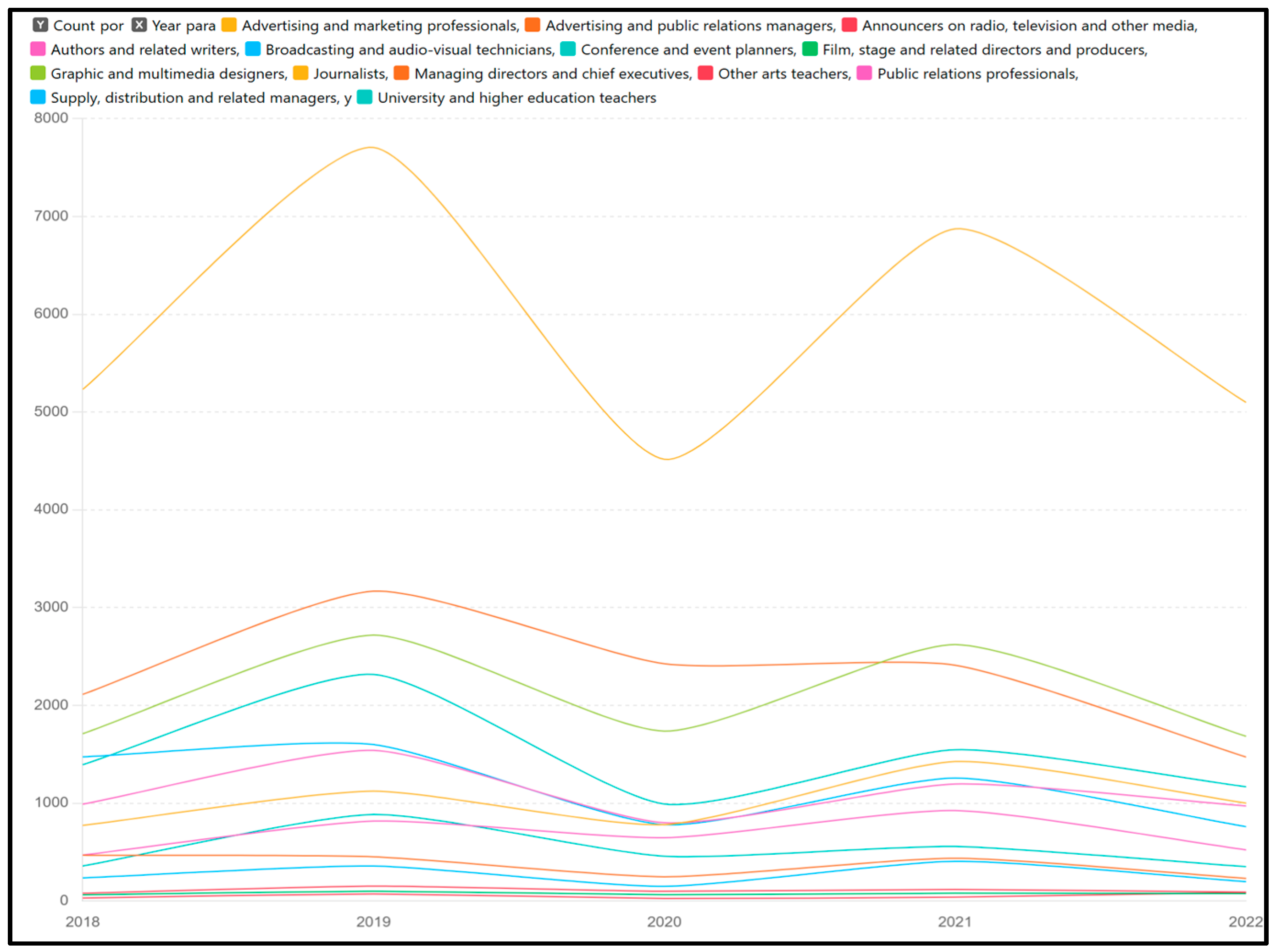
Figure 1 plots the annual number of job postings associated with Communication-related ESCO occupations in Spain between 2018 and 2023. The horizontal axis represents calendar years, and the vertical axis indicates the total volume of postings per year. The curve shows a marked pre-pandemic increase, a pronounced decline coinciding with the COVID-19 shock, and a subsequent rebound followed by partial adjustment, reflecting the sector’s sensitivity to macroeconomic conditions and digital transformation.
Between 2019 and 2020, total annual demand decreased by 40.4%, consistent with the impact of the COVID-19 pandemic, especially in sectors dependent on face-to-face events and public relations. In 2021, demand recovered by 45%, likely reflecting accelerated shifts towards digital models of marketing and communication, followed by a further decline of 31% in 2022, which may indicate labour-market stabilisation or post-pandemic adjustments. Several occupational groups (e.g., advertising and marketing professionals, general managers, and graphic/multimedia designers) show high volatility, with standard deviations indicating annual fluctuations of up to 25%. By contrast, occupations such as traditional media announcers and arts educators exhibit low volatility, remaining comparatively stable year-on-year.
The volatility pattern suggests that occupations such as advertising/marketing and graphic design are more sensitive to technological change and economic cycles, often resulting in shorter contracts and rapid demand adjustments. Demand for university teaching roles also varies, potentially linked to transitions between face-to-face and online education models. Conversely, low-volatility occupations benefit from the relative stability of traditional media structures and educational programmes.
3.3. Statistical Evidence of Differences in Skill Preference Across Professional Categories
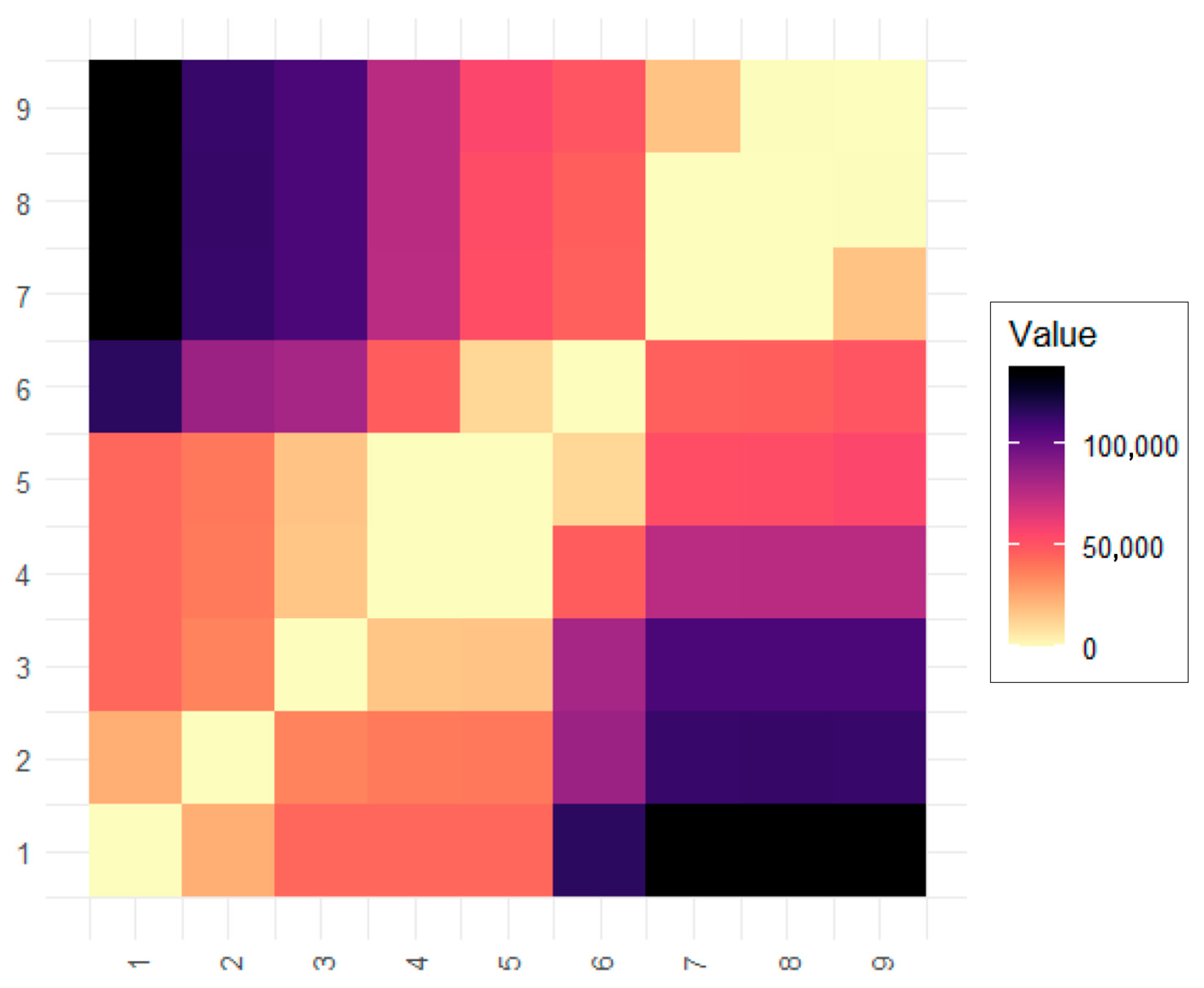
To assess whether the relative emphasis on transversal (soft) and technical skills varied across professional categories, we conducted a chi-square test of independence using a contingency table of skill type by professional grouping. The overall test was significant, , , , and Cramer’s , indicating a moderate-to-strong association between occupational grouping and skill emphasis. To examine whether this pattern was consistent across categories, pairwise comparisons were conducted between professional groupings. These comparisons were consistent with the overall test, indicating that the distribution of soft and technical skills was not homogeneous across professional categories.
Figure 2 presents a heatmap of the chi-square statistics for each pairwise comparison. Each cell represents a combination of two occupational groupings, with darker shading corresponding to higher chi-square values and, therefore, greater divergence from the null hypothesis of equal skill composition. The contrast between highly technical production roles and strategic management roles was among the most pronounced, reflecting marked differences in the balance between soft and technical skills.
Because the subsequent analyses focused on differences in the counts of soft and hard skills, we first tested the normality of these differences using the Shapiro–Wilk test. The results (W = 0.67632; p = 0.0004555) indicated that the assumption of normality was violated. Accordingly, a non-parametric paired two-sample Wilcoxon test was used instead of parametric alternatives such as the t-test or ANOVA. The Wilcoxon test yielded W = 82, p = 0.005859, indicating a statistically significant difference between the distributions of soft and hard skill counts across professions. The corresponding effect size (r = 0.54) suggests a substantial difference between skill types across professional categories. These results provide a robust basis for the descriptive and longitudinal analyses presented in the following sections.
3.4. Dispersion and Growth of Transversal Competencies Across Occupations
The distribution of transversal competencies across occupations shows considerable variability. On average, individual competencies account for 12.9% of representation, with values ranging from 0.07% to 100%. This wide dispersion suggests that some transversal competencies are highly occupation-specific, playing a central role in certain profiles while remaining marginal in others. For instance, among film and theatre directors/producers, competencies such as adjusting priorities and prioritising tasks show very limited representation (0.07%), indicating that these roles place greater emphasis on creative and leadership-related capabilities than on administrative ones. By contrast, in advertising and marketing occupations, competencies such as entrepreneurship, persuasion, proactivity, and public relations reach 100% representation, underlining their central importance in these professional contexts.
Overall, the observed distribution indicates that although some transversal competencies are strongly concentrated in specific occupations, many others show moderate or low representation across the occupational spectrum. Proactivity, persuasion, and public relations are especially prominent in marketing and advertising profiles, whereas adapting to change and generating ideas appear across several occupations at intermediate levels of representation. Communication and analytical thinking, in turn, display relatively consistent presence across occupations, suggesting that they function as cross-cutting competencies in roles that require both interpersonal interaction and problem-solving.
Several transversal competencies also exhibit marked growth over the observation period. Persuasion shows the largest increase (+466%), pointing to the growing importance of influencing audiences in increasingly saturated digital environments. Self-evaluation (+320.8%) and public relations (+300%) also rise substantially, reflecting greater emphasis on autonomy and online reputation management. Analytical thinking increases by 298.1%, in line with the expanding role of data-driven decision-making in digital marketing and communication. Comparable upward trends are observed for proactivity (+297.9%), creativity (+206.5%), and effective communication (+202.7%), all of which complement technical capabilities and support collaboration in remote and hybrid work settings.
3.5. Technical vs. Transversal Competencies by Occupation and Clustering of Profiles
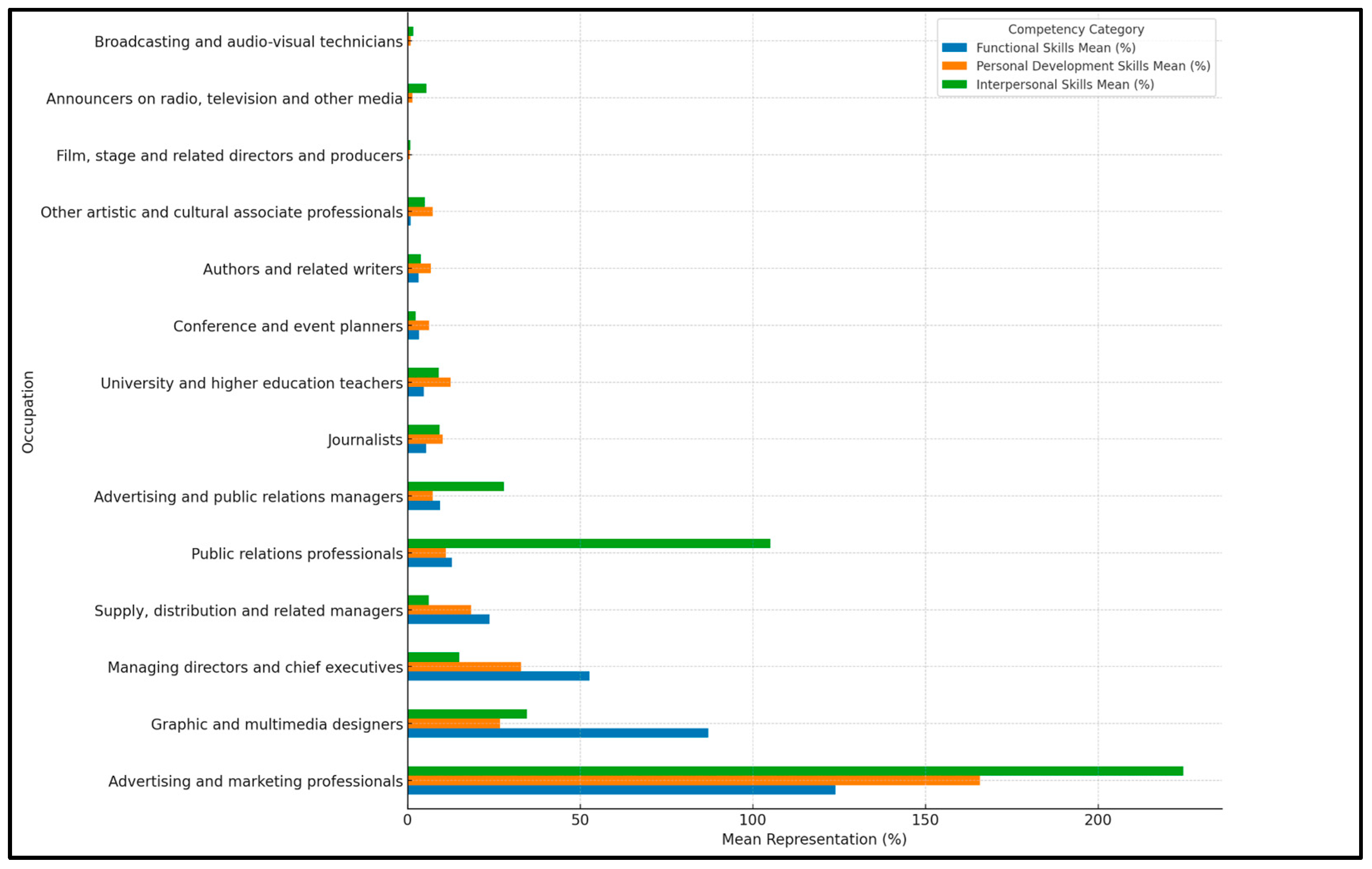
The percentage distribution of technical and transversal competencies across ESCO Level 1 occupations helps clarify which competency type predominates in communication-related roles. In occupations such as Communication Director and Media Planner, transversal competencies account for approximately 75% of the total, highlighting the relevance of interpersonal, leadership, and strategic decision-making skills in dynamic and collaborative environments. By contrast, occupations such as Graphic Designer and Content Editor show a higher proportion of technical competencies (around 70%), reflecting the importance of specialised operational skills, including image editing, proficiency in design software, and multimedia content production. Other roles, such as Journalist and Community Manager, display a more balanced distribution, with roughly equal proportions of transversal and technical competencies, suggesting that these occupations require both specialised technical capacities and interpersonal skills to investigate, write, communicate, and manage brand reputation on digital platforms.
Figure 3 illustrates these differences across occupations. Each bar represents an ESCO Level 1 occupation and displays the percentage of technical (dark segment) and transversal (light segment) competencies associated with that role. The figure reveals three broad profile types: occupations in which transversal competencies predominate, occupations dominated by technical competencies, and hybrid profiles characterised by a relatively balanced combination of both competency types.
A cluster analysis identified three main groups of occupations according to their competency profiles. Cluster 0 comprises roles primarily focused on technical and role-specific competencies (e.g., radio/TV announcers, authors and related writers), where accurate execution and domain-specific expertise are prioritised over managerial skills. Cluster 1 includes occupations requiring strong leadership and strategic management competencies (e.g., advertising and marketing professionals, public relations managers), in which interpersonal skills and decision-making are central. Cluster 2 brings together hybrid roles that balance technical and interpersonal competencies (e.g., graphic and multimedia designers, journalists), where both technical expertise and collaborative adaptability are valued. This statistically derived segmentation supports the identification of differentiated training pathways that align with distinct labour-market competency demands.
Alignment indices further quantify the extent to which curricular and labour-market skill sets coincide within each ESCO occupational family. Jaccard similarity values range from 0.21 to 0.58 (median = 0.37), indicating moderate overlap between competencies covered in curricula and those signalled in job postings. Expressed as percentage overlap, between 46% and 79% of curricular skills per occupation have a corresponding labour-market signal, whereas 28–52% of skills requested in job postings have no clear curricular counterpart. These patterns point to selective alignment, with stronger convergence in some occupational segments than in others.
3.6. Evolution of Key Competencies by Professional Category
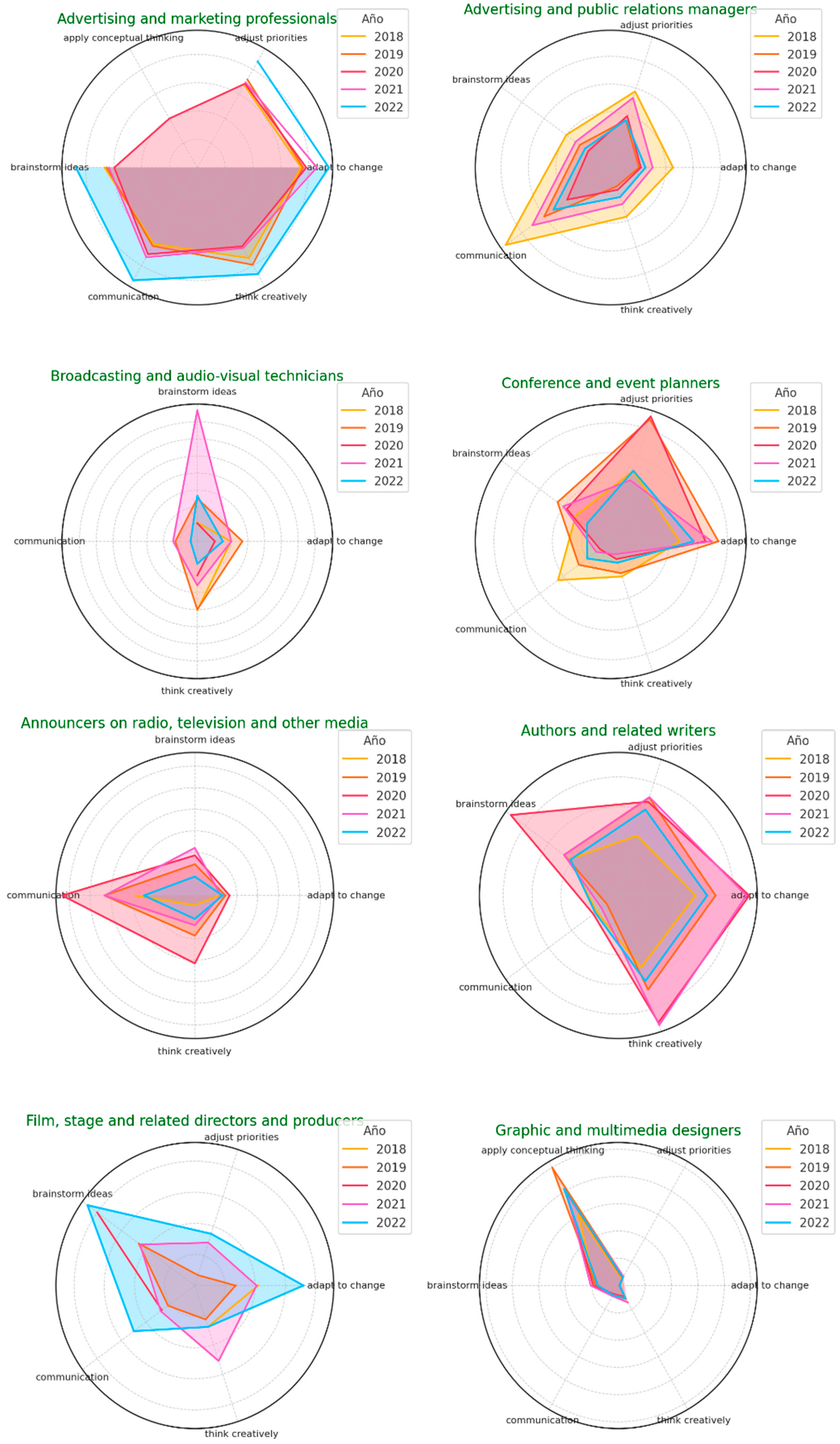
Competency trajectories over time reveal clear shifts across professional categories (
Figure 4). Adaptability and flexibility increase notably in several occupations: in Marketing/Advertising and Graphic/Multimedia Design, Adapt to Change rises from 8% to 15% between 2018 and 2023, while Teamwork among higher-education teaching roles increases from 62% to 73% over the same period. This pattern suggests a growing organisational need for rapid adjustment to changing trends and emerging technologies.
Competencies associated with creative thinking and innovation (e.g., Think Creatively, Brainstorm Ideas) remain high among graphic and multimedia designers and increase substantially in higher-education teaching roles, potentially reflecting digitalisation and greater demand for innovative pedagogical approaches. Leadership and strategic management competencies also rise in occupations related to Advertising/PR management and distribution/logistics functions, indicating stronger emphasis on informed decision-making and team management in complex operating environments.
Communication and collaboration competencies show similar upward trends in occupations such as marketing/advertising professionals and journalists. For example, Communication increases from 25% to 33% in marketing/advertising roles, and journalists’ Adapt to Change rises from 7% to 12% between 2018 and 2023. Analytical thinking also grows, particularly in marketing (from 25% to 33%), consistent with increased data availability and wider adoption of analytics tools, whereas in higher education it remains relatively stable (around 9.5%), underscoring its continued relevance for structuring and analysing academic content
4. Discussion
By combining ESCO-mapped occupational families, technical versus transversal skill classifications and overlap/volatility indicators, the study translates this multidimensional view of employability into empirically tractable variables that can be examined across communication-related occupational segments.
Graduate employability in Communication Studies increasingly depends on a dynamic balance between advanced technical competencies and adaptive transversal competencies (soft skills). Both the specialised literature and the evidence from this study indicate that mastering tools, platforms, or production languages is no longer sufficient on its own; labour markets increasingly value profiles that integrate technical expertise with cognitive, social, and ethical capabilities to operate in complex and uncertain environments (
Porter & Kramer, 2006;
Blázquez et al., 2020). In line with contemporary employability theory, this implies that Communication degrees should be understood as builders of employability portfolios—combining human and social capital, career adaptability, and proactive behaviours—rather than as providers of narrow, tool-specific qualifications (
Donald et al., 2024;
Donald, 2024;
Baruch, 2022;
Yorke, 2004,
2006).
At the same time, our results indicate that limited standardisation in how programmes describe occupational outputs—and their uneven alignment with international taxonomies such as ESCO—reduces cross-institution comparability and complicates strategic curriculum adaptation (
European Commission, 2017;
European Commission, 2025;
FUNDAE, 2017). Differences in the labelling and grouping of professional profiles and competencies make internal quality assurance and external benchmarking more difficult and hinder employers’ interpretation of graduate profiles across institutions (
Álvarez-Nobell et al., 2022). The ESCO-based mapping addresses part of this problem by providing a common occupational and skills language, although our analysis also shows that programmes do not yet exploit this vocabulary in a systematic way (
European Commission, 2017;
FUNDAE, 2017).
The ESCO-based mapping reveals a shared core of occupational profiles and competencies that structure Communication Studies training in Spain. ESCO codes associated with Audiovisual Director and Screenwriter appear across all analysed institutions, while profiles related to visual and sound post-production are present in most cases). This convergence suggests that Spanish universities share a foundational understanding of the professional profiles that define the field (
Álvarez-Nobell et al., 2022). At the same time, institution-specific ESCO codes point to strategies of differentiation and niche specialisation that respond to particular labour-market segments and local academic traditions (
Meza-Rivera et al., 2025). From an employability perspective, this combination of a shared core with targeted niches can be interpreted as a form of portfolio diversification within the discipline (
Tomlinson, 2017;
Holmes, 2013;
Clarke, 2018).
The inferential results reinforce this interpretation and lend robustness to the discussion on alignment. The chi-square tests show that soft-skill preferences are not homogeneous across professional groupings, and the pairwise heatmap indicates that the magnitude of these differences varies by category. In addition, the Shapiro–Wilk and Wilcoxon tests support the view that differences in soft-skill count distributions across professional categories are systematic rather than random. Together with the alignment indices—which reveal varying degrees of overlap between curricular and labour-market skill sets across occupational families—these findings enable a discussion of employability that goes beyond listing “what is included” in curricula, towards diagnosing where alignment and misalignment are most salient by segment and competency area (
Brunello & Wruuck, 2021;
Lee & Meng, 2021;
Succi & Canovi, 2020).
4.1. Audiovisual Communication
In Audiovisual Communication, the results confirm that technical competencies related to editing, post-production, and production workflows remain essential and are consistently embedded in programme documentation through ESCO mappings associated with audiovisual direction and screenwriting. This supports the view that, despite digitalisation and the proliferation of new formats, mastery of core audiovisual languages and production processes continues to be a central pillar of employability (
Medina et al., 2023;
García Caballero, 2020).
At the same time, the findings suggest a gap in the systematic incorporation of emerging technologies. While recent scholarship advocates integrating Virtual Reality (VR), Augmented Reality (AR), and Artificial Intelligence (AI) into Communication curricula (
Guerrero-Solé & Ballester, 2023;
Martín-Moraleda et al., 2025;
Anshari et al., 2022), our results indicate uneven adoption across institutions. Universities such as UOC and UPF appear more advanced in incorporating content related to immersive environments, data analytics, or process automation, but these initiatives have not yet been generalised across the system. This generates a potential misalignment between the pace of technological change in the audiovisual industry and the capacity of higher education institutions to integrate these innovations into formal curricula (
Amodu et al., 2019;
Abulibdeh et al., 2023;
Pavlik, 2013).
Regarding transversal competencies, adaptability, analytical thinking, creativity, and teamwork recur in both the White Paper and the analysed verification reports (
Estanyol i Casals, 2017). The emphasis on collaboration is consistent with the cooperative and interdisciplinary nature of audiovisual production (
Medina et al., 2023). In line with this, job-vacancy analytics show growth in competencies such as adapting to change, thinking analytically, and proposing ideas, suggesting that these capacities function not as secondary complements to technical training but as increasingly central components of employability in a production landscape that is distributed, data-driven, and partially automated (
Dwivedi et al., 2021;
Achoki, 2023;
Fana et al., 2022).
4.2. Advertising and Public Relations
In Advertising and Public Relations, the results point to the need for a hybrid professional profile that integrates creativity, analytical competencies, and strategic management capabilities. Recent literature underscores that campaign effectiveness depends not only on creative output but also on the ability to interpret data, segment audiences, and adjust strategies in real time (
Estanyol i Casals, 2017;
Sánchez-Riaño & Sojo-Gómez, 2024). The strong growth in labour-market demand for competencies linked to public relations and persuasion supports this interpretation, highlighting the increasing centrality of influence, reputation management, and relational work in digitally saturated environments (
Gass & Seiter, 2022;
Grunig & Grunig, 2008;
Alfonso & Suzanne, 2008;
Moukdad & Juidette, 2024).
However, the observed growth in proactivity, self-evaluation, and analytical thinking indicates that employability increasingly depends on professionals capable of anticipating change, evaluating outcomes critically, and making evidence-informed decisions (
Donald et al., 2024;
Thornhill-Miller et al., 2023;
Loumpourdi, 2021). This aligns with research warning against over-weighting purely instrumental platform knowledge at the expense of interpersonal and strategic capacities such as negotiation, empathy, and relationship-building (
Velosa et al., 2023;
Majid et al., 2020;
Okonkwo & Namkoisse, 2023). In this context, the competency compositions observed in roles such as Community Manager or Communication Director—where transversal competencies represent a substantial share—reinforce the idea that employability in this field is tightly coupled with strategic and relational capacity rather than tool mastery alone (
Commission on Public Relations Education, 2018;
VanDyke & Lee, 2020;
Restrepo-Morales et al., 2023).
4.3. Journalism
In Journalism, our results and the existing literature converge on the relevance of crisis management, critical analysis, and information verification as core professional competencies (
Blanco & Moreno, 2024). In an information ecosystem marked by disinformation, polarisation, AI-generated content, and shifting news consumption patterns (
Newman, 2024), the growing emphasis on effective communication is closely linked to sustaining rigour, clarity, and ethical standards in news production (
Gass & Seiter, 2022). Universities similarly stress the evaluation of source reliability and quality and incorporate, to varying degrees, media literacy, fact-checking, and digital ethics into their programmes (
Montemayor-Rodríguez & Torregrosa-Carmona, 2023).
Our findings suggest that analytical thinking, critical thinking, and adaptability remain stable or gain relative importance, indicating that Journalism curricula are beginning to respond to the combined pressures of automation and disinformation (
Dwivedi et al., 2021;
McGuinness et al., 2023;
García Caballero, 2020). Nonetheless, a key challenge lies in fully integrating generative AI both as an object of critical inquiry and as a practical tool within journalistic workflows, particularly in relation to verification, accountability, and professional ethics (
Guerrero-Solé & Ballester, 2023;
Volodenkov & Fedorchenko, 2022;
Carlson, 2018;
Diakopoulos, 2019).
The more balanced competency profile often required in journalistic roles suggests that contemporary journalists must combine technical foundations for content production and editing with interpretive and ethical capacities to contextualise information, engage audiences, and collaborate in multidisciplinary teams (
Holmes, 2013;
Pavlik, 2013).
4.4. Labour-Demand Evolution and Implications for Curriculum Alignment
Longitudinal vacancy analytics provide a clear temporal reading of labour demand for Communication-related occupations. Demand drops substantially during the pandemic period, rebounds as digital communication models accelerate, and subsequently stabilises under post-pandemic adjustment dynamics (
Medina et al., 2023;
Estanyol i Casals, 2017). These fluctuations underscore the sector’s sensitivity to external shocks and technological transformation, while also evidencing its capacity for resilience (
Brunello & Wruuck, 2021). Consistent with prior studies, the communication sector in Spain appears to have weathered the pandemic comparatively well due to earlier digital transitions in business models (
Medina et al., 2023;
FBBVA, 2024). The recovery phase aligns with shifts towards digital content consumption, platform growth, and online advertising, which have expanded opportunities for profiles that combine digital competencies with adaptive capacity (
Dwivedi et al., 2021;
Achoki, 2023;
Ng, 2020).
The results also show that volatility differs across occupations. Advertising/marketing and graphic/multimedia design roles experience stronger year-to-year fluctuations, reflecting exposure to advertising investment cycles, rapidly evolving digital strategies, and short tool life-cycles (
Estanyol i Casals, 2017;
McGuinness et al., 2023). By contrast, more traditional media roles display higher stability, suggesting relatively constant—though not necessarily growing—demand linked to consolidated organisational structures (
Medina et al., 2023). From an alignment perspective, this implies that curricula designed for more volatile segments may require more frequent updates and a stronger emphasis on adaptability, whereas programmes associated with more stable occupational niches can focus on consolidating enduring competencies and ethical standards (
Tomlinson, 2017;
Holmes, 2013;
Deming, 2017;
Restrepo-Morales et al., 2023).
Our alignment indices further indicate that the overlap between curricular and labour-market skill sets varies across ESCO occupational families. In some segments, a substantial share of curricular skills finds a direct counterpart in labour-market signals, while in others the overlap is more limited and several demanded skills lack a clear curricular counterpart (
Brunello & Wruuck, 2021;
Lee & Meng, 2021,
Ojan et al., 2025a). Rather than a uniform mismatch, the evidence points to selective misalignments concentrated in specific segments and competency areas, particularly those related to emerging AI/data/ethics domains and to highly analytic or entrepreneurial competencies (
Abulibdeh et al., 2023;
Volodenkov & Fedorchenko, 2022;
Ojan et al., 2025b).
4.5. Synthesis in Relation to RQ1–RQ3
Taken together, these results provide a coherent response to the three research questions. For RQ1, the ESCO mapping of official programme documentation reveals a consolidated core of Communication-related occupational profiles and transversal competencies shared across leading Spanish faculties, alongside institution-specific profiles that signal purposeful specialisation (
Álvarez-Nobell et al., 2022;
Meza-Rivera et al., 2025). For RQ2, job-vacancy analytics show that labour demand is sensitive to macro shocks and technological shifts, with distinct volatility patterns across occupational families (
Medina et al., 2023;
McGuinness et al., 2023;
Fana et al., 2022). For RQ3, the combined descriptive, inferential, and alignment evidence indicates that curricula and labour-market profiles do not follow a uniform skills template: soft-skill preferences vary significantly across professional groupings, and observed differences are systematic rather than random (
Brunello & Wruuck, 2021;
Deming, 2017).
4.6. Implications for Curriculum Redesign and Employability Strategies
Second, the evidence on selective alignment and segment-specific gaps supports instituting periodic skills-calibration cycles that combine ESCO-based curricular mapping, job-vacancy analytics, and stakeholder input. An annual or biannual review involving academic staff, employers, and alumni could track shifts in competency demand, monitor where alignment indices deteriorate or improve, and prioritise adjustments in those occupational segments that display the most pronounced gaps (
Brunello & Wruuck, 2021;
Lee & Meng, 2021;
Fundación CYD, 2025;
Lightcast, 2025).
Third, the cluster structure of competency profiles indicates that curricula may benefit from more clearly differentiated pathways aligned with distinct occupational segments. Technically intensive pathways would emphasise advanced production tools and workflows while ensuring a transversal foundation; strategic-relational pathways would foreground leadership, persuasion, negotiation, and ethical judgement; and hybrid pathways would integrate technical, analytical, and interpersonal competencies more evenly (
Tomlinson, 2017;
Donald et al., 2024;
Succi & Canovi, 2020;
Romero Martínez & Joya Bonilla, 2024;
Zahir, 2021). Explicit pathways can help students build employability portfolios tailored to specific labour-market niches.
Fourth, given the cross-cutting importance of AI, data, and ethics in the observed skill patterns, embedding an AI/data/ethics spine across the curriculum appears more effective than relying on isolated electives (
Abulibdeh et al., 2023;
Volodenkov & Fedorchenko, 2022). Progressive integration—from foundational literacy to applied modules and capstone experiences—would support graduates in understanding and critically evaluating AI-enabled communication practices, interpreting data responsibly, and navigating the ethical challenges of data-intensive environments (
Guerrero-Solé & Ballester, 2023;
Montemayor-Rodríguez & Torregrosa-Carmona, 2023;
Henseruk et al., 2021;
Trostinskaia et al., 2017;
Makhachashvili & Semenist, 2025).
Finally, performance-based assessment of transversal competencies and stronger university–industry co-governance can make employability claims more credible. Evaluating analytical thinking, adaptability, teamwork, persuasion, and ethical judgement through authentic tasks—such as real briefs, simulations, portfolios, peer assessment, and reflective evaluation—would render soft skills more observable and assessable (
Camarinha-Matos et al., 2020;
Belchior-Rocha et al., 2022;
Majid et al., 2020). In parallel, structured collaborations with industry—including advisory boards, co-designed projects, placements, practitioner-led studios, and joint evaluation panels—can help keep competency priorities current, validate the occupational relevance of ESCO-mapped profiles, and preserve distinctive academic specialisations (
Commission on Public Relations Education, 2018;
Lee & Meng, 2021;
Fundación CYD, 2025;
FBBVA, 2024).
5. Conclusions
Communication-related labour markets are undergoing accelerated transformation, and employability increasingly depends on a strategic balance between (i) digital/technical competencies and (ii) adaptive transversal competencies (soft skills) that support performance under uncertainty, rapid technological change, and complex stakeholder environments (
Deming, 2017;
Yorke, 2006). Drawing on an integrated analysis of 2,701,503 job postings (2018–2023) and a systematic review of official curricular documentation from five leading Spanish universities mapped to ESCO, this study shows that Communication Studies programmes share a substantial common core of occupational profiles and competencies, while selective misalignments persist between curricular emphasis and dynamic labour-market signals (
European Commission, 2017;
Lightcast, 2025).
In relation to RQ1, the ESCO-based mapping of official programme documentation identifies a consolidated set of Communication-related occupational profiles that structure the discipline across institutions. Most ESCO Level 1 codes appear in more than one university, indicating curricular convergence around foundational professional profiles, whereas a smaller subset of institution-specific codes signals purposeful differentiation and niche specialisation (
Álvarez-Nobell et al., 2022;
Meza-Rivera et al., 2025). This pattern suggests that Spanish universities maintain a shared disciplinary core while deploying specialisation strategies that may enhance their positioning in local or sector-specific labour markets (
Tomlinson, 2017;
Clarke, 2018).
Regarding RQ2, job-vacancy analytics reveal that labour demand for Communication occupations fluctuated markedly over 2018–2023 and differs substantially across occupational families. The sector is sensitive to macroeconomic shocks and technology-driven restructuring, yet also demonstrates adaptive recovery dynamics consistent with earlier digital transitions in business models (
Medina et al., 2023;
Estanyol i Casals, 2017). Importantly, demand volatility is not uniform: some families (e.g., marketing/advertising and graphic/multimedia design) exhibit higher year-to-year variability, whereas other profiles display greater stability. This implies that employability strategies and curricular priorities should be tailored to occupational segments with distinct exposure to technological and economic cycles (
Brunello & Wruuck, 2021;
McGuinness et al., 2023;
Ng, 2020).
For RQ3, the findings indicate that transversal competencies are increasingly prominent in labour-market signals and that the competency mix varies systematically by occupation: strategic roles tend to place greater relative emphasis on transversal competencies, production-oriented roles prioritise technical competencies, and several occupations require hybrid profiles (
Deming, 2017;
Heckman & Kautz, 2012). The inferential results reinforce this conclusion: soft-skill preference differs significantly across professional groupings, and variations in soft-skill count distributions across categories are systematic rather than random. Alignment indices further show that overlap between curricular and labour-market skill sets is stronger in some occupational families than in others. Taken together, these results support diagnosing alignment and misalignment by occupational segment rather than assuming a uniform skills template for Communication Studies, and they highlight a key employability risk in the uneven curricular integration of emerging areas—particularly AI/data/ethics-related competencies—where labour-market adoption may outpace curriculum revision cycles (
Abulibdeh et al., 2023;
Volodenkov & Fedorchenko, 2022;
Ojan et al., 2025a).
These conclusions translate into several practical implications for curriculum governance and redesign. ESCO can serve as a shared reference language that enhances comparability and supports quality assurance without constraining academic autonomy (
European Commission, 2017;
European Commission, 2025;
FUNDAE, 2017). Institutions should formalise periodic skills-calibration processes that triangulate ESCO-mapped curricular profiles, job-vacancy analytics, and employer/alumni input to reduce curriculum lag (
Brunello & Wruuck, 2021;
Lee & Meng, 2021;
Fundación CYD, 2025;
Lightcast, 2025). Programmes can improve coherence and student guidance by developing differentiated pathways aligned with occupational segments (technical, strategic-relational, and hybrid) while preserving a shared core of disciplinary competencies, and by embedding AI literacy, data interpretation, and ethical judgement as a progressive spine across curricula rather than confining them to isolated electives (
Tomlinson, 2017;
Donald, 2024;
Abulibdeh et al., 2023).
Finally, transversal competencies should be assessed through performance-based evidence—authentic projects, simulations, portfolios, and reflective evaluation—supported by structured university–industry co-governance mechanisms (advisory boards, co-designed briefs, placements, practitioner-led studios, and joint evaluation panels) that validate occupational relevance while preserving distinctive academic specialisations (
Camarinha-Matos et al., 2020;
Belchior-Rocha et al., 2022;
Fundación CYD, 2025). This study has limitations that shape interpretation and point to future work: the curricular sample covers five prominent Spanish universities and does not capture the full diversity of national provision or broader Euromediterranean contexts, and the 2018–2023 job-posting window cannot reflect the very latest shifts or enable precise forecasting.
Future research should therefore expand institutional coverage, undertake cross-country comparisons using a shared ESCO mapping protocol, incorporate updated vacancy data and predictive modelling, and complement document and analytics approaches with qualitative evidence from employers, graduates, and faculty (
Greene et al., 1989;
Johnson & Onwuegbuzie, 2004). Overall, employability in Communication Sciences emerges as a multidimensional challenge requiring coordinated action from higher education, industry, and policy; using ESCO as a common language and labour-market intelligence as a calibration tool offers a feasible route to sustaining a strong shared core while developing specialised, future-facing pathways (
Sellwood et al., 2024).