1. Introduction
Teaching is inherently stressful, and over the past five years, workload, boundary blurring, and emotional labor have intensified to unsustainable levels. Longitudinal evidence confirms that teacher distress persists and exceeds that of comparable professionals on every well-being indicator (
Pressley, 2021;
Steiner et al., 2025). Consequences extend to student achievement, motivation, and educational equity (
Kraft & Lyon, 2022). Gaps remain in understanding (a) intervention effectiveness across ecological levels, (b) policy adequacy, and (c) structural barriers to sustainable change. This review synthesizes evidence across these domains and critiques the evidence hierarchy that may bias resources toward low-impact individual interventions. We investigate whether persistence of teacher distress is better explained by how the field defines, studies, and responds to the problem than by individual resilience deficits. This is a guiding hypothesis, not a predetermined conclusion.
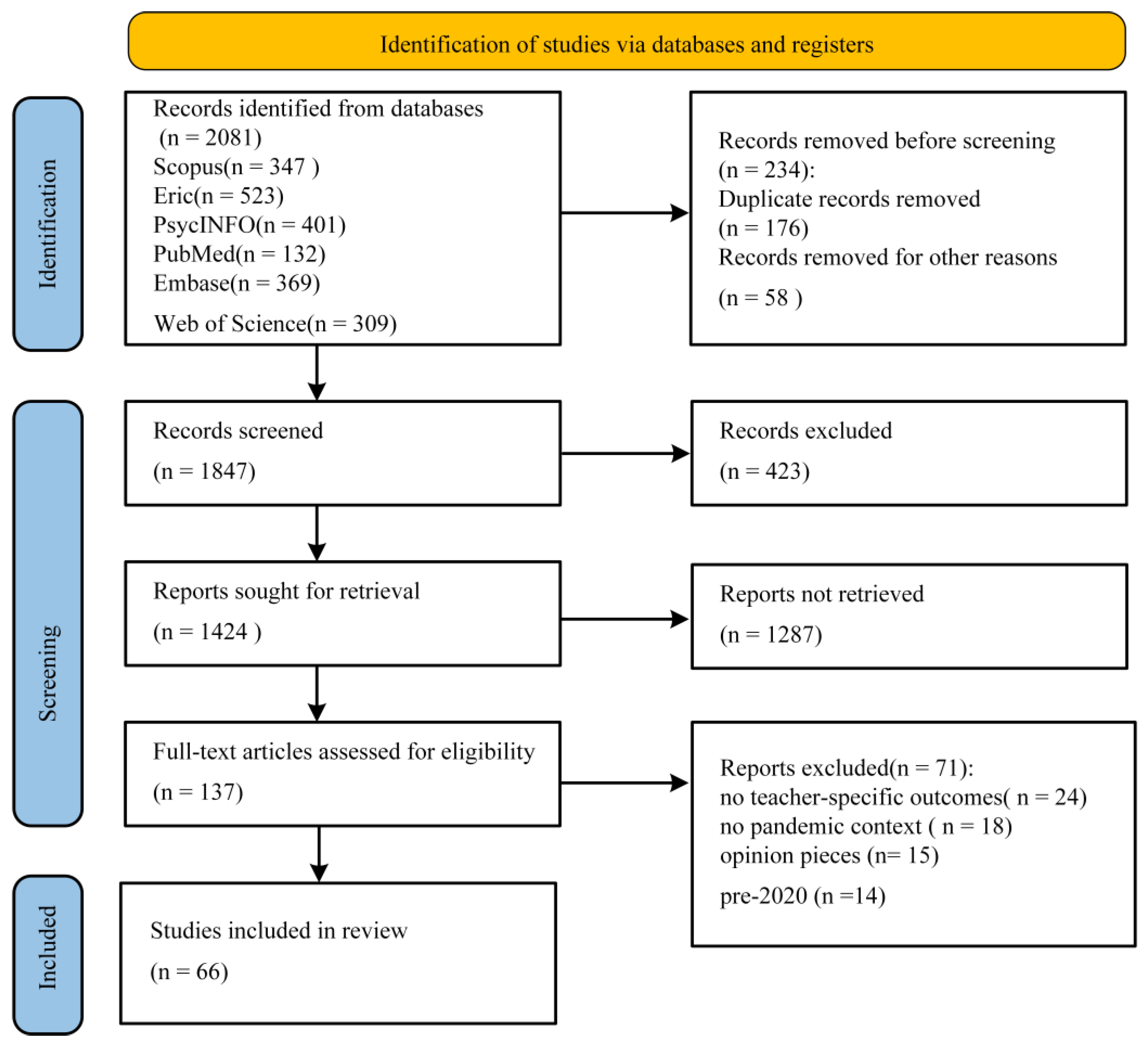
For this review, the pandemic period is 2020–2022 and the post-pandemic recovery period is 2023–2026. Studies from both periods were eligible because the review examines persistence and recovery; primary synthesis and policy analysis focus on 2023–2026, with sensitivity analyses in
Section 3.1 and
Supplementary Table S1. This manuscript has two functions: (a) a systematic review of empirical evidence on teacher mental health, and (b) development of a theoretical framework (Three-Tier Integrative Framework and EHMT). To avoid conflating these, we use the following explicit labels: [empirical finding], [theoretical interpretation], [policy implication], [normative proposal], and [speculative hypothesis].
Section 2 describes the method;
Section 3 reports empirical findings only;
Section 4 develops theoretical interpretation, policy implications, and normative proposals.
Section 4.5 grades each proposition, and
Supplementary Table S2 maps each component based on its method, evidence standard, and interpretive status.
1.1. Theoretical Framework: A Three-Tier Integrative Model
This section is conceptual and develops a testable framework, not an established causal model. Existing models are too narrow (JD-R explains individual-level job characteristics but lacks structural and moral dimensions), too abstract (Bronfenbrenner’s ecology describes contexts but offers no mechanism for resource allocation), or too critical without prescription (social justice scholarship diagnoses inequity but rarely specifies intervention loci). We integrate these as nested, sequentially ordered strata. JD-R specifies proximal psychological mechanisms (demands → strain → burnout) (
Bakker & Demerouti, 2017); Bronfenbrenner maps multi-level contexts; and a structural–social justice lens identifies inequities by race, class, and gender that JD-R’s value-neutral formulation obscures. The result is explanatory, ecological, and critical.
Three tiers are distinguished by primary locus of intervention, not by the nature of the problem:
Macro-level (structural): This includes policy regimes, funding inequities, and systemic discrimination. These allocate demands and resources unequally; per-pupil expenditure predicts administrative support staffing ratios (
Mccarthy et al., 2025). [Theoretical construct].
Meso-level (organizational): This includes school leadership, administrative support, professional culture, and working conditions. These are shaped by macro-level decisions and mediate structural conditions in daily experience. [Theoretical construct].
Micro-level (individual): This includes coping, self-efficacy, emotional regulation, and psychological resources. These are proximal influences but are shaped by macro and meso contexts. [Theoretical construct].
A micro-level intervention targets the individual teacher regardless of problem origin. This precision frames the mismatch documented in
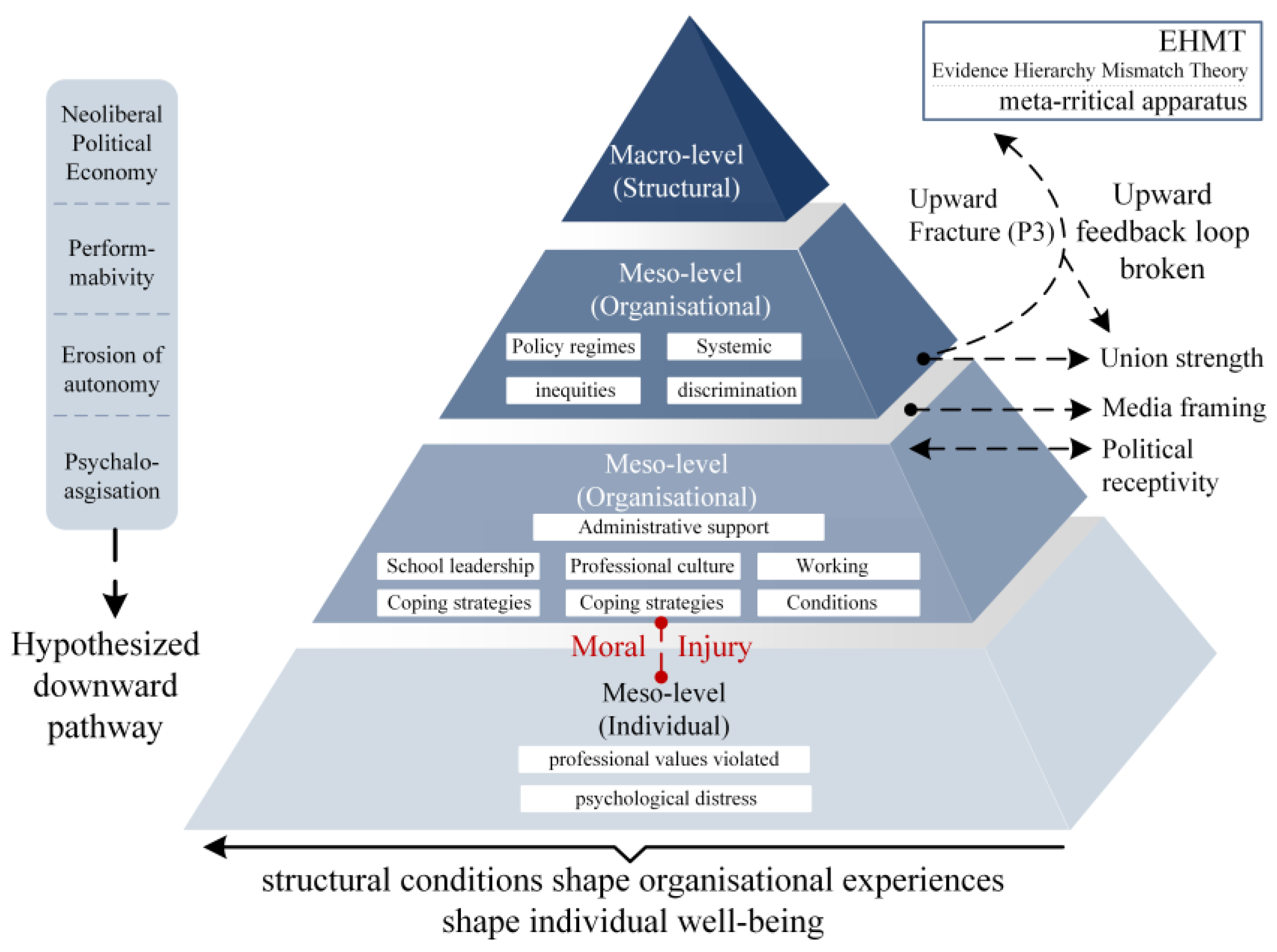
Section 3.2: most interventions target the micro level, while drivers may operate primarily at macro and meso levels. The hypothesized downward pathway (macro → meso → micro) proposes that funding cuts reduce administrative support, increasing workload and eroding well-being. This is consistent with observational evidence but not causally confirmed. Upward feedback (micro → macro) is hypothesized to be conditional on union strength, media framing, and political receptivity; where these are weak, the loop may remain fractured—the “upward fracture” (P3). This is an active mechanism of responsibility diffusion, not passive absence: individual distress is psychologized (
Zembylas, 2021) and structural grievances are translated into personal deficits, preempting collective policy claims. This occurs within a neoliberal political economy of accountability, performativity, and eroded autonomy (
Acuña, 2024).
Figure 1 illustrates the framework.
1.1.1. Moral Injury as a Candidate Bridging Construct
We propose moral injury as a testable hypothesis, not an established finding. Two claims are distinguished. The first is an observed-evidence claim: qualitative studies document teachers describing betrayal, guilt, shame, and value violation when institutional constraints prevent fulfillment of professional duties of care (
Sokal et al., 2020;
Loh & Hu, 2014). The second is a hypothesized mediation claim: moral injury mediates structural constraints and burnout/attrition. The first is empirically anchored but limited to qualitative and cross-sectional accounts; the second remains speculative and untested with validated instruments or longitudinal mediation.
Teacher moral injury is defined as psychological distress (guilt, shame, betrayal, and demoralization) when teachers are compelled by policies, directives, or resource constraints to violate professional values and duty of care. It is incremental to burnout, demoralization, work stress, emotional exhaustion, and compassion fatigue. Moral injury is incremental to burnout, demoralization, work stress, emotional exhaustion, and compassion fatigue; a full construct comparison is provided in
Supplementary Table S3. Operationalization: the Moral Injury Events Scale (MIES) was adapted as T-MIES, with dimensions including betrayal by institution/leadership/policy, guilt over constrained care, shame regarding professional identity, moral distress from value violation, and demoralization from repeated value violation. Validation requires content validity with teachers and teacher educators; discriminant validity against burnout (MBI), depression (PHQ-9), anxiety (GAD-7), and compassion fatigue (ProQOL); incremental validity predicting burnout/attrition; and three-wave longitudinal mediation. Current evidence remains qualitative and cross-sectional; no validated teacher-specific instrument or longitudinal mediation exists. Moral injury is therefore graded speculative in
Section 4.5.
1.1.2. Limits of the Military–Education Analogy
The analogy is heuristic, not ontological. We do not equate teaching with combat or claim identical moral injury. Four limits apply. The first limit is purpose and role: military moral injury involves existential threat, lethal force, and command responsibility; teaching involves developmental care, pedagogy, and professional judgment. The second limit is organizational structure: militaries are command hierarchies; schools are professional bureaucracies with distributed autonomy. Betrayal in teaching may appear as policy contradiction, resource scarcity, administrative indifference, or accountability pressure. The third limit is exposure: military moral injury often involves discrete high-intensity events; teacher moral injury is chronic, cumulative, and institutional. The fourth limit involves consequences and measurement: military moral injury is linked to PTSD, depression, and suicide risk; teacher distress is expressed as burnout, demoralization, guilt, shame, and attrition. Instruments cannot transfer without adaptation. School governance may condition expression—high-stakes accountability may produce metric-driven value violation, while low-stakes systems may differ—but comparative evidence is hypothesis-generating only. Conceptual overreach risks pathologizing teaching, militarizing discourse, obscuring moral rewards, conflating constructs, and importing unadapted measures. Moral injury remains a bounded, provisional candidate mechanism.
1.2. Distinction from Prior Reviews and Evidence Hierarchy Mismatch Theory
Table 1 summarizes key distinctions from prior reviews.
EHMT is a meta-theoretical proposition. The empirical finding it explains is the tier distribution in
Section 3.2: 91.7% of intervention studies target the micro level and 0% evaluate macro-level reforms. EHMT itself is not empirical. It comprises three claims:
C1 Descriptive [empirical]: Published intervention evidence is systematically skewed toward micro-level interventions and away from macro-level reforms.
C2 Explanatory [theoretical]: This skew is hypothesized to arise from epistemological, institutional, and practical biases. Epistemological bias is uncritical transplantation of the medical RCT hierarchy; institutional bias is funding and publication incentives favoring short-term, controllable studies; practical bias is RCT infeasibility for system-level reforms.
C3 Consequential [theoretical]: This may lead to epistemic foreclosure: macro-reforms remain under-evidenced, under-funded, and rarely evaluated.
Only C1 is supported by the tier distribution; C2–C3 are theoretical. The critique is not of RCTs as a method but of uncritical hierarchy treating RCTs as universally superior (
Coppe et al., 2025;
Parra & Edwards, 2024). RCTs remain valuable where randomization is feasible, ethical, and appropriate. The paradox is that macro-structural reforms (salary equalization, class-size mandates, and accountability redesign) may have the greatest population-level potential but are RCT-infeasible, while micro-interventions (mindfulness and CBT) are RCT-easy but may have minimal sustainable systemic impact. An “inverse evidence law” may operate (
Nutbeam, 2004): we may know the least about interventions with the greatest population potential. Quasi-experimental designs—interrupted time series, difference-in-differences, and comparative case studies—are appropriate and complementary (
Petticrew & Roberts, 2003).
Five competing explanations must be considered: financial limitations; measurement difficulty; publication patterns; policy data access; and political difficulties. EHMT is therefore one plausible explanation, and is not proven. Its distinctive prediction—that even when controlling these factors, the evidence hierarchy independently reduces prioritization of macro-level quasi-experimental evaluation—remains untested.
Table S4 summarizes these explanations. EHMT is bounded to evaluative evidence cultures in high-income, Anglophone-dominated systems; it does not explain policy adoption or implementation fidelity.
1.3. Research Questions and Propositions
Propositions are hypotheses to be evaluated, not conclusions established in advance. Their empirical weight is assessed in
Section 4.5.
RQ1: What is the prevalence and nature of teacher mental health difficulties in the post-pandemic era?
P1 (Hypothesized Downward Pathway). Macro-level funding inequities predict meso-level resource constraints, which predict micro-level distress, mediated by workload and accountability pressure. Individual links are supported by cross-sectional and multi-level evidence, but the complete macro–meso–micro mediation chain has not been tested longitudinally or causally. Grade: Moderate.
RQ2: What interventions have been implemented, and what is the evidence for their effectiveness, with attention to tier distribution and sustainability?
P4 (Evidence Hierarchy Mismatch). The distribution of published intervention studies is systematically biased toward micro-level interventions due to epistemological, institutional, and practical biases, not population-level impact assessments. See C1–C3. P4a (descriptive): Moderate. P4b (explanatory): Speculative.
P5 (Macro-Level Effectiveness). Macro-level structural reforms may produce greater population-level reductions in teacher distress than micro-level interventions. No peer-reviewed study in the identified quantitative effectiveness literature has evaluated a macro-level reform; comparative effectiveness remains untested. Grade: Speculative.
RQ3: What policy responses have been developed, and what persistent gaps remain?
P3 (Hypothesized Upward Fracture). The upward feedback loop (micro → macro) is moderated by (P3a) union density, (P3b) media framing, and (P3c) political receptivity. Where these are weak, the loop remains fractured. This is an active mechanism of systemic responsibility diffusion, not passive absence, and is institutionally produced and discursively maintained. Grade: Weak.
P2 (Moral Injury as Candidate Mediator). Resource constraints and accountability demands predict teacher moral injury, which mediates the relationship between working conditions and burnout/attrition. Grade: Speculative. Its theoretical function is to explain why individual-level interventions may systematically fail, thereby reinforcing EHMT.
The propositions vary in empirical weight, from moderate (P1, P4a) to weak (P3) and speculative (P2, P4b, P5).
Section 4.5 provides explicit grading to distinguish established findings from directional inferences and untested hypotheses.
3. Results
3.1. Hypothesized Downward Pathway: Macro-Level Inequities and Micro-Level Distress
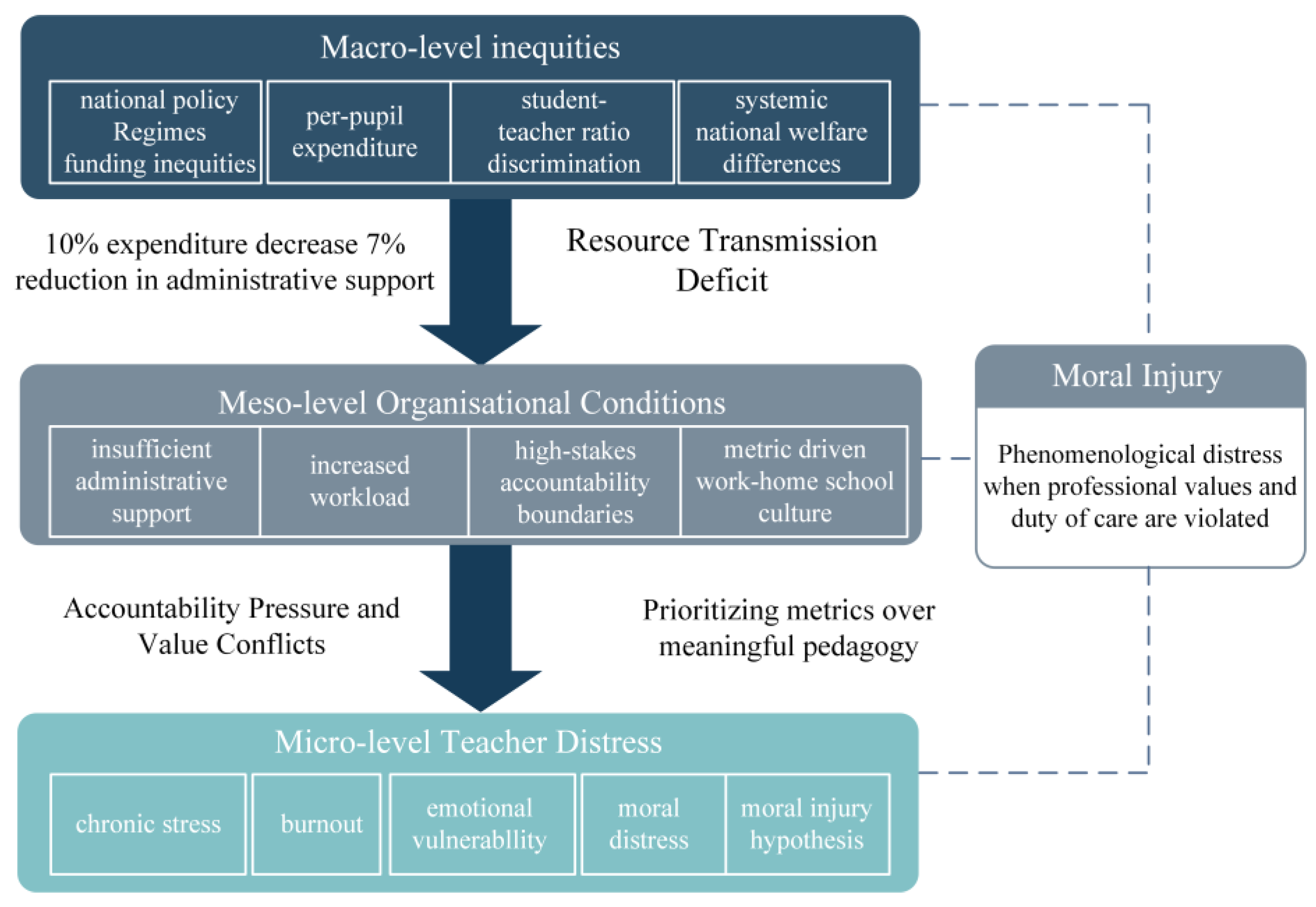
Figure 4 depicts a hypothesized pathway from funding and policy decisions through organizational conditions to individual outcomes. It is an explanatory model, not a confirmed causal chain. Solid arrows denote evidence-based associations; dashed arrows denote proposed pathways; and dotted arrows denote speculative mechanisms.
Macro → meso. Evidence across 22 countries shows that national policy regimes are descriptively associated with varying prevalence rates; these patterns are hypothesis-generating only (
Ma et al., 2022). Stress prevalence is 62.6% (95% Confidence Interval [CI]: 46.1–76.6) (
Ma et al., 2022), with higher rates in countries with lower relative teacher salaries and higher student-to-teacher ratios (
OECD, 2021a). Funding inequities—school-level free/reduced-price lunch percentage—were significantly associated with higher teacher stress and lower instructional support (
Mccarthy et al., 2025;
Kraft & Lyon, 2022). A 10% decrease in per-pupil expenditure predicted an approximately 7% reduction in administrative support staffing (
Mccarthy et al., 2025). Pay disparities persist: Black teachers earn approximately
$4400 (6%) less than White teachers, and female teachers earn about
$7000 (9%) less than male teachers (
Steiner et al., 2025). Nordic countries, prioritizing teacher autonomy, professional trust, and welfare support, report descriptively lower stress and attrition than the US and UK (
OECD, 2021c;
Sahlberg, 2021). These comparisons are heuristic only.
Meso → micro. Lack of administrative support is among the most consistent organizational predictors of burnout (
Harris & Jones, 2022;
Sokal et al., 2020). Increased workload, shifting responsibilities, and blurred work–home boundaries are primary meso-level stressors (
Collie & Mansfield, 2022). In high-stakes testing environments, teachers reported significantly higher moral distress—being compelled to act against professional values—than in low-stakes contexts (
Sokal et al., 2020).
Loh and Hu (
2014) documented that examination-based accountability systems trigger emotional vulnerability by forcing teachers to prioritize metrics over meaningful pedagogy. These findings offer phenomenological plausibility, not confirmatory evidence, for moral injury (P2). They document value violation and betrayal language; they do not show mediation. No included study administered a validated moral injury instrument or used a longitudinal mediation design.
Sensitivity analysis: post-pandemic only. Using only studies with data collected in 2023–2026, prevalence estimates remained elevated: stress was 55.8% (vs. 62.6% full sample), anxiety was 32.1% (vs. 36.3%), and depression was 51.7% (vs. 59.9%). The pooled intervention effect was g = 0.45 (95% CI [0.35, 0.55]) vs. g = 0.42 for the full sample. Direction, magnitude, and subgroup pattern were materially unchanged (
Supplementary Table S1).
3.2. The Great Imbalance: Why 91.7% of Interventions Target the Individual
The 2025 meta-analysis (
Wang et al., 2025) found a medium positive effect (g = 0.42) on overall occupational well-being.
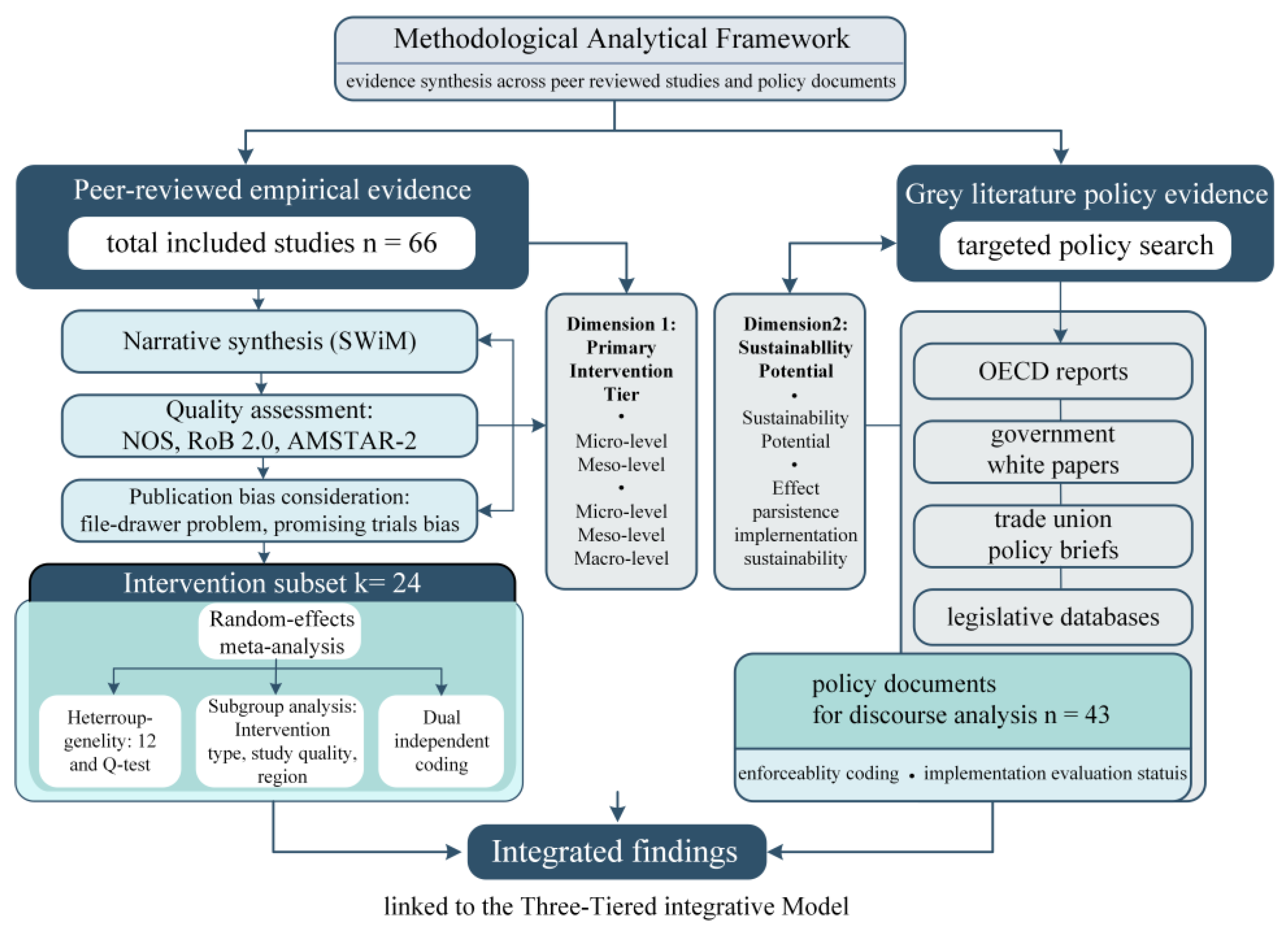
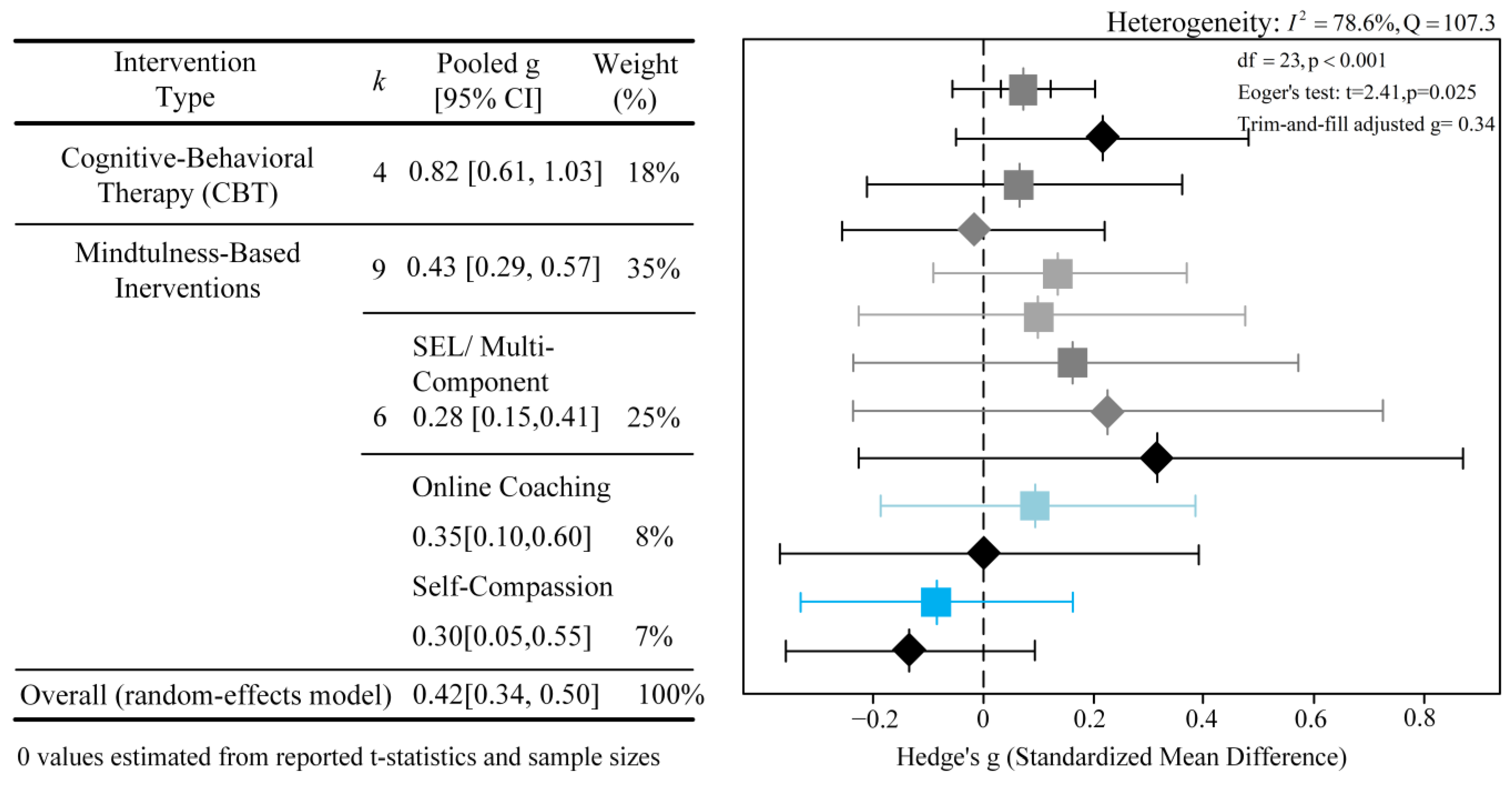
Table 2 summarizes intervention types, effect sizes, and sustainability ratings. Sustainability coding is exploratory and inferential, based on structural characteristics described in original studies, not confirmed implementation data; only 7 of 24 studies reported implementation fidelity or continuation data. The results are hypothesis-generating and not used to estimate effectiveness. “N/A” indicates insufficient reporting for meta-analysis, not ineffectiveness. Equity-relevant findings are analytical, not normative.
Heterogeneity was substantial (I
2 = 78.6%, Q = 107.3, df = 23,
p < 0.001). Study-level data underlying pooled estimates, as shown in
Figure 5, are given in
Supplementary Tables S9 and S19, making the meta-analysis fully reproducible. The primary random-effects estimate was g = 0.42 (95% CI [0.34, 0.50]). Sensitivity analyses using REML (g = 0.41, 95% CI [0.33, 0.49]), Hartung–Knapp (g = 0.41, 95% CI [0.28, 0.54]), and Paule–Mandel (g = 0.40, 95% CI [0.32, 0.48]) were comparable; the small-to-moderate positive effect remained unchanged (
Supplementary Table S20).
Figure 5 presents a forest plot by intervention type. Subgroup analyses: CBT showed the largest effect (g = 0.82, 95% CI [0.61, 1.03], k = 4), but all four CBT studies were in high-resource settings; mindfulness (k = 9) yielded g = 0.43 (95% CI [0.29, 0.57]); SEL/multi-component (k = 6) produced the smallest effect (g = 0.28, 95% CI [0.15, 0.41]). Between-group differences were significant (Q_b = 11.94,
p = 0.003). Low-risk-of-bias studies (k = 9) produced g = 0.36; high risk (k = 8) produced g = 0.53 (Q_b = 4.21,
p = 0.04). Egger’s regression suggested possible small-study effects (t = 2.41,
p = 0.025); Begg’s rank correlation was
p = 0.22 (τ = 0.18). The trim-and-fill-adjusted estimate was g = 0.34, suggesting possible upward bias but not a precise publication-bias estimate. Sensitivity analyses excluding small studies (N < 50) yielded g = 0.42, 95% CI [0.34, 0.50]; restricting this to low-risk-of-bias studies yielded g = 0.44, 95% CI [0.35, 0.53]; and PET-PEESE yielded g = 0.30, 95% CI [0.18, 0.42]. Direction and magnitude were comparable (
Supplementary Table S18). Of the 24 intervention studies, 22 (91.7%) were micro-level, 2 (8.3%) were meso-level, and none were macro-level. This absence of published macro-level effectiveness evaluations is the central empirical manifestation of the Evidence Hierarchy Mismatch (P4). Macro-level policy initiatives exist in multiple jurisdictions (
Section 3.3;
Table 3) but remain underrepresented in the quantitative effectiveness literature.
Interpretation (theoretical). These findings are consistent with EHMT but do not establish its explanatory mechanism. The distribution documents an imbalance; it does not prove that the evidence hierarchy causes it. Alternative explanations are provided in
Section 4.3.
Macro-level underrepresentation. Empirical finding: No peer-reviewed study in the identified quantitative effectiveness literature evaluated a macro-level reform. Theoretical interpretation: This is consistent with EHMT but may also reflect funding constraints, measurement difficulties, publication patterns, data access barriers, or political factors (
Section 1.2 and
Section 4.3. The absence establishes a descriptive imbalance; it does not establish that the evidence hierarchy is the cause, nor that macro-reforms are more effective. What is known: Macro-reforms are underrepresented. What is conjectured: They may have greater population-level potential. This remains a proposition requiring testing. Macro-reforms—salary adjustments, class-size mandates, accountability redesign—cannot be RCT-studied due to practical infeasibility (
Coppe et al., 2025). Funding agencies and journals privileging RCTs may de-prioritize quasi-experimental evaluations, creating a self-reinforcing cycle: a lack of RCT evidence can lead to dismissal as “insufficiently evidenced,” no funding, and rare evaluation. This is a proposed explanation, not an established causal account. Cross-national comparative evidence (Nordic vs. Anglo-American) is routinely downgraded as “correlational,” confusing internal validity with policy-relevant external validity (
Petticrew & Roberts, 2003). This is consistent with
Nutbeam’s (
2004) inverse evidence law: interventions with the greatest population impact are those about which evidence is most silent.
3.3. Upward Fracture: The Broken Feedback Loop from Micro to Macro
Narrative analysis of 43 policy documents (
Section 2.7) shows that while micro-level distress is pervasive—78% of teachers in one survey had thoughts of leaving (
Reinke et al., 2025), and mid-career teachers are least likely to intend to stay (
Longmuir, 2026)—the upward feedback loop from individual suffering to systemic reform remains fractured (P3).
Table 3 summarizes international policy responses and four recurring failure mechanisms.
Table 3.
Overview of international policy responses and failure mechanisms.
Table 3.
Overview of international policy responses and failure mechanisms.
| Country/Region | Key Policy Initiatives | Primary Tier | Enforceability | Failure Mechanism(s) | Persistent Gap |
|---|
| United States | RAND tracking (2021–2026) | Micro + Macro | Low | 2 + 4: No binding action; no evaluation | Structural inaction despite data |
| United Kingdom | DfE wellbeing fund | Micro | Low | 1: £10/teacher; 63% actual spend | Underfunded; policy-outcome gap |
| Canada | Federal pilot projects | Micro | Low | 3: Workload review lost in translation | No structural follow-through |
| China | Health checkups; counseling | Micro | Low | 3: Narrowed to individual screening | Limited evaluation |
| Singapore | Staff well-being committees | Meso + Micro | Medium | 4: Report not public/independent | Engagement improvements only |
| European Union | APRES COVID; joint guidelines | Macro + Micro | Low | 2: Non-binding guidelines | Variable national uptake |
| Nordic Countries | High autonomy; welfare; manageable workloads | Macro + Meso | High | No significant deficit | Serves as counterfactual |
Failure mechanism 1: Implementation deficit. The UK DfE allocated £8 million (Wellbeing for Education Return, 2020) and £7 million (Wellbeing for Education Recovery, 2021), primarily for training and resources rather than direct workload reduction.
Failure mechanism 2: Non-binding policy architecture. The Joint European Guidelines on Preventing Psychosocial Risks in Education (
ETUCE & EFEE, 2025) and US RAND reports lack enforcement mechanisms; there is no linkage of well-being metrics to school ratings or funding. Such a “soft policy” risks re-individualizing systemic responsibility (
Tsang & Wilkins, 2025).
Failure mechanism 3: Depoliticized translation. Policies are often repackaged as “teacher self-care workshops,” stripping workload review and administrative support language—this is known as the “psychologized language” critique (
Bekerman & Zembylas, 2025). In a Canadian case, the Educator Well-Being during Pandemic Recovery project (2023), funded with
$798,500 by the Public Health Agency of Canada and implemented by the Canadian Teachers’ Federation at three pilot sites, framed its objective as “systemic” yet delivered webinars and discussion boards, re-individualizing systemic stressors.
Failure mechanism 4: Absence of evaluation. Of the eight initiatives reviewed, systematic monitoring remains limited. Singapore’s MOE monitors well-being via surveys and parliamentary reporting, but no public annual implementation report was identified. Without evaluation, accountability is absent; without accountability, policy remains symbolic. Finnish provisions are embedded in legally binding collective agreements—though these specify working hours and teaching hour caps rather than class sizes, which remain a union recommendation.
The upward loop is hypothesized to be constrained by three mediators: declining union density (OECD cross-national decline from 33% in 1975 to 16% in 2018;
OECD, 2019); depoliticized education discourse framing distress in individual psychological terms (
Tsang & Wilkins, 2025;
Wilkins et al., 2025); and media narratives attributing turnover to personal stress rather than structural conditions. This is a theoretically grounded diagnosis, not an empirically settled conclusion; relative contributions require systematic investigation. Individual distress may thus accumulate without translating into structural remedies.
3.4. Social Justice Analysis
Who is most affected from thus? Teacher distress is elevated across countries, but the burden is uneven. Teachers in high-poverty, low-resource schools report higher stress and lower administrative support (
Mccarthy et al., 2025;
Kraft & Lyon, 2022). Pay disparities persist by race and gender: Black teachers earned approximately
$4400 (6%) less than White teachers; female teachers earn about
$7000 (9%) less than male teachers (
Steiner et al., 2025). These are descriptive disparities, not causal estimates.
Who benefits from these interventions? Of the 24 intervention studies, only 2 (8.3%) explicitly reported implementation in low-income or high-poverty districts. CBT studies, showing the largest pooled effect (g = 0.82), were all in high-resource settings. Mindfulness and self-compassion interventions require time, external facilitators, and release from teaching duties—resources are unevenly distributed. Voluntary micro-interventions may therefore be taken up disproportionately by teachers in better-resourced schools, potentially widening well-being gaps.
How does policy address structural inequities? The 43 policy documents included equity provisions in some jurisdictions, but enforceability varied. Nordic provisions embedded working hours and teaching-hour caps in legally binding agreements; UK and Canadian initiatives were largely non-binding and translated into individual self-care support. No policy document reported a quantitative evaluation of equity effects on teacher mental health. This is an evidence gap, not evidence of ineffectiveness.
Interpretation. Pooled effects are averages; they do not show whether interventions reduce or widen disparities. The evidence suggests micro-level interventions are least accessible to teachers facing the greatest structural burdens, while macro-level reforms with equity potential remain under-evaluated. This interpretation is analytical and provisional, not a causal conclusion.
4. Discussion
4.1. Persistence of the Crisis and the Individual-Level Paradigm
The evidence challenges any assumption that the teacher mental health crisis was transient. We treat COVID-19 as a temporal boundary condition, not a causal variable; our focus remains on structural determinants—funding inequities, accountability regimes, and evidence hierarchies—that predate and will outlast the pandemic. Teacher distress has become embedded in the profession’s structure (
Pressley, 2021;
Collie & Mansfield, 2022;
Steiner et al., 2025). Its persistence is better explained by a dominant individual-level intervention paradigm than by a lack of coping strategies.
This paradigm serves systemic responsibility diffusion (
Wilkins et al., 2025): framing distress as individual failure of resilience absolves the system of responsibility for working conditions, funding inequities, and accountability pressures. Teachers’ emotional experiences are socially, institutionally, and politically constructed (
Karnovsky & Kelly, 2025). The “teacher wellbeing turn” (
Wilkins et al., 2025) has functioned as neuropolitics, shaping teachers into “neuro-liberal workers” expected to manage systemic failures through self-regulation. Meta-analytic evidence supports this: even high-quality micro-interventions show modest, short-lived effects, dissipating within three to six months and likely inflated by publication bias. The crisis persists not because interventions are poorly designed but because the problem is misdefined.
4.2. Moral Injury as a Bridging Hypothesis
We propose moral injury as a candidate mechanism linking macro-structural constraints to micro-level distress (P2); this was advanced as testable and graded speculative. The military–education analogy and its limits are provided in
Section 1.1.2 and
Supplementary Note S1.
Observed. Qualitative studies document teachers using language consistent with moral injury.
Sokal et al. (
2020) found that 32% of Canadian teachers spontaneously invoked “betrayal” and “value violation”;
Loh and Hu (
2014) documented emotional vulnerability from “being forced to sacrifice pedagogical quality for metrics.” These are phenomenological and do not test mediation.
Hypothesized. Resource constraints and accountability demands predict moral injury, which mediates working conditions and burnout/attrition. The proposed chain is as follows: macro-level funding cuts/accountability → meso-level resource constraints → perceived inability to provide adequate care → moral injury (guilt, shame, demoralization) → burnout/attrition. This is a theoretical model, not an empirical finding.
Not yet established. No validated moral injury instrument (e.g., MIES) has been administered to teacher samples; no included study tested moral injury as a mediator; no longitudinal three-wave mediation design exists. Validation must be teacher-specific. Moral injury is incremental to JD-R, burnout, demoralization, work stress, emotional exhaustion, and compassion fatigue (
Section 1.1.1). Three validation pathways are proposed (
Supplementary Table S23): (a) adapt and validate the MIES for teaching (T-MIES); (b) test discriminant and incremental validity; (c) conduct three-wave longitudinal mediation designs. Until then, moral injury serves as a theoretical device explaining why individual-level interventions may fail, reinforcing EHMT.
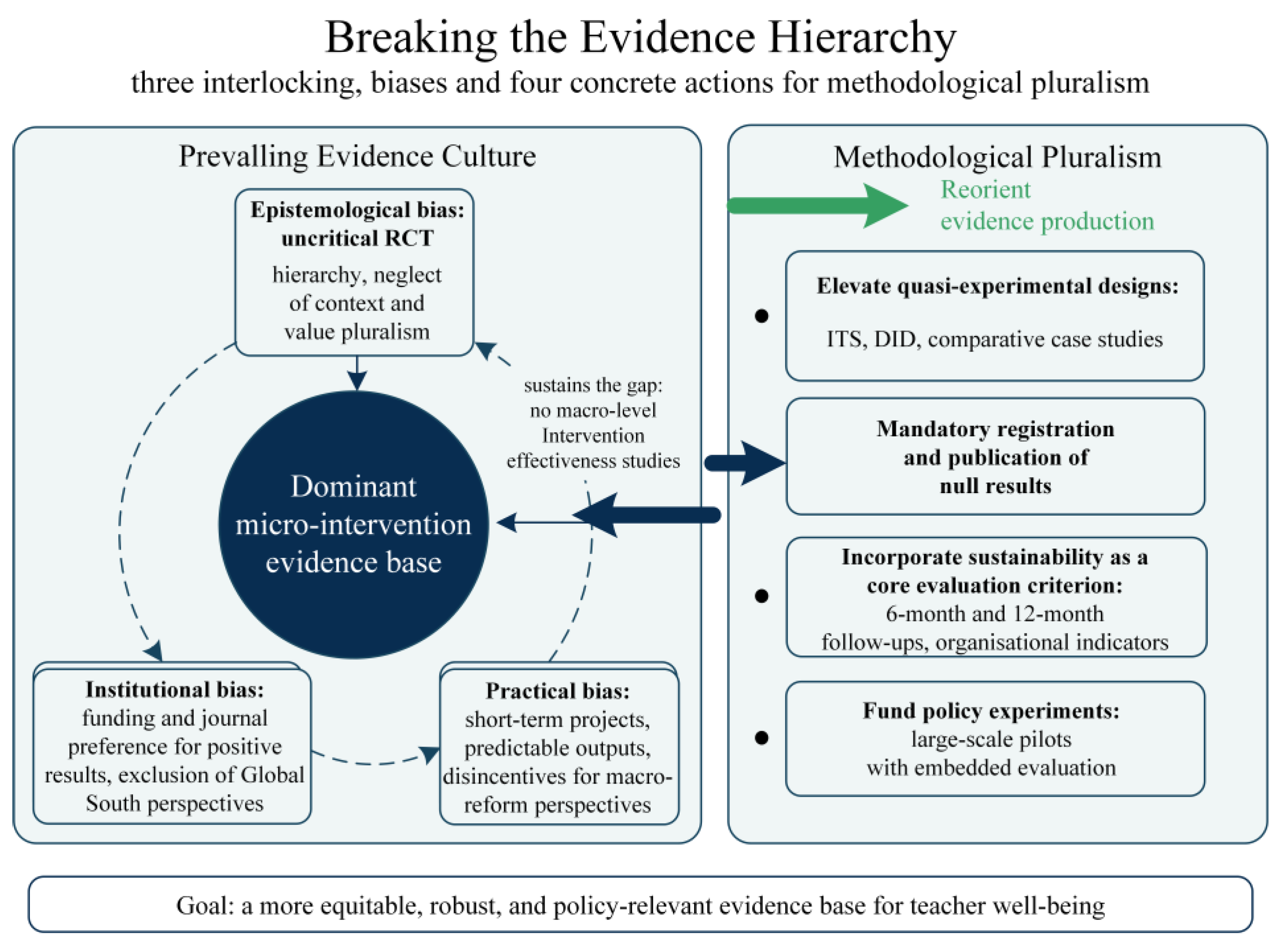
4.3. The Evidence Hierarchy Mismatch: Three Biases and Four Actions
Figure 6 summarizes three interlocking biases and four actions to disrupt them.
What the evidence shows [Empirical finding]: (a) 91.7% of the 24 intervention studies target the micro level; (b) 0% evaluate macro-level reforms; (c) macro-level policy initiatives exist but are substantially underrepresented in the quantitative effectiveness literature.
Theoretical interpretation: This pattern is consistent with EHMT. Three biases may sustain the imbalance:
Epistemological: The problem is the hierarchy, not RCTs. RCTs are powerful where randomization is feasible, ethical, and appropriate; the problem is that uncritical transplantation of a medical hierarchy treats RCTs as universally superior. Education deals with complex social systems where context, implementation, and value pluralism matter (
Coppe et al., 2025;
Biesta, 2026). The argument presented is for methodological pluralism, not replacing RCTs.
Institutional: Funding bodies and journals often prioritize RCTs and positive results, disadvantaging quasi-experimental and policy-relevant comparative work (
Parra & Edwards, 2024).
D’Angelo (
2025) argues that narrow definitions of “what counts” as evidence can exclude Global South perspectives. This is an institutional critique, not a claim that RCTs are politically compromised.
Practical: Macro-level reforms require long-time horizons, large budgets, and cross-sectoral collaboration—they have become disincentivized in current grant-funding and promotion systems favoring short, controllable projects (
Ioannidis, 2011). This affects all designs, including RCTs; it is a reason to broaden designs for policy questions.
Five competing explanations cannot be ruled out: financial limitations, measurement difficulty, publication patterns, policy data access, and political difficulties (
Table S4). EHMT’s distinctive prediction—that even when controlling these factors, the evidence hierarchy independently predicts lower prioritization of macro-level quasi-experimental evaluation—remains untested. EHMT is one plausible explanation among several.
Policy implications: If the imbalance is partly produced by the evidence hierarchy, policy evaluation should include quasi-experimental designs, interrupted time series, difference-in-differences, and comparative case studies. This is a policy implication derived from theoretical interpretation, not an empirical finding. It does not establish that macro-level reforms are more effective; it establishes that they are under-evaluated. Sustainability should be a core evaluation criterion.
Normative proposals: These are arguments, not empirical conclusions: (1) elevate quasi-experimental designs for macro-level policy questions (
Petticrew & Roberts, 2003); (2) mandate registration and publication of null results; (3) incorporate sustainability (6- and 12-month follow-ups, organizational indicators) as a core criterion; and (4) fund large-scale policy pilots with embedded rigorous evaluation.
Methodological complementarity: RCTs suit bounded, manipulable interventions; quasi-experimental designs suit macro-level policy changes where randomization is infeasible, unethical, or contested. Neither is universally superior; the goal is matching designs to questions.
Known and conjectured: Known: Macro-level policy initiatives exist; they are underrepresented in the quantitative effectiveness literature; no peer-reviewed study in this review evaluated a macro-level reform using quantitative effectiveness methods. Conjectured: Macro-level reforms may have greater population-level potential, produce more sustainable effects, and address structural drivers more directly. Testing requires large-scale policy experiments with embedded quasi-experimental evaluation. Until then, superiority of macro-level interventions remains a proposition, not a conclusion.
4.4. Social Justice Implications
First, average effects can conceal inequitable effects. The pooled effect (g = 0.42) is an average across studies conducted predominantly in better-resourced settings. If effects are weaker in under-resourced schools—where baseline stress is higher and implementation resources scarcer—the average may overstate benefits for teachers who need them most. This is a hypothesis, not a confirmed finding.
Second, intervention design and delivery have equity consequences. Interventions requiring external facilitators, release time, or recurring budgets are less sustainable and accessible in high-poverty schools. Sustainability coding (
Table 2) is therefore an equity issue. Statutory-policy interventions (staffing ratios and workload caps) may have greater equity potential because they do not depend on individual teacher uptake, but this remains untested.
Third, policy analysis must ask who is targeted and who is reached. Universal policies may be regressive if uptake is higher in well-resourced settings; targeted policies may reduce gaps but risk stigmatization. The reviewed policy documents rarely reported equity effects. Future evaluation should report differential effects by school poverty, race/ethnicity, gender, and career stage.
The unequal distribution of occupational stress reflects broader educational inequality. Persistent disparities by race and gender—with Black teachers more likely to intend to leave and female teachers reporting higher stress levels and burnout (
Steiner et al., 2025)—demand structural policy attention. Over-reliance on micro-level interventions exacerbates inequities: teachers in under-resourced schools have less time, fewer substitutes, and higher baseline stress, making voluntary mindfulness programs difficult to access. A socially just approach requires the following: (a) targeting resources to the most affected schools and populations; (b) addressing structural determinants including workload, pay, status, and autonomy; and (c) centering intervention design and policy advocacy around teachers of color, women, and those in low-wealth schools.
Cross-national comparative evidence. The Nordic–Anglo-American comparison is descriptive and hypothesis-generating (
Sahlberg, 2021;
OECD, 2021b). It is confounded by historical trajectories, cultural values, unionization histories, and welfare regimes. No causal claims are derived. We use this contrast to illustrate plausible macro-level policy variation and to motivate future within-country quasi-experimental studies.
4.5. Empirical Weight of the Theoretical Propositions
This section integrates the four evidence streams.
Table 4 grades each proposition;
Supplementary Table S13 maps each stream to its integration point.
Table 4.
Empirical weight of the core theoretical propositions (P1–P5).
Table 4.
Empirical weight of the core theoretical propositions (P1–P5).
| Proposition | Summary of Claim | Evidence Currently Available | Empirical Weight | Key Sources/Identified Gap |
|---|
| P1 | Macro-level funding inequities predict meso-level resource constraints, which predict micro-level distress (hypothesized downward pathway) | Cross-national comparative studies; multi-level cross-sectional studies; funding–staffing regressions. Individual links supported; full mediation chain not tested longitudinally or causally. | Moderate (downgraded from strong) | OECD (2021a); Mccarthy et al. (2025); Kraft and Lyon (2022); no longitudinal or quasi-experimental test of full macro → meso → micro mediation chain identified |
| P2 | Resource constraints and accountability pressures predict moral injury, which mediates working conditions and burnout/attrition | Observed: qualitative reports of betrayal/value violation (Sokal et al., 2020; Loh & Hu, 2014). Hypothesis: mediation untested; no validated scale-based studies; no longitudinal mediation design. | Speculative | Sokal et al. (2020); Loh and Hu (2014); no T-MIES or longitudinal mediation study to date |
| P3 | Upward feedback loop (micro → macro) moderated by union density, media framing, and political receptivity | Cross-national institutional comparisons; policy discourse analyses | Weak (directional) | Sahlberg (2021); Tsang and Wilkins (2025); no direct moderator tests available |
| P4a | The published quantitative effectiveness literature is skewed toward micro-level interventions and away from macro-level reforms (descriptive) | Tier distribution: 91.7% micro and 0% macro | Moderate (descriptive) | Table 2, this review; Nutbeam (2004) |
| P4b | This skew is produced primarily by the evidence hierarchy (epistemological, institutional, and practical biases) (explanatory) | No direct test; competing explanations not ruled out | Speculative (explanatory) | Coppe et al. (2025); Parra and Edwards (2024); Petticrew and Roberts (2003); competing explanations in Section 1.2 and Section 4.3. |
| P5 | Macro-level structural reforms may produce greater population-level reductions in teacher distress than micro-level interventions | No quantitative effectiveness study identified; derived from theoretical reasoning and policy analysis | Speculative | No peer-reviewed macro-level effectiveness evaluation identified; requires policy experiments with embedded quasi-experimental evaluation |
P1 has the strongest empirical anchoring but is graded moderate: individual links are supported, but the full mediation chain is untested. P2 remains at the hypothesis stage. P3 rests on institutional inference. P4a is supported by the tier distribution; P4b remains speculative. P5 is graded speculative: the review establishes underrepresentation, not superiority.
Theoretical contributions. Three advances emerge. First, the Three-Tier Integrative Framework specifies a proposed vertical pathway (macro → meso → micro) as well as conditions for upward feedback (micro → macro), extending JD-R with vertical stratification and social justice criteria. Second, EHMT specifies institutional mechanisms—such as epistemological transplantation, funding incentives, and practical infeasibility—producing evidence-base distortion, and introduces “proposed epistemic foreclosure.” Third, the moral injury hypothesis provides a candidate psychological mechanism bridging macro-structural and micro-experiential levels. Collectively, these contributions shift the theoretical center of gravity from individual resilience to structural explanation, from intervention efficacy to evidence architecture, and from descriptive prevalence to explanatory mechanisms.
4.6. Limitations
Search and scope. The search was limited to English-language publications, and the post-pandemic focus may under-capture long-term effects. Pre-2021 publications were not systematically captured. The inclusion of diverse designs limits quantitative conclusions.
Design coverage. Restricting meta-analysis to intervention studies with synthesizable effect sizes (k = 24) excluded qualitative and mixed-methods studies that could illuminate organizational and systemic change. Future reviews should synthesize this complementary evidence.
Policy analysis asymmetry. The supplementary gray literature search did not follow PRISMA-level rigor (no dual screening with κ and no formal quality appraisal). Policy findings are interpretive, not evidentiary, and should not be treated as equivalent to meta-analytic findings.
Moral injury hypothesis. No validated instrument has been administered to teacher samples, and no longitudinal mediation study exists. Teacher-specific validation is required. Moral injury is complementary and speculative, and not a replacement for established constructs.
Publication bias. The trim-and-fill estimate (g = 0.34) is exploratory, and not precise. Publication bias cannot be eliminated, and the pooled effect should be interpreted with caution.
Social justice analysis. The equity-weighted interpretation is limited by available equity data and is partly inferential. Future reviews require equity-relevant reporting.
5. Conclusions
This review documents persistent, elevated teacher mental health difficulties in the post-pandemic era, extending from individual suffering to educational quality and equity. Interventions remain overwhelmingly micro-level, while macro-structural reforms are substantially underrepresented in the identified quantitative effectiveness literature—not because they are absent in practice, but because the dominant evidence hierarchy privileges designs often infeasible for system-level policy evaluation. Cross-national policy comparisons are heuristic illustrations, not causal evidence.
The core challenge is a paradigm lag: the field prioritizes individual-level methodological conventions for structurally produced problems. As long as RCTs are treated as the only rigorous design, macro-level reforms may remain under-evidenced and under-funded. We do not conclude that macro-level reforms are more effective; their comparative effectiveness remains an open empirical question. The proposition that they may have greater population-level potential is a conjecture requiring testing. The argument is not against RCTs but for matching designs to questions and for methodological pluralism.
Normatively, we call for a paradigm shift from individual remediation to systemic reform, and we propose methodological pluralism, mandatory null-results publication, and sustainability as a core evaluation criterion. These are arguments about what should be done, not empirical conclusions. The Three-Tier Framework and Evidence Hierarchy Mismatch Theory provide theoretical scaffolding; moral injury remains a candidate bridging mechanism awaiting empirical validation.
Education sciences is well positioned to lead this shift by welcoming diverse methodologies, prioritizing structural analyses, and reframing teacher well-being from an individual luxury to a systemic necessity.