1. Introduction
In the current era of globalization and increasing cultural diversity, individuals interact and collaborate with people from very different linguistic, cultural, and social backgrounds. These encounters frequently involve diverse values, beliefs, and behavioral norms. When such cultural frameworks are not recognized or understood, miscommunication and stereotyping may occur. Mass media, social media, and local curricula can contribute to reinforcing simplified or biased cultural representations (
Paige, 1993). Consequently, the need for International Education, Intercultural Education, and the development of intercultural competence is increasingly evident. For students preparing to enter a global and multicultural workforce, developing the ability to understand and appreciate diverse cultural perspectives is essential. This also involves cultivating a set of transversal soft skills that enable respectful, effective, and empathetic communication in intercultural contexts. In response to this challenge, this article presents a set of teaching strategies and materials aimed at fostering intercultural competence among university students and preparing them for the challenges and opportunities of contemporary multicultural societies (
M. J. Bennett, 1993;
Paige, 1993).
According to
M. J. Bennett (
2012), intercultural learning refers to the acquisition of “increased awareness of subjective cultural context (worldview), including one’s own, and developing greater ability to interact sensitively and competently across cultural contexts as both an immediate and long-term effect of exchange” (p. 4). Effective teaching practices for enhancing interculturality therefore require understanding and applying intercultural competence frameworks (
Paige, 1993). Models such as
M. J. Bennett’s (
1993) Developmental Model of Intercultural Sensitivity (DMIS) and
Deardorff’s (
2006,
2009) Intercultural Competence Model provide educators with structured approaches to support learners’ progression in intercultural sensitivity and communication (
Aguareles et al., 2024). In this article, these models are used not only as theoretical references but also as guiding frameworks for pedagogical design and analysis. Integrating these models into the curriculum allows educators to design activities that guide students through developmental stages of intercultural awareness and communication, enabling them to recognize cultural diversity, avoid stereotyping, and become global citizens capable of addressing shared global challenges (
M. J. Bennett, 1993;
Grove & Torbiörn, 1993;
Paige, 1993). As culture is understood as “the learned beliefs, values, rules, norms, symbols, and traditions that are common to a group of people” (
Northouse, 2013, p. 384), cross-cultural communication training becomes a key component of this process. Through intercultural communication training, students can acquire strategies to interpret verbal and non-verbal behaviors appropriately, acknowledge cultural nuances, and understand how language shapes intercultural interactions (
Pusch, 1993;
Fowler & Mumford, 1995).
Recent scholarship has further emphasized intercultural competence as a dynamic, context-dependent, and pedagogically mediated process in higher education, particularly within Internationalization at Home (IaH) contexts (
Beelen & Jones, 2018;
Jones et al., 2021;
Sierra-Huedo et al., 2024). These perspectives highlight the need for intentional, curriculum-embedded pedagogical approaches that move beyond ad hoc activities or assumptions that intercultural learning emerges naturally from exposure to diversity alone, which it is related to
Allport (
1954) theory presented in his book
The Nature of Prejudice. The main element of any IaH strategy is the internationalization of the curriculum (
Sierra-Huedo et al., 2024). Thus, the activities presented here are part of such an academic effort to internationalize a higher education curriculum, helping faculty members to reflect on their intercultural pedagogies and approaches to a more inclusive environment in their classrooms (
Leask, 2015).
This article advocates for a holistic approach to welcoming cultural differences in higher education and provides concrete examples of cross-cultural communication activities suitable for university classrooms. These include the use of case studies, critical incidents, and role-plays to support students in reflecting on cultural diversity and developing intercultural competence. By incorporating these strategies into an internationalized curriculum addressing stereotypes, cultural awareness, and culture shock, educators can foster inclusive learning environments that prepare students for the complexities of diverse global and local contexts. The study follows a design-based pedagogical research approach. Rather than evaluating isolated activities, it examines how intercultural competence frameworks can be operationalized through developmentally sequenced classroom interventions in higher education. The originality of the article lies in the systematic alignment and developmental sequencing of intercultural learning activities based on Bennett’s Developmental Model of Intercultural Sensitivity (DMIS) and Deardorff’s intercultural competence framework, rather than in the proposal of isolated teaching activities.
1.1. Models for Developing Intercultural Competence: Developmental Model of Intercultural Sensitivity (DMIS) by Milton Bennett
The Developmental Model of Intercultural Sensitivity (DMIS) by
M. J. Bennett (
1993) and the Model of Intercultural Competence by
Deardorff (
2006,
2009) are two of the most remarkable models to date, regarding the acquisition and development of intercultural competence. As early as 1993, Bennett published his DMIS, a developmental model that measures how intercultural sensitivity or intercultural competence might be developed through years of training and personal experiences. Around a decade later,
Deardorff (
2006), who acknowledges that intercultural interactions are at the heart of what international education is all about, designed her Intercultural Competence Model (2006, 2009), with the main aim of determining the true significance and the potential implications of effective cross-cultural relationships. According to
Deardorff (
2006), “intercultural competence is the ability to develop targeted knowledge, skills and attitudes that lead to visible behavior and communication that are both effective and appropriate in intercultural interactions” (p. 31). It is relevant to mention that both academics have offered insightful advice on how to understand and cultivate the aforementioned intercultural competence. In this sense, their findings have highlighted the importance of knowledge, skills, attitudes, and behaviors in cross-cultural interactions, offering a roadmap for individuals and institutions who are in need of effectively managing cultural diversity and promoting positive relationships amongst individuals from different cultural backgrounds. Recent research further conceptualizes intercultural competence as a longitudinal and developmental learning outcome that requires intentional curriculum design and reflective pedagogy, rather than spontaneous exposure to cultural diversity alone (
Pettigrew, 2008;
Deardorff, 2009;
Spitzberg & Changnon, 2009). These perspectives reinforce the relevance of developmental models such as the DMIS for informing structured intercultural learning interventions in higher education (
Paige & Vande Berg, 2012).
In the present article, the primary focus is placed on Bennett’s Developmental Model of Intercultural Sensitivity as a framework for understanding and supporting students’ intercultural learning processes.
Sierra-Huedo (
2010), affirms that developmental models, including Bennett’s DMIS, are founded on relevant organizing concepts, being “differentiation” the underlying principle in this particular case. Therefore, “differentiation” is the term Bennett uses to “signify the manner in which people differentiate events and situations in different ways, and how cultures differ from one another by maintaining patterns of different worldviews” (
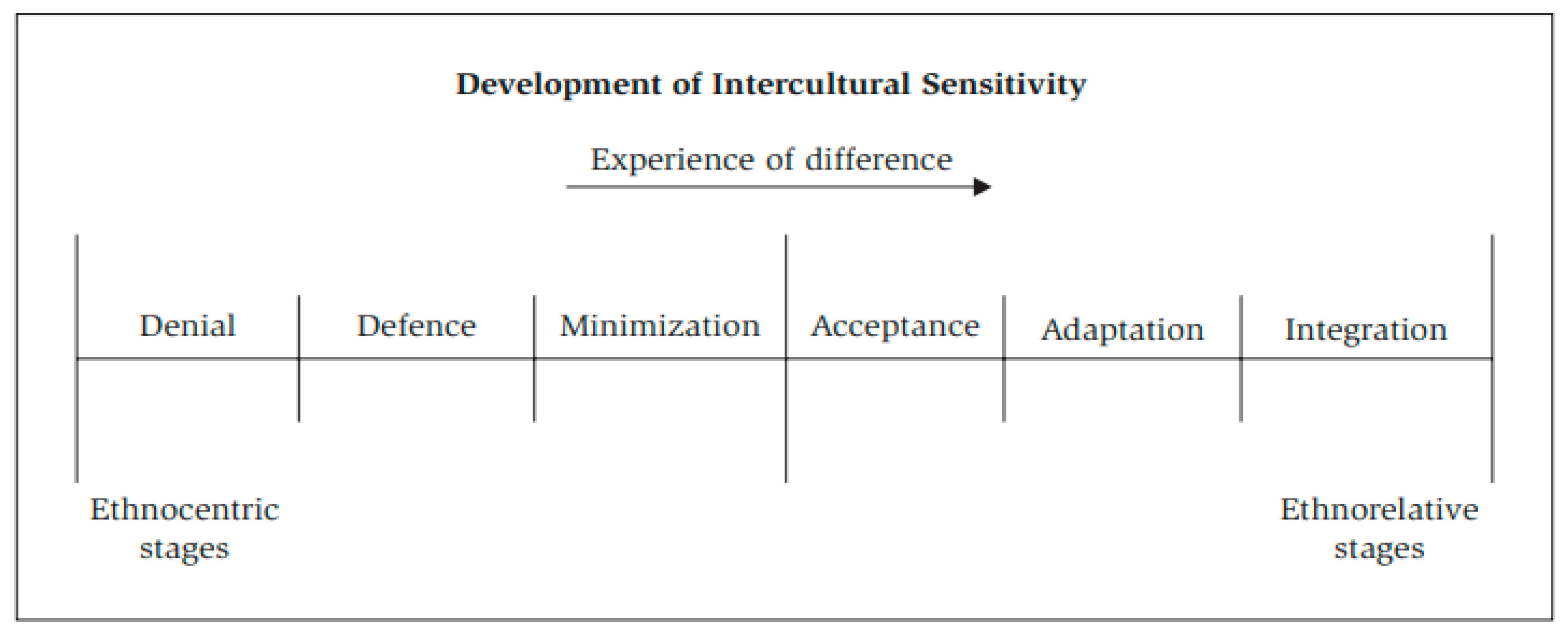
Sierra-Huedo, 2010, p. 171). In relation to this, it is relevant to mention that, in his model, Bennett describes a continuum of increasing cultural awareness, comprehension, and adaptation, where an individual can move from ethnocentric stages (in which a person believes that his or her culture is superior) to ethnorelative stages (in which a person is able to recognize that all cultures have both, positive and negative aspects) which are, at the same time, divided into different substages, as can be inferred from
Figure 1. In this sense, according to the author, the more advanced the individual is in the field of cultural differences, the better the intercultural competence” (
Vegh & Luu, 2019, p. 889).
According to
M. J. Bennett (
2017), the first three stages are ethnocentric and are referred to as Denial, Defense and Minimization. These stages address concerns related to perceiving one’s own culture as more “central to reality” (pp. 179–186). However, the latter three stages, Acceptance, Adaptation, and Integration, are ethnorelative in nature, and they deal with “issues associated with experiencing all cultures as alternative ways of organizing reality” (op. cit.). Individuals experience a shift in their perception on how they see cultural differences as they move from the ethnocentric stages to the ethnorelative ones. Instead of being perceived as dangerous as they were in the ethnocentric stages, individuals in ethnorelative stages view and accept cultural differences as pleasant and delightful. A brief definition of each DMIS stage is provided below.
- (1)
Denial Stage: According to
M. J. Bennett (
1993,
2017) and
Sierra-Huedo (
2010), the act of not recognizing or dismissing cultural differences is known as Denial of cultural diversity. Denying the reality of cultural differences or the notion that they may be important and consequential, or holding a stereotyped, undifferentiated, and sometimes self-serving view of individuals from other cultures, are examples of the Denial stage. Moreover, having little interest in or avoiding foreign cultures, as well as making naïve or ignorant remarks about different cultural traits are also indicators of this first stage.
- (2)
Defense Stage: This second stage refers to “a posture intended to counter the impact of specific cultural differences perceived as threatening. The threat is to one’s sense of reality and thus to one’s identity, which, at this point, is a function of one cultural reality” (
M. J. Bennett, 1993, p. 34). According to
Hammer et al. (
2003), individuals in this stage conceive that “the world is organized into ‘us’ and ‘them’, where one’s own culture is superior and other cultures are inferior” (p. 424). These individuals also acknowledge cultural differences but perceive them with a biased perspective; therefore, they try to shield or protect themselves from those differences that they consider to be a threat. It is also relevant to mention that there is a variation on this
Defense stage, known as
Reversal, “where an adopted culture is experienced as superior to the culture of one’s primary socialization” (op. cit.).
Reversal is, therefore, similar to
Defense because it maintains a polarized, ‘‘us’’ and ‘‘them’’ worldview, but, unlike
Defense, “it does not maintain the other culture as a threat” (op. cit.).
- (3)
Minimization Stage: According to
M. J. Bennett (
2004), “
Minimization of cultural difference is the state in which elements of one’s own cultural worldview are experienced as universal” (p. 4). Hence, individuals in this stage believe that human beings are all alike and that the only differences we can encounter are those related to the place where we were born or to where we currently live.
Minimization may also take the form of thinking that cultural differences are unimportant or unworthy of attention, and that human commonalities are more significant than cultural distinctions. This suggests that, somehow, cultural differences are not relevant or that they can be ignored. It is relevant to mention that
Minimization is the last of the
ethnocentric stages. Therefore, in order to move towards
Acceptance, the first of the
ethnorelative stages, a cognitive change “from reliance on absolute, dualistic principles of some sort to an acknowledgment of non-absolute relativity” (
M. J. Bennett, 1993, p. 45) becomes necessary.
- (4)
Acceptance Stage: M. J. Bennett (
2004) acknowledges that
Acceptance of cultural difference is the state “in which one’s own culture is experienced as just one of the equally complex worldviews. By discriminating differences among cultures (including one’s own), and by constructing a kind of self-reflexive perspective, people with this worldview are able to experience others as different from themselves, but equally human” (p. 6). In this stage, individuals also show a growing curiosity and interest in different cultures, as well as a willingness to socialize and engage in cross-cultural relationships; these attitudes may have been avoided in earlier stages.
- (5)
Adaptation Stage: Adaptation to cultural difference is “the state in which the experience of another culture yields perception and behavior appropriate to that culture. One’s worldview is expanded to include relevant constructs from other cultural worldviews” (
M. J. Bennett, 2004, p. 7). Another example of
adaptation is when individuals from different cultural origins are able to talk about their experiences and viewpoints in a way that is respectful and sensitive to the other culture.
- (6)
Integration Stage: Integration of cultural difference can be defined as “the state in which one’s experience of self is expanded to include the movement in and out of different cultural worldviews” (
Hammer et al., 2003, p. 425). In this stage, an individual’s identity or sense of self can evolve to suitably and truly include the values, beliefs, viewpoints, and actions of different cultures, being able to choose the most appropriate behavior based on the cultural milieu in which he/she finds him/herself.
It is important to emphasize that when the DMIS is used as a guiding framework in higher education, the focus is placed on the developmental nature of intercultural competence acquisition rather than on fixed categorizations of individuals. As Sierra-Huedo notes (2010), “intercultural sensitivity is not something natural to human nature. Looking back historically, any kind of cross-cultural interaction is directly related to war, conflict, or oppression. It is through education and training in intercultural communication that we start changing our natural behavior” (p. 171). She also states that, according to
M. J. Bennett (
1993), “when we try to teach our students about intercultural communication, we are asking them to transcend traditional ethnocentrism and to explore new relationships across cultural boundaries” (p. 21). This sometimes might be risky, and some previous teacher training is needed. Therefore, this means that in order to develop this aforementioned competence and to help university students advance in the continuum of the developmental process, appropriate intercultural training becomes essential, as well as enhancing their opportunities to experience the contact with cultural diversity, either locally or abroad. In this sense, teaching intercultural communication requires educators to support students in transcending ethnocentric assumptions and engaging with cultural difference in reflective and constructive ways (
M. J. Bennett, 1993). This process may involve discomfort or resistance and thus requires intentional pedagogical strategies and appropriate teacher preparation. Consequently, the DMIS provides a useful framework for designing and sequencing intercultural learning activities that support students’ progression along the developmental continuum, while acknowledging that intercultural competence development is gradual, non-linear, and context-dependent.
1.2. Key Element of Internationalization Process: Internationalization of the Curriculum
Most higher education institutions have traditionally emphasized the quantitative dimensions of internationalization, such as incoming and outgoing student mobility. However, a comprehensive understanding of internationalization in higher education requires greater attention to the quality of the process and recognition that internationalization is a continuous and ongoing endeavor. From a quality-oriented and inclusive perspective, internationalization should involve all students, not only those who participate in mobility programs.
This broader approach is commonly referred to as Internationalization at Home (IaH). IaH promotes the development of an intercultural campus in which students, faculty, and administrative staff engage in international and intercultural activities both on campus and, where relevant, abroad. As an inclusive strategy, IaH focuses on creating opportunities for all members of the academic community to participate in internationalization initiatives, including internationalized courses and curriculum-based activities (
Sierra-Huedo, 2013;
Sierra-Huedo & Nevado Llopis, 2021). According to
Sierra-Huedo (
2013), key elements of Internationalization at Home include the use of information and communication technologies, foreign languages, co-curricular activities, institutional policy, governance and facilities, and, crucially, teaching and learning practices grounded in intercultural learning.
Among these elements, the internationalization of the curriculum represents the core component of Internationalization at Home.
Leask (
2015) defines internationalization of the curriculum as “the incorporation of international, intercultural, and/or global dimensions into the content of the curriculum, as well as the learning outcomes, assessment tasks, teaching methods, and support services of a program of study” (p. 9). As the curriculum lies at the heart of the learning process, it occupies a central role in institutional internationalization strategies. Importantly, curriculum internationalization extends beyond content to include pedagogy and assessment practices, which are critical for supporting meaningful intercultural learning. In this regard, Leask and Carroll’s principles of good practice for teaching across cultures (2013) provide a useful pedagogical framework for working in culturally diverse learning environments (see
Table 1). These principles emphasize learner-centered approaches, respect for diversity, contextualized support, meaningful intercultural dialog, and pedagogical flexibility.
An important dimension of curriculum internationalization is the hidden curriculum, understood as the implicit assumptions, values, and forms of knowledge that educators bring into their teaching. This includes what is presented as legitimate or “true” knowledge, as well as unexamined stereotypes or prejudices related to cultural difference, learning styles, or epistemological traditions. Critical reflection on curriculum design therefore requires attention not only to course content, but also to what is implicitly included or excluded, and to educators’ assumptions about whose knowledge is valued. From a cognitive perspective,
Kahneman’s (
2011) distinction between fast, intuitive thinking (System 1) and slow, reflective thinking (System 2) provides a useful framework for understanding the persistence of stereotypes and prejudices. While such biases often operate automatically and unconsciously, the development of intercultural competence requires deliberate reflection, critical examination of assumptions, and engagement with evidence. In this sense, intercultural learning can be understood as a reflective process that involves moving beyond intuitive judgments toward more considered and context-sensitive interpretations of cultural difference.
1.3. Defining Key Terms: Culture Shock, Intercultural Competence, Stereotype, and Prejudice
To clarify the conceptual framework informing the pedagogical approach adopted in this study, key terms related to intercultural learning are defined below.
- (1)
Culture Shock: According to
Hall (
1959) and
Oberg (
1960), the term
Culture Shock refers to the anxiety that arises from losing the familiar and recognizable cues and symbols of social interaction, and their replacement with other unfamiliar cues, which results necessary in order to adjust to the new environment.
J. M. Bennett (
1998) also defined culture shock as “a special case of the typical human response to any transition, loss, or change” (p. 15). It is important to highlight that when having international students in our classes, they will go through a culture shock process that might affect their learning and understanding of the norms and culture in our higher education institutions.
- (2)
Intercultural Competence: According to
Deardorff (
2006), “intercultural competence is the ability to develop targeted knowledge, skills and attitudes that lead to visible behavior and communication that are both effective and appropriate in intercultural interactions” (p. 31). Being able to communicate effectively across cultures is key for higher education students and teachers. The world that surrounds a university is global; thus the development of intercultural competence should be worked in higher education institutions.
- (3)
Stereotype: Stereotyping can be defined as “the automatic application of information we have about a country or culture group, both positive and negative, to every individual in it” (
Paige et al., 2002, p. 57). In this context,
M. J. Bennett (
2012) states that another way to define a cultural stereotype is as a rigid and fixed description of a group (all people in group X are like this) or, alternatively, as a rigid and fixed application of a generalization to all people in a group (you must have the general characteristics of X because you belong to group X).
- (4)
Prejudice: According to
Genkova and Groesdonk (
2022),
prejudices can be defined as “affective, negative attitudes towards a person based on their perceived group membership […] that can lead to negative, discriminatory behavior towards the respective outgroup” (p. 1046). It is also relevant to mention that, according to
Aronson et al. (
2008), prejudices are based on a lack of information, and they cannot, however, be removed by easily providing additional and accurate information.
The development of intercultural competence is therefore a critical educational objective for university graduates in the twenty-first century. Curriculum design, teaching methods, and assessment practices all influence students’ learning outcomes in this area. Pedagogical approaches that incorporate real-world contexts, experiential learning, and structured reflection are particularly effective in supporting meaningful intercultural learning. The activities presented in the following sections are designed in alignment with these principles and aim to translate intercultural competence frameworks into concrete classroom practice.
2. Research Aims and Scope
This study is guided by the following research questions:
How can intercultural competence frameworks such as Bennett’s Developmental Model of Intercultural Sensitivity (DMIS) and Deardorff’s intercultural competence framework be translated into classroom-based pedagogical activities in higher education?
How can intercultural learning activities be intentionally sequenced to support students’ developmental progression in intercultural sensitivity?
What pedagogical outcomes emerge from the implementation of these activities, as evidenced through classroom-based observations and student reflective work, in university classroom contexts?
The pedagogical orientation of the study is grounded in the use of established intercultural competence frameworks as guiding principles for curriculum design and classroom practice. While models such as Bennett’s DMIS and Deardorff’s intercultural competence framework are well established in the literature, they are frequently employed as descriptive or diagnostic tools rather than as structuring principles for pedagogy. In this study, these frameworks inform the intentional design, sequencing, and facilitation of intercultural learning activities within higher education curricula.
By aligning specific pedagogical activities with stages of intercultural sensitivity, the study adopts a developmental perspective on intercultural learning in classroom settings. This perspective supports an understanding of how students may move from ethnocentric to ethnorelative orientations through guided educational engagement and responds to recent calls in intercultural and educational research for theory-informed, curriculum-embedded pedagogies that move beyond ad hoc activities or exposure-based assumptions about intercultural learning.
Rather than proposing a new theoretical model, the study focuses on strengthening the connection between intercultural competence theory and pedagogical practice. It demonstrates how established theoretical frameworks can be used to inform curriculum design and reflective evaluation, particularly within Internationalization at Home contexts where intercultural learning must be accessible to all students.
3. Materials and Methods
This study follows a design-based pedagogical research approach, focusing on the iterative design, implementation, and refinement of intercultural learning activities in authentic higher education classroom contexts. The aim of the study is not experimental measurement or causal attribution, but the systematic documentation and pedagogical analysis of intercultural learning practices grounded in theory and classroom experience. Bennett’s Developmental Model of Intercultural Sensitivity (DMIS) is employed as a developmental and interpretive framework to guide both the sequencing of activities and the interpretation of observed changes in students’ intercultural sensitivity.
The pedagogical framework and activities presented in this article were implemented and refined over several academic years in bachelor’s and master’s level courses in education, social sciences, and communication within European higher education institutions. The courses involved culturally diverse student groups, including domestic and international students, and were situated within Internationalization at Home initiatives and the Erasmus+ MULTICLASS project. The activities were integrated into regular course curricula and facilitated by the authors in their roles as instructors.
The activities were identified and refined through a rigorous review of scholarly literature on intercultural competence development (
M. J. Bennett, 1993;
Deardorff, 2006,
2009;
Hammer et al., 2003), intercultural learning pedagogy (
Paige, 1993;
Berardo & Deardorff, 2012), and the internationalization of the curriculum (
Leask, 2015). In addition, practitioner resources and intercultural training manuals (
Apedaile & Schill, 2008;
D. Reimann, 2015), as well as outcomes from university-level funded teaching innovation projects, including the Erasmus+ MULTICLASS project, informed the pedagogical design.
All activities were implemented and tested within higher education settings at both bachelor’s and master’s levels across courses in education, social sciences, and communication. The selection criteria for the activities were: (a) alignment with Bennett’s Developmental Model of Intercultural Sensitivity (DMIS) and Deardorff’s intercultural competence framework; (b) suitability for cooperative and project-based learning environments (
Johnson & Johnson, 2013); and (c) adherence to recommended sequencing of intercultural learning activities from low-risk awareness-building tasks to higher-risk activities involving identity reflection and perspective shifting (
Paige, 1993). Iterative refinement was informed by student reflective artifacts, instructor field notes, and classroom observations, consistent with a design-based approach to instructional improvement. All activities were conducted in learning environments that emphasized psychological safety, respect for cultural identities, and voluntary participation in reflective components.
4. Results
4.1. Teaching Materials
Many educators require structured entry-point activities when initiating intercultural learning interventions in higher education classrooms. The activities presented in the following sections are offered as pedagogical examples that have been refined through sustained classroom practice and are intended to support instructors seeking to integrate intercultural competence development into their teaching. Before introducing the activities, several pedagogical considerations relevant to teaching culture and intercultural communication in higher education should be highlighted. In particular, the use of student-centered methodologies is strongly recommended. Cooperative Learning (
Johnson & Johnson, 2013) and Project-Based Learning are especially well suited to intercultural learning, as they foster interaction, collaboration, and shared responsibility among students. When applied intentionally, these approaches create learning environments conducive to dialog, perspective-taking, and critical reflection, all of which are central to intercultural competence development.
Pedagogical strategies such as case studies, critical incidents, role-plays, simulations, and collaborative project work are widely recognized as effective approaches for fostering intercultural competence. These methods encourage students to engage actively with cultural diversity, examine multiple perspectives, and reflect on both their own cultural assumptions and those of others. For this reason, structured opportunities for reflection are integrated throughout the activities presented here. Reflective practices such as learning journals, short written reflections, portfolios, and online blogs are used to support students’ meaning-making processes and to consolidate intercultural learning. The activities described in the following subsections represent illustrative examples rather than an exhaustive catalog of intercultural teaching practices. They are intentionally organized along a continuum from lower-risk, awareness-oriented tasks to higher-risk activities involving identity exploration, perspective shifting, and emotional engagement. This sequencing is informed by developmental approaches to intercultural learning and aligns with Bennett’s Developmental Model of Intercultural Sensitivity.
While several of the activities draw on established practices in intercultural pedagogy, others were developed or substantially adapted by the authors and implemented within the Erasmus+ MULTICLASS project and subsequent higher education classroom contexts. The contribution of this study does not lie in the novelty of individual activities, but in their systematic adaptation, theoretical alignment, and developmental sequencing in accordance with intercultural competence frameworks. This approach demonstrates how existing pedagogical practices can be intentionally structured to support students’ progression in intercultural sensitivity within higher education curricula. Detailed descriptions are provided to enhance pedagogical transferability and to illustrate how developmental sequencing can be enacted in practice, while acknowledging that activities may be adapted to different institutional, disciplinary, or cultural contexts. All activities were implemented as part of regular coursework. Student participation in reflective analysis was voluntary, and all data used for research purposes were anonymized in accordance with ethical guidelines.
4.1.1. Activity n. º1: Presenting a Cultural Artifact
Extracted and adapted from Berardo and Deardorff (2012). Building Cultural Competence. Innovative Activities and Models, Sterling, VA: Stylus, pp. 155–157.
The main aim of this activity is to increase cultural self-awareness, broaden perspectives on other cultures, as well as get to know each other better. An element of material culture (an object, an event or an action) that sheds light on its origins and uses is called a cultural artifact. Students will be asked to choose an item or event representative of their cultural background (communities, history, languages, identities…). Once they have chosen their cultural artifact, they will need to prepare a 10 min oral presentation about the chosen item. During the presentation, the following questions need to be answered:
What is exactly the item you have chosen?
How do you refer to it in your mother tongue?
How does this artifact (object, action, or event) give us insight into your cultural, linguistic or community practices at a specific time and place in your history or at present?
When did you start having this item /taking part in this event?/Did someone give it to you/invited you to participate in this event?
Why did you choose it?
4.1.2. Activity n. º2: Critical Incidents
According to
Apedaile and Schill (
2008), in their book Critical incidents for intercultural communication: an interactive tool for developing awareness, knowledge and skills, “critical incidents are tools for increasing our awareness and understanding of human attitudes, expectations, behaviors, and interactions” (p. 7). They are also intended to “engage participants at a meaningful, personal level as they examine attitudes and behaviors that might be critical to their effectiveness in the roles they are already performing or preparing for (in the workplace, in educational settings, and in society at large)” (op. cit.).
In his work with cultural assimilators in the 1960s, Triandis was the one who initially employed critical situations to foster intercultural competence (see also
Triandis, 1994). Since the 1950s, critical incidents have been employed in the field of intercultural communication. The goal is to include as much experiential learning in the classroom as possible. Critical incidents, used in intercultural communication training, are short descriptions of circumstances in which “a misunderstanding, problem, or conflict arises as a result of the cultural differences of the interacting parties, or a problem of cross-cultural adaptation and communication” (
Apedaile & Schill, 2008, p. 7). Each situation gives just enough backstory to establish the context before going into detail about what happened and maybe even portraying the emotions and ideas of the people involved. The cultural differences that each participant brings to the situation are not specified; rather, they are meant to be discovered or revealed by a few suggested questions or activities that encourage students to reflect deeply on their own cultural backgrounds, as well as on those from the people involved in the incident.
Books, manuals, and bibliography on how to work with critical incidents for fostering intercultural competence are readily available in the market these days. It is important to note that there are several approaches to working with critical incidents. These include reflecting tasks (such essays, journals, or group debates), role-playing exercises, and the presentation and analysis of case studies and narratives. Consequently, educators now possess a potent and adaptable instrument that has proved to be highly successful in encouraging and supporting the development of intercultural competence among students. It is important to understand that key situations may arouse powerful emotions in students. Consequently, a supportive learning environment that can acknowledge and manage the emotional impact these experiences might awaken is necessary. Below, a list of manuals on how to work with critical incidents and case studies is proposed:
Wight (
1995). The critical incident as a training tool. In S. M. Fowler and M. G. Mumford (Eds.),
Intercultural sourcebook: Cross-cultural training methods (Vol. 1, pp. 127–140). Yarmouth: Intercultural Press.
A. Reimann (
2015).
Communication in Context: Critical Incidents for Raising Cultural Awareness. Intergraphica Press.
4.1.3. Activity n. º3: Test Your Level of Intercultural Competence Through Videos
Extracted and adapted from Grasset et al. (2023). La empleabilidad global como motivación para el aprendizaje del idioma y la cultura en todas las etapas educativas: un enfoque K-16. 105th AATSP Annual Conference. Salamanca, Spain.
Students will be asked to enter the Kahoot application and take the test individually. After completing the activity, they will understand how the different stages of DMIS (Developmental Model of Intercultural Sensitivity by Bennett) can be interpreted through videos. They will also be able to find out in which stage of the DMIS they could be, according to the answers given in the test. Access to the Kahoot (videos):
https://play.kahoot.it/v2/?quizId=56c7bf11-961a-4e6b9751-e12c7cfb91c9 (accessed on 21 May 2025). Below, you will find the answers given to the students, as well as the stage of the DMIS to which these answers belong.
V.1. ASIA
If you were a part of that situation, which of the following statements would best reflect your thoughts?| STUDENT’S ANSWER | STAGE |
| I would feel nothing. | Denial |
| I would feel a bit scared; as I would feel as a fish in a fish tank. | Defense |
| It’s OK. Every place has its own customs. | Minimization |
| I’d like to understand why they are doing that. | Acceptance |
| I find it interesting how people behave so differently. | Adaptation |
V.2. RESTROOMS
After watching the video, which of the following statements would best reflect your thoughts?| STUDENT’S ANSWER | STAGE |
| That’s disgusting! Yucky! | Denial |
| This is not for me. In fact, this only happens in poor or developing countries. | Defense |
| If you have to go, you have to go. | Minimization |
| It is a matter of learning how to use different devices in different parts of the world. | Acceptance |
| I’d like to know why toilet paper is a scarce resource. | Adaptation |
V.3. CLIMATE
After watching the video, which of the following statements would best reflect your thoughts?| STUDENT’S ANSWER | STAGE |
| Is this true? Too bad for them! | Denial |
| This is why they emigrated to different parts of the world. | Defense |
| It could be nice, especially, if you are on holidays. | Minimization |
| They should get advantage of that phenomenon and do a lot of things during the night. | Acceptance |
| It would be interesting to understand how they cope with the lack of light in winter. | Adaptation |
V.4. GREETINGS
After watching the video, which of the following statements would best reflect your thoughts?| STUDENT’S ANSWER | STAGE |
| I’d never allow someone to get so close to me, if I do not know them very well. | Denial |
| I always thought they were too touchy. I’d feel my personal space being invaded. | Defense |
| People say “hello” in very awkward ways in different countries. | Minimization |
| It might feel weird to me; but they seem a warm and friendly culture. | Acceptance |
| In the US, we give hugs, which can be similar to giving two kisses. | Adaptation |
V.5. NOODLES
After watching the video, which of the following statements would best reflect your thoughts?| STUDENT’S ANSWER | STAGE |
| I’ve been in many Asian restaurants, and I have never seen such a thing. | Denial |
| I think it is a bit disgusting. | Defense |
| Well, Europeans, for example, eat the fries with knife and fork. | Minimization |
| I guess we all do weird things when we eat. | Acceptance |
| There is not a better way to eat noodles. You can feel all the flavours in your mouth! | Adaptation |
V.6. BEING LATE
After watching the video, which of the following statements would best reflect your thoughts?| STUDENT’S ANSWER | STAGE |
| The video shows too much. It might happen once to me, but that’s it. | Denial |
| That’s so rude! I’ll not wait for anybody. My time is so precious, and it has to be respected. | Defense |
| Time is the same everywhere. | Minimization |
| Time is so stressful. | Acceptance |
| If you are meeting at 5.00, the best would be arriving at 5.30. | Adaptation |
When the students have completed the questionnaire, have them identify which DMIS stage each of the responses falls under (see tables above). Ask them to count the number of responses they provided for each stage and to reflect on their results. To do so, ask them to count whether their responses align with an ethnocentric perspective. (Denial, Defense, Minimization) or to an ethnorelative perspective (Acceptance, Adaptation) You may also pose the following questions for reflection:
What have you learnt from this activity?
What can you do to move towards Ethnorelativism?
Why is it important to develop our intercultural sensitivity?
4.1.4. Activity n. º4: Stereotypes and Generalizations
Extracted from Romea et al. (2024). Teaching Materials for Fostering Intercultural Competence among Higher Education Students. In Multicultural Classrooms: Inclusive Learning and Teaching in Higher Education. Czech University of Life Sciences Prague.
Give your students the following quiz to complete. They can do it on paper, or you can adapt it to Kahoot, Quizlet, or any other application of your choice. They must decide if the following statements are Generalizations or Stereotypes:
- 1.
Many Spanish enjoy their family life. Therefore, it is not surprising that Rosita still lives at home.
Answer: Generalization
- 2.
Japanese people are xenophobic, which makes sense given that they live on an island, separated from other countries.
Answer: Stereotype
- 3.
Given that alcoholism is a common problem in Russia, it makes sense that Evgeny enjoys going out drinking.
Answer: Stereotype
- 4.
I do not understand how Wan Dawei could perform so poorly on the exams. Asians are supposed to be great at Maths.
Answer: Stereotype
- 5.
French people typically prefer that foreign visitors speak French when they are in their country, since they have a great deal of respect for their language and culture.
Answer: Generalization
- 6.
When an Italian man approaches a woman, he has just one thing on his mind, flirt with her.
Answer: Stereotype
- 7.
In Japan, men are frequently the family’s breadwinner, and they frequently place a higher priority on their employer or on the company they work for than on their family life.
Answer: Generalization
- 8.
US is a violent country. Everyone carries a gun.
Answer: Stereotype
- 9.
Astrid doesn’t have light hair or blue eyes; thus, I can’t imagine that she is from Sweden.
Answer: Stereotype
- 10.
Germans frequently take recycling and environmental concerns very seriously.
Answer: Generalization
4.1.5. Activity n. º5: Bafa-Bafa, a Role Playing Game
You may complete this role play in a two-hour class period. Students will be asked to divide themselves into two groups. Once this is done, the facilitator (teacher) will provide them with specific communication guidelines. When they are ready, you move one student from one culture into the other and they return. Until then, you let the participants arrange themselves (according to instructions: they speak a different language, and they have different power roles within the group). The student must describe what he/she has witnessed and how they understand what is taking place. Then, this will be done the other way around. Once nearly every member of the other group has had a taste of the culture, you put them back together and begin the reflection, analysis, and group discussion. This role play’s primary learning objectives are as follows:
- (a)
Students gain knowledge about the importance of culture in our own lives.
- (b)
Students reflect on how culture shapes our identities, attitudes, and behaviors
- (c)
Prepare students to step outside of their comfort zones
- (d)
Prepare students to engage in interactions with people from diverse cultural backgrounds.
4.1.6. Activity n. º6: “Learning by Playing. Kit To Fight Hatred in Higher Education”; A Project by Alfonso Corral PhD (San Jorge University)
“Learning by playing. Kit to fight hatred in Higher Education” is the name of an innovation project created and developed by Ph.D. Alfonso Corral, lecturer, and researcher at San Jorge University (Spain). In the form of a kit of reunited games, the main objective of this gamification project is to promote intercultural learning among Higher Education students, although it can also be applied to secondary education.
Corral has designed this kit of reunited games by rethinking and adapting some of the most popular table games in the world: Pictionary, Taboo (Inside Out), Risk, Who is this?, Trivial and Dixit. In this context, by bridging the gap between theory and practical application, gamification serves as a dynamic and successful strategy to promote and develop intercultural awareness. It is crucial to note that gamification incorporates elements like competition, challenges, and rewards to keep students interested. Consequently, students exhibit increased motivation, active participation, and growing interest in the educational process.
First, students are instructed to divide themselves into small groups of three to four people each and set aside whatever electronics they may have (computers, cellphones, etc.). One this is done, the game can start. The various games allow students to earn points. Whoever finishes with the most points is the winning team.
Game n. º1: Pictionary
A variation of the well-known Pictionary game is the first one. A fir tree, a Muslim man, and a Muslim woman are the three drawings that the top drawer in each team, chosen by the students, must draw. To complete this challenge, they are given five to ten minutes. Students may receive up to 10 minipoints in this game, with five awarded for the best drawing and five for the most creative. The drawings are given to the game master (lecturer), once the students have completed challenge, so that the drawings may be assessed. Examining and analyzing their drawings is intriguing as it reveals what the participants’ reference sources are. After selecting the winner drawings, the game master poses the following questions for reflection:
The game master projects on Google images the three elements students have drawn to help them solve the final question. This exercise is a great starting point for reflecting on stereotypes.
Game n. º2: Taboo (Inside-Out)
This one is based on two well-known games: Scrattergories and Taboo. Students have forty-five seconds to write down all the words or pictures that come to their minds as they reflect on the word that the game master says (a total of six words will be given). A new word is uttered following those forty-five seconds. It is important to note that the written terms are non-repeatable throughout the exercise. In this game, the quantity of written words (not repeated) determines how many minipoints a team receives—five, three, and two—the more words they have, the more points they receive. The six words are: Arab, Islam, Muslim, Islamic State, Immigrant, and Israel.
In order to ensure a fair count, teams are required to switch papers with other teams after the activity is over. Once the words have been counted and points awarded, the game master asks the following questions for reflection:
Which of the six is the most complex word?
Now, in just one minute, please choose the word that, in your opinion, best fits in with the suggested concept.
After they respond to these questions, the game master asks them, “Is the communication industry responsible?” while displaying some pictures from various TV shows that feature stereotypes of Muslims. Why?
Game n. º3: Risk
In the classic
Risk game, you have to devise plans to conquer territory, and you may accomplish this by making deals and reaching agreements with other players. In this sense, players need to meet a target, at the same time they learn about Geography. Nevertheless, in Corral’s version of the game, students will not engage in any war or conquest. The main objective here is that students locate fifteen different countries on a world map. Thus, 15
minipoints are at stake (for every team), with one point awarded for each correctly located country. Students are given a world map without the names of the countries, so they may accomplish this challenge. The following are the countries or regions they are asked to locate:
| 1. Bosnia | 6. Afghanistan | 11. Indonesia |
| 2. Kazakhstan | 7. Nigeria | 12. Abbudin * |
| 3. Turkey | 8. Surinam | 13. Bulgaria |
| 4. Bangladesh | 9. Kurdistan | 14. Saudi Arabia |
| 5. Iran | 10. Sinkiang | 15. Palestine |
| * Note that Abbudin is an invented country. |
Game n. º4: Who Is This Person?
Students will have to guess the names of a few well-known people in this game. The game master does this by projecting images of these characters but hiding their faces. Students will be given 60 s to guess each of the characters, and if they need it, the game master will provide them with three hints at 15 s intervals. For every character correctly answered by the students, Mohamed Salah, Hiba Abouk, Humza Yousaf, Karim Benzema, Malala Yousafzai, Masha Amini, and Miss Raisa, they can earn up to seven minipoints.
When the game is over, the game master projects a few headlines about these well-known people from newspapers and other media (see below) and then invites the groups to discuss the material and how it relates to intercultural learning.
“The “Mohamed Salah” effect or how the Liverpool star helped reduce Islamophobia”.
“Mesut Özil: World Cup player says he is a ‘German when we win’ but ‘an immigrant when we lose’, quits national team.
Hiba Abouk: “My happiness does not depend on being with a man”.
Humza Yousaf, a Muslim to save the Scottish Independence movement.
Benzema, the best ’9’ even fasting he is called “Karim Ramadan” as his level does not decline.
Malala Yousafzai, youngest Nobel Peace Prize winner, gets married in England.
Mahsa Amini, new icon for young Iranian women.
Miss Raisa, feminist rapper: “I felt like a punching bag between Muslim and Spanish culture”.
Game n. º5: Trivial
This is a
Trivial adaption that Corral has enhanced with greater interactivity using Kahoot. Answering several questions related to the Islam and the Arab World is the goal of the game. Ten points will be awarded to the winning team, e and two for the next teams in the podium. The questions (open access) can be found here:
https://play.kahoot.it/v2/?quizId=ea2858e3-6e88-4f4d-8c42-427615fe02a3 (accessed on 21 May 2025). Nevertheless, we are including below the questions and their corresponding answers:
What is the meaning of the word “Islam”?
Answer: a
What is the meaning of the word “Yihad”?
Holy War
Peace
Fraternity
Effort
Answer: d
Are the terms Arab, Muslim and Islamist synonyms?
Answer: b
What is the country with the largest population of Muslims?
Indonesia
Nigeria
Morocco
Irak
Answer: a
What is the EU country with the largest population of Muslims?
France
Spain
Belgium
Germany
Answer: a
What EU country is the most critical of Muslims?
Answer: c
What is the Muslim population of Spain (approximately)?
500.000
1.000.000
2.000.000
4.000.000
Answer: c
What is the Muslim population of France (approximately)?
2.000.000
4.000.000
6.000.000
8.000.000
Answer: c
During the migrant crisis of 2015 (Syria, Irak, Afghanistan…), how many refugees did Spain receive?
Answer: b
During the migrant crisis of 2015 (Syria, Irak, Afghanistan…), what was the country receiving the most refugees?
Germany
Canada
Turkey
Greece
Answer: b
4.1.7. Game n. º6: Dixit
The last game is inspired on the well-known
Dixit. Students are given some photos to complete a story, which they are expected to finish. The team whose tale comes closest to truth will win fifteen points. In this context,
Corral (
2023) presents a true story that is based on a documentary from Patrizio Roversi and Suzy Blady while visiting Marrakech.
After completing all the games, students will be given some insights for reflection, especially focused on prejudices, stereotypes and generalizations. After that, the game master will end the activity projecting the following video on the DNA Journey, available in YouTube:
https://www.youtube.com/watch?v=tyaEQEmt5ls (accessed on 21 May 2025).
4.2. Results on the Development of Intercultural Competence Among Students
The pedagogical outcomes of the intervention were examined using Bennett’s Developmental Model of Intercultural Sensitivity (DMIS) as an interpretive framework for understanding students’ intercultural development. Students’ intercultural competence was analyzed through multiple sources of classroom-based evidence, including reflective discussions, written reflective tasks (learning journals and short essays), and observable communicative behaviors during intercultural learning activities. These sources were analyzed comparatively across the duration of the course in order to identify developmental tendencies, rather than to establish causal effects. Based on this analysis, approximately 70% of students (n = 44; N = 63) demonstrated observable indications of developmental progression in intercultural competence following the implementation of the developmentally sequenced intercultural learning activities. Developmental progression was defined as movement from earlier ethnocentric orientations, most frequently Minimization, toward more ethnorelative stages, particularly Acceptance. Indicators of progression included changes in students’ language use, increased depth and specificity in reflective writing, and observable shifts in interactional behavior during intercultural tasks.
In early-course reflections, many students articulated universalizing or relativizing statements characteristic of the Minimization stage, such as emphasizing that “people are basically the same everywhere” or suggesting that cultural differences were largely superficial or irrelevant. In later reflections, a substantial proportion of students demonstrated increased differentiation and contextual awareness. Students more frequently acknowledged that values, communication styles, and social norms are culturally situated and shape interaction in meaningful ways. Rather than evaluating difference through their own cultural expectations, students increasingly expressed curiosity about underlying cultural logics and contextual factors influencing behavior. Observable changes were also noted in classroom interaction. During later activities, students more frequently engaged in perspective-taking, posed clarifying questions regarding cultural practices, and demonstrated greater attentiveness to group dynamics when working in culturally diverse teams. In a smaller number of cases, students exhibited emerging indicators associated with the Adaptation stage, such as deliberate modification of communication strategies, increased behavioral flexibility, and explicit sensitivity to cultural context during role-plays and simulations.
The remaining students showed limited or no observable developmental change during the instructional period. This finding is consistent with Bennett’s conceptualization of intercultural sensitivity as a non-linear and individualized developmental process influenced by factors such as prior intercultural experience, personal dispositions, and levels of engagement. Importantly, the absence of observable progression during the course does not imply a lack of learning but rather reflects differences in students’ starting points and the time required for deeper intercultural development to become visible. In addition to indicators directly related to intercultural sensitivity, students demonstrated increased interest in international and intercultural experiences, including study abroad opportunities and participation in internationally oriented courses. Informal feedback collected during reflective discussions suggested heightened awareness of personal cultural assumptions and increased confidence in engaging constructively with cultural difference. These observations point to enhanced motivation and openness toward intercultural engagement as complementary pedagogical outcomes of the intervention.
Observed developmental progression was identified through comparative analysis of students’ early- and late-course reflections, patterns of participation in intercultural activities, and demonstrated communicative behaviors, all interpreted through the DMIS developmental lens. In line with the design-based pedagogical research approach adopted in this study, these results are presented as context-specific and indicative rather than as causal or generalizable claims.
5. Discussion
The results are discussed below in relation to existing research on intercultural competence development and Internationalization at Home, with particular attention to pedagogical implications for higher education.
The activities described in this study provide a concrete and transferable starting point for supporting the development of intercultural competence among university students. The findings indicate that intercultural learning is most effective when activities are clearly framed within the curriculum, with explicit articulation of their purpose, links to course content, and intended learning outcomes. Without such pedagogical framing, intercultural activities risk being perceived as isolated or peripheral, rather than as integral components of a coherent educational strategy.
Sequencing emerged as a critical factor in the effectiveness of the intercultural learning interventions. In increasingly diverse higher education classrooms, student-centered and reflective methodologies, such as Cooperative Learning and Project-Based Learning, create conditions that support sustained interaction, dialog, and shared responsibility. At the same time, the findings confirm that intercultural engagement can evoke discomfort, emotional responses, or ambivalence, particularly when deeply internalized cultural assumptions are challenged. Attending to the affective dimension of learning and to group climate is therefore essential for supporting constructive engagement (
Pusch, 1993).
Consistent with previous research, intercultural learning was shown to involve varying levels of emotional and cognitive risk (
Paige, 1993). These risks include personal exposure, fear of embarrassment or failure, perceived threats to cultural identity, and confrontation with previously unexamined assumptions or prejudices. While such experiences may generate tension, they are not inherently negative; rather, they often constitute a necessary condition for intercultural development. However, the findings underscore that these challenges must be carefully facilitated. Supportive learning environments and intentional guidance enable students to engage with difference reflectively rather than defensively (
Pettigrew, 2008;
Paige & Vande Berg, 2012).
In response to these considerations, the intercultural learning activities in this study were intentionally sequenced from lower- to higher-risk levels of emotional and cognitive engagement (
Paige, 1993). Introductory activities, such as the Cultural Artifact presentation or the Stereotypes and Generalizations exercise, allowed students to begin reflecting on cultural difference with limited personal exposure. More demanding activities, including simulations such as BaFa’ BaFa’ and tasks addressing identity-related issues, were introduced only after trust and group cohesion had been established. Across all activities, structured post-activity reflection played a central role in helping students process experiences, articulate learning, and connect personal insights to theoretical concepts (
Fowler & Mumford, 1995).
Students’ engagement with intercultural activities was also shaped by their developmental positioning along Bennett’s Developmental Model of Intercultural Sensitivity. Students primarily operating within the Minimization stage often perceived cultural differences as superficial or irrelevant and initially resisted activities that challenged this assumption. In contrast, students moving toward Acceptance or Adaptation benefited more readily from activities emphasizing perspective-taking and communicative practice. Recognizing such developmental differences enables educators to differentiate instructional strategies, scaffold learning more effectively, and set realistic expectations for student progression (
M. J. Bennett, 1993;
Grove & Torbiörn, 1993).
The findings further highlight a key implication for Internationalization at Home initiatives. As established in the literature, exposure to diversity alone does not automatically result in meaningful intercultural learning (
Allport, 1954;
Pettigrew, 2008). Simply placing students from different cultural backgrounds together does not guarantee dialog, engagement, or mutual understanding. Intercultural competence must be intentionally cultivated through structured activities, guided reflection, and learning environments that encourage curiosity rather than judgment. This supports
Leask’s (
2015) argument that curriculum design, classroom practice, and assessment should be understood as central components of internationalization, rather than as optional or supplementary elements.
The role of the educator emerged as particularly significant. Facilitators must be equipped to manage emotional dynamics, guide reflective dialog, and intervene constructively when misunderstandings arise. This underscores the importance of faculty development in intercultural pedagogy—an aspect that remains underemphasized in many institutional internationalization strategies. Without adequate preparation and support, educators may avoid more challenging dimensions of intercultural engagement, thereby limiting students’ opportunities for deeper learning (
Paige & Vande Berg, 2012).
Taken together, these findings reinforce the view that intercultural competence is not an automatic outcome of exposure to diversity, but a developmental process that requires intentional, reflective, and well-structured pedagogical interventions. When learning environments are designed to support this process, students demonstrate increased awareness of cultural complexity, more nuanced understandings of cultural identity, and a greater capacity for empathetic and effective intercultural communication (
M. J. Bennett, 1993;
Paige, 1993).
Finally, the results reaffirm the central role of educators as facilitators of intercultural learning. Without intentional scaffolding, reflective debriefing, and sustained attention to emotional safety, intercultural activities risk reinforcing, rather than challenging, ethnocentric perspectives. These findings align with recent international research emphasizing the importance of structured pedagogy, educator facilitation, and curriculum integration in fostering intercultural competence in contemporary higher education contexts (
Jones et al., 2021;
Barrett, 2025).
6. Conclusions
This study set out to explore how established intercultural competence frameworks, specifically Bennett’s Developmental Model of Intercultural Sensitivity and Deardorff’s intercultural competence framework, can be operationalized through classroom-based pedagogical activities and developmentally sequenced to support intercultural learning in higher education.
In response to the first research question, the findings demonstrate that these frameworks can function as practical tools for pedagogical design, rather than solely as descriptive or diagnostic models. When used intentionally, they informed the selection, adaptation, and facilitation of activities addressing attitudes, knowledge, skills, and behavior within regular university courses. Addressing the second research question, the study shows that developmental sequencing matters. Organizing activities along a continuum from lower-risk awareness-oriented tasks to higher-risk simulations and identity-focused interventions supported progressive engagement with cultural difference. The observed movement of many students from Minimization toward Acceptance suggests that alignment with developmental models, combined with structured reflection, can support intercultural learning over time. With regard to the third research question, classroom-based evidence indicated that approximately 70% of students (n = 44; N = 63) demonstrated observable indications of developmental progression in intercultural competence during the course. These changes were reflected in increased differentiation, contextual awareness, perspective-taking, and communicative sensitivity. Students also reported greater motivation for intercultural engagement, including interest in study abroad and internationally oriented learning experiences, pointing to affective and attitudinal outcomes alongside cognitive and behavioral development.
Taken together, these findings reinforce the argument that internationalization in higher education should not be limited to mobility. Instead, they highlight the central role of the curriculum and classroom pedagogy in fostering intercultural competence among all students, consistent with the principles of Internationalization at Home. The Erasmus+ MULTICLASS project provided an important institutional context for this work, illustrating how theory-informed pedagogical design can be embedded within broader internationalization strategies.
Several limitations must be acknowledged. Intercultural competence development is inherently gradual, non-linear, and context-dependent. The findings are based on classroom-based observations and reflective evidence rather than standardized measurement instruments and should therefore be interpreted as indicative rather than generalizable. Despite these limitations, the study contributes by strengthening the connection between intercultural competence theory and pedagogical practice, offering a structured and transferable framework for educators seeking to embed intercultural learning systematically within higher education curricula.
Future research could extend this work through longitudinal designs, comparative studies across institutions or disciplines, and mixed-method approaches combining qualitative and quantitative data to further examine the sustained impact of developmentally sequenced intercultural pedagogies within Internationalization at Home contexts.