1. Introduction
International studies such as the Programme for International Student Assessment (PISA), the Teaching and Learning International Survey (TALIS), and the Programme for the International Assessment of Adult Competencies (PIAAC) highlight the urgent need for changes in education that involve not only curriculum renewal but also the search for new learning formats that ensure the practical application of knowledge. According to PISA 2022, only 50% of students in Kazakhstan achieved the baseline level in mathematics (compared to 69% in Organisation for Economic Co-operation and Development (OECD) countries), 55% in science (OECD average: 76%), and just 36% in reading literacy (OECD average: 74%) (
OECD, 2023b). These findings highlight a deficit in students’ practical competencies: although they may possess subject knowledge, they struggle to apply it in real-life situations (
Abylkassymova et al., 2023).
Functional literacy refers to the ability to use basic skills—reading, writing, and numeracy—to solve everyday problems across diverse life contexts. It encompasses critical thinking and transversal 21st-century skills such as communication, collaboration, and creativity (
UIS, n.d.). International studies (PISA, PIAAC) assess functional literacy through practice-oriented tasks and underscore the importance of applied learning contexts, feedback mechanisms, and real-world relevance in educational programs (
Hernández-Ramos & Araya, 2025;
Kindl & Lenhard, 2023).
The decline in student achievement, particularly in the aftermath of the pandemic, has exacerbated a systemic contradiction: educational programs remain primarily focused on the formal acquisition of knowledge, while its application in real-life contexts remains limited. Subject teachers are often convinced that quality learning is possible only through formal lessons, underestimating the potential of non-formal practices (
Johnson & Majewska, 2024). This professional stance, inherited from the Soviet understanding of “supplementary education” as leisure activity, hinders the development of flexible pedagogical approaches.
At the same time, PIAAC data show that in Kazakhstan, young adults aged 25–34—despite higher educational attainment (50% hold a university degree)—demonstrate lower literacy levels than adults aged 55 and older (only 27% have higher education), a trend opposite to that in OECD countries (
OECD, 2023a). The average literacy and numeracy scores of Kazakhstani adults (247 and 249, respectively) are below the OECD averages (260 and 261). Only 15% of adults reach Level 2 in digital skills, compared to 25% in the OECD. Among youth, just 18% attain Levels 2–3, whereas in OECD countries the figure is 43%. The low score dispersion (52 and 48) indicates a uniformly weak skills level across the population (
OECD, 2023a, pp. 2, 6, 8). Particularly illustrative is the low level of participation in adult learning: only 17% of Kazakhstani adults engaged in it during the year preceding the survey, compared to the OECD average of 44%. This indicates the underdevelopment of the non-formal sector and the limited opportunities for lifelong learning, making the integration of formal and non-formal education especially relevant.
The limited participation in learning is directly reflected in cognitive skills, which, in turn, are closely linked to economic outcomes. In Kazakhstan, an increase in numeracy is associated with a 5.9% rise in hourly earnings (compared to 7.2% in the OECD), but the duration of education appears even more significant: each additional year of learning increases the probability of employment and higher income (
Toimbek, 2022). These findings underscore the importance of investment in lifelong learning—especially for educators.
According to the Teaching and Learning International Survey (TALIS 2018) (
OECD, 2020), teachers in Kazakhstan, despite having individual professional development plans, face persistent gaps in digital pedagogy, cross-curricular integration, and inclusive practices. A total of 45% of school principals report a lack of Information and Communication Technology (ICT) equipment, compared to the OECD average of 25%. Although 75% of teachers in Kazakhstan received ICT training during their pedagogical studies, only 43% felt well prepared to use digital technologies at the beginning of their careers, and 30% report a high need for further training in ICT skills, particularly in long-term and practice-oriented non-formal learning formats.
Contemporary research confirms that teacher competencies—an integrated set of subject-specific knowledge, instructional skills, digital capabilities, and personal qualities—are directly linked to student outcomes (
López-Martín et al., 2023). Core components include instructional expertise, professional resilience, and teacher agency—the ability to make informed decisions, act autonomously, and adapt to diverse teaching contexts. Meta-analyses indicate that even moderate improvements in teachers’ professional confidence and flexibility (e.g., through personalized Continuing Professional Development (CPD)) contribute to increased levels of students’ functional literacy. Longitudinal studies further demonstrate that strengthening teacher identity and developing reflective capacity enhance teachers’ self-efficacy and their impact on student learning (
Jiang et al., 2024).
In Kazakhstan, despite ongoing education reforms, CPD programs remain overly academic and insufficiently effective in cultivating teachers’ functional and digital literacy. Moreover, they rarely lead to observable changes in teaching practice (
Yakavets et al., 2023;
Koyshigulova et al., 2024). In contrast, teachers’ participation in long-term, practice-oriented training, professional communities, and mentoring initiatives significantly enhances their confidence, adaptability, and motivation—critical factors for sustainable school development. Therefore, teacher development requires a combination of formal courses and non-formal formats—such as clubs, workshops, project-based activities, and communities of practice (
Abakah, 2023;
Hai et al., 2024).
Modern approaches to Continuing Professional Development (CPD) for teachers increasingly emphasize personalized, context-sensitive, and practice-oriented formats grounded in the principles of lifelong learning, capacity building, and extended learning—particularly within initial teacher education (
OECD, 2019;
UIS, 2012). The use of data from PIAAC and TALIS enables the design of adaptive programs tailored to individual learning trajectories and levels of reflective capacity (
Chernobay & Tashibaeva, 2020). However, research shows that formal courses are often reduced to self-assessment and fail to ensure sustainable effects: real changes occur in practice-oriented formats such as coaching, project-based learning, and professional communities (
Philipsen et al., 2019;
Farrow et al., 2022;
Molina-Torres, 2022;
Qanay & Frost, 2020). Project-based learning and extended learning activities (clubs, studios) are regarded as key tools for fostering critical thinking, collaboration, and initiative, particularly in resource-constrained settings where formal programs prove insufficient (
Markula & Aksela, 2022;
Chung, 2023).
This article emphasizes non-formal (supplementary) school-based education—such as clubs, studios, and workshops—as key formats of extended learning and sustainable education. These formats promote practical skills, critical thinking, and cross-curricular connections within the framework of project-based learning (
Anggraeni et al., 2023;
Williamson, 2024;
Zulkarnaen et al., 2025). According to the UNESCO Institute for Lifelong Learning (UIL), non-formal learning complements formal education by fostering functional literacy and flexible learning pathways through the integration of diverse educational forms (
UIL, 2022), thereby contributing to the achievement of Sustainable Development Goal 4.7 (SDG 4.7) established by the
UN (
2015). It supports the development of functional literacy, metacognition, and inclusion while reducing educational inequality. In Kazakhstan, systemic studies underscore the need to integrate such practices into national education strategies as a means of strengthening human capital (
Kulgildinova et al., 2025). Unlike in Finland, where non-formal education is embedded in the National Core Curriculum and is institutionally supported (
Halinen, 2018), in Kazakhstan it is primarily implemented voluntarily by teachers acting on their own initiative rather than through institutional support.
The most critical challenge lies in the fact that a significant number of teachers continue to perceive non-formal education as secondary and less serious compared to formal learning, a view shaped by professional bias and the constraints of curricular frameworks. As a result, teachers are often unprepared to design and implement non-formal formats, even though such practices provide the practical understanding of knowledge, strengthen connections to real life, and are increasingly demanded by contemporary society.
In response to these challenges, a model of pedagogical design for non-formal school education was developed. This model is integrated with subject-specific curricula and aims to foster students’ functional literacy by enhancing teachers’ professional competencies. It is grounded in the Teacher–Lesson–School (TLS) approach and the framework of Teacher Professional Development for Sustainable Development Goals (TPD for SDG), highlighting the interdependence between teacher development, instructional quality, and institutional transformation at the school level.
We argue that the integration of formal and non-formal learning for students is only possible when accompanied by the integration of formal and non-formal formats of teachers’ professional development.
The aim of this study is to test a personalized model of teacher professional development based on the TLS approach (TLS-Based Personalized Teacher Professional Development Model, PTPD-model), which integrates formal subject-based instruction and non-formal educational practices into a unified CPD system with an emphasis on sustainable teacher development.
The research hypothesis is that teachers’ participation in a TLS-based CPD program (covering the Teacher–Lesson–School levels), which combines formal subject instruction with non-formal practices, will lead to statistically significant growth in pedagogical and digital competences, improvement in lesson quality, and the adoption of new pedagogical approaches in the school environment compared to traditional forms of professional development.
In accordance with the three levels of the TLS model, the following specific (sub-) hypotheses (H1–H3) are proposed:
H1 (Teacher level). Participation in the program will result in a statistically significant increase in teachers’ digital and instructional competencies.
H2 (Lesson level). The quality of teachers’ lessons will improve due to more active use of project-based and functionally oriented instructional methods.
H3 (School level). Schools will demonstrate improvements in the design and implementation of non-formal education projects, reflecting the institutional impact of the program.
The scientific novelty of this study lies in the design and validation of an original CPD model that integrates personalized teacher learning paths, coaching, and a modular training structure. The model emphasizes the implementation of projects that bridge formal (subject-based) and non-formal education. For the first time, the study demonstrates that a combination of individualized mentoring, inter-session practice, and in-school team collaboration contributes to the sustainable transformation of pedagogical practice under resource-constrained conditions. The findings extend theoretical understanding of context-sensitive CPD in low- and middle-income countries (LMICs), revealing the model’s multi-level impact at the levels of teacher, lesson, and school.
The following sections present the theoretical foundations of the model, the research methodology, the empirical results, and a discussion of the findings in light of the challenges outlined above.
2. Materials and Methods
The research methodology is grounded in international frameworks for monitoring teacher professional growth (OECD, PIAAC, TALIS), as well as the principles of capacity building and lifelong learning. Particular emphasis is placed on the concept of transformative learning (
Mezirow, 1997), viewed as a mechanism for rethinking pedagogical strategies and reshaping teacher identity. This perspective enables the exploration of links between teacher self-efficacy, the quality of project-based learning implementation, and the potential to foster students’ functional literacy through pedagogical transformation.
From 2013 to 2025, the Educational and Methodological Center (EMC) for Education Development of the Karaganda Region, Republic of Kazakhstan, designed and implemented the Personalized Multi-Level TPD Model (
EMC, n.d.). A total of 467 educators participated in the program, including subject teachers, school principals, psychologists, tutors, and other education professionals.
From 2014 to 2016, the training focused on the pedagogical design of non-formal education models for urban schools. Approximately 30% of the 242 participants were subject teachers (
Assakayeva, 2017). However, skill gaps were predominantly observed in rural schools—particularly in the areas of digital and instructional competencies.
Between 2017 and 2019, blended training programs were conducted for both rural and urban schools (145 participants), with an emphasis on innovation capacity and school transformation. The analysis revealed disparities in available resources and school leadership cultures.
Between 2023 and 2025, the training program focused on rural schools and involved 80 teachers as part of the regional social-pedagogical initiative “ZEIIN” (Kazakh: ЗЕЙІН—meaning “attention”, “mental focus”, or “mindfulness”), adapted to the local educational context (
EMC, 2020). Participants often combined multiple professional roles—subject teachers, school psychologists, and vice-principals—which is typical for rural school settings.
The step-by-step implementation of the program allowed for the refinement of a personalized approach and greater focus on the development of digital and instructional competencies under resource-constrained conditions.
The present article reports on the outcomes of the 2023–2025 stage, during which the updated TLS-Based Personalized Teacher Professional Development Model (PTPD-model) was piloted. The model integrates the TLS (Teacher–Lesson–School) approach and insights from PIAAC and TALIS data. It is designed to support the development of functional literacy, digital competence, and pedagogical design skills through non-formal education formats in rural schools.
2.1. Quantitative and Qualitative Analysis
The methodological framework drew on an analytical review of international and national policy documents (OECD, UNESCO, Ministry of Education of the Republic of Kazakhstan), which guided the adaptation of the TLS-Based CPD model to the national context.
The study employed a quasi-experimental, longitudinal research design with repeated measures (pre-/post-intervention) and comparison between an experimental group (EG) and control groups (CGs). It was grounded in a triangulated research design that integrated data from multiple sources—self-assessment questionnaires and expert evaluation checklists—to identify relationships between individual teacher development and institutional-level changes within school environments. This approach aligns with international frameworks for evaluating teacher professional development, including TALIS, the OECD School Leadership Framework, and the UNESCO Teacher Competency Model.
To ensure the confirmability, credibility, and dependability of the expert evaluations, three complementary procedures were applied.
First, cross-validation of data sources was carried out by comparing lesson observations, project documentation, and expert evaluation results to verify the consistency of interpretations (confirmability).
Second, inter-rater reliability was established through calibration meetings and consensus discussions among experts prior to data collection, achieving over 85% agreement (dependability).
Third, member checking was conducted, allowing participating teachers to review and confirm summaries of their evaluations, which enhanced transparency and credibility of the findings (credibility).
2.1.1. Research Instruments
A multi-level assessment system was used to capture change across three dimensions: individual (teacher), instructional (lesson), and institutional (school). The instruments included:
Self-assessment questionnaire (
Appendix A)—15 statements grouped into two domains: digital competencies (D1–D8) and instructional competencies (M1–M7), measured on a five-point Likert scale (1–5).
To confirm the structure and validity of the self-assessment questionnaire, both exploratory factor analysis (EFA) and confirmatory factor analysis (CFA) were conducted. The questionnaire initially consisted of 15 statements grouped into two domains—digital (D1–D8) and instructional (M1–M7) competencies. EFA on pre-test data (n = 80) using principal axis factoring with oblimin rotation identified a two-factor solution aligned with the theoretical model. Sampling adequacy was confirmed (KMO = 0.893; Bartlett’s test of sphericity
p < 0.001). Two items (D4 and M5) demonstrated low communality and strong ceiling effects, indicating limited discriminant power within the sample. Therefore, for purposes of construct validation and internal consistency assessment, a refined 13-item version was used (Cronbach’s α = 0.923; McDonald’s ω = 0.946). However, all 15 items were retained in the final instrument to maintain content coverage and ensure consistent pre- and post-test comparisons, in line with established psychometric recommendations (
Samuels, 2016). CFA on post-test data confirmed the two-factor structure, showing good model fit (CFI = 0.955, TLI = 0.945, RMSEA = 0.081, SRMR = 0.027). A multi-group CFA supported partial scalar invariance across EG, CG1, and CG2, validating the use of the instrument for comparing latent means between groups.
Lesson checklist (
Appendix B)—5 criteria assessing the application of project-based and functionally oriented approaches in lessons; expert evaluation was conducted pre- and post-training.
Project checklist (
Appendix C)—6 criteria assessing the quality of school-based initiatives in non-formal education; trainers evaluated implementation before and after the course.
These instruments were adapted and refined since 2013, based on national policy documents including: Order No. 500 of the Acting Minister of Education of the Republic of Kazakhstan dated 15 December 2022 (
Ministry of Education of the Republic of Kazakhstan, 2022), and The Professional Standards for Teachers (Order No. 31 of the Ministry of Education of the Republic of Kazakhstan, 24 February 2025) (
Ministry of Education of the Republic of Kazakhstan, 2025), which define requirements for teacher competencies in digital literacy, instructional expertise, and project-based learning.
2.1.2. Statistical Methods
For greater clarity in the presentation of results, the study employed validity and reliability analyses, as well as descriptive and inferential statistical methods.
Validity and Reliability Analyses:
EFA and CFA methods were used to assess the construct validity and confirm the factor structure of the self-assessment scale.
Cronbach’s alpha was used to assess the internal consistency of the questionnaire scales and the reliability of the measurement instruments.
Descriptive and Inferential Analyses:
Wilcoxon signed-rank test for paired samples was applied to determine the statistical significance of differences between pre- and post-training scores across self-assessments and checklists.
Spearman’s rank correlation coefficient was used to explore correlations between changes in teachers’ self-assessed competencies and the quality of lesson implementation.
All statistical analyses were performed in SPSS (Version 29.0), Excel and JASP (Version 0.18.3); additional verification of effect sizes and correlation coefficients was carried out using open-access calculators (Cogn-IQ, AAT Bioquest, PlanetCalc; see
Supplementary Materials).
2.2. Study Context and CPD Framework
2.2.1. Study Context and Sample
The study involved 80 teachers from 16 rural schools in the Karaganda region of Kazakhstan. Participants taught mathematics, science, and languages—the core subject areas assessed by PISA. Many participants also held additional responsibilities as vice principals, homeroom teachers, or social pedagogues. Teaching experience was distributed as follows: up to 5 years—22.5%, 6–15 years—46.3%, and more than 15 years—31.2%.
Out of 27 schools that expressed interest in participating, 16 were randomly selected using a stratified sampling approach. Partial randomization was conducted at the school level, ensuring balance in the number of teachers and the schools’ administrative readiness. All teachers from a given school (five per school) were assigned to the same group to prevent variation in training format within individual institutions. Six schools were allocated to the experimental group (30 teachers), while ten schools were assigned to two control groups (25 teachers each).
Voluntary participation ensured intrinsic motivation but may have introduced self-selection bias. Gender and ethnocultural characteristics were not analyzed as the primary focus was on tracking professional change among teachers within the TLS-Based Personalized Teacher Professional Development Model. All participants provided verbal informed consent, and all data were anonymized.
The sample size (n = 80) is adequate to detect a medium effect size (Cohen’s d ≈ 0.5) at a significance level of α = 0.05 and statistical power of 0.80 (
Cohen, 1988), allowing for valid inferences about the program’s effectiveness.
2.2.2. CPD Program Description
The professional development program was implemented in the form of structured CPD courses accompanied by additional support formats. The program’s content and structure were aligned with the TPD for SDG framework and the TLS (Teacher–Lesson–School) approach, integrating digital learning, project-based methodology, and professional collaboration within the school environment.
Training format for the experimental group (EG):
Course duration: 4 months;
Five in-person sessions (3 days × 5 academic hours each, totaling 75 h);
Coaching (group and individual; minimum 5 h per participant);
Inter-session assignments with feedback and support;
Three months of post-course mentoring and guidance.
All participants in the experimental group received training under identical conditions, including access to individual consultations, which ensured a consistent standard of personalized support.
The core program modules were:
Functional literacy and international assessments (PISA, PIAAC, TALIS);
Lesson design based on real-life challenges;
Formative assessment, checklists, and digital tools;
Pedagogical design of non-formal (supplementary) school education;
Reflection and peer-to-peer professional exchange.
The control group (CG) received the same content but without coaching, inter-session assignments, or individualized support—only conventional in-person training sessions totaling 80 h (
Ministry of Education and Science of the Republic of Kazakhstan, 2016). The 50 CG participants from 10 schools were divided into two subgroups based on school location to reduce logistical costs and ensure convenient participation. This arrangement made it possible to compare the effectiveness of personalized and basic approaches under equivalent content conditions.
2.2.3. TLS-Based Personalized Teacher Professional Development Model (PTPD-Model)
The proposed model represents a multi-level system of professional development that integrates formal subject-based instruction and non-formal educational practices (clubs, project-based formats, professional communities). It is grounded in the principles of personalized learning, institutional growth, co-design, and evidence-informed practices, while also drawing on the findings of international studies such as PIAAC and TALIS.
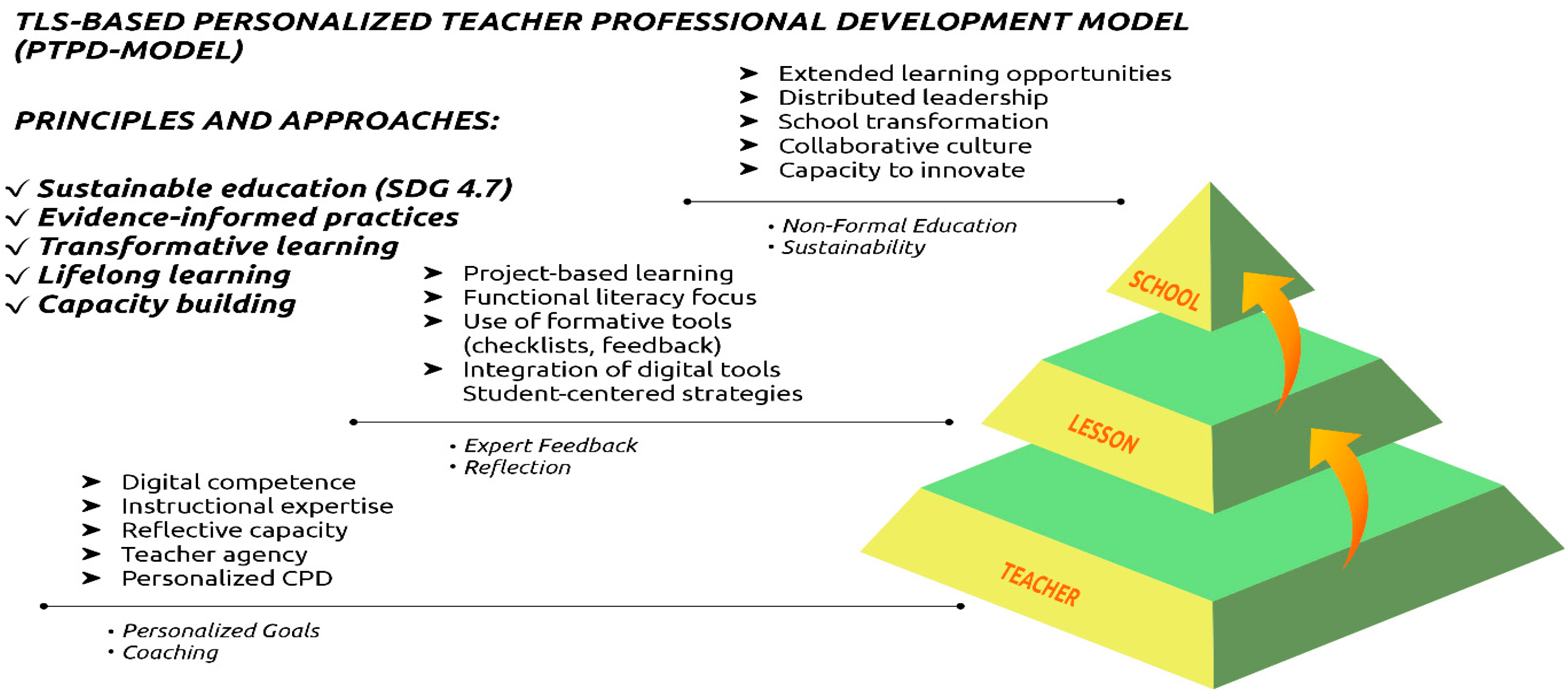
Methodologically, the model (
Figure 1) is aligned with the key components of the OECD School Leadership for Learning Framework (
OECD, 2021), but it extends it by emphasizing: (a) the development of teachers’ professional capacity through the combination of formal and non-formal CPD formats; (b) the cultivation of a collaborative school culture based on co-design and mentoring; and (c) the enhancement of schools’ innovative potential through the integration of formal and non-formal education and the alignment of individual practices with institutional priorities.
The term Teacher in the model’s title is used in a broad sense and is not limited to subject-specific educators within formal education. It also includes support specialists—such as school psychologists, tutors, social pedagogues, and other professionals within the educational environment.
3. Results
3.1. Level 1—Individual Level: Teacher (Self-Assessment Questionnaire)
To test Research Hypothesis 1, which assumed that teachers participating in the TLS-based CPD program would demonstrate a statistically significant increase in their digital and instructional competencies, we analyzed the results of the self-assessment questionnaire described in the in
Section 2.1.1 (Research Instruments).
The full list of statements is provided in
Appendix A.
The experimental group (EG) demonstrated consistent gains across all self-assessment items. The average scores increased by +0.35 for digital competencies and +0.36 for instructional competencies. In contrast, the gains in control groups CG1 and CG2 were less pronounced (
Table 1).
The EG results were substantially higher compared to the control groups, indicating meaningful individual progress—particularly among EG participants 1, 8, 10, 12, 14, and 30.
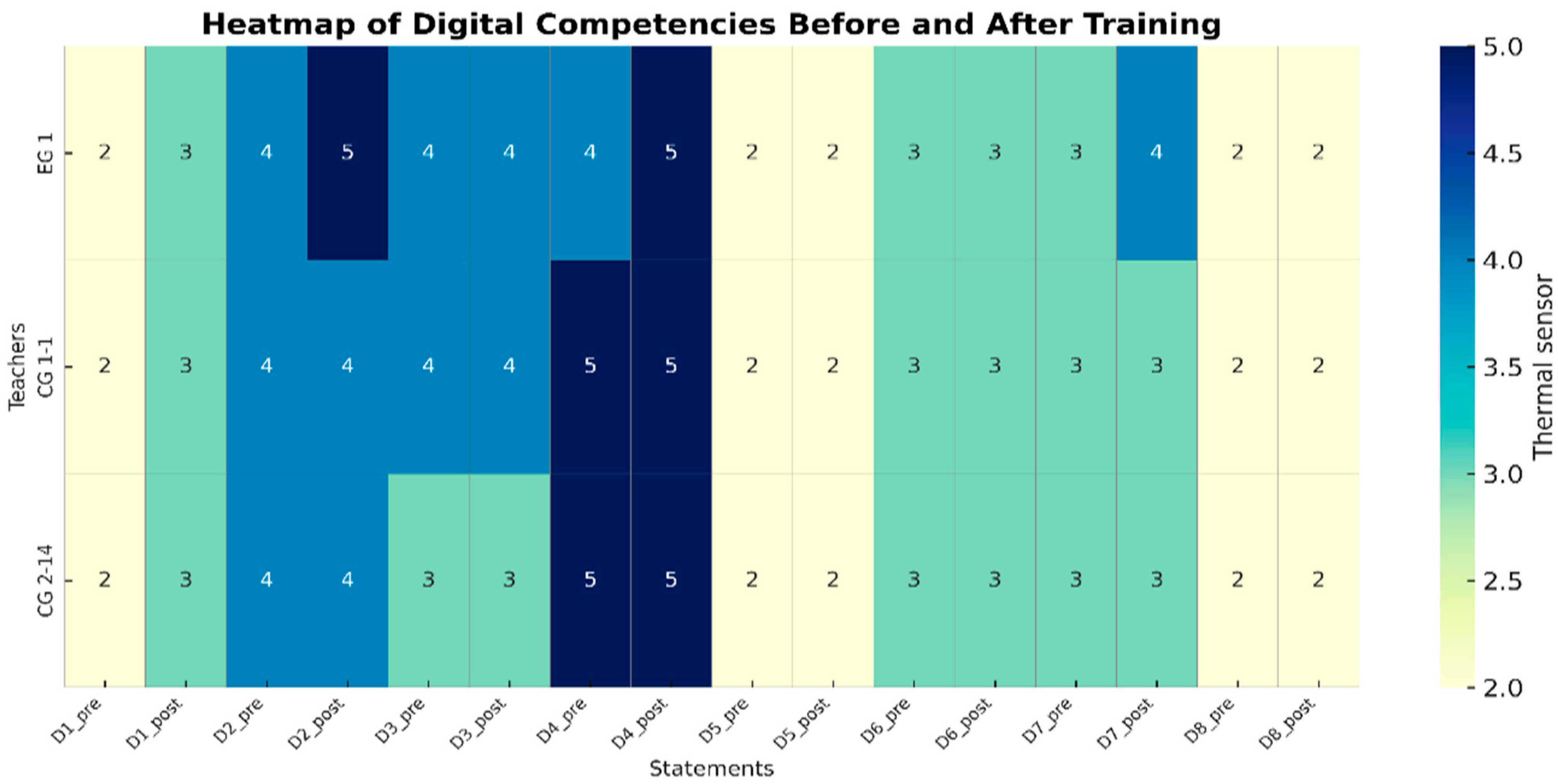
To visualize individual progress, heatmaps were constructed showing changes in digital competencies (
Figure 2) for participants with the lowest initial scores: EG1 (experimental group), CG1-1 (control group 1), and CG2-14 (control group 2).
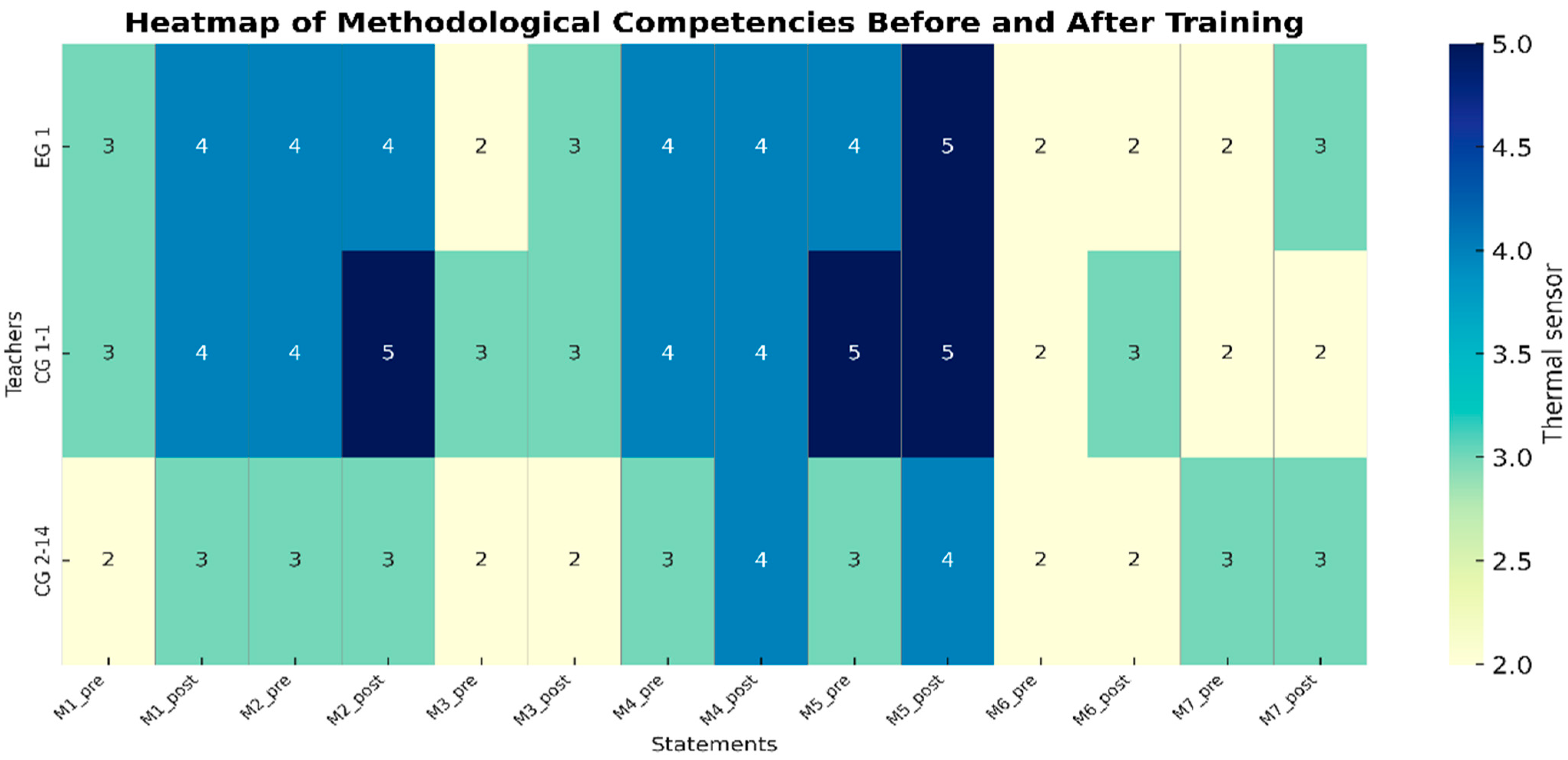
A similar visualization was created for instructional competencies to track individual progress across indicators M1–M7 (see
Figure 3).
No decreases in self-assessment scores were observed—all participants demonstrated either stable or positive changes. A detailed analysis of the experimental group (EG) revealed the most significant improvements in several key competencies.
In the EG, the highest gains were recorded for the indicator D1 (designing digital tasks)—with an average increase of +0.53 (from 4.20 to 4.73)—and for the indicator M3 (applying project-based methods in lessons), also approximately +0.53. These competencies were initially less developed, and the course proved effective in significantly strengthening them.
In contrast, for competencies that were already rated near the upper end of the scale at baseline, progress was minimal. For example, the indicator D4 (using online resources for teaching) and M5 (assignments with multiple solution paths) both had initial average scores close to 4.97 out of 5. As a result, further gains were marginal (≈+0.03), reflecting a ceiling effect. This is likely because such competencies became essential during the pandemic and had already been acquired by most teachers prior to the training.
Overall, the total scores in the experimental group increased substantially: for digital competencies, the average gain was +2.83 points, whereas in the control groups it was only +1.10 and +0.77 points; for instructional competencies, the gains were +2.47 in the EG, +0.66 in CG1, and +0.52 in CG2.
Thus, the analysis of self-assessment data for the experimental group demonstrates a clear positive trend in both components—digital competencies (D1–D8) and instructional competencies (M1–M7) (
Table 2).
The most substantial reduction in standard deviation was observed in the experimental group (−0.08 for digital and −0.07 for instructional competencies), compared to control group 1 (−0.06 and −0.04) and control group 2 (−0.04 and −0.05). This may indicate a more consistent self-assessment dynamic and a greater alignment in professional confidence levels among experimental group participants following the course.
Comparative analysis showed statistically significant improvements across all items in the experimental group (EG). The average digital competence score increased from 3.89 to 4.24 (Δ = +0.35, Z = −4.782, p ≈ 0.000002), and the instructional competence score increased from 3.88 to 4.24 (Δ = +0.36, Z = −4.782, p ≈ 0.000002), based on the Wilcoxon signed-rank test for paired samples.
The Cronbach’s alpha coefficient for the digital scale was 0.9590 (pre-test) and 0.9583 (post-test), and for the instructional scale, 0.9524 (pre-test) and 0.9518 (post-test), indicating high internal consistency and measurement reliability.
The effect size (Cohen’s d) calculated using the differences in means and standard deviations was 0.83 for digital competencies and 0.82 for instructional competencies, both considered large effect sizes. The 95% confidence intervals for gains in digital competence were [0.27; 0.43], and for instructional competence, [0.28; 0.44], further confirming the robustness of the observed differences.
According to the Wilcoxon signed-rank test for paired samples, the differences in the control groups (CG1 and CG2) also reached statistical significance (CG1: Z = −3.724 and −3.920, p ≈ 0.0002–0.00009; CG2: Z = −3.920 and −2.940, p ≈ 0.00009–0.0036). However, the Z values and the significance levels were lower, and the mean score gains (Δ = +0.12–0.19) were less pronounced.
Moreover, the experimental group demonstrated a stable and balanced improvement across both components, whereas the control groups showed an inconsistent pattern—one with higher gains in digital competencies and the other with higher gains in instructional competencies.
3.2. Level 2—Practical Level: Lesson (Project-Based Lesson Checklist)
To test Research Hypothesis 2, which posited that teachers’ lesson quality would improve through the integration of project-based and functionally oriented instructional methods, an expert lesson analysis checklist for project-based lessons was employed as the second evaluation instrument.
The full list of criteria and the corresponding evaluation rubric are provided in
Appendix B.
External experts conducted evaluations of lessons both before and after the professional development program. The results are presented as average scores per teacher (
Table 3).
Analysis of the project-based lesson checklists in the experimental group (EG) revealed significant gains across all five criteria (C1–C5). The most notable improvements were observed in the following areas: C2 (active student engagement), which increased from 2.93 to 4.91 (+1.98); C5 (presence of self-assessment and reflection), from 2.07 to 3.99 (+1.93); and C3 (tasks with multiple solution strategies), from 2.99 to 4.61 (+1.62). These results suggest a more consistent application of reflective and strategic teaching practices.
The analysis of individual progress showed that 29 out of 30 EG teachers improved their total checklist scores by more than +7 points. The average overall gain was approximately +8.78 points (ranging from +6.4 to +13.0). For 37% of participants (11 teachers), the improvement exceeded +10 points, indicating a considerable renewal of their teaching style. Only one teacher demonstrated minimal progress (+6.4), possibly due to individual difficulties. Selected data are presented in
Table 4.
In the experimental group, the average total score increased significantly from 13.92 to 22.70 (≈+8.78). In contrast, the control groups showed only minimal gains: CG1—from 12.70 to 16.00 (≈+3.30), and CG2—from 12.73 to 15.30 (≈+2.58), with no statistically significant changes observed across any of the checklist criteria (C1–C5).
These findings support the conclusion that the observed improvements in the EG are most likely attributable to the personalized CPD intervention, despite the inherent limitations of a quasi-experimental design (see
Table S3 for details).
The EG also demonstrated increased internal consistency: Cronbach’s alpha rose from approximately 0.80 to 0.87, indicating a more systematic and cohesive application of project-based teaching approaches. Prior to the training, certain elements (e.g., student activity) appeared sporadically, whereas post-training, they were more consistently combined with reflection (C5) and real-life relevance (C4), suggesting a more integrated approach to lesson design.
Further analysis revealed a moderate Spearman correlation (ρ ≈ 0.56, p < 0.01) between individual growth in teachers’ self-assessed competencies and improvements in lesson quality. This indicates that those teachers who reported the greatest gains in skills also demonstrated the most substantial changes in their classroom practice—providing indirect validation of the self-assessment results.
3.3. Level 3—Institutional Level: School (Project Evaluation Checklist)
To test Research Hypothesis 3, which proposed that schools would improve the design and implementation of non-formal education projects as an institutional outcome of the TLS-based CPD program, the quality of teacher-initiated school projects was evaluated.
One of the selection criteria for evaluating these projects was not merely their affiliation with non-formal education but also their meaningful integration with subject-based instruction. Therefore, the program emphasized transforming not only the format but also the content of educational practice.
This approach enabled an evaluation of the model’s potential to foster long-term transformation of day-to-day educational practice through subject-oriented projects—an element which, according to both teachers and external experts, may contribute to the sustained development of students’ functional literacy.
Prior to the program, many school initiatives were formalistic or template-based in nature (e.g., one-time events with no long-term objectives). Following the program, teachers in the experimental group (EG) substantially revised and enhanced their projects.
The complete list of criteria and the scoring rubric is provided in
Appendix C.
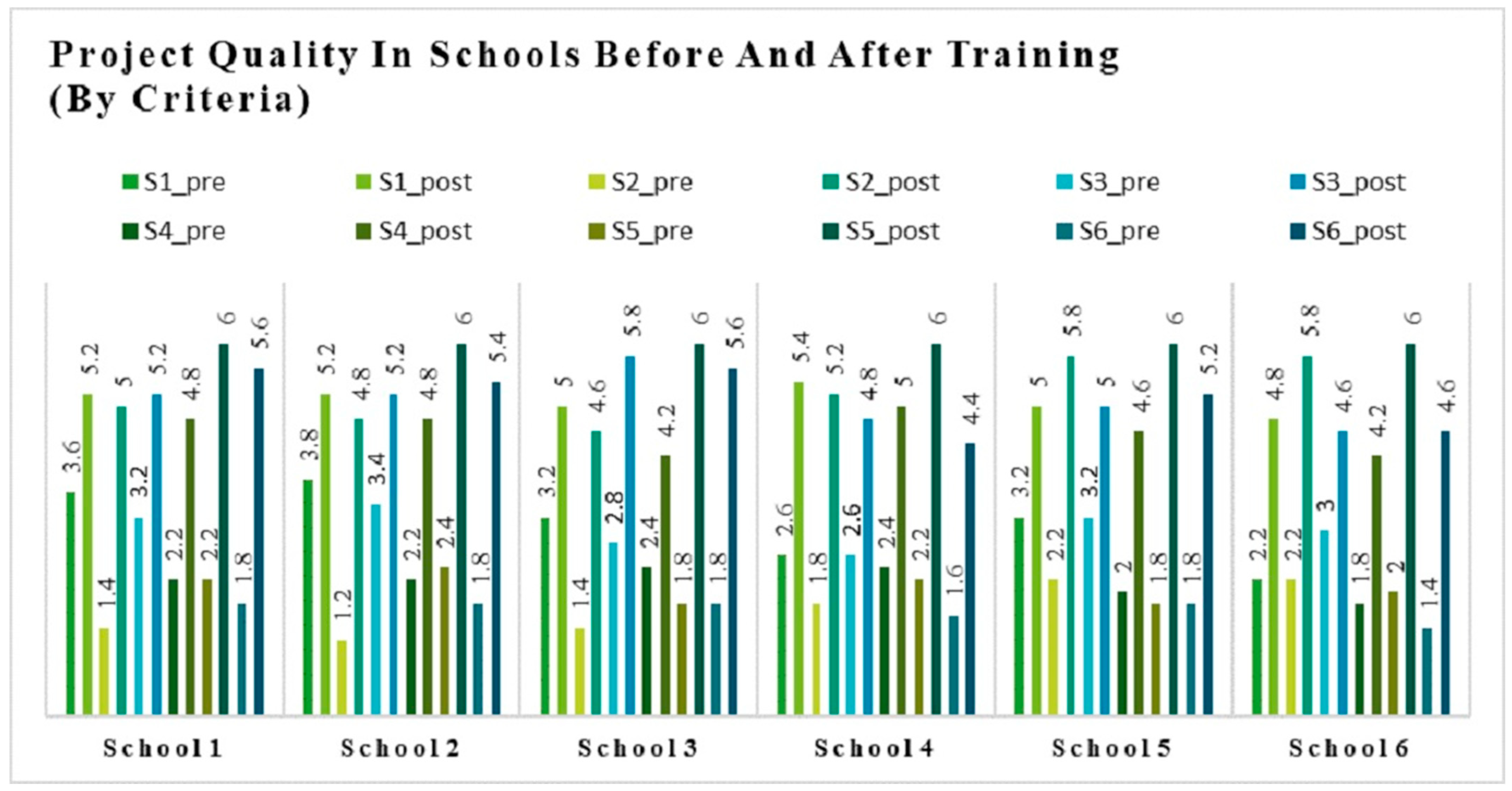
The average total score across the six evaluation criteria (S1–S6, maximum = 36 points) increased in the EG from 13.77 to 31.13, equivalent to an average per-criterion increase from 2.30 to 5.19. This indicates a systemic improvement in both the quality and functionality of the implemented projects (see
Figure 4).
In contrast, the control groups showed minimal improvement: CG1—from 12.72 to 13.83 (+1.11), CG2—from 12.72 to 13.42 (+0.70) with scores across individual criteria remaining within the narrow range of 2.2 to 3.3 points.
The gap in progress between the EG and CGs is striking: the pedagogical projects developed by teachers who completed the personalized training reached a fundamentally higher level of quality.
The most substantial improvements in the EG were observed in:
S2 (digital component): +3.50—active use of ICT and online tools;
S5 (team collaboration): +3.93—strong involvement of school teams;
S6 (assessment and sustainability): +3.43—introduction of monitoring mechanisms and continuity plans.
Other criteria (S1, S3, S4) also improved by +2.2 to +2.8 points, indicating that the projects became more student-centered, digitally integrated, and oriented toward long-term impact.
Statistical analysis confirmed both the reliability and the significance of the results: Cronbach’s alpha remained high (≈0.91–0.92), indicating strong internal consistency, while the Wilcoxon signed-rank test revealed statistically significant differences in the experimental group (Z = −2.201, p = 0.036). No statistically significant changes were observed in the control groups (CG1: Z = −2.023, p = 0.063; CG2: Z = −2.023, p = 0.063), and most projects remained formal in nature.
Several examples of school projects developed by the experimental group:
At one school, teachers launched a STEM club for grades 7–8, where students developed practical engineering mini-projects (e.g., building bridges from materials, programming Arduino-based robots). The project scored highly on S2 (integration of digital skills) and S5 (team collaboration) and ensured sustainability through regular peer-led sessions involving club graduates and new members.
At another school, the “EcoPatrol” project was implemented— a series of student-led investigations into local environmental issues using digital sensors, culminating in public presentations to the community. The project was praised for its strong student focus (S3) and community relevance (S1), as noted by expert evaluators.
Overall, the results across all three levels confirm that the personalized CPD program contributed to the teachers’ professional growth, renewal of pedagogical practices, and the initiation of meaningful school-based projects. These outcomes align with the core principles of the TLS model, wherein individual-level changes are scaled up into institutional transformations through collaborative team structures and a shared culture of innovation.
4. Discussion
This discussion section is organized according to the three research hypotheses (H1–H3), which correspond to the three levels of the TLS-based professional development model: Teacher–Lesson–School. For each hypothesis, the key results are analyzed in sequence and related to previous research findings.
The evidence strongly supports H1: teachers who participated in the TLS-based professional development program showed large gains in both digital and instructional competencies. On average, experimental-group (EG) teachers’ self-assessed digital competence rose from 3.89 (3.8875) to 4.24 (Δ = +0.35, p ≈ 0.000002) and their instructional competence from 3.88 (3.8857) to 4.24 (Δ = +0.36, p ≈ 0.000002). These gains were highly significant (p ≈ 0.000002) and correspond to large effect sizes (Cohen’s d ≈ 0.83 for digital skills and 0.82 for instructional skills). In percentage terms, EG teachers’ overall self-assessment improved by roughly +9%, whereas teachers in the control groups showed only minimal, non-significant increases (≈+4–5%). Notably, every teacher in the EG improved their total score—no one declined—indicating a consistently positive impact across participants.
The initially lowest indicators—understanding the use of digital technologies for developing functional competences (D8) and confidence in using ICT in teaching (M7)—increased by approximately +0.50, which is comparable to the highest improvements observed in designing digital tasks (D1) and applying project-based methods (M3), where the growth reached +0.53. This indicates that the program effectively addressed teachers’ most relevant professional needs. In contrast, competencies that were initially at a high level—such as using online resources (D3) or designing tasks with multiple solutions (M5)—showed minimal change, reflecting a “ceiling effect.”
This pattern suggests the program effectively targeted teachers’ most pressing needs. The intervention’s components—such as individualized coaching, diagnostic assessments, and teacher-designed projects—gave each teacher practice in areas where they felt weakest. In effect, the professional development (PD) was highly personalized, helping teachers see the practical value of the new tools and methods. Many participants began to meaningfully integrate digital technologies into both classroom and extracurricular activities. This reflects a shift from the formal acquisition of tools to their more deliberate, reflective pedagogical use, in line with the TPACK framework, which integrates technological, pedagogical, and content knowledge (
Handayani et al., 2023;
Osorio Vanegas et al., 2025), as well as the DigCompEdu Framework (Digital Competence Framework for Educators), which highlights the pedagogical use of digital tools as a key area for professional growth (
Tzafilkou et al., 2023).
Recent studies confirm that the development of teachers’ digital and instructional competencies is a critical condition for teaching quality (
Hämäläinen et al., 2021;
Lin et al., 2023) and is closely related to students’ learning outcomes (
Danişman et al., 2019;
López-Martín et al., 2023). In our study, the observed growth in competencies was accompanied by a qualitative shift in professional development: learning occurred through reflection, peer interaction, and self-initiative (
Abakah, 2023), combining both formal and informal forms of CPD (
Hai et al., 2024).
This combination—strengthened by coaching and project-based activities—ensured sustainable improvements in both digital and instructional skills. A similar effect is described in the systematic reviews by
Amemasor et al. (
2025) and
Domínguez-González et al. (
2025), which emphasize the importance of hands-on digital experience and mentoring in CPD programs.
In contrast to the general picture presented in TALIS (
OECD, 2020) and analyzed in the context of Kazakhstan by
Chernobay and Tashibaeva (
2020), where professional development is often perceived as purely formal, our CPD program delivered measurable growth in digital and instructional competencies. This aligns with the findings of
Jiang et al. (
2024), which highlight the development of teachers’ professional self-efficacy in long-term, context-sensitive CPD formats.
In summary, H1 is fully confirmed. Participation in the TLS-based CPD model yielded significant, large-magnitude improvements in teachers’ digital and instructional competencies. The universal improvement across the EG teachers—especially in their weakest skill areas—indicates the intervention successfully strengthened teacher capacity. These teacher-level changes are a necessary first step in the Teacher–Lesson–School model, setting the stage for improvements in classroom practices and school-wide innovation.
Hypothesis H2 predicted that lesson quality would improve through the integration of project-based, functionally oriented instruction. The evidence here is also clear: teachers in the experimental group delivered substantially richer, more engaging lessons by the end of the program. On the expert evaluation checklist (maximum of 30 points), the average EG lesson total score jumped from 13.59 to 22.57—an increase of ≈+66%. By contrast, lessons by the control group teachers improved only marginally (≈+20–26%) with no statistically significant changes in any criteria. The EG’s improvement was robust (nearly all EG teachers improved their lesson scores, and 37% improved by more than 10 points). Moreover, there was a moderate positive correlation between individual teachers’ self-assessed competency gains and their lesson score improvements, indicating that those who learned the most also transformed their teaching the most.
Looking at specific aspects of the lessons, the largest gains were in student engagement and reflection (C2 and C5). For example, the rubric criterion for active student engagement rose by +1.98 points, and structured reflection by +1.93. Task complexity and challenge also increased significantly. In effect, the EG teachers began structuring lessons around hands-on, problem-based activities with ample student participation and opportunities for metacognition. Classrooms shifted toward a more student-centered pedagogy, where students actively used ICT tools, worked collaboratively on projects, and reflected on their own learning.
The observed improvements in lesson quality align with international evidence on the impact of practice-oriented forms of CPD on teaching practice. Research shows that long-term and collaborative formats of teacher learning lead to more sustainable changes in instructional methods, whereas universal short-term training programs tend to have limited effects (
Philipsen et al., 2019;
Farrow et al., 2022). In our case, the implementation of project-based learning and systematic feedback in real classroom contexts enabled teachers to move from a reproductive model of instruction to an inquiry-based approach focused on developing students’ functional literacy. This finding corresponds with international research demonstrating that both project-based and problem-based learning approaches effectively enhance lesson quality, student engagement, and functional skills (
Markula & Aksela, 2022;
Williamson, 2024). Systematic reviews further emphasize that project-based learning supports the integration of interdisciplinary knowledge, sustainability principles, and authentic assessment practices (
Sánchez-García & Reyes-de-Cózar, 2025;
Zulkarnaen et al., 2025).
Empirical studies also highlight that shifting from traditional, teacher-centered instruction toward project- and problem-based models fosters students’ analytical and functional thinking, collaboration, and reflection (
Anggraeni et al., 2023;
Molina-Torres, 2022). Similar tendencies have been documented in Kazakhstan, where the implementation of the renewed curriculum has redefined teachers’ roles toward facilitating inquiry-based and project-oriented learning (
Yakavets et al., 2023).
Thus, H2 is confirmed. The intervention led to significant, practice-oriented improvements in actual teaching. Teachers were not only more skilled on paper (as H1 shows) but also demonstrated these skills by delivering higher-quality, project-based lessons that meaningfully engaged students in functional tasks. This in turn suggests that gains in teacher capacities (digital and pedagogical) were successfully translated into classroom practice—a critical link in the TLS framework.
Hypothesis H3 posited that schools would improve the quality of their non-formal education initiatives, reflecting an institutional impact. Again, the data support this. At the start of the program, the average quality score of the EG schools’ extracurricular projects was 13.77 (out of 36); after the program, it rose to 31.13—a +125.7% gain. The control schools’ project scores remained essentially flat (≈+20–26%). This difference is statistically significant and practically large, indicating that the experimental schools launched much stronger, more student-centered initiatives.
The EG teachers collectively designed and implemented several noteworthy projects. For instance, one school started a STEM club for grades 7–8 where students built bridges and programmed robots. This project was scored highly for its use of digital tools, hands-on teamwork, and continuity. Another school launched an “EcoPatrol” club in which students led environmental investigations using sensors and produced public exhibits; experts praised its strong student engagement and real-world relevance. In general, EG projects became more digitally integrated (criteria score, S2, up by +3.50), involved deeper collaborative planning (S5, +3.93), and incorporated better assessment and sustainability planning (S6, +3.43). Other aspects—such as student focus, community relevance, and linking to curriculum—also improved substantially. In contrast, control schools tended to run one-off events with low student ownership.
These changes reflect a broader shift in school culture. Teachers who participated in the personalized CPD became more collaborative with each other and with administrators. They formed peer teams to plan and execute projects, strengthening horizontal ties within the school. Many took on informal leadership roles by coordinating clubs and sharing practices. This echoes the literature on distributed leadership and teacher agency: when a core group of trained, motivated teachers begin innovating together, they can catalyze whole-school change (
Qanay & Frost, 2020;
Shal et al., 2024;
Tucaliuc et al., 2025). The TLS model’s logic—synchronized growth in teachers, lessons, and the school—is evident here. Improvements at the teacher and lesson levels were amplified at the institutional level. Such effects are consistent with recent reviews that describe professional learning as a non-linear and transformative process shaped by context and by teachers’ collective efforts (
Hagedoorn et al., 2023;
Kennedy & Stevenson, 2023;
Nīmante et al., 2025).
The institutional impact of this program is particularly notable given the context. In many OECD countries (for example, Finland’s Tutor Teacher program and Portugal’s STEM initiatives), cooperative PD efforts have also led to greater teacher agency and school improvement (
Chung, 2023;
Costa et al., 2022;
Lindfors et al., 2024). However, such programs often rely on centralized support and stable funding. By contrast, our TLS-Based PTPD model was deliberately designed for resource-constrained environments. It uses a flexible modular structure, local data (e.g., national surveys like PIAAC and TALIS), and embedded school projects rather than heavy external inputs. The success of the program in raising the quality of school initiatives shows that even under limited resources, it is possible to build an effective, scalable CPD system. The key is empowering teachers as change agents within their own schools.
Moreover, international experiences corroborate our findings. UNESCO-supported programs in the region have used similar principles. For example, Uzbekistan’s TPD@Scale initiative (also implemented in Ghana and Honduras) successfully trained teachers through blended and peer learning, digital monitoring, and a focus on ICT competencies, eventually integrating the model into the national system (
UNESCO, 2023). In Kazakhstan, the Remote and Rural Schools project has built teacher leadership in rural areas through school-based communities and teacher-led mini-projects (
UNESCO, 2024). Both cases highlight the potential of CPD models that emphasize teacher agency, modular flexibility, and technology integration. Our model, in line with these, achieved measurable improvements in rural Kazakh schools, suggesting it could be adapted to other similar education systems.
In addition, a distinctive feature of our approach was the deliberate integration of formal and non-formal learning. Projects were required not only to be innovative but also to align with curricular goals. This meant extracurricular clubs and activities reinforced subject instruction and helped develop students’ functional literacy. For example, a science club’s experiments tied into the physics curriculum, and a reading workshop supported language objectives. This bridging of school curriculum and out-of-school practice is still rare in many PD models, but it amplifies the impact: non-formal activities effectively become extensions of classroom learning. By showing how formal lessons and non-formal projects can work hand-in-hand, the program contributed to both immediate skill growth and long-term educational goals (such as fostering students’ functional literacy and problem-solving competencies). In practical terms, even under budget constraints, using existing local resources (like available digital tools or community expertise) in creative ways proved sufficient for transformation.
Our study confirms the importance of non-formal learning as a valuable educational resource (
Johnson & Majewska, 2024;
Kulgildinova et al., 2025), as well as the need to integrate it with formal education—supporting a shift from the traditional “qualification upgrading” paradigm to the paradigm of continuous professional development for teachers (
Koyshigulova et al., 2024).
This is further supported by a recent systematic review showing that formal and non-formal forms of professional learning are complementary and mutually reinforcing (
Makhmetova et al., 2025).
Overall, the main research hypothesis was confirmed: participation in the TLS-based CPD program—which integrates formal subject instruction with non-formal pedagogical practices across the Teacher–Lesson–School levels—resulted in statistically significant improvements in teachers’ digital and pedagogical competencies, enhanced lesson quality, and the introduction of new instructional approaches within the school environment compared with traditional PD formats.
Limitations of the Study
First, the sample was limited to 80 teachers from rural schools in a single region. Although this meets the minimum threshold for detecting a medium effect size (Cohen’s d ≈ 0.5) with a significance level of α = 0.05 and statistical power of 0.80, the external validity of the findings remains constrained. While many challenges facing rural education in Kazakhstan are systemic in nature, generalizing the results to other contexts—such as urban schools, other regions, or different countries—should be approached with caution. Additionally, due to the voluntary nature of participation and the regional scope of the project, the representativeness of the sample with respect to the broader teacher population in Kazakhstan may be limited.
Second, the quasi-experimental design does not eliminate the potential influence of external factors—particularly initial teacher motivation. Participants in the experimental group voluntarily enrolled in the program, which may have affected the outcomes. Partial randomization and the inclusion of the two control groups (25 teachers each) helped reduce the selection bias, but the influence of organizational context and school leadership culture cannot be entirely ruled out. While voluntary participation and school-level randomization helped mitigate self-selection effects, they could not eliminate them entirely.
Third, a substantial portion of the data is based on self-assessment instruments, which are susceptible to subjective distortions, such as social desirability bias. To enhance the objectivity of the findings, we incorporated additional data sources—lesson observations and expert evaluations of projects—which corroborated the positive changes observed. However, the impact on student learning outcomes has not yet been directly assessed. In the future, it is advisable to include metrics of students’ functional literacy before and after the implementation of projects in order to capture the transfer of effects, particularly in mastering non-formal formats that were new to many teachers.
Fourth, the study did not include long-term monitoring, so the sustainability of the observed changes remains unknown. Although one year of follow-up provided some indication of continued teacher engagement, further research is required to evaluate the long-term effects of the intervention.
Fifth, it is important to explore the factors contributing to the variability in outcomes, including teachers’ individual characteristics, the level of leadership support, and school-specific contextual conditions. Instances were observed in which teachers derived significantly different outcomes from the same training program, suggesting a need for a more differentiated approach in the CPD design and implementation.
Additionally, the exploratory factor analysis (EFA) was conducted on the pre-test data, and the confirmatory factor analysis (CFA) was performed on the post-test data. While this approach allowed the examination of the measurement structure’s stability over time, it does not ensure fully independent validation and may limit the detection of potential structural changes in the factor model resulting from the intervention. During the EFA, two items (D4 and M5) showed low communality and strong ceiling effects; therefore, a refined 13-item version was used to verify the construct validity and reliability of the instrument. However, for the main pre- and post-test analyses, all 15 items were retained to support measurement consistency and facilitate the comparability of latent means. Future research could address this limitation by conducting CFA on an independent or split sample and testing for longitudinal measurement invariance (configural, metric, and scalar levels) to further substantiate the robustness of the factor structure.
While the primary goal of the model is to support the development of students’ functional literacy, this study did not include direct measures of student progress (e.g., standardized assessments or diagnostic tasks). This limitation is due to the scope of the project, which focused on transforming teachers’ professional practice. At the same time, students’ functional literacy is developed not only in formal lessons but also in non-formal projects, which requires separate measurement in future studies. However, indirect evidence gathered during program implementation suggests potential positive effects on learners. Specifically, descriptions of teacher-led projects (see
Section 3.3) frequently highlight increased student engagement, initiative, and autonomy in both curricular and extracurricular activities—features that align with learner-centered and competency-based approaches.
Increased task variation, student activity in lessons, and involvement in project-based learning, as captured in expert observations, may also serve as indirect indicators of progress toward functional literacy.
Nevertheless, any claims regarding the program’s impact on student outcomes must be empirically validated in future evaluation cycles, including functional literacy testing and analysis of student work products (e.g., portfolios, reflective journals).
Despite these limitations, the results of the study demonstrate the effectiveness of a comprehensive and personalized approach to teacher professional development. The model, grounded in the Teacher–Lesson–School (TLS) framework, contributed to the development of functional literacy, the integration of innovative practices into teaching, and the initiation of school-level transformation.
In doing so, the model advances both the theory and practice of CPD in low- and middle-income countries (LMICs) by offering a sustainable mechanism for teacher growth under conditions of digital inequality and post-pandemic challenges.
In Kazakhstan, the development of functional literacy and 21st-century skills remains a national strategic priority. The findings of this study confirm that targeted support for teachers can generate a multi-level effect aligned with the objectives of Sustainable Development Goal (SDG) 4, particularly Target 4.7, which focuses on sustainable development, global citizenship, and practical competencies. The findings are significant not only for Kazakhstan but also for education systems in resource-constrained settings worldwide. They align with OECD’s conclusion that institutional flexibility is a prerequisite for sustainable reforms (
OECD, 2025), showing that teacher professional development integrating formal and non-formal learning can be viewed as part of broader governance transformation.
Based on these results, several practical recommendations can be offered for schools, including leveraging non-formal education as a resource to strengthen formal knowledge and as a mechanism for enhancing functional literacy. School-based clubs, workshops, and extended learning activities offer valuable opportunities for applied, student-centered learning.
Develop school-based mentoring structures grounded in horizontal collaboration between experienced and novice teachers. Such peer-driven support systems enhance the sustainability and depth of pedagogical transformation.
Ensure systematic support and follow-up for CPD initiatives through continuous monitoring of participant progress and the development of individual integration plans. These plans should guide how newly acquired knowledge and competencies are embedded into curricular and extracurricular practices.
These measures not only reinforce the effectiveness of teacher professional development but also promote the transformation of school environments at the institutional level.
5. Conclusions
The study led to the following key conclusions:
The TLS-Based Personalized Teacher Professional Development Model proved effective in rural schools in Kazakhstan by fostering the growth of teachers’ digital and methodological competences, improving lesson quality, integrating elements of non-formal education, and initiating school-level innovations. It demonstrated its applicability as a tool for data-informed change. The findings are particularly relevant for schools with limited resources; however, implementation in other contexts would require adaptation.
Applying the three-level approach (Teacher–Lesson–School) made it possible to trace the interconnections between individual teacher development, the integration of non-formal practices into instruction, and institutional shifts—including the development of distributed leadership. The correlation between self-assessment scores and lesson evaluations confirms the model’s hypothesis of interconnected change across all three levels.
The practical innovation of the model lies in the integration of formal and non-formal education through a modular CPD format (three days per month over four months), pedagogical design, and the work of school-based teams. This approach enabled the transformation of non-formal practices (clubs, projects, studios) from optional activities into institutionally significant elements of the school environment.
The key factors behind the model’s success were coaching, personalized support, formative reflection, and practice-based learning—all of which are consistent with international approaches to CPD and the goals of sustainable development (SDG 4.7, Education for Sustainable Development—ESD).
Despite the limitations of the quasi-experimental design, the differences between the experimental and control groups were statistically significant, confirming the effectiveness of the model as a tool for renewing pedagogical practice. Further research is needed to examine the impact of integrating non-formal practices on students’ learning outcomes.
Thus, future research should focus on analyzing the sustainability of the model’s effects, expanding its geographic scope, and exploring the interconnections between teacher agency, the integration of formal and non-formal learning, and institutional transformation. Additional longitudinal studies are needed to confirm the model’s long-term impact and transferability across educational systems.