Article

Curriculum Material Use in EFL Classrooms: Moderation and Mediation Effects of Teachers’ Beliefs and TPACK


by
Nurul Fitriyah Almunawaroh
1,2,* and
János Steklács
2,3
1
Doctoral School of Education, University of Szeged, 6722 Szeged, Hungary
2
Reading Fluency and Comprehension Research Group, MTA-PTE, 7624 Pécs, Hungary
3
Doctoral School of Education, University of Pécs, 7624 Pécs, Hungary
*
Author to whom correspondence should be addressed.
Educ. Sci. 2025, 15(12), 1647; https://doi.org/10.3390/educsci15121647 (registering DOI)
Submission received: 1 October 2025 / Revised: 1 December 2025 / Accepted: 4 December 2025 / Published: 6 December 2025

Abstract

While many studies have acknowledged multifaceted roles of curriculum materials (textbooks) in EFL reading activities, textbooks alone are insufficient, as their effectiveness depends on how teachers use them. Teachers’ textbook usage is strongly related to cognitive and affective factors. There is limited understanding of how the interplay between teachers’ cognitive and affective factors influences their use of these materials and how they use technology to enhance the effectiveness of textbooks for reading activities in EFL classrooms. The current study fills this gap by investigating the interplay among teachers’ technological pedagogical content knowledge (TPACK), learner-centered pedagogical beliefs (LCPB), teacher-centered pedagogical beliefs (TCPB), and their curriculum material use approach—specifically the constructivist and transmissive approaches—focusing on moderation and mediation effects. This study also investigated how teachers use technology to enhance reading activities in the textbooks. Structural equation modeling analyzed mediation and moderation effects using survey data from 251 Indonesian EFL teachers. Findings indicated that TPACK directly influenced the use of constructivist-oriented curriculum material. At the same time, both LCPB and TCPB acted as mediators in the influence of TPACK on teachers’ orientations towards the use of curriculum materials. Crucially, the relationship between TPACK and LCPB adversely affected constructivist usage, suggesting that robust learner-centered beliefs diminished dependence on TPACK. Conversely, transmissive orientations were primarily guided by beliefs and remained uninfluenced by TPACK. These results highlight that teachers’ knowledge and beliefs influence the way they use curriculum materials—either constructivist or transmissive. The findings inform policymakers in initiating professional development programs that aim to shift teachers toward more constructivist uses of curriculum materials, fostering a more interactive and student-centered language-learning environment.

1. Introduction

Curriculum materials, such as textbooks, play multifaceted roles in EFL classrooms’ reading activities. They provide sources of language exposure and learning (Iranmehr et al., 2011; Tergujeff, 2015), instructional guidance for teachers (Amiri & Rezvani, 2021; Artini et al., 2018), a physical realization of the curriculum (Masuhara, 2022), and a basis for assessment and assignment (Orfan et al., 2021). However, textbooks alone are insufficient since they often have issues related to overemphasis on a grammar-centric approach (Zohrabi et al., 2012), inadequate cultural representation and diverse contexts (Asakereh et al., 2019), inadequate critical thinking activities (Van Canh, 2018), and a lack of promotion of learner autonomy (Lima & Vieira, 2020). Therefore, del Pilar Montijano Cabrera (2014) and Orfan et al. (2021) suggest that teachers adapt and supplement textbooks with additional sources to meet the specific needs of different student groups and optimize learning (Alshumaimeri & Alharbi, 2024). Although curriculum materials adaptation is promising for enhancing their effectiveness, teachers’ willingness, and ease in adapting them depend on their teaching beliefs and on their TPACK.
Teachers’ knowledge, including pedagogy, content, and technology, is one influential factor in effectively using curriculum materials in the language classroom. TPACK conceptualizes free and open interplay between technology, pedagogy, and content” (Koehler et al., 2016), which supports teachers to use technology to enhance curriculum materials’ effectiveness. However, teachers’ beliefs play an essential role in translating knowledge into practice, especially their beliefs about teaching, learning, and students’ abilities (Flint et al., 2024; Martinez et al., 2025). Despite these insights, studies across contexts (Thailand and Taiwan) found that EFL teachers integrate technology at the substitution level (Boonmoh & Kulavichian, 2023; Tseng et al., 2011). Similarly, Nurwahidah et al. (2023), Cahyono et al. (2025), and Maru et al. (2021) reported that most EFL teachers in Indonesia use technology solely to display lessons for teaching reading. These practices make students passive recipients of information (Nurwahidah et al., 2023; Pramerta et al., 2025) and are identical to traditional methods. Teachers justify these practices because they lack technological knowledge and perceive themselves as more knowledgeable in traditional teaching methods (Mukminin & Habibi, 2020; Prasojo et al., 2020). These findings highlight the importance of examining teachers’ TPACK and their pedagogical beliefs regarding the use of curriculum materials.
Studies on EFL teachers’ instructional material use mainly focus on selection, adaptation, and implementation of curriculum materials (Çeliker-Ercan & Çubukçu, 2023; Li, 2021; Li & Harfitt, 2018; Shawer, 2010). However, these studies neglect the influence of cognitive and active factors on teachers’ decisions regarding the use of curriculum materials. Depaepe and König (2018) and Ertmer et al. (2014) emphasized the need for more studies investigating the impact of teachers’ cognitive and affective factors on their instructional practices. In their latest study, Almunawaroh and Steklács (2025) investigated the interrelationship among teachers’ pedagogical content knowledge, pedagogical beliefs, and instructional material use approach orientation. However, their study excludes technological knowledge, limiting insights into how technological knowledge, content, and pedagogical knowledge influence teacher curriculum material use approach.
Based on theoretical models of technology adaptation, such as the Technology Acceptance Model (Davis, 1989) and the Unified Theory of Acceptance and Use of Technology (Venkatesh et al., 2012), perceptions of usefulness and ease of use are closely linked to teachers’ pedagogical beliefs and TPACK (Kartal, 2024; Liu et al., 2017). These perspectives highlight that TPACK supports teachers with skills to use technology to enhance curriculum materials; however, their pedagogical beliefs still determine whether their TPACK is translated into transmissive or constructivist practice.
The present study addresses this gap by investigating the interplay among TPACK, pedagogical beliefs, and curriculum material use approaches among Indonesian EFL teachers. Specifically, it examines how teachers’ TPACK predicts their curriculum material use orientations—constructivist vs. transmissive—and whether pedagogical beliefs mediate and moderate this relationship. This study also explores how EFL teachers use technology to enhance the effectiveness of curriculum materials. This study contributes to theoretical, empirical, and practical contributions. Theoretically, it contributes to understanding how TPACK and pedagogical beliefs interact to shape material use approach orientation. Empirically, it provides mediation and moderation analyses linking TPACK, pedagogical beliefs, and curriculum material use orientation in an EFL context. In practice, the findings inform policymakers in initiating professional development programs that aim to shift teachers toward more constructivist uses of curriculum materials, thereby fostering a more interactive and student-centered language-learning environment.

2. Theoretical Framework

2.1. TPACK

TPACK is a framework for understanding the interplay among teachers’ knowledge domains, including subject-matter knowledge, pedagogical strategies, and the resources used to facilitate teaching (Koehler, 2006). It extends Shulman’s foundational concept of the knowledge base of teaching (Shulman, 1986, 1987) by integrating technological knowledge into the framework (Koehler, 2006; Rosenberg & Koehler, 2015). The relationship between pedagogical content knowledge and technology has “become a central topic in educational discourse, driven by the emergence of diverse technologies and the need for teachers to learn how to effectively integrate them into their teaching practices” (Koehler, 2006, p. 1023).
Studies have validated that TPACK is a determinant factor of technology integration to enhance learning, predict the technology integration of EFL teachers (Farjon et al., 2019; Lai et al., 2022; Santos & Castro, 2021), guide the professional development of teachers (Nazari et al., 2019), and serve as a framework in designing EFL teaching materials (Syamdianita & Cahyono, 2021). TPACK is also strongly associated with teachers’ instructional planning activities, specifically knowledge of students’ intellectual engagement and of technology integration standards (Harris & Hofer, 2011). Additionally, the TPACK framework underscores the relationships between pedagogical content knowledge and technology integration that guide teachers in effectively selecting and using technology-based instructional materials to elevate learning (Djulia & Brata, 2022; Durdu & Dag, 2017). Regarding teachers’ instructional material use, their pedagogical knowledge significantly predicts a constructivist-oriented approach to instructional material use (Almunawaroh et al., 2024).
While Ali and Mohammadzadeh (2022), Liang et al. (2017), and Yildiz Durak (2021) recognize that teachers’ beliefs may interfere with the application of TPACK in teachers’ instruction, earlier studies neglected the role of teachers’ beliefs in their approach to using curriculum materials. Moreover, existing TPACK studies did not capture how teachers enacted TPACK. Therefore, the current study fills this gap by exploring the interrelationships among EFL teachers’ TPACK and pedagogical beliefs regarding curriculum material use approaches. The current study also employs an open-ended written interview to gain a clearer understanding of teachers’ classroom-level practices and decisions.

2.2. Pedagogical Beliefs in English Language Teaching

Teachers’ pedagogical beliefs act as a filter that guides their instructional practices (Schutz et al., 2020). These beliefs cover theoretical principles and teaching strategies and fall into two categories—teacher-centered and learner-centered beliefs (Armin & Siregar, 2021; Larenas et al., 2015; Liu et al., 2017; Mertala, 2019). Teacher-centered beliefs are generally associated with a teacher-centered teaching approach, in which teachers view themselves as knowledge transmitters (Dejene, 2020) and rely on methods such as lecturing, which render students passive learners (Badjadi, 2020). In contrast, learner-centered beliefs are associated with a constructivist teaching approach. This approach underscores the implementation of constructivist-based teaching strategies, such as cooperative learning, discussions, and task-based learning (Badjadi, 2020; Ellis, 2017), promoting active student engagement and knowledge construction.
Information acquired through interactions (Schutz et al., 2020) from formal teacher training programs and learning experiences (Cook, 2012; Flint et al., 2024) shapes teachers’ pedagogical beliefs and further develops and changes through interactions with colleagues, students, school contexts, and curriculum during teaching practices (He & Levin, 2008; Nxasana et al., 2023). These beliefs influence teachers’ cognitive, affective, and behavioral decisions (Hoffman & Seidel, 2014), which guide their thinking and decision-making (Bandura, 1997) and shape their instructional practices (Schutz et al., 2020). Numerous studies have investigated the roles of pedagogical beliefs on teachers’ instructional practices, which include material use approaches (Almunawaroh et al., 2024), technology use (Ertmer et al., 2014), instructional strategies (Cook, 2012; Martinez et al., 2025), and TPACK implementation (Wu et al., 2022).
Regarding the relationship between teachers’ pedagogical beliefs and TPACK, those with strong LCPB and TCPB have greater confidence in implementing their TPACK (Wu et al., 2022). Furthermore, pre-service teachers’ use of ICT also depends on their ICT competencies and pedagogical beliefs. Teachers with TCPB tend to use technology for knowledge acquisition, whereas those with constructivist beliefs leverage technology to enhance students’ understanding before collaborative construction of knowledge (Chai, 2010). The LCPB of teachers is also a determinant factor in their constructivist-oriented instructional material use approach and mediates their pedagogical content knowledge to their instructional material use approach (Almunawaroh & Steklács, 2025). Thus, teachers’ pedagogical beliefs may also mediate the influence of their TPACK on their approach to using curriculum material.
Despite the growing body of research on teachers’ pedagogical beliefs, the studies mentioned above still present some methodological and conceptual limitations. The studies relied heavily on surveys, focusing solely on their stated beliefs rather than their actual classroom practices. Additionally, there is still limited focus on curriculum material use approaches, leading to a limited understanding of how teachers’ pedagogical beliefs influence their selection, adaptation, and design of materials. Therefore, this study addresses this gap by investigating teachers’ pedagogical beliefs as observable patterns in the material use approach, using both a closed-ended questionnaire and an open-ended written interview to capture how their beliefs are enacted in their actual pedagogical contexts.

2.3. Curriculum Material Use Approach in Language Teaching and Learning

Materials in language teaching and learning refer to the sources that teachers and students use in instruction, such as coursebooks, digital artifacts, and teacher handouts (Guerrettaz et al., 2021; Tomlinson, 2022). Curriculum materials, such as textbooks, function as curriculum artifacts that display learning goals, teaching contents (Richards, 2014), and pedagogical approaches (Garton & Graves, 2019). They mediate interactions between teachers, students, and course content (Bouckaert, 2019; Guerrettaz et al., 2022). Nonetheless, the roles and functions of instructional materials depend on cognitive and affective factors of both teachers and students (Almunawaroh & Steklács, 2025), as well as alignment with educational goals and content (Mazgon & Stefanc, 2012). For materials to be effective, they must align with the learning objectives, the subject matter, and the students’ contexts (Mazgon & Stefanc, 2012). Therefore, teachers as instructional planners must refer to their pedagogical and content knowledge and the needs of students (Barker et al., 2020) when selecting and adapting materials (McDuffie & Mather, 2006).
Studies have classified teachers’ use of instructional materials into curriculum-transmitter, curriculum-developer, and curriculum-maker (Shawer, 2010). Similarly, Almunawaroh and Steklács (2025) classified the material use orientations of teachers into transmissive and constructivist approaches. Teachers who implement a transmissive approach transmit knowledge to students by following predetermined objectives, contents, and activities, thereby affecting students’ learning and motivation (Shawer, 2010). Meanwhile, constructivist-oriented teachers create or adapt materials based on their experiences and student needs (Masuhara, 2022). They adjust the materials in order to meet their classroom context (Shawer, 2010), address students’ specific needs (Harwood, 2010), and ensure the materials are learner-centered (Maijala, 2020) by adding or deleting texts or activities, replacing or reordering sequences, and modifying or supplementing activities (Masuhara, 2022).
The pedagogical content knowledge (Almunawaroh & Steklács, 2025; Chen et al., 2020) and pedagogical beliefs of teachers (Almunawaroh & Steklács, 2025; Guerrettaz et al., 2022; Masuhara, 2022) shape their decisions regarding the material use approach—transmissive or constructivist. Nevertheless, most studies focused on the conceptual classification of material use but neglected how EFL teachers’ TPACK and pedagogical beliefs are applied in actual material selection, adaptation, and design. Thus, to fill these gaps, the current study uses open-ended written interview data to examine teachers’ actual practices regarding their material use. The interview provides a more explicit understanding of how TPACK and pedagogical beliefs shape instructional choices.

2.4. Concept of the Interrelationship Between Teachers’ Pedagogical Beliefs, TPACK, and Curriculum Material Use

Concerning digitalization in language teaching and learning, teachers are encouraged to use technology to enhance the effectiveness of curriculum materials. Koehler et al. (2016) integrated technological knowledge into pedagogical content knowledge, emphasizing its importance for teachers’ instruction. The focus is on using technology, aligned with learning goals and students’ needs, to enhance curriculum materials (Djulia & Brata, 2022; Durdu & Dag, 2017). Still, teachers’ beliefs shape their pedagogical content knowledge and affect their instructional practices (Lai et al., 2022; Tomlinson & Masuhara, 2018), as they influence how teachers teach content, use strategies, interact with students, and set learning objectives (Guerrettaz et al., 2022). Chai et al. (2013) found that TPACK positively correlates with student-centered pedagogical beliefs. Therefore, their TPACK may influence the development of their pedagogical beliefs (learner-centered and teacher-centered), affecting how they use curriculum materials (constructivist or transmissive approaches).

2.5. Conceptual Model

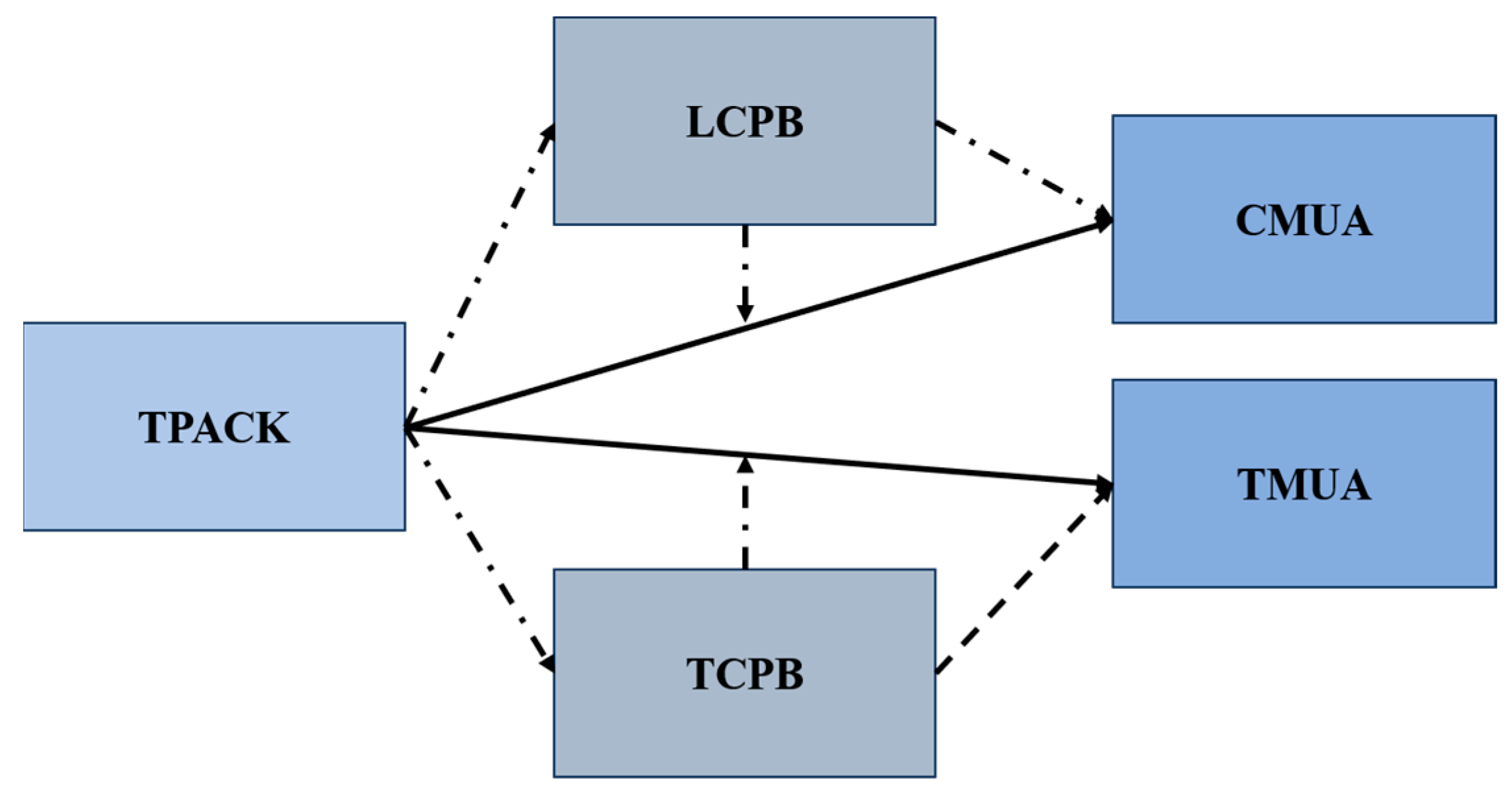
Figure 1 presents conceptual models illustrating the mediation and moderation effects of LCPB and TCPB on TPACK in the use of the constructivist material use approach (CMUA) and the transmissive curriculum material use approach (TMUA). The following research question explores these two conceptual models: How do teachers’ TPACK, LCPB, and TCPB interact to predict in-service EFL teachers’ use of CMUA and TMUA?
The following hypotheses test the mediation and moderation conceptual model:
Hypothesis 1. 
TPACK directly predicts CMUA.
Hypothesis 2. 
TPACK directly predicts TMUA.
Hypothesis 3. 
TPACK indirectly predicts CMUA.
Hypothesis 4. 
TPACK indirectly predicts TMUA.
Hypothesis 5. 
LCPB predicts CMUA.
Hypothesis 6. 
TCPB predicts TMUA.
Hypothesis 7. 
TPACK predicts LCPB.
Hypothesis 8. 
TPACK predicts TCPB.
Hypothesis 9. 
The interaction between TPACK and LCPB predicts teachers’ CMUA.
Hypothesis 10. 
The interaction between TPACK and TCPB predicts teachers’ TMUA.

3. Method

This study employed a mixed-methods design, using an online survey and written open-ended interview questions. This study draws on the same dataset as Almunawaroh and Steklács (2025). The current study introduces an additional variable (TPACK), applies both moderation and mediation frameworks, and incorporates open-ended responses to address the research question of how teachers translate their perceived TPACK, pedagogical beliefs, and curriculum material use approaches into their practices.

3.1. Participants

A total of 251 secondary school EFL teachers in Indonesia agreed to participate in the present study. The participants were identified using snowball sampling (Creswell & Clark, 2018). The participants provided implied consent to participate in the study by voluntarily completing the online survey and giving their consent that the data they provided could be analyzed anonymously. Participants’ demographics were collected, and the results showed that most participants were female (74.5%), outnumbering male participants (25.5%). Most participants had more than 10 years of teaching experience (70.1%) and a bachelor’s degree (60.6%).

3.2. Research Instruments

The TPACK Pedagogical Belief and Material Use (TPACKPBMU) scale consists of the TPACK, pedagogical belief, and material use scales. The TPACK scale was adapted from Schmidt et al. (2009) to assess teachers’ TPACK. The scale has 11 items (α = 0.918) on a 5-point Likert scale (1 = strongly disagree, and 5 = strongly agree). The Pedagogical Belief scale was adopted from Almunawaroh et al. (2024) and Almunawaroh and Steklács (2025), which measured teachers’ LCPB and TCPB. The LCPB has four items (α = 0.884), and the TCPB has three items (α = 0.766), both on a 5-point Likert scale (1 = strongly disagree and 5 = strongly agree). The material use scale was developed from interview data from Shawer’s (2010) study. The exploratory factorial analysis, using the Maximum Likelihood extraction method and Promax rotation with Kaiser normalization on 135 participants, yielded two factors, CMUA and TMUA, with eigenvalues greater than 1, explaining 52% of the variance, and factor loadings ranging from 0.586 to 0.818. CMU has three items (α = 0.719) on a 5-point Likert scale (1 = never, and 5 = always). TMU has three items (α = 0.823) on a 5-point Likert scale (1 = never, and 5 = always). Table 1 presents the TPACKPBMU scale.
The open-ended written interview included three questions designed to explore teachers’ implementation of TPACK, PB, and MUA in their instructional practices as follows:
  • Describe a specific instance where you effectively combined reading comprehension, technology, and teaching approaches in a classroom lesson. Include details about the content you taught related to reading comprehension, the technology you used, and the teaching approach(es) you implemented.
  • Share an example of a specific instance where you effectively applied your teaching approach. Provide details about how you implemented the approach, including examples of activities conducted during reading comprehension sessions.
  • Describe a specific instance where you effectively utilized teaching and learning materials by adapting, adopting, or developing them—whether from a textbook, following the curriculum, or creating your own. Include examples of classroom activities where you used these materials for reading comprehension.

3.3. Data Collection and Ethical Considerations

The Institutional Review Board (IRB) at the Doctoral School of Education granted ethical approval of this study with reference number 3/2023. In the online survey, participants were informed that by completing the survey, they volunteered to participate in this study and automatically consented to the anonymous analysis of the data they provided for the study’s purposes. Data on teachers’ TPACK, pedagogical beliefs, and material use were collected online using the TPACKPBMU questionnaire, comprising 24 closed-ended items and three open-ended written interview questions.

3.4. Data Analysis

The results were first analyzed using the IBM SPSS 25 application to assess internal consistency reliability for each construct using Cronbach’s alpha. A Cronbach’s alpha value equal to or greater than 0.60 is acceptable (Cohen et al., 2018). Next, composite reliability (CR) and average variance extracted (AVE) were employed to measure the convergent validity of the TPACKPBMU scale. An AVE value of more than or equal to 0.5 indicates convergent validity, while values between 0.6 and 0.7 indicate an acceptable CR (Shrestha, 2021).
The measurement models were analyzed using Confirmatory Factorial Analysis (CFA), and model fit was assessed using multiple indices in Mplus 8 Edition. The model fit encompassed RMSEA (parsimonious indices), CFI and TLI (incremental fit indices), GFI (goodness-of-fit index), and SRMR (standardized root mean square residual). Hooper et al. (2008) and Hu and Bentler (1999) suggested the following index values for evaluating model fit: CFI ≥ 0.90, TLI ≥ 0.90, GFI ≥ 0.90, RMSEA ≤ 0.80, and SRMR ≤ 0.08. The structural models were analyzed using Structural Equation Modelling with a moderation and mediation model using the XWITH command and the NEW syntax in the model constraint, defining the interaction between TPACK, LCPB, and TCPB. While the moderation analysis shows how TPACK and LCPB levels predict CMUA and how TPACK and TCPB levels predict TMUA, the mediation analysis explains how LCPB and TCPB mediate the predictive power of TPACK to TMUA and CMUA.
The results of open-ended written interview questions were explored qualitatively using thematic analysis. The answers were coded based on TPACK, pedagogical beliefs, and the curriculum material use approach for reading activities. Answers about TPACK practice were coded into three substitution levels: using technology, multimedia augmentation, and integration between technology and pedagogy. Answers related to pedagogical beliefs were coded into three belief practices: student-centered, hybrid, and teacher-centered. Curriculum material use-related answers were coded into textbook reliance, adaptation, and creation. After coding each answer, the researchers grouped the codes and created themes for each group. The themes are teachers’ TPACK, teachers’ pedagogical beliefs, and the use of curriculum materials in actual classroom practices.

4. Results

4.1. Descriptive Statistics

The descriptive statistics results indicated that most EFL teachers perceived themselves to have a sufficient level of TPACK (M = 4.02, SD = 0.43). Teachers who had LCPB (M = 4.43, SD = 0.49) outnumbered those who had TCPB (M = 3.38, SD = 0.92), indicating a strong endorsement of learner-centered instructional practices. Moreover, the teachers’ reports indicated that they mostly used the materials constructively (M = 3.82, SD = 0.59) rather than in a transmissive manner (M = 3.18, SD = 0.73), suggesting a greater reliance on a constructivist approach to material use.

4.2. Measurement Model

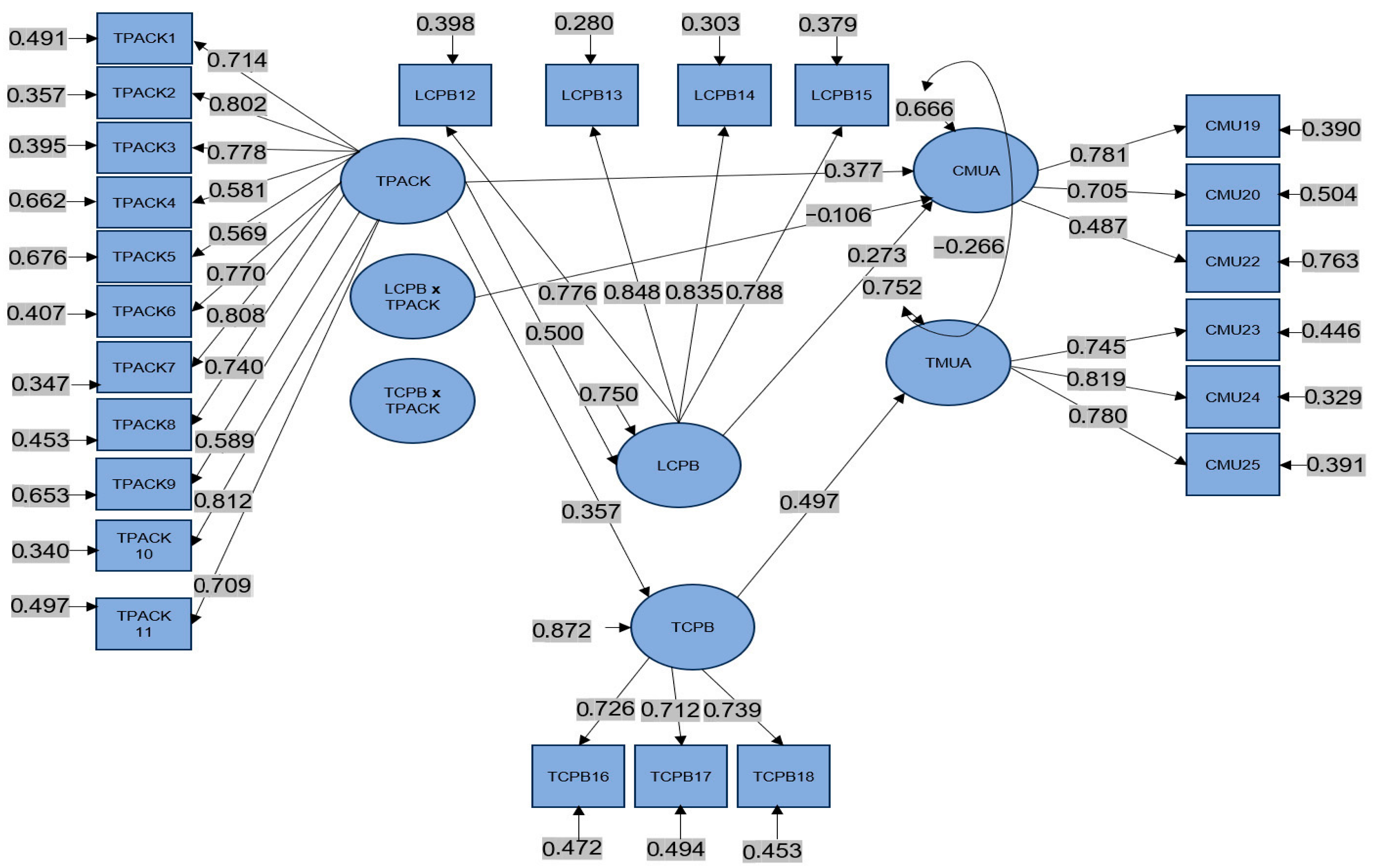
Confirmatory factor analysis results confirmed that the measurement model with multiple indices had a satisfactory model fit. The RMSEA value was 0.061 (0.052, 0.069), the TLI value was =0.915, the CFI value was 0.925, and the SRMR value was 0.054. The results confirmed that all the items were good representations of each construct (Hair et al., 2010), with standardized loadings exceeding the minimum value for confirmatory factor analysis (between 0.48 and 0.84) (see Figure 2).
Table 2 represents the results of reliability and convergent validity analyses. The constructs had reliable Cronbach’s alpha values ranging from 0.72 to 0.92. The TPACKPBMU scale also had adequate convergent validity, with AVE values ranging from 0.45 to 0.66. While the AVE of the constructivist-oriented instructional material use scale was 0.45, the CR value was 0.71, indicating adequate convergent validity (Fornell & Larcker, 1981). The CR of the other constructs was valid, with values between 0.71 and 0.92.
Table 2 presents the correlation among TPACK, LCPB, TCPB, CMUA, and TMUA. TPACK was positively and statistically correlated with LCPB (r = 0.464, p < 0.01), CMUA (r = 0.384, p < 0.01), and TCPB (r = 0.296, p < 0.01). These results indicate that teachers with stronger TPACK tend to hold more learner-centered pedagogical beliefs and report greater constructivist teaching practices. TPACK and TMUA were significantly correlated, but only slightly (r = 0.166, p < 0.01), suggesting a weak relationship with traditional material use practices. LCPB was moderately correlated with CMUA (r = 0.361, p < 0.01). It indicates that LCPB aligns with constructivist classroom practices. On the contrary, LCPB did not significantly correlate with TCPB (r = 0.099, p > 0.05), showing that LCPB and TCPB operate independently. TCPB had a significant correlation with TMUA (r = 0.386, p > 0.01). This result indicates that teachers with stronger TCPB prefer the traditional approach of instructional material use. CMUA and TMUA had a weak, negative correlation (r = −0.084), indicating teachers who adopt a constructivist approach may still use a transmissive approach.

4.3. Mediation and Moderation Structural Model

The structural equation modeling analysis of the conceptual model generated a model fit (CMIN/DF = 1.9; TLI = 0.915; CFI = 0.925; RMSEA = 0.061 (0.052, 0.069); SRMR = 0.054). Figure 2 shows that TPACK accounted for 37% of CMUA variation. LCPB and TCPB predicted 27% and 49% variations in CMUA and TMUA, respectively. Furthermore, TPACK predicted 38% for CMUA mediated by LCPB, and TPACK predicted 42% for TMUA mediated by TCPB. Teachers’ TPACK significantly accounted for 42% of the variation in teachers’ pedagogical beliefs. The LCPB moderated 10% of the influence of TPACK on CMUA.
Most of the hypothesized paths were significant, except for the relationships from TPACK to the transmissive-oriented MUA, LCPB to the transmissive-oriented MUA, and TCPB to the constructivist-oriented MUA, as presented in Table 3. Table 3 shows that some factors had predictive power for teachers’ instructional MUA and PB. TPACK directly and significantly predicted CMUA (β = 0.377, p < 0.01), but not TMUA (β = 0.002, p < 0.05). TPACK had greater predictive power for teachers’ LCPB (β = 0.500, p < 0.01) than for their TCPB (β = 0.357, p < 0.01). Teachers’ TCPB had more significant predictive power on their TMUA (β = 0.497, p < 0.01), compared to the predictive power of their LCPB on their CMUA (β = 0.273, p < 0.01). While both teachers’ LCPB and TCPB significantly mediated the influence of TPACK on their decision to use CMUA (β = 0.136, p < 0.01) and TMUA (β = 0.177, p < 0.01), only the moderation of LCPB on TPACK negatively and significantly predicted CMUA (β = −0.106, p < 0.01), indicating that the positive relationship between TPACK and CMUA was weaker at higher levels of LCPB.

4.4. Teachers’ TPACK, Pedagogical Beliefs, and Material Use Approach Actual Classroom Practices

The thematic analysis of teachers’ responses revealed insights into their TPACK, pedagogical beliefs, and curriculum material use in their actual practices. Distinctive patterns in three different themes were identified as follows:

4.4.1. Teacher’s TPACK Practice

Teachers described various strategies for integrating technology into their reading activities in EFL classrooms. First, they used technology as a substitute for traditional tools, such as accessing texts online. For example, one teacher stated (participant 4), “I use Google.” They also used the technology to display texts digitally, for example, (participant 3) “Reading monolog texts [with technology].” These responses indicate that teachers do not integrate technology to alter their pedagogy significantly.
Teachers generally use technology to augment reading activities through multimedia such as videos and PowerPoint slides. One teacher reported (participant 10), “In teaching a narrative text, I used a video of the story and asked students to comprehend it.” Similarly, another teacher stated, (participant 6) “I have ever combined reading comprehension, technology, and teaching approaches using PowerPoint slides and discussions.” Although these practices reflect technology integration for lesson delivery enrichment, teachers’ roles remain central.
A few teachers integrated pedagogy and technology to promote problem-solving, as one teacher explained (participant 24), “In teaching reading comprehension, I use video to introduce the students to the material. Students discuss in a group to solve the problem, they can use their smartphones to get the information, and I guide the students during the discussion.” Similarly, another teacher emphasized (participant 102), “I teach a narrative text through a video shown to the class. Then, I make a group discussion to discuss it in my teaching and learning process.” These examples imply that some teachers had better enactment of TPACK.

4.4.2. Teachers’ Pedagogical Beliefs Practice

Generally, teachers demonstrated their beliefs aligned with student-centered practices such as mind mapping, group work, and opinion sharing. For instance, one teacher noted (participant 2), “I asked my students to make a mind map about a narrative text.” Another teacher wrote (participant 87), “I always used student-centered learning to encourage students to be active and creative by inviting them to share their opinions and ideas. For example, I asked them to create a discussion group so that every student could share their ideas.” These learning activities foster active participation, which aligns with constructivist learning principles.
Teachers also embedded student-centered strategies within teacher-structured lessons, which reflected hybrid practices. For example, one teacher explained (participant 7), “First, I explained a narrative text (its purpose, structure, language features, and an example). Then we watched YouTube videos about popular narrative texts, for example Malin Kundang (a legend from West Sumatra, Indonesia). We discussed the legend.” Similarly, another teacher remarked (participant 74), “I apply both learner-centered and teacher-centered.” These responses indicate student involvement, but teachers still had firm control over the learning process.
Only some teachers demonstrated a more teacher-guided orientation, as indicated by a teacher (participant 195), “I explain to students why the strategy helps with comprehension and when to use it. I model or demonstrate, how to apply the strategy, usually by thinking aloud while reading the text that the students are using.” Another example is (participant 84) “I gave the students a worksheet with a text and some questions about it. Students read the text and created a mind map.” These examples suggest that teachers still use traditional forms of control, even though they value learner-centered practices.

4.4.3. Teachers’ Curriculum Material Use Classroom Practices

Teachers, in general, closely use textbooks with slight modifications. Teachers briefly noted, (participant 112) “I often use textbooks.” Another teacher mentioned (participant 7), “From a textbook, the students read a story about Bawang Merah Bawang Putih.” These practices reflect teachers’ reliance on mandated materials as the core of instruction.
Some teachers adapted materials to fit their students’ needs and foster lesson engagement. One explained (participant 9), “I arranged the text into random order, and students had to rearrange it.” Another mentioned (participant 6), “I had ever adapted teaching learning materials from a textbook by combining the exercise in the text with my own creativity … I modified the exercise by adding more types of question.” These activities reflect teachers’ attempts to scaffold comprehension by modifying texts and activities.
A few teachers created their own materials by supplementing textbooks with new resources. For example, (participant 86) “I always combine teaching and learning materials from many sources.” Another example is (participant 109) “When teaching a particular text, such as hortatory exposition, I usually use materials from The Jakarta Post or other digital media.” These practices reflect teachers’ initiative to develop context-specific resources.

5. Discussions

The present study investigated the interrelationships among teachers’ TPACK, LCPB, and TCPB, and their TMUA and CMUA, particularly the mediation and moderation roles of LCPB and TCPB in the influence of TPACK on TMUA and CMUA. The SEM results revealed that TPACK and LCPB directly predicted teachers’ constructive use of instructional materials. These findings corroborate Harris and Hofer’s (2011) findings that TPACK is associated with teachers’ instructional planning activities, as it encompasses pedagogical content knowledge and technology integration. This knowledge guides teachers in effectively selecting and using instructional materials to elevate learning (Djulia & Brata, 2022; Durdu & Dag, 2017), leading them to create or adapt materials based on students’ needs. The findings indicate that teachers with robust TPACK and student-centered beliefs have a stronger constructivist orientation to material use.
LCPB and TCPB positively and significantly mediated the predictive power of TPACK on CMUA and TMUA, respectively, indicating that teachers’ PB influence their decision to use material in a constructivist or transmissive manner. These findings confirm that teachers’ PB influence their instructional practices (Ertmer et al., 2014; Hoffman & Seidel, 2014; Ichebah, 2020). However, the interaction between TPACK and LCPB suggests that while TPACK generally enhances constructivist orientations, this positive effect becomes weaker as LCPB increases. It indicates that teachers with stronger LCPB may rely less on TPACK to use instructional materials constructively. In contrast, those with lower LCPB may benefit more from high TPACK levels when using instructional materials constructively. These contradictory results may be because pedagogical beliefs encompass specific teaching strategies and the theoretical principles that guide teachers, influencing teachers’ material use orientation. Therefore, teachers with a high level of LCPB do not rely on their TPACK as much as their counterparts to use instructional materials constructively, as their LCPB already emphasizes constructivist teaching strategies. This finding highlights the importance of considering teachers’ existing LCPB profiles to ensure the effectiveness of promoting a constructivist material use approach.
Unlike in the constructivist case, TPACK did not directly affect teachers’ transmissive use of material orientation, nor did the interaction between TPACK and TCPB in the transmissive material use approach case. A possible answer to these results is that teachers with strong TPACK may believe the teaching process should be centralized for students. This finding aligned with Liang et al. (2017), who found that teachers with higher TPACK levels tend to hold constructivist beliefs, emphasizing student-centered and active learning (Chai et al., 2013). However, their TCPB-mediated TPACK influence on their decision to use instructional materials in a transmissive manner suggests that the transmissive approach is likely belief-driven and does not depend on TPACK level or on interactions between TPACK and TCPB. These findings align with the view that teacher-centered beliefs are associated with a teacher-centered teaching approach, in which teachers view themselves as knowledge transmitters (Dejene, 2020) and rely on methods such as lecturing. In addition, external barriers, such as heavy teaching workloads, technical problems, and students’ behavior (Liang et al., 2017), may inhibit their instructional planning process, leading them to hold TCPB. Therefore, when teachers hold teacher-centered beliefs, their TPACK is translated into close adherence to curriculum materials, such as textbooks, with minimal modifications.
The direct, mediating, and moderating effects of TPACK, LCPB, and TCPB on teachers’ curriculum material use approaches provide practical and theoretical implications for EFL teachers. The findings affirm the roles of teachers’ TPACK and PB in influencing how teachers use their instructional materials. Teachers’ PBs direct teachers’ decisions to use instructional materials in either a more constructivist or a transmissive manner, calling for an early identification of their beliefs to decrease transmissive use of instructional materials and to provide more TPACK professional development for teachers whose beliefs are teacher-centered or lower-level learner-centered. Furthermore, since transmissive use of instructional material is likely belief-driven, external factors that can inhibit teachers’ decisions to implement constructivist instructional material use, such as heavy teaching workloads, technical problems, curriculum, and students’ behavior, must be addressed. The current study supports the hypothesized role of TPACK and PBs in shaping how teachers use curriculum materials. This study is limited to evidence of the interrelationships among teachers’ TPACK, pedagogical beliefs, and curriculum material use approaches. Thus, further investigations are necessary to reveal how teachers’ CMU and TMU approaches affect students’ learning.
The findings from the thematic analysis of teachers’ TPACK, pedagogical beliefs, curriculum materials, and classroom practices suggest that teachers’ beliefs orient toward student-centered pedagogy and TPACK awareness. Nevertheless, their classroom practices are influenced and constrained by a firm reliance on textbooks, resulting in a surface-level of technology integration and a hybrid classroom practice between learner autonomy and teacher control. Since textbooks are traditionally designed to focus on content delivery, a firm reliance on them can lead to a surface-level technology integration, in which digital tools are used merely as supplementary resources rather than as integral components of the learning process (Niaz, 2015; Sherman et al., 2020). Therefore, fostering learner autonomy and optimizing technology integration require change beyond traditional textbook-based instruction, and they require embracing more flexible, technology-enhanced curriculum material adaptation and development.

6. Conclusions

The present study investigated the direct effects of TPACK, LCPB, and TCPB on teachers’ CMUA and TMUA, and the mediation and moderation effects of LCPB and TCPB on the influence of TPACK on teachers’ TMUA and CMUA. The findings affirmed that teachers’ TPACK has only a direct predictive role in teachers’ CMUA and a reversed effect when moderated by LCPB. Therefore, teachers’ CMUA is both knowledge- and belief-driven. In contrast, teachers’ TMUA is more belief-driven than TPACK, and the interaction between TPACK and TCPB did not influence teachers’ transmissive use of instructional materials. However, the mediation of TCPB influenced the predictive power of TPACK for teachers’ TMUA. Although some teachers still hold and implement transmissive material use approaches because of the influence of their beliefs and contextual factors, such as school regulations, teachers’ TPACK, pedagogical beliefs, and curriculum material use are moving toward a student-centered approach and TPACK awareness. However, many teachers still closely adhere to curriculum materials, leading some to implement both student- and teacher-centered practices.

7. Limitations and Suggestions

The present research provided evidence of the predictive power of teachers’ TPACK and two types of pedagogical beliefs, as well as the interaction effects on teachers’ transmissive and constructivist use of curriculum materials. Nonetheless, this study has some limitations. The study focused solely on the influence of pedagogical beliefs on teachers’ curriculum material use approach, without considering other motivational–affective factors that may contribute to their decisions regarding instructional material use approaches. Hence, future studies should investigate the interplay of other affective–motivational factors, such as teachers’ motivation, interest, emotional development, and instructional material use approaches. Furthermore, future studies are essential to elucidate how teachers’ curriculum material use approaches make a difference in students’ learning, which context transmissive-oriented material use approach is essential for learning, and which context constructivist-oriented material use approach enhances learning. Future studies might also investigate students’ curriculum material use, the factors influencing their curriculum material use, and the effects of their curriculum material use on their learning.

Author Contributions

Conceptualization, N.F.A. and J.S.; methodology, N.F.A.; software, N.F.A.; validation, N.F.A. and J.S.; formal analysis, N.F.A.; investigation, N.F.A.; resources, N.F.A.; data curation, N.F.A.; writing—original draft preparation, N.F.A.; writing—review and editing, N.F.A. and J.S.; visualization, N.F.A.; supervision, J.S.; project administration, N.F.A.; funding acquisition, J.S. All authors have read and agreed to the published version of the manuscript.

Funding

The research was funded by a grant from the Research Programme for Public Education Development of the Hungarian Academy of Sciences Reading Fluency and Comprehension Research Group, MTA-PTE, SZKF2022-12/2022.

Institutional Review Board Statement

This study was reviewed and approved by the Institutional Review Board (IRB) of the Doctoral School of Education, University of Szeged (Reference number: 3/2023, date of approval: 22 March 2023).

Informed Consent Statement

All participants were informed that consent to participate in the study and publish their data would be assumed on completion and submission of the study questionnaire.

Data Availability Statement

The data presented in this study are available on request from the corresponding author due to the nature of the data and the need to ensure responsible use, access is restricted to academic and research purposes only.

Acknowledgments

We would like to express our gratitude to the Doctoral School of Education, University of Szeged, Hungary, and the Tempus Public Foundation, which support the corresponding author degree through the Stipendium Hungaricum scholarship program.

Conflicts of Interest

The authors declare the following financial interests/personal relationships which may be considered as potential competing interests: Nurul Fitriyah Almunawaroh reports article publishing charges was provided by the Research Programme for Public Education Development of the Hungarian Academy of Sciences, Reading Fluency and Comprehension Research Group, MTA-PTE. János Steklács reports article publishing charges was provided by the Research Programme for Public Education Development of the Hungarian Academy of Sciences, Reading Fluency and Comprehension Research Group, MTA-PTE. If there are other authors, they declare that they have no known competing financial interests or personal relationships that could have appeared to influence the work reported in this paper.

References

  1. Ali, S. S., & Mohammadzadeh, B. (2022). Iraqi Kurdish EFL teachers’ beliefs about technological pedagogical and content knowledge: The role of teacher experience and education. Frontiers in Psychology, 13, 969195. [Google Scholar] [CrossRef]
  2. Almunawaroh, N. F., Diem, C. D., & Steklács, J. (2024). EFL teachers’ pedagogical beliefs, pedagogical content knowledge, and instructional material use: A scale development and validation. Cogent Education, 11(1), 2379696. [Google Scholar] [CrossRef]
  3. Almunawaroh, N. F., & Steklács, J. (2025). The interplay of secondary EFL teachers’ pedagogical beliefs and pedagogical content knowledge with their instructional material use approach orientation. Heliyon, 11(2), e42065. [Google Scholar] [CrossRef]
  4. Alshumaimeri, Y., & Alharbi, T. (2024). English textbook evaluation: A Saudi EFL teacher’s perspective. Frontiers in Education, 9, 1479735. [Google Scholar] [CrossRef]
  5. Amiri, A., & Rezvani, R. (2021). A tale of three official English textbooks: An evaluation of their horizontal and vertical alignments. Language Related Research, 12(3), 51–79. [Google Scholar] [CrossRef]
  6. Armin, D. S., & Siregar, A. M. P. (2021). EFL teacher’s pedagogical beliefs in teaching at an Indonesian university. Jurnal Tarbiyah, 28(2), 82–93. [Google Scholar] [CrossRef]
  7. Artini, L. P., Ratminingsih, N. M., & Padmadewi, N. N. (2018). Project based learning in EFL classes Material development and impact of implementation. Dutch Journal of Applied Linguistics, 7(1), 26–44. [Google Scholar] [CrossRef]
  8. Asakereh, A., Yousofi, N., & Weisi, H. (2019). Critical content analysis of English textbooks used in the Iranian education system: Focusing on ELF features. Issues in Educational Research, 29(4), 1016–1038. [Google Scholar]
  9. Badjadi, N. E. I. (2020). Learner-centered English language teaching: Premises, practices, and prospects. Journal of Education: Language Learning in Education, 8(1), 7–27. [Google Scholar] [CrossRef]
  10. Bandura, A. (1997). Self-efficacy: The exercise of control. W.H Freeman and Company. [Google Scholar]
  11. Barker, D. D., Winsor, M. S., Vince Kirwan, J., & Rupnow, T. J. (2020). Searching for the key to knowledge integration: A lens to detect the promotion and use of integrated knowledge. In International perspectives on knowledge integration: Theory, research, and good practice in pre-service teacher and higher education (pp. 59–78). Brill. [Google Scholar] [CrossRef]
  12. Boonmoh, A., & Kulavichian, I. (2023). Exploring Thai EFL pre-service teachers’ technology integration based on SAMR model. Contemporary Educational Technology, 15(4), ep457. [Google Scholar] [CrossRef]
  13. Bouckaert, M. (2019). Current perspectives on teachers as materials developers: Why, what, and how? RELC Journal, 50(3), 439–456. [Google Scholar] [CrossRef]
  14. Cahyono, B. Y., Nurhadi, K., Novianti, H., & Khansa, M. (2025). EFL teachers’ use of technology in task-based language teaching in teaching reading: Perceptions, variety and intensity. Language Related Research, 16(5), 255–289. [Google Scholar] [CrossRef]
  15. Çeliker-Ercan, G., & Çubukçu, Z. (2023). Curriculum implementation approaches of secondary school English teachers: A case study. Kastamonu Education Journal, 31(3), 347–366. [Google Scholar] [CrossRef]
  16. Chai, C. S. (2010). The relationships among Singaporean preservice teachers ’ ICT competencies, pedagogical beliefs and their beliefs on the espoused use of ICT. The Asia-Pacific Education Researcher, 19(3), 387–400. [Google Scholar] [CrossRef]
  17. Chai, C. S., Chin, C. K., Koh, J. H. L., & Tan, C. L. (2013). Exploring Singaporean Chinese language teachers’ technological pedagogical content knowledge and its relationship to the teachers’ pedagogical beliefs. Asia-Pacific Education Researcher, 22(4), 657–666. [Google Scholar] [CrossRef]
  18. Chen, B., Wei, B., & Wang, X. (2020). Examining the factors that influence high school Chemistry teachers’ use of curriculum materials: From the teachers’ perspective. Journal of Baltic Science Education, 19(6), 893–907. [Google Scholar] [CrossRef]
  19. Cohen, L., Manion, L., & Morrison, K. (2018). Research methods in education (8th ed.). Routledge. [Google Scholar] [CrossRef]
  20. Cook, M. (2012). Revisiting Japanese English teachers’ (JTEs) perceptions of communicative, audio-lingual, and grammar translation (yakudoku) activities: Beliefs, practices, and rationales. Asian EFL Journal, 14(2), 79–98. [Google Scholar]
  21. Creswell, J. W., & Clark, V. L. P. (2018). Designing and conducting mixed methods Research (3rd ed.). SAGE Publications, Inc. [Google Scholar]
  22. Davis, F. D. (1989). Perceived usefulness, perceived ease of use, and user acceptance of information technology. MIS Quarterly: Management Information Systems, 13(3), 319–339. [Google Scholar] [CrossRef]
  23. Dejene, W. (2020). Conceptions of teaching and learning and teaching approach preference: Their change through preservice teacher education program. Cogent Education, 7(1), 1833812. [Google Scholar] [CrossRef]
  24. del Pilar Montijano Cabrera, M. (2014). Textbook use training in EFL teacher education. In Utrecht studies in language and communication (Vol. 27, pp. 267–286). Brill Academic Publishers. [Google Scholar] [CrossRef]
  25. Depaepe, F., & König, J. (2018). General pedagogical knowledge, self-efficacy and instructional practice: Disentangling their relationship in pre-service teacher education. Teaching and Teacher Education, 69, 177–190. [Google Scholar] [CrossRef]
  26. Djulia, E., Brata, W. W. W., & Amrizal. (2022). Pre-service Biology students technological pedagogical and content knowledge (TPCK) as prerequisite for professional Biology teacher. In F. Harahap, J. Purba, A. Sutiani, M. Zubir, & S. I. Al Idrus (Eds.), AIP conference proceedings (Vol. 2659). American Institute of Physics Inc. [Google Scholar] [CrossRef]
  27. Durdu, L., & Dag, F. (2017). Pre-service teachers’ TPACK development and conceptions through a TPACK-based course. Australian Journal of Teacher Education, 42(11), 150–171. [Google Scholar] [CrossRef]
  28. Ellis, R. (2017). Task-based language teaching. In S. Loewen, & M. Sato (Eds.), The Routledge handbook of instructed second language (1st ed., pp. 124–141). Routledge. [Google Scholar]
  29. Ertmer, P. A., Ottenbreit-Leftwich, A. T., & Tondeur, J. (2014). Teachers’ beliefs and uses of technology to support 21st-century teaching and learning. In International handbook of research on teachers’ beliefs (pp. 403–418). Taylor and Francis. [Google Scholar] [CrossRef]
  30. Farjon, D., Smits, A., & Voogt, J. (2019). Technology integration of pre-service teachers explained by attitudes and beliefs, competency, access, and experience. Computers and Education, 130, 81–93. [Google Scholar] [CrossRef]
  31. Flint, A., Rubie-Davies, C. M., & Peterson, E. (2024). Teacher views of relationships between their teaching practices and beliefs, the school context, and student achievement. New Zealand Journal of Educational Studies, 59(1), 157–173. [Google Scholar] [CrossRef]
  32. Fornell, C., & Larcker, D. F. (1981). Evaluating structural equation models with unobservable variables and measurement error. Journal of Marketing Research, 18(1), 39–50. [Google Scholar] [CrossRef]
  33. Garton, S., & Graves, K. (2019). Materials use and development. In S. Walsh, & S. Mann (Eds.), The Routledge handbook of English language teacher education (p. 417). Routledge. [Google Scholar] [CrossRef]
  34. Guerrettaz, A. M., Engman, M. M., & Matsumoto, Y. (2021). Empirically defining language learning and teaching materials in use through sociomaterial perspectives. Modern Language Journal, 105, 3–20. [Google Scholar] [CrossRef]
  35. Guerrettaz, A. M., Mathieu, C. S., Lee, S., & Berwick, A. (2022). Materials use in language classrooms: A research agenda. Language Teaching, 55, 547–564. [Google Scholar] [CrossRef]
  36. Hair, J. F., Black, W. C., Babin, B. J., & Anderson, R. E. (2010). Multivariate data analysis: A global perspective (7th ed). Pearson Educational Inc. [Google Scholar]
  37. Harris, J. B., & Hofer, M. J. (2011). Technological pedagogical content knowledge (TPACK) in action: A descriptive study of secondary teachers’ curriculum-based, technology-related instructional planning. Journal of Research on Technology in Education, 43(3), 211–229. [Google Scholar] [CrossRef]
  38. Harwood, N. (2010). Issues in materials development and design. In N. Harwood (Ed.), English language teaching materials: Theory and practice (pp. 3–32). Cambridge University Press. [Google Scholar]
  39. He, Y., & Levin, B. B. (2008). Match or mismatch? How congruent are the beliefs of teacher candidates, cooperating teachers, and university-based teacher educators? Teacher Education Quarterly, 35(4), 37–55. [Google Scholar]
  40. Hoffman, B. H., & Seidel, K. (2014). Measuring teachers’ beliefs for what purpose? In International handbook of research on teachers’ beliefs (pp. 106–127). Taylor and Francis. [Google Scholar] [CrossRef]
  41. Hooper, D., Coughlan, J., & Mullen, M. R. (2008). Structural equation modelling: Guidelines for determining model fit. Electronic Journal of Business Research Methods, 6(1), 53–60. [Google Scholar]
  42. Hu, L., & Bentler, P. M. (1999). A cutoff criteria for fit indexes in covariance structure analysis: Conventional criteria versus new alternatives. Structural Equation Modeling: A Multidisciplinary Journal, 6(1), 1–55. [Google Scholar] [CrossRef]
  43. Ichebah, A. (2020). Beliefs on english language teaching effectiveness in Moroccan higher education. In English language teaching in Moroccan higher education (pp. 123–141). Springer Singapore. [Google Scholar] [CrossRef]
  44. Iranmehr, A., Davari, H., & Erfani, S. M. (2011). The application of organizers as an efficient technique in ESP textbooks development. Theory and Practice in Language Studies, 1(4), 417–422. [Google Scholar] [CrossRef]
  45. Kartal, T. (2024). The influence of pedagogical and epistemological beliefs on preservice teachers’ technology acceptance in Turkey: A structural equation modeling. Croatian Journal of Education, 26(2), 607–650. [Google Scholar] [CrossRef]
  46. Koehler, M. J. (2006). Technological pedagogical content knowledge: A framework for teacher knowledge. Teachers College Record, 108(6), 1017–1054. [Google Scholar]
  47. Koehler, M. J., Mishra, P., Akcaoglu, M., & Rosenberg, J. M. (2016). The technological pedagogical content knowledge 20 framework for teachers and teacher educators. In M. R. Panigrahi (Ed.), Resource book on ICT integrated teacher education (pp. 20–30). Commonwealth Educational Media Centre for Asia. [Google Scholar]
  48. Lai, C., Wang, Q., & Huang, X. (2022). The differential interplay of TPACK, teacher beliefs, school culture and professional development with the nature of in-service EFL teachers’ technology adoption. British Journal of Educational Technology, 53(5), 1389–1411. [Google Scholar] [CrossRef]
  49. Larenas, C. D., Hernandez, P. A., & Navarrete, M. O. (2015). A case study on EFL teachers ’ beliefs about the teaching and learning of English in public Education. Porta Linguarum, 23, 171–186. [Google Scholar] [CrossRef]
  50. Li, Z. (2021). Disentangling teachers’ enactment of materials: A case study of two language teachers in higher education in China. Pedagogy, Culture and Society, 29(3), 449–468. [Google Scholar] [CrossRef]
  51. Li, Z., & Harfitt, G. (2018). Understanding language teachers’ enactment of content through the use of centralized curriculum materials. Asia-Pacific Journal of Teacher Education, 46(5), 461–477. [Google Scholar] [CrossRef]
  52. Liang, Z., Wang, Y., Zhang, H., & He, L. (2017, December 7–9). Relationships of TPACK and beliefs of primary and secondary teachers in China. 2017 International Conference of Educational Innovation through Technology (EITT) (pp. 32–35), Osaka, Japan. [Google Scholar] [CrossRef]
  53. Lima, S. C., & Vieira, F. (2020). The role of textbooks for promoting autonomy in English learning. Revista Brasileira de Linguistica Aplicada, 20(1), 217–244. [Google Scholar] [CrossRef]
  54. Liu, H., Lin, C.-H., & Zhang, D. (2017). Pedagogical beliefs and attitudes toward information and communication technology: A survey of teachers of English as a foreign language in China. Computer Assisted Language Learning, 30(8), 745–765. [Google Scholar] [CrossRef]
  55. Maijala, M. (2020). Pre-service language teachers’ reflections and initial experiences on the use of textbooks in classroom practice. Journal of Language Teaching and Research, 11(2), 157–165. [Google Scholar] [CrossRef]
  56. Martinez, M. I., Díaz Lara, G., & Whitney, C. R. (2025). The role of teacher beliefs in teacher learning and practice: Implications for meeting the needs of English learners emergent bilinguals. Language and Education, 39(3), 717–735. [Google Scholar] [CrossRef]
  57. Maru, M. G., Pikirang, C. C., Ratu, D. M., & Tuna, J. R. (2021). The integration of ICT in ELT practices: The study on teachers’ perspective in new normal era. International Journal of Interactive Mobile Technologies, 15(22), 44–67. [Google Scholar] [CrossRef]
  58. Masuhara, H. (2022). Approaches to materials adaptation. In J. Norton, & H. Buchanan (Eds.), The Routledge handbook of materials development for language teaching (pp. 277–289). Routledge. [Google Scholar] [CrossRef]
  59. Mazgon, J., & Stefanc, D. (2012). Importance of the various characteristics of educational materials: Different opinions, different perspectives. Turkish Online Journal of Educational Technology, 11(3), 174–188. [Google Scholar]
  60. McDuffie, A. M. R., & Mather, M. (2006). Reification of instructional materials as part of the process of developing problem-based practices in Mathematics education. Teachers and Teaching: Theory and Practice, 12(4), 435–459. [Google Scholar] [CrossRef]
  61. Mertala, P. (2019). Teachers’ beliefs about technology integration in early childhood education: A meta-ethnographical synthesis of qualitative research. Computers in Human Behavior, 101, 334–349. [Google Scholar] [CrossRef]
  62. Mukminin, A., & Habibi, A. (2020). Technology in the classroom: EFL teachers’technological pedagogical and content knowledge. Informatologia, 53(1–2), 24–36. [Google Scholar] [CrossRef]
  63. Nazari, N., Nafissi, Z., Estaji, M., Marandi, S. S., & Wang, S. (2019). Evaluating novice and experienced EFL teachers’ perceived TPACK for their professional development. Cogent Education, 6, 1632010. [Google Scholar] [CrossRef]
  64. Niaz, M. (2015). Textbooks: Impact on curriculum. In Encyclopedia of science education (pp. 1070–1073). Elsevier. [Google Scholar]
  65. Nurwahidah, N., Sulfasyah, S., & Rukli, R. (2023). Investigating grade five teachers’ integration of technology in teaching reading comprehension using the TPACK framework. Journal of Language Teaching and Research, 14(4), 927–932. [Google Scholar] [CrossRef]
  66. Nxasana, S. E., Chen, J., & Du, X. (2023). Teachers’ pedagogical beliefs in a project-based learning school in South Africa. Education Sciences, 13(2), 140. [Google Scholar] [CrossRef]
  67. Orfan, S. N., Noori, A. Q., & Akramy, S. A. (2021). Afghan EFL instructors’ perceptions of English textbooks. Heliyon, 7(11), e08340. [Google Scholar] [CrossRef]
  68. Pramerta, I. G. P. A., Pramawati, A. A. I. Y., Widhiasih, L. K. S., Mas, L. A. M. G. D., & Andari, K. A. M. (2025). Tailoring reading courses to student needs: A pathway to effective curriculum and teaching strategies. Educational Process: International Journal, 15, e2025165. [Google Scholar] [CrossRef]
  69. Prasojo, L. D., Habibi, A., Mukminin, A., & Yaakob, M. F. M. (2020). Domains of technological pedagogical and content knowledge: Factor analysis of indonesian in-service EFL teachers. International Journal of Instruction, 13(4), 593–608. [Google Scholar] [CrossRef]
  70. Richards, J. C. (2014). The ELT textbook. In S. Garton, & K. Graves (Eds.), International perspectives on materials in ELT (pp. 19–36). Palgrave Macmillan. [Google Scholar] [CrossRef]
  71. Rosenberg, J. M., & Koehler, M. J. (2015). Context and technological pedagogical content knowledge (TPACK): A systematic review. Journal of Research on Technology in Education, 47(3), 186–210. [Google Scholar] [CrossRef]
  72. Santos, J. M., & Castro, R. D. R. (2021). Technological pedagogical content knowledge (TPACK) in action: Application of learning in the classroom by pre-service teachers (PST). Social Sciences and Humanities Open, 3(1), 100110. [Google Scholar] [CrossRef]
  73. Schmidt, D. A., Baran, E., Thompson, A. D., Koehler, M. J., Mishra, P., & Shin, T. (2009). Technological pedagogical content knowledge (TPACK): The development and validation of an assessment for preservice teachers. Journal of Research on Technology in Education, 42(2), 123–149. [Google Scholar] [CrossRef]
  74. Schutz, P. A., Hong, J. Y., & Francis, D. C. (2020). Teachers’ goals, beliefs, emotions, and identity development: Investigating complexities in the profession (1st ed.). Routledge. [Google Scholar] [CrossRef]
  75. Shawer, S. F. (2010). Classroom-level curriculum development: EFL teachers as curriculum-developers, curriculum-makers and curriculum-transmitter. Teaching and Teacher Education, 26(2), 173–184. [Google Scholar] [CrossRef]
  76. Sherman, M. F., Cayton, C., Walkington, C., & Funsch, A. (2020). An analysis of secondary Mathematics textbooks with regard to technology integration. Journal for Research in Mathematics Education, 51(3), 361–374. [Google Scholar] [CrossRef]
  77. Shrestha, N. (2021). Factor analysis as a tool for survey analysis. American Journal of Applied Mathematics and Statistics, 9(1), 4–11. [Google Scholar] [CrossRef]
  78. Shulman, L. S. (1986). Those who understand: Knowledge growth in teaching. Educational Researcher, 15(2), 4–14. [Google Scholar] [CrossRef]
  79. Shulman, L. S. (1987). Knowledege and teaching: Foundation of the new reform. Harvard Educational Review, 57(1), 1–22. [Google Scholar] [CrossRef]
  80. Syamdianita, S., & Cahyono, B. Y. (2021). The EFL pre-service teachers’ experiences and challenges in designing teaching materials using TPACK framework. Studies in English Language and Education, 8(2), 561–577. [Google Scholar] [CrossRef]
  81. Tergujeff, E. (2015). Good servants but poor masters: On the important role of textbooks in teaching English pronunciation. Second Language Learning and Teaching, 24, 107–117. [Google Scholar] [CrossRef]
  82. Tomlinson, B. (2022). The discipline of materials development. In J. Norton, & H. Buchanan (Eds.), The Routledge handbook of materials development for language teaching. Routledge. [Google Scholar] [CrossRef]
  83. Tomlinson, B., & Masuhara, H. (2018). The complete guide to the theory and practice of materials development for language learning. John Wiley & Sons, Inc. [Google Scholar]
  84. Tseng, J.-J., Cheng, Y.-S., & Lin, C.-C. (2011). Unraveling in-service EFL teachers’ technological pedagogical content knowledge. Journal of Asia TEFL, 8(2), 45–72. [Google Scholar]
  85. Van Canh, L. (2018). A critical analysis of moral values in Vietnam-produced EFL textbooks for upper secondary schools. In English language education (Vol. 9, pp. 111–129). Springer Science and Business Media B.V. [Google Scholar] [CrossRef]
  86. Venkatesh, V., Thong, J. Y., & Xu, X. (2012). Consumer acceptance and use of information technology: Extending the unified theory of acceptance and use of technology. MIS Quarterly, 36(1), 157–178. [Google Scholar] [CrossRef]
  87. Wu, Y.-T., Chai, C.-S., & Wang, L.-J. (2022). Exploring secondary school teachers’ TPACK for video-based flipped learning: The role of pedagogical beliefs. Education and Information Technologies, 27, 8793–8819. [Google Scholar] [CrossRef]
  88. Yildiz Durak, H. (2021). Modeling of relations between K-12 teachers’ TPACK levels and their technology integration self-efficacy, technology literacy levels, attitudes toward technology and usage objectives of social networks. Interactive Learning Environments, 29(7), 1136–1162. [Google Scholar] [CrossRef]
  89. Zohrabi, M., Sabouri, H., & Behroozian, R. (2012). An evaluation of merits and demerits of Iranian first year high school English textbook. English Language Teaching, 5(8), 14–22. [Google Scholar] [CrossRef]
Figure 1. Conceptual model: mediation and moderation.
Education 15 01647 g001
Figure 2. The measurement and structural models of mediation and moderation analysis.
Education 15 01647 g002
Table 1. The TPACKPBMU scale.
FactorsItems
TPACK
  • I know about technologies I can use to comprehend reading texts written in English.
  • I can choose technologies that enhance the teaching approaches for a lesson.
  • I can choose technologies that enhance students’ learning for a lesson.
  • My teacher education program has caused me to think more deeply about how technology could influence the teaching approaches I use in my classroom.
  • I am thinking critically about how to use technology in my classroom.
  • I can adapt the use of technologies that I am learning about to different teaching activities.
  • I can select technologies in my classroom that enhance what I teach, how I teach, and what students learn.
  • I can use strategies that combine content, technologies, and teaching approaches that I learned about in my coursework in my classroom.
  • I can provide leadership in helping others coordinate using content, technologies, and teaching approaches at my school or district.
  • I can choose technologies that enhance the content of a lesson.
  • I can teach lessons that appropriately combine reading, technologies, and teaching approaches.
Pedagogical BeliefsLCPB
  • A good teacher should help students to think actively and build knowledge.
  • A teacher should encourage students to explore, discuss, and express their opinions.
  • Effective teaching should encourage students to engage in more discussion and practice.
  • Teaching should be flexible to meet the needs of students’ individual differences and learning processes.
TCPB
  • A teacher should have complete control over students’ learning.
  • The main task of teachers is to transmit knowledge to students.
  • Authoritarian teaching (a teacher who controls the classroom) is the best practice in a class.
Material UseConstructivist approach
  • I develop the content of the textbook by adding material from other sources.
  • I use some parts of the textbook and add other activities and materials to suit my students’ needs.
  • I design my teaching program and write materials based on a needs analysis.
Transmissive approach
  • I follow the sequence of the textbook I use.
  • I teach based on what is in the textbook.
  • I teach by following the activities in the textbook.
Table 2. The measurement model.
M (SD)CRαAVETPACKLCPBTCPBCMUATMUA
TPACK4.02 (0.43)0.920.920.521
LCPB4.43 (0.49)0.890.880.660.464 **1
TCPB3.38 (0.92)0.770.770.530.296 **0.0991
CMUA3.82 (0.59)0.710.720.450.384 **0.361 **0.198 **1
TMUA3.18 (0.73)0.820.820.610.166 **0.0140.386 **−0.0841
Note: ** p < 0.01.
Table 3. Test of the hypothesized paths and mediation effects.
Hypothesized PathsStandardized Regression (β)Sig
PredictorMediatorModeratorOutcome
TPACK CMUA0.377 **<0.01
TPACK TMUA0.002>0.05
TPACK LCPB0.500 **<0.01
TPACK TCPB0.357 **<0.01
LCPB CMUA0.273 **<0.01
TCPB TMUA0.497 **<0.01
TPACKLCPB CMUA0.136 **<0.01
TPACKTCPB TMUA0.177 **<0.01
TPACK LCPBCMUA0.106 **<0.01
TPACK TCPBTMUA0.021>0.05
Note: ** p < 0.01.
Disclaimer/Publisher’s Note: The statements, opinions and data contained in all publications are solely those of the individual author(s) and contributor(s) and not of MDPI and/or the editor(s). MDPI and/or the editor(s) disclaim responsibility for any injury to people or property resulting from any ideas, methods, instructions or products referred to in the content.