1. Introduction
Innovation occupies a key place in contemporary understandings of economic growth, productivity improvement, and structural modernization. At the regional level, it is viewed not only as a technological factor but also as a mechanism for developing competitive advantages, renewing industry structure, and improving the quality of economic development (
OECD, 2011;
Paas & Vahi, 2012). However, research shows that innovation processes are spatially heterogeneous: territories vary in the scale of research activity, investment, and number of innovation firms, as well as in their ability to transform existing resources into tangible innovation results and broader economic impacts (
Fritsch & Slavtchev, 2007;
Paas & Vahi, 2012).
Therefore, the literature is increasingly focusing not on a simple description of innovation activity, but on differences in the effectiveness of innovation systems. A high level of resource endowment alone does not guarantee strong results. At different stages of the innovation process—from knowledge generation to commercialization and subsequent impact on productivity—losses arise, leading some regions to demonstrate relatively high returns on available resources, while others face a significant gap between input conditions and final results (
Chen & Guan, 2012;
Lee, 2024;
Zabala-Iturriagagoitia et al., 2007).
This problem is particularly significant for countries with transition and catching-up economies, where modernization of the economic structure and reduction in resource dependence are directly linked to the quality of innovation development. In such conditions, not only the availability of research, educational, and infrastructural prerequisites is important, but also how effectively they are transferred into innovation outputs and, subsequently, into economic benefits. Research on countries with transition economies shows that the weak link is often precisely the transfer from research and development to commercialized results, and then to increased productivity (
Chen & Guan, 2012;
Kenzhaliyev et al., 2021;
Rudskaya et al., 2022).
This issue is particularly relevant in the case of Kazakhstan. On the one hand, the country has long declared a policy of economic diversification, technological modernization, and the development of innovation. On the other hand, the economy remains largely based on raw material specialization, while innovation outputs remain limited and not always comparable to existing inputs. As noted in the work of Slavova, Rubalcaba, and Franco-Riquelme (
Slavova et al., 2025), Kazakhstan is characterized by an unbalanced transmission from R&D expenditures to innovation outputs and then to innovation effects: the input parameters of innovation development appear relatively stronger, while the outputs and, especially, the broader effects are noticeably weaker.
The situation is further complicated by the marked heterogeneity of Kazakhstan’s regions themselves. They differ in economic structure, the level of urbanization, human capital, investment attractiveness, sectoral specialization, and the quality of the local institutional environment. Research on Kazakhstan’s regional development emphasizes that sustainable growth is impossible without a more accurate accounting of territorial differences, and that regional policy should be based on the actual characteristics and potential of specific territories (
Bureau of National Statistics of the Agency for Strategic Planning and Reforms of the Republic of Kazakhstan, 2025b;
Uskelenova & Nikiforova, 2024). This applies not only to the unevenness of resources but also to differences in the regions’ ability to utilize them to create innovation and economically significant results (
Bureau of National Statistics of the Agency for Strategic Planning and Reforms of the Republic of Kazakhstan, 2025b;
Kenzhaliyev et al., 2021;
Slavova et al., 2025).
From a theoretical perspective, this opens the research to a broader range of questions about the nature of regional innovation heterogeneity. The literature shows that differences between territories are shaped by several factors: the quality of human capital, knowledge mobility, agglomeration effects, the density of network interactions, industry structure, the level of institutional development, and the quality of governance (
de Groot et al., 2007;
Felsenstein, 2010;
Fritsch & Slavtchev, 2011;
Gianelle et al., 2024;
Orlando et al., 2019). At the same time, the conclusion that a universal innovation policy is incapable of producing equally good results in different territorial conditions is becoming increasingly convincing. Effective measures must take into account the type of regional constraints, the structure of the local economy, and the actual capacity of the territory to absorb, disseminate, and commercialize new knowledge (
Grillitsch & Asheim, 2018;
Morisson & Doussineau, 2019;
Tödtling & Trippl, 2005).
Against this backdrop, research interest shifts from the general question of the sufficiency of innovation resources to a more precise formulation: how exactly these resources are converted into results and where the main gaps arise. For Kazakhstan, this formulation is particularly important, as it allows us to move from general statements about the need for innovation development to an analysis of the specific territorial differences underlying the observed heterogeneity in innovation dynamics. In this sense, it is crucial not only to compare regions by the level of innovation activity but also to identify discrepancies between the resource base and results, as well as the economic interpretation of such discrepancies (
Chen & Guan, 2012;
Fritsch & Slavtchev, 2007;
Slavova et al., 2025;
Zabala-Iturriagagoitia et al., 2007).
The purpose of this study is to analyze interregional differences in innovation development in Kazakhstan through the lens of the relationship between innovation resources and results. This perspective not only allows us to describe the spatial heterogeneity of the innovation process but also to better understand the links where the main losses arise and what factors may underlie the weak transmission from input parameters to final effects. For an economy focused on diversification, increasing productivity, and reducing dependence on commodity markets, such an analysis is important because it allows us to view innovation not as a declarative priority, but as a concrete economic mechanism with measurable territorial differences (
Kenzhaliyev et al., 2021;
Slavova et al., 2025;
Uskelenova & Nikiforova, 2024).
To strengthen the analytical focus of the study, the analysis is guided by two interrelated research questions:
How are innovation resources and innovation-related economic outcomes distributed across Kazakhstan’s regions?
What types of gaps between innovation resources and outcomes can be identified at the regional level, and what do they imply for territorially differentiated innovation policy?
These questions link the descriptive analysis of interregional differences with a more specific assessment of the cases in which the resource base is accompanied by comparable outcomes and the cases in which a noticeable mismatch emerges between them.
Unlike existing studies on Kazakhstan, which more often examine innovation development at the national level or focus on individual indicators of innovation activity, this article emphasizes the subnational regional level. Its originality lies in the combination of three elements. First, the study compares Kazakhstan’s regions within a single statistical framework, which makes it possible to identify within-country differences rather than only the national picture of innovation development. Second, the article examines innovation development through the lens of the resource–outcome gap, analyzing not only the availability of innovation resources but also the extent to which they are transformed into economically meaningful outcomes. Third, based on an index-based procedure, the article proposes a typology of regions according to the relationship between the Resource Index and the Outcome Index, thereby linking the empirical analysis to policy implications for territorially differentiated innovation policy.
The article is structured as follows. After the Introduction, the main theoretical and empirical approaches to analyzing innovation, regional heterogeneity, and uneven transfers from resources to outcomes are reviewed. The data and rationale for the empirical analysis for Kazakhstan are then described. The main findings of the study are then presented, followed by a discussion of their economic significance and implications for regional policy.
2. Literature Review
In the economic and regional literature, innovation has long been viewed as a key source of long-term growth, productivity gains, and structural change. However, as research has progressed, it has become clear that innovation is not a homogeneous, uniformly operating factor. Its impact depends on the spatial context, institutional environment, economic structure, and the ability of regions to build interactions between knowledge, production, and the market. Early studies on regional innovation systems demonstrated that innovation does not emerge in isolation within individual firms, but rather within territorially embedded networks of interactions between enterprises, universities, research organizations, and support institutions (
Cooke, 2002;
Cooke et al., 1997). This approach was later developed toward understanding the region as an environment in which the quality of interactions directly influences innovation outcomes (
López-Rubio et al., 2020;
OECD, 2011).
Related to this is the shift from the general question of the role of innovation to an analysis of interregional differences. Research shows that innovation is closely linked to the level of income and economic dynamics of territories, but its influence does not necessarily lead to equalization. On the contrary, in the short and medium term, it can exacerbate differences between regions, as more developed territories often have better starting conditions for the creation, development, and dissemination of new knowledge (
Paas & Vahi, 2012). This logic is also supported by studies linking the most radical forms of innovation with the spatial concentration of economic benefits. It has been shown that breakthrough innovations are often concentrated in specific development nodes and can thus exacerbate territorial inequality, especially during periods of major technological shifts (
Kemeny et al., 2025).
This has given rise to a more complex understanding of innovation development, in which the central focus is not so much on the availability of resources as on their effective transformation. A number of studies have shown that regions differ not only in the scale of scientific research activity, but also in the effectiveness of regional innovation systems. Fritsch and Slavtchev demonstrated that it is not simply the volume of resources that is decisive, but also the nature of knowledge flows, the intensity of interactions between the public and private research sectors, technological proximity, and the specifics of the industry structure (
Fritsch & Slavtchev, 2007,
2011). Fritsch’s earlier work also indicated that the effectiveness of innovation activity is territorially heterogeneous and partially reproduces the core–periphery structure of space (
Fritsch, 2002). Thus, the question shifts from the level of “how many resources are available” to the level of “how effectively the system can transform them into results.”
This logic underlies research using efficiency assessment methods and other approaches to measuring performance. They demonstrate that regions and countries with significant innovation resources are not always the most successful in terms of converting these resources into final results. Research on assessing regional innovation systems has directly demonstrated that ranking by resource volume and ranking by efficiency can diverge significantly (
Zabala-Iturriagagoitia et al., 2007). This means that traditional innovation ratings often primarily reflect resource saturation, but do not always reveal the true effectiveness of the innovation process. The dynamic aspect of this problem is revealed in studies that decompose growth in innovation performance into changes in efficiency and economies of scale. Using Russian regions as an example, it has been shown that improvements in aggregate indicators are often associated not with better use of resources, but with the expansion of the resource base itself (
Firsova & Chernyshova, 2020).
The concept of the innovation process as a multi-stage chain occupies a special place. Chen and Guan showed that differences between regions can arise not only at the knowledge generation stage, but also at the commercialization stage (
Chen & Guan, 2012). Regions can demonstrate comparatively strong results in technological development, but remain weak in the subsequent translation of these results into economic impact. In this case, patents, scientific results, and formal innovation outputs do not translate into comparable market results. This formulation is especially important for countries with transition economies, where the innovation system itself is often institutionally incomplete, and the transfer from science to market operates in a fragmented manner. More recent studies on transition economies also confirm that two- and multi-stage models better reflect the nature of innovation gaps than aggregate approaches (
Rudskaya et al., 2022).
A separate body of literature is devoted to the factors determining regional heterogeneity in innovation development. Human capital occupies a special place here, being considered one of the most stable factors behind differences in the innovation and production performance of territories (
Felsenstein, 2010). Not only is accumulated educational potential significant, but also the mobility of knowledge and its ability to spread between regions and sectors. A similar line is developed by works on the role of universities and agglomeration. They show that the presence of universities in itself does not guarantee a high innovation effect; it is largely realized through human capital and through channels of interaction between the research environment and firms (
Orlando et al., 2019). Agglomeration effects and industry structure are no less important. Meta-analytical studies show that diversity, competition, and specialization are associated with innovation dynamics in different ways, with the most stable positive impact often demonstrated by the diversity of industry structure (
de Groot et al., 2007).
At the same time, the institutional and managerial component is gaining increasing prominence in the literature. Recent studies demonstrate that even well-designed innovation policies can yield significantly different results if regions differ in the quality of governance, administrative capacity, coordination, and ability to build connections between innovation participants (
Gianelle et al., 2024). This is particularly important for territorially oriented innovation policies, which require not only the correct selection of priorities but also the region’s ability to implement the chosen strategy. In this sense, innovation heterogeneity is increasingly interpreted not only as a consequence of differences in resources and economic structure, but also as a result of differences in institutional effectiveness.
This logic leads to the question of regional innovation policy. The most important conclusion of the literature is that a universal approach is weak here. Tödtling and Trippl showed that different types of regions face different systemic constraints: peripheral territories face organizational thinness, old industrial regions face a lock-in effect, and major urban areas face fragmented interactions (
Tödtling & Trippl, 2005). Consequently, policies should differ not only in the intensity of support, but also in their content. This conclusion is consistent with the OECD approach, which emphasizes that an effective innovation policy should take into account the diversity of regions, differences in their innovation capacity, and should not be reduced to a single support model for all territories (
OECD, 2020). In later studies, this idea was further developed within the concept of place-based innovation policy, where regional strategies are viewed as embedded in specific initial conditions, local opportunities, and governance arrangements (
Grillitsch & Asheim, 2018;
Morisson & Doussineau, 2019). More recent research complements this approach by distinguishing between strategies of reorientation and transformation of regional innovation systems, which is particularly important for territories that differ in their available resources, the range of innovation actors involved, and the depth of change required (
Isaksen et al., 2022). For countries with pronounced territorial heterogeneity, this implies moving away from a single uniform model and toward a more precise consideration of regional differences.
For Kazakhstan, these issues have direct economic significance. Studies on Kazakhstan also emphasize that the country’s innovation development should be viewed as a mechanism for economic modernization and fuller use of its intellectual potential, rather than merely as growth in individual formal indicators of innovation activity (
Sadyrova et al., 2021). On the one hand, the country has accumulated certain prerequisites for innovation development, including elements of educational, research, and statistical infrastructure. The official database of the Bureau of National Statistics allows for recording the innovation activity of enterprises at the regional level and provides comparable data across the country (
Bureau of National Statistics of the Agency for Strategic Planning and Reforms of the Republic of Kazakhstan, 2025b). On the other hand, Kazakhstani studies point to significant limitations in the transfer of scientific and innovation resources to results. The literature emphasizes the weak commercialization of research results, the gap between science and business, the insufficient density of knowledge and technology transfer channels, and the uneven ability of regions to utilize existing prerequisites (
Kenzhaliyev et al., 2021;
Uskelenova & Nikiforova, 2024). Particularly significant is the conclusion that the commercialization of research and development remains one of the most vulnerable links in the national innovation system (
Kenzhaliyev et al., 2021).
The study by Slavova, Rubalcaba, and Franco-Riquelme (
Slavova et al., 2025) is most relevant to the present article’s subject matter. They examine Kazakhstan as an example of an imbalanced transfer from R&D expenditures to innovation outputs and then to innovation effects. The authors demonstrate that the country is characterized by relatively higher positions in terms of input parameters and significantly weaker positions in terms of outputs and final effects. This work is important for the present study, not only substantively but also analytically: it allows us to consider Kazakhstan’s problem not as a simple lack of innovation development, but as an imbalance in the transfer from resources to results (
Slavova et al., 2025).
Thus, the literature allows us to draw several consistent conclusions. First, innovation is indeed an important factor in regional and national development, but its effects are spatially heterogeneous (
Kemeny et al., 2025;
OECD, 2011;
Paas & Vahi, 2012). Second, differences between territories are explained not only by the unevenness of resources, but also by the quality of their transformation, including institutional, structural, and organizational mechanisms (
Chen & Guan, 2012;
Fritsch & Slavtchev, 2007,
2011;
Zabala-Iturriagagoitia et al., 2007). Third, effective innovation policy should be territorially sensitive and take into account local constraints and opportunities (
Gianelle et al., 2024;
Grillitsch & Asheim, 2018;
Morisson & Doussineau, 2019;
Tödtling & Trippl, 2005). It is in this context that an analysis of interregional differences in resource endowments and their transmission to outcomes allows us to more accurately understand the overall picture of Kazakhstan’s innovation development (
Bureau of National Statistics of the Agency for Strategic Planning and Reforms of the Republic of Kazakhstan, 2025b;
Kenzhaliyev et al., 2021;
Slavova et al., 2025;
Uskelenova & Nikiforova, 2024).
3. Data and Indicators
The empirical part of the study relies on official statistical data for the regions of the Republic of Kazakhstan. The primary source of information is the Bureau of National Statistics of the Agency for Strategic Planning and Reforms of the Republic of Kazakhstan, including spreadsheets on the innovation activity of enterprises and accompanying methodological documentation (
Bureau of National Statistics of the Agency for Strategic Planning and Reforms of the Republic of Kazakhstan, 2025a,
2025b). This database was chosen because it provides comparable regional coverage across the country and is compiled within the framework of official statistical monitoring, making it particularly suitable for interregional comparative analysis.
According to the methodological documentation, statistics on innovation activity in Kazakhstan are based on Form 1-Innovation, “Report on Innovation Activity” (
Bureau of National Statistics of the Agency for Strategic Planning and Reforms of the Republic of Kazakhstan, 2025b). The survey covers legal entities and their separate divisions according to an established list of types of economic activity; for medium and large enterprises, continuous or near-continuous coverage is used, while for some small enterprises, a selective approach is used (
Bureau of National Statistics of the Agency for Strategic Planning and Reforms of the Republic of Kazakhstan, 2025b). Geographically, the data cover all regions of the country and cities of national significance, which is especially important for the present study, which is aimed at identifying interregional differences.
The selection of indicators in this paper is based on the distinction between innovation resources and the economic results associated with innovation. This distinction is consistent with the contemporary literature, which views the innovation process as a sequence of stages, at which differences in the efficiency of converting resources into results are possible (
Chen & Guan, 2012;
Fritsch & Slavtchev, 2007;
Slavova et al., 2025;
Zabala-Iturriagagoitia et al., 2007). Accordingly, all indicators used are grouped into two categories.
The second category encompasses innovation-related economic outcomes. This includes the volume of innovative products, the volume of sold innovative products, innovation products new to the market, innovation products new to the organization, export of innovation products, and enterprise-level indicators of the economic effects of innovation, namely the number of enterprises whose incomes increased due to innovations and the number of enterprises whose costs decreased due to innovations (
Bureau of National Statistics of the Agency for Strategic Planning and Reforms of the Republic of Kazakhstan, 2025a,
2025b). The number of innovation-active enterprises is treated as a resource-side indicator, since it reflects the breadth of the innovation base rather than an economic outcome.
Crucially, the analysis is based not on a single indicator, but on a system of interconnected indicators. Interregional differences in innovation development are difficult to adequately capture with a single indicator. High levels of innovation spending do not in themselves necessarily translate into high economic returns, just as a significant share of innovation-intensive enterprises does not guarantee comparable output of innovation products. Therefore, the study includes a set of indicators that allows for comparisons between regions not only by the intensity of innovation activity but also by its effectiveness.
When compiling the final list of indicators, two conditions were considered. First, they must be available in a comparable form across all regions analyzed. Second, they must be directly related to the study’s objective, that is, to help identify potential gaps between the resource base and results. In this sense, the selection of indicators is not formal, but analytical: only those indicators that reveal the territorial heterogeneity of the innovation process are included in the analysis.
Despite the advantages of the database used, its limitations must also be considered. Official statistics capture only that portion of the innovation process that falls within the scope of established observation. Therefore, aspects such as the quality of cooperation between universities and businesses, the intensity of informal knowledge flows, the institutional density of the innovation ecosystem, or real differences in the commercialization of research are not directly reflected in quantitative indicators (
Fritsch & Slavtchev, 2011;
Kenzhaliyev et al., 2021;
Slavova et al., 2025). Furthermore, the selective nature of observation for some small enterprises requires caution when interpreting interregional differences, especially in regions with different business structures (
Bureau of National Statistics of the Agency for Strategic Planning and Reforms of the Republic of Kazakhstan, 2025b). This limitation is particularly important for regions where small enterprises occupy a significant place in the business structure. In such cases, indicators of small-enterprise innovation activity may reflect not the entire population of small firms, but only the part covered by official statistical observation. Therefore, interregional comparisons based on indicators related to small enterprises are interpreted with caution and are treated as characteristics of the officially observed segment of innovation activity.
The present study is cross-sectional and is based on data for a single year, 2024. This makes it possible to compare regions within a common statistical snapshot and to identify the structure of interregional differences, but it does not allow for the analysis of innovation dynamics, the persistence of the identified gaps over time, or time lags between resources and outcomes. Therefore, the findings should be interpreted as a characterization of the observed interregional configuration of innovation resources and outcomes in the year under consideration.
The choice of indicators is also determined by the purpose of the study and the availability of comparable regional data. The article uses official statistics on enterprise innovation activity because these indicators make it possible to capture both the resource side of the innovation process and innovation-related economic outcomes across all regions of Kazakhstan. Alternative indicators, such as patents, may be important for analyzing inventive activity and technological knowledge, but they do not always directly reflect commercialization, output, sales, or the economic effects of innovation at the enterprise level. Therefore, this article gives priority to indicators that are directly related to observed resources and economic outcomes of innovation activity.
It should also be taken into account that the indicators used reflect statistically recorded innovation activity, rather than the full spectrum of a region’s potential innovation capabilities. Therefore, the article analyzes not the abstract innovation capabilities of territories, but their observable manifestations. This approach narrows the research field, but simultaneously makes the conclusions more empirically substantiated and suitable for comparison with official economic policy.
Thus, the selected data and system of indicators allow us to move from a general discussion of innovation development to a specific interregional comparison. Their structure allows for a consistent consideration of three interrelated questions: how are innovation resources distributed among regions, how are economic results related to innovation distributed, and in what cases does a noticeable gap arise between these two levels? It is this logic that determines the further course of the empirical analysis.
4. Methodological Approach
The methodological basis of this study is that a region’s innovation development cannot be adequately described by a single indicator. To analyze interregional differences, at least two dimensions are essential: the availability of innovation resources and the economic results associated with their use. Therefore, the study employs a two-pronged approach: first, the distribution of innovation resources among regions is examined separately, then the distribution of economic results associated with innovation, and finally, the degree of correspondence between these two levels is analyzed. This logic is consistent with the findings of the literature, according to which the key problem of many regional innovation systems lies not only in the scarcity of resources but also in the unevenness of their transformation into final results (
Chen & Guan, 2012;
Fritsch & Slavtchev, 2007;
Slavova et al., 2025;
Zabala-Iturriagagoitia et al., 2007).
The study is comparative and interregional in nature. It is based on a comparison of Kazakhstan’s regions within a single statistical framework using a system of official indicators of innovation activity and related economic outcomes (
Bureau of National Statistics of the Agency for Strategic Planning and Reforms of the Republic of Kazakhstan, 2025a,
2025b). The focus is not on the dynamics of individual regions over time, but on the differences between regions within a single national economy. This approach allows us to identify spatial heterogeneity in innovation development and assess the extent to which it is related to the distribution of the resource base and the extent to which it is related to differences in the effectiveness of its use.
The first stage of the analysis focuses on interregional differences in innovation resources. This is done using indicators reflecting the scale of enterprises’ innovation activity, the intensity of innovation expenditures, and other characteristics of the resource side of the innovation process. At this stage, the objective is to determine which regions have a stronger innovation base and which lag significantly behind in terms of the volume or intensity of relevant resources. Not only are absolute values important, but also the region’s relative position in the interregional distribution.
The second stage involves analyzing interregional differences in innovation-related economic outcomes. Here, indicators do not reflect the input prerequisites, but the final performance of the innovation process is examined. Comparing the two sets of indicators allows us to move on to the third stage—analyzing the gaps between resources and outcomes. This is the central stage of the entire study, as it allows us to answer the main research question: to what extent does a region’s strong resource base actually yield comparable economic outcomes?
In this article, the resource–output gap is understood as the discrepancy between a region’s relative position in terms of resource indicators and its position in terms of outcome indicators. If a region ranks relatively high in terms of innovation resources but demonstrates weak results, this is interpreted as a sign of reduced efficiency in converting resources into an economically significant impact. Conversely, if a region demonstrates comparatively strong results with a more modest resource base, this may indicate a higher efficiency in utilizing existing opportunities. This logic is widely used in studies devoted to regional innovation systems and unbalanced transmission from inputs to outputs (
Chen & Guan, 2012;
Firsova & Chernyshova, 2020;
Rudskaya et al., 2022;
Slavova et al., 2025;
Zabala-Iturriagagoitia et al., 2007).
To improve the reproducibility of the regional typology, the revised version of the study adds a simple index-based procedure. This procedure does not replace the substantive interpretation of interregional differences, but it makes it possible to express the gap between innovation resources and innovation-related economic outcomes in a measurable form.
The Resource Index was calculated using seven indicators from
Table 1: the innovation activity level of enterprises, the share of innovation-active small enterprises, the share of innovation-active medium enterprises, the share of innovation-active large enterprises, innovation expenditures, the number of innovation-active enterprises, and the number of enterprises carrying out internal R&D. The Outcome Index was calculated using seven indicators from
Table 2: the volume of innovative products, the volume of sold innovative products, innovation products new to the market, innovation products new to the organization, export of innovation products, the number of enterprises whose incomes increased due to innovations, and the number of enterprises whose costs decreased due to innovations. The number of innovation-active enterprises was included only in the Resource Index and was not used in the Outcome Index, since it reflects the breadth of the innovation base rather than an economic outcome.
Since the original indicators are expressed in different units of measurement, each indicator was normalized using min–max normalization:
where
is the value of indicator
j for region
i, while
and
are the minimum and maximum values of this indicator across the 20 regions. The “Republic of Kazakhstan” row was not included in the calculation of the indices, since it represents the national total rather than a separate regional observation.
After normalization, two composite indices were calculated:
where
is the Resource Index of region
i, and
is the Outcome Index of region
i. The resource–outcome gap was defined as follows:
A positive value of indicates that the region’s relative innovation-related economic outcomes exceed its relative resource base. A negative value indicates that the resource base is not accompanied by comparable outcomes.
For the regional classification, rank-based groups were used. Regions were ranked separately by the Resource Index and the Outcome Index. The upper third of the distribution, ranks 1–7, was classified as high; the middle third, ranks 8–14, as medium; and the lower group, ranks 15–20, as low. Thus, the high/medium/low classification in
Table 3 is based on a transparent and reproducible rule.
It should be noted that in
Table 2 of the official statistics, some values are marked as x or —. For the technical purpose of index calculation, these values were treated as zero, since the composite index requires numerical values for all regional observations. This assumption is taken into account in the interpretation of the results, especially for the Ulytau Region, where several outcome indicators are not presented in the official table. Therefore, the indices are interpreted as measures of innovation resources and outcomes recorded in official statistics, rather than as a complete assessment of the hidden innovation potential of regions.
In practical terms, this approach involves the consistent application of descriptive statistics, interregional comparison, and analytical comparison of regions’ positions across two sets of indicators. At the primary analysis level, comparative characteristics are used to identify the overall degree of heterogeneity. Regions are then compared based on their relative positions within each set of indicators. This creates the basis for qualitative typology: some territories can be classified as regions with high resource endowments and high performance, others as regions with low resources and low performance, and still others as regions with intermediate or imbalanced types, where resources and performance diverge.
Crucially, this article does not attempt to construct a complex econometric model with a causal interpretation of the contribution of each individual factor. Such an approach would require more detailed and long-term comparable data series across regions, as well as the inclusion of a broader range of institutional and structural indicators. This study emphasizes comparative analysis, as the primary objective is to identify the underlying configuration of interregional differences and resource–performance gaps, rather than a rigorous quantitative assessment of the contribution of each individual factor.
In this sense, the methodology of the article is primarily comparative and policy-oriented rather than causal–econometric. Its purpose is to identify configurations of interregional differences, systematize types of gaps between resources and outcomes, and show which constraints may require different innovation policy instruments. This approach does not allow for the identification of causal effects of individual factors, but it is useful for the preliminary diagnosis of regional profiles and for the development of territorially differentiated support measures.
In addition, the data used in this study do not allow us to address time lags between innovation resources and outcomes. Innovation expenditures, research activity, and organizational changes may generate economic effects not in the same year, but with a delay. Since the analysis is based on a single statistical cross-section, the identified gaps should be interpreted as the observed relationship between resources and outcomes in 2024, rather than as a definitive assessment of the long-term effectiveness of regional innovation policy.
At the same time, the chosen approach draws on the contemporary literature on the effectiveness of innovation systems, which emphasizes the need to separate the resource and outcome levels of analysis (
Chen & Guan, 2012;
Fritsch & Slavtchev, 2007;
Zabala-Iturriagagoitia et al., 2007). It is also consistent with research showing that for countries with transition and catching-up economies, it is particularly important to identify not only the volume of innovation investments but also the nature of their transfer to results (
Rudskaya et al., 2022;
Slavova et al., 2025). From this perspective, it is also noteworthy that studies of innovation efficiency based on cross-country evidence often show substantial differences between rankings by resource endowment and rankings by efficiency, which further confirms the need to analyze the resource base and outcomes separately (
Andrijauskiene et al., 2023). In this sense, the methodological logic employed allows for the integration of the Kazakhstani material into a broader research context without losing the specificity of the national and regional levels.
However, interpreting the identified gaps requires caution. A discrepancy between resources and results should not be automatically viewed as direct evidence of managerial inefficiency in a particular region. It may be due to specific industry structures, time lags between investments and results, differences in enterprise structure, and the fact that some significant aspects of the innovation process are not directly reflected in official statistics (
Bureau of National Statistics of the Agency for Strategic Planning and Reforms of the Republic of Kazakhstan, 2025b;
Kenzhaliyev et al., 2021;
Slavova et al., 2025). Therefore, in this paper, such gaps are interpreted not as a definitive diagnosis, but as an analytical signal indicating the need for a more careful analysis of the regional innovation environment and the nature of its constraints.
Thus, the article’s methodological approach is based on a consistent comparison of two sets of indicators—innovation resources and innovation-related economic results—followed by the identification of gaps between them across regions. This framework allows us, on the one hand, to maintain empirical rigor by relying on comparable official data, and on the other, to advance a more meaningful interpretation of the territorial heterogeneity of innovation development in Kazakhstan. It is on this basis that the following sections examine the differences between regions in terms of resource base, results, and the nature of their relationships.
5. Interregional Differences in Innovation Resources
Statistics show that innovation resources in Kazakhstan are distributed extremely unevenly across regions. In 2024, 30,756 enterprises were surveyed in the country, of which 3662 were innovation-active, resulting in an overall innovation activity level of 11.9% (
Bureau of National Statistics of the Agency for Strategic Planning and Reforms of the Republic of Kazakhstan, 2025a,
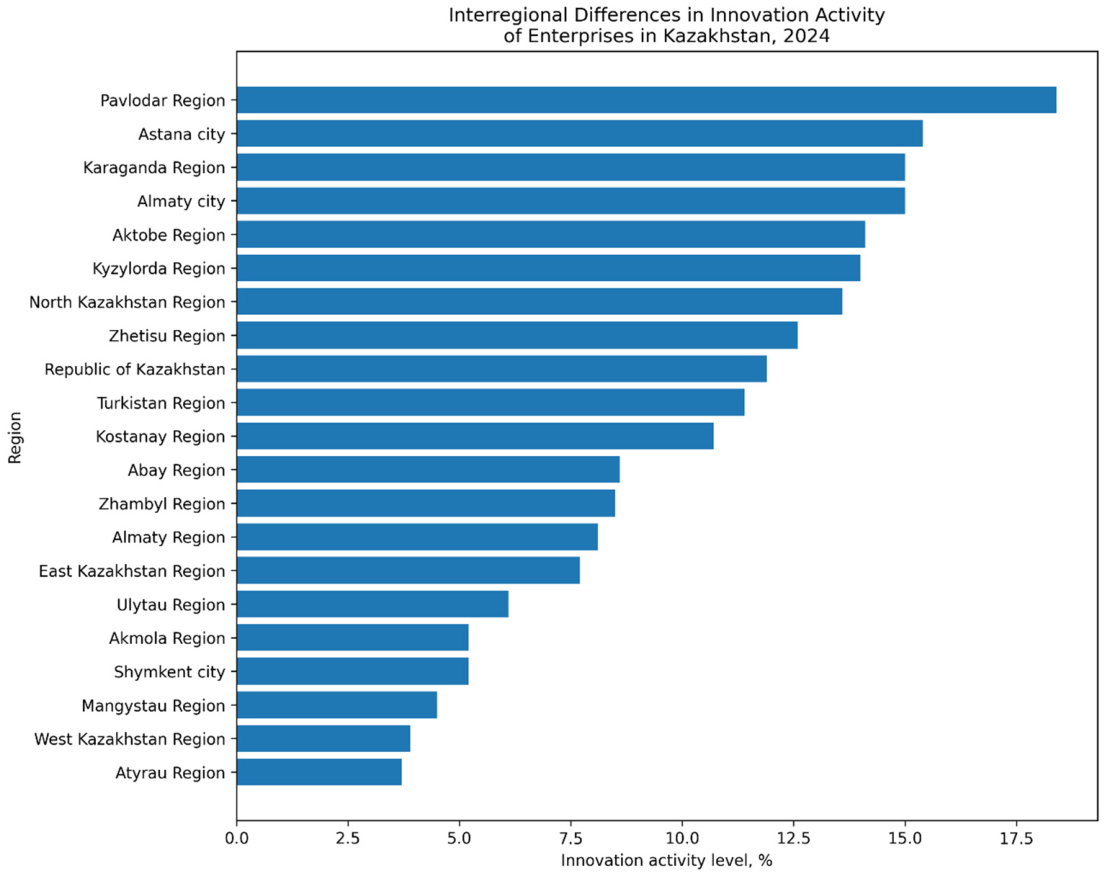
2025b). It should be clarified that the figure of 30756 refers to enterprises included in the official Form 1-Innovation statistical observation rather than to all registered enterprises in the country. Therefore, the results characterize the segment of enterprises covered by official innovation statistics and should not be interpreted as a complete description of the entire population of registered business entities. However, this average value conceals significant regional differentiation. The highest levels of innovation activity were observed in the Pavlodar region (18.4%), Astana city (15.4%), the Karaganda region and Almaty city (15.0% each), the Aktobe region (14.1%), the Kyzylorda region (14.0%), and the North Kazakhstan region (13.6%). At the other end of the distribution were the Atyrau region—3.7%, West Kazakhstan region—3.9%, Mangistau region—4.5%, and Akmola region and Shymkent city—5.2% each. Even at this level, it is clear that the gap between the leaders and outsiders is systemic, not isolated.
This heterogeneity is clearly illustrated in
Figure 1, which shows the differences in the level of innovation activity among enterprises across regions. This visualization allows one to immediately identify both regions with the highest innovation engagement and areas with a significantly weaker resource base.
Even more indicative is the structure of innovation activity by enterprise size. On average, 9.6% of small enterprises, 19.1% of medium-sized enterprises, and 34.0% of large enterprises were engaged in innovation across the country (
Bureau of National Statistics of the Agency for Strategic Planning and Reforms of the Republic of Kazakhstan, 2025a). This means that the innovation base in Kazakhstan as a whole is noticeably shifted towards larger economic entities. This pattern is particularly pronounced at the regional level. Among large enterprises, the highest innovation activity was recorded in the Zhetysu region—57.5%, the North Kazakhstan region—56.6%, the Karaganda region—55.6%, the East Kazakhstan region—49.4%, and the Abay region—46.7%. For medium-sized enterprises, the leaders were the Pavlodar region—30.6%, the Karaganda region—29.7%, and the North Kazakhstan region—28.6%. Among small businesses, even the best indicators were significantly lower: Almaty city—14.6%, Pavlodar region—14.4%, and Astana city—14.2%. In other words, in many regions, innovation activity relies primarily on medium and large businesses, while the involvement of small businesses in innovation remains limited.
These expenditures were concentrated in a relatively small number of regions. The absolute leader was the Atyrau region with 1,025,936.9 million tenge, that is, almost half of all national expenditures. When interpreting this value, the sectoral structure of the region should be taken into account. The Atyrau region is Kazakhstan’s main oil and gas extraction hub, and therefore such a high volume of innovation expenditures may reflect not only broad regional innovation development, but also capital-intensive modernization of extractive industries and the introduction of industrial technologies in the resource sector. Next came the Almaty region—506,798.6 million tenge, the North Kazakhstan region—150,283.6 million tenge, the Karaganda region—118,757.4 million tenge and Almaty city—102,517.7 million tenge (
Bureau of National Statistics of the Agency for Strategic Planning and Reforms of the Republic of Kazakhstan, 2025a). This shows that the resource base of the innovation process across the country is distributed unevenly not only in terms of the number of innovation-active enterprises, but also in terms of the volume of financial resources actually involved.
The structure of innovation financing is also significant. At the national level, enterprises’ own funds amounted to 957,888.6 million tenge, or 41.6% of all innovation expenditures. Funds from the national and local budgets together accounted for only a small portion of the total, while foreign funds and other sources played a significant role (
Bureau of National Statistics of the Agency for Strategic Planning and Reforms of the Republic of Kazakhstan, 2025a,
2025b). This means that Kazakhstan’s innovation resource base as a whole relies primarily on businesses’ own funds and heterogeneous extra-budgetary channels, while direct budget financing remains comparatively limited. This is important for interregional analysis because regions with weaker internal financial bases find themselves in a less advantageous position already at the outset of the innovation process.
Moving from total costs to more specific forms of innovation activity, the differences between regions become even more pronounced. In terms of the number of enterprises with at least one of the two main types of innovation, Almaty city ranked first, with 1231 enterprises, followed by Astana city with 646, the Karaganda region with 282, the Pavlodar region with 210, and the Aktobe region with 157 (
Bureau of National Statistics of the Agency for Strategic Planning and Reforms of the Republic of Kazakhstan, 2025a). Moreover, Almaty and Astana have a particularly high number of enterprises with process innovations, while in a number of other regions, the share of product innovations appears more limited. Consequently, regional innovation resources differ not only quantitatively, but also in their internal structure.
Similar heterogeneity is observed in the indicators related to research and development. In terms of the number of enterprises conducting internal research and development, the leaders were Almaty city (154), Astana city (61), and the Karaganda region (42) (
Bureau of National Statistics of the Agency for Strategic Planning and Reforms of the Republic of Kazakhstan, 2025a). Relatively high values were also observed in Shymkent city and the Aktobe, and West Kazakhstan regions. Thus, the research and development component of innovation resources gravitates primarily toward the largest urban centers and several industrial regions. When looking at the acquisition of modern equipment, software, and other capital goods for innovation, the picture changes somewhat. Here, the leaders were the Karaganda region (157 enterprises), the Pavlodar region (156), Almaty city (126), the North Kazakhstan region (120), and Astana city (110). This allows us to speak of at least two dimensions of the resource base for innovation development—research and production-related dimensions—which do not always coincide with regional distribution.
For a more visual comparison of regions,
Table 1 summarizes the key indicators of the innovation resource base. The table demonstrates that interregional differences affect several interrelated dimensions: the overall level of innovation activity, the structure of enterprises by size, the volume of innovation expenditures, the number of innovation-active enterprises, and the research component of the innovation process.
At this stage, several broad groups of regions can already be identified based on their resource endowment. The first group includes territories with high overall innovation activity and a noticeable concentration of resource bases. The second group includes regions where the overall level of innovation activity is not maximal, but the volume of innovation expenditures is very high. The third group includes territories with a weaker resource base, both quantitatively and qualitatively. However, a more detailed typology of the relationship between resources and results is discussed further in
Section 7.
Thus, interregional differences in innovation resources in Kazakhstan are multidimensional. They manifest themselves in unevenness in the overall level of innovation activity, a strong dependence of the innovation process on enterprise size, a high concentration of innovation expenditures in a limited number of regions, and differences between the research and production-related components of the innovation base. Even at this stage, it is clear that Kazakhstan’s regions are entering the innovation process with very different starting conditions. Therefore, the subsequent comparison of resources with economic outcomes should take into account not only the scale of innovation activity, but also the internal structure of regional resource endowments.
6. Interregional Differences in Innovation-Related Economic Outcomes
The next step is to examine how regional innovation resources are reflected in measurable economic outcomes. In Kazakhstani statistics, this is most clearly reflected by indicators of the volume of innovation output, the volume of innovative products sold, the export of innovation products, and data on how the implementation of innovations has impacted enterprise revenues and costs (
Bureau of National Statistics of the Agency for Strategic Planning and Reforms of the Republic of Kazakhstan, 2025a,
2025b). These indicators allow us to move from a description of the resource base to an assessment of the actual economic returns of innovation activity at a regional level.
In 2024, the total volume of innovative products in Kazakhstan amounted to 1,838,998.4 million tenge, and the volume of innovative products sold was 1,718,971.6 million tenge (
Bureau of National Statistics of the Agency for Strategic Planning and Reforms of the Republic of Kazakhstan, 2025a). Even at the country level, it is clear that innovation activity is expressed in the production and sale of products. However, in the regional context, high heterogeneity is also observed here.
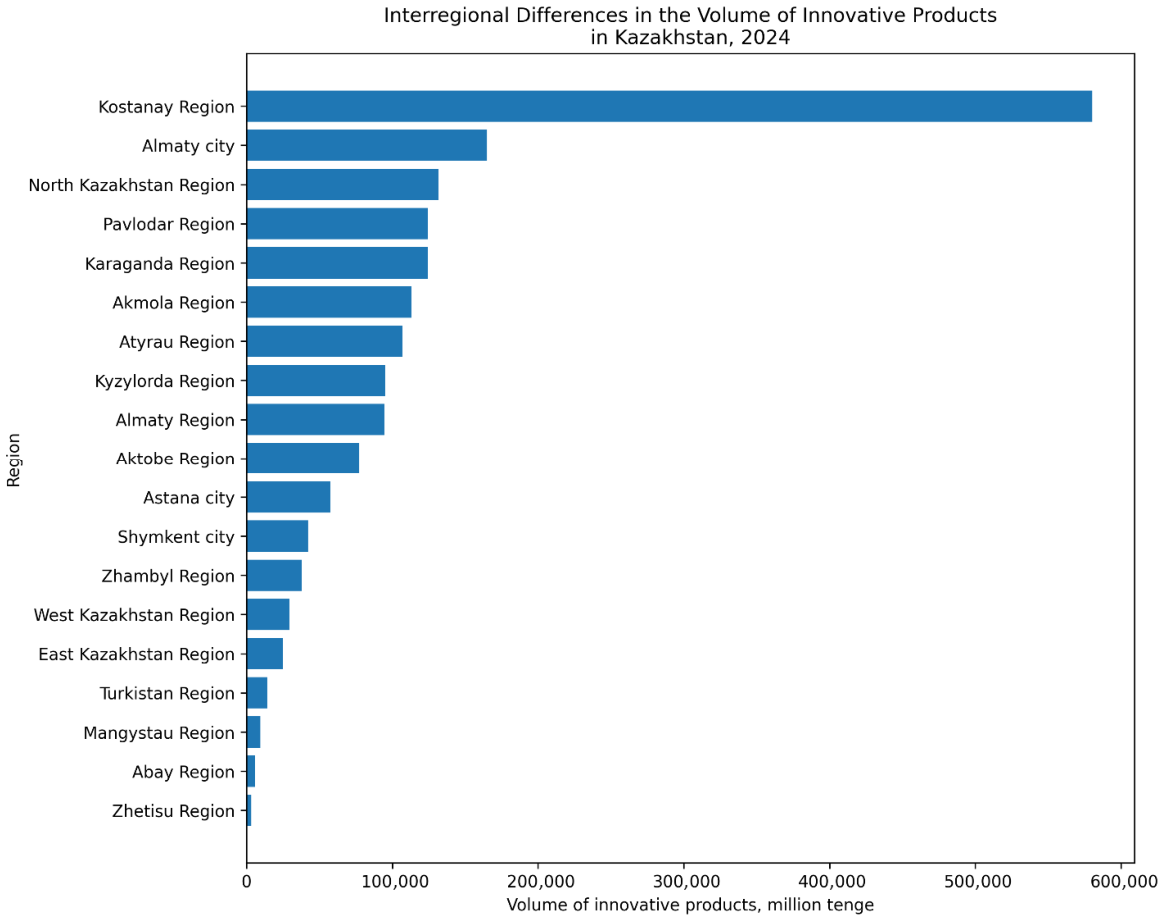
The absolute leader in terms of the volume of innovative products was the Kostanay region—580,272.8 million tenge. Significantly lower, but still noticeably standing out, were Almaty city—165,007.7 million tenge, the North Kazakhstan region—131,662.9 million tenge, the Pavlodar region—124,419.3 million tenge and the Karaganda region—124,392.5 million tenge. For comparison, in the Zhetysu region, the volume of innovation output amounted to only 3200.1 million tenge, in the Abay region—6044.3 million tenge, in the Mangistau region—9426.1 million tenge, and in the Turkestan region—14,448.7 million tenge. This shows that the differences between regions in innovation output are manifold.
A more complete picture of interregional differences is provided by
Table 2, which summarizes indicators of innovation output, sales, the export component, and individual economic effects of innovation at the enterprise level. The spatial concentration of innovation output is further shown in
Figure 2, which allows one to clearly see its connection to a limited number of territories.
A similar picture is observed in terms of the volume of innovative products sold. The highest figures were demonstrated by the Kostanay region—511,912.7 million tenge, Karaganda region—171,856.3 million tenge, Akmola region—135,496.1 million tenge, North Kazakhstan region—131,889.5 million tenge, Pavlodar region—124,581.5 million tenge, and Almaty region—115,348.8 million tenge (
Bureau of National Statistics of the Agency for Strategic Planning and Reforms of the Republic of Kazakhstan, 2025a). In other words, the regional map of innovation output and innovation sales only partially coincides. In a number of cases, a region occupies a relatively modest position in terms of the volume of innovative products produced, but a stronger position in terms of the volume of their sales. This indicates possible differences between the stage of creating an innovation product and the stage of its launch on the market.
Of additional interest is the internal structure of innovation products. Across the country as a whole, of the total volume of innovative products, 594,704.8 million tenge was goods and services new to the market, and 1,124,266.8 million tenge was goods and services new to the organization itself (
Bureau of National Statistics of the Agency for Strategic Planning and Reforms of the Republic of Kazakhstan, 2025a). This means that Kazakhstan’s economy is dominated by innovations focused primarily on the internal renewal of enterprises, rather than on bringing fundamentally new solutions to a wider market. This imbalance also varies across regions. For example, in the Almaty region, of 94,553.5 million tenge of innovation products, 106,450.1 million tenge was products new to the market, while in Akmola region, only 2675.4 million tenge was products new to the market, and the bulk—132,820.6 million tenge—was products new only to the organization itself. Consequently, regions differ not only in the scale of innovation output, but also in their qualitative structure.
An important indicator of the economic performance of innovation is the export of innovation products. In 2024, their total volume across the country amounted to 313,716.2 million tenge. The most notable regions in terms of this indicator were the Karaganda region—83,661.8 million tenge, Pavlodar region—38,193.8 million tenge, Kyzylorda region—32,729.4 million tenge, Astana city—19,363.7 million tenge and the North Kazakhstan region—15,638.5 million tenge. This shows that the export component of the innovation result is concentrated even more narrowly than the total innovation output. Many regions where the output of innovation products is recorded practically do not demonstrate significant export deliveries. Consequently, the transition from innovation production to foreign market sales is also spatially uneven.
When looking at innovation results not only through cost indicators but also through changes in the performance of enterprises, statistics also reveal significant differences. In 2024, 3662 enterprises nationwide engaged in innovation, of which 1562 reported positive revenue growth due to innovation, and 1379 reported positive cost reductions. The largest number of such enterprises was concentrated in Almaty, Astana, and the Karaganda and Pavlodar regions. This indicates a high concentration of the economic returns of innovation in the country’s largest urban and industrial centers.
Of significant importance is the fact that in most regions, the majority of enterprises reported either no income growth or relatively moderate growth in the range of 1 to 24%. Categories with income growth of 25 to 50% and especially 51 to 100% were significantly less common (
Bureau of National Statistics of the Agency for Strategic Planning and Reforms of the Republic of Kazakhstan, 2025a). This allows us to cautiously conclude that, in most cases, innovation in Kazakhstan is currently delivering a limited or moderate economic effect at the enterprise level rather than a sharp increase in market performance. A similar picture is observed for cost reduction: positive effects are recorded relatively widely, but large effects remain rare.
Thus, interregional differences in innovation-related economic outcomes in Kazakhstan are very pronounced. These are manifested in the high concentration of innovation output in a limited number of regions, in the differences between the volume of manufactured and sold innovation products, in the extremely uneven distribution of the export component, and in the varying degrees of the economic impact of innovation at the enterprise level. Crucially, leaders in innovation resources do not always completely coincide with leaders in innovation output and sales. Even at this stage, it becomes clear that the relationship between the resource base and results is not linear. This provides the basis for the next section, which examines the gaps between resources and results across regions.
7. Gaps Between Resources and Results Across Regions
The Atyrau region requires particular attention. In absolute terms, it stands out sharply in terms of innovation expenditures: in 2024, the region accounted for 1,025,936.9 million tenge, or almost half of all national innovation expenditures (
Bureau of National Statistics of the Agency for Strategic Planning and Reforms of the Republic of Kazakhstan, 2025a). At the same time, the innovation activity rate of enterprises was only 3.7%, one of the lowest among Kazakhstan’s regions (
Bureau of National Statistics of the Agency for Strategic Planning and Reforms of the Republic of Kazakhstan, 2025b). At first glance, this may appear to be a direct example of a resource–outcome imbalance. However, this interpretation requires caution.
The Atyrau region is Kazakhstan’s main oil and gas extraction hub, and therefore a substantial part of its innovation expenditures is likely to be associated with capital-intensive modernization of extraction, the introduction of industrial technologies, and the renewal of production processes in large companies of the resource sector. Within the official Form 1-Innovation statistical framework, such expenditures may be classified as innovation expenditures; however, in economic terms, they differ from a broader knowledge-intensive innovation process associated with diversification, knowledge commercialization, and the expansion of the number of innovation-active enterprises.
Therefore, the Atyrau region should not be interpreted as a standard case of inefficient transformation of innovation resources into outcomes. Rather, it should be treated as a special sectoral case. Its indicators reflect not only the characteristics of innovation activity, but also the statistical classification of large capital expenditures in the resource-extraction sector. This also shows that Form 1-Innovation data may not always capture a fully comparable concept of “innovation resource” across resource-dependent and more diversified regional economies.
The Almaty region exhibits a different type of gap. It ranks among the leaders in terms of innovation expenditures—506,798.6 million tenge (
Bureau of National Statistics of the Agency for Strategic Planning and Reforms of the Republic of Kazakhstan, 2025a)—but the level of innovation activity among enterprises here is not among the highest. The volume of innovation output is noticeable, but not entirely comparable to the scale of the resource base. This suggests that the region possesses significant resources, but their transformation into final innovation output remains incomplete. In other words, the Almaty region appears well-endowed with resources, but not as strong in terms of ultimate economic returns.
A different picture is observed in the Kostanay region. This region is not among the undisputed leaders in terms of innovation expenditures or the overall innovation activity rate of enterprises, yet it recorded the highest volume of innovative products in the country—580,272.8 million tenge—as well as one of the highest volumes of sold innovative products, 511,912.7 million tenge (
Bureau of National Statistics of the Agency for Strategic Planning and Reforms of the Republic of Kazakhstan, 2025a). In the index-based typology, this is reflected as a combination of moderate resources and high outcomes. However, this result should not be automatically interpreted as universal “innovation efficiency” of the region. The Kostanay region is one of Kazakhstan’s important industrial and agro-industrial regions; manufacturing plays a major role in its industrial output, with mechanical engineering, the food industry, and metallurgy being particularly significant. Therefore, the high volume of innovative products is likely to reflect modernization within production, agro-industrial, and metallurgical chains, rather than necessarily the development of broader knowledge-intensive innovation. In this sense, the Kostanay region demonstrates strong recorded economic outcomes relative to its resource position, but the sectoral content of these outcomes requires cautious interpretation.
A similar, although less pronounced, pattern is observed in the Akmola region. In terms of the innovation activity rate, it belongs to the weaker group of regions and does not stand out among the leaders in innovation expenditures (
Bureau of National Statistics of the Agency for Strategic Planning and Reforms of the Republic of Kazakhstan, 2025a,
2025b). Nevertheless, the volume of sold innovative products reached 135,496.1 million tenge, placing the region among the national leaders in this indicator. In the revised index-based typology, the Akmola region belongs to the group of regions with low resources but relatively stronger outcomes. However, sectoral context is also necessary here. The Akmola region is an industrial and agricultural region, where processing, the food industry, mechanical engineering, metallurgy, and the chemical industry play an important role. Therefore, its relatively strong sales of innovative products may be associated less with a broad knowledge-intensive innovation ecosystem than with modernization in specific production and agro-industrial segments. Accordingly, this case should be interpreted as an example of strong recorded outcomes under a limited resource base, but not as direct evidence of high innovation efficiency without taking sectoral structure into account.
Of particular interest are the Karaganda and Pavlodar regions. Both regions rank among the leaders in terms of enterprise innovation activity—15.0% and 18.4%, respectively (
Bureau of National Statistics of the Agency for Strategic Planning and Reforms of the Republic of Kazakhstan, 2025a,
2025b)—and demonstrate high levels of innovation engagement among medium and large enterprises, while simultaneously ranking among the leaders in terms of the volume of innovative products and export deliveries of innovation products. In this case, the relationship between the resource base and performance appears more balanced. These regions can be considered examples of territories where a relatively strong innovation base truly translates into measurable economic results.
The cities of Almaty and Astana constitute another important type of region. They lead in the number of innovation-active enterprises, the scale of process and product innovation, and the development of the research component of the innovation process (
Bureau of National Statistics of the Agency for Strategic Planning and Reforms of the Republic of Kazakhstan, 2025a). Almaty has a particularly high concentration of enterprises conducting internal research and development, while Astana combines high innovation activity, large-scale enterprises, and a significant role for innovation products and their export component. However, the volume of innovation output in these cities is inferior to the Kostanay region and, in some cases, comparable to industrial regions. This suggests that Kazakhstan’s largest urban centers possess a very strong organizational and research base for innovation, but do not always translate this advantage into an equally dominant output of innovation products. Consequently, there is a certain gap here, albeit less pronounced than in resource-overburdened regions.
At the other end of the distribution are regions with a double disadvantage, i.e., territories where both innovation resources and economic performance are weak. This group includes, for example, the Mangistau region, West Kazakhstan region, Zhetysu region, and, to a certain extent, the Turkestan region (
Bureau of National Statistics of the Agency for Strategic Planning and Reforms of the Republic of Kazakhstan, 2025a,
2025b). They are characterized by low levels of enterprise innovation activity, limited scale of innovation output, and a weak presence of innovation products in sales and export indicators. In such cases, it is not so much a question of a gap between resources and results, but rather of the region’s systemically weak position in the innovation process as a whole. This is particularly important for economic policy, as support measures here should be aimed not only at improving performance but also at expanding the resource base itself.
In general, interregional differences in Kazakhstan do not fit a single, simple pattern. Alongside regions with a strong resource base and high performance, there are also areas with high resource endowments but incomplete returns and regions with a relatively modest resource base and comparatively strong performance, as well as areas with mixed profiles and regions facing a double disadvantage. Therefore,
Table 3 uses a more detailed typology to more accurately reflect the actual diversity of regional resource combinations and performance.
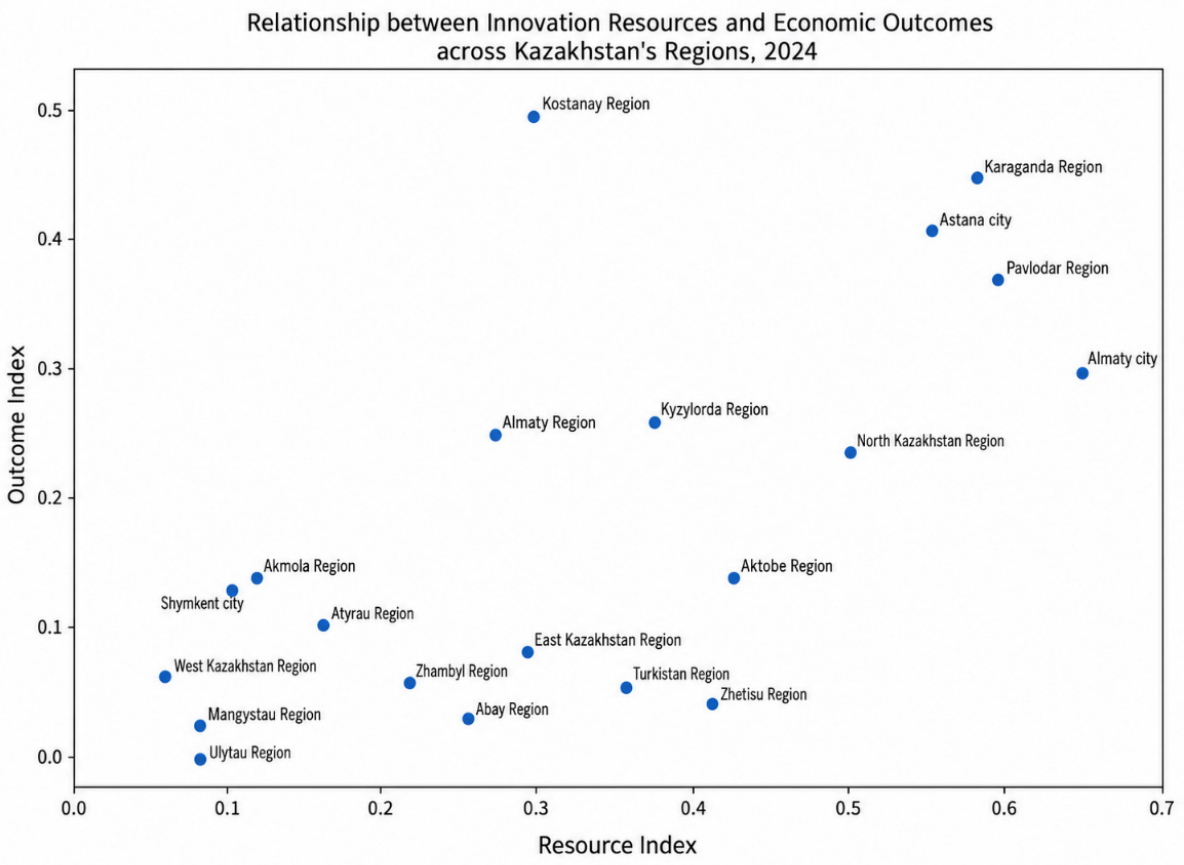
The index-based procedure confirms that interregional differences in Kazakhstan are not only pronounced descriptively but also quantitatively. The coefficients of variation show particularly high dispersion for innovation expenditures (CV = 1.980), innovation products new to the organization (CV = 1.950), export of innovation products (CV = 1.763), the number of innovation-active enterprises (CV = 1.504), the volume of innovative products (CV = 1.332), and the volume of sold innovative products (CV = 1.294). At the aggregate level, the coefficient of variation for the Resource Index was 0.562, while that for the Outcome Index was 0.840. This indicates that innovation-related economic outcomes are distributed more unevenly across regions than the resource base.
In addition, Spearman’s rank correlation coefficient was calculated between the Resource Index and the Outcome Index. The obtained value, ρs = 0.644, indicates a positive but incomplete association between resources and outcomes. In other words, regions with a stronger resource base generally tend to have stronger outcome positions, but this correspondence is not automatic or one-to-one. This is precisely why noticeable resource–outcome gaps arise in several cases.
To systematize the identified differences,
Table 3 presents a typology of Kazakhstan’s regions based on the ratio of innovation resources to economic performance. Unlike the initial version, the typology in
Table 3 is based not on brief qualitative characterizations of regions, but on the calculated values of the Resource Index, the Outcome Index, the gap between them, and the rank-based classification of resource and outcome levels.
Figure 3 complements this logic graphically, allowing us to see which regions are located in a zone of relative balance between resource base and performance, and which lie in a zone of significant disparity.
It should be emphasized that the typology presented here is heuristic and policy-oriented in nature. It is intended to systematize regional differences and to formulate implications for territorially differentiated innovation policy, rather than to serve as the result of a formal clustering procedure. Therefore, the regional categories should be understood as analytical groups based on the index-based and rank-based procedures, not as statistically derived clusters. Accordingly, differences between regions are not interpreted as direct evidence of higher or lower managerial efficiency. Instead, they indicate different configurations of resource base, recorded outcomes, sectoral structure, and possible constraints in transforming resources into economic results.
The revised typology shows that regional resource–outcome configurations are indeed diverse. The Karaganda region, Pavlodar region, Astana city, Almaty city, and several other regions combine relatively high resource and outcome positions. The Kostanay region, Almaty region, and Kyzylorda region demonstrate comparatively strong outcomes despite only medium resource positions. Conversely, the Zhetisu Region and North Kazakhstan region have relatively high resource positions but weaker outcome positions, indicating an incomplete transformation of resources into economic results. The Ulytau Region, Mangystau Region, and several other regions remain in the low-resource and low-outcome group. At the same time, the classification of the Ulytau Region requires particular caution. Since several outcome indicators for this region are marked as x in
Table 2, its Outcome Index reflects the technical treatment of unavailable values in the index calculation rather than a fully observed profile of economic outcomes. Therefore, the Ulytau Region should be regarded as a region with low resources and low recorded outcomes, but with limited statistical observability.
These findings are consistent with the contemporary literature, which emphasizes that the key problem of regional innovation systems lies not only in differences in the volume of resources, but also in the uneven capacity of territories to transform these resources into outcomes (
Chen & Guan, 2012;
Rudskaya et al., 2022;
Slavova et al., 2025;
Zabala-Iturriagagoitia et al., 2007). The Kazakhstani data confirm this conclusion: within a single country, with a common institutional framework and a comparable statistical system, regions demonstrate substantially different combinations of resource base and economic returns.
Consequently, interregional differences in Kazakhstan’s innovation development are not only quantitative but also qualitative. Some regions face shortages of innovation resources, while others have a limited ability to convert existing resources into outcomes, and still others demonstrate comparatively strong outcomes even with a less pronounced resource base. At the same time, the identified gaps should not be automatically interpreted as direct evidence of managerial inefficiency. Rather, they indicate the need for a more detailed analysis of sectoral structure, time lags, statistical observability, and commercialization mechanisms in specific regions.
8. Discussion and Economic Policy Implications
The results demonstrate that interregional differences in innovation development in Kazakhstan cannot be explained solely by resource imbalances. An equally important factor is the difference in the ability of regions to transform available resources into economically significant results. In this sense, the Kazakhstani data confirm the literature’s findings that the key problem of innovation systems lies not only in the volume of input parameters but also in the way they are translated into results (
Chen & Guan, 2012;
Fritsch & Slavtchev, 2007;
Slavova et al., 2025;
Zabala-Iturriagagoitia et al., 2007). This is particularly important for economic interpretation, as it allows for a shift from a simple comparison of levels of innovation activity to an analysis of the effectiveness of regional models of innovation development.
The case of Atyrau region has broader methodological implications. It shows that identical statistical categories may reflect different economic processes in different types of regional economies. In resource-dependent regions, large innovation expenditures may primarily be associated with capital-intensive technological upgrading in extractive industries, whereas in large urban and more diversified regions, innovation resources are more closely connected with the number of innovation-active enterprises, research infrastructure, internal R&D, and broader commercialization channels. Therefore, direct comparisons of innovation expenditures across such regions require caution. In the present study, this limitation is addressed through the index-based procedure, where innovation expenditures constitute only one of the seven resource indicators, and through the separate interpretation of the Atyrau region as a special sectoral case.
The most obvious conclusion is that a high concentration of innovation expenditures does not in itself guarantee comparable economic returns. The example of the Atyrau region demonstrates that even extremely significant financial resources may not lead to high innovation output if the innovation process relies on a narrow industry base, limited enterprise involvement, and weak resource-to-output transfer. This means that policies focused primarily on increasing expenditures, without considering the economic structure and commercialization mechanisms, may have limited impact.
The cases of the Kostanay and Akmola regions also show that strong outcome indicators require sectoral interpretation. The high volume of innovative products in the Kostanay region and the large volume of sold innovative products in the Akmola region should not be automatically interpreted as universal innovation efficiency. These outcomes are more likely to reflect modernization in specific production, agro-industrial, metallurgical, or processing segments of the regional economy. This distinction is important because innovation in such sectors may differ substantially from knowledge-intensive innovation associated with diversification, digital technologies, research infrastructure, and knowledge commercialization. Therefore, in the revised manuscript, these regions are interpreted as cases of strong recorded outcomes relative to their resource positions, but not as direct evidence of general innovation efficiency.
A full sectoral decomposition of innovation output at the regional level is beyond the scope of the available official table used in this study; therefore, the revised manuscript provides a sectoral contextualization of the most anomalous cases and treats these interpretations with caution.
The Karaganda and Pavlodar regions occupy a special place, with a comparatively strong resource base combined with high results. These regions can be considered examples of a relatively more balanced innovation model. This is important for economic policy because it is in these regions that practices associated with a more sustainable transfer of resources into results can be identified and used as a benchmark when developing measures for other regions. In this sense, the task is not only to support leaders but also to understand which elements of their model can be adapted to other regional conditions.
The cities of Almaty and Astana require separate interpretation. They concentrate a significant share of innovation-active enterprises, research infrastructure, and organizational resources, but their dominance in the resource base is not always accompanied by equally undisputed leadership in the production of innovation products. This suggests that major urban centers play a key role in the generation and accumulation of innovation resources, but do not always fully translate this advantage into comparable production output. For policy, this means that support for such areas should be aimed not only at further expanding research potential but also at strengthening commercialization channels, interfirm cooperation, and the linkages between research and production.
Regions facing a double disadvantage require a different approach. In their case, the problem lies not only in weak performance but also in the limited resource base itself. This means that a single set of measures for all regions will be ineffective. While resource-rich but underperforming regions prioritize increasing the return on existing resources, for regions facing a double disadvantage, measures to expand the very foundation for innovation development are more important: developing human capital, building local infrastructure, supporting businesses’ involvement in innovation, and reducing barriers to the dissemination of knowledge and technology.
A more general conclusion follows from this: innovation policy in Kazakhstan must be differentiated by territory. A universal approach, equally targeted at all regions, is unlikely to be equally effective, as the types of constraints themselves vary. For one group of regions, the key objective is to improve the effectiveness of existing resources, for another, to strengthen the research and organizational base, and for a third, to develop the minimum necessary innovation potential. This conclusion aligns well with the contemporary literature, which emphasizes that territorially oriented innovation policy must consider not only the overall level of development of a region but also the nature of its specific constraints (
Gianelle et al., 2024;
Grillitsch & Asheim, 2018;
Morisson & Doussineau, 2019;
Tödtling & Trippl, 2005).
More broadly, the article’s results are also important for understanding the limitations of the current diversification model in Kazakhstan. If interregional differences concern not only the distribution of innovation resources but also the mechanisms for their economic implementation, then the task of diversification itself requires a more complex policy than simply increasing innovation funding. Measures are needed to strengthen the links between research, production, and the market, develop the regional institutional environment, and narrow the gaps that hinder the transformation of resources into sustainable economic results.
The revised typology also makes it possible to formulate more specific policy implications for different types of regions. A uniform increase in innovation funding is unlikely to be equally effective across all regional contexts. Policy measures should instead be linked to the specific position of each region in the resource–outcome configuration.
For regions with high resources and strong outcomes, such as the Karaganda region, Pavlodar region, Astana city, and Almaty city, the main policy task is not simply to expand the existing resource base, but to consolidate and diffuse successful practices. Policy instruments for this group may include targeted support for interregional knowledge transfer, supplier development programs, joint university–industry laboratories, and incentives for large firms to involve local small and medium-sized enterprises in innovation chains. These regions can act as anchor territories for broader national innovation diffusion.
For regions with high resources but not fully realized outcomes, such as the Aktobe region, Zhetisu Region, and North Kazakhstan region, policy should focus on improving the conversion of existing resources into marketable and exportable outputs. Relevant instruments include commercialization grants, innovation vouchers for firms, technology extension services, applied research contracts with universities, and performance-based support schemes tied to sales of innovative products rather than only to expenditures. In these regions, the problem is not primarily the absence of resources, but the weakness of the mechanisms that transform resources into economic outcomes.
For regions with moderate resources and strong outcomes, such as the Kostanay region, Almaty region, and Kyzylorda region, policy should support scaling and sectoral upgrading. These regions demonstrate strong recorded outcomes relative to their resource position, but their results may be concentrated in specific sectors. Therefore, policy instruments should include sector-specific innovation programs, support for modernization in agro-industrial, manufacturing, and processing chains, export promotion for innovative products, and mechanisms to spread innovation from leading firms to related suppliers and local SMEs.
For regions with moderate resources but weak outcomes, such as the Abay region, Zhambyl Region, and Turkistan Region, policy should focus on diagnosing bottlenecks in commercialization and enterprise capabilities. Relevant measures include managerial and technological upgrading programs for firms, support for quality certification and product standardization, advisory services for innovation project preparation, and co-financing schemes that link public support to clearly defined output indicators. In these regions, the priority is to prevent existing resources from remaining disconnected from measurable economic results.
For regions with low resources but relatively stronger outcomes, such as the Akmola region, Atyrau region, West Kazakhstan region, and Shymkent city, policy should be more selective. These regions should not necessarily be treated as simple laggards. In the Akmola region and Shymkent city, policy may focus on strengthening the firms and sectors that already generate recorded outcomes, especially through support for production modernization, market access, and supplier networks. The Atyrau region should be treated separately as a sector-specific case: policy instruments should aim to increase knowledge spillovers from oil and gas modernization through local content requirements in technology contracts, supplier development programs, partnerships between large resource sector companies and local universities, and incentives for applied R&D and engineering services outside the core extractive sector.
For regions with low resources and weak outcomes, such as the Mangystau Region and Ulytau Region, the sequencing of interventions is especially important. In these regions, immediate expectations of high innovation output may be unrealistic without first strengthening basic absorptive capacity. The first stage should focus on human capital, technical skills, business support infrastructure, and the identification of feasible sectoral niches. The second stage should focus on attracting investment and supporting firm-level modernization. Only after these foundations are strengthened should more advanced instruments, such as commercialization grants, R&D support, or export-oriented innovation programs, become effective.
For regions with moderate resources and moderate outcomes, such as the East Kazakhstan region, policy should aim at improving the stability of the resource–outcome link. Measures may include support for interfirm cooperation, modernization of existing industrial competencies, applied technology transfer, and stronger links between regional enterprises and national research institutions. Such regions may not require radical policy redesign, but they need instruments that can move them from intermediate positions toward stronger outcome performance.
The cases of Astana city and Almaty city require additional attention because they combine strong research, organizational, and enterprise bases with outcome positions that are not always proportional to their resource concentration. For these urban innovation centers, policy should prioritize commercialization mechanisms: university technology transfer offices with performance-based incentives, proof-of-concept funding, seed financing for academic spin-offs, public procurement of innovative solutions, accelerator programs linked to large firms, and stronger intellectual property and licensing support. The main challenge for these cities is not the absence of innovation resources, but the need to transform research and organizational capacity into scalable market outcomes.
Overall, the policy implication is not simply that Kazakhstan needs territorially differentiated innovation policy, but that different types of resource–outcome configurations require different instruments and sequencing. Resource-rich but underperforming regions need conversion mechanisms; moderate-resource but strong-outcome regions need scaling and sectoral upgrading; low-resource and weak-outcome regions need basic capacity building before advanced innovation instruments can be effective; and major urban centers need stronger commercialization channels.
Thus, the results demonstrate that interregional heterogeneity in innovation development in Kazakhstan has direct implications for economic policy. They highlight the need to move from a single and largely unified approach to a more precise model that takes into account regional differences in resource base, performance, and the nature of constraints. This is the main practical conclusion of the analysis.
9. Conclusions
This article analyzes interregional differences in innovation development in Kazakhstan through the relationship between innovation resources and innovation-related economic outcomes. The analysis revealed that spatial heterogeneity in the country’s innovation process is determined not only by the unevenness of the resource base, but also by differences in the ability of regions to transform available resources into economically significant results.
The results confirm that the relationship between resource endowment and innovation performance is not linear. Along with regions where a relatively strong resource base is combined with high innovation performance, there are also areas with a high concentration of resources but limited returns, as well as regions with a more moderate resource base and comparatively strong performance. Thus, interregional differences in Kazakhstan are not only quantitative but also qualitative.
A key finding of the study was the identification of several types of regional resource–result configurations. This demonstrated that for some regions, the key problem stems from the inadequacy of the innovation base itself, while for others, it stems from a limited ability to transform existing resources into output, sales, and broader economic impact. In this sense, the article contributes not only to the description of interregional heterogeneity but also to its economic interpretation.
The practical conclusion is that innovation policy in Kazakhstan cannot be the same for all regions. The effectiveness of support measures should be determined not only by the overall strength of the regional resource base, but also by the nature of the specific constraints facing each region. For resource-rich but underperforming regions, increasing the return on existing resources becomes a priority. For regions facing a double disadvantage, measures to expand the resource base itself, develop human capital, infrastructure, and engage businesses in the innovation process are more important.
More broadly, the study’s findings demonstrate that for an economy focused on diversification, increasing productivity, and reducing dependence on raw materials, it is crucial not only to increase innovation resources but also to narrow the gaps between the resource base and the economic returns of innovation. This is precisely the direction in which Kazakhstan’s innovation policy should shift if its goal is not merely to formally increase innovation activity but also to achieve sustainable economic impact at the regional level.
Future research may proceed in several directions. First, a dynamic analysis based on multi-year data would make it possible to assess the persistence of the identified resource–outcome gaps and to trace whether regional positions change over time. Second, further research may focus on identifying the causal mechanisms that explain why some regions are more successful in transforming innovation resources into economic outcomes, while others face not fully realized returns. Third, qualitative case studies of specific regions would be particularly useful, especially for sectorally distinctive cases such as the Atyrau, Kostanay, and Akmola regions, as well as Astana city and Almaty city. Such studies would allow for a deeper examination of the role of sectoral structure, institutions, commercialization channels, and interactions between firms, universities, and the state.