Article

Multilevel Okun’s Law: Heterogeneity, Stability and Asymmetry in Ecuador

by
Rocío González-Reyes
1,
Ángel Maridueña-Larrea
2,*,
Patricio Álvarez-Muñoz
3 and
Geoconda Álava-Bravo
4
1
Centro de Estudios Económicos para el Desarrollo del Ecuador, Facultad de Vinculación y Facultad de Posgrado, Universidad Estatal de Milagro, Milagro, Provincia del Guayas, Ecuador 091050
2
Centro de Estudios Económicos para el Desarrollo del Ecuador, Facultad de Ciencias Sociales, Educación Comercial y Derecho, Universidad Estatal de Milagro, Milagro, Provincia del Guayas, Ecuador 091050
3
Facultad de Ciencias Sociales, Educación Comercial y Derecho, Universidad Estatal de Milagro, Milagro, Provincia del Guayas, Ecuador 091050
4
Dirección de Postgrados Cooperación y Relaciones Internacionales, Universidad Laica Eloy Alfaro de Manabí, Manta, Provincia de Manabí, Ecuador 130214
*
Author to whom correspondence should be addressed.
Economies 2026, 14(5), 189; https://doi.org/10.3390/economies14050189
Submission received: 21 March 2026 / Revised: 2 May 2026 / Accepted: 11 May 2026 / Published: 20 May 2026
(This article belongs to the Special Issue Macroeconomics of the Labour Market)

Abstract

Okun’s Law has been predominantly estimated at the aggregate level and for advanced economies, leaving its heterogeneity insufficiently explored in developing countries. This paper examines such heterogeneity for Ecuador, articulating for the first time in a developing and dollarised economy the multilevel estimation of the coefficient, the assessment of its temporal stability and the test for cyclical asymmetry within a single analytical framework. The relationship between economic activity and unemployment is estimated at the national level and for 19 disaggregations by area, sex, age, ethnicity and educational attainment, using monthly series from 2021 to 2025. The results suggest that the aggregate coefficient conceals a profound heterogeneity: Okun’s Law operates with intensity in the urban, female, youth, Afro-Ecuadorian and university-educated segments, yet is non-existent in the rural, male, older-age, indigenous and lower-education strata. This configuration is temporally robust and predominantly symmetrical between phases of the cycle, with specific exceptions in the Montubio and postgraduate segments. Economic growth reduces unemployment only in certain groups, whilst in the remainder the cyclical adjustment is channelled through margins that conventional statistics do not capture, suggesting that economic growth may be a necessary but not sufficient condition for improving labour market outcomes as a whole.
JEL Classification:
C32; E24; E32; J15; J21

1. Introduction

The reduction in unemployment remains a central objective of economic policy, particularly in developing economies, where informality, labour market segmentation and other structural heterogeneities constrain the capacity of growth to translate into sustained improvements in labour welfare (Ben-Salha & Mrabet, 2019; Nnyanzi et al., 2025). In this context, Okun’s Law (Okun, 1962) constitutes the classical empirical benchmark for examining the relationship between economic activity and unemployment. The accumulated evidence broadly supports its validity, yet also reveals that the magnitude of the coefficient varies substantially across countries, time periods, labour market structures and estimation strategies (Ball et al., 2017; Boďa & Považanová, 2023; Perman et al., 2015). Nevertheless, a considerable share of this literature has focused on advanced economies and aggregate-level estimations, thereby obscuring heterogeneities that are crucial for understanding labour market functioning and for designing more effective policy responses.
Precisely to overcome these limitations, the recent literature has advanced along three complementary fronts. The first has involved disaggregating unemployment by demographic and socioeconomic characteristics—particularly age, gender, and educational attainment—revealing that the sensitivity of unemployment to the business cycle is far from homogeneous across population groups. The second has explored the possibility of cyclical asymmetries, whereby the intensity of the output-unemployment relationship differs between expansions and recessions (Porras-Arena et al., 2024). The third has called into question the stability hypothesis, showing that the Okun coefficient may vary over time in response to structural, institutional or macroeconomic changes (Cuaresma, 2003; Sovbetov, 2025; Zanin & Marra, 2012). However, these three dimensions have tended to be analysed in isolation. As Boďa and Považanová (2025) synthesise, only a small fraction of studies published between 1995 and 2020 incorporated demographic disaggregation, very few simultaneously combined more than one dimension of heterogeneity, and virtually none integrated ethnicity or articulated educational attainment alongside other stratification variables. Consequently, the interaction between sociodemographic composition, cyclical asymmetry and temporal stability remains an insufficiently explored terrain.
Ecuador offers a particularly pertinent case for addressing this gap. The available evidence for Latin America suggests that Okun’s Law tends to be weaker in environments characterised by high informality and labour market segmentation (Pizzo, 2020). In Ecuador, these conditions acquire special relevance, as high levels of informal employment persist alongside marked disparities between urban and rural areas and enduring differences by gender, ethnicity and educational attainment (Maridueña-Larrea & Martín-Román, 2025). Added to this is the country’s status as a dollarised economy, which restricts conventional macroeconomic adjustment, particularly monetary and exchange rate policy. In the absence of nominal depreciation as a shock-absorption mechanism, a larger share of the adjustment must operate through domestic prices, wages and, above all, labour market quantities, which may intensify the transmission of the business cycle to employment and unemployment in economies with limited exchange rate flexibility (Akkoyunlu, 2024). Although recent contributions have examined the unemployment-output relationship in Ecuador (Ñacata-Loachamin et al., 2026; Sánchez Giler et al., 2017), these studies are confined to aggregate estimations and do not examine sociodemographic heterogeneity or variations in the relationship across the business cycle.
Against this backdrop, the study contributes to the literature in four directions. First, it provides high-frequency evidence for Ecuador, thereby capturing short-run adjustment dynamics with greater precision and identifying business cycle phases with greater clarity. Second, it simultaneously incorporates five dimensions of disaggregation—area, sex, age, ethnicity and educational attainment—which constitute the principal axes of structural segmentation in the Ecuadorian labour market, a combination seldom addressed jointly in the literature. Third, it examines whether the strength of the relationship has remained stable over time or has shifted in response to changing economic conditions. Fourth, it evaluates whether the output–unemployment link behaves symmetrically across expansionary and recessionary phases. The empirical strategy relies on a gap specification derived from the Hodrick and Prescott (1997) and Butterworth (1930) filters, and the relationship is estimated both at the aggregate level and for distinct sociodemographic strata.
In anticipation of the findings, the results suggest that Okun’s Law holds at the aggregate level for Ecuador, albeit with marked heterogeneity across population groups. In broad terms, the cyclical sensitivity of unemployment proves more intense in certain labour market segments than in others, whilst the evidence of asymmetry is limited in most cases, though not entirely absent. Taken together, these findings indicate that labour policy responses can hardly be designed on the basis of a single average coefficient and lend support to the need for more targeted interventions in structurally segmented labour markets.
The remainder of the manuscript is organised as follows. Section 2 develops the literature review. Section 3 describes the data and methodology. Section 4 presents the results. Section 5 discusses them. Section 6 acknowledges the limitations of the study. Section 7 summarises the conclusions and policy recommendations.

2. Literature Review

The inverse relationship between unemployment and output, originally documented by Okun (1962) for the United States economy, has become one of the most extensively studied empirical regularities in macroeconomics. The author estimated that an increase of approximately three percentage points (p.p.) in output was associated with a one p.p. reduction in the unemployment rate, establishing an influential rule of thumb for labour market analysis. From an economic standpoint, this relationship reflects the fact that fluctuations in activity affect labour demand, yet such adjustment is neither mechanical nor proportional, as it is mediated by factors such as productivity, labour force participation, sectoral composition and labour market institutions (Gordon & Clark, 1984; Perry et al., 1971). It is precisely for this reason that the literature has shown Okun’s Law to be robust as a general regularity, although its intensity depends on the economic and institutional context in which it is estimated.
Building on this premise, the literature review is organised along three main lines. The first examines the empirical validity of the relationship across countries and compares its magnitudes. The second analyses whether the link between output and unemployment is stable and symmetrical over the business cycle. The third investigates whether the unemployment response differs across specific labour market groups. These three lines are especially relevant to the present study, as they provide the framework for situating its contribution around the structural heterogeneity of the Ecuadorian labour market.

2.1. Baseline Estimation and Cross-Country Evidence

The earliest investigations following Okun (1962) focused on verifying whether the negative relationship between output and unemployment held beyond the United States. The evidence for advanced economies shows, in broad terms, that Okun’s Law constitutes a robust empirical regularity, albeit with substantial differences in the magnitude of the coefficient across countries. Moosa (1997) documented this pattern for the G7; Lee (2000) confirmed it for a broader set of OECD economies; and Ball et al. (2017) demonstrated that the relationship remained relevant even after the Great Recession, concluding that Okun’s Law is strong and stable by the standards of macroeconomics. The meta-analysis of Perman et al. (2015) places the typical OECD magnitude approximately in the −0.6 to −1.0 range, with the upper bound disproportionately driven by Spain, whose unusually high incidence of temporary contracts has been linked to a coefficient of around −0.82 (Ball et al., 2017; Cutanda, 2023). The international heterogeneity, therefore, reflects not only differences in the cycle but also in structural and methodological factors.
In developing economies, the evidence is more limited and less uniform. A recurrent explanation is that, in contexts characterised by high informality, self-employment or occupational segmentation, part of the adjustment to activity shocks does not necessarily translate into open unemployment, but rather into transitions towards low-productivity or less protected forms of employment. This reasoning helps to explain why Okun’s Law tends to appear weakened in Latin America. Pizzo (2020) highlights precisely the role of informality as a partial buffer of the output-unemployment link. The available estimates, however, differ markedly across studies even for the same country. For Ecuador, Porras-Arena and Martín-Román (2023a) report a coefficient of −0.13 over 1980–2017 averaging four gap-version specifications, whereas Ball et al. (2019) place it at −0.17 over 1988–2015 using a single HP filter; comparable spreads emerge for Peru (−0.13, −0.12, −0.08), Honduras (−0.12, −0.10) and Argentina (−0.22, −0.11, −0.30), as systematised in Appendix A (Table A1). The meta-regression of (Porras-Arena & Martín-Román, 2023b) attributes this heterogeneity primarily to labour-market structural features—self-employment, informal employment and the sectoral composition of jobs—and, secondarily, to methodological choices regarding the cycle-extraction filter, the version of Okun’s Law and the data frequency, with the underlying theoretical model contributing only marginally.
Evidence from other economies marked by widespread informality converges on this reading. Ben-Salha and Mrabet (2019) document for four North African countries that the strength of the Okun relationship varies sharply by country and demographic group, with structural breaks affecting the magnitude of estimates; Nnyanzi et al. (2025) show for African economies that hysteresis in youth unemployment qualitatively modifies the output–unemployment trade-off; and Akkoyunlu (2024), employing non-linear ARDL cointegration, identifies for Turkey an asymmetric long-run relationship that departs from the canonical linear pattern. Taken together, these results imply that, in such institutional contexts, the open-unemployment-based Okun coefficient should be interpreted as a lower bound of the true cyclical sensitivity of the labour market.
In the specific case of Ecuador, a dollarised economy in which adjustment to shocks must operate predominantly through prices, wages and labour-market quantities (Maridueña-Larrea, 2017), the empirical evidence remains scarce and relatively recent. Sánchez Giler et al. (2017) find a negative and statistically significant relationship between economic growth and unemployment for the period 1997–2016, whilst Ñacata-Loachamin et al. (2026) also document an inverse relationship between growth and unemployment and report evidence of a causal effect of growth on adequate employment. Nevertheless, both studies rely on aggregate national-level estimations and, therefore, leave open the question of how the intensity of Okun’s Law changes when the labour market is observed from a more disaggregated sociodemographic perspective. Beyond aggregation, neither study engages with the heterogeneity, asymmetry or stability dimensions that have organised the international research agenda on Okun’s Law over the past two decades (Boďa & Považanová, 2025)—the gaps that the present study is designed to address.

2.2. Temporal Stability and Cyclical Asymmetry

The literature has called into question the temporal stability of the Okun coefficient. The underlying premise is that the intensity of the relationship may shift as labour market institutions, sectoral composition, the depth of crises or the macroeconomic regime itself evolve over time. Zanin and Marra (2012) show for eurozone countries that coefficients vary gradually over time and that time-varying parameter approaches capture this evolution more effectively than conventional static estimations. Similarly, Karlsson and Österholm (2020) find for the United States that, although the fundamental link between output and unemployment persists, its intensity does not remain entirely constant. Consequently, assuming stability in this relationship may prove unduly restrictive, particularly when analysing economies subject to structural transformations or severe shocks.
A second line of inquiry has examined whether the relationship between unemployment and output is symmetrical across the business cycle. Although the findings are not entirely uniform, there is considerable convergence around the notion that the unemployment response tends to be more intense during recessions than during expansions. Virén (2001) was among the first to observe that the relationship could exhibit non-linear behaviour across cycle phases, a regularity subsequently corroborated by a growing body of evidence across diverse country samples and methodological approaches (Abid et al., 2023; Boďa & Považanová, 2021; Duran, 2022; Sovbetov, 2025). On this front, the literature suggests not only that asymmetry is economically plausible, but also that its detection depends on the method employed and on the model’s capacity to capture non-linearities or regime changes (Gil-Alana et al., 2020).
An analytical reading of these two strands reveals a tension common to both: their conclusions are jointly determined by the level of aggregation, the regime-classification rule and the cycle-extraction filter rather than by the data alone. With respect to stability, Ball et al. (2017) describe Okun’s Law as strong and stable on the basis of pre/post-Great-Recession comparisons for twenty advanced economies, whereas Zanin and Marra (2012) and Karlsson and Österholm (2020), employing time-varying parameter techniques and Bayesian VAR methods on overlapping samples, document substantial gradual drift. Boďa and Považanová (2025), in their survey of 84 studies, reconcile this contradiction by showing that methods designed to detect gradual parameter drift systematically uncover variation that pre-/post-comparisons or full-sample structural-break tests do not. With respect to asymmetry, an analogous mechanism operates: regime-dependent specifications confirm a stronger response in recessions for the United States (Cuaresma, 2003; Silvapulle et al., 2004), but Cutanda (2023) shows for Spain that aggregate-level evidence of asymmetry is qualified by disaggregated regional analysis, which identifies a subset of regions for which cyclical asymmetry is firmly rejected. Stability and asymmetry thus emerge as conditional findings rather than universal facts—a caveat the present paper acknowledges through rolling regressions across multiple windows, asymmetry tests at both the aggregate and disaggregated levels, and the use of two filters as cross-checks.

2.3. Demographic Disaggregation of Okun’s Law

A more recent strand of research has investigated whether the sensitivity of unemployment to the business cycle differs across labour market groups. The most consistent evidence is concentrated in the age dimension. Hutengs and Stadtmann (2013) show that youth unemployment is considerably more sensitive to the business cycle in eurozone countries. Hutengs and Stadtmann (2014) find similar results for Scandinavian economies, and Zanin (2014) extends this conclusion to a broader set of OECD countries. These findings are typically linked to barriers to youth labour market entry, such as limited work experience and the greater exposure of young workers to sectors and contractual arrangements that are more sensitive to output fluctuations.
The results by gender are more nuanced. The advanced-economies literature converges on a relatively consistent pattern: male unemployment is either more cyclically sensitive than female unemployment—as documented by Hutengs and Stadtmann (2014) for Scandinavian economies, by Boďa and Považanová (2021) for OECD countries and by Erdoğan Coşar and Yavuz (2021) for Turkey—or no significant gender differences emerge, as Blázquez-Fernández et al. (2018) report for the EU-15 and Kim and Park (2019) document for South Korea, where female coefficients are simply smaller and more stable than their male counterparts. Bonaventura et al. (2020) qualify this regularity by documenting regional gender differences within Italy, indicating that institutional and sectoral conditions can locally reverse the conventional ranking. Read jointly, these findings imply that the cyclical sensitivity of female unemployment is conditional on the degree of labour-force participation, the extent of occupational segregation and the access to alternative absorption margins—notably informal employment or self-employment—that men can typically deploy more readily. This analytical lens is particularly relevant for Latin America: the added-worker and discouraged-worker effects documented by (Maridueña-Larrea & Martín-Román, 2024a, 2024b) interact with restricted female access to informal absorption margins, opening the empirical possibility that the female coefficient exceeds the male one and inverts the OECD regularity—a configuration that aggregate estimations are bound to conceal.
Erdoğan Coşar and Yavuz (2021) show for Turkey that the sensitivity of unemployment also varies according to educational attainment, whilst Butkus et al. (2023) find that differences across groups persist even after accounting for labour market institutional factors. The literature thus consistently rejects the interpretation of Okun’s Law as a single, homogeneous relationship; yet, as Boďa and Považanová (2025) document, the majority of studies still analyse one dimension of heterogeneity at a time, very few combine more than two, and virtually none integrate ethnicity—a structurally salient axis of stratification in Latin America—alongside gender, age, area and education within a unified empirical framework, leaving the interaction structure that this paper exploits as a largely unexplored frontier.

2.4. Positioning of the Present Study

Table 1 summarises the main characteristics of several of the reviewed studies, thereby allowing this investigation to be situated at the intersection of three debates that remain insufficiently integrated. The first concerns the heterogeneity of Okun’s Law in emerging economies and particularly in Latin American contexts marked by high informality, where increases in economic activity do not translate into substantive reductions in unemployment. The second relates to the possibility that the relationship between output and unemployment may change according to the phase of the cycle and may not remain stable over time. The third pertains to the growing evidence that the unemployment response depends on the demographic and socioeconomic composition of the labour market. Our contribution consists of articulating these three dimensions within a single analytical framework for Ecuador, a dollarised economy whose macroeconomic stability depends to a considerable extent on the evolution of the prices of its main export commodities and which, despite these distinctive features, has not been studied from a multilevel labour market perspective (Maridueña-Larrea, 2017).

3. Data and Methodology

3.1. Data

The analysis employs monthly series for the period January 2021 to December 2025. The labour market variable is the open unemployment rate, constructed from the microdata of the National Survey of Employment, Unemployment and Underemployment (ENEMDU) published by the National Institute of Statistics and Censuses (INEC). For each monthly wave, rates are calculated by applying the survey sampling weights, thereby ensuring national representativeness. Since unemployment rates constructed from household surveys may exhibit seasonal patterns, all series were seasonally adjusted using the Census X-12 procedure in Stata 18 software. Economic activity is proxied by the Monthly Index of Economic Activity (IMAEc) of the Central Bank of Ecuador, in its seasonally adjusted form.
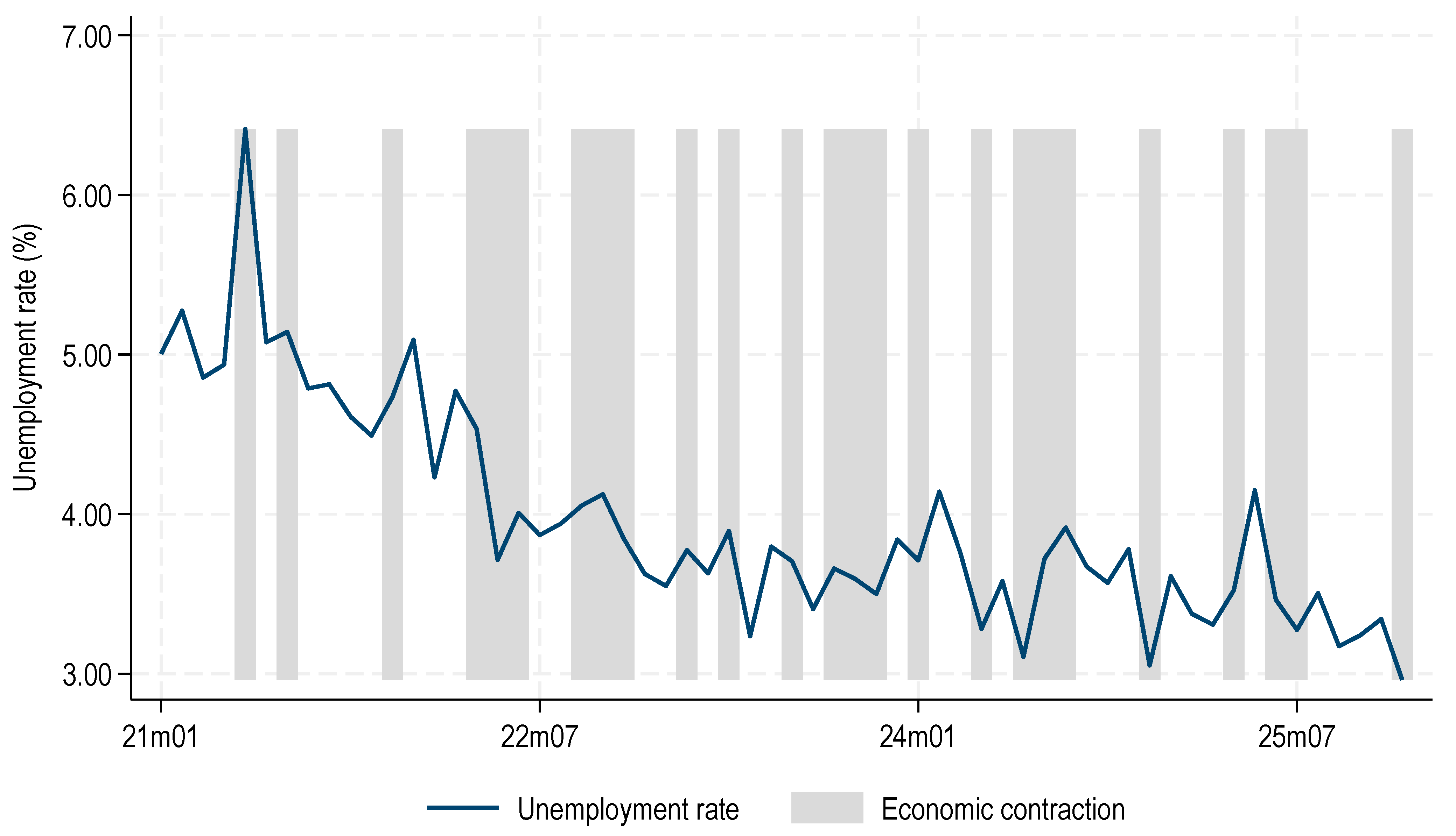
The sample period corresponds to the post-pandemic phase of the Ecuadorian economy. This choice is dictated by data availability, as the ENEMDU has been published continuously at a monthly frequency only since January 2021, following the methodological transition that replaced the previous quarterly format. Within this restriction, the sample contains substantive temporal variation along both dimensions of the analysis, as shown in Figure 1. In 2021, the post-COVID rebound materialised in a GDP expansion of 9.4% and the unemployment rate returned to a level of approximately 4%, after having exceeded 6% during the pandemic. From 2022 onwards, economic activity decelerated markedly—from 5.9% in 2022 to 1.8% in 2023—and in 2024 the country recorded a contraction of −1.9%, configuring the third recession of the dollarisation era; over this stretch, the unemployment rate exhibited considerable volatility. In 2025, a fresh expansionary episode emerged, with output growth in the order of 4%. At the monthly frequency, the grey shaded areas identify the months in which the seasonally adjusted IMAEc registers a contraction relative to the immediately preceding month. The joint trajectory of the two series anticipates, at a descriptive level, the inverse relationship between economic activity and unemployment that Okun’s Law postulates.
The multilevel strategy of the study requires constructing unemployment rates for multiple levels of disaggregation. Table 2 summarises the complete set of series. At the national level, the aggregate rate is available. Five dimensions of disaggregation are considered: by area (urban and rural), by gender (male and female), by age (15–24, 25–34, 35–44, 45–64 and 65 years and over), by ethnic self-identification (indigenous, Afro-Ecuadorian, Montubio, Mestizo and White) and by educational attainment (basic, secondary, non-university higher, university and postgraduate). In total, 19 disaggregated unemployment rates are analysed alongside the national rate, together with a single economic activity series.

3.2. Methodology

3.2.1. Extraction of the Cyclical Component

Given that Okun’s Law is an essentially cyclical relationship, both unemployment and activity are expressed in their cyclical components. Let be a generic series belonging to the set. Its trend-cycle decomposition is defined as:
x t   =   x t t r e n d   +   x t c ,   w h e r e   x t c   =   x t     x t t r e n d
The trend x t t r e n d is estimated by means of the HP filter proposed by Hodrick and Prescott (1997), which solves the following minimisation problem:
m i n   t = 1 T x t     τ t 2   +   λ   t = 2 T 1 τ t + 1     τ t     τ t     τ t 1 2
where τ t represents the trend component λ and is the smoothing parameter that penalises second-order variations in the trend. The first term captures the fit to the observed data, whilst the second penalises the roughness of the trend. For quarterly data, the conventional value is λ = 1600 . Since the series in the present study are monthly, the parameter is adjusted following the scaling rule of Ravn and Uhlig (2002):
λ m = 1600   × 3 4 = 129,600
As a robustness check, the cyclical extraction is contrasted with the Butterworth (1930) filter, a band-pass filter that operates directly in the frequency domain. In both cases, the pattern of results is preserved, and the magnitudes are comparable; accordingly, the main exposition relies on the HP filter, and the Butterworth results are reported as robustness verification.
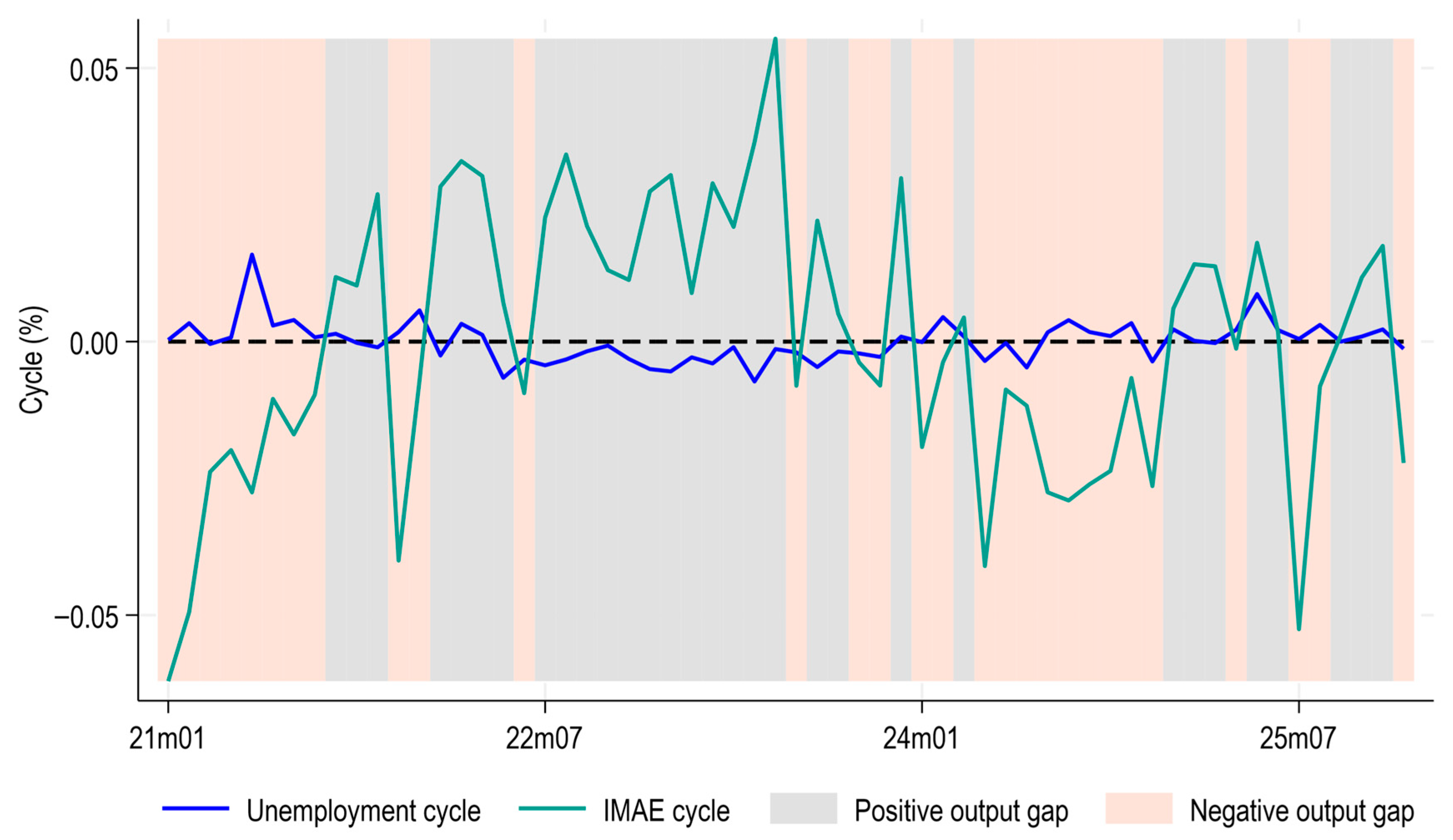
Figure 2 displays the cyclical components of the national unemployment rate and the IMAEc following the application of the HP filter. The shaded areas distinguish months with a positive output gap—cyclical component of the IMAEc above zero, in grey—from those with a negative output gap, in peach. Inspection of the cyclical component allows us to characterise the dynamics of the business cycle within the sample period. Two lower turning points and one upper turning point are identified: a cyclical trough in January 2021 (−6.21%), associated with the end of the pandemic recession; a cyclical peak in June 2023 (+5.54%), corresponding to the upper bound of the 2021–2023 expansion; and a second trough in April 2024 (−4.10%), embedded in the contractionary phase that extends throughout 2024 and that coincides with the third recession of the dollarisation era. From January 2025 onwards, a recovery of the cyclical component is observed. The duration between the two cyclical troughs is 39 months, and the peak-to-trough amplitude reaches 9.6 log points, magnitudes consistent with the average duration of activity cycles documented in the literature. The two components display the expected counter-cyclical co-movement: phases of negative output gap—in the first half of 2021 and over the whole of 2024—are accompanied by increases in the cyclical component of unemployment, whereas the 2022–2023 expansion is associated with reductions in the same component.

3.2.2. Properties of the Series

The validity of conventional inference in the econometric specifications developed in the following subsections requires that the cyclical components employed—in both the dependent and explanatory variables—be stationary. Otherwise, the presence of a unit root would compromise the standard asymptotic properties of the and F statistics and could give rise to spurious relationships, as cautioned by the classical contribution of Granger and Newbold (1974).
To this end, three unit root tests are applied to each of the 21 cyclical series considered in the analysis (20 unemployment gaps and the IMAEc gap). The Augmented Dickey–Fuller test (ADF; Dickey & Fuller, 1979) and the Phillips-Perron test (PP; Phillips & Perron, 1988) test the null hypothesis that the series contains a unit root against the alternative of stationarity. Complementarily, the KPSS test (Kwiatkowski et al., 1992) adopts the reverse approach, establishing stationarity as the null hypothesis. The combination of both approaches—rejection of the null hypothesis under ADF and PP together with non-rejection under KPSS—provides convergent and robust evidence of stationarity.
Table 3 reports the test statistics corresponding to the three tests applied to each cyclical component obtained via the HP filter. The results show that, for all series, the ADF and PP tests reject the null hypothesis of a unit root at least at the 5 per cent significance level, whilst the KPSS test fails to reject the null hypothesis of stationarity in every case. Taken together, this evidence confirms that the gaps employed in the analysis are stationary, thereby supporting their use in the econometric specifications developed in the following sections.

3.2.3. Baseline Model: Full-Sample Estimation of the Okun Coefficient

For each group g , the gap model estimates the Okun relationship through the following specification:
U g , t c   =   α g   +   β g     I M A E c t c   +   ε g , t ,   t   =   1 ,   ,   T
where U g , t c is the unemployment gap of the group g in month t , I M A E c t c is the activity gap, α g is an intercept and ε g , t is the error term. The coefficient β g constitutes the central parameter of interest: it measures the expected change in the cyclical unemployment of the group g in response to a unit change in cyclical activity. Okun’s Law predicts β g < 0 .
Estimation is carried out by ordinary least squares (OLS) with heteroscedasticity and autocorrelation consistent (HAC) standard errors following Newey and West (1987). The choice of a static specification is justified on the grounds that the gap framework operates on cyclical components from which the trend has already been removed; the relationship captured by β g is, by construction, a short-run one. This is the predominant specification in the gap-based Okun’s Law literature (Ball et al., 2017; Blázquez-Fernández et al., 2018; Hutengs & Stadtmann, 2013; Zanin, 2014). Any residual persistence in the cyclical components is addressed at the inference level—through the HAC correction with automatic bandwidth selection—rather than at the model specification level, thereby avoiding the loss of degrees of freedom that would prove particularly costly with T = 60 observations. The following hypothesis is tested:
Hypothesis 1.
For each group g, the cyclical component of unemployment is inversely related to the cyclical component of economic activity. Formally:
H 0 :   β g     0   v e r s u s   H 1 :   β g < 0 .
Rejection of H 0 , at conventional significance levels, provides evidence consistent with Okun’s Law for group g. Failure to reject H 0 does not constitute evidence of the absence of a relationship, but rather of insufficient statistical power or of cyclical adjustment operating through margins not captured by the open unemployment rate.

3.2.4. Temporal Stability: Rolling Regressions

To assess whether the Okun coefficient is stable throughout the period, a rolling regression estimation scheme is employed, a procedure used extensively in this literature (Moosa, 1997; Porras-Arena & Martín-Román, 2019; Zanin & Marra, 2012). With a window of w = 35 months, for each endpoint t w ,   ,   T , the following is estimated:
U g , s c   =   α g ,   t + β g , t I M A E c s c + ϵ g , s ,   s = t w + 1 ,   ,   t .
The resulting sequence β g , t allows the evolution of the coefficient to be traced over time. The choice of w = 35 months reflects a criterion that balances degrees of freedom against the capacity to capture temporal variation, as shorter windows increase the sampling variability of the estimators, whilst longer windows approximate the full-sample estimation and lose sensitivity to local changes. With T = 60 and w = 35 , 26 successive estimates are obtained, a number sufficient to evaluate the recurrence of the sign and the stability of the range. Inference in each window likewise relies on HAC standard errors (Newey & West, 1987).
Hypothesis 2.
For each group g, the cyclical sensitivity of unemployment, as estimated by the rolling sequence  β g , t , exhibits temporal stability over the sample period. Formally:
H 0 :   β g , t  exhibits temporal instability across the 26 rolling windows, versus
H 1 :   β g , t  exhibits temporal stability.
Given that the overlapping nature of rolling windows precludes the construction of a formal asymptotic test for the joint sequence, H 0 is evaluated against three observable criteria whose simultaneous satisfaction supports its rejection: (i) sign persistence— β g , t preserves a single sign across the 26 rolling windows; (ii) magnitude boundedness— β g , t remains within a range whose amplitude does not exceed twice the absolute value of the full-sample coefficient; and (iii) recurrent statistical significance— β g , t is significant at the 5 per cent level in a non-trivial proportion of windows. H 0 is rejected when criteria (i) and (ii) are satisfied, providing evidence consistent with the temporal stability of the Okun coefficient for group g; criterion (iii) provides additional support for groups where the baseline relationship is also significant, and identifies recurrent cyclical dynamics in groups where the baseline is non-significant.

3.2.5. Cyclical Asymmetry: Regime-Dependent Slope Model

To examine whether the sensitivity of unemployment differs between expansionary and recessionary phases, the regime is defined according to the sign of the activity gap:
D 1 , t   =   1 { I M A E c t c   >   0 } ,   D 2 , t   =   1     D 1 , t
where D 1 , t identifies periods in which activity lies above its trend (expansionary phase) and D 2 , t identifies periods in which it lies below (recessionary phase). This classification, based directly on the sign of the estimated gap, is the most widely used procedure in gap-based literature (Ball et al., 2017; Cutanda, 2023). Building on this definition, a model with regime-dependent slopes is estimated:
U g , t c   =   φ g   +   θ g     D 1 , t     I M A E c t c   +   δ g     D 2 , t     I M A E c t c   +   v g , t
where θ g captures the response of cyclical unemployment during expansions and δ g during recessions. If the Okun relationship operates symmetrically, both coefficients should be statistically equal. Asymmetry is formally evaluated by means of a Wald test whose statistic is defined as:
W   =   θ g     δ g 2 V a r θ g     δ g   ~   χ 2 ( 1 )
Under the null hypothesis θ g , statistic W is asymptotically distributed as chi-squared with one degree of freedom. The variance in the denominator is obtained from the HAC variance-covariance matrix of the model estimated in Equation (7). Rejection of the null hypothesis at conventional significance levels would indicate that the magnitude of the unemployment response to the cycle differs between expansions and recessions for the group g .
Hypothesis 3.
The Okun relationship is symmetric across cyclical regimes. For each group g:
H 0 :   θ g = δ g   v e r s u s   H 1 :   θ g     δ g
Rejection of H 0 at conventional significance levels provides evidence consistent with cyclical asymmetry for group g. The direction of the asymmetry—whether the response is stronger in expansions or in recessions—is determined ex post by the sign and magnitude of ( θ g δ g ). Failure to reject H 0 does not constitute evidence of perfect symmetry, but rather of insufficient statistical power to detect departures from it under the available sample size and regime classification.
The three stages —full-sample estimation (Equation (4)), temporal stability (Equation (5)) and the asymmetry test (Equations (7) and (8))—are applied to each of the 20 unemployment series (national plus 19 disaggregations), generating a comprehensive map of the Okun coefficient in Ecuador. The results obtained with the HP filter constitute the main exposition; those obtained with the Butterworth filter are presented as a robustness exercise.

4. Results

4.1. Baseline Model

Table 4 reports the Okun coefficients estimated via Equation (4) for the national rate and the 19 disaggregations, using both cyclical extraction filters. At the aggregate level, Okun’s Law holds for Ecuador: the overall coefficient is −0.05 (significant at 5%) with the HP filter and −0.04 (significant at 10%) with Butterworth. This indicates that when economic activity lies one p.p. above its trend, the national unemployment gap narrows by approximately 0.05 p.p. The magnitude, moderate relative to that reported for advanced economies—Perman et al. (2015) place the range between −0.6 and −1.0—is consistent with the evidence for Latin America, where informality dampens the transmission of the cycle to open unemployment (Pizzo, 2020; Porras-Arena & Martín-Román, 2023b). However, the principal contribution of this subsection emerges upon examining the disaggregations, which reveal a markedly heterogeneous cyclical sensitivity.
The first dimension of heterogeneity emerges when distinguishing between urban and rural segments. The urban coefficient is −0.08 (significant at 1%), implying that the response of urban unemployment to the cycle is approximately 60 per cent more intense than that of the national aggregate. By contrast, the rural coefficient is close to zero and non-significant (−0.01); that is, fluctuations in activity do not translate into detectable changes in unemployment within this segment. This pattern is consistent with the structure of the Ecuadorian rural labour market, where informal employment exceeds 80 per cent according to the latest annual report on the Ecuadorian labour market published by the INEC. In the face of activity fluctuations, the adjustment does not manifest as unemployment but rather as transitions towards self-employment, underemployment due to insufficient hours or subsistence informality. Ben-Salha and Mrabet (2019) document an analogous mechanism in North African economies where informality operates as a buffer of the output-unemployment link.
The disaggregation by gender yields a result that departs from the international regularity, as female unemployment exhibits a substantially higher cyclical sensitivity than male unemployment. The coefficient for women is −0.10 (significant at 1%), meaning that each additional p.p. of positive activity gap is associated with a 0.10 p.p. reduction in the female unemployment gap—twice the effect at the aggregate level. For men, the coefficient is non-significant (−0.01), indicating that the business cycle does not generate detectable variations in male unemployment. This finding contrasts with the predominant evidence for advanced economies, where male unemployment tends to be more responsive to the cycle (Boďa & Považanová, 2021; Kim & Park, 2019). In the Ecuadorian context, a plausible explanation is that men displaced from formal employment transition more readily into informal activities or self-employment—construction, agriculture, street vending—thereby absorbing the shock without being recorded as unemployed. The female pattern cannot be attributed to an analogous buffer. Although Table A2 in Appendix C reports comparable informality rates between sexes within each prime-age cohort, the differential rests on two reinforcing margins. First, female labour force participation (53.4 per cent against 77.9 per cent) is substantially more elastic to cyclical conditions, in line with the added-worker and discouraged-worker mechanisms documented for Latin America (De Oliveira et al., 2014; Fernandes & De Felício, 2005; Martinoty, 2015; Parker & Skoufias, 2004), so that aggregate shocks generate larger flows across the participation margin for women than for men. Second, care responsibilities and occupational segmentation restrict women’s access to the low-entry-barrier activities through which men absorb the shock, which is therefore recorded as open unemployment and mechanically amplifies the estimated cyclical elasticity of the female unemployment rate.
Along the age dimensions, the data reveal a declining gradient of cyclical sensitivity. The 15–24 cohort exhibits the largest coefficient in absolute terms, −0.15 (significant at 1%), indicating that young workers experience an unemployment response to the cycle three times greater than the national average. The 25–34 cohort records a coefficient of −0.10 (significant at 5%), still twice the aggregate figure. From the age of 35 onwards, the coefficients are small and non-significant, suggesting that these cohorts absorb cyclical shocks through mechanisms not captured by the unemployment rate Table A2 reports a marked decline in participation rates after age 45—from 91.9 per cent to 48.7 per cent for men and from 62.0 per cent to 29.0 per cent for women between cohorts 45–64 and 65 and over—, a structural feature consistent with cyclical adjustment via transitions to inactivity in the older cohorts; this margin is not available to younger workers. This pattern is consistent with international evidence. Hutengs and Stadtmann (2013, 2014) and Zanin (2014) documented the same gradient for OECD and eurozone economies, attributing it to the fact that young workers, frequently employed under temporary contracts and with shorter tenure, constitute the preferred margin of adjustment in response to demand fluctuations.
The ethnic disaggregation—a dimension virtually absent from the prior literature on Okun’s Law—yields one of the most pronounced findings of the analysis. The Afro-Ecuadorian coefficient reaches −0.34 (significant at 5%), the largest across all disaggregations. This implies that a one p.p. positive activity gap is associated with a 0.34 p.p. reduction in the unemployment gap of this group, nearly seven times the national aggregate effect. Mestizo unemployment also displays sensitivity, with a coefficient of −0.05 (significant at 10% under the HP filter). The coefficients for the indigenous, Montubio and White populations are non-significant. Table A3 in Appendix C reports a structural composition for Afro-Ecuadorian workers that differs from that of the other non-White groups along three indicators: a predominantly urban residential profile (79.4 per cent), the lowest informality and inadequate employment rates among non-White ethnic groups (53.4 and 65.5 per cent, against 83.9 and 87.7 per cent for indigenous, and 69.9 and 79.3 per cent for Montubio populations), and the highest open unemployment rate (9.6 per cent). Indigenous and Montubio populations exhibit the opposite pattern, with a predominantly rural residential profile (83.7 and 58.6 per cent) and the highest incidence of inadequate employment among non-White ethnic groups. This composition—urban residence with a comparatively lower incidence of inadequate employment and a markedly higher unemployment rate—sets the Afro-Ecuadorian group apart from the remaining non-White ethnic groups, and may underpin the more pronounced cyclical sensitivity observed in their unemployment rate.
Finally, the stratification by educational attainment shows that cyclical sensitivity is concentrated in the university level, with a coefficient of −0.11 (significant at 1%). This implies that a one p.p. increase in the activity gap is associated with a 0.11 p.p. reduction in the unemployment gap of this group, a response more than twice that observed at the aggregate level. The remaining levels—basic, secondary, non-university higher and postgraduate—do not attain statistical significance. Table A4 in Appendix C reports a structural composition for the university segment that differs from that of the other educational groups along three indicators: a substantial active population (1.33 million workers, 15.6 per cent of the labour force), a high share of formal private-sector employment (56.2 per cent), and a comparatively low informality rate (21.6 per cent). The postgraduate segment exhibits a distinct configuration, with formal salaried employment dominated by government employees (53.4 per cent against 42.6 per cent in the formal private sector) and an informality rate below 4 per cent; the basic and secondary segments display the opposite pattern, with informality rates of 74.2 and 50.9 per cent and a residual share of formal private-sector employment (19.2 and 40.1 per cent). This composition—a sizeable active population predominantly attached to the formal private sector with a comparatively low incidence of informality—sets the university segment apart from the remaining educational groups: the postgraduate segment is largely insulated within public-sector employment, while the basic and secondary segments are dominated by informality. The university level may therefore concentrate the type of formal attachment most exposed to cyclical fluctuations in private hiring, which is consistent with the differentiated response observed across qualification levels in the international evidence (Butkus et al., 2023).
The results are robust to the filtering method. Across all disaggregations, the Butterworth coefficients preserve the sign, approximate magnitude and significance pattern of the HP filter. The test of Hypothesis 1 yields a differentiated outcome across strata: H 0 is rejected in favour of the alternative for the national rate and for a specific subset of groups—urban, female, the 15–24 and 25–34 cohorts, Afro-Ecuadorian, Mestizo and university education—providing evidence consistent with Okun’s Law in these segments. In the remaining strata, H 0 cannot be rejected at conventional significance levels, indicating that growth does not translate into detectable unemployment reductions homogeneously across labour market segments. This map of heterogeneity reinforces the central thesis of the article: an aggregate estimation of the Okun coefficient masks substantive differences across population groups, with direct implications for the targeting of labour policy.

4.2. Parameter Stability: Rolling Regression Approach

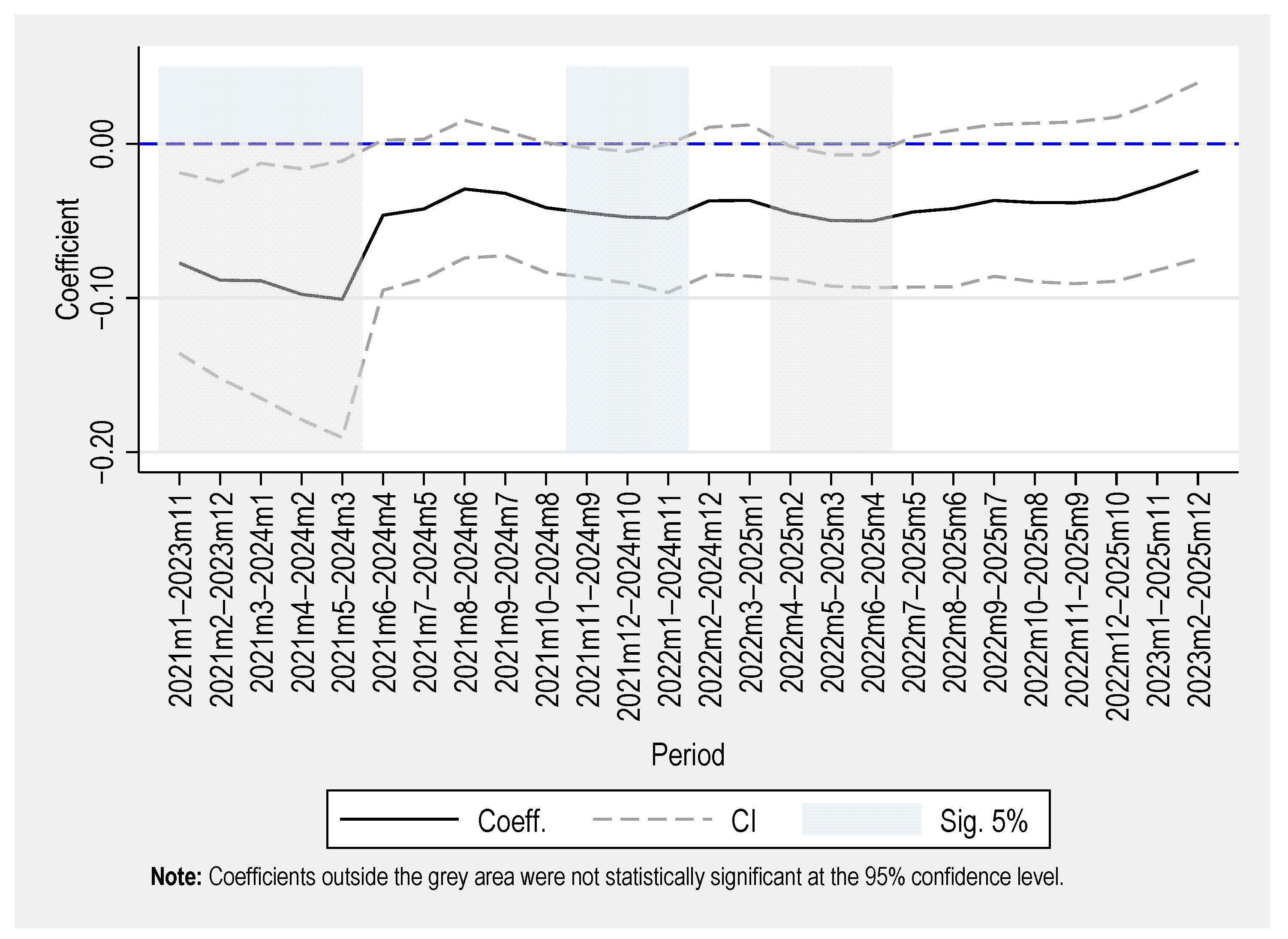
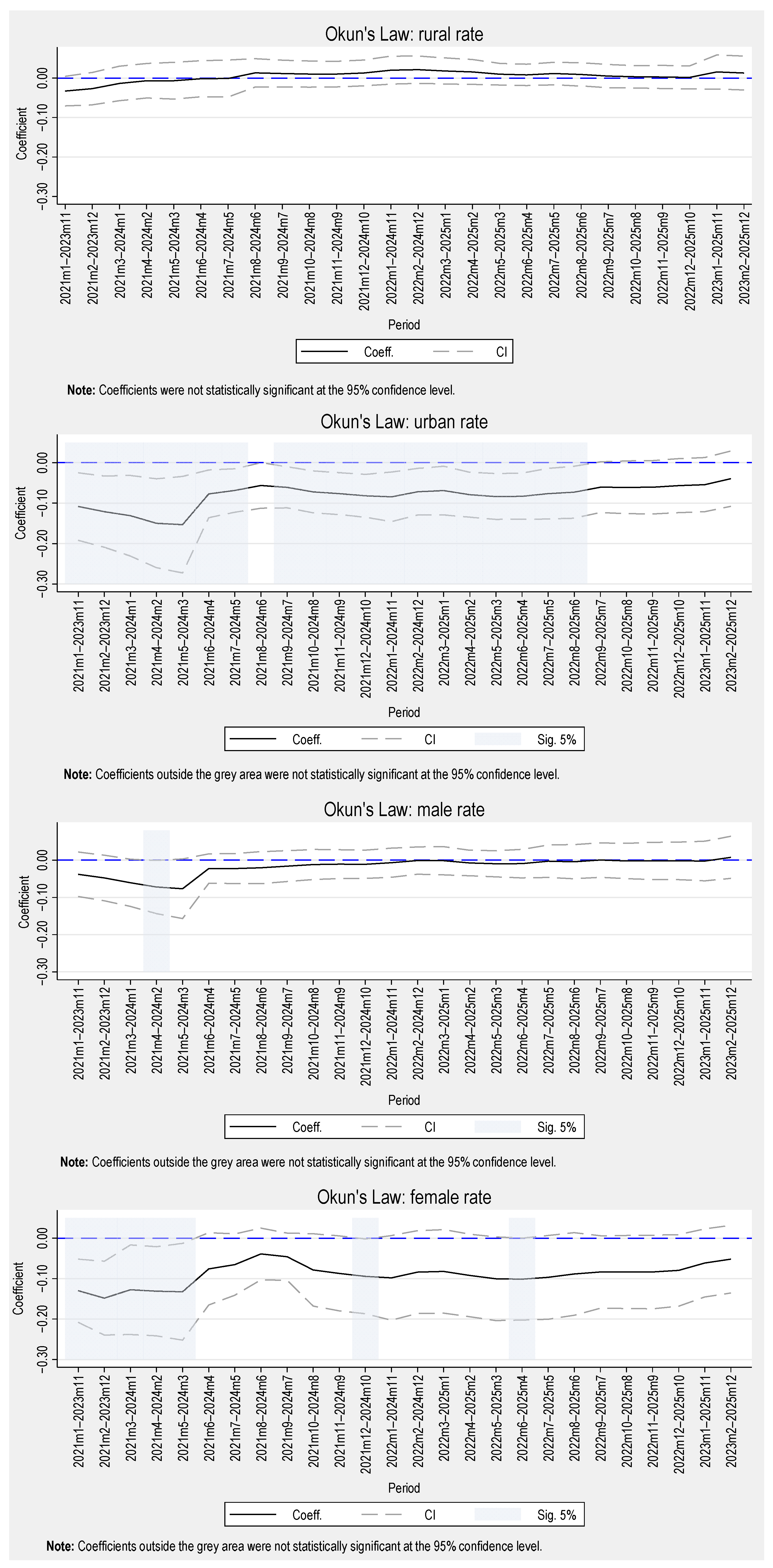
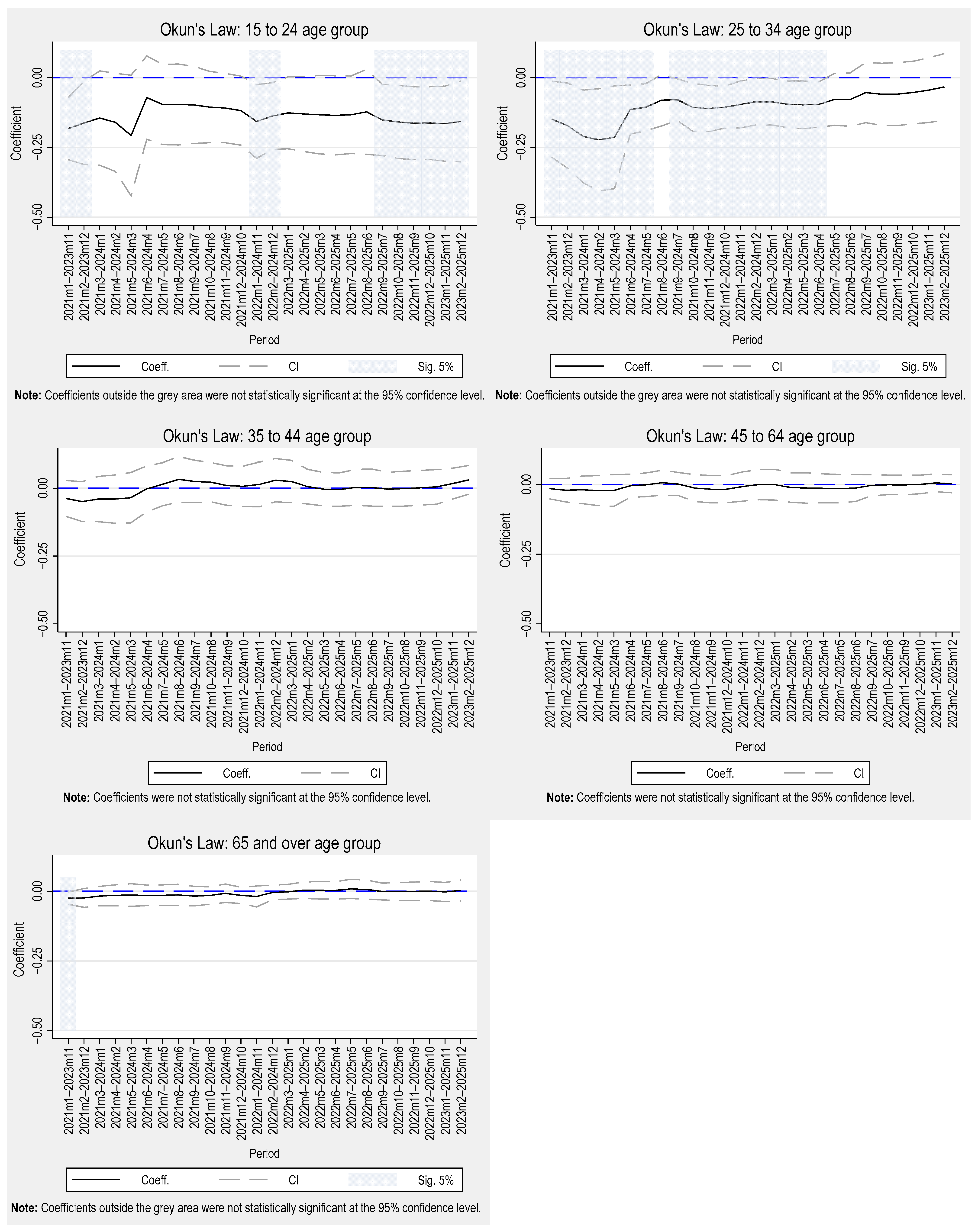
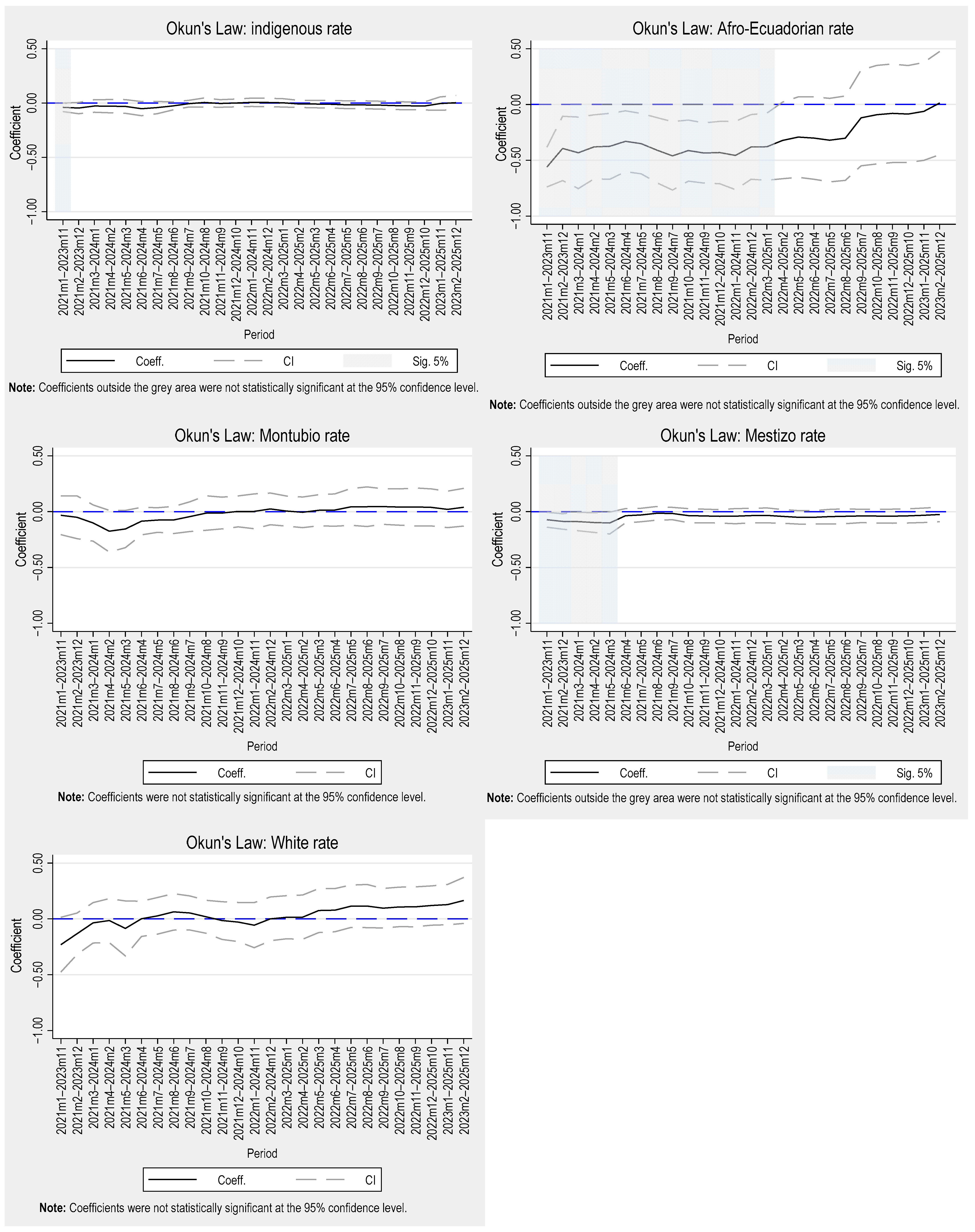
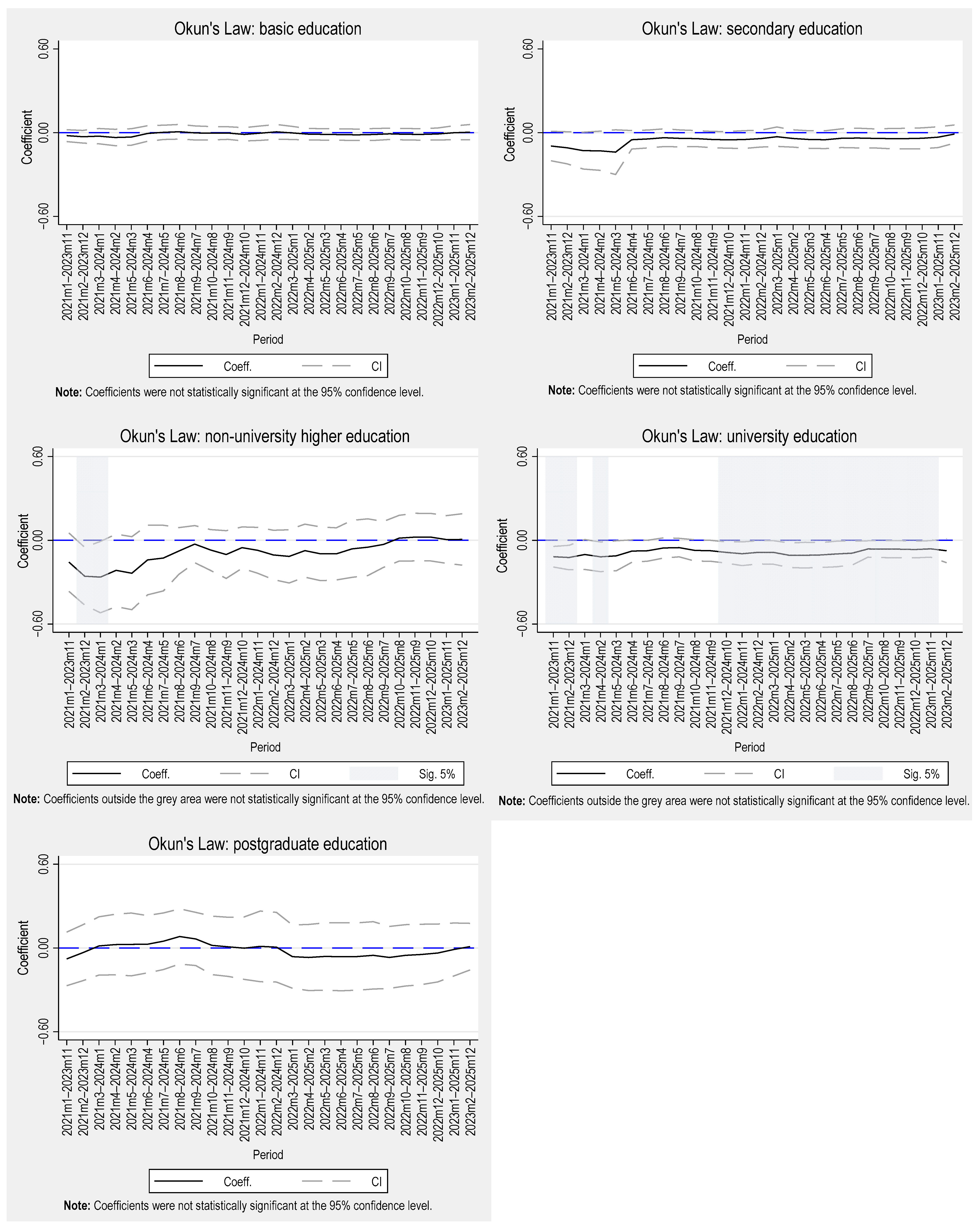
A coefficient estimated over the full sample may be driven by an atypical episode or a particular sub-period. To rule out this possibility, this subsection examines the temporal evolution of the coefficients estimated for Equation (4) through rolling regressions with 35-month windows (see Equation (5)). Table 5 summarises the results by classifying the 20 series according to sign persistence, frequency of sign changes and the proportion of windows with statistical significance. Figure A1, Figure A2, Figure A3, Figure A4 and Figure A5 in Appendix B complement this information with the graphical trajectories and their 95 per cent confidence bands.
Before discussing the disaggregated results, a feature of the rolling sequence common to most series deserves attention. The marked drop visible in the sixth window (21m6–24m4) and reproduced across the national rate, the urban segment, the youth cohorts and the university segment coincides with the entry of the first four months of 2024 into the rolling sample, a period in which the Ecuadorian economy was simultaneously affected by the energy-rationing programme triggered by the extreme drought of October 2023–April 2024 and by the escalation of the internal security crisis. These shocks operate as supply-side disturbances that contract activity for reasons unrelated to aggregate demand, weakening the conventional cyclical mapping between output and unemployment for the duration of the episode. The coefficient recovers in subsequent windows as these months are progressively absorbed by the rolling sample, which supports the supply-side reading and advises caution when interpreting windows containing episodes of this nature.
At the aggregate level, the inverse relationship between activity and unemployment holds throughout the entire period: the national coefficient remains negative across all 26 windows, ranging between −0.10 and −0.02, with significance in 11 of them (Table 6). The urban coefficient does not change sign in any window and attains significance in 19 out of 26—the highest proportion across all disaggregations—whilst the female coefficient likewise remains negative throughout the period (7 significant windows). The contrast with their counterparts is revealing: the rural coefficient fluctuates between −0.03 and 0.02 without reaching significance in any window, and the male coefficient exhibits three sign changes with significance in only one, confirming that the absence of a relationship in these groups is not an isolated result but a persistent condition.
The age dimension deepens this contrast. The younger cohorts—15–24 and 25–34—preserve the negative sign without exception across all 26 windows, with significance in 10 and 17 of them respectively (Table 7). The 25–34 cohort, in particular, exhibits one of the highest proportions of significance in the analysis, suggesting that this group captures the Okun dynamic in an especially stable manner. From the age of 35 onwards, the picture reverses: the 35–44 cohort records five sign changes and no significant windows, whilst the 45–64 and 65+ cohorts fluctuate marginally around zero. The declining gradient of cyclical sensitivity identified in the preceding subsection is not only confirmed but revealed as a temporally robust feature of the Ecuadorian labour market.
The ethnic disaggregation yields the most distinctive temporal pattern in the analysis (Table 8). The Afro-Ecuadorian coefficient begins at −0.56 in the first window—the largest value in magnitude across the entire sample—and attenuates progressively until approaching zero in the final windows, with significance concentrated in the first half of the period (15 out of 26 windows). This decay is compatible with the hypothesis that the shocks associated with the post-COVID recovery affected this group disproportionately and that cyclical transmission dissipated as the economy stabilised. The Mestizo coefficient, by contrast, offers a more stable profile: a negative sign preserved across all 26 windows with significance in 5 of them. The remaining ethnic groups—indigenous, Montubio and White—do not exhibit interpretable patterns: coefficients close to zero or with multiple sign changes and elevated dispersion.
The final axis of disaggregation confirms that university education constitutes the educational segment with the most robust relationship (Table 9): a negative coefficient across all 26 windows, a range of [−0.12; −0.05] and significance in 18 of them—surpassed only by the urban segment. Secondary education likewise preserves the negative sign without exception, albeit with smaller magnitudes and without achieving significance in any window. At the opposite end, basic education and postgraduate each exhibit five sign changes, and non-university higher displays elevated dispersion with significance in only 2 windows.
The temporal stability analysis qualifies the findings from the baseline model. The test of Hypothesis 2 yields three differentiated outcomes across strata, evaluated against the three criteria of sign persistence, magnitude boundedness and recurrent statistical significance defined in Section 3.2.4. First, H 0 is rejected in favour of temporal stability for the strata where Okun’s Law operated significantly in the baseline—urban, female, youth (15–24 and 25–34), Afro-Ecuadorian, Mestizo and university education—as the rolling coefficients preserve the negative sign across all 26 windows, remain within bounded ranges and attain statistical significance in a non-trivial proportion of windows, thereby satisfying the three criteria simultaneously. Second, H 0 is also rejected for the secondary-education segment, which preserves the negative sign across all 26 windows and remains within a bounded range [−0.14; −0.01] despite a non-significant baseline coefficient, indicating a persistent negative co-movement that the full-sample test does not detect at conventional significance levels (criteria (i) and (ii) satisfied; criterion (iii) not met). Third, H 0 cannot be rejected for the remaining strata: those whose rolling sequences hover close to zero (rural, 45–64, 65+, indigenous, basic, male) and those whose trajectories exhibit sign reversals (35–44, Montubio, White, postgraduate and non-university higher). The variation in the proportion of significant windows across the first group, ranging from 5/26 in Mestizo to 19/26 in urban, advises a measured reading of the temporal-stability claim group by group.

4.3. Asymmetry Test: Regime-Dependent Slope Model

Having established that Okun’s Law operates significantly in a specific subset of strata and that this relationship is temporally stable, it remains to examine whether its intensity differs according to the phase of the business cycle. To this end, the regime-dependent slope model (Equation (7)) is estimated, and the symmetry hypothesis is formally tested by means of the Wald statistic (Equation (8)). Table 10 reports the expansion ( θ g ) and recession ( δ g ) coefficients together with the W statistic for the 19 disaggregations and the national rate, using both filters.
The dominant finding is that symmetry cannot be rejected in the vast majority of strata. At the national level, the expansion coefficient ( θ =   0.08 , significant at 5%) indicates that during boom phases, Okun’s Law operates with greater intensity than the overall average, whereas the recession coefficient ( δ = −0.02) is not statistically distinguishable from zero, so no detectable response of unemployment to contractions is identified in this regime. The Wald statistic ( W = 1.08) does not reach the critical value at 10%, so the difference is not statistically distinguishable from zero. This pattern—numerically distinct coefficients but no formal rejection of symmetry—is reproduced across most disaggregations: urban, female, youth (15–24 and 25–34), Afro-Ecuadorian and university unemployment all exhibit expansion coefficients that are systematically more negative than their recession counterparts, yet in no case does the Wald test reject the null hypothesis.
Two exceptions break this pattern of generalised symmetry, and both exhibit behaviours that depart from the conventional Okun logic. Montubio unemployment presents a Wald statistic of 3.47 (significant at 10% with HP) and 3.08 (significant at 10% with Butterworth), with coefficients of opposite sign: θ =   0.16 during expansions and δ =   0.18 (significant at 10%) during recessions. In the expansionary phase, Okun’s Law operates normally, as Montubio’s unemployment declines. During recessions, however, an “anti-Okun” result emerges: Montubio unemployment paradoxically falls when activity contracts. The most plausible interpretation is that, in the face of contractions, Montubio workers exit unemployment towards forms of agricultural self-employment, unpaid family work or subsistence underemployment, thereby reducing the measured rate without this implying an improvement in labour conditions.
Postgraduate unemployment exhibits the most pronounced asymmetry in the analysis, with a Wald statistic of 5.53 (significant at 5% with HP) and 7.71 (significant at 10% with Butterworth). The coefficients are: θ =   0.17 during expansions (non-significant) and δ =   0.26 during recessions (significant at 1%). In the recessionary phase, Okun’s Law operates with considerable intensity: postgraduate unemployment rises significantly when activity falls. During expansions, by contrast, a phenomenon contrary to the Okun hypothesis is observed: postgraduate unemployment also tends to increase when the economy grows, although this effect does not attain statistical significance. A plausible explanation is that workers with postgraduate qualifications are concentrated in sectors whose hiring dynamics do not follow the aggregate IMAEc cycle—public administration, higher education, healthcare—such that expansions do not benefit them, whilst contractions affect them through budget cuts or hiring freezes.
Beyond the formal test, in the strata where Okun’s Law proved significant, the expansion coefficient is consistently more negative than the recession coefficient—most visibly for youth (15–24), where θ = −0.26 contrasts with δ = −0.05 (Table 10). The Wald test does not reject symmetry for any of these strata, however, so this numerical pattern is reported as a descriptive observation rather than as evidence of cyclical asymmetry that could sustain policy inference at this stage.
The results are consistent across both filters: the two rejections of symmetry—Montubio and postgraduate—are confirmed with both HP and Butterworth, and the absence of rejection in the remaining strata is likewise preserved. The test of Hypothesis 3 thus yields two differentiated outcomes across strata. First, H 0 cannot be rejected at conventional significance levels in the vast majority of strata, a finding that diverges from the international evidence converging around stronger unemployment responses during recessions (Abid et al., 2023; Cuaresma, 2003; Duran, 2022; Silvapulle et al., 2004) and which, in keeping with the caveat of Section 3.2.5, should be read as the absence of detectable departures from symmetry under the available sample size and regime classification rather than as evidence of perfect symmetry. Second, H 0 is rejected in favour of cyclical asymmetry for two specific segments: the “anti-Okun” behaviour of Montubio unemployment during recessions and the asymmetric vulnerability of the postgraduate segment, both of which provide evidence that the transmission of the cycle to the Ecuadorian labour market is heterogeneous not only across groups but also across cycle phases for specific subpopulations.

5. Discussion

The result from the three estimation stages converges on a central finding: the Okun coefficient in Ecuador is not a single parameter but rather a map of differentiated responses that reflects the structural segmentation of the labour market. The national rate yields a moderate and significant coefficient, yet this average figure conceals the fact that the transmission of the cycle to open unemployment is concentrated in specific segments—urban, female, youth, Afro-Ecuadorian and university education—whilst in the remainder, the activity gap does not generate detectable variations in measured unemployment. This pattern suggests that, for a considerable proportion of the Ecuadorian labour force, the adjustment to cyclical fluctuations may be channelled through margins that the unemployment rate does not capture: for instance, transitions into informality, underemployment, working-time adjustments or movements between activity and inactivity.
The reversal of the gender pattern relative to the evidence from advanced economies reinforces this interpretation. The male labour force participation rate in Ecuador stands at approximately 80 per cent, implying that the vast majority of working-age men are already integrated into the labour market, irrespective of the cycle phase, leaving a narrow margin for activity fluctuations to generate detectable movements in their unemployment rate. Female participation, at approximately 50 per cent, configures a different scenario, as a substantial proportion of women enter or withdraw from the labour force in response to cyclical conditions—a mechanism consistent with the added-worker and discouraged-worker effects originally formulated by Long (1953, 1958) and Woytinsky (1940) and recently documented for Latin America (Maridueña-Larrea & Martín-Román, 2024a, 2024b)—which amplifies the sensitivity of female unemployment to the cycle.
The age gradient—with coefficients that decline progressively from the youngest cohort to the oldest—indicates that cyclical fluctuations are distributed unevenly across generations. Young workers bear a disproportionate share of cyclical adjustment via unemployment, which is consistent with the logic that they constitute the most flexible margin of adjustment for productive units. This finding acquires particular relevance in a dollarised economy where the absence of exchange rate instruments concentrates macroeconomic adjustment on quantities—employment, hours, real wages—rather than on relative prices, which foreseeably amplifies the adjustment burden on the segments with the least bargaining power.
The magnitude of the Afro-Ecuadorian coefficient—nearly seven times the national aggregate—and its progressive attenuation across rolling windows, from approximately −0.56 in the earliest windows to values close to zero by the end of the sample, configure a pattern that combines a structural component, anchored in the urban occupational profile of this population (Table A3), with a conjunctural component associated with the post-pandemic period. The post-2020 recovery in Ecuador concentrated initially in urban services and commerce—the sectors in which the Afro-Ecuadorian working-age population predominantly resides, which is descriptively consistent with the larger initial coefficient. The subsequent attenuation, which persists through the 2024 contraction, is consistent with a fading post-pandemic shock effect rather than with a uniform stabilisation of cyclical sensitivity. The “anti-Okun” behaviour of Montubio unemployment during recessions—the only formally significant departure from Okun’s logic in our regime decomposition—suggests that certain labour market segments may operate according to dynamics that are not synchronised with the aggregate cycle as measured by the IMAEc. The asymmetric vulnerability of postgraduate unemployment, concentrated in the recessionary phase, points in the same direction. Taken together, these findings suggest that Okun’s Law, understood as an empirical regularity, operates in Ecuador as a valid descriptor for those labour market segments where cyclical adjustment manifests through open unemployment, but may lose explanatory traction in those strata where adjustment operates through margins not captured by this indicator and where the greatest structural fragilities are concentrated.

6. Limitations

Three considerations bound the scope of the evidence presented and merit being made explicit before turning to the conclusions. The 60 monthly observations covered by the analysis (January 2021 to December 2025) are imposed by data availability, given that the ENEMDU has been published continuously at a monthly frequency only since January 2021, following the methodological transition that replaced the previous quarterly format (Section 3.1). In addition, this interval coincides with an atypical macroeconomic sequence, comprising the rebound of 2021, the slowdown of 2022–2024 and the recovery of 2025 (Figure 1), which advises caution when projecting the estimated magnitudes onto different cyclical scenarios. The rolling regressions reported in Section 4.2 provide an initial reading of the persistence of the signs and of the ranges of the coefficients across the strata for which Hypothesis 2 is supported, although only the incorporation of further ENEMDU rounds will allow this assessment to be deepened.
Alongside this temporal constraint, the estimation strategy itself warrants discussion. The coefficients are obtained by ordinary least squares with heteroskedasticity- and autocorrelation-consistent (HAC) standard errors applied to the cyclical components extracted under the gap version, the predominant specification in the gap-based Okun’s Law literature (Section 3.2.3). Such a specification efficiently captures the contemporaneous co-movement between cyclical unemployment and cyclical activity, although it does not resolve causal identification. Consequently, the coefficients should be read as descriptions of the structure of cyclical co-movement across labour-market segments, rather than as structural effects of output on unemployment. The search for credible monthly external instruments, together with the cost in degrees of freedom that such strategies would entail with T = 60, falls outside the design adopted. Hence, the value of the multilevel disaggregation lies in identifying which segments respond cyclically and which appear to adjust outside the open-unemployment margin, rather than in estimating point structural elasticities.
A final consideration concerns the labour-market outcome under analysis. The open unemployment rate is adopted as the sole dependent variable, in line with the original formulation and with the predominant international practice, which facilitates direct comparability of the coefficients across countries and periods. That said, other margins of the labour market, amongst them underemployment, employment quality, labour-force participation and informality, absorb a non-trivial share of the cyclical adjustment in the Ecuadorian context. Their structural composition over the period of analysis, reported in Appendix C for the sex–age, ethnicity and education dimensions, illustrates the magnitude of these omitted margins relative to open unemployment. Extending the multilevel framework from the description of these variables towards their modelling constitutes, accordingly, a natural avenue for the continuation of this line of research.

7. Conclusions and Policy Recommendations

Read together, the three tests yield a coherent picture of the Okun relationship in Ecuador. The aggregate coefficient masks a structurally segmented response in which only specific strata—urban, female, youth, Afro-Ecuadorian, Mestizo and university education—register a statistically detectable cyclical sensitivity, whilst the remainder absorb cyclical fluctuations through margins outside open unemployment. Where Okun’s Law operates, the relationship proves temporally stable across the 26 rolling windows; the secondary-education segment provides an additional case of persistent negative co-movement that the full-sample test does not detect. Cyclical asymmetry, in turn, emerges as the dimension where the Ecuadorian evidence diverges most clearly from the international literature: H 0 of perfect symmetry between expansions and recessions cannot be rejected for the vast majority of strata—at variance with the convergence around stronger recessionary responses documented for advanced and emerging economies, with the Montubio and postgraduate segments standing as the only exceptions, each pointing to distinctive adjustment dynamics that warrant dedicated investigation in subsequent research.
These findings may have implications for the design of labour policy, although their translation into specific measures should be interpreted with caution. The concentration of cyclical sensitivity in the urban, female and youth segments suggests that employment policies could consider prioritising these groups across both phases of the cycle, where growth appears to have the greatest measurable capacity to translate into effective unemployment reductions. Youth labour market insertion programmes, incentives for female hiring and active employment policies in urban areas could potentially enhance the transmission of favourable cyclical conditions to the labour market and cushion the impact of contractions for these segments. By contrast, the absence of a detectable cyclical response in the rural, male and lower-education strata is suggestive that aggregate growth alone may be insufficient to improve the labour conditions of these groups, which could motivate structural interventions oriented towards employment quality—formalisation, training, access to social protection—that operate independently of the position in the cycle. The pronounced cyclical vulnerability of the Afro-Ecuadorian population, for its part, could motivate considering the incorporation of ethnic criteria in the design of shock protection networks, an approach that Ecuadorian labour policy has not systematically adopted.
Naturally, the foregoing considerations should be interpreted within the scope of the research design employed. The monthly frequency and the 2021–2025 period reflect the availability of the ENEMDU in its continuous format and provide the highest temporal resolution currently possible for the multilevel analysis of the Ecuadorian labour market. The extraction of the cyclical component by means of two filters with complementary logics—Hodrick–Prescott and Butterworth—lends additional confidence to the identified patterns, given that the results converge across both strategies. The focus on the unemployment rate, in turn, aligns with the predominant specification in the Okun literature and permits international comparability of the coefficients, although it does not exhaust the dimensions through which the cycle may affect the labour market, thereby opening space for extensions that could enrich this line of research.
In this direction, extending the period of analysis as further ENEMDU rounds accumulate would likely strengthen the detection power of the three tests applied here, particularly that of cyclical asymmetry. The incorporation of alternative dependent variables—underemployment, labour-force participation and informality—could complement these findings by potentially revealing cyclical transmission channels that the open unemployment rate does not capture, particularly in the strata where Okun’s Law did not appear to operate significantly. A regional disaggregation would enrich the analysis by exploring whether the demographic heterogeneity identified is also reproduced at the territorial level. Taken together, the results of this study suggest that the multilevel approach can open an analytical window that the aggregate coefficient does not offer, as it allows for a more granular reading of where growth appears to generate employment, where it does not, and where cyclical adjustment may take forms that conventional indicators do not fully capture.

Author Contributions

Conceptualization, Á.M.-L.; methodology, Á.M.-L. and R.G.-R.; software, R.G.-R.; validation, Á.M.-L., R.G.-R., P.Á.-M. and G.Á.-B.; formal analysis, Á.M.-L., R.G.-R. and P.Á.-M.; investigation, Á.M.-L., R.G.-R., P.Á.-M. and G.Á.-B.; resources, R.G.-R. and P.Á.-M.; data curation, R.G.-R. and G.Á.-B.; writing—original draft preparation, R.G.-R.; writing—review and editing, Á.M.-L., P.Á.-M. and G.Á.-B.; visualisation, Á.M.-L. and R.G.-R.; supervision, Á.M.-L.; project administration, Á.M.-L. and R.G.-R.; funding acquisition, Á.M.-L. and P.Á.-M. All authors have read and agreed to the published version of the manuscript.

Funding

This research received no external funding.

Institutional Review Board Statement

Not applicable.

Informed Consent Statement

Not applicable.

Data Availability Statement

The ENEMDU data can be consulted on the INEC website through the following link: https://www.ecuadorencifras.gob.ec/estadisticas/ (accessed on 15 January 2026). The Monthly Index of Economic Activity (IMAEc) data reported by the BCE, see: https://www.bce.fin.ec/estadisticas-economicas/ (accessed on 15 January 2026).

Conflicts of Interest

The authors declare no conflicts of interest.

Appendix A

Table A1. Okun coefficient estimates for Latin American economies: cross-study comparison.
Country(1)(2)(3)
Argentina−0.220 ***−0.112 **−0.300 ***
Bolivia−0.110
Brazil−0.220 ***−0.241 ***−0.324 ***
Chile−0.290 ***−0.356 ***−0.368 ***
Colombia−0.360 ***−0.437 ***−0.390 ***
Costa Rica−0.300 ***−0.231 ***
Ecuador−0.130−0.172 **
Honduras−0.120−0.096 *
Mexico−0.170 ***−0.190 ***−0.223 **
Nicaragua−0.120−0.154 ***
Panama−0.280 ***−0.241 ***
Paraguay−0.190 ***−0.108 *
Peru−0.130 ***−0.123 ***−0.079
Uruguay−0.200 ***−0.218 ***
Venezuela−0.250 ***
Notes: Each cell reports the estimated Okun coefficient for the corresponding country and study. Statistical significance is denoted by *** p < 0.01, ** p < 0.05, * p < 0.10; coefficients without asterisks are not statistically significant at conventional levels. Dashes (—) indicate that the country is not included in the corresponding study. The row for Ecuador is highlighted to facilitate comparative reading. Column headings: (1) Porras-Arena and Martín-Román (2023a): arithmetic mean of four gap-version specifications (HP filter with λ { 6.65 , 10 , 100 } ; Hamilton filter), estimated on annual data for the period 1980–2017. (2) Ball et al. (2019): gap version, estimated on annual data for the period 1980–2015 (1988–2015 in the case of Ecuador). (3) Zanin (2019): a different version estimated by OLS on annual data for the period 1995–2017. Sources: Authors’ own elaboration.

Appendix B

Figure A1. Okun’s Law: national rate.
Economies 14 00189 g0a1
Figure A2. Okun’s Law: by area and by gender.
Economies 14 00189 g0a2
Figure A3. Okun’s Law: by age group.
Economies 14 00189 g0a3
Figure A4. Okun’s Law: by ethnicity.
Economies 14 00189 g0a4
Figure A5. Okun’s Law: by educational attainment.
Economies 14 00189 g0a5

Appendix C

Table A2. Labour market structure by sex and age group, average 2021–2025.
SexIndicator15–2425–3435–4445–6465+Total
MaleParticipation rate54.9594.2497.4591.9548.6577.93
Unemployment rate6.954.132.051.931.043.28
Inactivity rate45.055.762.558.0551.3522.07
Informality rate59.0840.7645.6154.3577.1852.38
Inadequate employment77.9549.3747.7856.0781.9758.96
FemaleParticipation rate34.8764.6269.9461.9628.9653.40
Unemployment rate12.147.323.551.930.334.93
Inactivity rate65.1335.3830.0638.0471.0446.60
Informality rate61.2543.7248.3556.0281.3054.10
Inadequate employment85.0162.6364.9371.1491.6671.20
Notes: Entries are mean monthly values for the period January 2021–December 2025, computed from ENEMDU microdata (INEC) applying the survey expansion factors. The labour force participation rate is the ratio of the economically active population (EAP) to the working-age population (WAP, individuals aged 15 and over) of each subgroup. The unemployment rate is the ratio of unemployed individuals to the EAP of the subgroup. The inactivity rate is the ratio of the economically inactive population (EIP) to the WAP. The informality rate is the share of employed workers in the informal sector according to the INEC classification, which defines informality at the level of the productive unit (establishments not registered with the tax authority). Inadequate employment groups together underemployment, other non-full employment, unpaid employment and unclassified employment, concentrating the bulk of subsistence self-employment in the Ecuadorian labour market. All values are expressed in percentages.
Table A3. Territorial distribution, sectoral composition and adjustment margins by ethnic self-identification, average 2021–2025.
IndicatorIndigenousAfro-EcuadorianMontubioMestizoWhiteTotal
Territorial distribution (% of working-age population)
Urban area16.2979.3841.4377.6781.5369.68
Rural area83.7120.6258.5722.3318.4730.32
Private-sector composition by industry (% of employed)
Agriculture, livestock and fishing76.6122.6858.9422.9719.4632.14
Manufacturing3.059.065.5611.1410.089.68
Construction3.537.953.786.715.186.16
Trade7.0417.0210.9819.5520.4817.32
Services5.8633.8517.4231.2338.6127.11
Other (mining, energy, water)0.740.990.160.780.860.76
Public-sector employment (% of employed)
Government employees3.178.463.157.625.336.81
Adjustment margins
Informality rate83.8653.3969.9446.6041.9753.10
Inadequate employment87.7165.5079.3258.8454.3364.02
Unemployment rate1.179.571.954.324.493.97
Notes: Entries are mean monthly values for the period January 2021–December 2025, computed from ENEMDU microdata (INEC) applying the survey expansion factors. Ethnic self-identification follows variable p15; the Afro-Ecuadorian category groups the responses Afro-Ecuadorian, Black and Mulatto. The territorial distribution is calculated over the working-age population (urban + rural sums to 100% within each ethnic group). The private-sector composition by industry is computed over the employed population aged 15 and over, classified according to ISIC Rev. 4.1 (variable rama1) and restricted to non-government workers (variable p42 ≠ “government employee”); these six industries plus the government employment share are mutually exclusive and the remainder of the employed population corresponds to informality, self-employment and unpaid work, which are reported separately under “Adjustment margins”. Government employees are identified strictly through the occupational category (variable p42 = “government employee”), and therefore exclude workers in private education and private healthcare services that branches P and Q of ISIC otherwise mix with their public counterparts. The informality rate is computed over the employed population of each ethnic group; inadequate employment groups together underemployment, other non-full employment, unpaid employment and unclassified employment; the unemployment rate is computed over the economically active population. All values are expressed in percentages.
Table A4. Active population, adjustment margins and formal salaried employment by educational attainment, average 2021–2025.
IndicatorBasicSecondaryNon-Univ. HigherUniversityPostgraduateTotal
Stock
Active population (thousands)3049.143698.77272.451328.73178.148527.25
Share of total active population (%)35.7643.373.1915.592.09100.00
Adjustment margins (%)
Unemployment rate1.644.827.816.322.873.97
Informality rate74.1850.8522.8121.573.8153.10
Inadequate employment81.2363.8338.1235.829.8864.02
Formal salaried employment (% of employed)
Formal private sector (excl. government)19.2340.0554.0056.1842.6135.34
Government employees0.813.7620.6320.5553.376.81
Notes: Entries are mean monthly values for the period January 2021–December 2025, computed from ENEMDU microdata (INEC) applying the survey expansion factors. Educational attainment is constructed from variable p10a as follows: Basic groups include individuals without instruction, with literacy training and with primary or general basic education; secondary corresponds to high-school education; non-university higher corresponds to post-secondary technical and technological education; university and postgraduate retain the original ENEMDU categories. The active population is expressed in thousands of persons; the share is computed as a percentage of the national economically active population. The unemployment rate is computed over the economically active population of each educational group; informality and inadequate employment are computed over the employed population of each group. The formal private sector is identified as workers in the formal sector by productive unit (variable secemp = formal) and excludes government employees (variable p42 ≠ “government employee”); government employees are identified strictly through the occupational category (variable p42 = “government employee”). The two categories of formal salaried employment are mutually exclusive; their sum within each educational group does not reach 100% because the remaining share corresponds to informal employment, self-employment, jornaleros, domestic workers and unpaid family workers, which are captured by the informality and inadequate employment indicators reported above. All values except the active population in thousands are expressed in percentages.

References

  1. Abid, M., Benmeriem, M., Gheraia, Z., Sekrafi, H., Abdelli, H., & Meddah, A. (2023). Asymmetric effects of economy on unemployment in Algeria: Evidence from a nonlinear ARDL approach. Cogent Economics and Finance, 11(1), 2192454. [Google Scholar] [CrossRef]
  2. Akkoyunlu, Ş. (2024). Testing Okun’s Law for Turkey (1923–2019). Journal for Studies in Economics and Econometrics, 48(2), 113–132. [Google Scholar] [CrossRef]
  3. Ball, L., Furceri, D., Leigh, D., & Loungani, P. (2019). Does one law fit all? Cross-country evidence on Okun’s Law. Open Economies Review, 30(5), 841–874. [Google Scholar] [CrossRef]
  4. Ball, L., Leigh, D., & Loungani, P. (2017). Okun’s Law: Fit at 50? Journal of Money, Credit and Banking, 49(7), 1413–1441. [Google Scholar] [CrossRef]
  5. Ben-Salha, O., & Mrabet, Z. (2019). Is economic growth really jobless? Empirical evidence from North Africa. Comparative Economic Studies, 61(4), 598–624. [Google Scholar] [CrossRef]
  6. Blázquez-Fernández, C., Cantarero-Prieto, D., & Pascual-Sáez, M. (2018). Okun’s Law in selected European countries (2005–2017): An age and gender analysis. Economics and Sociology, 11(2), 263–274. [Google Scholar] [CrossRef]
  7. Boďa, M., & Považanová, M. (2021). Output-unemployment asymmetry in Okun coefficients for OECD countries. Economic Analysis and Policy, 69, 307–323. [Google Scholar] [CrossRef]
  8. Boďa, M., & Považanová, M. (2023). How credible are Okun coefficients? The gap version of Okun’s Law for G7 economies. Economic Change and Restructuring, 56(3), 1467–1514. [Google Scholar] [CrossRef]
  9. Boďa, M., & Považanová, M. (2025). A quarter century of Okun’s Law in scholarly literature. Journal of the Knowledge Economy, 16(6), 17784–17839. [Google Scholar] [CrossRef]
  10. Bonaventura, L., Cellini, R., & Sambataro, M. (2020). Gender differences in the Okun’s Law across the Italian regions. Economics Bulletin, 40(4), 2780–2789. [Google Scholar]
  11. Butkus, M., Dargenyte-Kacileviciene, L., Matuzeviciute, K., Rupliene, D., & Seputiene, J. (2023). The role of labor market regulations on the sensitivity of unemployment to economic growth. Eurasian Economic Review, 13(3), 373–427. [Google Scholar] [CrossRef]
  12. Butterworth, S. (1930). On the theory of filter amplifiers. Wireless Engineer, 7(6), 536. [Google Scholar]
  13. Cuaresma, J. C. (2003). Okun’s Law revisited*. Oxford Bulletin of Economics and Statistics, 65(4), 439–451. [Google Scholar] [CrossRef]
  14. Cutanda, A. (2023). Stability and asymmetry in Okun’s Law: Evidence from Spanish regional data. Panoeconomicus, 70(2), 219–238. [Google Scholar] [CrossRef]
  15. De Oliveira, E. L., Rios-Neto, E. G., & Hermeto, A. M. (2014). The added worker effect for children in Brazil|O efeito trabalhador adicional para filhos no Brasil. Revista Brasileira de Estudos de Populacao, 31(1), 29–50. [Google Scholar] [CrossRef]
  16. Dickey, D. A., & Fuller, W. A. (1979). Distribution of the estimators for autoregressive time series with a unit root. Journal of the American Statistical Association, 74(366), 427. [Google Scholar] [CrossRef] [PubMed]
  17. Duran, H. E. (2022). Validity of Okun’s Law in a spatially dependent and cyclical asymmetric context. Panoeconomicus, 69(3), 447–480. [Google Scholar] [CrossRef]
  18. Erdoğan Coşar, E., & Yavuz, A. A. (2021). Okun’s Law under the demographic dynamics of the Turkish labor market. Central Bank Review, 21(2), 59–69. [Google Scholar] [CrossRef]
  19. Fernandes, R., & De Felício, F. (2005). The entry of the wife into the labor force in response to the husband’s unemployment: A study of the added worker effect in Brazilian metropolitan areas. Economic Development and Cultural Change, 53(4), 887–911. [Google Scholar] [CrossRef]
  20. Gil-Alana, L. A., Skare, M., & Buric, S. B. (2020). Testing Okun’s Law. Theoretical and empirical considerations using fractional integration. Applied Economics, 52(5), 459–474. [Google Scholar] [CrossRef]
  21. Gordon, R. J., & Clark, P. K. (1984). Unemployment and potential output in the 1980s. Brookings Papers on Economic Activity, 1984(2), 537. [Google Scholar] [CrossRef]
  22. Granger, C. W. J., & Newbold, P. (1974). Spurious regressions in econometrics. Journal of Econometrics, 2(2), 111–120. [Google Scholar] [CrossRef]
  23. Hodrick, R. J., & Prescott, E. C. (1997). Postwar U.S. business cycles: An empirical investigation. Journal of Money, Credit and Banking, 29(1), 1–16. [Google Scholar] [CrossRef]
  24. Hutengs, O., & Stadtmann, G. (2013). Age effects in Okun’s Law within the eurozone. Applied Economics Letters, 20(9), 821–825. [Google Scholar] [CrossRef]
  25. Hutengs, O., & Stadtmann, G. (2014). Age- and gender-specific unemployment in Scandinavian countries: An analysis based on Okun’s Law. Comparative Economic Studies, 56(4), 567–580. [Google Scholar] [CrossRef]
  26. Karlsson, S., & Österholm, P. (2020). A hybrid time-varying parameter Bayesian VAR analysis of Okun’s Law in the United States. Economics Letters, 197(5), 109622. [Google Scholar] [CrossRef]
  27. Kim, M. J., & Park, S. Y. (2019). Do gender and age impact the time-varying Okun’s law? Evidence from South Korea. Pacific Economic Review, 24(5), 672–685. [Google Scholar] [CrossRef]
  28. Kwiatkowski, D., Phillips, P. C. B., Schmidt, P., & Shin, Y. (1992). Testing the null hypothesis of stationarity against the alternative of a unit root: How sure are we that economic time series have a unit root? Journal of Econometrics, 54(1–3), 159–178. [Google Scholar] [CrossRef]
  29. Lee, J. (2000). The robustness of Okun’s law: Evidence from OECD countries. Journal of Macroeconomics, 22(2), 331–356. [Google Scholar] [CrossRef]
  30. Long, C. (1953). Impact of effective demand on the labor supply. The American Economic Review, 43(2), 458–467. [Google Scholar]
  31. Long, C. (1958). The labor force under changing income and employment|industrial relations section (Vol. 86, p. 440). Princeton University Press. Available online: https://irs.princeton.edu/labor-force-under-changing-income-and-employment (accessed on 4 January 2026).
  32. Maridueña-Larrea, Á. (2017). Efecto de la apertura comercial en el crecimiento económico. La estructura productiva, el empleo, la desigualdad y la pobreza en el Ecuador (1960–2015). Cuestiones Económicas, Banco Central del Ecuador, 27(2). Available online: https://estudioseconomicos.bce.fin.ec/index.php/RevistaCE/article/view/61 (accessed on 4 January 2026).
  33. Maridueña-Larrea, Á., & Martín-Román, Á. (2024a). Spatial dependence in the cyclical sensitivity of labour supply: An analysis at the regional level in Ecuador. Economies, 12(12), 353. [Google Scholar] [CrossRef]
  34. Maridueña-Larrea, Á., & Martín-Román, Á. (2024b). The unemployment invariance hypothesis and the implications of added and discouraged worker effects in Latin America. Latin American Economic Review, 33, 1–25. [Google Scholar] [CrossRef]
  35. Maridueña-Larrea, Á., & Martín-Román, Á. (2025). Female labor supply in Latin America and the business cycle: Instability and asymmetry1. Review of Development Economics, 29(4), 2505–2533. [Google Scholar] [CrossRef]
  36. Martinoty, L. (2015). Intra-household coping mechanisms in hard times: The added worker effect in the 2001 Argentine. Working paper No. 1505. HAL. Available online: https://shs.hal.science/halshs-01133388v1 (accessed on 4 January 2026).
  37. Moosa, I. A. (1997). A cross-country comparison of Okun’s coefficient. Journal of Comparative Economics, 24(3), 335–356. [Google Scholar] [CrossRef]
  38. Newey, W. K., & West, K. D. (1987). A Simple, positive semi-definite, heteroskedasticity and autocorrelation consistent covariance matrix. Econometrica, 55(3), 703–708. [Google Scholar] [CrossRef]
  39. Nnyanzi, J. B., Mukisa, I., & Mugoda, S. (2025). Is there hysteresis in youth unemployment in Africa? Implications for the output–unemployment relationship. Indian Journal of Labour Economics, 68(3), 837–886. [Google Scholar] [CrossRef]
  40. Ñacata-Loachamin, N. A., Salcedo-Vallejo, L. C., & Beltrán-Mesías, C. (2026). Vector autoregression analysis of employment-growth dynamics in Ecuador (2018–2022): Pre-pandemic, pandemic, and post-pandemic. In AI and computing in industrial education handbook (Vol. 1512, pp. 677–700). Lecture Notes in Networks and Systems. Springer. [Google Scholar] [CrossRef]
  41. Okun, A. M. (1962). Potential GNP: Its measurement and significance. In Proceedings of the business and economic statistics section (pp. 98–104). Cowles Foundation Paper, 190. Cowles Foundation for Research in Economics at Yale University. Available online: https://milescorak.com/wp-content/uploads/2016/01/okun-potential-gnp-its-measurement-and-significance-p0190.pdf (accessed on 4 January 2026).
  42. Parker, S. W., & Skoufias, E. (2004). The added worker effect over the business cycle: Evidence from urban Mexico. Applied Economics Letters, 11(10), 625–630. [Google Scholar] [CrossRef]
  43. Perman, R., Stephan, G., & Tavéra, C. (2015). Okun’s Law—A meta-analysis. Manchester School, 83(1), 101–126. [Google Scholar] [CrossRef]
  44. Perry, G. L., Denison, E. F., & Solow, R. M. (1971). Labor force structure, potential output, and productivity. Brookings Papers on Economic Activity, 1971(3), 533. [Google Scholar] [CrossRef] [PubMed][Green Version]
  45. Phillips, P. C. B., & Perron, P. (1988). Testing for a unit root in time series regression. Biometrika, 75(2), 335–346. [Google Scholar] [CrossRef]
  46. Pizzo, A. (2020). Literature review of empirical studies on Okun’s law in Latin America and the Caribbean. Employment Working Paper No. 252. ILO. [Google Scholar]
  47. Porras-Arena, M. S., & Martín-Román, Á. L. (2019). Self-employment and the Okun’s Law. Economic Modelling, 77, 253–265. [Google Scholar] [CrossRef]
  48. Porras-Arena, M. S., & Martín-Román, Á. L. (2023a). The correlation between unemployment and economic growth in Latin America—Okun’s law estimates by country. International Labour Review, 162(2), 171–198. [Google Scholar] [CrossRef]
  49. Porras-Arena, M. S., & Martín-Román, Á. L. (2023b). The heterogeneity of Okun’s Law: A metaregression analysis. Economic Modelling, 128, 106490. [Google Scholar] [CrossRef]
  50. Porras-Arena, M. S., Martín-Román, Á. L., Dueñas Fernández, D., & Llorente Heras, R. (2024). Okun’s Law: The effects of the COVID-19 pandemic and the temporary layoffs procedures (ERTEs) on Spanish regions|Ley de Okun: Los efectos de la pandemia de COVID-19 y los procedimientos de despido temporal (ERTE) en las regiones españolas. Investigaciones Regionales, 2024(59), 105–125. [Google Scholar] [CrossRef]
  51. Ravn, M. O., & Uhlig, H. (2002). On adjusting the hodrick-prescott filter for the frequency of observations. The Review of Economics and Statistics, 84(2), 371–376. [Google Scholar] [CrossRef]
  52. Sánchez Giler, S., Cruz Ibarra, E. J., del Rodríguez, F. R., & Cordero Nicolalde, C. (2017). Economic growth and inflation: Determinants of unemployment in Ecuador [Crecimiento económico e inflación, determinantes del desempleo en Ecuador]. Espacios, 40(37). Available online: https://www.scopus.com/pages/publications/85075991460?origin=resultslist (accessed on 4 January 2026).
  53. Silvapulle, P., Moosa, I. A., & Silvapulle, M. J. (2004). Asymmetry in Okun’s Law. Canadian Journal of Economics, 37(2), 353–374. [Google Scholar] [CrossRef]
  54. Sovbetov, I. (2025). The dynamics of Okun’s Law: Cross-country analysis across economic cycles (1980–2023). Empirica, 52(4), 687–720. [Google Scholar] [CrossRef]
  55. Virén, M. (2001). The Okun curve is non-linear. Economics Letters, 70(2), 253–257. [Google Scholar] [CrossRef]
  56. Woytinsky, W. S. (1940). Additional workers on the labor market in depressions: A reply to Mr. Humphrey. Journal of Political Economy, 48(5), 735–739. [Google Scholar] [CrossRef]
  57. Zanin, L. (2014). On Okun’s Law in OECD countries: An analysis by age cohorts. Economics Letters, 125(2), 243–248. [Google Scholar] [CrossRef]
  58. Zanin, L. (2019). On the estimation of Okun’s coefficient in some countries in Latin America: A comparison between OLS and GME estimators. Empirical Economics, 60(3), 1575–1592. [Google Scholar] [CrossRef]
  59. Zanin, L., & Marra, G. (2012). Rolling regression versus time-varying coefficient modelling: An empirical investigation of the Okun’s Law in some Euro area countries. Bulletin of Economic Research, 64(1), 91–108. [Google Scholar] [CrossRef]
Figure 1. Unemployment rate and months of economic contraction, January 2021–December 2025. Source: Authors’ own elaboration based on ENEMDU (INEC) and the IMAEc (BCE). Notes: Solid line—monthly national unemployment rate. Grey shaded areas identify months in which the seasonally adjusted IMAEc records negative month-on-month growth. Horizontal-axis labels denote month and year (e.g., 21m1 = January 2021).
Economies 14 00189 g001
Figure 2. Cyclical components of the unemployment rate and economic activity, January 2021–December 2025. Source: Authors’ own elaboration based on ENEMDU (INEC) and the IMAEc (BCE). Notes: Grey shaded areas identify months with a positive output gap (IMAEc cyclical component above zero); peach shaded areas identify months with a negative output gap. Cyclical components are obtained from the HP filter with λ = 129,600 (Equations (1)–(3)).
Economies 14 00189 g002
Table 1. Comparative studies of Okun’s Law.
AuthorsCountry—DataVersion/MethodDisaggregationAsymmetryStabilityMain Findings
Lee (2000)16 OECD, 1955–1996Gap and differences/cointegrationNoYesYesRobust but heterogeneous relationship.
Virén (2001)20 OECD, 1960–1997Gap/nonlinear approachNoYesNoEarly evidence of nonlinearity.
Cuaresma (2003)EE. UU, 1965–1999Gap/thresholdNoYesNoGreater sensitivity during recessions.
Silvapulle et al. (2004)EE. UU, 1947–1999Gap/UCM filterNoYes NoClear asymmetry between downturns and expansions.
Zanin and Marra (2012)9 Eurozones,
1960–2009
Differences/splines and rollingNoNoYesThe coefficient varies over time.
Hutengs and Stadtmann (2013)11 Eurozones,
1983–2013
Differences/OLS AgeNoNoYouth unemployment is more sensitive to the cycle.
Hutengs and Stadtmann (2014)5 Scandinavian,
1984–2011
Differences/OLSAge, genderNoNoYouth are more sensitive; male unemployment is more reactive than female.
Zanin (2014)33 OECD, 1998–2012Differences/OLSAge, genderNoNoCoefficients decline with age; gender differences vary by country.
Ball et al. (2017)EE. UU., 1948–2013; 20 advanced economies: 1980–2013Gap/OLSNoNoYesStable relationship; the Great Recession did not alter its basic validity.
Blázquez-Fernández et al. (2018)EU-15, 2005–2017Gap and differences/ANOVAAge, gender,
macro-regions
NoNoNo significant gender differences; older cohorts show lower exposure.
Kim and Park (2019)South Korea,
1980–2014
Gap and differences/Legendre + GARCHAge, genderYesYesYouth (15–24) are most sensitive; asymmetry in recessions; female coefficients are smaller and more stable.
Ben-Salha and Mrabet (2019)4 North African
1991–2013
Gap and differences/threshold, structural breaksAge, genderYesYes Mixed results by country; structural breaks affect magnitude.
Karlsson and Österholm (2020)EE. UU., 1948Q3–2019Q4Time series/Bayesian VAR with TVP and stochastic volatilityNoNoYesModerate time variation.
Erdoğan Coşar and Yavuz (2021)Turkey,
1989–2019
Differences/Markov-switchingAge, gender and educationYesNoMen are more affected in recessions; university graduates are the least affected; women exit the labour force during recoveries.
Boďa and Považanová (2021)21 OECD, 1989–2019Differences/Extended Okun equation by OLS (system framework)GenderYesNoMale unemployment is more sensitive than female.
Duran (2022)26 NUTS-2 regions, Turkey, 2004–2018Gap/Spatial panel (SDM, SAR, SEM)RegionalYes NoIgnoring spatial dependence and asymmetry biases the coefficient; it is stronger in recessions.
Abid et al. (2023)Algeria, 1970–2018Gap/NARDLNoYesNoUnemployment responds more during recessions.
Butkus et al. (2023)UE countries, 2000–2020Differences/Time-series OLS and cross-country panelAge, gender and educationYesYesDemographic heterogeneity persists.
Cutanda (2023)17 Spanish regions, 1980–2011Gap and differences/Regional panel and time-seriesRegionalYesYesHigh coefficient for Spain; regional and temporal heterogeneity.
Porras-Arena and Martín-Román (2023a)15 Latin American countries,
1980–2017
Gap and differences/comparative and rolling estimationNoNoYesThe relationship is weak and unstable in Ecuador.
Akkoyunlu (2024)Turkey, 1923–2019Levels/NARDL cointegrationNoYesNoThe relationship deviates from the traditional pattern.
Sovbetov (2025)92 countries, 1980–2023Regime-based gap/comparative panelNoYesNoCoefficient changes across business cycle phases.
Table 2. Variables used in the analysis.
DimensionDescription/CategoriesMeasureSource
Independent variable
NationalMonthly Index of Economic ActivitySeasonally adjusted,
Base 2018 = 100
Central Bank of Ecuador Indicator
Dependent variables
NationalNational unemployment rate U n e m p l o y m e n t t L F t × 100 National Institute of Statistics and Censuses (INEC) of Ecuador
 
National Survey of Employment, Unemployment and Underemployment (ENEMDU)
AreaUrban; rural U n e m p l o y m e n t g , t L F g , t × 100
GenderMale; female
Age15–24; 25–34; 35–44; 45–64; 65 and over
Ethnic self-identificationIndigenous; Afro-Ecuadorian; Montubio; Mestizo; White
Educational attainmentBasic; secondary; non-university higher; university; postgraduate
Note: U n e m p l o y m e n t g , t represents the number of unemployed persons in the subgroup during the month, weighted by the survey expansion factor (fexp). L F g , t represents the economically active population of the same subgroup. Rates are expressed in percentage terms. All dependent variables are subsequently transformed into cyclical components (gaps) as described in Section 3.2. In general, for any subgroup (where denotes a category of area, gender, age, ethnicity or educational attainment), the unemployment rate is calculated as: U g , t = U n e m p l o y m e n t g , t L F g , t × 100 .
Table 3. Unit root tests.
Test
Variable in Its HP Cyclical ComponentADFPPKPSS
I M A E c t 4.96 *** 4.91 ***0.13
U t 5.46 *** 5.61 ***0.15
U u r b a n , t 5.53 *** 5.63 ***0.13
U r u r a l , t 5.79 *** 5.85 ***0.17
U m a l e , t 6.88 *** 6.87 ***0.14
U f e m a l e , t 4.76 *** 4.86 ***0.14
U 15 24 , t 7.71 *** 7.77 ***0.12
U 25 34 , t 5.47 *** 5.46 ***0.13
U 35 44 , t 6.72 *** 6.80 ***0.13
U 45 64 , t 5.28 *** 5.22 ***0.12
U 65 + , t 6.95 *** 6.93 ***0.13
U i n d i g e n o u s ,   t 6.66 *** 6.63 ***0.17
U a f r o e c u a d o r i a n , t 6.45 *** 6.45 ***0.10
U m o n t u b i o , t 6.12 *** 5.98 ***0.07
U m e s t i z o s , t 5.80 *** 5.94 ***0.15
U w h i t e , t 8.16 *** 8.16 ***0.10
U b a s i c , t 6.24 *** 6.33 ***0.13
U s e c o n d a r y , t 7.34 *** 7.41 ***0.15
U n o n u n i v e r s i t y   h i g h e r , t 7.49 *** 7.53 ***0.11
U u n i v e r s i t y ,   t 5.94 *** 5.61 ***0.12
U p o s t g r a d u a t e , t 7.09 *** 7.17 ***0.13
Notes: Null Hypothesis ( H 0 ): In the case of the ADF and PP tests, the null hypothesis states that the series contains a unit root, whereas for the KPSS test, the null hypothesis assumes stationarity. *** indicates that the null hypothesis is rejected at 1% levels. Values without an asterisk indicate that the null hypothesis is accepted, at least at 1%, 5% or 10% levels. The ADF, PP, and KPSS tests were conducted without including either a constant or a trend, while the KPSS test included at least one constant.
Table 4. Estimated Okun coefficients: full-sample model (Equation (4)).
HP Filter: λ   =   129,600 Butterworth Filter
Dependent Variable β g (SE) β g (SE)
National
U n a t i o n a l ,   t c −0.05 **(0.02)−0.04 *(0.02)
By area
U u r b a n ,   t c −0.08 ***(0.03)−0.07 **(0.03)
U r u r a l ,   t c −0.01(0.01)0.02(0.02)
By gender
U m a l e ,   t c −0.01(0.02)−0.00(0.02)
U f e m a l e ,   t c −0.10 ***(0.03)−0.09 ***(0.03)
By age
U 15 24 ,   t c −0.15 ***(0.05)−0.14 ***(0.05)
U 25 34 ,   t c −0.10 **(0.04)−0.08 *(0.05)
U 35 44 ,   t c −0.01(0.03)0.00(0.03)
U 45 64 ,   t c −0.01(0.02)−0.01(0.03)
U 65 + ,   t c −0.01(0.01)−0.01(0.01)
By ethnicity
U i n d i g e n o u s ,   t c −0.02(0.02)−0.01(0.02)
U a f r o e c u a d o r i a n ,   t c −0.34 **(0.13)−0.34 **(0.14)
U m o n t u b i o ,   t c 0.02(0.07)0.03(0.06)
U m e s t i z o s ,   t c −0.05 *(0.02)−0.04(0.02)
U w h i t e ,   t c −0.09(0.11)−0.07(0.11)
By educational attainment
U b a s i c ,   t c −0.01(0.02)0.01(0.02)
U s e c o n d a r y ,   t c −0.05(0.03)−0.04(0.03)
U n o n u n i v e r s i t y   h i g h e r ,   t c −0.10(0.08)−0.07(0.08)
U u n i v e r s i t y ,   t c −0.11 ***(0.03)−0.10 ***(0.04)
U p o s t g r a d u a t e ,   t c −0.06(0.08)−0.04(0.08)
Note: HAC standard errors (Newey & West, 1987) in parentheses. ***, ** and * denote significance at the 1%, 5% and 10%, respectively. T = 60 monthly observations (January 2021–December 2025). Gaps are obtained using the HP Filter ( λ = 129,600 ) and the Butterworth filter as a robustness check.
Table 5. Classification of series by temporal stability pattern.
PatternSeriesRange of
β g , t
Sign ChangeSignificant Windows
Stable negative with recurrent significanceNational, urban, female, 15–24, 25–34, Afro-Ecuadorian, mestizo, university[−0.56; −0.02]05 to 19/26
Stable negative without recurrent significanceSecondary[−0.14; −0.01]00/26
Close to zeroRural, 45–64, 65+, indigenous, basic, male[−0.08; 0.02]0 to 40 to 1/26
Volatile/no pattern35–44, Montubio, white, postgraduate, non-univ. higher[−0.23; 0.16]2 to 30 to 2/26
Note: Classification is based on sign persistence, frequency of sign changes and the proportion of windows with statistical significance at the 5% level.
Table 6. Okun coefficients by Rolling window: national rate, area and gender.
WindowNationalUrbanRuralFemaleMale
21m1–23m11−0.08 **−0.11 **−0.03−0.13 **−0.04
21m2–23m12−0.09 **−0.12 **−0.03−0.15 **−0.05
21m3–24m1−0.09 **−0.13 **−0.01−0.13 **−0.06
21m4–24m2−0.10 **−0.15 **−0.01−0.13 **−0.07 **
21m5–24m3−0.10 **−0.15 **−0.01−0.13 **−0.08
21m6–24m4−0.05−0.08 **0.00−0.08−0.02
21m7–24m5−0.04−0.07 **0.00−0.07−0.02
21m8–24m6−0.03−0.060.01−0.04−0.02
21m9–24m7−0.03−0.06 **0.01−0.05−0.02
21m10–24m8−0.04−0.07 **0.01−0.08−0.01
21m11–24m9−0.04 **−0.08 **0.01−0.09−0.01
21m12–24m10−0.05 **−0.08 **0.01−0.09 **−0.01
22m1–24m11−0.05 **−0.08 **0.02−0.10−0.01
22m2–24m12−0.04−0.07 **0.02−0.08−0.00
22m3–25m1−0.04−0.07 **0.02−0.08−0.00
22m4–25m2−0.04 **−0.08 **0.02−0.09−0.01
22m5–25m3−0.05 **−0.08 **0.01−0.10−0.01
22m6–25m4−0.05 **−0.08 **0.01−0.10 **−0.01
22m7–25m5−0.04−0.08 **0.01−0.10−0.00
22m8–25m6−0.04−0.07 **0.01−0.09−0.00
22m9–25m7−0.04−0.060.01−0.080.00
22m10–25m8−0.04−0.060.00−0.08−0.00
22m11–25m9−0.04−0.060.00−0.08−0.00
22m12–25m10−0.04−0.060.00−0.08−0.00
23m1–25m11−0.03−0.050.02−0.06−0.00
23m2–25m12−0.02−0.040.01−0.050.01
Notes: OLS estimates with HAC standard errors (Newey & West, 1987). ** denotes significance at 5%. Window: w = 35 months.
Table 7. Okun coefficients by Rolling window: age groups.
Window15–2425–3435–4445–6465+
21m1–23m11−0.18 **−0.15 **−0.04−0.01−0.03 **
21m2–23m12−0.16 **−0.17 **−0.05−0.02−0.02
21m3–24m1−0.14−0.21 **−0.04−0.02−0.02
21m4–24m2−0.16−0.22 **−0.04−0.02−0.01
21m5–24m3−0.21−0.21 **−0.04−0.02−0.01
21m6–24m4−0.07−0.11 **−0.000.00−0.02
21m7–24m5−0.10−0.11 **0.010.00−0.01
21m8–24m6−0.10−0.080.030.01−0.01
21m9–24m7−0.10−0.08 **0.020.00−0.02
21m10–24m8−0.11−0.11 **0.02−0.01−0.02
21m11–24m9−0.11−0.11 **0.01−0.02−0.01
21m12–24m10−0.12−0.11 **0.01−0.02−0.02
22m1–24m11−0.16 **−0.10 **0.01−0.01−0.02
22m2–24m12−0.14 **−0.09 **0.030.000.00
22m3–25m1−0.13−0.09 **0.020.000.00
22m4–25m2−0.13−0.10 **0.01−0.010.00
22m5–25m3−0.13−0.10 **−0.00−0.010.00
22m6–25m4−0.13−0.10 **−0.01−0.010.00
22m7–25m5−0.13−0.080.00−0.010.01
22m8–25m6−0.12−0.080.00−0.010.01
22m9–25m7−0.15 **−0.05−0.000.000.00
22m10–25m8−0.16 **−0.06−0.000.000.00
22m11–25m9−0.16 **−0.060.000.000.00
22m12–25m10−0.16 **−0.050.000.000.00
23m1–25m11−0.16 **−0.040.020.010.00
23m2–25m12−0.16 **−0.030.030.000.00
Notes: OLS estimates with HAC standard errors (Newey & West, 1987). ** denotes significance at 5%. Window: w = 35 months.
Table 8. Okun coefficients by Rolling window: ethnic self-identification.
WindowIndigenousAfro-EcuadorianMontubioMestizoWhite
21m1–23m11−0.04 **−0.56 **−0.03−0.07 **−0.23
21m2–23m12−0.05−0.39 **−0.05−0.09 **−0.13
21m3–24m1−0.03−0.43 **−0.10−0.09 **−0.04
21m4–24m2−0.03−0.38 **−0.17−0.10 **−0.01
21m5–24m3−0.03−0.37 **−0.16−0.10 **−0.09
21m6–24m4−0.05−0.33 **−0.08−0.040.00
21m7–24m5−0.04−0.35 **−0.07−0.030.03
21m8–24m6−0.03−0.41 **−0.07−0.010.06
21m9–24m7−0.01−0.46 **−0.04−0.020.05
21m10–24m80.00−0.41 **−0.01−0.040.02
21m11–24m90.00−0.43 **−0.01−0.04−0.02
21m12–24m100.00−0.43 **0.00−0.04−0.03
22m1–24m110.01−0.46 **0.00−0.04−0.06
22m2–24m120.00−0.38 **0.02−0.030.00
22m3–25m10.00−0.38 **0.01−0.030.01
22m4–25m2−0.01−0.32−0.01−0.040.02
22m5–25m3−0.01−0.290.01−0.050.07
22m6–25m4−0.01−0.300.01−0.050.08
22m7–25m5−0.02−0.320.04−0.040.11
22m8–25m6−0.02−0.300.04−0.040.12
22m9–25m7−0.02−0.120.05−0.040.10
22m10–25m8−0.02−0.090.04−0.040.11
22m11–25m9−0.03−0.080.04−0.040.11
22m12–25m10−0.03−0.090.04−0.040.12
23m1–25m11−0.01−0.060.02−0.030.13
23m2–25m120.00−0.000.04−0.020.16
Notes: OLS estimates with HAC standard errors (Newey & West, 1987). ** denotes significance at 5%. Window: w = 35 months.
Table 9. Okun coefficients by Rolling window: educational attainment.
WindowBasicSecondaryNon-Univ. HigherUniversityPostgraduate
21m1–23m11−0.02−0.10−0.16−0.12 **−0.08
21m2–23m12−0.03−0.11−0.26 **−0.12 **−0.03
21m3–24m1−0.02−0.13−0.26 **−0.100.01
21m4–24m2−0.03−0.13−0.22−0.12 **0.02
21m5–24m3−0.03−0.14−0.24−0.11 **0.03
21m6–24m4−0.01−0.05−0.14−0.080.03
21m7–24m50.00−0.05−0.13−0.070.05
21m8–24m60.01−0.04−0.08−0.050.08
21m9–24m7−0.00−0.04−0.03−0.050.07
21m10–24m8−0.00−0.04−0.07−0.070.02
21m11–24m9−0.00−0.05−0.10−0.070.01
21m12–24m10−0.01−0.05−0.05−0.09 **−0.00
22m1–24m11−0.00−0.05−0.07−0.10 **0.01
22m2–24m120.01−0.04−0.10−0.09 **0.01
22m3–25m1−0.00−0.03−0.11−0.09 **−0.06
22m4–25m2−0.01−0.04−0.07−0.11 **−0.07
22m5–25m3−0.01−0.05−0.10−0.11 **−0.06
22m6–25m4−0.01−0.05−0.10−0.10 **−0.06
22m7–25m5−0.02−0.04−0.06−0.10 **−0.06
22m8–25m6−0.01−0.04−0.05−0.09 **−0.05
22m9–25m7−0.01−0.04−0.03−0.06 **−0.07
22m10–25m8−0.01−0.040.02−0.06 **−0.05
22m11–25m9−0.01−0.040.02−0.06 **−0.05
22m12–25m10−0.01−0.040.02−0.07 **−0.04
23m1–25m11−0.00−0.030.01−0.06 **−0.01
23m2–25m120.00−0.010.01−0.070.01
Notes: OLS estimates with HAC standard errors (Newey & West, 1987). ** denotes significance at 5%. Window: w = 35 months.
Table 10. Okun coefficients by cyclical regime and Wald symmetry test (Equations (7) and (8)).
Dependent VariableHP Filter: λ   =   129,600 Butterworth Filter
θ (SE) δ (SE)W θ (SE) δ (SE)W
Expans. Reces. WaldExpans. Reces. Wald
National
U n a t i o n a l ,   t c −0.08 **(0.04)−0.02(0.03)1.08−0.07 *(0.04)−0.01(0.03)0.95
By area
U u r b a n ,   t c −0.13 **(0.05)−0.03(0.05)1.27−0.11 **(0.05)−0.03(0.05)1.08
U r u r a l ,   t c 0.01(0.03)−0.02(0.02)0.470.02(0.03)−0.02(0.02)0.82
By gender
U m a l e ,   t c −0.05(0.03)0.02(0.03)1.85−0.04(0.04)0.03(0.03)1.69
U f e m a l e ,   t c −0.12 **(0.06)−0.08(0.05)0.17−0.10 *(0.06)−0.07(0.06)0.14
By age
U 15 24 ,   t c −0.26 **(0.11)−0.05(0.12)0.94−0.26 **(0.11)−0.04(0.10)0.90
U 25 34 ,   t c −0.12 *(0.06)−0.08(0.08)0.09−0.10(0.07)−0.07(0.08)0.05
U 35 44 ,   t c −0.02(0.06)−0.01(0.04)0.02−0.01(0.06)0.01(0.05)0.02
U 45 64 ,   t c 0.02(0.03)−0.04(0.03)0.880.03(0.03)−0.04(0.03)1.12
U 65 + ,   t c −0.04(0.04)0.01(0.03)0.38−0.03(0.04)0.01(0.03)0.45
By ethnicity
U i n d i g e n o u s ,   t c −0.04(0.04)0.01(0.04)0.50−0.03(0.04)0.01(0.04)0.39
U a f r o e c u a d o r i a n ,   t c −0.41(0.30)−0.29(0.26)0.06−0.44(0.31)−0.26(0.32)0.13
U m o n t u b i o ,   t c −0.16(0.12)0.18 *(0.09)3.47 *−0.16(0.13)0.18 *(0.11)3.08 *
U m e s t i z o s ,   t c −0.07(0.04)−0.03(0.04)0.46−0.06(0.05)−0.02(0.04)0.33
U w h i t e ,   t c 0.09(0.15)−0.24(0.24)0.870.14(0.16)−0.24(0.24)1.16
By educational attainment
U b a s i c ,   t c −0.02(0.04)0.01(0.03)0.14−0.00(0.03)0.01(0.03)0.06
U s e c o n d a r y ,   t c −0.09(0.06)−0.03(0.04)0.49−0.07(0.06)−0.02(0.04)0.40
U n o n u n i v e r s i t y   t e r t i a r y ,   t c −0.30(0.20)0.08(0.17)1.21−0.30(0.22)0.12(0.17)1.19
U u n i v e r s i t y   t e r t i a r y ,   t c −0.13 *(0.07)−0.10(0.06)0.11−0.14 *(0.09)−0.08(0.06)0.24
U p o s t g r a d u a t e ,   t c 0.17(0.15)−0.26 ***(0.07)5.53 **0.23(0.23)−0.27 ***(0.07)7.71 *
Notes: HAC standard error (Newey & West, 1987) in parentheses. ***, ** and * denote significance at the 1%, 5% and 10% levels, respectively. θ : expansion-phase coefficient. δ : recession-phase coefficient. W : Wald statistic for H 0 :   θ g   =   δ g , distributed as χ 2 ( 1 ) . T   =   60 observations.
Disclaimer/Publisher’s Note: The statements, opinions and data contained in all publications are solely those of the individual author(s) and contributor(s) and not of MDPI and/or the editor(s). MDPI and/or the editor(s) disclaim responsibility for any injury to people or property resulting from any ideas, methods, instructions or products referred to in the content.