1. Introduction
The Canadian retail industry has experienced massive success over the last two decades. Its reported sales increased from CAD 288 billion to CAD 803 billion between 2000 and 2024. Similarly, a closely related wholesale industry reported increased operating revenue from CAD 371 billion in 2000 to CAD 1.5 trillion in 2023. Evaluating the performance of Canadian retailers during that period should yield significant insights into industry dynamics.
Within the industry, one sector has gone through several crises, including the most recent one due to the COVID-19 pandemic, as well as significant restructuring driven by mergers and acquisitions over the past few years: the hardware and renovation materials sector. Indeed, until 2015, four leading retail chains competed in that market: two Canadian companies (Rona and Home Hardware) and two US companies with operations in Canada (Home Depot and Lowe’s). The two Canadian companies originally shared the same background. They started as an alliance of many independent small store owners (originally in Quebec for Rona and Ontario for Home Hardware) and decided to mutualize their procurement. They grew through mergers and acquisitions of other chains and stores, becoming large chains with stores in all 10 provinces of Canada. Home Hardware stayed private from there, while Rona went public in 2002 and was listed on the Toronto Stock Exchange. Home Depot entered Canada in 1994 by acquiring an existing five-store chain in the Greater Toronto Area (GTA). Lowe’s entered Canada in 2007, initially opening three (3) stores in the GTA in December 2007. Since then, Lowe’s has expanded its store chain and, up until 2022, operated in all ten (10) provinces. It is noteworthy that Lowe’s was the only major player that to enter the Canadian market by building a network of stores from scratch rather than acquisitions. They have been trying for a long time to do so by acquiring and merging with Rona. The most recent unsuccessful attempt was a hostile takeover bid that failed amid strong opposition from the province of Quebec and its pension fund.
Despite the importance of the subsector and its dynamics, few studies have attempted to assess the operating performance of its leading players and to shed light on their drivers. To our knowledge, the only recent study is by
Takouda and Dia (
2016). They performed a relative efficiency analysis of three of the four major chains (Rona, Home Depot, and Lowe’s) for the period 2000–2010 using data envelopment analysis (DEA). They showed how the firms had been impacted by the 2005–2006 collapse of the US housing bubble, the 2007 crisis in the Canadian forest industry, and the 2008 subprime mortgage crisis. An additional observation at the time was that Lowe’s had consistently lost efficiency since 2007, and Rona had some stability issues with its efficiency levels. In both cases, the scale of operations caused the reported inefficiencies. The authors hinted that this was likely why Lowe’s had made several attempts to acquire Rona at the time.
On 20 May 2016, Lowe’s announced that it had completed the acquisition of Rona for a transaction valued at CAD 3.2 billion (USD 2.4 billion). The transaction led to a significant restructuring of the markets, characterized by stores originally owned by Rona continuing to operate under their own banners, such as Rona, Reno Depot, etc. In November 2022, Lowe’s announced it was selling all its Canadian operations to a US equity firm. Hence, starting in 2023, a new, privately owned entity called Rona+ controlled all the stores previously owned by Lowe’s in Canada. This included stores built by Lowe’s during its Canadian endeavors and stores acquired as part of the 2016 acquisition of the original Rona. Since then, Rona+ has engaged in a rationalization process in which, after analysis, some existing stores were closed, and the remaining stores were renovated and reopened under the new banner.
Since the last study of the Canadian hardware retail sector by
Takouda and Dia (
2016), the industry has undergone significant structural and macroeconomic disruptions that remain unexamined in the literature, including Lowe’s acquisition of Rona in 2016, the subsequent cessation of all Lowe’s Canadian operations in 2022, the emergence of Rona+, and the COVID-19 pandemic. Moreover,
Takouda and Dia (
2016) relied exclusively on classic DEA, which produces efficiency estimates subject to upward bias and does not support strong statistical inference. This paper addresses both gaps by extending the longitudinal analysis to 2021 and introducing bootstrap DEA (
Simar & Wilson, 1998,
2000), which yields bias-corrected efficiency scores and confidence intervals, thereby providing a methodologically superior and empirically updated assessment of the sector’s performance.
Based on this context, our objective is to assess the performance of the wholesale and retail industry subsector, which comprises chains of hardware and renovation materials retail stores. Performance assessment in operations management is typically conducted using productivity measures that evaluate how effectively organizations utilize their available resources. Productivity is the ratio between the output and the input of any process that creates value. Total factor productivity measurements require that all outputs and inputs be used to calculate productivity. This provides more accurate results; however, it can be challenging to achieve especially when the inputs and outputs are heterogeneous. On the other hand, efficiency is measured by comparing the outputs and inputs of a process that creates value with those of the most efficient comparable processes. For example, it can be used to compare competitors’ performance within the same industry by evaluating their outputs and the inputs used to produce them.
Several approaches or techniques can be utilized to assess the efficiency of organizations. Among these, DEA is the most widely used (
Agasisti et al., 2019;
Dutta et al., 2021;
Kohl et al., 2019;
Lee et al., 2023;
Taboada & Han, 2020;
Yousefi et al., 2023;
Zhan et al., 2020). DEA is a non-parametric methodology used to measure the relative efficiency of a collection of decision-making units (DMUs) considering several inputs and outputs (
Charnes et al., 1978). It has been used extensively in recent decades, with applications to measure the performance or relative efficiency of multiple sectors owned by private and public organizations, including retail (
Athanassopoulos, 1998;
Barros & Perrigot, 2008;
de Jorge Moreno, 2008,
2009;
Digal, 2015;
Gandhi & Shankar, 2014,
2016;
Lau, 2013;
Pradhan & Kamble, 2015;
Sellers-Rubio & Mas-Ruiz, 2007;
Takouda & Dia, 2016,
2019;
Vyt, 2008;
Vyt & Cliquet, 2017); mining, and oil and gas production (
Dia et al., 2019,
2021); as well as financial services (
Dia et al., 2020,
2022). Recent surveys of DEA applications can be found in the work of
Chen et al. (
2019),
Emrouznejad and Yang (
2018), and
Fosso Wamba et al. (
2018). More specifically, DEA was used to analyze the performance of retail and wholesale firms at the global level (
Barros & Perrigot, 2008;
de Jorge Moreno, 2008,
2009;
Gandhi & Shankar, 2014,
2016;
Lau, 2013;
Pradhan & Kamble, 2015;
Sellers-Rubio & Mas-Ruiz, 2007;
Takouda & Dia, 2016,
2019) and the store level (
Athanassopoulos, 1998;
Vyt, 2008;
Vyt & Cliquet, 2017). Most of these studies were geographically located in Europe (France, Spain, and the United Kingdom), the USA, Canada, and Asia (China and India).
Our contribution through this paper is as follows. Using the DEA, we perform a longitudinal analysis of the performance of the wholesale and retail industry’s subsector, which consists of chains of hardware and renovation materials retail stores. More specifically, using classic and bootstrap DEA models, we compute overall technical efficiency, pure technical efficiency, and scale efficiency for a sample of firms over the 22 years 2000–2021. Then, we analyze their descriptive statistics and their trends over the years. Finally, we investigate the impacts of recent shocks and crises, such as the 2008 global financial crisis, the acquisition of Rona by Lowe’s and the COVID-19 pandemic, on these efficiencies.
The remainder of the paper is organized as follows:
Section 2 presents the DEA methodology and reviews its application in the retail sector.
Section 3 presents our case study. In
Section 4, we discuss the results obtained. Managerial insights are provided in
Section 5, and the conclusions are presented in
Section 6.
2. DEA: Models, Applications in Retail, Mergers and Acquisitions and Crises
DEA is an operations research-based methodology used to compute the technical efficiency of units, introduced first by
Charnes et al. (
1978). More than four decades later, it is now one of the most widely used decision-making techniques, having successfully assessed the performance or relative efficiency of private and public organizations in almost all sectors (
Fried et al., 2008). Instances of recent applications comprise retail (
Athanassopoulos, 1998;
Barros & Perrigot, 2008;
de Jorge Moreno, 2008,
2009;
Gandhi & Shankar, 2014,
2016;
Lau, 2013;
Pradhan & Kamble, 2015;
Sellers-Rubio & Mas-Ruiz, 2007;
Takouda & Dia, 2016,
2019;
Vyt, 2008;
Vyt & Cliquet, 2017), mining, and oil and gas production (
Dia et al., 2019,
2021), financial services (
Dia et al., 2020,
2022), healthcare and hospitals (
Kohl et al., 2019), logistics companies (
Lee et al., 2023), sustainability of urban rail transit (
Taboada & Han, 2020), capacity utilization of hub airports in the U.S. (
Karanki & Bilotkach, 2023), supplier evaluation and selection (
Dutta et al., 2021), the short-term karket of mutual fund industries (
Vidal-García et al., 2018), insurance companies (
H. Zhang et al., 2023), European education systems (
Agasisti et al., 2019), agricultural production (
Zhan et al., 2020), COVID-19 treatment centers (
Yousefi et al., 2023), etc. In the studies by
Chen et al. (
2019),
Emrouznejad and Yang (
2018), and
Fosso Wamba et al. (
2018), an interested reader can find surveys of DEA applications.
Alternative approaches to DEA for computing technical efficiency typically involve parametric models, such as Stochastic Frontier Analysis (SFA) (
Aigner et al., 1977;
Meeusen & van Den Broeck, 1977). Compared to them, the DEA has several advantages. First, it aggregates multiple inputs and outputs into a comprehensive measure of relative efficiency for a sample of DMUs. Next, this technique allows benchmarking for the DMUs, which are inefficient without setting a priori relationships between the inputs and outputs.
The DEA models that are utilized the most are the CCR (for Charnes–Cooper–Rhodes (
Charnes et al., 1978)) and BCC methods (for Banker–Charnes–Cooper (
Banker et al., 1984)). The CCR model measures the overall technical efficiency (OTE), while the BCC model measures the pure technical efficiency (PTE) or managerial efficiency. Managerial efficiency is one of two components of the overall technical efficiency (OTE). It assesses how efficiently the operations or processes are managed. The other component of the OTE is the scale efficiency (SE) (
Banker et al., 1984), which we define later in this section.
In the above model, the index i indicates the DMU being assessed; n is the number of DMUs; t is the number of outputs; m is the number of inputs; xis is the value of the input s for the DMUi; yir is the value of the output r for the DMUi; is the efficiency score of the DMUi; μr is the relative importance of the output r; νs is the relative importance of the input s; and ε is a small positive real number.
The CCR model assumes a constant return to scale. When variable returns to scale are considered, the second DEA model is a variant of the preceding one: the input-oriented BCC model in envelopment form (
Banker et al., 1984).
In the above model (5)–(8), the variable is the return to scale variable. It is equal to 0 when a DMU operates at a constant return to scale, strictly positive when the DMU operates at increasing returns to scale, and strictly negative when the DMU operates at decreasing returns to scale.
The DEA models allow sources of inefficiencies to be identified and quantified by transforming the CCR and BCC models into equivalent linear programming dual models. For instance, the dual of the input-oriented CCR model in envelopment form (
Charnes et al., 1978) (1)–(4) is as follows:
where the parameters λ
j (
j = 1, …,
n) in Equations (10) and (11) identify the benchmark DMUs and define an envelope for the evaluated DMU
i;
in Equation (9) is the efficiency ratio of the evaluated DMU
i;
zi in Equations (9) and (10) indicates the proportion of inputs, for an inefficient DMU, needed to produce outputs equivalent to its benchmark DMUs; and
and
in Equations (9)–(11) correspond to the slacks associated with the inputs
s and the outputs
r, respectively. Similarly, the dual of the BCC-oriented input model (5)–(8) is obtained by adding the following convex constraint to the dual of the CCR-oriented input model specified in Equations (9)–(11):
The efficiency obtained from the CCR model can be further decomposed into efficiency related to the management effectiveness and the scale of operations. Since the BCC model computes the efficiency driven by management effectiveness, we can evaluate the scale efficiency (
) (
Banker et al., 1984) as the ratio of the overall technical efficiency (computed by the CCR model) to the pure technical efficiency (calculated by the BCC model), as shown in Equation (13).
The scale efficiency in Equation (13) evaluates whether the DMU is at the optimal scale, or, in other words, has the right amount of resources to operate.
Even though the original DEA models can handle multiple inputs and outputs, they are limited by their deterministic nature. The efficiency ratios of DMUs are evaluated on a sample of observations
. As a result, such ratios may be viewed as point estimates of the true ratios, which are unknown. A few prior studies have found that conventional point estimators obtained from classical DEA models do not yield consistent results (
Toma et al., 2017). Fortunately, bootstrapping methodologies can help address the shortcomings mentioned above.
Bootstrapping is a resampling method that enables analysts to draw statistical inferences from complex data. These tools are well-known and used frequently. In our DEA context,
Simar and Wilson (
1998) proposed constructing confidence intervals to obtain more robust efficiency scores (see also,
Simar & Wilson, 2000,
2007). Hence, we may assume that the sample
is a particular realization of an unknown data-generating process,
. The latter being unknown also means that the true efficiency ratios are unknown. As a result, the solutions to the problems (Models (1)–(4) and (9)–(11)) are point estimates of the true efficiency scores. As
is unavailable, we use sample
and bootstrapping to build an approximate distribution,
, of
, which we expect will replicate the statistical properties of
. This way, we can generate
samples from
, and for each DMU
j,
, solve Model (1)–(4) and Model (9)–(11) for each sample to obtain
estimates
thus obtaining a better estimation of the true efficiency scores compared to the regular DEA efficiency scores. In the numerical experiments, we set
to ensure sufficient coverage of the confidence intervals.
Most applications of DEA in retail can be summarized as follows (
Athanassopoulos, 1998;
Barros & Perrigot, 2008;
de Jorge Moreno, 2008,
2009;
Gandhi & Shankar, 2014,
2016;
Lau, 2013;
Pradhan & Kamble, 2015;
Sellers-Rubio & Mas-Ruiz, 2007;
Takouda & Dia, 2016,
2019;
Vyt, 2008;
Vyt & Cliquet, 2017). DMUs were individual stores (
Athanassopoulos, 1998;
Vyt, 2008;
Vyt & Cliquet, 2017), typically within the same chains, or firms as a whole (
Barros & Perrigot, 2008;
de Jorge Moreno, 2008,
2009;
Gandhi & Shankar, 2014,
2016;
Lau, 2013;
Pradhan & Kamble, 2015;
Sellers-Rubio & Mas-Ruiz, 2007;
Takouda & Dia, 2016,
2019). In general, the input factors reported are classified into three types of resources: human resources (number of employees), stores or marketing resources (total sales area, number of stores) and financial resources (capital/asset, costs). The outputs were mainly related to financial measures (sales, profits). The CCR and BCC models were the most popular choices, and the OTE and PTE were almost always computed. SE scores were calculated as well. The computed scores served in benchmarking analysis to identify efficient units and peer units for non-efficient scores. They were used for advanced statistical analyses as panel data to compute Malmquist’s productivity indices and used to determine whether the change in efficiency was due to improved productivity efforts or the introduction of new technologies (
de Jorge Moreno, 2008,
2009), or further in regression models, such as the Tobit model, to determine the drivers of efficiency (
Barros & Perrigot, 2008;
Vyt, 2008;
Vyt & Cliquet, 2017).
Finally, our study is interested in the impacts of mergers and acquisitions (M&A) and economic crises on the efficiency of organizations, and in particular, retail firms. Regarding the former, scholars have discussed the empirical relationship between M&A operations and firm efficiencies. In the context of retail,
Perrigot and Barros (
2008) observed that the size and the structure of a network were significant determinants of efficiency, hence justifying M&A intended at consolidating retail distribution networks. On the contrary,
Y. Zhang et al. (
2025) demonstrated that, within the setting of publicly traded Chinese companies across several sectors, mergers and acquisitions generally diminish efficiency scores in comparison to non-merged enterprises. These divergent results suggest that the effects of mergers and acquisitions on firms’ efficiency are contingent upon factors such as industry, sector, and the actions made by the firm before and after the mergers. Concerning the impacts of crises, and specifically, the 2007–2009 global financial crisis, scholars have shown that, typically, a macroeconomic crisis results in a decline in firms’ operational efficiency, succeeded by a recovery phase, the pace of which varies according to industry sectors and institutional contexts (see
Rezvanian & Mehdian, 2024).
3. The Case Study
3.1. Description
Our study uses DEA to assess the performance of the wholesale and retail industry’s subsector, which consists of chains of hardware and renovation materials retail stores. More specifically, we analyze the efficiency of the major chains of hardware and renovation materials retail stores for 2000–2021. In addition, we investigate the impacts of the two most recent sector restructurings, centered on Rona and Lowe’s, and the effect of the COVID-19 pandemic.
Hence, our research questions are the following:
How efficient have the retail chains in the subsector been for the period 2000–2021?
What was driving the efficiencies?
If inefficiencies were observed, what were the sources?
How did the 2007–2009 global financial crisis impact the subsector?
How did the COVID-19 pandemic impact the subsector?
How did Lowe’s 2016 acquisition of Rona impact the subsector?
As mentioned earlier,
Takouda and Dia (
2016) performed a similar efficiency analysis in the same subsector. At the time, they covered the period 2000–2010. Hence, we first use a methodology similar to theirs. In that approach, which we denote in the rest of this paper as Methodology 2 or the TD approach, for DEA models, the number of stores, total sales area, and number of employees are used as inputs, and sales and profits are used as outputs. These data were obtained from the annual reports of the firms we considered.
In Canada, there are essentially five chains of big-box retail stores selling hardware and renovation products: Rona (RN), Home Hardware (HH), Canadian Tire (CT), Lowe’s (LW), and Home Depot (HD). The first three are Canadian, and the two others are US-based and operate in Canada. Among them, Home Hardware is not publicly traded, and Canadian Tire is not a pure-play hardware retailer but rather a heterogeneous business model. Its focus is actually on automotive products and services, and it has significant other segments: multiple banners, oil and gas, and financial services. Hence, we excluded them from our analysis. The remaining three firms together capture the largest share of the Canadian hardware retail market (more than 50%) and the totality of publicly traded pure-play hardware retailers in Canada.
Upon collecting data on the outputs and inputs of Methodology 2 above, we noted that in some years of our study, Rona incurred losses, resulting in negative profits. Since the DEA only accommodates nonnegative values, we applied a translation to all profit values in our sample, as recommended by
Pastor and Ruiz (
2007).
We came across another roadblock in our data collection. The input, total sales area, was missing for some years (2011–2015) in our study. In such a case, one approach is to use a data imputation method. Given that no shocks, crises, or other crucial changes occurred during this period, we decided to use a trend-based imputation. Using a regression analysis of the trend over the years, we could estimate the missing values for the total sales area using the trend equation (with a coefficient of determination . Nevertheless, these issues with missing total sales led to an interesting question. The total sales area and the number of stores might be considered closely related inputs. This is true when the organization that owns the chain stores adopts a nearly identical size (sales area) across most stores. It would therefore be interesting to understand the effect of the total sales area, as an additional input, on the organization’s efficiency when it has stores of diverse sizes.
3.2. Data, Methodology and Models
Our current study was initially designed to use the same methodology as in
Takouda and Dia (
2016). As explained previously, one of the inputs, total sales area, was reported by the firms for some years. We also explained the remediation process we used. However, to ensure that we obtain robust results, we used the following two methodologies:
Methodology 1 or TAD (for Takouda, Abdulkader and Dia) approach: use.
Inputs: capital, number of stores, and number of employees.
Outputs: sales and profits.
Methodology 2 or TD (for Takouda and Dia) approach: use.
Inputs: capital, number of stores, total sales area, and number of employees.
Outputs: sales and profits.
The input and output data were collected from the annual reports of three retail chain stores (Home Depot, Lowe’s, and Rona). Data from Home Depot and Lowe’s are available for the period from 2000 to 2021. However, since Rona was acquired by Lowe’s in 2016, Rona’s data are available only from 2000 to 2015. The financial data for Home Depot and Lowe’s are expressed in US dollars. Rona’s financial data are converted from Canadian dollars to US dollars using the Bank of Canada’s average annual exchange rate. All the data were corrected for inflation. This correction was done using the yearly average inflation rates published by Statistics Canada and the US Census Bureau. Then, all the profit data for the firms and all the years considered were translated by $100 million $USD to avoid negative data values resulting from the losses Rona incurred. Finally, missing total sales values were imputed using the yearly trend equation.
We employed a pooled cross-sectional DEA approach (
Charnes et al., 1985;
Fried et al., 2008) to estimate a single grand frontier. This involved benchmarking all the firms in our sample. We define a DMU as a company considered in a given year (
Barros, 2006;
Barros & Perrigot, 2008). For example, Rona2012 is a DMU corresponding to the company Rona in 2012. As a result, we have 60 DMUs (22 + 22 + 16). Note also that Methodology 1 has two outputs and three inputs, and Methodology 2 has two outputs and four inputs. The triple sum of the number of inputs and outputs is 15 and 18, respectively. Therefore, since 60 is larger than 15 and 18, all our DEA models, regardless of methodology, satisfy the rule of thumb for obtaining qualitatively reliable models (
Sarkis, 2007).
In practical applications, precise measurements of input and output factors can be challenging. This is particularly crucial when DEA is used since DMUs’ efficiencies are sensitive to possible data errors. In addition, we had some issues with data collection, including the need to transform some data and estimate missing values. Therefore, we performed bootstrapping with our DEA models to obtain more robust scores.
A summary of the input and output data for the two methodologies is provided in
Table 1.
The DEA models presented in
Section 2 will be used to address the first three research questions. We use inferential statistics tools to answer the remaining four: independent samples
t-tests and one-way ANOVA. Typically, parametric versions of these tests require that the data be drawn from a normally distributed population. Otherwise, non-parametric versions of these tests were used: the Mann–Whitney U test to replace the
t-test, and the Kruskal–Wallis test instead of ANOVA.
4. Results and Analysis
For this study, we built and solved four models for each methodology. The CCR model was used to estimate overall technical efficiency (OTE), and the BCC model was used to estimate pure technical efficiency (PTE) (
Banker et al., 1988). We also bootstrapped all our CCR and BCC models. In addition, the scale efficiency (SE) and bootstrapped SE were calculated as ratios between the corresponding OTE and PTE. All the computations were performed using the MATLAB DEA Toolbox version 1.0.2.1 of
Álvarez et al. (
2020).
Note that the first three research questions are exploratory in nature; as such, graphical analysis is the most appropriate and informative tool, particularly given the limited number of post-event observation years available. The remaining four research questions are confirmatory and involve formal comparisons across firms and time periods; these are supported by one-way ANOVA, independent t-tests, and their non-parametric equivalents, the results of which are presented in tabular form.
4.1. Efficiency Analysis Using Methodology 1
The first three research questions in our study concern the relative efficiencies of firms in the sector. These questions are addressed below:
How efficient have the retail chains in the subsector been for the period 2000–2021?
What was driving the efficiencies?
If inefficiencies were observed, what were the sources?
Using results from the DEA models solved under Methodology 1, we answer these questions with the results summarized in
Table 2 and
Figure 1,
Figure 2 and
Figure 3.
Table 2 provides the average and standard deviation of regular and bootstrapped overall technical, pure technical and scale efficiency scores for each firm (Home Depot, Lowe’s and Rona) over the study period.
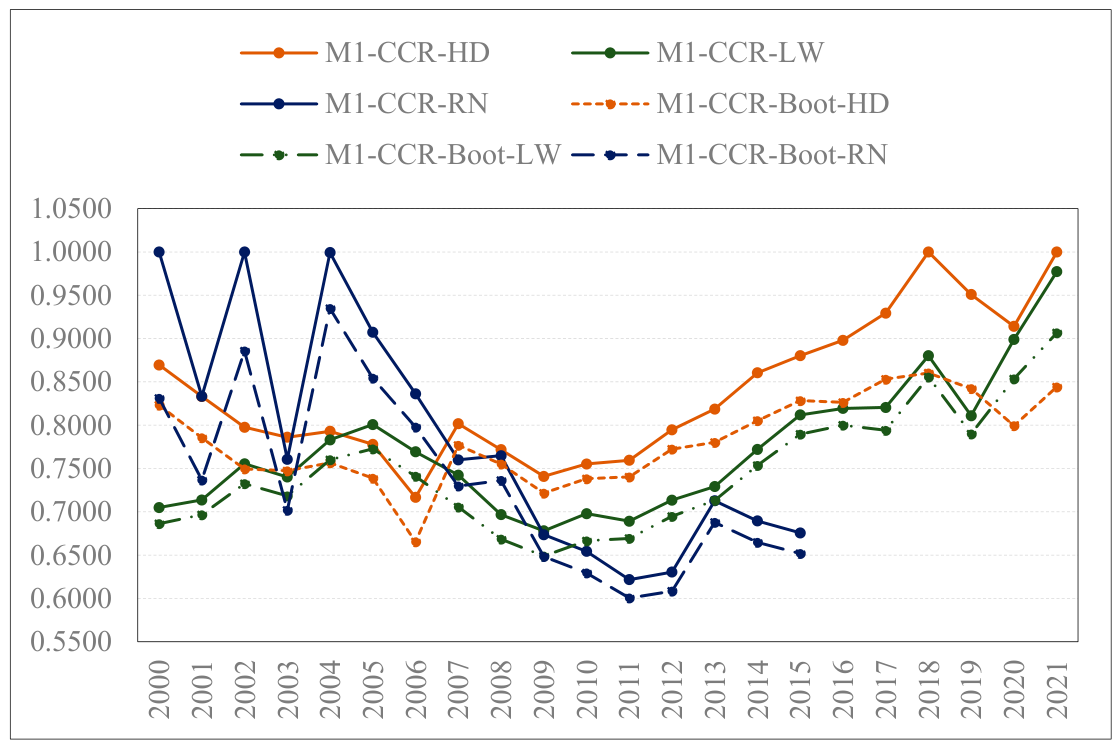
Figure 1 shows the trends in the three firms’ regular and bootstrapped OTE scores from 2000 to 2021. The regular score trends are shown as solid lines, and the average bootstrap scores are shown as dashed lines. Similarly,
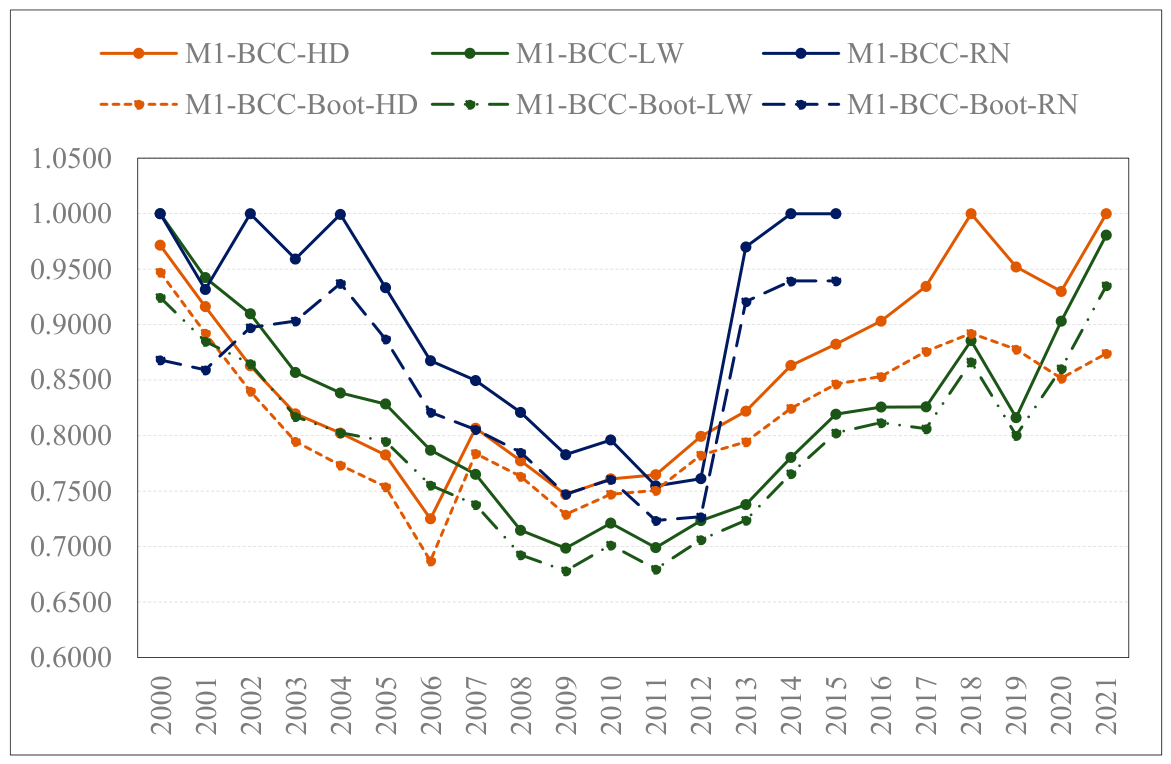
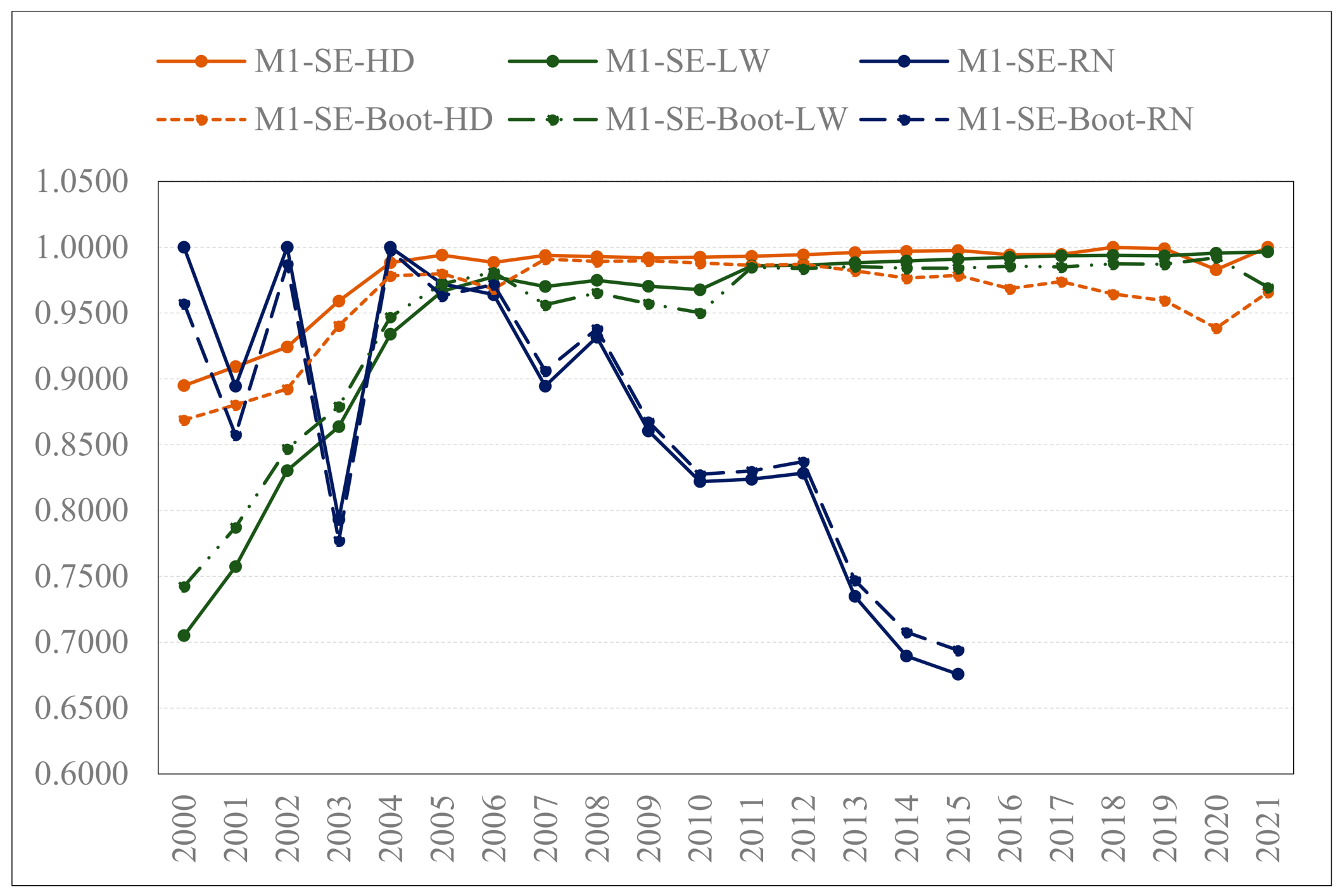
Figure 2 and
Figure 3 show the regular and bootstrapped PTE SE scores, respectively. The return-to-scale variable is not reported for the BCC models as it is not relevant to our analysis.
It can be observed that all efficiency scores are relatively higher than 0.60.
Table 2 shows that Home Depot has an average OTE of 0.8386, which is the highest of the three organizations, followed by Rona (0.7825) and Lowe’s (0.7730). Hence, despite being out of operation for about one-third of the study period, on average, Rona performs better than Lowe’s, which acquired it in 2016. Moreover, Rona performs best in operations management (highest PTE score), whereas Home Depot is again the best performer in SE.
Hence, one can say that, on average, none of the three companies performs consistently better than the others for all three scores: OTE, PTE and SE. This observation differs from that of
Takouda and Dia (
2016). The same observations hold when considering the average bootstrapped OTE, PTE and SE scores. This shows that the observations are robust, since they are the same for the point estimates and the bootstrap scores. Home Depot has the highest average OTE among the three organizations, followed by Rona and Lowe’s. Rona has the highest average PTE. Home Depot has the best performance with respect to the SE.
We then investigated trends over the 22 years of the study (16 for Rona). We intended to analyze further how the firms’ efficiencies evolved during this period.
Figure 1 shows that, despite being the best on average, Home Depot was not the most efficient organization up until 2007. Interestingly, Rona was the best performer during that time. Home Depot’s dominance began in 2007 and lasted until 2021. Home Depot gained the lead in 2007, driven by steady improvements in scale efficiency (SE), as shown in
Figure 3. There were two slow years in 2008 and 2009, which can be explained by the 2007–2009 global financial crisis. The OTE of Home Depot has increased since 2010, reaching a high of 1.0000 in 2018. In 2019, the OTE was reduced to 0.9509, and in 2020, likely due to the COVID-19 pandemic, it was further reduced to 0.9141. In 2021, Home Depot recovered its losses in the OTE, reaching 1.0000.
Figure 3 shows that the SE has been a strength point for Home Depot since 2004, operating consistently at the optimum scale. This indicates that the steady improvement in OTE since 2010 has been mainly driven by Home Depot’s PTE.
After a tough start in 2000, Lowe’s OTE steadily improved from 2001 to 2005, enabling it to catch up with Home Depot, as shown in
Figure 1.
Figure 3 shows that improvements in the SE during these years drove improvements in the OTE. As shown in
Figure 2, Lowe’s PTE decreased during this period, whereas Home Depot’s PTE remained higher. From 2005 to 2009, Lowe’s OTE consistently deteriorated. Here again, we can observe the impact of the 2007–2009 global financial crisis, but it appears to have aggravated a decline that began years earlier. Lowe’s OTE behavior was similar to Home Depot’s. It followed an increasing trend from 2010 to 2018 and then a decrease in 2019. However, they improved their efficiency in 2020 and 2021, reducing the gap between their OTE and Home Depot’s OTE. The bump between 2018 and 2019 is most likely due to the COVID-19 pandemic.
Figure 3 shows that Lowe’s SE has been consistently high (95% or higher) and has been improving. It is therefore clear that the decrease from 2005 to 2009, followed by the improvement from 2010 onward, was driven by the PTE.
Rona, which exhibited an unstable overall technical efficiency between 2000 and 2004, was also the most efficient organization during six out of seven years (2000–2006, with 2003 as an exception). Note that the unstable efficiencies for those five years are observed for OTE, PTE, and SE. Rona’s OTE started deteriorating fairly rapidly and consistently between 2005 and 2011. Here again, the same trends are exhibited by PTE and SE. However, Rona remained the most efficient overall until 2007, when Home Depot took the top spot and never relinquished it. Further, RONA had the best PTE of the three until 2010. Again, the impact of the 2007–2009 crisis is evident here. After 2010, the PTE quickly bounced back and reclaimed its best PTE score in 2013, maintaining it until the company was acquired by Lowe’s in 2016. During the same period, the SE deteriorated even further and faster. As a result, the OTE improved in 2011–2013, then deteriorated slightly further in 2014–2015. The inefficiency caused by SE seems to have weakened the gains in PTE. Here again, we can observe the impact of the 2007–2009 global financial crisis, but it appears to have aggravated a decline that began years earlier.
Once again, the above observations hold when considering the average bootstrapped OTE, PTE and SE scores. This confirms that the observations are robust.
Interestingly, the two companies that merged in 2016 were the ones that had been experiencing efficiency issues before the 2007–2009 global financial crisis, which aggravated them. It is worth noting that even though the observations in terms of the trends made above are slightly different from the results in
Takouda and Dia (
2016), the overall remark that Lowe’s was driven to acquire Rona to fix its efficiency issues and that Rona was an ideal candidate because it had similar issues has already been made by
Takouda and Dia (
2016). The fact that the Canadian dollar was relatively weaker than the US dollar at the same time helped close the deal. Remember that the models were different. The total sales area was used as an input in their model, but not in this study.
This hints that the total sales area may be important in achieving efficiencies. Additional investigations are needed to understand the dynamics of the situation.
4.2. The Effect of the Total Sales Area: Methodology 1 vs. Methodology 2
To investigate the role of the total sales area as an input in the efficiency of the hardware retail chain, we consider the results obtained from the DEA Methodology 2 models. Recall that this methodology differs from the previous one (Methodology 1) by the addition of the total sales area to the inputs of the models and the use of a regression analysis on the trend over the years 2000–2010 to estimate the missing values for the total sales area for 2011 to 2015 using the trend equation (with a coefficient of determination of
. Methodology 2 is the one used by
Takouda and Dia (
2016). Note that we are still responding to the research questions 1, 2 and 3.
Table 3 provides the average and standard deviation of regular and bootstrapped overall technical, pure technical and scale efficiency scores for each firm over the study period using Methodology 2. Note that figures in bold represent statistics with values that changed when compared to
Table 2.
As a first remark, we can see that adding the total sales area as one of the inputs (as in Methodology 2) did not affect the average and standard deviation of the OTE, PTA and SE scores for both Home Depot and Lowe’s, as well as the average OTE scores for Rona. On the other hand, the averages of PTE and SE, the standard deviations of OTE, PTE, and SE for Rona, and the statistics for all the bootstrapped scores across the firms were affected by the inclusion of the total sales area as an input in Methodology 2.
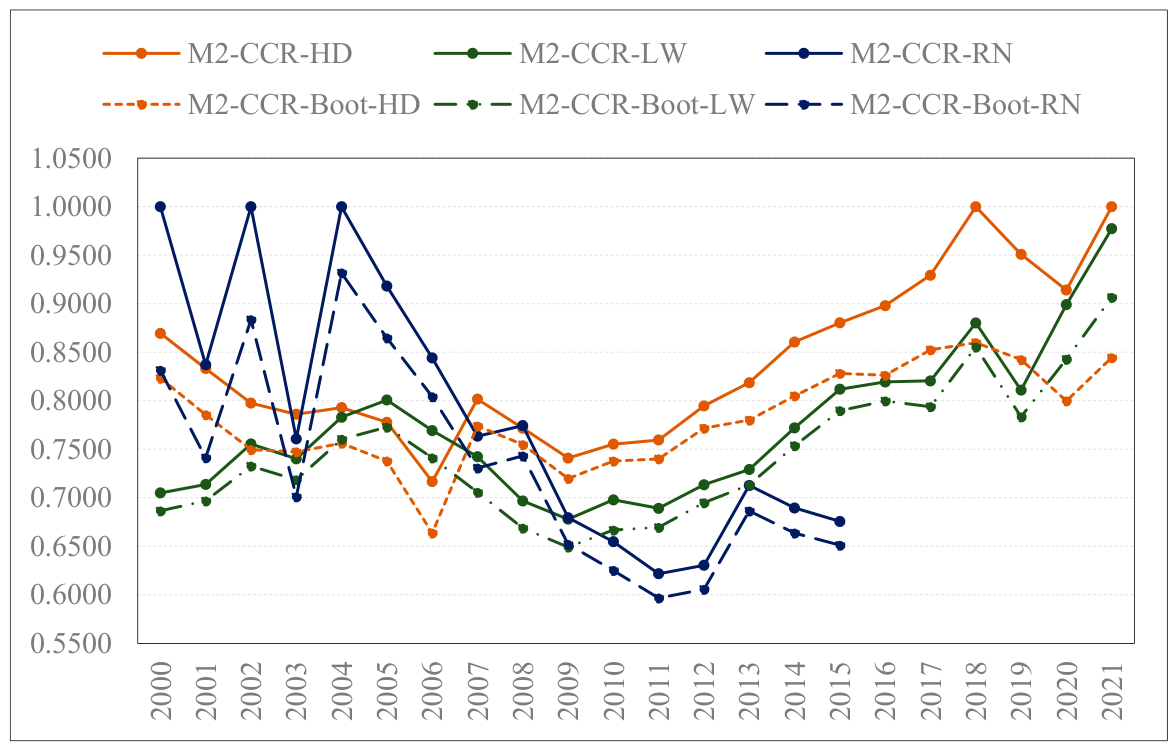
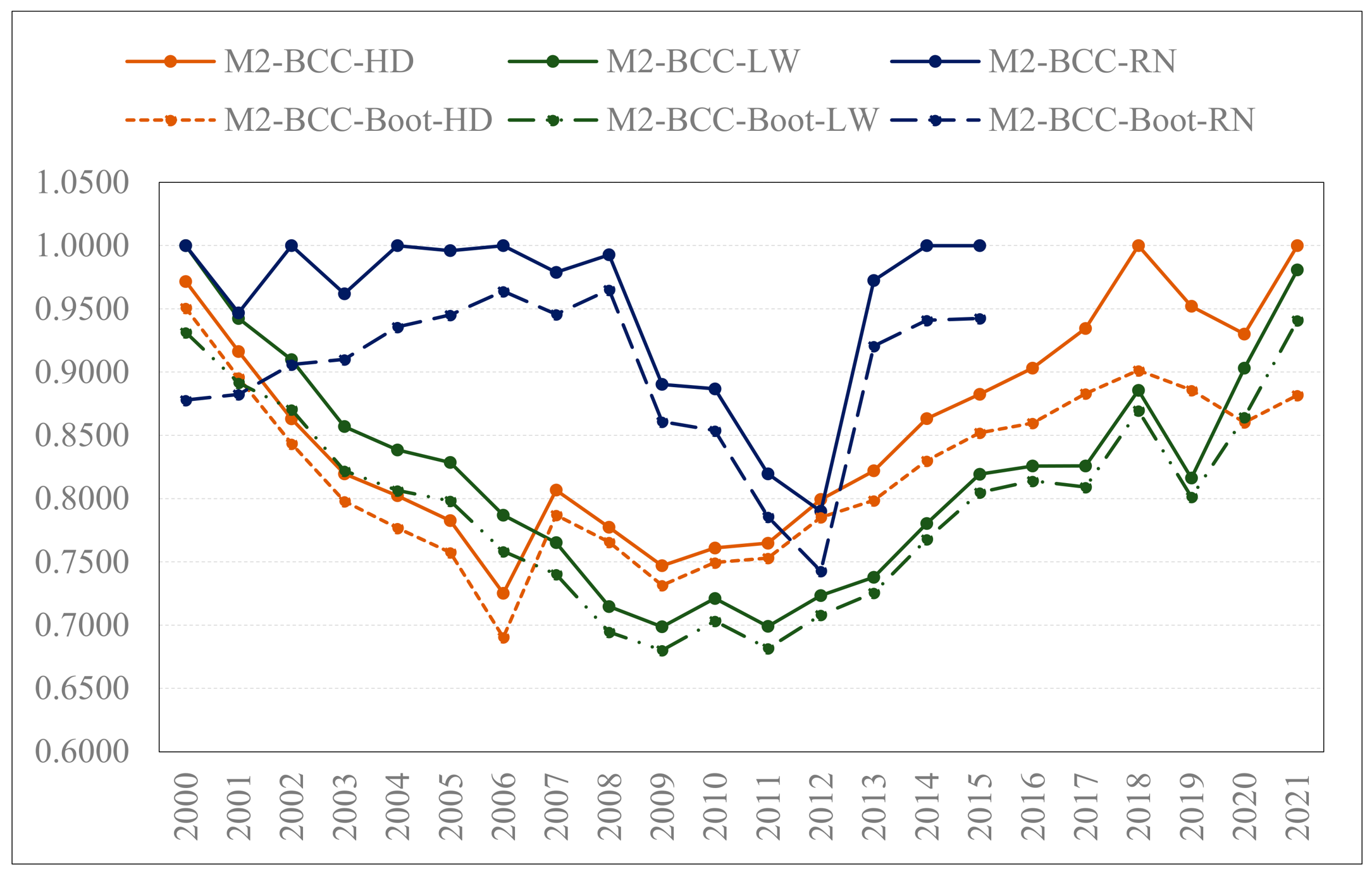
Figure 4 exhibits the trends of the regular and bootstrapped OTE scores for the three firms between 2000 and 2021, according to Methodology 2. Regular score trends are shown with solid lines, and average bootstrap scores are shown with dashed lines. Similarly,
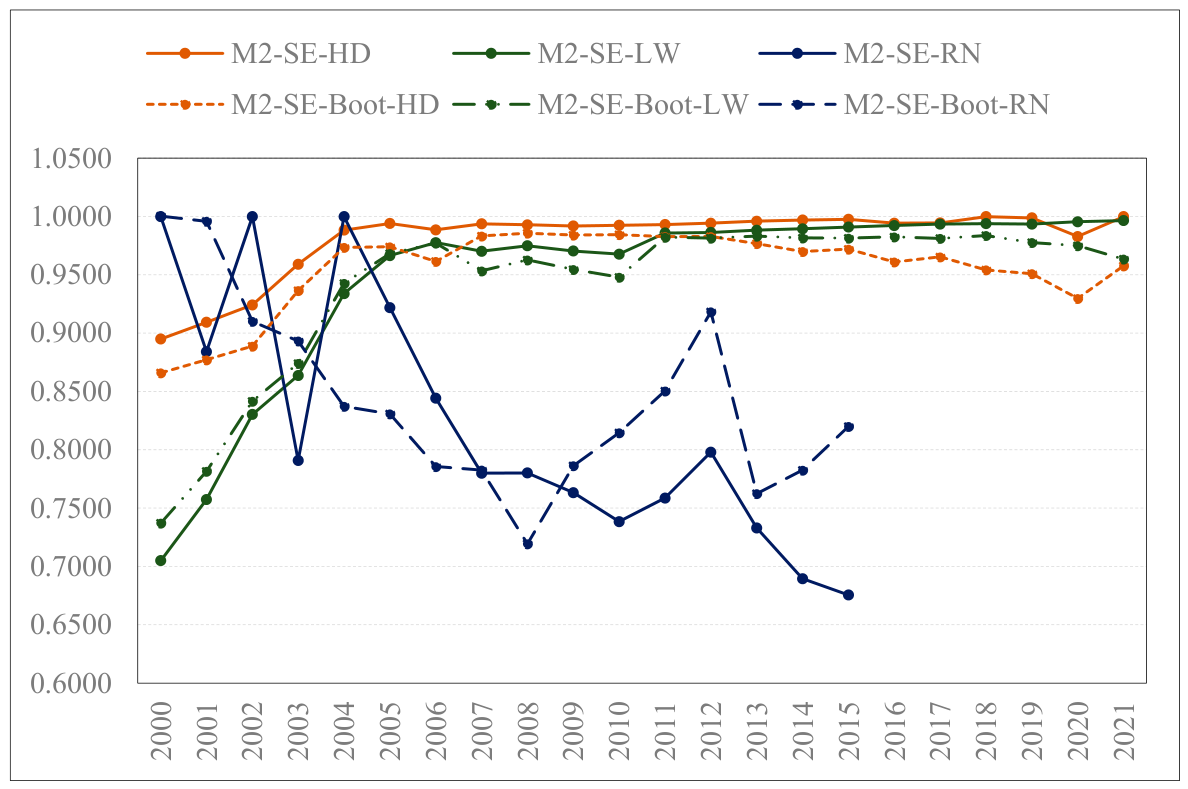
Figure 5 (respectively
Figure 6) shows the regular and bootstrapped PTE (respectively SE) scores.
A comparison between
Figure 1 and
Figure 4,
Figure 2 and
Figure 5, and
Figure 3 and
Figure 6 confirms that, at the trend level as well as the OTE, PTE and SE scores for both Home Depot and Lowe’s are the same with or without the total sales area as an input. A similar observation can be made for Rona’s OTE score.
However, some differences exist for the other efficiency scores.
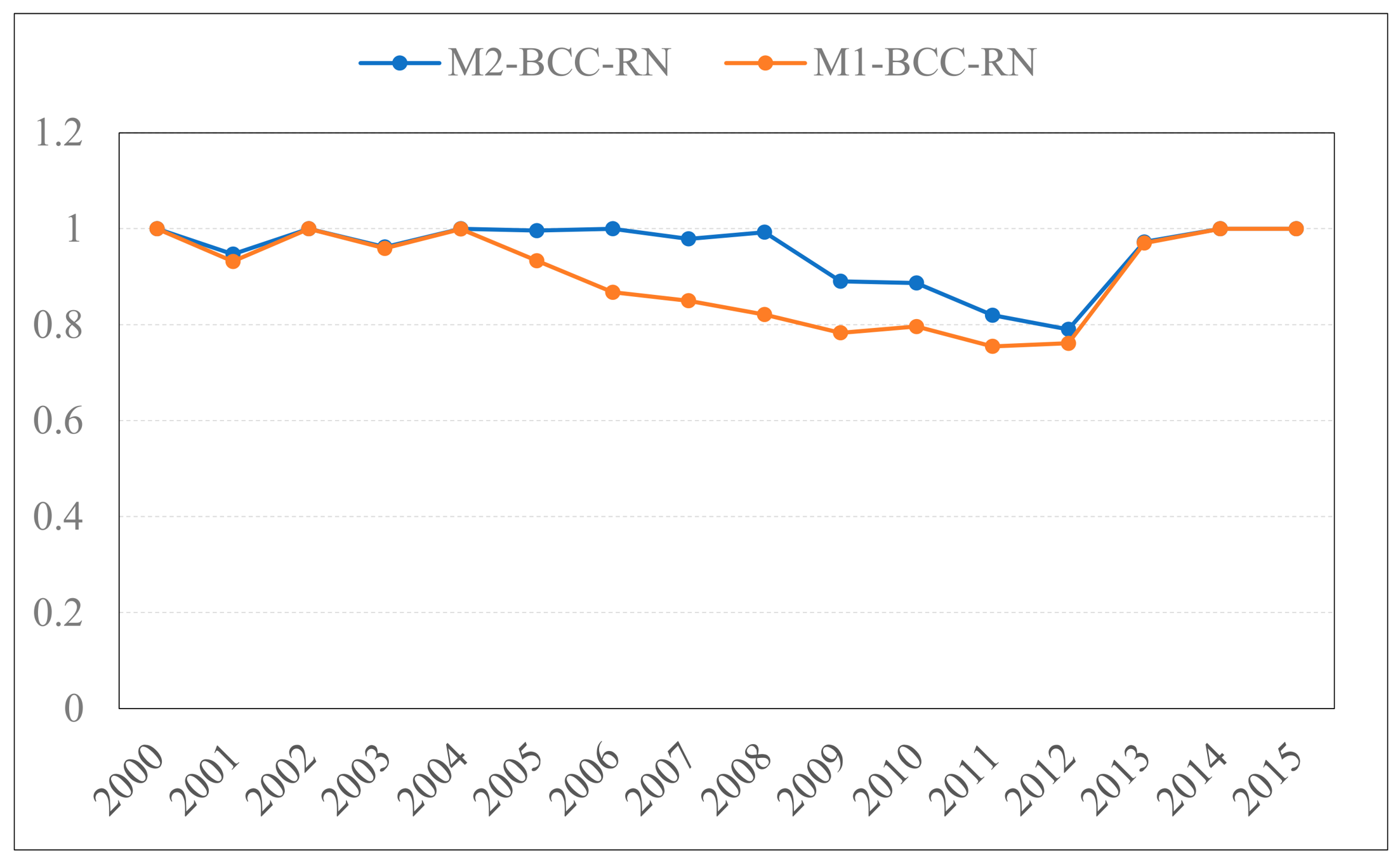
Figure 7 shows the PTE results of Methodology 1 when the sales area was not included as an input, and the results of Methodology 2 when the sales area was included as an input. It shows that when the total sales area was taken into account, the PTE improved significantly from 2005 to 2012. The average PTE is 0.9522 (0.9017 before including the total sales area). The improvement reached 17% in 2008.
The improvement in Rona’s PTE confirmed its dominance over the other two PTE chain stores, as shown in
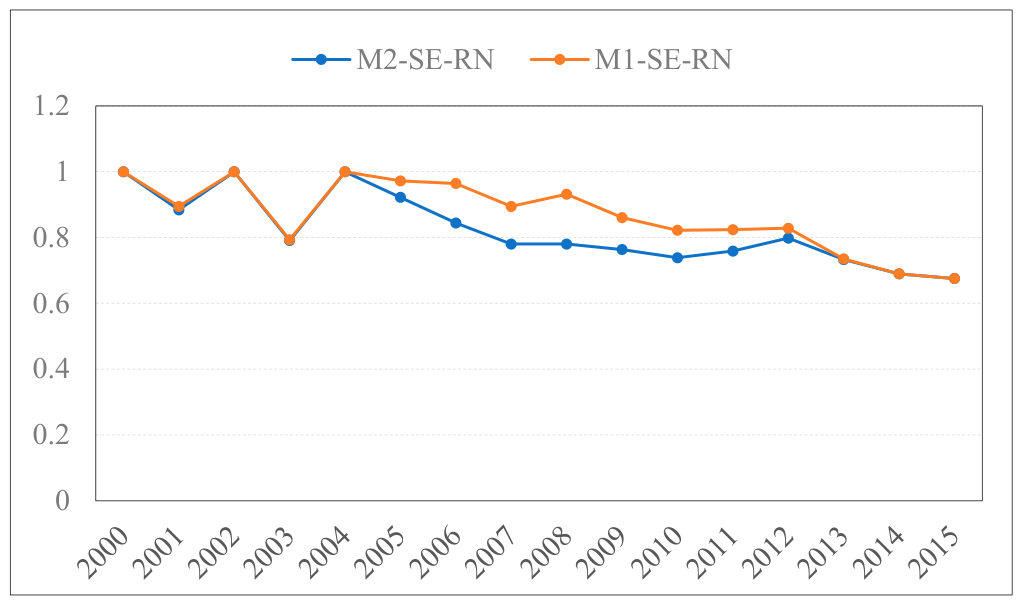
Figure 5. Unfortunately, this improvement was met by a deterioration in the SE in the same period (see
Figure 8). The average SE is 0.8223 (0.8678 before including the total sales area). A similar observation was made through the analysis of Methodology 1 results. The reduction in the SE that started in 2005 and lasted until 2012 was the main reason for the decrease in OTE, even though the PTE was improving.
Again, the observations made above are robust when the bootstrap models are considered under Methodology 2, even though the figures differ slightly, the same trends hold between 2020 and 2021.
4.3. Analyzing the Impact of the 2007–2009 Financial Crisis
Regarding research question 4, “how did the 2007–2009 global financial crisis impact the subsector?”, we consider the following hypothesis:
H1. The efficiency of the subsector was different during the 2007–2009 financial crisis.
To test H1, have performed parametric and non-parametric (Kruskal–Wallis) one-way ANOVA to compare average efficiencies across three periods to obtain robust results: the pre-crisis period, 2000 to 2006; the crisis period, 2007 to 2009; and the post-crisis period, 2010 to 2021.
Table 4 summarizes the results of our calculations. In columns 1 (and 2, 3, and 4, respectively), we identify the efficiency scores utilized (the period considered, the size of the sample corresponding to the period, and the average (standard deviation) of the efficiency scores. The remaining four columns present the results of the one-way ANOVA tests: the test type, the statistics, the degrees of freedom, and the
p-values. Note that
p-values lower than 0.1 are in bold.
For all 12 measures, the average efficiency scores during the crisis are lower than those in the pre-crisis and post-crisis periods. This confirms that the crisis impacted the three firms’ efficiencies. Further, the average post-crisis scores are slightly lower than the pre-crisis scores, suggesting that, on average, firms have not yet fully recovered from the financial crisis. Note that both ANOVA and Kruskal–Wallis tests are significant for BCC across both methodologies. Hence, there is a significant difference between the periods.
We can therefore conclude that, regardless of the methodology, the three technical efficiencies of the subsector were different during the 2007–2009 financial crisis. If we consider the bootstrap efficiency, the same result holds only for the bootstrap CCR and BCC (Methodology 1). This also confirms that the inefficiencies were driven more by the management and scale of operations. These results are consistent with the literature: the 2007–2009 financial crisis resulted in a decline in firms’ operational efficiency, succeeded by a recovery phase.
4.4. Analyzing the Impacts of the COVID-19 Pandemic
For research question 5, “how did the COVID-19 pandemic impact the subsector?”, we consider the hollowing hypothesis:
H2. The efficiency of the subsector was different during the COVID-19 pandemic.
To test H2, we considered the pre-pandemic period (2000–2019) and the pandemic period (2020–2021). We compared the regular and bootstrapped efficiency scores of the chains together across the two periods, first by analyzing trends and then by comparing average efficiencies. We used parametric and non-parametric (Mann–Whitney U) independent t-tests to compare the average efficiencies for the two periods. We tested for normality in the two periods using the Shapiro–Wilks test.
Table 5 summarizes the results of our calculations. In columns 1 (and 2, 3, and 4, respectively), we identify the efficiency scores used (the period considered, the sample size corresponding to that period, and the average (standard deviation) of the efficiency scores). The remaining four columns present the test results: test type, statistics, degrees of freedom, and
p-values. Note that
p-values lower than 0.1 are in bold.
We made the following observations. First, the results show that the increasing efficiency trends observed in 2009–2011 continued during COVID-19, after a blip in 2019–2020. Note that here, when we first ran the Shapiro–Wilks normality tests, the normality hypothesis was rejected at p = 0.05 for at least one subsample in all cases, except Methodology 1 for Bootstrap CCR and Methodology 2 for Bootstrap CCR. We computed both the t-test and Mann–Whitney statistics and their corresponding p-values, and we used the Mann–Whitney p-value to conclude our hypothesis tests for all cases except the three exceptions listed previously, where we used the t-test’s p-value.
Here again, the 12 efficiency measures consistently indicate that, overall, mean efficiency scores differed, with larger differences observed during COVID-19 than before. Moreover, these differences were significant for all measures, regardless of the test, except for the BCC and SE bootstraps using Methodology 2. Again, even though the COVID-19 period only covers two (2) years out of the 22 study periods, all average COVID-19 efficiencies are higher than pre-COVID-19 ones. Hence, we can conclude that the improvement in efficiency was greater after COVID-19. This may be explained by the fact that home renovations were booming during COVID-19. Further studies would be needed here to strengthen this observation.
We can therefore conclude that, regardless of the methodology, the three technical efficiencies of the subsector were different during the COVID-19 pandemic. If we consider the bootstrap efficiency, the same result holds only for the bootstrap CCR (Methodologies 1 and 2) and BCC (Methodology 1). These results are consistent with the literature: the COVID-19 pandemic resulted in different, increased efficiencies.
4.5. Analyzing the Impact of the Lowe’s–Rona Merger
Finally, regarding the last research question, “how did Lowe’s 2016 acquisition of Rona impact the subsector?”, we consider the hollowing hypothesis:
H3. The efficiency of the subsector was different following the 2015 M&A of Rona by Lowe’s.
To test H3, we considered the pre-acquisition period (2000–2015) and the post-acquisition period (2016–2021). We again compared the regular and bootstrapped efficiency scores of the chains combined across the two periods, first by analyzing trends and then by comparing average efficiencies. We used parametric and non-parametric (Mann–Whitney U) independent t-tests to compare the average efficiencies for the two periods. We tested for normality in the two periods using the Shapiro–Wilks test.
We considered 12 efficiency measures, six from each of the two methodologies (Methodologies 1 and 2). We considered each methodology’s OTE, PTE, and SE scores with their bootstrapped counterparts.
Table 6 summarizes the results of our calculations. In columns 1 (and 2, 3, and 4, respectively), we identify the efficiency scores used (the period considered, the sample size for that period, and the average (standard deviation) of the efficiency scores). The remaining four columns provide the results of the two-sample means comparison tests: the type of test, the statistics, the degrees of freedom and the
p-values. Note that
p-values lower than 0.1 are in bold.
All 12 efficiency measures consistently indicate that, overall, there were differences in mean efficiency scores, which were more extensive after the acquisition than before. Moreover, these differences were significant for all measures, regardless of the statistics, except for BCC and SE bootstraps using Methodology 2. One interesting remark is that even though the post-acquisition period only covers six (6) years out of the 22 study periods, all post-acquisition average efficiencies are higher than pre-acquisition efficiencies. Hence, we can claim that the efficiency improvement rate was higher after the acquisition. This may support the claim that Lowe’s acquisition of Rona was a strategy to increase their efficiency.
We can, therefore, conclude that, regardless of the methodology, the three technical efficiencies of the subsector were different following the 2015 M&A of Rona by Lowe’s. If we consider the bootstrap efficiency, the same result holds for all, except for the bootstrap BCC (Methodology 2). These results are consistent with the literature: the 2015 M&A of Rona by Lowe’s resulted in different, increased efficiencies.
In summary, when we analyze the impact of the Lowe’s–Rona merger, we can make the following two observations. At the sample level, which is representative of the industry, the merger led to improved performance. However, at the firm level, when we refer to
Figure 4,
Figure 5 and
Figure 6, Lowe’s maintained or solidified its position as second.
5. Managerial Insights
Our study analyzes the large-format, publicly traded hardware retail chains operating in Canada during 2010–2021. Our study’s findings on the relative efficiency of the three hardware retail chains operating in Canada (Home Depot, Lowe’s, and Rona) during 2000–2021 provide valuable insights for managers.
Firms in the sector operate at relatively high efficiency. Indeed, regardless of the methodology or approach used, and whether we consider classic or bootstrapped models, average efficiencies were above 0.70, with relatively small standard deviations. The actual figures obtained were consistently higher than 0.60.
Operations management is the primary source of inefficiency. Indeed, regardless of the methodology or approach used and whether we consider classic or bootstrapped models, the trends illustrated in
Figure 1,
Figure 2,
Figure 3,
Figure 4,
Figure 5 and
Figure 6 confirm these observations.
Firms were seriously impacted by the 2007–2009 global financial crisis. The global financial crisis affected the three firms, Home Depot, Rona and Lowe’s, at the end of the 2000s. The first firm’s impact lasted a few years, and its efficiency has improved steadily since 2009. For Lowe’s, the crisis occurred when the firm’s efficiency declined. The trends continued during the crisis, and it is only since 2009–2011 that they have reversed, and Lowe’s has exhibited steadily increasing efficiencies. Finally, Rona experienced instability and decreased efficiency before the crisis. The decrease continued during and beyond the crisis until 2011.This was followed by a two-year rebound, and then another two-year decline, ending with Lowe’s acquisition of the company.
The impact of COVID-19 seems to be challenging to estimate as of yet. A similar remark can be made on the impact of the COVID-19 pandemic. There seems to have been little impact from COVID-19, except for an increased pace in the improvement of efficiencies. This might indicate that the sector has benefited from a boom in home renovations driven by COVID-19 lockdowns and stay-at-home orders.
Rona was more severely impacted, which might have led to Lowe’s acquisition. Rona was the most affected of the three companies at the end of the financial crisis. This might explain why Rona was targeted and later acquired by Lowe’s, trying to solve its efficiency issues through an acquisition strategy.
The acquisition by Lowe’s did not seem to have a significant impact, leading to Rona+. The trend analysis of Home Depot and Lowe’s, before and after Lowe’s acquisition of Rona, did not show a significant impact of the transaction on their efficiencies. The companies continued to regain the efficiencies lost during the 2007–2009 global financial crisis. The effect, if any, seems to have been the pace of recovery, which appears to have increased post-acquisition. Hence, even though efficiencies were higher post-acquisition than in the preceding period, Lowe’s acquisition strategy does not seem as impactful as expected.
6. Conclusions
We conducted a longitudinal analysis of the performance of the hardware retail industry in Canada from 2000 to 2021. The performance was measured using relative efficiency scores obtained from DEA models. We used two methodologies in our study. They share the same outputs, sales, and profits but differ in their inputs. The first methodology uses capital, the number of stores, and employees as inputs; the second adds the total sales area as an additional input. We computed regular and bootstrap scores for both methodologies to measure overall technical efficiency, pure technical efficiency, and scale efficiency. We subsequently analyzed trends over the years, the descriptive statistics, and compared average efficiencies across various periods to investigate the effects of the 2007–2009 global financial crisis, the acquisition of Rona by Lowe’s in 2015, and the COVID-19 pandemic.
Our findings can be summarized as follows. Overall, the firms consistently exhibit high efficiency scores. Moreover, the primary source of inefficiencies lies in operations management. The 2007–2009 financial crisis significantly impacted the three companies. That period had the lowest efficiencies for Lowe’s and Home Depot, but Lowe’s had already been experiencing declining efficiency before the crisis. Rona’s low efficiencies extended beyond the global financial crisis and only rebounded slightly a few years before its acquisition. Finally, the acquisition of Rona and the COVID-19 pandemic did not significantly impact Lowe’s and Home Depot. The two firms were already regaining the efficiencies they had lost during the crisis and did not seem to change course when they faced these two later events.
This study makes a valuable contribution to both the academic and practitioner communities. On the theoretical side, our study shows the use of bootstrap DEA in the context of retail for longitudinal studies, in support of classic DEA. It contributes to the literature on crisis-efficiency dynamics, on the impacts of Mergers and acquisitions on efficiency, and on retail resilience during pandemics. Our managerial insights, illustrated in the previous section, provide managers in this sector with information on potential areas for improvement and challenges they might face in their day-to-day activities.
There are indeed some limitations to this work. For example, the impact of the Rona acquisition in 2016 occurred in the last quarter of our study period, and the COVID-19 pandemic occurred even later. The post-period sample is small in both cases. It would be worth revisiting these questions in a few years with additional data. In addition, a longitudinal analysis, typically, would include a Malmquist productivity index investigation. We plan to do so in future work. Finally, DEA-based models measure internal efficiency and do not take into account the impact of environmental variables on efficiency. A two-stage DEA would be a natural extension of this work.
The findings of this study are grounded in the specific institutional and economic context of the Canadian hardware retail market, characterized by its oligopolistic structure and hardware retail demand. From a methodological standpoint, the bootstrap DEA framework employed here is transferable to any retail sector where multi-year financial data are available for a set of comparable firms operating in a sufficiently concentrated market. However, the substantive findings should be interpreted with caution outside the Canadian context, as the efficiency dynamics documented here are contingent on sector-specific drivers of demand, the particular oligopolistic structure of the market, and the homogeneity requirement of DEA.