
Why Oil Windfalls Do Not Equal Welfare: Regime-Dependent Long-Run Elasticities in MENA and Azerbaijan

 and
and
Abstract
1. Introduction
1.1. Problem Statement and Motivation
1.2. Contribution of the Research
1.3. Research Gap
1.4. Research Questions (RQ)
- RQ1: How do oil shocks and oil dependence affect welfare (GDP per capita) in the long run?
- RQ2: Why does this effect differ across countries?
1.5. Research Hipotesis
- H1a (GCC cluster): In the GCC countries (UAE, Qatar, Kuwait, Bahrain, Saudi Arabia), the long-run coefficient β_oil ≠ 0, and in many cases it is negative or statistically insignificant;
- H1b (Non-GCC cluster): For Iraq, Egypt, Libya, and Azerbaijan, β_oil is more likely to be marginally positive and statistically insignificant.
- H2a: When expenditures are consumption-oriented and have a high import content, β_govexp < 0 (as in the case of the UAE, for example);
- H2b: In investment-oriented or fiscally rule-based environments, β_govexp ≥ 0 may hold.
2. Literature Review
3. Data & Methodology
4. Empirical Results
4.1. Country ARDL/ECM Results—“Standardized Summary”
4.2. Heterogeneity Map and Its Interpretation
4.3. Country Case Deep Dive
4.3.1. Azerbaijan: Slow Adjustment and Fiscal Over-Expansion
4.3.2. Qatar: Fast Adjustment and Strong Oil–Welfare Transmission
4.3.3. United Arab Emirates: Diversified Exporter and the “Post-Rentier” Paradox
5. Discussion
5.1. Interpretation of the Core Mechanism: Welfare Transmission
5.2. Positioning the Results in the Broader Literature
5.3. Theoretical Implications and Avenues for Further Work
6. Policy Implications
6.1. Rethinking the “Windfalls → Welfare” Strategy
6.2. Cluster-Specific Policy Priorities
6.3. Designing Fiscal Rules and Sovereign Wealth Strategies
7. Limitation of the Research
8. Conclusions
Author Contributions
Funding
Institutional Review Board Statement
Informed Consent Statement
Data Availability Statement
Conflicts of Interest
Appendix A

| Blok | Indicator | Value (Approximate) | Note |
|---|---|---|---|
| Long-run | LOGOILPRICE (β_oil) | +0.112 (p ≈ 0.108) | Positive, marginally significant. |
| Long-run | LOGGOV_EXP (β_gov) | −0.142 (p ≈ 0.538) | Not significant. |
| Long-run | POPGROWTH | −0.050 (p = 0.006) | Negative and significant. |
| Long-run | WGDPGROWTH | −0.041 (p ≈ 0.186) | Not significant. |
| ECM | CointEq(−1) (φ) | −0.158 (p < 0.001) | Rapid adjustment. |
| Bounds | F-stat (k = 4) | 10.882 | Cointegration is confirmed. |
| Diagnostics | Normality (JB p) | 0.764 | Not rejected. |
| Diagnostics | BG-LM (p) | 0.404/0.542 | No serial correlation. |
| Diagnostics | BPG (p) | ≈0.156 | Homoskedasticity not rejected. |
| Diagnostics | RESET (p) | 0.439 | No functional form problem. |
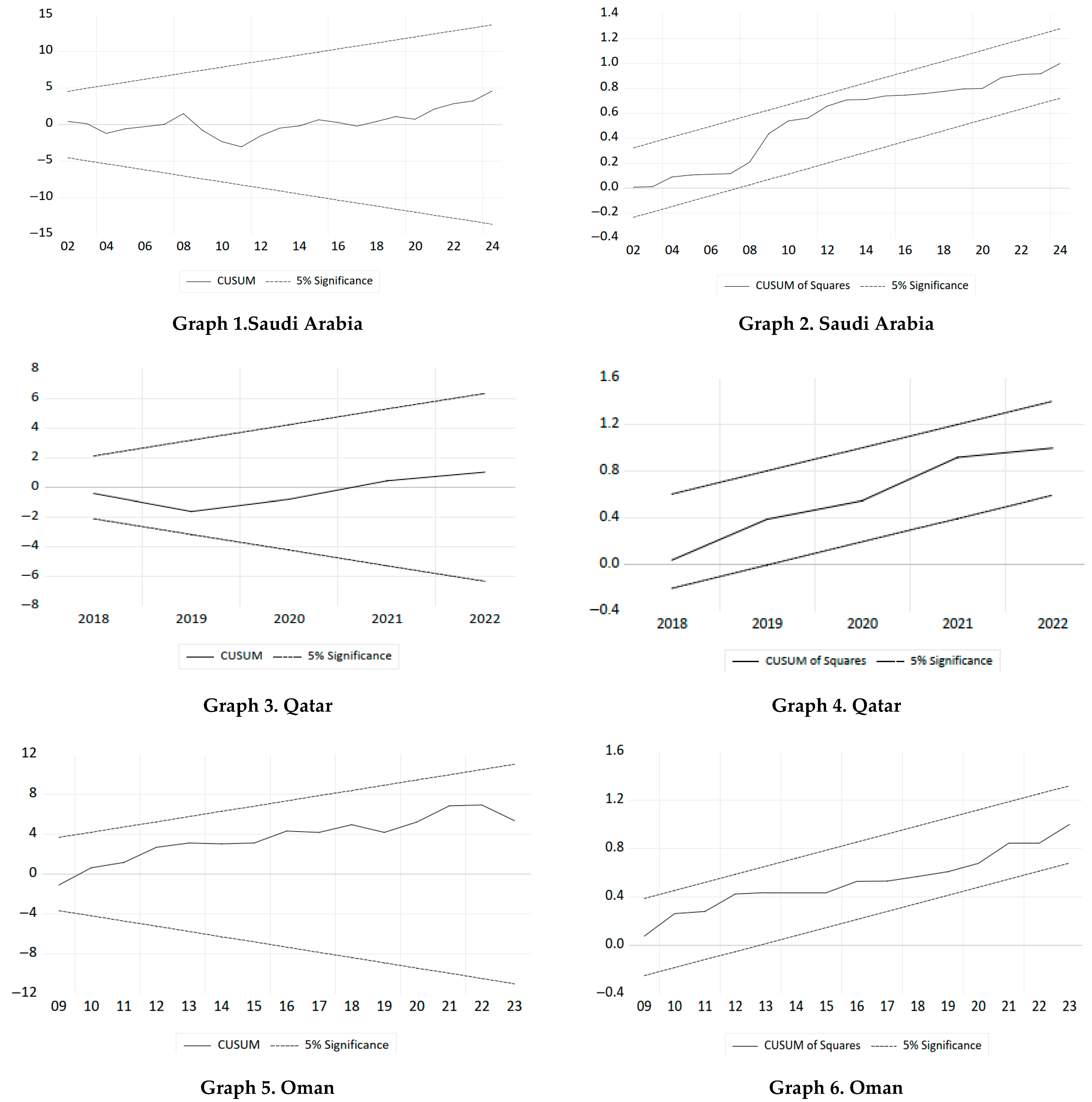
| Stability | CUSUM/CUSUMSQ | Within the bands | Parameter stability. |
| Blok | Indicator | Value/Test | Short Comment |
|---|---|---|---|
| Long-run | LOGOILPRICE (β_oil) | +0.269 (p < 0.001) | Positive, significant. |
| Long-run | LOGGOV_EXP (β_gov) | −0.166 (p = 0.014) | Negative, significant. |
| Long-run | POPGROWTH | −0.0136 (p < 0.001) | Negative, significant. |
| Long-run | WGDPGROWTH | +0.060 (p < 0.001) | Positive, significant. |
| Long-run | DUMMY1 | ≈0.0015 (p ≈ 0.93) | Not significant. |
| ECM | CointEq(−1) (φ) | −0.895 (p < 0.001) | Very rapid convergence. |
| Bounds | F-stat (k = 5) | 21.95 | Cointegration is present. |
| Diagnostics | Normality (JB p) | 0.112 | Normality is not rejected. |
| Diagnostics | BG-LM (1/2 lag) | p < 0.001/p ≈ 0.0004 | Autocorrelation is present. |
| Diagnostics | BPG | p ≈ 0.77/0.59 | There is no heteroskedasticity. |
| Diagnostics | RESET | p ≈ 0.765 | No functional form problem. |
| Stability | CUSUM/CUSUMSQ | 5% Within the bands | Parameter stability. |
| Blok | Indicator | Value/Test | Short Comment |
|---|---|---|---|
| Long-run | LOGOILPRICE (β_oil) | −0.0835 (p = 0.0115) | Negative, significant. |
| Long-run | LOGGOV_EXP (β_gov) | −0.6773 (p = 0.0004) | Negative, significant. |
| Long-run | POPGROWTH | +0.0089 (p ≈ 0.054) | Positive, borderline. |
| Long-run | WGDPGROWTH | −0.0077 (p = 0.524) | Not significant. |
| ECM | CointEq(−1) (φ) | −0.439 (p < 0.001) | Medium Rapid adjustment. |
| Bounds | F-stat (k = 4) | 5.413 | Cointegration is confirmed. |
| Diagnostics | Normality (JB p) | 0.993 | Normality is not rejected. |
| Diagnostics | BG-LM (1/2 lag) | 0.205/0.188 (F-p) | No serial correlation. |
| Diagnostics | BPG (heterosked.) | 0.976/0.926 | There is no heteroskedasticity. |
| Diagnostics | RESET (t-p) | 0.130 | No functional form problem. |
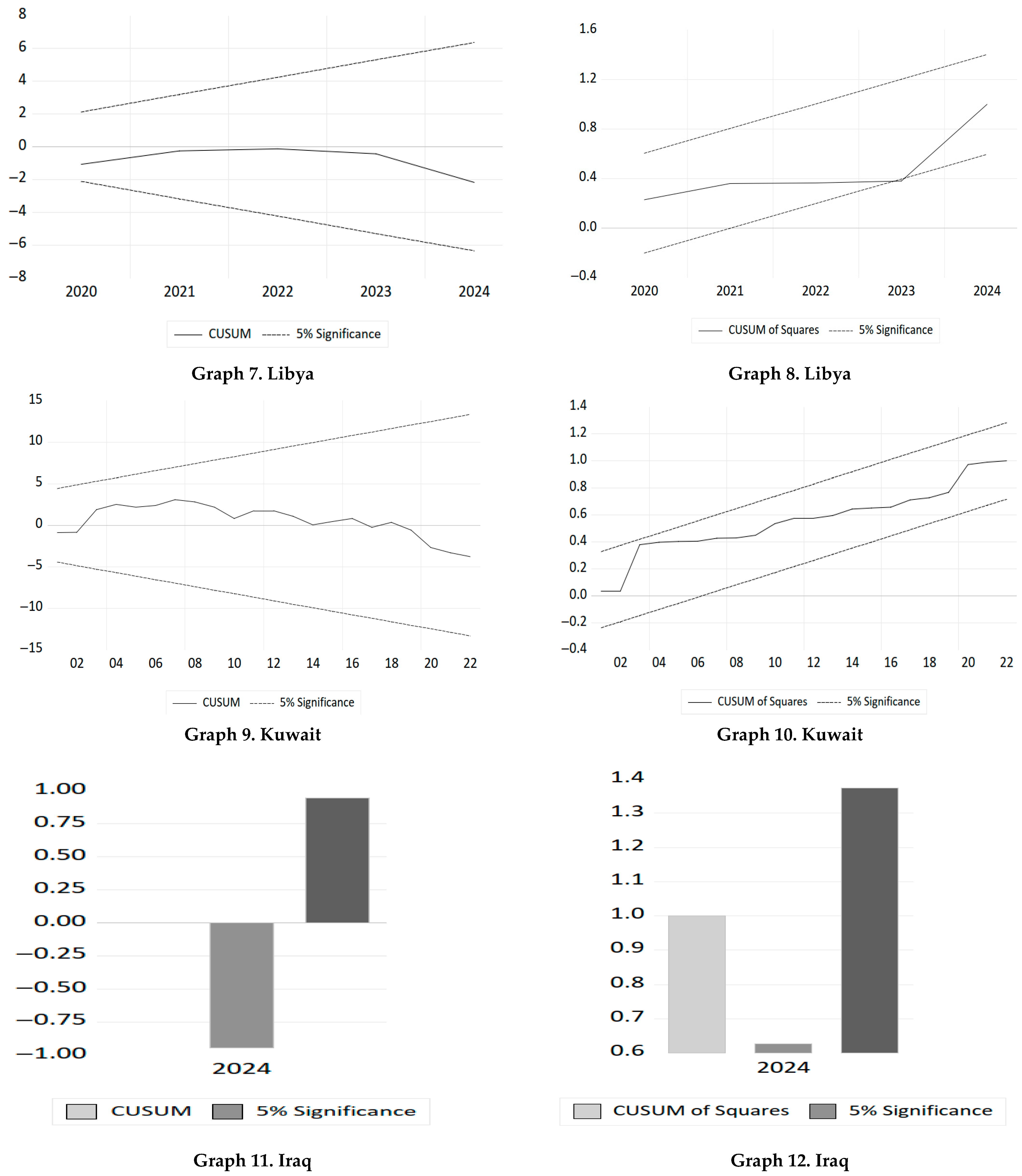
| Stability | CUSUM/CUSUMSQ | 5% Within the bands | Parameter stability. |
| Blok | Indicator | Value/Test | Short Comment |
|---|---|---|---|
| Long-run | LOGOILPRICE (β_oil) | −0.102 (p = 0.447) | Not significant. |
| Long-run | LOGGOV_EXP (β_gov) | −0.608 (p = 0.215) | Not significant. 3-Bound test. |
| Long-run | POPGROWTH | +0.430 (p = 0.0049) | Positive and significant. |
| Long-run | WGDPGROWTH | +0.222 (p ≈ 0.089) | Border importance. |
| Long-run | DUMMY1 (political) | +0.234 (p = 0.325) | Not significant. |
| Long-run | DUMMY2 (devalvasiya) | +0.892 (p ≈ 0.046) | Positive, significant. |
| ECM | CointEq(−1) (φ) | −0.629 (p < 0.001) | Rapid adjustment. |
| Bounds | F-stat (k = 6) | 9.954 | Cointegration is confirmed. |
| Diagnostics | Normality (JB p) | ≈0.0286 | Normality is rejected. |
| Diagnostics | BG-LM (1/2 lag) | 0.3515/0.0375 (F-p) | Autocorrelation in 2 lags. |
| Diagnostics | BPG (heterosked.) | 0.958/0.741 | There is no heteroskedasticity. |
| Diagnostics | RESET (p) | ≈0.001 | No form problem. |
| Stability | CUSUM/CUSUMSQ | 5% Within the bands | Parameter stability (visual). |
| Blok | Indicator | Value/Test | Short Comment |
|---|---|---|---|
| Bounds | F-stat (k = 5) | 1.633 | There is no cointegration. |
| ECM | CointEq(−1) | −0.1856 (p ≈ 0.001) | Negative/significant; but Bounds does not confirm. |
| Short-run | ΔLOGGOV_EXP | −0.816 (p < 0.001) | Negative and significant. |
| Short-run | ΔLOGOILPRICE | −0.328 (p < 0.001) | Negative and significant. |
| Short-run | ΔDUMMY1 | −0.734 (p ≈ 0.0056) | Negative and significant. |
| Long-run * | LOGGOV_EXP | −1.437 (p < 0.001) | With caution (Bounds not crossed). |
| Long-run * | LOGOILPRICE | −0.326 (p ≈ 0.012) | With caution. |
| Diagnostics | Normality (JB p) | 0.250 | Normality is OK. |
| Diagnostics | BG-LM (1/2 lag) | 0.295/0.147 (F-p) | No serial correlation. |
| Diagnostics | BPG (heterosked.) | p ≈ 0.83/0.76 | There is no heteroskedasticity. |
| Diagnostics | RESET (p) | ≈0.457 | No functional form problem. |
| Stability | CUSUM/CUSUMSQ | 5% Within the bands | Parameter stability. |
| Blok | Indicator | Value/Test | Short Comment |
|---|---|---|---|
| Bounds | F-stat (k = 6) | 7.068 | Cointegration is confirmed. |
| ECM | CointEq(−1) | −0.7927 (p < 0.001) | Powerful, Rapid adjustment. |
| Long-run | LOGGOV_EXP | +0.469 (p < 0.001) | Positive, significant. |
| Long-run | LOGOILPRICE | −0.003 (p ≈ 0.96) | Not significant. |
| Long-run | POPGROWTH | −0.0138 (not significant) | Not significant. |
| Long-run | WGDPGROWTH | +0.078 (p ≈ 0.058) | Border importance. |
| Long-run | DUMMY1 (political) | −0.489 (p < 0.001) | Negative, significant. |
| Short-run | ΔLOGGOV_EXP | +0.2757 (p < 0.001) | Positive, significant. |
| Short-run | ΔLOGGOV_EXP(−1) | −0.1120 (p = 0.002) | Negative, significant. |
| Short-run | ΔLOGOILPRICE | +0.0909 (p ≈ 0.126) | Not significant. |
| Short-run | ΔPOPGROWTH | −0.0555 (p = 0.0046) | Negative, significant. |
| Short-run | ΔWGDPGROWTH; ΔWGDPGROWTH(−2) | +0.0199 (p = 0.0248); +0.0203 (p = 0.0117) | Positive, significant. |
| Short-run | ΔDUMMY2(−1) | +0.254 (p = 0.0050) | Positive, significant. |
| Diagnostics | Normality (JB p) | 0.128 | Normality is OK. |
| Diagnostics | BG-LM (1/2 lag) | 0.802/0.584 (F-p) | No serial correlation. |
| Diagnostics | BPG (heterosked.) | p ≈ 0.98/0.94 | There is no heteroskedasticity. |
| Diagnostics | RESET (p) | ≈0.694 | No functional form problem. |
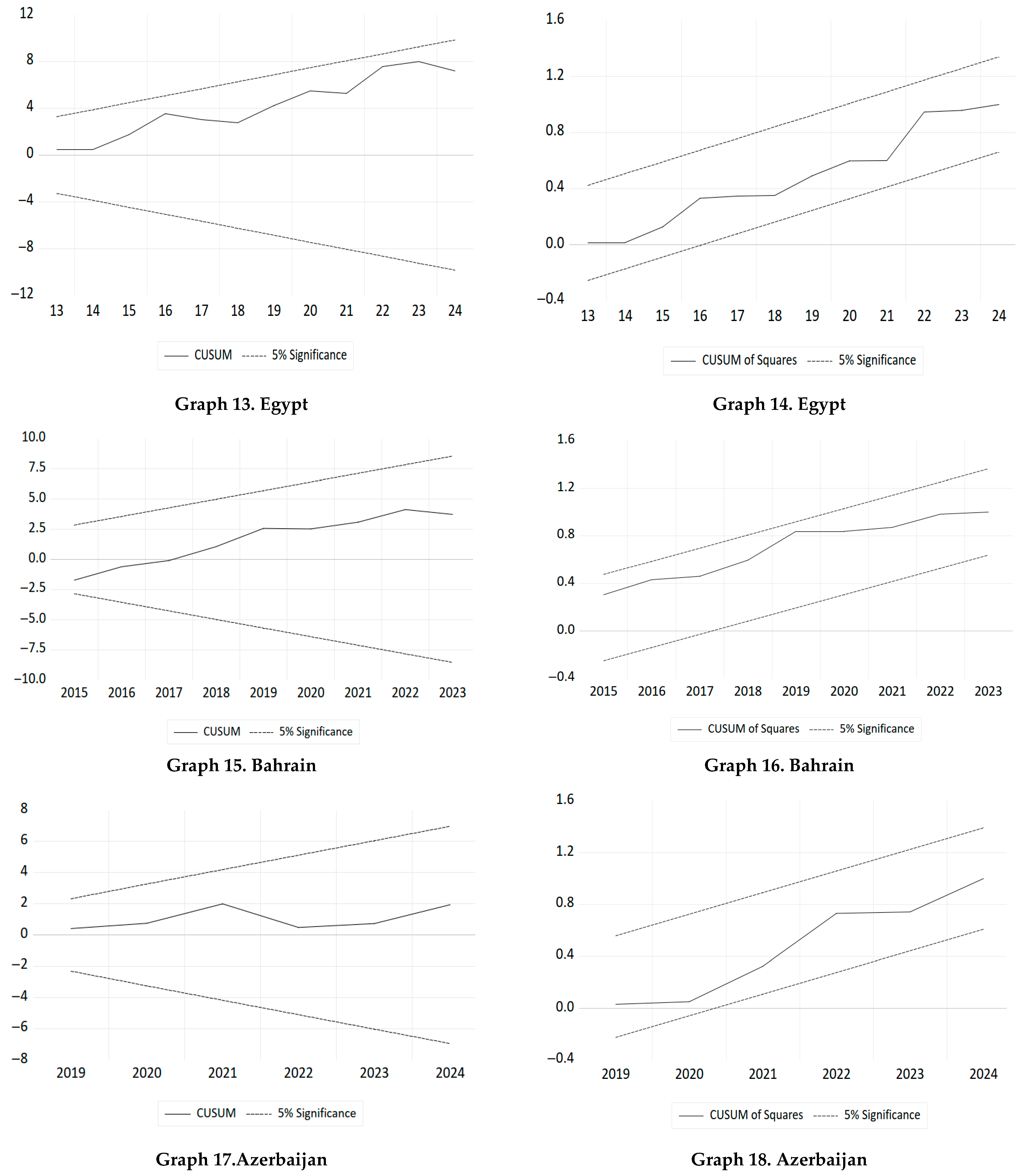
| Stability | CUSUM/CUSUMSQ | 5% Within the bands | Parameter stability. |
| Blok | Indicator | Value/Test | Short Comment |
|---|---|---|---|
| Bounds | F-stat (k = 6) | 7.498 | Cointegration is confirmed. |
| ECM | CointEq(−1) | −0.0438 (p < 0.001) | Slow adjustment. |
| Long-run | LOGGOV_EXP | +1.569 (p = 0.196) | Not significant. |
| Long-run | LOGOILPRICE | −0.199 (p = 0.359) | Not significant. |
| Long-run | POPGROWTH | −2.736 (p ≈ 0.083) | Border (−). |
| Long-run | WGDPGROWTH | +0.028 (p = 0.468) | Not significant. |
| Long-run | DUMMY1/DUMMY2 | −0.851/−1.490 (not significant) | Not significant. |
| Short-run | ΔLOGGOV_EXP; ΔLOGGOV_EXP(−1) | −0.167; −0.226 (p < 0.001) | Negative, significant. |
| Short-run | ΔLOGOILPRICE; ΔLOGOILPRICE(−2) | −0.0175 (p = 0.0047); −0.0134 (p = 0.014) | Negative, significant. |
| Short-run | ΔPOPGROWTH(−1) | +0.1026 (p = 0.0002) | Positive, significant. |
| Short-run | ΔDUMMY2; ΔDUMMY2(−1) | −0.0088; +0.0235 (significant) | Mixed effect. |
| Diagnostics | Normality (JB) | p ≈ 0.545 | Normality is OK. |
| Diagnostics | BG-LM (1/2 lag) | F-p ≈ 0.094/0.171; χ2-p ≈ 0.006/0.009 | χ2 hard → risk. |
| Diagnostics | BPG (heterosked.) | p ≈ 0.175/0.224 | No problem. |
| Diagnostics | RESET (F-p) | ≈0.141 | No functional form problem. |
| Stability | CUSUM/CUSUMSQ | 5% Within the bands | Parameter stability. |
| Blok | Indicator | Value/Test | Short Comment |
|---|---|---|---|
| Bounds | F-stat (k = 5) | 6.422 | Cointegration is confirmed. |
| ECM | CointEq(−1) | −1.200 (p < 0.001) | Very rapid adjustment. |
| Long-run | LOGGOV_EXP | +0.0528 (not significant) | Not significant. |
| Long-run | LOGOILPRICE | +0.0209 (ns) | Not significant. |
| Long-run | POPGROWTH | −0.0120 (p < 0.001) | Negative, significant. |
| Long-run | WGDPGROWTH | +0.0295 (p < 0.001) | Positive, significant. |
| Long-run | DUMMY1 (political) | −0.1639 (p ≈ 0.0017) | Negative, significant. |
| Short-run | ΔLOGGOV_EXP; ΔLOGGOV_EXP(−1); ΔLOGGOV_EXP(−2) | +0.192; +0.291; +0.402 (significant) | Positive, significant. |
| Short-run | ΔLOGOILPRICE; ΔLOGOILPRICE(−1); ΔLOGOILPRICE(−2) | +0.102; +0.043; +0.072 (significant) | Positive, significant |
| Short-run | ΔPOPGROWTH(−1); ΔPOPGROWTH(−2) | +0.0080; +0.0049 (significant) | Positive, significant |
| Short-run | ΔWGDPGROWTH(−1) | −0.0127 (significant) | Negative significant. |
| Short-run | ΔDUMMY1; ΔDUMMY1(−1) | −0.0633; +0.0968 (significant) | Mixed effect. |
| Diagnostics | Normality (JB) | p ≈ 0.000041 | Normality is rejected. |
| Diagnostics | BG-LM (2 lag) | F-p ≈ 0.763; χ2-p ≈ 0.315 | No serial correlation. |
| Diagnostics | BPG (heterosked.) | p ≈ 0.542/0.423 | No problem. |
| Diagnostics | RESET (p) | ≈0.673 | No functional form problem. |
| Stability | CUSUM/CUSUMSQ | 5% Within the bands | Parameter stability. |
| Blok | Indicator | Value/Test | Short Comment |
|---|---|---|---|
| Bounds | F-stat (k = 6) | 32.84 | Strong confirmation of cointegration. |
| ECM | CointEq(−1) | −0.159 (p < 0.001) | ~16%/ year correction. |
| Long-run | LOGGOV_EXP | −6.632 (p ≈ 0.065) | Borderline significance, negative. |
| Long-run | LOGOILPRICE | −0.074 (not significant | Not significant. |
| Long-run | POPGROWTH | −1.675 (p ≈ 0.011) | Negative and significant. |
| Long-run | WGDPGROWTH | +0.225 (ns) | Not significant. |
| Long-run | DUMMY1 (political) | +4.186 (p ≈ 0.018) | Positive and significant. |
| Long-run | DUMMY2 (devalv.) | +0.174 (ns) | Not significant. |
| Short-run | ΔLOGGOV_EXP; ΔLOGGOV_EXP(−1); ΔLOGGOV_EXP(−2) | −0.435; +0.548; +0.265 (significant) | First (−), then (+). |
| Short-run | ΔLOGOILPRICE(−1) | +0.159 (significant) | Positive effect. |
| Short-run | ΔPOPGROWTH; ΔPOPGROWTH(−1) | −0.226; +0.072 (significant) | Mixed effect. |
| Short-run | ΔWGDPGROWTH(−1); ΔWGDPGROWTH(−2) | −0.038; −0.015 (significant) | Negative effect. |
| Short-run | ΔDUMMY1(−1); ΔDUMMY1(−2) | −0.217; −0.239 (significant) | Negative effect. |
| Short-run | ΔDUMMY2; ΔDUMMY2(−1); ΔDUMMY2(−2) | +0.073; +0.064; +0.061 (significant) | Positive effect. |
| Diagnostics | Normality (JB) | p ≈ 0.225 | Normality is not rejected. |
| Diagnostics | BG-LM (2 lag) | F-p ≈ 0.641; χ2-p ≈ 0.110 | No serial correlation. |
| Diagnostics | BPG (heterosked.) | p ≈ 0.836/0.623 | Homoskedastic. |
| Diagnostics | RESET (F-p) | ≈0.513 | No functional form problem. |
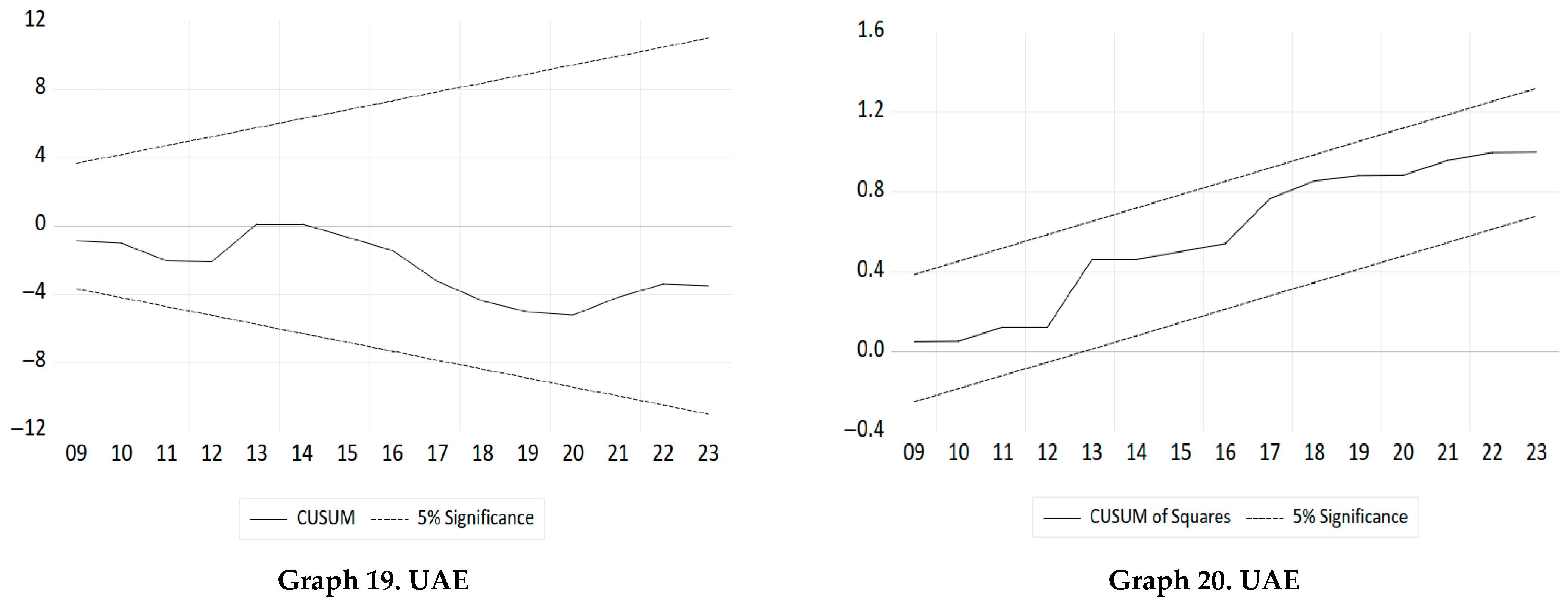
| Stability | CUSUM/CUSUMSQ | 5% Within the bands | Parameter stability. |
| Blok | Indicator | Value/Test | Short Comment |
|---|---|---|---|
| Bounds | F-stat (k = 4) | 6.762 | Cointegration is confirmed. |
| ECM | CointEq(−1) | −0.252 (p < 0.001) | ~25%/ year correction. |
| Long-run | LOGGOV_EXP | −0.552 (p = 0.0038) | Negative, significant. |
| Long-run | LOGOILPRICE | −0.260 (p = 0.0094) | Negative, significant. |
| Long-run | POPGROWTH | −0.0366 (not significant) | Not significant. |
| Long-run | WGDPGROWTH | +0.0957 (ns) | Not significant. |
| Short-run | ΔWGDPGROWTH | +0.0158 (p < 0.001) | Positive and significant. |
| ARDL (level) | LOGGDPPC(−1) | +0.748 (p < 0.001) | High inertia. |
| Diagnostics | Normality (JB) | p ≈ 0.790 | Normality is OK. |
| Diagnostics | BG-LM (2 lag) | F-p ≈ 0.662; χ2-p ≈ 0.509 | No serial correlation. |
| Diagnostics | BPG | p ≈ 0.857/0.791/0.985 | There is no heteroskedasticity. |
| Diagnostics | RESET | p ≈ 0.251 | No functional form problem. |
| Stability | CUSUM/CUSUMSQ | 5% Within the bands | Parameter stability. |


References
- Abuzayed, B., & Al-Fayoumi, N. (2021). Risk spillover from crude oil prices to GCC stock market returns: New evidence during the COVID-19 outbreak. The North American Journal of Economics and Finance, 58, 101476. [Google Scholar] [CrossRef]
- Agboola, E., Chowdhury, R., & Yang, B. (2024). Oil price fluctuations and their impact on oil-exporting emerging economies. Economic Modelling, 132, 106665. [Google Scholar] [CrossRef]
- Aizenman, J., & Pinto, B. (2013). Managing financial integration and capital mobility—Policy lessons from the past two decades. Review of International Economics, 21(4), 636–653. [Google Scholar] [CrossRef]
- Akinsola, M. O., & Odhiambo, N. M. (2020). Asymmetric effect of oil price on economic growth: Panel analysis of low-income oil-importing countries. Energy Reports, 6, 1057–1066. [Google Scholar] [CrossRef]
- Al-Fayoumi, N., Bouri, E., & Abuzayed, B. (2023). Decomposed oil price shocks and GCC stock market sector returns and volatility. Energy Economics, 126, 106930. [Google Scholar] [CrossRef]
- Al Jabri, S., Raghavan, M., & Vespignani, J. (2022). Oil prices and fiscal policy in an oil-exporter country: Empirical evidence from Oman. Energy Economics, 111, 106103. [Google Scholar] [CrossRef]
- Alkathery, M. A., Chaudhuri, K., & Nasir, M. A. (2022). Implications of clean energy, oil and emissions pricing for the GCC energy sector stock. Energy Economics, 112, 106119. [Google Scholar] [CrossRef]
- Alkofahi, K., & Bousrih, J. (2024). The nexus between oil consumption, economic growth, and crude oil prices in Saudi Arabia. Economies, 12, 105. [Google Scholar] [CrossRef]
- Alqahtani, A., & Klein, T. (2021). Oil price changes, uncertainty, and geopolitical risks: On the resilience of GCC countries to global tensions. Energy, 236, 121541. [Google Scholar] [CrossRef]
- Alquist, R., Ellwanger, R., & Jin, J. (2020). The effect of oil price shocks on asset markets: Evidence from oil inventory news. Journal of Futures Markets, 40(8), 1186–1211. [Google Scholar] [CrossRef]
- Alshammary, M. D., Khalid, N., Abdul Karim, Z., & Ahmad, R. (2022). Government expenditures and economic growth in the MENA region: A dynamic heterogeneous panel estimation. International Journal of Finance & Economics, 27(3), 3287–3299. [Google Scholar] [CrossRef]
- Attílio, L. A., & Mollick, A. V. (2026). Oil price shocks and interest rates in major economies. International Economics and Economic Policy, 23, 14. [Google Scholar] [CrossRef]
- Balcilar, M., Gabauer, D., & Umar, Z. (2021). Crude oil futures contracts and commodity markets: New evidence from a TVP-VAR extended joint connectedness approach. Resources Policy, 73, 102219. [Google Scholar] [CrossRef]
- Bayramov, S. V., Mehdiyeva, G. Y., Eyvazov, A. A., & Mustafayev, E. R. (2021). Diversification rate of energy balance and energy export demand risk impacts on economic growth: The Case of Azerbaijan. Cuestiones Políticas, 39(68), 290–314. [Google Scholar] [CrossRef]
- Belloumi, M., Aljazea, A., & Alshehry, A. (2023). Study of the impact of crude oil prices on economic output and inflation in Saudi Arabia. Resources Policy, 86, 104179. [Google Scholar] [CrossRef]
- Belloumi, M., & Almashyakhi, A. A. (2025). Impact of natural resource rents and governance on economic growth in major MENA oil-producing countries. Energies, 18, 2066. [Google Scholar] [CrossRef]
- Bensafta, K. M. (2023). The impact of oil price shocks on economic growth in Algeria. Economics and Policy of Energy and the Environment, 2022(2), 63–82. [Google Scholar] [CrossRef]
- Bentour, E. M. (2023). On the government consumption multipliers evolvement over time: An SVAR analysis. Applied Economics Letters, 30(12), 1612–1617. [Google Scholar] [CrossRef]
- Bentour, E. M. (2025). Assessing government expenditures multipliers under oil price swings. Journal of Commodity Markets, 38, 100477. [Google Scholar] [CrossRef]
- Bigerna, S. (2023). Energy price shocks, exchange rates and inflation nexus. Energy Economics, 128, 107156. [Google Scholar] [CrossRef]
- Castro, C., & Jiménez-Rodríguez, R. (2024). The impact of oil shocks on the stock market. Global Finance Journal, 60, 100967. [Google Scholar] [CrossRef]
- Cherif, R., & Hasanov, F. (2013). Oil exporters’ dilemma: How much to save and how much to invest. World Development, 52, 120–131. [Google Scholar] [CrossRef]
- Coutinho, L., Georgiou, D., Heracleous, M., Michaelides, A., & Tsani, S. (2022). Limiting fiscal procyclicality: Evidence from resource-dependent countries. Economic Modelling, 106, 105700. [Google Scholar] [CrossRef]
- Dąbrowski, M. A., Papież, M., Rubaszek, M., & Śmiech, S. (2022). The role of economic development for the effect of oil market shocks on oil-exporting countries: Evidence from the interacted panel VAR model. Energy Economics, 110, 106017. [Google Scholar] [CrossRef]
- Ding, S., Zheng, D., Cui, T., & Du, M. (2023). The oil price–inflation nexus: The exchange rate pass-through effect. Energy Economics, 125, 106828. [Google Scholar] [CrossRef]
- El Anshasy, A. A., & Bradley, M. D. (2012). Oil prices and the fiscal policy response in oil-exporting countries. Journal of Policy Modeling, 34(5), 605–620. [Google Scholar] [CrossRef]
- Fueki, T., Nakajima, J., Ohyama, S., & Tamanyu, Y. (2020). Identifying oil price shocks and their consequences: The role of expectations in the crude oil market. International Finance, 23(3), 373–401. [Google Scholar] [CrossRef]
- Gong, X., Liu, Y., & Wang, X. (2021). Dynamic volatility spillovers across oil and natural gas futures markets based on a time-varying spillover method. International Review of Financial Analysis, 76, 101790. [Google Scholar] [CrossRef]
- Gulaliyev, M., Aga, A., Azizov, A., Kazimov, F., & Mir-Babayev, R. (2018). Assessing the degree of inequality in the distribution of national income and its macroeconomic consequences in Azerbaijan. Revista Amazonia Investiga, 7(17), 85–108. [Google Scholar]
- Gulaliyev, M., Ashurbayli-Huseynova, N. P., Gubadova, A. A., Ahmedov, B. N., Mammadova, G. M., & Jafarova, R. T. (2019). Stability of the banking sector: Deriving stability indicators and stress-testing. Polish Journal of Management Studies, 19(2), 182–195. [Google Scholar] [CrossRef]
- Gulaliyev, M., Musayeva, J., Musayeva, F., Jabbarova, A., & Hatamov, F. (2024). Effects of oil price shock on the exchange rate of national currencies in oil-rich countries: In the case of some Arab countries and Azerbaijan. WSEAS Transactions on Business and Economics, 21, 44–58. [Google Scholar] [CrossRef]
- Gülaliyev, M. G., Nuraliyeva, R. N., Huseynova, R. A., Hatamov, F. E., Yegana, A., & Abdullayev, E. S. (2022). Assessing the impact of the oil price shocks on economic growth in oil-exporting Arab countries. WSEAS Transactions on Business and Economics, 19, 462–473. [Google Scholar] [CrossRef]
- Hailemariam, A., Smyth, R., & Zhang, X. (2019). Oil prices and economic policy uncertainty: Evidence from a nonparametric panel data model. Energy Economics, 83, 40–51. [Google Scholar] [CrossRef]
- Hobdari, N. (2004). Country experiences with managing natural resource windfalls. In J. Wakeman-Linn, C. Aturupane, S. Danninger, K. Gvenetadze, N. Hobdari, & E. Le Borgne (Eds.), Managing oil wealth: The case of Azerbaijan. International Monetary Fund. Available online: https://www.imf.org/external/pubs/nft/2004/aze/oil/ (accessed on 1 November 2025).
- Javed, S. A., Furqan, M., & Bajwa, I. A. (2020). An ARDL investigation on the nexus of oil factors and economic growth: A timeseries evidence from Sultanate of Oman. Cogent Economics & Finance, 8(1), 1838418. [Google Scholar] [CrossRef]
- Jiménez-Rodríguez, R. (2022). Oil shocks and global economy. Energy Economics, 115, 106373. [Google Scholar] [CrossRef]
- Kilian, L. (2022). Understanding the estimation of oil demand and oil supply elasticities. Energy Economics, 107, 105844. [Google Scholar] [CrossRef]
- Krishkumar, S., & Naseem, N. A. M. (2022). Investigating the asymmetric effect of oil price on the economic growth in Malaysia: An augmented NARDL approach. SAGE Open, 12(2), 21582440221079936. [Google Scholar] [CrossRef]
- Lee, C.-C., Lee, C.-C., & Li, Y.-Y. (2021). Oil price shocks, geopolitical risks, and green bond market dynamics. The North American Journal of Economics and Finance, 55, 101309. [Google Scholar] [CrossRef]
- Lin, B., & Bai, R. (2021). Oil prices and economic policy uncertainty: Evidence from global, oil importers, and exporters’ perspective. Research in International Business and Finance, 56, 101357. [Google Scholar] [CrossRef]
- Liu, F., Umair, M., & Gao, J. (2023). Assessing oil price volatility co-movement with stock market volatility through quantile regression approach. Resources Policy, 81, 103375. [Google Scholar] [CrossRef]
- Mohammed, J. I., Karimu, A., Fiador, V. O., & Abor, J. Y. (2020). Oil revenues and economic growth in oil-producing countries: The role of domestic financial markets. Resources Policy, 69, 101832. [Google Scholar] [CrossRef]
- Moshiri, S. (2015). Asymmetric effects of oil price shocks in oil-exporting countries: The role of institutions. OPEC Energy Review, 39(2), 222–246. [Google Scholar] [CrossRef]
- Mukhtarov, S., Humbatova, S., Mammadli, M., & Hajiyev, N. G. (2021). The impact of oil price shocks on national income: Evidence from Azerbaijan. Energies, 14(6), 1695. [Google Scholar] [CrossRef]
- Poku, K., Opoku, E., & Ennin, P. A. (2022). The influence of government expenditure on economic growth in Ghana: An ARDL approach. Cogent Economics & Finance, 10(1), 2160036. [Google Scholar] [CrossRef]
- Sadraoui, T., & Mili, H. (2025). Dynamic interactions between oil price volatility and fiscal policy: Empirical evidence from GCC countries. Economies, 13, 334. [Google Scholar] [CrossRef]
- U.S. Energy Information Administration. (2025). Spot prices for crude oil and petroleum products [Data set]. Available online: https://www.eia.gov/dnav/pet/pet_pri_spt_s1_d.htm (accessed on 2 November 2025).
- World Bank. (2025). World development indicators [Data set]. Available online: https://databank.worldbank.org/source/world-development-indicators (accessed on 5 November 2025).
- Yildirim, Z., & Arifli, A. (2021). Oil price shocks, exchange rate and macroeconomic fluctuations in a small oil-exporting economy. Energy, 219(C), 119527. [Google Scholar] [CrossRef]
- Zhang, X., & Baek, J. (2022). The role of oil price shocks on exchange rates for the selected Asian countries: Asymmetric evidence from nonlinear ARDL and generalized IRFs approaches. Energy Economics, 112, 106178. [Google Scholar] [CrossRef]
- Zulfigarov, F., & Neuenkirch, M. (2020). The impact of oil price changes on selected macroeconomic indicators in Azerbaijan. Economic Systems, 44(4), 100814. [Google Scholar] [CrossRef] [PubMed]
| Bounds F | CointEq(−1) (φ) | Long-Run | JB p | BG-LM | BPG (p) | RESET (p) | CUSUM/ CUSUMSQ | ||||
|---|---|---|---|---|---|---|---|---|---|---|---|
| logoilprice | loggov_exp | popgrowth | wgdpgrowth | ||||||||
| Saudi Arabia | 10.882 (k = 4) | −0.158 (p < 0.001) | +0.112 (p ≈ 0.108) | −0.142 (p ≈ 0.538) | −0.050 (p = 0.006) | −0.041 (p ≈ 0.186) | 0.764 | 0.404/0.542 | ≈0.156 | 0.439 | + |
| Qatar | 21.95 (k = 5) | −0.895 (p < 0.001) | +0.269 (p < 0.001) | −0.166 (p = 0.014) | −0.0136 (p < 0.001) | +0.060 (p < 0.001) | 0.112 | p < 0.001/p ≈ 0.0004 | p ≈ 0.77/0.59 | 0.765 | + |
| Oman | 5.413 (k = 4) | −0.439 (p < 0.001) | −0.0835 (p = 0.0115) | −0.6773 (p = 0.0004) | +0.0089 (p ≈ 0.054) | −0.0077 (p = 0.524) | 0.993 | 0.205/0.188 (F-p) | 0.976/0.926 | 0.130 | + |
| Libya | 9.954 (k = 6) | −0.629 (p < 0.001) | −0.102 (p = 0.447) | −0.608 (p = 0.215) | +0.430 (p = 0.0049) | +0.222 (p ≈ 0.089) | 0.0286 | 0.3515/0.0375 (F-p) | 0.958/0.741 | ≈0.001 | + |
| Kuwait | 1.633 (k = 5) | −0.1856 (p ≈ 0.001) | −0.326 (p ≈ 0.012) | −1.437 (p < 0.001) | −0.0879 (p ≈ 0.1817) | 0.0280 (p ≈ 0.4021) | 0.250 | 0.295/0.147 (F-p) | p ≈ 0.83/0.76 | ≈0.457 | + |
| Iraq | 7.068 (k = 6) | −0.7927 (p < 0.001) | −0.003 (p ≈ 0.96) | +0.469 (p < 0.001) | −0.0138 (ns) | +0.078 (p ≈ 0.058) | 0.128 | 0.802/0.584 (F-p) | p ≈ 0.98/0.94 | ≈0.694 | + |
| Egypt | 7.498 (k = 6) | −0.0438 (p < 0.001) | −0.199 (p = 0.359) | +1.569 (p = 0.196) | −2.736 (p ≈ 0.083) | +0.028 (p = 0.468) | p ≈ 0.545 | F-p ≈ 0.094/0.171 | p ≈ 0.175/0.224 | ≈0.141 | + |
| Bahrain | 6.422 (k = 5) | −1.200 (p < 0.001) | +0.0209 (ns) | +0.0528 (ns) | −0.0120 (p < 0.001) | +0.0295 (p < 0.001) | p ≈ 0.000 | F-p ≈ 0.763; χ2-p ≈ 0.315 | p ≈ 0.542/0.423 | ≈0.673 | + |
| Azerbaijan | 32.84 (k = 6) | −0.159 (p < 0.001) | −0.074 (ns) | −6.632 (p ≈ 0.065) | −1.675 (p ≈ 0.011) | +0.225 (ns) | p ≈ 0.225 | F-p ≈ 0.641; χ2-p ≈ 0.110 | p ≈ 0.836/0.623 | ≈0.513 | + |
| UAE | 6.762 (k = 4) | −0.252 (p < 0.001) | −0.260 (p = 0.0094) | −0.552 (p = 0.0038) | −0.0366 (ns) | +0.0957 (ns) | p ≈ 0.790 | F-p ≈ 0.662; χ2-p ≈ 0.509 | p ≈ 0.857/0.791/0.985 | p ≈ 0.251 | + |
| Country | Bounds F | CointEq(−1) (φ) | logoilprice | loggov_exp | popgrowth | wgdpgrowth |
|---|---|---|---|---|---|---|
| Saudi Arabia | 10.882 (4) | −0.158 *** | +0.112 | −0.142 | −0.050 *** | −0.041 |
| Qatar | 21.95 (5) | −0.895 *** | +0.269 *** | −0.166 ** | −0.0136 *** | +0.060 *** |
| Oman | 5.413 (4) | −0.439 *** | −0.0835 ** | −0.6773 *** | +0.0089 * | −0.0077 |
| Libya | 9.954 (6) | −0.629 *** | −0.102 | −0.608 | +0.430 *** | +0.222 * |
| Kuwait | 1.633 (5) | −0.1856 *** | −0.326 ** | −1.437 *** | −0.0879 | 0.0280 |
| İraq | 7.068 (6) | −0.7927 *** | −0.003 | +0.469 *** | −0.0138 | +0.078 * |
| Egypt | 7.498 (6) | −0.0438 *** | −0.199 | +1.569 | −2.736 * | +0.028 |
| Bahrain | 6.422 (5) | −1.200 *** | +0.0209 | +0.0528 | −0.0120 *** | +0.0295 *** |
| Azerbaijan | 32.84 (6) | −0.159 *** | −0.074 | −6.632 * | −1.675 ** | +0.225 |
| UAE | 6.762 (4) | −0.252 *** | −0.260 *** | −0.552 *** | −0.0366 | +0.0957 |
Disclaimer/Publisher’s Note: The statements, opinions and data contained in all publications are solely those of the individual author(s) and contributor(s) and not of MDPI and/or the editor(s). MDPI and/or the editor(s) disclaim responsibility for any injury to people or property resulting from any ideas, methods, instructions or products referred to in the content. |
© 2026 by the authors. Licensee MDPI, Basel, Switzerland. This article is an open access article distributed under the terms and conditions of the Creative Commons Attribution (CC BY) license.
Share and Cite
Gulaliyev, M.; Aliyev, S.; Alesgerova, A.; Muradova, S.; Kerimov, J. Why Oil Windfalls Do Not Equal Welfare: Regime-Dependent Long-Run Elasticities in MENA and Azerbaijan. Economies 2026, 14, 77. https://doi.org/10.3390/economies14030077
Gulaliyev M, Aliyev S, Alesgerova A, Muradova S, Kerimov J. Why Oil Windfalls Do Not Equal Welfare: Regime-Dependent Long-Run Elasticities in MENA and Azerbaijan. Economies. 2026; 14(3):77. https://doi.org/10.3390/economies14030077
Chicago/Turabian StyleGulaliyev, Mayis, Shafa Aliyev, Aygun Alesgerova, Sabina Muradova, and Jabir Kerimov. 2026. "Why Oil Windfalls Do Not Equal Welfare: Regime-Dependent Long-Run Elasticities in MENA and Azerbaijan" Economies 14, no. 3: 77. https://doi.org/10.3390/economies14030077
APA StyleGulaliyev, M., Aliyev, S., Alesgerova, A., Muradova, S., & Kerimov, J. (2026). Why Oil Windfalls Do Not Equal Welfare: Regime-Dependent Long-Run Elasticities in MENA and Azerbaijan. Economies, 14(3), 77. https://doi.org/10.3390/economies14030077