Article

Portable Holonomic Educational Robot Platform for Home Laboratory—Study Case: AI-Based Electromyography Control


by
Erick Alexander Noboa
1,2,3,4,*,
Lourdes Ruiz
5,
György Eigner
1,2,4,6,* and
Péter Galambos
4
1
Biomatics and Applied Artificial Intelligence Institute, John von Neumann Faculty of Informatics, Obuda University, 1034 Budapest, Hungary
2
Physiological Controls Research Center, University Research and Innovation Center, Obuda University, 1034 Budapest, Hungary
3
Applied Informatics and Applied Mathematics Doctoral School, Obuda University, 1034 Budapest, Hungary
4
EKIK Research and Investigation Center, Obuda University, 1034 Budapest, Hungary
5
Banki Donat Faculty of Mechanical and Safety Engineering, Obuda University, 1081 Budapest, Hungary
6
Institute of Instrumentation and Automation, Kandó Kálmán Faculty of Electrical Engineering, Obuda University, 1034 Budapest, Hungary
*
Authors to whom correspondence should be addressed.
Technologies 2026, 14(5), 308; https://doi.org/10.3390/technologies14050308
Submission received: 10 April 2026 / Revised: 6 May 2026 / Accepted: 16 May 2026 / Published: 20 May 2026

Abstract

The post-pandemic evolution of education involving mechatronics and machine learning has shifted the demand for robotic hardware from centralized laboratories to accessible laboratories in home environments. This paper presents a portable three-wheeled holonomic robotic platform designed for remote research and home office experimentation. The proposed system utilizes a modular design and low-cost philosophy comprising a custom embedded control system driven by an ESP32-WROOM microcontroller, which manages a closed-loop PID velocity controller using Hall effect feedback from three DC micromotors. In contrast, external nodes allow the reception, conditioning, and classification of 8-channel surface electromyography (sEMG) data sampled at 500 Hz. To address the non-stationarity and stochastic noise in raw sEMG signals, this study implements a hybrid Deep Learning (DL) architecture that complements 2D Convolutional Neural Networks (CNN) for spatial feature extraction with Long Short-Term Memory (LSTM) networks for temporal context awareness. This model decodes the neuromuscular intent of the user into real-time holonomic velocity vectors, achieving validation accuracies of 80.51% for horizontal movement, 84.86% for vertical translation, and 99.56% for the Fist/no-Fist state. By synthesizing advanced AI-based teleoperation with a portable design, this study establishes a scalable framework for the next generation of “laboratory-at-home” educational tools and research regardless of physical location.

1. Introduction

Historically, the pedagogical landscape of robotics and mechatronics has been anchored to the physical confines of university laboratories [1,2]. Traditionally, the study of complex kinematic systems was restricted to centralized environments in which students had access to expansive, high-cost equipment [3,4]. However, the global shift toward remote learning and home-office research paradigms [2,5] has generated a fundamental reconsideration of robotic hardware accessibility [5,6].
Although simulators offer a partial solution [7], the physical embodiment of a robot remains irreplaceable for understanding real-world phenomena, such as sensor noise, friction, and dynamic instabilities [7,8]. Consequently, there is a growing demand for portable, low-cost robotic platforms that can bridge the gap between theoretical modeling and physical experimentation outside the laboratory [9,10].
A review of contemporary educational robotics reveals a market dominated by differential drive platforms [11]. Widely adopted systems, such as the TurtleBot series [12], e-puck [13], and Thymio [14], have set a significant standard for teaching navigation and programming [15]. These robots typically utilize two independently driven wheels and one or more passive casters or free wheels [16].
From a kinematic perspective, these platforms are non-holonomic, which means that their instantaneous velocity is constrained [17,18,19]; they cannot move in a direction perpendicular to their drive wheels without undergoing rotation. Although these systems are excellent for introductory courses, their motion is limited to two degrees of freedom (DoF) in the plane: linear translation and angular rotation [20].
The limitations of differential mobile robots simplify the mathematical analysis but limit the maneuverability of the platform in human-centric environments, where lateral movement is often required [20]. The decision to transition from a traditional differential configuration to an omnidirectional (i.e., holonomic) platform in this study was driven by the pedagogical and functional requirements.
Unlike their differential counterparts, omnidirectional robots often employ three or more omni-wheels [21,22], enabling three degrees of freedom, as they can simultaneously translate along the X and Y directions and rotate around the Z axis.
This addition increases the complexity of the kinematic analysis because the coupling matrix must account for the specific geometry and slip-free conditions of each wheel [23]. For higher education students, this provides a more rigorous challenge in vector calculus and control theory, moving beyond the simpler unicycle model to more sophisticated holonomic state-space representations.
The proposed approach is driven by the principles of low cost and component availability to encourage students to practice hands-on without the fear of breaking any replaceable components. In contrast, high-performance omnidirectional platforms, such as the TIAGo OMNI Base or NAO humanoid [24], are expensive for individual student ownership or large-scale classroom deployment. To democratize access to these advanced kinematics, this proposal focuses on a modular and replaceable approach [25]. By utilizing widely available modules such as the ESP32-WROOM microcontroller, L298D current drivers, and low-cost DC micro-motors with integrated Hall effect sensors [26], the platform becomes reproducible in a home environment, as the structural components are designed for additive manufacturing, i.e., 3D printing ensures that the chassis can be repaired or modified according to students’ needs while maintaining a modular design.
On the other hand, the integration of surface electromyography (sEMG) for teleoperation introduces an intuitive human–machine interface (HMI) to the platform [27,28]. Traditional control via joysticks or keyboards can be confusing for users with little experience, whereas using an EMG armband to control a mobile platform not only provides a more intuitive control method but also allows the user’s hand to be free and available for other purposes [29,30].
Furthermore, previous studies have relied heavily on classical machine learning techniques such as support vector machines (SVMs) [31,32] and linear discriminant analysis (LDA) [33]. While these models are computationally efficient and have achieved accuracies of up to 97.54 ± 1.03 % in controlled settings, as obtained by Fu et al. in their proposal [33] they are heavily dependent on manual feature extraction in the time and frequency domains (e.g., mean absolute value and zero crossings) [26].
Notably, comparative studies have demonstrated that these models often struggle with the non-stationary and stochastic nature of EMG signals over long durations [34], and attention mechanisms in DL methodologies have improved signal classification [35].
Considering previous results addressing the behavior of different artificial intelligence (AI) models in the task of EMG signal classification, this study proposes the implementation of a hybrid CNN-LSTM architecture. Unlike traditional classifiers, this model serves as a feature extractor and temporal predictor, where the 2D-Convolution layers identify spatial synergies across the 8-channel sEMG array, whereas the LSTM layers capture the temporal evolution of muscle activity.
Using a hybrid CNN-LSTM model to decode neuromuscular signals from an EMG armband, the operator can command the robot using intuitive gestures of the wrist and hand. This setup requires a robust data pipeline, where raw (unprocessed) signals are received by an external computational node, pre-processed to attenuate the noise, eliminate any vertical shift of the DC offset, and classified into a set of predefined hand movements or features before being transmitted to the robot via MQTT. This is a critical consideration since sensor measurements are affected by Gaussian noise [36]. This hybrid architecture provides additional reliability, Deep Learning models used for signal processing are robust to noise and variations in data, which are pertinent for diverse environmental conditions, and hybrid models do not overfit when dealing with noisy datasets [37].
This distributed architecture, which separates high-level AI inference from low-level PID control, allows for a reproducible design that remains accessible regardless of geographical or financial constraints. The modular approach allows students to work on the components required for their projects instead of dealing with the complete system before they can start working, significantly reducing the time required for testing and correction.
The main contribution of this study is the specific combination of innovative elements in a single system, such as a three-wheeled holonomic platform along 8 channel sEMG decoded via a 2D CNN-LSTM hybrid framed laboratory at-home educational tool, which addresses the necessity of post-pandemic remote educational devices. However, terms such as cyber-security [38] and robust communication, e.g., LoRa [39], are still a matter of study in the presented proposal. On the other hand, previous studies have approached the sEMG-based platform maneuver, as Nemes et al. established that in such applications the combination of 1D-Convolution Neural Networks (RNN) with an LSTM layer provides the best performance [40]. This study goes beyond that point by proposing a more robust model, where 2D-convolution layers take the eight-channel signal to be treated as an image (with height and width), inducing cross-talking between channels.

2. Materials and Methods

2.1. Holonomic Portable Mobile Platform

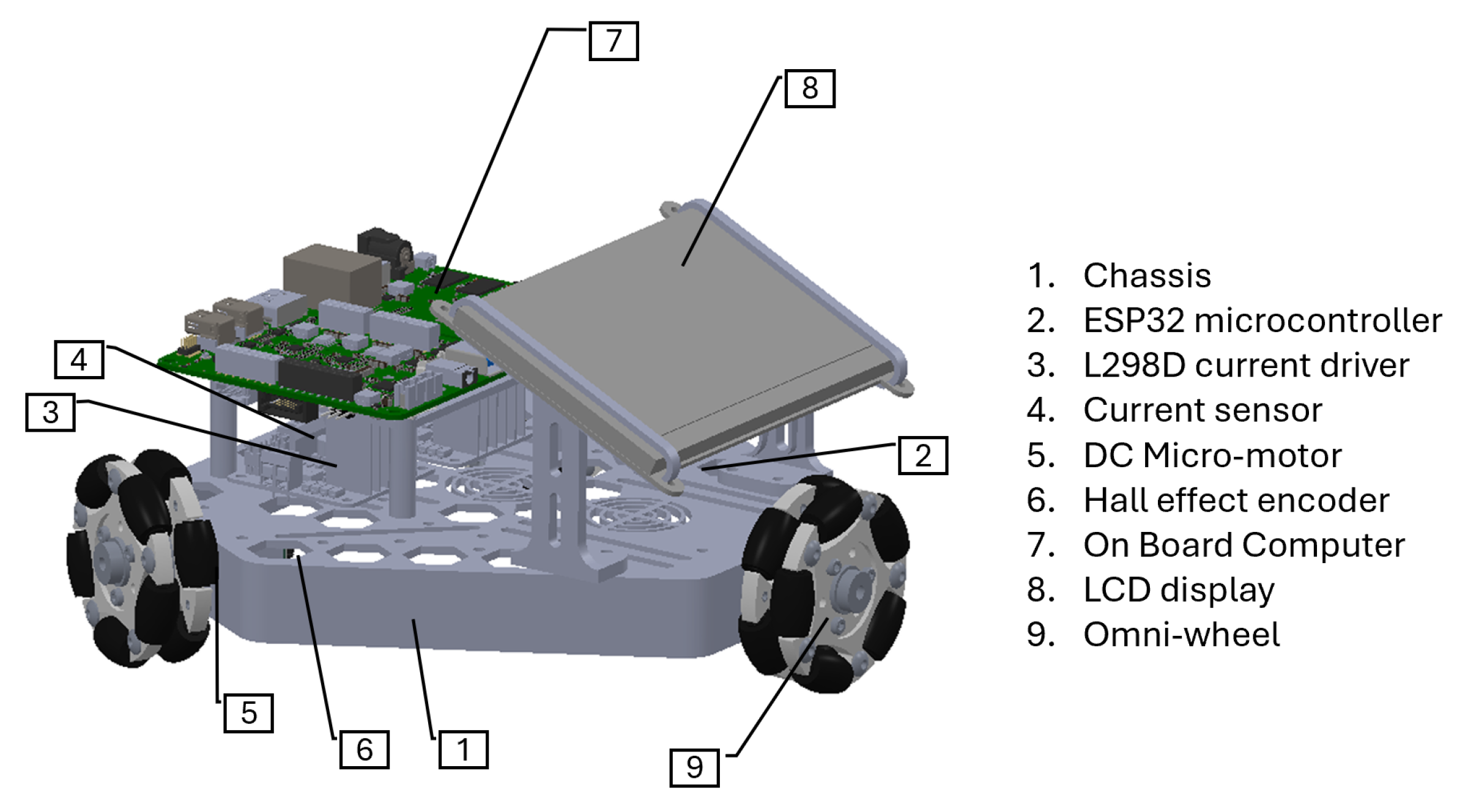
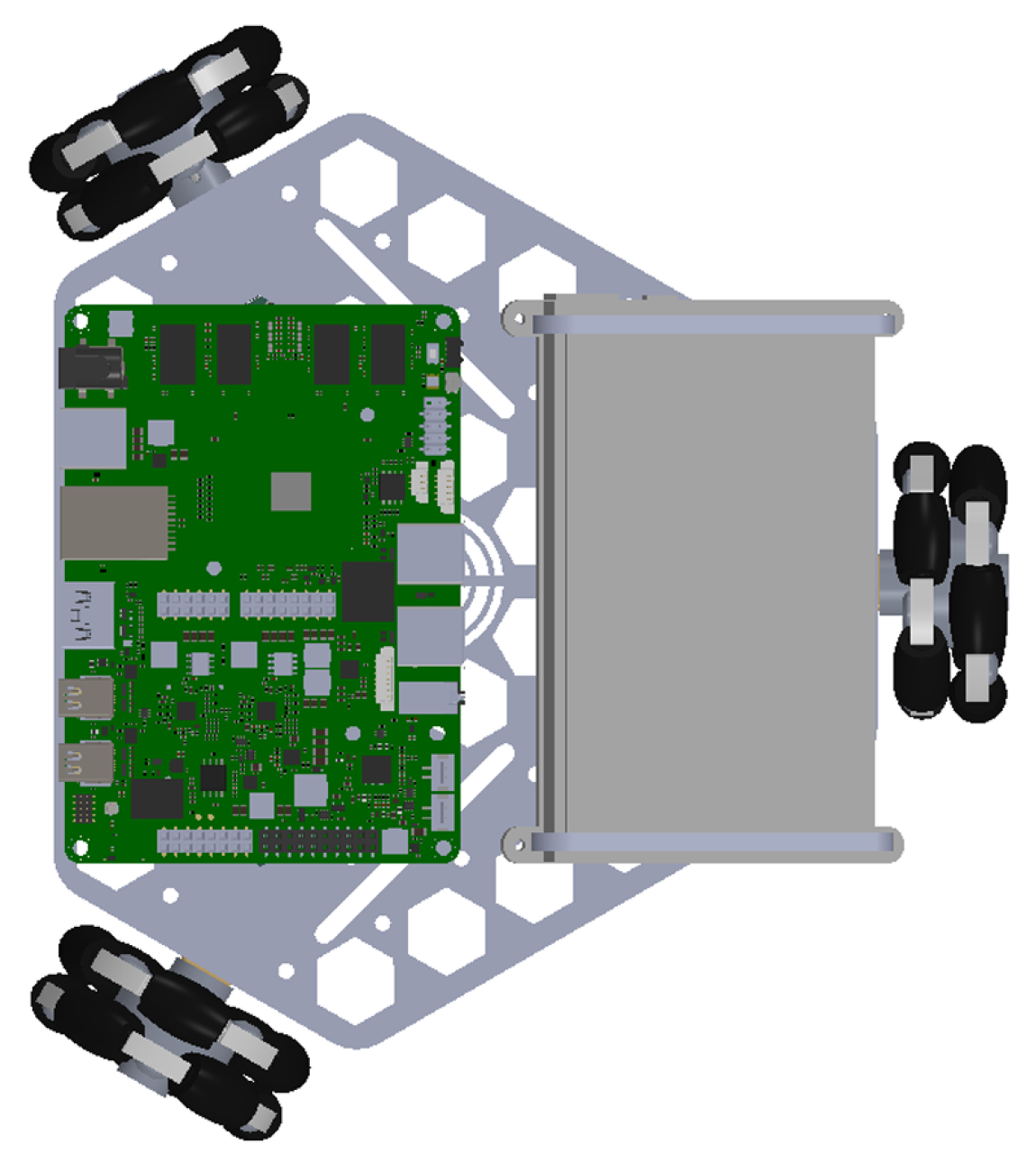
Considering that the purpose of the proposed developments is to offer students a light and practical mobile robot platform for real-life tests on a home office policy, the physical construction of the platform represents a compromise between the structural integrity and accessibility of its constituent parts. Figure 1 shows a CAD representation of the proposed platform and the main elements that constitute the presented iteration.

2.1.1. Involved Hardware

The chassis, labeled “1” in Figure 1, serves as the foundation of this system and is constructed from lightweight materials. PLA was used with the Fused Deposition Modeling (FDM) method for 3D structure prototyping. This design utilizes a hexagonal lattice configuration, which provides a rigid mounting surface for the three DC micro-motors (labeled “5” in Figure 1) while maintaining a low overall weight. Each motor was positioned at a 120° offset relative to the geometric center, as shown in Figure 2. This is a configuration that allows the platform to navigate its environment with a degree of fluidity and is capable of instantaneous translation in any direction without the need to pivot.
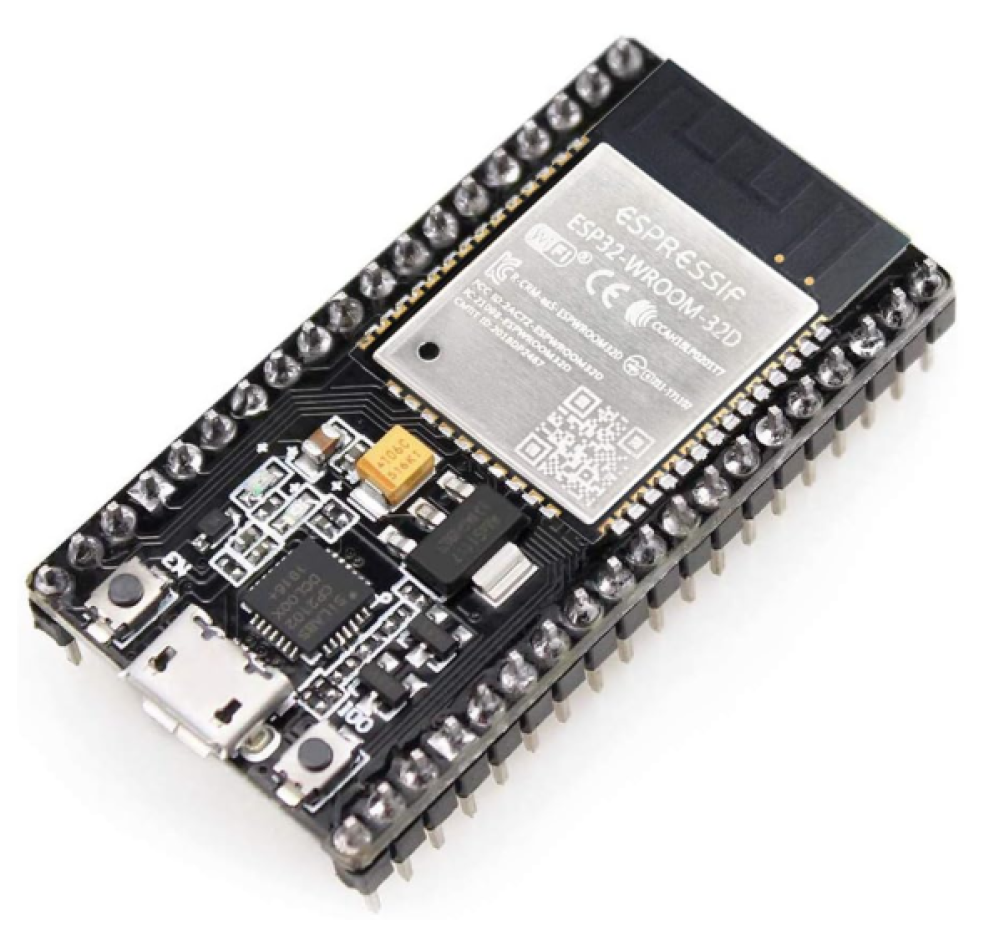
The low-level actuation and control logic were centralized within a custom-designed motor driver. At its core, an ESP32-WROOM microcontroller (located at “2” in Figure 1) manages the real-time velocity control of each wheel on the platform. This chip was selected for its dual-core architecture and integrated wireless capabilities, which are essential for maintaining the modular philosophy and portability of the proposed system. The selected board is shown in Figure 3.
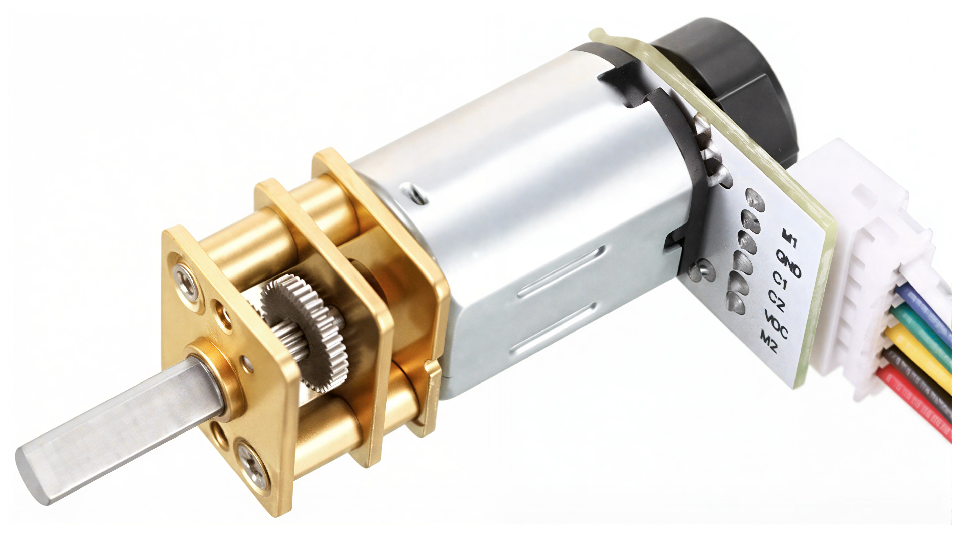
To drive the micromotors, this proposal implements L298D current drivers (marked as “3” in Figure 1). Their robustness and global availability make them ideal educational tools, where the ability to repair and understand the circuit is crucial. The velocity control loop is closed using feedback from a Hall effect encoder integrated into the motor shafts (located at “6” in Figure 1), as can be noticed in the following Figure 4, which provide rotational frequency to be processed by a discrete PID (Proportional–Integral–Derivative) controller running on the ESP32, reacting to incoming requests, ensuring that the onmi-wheels, marked “9” in Figure 1, maintain the target velocities despite the unpredictable friction of domestic floor surfaces.
The MQTT broker in charge of information trade between all the modules included in the platform is executed in a Single Board Computer (SBC), labeled as “7” in Figure 1, running Ubuntu 22.04, where a 7 in screen is connected (see “8” in Figure 1).
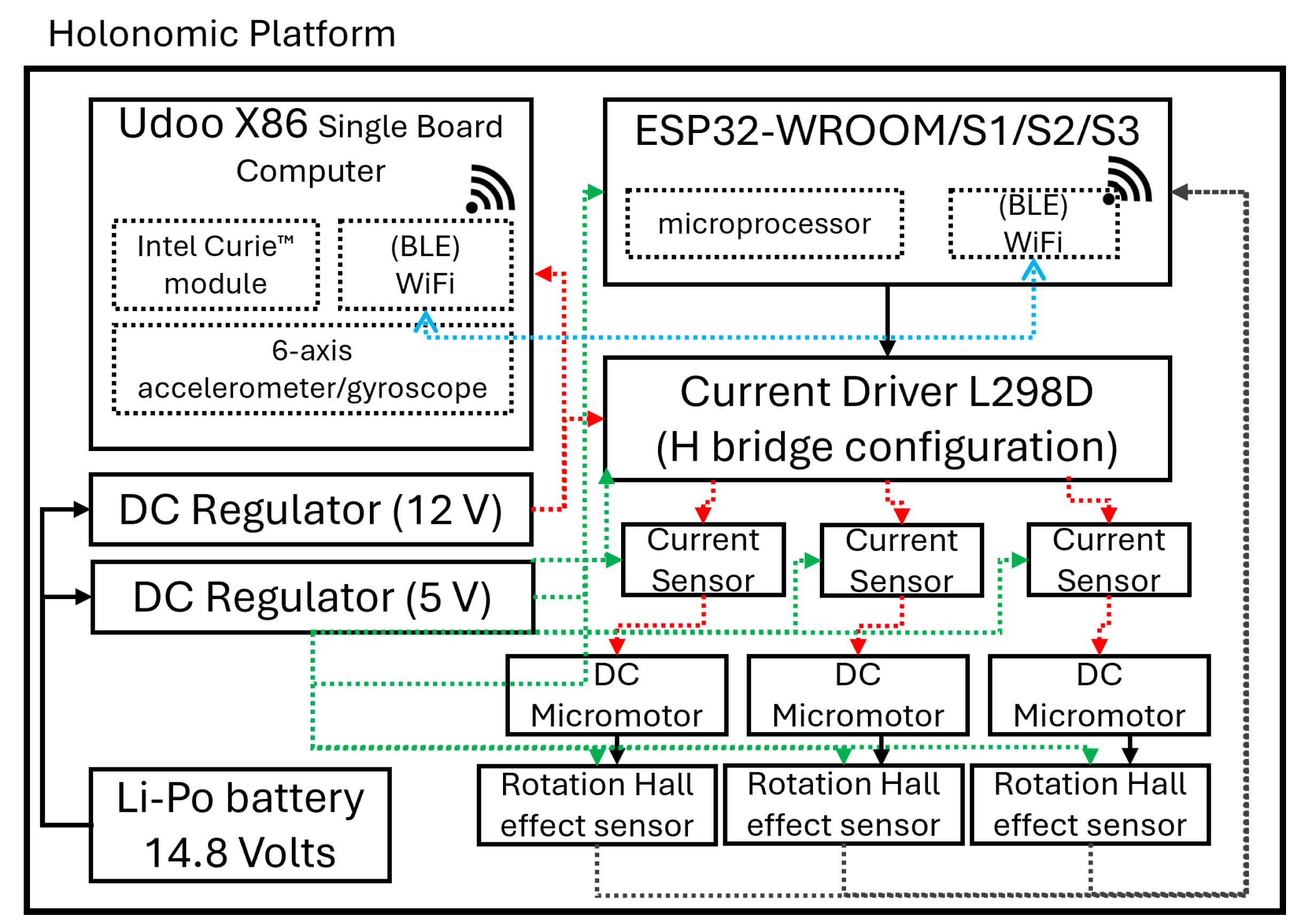
A diagram displaying the electronic connections between the elements of the proposed platform is presented in Figure 5, where the power distributions are represented by red and green dashed lines for the hardware requiring 12 V and 5 V, respectively. On the other hand, the dashed light blue line establishes the connection of the devices via WLAN, communicating through the MQTT broker.
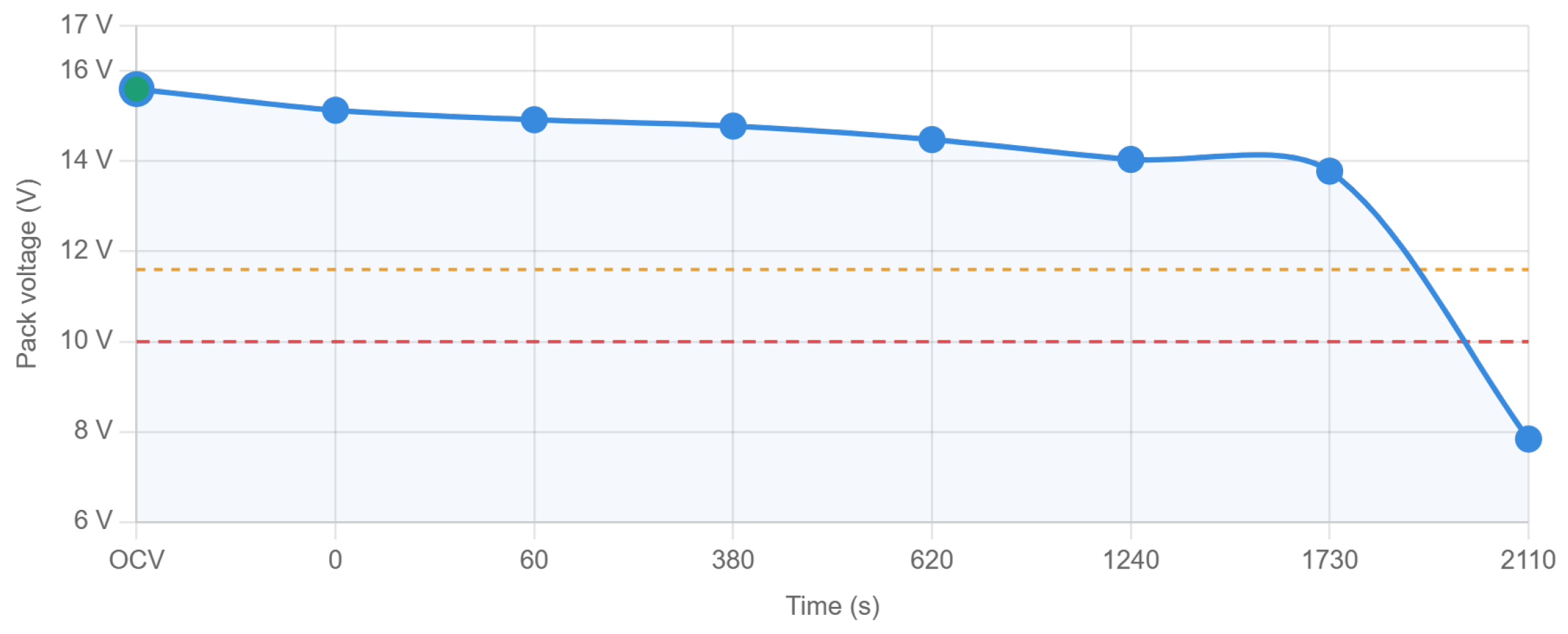
A battery discharge test was conducted to estimate the working time of the platform while running the motors constantly with a velocity of 30 cm/s when holding all the required equipment. The obtained discharge curve can be seen in Figure 6 as follows, where the blue line represents the voltage measured directly on the battery pack, starting with a pre-load of 15.6 V at T = 0 s and finishing the test after 42 min when the drastic discharge induced the OBC to stop working. On the other hand, the yellow dashed line shows when it is recommended to stop operation and recharge ( 11.6 V), suggesting an approximated working time of 30 min.

2.1.2. Holonomic Platform Kinematics

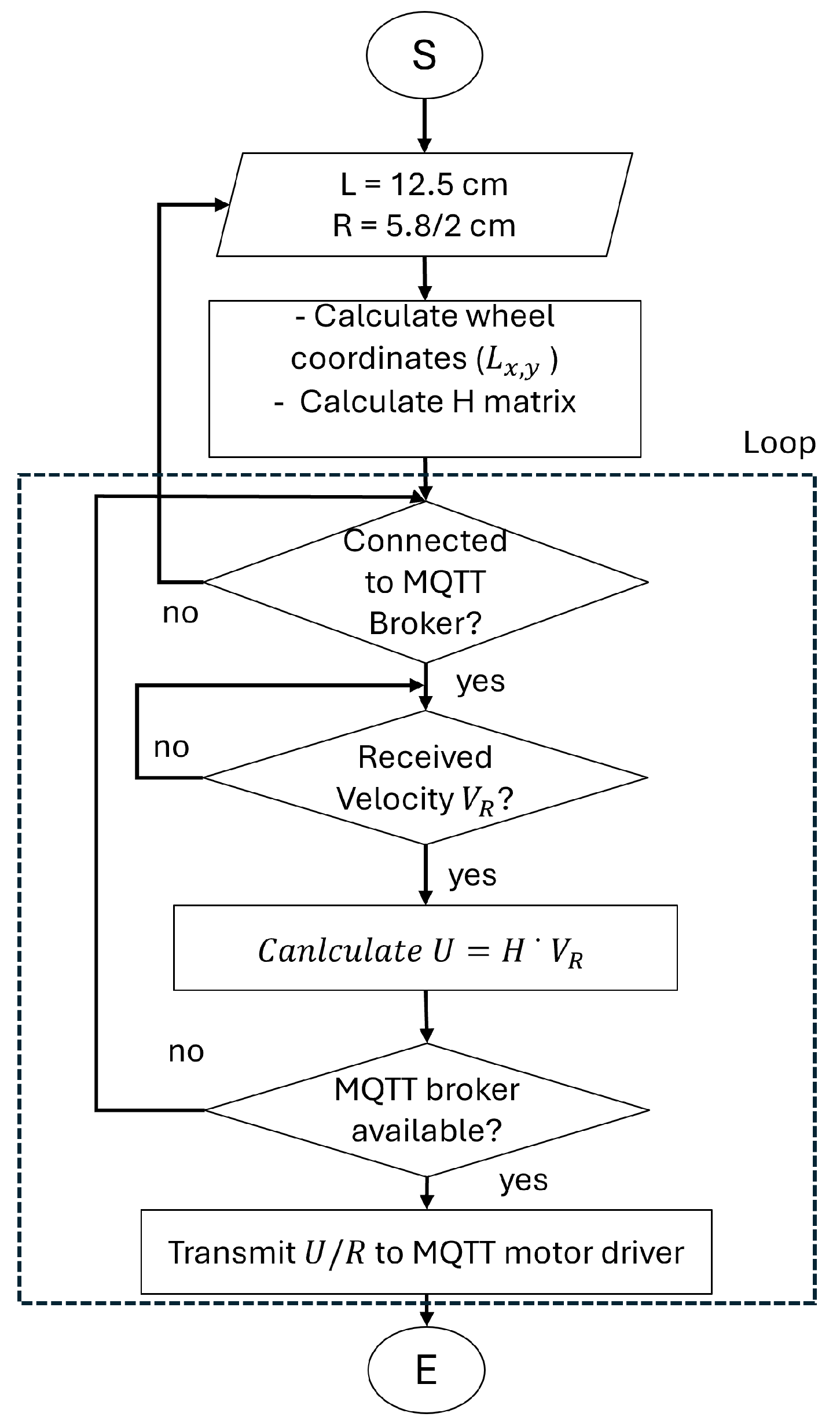
To achieve control in the desired direction, a second node takes the classification output from the AI model and defines the robot’s target velocity vector in the global frame as v = [ θ ˙ , V R x , V R y ] T . The algorithm performed in this node is represented in the diagram shown in Figure 7.
Here, the algorithm starts by establishing the location of the center of the wheels related to the center of the platform, as the following set of equations describes in 1, given the selected geometry of the holonomic platform:
C W 1 = ( X 1 , Y 1 ) = ( L , 0 ) C W 2 = ( X 2 , Y 2 ) = ( L s i n ( π / 6 ) , L c o s ( π / 6 ) ) C W 3 = ( X 3 , Y 3 ) = ( L s i n ( π / 6 ) , L c o s ( π / 6 ) )
where C W i are the coordinates of each wheel, considering the center of the platform as the origin of coordinates (OC), L = 12.5 cm is the distance from the center of the platform to the center of each wheel, and π / 6 is the angle between the axis of coordinates and the axis of rotation of each motor.
The relationship between this global velocity and the individual linear velocities of the wheels ( v 1 , v 2 , v 3 ) is governed by the kinematics matrix H = [ H 1 , H 2 , H 3 ] T using Equation (2) as follows.
H i = 1 / R [ 1 tan δ ] [ cos β i sin β i sin β i cos β i ] [ Y i 1 0 X i 0 1 ]
where R is the radius of the wheel ( R = 2.9 [cm]), and δ is the intrinsic angle of the omni-wheel between the roll directions, which in this proposal is 90°. On the other hand, β is the angle formed between the translation direction of the wheel (in positive rotation) and the X axis of the platform coordinate frame, whereas X i and Y i are the coordinates of the wheels, as calculated using Equation (1).
To determine the velocity required for each wheel ( v i ) , the algorithm iterates the robot’s desired velocity multiplied from the left by the H matrix, resulting in Equation (3) as follows.
v i = 1 / R · 1 tan δ · cos β i sin β i sin β i c cos β i · Y i 1 0 X i 0 1 · W R V R x V R y
Solving the matrix H for the characteristics of this proposal:
H 1 H 2 H 3 = 1 / R · 12.5 0 1 12.5 0.866 0.5 12.5 0.866 0.5
Consequently, replacing (4) in (3) yields the following kinematic model:
v 1 v 2 v 3 = 1 / 2.9 · 12.5 0 1 12.5 0.866 0.5 12.5 0.866 0.5 · W R V R x V R y

2.1.3. Velocity Controller

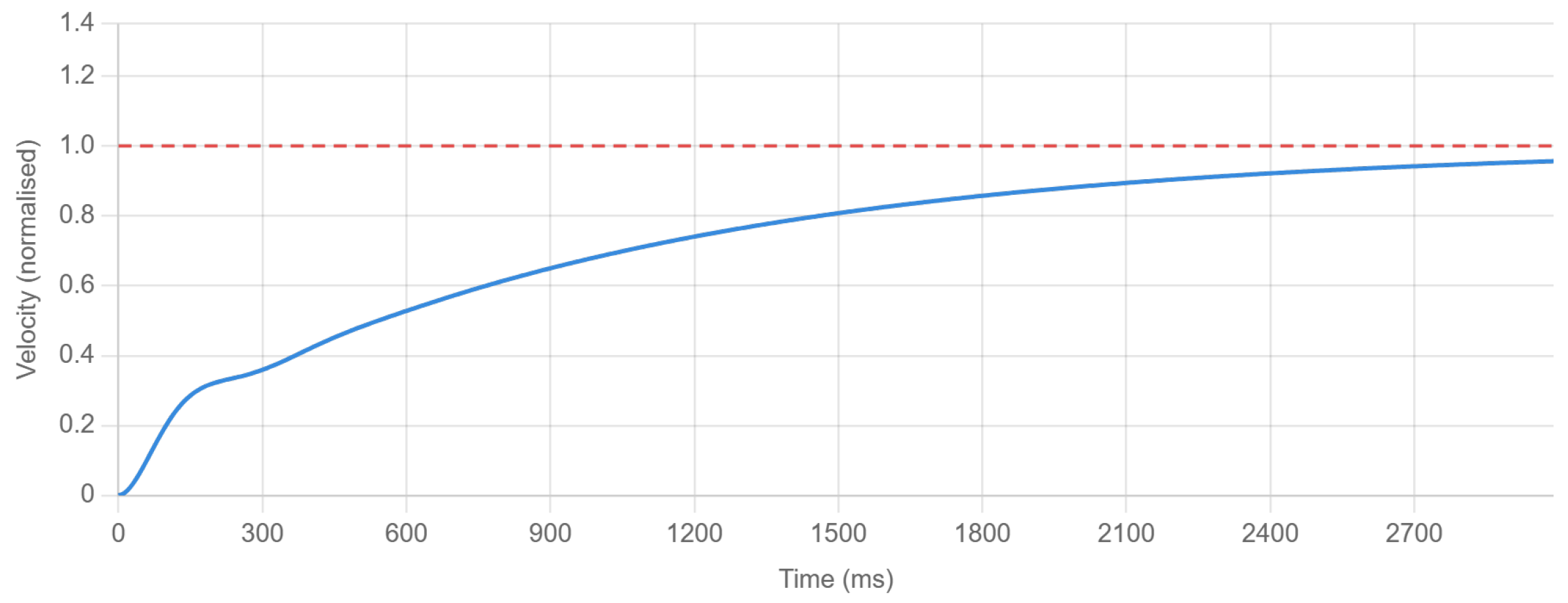
The implemented PID was manually tuned to the values K p = 4.0 , K i = 23 , K d = 0.012 . To evaluate the system stability, the DC micro-motor with Hall-effect encoder feedback was modeled as a first-order plant with an integrator for velocity control, having the plant G as follows (6):
G ( s ) = K s ( τ s + 1 )
where τ is approximated to 0.05 s based on the encoder response, and K is given a value of 1.
The implemented PID in the continuous time domain is given by Equation (7) as follows.
C ( s ) = K p + K i s + s K d = 4.0 + 23 s + 0.012 s
Consequently, the open-loop system is given by Equation (8).
L ( s ) = C ( s ) G ( s ) = K d ( s 2 ) + K p ( s ) + K i s 2 ( τ s + 1 )
Meanwhile, the closed-loop control system is:
T ( s ) = G ( s ) = L ( s ) ( L s + 1 )
Therefore, the closed-loop system’s simulation has a step response, as shown in Figure 8 as follows.

2.2. sEMG-Based Robot Manipulation

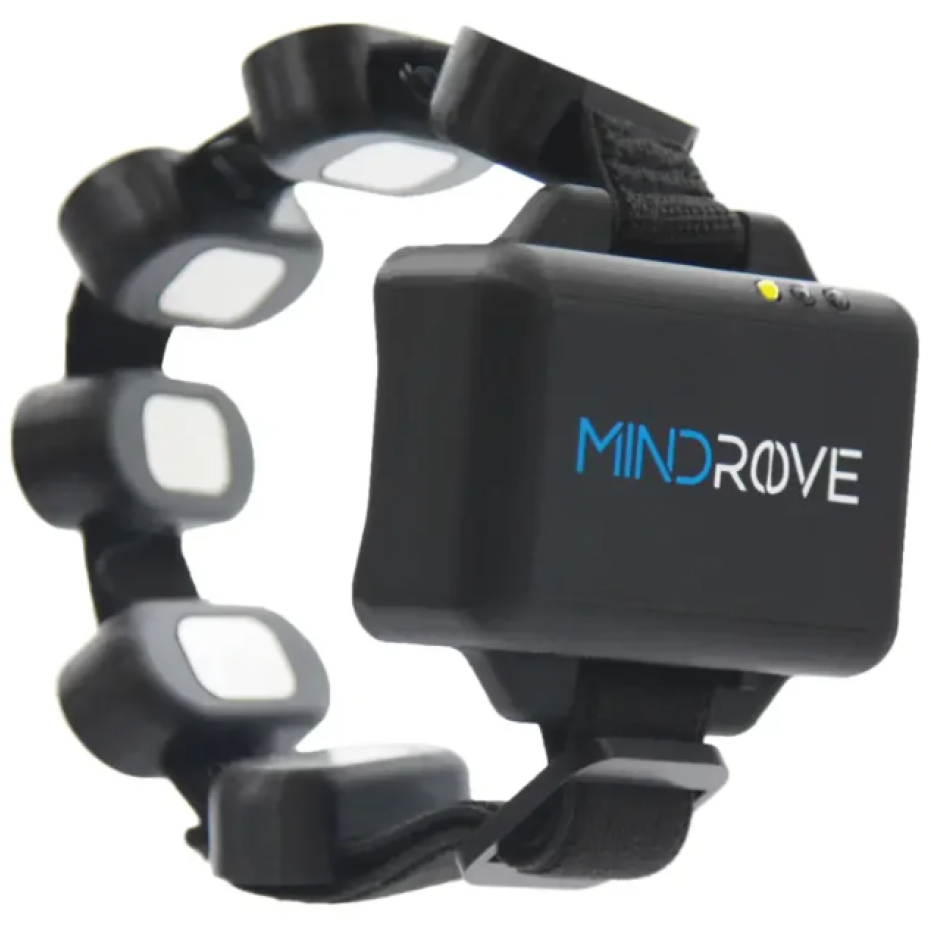
The transition from biological movements, such as hand gestures, to mechanical actions to move the platform is achieved using a distributed computational pipeline. The primary sensing hardware is the MindRove armband, shown in Figure 9, which is a semi-dry sEMG sensor that captures the electrical activity of the forearm musculature across eight channels. These signals were sampled at 500 Hz (defined by hardware specifications), which was sufficient to capture the relevant components of muscle activity.

Data Collection and Conditioning Paradigm

Data from 3 different male subjects were collected in separated recording sessions, where a verbalization of the project was conducted along an introduction of the tools and movements to be performed by the users, while in the same way, consent to use and publish the collected data was given verbally.
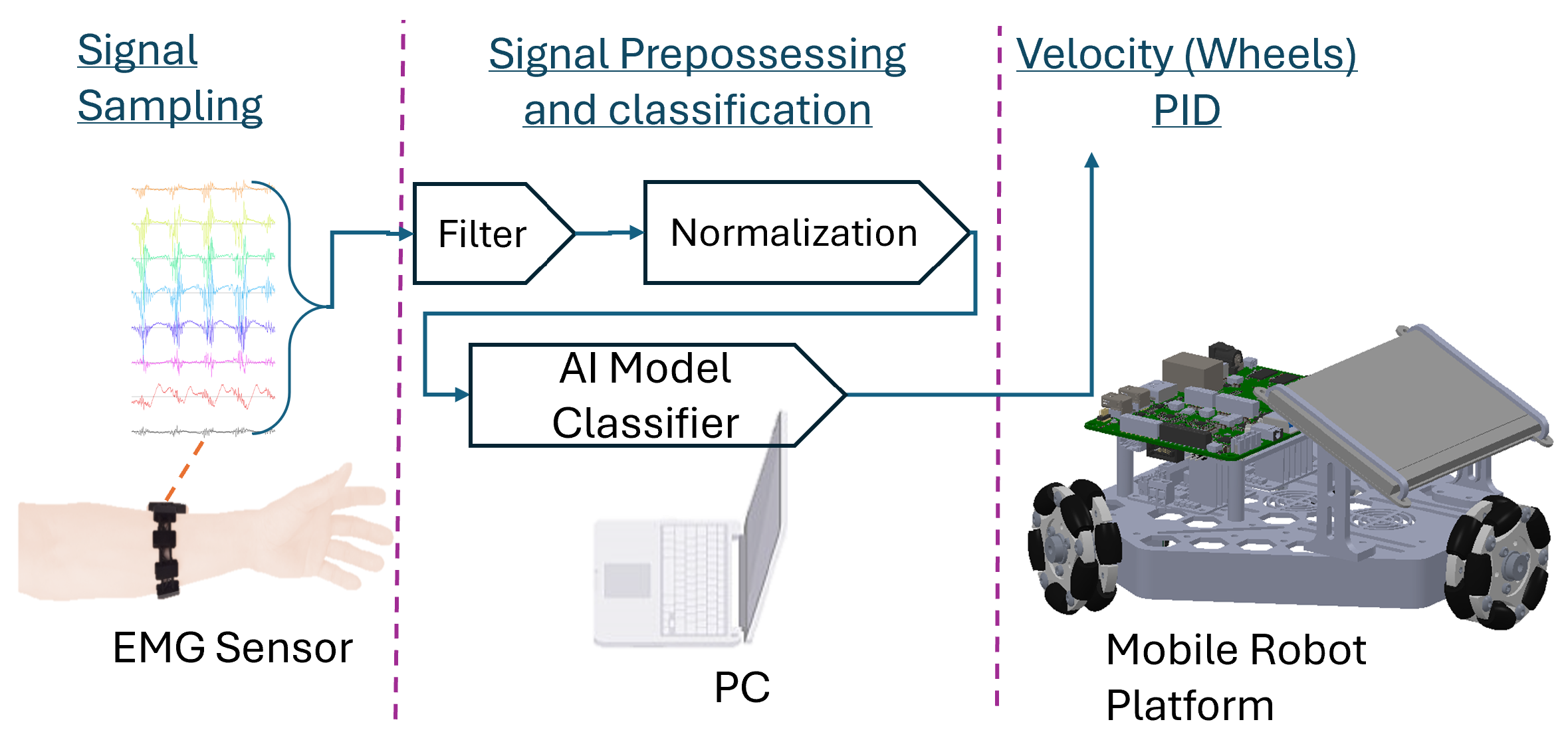
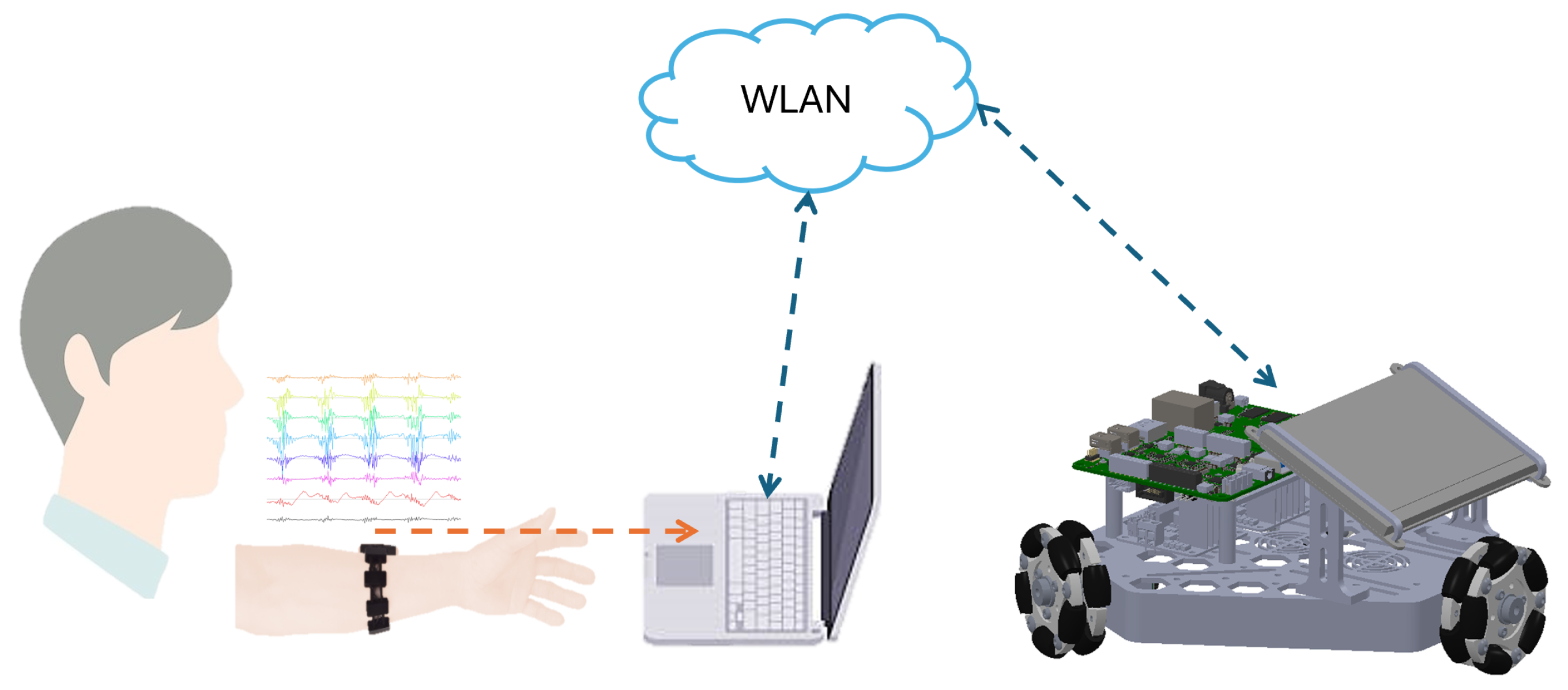
During data collection, each user replicated the hand gestures with their right hand, while their left hand simultaneously moved a joystick in the same direction. After validation, a selection of data, a total of 16,441 samples, was used to train (60%), test (20%), and validate (20%) the proposed model. The general workflow of the presented system is shown in Figure 10. Here, unprocessed data are transmitted over WiFi from the sensor access point to a PC acting as a computational node serving as the high-level brain of the system, providing the necessary environment for the AI model to classify the signals generated by the user’s hand gestures.
This node fetches 2 s of raw sEMG signals, which are often masked by stochastic noise and baseline drift, then stores them in a temporal buffer; they are then subjected to pre-processing, that is, band-pass filter and normalization steps, preparing the data for model training and further interpretation.
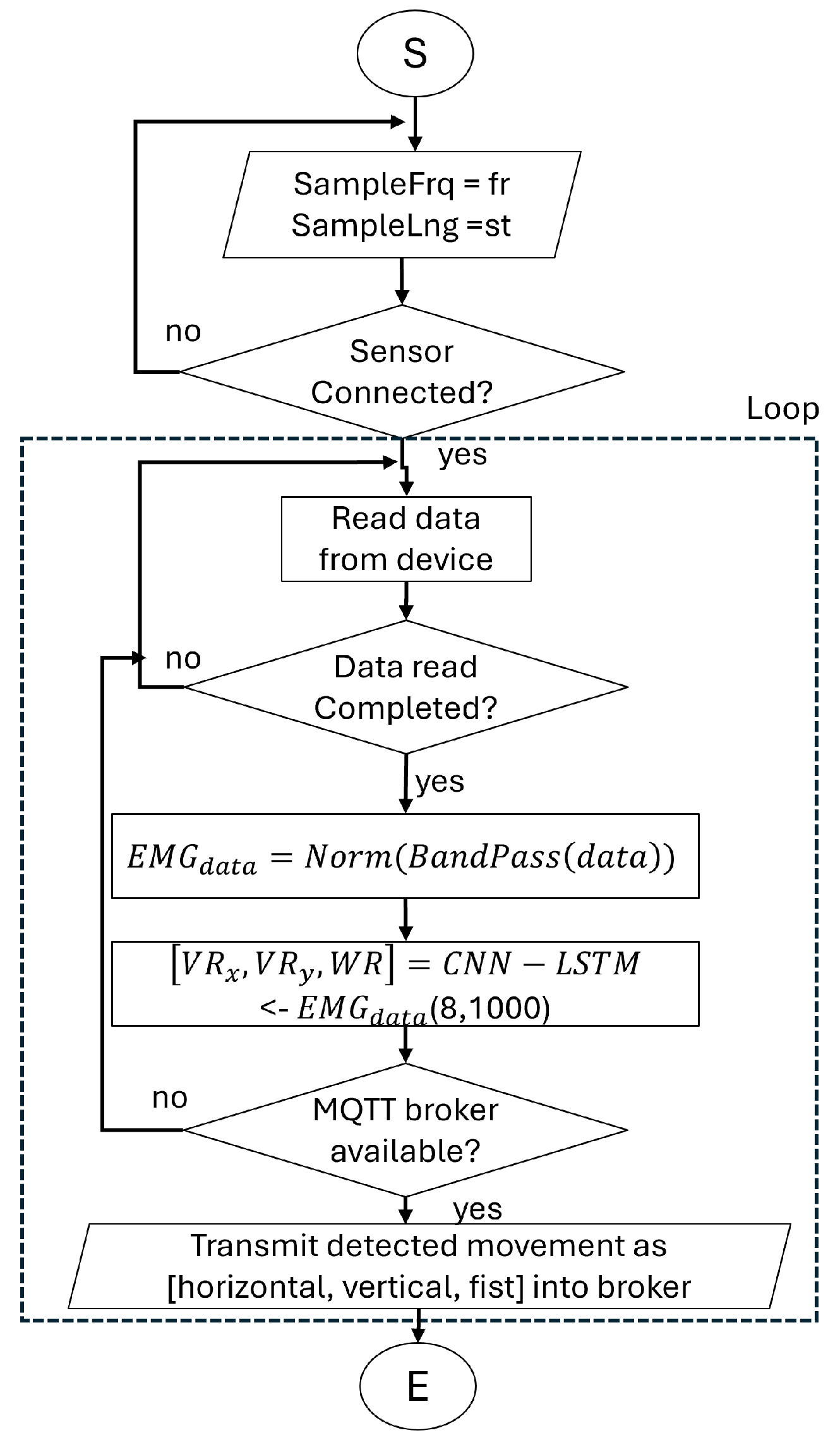
The flow diagram of the algorithm performed in the mentioned computational node is shown in Figure 11, where the instance starts on the side of the user to establish communication between the armband sensor and the PC.
After confirming the connection with the sEMG sensor, a buffer was created to store 2 s of data with a sampling rate S f = @ 500 Hz in order to continue with the data preparation steps to fit the model’s requirements.
This involves reshaping the data to a tensor with eight rows containing 1000 data points each, to continue with a band-pass filter using the Scipy library, with L b = 10 Hz for a low cut, and H b = 240 Hz for a high cut; it is B P [ 10 Hz 240 Hz ] considering the Nyquist frequency to be N f = S f / 2 , for the given sampling frequency S f .
Furthermore, normalization techniques, i.e., scaling the inputs to a standard range of [ 1 , 1 ] , are applied to ensure that the AI model remains sensitive to the morphology of the muscle activation rather than the absolute amplitude, which can fluctuate based on the user’s hydration or the tightness of the armband. This conditioning is essential for providing a stable input to the hybrid Deep Learning architecture.
To achieve this, the algorithm first determines the maximum and minimum values of each sample and then applies Equation (10) to ensure that the data used in the AI model are within the established range.
x i = 2 ( f d i l m ) / ( l M l m ) 1
where x i is the output sample of the data normalization process, f d i is the input data after the band-pass filter, and l m and l M are the local minimum and maximum of each sample, respectively, which are processes that are repeated across all eight channels of the received data.

2.3. Deep Learning Model Architecture

After normalizing the samples, they were used as the input for the AI model, where the first convolution layer was responsible for extracting features from the eight channels of the sEMG data. The CNN output was fed into the LSTM layers, enabling the model to understand the sequence of features and distinguish between sustained gestures and involuntary movements.
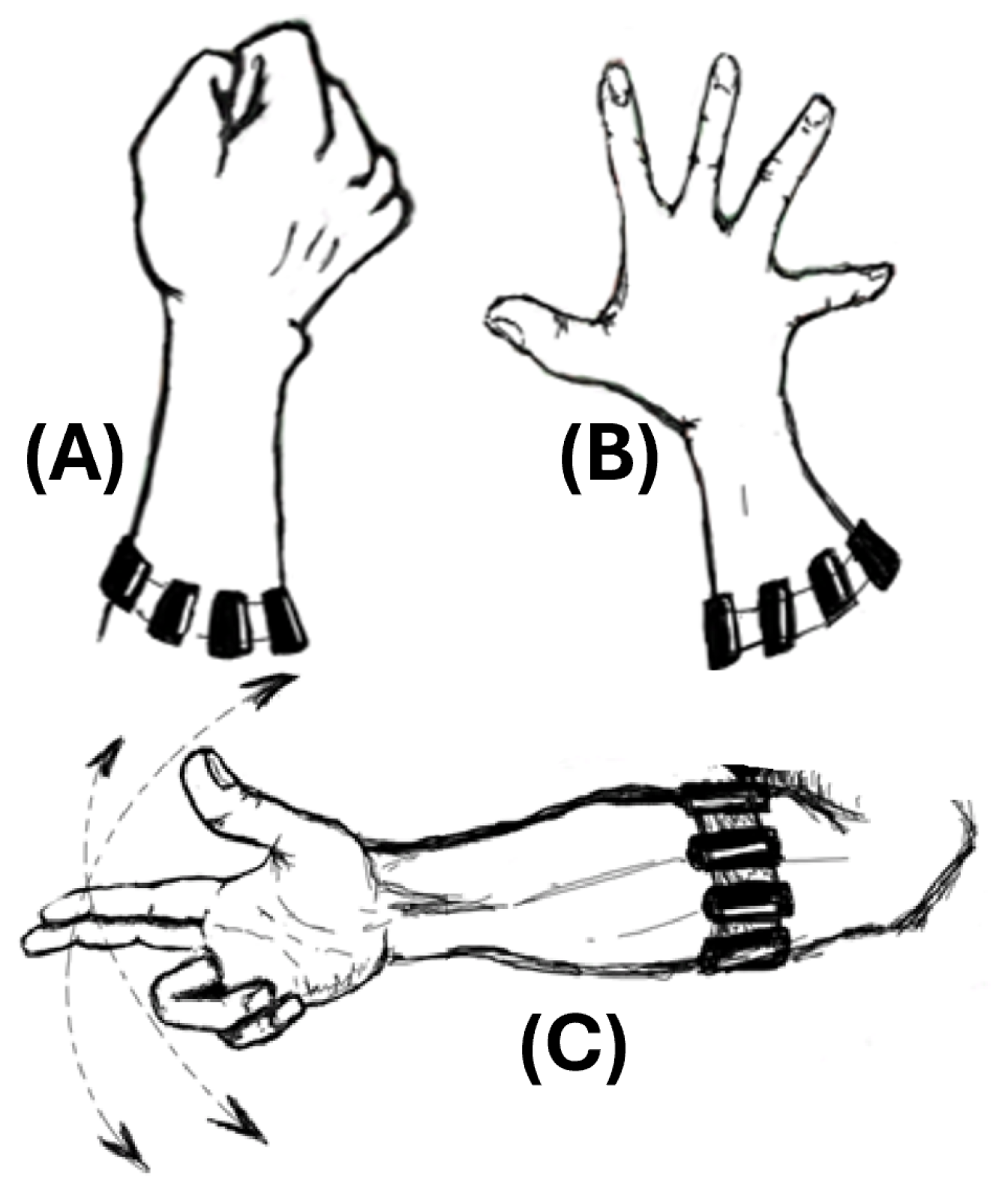
The wrist and hand gestures were selected to meet the availability of the three degrees of freedom movements that a holonomic mobile robot is capable of performing, meaning that the platform can displace in both vertical and horizontal directions at the same time that it rotates over its own Z axis, that is, normal to the plane of displacement. The following set of images in Figure 12 displays the hand gestures of Fist and No-Fist in the representations A and B, respectively, while the representation in C shows the possible wrist rotations that this methodology classifies.
The suggested Deep Learning model discriminates the input data into three axes: horizontal movement mapped as [−1, 0, 1] corresponding to “Left”, “Center”, “Right”, respectively; vertical movement mapped to [−1, 0, 1] representing “Up”, “Center”, “Down”, accordingly, and a trigger state of [0, 1] for Open/Fist hand gestures. The structure of the proposed model is described in Table 1.
After the AI model performs a signal classification, the result is structured as v (see Section 2.1.2) to be transmitted to the on-board SBC to calculate the required wheel velocities to displace the platform in the user’s intended direction. Furthermore, the calculated velocities were transmitted to the motor driver ESP-based microcontroller, where a conventional PID ensured the required velocity for each omniwheel.

Training Environment

The classification of the user’s intent is obtained by regression-based discrimination of the processed data by combining a 2D Convolutional Neural Network (CNN) and Long Short-Term Memory (LSTM) model where MaxPooling2D Layers along with the DropOut Layers significantly reduce the number of features obtained by the convolution before the LSTM layers are fed. This environment was created using the TensorFlow library version 2.10, which was selected because it is the latest version that provides GPU compatibility in Windows architectures. The Selected Loss function is based on the Mean Absolute Error (MAE) with the Adam optimizer. On the other hand, activation functions for the last three Dense layers were selected based on the expected output, the Tanh activation function for the vertical and horizontal movements, and Sigmoid activation for the Fist/Open-Hand detection. Next, the SDK provided by MindRove was included in the Python3 environment created to train and test the proposed model.

2.4. Communication Interface

The nervous system of this proposal relies on the MQTT (Message Queuing Telemetry Transport) communication protocol using a Quality of Service 0 (QoS), where the broker manages to receive and deliver the information flow involved in the correct performance of the proposed methodology. As a lightweight messaging standard, MQTT is particularly well-suited for high-frequency updates over WLAN.
The SBC computer receives the target velocities into ROS2-compatible topics to further calculate the independent velocities for each wheel based on the matrix H (see Section 2.1.2), which is then transmitted to the ESP32 microcontroller subscribed to in real-time. Simultaneously, the ESP32 returns data derived from the Hall effect sensors to the ROS2 environment, where students and researchers can capture and manipulate the data according to their needs. This effectively closes the loop between the human operator and controlled machine. A description of the proposed communication architecture is presented in Figure 13, where the orange dashed line displays a one-way communication via Access Point (AP) from the SEMG sensor to the computational node managing the signal reception, pre-processing, and classification.

3. Results and Discussion

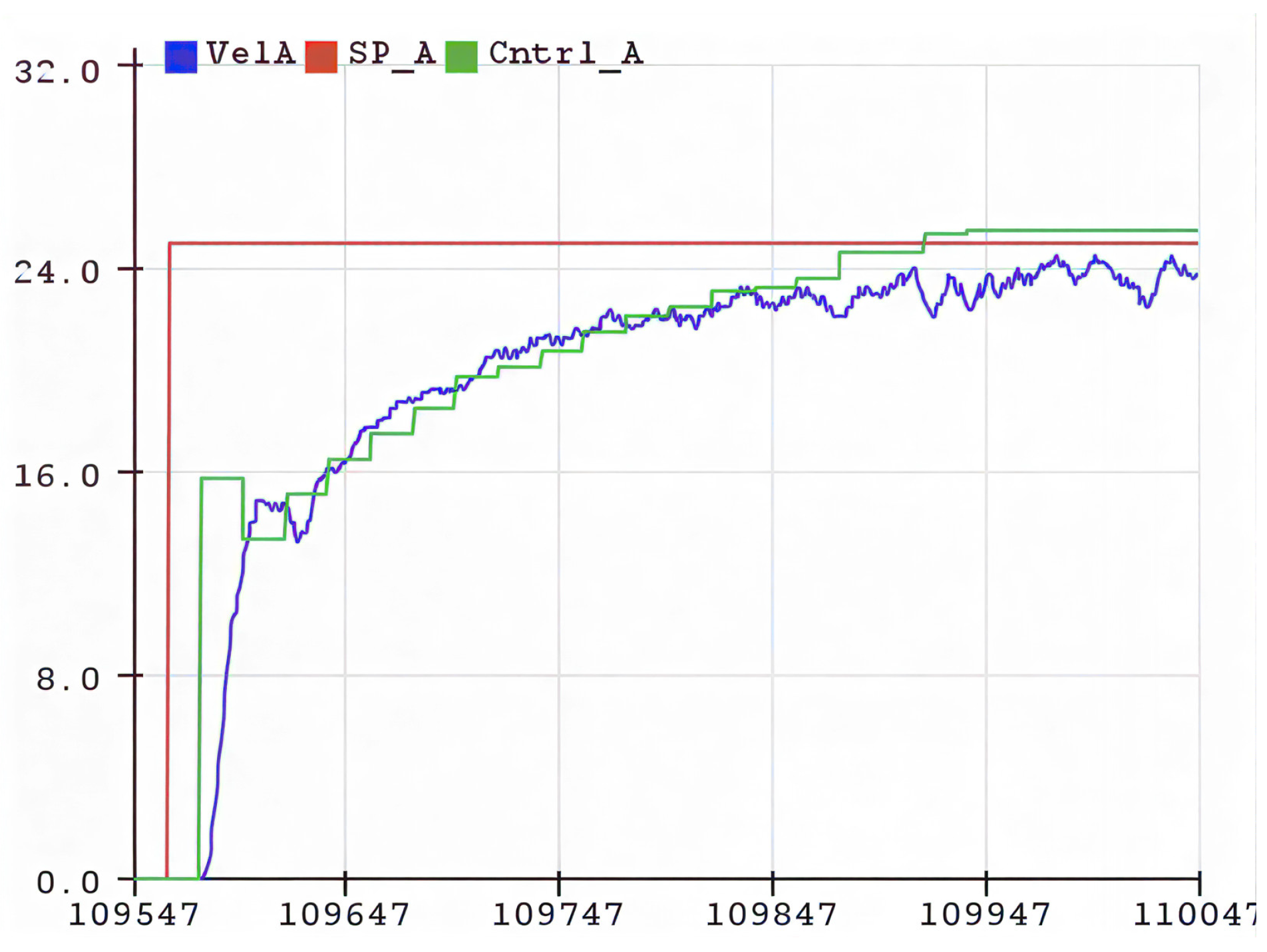
The proposed system was evaluated in three distinct aspects: the mechanical response of the low-level velocity controller, convergence and predictive precision of the Deep Learning architecture, and the subjective workload experienced by the students during practical implementation. The following figure displays the real response of the velocity controller.
In the previous figure, the absence of overshoot is notable, while on the other hand, a steady state error of approximately 8% remains after 3000 ms and a Rise time (10–90%) average of 85 ms.
The performance of the PID controller implemented in the ESP32-WROOM was analyzed by monitoring the system’s response to a step velocity input of approximately 25 cm / s , as shown in red in the results provided in Figure 14. The transient response, represented by the blue line, characterized in the experimental data, and displays a well-damped behavior; while the initial acceleration phase shows the expected inertia-driven lag, the velocity V e l _ A converges to the setpoint S P _ A within approximately 300 cycles. The damping observed is reminiscent of a calibration process, where oscillations are suppressed to maintain the stability of the platform’s center of mass while preventing drifting to avoid abrupt jerks in motion.
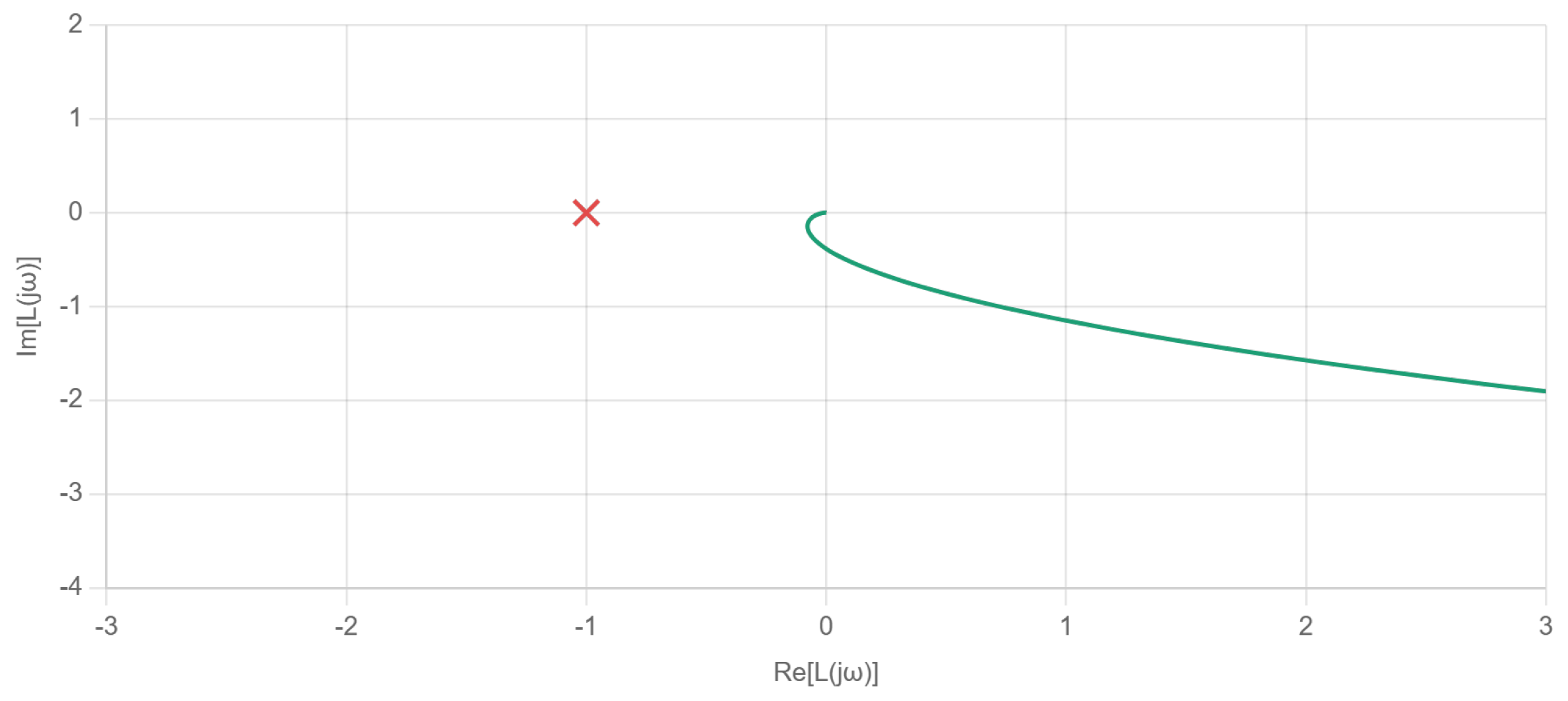
Comparing the step response of the simulated closed-loop system and the real motor-wheel configuration (see Figure 14 with the simulation result vs. Figure 8). Therefore, a stability analysis shows that the open-loop plant is marginally stable due to a pole at the origin (velocity integrator). The closed-loop system under PID feedback is BIBO stable, as confirmed by the Nyquist criterion, as shown in Figure 15, where the pole (marked in red) is farther from the system frequency response.
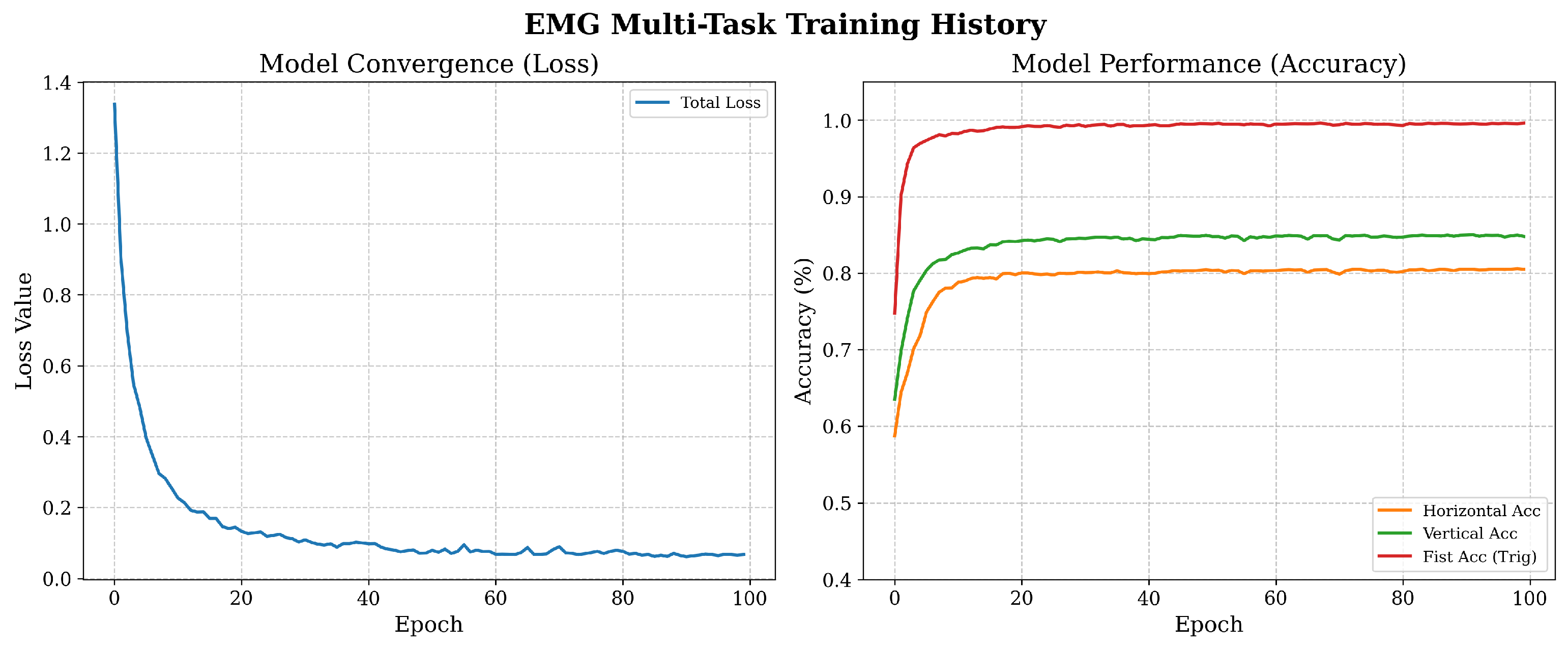
The hybrid CNN-LSTM model was trained over 100 epochs to decode the eight-channel sEMG input into directional and functional commands, as shown in Figure 16. On the left, the training history illustrates rapid and stable convergence, with the total loss value decreasing rapidly within the first 25 epochs; it is important to notice the Loss functions implemented are the MAE along an Adam optimizer. This suggests that the spatial filters of the 2D-CNN layers effectively identified the unique signatures of forearm muscle synergies early in the training process. However, regarding classification accuracy, the results in Figure 16 demonstrate a well-marked difference in precision, where the Fist/No-Fist accuracy reached the highest reliability, exceeding 99 % . This is likely due to the significant and distinct muscular recruitment required for a full grip, which presents a high signal-to-noise ratio compared with that of subtle wrist deviations. The vertical and horizontal accuracies followed closely at 84.86 % and 80.51 % , respectively.
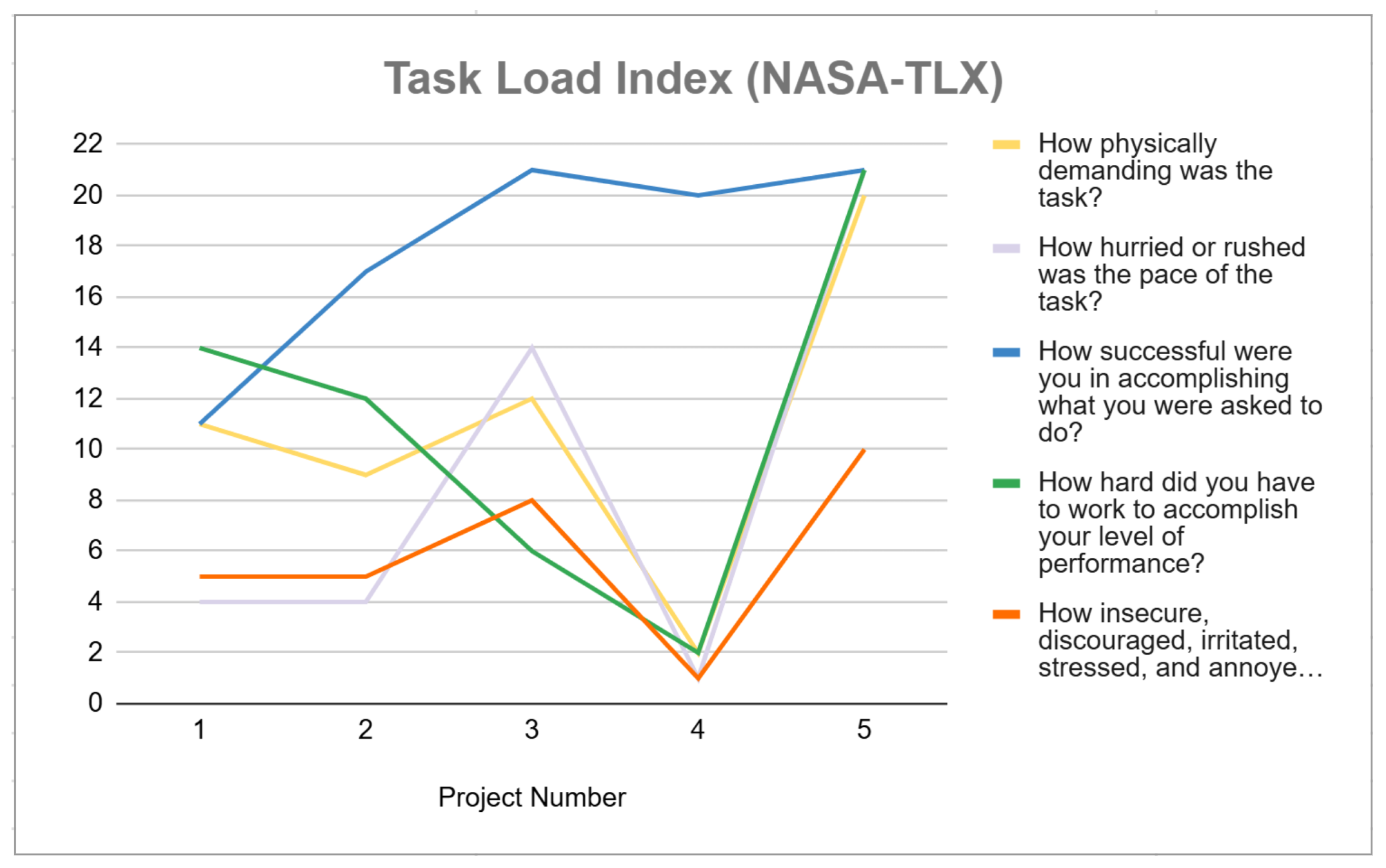
To evaluate the platform’s utility as a Home-Laboratory tool, different students used the holonomic robot across five distinct project iterations. Their experiences were quantified using the NASA-TLX (Task Load Index) to measure the mental and physical demands of using the platform, as the following Figure 17 displays. The data revealed that while physical demand and effort varied significantly across project types, peaking during the more complex navigation tasks of Project 5, the “Success” metric remained consistently high. This suggests that despite the inherent difficulty of such a complex system, the students felt highly capable of achieving their independent objectives. Interestingly, Project 4 demonstrated notable calmness in the learning curve, showing the lowest levels of insecurity and stress. This subjective data serve as an important indicator of the success of the platform’s purpose; in the same way as learning to ride a bicycle, the initial cognitive load of neuromuscular control eventually gives way to intuitive mastery, making the platform a powerful catalyst for student engagement in advanced control theory and AI.
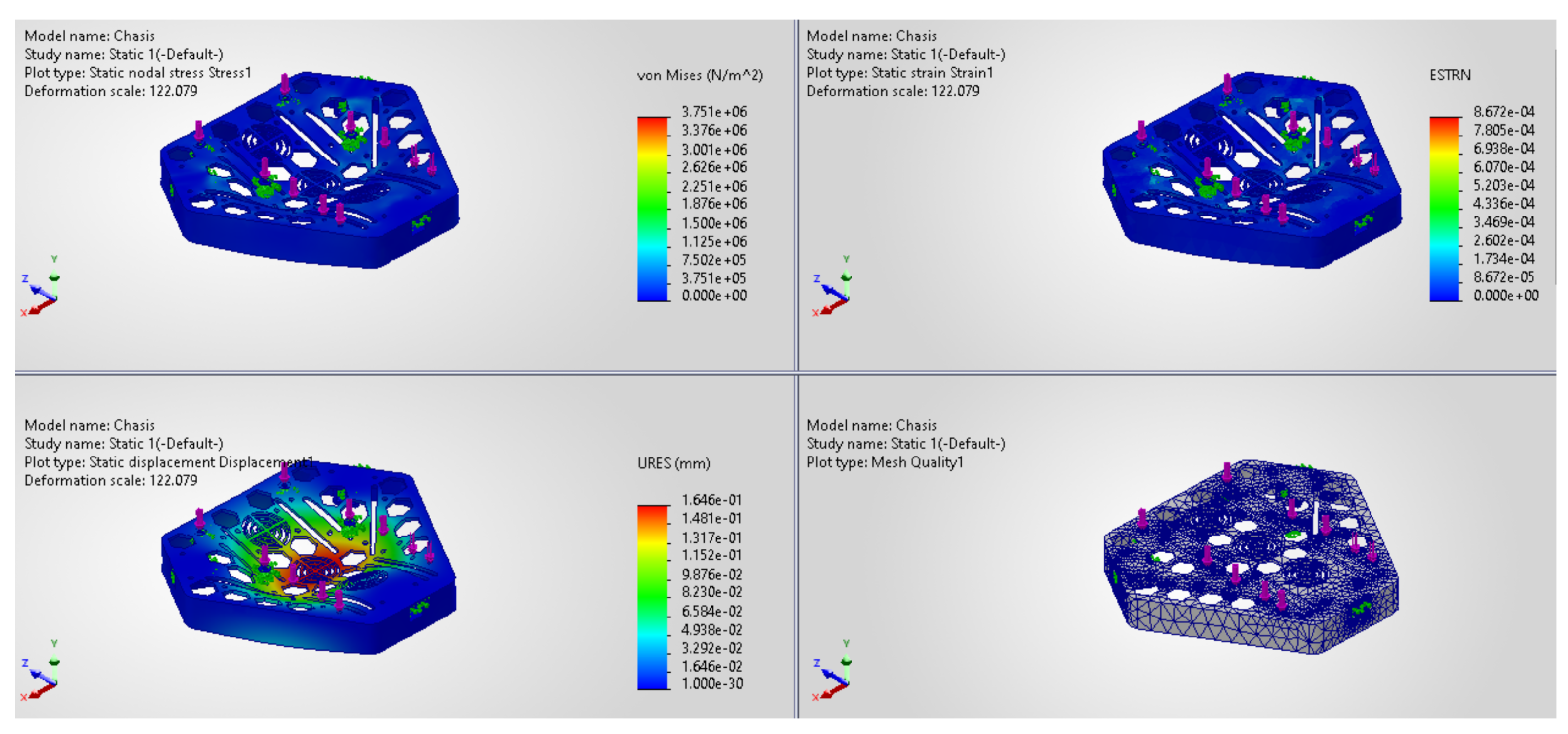
As a general concern, the robustness of the robot’s chassis was studied by performing a static FEA in SolidWorks (https://www.solidworks.com/de, accessed on 15 May 2026) with default configurations. The results of the static analysis are shown in Figure 18. Fixed constraints were placed on the wheel/motor mounting columns (green arrows) and applied loads at the sensor/component attachment points (pink arrows). The mesh uses tetrahedral solid elements with dynamic density and the material is ABS.
A summary of the Finite Element Analysis is presented in Table 2.

Authors Discussion

The CNN layers act as spatial filters, sliding across the eight-channel input to identify the specific synergies of muscle groups that correspond to hand movements, such as wrist rotation or fist formation. However, because human motion is inherently temporal, the 2D convolutional layers identify spatial synergies, whereas the LSTM layers capture the temporal evolution of muscle contractions. This allows for a more intuitive feel in the teleoperation loop because the model can distinguish between static gestures and dynamic transitions with high reliability. The slight deficit in horizontal precision mirrors the anatomical complexity of the wrist, where radial and ulnar deviations often involve overlapping muscle groups. Despite these biological nuances, the model performance remained sufficiently robust to provide a seamless teleoperation experience.
Although the presented study case requires more data collected from differnet subjets, it sets a baseline to improve previous methodologies of robot teleoperation, e.g., [40], by adding one degree of freedom in the movement detections, and including crosstalk between the sensor’s channels by implementing 2D convolution layers and treating the whole signal as a single image. In contrast, the presented methodology applies only discrete control, as mentioned in the data collection and training description; the maneuver commands expect a regression-based classification where the output is discrete e.g., 0 or 1, and the velocity is set to a constant value for safety reasons.
The spatial-temporal features extracted from the conditioned sEMG signals provided a rich, mathematically separable representation of the operator’s neuromuscular intent, i.e., the EMG signal appears between 100 and 150 ms before the activity in the joystick is notable. This aligns with previous investigations, suggesting that the application of sEMG sensors implies a faster system reaction time.
The overall latency was measured from video recordings captured at 60 FPS, where an average time delay of 0.695 ms was measured between the start of the movement and the motor activation.
However, the model demonstrated to be affected by the difference in the tightness of the bracelet on the user’s arm during tests, which produced a variance in the amplitude of the voltage captured by the electrodes. This issue must be mitigated in further steps of this research by inducing this variability during the signal recording sessions, e.g., adding subjects with thicker and thinner forearms or increasing the skin conductivity with saline solutions.

4. Conclusions

The development of the portable holonomic platform presented in this work represents a successful convergence of high-level artificial intelligence and low-level mechatronic control, designed specifically to meet the evolving demands of modern robotics education. By transitioning from a centralized laboratory model to a transportable “home-office” architecture, we demonstrated that the complexity of a three-wheeled omnidirectional system can be maintained within a modest physical and financial footprint of a conventional laboratory. The mechanical integrity provided by the hexagonal chassis serves as a reliable foundation for the intricate dance of holonomic motion, where the three degrees of freedom allow the robot to move with fluidity that mirrors the natural range of human intention.
The integration of the CNN-LSTM architecture has proven to be a robust bridge between neurological impulses and mechanical execution. The high validation accuracies achieved—specifically, the 99.56% Fist accuracy and over 80% for directional vectors—confirm that Deep Learning can effectively navigate the stochastic noise inherent in biological signals. This reliability ensures that the Human–Machine Interface is not merely a novelty but a functional tool, allowing for precise teleoperation that feels like a distal extension of the user’s own limb. Furthermore, the stable performance of the PID velocity controller, which exhibits a well-damped response necessary for smooth navigation, validates the choice of accessible embedded components, such as ESP32 and L298D drivers, for high-level research tasks.
Finally, subjective evaluation using NASA-TLX metrics underscored the pedagogical value of the platform. Although the cognitive load of mastering a neuromuscular interface is initially high, the consistent success rates reported by students suggest that the platform effectively facilitates the learning of complex concepts in control theory and AI inference. The platform not only teaches robotics but also challenges students to harmonize biological feedback with machine precision. In future iterations, the implementation of more sophisticated odometry and refinement of the chassis through structural analysis will further enhance the platform’s autonomy. Ultimately, this study establishes a scalable and humble framework for the next generation of engineers, ensuring that the exploration of advanced robotics remains an accessible endeavor, regardless of the physical or geographic boundaries of the laboratory.

Author Contributions

Conceptualization, E.A.N. and G.E.; methodology, E.A.N.; software, E.A.N.; validation, E.A.N., G.E. and L.R.; formal analysis, E.A.N. and G.E.; investigation, E.A.N.; resources, E.A.N. and G.E.; writing—original draft preparation, E.A.N.; writing—review and editing, G.E. and L.R.; supervision, G.E. and P.G.; project administration, E.A.N. and G.E.; funding acquisition, E.A.N. and G.E. All authors have read and agreed to the published version of the manuscript.

Funding

Gy. Eigner was supported by the Distinguished Grant of Obuda University.

Data Availability Statement

The data collected during this development its IP protected and they are available upon request.

Acknowledgments

Authors are sincerely grateful for the support presented by György Eigner for the development of this platform.

Conflicts of Interest

The authors declare no conflict of interest.

References

  1. Tsakeni, M. STEM education practical work in remote classrooms: Prospects and future directions in the post-pandemic era. J. Cult. Values Educ. 2022, 5, 144–167. [Google Scholar] [CrossRef]
  2. Maisano, D.A.; Carrera, G.; Mastrogiacomo, L.; Franceschini, F. Remote STEM education in the post-pandemic period: Challenges from the perspective of students and faculty. Int. J. Educ. Technol. High. Educ. 2024, 21, 64. [Google Scholar] [CrossRef]
  3. Dugandžić, M.; Božinović, K.; Ceci, S.; Majhen, D.; Nestić, D.; Košiček, M. Hybrid STEM intervention as new post-pandemic approach to motivate students to STEM. Interdiscip. Descr. Complex Syst. 2023, 21, 297–308. [Google Scholar] [CrossRef]
  4. Çoban, A.; Erol, M. Teaching kinematics via Arduino based STEM education material. Phys. Educ. 2022, 57, 015010. [Google Scholar] [CrossRef]
  5. Tantawi, K.H.; Ashcroft, J. Investigation of the post-pandemic STEM education (STEM 3.0). J. Adv. Technol. Educ. 2022, 1, 1–8. [Google Scholar]
  6. Chung, C.J.; Siegel, J. Impact of the COVID-19 Pandemic on Robofest: A Longitudinal Analysis of STEM Education Outcomes. In 2025 IEEE Integrated STEM Education Conference (ISEC); IEEE: Princeton, NJ, USA, 2025; pp. 1–8. [Google Scholar] [CrossRef]
  7. Chukwurah, N.; Adebayo, A.S.; Ajayi, O.O. Sim-to-real transfer in robotics: Addressing the gap between simulation and real-world performance. Int. J. Appl. Sci. Eng. Inf. Technol. 2024, 6, 89–102. [Google Scholar] [CrossRef]
  8. Muratore, F.; Ramos, F.; Turk, G.; Yu, W.; Gienger, M.; Peters, J. Robot learning from randomized simulations: A review. Front. Robot. AI 2022, 9, 799893. [Google Scholar] [CrossRef]
  9. Torne, M.; Simeonov, A.; Li, Z.; Chan, A.; Chen, T.; Gupta, A.; Agrawal, P. Reconciling Reality Through Simulation: A Real-to-Sim-to-Real Approach for Robust Manipulation. Proceedings of Robotics: Science and Systems (RSS). arXiv 2024, arXiv:2403.03949. [Google Scholar] [CrossRef]
  10. Chen, X.; Cheng, G.; Zou, D.; Zhong, B.; Xie, H. Artificial intelligent robots for precision education. Educ. Technol. Soc. 2023, 26, 171–186. [Google Scholar] [CrossRef]
  11. Atman Uslu, N.; Yavuz, G.Ö.; Koçak Usluel, Y. A systematic review study on educational robotics and robots. Interact. Learn. Environ. 2023, 31, 5874–5898. [Google Scholar] [CrossRef]
  12. Martínez, F.; Rendón, A. Voice-Command Responsive Autonomous Navigation for Service Robots Using the Ollama Framework on the ARMOS TurtleBot. In International Conference on Systems Engineering; Lecture Notes in Networks and System; Springer: Cham, Switzerland, 2024; Volume 1066, pp. 53–67. [Google Scholar] [CrossRef]
  13. Gogoi, B.J.; Mohanty, P.K. A Braitenberg path planning strategy for e-puck mobile robot in simulation and real-time environments. In Applications of Computational Methods in Manufacturing and Product Design: Select Proceedings of IPDIMS 2020; Springer: Singapore, 2022; pp. 135–151. [Google Scholar] [CrossRef]
  14. Al Ansari, H. Educational Robotics: A Comparison Between the Thymio and NAO Robot. In 2024 IEEE Global Engineering Education Conference (EDUCON); IEEE: Kos Island, Greece, 2024; pp. 1–3. [Google Scholar] [CrossRef]
  15. Gai, A.D.M.; Bevilacqua, S.; Cukla, A.R.; Gamarra, D.F.T. Evaluation on IMU and odometry sensor fusion for a Turtlebot robot using AMCL on ROS framework. In 2023 Latin American Robotics Symposium (LARS), 2023 Brazilian Symposium on Robotics (SBR), and 2023 Workshop on Robotics in Education (WRE); IEEE: Piscataway, NJ, USA, 2023; pp. 637–642. [Google Scholar] [CrossRef]
  16. Evripidou, S.; Doitsidis, L.; Tsinarakis, G.; Zinonos, Z.; Chatzichristofis, S.A. Selecting a robotic platform for education. In 2022 IEEE International Conference on Consumer Electronics (ICCE); IEEE: Las Vegas, NV, USA, 2022; pp. 1–6. [Google Scholar] [CrossRef]
  17. Wang, D.; Pan, S.; Zhou, J.; Pan, Q.; Miao, Z.; Yang, J. Event-triggered integral formation controller for networked nonholonomic mobile robots: Theory and experiment. IEEE Trans. Intell. Transp. Syst. 2023, 24, 14620–14632. [Google Scholar] [CrossRef]
  18. Rácz, M.; Noboa, E.; Détár, B.; Nemes, Á.; Galambos, P.; Szucs, L.; Márton, G.; Eigner, G.; Haidegger, T. PlatypOUs—A mobile robot platform and demonstration tool supporting STEM education. Sensors 2022, 22, 2284. [Google Scholar] [CrossRef]
  19. Kitić, G.; Krklješ, D.; Panić, M.; Petes, C.; Birgermajer, S.; Crnojević, V. Agrobot Lala—an autonomous robotic system for real-time, in-field soil sampling, and analysis of nitrates. Sensors 2022, 22, 4207. [Google Scholar] [CrossRef]
  20. Schulze, M.; Graaf, F.; Steffen, L.; Roennau, A.; Dillmann, R. A trajectory planner for mobile robots steering non-holonomic wheelchairs in dynamic environments. In 2023 IEEE International Conference on Robotics and Automation (ICRA); IEEE: London, UK, 2023; pp. 3642–3648. [Google Scholar] [CrossRef]
  21. Wu, J.; Chong, W.; Holmberg, R.; Prasad, A.; Gao, Y.; Khatib, O.; Song, S.; Rusinkiewicz, S.; Bohg, J. TidyBot++: An Open-Source Holonomic Mobile Manipulator for Robot Learning. arXiv 2024, arXiv:2412.10447. [Google Scholar] [CrossRef]
  22. Apurin, A.; Abbyasov, B.; Martínez-García, E.A.; Magid, E. Comparison of ROS Local Planners for a Holonomic Robot in Gazebo Simulator. In International Conference on Interactive Collaborative Robotics; Lecture Notes in Computer Science; Springer: Cham, Switzerland, 2023; Volume 14214, pp. 116–126. [Google Scholar] [CrossRef]
  23. Tsiakas, K.; Papadimitriou, A.; Pechlivani, E.M.; Giakoumis, D.; Frangakis, N.; Gasteratos, A.; Tzovaras, D. An autonomous navigation framework for holonomic mobile robots in confined agricultural environments. Robotics 2023, 12, 146. [Google Scholar] [CrossRef]
  24. Schoenbach, V.; Wiedemann, M.; Memmesheimer, R.; Mosbach, M.; Behnke, S. Integration of the TIAGo Robot into Isaac Sim with Mecanum Drive Modeling and Learned S-Curve Velocity Profiles. In 2025 IEEE 21st International Conference on Automation Science and Engineering (CASE); IEEE: Los Angeles, CA, USA, 2025; pp. 1456–1463. [Google Scholar] [CrossRef]
  25. Ari, A.; Rojas, A.; Cornejo, J.; Palomares, R. Mechatronic design and kinematic analysis of land-based, holonomic-type and mecanum-wheeled mobile robot for queue management in supermarkets. In 2022 IEEE Engineering International Research Conference (EIRCON); IEEE: Lima, Peru, 2022; pp. 1–4. [Google Scholar] [CrossRef]
  26. Pratama, E.W.; Kiswantono, A. Electrical analysis using ESP-32 module in realtime. JEECS (J. Electr. Eng. Comput. Sci.) 2022, 7, 1273–1284. [Google Scholar] [CrossRef]
  27. Liu, J.; Li, Z.; Le, R.; Zhang, X.; Sugita, N.; Ying, Z.; Shu, L. Precise Hand-Arm Teleoperation of Dexterous Robotic Manipulator via Markerless Vision and High Density sEMG Fusion. IEEE Robot. Autom. Lett. 2025, 10, 1938–1945. [Google Scholar] [CrossRef]
  28. Machida, Y.; Katsuyama, Y.; Kameyama, W. sEMG-based Arm Movement Prediction by LSTM for Realtime Teleoperation. In 2025 IEEE 14th Global Conference on Consumer Electronics (GCCE); IEEE: Osaka, Japan, 2025; pp. 890–891. [Google Scholar] [CrossRef]
  29. Si, W.; Wang, N.; Yang, C. Design and Quantitative Assessment of Teleoperation-Based Human–Robot Collaboration Method for Robot-Assisted Sonography. IEEE Trans. Autom. Sci. Eng. 2024, 22, 317–327. [Google Scholar] [CrossRef]
  30. Xia, W.; Liao, Z.; Lu, Z.; Yao, L. Bio-Signal-Guided Robot Adaptive Stiffness Learning via Human-Teleoperated Demonstrations. Biomimetics 2025, 10, 399. [Google Scholar] [CrossRef]
  31. Menon, A.; Sun, D.; Sabouri, S.; Lee, K.; Aristio, M.; Liew, H.; Rabaey, J.M. A Highly Energy-Efficient Hyperdimensional Computing Processor for Biosignal Classification. IEEE Trans. Biomed. Circuits Syst. 2022, 16, 524–534. [Google Scholar] [CrossRef]
  32. Aly, H.; Youssef, S.M. Bio-Signal Based Motion Control System Using Deep Learning Models: A Deep Learning Approach for Motion Classification Using EEG and EMG Signal Fusion. J. Ambient Intell. Humaniz. Comput. 2023, 14, 991–1002. [Google Scholar] [CrossRef]
  33. Fu, R.; Zhang, B.; Liang, H.; Wang, S.; Wang, Y.; Li, Z. Gesture recognition of sEMG signal based on GASF-LDA feature enhancement and adaptive ABC optimized SVM. Biomed. Signal Process. Control 2023, 85, 105104. [Google Scholar] [CrossRef]
  34. Al Taee, A.A.; Khushaba, R.N.; Zia, T.; Al-Jumaily, A. Deep scattering transform with attention mechanisms improves EMG-based hand gesture recognition. In 2023 45th Annual International Conference of the IEEE Engineering in Medicine & Biology Society (EMBC); IEEE: Sydney, Australia, 2023; pp. 1–4. [Google Scholar]
  35. Jaramillo Yanez, A. Reducing Training Effort in a Non-Stationary Environment: Hand Gesture Recognition Using Surface Electromyography (sEMG). Ph.D. Thesis, RMIT University, Melbourne, Australia, 2024. [Google Scholar]
  36. Kenyeres, M.; Kenyeres, J.; Hassankhani Dolatabadi, S. Distributed Consensus Gossip-Based Data Fusion for Suppressing Incorrect Sensor Readings in Wireless Sensor Networks. J. Low Power Electron. Appl. 2025, 15, 6. [Google Scholar] [CrossRef]
  37. Pan, D.; Deng, Y.; Yang, S.X.; Gharabaghi, B. Recent Advances in Remote Sensing and Artificial Intelligence for River Water Quality Forecasting: A Review. Environments 2025, 12, 158. [Google Scholar] [CrossRef]
  38. Orsós, M.; Török, R.; Faragó, C.; Antalfia, B.; Kail, E.; Bánáti, A. Security Operation Center Methodology for 5G Networks. Acta Polytech. Hung. 2025, 22, 99–121. [Google Scholar] [CrossRef]
  39. Bringye, Z.J.; Fleiner, R.D.; Umhauser, B.; Aradi, M.; Kail, E. Extending SOC Capabilities to LoRaWAN: A Cloud-Integrated Intrusion Detection Framework for IoT Networks. Acta Polytech. Hung. 2026, 23, 65–84. [Google Scholar] [CrossRef]
  40. Nemes, Á.G.; Kovács, L.; Eigner, G.; Márton, G.; Weiss, B. Deep Learning based sEMG decoding for TelePresence device control. In 2023 24th International Conference on Process Control (PC); IEEE: Štrbské Pleso, Slovakia; pp. 192–197. [CrossRef]
Figure 1. CAD representation of the presented design.
Technologies 14 00308 g001
Figure 2. Areal View of the Holonomic Platform.
Technologies 14 00308 g002
Figure 3. ESP WROOM 32 develop board.
Technologies 14 00308 g003
Figure 4. Micro-motor and Hall effect encoder.
Technologies 14 00308 g004
Figure 5. Hardware connections and power distribution in the Holonomic Platform.
Technologies 14 00308 g005
Figure 6. Battery Discharge Curve.
Technologies 14 00308 g006
Figure 7. Wheel velocity calculation diagram.
Technologies 14 00308 g007
Figure 8. Plant Step response.
Technologies 14 00308 g008
Figure 9. MindRove, 6 + 2 channels armband.
Technologies 14 00308 g009
Figure 10. System Workflow description.
Technologies 14 00308 g010
Figure 11. Electromyography signal capturing and pre-processing algorithm.
Technologies 14 00308 g011
Figure 12. Defined Movements to be classified. Where (A) and (B) are the Fist/Open-hand feature, respectively, and (C) represents the hand (open or closed) performing wrist rotation movement in horizontal and vertical directions.
Technologies 14 00308 g012
Figure 13. System’s communication architecture.
Technologies 14 00308 g013
Figure 14. Velocity controller result where the X axis is displays the number of iterations and the Y coordinate is the velocity of wheel “A” in cm/s.
Technologies 14 00308 g014
Figure 15. Nyquist analysis of the closed-loop system.
Technologies 14 00308 g015
Figure 16. Deep Learning model training results.
Technologies 14 00308 g016
Figure 17. Task load index results.
Technologies 14 00308 g017
Figure 18. Results comparison of the chassis’ static analysis.
Technologies 14 00308 g018
Table 1. Proposed Model Architecture.
LayerOutput ShapeParametersConnected to
Input Layer(None, 8, 850)0None
Reshape Layer(None, 8, 850, 1)0Input Layer
Conv2D(None, 8, 850, 64)5184Reshape Layer
BatchNormalization(None, 8, 850, 64)256Conv2D
MaxPooling2D(None, 8, 170, 64)0BatchNormalization
Dropout1(None, 8, 170, 64)0MaxPooling2D
Conv2D(None, 8, 170, 128)41,088Dropout1
BatchNormalization(None, 8, 170, 128)512Conv2D
MaxPooling2D(None, 8, 34, 128)0BatchNormalization
Dropout2(None, 8, 34, 128)0MaxPooling2D
Reshape for LSTM(None, 34, 1024)0Dropout2
LSTM1(None, 34, 128)590,336Reshape for LSTM
BatchNormalization(None, 34, 128)512LSTM1
LSTM2(None, 64)49,408BatchNormalization
BatchNormalization(None, 64)256LSTM2
Dropout(None, 64)0BatchNormalization
DenseShared(None, 64)4160Dropout
DenseVertical(None, 1)65DenseShared
DenseHorizontal(None, 1)65DenseShared
DenseFist(None, 1)65DenseShared
Table 2. FEA quantitative summary—ABS robot chassis.
ParameterSimulated ValueABS Limit
Peak von Mises stress1.125 MPa28 MPa (yield)
Max equivalent strain (ESTRN) 8.672 × 10 4 1.3 × 10 2 (elastic limit)
Max resultant displacement0.1646 mmDesign-dependent
Safety factor (yield)24.88Recommended: 2–3
Mesh typeTetrahedral
Disclaimer/Publisher’s Note: The statements, opinions and data contained in all publications are solely those of the individual author(s) and contributor(s) and not of MDPI and/or the editor(s). MDPI and/or the editor(s) disclaim responsibility for any injury to people or property resulting from any ideas, methods, instructions or products referred to in the content.