Article

Usability and Feasibility of a Contrast Avoidance Model-Based Virtual Reality Protocol Designed for Generalized Anxiety Disorder


by
Barbora Darmová
1,2,3,*,
Iveta Fajnerová
3,4 and
Lora Appel
2,5,6,*
1
First Faculty of Medicine, Charles University, 121 08 Prague, Czech Republic
2
School of Health Policy and Management, Faculty of Health, York University, Toronto, ON M3J 1P3, Canada
3
Center for Virtual Reality Research in Mental Health and Neuroscience, National Institute of Mental Health, 250 67 Klecany, Czech Republic
4
Third Faculty of Medicine, Charles University, 100 00 Prague, Czech Republic
5
OpenLab, University Health Network, Toronto, ON M6G 1A5, Canada
6
General Internal Medicine, Michael Garron Hospital, Toronto, ON M4C 3E7, Canada
*
Authors to whom correspondence should be addressed.
Technologies 2026, 14(5), 305; https://doi.org/10.3390/technologies14050305
Submission received: 26 April 2026 / Revised: 12 May 2026 / Accepted: 13 May 2026 / Published: 16 May 2026
(This article belongs to the Special Issue VR for Cognitive and Emotional Well-Being)

Abstract

Generalized anxiety disorder (GAD) is characterized by persistent, excessive, and difficult-to-control worry. The Contrast Avoidance Model (CAM) proposes that individuals with GAD use worry to sustain negative emotional arousal, thereby avoiding sharp negative emotional contrasts that would otherwise follow unexpected adverse events. A virtual reality (VR) protocol was developed to simulate such contrasts by alternating guided relaxation with brief anxiety-inducing scenarios (skyline plank, crowded elevator, and loose dog encounter). This study evaluated the usability and feasibility of this protocol in 20 subclinical adults aged 18–45 who met a screening threshold of GAD-7 ≥ 5, using a Meta Quest 3 headset and Polar H10 heart rate sensor. Exposure segments produced a significant decrease in RMSSD (β = −0.185, p < 0.001), consistent with reduced parasympathetic activity during exposure, whereas heart rate did not differ significantly between conditions. Subjectively, exposure increased SUDS (β = 2.23, p < 0.001) and SAM arousal (β = 1.95, p < 0.001), and decreased SAM valence (β = −2.68, p < 0.001) and dominance (β = −1.70, p = 0.005). Presence scores, cybersickness ratings, and qualitative feedback supported the usability of the protocol and identified concrete design refinements. These results support the feasibility of the protocol and provide a foundation for future controlled clinical evaluation.

1. Introduction

Generalized anxiety disorder (GAD) is characterized by persistent, unmanageable, and excessive worry and tension that significantly impairs an individual’s daily functioning and overall quality of life [1,2]. GAD has a moderately high lifetime prevalence of approximately 3.7% to 5.0%, yet it remains under-researched compared to other anxiety disorders [3,4], likely in part because it was historically treated as a residual and diagnostically uncertain category, and repeated revisions to its diagnostic criteria hindered the accumulation of a stable evidence base [5,6]. Despite advances in evidence-based psychotherapeutic treatments, such as traditional cognitive–behavioral therapy (CBT), its efficacy remains limited, with approximately 50% of GAD patients failing to achieve full remission or experiencing relapse [7,8]. This treatment gap underscores the need for novel theoretical frameworks and intervention delivery methods that address the underlying mechanisms of pathological worry [3,9].
A promising perspective is offered by the Contrast Avoidance Model (CAM), which suggests that individuals with GAD engage in worry as a maladaptive emotion regulation strategy [3,10]. Unlike earlier models suggesting that worry serves to dampen or avoid somatic activation, CAM proposes that individuals worry to intentionally create and sustain a state of negative emotional arousal [10,11,12,13,14]. By maintaining this constant negative affect, they avoid sharp, aversive increases in negative emotion, referred to as negative emotional contrasts, that would otherwise occur in response to unexpected negative events [10,12].
Recent evidence from ecological momentary assessment (EMA) and laboratory studies has supported the tenets of CAM, showing that sustained anxiety indeed reduces the shock of negative transitions while simultaneously increasing the probability of experiencing a positive emotional contrast [12,15,16]. Based on these findings, the authors of the model have proposed a novel contrast exposure framework which aims to induce strong negative emotion immediately following a period of contiguous relaxation; this approach is designed to help individuals achieve emotional processing by training them to tolerate sharp affective shifts rather than preemptively avoiding them through worry [10,16].
Virtual Reality (VR) technology provides a unique opportunity to implement CAM-based interventions by offering immersive, safe, and highly controlled environments [17,18,19]. Virtual reality exposure therapy (VRET) allows for a consistent structure and the possibility of gradual exposure, making it well suited to helping patients confront and tolerate the emotional contrasts they typically seek to avoid [17,19]. By transitioning users from a state of guided relaxation to sudden, discomfort-evoking virtual scenarios, clinicians can systematically challenge the avoidance behaviors central to GAD [10,12]. VR is particularly useful here because real-world environments rarely allow the deliberate and repeatable orchestration of sharp contrasts between calm and anxiety-provoking situations, whereas VR enables therapists to do so safely while controlling both the intensity and duration of exposure [20]. However, for such applications to be effective, they must be designed with high usability and visual fidelity to ensure participant engagement and emotional presence [21,22]. Accordingly, early-stage feasibility and user-experience evaluation is an essential step in translating this approach into clinical application [23,24].
The primary objective of this study was to evaluate the usability and feasibility of a VR-based protocol designed to simulate emotional contrasts in accordance with CAM of GAD. Because the protocol’s intended future clinical rationale involves inducing transitions from relaxation to threat exposure, its capacity to generate such emotional contrasts was conceptualized as a core indicator of feasibility rather than as a measure of clinical efficacy. Accordingly, the study pursued four specific aims: (1) to determine whether the protocol could elicit the intended autonomic and subjective shifts from a relaxed baseline to anxiety-provoking states; (2) to assess user comfort, including the tolerability of wearable biometric sensors; (3) to evaluate the degree of user immersion and sense of presence achieved within the virtual environments; and (4) to identify technical and design requirements necessary for future clinical implementation. Through this feasibility-focused investigation, we sought to determine whether this prototype could produce rapid, within-session affective transitions relevant to a future CAM-informed intervention, while meeting key usability criteria related to comfort, immersion, and system implementation.

2. Materials and Methods

2.1. Study Design

The study followed a prospective, within-subject experimental design. Each participant completed a single experimental session lasting approximately 20–30 min, with the core VR protocol lasting 12–15 min. During the VR session, physiological measures were collected via wearables, and subjective ratings of distress and affect were collected in VR using standardized self-report scales. Because subjective ratings during the relaxation periods would have interrupted the intended relaxation-to-exposure contrast, subjective relaxation ratings were collected retrospectively and were therefore used as recalled reference points for estimating subjective change. After the VR protocol, participants completed post-session questionnaires, followed by a short recorded semi-structured interview to provide qualitative feedback.

2.2. Participants

A recruitment target of 20 participants was selected, consistent with published guidance for pilot-study sample sizes and appropriate for an early-stage feasibility evaluation [25,26]. Participants were recruited through professional and community networks using informal announcements and direct outreach. Recruitment targeted a subclinical adult sample of participants with elevated anxiety symptoms, rather than individuals with a clinical diagnosis of GAD. Eligibility criteria are summarized in Table 1.

2.3. Procedure

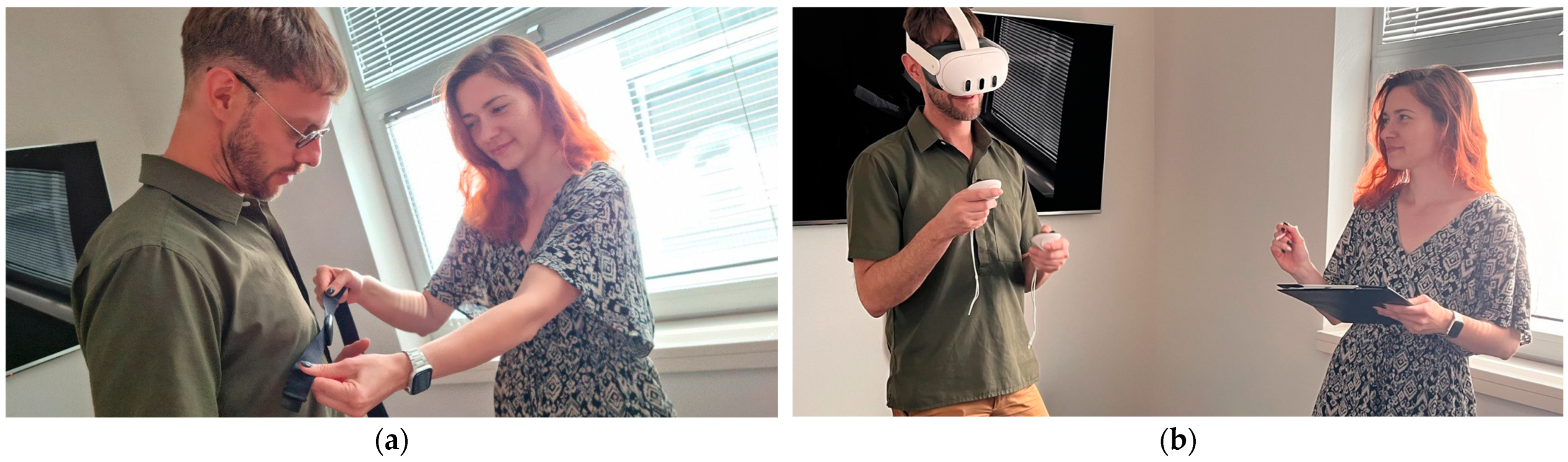
After providing written informed consent, participants were fitted with a Meta Quest 3 VR headset (Meta Platforms Technologies, LLC, Menlo Park, CA, USA) and a Polar H10 heart rate sensor (Polar Electro Oy, Kempele, Finland). The experimental setup is shown in Figure 1. The Polar device was used to continuously record heart rate (HR) and heart rate variability (HRV), which served as objective indicators of autonomic arousal [27].
After equipping the participants with the two wearables, they completed baseline questionnaires within the virtual environment using standard Meta Quest 3 controllers, including demographic questions and the GAD-7 [28]. The GAD-7 threshold was used to identify participants with at least mild anxiety symptoms for feasibility testing and was not intended to establish a clinical diagnosis of GAD. Participants who did not meet the eligibility criteria discontinued the study without data recording or retention. Eligible participants were then placed in a neutral virtual garden environment for three minutes to experience the first relaxation period. During this phase, participants engaged in a guided meditation involving paced diaphragmatic breathing with a 4:6 inhale–exhale ratio, synchronized with visual light stimuli to ensure a state of initial relaxation [28]. This component was informed by our group’s prior work on guided relaxation in VR [29].
Following the initial relaxation segment, participants were exposed to three distinct anxiety-inducing virtual scenarios, each lasting one minute. To control for potential order effects, the sequence of scenarios was counterbalanced using a 3 × 3 Latin square design [30]. Because the final sample size was not divisible by the three Latin-square orders, exact balance across orders was not possible; scenario order was therefore assigned as evenly as possible, with 7, 7, and 6 participants completing each order. Immediately following each exposure scenario, participants provided subjective ratings within the VR environment using Self-Assessment Manikin (SAM) and Subjective Units of Distress Scale (SUDS) on a 1–9 scale [31,32]. Between scenarios, participants returned to the neutral virtual garden for a three-minute guided relaxation segment to facilitate physiological recovery and prepare for the next exposure. Participants completed the whole procedure standing to match the posture implied by the implemented exposure scenarios, and thereby minimize mismatch between the participant’s physical stance and the virtual context [33,34].
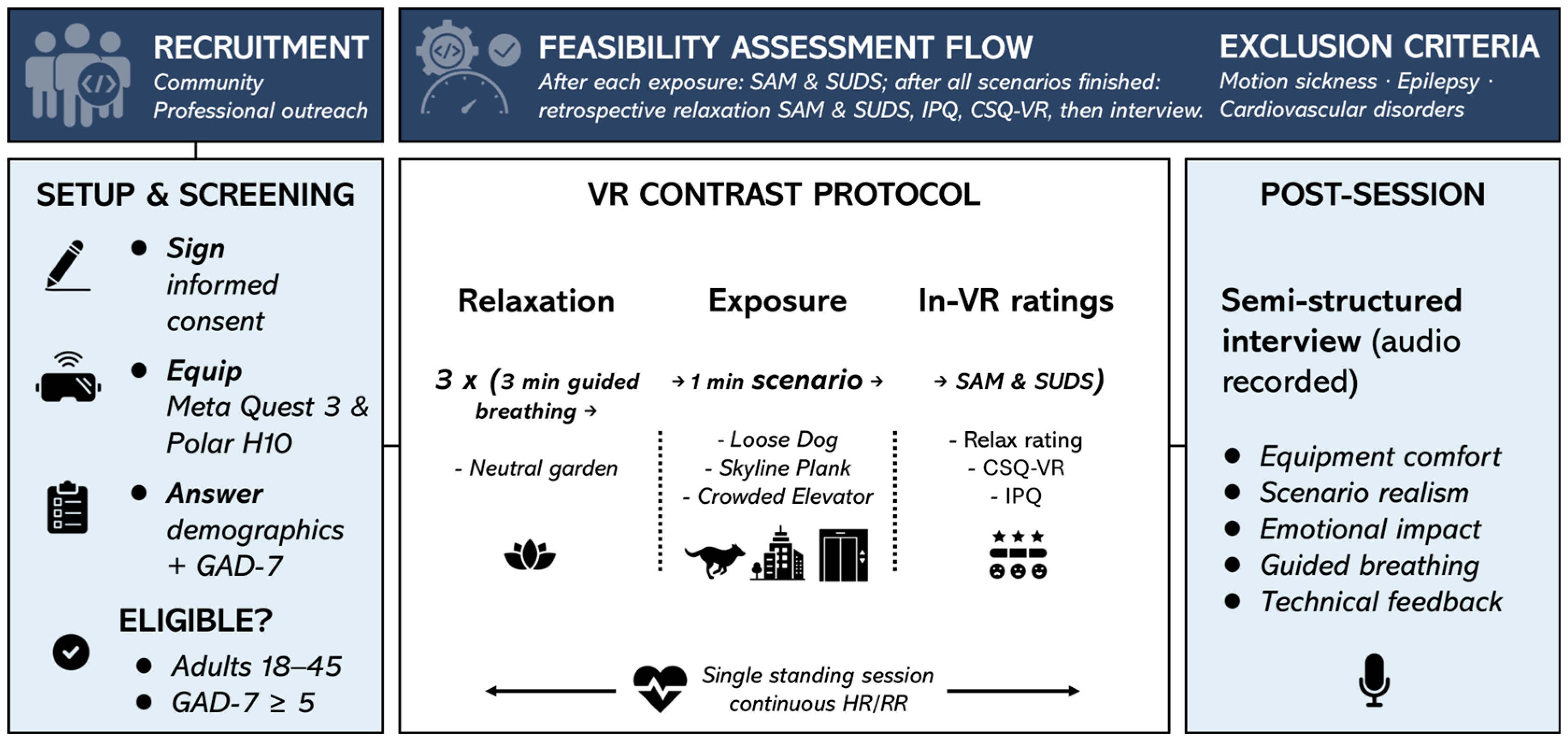
As noted above, relaxation ratings were collected retrospectively to avoid disrupting the relaxation-to-exposure contrast. Participants then completed post-experiment VR-administered questionnaires assessing presence using the Igroup Presence Questionnaire (IPQ) and cybersickness using the Cybersickness in Virtual Reality Questionnaire (CSQ-VR) [35,36,37], after which the VR headset and heart rate sensor were removed. The procedure was followed by a short semi-structured interview designed to gather feedback on general experience, equipment comfort, scenario realism, emotional impact, and technical feasibility, consistent with a user-centered design approach. Interviews were audio-recorded and transcribed prior to analysis. An overview of the study procedure is shown in Figure 2.

2.4. Virtual Environments and Scenario Design

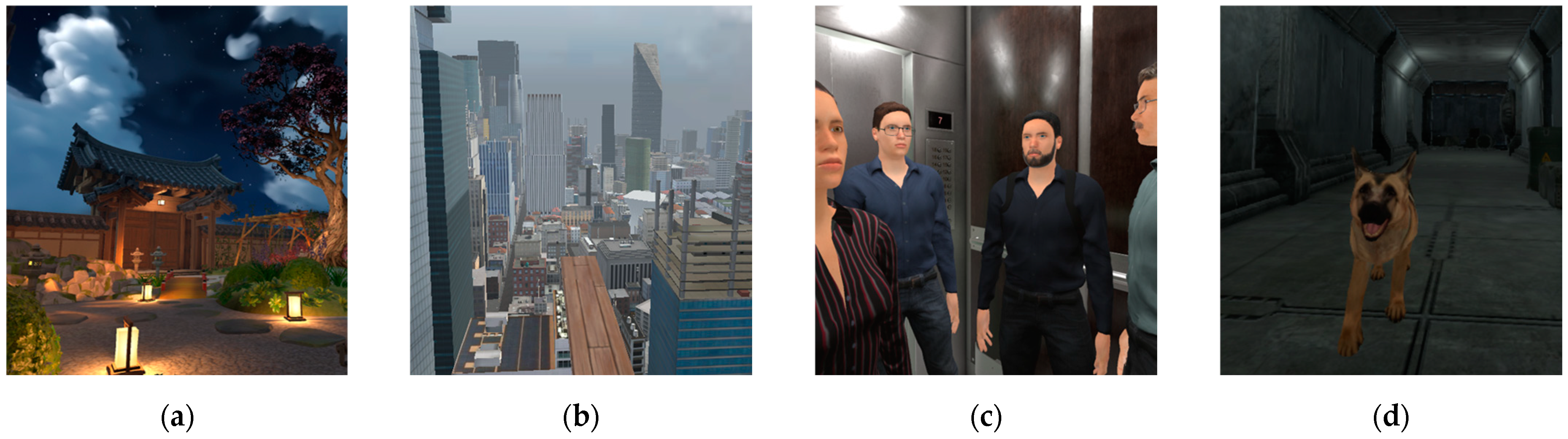
The application was developed in the Unity game engine, version 2022.3.62f1 (Unity Technologies, San Francisco, CA, USA) for the Meta Quest 3 VR headset. Candidate scenarios were identified through our systematic review of VR/video exposure and symptom-provocation paradigms in generalized anxiety disorder and related populations [38]. These candidates were then refined in a separate preparatory scenario-selection study using ratings from therapists and individuals with GAD; this was distinct from the present feasibility sample, which was subclinical [33]. In our systematic review, thematic analysis identified recurrent categories of uncertainty, social evaluation, and physical threat; these are consistent with prior accounts of common GAD concerns [3,39,40] and with VR scenarios used in related work [41,42,43,44]. The four virtual environments, including the relaxation scene, are described in Table 2 and shown in Figure 3.

2.5. Data Analysis

2.5.1. Quantitative Analysis

Quantitative analyses were conducted in Python 3.14.0 using pandas 2.3.3, numpy 2.3.5, statsmodels 0.14.6, scipy 1.16.3, and matplotlib 3.10.7. Descriptive statistics were used to summarize sample characteristics, physiological parameters, and post-session scale scores, with categorical variables reported as counts and percentages and continuous variables as means, standard deviations, and ranges. Statistical significance was evaluated at α = 0.05. Coefficient-level effects were evaluated with two-tailed z tests, whereas multi-parameter omnibus effects were evaluated with joint Wald chi-square tests. Where multiple related outcomes were tested, p-values were adjusted within outcome families using the Benjamini–Hochberg false discovery rate (FDR) procedure.
Physiological analyses were based on HR and HRV derived from RR intervals. Data were segmented by condition, that is, relaxation versus exposure. The root mean square of successive differences (RMSSD) was used as the primary HRV index. Segments with low signal quality or physiologically implausible RR values were excluded according to prespecified validity thresholds, and RMSSD was analyzed on the log scale when residual diagnostics indicated improved model fit. RR intervals outside 300–2000 ms were treated as invalid; segments were retained only when at least 80% of rows were valid and at least 20 valid RR observations were available, and complete relaxation–exposure cycles were excluded if either segment failed these criteria.
The primary analyses tested whether the protocol induced the intended emotional contrast. For HR and RMSSD, linear mixed-effects models with Participant as a random intercept were fitted with Segment Type and Scenario as fixed effects, with Scenario interaction terms evaluated in full models; model-based exposure-minus-relaxation contrasts were then estimated to test whether contrast magnitude varied across scenarios.
The general model structure was:
Outcomeij = β0 + β1(Predictorij) + β2(Scenarioij) + β3(Predictor × Scenarioij) + u0j + εij.
Subjective analyses focused on post-exposure ratings and retrospective-baseline-referenced change scores calculated relative to the recalled relaxation state. These scores were treated as estimated subjective contrasts, not direct pre–post changes, because the relaxation reference was retrospective rather than immediately post-segment. The outcomes were analyzed using mixed-effects models with Scenario as a fixed effect and Participant as a random intercept. IPQ and CSQ-VR scores were summarized descriptively.
To examine whether baseline anxiety severity was associated with physiological reactivity, GAD-7 and its interaction with Segment Type were added to the physiological models. Exploratory analyses also examined associations between physiological contrast indices and post-exposure subjective responding. Model assumptions were inspected using residual diagnostics for primary mixed-effects analyses, and results are reported as parameter estimates, standard errors, 95% confidence intervals, and p-values.

2.5.2. Qualitative Analysis

Interview transcripts were analyzed using the reflexive thematic analysis framework [45]. A single researcher conducted the qualitative coding. Because the interview was designed around the study’s feasibility and usability objectives, these objectives were used as an organizational scaffold while allowing subthemes and insights to be developed inductively from participants’ accounts. NLP-assisted preprocessing was used only as an organizational aid to support familiarization with the dataset, including keyword extraction, semantic clustering, and deviant case flagging; it did not generate final themes or replace interpretive coding. To support credibility, emerging codes and themes were checked against the original transcripts, deviant or contradictory cases were reviewed, illustrative quotations were retained, and analytic notes were used to link participant accounts to theme development. Outputs were reviewed iteratively for internal coherence, distinctiveness, and relevance to the study objectives. The semi-structured interview guide is available in the project OSF repository [46].

3. Results

3.1. Quantitative Findings

A total of 20 participants met the inclusion criteria and participated in the study, 35% of whom were women (n = 7). All eligible participants were able to complete the full VR protocol and post-session assessment procedures. Table 3 provides a descriptive overview of the sample and the principal feasibility measures, including baseline anxiety severity, presence (Objective 3), and cybersickness (Objective 2). IPQ scores are reported on the original −3 to +3 scale, where 0 represents the midpoint and negative values indicate lower-than-midpoint ratings; CSQ-VR total scores range from 6 to 42 and subscale scores from 2 to 14, with higher values indicating greater cybersickness symptoms.

3.1.1. Physiological Reactivity

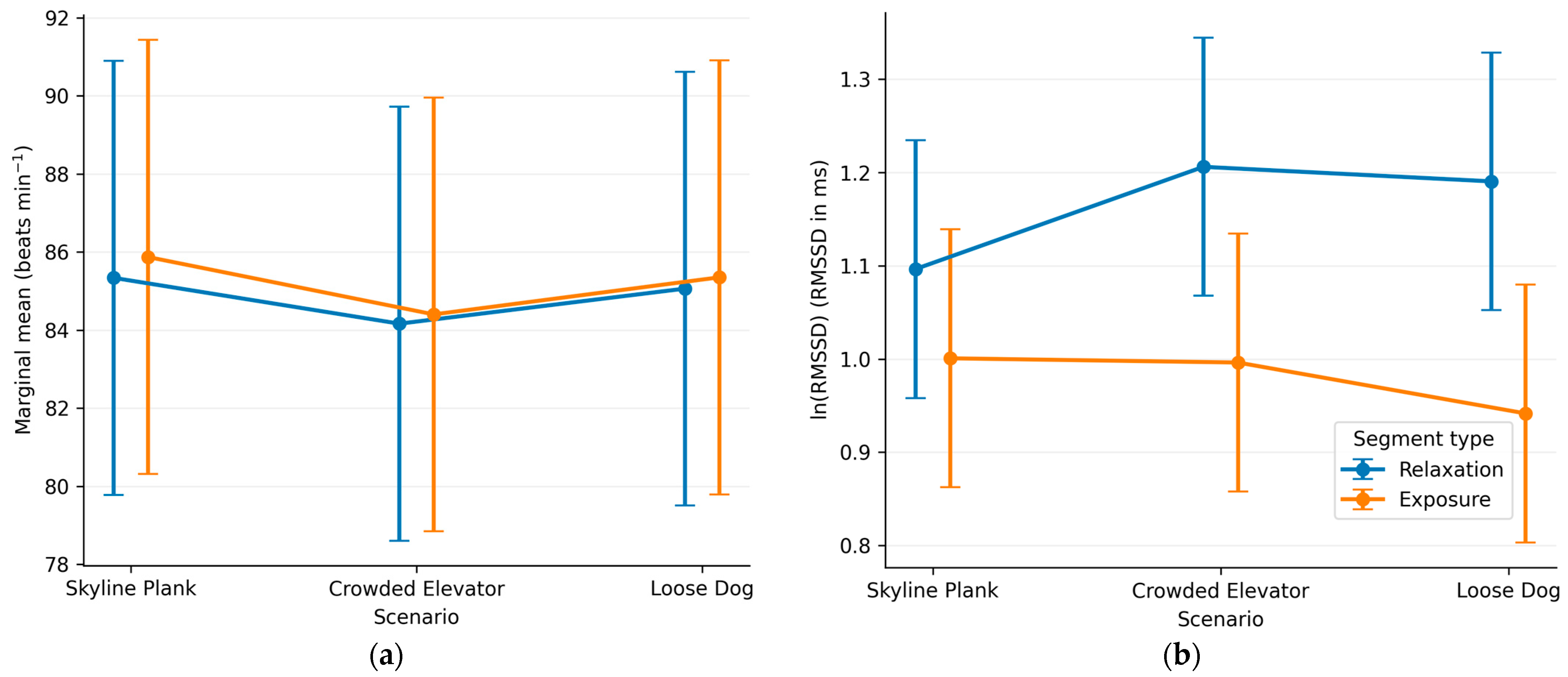
To assess the contrast-inducing potential of the protocol (Objective 1), HR and HRV were examined across relaxation and exposure segments. Before physiological modelling, data-quality screening was applied to all relaxation and exposure segments. Of the 120 planned physiological segments, none were excluded for failing RR-validity or minimum-observation criteria. Accordingly, no complete relaxation–exposure cycles were excluded, leaving 60 complete cycles for HR and RMSSD analyses. Analysis of HR revealed a non-significant main effect of Segment Type (β = 0.35 bpm, SE = 0.52, 95% CI [−0.67, 1.38], p = 0.500), with slightly higher HR during exposure than relaxation segments. Neither the main effect of Scenario (p = 0.108) nor the Segment Type × Scenario interaction (p = 0.970) reached significance. In contrast, log-transformed RMSSD showed a significant decrease during exposure segments relative to relaxation (β = −0.185, SE = 0.038, 95% CI [−0.259, −0.111], p < 0.001), consistent with reduced parasympathetic activity during anxiety induction.
After FDR correction within the physiological outcome family, the Segment Type effect remained statistically significant for RMSSD, whereas the corresponding HR effect did not. Scenario-level differences in contrast magnitude were non-significant, suggesting that physiological contrast was broadly comparable across thematic categories in this sample. Model-estimated marginal means for both physiological outcomes are presented in Figure 4.

3.1.2. Subjective Emotional Reactivity

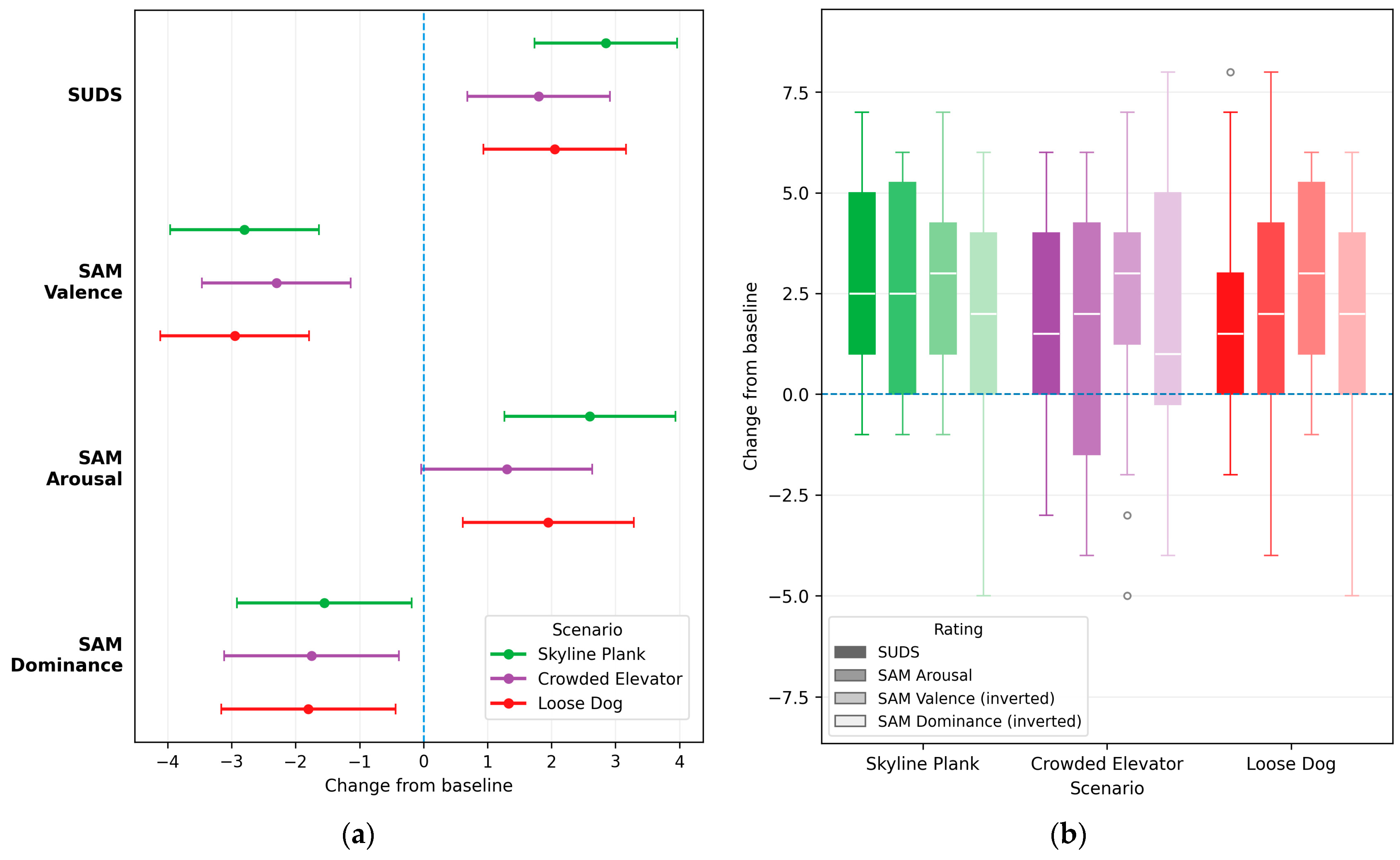
Complementing the physiological indices of contrast (Objective 1), subjective ratings showed higher distress on SUDS, lower valence, higher arousal, and lower dominance across scenarios during post-exposure ratings. Mixed-effects models of these baseline-referenced change scores indicated a significant overall increase in SUDS, β = 2.23 (SE = 0.45, 95% CI [1.36, 3.11], p < 0.001), a significant decrease in SAM valence, β = −2.68 (SE = 0.44, 95% CI [−3.54, −1.83], p < 0.001), a significant increase in SAM arousal, β = 1.95 (SE = 0.57, 95% CI [0.84, 3.06], p < 0.001), and a significant decrease in SAM dominance, β = −1.70 (SE = 0.60, 95% CI [−2.87, −0.53], p = 0.005). All four effects remained significant after FDR correction within the subjective outcome family. Because the relaxation reference was rated retrospectively, these subjective effects should be interpreted as estimated contrasts relative to a recalled relaxation state.
To test whether the significant subjective change was comparable across the three exposure scenarios, rather than driven primarily by one scenario, omnibus tests of Scenario were conducted for each baseline-referenced outcome. The results were non-significant for all four outcomes (SUDS: p = 0.197; SAM valence: p = 0.618; SAM arousal: p = 0.144; SAM dominance: p = 0.911), indicating that baseline-referenced subjective change did not vary significantly across scenarios. Descriptively, the largest increase in distress and arousal was observed in Skyline Plank (ΔSUDS = 2.85, 95% CI [1.74, 3.96]; ΔSAM arousal = 2.60, 95% CI [1.26, 3.94]), whereas the largest decrease in valence and dominance was observed in Loose Dog (ΔSAM valence = −2.95, 95% CI [−4.11, −1.79]; ΔSAM dominance = −1.80, 95% CI [−3.16, −0.44]). Scenario-specific comparisons against the relaxation baseline further suggested that SUDS increased and valence decreased significantly for all three scenarios, arousal increased significantly for Skyline Plank and Loose Dog, and dominance decreased significantly for all three scenarios. Model-estimated changes across all outcomes and scenarios are displayed in Figure 5a, and participant-level change-score distributions by scenario are shown in Figure 5b.

3.1.3. Associations with Baseline Anxiety

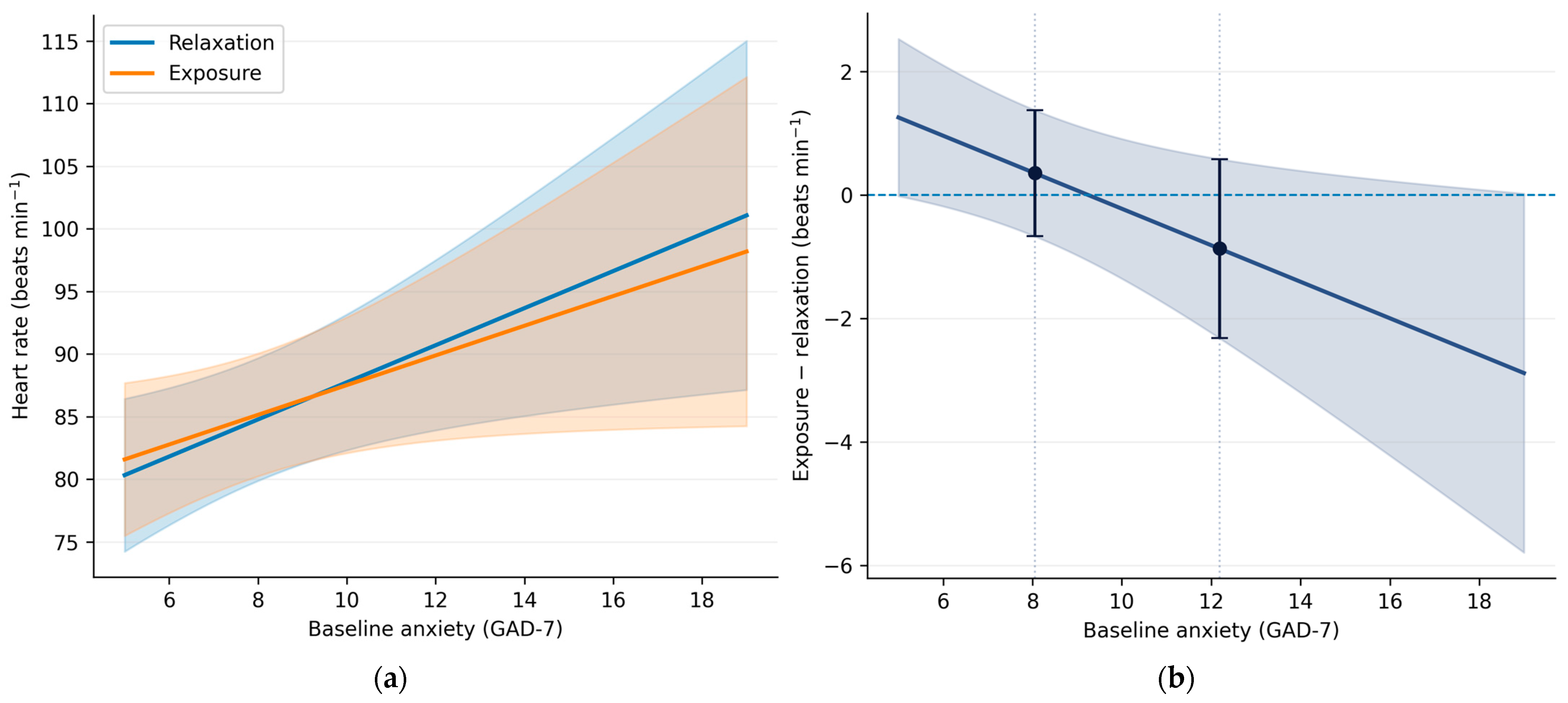
To further evaluate Objective 1, GAD-7 scores were included as a continuous predictor in mixed-effects models to examine whether physiological reactivity varied with baseline anxiety severity. In this exploratory analysis, the interaction between Segment Type and GAD-7 was significant for HR (β = −0.296, SE = 0.127, 95% CI [−0.544, −0.047], p = 0.020) and remained significant after FDR correction, suggesting a preliminary association between higher baseline anxiety and reduced HR reactivity during exposure segments. However, RMSSD, indexing parasympathetic activity, showed no comparable moderation by GAD-7. This pattern should therefore be interpreted cautiously and requires replication in larger samples. Figure 6 illustrates the interaction effect for HR at low (−1 SD), mean, and high (+1 SD) levels of baseline anxiety.

3.1.4. Subjective–Objective Correspondence

To inform assessment methodology and technical requirements for future controlled studies (Objective 4), analyses examined whether post-scenario subjective ratings corresponded to physiological reactivity and whether scenario-specific mismatch profiles suggested differential engagement of cognitive versus somatic components of the stress response. Associations between subjective ratings and physiological contrast indices were non-significant, both for ΔHR (β = 0.067, SE = 0.563, 95% CI [−1.036, 1.171], p = 0.905) and for ΔRMSSD reactivity (β = −0.056, SE = 0.049, 95% CI [−0.152, 0.040], p = 0.251). Descriptively, Crowded Elevator showed the largest positive mismatch, whereas Skyline Plank showed the largest mismatch in the opposite direction; however, both discrepancies were small. The Loose Dog scenario showed the closest correspondence between subjective and objective responding.

3.2. Qualitative Findings

Because the semi-structured interview was organized around feasibility and usability domains, the qualitative findings are presented in four objective-aligned themes. Within this structure, participant accounts generated concrete implementation-relevant subthemes, including transition impact, postural fatigue, interface friction, breathing-cue pacing, visual realism, avatar quality, and loading artifacts. Overall, the interviews suggested that the application was well received; one participant described it as “one of the most immersive … VR experiences I’ve had” (P19).

3.2.1. Emotional Contrast and Engagement

Participants’ accounts supported Objective 1 by indicating that the protocol produced the intended alternation between relaxation and anxiety-provoking exposure. Several described the shift from the calming garden environment into the first stress scenario as particularly impactful. One participant stated that the transitions were “very powerful” and “very effective to create a sense of anxiety” (P02), while another noted, “I could feel my heart rate growing and changing throughout” (P16). Some participants also described lingering effects beyond the scenario itself; for example, one reported that after the experience “it is taking me some time to really get to the view of [the] world again” (P14). At the same time, emotional impact varied by scenario and by personal relevance. Heights, social closeness, and unpredictability affected participants differently, and several noted that the contrast became less striking once the switching pattern was familiar.

3.2.2. Comfort and Wearable Burden

For Objective 2, most participants described the procedure as manageable in terms of comfort and sensor burden. The heart rate sensor was especially well tolerated and was often described as fading into the background; participants reported, for example, “I didn’t think about it at all” (P03) and “I forgot it was there” (P04). The VR headset was also generally acceptable for the duration of the protocol, although some participants reported localized discomfort related to heat, weight, eye strain, or prolonged standing. One participant remarked, “they were quite heavy, and I was sweating under the cushioning” (P05), while others noted that standing for the full session could become tiring or limit accessibility for some users.

3.2.3. Immersion, Realism, and Interface Quality

Objective 3 was reflected in participants’ descriptions of the scenarios as emotionally engaging even when realism was incomplete. Positive responses were especially evident when the scenario matched a participant’s own sensitivities or felt socially plausible. One participant reported, “with the elevator one I was very immersed” (P20), while another said, “I really felt like I was transported into the scenarios” (P19). However, participants also repeatedly emphasized that visual fidelity shaped the depth and persistence of immersion. As one participant put it, the experience could become “a simple little pixelated world” (P02), and another commented that the avatars “just feel like some dummies and mannequins” (P07). In addition to realism, participants noted that loading artifacts, abrupt scene changes, limited environmental detail, and repetitive or less dynamic animations could weaken presence over time.

3.2.4. Feasibility and Refinement Priorities

Findings relevant to Objective 4 centered on usability, feasibility, and priorities for future refinement. Instructions were generally described as clear, and many participants found the pacing and pauses sufficient to support recovery between scenarios. At the same time, the breathing guidance and in-VR ratings emerged as the two most consistent sources of friction. Although breathing instructions were usually understandable, some participants found the pace too fast, the visual cues insufficiently smooth or intuitive, or the environment too stimulating for relaxation. One participant noted that “the breathing actually kind of forced me to go like a little faster” (P20). Similarly, the SUDS and SAM ratings were typically learnable after one or two trials, but participants pointed to issues with slider precision, unclear anchors, readability, mixed visual formats, and the effort of completing some forms in VR.
Several also suggested that more in-app prompting or onboarding would help users know when and how to respond. Participants also viewed the application as broadly feasible and potentially useful, particularly as a safe and controlled way of eliciting emotionally relevant experiences. One participant explicitly described it as “a safe way of doing it” (P12). Most participants felt that other users could complete the study, although some noted that additional support might be useful for those unfamiliar with VR or less able to tolerate standing, text entry, or controller-based interaction. Across interviews, the most common improvement targets were clearer in-app guidance, reduced burden for nonessential VR-based data entry, more intuitive and readable rating interfaces, smoother and more effective relaxation cues, and greater visual and behavioral realism within the scenarios. The frequency of feedback for each theme is detailed in Table 4.

4. Discussion

Taken together, the findings broadly support the feasibility of the protocol across all four objectives: physiological and subjective indices suggested genuine affective shifts during exposure (Objective 1), wearables and VR hardware were generally well tolerated (Objective 2), presence was sufficient to elicit emotional engagement (Objective 3), and participants identified concrete priorities for refinement (Objective 4).

4.1. Contrast-Inducing Potential

Together, the physiological and subjective findings provided preliminary support for the protocol’s capacity to elicit within-session affective shifts, although the strength of evidence differed across measures. HR did not show a significant overall effect, whereas RMSSD provided the main physiological evidence of differentiation between relaxation and exposure. RMSSD, as a parasympathetic HRV index, is sensitive to rapid autonomic shifts and may respond more readily within brief recording windows, whereas HR changes may require longer exposure durations to accumulate into detectable mean differences [47,48]. Given that each exposure segment lasted one minute, the absence of a significant HR effect may therefore reflect the temporal dynamics of cardiac responding rather than insufficient emotional activation. At the same time, physiological evidence should be interpreted cautiously because autonomic support for contrast induction was driven primarily by RMSSD.
The subjective findings were more consistent, with estimated changes observed across distress, valence, arousal, and dominance. Together with the RMSSD pattern, these findings suggest that the protocol elicited measurable within-session affective contrast rather than merely demand-driven responding, consistent with prior VR anxiety induction work [17,19]. Notably, baseline anxiety severity significantly moderated HR reactivity, with higher GAD-7 scores associated with attenuated autonomic differentiation between relaxation and exposure segments. This pattern is compatible with CAM-informed expectations that sustained anticipatory arousal narrows the dynamic range of subsequent physiological responses [10,12] and is broadly consistent with laboratory-based observations of reduced emotional variability in chronic anxiety [11,15,49,50]. However, physiological evidence should be interpreted cautiously: HR did not differ significantly between relaxation and exposure, and the autonomic support for contrast induction was driven primarily by RMSSD. More broadly, the stronger and more consistent subjective effects relative to the autonomic findings suggest that the protocol’s affective impact may have been registered most reliably at the experiential level, with autonomic indices providing only partial corroboration in this sample.
Although RMSSD and subjective measures shifted in the expected direction, they were not significantly correlated at the individual level: participants reporting greater subjective distress did not necessarily show greater RMSSD reactivity. This pattern is consistent with response desynchrony, in which subjective and physiological components of fear do not necessarily co-vary [51,52], and theoretically expected in GAD, where sustained worry may inhibit somatic activation [10,11,15].
Qualitative accounts also supported the overall pattern of contrast induction. Participants described noticeable transitions from calm to stress, with several reporting these shifts as physically palpable. At the same time, emotional impact varied with personal relevance and novelty: in the interviews, some participants reported that the contrast felt weaker once the switching pattern became familiar, and different triggers resonated differently across individuals. This suggests that contrast potency depends not only on stimulus intensity but also on how personally relevant and how novel or unpredictable a scenario remains to the individual [3].

4.2. User Comfort and Wearable Burden

Cybersickness scores were low and within acceptable ranges for modern consumer VR environments [36,37], indicating good overall tolerability. The Polar H10 heart rate sensor, previously validated for HRV measurement in resting and active conditions [27], imposed minimal burden and functioned without interruption across sessions.
Qualitative feedback was also consistent with this pattern: participants often described the sensor as fading from awareness, and the VR headset was generally acceptable, although some reported heat, weight, eye strain, and discomfort during prolonged standing. Standing emerged as the main physical concern and led to revision of the protocol to a seated format, along with an improved VR headset strap and silicone facial cushion.

4.3. Immersion and Presence

IPQ scores indicated moderate presence overall, with spatial presence and general presence scoring higher than realism, which was negative on average. This pattern is consistent with prior work showing that VR-based anxiety paradigms do not require perfect perceptual convincingness to elicit emotional engagement, and that moderate immersion can be sufficient to support affective responding [21,22]. In this context, the presence scores suggest that the protocol was immersive enough to engage participants emotionally, while the lower realism scores point to visual fidelity as the main target for improvement.
Qualitative feedback clarified this pattern further. Participants described genuine immersion, particularly in the elevator and height scenarios, but also identified avatar quality, environmental detail, scene transition smoothness, and repetitive animations as factors that weakened sustained presence. These concerns informed refinements to scene detail, character movement, background activity, and transition smoothness.

4.4. Technical Requirements and Future Directions

From an assessment standpoint, the scenario-specific mismatch profiles observed in the correspondence analyses suggest that subjective and physiological measures are not fully interchangeable and may capture partly distinct aspects of the stress response. With Crowded Elevator showing relatively stronger objective activation and Skyline Plank the reverse, these findings support retaining multimodal assessment in future controlled studies rather than relying on either index alone, and further support individualized scenario selection to match exposure content to an individual’s dominant worry profile [3,39,51,52].
Qualitative feedback identified several refinement priorities that were incorporated into a subsequent version of the protocol after completion of data collection. Breathing guidance was simplified through softer, slower voice instructions, more linear and pronounced cues, and a less visually complex daytime relaxation environment. In-VR ratings and onboarding were streamlined through clearer endpoint labels and anchors, mandatory item completion, a tutorial with spoken prompts, relocation of intake measures to a tablet, and hand tracking to reduce controller burden. Application-controlled volume standardization addressed session-to-session inconsistency. More broadly, given the substantial individual variability observed in our participants’ responses, future iterations could also benefit from flexible relaxation options, vary scenario content across sessions, and allow adjustment of exposure intensity to better match individual tolerance, symptom profile, and study goals [10,12].

4.5. Limitations

Several limitations should be considered when interpreting these findings. First, the modest sample size limited statistical power, particularly for detecting interaction effects, and constrains the precision of parameter estimates; accordingly, moderation findings should be interpreted cautiously pending replication in larger samples.
Second, the use of a subclinical sample, while appropriate for feasibility testing, limits generalizability to clinically diagnosed populations, who may exhibit different patterns of autonomic flexibility or habituation.
Third, although the protocol incorporated repeated relaxation–exposure transitions, the absence of a prolonged resting baseline outside VR restricts inferences about absolute autonomic set points, emphasizing within-session contrasts rather than trait-level differences.
A further limitation concerns the retrospective assessment of relaxation-period subjective ratings. To avoid disrupting the intended relaxation-to-exposure contrast, SUDS and SAM ratings were collected immediately after exposure segments, whereas relaxation-period ratings were obtained retrospectively at the end of the session. As a result, subjective change scores may reflect not only perceived differences between relaxation and exposure, but also recall bias, anchoring to the most recent or most salient exposure experiences, and post-session reconstruction of the relaxation state. These subjective contrasts should therefore be interpreted as estimated changes relative to a recalled reference point, not as direct moment-to-moment changes from a contemporaneously measured baseline. This issue has been addressed in subsequent iterations by incorporating a rateable relaxation segment following exposure.
Importantly, this study was not designed to evaluate therapeutic efficacy, symptom reduction, durability of effects, or clinical mechanisms of change. Collectively, these limitations highlight the need for replication in larger and more diverse samples, as well as longitudinal designs to assess whether repeated exposure to controlled emotional contrast yields clinical changes in physiological and subjective reactivity.

5. Conclusions

The findings of this study support the feasibility of a VR-based protocol designed to operationalize emotional contrast in accordance with the Contrast Avoidance Model. Repeated transitions between guided relaxation and immersive threat scenarios produced measurable subjective shifts and more limited physiological differentiation within a single VR session, suggesting that the system can support controlled relaxation-to-exposure transitions across several anxiety-relevant scenario types. The exploratory association between higher baseline anxiety severity and attenuated heart rate reactivity was compatible with CAM-informed expectations, but requires replication in larger, clinically diagnosed samples. From a usability perspective, the protocol was well tolerated, with acceptable levels of comfort related to wearable sensors, minimal cybersickness, and sufficient immersion and presence to support emotional engagement despite limitations in visual fidelity. Participant feedback yielded specific and actionable insights that directly informed iterative improvements, addressing key technical considerations for future clinical implementation. Collectively, these results support the feasibility and usability of the protocol as a platform for future controlled research; whether repeated modulation of emotional contrast has therapeutic value for GAD remains an open question for subsequent clinical studies.

Author Contributions

Conceptualization, B.D. and L.A.; methodology, B.D., L.A. and I.F.; software, B.D.; validation, B.D.; formal analysis, B.D.; investigation, B.D.; resources, I.F. and L.A.; data curation, B.D.; writing—original draft preparation, B.D.; writing—review and editing, B.D., I.F. and L.A.; visualization, B.D.; supervision, I.F. and L.A.; project administration, I.F.; funding acquisition, I.F. All authors have read and agreed to the published version of the manuscript.

Funding

This work was partially supported by the project “Research of Excellence on Digital Technologies and Wellbeing” (grant no. CZ.02.01.01/00/22_008/0004583) co-financed by the European Union; the Charles University Research Program Cooperatio (Neurosciences); and institutional support from the First Faculty of Medicine, Charles University.

Institutional Review Board Statement

The study was conducted in accordance with the Declaration of Helsinki and approved by the Ethics Committee of the National Institute of Mental Health (Etická komise Národního ústavu duševního zdraví), Klecany, Czech Republic (decision no. 29/24, 15 February 2024).

Informed Consent Statement

Informed consent was obtained from all subjects involved in the study. With regard to the identifiable photograph in Figure 1, written informed consent has been obtained from the participant to publish this paper.

Data Availability Statement

De-identified study materials and analytic resources, including the semi-structured interview guide, qualitative and quantitative summary outputs, instrument materials, and Python scripts used for preprocessing and analysis, are available in the project OSF repository doi:10.17605/OSF.IO/9ZDHR. Raw participant-level data are not publicly available due to privacy and ethical considerations. An APK binary of the VR application can be made available to researchers upon reasonable request.

Acknowledgments

The authors gratefully acknowledge the team at caregiVR Inc. for their encouragement, enthusiasm, and sustained commitment to this work; MRstudios s.r.o. for its continued support and the collaborative environment it provided; and OpenLab at University Health Network (UHN), Toronto, for providing space and a collegial community. During the preparation of this manuscript, the authors used ChatGPT (GPT-5.4; OpenAI) for language and structural editing, including sentence shortening, clarity improvement, and identification of repeated information. The authors reviewed and edited the output and take full responsibility for the content of this publication.

Conflicts of Interest

The authors declare no conflicts of interest.

Abbreviations

The following abbreviations are used in this manuscript:
APKAndroid application package
CAMContrast Avoidance Model
CBTCognitive–behavioral therapy
CSQ-VRCybersickness in Virtual Reality Questionnaire
EMAEcological momentary assessment
FDRFalse discovery rate
GADGeneralized anxiety disorder
GAD-7Generalized Anxiety Disorder 7-item scale
HRHeart rate
HRVHeart rate variability
IPQIgroup Presence Questionnaire
NLPNatural language processing
OSFOpen Science Framework
RMSSDRoot mean square of successive differences
RRR-to-R interval
SAMSelf-Assessment Manikin
SUDSSubjective Units of Distress Scale
VRVirtual reality
VRETVirtual reality exposure therapy

References

  1. American Psychiatric Association. Diagnostic and Statistical Manual of Mental Disorders, 5th ed.; American Psychiatric Association: Washington, DC, USA, 2013. [Google Scholar]
  2. Stein, M.B.; Sareen, J. Generalized Anxiety Disorder. N. Engl. J. Med. 2015, 373, 2059–2068. [Google Scholar] [CrossRef] [PubMed]
  3. Newman, M.G.; Llera, S.J.; Erickson, T.M.; Przeworski, A.; Castonguay, L.G. Worry and Generalized Anxiety Disorder: A Review and Theoretical Synthesis of Evidence on Nature, Etiology, Mechanisms, and Treatment. Annu. Rev. Clin. Psychol. 2013, 9, 275–297. [Google Scholar] [CrossRef]
  4. Ruscio, A.M.; Hallion, L.S.; Lim, C.C.W.; Aguilar-Gaxiola, S.; Al-Hamzawi, A.; Alonso, J.; Andrade, L.H.; Borges, G.; Bromet, E.J.; Bunting, B.; et al. Cross-Sectional Comparison of the Epidemiology of DSM-5 Generalized Anxiety Disorder Across the Globe. JAMA Psychiatry 2017, 74, 465. [Google Scholar] [CrossRef]
  5. Kessler, R.C.; Keller, M.B.; Wittchen, H.-U. The Epidemiology of Generalized Anxiety Disorder. Psychiatr. Clin. N. Am. 2001, 24, 19–39. [Google Scholar] [CrossRef]
  6. Crocq, M.-A. The History of Generalized Anxiety Disorder as a Diagnostic Category. Dialogues Clin. Neurosci. 2017, 19, 107–116. [Google Scholar] [CrossRef]
  7. Cuijpers, P.; Sijbrandij, M.; Koole, S.; Huibers, M.; Berking, M.; Andersson, G. Psychological Treatment of Generalized Anxiety Disorder: A Meta-Analysis. Clin. Psychol. Rev. 2014, 34, 130–140. [Google Scholar] [CrossRef]
  8. Hunot, V.; Churchill, R.; Teixeira, V.; Silva De Lima, M. Psychological Therapies for Generalised Anxiety Disorder. Cochrane Database Syst. Rev. 2007, 1, CD001848. [Google Scholar] [CrossRef] [PubMed]
  9. Freeston, M.H. What If We Have Too Many Models of Worry and GAD? Behav. Cogn. Psychother. 2023, 51, 559–578. [Google Scholar] [CrossRef]
  10. Newman, M.G.; Llera, S.J. A Novel Theory of Experiential Avoidance in Generalized Anxiety Disorder: A Review and Synthesis of Research Supporting a Contrast Avoidance Model of Worry. Clin. Psychol. Rev. 2011, 31, 371–382. [Google Scholar] [CrossRef]
  11. Borkovec, T.D.; Hu, S. The Effect of Worry on Cardiovascular Response to Phobic Imagery. Behav. Res. Ther. 1990, 28, 69–73. [Google Scholar] [CrossRef] [PubMed]
  12. Llera, S.J.; Newman, M.G. Rethinking the Role of Worry in Generalized Anxiety Disorder: Evidence Supporting a Model of Emotional Contrast Avoidance. Behav. Ther. 2014, 45, 283–299. [Google Scholar] [CrossRef]
  13. Stapinski, L.A.; Abbott, M.J.; Rapee, R.M. Evaluating the Cognitive Avoidance Model of Generalised Anxiety Disorder: Impact of Worry on Threat Appraisal, Perceived Control and Anxious Arousal. Behav. Res. Ther. 2010, 48, 1032–1040. [Google Scholar] [CrossRef] [PubMed]
  14. Kim, H.; Newman, M.G. Avoidance of Negative Emotional Contrast from Worry and Rumination: An Application of the Contrast Avoidance Model. J. Behav. Cogn. Ther. 2022, 32, 33–43. [Google Scholar] [CrossRef]
  15. Llera, S.J.; Newman, M.G. Effects of Worry on Physiological and Subjective Reactivity to Emotional Stimuli in Generalized Anxiety Disorder and Nonanxious Control Participants. Emotion 2010, 10, 640–650. [Google Scholar] [CrossRef] [PubMed]
  16. Newman, M.G.; Jacobson, N.C.; Zainal, N.H.; Shin, K.E.; Szkodny, L.E.; Sliwinski, M.J. The Effects of Worry in Daily Life: An Ecological Momentary Assessment Study Supporting the Tenets of the Contrast Avoidance Model. Clin. Psychol. Sci. 2019, 7, 794–810. [Google Scholar] [CrossRef] [PubMed]
  17. Carl, E.; Stein, A.T.; Levihn-Coon, A.; Pogue, J.R.; Rothbaum, B.; Emmelkamp, P.; Asmundson, G.J.G.; Carlbring, P.; Powers, M.B. Virtual Reality Exposure Therapy for Anxiety and Related Disorders: A Meta-Analysis of Randomized Controlled Trials. J. Anxiety Disord. 2019, 61, 27–36. [Google Scholar] [CrossRef]
  18. Carlson, C.G. Virtual and Augmented Simulations in Mental Health. Curr. Psychiatry Rep. 2023, 25, 365–371. [Google Scholar] [CrossRef]
  19. Gorini, A.; Riva, G. The Potential of Virtual Reality as Anxiety Management Tool: A Randomized Controlled Study in a Sample of Patients Affected by Generalized Anxiety Disorder. Trials 2008, 9, 25. [Google Scholar] [CrossRef] [PubMed]
  20. Page, S.; Coxon, M. Virtual Reality Exposure Therapy for Anxiety Disorders: Small Samples and No Controls? Front. Psychol. 2016, 7, 326. [Google Scholar] [CrossRef]
  21. Cummings, J.J.; Bailenson, J.N. How Immersive Is Enough? A Meta-Analysis of the Effect of Immersive Technology on User Presence. Media Psychol. 2016, 19, 272–309. [Google Scholar] [CrossRef]
  22. Gromer, D.; Reinke, M.; Christner, I.; Pauli, P. Causal Interactive Links Between Presence and Fear in Virtual Reality Height Exposure. Front. Psychol. 2019, 10, 141. [Google Scholar] [CrossRef]
  23. Bowen, D.J.; Kreuter, M.; Spring, B.; Cofta-Woerpel, L.; Linnan, L.; Weiner, D.; Bakken, S.; Kaplan, C.P.; Squiers, L.; Fabrizio, C.; et al. How We Design Feasibility Studies. Am. J. Prev. Med. 2009, 36, 452–457. [Google Scholar] [CrossRef]
  24. Orsmond, G.I.; Cohn, E.S. The Distinctive Features of a Feasibility Study: Objectives and Guiding Questions. OTJR Occup. Ther. J. Res. 2015, 35, 169–177. [Google Scholar] [CrossRef]
  25. Hertzog, M.A. Considerations in Determining Sample Size for Pilot Studies. Res. Nurs. Health 2008, 31, 180–191. [Google Scholar] [CrossRef] [PubMed]
  26. Julious, S.A. Sample Size of 12 per Group Rule of Thumb for a Pilot Study. Pharm. Stat. 2005, 4, 287–291. [Google Scholar] [CrossRef]
  27. Schaffarczyk, M.; Rogers, B.; Reer, R.; Gronwald, T. Validity of the Polar H10 Sensor for Heart Rate Variability Analysis during Resting State and Incremental Exercise in Recreational Men and Women. Sensors 2022, 22, 6536. [Google Scholar] [CrossRef]
  28. Hopper, S.I.; Murray, S.L.; Ferrara, L.R.; Singleton, J.K. Effectiveness of Diaphragmatic Breathing for Reducing Physiological and Psychological Stress in Adults: A Quantitative Systematic Review. JBI Database Syst. Rev. Implement. Rep. 2019, 17, 1855–1876. [Google Scholar] [CrossRef]
  29. Francová, A.; Šouláková, B.; Procházková, L.; Fajnerová, I. Dechový Trénink ve Virtuální Realitě Na Podporu Relaxace—Pilotní Studie. [Relaxation-Supporting Breathing Exercise in Virtual Reality—Pilot Study]. ČEs. Slov. Psychiatr. 2019, 115, 20–26. [Google Scholar]
  30. Fisher, R.A. The Design of Experiments; Oliver & Boyd: Edinburgh/London, UK, 1935. [Google Scholar]
  31. Bradley, M.M.; Lang, P.J. Measuring Emotion: The Self-Assessment Manikin and the Semantic Differential. J. Behav. Ther. Exp. Psychiatry 1994, 25, 49–59. [Google Scholar] [CrossRef] [PubMed]
  32. Wolpe, J. The Practice of Behavior Therapy, 1st ed.; Pergamon General Psychology Series; Pergamon Press: New York, NY, USA, 1969. [Google Scholar]
  33. Darmová, B.; Fajnerová, I. Evaluating Virtual Scenarios through the Lens of the Contrast Avoidance Model in the Context of Generalized Anxiety Disorder Treatment. In Proceedings of the 15th International Conference on Disability, Virtual Reality and Associated Technologies; Fajnerová, I., Gamito, P., Brown, D.J., Rosenlund Høeg, E., Shopland, N., Eds.; National Institute of Mental Health: Bethesda, MD, USA, 2024; pp. 39–41. [Google Scholar]
  34. Bzdúšková, D.; Marko, M.; Hirjaková, Z.; Kimijanová, J.; Hlavačka, F.; Riečanský, I. The Effects of Virtual Height Exposure on Postural Control and Psychophysiological Stress Are Moderated by Individual Height Intolerance. Front. Hum. Neurosci. 2022, 15, 773091. [Google Scholar] [CrossRef]
  35. Schubert, T.; Friedmann, F.; Regenbrecht, H. The Experience of Presence: Factor Analytic Insights. Presence Teleoperators Virtual Environ. 2001, 10, 266–281. [Google Scholar] [CrossRef]
  36. Kourtesis, P.; Linnell, J.; Amir, R.; Argelaguet, F.; MacPherson, S.E. Cybersickness in Virtual Reality Questionnaire (CSQ-VR): A Validation and Comparison against SSQ and VRSQ. Virtual Worlds 2023, 2, 16–35. [Google Scholar] [CrossRef]
  37. Sevinc, V.; Berkman, M.I. Psychometric Evaluation of Simulator Sickness Questionnaire and Its Variants as a Measure of Cybersickness in Consumer Virtual Environments. Appl. Ergon. 2020, 82, 102958. [Google Scholar] [CrossRef]
  38. Darmová, B.; Sedlák, M.; Fajnerová, I. Virtual Reality and Video-Based Exposure and Symptom Provocation in Generalized Anxiety Disorder and Related Populations: A Systematic Review and Narrative Synthesis; PROSPERO: London, UK, 2025. [Google Scholar]
  39. Carleton, R.N. Fear of the Unknown: One Fear to Rule Them All? J. Anxiety Disord. 2016, 41, 5–21. [Google Scholar] [CrossRef]
  40. Hoyer, J.; Becker, E.S.; Roth, W.T. Characteristics of Worry in GAD Patients, Social Phobics, and Controls. Depress. Anxiety 2001, 13, 89–96. [Google Scholar] [CrossRef]
  41. Freeman, D.; Evans, N.; Lister, R.; Antley, A.; Dunn, G.; Slater, M. Height, Social Comparison, and Paranoia: An Immersive Virtual Reality Experimental Study. Psychiatry Res. 2014, 218, 348–352. [Google Scholar] [CrossRef]
  42. Guitard, T.; Bouchard, S.; Bélanger, C.; Berthiaume, M. Exposure to a Standardized Catastrophic Scenario in Virtual Reality or a Personalized Scenario in Imagination for Generalized Anxiety Disorder. J. Clin. Med. 2019, 8, 309. [Google Scholar] [CrossRef]
  43. Hartanto, D.; Kampmann, I.L.; Morina, N.; Emmelkamp, P.G.M.; Neerincx, M.A.; Brinkman, W.-P. Controlling Social Stress in Virtual Reality Environments. PLoS ONE 2014, 9, e92804. [Google Scholar] [CrossRef] [PubMed]
  44. Whiteside, S.P.H.; Brennan, E.; Biggs, B.K.; Vickers, K.; Hathaway, J.; Seifert, S.J.; Kramer, K.M.; Hofschulte, D.R. The Feasibility of Verbal and Virtual Reality Exposure for Youth with Academic Performance Worry. J. Anxiety Disord. 2020, 76, 102298. [Google Scholar] [CrossRef] [PubMed]
  45. Braun, V.; Clarke, V. Using thematic analysis in psychology. Qual. Res. Psychol. 2006, 3, 77–101. [Google Scholar] [CrossRef]
  46. Darmová, B.; Appel, L.; Fajnerová, I. Usability and Feasibility of a Contrast Avoidance Model-Based Virtual Reality Protocol Designed for Generalized Anxiety Disorder. OSF 2026. [Google Scholar] [CrossRef]
  47. Shaffer, F.; Ginsberg, J.P. An Overview of Heart Rate Variability Metrics and Norms. Front. Public Health 2017, 5, 258. [Google Scholar] [CrossRef]
  48. Laborde, S.; Mosley, E.; Thayer, J.F. Heart Rate Variability and Cardiac Vagal Tone in Psychophysiological Research—Recommendations for Experiment Planning, Data Analysis, and Data Reporting. Front. Psychol. 2017, 08, 213. [Google Scholar] [CrossRef] [PubMed]
  49. Souza, G.G.L.; Mendonça-de-Souza, A.C.F.; Duarte, A.F.A.; Fischer, N.L.; Souza, W.F.; Silva Freire Coutinho, E.; Figueira, I.; Volchan, E. Blunted Cardiac Reactivity to Psychological Stress Associated with Higher Trait Anxiety: A Study in Peacekeepers. BMC Neurosci. 2015, 16, 81. [Google Scholar] [CrossRef] [PubMed]
  50. O’Riordan, A.; Gallagher, S.; Howard, S. Type D Personality and Cardiovascular Reactivity to Acute Psychological Stress: A Systematic Review and Meta-Analysis. Health Psychol. 2023, 42, 628–641. [Google Scholar] [CrossRef] [PubMed]
  51. Lang, P.J. Fear Reduction and Fear Behavior: Problems in Treating a Construct. In Research in Psychotherapy; Shlien, J.M., Ed.; American Psychological Association: Washington, DC, USA, 1968; pp. 90–102. [Google Scholar]
  52. Rachman, S.; Hodgson, R.I. Synchrony and Desynchrony in Fear and Avoidance. Behav. Res. Ther. 1974, 12, 311–318. [Google Scholar] [CrossRef]
Figure 1. Experimental setup. (a) Fitting of the Polar H10 heart rate sensor. (b) Participant equipped with the Meta Quest 3 VR headset and controllers.
Technologies 14 00305 g001
Figure 2. Study procedure.
Technologies 14 00305 g002
Figure 3. Implemented virtual environments used in the feasibility pilot. (a) Neutral Garden; (b) Skyline Plank; (c) Crowded Elevator; (d) Loose Dog.
Technologies 14 00305 g003
Figure 4. Model-estimated marginal means from linear mixed-effects models for physiological outcomes by Segment Type and Scenario: (a) heart rate (HR), expressed in beats per minute; (b) natural-log-transformed root mean square of successive differences (lnRMSSD). Error bars represent model-based 95% confidence intervals.
Technologies 14 00305 g004
Figure 5. Subjective contrast outcomes by scenario: (a) Model-estimated change scores from mixed-effects models, calculated relative to the retrospectively recalled relaxation baseline across subjective outcomes and scenarios. (b) Participant-level change-score distributions by scenario and rating type, with group means and 95% confidence intervals, color indicates scenario and shade indicates rating type, as shown in the legend.
Technologies 14 00305 g005
Figure 6. Exploratory Moderation of Heart Rate Reactivity by Baseline Anxiety: (a) Model-predicted heart rate values by Segment Type across the observed GAD-7 range. (b) Model-estimated exposure–relaxation heart rate reactivity across the observed GAD-7 range, shown with 95% confidence intervals.
Technologies 14 00305 g006
Table 1. Eligibility criteria.
TypeCriteria
InclusionAdults aged 18–45 years; normal or corrected-to-normal vision; Generalized Anxiety Disorder 7-item (GAD-7) score ≥ 5, indicating mildly elevated anxiety symptoms.
ExclusionHistory of severe motion sickness; history of epilepsy; history of cardiovascular disorders.
Table 2. Overview of virtual scenarios.
ScenarioExperimental RoleDescription
Neutral GardenBaseline/relaxationA calm, Japanese-style courtyard used for baseline assessment and guided relaxation.
Skyline PlankPhysical threatA simulation involving standing on a narrow wooden plank protruding from a skyscraper.
Crowded ElevatorSocial evaluationAn enclosed, cramped elevator space where the user is surrounded by non-interactive
avatars.
Loose DogUncertaintyA confined hallway featuring an encounter with an unleashed German Shepherd.
Table 3. Participant Characteristics and Feasibility Measures.
VariableMSDRange
Age (years)35.357.0225–45
GAD-7 18.054.225–19
IPQ Overall 20.121.01−1.43–1.71
IPQ General Presence 20.91.59−2.00–3.00
IPQ Spatial Presence 20.891.07−1.00–2.20
IPQ Involvement 20.391.56−2.75–2.75
IPQ Realism 2−1.31.03−3.00–1.25
CSQ-VR Total 311.44.686–21
CSQ-VR Nausea 33.21.512–8
CSQ-VR Vestibular 34.22.072–9
CSQ-VR Oculomotor 342.152–9
1 Generalized Anxiety Disorder 7-item scale. 2 Igroup Presence Questionnaire. 3 Cybersickness Questionnaire for Virtual Reality.
Table 4. Frequencies of feedback for qualitative themes.
ThemePositive Feedback InstancesNegative/Constructive Feedback Instances
Emotional Contrast and Engagement6121
Comfort and Wearable Burden17215
Immersion, Realism, and Interface
Quality
13570
Feasibility and Refinement Priorities10323
Disclaimer/Publisher’s Note: The statements, opinions and data contained in all publications are solely those of the individual author(s) and contributor(s) and not of MDPI and/or the editor(s). MDPI and/or the editor(s) disclaim responsibility for any injury to people or property resulting from any ideas, methods, instructions or products referred to in the content.