
Article

Assessment of Geometric Scaling Factors and Anisotropic Phase Formation in GMAW-Additively Manufactured Duplex Stainless Steel (ER2209) Components

1
Faculty of Science and Technology, Charles Darwin University, Casuarina, NT 0810, Australia
2
Department of Industrial Engineering, Mechanical Engineering Faculty in Slavonski Brod, University of Slavonski Brod, 35000 Slavonski Brod, Croatia
*
Authors to whom correspondence should be addressed.
Technologies 2026, 14(5), 288; https://doi.org/10.3390/technologies14050288
Submission received: 14 April 2026 / Revised: 1 May 2026 / Accepted: 6 May 2026 / Published: 8 May 2026
(This article belongs to the Section Innovations in Materials Science and Materials Processing)

Abstract

Duplex stainless steel (DSS) blends impressive mechanical and chemical characteristics to withstand aggressive environments. Its fabrication by Gas Metal Arc Welding-Additive Manufacturing is an emerging research topic. However, its sensitive grain structure and alloy composition are prone to deterioration by repeated thermal shocks. Whether optimal weld parameters can resolve these challenges without additional costs from special fillers, gases, or mechanisms is a valid question. In this study, how different wire feed speeds, travel speeds, and weld voltages, chosen from a set of preliminary beads, translate into wall dimensions, phase formation and distribution, morphological transformation, and elemental segregation is investigated. The unique DSS microstructures were characterised using scanning electron microscopy and energy-dispersive spectroscopy to reveal differences in microstructural evolution and ferrite-austenite (α-γ) structure. The deposited walls exhibited satisfactory geometric quality with negligible distortions. However, the height suppression was noticeable at the deposition energy (DE) of 755 J/mm. Metallographic analysis revealed low γ phase formation (<30%) at low DE (230 J/mm) and excessive γ formation (>70%) in the high DE wall (755 J/mm). The parameters WFS:TS = 15, TS = 35 cm/min, WFS = 525 cm/min, and V = 20.804 volts suppressed the elemental segregation while maintaining a suitable phase balance without post-processing.

1. Introduction

Among various metals and alloys, the demand for duplex stainless steels (DSSs) has surged significantly due to their wide-ranging applications in both offshore and onshore industries [1,2,3,4,5]. The equilibrium of 50% body-centred cubic ferrite (α) and 50% face-centred cubic austenite (γ) enables these phase binaries to exhibit high strength and superior corrosion resistance in harsh, aggressive conditions [3]. Given its versatile applications, metal additive manufacturing (AM) offers a pathway for the rapid, sustainable production of large, intricate parts with high process efficiency and reduced material waste [6]. In this regard, Gas Metal Arc Welding-Additive Manufacturing (GMAW-AM) is characterised by high material deposition rates, superior part density, and excellent fusion characteristics [7,8,9,10,11,12,13]. Previous successes, such as the 3D printing of structural bridges and complex propeller blades, have demonstrated the rapid production potential of this technology [14,15,16,17,18,19]. However, whether this manufacturing route is metallurgically reliable for DSS remains a critical question, as the complex relationship between process parameters, thermal history, and phase stoichiometry is still under intensive review.
Robotic fabrication in GMAW-AM is a bottom-up, layer-by-layer process where each layer results from the coalescence of molten filler wire droplets, governed by the deposition energy (DE). During this formation, deposited layers solidify by dissipating heat through conduction and convection at rates significantly higher than traditional casting. These rapid cooling rates (~102 to 103 K/s) often freeze the microstructure in a metastable state, restricting the diffusion-controlled transformation of α phase to γ phase. Consequently, the multilayered weld microstructures are typically columnar dendritic, unlike the fine lamellae of γ islands observed in cast DSS. This dendrite formation is dictated by the heat flow direction and governs the mechanical anisotropy of the fabricated part [20]. Therefore, the DE input is not merely a geometric control but a metallurgical lever. Employing a suitable DE can optimise the cooling window (800 °C to 500 °C), potentially minimising the need for costly post-process solution annealing or heat treatments [21,22,23].
According to the available literature, the structural integrity of GMAW-AM parts is the interplay between DE input, the intrinsic heat treatment of subsequent layers, and elemental segregation [24,25,26,27,28,29]. Previous studies by Eriksson et al. [24] and Kumar & Maji [25] successfully optimised wire feed speed (WFS) and travel speed (TS) to achieve desired geometries, yet consistently reported α depletion (<25%) and low toughness. Similarly, research by Kemény et al. [26]. and Wittig et al. [27] noted that while hardness remained uniform, the rapid thermal cycles stifled the partitioning of Chromium, Molybdenum, and Nickel required for balanced phase stoichiometry, often leading to deleterious sigma (σ) phase formation. Even trial-and-error methods to obtain suitable wall parameters by Pant et al. [28] and Knezović et al. [29] resulted in porosity and phase anisotropy. According to Mahey et al. [14], the complex thermal mechanism during fabrication complicated the microstructural makeup of a large-scale DSS wall, resulting in notable phase anisotropies in the bottom section. A recent study by Ramkumar et al. [16] found that the α phase is prone to depletion during repeated thermal cycles, highlighting the need for optimal weld parameters to retain satisfactory α-phase content. Regarding phase anisotropy, Grandhi et al. [30] suggested that unbalanced α-γ ratios can result in both high and low hardnesses (270 HV and 340 HV) across different sections of the same wall. These collective findings suggest that a high height-to-width ratio in a deposited bead is more than a structural metric—it signifies a controlled energy density that may mitigate the steep thermal gradients responsible for unbalanced phase ratios.
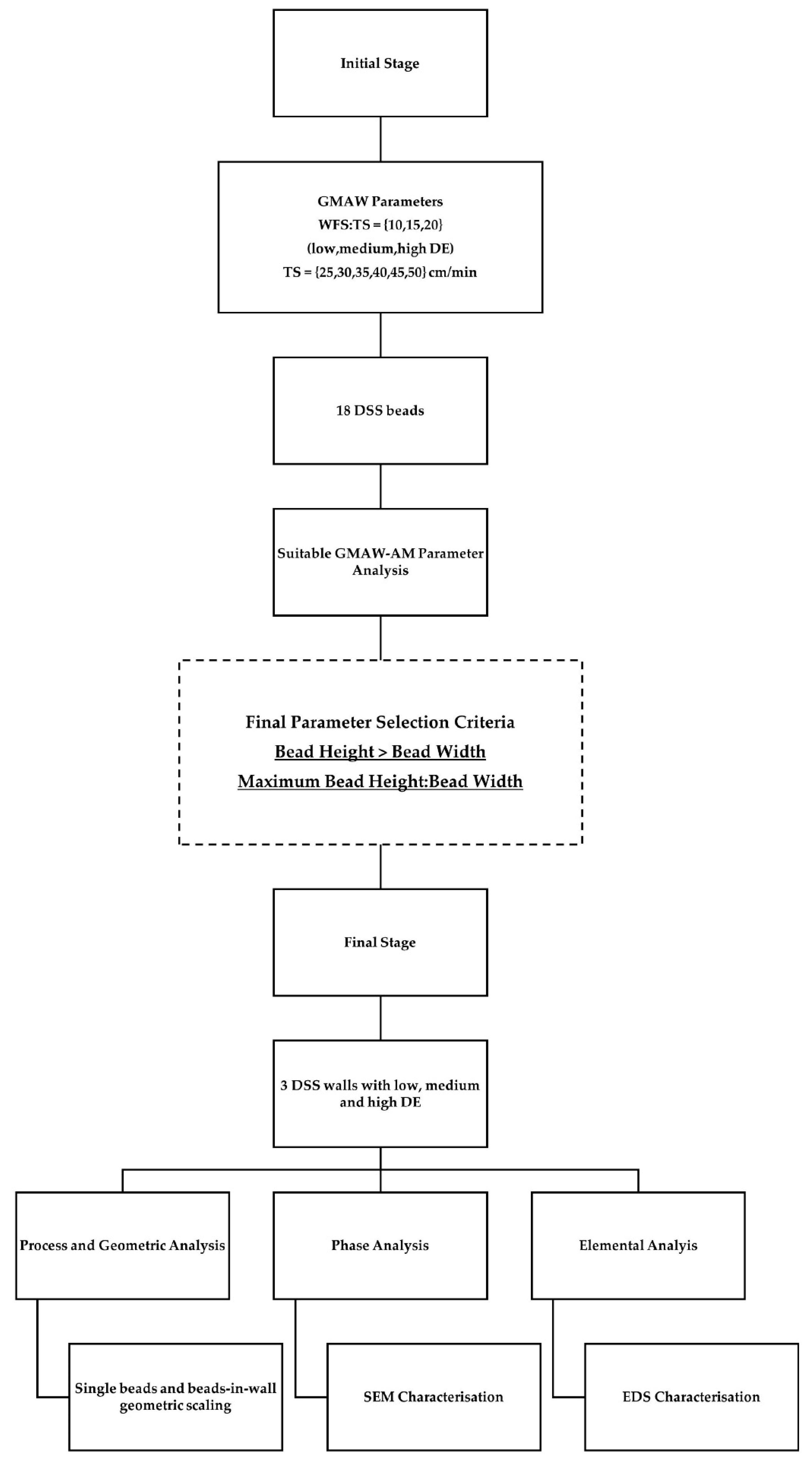
To summarise, a persistent deficit in the α phase and poor α-γ ratios remain a hurdle for the industrial adoption of GMAW-AM-based DSS. There is a clear opportunity to improve these characteristics by precisely controlling the relationship between WFS and TS. In this study, three wire feed speed to torch speed ratios (WFS:TS) of 10, 15, and 20—representing low, medium, and high DE input—were applied across TS values ranging from 25 cm/min to 50 cm/min. This resulted in eighteen DSS beads for geometric analysis. The wall parameter selection was based on the beads producing the highest height-to-width ratio (H/W), serving as a proxy for arc stability and optimal heat distribution. H/W ratio also links with thermal mass. A higher H/W ratio often means less heat conduction into the substrate and more uniform reheating of previous layers. These walls were then subjected to advanced characterisation via ImageJ (v1.54g), scanning electron microscopy (SEM), and energy-dispersive spectroscopy (EDS) to map phase morphologies and chemical compositions. This research provides critical insights into the translated effect of weld parameters on the morphological transformation of DSS, offering a pathway toward tailored mechanical properties in additive manufacturing.

2. Materials and Methods

2.1. Equipment, Materials, and Process

This study employed a 1.2 mm DSS 2209 filler wire with a DSS 2205 base plate due to their similar chemical composition, research popularity, and availability of welding guidelines [5,10,23,31,32,33]. Chemical compositions of filler and base materials are shown in Table 1.
The base plate used for each wall was 200 mm (length) × 100 mm (width) × 10 mm (thickness), while the preliminary beads were deposited on a 200 mm × 40 mm × 10 mm plate. The base plates were carefully brushed before layer deposition. Pure argon (99.99%) was employed for shielding. The Gas Metal Arc Welding (GMAW) process was employed for both bead and wall depositions. The semi-automated welding process was executed using FANUC® ARC Mate 100iC industrial robot co-supported by FANUC® Controller R-30iB Plus and LINCOLN ELECTRIC Power Wave® S500CE at Charles Darwin University, as shown in Figure 1. The welding robot and its program controller are from FANUC Corporation, Oshino-mura, Yamanashi, 401-0597, Japan. The power controller is from The Lincoln Electric Company, Cleveland, Ohio, USA. For temperature measurements, a handheld thermal sensing gun was used. While a constant 60 s dwell time per layer was maintained during wall deposition, the weld end had a lower cooling rate than the weld start point. To achieve precision, temperatures at different points along the deposition direction for each layer were measured. Of these measurements, the highest and lowest temperatures were considered to calculate the cooling rate per layer.

2.2. Bead Deposition Procedure

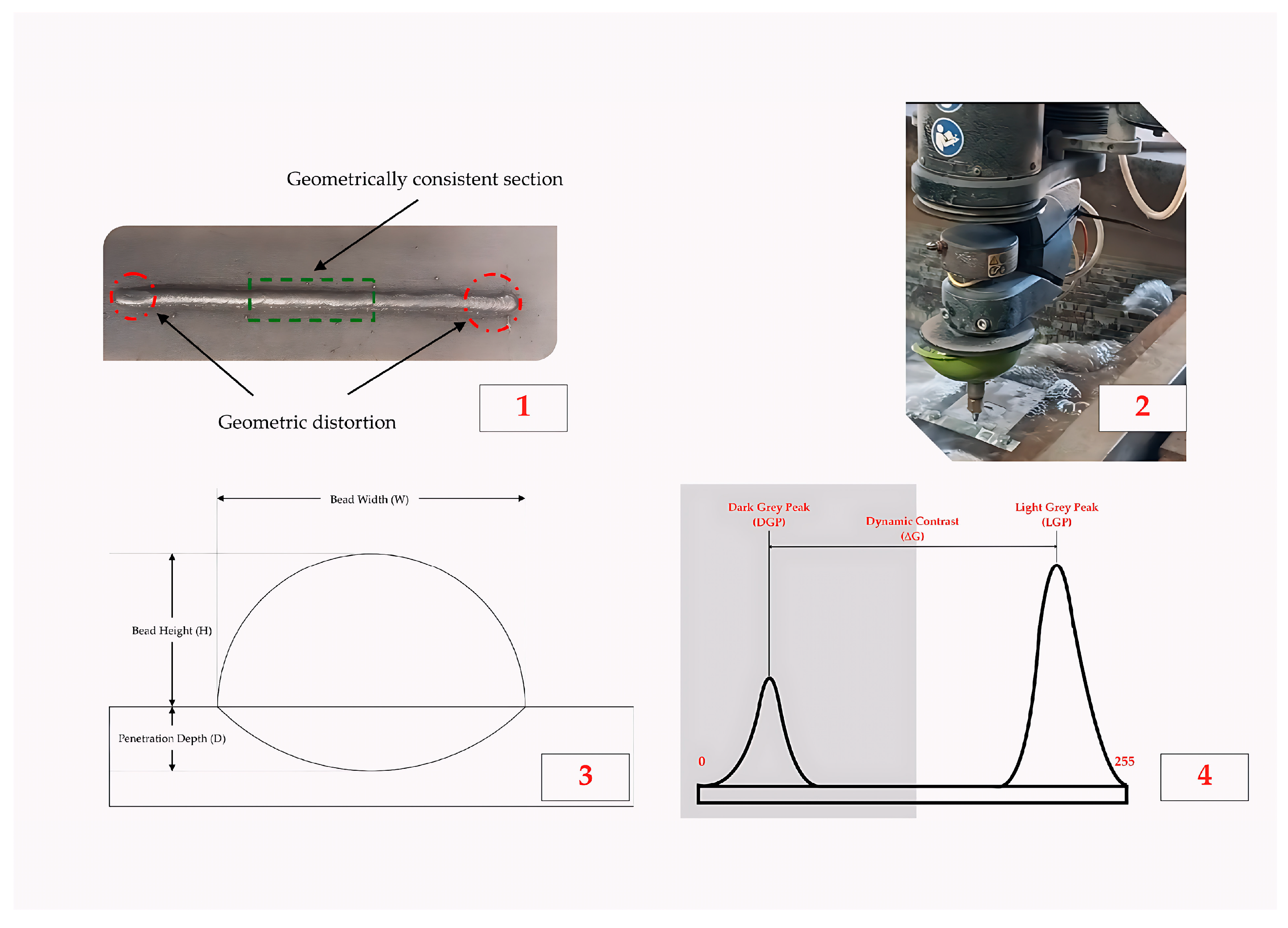
For preliminary beads, three WFS:TS were used against six TS values and constant parameters, as shown in Table 2. While WFS and TS were assigned from Table 2, a suitable weld voltage was chosen from the synergic line of the robot’s teach pendant. The deposited beads were sectioned from the centre for height and width measurements using abrasive waterjet cutting. A weld bead with water jet cutting equipment, a schematic of a bead cross-section, and an ImageJ threshold setup are shown in Figure 2.
In Figure 2(1), the weld start and end points exhibit noticeable geometric distortions (highlighted with red-dashed circles), whereas the centre portion is geometrically consistent (highlighted with a green-dashed rectangle). For this reason, the centre of the bead was chosen for geometric analysis. The geometric data obtained from the preliminary bead characterisation were evaluated against the following criteria to determine the suitable parameters for wall fabrication:
  • Bead aspect ratio: preference was given to bead geometries where the deposit height exceeded the width (H/W > 1) within each WFS:TS parameter set.
  • Vertical growth optimisation: in instances where multiple bead configurations within a single set satisfied the condition, the configuration exhibiting the highest height-to-width ratio was selected to ensure maximum vertical deposition efficiency.
Afterwards, three DSS walls, each with low, medium, and high DE input, were deposited for geometrical and microstructural analysis. During wall deposition, a constant interlayer dwell time of sixty seconds was incorporated. These brief interlayer pauses were intended to regulate interlayer temperature, prevent excessive heat accumulation, and promote uniform thermal cycles across all layers.
To further provide conducive conditions for the deposited layers to effectively release accumulated heat, a bidirectional deposition mode was adopted. This strategy mitigates cumulative height gradients and promotes geometric symmetry. By reversing the welding direction after each successive layer, geometric distortions at the extreme ends are minimised, resulting in well-aligned, structurally homogeneous layers.

2.3. Geometrical Measurement Procedure

To evaluate the geometric accuracy and deposition efficiency, the height and width of the walls produced under varying DE inputs were systematically quantified. Dimensional data were extracted using Digital Image Processing (DIP) via the ImageJ software suite. The following stages were involved during the measurement:
  • Scale setting: For precision analysis, the bead cross-sectional images were obtained with a high-resolution microscope. Before measurement, spatial calibration was carried out by assigning a known scale to the corresponding image pixels.
  • Image thresholding: To clearly contrast the weld and base plate areas, the image was converted to 8-bit grayscale. Later, the Otsu tool was employed for image thresholding. This provided a clear binary contrast, allowing for the precise identification of the fusion boundaries.
  • Calculation of dimensional variance: Since the geometric profiles of the single beads (deposited under identical DE inputs) were already established, the percentage deviation between the single-bead and multi-layer wall geometries was calculated. This analysis provides critical insights into the dimensional tolerances and cumulative thermal effects that must be accounted for when scaling from single-track deposition to complex wall fabrication.

2.4. Microstructure Sample Procedure

The microstructural analysis aimed to characterise the phase evolution and morphological features of the walls deposited under varying DE configurations.
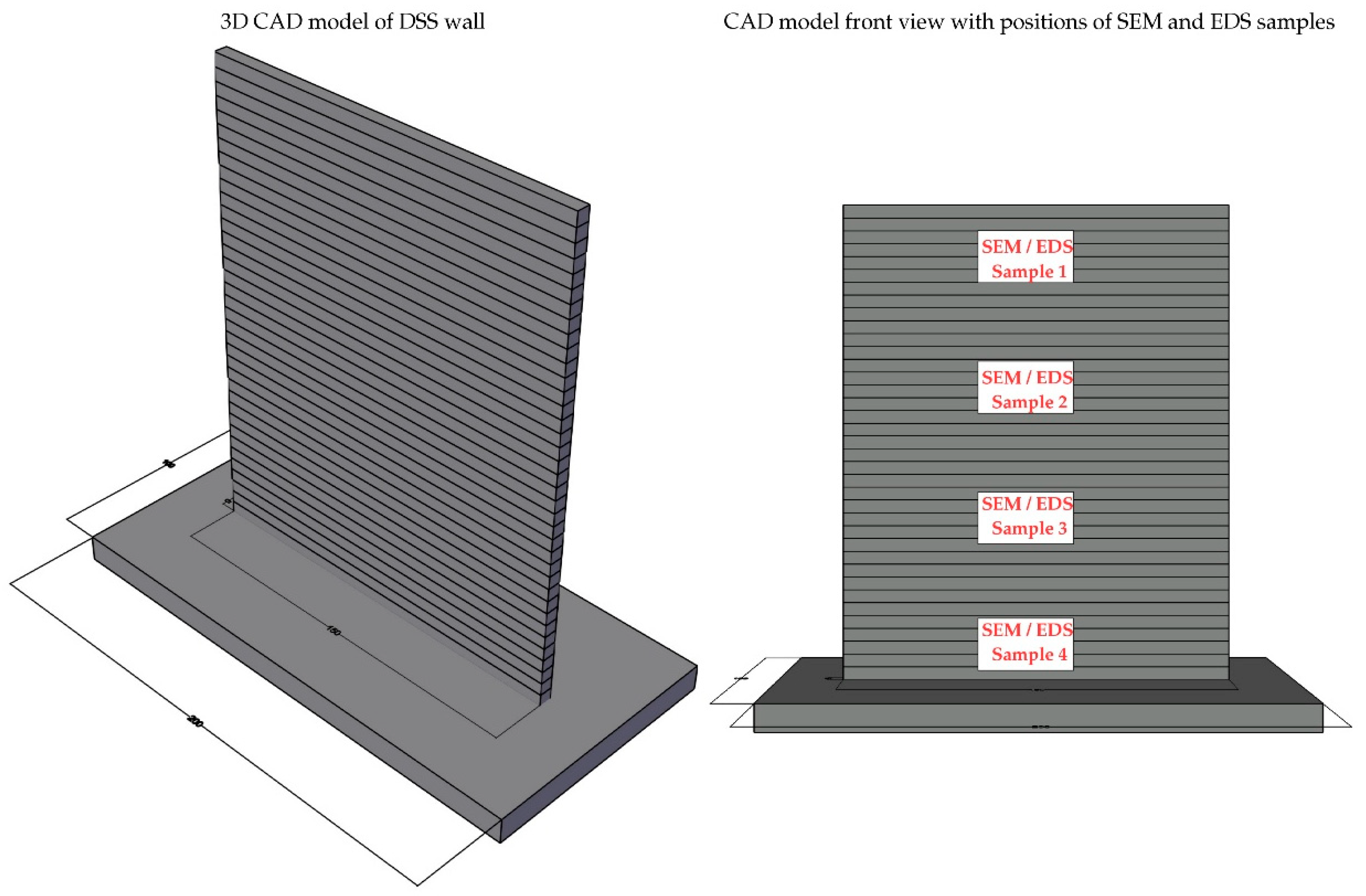
  • Sample extraction and preparation: To ensure the extracted samples were representative of the steady-state thermal conditions, four equidistant specimens were extracted from the wall centres. This region was selected as it is less susceptible to the complex thermomechanical modifications and residual stress gradients typically induced by the constrained contraction (upward bending) of the base plate. To prevent any thermally induced phase alterations during sectioning, abrasive waterjet cutting was employed as a cold-cutting technique. The positions of the samples are shown in Figure 3.
  • Metallographic preparation: Specimens were hot-mounted and subjected to a rigorous grinding and polishing sequence using silicon carbide (SiC) papers of increasing fineness (120, 220, 320, 500, and 1200 grit). Final surface refinement was achieved through diamond suspension polishing to a mirror finish.
  • Chemical etching: To provide the necessary phase contrast for image analysis, the samples were treated with Beraha’s tint etchant (composition: 200 mL HCl, 1000 mL H2O, and 12 g K2S2O5), given its recommendation and suitability to etch DSS [34,35]. This selective etchant preferentially tints the ferrite matrix while leaving the austenite phases bright, facilitating accurate segmentation.
  • Microscopy and phase quantification: A Thermo Scientific Phenom XL G2 Desktop SEM was utilised for high-resolution imaging and elemental distribution analysis via integrated Energy Dispersive X-ray Spectroscopy (EDS). The SEM/EDS equipment is from Thermo Fisher Scientific Inc., 168 Third Avenue, Waltham, MA 02451, USA. For quantitative phase analysis, 12 micrographs per wall were processed using the Otsu thresholding method within the ImageJ platform [26,36].
  • Statistical stratification: To analyse the influence of the cumulative heat cycle on phase distribution, the 39-layer wall was stratified into three distinct zones: the bottom zone (layers 1–13), middle zone (layers 14–26), and top zone (layers 27–39). This approach allowed for a granular assessment of the reheating effects and secondary austenite formation across the deposition height. A graphical image of the overall research method is shown in Figure 4.

3. Results and Discussion

3.1. Rationale Behind Geometric Analysis of Beads for Wall Parameter Selection

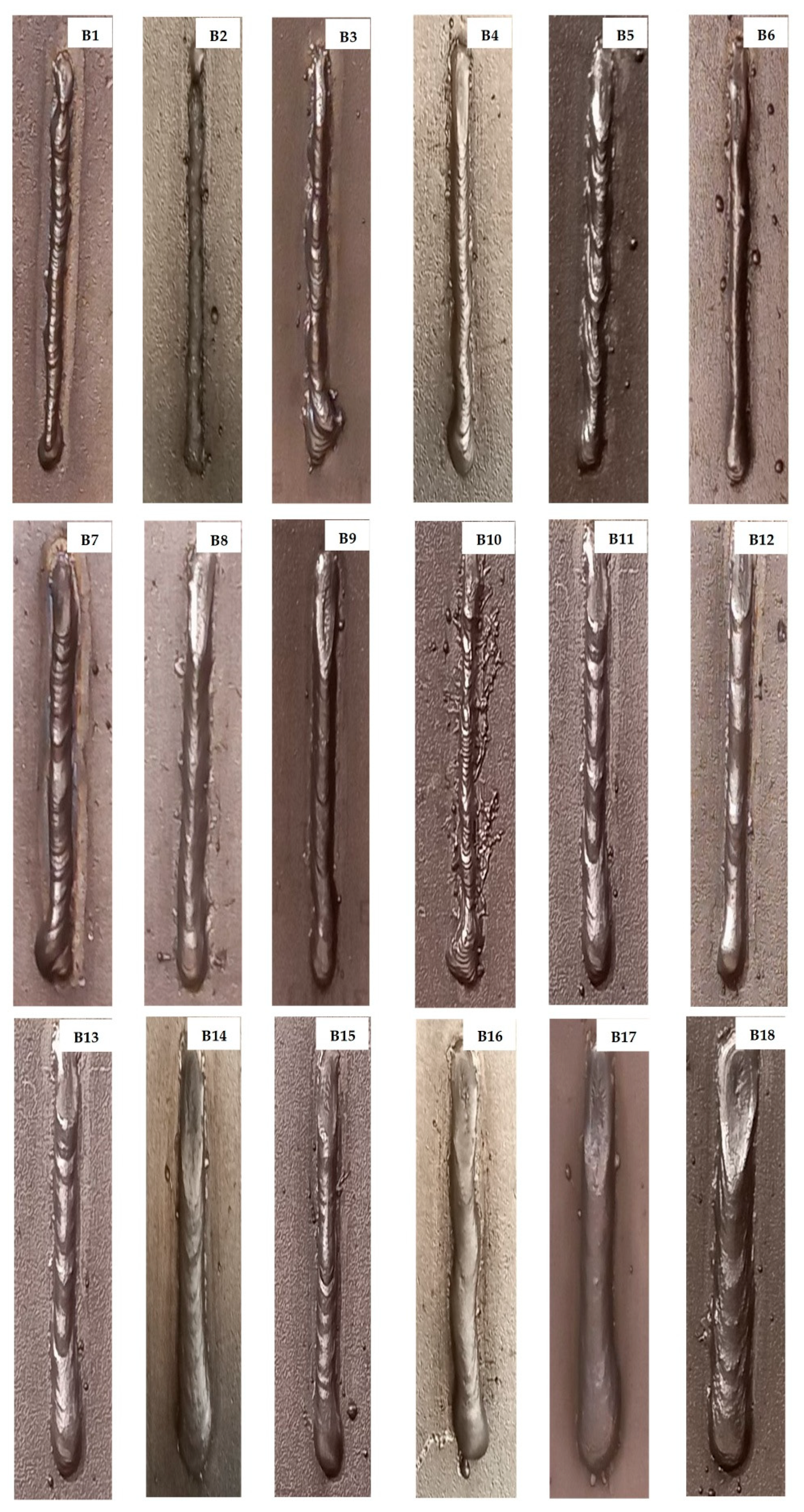
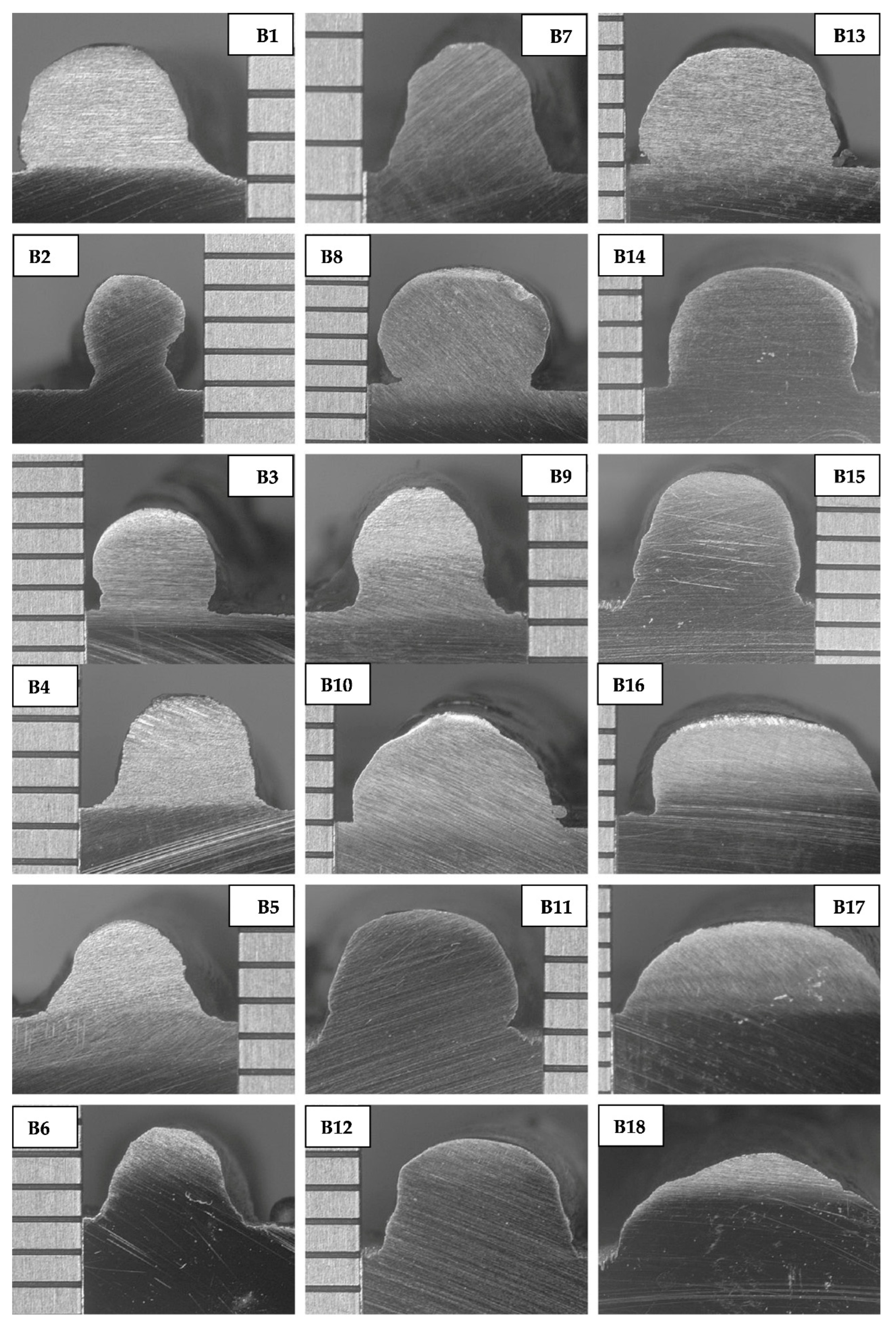
For DSS parts fabricated with the GMAW-AM process, suitable WFS and TS are critical, as an imbalanced combination of the two can cause geometric distortions and decrease process efficiency. These parameters also affect the thermal history of each layer, as WFS directly controls the weld current, which, in turn, influences the DE input. An optimum DE input during fabrication can significantly improve the weld and microstructural quality of fabricated parts. However, a DE input suitable for the single-bead microstructure might not be equally suited to the wall microstructure due to the completely different process mechanics and thermal histories. Therefore, geometric analysis of beads is feasible for deciding suitable wall fabrication parameters. From this observation, it is deduced that the geometrical distortions in additively fabricated DSS walls can be minimised by recognising them from single-bead depositions. The preliminary beads deposited using Table 2 are shown in Figure 5. The bead cross-sections are shown in Figure 6, along with the corresponding heights and widths in Table 3. For wall deposition, parametric sets B4, B9, and B15 (bold-highlighted in Table 3) were chosen for their optimal height-to-width ratios and resistance to Plateau–Rayleigh instability.

3.2. Geometric Analysis of Fabricated Walls

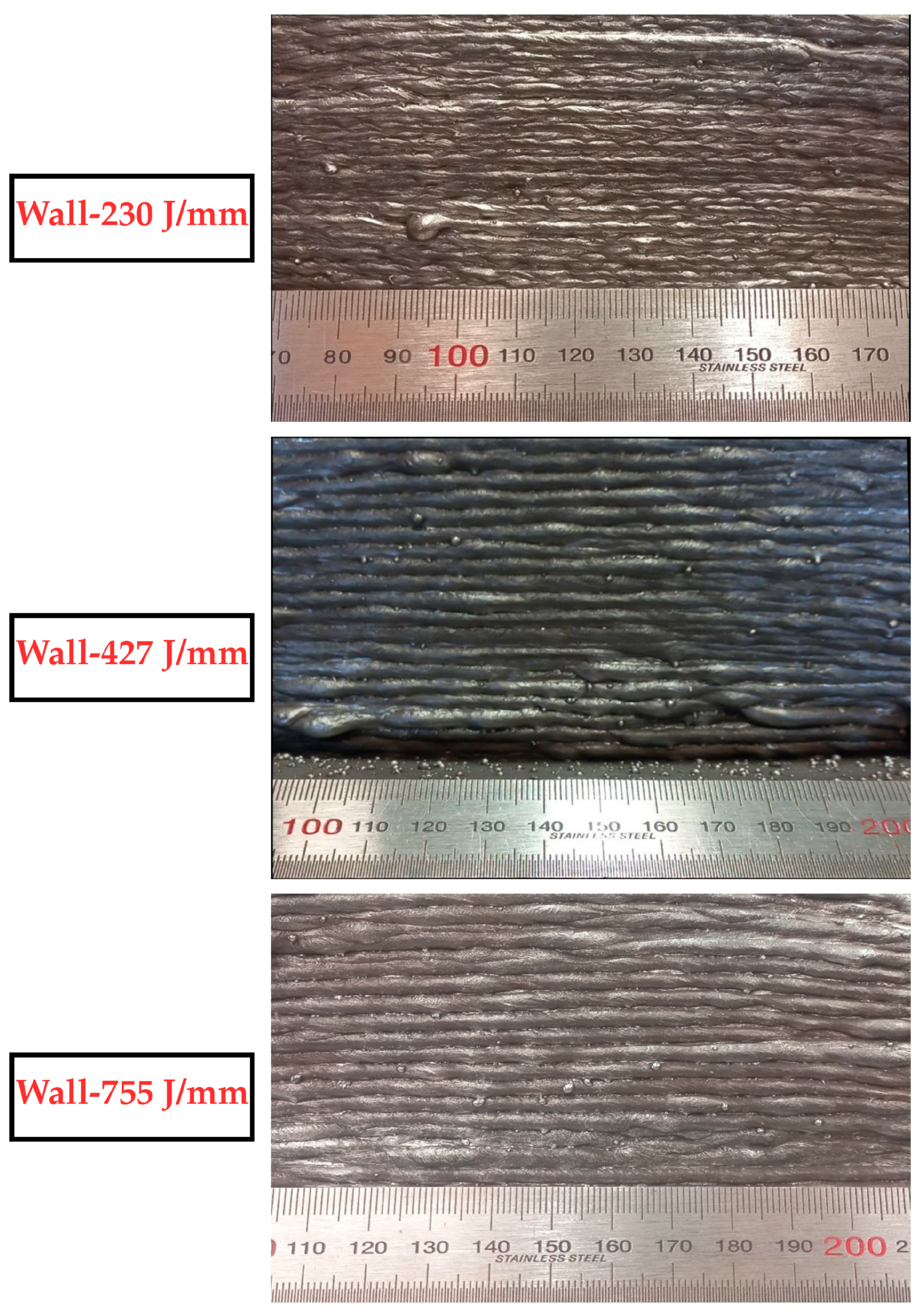
The stability of the DSS layers was evaluated through the physical morphology of the resulting walls. In this study, the parameters selected from the single-bead trials (B4, B9, and B15) effectively suppressed Plateau–Rayleigh instability, preventing common defects such as humping or irregular metal accumulation. This resulted in high-fidelity structures with uniform bead geometry and minimal dimensional variation, as shown in Figure 7. These walls are categorised by their specific DE inputs as Wall-230 J/mm, Wall-427 J/mm, and Wall-755 J/mm.
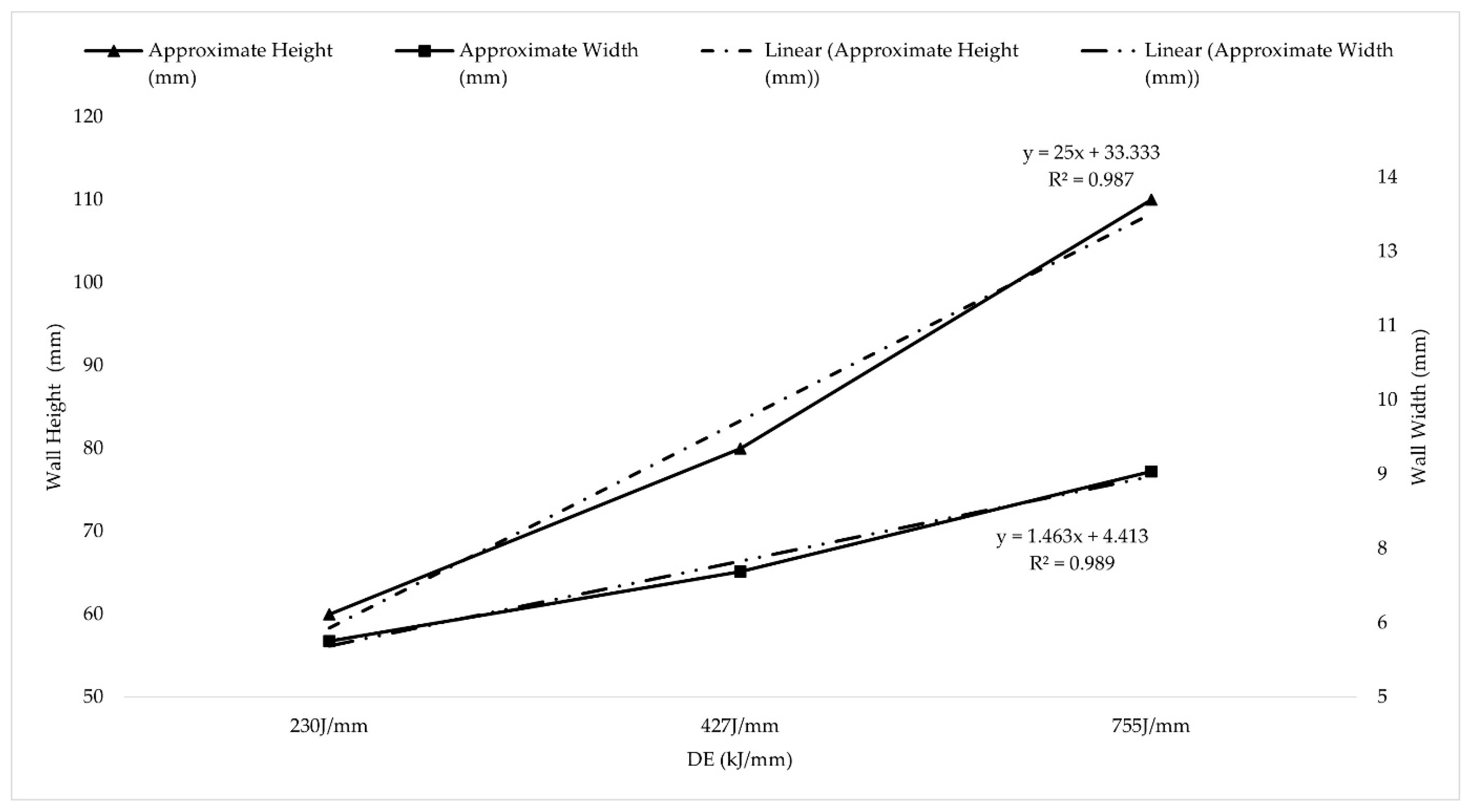
To quantify the relationship between energy density and deposition outcomes, the geometric profiles were mapped against DE inputs, as shown in Figure 8. As the DE input increased from 230 to 755 J/mm, the wall height increased by 83% and the width by 48%, indicating a linear relation between DE input and wall dimensions. This indicates that higher DE input increased lateral wetting, leading to wider wall profiles, and also promoted vertical growth. In Figure 8, while the overall wall height increased with the corresponding increase in DE input, Table 4 shows that single-bead heights are up to 307% higher than the layer heights in the corresponding wall counterparts. This difference is attributed to thermal remelting of layers and requires an adjustment factor for accurate vertical growth predictions.
A critical finding of this study is the geometric discrepancy between single-layer beads and their behaviour within a multi-layer stack. As shown in Table 4, the layer height in the wall is significantly lower than the single bead height, with differences reaching up to 307%. For instance, in the 230 J/mm sample, the single bead measured 4.894 ± 0.05 mm, whereas the average layer height in the wall dropped to 1.538 ± 0.35 mm. This reduction is attributed to the thermal remelting and compression inherent in additive manufacturing; subsequent layers partially remelt the previous deposit, causing the molten pool to spread laterally rather than stack vertically. Consequently, these results prove that single-bead height is a poor direct predictor of wall height. Based on the results of this study, an adjustment factor ranging from 1.03 to 3.07 may be applied to single-layer data to accurately estimate the number of layers required for a target wall dimension.

3.3. α-γ Phases and Morphologies

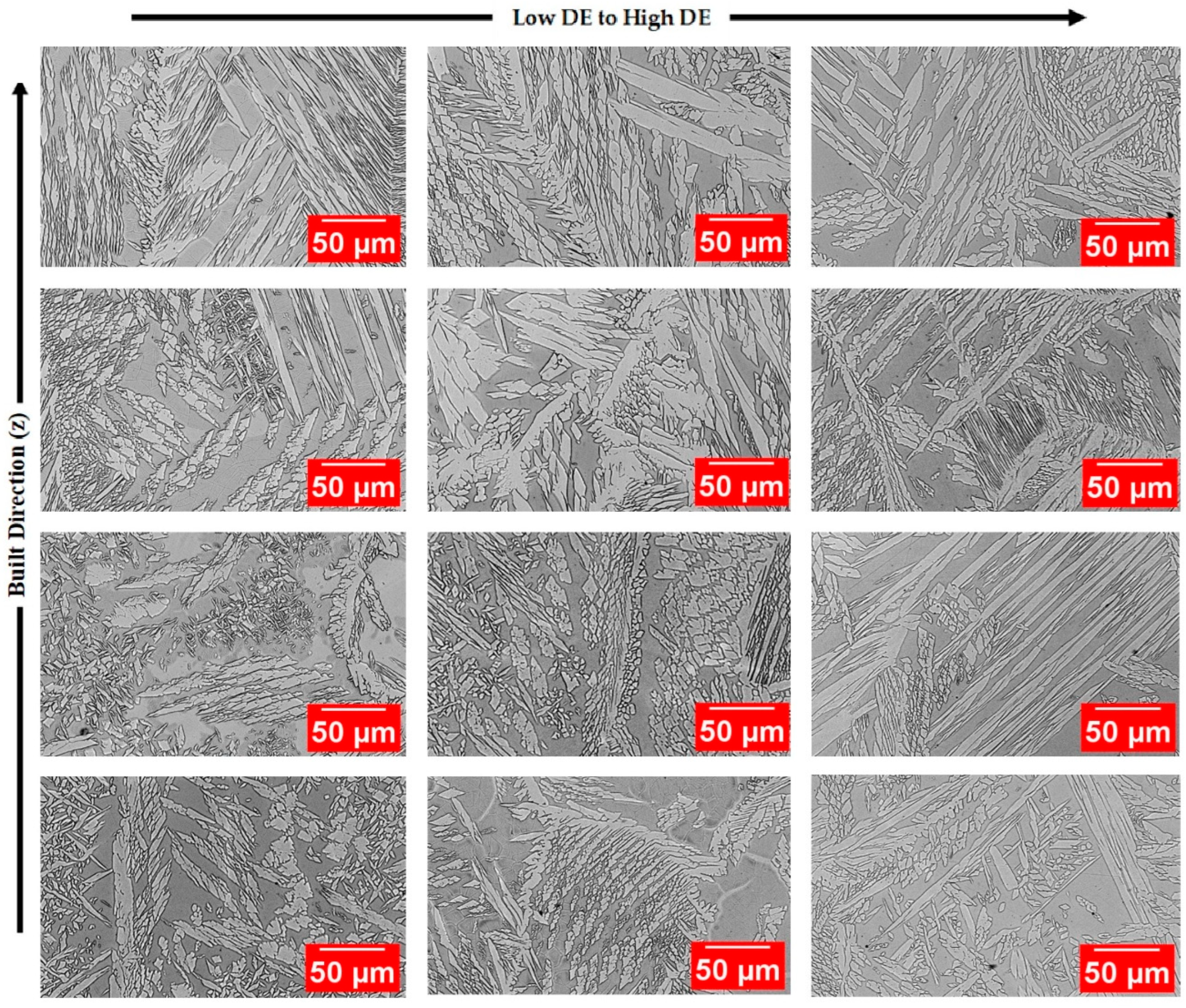
Microstructure assessment is not only important for material characterisation but also correlates with and validates the mechanical behaviour of fabricated parts. For this, it was important to examine phase formation and the different phase morphologies in each wall. It was observed that the microstructure of each wall was characteristic of its thermal history, also evidenced by the contrast in α and γ phase formation. The micro-structure profiles of the three walls were comparable in the sense that adequate γ formation took place, indicated by the presence of γ particles from bottom to top. However, the difference was in the unique γ formation and distribution pattern. The SEM images from bottom to top (built direction) of each wall sample are presented in Figure 9.

3.3.1. Wall-230 J/mm

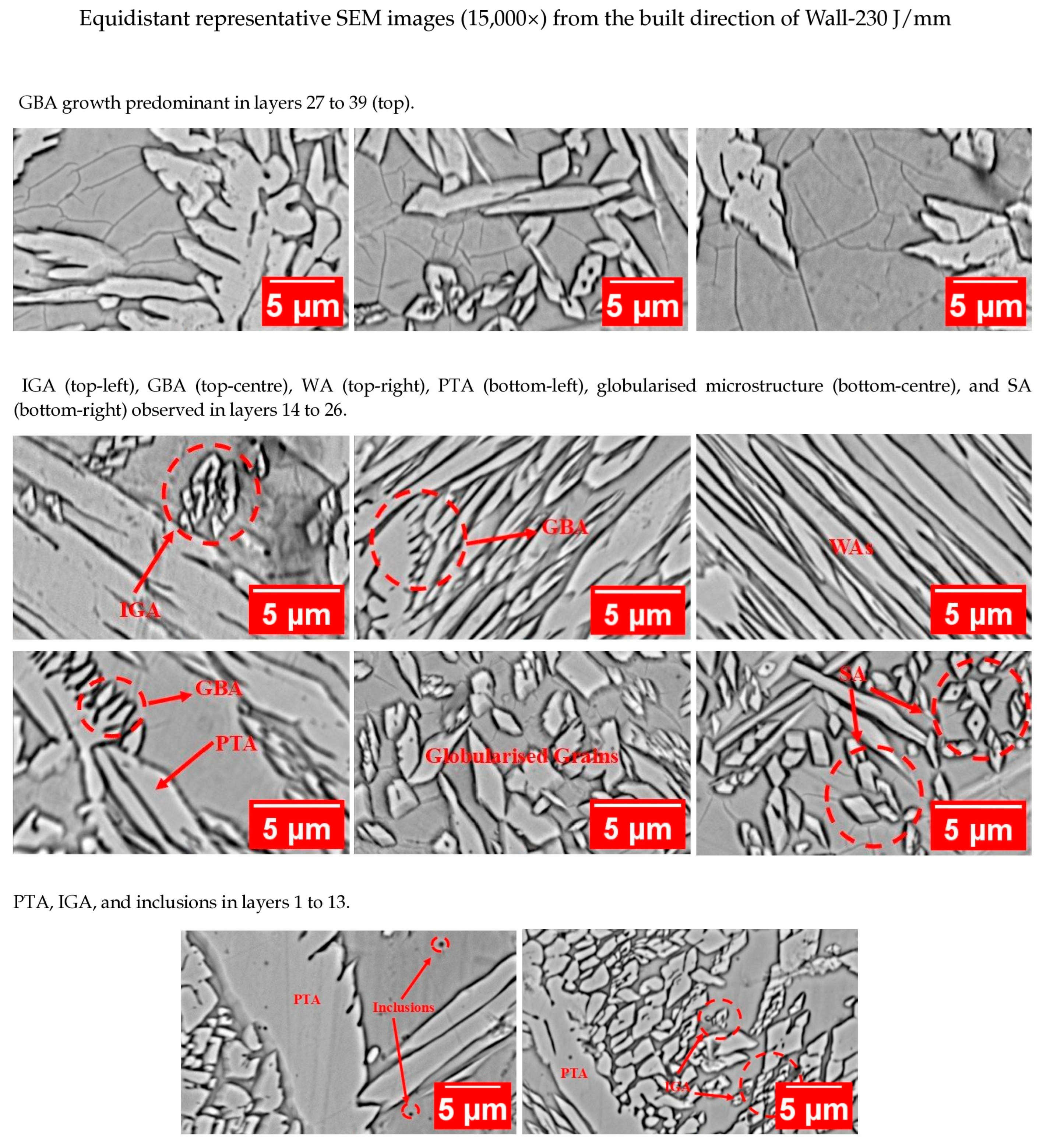
The Wall-230 J/mm did not remain at elevated temperatures for a prolonged period, as evidenced by the formation of pearly γ dendrites in its microstructure. Unlike the other two walls, its average cooling rate of 0.492 °C/s hindered the γ transformation into different morphologies. In the Wall-230 J/mm wall, the first 13 layers had an average cooling rate of 0.667 °C/s, which was conducive to γ formation in the α matrix. However, the γ formation was largely characteristic of thick and coarsened γ grains along their boundaries, characteristic of partially transformed austenite (PTA), and lacked the columnar structure. Additionally, Intra-Granular Austenite (IGA) morphologies were observed; Grain-Boundary Austenite (GBA) and Secondary Austenite (SA) were rare. The micro-structure was largely dominated by the lamellar-to-globularised transformation. Oxide inclusions were also detected. Figure 10 shows the dominant γ phases in the bottom layers of the Wall-230 J/mm. From the 14th to the 26th layer (middle section), the thermal conditions of the deposited layers provided sufficient time for γ morphologies such as Widmanstätten Austenite (WA), IGA, GBA, SA, and some PTA, with an average cooling rate of 0.370 °C/s. The WA particles were typically arranged as clusters of parallel, lenticular plates, often located between the interfaces of α and γ particles, as shown in Figure 10. In the layers from 27 to 39 of Wall-230 J/mm, WA and GBA growth were predominant. The average cooling rate of these layers was 0.440 °C/s. With the highest fraction of WAs, the GBA’s growth was observed along the δ-ferrite grain boundary, which can be seen in Figure 10.

3.3.2. Wall-427 J/mm

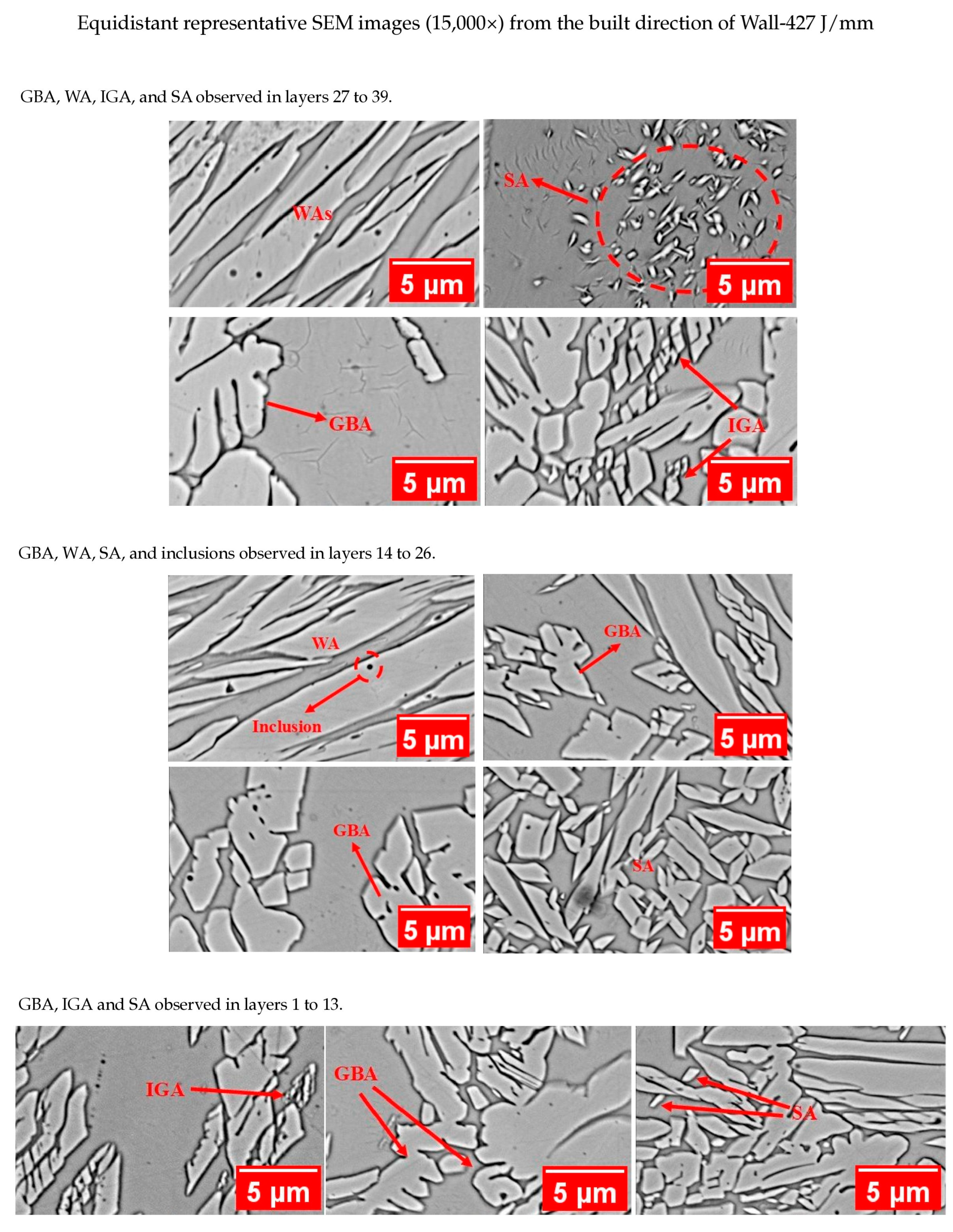
With an average overall cooling rate of 0.280 °C/s, the Wall-427 J/mm exhibited various γ morphologies in the bottom section (layers 1 to 13), including WA, IGA, GBA, and SA. The SAs were epitaxially arranged as clusters of fine grains with columnar γ grains. The average cooling rate for the 1st to 13th layers remained 0.294 °C/s. The γ morphologies detected in the bottom section are presented in Figure 11. The layers in the middle section (layers 14th to 26th) had a higher heat retention than the bottom section, with a cooling rate of 0.251 °C/s. Various γ morphologies were observed in this section, including WA, GBA, IGA, and SA. These morphologies are presented in Figure 11. In the top section of the Wall-427 J/mm, the coarsened γ morphologies were evident due to an average cooling rate of 0.295 °C/s. The WAs in these layers were characteristically thicker and longer, and the clusters of SAs were more pointed and saturated. GBAs also formed along the δ-ferrite boundaries. The γ grains were characteristically columnar, with their orientation toward the base plate, the direction of heat transfer, i.e., from the top to the bottom layers. The inclusion density in these layers was comparatively higher than in both the middle and bottom layers. Figure 11 shows the SEM images taken at different points of the top section.

3.3.3. Wall-755 J/mm

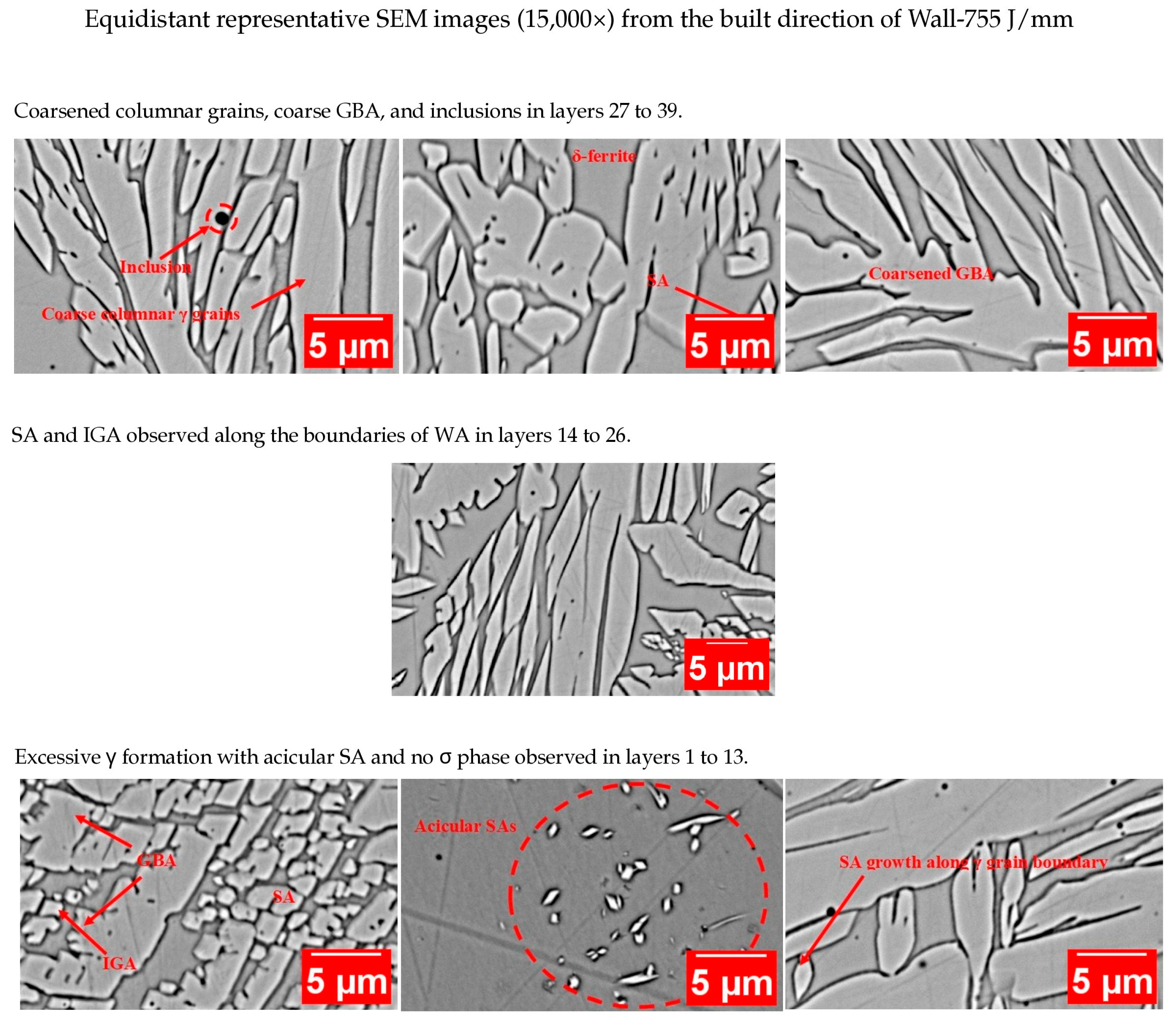
In the Wall-755 J/mm, with an average overall cooling rate of 0.108 °C/s, the bottom section (layers 1st to 13th) was largely characterised by coarsened columnar γ grains formed along the built direction and directed toward the base plate (the direction of heat transfer in the layers). These columnar grains exhibited a lamellar pattern where columnar grains and finer SA grains were epitaxially arranged. The γ growth resulted in the formation of morphologies, including GBA, WA, IGA, and SA, with relatively fewer inclusions. However, despite the very high DE input employed for the deposition of this wall, no secondary intermetallics, especially σ phases, were detected in the bottom layers. However, the excessive γ formation can be detrimental to the minimum δ-ferrite phase required in a DSS microstructure. The average cooling rate for the bottom layers was 0.183 °C/s. SEM images of samples from the bottom section are presented in Figure 12. In the middle section (layers 14th to 26th), the presence of WAs, IGAs, and SAs was prominent with an average cooling rate of 0.025 °C/s. Some SAs and IGAs were also observed along the boundaries of WAs, as shown in Figure 12. In the top section (layers 27th to 39th), the SA morphology stood out among other γ morphologies such as IGA, GBA, and WA, often arranged as clusters, with an average cooling rate of 0.115 °C/s. The SA particles had a sharp-pointed lenticular structure. SA growth was observed along the γ grain boundary, as shown in Figure 12.

3.4. Metallographic Analysis

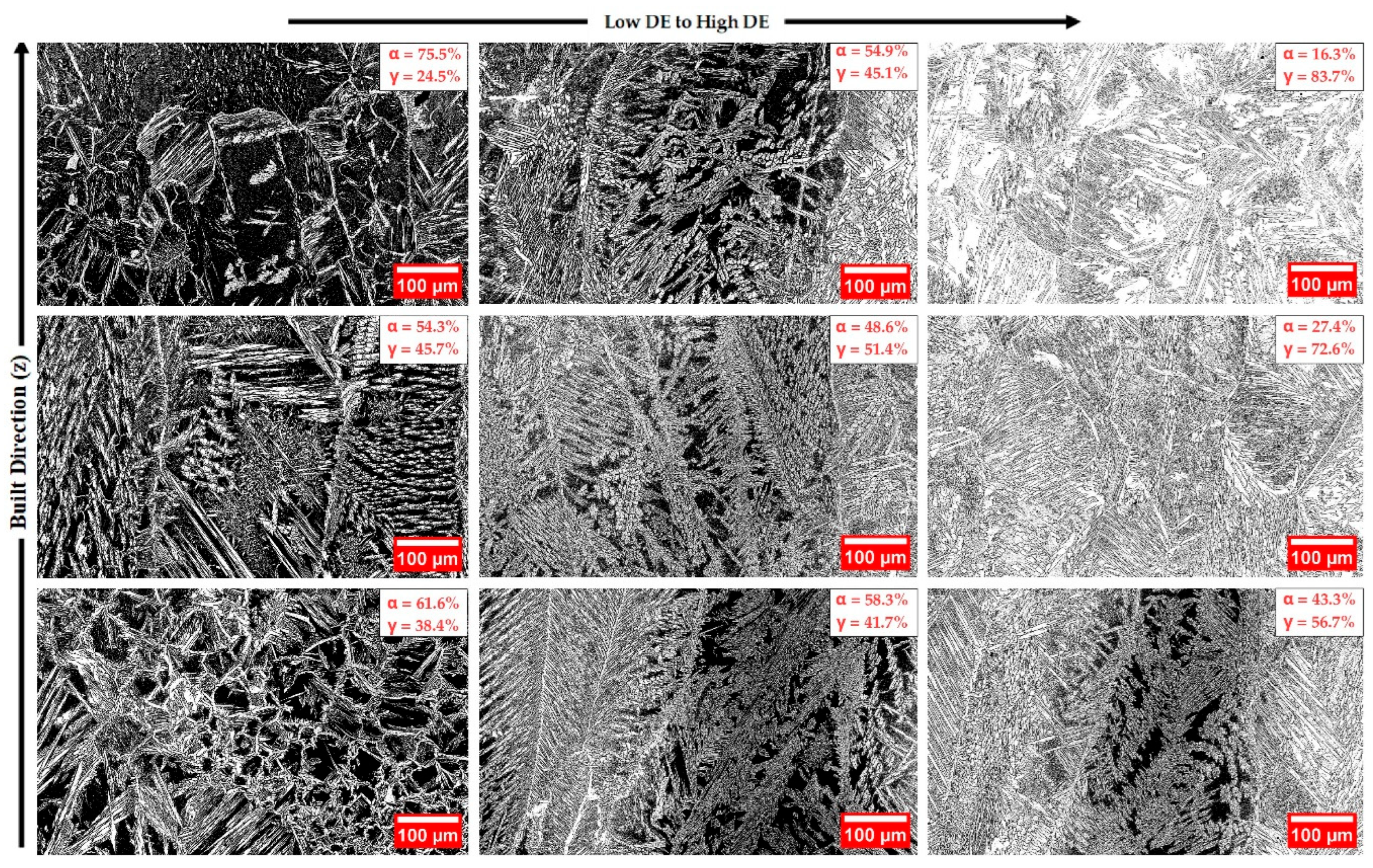
Due to the anisotropic nature of α-γ formation, it was necessary to conduct metallographic analysis of each wall to determine its α and γ contents. Additionally, metallographic analysis is important for mechanical characterisation and for predicting part behaviour under specific conditions, as the properties of DSS are extensions of its phases. In this study, metallography also helped analyse the heterogeneous α-γ phase formation along the built direction of the deposited walls. The metallographic results obtained from the SEM images representing the bottom, middle, and top sections of each wall are shown in Figure 13.
Metallographic analysis showed that the Wall-230 J/mm and Wall-755 J/mm had higher phase anisotropies. In Wall-230 J/mm, the α and γ phase anisotropies ranged from 11.8% to 39% and 19% to 46.4%, respectively. Additionally, its top section exhibited a lower γ phase than the standard requirement of ≤30%. In Wall-755 J/mm, the α and γ phase anisotropies ranged from 36.7% to 40.5% and 15.3% to 28.04%, respectively. The wall exhibited α phase depletion (≤30%) in the middle and top sections. The Wall-427 J/mm exhibited allowable phase heterogeneity, as α phase variation from bottom to top was from 12.9% to 16.6%, while that of γ phase was 12.2% to 23.2%. This was due to a largely homogeneous thermal distribution and a stable cooling rate along its built direction.
A comparative analysis across the three energy regimes reveals a distinct correlation between DE input, cooling rates, and phase homogeneity. At the low DE of 230 J/mm, high cooling rates (0.66 °C/s) restricted γ transformation. The resulting microstructure was dominated by PTA and a higher density of oxide inclusions, which may compromise toughness. Conversely, the high DE of 755 J/mm promoted excessive coarsening and significant anisotropy due to prolonged heat retention and extremely low cooling rates (0.025 °C/s). The medium DE of 427 J/mm emerged as the optimal thermal window for DSS fabrication. It promoted a more balanced distribution of GBA, WA, IGA, and SA morphologies, while stabilising appropriate α phase content along the built direction. The limited phase content variation achieved with this configuration effectively mitigated the typical phase anisotropy encountered in GMAW-AM parts. There is potential for these microstructural attributes to translate into consistent, uniform mechanical and electrochemical properties in parts [16,30,37,38,39,40,41].

3.5. Elemental Analysis

The influence of varying DE inputs and their associated thermal histories on the chemical composition and phase stability of GMAW-AM walls can be assessed through elemental mapping analysis. Further, the calculation of the Chromium Equivalent (CrEq), Nickel Equivalent (NiEq), and the Pitting Corrosion Resistance Equivalent Number (PREN) (Equations (1)–(3) [13,15,19,26,29]) can serve as critical indicators of the material’s predicted phase balance and corrosion resistance. The EDS results and derived values are presented in Table 5.
CrEq = Cr + Mo + 0.7 Nb
NiEq = Ni + 35 C + 20 N + 0.25 Cu
PREN = Cr + 3.3 Mo + 20 N
Based on the WRC-1992 diagram, the predicted Ferrite Numbers (FN) for the 230, 427, and 755 J/mm walls are 70, 55, and 40, respectively. A notable observation is the compositional shift in the low-DE Wall-230 J/mm, which exhibited a Chromium content of 18.82%—significantly lower than the 23.0% present in the ER2209 filler wire. This elemental depletion resulted in an apparent PREN of 31.85, the lowest among the three samples. In contrast, Wall-427 J/mm and Wall-755 J/mm maintained PREN values closer to those of the filler wire and base plate, suggesting that moderate-to-high DE inputs facilitate better elemental recovery and chemical homogeneity. Furthermore, a consistent discrepancy was observed between the chemically predicted FN and the actual α phase content measured metallographically. While the WRC-1992 diagram predicts a high ferrite content (70 FN) for Wall-230 J/mm, the metallographic results showed significantly higher austenite fractions. This deviation is attributed to the intrinsic heat treatment effect of the GMAW-AM process, discussed as follows:
  • Thermal cycling: Unlike single-pass welding (for which WRC-1992 was designed), the repetitive reheating of deposited layers promotes solid-state transformation.
  • Nitrogen limitation: As EDS cannot accurately quantify Nitrogen (a potential γ stabiliser), the calculated NiEq and PREN should be considered apparent values. In this context, the increased γ formation in the microsections can be attributed to the apparently low (but actually higher NiEq) due to EDS limitations in detecting nitrogen concentration.
While Wall-427 J/mm and Wall-755 J/mm achieved superior corrosion resistance (higher PREN), to account for the complex thermal cycles inherent in additive manufacturing, predictive models for standard welding must be applied with an adjustment factor.

4. Conclusions

This research study assessed the influence of GMAW-AM process parameters on the structural integrity, microstructural evolution, and elemental stability of GMAW-AM fabricated DSS walls. The following conclusions are drawn:
Geometric Scaling: A significant discrepancy exists between single-bead geometry and multi-layer wall dimensions. Due to heat accumulation and lateral weld flow, the layer heights within the walls were up to 307.7% lower than those of their single-bead counterparts. This necessitates an empirical adjustment factor when predicting wall growth from single-layer data.
Optimal Processing: A DE of 427 J/mm provided the most stable deposition. This regime effectively suppressed Plateau–Rayleigh instability, resulting in high-fidelity walls with minimal geometric distortion and the most homogeneous phase distribution along the build direction.
Thermal History and Phase Morphology: Cooling rates governed the resulting austenite morphologies. Partially transformed austenite (PTA) and oxide inclusions were detected in the low DE (230 J/mm) wall, while excessive grain coarsening was prominent in the high DE (755 J/mm) wall. A duplex structure comprising balanced Widmanstätten (WA), Intra-Granular (IGA), and Secondary Austenite (SA) particles was observed in the 427 J/mm wall. Based on the microstructure results, the process parameters employed for the Wall-427 J/mm are industrially scalable for non-post-processed DSS fabrication.
Elemental and Phase Discrepancies: Low heat input (230 J/mm) resulted in significant Chromium depletion (18.82%) and a reduced PREN (31.85), potentially compromising corrosion resistance. Furthermore, the WRC-1992 diagram overestimated Ferrite Numbers across all samples, as it fails to account for the intrinsic heat treatment and repetitive thermal cycling of the AM process, which promotes additional austenite formation.
Future recommendations: The microscopic results revealed that similar phase morphologies can precipitate in DSS microstructures deposited with different DE inputs. Whether these morphologies formed under different heating and solidification conditions are characteristically distinct merits further investigation. The wall deposited with the DE input of 427 J/mm exhibited a desirable phase uniformity along the built direction. Whether such characteristics can be translated into desirably uniform mechanical characteristics is recommended for further research.

Author Contributions

Conceptualisation, U.P. and S.K.; methodology, U.P.; software, U.P.; validation, U.P., S.K. and S.H.; formal analysis, U.P.; investigation, U.P.; resources, U.P., S.K. and S.H.; data curation, U.P.; writing—original draft preparation, U.P.; writing—review and editing, U.P.; visualisation, U.P.; supervision, S.K.; project administration, S.K.; funding acquisition, U.P., S.K. and S.H. All authors have read and agreed to the published version of the manuscript.

Funding

This research paper was funded by the University of Slavonski Brod through the institutional research project Smartmod4IND45, financed by the European Union-NextGenerationEU. The views and opinions expressed in this paper are those of the author and do not necessarily reflect the official position of the European Union or the European Commission. Neither the European Union nor the European Commission can be held responsible for them.

Institutional Review Board Statement

Not applicable.

Informed Consent Statement

Not applicable.

Data Availability Statement

The research data analysed in this study is available from the corresponding author and will be made available upon reasonable request.

Acknowledgments

This research was supported by an Australian Government Research Training Programme (RTP) Scholarship (DOI): doi.org/10.82133/C42F-K220.

Conflicts of Interest

The authors declare no conflicts of interest.

Abbreviations

The following abbreviations are used in this manuscript:
3DThree-Dimensional
α-γFerrite-Austenite
σSigma
DEDeposition Energy
DIPDigital Image Processing
DSSDuplex Stainless Steel
FNFerrite Number
GBAGrain Boundary Austenite
GMAW-AMGas Metal Arc Welding-Additive Manufacturing
IGAIntragranular Austenite
OIOxide Inclusion
PAGBPrior Austenite Grain Boundary
PRENPitting Resistance Equivalent Number
PTAPartially Transformed Austenite
SASecondary Austenite
TSTravel Speed
WAWidmanstätten Austenite
WFSWire Feed Speed

References

  1. Uhamir, P.; Klarić, Š.; Havrlišan, S. Preliminary Investigation of Additive Manufacturing of Duplex Stainless Steel Parts with Vibrational Assistance. Stroj. Tehnol. Izradi Zavarenih Konstr. Proizv. SBZ 2025, 2025, 156–166. [Google Scholar]
  2. Chiniforoush, E.A.; Gholizadeh, T.; Jandaghi, M.R.; Moverare, J.; Gür, C.H. Investigation of Travel Speed Effects on Microstructure and Corrosion Behavior of Duplex Stainless Steel in Wire-Based DED Additive Manufacturing. J. Mater. Res. Technol. 2025, 37, 1486–1504. [Google Scholar] [CrossRef]
  3. Pawanr, S.; Gupta, K. Analysis of Surface Roughness and Machine Learning-Based Modeling in Dry Turning of Super Duplex Stainless Steel Using Textured Tools. Technologies 2025, 13, 243. [Google Scholar] [CrossRef]
  4. Queguineur, A.; Asadi, R.; Ostolaza, M.; Valente, E.H.; Nadimpalli, V.K.; Mohanty, G.; Hascoët, J.Y.; Ituarte, I.F. Wire arc additive manufacturing of thin and thick walls made of duplex stainless steel. Int. J. Adv. Manuf. Technol. 2023, 127, 381–400. [Google Scholar] [CrossRef]
  5. Hejripour, F.; Binesh, F.; Hebel, M.; Aidun, D.K. Thermal modeling and characterization of wire arc additive-manufactured duplex stainless steel. J. Mater. Process. Technol. 2019, 272, 58–71. [Google Scholar] [CrossRef]
  6. Rahmani, R.; Bashiri, B.; Lopes, S.I.; Hussain, A.; Maurya, H.S.; Vilu, R. Sustainable additive manufacturing: An overview on life cycle impacts and cost efficiency of laser powder bed fusion. J. Manuf. Mater. Process. 2025, 9, 18. [Google Scholar] [CrossRef]
  7. Joosten, S.K. Printing a Stainless Steel Bridge: An Exploration of Structural Properties of Stainless Steel Additive Manufactures for Civil Engineering Purposes. Master’s Thesis, Delft University of Technology, Delft, The Netherlands, 2015. Available online: https://repository.tudelft.nl/islandora/object/uuid%3Ab4286867-9c1c-40c1-a738-cf28dd7b6de5 (accessed on 5 May 2026).
  8. Posch, G.; Chladil, K.; Chladil, H. Material properties of CMT—Metal additive manufactured duplex stainless steel blade-like geometries. Weld. World 2017, 61, 873–882. [Google Scholar] [CrossRef]
  9. Pechet, G.; Hascoet, J.Y.; Rauch, M.; Ruckert, G.; Thorr, A.S. Manufacturing of a hollow propeller blade with WAAM process-from the material characterisation to the achievement. In Industry 4.0–Shaping the Future of the Digital World; CRC Press: Boca Raton, FL, USA, 2020; pp. 155–160. [Google Scholar]
  10. Patrick, U.; Klaric, S.; Havrlisan, S. Review of Fabrication Methods Employed for 3D Printing DSS Parts using GMAW-AM Process: A Systematic Analysis. Teh. Vjesn. 2026, 33, 1290–1299. [Google Scholar] [CrossRef]
  11. Patrick, U.; Klaric, S.; Wang, H.; Havrlišan, S. Effect of Different Interlayer Temperatures on Ferrite-Austenite Phase Formation of DSS Walls Fabricated Using GMAW-AM Process. In Proceedings of International Conference Napier, New Zealand; IRAJ International: Dubai, United Arab Emirates, 2025; p. 50. [Google Scholar]
  12. John, J.S.; Pervaiz, S. Structural Integrity Assessment of Stainless Steel Fabricated by GMAW-Assisted Wire Arc Additive Manufacturing. Technologies 2025, 13, 392. [Google Scholar] [CrossRef]
  13. Dornelas, P.H.G.; Oliveira, J.P.; da Silva, T.C.; Ramos, A.S.; Santos, T.G. Development of a gas metal arc based prototype for direct energy deposition with micrometric wire. J. Mater. Res. Technol. 2024, 30, 3571–3583. [Google Scholar] [CrossRef]
  14. Mahey, V.; Johnson, G.A.; Burad, P.; Chulist, R.; Collins, P.C.; Roy, S. Large-Scale Wire Arc Additive Manufacturing of Duplex Stainless Steel: Comprehensive Insights into Microstructure and Mechanical Behavior. Mater. Sci. Eng. A 2026, 963, 150232. [Google Scholar] [CrossRef]
  15. Jebaraj, A.V.; Ajaykumar, L.; Deepak, C.R.; Aditya, K.V.V. Weldability, machinability and surfacing of commercial duplex stainless steel AISI2205 for marine applications—A recent review. J. Adv. Res. 2017, 8, 183–199. [Google Scholar] [CrossRef]
  16. Ramkumar, K.R.; Burad, P.; Mahey, V.; Yamamoto, Y.; Nycz, A.; Wallace, R.; Roy, S. Process-driven roadmap for depositing super duplex stainless steel via wire Arc additive manufacturing. Int. J. Adv. Manuf. Technol. 2026, 143, 5203–5215. [Google Scholar] [CrossRef]
  17. Rathinasuriyan, C.; Elumalai, P.V.; Bharani Chandar, J.; Karthik, K.; Medapati, S.R.; Alahmadi, A.A.; Alwetaishi, M.; Alzaed, A.N.; Kalam, M.A.; Shahapurkar, K. Welding-based additive manufacturing processes for fabrication of metallic parts. Compos. Adv. Mater. 2023, 32, 26349833231210572. [Google Scholar] [CrossRef]
  18. Zhang, D.; Liu, A.; Yin, B.; Wen, P. Additive manufacturing of duplex stainless steels—A critical review. J. Manuf. Process. 2022, 73, 496–517. [Google Scholar] [CrossRef]
  19. Isidorio, D.K.M.; da Cruz Payão Filho, J.; Uddagiri, M.; NouraniNiaki, K.; Shchyglo, O.; Steinbach, I. Super duplex stainless steel fabricated by arc-based directed energy deposition: Microstructure evolution and phase field solidification simulation. Mater. Des. 2025, 254, 114027. [Google Scholar] [CrossRef]
  20. Akbarzadeh, E.; Yurtışık, K.; Hakan Gür, C.E.M.İ.L.; Saeid, T.; Tavangar, R. Influence of shielding gas on the microstructure and mechanical properties of duplex stainless steel in wire arc additive manufacturing. Met. Mater. Int. 2024, 30, 1977–1996. [Google Scholar] [CrossRef]
  21. ISO 17781; Petroleum, Petrochemical and Natural Gas Industries—Test Methods for Quality Control of Microstructure of Ferritic/Austenitic (Duplex) Stainless Steels. International Organization for Standardization: Geneva, Switzerland, 2017.
  22. ISO 6520-1: 2007; Welding and Allied Processes—Classification of Geometric Imperfections in Metallic Materials. Part 1—Fusion Welding. International Organization for Standardization: Geneva, Switzerland, 2017.
  23. TMR Stainless. Practical Guidelines for the Fabrication of Duplex Stainless Steels, 3rd ed.; International Molybdenum Association: London, UK, 2014. [Google Scholar]
  24. Eriksson, M.C.F.; Lervåg, M.; Sørensen, C.; Robertstad, A.; Brønstad, B.M.; Nyhus, B.; Aune, R.; Ren, X.; Akselsen, O.M. Additive manufacture of superduplex stainless steel using WAAM. In MATEC Web of Conferences; EDP Sciences: Les Ulis, France, 2018. [Google Scholar]
  25. Kumar, P.; Maji, K. Experimental investigations and parametric effects on depositions of super duplex stainless steel in wire arc additive manufacturing. Proc. Inst. Mech. Eng. Part E J. Process Mech. Eng. 2024, 238, 1600–1612. [Google Scholar] [CrossRef]
  26. Kemény, D.M.; Sándor, B.; Varbai, B.; Katula, L.T. The effects of arc voltage and shielding gas type on the microstructure of wire arc additively manufactured 2209 duplex stainless steel. Adv. Mater. Sci. 2023, 23, 62–82. [Google Scholar] [CrossRef]
  27. Wittig, B.; Zinke, M.; Jüttner, S. Influence of arc energy and filler metal composition on the microstructure in wire arc additive manufacturing of duplex stainless steels. Weld. World 2021, 65, 47–56. [Google Scholar] [CrossRef]
  28. Pant, S.; Kumar, S.; Shahi, A.S. Microstructural characterization of super duplex stainless steel fabricated using WAAM technique. Mater. Today Proc. 2023, 113, 230–234. [Google Scholar] [CrossRef]
  29. Knezović, N.; Garašić, I.; Jurić, I. Influence of the interlayer temperature on structure and properties of wire and arc additive manufactured duplex stainless steel product. Materials 2020, 13, 5795. [Google Scholar] [CrossRef]
  30. Jin, W.; Zhang, C.; Jin, S.; Tian, Y.; Wellmann, D.; Liu, W. Wire arc additive manufacturing of stainless steels: A review. Appl. Sci. 2020, 10, 1563. [Google Scholar] [CrossRef]
  31. Hosseini, V.A.; Högström, M.; Hurtig, K.; Valiente Bermejo, M.A.; Stridh, L.E.; Karlsson, L. Wire-arc additive manufacturing of a duplex stainless steel: Thermal cycle analysis and microstructure characterization. Weld. World 2019, 63, 975–987. [Google Scholar] [CrossRef]
  32. Bellamkonda, P.N.; Dwivedy, M.; Sudersanan, M.; Visvalingam, B. Influence of welding processes on the micro-structure and mechanical properties of duplex stainless steel parts fabricated by wire arc additive manufacturing. Met. Mater. Int. 2025, 31, 368–391. [Google Scholar] [CrossRef]
  33. Kotecki, D.J.; Siewert, T.A. WRC-1992 constitution diagram for stainless steel weld metals: A modification of the WRC-1988 diagram. Weld. J. 1992, 71, 171–178. [Google Scholar]
  34. Vander Voort, G.F. (Ed.) ASM Handbook: Metallography and Microstructures; ASM International: Almere, The Netherlands, 2004. [Google Scholar]
  35. Hosseini, V.A.; Hurtig, K.; Eyzop, D.; Östberg, A.; Janiak, P.; Karlsson, L. Ferrite content measurement in super duplex stainless steel welds. Weld. World 2019, 63, 551–563. [Google Scholar] [CrossRef]
  36. Chiniforoush, E.A.; Jandaghi, M.R.; Moverare, J.; Saeid, T.; Yurtışık, K. A novel in-situ gas-phase alloying approach in wire arc additive manufacturing for controlling solidification mode and designing hybrid stainless steels. Mater. Des. 2025, 259, 114781. [Google Scholar] [CrossRef]
  37. Attar, H.Z.; Zhou, Y.; Roy, M.J.; Fellowes, J.W.; Hosseini, V.A.; Engelberg, D.L. Application of corrosion test methods for microstructure screening of WAAM duplex stainless steel. Electrochim. Acta 2025, 534, 146564. [Google Scholar] [CrossRef]
  38. Attar, H.Z.; Fellowes, J.W.; Roy, M.J.; Hosseini, V.A.; Engelberg, D.L. Optimizing the phase distribution in arc-based direct energy deposition of duplex stainless steel. Metall. Mater. Trans. A 2024, 55, 1600–1625. [Google Scholar] [CrossRef]
  39. Grandhi, P.; Punugupati, G.; Kumar, G.B.; Madivada, H.; Rao, C.S.P.; Mukherjee, M. Influence of process parameters on the microstructure and mechanical behavior of wire arc additive manufactured duplex stainless steel 2209 alloy. Prog. Addit. Manuf. 2026, 11, 4143–4158. [Google Scholar] [CrossRef]
  40. Treutler, K.; Wesling, V. The current state of research of wire arc additive manufacturing (WAAM): A review. Appl. Sci. 2021, 11, 8619. [Google Scholar] [CrossRef]
  41. Chiniforoush, E.A.; Zargari, H.H.; Jandaghi, M.R.; Moverare, J.; Warsi, R.; Gür, C.H. A sustainable strategy for wire arc additive manufacturing of high-performance duplex stainless Steel: Microstructural refinement and mechanical anisotropy reduction. Mater. Sci. Eng. A 2025, 943, 148785. [Google Scholar] [CrossRef]
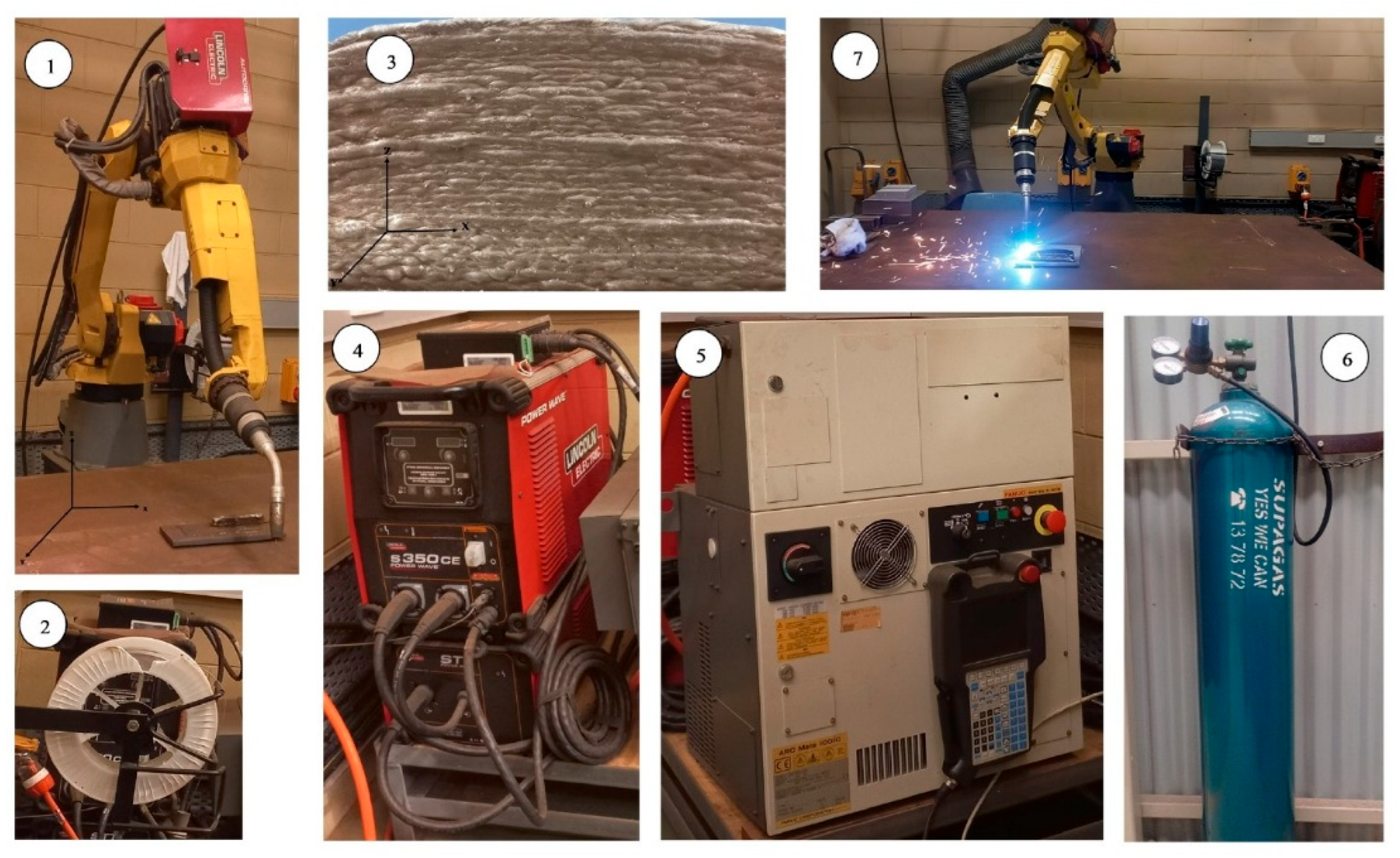
Figure 1. GMAW-AM Setup at Charles Darwin University (1. Welding Robot, 2. Filler Wire Coil, 3. 3D Printed Wall, 4. Power Source, 5. G and M Programmer, 6. Shielding Gas Cylinder, and 7. GMAW-AM Process).
Technologies 14 00288 g001
Figure 2. DSS bead deposited using GMAW process (1), abrasive waterjet cutting tool (2), macro-image of a bead cross-section (3), and ImageJ digital image processing threshold (4).
Technologies 14 00288 g002
Figure 3. Schematic illustrating equidistant SEM and EDS samples extracted from the centre of each wall with an isometric CAD view of a deposited wall.
Technologies 14 00288 g003
Figure 4. DSS beads and walls fabrication and analytical method.
Technologies 14 00288 g004
Figure 5. Preliminary DSS beads deposited with different combinations of WFS, TS, and V.
Technologies 14 00288 g005
Figure 6. Cross-sections of preliminary DSS beads.
Technologies 14 00288 g006
Figure 7. DSS walls fabricated with suitable parameters using GMAW-AM.
Technologies 14 00288 g007
Figure 8. DE input versus wall height and width.
Technologies 14 00288 g008
Figure 9. SEM images from along the built direction of Wall-230 J/mm (left), Wall-427 J/mm (middle), and Wall-755 J/mm (right).
Technologies 14 00288 g009
Figure 10. PTA, IGA, and inclusions observed in layers 1 to 13 (bottom section), IGA (top-left), GBA (top-centre), WA (top-right), PTA (bottom-left), globularised microstructure (bottom-centre), and SA (bottom-right) observed in layers 14 to 26 (middle section), and GBA growth observed in layers 27 to 39 (top section).
Technologies 14 00288 g010
Figure 11. GBA, IGA, and SA observed in layers 1 to 13 (bottom section), coarse GBA, WA, and clusters of SA observed in layers 14 to 26 (middle section) and layers 27 to 39 (top section).
Technologies 14 00288 g011
Figure 12. Acicular SA observed along the grain boundary in layers 1 to 13 (bottom section) and layers 14 to 26 (middle section) along with other γ morphologies. High volume of coarse columnar grains observed in layers 27 to 39 (top section).
Technologies 14 00288 g012
Figure 13. Phase count from the (bottom), (middle), and (top) sections of the deposited walls. Represented counts are the mean values of phase counts from 12 SEM images from each section (n = 12). The standard deviation for Wall-230 J/mm, Wall-427 J/mm, and Wall-755 J/mm was ±5.72, ±6.44, and ±7.67, respectively.
Technologies 14 00288 g013
Table 1. Chemical composition (%wt.) of filler and base materials as per the manufacturer’s datasheet.
MaterialCrMoNiMnCNSiSPFe
DSS 220923391.60.020.140.5Not ReportedNot ReportedBalance
DSS 220522.213.135.721.360.0140.180.350.0010.027Balance
Table 2. Parametric table for deposition of 18 DSS beads with different WFS and TS combinations and constant parameters.
WFS:TSTS (cm/min)Constants
253035404550
WFS (cm/min)
10250300350400450500Tip-to-Contact = 10 mm
Wire stickout = 5 mm
Shielding gas flow rate = 20 L/min
Number of layers = 39
Dwell time per layer = 60 s
15375450525600675750
205006007008009001000
Table 3. ImageJ results from bead cross-sections. Parameters meeting the selection criteria are bold-highlighted.
SampleWFS:TSTS
(cm/min)
Weld Voltage
(Volts)
DE
(J/mm)
Height
(mm)
Width
(mm)
Height:Width
B1102518.7252232.4854.2850.580
B23018.9002272.9772.8741.047
B33519.1382292.7783.1120.893
B44019.3762304.8944.4391.103
B54519.6142322.3174.5450.510
B65019.8522352.5253.9950.632
B7152520.0904262.2292.9650.752
B83020.3284273.8884.7780.814
B93520.5664274.6033.7551.226
B104020.8044492.8695.4460.527
B114520.9794783.1124.8370.643
B125021.1545212.8484.940.577
B13202521.3296973.4065.2630.647
B143021.5047233.2865.1640.636
B153521.6797555.7975.2831.097
B164021.8547982.7826.4850.429
B174522.0298572.737.7620.352
B185022.2049403.318.4810.390
Table 4. Comparison of geometric heights of single-bead and bead-in-walls.
SampleLayer Height in Wall
(mm)
Single Bead Height
(mm)
Height Difference
(%)
Wall Width
(mm)
Single Bead Width
(mm)
Width Difference
(%)
Wall-230 J/mm1.538 ± 0.354.894 ± 0.05161.9–307.75.964 ± 0.724.439 ± 0.5533.9–34.8
Wall-427 J/mm2.051 ± 0.104.603 ± 0.05116.3–133.37.164 ± 0.383.755 ± 0.4977.7–107.8
Wall-755 J/mm2.821 ± 0.055.797 ± 0.05103.7–107.48.86 ± 1.345.283 ± 0.3452.1–81.4
Table 5. Elemental composition (.wt%) with CrEq, NiEq, and PREN of fabricated walls.
SampleCFeCrNiMoMnCuNbMgSiPS* CrEqNiEq* PRENApparent
Wall-230 J/mm0.01069.4418.8210.693.951.340.050.820.203.0970.000.0023.3411.0531.85
Wall-427 J/mm0.01563.5122.6611.803.821.450.330.050.080.720.000.0526.5112.4135.25
Wall-755 J/mm0.02063.6322.0812.303.891.330.220.070.100.730.000.0026.0113.0534.90
DSS 2209 (filler wire)0.02050.0023.009.003.001.60--0.50-----35.14
DSS 2205 (base plate)0.01446.5022.215.723.131.36--0.35-0.030.00--35.00
* PRENApparent and NiEq are calculated excluding Nitrogen due to EDS detection limits.
Disclaimer/Publisher’s Note: The statements, opinions and data contained in all publications are solely those of the individual author(s) and contributor(s) and not of MDPI and/or the editor(s). MDPI and/or the editor(s) disclaim responsibility for any injury to people or property resulting from any ideas, methods, instructions or products referred to in the content.