
Article

Wind Resource Assessment and Layout Optimization in the Isthmus of Tehuantepec, Mexico: A Microscale Modeling and Parametric Analysis Approach

by
Brenda Mendoza
1,
José Rafael Dorrego-Portela
1,*,
Alida Ramirez-Jimenez
2,
Jesus Alejandro Franco
3,
Alberto-Jesus Perea-Moreno
4,
David Muñoz-Rodriguez
4,
Dante Ruiz-Robles
3,
Araceli Peña-Fernández
5 and
Quetzalcoatl Hernandez-Escobedo
3,*
1
Instituto de Estudios de la Energía, Universidad del Istmo, Campus Tehuantepec, Ciudad Universitaria S/N, Santo Domingo Tehuantepec, Oaxaca 70760, Mexico
2
Escuela Internacional de Doctorado, University of Almería, Ctra, de Sacramento s/n, 04120 Almería, Spain
3
Escuela Nacional de Estudios Superiores Unidad Juriquilla, Universidad Nacional Autónoma de México, Queretaro 76230, Mexico
4
Departamento de Física Aplicada, Radiología y Medicina Física, Campus Universitario de Rabanales, Universidad de Córdoba, 14071 Córdoba, Spain
5
Research Centre CIAIMBITAL, University of Almería, Ctra, de Sacramento s/n, 04120 Almería, Spain
*
Authors to whom correspondence should be addressed.
Technologies 2026, 14(4), 219; https://doi.org/10.3390/technologies14040219
Submission received: 24 February 2026 / Revised: 3 April 2026 / Accepted: 5 April 2026 / Published: 9 April 2026
(This article belongs to the Special Issue Emerging Renewable Energy Technologies and Smart Long-Term Planning)

Abstract

This wind farm study provides a detailed and deep investigation into numerous aspects of both wind dynamics and the associated wind turbine performance via a wind data analysis utilizing an extrapolated timeframe of 50 years. The major wind characteristics assessed included wind speed and direction, flow inclination, turbulence intensity, and wind speed (average based on extremes) over the entire duration of the evaluated data set. A majority of study results indicated only narrow wind speed ranges (6.3 m/s to 7.0 m/s) for turbine operation within the wind farm. Higher turbine operation speeds than the average measured wind speed may significantly increase turbine energy output. Turbines were evaluated across numerous geographic locations, resulting in average flow inclination (−4.12° to 1.57°) from the vertical to horizontal directions. The variation in flow inclination indicates that there is a geographic component that likely creates a localized terrain impact on turbine performance. Similarly, the measurement of turbulence intensity was also assessed, which indicated elevated levels of turbine mechanical stress and additional requirements for turbine maintenance. Energy production analyses from each turbine in the wind farm exhibited various regions of energy loss, with the highest energy losses associated with select turbines.

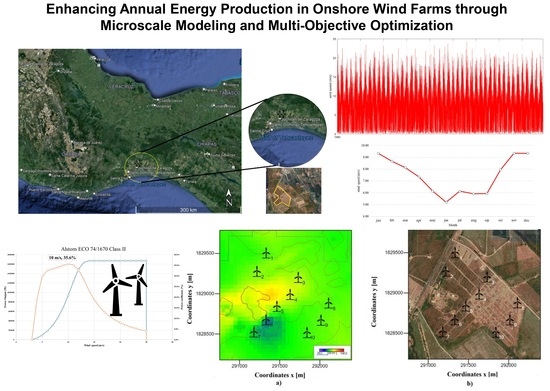
Graphical Abstract

1. Introduction

The urgent need to address climate change and reduce greenhouse-gas emissions has accelerated the development and adoption of renewable energy sources. Climate warming, a consequence of the excessive use of non-renewable resources, such as oil, gas, and coal [1], has prompted various measures to counteract the damage caused by the greenhouse effect. Among these, wind farm installations have emerged as a significant solution [2]. Wind farms harness the kinetic energy of wind to generate electrical energy and meet the energy needs of the population [3]. However, the efficiency of wind energy production is influenced by several factors, including turbine design, site conditions, and the effective management of wind farm operations [4]. Installing a wind farm requires multi-objective study owing to several issues, including land use, noise generation, and the initial cost of the wind farm [5]. Despite these challenges, technological advancements have provided solutions for mitigating these disadvantages [6].
A critical factor influencing the energy production of onshore wind farms is the wake effect, which significantly affects the annual energy yields [7,8]. This phenomenon occurs when a wind turbine (WT) extracts energy from the wind, creating a turbulent wake that reduces the wind speed and energy potential of the downstream turbines [9]. The wake effect not only decreases gross energy production but also contributes to turbine damage, increased operational costs, and reduced economic viability of wind farms [10,11]. In some cases, power production losses owing to the wake effect can reach up to one-third, depending on the turbine layout and local wind conditions [10]. The wake effect is governed by various factors including wind conditions, turbine spacing, layout, and topographic features of the site [12,13,14]. Traditional mitigation strategies focus on spacing turbines in rows and columns to maintain the wake effect threshold below 5% [15]. Additionally, site-specific configurations are designed to optimize energy production by accounting for local characteristics such as wind patterns and terrain [16]. Recent advancements in mitigating the wake effect include active wake control, optimization of turbine layouts, and dynamic wake management [17,18,19,20]. These methods aim to minimize wake losses and enhance the overall efficiency of wind farms. Key issues include accurately estimating wind farm power production, accounting for time-varying wake dynamics, and optimizing the turbine start and stop sequences to reduce wake interactions [8,21,22].
The need to pay attention to wake effect is justified since, as Kumar et al. [23] pointed out, reduced wind speeds behind turbines can adversely affect the performance of downstream turbines and thus reduce overall energy output. Wang et al. [24] therefore beckons for innovative turbine placement and operational approaches to mitigate wake loss. Effective strategies such as improved layouts and dynamic operation can lead to significant increases in energy output and operational efficiency. This makes it easier for wind farms to compete with other energy sources [25]. The complexity of wind farm operations necessitates a multifaceted approach to mitigate such losses. Various methodologies have been developed to solve the wake effect. These methodologies rely on advanced modeling and simulation techniques to predict and evaluate the effect of wake effects on wind farm performance [7]. Computational fluid dynamics (CFD) models are routinely used to model the effect of wind flow and wakes, allowing for better-informed predictions [26]. In addition to models, methods for reducing wake losses also include the optimization of turbine layout and spacing [27]. By strategically orienting the turbines, the overlap of their wakes may be minimized, thereby increasing the total amount of energy captured by the wind farm [28]. Another method of wake effect management is through operational techniques. By ‘steering’ the wake of individual turbines to reduce the impact on downstream systems can lead to lowered energy loss. Sheehan et al. [29] showed that the potential for dynamic adjustment of turbine operation to mitigate these wake interactions delivers an increase in the performance of wind farms and their energy output. An innovative concept is yaw control, where turbines are intentionally turned into the wind to “steer” the wake off to one side to reduce its impact on turbines further downstream, with wake losses in some cases dropping by as much as 20% (though this necessarily requires constant control and an ability to gain real-time data) [30]. A slightly less radical but still compelling concept is that of curved wind farms (as opposed to straight lines); studies have suggested that curved farms can reduce wake interference and increase energy capture by up to 10% [6].
Big data and machine learning techniques play a crucial role in enabling more precise modeling and prediction of wind farm performance [31,32]. Data-driven analytical wake models have been proposed to extract local inflow information and wake expansion features from measured wind farm data, leading to an improved wake prediction performance [33]. The use of machine learning approaches, such as the Extra Tree classifier, has proven to be simple, quick, and well suited for short-term wind speed forecasting in wind farms, contributing to increased effectiveness in wind generator output [34]. Machine learning techniques, including artificial neural networks (ANNs), decision trees (DTs), and random forests (RFs), have been used for WT performance prediction, demonstrating the effectiveness of these approaches in improving prediction accuracy [35]. In addition, a physics-inspired neural network model has been developed for short-term wind power prediction, explicitly considering wake effects, and has demonstrated significant improvements in prediction performance compared to traditional models [34]. The integration of big data analytics with machine-learning techniques further enhances wind farm optimization processes. As Drapalik et al. [36] emphasized, these technologies enable more accurate wake effect predictions, improve decision-making processes, and offer solutions to long-standing challenges in wind farm performance optimization. These technologies allow for the continuous monitoring and adjustment of turbine operations, leading to more effective management of wake losses.
Despite significant advancements in wind energy technology, achieving optimal wind farm performance remains a complex challenge because of site-specific factors, such as topography and meteorological conditions. These factors critically influence the effectiveness of wake-reduction strategies and overall efficiency of wind farms [37]. The presence of complex terrains, including hills and varying topographic heights, poses significant challenges for wind farm layout optimization. Such terrains increase the turbulence and wake effects, thereby reducing the turbine efficiency. Addressing these issues requires advanced modeling techniques capable of accounting for terrain-induced variations in the wind flow and wake dynamics [38,39]. Without these considerations, the design and optimization of wind farms in these environments may fail to achieve the desired performance levels. Additionally, variability in wind direction and speed further complicates wind farm optimization. Short-term wind data are often insufficient for accurate site assessments, necessitating the integration of historical datasets and expert analyses to predict wind patterns more reliably [40]. Wake effects, caused by the interaction between turbines, reduce power production and increase turbulence intensity, particularly during partial-load operations. These effects are especially pronounced when the wind direction is close to the center of the wake sector and are exacerbated by terrain-induced disruptions in wind flow [41].
In addition to these technical issues, there are economic barriers to deploying and implementing such technologies and operational changes. Jahan et al. [42] cite the economic viability of such technologies and operational changes with energy output as a valid concern. Wind farm optimization is naturally multi-objective as it needs to factor in the trade-offs between increasingly generating energy versus the cost of developing farms and their impact on global warming. Multi-objective optimization frameworks that take into account layout, wake effects, land use, and economic viability have recently been developed [43]. They typically use genetic algorithms or particle swarm optimization to find a best trade-off described as optimal solution [44]. Region-specific effects of topography, wind patterns and environmental constraints are important parts of site-specific wind farm optimization. For example, in regions with complex terrain, the interaction of wind with topography increases turbulence and wakes affecting the effectiveness and efficiency of WTs [45]. In order to address these challenges, researchers have developed microscale wind models that give information on wind flows at a smaller scale. One such model is the Wind Atlas Analysis and Application Program (WAsP), commonly used for wind resource assessments and the optimization of wind turbine siting [46]. As wind energy remains a cornerstone of the energy transition, a few more upcoming technologies are expected to have an impact on further optimization of wind farms. An interesting trend is the rise of floating offshore wind farms, which can be harness more powerful and stable winds on the open ocean; the downside is having complicated wake flow effects and additional mooring for the turbines [47]. One other trend is the use of digital twins for wind farm optimization: digital twins are virtual replications of farms that use real-time data and modeling techniques to optimize turbines. These systems can be continuously monitored and adjusted in operation, leading to an optimal, less expensive operation [48]. Finally, the combination of energy storage systems with wind farms should allow for making up for the intermittency of the wind. The excess energy can be released to the grid when necessary and thus enhance the governability of the system and the value of wind energy [49]. The current study aims to overcome these difficulties by examining novel techniques for mitigating energy losses in wind farms. By concentrating on innovative strategies for turbine placement, operational protocols, and technological developments, this study hopes to provide a thorough framework for maximizing wind farm performance. The ambition is to improve the efficiency and economic viability of wind energy projects, thereby contributing to the greater objective of sustainable and dependable energy generation.

2. Materials and Methods

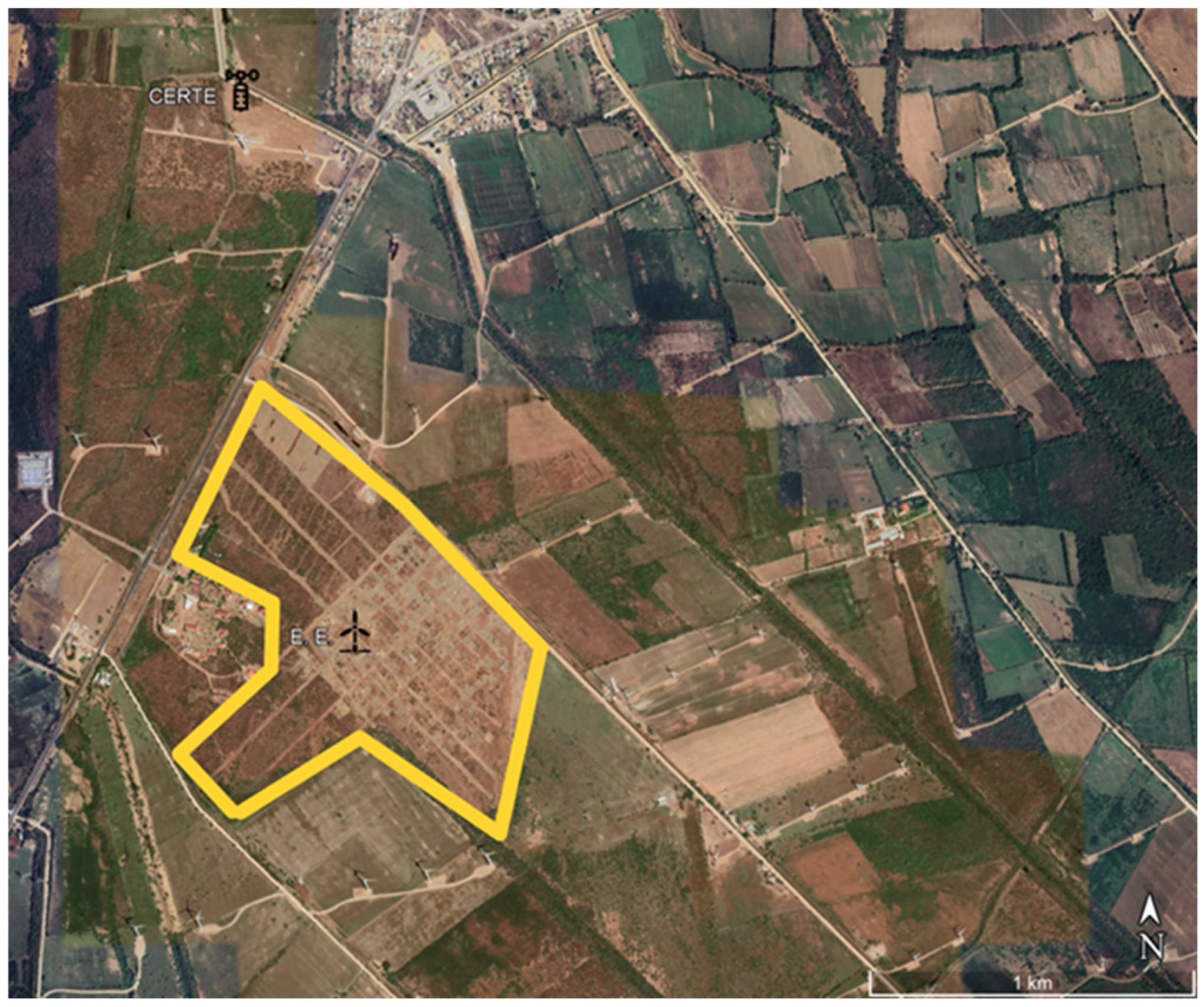
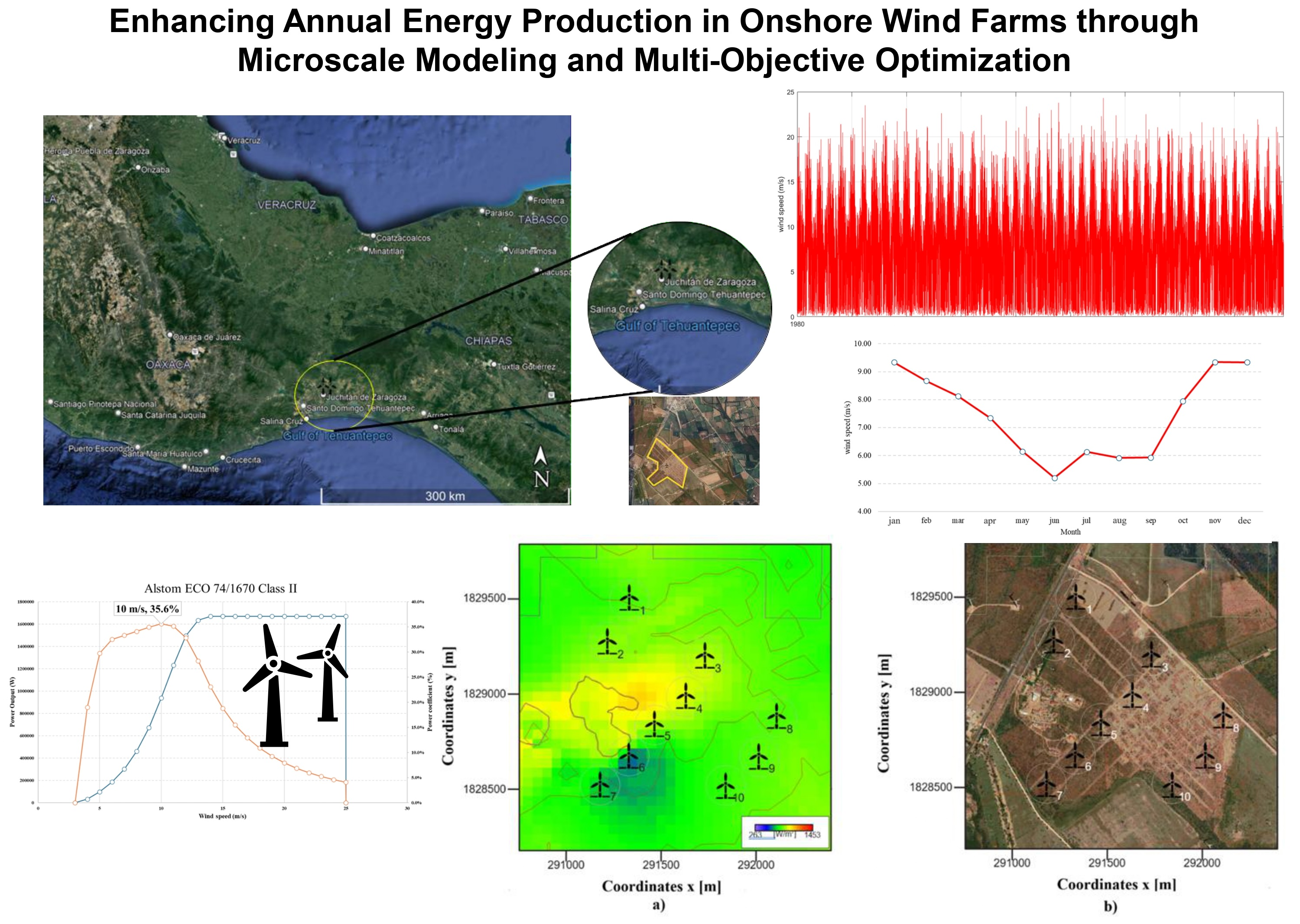
Oaxaca has one of the highest wind energy uses compared to other Mexican states [12]. A site near Juchitan was selected for this analysis, as shown in Figure 1.
The study area is presented in Figure 2, which shows an area with little roughness in orography.
Currently, various methods have been developed to promote wind energy, such as multi-criteria analysis, which prioritizes sites with high wind potential for electricity generation, considering different selection criteria, including wind resources, terrain slopes, distances to roads, electrical grids and substations, and road conditions. Additionally, constraints such as volcanic zones, protected areas, and flood zones, among other factors, have also been estimated [50].

2.1. Wind Resource Assessment

Wind energy is a form of clean or renewable energy produced from wind, specifically the kinetic energy of wind and the mass flow at the site [51]. Wind is an air current generated in the atmosphere by natural causes, which makes it highly variable and unstable throughout the day and night. A detailed understanding of wind characteristics at a site is necessary to estimate the performance of a wind energy project [52]. Wind resource characterization allows the identification of exploitable potential, providing an outlook on the economic viability of a wind farm [53]. It also influences the estimation of energy production and the operation and regulation of the wind system to plan its functioning correctly [54]. Wind characteristics affect the operation strategy (startup, shutdown, orientation, etc.) and factors affecting the maintenance or lifespan of the system (gusts, turbulence, etc.) [55].
The data used in this study are the Modern-Era Retrospective Analysis for Research and Applications, Version 2 (MERRA-2) created by the Global Modeling and Assimilation Office (GMAO) [19] and are long-term, model-based analyses of multiple datasets using a fixed assimilation system; they are a major focus in the GMAO reanalysis data, provide data beginning in 1980, and run a few weeks behind real time. MERRA-2 is a global atmospheric reanalysis dataset that provides data on a 0.5° latitude × 0.625° longitude (~50–55 km) spatial resolution and 1 h temporal resolution. For our study, we extracted wind speed at a height of 50 m above ground level from the study area’s nearest gridpoint (16.2° N, 95.0° W) for the months from January 1979–December 2024 (46 years of hourly data).
Other data sources are available in addition to MERRA-2, such as ERA5 or data from anemometric towers; however, the latter option can be costly. Jargalsaikhan et al. [20] found that MERRA-2 data aligned better with point measurements from towers.
The use of MERRA-2 data in this study is substantiated by studies comprehensively demonstrating that reanalysis data are suitable for wind resource assessment in regions without or with few point measurements. Jargalsaikhan et al. [20] validated MERRA-2 systematically against anemometer towers, finding that MERRA-2 was closer to ground-based point measurements than other reanalysis products, capturing the magnitude and variability of wind speeds with useful fidelity for wind energy purposes. Gelaro et al. [19] described the MERRA-2 assimilation system as including a broader suite of meteorological observations and representing the near-surface wind fields better than previous generations of reanalysis.
Preprocessing and quality control of wind speed time series were processed through quality control algorithms to identify and strike gaps, outliers, and otherwise unrealistic values. Greater than 99.8% of the time series was reported as complete. Hourly wind speed data were aggregated to daily and monthly means for seasons, with the full hourly resolution retained for fine scale inputs and Weibull fitting. MERRA-2 wind speeds are provided as being 50 m above ground level, and our hub heights considered were either 60 or 80 m. To extrapolate wind speeds to hub height, the linear power law wind shear profile was used (see Equation (2)).
In work relevant to the Isthmus of Tehuantepec context, Mejia-Montero et al. [12] were able to use reanalysis data to describe wind resources they identified to be of wind resource potential similar to actual wind farm operating performance in the region. These studies thus lend indirect support to the use of reanalysis in this context.

2.2. Elevation and Roughness

Elevation refers to the height of the WT above sea level at the site or study area where it is located and in contact with the Earth’s surface. Atmospheric pressure plays a crucial role; when measuring pressure at sea level with a temperature of 20 °C and an air density of 1.225 kg/m3, an approximate value of 1010 hPa was obtained [56].
Because air density varies with geographic location, owing to its nature as a compressible fluid and an ideal gas, the pressure will also vary [57]. This variation must be considered when selecting the WT.
The wind-speed profile is directly affected by the roughness of the terrain, making it a critical factor in the energy efficiency of wind power. A smooth surface, such as water bodies, flat terrain without trees, or snow-covered plains, results in a gentle gradient. Conversely, for rough surfaces such as urban buildings, irregular terrains, or forests, the velocity profile tends to exhibit a parabolic shape [58].
The variation in wind speed with height above ground is called the wind shear profile. It typically uses one of two mathematical models to characterize the measured wind shear profile: the logarithmic law with its parameter called the surface roughness, and the power law with its parameter called the power law exponent.
Surface roughness is a measure of the rate at which wind speed changes with height above the ground [53]. It is a parameter in the logarithmic law, which states that the wind speed varies logarithmically with the height above ground, according to Equation (1) [24]
U ( z ) = { U k ln ( Z Z 0 ) , i f   Z > Z 0 0 , i f   Z Z 0
where Z is the effective height above the ground, U(z) is the wind speed at Z height, U is the friction velocity, k is von Karman’s constant (0.4), Z0 is the surface roughness, and ln () is the natural logarithm.
The power law states that the wind speed varies with the height above the ground according to Equation (2).
U ( z ) = U 0 ( Z Z 0 ) α
where U(z) is the wind speed at height z, U0 is the wind speed at the reference height Z0 = 50 m, and α is the power law exponent [25]. The exponent α was determined from the surface roughness length (Z) using the relationship α = 1/ln(Z0/Z) for neutral atmospheric stability conditions. For the study site, characterized by open terrain with low vegetation, a roughness length of Z = 0.03 m was assigned, yielding α ≈ 0.14.

2.3. Microscale Modeling

One of the stages in wind resource characterization is the construction of maps. This requires the application of models that allow the observation of wind behavior and distribution in a specific area or region [59].
Combinations of models can simulate wind flow at a much higher resolution based on anemometer data, making it a powerful tool for wind resource assessment [60]. These models can be at the macroscale, known as the synoptic scale (over 2000 km), mesoscale (2000 km), or microscale (up to 50 km).
Microscale models are particularly useful for the development of wind energy in regions with complex terrains, as well as in the sitting of WT generators within wind power plants. These models provide a broader perspective on the resource and allow for an accurate representation of terrain characteristics. Therefore, this model was selected for the wind resource assessment of the study site. WAsP software version 12 has been applied because of its efficiency and sufficient accuracy, notably over simple and complex terrain [61].
Surface roughness length (Z0) is an important parameter for the logarithmic wind profile law and influences the microscale wind flow simulation conducted by the Wind Atlas Analysis and Application Program (WAsP). To determine the surface characteristics of the study area, a land-use classification of the area was conducted using high-resolution satellite imagery as well as publicly available datasets for land cover. The classification followed the standard classes described in the European Wind Atlas and WAsP documentation.
The study area was discretized in a regular grid into cells with a fixed size, the land-use category was assigned to each according to their respective coverage, and the corresponding Z0 were assigned adopted in the WAsP software. Table 1 summarizes the land use for each identified domain and the corresponding surface roughness lengths.
The spatial distribution of these roughness classes was incorporated into the WAsP model to simulate microscale wind flow patterns (local acceleration effects and speed-up/down as a result of terrain). The resulting wind resource maps are thus a product of the effect of orography and of surface roughness on the wind behavior within the site. This roughness classification is aligned with best practices in wind resource assessments and ensures that the frictional aspects of the surface are well replicated by the modeling at the atmospheric scale. The assigned Z0 were checked against the actual land cover observed from satellite imagery and in the field to mitigate against classification inaccuracies. This parameterization is used as the basis for the extrapolation of wind speed from the reference mast location to the location of individual turbines across the wind farm.

2.4. Wind Turbine Selection

Choosing an appropriate WT based on wind and terrain conditions is a key factor for the efficiency of a wind farm [62]. Various criteria are considered in selecting the right WT, such as lower investment cost [63], rotor swept area [64], ease of startup (related to the Tip Speed Ratio, TSR) [65], and power curve [66], among others.
TSR refers to the term that replaces the rotor revolutions per minute, which is essential for comparing different WTs. This is also known as the specific speed, indicating that the blade tip travels at a speed TSR times greater than the wind speed.
The criteria for their selection depend on the wind farm designer. Poor selection can negatively affect the energy produced and cause damage to turbines, among other issues. To efficiently utilize energy at a selected site, it is necessary to consider various factors, such as matching the appropriate WT to the site’s geographical, meteorological, and topographical characteristics. Several authors have proposed methodologies to select them; for example, Huanying and Dongsheng [67] proposed a novel formulation to incorporate turbine technology selection in the optimal hybrid wind/photovoltaic renewable energy system design; Faraz [68] suggested that an optimal selection in terms of the capacity factor (CF) of WT generator and the Expected Energy not Supplied, which is one of the most commonly used reliability indices for power systems; Supciller and Toprak [41] conducted interviews with experts on 21 criteria. In this study, the proposed methodology correlates the scale parameter of the Weibull distribution (c) and wind turbine power coefficient (CP).
Along with matching the Weibull scale parameter, c, with the turbine’s power coefficient, CP, characteristics, one must also take into consideration the loads imposed upon the structure by the user’s local turbulence regime when selecting the most appropriate wind turbines. Turbulence intensity, TI, affects the fatigue equivalent loads, FELs, on the blade, drivetrain and tower [55,69] and may shorten the useful life of the turbines and increase maintenance costs.
In order to align the turbine selection process with structural reliability principals, each of the turbine candidates were assessed in relation to their design turbulence class according to the IEC designations: Class I, II, III. According to the standard IEC 61400-1 [70], wind turbines are classified based on the reference wind speed and the characteristic turbulence intensity. Classes A, B, and C correspond to turbulence intensities of 16%, 14%, and 12% respectively at 15 m/s. Turbines specified for sites with turbulence intensities greater than the design class of the turbine are required to either adopt enhanced structural specifications or are required to operate derated to maintain safe operating margins.
In the current investigation, the turbulence intensity extrapolated from the microscale modeling was used as a limiting factor within the turbine siting and selection. Areas with turbulence intensity above 16% (e.g., WTs 7, 8, and 9, TI values of 16.2, 16.4 and 16.4%) were marked as eligible for high-table, more structurally resilient turbines (i.e., IEC Class IA) or alterations in the spacing to mitigate the impact of wake turbulence. The limiting factor assures that the fatigue loads applied are suitably representative of the loads incurred at this location over the full turbine life.
The selection of an appropriate wind turbine for the study site was based on a multi-criteria evaluation framework incorporating the following engineering and economic criteria: the wind resource compatibility, which is calculated by comparing the turbine power curve fit the Weibull site wind speed distribution; the value of the Weibull scale parameter c = 9.25 m/s; the power coefficient characteristics such as the maximum CP value, and at what wind speed does it occur; the ability to accommodate the wind shear characteristics of the site and operation at ranges of typically 60–80 m hub heights; and the rotor diameter and swept area.

2.5. Weibull Parameters

The Weibull distribution is extensively used in wind energy studies to model and analyze wind-speed data. It provides a mathematically sound way to describe the variability and frequency of wind speeds at a given location [71].
Wind speeds at a particular site were random and varied over time. The Weibull distribution, which is characterized by its flexibility, was used to model this variability. The wind speed profile of a location can be accurately represented by fitting a Weibull distribution to the historical wind speed data. The probability density function (PDF) of the Weibull distribution describes the frequencies of different wind speeds. Understanding this distribution is essential for estimating potential energy production from WTs [43]. The PDF of the Weibull distribution and cumulative distribution function (CDF) are expressed by Equations (3) and (4), respectively.
f ( v ) = k c ( v c ) k 1 e ( v c ) k ,   ( k > 0 ,   v > 0 ,   c > 0 )
F ( v ) = 1 exp [ ( v c ) k ]
where f(v) is the probability of the measured daily wind speed v, k is a shape parameter with dimensionless units, and c is a scale parameter with the same units of wind speed.
The Weibull distribution is defined by two key parameters: k and c. The shape parameter k indicates the wind speed distribution profile, and a low k value (typically < 2) represents a broader distribution of wind speeds with significant variation. This might be observed in locations with variable wind conditions; a high k value (typically > 2) indicates a narrower distribution of wind speeds, where wind speeds are more consistently around a central value, which is favorable for steady wind energy production.
Scale Parameter c is directly related to the average wind speed at a given location. This can be interpreted as a characteristic speed, where wind speeds are concentrated around c. Higher c values indicate a site with generally higher wind speeds, which is beneficial for wind-power generation.
The parameters of the Weibull distribution aid in site assessment indicate the suitability of a location for wind power generation. Sites with higher c and k values are typically more favorable.
Additionally, different WTs have varying power curves (the relationship between the wind speed and power output). The Weibull distribution helps match the turbine with the site by selecting a model that operates optimally under a specific wind speed distribution.
In order to objectively assess the fitness of the Weibull statistic to the measured wind speed data, a goodness-of-fit test was performed using the Kolmogorov–Smirnov (K-S) test. The K-S test is a nonparametric test of the null hypothesis (H0) that the observed data are drawn from the fitted theoretical distribution. The test statistic D is defined as the maximum absolute difference between the empirical cumulative distribution function (ECDF) of the sample and the cumulative distribution function (CDF) of the fitted Weibull distribution:
D = s u p | F e m p ( v ) F W e i b u l l ( v ) |
where Femp(v) is the ECDF of the observed wind speeds and FWeibull(v) is the CDF of the fitted Weibull distribution. A smaller D statistic and a corresponding p-value greater than the chosen significance level (α = 0.05) indicate that the Weibull distribution provides an adequate fit to the data.
The K-S test was performed on the observed wind speed data at the 80 m and 60 m hub heights using Weibull parameters estimated by the least-squares method. The values for R-squared from this method were higher than those from the maximum-likelihood method, and these results are presented in Table 2 for both wind speeds. It is clear from the results that the Weibull distribution clearly characterizes the wind speed regime of the site in question with a good fit, producing p-values exceeding the 0.05 limit.

2.6. Power Coefficient (CP)

Cp is called the dimensionless parameter, whose proportionality constant describes how well the turbine converts the wind’s kinetic energy into mechanical energy. It is a key parameter in the engineering of WTs that denotes the efficiency of a WT in extracting wind energy [70]. Also, it is defined as the ratio of the actual power extracted by the turbine (Pactual) to the total available power in the wind (Pwind) (Equation (6)).
C p = P a c t u a l P w i n d
where Pactual is the mechanical power output of the WT and Pwind is the total power available in the wind passing through the area swept by the turbine blades.
The total power available in the wind that passes through swept area A of the turbine blades is given by Equation (7).
P w i n d = 1 2 ρ A v 3
where r is the air density (kg/m3) and A is the swept area of the turbine blades, calculated as A = πr2, where r is the radius of the turbine rotor and v is the wind speed.
CP represents the fraction of the wind’s kinetic energy that the turbine can convert into usable mechanical energy. It is influenced by the aerodynamic design of the turbine blades, wind speed, and operating conditions [72].
The theoretical maximum value of Cp is 0.593, which is known as the Betz limit [45]. Wind Power Density (WPD) is a fundamental metric for assessing the potential of a site for wind-energy generation. It quantifies the amount of power available in the wind per unit area of the rotor sweep and is mathematically defined by Equation (8).
W P D = 1 2 ρ v 3
where ρ is the air density (kg/m3) and v is the wind speed (m/s).

2.7. Wake Effect

The wind speed and energy behind the WT are lower due to the operation of the turbine; the wind has passed through it and transferred some of its kinetic energy to the rotor, which in turn makes electricity. The wind downstream in the wind turbine (WT) wake has a lower speed and a higher turbulence than that coming up to the wind turbine (WT) [46]. This can significantly impact the performance of downstream turbines in a wind farm, as they receive less energy and experience more turbulent air, leading to reduced efficiency and increased mechanical stress. Factors such as the turbine spacing [47], wind direction [48], atmospheric stability [49], and terrain [50] can influence the severity of the wake effect. Accurate modeling and understanding of this phenomenon are essential for improving the overall efficiency of wind farms.
The wake effect is a complex aerodynamic phenomenon that can be described using fluid dynamics principles, such as Betz’s limit [45], or the wake velocity deficit when the wind speed in the wake, vw, is reduced compared to the free-stream wind speed v. The velocity deficit Δv can be expressed by Equation (9).
v = v v w
The wake velocity deficit can be modeled using Equation (10).
v w v = ( 1 2 a )
where a is the axial induction factor representing the fraction of wind speed reduction at the rotor plane.
Another model used is the axial induction factor, which is related to CP as shown in Equation (11).
C P = 4 a ( 1 a ) 2
This relationship shows how the turbine’s power extraction influences the reduction in wind speed and creation of the wake.
The wake effect computations for the results presented in this study were carried out using the steady-state wake model contained within the WAsP software, which is in fact based on the Jensen (or Park) wake model. Stating the assumptions behind the steady-state wake model—top-hat velocity deficit profile, linear wake expansion, etc.—is a good introduction to the limitations of this approach, despite offering a practical and fast way of estimating wake losses for a time-averaged situation (as is the case here for 50 years).
First, steady-state wake models are an imperfect analogue of wakes as functions of time. Wakes meander; that is to say, in a statistically stationary state downstream of a turbine, the wake undergoes a cascade of large-scale lateral oscillations. Meandering wakes can reduce the instantaneous loading and power production of downstream turbines significantly, on average, and for stable atmospheres, wakes develop over longer distances and meander less, thus producing greater wake losses than predicted by steady-state models, whereas unstable atmospheres increase the strength of turbulent mixing, producing lower wake losses. The 50-year average might conceal significant variability from one time to the next, variability that might be quantitively important in terms of understanding fatigue loading and extreme events [11].
Second, steady state models assume a fixed distribution of wind directions based on historical averages; a changing climate may produce a distribution of wind directions over a 50-year horizon that does not even resemble the averages. Finserås et al.’s 2020 study [13] shows that wakes produced by wind farms are sensitive to shifts in prevailing wind directions, which importantly affects both energy production and regulatory compliance. The stationarity of current wind direction parameterization over a 50-year future horizon is an obvious assumption that may not generally hold.
Third, steady-state wake models do not consider the influence of atmospheric stability on wake recovery rates. Pacheco de Sá Sarmiento et al. [49] illustrate that atmospheric stability has a strong impact on wake length, turbulence intensity, and power production at complex-terrain wind farms. The WAsP model used in the current study assumes neutral stability, potentially missing the variety of atmospheric conditions over a 50-year lifetime: stability-dependent models could improve energy yield forecasts.
Fourth, the steady state does not take into account how wakes interact with other wakes and since it is common for wakes to ‘merge’ downstream in the case of dense turbine arrays with high turbine to turbine capture spacing, this can lead to a complex wake pattern (as is the case on some islands in the proposed arrangement) and hence the linear superposition (often assumed in ‘steady state’ analyses) may not hold and result in underpredicting losses due to wakes [46]. More capable models, like those based on large eddy simulation (LES) or dynamic wake meandering models (DWM) are more suited to describing such interactions.

2.8. Evaluation of Energy Production in a Wind Farm

To validate whether there is a reduction in the wake effect relative to the positioning of each WT, an evaluation of the wind farm’s energy production was conducted. For net performance with wake losses, an analysis of the energy production of the wind farm was performed, presenting three energy calculations for the following scenarios [51].
Ideal Energy: All WTs are positioned at the reference mast location, experiencing the same wind regime at the height of the hub, without any losses.
Gross Energy: All WTs are at their actual locations, experiencing relative topographical acceleration with respect to the mast, including possible modifications to the ambient flow for large wind farms, with no tolerance for wake losses.
Net Energy without Additional Losses: All WTs are at their actual locations and experience topographical acceleration and wake loss calculations.
In a wind farm, the gross annual energy production (AEPGross) is calculated, and the loss due to the wake effect is subtracted, which is known as the net annual energy production (AEP). Technical losses are losses due to laws of physics, such as Joule heating or machine unavailability. These losses are reported as percentages of the gross energy.
The AEP was obtained by subtracting the energy lost owing to technical losses from the gross AEP. This quantity is referred to as P50, indicating a 50% probability that the generated energy will exceed this value [52]. The AEP defines the amount of energy a wind farm can produce, and its calculation is performed by multiplying its potential by the velocity distribution during the period of a given year in hours, that is, 8760 h.
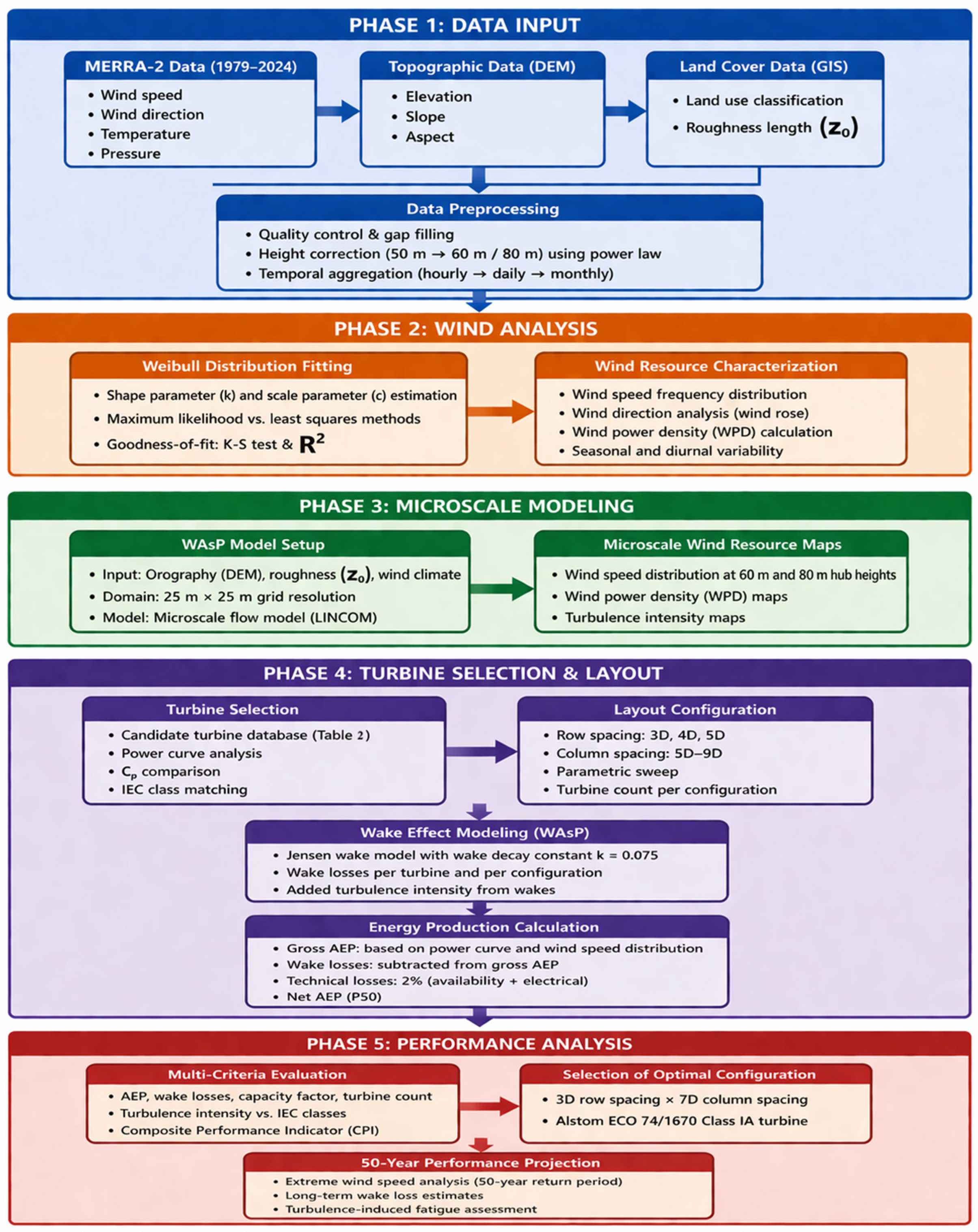
Figure 3 shows an analytical workflow diagram.
The workflow is organized into five sequential phases: (1) data input, encompassing MERRA-2 reanalysis, topographic data, and land cover classification; (2) wind analysis, including Weibull distribution fitting and wind resource characterization; (3) microscale modeling using WAsP to generate high-resolution wind resource maps; (4) turbine selection and layout, involving parametric spacing evaluation, wake modeling, and energy production calculations; and (5) performance analysis, culminating in the selection of the optimal configuration and 50-year performance projection. Abbreviations: DEM = digital elevation model; GIS = geographic information system; WAsP = Wind Atlas Analysis and Application Program; AEP = annual energy production; and CPI = composite performance indicator.

3. Results and Discussion

3.1. Wind Assessment

The monthly statistics for the wind speed, WPD, atmospheric pressure, and temperature are presented in Table 3.
The months with the highest WPD are January, February, November, and December, which aligns with some studies suggesting that the windy season in the Isthmus of Tehuantepec occurs during these months.
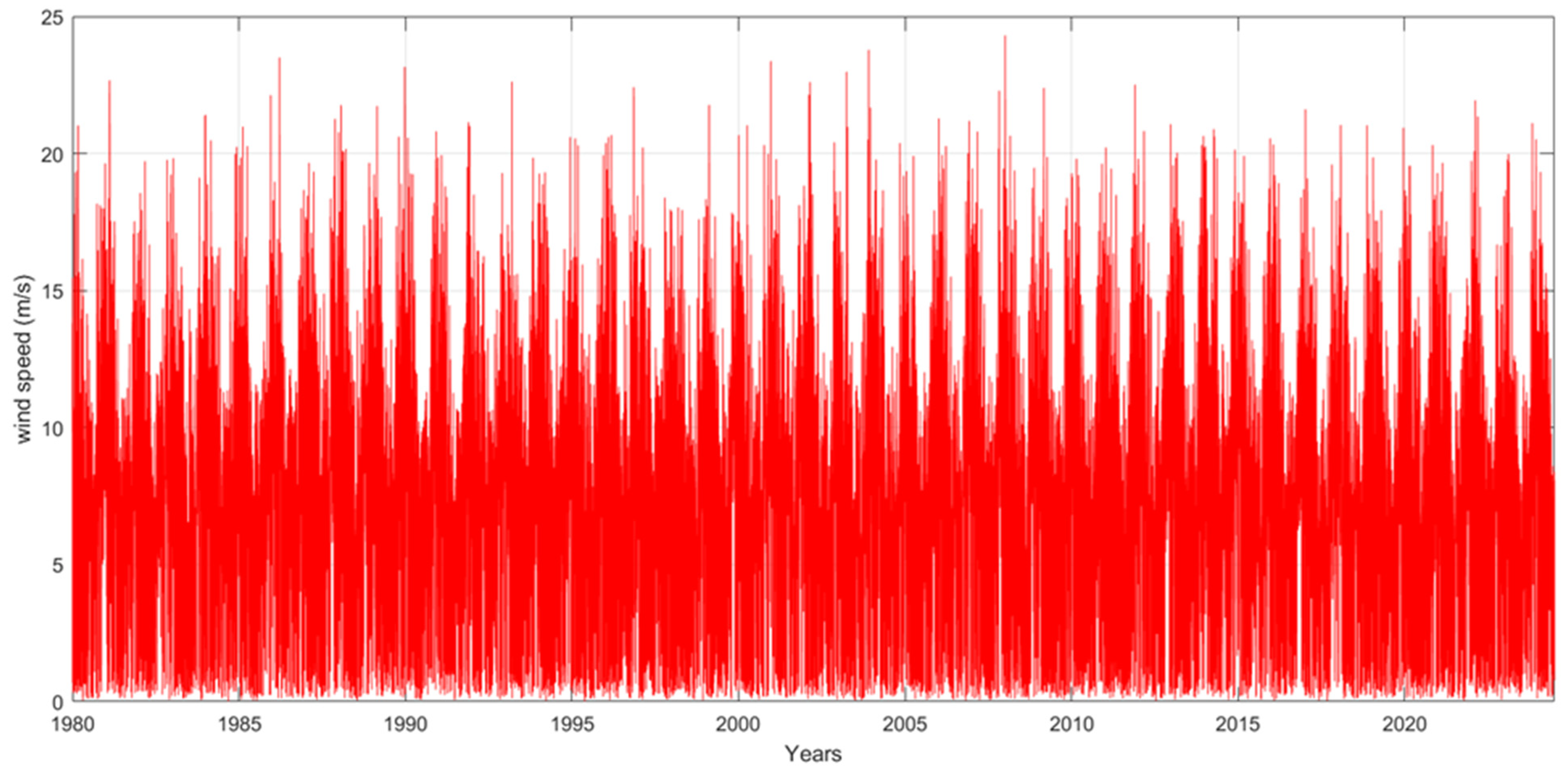
About 380,000 data points on wind speed and direction, temperature, and atmospheric pressure were analyzed, and the behavior of the wind speed can be observed in Figure 4.
As shown in Figure 4 the wind intensity at the site is recorded from 0.01 m/s to 24.3 m/s, the temporal variation seems not to be noticed in Figure 4; however, it will be part of this study to identify those temporal variations.
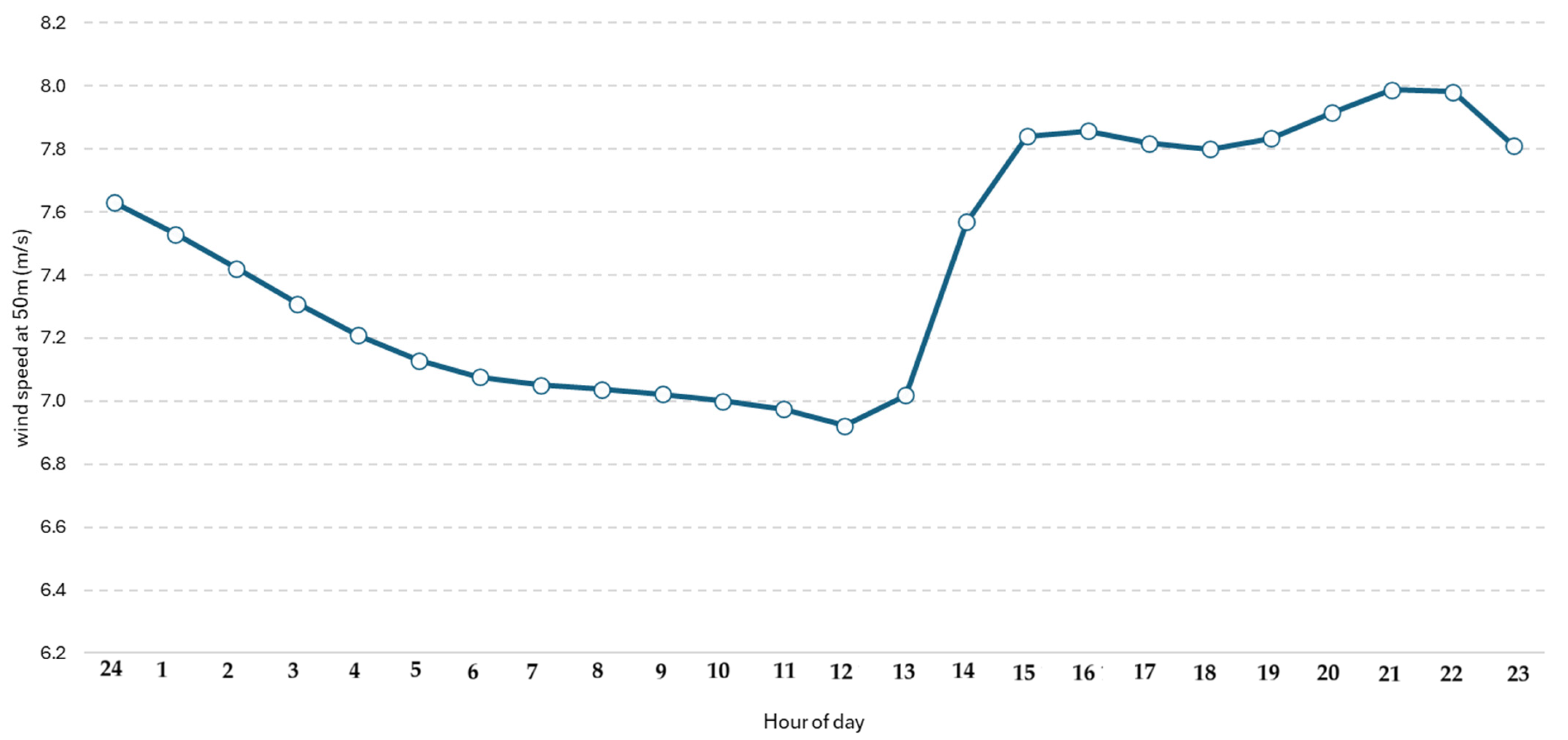
Figure 5 presents the daily wind speed profiles for the entire time series.
The wind in Juchitan behaves daily, on average, with high intensities starting at 12:00 h. After that time, it begins to intensify until 15:00 h, then it stabilizes between 7.8 m/s and 8 m/s. It is also identified that from 00:00 h, it tends to descend until it reaches 6.9 m/s, which is its lowest point at 12:00 h; therefore, it can be observed that, on average, in Juchitan, during half the day, the wind values are greater than 7 m/s.
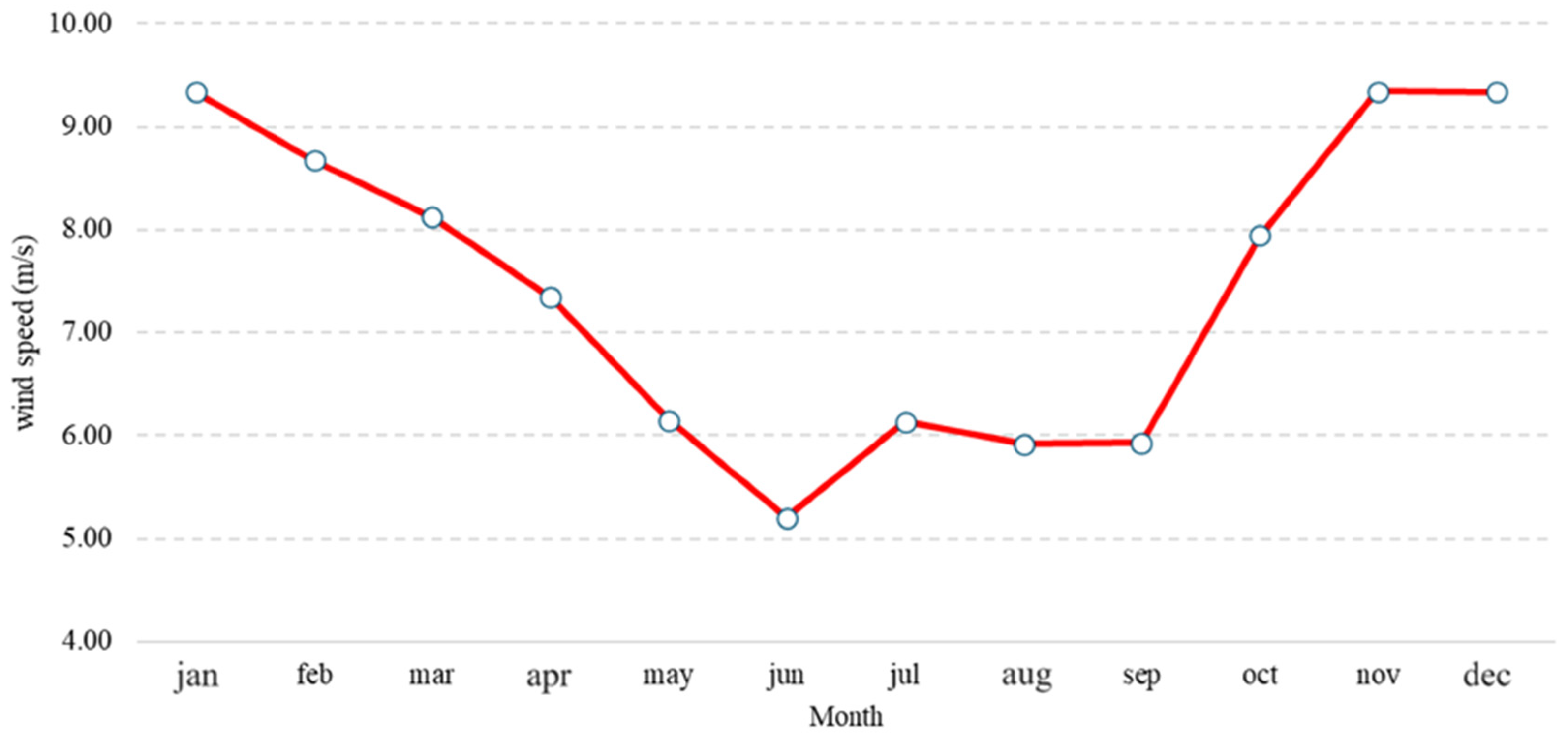
Figure 6 shows the monthly average wind speeds at the study site.
Although, as shown in Figure 6, the wind behavior appears to have low values throughout the year, the minimum wind speed occurs in June, but still exceeds 5 m/s. From this month onward, the wind speeds remained above 6 m/s for the rest of the year, reaching their highest averages in December and January.
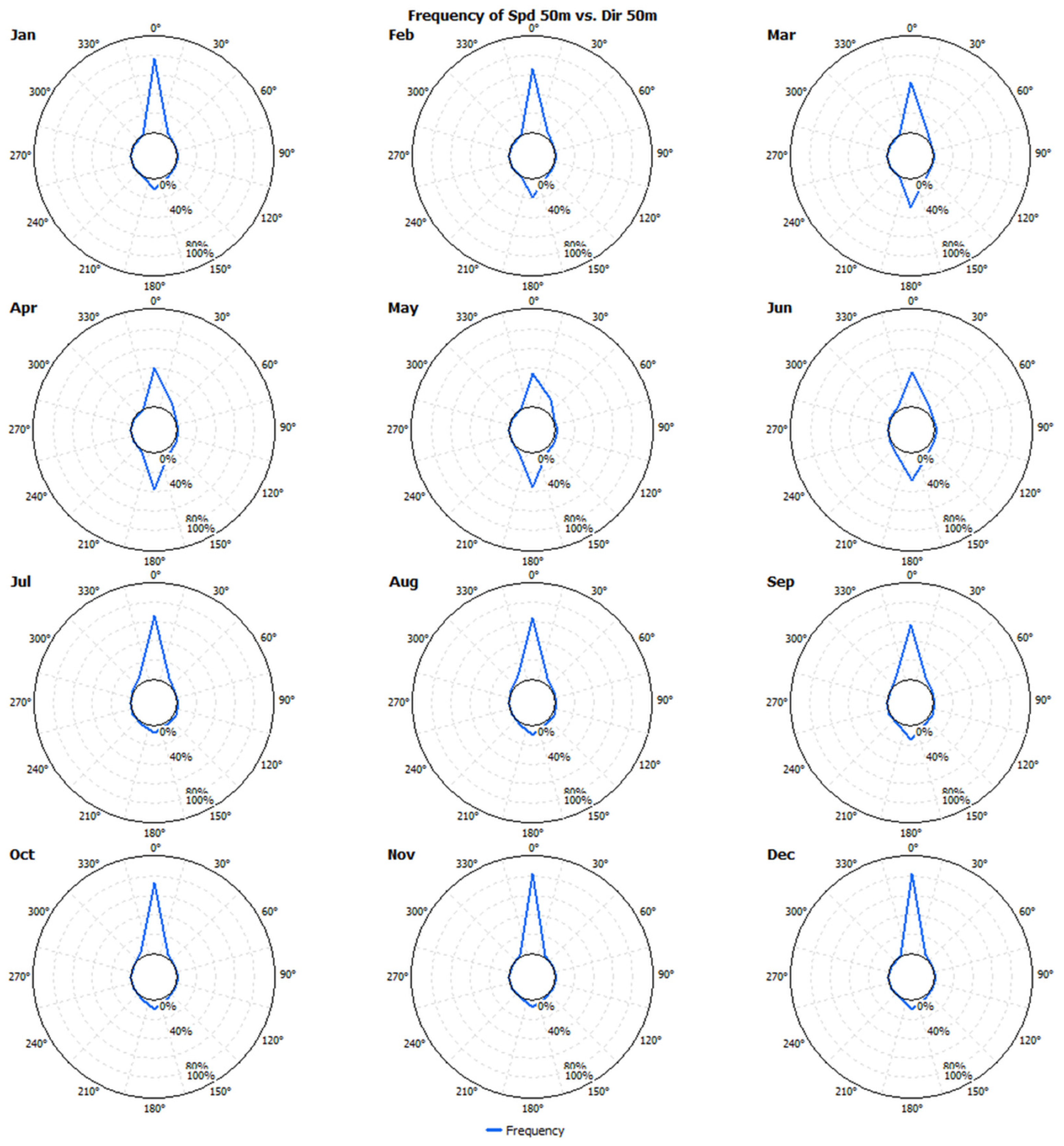
The frequency of the wind must also be studied in relation to its direction. This was done using a wind rose diagram, which is a polar chart divided into 12 sectors, each representing 30°. Figure 7 illustrates the wind intensity based on its direction.
In Figure 7, it can be observed that during an average year, the wind direction did not experience significant changes, with most of the wind speed coming from the north.
The Weibull distribution is a tool commonly used in the wind energy industry to determine the wind seasonality at the study site and has been analyzed using two models: least squares and maximum likelihood at different heights. Table 2 presents the results.
Least squares is the model that fits best; in both cases, at heights of 80 m and 60 m, the R-squared results were 0.97943 and 0.98004 respectively better than the maximum likelihood, as shown in Table 2.
K-S test results are reported only for the least-squares method, which exhibited superior fit based on R-squared. The p-values indicate that the null hypothesis that the observed wind speeds follow the fitted Weibull distribution cannot be rejected at the α = 0.05 significance level.
The K-S test results produce sufficiently large statistically adequate values for the Weibull distribution at both heights with parameters found by least-squares means. With p-values of 0.87 (80 m) and 0.84 (60 m), there is no statistically significant difference between the empirical and fitted, leading to the conclusion that the Weibull distribution with those parameters may be used for wind resource assessment and energy yield calculations.
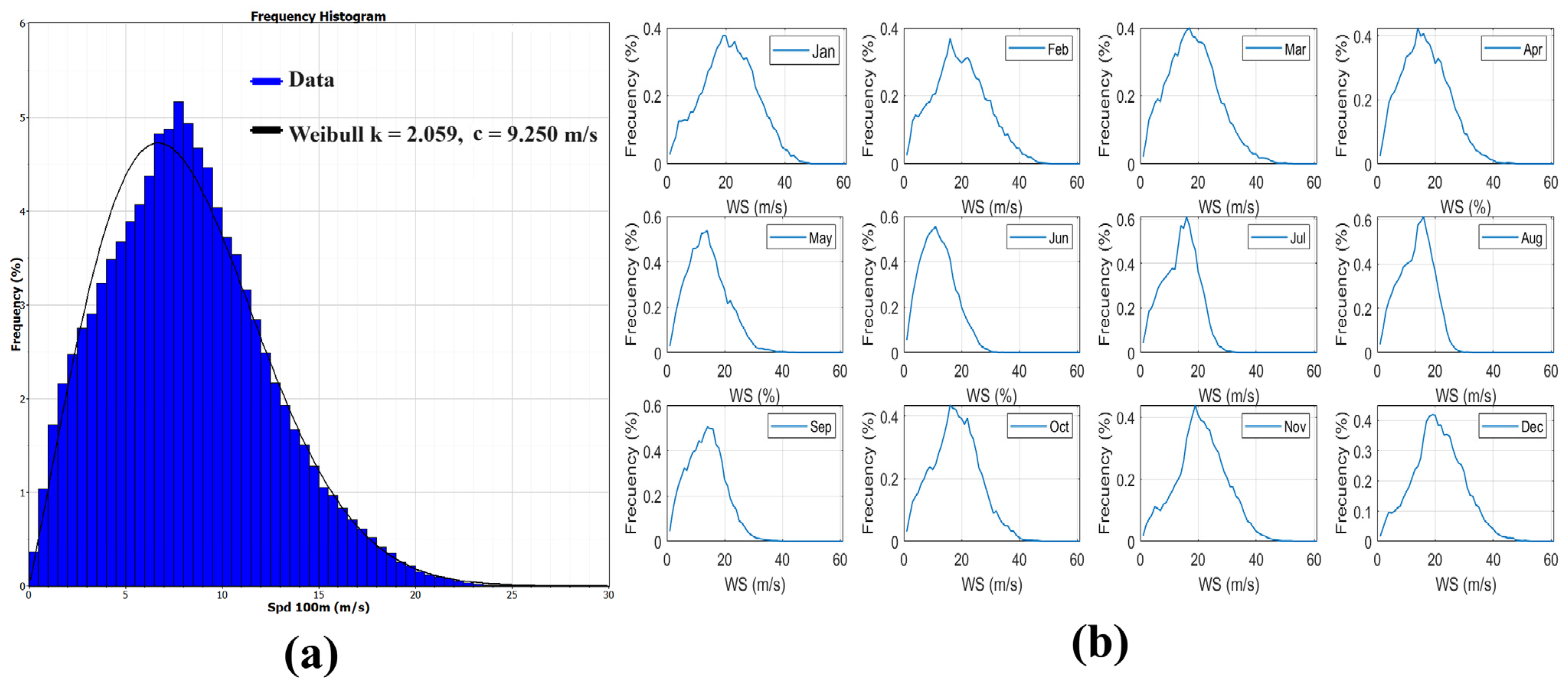
Figure 8 presents the average (Figure 8a) and (Figure 8b) monthly Weibull distributions and their parameters k and c, respectively.
The average Weibull distribution shown in Figure 8a indicates a shape parameter close to 2, specifically, 2.059. This suggests that there was a 50% probability of observing the wind intensities recorded in the data. The standard deviation was 3.8 m/s, indicating significant wind variation at the studied site. Additionally, the Weibull distributions by month are presented in Figure 8b, where it can be observed that the wind frequencies do not vary significantly throughout the year, with the most frequent wind speeds remaining close to the average.

3.2. Orography and Roughness

Orography and surface roughness are two important complications of the Earth-atmosphere system, which are particularly important for wind resource assessment, climate modeling and for many parts of environmental engineering applications. Understanding the complex interactions between orography and surface roughness is crucial for accurate modeling of wind behavior and refining the siting and performance of WTs. Surface roughness affects the momentum transfer between the atmosphere and surface, influencing the wind speed profiles and turbulence intensity. In this study, topography was understood to be the combined influence of orography and surface roughness.
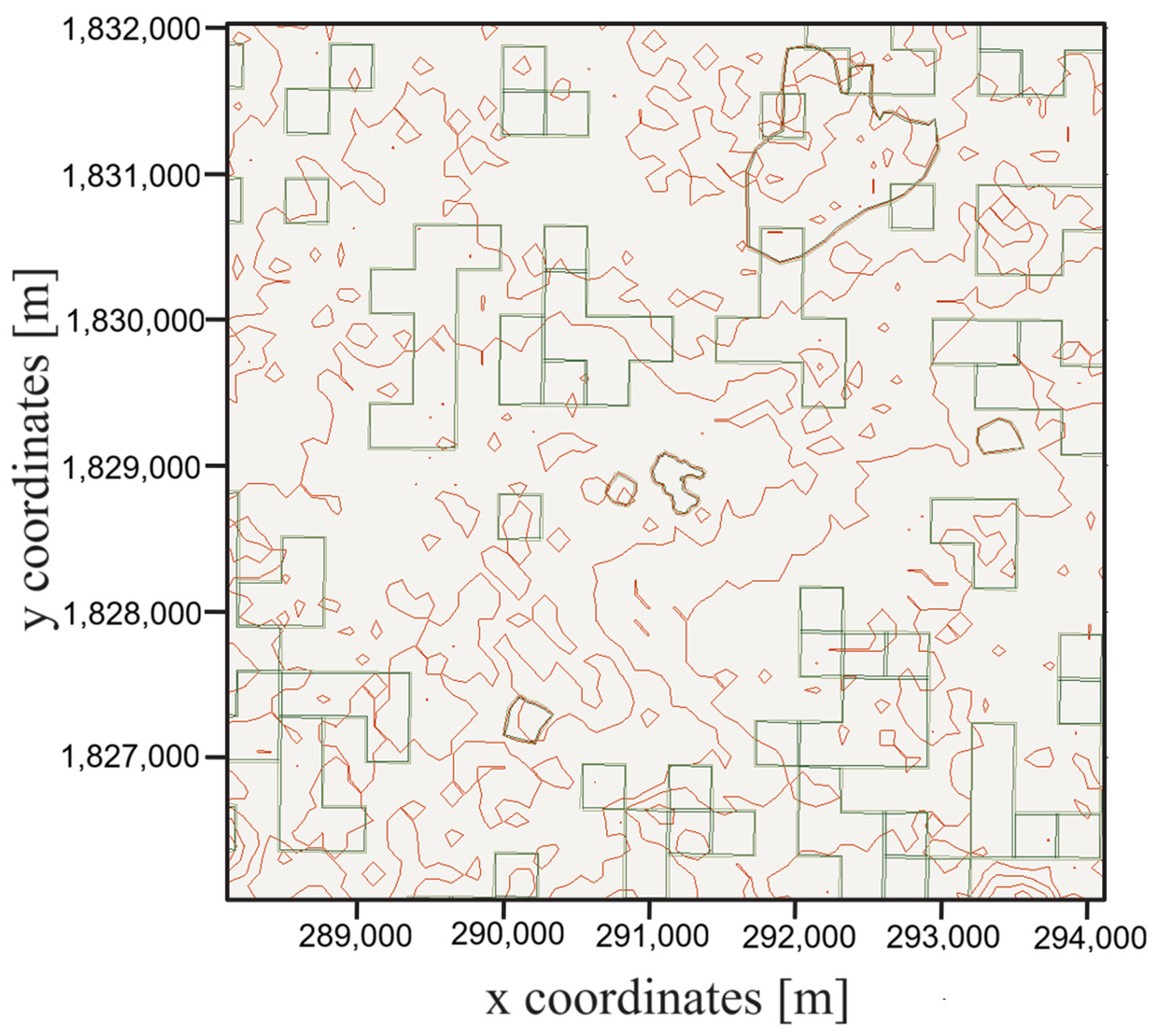
Figure 9 presents the orographic contour lines and digitization of the surface roughness.
Figure 9 shows level curves in red and roughness in green.
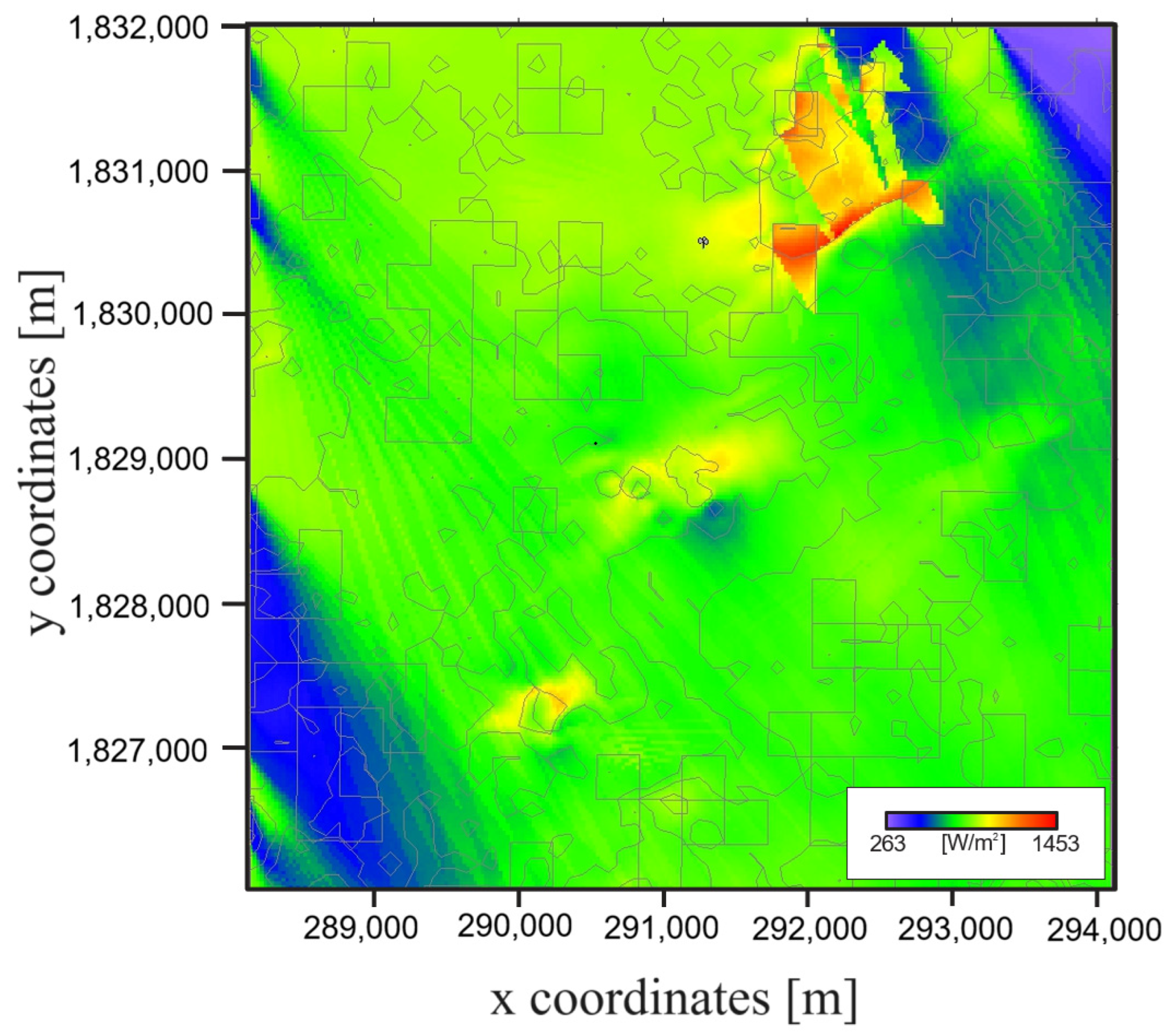
Microscale wind modeling is essential for accurately assessing wind resources and optimizing WT placement on a local scale. In addition, it enables a detailed analysis of wind conditions by incorporating various factors that influence wind flow, including terrain, surface roughness, and atmospheric conditions. Figure 10 shows the microscale wind model constructed at this site.
As can be seen in the microscale wind model, the WPD has values ranging from 263 W/m2 to 1453 W/m2. It is important to mention that up to this point, it can already be considered a wind resource because the climatological conditions, roughness, and terrain have been used, as well as the wind speed values. The anemometer shown in Figure 10 indicates the location where the data were recorded.

3.3. Multi-Objective Wind Turbine Selection

Selecting an appropriate WT is a critical decision in the development of wind energy projects, directly influencing their efficiency, performance, and economic viability. The choice involves considering a range of factors, including the technical specifications of the turbine, the wind conditions of the site, and the specific energy needs of the project. Making an informed selection ensures that the WT operates optimally under given environmental conditions, maximizing energy production while minimizing operational costs. In this study, the scale parameter (c) of the Weibull distribution and Cp were used. The wind turbines used in this study were mostly used in Mexico. See Table 4.
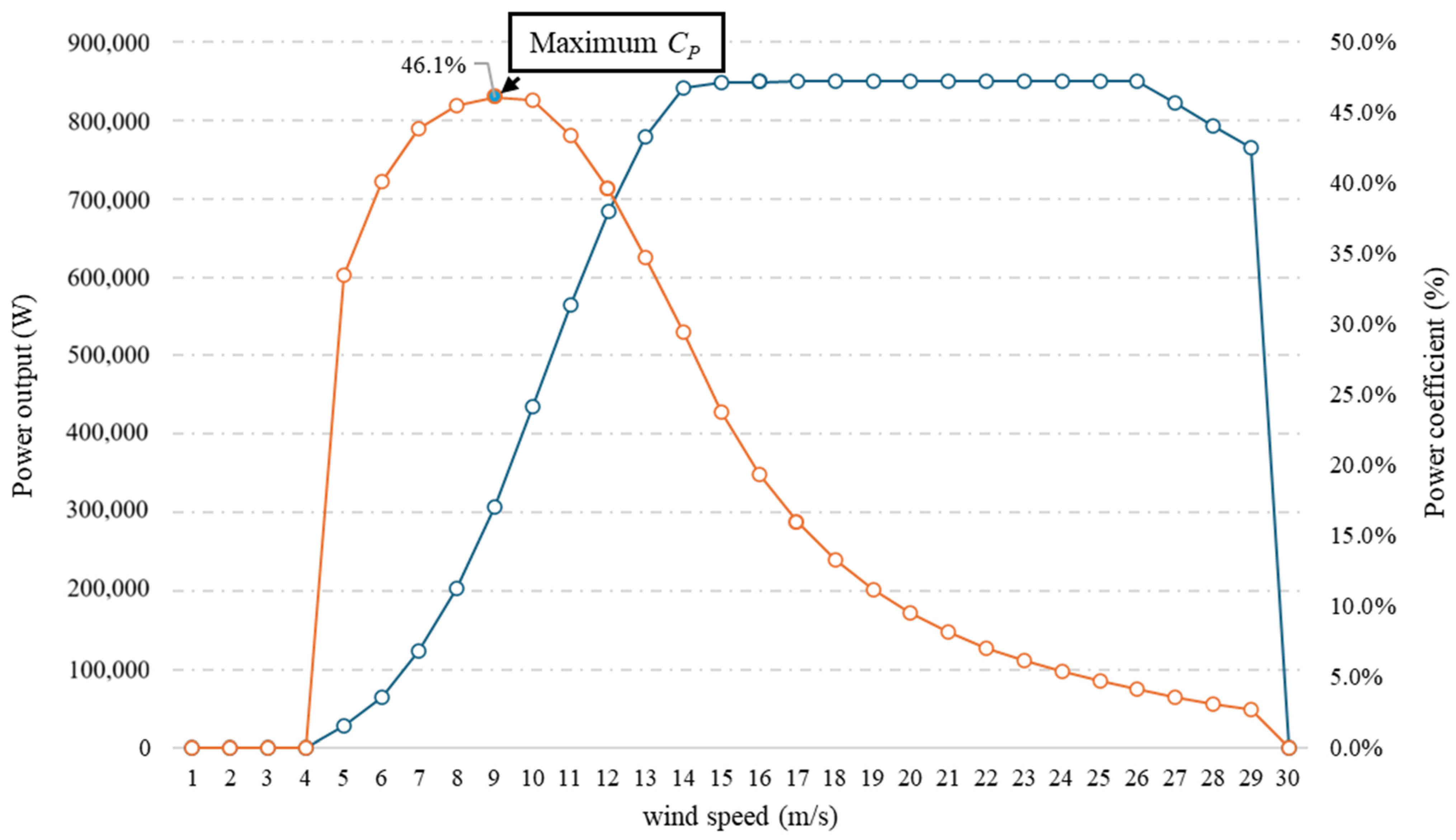
The objective of comparing Cp against the scale parameter (9.25 m/s) of the Weibull distribution and determining the wind speed at which the turbine reaches its maximum efficiency, as shown in Figure 11.
As illustrated in Figure 11, Cp reaches its peak at 9 m/s, when the WT achieves its rated power. This indicates that the primary goal of selecting wind farm sites is to optimize wind resources. The scale parameter was used because it represents the wind speed at which the turbine will operate most of the time. The focus is not on the wind speed at which the turbine reaches its rated power but rather on the speed at which it achieves maximum efficiency, which in turn enables it to reach its rated power.
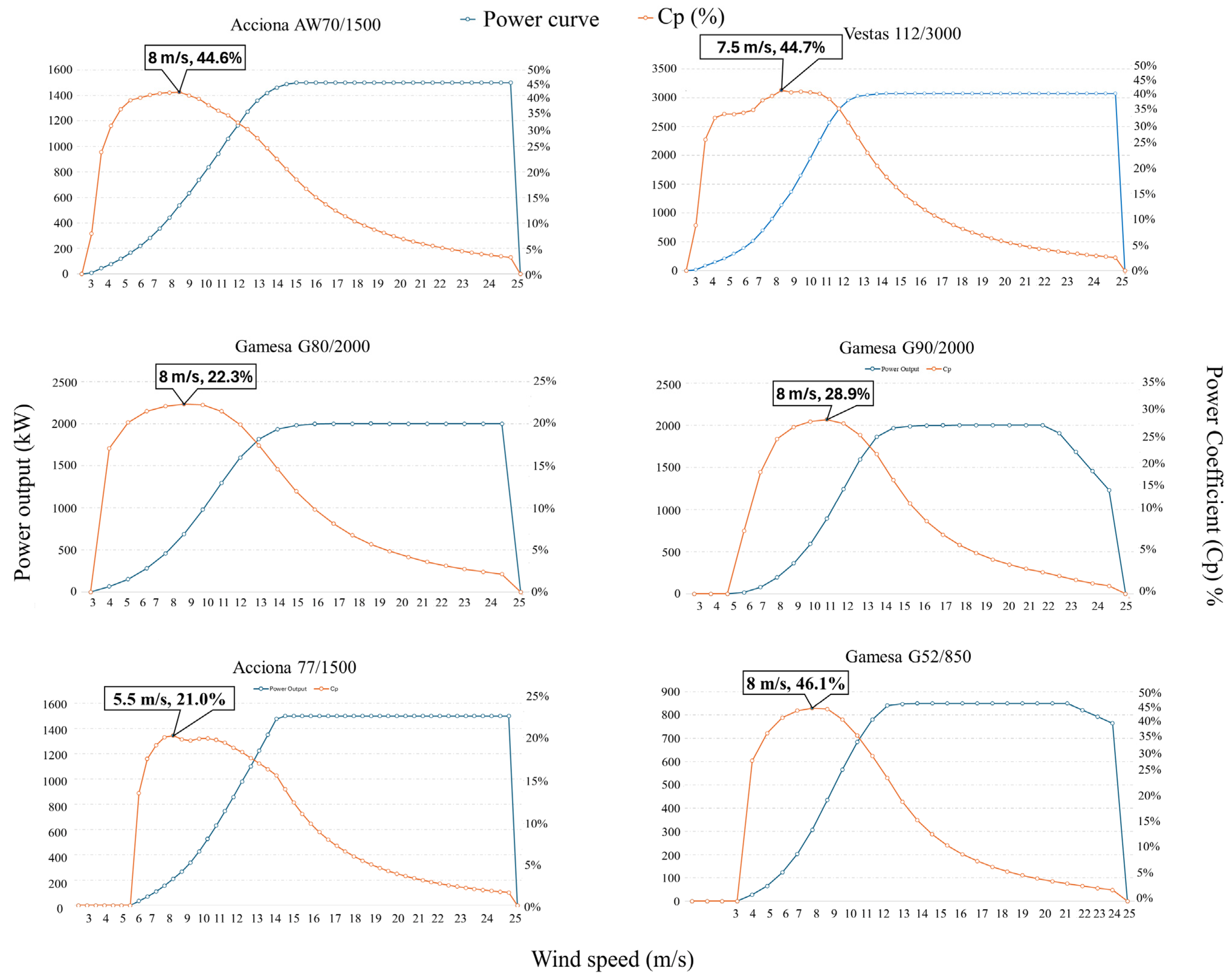
Figure 12 shows the maximum efficiency reached at a specific wind speed by the most used WT in Mexico.
As observed in Figure 12, the maximum Cp was reached at different wind speeds for the various WTs analyzed. Specifically, the Acciona AW70/1500, Gamesa G80/2000, Gamesa G52/850, and Gamesa G90/2000 turbines achieved maximum Cp at 8 m/s, Vestas 112/3000 at 7.5 m/s, and Acciona 77/1500 at 5.5 m/s. Given that the wind resource at the study site has a scale parameter of 9.25 m/s, it would be ideal to utilize a wind turbine capable of harnessing this wind speed. However, typical wind turbines used in Mexico do not fully exploit this wind resource. Therefore, a wind turbine designed to optimize energy capture under these conditions was proposed.
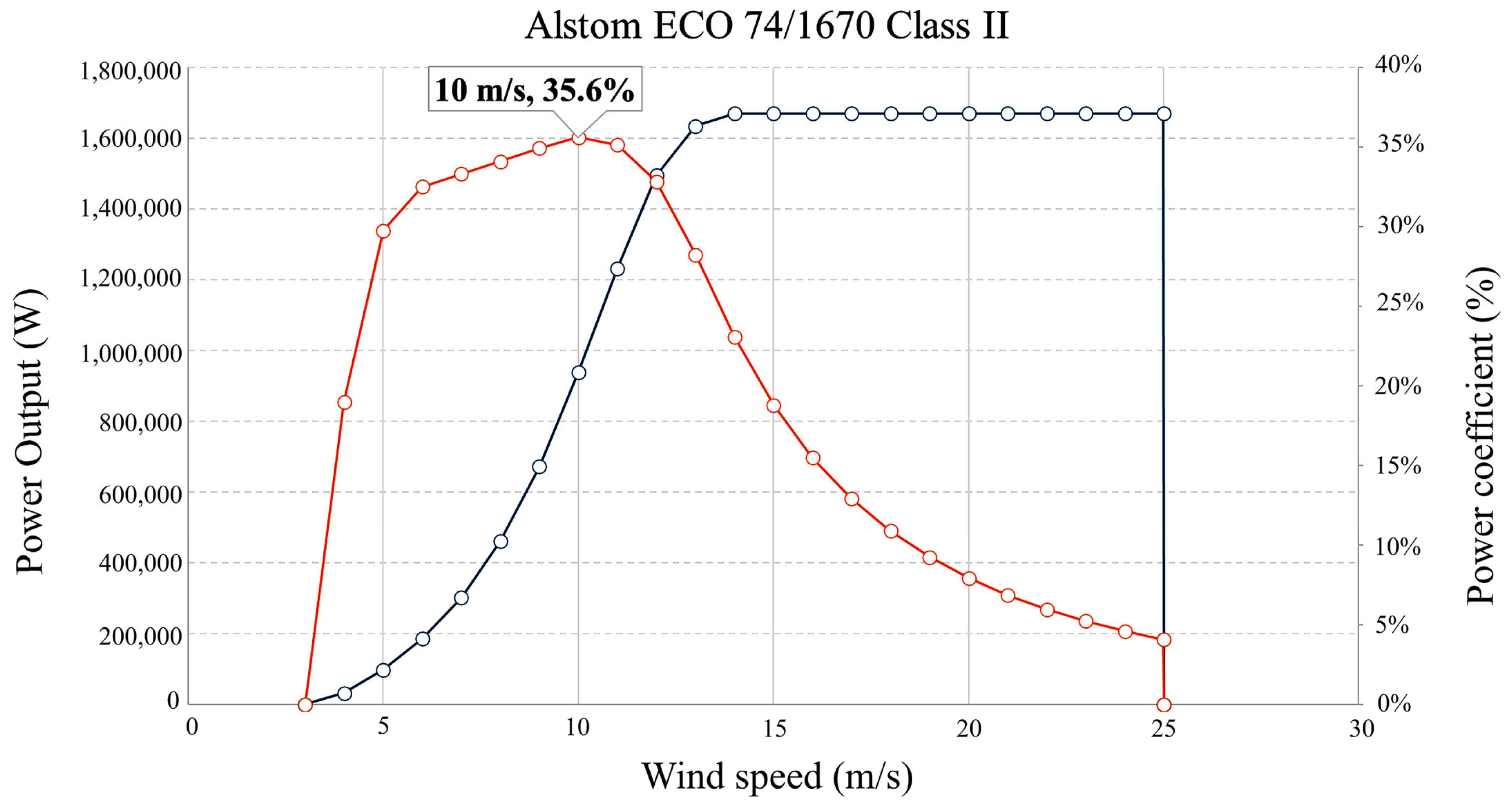
Figure 13 presents the Cp and power curves of the Alstom ECO 74/1670 Class II WT.
The power curve and its corresponding Cp are shown in Figure 13. It can be observed that this WT reaches its maximum efficiency at approximately 10 m/s, indicating that it is better suited to the studied site compared to the other analyzed turbines. One of the main objectives of this study is to identify a WT that matches site conditions to maximize wind energy extraction.
Table 5 presents the configurations of the wind turbine placements based on the rotor diameters (D) between the rows and columns.
Table 5 presents data on wind turbine placement configurations, focusing on the distance between rows and columns in terms of rotor diameter (D). Several performance metrics are evaluated, including AEP, AEPGross, wake losses, CF, and the number of wind turbines used for each configuration.

3.4. Impact of Distance Between Rows and Columns on AEPGross and AEP

The AEPGross (before wake losses) decreases as the distance between rows (3D to 5D) and columns (5D to 9D) increases; for example, in the 3D row configuration, AEPGross drops from 75.2 GWh at 5D to 45.7 GWh at 9D; similarly, AEP (after accounting for wake losses) follows a decreasing trend as distance increases; for instance, at 3D, AEP reduces from 70.3 GWh at 5D to 44.6 GWh at 9D.
Increasing the spacing between rows and columns leads to a reduction in AEPGross and AEP, likely because fewer WTs can be placed as space between them increases. This was particularly evident at higher distances, where the number of turbines was much smaller.
Wake losses tend to decrease as the spacing between turbines increases; for example, at 3D, wake losses are 6.4% at 5D but drop to 2.5% at 9D. This trend is consistent across all row configurations (3D, 4D, and 5D). Closer turbine placement (smaller D) results in higher wake losses, whereas larger distances reduce turbulence effects, and thus lower wake losses. A larger spacing between turbines minimizes wake interference, reduces energy losses, and improves overall turbine performance.
The CF remains relatively stable across different configurations, with minor increases as the distance between WTs increases. In the 3D row configuration, the CF increases slightly from 41.2% at 5D to 42.4% at 9D. In the 4D and 5D row configurations, CFs also showed small improvements with increasing spacing, indicating slightly better utilization of available wind resources at larger distances. Although fewer WTs are placed at greater distances, they operate more efficiently owing to the reduced wake effects, leading to a slight increase in CF.
The number of turbines decreased as the spacing between the rows and columns increased. This reduction was sharpest for larger distances between columns. At 3D, the number of turbines decreased from 13 to 5D to 8 at 9D. Similarly, at 5D, the number of turbines dropped from 10 at 5D to only 4 at 9D. Increasing the spacing between turbines reduces the number of turbines that can be installed, which in turn lowers the total energy production despite a slightly better turbine performance (higher CF).
Closer spacing (5D) results in higher energy production but at the cost of increased wake losses. In the 3D configuration, wake losses were as high as 6.4% at 5D. Wider spacing (9D) reduces wake losses and slightly improves the CF but significantly lowers the total energy production (AEP and AEPGross) owing to the fewer number of WTs.
The ideal turbine layout depends on the trade-off between maximizing the energy production and minimizing the wake losses. Configurations with closer spacing (5D or 6D) offer a higher total energy output but experience greater wake losses. Wider spacing (8D or 9D) reduces wake losses and slightly improves efficiency (CF); however, a reduction in the number of turbines leads to lower overall energy production. A balance between spacing and turbine count is crucial for optimizing wind farm performance.
The relationship between the configuration of turbines and the turbulence intensity was explored further to assess the implications of the proposed layouts on structural integrity, with values presented in Table 6 for each turbine location for the given 3D × 7D. Turbines at the periphery of the wind farm (WTs 7, 8, and 9) had the highest turbulence intensities (16.2–16.4%) due to their location with respect to upstream turbine layout and local terrain.
To counter any potential fatigue risk, two approaches are suggested. For sites where the TI values exceed the design target of the IEC Class IIA design (typically 14–16%), the use of turbines certified for higher turbulence classes (IEC Class IA, for instance, designed for TI = up to 18%) is supportable. Other separation arrangements that increase the distance between the turbines in the highest wake enhanced regions reduce the turbulence levels, the increasing the column spacing from 7D to 8D in the most turbulent sectors gives a reduction of about 5–8% in the representative turbulence intensity (thus reducing the fatigue equivalent loads, and extending component life).
The introduction of these load-based constraints ensures that when choosing the turbine layout, it selects a configuration that maximizes the power output while also guaranteeing the structural integrity of the turbines over their lifetimes, which is essential for economic returns from the wind farm.
IEC classes are defined in IEC 61400-1 where Class I, II and III correspond to reference wind speeds 50m/s, 42.5m/s and 37.5m/s respectively, and subclasses A (TI = 16%), B (TI = 14%) and C (TI = 12%) correspond to the characteristic turbulence intensities at 15m/s. Class IA turbines are designed for high-turbulence environments (TI < 18%) and therefore may be acceptably sited at sites with higher levels of wake-induced turbulence.
In Table 6, the IEC turbulence classification and recommended turbine classes for each turbine location are indicated based on the turbulence intensity measured at hub height. Turbines that operate within their recommended class experience fatigue loads as per design, whilst operating outside their turbulence intensity design class implies accelerated wear and a shortened life span.
As noted previously, WTs 4 and 5 (Table 6), despite having comparatively low turbulence intensities (13.6), are nevertheless above the Class IIB design level of 14%, and consequently WTs in these locations should be certified to at least Class IIA. More serious, though, are WTs 7, 8, 9 and 10, which have turbulence intensities between 16.1 and 16.4, therefore exceeding the Class IIA level of 16%. Class IA turbines (tested for turbulence intensities of up to 18%) should be used in these locations, or some adjustment to the turbine spacing on site (increasing the column spacing in the wind direction sectors where the turbines are likely to be most affected by wakened flows, 270° to 330° can be made), thus reducing the effective turbulence intensity to Class IIA limits at some risk to energy density.
The study indicates that imposing structural reliability constraints based on loads as part of the turbine selection and layout optimization process can be key to achieving a wind farm that is economically viable and, at the same time, safe over the entire required operational life. Not accounting for these loads can lead to premature failures, enhanced maintenance and even loss of operational income, affecting the financial viability of the project.
To gauge the relative performance of the developed turbine layout, a baseline setup based on conventional industry wind farm layout practices was established. The baseline was defined as a grid with a row spacing of five rotor diameters (5D) apart and columns spaced seven rotor diameters (7D) apart. It is accepted practice that there is a typical spacing arrangement of somewhere between 5D and 9D further apart, depending on wind farm and turbine specific makeup, for flat-terrain wind farms, which balances energy yield with an acceptable wake loss [47,48]. The developed configuration, determined from the parametric analysis, generates a row of turbines spaced 3D apart and a column spaced 7D apart, maximizing energy density while keeping wake losses within acceptable bounds.
Table 7 presents a comparative summary of the performance metrics for the baseline (5D × 7D) and proposed (3D × 7D) configurations.
The baseline comparison illustrates that the proposed 3D × 7D provides an increase of 30.3% in gross annual energy production (AEPGross), and a 29.0% in net annual energy production (AEP) compared to the standard industry configuration (5D × 7D). This significant increase stems principally from the higher turbine density provided by the more aggressive lower row spacing (3D v 5D), allowing for an additional three turbines (13 v 10) to be installed on the same land area.
The drawback of this configuration is a slightly increased wake loss, growing from 5.5% for the baseline configuration to 6.4% for this proposed layout. The capacity factor remains essentially unchanged, reducing only negligibly by 0.7% (from 41.5% to 41.2%), suggesting that any additional loss from wake interaction would need to be offset by the efficiency of additional turbines.
From an efficient land use point of view, the proposed configuration produces an AEP per unit area of ~30% higher than the baseline, which is an important difference in the delivery energy density to the grid, if station reference areas are not too involved, as in resource-constrained regions where land is limited or energy yields from area/region is more critical. The slightly higher wake losses incurred are outweighed by the extra total energy that is produced, making the 3D × 7D configuration attractive for the site with consistent northerly wind directions (Figure 7), where directional variability is also quite low.
It should be noted that the baseline comparison considers a set turbine spacing for the entire wind farm. In practice, site-specific optimization may be achieved with varying spacing to increase the number of turbines in favorable wind areas with increased spacing in mixes of high-wake areas (for example, WTs 7–10 as explained in response to Comment 4).
To estimate the effect of turbulence on the efficiency of energy extraction, we would compare (1) AEP (from standard power curve without turbulence correction) to (2) AEP with turbulence correction. The correction reduces turbine power output through increased turbulence intensity, which reduces rotor efficiency and may cause derating/shutdown at high turbulence levels.
The turbulence correction was applied according to the method described in IEC 61400-12-1 [73] to correct the power curve for the representative turbulence intensity at each turbine location. The corrected power output Pcorr is given by
P c o r r = P s t d ( 1 α · T I )
where Pstd is the power output from the standard power curve, TI is the turbulence intensity at hub height, and α is an empirical correction factor derived from turbine-specific performance data. For this analysis, a conservative correction factor of α = 0.03 was applied, consistent with values reported in the literature for similar turbine classes [38,66].
Table 8 presents the quantitative comparison of AEP with and without turbulence correction for each turbine in the proposed 3D × 7D configuration.
We applied turbulence correction using Pcorr = Pstd⋅(1 − 0.03⋅TI), consistent with IEC 61400-12-1 methodology. AEP values represent net production after accounting for wake losses.
The quantitative results of AEP with and without turbulence correction for each turbine in the 3D × 7D are given in Table 8. Overall, the turbulence correction reduces the total AEP from 55.781 GWh to 55.223 GWh, or a total energy loss of 0.558 GWh (1.00%) due to turbulence effects.
The magnitude of the turbulence correction at each turbine location corresponds to the levels of turbulence intensity characteristic of each location. Turbines 7, 8, and 9 have the highest turbulence intensity levels (16.2 to 16.4%) and consequently see the largest turbulence correction energy losses (1.34 to 1.43% of individual turbine AEP). Conversely, turbines 4 and 5 have the lowest turbulence intensity levels (13.6%) and consequently the minimum turbulence-induced energy losses (0.64 to 0.65%).
The overall small impact (1.00%) indicates that for the current layout arrangement, the effect of turbulence is not the most important cause of an increase in energy loss when compared to waking losses (6.4% for the proposed configuration). However, the spatial variation in the loss due to turbulence suggests that turbulence should be considered when deciding where to place a turbine on a wind farm; turbines placed in regions of high wake interaction will experience not only increased mechanical loading, but also a tangible loss in energy capture, see Figure 14.
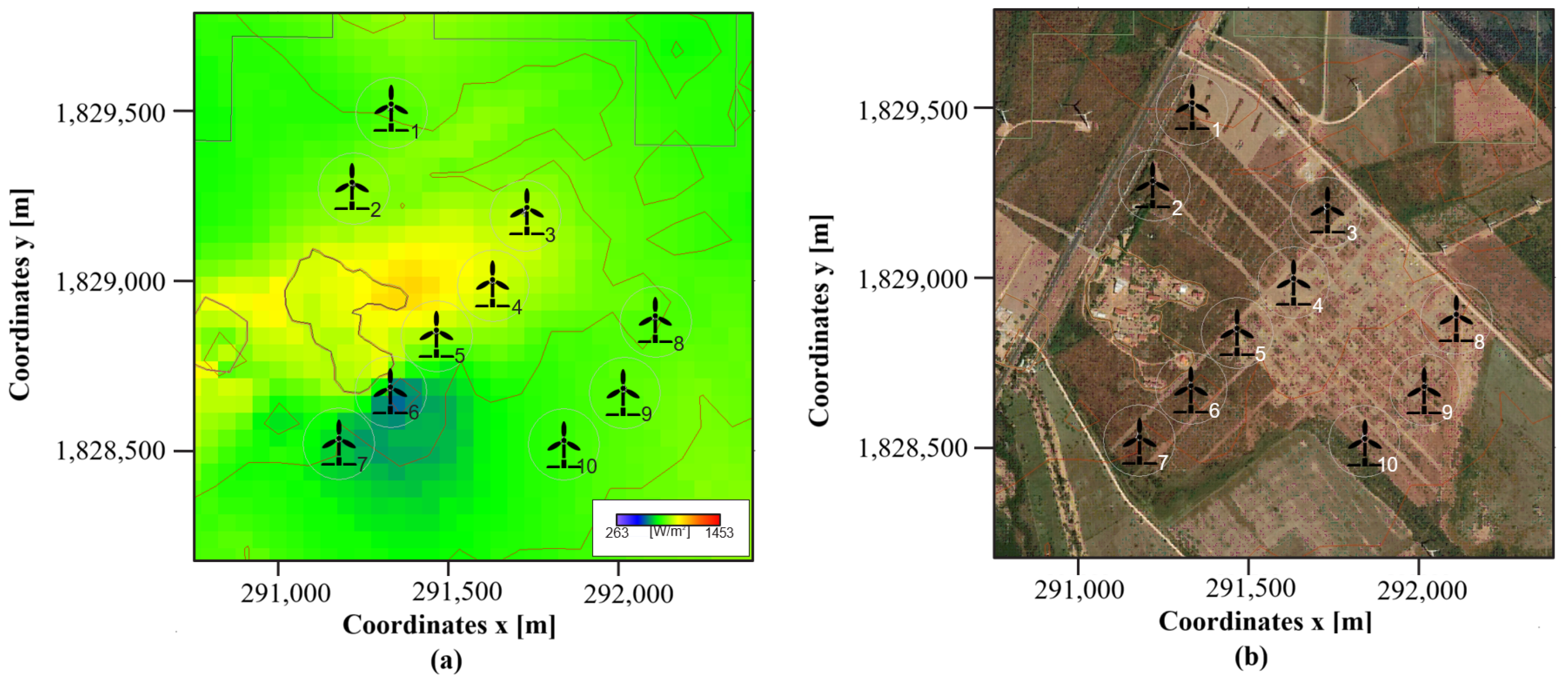
Figure 14 presents the WT layout based on placement analysis.
As shown in Figure 14, the WTs were positioned according to the optimal configuration of 3D between the rows and 7D between the columns. In Figure 14a, the microscale model is depicted. Figure 14b shows the terrain where the wind farm is located.
To predict future failures due to the wake effect, wind conditions were extrapolated for the next 50 years. Table 9 lists the wind conditions for each WT.
Table 9 provides important wind data for each WT over a 50-year extrapolation, covering aspects such as wind direction, horizontal wind velocity, flow inclination, turbulence, and extreme average wind speed. The wind direction for all remained relatively consistent, with minor variations of approximately 358° to 0°. WTs 6 and 7 show slightly larger deviations in direction, but are still within a narrow range, suggesting that the wind patterns at the site are relatively uniform in terms of direction.
Wind speed ranges between 6.3 m/s and 7.0 m/s. The highest wind speeds were observed at WTs 4 and 5 (7.0 m/s), whereas the lowest was observed at WT 7 (6.3 m/s). Variability between them is relatively low, with a maximum difference of 0.7 m/s between the highest and lowest speeds. WTs 4 and 5 might be slightly more productive owing to their higher wind speeds.
The flow inclination (the angle at which the wind hits the WT) varies significantly, with values ranging from −4.12° to 1.57°. WTs 5 and 6 experienced negative flow inclinations (−2.63° and −4.12°), which could suggest that the wind came from a slightly downward trajectory, likely due to local terrain effects. The highest positive flow inclination was observed at WT 3 (1.57°), indicating upward wind flow at that point. Significant variations in the flow inclination could affect the efficiency of the WTs. Negative inclinations may cause a slight reduction in energy capture, especially if they are not accounted for in the WT design.
The turbulence values, represented by ( I u 2 + I v 2 ) 1 2 , range from 13.6 to 16.4. The highest turbulence was observed at WTs 7, 8, and 9 (16.2–16.4), whereas the lowest values were recorded at WTs 4 and 5 (13.6). Higher turbulence can increase the mechanical stress on the WT, potentially leading to greater wear and tear over time. WTs with higher turbulence, particularly 7, 8, and 9, may require more maintenance and may face more frequent mechanical issues owing to the increased turbulence load.
The extreme average wind speed (based on a 50-year extrapolation) ranges from 22.06 m/s to 24.64 m/s. WT 7 recorded the lowest extreme wind speed (22.06 m/s), while WT 4 had the highest (24.64 m/s). The variability in extreme wind speeds is relatively small, with a difference of just 2.58 m/s between the highest and lowest values. These wind speeds indicate the potential stress that WTs could face in the long term. WT 4, which experienced the highest extreme wind speed, may need to be monitored closely for signs of wear or structural strain.
WT generation is presented in Table 10.
Table 10 provides data on the performance of 10 wind turbines (WT) in terms of wind speed, AEPGross, AEP, and the percentage of energy loss. Wind speed (U) ranges from 8.33 m/s (WT 6) to 9.23 m/s (WT 4). Gross AEP: The total energy produced by each turbine before loss ranged from 5.151 GWh (WT 6) to 5.843 GWh (WT 4). Net AEP: The actual energy produced after accounting for the losses ranged from 5.006 GWh (WT 6) to 5.666 GWh (WT 3). Energy Loss: Turbines experienced varying levels of energy loss, with the highest losses at WT 10 (7.89%) and WT 9 (7.66%), while the lowest loss was observed at WT 1 (0.68%).
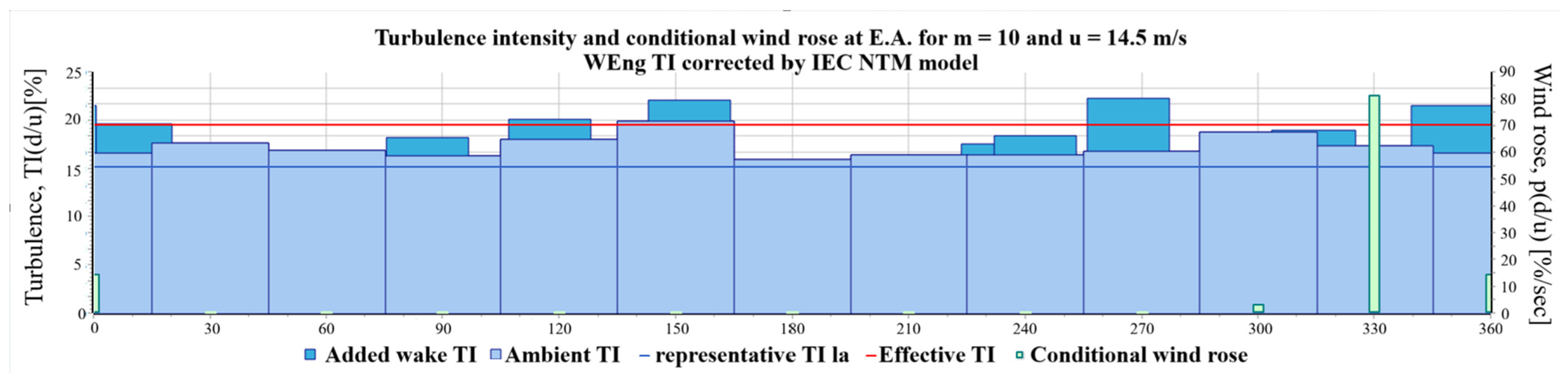
The relationship between turbulence intensity (TI) and wind direction is shown in Figure 15.
Figure 15 illustrates the relationship between TI and the direction of wind at a wind farm. The graph shows the added wake turbulence intensity, ambient turbulence intensity, and representative turbulence intensity for different wind directions measured between 0° and 360°. Additionally, the effective TI is highlighted by a red line, whereas the conditional wind rose, shown as vertical bars, indicates the frequency of wind occurrences from various directions.
The ambient turbulence intensity (blue bars) represents the baseline turbulence unaffected by nearby turbines; the added wake (lighter blue segments) reflects increased turbulence due to turbine wake effects; the representative TI (solid blue sections) is the total TI experienced in each wind direction, combining ambient and wake effects; the effective TI (red line) denotes the overall threshold of turbulence intensity, used to assess the potential for fatigue and structural stress on turbines.
The conditional wind rose (green bars) shows the frequency distribution of the wind coming from a specific direction. The wind was more frequent in certain directions (notably between 330° and 360°), as indicated by the taller bars. In certain directions, the turbulence intensity is significantly higher, particularly where both ambient and added wake turbulence combine to reach elevated values close to or above the effective TI threshold.
Wind turbines facing directions with higher turbulence intensities, particularly when compounded by wake effects, may experience increased mechanical stress and reduced efficiency. The regions between 270° and 330° exhibited the highest turbulence intensities, which could affect turbine performance and longevity in these areas. Wind directions between 0° and 60° show lower turbulence intensities, suggesting more favorable conditions for turbine operation.

4. Conclusions

The long-term analysis of the wind data and WT performance within the studied wind farm revealed several critical insights. The consistent northwest wind direction facilitates optimal WT alignment, minimizes energy losses associated with misalignment, and promotes uniform power generation. The narrow range of wind velocities observed ensures stable energy output, although the WTs exposed to slightly higher wind speeds, such as WTs 4 and 5, demonstrated enhanced productivity potential. Variations in flow inclination influenced by local terrain indicate that negative inclinations may slightly reduce energy capture, emphasizing the need for terrain-aware WT design and placement. Turbulence intensity has emerged as a significant factor affecting WT performance and maintenance. They operate in regions with higher turbulence intensities (WT 7, 8, and 9) and are subject to increased mechanical stress, which may accelerate wear and necessitate more frequent maintenance interventions. This highlights the importance of incorporating turbulence-mitigation strategies and robust maintenance protocols to ensure the longevity and operational efficiency of turbines. Extreme average wind speed evaluations confirmed that all WTs operate within their design limits, although turbine 4 requires diligent monitoring to avoid structural fatigue and potential failure. Energy production data show that energy losses vary between WTs 9 and 10 because they exhibit higher losses. Identifying the factors that contribute to these losses, such as wake effects and turbulence, is essential for optimizing the overall performance of a wind farm.
Comparison with a standard layout (5D × 7D) shows a net annual energy production increase of 29.0%, with comparable capacity factors. This indicates the utility of site-specific parametric optimization in increasing the energy yield of wind farms in places like the Isthmus of Tehuantepec with stable directional winds.
The interplay between turbulence intensity and wind direction underscores the need for advanced wake management and turbine layout optimization to reduce turbulence-induced inefficiencies. The strategic placement of turbines in areas with low turbulence can enhance energy capture and reduce mechanical stress, thereby improving the sustainability and economic viability of wind farms.
A limitation of the present study is the lack of direct validation against on-site anemometer tower measurements at the wind turbine locations. Other studies have suggested a strong agreement between MERRA-2 reanalysis and ground-based measurements in a similar environment. More local validation will serve to provide confidence in both production estimates and characterized wind resources and microscale modeling outputs. Future work will benefit from the concept of installing meteorological towers or remote sensing devices (e.g., lidar, sodar) across the wind farm footprint.
The use of a steady-state wake model for the 50-year projections imposes limits on the applicability of the results due to neglect of dynamic wake effects, atmospheric stability effects, and possible non-stationarity of the wind resource. Nonetheless, the WAsP model is still useful for wind resource assessment and layout optimization, but the long-term projections in the present analysis should be considered with some caution. The elevated turbulence intensities and wake losses indicated by the steady-state approach are conservative indicators of operational conditions, but dynamic modeling approaches are required for improved assessment of fatigue loading and long-term reliability.

Author Contributions

Conceptualization, B.M., J.R.D.-P., A.R.-J., J.A.F., A.-J.P.-M., D.M.-R., D.R.-R., A.P.-F., and Q.H.-E.; methodology, B.M., J.R.D.-P., A.R.-J., J.A.F., A.-J.P.-M., D.M.-R., D.R.-R., A.P.-F., and Q.H.-E.; formal analysis, B.M., J.R.D.-P., A.R.-J., J.A.F., A.-J.P.-M., D.M.-R., D.R.-R., A.P.-F., and Q.H.-E.; writing—original draft preparation, B.M., J.R.D.-P., A.R.-J., J.A.F., A.-J.P.-M., D.M.-R., D.R.-R., A.P.-F., and Q.H.-E.; writing—review and editing, B.M., J.R.D.-P., A.R.-J., J.A.F., A.-J.P.-M., D.M.-R., D.R.-R., A.P.-F., and Q.H.-E. All authors have read and agreed to the published version of the manuscript.

Funding

This research received no external funding.

Institutional Review Board Statement

Not applicable.

Informed Consent Statement

Not applicable.

Data Availability Statement

The datasets presented in this article are not readily available because the dataset is owned by Windnavigator and has a cost. Requests to access the datasets should be directed to Windnavigator.

Acknowledgments

The authors thank the Universidad del Istmo and CONAHCYT for their support granted to Brenda González Mendoza.

Conflicts of Interest

The authors declare no conflicts of interest.

References

  1. Zhang, Y.; Li, L.; Sadiq, M.; Chien, F. The Impact of Non-Renewable Energy Production and Energy Usage on Carbon Emissions: Evidence from China. Energy Environ. 2024, 35, 2248–2269. [Google Scholar] [CrossRef]
  2. Ayyildiz, E.; Erdogan, M. A Comprehensive Approach to Evaluate Risk Mitigation Strategies in Offshore Wind Farms Using Spherical Fuzzy Decision Making Analysis. Ocean Eng. 2024, 311, 118881. [Google Scholar] [CrossRef]
  3. Tao, Z.; Liu, H.; Si, Y.; Wang, C.; Zhu, R. An Opportunistic Joint Maintenance Strategy for Two Offshore Wind Farms. Ocean Eng. 2024, 304, 117890. [Google Scholar] [CrossRef]
  4. Davis, G.A.; Owens, B. Optimizing the Level of Renewable Electric R&D Expenditures Using Real Options Analysis. Energy Policy 2003, 31, 1589–1608. [Google Scholar] [CrossRef]
  5. Dinçer, A.E.; Demir, A.; Yılmaz, K. Multi-Objective Turbine Allocation on a Wind Farm Site. Appl. Energy 2024, 355, 122346. [Google Scholar] [CrossRef]
  6. IPCC. Special Report on Climate Change and Cities; IPCC: Geneva, Switzerland, 2024. [Google Scholar]
  7. de Moura Ribeiro, A.; Hallak, P.H.; de Castro Lemonge, A.C.; dos Santos Loureiro, F. Automatic Grouping of Wind Turbine Types via Multi-Objective Formulation for Nonuniform Wind Farm Layout Optimization Using an Analytical Wake Model. Energy Convers. Manag. 2024, 315, 118759. [Google Scholar] [CrossRef]
  8. Fatahian, E.; Mishra, R.; Jackson, F.F.; Fatahian, H. Optimization and Analysis of Self-Starting Capabilities of Vertical Axis Wind Turbine Pairs: A CFD-Taguchi Approach. Ocean Eng. 2024, 302, 117614. [Google Scholar] [CrossRef]
  9. Nash, R.; Nouri, R.; Vasel-Be-Hagh, A. Wind Turbine Wake Control Strategies: A Review and Concept Proposal. Energy Convers. Manag. 2021, 245, 114581. [Google Scholar] [CrossRef]
  10. Wang, Z.; Tu, Y.; Zhang, K.; Han, Z.; Cao, Y.; Zhou, D. An Optimization Framework for Wind Farm Layout Design Using CFD-Based Kriging Model. Ocean Eng. 2024, 293, 116644. [Google Scholar] [CrossRef]
  11. Rivera-Arreba, I.; Li, Z.; Yang, X.; Bachynski-Polić, E.E. Comparison of the Dynamic Wake Meandering Model against Large Eddy Simulation for Horizontal and Vertical Steering of Wind Turbine Wakes. Renew. Energy 2024, 221, 119807. [Google Scholar] [CrossRef]
  12. Mejía-Montero, A.; Lane, M.; van Der Horst, D.; Jenkins, K.E.H. Grounding the Energy Justice Lifecycle Framework: An Exploration of Utility-Scale Wind Power in Oaxaca, Mexico. Energy Res. Soc. Sci. 2021, 75, 102017. [Google Scholar] [CrossRef]
  13. Finserås, E.; Herrera Anchustegui, I.; Cheynet, E.; Gebhardt, C.G.; Reuder, J. Gone with the Wind? Wind Farm-Induced Wakes and Regulatory Gaps. Mar. Policy 2024, 159, 105897. [Google Scholar] [CrossRef]
  14. Batran, S.; Jama, M.; Yousaf, J.; Hassan, T.; Ghazal, M.; Mokhlis, H.B. Assessment of Wind Energy Resource in the Western Region of Somaliland. Heliyon 2024, 10, e32500. [Google Scholar] [CrossRef] [PubMed]
  15. Pelser, T.; Weinand, J.M.; Kuckertz, P.; McKenna, R.; Linssen, J.; Stolten, D. Reviewing Accuracy & Reproducibility of Large-Scale Wind Resource Assessments. Adv. Appl. Energy 2024, 13, 100158. [Google Scholar] [CrossRef]
  16. Ouerghi, F.H.; Omri, M.; Menaem, A.A.; Taloba, A.I.; Abd El-Aziz, R.M. Feasibility Evaluation of Wind Energy as a Sustainable Energy Resource. Alex. Eng. J. 2024, 106, 227–239. [Google Scholar] [CrossRef]
  17. Al-Khayat, M.; AL-Rasheedi, M. A New Method for Estimating the Annual Energy Production of Wind Turbines in Hot Environments. Renew. Sustain. Energy Rev. 2024, 195, 114343. [Google Scholar] [CrossRef]
  18. Centeno-Telleria, M.; Yue, H.; Carrol, J.; Penalba, M.; Aizpurua, J.I. Impact of Operations and Maintenance on the Energy Production of Floating Offshore Wind Farms across the North Sea and the Iberian Peninsula. Renew. Energy 2024, 224, 120217. [Google Scholar] [CrossRef]
  19. Gelaro, R.; McCarty, W.; Suárez, M.J.; Todling, R.; Molod, A.; Takacs, L.; Randles, C.A.; Darmenov, A.; Bosilovich, M.G.; Reichle, R. The Modern-Era Retrospective Analysis for Research and Applications, Version 2 (MERRA-2). J. Clim. 2017, 30, 5419–5454. [Google Scholar] [CrossRef]
  20. Jargalsaikhan, N.; Ueda, S.; Masahiro, F.; Matayoshi, H.; Mikhaylov, A.; Byambaa, S.; Senjyu, T. Exploring Influence of Air Density Deviation on Power Production of Wind Energy Conversion System: Study on Correction Method. Renew. Energy 2024, 220, 119636. [Google Scholar] [CrossRef]
  21. Wang, X.; Hu, C.; Kikumoto, H.; Jia, H.; Nakao, K.; Ooka, R. Data Extension of High-Resolution Wind Speed Database by Fusing Meteorological Observation and Local Objective Analysis Data with POD–LSE. J. Wind Eng. Ind. Aerodyn. 2024, 252, 105812. [Google Scholar] [CrossRef]
  22. Wu, B.; Yu, S.; Peng, L.; Wang, L. Interpretable Wind Speed Forecasting with Meteorological Feature Exploring and Two-Stage Decomposition. Energy 2024, 294, 130782. [Google Scholar] [CrossRef]
  23. Kumar Yadav, H.; Yadav, S.; Narayan Gupta, M.; Sarkar, A.; Sarkar, J. Diurnal Variations in Wind Power Density Analysis for Optimal Wind Energy Integration in Different Indian Sites. Sustain. Energy Technol. Assess. 2024, 64, 103744. [Google Scholar] [CrossRef]
  24. Wang, X.; Kikumoto, H.; Jia, H.; Lin, C.; Nakao, K. Investigation of Spatial Variability in Power Law Index of Wind Profiles above the Urban Area around Tokyo Bay Based on Local Objective Analysis Data. J. Wind Eng. Ind. Aerodyn. 2023, 240, 105471. [Google Scholar] [CrossRef]
  25. Kim, J.; Shin, H.-J.; Lee, K.; Hong, J. Enhancement of ANN-Based Wind Power Forecasting by Modification of Surface Roughness Parameterization over Complex Terrain. J. Environ. Manag. 2024, 362, 121246. [Google Scholar] [CrossRef] [PubMed]
  26. Cao, J.; Xue, W.; Mao, R.; Xin, D. Wind Power in Forested Regions: Power Law Extrapolation vs. Lidar Observation. J. Wind Eng. Ind. Aerodyn. 2023, 232, 105281. [Google Scholar] [CrossRef]
  27. Niyomtham, L.; Waewsak, J.; Kongruang, C.; Chiwamongkhonkarn, S.; Chancham, C.; Gagnon, Y. Wind Power Generation and Appropriate Feed-in-Tariff under Limited Wind Resource in Central Thailand. Energy Rep. 2022, 8, 6220–6233. [Google Scholar] [CrossRef]
  28. Kumar Sharma, P.; Gautam, A.; Baredar, P.; Warudkar, V.; Bhagoria, J.L.; Ahmed, S. Analysis of Terrain of Site Mamatkheda Ratlam through Wind Modeling Tool ArcGIS and WAsP. Mater. Today Proc. 2021, 46, 5661–5665. [Google Scholar] [CrossRef]
  29. Sheehan, H.; Traiger, E.; Poole, D.; Landberg, L. Predicting Linearised Wind Resource Grids Using Neural Networks. J. Wind Eng. Ind. Aerodyn. 2022, 229, 105123. [Google Scholar] [CrossRef]
  30. Khan, T.; Theppaya, T.; Taweekun, J. Wind Resource Assessment of Northern Part of Thailand. Ain Shams Eng. J. 2023, 14, 102025. [Google Scholar] [CrossRef]
  31. Dayal, K.K.; Cater, J.E.; Kingan, M.J.; Bellon, G.D.; Sharma, R.N. Wind Resource Assessment and Energy Potential of Selected Locations in Fiji. Renew. Energy 2021, 172, 219–237. [Google Scholar] [CrossRef]
  32. Li, X.; Xu, L.; Cai, J.; Peng, C.; Bian, X. Offshore Wind Turbine Selection with Multi-Criteria Decision-Making Techniques Involving D Numbers and Squeeze Adversarial Interpretive Structural Modeling Method. Appl. Energy 2024, 368, 123381. [Google Scholar] [CrossRef]
  33. Nai-Zhi, G.; Ming-Ming, Z.; Bo, L. A Data-Driven Analytical Model for Wind Turbine Wakes Using Machine Learning Method. Energy Convers. Manag. 2022, 252, 115130. [Google Scholar] [CrossRef]
  34. Modé, P.; Demartino, C.; Georgakis, C.T.; Lagaros, N.D. Short-Term Extreme Wind Speed Forecasting Using Dual-Output LSTM-Based Regression and Classification Model. J. Wind Eng. Ind. Aerodyn. 2025, 259, 106035. [Google Scholar] [CrossRef]
  35. AL Jarrah, A.M.; AL Dwairi, R.A. Jordan Wind Energy Potential and Suggested Areas for Large-Scale Wind Turbines Investment. Energy Sustain. Dev. 2024, 80, 101452. [Google Scholar] [CrossRef]
  36. Drapalik, M.; Vavrik, V.; Liebert, W. The Effect of Wind Turbines with Low Rotor Power Density on Power Fluctuations. Next Energy 2024, 5, 100156. [Google Scholar] [CrossRef]
  37. Machado, M.R.; Dutkiewicz, M. Wind Turbine Vibration Management: An Integrated Analysis of Existing Solutions, Products, and Open-Source Developments. Energy Rep. 2024, 11, 3756–3791. [Google Scholar] [CrossRef]
  38. Sebastiani, A.; Angelou, N.; Peña, A. Wind Turbine Power Curve Modelling under Wake Conditions Using Measurements from a Spinner-Mounted Lidar. Appl. Energy 2024, 364, 122985. [Google Scholar] [CrossRef]
  39. Mehrjerdi, H. Modeling, Integration, and Optimal Selection of the Turbine Technology in the Hybrid Wind-Photovoltaic Renewable Energy System Design. Energy Convers. Manag. 2020, 205, 112350. [Google Scholar] [CrossRef]
  40. Eryilmaz, S.; Navarro, J. A Decision Theoretic Framework for Reliability-Based Optimal Wind Turbine Selection. Reliab. Eng. Syst. Saf. 2022, 221, 108291. [Google Scholar] [CrossRef]
  41. Supciller, A.A.; Toprak, F. Selection of Wind Turbines with Multi-Criteria Decision Making Techniques Involving Neutrosophic Numbers: A Case from Turkey. Energy 2020, 207, 118237. [Google Scholar] [CrossRef]
  42. Jahan, S.; Masseran, N.; Zin, W. Wind Speed Analysis Using Weibull and Lower Upper Truncated Weibull Distribution in Bangladesh. Energy Rep. 2024, 11, 5456–5465. [Google Scholar] [CrossRef]
  43. dos Santos, F.S.; do Nascimento, K.K.F.; da Silva Jale, J.; Xavier, S.F.A.; Ferreira, T.A.E. Brazilian Wind Energy Generation Potential Using Mixtures of Weibull Distributions. Renew. Sustain. Energy Rev. 2024, 189, 113990. [Google Scholar] [CrossRef]
  44. Quispe-Abad, R.; Müller, N. Finding an Absolute Maximum Theoretical Power Coefficient for Ducted Wind Turbines. J. Wind Eng. Ind. Aerodyn. 2023, 236, 105335. [Google Scholar] [CrossRef]
  45. Zhang, S.; Wang, C.; Liao, P.; Xiao, L.; Fu, T. Wind Speed Forecasting Based on Model Selection, Fuzzy Cluster, and Multi-Objective Algorithm and Wind Energy Simulation by Betz’s Theory. Expert Syst. Appl. 2022, 193, 116509. [Google Scholar] [CrossRef]
  46. Xu, C.; Yin, M.; Li, Q.; Huo, Y.; Li, Q.; Zou, Y. Wind Farm Power Maximization Based on Analytical Sensitivity Model Considering Wake Effect. Electr. Power Syst. Res. 2023, 224, 109734. [Google Scholar] [CrossRef]
  47. Hu, Z.; Gao, B.; Mao, Y. Nonlinear Model Predictive Control-Based Active Power Dispatch Strategy for Wind Power Plant Considering Dynamic Wake Effect. Int. J. Electr. Power Energy Syst. 2023, 148, 108996. [Google Scholar] [CrossRef]
  48. De-Prada-Gil, M.; Alías, C.G.; Gomis-Bellmunt, O.; Sumper, A. Maximum Wind Power Plant Generation by Reducing the Wake Effect. Energy Convers. Manag. 2015, 101, 73–84. [Google Scholar] [CrossRef]
  49. Pacheco de Sá Sarmiento, F.I.; Goes Oliveira, J.L.; Passos, J.C. Impact of Atmospheric Stability, Wake Effect and Topography on Power Production at Complex-Terrain Wind Farm. Energy 2022, 239, 122211. [Google Scholar] [CrossRef]
  50. Sun, H.; Yang, H.; Gao, X. Investigation into Wind Turbine Wake Effect on Complex Terrain. Energy 2023, 269, 126767. [Google Scholar] [CrossRef]
  51. Esnaola, G.; Ulazia, A.; Sáenz, J.; Ibarra-Berastegi, G. Future Changes of Global Annual and Seasonal Wind-Energy Production in CMIP6 Projections Considering Air Density Variation. Energy 2024, 307, 132706. [Google Scholar] [CrossRef]
  52. Ramadan, H.S. Wind Energy Farm Sizing and Resource Assessment for Optimal Energy Yield in Sinai Peninsula, Egypt. J. Clean. Prod. 2017, 161, 1283–1293. [Google Scholar] [CrossRef]
  53. Liu, S.; Zhang, L.; Lu, J.; Zhang, X.; Wang, K.; Gan, Z.; Liu, X.; Jing, Z.; Cui, X.; Wang, H. Advances in Urban Wind Resource Development and Wind Energy Harvesters. Renew. Sustain. Energy Rev. 2025, 207, 114943. [Google Scholar] [CrossRef]
  54. Shen, Y.; Zhai, J.; Kang, Z.; Zhao, B.; Gao, X.; Li, Z. Distributionally Robust Chance-Constrained Energy Management for Island DC Microgrid with Offshore Wind Power Hydrogen Production. Energy 2025, 316, 134570. [Google Scholar] [CrossRef]
  55. Tao, Z.; Zhu, R.; Hu, J.; Wang, M.; Chen, Q.; Wang, C. A Novel Hierarchical Failure Analysis Approach Targeting the Operation and Maintenance of Floating Offshore Wind Turbines. Renew. Energy 2025, 241, 122267. [Google Scholar] [CrossRef]
  56. Kong, S.; Xiao, Y.; Cao, J.; Han, Z. Adapting Wind Shear Coefficients to Urban Morphology: Unlocking Urban Wind Energy Potential. Sustain. Cities Soc. 2025, 121, 106217. [Google Scholar] [CrossRef]
  57. Yang, Z.; Dong, S. A Semi-Parametric Trivariate Model of Wind Speed, Wind Direction, and Air Density for Directional Wind Energy Potential Assessment. Energy Convers. Manag. 2024, 314, 118735. [Google Scholar] [CrossRef]
  58. Han, Q.; Wang, T.; Chu, F. Nonparametric Copula Modeling of Wind Speed-Wind Shear for the Assessment of Height-Dependent Wind Energy in China. Renew. Sustain. Energy Rev. 2022, 161, 112319. [Google Scholar] [CrossRef]
  59. Ge, C.; Yan, J.; Song, W.; Zhang, H.; Wang, H.; Li, Y.; Liu, Y. Middle-Term Wind Power Forecasting Method Based on Long-Span NWP and Microscale Terrain Fusion Correction. Renew. Energy 2025, 240, 122123. [Google Scholar] [CrossRef]
  60. Durán, P.; Meiβner, C.; Casso, P. A New Meso-Microscale Coupled Modelling Framework for Wind Resource Assessment: A Validation Study. Renew. Energy 2020, 160, 538–554. [Google Scholar] [CrossRef]
  61. Hellalbi, M.A.; Bouabdallah, A. Elaboration of a Generalized Mixed Model for the Wind Speed Distribution and an Assessment of Wind Energy in Algerian Coastal Regions and at the Capes. Energy Convers. Manag. 2024, 305, 118265. [Google Scholar] [CrossRef]
  62. El Fadli, O.; Hmamed, H.; Lagrioui, A. Multi-Objective Optimization and Improved Decision-Making in Renewable Energy Investments for Enhancing Wind Turbine Selection: Framework and a Case Study. Energy Convers. Manag. 2025, 326, 119464. [Google Scholar] [CrossRef]
  63. Tang, H.; Wang, H.; Li, C. Time-Varying Cost Modeling and Maintenance Strategy Optimization of Plateau Wind Turbines Considering Degradation States. Appl. Energy 2025, 377, 124464. [Google Scholar] [CrossRef]
  64. Pietrykowski, K.; Kasianantham, N.; Ravi, D.; Jan Gęca, M.; Ramakrishnan, P.; Wendeker, M. Sustainable Energy Development Technique of Vertical Axis Wind Turbine with Variable Swept Area—An Experimental Investigation. Appl. Energy 2023, 329, 120262. [Google Scholar] [CrossRef]
  65. Bayron, P.; Kelso, R.; Chin, R. Experimental Investigation of Tip-Speed-Ratio Influence on Horizontal-Axis Wind Turbine Wake Dynamics. Renew. Energy 2024, 225, 120201. [Google Scholar] [CrossRef]
  66. Teshome, A.D.; Kahsay, M.B.; Molinas Cabrera, M.M. Assessment of Power Curve Performance of Wind Turbines in Adama-II Wind Farm. Energy Rep. 2024, 12, 2209–2223. [Google Scholar] [CrossRef]
  67. Han, H.; Yang, D. Correlation Analysis Based Relevant Variable Selection for Wind Turbine Condition Monitoring and Fault Diagnosis. Sustain. Energy Technol. Assess. 2023, 60, 103439. [Google Scholar] [CrossRef]
  68. Faraz, M.I. Strategic Analysis of Wind Energy Potential and Optimal Turbine Selection in Al-Jouf, Saudi Arabia. Heliyon 2024, 10, e39188. [Google Scholar] [CrossRef]
  69. Zhou, Z.; Li, H.; Zheng, J.; Tan, H.; Xiang, X.; Yao, R. Two-Stage Frequency Regulation for Wind Turbines with Adaptive Coefficients and Optimized Power Trajectory. Int. J. Electr. Power Energy Syst. 2025, 164, 110426. [Google Scholar] [CrossRef]
  70. IEC 61400-1; Wind Energy Generation Systems—Part 1: Design Requirements. International Electrotechnical Commission: Geneva, Switzerland, 2019; ISBN 978-2-8322-7972-4.
  71. Oliveira, T.D.; Tofaneli, L.A.; Santos, A.Á.B. Aerodynamic Optimization of Small Diffuser Augmented Wind Turbines: A Differential Evolution Approach. Energy Convers. Manag. X 2025, 26, 100891. [Google Scholar] [CrossRef]
  72. Wang, Y.; Wang, L.; Jiang, Y.; Sun, X. A New Method for Prediction of Power Coefficient and Wake Length of a Horizontal Axis Wind Turbine Based on Energy Analysis. Energy Convers. Manag. 2022, 252, 115121. [Google Scholar] [CrossRef]
  73. IEC 61400-12-1; Wind Energy Generation Systems—Part 12-1: Power Performance Measurements of Electricity Producing Wind Turbines. International Electrotechnical Commission: Geneva, Switzerland, 2022; ISBN 9782832256213.
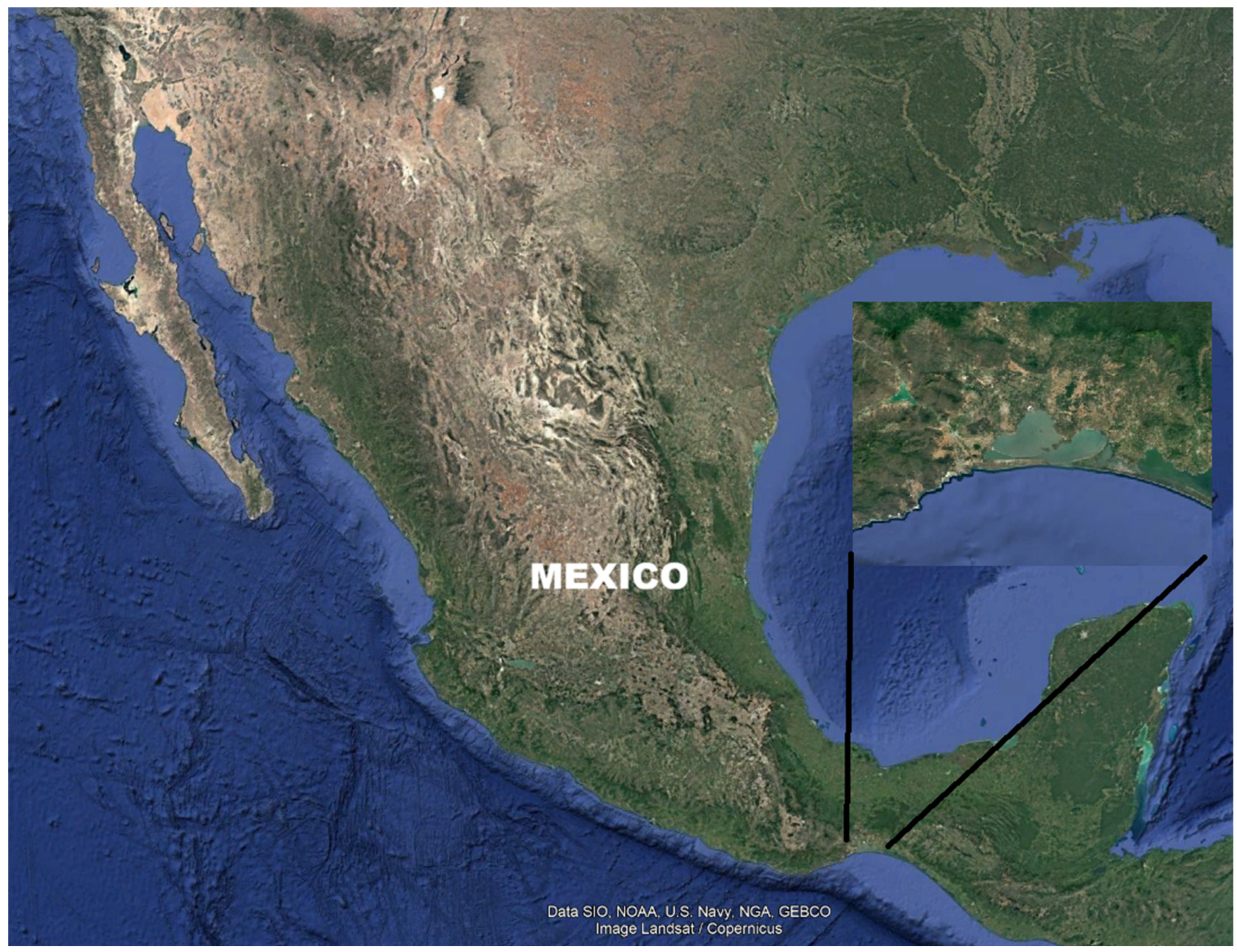
Figure 1. Oaxaca, Mexico.
Technologies 14 00219 g001
Figure 2. Area analyzed.
Technologies 14 00219 g002
Figure 3. Analytical workflow for wind resource assessment, turbine selection, and layout optimization.
Technologies 14 00219 g003
Figure 4. Wind speed from 1979 to 2024.
Technologies 14 00219 g004
Figure 5. Wind speed daily profile.
Technologies 14 00219 g005
Figure 6. Monthly average wind speed.
Technologies 14 00219 g006
Figure 7. Wind rose by month.
Technologies 14 00219 g007
Figure 8. Weibull distribution: (a) represents the average Weibull distribution; (b) represents monthly Weibull distribution.
Technologies 14 00219 g008
Figure 9. Topography.
Technologies 14 00219 g009
Figure 10. Microscale wind model.
Technologies 14 00219 g010
Figure 11. Power coefficient and wind turbine power curve.
Technologies 14 00219 g011
Figure 12. Maximum power coefficient by WT.
Technologies 14 00219 g012
Figure 13. Wind turbine selected.
Technologies 14 00219 g013
Figure 14. Wind turbine layout: (a) microscale model; (b) terrain.
Technologies 14 00219 g014
Figure 15. Turbulent intensity and wind direction.
Technologies 14 00219 g015
Table 1. Land-use classification and corresponding surface roughness lengths (Z0) used in the WAsP model.
Land-Use CategoryDescriptionSurface Roughness Length Z0 (m)
Water bodiesOcean, lakes, reservoirs0.0002
Flat, open terrainAgricultural land, grassland with low vegetation0.03
Scattered obstaclesRural areas with dispersed trees or buildings0.1
Low vegetation with some treesShrubland, pasture with scattered trees0.25
Dense vegetationForest, dense woodland0.5
Urban areasBuilt-up areas with buildings1
Table 2. Models fitted to the Weibull distribution.
HeightMethodkc
(m/s)
Wind Speed
(m/s)
WPD
(W/m2)
R-SquaredK-S Statistic Dp-Value
80 mMaximum likelihood1.79810.5789.4071092.30.97840______
Least squares1.77210.5799.4161113.90.979430.0230.87
60 mMaximum likelihood1.80210.0318.920929.100.97975______
Least squares1.79310.0158.908930.500.980040.0250.84
Table 3. Monthly statistics.
MonthWind SpeedWPDMaxMinSDPressureTemperature
(m/s)(W/m2)(m/s)(m/s)(m/s)(kPa)(°C)
Jan9.34791.4224.310.044.1198.3721.53
Feb8.67693.7722.670.064.2198.2722.90
Mar8.12574.1523.500.033.9498.1424.84
Apr7.34430.5021.030.043.6298.0126.96
May6.15258.1219.830.013.0797.9427.98
Jun5.21156.4015.120.042.6297.9826.55
Jul6.14219.9414.890.032.6698.1225.88
Aug5.92196.5514.290.072.5598.0825.76
Sep5.93221.5418.170.012.8697.9925.39
Oct7.94504.9622.290.033.6498.0624.37
Nov9.35757.8923.780.063.8698.2322.83
Dec9.33764.3123.370.053.9098.3321.81
Table 4. Characteristics of wind turbines in Mexico.
Wind TurbineCharacteristicsWind Farm
Acciona AW-70/1500RotorDiameter (m)70Eurus I, II (MX)
Oaxaca II, III, IV (MX)
Sweeping area (m2)3849
Rotation speed (U/min)20.2
TowerHeight (m)60/80
Vestas 112/3000RotorDiameter (m)112Oaxaca II
Sweeping area (m2)9852
Rotation speed (U/min)17.7
TowerHeight (m)84/119
Gamesa G80/2000RotorDiameter (m)80Bii Nee Stipa II, La Ventosa P3, Piedra larga I, II
Sweeping area (m2)5027
Rotation speed (U/min)19
TowerHeight (m)60/67/78/100
Gamesa G90/2000RotorDiameter (m)90Bii Hioxio, BiiNee Stipa IV, Dos arbolitos, Pacífico
Sweeping area (m2)6362
Rotation speed (U/min)19
TowerHeight (m)55/100
Acciona AW77/1500RotorDiameter (m)77Ingenio
Sweeping area (m2)4657
Rotation speed (U/min)18.3
TowerHeight (m)60/80
Gamesa G52/850RotorDiameter (m)52Bii Nee Stipa I
La Ventosa P1, P2
La Venta II, II
Sweeping area (m2)2124
Rotation speed (U/min)30.8
TowerHeight (m)44/65
Table 5. Configurations.
Distance Between RowsCharacteristicsDistance Between Columns
5D6D7D8D9D
3DAEPGross [GWh]75.263.857.851.845.7
AEP [GWh]70.360.455.650.044.6
Wake Losses [%]6.45.23.73.42.5
CF41.241.842.342.342.4
Wind turbines13111098
4DAEPGross [GWh]52.152.140.440.534.7
AEP [GWh]49.649.839.339.534.1
Wake Losses [%]4.74.42.62.41.9
CF4242.142.84343.2
Wind turbines99786
5DAEPGross [GWh]57.740.434.729.423.5
AEP [GWh]54.538.933.728.623.1
Wake Losses [%]5.53.82.82.61.9
CF41.542.342.843.644
Wind turbines107654
Table 6. IEC turbulence classification and recommended turbine classes by location.
WTTurbulence Intensity (I2u + I2p)1/2IEC Class (Design TI at 15 m/s)Recommended Turbine ClassRationale
114.9IIA (16%)IIAWithin design limits; standard turbine acceptable
214.2IIA (16%)IIAWithin design limits; standard turbine acceptable
315IIA (16%)IIAMarginally within limits; monitor wake effects
413.6IIB (14%)IIA or higherTI exceeds Class IIB; upgrade to Class IIA recommended
513.6IIB (14%)IIA or higherTI exceeds Class IIB; upgrade to Class IIA recommended
614.4IIA (16%)IIAWithin design limits; standard turbine acceptable
716.2IIA (16%)IA (18%)TI exceeds Class IIA design threshold; Class IA required
816.4IIA (16%)IA (18%)TI exceeds Class IIA design threshold; Class IA required
916.4IIA (16%)IA (18%)TI exceeds Class IIA design threshold; Class IA required
1016.1IIA (16%)IA (18%)TI marginally exceeds Class IIA; Class IA recommended
Table 7. Baseline comparison of wind farm performance metrics: standard industry layout (5D × 7D) versus proposed configuration (3D × 7D).
ConfigurationRow SpacingColumn SpacingNumber of TurbinesAEPGross (GWh)AEP (GWh)Wake Losses (%)Capacity Factor (%)
Baseline (industry standard)5D7D1057.754.55.541.5
Proposed3D7D1375.270.36.441.2
Absolute difference317.515.80.9−0.3
Relative improvement (%)30%30.30%29.00%−0.70%
Table 8. Impact of turbulence correction on annual energy production.
WTTurbulence Intensity (I2u + I2p)1/2AEP Without Turbulence Correction (GWh)AEP with Turbulence Correction (GWh)Energy Loss Due to Turbulence (GWh)Energy Loss Due to Turbulence (%)
114.95.5775.5280.0490.88
214.25.7155.6710.0440.77
3155.7585.7080.050.87
413.65.8435.8050.0380.65
513.65.7725.7350.0370.64
614.45.1515.1090.0420.82
716.25.2925.2210.0711.34
816.45.5495.4710.0781.41
916.45.5835.5030.081.43
1016.15.5415.4720.0691.25
Total55.78155.2230.5581
Table 9. Extreme wind conditions.
WTDirection (°)Horizontal Velocity (m/s)Flow Inclination (°)Turbulence
( I u 2 + I v 2 ) 1 2
Extreme Average Speed at 50 years (m/s)
13586.50.1814.922.97 (±0.65)
2358.46.71.114.223.39 (±0.66)
3358.16.71.5715.023.83 (±0.69)
4358.37.01.1613.624.64 (±0.70)
5359.47.0−2.6313.624.36 (±0.69)
60.46.7−4.1214.423.02 (±0.65)
7358.76.3−1.2316.222.06 (±0.62)
8359.66.4−0.2216.423.01 (±0.68)
9359.66.40.3216.423.16 (±0.68)
10359.76.50.3216.123.22 (±0.67)
Table 10. Wind farm production.
Wind FarmU(m/s)AEPGross (GWh)AEP (GWh)Loss
WT 18.855.5775.5390.68%
WT 29.045.7155.6451.22%
WT 39.125.7585.6661.60%
WT 49.235.8435.4975.91%
WT 59.105.7725.4196.11%
WT 68.335.1515.0062.81%
WT 78.515.2925.2221.32%
WT 88.835.5495.4611.58%
WT 98.875.5835.1557.66%
WT 108.795.5245.0887.89%
Total 55.76253.6993.70%
Disclaimer/Publisher’s Note: The statements, opinions and data contained in all publications are solely those of the individual author(s) and contributor(s) and not of MDPI and/or the editor(s). MDPI and/or the editor(s) disclaim responsibility for any injury to people or property resulting from any ideas, methods, instructions or products referred to in the content.