Article

Preparing Financial Reporting Professionals for Virtual Asset Disclosure and Assurance: Stakeholder Readiness for Metaverse-Based Accounting Systems

by
Rabindra Kumar Jena
Department of BAIT, Institute of Management Technology, Nagpur 441502, India
Int. J. Financial Stud. 2026, 14(5), 126; https://doi.org/10.3390/ijfs14050126
Submission received: 19 February 2026 / Revised: 23 March 2026 / Accepted: 9 April 2026 / Published: 8 May 2026
(This article belongs to the Special Issue Accounting and Financial/Non-financial Reporting Developments)

Abstract

The rapid emergence of virtual assets, blockchain-based transactions, and immersive digital economies presents major challenges to financial reporting processes (recognition, measurement, disclosure, and assurance). This study aims to investigate stakeholder readiness for digital financial reporting in the context of virtual assets, focusing on the human capital dimension, which was often overlooked in prior research. A mixed-methods design was employed to obtain comprehensive insights from both experts and students. Qualitative interviews with 16 academics and practitioners were conducted to capture expert perspectives on the inclusion of metaverse-related courses in accounting curricula. Furthermore, a survey of 438 accounting students was analyzed to examine the determinants of Digital Financial Reporting Readiness (DFRR) using the Stimulus–Organism–Response (S-O-R) framework. Experts highlighted opportunities for enhanced professional judgment but raised concerns about automation risks and institutional capacity. Quantitative results indicated that perceived importance and usefulness significantly increased student interest, which strongly predicted DFRR, while perceived difficulty reduced student interest. By interpreting the findings through the lens of Experiential Learning Theory (ELT), this study provides a process-oriented explanation of how cognitive evaluations translate into professional preparedness. This study contributes by conceptualizing DFRR as a human capital construct and offering a multi-stakeholder perspective by integrating student readiness with expert insights to inform the adoption of the metaverse in accounting education.

1. Introduction

The term “metaverse” was created by Neal Stephenson in his science fiction novel, “Snow Crash.” The metaverse is defined as “all kinds of virtual worlds” or “a virtual environment in which people can create their own avatars and interact with each other through virtual space.” The metaverse will be able to extend beyond the confines of our physical world through the use of virtual and augmented reality (Wu & Ho, 2023). The metaverse has evolved into utilizing numerous emerging technologies to support its functions. These technologies include blockchain, “artificial intelligence (AI),” “non-fungible tokens (NFTs),” cryptocurrencies, digital avatars, augmented reality (AR), and virtual reality (VR) (Bouebdallah et al., 2025; Dwivedi et al., 2023; Jena, 2025). The metaverse operates based upon a distinct economic model known as a token economy. A token economy utilizes NFTs, and organizations are developing and providing a wide range of digital goods that are available virtually to their clients (Burlea-Schiopoiu et al., 2023; Mancuso et al., 2023). As the use of virtual assets grows with the rise in metaverse technologies, little attention has been given to managing virtual assets and studying their attributes and challenges. To develop systems and methods for recording and reporting virtual assets, it is essential to understand the characteristics and challenges of the metaverse environment (Alawadhi & Alrefai, 2024). Therefore, in the rapidly evolving nature of the virtual world, new forms of resources and their interactions are emerging daily (Dwivedi et al., 2022; Vysotskaya & Prokofieva, 2025). Furthermore, Digital Forensic Accounting (DFA) is another emerging area that has gained significant interest and consideration due to the implications of rapid globalization and the potential for metaverse circular business model innovation (MCBMI) (Quang Huy & Kien Phuc, 2025). DFA utilizes digital technologies (i.e., blockchain, IoT, AI, VR, and AR) to evaluate accounting and auditing procedures and provide accurate information concerning market, political, and environmental conditions. Additionally, the metaverse creates new forms of digital assets (i.e., virtual assets, digital currencies, and NFTs), and it is imperative that accountants thoroughly understand these unique digital assets and report them on financial statements (Crowley et al., 2022). Finally, metaverse technologies can facilitate enhanced collaboration and communication between accounting and auditing professionals and other stakeholders (Firman et al., 2022). Metaverse technologies have the potential to create and measure unique digital assets, transform financial transactions, and provide new educational opportunities (Al-gnbri, 2022; Firman et al., 2022; Jader, 2023). Therefore, as metaverse technologies continue to evolve, accountants will need to update their skills and methodologies to properly handle virtual assets (Alawadhi & Alrefai, 2024; Musleh Alsartawi & Hussainey, 2024).

Research Gaps and Contributions

Despite the growing body of literature on digital assets and metaverse-enabled accounting systems, several critical gaps remain. First, existing studies predominantly focus on technical, regulatory, and valuation challenges (Alawadhi & Alrefai, 2024; Kim et al., 2022; Pandey & Gilmour, 2024), while largely overlooking the human capital readiness required to ensure transparency and governance in digital financial reporting environments. Second, prior research has primarily relied on technology adoption models, which emphasize usage intention rather than preparedness to execute complex reporting tasks involving professional judgment under uncertainty (Bouebdallah et al., 2025; Abdo-Salloum & Al-Mousawi, 2025). Third, limited attention has been given to integrating multi-stakeholder perspectives, particularly in emerging economies where institutional readiness and technological infrastructure significantly influence reporting transformation (Dwivedi et al., 2022; Burlea-Schiopoiu et al., 2023).
To address the gaps in the literature, this study developed and empirically examined the construct of digital financial reporting readiness (DFRR) as a human capital mechanism supporting reliable digital asset reporting. Using a sequential exploratory mixed-methods design, the study first captured expert insights regarding opportunities and governance risks associated with metaverse-enabled financial systems, including concerns related to automation, “data faith,” and professional accountability. Then, the study employed the Stimulus–Organism–Response (S-O-R) Framework to explain how students’ cognitive evaluations of metaverse-based accounting environments influence their motivational engagement and subsequent DFRR. By integrating experiential learning theory with S–O–R, this research advanced the financial reporting literature by positioning professional readiness as a structural prerequisite for maintaining transparency, faithful representation, and governance integrity in emerging digital financial reporting ecosystems. Rather than treating technology integration as solely a pedagogical innovation, the study conceptualized human capital preparedness as a foundational infrastructure for future-oriented financial and non-financial reporting systems. The study was conducted to answer the following research questions:
RQ1:
How do academic and industry stakeholders view the potential benefits and risks associated with the integration of metaverse technologies to enhance the recognition, measurement, disclosure, and assurance of virtual assets inside financial reporting systems?
RQ2:
How can cognitive assessments of metaverse-enabled accounting settings affect accounting students’ Digital Financial Reporting Readiness (DFRR) for virtual asset reporting?
RQ3:
How can stakeholder insights and student readiness be interpreted through experiential learning theory to generate human capital that supports openness, governance, and accountability in new digital financial reporting ecosystems?
This study contributes to the literature in three ways. First, it introduces DFRR as a novel variable capturing professional preparedness for digital financial reporting in virtual environments. Second, it extends prior technology adoption-based research by explaining the cognitive–motivational mechanisms underlying readiness for digital reporting. Third, it adopts a mixed-methods approach that integrates expert insights with student-level empirical evidence, thereby providing a multi-stakeholder perspective on accounting education and reporting transformation in emerging digital economies.
The remainder of the paper is organized as follows: Section 2 presents an extensive literature review. Section 3 details the research methodology used (sampling and data collection). Section 4 presents the research results in detail, and Section 5 provides a thorough analysis and discussion of the findings. The final section (Section 6) of the research discusses the limitations and potential areas for future research in the field of accounting education.

2. Literature Review

2.1. Financial Reporting Challenges in Digital Asset Ecosystems

Digital assets, blockchain-based transactions, and the tokenization of economic models have rapidly grown, adding new layers of complexity to traditional financial reporting systems. For example, issues related to the classification, recognition, and measurement of digital assets, such as cryptocurrencies and NFTs, remain open questions with regard to current accounting frameworks (Alawadhi & Alrefai, 2024; Kim et al., 2022). Professional judgment is required to determine if a particular digital asset is classified as an intangible asset, inventory, or financial instrument where the economic substance does not align with the legal form of the asset. Furthermore, the use of fair value measurements for highly volatile and thinly traded digital assets can create greater dependency on unobservable inputs and estimation techniques and therefore increase uncertainty in valuations and volatility in reported earnings. In addition to the above-mentioned issues related to the recognition and measurement of digital assets, the digital ecosystem also creates new issues related to disclosures and corporate governance. Entities are required to provide clear and complete information about how they arrive at their valuations of digital assets, their dependence on technology, their exposure to cyber threats, and the mechanisms used to exert control over these types of assets (Pandey & Gilmour, 2024). While blockchain technologies may improve the ability to trace and verify transactions and create a digital trail that improves auditability, the potential for over-automation, algorithmic bias, and “data faith” will continue to require the active role of humans in the assurance process (Musleh Alsartawi & Hussainey, 2024). Therefore, the need for professional competence continues to grow to ensure the transparency of financial reporting and the integrity of corporate governance in the digital financial environment.

2.2. Human Capital Gap in Digital Financial Reporting

While prior research has analyzed both the technical and regulatory aspects of digital asset reporting, little is known about the human resources required to ensure transparency, faithful representations, and governance integrity. Reporting quality in technologically complex environments relies heavily on a professional’s use of judgment, their ethical reasoning, and their ability to interpret uncertain valuation inputs. Therefore, as digital financial ecosystems continue to grow, accountants will need to consider how they can address recognition ambiguity, how they can effectively apply the fair value hierarchy, manage the risks associated with automation, and consider additional non-financial disclosures. Unfortunately, many existing studies have relied on technology adoption frameworks that focus on an individual’s intent to adopt the technology versus the individual’s preparedness to execute the complex reporting obligations (Abdo-Salloum & Al-Mousawi, 2025; Bouebdallah et al., 2025), which can lead to a misunderstanding of the actual challenges faced by users in implementing these technologies effectively. This approach neglects to identify the mechanisms through which cognitive assessments and motivational states contribute to the individual’s preparedness to accomplish digital financial reporting tasks. Therefore, we under-theorize the behavioral and motivational foundations that support the development of reliable reporting in virtual economies. By conceptualizing professional preparedness as digital financial reporting readiness, we can close this knowledge gap.

2.3. Technology Integration as a Mechanism for Reporting Readiness

Blockchain technology, virtual reality (VR) environments, and metaverse simulations offer emerging opportunities for enhancing professional reporting competence through the use of new immersive digital environments (Jena, 2025). Kolb’s (1984) Experiential Learning Theory suggests that learning occurs through a cyclical experience process of concrete experience, reflective observation, abstract conceptualization, and active experimentation. The literature indicates that experiential learning methods within accounting contexts lead to improvements in professional judgment, engagement, and applied competence (Molendijk et al., 2025; Gittings et al., 2020). The literature also supports the idea that digital immersive environments can be used to create complex reporting simulation experiences such as simulating blockchain audit trails, NFT valuations, and digital forensic investigations. This enables students to evaluate realistic uncertainty and apply theoretical standards in practice. Therefore, when viewed from the perspective of the Stimulus–Organism–Response (S-O-R) model, cognitive assessments of importance, usefulness, and difficulty to a learner will determine motivation to engage with learning materials and therefore prepare them for professional action. Consequently, the incorporation of technology into education is not simply a form of pedagogical innovation; it represents an opportunity to build the human capital required to support the evolving nature of financial and non-financial reporting systems.
Drawing on the above discussion, cognitive evaluations of metaverse-based accounting environments can be conceptualized as key stimuli influencing learners’ affective and motivational states. Within the S-O-R framework, perceived importance, usefulness, and difficulty represent cognitive stimuli that shape students’ interest as an organismic state, which subsequently influences their readiness to engage in complex financial reporting tasks. This theoretical linkage provides the basis for developing the following theoretical framework.

2.4. Theoretical Framework Hypothesis Development

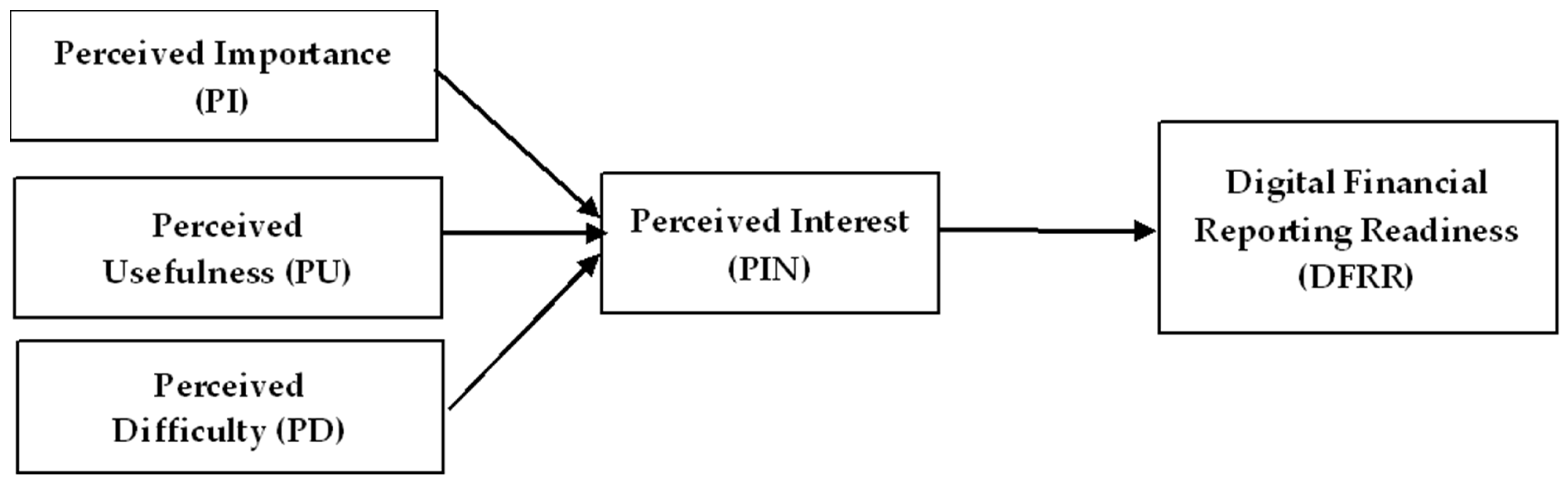
This study utilizes the S-O-R model to analyze students’ perceptions regarding the inclusion of metaverse-based courses in curriculum. The three Cognitive Belief-Based Stimuli (Perceived Importance, perceived usefulness, and perceived difficulty) represent students’ assessments of accounting education within a metaverse context. These inputs are conceived to alter students’ emotional and motivational states (Reeve, 2015), specifically their interest in learning about accounting in the metaverse as an organism. DFRR, which stands for Digital Financial Reporting Readiness, is used as a response variable. DFRR refers to a learner’s perceived level of preparedness, willingness, and confidence to actively participate in learning activities that necessitate effort, experimentation, and the application of knowledge. Subsequently, this study looks at how students contemplate and evaluate these learning opportunities using the S-O-R sequence: cognitive stimulus → emotional organism → behavioral preparedness to engage. This gives a theory-based explanation for how students rate learning opportunities using the metaverse. The framework (Figure 1) of this study elucidates the collaborative influence of beliefs and emotions on future-oriented learning outcomes.

Proposed Hypothesis

Perceived Interest → Digital Financial Reporting Readiness (DFRR)
Digital Financial Reporting Readiness (DFRR) refers to how ready, confident, and willing accounting students feel to use professional standards, evaluation principles, and disclosure rules in financial reporting in the metaverse. The perceived interest of the students is a reflection of their intrinsic motivation and their affective engagement in using a metaverse-based accounting application. Interest as an “organismic” state within the S-O-R model represents the way that the cognitive evaluation of an individual will be translated into preparedness for behavior. The experiential learning theory proposed by Kolb (1984) states that experiential learning requires an individual to have the psychological readiness to participate in active experimentation and concrete experiences. Previous studies on accounting education have indicated that the student’s greater interest has increased the student’s willingness to participate in the complex professional simulations (Molendijk et al., 2025; Gittings et al., 2020). Consequently, students with a greater interest in the use of technology will have a greater likelihood of demonstrating DFRR. Thus, the following hypothesis is proposed:
H1. 
Perceived interest positively affects Digital Financial Reporting Readiness (DFRR).
Perceived Importance → Perceived Interest
Perceived importance indicates learners’ convictions regarding the significance and applicability of a subject in their academic and professional spheres. Expectancy-Value Theory states that students are more likely to be interested in learning activities they perceive as important and useful (Eccles & Wigfield, 2002; Schoute et al., 2024). In college and university settings, perceived task value has regularly been proven to increase students’ motivation and attention, especially in professional fields like business and accounting (Reeve, 2015). In the S–O–R framework, perceived importance is an external educational stimulus that motivates students to learn. Thus, the following hypothesis is framed:
H2. 
Perceived importance of metaverse technology in accounting positively influences students’ interest in learning.
Perceived Usefulness → Perceived Interest
Perceived usefulness denotes learners’ convictions that the acquisition of specific knowledge or abilities would improve their future performance or professional efficacy. Many studies in information systems and educational technology have shown that perceived usefulness is a major factor in having favorable attitudes, being motivated, and being involved with new technologies (Davis, 1989; Venkatesh et al., 2003). When students believe that what they are studying is beneficial for their future jobs, they are more likely to be interested and stay engaged in school (Scherer et al., 2019). So, perceived usefulness is an instrumental stimulus that increases students’ interest in learning about accounting in the metaverse. Therefore, the following hypothesis is posited:
H3. 
Perceived usefulness of metaverse technology for accounting practice positively influences students’ interest.
Perceived Difficulty → Perceived Interest
Perceived difficulty is how learners judge the mental effort required to understand and master what they are learning. Cognitive Load Theory posits that assignments perceived as excessively difficult or complex can diminish user interest and motivation due to increased cognitive demands (Paas et al., 2003; Sweller, 2011). Empirical research in technology-enhanced and simulation-based learning environments indicates that a high perceived level of difficulty correlates with diminished interest and engagement, especially in the absence of adequate instructional scaffolding (Paas et al., 2003; Mayer, 2014). From an S-O-R perspective, perceived difficulty functions as a task-related stimulus that can adversely affect students’ desire to participate in metaverse-based accounting instruction. Hence, the following hypothesis is presented:
H4. 
Perceived difficulty learning metaverse-based accounting negatively influences students’ interests.

3. Research Methodology

To address the identified reporting-readiness gap, this study integrates experiential learning theory (ELT) to examine how immersive environments cultivate professional competence in digital financial reporting contexts. ELT systematically investigates how immersive platforms such as the metaverse can facilitate all phases of the experiential learning cycle (concrete experience, reflective observation, abstract conceptualization, and active experimentation) within accounting education.

3.1. Study Design

The sequential exploratory mixed-methods design was adopted to ensure methodological complementarity, where qualitative findings are aligned with the development and interpretation of the quantitative analysis (Headley & Plano Clark, 2020; Clark & Clark, 2022). This design is particularly appropriate for emerging research areas where theoretical constructs require initial exploration before empirical validation.
The first stage used a qualitative interpretive thematic approach to gather expert comments on how to integrate metaverse tools and techniques into the accounting curriculum. The interpretive thematic methodology was chosen because it enables the investigation of a specific phenomenon, resulting in a more thorough and profound understanding of the phenomenon (Headley & Plano Clark, 2020). Based on experts’ opinions, we categorized thematically coherent patterns that captured the shared views of the experts. Then, a conceptual mapping from categories to ELT themes based on conceptual alignment was performed. The conceptual mapping focuses on “What type of learning process is implied by this theme?” The finalized themes informed the operationalization of Digital Financial Reporting Readiness (DFRR) in the subsequent quantitative phase, strengthening the integration of the mixed-method design. In the quantitative study, students’ attitudes to acquiring knowledge about the latest metaverse technology in the accounting curriculum using the SOR framework were assessed. Furthermore, these attitudes were mapped to the indicators of readiness to engage in experiential learning. The subsequent sections explain the detailed approaches employed in qualitative and quantitative research.

3.1.1. Qualitative Study

Participants
Sixteen experts from academic institutions and accounting firms in India were interviewed using semi-structured interviews. To qualify for participation in this study, academic professionals were required to hold a minimum rank of professor. In contrast, industry professionals were required to possess at least 15 years of work experience. The study utilized a combination of convenience sampling and snowball sampling to select study participants. Nine accounting professors, seven senior professionals from different accounting firms, and two fintech professionals agreed to participate in the study. The age of the participants ranged from 52 to 65 years, with 42% being female and 58% being male.
Procedure
This study utilizes an inductive methodology to generate theories and employs an interpretive thematic analysis of expert narratives. It also maintains an interpretivistic philosophical perspective. The data-collecting instruments chosen were open-ended questions. The self-administered semi-structured questionnaire consisted of demographic information and an open-ended question, i.e., “What are your thoughts on including Metaverse technologies in accounting and auditing curricula? What is your perspective on institutional readiness for digital reporting governance by incorporating these advanced technologies into the accounting curriculum? Please provide your professional assessment,” and sent it to the experts via email, WhatsApp, and the X platform.
Furthermore, the experts were given detailed information about the research’s background, nature, and purpose. The research was conducted in accordance with all relevant ethical standards, including the provision of a researcher’s introduction letter, a participant information sheet, and a participant consent form. The survey was carried out between July 2025 and September 2025.

3.1.2. Quantitative Study

The quantitative data were analyzed using Partial Least Squares Structural Equation Modeling (PLS-SEM), which is suitable for explanatory research and models involving latent constructs (Hair et al., 2021). Bootstrapping with 5000 resamples was conducted to assess the significance of path coefficients. The analysis was performed using SEMinR packages (Version: 2.4.2) (Hair et al., 2021).
Study Instrument
The study utilized a survey instrument to collect data in the quantitative study, composed of two sections. The first section of the instrument contained demographic information for the respondent, and two basic questions about the metaverse (for example, “Do you know about metaverse technology? (yes/no)” and “What do you believe that metaverse technologies will bring to accounting in the future? (positive/negative)”) were asked.
The second part of the instrument was designed to measure the construct used in the proposed model. Perceived importance (four items)—the perceived consequences and importance of metaverse technology in accounting; Perceived interest (four items)—the perceived enthusiasm for metaverse technology in accounting education; Perceived difficulty (four items)—the perceived obstacles for students to grasp the metaverse technology; and Perceived usefulness (four items)—the perceived utility of the metaverse technology for future accounting and auditing. All the above constructs were measured by utilizing a modified version of the PATT scale (Ardies et al., 2013). The four items of the Digital Financial Reporting Readiness (DFRR) scale were modified using experiential learning and motivational readiness assessments in accounting education (Gittings et al., 2020; Molendijk et al., 2025). All the scales were modified by replacing general technology terms with accounting-specific metaverse applications (e.g., blockchain audit, NFT valuation). A five-point Likert scale was used to measure the items. Face validity was established by having two accounting professors and one fintech expert review the modified items to ensure they accurately reflected metaverse competencies in a professional accounting context. The items listed above represent a neutral belief or assumption about metaverse technology (Appendix A).
Participants
The sample size for this investigation was determined in accordance with the SEM specifications. According to Wolf et al. (2013), the minimum sample size for structural equation modeling (SEM) is at least 10 times the number of free variables. Based on the aforementioned suggestion, a minimum sample size of 200–250 was deemed adequate to mitigate bias in the study findings. Aiming to obtain a required response, more than 800 questionnaires were distributed among accounting students between August and November 2025 using convenience sampling. Convenience sampling was chosen because the metaverse is an emerging field, requiring a “purposive and convenience” approach to identify respondents with a baseline understanding of digital assets. The sample consisted of students currently pursuing a master’s degree in accounting, as well as students enrolled in professional accounting and auditing courses (CA and ICWA courses). Informed consent was obtained from all participants prior to data collection. Participants were informed about the purpose of the study, assured of anonymity and confidentiality, and their participation was voluntary. Responses from 456 students were obtained. Due to their incomplete nature, 18 responses were removed from further analysis.
To assess the potential influence of common method bias, Harman’s single-factor test was conducted by entering all attitudinal items into an unrotated exploratory factor solution. The first factor accounted for 31.6% of the total variance, which is below the recommended 50% threshold, suggesting that common method variance was unlikely to pose a serious concern (Podsakoff et al., 2003).

4. Results and Analysis

4.1. Qualitative Analysis

The interviews were conducted entirely in the English language. The author, along with two research assistants, analyzed the transcripts. The author analyzed the data at an abstract level using line-by-line coding and memo-taking for a broad analysis of the transcripts (Birks et al., 2008). After the author’s analysis, two research assistants went through an iterative process of analyzing the codes created by the author and consolidating them into comprehensive themes and subthemes. To achieve the research objectives, the research assistants synthesized the codes and organized the associated data pieces to identify patterns in the data, then categorized those patterns into themes. At the end of the analysis, the research team reviewed the relevant data associated with each theme and reviewed the themes as a whole to ensure they were important, internally consistent, distinct, and interrelated. After reviewing the result, the team agreed on the themes and provided details about each one. Furthermore, the team validated the accuracy of the analytical process by employing a cutting and sorting method developed by Ryan and Bernard (2003) to identify themes related to immersive technology in accounting education. Using this method, the research assistants individually coded and verified the method’s reliability with an intra-class correlation coefficient of 0.79. The final themes were further validated and corroborated by incorporating comments from verbatim experts, who offered alternative perspectives on the identified themes. Finally, the themes were categorized as “perceived opportunities” and “perceived challenges” toward Digital Financial Reporting Readiness (DFRR). The data were analyzed using the open-source text mining program Taguette. The selected participants’ conversation excerpts are presented in the results section as supporting evidence. To improve the reliability and rigor of qualitative analysis, inter-coder agreement was evaluated using an intra-class correlation coefficient (ICC) = 0.79, signifying significant concordance among coders (Koo & Li, 2016; Miles et al., 2014).

4.1.1. Perceived Opportunity

Most experts favored including the metaverse in the accounting curriculum, agreeing with the generally recommended prospects and potential advantages. The participants asserted that utilizing the metaverse would improve the precision, momentum, and effectiveness of accounting and auditing procedures for digital assets. Some participants directly associated these perceived advantages with enhancing the quality of accounting services for digital transactions.
“I believe this metaverse is very helpful for virtual assets because it makes gathering and reviewing data simple. This can help accountants and auditors focus on what needs to be examined and make notes and suggestions about the transactions. Thus, learning the metaverse in formal education is a need of the hour […]”
(Participant 3)
Furthermore, some participants expressed that the metaverse may facilitate more accessible, impartial, and equitable accounting and auditing processes by mitigating human bias and accountants’ preconceived notions about some people or businesses.
“ I merely hope that algorithms or programs facilitated by the metaverse could automate many accounting tasks and help to assist in institutional readiness for Digital Reporting Governance, thereby reducing computing, human error, and other forms of subjectivity […]. It will be a very welcome move to include the metaverse in university education”.
(Participant 16)
Regarding the potential benefits of metaverse-based accounting in terms of objectivity, some experts highlighted recognition ambiguity, fair value hierarchy complexity, and disclosure uncertainty under IFRS-based reporting, the fairness process, and its possible effect on decision-making processes.
“I am hesitant to make any accusations regarding individuals intentionally employing more or less rigorous processes due to personal biases or conscious decisions based on perceived importance. However, there may be a potential risk in this regard. This is where an automatic mechanism based on the metaverse could help ensure fairness, so to speak […]. Metaverse in accounting education is a very welcome step”.
(Participant 4)
“… I believe that utilizing metaverse technology in accounting can significantly improve analysts’ capacity to identify instances of financial wrongdoing. I think it is essential to be familiar with advanced technologies like the metaverse in accounting […]”.
(Participant 14)

4.1.2. Perceived Challenges

There are typically numerous challenges and risks associated with incorporating advanced technology into any curriculum. These challenges can be categorized into three categories: the significance of personal factors, roles and obligations, and decision-making. Therefore, the experts’ opinions were analyzed in accordance with these three categories. A significant number of experts believed that faith in metaverse technologies would ultimately influence decision-making and induce risk in the process. Specifically, the prevailing belief of some experts was that the metaverse would be incapable of supplanting humans in the fields of accounting and auditing, as these professions heavily rely on human connections and the ability to understand and share the feelings of others. Notwithstanding the aforementioned risks and limitations, most experts advocated for the incorporation of the metaverse into the accounting curriculum due to its numerous benefits.
“[…] One might envision a risk wherein accountants become overly dependent on the metaverse, potentially concentrating on it to the detriment of their human interaction and professional judgment under uncertainty, but it has huge other advantages […].”
(Participant 2)
Highlighting the authoritative knowledge of accounting professionals, some participants concurred that accountants and auditors should have the ultimate authority in decision-making. They also agreed that people should always have the ability to intervene in immersive technology, either to verify or rectify its output. Acquiring knowledge of metaverse platforms while pursuing an accounting degree will enable individuals to engage with metaverse systems effectively.
“To fix certain system problems, I believe accountants should still have the option to intervene. Moreover, that this, now selected from thousands, can still be individually adapted to the accounting work; that it can serve as evidence, but that personal experience and intuition should also be accounted for; and that automation accountability is in question raise concerns about the balance between technology and human judgment in financial decision-making. Technology alone will not solve the problem; therefore, technology and human behaviour in accounting must be part of the curriculum”
(Participant 15)
The discussion centered on the relationship between decision-making authority and issues of accounting inaccuracy and responsibility. While certain participants expressed optimism about the metaverse’s ability to mitigate or prevent errors, others acknowledged that both humans and technology can introduce sources of error, such as biased data sets or inaccuracies in data acquisition. However, most of them preferred learning about the metaverse in the context of accounting.
“[…] and, in either case, mistakes might occur due to disclosure complexity; thus, the metaverse system may provide advice that is ultimately inaccurate because certain parameters were entered wrongly, but the technology will evolve and minimize the above […].”
(Participant 10)
There was a consensus that, despite immersive technology (e.g., metaverse), the duty for decision-making ultimately lies with the accounting practitioner. Some participants argued that having a basic understanding of intelligent systems, such as the metaverse, could be essential to guaranteeing quality.
“One should never abdicate one’s responsibility. If something goes wrong, I still have to accept responsibility. […], there is no doubt that the accountant is accountable and the technology will support them […]”.
(Participant 13)
“In my opinion, the use of technology like the metaverse in the future will help reduce errors, despite the possibility of error in both humans and technology.” I foresee the utility of the metaverse in the future and am in favour of metaverse technology in accounting education. […].”
(Participant 1)
Several participants expressed apprehensions over the sharing of data, the potential for monitoring, the erosion of privacy, and the possibility of information falling into the hands of unauthorized individuals, such as hackers. Nevertheless, a small number of participants assigned little importance to data protection and privacy, showed indifference, or regarded them as unimportant. Some participants frequently assessed the potential hazards associated with exchanging data and the eventual utilization of such data.
Participant 9: There are individuals within our social circle who place significant importance on data protection. While we do not align with that group, our primary concern is ensuring that the data is handled in a manner that enables stakeholders to utilize it. Technology like the metaverse hopes to reduce the concern in the coming years […]”
Participant 6: […] Yes, as most of us, I share the same sentiments. Above all, I hope to see the success of new technological developments in accounting and auditing.”
One expert stated that they did not agree with the idea of “data faith” and felt that additional data may introduce new vulnerabilities in assurance procedures, which could also fail to address issues relating to enhancing accounting and auditing processes. Such reflections support the continuation of human oversight in the assurance process for the purpose of maintaining accountability, reliability, and transparency in evolving digital financial ecosystem datasets.
“We are less sure what will happen when we have more information. Moreover, the main problem right now is that people have too much faith in the metaverse, or they think that we can make everything better if we gather enough data through different computer touchpoints. I believe it is time to slow down a bit, but technology like the metaverse will gradually solve the problem […].”
(Participant 7).
Experts (Participant 7) emphasized that although blockchain-based infrastructure provides enhanced traceability and transaction verification, they expressed concern regarding overreliance on automated outputs. Additionally, from an accounting perspective, an overabundance of automation may impede professional skepticism and may be in conflict with faithful representation when algorithmic assumptions are not critically analyzed (Pandey & Gilmour, 2024).
Although experts have also expressed their agreement that this is the right time to train budding accountants and auditors in metaverse technology, their concerns center on finding the right individuals (academics and trainers) with adequate knowledge of the new developments in this domain, particularly in India.
[…], finding human and technology resources to train learners in the metaverse is difficult in India […] (Participant 9); […] engaging with trained metaverse professionals is very challenging […] (Participant 16); […] I am not sure how easily we can find the required workforce to train the students in a metaverse-enabled accounting information system […].
(Participant 4)
Expert observations demonstrate that there is still a degree of uncertainty in how digital assets are recognized and classified under current reporting models. It takes a lot of professional judgment to figure out whether a cryptocurrency or NFT is an intangible asset, an inventory item, or a financial instrument (Alawadhi & Alrefai, 2024; Kim et al., 2022). This is because digital asset markets change all the time, which makes it even harder to get a fair value.
Based on the qualitative input from experts, it can be concluded that, despite differences in various aspects, most experts believe this is an excellent time to incorporate the metaverse in accounting education. Collectively, the opinion of experts illustrates that adapting to technology alone will not assure the reliability of financial reporting. Instead, the ongoing transparency in digital assets relies upon the preparedness of financial reporting professionals, particularly students, to understand, interpret, recognize, and demonstrate professional skepticism regarding valuation uncertainties, all core components of DFRR. The following section focuses on students’ attitudes and perceptions regarding the introduction of immersive accounting environments.


4.1.3. ELT Mapping

While the qualitative themes emerged inductively from expert narratives, they were subsequently interpreted through the lens of Experiential Learning Theory to explore their implications for experiential and immersive learning in accounting education. The major themes, e.g., perceived opportunities and perceived challenges, are further classified as metaverse integration, realism and objectivity, over-automation, human judgment, and resource constraints. Furthermore, these sub-themes map to the major ELT stages and their interpretations (Table 1).

4.2. Quantitative Study Results

First, the study analyzes the students’ opinions regarding the inclusion of the metaverse in the accounting curriculum. The first question was, “Are you aware of metaverse technologies?” Around 73% of the participants were familiar with metaverse technology, while 27% expressed unfamiliarity by stating they were “unaware.” The second question focused on the influence of metaverse technology on the current accounting process. Of the participants, 59% agreed that the metaverse has a beneficial influence on accounting. In contrast, 13% maintained a contrary perspective, while 28% exhibited skepticism by replying, “I cannot say.” The participant profile was as follows: 66% of the participants were male. The average age of participants was 23.6. Sixty-two percent of participants were pursuing a bachelor’s/master’s degree in accounting, while thirty-eight percent held a professional degree (e.g., CMA, CPA, CA, etc.).

4.2.1. Construct Validation

As the instrument was adapted to the accounting-metaverse context in this study, construct validity was assessed using exploratory factor analysis (EFA). Principal axis factoring with oblique rotation was employed. The Kaiser–Meyer–Olkin (KMO) measure of sampling adequacy was 0.82, and Bartlett’s test of sphericity was statistically significant (χ2(120) = 2369.54, p < 0.001), indicating the suitability of the data for factor analysis (Hair et al., 2021). The results supported a five-factor solution (DFRR, perceived interest, perceived importance, perceived difficulty, and perceived usefulness), with factor loadings exceeding 0.50 and no substantial cross-loadings above 0.30, supporting construct validity (Hair et al., 2021). In the present study, all constructs demonstrated satisfactory reliability (Cronbach’s α = 0.78–0.83; McDonald’s ω = 0.76–0.81), internal consistency (CR values > 0.70), and construct validity (AVE > 0.5), supporting the use of parametric statistical techniques (Table 2). Furthermore, collinearity was examined using variance inflation factor (VIF) values. The results in Table 3 show that VIFs are below the conservative threshold of 3.3. Thus, no collinearity issues among reflective indicators.
Discriminant validity was assessed using the HTMT criterion, with all inter-construct values below 0.85, indicating adequate discriminant validity (Hair et al., 2021). These results (Table 3) confirm the reliability and validity of the measurement model.
Despite PLS-SEM’s primary focus on prediction, global model fit indices, such as the “Standardized Root Mean Square Residual (SRMR)” and the “Normed Fit Index (NFI),” were analyzed to evaluate approximate model fit. The results presented in Table 4 are within the prescribed threshold. Consequently, the data validate the model’s appropriateness (Hair et al., 2021).

4.2.2. Descriptive Analysis

Students who understand the accounting process and the implications of metaverse technologies on accounting practices (73% of the validation sample) achieve noticeably higher scores on all scales compared to those who lack this knowledge (27% of the validation sample), as presented in Table 5. Furthermore, a statistically significant difference (p < 0.05) is observed among the attitude constructs, which include usefulness, interest, importance, difficulties, and readiness aspects related to the metaverse and its application in accounting and auditing. However, in quantitative research, it is crucial to include the magnitude of the effect in addition to the ‘p’ value. The magnitude of the effect was assessed using Cohen’s d effect sizes. Effect sizes were categorized as small (d < 0.2), medium (d > 0.5), or large (d > 0.8) (Cohen, 1988). It is evident from the results (Table 5) that the effect sizes range from moderate to large.
Table 6 illustrates that students who indicated that metaverse technologies in the accounting curriculum have a positive impact have significantly higher scores on all constructs compared to those who indicated that metaverse technologies have a negative influence on the accounting process. The student who expressed uncertainty by stating “I cannot say” has been omitted from the comparison above. A significant majority of students believe that incorporating the metaverse into accounting education will benefit future accounting practices. The Cohen’s d statistic suggests that the effect sizes range from modest to high.

4.2.3. Hypothesis Testing

Hypotheses were tested using PLS-SEM with 5000 bootstrap samples. All constructs were modeled reflectively. Path significance was assessed using standardized path coefficients (β), t-values, and p-values.
The structural model results (Table 7) indicate that perceived importance (β = 0.31, p < 0.001) and perceived usefulness (β = 0.38, p < 0.001) significantly enhance students’ motivation in learning the metaverse. Thus, hypotheses H2 and H3 are validated. The perceived difficulty has a significant negative impact (β = −0.19, p < 0.001) on the desire to learn metaverse courses. So, H4 is supported. From an ELT perspective, this highlights the significance of Reflective Observation (RO), wherein organized reflection and instructional scaffolding facilitate learners in navigating complicated experiences and avert disengagement. These cognitive learning cues together make for 52% of the difference in perceived interest. Perceived interest also has a significant and important positive effect on DFRR (β = 0.56, p < 0.001), which explains 41% of its variance. Therefore, H1 is validated. In the context of ELT, this relationship signifies the progression from Concrete Experience (CE) to Active Experimentation (AE), wherein motivation empowers learners to evaluate and implement concepts in real-world settings. The results support the proposed Stimulus–Organism–Response framework, demonstrating that students’ cognitive evaluations influence emotional motivation, which in turn fosters readiness for learning engagement and establishes a robust motivational basis for experiential involvement.

4.2.4. ELT Mappings

The ELT mapping does not attempt to retroactively align results with theory; rather, it seeks to elucidate how empirically validated attitudinal correlations influence decisions in experiential learning design. Table 8 shows constructs in the S-O-R model linked to ELT phases.

4.3. Integration of Qualitative and Quantitative Findings

The synthesis of qualitative and quantitative findings was conducted using a sequential explanatory design. The qualitative analysis produced thematic patterns that are associated with perceived opportunities (for example, increased objectivity and auditability) and perceived challenges (for example, over-automating, relying on “data faith,” and risk to accountability). Furthermore, this thematic analysis leads to the conceptualization of cognitive stimuli in the S-O-R model. The quantitative results provided empirical evidence to support the findings from the qualitative phase. More specifically, perceived usefulness and importance (which represent expert perceptions of potential benefits of metaverse integration into educational environments) positively affected students’ interest. Furthermore, perceived difficulty (aligned with the expert concern about the complexity and dependence on technology) negatively impacted students’ interest. The collective findings from the qualitative phase and the quantitative phase lend additional credence to the proposed model as well as demonstrate that both the expert perceptions and the students’ self-evaluations confirm the role of the cognitive and motivational factors influencing students’ preparedness for digital financial reporting (Tiron-Tudor et al., 2025).

5. Discussion and Implications

Virtual asset ecosystems and metaverse technologies are rapidly transforming the recognition, measurement, disclosure, and assurance of accounting principles. Accounting literature has investigated extensively how difficult it will be to create new rules for reporting digital assets. However, there is little information available on accountants’ readiness to learn and report on digital assets. Therefore, this study develops a mixed-methods approach to investigate various stakeholders’ readiness to learn metaverse courses for digital financial reporting. This research employs a qualitative approach to analyze the structural and governance challenges associated with the utilization of accounting systems grounded in metaverses. The past literature consistently points out three major issues in reporting digital assets: classification ambiguity, valuation uncertainty, and disclosure complexity. This study expanded on these findings by showing that having technology alone does not ensure accurate reporting. Experts expressed concerns about “faith in data,” overreliance on automation, and decreased professional skepticism related to the use of technology in financial reporting.
The study findings support the view that even in the presence of advanced technology, the use of professional judgment, ethical decision-making, and professional competence will continue to be required. The study found that the metaverse is seen not only as a tool to increase the efficiency and auditability of accounting reports but also as an experiential learning platform that could enhance the ability of professionals to make favorable judgments (Almeman et al., 2025).
This finding is consistent with experiential learning theory (Kolb, 1984), which indicates that learning occurs most effectively when the learner is actively engaged in realistic and iterative problem-solving experiences. Experiential learning approaches to accounting education have shown that they can be successful in increasing student engagement and improving students’ applied competence (Gittings et al., 2020; López-Hernández et al., 2023; Molendijk et al., 2025). The study links these experiential learning environments to developing professional readiness for performing complex reporting tasks.
The study yielded qualitative findings and offered empirical evidence regarding the mechanisms by which cognitive evaluations influence DFRR. Specifically, the study demonstrated that perceived importance and perceived usefulness significantly positively affected students’ interest. This result is consistent with both expectancy-value theory and technology acceptance research (Eccles & Wigfield, 2002; Jena, 2024; Venkatesh et al., 2003). Unlike prior studies that focused on usage intentions, this study indicated that these cognitive evaluations lead to motivational engagement and ultimately affect readiness to perform digital reporting tasks. The study’s shift from adoption to preparedness represents a meaningful theoretical contribution to both accounting education and digital reporting research. The strong positive relationship between perceived interest and DFRR demonstrates the central role of affective engagement in facilitating experiential learning processes. Prior research emphasizes that intrinsic motivation enhances participation in complex learning environments (Reeve, 2015; Gittings et al., 2020). However, this study adds to prior research by demonstrating that interest is not merely a precursor to engagement but rather a primary mechanism through which learners build confidence and capability to apply accounting principles in uncertain and technologically mediated contexts. Therefore, DFRR is a higher-order outcome that includes cognitive, affective, and behavioral aspects of learning.
On the other hand, the negative effect of perceived difficulty on interest supports cognitive load theory, which suggests that too much complexity can impede engagement and learning (Sweller, 2011; Mayer, 2014). This finding is consistent with prior studies in technology-enhanced learning environments, where high cognitive loads decrease motivation unless supported by instructional scaffolding (Paas et al., 2003; Duan et al., 2025). Extending this perspective, the study points out that students require structured reflective processes (consistent with the reflective observation stage of ETL) to help learners navigate complex metaverse-based accounting tasks, such as analyzing virtual financial statements or collaborating on simulated business projects (Andersen et al., 2025; Crogman et al., 2025). Therefore, the study points out that there are well-designed curricula that balance realism with pedagogical support.
A significant contribution of this study is the mixed-methods approach that enables an integrated understanding of stakeholders’ (students’ and professionals’) readiness for digital financial reporting. The synthesis of expert perspectives with student opinions helps reinforce the validity of the proposed conceptual model. The similarities in the views of experts and student opinions also help demonstrate that practitioner perspectives and learner evaluations, both separately and together, validate the critical role that cognitive and motivational factors have in determining students’ (and practitioners’) readiness for digital financial reporting. More precisely, the study’s results imply that the transition of financial reporting systems from traditional to digital forms cannot simply be explained by either technological advancements or regulatory changes alone. Rather, the transition to digital financial reporting systems will require a complete view of the process. A complete view includes developing the capabilities of individuals (human capital), providing experiences of learning (experiential learning), and understanding the psychological processes of cognition and behavior. This perspective is important because the study provides evidence that professionals’ and students’ readiness is the underlying foundation of transparency, reliability, and accountability in new reporting environments (Larios Soldevilla et al., 2025).
Finally, the outcomes of the qualitative and quantitative evaluations were correlated with the distinct phases of the ELT process in the subsequent table (Table 9).
In summary, this study contributes to the literature by shifting the focus from technology adoption to professional preparedness, offering a theoretically grounded and empirically validated explanation of how cognitive evaluations and motivational states interact to shape digital financial reporting readiness. By integrating experiential learning theory with the S-O-R framework, the research provides a broad overview of how immersive technologies can be leveraged to develop the competencies required for future-oriented financial reporting.

5.1. Implications of the Study

5.1.1. Theoretical Implications

This research is contributing to the literature of accounting and finance by developing a new concept of Digital Financial Reporting Readiness (DFRR), which is a new human capital construct that is essential for providing accurate and complete recognition, measurement, disclosures, and assurances in digital asset environments. There have been many studies regarding the technical and regulatory aspects of virtual assets (Pandey & Gilmour, 2024; Alawadhi & Alrefai, 2024; Kim et al., 2022; Luo & Adelopo, 2025); however, there are a limited number of studies addressing the motivational and preparedness mechanisms that support reporting transparency and good governance, such as the factors that influence individuals’ willingness to report and the training programs that enhance governance practices. The present study provides an explanation of how cognitive evaluations are translated into motivational engagement and subsequent readiness to perform complex reporting duties through the integration of the Stimulus–Organism–Response framework with Experiential Learning Theory (Kolb, 1984). The conceptualization of DFRR as the structure of reporting infrastructure represents an extension of the current debates concerning standard setting and valuation issues to include the behavioral components required for maintaining faithful reporting, accountability, and stakeholder trust in evolving digital financial systems. In summary, this integration demonstrates the robustness of the S-O-R framework in explaining both expert-level and learner-level readiness mechanisms.

5.1.2. Implications for Financial and Non-Financial Reporting Developments

The results have important implications for emerging financial and nonfinancial reporting systems in digital economies. With virtual assets, i.e., cryptocurrencies and NFTs, being incorporated into the balance sheet of companies in increasing numbers, major problems will occur concerning the identification, valuation and disclosure transparency of these new forms of assets (Kim et al., 2022; Alawadhi & Alrefai, 2024). The significant positive relationship between perceived interest and Digital Financial Reporting Readiness (DFRR) points towards a motivating and engaging role of professionals’ judgments in applying reporting requirements in uncertain and technologically challenging conditions. Concerns expressed by participants on “over-automation” and “data faith” are consistent with more general debates on governance and accountability in the context of financial systems based on the Metaverse (Musleh Alsartawi & Hussainey, 2024; Pandey & Gilmour, 2024). Apart from the measurement aspects of financial statements, digital ecosystems also broaden the scope of obligations to disclose nonfinancial information, e.g., on cybersecurity risks and governance controls. Therefore, an improvement in DFRR can contribute to maintaining transparency, reliability, and ethical control in the evolving digital financial reporting environment.
The findings indicate that regulatory authorities and educational institutions must create a definitive framework for education that leverages immersive technologies to enhance professional judgment for digital financial reporting in virtual environments, such as through the use of virtual reality simulations and interactive learning modules that mimic real-world financial scenarios. These changes are vital to emerging countries because the growth of their human capital and the readiness of their institutions will be the most important issues for getting reliable digital financial reporting systems in the realm of virtual assets (Dwivedi et al., 2022), which can enhance transparency, improve access to financial services, and foster economic growth.

6. Conclusions, Limitations, and Future Research

The emergence of virtual asset markets, blockchain-based transactional platforms, and immersive digital economic environments is transforming the financial and non-financial reporting frameworks. The issues of recognition, fair value measurement, disclosure, assurance, governance, and accountability in relation to these new technologies will require not only technological solutions but will necessitate enhanced professional capabilities and competencies. This research explored how students respond to and perceive immersive digital accounting environments through an examination of stakeholders’ perceptions and student responses to assess Digital Financial Reporting Readiness (DFRR) as a form of human capital to support developing reporting systems. Findings from the qualitative component suggest the potential for immersive technologies to increase objectivity and auditability, while also raising concerns about automation and institutional capacity for ethical accountability. Results from the quantitative component indicate that cognitive evaluations influence motivation and motivate engagement with the DFRR construct, which is the most significant predictor of DFRR. By positioning DFRR as an essential structure to maintain transparency, faithfulness in representation, and governance integrity, this study contributes to the body of knowledge in financial reporting. It demonstrates the necessity of professional readiness within new emerging digital financial reporting environments.

Research Limitations and Future Research

This study has the following limitations: First, qualitative studies have limitations due to the possibility that participants may conceal their true intentions and provide responses that are perceived as suitable and acceptable during the data collection process. Second, despite the efforts made to remain neutral throughout this study, other researchers may hold different views or identify different themes than those identified in this study, thus offering alternative views. As a result, future studies should consider the limitations of qualitative studies. In addition, to increase the generalizability of the quantitative study, future studies should be conducted using other behavioural models or combination of models with more demographic variables, such as the college level, digital skills, academic interest, social status, and academic position. Third, future studies can use experimental or quasi-experimental designs that compare metaverse-supported experiential learning with the case-based method or the simulation-based method. Finally, future studies can concentrate on developing a complete framework to examine the necessity of applying the metaverse to accounting and ensure that the academic community (students and teachers) understands and uses the metaverse according to governmental rules and regulations (Churyk et al., 2023).

Funding

This research received no external funding.

Institutional Review Board Statement

The study was approved by the Institutional Ethics Committee of Institute of Management Technology Nagpur India (Approval No.: EthC-2026(14) on 8 April 2026).

Informed Consent Statement

Informed consent for participation was obtained from all subjects involved in the study.

Data Availability Statement

The data presented in this study are available on request from the corresponding author.

Conflicts of Interest

The author declares no conflicts of interest.

Appendix A

Perceived Importance (PI)
PI1. Learning about metaverse technologies is important for my future accounting career.
PI2. Understanding virtual assets is essential for modern financial reporting.
PI3. Metaverse-based accounting knowledge is relevant to professional practice.
PI4. Accounting education should include metaverse-related topics.
Perceived Usefulness (PU)
PU1. Learning metaverse-based accounting will improve my professional skills.
PU2. Knowledge of digital assets will enhance my employability.
PU3. Metaverse tools can improve the efficiency of accounting tasks.
PU4. Understanding blockchain and NFTs will help in financial reporting decisions.
Perceived Difficulty (PD)
PD1. Learning metaverse-based accounting concepts is difficult.
PD2. Understanding digital assets (e.g., NFTs, cryptocurrencies) is complex.
PD3. I find metaverse technologies hard to apply in accounting.
PD4. The technical nature of metaverse tools makes learning challenging.
Perceived Interest (PIN)
PIN1. I am interested in learning accounting in a metaverse environment.
PIN2. I enjoy exploring new technologies in accounting.
PIN3. I am motivated to learn about digital financial reporting.
PIN4. I find metaverse-based accounting engaging.
Digital Financial Reporting Readiness (DFRR)
DFRR1. I feel prepared to handle financial reporting involving digital assets.
DFRR2. I am confident in applying accounting standards to virtual assets.
DFRR3. I am willing to engage in metaverse-based accounting tasks.
DFRR4. I am capable of analyzing financial data in digital environments.

References

  1. Abdo-Salloum, A. M., & Al-Mousawi, H. Y. (2025). Accounting students’ technology readiness, perceptions, and digital competence toward artificial intelligence adoption in accounting curricula. Journal of Accounting Education, 70, 100951. [Google Scholar] [CrossRef]
  2. Alawadhi, A. S., & Alrefai, A. A. (2024). The metaverse and accounting: A paradigm shift in emerging technologies and their implications on accounting research. Journal of Emerging Technologies in Accounting, 21(2), 19–34. [Google Scholar] [CrossRef]
  3. Al-gnbri, M. K. (2022). Accounting and auditing in the metaverse world from a virtual reality perspective: A future research. Journal of Metaverse, 2(1), 29–41. [Google Scholar]
  4. Almeman, K., EL Ayeb, F., Berrima, M., Issaoui, B., & Morsy, H. (2025). The integration of AI and metaverse in education: A systematic literature review. Applied Sciences, 15(2), 863. [Google Scholar] [CrossRef]
  5. Andersen, D. F., Cronemberger, F., Kim, H., Bahaddin, B., Tomoaia-Cotisel, A., Gordon, D., Mashayekhi, A. N., & Luna-Reyes, L. F. (2025). Simulation learning environments as experiential learning: Making the case for evidence-based decision and policy making in a public policy capstone course. Journal of Public Affairs Education, 31(4), 525–542. [Google Scholar] [CrossRef]
  6. Ardies, J., De Maeyer, S., & Gijbels, D. (2013). Reconstructing the pupils attitude towards technology-survey. Design and Technology Education, 18(1), 8–19. [Google Scholar]
  7. Birks, M., Chapman, Y., & Francis, K. (2008). Memoing in qualitative research: Probing data and processes. Journal of Research in Nursing, 13(1), 68–75. [Google Scholar] [CrossRef]
  8. Bouebdallah, N., Ajili Ben Youssef, W., & EL Bouhali, M. (2025). Factors determining big four auditors’ intentions to use blockchain technology: A mixed-methods approach. Asian Review of Accounting. ahead-of-print. [Google Scholar] [CrossRef]
  9. Burlea-Schiopoiu, A., Popovici, N., & Panait, N. G. (2023). Metaverse acceptance by the accounting community as a premise of sustainable behavior. Systems, 11(12), 560. [Google Scholar] [CrossRef]
  10. Churyk, N. T., Ndicu, M., & Pearson, T. C. (2023). Fostering professional research skills in the undergraduate accounting curriculum. In T. G. Calderon (Ed.), Advances in accounting education: Teaching and curriculum innovations (pp. 29–57). Emerald Publishing Limited. [Google Scholar] [CrossRef]
  11. Clark, R., & Clark, V. P. (2022). The use of mixed methods to advance positive psychology: A methodological review. International Journal of Wellbeing, 12(3), 35–55. [Google Scholar] [CrossRef]
  12. Cohen, J. (1988). Set correlation and contingency tables. Applied Psychological Measurement, 12(4), 425–434. [Google Scholar] [CrossRef]
  13. Crogman, H. T., Cano, V. D., Pacheco, E., Sonawane, R. B., & Boroon, R. (2025). Virtual reality, augmented reality, and mixed reality in experiential learning: Transforming educational paradigms. Education Sciences, 15(3), 303. [Google Scholar] [CrossRef]
  14. Crowley, J. L., Coutaz, J., Grosinger, J., Vazquez-Salceda, J., Angulo, C., Sanfeliu, A., Iocchi, L., & Cohn, A. G. (2022). A hierarchical framework for collaborative artificial intelligence. IEEE Pervasive Computing, 22(1), 9–18. [Google Scholar] [CrossRef]
  15. Davis, F. D. (1989). Perceived usefulness, perceived ease of use, and user acceptance of information technology. MIS Quarterly, 13(3), 319–340. [Google Scholar] [CrossRef] [PubMed]
  16. Duan, H. K., Issa, H., & Vasarhelyi, M. A. (2025). Business education 4.0: A pedagogical emphasis on innovation, flexibility, and scalability. Journal of Emerging Technologies in Accounting, 22(2), 27–46. [Google Scholar] [CrossRef]
  17. Dwivedi, Y. K., Hughes, L., Baabdullah, A. M., Ribeiro-Navarrete, S., Giannakis, M., Al-Debei, M. M., Dennehy, D., Metri, B., Buhalis, D., Cheung, C. M., Conboy, K., Doyle, R., Dubey, R., Dutot, V., Felix, R., Goyal, D. P., Gustafsson, A., Hinsch, C., Jebabli, I., … Wamba, S. F. (2022). Metaverse beyond the hype: Multidisciplinary perspectives on emerging challenges, opportunities, and agenda for research, practice and policy. International Journal of Information Management, 66, 102542. [Google Scholar] [CrossRef]
  18. Dwivedi, Y. K., Hughes, L., Wang, Y., Alalwan, A. A., Ahn, S. J., Balakrishnan, J., Barta, S., Belk, R., Buhalis, D., Dutot, V., Felix, R., Filieri, R., Flavián, C., Gustafsson, A., Hinsch, C., Hollensen, S., Jain, V., Kim, J., Krishen, A. S., … Wirtz, J. (2023). Metaverse marketing: How the metaverse will shape the future of consumer research and practice. Psychology & Marketing, 40(4), 750–776. [Google Scholar]
  19. Eccles, J. S., & Wigfield, A. (2002). Motivational beliefs, values, and goals. Annual Review of Psychology, 53(1), 109–132. [Google Scholar] [CrossRef]
  20. Firman, A., Muktiyanto, A., Inan, D. I., Juita, R., Beydoun, G., & Daryono. (2022). UT metaverse: Beyond universitas terbuka governance transformation and open challenges. In 2022 seventh international conference on informatics and computing (ICIC) (pp. 1–6). IEEE. [Google Scholar]
  21. Gittings, L., Taplin, R., & Kerr, R. (2020). Experiential learning activities in university accounting education: A systematic literature review. Journal of Accounting Education, 52, 100680. [Google Scholar] [CrossRef]
  22. Hair, J. F., Jr., Hult, G. T. M., Ringle, C. M., Sarstedt, M., Danks, N. P., & Ray, S. (2021). Evaluation of reflective measurement models. In Partial least squares structural equation modeling (PLS-SEM) using R: A workbook (pp. 75–90). Springer International Publishing. [Google Scholar]
  23. Headley, M. G., & Plano Clark, V. L. (2020). Multilevel mixed methods research designs: Advancing a refined definition. Journal of Mixed Methods Research, 14(2), 145–163. [Google Scholar] [CrossRef]
  24. Jader, A. Z. (2023). The metaverse and the role of accounting culture: Reporting of digital assets according to international standards. In International multi-disciplinary conference-integrated sciences and technologies (pp. 190–211). Springer Nature. [Google Scholar]
  25. Jena, R. K. (2024). Investigating accounting professionals’ intention to adopt blockchain technology. Review of Accounting and Finance, 23(3), 375–393. [Google Scholar] [CrossRef]
  26. Jena, R. K. (2025). Factors influencing blockchain adoption in accounting and auditing in the face of Industry 4.0: A multi-criteria decision-making approach. Journal of Accounting & Organizational Change, 21(6), 1016–1039. [Google Scholar]
  27. Kim, S., Crowley, M., Park, A., & Karnick, M. (2022). The metaverse: Accounting considerations related to nonfungible tokens. In Accounting spotlight. Deloitte. [Google Scholar]
  28. Kolb, D. A. (1984). Experiential learning: Experience as the source of learning and development. Prentice Hall. [Google Scholar]
  29. Koo, T. K., & Li, M. Y. (2016). A guideline of selecting and reporting intraclass correlation coefficients for reliability research. Journal of Chiropractic Medicine, 15(2), 155–163. [Google Scholar] [CrossRef] [PubMed]
  30. Larios Soldevilla, O. A., Mendoza Ibarra, V., Moscoso Cuaresma, J. R., Urdanegui Sibina, R., Stone, D., Huamani Cerrón, A., & Pretell Pintado, E. A. (2025). Transforming accounting education: Integrating technological, soft and research skills in education. Cogent Education, 12(1), 2478304. [Google Scholar] [CrossRef]
  31. López-Hernández, C., Lizarraga-Álvarez, G. I., & Soto-Pérez, M. (2023). Enhancing learning of accounting principles through experiential learning in a board game. Accounting Education, 32(3), 300–331. [Google Scholar] [CrossRef]
  32. Luo, X., & Adelopo, I. (2025). Integrating blockchain technology into accounting curricula: Current status, approaches, opportunities and challenges. Accounting Education, 1–35. [Google Scholar] [CrossRef]
  33. Mancuso, I., Petruzzelli, A. M., & Panniello, U. (2023). Digital business model innovation in metaverse: How to approach virtual economy opportunities. Information Processing & Management, 60(5), 103457. [Google Scholar] [CrossRef]
  34. Mayer, R. E. (2014). Incorporating motivation into multimedia learning. Learning and Instruction, 29, 171–173. [Google Scholar] [CrossRef]
  35. Miles, M. B., Huberman, A. M., & Saldana, J. (2014). Qualitative data analysis. Sage. [Google Scholar]
  36. Molendijk, L., Taplin, R. H., & Brennan, A. J. (2025). Empirical evidence of factors to improve student engagement from experiential learning activities. Issues in Accounting Education, 40(2), 67–82. [Google Scholar] [CrossRef]
  37. Musleh Alsartawi, A. M., & Hussainey, K. (2024). Guest editorial: The future of financial reporting and accounting in the metaverse. Journal of Financial Reporting and Accounting, 22(2), 205–210. [Google Scholar] [CrossRef]
  38. Paas, F., Renkl, A., & Sweller, J. (2003). Cognitive load theory and instructional design: Recent developments. Educational Psychologist, 38(1), 1–4. [Google Scholar] [CrossRef]
  39. Pandey, D., & Gilmour, P. (2024). Accounting meets metaverse: Navigating the intersection between the real and virtual worlds. Journal of Financial Reporting and Accounting, 22(2), 211–226. [Google Scholar] [CrossRef]
  40. Podsakoff, P. M., MacKenzie, S. B., Lee, J.-Y., & Podsakoff, N. P. (2003). Common method biases in behavioral research: A critical review of the literature and recommended remedies. Journal of Applied Psychology, 88(5), 879. [Google Scholar] [CrossRef] [PubMed]
  41. Quang Huy, P., & Kien Phuc, V. (2025). Insight into how legal and ethical considerations of artificial intelligence enhance the effectiveness of cyber forensic accounting. Journal of Global Information Technology Management, 28(2), 136–166. [Google Scholar] [CrossRef]
  42. Reeve, J. (2015). Giving and summoning autonomy support in hierarchical relationships. Social and Personality Psychology Compass, 9(8), 406–418. [Google Scholar] [CrossRef]
  43. Ryan, G. W., & Bernard, H. R. (2003). Techniques to identify themes. Field Methods, 15(1), 85–109. [Google Scholar] [CrossRef]
  44. Scherer, R., Siddiq, F., & Tondeur, J. (2019). The technology acceptance model (TAM): A meta-analytic structural equation modeling approach to explaining teachers’ adoption of digital technology in education. Computers & Education, 128, 13–35. [Google Scholar] [CrossRef]
  45. Schoute, E. C., Alexander, P. A., Loyens, S. M., Lombardi, D., & Paas, F. (2024). College students’ perceptions of relevance, personal interest, and task value. The Journal of Experimental Education, 92(1), 76–100. [Google Scholar] [CrossRef]
  46. Sweller, J. (2011). Cognitive load theory. In Psychology of learning and motivation (Vol. 55, pp. 37–76). Academic Press. [Google Scholar]
  47. Tiron-Tudor, A., Labaditis, A., & Deliu, D. (2025). Future-Ready digital skills in the AI era: Bridging market demands and student expectations in the accounting profession. Technological Forecasting and Social Change, 215, 124105. [Google Scholar] [CrossRef]
  48. Venkatesh, V., Morris, M. G., Davis, G. B., & Davis, F. D. (2003). User acceptance of information technology: Toward a unified view1. MIS Quarterly, 27(3), 425–478. [Google Scholar] [CrossRef]
  49. Vysotskaya, A., & Prokofieva, M. (2025). Management accounting and data analytics: Technology acceptance from the educational perspective. Accounting Education, 34(3), 410–433. [Google Scholar] [CrossRef]
  50. Wolf, E. J., Harrington, K. M., Clark, S. L., & Miller, M. W. (2013). Sample size requirements for structural equation models: An evaluation of power, bias, and solution propriety. Educational and Psychological Measurement, 73(6), 913–934. [Google Scholar] [CrossRef] [PubMed]
  51. Wu, T.-C., & Ho, C.-T. B. (2023). A scoping review of metaverse in emergency medicine. Australasian Emergency Care, 26(1), 75–83. [Google Scholar] [CrossRef] [PubMed]
Figure 1. Proposed Framework.
Ijfs 14 00126 g001
Table 1. Sub-theme to ELT Mapping.
Qualitative Sub-ThemesELT Stage(s)Interpretation
Metaverse Integration Concrete Experience (CE) Experts recognise the value of immersive, practice-based experiences.
Realism and objectivity Active Experimentation (AE) Metaverse seen as enabling testing and iteration of accounting decisions.
Over-automationReflective Observation (RO) Need for human reflection and critical evaluation of decisions.
Human judgment Abstract Conceptualization (AC) Importance of linking experience to accounting theory and ethics.
Resource constraints CE & RO Barriers to implementing structured experiential learning.
Table 2. Construct Reliability, Internal Consistency, and Validity.
Constructs MeanFactor Loading Cronbach’s Alpha (α)MacDonald’s OmegaCRAVEVIF Range
Digital Financial Reporting Readiness 4.10.78–0.890.810.790.910.721.35–2.12
Perceived Interest3.60.72–0.840.830.810.860.601.48–2.26
Perceived Importance 3.80.75–0.870.790.780.890.671.21–1.94
Perceived Difficulty4.20.70–0.820.780.760.850.591.42–2.18
Perceived usefulness4.10.76–0.880.810.800.900.691.37–2.09
Table 3. Discriminant Validity (HTMT Criterion).
ConstructsPIPUPDPINDFRR
Perceived Importance (PI)-
Perceived Usefulness (PU)0.68-
Perceived Difficulty (PD)0.410.39-
Perceived Interest (PIN)0.720.750.46-
Digital Financial Reporting Readiness (DFRR)0.630.660.340.78-
Table 4. Model Fit Indices.
Fit IndexValueRecommended ThresholdAssessment
SRMR0.054<0.08Good fit
NFI0.91≥0.90Acceptable fit
Table 5. Means, standard deviations, Student’s t-test, and Cohen’s d for students who know (yes/no) about metaverse technologies.
ConstructsMean t-Testp-ValueCohen (d)
YesNo
DFRR4.13.23.560.000.65
PIN4.23.14.170.011.00
PI3.93.13.870.000.76
PD3.93.22.890.000.54
PU4.13.32.630.020.42
Table 6. Means, Student’s t-test, and Cohen’s d of students who think metaverse technologies will affect accounting (positively or negatively) in the future.
ConstructsMean t-Testp-ValueCohen (d)
PositiveNegative
DFRR3.93.23.490.010.89
PIN3.73.42.090.040.37
PI3.83.32.870.000.69
PD4.13.82.190.040.49
PU3.93.52.240.010.52
Table 7. Hypothesis Testing Results.
HypothesisPathβt-Valuep-ValueEffect Size (f2)Result
H1Perceived Interest → DFRR 0.5611.43<0.010.07Supported
H2Perceived Importance → Perceived Interest0.315.84<0.010.45Supported
H3Perceived Usefulness → Perceived Interest0.387.21<0.010.14Supported
H4Perceived Difficulty → Perceived Interest−0.193.96<0.010.21Supported
Note: Interest (R2 = 0.52); DFRR (R2 = 41%).
Table 8. ELT Interpretation.
ConstructsRole in
S-O-R
ELT PhasesTheoretical Validation
Perceived Importance Cognitive stimulus Abstract Conceptualisation (AC) Credibility of theory, standards, and cognitive framing are necessary for AC.
Perceived DifficultyCognitive barrier Reflective Observation (RO) High difficulty triggers thought, perception, and desire for support.
Perceived UsefulnessCognitive stimulus Active Experimentation (AE) AE relies on the conviction that experimentation will provide beneficial results.
Perceived InterestOrganism: affective motivation Concrete Experience (CE)CE necessitates a readiness to engage in an experience. Experiential engagement does not transpire in the absence of interest.
DFRRResponse: behavioral preparedness Transition from AC → AEReadiness signifies the capacity to implement concepts in innovative experiencing cycles.
Table 9. Qualitative and quantitative results mapping to ELT stages.
ELT StageExpert Insights (Qualitative) Student Evidence (Quantitative)
Concrete Experience Need for realistic virtual accounting principles High interest and usefulness
Reflective Observation Risk of over-reliance on automation Perceived difficulty
Abstract ConceptualisationImportance of theory and ethics Perceived Importance
Active Experimentation Support for simulation-based learning DFRR
Disclaimer/Publisher’s Note: The statements, opinions and data contained in all publications are solely those of the individual author(s) and contributor(s) and not of MDPI and/or the editor(s). MDPI and/or the editor(s) disclaim responsibility for any injury to people or property resulting from any ideas, methods, instructions or products referred to in the content.