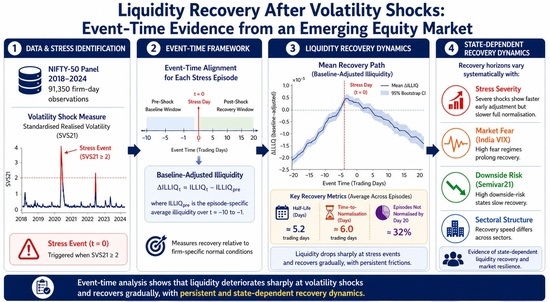
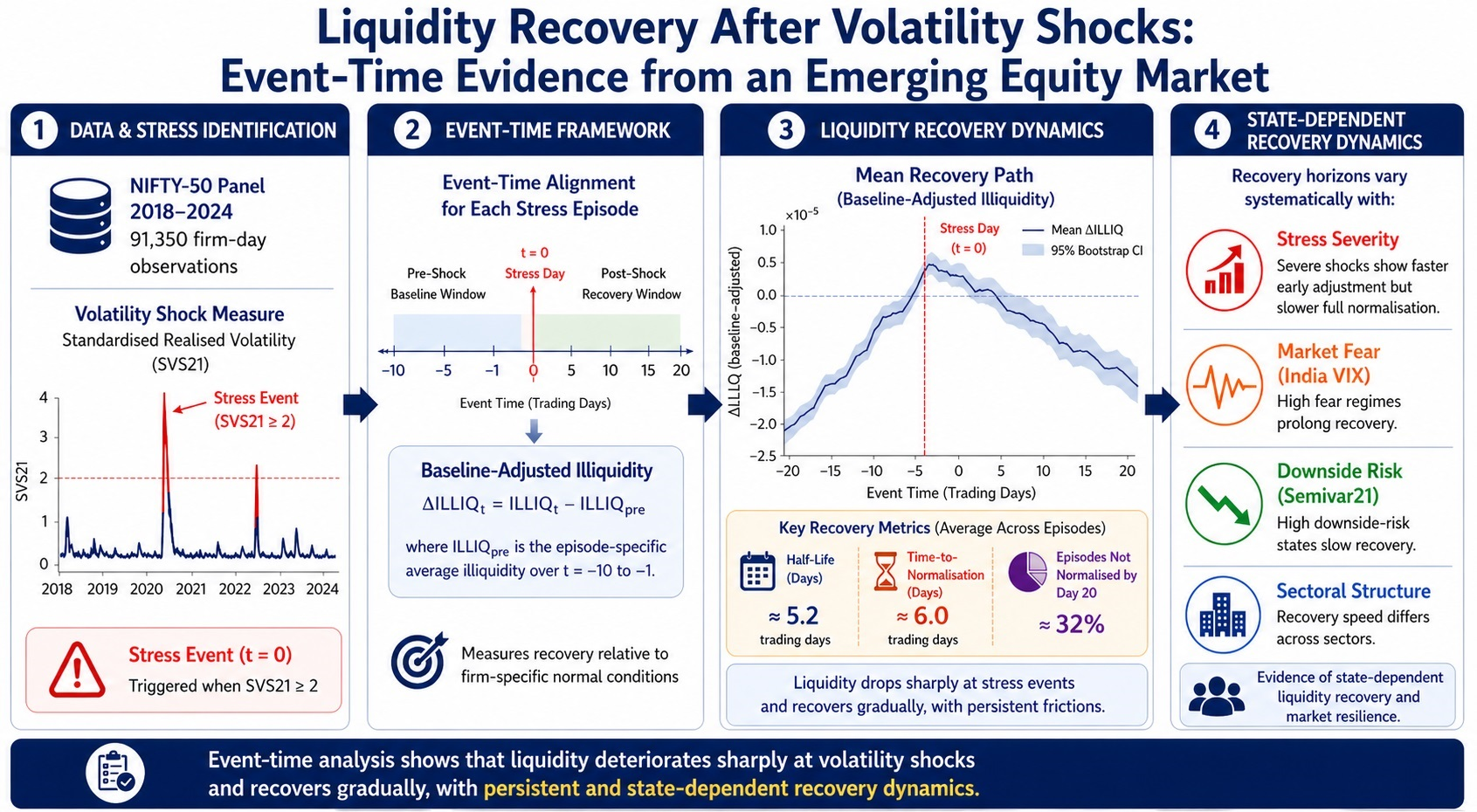
1. Introduction
Understanding how financial markets recover after episodes of extreme volatility is central to the study of market microstructure and financial stability. Periods of heightened volatility are typically accompanied by deteriorating trading conditions, reflected in widening bid–ask spreads, declining market depth, and reduced trading activity. Such disruptions temporarily impair market liquidity and increase trading frictions for investors. While a substantial body of research has examined how volatility shocks affect liquidity contemporaneously, significantly less attention has been devoted to the temporal dynamics through which market liquidity recovers once stress subsides. From the perspective of financial market functioning, the speed of liquidity recovery is an important indicator of market resilience, as it determines how rapidly trading conditions and price discovery return to normal following disruption.
The restoration of normal trading conditions after volatility shocks is economically important because market quality depends not only on the immediate absorption of stress but also on the speed with which liquidity and price discovery stabilise thereafter. When liquidity remains impaired beyond the initial volatility episode, transaction costs remain elevated, large orders become more difficult to execute, and prices may adjust less efficiently to incoming information. For portfolio managers, this persistence affects rebalancing decisions and execution timing, while for exchanges and regulators, it provides a practical signal of whether the market has merely absorbed the shock mechanically or has genuinely returned to orderly functioning.
Despite its importance, empirical evidence on liquidity recovery remains limited, particularly in emerging equity markets. Much of the existing literature focuses on identifying stress episodes, documenting contemporaneous volatility–liquidity interactions, or constructing stress indicators rather than directly measuring how long abnormal trading frictions persist after disruption.
Broto and Lamas (
2020) show that volatility persistence can weaken liquidity resilience, while
Yamada and Ito (
2022) demonstrate that the speed of liquidity recovery is itself an important dimension of market quality in the foreign-exchange market. More recently,
O’Sullivan et al. (
2024) show that liquidity resiliency differs systematically across episodes and market segments, reinforcing the view that post-shock adjustment should be studied as a distinct market-quality process. Yet, direct firm-level evidence on recovery duration in emerging equity markets remains comparatively limited, leaving the temporal structure of post-shock liquidity adjustment less clearly understood than the incidence of stress itself.
Existing research has primarily examined contemporaneous volatility–liquidity interactions or the identification of market stress episodes, while considerably less attention has been devoted to how long liquidity conditions remain impaired after volatility shocks occur. Studies such as
Chordia et al. (
2001),
Hameed et al. (
2010),
Brunnermeier and Pedersen (
2009), and
Broto and Lamas (
2020) show that liquidity deteriorates meaningfully during periods of market stress, yet they provide less direct evidence on the duration and trajectory of post-shock liquidity normalisation. This study addresses that gap by examining how quickly market liquidity recovers following volatility-based stress shocks in an emerging equity market. Using a balanced daily panel of NIFTY-50 constituent firms over 2018–2024, the analysis adopts an event-time empirical framework that traces liquidity behaviour around episodes of extreme volatility. Stress events are identified endogenously using firm-specific volatility thresholds, and post-event liquidity dynamics are evaluated relative to firm-specific pre-stress baselines. Within this framework, two operational recovery metrics—recovery half-life and time-to-normalisation—are introduced to quantify the speed and persistence of liquidity adjustment after volatility shocks. By focusing on recovery horizons rather than on the magnitude of stress alone, this study provides a transparent and empirically tractable perspective on market resilience in an emerging equity market.
Examining liquidity recovery is also directly relevant for trading, portfolio management, and market surveillance decisions. When liquidity remains impaired after volatility declines, price impact costs and execution risks may continue to influence trading behaviour. Duration-based recovery metrics, therefore, provide valuable information for portfolio managers, market makers, and institutional traders regarding the persistence of trading frictions following stress episodes. In emerging markets—where liquidity provision may be more concentrated and market participation more heterogeneous—understanding the time structure of liquidity adjustment is particularly important for evaluating market resilience and stability.
This study contributes to the literature on financial market liquidity and resilience in three principal ways. First, it develops a recovery-oriented empirical framework that quantifies the temporal dynamics of liquidity adjustment following volatility shocks using two operational metrics—recovery half-life and time-to-normalisation. Second, it provides large-scale firm-level evidence on post-shock liquidity recovery in an emerging equity market using a comprehensive daily panel of NIFTY-50 firms over the period 2018–2024. Third, it shows that recovery dynamics are state-dependent, varying systematically across shock severity, market-wide fear, downside-risk conditions, and sectoral characteristics. By combining event-time recovery analysis with robustness checks and econometric diagnostics, this study extends the literature beyond contemporaneous volatility–liquidity interaction and provides direct evidence on the duration and persistence of post-shock liquidity impairment in an emerging-market setting. Overall, the analysis highlights that market resilience is not captured fully by the incidence of stress alone, but also by the speed and completeness with which liquidity conditions normalise after the shock.
2. Review of Literature
Market liquidity is a central concept in financial market microstructure because it determines trading costs, price discovery, and the efficiency with which financial markets incorporate information into prices. Early theoretical contributions highlight that liquidity provision is closely linked to information asymmetry and inventory risk faced by market makers.
Kyle (
1985) develops a foundational model demonstrating how informed trading and market maker behaviour jointly determine price impact and liquidity conditions. Subsequent empirical work by
Amihud (
2002) shows that stock returns are systematically related to illiquidity, indicating that liquidity represents an important state variable in asset pricing. Similarly,
Pástor and Stambaugh (
2003) demonstrate that liquidity risk is priced in equity markets, while
Acharya and Pedersen (
2005) further develop a liquidity-adjusted capital asset pricing framework in which both expected illiquidity and liquidity risk influence asset returns. These studies establish that liquidity conditions fluctuate over time and play an important role in shaping financial market outcomes.
A related strand of literature examines liquidity not only as a priced state variable but also as a dynamic market-quality condition that evolves with order flow, information asymmetry, and changing risk perceptions. This literature suggests that liquidity should not be interpreted purely as a contemporaneous outcome; it also reflects the capacity of markets to absorb shocks and then recover from them over time. In this sense, the temporal adjustment of liquidity is closely linked to the broader concept of market resilience, especially during episodes when volatility rises sharply, and market participants temporarily retreat from providing depth.
Empirical evidence consistently shows that liquidity deteriorates during periods of financial stress. In times of heightened uncertainty or market volatility, liquidity providers often widen bid–ask spreads, reduce trading depth, or temporarily withdraw from markets to manage inventory risk and adverse selection.
Chordia et al. (
2001) document strong co-movements in market liquidity across stocks, demonstrating that liquidity conditions are systematically influenced by market-wide factors. Later research by
Hameed et al. (
2010) shows that liquidity declines significantly following large market returns, suggesting that volatility shocks and liquidity disruptions are closely interconnected. These findings highlight the cyclical relationship between market uncertainty and trading frictions in financial markets.
Beyond contemporaneous volatility–liquidity interactions, researchers have increasingly focused on the concept of market resilience, defined as the capacity of markets to absorb shocks and restore normal trading conditions.
Brunnermeier and Pedersen (
2009) show that liquidity conditions may deteriorate sharply when funding constraints interact with market liquidity, producing reinforcing feedback loops during periods of stress. Similarly,
Bekaert et al. (
2007) demonstrate that liquidity conditions are closely linked to financial market stability in emerging economies. These studies suggest that liquidity disruptions may persist even after volatility declines, implying that the speed of liquidity recovery is an important dimension of market resilience.
This resilience perspective is particularly relevant in emerging markets, where liquidity provision may be more concentrated, investor participation may be less evenly distributed, and market recovery after stress may therefore be less uniform than in deeper developed markets. The existing literature on resilience has largely examined market functioning during crises or periods of disruption, yet it has more rarely translated resilience into directly measurable firm-level recovery horizons. As a result, an important distinction remains underexplored: a market may survive a stress episode without systemic breakdown, but still experience a slow and uneven restoration of normal trading conditions.
Recent empirical research has further expanded the understanding of liquidity dynamics during periods of financial stress and market disruption.
Bao et al. (
2011) show that liquidity conditions in fixed-income markets can deteriorate sharply during turbulent periods and recover only gradually as trading activity stabilises.
Benos and Wetherilt (
2012) emphasise that market resilience depends critically on the capacity of market participants to absorb temporary order-flow imbalances, while
Kyle and Obizhaeva (
2016) highlight the structural role of market microstructure in shaping liquidity fluctuations across trading environments. More recent evidence from pandemic-era market conditions also shows that liquidity responses can differ across developed and emerging markets and may remain sensitive to volatility and market participation during stress episodes (
Marozva & Magwedere, 2021;
Umar et al., 2023). Together, these studies suggest that liquidity recovery following stress is influenced not only by the magnitude of volatility shocks but also by the structure of market participation and the speed with which liquidity provision is restored.
More recent studies have examined liquidity adjustment after stress with greater emphasis on the speed and structure of recovery.
Broto and Lamas (
2020) show that volatility persistence can weaken liquidity resilience and prolong post-shock adjustment, while
O’Sullivan et al. (
2024) provide evidence that liquidity resiliency differs systematically across episodes and market segments in sovereign bond markets. Evidence from more granular market-microstructure settings reinforces this interpretation:
Lo and Hall (
2015) show that order-book resiliency can be analysed through replenishment dynamics after liquidity shocks, and
Yamada and Ito (
2022) demonstrate that liquidity recovery speed after major macroeconomic announcements is itself an important component of market quality. Taken together, these studies suggest that recovery should be analysed as a distinct market-quality process rather than as a mechanical reversal of stress-day illiquidity.
Recent global financial disruptions have further renewed interest in liquidity dynamics. The COVID-19 pandemic generated unprecedented volatility and trading disruptions across global equity markets, leading to a growing body of research examining liquidity behaviour during extreme stress conditions. Studies of Asian and ASEAN equity markets report severe liquidity contractions during the early stages of the pandemic, followed by a gradual and uneven recovery across markets and sectors. Research examining emerging and frontier markets similarly finds that liquidity conditions often recover more slowly than in developed markets due to differences in market depth, institutional frameworks, and investor participation.
Parallel to these developments, a growing literature conceptualises market resilience as a key component of financial risk management.
Alnatour (
2025) argues that resilient markets are characterised by their ability to limit the persistence of liquidity dry-ups and prevent fire-sale dynamics that may amplify systemic shocks. Recent studies examining the Indian financial market also highlight the importance of volatility spillovers and global financial linkages in shaping market stability and resilience.
Maharana et al. (
2025), for example, show that volatility dynamics in the Indian equity market are closely connected to global financial conditions and investor sentiment.
Recent evidence also indicates that liquidity recovery is unlikely to be uniform across instruments, episodes, and market environments. Recovery trajectories depend not only on the magnitude of the initial disturbance but also on market structure, trading participation, and the speed with which liquidity providers re-enter after stress.
Lo and Hall (
2015) show that order-book resiliency depends on how quickly liquidity is replenished after liquidity shocks,
Yamada and Ito (
2022) show that post-announcement liquidity recovery and price discovery need not occur at the same pace, and
O’Sullivan et al. (
2024) show that liquidity resiliency differs systematically across sovereign-market episodes and segments. Taken together, these studies imply that recovery is inherently multi-dimensional and state-dependent. Yet, despite these advances, direct firm-level evidence on recovery duration in emerging equity markets remains comparatively limited.
Despite these advances, empirical evidence on the temporal dynamics of liquidity recovery remains relatively limited, particularly at the firm level and within emerging equity markets. Much of the existing literature focuses on identifying stress events, analysing contemporaneous volatility–liquidity relationships, or constructing composite indices of market stress. While these approaches provide valuable information about market conditions, they do not directly quantify how quickly liquidity returns to normal levels following stress episodes. Consequently, an important gap remains in the literature regarding the duration and persistence of post-shock liquidity impairment. Understanding the speed with which trading conditions recover after volatility shocks is particularly important for investors and regulators because prolonged illiquidity can increase execution costs, constrain portfolio rebalancing, and amplify systemic risk. Consequently, a framework capable of directly measuring liquidity recovery horizons at the firm level can provide new insights into the resilience of financial markets following periods of extreme volatility.
The present study contributes to this literature by examining liquidity recovery dynamics in an emerging equity market using an event-time empirical framework. Using firm-level panel data for NIFTY-50 companies, the analysis introduces two duration-based recovery metrics—recovery half-life and time-to-normalisation—to quantify how quickly liquidity conditions return to pre-stress levels following volatility shocks. By focusing on the temporal structure of liquidity adjustment, this study provides new empirical evidence on market resilience and contributes to the literature on financial market microstructure in emerging economies.
3. Conceptual Framework and Hypotheses
The literature reviewed above demonstrates that liquidity conditions deteriorate substantially during periods of financial stress, yet the process through which markets restore normal trading conditions remains less clearly understood. While existing research documents the contemporaneous relationship between volatility and liquidity, relatively little attention has been devoted to examining the dynamic process through which liquidity recovers after stress events occur. To address this gap, the present study adopts a recovery-oriented conceptual framework in which market resilience is evaluated through the speed and trajectory of liquidity normalisation following volatility shocks.
In financial market microstructure, liquidity is typically characterised through several dimensions, including tightness, depth, and resiliency. Traditional liquidity indicators capture the level of trading frictions at a particular point in time, but they do not provide information about the adjustment process through which markets recover after disruptions. A recovery-based perspective interprets market resilience as a dynamic adjustment process through which liquidity conditions gradually return to their normal levels following stress events. Under this interpretation, a resilient market is not necessarily one that avoids volatility shocks entirely; rather, it is one in which liquidity disruptions are temporary and normal trading conditions are restored within a relatively short period. In empirical microstructure analysis, liquidity resilience is commonly interpreted as the speed with which temporary liquidity shocks dissipate. A recovery-based approach, therefore, evaluates resilience through the duration of post-shock trading frictions. In this framework, shorter recovery horizons indicate stronger liquidity provision capacity and faster restoration of normal trading conditions. This perspective is particularly relevant from a financial risk management standpoint. When liquidity remains impaired after volatility shocks, trading costs remain elevated, and investors may face difficulties executing transactions or rebalancing portfolios. Prolonged illiquidity may also cause margin requirements and risk limits to remain binding for longer periods. Consequently, measuring the duration of liquidity impairment provides important insights into the functioning and stability of financial markets.
To operationalise this concept, the present study introduces two duration-based recovery metrics. The first metric, recovery half-life, measures the time required for half of the liquidity deterioration associated with a stress event to dissipate. The second metric, time-to-normalisation, measures the number of trading days required for liquidity conditions to return to their pre-stress baseline. Together, these measures provide observable indicators of the speed with which markets restore normal trading conditions after volatility shocks.
Market stress events are typically associated with sudden increases in volatility, heightened uncertainty, and shifts in trading behaviour. During such periods, liquidity providers often adjust their quoting behaviour by widening spreads, reducing order-book depth, or temporarily withdrawing from trading to manage inventory risk and adverse selection. While the deterioration of liquidity following stress events may occur rapidly, the recovery process is often gradual because market participants remain cautious until uncertainty declines and trading confidence is restored.
Several factors may influence the trajectory of liquidity recovery. First, the severity of the initial volatility shock may affect the persistence of liquidity disruptions. Larger shocks may trigger greater withdrawal of liquidity provision and therefore require longer adjustment periods before trading conditions stabilise. Second, prevailing market conditions, such as elevated market fear or downside risk, may delay the restoration of normal liquidity conditions because investors and market makers remain cautious even after volatility subsides. Third, structural differences across firms and sectors may lead to heterogeneous recovery patterns within the same market, reflecting differences in trading activity, ownership structure, and market participation.
Taken together, these considerations suggest that liquidity recovery following volatility shocks is a gradual and state-dependent process. Although markets generally recover from stress over time, the speed of recovery may vary significantly across episodes and across market conditions. Understanding these dynamics, therefore, requires systematic empirical analysis of post-shock liquidity behaviour.
Because the empirical design of this study is event-time-based and recovery-oriented, the analysis is organised around two research objectives and one formal hypothesis. The first objective is to document the post-shock trajectory of baseline-adjusted illiquidity following volatility-based stress events. The second objective is to examine whether recovery horizons differ across milder and more severe volatility shocks. These objectives guide the descriptive and comparative recovery analysis. This study’s formal hypothesis concerns state dependence in recovery time under the surrounding risk environment. Accordingly, the post-shock recovery pattern and the severity comparison are treated as research objectives rather than as formal hypotheses.
Research Objective 1. To document the post-shock event-time pattern of baseline-adjusted illiquidity following volatility-based stress events.
Research Objective 2. To examine whether liquidity recovery horizons differ across mild and severe volatility shocks.
Hypothesis 1. Liquidity recovery time varies systematically with the surrounding risk environment, such that episodes occurring under elevated market fear and heightened downside-risk conditions exhibit slower or less complete normalisation.
This formulation aligns the conceptual structure more closely with the empirical design. The event-time profiles and recovery metrics address this study’s descriptive objectives, while the formal hypothesis is evaluated through state-conditioned comparisons and duration-oriented recovery diagnostics.
4. Data and Stress Identification
4.1. Data Description and Sample Construction
The empirical analysis is based on a carefully selected, equally weighted portfolio containing all the components of the NIFTY-50 index for the period between January 2018 and December 2024. After extensive data cleaning, imputation, and alignment procedures, the final dataset contains 91,350 firm-day observations. This rich micro-level set of price and turnover data, combined with market-wide indicators, enables the development of nuanced measures of volatility, liquidity, and downside risk, and is well positioned to ask questions about the dynamics of stress and recovery. Missing observations in price or trading volume were rare (<0.5%) and were handled using simple forward alignment to maintain continuity in rolling-window volatility and liquidity calculations.
The empirical dataset is constructed from multiple sources. Firm-level equity prices and trading-related variables are drawn from the CMIE ProwessIQ database (
CMIE, 2026), while market-wide volatility conditions are captured using India VIX data obtained from the National Stock Exchange of India (
NSE, 2026a). Market index levels and daily NIFTY-50 returns are also obtained from NSE sources. Sector classifications and supporting firm-level identifiers are aligned using the corresponding firm metadata contained in the curated research dataset. This multi-source construction is intended to ensure consistency between firm-level liquidity measurement and the broader market-state indicators used in the analysis.
Daily stock returns are based on adjusted closing prices. Market-wide uncertainty is proxied through the India VIX, which is a forward-looking indicator of market volatility. In order to maintain analytical consistency across companies and over time, all the rolling-window metrics are computed with trading day conventions and are properly aligned in terms of event time when episodes of stress appear. The focus is directed towards large-capitalisation stocks, which have a dominant influence over the liquidity and price discovery in the market in the Indian context. By limiting the sample to NIFTY-50 constituents, we avoid the distorting effects of thin trading or extreme microstructure noise, although still allowing us to explore meaningful heterogeneity across firms and sectors. Sector classifications used in the sectoral analysis are based on NSE industry classifications as reported in the CMIE ProwessIQ database. For transparency and replication, a curated
Supplementary Dataset is provided that contains the event-time aligned panel, declustered stress episodes, and derived recovery metrics used in the empirical analysis. The underlying data were obtained from the National Stock Exchange of India (
NSE, 2026b) historical price database, the India VIX volatility index, and firm-level information from the CMIE ProwessIQ database. The corresponding data sources are formally cited in the reference list to ensure transparency and reproducibility of the dataset construction. (see data-source references in the reference list).
4.2. Variable Construction
Firm-level volatility is operationalised by a 21-day realised volatility (Vol21), which is defined as the rolling standard deviation of daily returns. This 21-day horizon is long enough to capture sustained shifts in market conditions, but is sufficiently responsive to acute stress episodes. For the entire sample, Vol21 shows an average of around 0.0168 with a standard deviation of 0.0038, highlighting high levels of intra-sample time variation. Liquidity conditions are measured using the
Amihud (
2002) illiquidity indicator, defined as the absolute daily stock return divided by daily traded value. Daily traded value is computed as the closing price multiplied by the number of shares traded. The dataset shows that the average illiquidity level is around 0.000136 and increases significantly during times of increased market stress. Downside risk is measured by a 21-day downside semivariance (Semivar21), which separates negative return fluctuations and measures asymmetric risk perceptions. Market-wide fear is proxied by India VIX because it is a forward-looking, option-implied measure of expected equity-market volatility in India and therefore captures broad uncertainty conditions that may influence liquidity provision beyond firm-specific trading shocks. In the present context, it serves as a market-wide fear indicator because it reflects the expected volatility environment faced by traders and liquidity providers at the time of the stress event.
Table 1 provides descriptive statistics for the key variables used in the analysis.
These descriptive statistics indicate substantial variation in volatility and liquidity conditions across the sample period, supporting the suitability of the dataset for examining stress episodes and recovery dynamics.
4.3. Identification of Stress Episodes
Market stress episodes are identified using a criterion based on volatility, which fits very well with the overall empirical framework. Concretely, a stress event is defined as a firm-day on which realised volatility deviates markedly from the recent volatility history of the firm. To identify abnormal volatility episodes in a scale-consistent manner, realised volatility is converted into a firm-level standardised volatility score, denoted SVS21, which measures the extent to which current realised volatility departs from the firm’s own historical volatility pattern. An observation is considered a stress event if this standardised metric has a value that exceeds a threshold of SVS21 ≥ 2.00 and is used to define the baseline stress in the empirical analysis. This standardised threshold is intended to identify firm-specific volatility stress relative to each firm’s own historical volatility distribution rather than to impose a common raw-volatility cut-off across firms with different baseline trading characteristics.
This standardised-score approach ensures that stress episodes are endogenously derived from the market data and thus captures firm-specific volatility shocks instead of relying on exogenous classifications of the events or calendar-based indicators. By standardising the level of volatility at the firm level, the procedure allows for heterogeneity in the baseline level of volatility across firms and time. To distinguish stress intensity, events are subdivided into mild and severe categories based on the magnitude of the standardised volatility exceedance. To distinguish stress intensity, episodes are partitioned into mild and severe groups using the empirical distribution of the stress-day volatility exceedance. Specifically, ‘severe’ episodes correspond to the upper segment of stress-day SVS21 exceedances (as coded in the
Supplementary Dataset), while the remaining episodes are classified as ‘mild’. In the baseline sample, this split yields 204 severe and 398 mild episodes. The standardised volatility score is computed using a rolling 252-trading-day historical window, allowing stress identification to adapt to evolving firm-specific volatility regimes. This data-driven classification allows stress intensity to be determined relative to the empirical distribution of volatility shocks rather than relying on arbitrary external thresholds.
A short suppression rule is applied to avoid counting immediate adjacent exceedances as separate episodes; however, some events may still occur within the recovery horizon. We therefore rely on firm–episode block bootstrap inference and additional robustness checks that restrict to more isolated episodes. Robustness analyses presented in
Section 7 consider alternative stress definitions by increasing the standardised volatility score threshold above the baseline (SVS21 ≥ 2.25 and SVS21 ≥ 2.50), while keeping the declustering procedure and event-window construction unchanged. A robustness analysis restricting attention to isolated episodes without overlapping stress events is presented in
Section 7.6.
4.4. Event-Time Alignment
After identifying stress episodes, observations are coordinated in time of the event to study the post-stress liquidity dynamics in a coherent and comparable context. The trading day, where the volatility-based stress condition occurs for the first time, is designated event day 0. Liquidity behaviour is then traced for a fixed post-event window compared to a pre-stress baseline period, allowing for juxtaposing recovery paths across firms and episodes. The twenty-day horizon captures the short-to-medium-term adjustment period during which liquidity typically stabilises after volatility shocks in equity markets.
This event-time alignment allows aggregating recovery trajectories over heterogeneous firms and dates and thus helps infer about average recovery speed, time-to-normalisation, and cross-episode heterogeneity in liquidity adjustment. By anchoring all the episodes to a common event origin, the approach isolates the post-stress from the effects of calendar time and firm-specific trends.
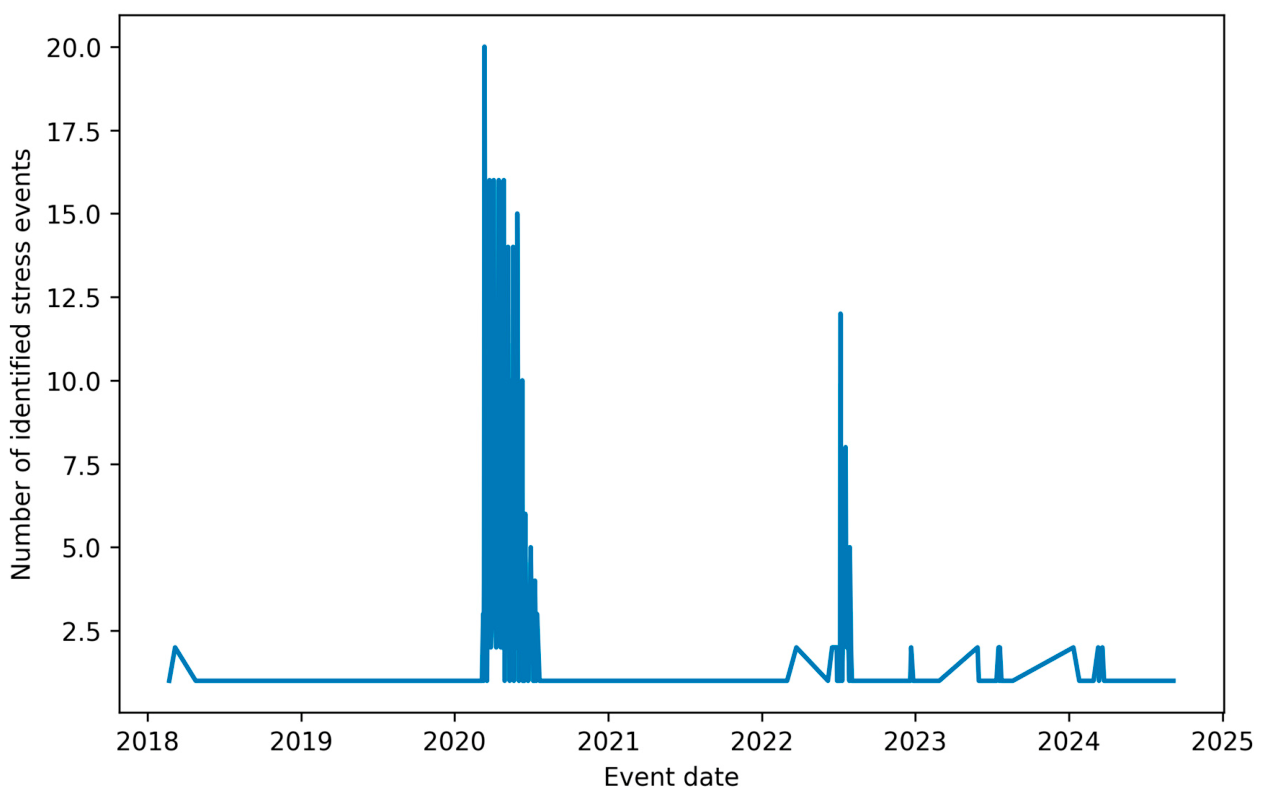
Figure 1 shows the timeline and distribution of the identified stress episodes during the period of sample consideration. The figure shows the clustering of volatility-related stress events over time with distinct concentrations during periods of high market turbulence, including market-wide stress episodes. This visual evidence serves as validation for the event-based approach in that stress events are not distributed equally across time but are usually concentrated during turbulent market events.
5. Methodology: Measuring Liquidity Recovery Dynamics
This section formalises the empirical framework used to quantify the speed and persistence of liquidity recovery following volatility-based stress episodes identified in
Section 4. The framework is non-parametric and event-time-based, and is designed to characterise recovery horizons and cross-episode heterogeneity rather than to estimate structural causal effects. The construction of the liquidity variable follows the
Amihud (
2002) price-impact formulation, while the recovery metrics are specified as duration-oriented operational measures consistent with the study’s recovery-focused design.
5.1. Event-Time Alignment and Baseline Definition
For each identified stress episode s affecting firm i, observations are reindexed in event time so that the stress day corresponds to t = 0. Post-event days are indexed as t = 1, 2, …, H, where the baseline specification uses H = 20 trading days. This horizon aligns with the declustering window and ensures that recovery is measured over a consistent adjustment interval across episodes.
To interpret post-stress movements relative to firm-specific normal conditions, illiquidity outcomes are expressed relative to a pre-stress baseline. The baseline window consists of the ten trading days before the stress day, t = −10, …, −1. A ten-day window provides a short but stable benchmark for pre-stress trading conditions while avoiding contamination from earlier volatility disturbances. Let ILLIQ_{i, s, t} denote the
Amihud (
2002) illiquidity measure computed as |R_{i, t}|/(Price_{i, t} × Volume_{i, t}). Baseline-adjusted illiquidity is defined as:
Equation (1) expresses baseline-adjusted illiquidity as the deviation of ILLIQ_{i, s, t} from the episode-specific pre-stress mean, ILLIQ¯^{pre}_{i, s}, computed over u = −10, …, −1 for the same firm–episode pair. Positive values indicate liquidity deterioration relative to the firm-specific baseline, while negative values indicate liquidity improvement. This transformation removes firm-specific scale differences and allows post-shock liquidity conditions to be interpreted relative to each firm’s own pre-stress normal level rather than in raw absolute units. The baseline-adjustment procedure is therefore consistent with an event-time design in which recovery is measured in deviation form rather than in unconditional levels.
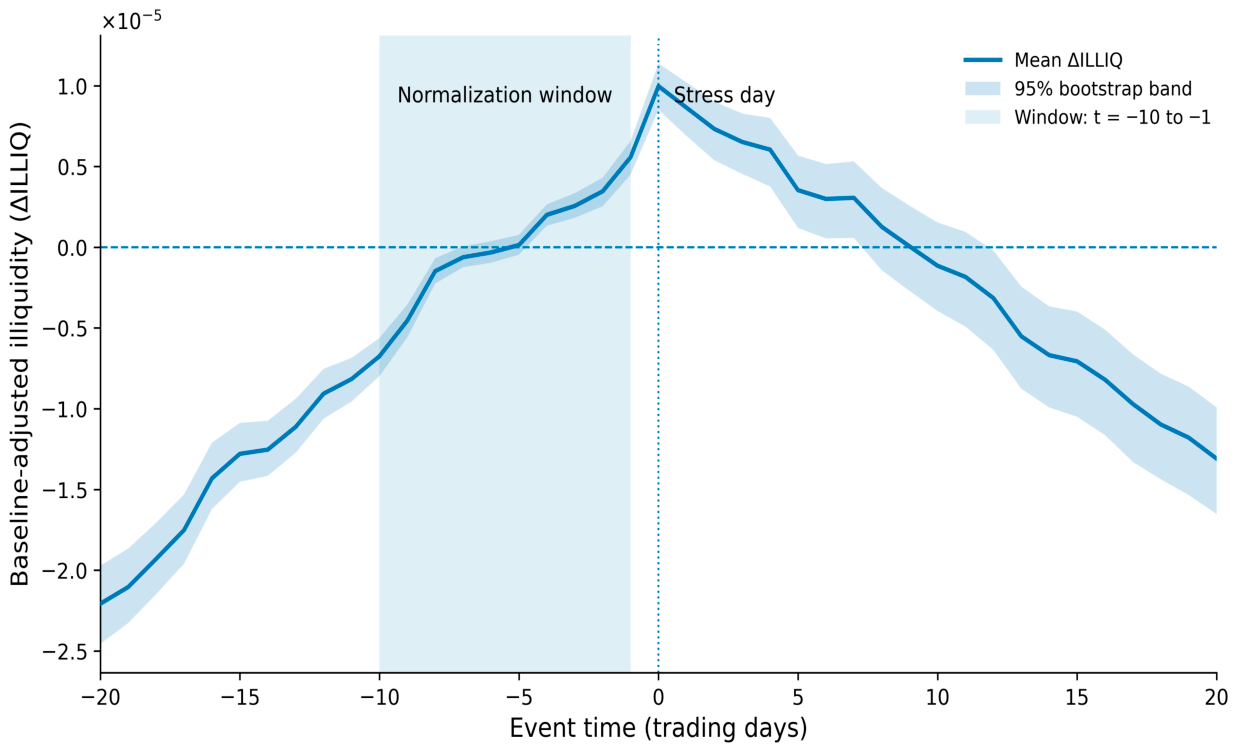
Baseline adjustment is performed separately for each firm–episode using that episode’s own pre-stress window t = −10, …, −1. By construction, the mean of baseline-adjusted illiquidity within this normalisation window is zero for each episode. However, the figures presented in the empirical section do not plot this within-window identity directly. Instead, they report pooled event-time averages across admissible firm–episode observations at each event time t. Consequently, the pre-event segment of the plotted recovery paths should be interpreted as a pooled descriptive profile rather than as a literal visualisation of the within-window normalisation condition itself. Importantly, the zero-normalisation applies to the average over the full pre-stress window for each episode, not to each pre-event day. When event-time profiles are constructed by pooling observations across episodes at each day, the day-specific averages within the normalisation window need not equal zero point-by-point.
5.2. Recovery Metrics: Time-to-Normalisation and Half-Life
Liquidity recovery is summarised using two complementary episode-level metrics: time-to-normalisation (TTN) and recovery half-life. Both metrics are computed relative to stress day t = 0. TTN captures the persistence of post-stress illiquidity, while half-life captures the speed of early-stage adjustment. The use of duration-based recovery measures is consistent with the recovery-oriented perspective adopted in the recent literature on liquidity persistence and post-stress market adjustment (
Broto & Lamas, 2020;
O’Sullivan et al., 2024).
In practical terms, TTN captures the number of trading days required for abnormal illiquidity to fall back to the pre-stress benchmark and remain there for a short persistence interval. The persistence rule is important because a one-day return to baseline may reflect temporary noise rather than genuine liquidity normalisation. By requiring a sustained return to baseline, the metric is designed to measure recovery more conservatively and more meaningfully from a market-functioning perspective. Time-to-normalisation is defined as:
Equation (2) imposes a persistence requirement of k = 3 consecutive post-event trading days with ΔILLIQ at or below zero. If no such three-day sequence occurs within H = 20, the episode is classified as not normalised within the event window. Mean TTN values are computed conditional on episodes that normalise within +20 days, while the share of non-normalising episodes is reported separately as %NotNorm_by20. This rule reduces the likelihood that temporary fluctuations around the baseline are incorrectly interpreted as full recovery. The recovery half-life is used to capture the speed of early-stage adjustment even when full normalisation is not achieved within the event window. It is defined as:
Equation (3) defines half-life τ_{i, s} as the first post-event time at which baseline-adjusted illiquidity declines to at most 50% of its stress-day magnitude ΔILLIQ_{i, s, 0}. When the threshold is crossed between two integer event times, linear interpolation is applied to obtain a continuous estimate of τ_{i, s}. Accordingly, the reported mean half-life reflects realised early-stage recovery conditional on reaching the threshold within the horizon. Episodes that do not reach the 50% threshold within the observation window are treated as censored observations. Unlike TTN, which focuses on complete baseline reversion under a persistence rule, the half-life metric captures the pace of partial improvement. The two measures are therefore complementary: one reflects partial recovery speed, and the other reflects the time required for sustained normalisation.
5.3. Estimation of Average Recovery Paths
To characterise aggregate recovery dynamics without imposing parametric functional forms, baseline-adjusted illiquidity profiles are pooled across admissible firm–episode observations at each event time t. This aggregation strategy is consistent with event-time analysis used to trace post-shock adjustment trajectories in market-liquidity settings (
Broto & Lamas, 2020;
O’Sullivan et al., 2024). The mean event-time recovery path is defined as:
In Equation (4), A_t denotes the set of admissible firm–episode observations available at event time t, and N_t is the corresponding count. This non-parametric aggregation yields an interpretable event-time trajectory of liquidity impairment and recovery and forms the basis for the recovery profiles reported in
Section 6. Each firm–episode observation receives equal weight in the event-time aggregation so that the resulting profile reflects average episode behaviour rather than being dominated by firms with more frequent stress events.
It is important to distinguish between episode-level normalisation and pooled event-time aggregation. While baseline adjustment ensures that the average illiquidity over the normalisation window t = −10, …, −1 equals zero within each firm–episode, the event-time recovery path is computed by averaging across the admissible set of firm–episode observations at each event time t. Because the composition of this admissible set may vary across event times, the pooled pre-event path is not mechanically constrained to equal zero at every pre-event day. Accordingly, deviations from zero in the pre-event segment reflect cross-episode averaging rather than a violation of the baseline normalisation.
The term recovery path refers to the average event-time trajectory of baseline-adjusted illiquidity across all admissible firm–episode observations after the stress day. In other words, it summarises how abnormal illiquidity typically evolves from event day 0 onward when episodes are aligned to a common stress origin. This representation makes it possible to study not only whether liquidity deteriorates on the stress day but also how rapidly that deterioration tends to unwind over the following trading sessions. Accordingly, the event-time path should be interpreted as a pooled descriptive trajectory rather than a mechanical identity imposed by the normalisation step.
5.4. Statistical Inference and Confidence Bands
Uncertainty in the mean recovery path and in the episode-level recovery metrics is assessed using a block bootstrap procedure designed to preserve within-episode serial dependence. Firm–episode blocks are resampled with replacement while maintaining the temporal ordering of observations within each episode. For each bootstrap replication b = 1, …, B, with B = 1000 in the baseline implementation, the mean recovery path and the recovery metrics are re-estimated. Pointwise 95% confidence bands correspond to the 2.5th and 97.5th percentiles of the bootstrap distribution at each event time t, and confidence intervals for TTN and half-life are constructed analogously from their empirical bootstrap distributions.
5.5. Identification Considerations
The event-time framework adopted in this study is designed to characterise empirical recovery dynamics rather than to identify structural causal effects. Because stress episodes may occur within the observation horizon, recovery trajectories are interpreted as episode-level conditional paths rather than strictly independent observations. The resulting estimates should therefore be read as descriptive but policy-relevant measures of liquidity adjustment speed and persistence following volatility-based stress events.
6. Empirical Results: Liquidity Recovery Dynamics and Heterogeneity
This section reports the empirical evidence on the duration, speed, and heterogeneity of liquidity recovery following volatility-based stress shocks in the NIFTY-50 equity market. The central objective is not merely to document that liquidity deteriorates on the stress day, but to evaluate how long that deterioration persists, how quickly partial and full recovery occur, and whether recovery horizons vary across severity levels, market states, and sectors. Accordingly, the discussion places particular emphasis on recovery half-life, time-to-normalisation (TTN), and the share of episodes that remain unresolved within the twenty-day event window.
6.1. Immediate Illiquidity Response and Baseline Recovery Metrics
Across the 602 declustered stress episodes, baseline-adjusted illiquidity (ΔILLIQ) increases on the stress day (t = 0), indicating a sharp deterioration in trading conditions relative to the firm-specific pre-stress baseline.
Table 2 summarises stress-day impairment and episode-level recovery metrics.
The mean time-to-normalisation is approximately one trading week among episodes that normalise within the event window, while nearly one-third of episodes do not return to baseline liquidity conditions within twenty trading days. In economic terms, this persistence implies that elevated transaction costs and execution risks may remain relevant for several trading sessions even after volatility conditions begin to stabilise. From an economic perspective, a recovery half-life of roughly five trading days implies that liquidity disruptions following volatility shocks persist for approximately one trading week, indicating that temporary increases in trading costs may influence portfolio rebalancing and order execution decisions over several sessions.
These baseline metrics indicate that the principal empirical feature of the data is not simply the contemporaneous liquidity deterioration observed on the stress day, but the persistence of impaired trading conditions beyond that date. A mean half-life of approximately one trading week implies that the initial dislocation is not reversed immediately, while the substantial share of episodes that fail to normalise within twenty trading days indicates that post-shock illiquidity is often economically meaningful for longer than the volatility episode itself. The results, therefore, support a recovery-horizon interpretation of market resilience rather than a purely event-day interpretation of market stress.
6.2. Baseline Recovery Paths and Normalisation Shares
Figure 2 plots the mean event-time recovery profile of ΔILLIQ with 95% block-bootstrap confidence bands. Because ΔILLIQ is measured relative to the firm-specific pre-stress benchmark, values below zero indicate that illiquidity falls below its pre-stress average. These post-recovery negative values should therefore be interpreted as temporary overshooting relative to the benchmark, rather than as a linear continuation of recovery. The pre-event portion of the recovery path should therefore be read as a pooled descriptive trajectory across episodes rather than as a direct depiction of the within-episode normalisation window, and is not required to lie exactly at zero at each pre-event time. The profile shows steady reversion after day 0 but persistent elevation relative to baseline during the early post-shock period. Complementing the profile evidence,
Table 3 reports cumulative normalisation shares by horizon, showing how quickly episodes meet the TTN criterion. This distinction between episode-level normalisation and pooled event-time averaging is essential for interpreting the pre-event segment of the figure.
The plotted series represents pooled event-time averages across admissible firm–episode observations at each event time t. Because this pooling is performed across different sets of episodes at each t, the pre-event portion of the plotted path (particularly for t < −10) is not mechanically constrained to equal zero on every day. Accordingly, deviations from zero in the pre-event segment reflect cross-episode averaging rather than a violation of the baseline normalisation.
The vertical dotted line denotes the stress day (t = 0). Values above zero indicate illiquidity above the pre-stress benchmark, while values below zero indicate that illiquidity falls below its pre-stress average, reflecting temporary overshooting during the recovery phase rather than a linear continuation of improvement.
6.3. Severity-Dependent Recovery Dynamics
To assess whether recovery depends on shock intensity, stress episodes are partitioned into mild and severe categories based on the volatility exceedance definition in
Section 4.3.
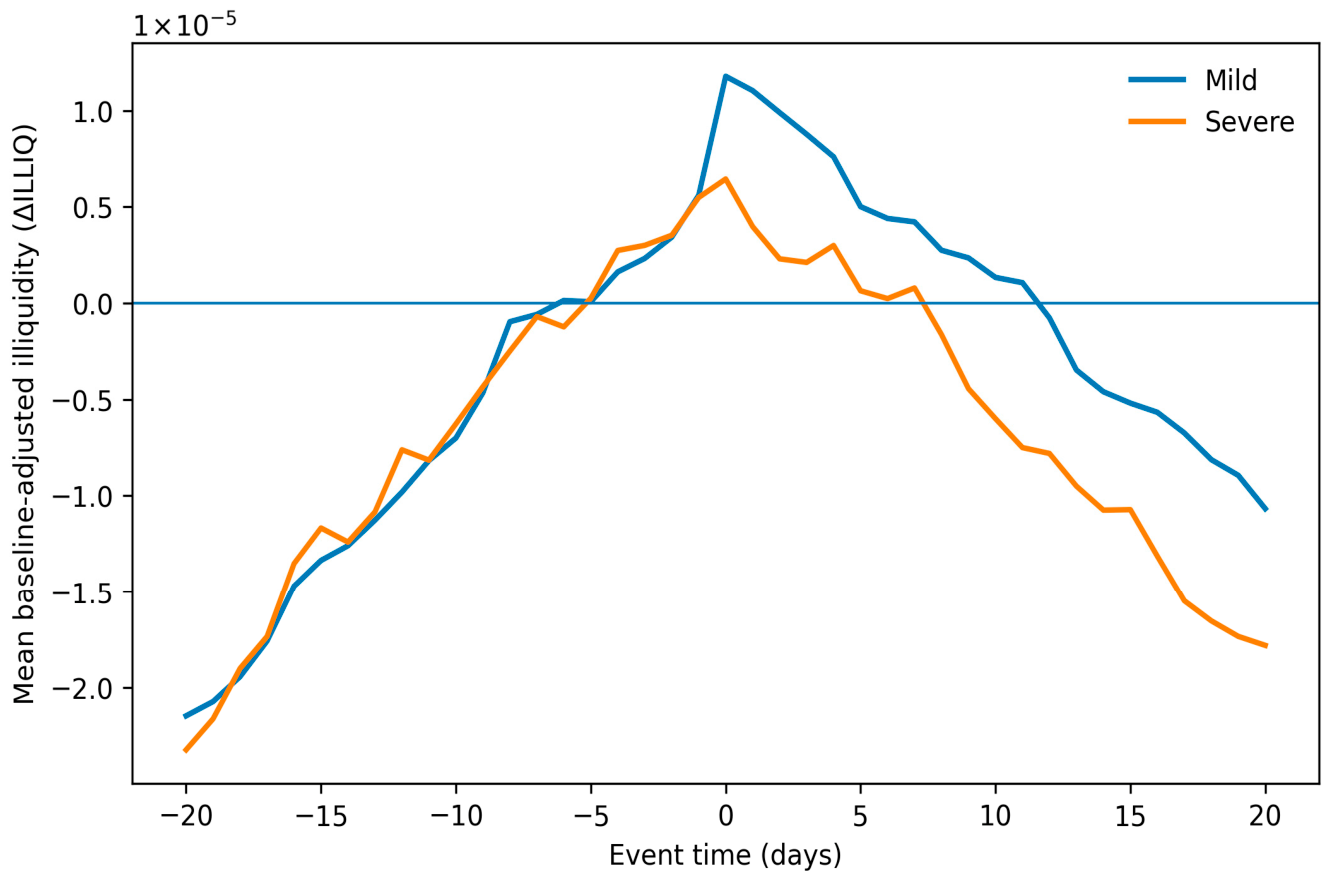
Table 4 reports severity-specific recovery metrics, and
Figure 3 visualises the divergence in mean recovery profiles. Because severity is defined using volatility rather than liquidity, interpretation focuses on recovery speed and persistence rather than stress-day ΔILLIQ magnitudes. The combination of shorter half-life but longer TTN among severe episodes indicates faster early-stage adjustment alongside greater persistence in full normalisation. The lower non-normalisation rate for severe episodes reflects faster early compression of large stress-day deviations, even though full normalisation may take longer in calendar time. This pattern suggests that severe shocks initially generate large liquidity withdrawals that compress quickly as trading resumes, yet full restoration of normal trading conditions may take longer because order-flow imbalances persist. This persistence suggests that post-shock trading conditions may influence portfolio execution strategies and transaction costs beyond the immediate volatility episode, highlighting the practical relevance of recovery horizons for institutional investors. Interpreted in recovery-time terms, the severity comparison suggests that the temporal profile of adjustment is multi-stage rather than uniform. Severe shocks appear to exhibit relatively rapid early compression in abnormal illiquidity, but full and sustained normalisation may still require longer calendar time. This distinction is important because it shows that early improvement in liquidity does not necessarily imply complete restoration of normal trading conditions.
Figure 3 should therefore be read as showing a two-stage adjustment pattern, with faster early compression under severe shocks but slower full normalisation in calendar time.
6.4. Market Fear and Liquidity Recovery (India Vix)
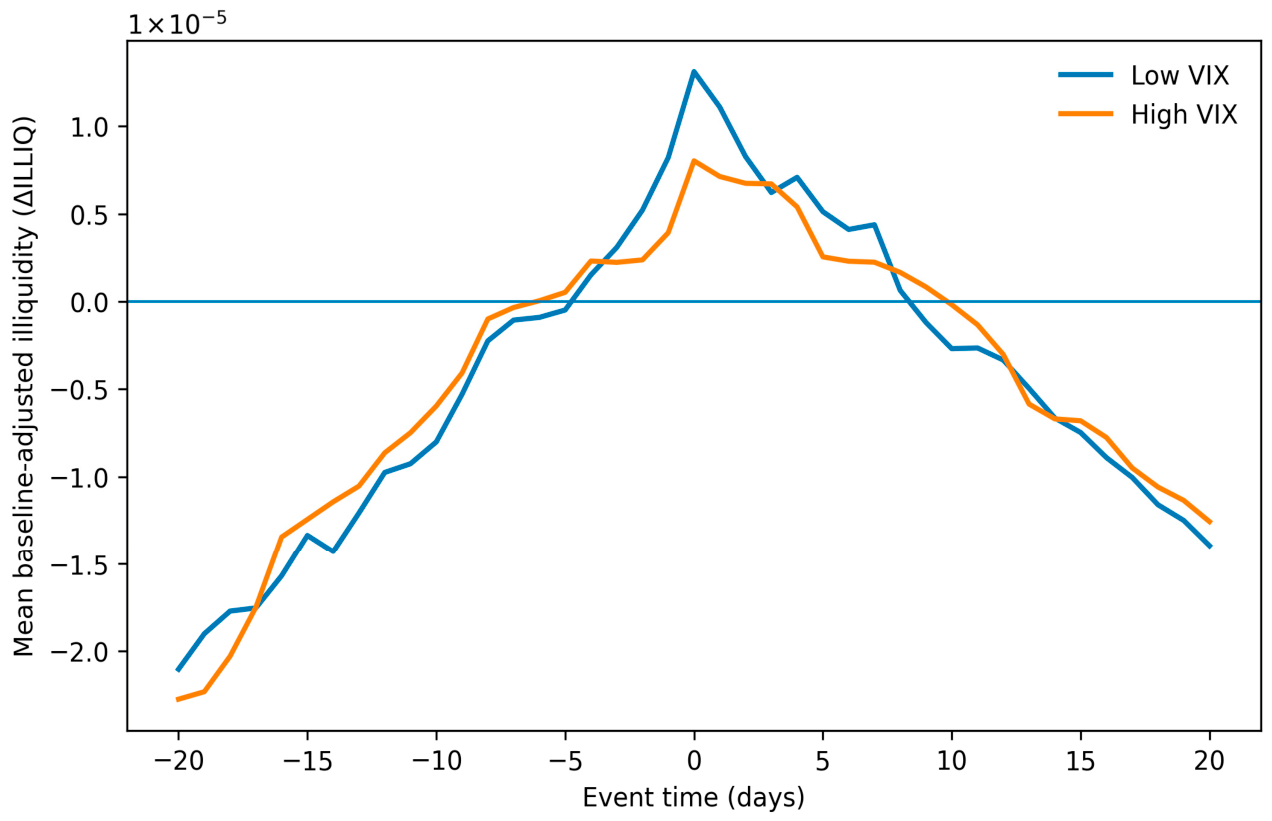
Next, we condition recovery on market-wide fear, proxied by India VIX on the stress day.
Table 5 shows differences in recovery horizons and non-normalisation shares across high- and low-fear regimes.
Figure 4 plots the corresponding recovery profiles. These results suggest that broader market sentiment conditions influence the trajectory of liquidity recovery, even when the initial volatility shock occurs at the firm level.
From a recovery-duration perspective, the VIX-based partition indicates that broader market sentiment conditions shape the environment within which liquidity normalisation occurs. Even when the initial volatility shock is identified at the firm level, episodes arising in periods of elevated market-wide fear may face slower or less uniform restoration of trading conditions because liquidity providers remain cautious, and trading participation may recover only gradually.
6.5. Downside-Risk Regimes and Recovery Speed
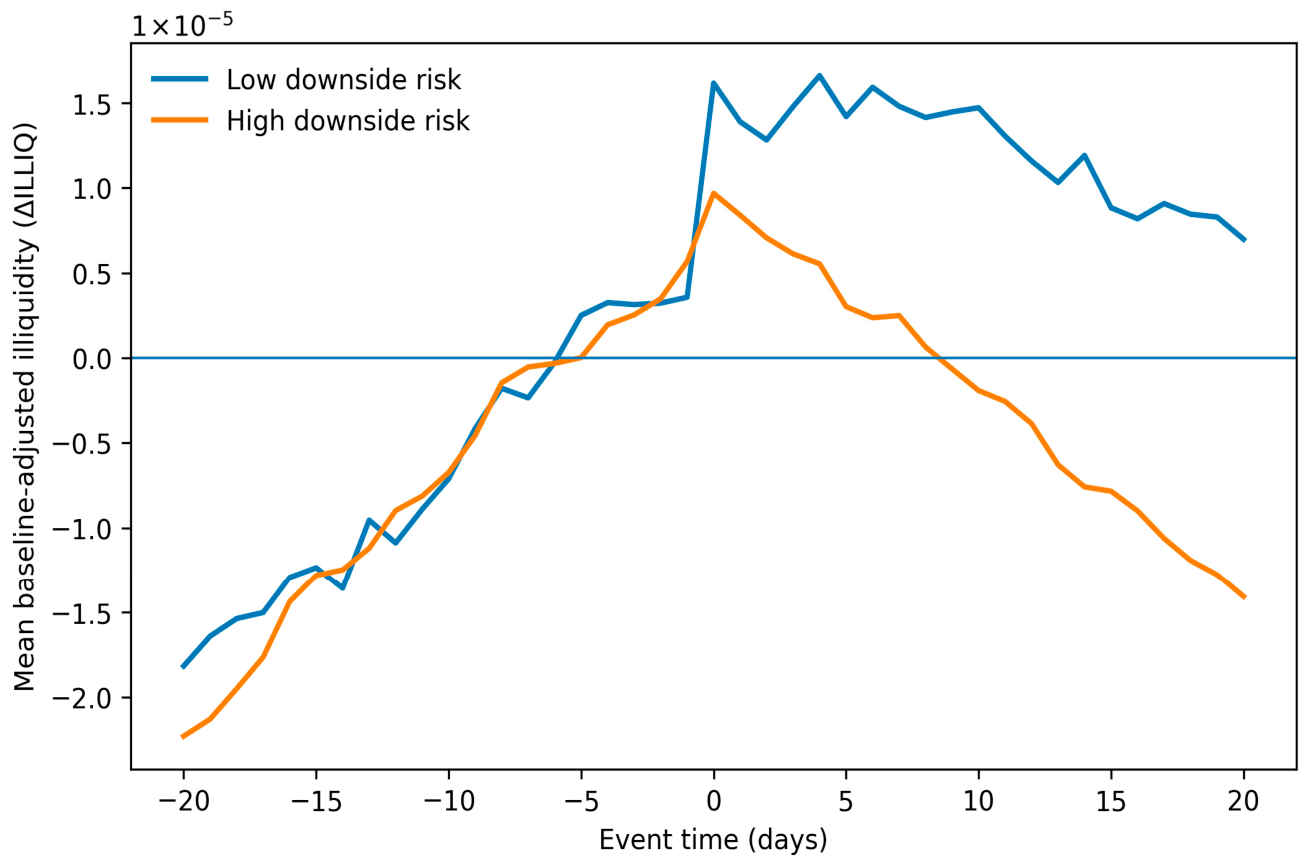
Downside risk captures asymmetric return conditions that may constrain liquidity provision following volatility shocks. To evaluate state dependence, episodes are classified into high and low downside-risk regimes using Semivar21 on the stress day.
Table 6 reports the corresponding recovery metrics, and
Figure 5 shows the recovery profiles. Because the number of observations in the low-downside-risk regime is relatively small, these results should be interpreted primarily as descriptive evidence rather than definitive statistical inference. Although the low-downside-risk sub-sample is relatively small and should therefore be interpreted cautiously, the evidence still points to the importance of conditioning recovery analysis on the surrounding risk environment. In substantive terms, the comparison suggests that recovery horizons can differ materially depending on whether the stress event occurs in a market setting already characterised by asymmetric downside pressure.
6.6. Sectoral Heterogeneity in Liquidity Recovery
To examine cross-sectional heterogeneity, we compute recovery metrics by sector.
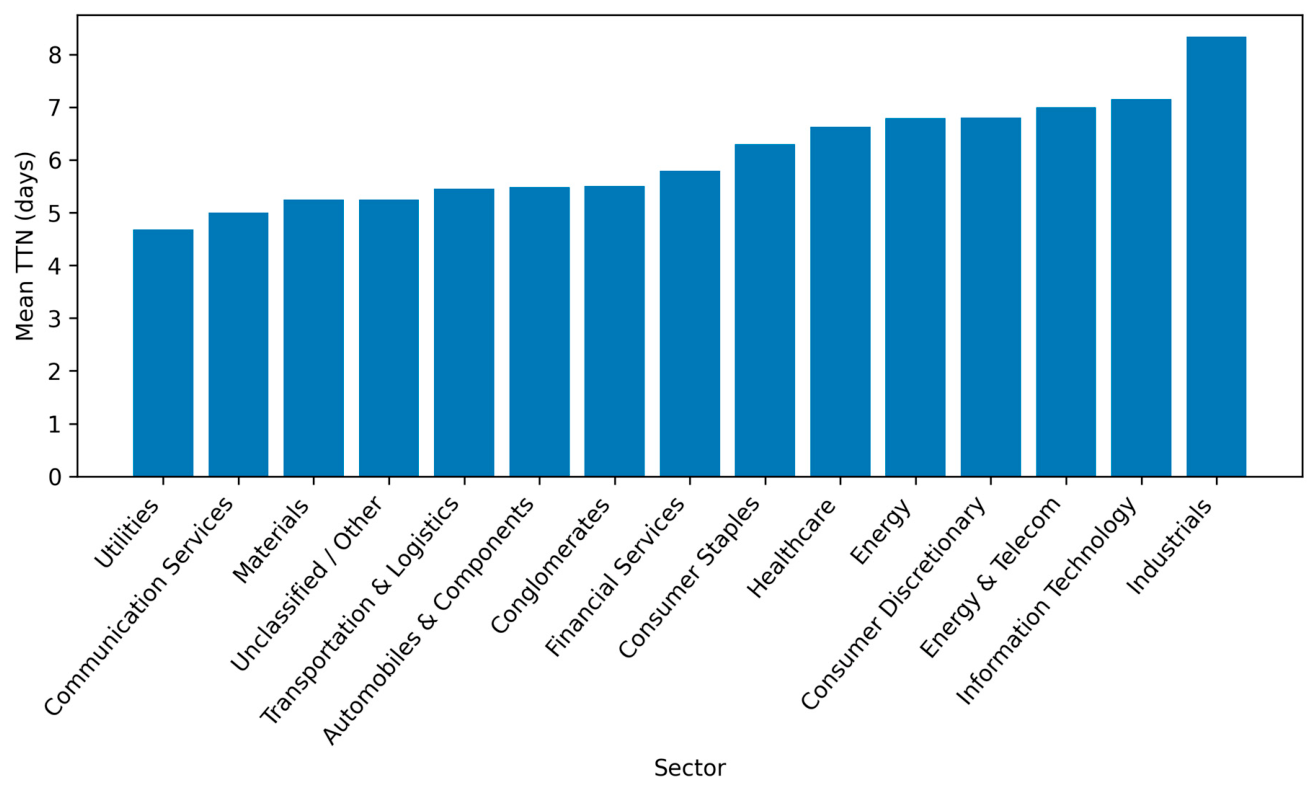
Table 7 reports sector-level averages for stress-day impairment and recovery horizons, and
Figure 6 visualises dispersion in mean TTN. The “Unclassified/Other” category aggregates heterogeneous sector mappings and should be interpreted cautiously. Differences across sectors likely reflect variations in trading activity, market depth, and the concentration of institutional investors, which influence the speed with which liquidity providers restore normal trading conditions.
6.7. Recovery-Time Evidence, Econometric Diagnostics, and Synthesis
The empirical core of this study is the measurement of liquidity recovery time rather than the documentation of event-day disruption alone. Accordingly, the evidence is interpreted through duration-oriented recovery measures, including recovery half-life, time-to-normalisation, the share of non-normalising episodes, and the corresponding recovery-time diagnostics. The event-time recovery profiles and episode-level metrics show that baseline-adjusted illiquidity rises sharply on the stress day and then declines gradually, but a meaningful share of episodes remains unresolved within the twenty-day horizon. This confirms that the principal contribution of the analysis lies in documenting the speed, duration, and persistence of post-shock liquidity adjustment.
Because time-to-normalisation is a recovery-time outcome and is right-censored for episodes that do not return to baseline within the observation window, the interpretation of the empirical results is anchored in duration-oriented evidence rather than in event-day effects alone. In this sense, the descriptive recovery metrics and the subsequent diagnostics jointly support this paper’s recovery-time focus.
Hypothesis 1 predicts that recovery behaviour is state-dependent and influenced by prevailing market conditions. The non-parametric evidence indicates that recovery metrics differ across market-wide fear regimes defined by India VIX and across downside-risk regimes defined using the Semivar21 indicator. These differences suggest that liquidity resilience depends not only on the magnitude of the firm-level shock but also on the broader risk environment in which the episode occurs.
To complement the non-parametric event-time evidence, we estimate episode-level regression diagnostics that relate recovery speed to characteristics of the stress episode while controlling for sector-specific heterogeneity. The baseline specification is given by:
In this specification, the dependent variable Recovery_{i, s} denotes the recovery speed of firm i in stress episode s. Two alternative recovery measures are used: (i) the recovery half-life τ_{i, s}, and (ii) the time-to-normalisation measure TTN_{i, s}. The indicator Severe_{i, s} identifies episodes classified as severe volatility shocks. HighVIX_{s} captures periods of elevated market-wide fear based on India VIX, while HighDown_{s} denotes episodes occurring under heightened downside-risk conditions measured using the Semivar21 indicator. Sector fixed effects γ_{sector} account for structural differences in trading activity and liquidity conditions across industries.
The regression estimates are reported in
Table 8 using heteroskedasticity-robust (HC1) standard errors. The results show that the severity indicator is positively associated with the time-to-normalisation measure and statistically significant at conventional levels, implying that more intense volatility shocks tend to prolong the duration required for liquidity conditions to return to baseline levels. By contrast, the coefficients associated with market-wide fear and downside-risk regimes are not statistically significant in the linear regression framework. This does not imply that these state variables are irrelevant; rather, it suggests that their effects may be heterogeneous across episodes and may not be fully captured by a simple linear specification.
The modest explanatory power of the regression diagnostics further indicates that recovery dynamics are influenced by a range of episode-specific microstructure conditions, including order-flow imbalances, liquidity provision behaviour, and trading participation dynamics, that are not explicitly modelled in the baseline equation. Accordingly, the regression results should be interpreted as conditional associations that complement the primary event-time analysis rather than as structural causal estimates.
Taken together, the combined evidence from recovery profiles, episode-level metrics, and regression diagnostics supports the central propositions of the revised conceptual framework. The evidence shows that abnormal illiquidity rises sharply on the stress day and then normalises gradually, that recovery differs across severity regimes, and that recovery behaviour varies across market-risk conditions. The core empirical contribution of this study, therefore, lies in documenting recovery duration rather than merely stress incidence. Liquidity resilience emerges as a temporal adjustment process whose practical relevance depends on how long abnormal trading frictions persist after the initial shock has occurred.
Table 9 summarises how the empirical evidence maps onto this study’s two research objectives and the formal risk-state dependence hypothesis.
Taken together, and as summarised in
Table 9, the evidence indicates that the core empirical contribution of this study lies in documenting recovery duration rather than merely stress incidence. The event-time profiles, episode-level metrics, and diagnostic regressions consistently show that liquidity recovery is gradual, incomplete for a meaningful subset of episodes, and conditioned by both shock intensity and the surrounding market environment. This reinforces the interpretation of liquidity resilience as a temporal adjustment process whose practical relevance depends on how long abnormal illiquidity persists after the initial shock has occurred.
7. Robustness and Sensitivity Analysis
This section examines whether this paper’s central recovery-horizon findings remain stable under alternative stress definitions, baseline windows, liquidity proxies, recovery rules, and sub-sample partitions. The purpose of these exercises is not merely to replicate the event-day deterioration result, but to test whether the measured duration and persistence of liquidity recovery remain qualitatively similar when the empirical design is varied in reasonable ways.
7.1. Alternative Stress Thresholds
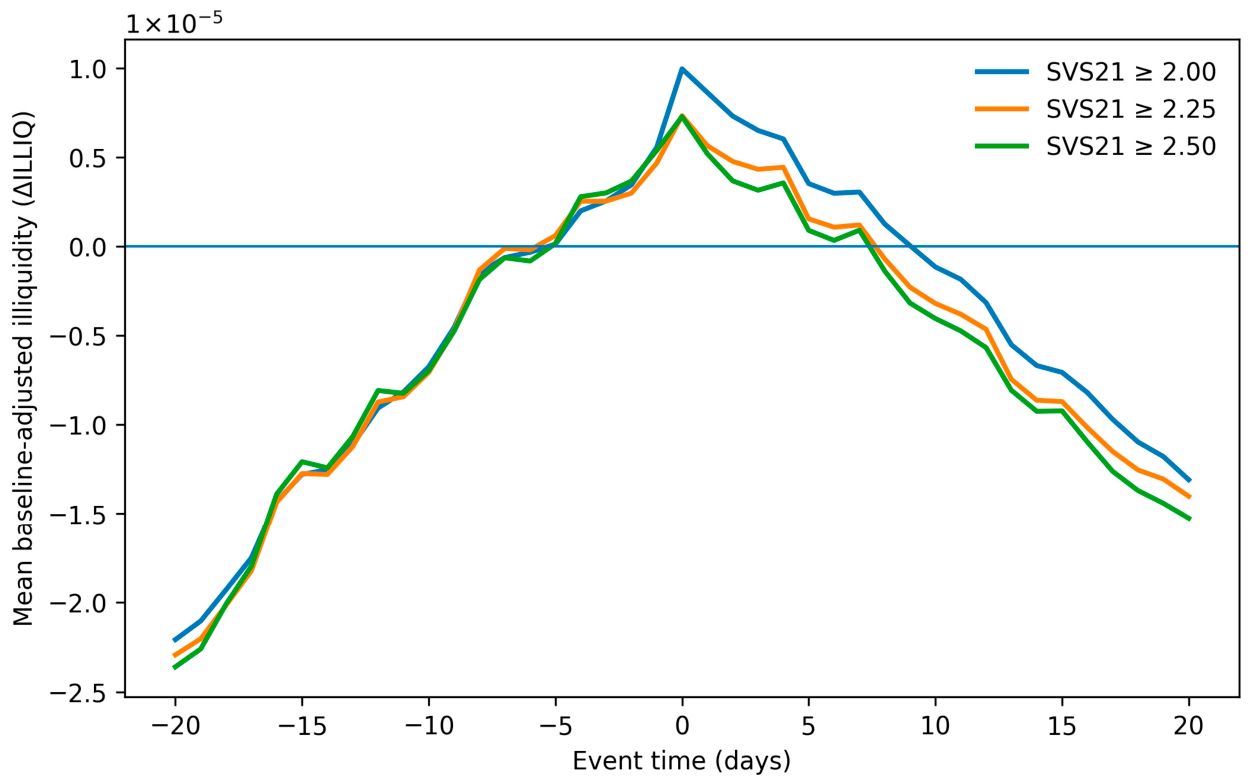
To test sensitivity to the severity of the stress trigger, stress episodes are restricted to stricter realised-volatility thresholds (SVS21 ≥ 2.25 and SVS21 ≥ 2.50) while retaining the same declustering and event-window construction.
Table 10 reports episode counts and recovery metrics under each threshold.
Figure 7 plots the corresponding mean event-time recovery profiles.
7.2. Alternative Baseline Normalisation Windows
Baseline adjustment is required to interpret post-stress changes relative to pre-stress liquidity conditions. To ensure that recovery metrics are not an artefact of the chosen baseline window, ΔILLIQ is recomputed using two alternative pre-stress windows (−15 to −5 and −20 to −10 trading days), alongside the baseline (−10 to −1).
Table 11 reports the resulting recovery metrics.
7.3. Alternative Liquidity Proxies
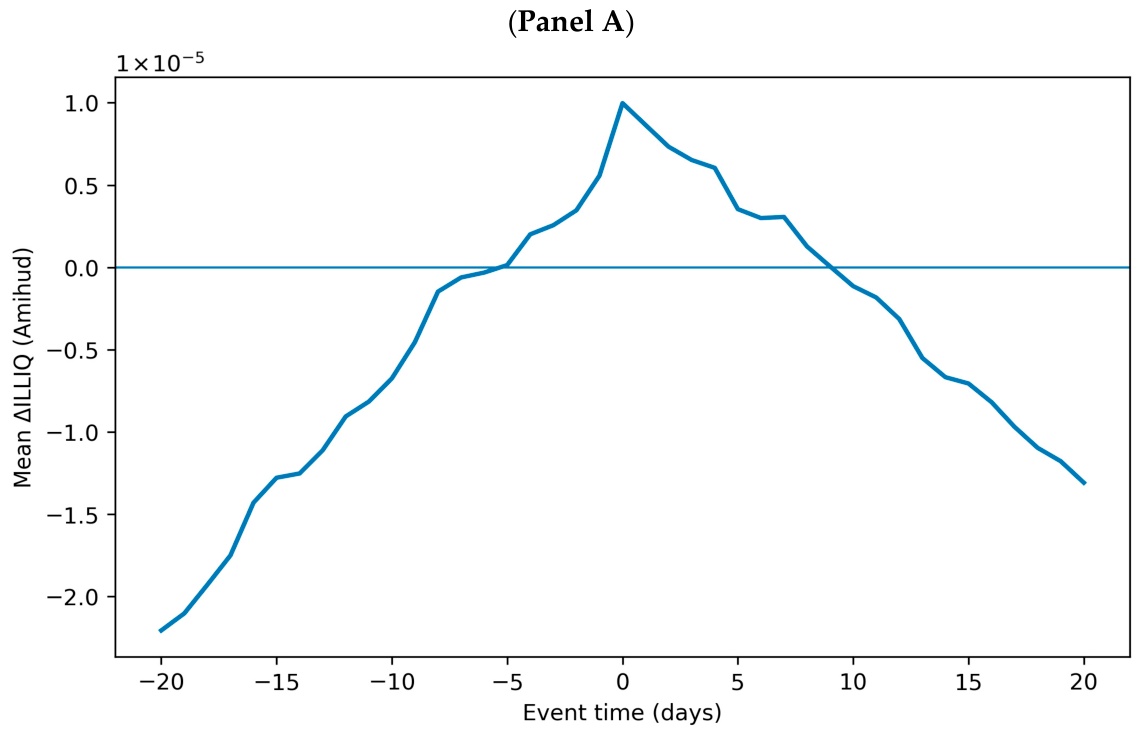
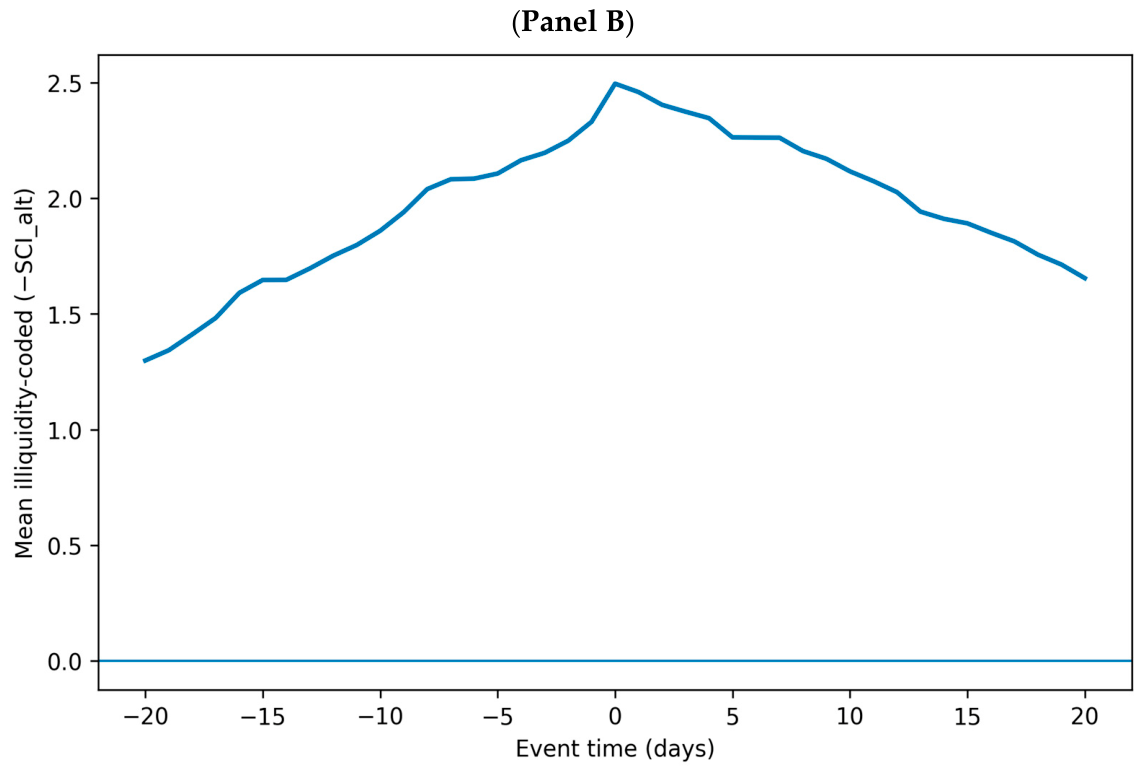
To verify that recovery dynamics are not specific to a single liquidity proxy, the event-time analysis is replicated using the alternative proxy SCI_alt provided in the dataset. Because SCI_alt is a liquidity-coded index (higher values correspond to more liquid conditions), it is converted to an illiquidity-coded measure by multiplying by −1 before baseline adjustment so that positive Δ values represent liquidity impairment, consistent with ΔILLIQ.
Table 12 reports recovery metrics for the baseline Amihud proxy and the illiquidity-coded −SCI_alt proxy, and
Figure 8 plots their mean event-time recovery profiles. To preserve interpretability, the two proxy series are presented in separate panels because their numerical scales differ substantially. Because the two liquidity proxies are measured on different numerical scales, the magnitude of half-life values is not directly comparable across proxies; interpretation therefore focuses on qualitative recovery patterns and persistence behaviour rather than absolute levels.
7.4. Alternative Recovery Definitions
The baseline analysis defines time-to-normalisation (TTN) using a persistence rule requiring three consecutive post-event trading days with baseline-adjusted illiquidity at or below zero. To assess sensitivity to this operational definition, two alternatives are considered: (i) a shorter two-day persistence rule (k = 2) and (ii) a percentile-based threshold, where recovery is declared when ΔILLIQ falls below the 25th percentile of the episode’s pre-stress Δ distribution for three consecutive days.
Table 13 reports the resulting TTN means and non-normalisation rates.
7.5. Sub-Sample Analysis: Crisis Versus Non-Crisis Periods
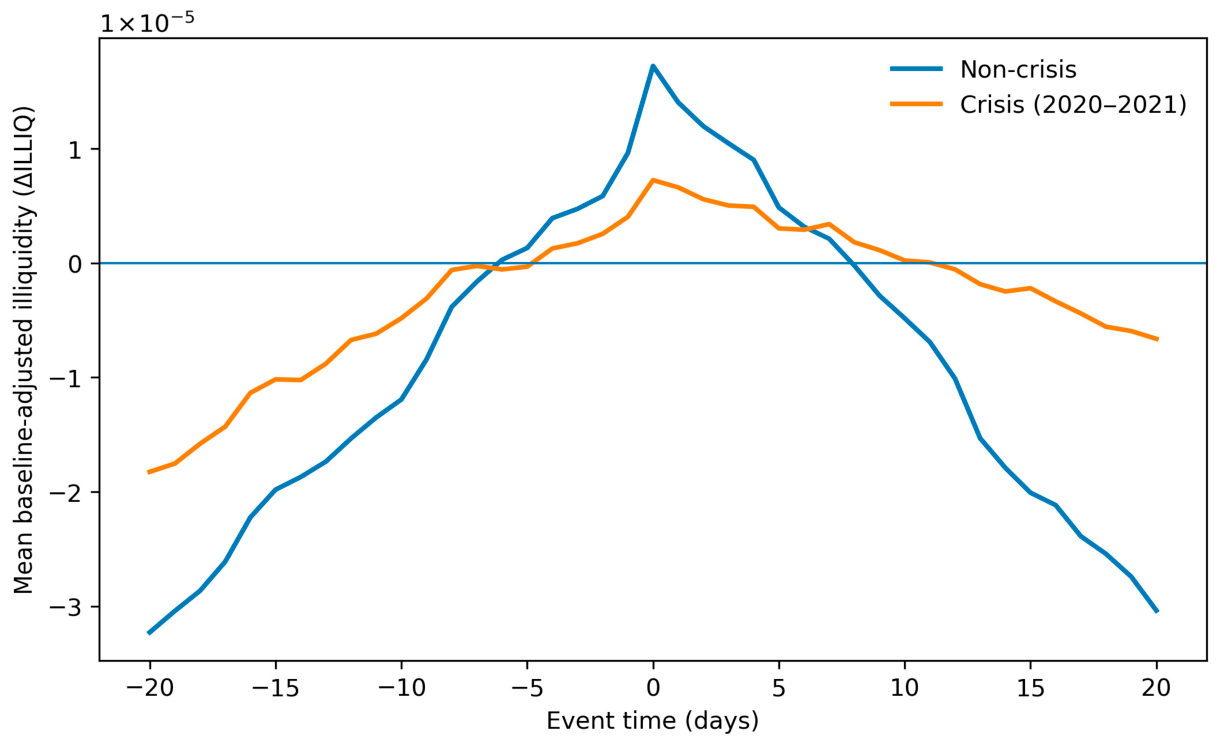
Finally, recovery dynamics are examined across regime conditions by splitting events into crisis (2020–2021) and non-crisis periods.
Table 14 reports recovery metrics by sub-sample, and
Figure 9 plots the corresponding mean event-time recovery profiles. The comparison separates differences in early-stage adjustment (half-life) from tail persistence (non-normalisation within +20 days). The crisis regime exhibits sharper initial corrections but greater tail persistence, consistent with episodic liquidity rebounds that remain fragile under elevated systemic uncertainty.
7.6. Isolated-Episode Robustness (Non-Overlapping Stress Windows)
The baseline framework is designed to study liquidity recovery following volatility-based stress shocks. However, recovery dynamics may be mechanically affected if multiple stress shocks occur for the same firm within the ±20 trading-day window, because overlapping event windows can contaminate measured recovery horizons. To address this concern, we restrict attention to an “isolated episode” sub-sample that excludes any firm–episode where the same firm experiences another stress event within ±20 trading days of the stress date.
Using this non-overlap rule, the isolated-episode sub-sample contains 64 episodes (out of 602). We then re-estimate the baseline recovery metrics (stress-day impairment, half-life, TTN, and the non-normalisation share) using the same definitions as in
Section 5.2.
Table 15 shows that the core qualitative interpretation is unchanged: liquidity deteriorates on the stress day and recovers thereafter. Importantly, the persistence measures remain meaningful even when overlapping event windows are removed, indicating that the baseline recovery patterns are not an artefact of clustered stress events within firms.
7.7. Censoring-Aware Robustness: Survival Model for Time-to-Normalisation (Ttn)
A key econometric consideration is that TTN is right-censored by construction for episodes that do not normalise within the horizon H = 20. In the baseline tables, mean TTN is computed conditional on normalising within +20 days, while the non-normalisation share is reported separately. To ensure that inference on recovery determinants is not sensitive to this conditionality, we estimate a censoring-aware survival model for TTN.
Equation (6) specifies a Cox proportional hazards model, where h(t | X_{i, s}) denotes the hazard of liquidity normalisation at event time t conditional on the episode-level covariates, and h_{0, sector}(t) denotes the sector-specific baseline hazard. The covariates Severe_{i, s}, HighVIX_s, and HighDown_s represent the severe-shock indicator, the high market fear regime indicator, and the high downside-risk regime indicator, respectively. An estimated hazard ratio greater than one implies faster normalisation, while a hazard ratio below one implies slower normalisation. Episodes that do not normalise within +20 trading days are treated as right-censored at t = 20.
The survival estimates corroborate the baseline conclusions while explicitly accounting for right-censoring in time-to-normalisation. The estimated hazard ratios indicate that the determinants of recovery do not affect all episodes uniformly, but the censoring-aware specification confirms that recovery speed remains systematically related to episode characteristics and market conditions. In particular, the results should be interpreted together with the descriptive evidence reported earlier in the manuscript rather than as standalone structural estimates. Overall, the survival analysis strengthens the conclusion that post-shock liquidity recovery is gradual and state-dependent even after accounting for episodes that do not normalise within the twenty-day window.
7.8. Alternative State Definitions: Median and Tercile Splits for India Vix and Semivar21
The baseline state definitions in
Section 6 use pre-defined indicators (HighVIX; HighDown/LowDown). Because the low-downside sub-sample is small in the baseline split, we assess robustness using alternative, more balanced regime definitions. Specifically, we (i) classify episodes into high/low regimes using a median split of the stress-day values, and (ii) use terciles and compare the top tercile (“High”) to the bottom tercile (“Low”). This checks whether state-dependent conclusions are sensitive to regime cut-offs.
Across these alternative regime definitions, the qualitative message remains consistent with the baseline: recovery horizons vary with market state, and the state dependence is not an artefact of a particular indicator cut-off. Importantly, the tercile definitions produce balanced group sizes, supporting more stable descriptive comparisons than the baseline low-downside split.
7.9. Summary of Robustness Results
The robustness analyses conducted in this section confirm that the principal findings of this study are not sensitive to alternative modelling choices, event definitions, or sample partitions.
First, alternative stress thresholds (
Table 10) demonstrate that the recovery patterns documented in the baseline specification persist under stricter definitions of volatility shocks. Although the number of detected stress episodes declines under higher thresholds, the qualitative recovery dynamics remain unchanged: liquidity deteriorates sharply on the stress day and subsequently recovers over the following trading days, while a meaningful fraction of episodes fails to normalise within the observation horizon.
Second, the use of alternative baseline windows (
Table 11) shows that the measurement of liquidity impairment and recovery speed is not materially affected by the choice of the pre-event reference period. Recovery half-life, time-to-normalisation, and the share of non-normalising episodes remain broadly consistent across baseline definitions, indicating that the empirical results are not driven by a particular benchmark window.
Third, robustness checks using an alternative liquidity proxy (
Table 12) confirm that the documented recovery dynamics are not specific to the Amihud illiquidity measure. When liquidity impairment is measured using an alternative proxy, the overall recovery trajectory and persistence patterns remain qualitatively similar.
Fourth, alternative definitions of time-to-normalisation (
Table 13) show that the conclusions are robust to changes in the persistence requirement used to identify recovery events. While the exact number of normalising episodes varies with the persistence rule, the overall pattern of gradual recovery and incomplete normalisation remains stable.
Fifth, the crisis–non-crisis comparison (
Table 14) indicates that liquidity recovery behaviour differs across market regimes but retains the same fundamental structure. Crisis periods exhibit sharper initial impairment but relatively faster early adjustments, while full normalisation may still require extended periods under elevated uncertainty.
Sixth, the isolated-episode robustness analysis (
Table 15) confirms that the baseline recovery patterns are not driven by overlapping stress windows within firms. Restricting the sample to episodes without another stress event within ±20 trading days yields qualitatively similar recovery metrics, indicating that clustered volatility events do not mechanically bias the observed recovery dynamics.
Seventh, the censoring-aware survival analysis (
Table 16) accounts explicitly for the right-censoring of time-to-normalisation at the twenty-day horizon. The survival estimates corroborate the baseline conclusions while explicitly accounting for right-censoring in time-to-normalisation, and they indicate that recovery speed is not uniform across episodes, with some dimensions of the surrounding risk environment remaining relevant for post-shock liquidity normalisation.
Finally, alternative regime definitions based on median and tercile splits of India VIX and Semivar21 (
Table 17) demonstrate that the state-dependent recovery patterns are not sensitive to the specific cut-off values used to define market conditions. Across these alternative classifications, liquidity recovery remains systematically linked to prevailing market risk environments.
Taken together, the extensive robustness analyses provide strong evidence that the empirical findings are stable across a wide range of methodological choices. The central conclusions of this study—namely that liquidity deteriorates sharply during volatility shocks, recovers gradually over time, and exhibits state-dependent dynamics—remain consistent under all robustness specifications. These robustness results strengthen confidence in the empirical framework and provide a reliable basis for interpreting the liquidity resilience patterns discussed in the following section. Accordingly, the evidence supports the conclusion that the manuscript’s recovery-time findings are not an artefact of a single threshold, proxy, or event definition, but reflect a stable empirical pattern of gradual and state-dependent liquidity normalisation after volatility shocks.
8. Discussion, Implications, Limitations, and Conclusions
8.1. Discussion
The empirical results show that liquidity recovery following volatility-based stress shocks in the NIFTY-50 equity market is gradual rather than immediate. Baseline-adjusted illiquidity rises sharply on the stress day and then declines over subsequent trading sessions, but full normalisation is not achieved quickly in many cases. The estimated recovery half-life is slightly above five trading days, while the mean time-to-normalisation among episodes that recover within the event window is approximately one trading week. Importantly, nearly one-third of stress episodes do not return to their pre-stress liquidity baseline within twenty trading days. These findings indicate that volatility shocks generate liquidity disruptions whose effects persist beyond the initial disturbance.
The event-time recovery profiles reinforce this interpretation. Although volatility stabilisation may occur relatively quickly, liquidity restoration often remains incomplete for a meaningful share of episodes. This distinction is economically important because volatility measures capture the intensity of market stress at a given point in time, whereas recovery metrics capture the duration over which trading frictions continue to affect execution conditions. The results, therefore, suggest that market stress should be evaluated not only by the magnitude of the initial shock but also by the persistence of post-shock illiquidity.
The heterogeneity analysis further shows that liquidity recovery is state-dependent rather than uniform across episodes. Differences across severity categories, market-wide fear conditions, downside-risk regimes, and sectors indicate that recovery dynamics depend both on the characteristics of the shock and on the broader environment in which the shock occurs. The robustness analyses strengthen this interpretation by showing that the qualitative recovery pattern remains stable across alternative thresholds, baseline windows, liquidity proxies, recovery definitions, and sample partitions.
8.2. Theoretical Implications
This study contributes to the literature on financial market liquidity and resilience by shifting attention from contemporaneous stress effects to the temporal structure of post-shock adjustment. Much of the existing literature documents that liquidity deteriorates during volatile periods, but less attention has been devoted to how long impaired trading conditions persist after the initial shock. By introducing recovery half-life and time-to-normalisation within an event-time framework, the present study provides an operational way to evaluate liquidity resilience as a duration-based process rather than as a static market condition.
This perspective also refines the interpretation of market resilience. A market may absorb a shock without experiencing a structural breakdown, yet still require considerable time for trading conditions to return to normal. In this sense, resilience depends not only on whether stress can be absorbed but also on the speed and completeness of subsequent liquidity recovery. The results, therefore, add a temporal dimension to the study of market functioning in volatile environments.
8.3. Practical Implications
The findings have practical relevance for market participants as well as regulatory institutions. For portfolio managers and institutional traders, the evidence suggests that liquidity disruptions may remain economically meaningful for several trading sessions after volatility shocks occur. Execution strategies that assume rapid restoration of normal market depth may therefore underestimate the persistence of transaction costs and price impact. Incorporating recovery-oriented measures such as half-life and time-to-normalisation into trading and liquidity-risk frameworks may improve execution planning during turbulent periods.
For exchanges and regulators, the results highlight the importance of monitoring the recovery phase after stress events rather than focusing exclusively on the initial volatility spike. Traditional surveillance mechanisms often concentrate on the onset of stress through indicators such as volatility surges or trading interruptions. However, the persistence of abnormal illiquidity documented in this study suggests that post-shock liquidity normalisation provides an additional and practically relevant signal of whether orderly market functioning has genuinely been restored.
8.4. Research Limitations
This study should be interpreted in light of several limitations. First, the analysis focuses on large-capitalisation firms in a single emerging equity market, and recovery dynamics may differ for smaller firms, less liquid securities, or markets with different institutional structures. Second, the use of daily data is suitable for measuring medium-term post-shock adjustment, but does not capture the finer intraday evolution of liquidity recovery. Third, although robustness checks using alternative proxies and definitions support the stability of the core findings, liquidity remains a multidimensional concept and cannot be fully represented by any single indicator. Future research may therefore extend the framework to higher-frequency data, broader firm samples, and comparative cross-market settings.
8.5. Conclusions
In conclusion, this study advances the empirical understanding of liquidity resilience by focusing on the duration and persistence of post-shock liquidity recovery in an emerging equity market. The evidence shows that liquidity adjustment after volatility shocks is gradual, heterogeneous, and shaped by both shock severity and prevailing market conditions. By formalising recovery half-life and time-to-normalisation within a transparent event-time framework, this study provides practical metrics for evaluating how quickly trading conditions return to normal after stress episodes. More broadly, the findings show that the economic significance of volatility shocks lies not only in the immediate deterioration of liquidity but also in the length of time for which abnormal trading frictions remain in place. Monitoring liquidity recovery horizons can therefore improve the assessment of market resilience, portfolio execution conditions, and post-shock market surveillance.