1. Introduction
Cryptocurrency perpetual futures have become the dominant derivatives instrument in digital asset markets, with daily trading volumes routinely exceeding those of the underlying spot markets (
Makarov & Schoar, 2020). Unlike traditional futures, perpetual contracts have no expiry date and are anchored to spot through a periodic funding rate mechanism: when the perpetual trades above spot, longs pay shorts, and vice versa. These rates, set independently by each exchange, encode information about market sentiment, leverage demand, and cross-venue price efficiency. A companion study (
Zhivkov, 2026), which analyzes the same market using a static eight-day snapshot and is published alongside this work, provided the first comprehensive analysis of funding rate dynamics across centralized (CEX) and decentralized (DEX) exchanges, documenting a two-tiered structure in which CEX venues are tightly integrated while DEX venues remain fragmented, with CEX platforms leading price discovery.
The practical relevance of understanding how these dynamics evolve over time extends well beyond academic interest. Regulatory bodies and risk managers increasingly rely on estimates of market integration and price leadership to calibrate surveillance frameworks, set margining requirements, and assess systemic exposure; if those parameters shift substantially over a two-month horizon, a framework calibrated to a historical snapshot may systematically mischaracterize current market conditions (
ESRB, 2025). Concerns about the adequacy of existing monitoring infrastructure are not hypothetical: the Bank for International Settlements has noted that financial authorities face serious challenges in monitoring cryptoasset markets and assessing the associated financial stability risks, partly due to persistent data and coverage gaps (
BIS, 2023). Documenting the extent and character of temporal variation in market integration is therefore a prerequisite for designing more reliable surveillance and risk management frameworks in cryptocurrency derivatives markets.
We address five questions: does the CEX–DEX integration gap persist over a two-month horizon? Does it evolve through discrete structural breaks (
Bai & Perron, 1998,
2003) or gradual drift? Do intraday and day-of-week patterns exist in funding rate spreads (
Caporale & Plastun, 2019)? Is the near-IGARCH volatility (
Bollerslev, 1986;
Engle, 1982) from the companion study a stable property or a short-sample artifact? Does Granger causality (
Granger, 1969) between exchanges change over time?
These questions motivate four formal hypotheses.
H1. The two-tiered integration structure, with CEX-CEX correlations exceeding DEX-DEX correlations, persists qualitatively over the two-month sample, though its magnitude may vary.
H2. The integration gap evolves through gradual drift rather than discrete structural breaks.
H3. Intraday and day-of-week patterns in funding rate spreads are statistically significant and linked to the settlement mechanism.
H4. Granger causality between exchanges is not determined solely by exchange size. Each hypothesis is examined in Section 4 using the methods described in Section 3. We analyze 9.1 million hourly funding rate observations across 26 exchanges and 812 symbols over 14 November 2025 through 13 January 2026. Using 53 overlapping seven-day rolling windows, we track the evolution of cross-exchange correlations, arbitrage prevalence, GARCH volatility persistence, and Granger causality. We complement this with Bai–Perron structural break detection (
Bai & Perron, 1998,
2003), CUSUM stability tests (
Brown et al., 1975), and seasonal decomposition of intraday and day-of-week spread patterns.
The study makes five contributions. First, we provide the first temporal analysis of multi-venue funding rate dynamics: the two-tiered structure persists qualitatively but the integration gap ranges from
to
, evolving through gradual drift rather than discrete regime shifts. Second, we resolve the IGARCH puzzle (
Bollerslev, 1986;
Engle, 1982) from the companion study, showing that near-unit GARCH persistence is episodic (24.5% of windows) rather than a fundamental property. Third, we show that Granger causality (
Granger, 1969) does not follow exchange size: mid-tier CEXs lead Binance more frequently than the reverse. Fourth, we identify statistically significant intraday spread patterns linked to the settlement mechanism (
Aharon & Qadan, 2019;
Caporale & Plastun, 2019). Fifth, we report a window-width sensitivity analysis suggesting that the qualitative conclusions tend to hold across five-day, seven-day, and ten-day rolling windows, which may increase confidence in the robustness of the findings.
The remainder of this paper is organized as follows.
Section 2 reviews related work on time-varying integration, structural breaks, and calendar effects.
Section 3 describes the data, rolling-window framework, and econometric methods.
Section 4 presents results across seven subsections.
Section 5 discusses implications and limitations.
Section 6 concludes.
4. Results
4.1. Dataset Overview
The extended dataset spans 60 usable days and yields 9.1 million hourly observations after aggregation.
Table 1 in
Section 3.1 summarizes the key characteristics. The spread distribution across 994,088 symbol–hour pairs (after the 5000 bps outlier cap) has a mean of 15.3 bps and median of 7.5 bps, with 18.7% of observations exceeding the 20 bps high-arbitrage threshold. CEX–CEX pairings dominate the spread observations (68.8%), followed by CEX–DEX (27.1%) and DEX–DEX (4.0%), reflecting the larger number of centralized exchanges in the sample.
4.2. Rolling-Window Integration Evolution
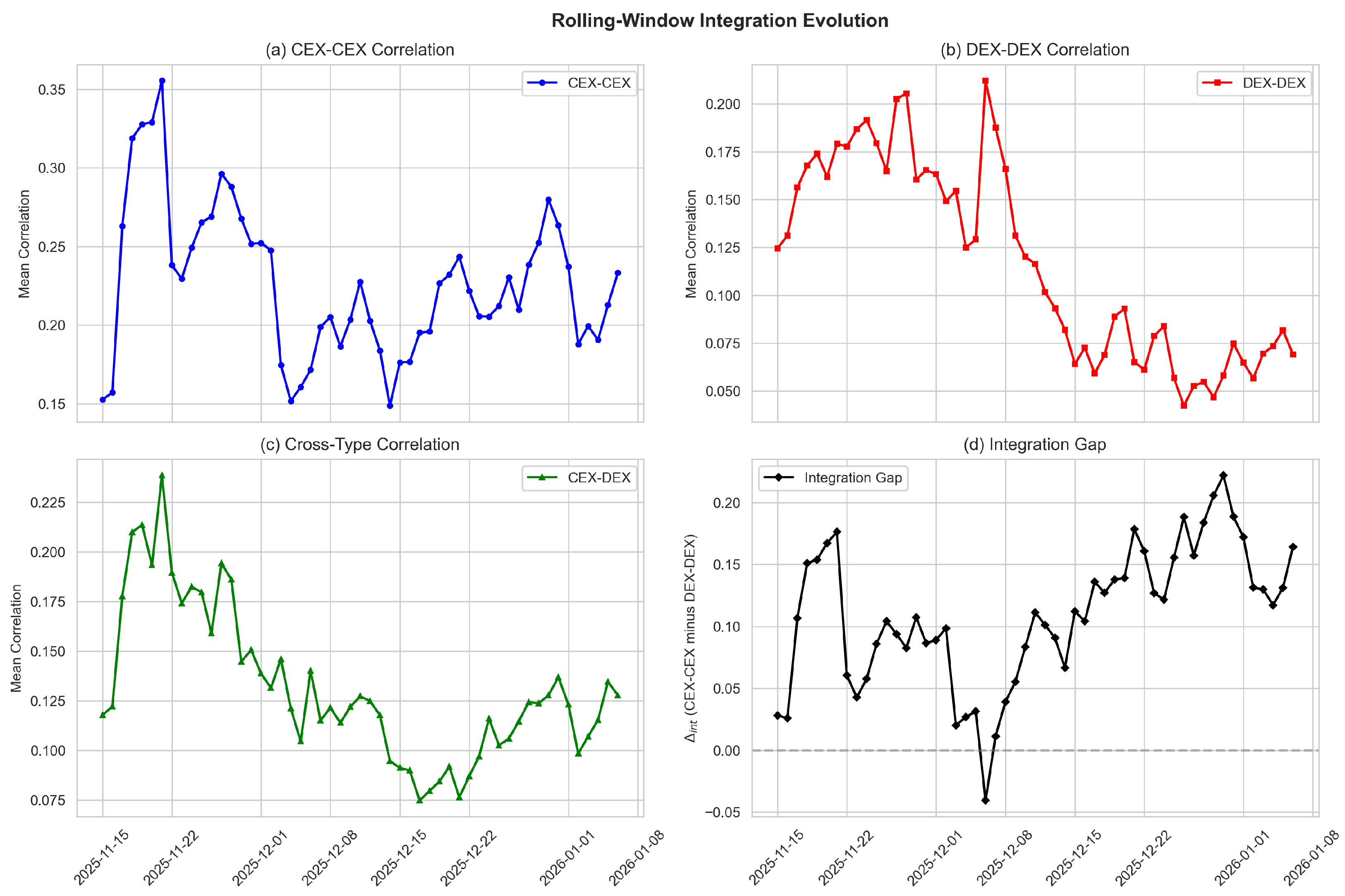
The rolling-window analysis across 53 overlapping seven-day windows reveals that the two-tiered market structure persists throughout the two-month sample, but with substantial temporal variation. The integration gap is positive in 52 of 53 windows, with a mean of 0.110, a standard deviation of 0.056, and a range from to .
CEX–CEX correlations average 0.226 across windows, approximately twice the level of DEX–DEX correlations (mean 0.117) and substantially above CEX–DEX correlations (mean 0.132).
Figure 1 tracks these three correlation series and the integration gap over time. The CEX–CEX correlation is consistently the highest of the three, though its level fluctuates considerably, from 0.149 in window 29 (14–20 December) to 0.355 in window 6 (21–27 November). DEX–DEX and CEX–DEX correlations follow broadly similar trajectories but at lower levels.
The single reversal occurs in window 21 (6–12 December), when the DEX–DEX correlation (0.212) briefly exceeds the CEX–CEX correlation (0.172), producing the only negative integration gap (). This reversal is short-lived: the gap returns to positive territory in the following window and remains there for the rest of the sample.
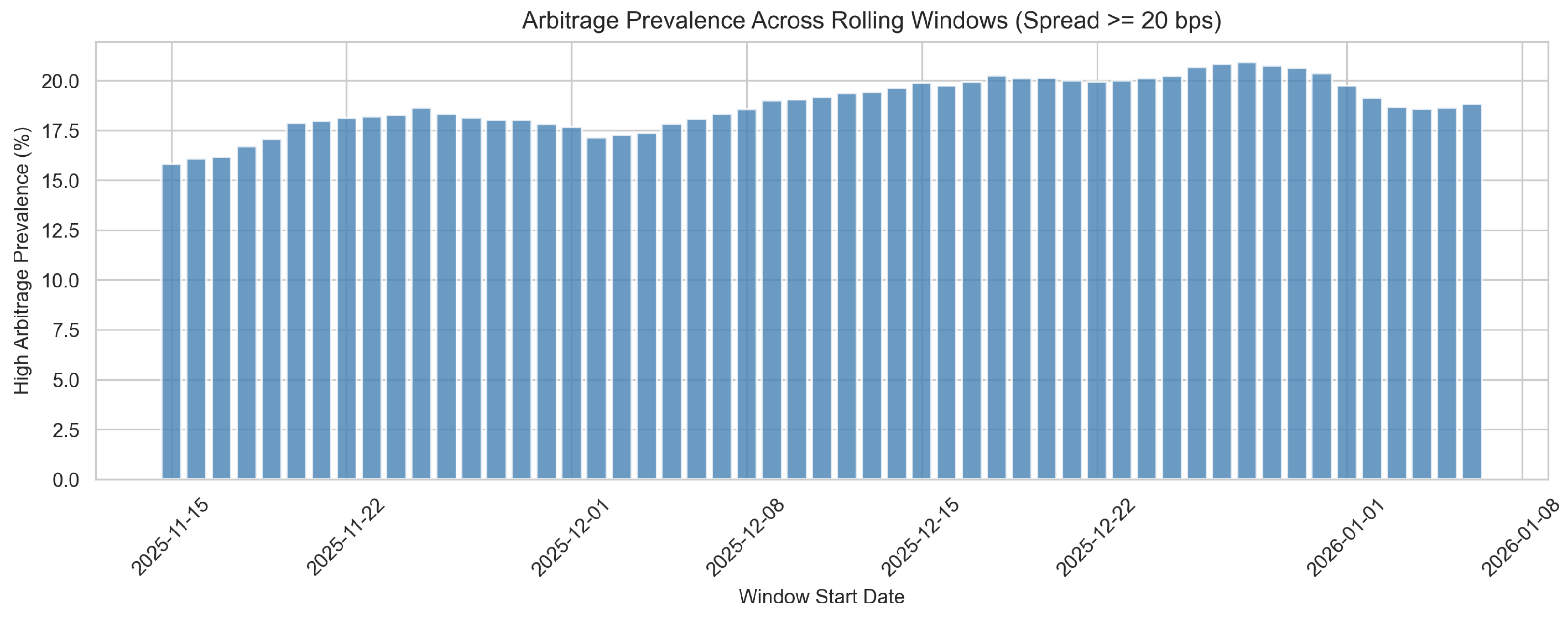
Two temporal trends are visible. First, the integration gap widens over the sample period, from an average of 0.069 across the first 17 windows (mid-November through early December) to 0.143 across the last 17 windows (late December through mid-January). This widening is driven primarily by declining DEX–DEX correlations rather than increasing CEX–CEX correlations, suggesting that decentralized venues became less synchronized with each other over the sample period. Across the first 17 windows, the mean CEX–CEX correlation is 0.265 and the mean DEX–DEX correlation is 0.170; across the last 17 windows, the mean CEX–CEX correlation falls modestly to 0.225 while the mean DEX–DEX correlation declines more sharply to 0.064. The gap therefore widens from 0.095 to 0.161, with the DEX–DEX decline accounting for the larger share of the change. Second, arbitrage prevalence exhibits a parallel upward trend, rising from 16–17% in November to 19–21% in late December and early January (
Figure 2). The concurrent widening of the integration gap and increase in arbitrage prevalence is consistent with growing market fragmentation, particularly among decentralized venues.
Mean spreads are relatively stable across windows, averaging 15.4 bps with a standard deviation of 0.7 bps across the 53 windows, indicating that the level of cross-exchange price differences remains consistent even as the correlation structure evolves.
Table 2 summarizes the key rolling-window statistics.
4.3. Structural Break Results
The structural break analysis produces a clear but qualified result: is not stationary over the sample, yet it evolves gradually rather than through discrete regime shifts.
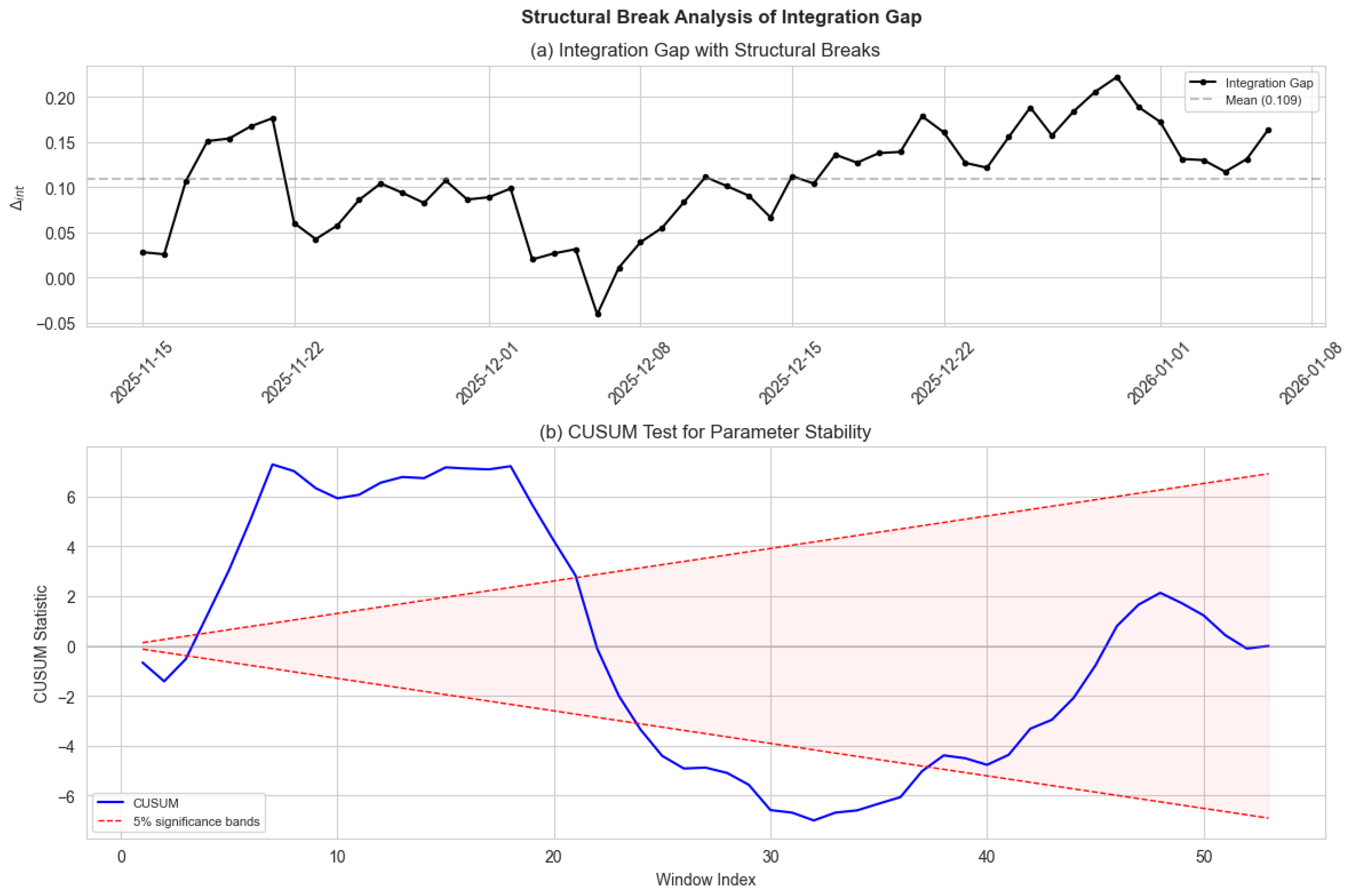
The CUSUM test rejects the null hypothesis of parameter stability at the 5% significance level (maximum CUSUM statistic 7.27, critical value 6.90).
Figure 3 shows the CUSUM path crossing the significance band early in the sample and remaining outside it, indicating a persistent departure from the initial mean level rather than a localized structural break. The trajectory of the CUSUM is consistent with the upward trend in the integration gap documented in
Section 4.2.
The Bai–Perron multiple structural change test, implemented via the Pelt algorithm, detects zero statistically significant breaks across all penalty levels tested (). This result does not contradict the CUSUM finding; rather, it indicates that the integration gap evolves smoothly enough that no single date constitutes a statistically significant discontinuity. The absence of discrete breaks is itself informative: it rules out the hypothesis that market integration shifts abruptly in response to isolated events such as exchange listings, regulatory announcements, or liquidity crises.
When the BinSeg algorithm is constrained to identify exactly two breaks, the estimated dates are window 15 (30 November) and window 30 (15 December), dividing the sample into approximate thirds. The mean integration gap in the three resulting sub-periods is 0.096 (15 November through 30 November), 0.058 (1 December through 15 December), and 0.152 (16 December through 12 January). The middle period coincides with the brief convergence episode visible in
Figure 1, during which DEX–DEX correlations temporarily rose, while the final period captures the sustained widening of the two-tiered gap.
Gradual drift, not regime switching, is the better characterization of funding rate market structure. The two-tiered hierarchy contracts and expands over time; it does not transition abruptly.
4.4. Seasonal Patterns
Both hour-of-day and day-of-week effects are statistically significant in funding rate spreads, though the economic magnitudes are modest.
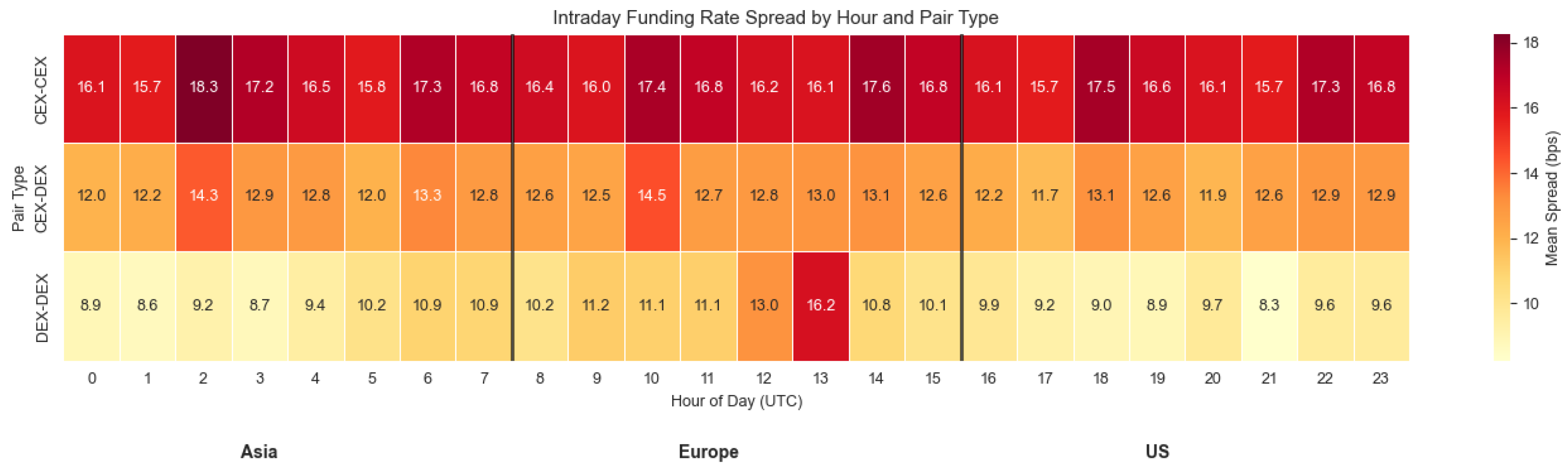
The hour-of-day analysis reveals a systematic pattern linked to funding rate settlement times. An F-test for equality of hourly mean spreads rejects the null decisively (, ). The peak spread occurs at 02:00 UTC (16.85 bps mean, 21.4% arbitrage prevalence) during the Asian trading session, while the trough occurs at 17:00 UTC (14.35 bps, 16.5% arbitrage prevalence) during the early North American session. The spread between peak and trough hours is approximately 2.5 bps, or 17% of the trough value.
Mapping hourly coefficients to settlement schedules reveals a pattern worth noting. Exchanges with 8 h settlement intervals typically process payments at 00:00, 08:00, and 16:00 UTC. Spreads spike approximately two hours after each settlement time (at 02:00, 10:00, and 18:00 UTC), consistent with rates diverging immediately after payments are processed and before the market converges to a new equilibrium.
Figure 4 displays this pattern decomposed by exchange pair type, showing that the settlement-driven pattern is most pronounced for CEX–DEX pairings.
Day-of-week effects are also statistically significant (
,
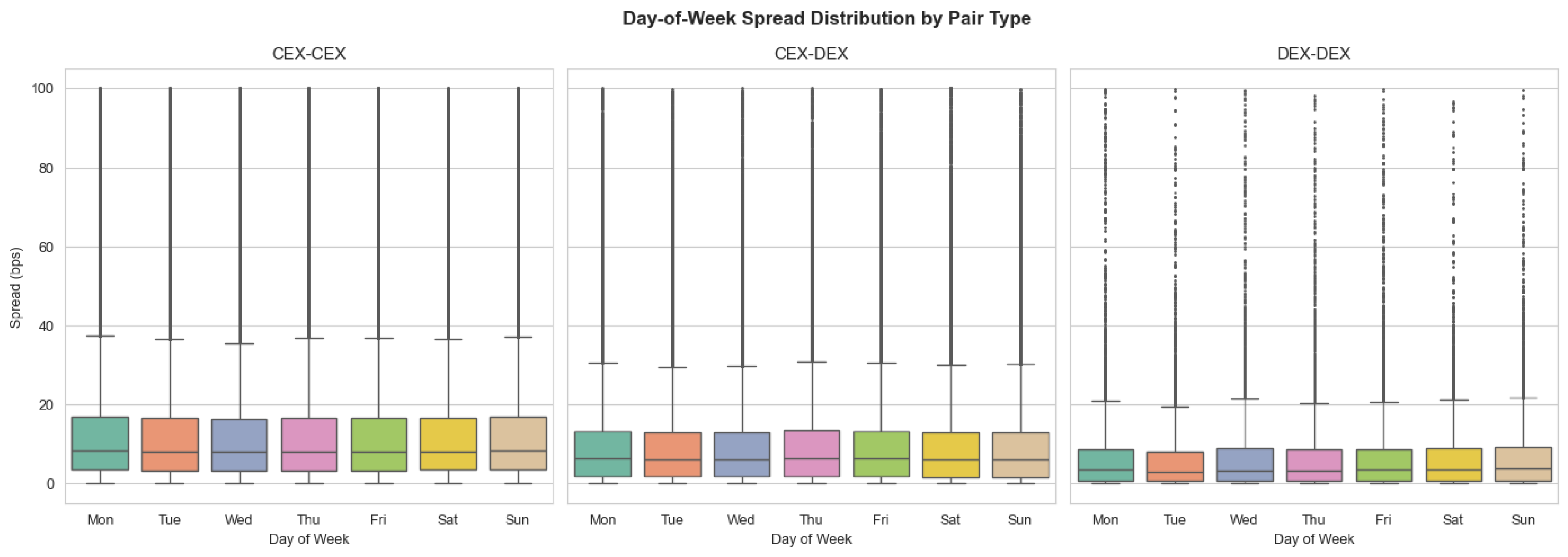
), though economically smaller. Friday exhibits the highest mean spread (15.78 bps) and Tuesday the lowest (14.73 bps), a difference of approximately 1 bps. The pattern does not show a clear weekday-versus-weekend divide, consistent with the continuous operation of cryptocurrency markets.
Figure 5 shows the spread distribution by day of week and pair type.
Across the three trading sessions, mean spreads are similar: Asia 15.35 bps, Europe 15.47 bps, and North America 15.10 bps. The absence of large session-level differences indicates that arbitrage opportunities do not systematically concentrate in a single global trading session, despite the significant within-session hourly variation driven by settlement times.
4.5. Window Width Sensitivity
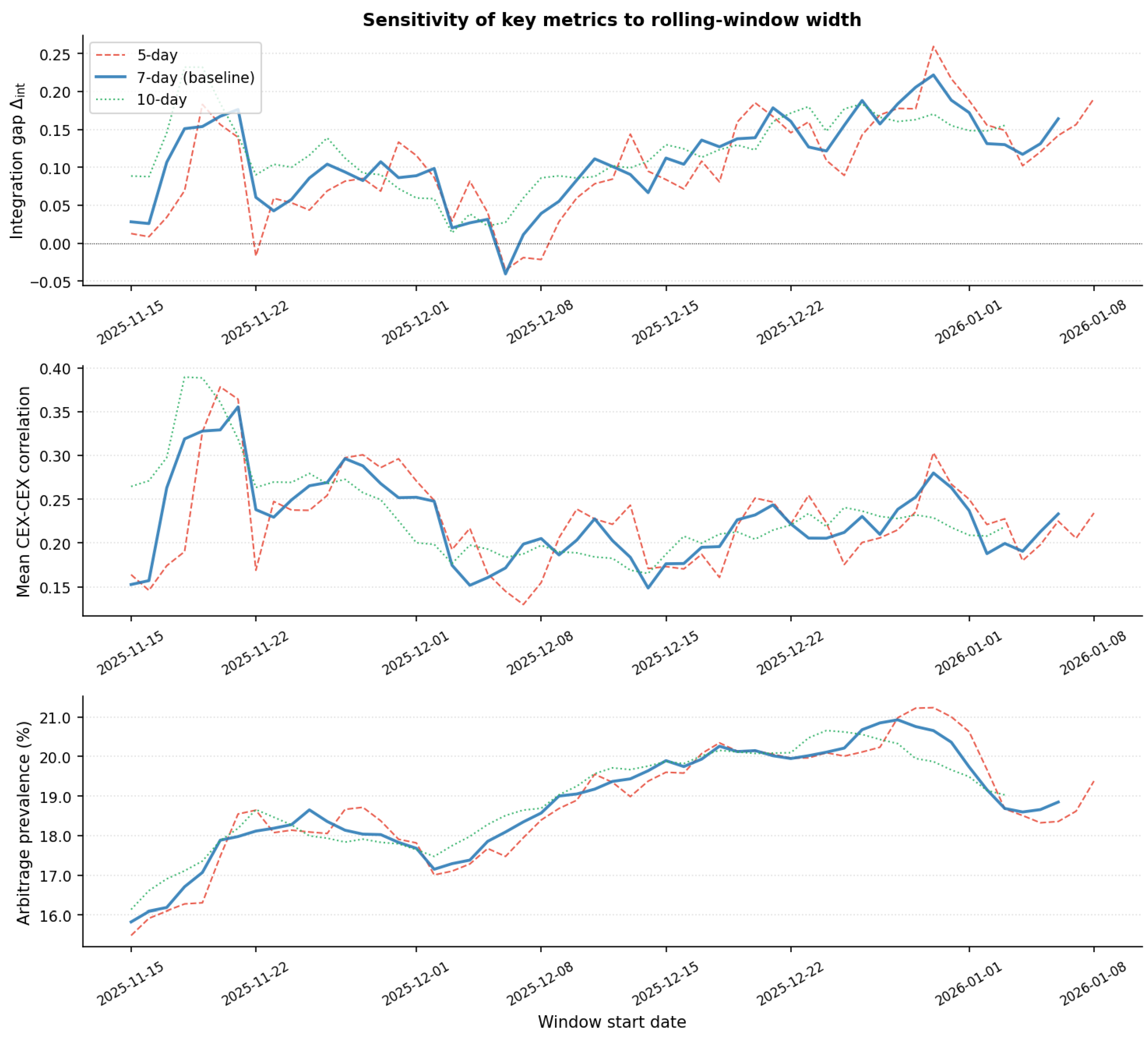
A natural concern with rolling-window analysis is that the results may depend on the specific window width chosen. To assess whether the key findings are sensitive to this choice, we repeated the correlation and arbitrage-prevalence analysis for five-day and ten-day windows alongside the seven-day baseline. Across all three widths the mean integration gap varies by less than 0.02 (0.103 for five days, 0.109 for seven days, 0.120 for ten days), and mean arbitrage prevalence is almost unchanged (18.8%, 18.8%, and 18.9%, respectively). As might be expected, wider windows smooth idiosyncratic fluctuations: the standard deviation of the integration gap falls from 0.065 at five days to 0.049 at ten days. The qualitative pattern of a positive, time-varying integration gap that evolves gradually rather than through discrete breaks appears broadly consistent across all three window widths examined, which may increase confidence that the seven-day baseline is not driving the conclusions (
Figure 6).
4.6. GARCH Persistence and Stationarity
The GARCH(1,1) analysis across rolling windows resolves an ambiguity from the companion study, which found integrated GARCH (IGARCH) behavior (
) for BTC over its eight-day sample.
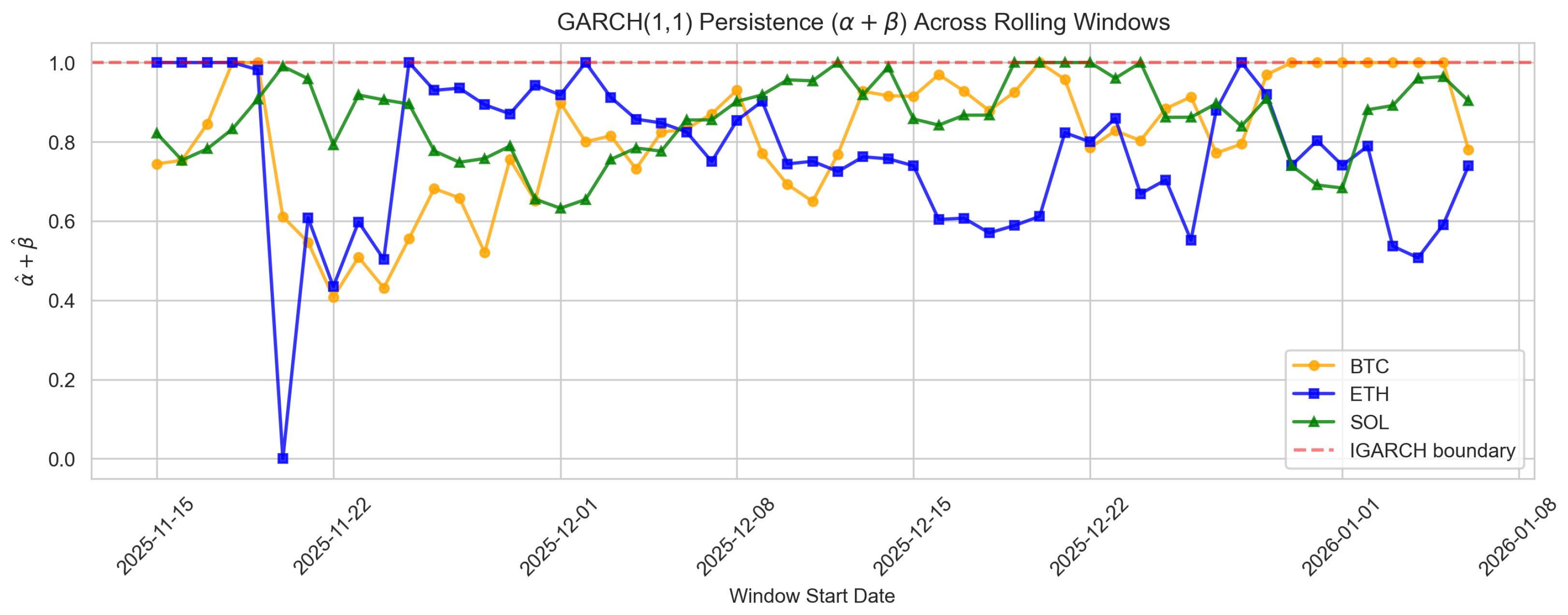
Figure 7 plots the persistence parameter
for BTC, ETH, and SOL across all 53 windows.
For BTC, the mean persistence across windows is 0.815 with a standard deviation of 0.160, substantially below the IGARCH threshold of 1.0. Near-IGARCH behavior () appears in only 13 of 53 windows (24.5%), and these cluster in two distinct periods: late November (windows 3–4, covering 18–25 November) and late December through early January (windows 44–51, covering 29 December through 11 January). Between these clusters, persistence ranges from 0.407 to 0.930, well below unity. This pattern indicates that the IGARCH finding in the companion study reflected transient market conditions rather than a fundamental property of funding rate volatility. The two IGARCH-prone periods may correspond to episodes of elevated market uncertainty, during which volatility shocks propagate more persistently across the funding rate surface.
ETH and SOL exhibit even greater variability in GARCH persistence. ETH persistence ranges from near zero (in windows where the optimizer concentrates all persistence in the term) to 1.0, with a mean of approximately 0.77. SOL persistence is more consistent, averaging approximately 0.86, but still shows substantial window-to-window fluctuation. The lower and more variable persistence of ETH may reflect the more heterogeneous composition of Ethereum-based perpetual futures, which span a wider range of trading venues and liquidity profiles than BTC.
Stationarity analysis via ADF tests provides complementary evidence. BTC funding rate spreads are stationary at the 5% level in 52 of 53 windows, with only one borderline exception (window 36, 21–27 December, ). This consistent rejection of the unit root null confirms that BTC spreads are mean-reverting across virtually all market conditions in the sample. ETH shows more variability: approximately seven windows concentrated in late November through early December fail to reject the unit root null at 5%, suggesting episodes of persistent trending behavior in ETH funding rate dynamics. SOL is stationary in all but two windows. BTC stationarity is, in this sense, more durable than its GARCH persistence: the mean-reverting property of spreads holds consistently even across windows where the speed of volatility shock decay fluctuates considerably.
4.7. Granger Causality Evolution
Table 3 presents the fraction of rolling windows in which bivariate Granger causality tests are significant at the 5% level, estimated with a maximum lag of six hours (one complete funding cycle for hourly data). The results challenge the straightforward “large CEX leads all” narrative.
Among CEX–CEX pairs, information flow is strongly asymmetric, but in a direction opposite to what exchange size alone would predict. Bybit Granger-causes Binance funding rates in 62% of windows, while the reverse direction is significant in only 21%. Similarly, OKX Granger-causes Binance in 55% of windows, compared to 25% in the reverse direction. The smaller CEX–CEX pair (KuCoin–MEXC) shows a more balanced pattern (34% versus 26%), consistent with similarly-sized exchanges exhibiting roughly symmetric information flow.
For the CEX–DEX pair (Binance–Hyperliquid), the DEX-to-CEX direction is twice as prevalent: Hyperliquid Granger-causes Binance in 25% of windows, while the reverse is significant in only 13%. This suggests that the decentralized venue, despite lower volume, contains incremental information about funding rate dynamics that is subsequently reflected in Binance’s rates. The DEX–DEX pair (Drift–Hyperliquid) exhibits roughly symmetric causality (36% versus 30%), consistent with neither venue systematically leading the other.
These patterns suggest that information discovery in perpetual futures funding rates does not follow a simple hierarchy in which the largest exchange leads. Concretely, if price discovery were determined by size alone, we would expect Binance, as the largest venue by volume, to Granger-cause other exchanges in the majority of windows. The data show the opposite: Bybit leads Binance in 62% of windows versus 21% in the reverse direction, and OKX leads Binance in 55% of windows versus 25% in the reverse direction. A size-based model has no ready explanation for this asymmetry. Instead, mid-tier centralized exchanges and even decentralized venues contain information that propagates to larger platforms. One explanation is compositional: exchanges that attract more speculative or informed trading may set rates that are subsequently reflected at higher-volume venues, even when those venues dominate aggregate trading activity. The BYBIT → BINANCE relationship is significant in a majority of windows throughout the sample; that consistency distinguishes it from a transient episode and suggests something more durable about how funding rates propagate across venues. Throughout, the term “Granger-causes” denotes statistical predictive precedence: lagged values of the first exchange’s rate improve forecasts of the second’s, conditional on its own history, with no claim of structural or economic causation.
5. Discussion
This study tested whether the two-tiered market structure documented in the companion study is a stable feature of cryptocurrency perpetual futures or an artifact of a short observation window. The results point to two main findings with direct implications for market participants, regulators, and researchers who study market microstructure from static snapshots.
5.1. Main Findings
The first main finding is that the CEX–DEX integration hierarchy is real but not fixed. The integration gap
is positive in 52 of 53 windows, confirming the qualitative two-tiered structure, but its magnitude varies by more than a factor of five: from
to
. Specific windows illustrate the practical stakes. In window 21 (6–12 December), DEX–DEX correlations (0.212) exceeded CEX–CEX correlations (0.172); a researcher sampling the market that week would have concluded that decentralized exchanges are more integrated than centralized ones. Three weeks later, in window 45 (30 December through 5 January), the gap reached 0.222. The same market, sampled three weeks apart, yields qualitatively opposite conclusions. Any regulatory assessment of market fragmentation, any risk model conditioning on a static integration parameter, or any arbitrage strategy calibrated to a fixed correlation regime will be unreliable if it ignores this temporal dimension. The eight-day estimate reported in (
Zhivkov, 2026) fell within the first few windows of our sample, where the gap was low (0.03–0.07); had that study been conducted in late December, its headline conclusions about the magnitude of CEX–DEX divergence would have been three to four times larger. The economic interpretation of this finding is twofold. For arbitrageurs, a hierarchy that is real but variable implies that strategies calibrated to a fixed spread regime may be well-suited to some periods and poorly suited to others; position sizing and threshold selection should ideally incorporate estimates of current integration rather than relying on historical averages. For regulators and risk managers, it implies that a surveillance framework conditioned on a static characterization of CEX–DEX fragmentation may periodically underestimate or overestimate the degree to which price dislocations can propagate across venue types, depending on where in the integration cycle the market currently sits.
The structural break analysis sharpens this interpretation. The CUSUM test rejects parameter stability, confirming that the gap is not stationary, but the Bai–Perron test detects zero significant discrete breaks at any penalty level. The market does not alternate between regimes of integration and fragmentation in the manner suggested by Markov-switching models (
Hamilton, 1989). Instead, it drifts gradually, driven primarily by declining DEX–DEX correlations over the sample period. The widening from a mean of 0.069 in November to 0.143 in late December through January may reflect growing liquidity fragmentation among decentralized venues, though distinguishing this from seasonal effects would require a longer sample.
The second main finding resolves the IGARCH puzzle from the companion study. That study reported GARCH(1,1) persistence near unity () for BTC funding rate spreads, implying that volatility shocks are permanent and that spread variance grows without bound. If true, this would fundamentally undermine the viability of funding rate arbitrage, since permanent volatility means spread convergence cannot be relied upon. Our extended analysis shows that this characterization is episodic, not general. The mean BTC persistence across 53 windows is 0.815 with a standard deviation of 0.160. Near-IGARCH behavior () appears in only 13 windows (24.5%), concentrated in two clusters: late November (windows 3–4) and late December through early January (windows 44–51). In the remaining 75% of windows, persistence ranges from 0.407 to 0.930, well below the threshold at which volatility shocks become permanent. For practitioners, the implication is concrete: risk models and position-sizing algorithms that assume permanent volatility will systematically overestimate spread risk during three-quarters of market conditions. The episodic clustering suggests that near-IGARCH behavior is associated with specific market conditions, likely elevated uncertainty or reduced liquidity, rather than being an inherent property of funding rate dynamics.
5.2. Additional Results
The Granger causality results challenge a simplistic price-discovery hierarchy. The companion study found that CEX platforms lead DEX platforms in a static sense, which might suggest that the largest exchange (Binance) sets funding rates that other venues follow. The rolling-window analysis complicates that picture: Bybit Granger-causes Binance in 62% of windows and OKX does so in 55%, while the reverse directions are significant far less frequently (21% and 25%, respectively). This asymmetry is consistent with the hypothesis advanced by Makarov and Schoar (
Makarov & Schoar, 2020) that smaller venues with more concentrated informed trading can lead price discovery, even when they represent a smaller share of aggregate volume. In the perpetual futures context, this may reflect differences in the composition of speculative positioning across platforms: exchanges that attract directional traders may generate funding rate signals that are subsequently reflected at higher-volume venues where hedging activity dominates. The BYBIT → BINANCE relationship holds across a majority of windows throughout the sample, which argues against treating it as a transient episode. This interpretation is speculative; the Granger tests establish predictive precedence only, and the underlying mechanism warrants investigation with structural identification.
The seasonal analysis reveals statistically significant but economically modest intraday patterns linked to the funding rate settlement process. The 2.5 bps spread between peak and trough hours, and the systematic post-settlement spikes at 02:00, 10:00, and 18:00 UTC, are consistent with a brief divergence window after each settlement in which exchanges have not yet converged on a new rate equilibrium. The magnitude is small relative to transaction costs on most platforms, suggesting that these patterns are unlikely to support profitable trading strategies in isolation. The absence of a strong weekend effect is consistent with the continuous operation of cryptocurrency markets and distinguishes funding rate dynamics from the calendar anomalies documented in equity markets.
5.3. Limitations and Future Research
Several limitations constrain the interpretation of these results. First, the two-month sample period, while substantially longer than the companion study’s eight days, remains short by the standards of financial econometrics. The trends we identify, particularly the widening integration gap, could reflect transient conditions specific to the November 2025 through January 2026 period rather than durable structural features. Extending the sample to six months or longer would clarify whether the observed widening represents a genuine trend toward greater DEX fragmentation or a temporary fluctuation. Cryptocurrency markets are highly regime-dependent; the November 2025–January 2026 window spans a specific phase of market conditions that may not be representative of other periods, and generalization of the quantitative findings should be approached with caution until confirmed on a longer panel. Second, our rolling-window framework uses a fixed seven-day window width.
Section 4.5 reports a sensitivity analysis with five-day and ten-day windows; the key metrics appear broadly stable across the three widths, though wider windows naturally smooth some of the short-run variation visible in the baseline. Third, the Granger causality tests are bivariate and do not control for information flow through third-party exchanges. A multivariate VAR approach encompassing all 26 exchanges simultaneously would provide a more complete map of the information network, but was computationally prohibitive given the number of exchange pairs and rolling windows. Future work should explore sparse VAR or network-based methods that can scale to this dimensionality. Finally, the seasonal analysis uses simple
F-tests and does not control for time-varying volatility or cross-sectional dependence, which may affect inference in panel settings with correlated observations. Panel-corrected standard errors or hierarchical models would provide more reliable inference on the magnitude of seasonal effects. Fifth, our integration measure relies on rolling Pearson correlations rather than cointegration-based methods. Cointegration and error-correction models would provide a more formal test of long-run integration, but require sample sizes (typically
observations) that exceed what our seven-day rolling windows provide (approximately 168 hourly observations per pair). More fundamentally, cointegration assumes a stable long-run equilibrium, which our results call into question; applying it at the window level would be conceptually inconsistent with the temporal-dynamics focus of this study. Panel cointegration over the full two-month sample is a natural extension for future work.
6. Conclusions
This study extends the static market structure analysis of cryptocurrency perpetual futures funding rates to a temporal setting, tracking integration dynamics across 53 rolling seven-day windows over a two-month sample of 26 exchanges and 812 symbols.
The two-tiered structure, in which centralized exchanges form a tightly integrated core while decentralized exchanges remain fragmented, persists as a qualitative feature but varies substantially in magnitude. The integration gap averages 0.110 and ranges from to , evolving through gradual drift rather than discrete regime shifts. Structural break tests detect no statistically significant discontinuities, ruling out the hypothesis that integration changes abruptly in response to market events.
Three additional findings emerge. First, IGARCH behavior in funding rate volatility, previously reported as a general characteristic, is shown to be episodic: BTC GARCH persistence averages 0.815 across windows, with near-IGARCH episodes (>) appearing in only 24.5% of windows and clustering in specific time periods. Second, Granger causality analysis reveals that information flow does not follow exchange size: mid-tier exchanges (Bybit, OKX) Granger-cause Binance more frequently than the reverse, suggesting that directional trading on smaller venues generates funding rate signals that propagate to larger platforms. Third, intraday funding rate spreads exhibit statistically significant patterns linked to settlement mechanics, with spreads peaking approximately two hours after standard settlement times.
A window-width sensitivity analysis suggests that these findings are broadly robust to the choice of rolling-window length, with key metrics remaining qualitatively stable across five-day, seven-day, and ten-day windows. These results have implications for both market participants and regulators. Arbitrage strategies should account for the time-varying nature of cross-exchange spreads and the episodic character of volatility persistence, rather than relying on parameters calibrated from short observation windows. Market surveillance frameworks should recognize that smaller exchanges can lead price discovery, complicating the assumption that monitoring the largest venue is sufficient for systemic risk assessment.