
Crowding Out or Ricardian Behaviour? Evidence from South Africa


Abstract
1. Introduction
2. Literature Review
2.1. Theoretical Perspectives on Debt Financing and Consumption
2.2. Empirical Literature
3. Materials and Methods
3.1. Data and Variable Construction
3.2. Econometric Framework and Identification Strategy
- A measurement equation linking observed consumption to the explanatory variables;
- State equations governing the evolution of the time-varying parameters.
- is a vector including private consumption, government debt, and other macroeconomic variables;
- is an unobserved regime indicator;
- is a regime-dependent intercept vector;
- are regime-specific autoregressive coefficient matrices;
- is a regime-dependent error term.
4. Results
4.1. Descriptive Statistics and Stylised Facts
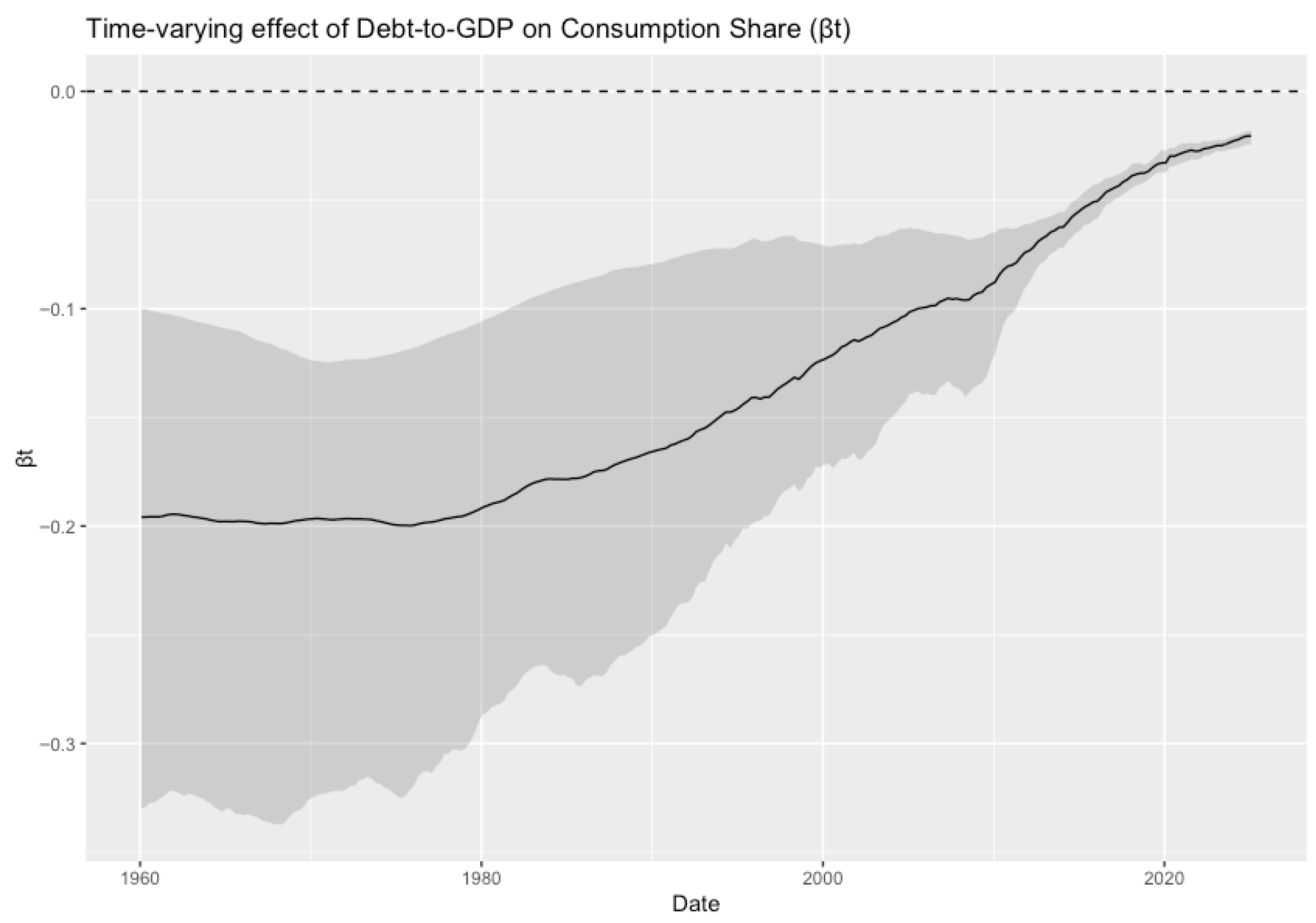
4.2. Time-Varying Effects of Government Debt on Private Consumption: Baseline Estimates
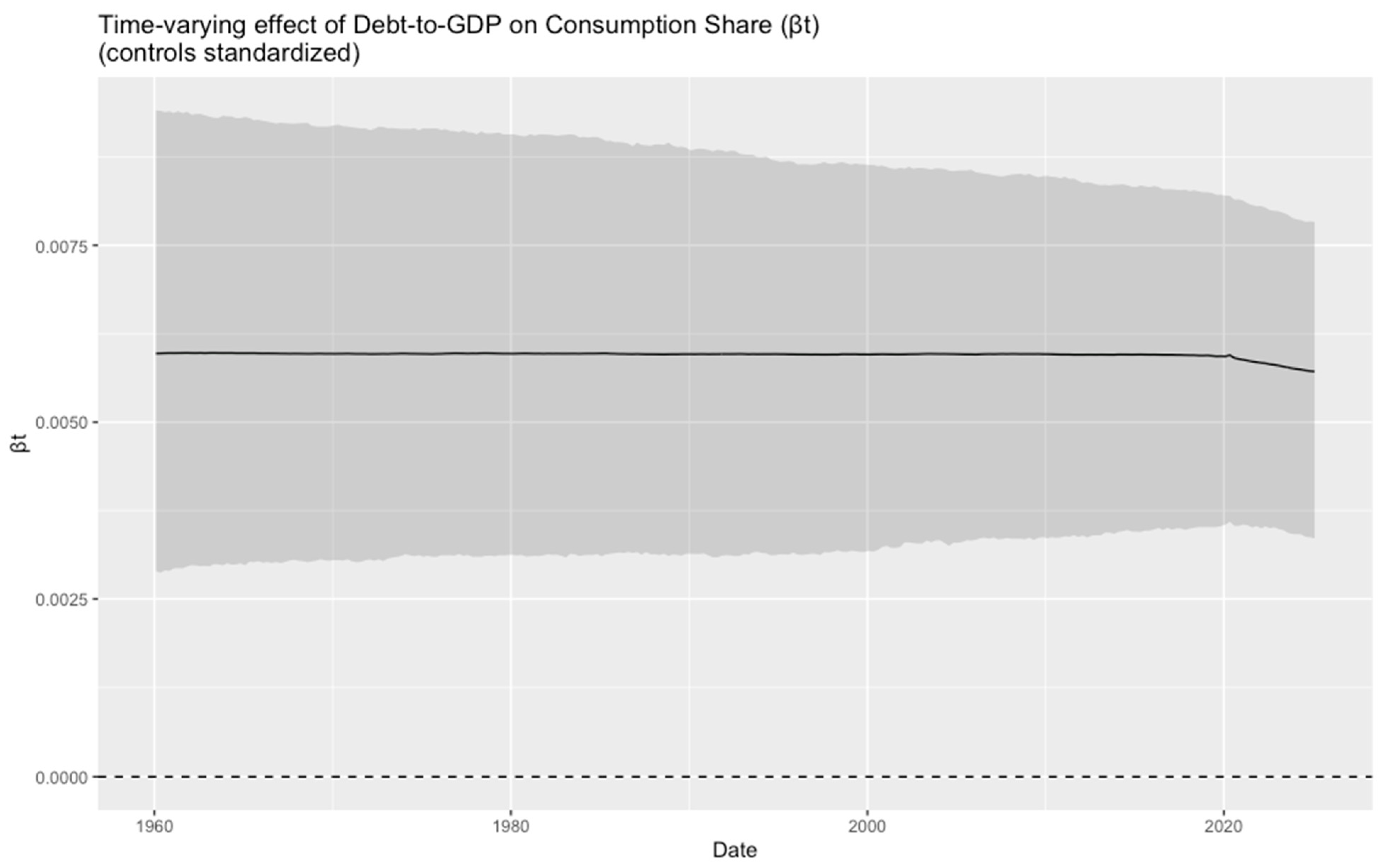
4.3. Conditioning on Fiscal Stance: Standardised Controls
4.4. Constant-Parameter Bayesian Benchmark
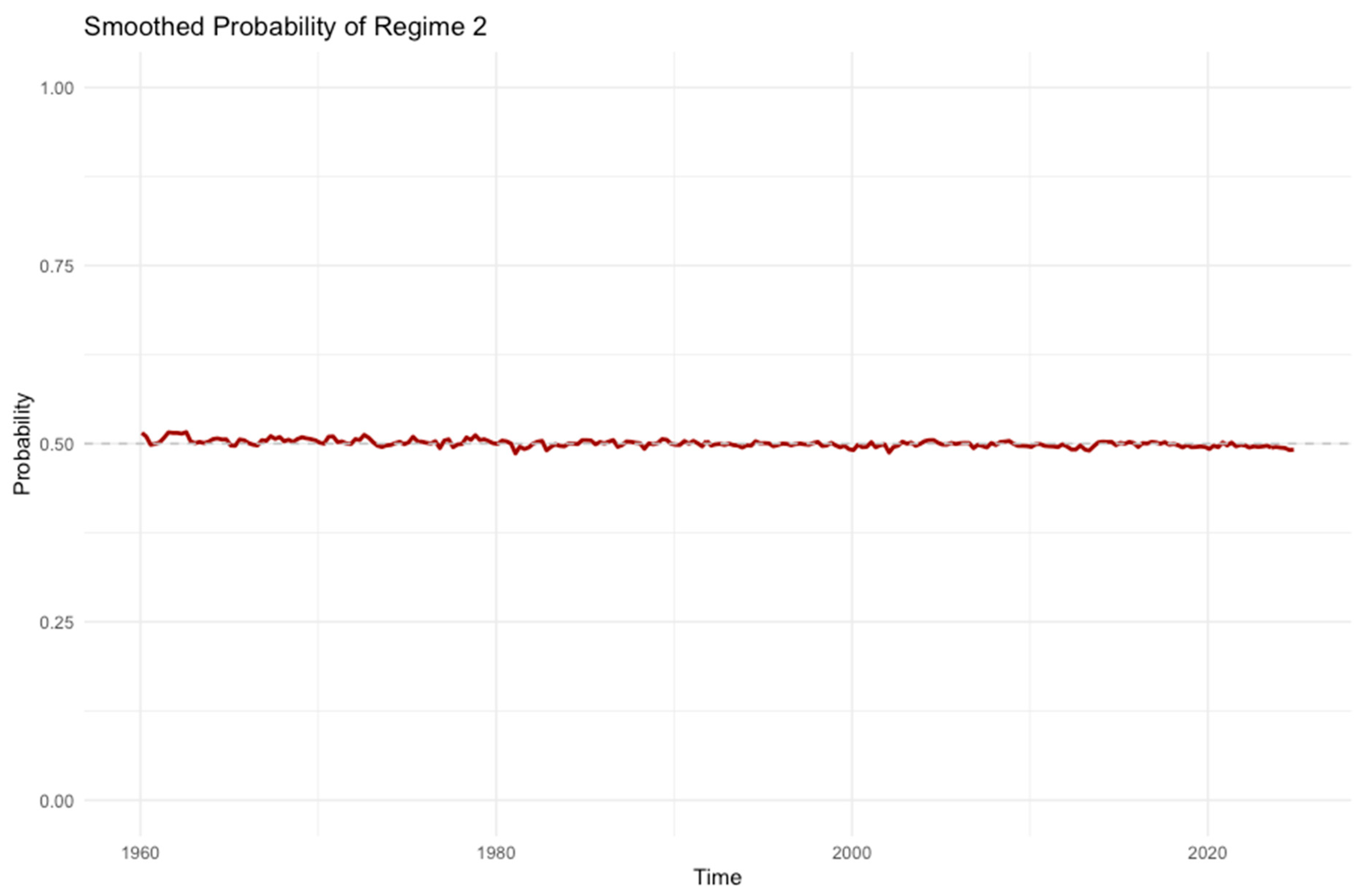
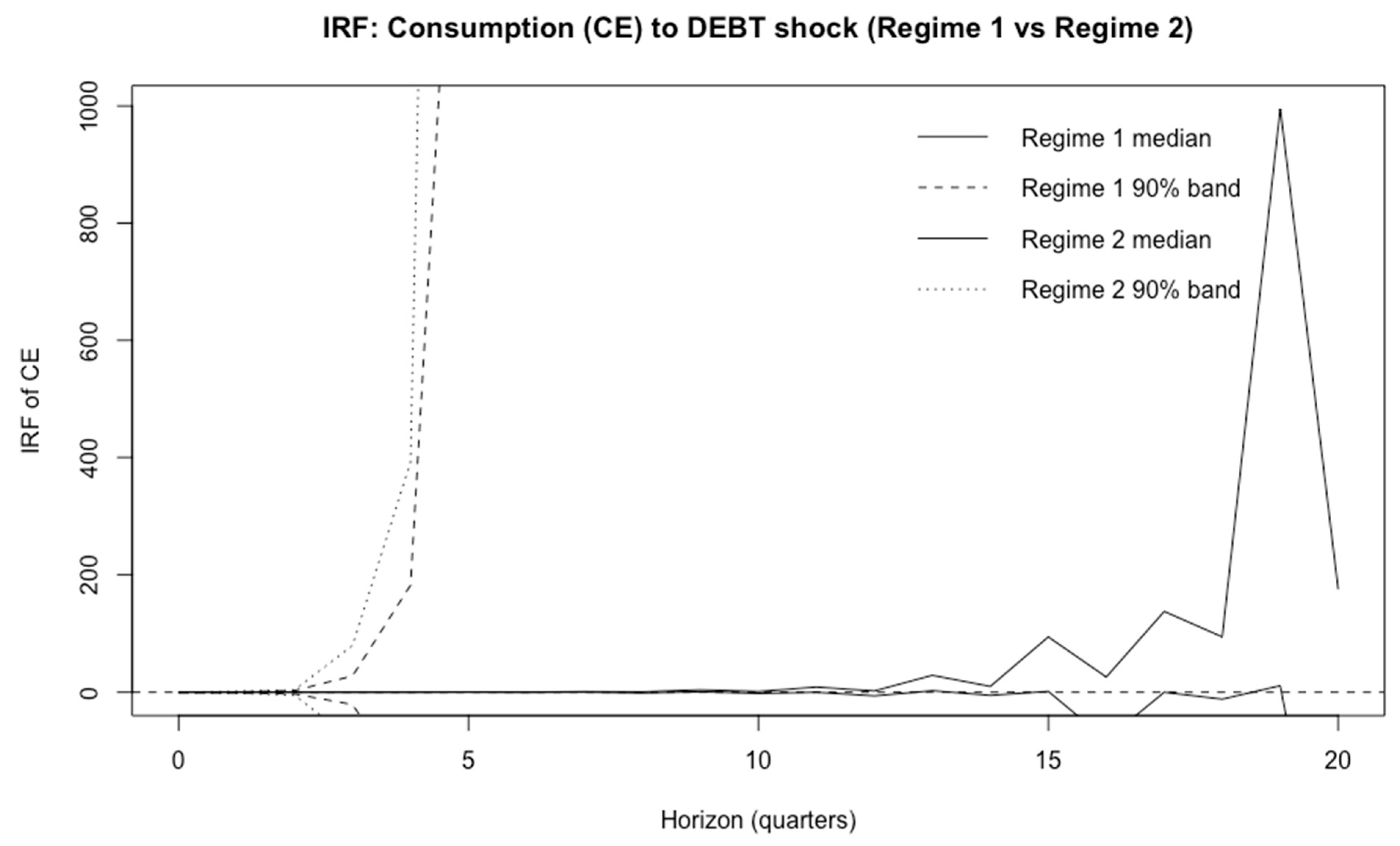
4.5. Robustness Results: Markov-Switching Bayesian VAR
4.6. Discussion
5. Conclusions
Author Contributions
Funding
Institutional Review Board Statement
Data Availability Statement
Acknowledgments
Conflicts of Interest
Appendix A

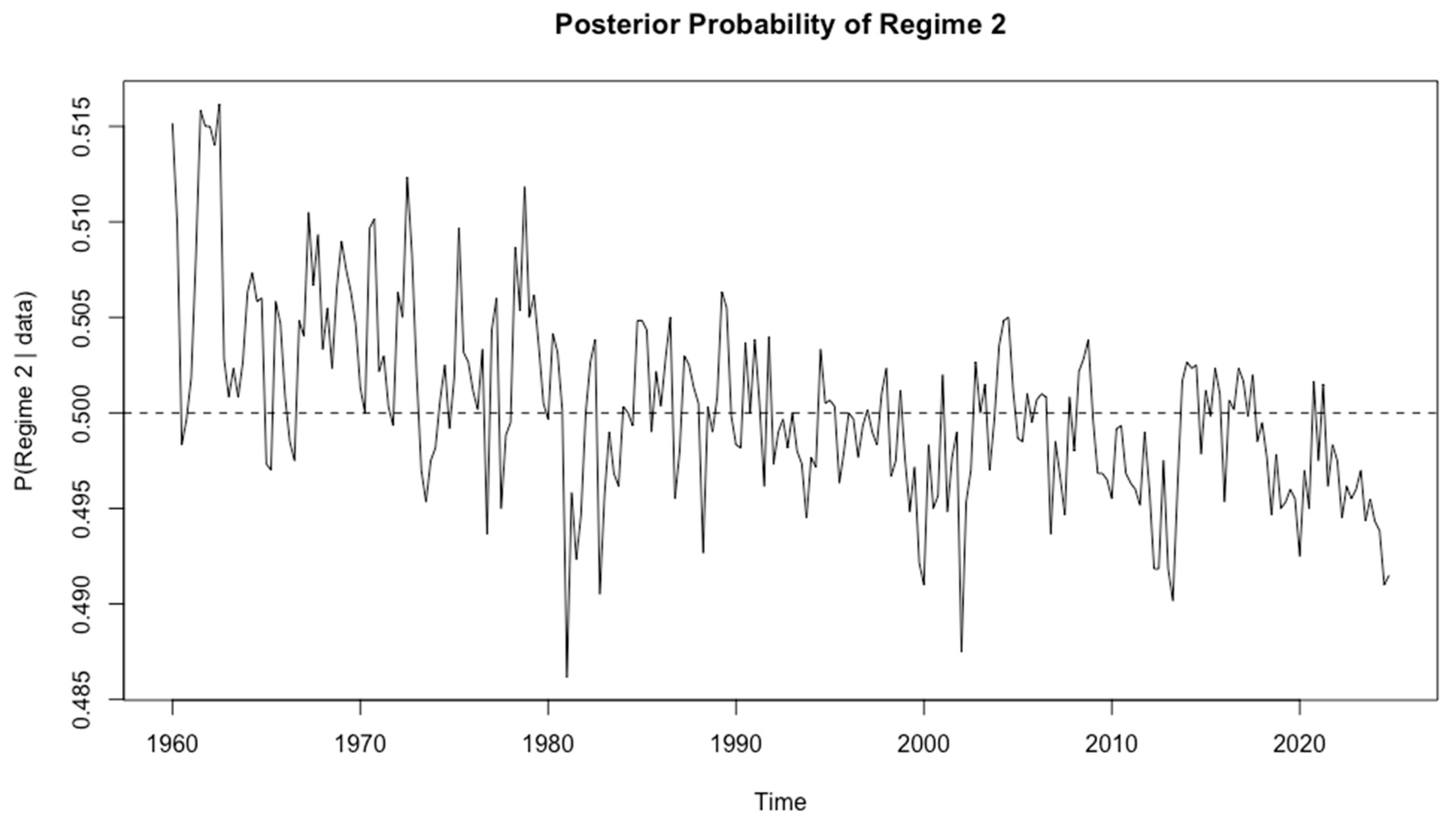
| To Regime 1 | To Regime 2 | |
|---|---|---|
| From Regime 1 | 0.883 | 0.117 |
| From Regime 2 | 0.117 | 0.883 |
References
- Afonso, A., & Jalles, J. T. (2019). Fiscal rules and government financing costs. Fiscal Studies, 40(1), 71–90. [Google Scholar] [CrossRef]
- Al Mamun, T. G., Ullah, E., Hassan, M. S., Yusof, M. F., Islam, M. A., & Rab, N. B. (2025). Fiscal policy and household savings in Central Europe: A Markov switching VAR with COVID shock. Cogent Economics & Finance, 13(1), 2537233. [Google Scholar] [CrossRef]
- Alpanda, S., Song, M. H., & Zubairy, S. (2024). Household debt and the effects of fiscal policy. International Economic Review, 65(4), 1877–1909. [Google Scholar] [CrossRef]
- Bajo-Rubio, O., Díaz-Roldán, C., & Esteve, V. (2010). On the sustainability of government deficits: Some long-term evidence for Spain, 1850–2000. Journal of Applied Economics, 13(2), 263–281. [Google Scholar] [CrossRef]
- Banday, U. J., & Aneja, R. (2019). Ricardian equivalence: Empirical evidences from China. Asian Affairs: An American Review, 46(1), 1–18. [Google Scholar] [CrossRef]
- Barro, R. J. (1974). Are government bonds net wealth? Journal of Political Economy, 82(6), 1095–1117. [Google Scholar] [CrossRef]
- Barro, R. J. (1989). The Ricardian approach to budget deficits. Journal of Economic Perspectives, 3(2), 37–54. [Google Scholar] [CrossRef]
- Bassier, I., Budlender, J., & Goldman, M. (2022). Social distress and (some) relief: Estimating the impact of pandemic job loss on poverty in South Africa (UNU-WIDER Working Paper No. 2022/80). UNU-WIDER. [Google Scholar]
- Bhorat, H., Cassim, A., & Tseng, D. (2017). Higher education, employment and economic growth: Exploring the interactions. Development Southern Africa, 34(3), 312–327. [Google Scholar] [CrossRef]
- Bhorat, H., & Köhler, T. (2025). The labour market effects of cash transfers to the unemployed: Evidence from South Africa. World Development, 188, 106889. [Google Scholar] [CrossRef]
- Bohn, H. (1998). The behavior of U.S. public debt and deficits. The Quarterly Journal of Economics, 113(3), 949–963. [Google Scholar] [CrossRef]
- Brandt, P. T., & Freeman, J. R. (2006). Advances in Bayesian time series modeling and the study of politics: Theory testing, forecasting, and policy analysis. Political Analysis, 14(1), 1–36. [Google Scholar] [CrossRef]
- Burger, P., & Calitz, E. (2021). COVID-19, economic growth and South African fiscal policy. South African Journal of Economics, 89(1), 3–24. [Google Scholar] [CrossRef]
- Buthelezi, E. M. (2023). The dynamic relationship between government debt, fiscal policy, and macroeconomic performance in South Africa. Cogent Economics & Finance. Advanced online publication. [Google Scholar]
- Carlson, K. M., & Spencer, R. W. (1975). Crowding out and its critics. Federal Reserve Bank of St. Louis Review. Available online: https://eco-consultas.aulavirtual.unc.edu.ar/pluginfile.php/138679/mod_resource/content/1/Carlson%20-%20Spencer%20%281975%29.pdf (accessed on 5 December 2025).
- Coenen, G., Montes-Galdón, C., & Smets, F. (2023). Effects of state dependent forward guidance, large scale asset purchases, and fiscal stimulus in a low interest rate environment. Journal of Money, Credit and Banking, 55(4), 825–858. [Google Scholar] [CrossRef]
- Du Rand, G., Hollander, H., & Van Lill, D. (2023). Time-varying fiscal multipliers for South Africa: A large time-varying parameter vector autoregression approach (No. 2023/106). WIDER Working Paper. The United Nations University World Institute for Development Economics Research (UNU-WIDER). [Google Scholar]
- Eichenbaum, M., Guerreiro, J., & Obradovic, J. (2025). Ricardian non equivalence (Working paper). Available online: https://www.aeaweb.org/conference/2026/program/paper/rtSRd686 (accessed on 5 December 2025).
- European Central Bank. (2021). Household saving and fiscal policy: Evidence for the euro area from a thick modelling perspective (ECB Working Paper No. 2633). European Central Bank. [Google Scholar]
- Evans, P. (1993). Consumers are not Ricardian: Evidence from nineteen countries. Economic Inquiry, 31(4), 534–548. [Google Scholar] [CrossRef]
- Ghosh, A. R., Kim, J. I., Mendoza, E. G., Ostry, J. D., & Qureshi, M. S. (2013). Fiscal fatigue, fiscal space and debt sustainability in advanced economies. The Economic Journal, 123(566), F4–F30. [Google Scholar] [CrossRef]
- Gogas, P., Plakandaras, V., & Papadimitriou, T. (2014). Public debt and private consumption in OECD countries. Journal of Policy Modeling, 36(6), 1015–1030. [Google Scholar] [CrossRef]
- Guo, F. (2023). Fiscal multipliers, monetary efficacy, and hand to mouth households. Journal of Macroeconomics. Advance online publication. [Google Scholar]
- International Monetary Fund. (2017). South Africa: Selected issues (IMF Country Report No. 17/189). Available online: https://www.imf.org/-/media/files/publications/cr/2017/cr17189.pdf (accessed on 1 December 2025).
- International Monetary Fund. (2024). South Africa: Selected issues (IMF Country Report No. 24/029). International Monetary Fund. [Google Scholar]
- International Monetary Fund. (2025a). South Africa: 2025 article IV consultation—Staff report (IMF Country Report No. 25/028). International Monetary Fund. [Google Scholar]
- International Monetary Fund. (2025b). South Africa: Selected issues (IMF Country Report No. 25/029). International Monetary Fund. [Google Scholar]
- International Monetary Fund. (2025c). South Africa’s fiscal framework: Challenges and options (Selected issues paper). International Monetary Fund. [Google Scholar]
- Isah, A., Joseph, T., & Dairo, R. (2022). Review of Ricardian equivalence in theory and practice: Empirical data from Nigeria. Applied Journal of Economics, Management and Social Sciences, 3(1), 25–32. [Google Scholar] [CrossRef]
- İkiz, A. S. (2020). Testing the Ricardian equivalence theorem: Time series evidence from Turkey. Journal of Economics, 8(3), 69. [Google Scholar] [CrossRef]
- Jooste, C., Liu, G. D., & Naraidoo, R. (2013). Analysing the effects of fiscal policy shocks in the South African economy. Economic Modelling, 32, 215–224. [Google Scholar] [CrossRef]
- Kemp, J. H. (2020). Empirical estimates of fiscal multipliers for South Africa (No. 2020/91). WIDER Working Paper. The United Nations University World Institute for Development Economics Research (UNU-WIDER). [Google Scholar]
- Kormendi, R. C. (1983). Government debt, government spending, and private sector behavior. The American Economic Review, 73(5), 994–1010. [Google Scholar]
- Maluleke, G., Odhiambo, N. M., & Nyasha, S. (2023). Symmetric and asymmetric impact of public investment on private investment in South Africa: Evidence from the ARDL and nonlinear ARDL approaches. Cogent Economics & Finance, 11(1), 2189560. [Google Scholar] [CrossRef]
- Mbaleki, C. (2024). Decomposing South Africa’s fiscal dynamics through successive policy regimes in the post-apartheid dispensation. Journal of Public Administration, 59(2), 210–222. [Google Scholar] [CrossRef]
- Minea, A., & Villieu, P. (2012). Persistent deficit, growth, and indeterminacy. Macroeconomic Dynamics, 16(S2), 267–283. [Google Scholar] [CrossRef]
- Morina, F., Misiri, V., & Alijaj, S. (2024). Examining the relationship between public debt and private consumption in European OECD countries, 2011 to 2020. Quantitative Finance and Economics, 8(1), 75–102. [Google Scholar] [CrossRef]
- Mutezo, A. (2014). Household debt and consumption spending in South Africa: An ARDL bounds testing approach. Banks and Bank Systems, 9(4), 73–81. [Google Scholar]
- National Treasury. (2023). Estimates of national expenditure 2023. Government of South Africa. Available online: https://www.treasury.gov.za/documents/national%20budget/2023/ene/FullENE.pdf (accessed on 6 December 2025).
- National Treasury. (2024). Estimates of national expenditure 2024. Government of South Africa. Available online: https://www.treasury.gov.za/documents/National%20Budget/2024/ene/FullENE.pdf (accessed on 6 December 2025).
- National Treasury. (2025). Fiscal anchors discussion document. Government of South Africa. Available online: https://www.treasury.gov.za/documents/National%20Budget/2025May/review/Fiscal%20anchors%20discussion%20document.pdf (accessed on 6 December 2025).
- Ofori-Abebrese, G., & Pickson, R. B. (2018). Ricardian equivalence hypothesis in Sub Sahara African countries. Journal of Economic Integration, 33(3), 466–487. [Google Scholar]
- Omodero, C. O. (2019). Domestic debt and private sector credit in Nigeria: An empirical investigation. Acta Universitatis Danubius Oeconomica, 15(6), 188–207. [Google Scholar]
- Ranchhod, V., & Finn, A. (2017). Estimating the short run effects of South Africa’s employment tax incentive on youth employment probabilities. Journal of African Economies, 26(2), 192–225. [Google Scholar] [CrossRef][Green Version]
- Sardoni, C. (2021). The public debt and Ricardian equivalence: Some critical remarks. Structural Change and Economic Dynamics, 58, 153–160. [Google Scholar] [CrossRef]
- Seater, J. J. (1993). Ricardian equivalence. Journal of Economic Literature, 31(1), 142–190. [Google Scholar]
- South African Reserve Bank. (2021). Fiscal multipliers in South Africa after the global financial crisis (Working Paper No. 2107). South African Reserve Bank. [Google Scholar]
- South African Reserve Bank. (2023). Annual report/financial stability review. South African Reserve Bank. [Google Scholar]
- Tendengu, S., Kapingura, F. M., & Tsegaye, A. (2022). Fiscal policy and economic growth in South Africa. Economies, 10(9), 204. [Google Scholar] [CrossRef]
- Woldu, G. T. (2023). The asymmetric effect of fiscal policy on private consumption and private investment over a business cycle: Evidence from Sub Saharan African countries. Regional Science Policy & Practice, 15(6), 1147–1163. [Google Scholar]
- World Bank. (2018). South Africa economic update: Jobs and inequality (11th ed.). World Bank. [Google Scholar]
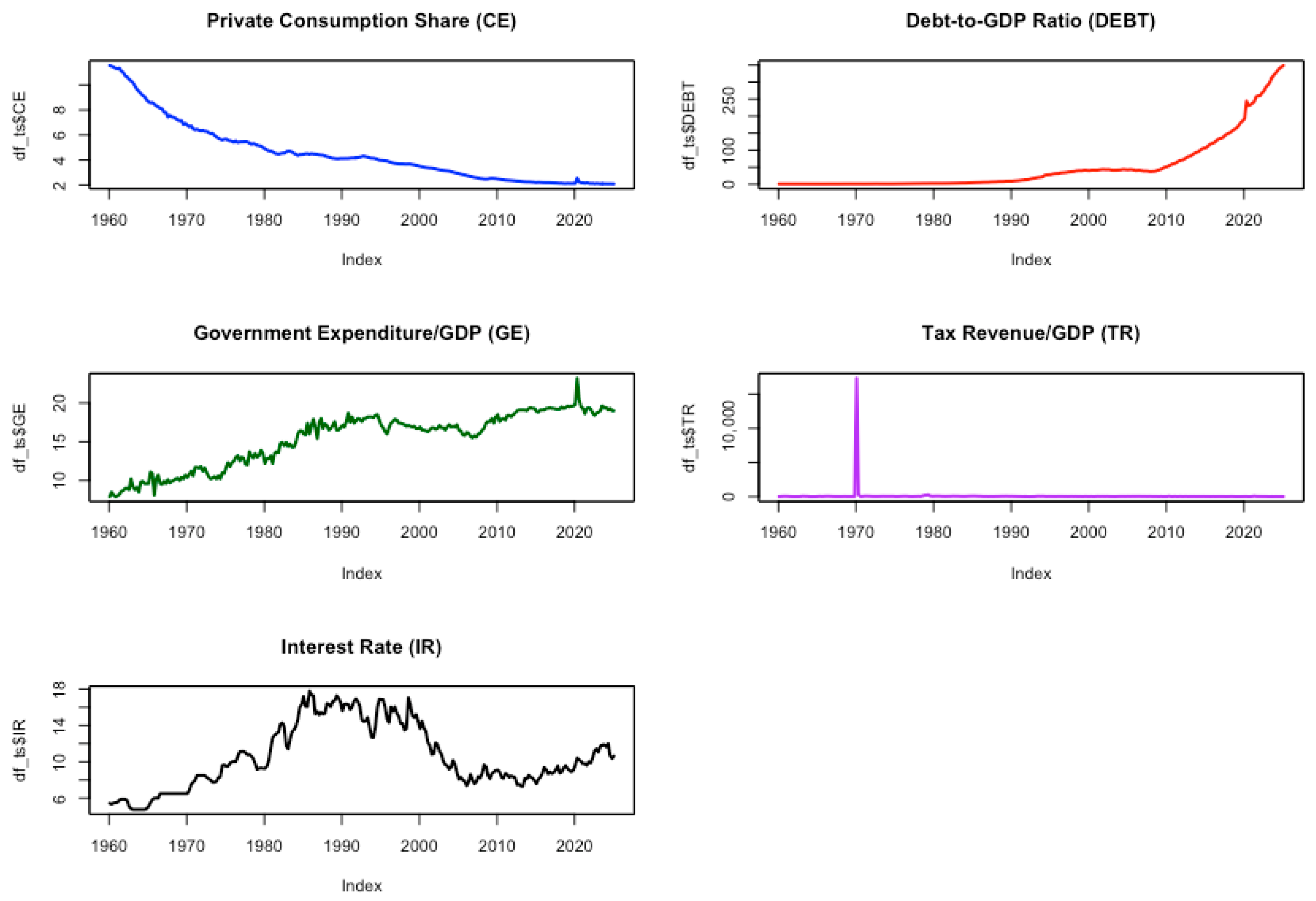



| Variable | Mean | Std. Dev. | Min | Max | Skewness | Kurtosis |
|---|---|---|---|---|---|---|
| CE (Private Consumption, % of GDP) | 4.54 | 2.36 | 2.08 | 11.6 | 0.89 | 3.12 |
| DEBT (% of GDP) | 51.02 | 80.04 | 0.82 | 348.91 | 1.75 | 5.89 |
| GE (% of GDP) | 15.3 | 3.54 | 7.9 | 23.2 | 0.41 | 2.78 |
| TR (% of GDP) | 100 | 1072 | -14 | 17338 | 8.92 | 92.14 |
| IR (%) | 10.5 | 3.54 | 4.75 | 17.8 | 0.22 | 2.35 |
| Parameter | Mean | Std. Dev. | 2.50% | 97.50% |
|---|---|---|---|---|
| Debt-to-GDP (β) | 0.0007 | 0.001 | −0.0010 | 0.0024 |
| Government Expenditure/GDP (γ) | −0.6460 | 0.027 | −0.6910 | −0.6020 |
| Tax Revenue/GDP (δ) | −0.00005 | 0.00005 | −0.00014 | 0.00004 |
| Interest Rate (θ) | 0.0526 | 0.0218 | 0.0174 | 0.0893 |
| Residual Std. Dev. (σ) | 0.959 | 0.0421 | 0.894 | 1.03 |
Disclaimer/Publisher’s Note: The statements, opinions and data contained in all publications are solely those of the individual author(s) and contributor(s) and not of MDPI and/or the editor(s). MDPI and/or the editor(s) disclaim responsibility for any injury to people or property resulting from any ideas, methods, instructions or products referred to in the content. |
© 2026 by the authors. Licensee MDPI, Basel, Switzerland. This article is an open access article distributed under the terms and conditions of the Creative Commons Attribution (CC BY) license.
Share and Cite
Sanusi, K.A.; Dickason-Koekemoer, Z. Crowding Out or Ricardian Behaviour? Evidence from South Africa. Int. J. Financial Stud. 2026, 14, 100. https://doi.org/10.3390/ijfs14040100
Sanusi KA, Dickason-Koekemoer Z. Crowding Out or Ricardian Behaviour? Evidence from South Africa. International Journal of Financial Studies. 2026; 14(4):100. https://doi.org/10.3390/ijfs14040100
Chicago/Turabian StyleSanusi, Kazeem Abimbola, and Zandri Dickason-Koekemoer. 2026. "Crowding Out or Ricardian Behaviour? Evidence from South Africa" International Journal of Financial Studies 14, no. 4: 100. https://doi.org/10.3390/ijfs14040100
APA StyleSanusi, K. A., & Dickason-Koekemoer, Z. (2026). Crowding Out or Ricardian Behaviour? Evidence from South Africa. International Journal of Financial Studies, 14(4), 100. https://doi.org/10.3390/ijfs14040100