


Abstract
When speakers encounter errors or misunderstandings in others’ talk, how they respond carries both pragmatic and interpersonal consequences that vary systematically across languages and cultures, yet this area remains underexplored in cross-cultural pragmatic research. This study examines how native speakers of English, Spanish, and Chinese respond to communication trouble across comparable sociopragmatic situations, and how social distance and social status shape these responses. Data were elicited from 124 L1 speakers of English, Spanish, and Chinese using an online Discourse Completion Task (DCT) and analysed using a pragmatics-oriented framework distinguishing three main types of responses: remediation, trouble-signalling, and let-it-pass. Results show that all three groups preferred remediation, particularly indirect remediation, reflecting a shared concern for managing the face-threatening potential of addressing others’ problems. The groups diverged most sharply in their use of let-it-pass, with Chinese and English speakers leaving trouble unaddressed far more often than Spanish speakers. Social status emerged as a more robust and cross-linguistically consistent factor than social distance, with remediation more frequently selected in high-status contexts across all three groups. These findings provide a cross-cultural reference point for L2 pragmatic instruction, particularly for learners whose L1 norms diverge most sharply from the target language in managing communicative trouble.
1. Introduction
Communication is not by nature effortless or seamless. As Coupland et al. (1991, p. 3) argue, language use is “pervasively and even intrinsically flawed, partial, and problematic,” a challenge particularly acute in interlanguage and intercultural communication (e.g., Gumperz, 1982; House et al., 2003; Thomas, 1983). Managing communication trouble in both classroom and daily life has been examined across various fields (repair in conversation analysis, corrective feedback in language learning). However, it is commonly viewed as a tool for fixing information, rather than a pragmatic act in its own right.
Studies (Bolden, 2018; Kendrick, 2015; Norrick, 1991; Raymond & Sidnell, 2019; Robinson, 2006) have shown that managing communication trouble is context-sensitive and carries interpersonal consequences. For example, correcting a stranger’s factual error may be perceived as rude, whereas the same correction among close friends may pass unnoticed. What remains unclear is whether these patterns hold across languages and cultures. Existing cross-linguistic research has focused primarily on the sequential organisation of managing communication trouble (Dingemanse & Enfield, 2015) and the pragmatic typology of initiators of managing communication trouble (e.g., Huh?; What?) (Dingemanse et al., 2014). Less attention has been paid to how speakers choose among different ways of responding to trouble and how these choices are shaped by social factors such as status and distance. This gap is not merely a matter of descriptive interest; it also carries implications for L2 pragmatic instruction. Cross-cultural pragmatics informs L2 pragmatics by revealing cross-linguistic differences that may serve as sources of pragmatic transfer (Kasper & Blum-Kulka, 1993; Maeshiba et al., 1996), thereby providing a descriptive foundation for anticipating learner difficulties and designing instruction.
To address this gap, the present study conducts a systematic cross-cultural comparison of how English, Spanish, and Chinese speakers respond to communicative trouble, using a written Discourse Completion Task (DCT) with controlled sociopragmatic scenarios. It examines the frequency and linguistic realisation of three strategies, namely remediation, trouble-signalling, and let-it-pass across the three languages, as well as how social status and social distance shape these strategic choices. The findings are intended to provide both a theoretical baseline for understanding cross-cultural variation in responses to communicative trouble and a potential reference for L2 pedagogy by highlighting areas where cross-linguistic differences may merit instructional attention.
The paper is organised as follows. The literature review introduces misunderstanding as a multi-levelled phenomenon, situating the present study within cross-cultural pragmatics and surveying existing research into response strategies to communication trouble across Chinese, Spanish, and English. The methods section presents the participants, DCT instrument, and coding procedures. The findings are then presented and discussed, followed by pedagogical implications for L2 pragmatic instruction.
2. Literature Review
2.1. Misunderstanding and Managing Communication Trouble
Misunderstanding is not an aberration in human communication but an inherent feature of it (Coupland et al., 1991; Dingemanse & Enfield, 2024). It has attracted scholarly attention across multiple disciplines under different terms: conversation analysts have examined its sequential organisation under the term of repair (Dingemanse & Enfield, 2015; Schegloff et al., 1977), intercultural communication researchers have focused on its cultural sources under the term of miscommunication (Binay, 2025; Korkut et al., 2018), pragmaticians have examined the gap between what is said and what is meant under the term of misunderstanding (Elder, 2024; Verdonik, 2010), and SLA researchers have explored its role in language development (Long, 1996; Nassaji & Kartchava, 2021) under the term corrective feedback. Because misunderstanding is a multi-levelled phenomenon that resists analysis from any single perspective, House (2003) calls for a transdisciplinary approach that draws on multiple research traditions.
The present study uses the term management of communication trouble rather than “misunderstanding” or “miscommunication,” because our focus is not on the causes or the overall process, but on the responses that follow a communicative trouble. This paper highlights the pragmatic aspects of managing communication trouble. When we address communication trouble, it not only fixes the informational flow but also adjusts the interpersonal relationship to fulfil communication goals. Kendrick (2015), for example, observes that in English-language interaction, remediation and trouble-signalling can introduce non-serious activities like joking or teasing and may also serve as a preliminary to dispreferred turn formats. Robinson (2006) found that the responsibility for creating communication trouble can be modulated by the choice of trouble-signalling format; for instance, using “sorry” in English tends to shift the locus of responsibility toward the repair initiator instead. At the same time, management of communication trouble is neither invariant nor static; rather, it is flexibly adapted to local interactional contingencies. In asymmetrical settings like those between parents and children, teachers and students, or native and nonnative speakers, remediation by the more competent participant is routine and often unmarked compared with trouble-signalling (Norrick, 1991).
Beyond the influence of contextual variables, studies on repairing communication trouble from different languages show that the linguistic tools and cultural norms for managing communication trouble vary across linguistic communities. For example, at the level of linguistic tools, Russian informal conversation, unlike English and other languages, lacks dedicated politeness expressions such as excuse me or sorry for signalling communicative trouble (Baranova, 2015). At the level of cultural norms, in Lao, certain response strategies are reserved for interactions between strangers rather than intimates, suggesting that social distance systematically constrains response strategy selection (Enfield, 2015). These isolated findings across different languages point to the need for systematic cross-linguistic research, as it remains unclear whether observed differences reflect language-specific norms or more universal patterns of face management. These cultural differences mean that learners face a real risk of pragmalinguistic or sociopragmatic failure when managing communication trouble in an L2, yet little is known about how speakers respond to communication trouble across languages and cultures, leaving learners without a reliable basis for judging what counts as pragmatically appropriate in the target language.
The appropriate responses to communicative trouble are not automatically acquired in an L2. Sun and Sánchez-Hernández (2026) found that Chinese EFL learners differed systematically from L1 English speakers in not only their response strategies but also their sociopragmatic sensitivity, providing empirical support for this concern. In their study, Chinese English as a Foreign Language (EFL) learners were found to differ systematically from L1 English speakers in several respects: they showed a lower tendency to signal trouble explicitly, relied more heavily on implicature-based strategies reflecting L1 pragmatic transfer, and displayed weaker sensitivity to social distance as a sociopragmatic variable.
To capture this behaviour, the present study proposes a three-way classification of interlocutor responses to communicative trouble: remediation (where the responding interlocutor provides a correction), trouble-signalling (where the responding interlocutor signals the problem without providing a correction), and let-it-pass (where the trouble is left unaddressed). When an interlocutor identifies a trouble source, these three options reflect a basic pragmatic choice between action and non-action and between self-provided and other-invited resolution.
This distinction has been independently documented across multiple research traditions. In CA, the first two options (remediation and trouble-signalling) correspond to the typology of other-initiated repair (OIR), which distinguishes between cases in which the recipient provides the correction directly and cases in which the recipient signals the trouble and invites the original speaker to self-correct (Dingemanse et al., 2014; Dingemanse & Enfield, 2015; Schegloff et al., 1977). In SLA research into corrective feedback, Lyster and Ranta (1997) independently arrived at a functionally parallel distinction through inductive analysis of teacher–student interaction, identifying feedback types that either supply the correct form directly (e.g., explicit correction and recasts) or signal the error to invite learner self-correction (clarification requests, elicitation, metalinguistic feedback, and repetition). The third option has been documented as the let-it-pass practice, whereby interlocutors proceed as if understanding has been achieved even when it is uncertain, prioritising interactional harmony over explicit clarification (Firth, 1996). This phenomenon is widely observed in Sun and Sánchez-Hernández (2026) as well.
In sum, misunderstanding is a pervasive and multi-levelled phenomenon that has been approached from multiple disciplinary perspectives. The present study adopts a cross-cultural perspective, focusing specifically on how interlocutors respond to communicative trouble through three response types: remediation, trouble-signalling, and let-it-pass. How these responses are distributed and linguistically realised across languages and cultures remains poorly understood, which motivates the cross-cultural comparison undertaken in this study.
2.2. Responses to Communicative Trouble Across Languages: English, Spanish, and Chinese
Cross-linguistic research has established considerable regularity in trouble-signalling formats across languages. Dingemanse et al. (2014) examined trouble-signalling formats in conversational corpora from 11 typologically diverse languages (including English, Mandarin, Russian, Lao, and several non-Indo-European languages) and found that speakers draw on a shared set of resources despite morphosyntactic variation across languages. These include open initiators (e.g., Huh?), restricted initiators (e.g., repetition of the trouble source), and candidate understandings (e.g., Do you mean X?). The choice among these formats reflects three interactional concerns: trouble, knowledge, and responsibility. This finding was further corroborated by Dingemanse and Enfield (2015), who demonstrated that the sequential organisation of OIR and the principles governing format selection are consistent across languages and cultures.
However, this line of research has focused on how speakers signal trouble and how repair is sequentially organised, rather than on how speakers choose among different repair solutions or whether these choices are shaped by language and context. This gap is partly attributable to the methodological constraints of natural conversation data, in which the nature of the trouble source and the relationship between interlocutors vary considerably across episodes. By shifting the analytical focus from signalling formats to the full range of response strategies through a controlled elicitation design, this study reframes the object of inquiry from a sequential repair operation to a sociopragmatic decision.
Beyond these cross-linguistic regularities, language-specific patterns have been documented in English, Spanish, and Chinese, though this research remains uneven and limited in scope. Research into English suggests a preference for specific (e.g., do you mean…) rather than open trouble-signalling (e.g., Huh?). Kendrick (2015) found that only 18.5% of cases in his corpus involved open initiators, while candidate understandings were the most frequent format. He explained that trouble-signalling in English can serve social functions beyond resolving understanding problems, including teasing, expressing surprise, and prefacing dispreferred responses.
Maíz-Arévalo (2018) analysed interactions among Spanish speakers in a Facebook interest group and found that they employed a wide range of face-saving and supportive strategies, including giving accounts, suppressing ignorance, humour, aggression, remediation, and appeals to group unity. Importantly, she also observed that other-repair was frequently used as a form of face-repair, often to express support (e.g., Te entiendo perfectamente, “I totally understand you”) rather than leaving face damage to be dealt with through self-repair alone. These findings are particularly relevant from a cross-cultural pragmatic perspective, as they suggest that Spanish speakers may respond to problematic situations through a broader repertoire of interpersonal and discursive strategies, rather than through clarification alone.
Research into Chinese points to two differences from English. First, based on a corpus of radio Q&A interactions, Zhang (1998) found that the overall organisation of repair in Mandarin is largely similar to that in English. However, Mandarin also displays language-specific features, such as the fixed expression 你说 (nǐ shuō, “you say”), which serves as a trouble-signalling format without a direct equivalent in English. Second, drawing on data from academic conference settings, Yang (2009) observed that Chinese speakers tend to prefer other-initiated remediation, whereas English speakers are more likely to signal trouble and invite the original speaker to self-correct. This suggests that the two languages may differ in how remediation and trouble-signalling are perceived in terms of face-threat, with remediation being less face-threatening in Chinese academic interaction than in English.
These cross-linguistic differences highlight potential areas of difficulty for L2 learners, particularly in using language-specific pragmalinguistic tools and navigating different social norms and communicative preferences. When responding to communication trouble, learners are influenced by their L1 norms (Kasper & Blum-Kulka, 1993; Maeshiba et al., 1996). Since native speakers of different languages differ in their preferences, learners are likely to experience negative transfer when responding to trouble in the target language. Understanding how native speakers actually respond across comparable sociopragmatic contexts can therefore provide an empirical reference point for anticipating such difficulties.
At the same time, cross-linguistic differences in responding to communication trouble are also relevant to pragmatic awareness and intercultural competence. As Sánchez-Hernández and Maíz-Arévalo (2021) argue, intercultural pragmatic competence involves the ability to interpret and respond to language use in contextually and culturally appropriate ways, rather than simply applying L1-based norms. Understanding how native speakers actually respond across comparable sociopragmatic contexts can therefore provide an empirical reference point not only for anticipating transfer-related difficulties but also for fostering learners’ awareness of cross-cultural differences and their capacity to navigate them in intercultural interaction.
However, cross-linguistic research has not yet systematically examined how speakers respond to communication trouble at the pragmatic level, nor how such responses might inform L2 instruction. These gaps give rise to the following research questions:
- RQ1. What cross-linguistic similarities and differences can be observed in the frequency and linguistic realisation of response strategies across Chinese, English, and Spanish?
- RQ2. How do sociopragmatic factors (i.e., social distance, social status) influence the frequency and linguistic realisation of response strategies across Chinese, English, and Spanish?
3. Method
3.1. Participants
A total of 124 participants took part in this study: 35 L1 Spanish speakers from Spain (20 females and 15 males, age range 22–59, M = 30.1), 59 L1 Mandarin Chinese speakers from mainland China (32 females and 27 males, age range 19–43, M = 25.6), and 30 L1 English speakers from England (15 females and 15 males, age range 21–63, M = 24.0). Chinese and Spanish participants were recruited through snowball sampling via university networks at one university in China and one in Spain, whereby existing participants referred other potential participants from their social networks. English participants were recruited through Prolific.
3.2. Instruments
DCT is a widely used instrument in cross-cultural pragmatics. It employs open-ended situational prompts to elicit participants’ responses, allowing researchers to systematically manipulate social variables such as social distance, social status, and degree of imposition. DCTs are particularly valued for their efficiency in generating large, comparable datasets, making them suitable for investigating a range of pragmatic phenomena (Ogiermann, 2018). Written DCTs elicit hypothetical responses rather than naturally occurring talk, and they do not capture prosodic or multimodal aspects of interaction. Nevertheless, they remain a well-established tool for eliciting responses to communicative trouble across comparable sociopragmatic situations and for identifying cross-cultural tendencies in how such trouble is managed.
In this study, a written DCT was used to elicit response strategies across distinct sociopragmatic contexts. The design of the instrument was informed by previous work on the elicitation of responses to communicative trouble in comparable sociopragmatic settings (Sun & Sánchez-Hernández, 2026). An overview of the six scenarios included in the DCT is provided in Table 1.
Table 1.
Description of the situations included in the DCT, adapted from Sun and Sánchez-Hernández (2026).
The DCT, as shown in Table 1, included six scenarios, each involving a different story background and distinct sociopragmatic factors that could influence the interaction. These sociopragmatic factors were based on Brown and Levinson’ s (1987) framework and included social status (the hierarchical relationship between individuals) with three levels (low/equal/high); social distance (the degree of familiarity or closeness) with two levels (close/distant); and the degree of imposition (the level of obligation or burden imposed by the request or interaction), which was kept low in all scenarios.
The six scenarios were designed with controlled trouble sources to ensure cross-cultural comparability. Drawing on the distinction between discourse-internal and discourse-external sources of misunderstanding (Bazzanella & Damiano, 1999; House et al., 2003; Tzanne, 2000), the present study focused exclusively on discourse-internal trouble sources, namely factual mistakes and linguistic errors. This design decision was motivated by a methodological concern: individual differences in knowledge and experience may lead to varying perceptions of what constitutes a trouble source, particularly for discourse-external problems involving divergent interpretations of social roles or situational frames. Factual mistakes and linguistic errors provide a more controlled and comparable basis for eliciting responses to communicative trouble across languages and participant groups. Example 1 illustrates the description of Situation 2, which involved a misunderstanding in a chocolate store.
Example 1.

Situation 2 in English DCT.
Today, you went to the chocolate store to buy a bar of white chocolate. The shop assistant, whom you didn’t know, mistook white chocolate for dark chocolate and gave you the dark chocolate. She said: “Here’s your dark chocolate, it’s five pounds in total.”
How would you respond to resolve the misunderstanding?
__________________________________________________
In Example 1, the seller gave the wrong chocolate to the client. The trouble source is an overt factual mistake for eliciting the participants’ response. The instrument was originally developed in English and subsequently translated into Spanish and Chinese, with minor adaptations to personal names and linguistic errors to enhance naturalness and cultural relevance while maintaining content equivalence across languages.
3.3. Data Collection Process
Chinese and Spanish participants were recruited through university networks at one university in China and one university in Spain. English participants were recruited via Prolific, an online research platform providing access to a pre-screened pool of participants, with eligibility filters applied for native language (English) and country of residence (England). All participants first completed a background questionnaire online, collecting information on age, gender, native language, and linguistic background; only those meeting the inclusion criteria were retained for analysis. To ensure confidentiality, all questionnaires were anonymised and collected no identifying personal information beyond basic demographic data. Before beginning the questionnaire, participants were presented with an online consent form outlining the purpose of the study, their right to withdraw at any time, and assurances that their data would remain confidential and be used solely for research purposes. By proceeding to the online questionnaire, participants indicated their voluntary participation and informed consent. The DCT scenarios were then presented in Microsoft Forms with instructions to read each scenario and respond according to their typical linguistic habits.
3.4. Coding System and Data Analysis
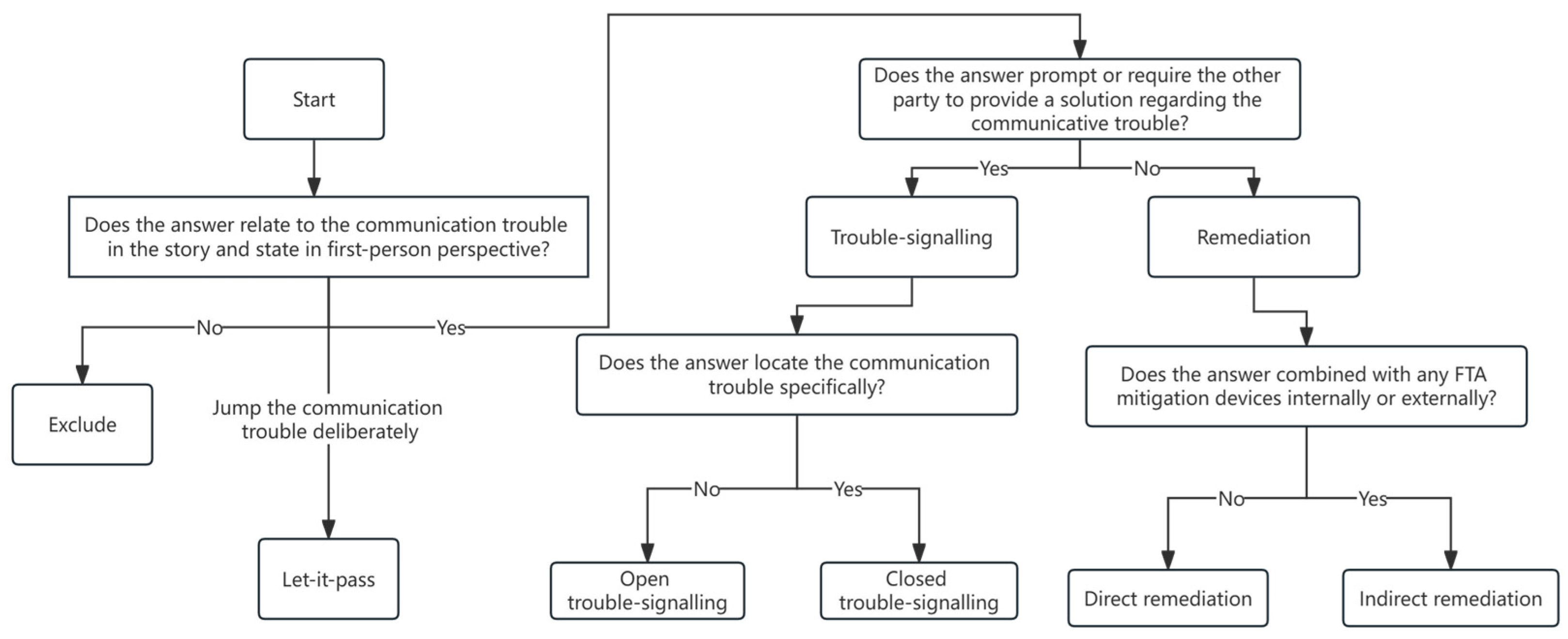
The coding categories adopted in the present study are based on the classification logic developed by Sun and Sánchez-Hernández (2026), while the terminology was revised to align with the cross-cultural pragmatic framework of the present study. Responses to communication trouble were first classified into three broad strategy types: remediation, trouble-signalling, and let-it-pass. Remediation refers to responses in which participants directly address the trouble source by providing a correction, whereas trouble-signalling includes responses that signal the problem without directly supplying a correction. Let-it-pass refers to cases in which participants did not address the trouble source.
Remediation was further divided into direct and indirect subtypes. Direct remediation includes responses that provide a correction without mitigation, whereas indirect remediation includes responses in which the correction is softened by mitigating moves. Trouble-signalling was further coded according to the degree of specificity. Open trouble-signalling provides no specific information about the nature of the problem, whereas closed trouble-signalling locates the difficulty more precisely, either by identifying the problematic element or by offering a candidate understanding for confirmation. For the full taxonomy and detailed coding criteria, see Sun and Sánchez-Hernández (2026). For representative examples, including coding decision criteria, see Appendix A.
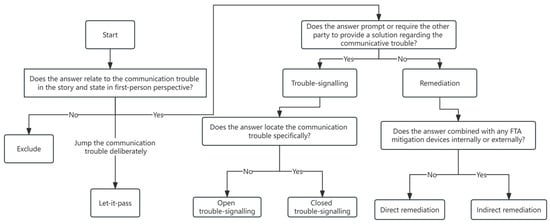
MAXQDA, a qualitative data analysis software (version 24.5.1), was used as the coding instrument. After training, two annotators independently coded the elicited response strategies using a predefined coding scheme and a decision tree developed for the annotation process. Both annotators were native speakers of Chinese. One had C1 proficiency in English and B2 proficiency in Spanish, while the other had B2 proficiency in English and C2 proficiency in Spanish. Because the coding focused on functionally defined response strategy types, the same coding framework was applied across the Chinese, English, and Spanish datasets. Inter-rater agreement was assessed using Cohen’s Kappa, yielding a value of 0.82, indicating a high level of agreement. Discrepancies were resolved through collaborative discussion to produce the final dataset. The coding procedure followed the decision tree illustrated in Figure 1, which was used by both annotators as a guide throughout the annotation process.
Figure 1.
Decision tree for coding response strategies to communication trouble.
After coding, quantitative methods were employed to analyse participants’ responses. Prior to analysis, expected cell frequencies were examined; all cells met the minimum threshold of 5, confirming the suitability of Pearson’s chi-square test. To address RQ1, Pearson’s chi-square tests were conducted to examine the association between language and response strategy, with effect sizes calculated using Cramer’s V (interpreted following Cohen, 1988): less than 0.2 = weak; 0.2 to 0.6 = moderate; greater than 0.6 = strong). Post hoc analysis based on standardised residuals was performed to identify which specific language pairs contributed to significant differences, measuring the extent to which observed frequencies deviated from expected frequencies under the assumption of independence. To address RQ2, Pearson’s chi-square tests were conducted to examine the influence of social status and social distance on the three response strategy types in Chinese, Spanish, and English, respectively.
It should be noted that Pearson’s chi-square test assumes independent observations, whereas each participant in the present study contributed responses to six DCT scenarios. As a result, the frequency counts analysed were not fully independent, and significance levels may have been inflated. The chi-square results should therefore be interpreted as indicative of distributional tendencies rather than as fully independent statistical comparisons.
4. Results
4.1. Cross-Linguistic Patterns of Responses to Communication Trouble
To address RQ1, which asked what similarities and differences can be observed in the responses to communication trouble produced by Chinese, English, and Spanish speakers across comparable sociopragmatic situations, we first examined the distribution of the three main response strategies to communication trouble (remediation, trouble-signalling, let-it-pass) across the three languages. Table 2 presents the proportions of Chinese, English, and Spanish speakers who selected each of the three strategies.
Table 2.
Percentage of response strategy choices across Chinese, English, and Spanish.
As shown in Table 2, remediation was the most frequent strategy overall, though Spanish speakers used it significantly more frequently (83.1%) than English (66.2%) or Chinese (73.7%) speakers. Conversely, let-it-pass was rare among Spanish speakers (3.6%) but more common in Chinese (21.2%) and English (22.6%). A Pearson chi-square test revealed a statistically significant but weak association between language and response strategy choice (χ2(4, n = 652) = 36.983, p < 0.01, Cramer’s V = 0.168), suggesting a possible difference in how L1 speakers of Chinese, English, and Spanish manage communicative trouble, though the effect size was small. Standardised residuals were then examined to determine which strategies contributed most to these differences (see Table 3).
Table 3.
Standardised residuals for remediation, trouble-signalling, and let-it-pass across the three language groups.
As shown in Table 3, Chinese speakers showed a lower-than-expected use of trouble-signalling (r = −2.2), whereas Spanish speakers showed a higher-than-expected use of it (r = 2.1) and a markedly lower-than-expected use of let-it-pass (r = −4.2). English speakers showed no strong preferences (all |r| < 2), with the sharpest contrast occurring between Chinese and Spanish speakers. These results suggest different orientations to managing communicative trouble across the three languages within the context of the present DCT data. Spanish speakers appeared more inclined to use trouble-signalling to address trouble explicitly by pinpointing the problematic element, while also showing little tolerance for leaving trouble unresolved. By contrast, Chinese speakers were less likely to signal the trouble source explicitly, suggesting a weaker preference for highly specific trouble-signalling. English speakers displayed a more even distribution across the three strategy types, rather than a marked preference for any single response option.
Having established the overall distribution of the three main strategy types, we now turn to a more fine-grained analysis of how these strategies were realised within each category. Table 4 presents the percentage distribution of response strategies across the three language groups, including direct and indirect remediation, open and closed trouble-signalling, and let-it-pass.
Table 4.
Distribution of response strategy subtypes across Chinese, English, and Spanish speakers.
As shown in Table 4, no instances of open trouble-signalling were attested across the three languages. This may be related to the DCT format, which did not require participants to manage real-time progressivity and may therefore have been less likely to elicit this type of response.
By contrast, closed trouble-signalling was more commonly attested, especially in the form of candidate understandings (e.g., do you mean grandma’s kitchen?), with Spanish speakers using it most frequently (13.3%), followed by English speakers (11.2%) and Chinese speakers (5.1%). Notably, Chinese speakers’ use of closed trouble-signalling was considerably lower than that of the other two groups, suggesting a weaker orientation toward explicitly locating the trouble source in this language community.
Across the three language groups, candidate understandings served a similar function: speakers proposed a possible interpretation of the trouble source and invited the interlocutor to confirm or reject it. At the same time, cross-linguistic differences were observed in how this action was formulated. English responses were the most formulaic, relying heavily on patterns such as Do/Did you mean X?. Spanish responses were also recurrent in form but showed greater variation, including structures such as ¿Te refieres a X? (Do you mean X?), ¿No era X? (Wasn’t it X?), and candidate formulations followed by confirmation tags such as ¿no? or ¿verdad? (right?). Chinese responses displayed the greatest structural flexibility, ranging from full confirmation requests such as 我想向您确认一下这个三等奖学金的表是我的,还是咱们师门别的同学的? (I would like to confirm whether this third-class scholarship form is mine or belongs to another student in our research group) to highly reduced forms such as 瓶子吗? (The bottle ma?). In particular, Chinese relies less on fixed syntactic frames such as Do you mean X? and more on contextual recoverability and sentence-final particles. Particles such as 吗 (ma) turn the candidate into an explicit confirmation request, while 吧 (ba) presents it as a tentative inference. These patterns suggest that English and Spanish relied more on fixed syntactic frames, whereas Chinese more often used reduced forms supported by contextual inference and sentence-final particles.
Turning to remediation, although all three language groups showed a preference for remediation, this was driven largely by the high proportion of indirect rather than direct remediation across languages. Indirect remediation accounted for the majority of remediation responses in all three groups (Chinese: 53.7%; Spanish: 56.5%; English: 48.8%), substantially outweighing direct remediation (Chinese: 20.0%; Spanish: 26.6%; English: 17.4%). In addition, different preferences in the use of specific indirect remediation strategies were observed. Among indirect remediation strategies, Chinese speakers most frequently used downgraders (24.7%), Spanish speakers preferred head acts with FTA mitigation (22.7%), and English speakers favoured combinations of apology with head acts (31.5%). Linguistic examples from the DCT responses, including Chinese (Example 2), Spanish (Example 3), and English (Example 4), illustrate these preferences.
Example 2.
Use of downgraders in Chinese
不好意思,我点的是白巧克力哦,你好像给错啦!
“I’m sorry, what I ordered is white chocolate o (particle), you seem to have given the wrong one la (particle)!”
As shown in Example 2, Chinese speakers frequently employed the idiomatic expression 不好意思 (literally “no good meaning”, commonly translated as “sorry”). Sentence-final particles such as 哦 (o) and 啦 (la) helped convey a mitigated tone, softening the impact of pointing out the trouble source. The use of 好像 (seem) further attenuated the certainty of the statement, introducing an element of hedging into the response.
Example 3.
Use of head act + FTA mitigation in Spanish
Bueno, la verdad es que serviría como florero, pero también como taza.
“Well, the truth is that it could not only serve as a vase, but also as a cup.”
As illustrated in Example 3, when the interlocutor mistakenly identified the gift as a vase instead of a cup, the Spanish speaker first provided the head act la verdad es que serviría como florero (the truth is that it would serve as a vase), with the downgrader serviría (would serve) as an internal modification. The speaker then added the supportive move pero también como taza (but also as a cup) to signal partial agreement with the interlocutor’s misinterpretation while simultaneously signalling the trouble source. This strategy allowed the speaker to address the misunderstanding while mitigating the threat to the interlocutor’s positive face.
Example 4.
Use of apology in English
I am so sorry, I think there has been a misunderstanding, I am after the first-class scholarship.
As shown in Example 4, English speakers most frequently employed an apology-based initiator followed by a head act as their preferred indirect remediation strategy. By opening with sorry, speakers located responsibility for the communicative trouble on themselves rather than on the interlocutor, thereby mitigating the face-threatening potential of the correction.
Let-it-pass responses encompassed several patterns across the three language groups. The most common involved simply processing the conversation without pointing out the communication trouble, such as responding to the request in the task (e.g., English: Sure, I’ll open it for you; Chinese: 好 “OK”; Spanish: Sin problemas “No problem”). A pattern of explicit non-correction with reasoning was also observed across all three groups (e.g., English: Let her believe it’s a vase, it’s a harmless misunderstanding; Chinese: 没必要在大街上教小孩认字 “no need to correct a child’s speech on the street”; Spanish: No le daría importancia ni la corregiría “I wouldn’t pay attention to it or correct it”). Laughter as a mitigation device in let-it-pass appeared in both the Chinese and Spanish data but not in the English data (e.g., Chinese: 哈哈哈哈好 “hahaha OK”; Spanish: me reiría y le ayudaría sin corregirle “I would laugh and help without correcting”).
In summary, the findings for RQ1 reveal clear cross-linguistic differences in the distribution of response strategies. Chinese speakers underused trouble-signalling, Spanish speakers overused trouble-signalling and strongly underused let-it-pass, whereas English speakers displayed a comparatively more even distribution across the available strategies. At the same time, all three groups showed a broad preference for remediation, especially indirect remediation. Cross-linguistic variation was also observed in the linguistic realisation of these strategies.
4.2. The Influence of Sociopragmatic Factors on Responses to Communication Trouble
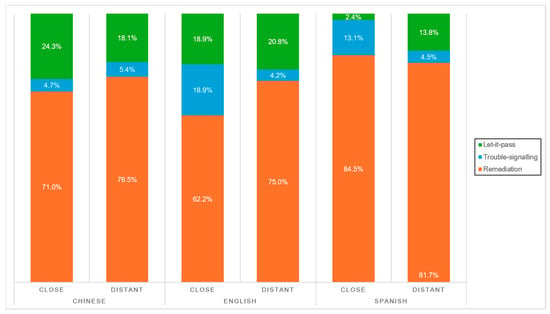
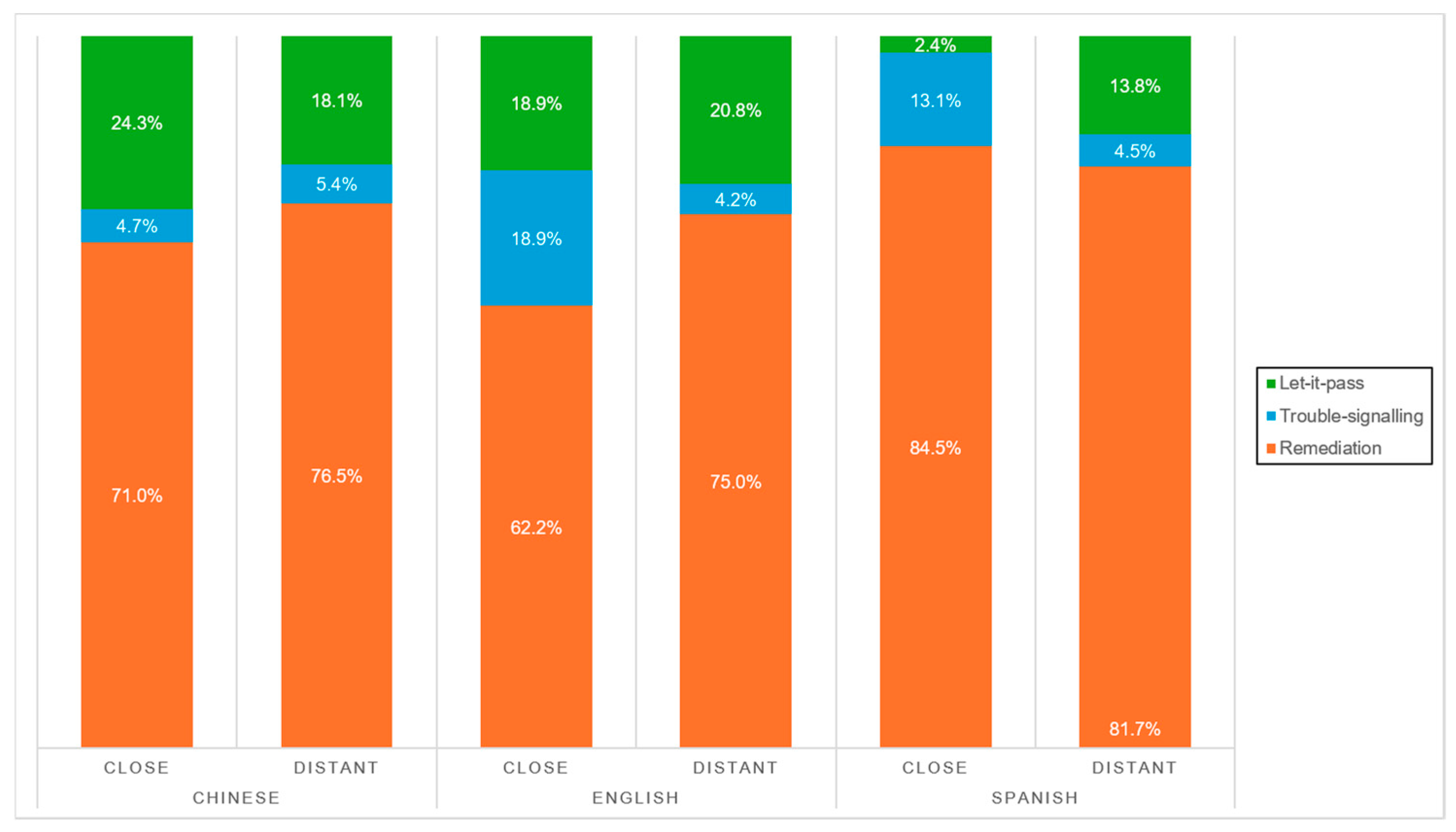
To address RQ2, which asked how social distance and social status shape response strategy preferences across the three language groups, the influence of these variables on response strategy choice was examined for each language group separately. Figure 2 illustrates the distribution of the three response strategies across close and distant social relationships for the three languages.
Figure 2.
Percentage of response strategy use across close and distant social relationship conditions in Chinese, Spanish, and English.
As seen in Figure 2, remediation usage remained stable across social distances in Chinese and Spanish, whereas English speakers showed marked sensitivity, using remediation 12.9% less in close social relationship contexts. A similar pattern emerged for trouble-signalling: English (4.2% to 18.9%) and Spanish (4.2% to 13.1%) speakers increased their usage as social distance decreased, whereas Chinese speakers maintained consistently low rates (4.7% vs. 5.4%). For let-it-pass, Chinese speakers used it more often with close interlocutors (24.3% close vs. 18.1% distant), suggesting greater tolerance for unresolved trouble in intimate relationships. English speakers showed minimal variation (18.9% vs. 20.8%). Most notably, Spanish speakers almost entirely avoided let-it-pass in close social relationship contexts (2.4%), demonstrating a strong preference for explicit resolution regardless of relationship proximity.
Pearson chi-square tests suggested that social distance significantly influenced response strategy choice only among L1 English speakers (χ2(2, N = 151) = 7.869, p = 0.020, Cramer’s V = 0.228), whereas no significant effect was found for L1 Chinese or Spanish speakers (p > 0.05). Post hoc inspection of English data showed that no individual cell reached the conventional significance threshold (|r| ≥ 2). However, the largest deviation from expected frequencies was found for trouble-signalling (distant: r = −1.9; close: r = 1.9), suggesting that the overall effect of social distance was mainly associated with a tendency for trouble-signalling to occur more often in close social relationship contexts than in distant social relationships. This shift is further reflected in indirect remediation strategy use among English speakers. As shown in Example 5, in distant social relationship contexts, apology-based initiators were the dominant strategy (33.3%), with speakers opening with an explicit apology before delivering the remediation:
Example 5.
Apology used by an English speaker with an unfamiliar secretary (F_SSH_14)
Oh, I’m sorry, I actually wanted the form for the first-class scholarship. Do you have that, please?
In close social relationship contexts, however, apology-based initiators disappeared entirely, with FTA mitigation increasing markedly from 2.9% to 15.0%. As shown in Example 6, speakers instead partially validated the interlocutor’s misunderstanding before signalling the trouble source:
Example 6.
FTA mitigation used by an English speaker with a familiar professor (N_SSH_21)
You are very welcome! I thought it might be a cup, but it will also make a great vase.
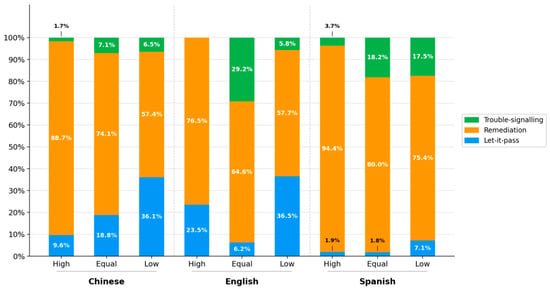
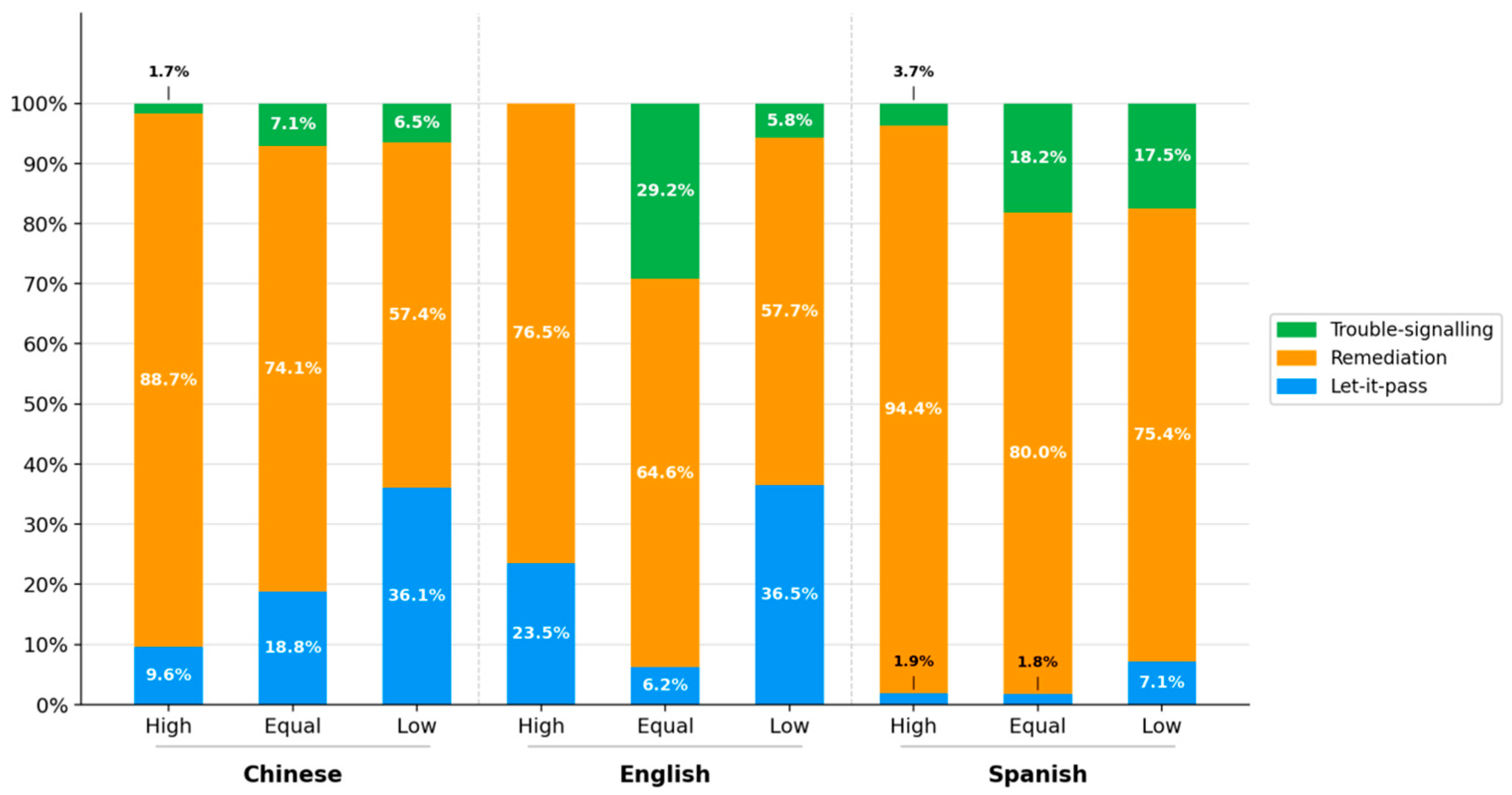
Having examined the role of social distance, we now turn to the influence of social status on response strategy choice. Figure 3 presents the distribution of the three response strategies across high, equal, and low social status conditions for the three languages.
Figure 3.
Percentage of response strategy use across high, equal, and low social status conditions in Chinese, Spanish, and English.
As shown in Figure 3, remediation was more frequently chosen in high-status contexts across all three groups, though with varying degrees: Chinese (88.7% high vs. 57.4% low), Spanish (94.4% vs. 75.4%), and English (76.5% vs. 57.7%) speakers all showed elevated remediation use with higher-status interlocutors. Trouble-signalling patterns showed noticeable cross-linguistic differences: while all groups favoured it in equal-status situations, English speakers showed the highest overall usage (29.2%) but complete avoidance in high-status contexts. Spanish speakers displayed moderate equal-status use (18.2%) that dropped sharply with higher status (3.7%), whereas Chinese speakers maintained consistently low trouble-signalling rates (1.7% to 7.1%) regardless of status. For let-it-pass, English speakers exhibited a U-shaped pattern, peaking in low-status interactions (36.5%). Chinese speakers progressively decreased let-it-pass use as status rose (36.1% low to 9.6% high), while Spanish speakers rarely employed this strategy across all status conditions (less than 7.1%).
Pearson chi-square tests indicated that social status significantly influenced response strategy choice in all three language groups: Chinese (χ2(4, N = 335) = 30.277, p < 0.001, Cramer’s V = 0.213), English (χ2(4, N = 151) = 32.411, p < 0.001, Cramer’s V = 0.328), and Spanish (χ2(4, N = 166) = 9.599, p = 0.048, Cramer’s V = 0.170). Post hoc analyses revealed different status-sensitive patterns across the three groups. In the English data, the effect of social status was mainly associated with let-it-pass and trouble-signalling: let-it-pass occurred more often than expected in low-status contexts (r = 2.1), while trouble-signalling occurred much more often than expected in equal-status contexts (r = 3.7) and less often than expected in high-status contexts (r = −2.4). In the Spanish data, no individual cell reached the conventional significance threshold, although trouble-signalling tended to occur less often than expected in high-status contexts (r = −1.9). In the Chinese data, the status effect was mainly linked to let-it-pass, which occurred more often than expected in low-status contexts (r = 3.4) and less often than expected in high-status contexts (r = −2.7). Remediation also occurred less often than expected in low-status contexts (r = −2.0), whereas trouble-signalling showed no marked deviations.
In conclusion, the findings for RQ2 reveal that social status was a more consistent predictor of response to communication trouble than social distance, with significant effects observed across all three language groups for status, but only among English speakers for distance.
5. Discussion
5.1. Cross-Linguistic Patterns of Response Strategies to Communication Trouble
The present study examined how L1 speakers of Chinese, English, and Spanish respond to communicative trouble across comparable sociopragmatic situations. The findings revealed both cross-linguistic commonalities and systematic differences in the distribution and linguistic realisation of response strategies.
One of the more consistent patterns across the three language groups was a shared preference for remediation, particularly indirect remediation (e.g., I thought it might be a cup, but it will also make a great vase). This pattern appears to indicate two things. First, all three groups oriented to the face-threatening potential of addressing others’ communicative trouble. As Robinson (2006) notes, listener-initiated remediation implicitly assigns responsibility for the communicative breakdown to the prior speaker, making it an inherently face-sensitive action. Second, despite this face-sensitivity, speakers across all three languages nonetheless chose to address the trouble rather than let it pass in the majority of cases, suggesting a shared orientation toward resolving communicative trouble and restoring mutual understanding. The cross-linguistic prevalence of indirect remediation thus reflects a balance between two competing concerns: the communicative need to resolve trouble efficiently and the interpersonal need to maintain social harmony. The specific linguistic means of achieving this balance differed across languages: Chinese speakers most frequently relied on downgraders and hedging particles, Spanish speakers combined correction with supportive facework, and English speakers typically opened with an apology to locate responsibility on themselves before delivering the correction.
The three groups diverged most sharply in their use of let-it-pass and trouble-signalling. Chinese and English speakers left trouble unaddressed in approximately one fifth of cases, whereas Spanish speakers did so in fewer than one in twenty. This pattern suggests that Chinese and English speakers may place greater weight on interactional harmony and the avoidance of open conflict, even at the cost of leaving the trouble source unresolved, while Spanish speakers display a stronger orientation toward explicit resolution. These findings are consistent with Firth’s (1996) observation that let-it-pass is a meaningful interactional resource rather than a communicative failure, and they extend his account by showing that its use is not uniform across languages. From the perspective of cross-cultural pragmatics, the contrast between Spanish and the other two groups may reflect different cultural priorities with respect to clarity and face-sensitivity (Wierzbicka, 1991).
Trouble-signalling was relatively infrequent across all three language groups, though Spanish speakers used it somewhat more often than Chinese and English speakers. At the level of linguistic realisation, English speakers relied most heavily on fixed syntactic frames such as Do you mean X?, whereas Spanish speakers displayed greater formal variety, and Chinese speakers showed the greatest structural flexibility, relying on reduced forms, contextual recoverability, and sentence-final particles such as 吗 (ma) and 吧 (ba). These language-specific resources align with Zhang’s (1998) observation that Mandarin deploys trouble-signalling formats that do not have direct equivalents in English, and they are consistent with Dingemanse et al.’s (2014) finding that, despite cross-linguistic regularities in the functional types of trouble-signalling, the specific linguistic means through which these functions are realised are shaped by the grammatical and pragmatic resources of each language. These findings extend previous cross-linguistic research into repair, which has focused primarily on the formats of repair initiation and their sequential organisation (Dingemanse et al., 2014; Dingemanse & Enfield, 2015). While those earlier studies demonstrated that the structural machinery of repair is largely shared across languages, our findings show that once we move beyond initiation formats to examine the repair solution, including whether speakers remediate, signal, or let trouble pass, systematic cross-linguistic variation emerges. This suggests that cross-language similarity at the level of repair structure does not necessarily extend to the level of pragmatic strategy choice, where culturally specific norms of face management and interpersonal harmony come into play.
While our results reveal both similarities and differences in how the three language groups respond to communicative trouble in the DCT, the proportions and linguistic realisations of each strategy need to be treated cautiously, as they may have been shaped by the written nature of the task. This is particularly relevant for trouble-signalling and let-it-pass, which in natural conversation often depend on real-time interactional cues such as timing, prosody, or gaze. The DCT format, while offering controlled comparability, did not oblige participants to remediate; however, the absence of time pressure may have encouraged more explicit and deliberate responses, potentially inflating the frequency of remediation relative to what might occur in spontaneous interaction. Future research could complement DCTs with observational or role-play methods to capture these dynamic dimensions more fully.
5.2. The Role of Sociopragmatic Factors in Response Strategies to Communication Trouble
The two sociopragmatic variables examined in this study showed markedly different effects across the three language groups, suggesting that response to communicative trouble is a context-sensitive social action shaped by interpersonal variables (Firth, 1996; Robinson, 2006).
Social distance had a limited and language-specific effect. It significantly influenced response strategy choice only among English speakers, where the main effect was a tendency for trouble-signalling to occur more often in close social relationship contexts (e.g., interactions between family members or friends). For Chinese and Spanish speakers, social distance did not significantly alter the overall distribution of response strategies, suggesting that its relevance may depend on broader pragmatic norms within each language community.
Social status emerged as a more robust and cross-linguistically consistent factor, significantly influencing response strategy choice in all three language groups. Across all three groups, remediation was more frequently selected in high-status contexts (e.g., interaction between professors and students), while let-it-pass was more common when addressing lower-status interlocutors (e.g., interactions between a student and a kid, and between a student and his/her little sibling), a pattern that may reflect the higher communicative stakes of leaving trouble unresolved with a higher-status interlocutor. The specific strategies through which this sensitivity was expressed differed across languages: English speakers showed a sharp avoidance of trouble-signalling in high-status contexts, Chinese speakers primarily expressed status sensitivity through let-it-pass, and Spanish speakers showed the weakest overall effect, though with a similar tendency to avoid trouble-signalling with higher-status interlocutors.
The systematic comparison of macro-social variables in the present study shows that social variables do condition strategy choice, and that their relevance is itself language-specific. Previous cross-linguistic research into repair has drawn primarily on natural conversation data, which tends to be skewed toward informal interactions among family members and friends (Dingemanse et al., 2014; Dingemanse & Enfield, 2015). While studies such as Norrick (1991) have suggested, through comparative observation, that different settings may give rise to different repair preferences, these insights have not been tested through systematic, cross-linguistic empirical comparison of how social distance and social status shape responses to communication trouble across languages. By using a controlled elicitation design that systematically varies social status and social distance while holding other contextual factors constant, the present study offers empirical evidence that complements naturalistic accounts. It demonstrates not only that social variables condition strategy choice but also that the relevance of these variables is itself language-specific.
5.3. Pedagogical Implications
The theoretical relevance of cross-cultural pragmatic findings to L2 instruction rests on a well-established premise in L2 pragmatics: learners are known to rely on their L1 pragmatic norms when performing in an L2, and this reliance can lead to negative or positive pragmatic transfer (Kasper & Blum-Kulka, 1993; Maeshiba et al., 1996). Cross-cultural studies that document systematic differences between languages therefore provide an empirical basis for generating hypotheses about where such transfer is most likely to occur. At the same time, such findings can also inform instruction aimed at raising pragmatic awareness and developing intercultural pragmatic competence, that is, the ability to recognise, interpret, and flexibly respond to pragmatically different norms rather than simply to avoid transferring L1 norms.
The present findings do not provide direct evidence for how learners actually behave when responding to communication trouble. They do, however, offer an empirical baseline of native speaker norms that can inform the generation of such hypotheses. Specifically, the findings point to three areas where cross-linguistic variation is most pronounced and where pedagogical attention may hypothetically be warranted.
At the strategy level, the marked differences in let-it-pass use suggest this as a possible point of cross-cultural divergence. Learners from an L1 background in which let-it-pass is less conventionalised may underuse this strategy in the L2, instead opting for more explicit remediation even in contexts where the L2 community would prefer to let the trouble pass. Conversely, learners whose L1 favours let-it-pass may overuse it in the L2, producing responses that are perceived as disengaged, uncooperative, or pragmatically inadequate when more explicit remediation is expected. Such difficulties are not merely a matter of transfer; they also reflect limited pragmatic awareness of how silence itself can carry interactional meaning. Instruction could therefore use authentic cross-cultural examples to make learners notice when let-it-pass is preferred, what it signals, and how it may be perceived if over- or underused.
At the pragmalinguistic level, the different mitigation devices preferred by each language group indicate that the linguistic realisation of remediation is not universal. Learners may know that mitigation is needed but select a device that is too formal, too informal, or pragmatically marked in the L2. For example, relying on a direct apology or a bare explanation where the L2 prefers a more elaborated or more indirect form. This is a classic area of difficulty because pragmalinguistic knowledge is often underrepresented in textbooks. Explicit classroom attention, supported by contrastive examples, could help learners expand their repertoire of mitigation devices and understand their different interactional effects, thereby supporting intercultural pragmatic competence rather than mere rule-following.
At the sociopragmatic level, the language-specific effects of social distance and social status suggest that learners might benefit from awareness that the relevance of these variables is itself culturally conditioned. A learner may correctly map distance and status onto the L2 but assign them the weighting conventional in the L1, leading to remediation that is perceived as too deferential, too casual, or simply inappropriate. This is a particularly challenging area because sociopragmatic norms are often implicit and context-dependent. Instruction could therefore focus on raising pragmatic awareness through situated examples and reflection on learners’ own expectations, helping them interpret how distance and status are calibrated in the target community and adjust their behaviour accordingly.
These patterns do not constitute evidence of instructional effectiveness, nor do they predict learner behaviour. They are descriptive findings that can help formulate research questions for future empirical studies on L2 pragmatic development in this domain.
6. Conclusions
This study examined how L1 speakers of English, Spanish, and Chinese respond to communicative trouble across comparable sociopragmatic situations, and how social distance and social status shape these responses. Using a written DCT and a pragmatics-oriented coding framework, responses were classified into three strategy types: remediation, trouble-signalling, and let-it-pass.
All three groups showed a broad preference for remediation, particularly indirect remediation, reflecting a shared orientation toward resolving communicative trouble while managing its face-threatening potential. The three groups diverged most sharply in their use of let-it-pass, with Chinese and English speakers leaving trouble unaddressed far more often than Spanish speakers, suggesting different cultural priorities with respect to clarity and interpersonal harmony. Differences were also found in the linguistic realisation of response strategies and in sensitivity to sociopragmatic factors: social distance had a limited and language-specific effect, whereas social status emerged as a more robust and cross-linguistically consistent factor across all three groups.
Several limitations should be noted. The chi-square results comparing pragmatic strategies across groups should be interpreted with caution, as each participant contributed responses to multiple DCT scenarios, meaning that frequency counts were not fully independent. The trouble sources were also limited to factual mistakes and linguistic errors, and future studies could examine a broader range of trouble sources to better capture the contexts in which communicative trouble arises. Finally, written DCTs may be less likely to elicit open trouble-signalling due to low time pressure and may also not fully capture let-it-pass, which in real interaction can be managed through subtle cues such as gaze or prosody rather than verbal acknowledgement. Future research could employ role-play or multimodal methods to more closely simulate the dynamics of naturally occurring interactions.
This study makes three contributions. First, it extends cross-linguistic research into responses to communicative trouble by shifting attention from trouble-signalling formats to the full range of response strategies, examined from a cross-cultural pragmatic rather than a conversation-analytic perspective. Second, it broadens the sociopragmatic scope of previous research by systematically comparing the effects of social distance and social status across three language groups. Third, it provides a cross-cultural reference point for L2 pragmatic instruction, documenting both the universal and the language-specific dimensions of responding to communicative trouble across English, Spanish, and Chinese.
Author Contributions
Conceptualization, Y.S. and A.S.-H.; methodology, Y.S.; software, Y.S.; validation, Y.S. and A.S.-H.; formal analysis, Y.S.; investigation, Y.S.; resources, Y.S.; data curation, Y.S. and A.S.-H.; writing—original draft preparation, Y.S.; writing—review and editing, A.S.-H.; visualization, Y.S.; supervision, A.S.-H.; project administration, Y.S.; funding acquisition, A.S.-H. All authors have read and agreed to the published version of the manuscript.
Funding
This research received no external funding.
Institutional Review Board Statement
The study was conducted in accordance with the guidelines of the Declaration of Helsinki, and approved by the Ethics Committee of Complutense University of Madrid (protocol code CE_20240314_06_HUM and date of approval: 14 March 2024).
Informed Consent Statement
Informed consent was obtained from all subjects involved in the study.
Data Availability Statement
The data presented in this study are available on request from the corresponding author due to privacy/ethical restrictions.
Acknowledgments
During the preparation of this study, the authors used Wenxin Yige (Baidu AI Art, 2024) for the purpose of generating illustrative images to enhance the authenticity of the scenarios in the discourse completion task. One such AI-generated image appears in Example 1 of this article. The authors have reviewed and edited the output and take full responsibility for the content of this publication.
Conflicts of Interest
The authors declare no conflict of interest.
Appendix A
Table A1.
Coding categories and examples of responses to communicative troubles.
References
- Baranova, J. (2015). Other-initiated repair in Russian. Open Linguistics, 1(1), 555–577. [Google Scholar] [CrossRef] [Scilit]
- Bazzanella, C., & Damiano, R. (1999). The interactional handling of misunderstanding in everyday conversations. Journal of Pragmatics, 31(6), 817–836. [Google Scholar] [CrossRef] [Scilit]
- Binay, M. (2025). Intercultural communication in English: Language, culture, and miscommunication. Journal of Exceptional Multidisciplinary Research, 2(2), 92–100. [Google Scholar] [CrossRef] [Scilit]
- Bolden, G. B. (2018). Speaking ‘out of turn’: Epistemics in action in other-initiated repair. Discourse Studies, 20(1), 142–162. [Google Scholar] [CrossRef] [Scilit]
- Brown, P., & Levinson, S. C. (1987). Politeness: Some universals in language usage. Cambridge University Press. [Google Scholar]
- Cohen, J. (1988). Statistical power analysis for the behavioral sciences (2nd ed.). Lawrence Erlbaum Associates. [Google Scholar]
- Coupland, N., Giles, H., & Wiemann, J. M. (Eds.). (1991). “Miscommunication” and problematic talk. Sage. [Google Scholar]
- Dingemanse, M., Blythe, J., & Dirksmeyer, T. (2014). Formats for other-initiation of repair across languages: An exercise in pragmatic typology. Studies in Language, 38(1), 5–43. [Google Scholar] [CrossRef] [Scilit]
- Dingemanse, M., & Enfield, N. J. (2015). Other-initiated repair across languages: Towards a typology of conversational structures. Open Linguistics, 1(1), 96–118. [Google Scholar] [CrossRef] [Scilit]
- Dingemanse, M., & Enfield, N. J. (2024). Interactive repair and the foundations of language. Trends in Cognitive Sciences, 28(1), 30–42. [Google Scholar] [CrossRef] [Scilit]
- Elder, C.-H. (2024). Pragmatic inference: Misunderstandings, accountability, deniability. Cambridge University Press. [Google Scholar] [CrossRef] [Scilit]
- Enfield, N. J. (2015). Other-initiated repair in Lao. Open Linguistics, 1(1), 119–144. [Google Scholar] [CrossRef] [Scilit]
- Firth, A. (1996). The discursive accomplishment of normality: On ‘lingua franca’ English and conversation analysis. Journal of Pragmatics, 26(2), 237–259. [Google Scholar] [CrossRef] [Scilit]
- Gumperz, J. J. (1982). Discourse strategies. Cambridge University Press. [Google Scholar]
- House, J. (2003). Misunderstanding in intercultural university encounters. In J. House, G. Kasper, & S. Ross (Eds.), Misunderstanding in social life: Discourse approaches to problematic talk (pp. 22–56). Routledge. [Google Scholar]
- House, J., Kasper, G., & Ross, S. (Eds.). (2003). Misunderstanding in social life: Discourse approaches to problematic talk. Routledge. [Google Scholar]
- Kasper, G., & Blum-Kulka, S. (Eds.). (1993). Interlanguage pragmatics. Oxford University Press. [Google Scholar]
- Kendrick, K. H. (2015). Other-initiated repair in English. Open Linguistics, 1(1), 164–190. [Google Scholar] [CrossRef] [Scilit]
- Korkut, P., Işık-Güler, H., & Maíz-Arévalo, C. (2018). Cross-cultural pragmatics and intercultural communication. In The Routledge handbook of pragmatics (pp. 1–15). Routledge. [Google Scholar]
- Long, M. H. (1996). The role of the linguistic environment in second language acquisition. Handbook of Second Language Acquisition, 2(2), 413–468. [Google Scholar] [CrossRef] [Scilit]
- Lyster, R., & Ranta, L. (1997). Corrective feedback and learner uptake: Negotiation of form in communicative classrooms. Studies in Second Language Acquisition, 19(1), 37–66. [Google Scholar] [CrossRef] [Scilit]
- Maeshiba, N., Yoshinaga, N., Kasper, G., & Ross, S. (1996). Transfer and proficiency in interlanguage apologizing. In S. M. Gass, & J. Neu (Eds.), Speech acts across cultures: Challenges to communication in a second language (pp. 155–187). Mouton de Gruyter. [Google Scholar]
- Maíz-Arévalo, C. (2018). Losing face on Facebook: Linguistic strategies to repair face in a Spanish common interest group. In P. Bou-Franch, & P. Garcés-Conejos Blitvich (Eds.), Analyzing digital discourse: New insights and future directions (pp. 283–309). Palgrave Macmillan. [Google Scholar] [CrossRef] [Scilit]
- Nassaji, H., & Kartchava, E. (Eds.). (2021). The Cambridge handbook of corrective feedback in second language learning and teaching. Cambridge University Press. [Google Scholar] [CrossRef] [Scilit]
- Norrick, N. R. (1991). On the organization of corrective exchanges in conversation. Journal of Pragmatics, 16(1), 59–83. [Google Scholar] [CrossRef] [Scilit]
- Ogiermann, E. (2018). Discourse completion tasks. In A. H. Jucker, K. P. Schneider, & W. Bublitz (Eds.), Methods in pragmatics (pp. 229–255). De Gruyter Mouton. [Google Scholar] [CrossRef] [Scilit]
- Raymond, G., & Sidnell, J. (2019). Interaction at the boundaries of a world known in common: Initiating repair with “What do you mean?”. Research on Language and Social Interaction, 52(2), 177–192. [Google Scholar] [CrossRef] [Scilit]
- Robinson, J. D. (2006). Managing trouble responsibility and relationships during conversational repair. Communication Monographs, 73(2), 137–161. [Google Scholar] [CrossRef] [Scilit]
- Sánchez-Hernández, A., & Maíz-Arévalo, C. (2021). Toward a new measurement of intercultural competence: Assessing the pragmatic competence of intercultural speakers. In Teaching and learning second language pragmatics for intercultural understanding (pp. 199–225). Routledge. [Google Scholar]
- Schegloff, E. A., Jefferson, G., & Sacks, H. (1977). The preference for self-correction in the organization of repair in conversation. Language, 53(2), 361–382. [Google Scholar] [CrossRef] [Scilit]
- Sharpe, D. (2015). Your chi-square test is statistically significant: Now what? Practical Assessment, Research & Evaluation, 20(8), 1–10. [Google Scholar] [CrossRef]
- Sun, Y., & Sánchez-Hernández, A. (2026). Towards a pragmatic assessment of OIR: Development of a pragmatics-oriented coding system. International Journal of Applied Linguistics, 36(3), 2675–2688. [Google Scholar] [CrossRef] [Scilit]
- Thomas, J. (1983). Cross-cultural pragmatic failure. Applied Linguistics, 4(2), 91–112. [Google Scholar] [CrossRef] [Scilit]
- Tzanne, A. (2000). Talking at cross-purposes: The dynamics of miscommunication. John Benjamins. [Google Scholar]
- Verdonik, D. (2010). Between understanding and misunderstanding. Journal of Pragmatics, 42(5), 1364–1379. [Google Scholar] [CrossRef] [Scilit]
- Wierzbicka, A. (1991). Cross-cultural pragmatics: The semantics of human interaction. Mouton de Gruyter. [Google Scholar]
- Yang, R. (2009). Other-repair in Chinese conversation: A case of web-based academic discussion. Intercultural Pragmatics, 6(3), 315–343. [Google Scholar] [CrossRef] [Scilit]
- Zhang, W. (1998). Repair in Chinese conversation [Doctoral dissertation, The University of Hong Kong]. [Google Scholar] [CrossRef] [Scilit]

Disclaimer/Publisher’s Note: The statements, opinions and data contained in all publications are solely those of the individual author(s) and contributor(s) and not of MDPI and/or the editor(s). MDPI and/or the editor(s) disclaim responsibility for any injury to people or property resulting from any ideas, methods, instructions or products referred to in the content. |
© 2026 by the authors. Licensee MDPI, Basel, Switzerland. This article is an open access article distributed under the terms and conditions of the Creative Commons Attribution (CC BY) license.