Response Analysis and Damping Parameter Identification of Stiffened Plates Under Shock Environment



Abstract
1. Introduction
2. Methodology
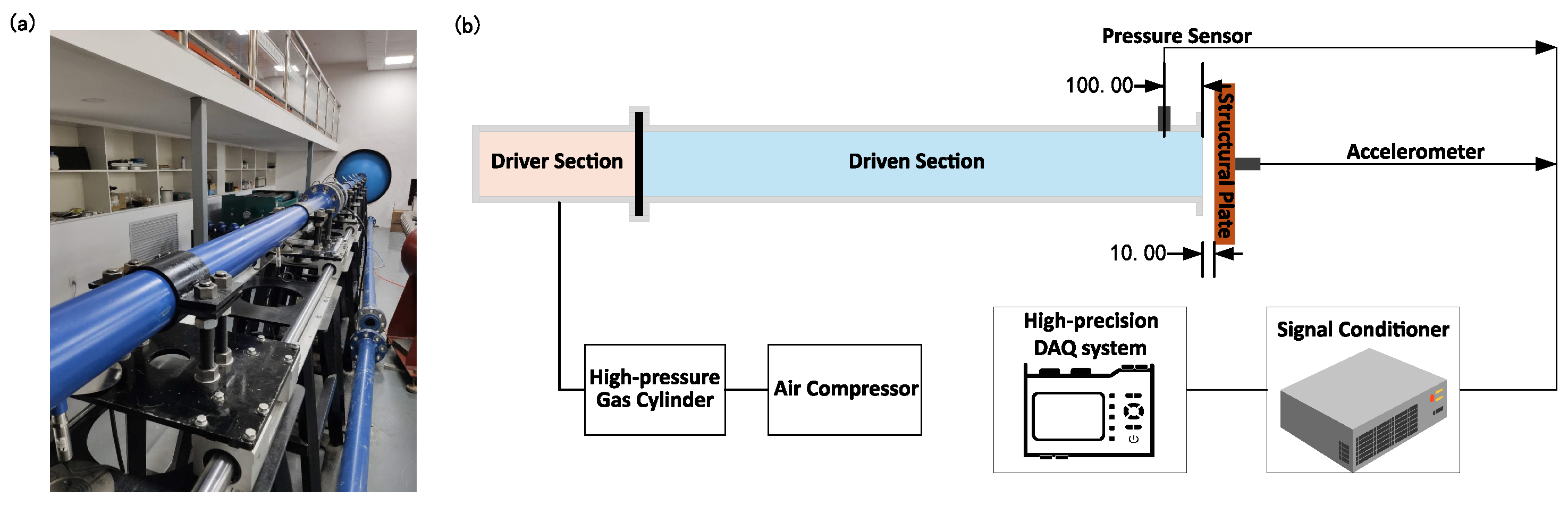
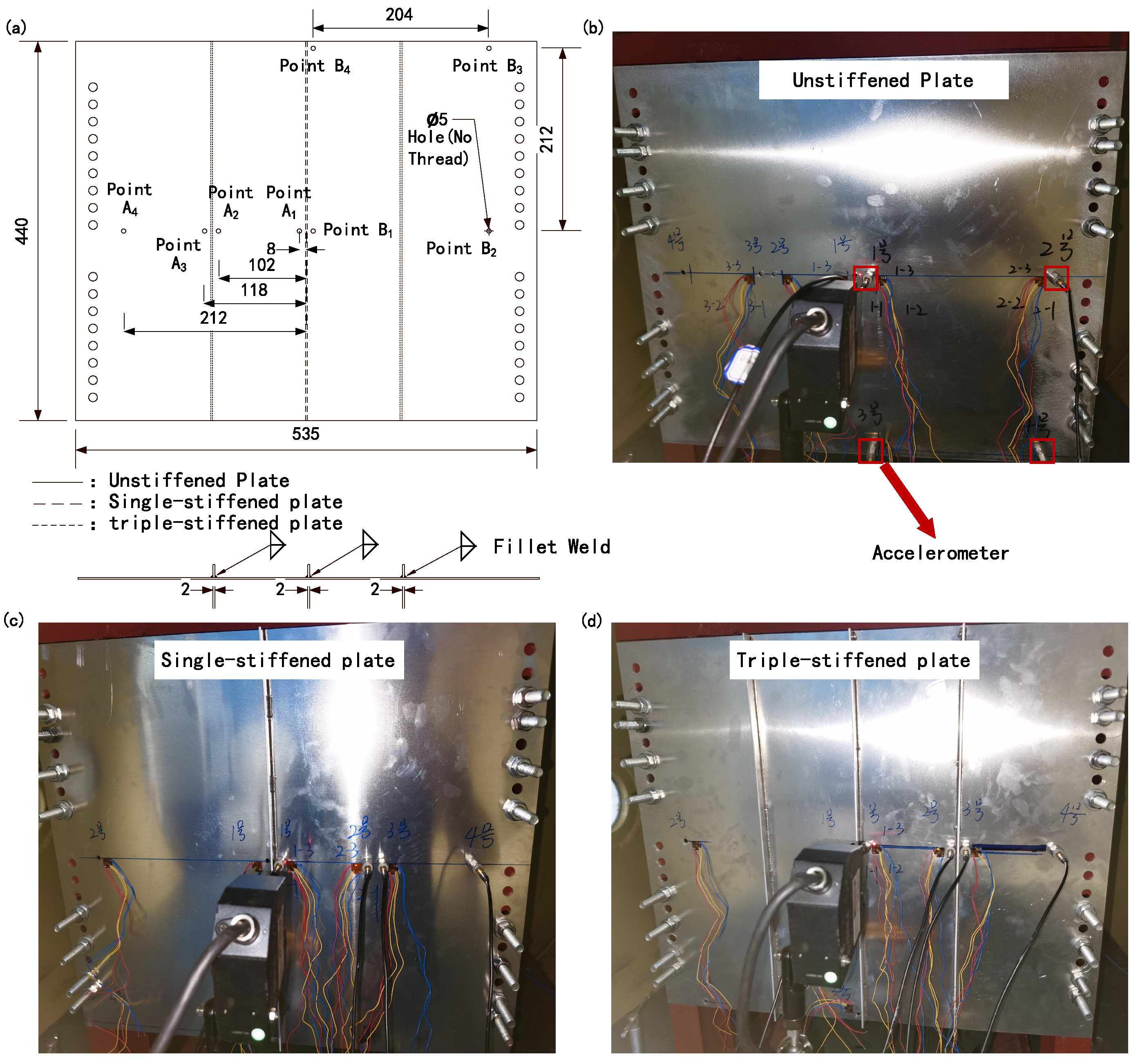
2.1. Experimental Setup
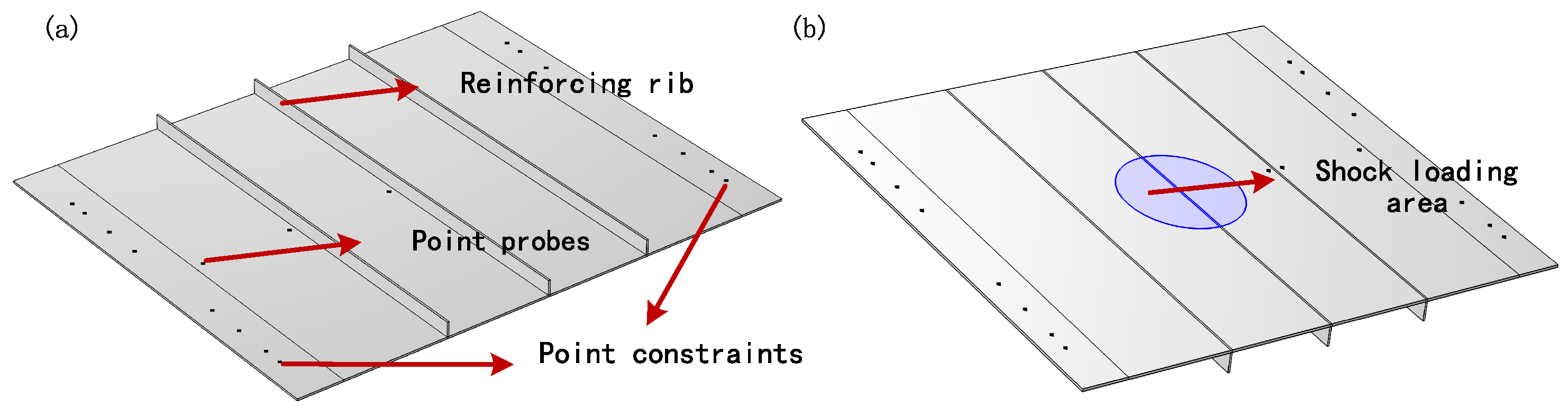
2.2. Finite Element Modeling of the Stiffened Plates
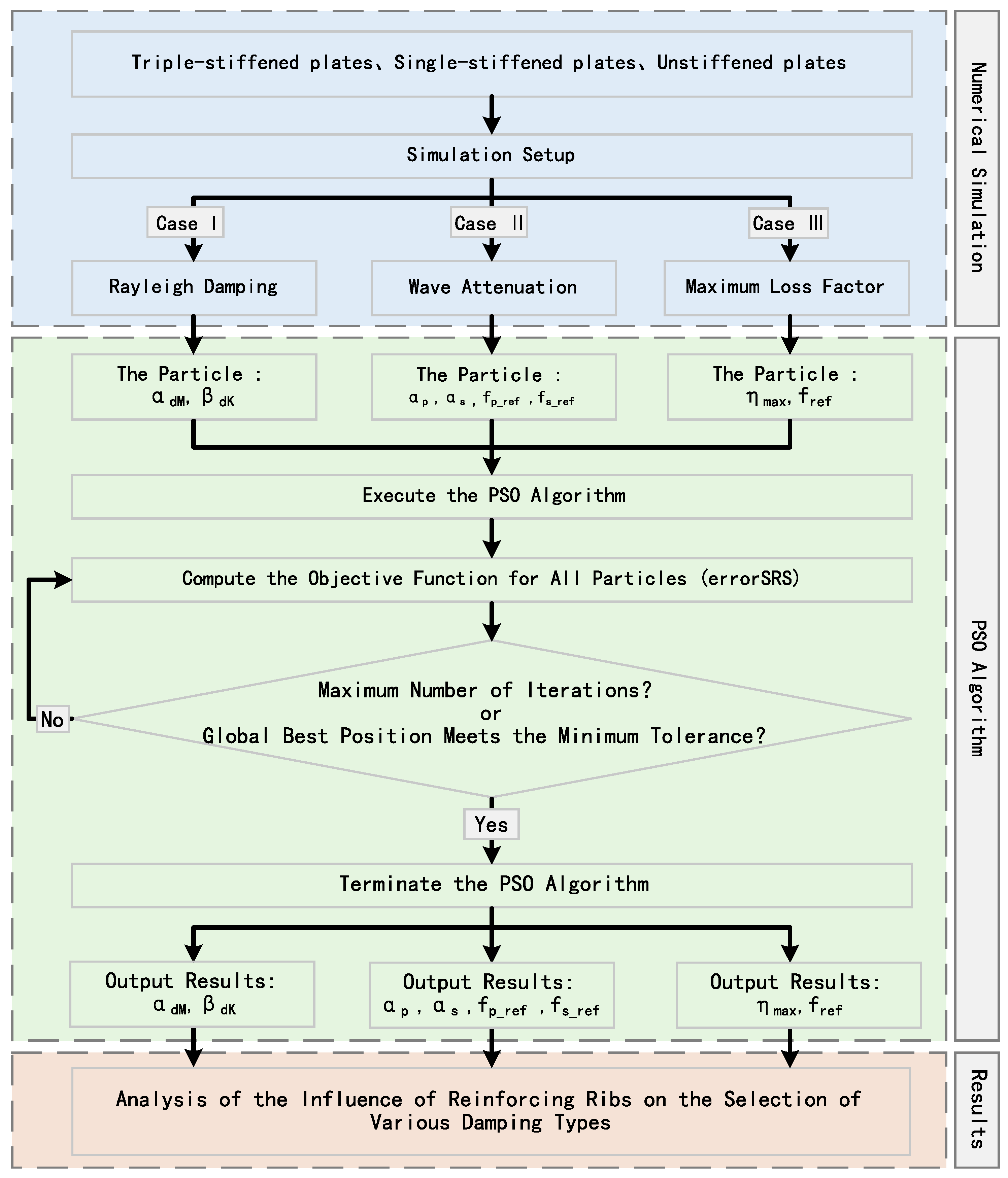
2.3. Damping Parameter Identification for the Stiffened Plates
3. Experiment and Simulation Results
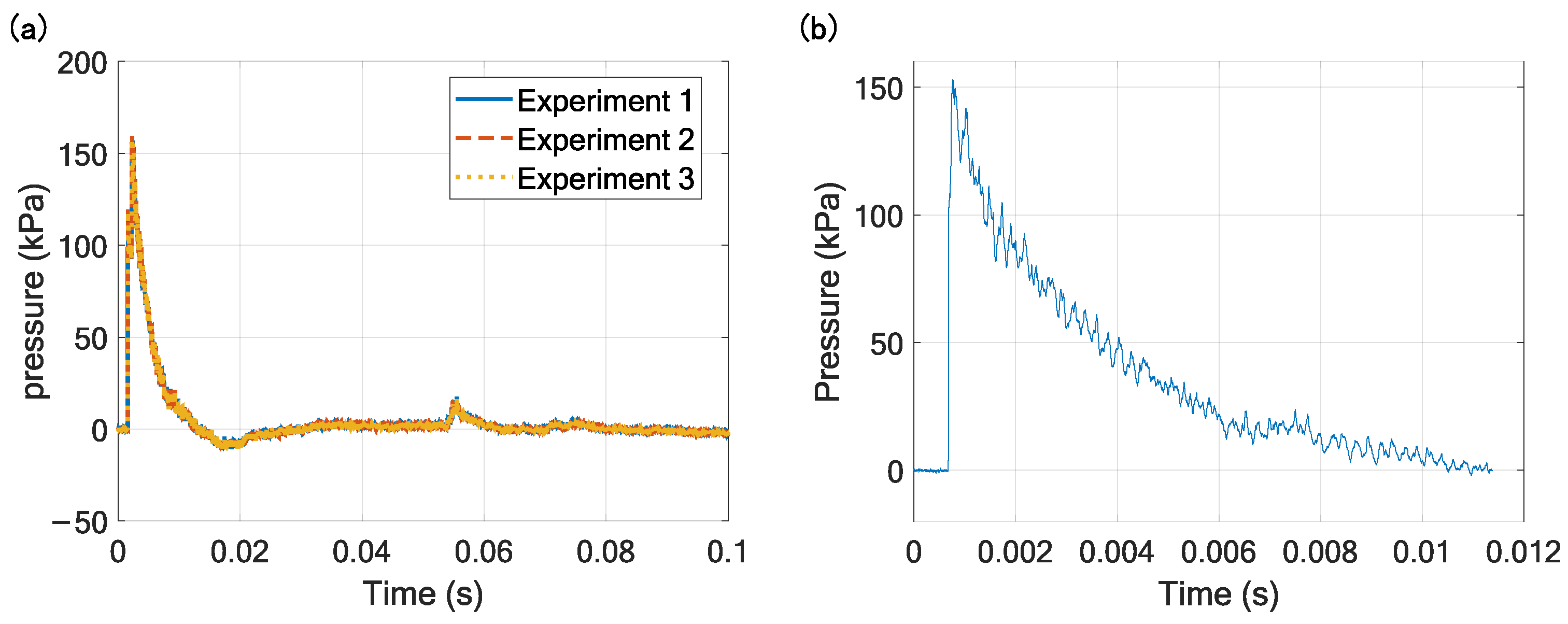
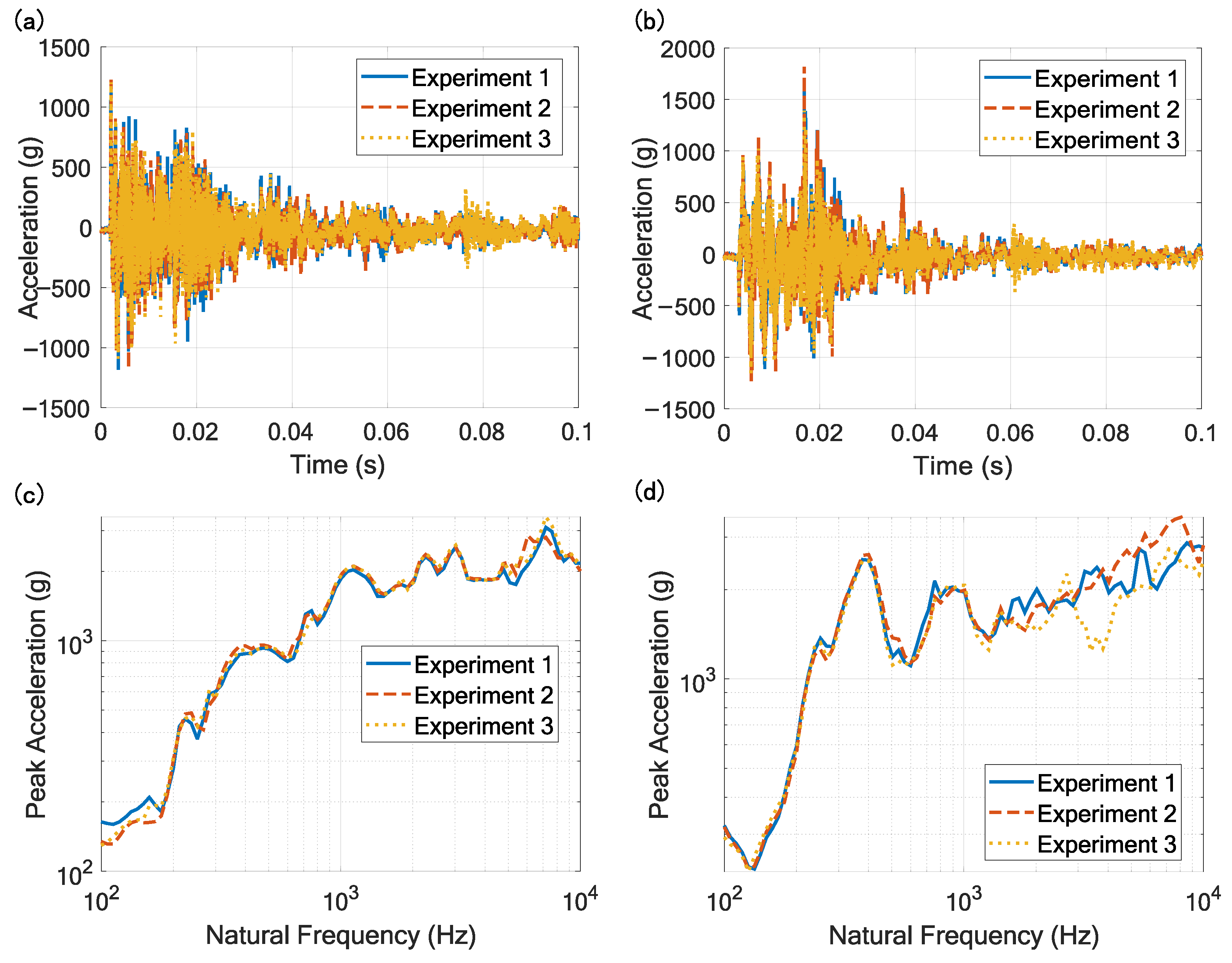
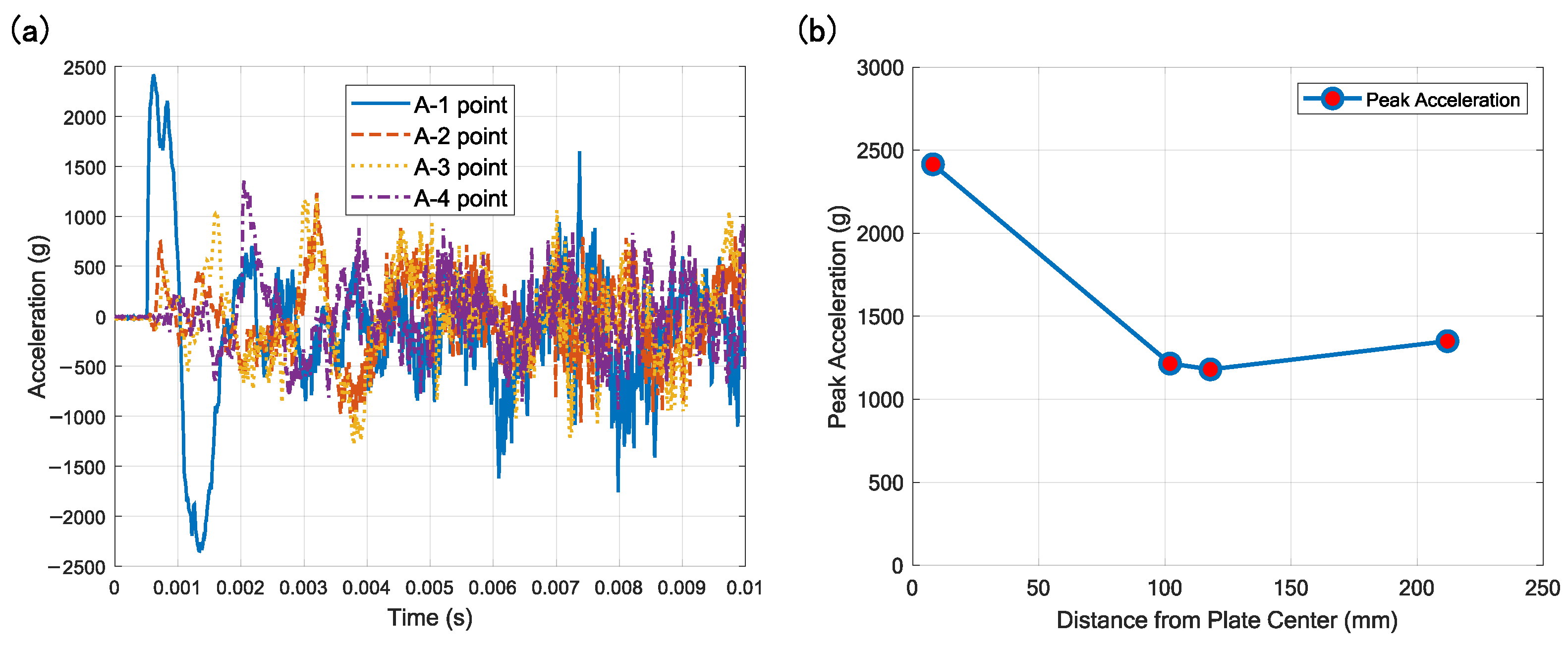
3.1. Repeatability Analysis of Shock Responses in Shock Wave Experiments
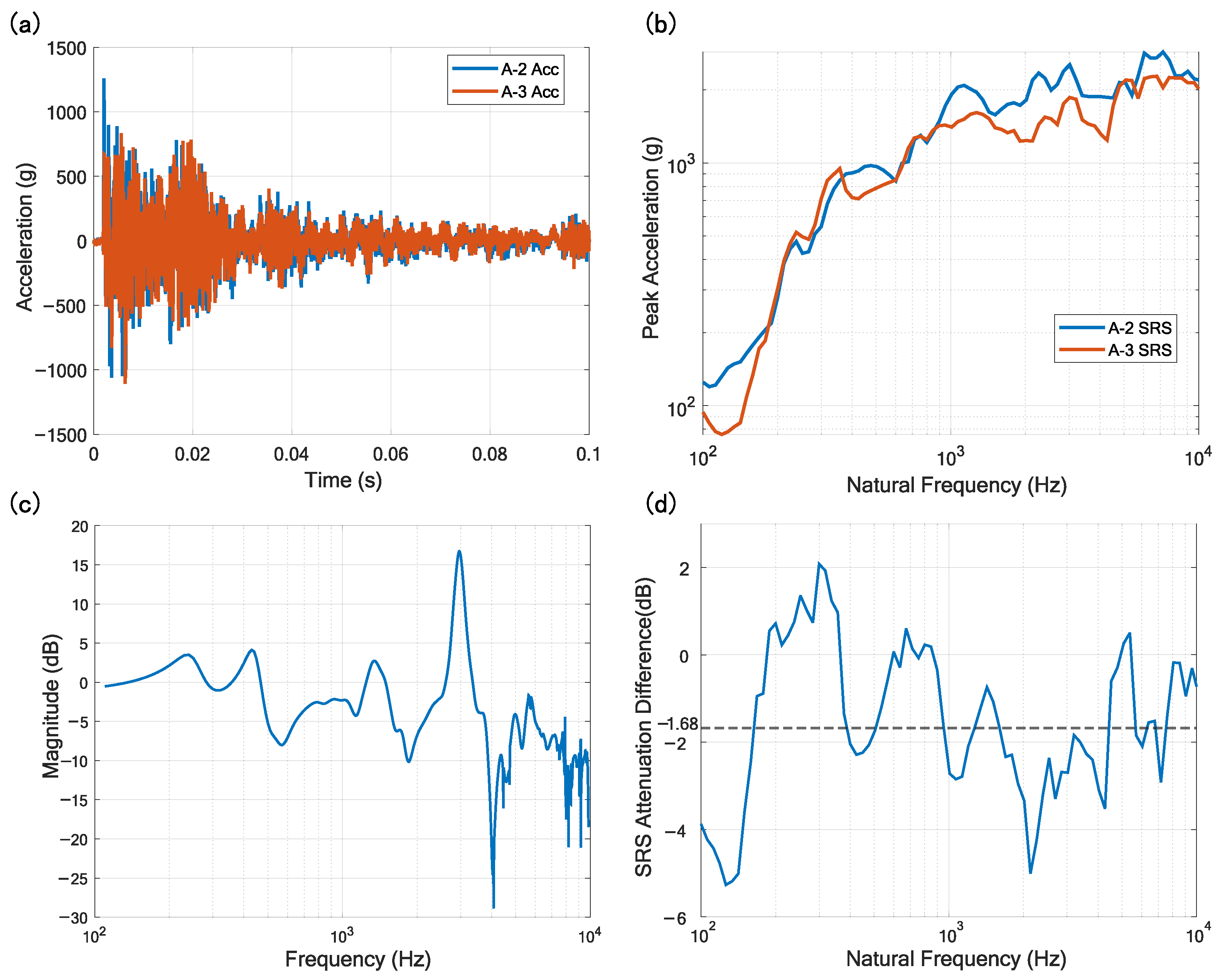
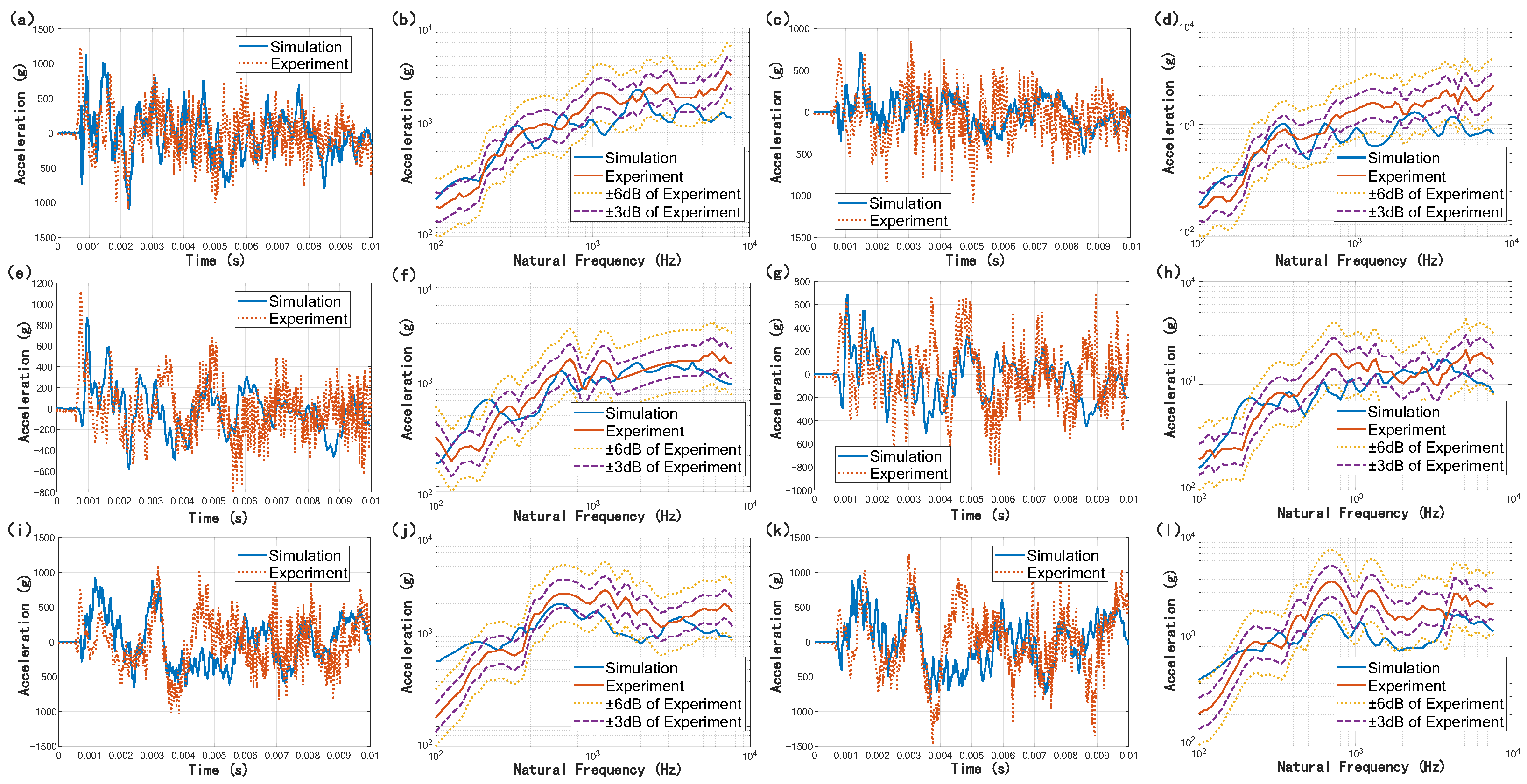
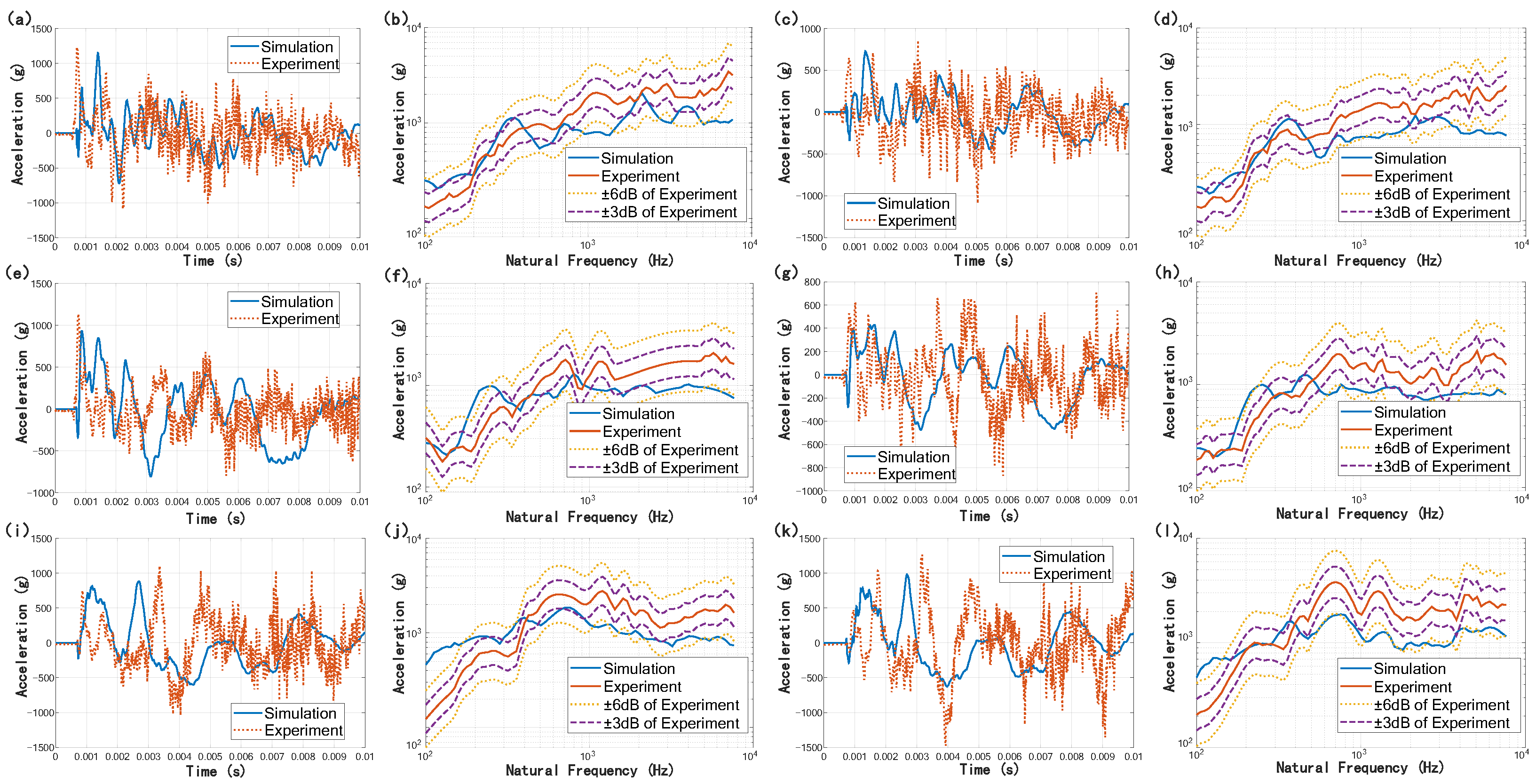
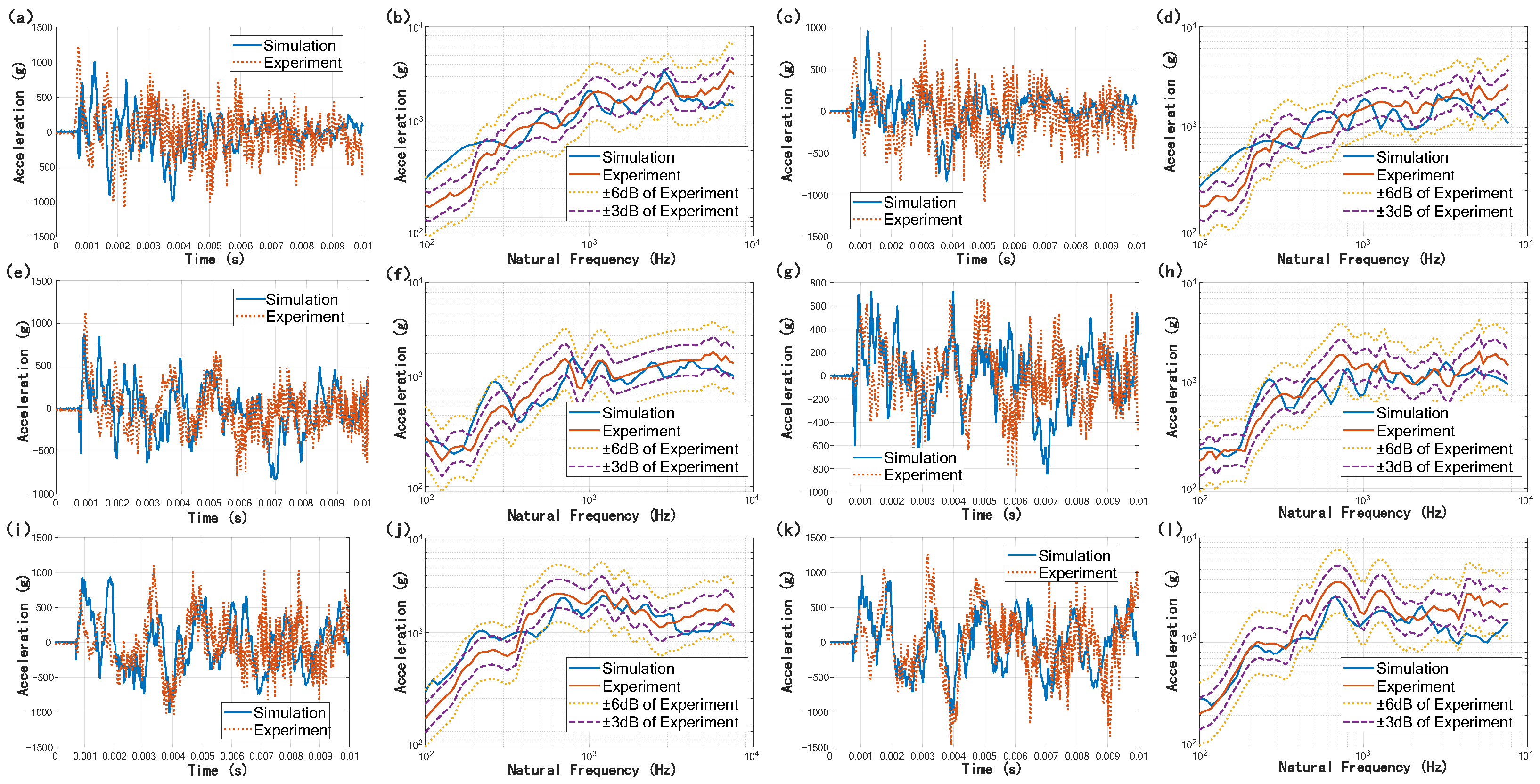
3.2. Analysis of the Attenuation Effects of Reinforcing Rib on Structural Shock Responses
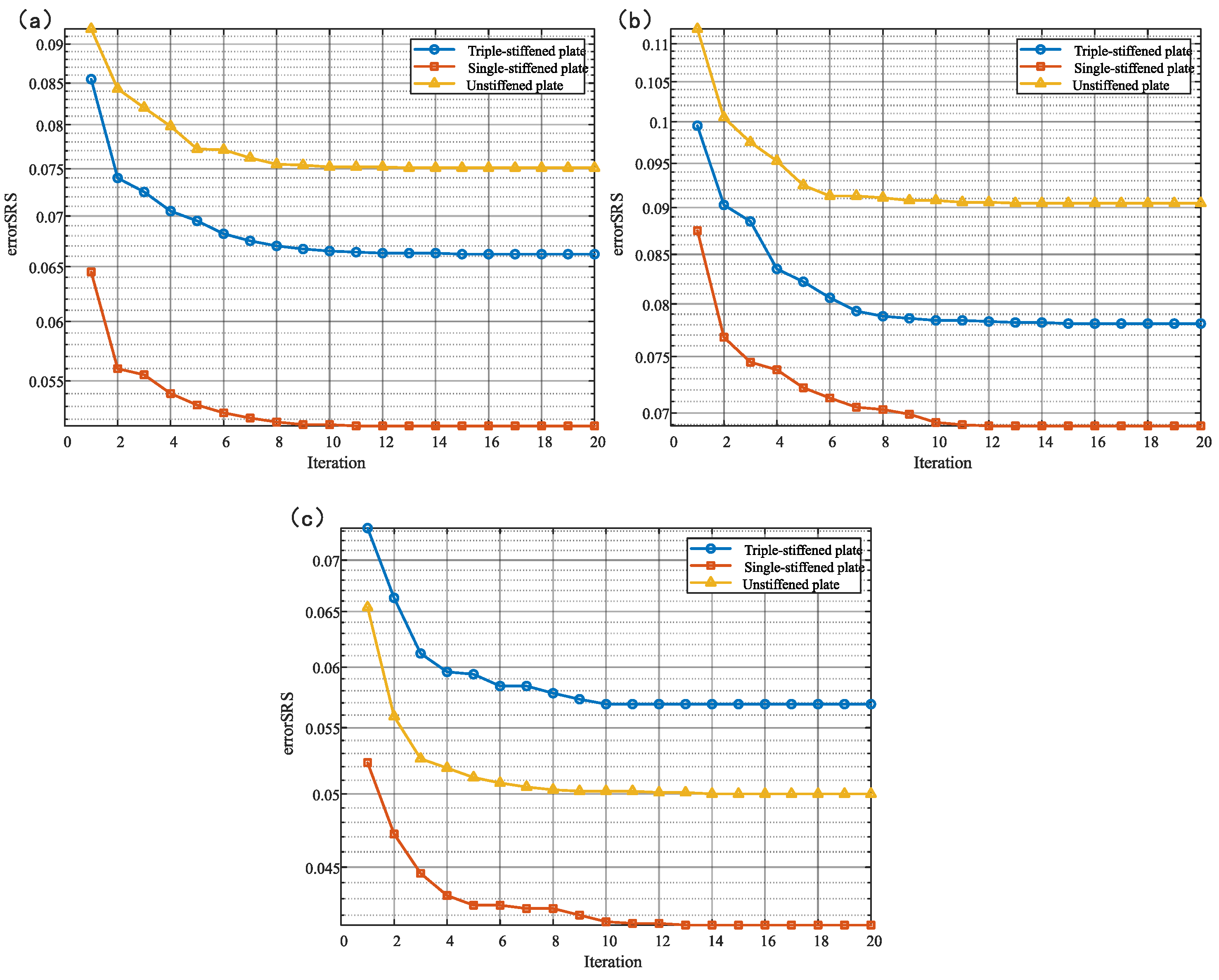
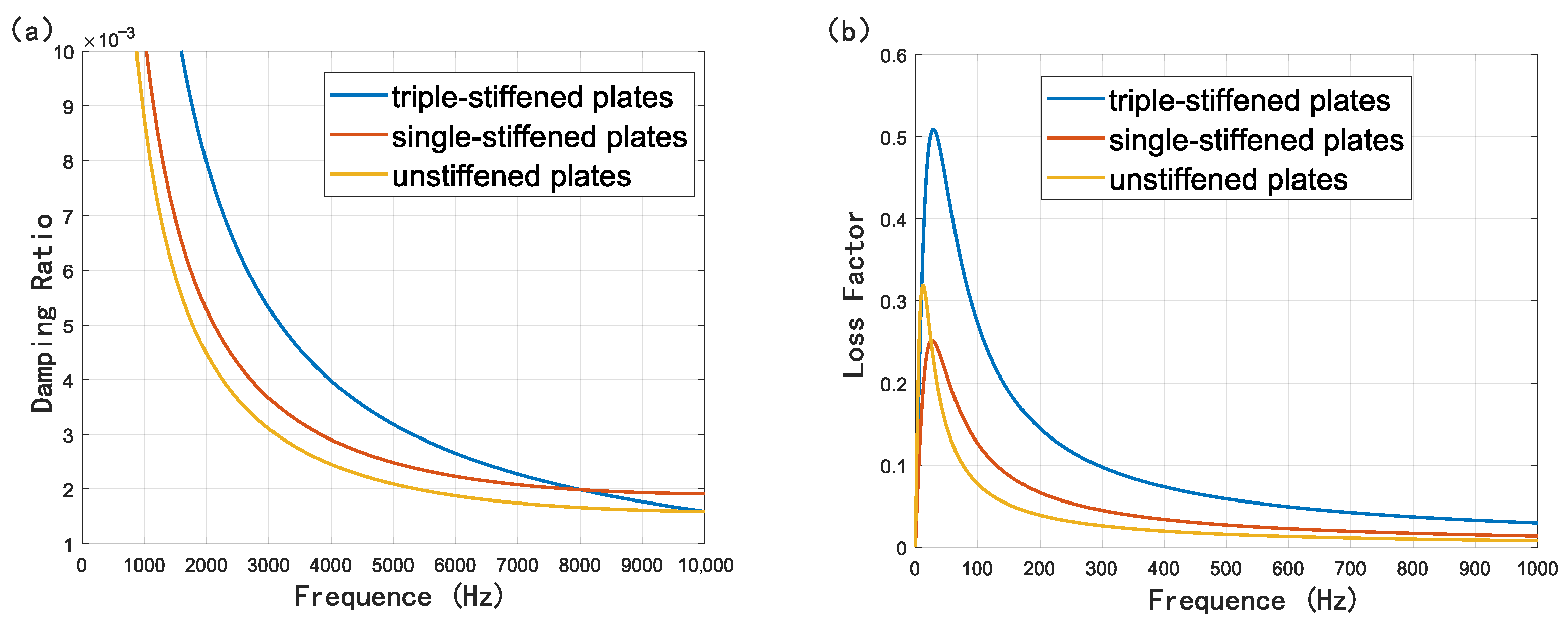
3.3. Analysis of the Effect of Reinforcing Rib on Parameters of Damping Models
4. Conclusions
- The damping characteristics of the structure are strongly affected by the presence of the reinforcing rib. The attenuation in time-domain response amplitude was consistently around 25.0%, while the most significant SRS reduction reached dB.
- Among the damping models considered, the maximum loss factor model provides the best damping prediction performance, significantly outperforming the engineering-standard Rayleigh damping model. In contrast, the wave attenuation model yields the lowest prediction accuracy, reaching only 78.11% of that achieved by the maximum loss factor model.
- Among the parameters affecting the accuracy of shock environment prediction, damping is the most critical modeling parameter. By adjusting only the damping model parameters, an average of 82.82% of the two-point prediction results can be brought within the 6 dB tolerance range. However, it should be noted that these results primarily demonstrate the localized calibration fidelity of the model across the reinforcing rib, rather than its global predictive capability.
- The present study is limited to linear damping formulations and shock environment prediction for plate-type structures operating within the elastic regime. It should be noted that under more realistic and severe shock environments, energy dissipation is often governed by complex nonlinear mechanisms that are not explicitly captured in the current model, including localized plastic deformation, structural yielding, and mechanical joint slip. In this context, the damping parameters identified in this study should be regarded as effective calibration parameters that phenomenologically characterize macroscopic energy dissipation, rather than intrinsic physical material properties. Therefore, the proposed methodology is primarily applicable to the structural dynamic design and environmental qualification of airborne equipment subjected to moderate shock conditions where elastic assumptions remain valid. Future work will focus on nonlinear damping behavior, joint friction effects, and more complex structural configurations involving fluid–structure interaction, with the aim of developing data-driven or hybrid identification approaches to improve predictive robustness under severe nonlinear shock environments.
Author Contributions
Funding
Data Availability Statement
Conflicts of Interest
References
- European Cooperation for Space Standardization. ECSS-E-HB-32-25A: Mechanical Shock Design and Verification Handbook; ECSS: Noordwijk, The Netherlands, 2015. [Google Scholar]
- U.S. Department of Defense. MIL-STD-810H: Environmental Engineering Considerations and Laboratory Tests; Department of Defense: Washington, DC, USA, 2019.
- Sisemore, C.; Babuška, V. The Science and Engineering of Mechanical Shock; Springer International Publishing: Cham, Switzerland, 2020. [Google Scholar]
- Irvine, T. An Introduction to the Shock Response Spectrum; Vibrationdata: Madison, AL, USA, 2002; Available online: http://www.vibrationdata.com/tutorials2/srs_intr.pdf (accessed on 27 May 2025).
- Li, B.; Li, Q. Damage boundary of structural components under shock environment. Int. J. Impact Eng. 2018, 118, 67–77. [Google Scholar] [CrossRef]
- Hou, D.; Li, Q. Damage boundaries on shock response spectrum based on an elastic single-degree-of-freedom structural model. Int. J. Impact Eng. 2023, 173, 104435. [Google Scholar] [CrossRef]
- Hou, D.; Li, Q. About the theoretical basis of using pseudo-velocity as shock severity metric. Mech. Syst. Signal Process. 2025, 236, 113024. [Google Scholar] [CrossRef]
- National Aeronautics and Space Administration (NASA). NASA-STD-7003A: Payload Vibroacoustic Test Criteria; NASA: Washington, DC, USA, 2017.
- Bundesamt für Wehrtechnik und Beschaffung (BWB). BV 043/85: Construction Specification for Federal German Navy Surface Ships—Shock Safety; BWB: Koblenz, Germany, 1985.
- Gao, X.; He, X.; Wu, Y.; Dong, Y.; Huo, J.; Li, Y. Shock characteristics and protective design of equipment during spacecraft docking process. Acta Mech. Solida Sin. 2023, 36, 837–850. [Google Scholar] [CrossRef]
- Ren, K.; Li, K.; Lin, Y.; Chen, R.; Zhang, Z.; Sun, J. Experimental and numerical investigation on the shock characteristics of U-notched ZL205A specimens under dynamic mixed-mode loading. Lat. Am. J. Solids Struct. 2018, 15, e101. [Google Scholar] [CrossRef]
- Li, H.; Zhu, Y.; Liu, K.; Zou, H.; Chen, X.; Wang, H. Experimental study of the coupled damage characteristics of a large-scale hull girder subjected to an underwater near-field explosion. Thin-Walled Struct. 2024, 196, 111547. [Google Scholar] [CrossRef]
- Xing, Y.; Li, Q. Evaluation of the mechanical shock testing standards for electric vehicle batteries. Int. J. Impact Eng. 2024, 194, 105077. [Google Scholar] [CrossRef]
- Lee, J.R.; Chia, C.C.; Kong, C.W. Review of pyroshock wave measurement and simulation for space systems. Measurement 2012, 45, 631–642. [Google Scholar] [CrossRef]
- Zhang, Y.; Li, J.; Zhang, C.; Chen, W.; Du, Z.; Li, X. Research on the shock environment characteristics of a marine diesel engine based on a large floating shock platform. J. Mar. Sci. Eng. 2023, 11, 2308. [Google Scholar] [CrossRef]
- Wang, P.; Zheng, L.; Yan, M. Improved CEEMD-based correction method for low-frequency shock response spectrum in large dual-wave shock tester devices. J. Vibroeng. 2025, 27, 771–788. [Google Scholar] [CrossRef]
- Duan, Z.; Luo, T.; Tang, D. Potential Analysis of High-g Shock Experiment Technology for Heavy Specimens Based on Air Cannon. Shock Vib. 2020, 2020, 5439785. [Google Scholar] [CrossRef]
- Babuska, V.; Gomez, S.P.; Smith, S.A.; Hammetter, C.; Murphy, D. Spacecraft pyroshock attenuation in three parts. In Proceedings of the 58th AIAA/ASCE/AHS/ASC Structures, Structural Dynamics, and Materials Conference, Grapevine, TX, USA, 9–13 January 2017; p. 0633. [Google Scholar]
- Ott, R.J. Understanding Pyrotechnic Shock Dynamics and Response Attenuation over Distance. Ph.D. Thesis, Utah State University, Logan, UT, USA, 2016. [Google Scholar]
- Park, H.S.; Hwang, D.H.; Yang, J.; Han, J.H. Experimental Study on Attenuation Performance of Shock-Absorbing Insert. In Proceedings of the 32nd Congress of the International Council of the Aeronautical Sciences, ICAS 2021, Shanghai, China, 6–10 September 2021. [Google Scholar]
- Zhao, C.; Zhang, Z.; Xu, Z.; Li, B.; Yu, M.; Niu, Z. Damage boundary study of crystal oscillators under shock environment. Shock Vib. 2020, 2020, 8899299. [Google Scholar] [CrossRef]
- Lee, J.; Hwang, D.H.; Han, J.H. Study on pyroshock propagation through plates with joints and washers. Aerosp. Sci. Technol. 2018, 79, 441–458. [Google Scholar] [CrossRef]
- Ruan, J.; Yan, Y.; Xue, P.; Li, Y. Evolution of temporal features during pyroshock propagation caused by wave dispersion. Aerosp. Sci. Technol. 2025, 157, 109841. [Google Scholar] [CrossRef]
- Wang, P.; Yan, M.; Zhang, L.; Zhang, M. A Correction Method for the Underwater Shock Signals of Floating Shock Platforms Based on a Combination of FFT and Low-Frequency Oscillator. Shock Vib. 2019, 2019, 7463874. [Google Scholar] [CrossRef]
- Yao, X.; Zhang, W.; Wang, Z.; Chen, J.; Yang, H. Acceleration signal processing method of impact response of floating shock platform based on rigid body motion model. Shock Vib. 2020, 2020, 8826675. [Google Scholar] [CrossRef]
- Morais, O.; Vasques, C. Shock environment design for space equipment testing. Proc. Inst. Mech. Eng. Part G J. Aerosp. Eng. 2017, 231, 1154–1167. [Google Scholar] [CrossRef]
- García-Pérez, A.; Sorribes-Palmer, F.; Alonso, G.; Ravanbakhsh, A. Overview and application of FEM methods for shock analysis in space instruments. Aerosp. Sci. Technol. 2018, 80, 572–586. [Google Scholar] [CrossRef]
- Rakotomalala, Q.; Khoun, L.; Leblond, C.; Sigrist, J.F. An advanced semi-analytical model for the study of naval shock problems. J. Sound Vib. 2021, 511, 116317. [Google Scholar] [CrossRef]
- Lee, S.J.; Hwang, D.H.; Han, J.H. Development of pyroshock simulator for shock propagation test. Shock Vib. 2018, 2018, 9753793. [Google Scholar] [CrossRef]
- Lee, J.; Han, J.H.; Lee, Y.; Lee, H. A parametric study of ridge-cut explosive bolts using hydrocodes. Int. J. Aeronaut. Space Sci. 2015, 16, 50–63. [Google Scholar] [CrossRef]
- Lee, J.; Hwang, D.H.; Jang, J.K.; Kim, D.J.; Lee, Y.; Lee, J.R.; Han, J.H. Pyroshock Prediction of Ridge-Cut Explosive Bolts Using Hydrocodes. Shock Vib. 2016, 2016, 1218767. [Google Scholar] [CrossRef]
- Lee, J.; Han, J.H.; Lee, Y.; Lee, H. Separation characteristics study of ridge-cut explosive bolts. Aerosp. Sci. Technol. 2014, 39, 153–168. [Google Scholar] [CrossRef]
- Zhao, H.; Ding, J.; Zhu, W.; Sun, Y.; Liu, Y. Shock response prediction of the typical structure in spacecraft based on the hybrid modeling techniques. Aerosp. Sci. Technol. 2019, 89, 460–467. [Google Scholar] [CrossRef]
- Wang, X.; Liu, W.; Ding, J.; Sun, Y.; Dang, Y. Pyroshock response prediction of spacecraft structure in wide frequency domain based on acceleration FRF. Aerospace 2022, 9, 54. [Google Scholar] [CrossRef]
- Yan, Y.; Li, Q. Predictive model and physical interpretation of asymmetric features in pyroshock signals. Mech. Syst. Signal Process. 2023, 199, 110447. [Google Scholar] [CrossRef]
- Yu, P.; Ong, M.C.; Li, H. Effects of added mass and structural damping on dynamic responses of a 3D wedge impacting on water. Appl. Sci. 2018, 8, 802. [Google Scholar] [CrossRef]
- Chandra, S.; Maeder, M.; Sepahvand, K.; Matsagar, V.; Marburg, S. Damping analysis of stiffened laminated composite plates in thermal environment. Compos. Struct. 2022, 300, 116163. [Google Scholar] [CrossRef]
- Chandra, S.; Maeder, M.; Bienert, J.; Beinersdorf, H.; Jiang, W.; Matsagar, V.; Marburg, S. Identification of temperature-dependent elastic and damping parameters of carbon–epoxy composite plates based on experimental modal data. Mech. Syst. Signal Process. 2023, 187, 109945. [Google Scholar] [CrossRef]
- Yan, Y.; Li, Q. Low-pass-filter-based shock response spectrum and the evaluation method of transmissibility between equipment and sensitive components interfaces. Mech. Syst. Signal Process. 2019, 117, 97–115. [Google Scholar] [CrossRef]
- Courant, R.; Friedrichs, K.; Lewy, H. On the partial difference equations of mathematical physics. IBM J. Res. Dev. 1967, 11, 215–234. [Google Scholar] [CrossRef]





| Experimental Groups | Shock Tube Loading Conditions | Structural Plate Type | Measurement Points | |
|---|---|---|---|---|
| Membrane
Thickness | Tube-to-Plate
Distance | |||
| No. 1 | 0.2 mm | 1 cm | Unstiffened plate | Group A |
| No. 2 | Group B | |||
| No. 3 | Single-stiffened plate | Group A | ||
| No. 4 | Group B | |||
| No. 5 | Triple-stiffened plate | Group A | ||
| No. 6 | Group B | |||
| Elastic Modulus E (Pa) | Poisson’s Ratio | Density (kg/m3) | Yield Strength (MPa) | Ultimate Tensile Strength (MPa) |
|---|---|---|---|---|
| 0.3312 | 2687.3 | 193 | 228 |
| Experimental Groups | Measurement Points | Exp. 1 (g) | Exp. 2 (g) | Exp. 3 (g) | Mean (g) | Standard Deviation (g) |
|---|---|---|---|---|---|---|
| Experimental Group 1 | 2379 | 2416 | 2723 | 2506 | 188.84 | |
| 1102 | 1234 | 1126 | 1154 | 70.31 | ||
| 1261 | 1180 | 1253 | 1231 | 44.64 | ||
| 1506 | 1353 | 1343 | 1401 | 91.36 | ||
| Experimental Group 2 | 2725 | 2572 | 2648 | 2648 | 76.50 | |
| 1073 | 1174 | 950 | 1066 | 112.18 | ||
| 1062 | 966 | 928 | 985 | 69.06 | ||
| 1322 | 1483 | 1435 | 1413 | 82.66 | ||
| Experimental Group 5 | 2831 | 2472 | 2466 | 2590 | 209.02 | |
| 1246 | 1247 | 1225 | 1239 | 12.42 | ||
| 927 | 927 | 1051 | 968 | 71.59 | ||
| 1007 | 880 | 980 | 956 | 66.91 | ||
| Experimental Group 6 | 2369 | 2733 | 2724 | 2609 | 207.61 | |
| 1082 | 1114 | 1197 | 1131 | 59.35 | ||
| 1637 | 1836 | 1410 | 1628 | 213.15 | ||
| 1348 | 1068 | 1094 | 1170 | 154.70 |
| Experimental Groups | Experiment IDs | Amplitude Attenuation (g) | Attenuation Ratio (%) | Avg. Attenuation (%) | ||
|---|---|---|---|---|---|---|
| Experimental Group 5 | Exp. 1 | 1246 | 927 | 319 | 25.60 | 21.82 |
| Exp. 2 | 1247 | 927 | 320 | 25.66 | ||
| Exp. 3 | 1225 | 1051 | 174 | 14.20 |
| Model Type | Parameter | Structural Plate Type | ||
|---|---|---|---|---|
| Triple-Stiffened Plate | Single-Stiffened Plate | Unstiffened Plate | ||
| Rayleigh damping | 200 | 127.914 | 108.623 | |
| wave attenuation | 0.1 | 6.653 | 0.00223 | |
| 15.098 | 33.572 | 20 | ||
| (Hz) | 5000 | 4786.963 | 6270.776 | |
| (Hz) | 104.363 | 283.576 | 493.021 | |
| (Pa·s) | ||||
| (Pa·s) | ||||
| maximum loss factor | 0.509 | 0.252 | 0.319 | |
| (Hz) | 29.017 | 26.871 | 12.256 | |
| Damping Types | Rayleigh Damping | Wave Attenuation | Maximum Loss Factor | Mean of Various Plate | ||||
|---|---|---|---|---|---|---|---|---|
| Point | ||||||||
| Triple- stiffened plate | MLAD | 0.0611 | 0.0712 | 0.0713 | 0.0849 | 0.0549 | 0.0589 | 0.0671 |
| errorSRS | 0.0662 | 0.0781 | 0.0569 | 0.0671 | ||||
| Proportion (±3 dB) (%) | 48.68 | 44.74 | 36.84 | 32.89 | 56.58 | 48.68 | 44.74 | |
| Proportion (±6 dB) (%) | 84.21 | 73.68 | 77.63 | 69.74 | 82.89 | 90.79 | 79.82 | |
| Single- stiffened plate | MLAD | 0.0464 | 0.0565 | 0.0651 | 0.0726 | 0.0417 | 0.0411 | 0.0539 |
| errorSRS | 0.0515 | 0.0689 | 0.0414 | 0.0539 | ||||
| Proportion (±3 dB) (%) | 59.21 | 56.58 | 40.79 | 35.53 | 67.11 | 63.16 | 53.73 | |
| Proportion (±6 dB) (%) | 94.74 | 90.79 | 84.21 | 76.32 | 100 | 97.37 | 90.57 | |
| Unstiffened plate | MLAD | 0.0705 | 0.0796 | 0.0892 | 0.0917 | 0.0502 | 0.0497 | 0.0718 |
| errorSRS | 0.0751 | 0.0905 | 0.0500 | 0.0718 | ||||
| Proportion (±3 dB) (%) | 38.16 | 25.00 | 17.11 | 19.74 | 51.32 | 52.63 | 33.99 | |
| Proportion (±6 dB) (%) | 78.95 | 72.37 | 69.74 | 59.21 | 96.05 | 92.11 | 78.07 | |
| Mean of Various Damping Types | MLAD | 0.0593 | 0.0691 | 0.0752 | 0.0831 | 0.0489 | 0.0499 | 0.0643 |
| errorSRS | 0.0642 | 0.0791 | 0.0494 | 0.0643 | ||||
| Proportion (±3 dB) (%) | 48.68 | 42.11 | 31.58 | 29.39 | 58.33 | 54.82 | 44.15 | |
| Proportion (±6 dB) (%) | 85.96 | 78.95 | 77.19 | 68.42 | 92.98 | 93.42 | 82.82 | |
Disclaimer/Publisher’s Note: The statements, opinions and data contained in all publications are solely those of the individual author(s) and contributor(s) and not of MDPI and/or the editor(s). MDPI and/or the editor(s) disclaim responsibility for any injury to people or property resulting from any ideas, methods, instructions or products referred to in the content. |
© 2026 by the authors. Licensee MDPI, Basel, Switzerland. This article is an open access article distributed under the terms and conditions of the Creative Commons Attribution (CC BY) license.
Share and Cite
Jin, J.; Zhou, M.; Xue, P.; Ruan, J.; Yan, Y.; Li, Y. Response Analysis and Damping Parameter Identification of Stiffened Plates Under Shock Environment. Aerospace 2026, 13, 469. https://doi.org/10.3390/aerospace13050469
Jin J, Zhou M, Xue P, Ruan J, Yan Y, Li Y. Response Analysis and Damping Parameter Identification of Stiffened Plates Under Shock Environment. Aerospace. 2026; 13(5):469. https://doi.org/10.3390/aerospace13050469
Chicago/Turabian StyleJin, Jianhui, Minliang Zhou, Pu Xue, Jianbin Ruan, Yinzhong Yan, and Yulong Li. 2026. "Response Analysis and Damping Parameter Identification of Stiffened Plates Under Shock Environment" Aerospace 13, no. 5: 469. https://doi.org/10.3390/aerospace13050469
APA StyleJin, J., Zhou, M., Xue, P., Ruan, J., Yan, Y., & Li, Y. (2026). Response Analysis and Damping Parameter Identification of Stiffened Plates Under Shock Environment. Aerospace, 13(5), 469. https://doi.org/10.3390/aerospace13050469