Article

Design and Analysis of a Grasping Mechanism with an Actuated Palm for On-Orbit Servicing

1
Xi’an Institute of Optics and Precision Mechanics, Chinese Academy of Sciences, Xi’an 710119, China
2
University of Chinese Academy of Sciences, Beijing 101408, China
*
Authors to whom correspondence should be addressed.
Aerospace 2026, 13(5), 449; https://doi.org/10.3390/aerospace13050449
Submission received: 10 April 2026 / Revised: 1 May 2026 / Accepted: 8 May 2026 / Published: 10 May 2026
(This article belongs to the Section Astronautics & Space Science)

Abstract

To address the inability of existing space grasping mechanisms to adapt to the varying shapes and sizes of space objects, we propose a novel three-fingered space robotic hand composed of an actuated palm and deployable fingers with the aim of successfully grasping a wider variety of space objects. We begin by elaborating on the design concept of the robotic hand. Compared to traditional robotic palms, the actuated palm possesses deployment and metamorphic functions, allowing it to adjust its dimensions to actively adapt to different items. The modular deployable fingers are designed based on a parallel scissor mechanism featuring folding and deployment functions. Next, a kinematic analysis and performance evaluation are performed. The force closure and contact force distribution are also analyzed. After that, a physical prototype is fabricated, and basic motion and grasping tests are performed. The proposed three-fingered robotic hand exhibits excellent adaptability. Finally, the design trade-offs are discussed, along with an analysis of the model’s limitations and future prospects, and it is demonstrated that the proposed novel robotic hand has broad application prospects in future on-orbit missions.

1. Introduction

Space debris poses an increasingly severe thread to spacecraft [1]. Recently, the porthole of China’s Shenzhou-20 manned spacecraft was suspected to have been impacted by space debris [2], and the International Space Station has also suffered multiple impacts [3]. Furthermore, defunct spacecraft may collide with operational ones and generate countless pieces of space debris, posing a catastrophic threat to human activities in space [4,5,6]. To ensure that space operations remain safe and sustainable [7], it is imperative that such objects are removed.
Researchers have conducted experiments in which space grasping mechanisms are used to remove space objects. The most common methods involve tethered flying claws, flexible flying nets, harpoons, underactuated manipulators, and truss-shaped space manipulators [8]. Tethered flying claws [9] are capable of long-distance capture, but they require the target object to have a suitable surface structure and have high demands for dynamics and control. Flexible flying nets [10,11,12] facilitate large-scale, long-distance capture with minimal damage to objects, but they cannot be reused and require significant space for deployment. Harpoons [13] can perform long-distance capture, but may damage the objects during the retrieval process, potentially generating additional space debris. Because of their specific structural design, underactuated mechanisms [14,15] possess a certain degree of adaptability to objects’ shapes and sizes; however, their grasping range, in terms of object dimensions, is limited. Truss-shaped space manipulators, which possess advantages such as a large workspace and lower operational precision requirements, have become one of the most promising directions for development in the field of space grasping [16].
Space objects vary significantly in shape and size. To enhance their adaptability, truss-shaped space manipulators are typically designed with deployability, which allows their workspace range to be adjusted as needed. They achieve structural deployment and grasping motions by actuating rigid links via drivers. The structure of a robotic hand typically includes fingers and a palm [17]. Existing research has primarily focused on truss-shaped deployable fingers, often employing scissor mechanisms with high folding and deployment ratios [18,19] to alter the finger length, thereby improving the manipulator’s ability to adapt to space objects. Jia [20] designed a deployable finger based on a configuration-synthesis method, but the mechanism exhibited low stiffness and insufficient modularity. Li [21] proposed a high-stiffness deployable finger with decoupled deployment and metamorphic motions, featuring higher modularity and better adaptability to space objects. However, the decoupling of these two motions made the mechanism overly complex. To improve reliability, Gao [22] utilized the motion bifurcation characteristic of metamorphic mechanisms. A single-finger mechanism was first utilized to achieve the sequential motion of deployment, followed by grasping. This not only enhanced the mechanism’s reliability and modularity but also further improved its adaptability. Zhao [23] proposed a metamorphic parallel deployable finger capable of operating under multiple conditions, offering advantages such as a high folding and deployment ratio, a large grasping range, and high stiffness. Yang [24] described a deployable finger based on a three-degree-of-freedom parallel mechanism, leveraging the multi-degree-of-freedom characteristics of parallel mechanisms to achieve caging grasps of space objects. Current research on truss-shaped space manipulators primarily concentrates on deployable fingers, utilizing deployable fingers to perform caging grasps. In contrast, the palm is usually regarded as a static and immobile grasping platform, which does not actively participate in the grasping process.
The static robotic palm limits the manipulator’s object adaptability. Consequently, researchers have embedded actuators into the mechanical palm [25], allowing it to possess actuation capabilities and actively participate in grasping tasks. Dollar presented designs of several robotic hands with actuated palms. The palms of Model O [26] and Model Q [27] were equipped with actuators that allowed the robotic fingers to rotate in place, thereby adjusting their grasping orientations. Model W [28] was equipped with a linear motion mechanism in its palm, which granted it the ability to expand and contract. This changed the size of the palm, and consequently, the positions of the fingers, enabling the space robotic hand to grasp larger objects. To improve the grip, some soft robotic hands were designed with actuated palms [29] in order to alter the distance between fingers and/or modify the postures of the fingers during grasping. This demonstrates how palm actuation can further improve space grasping mechanisms’ ability to adapt to the shapes and sizes of space objects. Although existing studies have improved the adaptability of manipulators through variable admittance control approaches [30], enhancing adaptability at the mechanism level is a more fundamental solution. Therefore, to further improve the grasping potential of truss-shaped space manipulators, it is necessary to study actuated palms and their possible combination with deployable fingers.
This paper describes a novel space robotic hand with an actuated palm. The position of the robotic fingers is changed by varying the palm size, allowing it to participate in the grasping process. This is a unique contribution of this paper which has no precedent in the existing literature. A hand with these specifications can enhance the adaptability of space manipulators and thereby increase their multifunctionality and task universality. The size of the hand can be adjusted according to the sizes and shapes of the objects it is aiming to grasp. A three-fingered design was chosen to balance the cost and grasping stability. A kinematics analysis of the designed actuated palm and deployable fingers is conducted to determine the end poses of the fingers and analyze the advantages of the proposed design compared to existing examples. To evaluate the performance of the hand, its workspace, motion transmission, and grasping performance are assessed. A force closure model for grasping is established; the graspable range is calculated based on the maximum stability margin; and the engineering feasibility of the optimal configuration is verified through contact force distribution analysis. Then, a physical prototype is designed and undergoes basic motions and grasping tests to verify the motion capability and adaptability of the hand. Finally, the design trade-offs are discussed and the limitations of ground experiments are evaluated. Although the introduction of the actuated palm increases the complexity of the mechanism, it is better suited to meet the requirements of future on-orbit missions for space robotic hands. Ground experiments are deemed to be sufficient to verify the reliable realization of the three-fingered robotic hand configuration at the geometric kinematics level. Directions for future work are also discussed.
The remainder of this paper is organized as follows: In Section 2, the designs of the actuated palm and deployable fingers are introduced. In Section 3, the kinematic analysis is discussed. In Section 4, the performance of the three-fingered robotic hand is analyzed and the grasping simulations are described. In Section 5, a physical prototype of the three-fingered robotic hand is designed and tested. In Section 6, the design trade-offs, limitations, and future prospects of the novel robotic hand are discussed. This paper ends with the conclusions.

2. Design of a Three-Fingered Robotic Hand with an Actuated Palm

When robotic hands with two fingers are used for grasping, they can utilize “pinching” or “clamping” actions to grasp objects of a regular shape (e.g., cylinders, prisms). This configuration has a simple structure and low cost; however, for the on-orbit grasping of space objects, two-fingered robotic hands exhibit the following limitations:
(1)
Shape adaptability [31,32]: When grasping irregular-shaped space objects, force balance becomes challenging. This is particularly true for rigid grasping mechanisms, which can easily lead to object escape.
(2)
Grasping stability [31,32,33]: Two-fingered robotic hands fail to maintain grasping stability. Random movements of dynamic objects or external disturbances may lead to the space object coming loose or even escaping entirely.
(3)
Fault tolerance: If the pregrasping positions of the fingers are improperly set or the fingers do not precisely reach the predetermined positions, the space objects may collide with the fingers and subsequently, escape.
(4)
Safety [33]: Grasping requires applying a certain clamping force to generate friction that counteracts the external forces, which may cause damage to the spacecraft.
Therefore, when grasping space objects, two-fingered robotic hands are prone to damaging the objects and allowing them to escape. This makes these hands unsuitable for on-orbit missions. For space objects with large variations in shape and size, three-fingered robotic hands offer a greater number of contact points [32,33]. Additionally, such robotic hands can achieve form-force closure and form closure on the grasped objects, ensuring stable grasping performance and high fault tolerance, without excessive clamping force [32,33]. Although robotic hands with more fingers exhibit superior performances in these aspects, increasing the number of fingers significantly increases the structural complexity of the mechanism [34], thereby increasing the associated costs and the difficulty of controlling the device. Thus, three-fingered robotic hands balance the trade-off between the functionality and complexity of the grasping mechanism, making them the preferred choice.

2.1. Design of the Actuated Palm

Unlike traditional palms, actuated palms embed mechanical joints and links which can rotate around the joints during actuation [29]. Thus, the actuated palm functions as a mechanism, rather than a static, immovable structure. It is employed to adjust the positions and orientations of the fingers during grasping or to implement specific grasping strategies, enabling the fingertips to access new locations and achieve different poses. Consequently, the positions and orientations of the fingertips are determined by the combined motions of both the fingers and the palm.
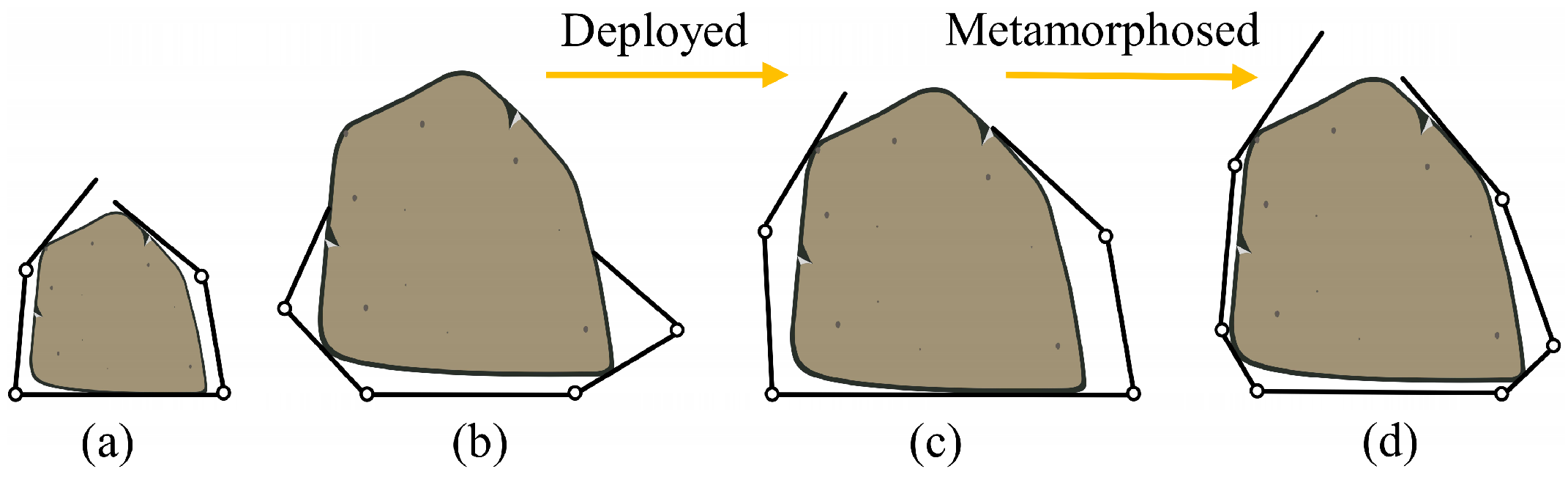
Based on the requirements for adaptability, multifunctionality, and stiffness in space grasping mechanisms for on-orbit servicing missions [35], an actuated palm is constructed by introducing a deployable mechanism and metamorphic mechanism. Figure 1 illustrates the impacts of the deployable palm mechanism and metamorphic mechanism on grasping. A comparison of Figure 1b,c indicates that the deployment of the palm increases the distance between the robotic fingers, facilitating more stable grasping of large objects. The comparison of Figure 1c,d indicates that the metamorphic mechanism adds joints to the palm, increasing the number of contact points between the robotic hand and the grasped object, thereby enhancing its ability to adapt to irregularly shaped objects. Therefore, the deployable palm mechanism, combined with deployable fingers, is adopted to improve the robotic hand’s ability to grasp space objects of different sizes. The metamorphic mechanism is employed to enhance the flexibility and stability of grasping, as well as the handling of various shapes. In addition, a symmetric design is adopted, enabling the actuated palm to achieve symmetric motion postures, which facilitates force analysis and on-orbit operations.
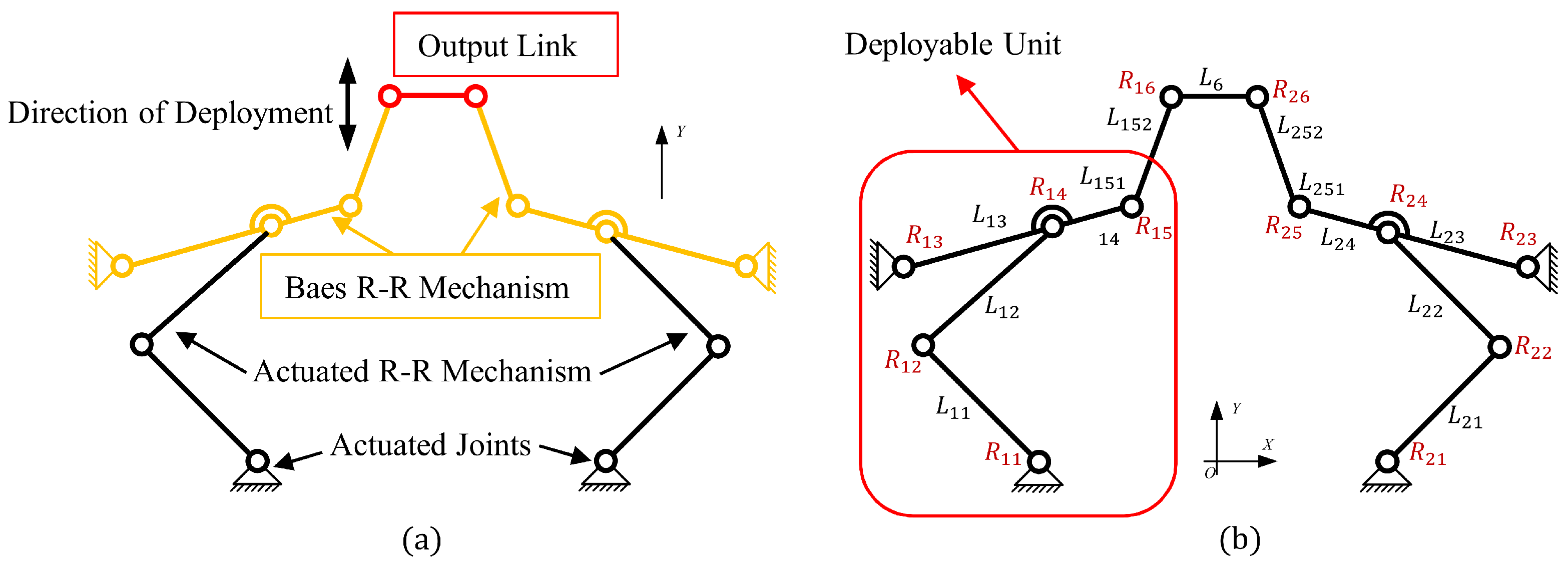
We begin by designing the deployable palm mechanism of the actuated palm. The R-R mechanism, a fundamental kinematic chain formed by two revolute joints, is characterized by its simple structure and high folding and deployment ratios. Under constrained conditions, it can achieve deterministic output motion and can be driven synchronously by a single motor to control multiple parallel R-R mechanisms. Therefore, the R-R mechanism is adopted as the foundation for constructing the deployable palm mechanism, as shown in Figure 2a. To allow the palm to grasp larger objects, the links of the active R-R mechanism should be as long as possible. However, increasing the sizes of the links compromises the mechanism’s stiffness. To ensure sufficient rigidity, an additional R-R mechanism—base R-R—is installed at a certain distance from the active one on the same side of the palm-deployable direction and connected to the base. This enhances the stiffness of the deployable palm mechanism during its deployment. The two R-R mechanisms are connected via a revolute joint to form a deployable unit, as illustrated in Figure 2b. In this configuration, the rotational motion of the active R-R mechanism is transformed into the rotational motion of the base R-R mechanism. To further improve the structural stiffness, two deployable units are arranged symmetrically. A link perpendicular to the palm-deployable direction is added as the output link of the deployable palm mechanism; this link will connect to the robotic fingers. The composition of the deployable palm mechanism is illustrated in Figure 2a.
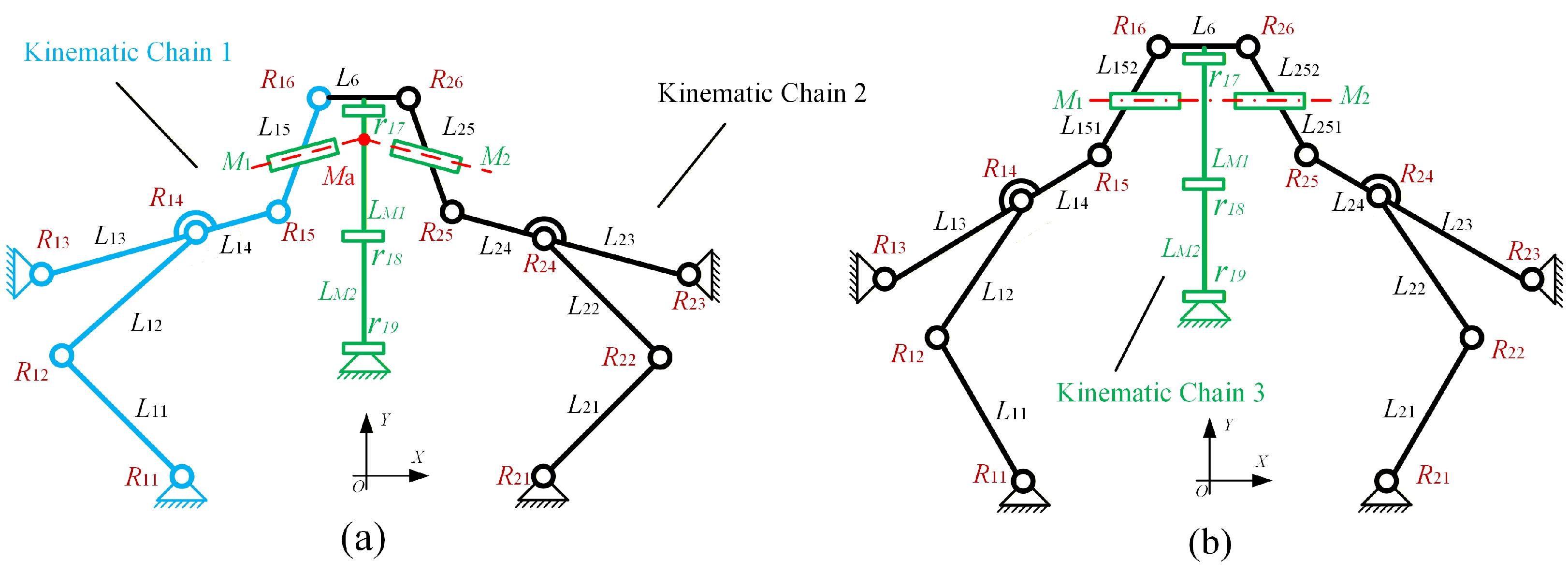
The expected motion of the deployable palm mechanism is the reverse rotation of two active R-R mechanisms, which ultimately drives the output link to move along the Y axis. To determine whether the motion of the deployable palm mechanism meets expectations, its mobility is analyzed using the screw theory method for parallel mechanisms. The output link is regarded as the moving platform of the parallel mechanism; the base of the active joints of the deployable palm mechanism is regarded as the fixed platform; and the left and right sides of the deployable palm mechanism are considered as chains 1 and 2, respectively. As shown in Figure 2b, let the twist of each kinematic joint R ij in the deployable palm mechanism be denoted as S i j = ( s i j , r i j × s i j ) T , where the axis vector and position vector are s i j = ( a i j , b i j , c i j ) T and r i j = ( d i j , e i j , f i j ) T , respectively. Here, i j represents the j-th kinematic joint of the i-th chain. The output-link motion-screw system S f 1 of the deployable palm mechanism can be calculated from the intersection of the subchain motion-screw system S l i (i = 1,2), expressed as follows:
S f 1 = S l 1 S l 2 ,
where S l i = ( S i 1 , S i 2 , S i 3 , S i 4 , S i 5 , S i 6 ) , S i j = ( 0 , 0 , 1 ; e i j , ( 1 ) i + 1 d i j , 0 ) T , i = 1 , 2 , j = 1 , 2 , , 6 .
Therefore, a sets of basis of the platform motion-screw system S f 1 can be written as follows:
S f 1 = S a 1 = ( 0 , 0 , 1 ; 0 , 0 , 0 ) T S a 2 = ( 0 , 0 , 0 ; 1 , 0 , 0 ) T S a 3 = ( 0 , 0 , 0 ; 0 , 1 , 0 ) T
The order of S f 1 is the degree of freedom of the motion platform of the mechanism. According to Equation (2), the output link possesses three degrees of freedom and allows for three permissible motion types: translation along the X-axis, translation along the Y-axis, and rotation about the Z-axis. Based on the required motion of the deployable palm mechanism, translation along the X-axis and rotation about the Z-axis must be constrained, while only translation along the Y-axis is retained. Therefore, additional constraints must be introduced to restrict the degree of freedom of the deployable palm mechanism.
To enhance the flexibility when grasping objects, a metamorphic mechanism based on the bifurcation principle is used to constrain the degree of freedom of the deployable palm mechanism. Considering the permissible motion of the output link, as shown in Figure 3a, metamorphic joints M 1 and M 2 are set at the same positions on link L 15 and link L 25 , respectively. At this time, the two metamorphic joints intersect at point M a and divide link L 15 and link L 25 into two segments each: L 151 and L 152 , L 251 and L 252 , as shown in Figure 3b. The metamorphic links L M 1 and L M 2 are used to transmit the motion from the metamorphic actuator at r 19 while constraining the degree of freedom of the deployable palm mechanism. Links L 152 , L 6 , L 252 , L M 1 and L M 2 form a metamorphic mechanism.
After incorporating the metamorphic mechanism, additional joints are added to both chains 1 and 2. Let the axis vectors of metamorphic joints M 1 and M 2 be denoted as s m 1 and s m 2 , respectively, while their position vectors are labeled as r m 1 and r m 2 , respectively, where s m i = ( a m i , b m i , c m i ) T and r m i = ( d m i , e m i , f m i ) T , with i = 1 , 2 . Considering the metamorphic links L M 1 and L M 2 as a third chain connecting to the finger platform, the output-link motion-screw system S f 2 of the mechanism can be expressed as the intersection of the subchain motion-screw system S l i ( i = 1 , 2 , 3 ) , which can be written as follows:
S f 2 = S l 1 D S l 2 D S l 3 D ,
where:
S l i D = ( S i 1 , S i 2 , S i 3 , S i 4 , S i 5 , S i 6 , S m i ) , i = 1 , 2
S m i = ( s m i , r m i × s m i ) T = ( a m i , b m i , 0 ; 0 , 0 , ( 1 ) i + 1 d m i b m i e m i a m i ) T , i = 1 , 2
S i j = ( 0 , 0 , 1 ; e i j , ( 1 ) i + 1 d i j , 0 ) T , i = 1 , 2 , j = 1 , 2 , , 6
S l 3 D = S 31 = ( 1 , 0 , 0 ; 0 , f 31 , e 31 ) T S 32 = ( 1 , 0 , 0 ; 0 , f 32 , e 32 ) T S 33 = ( 1 , 0 , 0 ; 0 , f 33 , e 33 ) T
The output-link motion-screw system S f 2 = ( 0 , 0 , 0 ; 0 , 1 , 0 ) T indicates that the output link can translate along the Y-axis and the degree of freedom f = dim ( S f 2 ) = 1 , with only one degree of freedom. Therefore, the actuated palm mechanism composed of a deployable palm and metamorphic mechanism has a definite deployable motion along the Y-axis.
When the deployable palm mechanism is functioning, metamorphic joints M 1 and M 2 are not coaxial and therefore cannot rotate, as shown in Figure 3a. In this state, links L 15 and link L 25 are not divided and are each considered as a single rigid body, while the metamorphic links L M 1 and L M 2 and metamorphic actuator at r 19 move along with the deployable palm mechanism as accompanying motions. When the deployable palm mechanism reaches its maximum deployment position and stops, metamorphic joints M 1 and M 2 become coaxial, facilitating rotation, as shown in Figure 3b. At this stage, links L 11 to L 14 of kinematic chain 1 and links L 21 to L 24 of kinematic chain 2 remain stationary, and are considered rigid bodies, with revolute joints R 16 and R 26 being fixed. There is no relative motion among link L 152 , link L 252 , and the output link L 6 . These three links, together with the metamorphic links L M 1 and L M 2 , constitute a planar four-bar linkage with redundant constraints. Clearly, this mechanism has one degree of freedom, allowing the output link to rotate around the metamorphic joints M 1 and M 2 . Consequently, the fingers attached to the output link can also rotate around metamorphic joints M 1 and M 2 . Thus, the metamorphic mechanism serves a dual purpose: it constrains the degree of freedom of the deployable palm mechanism while enhancing the stiffness of the actuated palm mechanism during deployment. Because of the constraints introduced by the metamorphic mechanism, the two actuators of the deployable palm mechanism become strongly coupled and can no longer move independently. As a result, the actuated palm mechanism transforms into an overconstrained mechanism with a parallel configuration.
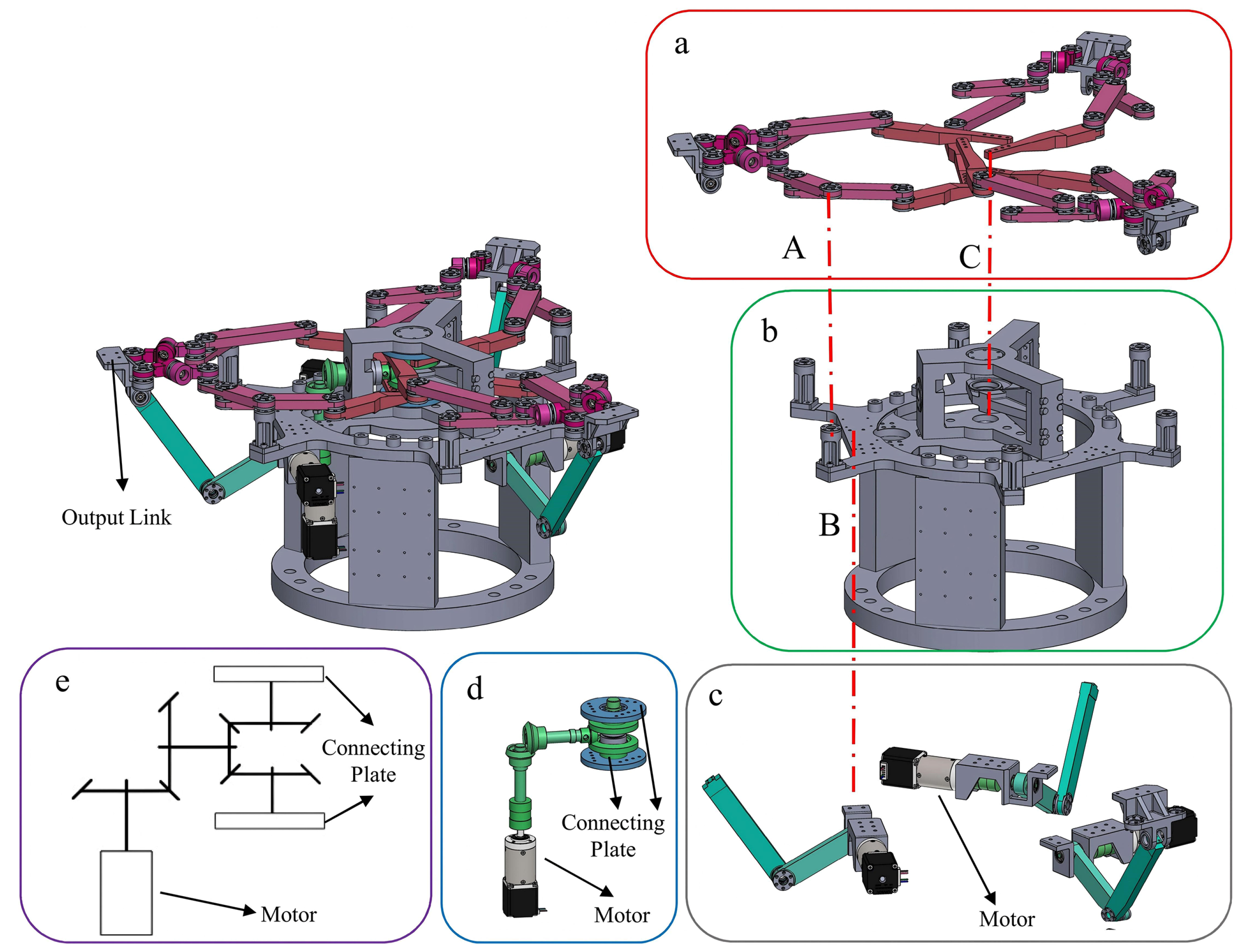
Based on the above analysis, the three-dimensional (3D) model of the actuated palm is presented in Figure 4, where three actuated palm mechanisms are evenly distributed at 120° intervals to form the complete actuated palm. To reduce the number of actuators and avoid structural interference, the driving links L 11 and L 21 of the left and right active R-R mechanisms of the deployable palm mechanism are arranged on two planes with a specific height difference, as shown in Figure 4a. The left and right chains of the three actuated palm mechanisms are connected in parallel to two connecting plates, respectively, as shown in Figure 4d,e. The drive system is mounted on the base, and bevel gears are used to achieve reverse synchronous motion of the two connecting plates, driving the rotations of the left and right chains of the three actuated palm mechanisms. This allows a single motor to drive the three mechanisms so that they can rotate and deploy synchronously. The base R-R mechanisms of the deployable palm mechanism are connected to the base, as indicated by line A in Figure 4. The center of the actuated palm mechanism is coaxial with the center of the base, as indicated by line C in Figure 4. The metamorphic links are connected to the output link of the deployable palm mechanism at one end and to the based at the other end, as indicated by line B in Figure 4.
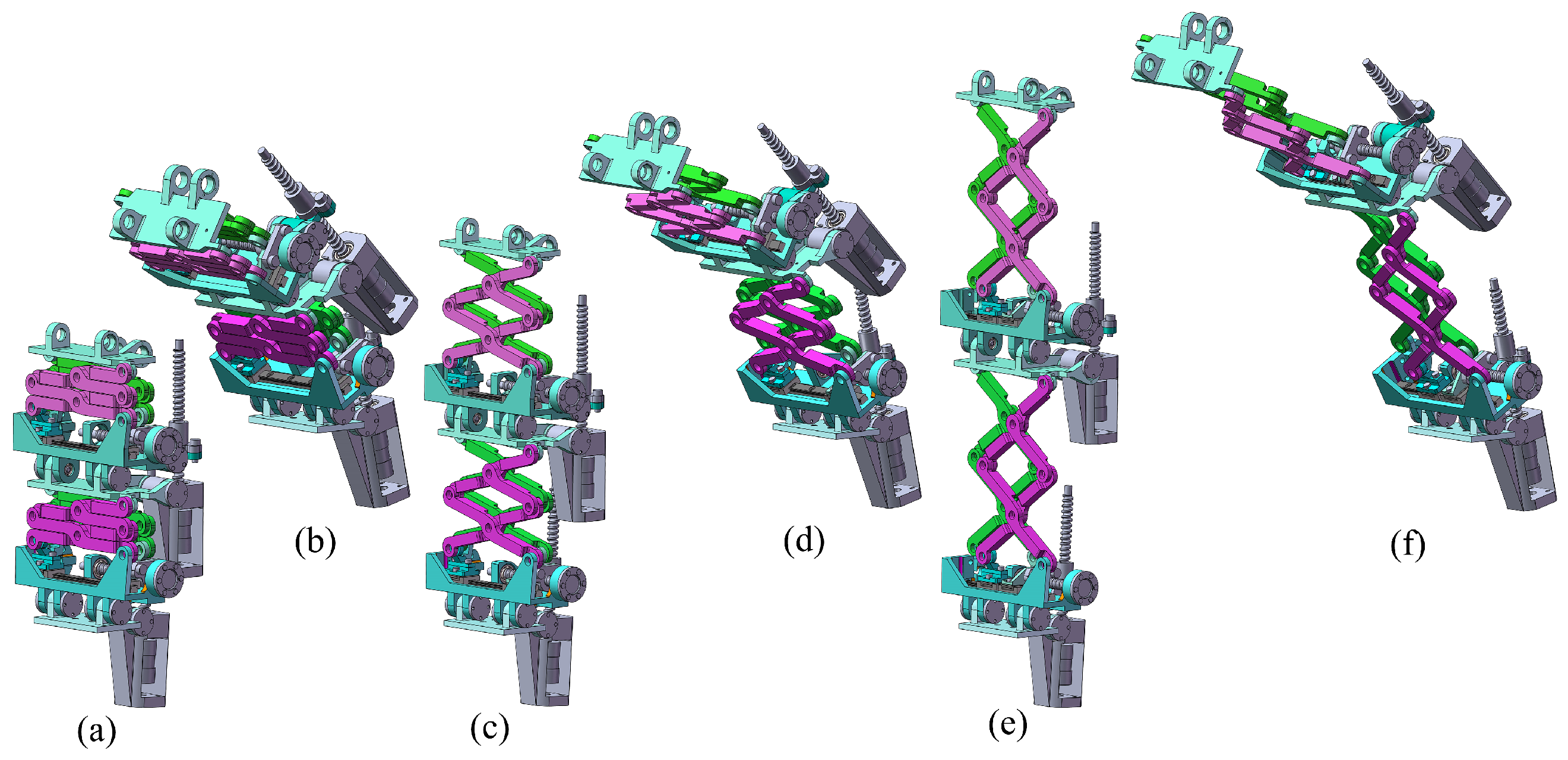
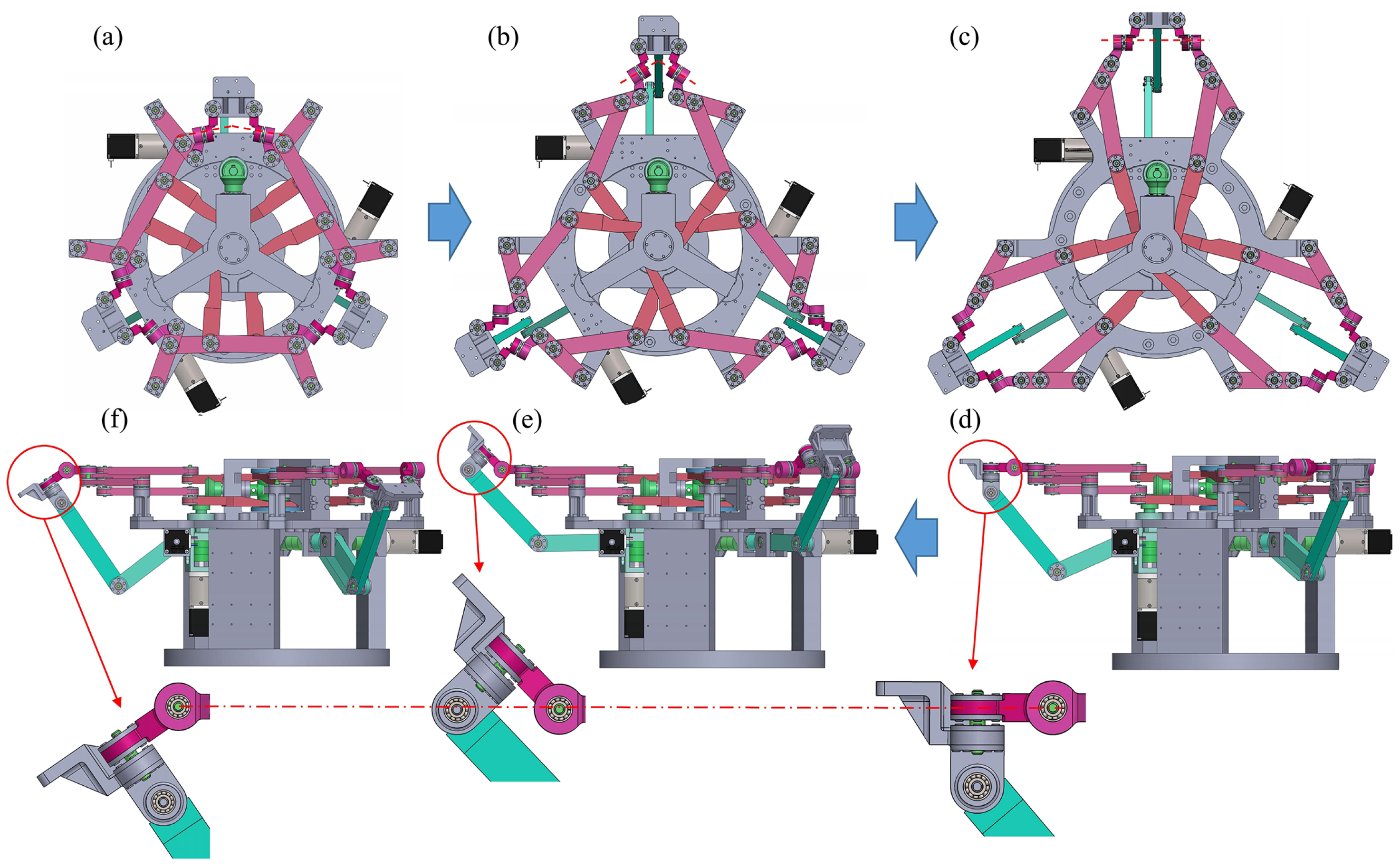
Considering both the design complexity of the mechanism and the performance requirements of the robotic hand, three separate motors are used to drive the three metamorphic mechanisms of the actuated palm, as shown in Figure 4c. The deployment and metamorphic process of the actuated palm are illustrated in Figure 5. Before or during the process of grasping small objects, the actuated palm remains in a fully folded state, as shown in Figure 5a. As the actuated palm deploys, the sizes of the objects that the robotic hand can grasp gradually increase, as shown in Figure 5b. When the actuated palm is fully deployed, the graspable object size reaches its maximum, as shown in Figure 5c,d, and the metamorphic function can be activated based on task requirements. As shown in Figure 5e, when the mechanism metamorphoses upward, the number of contact points between the robotic hand and object increases. Meanwhile, when it metamorphoses downward, as shown in Figure 5f, the workspace expands, allowing the robotic fingers to capture space objects.
In summary, compared with traditional static palms, the actuated palm proposed in this paper offers significant advantages in terms of workspace, target adaptability, flexibility, grasping stability, and other aspects. The performances are compared in Table 1.

2.2. Design of Deployable Fingers

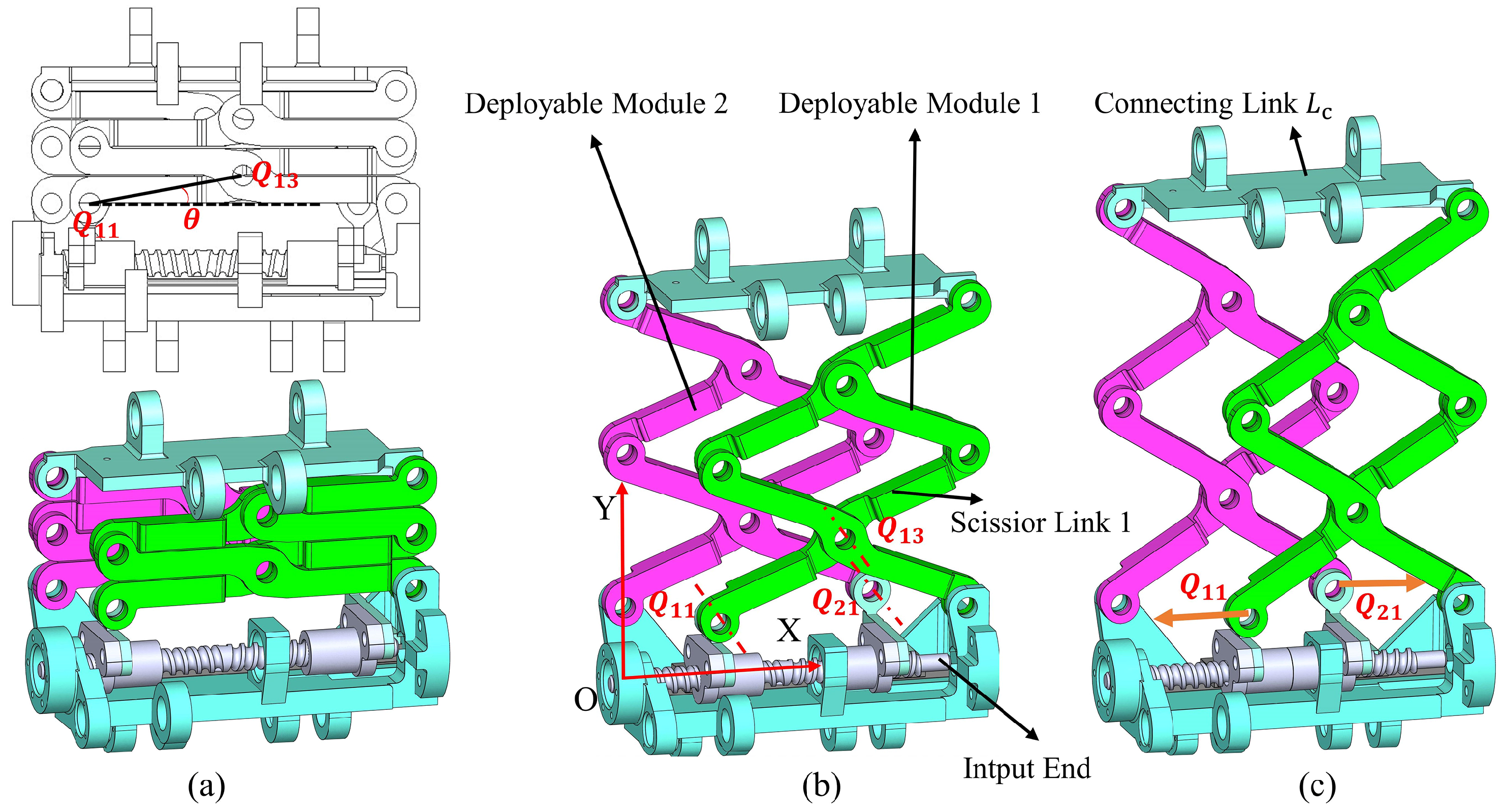
In order to increase the grasping range of the robotic hand, a modular design is adopted for the robotic finger, based on the deployment principle. The designed deployable phalanx consists of two deployable units. The folded, deploying, and fully deployed states of the deployable phalanx are illustrated in Figure 6. The scissor mechanism, known for its good vertical guiding performance and high folding and deployment ratios, is used as the deployable unit of the phalanx. To ensure that the robotic finger retains its stiffness after deployment, the two deployable units are arranged in a reverse parallel configuration. This design achieves a fixed base dimension for the scissor mechanism, facilitating a reduction in the overall size.
A local coordinate system is established as shown in Figure 6b. When the phalanx is deployed, the actuator at the input end drives the bidirectional ball screw to rotate. This causes the revolute joints Q 11 and Q 21 to move linearly along the forward and reverse X-axis directions, respectively, thereby reducing the dimensions of deployable units 1 and 2 along the X-axis and increasing their dimensions along the Y-axis. As the two units deploy synchronously, the connecting link L c moves upward and downward along the Y-axis. The folding process of the deployable phalanx is the opposite of its deployment process. During folding, the motion directions of revolute joints Q 11 and Q 21 are indicated by the arrows in Figure 6c.
The deployable unit is analyzed according to the virtual work principle and geometric relationship. Thus, the following conclusions can be drawn:
F = 2 W cot θ ,
where F is the X-direction driving force required for the deployment of the deployable unit and W is the load borne by said unit. The direction is negative along the Y-axis. θ is the included angle between the scissor-link and X-axis, as shown in Figure 6a.
Equation (4) indicates that the magnitude of the driving force F in the X-direction is related to the angle θ . When the deployable unit is fully folded, θ is at its minimum. At this point, a very large driving force in the X-direction is required, which is unfavorable for actuation. To avoid this situation, the scissor links are designed with a special configuration to increase the minimum value of the angle θ . As shown in Figure 6a, the angle satisfies the following geometric relationship:
θ cos 1 | Q 11 Q 13 | x | Q 11 Q 13 | ,
where | Q 11 Q 13 | represents the distance between the rotating joints Q 11 and Q 13 , and | Q 11 Q 13 | x represents the projection of the distance in the X-axis direction.
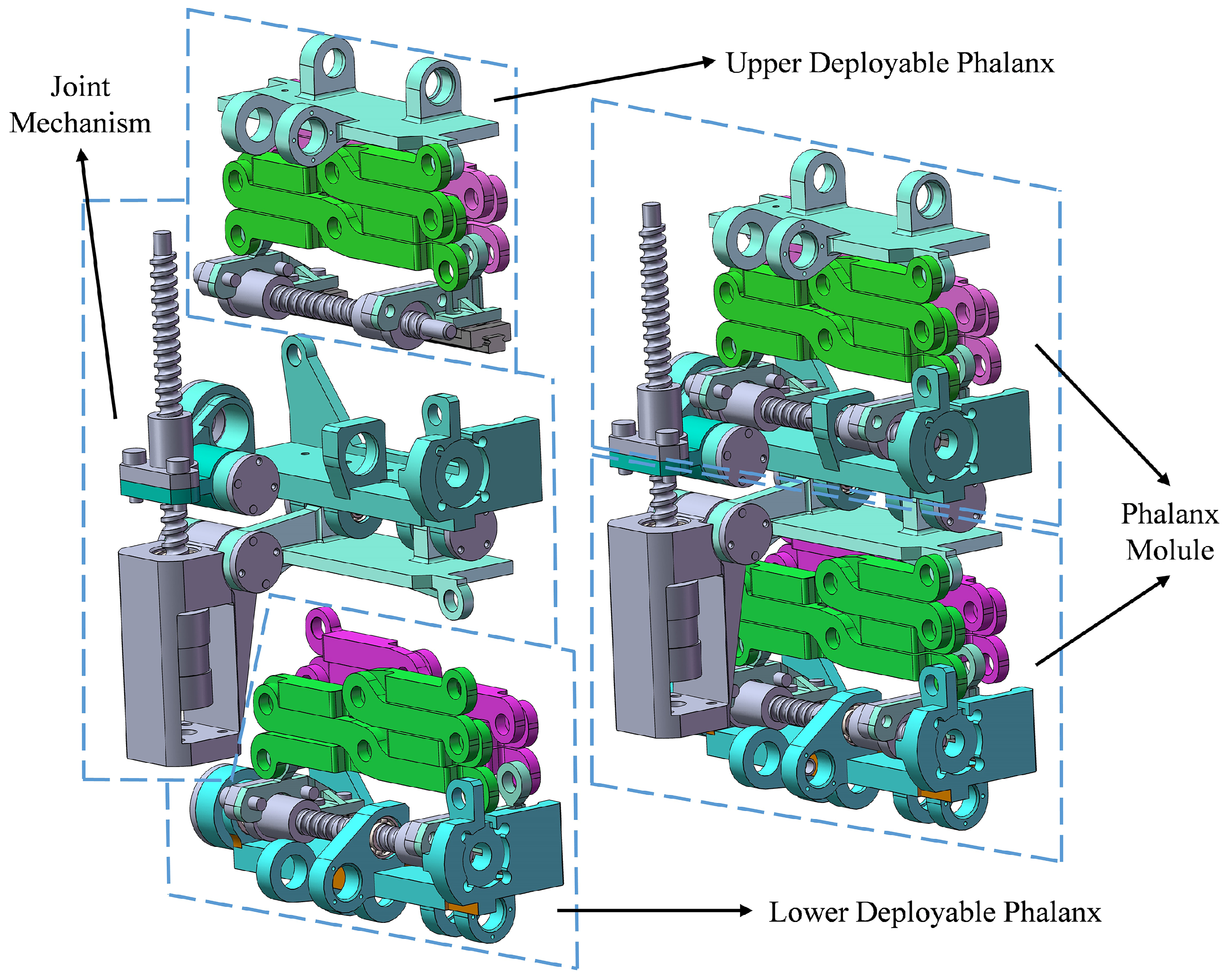
The joint mechanism of the robotic finger connects the upper and lower deployable phalanges, enabling contact with and enveloping of objects through its rotational motion. The finger is composed of the joint mechanism and deployable phalanges, which operate independently; together, they form a phalanx module. The modular phalanges are connected using the mounting interfaces on the connecting link L c . Schematic diagrams of the joint mechanism connecting the deployable phalanges and phalanx module are presented in Figure 7. A two-phalanx deployable robotic finger can achieve multiple grasping configurations, as illustrated in Figure 8. The deployment and grasping process of the deployable finger are decoupled, meaning that the finger can perform grasping at any stage of its deployment. This significantly enhances the adaptability of the robotic finger to objects of various shapes and sizes.

3. Kinematic Analysis

3.1. Kinematic Analysis of Actuated Palm Mechanism

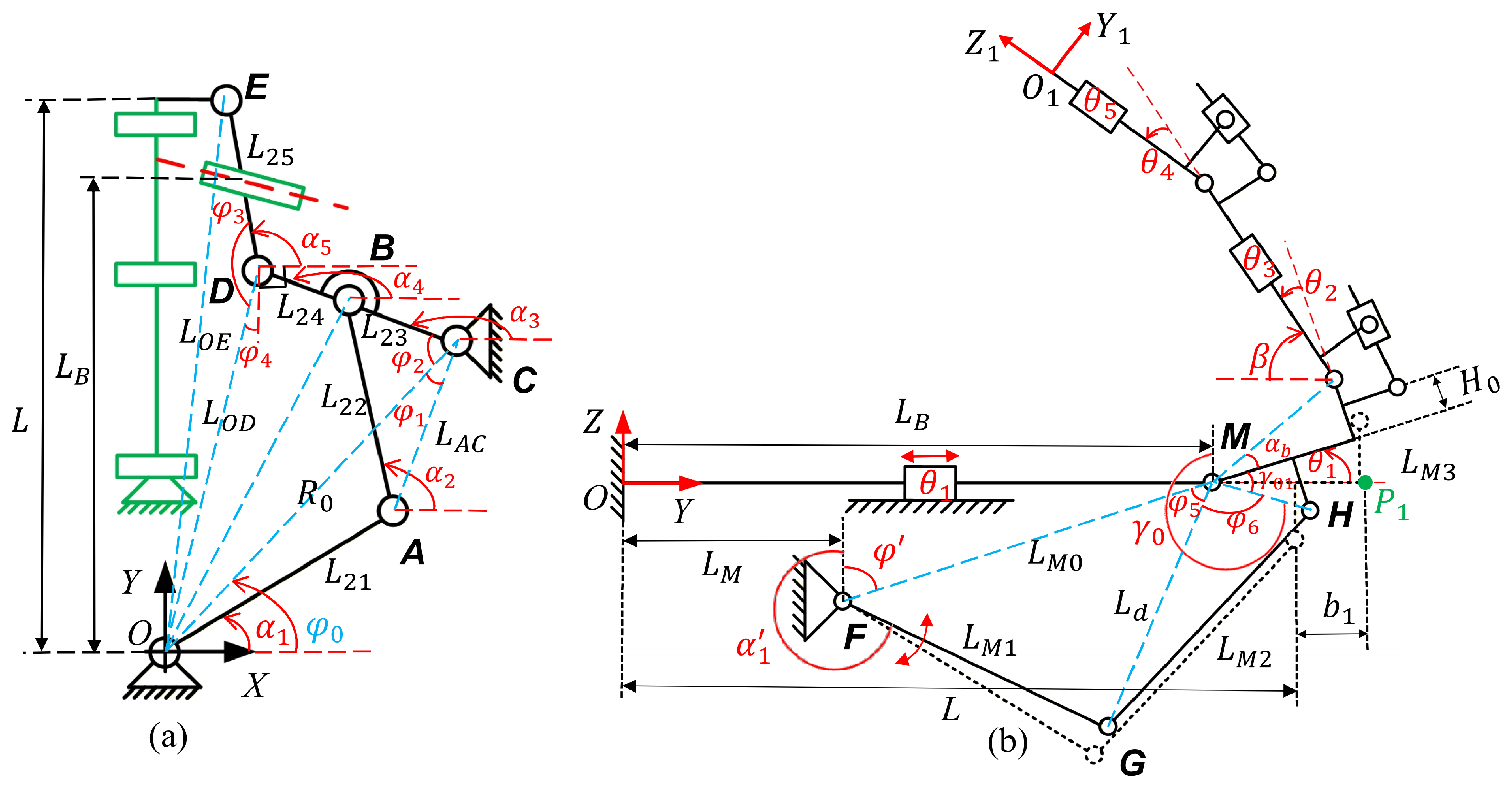
As mentioned above, driven by the motor, link L 21 rotates and drives the motion of the remaining links, causing the output link at the distal end of the palm to move toward or away from the center of the palm. This realizes the deployment and folding of the deployable palm mechanism. Based on the 3D modeling results of the actuated palm, the active joints R 11 of chain 1 and R 21 of chain 2 are overlap, and their new position is at the center of the original positions. A global coordinate system O-XYZ is established at the center of the deployable palm mechanism; thus, the origin O is located at the center of the revolute joint R 21 ( R 11 ). The Y-axis points in the deployment direction of the actuated palm mechanism and lies in the plane defined by the unmetamorphosed metamorphic joints M 1 and M 2 . The X-axis is perpendicular to the Y-axis and points toward the right half of the mechanism. The Z-direction is determined by the right-hand rule, as shown in Figure 9a. A kinematic model of the actuated palm mechanism is established. Assuming the coordinates of the output link in the global coordinate system are [ 0 L 0 ] T , according to the geometric relationship, the size L of the actuated palm can be expressed as follows:
L = L ( α 1 ) = R 0 sin φ 0 + ( L 3 + L 4 ) sin α 3 + L 5 sin α 5 ,
where:
α 3 = π φ 1 φ 2 + φ 0
sin φ 1 = L 1 sin ( α 1 φ 0 ) L A C
cos φ 2 = L A C 2 + L 3 2 L 2 2 2 L A C L 3
L A C 2 = L 1 2 + R 0 2 2 L 1 R 0 cos ( α 1 φ 0 )
α 5 = 3 π / 2 φ 3 φ 4
cos φ 3 = L 5 2 + L O D 2 L O E 2 2 L 5 L O D
φ 4 = cos 1 L O D 2 + ( L 3 + L 4 ) 2 R 0 2 2 L O D ( L 3 + L 4 ) α 3 π / 2
L O D 2 = ( L 3 + L 4 ) 2 + R 0 2 + 2 ( L 3 + L 4 ) R 0 cos ( φ 1 + φ 2 )
L O E 2 = ( L 6 / 2 ) 2 + L 2
L j is the length of the link L 2 j of the deployable palm mechanism, j = 1–5, and L 6 is the length of the output link; R 0 is the fixed value, indicating the distance between base O and base C; L A C , L O D , and L O E represent the lengths of lines AC, OD, and OE, respectively. The meanings of each angle are shown in Figure 9a. Given the input angle α 1 [ 12 . 5 , 67 ] , the maximum size L m a x = 268.9 mm and the minimum size L m i n = 147.4 mm of the actuated palm can be obtained through the above formula. Therefore, the space robotic hand can flexibly select the deployment size of the actuated palm according to different sizes and shapes of space targets, thereby improving its adaptability to targets. The folding–deployment ratio of the actuated palm can be expressed as follows:
σ P = L max / L min 1.82

3.2. Kinematic Analysis of Metamorphic Mechanism

As mentioned above, the metamorphic mechanism of the actuated palm is equivalent to a four-bar mechanism. Let the output angle of the mechanism be γ 0 and input angle at the motor end be α 1 . From the geometric relationship:
γ 0 = γ 0 ( α 1 ) = π φ + φ 5 + φ 6 ,
where:
L M 1 sin φ 5 = L d sin ( 2 π α 1 φ )
cos φ 6 = L d 2 + L M 3 2 L M 2 2 2 L d L M 3
L d 2 = L M 1 2 + L M 0 2 2 L M 1 L M 0 cos ( 2 π α 2 φ )
L M 0 , L M 1 , L M 2 , and L M 3 are the lengths of each link. The angles in the formula are shown in Figure 9b. γ 0 can be used to calculate the metamorphic angle θ 1 of the metamorphic mechanism during operation.

3.3. Kinematic Analysis of Phalanx Module

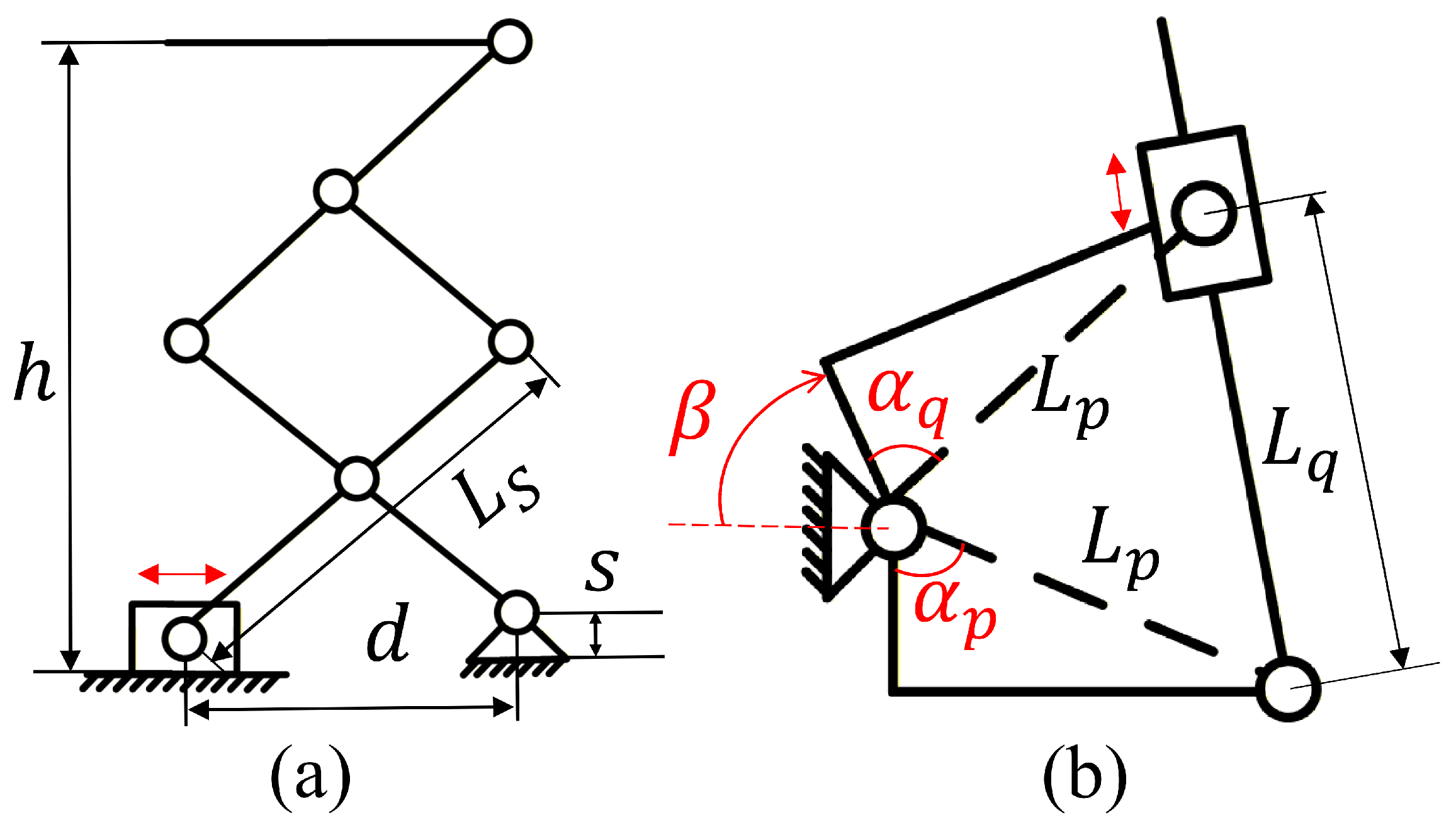
The variation in the deployable unit height h i of the deployable finger with the movement distance d i of the lead screw is as follows:
h i = h i ( d i ) = 2 L s 2 d i 2 ,
where L s is the length of the scissor-link and i is the i-th phalanx module, i = 1 , 2 , as shown in Figure 10a. Given the lead screw travel distance d i [ 49.2 mm , 69.5 mm ] , the maximum size h i m a x = 145.1 mm and the minimum size h i m i n = 69.3 mm of the deployable finger can be obtained through calculation. Therefore, the space robotic hand can select fingers of different deployment sizes to cope with space targets of various sizes and shapes. The folding ratio of the deployable finger is expressed as follows:
σ F = h max / h min 2.09

3.4. Kinematic Analysis of the Grasping Mechanism

The joint mechanism of the deployable finger takes the form of a four-bar slider mechanism. The variation in the grasping angle β of the joint mechanism with driving displacement L q can be expressed as follows:
β = β ( L q ) = 3 π / 2 α p α q arccos 2 L p 2 L q 2 2 L p 2 ,
where α p , α q , and L p are structural parameters, as shown in Figure 10b. β can be used to calculate the grasping angles θ 2 and θ 4 of the deployable finger joints.

3.5. Kinematic Analysis of the Three-Fingered Robotic Hand

An object coordinate system O 1 X 1 Y 1 Z 1 is established at the fingertip. The initial configuration is defined as the state in which the actuated palm and deployable fingers of the robotic hand are fully folded with the palm and fingers are perpendicular to one other. For the purpose of symmetry, a kinematic submechanism consisting of one actuated palm mechanism with an attached deployable finger is considered as an example. The Poincaré–Euler method is used to analyze the end-effector pose of the deployable finger in the three-fingered robotic hand. A schematic diagram of the grasping mechanism is presented in Figure 9b. The coordinate transformation matrix g ( 0 ) from the object coordinate system to the global coordinate system can be expressed as follows:
g ( 0 ) = I 3 × 3 P 0 1 ,
where:
P = 0 L min + b 1 H 0 + H 1 + H 2 T , during actuated palm deployment 0 L max + b 1 H 0 + H 1 + H 2 T , during actuated palm metamorphose ,
where b 1 and H 0 are structural parameters, as shown in Figure 9b, b 1 = 19 mm , H 0 = 19.62 mm . H 1 and H 2 are the lengths of phalanx modules 1 and 2, respectively, when fully folded.
The motion parameters of each joint in the robotic hand are denoted by θ i (i = 1–5), as illustrated in Figure 9b. When the joint is a revolute joint, θ i represents the rotational angle of the joint; when the joint is a prismatic joint, θ i represents the translational displacement of the joint. According to the analysis above, the deployable palm mechanism and the metamorphic mechanism cannot move simultaneously. Therefore, the motion of each joint can be expressed as follows:
θ 1 = L ( α 1 ) , during actuated palm deployment γ 0 + γ 01 3 π / 2 , during actuated palm metamorphose θ 2 = π β 1 α b , during actuated palm deployment π β 1 α b + θ 1 , during actuated palm metamorphose θ 3 = h 1 ( d 1 ) θ 4 = β 1 β 2 θ 5 = h 2 ( d 2 ) ,
γ 01 and α b are the structural parameters, γ 01 = 46 . 4 , α b = 22 . 52 , d 1 and d 2 are the input displacements of phalanx modules 1 and 2, respectively, and β 1 and β 2 are the output angles of the joint-connecting mechanisms 1 and 2, respectively.
When the robotic hand performs a grasping motion, the unit twist of each axis is denoted by S q i . Then, the unit twist system corresponding to the initial posture of the kinematic submechanism during grasping can be expressed as follows:
S q 1 = ( 0 , 0 , 0 ; 0 , 1 , 0 ) T , during actuated palm deployment ( 1 , 0 , 0 ; 0 , 0 , L B ) T , during actuated palm metamorphose S q 2 = 1 , 0 , 0 ; 0 , H 0 , L min + b 1 T S q 3 = 0 , 0 , 0 ; 0 , 0 , 1 T S q 4 = 1 , 0 , 0 ; 0 , H 0 + H 1 , L min + b 1 T S q 5 = 0 , 0 , 0 ; 0 , 0 , 1 T ,
L B is the Y-axis coordinate in the global coordinate system when the metamorphic joints M 1 and M 2 are coaxial, L B = 242 mm .
The fingertip pose E 1 of the kinematic submechanism can be expressed as follows:
g ( θ ) 1 = i = 1 5 exp ( θ i S q i ) g ( 0 ) , i = 1 , 2 , , 5
Combining Equations (11)–(13), the fingertip pose E 1 of the motion submechanism can be expressed as follows:
g ( θ ) 1 = R ( θ ) R ( θ ) P + P E 0 1 ,
where:
θ = θ 1 + θ 2 + θ 4 , during actuated palm deployment θ 2 + θ 4 , during actuated palm metamorphose ,
R ( θ ) = 1 0 0 0 cos θ sin θ 0 sin θ cos θ ,
P E = R ( θ 1 ) R ( θ 2 ) T 4 + R ( θ 4 ) 0 0 θ 5 + 0 0 θ 3 + T 2 + T 1 , during actuated palm deployment R ( θ 2 + θ 4 ) 0 0 θ 5 + R ( θ 2 ) T 4 + 0 0 θ 3 + T 2 + 0 θ 1 0 , during actuated palm metamorphose ,
T 1 = 0 ( 1 cos θ 1 ) L B sin θ 1 L B , T 2 = 0 ( 1 cos θ 2 ) ( L min + b 1 ) + H 0 sin θ 2 sin θ 2 ( L min + b 1 ) + H 0 ( 1 cos θ 2 ) ,
T 4 = 0 ( 1 cos θ 4 ) ( L min + b 1 ) + sin θ 4 ( H 0 + H 1 ) sin θ 4 ( L min + b 1 ) + ( 1 cos θ 4 ) ( H 0 + H 1 ) ,
R ( θ ) P + P E represents the position of the fingertip in the global coordinate system and θ represents the posture of the fingertip in the global coordinate system.
As the three robotic fingers are evenly distributed at 120° intervals, the poses of the fingertips E 2 and E 3 of the other two kinematic submechanisms in the global coordinate system can be expressed as follows:
g ( θ ) 2 = g ( θ ) 1 R 2 3 π 0 0 1
g ( θ ) 3 = g ( θ ) 1 R 2 3 π 0 0 1
The above-described calculation process shows that the fingertip poses of the robotic hand are jointly determined by the deployment size L of the actuated palm (or the metamorphic angle θ 1 of the actuated palm), the deployable finger size h i , and the deployable finger joint angles θ 2 and θ 4 . This verifies the influence of the actuated palm and deployable fingers on the fingertip poses.
Combining the above design and kinematic analysis, the most significant innovation of the three-finger space robotic hand proposed in this paper lies in its actuated palm. To quantitatively evaluate the performance advantages of this design, representative space grasping mechanisms from the literature are selected for comparison. The results are shown in Table 2.
As can be seen from Table 2, compared with the referenced literature, the proposed design offers significant advantages with regard to several key performance indicators:
(1)
Degree of freedom of the palm: Compared with the static palm (zero degrees of freedom) in the literature, the actuated palm proposed in this paper has two independent degrees of freedom (deployable and metamorphic). This enables the three-finger space robotic hand to implement active, real-time adjustments of its grasping configuration, significantly enhancing its ability to adapt to space targets.
(2)
Metamorphic angle: The proposed design is the only one that features a metamorphic function, with a metamorphic angle of 45 to 45 . This allows the space robotic hand to further adjust its grasping posture for better dexterity.
(3)
Adjustable dimensions: The proposed design has four adjustment dimensions: palm deployment/folding, palm metamorphosis, finger deployment/folding, and finger grasping. In contrast, the designs in the literature have only two adjustment dimensions (finger deployment/folding and finger grasping). The multi-dimensional adjustment makes the proposed design more flexible in adapting to space targets of different shapes and sizes.
(4)
Folding-deployment ratio of the palm: This paper is the first to present a folding-deployment ratio for the deployable palm; the ratio is 1.82. This means that in the folded state, the radial size of the robotic hand can be significantly reduced, which is beneficial for stowage during launch. In the deployed state, a larger grasping space can be obtained through the deployment of the palm. None of the compared references include this parameter.
(5)
Folding-deployment ratio of the finger: The folding-deployment ratio of the finger proposed in this paper is 2.09, which is of the same order of magnitude as those in the literature (2.7/2.9).
In summary, the three-finger space robotic hand with an actuated palm that we propose in this paper outperforms the representative designs in the existing literature in several quantitative indicators, including palm degrees of freedom, palm metamorphic angle, adjustable dimensions, and the folding-deployment ratio of the palm. This design offers stronger adaptability to shape and size, as well as a wider range of applications, for space missions such as grasping non-cooperative targets.

4. Performance Analysis and Simulation

4.1. Workspace Analysis

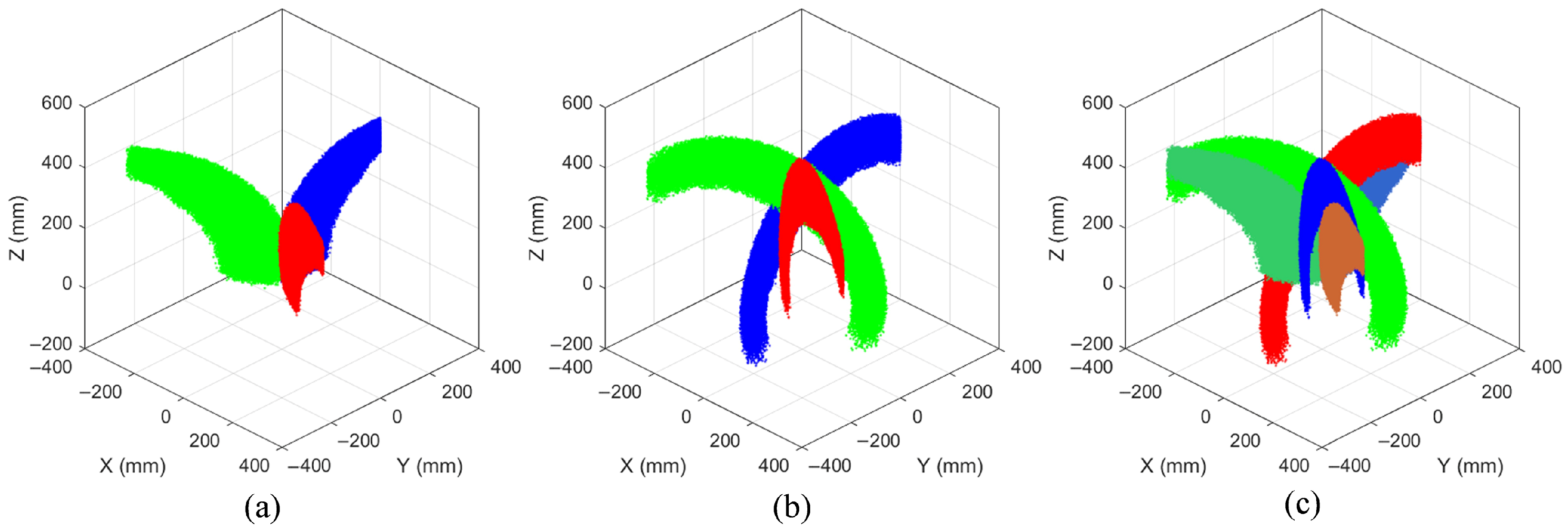
The area that the fingertip can reach is selected as the workspace. This workspace, which was calculated based on Equations (14)–(16), is presented in Figure 11. Specifically, Figure 11a shows the workspace when the actuated palm performs only deployment motion, while Figure 11b shows the workspace when the actuated palm performs the metamorphosis. The overall workspace of the three-fingered robotic hand is the superimposition of the workspaces from these two motions, as shown in Figure 11c.
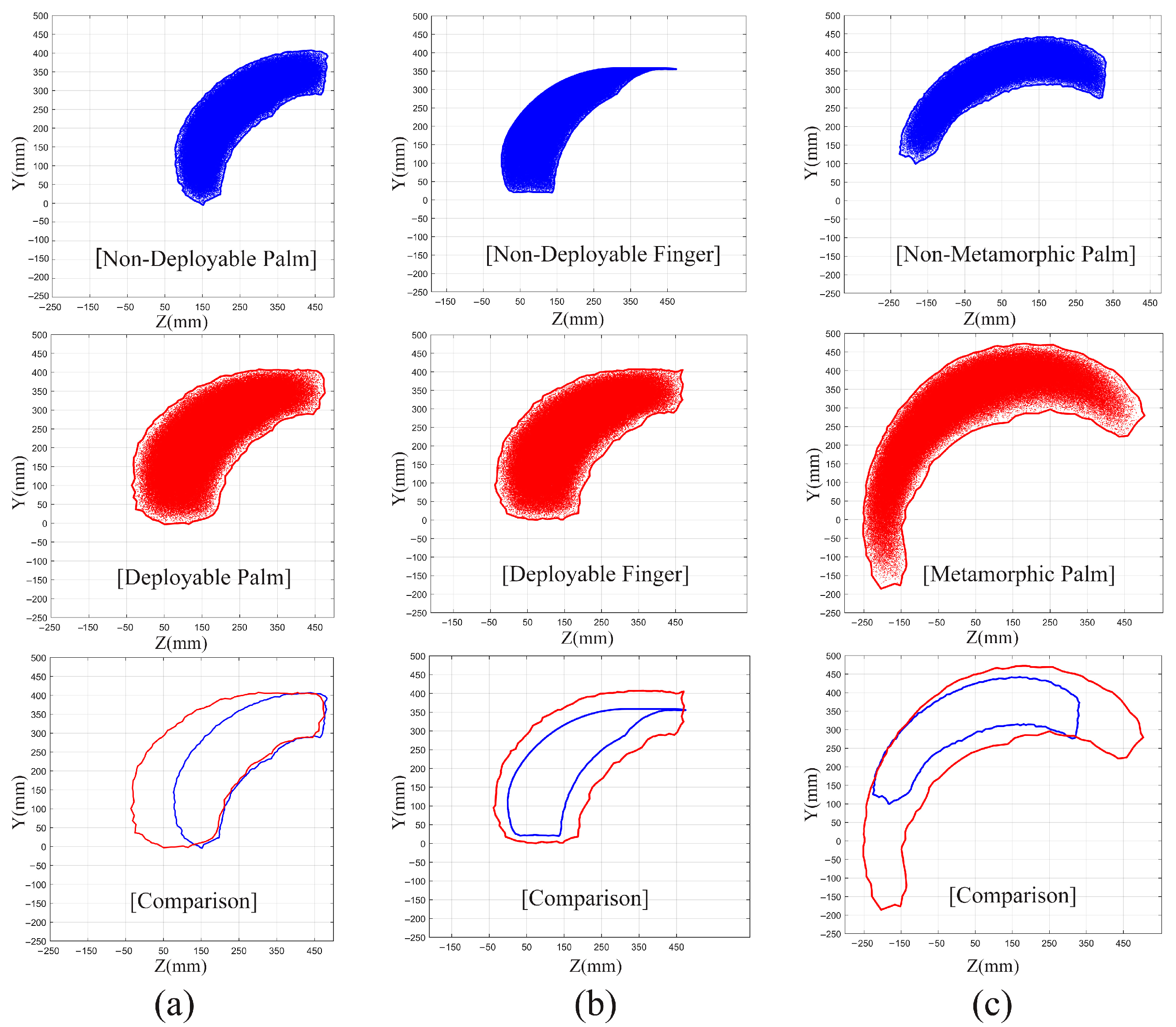
To demonstrate the advantages the actuated palm and deployable fingers exhibit with regard to adjusting the robotic hand’s workspace, the influences of the deployable palm mechanism, metamorphic mechanism, and the deployable finger mechanism on workspace variation are analyzed, as shown in Figure 12. Taking the kinematic submechanism that deploys along the Y-axis as an example, a random sampling method is used to analyze the region that can be reached by the fingertip in the YOZ plane under three cases: whether the palm can deploy, whether the fingers can deploy, and whether the palm can metamorphose. The calculation results are shown in Figure 12; each column contains the results of one case.
(1)
The first case discusses whether the palm can deploy (Figure 12a):
The workspace of the deployable palm is compared with that of the non-deployable palm, with the size of the non-deployable palm set to L max . Based on the fingertip pose kinematic equations (Equation (14)), the workspace of the non-deployable palm (blue region) and that of the deployable palm (red region) are obtained, and the two are compared in Figure 12a. It can be observed that the deployment function of the actuated palm significantly enlarges the robotic hand’s workspace along the Y-axis.
(2)
The second case discusses whether the fingers can deploy (Figure 12b):
As the deployment motion and the metamorphic motion of the actuated palm cannot occur simultaneously, the deployment function of the actuated palm can be considered as an example when analyzing the workspace. The workspace of the non-deployable fingers is compared with that of the deployable fingers, with the size of the phalanges of the non-deployable fingers set to 100 mm . The calculated workspace and its comparison are presented in Figure 12b. Clearly, the deployment function of the fingers expands the robotic-hand’s workspace along both the Y- and Z-axes.
(3)
The third case discusses whether the palm can metamorphose (Figure 12c):
The workspace of the non-metamorphic palm is compared with that of the metamorphic equivalent. The calculated workspace and its comparison are presented in Figure 12c. The metamorphic function of the actuated palm substantially increases the robotic hand’s workspace along the Z-axis. Moreover, compared to the deployment functions of the actuated palm and deployable fingers, it noticeably enlarges the workspace in the positive Y-axis direction.

4.2. Constraint Index Analysis

The deployable palm mechanism adopts a multilink design with a parallel configuration, involving a relatively high number of links and joints. Consequently, the transmission paths for the motion and constraint forces are rather long. To assess its performance in transmitting internal forces and constraining passive motions, the motion/force transmission performance and constraint/force transmission performance of the deployable palm mechanism are analyzed with reference to the performance evaluation methods for parallel mechanisms, employing the power-coefficient method [36].
The deployable palm mechanism comprises two symmetric chains, which we refer to as chain 1 and chain 2. Considering chain 1 as an example for analysis, the kinematic screws of the joints in chain 1 can be expressed as follows:
S 1 = ( 0 , 0 , 1 ; 0 , 0 , 0 ) S 2 = ( 0 , 0 , 1 ; L 11 sin α 1 , L 11 cos α 1 , 0 ) S 3 = ( 0 , 0 , 1 ; R 0 sin φ 0 , R 0 cos φ 0 , 0 ) S 4 = ( 0 , 0 , 1 ; R 0 sin φ 0 + L 31 sin α 3 , R 0 cos φ 0 + L 31 cos α 3 , 0 ) S 5 = ( 0 , 0 , 1 ; R 0 sin φ 0 + ( L 31 + L 41 ) sin α 3 , R 0 cos φ 0 + ( L 31 + L 41 ) cos α 3 , 0 ) S 6 = ( 0 , 0 , 1 ; R 0 sin φ 0 + ( L 31 + L 41 ) sin α 3 + L 51 sin α 5 , R 0 cos φ 0 + ( L 31 + L 41 ) cos α 3 + L 51 cos α 5 , 0 ) ,
where the input twist screw of chain 1 is S I 1 = S 1 = ( 0 , 0 , 1 ; 0 , 0 , 0 ) .
As the axes of the kinematic screws in the aforementioned chain are parallel and noncoaxial, the order of the screw system is three. Therefore, this chain is a three-degree-of-freedom chain. Three mutually linearly independent joint screws are selected to form a third-order screw system U 3 , which can serve as a basis for the motion-screw system of the chain; this can be expressed as follows:
U 3 = S 1 , S 2 , S 3 ,
where S 1 = ( 0 , 0 , 1 ; 0 , 0 , 0 ) S 2 = ( 0 , 0 , 1 ; L 11 sin α 1 , L 11 cos α 1 , 0 ) S 3 = 0 , 0 , 1 ; R 0 sin φ 0 , R 0 cos φ 0 , 0 .
Based on the reciprocal screw principle, the constraint wrench system of this chain is U 3 r .
U 3 r = S 1 r , S 2 r , S 3 r ,
where S 1 r = ( 0 , 0 , 1 ; 0 , 0 , 0 ) , S 2 r = ( 0 , 0 , 0 ; 1 , 0 , 0 ) , S 3 r = ( 0 , 0 , 0 ; 0 , 1 , 0 ) .
In order to obtain the transmission wrench screw S T 1 corresponding to S 1 , S 1 is locked. Then U 3 becomes U 2 :
U 2 = S 2 , S 3
At this point, a new screw S T 1 is generated, whose reciprocal products with all the joint screws in U 2 are zero, and it is linearly independent of the constraint wrench system U 3 r . The transmission wrench screw S T 1 corresponding to S 1 is obtained as follows:
S T 1 = R 0 cos φ 0 L 11 cos α 1 , R 0 sin φ 0 L 11 sin α 1 , 0 ; 0 , 0 , L 11 R 0 sin ( α 1 φ 0 )
The input motion transmission performance of the deployable palm mechanism is evaluated using the input transmission index λ 1 . For chain 1, λ 1 represents the transmission factor of the chain’s transmission wrench relative to the input joint, which is expressed as follows:
λ 1 = P I 1 P I 1 max = S T 1 S I 1 S T 1 S I 1 max = sin α 1 φ 0 sin α 1 φ 0 max ,
where P I 1 represents the actual input power and P I 1 m a x represents the apparent power (maximum input power).
The higher the value of λ 1 , the higher the transmission factor of the transmission wrench from chain 1 to the input joint. As chains 1 and 2 are symmetric, λ 1 = λ 2 . Therefore, the input transmission index of the deployable palm mechanism is:
μ I = min λ 1 , λ 2 = λ 1
It can be readily determined that the output twist screw of the mechanism is:
S O 1 = ( 0 , 0 , 1 ; 0 , 0 , 0 )
Similarly, the output transmission performance of the deployable palm mechanism is evaluated using the output transmission index. For chain 1, it can be expressed as follows:
η 1 = P O 1 P O 1 max = S T 1 S O 1 S T 1 S O 1 max = R 0 sin φ 0 L 1 sin α 1 R 0 sin φ 0 L 1 sin α 1 max = η 2 ,
where P O 1 represents the actual output power and P O 1 m a x represents the apparent power (maximum output power).
A higher value of η 1 indicates that the output link has a better motion transmission performance. The output transmission index of the deployable palm mechanism is:
μ O = min η 1 , η 2 = η 1
When the input or output transmission index of the deployable palm mechanism equals or approaches zero, the mechanism is near or at a singular configuration, and the input motion is not efficiently transmitted to the output link. Generally, the mechanism should be kept away from singular positions, and both its input and output transmission indices should be as large as possible. Therefore, the local transmission index μ is used to evaluate the overall motion/force transmission performance of the deployable palm mechanism:
μ I = min μ I , μ O
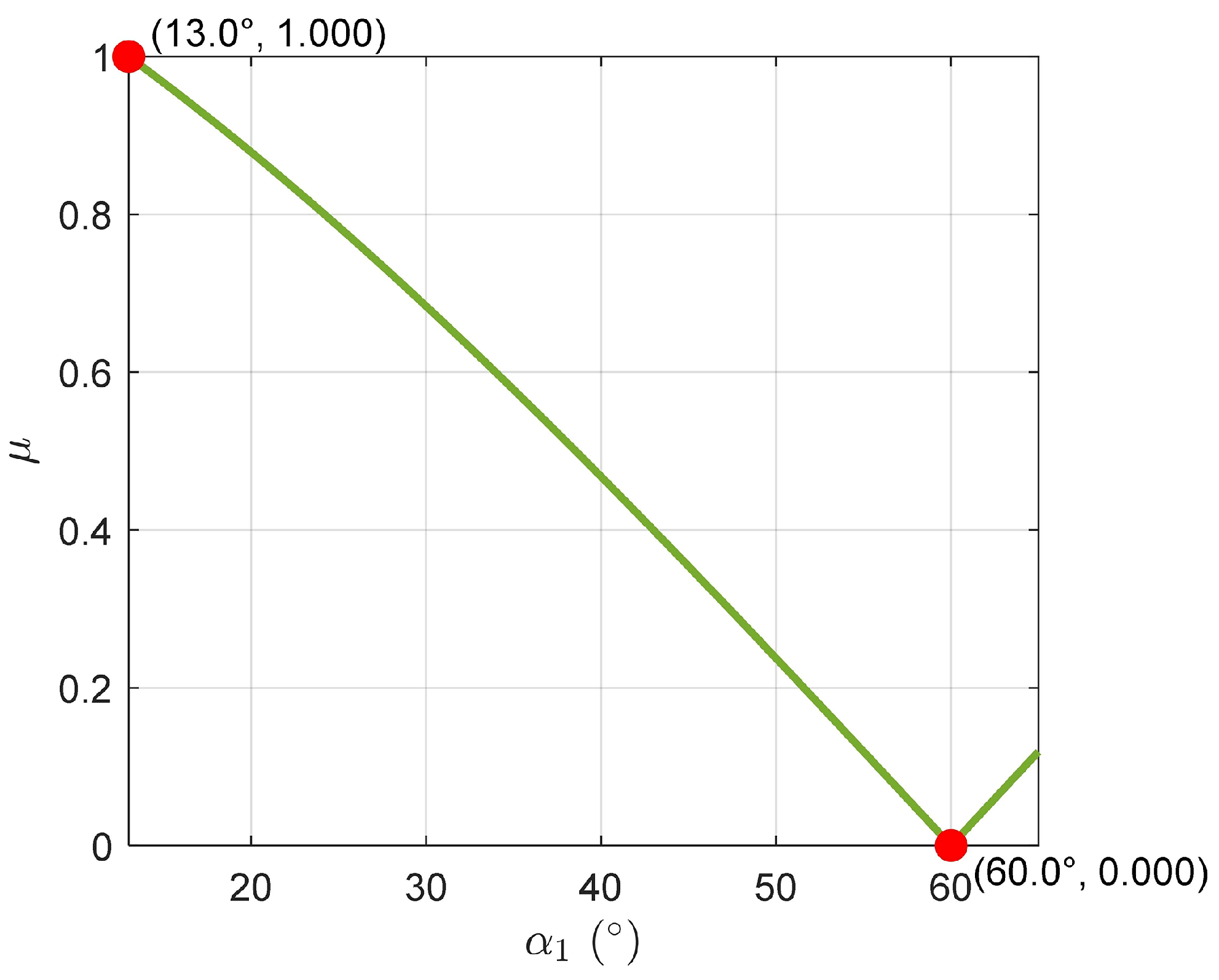
The local transmission index μ for the deployable palm mechanism is calculated and presented in Figure 13. When α 1 60 , μ is consistently greater than zero and remains far from zero. When α 1 approaches 60 , μ nears zero, leading to a singular configuration in which the motion transmission is poor. As shown in the model diagram of the palm deployable mechanism (Figure 3), the reason for the low motion transmission performance near α 1 = 60 is the links L 1 and L 2 being collinear. This decreases the transmission angle between them, consequently slowing the variation in the deployment length L of the actuated palm. When the actuated palm is in the process of deployment, α 1 approaching 60 indicates that it is approaching the maximum deployment position. The mechanism is in a singular configuration with a low motion transmission performance that reduces the output velocity of the mechanism. The helps to reduce the impact and improves the stability of the mechanism when it is deployed to the maximum position.
When the actuated palm is exhibiting a folding motion, α 1 approaching 60 corresponds to the initial stage of folding Based on the transmission characteristic of the singular configuration, the impact load generated by low-speed motion is relatively small, which helps to prevent shocks caused by acceleration and improves the stability of the mechanism at the initial stage of the folding motion.Therefore, although the singular configuration near α 1 = 60 reduces the motion transmission performance of the deployable palm mechanism, the regulation of motion via the transmission characteristic of the singular configuration avoids the impact forces at the end of deployment and the beginning of folding, thereby enhancing the motion stability and protecting the actuated palm. Thus, the slow-motion characteristic near the singular configuration is actually beneficial for the mechanism’s operation. In summary, the motion-transmission performance of the deployable palm mechanism meets the operational requirements.

4.3. Grasping Simulation

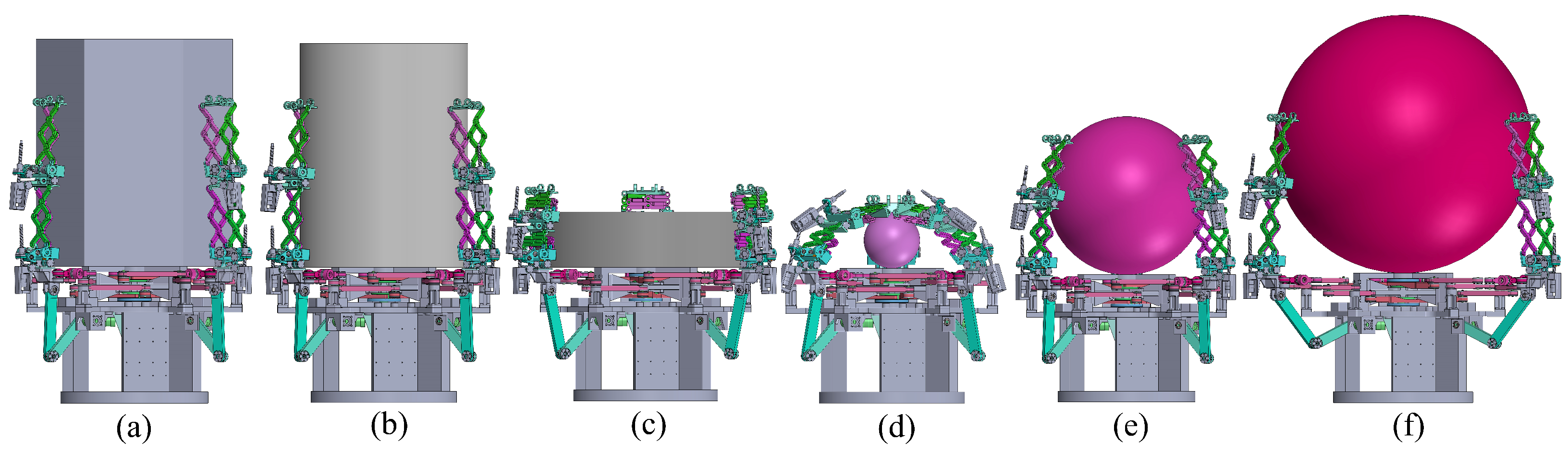
To verify the three-fingered robotic hand’s favorable adaptability, simulations are conducted to assess its ability to adapt to both shape and size, as shown in Figure 14. Figure 14a–d illustrates the grasping of a hexagonal prism, cylinder, disk-shaped object, and sphere, respectively. Figure 14d–f shows the robotic hand grasping small, medium, and large spheres, respectively. When confronted with objects of various sizes and shapes, the deployable fingers can adapt to changes in the height, while the actuated palm can accommodate variations in radial dimensions. Thus, the three-fingered robotic hand exhibits good adaptability to objects with different dimensions.

4.4. Grasping Performance Analysis

(1)
Determination of grasp force closure
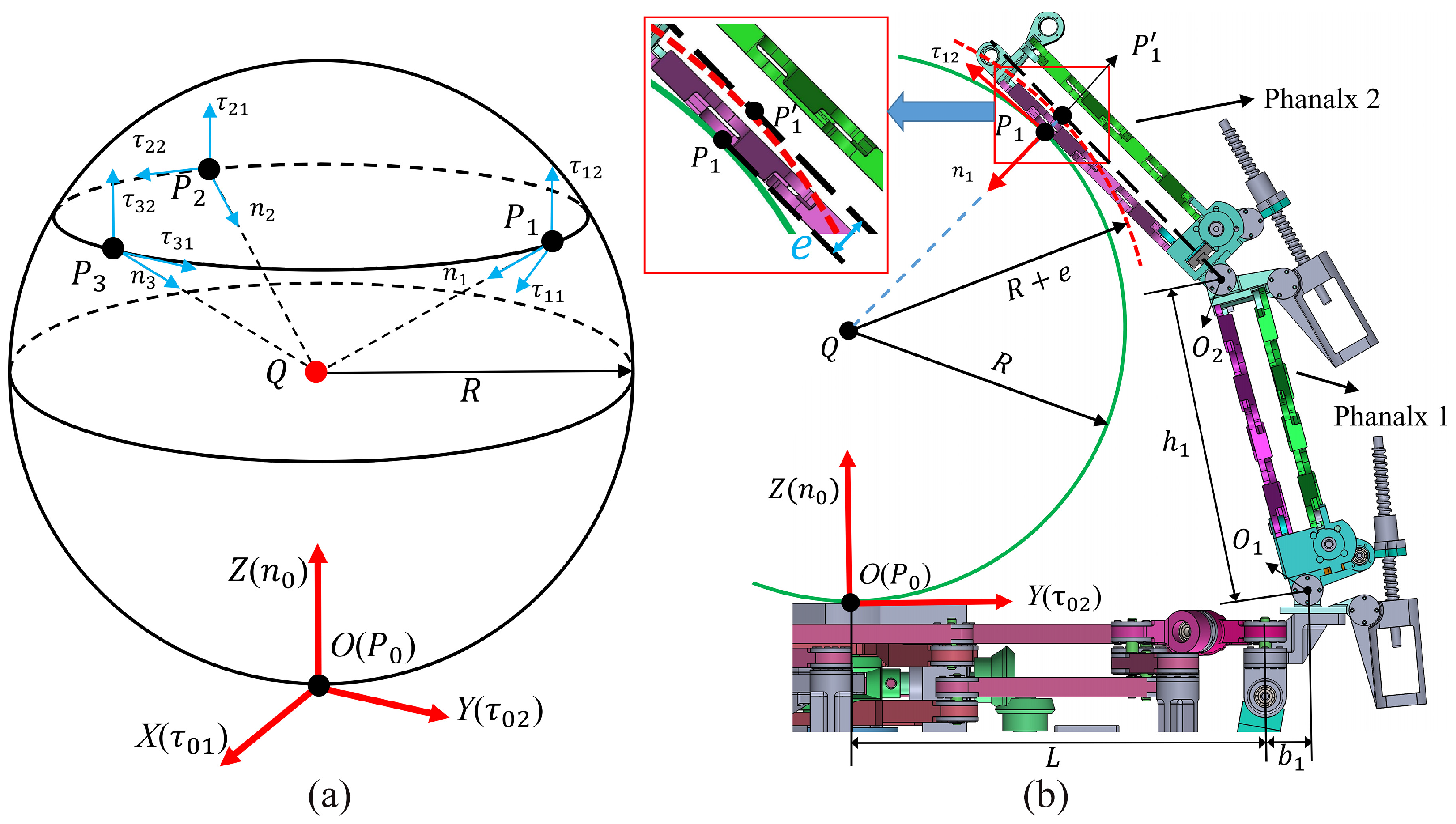
Spheres are typical targets in on-orbit servicing. They possess symmetry, which facilitates theoretical modeling and analysis. Taking the three-finger space robotic hand grasping a sphere of radius R with its fingertips as an example, force closure modeling and analysis are performed. The actuated palm has one point of contact with the target, denoted as P 0 . Meanwhile, phalanx 2 of each deployable finger has three contact points evenly spaced at 120 on the target, denoted as P 1 , P 2 and P 3 . It is assumed that the robotic hand grasps the sphere in an enveloping manner; so, all four contact points are tangent points. The global coordinate system is the same as before, as shown in Figure 15. The unit normal vector at the contact point P i is n i , pointing to the center of the grasped sphere. A set of orthonormal basis vectors τ i 1 and τ i 2 on the tangent plane is chosen so that τ i 1 , τ i 2 , n i form a right-handed coordinate system. The origin coincides with the contact point P 0 ; therefore the center of mass Q of the sphere has coordinates Q = ( 0 , 0 , R ) , and the contact point P 0 has coordinates P 0 = ( 0 , 0 , 0 ) .
First, compute the contact points between the space robotic hand and the sphere. In the YOZ plane, calculate the coordinates of P 1 . Let P 1 = ( 0 , A , B ) in the global coordinate system. The coordinates of P 2 and P 3 are obtained by rotating P 1 . Take a point P 1 on the deployable finger, as shown in Figure 15b. Point P 1 shows that its distance from P 1 is e and that P 1 lies on the segment Q P 1 . Let its coordinates be P 1 = ( 0 , a , b ) . According to geometrical relationships, P 1 is the tangent to a sphere of radius R + e centered at Q. P 1 is uniquely determined by the following equations:
a 2 + ( b R e ) 2 = ( R + e ) 2 a ( a O 2 y ) + ( b R ) ( b O 2 z ) = 0 b > R + e ,
where O 2 y and O 2 z are the coordinates of the finger joint O 2 in the global coordinate system and e = 8.5 mm is a structural compensation value, as shown in Figure 15b. Based on the previous kinematic analysis, O 2 y and O 2 z can be expressed as follows:
O 2 y = L + b 1 + h 1 cos ( θ 1 + π / 2 ) O 2 z = H 0 + h 1 sin ( θ 1 + π / 2 ) ,
Since the contact point P 1 lies on the grasped sphere, it can be obtained from P 1 :
A 2 + ( B R ) 2 = R 2 A ( a O 2 y ) + ( B R ) ( b O 2 z ) = 0 B > R
Assuming that the two phalanges of the deployable finger are of equal length, and that the tangent point lies on the phalanx, the following geometric condition must be satisfied:
( A O 2 y ) 2 + ( B O 2 z ) 2 h 1 2 + e 2 ,
where h 1 is the phalanx length.
During grasping, the fingertips of the deployable fingers must not interfere with one another. Let the end-effector pose of finger 1 be E 1 = [ 0 , E 1 y , E 1 z ] . The condition to avoid interference is:
E 1 y > R e ,
where R e is the radius of the limit circle for fingertip interference; based on measurement, R e = 30 mm . Once the contact point coordinates P 1 have been obtained, E 1 y can be computed geometrically as follows:
( E 1 y O 2 y ) 2 + ( E 1 z O 2 z ) 2 = h 1 2 E 1 z O 2 z E 1 y O 2 y = B O 2 y A O 2 z E 1 y > R
With respect to the sphere center Q, when the space robotic hand grasps the sphere, a contact force f i is generated at each contact point P i ( i = 0 , 1 , 2 , 3 ) , which always lies inside the friction cone. The corresponding wrench w i [37] is:
w i = r i × f i f i ,
where r i is the relative vector from the sphere center Q to the contact point P i .
Therefore, for a grasp with four contact points, the total wrench is:
w = i = 0 4 W i λ i = W λ ,
where W is the extended grasp matrix, W i is the extended matrix for the i-th point, and λ i is the vector of non-negative combination coefficients of the edge direction vectors in the linearization of the friction cone using a regular m-pyramid.
A geometric criterion [38] is used to determine force closure. Each column w j of the extended grasp matrix W is considered a vector in the six-dimensional wrench space R 6 . The set of all convex combinations of all these column vectors forms a bounded convex hull, denoted as H :
H = j = 0 3 β j w j β j 0 , j = 0 3 β j = 1 ,
where β j is the proportion of the j-th primitive wrench in the convex combination.
If the origin O H , the grasp is force-closed. To quantitatively evaluate grasp stability, rays are emitted from the origin, and the minimum distance from the origin to the boundary of H is calculated. This minimum distance is called the stability margin ρ :
ρ = min u ( t ) ,
where t is the distance from the origin to the boundary of the convex polyhedron H along the direction u .
Thus, given the sphere radius R, the contact point coordinates (or the space robotic hand grasping configuration parameters ( L , h 1 , θ 2 )), the stability margin ρ can be computed to determine whether the grasp satisfies the force closure condition, i.e., whether there is at least one set of contact forces (each lying inside its friction cone) that can balance any external wrench. The stability margin ρ quantitatively describes the ability of the grasp to resist external disturbances. If ρ > 0 , the grasp is force-closed, and a larger ρ indicates better grasp stability.
(2)
Determining the graspable range based on grasp stability
When the three-finger space robotic hand grasps a spatial target with a radius of R, the robotic hand configuration that maximizes the stability margin ρ should achieve the best grasp stability, thereby enabling reliable target grasping in a microgravity environment. According to the force closure model depicted above, the stability margin ρ regarded as a function of the design variables x = ( L , h 1 , θ 2 ) , denoted as ρ ( x ) . Because the evaluation of ρ ( x ) involves multiple linear programming steps and is computationally expensive, and because no explicit analytical expression is available, the Bayesian optimization method [39] is adopted. Bayesian optimization uses a probabilistic surrogate model to approximate the objective function and automatically balances “exploitation of the current best solution” and “exploration of unknown regions” via the expected improvement criterion, thus efficiently searching for the global optimum and converging to the optimal solution within a relatively small number of objective function evaluations.
For a sphere of radius R, the grasp stability optimization problem can be stated as follows: by adjusting the design variables x subject to geometric feasibility constraints and force closure constraints, maximize the stability margin ρ ( x ; R ) . The final solution to this optimization problem is the optimal grasping configuration for the robotic hand when grasping a sphere of radius R, which can be expressed as follows:
max x ρ ( x ; R ) s . t . w = i = 0 3 W i λ i = W λ , λ 0 ( A O 2 y ) 2 + ( B O 2 z ) 2 ( h 1 + e ) 2 B > R , A > R e L min L L max h min h 1 h max 0 θ 2 90
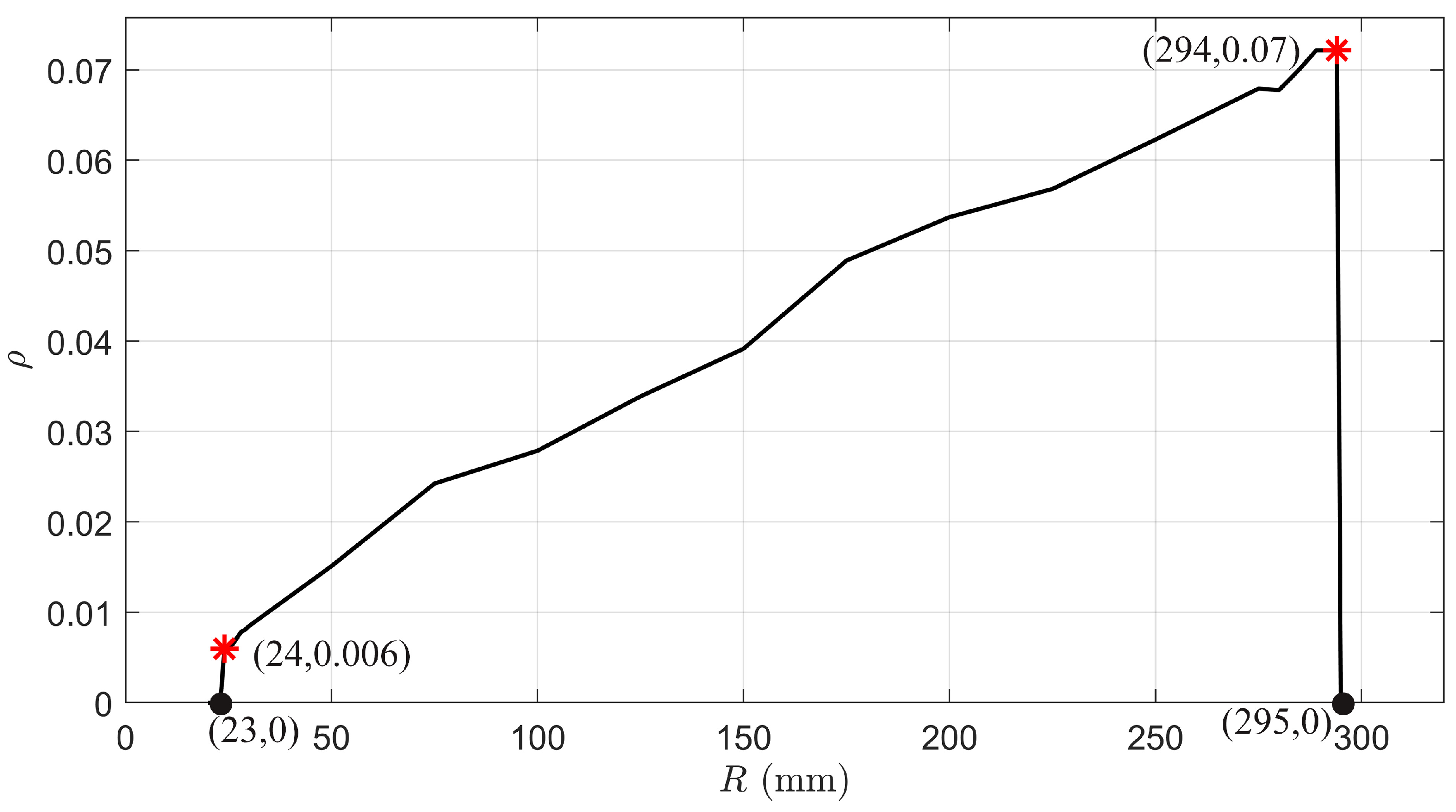
Using the above optimization method, the range of sphere radii that the robotic hand can grasp can be obtained by parameter sweeping. Take the friction coefficient μ = 0.4 . From the previous analysis, L [ 147.4 mm , 268.9 mm ] , h 1 [ 69.3 mm , 145.1 mm ] . The resulting variation in the optimal stability margin with the grasped sphere radius R is shown in Figure 16.
Figure 16 shows that the stability margin ρ increases with the sphere radius R for R [ 24 mm , 294 mm ] . This indicates that for larger spheres, the robotic hand can more easily form a stable four-point grasping configuration. The reason is that as R increases, the curvature of the sphere decreases, the three fingertips are more widely distributed on the sphere, and the volume of the wrench convex hull expands, thereby enhancing the ability to resist disturbances from any direction. When R > 294 mm or R < 24 mm , no grasping configuration satisfying both geometric constraints and force closure can be found, and the stability margin ρ becomes zero. Once the radius of the target sphere has been determined, the optimization algorithm can provide the optimal grasping posture of the robotic hand for that radius, ensuring stable grasping and providing data support for on-orbit grasping strategies.
Consequently, the three-finger space robotic hand proposed in this paper can stably grasp spherical targets with a radius range of 24 mm to 294 mm . Compared with the grasping range ( 40 mm to 110 mm ) of a representative grasping mechanism for non-cooperative space targets reported in the literature [22], the proposed grasping mechanism has a significantly larger graspable range and is better suited for on-orbit grasping of small-to-medium-sized space debris and defunct spacecraft.
(3)
Analysis of the optimal grasping configuration parameters variation
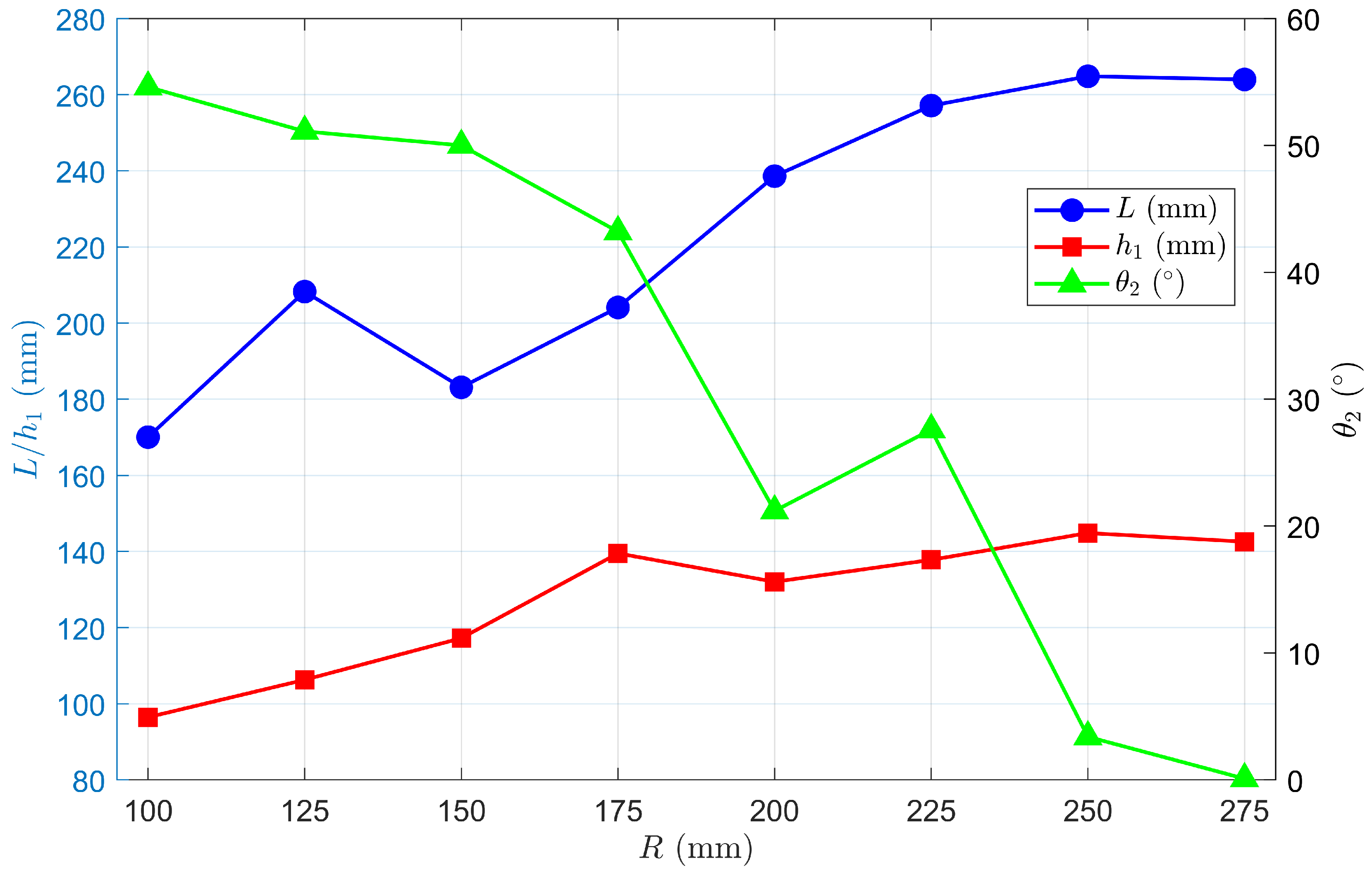
Analyzing the variation in each design parameter with target size under the optimal grasping configuration has clear engineering significance. Taking the sphere radius range R [ 100 mm , 275 mm ] with a step of Δ R = 25 mm as an example, the radius sweep is performed using the optimization algorithm, and the variation in each parameter with sphere radius under the optimal configuration is shown in Figure 17.
The figure shows that when the sphere radius R is small, a smaller actuated palm size L, a smaller deployable finger link length h 1 , and a larger finger joint angle θ 2 are required to reduce the enveloping range. As R increases, the required enveloping range of the robotic hand must expand; so, L and h 1 gradually increase while θ 2 gradually decreases. When R exceeds 225 mm , the actuated palm size L tends to stabilize and reaches its upper limit, indicating that for medium-to-large objects, the actuated palm needs to be fully deployed to adjust the position of the deployable finger base. When R exceeds 175 mm , the deployable finger length h 1 stabilizes and reaches the upper limit of the phalanx length, showing that for medium-to-large objects, the phalanx must be fully deployed to provide sufficient enveloping length. When R exceeds 250 mm , the joint angle θ 2 approaches zero, the first phalanx is almost straight, and enveloping is then achieved by the phalanx 2 and the deployment of the actuated palm.
These variation trends demonstrate the positive role of the deployment characteristics of the actuated palm and deployable fingers in grasping targets of different sizes, verifying the superiority of the three-finger space robotic hand with an actuated palm in terms of adaptability to space target sizes.
(4)
Grasp contact force analysis
To verify the engineering feasibility of the optimal configurations obtained above, a contact force analysis is performed. On one hand, the distribution of contact forces is evaluated to avoid local overpressure that could damage the grasped target or deform the robotic hand; on the other hand, it is verified whether the grasping configuration satisfies the static friction constraints to prevent slipping. Based on the force closure model, a quadratic programming method is used to solve for a set of contact forces that satisfy force balance and minimize the sum of squared forces. The optimization problem is formulated as follows:
min λ 1 2 λ T λ s . t . W λ = w e x t , λ 0 ,
where W is the extended grasp matrix, λ is the vector of non-negative combination coefficients of the edge direction vectors in the friction cone linearization, and w e x t is the applied external wrench.
The tangential force f t i and normal force f n i at each contact point should satisfy the following:
f t i f n i μ
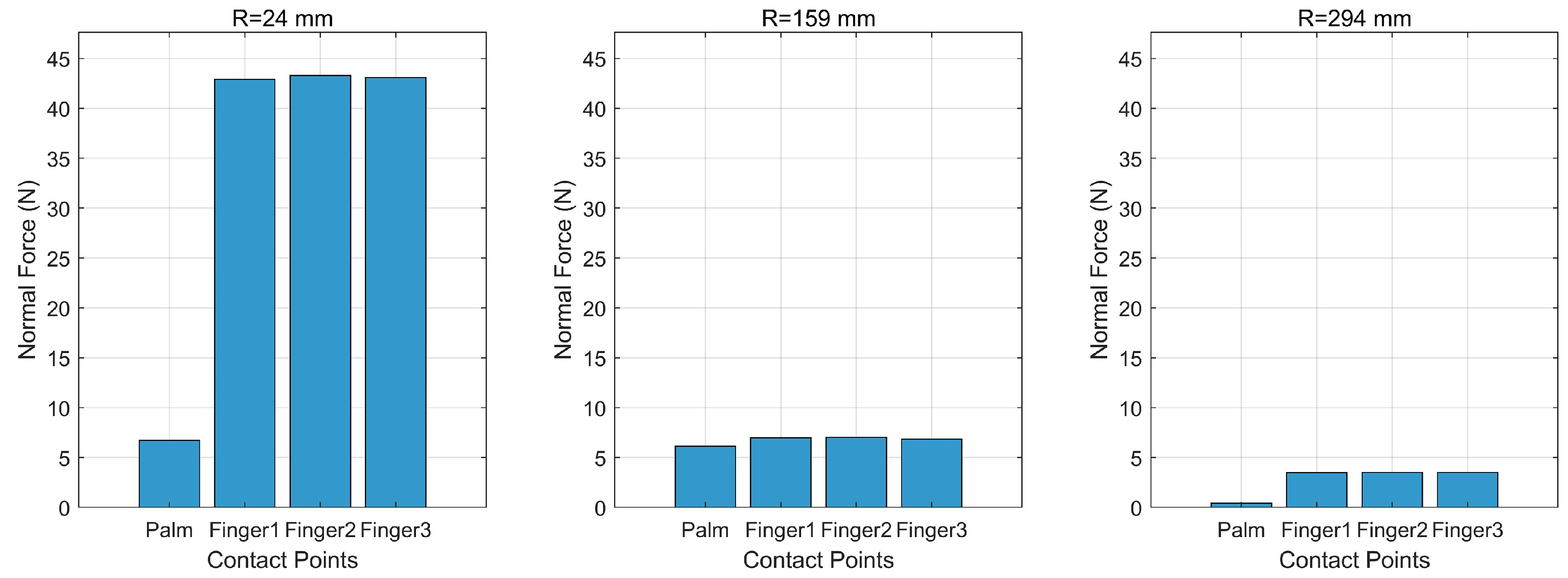
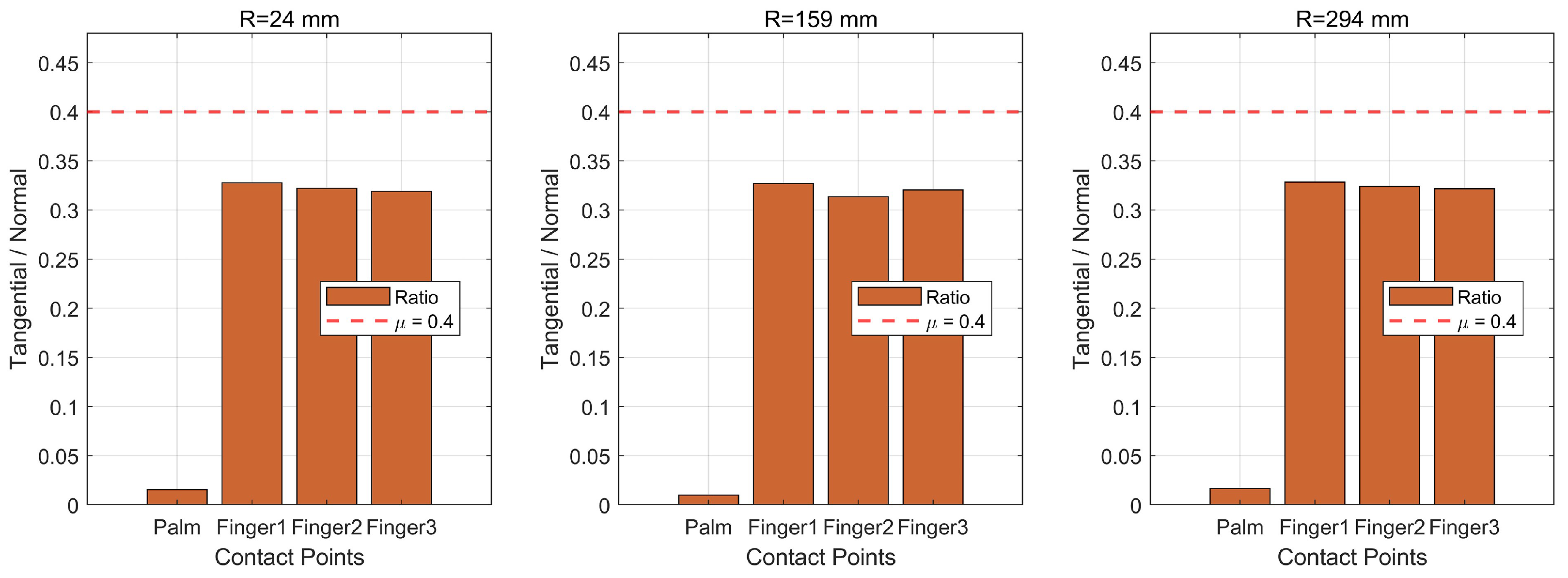
Taking the optimal configurations corresponding to typical graspable sphere radii, specifically the minimum radius R = 24 mm , the middle radius R = 159 mm , and the maximum radius R = 294 mm , with friction coefficient μ = 0.4 and applied load w e x t = [ 0 , 0 , 0 , 0 , 0 , 1 ] T (unit: N), the uniformity of the contact force distribution under the expected external force and whether the contact forces satisfy the friction constraint can be verified. The results are shown in Figure 18 and Figure 19.
The magnitude of the normal force in Figure 18 directly reflects the pressing degree between the fingers and the grasped sphere; it is a key indicator of whether local overloading, target damage, or finger wear have occurred. A uniform normal force distribution means that the grasping force distribution is reasonable. Figure 18 shows that when the robotic hand grasps spheres of the three typical radii, the normal forces at the three fingertip contact points are fairly uniform. Due to the applied external force in the positive Z direction, the normal force at the palm contact point is smaller than that at the fingertip contact points, and it mainly provides normal support with very little contribution to tangential disturbance rejection.
Figure 19 shows that for all three typical sphere-grasping cases, the ratio of tangential to normal force at each contact point is smaller than the friction coefficient μ , indicating that all contact forces lie within the friction cone.
In summary, the optimal configurations obtained not only have a high stability margin but also exhibit a reasonable contact force distribution, enabling reliable force closure grasping. This verifies the rationality of the proposed three-finger space robotic hand design.

5. Prototype Design and Testing

5.1. Prototype Fabrication

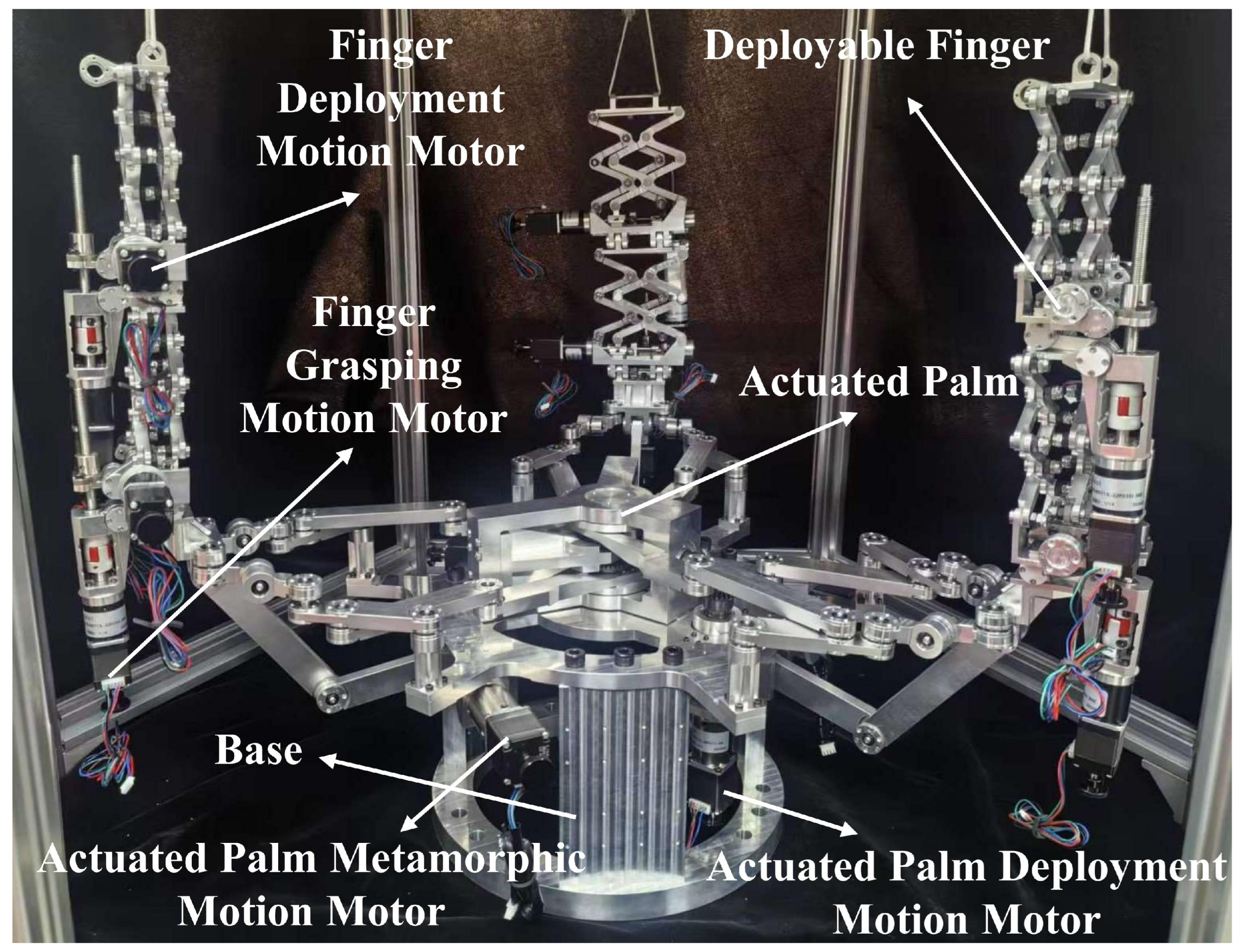
Based on the design and analysis presented above, a physical prototype of the three-fingered robotic hand was fabricated, as shown in Figure 20. It consists of a base, an actuated palm, and three deployable fingers. The actuated palm’s deployment motion and metamorphic motion, the finger’s deployment motion, and the grasping motion are driven by motors and reducers, respectively. The motors and reducers drive ball screws to generate the linear motion required for the finger-deployment motion. During operation, when both the actuated palm and fingers are fully deployed, the three-fingered space robotic hand reaches its maximum dimensions: 523 mm in height and 688 mm in diameter (excluding the base). When both are folded, it achieves its minimum dimensions: 372 mm height and 442 mm diameter (excluding the base).

5.2. Basic Motion Tests

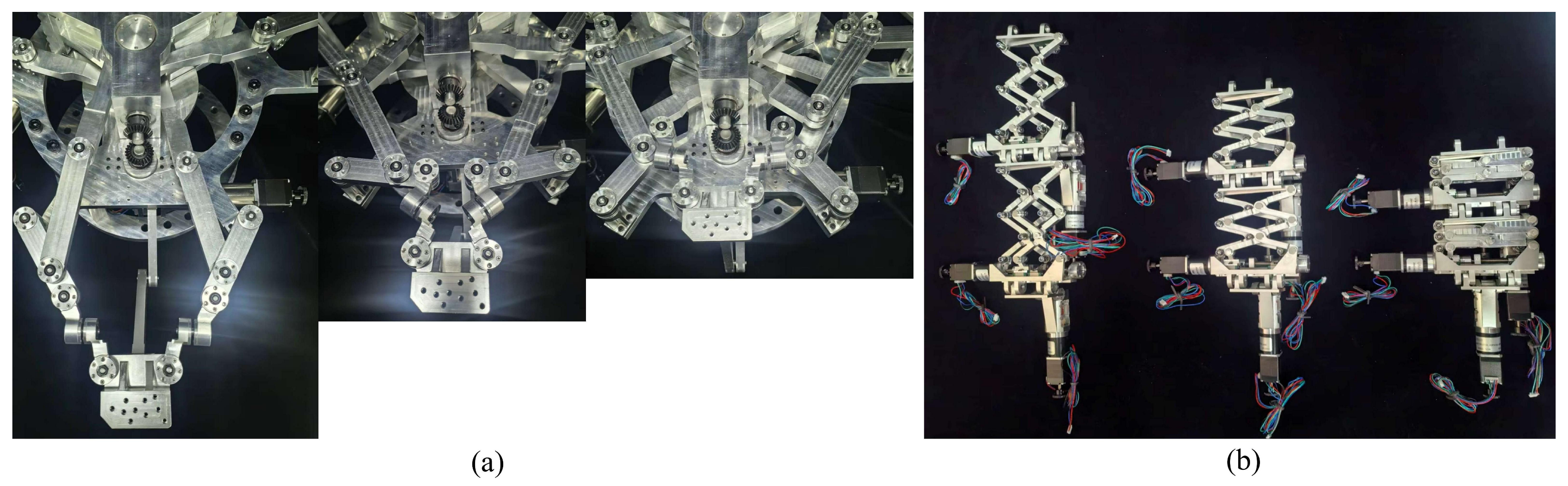
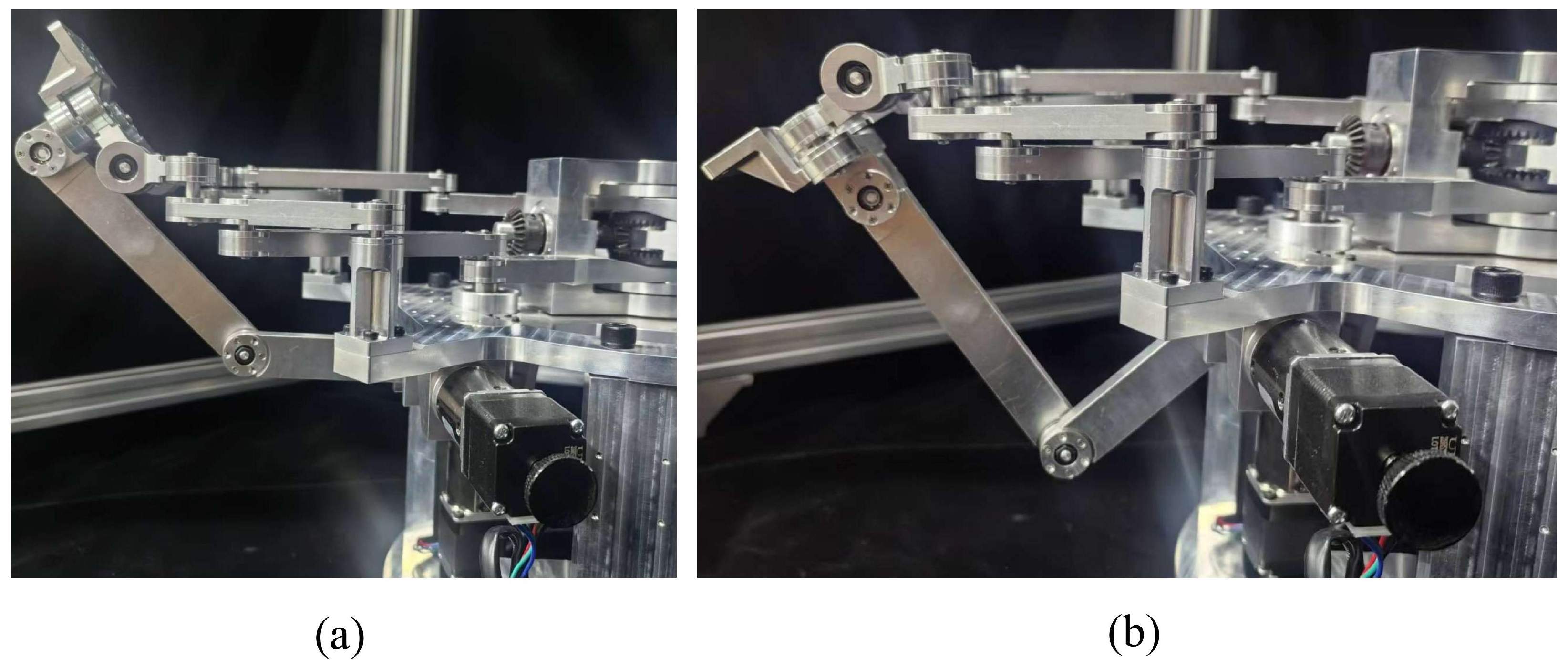
The following tests on the deployment and metamorphic motions of the robotic hand were conducted to validate the design rationale. Figure 21 shows the deployment and folding motion tests of the three-fingered robotic hand. Figure 21a illustrates the deployed state, deploying process, and folded state of the actuated palm; the radii of the deployed and folded states are 308 and 191 mm, respectively. Figure 21b presents the deployed state, deploying process, and folded state of the deployable fingers; the radii of the deployed and folded states are 146 and 69 mm, respectively. Figure 22 demonstrates the upward and downward metamorphic motions performed when the actuated palm is fully deployed; the upward and downward metamorphic angles are −45° and 45°, respectively. The motion tests confirm that both the actuated palm and deployable fingers can achieve the intended deployment, folding, and metamorphic motions.

5.3. Grasping Adaptability Tests

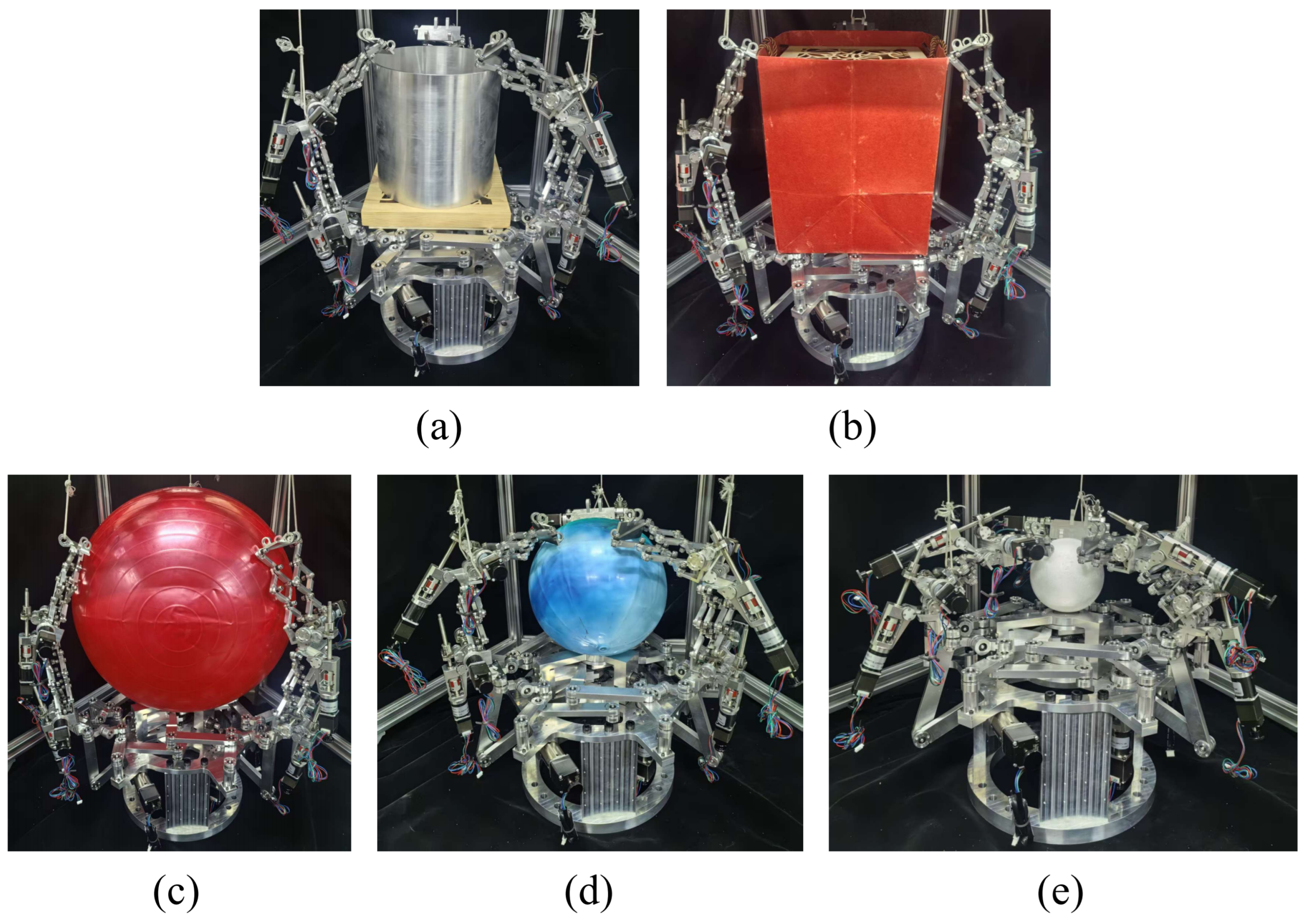
To verify the adaptability of the three-fingered robotic hand when grasping objects, objects of different shapes and sizes were selected for testing. As shown in Figure 23a–c, the robotic hand successfully grasped a cylinder, cube, and sphere. In these cases, the deployable fingers were fully deployed, and the actuated palm was in an intermediate state between deployment and folding. As shown in Figure 23c–e, the robotic hand proved capable of grasping spherical objects of different sizes. When grasping the small sphere in Figure 23e, both the actuated palm and deployable fingers were in the folded state. The grasping adaptability tests verified that the three-fingered robotic hand can flexibly modify its own workspace, demonstrating good adaptability to object shape and size.

6. Discussion

(1)
Design trade-offs
The above analysis, simulations, and tests results indicate that the proposed novel robotic hand with an actuated palm exhibits good adaptability to targets of different sizes and shapes. In particular, the introduction of the palm degrees of freedom enabled the robotic hand to further adapt to the contour features of the target. As shown in Table 1, compared with traditional space static palms, the proposed novel robotic hand possesses significant advantages in terms of workspace, target adaptability, grasping stability, and grasping flexibility. As shown in Table 2, compared with existing space manipulators designed to grasp non-cooperative targets, the proposed robotic hand exhibits significant advantages in terms of its palm degrees of freedom, metamorphic angle, adjustable dimensions, and palm folding–deployment ratio.
However, any improvements made to a design come with trade-offs. The actuation capability of the palm inevitably increases the complexity of the mechanism, increasing the number of links and joints in the robotic hand, which in turn makes it more difficult to control. This trade-off is an inevitable cost of achieving higher adaptability and greater versatility for space missions. In addition, due to the increasing complexity of the mechanism, issues related to lubrication and wear, anti-cold-welding measures, reliability, and modular assembly design must be carefully considered. Addressing these engineering challenges is a necessary part of developing the novel space robotic hand with an actuated palm from a laboratory prototype into a highly reliable space system.
Despite the additional challenges, the overall advantages of the present design are sufficient to justify these trade-offs, especially in future space missions requiring space grasping mechanisms with strong target adaptability and wide mission versatility. Therefore, the space robotic hand with an actuated palm can replace traditional space static palms and will serve as a promising solution for building intelligent general-purpose space robotic hands in the future.
(2)
Limitations of ground experiments and future prospects
Constrained by experimental conditions, the ground experiments in this paper were conducted under the influence of Earth’s gravitational field, which is fundamentally different from the true microgravity environment of space. To aid the objective evaluation of the application potential of the proposed robotic hand in space, the limitations of the ground experiments are discussed below.
The main differences between ground experiments and the space environment lie in the effects of gravity on the target, the lack of realistic target dynamics, and the extreme space environment (microgravity, wide-range temperature cycling, and high-vacuum conditions). First, in ground experiments, the grasped object is constrained by gravity and is not prone to escape; in the space microgravity environment, any collision between the manipulator and the target, errors in grasping parameter estimation, or control deviations may allow the targets to escape. Therefore, space grasping must not only achieve positional restraint but must also rely entirely on contact forces to counteract any of the initial momentum of the target. This imposes much more stringent requirements on fingertip force/torque control and dynamic stability than ground experiments. Second, ground targets are either stationary or are moved slowly by hand, which does not accurately simulate the complex motion states commonly encountered with non-cooperative space targets. During actual on-orbit grasping, an instantaneous impact and momentum exchange occur between the robotic hand and the target, while the issues of dynamic target tracking and impact buffering are not addressed in this paper. Finally, all experiments in this work were carried out at normal temperature and atmospheric pressure and in clean indoor conditions, without considering the effects of the extreme space environment on mechanism materials, lubrication, etc. These factors could lead to material embrittlement, mechanism jamming, and other engineering risks.
Despite these limitations, ground experiments remain the primary and indispensable means of verifying the basic functions of a space robotic hand. For the proposed design, the core objectives of the ground experiments were to demonstrate the rationality of the mechanical design and the advanced nature of the configuration. Specifically, these included the following: (1) the deployment/folding and metamorphic motion of the actuated palm, (2) the deployment/folding and grasping motion of the deployable fingers, (3) and the adaptability to target size and shape. All these verifications fall into the geometric and kinematic domain and are insensitive to gravity conditions; therefore, ground experiments are sufficient to prove the reliable realization of these basic functions.
In future work, to develop the proposed three-fingered space robotic hand into a truly versatile grasping system for space missions, further research is needed, and must include microgravity environment simulation, dynamics, and space environmental adaptability. First, gravity should be compensated by suspension or air-floating methods to simulate the free-floating motion that occurs under microgravity, which is an effective means of verifying contact dynamics, momentum exchange, and impact stability during grasping. Second, a complete simulation system incorporating the multi-body dynamics of the robotic hand, rigid-body dynamics of the target, and contact--impact models should be established. Numerical simulations can then be performed to study the variation in stability margins under different grasping speeds, contact friction coefficients, and initial angular velocities of the target, thereby providing a basis for control parameter optimization. Finally, for the extreme space environment, low-temperature adaptability tests of mechanism materials, vacuum lubrication schemes, and environmental reliability assessments of the mechanism should be carried out.
In summary, the ground experiments presented in this paper fully validate the advanced configuration and kinematic feasibility of the three-fingered space robotic hand with an actuated palm. Although further in-depth studies on dynamic target capturing and environmental adaptability are still required, this work provides a solid technical foundation and a novel solution for the design of an actively adjustable multi-functional grasping mechanism for non-cooperative space target grasping.

7. Conclusions

This paper presented a novel three-fingered space robotic hand featuring an actuated palm. Unlike traditional static palms, the actuated palm could actively participate in the grasping process, expanding the range of workspace variation and enhancing the robotic hand’s ability to adapt to diverse objects. The coordinated operation of the actuated palm and deployable fingers enabled the three-fingered space robotic hand to actively adjust its workspace size based on the shapes or sizes of objects, accommodating their geometric characteristics. Subsequently, kinematic and performance analyses of the robotic hand were performed. The workspace analysis results demonstrated that the deployable palm mechanism, metamorphic mechanism, and deployable fingers all contributed to an increase in the robotic hand’s workspace. Transmission performance analyses indicated that the singularities during the actuated palm’s deployment motion were beneficial, as they reduced the mechanical shock. The stability margin analysis demonstrates the positive effect of the deployable characteristics of the actuated palm and deployable fingers on adapting to targets of different sizes. The contact force distribution analysis shows that the optimal grasping configurations allowing the three-fingered space robotic hand to grasp a sphere of a typical radius exhibit reasonable contact force allocation. The calculation of the grasping range reveals that the proposed three-fingered space robotic hand can grasp spheres with radii from 24 mm to 294 mm , making it suitable for on-orbit grasping of small and medium-sized space debris and dysfunctional spacecraft. Finally, a prototype was fabricated, and basic motion and grasping tests were performed for objects of different shapes and sizes. The proposed space three-fingered robotic hand exhibited excellent adaptability. The trade-off discussion in this paper shows that, although the introduction of the actuated palm increases the complexity of the mechanism and makes it more difficult to control, its beneficial effects on enhancing the target adaptability of the space robotic hand are sufficient to justify these trade-offs. Although the experiments in this paper were carried out under gravity, this did not affect the validity of the robotic hand configuration verification. Leveraging these advantages, the proposed novel three-fingered space robotic hand holds promising application prospects for on-orbit servicing missions of various types.

Author Contributions

Conceptualization, Z.Y.; methodology, Z.Y. and Y.C.; software, B.H.; validation, B.H. and Y.C.; formal analysis, C.L.; investigation, Z.Y., H.Z. and C.L.; resources, H.Z.; data curation, Z.Y.; writing—original draft preparation, Z.Y.; writing—review and editing, G.R. and C.L.; visualization, G.R.; supervision, B.H.; project administration, C.L. and H.Z.; funding acquisition, H.Z. All authors have read and agreed to the published version of the manuscript.

Funding

This research received no external funding.

Data Availability Statement

The raw data supporting the conclusions of this article will be made available by the authors on request.

Acknowledgments

This research was supported by the Xi’an Institute of Optics and Precision Mechanics, Chinese Academy of Sciences.

Conflicts of Interest

The authors declare no conflicts of interest.

References

  1. Zhang, W.; Li, F.; Li, J.; Cheng, Q. Review of On-Orbit Robotic Arm Active Debris Capture Removal Methods. Aerospace 2023, 10, 13. [Google Scholar] [CrossRef]
  2. Hao, Y.; Wu, T.; Zhang, X. The Shenzhou-20 crew has returned by switching spacecraft, demonstrating China’s space emergency response capabilities. Sp. Int. 2025, 12, 5–6. [Google Scholar]
  3. Ebisuzaki, T.; Quinn, M.N.; Wada, S.; Piotrowski, L.W.; Takizawa, Y.; Casolino, M.; Bertaina, M.E.; Gorodetzky, P.; Parizot, E.; Tajima, T.; et al. Demonstration designs for the remediation of space debris from the International Space Station. Acta Astronaut. 2015, 112, 102–113. [Google Scholar] [CrossRef]
  4. Wen, G.; Wang, S.; Zeng, Y.; Liu, T.; Zhang, M.; Liang, Z.; Ibrahim, M.; Han, X.; Liu, C. Research on the Laser Ranging of Runaway Space Objects. Aerospace 2026, 13, 186. [Google Scholar] [CrossRef]
  5. Bigdeli, M.; Srivastava, R.; Scaraggi, M. Mechanics of Space Debris Removal: A Review. Aerospace 2025, 12, 277. [Google Scholar] [CrossRef]
  6. Shan, M.; Shi, L. Comparison of Tethered Post-Capture System Models for Space Debris Removal. Aerospace 2022, 9, 33. [Google Scholar] [CrossRef]
  7. Han, Y.; Wen, D.; Li, J.; Qiao, Z. Improved Detection of Multiple Faint Streak-like Space Targets from a Single Star Image. Remote Sens. 2025, 17, 631. [Google Scholar] [CrossRef]
  8. Xu, K.; Zhuang, X.; Qiao, A.; Li, X.; Li, Y.; Li, L.; Ding, X. Design and analysis of a novel deployable grasping manipulator for space object capture. Acta Astronaut. 2024, 224, 266–280. [Google Scholar] [CrossRef]
  9. Bourabah, D.; Field, L.; Botta, E.M. Estimation of uncooperative space debris inertial parameters after tether capture. Acta Astronaut. 2023, 202, 909–926. [Google Scholar] [CrossRef]
  10. Bischof, B.; Kerstein, L. ROGER—Robotic Geostationary Orbit Restorer. In Proceedings of the 54th International Astronautical Congress of the International Astronautical Federation, the International Academy of Astronautics, and the International Institute of Space Law, Bremen, Germany, 29 September–3 October 2003. [Google Scholar]
  11. Kassebom, M. ROGER—An Advanced Solution for a Geostationary Service Satellite. In Proceedings of the 54th International Astronautical Congress of the International Astronautical Federation, the International Academy of Astronautics, and the International Institute of Space Law, Bremen, Germany, 29 September–3 October 2003. [Google Scholar]
  12. Nakasuka, S.; Funane, T.; Nakamura, Y.; Nojiri, Y.; Sahara, H.; Sasaki, F.; Kaya, N. Sounding rocket flight experiment for demonstrating “Furoshiki Satellite” for large phased array antenna. Acta Astronaut. 2006, 59, 200–205. [Google Scholar] [CrossRef]
  13. Dudziak, R.; Tuttle, S.; Barraclough, S. Harpoon technology development for the active removal of space debris. Adv. Space Res. 2015, 56, 509–527. [Google Scholar] [CrossRef]
  14. Rubinger, B.; Brousseau, M.; Lymer, J.D.; Gosselin, C.; Laliberté, T. A Novel Robotic Hand-SARAH For Operations on the International Space Station. In Proceedings of the ASTRA 2002 Workshop, Noordwijk, The Netherlands, 14–16 May 2002. [Google Scholar]
  15. Zhang, Z.; Zhang, Y.; Ning, M.; Zhou, Z.; Wu, Z.; Zhao, J.; Li, X.; Liu, W. One-DOF six-bar space gripper with multiple operation modes and force adaptability. Aerosp. Sci. Technol. 2022, 123, 107485. [Google Scholar] [CrossRef]
  16. Belbin, S.P.; Merrill, R.G. Boulder capture system design options for the asteroid robotic redirect mission alternate approach trade study. In Proceedings of the AIAA SPACE 2014 Conference and Exposition, San Diego, CA, USA, 4–7 August 2014; p. 4434. [Google Scholar]
  17. Chu, D.; Xiong, C.; Huang, Z.; Yang, J.; Ma, J.; Zhang, J.; Sun, B.Y.; Cai, J. Human Palm Performance Evaluation and the Palm Design of Humanoid Robotic Hands. IEEE Robot. Autom. Lett. 2024, 9, 2463–2470. [Google Scholar] [CrossRef]
  18. Yang, Y.; Peng, Y.; Pu, H.; Chen, H.; Ding, X.; Chirikjian, G.S.; Lyu, S. Deployable parallel lower-mobility manipulators with scissor-like elements. Mech. Mach. Theory 2019, 135, 226–250. [Google Scholar] [CrossRef]
  19. Yang, Y.; Liu, H.; Zheng, H.; Peng, Y.; Yu, Y. Two types of remote-center-of-motion deployable manipulators with dual scissor-like mechanisms. Mech. Mach. Theory 2021, 160, 104274. [Google Scholar] [CrossRef]
  20. Jia, G.; Huang, H.; Li, B.; Wu, Y.; Cao, Q.; Guo, H. Synthesis of a novel type of metamorphic mechanism module for large scale deployable grasping manipulators. Mech. Mach. Theory 2018, 128, 544–559. [Google Scholar] [CrossRef]
  21. Li, G.; Huang, H.; Guo, H.; Li, B. Design, analysis and control of a novel deployable grasping manipulator. Mech. Mach. Theory 2019, 138, 182–204. [Google Scholar] [CrossRef]
  22. Gao, C.; Huang, H.; Li, B.; Jia, G. Design of a truss-shaped deployable grasping mechanism using mobility bifurcation. Mech. Mach. Theory 2019, 139, 346–358. [Google Scholar] [CrossRef]
  23. Zhao, C.; Guo, H.; Liu, R.; Deng, Z.; Li, B.; Tian, J. Actuation distribution and workspace analysis of a novel 3(3RRlS) metamorphic serial-parallel manipulator for grasping space non-cooperative targets. Mech. Mach. Theory 2019, 139, 424–442. [Google Scholar] [CrossRef]
  24. Yang, H.; Han, Y.; Li, C.; Wang, Y.; Liu, R. Design and Envelope Grasping Analysis of Deployable Manipulator for Space Capture. In Proceedings of the International Conference on Intelligent Robotics and Applications, Xi’an, China, 31 July–2 August 2024; pp. 195–207. [Google Scholar]
  25. Cui, Y.; Liu, X.J.; Dong, X.; Zhou, J.; Zhao, H. Enhancing the Universality of a Pneumatic Gripper via Continuously Adjustable Initial Grasp Postures. IEEE Trans. Robot. 2021, 37, 1604–1618. [Google Scholar] [CrossRef]
  26. Odhner, L.U.; Jentoft, L.P.; Claffee, M.R.; Corson, N.; Tenzer, Y.; Ma, R.R.; Buehler, M.; Kohout, R.; Howe, R.D.; Dollar, A.M. A compliant, underactuated hand for robust manipulation. Int. J. Rob. Res. 2014, 33, 736–752. [Google Scholar] [CrossRef]
  27. Dong, Y.; Kim, J.; Patel, V.V.; Feng, H.; Dollar, A.M. Model Q-II: An Underactuated Hand with Enhanced Grasping Modes and Primitives for Dexterous Manipulation. In Proceedings of the 2025 IEEE International Conference on Robotics and Automation (ICRA), Atlanta, GA, USA, 19–23 May 2025; pp. 6779–6785. [Google Scholar]
  28. Bircher, W.G.; Morgan, A.S.; Dollar, A.M. Complex manipulation with a simple robotic hand through contact breaking and caging. Sci. Robot 2021, 6, eabd2666. [Google Scholar] [CrossRef] [PubMed]
  29. Pozzi, M.; Malvezzi, M.; Prattichizzo, D.; Salvietti, G. Actuated Palms for Soft Robotic Hands: Review and Perspectives. IEEE/ASME Trans. Mechatron. 2024, 29, 902–912. [Google Scholar] [CrossRef]
  30. Xing, H.; Liu, Y.; Chen, J.; Li, W.; Ding, L.; Tavakoli, M. Variable admittance control for door opening with a wheeled mobile manipulator considering ground obstacles. Intell. Serv. Robot. 2026, 19, 41. [Google Scholar] [CrossRef]
  31. McCann, C.; Patel, V.; Dollar, A. The Stewart Hand: A Highly Dexterous, Six-Degrees-of-Freedom Manipulator Based on the Stewart-Gough Platform. IEEE Robot. Autom. Mag. 2021, 28, 23–36. [Google Scholar] [CrossRef]
  32. Shan, M.; Guo, J.; Gill, E. Review and comparison of active space debris capturing and removal methods. Prog. Aerosp. Sci. 2016, 80, 18–32. [Google Scholar] [CrossRef]
  33. Bicchi, A.; Kumar, V. Robotic grasping and contact: A review. In Proceedings of the 2000 ICRA. Millennium Conference, IEEE International Conference on Robotics and Automation, Symposia Proceedings (Cat. No.00CH37065), San Francisco, CA, USA, 24–28 April 2000; Volume 1, pp. 348–353. [Google Scholar]
  34. Xu, D.; Guo, S.; Jin, X.; Zhao, F.; Fang, Y. Design and analysis of a novel class of hybrid parallel manipulators with 3+3 degrees of freedom and remotely operated grippers. Mech. Mach. Theory 2025, 212, 106073. [Google Scholar] [CrossRef]
  35. Yin, Z.; Li, C.; Yang, Z.; Cai, Y.; Zhao, H. Design and Analysis of a Deployable Manipulator for On-Orbit Grasping. In Proceedings of the 2025 5th International Conference on Computer, Control and Robotics (ICCCR), Hangzhou, China, 16–18 May 2025; pp. 181–186. [Google Scholar]
  36. Liu, X.; Xie, F.; Wang, J. Fundamentals of Parallel Robotic Mechanisms; Higher Education Press: Beijing, China, 2018. [Google Scholar]
  37. Xu, W.; Zhao, Y.; Guo, W.; Sheng, X. Stochastic Force-Closure Grasp Synthesis for Unknown Objects Using Proximity Perception. IEEE/ASME Trans. Mechatron. 2025, 30, 3735–3745. [Google Scholar] [CrossRef]
  38. Pollard, N. Synthesizing grasps from generalized prototypes. In Proceedings of the IEEE International Conference on Robotics and Automation, Minneapolis, MN, USA, 22–28 April 1996; Volume 3, pp. 2124–2130. [Google Scholar]
  39. Lechuz-Sierra, J.G.; Martin, A.E.H.; Sundaram, A.M.; Martinez-Cantin, R.; Roa, M.A. Bayesian Optimization for Robust Robotic Grasping Using a Sensorized Compliant Hand. IEEE Robot. Autom. Lett. 2024, 9, 10503–10510. [Google Scholar] [CrossRef]
Figure 1. The effect of an actuated deployable palm mechanism and metamorphic mechanism on grasping. (a) A robotic hand with a non-deployable palm grasps a small-scale object. (b) A robotic hand with a non-deployable palm grasps a large-scale object. (c) A robotic hand grasps a large-scale object after the introduction of the deployable palm mechanism. (d) A robotic hand grasps large-scale objects after the introduction of the palm metamorphic mechanism.
Aerospace 13 00449 g001
Figure 2. A schematic diagram of the deployable palm mechanism. (a) The composition of the deployable palm mechanism. (b) A schematic diagram of the mobility analysis of the deployable palm mechanism.
Aerospace 13 00449 g002
Figure 3. Schematic diagram of actuated palm mechanism. (a) Metamorphic joints M 1 and M 2 are not coaxial. (b) Metamorphic joints M 1 and M 2 are coaxial.
Aerospace 13 00449 g003
Figure 4. The actuated palm model and its components. The red axes “A–C” indicate the following installation positions on the base: one of the joints of the deployable palm mechanism (red axe A), one of the metamorphic links and drives (red axe B) and the center of the deployable palm mechanism (red axe C). (a) The deployable palm mechanism (red box). (b) The base (green box). (c) The metamorphic links and drives (gray box). (d) The deployable palm mechanism drive system (blue box). (e) A diagram of the deployable palm mechanism drive system z(purple box).
Aerospace 13 00449 g004
Figure 5. The actuated palm deployment and metamorphosis process. The horizontal red axis at the bottom of the figure is used to compare the positions of the output link during downward metamorphosis, upward metamorphosis, and pre-metamorphosis; the blue arrow shows the motion sequence of the actuated palm deployment and metamorphosis. (a) Actuated palm (fully folded). (b) Actuated palm deployment. (c) Actuated palm fully deployed (top view). (d) Actuated palm fully deployed (side view). (e) Actuated palm metamorphosis (upward). (f) Actuated palm metamorphosis (downward).
Aerospace 13 00449 g005
Figure 6. Deployable phalanx design and motion display. (a) Folded state. (b) Deploying (the red axes at joints Q 11 , Q 21 and Q 13 indicate the joint axes). (c) Fully deployed (the arrows at joints Q 11 and Q 21 indicate the folding motion direction after the phalanx unit is fully deployed).
Aerospace 13 00449 g006
Figure 7. A schematic diagram of the joint mechanism connecting the deployable phalanx and phalanx module (different blue dashed boxes indicate different components).
Aerospace 13 00449 g007
Figure 8. A schematic diagram of deployable finger model and grasping configuration. (a) Fully folded. (b) Fully folded grasping. (c) Partially unfolded. (d) Partially unfolded grasping. (e) Fully deployed. (f) Fully deployed grasping.
Aerospace 13 00449 g008
Figure 9. Kinematic model of mechanism. Letters are used to represent joints: A R 22 , B R 24 , C R 23 , D R 25 , E R 26 , F r 19 , G r 18 , H r 17 , M – when M 1 and M 2 coaxial. The red double-headed arrows indicate the direction of motion of prismatic joints, and red single-headed arrows indicate angles(excluding the coordinate axes). The blue dashed lines are auxiliary lines. (a) Actuated palm mechanism. (b) Kinematic submechanism.
Aerospace 13 00449 g009
Figure 10. Kinematic model of mechanism. The red double-headed arrows indicate the direction of motion of prismatic joints, and red single-headed arrows indicate angles. (a) Phalanx module. (b) Joint mechanism.
Aerospace 13 00449 g010
Figure 11. Three-fingered robotic hand workspace. Different colors represent the deployment or metamorphosis workspaces of different fingers. (a) Actuated palm deployment. (b) Actuated palm metamorphosis. (c) Workspace superposition.
Aerospace 13 00449 g011
Figure 12. Workspace of the three-finger space robotic hand and comparison. Different colors represent the deployment or metamorphosis workspaces of finger. (a) Non-deployable palm and deployable palm. (b) Non-deployable fingers and deployable fingers. (c) Non-metamorphic palm and metamorphic palm.
Aerospace 13 00449 g012
Figure 13. Curve of local transmission index for the deployable palm mechanism.
Aerospace 13 00449 g013
Figure 14. Shape and size adaptability simulations. (a) Hexagonal prism; (b) cylinder shape; (c) disk-shaped; (d) small sphere; (e) medium sphere; (f) large sphere.
Aerospace 13 00449 g014
Figure 15. Schematic diagram of the robotic hand grasping a spherical target. (a) Distribution of contact points. (b) Calculation of the coordinates of contact point P 1 .
Aerospace 13 00449 g015
Figure 16. The variation curve of maximum stability margin with the radius of the captured sphere. The red asterisks indicate the two closest points on the curve where the distance stability margin is zero (the radius R step size is 1 mm ).
Aerospace 13 00449 g016
Figure 17. Curve of the optimal configuration parameters of the three-finger space robotic hand with the sphere radius when the grasping stability margin is maximum.
Aerospace 13 00449 g017
Figure 18. Normal force distribution when grasping a sphere with a typical radius.
Aerospace 13 00449 g018
Figure 19. The ratio of tangential force to normal force when grasping a sphere of typical radius.
Aerospace 13 00449 g019
Figure 20. The physical prototype of the three-fingered robotic hand.
Aerospace 13 00449 g020
Figure 21. Deployment and folding motion tests of the three-fingered robotic hand. (a) Motion tests of the actuated palm. (b) Motion tests of the deployable fingers.
Aerospace 13 00449 g021
Figure 22. Metamorphic motion tests of the actuated palm for the three-fingered robotic hand. (a) Upward metamorphosis. (b) Downward metamorphosis.
Aerospace 13 00449 g022
Figure 23. Grasping adaptability tests of the three-fingered robotic hand. (a) Cylinder. (b) Cube. (c) Sphere with a radius of 200 mm. (d) Sphere with a radius of 100 mm. (e) Sphere with a radius of 50 mm.
Aerospace 13 00449 g023
Table 1. Performance comparison between the actuated palm and the static palm.
PerformanceActuated PalmStatic Palm
Degree of Freedom20
WorkspaceLargeSmall
AdaptabilityHighLow
FlexibilityHighLow
StabilitySuperiorInferior
Table 2. Performance comparison between the proposed three-finger space robotic hand (with an actuated palm) and reference space grasping mechanisms.
PerformanceThe Proposed DesignLi [21]Gao [22]Zhao [23]Yang [24]
Palm DOF20000
Finger DOF22222
Metamorphic Angle 45 to 45 0000
Adjustment Dimensions42222
Folding-deployment Ratio (palm) 1.82 0000
Folding-deployment Ratio (finger) 2.09 2.9 2.6 Not ReportedNot Reported
Disclaimer/Publisher’s Note: The statements, opinions and data contained in all publications are solely those of the individual author(s) and contributor(s) and not of MDPI and/or the editor(s). MDPI and/or the editor(s) disclaim responsibility for any injury to people or property resulting from any ideas, methods, instructions or products referred to in the content.