
Article

Experimental and Numerical Analysis of Laser-Welded GFRP–PBT Joints for Aerospace Components
by
Ana-Teodora Untariu
1,
Katarina Monkova
2,3,*,
Liviu Marșavina
1,
Nicușor-Alin Sîrbu
4,5 and
Sergiu-Valentin Galațanu
1,*
1
Department of Mechanics and Strength of Materials, Politehnica University of Timisoara, Mihai Viteazu Bd., 300222 Timisoara, Romania
2
Faculty of Manufacturing Technologies with a Seat in Presov, Technical University of Kosice, Sturova 31, 080 01 Presov, Slovakia
3
Faculty of Technology, Tomas Bata University in Zlin, Vavreckova 5669, 760 01 Zlin, Czech Republic
4
National R&D Institute for Welding and Material Testing—ISIM Timisoara, Mihai Viteazu Bd., 300222 Timisoara, Romania
5
Department of Materials and Manufacturing Engineering, Politehnica University of Timisoara, Mihai Viteazu Bd., 300222 Timisoara, Romania
*
Authors to whom correspondence should be addressed.
Aerospace 2026, 13(5), 426; https://doi.org/10.3390/aerospace13050426
Submission received: 29 March 2026 / Revised: 21 April 2026 / Accepted: 28 April 2026 / Published: 1 May 2026

Abstract

This study investigates laser transmission welding of 30% glass fiber-reinforced polybutylene terephthalate (PBT-GF30). Injection-molded plates were used as base material, from which specimens were prepared, welded, and experimentally tested. The influence of key process parameters, including laser power, beam size, and scanning speed, on weld quality was systematically evaluated through an iterative optimization approach. An optimized parameter set (400 W laser power, reduced beam size, and increased scanning speed) enabled stable and repeatable weld formation with minimal thermal degradation. Experimental results were further supported by finite element analysis, showing good agreement between numerical and experimental data. The findings confirm the feasibility of laser welding for PBT-GF30 and its potential for aerospace applications requiring precision, weight reduction, and structural reliability.

1. Introduction

The aerospace industry increasingly relies on lightweight polymeric materials to improve performance, reduce weight, and enhance manufacturing efficiency. Among these materials, polybutylene terephthalate (PBT) reinforced with glass fibers has gained attention due to its favorable mechanical, thermal, and chemical properties [1,2,3,4,5].
Polybutylene terephthalate PBT is a semi-crystalline thermoplastic widely used in aerospace and engineering applications due to its high strength, dimensional stability, chemical resistance, and good processability. When reinforced with glass fibers, its mechanical performance is further enhanced, making it suitable for structural components [6].
PBT exhibits a combination of favorable mechanical, thermal, electrical, and chemical properties, including high strength, rigidity, thermal stability, and dimensional stability over a wide temperature range [7,8,9,10,11]. It also presents low dielectric constant and high dielectric strength, making it suitable for electrical insulation applications [12]. In addition, PBT shows good resistance to chemicals, moisture, and UV exposure, contributing to its durability in demanding environments [13,14].
Due to these properties, PBT is widely used in automotive and electronic applications and can be efficiently processed using conventional manufacturing techniques such as injection molding and extrusion [15,16].
As polymer components are increasingly integrated into multi-material structures, reliable joining techniques are required. Among these, welding methods such as laser and ultrasonic welding have gained attention due to their efficiency and ability to produce high-quality joints [17]. Laser welding enables localized melting and precise joining of complex geometries, while ultrasonic welding relies on high-frequency vibrations to generate interfacial heat without additional materials [17,18].
Although adhesive bonding may provide higher ultimate joint strength, laser transmission welding offers significant advantages for thermoplastic composite assemblies, including rapid processing, high reproducibility, compatibility with automated manufacturing, and the elimination of curing-related variability. In addition, the process does not require additional joining materials, reducing the risk of long-term degradation associated with adhesive interfaces. These features make laser welding particularly suitable for high-volume industrial applications, motivating its investigation in the present work.
To better understand and predict structural performance, numerical approaches such as finite element analysis (FEA) are increasingly employed. FEA enables the simulation of thermal cycles, stress distributions, and strain evolution, allowing researchers to optimize design parameters and improve structural reliability [19,20]. In the case of polybutylene terephthalate (PBT), laser welding is commonly performed using through-transmission laser welding (TTLW), a process in which the laser beam passes through a transparent component and is absorbed by an opaque one at the interface, producing localized heating and melting [21,22]. However, the semi-crystalline structure of PBT can scatter near-infrared radiation, thereby reducing the transmission of laser energy. This limitation is typically addressed by using laser-optimized polymer grades or by incorporating absorbing additives such as carbon black [23].
The quality of the welded joint is strongly influenced by process parameters such as laser power, welding speed, and clamping pressure, which directly affect heat generation, heat transfer, and molecular diffusion at the interface. Several studies have proposed coupled thermo-mechanical finite element models capable of predicting temperature fields, residual stresses, and potential failure regions in welded thermoplastic structures [24,25,26,27,28]. Nevertheless, the behavior of laser-welded PBT components reinforced with glass fibers and characterized by complex industrial geometries remains insufficiently understood, highlighting the need for further investigation.
The present study aims to investigate the laser welding of PBT-GF30 through a combined experimental and numerical approach, focusing on process optimization, weld integrity, and mechanical performance. The results contribute to a better understanding of laser-welded thermoplastic composites for aerospace applications.
Existing studies on laser transmission welding of thermoplastics have demonstrated the importance of process parameters in controlling weld quality; however, most investigations focus on unreinforced polymers or isolated experimental observations. The behavior of laser-welded glass-fiber-reinforced PBT, particularly under conditions relevant to structurally loaded aerospace components, remains insufficiently understood.
Therefore, the present study aims to investigate laser transmission welding of PBT-GF30 through a combined experimental and numerical approach. The work focuses on process optimization, weld integrity, and mechanical performance, with particular emphasis on the influence of laser power, welding speed, and clamping pressure.
The study is based on the hypotheses that optimized welding parameters can produce repeatable joints with limited thermal degradation, that glass fiber reinforcement affects weld morphology and mechanical response, and that a coupled thermo-mechanical finite element model can reliably reproduce the joint behavior. The results are intended to support the development of reliable joining strategies for lightweight aerospace structures.

2. Materials and Methods

2.1. Material

The investigated material was a commercially available glass-fiber-reinforced polybutylene terephthalate (PBT-GF30). Due to supplier confidentiality agreements, detailed proprietary information regarding supplier identity, grade designation, production lot, exact fiber length distribution, and carbon black type and content in the absorbent plates cannot be disclosed. Nevertheless, all specimens were produced from the same material batch, and the key processing-relevant material properties provided by the manufacturer are summarized in Table 1a–c [29,30,31,32,33,34,35].

2.2. Specimen Preparation

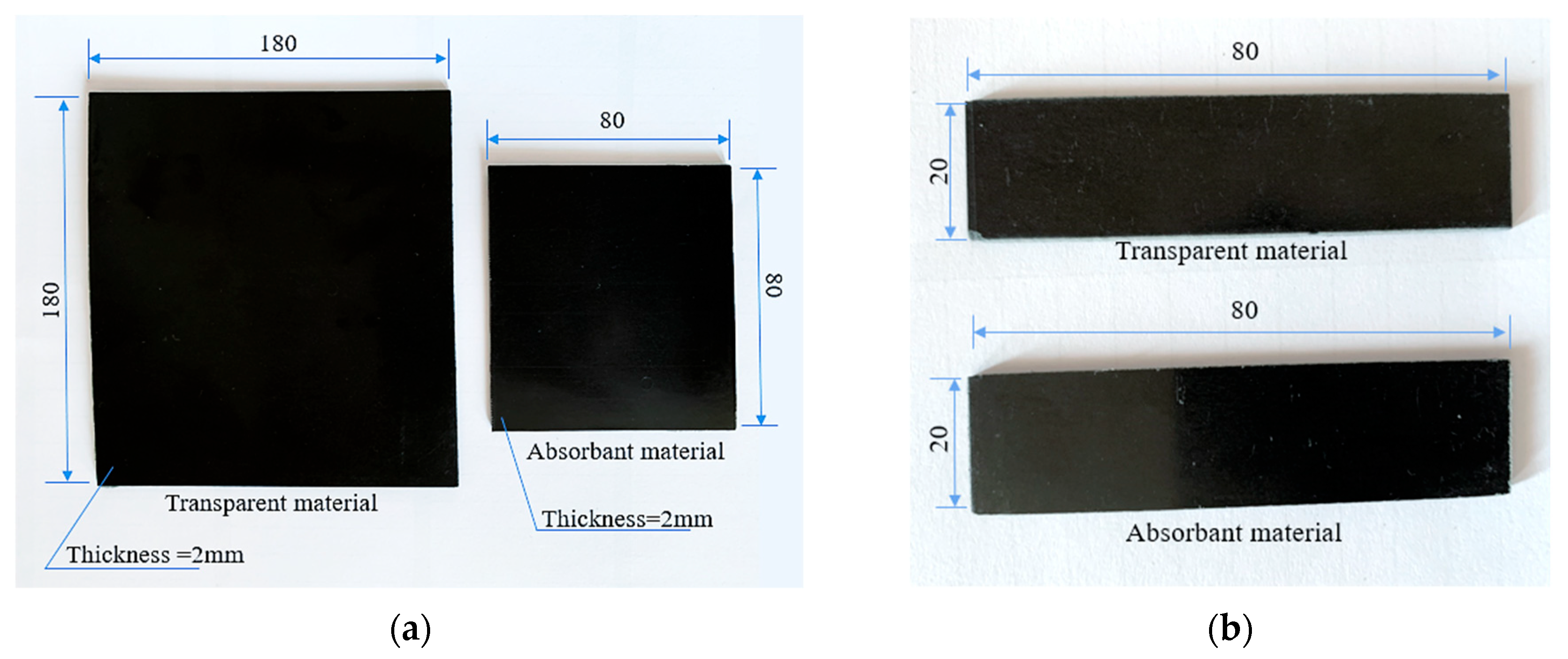
Dog-bone specimens were prepared according to ISO standards [29,30,31,32,33,34,35] to ensure uniform stress distribution during tensile testing. Plates were fabricated via injection molding: an absorbent PBT plate (80 mm × 80 mm × 2 mm, Figure 1a) and a laser-transparent PBT plate (180 × 180 × 2 mm, Figure 1b).
In this context, the term laser-transparent refers to the material’s transmissivity at the laser operating wavelength in the near-infrared (NIR) range, rather than optical transparency in the visible spectrum. Although both components appear dark in the provided images, the upper plate allows partial transmission of the laser radiation, while the lower plate contains an infrared-absorbing additive (carbon black) that promotes localized heating at the interface during the welding process. The investigated laser-welded specimens were prepared from injection-molded PBT-GF30 plates, which were cut to size prior to the welding process. The injection process involved mold clamping, molten polymer injection, cooling, and ejection [30].
Glass fiber orientation was controlled at 0° for consistent properties [30,31]. Plates were then cut into 80 mm × 20 mm × 2 mm samples using a ROMAX (Waterjet, Bucharest, Romania) water jet cutter to avoid heat-induced alterations, ensuring precise dimensions and fiber alignment.

2.3. Welding of Samples

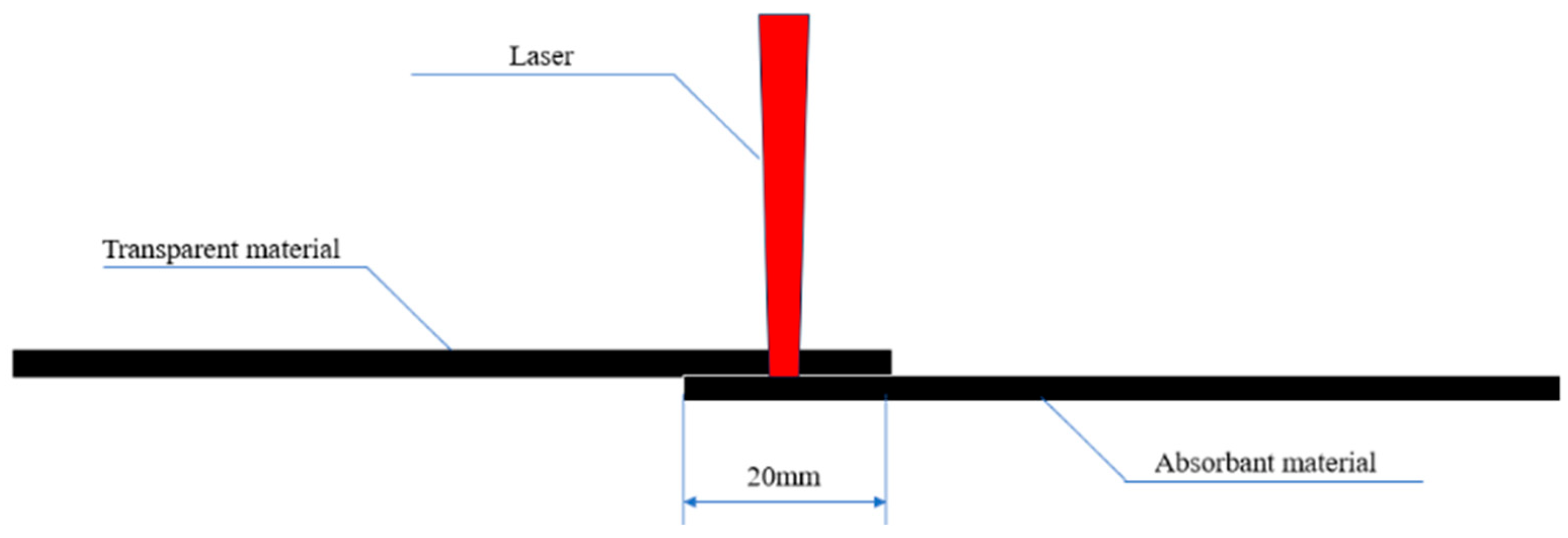
Welding was performed using an MFMC 8000 (HANS LASER, Shenzhen, China) system operating at 1064 nm. The specimens were arranged in an overlap configuration and clamped during processing, Figure 2.
A total of 10 parameter sets (T1–T10) were investigated (Table 2), based on prior experimental experience. Key variables included laser power, beam geometry, welding speed, and applied pressure.
The general recommended parameters are as follow:
Overlapping:
  • Laser Wavelength 980 nm,
  • Laser Power 80–150 W,
  • Welding Speed ≤500 mm/s,
  • Number of Passes 1–3 passes,
  • Pressing Force 1000 N force.

2.4. Testing Methods

2.4.1. Tensile Testing of Dog-Bone Specimens

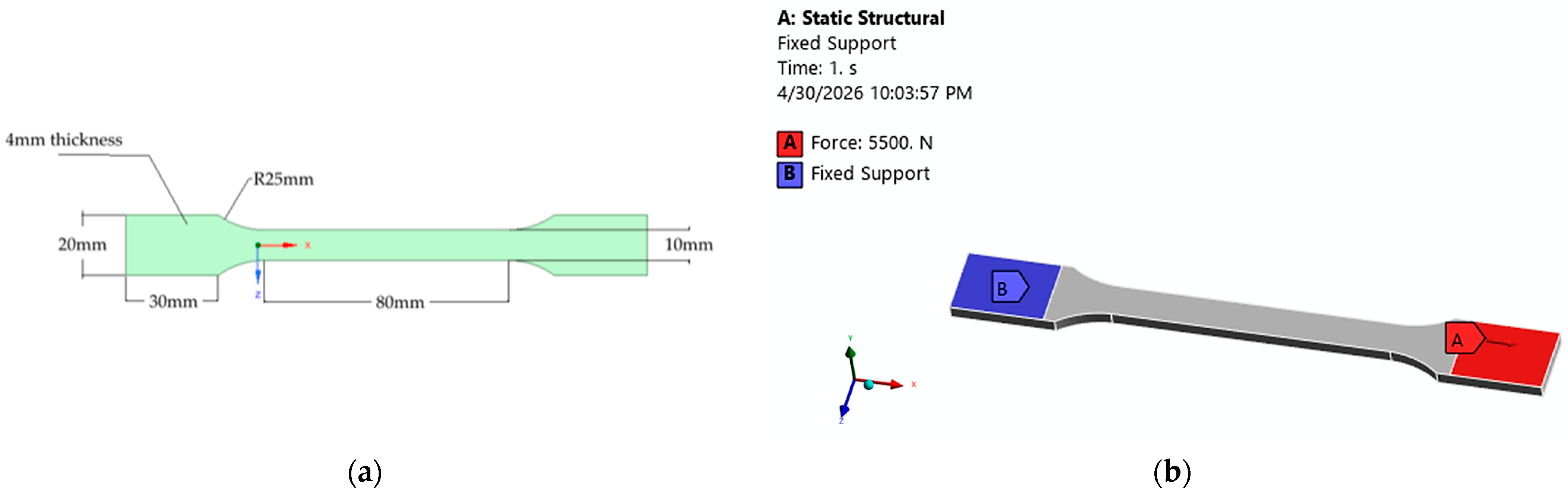
Tensile tests were carried out on a Zwick/Roell Z005 machine (ZwickRoell GmbH & Co. KG, Ulm, Germany) (crosshead speed 5 mm/min, ambient temperature), in accordance with ISO 527-2 [31]. Standard ISO 3167 [36] Type 1A injection-molded specimens were used. An extensometer measured strain for tensile strength, yield strength, elongation at break, and Young’s modulus. Force was applied until failure, and stress–strain curves were generated.

2.4.2. Shear Testing of Welded Samples

The welded joints were tested using the same Zwick/Roell Z005 setup, with a preload of 1 N, a crosshead speed of 5 mm/min, a gauge length of 71 mm, and a test termination criterion set at 80% of the maximum force. The test configuration followed a uniaxial displacement-controlled loading scheme adapted from ISO 527 [31], as no dedicated ISO standard exists for shear testing of laser-welded thermoplastic joints.
In total, six tests were performed on the welded specimens. The mean maximum force obtained from these tests was used as an input parameter in the numerical simulations of the weld. The experimental results were also used to characterize the mechanical response of the welded joints.
It should be noted that the shear-stress formulation presented below does not refer to a direct measurement from the welded-joint tests. Instead, it was used to estimate the shear stress from the tensile properties of the material. Because failure in the welded conmode, the stress state was discussed in terms of shear stress. Since the tensile tests provide the maximum normal stress, σmax, the maximum shear stress, τmax, was estimated through standard engineering relationships between tensile and shear strength. According to classical yield criteria [37], this value is typically approximated as 0.5σmax for the Tresca criterion and 0.577σmax for the von Mises criterion. For heterogeneous materials such as short-fiber-reinforced polymers, higher empirical factors are sometimes considered in the literature to account for anisotropy and multiaxial stress effects [38,39,40].
τ = (0.5 ÷ 0.8)σmax
τ—shear stress (MPa).

2.5. Microscopic Study of Welded Samples

A microscopic investigation of the welded samples was performed before and after mechanical testing using an Insize ISM-M1000 microscope (Insize Co., Ltd., Suzhou, China). Magnified images and video recordings were analyzed to characterize the morphology of the welded region, focusing on the degree of polymer matrix melting, the preservation of the glass fibers, and the structural features observed in both the central and peripheral zones of the weld. The purpose of this analysis was to identify possible microstructural non-uniformities and to relate them to the mechanical behavior of the joints.

2.6. Numerical Analysis

Finite element simulations were performed in ANSYS 2024R2 to reproduce the mechanical response of both base materials and welded joints. The weld region was modeled as a heat-affected zone (HAZ) with reduced material properties. Experimental stress–strain data were used as input for the material model, and simulation results were compared with experimental measurements.

2.6.1. Numerical Analysis of Dog-Bone Samples

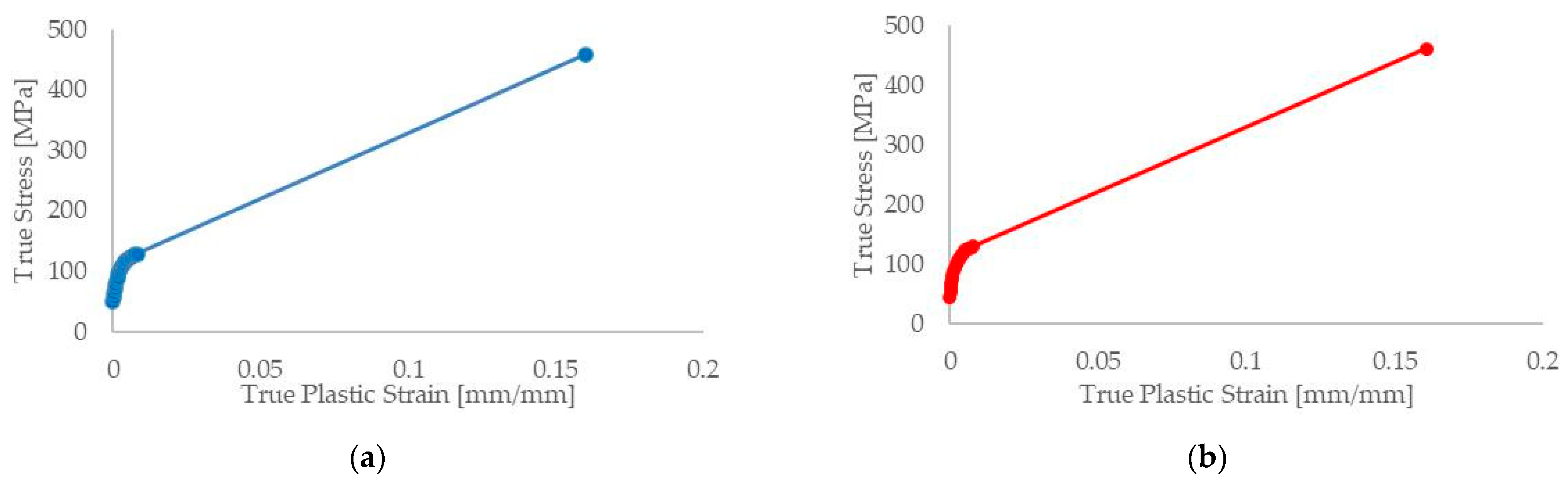
Engineering stress–strain curves obtained from the tensile tests were converted to true stress–plastic strain values for implementation in the ANSYS 2024R2 Engineering Data module using the Multilinear Isotropic Hardening material model (Figure 3).
The yield tensile strength (YTS) was estimated to be from the ultimate tensile strength (UTS) using a typical yield factor Re/Rm. For glass-fiber reinforced thermoplastics used in structural applications, this ratio is commonly assumed to be around 0.4–0.5 in engineering simulations when a distinct yield point cannot be clearly identified in the experimental curves. Based on this assumption, the yield tensile strength was estimated as YTS = UTS × 04 = 50.53 MPa.
A 3D model was created in SpaceClaim 2024R2 based on the ISO dimensions, with ends split via Split Body for boundary conditions (fixed support was employed at one end, tensile force at another clamped end), ensuring mesh continuity via ShareTopology, as it is shown in Figure 4. The material was assigned separately for absorbent/transparent PBT, while no contacts definition was needed; it is a single body.
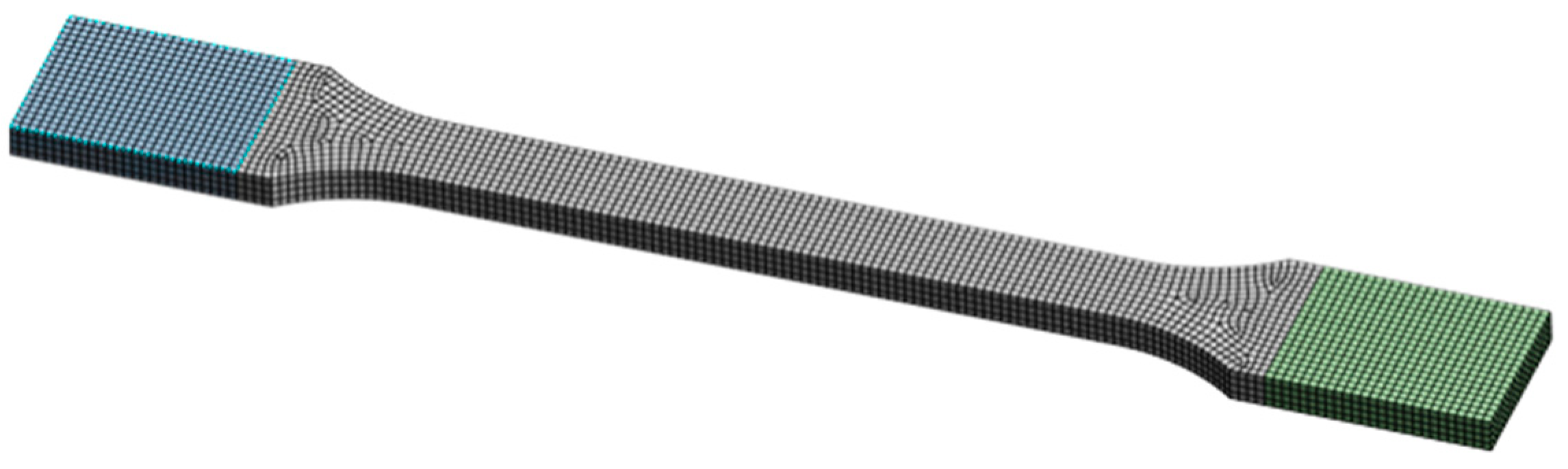
Meshing (Figure 5) used Hex Dominant Method (1 mm tetrahedral/hexahedral elements), refined in narrow gauge section (Number of nodes = 49,874, number of elements = 10,366). For non-linear analysis 12 load steps (500 N each, total 6000 N) were considered, large deflection enabled for plastic deformation.

2.6.2. Numerical Analysis of Welded Specimens

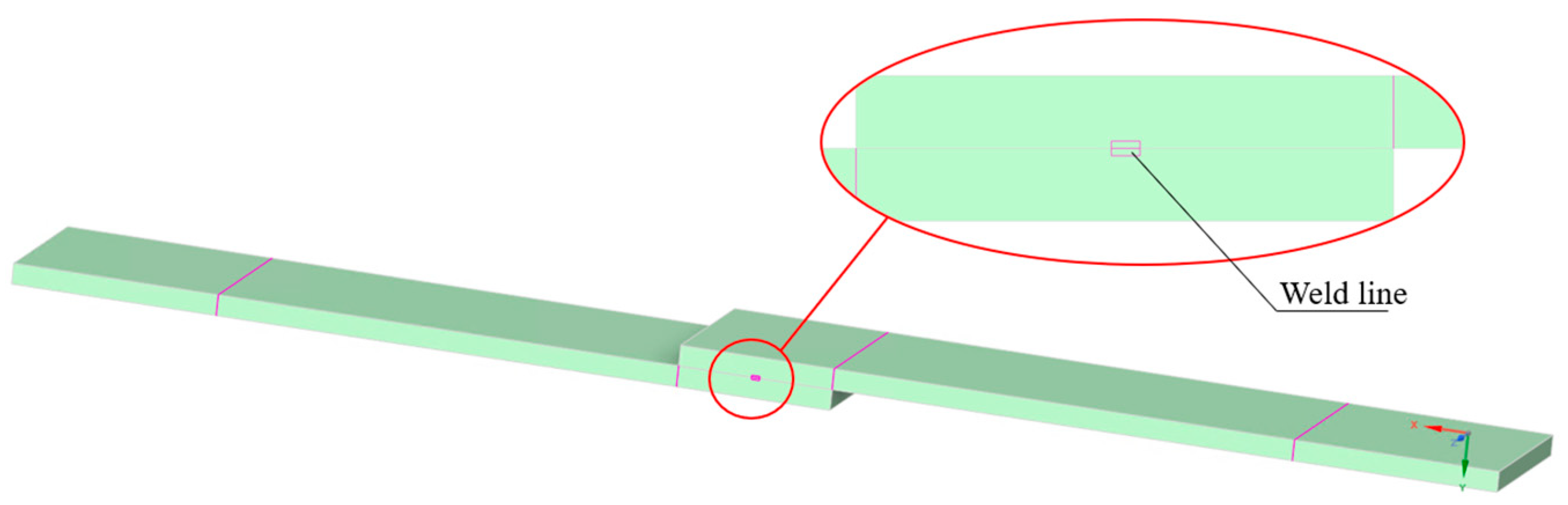
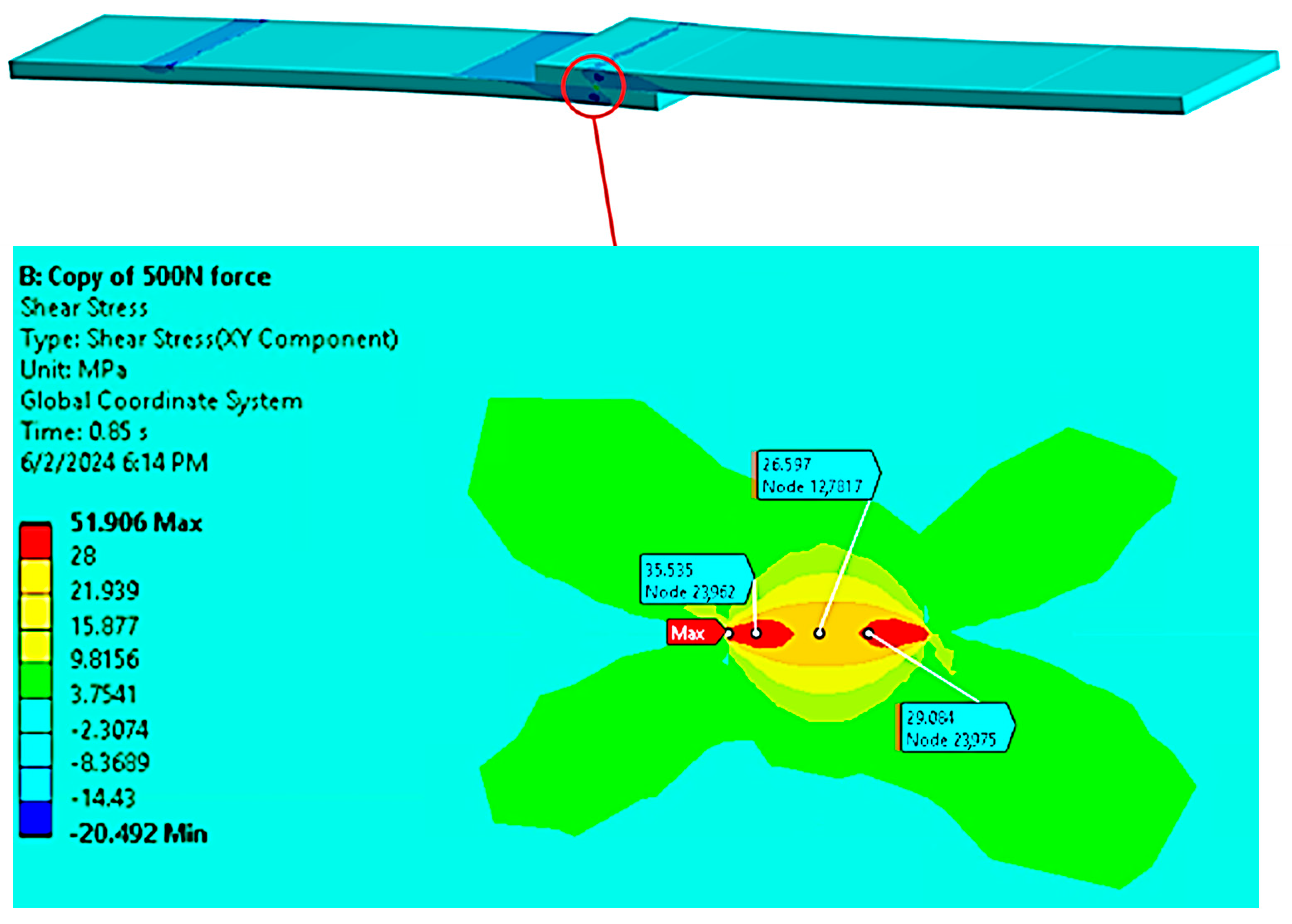
The numerical models comprised the base materials (PBT-T and PBT-A) together with a heat-affected zone (HAZ) representing the welded interface. In this study, the weld-line region was modeled as an HAZ-equivalent zone, whereas a distinct fusion zone was not considered separately. The geometry of this region was defined as a rectangular band located at the interface between the two joined components, with its width selected based on weld-line measurements obtained from the experimental specimens. The constitutive response of the base materials was based on experimentally obtained stress–strain curves measured on tensile test specimens exhibiting ideal fiber orientation. Since the molded components are expected to exhibit a certain degree of fiber misalignment relative to the tensile bars, these original curves were first scaled down by 25% prior to implementation in the finite element model. To represent the additional mechanical degradation associated with the welded interface, the material properties assigned to the HAZ region were further reduced by 25% relative to the already adjusted base–material curves. The model was constructed to represent the mechanical behavior of the joint after welding; therefore, the welding process itself (such as local contact pressure or thermal gradients during heating) was not simulated explicitly. Instead, a bonded interface condition was assumed between the two components. The material behavior was implemented in ANSYS 2024R2 using a multilinear isotropic hardening model. It should also be noted that the teardrop-like shape observed in the numerical stress plots (Section 3.2.2) does not represent the geometry of the modeled HAZ. Rather, it corresponds to the non-uniform stress distribution that develops under loading and specimen boundary conditions. The HAZ implemented in the numerical model remains rectangular as defined.
The 3D geometry was created in SpaceClaim 2024R2 and included split-body ends and a distinct weld-line region modeled as symmetrical components, with ShareTopology being applied to ensure nodal continuity across the interfaces (Figure 6). The width of the simulated HAZ corresponded to the geometric width of the weld-line region introduced in the model, representing the experimentally observed welded zone.
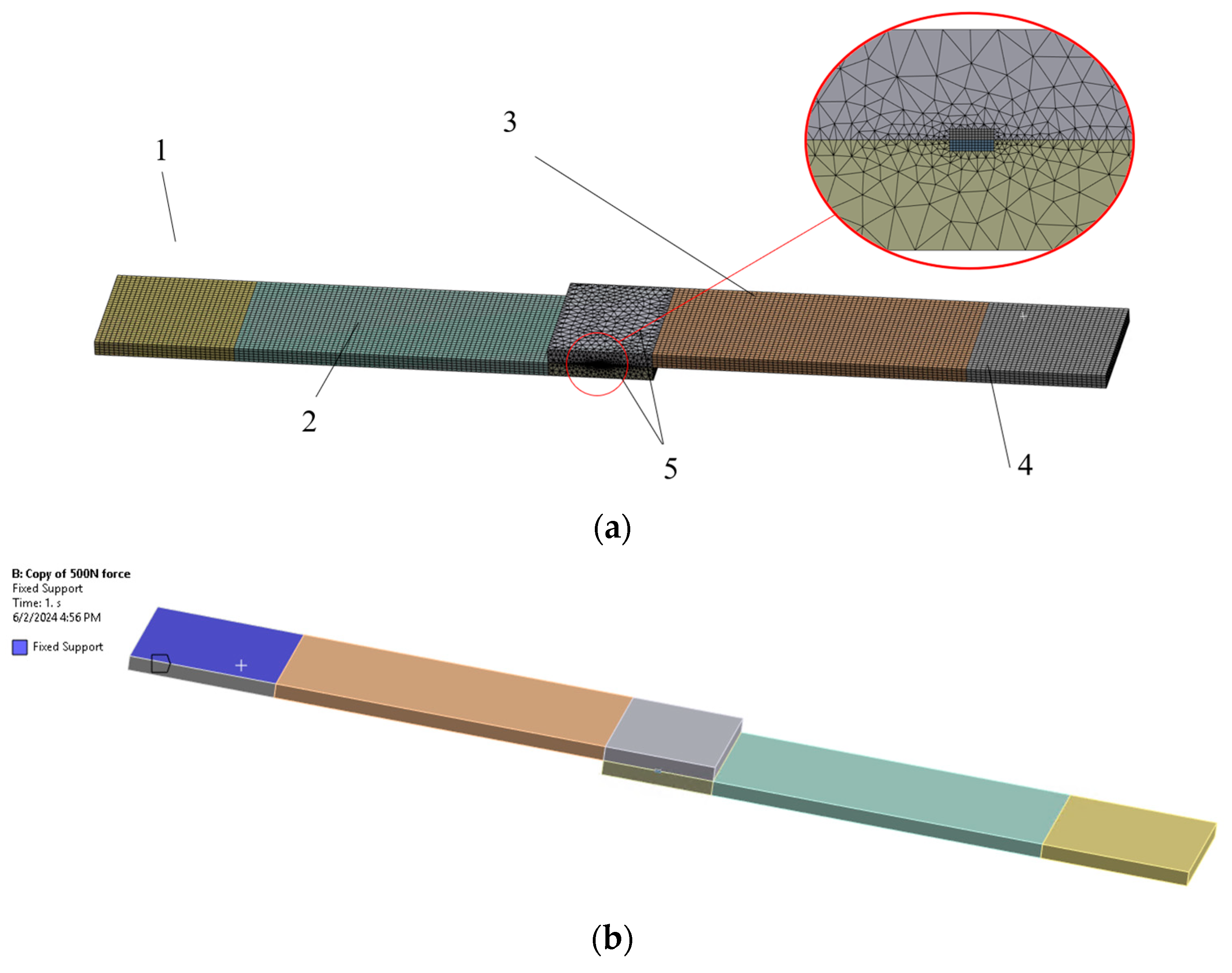
To capture stress gradients accurately in the weld seam and heat-affected zone (HAZ), meshing combined Patch Conforming for stable regions (parts 5) and Hex Dominant for critical areas (weld seam and parts 1–4) (Figure 7a). Element sizes were refined to 0.06 mm in the weld seam (for high-resolution fusion/HAZ modeling), 0.7 mm in adjacent bodies, with Edge Sizing ensuring smooth transitions and avoiding abrupt jumps that could distort results. A mix of tetrahedral and hexahedral elements was generated, prioritizing hexahedral in prismatic regions for superior accuracy in shear stress prediction; mesh quality was verified to support convergence in nonlinear analysis.
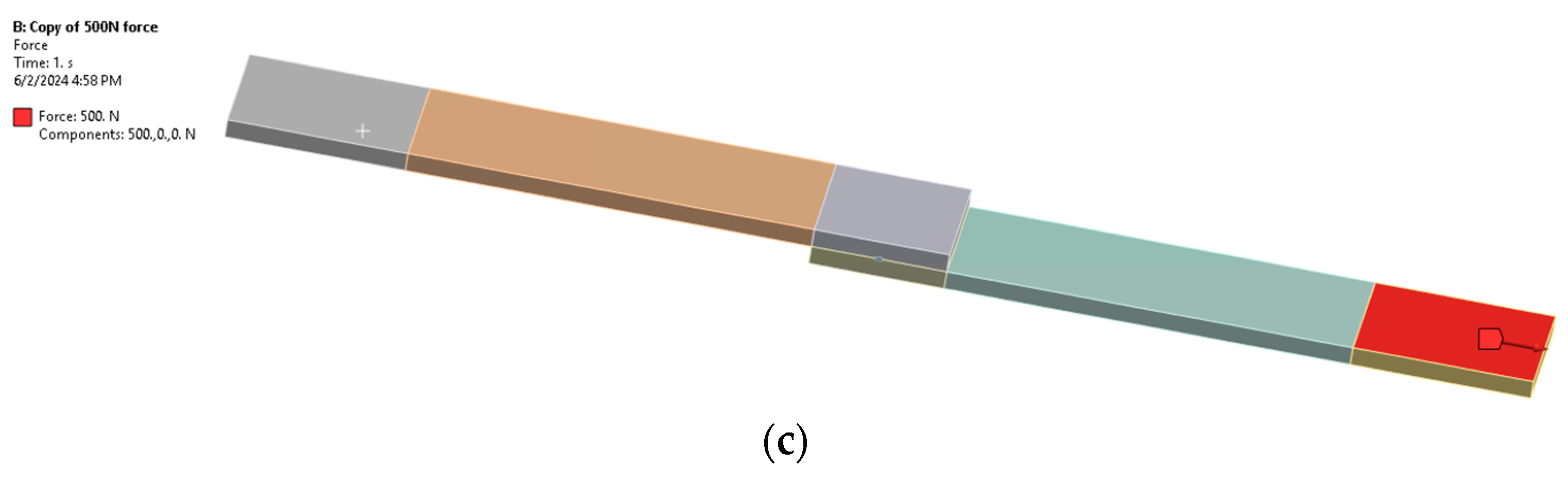
Boundary conditions: fixed support shown in Figure 7b (2 faces, simulating fixed jaw), 500 N force in Figure 7c (movable jaw replication; average experimental failure ~429 N), Y-axis displacement blocked on upper/lower faces for pure shear stress. Single analysis step (low force, no increments needed). Results compared simulated stress distribution to experimental fractures.

3. Results and Discussion

Ten PBT30 pairs (Table 3) were laser welded using process parameters selected through preliminary experimental trials. The final parameter set (improved T8) consisted of 400 W laser power, a rectangular beam with dimensions of 1 × 1 mm, 100 Hz frequency, 250 Hz rotation speed, and a scanning speed of 0.5 m/s. The parameter selection was based on an empirical trial-and-error approach, in which different parameter combinations were iteratively tested and evaluated according to the observed weld quality and overall sample integrity. The starting point for this procedure was a baseline parameter set identified during the preliminary trials (Table 2), comprising 400 W power, a rectangular beam of 2 × 2 mm, 100 Hz frequency, 250 Hz rotation speed, and a scanning speed of 0.02 m/s. From this baseline, the beam dimensions were reduced to 1 × 1 mm, and the scanning speed was increased to 0.5 m/s, as these adjustments yielded the best-performing welded samples among the tested configurations. Tensile testing was used to assess weld strength, while dog-bone specimens were employed to determine Young’s modulus. The experimental results were subsequently used for FEA validation.

3.1. Welding Parameters

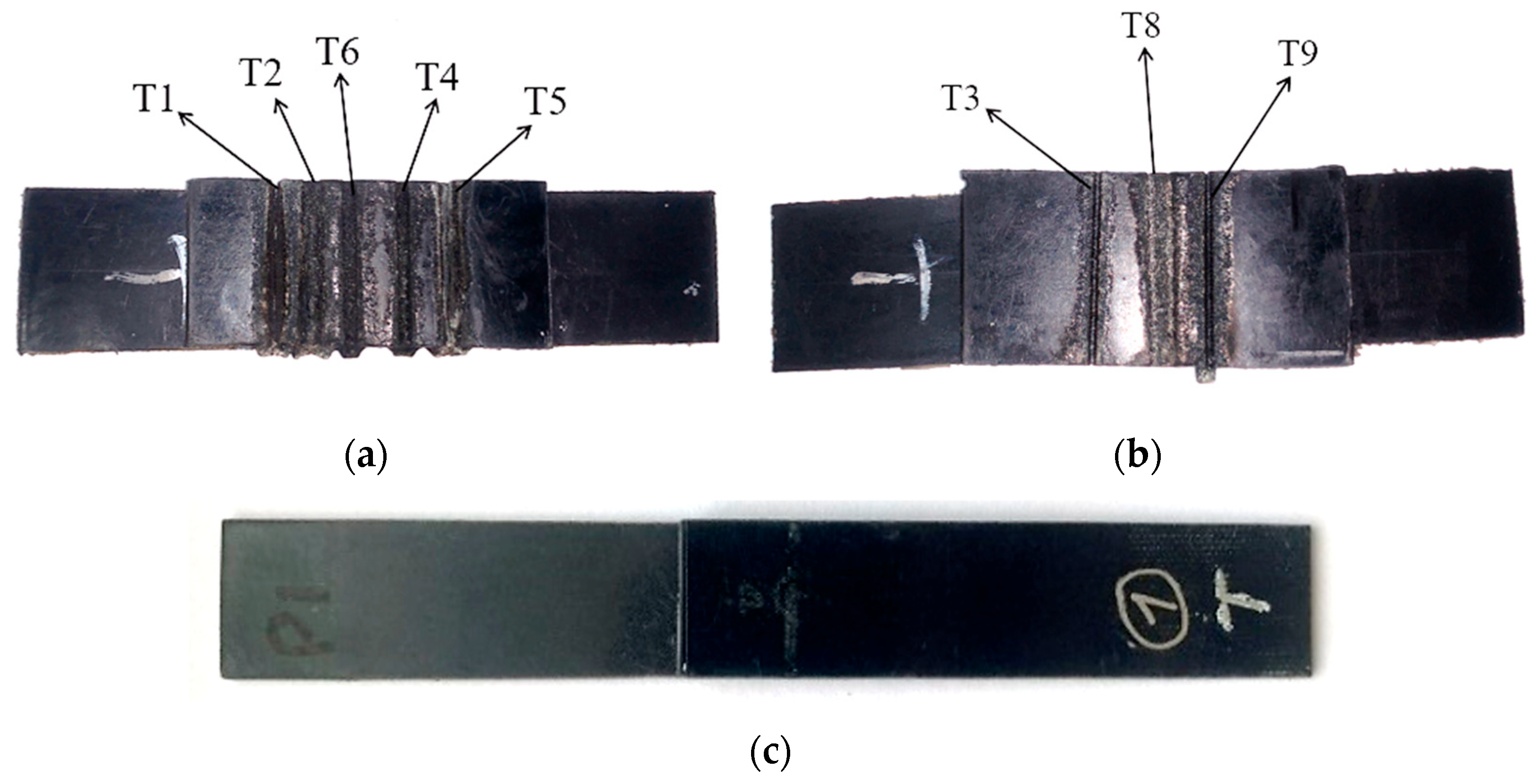
Set parameters T1, T2, T4, T5 and T6 are presented in Figure 8a and set parameters T3, T8 and T9 are presented in Figure 8b, respectively. Figure 8c shows the final weld using the optimized parameters.
Parameter set T8 served as the baseline for the optimization process and corresponds to the initial trials performed with a beam size of 2 × 2. During subsequent optimization, the beam dimensions were modified to 1 × 1 in order to enhance weld quality, which required a corresponding adjustment of the process parameters.
For clarity, the weld shown in Figure 8c was not produced using the original T8 parameter set, but using an optimized parameter set obtained from T8 after parameter adjustment (Table 4). This optimized configuration resulted in clean fusion without material degradation. The repeatability of the optimized process was confirmed through six replicates.
The results consistently showed minimal thermal degradation, with each test producing a stable and visually clean fusion area across the laser-transparent and absorbent materials. These trials confirmed the effectiveness of the refined parameters and established a reliable foundation for PBT laser welding under controlled conditions.
These independently developed parameters align with [12] despite post-study availability, validating the trial-and-error approach for PBT30.
The rigorous parameter testing and adjustment process for PBT laser welding revealed critical insights into the interaction between laser energy and PBT material properties. The final settings, including optimal wavelength, laser power, welding speed, and number of passes, ensured effective fusion with minimal thermal degradation. By systematically testing and refining the parameters, this study developed a reliable framework for laser welding PBT, laying the groundwork for future research and applications in polymer welding. The close control over variables allowed for precise bonding quality, validating these methods as viable for producing structurally sound and esthetically acceptable welded joints in PBT materials.
The mechanical performance of laser-welded PBT-GF30 joints is also influenced by the size and spatial distribution of reinforcing glass fibers within the polymer matrix. Fiber length and dispersion affect local heat conduction, melt flow, and stress transfer across the welded interface. In regions where fiber concentration is high or unevenly distributed, localized constraints on polymer flow during melting and solidification can occur, potentially promoting stress concentrations and reducing joint strength. Conversely, finer and more uniformly distributed fibers can contribute to more homogeneous thermal fields and improved stress redistribution during loading [41].
In the present study, the glass fiber size and distribution were defined by the commercial injection-molded material and were not altered during processing. As such, their influence is reflected indirectly through the observed weld morphology and mechanical response rather than through independent parametric variation. The partial preservation of fiber architecture observed in the welded zone suggests that fiber reinforcement continues to play a role in load transfer, while thermal gradients and matrix-dominated regions likely govern failure initiation [42]. A detailed quantitative assessment of fiber size effects would require dedicated material variants and advanced microstructural characterization, which is beyond the scope of the present work.

3.2. Tensile Testing and Numerical Analysis

3.2.1. Dog-Bone Specimens

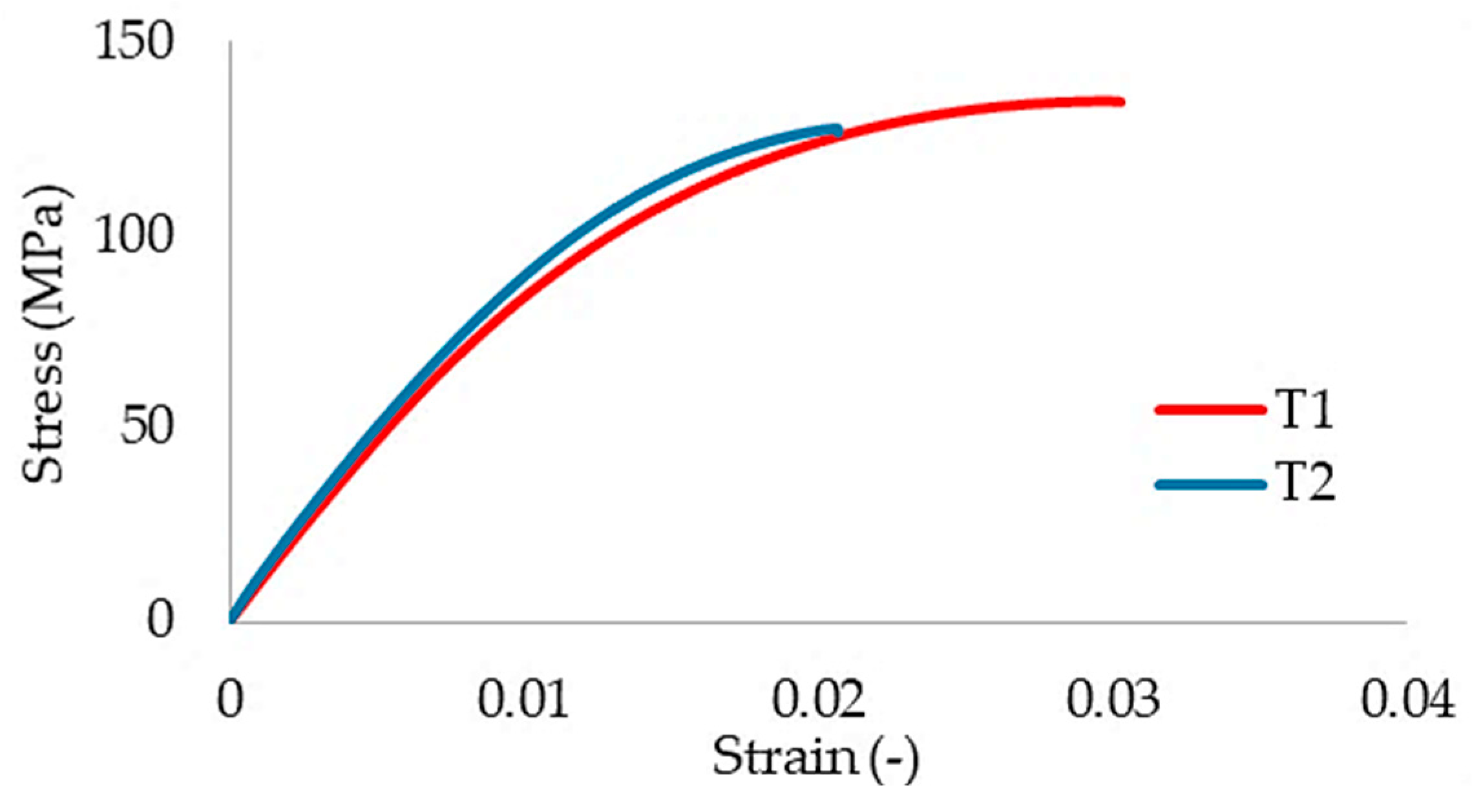
The experimental tensile tests provided key mechanical properties for both the laser-transparent (PBT-T) and absorbent (PBT-A) materials. The ultimate tensile strength (UTS) of the laser-transparent material was measured at 134.68 MPa, while the absorbent material exhibited a slightly lower UTS of 127.56 MPa (Figure 9).
Regarding stiffness, the Young’s modulus of the PBT-T material was determined to be 9700 MPa, whereas the absorbent PBT-A material showed a slightly higher value of 10500 MPa, indicating a marginally greater resistance to elastic deformation.
The experimentally obtained stress–strain curves and failure loads from the dog-bone specimens (cross-section 4 × 10 mm) were subsequently used to calibrate and validate the numerical material model implemented in ANSYS 2024R2. In the finite element simulations, the tensile loads corresponded to the experimentally measured forces, allowing the numerical model to reproduce the same loading conditions as the laboratory tests.
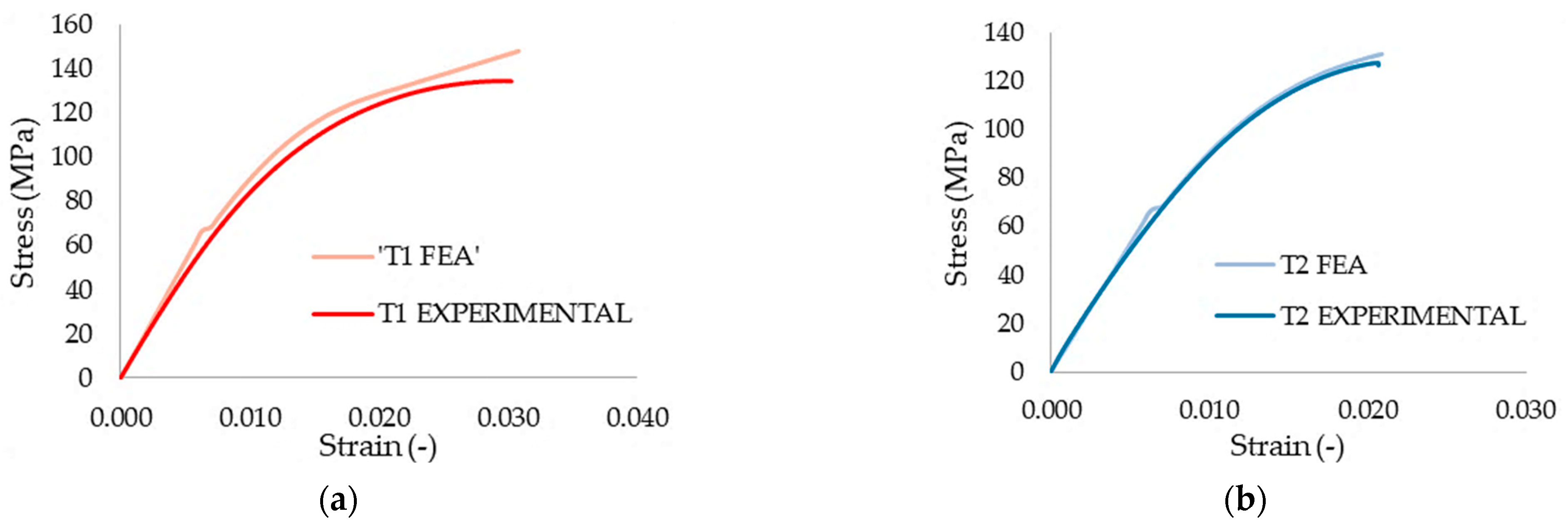
To generate the material input, a curve-fitting approach was used. However, the fitting was not perfectly exact, especially in the elastic region. As a result, the initial Young’s modulus used in the FEA model was slightly higher than the experimentally measured value. This explains the early linear portion of the FEA curve, which appears stiffer than the experimental curve.
Once the simulation transitions from the elastic to the plastic regime, the material response shifts slightly toward the right. This shift is consistent with the small mismatch in the fitted parameters and is visible (the plots), where the FEA curve initially overshoots the experimental response and then aligns more closely at higher strain.
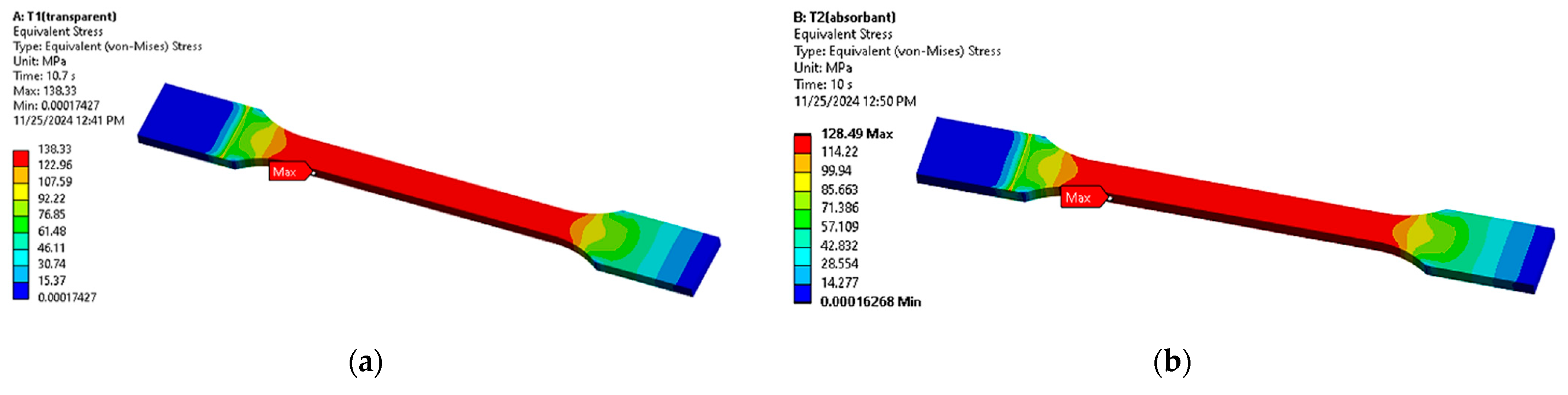
The simulations predicted failure loads of 5380 N for PBT-T and 5062 N for PBT-A, showing very good agreement with the experimental results. The comparison between the numerical and experimental stress–strain curves demonstrated a deviation below 5%, confirming the validity of the material model and its suitability for subsequent simulations of the welded joint configuration (Figure 10 and Figure 11).

3.2.2. Welded Specimens

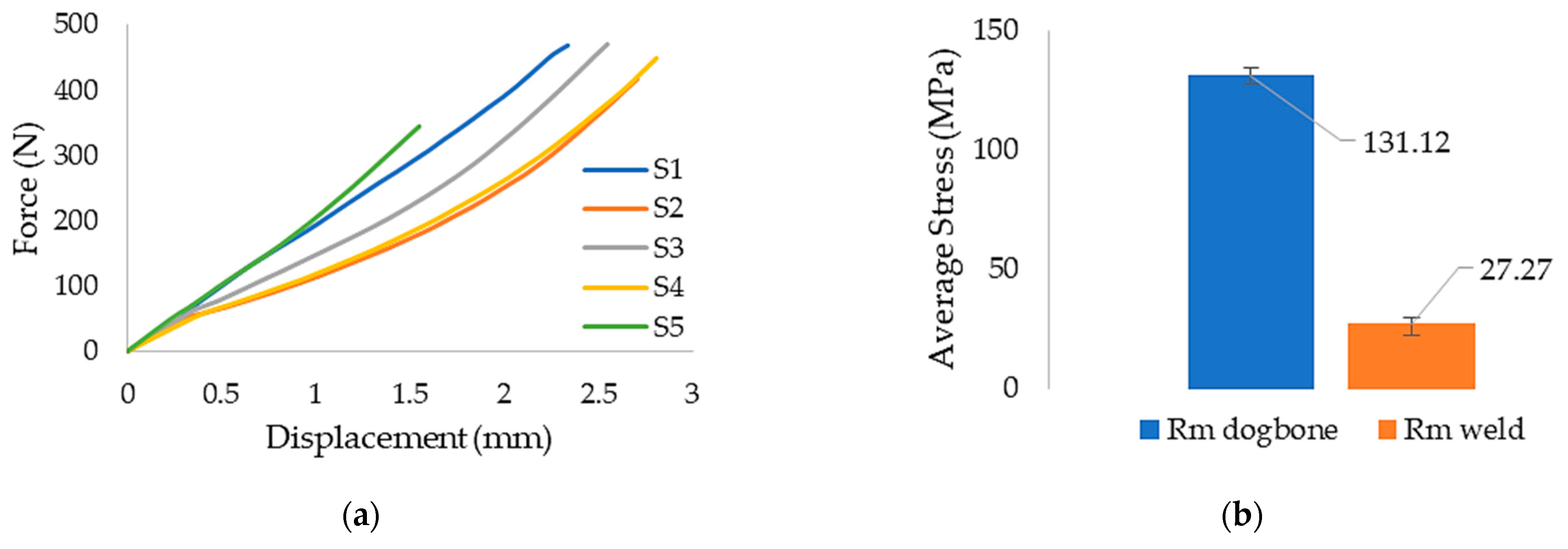
The force–displacement curves obtained from the shear tests on the welded specimens are presented in Figure 12. For each specimen, the maximum force recorded during the test was used to calculate the corresponding shear stress at failure. The shear stress was determined by dividing the applied force by the shear area of the welded interface, taken as 1 mm × 20 mm. Based on this calculation, the welded joints exhibited shear strengths ranging from 22.15 to 30.08 MPa, with an average value of 27.27 MPa.
The observed reduction in strength is consistent with the literature on welded polymer joints, where the decrease is generally associated with thermal degradation in the HAZ/welded region, weakening of the molecular structure, and the predominance of shear loading during lap-joint testing (Equation (1)) [42]. Nevertheless, the measured weld strength of 27.27 MPa indicates that the joint retained a significant level of mechanical integrity.
The maximum allowable stress (σmax) for the base material was determined to be 130 MPa, with 50% of that value (65 MPa) typically expected for welded joints, Equation (2).
τmax* = 50% of σmax = 65 MPa
where
σmax— is maximum stress of the base material subjected to tensile tests
τmax*— is the maximum shear stress in the weld.
However, the actual shear stress in the welded samples was calculated to be 32.5 MPa, reflecting the combined effects of heat and applied shear stress, as given by Equation (1). Using this equation, the admissible shear stress τ, was determined to be 32.5 MPa.
Although the tensile strength of the welded samples was reduced due to the combined effects of thermal degradation and shear forces, the results align with standard expectations. The final tensile strength values are suitable for practical applications, demonstrating that the welded joints, while weakened by external factors, meet performance requirements.
It should be noted that the peak stress initially reported corresponds to a local stress singularity associated with a single finite element and, as such, does not reflect the overall stress state within the welded region. For the analysis presented in this study, the shear stress value was instead selected based on the broader stress distribution across the weld zone, providing a more representative measure of the stresses acting in the modeled joint.
FEA predicted 30 MPa average stress in the weld zone (Figure 13) when a 430 N load was applied. This closely aligned with the 27.27 MPa stress recorded in experimental tests, with a 9.1% difference between the maximum shear stress values obtained in both methods.
The percentage difference was calculated using Equation (3):
= τ F E A τ e x p τ F E A × 100
where:
τexp—is the experimental result,
τFEA—is the numerical result.
This difference underscores the validity of the numerical model in replicating the behavior of the welded joints under tensile stress, indicating that the FEA setup adequately represented the experimental conditions.

3.3. Microscopic Analysis

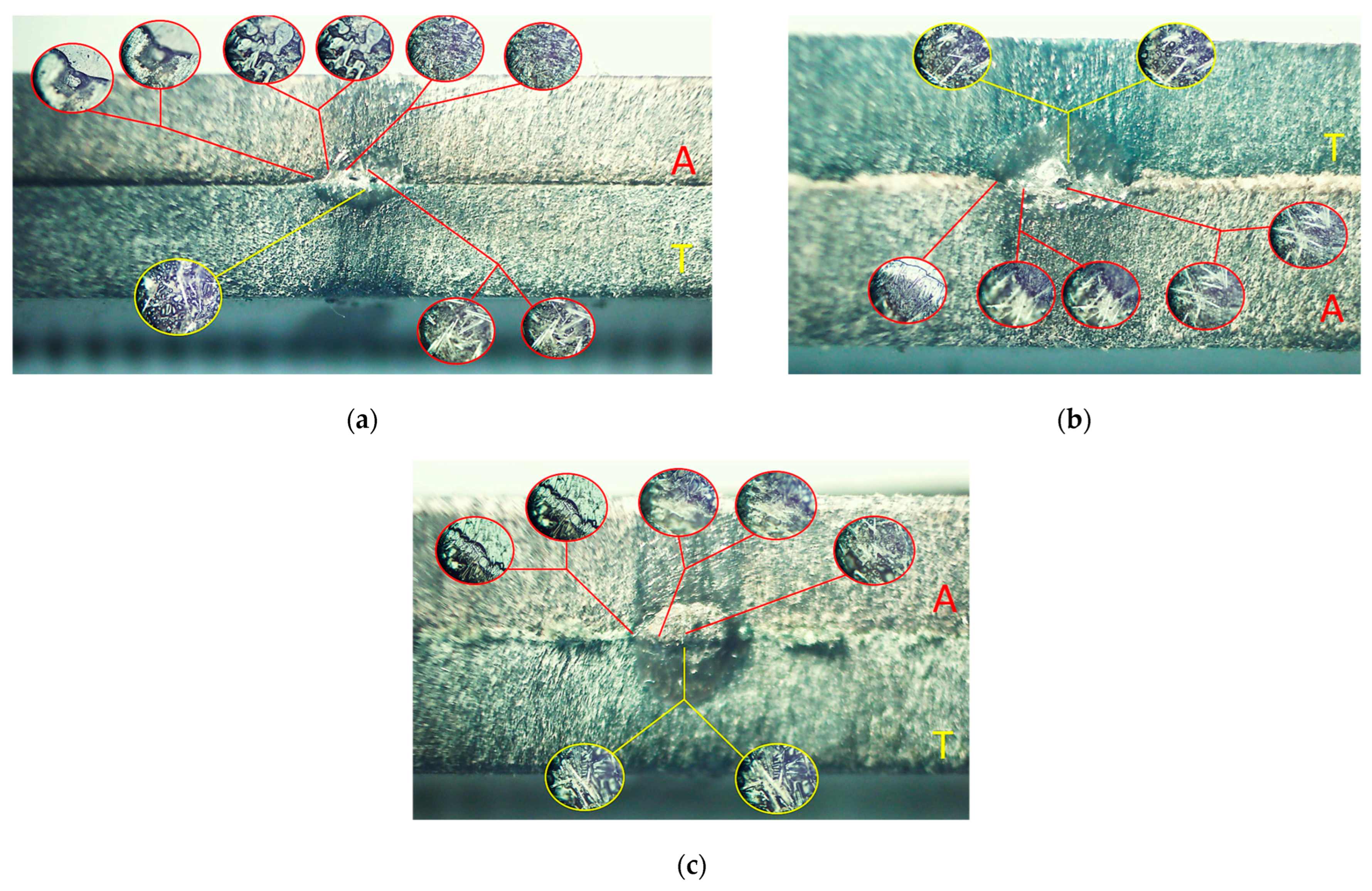
Upon detailed examination of the welded joints using the Insize ISM-M1000 microscope (Insize Co., Ltd., Suzhou, China), important observations were made regarding the microstructural evolution across the weld zone. In the central region, complete melting of the PBT matrix was observed, while the 30% glass fibers remained visible and structurally preserved despite exposure to the highest thermal input (Figure 14a–c). This suggests that the selected processing parameters (400 W, 0.5 m/s) allowed matrix fusion to occur without causing complete destruction of the reinforcing phase, which is consistent with the measured weld strength of 27.27 MPa.
Toward the peripheral regions, the degree of matrix melting gradually decreased, indicating the presence of a thermal gradient across the weld zone. As a result, the fusion became less uniform near the weld edges, and locally incomplete bonding could be observed. Such non-uniformity in the welded region is likely to promote local stress concentrations and may contribute to crack initiation under mechanical loading.
The fracture surfaces indicate that failure initiated predominantly at the welded interface under shear-dominated loading. The central weld region, characterized by complete matrix melting, showed cohesive behavior, while peripheral areas with incomplete fusion promoted crack initiation. The presence of exposed fibers and limited fiber pull-out suggests that failure is primarily matrix-dominated, influenced by thermal gradients and non-uniform fusion across the weld.
These observations indicate that, although the central weld region exhibited effective fusion, the mechanical performance of the joint was likely limited by the heterogeneity of the peripheral zones. Therefore, further improvement in weld quality may depend on achieving a more uniform heat distribution, for example, through adjustment of the beam profile or refinement of the welding strategy.

4. Conclusions

The study demonstrated the viability of laser transmission welding for 30% glass-fiber-reinforced PBT (PBT30). The selected processing conditions (Improved Parameter Set for T8: 400 W, 0.5 m/s, rectangular beam) were established through experimental trials and produced welded joints with repeatable mechanical performance. Tensile testing of six specimens yielded an average shear strength of 27.27 MPa, which is substantially lower than the base-material strength (134.68 MPa), reflecting the mechanical degradation associated with the welded region.
Microstructural observations indicated complete melting of the polymer matrix in the central welded zone, while the glass fibers remained present, suggesting partial preservation of the reinforcement architecture. At the same time, heterogeneity in the peripheral regions and thermal gradients across the joint are likely to have contributed to the observed reduction in strength.
The finite element model showed good agreement with the experimental results. The simulated weld stress of 30 MPa at a load of 430 N differed from the experimental average value of 27.27 MPa by 9.1%, indicating that the numerical approach is capable to reproduce the mechanical response of the welded joint with reasonable accuracy. These results support the use of the proposed numerical framework as a useful tool for further analysis and improvement of PBT30 laser-welded joints.
Knowledge of the behavior of the experimental model and new testing improvements may bring further improvements in the future, making it possible to achieve even higher agreement. Better predictions will allow more reliable implementation of research results into real practice without unwanted consequences.

Author Contributions

Conceptualization, S.-V.G. and K.M.; methodology, L.M. and K.M.; software, A.-T.U.; validation, A.-T.U. and S.-V.G.; formal analysis, A.-T.U. and S.-V.G.; investigation, A.-T.U., K.M. and N.-A.S.; resources, N.-A.S.; data curation, N.-A.S. and L.M.; writing—original draft preparation, A.-T.U.; writing—review and editing, S.-V.G., K.M. and L.M.; visualization, S.-V.G.; supervision, L.M., S.-V.G. and K.M.; project administration, L.M. and K.M.; funding acquisition, K.M. All authors have read and agreed to the published version of the manuscript.

Funding

This research was funded by the Ministry of Education, Science, Research and Sport of the Slovak Republic by the grants APVV-19-0550 and KEGA 042TUKE-4/2025, as well as through the CEEPUS agency within the network SK-2026-01-2526.

Data Availability Statement

The data in this study is available on request from the authors.

Acknowledgments

The authors would like to express their gratitude to the Ministry of Education, Science, Research and Sports of the Slovak Republic for research support provided through the grants APVV-19-0550 and KEGA 042TUKE-4/2025, as well as through the CEEPUS agency within the network SK-2026-01-2526.

Conflicts of Interest

The authors declare no conflicts of interest.

Abbreviations

The following abbreviations are used in this manuscript:
EVElectric vehicle
FEAFinite Element Analysis
FEMFinite Element Method
HAZHeat-Affected Zone
PBTPolybutylene terephthalate
PBT30Polybutylene terephthalate reinforced with 30% glass fiber
BT-AAbsorbent PBT
PBT-TLaser-transparent PBT
PCPolycarbonate
PPPolypropylene
UTSUltimate Tensile Strength
YTSYield Tensile Strength
σTensile (normal) stress
σmaxMaximum tensile stress
τShear stress
τexpExperimental shear stress
τFEAShear stress obtained from finite element analysis
τmax*Maximum allowable shear stress in the weld (50% rule)

References

  1. Pawan, K.M. The Impact of Aviation Industry on Global Economic Development. Int. J. Progress. Res. Eng. Manag. Sci. 2025, 5, 709–711. [Google Scholar]
  2. 2026 Aerospace and Defense Industry Outlook. Deloitte. 2025. Available online: https://www2.deloitte.com/us/en/insights/industry/aerospace-defense/aerospace-and-defense-industry-outlook.html (accessed on 10 March 2026).
  3. What’s Next for Aerospace and Defense. A Vision for 2050. AIA. Available online: https://www.aia-aerospace.org/wp-content/uploads/Whats-Next-for-Aerospace-and-Defense.pdf (accessed on 10 March 2026).
  4. Shivanagere, A.; Sharma, S.K.; Goyal, P. Modelling of Glass Fibre Reinforced Polymer (GFRP) for Aerospace Applications. J. Eng. Sci. Technol. 2018, 13, 3710–3728. [Google Scholar]
  5. ASEP Industries. 2024. Available online: https://www.asepindustries.com.my/post/pbt-aerospace-engineering (accessed on 10 March 2026).
  6. Features Materials in Aerospace Part I of II: Composition of Aircraft. Available online: https://www.aerospacemanufacturinganddesign.com/article/materials-in-aerospace/ (accessed on 10 March 2026).
  7. Hamlaoui, O.; Klinkova, O.; Elleuch, R.; Tawfiq, I. Effect of the Glass Fiber Content of a Polybutylene Terephthalate Reinforced Composite Structure on Physical and Mechanical Characteristics. Polymers 2022, 14, 17. [Google Scholar] [CrossRef]
  8. Shin, H.; Park, E.-S. Mechanical and dielectric breakdown properties of PBT/TPE, PBT/PBT/PET, and PBT/antioxidant blends. J. Appl. Polym. Sci. 2009, 114, 3008–3015. [Google Scholar] [CrossRef]
  9. Yin, H.; Dittrich, B.; Farooq, M.; Kerling, S.; Wartig, K.-A.; Hofmann, D.; Huth, C.; Okolieocha, C.; Altstädt, V.; Schönhals, A.; et al. Carbon-based nanofillers/Poly(butylene terephthalate): Thermal, dielectric, electrical and rheological properties. J. Polym. Res. 2015, 22, 140. [Google Scholar] [CrossRef]
  10. Hao, W.; Yang, W.; Cai, H.; Huang, Y. Non-isothermal crystallization kinetics of polypropylene/silicon nitride nanocomposites. Polym. Test. 2010, 29, 527–533. [Google Scholar] [CrossRef]
  11. Xu, X.; Deng, J.; Nie, S.; Lan, Z.; Xu, Z. Effect of Thermal Aging on Mechanical Properties and Morphology of GF/PBT Composites. Polymers 2023, 15, 3798. [Google Scholar] [CrossRef]
  12. Finelli, L.; Lotti, N.; Munari, A. Crystallization kinetics and melting behavior of poly(butylene isophthalate/terephthalate) random copolyesters. Eur. Polym. J. 2001, 37, 2039–2046. [Google Scholar] [CrossRef]
  13. Vyavahare, S.A.; Kharat, B.M.; More, A.P. Polybutylene Terephthalate (PBT) Blends and Composites: A Review. Viet. J. Chem. 2024, 62, 579. [Google Scholar] [CrossRef]
  14. Au, Q.M.; Tran, T.V.; Pham, T.H.N.; Huynh, T.Q.; Vo, M.T.T.; Tran, M.T.U.; Nguyen, V.T.; Tran, V.T.; Vo, X.-T.; Huynh, N.A.T.; et al. Research on Tensile Strength of PBT/EVA Blends. J. Tech. Educ. Sci. 2023, 18, 27–34. [Google Scholar] [CrossRef]
  15. Cao, Y.; Xu, P.; Yang, W.; Zhu, X.; Dong, W.; Chen, M.; Du, M.; Liu, T.; Lemstra, P.J.; Ma, P. UV resistant PBT nanocomposites by reactive compatibilization and selective distribution of tailor-made double-shelled TiO2 nanohybrids. Compos. Part B Eng. 2021, 205, 108510. [Google Scholar] [CrossRef]
  16. Loyer, C.; Ferreira, P.; Marijon, J.-B.; Michel, V.; Régnier, G.; Vera, J.; Duval, V.; Richaud, E. Embrittlement of Polybutylene Terephthalate Induced by Injection Molding. Polym. Degrad. Stab. 2022, 196, 109843. [Google Scholar] [CrossRef]
  17. Wu, J.; Lu, S.; Wang, H.J.; Wang, Y.; Xia, F.-B.; Wang, J. A review on laser transmission welding of thermoplastics. Int. J. Adv. Manuf. Technol. 2021, 116, 2093–2109. [Google Scholar] [CrossRef]
  18. Dobrotă, D.; Lazăr, S.V. Ultrasonic Welding of PBT-GF30 (70% Polybutylene Terephthalate + 30% Fiber Glass) and Expanded Polytetrafluoroethylene (e-PTFE). Polymers 2021, 13, 298. [Google Scholar] [CrossRef]
  19. Khudayarov, B.; Komilova, K.; Turaev, F. Numerical study of the effect of viscoelastic properties of the material and bases on vibration fatigue of pipelines conveying pulsating fluid flow. Eng. Fail. Anal. 2020, 115, 104635. [Google Scholar] [CrossRef]
  20. Javidinejad, A. Review of Finite Element Modeling and Analysis Applications in Aerospace Structural Systems Design: Design Conceptualization Tool. Int. J. Aerosp. Mech. Eng. 2021, 8, 2393–8609. [Google Scholar]
  21. Silva, L.; Marques, E.; da Silva, L.F. Polymer joining techniques state of the art review. Weld. World 2021, 65, 2023–2045. [Google Scholar] [CrossRef]
  22. Acherjee, B. Laser transmission welding of polymers–a review on welding parameters, quality attributes, process monitoring, and applications. J. Manuf. Process. 2021, 64, 421–443. [Google Scholar] [CrossRef]
  23. Chen, M.; Zak, G.; Bates, P.J. Effect of carbon black on light transmission in laser welding of thermoplastics. J. Mater. Process. Technol. 2011, 211, 43–47. [Google Scholar] [CrossRef]
  24. Okuizumi, R.; Hirota, S.; Takagi, Y.; Sudoh, M.; Okano, Y. Process analysis of laser welding method with polybutyleneterephthalate (PBT). Adv. Mater. Res. 2011, 222, 150–153. [Google Scholar] [CrossRef]
  25. Hu, S.; Li, F.; Zuo, P. Numerical simulation of laser transmission welding—A review on temperature field, stress field, melt flow field, and thermal degradation. Polymers 2023, 15, 2125. [Google Scholar] [CrossRef] [PubMed]
  26. Labeas, G.; Moraitis, G.; Katsiropoulos, C.V. Optimization of laser transmission welding process for thermoplastic composite parts using thermo-mechanical simulation. J. Compos. Mater. 2010, 44, 113–130. [Google Scholar] [CrossRef]
  27. Fernandes, F.A.; Pereira, A.B.; Guimarães, B.; Almeida, T. Laser welding of transmitting high-performance engineering thermoplastics. Polymers 2020, 12, 402. [Google Scholar] [CrossRef]
  28. Gómez, C.; Mira, J.; Carrión-Vilches, F.J.; Cavas, F. Dynamic Moduli of Polybutylene Terephthalate Glass Fiber Reinforced in High-Temperature Environments. Materials 2021, 14, 483. [Google Scholar] [CrossRef] [PubMed]
  29. ISO 1133-1:2022. Plastics—Determination of the Melt Mass-Flow Rate (MFR) and Melt Volume-Flow Rate (MVR) of Thermoplastics—Part 1: Standard Method. Available online: https://www.iso.org/standard/83905.html (accessed on 10 March 2026).
  30. SR EN ISO 294-1:2017. Plastics—Injection Molding of Test Specimens of Thermoplastic Materials—Part 1: General Principles. Available online: https://www.iso.org/standard/67036.html (accessed on 10 March 2026).
  31. SR EN ISO 527-2:2015. Plastics—Determination of Tensile Properties—Part 2: Test Conditions for Molding and Extrusion Plastics. Available online: https://www.iso.org/standard/527-2 (accessed on 10 March 2026).
  32. ISO 179-1:2026. Plastics—Determination of Charpy Impact Properties—Part 1: Non-Instrumented Impact Test. Available online: https://www.iso.org/standard/91071.html (accessed on 10 March 2026).
  33. ISO 1183-1:2025. Plastics—Methods for Determining the Density of Non-Cellular Plastics—Part 1: Immersion Method, Liquid Pycnometer Method and Titration Method. Available online: https://www.iso.org/standard/85977.html (accessed on 10 March 2026).
  34. ISO 62:2008. Plastics—Determination of Water Absorption. Available online: https://www.iso.org/standard/41672.html (accessed on 10 March 2026).
  35. ISO 1268-1:2001. Fiber-Reinforced Plastics—Methods of Producing Test Plates—Part 1: General Conditions. Available online: https://www.iso.org/standard/25213.html (accessed on 10 March 2026).
  36. SR EN ISO 3167:2014. Plastics—Multipurpose Test Specimens. Available online: https://www.iso.org/standard/65105.html (accessed on 10 March 2026).
  37. Dassault Systèmes. Maximum Shear Stress Criterion–SOLIDWORKS Design Help. 2024. Available online: https://help.solidworks.com/2024/english/SolidWorks/cworks/r_Maximum_Shear_Stress_Criterion.htm (accessed on 10 March 2026).
  38. Rosato, D.V.; Rosato, M.G. Injection Molding Handbook, 3rd ed.; Kluwer Academic Publishers: Dordrecht, The Netherlands, 2000. [Google Scholar] [CrossRef]
  39. Mouad, C.; Mohamed, O.M.; Ismail, K.; Mohamed, B.; Najma, L.; Tarak, B.Z. Influence of Fiber Orientation on the Moisture Adsorption of Continuous Bamboo Fiber Composites. Mater. Today Proc. 2023, 121, 289–294. [Google Scholar] [CrossRef]
  40. Beardmore, R. Shear Strength of Metals–Roy Mech. Available online: https://roymech.org/Useful_Tables/Matter/shear_tensile.html (accessed on 12 January 2026).
  41. Zhang, D.; He, M.; Qin, S.; Yu, J. Effect of Fiber Length and Dispersion on Properties of Long Glass Fiber Reinforced Thermoplastic Composites Based on Poly(butylene terephthalate). RSC Adv. 2017, 7, 28180–28190. [Google Scholar] [CrossRef]
  42. Silva, L.R.R.; Nunes, P.D.P.; Marques, E.A.S.; Carbas, R.J.C.; da Silva, L.F.M. Experimental and Numerical Study of Laser Beam Welding of PBT-G30 for Electronic Housings in Automotive Applications. Polymers 2025, 17, 2662. [Google Scholar] [CrossRef]
Figure 1. (a) Injected plates and (b) injected plates cut to size.
Aerospace 13 00426 g001
Figure 2. Materials positioned for welding.
Aerospace 13 00426 g002
Figure 3. (a) Material True stress–plastic strain curve for PBT-T and (b) Material curve for PBT-A.
Aerospace 13 00426 g003
Figure 4. (a) Material curve for PBT-T and (b) Material curve for PBT-A.
Aerospace 13 00426 g004
Figure 5. The dog-bone samples meshing.
Aerospace 13 00426 g005
Figure 6. Welded sample geometry generated using SpaceClaim 2024R2 software.
Aerospace 13 00426 g006
Figure 7. (a) Mesh; (b) Fixed support applied, and (c) Force applied to the welded sample.
Aerospace 13 00426 g007aAerospace 13 00426 g007b
Figure 8. (a) Initial trial welds T1, T2, T4. T5 and T6; (b) Initial trial welds T3, T8 and T9 and (c) welded components using optimized parameters.
Aerospace 13 00426 g008
Figure 9. Stress–Strain curve for dog-bone Samples (T1: PBT-T, T2: PBT-A).
Aerospace 13 00426 g009
Figure 10. Stress–strain curves resulting from experimental tests and numerical analyses (a) PBT-T, and (b) PBT-A.
Aerospace 13 00426 g010
Figure 11. Stress distribution for (a) PBT-T (load of 5400 N) and (b) PBT-A (load of 5000 N).
Aerospace 13 00426 g011
Figure 12. (a) Force–displacement response of the welded joints under shear loading; (b) Average of the maximum stress for the dog-bone and weld specimens.
Aerospace 13 00426 g012
Figure 13. Distribution of shear stress (XY component) in the modeled weld region and adjacent plates.
Aerospace 13 00426 g013
Figure 14. (a) Sample S1; (b) sample S2 and (c) sample S3 under the microscope before and after performing the tensile test. (Note: “A” in the pictures is for the Absorbent PBT and “T” symbol is for the Laser-transparent PBT).
Aerospace 13 00426 g014
Table 1. (a) Rheological properties of PBT. (b) Supplier datasheet values for mechanical properties of PBT. (c) Properties relevant for the weld quality.
(a)
ValueUnit of MeasureTesting Standard
Melt volume rate14cm3/10 minISO 1133 [29]
Temperature250°CISO 1133
Load2.16kgISO 1133
Shrinkage in molding, parallel1.2%ISO 294-4, 2577 [30]
Shrinkage in molding, normal0.3%ISO 294-4, 2577
(b)
ValueUnit of MeasureTesting Standard
Modulus of elasticity9350MPaISO 527-1/ISO 527-2 [31]
Tensile strength80MPaISO 527-1/ISO 527-2
Elongation at break3%ISO 527-1/ISO 527-2
Impact resistance, Charpy, 23 °C60kJ/m2ISO 179-1 [32]
Impact resistance, Charpy, 0 °C45kJ/m2ISO 179-1
(c)
Other PropertiesValueUnit of MeasureTesting Standard
Density1520kg/m3ISO 1183 [33]
Water absorption0.3%ISO 62 [34]
Moisture absorption0.15%ISO 62
Table 2. Welding parameters sets.
SetPower
(kW)
TypeDimensions
(mm)
FocusingFrequency
(Hz)
Beam Rotation
Speed
(Hz)
Beam Passing
Speed Over Sample
(m/s)
T10.4CircularDiameter = 1Lower plane1002500.02
T20.4CircularDiameter = 1Intermediate plane1002500.02
T30.4CircularDiameter = 1Upper plane1002500.02
T40.4CircularDiameter = 1.5Intermediate plane502500.02
T50.4CircularDiameter = 0.5Intermediate plane1002500.02
T60.4CircularDiameter = 1Intermediate plane1002500.02
T70.4CircularDiameter = 2Intermediate plane1002500.02
T80.4Rectangular2 × 2Intermediate plane1002500.02
T90.4Spiral2, positive
direction
Intermediate plane1002500.02
T100.4Spiral2, negative
direction
Intermediate plane1002500.02
Table 3. Summary of welded specimens, observations, and experimental use.
Parameter
Set ID
ObservationsTest PerformedOutcome
T1Used for initial trial and calibration of the machine.Visual inspectionUnsatisfying
results
T2Used for initial trial and calibration of the machine.Visual inspectionUnsatisfying
results
T3Used for initial trial and calibration of the machine.Visual inspectionUnsatisfying
results
T4Used for initial trial and calibration of the machine.Visual inspectionUnsatisfying
results
T5Used for initial trial and calibration of the machine.Visual inspectionUnsatisfying
results
T6Used for initial trial and calibration of the machine.Visual inspectionUnsatisfying
results
T7Used for initial trial and calibration of the machine.Visual inspectionUnsatisfying
results
T8Used for initial trial and calibration of the machine.Visual inspectionUnsatisfying
results
T9Used for initial trial and calibration of the machine.Visual inspectionUnsatisfying
results
T10Used for initial trial and calibration of the machine.Visual inspectionUnsatisfying
results
Improved T8
(resulting
in 6 welded
samples)
Used for final analysis.Visual inspection
and Shear Testing
Clean fusion
Table 4. Welding parameters set.
ParameterValue
Power400 W
Beam TypeRectangular
Dimensions1 × 1 mm
Frequency100 Hz
Rotation Speed250 Hz
Speed0.5 m/s
Disclaimer/Publisher’s Note: The statements, opinions and data contained in all publications are solely those of the individual author(s) and contributor(s) and not of MDPI and/or the editor(s). MDPI and/or the editor(s) disclaim responsibility for any injury to people or property resulting from any ideas, methods, instructions or products referred to in the content.