Article

Applied Physics-Informed Neural Networks for Spacecraft Magnetic Testing

1
Computer Science Department, Capitol Technology University, Laurel, MD 20708, USA
2
Computer Science Department, Grambling State University, Grambling, LA 71245, USA
*
Author to whom correspondence should be addressed.
Aerospace 2026, 13(5), 404; https://doi.org/10.3390/aerospace13050404
Submission received: 16 March 2026 / Revised: 12 April 2026 / Accepted: 22 April 2026 / Published: 24 April 2026
(This article belongs to the Section Astronautics & Space Science)

Abstract

Artificial intelligence and machine learning techniques can be used for performing magnetic testing on spacecraft that has historically been difficult and risky to perform. Some of the difficulty arises from the need to take these measurements from within the turbulent near-field area of the spacecraft. Some methods of testing require the spacecraft to be hoisted in the air and swung while the measurements are being taken so that any magnetic signatures in the test area can be removed. These new artificial intelligence and machine learning techniques can be used to determine the magnetic torque of complex magnetic systems. Here we will describe a test method that collects such data and poses much less risk to the spacecraft. We will also show some combinations of hyper-parameters that can be used to increase the speed and accuracy of the models. Some models were able to achieve over 96.6% accuracy of multipole determination on simulated data and over a 99.99% accuracy of dipole moment determination on simulated data. Applications include attitude control systems (ACS), science instrument locations, and data analysis.

1. Introduction

There are many good libraries and frameworks available for use in applying PINNs to solve real world problems. One of the largest libraries is provided by the graphics card developer NVIDIA, called modulus. There is also the SciML library [1], IDRLnet [2], DeepXDE [3], PyDEns [4], NeuroDiffEq [5], NeuralPDE [6], SciANN [7], ADCME [8], and GpyTorch [9].
Despite the plethora of libraries, there are still reasons to develop custom ANNs where different aspects of the physical problem being tackled are embedded within the network. This can be seen in a lot of the recent research being performed in applying PINNs to different areas related to spacecraft. Applications include: determining satellite thrust and state vectors from angle-only observations using PINNs [10], embedding the heat transfer equation into an ANN to determine spacecraft temperature variations over time [11], using PINN recurrent neural networks (RNNs) to predict spacecraft lithium-ion battery health [12], and using PINNs to determine the optimal control for orbital transfers [13].
Our research has leaned into solving physics problems associated with performing environmental testing on spacecraft. Prior to spacecraft launch activities, it is important to determine whether or not the spacecraft and its instruments can withstand the environment before, during, and after launch and that all of its subsystems are compatible with each other. This includes being on the launchpad in the radar range and a potential lightning strike environment, the tumultuous launch phase, and the hostile environment of either being in earth orbit or passing into deep space. Each of these environments presents a unique set of challenges to the survival of the spacecraft. It can take decades from inception to launch of a spacecraft, as well as millions of dollars and thousands of man-hours. Therefore, it is prudent to verify the survivability and functionality of the spacecraft operations within these environments prior to launch so that the tremendous cost and effort put into deploying spacecraft will not be wasted.

Magnetic Testing

Magnetic testing also falls under the umbrella of electromagnetic interference/electromagnetic compatibility (EMI/EMC) testing from a radiated emissions perspective. Satellites that contain a residual magnetic field that are in Low Earth Orbit (LEO) or pass through Earth’s orbit will attempt to align the magnetic field of the Earth such that the overall dipole moment of the spacecraft will orient to the closest magnetic pole. This is important to understand for attitude control systems. Therefore, satellites have a design constraint to try to minimize or characterize the residual permanent magnetic field for the spacecraft. The overall dipole moment is what the magnetic multipole system of the spacecraft will look like in the far-field. Knowing the magnetic moment of the spacecraft is also extremely important for sensitive magnetometers used for collecting science data. The challenge is that measurements of the dipole moment must be made in the near field.
In our prior work [14] we demonstrated the use of a PINN with the field equation embedded into the neural network for determining a magnetic dipole moment of a spacecraft. Since then, very similar methods have been used [15] to determine the magnetic moments of a spacecraft from the derived Biot–Savart equation. Although, the inputs to the network were based on the current draw and positioning of the subsystem. Others have developed methods using Bayesian-optimized long-term short-term memory (LSTM) models [16] to determine the magnetic moment from spin exchange relaxation-free (SERF) magnetometer data. Here we will present improvements to our initial model; a new model that can be used to determine the magnetic multipole moment of a spacecraft and a test method for collecting the data that can be fed into these models.

2. Materials and Methods

2.1. Physical and Simulated Test Method

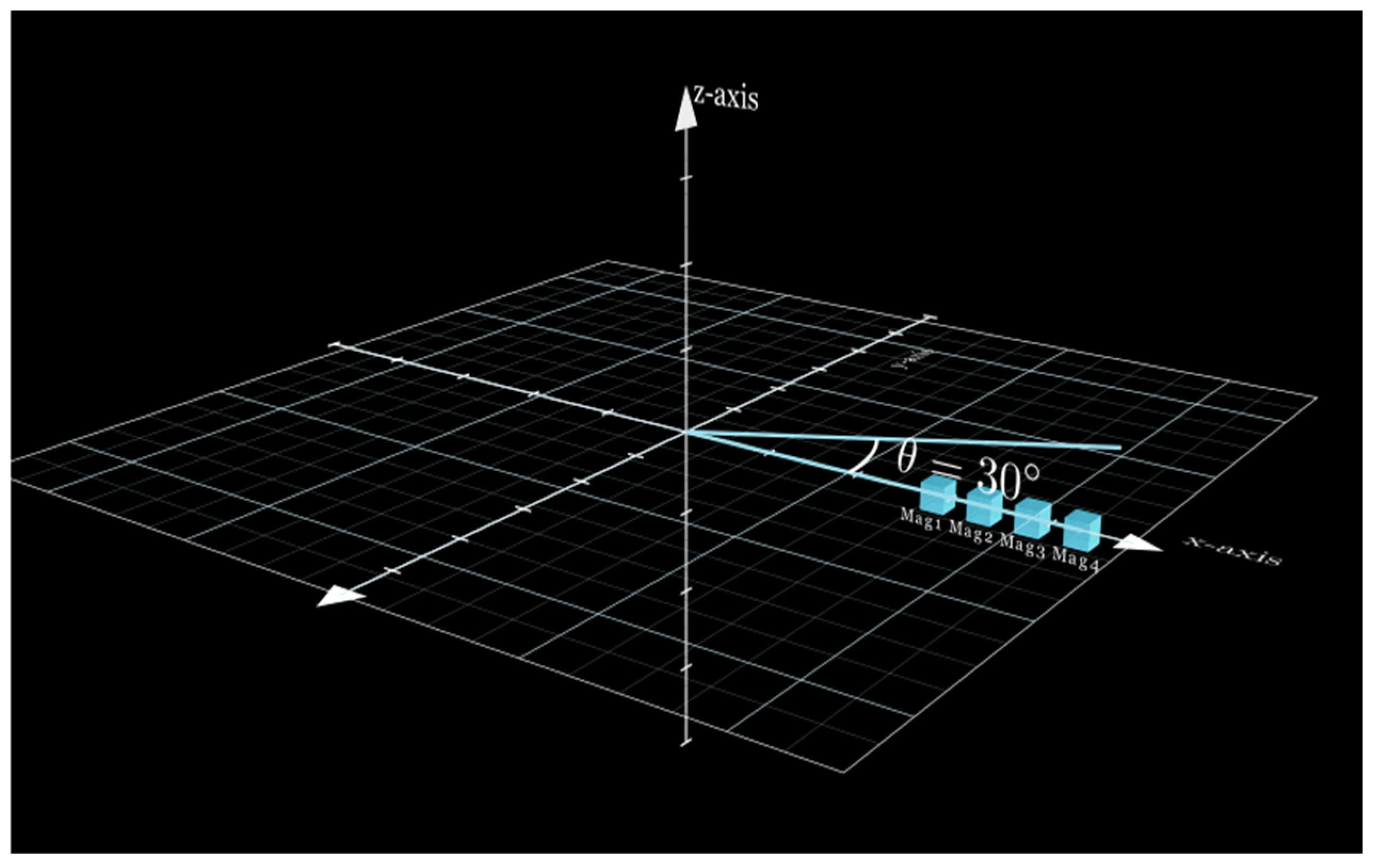
We can take flux density measurements in a shell around the center of the spacecraft. Ideally, we would take several measurements at a time aligned along some arbitrary axis of the test area. Given the risk to the spacecraft of suspending something over it, it is easier to take these measurements within an x-y plane about the spacecraft. We can then rotate the spacecraft by some angle and take another set of measurements until the spacecraft has been rotated a full 360°. This test configuration can be seen in Figure 1.
The data collected during testing uses a polar coordinate system that uses the reference angle and the distance of each magnetometer from the center of rotation. The AI we will be using to solve for the dipole moments uses cartesian coordinates. We will need to convert all of the position data from the test into Cartesian coordinates.
It should be noted that the magnetometers used to measure the spacecraft have their own coordinate system, which is the coordinate system that data is recorded in. This example has the x-axis of the magnetometers always pointing towards the spacecraft as the spacecraft is rotated about its z-axis. The data collected will need to be transformed back into a standard Cartesian coordinate system.
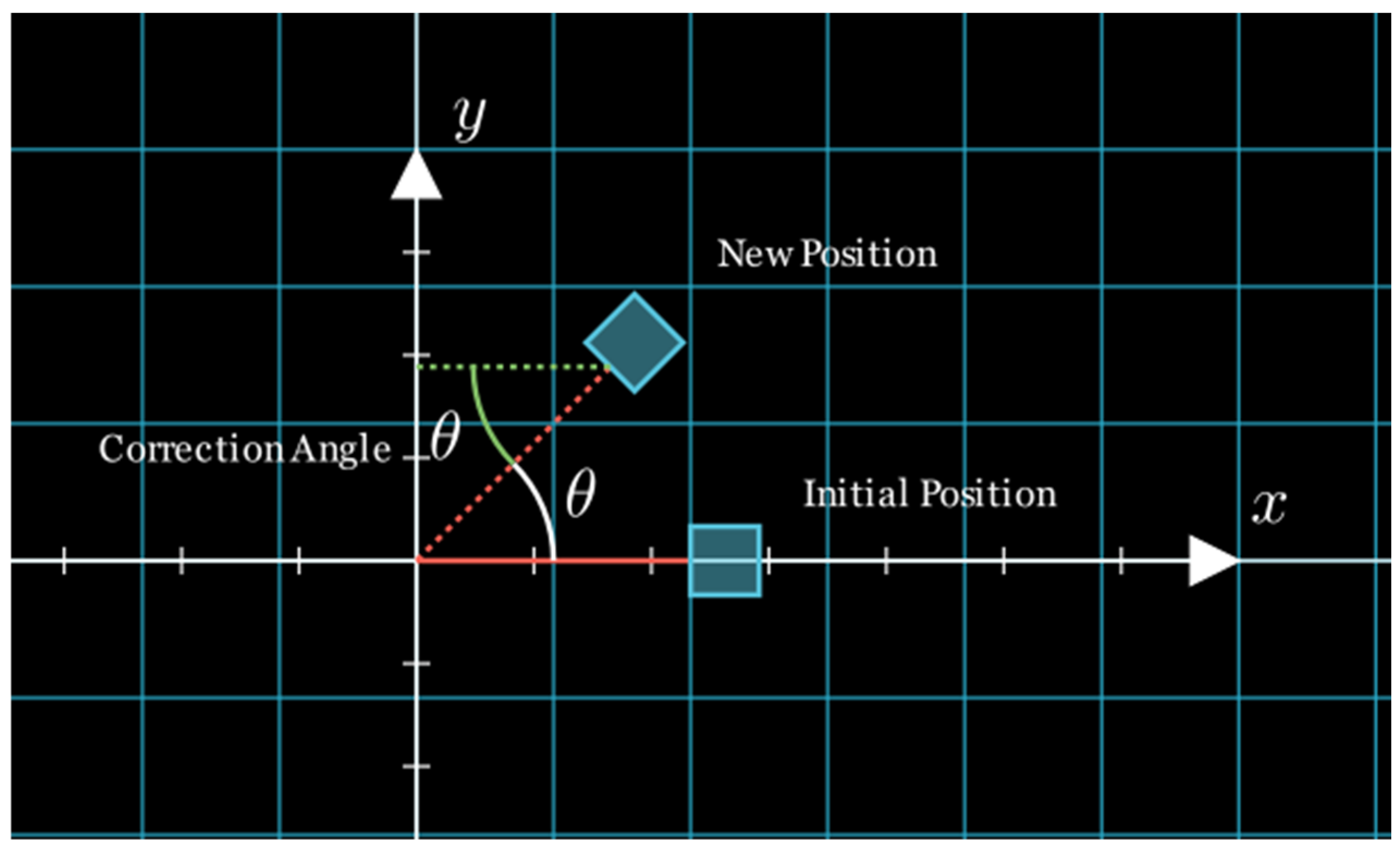
To do this we assume that the starting position is directly in the x-axis of our governing coordinate system, where the x position of each magnetometer is the distance from the center of rotation. In the starting position, y and z coordinates are zero. We then can rotate the x and y coordinates of each position about the z-axis by the same amount that the spacecraft is rotated. We also need to remember the data of the magnetometers is referenced to its own coordinate system. Therefore, we will also need to rotate the x and y data of each magnetometer about the z-axis of the magnetometer such that the x and y axis data is transformed into the governing coordinate system. An example of this transformation can be seen in Figure 2.
To simulate test data, we will need to be able to calculate the flux density due to a magnetic moment at some arbitrary position. We can use the following equation to determine the vector flux density (B-field) B at some position occupied by the observer.
B = μ 0 / 4 π 3 P O P M / P O P M 5 m · P O P M μ 0 / 4 π m / P O P M 3
where P O is the vector describing position of observation, P M is the vector describing the position of the magnetic moment and m is the vector describing the force of the dipole moment. If we assume that there is only one magnetic moment at the origin, a dipole moment, we can simplify the equation to the following.
B = μ 0 / 4 π 3 P O / P O 5 m P O μ 0 / 4 π m / P O 3
We will be able to use both Equations (1) and (2) to embed the correct physics into our models. In order to determine the assumed magnetic dipole moment of the multipole system, we will need to take several measurements that we can use as the ground truth for our PINN to try to optimize its solution against.

2.2. Magnetic Dipole Moment Machine Learning Model

Now that we have a method for collecting magnetic measurement data either physically or simulated, we can develop a machine learning model that can be used for determining the magnetic moment of a spacecraft. In our previous work [14], we discussed the different methods that have been used for magnetic dipole moment determination: direct torque measurements [17], spherical harmonic analysis [18], magnetic gradiometer tensor data [19], and Monte-Carlo search over finite element analysis. It can be shown that there is no single direct mathematical solution to determine the magnetic dipole moment of a system as any multipole moment system with sufficient complexity can never be effectively simulated by a single dipole moment. As there can be an entire family of solutions to this problem, it effectively becomes an optimization and search problem. We need to determine the most optimal solution to the problem that fits the data collected. This can be easily classified as a prime candidate to use a PINN. More specifically, this would fall into the optimization category for PINNs.
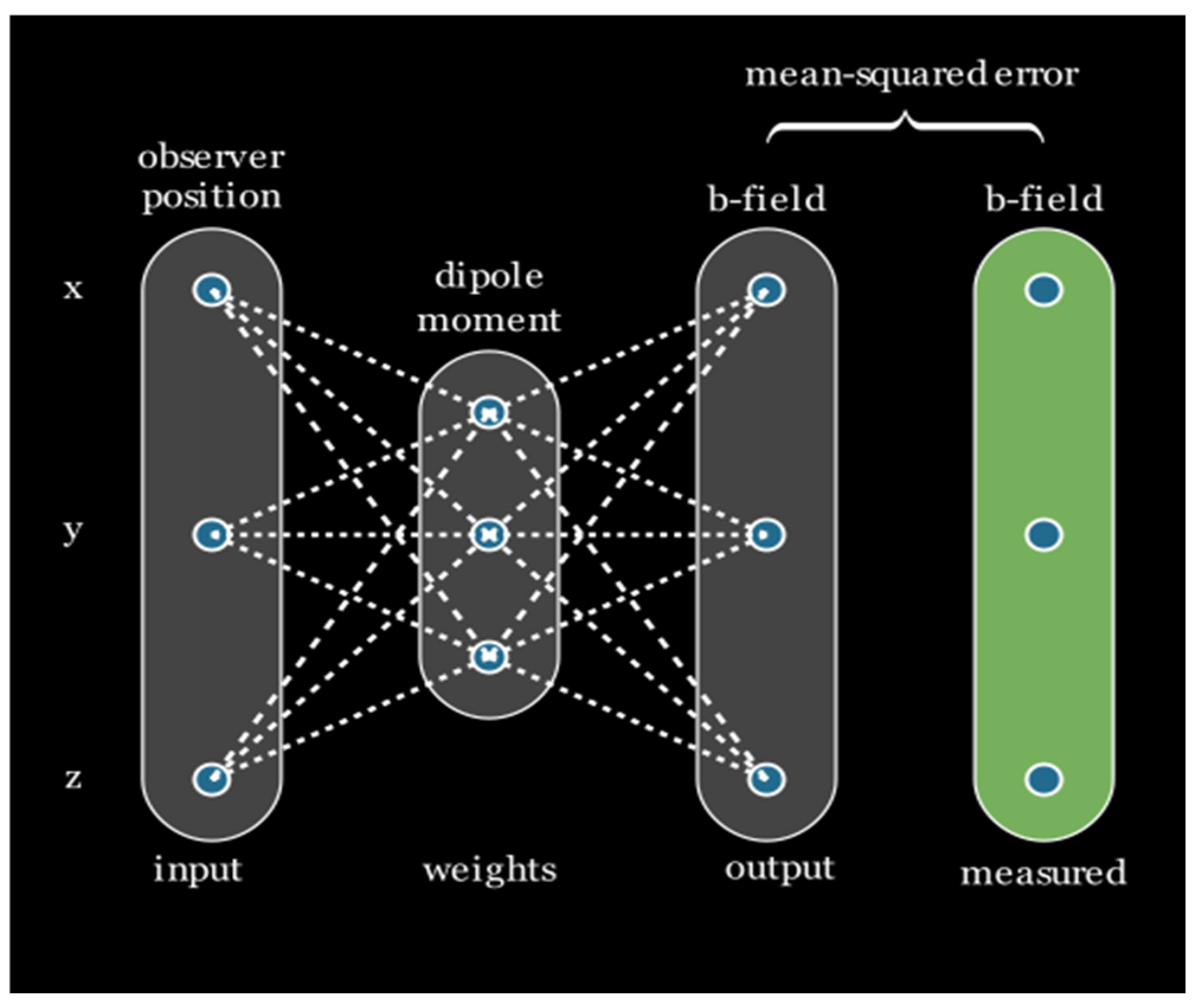
We can attempt to create a neural network that can solve for the effective dipole moment from this collected data. We can use Equation (2) as the node equation for our neural network, where the learnable parameters are the weights of the nodes which are the moment values of the dipole moment, and where the input is the position of observation of which we wish to know the B-field measurement. The output of the neural network will be the B-field of the effective dipole moment described by the weights of the network. As a baseline we will use the mean squared error (MSE) as the loss function to determine the amount of difference between the predicted value, Yi, and the measured value, Xi, as seen in Equation (3).
M S E = 1 n i = 1 n Y i X i 2
As a baseline optimizer for the neural network, we can use stochastic gradient descent (SGD) [20] to determine how to update the weights of the network such that they will converge to a solution that fits the data presented. We do this by feeding test data in a random order to the model and taking the gradient of the loss function and scaling it by the learning rate, α. By subtracting this we will effectively be taking a small step in the direction of the least error between the predicted values and the measured test values. We can see this in Equation (4) where Mnew are the newly predicted moment weights and Mprior are the previous.
M n e w = M p r i o r 1 / n i = 1 n Y i X i 2
There will not need to be any activation functions for the network. This would technically be a regression neural network. This was the design of our original model. The network can be designed as shown in Figure 3.
While this configuration can give a generalizable solution to the problem, it can be seen that for a sufficiently complicated multipole moment system that can be generated by a test article, a single dipole moment at the center of the instrument cannot accurately describe the collected data.
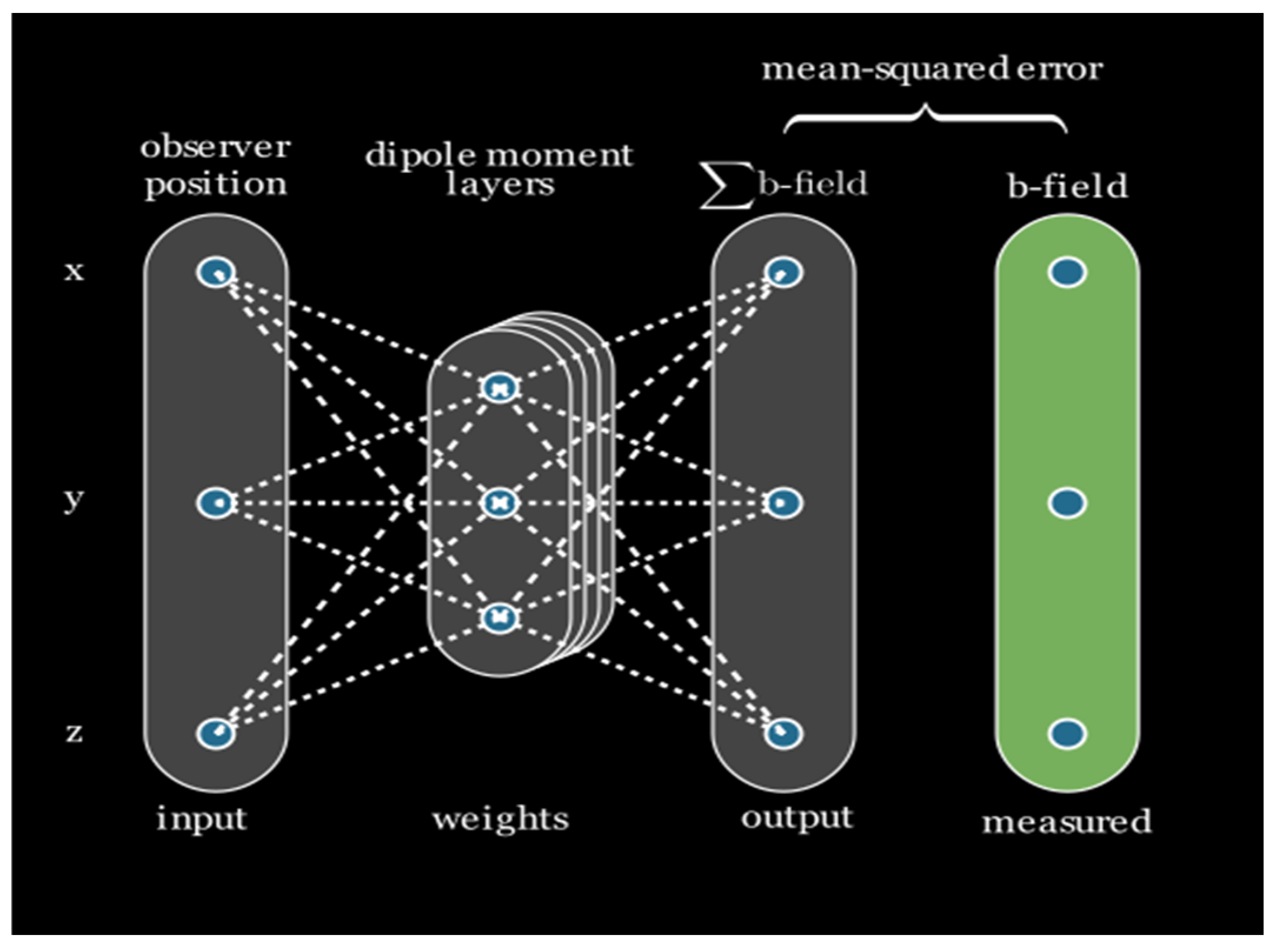
We can achieve a much closer fit to the data if we were to stack multiple dipole moments constrained to the center of the instrument’s rotation. We can stack an arbitrary number of these dipole moment layers and add a summation layer that will sum all B-field predictions generated by each layer as the predictive output. This will allow this model to achieve a much closer fit to the data. As the model assumes that the dipole moments are centered at the origin, we can then sum all of the moment layer’s learnable parameters to determine what the effective magnetic dipole moment of the system is. This is one of the improvements that we made upon the original model.
A diagram of this model can be seen in Figure 4. Additionally, we scaled the data into units of nano-Tesla in the new model instead of adjusting the gradients of the loss function as we did in the previous model. This allowed the tensor data and gradient data to remain in a range where there was less of a chance of disappearing gradients.
For the original model and the updated multi-dipole moment model, we use the field equation, Equation (2), as the equation within the layer for prediction. In our previous work we derive a trivial test where one or more magnetic moments are stacked at the origin and have the AI try to determine the overall dipole moment of the system. We recreated that experiment using only 1 multi-dipole moment layer to compare with previous experiments. The new model also uses ADAM [21] as the optimizer as opposed to SGD that was originally used. ADAM is a form of gradient descent and an improvement to the standard SGD. It uses an adaptive momentum estimation that calculates running averages of changes to the gradient of the loss function. This optimizer can greatly speed up the convergence to a solution. The new calculation for the updated magnetic moment weights is shown in Equation (10).
g i = l o s s
m i = β 1 m i 1 + 1 β 1 g i
v i = β 2 v i 1 + 1 β 2 g i 2
m i = m i / 1 β 1 i
v i = v i / 1 β 2 i
M n e w = M p r i o r m i / v i + ε
where m i is the first momentum vector and v i is the second momentum vector. β 1 and β 2 are the exponential decay rates for the momentum vectors in order. The variable ε is just an extremely small number to prevent division by zero, typically on the order of 10−8.

2.3. Magnetic Multipole Moment Machine Learning Model

Knowing the dipole moment of the spacecraft is useful for approximating the B-field at some arbitrary point about the spacecraft. It might be better to the know multipole configuration of the permanent magnetic field of the spacecraft in order to calculate a much more accurate B-field. In the dipole model, we stacked several layers of magnetic moments together where the positions of the magnetic moments were constrained to the origin of the system. If we remove this constraint and allow the model to try to optimize the position of each moment within the layer, we can solve for individual moment values and positions within the volume of the spacecraft. The multipole moment models use Equation (1) as the field equation for each predictive layer. The output of the predicted layers is then summed and compared to the measured B-field as shown in Figure 4.
It can be shown that this type of model can converge to an accurate model of the magnetic system. For this model, we will need to estimate the number of magnetic moments and train the model against the test data. The model will converge to a best fit when the optimal number of moments are determined for the training.
In practice, it will not be known how many magnetic moments make up the whole of the multipole moment system. It would be useful to use an algorithm like that used in k-nearest neighbors where the users will make several estimates at the optimal value of the number of moments and where the derivative of the loss function begins to not move as fast then becomes the optimal value. An example algorithm for determining the optimal number of layers and then determining the multipole moment system can be seen in Algorithm 1.
Algorithm 1: Multipole Moment Determination
MAX_MOMENTS = estimated moments
MOMENTS = 0
MODEL []
for i = 1 to MAX_MOMENTS, do
    create MODEL (moments = i, optimizer = ADAGRAD, loss = MAE) [i]
    train MODEL[i]
    if derivative (MODEL[i] loss) < derivative (MODEL[i − 1] loss)
        MOMENTS = i
    end
end
create FINAL_MODEL (moments = MOMENTS, optimizer = RMSPROP, loss = Huber)
train FINAL_MODEL

2.4. Optimal Hyper-Parameter Determination

As there will be several models explored during the multipole moment determination phase that could take some amount of time to train, it would be useful to know what metrics would be ideal for the search. It would be beneficial to know what combination of loss function and optimizer converges the fastest and which combinations are the most accurate. Towards that end, we have chosen a matrix of loss functions and optimizers that we believe could provide an optimal solution set to the problem.

2.4.1. Loss Functions

The following loss functions were chosen to be used for optimal hyper-parameter testing:
Mean absolute error (MAE), given by Equation (11), where Yi is the predicted value and Xi is the measured value.
M A E = 1 / n i = 1 n Y i X i
Mean squared error, as described in Equation (3).
The final loss function to be evaluated will be Huber [22]. This function combines the best properties of MAE and MSE and can be seen in Equation (12) where Yi is the predicted value and Xi is the measured value. The variable δ is the threshold parameter that determines which equation is chosen.
H u b e r = 1 n i = 1 n 1 / 2 Y i X i 2                                                   Y i X i δ i = 1 n δ Y i X i 1 / 2 δ                           Y i X i > δ

2.4.2. Optimizers

The following gradient descent optimizer functions were chosen for hyper-parameter testing:
  • SGD has already been presented previously in this manuscript. It can be seen in Equation (3).
  • ADAM has also already been presented previously and can be seen in Equations (5)–(10).
  • Nesterov-accelerated Adaptive Momentum Estimation (NADAM) [23] combines Nesterov momentum with ADAM which can often be superior to standard momentum-based gradient descent. The update function is modified from the ADAM (Equations (5)–(10)) can be seen in Equation (13).
    M n e w = M p r i o r / v i ε β 1 m i + 1 β i g i / 1 β 1 i
  • Adaptive sub gradients (ADAGRAD) [24] were also explored. This method applies an adaptively scaled learning rate for each dimension of the tensor supplied and works well with sparse input data. The update function can be seen in Equation (14) where g i 2 represents the sum for the squared gradient of the loss over the entire set of training.
    M n e w = M p r i o r / ε + g i 2 g i
  • RMSPROP [25] is an update to ADAGRAD and maintains a running average of the sum of the squared gradient loss as shown in Equation (14). The update function for ADADELTA can be seen in Equation (15) where E g i 2 is the running average.
    M n e w = M p r i o r / ε + E g i 2 g i
  • Adaptive learning rate method. ADADELTA [26] is an update to RMSPROP and ADAGRAD by incorporating the running average of the sum of the squared gradients and correcting the unit of parameter updates with Hessian approximations where γ is a decay factor. It is analogous to β from the previous momentum-based equations. E θ i 2 t is the running average of the parameter updates. The final update method can be seen in Equation (17).
    E θ i 2 t = γ E θ i 2 t 1 + 1 γ θ i 2
    M n e w = M p r i o r ε + E θ i 2 / ε + E g i 2 g i

2.5. Data

2.5.1. Simple Dipole Moment Simulated Test Data

We used the same configuration from our previous work [14] to generate a test set for the multi-dipole moment model so we could compare any gains in accuracy. In the test configuration, we generated the B-field from extremely large magnetic moments to small moments to determine if there was a threshold where the accuracy of the moment determination would be affected. The X vector component was varied from 100 A·m2 to 0.001 A·m2. The Y vector component was varied from 200 A·m2 to 0.0002 A·m2. The Z component was varied from −600 A·m2 to −0.0006 A·m2.

2.5.2. Dipole Moment Layers Simulated Test Data

We were also interested in the effect that the number of dipole moment layers could have on the accuracy of the multi-dipole moment model. For that test, we generated a known multipole system by adding 4 random magnetic moments with random positions to the simulation and generating the field values at test positions. This test was run by generating several different models with more successive layers, starting with one layer and adding more layers in powers of two so we can quickly test the upper limit of layers. This could show the optimal number of layers that converge for this type of data.

2.5.3. Multipole Moment Layers Simulated Test Data

A simple test was set up where three orthogonal magnetic moments were distributed around the test volume and the model was able to predict the positions and magnitude of the moments. For this model, we need to make a guess as to the number of the magnetic moment layers that we will need to use. For this testing, we chose 3 layers for the problem but in practice, the user will not know how many would be ideal.
The experiment was set up with the model having 3 multipole moment layers and with the simulation having 3 magnetic moments placed orthogonally along each axis. The position of the moments was varied. The maximum number of epochs was set to 2000. The models were allowed to consider training complete when they had either exhausted the maximum number of epochs to train against or they had reached a minimum amount set for the loss function. This allowed the models to be tested for speed of convergence and accuracy of prediction. The minimum losses were set as: 1 for Huber, 2 for MAE, and 4 for MSE. This maintained an average error of ±2 nano-Tesla from the model’s prediction vs the expected measured B-field.
As the model will be attempting to determine the position and the value to the magnetic moments, we will need to have a way to compare the accuracy of each test with the known moment and position. We can calculate the average percentage of accuracy for the combination of position and moments by Equation (18) where X P i is the ground truth position of moment i and Y P i is the predicted position of moment i. Conversely, X M i is the ground truth value of moment i and Y M i is the predicted value of moment i.
1 2 n i = 0 n X P i X P i Y P i X P i 100 + 1 = 0 n X M i X M i Y M i X M i 100

3. Results

3.1. Simple Dipole Moment

Running the same set of tests with the new model, we can see that the accuracy of the predicted moments has increased significantly to something above 99.9999%; see Table 1. This does show that the improvements to the model are not trivial.

3.2. Dipole Moment Layers

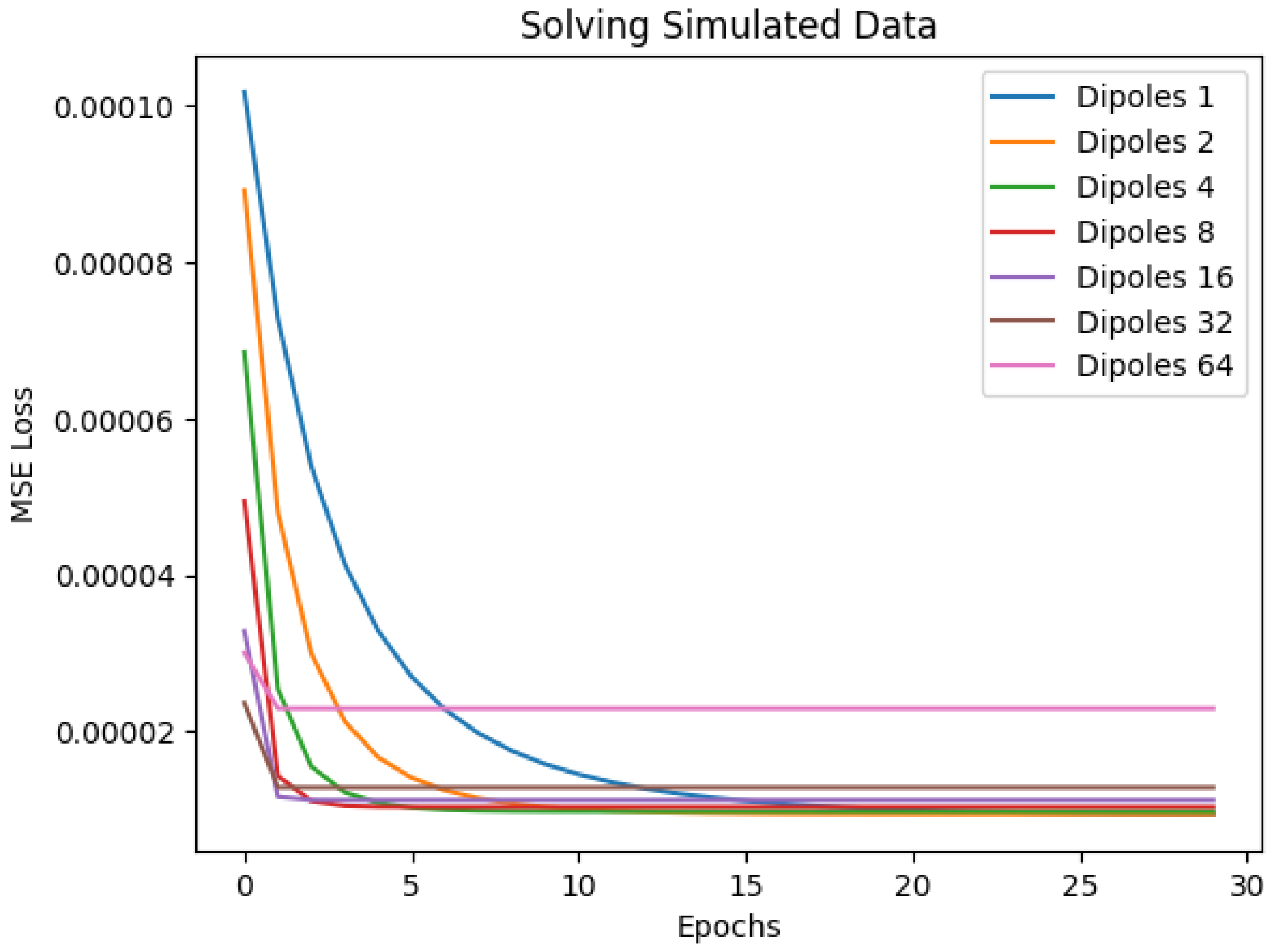
It can be seen in Figure 5 that the more layers added to the model will cause the model to more rapidly converge to a solution. However, the optimal fit for the model appears to be closer to the number of poles that determine the field that was being generated. So, the model with four dipole moment layers achieves the best fit for the test data. It is likely that the models with many more layers are not able to generate a good fit because the residuals of the dipole moment layers of the model will continue to add to the sum of the total B-field for the final fit. Therefore, the error will become greater as the number of layers begin to exceed the optimal number of layers required to match the data.
It does appear that between two and four layers may be the optimal number of layers to use for this type of model. It would be worth performing this test on a much larger sample set of very complex magnetic moment data to determine if that is indeed the case.

3.3. Multipole Moment Layers

The multipole moment testing was more interesting in their results as it shows the speed of solution and the aggregate accuracy of the model. The results were split into three groups according to the loss function used and can be seen in Table 2, Table 3 and Table 4.
The fastest time to convergence and highest accuracy are highlighted in bold for each of the test sets. From these tests it shows that the combination of loss and optimizer that converges to a solution the fastest and with the highest accuracy is ADAGRAD for the optimizer and Huber for the loss. This would be the combination that should be used for the initial search for the optimal number of moments in Algorithm 1. The final model would then use the most accurate combination. From this testing it would be RMSPROP for the optimizer and Huber for the loss.

4. Conclusions

From the changes that were made to the original model, we have shown a marked increase in the accuracy of the dipole moment determination model compared to the model that was originally developed. We have also shown a new novel physics-informed model that can accurately predict the magnetic multipole system from near-field magnetic data collected during standard magnetic testing as well as a method to determine the optimal number of moments. All data and models can be found on the GitHub repository for this paper in version 1.2.

Future Work

As mentioned previously, it would be interesting to explore the dipole moment model results that suggested the optimal number of layers is approximately four with a much larger dataset of actual data collected from spacecraft. Comparing this to the quadrupole term of a multipole expansion might have interesting correlations that could be explored further. It would also be interesting to compare this method against other methods with noisy or sparse datasets.
There are a significant number of similarities between this problem and a few other environmental tests from other disciplines. There is great potential to apply similar types of techniques to acoustic testing to determine the amount of force and location of impact of sound waves across the body of a spacecraft as a timeseries from recorded microphone data taken during testing. This could be used to compliment pressure sensors that are located on the spacecraft during testing. There is also the opportunity to apply a PINN model on temperature sensor data from thermal vacuum testing to more accurately determine a thermal model of the spacecraft, as well as the potential to develop models to help solve issues with radio-frequency self-compatibility testing of spacecraft transponders where there is not the possibility of integrated testing in an anechoic chamber or an open area test site.

Author Contributions

A.M.: Conceptualization; data curation; formal analysis; methodology; software; validation; visualization; writing—original draft. B.R.: Supervision; writing—review and editing. All authors have read and agreed to the published version of the manuscript.

Funding

This research received no external funding.

Data Availability Statement

The research presented here uses custom machine learning models for magnetic dipole moment and multipole determination from near-field data. The models were developed in python with TensorFlow and can be found in the GitHub repository magnetic-moment-PINN. https://github.com/andrewmentges/magnetic-moment-PINN (accessed on 1 May 2025). The markdown file lists the requirements for running the software. The developed code is released under the MIT license.

Conflicts of Interest

The authors declare no conflicts of interest.

Abbreviations

The following abbreviations are used in this manuscript:
PINNPhysics-Informed Neural Network
AIArtificial Intelligence
MLMachine Learning
ANNArtificial Neural Network
PDEPartial Differential Equation
FEMFinite Element Methods
FDMFinite Difference Methods
MSEMean Squared Error
RNNRecurrent Neural Network
EMIElectromagnetic Interference
EMCElectromagnetic Compatibility
LEOLow Earth Orbit
LSTMLong-Term Short-Term
SERFSpin Exchange Relaxation Free
SGDStochastic Gradient Descent
MAEMean Absolute Error

References

  1. Rackauckas, C.; Ma, Y.; Martensen, J.; Warner, C.; Zubov, K.V.; Supekar, R.B.; Skinner, D.J.; Ramadhan, A. Universal Differential Equations for Scientific Machine Learning. arXiv 2020, arXiv:2001.04385. Available online: https://api.semanticscholar.org/CorpusID:210164697 (accessed on 25 January 2026).
  2. Peng, W.; Zhang, J.; Zhou, W.; Zhao, X.; Yao, W.; Chen, X. IDRLnet: A Physics-Informed Neural Network Library. arXiv 2021, arXiv:2107.04320. Available online: https://api.semanticscholar.org/CorpusID:235790732 (accessed on 25 January 2026). [CrossRef]
  3. Lu, L.; Meng, X.; Mao, Z.; Karniadakis, G.E. DeepXDE: A Deep Learning Library for Solving Differential Equations. SIAM Rev. 2021, 63, 208–228. [Google Scholar] [CrossRef]
  4. Koryagin, A.; Khudorozhkov, R.; Tsimfer, S. PyDEns: A Python Framework for Solving Differential Equations with Neural Networks. arXiv 2019, arXiv:1909.11544. Available online: https://api.semanticscholar.org/CorpusID:202749843 (accessed on 25 January 2026). [CrossRef]
  5. Chen, F.; Sondak, D.; Protopapas, P.; Mattheakis, M.; Shuheng, L.; Agarwal, D.; Di Giovanni, M. NeuroDiffEq: A Python package for solving differential equations with neural networks. J. Open. Source Softw. 2020, 5, 3. [Google Scholar] [CrossRef]
  6. Zubov, K.; McCarthy, Z.; Ma, Y.; Calisto, F.; Pagliarino, V.; Azeglio, S.; Bottero, L.; Luj’an, E.; Sulzer, V.; Bharambe, A.; et al. NeuralPDE: Automating Physics-Informed Neural Networks (PINNs) with Error Approximations. arXiv 2021, arXiv:2107.09443. Available online: https://api.semanticscholar.org/CorpusID:236134289 (accessed on 25 January 2026).
  7. Haghighat, E.; Juanes, R. SciANN: A Keras/TensorFlow wrapper for scientific computations and physics-informed deep learning using artificial neural networks. Comput. Methods Appl. Mech. Eng. 2021, 373, 113552. [Google Scholar] [CrossRef]
  8. Xu, K.; Darve, E. ADCME: Learning Spatially-varying Physical Fields using Deep Neural Networks 2021. arXiv 2021, arXiv:2011.11955. [Google Scholar] [CrossRef]
  9. Gardner, J.R.; Pleiss, G.; Bindel, D.; Weinberger, K.Q.; Wilson, A.G. GPyTorch: Blackbox matrix-matrix Gaussian process inference with GPU acceleration. In Proceedings of the 32nd International Conference on Neural Information Processing Systems, Montreal, QC, Canada, 3–8 December 2018; Curran Associates Inc.: Red Hook, NY, USA, 2018; pp. 7587–7597. Available online: https://dl.acm.org/doi/10.5555/3327757.3327857 (accessed on 25 January 2026).
  10. Varey, J.; Ruprecht, J.D.; Tierney, M.; Sullenberger, R. Physics-Informed Neural Networks for Satellite State Estimation. In Proceedings of the 2024 IEEE Aerospace Conference, Big Sky, MT, USA, 2–9 March 2024; IEEE: New York, NY, USA, 2024; pp. 1–8. [Google Scholar] [CrossRef]
  11. de Curtò, J.; de Zarz, I. Physics-Informed Neural Networks for Enhanced Thermal Regulation in a Spacecraft. Procedia Comput. Sci. 2024, 246, 1659–1669. [Google Scholar] [CrossRef]
  12. Fu, H.; Liu, Z.; Cui, K.; Du, Q.; Wang, J.; Shi, D. Physics-Informed Neural Network for Spacecraft Lithium-Ion Battery Modeling and Health Diagnosis. IEEE/ASME Trans. Mechatron. 2024, 29, 3546–3555. [Google Scholar] [CrossRef]
  13. Schiassi, E.; D’Ambrosio, A.; Drozd, K.; Curti, F.; Furfaro, R. Physics-Informed Neural Networks for Optimal Planar Orbit Transfers. J. Spacecr. Rocket. 2022, 59, 834–849. [Google Scholar] [CrossRef]
  14. Mentges, A.; Rawal, B.S. Magnetic Dipole Moment Estimation from Nearfield Measurements Using Stochastic Gradient Descent AI Model. In Proceedings of the 2022 International Conference on Machine Learning, Big Data, Cloud and Parallel Computing (COM-IT-CON), Faridabad, India, 26–27 May 2022; Curran Associates, Inc.: Red Hook, NY, USA, 2022; Volume 1, pp. 327–332. [Google Scholar]
  15. Styp-Rekowski, K.; Michaelis, I.; Korte, M.; Stolle, C. Physics-informed neural networks for the improvement of platform magnetometer measurements. Phys. Earth Planet. Inter. 2025, 358, 107283. [Google Scholar] [CrossRef]
  16. Wang, Z.; Lu, J.; Liu, Z.; Li, X.; Sheng, J.; Li, J. Neural Network-Assisted Magnetic Moment Measurement Using an Atomic Magnetometer. IEEE Trans. Instrum. Meas. 2025, 74, 2509010. [Google Scholar] [CrossRef]
  17. Boyle, J.C. Lunar Roving Vehicle Magnetic Tests. NASA GSFC. 1 October 1971. Available online: https://ntrs.nasa.gov/citations/19720019624 (accessed on 25 January 2026).
  18. Eichhorn, W.L. Magnetic Dipole Moment Determination by Near-Field Analysis. NASA GSFC. 1 July 1972. Available online: https://ntrs.nasa.gov/citations/19720020082 (accessed on 25 January 2026).
  19. Liu, K.; Sui, Y.; Cheng, H.; Wang, Z.; Clark, D.A. Magnetic Dipole Moment Determination Using Near-Field Magnetic Gradient Tensor Data. IEEE Geosci. Remote Sens. Lett. 2021, 18, 1169–1173. [Google Scholar] [CrossRef]
  20. Bottou, L. Stochastic Gradient Descent Tricks. In Neural Networks: Tricks of the Trade: Second Edition; Montavon, G., Orr, G.B., Müller, K.-R., Eds.; Springer: Berlin/Heidelberg, Germany, 2012; pp. 421–436. ISBN 978-3-642-35289-8. [Google Scholar] [CrossRef]
  21. Kingma, D.P.; Ba, J. Adam: A Method for Stochastic Optimization. CoRR 2014, arXiv:1412.6980. Available online: https://api.semanticscholar.org/CorpusID:6628106 (accessed on 25 January 2026).
  22. Huber, P. Robust Estimation of a Location Parameter. Ann. Math. Stat. 1964, 35, 73–101. [Google Scholar] [CrossRef]
  23. Dozat, T. Incorporating Nesterov Momentum into ADAM. 2015. Available online: https://api.semanticscholar.org/CorpusID:620137 (accessed on 25 January 2026).
  24. Duchi, J.; Hazan, E.; Singer, Y. Adaptive Subgradient Methods for Online Learning and Stochastic Optimization. J. Mach. Learn Res. 2011, 12, 2121–2159. Available online: https://dl.acm.org/doi/10.5555/1953048.2021068 (accessed on 25 January 2026).
  25. Tielman, T.; Hinton, G. Lecture 6.5-rmsprop: Divide the Gradient by a Running Average of Its Recent Magni-Tude. Presented at the Neural Networks for Machine Learning, 2012. Available online: https://www.cs.toronto.edu/~tijmen/csc321/slides/lecture_slides_lec6.pdf (accessed on 25 January 2026).
  26. Zeiler, M.D. ADADELTA: An Adaptive Learning Rate Method. arXiv 2012, arXiv:1212.5701. Available online: https://api.semanticscholar.org/CorpusID:7365802 (accessed on 25 January 2026). [CrossRef]
Figure 1. Magnetic moment test configuration.
Aerospace 13 00404 g001
Figure 2. Magnetometer data coordinate transform. Ɵ is the required angle to transform magnetometer data back into the governing system.
Aerospace 13 00404 g002
Figure 3. Single-layer dipole moment PINN configuration. Dashed lines indicate interconnections for feed forward and back propagation.
Aerospace 13 00404 g003
Figure 4. Multi-layer dipole moment PINN configuration. Dashed lines indicate interconnections for feed forward and back propagation.
Aerospace 13 00404 g004
Figure 5. Known data, multi-dipole layer convergence.
Aerospace 13 00404 g005
Table 1. Dipole moment accuracy vs. previous model.
Simulated Moment (Am2)Accuracy
Prior
MSE
Prior
Accuracy
New
MSE
New
MXMYMZ
100200−60099.99754%4.55 × 10−1199.99997%1.99 × 10⁻⁴
1020−6099.98638%4.53 × 10−1399.99996%1.20 × 10⁻⁵
12−699.79722%4.6 × 10−1599.99992%1.97 × 10⁻⁷
0.10.02−0.0699.99832%9.94 × 10−1999.99992%1.05 × 10⁻¹⁰
0.010.002−0.00699.99831%3.19 × 10−1999.99997%1.25 × 10⁻¹⁴
0.0010.0002−0.000699.99832%7.17 × 10−1999.99999%1.32 × 10⁻¹⁴
Table 2. Multipole moment—MAE.
OptimizerLossEpochsTime (mins)LossAccuracy (%)
ADADELTAMAE74830.267041.99631290.4873235
ADAGRADMAE29110.081191.8991291.5430708
ADAMMAE136859.355961.99303488.738672
NADAMMAE1406136.1351.99818288.6279009
RMSPROPMAE58421.620821.9425793.3610191
SGDMAE199969.32518118.299112.9396241
Table 3. Multipole moment—MSE.
OptimizerLossEpochsTime (min)Final LossAccuracy (%)
ADADELTAMSE187580.104753.99699693.74246578
ADAGRADMSE154854.458183.99656293.73363789
ADAMMSE156065.923313.99164592.54506961
NADAMMSE167568.790023.97927193.49059389
RMSPROPMSE132194.260073.99639195.29144061
SGDMSE199975.6093366.4385175.52251806
Table 4. Multipole moment—Huber.
OptimizerLossEpochsTime (min)Final LossAccuracy (%)
ADADELTAHuber90338.921540.97488893.41850522
ADAGRADHuber28910.86890.96419392.80979322
ADAMHuber158474.409730.96171392.04611767
NADAMHuber1461147.86410.96801491.77048061
RMSPROPHuber96738.374250.967296.63192028
SGDHuber199974.9457513.3567764.13893572
Disclaimer/Publisher’s Note: The statements, opinions and data contained in all publications are solely those of the individual author(s) and contributor(s) and not of MDPI and/or the editor(s). MDPI and/or the editor(s) disclaim responsibility for any injury to people or property resulting from any ideas, methods, instructions or products referred to in the content.