Article

Rainfall Erosivity Dynamics in a Tropical Basin: Integration of Rain Gauge Data and Satellite-Based Precipitation


by
Guilherme d. S. Rios
1,
Joaquim E. B. Ayer
2,
Derielsen B. Santana
1,
Victor H. F. d. Silva
1,
Marcelo A. R. Pires
1,
Talyson d. M. Bolleli
3,
Fellipe S. Gomes
1,
Mariana Raniero
1,
Pedro F. R. Grande
1,
Velibor Spalevic
4,
Felipe G. Rubira
1 and
Ronaldo L. Mincato
1,*
1
Institute of Natural Sciences, Federal University of Alfenas (UNIFAL-MG), R. Gabriel Monteiro da Silva 700, Alfenas 37130-001, MG, Brazil
2
Department of Chemistry, College of Paulínia (UNIFACP), R. Maria Vilac 121, Paulínia 13140-000, SP, Brazil
3
Center for Water Resources and Applied Ecology (CRHEA), São Carlos School of Engineering, University of São Paulo (USP), São Carlos 13566-590, SP, Brazil
4
Biotechnical Faculty, University of Montenegro, Mihaila Lalića bb, 81000 Podgorica, Montenegro
*
Author to whom correspondence should be addressed.
Climate 2026, 14(6), 111; https://doi.org/10.3390/cli14060111
Submission received: 2 April 2026 / Revised: 11 May 2026 / Accepted: 18 May 2026 / Published: 22 May 2026
(This article belongs to the Section Weather, Events and Impacts)

Highlights

What are the main findings?
  • Rainfall erosivity in the basin showed marked spatiotemporal variability, with annual values ranging from 3900 to more than 9000 MJ mm ha−1 h−1 yr−1.
  • The year with the highest annual precipitation did not correspond to the year with the highest rainfall erosivity, highlighting the control exerted by rainfall intensity and the temporal concentration of events on the R factor.
What are the implications of the main findings?
  • CHIRPS-estimated precipitation data showed spatial agreement with rain gauge stations and allowed reliable rainfall erosivity estimates in regions with sparse monitoring networks.
  • Interannual variability in rainfall erosivity directly influenced the potential soil loss estimated by RUSLE and promoted the expansion of erosion-prone areas in years with higher rainfall energy.

Abstract

This study evaluated the spatial and temporal variability of rainfall erosivity (R factor) and its implications for soil loss in the Velhas River Basin, Minas Gerais, Brazil. Rainfall erosivity was estimated from 49 rain gauge stations and CHIRPS precipitation data using empirical equations-based on monthly and annual precipitation totals. Soil loss was estimated using the RUSLE model for the years of minimum and maximum erosivity. Between 2014 and 2024, annual R values ranged from approximately 3900 to more than 9000 MJ mm ha−1 h−1 yr−1, with the lowest values recorded in 2014 and the highest in 2022. Although 2020 had the highest annual rainfall, 2022 showed the highest erosivity, indicating that rainfall intensity and temporal concentration were more important than total rainfall volume. Furthermore, the comparison of erosivity was estimated from ANA stations and derived from CHIRPS agreement for paired station-year observations (r = 0.7196), although CHIRPS slightly underestimated erosivity values (mean bias −5.74%). Estimated soil loss ranged from 0.60 to 274.17 Mg ha−1 yr−1, with the highest values occurring mainly in exposed soil and agricultural areas. These findings highlight the importance of rainfall temporal distribution in erosion risk and support the use of satellite-derived precipitation products for regional-scale erosion assessments in data-scarce tropical basins.

1. Introduction

Water erosion is a natural phenomenon and one of the main drivers of environmental degradation in tropical soils, as it affects agricultural production, ecological stability, water quality, and the hydrosedimentological functioning of river basins [1,2,3]. Thus, increasing anthropogenic pressure, combined with climatic variability and the intensification of extreme rainfall events, reinforces global concern about soil loss and ecosystem degradation [4,5,6]. In Brazil, this process is particularly significant due to the predominance of a tropical rainfall regime characterized by intense and highly concentrated precipitation, which enhances the erosive potential of rainfall [7]. Regional applications of RUSLE (Revised Universal Soil Loss Equation) in tropical environments have shown that soil loss estimates are strongly influenced by the interaction between rainfall erosivity, topography, soil erodibility, and land use. In Brazilian studies, higher soil losses are commonly associated with exposed soils, agricultural areas, and low vegetation cover, while forested and natural vegetation areas tend to present lower estimated losses [8].
Rainfall erosivity, represented by the R factor of the RUSLE, governs the detachment and transport of soil particles [9,10]. The direct estimation of this factor is commonly based on EI30, which requires high-temporal-resolution pluviographic records. However, these data are often unavailable or incomplete in regional-scale studies, especially in countries with large territorial extent and uneven monitoring networks. Therefore, empirical relationships based on monthly or annual precipitation have been widely used as an alternative to estimate rainfall erosivity when long-term rainfall intensity records are limited [11,12]. In Brazil, this approach has also been applied at broad spatial scales. Trindade et al. used rainfall data from more than 1500 rain gauge stations and regression equations relating precipitation variables to EI30 to map the spatial and monthly variability of rainfall erosivity across the country [13]. These studies support the use of indirect rainfall-based methods for regional erosivity assessments under Brazilian conditions, particularly where continuous pluviographic monitoring is not available [14,15,16].
In this context, remote sensing products for precipitation estimation have expanded the possibilities for hydrometeorological analyses in areas with limited ground-based monitoring. The Climate Hazards Group InfraRed Precipitation with Station Data (CHIRPS) dataset integrates satellite observations and ground-based measurements, providing long and spatially continuous precipitation records [17]. Evaluations in different tropical regions indicate satisfactory performance of this product for hydrological and climatological applications, including analyses related to rainfall erosivity and soil loss modeling [18]. In Brazil, CHIRPS has been evaluated against rain gauge observations and has shown satisfactory performance in representing rainfall variability, especially at monthly and seasonal scales, although uncertainties remain in the representation of local extremes [19]. This reinforces the importance of comparing satellite-derived precipitation with ground-based observations before applying these products to rainfall erosivity estimation. Recent studies also highlight the usefulness of these data for estimating erosive processes in tropical environments through integrated geospatial modeling approaches [20,21].
This study was conducted in the Velhas River Basin (VRB), one of the tributaries of the São Francisco River. The basin is characterized by high geological, geomorphological, and climatic diversity, encompassing physical, biological, and socioeconomic characteristics that are representative of the state of Minas Gerais [22,23]. The basin hosts important mining districts in the Quadrilátero Ferrífero, one of the main mineral provinces in Brazil, which intensifies environmental pressure on the landscape [24]. Furthermore, it includes the urban area of the Belo Horizonte Metropolitan Region and extensive agricultural areas, which increase land use conflicts and the environmental vulnerability of the basin [25,26].
Tropical river basins subjected to strong anthropogenic pressure, pronounced relief, and changes in land use tend to exhibit greater susceptibility to soil erosion, sediment transport, and hydrosedimentological imbalance [27,28]. The Velhas River Basin also plays a strategic role in regional water supply, sustaining the water security of approximately six million inhabitants [29]. Under these conditions, intense rainfall events in southeastern Brazil, often associated with climatic variability and climate change [4,5], can contribute to increased rainfall erosivity and soil loss rates [9,15,16]. Marked altitudinal variation and the presence of steep slopes favor the occurrence of processes, especially during periods of rainfall [27,30].
Considering these conditions, this study estimated and compared the annual variation of the R factor in the Velhas River Basin using two complementary approaches: (i) the application of empirical equations to observed precipitation data and (ii) the estimation of rainfall erosivity based on precipitation derived from the CHIRPS product. Based on these results, the years of minimum and maximum rainfall erosivity were identified, and the RUSLE model was applied to these two scenarios to quantify soil loss under contrasting climatic conditions. Unlike studies focused only on annual precipitation totals or static applications of RUSLE, this study investigates how the interannual variability of rainfall erosivity influences erosion-prone areas and soil loss under contrasting climatic conditions [9,15,16]. Furthermore, the comparison between rainfall observations and satellite-derived precipitation enables the evaluation of the applicability of alternative precipitation products for improving the estimation of erosivity in large tropical basins with complex topography and heterogeneous land use. This approach enhances the understanding of regional erosion dynamics and supports hydrosedimentological assessments in areas with limited rainfall coverage.

2. Materials and Methods

2.1. Study Area

The Velhas River Basin covers about 29,000 km2 in the central portion of Minas Gerais state, southeastern Brazil (Figure 1).
The geological framework of the Velhas River Basin is characterized by high structural and lithological complexity. In the upper course, Archean and Paleoproterozoic sequences are associated with the Quadrilátero Ferrífero predominate, particularly those belonging to the Rio das Velhas and Minas Supergroups [23,24]. In the middle and lower sectors of the basin, carbonate and pelitic units of the Bambuí Group stand out, exerting strong control over the organization of the drainage network and regional geomorphological compartmentalization [22]. In the northern and northeastern sectors, metasedimentary rocks related to the Serra do Espinhaço occur, associated with areas of higher relief energy and pronounced landscape dissection [22]. This lithological diversity leads to marked contrasts in resistance to weathering and directly influences regional erosive dynamics.
The basin relief exhibits a strong altitudinal gradient, with elevations ranging from approximately 1740 m in the headwater areas to less than 500 m near the confluence with the São Francisco River [22]. This topographic contrast reflects regional geomorphological evolution and influences drainage organization and erosive processes. According to the Agricultural Land Suitability Assessment System, the middle course is dominated by flat to gently undulating surfaces, which concentrate much of the agricultural activity and human occupation [33]. In contrast, the southern and eastern portions of the upper course present undulating to strongly undulating terrains, frequently with slopes exceeding 20%, a condition that intensifies relief dissection and increases susceptibility to erosion.
According to Alvares et al. [7], the climate of the basin is predominantly classified as Aw, Cwa, and Cwb according to the Köppen classification. Regional rainfall dynamics are influenced by the South Atlantic Convergence Zone, cold fronts, and convective systems, which account for a significant portion of extreme events in southeastern Brazil [5]. This climatic seasonality results in a strong concentration of rainfall during the austral summer, increasing the erosive potential of precipitation and intensifying rainfall erosivity represented by the R factor [6].
Regarding soils, Argisols (30%), Neosols (22%), Latosols (22%), and Cambisols (17%) predominate, according to the soil map of the state of Minas Gerais [34]. These soil classes are typical of highly weathered tropical environments [35,36]. Although they exhibit high porosity and good infiltration capacity, these soils may exhibit high vulnerability to erosion when vegetation cover is removed or under inadequate soil management [30]. In addition, attributes such as texture, structure, depth, and organic matter content directly influence infiltration, surface runoff, and sediment transport processes [37].
The Velhas River Basin lies in a transition zone between the Cerrado and Atlantic Forest biomes. The Cerrado occupies a large portion of the area and is characterized by savanna formations typical of a seasonal tropical climate, with high structural and phytophysiognomic diversity [38]. Remnants of Atlantic Forest are mainly concentrated in the southern and eastern sectors of the basin, associated with higher elevations and more humid climatic conditions [39]. This configuration results in a mosaic of vegetation formations that contributes to landscape environmental heterogeneity.
Land use and land cover are highly heterogeneous across the basin. The Belo Horizonte Metropolitan Region concentrates extensive urbanized areas and major mining districts associated with the Quadrilátero Ferrífero [24]. In the central–northern sectors, pastures, temporary crops, and silviculture dominate, land uses that reduce water infiltration into the soil, increase surface exposure, and favor the initiation of erosive processes [37]. Forest, savanna, and grassland formations are distributed in a fragmented pattern throughout the basin, as indicated by the MapBiomas Project [31], reflecting the progressive replacement of native vegetation and the increasing environmental vulnerability of the region.
The combination of a seasonal tropical climate, highly weathered soils, heterogeneous relief, and intense anthropogenic pressures creates an environment particularly susceptible to water erosion. Recent studies applying erosion models in tropical environments demonstrate that the interaction between rainfall erosivity, relief characteristics, and land use changes exerts strong control over soil loss in river basins [40,41], justifying an integrated assessment of rainfall variability, the R factor, and potential soil loss.

2.2. Methodological Procedures

We obtained observed rainfall precipitation data from ANA [32]. To increase spatial representativeness and reduce monitoring gaps near basin boundaries, we applied a 30 km buffer generated with the Buffer tool in ArcGIS 10.8 [42]. After delineating the expanded area, 391 stations were identified within the buffer zone. According to ANA, 141 of these stations are no longer operational, while others have extensive gaps or inadequate time series for consistent hydrological analyses. We evaluated each station individually for record continuity and data quality, considering temporal consistency, data completeness, and monthly continuity for the period from 2014 to 2024. Stations with long interruptions, missing annual records, or insufficient monthly continuity were excluded. Following this selection process, 49 stations presented complete time series for the period from 2014 to 2024, and we selected them for estimating rainfall erosivity, as shown in Figure 1. Valid records were organized into monthly and annual totals to meet the requirements of the empirical equations used.
To complement ground-based observations and enable continuous spatial analyses, we used data from the CHIRPS product. This study used the CHIRPS product daily version 2.0, which has a spatial resolution of 0.05° [17], available on https://code.earth-engine.google.com/8741a9defd19207b4da68071e848adfd (accessed on 19 December 2025). This dataset combines satellite-derived precipitation estimates with rain gauge observations and demonstrates robust performance in tropical regions [5,16,17,18]. All pixels intersecting the basin area were extracted, and daily precipitation values were aggregated into monthly and annual totals for the period from 2014 to 2024, ensuring consistency with the ANA observations and spatially aligned to ensure consistency between the datasets.
Rainfall erosivity was not calculated from direct EI30 values, since this index requires sub-hourly rainfall records, which are not available for CHIRPS or for most ANA stations in the study area [9,10]. Therefore, R was estimated indirectly using empirical equations based on the relationship between monthly and annual precipitation totals, following formulations widely applied in Brazilian studies [9,14,15,16]. The same empirical formulation was applied to both datasets, allowing direct comparison between observed and satellite-derived rainfall erosivity estimates.
We estimated rainfall erosivity (R) using empirical equations widely applied in Brazilian studies, based on the relationship between monthly and annual precipitation [9,14]. The calculation was based on the formulation originally proposed by Wischmeier and Smith [10] and later adapted for monthly data by national studies [16,19], expressed as:
R = i = 1 12 67.355 ( P i 2 P ) 0.85
where Pᵢ represents monthly precipitation (mm) and P corresponds to total annual precipitation (mm).
We performed the calculations for each of the 49 ANA rain gauge stations and for the corresponding CHIRPS pixels, extracted from the same geographic locations, numbered and arranged in Figure 1. In this way, each ANA station was directly associated with the respective CHIRPS pixel that intersects its coordinates, allowing point-by-pixel comparison between observed precipitation data and satellite-derived data, under the same spatial reference. The sum of monthly values resulted in annual rainfall erosivity, enabling the identification of years with minimum and maximum erosivity, which were used as reference years for estimating potential soil loss. The spatial distribution of R was obtained through Inverse Distance Weighting (IDW) interpolation in ArcGIS 10.8 [41]. IDW is a deterministic interpolation method widely used to generate continuous surfaces from point-based hydrometeorological observations. In rainfall erosivity studies, IDW has been applied to produce annual, seasonal, and monthly erosivity maps when estimates are derived from rain gauge stations [11,42]. Although methods incorporating climatic or topographic covariates may improve performance when auxiliary data are available, IDW remains a suitable approach for regional-scale spatialization based on station data [11].
The agreement between ANA and CHIRPS rainfall erosivity estimates was assessed using Pearson’s correlation coefficient (r), the paired Student’s t-test, mean bias, mean absolute error (MAE), and root mean square error (RMSE), calculated in RStudio [43]. These metrics are commonly used in precipitation product validation studies because they evaluate association, systematic deviation, and error magnitude between satellite-derived estimates and rain gauge observations [19]. The analyses were performed using station-by-station temporal comparisons and paired station-year values, in which each ANA rain gauge value was matched with the corresponding CHIRPS pixel extracted from the same geographic coordinates and year. Mean bias was used to identify overestimation or underestimation by CHIRPS, while MAE and RMSE quantified the magnitude of the differences between datasets. The same metrics were also applied to the average soil loss values estimated by land use and land cover class for the years of minimum and maximum rainfall erosivity.
We estimated soil loss using RUSLE, a model widely applied in erosion studies [6,8,10,44]. The general equation is expressed as:
A = R K L S C P
where A represents the average annual soil loss (Mg ha−1 yr−1); R corresponds to the rainfall erosivity factor (MJ mm ha−1 h−1 yr−1); K represents the soil erodibility factor (Mg ha−1 MJ−1 mm−1); LS corresponds to the topographic factor (dimensionless); C represents the land use and management factor (dimensionless); and P corresponds to the conservation practices factor (dimensionless).
The topographic factor LS was calculated using the method proposed by Desmet and Govers [44], based on the area of contribution per pixel and the slope derived from the digital elevation model. Processing the processing was performed in ArcGIS 10.8 using the 30 m Copernicus Digital Elevation Model (DEM) accessed through the Google Earth Engine (GEE) platform [45], whose accuracy is suitable adequate for topographic analyses applied in RUSLE studies [8,10,44,46]. The applied formulation is expressed as:
L S = ( A f l o w 22.13 ) m sin θ 0.0896 n
where Aflow represents the contributing area per cell, θ denotes slope in radians, and m and n are exponents defined according to the surface runoff regime.
The K factor was assigned based on the soil map of Minas Gerais developed by UFV et al. [34], with values derived from studies that quantify erodibility across different tropical soil classes similar to those found in the Rio Velhas Basin [35,36,40].
We defined the land use and management factor (C) based on consolidated values in the literature for each land use and land cover class identified in the basin, as presented in Table 1. We considered the degree of surface protection provided by vegetation cover, canopy density, agricultural management practices, and the level of soil exposure to adequately represent the differences between natural, agricultural, and anthropogenic areas [30,37,46]. Surfaces without structured soil or erodible pedological material, such as rocky outcrops, water bodies, flooded areas, and active mining areas, were not included in the soil loss estimate, as they do not meet the physical assumptions of RUSLE, originally developed to estimate sheet and rill erosion in structured soils [6,10]. In active mining areas, where topsoil is removed and erosive processes become dominated by slope instability and localized sediment redistribution, the direct application of RUSLE presents methodological limitations [47]. The use of fixed values for the C factor ensured comparability between the minimum and maximum erosivity scenarios and allowed isolating the effect of the R factor in modeling soil loss.
The P factor represents the effectiveness of conservation practices in controlling erosion [10]. To isolate the influence of the other RUSLE factors, we adopted p = 1 was across the entire basin. This assumption represents the absence of conservation practices and reflects the scenario of maximum potential soil loss, enabling direct comparison between years of minimum and maximum rainfall erosivity.

3. Results

3.1. Rainfall and Erosivity Variability

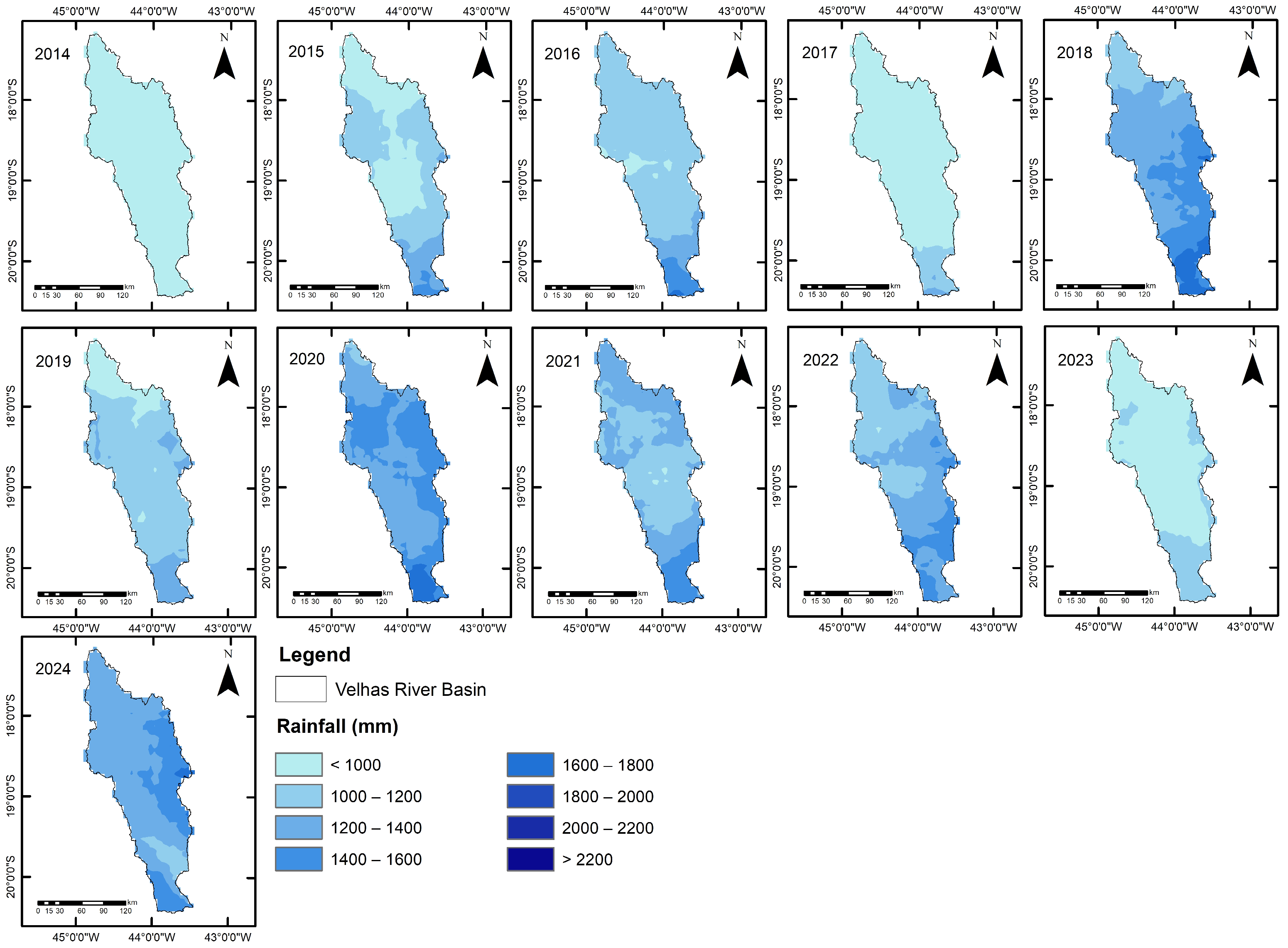
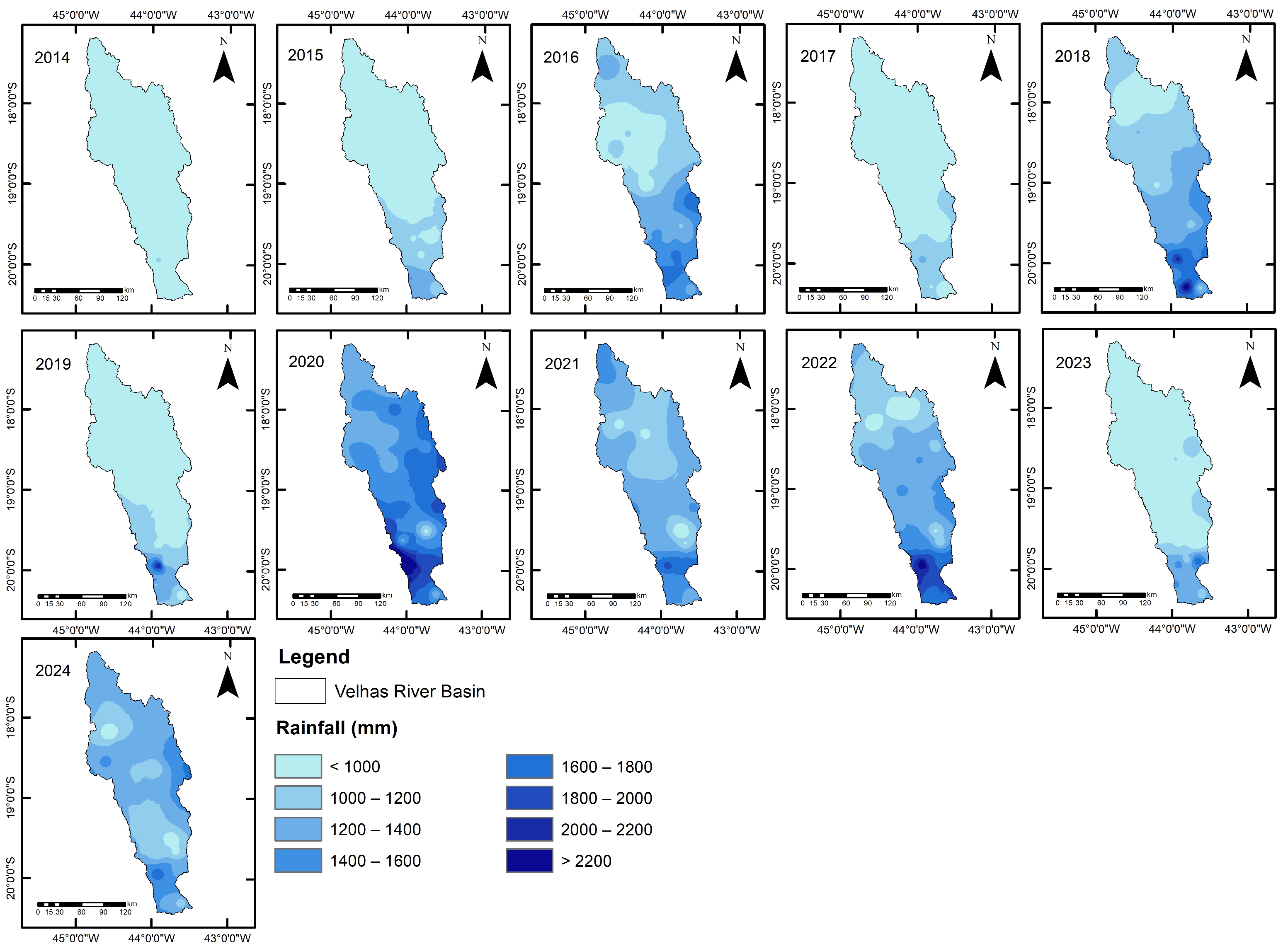
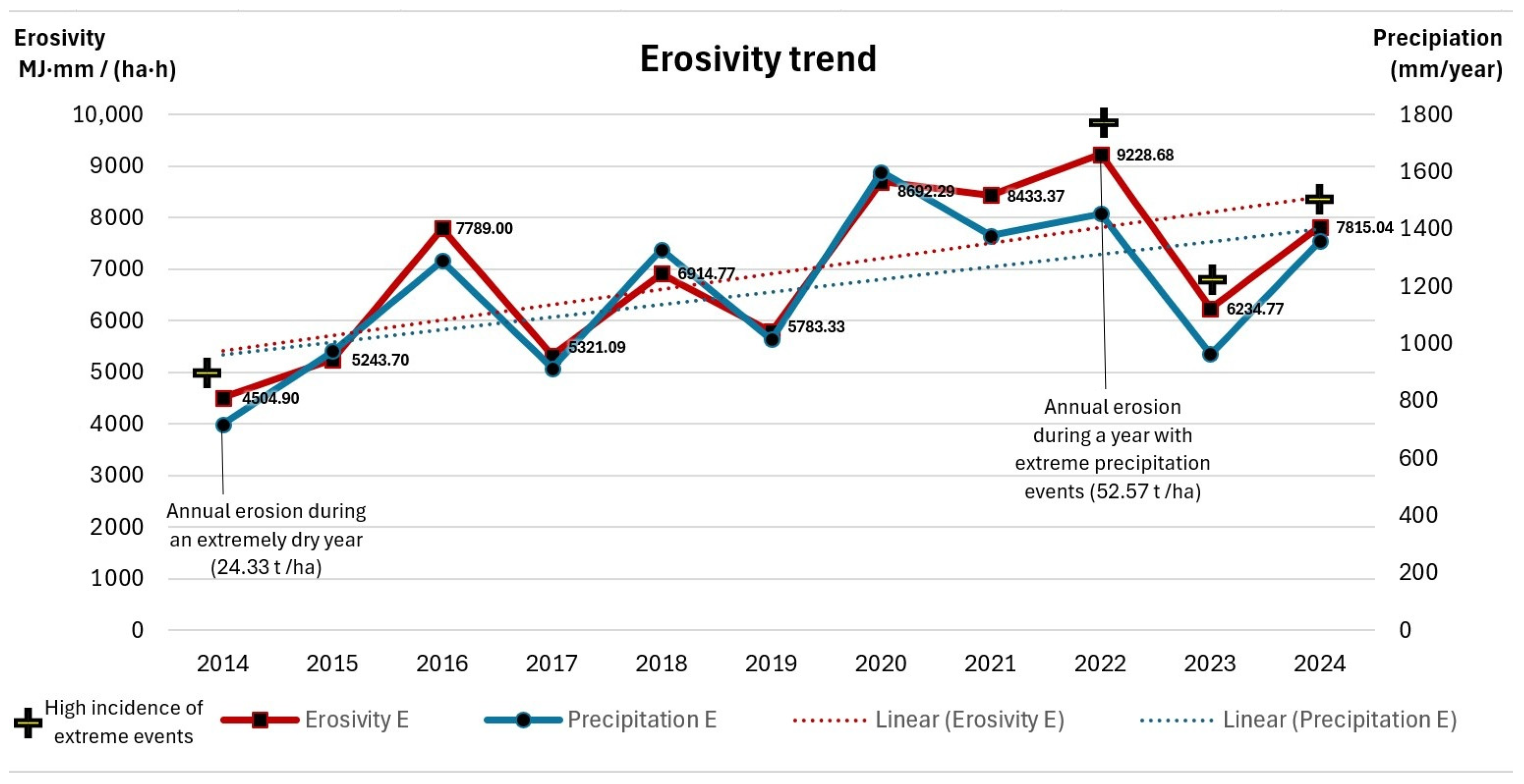
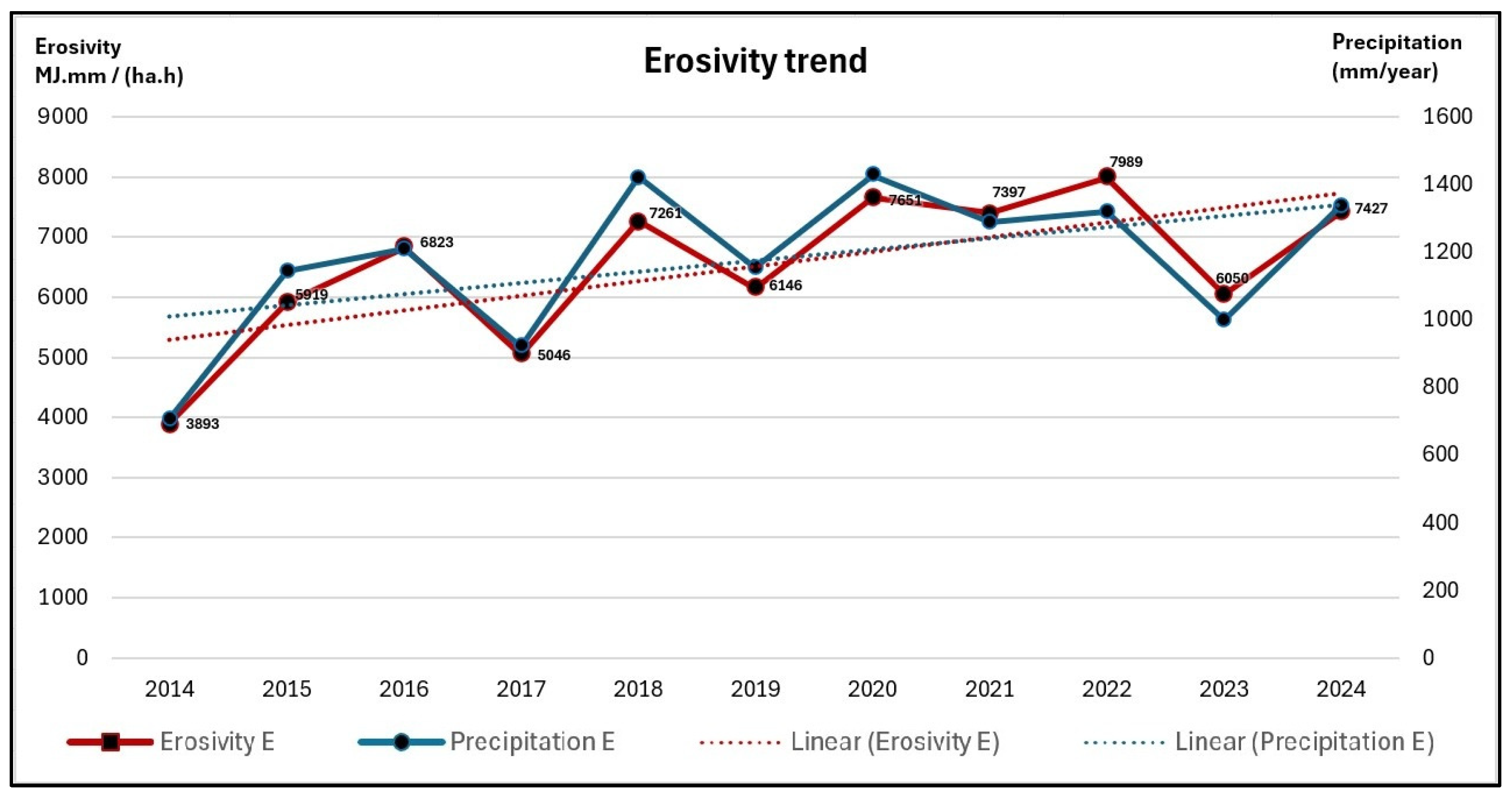
The average annual rainfall in the Velhas River Basin showed high variability during the study period, ranging from 717.99 mm (2014) to 1598.77 mm (2020). The years 2014, 2017 (912.79 mm) and 2023 (963.00 mm) represented the driest periods of the series, while 2020, 2022 (1452.42 mm) and 2021 (1375.65 mm) were the wettest. The average annual rainfall for the analyzed period was approximately 1162 mm year−1. Precipitation maps are shown in Figure 2 and Figure 3.
Annual rainfall erosivity (R), estimated from ANA rain gauge stations and the CHIRPS product (Table 2), also exhibited strong variability. For the ANA stations, values ranged from 4504.90 to 9228.68 MJ·mm·ha−1·h−1·yr−1, corresponding to 2014 and 2022, respectively. The CHIRPS dataset exhibited a similar pattern, with values ranging from 3892.63 to 7989.21 MJ·mm·ha−1·h−1·yr−1.
The data in Table 2 indicate that, although 2020 recorded the highest annual precipitation total, maximum rainfall erosivity occurred in 2022. Years with lower rainfall totals, such as 2014 and 2017, also presented the lowest erosivity values. This pattern shows that rainfall erosivity is not directly proportional to total annual precipitation.
Statistical comparison between rainfall erosivity estimates derived from ANA and CHIRPS showed a positive association between the two datasets, with a Pearson correlation coefficient of r = 0.7196 for the complete set of paired season–year observations. However, the paired Student’s t-test indicated statistically significant differences between the paired estimates (p = 2.178 × 10⁻¹⁰). CHIRPS presented a mean bias of −396.16 MJ mm ha−1 h−1 year−1, corresponding to a mean underestimation of −5.74% compared to the estimates based on ANA. The mean absolute error was 1117.30 MJ mm ha−1 h−1 year−1, while the mean squared error was 1474.02 MJ mm ha−1 h−1 year−1, indicating that although CHIRPS reproduced the general erosivity pattern, differences occurred in some season–year pairs, especially where larger errors contributed more strongly to the RMSE.
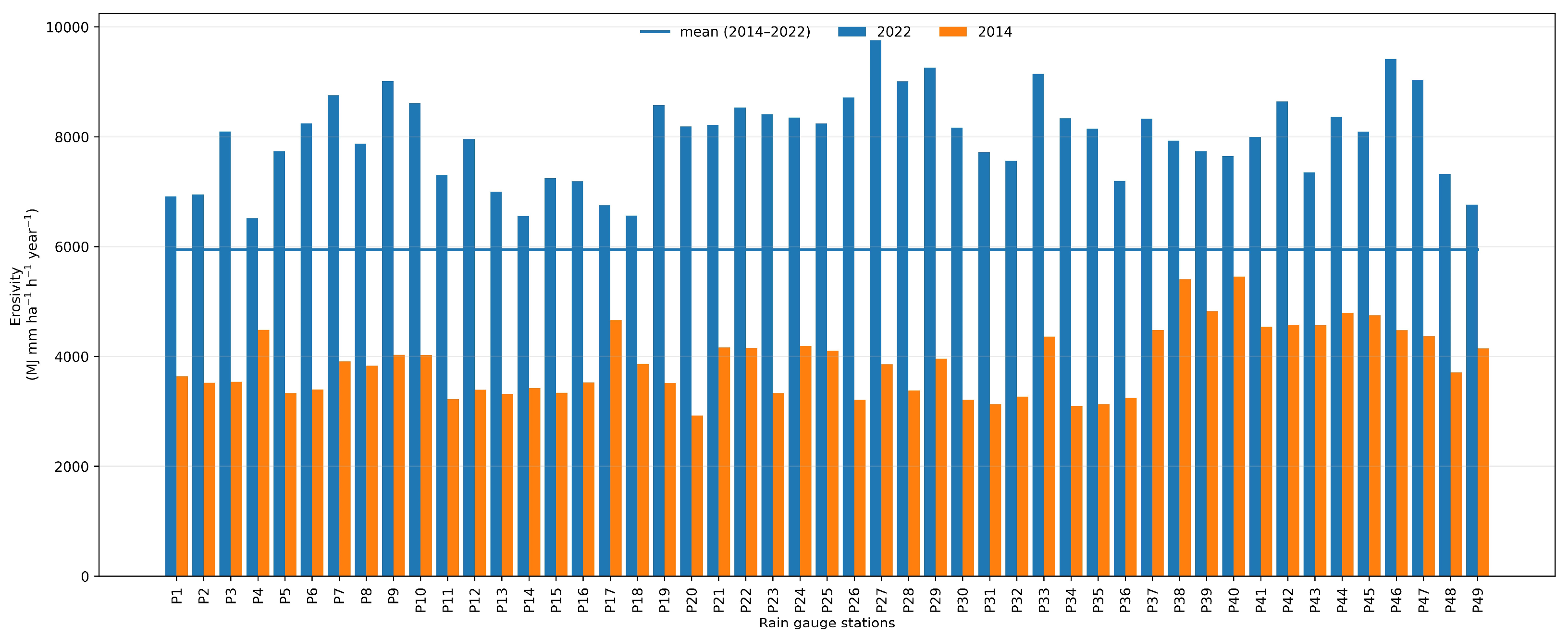
To complement the basin-scale analysis, a station-based comparison of rainfall erosivity for the years of minimum (2014) and maximum (2022) conditions was performed, together with the multi-year mean. The results indicate that the increase in erosivity observed in 2022 is spatially consistent across all stations, with systematically higher values compared to 2014. This pattern highlights that the intensification of erosivity is not restricted to specific locations but represents a basin-wide response. Additionally, the comparison with mean values shows that 2022 exceeds the historical baseline across the entire basin, whereas 2014 remains consistently below average, as shown in Figure 4.
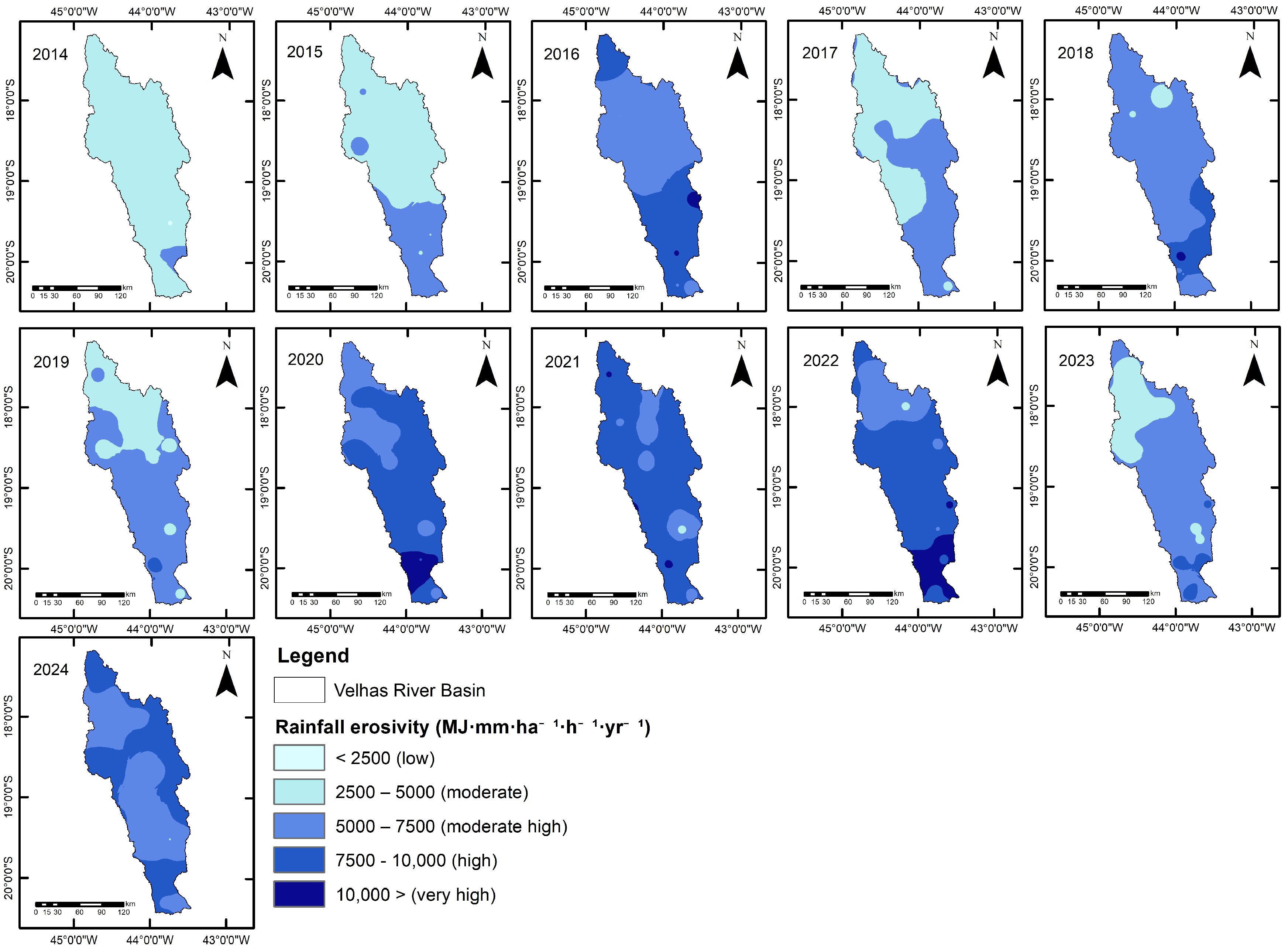
The spatial distribution of annual rainfall erosivity estimated based on CHIRPS data is shown in Figure 5.
The CHIRPS maps indicate that dry years, such as 2014, 2017, and 2023, are characterized by a predominance of low and moderate rainfall erosivity classes across most of the basin. In contrast, wet years, particularly 2016, 2020, 2021, and 2022, exhibit an expansion of high and very high classes, with greater intensity in the central–southern sector.
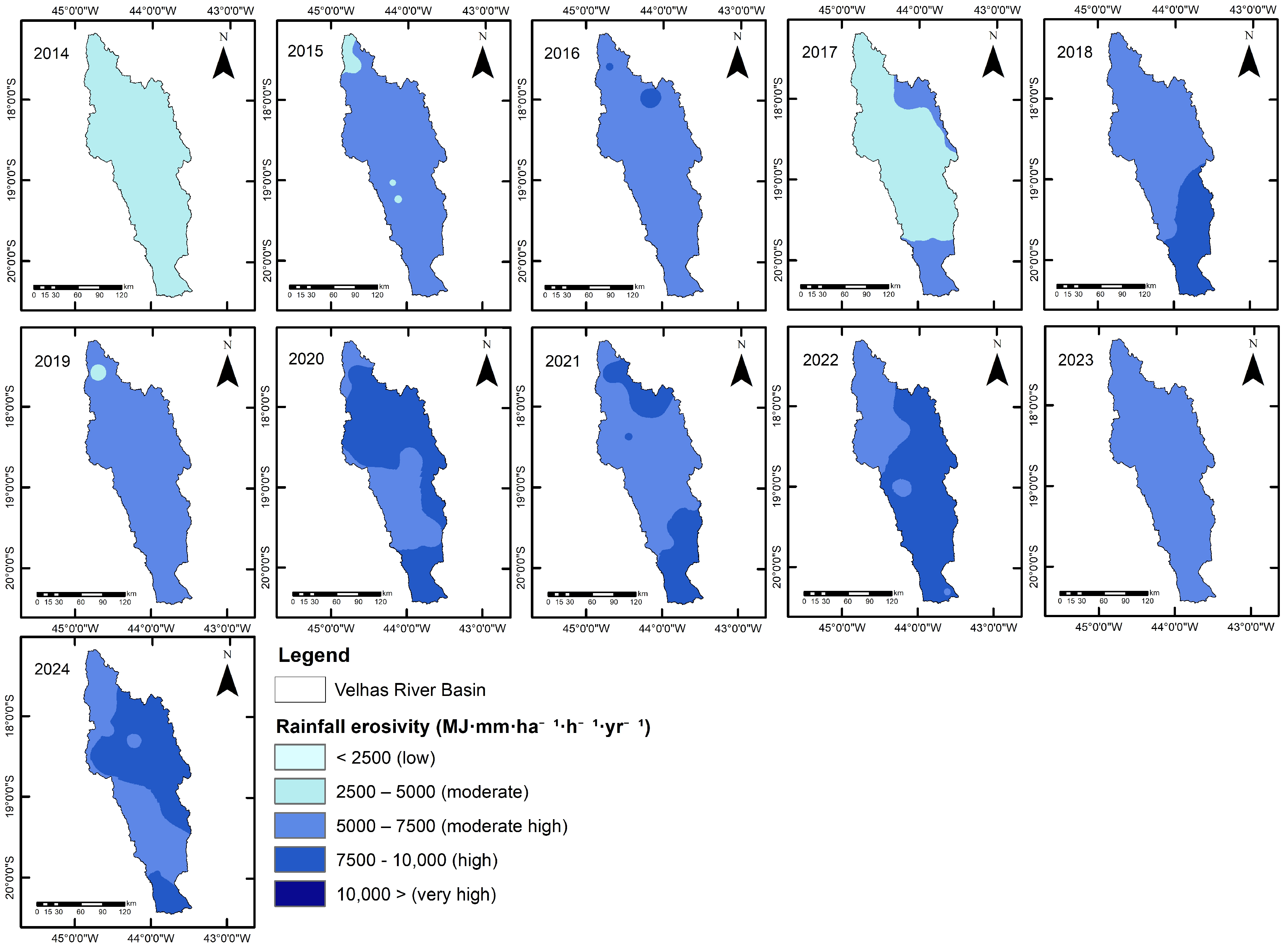
The spatial distribution of rainfall erosivity derived from ANA rain gauge stations is shown in Figure 6.
The patterns observed in the station data confirm the spatial variability identified by CHIRPS but reveal greater local detail and amplitude, particularly in 2016, 2020, and 2022, when specific locations reached the very high class. In years of lower rainfall erosivity, reduced values predominate in the northern sector of the basin.
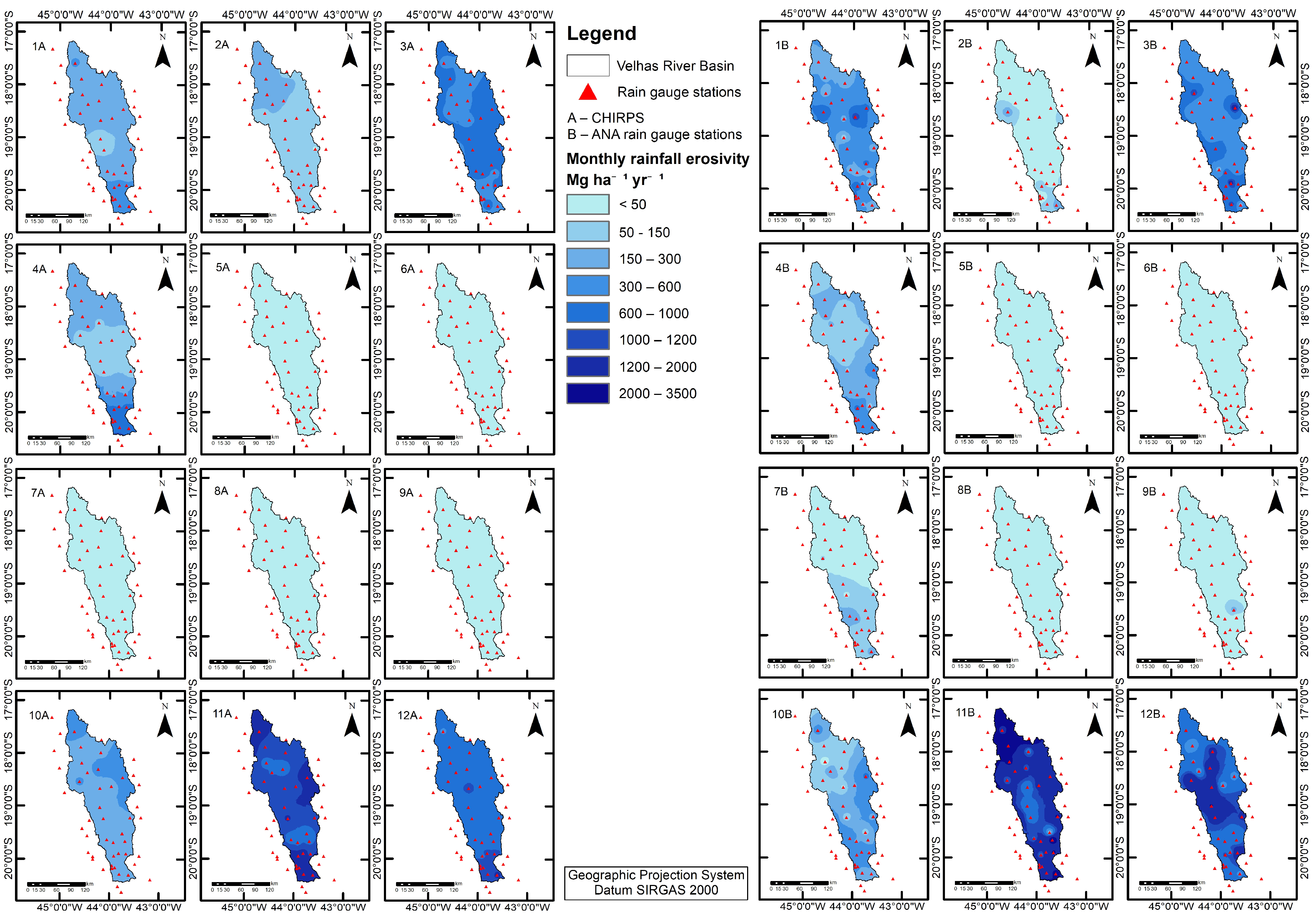
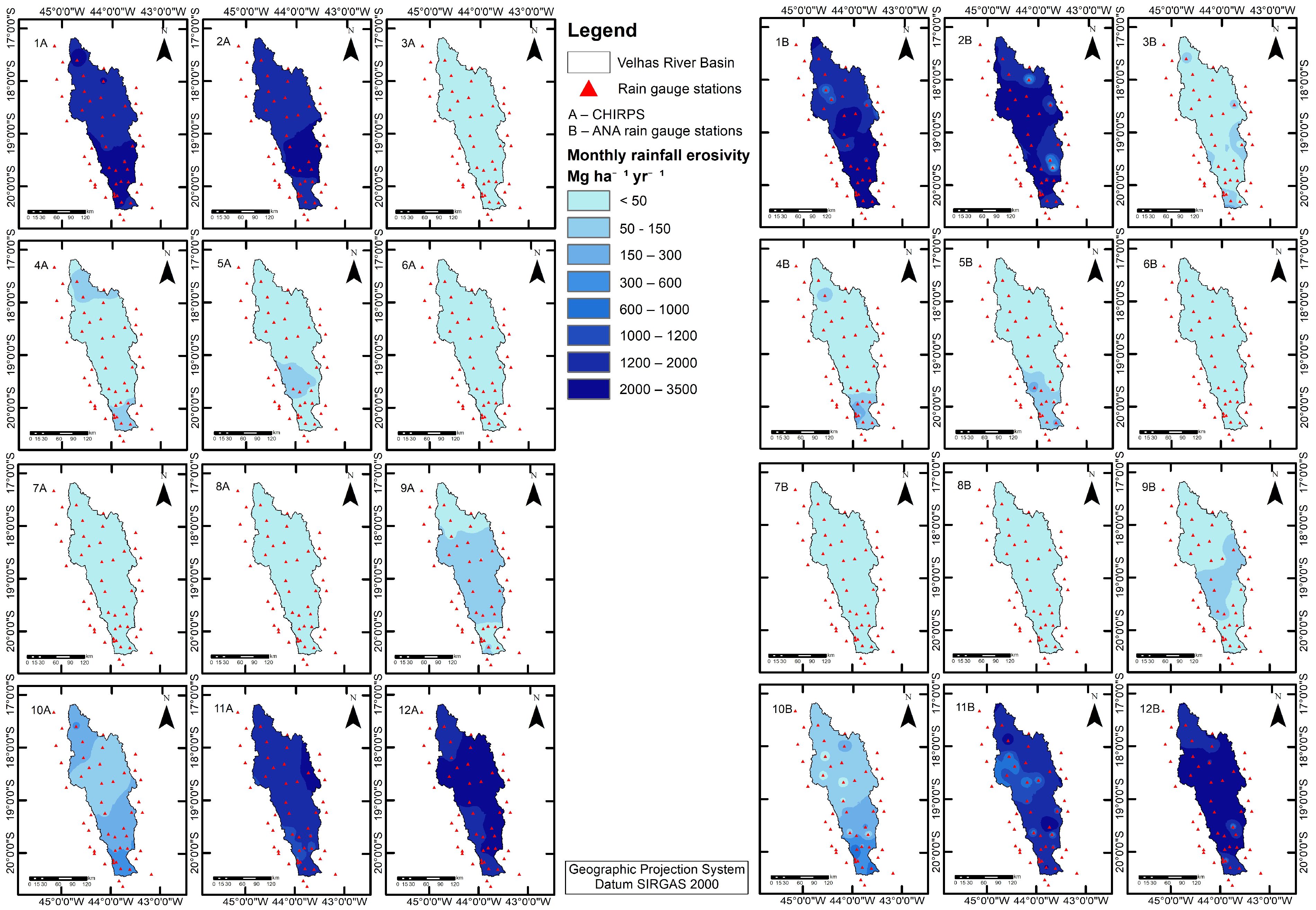
To complement the annual analysis, Figure 7 and Figure 8 present the monthly spatial distribution of rainfall erosivity for the years of minimum (2014) and maximum (2022) erosivity, based on data from CHIRPS and rain gauge stations, respectively. In 2014, rainfall erosivity remained relatively low throughout the year, with more restricted areas of moderate values during the rainy season. In contrast, 2022 showed a marked concentration of higher erosivity values during some months, especially in the rainy season, with a wider spatial distribution and greater intensity across the basin. These patterns indicate that the annual increase in rainfall erosivity was associated with the temporal concentration of erosive events, and not with a uniform increase throughout the year.

3.2. Soil Loss Estimates

Based on the years of minimum (2014) and maximum (2022) rainfall erosivity, the RUSLE model was applied to estimate soil loss under contrasting climate scenarios. The selection of these two years was intentional and aimed to isolate the influence of rainfall erosivity (R factor) on soil loss dynamics, keeping the other RUSLE factors (K, LS, C, and P) unchanged. This approach allows for comparison between extreme erosivity conditions and provides a clearer assessment of how rainfall erosivity variability affects the spatial distribution and magnitude of soil loss. The estimated soil loss results are presented in Table 3.
Statistical comparison of mean soil loss estimates by land use and land cover class showed high correspondence between results based on ANA and CHIRPS stations, both in 2014 and 2022. In 2014, the mean annual soil loss was 24.33 t ha−1 yr−1, whereas in 2022 it increased to 52.57 t ha−1 yr−1. The paired Student’s t-test did not indicate statistically significant differences between the datasets at the 5% level, with p = 0.1619 in 2014 and p = 0.1126 in 2022. In 2014, CHIRPS-based estimates were lower than station-based estimates, with a mean bias of −3.68 Mg ha−1 year−1, a mean percent bias of −15.14%, MAE = 3.68 Mg ha−1 year−1 and RMSE = 7.70 Mg ha−1 year−1. In 2022, the mean bias was −7.38 Mg ha−1 year−1, the mean percentage bias was −14.03%, the MAE = 7.40 Mg ha−1 year−1, and the RMSE = 13.84 Mg ha−1 year−1. The comparison between the minimum and maximum erosivity years indicated an increase in average soil loss in all land use classes, with average increases of 116.07% for estimates based on meteorological stations and 118.88% for estimates based on CHIRPS. The very high Pearson correlation (r = 0.99) reflects the use of the same K, LS, C, and P factors in both RUSLE simulations, with differences restricted to the rainfall erosivity input.
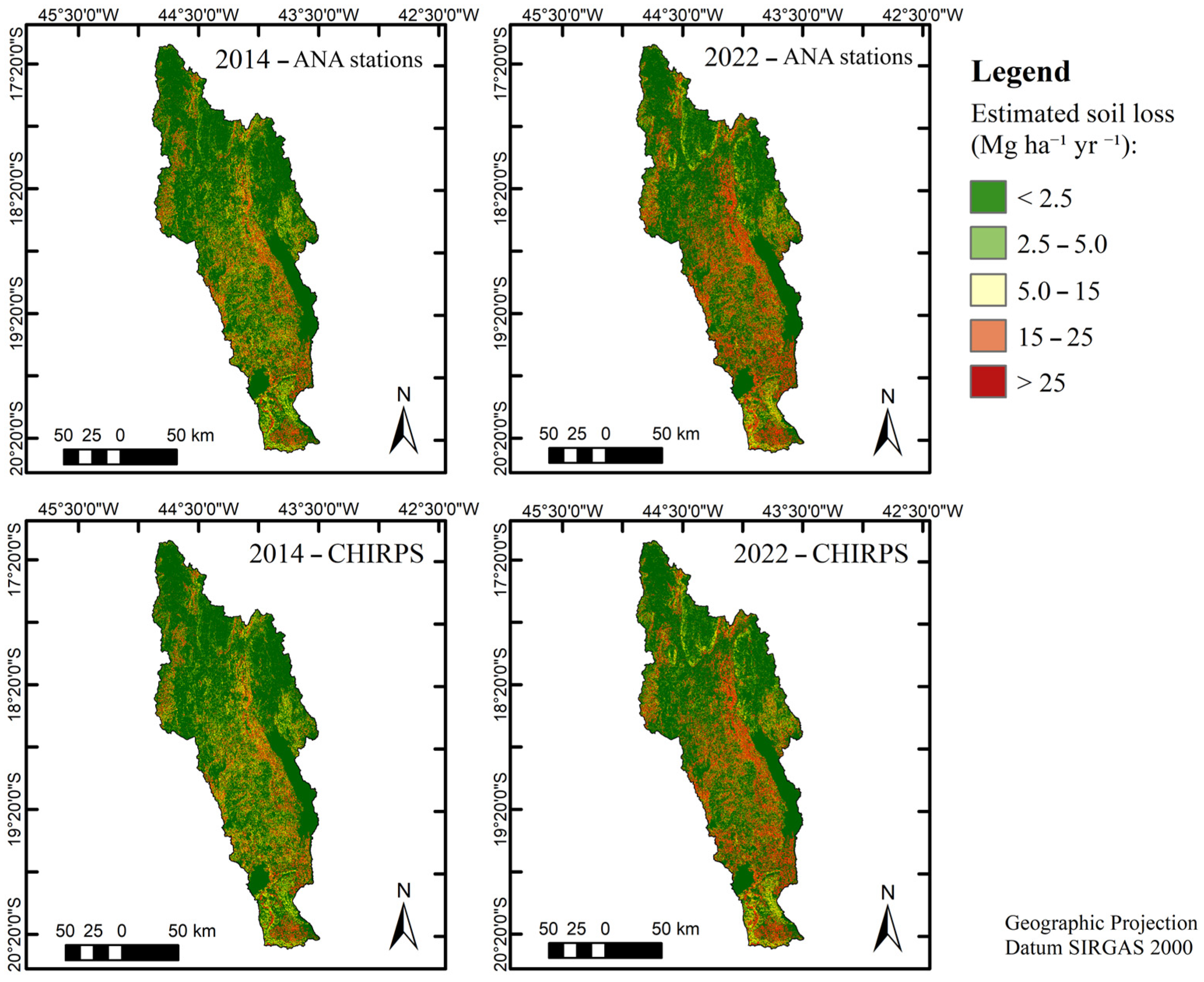
Spatially, the highest soil losses are concentrated in the Quadrilátero Ferrífero and in the mountainous sectors of the central–southern portion of the basin, where steep slopes and shallow soils increase the LS factor and enhance surface runoff (Figure 9).
In contrast, areas with gentler relief in the middle and lower reaches of the basin exhibit moderate soil loss, associated with the predominance of Latosols and Argisols and greater surface protection.

3.3. Rainfall Erosivity and Climate Change

The relationship between mean annual precipitation and rainfall erosivity (R) is shown in Figure 10 and Figure 11, which summarize the interannual variability over the study period.
The time series presented in Figure 10 and Figure 11 show interannual variation in rainfall erosivity between 2014 and 2024 for both ANA and CHIRPS datasets. In both series, lower erosivity values were observed in 2014 and 2017, whereas higher values occurred mainly in 2016, 2020, 2022, and 2024. The highest erosivity value was recorded in 2022, while 2014 corresponded to the lowest erosivity year. CHIRPS followed the general temporal pattern observed in ANA, although some peak values were lower than those estimated from rain gauge data. The highlighted soil loss values correspond to the basin-scale mean annual estimates obtained for the years selected for RUSLE modeling. These values represent the average soil loss for the entire basin, considering all land use and land cover classes together.

4. Discussion

4.1. Interannual Variability of Rainfall and Erosivity

Interannual variability in precipitation in the Velhas River Basin is directly reflected in the rainfall erosivity values estimated for the 2014–2024 period. Although 2020 recorded the highest annual precipitation total, maximum rainfall erosivity was observed in 2022. This behavior is consistent with the original formulation of RUSLE, in which rainfall erosivity is a function of rainfall kinetic energy and the maximum 30 min intensity of rainfall events (EI30) [6,9].
Previous studies at the national scale indicate that tropical regions exhibit high sensitivity of rainfall erosivity to rainfall irregularity, particularly when associated with extreme events [7,15,16]. His behavior is consistent with broader erosivity assessments showing that the r factor responds not only to annual rainfall totals, but also to rainfall intensity, seasonal concentration, and intra-annual distribution of erosive events [11,13]. In Brazil, monthly erosivity patterns show that the highest erosive potential is commonly concentrated during the rainy season, especially between November and February [13]. The intensification observed during the 2020–2022 period suggests a greater concentration of high-energy rainfall events, even without a proportional increase in total annual precipitation, a pattern consistent with scenarios of increasing rainfall extremes reported in recent climate assessments [4,5].
The annual statistical results reinforce this interpretation. Pearson’s correlation coefficients between ANA- and CHIRPS-derived erosivity varied substantially between years, from −0.0484 in 2021 to 0.7477 in 2015, indicating that the agreement between the datasets was not uniform throughout the study period. This variability suggests that CHIRPS performance was influenced by the annual distribution and spatial concentration of rainfall events. Years with more irregular and intense rainfall patterns showed greater discrepancies between the datasets, whereas years with more homogeneous rainfall distribution tended to present better agreement. This behavior is consistent with previous CHIRPS validation studies in Brazil, which reported that the product can represent rainfall variability at monthly and seasonal scales, but its performance varies according to rainfall regime and may decrease under conditions of higher rainfall intensity or spatial heterogeneity [19].
This pattern is particularly evident during the 2020–2022 period. CHIRPS underestimated rainfall erosivity in 2020, 2021, and 2022, with mean biases of −11.98%, −12.29%, and −13.43%, respectively. These years correspond to the period of greater erosive potential and suggest that the satellite product had greater difficulty representing rainfall erosivity under conditions of higher rainfall energy and temporal concentration. Similar limitations have been reported in CHIRPS-based precipitation assessments, in which higher rainfall values and extreme events tend to present greater uncertainty or attenuation when compared with rain gauge observations [19]. Conversely, overestimation occurred in some years, such as 2015 (+12.89%) and 2018 (+5.01%), indicating that the direction and magnitude of the bias varied according to annual rainfall characteristics.
The largest discrepancies were observed in 2022, the year of maximum erosivity, when MAE reached 1771.26 MJ·mm·ha−1·h−1·yr−1 and RMSE reached 2157.00 MJ·mm·ha−1·h−1·yr−1. The higher RMSE indicates the presence of larger errors in specific paired observations, probably associated with intense and spatially concentrated rainfall events. Therefore, the statistical results support the interpretation that the maximum erosivity observed in 2022 was not primarily related to the highest annual precipitation total, but to the temporal concentration and intensity of rainfall events.
The spatial patterns observed in the precipitation maps (Figure 2 and Figure 3) indicate that, despite interannual variability in total rainfall, the overall distribution of precipitation across the basin remains relatively stable, with higher values consistently concentrated in the southern sector. This spatial consistency suggests that differences in erosivity between years are not primarily driven by shifts in rainfall location, but rather by changes in rainfall intensity and temporal concentration.
The monthly erosivity maps (Figure 7 and Figure 8) provide additional insight into this behavior. In the year of minimum erosivity (2014), erosivity values remain low and relatively homogeneous throughout the year, with only limited increases during the peak rainy season. In contrast, the year of maximum erosivity (2022) is characterized by a pronounced concentration of high erosivity values during specific months, in the austral summer, when intense rainfall events are more frequent. This temporal concentration results in significantly higher annual erosivity, even in the absence of the highest total precipitation. This pattern agrees with broader rainfall erosivity assessments showing that erosive potential is strongly controlled by rainfall intensity and intra-annual concentration, rather than by annual precipitation totals alone [11]. In Brazil, Trindade et al. also reported that the highest monthly erosivity values are commonly concentrated during the rainy season, especially between November and February, reinforcing the importance of monthly analyses for identifying critical erosion periods [13].
These results reinforce that rainfall erosivity in the Velhas River Basin is strongly controlled by the temporal distribution of rainfall events rather than by total annual precipitation alone. The concentration of high-energy rainfall over short periods increases the kinetic energy of precipitation and amplifies erosive processes, particularly in areas with steeper slopes and exposed soils, as previously discussed [6,9,27,48].

4.2. Spatial Patterns of Erosivity and Performance of CHIRPS

The spatial patterns indicate a clear reorganization of rainfall erosivity classes across the basin over time. During dry years, especially 2014 and 2017, low and moderate classes predominate across most of the basin. In contrast, the 2020–2022 period is characterized by an expansion of moderate–high, high, and very high classes, particularly in the central-southern sector, where the altitudinal gradient and orographic control favor greater concentration of rainfall energy.
This spatial reorganization is consistent with the monthly erosivity patterns presented in Figure 6 and Figure 7, which indicate that the expansion of high-erosivity classes is associated with the temporal concentration of precipitation during specific high-intensity months. Therefore, the expansion of higher-erosivity classes should not be interpreted only as a consequence of increased annual precipitation, but also as a response to more erosive rainfall events concentrated during specific periods of the rainy season.
The comparison between ANA stations and CHIRPS indicates similar temporal behavior in annual rainfall erosivity, although the satellite-derived product tends to attenuate extreme values. Considering all paired station-year observations, Pearson’s correlation coefficient was 0.7196, indicating a moderately strong positive association between ANA and CHIRPS-derived erosivity estimates. This result demonstrates that CHIRPS was able to reproduce the general spatial and temporal patterns of rainfall erosivity at the watershed scale. However, the paired Student’s t-test indicated a statistically significant difference between the datasets (p = 2.178 × 10⁻¹⁰), showing that this agreement did not eliminate systematic differences in the magnitude of the estimates.
The overall mean bias was −396.16 MJ·mm·ha−1·h−1·yr−1, corresponding to −5.74%, indicating that CHIRPS generally underestimated rainfall erosivity in relation to ANA observations. The MAE and RMSE values were 1117.30 and 1474.02 MJ·mm·ha−1·h−1·yr−1, respectively, confirming that differences between the datasets remained relevant in terms of magnitude. The higher RMSE compared with MAE suggests that larger errors occurred in specific station-year pairs, particularly where erosivity values were higher or more spatially concentrated.
This attenuation of extreme values is expected, since satellite-derived precipitation products may have limitations in detecting short-duration, high-intensity rainfall events, which are important determinants of rainfall erosivity and directly influence the R factor [13,14]. As the original concept of EI30 strongly depends on rainfall intensity and kinetic energy [6,8], this underestimation is particularly relevant for erosivity studies. Similar limitations have been reported in CHIRPS-based precipitation assessments, in which higher rainfall values and extreme events tend to present greater uncertainty or attenuation when compared with rain gauge observations [19]. In this context, the negative bias observed for CHIRPS is consistent with the smoothing of localized rainfall extremes, especially during years of greater erosive potential.
Despite these limitations, the statistical indicators demonstrate that CHIRPS remains suitable for regional hydrosedimentological analyses. The strong overall correlation indicates that the product captures the general behavior of rainfall erosivity, while the bias, MAE, RMSE, and paired t-test show that caution is required when interpreting absolute erosivity magnitudes and localized peak values. Therefore, CHIRPS is particularly useful for regional-scale assessments in large tropical basins with limited rainfall monitoring, where continuous rain gauge coverage is often unavailable [17,18,19,20,21], but estimates should be interpreted carefully in areas or periods affected by intense, localized rainfall events.

4.3. Soil Loss Response Under Contrasting Erosivity Scenarios

The application of RUSLE to years with minimum (2014) and maximum (2022) rainfall erosivity highlighted the central role of the R factor as the main interannual driver of potential soil loss. In 2014, soil loss values below 5 Mg ha−1 yr−1 predominate across most of the basin, whereas in 2022 there was a clear expansion of areas exceeding 15 Mg ha−1 yr−1, particularly in agricultural areas and mountainous sectors.
This pattern reflects the interaction between rainfall erosivity (R), topography (LS), and land use and management (C). Areas with steeper slopes, such as the Quadrilátero Ferrífero, promote greater concentration of surface runoff, thereby amplifying the effect of rainfall [33,35]. Conversely, deep and well-structured soils, predominant in the middle and lower portions of the basin, tend to attenuate the erosive response, as documented in tropical Latosols and Argisols [30,35,40]. The highest soil losses occur in temporary crops and poorly vegetated areas, reflecting high values of the C factor [21,28,46]. In contrast, forest formations maintained low soil loss rates, reinforcing their role in hydrosedimentological protection of the basin [21,28,39].
The statistical comparison indicates that CHIRPS-derived erosivity reproduced the general pattern of RUSLE-based soil loss obtained from ANA station data, although with lower magnitudes. The negative biases observed in CHIRPS-based soil loss estimates followed the same pattern found for rainfall erosivity, indicating that differences in precipitation and erosivity inputs propagated directly into RUSLE estimates. Since the same K, LS, C, and P factors were used in both simulations, these differences were mainly associated with the rainfall erosivity input [6,40]. The higher MAE and RMSE values in 2022 indicate that discrepancies between ANA- and CHIRPS-based estimates increased under the maximum erosivity scenario. Therefore, CHIRPS represents a useful alternative for regional soil loss assessments where rain gauge data are limited, but its estimates should be interpreted with caution in years of higher erosive potential [18,19].
The comparison between the years of minimum and maximum erosivity shows that the increase in rainfall erosivity from 2014 to 2022 was reflected in all land use and land cover classes, but with different magnitudes. Forest and savanna formations showed smaller absolute increases, while exposed soils, temporary crops, and perennial crops showed the largest increases [21,28,46]. This pattern indicates that the effect of rainfall erosivity on soil loss is mediated by land use and vegetation cover, represented in RUSLE by the C factor [6,37]. Although paired tests did not indicate statistically significant differences between ANA- and CHIRPS-based estimates, the results support the spatial interpretation of the maps, showing that the main changes occurred in already susceptible classes, especially exposed soils and agricultural areas [35,40]. This pattern is consistent with other RUSLE applications in Brazil, which have reported higher soil loss estimates in non-vegetated areas, agricultural land, and pastures, and lower values in forested and natural vegetation classes [8,43]. Therefore, the results reinforce that the effect of rainfall erosivity on soil loss is mediated by land use and vegetation cover conditions, rather than acting uniformly across the basin [21,46].

4.4. Climatic Variability and Hydrosedimentological Sensitivity

The temporal pattern suggests a recent increase in the frequency of years classified as high or very high in terms of rainfall erosivity. Although the analyzed series does not allow robust conclusions regarding long-term climatic trends, the coincidence between erosivity peaks and years of higher rainfall irregularity is consistent with scenarios of increasing precipitation extremes associated with global climate warming [4]. Previous reviews have also emphasized that rainfall erosivity is strongly affected by changes in rainfall intensity, temporal concentration, and seasonal distribution, reinforcing the importance of evaluating both annual variability and intra-annual rainfall behavior in erosivity studies [11].
Figure 9 and Figure 10 illustrate the temporal relationship between annual precipitation and rainfall erosivity based on rain gauge observations and CHIRPS estimates. Despite differences in data sources, both series reveal a consistent interannual pattern in which variations in rainfall erosivity closely track changes in rainfall regime rather than total annual precipitation alone. This agreement indicates that the erosive response of the basin is primarily controlled by the intensity and temporal concentration of rainfall events, a behavior consistently captured by both observational and satellite-based datasets.
Although monthly precipitation data were used for rainfall erosivity estimation, the main analysis was conducted at the annual scale because RUSLE is conceptually designed to estimate average annual soil loss [11,12]. The objective of this study was to evaluate how interannual variability in rainfall erosivity influences soil loss dynamics under contrasting climatic conditions rather than to perform a detailed seasonal climatological analysis. Thus, the annual approach allowed direct comparison between years of minimum and maximum erosivity and better assessment of the influence of the R factor on soil loss patterns. The monthly erosivity maps were used as complementary evidence to interpret the temporal concentration of erosive rainfall within the selected years, following the relevance of monthly erosivity assessments reported in Brazilian and international studies [11,13].
Greater atmospheric energy availability favors the main development of more intense storms and temporally concentrated precipitation, increasing raindrop kinetic energy and consequently the R factor [4,6]. In basins with dissected relief and intense anthropogenic land use, such as the Velhas River Basin, this climatic intensification tends to generate a disproportionate erosive response, increasing the vulnerability of structurally sensitive sectors.
Therefore, the erosive dynamics of the Velhas River Basin result from a multiscale interaction between climatic variability, geomorphological characteristics, and land use changes, with the R factor acting as the primary interannual trigger of increased soil loss.

4.5. Limitations and Management Implications

As described in Section 2.2, rainfall erosivity was estimated using empirical equations based on monthly and annual precipitation totals. While this approach may smooth out short-duration extreme rainfall events and partially underestimate event-scale erosivity, it remains adequate for regional-scale analyses and for temporal and spatial comparison of rainfall erosivity in large areas with limited pluviographic monitoring [9,11,12,13,14,15]. Similarly, CHIRPS slightly underestimated extreme values, which is expected due to the attenuation of high-intensity rainfall events commonly observed in satellite-derived precipitation products.
Another important limitation is the absence of independent sedimentological validation, such as measurements of sediment production, reservoir siltation rates, or observations in erosion plots. Since RUSLE estimates potential soil loss rather than directly observed sediment transport, the results should be interpreted as indicators of relative spatial susceptibility, and not as absolute measurements of sediment production [6,10]. This interpretation is consistent with regional-scale RUSLE applications, which emphasize the usefulness of the model for identifying spatial patterns, critical areas, and relative erosion susceptibility, while recognizing the need for field validation to quantify sediment production [8,20,36,40,47]. This distinction is particularly important in large basins where sedimentological observations are scarce or spatially discontinuous. Despite this limitation, RUSLE remains useful for supporting watershed management strategies and prioritizing areas prone to soil loss [20,36,40].
From a management perspective, the expansion of areas with high soil loss in agricultural sectors and steep slopes highlights the need for conservation practices, especially in the Iron Quadrangle and the south–central portions of the basin [48]. Measures such as maintaining vegetation cover, contour farming, recovering degraded pastures, and restoring vegetation can reduce surface runoff concentration and improve hydrosedimentological stability, as reported for tropical basins under similar environmental conditions [21,28,37,46,49].

5. Conclusions

This study demonstrated that interannual variability in rainfall erosivity is the main natural driver of soil loss in the Velhas River Basin. Increases in the R factor not only raise mean soil loss values but also expand the spatial extent of critical erosion-prone areas.
Rainfall erosivity was controlled by mainly by rainfall intensity and temporal concentration rather than by total annual precipitation. Although the highest annual rainfall occurred in 2020, the highest erosivity was recorded in 2022, confirming the importance of intense rainfall events in erosive dynamics.
The comparison between rain gauge observations and CHIRPS showed consistent temporal behavior between annual basin-scale mean erosivity values, although CHIRPS slightly underestimated extreme values. Even so, the product proved suitable for regional hydrosedimentological analyses in areas with limited monitoring coverage.
These findings reinforce the importance of conservation practices adapted to climatic variability, relief conditions, and land use patterns, supporting the prioritization of interventions in areas with recurrent high erosivity, particularly in agricultural regions and steep slopes with greater erosion susceptibility, where erosion risks are more pronounced.

Author Contributions

Conceptualization, G.d.S.R., D.B.S., T.d.M.B., V.H.F.d.S., F.G.R., J.E.B.A. and R.L.M.; methodology, G.d.S.R., D.B.S., T.d.M.B., F.G.R., J.E.B.A. and R.L.M.; software, G.d.S.R.; validation, G.d.S.R.; formal analysis, G.d.S.R. and R.L.M.; investigation, G.d.S.R. and R.L.M.; resources, F.G.R., J.E.B.A. and R.L.M.; data curation, G.d.S.R., M.A.R.P., F.S.G., D.B.S.; writing—original draft preparation, G.d.S.R.; writing—review and editing, G.d.S.R., D.B.S., V.S., M.R., T.d.M.B., V.H.F.d.S., F.G.R., P.F.R.G., V.H.F.d.S., J.E.B.A. and R.L.M.; visualization, G.d.S.R.; supervision, J.E.B.A., V.S., F.G.R. and R.L.M.; project administration, G.d.S.R. and R.L.M.; funding acquisition, R.L.M. and J.E.B.A. All authors have read and agreed to the published version of the manuscript.

Funding

This research was funded by the Coordination for the Improvement of Higher Education Personnel—Brazil (CAPES), Finance Code 001. The APC was funded by the author Joaquim Ernesto Bernardes Ayer.

Data Availability Statement

Rainfall data from ground-based rain gauge stations were obtained from the Brazilian National Water and Sanitation Agency (ANA) through the Hidroweb hydrometeorological database, available at: https://www.snirh.gov.br/hidroweb/, accessed on 10 January 2025. Estimated precipitation data were obtained from the Climate Hazards Group InfraRed Precipitation with Station data (CHIRPS), available at: https://www.chc.ucsb.edu/data/chirps, accessed on 10 January 2025. Land use and land cover data were acquired from the MapBiomas Project (latest collection), available at: https://mapbiomas.org/. Values for the cover-management factor (C factor) were obtained from previously published scientific studies cited in the manuscript. Topographic data used to derive the LS factor were obtained from the Copernicus Digital Elevation Model, available at: https://spacedata.copernicus.eu. The LS factor was calculated using the Moore and Burch method implemented in ArcGIS software. All original datasets are publicly available from their respective repositories. The datasets generated during the analysis, including rainfall erosivity indices and spatial outputs, are available from the corresponding author upon reasonable request.

Acknowledgments

The authors thank CAPES (Coordination for the Improvement of Higher Education Personnel) for the scholarship to the first and seventh authors, and CNPq (National Council for Scientific and Technological Development) for the scholarship to the fourth, eighth and ninth authors. All individuals included in this section have consented to the acknowledgement.

Conflicts of Interest

The authors declare no conflicts of interest.

Abbreviations

The following abbreviations are used in this manuscript:
ANABrazilian National Water and Sanitation Agency
VRBVelhas River Basin
CHIRPSClimate Hazards Group InfraRed Precipitation with Station Data
DEMDigital Elevation Model
EMBRAPAEmpresa Brasileira de Pesquisa Agropecuária
GEEGoogle Earth Engine
GISGeographic Information System
IDWInverse Distance Weighting
RUSLERevised Universal Soil Loss Equation
UFVUniversidade Federal de Viçosa

References

  1. Pimentel, D.; Burgess, M. Soil Erosion Threatens Food Production. Agriculture 2013, 3, 443–463. [Google Scholar] [CrossRef]
  2. Panagos, P.; Borrelli, P.; Poesen, J.; Ballabio, C.; Lugato, E.; Meusburger, K.; Montanarella, L.; Alewell, C. The new assessment of soil loss by water erosion in Europe. Environ. Sci. Policy 2015, 54, 438–447. [Google Scholar] [CrossRef]
  3. García-Ruiz, J.M.; Nadal-Romero, E.; Lana-Renault, N.; Beguería, S. Erosion in Mediterranean landscapes: Changes and future challenges. Geomorphology 2015, 198, 20–36. [Google Scholar] [CrossRef]
  4. IPCC. Climate Change 2021: The Physical Science Basis; Cambridge University Press: Cambridge, UK, 2021. [Google Scholar]
  5. Marengo, J.A.; Cardona, O.-D. Editorial: Climatic hazards and disaster risk reduction in South-Central America and the Caribbean. Front. Clim. 2022, 12, 19. [Google Scholar] [CrossRef]
  6. Renard, K.G.; Foster, G.R.; Weesies, G.A.; McCool, D.K.; Yoder, D.C. Predicting Soil Erosion by Water: A Guide to Conservation Planning with the RUSLE; USDA Handbook 703; USDA: Washington, DC, USA, 1997. [Google Scholar]
  7. Alvares, C.A.; Stape, J.L.; Sentelhas, P.C.; Gonçalves, J.L.M.; Sparovek, G. Köppen’s Climate Classification Map for Brazil. Meteorol. Z. 2013, 22, 711–728. [Google Scholar] [CrossRef]
  8. Lense, G.H.E.; Moreira, R.S.; Parreiras, T.C.; Mincato, R.L. Soil losses in the State of Rondônia, Brazil. Ciênc. Rural 2021, 51, e20200460. [Google Scholar] [CrossRef]
  9. Oliveira, P.T.S.; Wendland, E.; Nearing, M.A. Rainfall Erosivity in Brazil: A Review. Catena 2013, 100, 139–147. [Google Scholar] [CrossRef]
  10. Wischmeier, W.H.; Smith, D.D. Predicting Rainfall Erosion Losses: A Guide to Conservation Planning; USDA Handbook 537; USDA: Washington, DC, USA, 1978. [Google Scholar]
  11. Yin, S.; Nearing, M.A.; Borrelli, P.; Xue, X. Rainfall erosivity: An overview of methodologies and applications. Vadose Zone J. 2017, 16, 1–16. [Google Scholar] [CrossRef]
  12. Renard, K.G.; Freimund, J.R. Using monthly precipitation data to estimate the R-factor in the revised USLE. J. Hydrol. 1994, 157, 287–306. [Google Scholar] [CrossRef]
  13. Trindade, A.L.F.; Oliveira, P.T.S.; Anache, J.A.A.; Wendland, E.; Nearing, M.A. Variabilidade espacial da erosividade das chuvas no Brasil. Pesqui. Agropecu. Bras. 2016, 51, 1918–1928. [Google Scholar] [CrossRef]
  14. Riquetti, N.B.; Panagos, P.; Borrelli, P.; Oliveira, P.T.S.; Nearing, M.A. Rainfall Erosivity in South America: Current Patterns and Future Perspectives. Sci. Total Environ. 2020, 724, 138315. [Google Scholar] [CrossRef]
  15. Oliveira-Roza, M.P.; Cecílio, R.A.; Teixeira, D.B.S.; Moreira, M.C.; Almeida, A.Q.; Xavier, A.C.; Zanetti, S.S. Rainfall Erosivity over Brazil: A Large National Database. Data 2024, 9, 120. [Google Scholar] [CrossRef]
  16. Bolleli, T.M.; Santos, B.C.; Sanches, R.G.; Moreira, R.M.; Bourscheidt, V.; Souza, P.H.; Mauad, F.F. Análise espaço-temporal e extrema da erosividade da chuva na região centro-leste do Estado de São Paulo, Brasil. Rev. Dep. Geogr. 2023, 43, e205190. [Google Scholar] [CrossRef]
  17. Funk, C.; Peterson, P.; Landsfeld, M.; Pedreros, D.; Verdin, J.; Shukla, S.; Husak, G.; Rowland, J.; Harrison, L.; Hoell, A.; et al. The Climate Hazards Infrared Precipitation with Stations—A New Environmental Record for Monitoring Extremes. Sci. Data 2015, 96, 69–83. [Google Scholar] [CrossRef]
  18. Arregocés, H.A.; Rojano, R.; Pérez, J. Validation of the CHIRPS dataset in a coastal region with extensive plains and complex topography. Case Stud. Chem. Environ. Eng. 2023, 8, 100452. [Google Scholar] [CrossRef]
  19. Paredes-Trejo, F.J.; Barbosa, H.A.; Kumar, T.V.L. Validating CHIRPS-based satellite precipitation estimates in Northeast Brazil. J. Arid Environ. 2017, 139, 26–40. [Google Scholar] [CrossRef]
  20. Raj, R.; Saharia, M.; Chakma, S. Geospatial modeling and mapping of soil erosion in India. Catena 2024, 240, 107996. [Google Scholar] [CrossRef]
  21. Cooper, M.; Noronha, N.C. Land Use and Erosion. Land 2020, 9, 233. [Google Scholar] [CrossRef]
  22. Salgado, A.A.R.; Santos, L.J.C.; Paisani, J.C. (Eds.) The Physical Geography of Brazil: Environment, Vegetation and Landscape; Springer: Cham, Switzerland, 2019. [Google Scholar]
  23. Alkmim, F.F.; Teixeira, W. The Minas Accretionary Orogen. In São Francisco Craton, Eastern Brazil; Heilbron, M., Alkmim, F.F., Eds.; Springer: Cham, Switzerland, 2017. [Google Scholar]
  24. Cavalcanti, J.A.D.; Silva, M.S.; Schobbenhaus, C.; Atencio, D.; Lima, H.M. Geoconservation of geological and mining heritage related to banded iron formation of Itabira Group, Quadrilátero Ferrífero, Minas Gerais, Brazil: A challenging issue. Int. J. Geoherit. Parks 2023, 11, 118–148. [Google Scholar] [CrossRef]
  25. Wang, Y.; Shu, J.; Yuan, Y. Navigating urban risks for sustainability: A comprehensive evaluation of urban vulnerability based on a pressure–sensitivity–resilience framework. Sustain. Cities Soc. 2024, 117, 105961. [Google Scholar] [CrossRef]
  26. Carmo, F.F.; Lanchotti, A.O.; Kamino, L.H.Y. Mining Waste Challenges: Environmental Risks of Gigatons of Mud, Dust and Sediment in Megadiverse Regions in Brazil. Sustainability 2020, 12, 8466. [Google Scholar] [CrossRef]
  27. Zhao, J.; Wang, Z.; Dong, Y.; Yang, Z.; Govers, G. How Soil Erosion and Runoff Are Related to Land Use, Topography and Annual Precipitation: Insights from a Meta-Analysis of Erosion Plots in China. Sci. Total Environ. 2022, 802, 149665. [Google Scholar] [CrossRef] [PubMed]
  28. Santana, D.B.; Lense, G.H.E.; Rios, G.S.; Archanjo, R.E.; Raniero, M.; Santana, A.B.; Rubira, F.G.; Ayer, J.E.B.; Mincato, R.L. Spatiotemporal Dynamics of Soil and Soil Organic Carbon Losses via Water Erosion in Coffee Cultivation in Tropical Regions. Sustainability 2025, 17, 821. [Google Scholar] [CrossRef]
  29. Instituto Brasileiro de Geografia e Estatística (IBGE). Estimativas Populacionais dos Municípios. Available online: https://www.ibge.gov.br (accessed on 10 January 2025).
  30. Mello, C.R.; Norton, L.D.; Pinto, L.C.; Beskow, S.; Curi, N. Agricultural Watershed Modeling: A Review for Hydrology and Soil Erosion Processes. Ciênc. Agrotec. 2016, 40, 7–25. [Google Scholar] [CrossRef]
  31. Projeto MapBiomas. Coleção 8. Available online: https://mapbiomas.org (accessed on 10 January 2025).
  32. Agência Nacional de Águas e Saneamento Básico (ANA). Sistema Hidroweb. Available online: https://www.snirh.gov.br (accessed on 10 January 2025).
  33. Ramalho Filho, A.; Beek, K.J. Sistema de Avaliação da Aptidão Agrícola das Terras; Embrapa: Rio de Janeiro, Brazil, 1995. [Google Scholar]
  34. Universidade Federal de Viçosa (UFV); Fundação Estadual do Meio Ambiente (FEAM); Fundação Centro Tecnológico de Minas Gerais (CETEC); Universidade Federal de Lavras (UFLA). Mapa de Solos do Estado de Minas Gerais: Legenda Expandida; FEAM: Belo Horizonte, Brazil, 2010.
  35. Curi, N.; Ker, J.C.; Novais, R.F.; Vidal-Torrado, P.; Schaefer, C.E.G.R. Assessing Soil Erosion Susceptibility in a Tropical Landscape: Insights from a Brazilian Case Study. Sustainability 2026, 18, 1878. [Google Scholar] [CrossRef]
  36. Cunha, E.R.; Bacani, V.M.; Panachuki, E. Modeling Soil Erosion Using RUSLE and GIS in a Watershed Occupied by Rural Settlement in the Brazilian Cerrado. Nat. Hazards 2017, 85, 851–868. [Google Scholar] [CrossRef]
  37. Bertoni, J.; Lombardi Neto, F. Conservação do Solo, 10th ed.; Ícone: São Paulo, Brazil, 2017. [Google Scholar]
  38. Durigan, G. Cerrado: Biodiversity and Ecosystem Services under Severe Threat by Misguided Restoration. Ann. Bot. 2025, Advance Article, mcaf306. [Google Scholar] [CrossRef]
  39. Vancine, M.H.; Muylaert, R.L.; Niebuhr, B.B.; Oshima, J.E.F.; Tonetti, V.; Bernardo, R.; De Angelo, C.; Rosa, M.R.; Grohmann, C.H.; Ribeiro, M.C. The Atlantic Forest of South America: Spatiotemporal Dynamics of Vegetation and Implications for Conservation. Biol. Conserv. 2024, 291, 110499. [Google Scholar] [CrossRef]
  40. Beskow, S.; Mello, C.R.; Norton, L.D.; Curi, N.; Viola, M.R.; Avanzi, J.C. Soil erosion prediction in the Grande River Basin, Brazil using distributed modelling. Catena 2009, 79, 49–59. [Google Scholar] [CrossRef]
  41. Environmental Systems Research Institute (ESRI). ArcGIS Desktop, version 10.8; ESRI: Redlands, CA, USA, 2020. Available online: https://www.esri.com/en-us/arcgis/products/arcgis-desktop/overview (accessed on 10 January 2025).
  42. R Core Team. R: A Language and Environment for Statistical Computing; R Foundation for Statistical Computing: Vienna, Austria, 2024. [Google Scholar]
  43. Rios, G.S.; Santana, D.B.; Lense, G.H.E.; Silva, B.A.; Ayer, J.E.B.; Kader, S.; Spalevic, V.; Rubira, F.G.; Mincato, R.L. Estimates of Soil Losses Due to Water Erosion in the Amazon Biome. Agric. For. 2024, 70, 361–378. [Google Scholar] [CrossRef]
  44. Desmet, P.J.J.; Govers, G. A GIS Procedure for Automatically Calculating the LS Factor on Topographically Complex Landscape Units. J. Soil. Water Conserv. 1996, 51, 427–433. [Google Scholar] [CrossRef]
  45. European Space Agency (ESA). Copernicus Digital Elevation Model (DEM). Available online: https://spacedata.copernicus.eu (accessed on 10 January 2025).
  46. Silva, M.L.N.; Curi, N.; Ferreira, M.M.; Lima, J.M. Soil Conservation and Crop Management Effects on Soil Erosion. Rev. Bras. Ciênc. Solo 2012, 36, 683–693. [Google Scholar] [CrossRef]
  47. Mhaske, S.N.; Singh, S.; Bhat, S.; Pandey, A. Assessment and Management of Soil Erosion in the Hilltop Mining Dominated Catchment Using GIS Integrated RUSLE Model. J. Environ. Manag. 2021, 296, 113172. [Google Scholar] [CrossRef] [PubMed]
  48. Lepsch, I.F.; Espindola, C.R.; Visconti, F.; Hernani, L.C.; Siqueira, D.S. Manual para Levantamento Utilitário do Meio Físico e Classificação de Terras no Sistema de Capacidade de Uso; Sociedade Brasileira de Ciência do Solo: Viçosa, Brazil, 2015. [Google Scholar]
  49. EMBRAPA. Manual de Conservação do Solo; Empresa Brasileira de Pesquisa Agropecuária: Rio de Janeiro, Brazil, 1979.
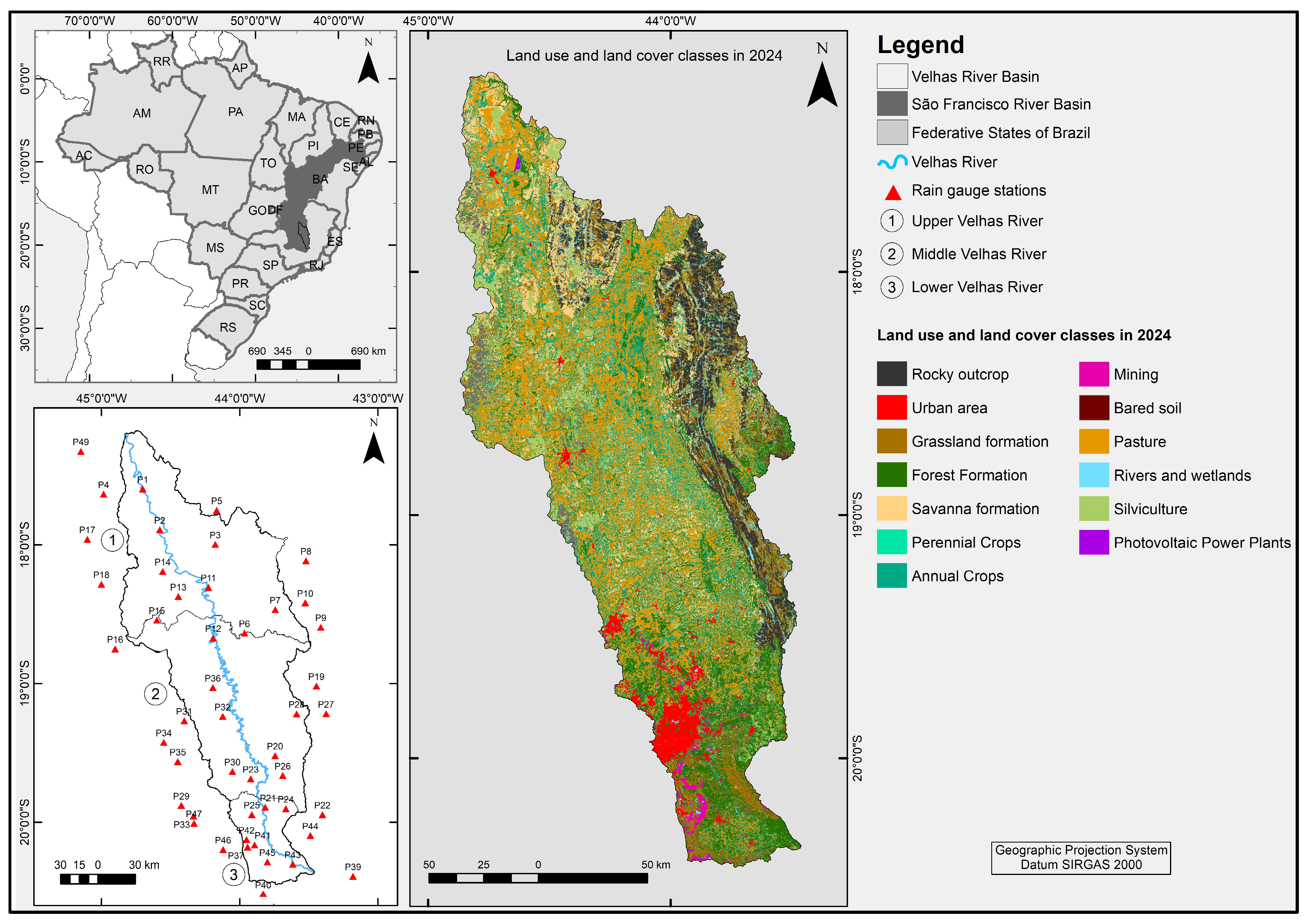
Figure 1. Location and land use and land cover map of the Velhas River Basin, based on data from the MapBiomas Project [31] and the Brazilian National Water and Sanitation Agency (ANA) [32].
Climate 14 00111 g001
Figure 2. Spatial distribution of annual precipitation (mm) in the Velhas River Basin derived from ANA rain gauge stations for the period 2014–2024.
Climate 14 00111 g002
Figure 3. Spatial distribution of annual precipitation (mm) in the Velhas River Basin derived from CHIRPS data for the period 2014–2024.
Climate 14 00111 g003
Figure 4. Station-based comparison of rainfall erosivity (MJ mm ha−1 h−1 yr−1) in the Velhas River Basin for the years of minimum (2014) and maximum (2022) erosivity, including the multi-year mean.
Climate 14 00111 g004
Figure 5. Annual rainfall erosivity derived from CHIRPS data (2014–2024).
Climate 14 00111 g005
Figure 6. Annual rainfall erosivity derived from ANA stations (2014–2024).
Climate 14 00111 g006
Figure 7. Monthly spatial distribution of rainfall erosivity (MJ mm ha−1 h−1 month−1) in the Velhas River Basin for 2014, derived from (A) CHIRPS and (B) ANA rain gauge stations. Panels represent monthly values (1–12).
Climate 14 00111 g007
Figure 8. Monthly spatial distribution of rainfall erosivity (MJ mm ha−1 h−1 month−1) in the Velhas River Basin for 2022, derived from (A) CHIRPS and (B) ANA rain gauge stations. Panels represent monthly values (1–12).
Climate 14 00111 g008
Figure 9. Spatial distribution of soil loss (Mg ha−1 yr−1) in the Velhas River Basin estimated using RUSLE model for years of minimum and maximum rainfall erosivity. 2014—ANA stations; 2022—ANA stations; 2014—CHIRPS; 2022—CHIRPS.
Climate 14 00111 g009
Figure 10. Time series of mean annual precipitation (mm) and rainfall erosivity (R; MJ mm ha−1 h−1 yr−1) in the Velhas River Basin from 2014 to 2024 based on data from ANA rain gauge stations, highlighting extreme events and linear trends.
Climate 14 00111 g010
Figure 11. Time series of mean annual precipitation (mm) and rainfall erosivity (R; MJ mm ha−1 h−1 yr−1) in the Velhas River Basin from 2014 to 2024 based on CHIRPS data, highlighting extreme events and linear trends.
Climate 14 00111 g011
Table 1. C factor values assigned to land use and land cover classes in the Velhas River Basin.
Land Use and Land Cover ClassC FactorReference
Forest Formation0.001[6,10,37]
Savanna Formation0.02[36,37]
Grassland Formation0.02[36,37]
Pasture0.12[36,37]
Silviculture0.08[35,36]
Temporary Crops0.30[6,36,37]
Perennial Crops0.15[36,37]
Urban Areas0.05[37]
Exposed Soil1.00[10]
Table 2. Annual mean erosivity (MJ·mm·ha−1·h−1·yr−1).
YearANA StationsCHIRPS
20144504.903892.63
20155243.705919.40
20167789.006823.38
20175321.095046.08
20186914.777261.33
20195783.336146.41
20208692.297650.91
20218433.377396.51
20229228.687989.21
20236234.776050.37
20247815.047426.89
Table 3. Mean soil loss (Mg ha−1 yr−1) by land use and land cover classes.
Class2014 Stations2014 CHIRPS2022 Stations2022 CHIRPS
Forest formation0.680.601.501.28
Savanna formation1.641.433.063.14
Grassland formation2.582.345.554.56
Urban areas2.302.016.225.03
Silviculture6.775.6013.5811.61
Pasture7.826.8116.1614.37
Perennial crops21.5018.5372.0159.12
Temporary crops38.4933.6480.8871.72
Exposed soil137.19114.86274.17235.90
Disclaimer/Publisher’s Note: The statements, opinions and data contained in all publications are solely those of the individual author(s) and contributor(s) and not of MDPI and/or the editor(s). MDPI and/or the editor(s) disclaim responsibility for any injury to people or property resulting from any ideas, methods, instructions or products referred to in the content.