A CRY1 Interactor eIF3G1 Negatively Regulates Root Growth Under Blue Light in Arabidopsis
 ,
,  and
and
Abstract
1. Introduction
2. Results
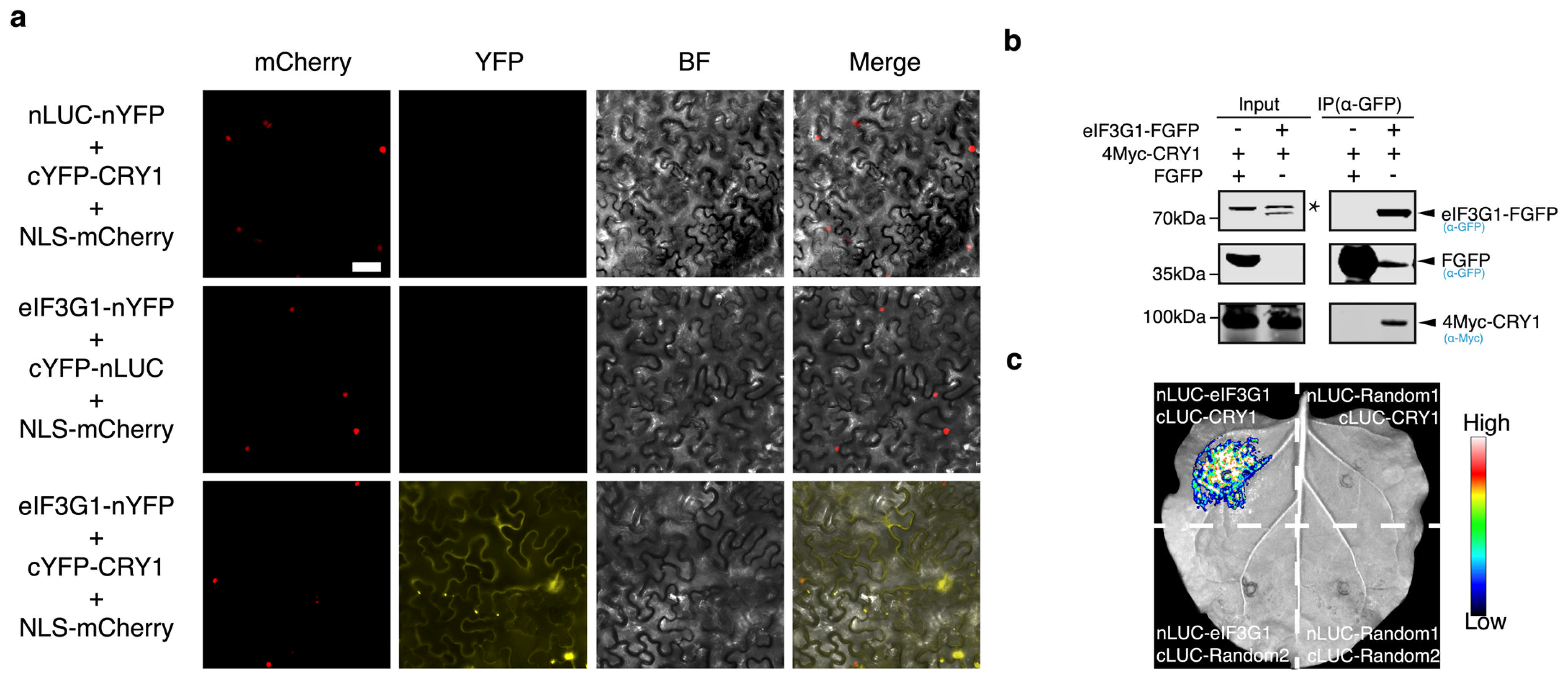
2.1. eIF3G1 Physically Interacts with CRY1 in the Cytoplasm
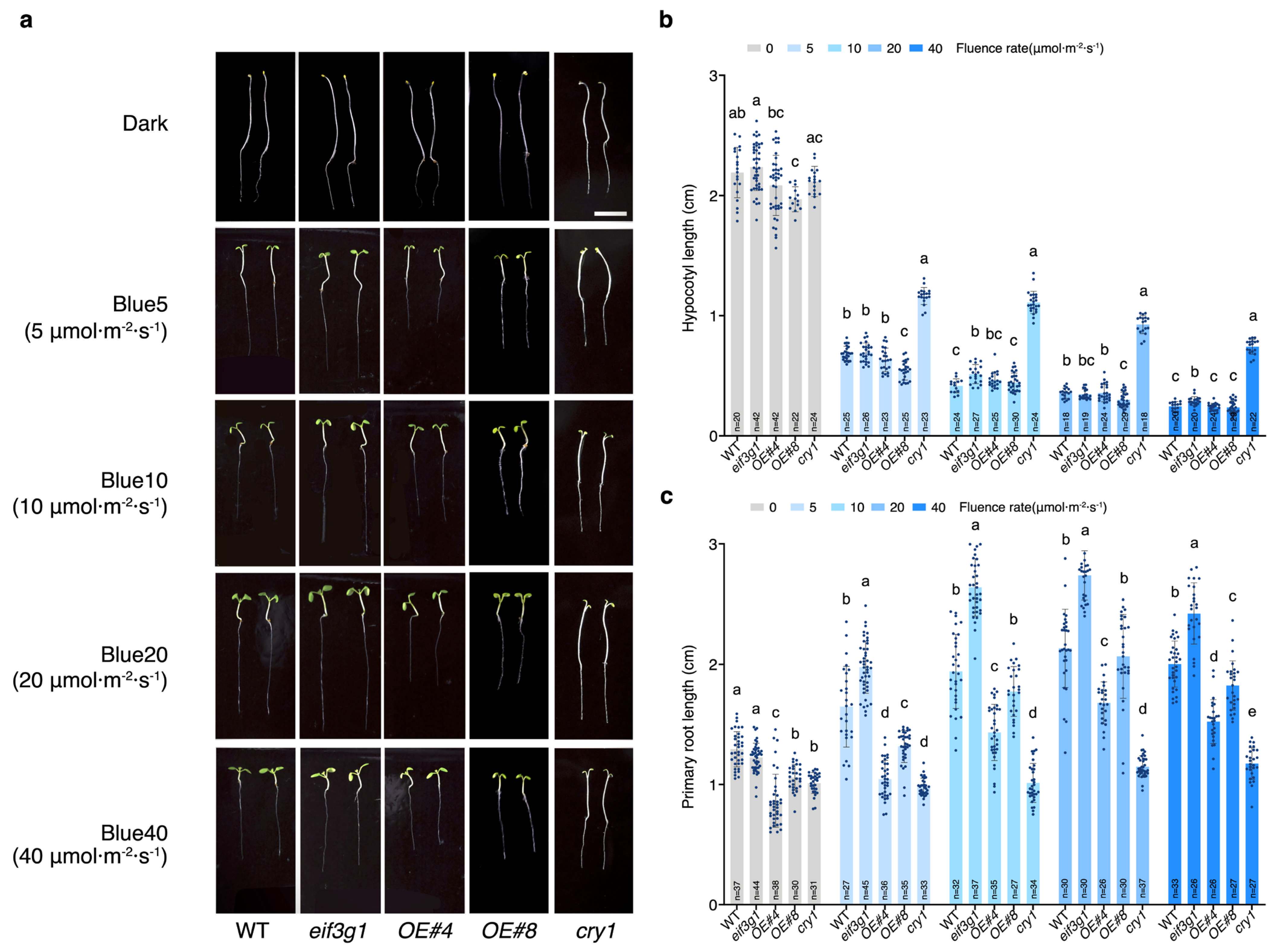
2.2. eIF3G1 Negatively Regulates Primary Root Elongation Under Blue Light
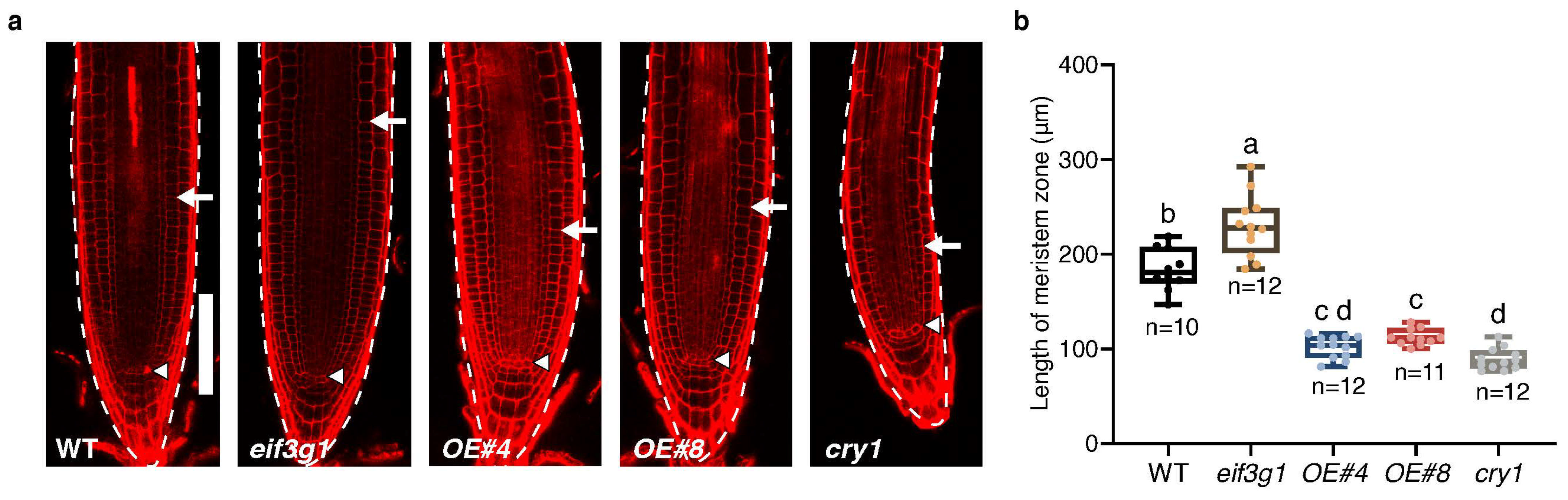
2.3. eIF3G1 Is Associated with Root Apical Meristem Size Under Blue Light

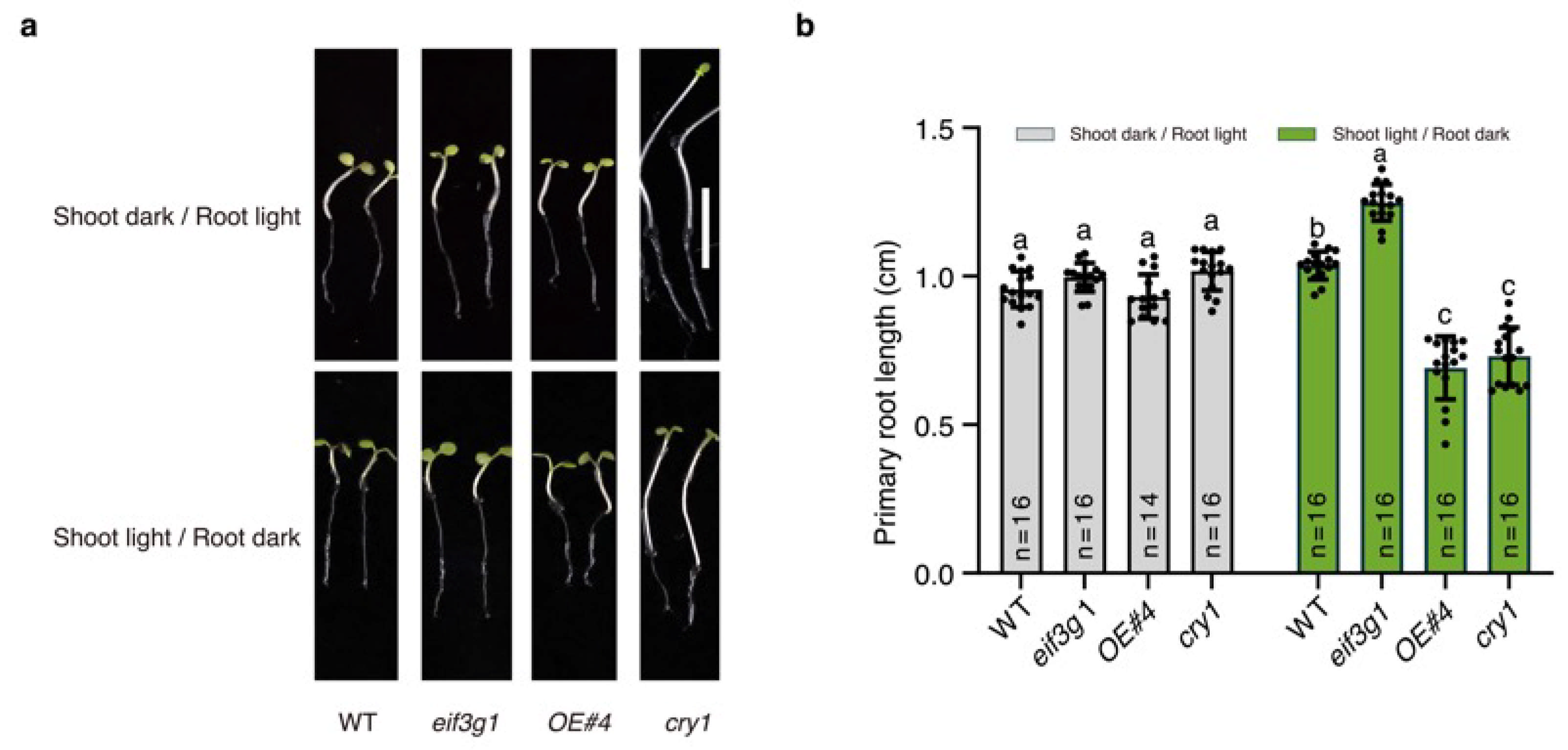
2.4. Shoot Illumination Is Required for eIF3G1-Dependent Root Growth Regulation
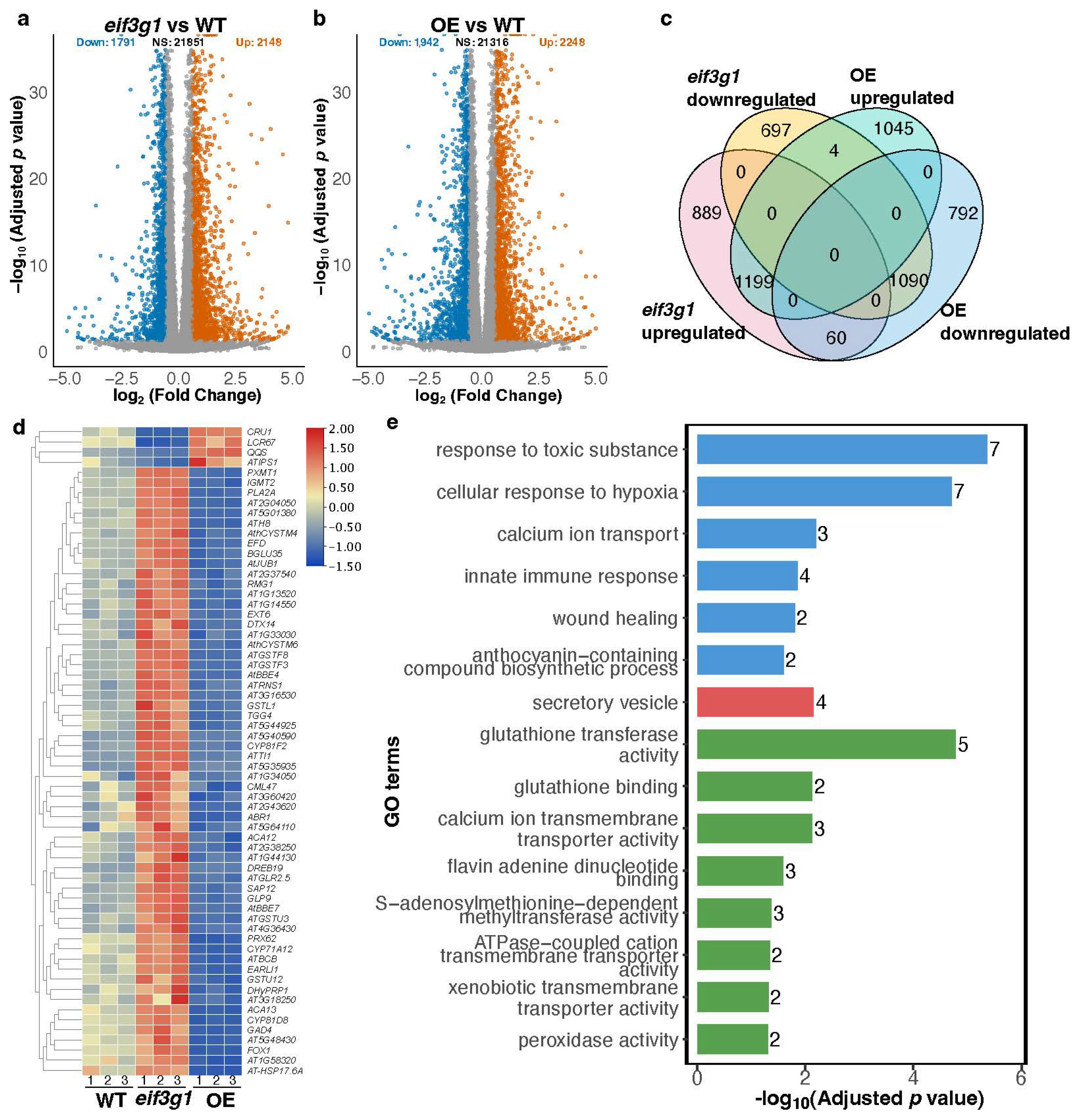
2.5. Transcriptome Profiling Reveals Shared and Genotype-Specific Transcriptional Changes upon Altered eIF3G1 Expression
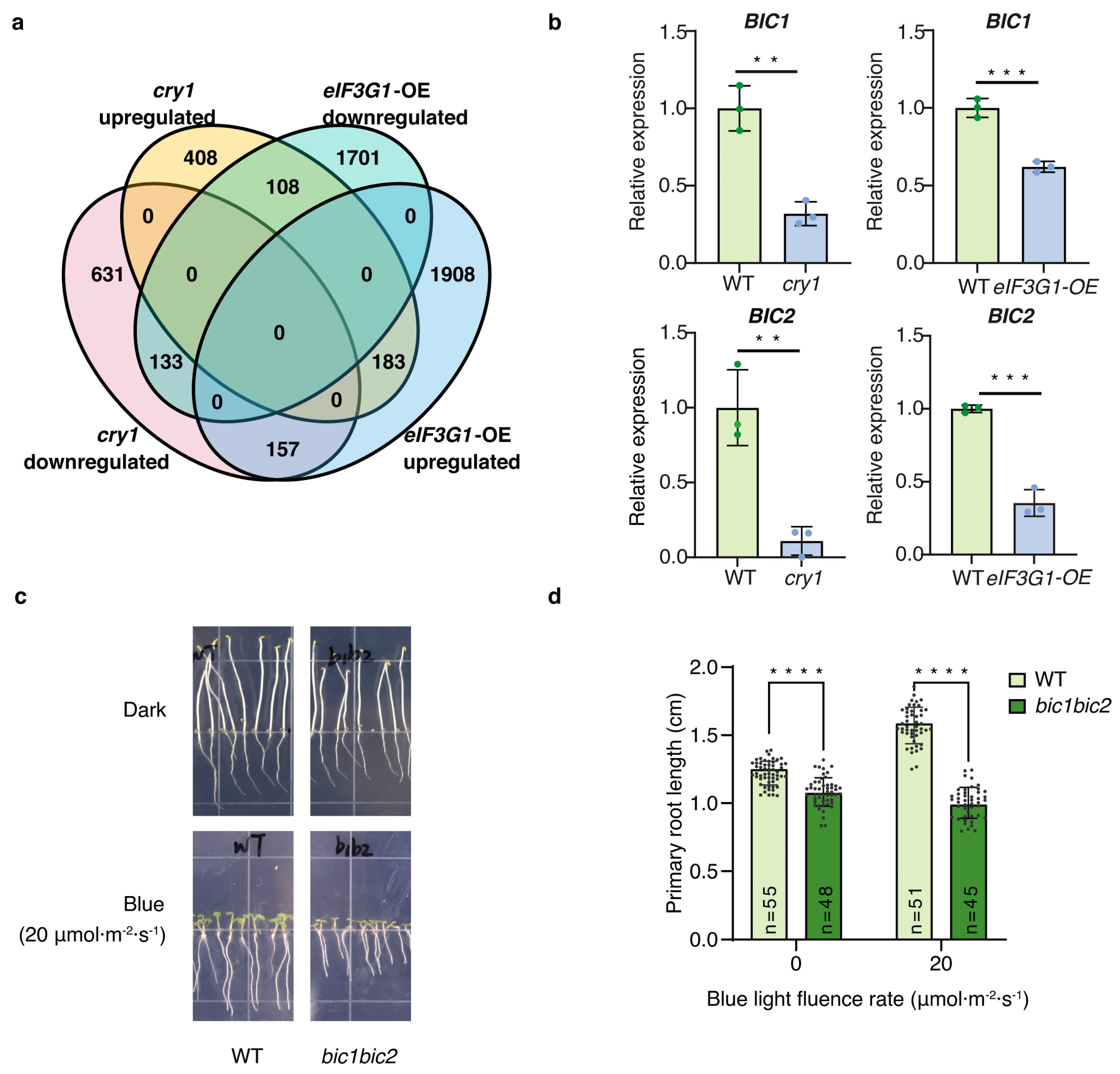
2.6. Identification of BIC1 and BIC2 as Shared Transcriptional Targets of CRY1 and eIF3G1 in Roots
3. Discussion
4. Materials and Methods
4.1. Plant Materials and Growth Conditions
4.2. RNA Isolation and Gene Cloning
4.3. Protein Interaction Assays
4.4. Blue-Light-Regulated Root Phenotypic Analysis
4.5. Separate Illumination System Assays
4.6. Arabidopsis Root Sampling, RNA Extraction and RNA Sequencing
4.7. RNA-Seq Data Processing, Differential Expression and PCA Analysis
4.8. Gene Ontology (GO) Enrichment Analysis
4.9. Data Visualization
5. Conclusions
Supplementary Materials
Author Contributions
Funding
Data Availability Statement
Acknowledgments
Conflicts of Interest
References
- Paik, I.; Huq, E. Plant photoreceptors: Multi-functional sensory proteins and their signaling networks. Semin. Cell Dev. Biol. 2019, 92, 114–121. [Google Scholar] [CrossRef]
- Ahmad, M.; Cashmore, A.R. HY4 gene of A. thaliana encodes a protein with characteristics of a blue-light photoreceptor. Nature 1993, 366, 162–166. [Google Scholar] [CrossRef]
- Lin, C.; Yang, H.; Guo, H.; Mockler, T.; Chen, J.; Cashmore, A.R. Enhancement of blue-light sensitivity of Arabidopsis seedlings by a blue light receptor cryptochrome 2. Proc. Natl. Acad. Sci. USA 1998, 95, 2686–2690. [Google Scholar] [CrossRef]
- Guo, H.; Yang, H.; Mockler, T.C.; Lin, C. Regulation of flowering time by Arabidopsis photoreceptors. Science 1998, 279, 1360–1363. [Google Scholar] [CrossRef]
- Somers, D.E.; Devlin, P.F.; Kay, S.A. Phytochromes and cryptochromes in the entrainment of the Arabidopsis circadian clock. Science 1998, 282, 1488–1490. [Google Scholar] [CrossRef] [PubMed]
- Wang, Q.; Lin, C. Mechanisms of cryptochrome-mediated photoresponses in plants. Annu. Rev. Plant Biol. 2020, 71, 103–129. [Google Scholar] [CrossRef] [PubMed]
- Wang, X.; Lin, C. The two action mechanisms of plant cryptochromes. Trends Plant Sci. 2025, 30, 775–791. [Google Scholar] [CrossRef] [PubMed]
- Miao, L.; Zhao, J.; Yang, G.; Xu, P.; Cao, X.; Du, S.; Xu, F.; Jiang, L.; Zhang, S.; Wei, X.; et al. Arabidopsis cryptochrome 1 undergoes COP1 and LRBs-dependent degradation in response to high blue light. New Phytol. 2022, 234, 1347–1362. [Google Scholar] [CrossRef]
- Wang, X.; Jiang, B.; Gu, L.; Chen, Y.; Mora, M.; Zhu, M.; Noory, E.; Wang, Q.; Lin, C. A photoregulatory mechanism of the circadian clock in Arabidopsis. Nat. Plants 2021, 7, 1397–1408. [Google Scholar] [CrossRef]
- Ma, D.; Li, X.; Guo, Y.; Chu, J.; Fang, S.; Yan, C.; Noel, J.P.; Liu, H. Cryptochrome 1 interacts with PIF4 to regulate high temperature-mediated hypocotyl elongation in response to blue light. Proc. Natl. Acad. Sci. USA 2016, 113, 224–229. [Google Scholar] [CrossRef]
- Mao, Z.; Wei, X.; Li, L.; Xu, P.; Zhang, J.; Wang, W.; Guo, T.; Kou, S.; Wang, W.; Miao, L.; et al. Arabidopsis cryptochrome 1 controls photomorphogenesis through regulation of H2A.Z deposition. Plant Cell 2021, 33, 1961–1979. [Google Scholar] [CrossRef] [PubMed]
- Lee, Y.; Lee, H.S.; Lee, J.S.; Kim, S.K.; Kim, S.H. Hormone- and light-regulated nucleocytoplasmic transport in plants: Current status. J. Exp. Bot. 2008, 59, 3229–3245. [Google Scholar] [CrossRef]
- Liu, Y.; Zhao, Z.; Zhang, X.; Hao, Y.; Feng, F.; Chen, Y.; Wang, J.; Ma, M.; Li, J.; Yu, F.; et al. Structural assembly of maize CRY-GL2 photosignaling complex provides insights into its regulatory role in cuticular wax biosynthesis. Sci. Adv. 2025, 11, eadz0136. [Google Scholar] [CrossRef] [PubMed]
- Wu, G.; Spalding, E.P. Separate functions for nuclear and cytoplasmic cryptochrome 1 during photomorphogenesis of Arabidopsis seedlings. Proc. Natl. Acad. Sci. USA 2007, 104, 18813–18818. [Google Scholar] [CrossRef]
- Stafen, C.F.; Kleine-Vehn, J.; Maraschin, F.D.S. Signaling events for photomorphogenic root development. Trends Plant Sci. 2022, 27, 1266–1282. [Google Scholar] [CrossRef]
- Chen, X.; Yao, Q.; Gao, X.; Jiang, C.; Harberd, N.P.; Fu, X. Shoot-to-root mobile transcription factor HY5 coordinates plant carbon and nitrogen acquisition. Curr. Biol. 2016, 26, 640–646. [Google Scholar] [CrossRef]
- Sassi, M.; Lu, Y.; Zhang, Y.; Wang, J.; Dhonukshe, P.; Blilou, I.; Dai, M.; Li, J.; Gong, X.; Jaillais, Y.; et al. COP1 mediates the coordination of root and shoot growth by light through modulation of PIN1- and PIN2-dependent auxin transport in Arabidopsis. Development 2012, 139, 3402–3412. [Google Scholar] [CrossRef]
- Miotto, Y.E.; da Costa, C.T.; Offringa, R.; Kleine-Vehn, J.; Maraschin, F.D.S. Effects of light intensity on root development in a D-Root growth system. Front. Plant. Sci. 2021, 12, 778382. [Google Scholar] [CrossRef] [PubMed]
- van Gelderen, K.; Kang, C.; Pierik, R. Light signaling, root development, and plasticity. Plant Physiol. 2018, 176, 1049–1060. [Google Scholar] [CrossRef]
- Lee, H.J.; Ha, J.H.; Kim, S.G.; Choi, H.K.; Kim, Z.H.; Han, Y.J.; Kim, J.I.; Oh, Y.; Fragoso, V.; Shin, K.; et al. Stem-piped light activates phytochrome B to trigger light responses in Arabidopsis thaliana roots. Sci. Signal. 2016, 9, ra106. [Google Scholar] [CrossRef]
- Li, J.; Zeng, J.; Tian, Z.; Zhao, Z. Root-specific photoreception directs early root development by HY5-regulated ROS balance. Proc. Natl. Acad. Sci. USA 2024, 121, e2313092121. [Google Scholar] [CrossRef]
- Lee, H.J.; Park, Y.J.; Ha, J.H.; Baldwin, I.T.; Park, C.M. Multiple routes of light signaling during root photomorphogenesis. Trends Plant Sci. 2017, 22, 803–812. [Google Scholar] [CrossRef] [PubMed]
- Zeng, D.; Lv, J.; Li, X.; Liu, H. The Arabidopsis blue-light photoreceptor CRY2 is active in darkness to inhibit root growth. Cell 2025, 188, 60–76. [Google Scholar] [CrossRef]
- Canamero, R.C.; Bakrim, N.; Bouly, J.P.; Garay, A.; Dudkin, E.E.; Habricot, Y.; Ahmad, M. Cryptochrome photoreceptors cry1 and cry2 antagonistically regulate primary root elongation in Arabidopsis thaliana. Planta 2006, 224, 995–1003. [Google Scholar] [CrossRef] [PubMed]
- Zeng, J.; Wang, Q.; Lin, J.; Deng, K.; Zhao, X.; Tang, D.; Liu, X. Arabidopsis cryptochrome-1 restrains lateral roots growth by inhibiting auxin transport. J. Plant Physiol. 2010, 167, 670–673. [Google Scholar] [CrossRef] [PubMed]
- Cuchalová, L.; Kouba, T.; Herrmannová, A.; Dányi, I.; Chiu, W.L.; Valásek, L. The RNA recognition motif of eukaryotic translation initiation factor 3g (eIF3g) is required for resumption of scanning of posttermination ribosomes for reinitiation on GCN4 and together with eIF3i stimulates linear scanning. Mol. Cell Biol. 2010, 30, 4671–4686. [Google Scholar] [CrossRef]
- Herrmannová, A.; Daujotyte, D.; Yang, J.C.; Cuchalová, L.; Gorrec, F.; Wagner, S.; Dányi, I.; Lukavsky, P.J.; Valásek, L.S. Structural analysis of an eIF3 subcomplex reveals conserved interactions required for a stable and proper translation pre-initiation complex assembly. Nucleic Acids Res. 2012, 40, 2294–2311. [Google Scholar] [CrossRef]
- Masutani, M.; Sonenberg, N.; Yokoyama, S.; Imataka, H. Reconstitution reveals the functional core of mammalian eIF3. EMBO J. 2007, 26, 3373–3383. [Google Scholar] [CrossRef]
- Kato, H.; Oguro, A.; Mao, Y.; Ochsner, K.; Casey, H.; Sakai, G.; Wan, J.; Usuki, S.; Tang, L.; Asano, M.; et al. eIF3g binding to GUCG boxes located in mRNA coding regions enhances translation of mild heat shock response genes in the yeast Saccharomyces cerevisiae. Nucleic Acids Res. 2026, 54, gkaf1533. [Google Scholar] [CrossRef]
- Blazie, S.M.; Takayanagi-Kiya, S.; McCulloch, K.A.; Jin, Y. Eukaryotic initiation factor EIF-3.G augments mRNA translation efficiency to regulate neuronal activity. eLife 2021, 10, e68336. [Google Scholar] [CrossRef]
- Abaeva, I.S.; Arhab, Y.; Miścicka, A.; Hellen, C.U.T.; Pestova, T.V. In vitro reconstitution of SARS-CoV-2 Nsp1-induced mRNA cleavage reveals the key roles of the N-terminal domain of Nsp1 and the RRM domain of eIF3g. Genes Dev. 2023, 37, 844–860. [Google Scholar] [CrossRef]
- Kim, J.T.; Lee, S.J.; Kim, B.Y.; Lee, C.H.; Yeom, Y.I.; Choe, Y.K.; Yoon, D.Y.; Chae, S.K.; Kim, J.W.; Yang, Y.; et al. Caspase-mediated cleavage and DNase activity of the translation initiation factor 3, subunit G (eIF3g). FEBS Lett. 2013, 587, 3668–3674. [Google Scholar] [CrossRef]
- Burnicka-Turek, O.; Kata, A.; Buyandelger, B.; Ebermann, L.; Kramann, N.; Burfeind, P.; Hoyer-Fender, S.; Engel, W.; Adham, I.M. Pelota interacts with HAX1, EIF3G and SRPX and the resulting protein complexes are associated with the actin cytoskeleton. BMC Cell Biol. 2010, 11, 28. [Google Scholar] [CrossRef]
- Zheng, Q.; Liu, H.; Ye, J.; Zhang, H.; Jia, Z.; Cao, J. Nuclear distribution of eIF3g and its interacting nuclear proteins in breast cancer cells. Mol. Med. Rep. 2016, 13, 2973–2980. [Google Scholar] [CrossRef] [PubMed][Green Version]
- Yang, C.; Liu, X.; Li, C.; Li, S.; Du, W.; Yang, D. Eukaryotic translation initiation factor 3 subunit G (EIF3G) resensitized HCT116/5-Fu to 5-fluorouracil (5-Fu) via inhibition of MRP and MDR1. OncoTargets Ther. 2018, 11, 5315–5324. [Google Scholar] [CrossRef]
- Holm, A.; Lin, L.; Faraco, J.; Mostafavi, S.; Battle, A.; Zhu, X.; Levinson, D.F.; Han, F.; Gammeltoft, S.; Jennum, P.; et al. EIF3G is associated with narcolepsy across ethnicities. Eur. J. Hum. Genet. 2015, 23, 1573–1580. [Google Scholar] [CrossRef] [PubMed]
- Boodhoo, K.; Vlok, M.; Tabb, D.L.; Myburgh, K.H.; van de Vyver, M. Dysregulated healing responses in diabetic wounds occur in the early stages postinjury. J. Mol. Endocrinol. 2021, 66, 141–155. [Google Scholar] [CrossRef] [PubMed]
- Raabe, K.; Honys, D.; Michailidis, C. The role of eukaryotic initiation factor 3 in plant translation regulation. Plant Physiol. Biochem. 2019, 145, 75–83. [Google Scholar] [CrossRef]
- Zheng, L.; Zhang, Q.; Wang, C.; Wang, Z.; Gao, J.; Zhang, R.; Shi, Y.; Zheng, X. The heat shock factor HSFB1 coordinates plant growth and drought tolerance in Arabidopsis. Plant J. 2025, 121, e17258. [Google Scholar] [CrossRef]
- Singh, B.; Chauhan, H.; Khurana, J.P.; Khurana, P.; Singh, P. Evidence for the role of wheat eukaryotic translation initiation factor 3 subunit g (TaeIF3g) in abiotic stress tolerance. Gene 2013, 532, 177–185. [Google Scholar] [CrossRef]
- Singh, G.; Jain, M.; Kulshreshtha, R.; Khurana, J.P.; Kumar, S.; Singh, P. Expression analysis of genes encoding translation initiation factor 3 subunit g (TaeIF3g) and vesicle-associated membrane protein-associated protein (TaVAP) in drought tolerant and susceptible cultivars of wheat. Plant Sci. 2007, 173, 660–669. [Google Scholar] [CrossRef]
- Tsukagoshi, H.; Busch, W.; Benfey, P.N. Transcriptional regulation of ROS controls transition from proliferation to differentiation in the root. Cell 2010, 143, 606–616. [Google Scholar] [CrossRef]
- Samantaray, D.; Nair, A.U.; Balazadeh, S.; Allu, A.D. JUNGBRUNNEN1, a central regulator of plant growth and stress response. Plant Cell Environ. 2025. online ahead of print. [Google Scholar]
- Li, L.; Zheng, W.; Zhu, Y.; Ye, H.; Tang, B.; Arendsee, Z.W.; Jones, D.; Li, R.; Ortiz, D.; Zhao, X.; et al. QQS orphan gene regulates carbon and nitrogen partitioning across species via NF-YC interactions. Proc. Natl. Acad. Sci. USA 2015, 112, 14734–14739. [Google Scholar] [CrossRef]
- Martín, A.C.; del Pozo, J.C.; Iglesias, J.; Rubio, V.; Solano, R.; de La Peña, A.; Leyva, A.; Paz-Ares, J. Influence of cytokinins on the expression of phosphate starvation responsive genes in Arabidopsis. Plant J. 2000, 24, 559–567. [Google Scholar] [CrossRef] [PubMed]
- Wang, X.; Wang, Q.; Han, Y.J.; Liu, Q.; Gu, L.; Yang, Z.; Su, J.; Liu, B.; Zuo, Z.; He, W.; et al. A CRY-BIC negative-feedback circuitry regulating blue light sensitivity of Arabidopsis. Plant J. 2017, 92, 426–436. [Google Scholar] [CrossRef] [PubMed]
- Juntawong, P.; Bailey-Serres, J. Dynamic light regulation of translation status in Arabidopsis thaliana. Front. Plant. Sci. 2012, 3, 66. [Google Scholar] [CrossRef]
- Liu, M.J.; Wu, S.H.; Chen, H.M.; Wu, S.H. Widespread translational control contributes to the regulation of Arabidopsis photomorphogenesis. Mol. Syst. Biol. 2012, 8, 566. [Google Scholar] [CrossRef]
- Lyons, J.; Merchante, C.; Stepanova, A.N.; Alonso, J.M. Translational control in plants: From basic mechanisms to environmental and developmental responses. Plant J. 2026, 125, e70647. [Google Scholar] [CrossRef] [PubMed]
- Jiang, B.; Zhong, Z.; Gu, L.; Zhang, X.; Wei, J.; Ye, C.; Lin, G.; Qu, G.; Xiang, X.; Wen, C.; et al. Light-induced LLPS of the CRY2/SPA1/FIO1 complex regulating mRNA methylation and chlorophyll homeostasis in Arabidopsis. Nat. Plants 2023, 9, 2042–2058. [Google Scholar] [CrossRef]
- Yahalom, A.; Kim, T.H.; Roy, B.; Singer, R.; von Arnim, A.G.; Chamovitz, D.A. Arabidopsis eIF3e is regulated by the COP9 signalosome and has an impact on development and protein translation. Plant J. 2008, 53, 300–311. [Google Scholar] [CrossRef]
- Sural, S.; Lu, T.C.; Jung, S.A.; Hsu, A.L. HSB-1 Inhibition and HSF-1 overexpression trigger overlapping transcriptional changes to promote longevity in Caenorhabditis elegans. G3 Genes Genomes Genet. 2019, 9, 1679–1692. [Google Scholar] [CrossRef]
- Chibani, K.; Gherli, H.; Fan, M. The role of blue light in plant stress responses: Modulation through photoreceptors and antioxidant mechanisms. Front. Plant. Sci. 2025, 16, 1554281. [Google Scholar] [CrossRef]
- Huot, B.; Yao, J.; Montgomery, B.L.; He, S.Y. Growth-defense tradeoffs in plants: A balancing act to optimize fitness. Mol. Plant 2014, 7, 1267–1287. [Google Scholar] [CrossRef]
- Wang, Q.; Zuo, Z.; Wang, X.; Gu, L.; Yoshizumi, T.; Yang, Z.; Yang, L.; Liu, Q.; Liu, W.; Han, Y.J.; et al. Photoactivation and inactivation of Arabidopsis cryptochrome 2. Science 2016, 354, 343–347. [Google Scholar] [CrossRef]
- Li, B.; Dewey, C.N. RSEM: Accurate transcript quantification from RNA-Seq data with or without a reference genome. BMC Bioinform. 2011, 12, 323. [Google Scholar] [CrossRef]
- Langmead, B.; Salzberg, S.L. Fast gapped-read alignment with Bowtie 2. Nat. Methods 2012, 9, 357–359. [Google Scholar] [CrossRef]
- Love, M.I.; Huber, W.; Anders, S. Moderated estimation of fold change and dispersion for RNA-seq data with DESeq2. Genome Biol. 2014, 15, 550. [Google Scholar] [CrossRef]
- Wu, T.; Hu, E.; Xu, S.; Chen, M.; Guo, P.; Dai, Z.; Feng, T.; Zhou, L.; Tang, W.; Zhan, L.; et al. clusterProfiler 4.0: A universal enrichment tool for interpreting omics data. Innovation 2021, 2, 100141. [Google Scholar] [CrossRef]
- Chen, C.; Wu, Y.; Li, J.; Wang, X.; Zeng, Z.; Xu, J.; Liu, Y.; Feng, J.; Chen, H.; He, Y.; et al. TBtools-II: A “one for all, all for one” bioinformatics platform for biological big-data mining. Mol. Plant 2023, 16, 1733–1742. [Google Scholar] [CrossRef]
- Zhang, S.; Chen, X.; Jin, E.; Wang, A.; Chen, T.; Zhang, X.; Zhu, J.; Dong, L.; Sun, Y.; Yu, C.; et al. The GSA family in 2025: A broadened sharing platform for multi-omics and multimodal data. Genom. Proteom. Bioinform. 2025, 23, qzaf072. [Google Scholar] [CrossRef]
- CNCB-NGDC Members and Partners. Database resources of the National Genomics Data Center, China National Center for bioinformation in 2025. Nucleic Acids Res. 2025, 53, D30–D44. [CrossRef]


Disclaimer/Publisher’s Note: The statements, opinions and data contained in all publications are solely those of the individual author(s) and contributor(s) and not of MDPI and/or the editor(s). MDPI and/or the editor(s) disclaim responsibility for any injury to people or property resulting from any ideas, methods, instructions or products referred to in the content. |
© 2026 by the authors. Licensee MDPI, Basel, Switzerland. This article is an open access article distributed under the terms and conditions of the Creative Commons Attribution (CC BY) license.
Share and Cite
Chen, X.; Pang, J.; Liu, L.; Li, W.; Zhang, Y.; Feng, J.; Xiang, X.; Wu, Q.; Fan, R.; Qu, L.; et al. A CRY1 Interactor eIF3G1 Negatively Regulates Root Growth Under Blue Light in Arabidopsis. Plants 2026, 15, 1682. https://doi.org/10.3390/plants15111682
Chen X, Pang J, Liu L, Li W, Zhang Y, Feng J, Xiang X, Wu Q, Fan R, Qu L, et al. A CRY1 Interactor eIF3G1 Negatively Regulates Root Growth Under Blue Light in Arabidopsis. Plants. 2026; 15(11):1682. https://doi.org/10.3390/plants15111682
Chicago/Turabian StyleChen, Xiali, Jinyu Pang, Lingling Liu, Wanqi Li, Yan Zhang, Juan Feng, Xian Xiang, Qiyao Wu, Rongbin Fan, Lina Qu, and et al. 2026. "A CRY1 Interactor eIF3G1 Negatively Regulates Root Growth Under Blue Light in Arabidopsis" Plants 15, no. 11: 1682. https://doi.org/10.3390/plants15111682
APA StyleChen, X., Pang, J., Liu, L., Li, W., Zhang, Y., Feng, J., Xiang, X., Wu, Q., Fan, R., Qu, L., Su, J., Wang, Q., Lin, C., Wang, Z., & Lin, G. (2026). A CRY1 Interactor eIF3G1 Negatively Regulates Root Growth Under Blue Light in Arabidopsis. Plants, 15(11), 1682. https://doi.org/10.3390/plants15111682