
Agromorphological Characterization of Quinoa (Chenopodium quinoa Willd.) Under Andean–Amazonian Region of Peru

 , ,
, ,  and
and
Abstract
1. Introduction
2. Materials and Methods
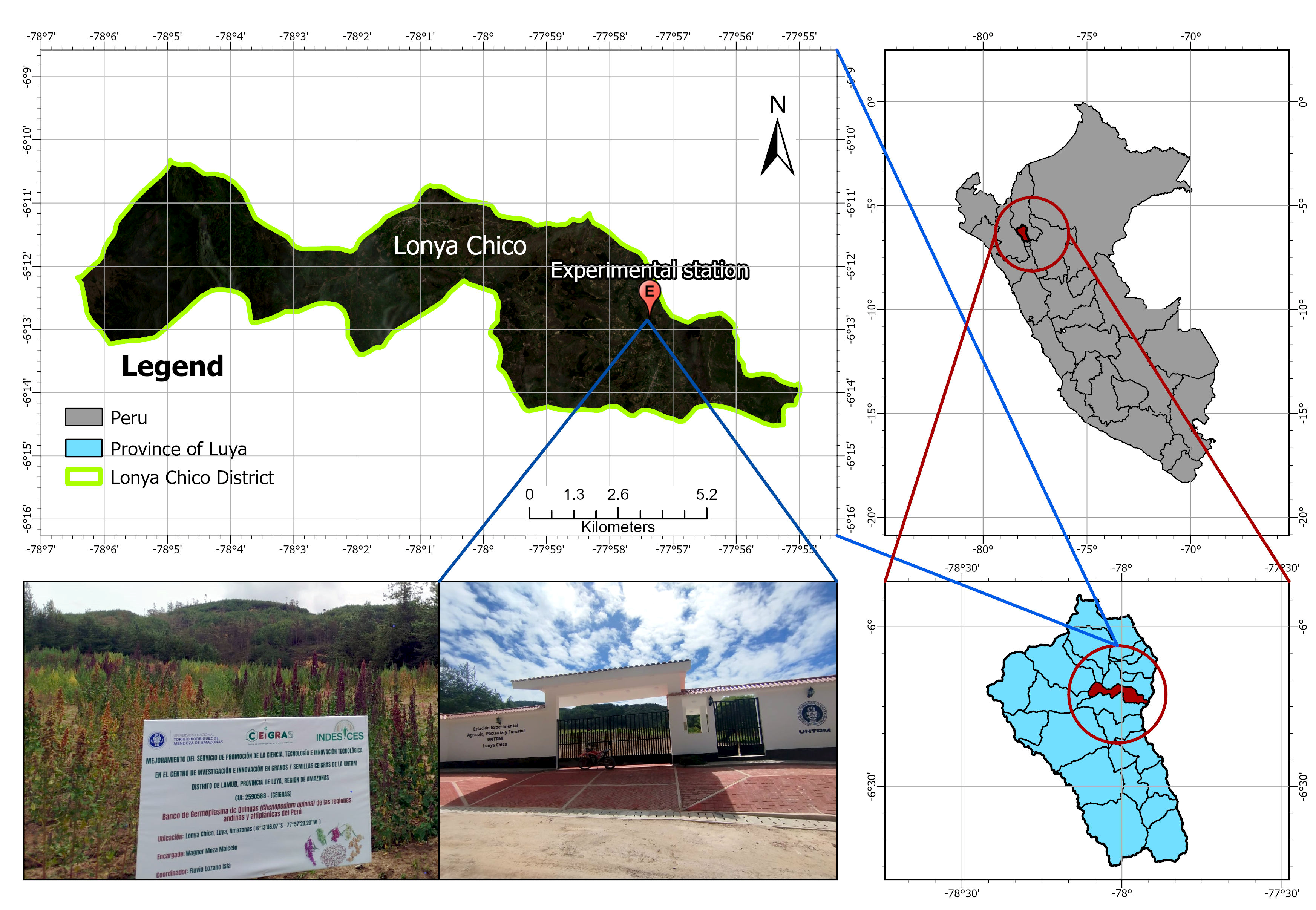
2.1. Study Area
2.2. Plant Material
2.3. Experimental Design
2.4. Agronomic Management
2.5. Evaluated Variables
2.6. Qualitative Variables
2.7. Quantitative Variables
2.8. Data Processing and Statistical Analysis
3. Results
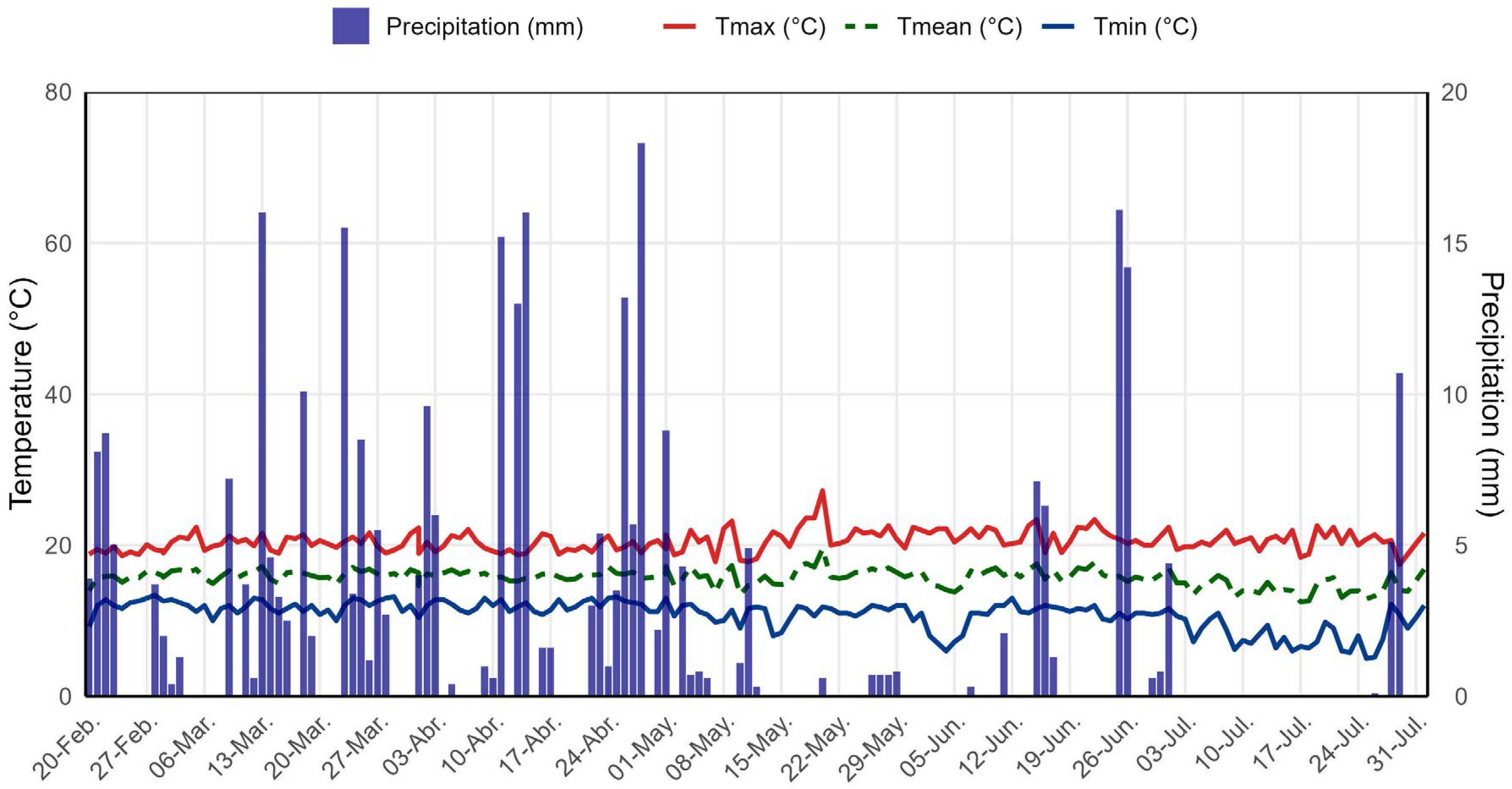
3.1. Meteorological and Environmental Conditions for the Cultivation of Chenopodium quinoa
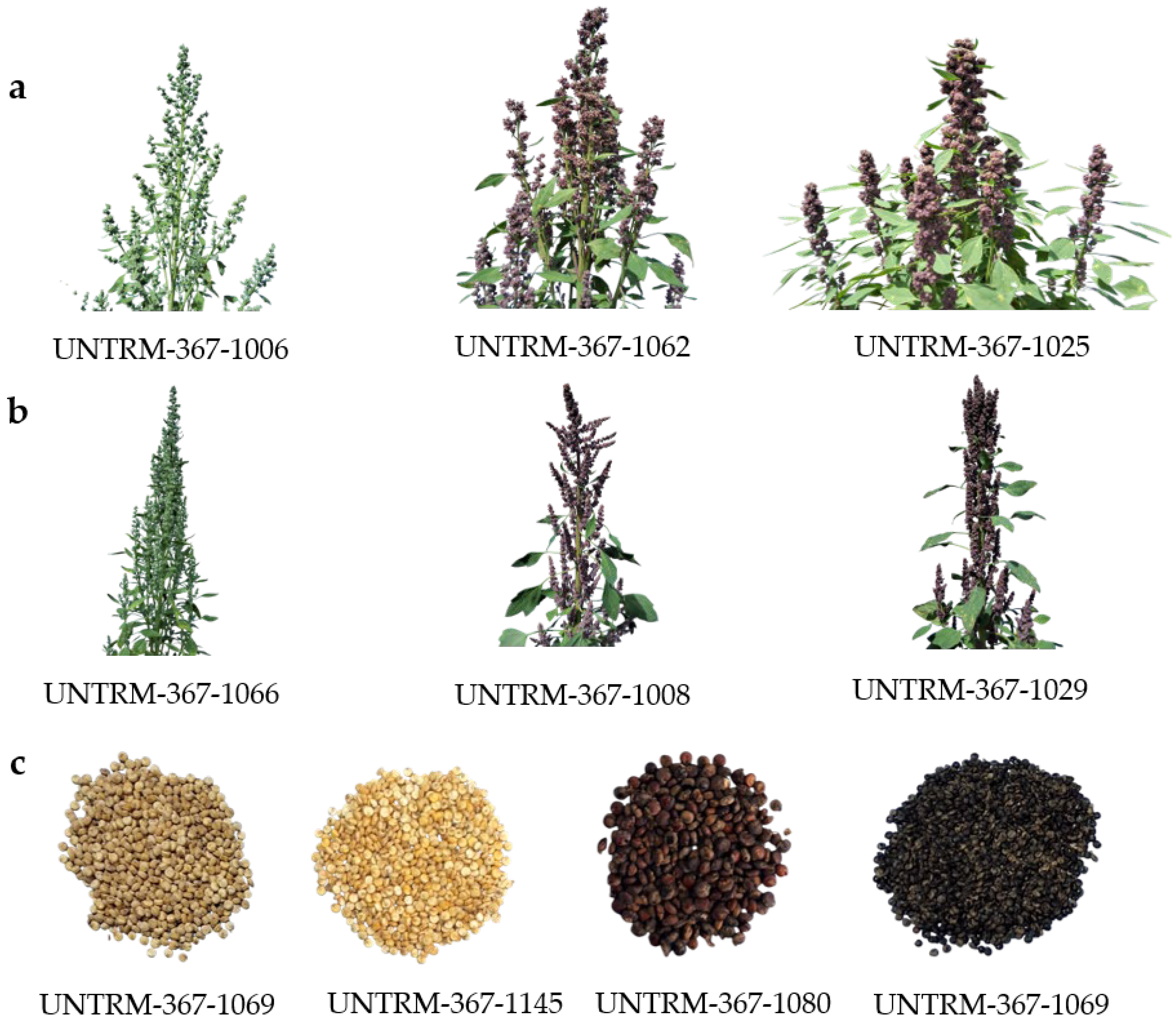
3.2. Agromorphological Diversity of Qualitative Variables
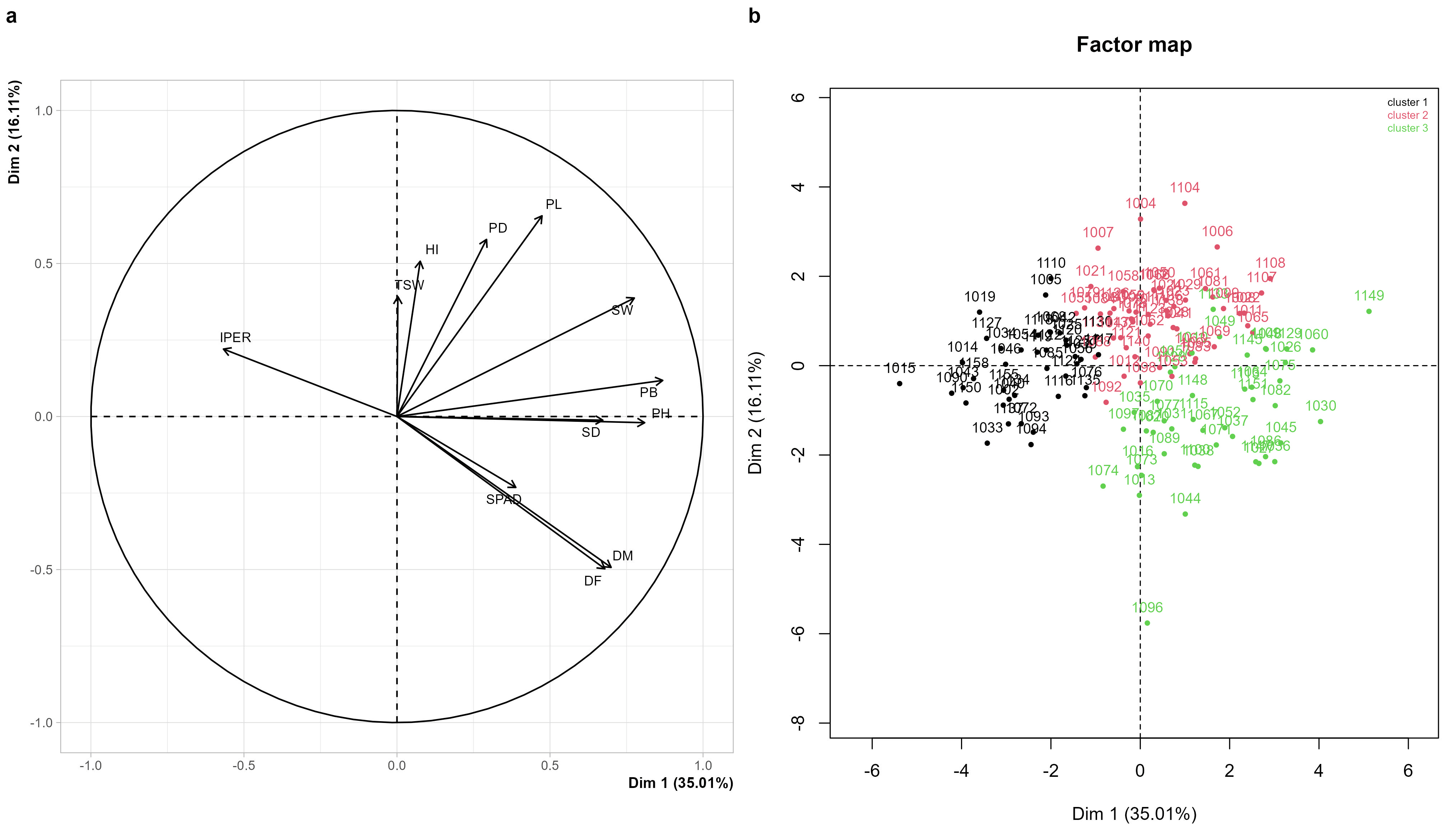
3.3. Agromorphological Diversity of the Quantitative Variables
3.4. Identification of Outstanding Accessions
4. Discussion
4.1. Diversity of Qualitative Variables
4.2. Diversity of Quantitative Variables
4.3. Selection of Promising Accessions
4.4. Limitations and Future Perspectives of the Study
5. Conclusions
Supplementary Materials
Author Contributions
Funding
Data Availability Statement
Acknowledgments
Conflicts of Interest
References
- Bazile, D.; Pulvento, C.; Verniau, A.; Al-Nusairi, M.S.; Ba, D.; Breidy, J.; Hassan, L.; Mohammed, M.I.; Mambetov, O.; Otambekova, M.; et al. Worldwide Evaluations of Quinoa: Preliminary Results from Post International Year of Quinoa FAO Projects in Nine Countries. Front. Plant Sci. 2016, 7, 850. [Google Scholar] [CrossRef] [PubMed]
- Jacobsen, S.E.; Mujica, A.; Ortiz, R. The Global Potential for Quinoa and Other Andean Crops. Food Rev. Int. 2003, 19, 139–148. [Google Scholar] [CrossRef]
- Hellin, J.; Higman, S. Crop Diversity and Livelihood Security in the Andes. Dev. Pract. 2005, 15, 165–174. [Google Scholar] [CrossRef]
- Manjarres-Hernández, E.H.; Arias-Moreno, D.M.; Morillo-Coronado, A.C.; Ojeda-Pérez, Z.Z.; Cárdenas-Chaparro, A. Phenotypic Characterization of Quinoa (Chenopodium quinoa Willd.) for the Selection of Promising Materials for Breeding Programs. Plants 2021, 10, 1339. [Google Scholar] [CrossRef]
- Angeli, V.; Miguel Silva, P.; Crispim Massuela, D.; Khan, M.W.; Hamar, A.; Khajehei, F.; Graeff-Hönninger, S.; Piatti, C. Quinoa (Chenopodium quinoa Willd.): An Overview of the Potentials of the “Golden Grain” and Socio-Economic and Environmental Aspects of Its Cultivation and Marketization. Foods 2020, 9, 216. [Google Scholar] [CrossRef] [PubMed]
- Bhargava, A.; Shukla, S.; Ohri, D. Chenopodium quinoa—An Indian Perspective. Ind. Crops Prod. 2006, 23, 73–87. [Google Scholar] [CrossRef]
- Agricultural University of Athens; Bilalis, D.J.; Roussis, I.; Kakabouki, I.; Folina, A. Quinoa (Chenopodium quinoa Willd.) Crop under Mediterranean Conditions: A Review. Cienc. Investig. Agrar. 2019, 46, 51–68. [Google Scholar] [CrossRef]
- Lozano-Isla, F.; Apaza, J.-D.; Mujica Sanchez, A.; Blas Sevillano, R.; Haussmann, B.I.G.; Schmid, K. Enhancing Quinoa Cultivation in the Andean Highlands of Peru: A Breeding Strategy for Improved Yield and Early Maturity Adaptation to Climate Change Using Traditional Cultivars. Euphytica 2023, 219, 26. [Google Scholar] [CrossRef]
- Grenfell-Shaw, L.; Tester, M. Abiotic Stress Tolerance in Quinoa. In The Quinoa Genome; Schmöckel, S.M., Ed.; Springer International Publishing: Cham, Switzerland, 2021; pp. 139–167. ISBN 978-3-030-65237-1. [Google Scholar]
- Afzal, I.; Haq, M.Z.U.; Ahmed, S.; Hirich, A.; Bazile, D. Challenges and Perspectives for Integrating Quinoa into the Agri-Food System. Plants 2023, 12, 3361. [Google Scholar] [CrossRef]
- Pulvento, C.; Bazile, D. Worldwide Evaluations of Quinoa—Biodiversity and Food Security under Climate Change Pressures: Advances and Perspectives. Plants 2023, 12, 868. [Google Scholar] [CrossRef]
- Bazile, D.; Jacobsen, S.-E.; Verniau, A. The Global Expansion of Quinoa: Trends and Limits. Front. Plant Sci. 2016, 7, 622. [Google Scholar] [CrossRef]
- Delgado, H.; Martín, J.P. Assessment of Genetic Diversity in Quinoa Landraces Cultivated in the Ecuadorian Highlands Since the Early 1980s. Plants 2025, 14, 635. [Google Scholar] [CrossRef]
- Vleugels, T.; Van Waes, C.; De Keyser, E.; Cnops, G. Optimization of Breeding Tools in Quinoa (Chenopodium quinoa) and Identification of Suitable Breeding Material for NW Europe. Plants 2025, 14, 3. [Google Scholar] [CrossRef] [PubMed]
- Instituto Nacional de Innovación Agraria (INIA); Organización de las Naciones Unidas para la Alimentación y la Agricultura (FAO). Catálogo de Variedades Comerciales de Quinua en el Perú; INIA: Lima, Perú; FAO: Lima, Perú, 2013. [Google Scholar]
- Maamri, K.; Zidane, O.D.; Chaabena, A.; Fiene, G.; Bazile, D. Adaptation of Some Quinoa Genotypes (Chenopodium quinoa Willd.), Grown in a Saharan Climate in Algeria. Life 2022, 12, 1854. [Google Scholar] [CrossRef] [PubMed]
- Soto, E.; Mercado, W.; Estrada Zúniga, R.; Díaz, F.; Díaz, G. El Mercado y la Producción de Quinua en el Perú; Instituto Interamericano de Cooperación para la Agricultura—IICA: San José, CA, USA; Instituto Nacional de Innovación Agraria—INIA: La Molina, Peru, 2015; ISBN 978-92-9248-602-0. [Google Scholar]
- Lozano-Isla, F.; Kienbaum, L.; Haussmann, B.I.G.; Schmid, K. A High-Throughput Phenotyping Pipeline for Quinoa (Chenopodium quinoa) Panicles Using Image Analysis with Convolutional Neural Networks. Plant Breed. 2025; early view. [Google Scholar] [CrossRef]
- Zurita-Silva, A.; Fuentes, F.; Zamora, P.; Jacobsen, S.-E.; Schwember, A.R. Breeding Quinoa (Chenopodium quinoa Willd.): Potential and Perspectives. Mol. Breed. 2014, 34, 13–30. [Google Scholar] [CrossRef]
- Bedoya-Perales, N.S.; Pumi, G.; Mujica, A.; Talamini, E.; Domingos Padula, A. Quinoa Expansion in Peru and Its Implications for Land Use Management. Sustainability 2018, 10, 532. [Google Scholar] [CrossRef]
- Hlásná Cepková, P.; Dostalíková, L.; Viehmannová, I.; Jágr, M.; Janovská, D. Diversity of Quinoa Genetic Resources for Sustainable Production: A Survey on Nutritive Characteristics as Influenced by Environmental Conditions. Front. Sustain. Food Syst. 2022, 6, 960159. [Google Scholar] [CrossRef]
- Castro, A.; Davila Arriaga, C.; Laura, W.; Cubas Saucedo, F.; Avalos, G.; López, C.; Villena, D.; Valdez, M.; Urbiola, J.; Trebejo, I.; et al. Climas del Perú: Mapa de Clasificación Climática Nacional; Servicio Nacional de Meteorología e Hidrología del Perú: Lima, Peru, 2021; ISBN 978-612-48315-3-9. [Google Scholar]
- EL-Harty, E.H.; Ghazy, A.; Alateeq, T.K.; Al-Faifi, S.A.; Khan, M.A.; Afzal, M.; Alghamdi, S.S.; Migdadi, H.M. Morphological and Molecular Characterization of Quinoa Genotypes. Agriculture 2021, 11, 286. [Google Scholar] [CrossRef]
- Ren, A.; Jiang, Z.; Dai, J.; Sun, M.; Anwar, S.; Tang, P.; Wang, R.; Ding, P.; Li, L.; Wu, X.; et al. Phenotypic Characterization and Yield Screening of Quinoa Germplasms in Diverse Low-Altitude Regions: A Preliminary Study. Agronomy 2024, 14, 1354. [Google Scholar] [CrossRef]
- Alania-Choque, J.; Vásquez-Espinoza, L.G.; Anculle-Arenas, A.; Bustamente-Muñoz, J.L.; Jellen, E.N.; Gutiérrez-Rosales, R.O.; Mayta-Anco, M.E. Characterization and Agronomic Evaluation of 25 Accessions of Chenopodium quinoa in the Peruvian Coastal Desert. Agronomy 2024, 14, 1908. [Google Scholar] [CrossRef]
- Gamboa, C.; Van den Broeck, G.; Maertens, M. Smallholders’ Preferences for Improved Quinoa Varieties in the Peruvian Andes. Sustainability 2018, 10, 3735. [Google Scholar] [CrossRef]
- Bhargava, A.; Shukla, S.; Rajan, S.; Ohri, D. Genetic Diversity for Morphological and Quality Traits in Quinoa (Chenopodium quinoa Willd.) Germplasm. Genet. Resour. Crop Evol. 2007, 54, 167–173. [Google Scholar] [CrossRef]
- Gosgot Angeles, W.; Banda Martinez, D.; Barrena Gurbillón, M.Á.; Espinoza Canaza, F.I.; Santillan Gomez, H.; Mori Servan, D.C.; Yalta Chappa, M.; Huanes Mariños, M.A.; Gamarra-Torres, O.A.; Oliva-Cruz, M. Productivity and Morphological Adaptation of Phaseolus vulgaris L. in Agrivoltaic Systems with Different Photovoltaic Technologies: A Case Study in Chachapoyas, Amazonas, Peru. Agronomy 2025, 15, 529. [Google Scholar] [CrossRef]
- Rascón, J.; Gosgot Angeles, W.; Quiñones Huatangari, L.; Oliva, M.; Barrena Gurbillón, M.Á. Dry and Wet Events in Andean Populations of Northern Peru: A Case Study of Chachapoyas, Peru. Front. Environ. Sci. 2021, 9, 614438. [Google Scholar] [CrossRef]
- Murillo, D.A.; Gezan, S.A.; Heilman, A.M.; Walk, T.C.; Aparicio, J.S.; Horsley, R.D. FielDHub: A Shiny App for Design of Experiments in Life Sciences. J. Open Source Softw. 2021, 6, 3122. [Google Scholar] [CrossRef]
- Burgueño, J.; Crossa, J.; Rodríguez, F.; Yeater, K.M. Augmented Designs-Experimental Designs in Which All Treatments Are Not Replicated. In ASA, CSSA, and SSSA Books; Glaz, B., Yeater, K.M., Eds.; American Society of Agronomy, Crop Science Society of America, and Soil Science Society of America, Inc.: Madison, WI, USA, 2018; pp. 345–369. ISBN 978-0-89118-360-0. [Google Scholar]
- Zystro, J.; Colley, M.; Dawson, J. Alternative Experimental Designs for Plant Breeding. In Plant Breeding Reviews; Goldman, I., Ed.; Wiley: Hoboken, NJ, USA, 2018; pp. 87–117. ISBN 978-1-119-52131-0. [Google Scholar]
- Bioversity International; Organización de las Naciones Unidas para la Agricultura y la Alimentación (FAO); Fundación PROINPA; Instituto Nacional de Innovación Agropecuaria y Forestal (INIAF); Fondo Internacional de Desarrollo Agrícola (FIDA). Descriptores para Quinua (Chenopodium quinoa Willd.) y sus Parientes Silvestres; Bioversity International: Rome, Italy, 2013; ISBN 978-92-9043-927-1. [Google Scholar]
- Sosa-Zuniga, V.; Brito, V.; Fuentes, F.; Steinfort, U. Phenological Growth Stages of Quinoa (Chenopodium quinoa) Based on the BBCH Scale. Ann. Appl. Biol. 2017, 171, 117–124. [Google Scholar] [CrossRef]
- Stanschewski, C.S.; Rey, E.; Fiene, G.; Craine, E.B.; Wellman, G.; Melino, V.J.; Patiranage, D.S.R.; Johansen, K.; Schmöckel, S.M.; Bertero, D.; et al. Quinoa Phenotyping Methodologies: An International Consensus. Plants 2021, 10, 1759. [Google Scholar] [CrossRef]
- Lozano-Isla, F.; Farfan-Vignolo, E.R.; Gutierrez, R.; Blas, R.; Awais, K. Harvest Index Is a Key Trait for Screening Drought-Tolerant Potato Genotypes (Solanum tuberosum). J. Crop Sci. Biotechnol. 2024, 27, 91–103. [Google Scholar] [CrossRef]
- Lozano-Isla, F. Inti: Tools and Statistical Procedures in Plant Science, [R package inti version 0.6.9]. 2025. Available online: https://doi.org/10.32614/CRAN.package.inti (accessed on 26 November 2025).
- Lozano-Isla, F. Huito: Reproducible and Flexible Label Design, [R package huito version 0.2.6]. 2025. Available online: https://doi.org/10.32614/CRAN.package.huito (accessed on 26 November 2025).
- Rife, T.W.; Poland, J.A. Field Book: An Open-Source Application for Field Data Collection on Android. Crop Sci. 2014, 54, 1624–1627. [Google Scholar] [CrossRef]
- R Core Team. R: A Language and Environment for Statistical Computing; R Core Team: Vienna, Austria, 2025. [Google Scholar]
- Oksanen, J.; Simpson, G.L.; Blanchet, F.G.; Kindt, R.; Legendre, P.; Minchin, P.R.; O’Hara, R.B.; Solymos, P.; Stevens, M.H.H.; Szoecs, E.; et al. Vegan: Community Ecology Package, [R package vegan version 2.7-2]. 2025. Available online: https://doi.org/10.32614/CRAN.package.vegan (accessed on 26 November 2025).
- Nei, M. Molecular Evolutionary Genetics; Reimpresión; Columbia University Press: New York, NY, USA, 1987; ISBN 0-231-06321-0. [Google Scholar]
- Shannon, C.; Weaver, W. The Mathematical Theory of Communication; University of Illinois Press: Urbana, IL, USA, 1949. [Google Scholar]
- Bates, D.; Maechler, M.; Bolker, B.; Walker, S. Lme4: Linear Mixed-Effects Models Using “Eigen” and S4, [R package lme4 version 1.1-38]. 2025. Available online: https://doi.org/10.32614/CRAN.package.lme4 (accessed on 26 November 2025).
- Husson, F.; Josse, J.; Le, S.; Mazet, J. FactoMineR: Multivariate Exploratory Data Analysis and Data Mining, [R package FactoMineR version 2.12]. 2025. Available online: https://doi.org/10.32614/CRAN.package.FactoMineR (accessed on 26 November 2025).
- Kassambara, A.; Mundt, F. Factoextra: Extract and Visualize the Results of Multivariate Data Analyses, [R package factoextra version 1.0.7]; R Foundation: Vienna, Austria, 2020.
- Revelle, W. Psych: Procedures for Psychological, Psychometric, and Personality Research, [R package psych version 2.5.6]; Northwestern University: Evanston, IL, USA, 2025.
- Piepho, H.P.; Möhring, J.; Melchinger, A.E.; Büchse, A. BLUP for Phenotypic Selection in Plant Breeding and Variety Testing. Euphytica 2008, 161, 209–228. [Google Scholar] [CrossRef]
- Katwal, T.B.; Bazile, D. First adaptation of quinoa in the Bhutanese mountain agriculture systems. PLoS ONE 2020, 15, e0219804. [Google Scholar] [CrossRef] [PubMed]
- Tabatabaei, I.; Alseekh, S.; Shahid, M.; Leniak, E.; Wagner, M.; Mahmoudi, H.; Thushar, S.; Fernie, A.R.; Murphy, K.M.; Schmöckel, S.M.; et al. The Diversity of Quinoa Morphological Traits and Seed Metabolic Composition. Sci. Data 2022, 9, 323. [Google Scholar] [CrossRef] [PubMed]
- Naim, J.; Khatun, S.M.; Das, B.; Akter, S.; Hossain, M.A.; Mim, M.H.; Shakil, M.R.; Shozib, H.B.; Toderich, K. Phenotyping of Quinoa (Chenopodium quinoa Willd.) Genotypes for Morphological, Yield and Nutritional Quality Traits. Phyton 2024, 93, 3443–3463. [Google Scholar] [CrossRef]
- Craine, E.B.; Davies, A.; Packer, D.; Miller, N.D.; Schmöckel, S.M.; Spalding, E.P.; Tester, M.; Murphy, K.M. A Comprehensive Characterization of Agronomic and End-Use Quality Phenotypes across a Quinoa World Core Collection. Front. Plant Sci. 2023, 14, 1101547. [Google Scholar] [CrossRef]
- Bhargava, A.; Ohri, D. Origin of Genetic Variability and Improvement of Quinoa (Chenopodium quinoa Willd.). In Gene Pool Diversity and Crop Improvement: Volume 1; Rajpal, V.R., Rao, S.R., Raina, S.N., Eds.; Springer International Publishing: Cham, Switzerland, 2016; pp. 241–270. ISBN 978-3-319-27096-8. [Google Scholar]
- Rey, E.; Abrouk, M.; Dufau, I.; Rodde, N.; Saber, N.; Cizkova, J.; Fiene, G.; Stanschewski, C.; Jarvis, D.E.; Jellen, E.N.; et al. Genome Assembly of a Diversity Panel of Chenopodium quinoa. Sci. Data 2024, 11, 1366. [Google Scholar] [CrossRef]
- Hazzam, K.E.; Mhada, M.; Bakrim, W.B.; Taourirte, M.; Yasri, A. Antinutritional and Insecticidal Potential of Chenopodium quinoa Saponin Rich Extract against Tribolium castaneum (Herbst) and Its Action Mechanism. Sci. Rep. 2025, 15, 6829. [Google Scholar] [CrossRef]
- Benlhabib, O.; Boujartani, N.; Maughan, P.J.; Jacobsen, S.E.; Jellen, E.N. Elevated Genetic Diversity in an F2:6 Population of Quinoa (Chenopodium quinoa) Developed through an Inter-Ecotype Cross. Front. Plant Sci. 2016, 7, 1222. [Google Scholar] [CrossRef]
- Hafeez, M.B.; Iqbal, S.; Li, Y.; Saddiq, M.S.; Basra, S.M.A.; Zhang, H.; Zahra, N.; Akram, M.Z.; Bertero, D.; Curti, R.N. Assessment of Phenotypic Diversity in the USDA Collection of Quinoa Links Genotypic Adaptation to Germplasm Origin. Plants 2022, 11, 738. [Google Scholar] [CrossRef]
- Thiam, E.; Allaoui, A.; Benlhabib, O. Quinoa Productivity and Stability Evaluation through Varietal and Environmental Interaction. Plants 2021, 10, 714. [Google Scholar] [CrossRef]
- Cui, H.; Yao, Q.; Xing, B.; Zhou, B.; Shah, S.S.; Qin, P. The Performance of Agronomic and Quality Traits of Quinoa under Different Altitudes in Northwest of China. Agronomy 2024, 14, 1194. [Google Scholar] [CrossRef]
- Lesjak, J.; Calderini, D.F. Increased Night Temperature Negatively Affects Grain Yield, Biomass and Grain Number in Chilean Quinoa. Front. Plant Sci. 2017, 8, 352. [Google Scholar] [CrossRef]
- Rodríguez, J.P.; Rahman, H.; Thushar, S.; Singh, R.K. Healthy and Resilient Cereals and Pseudo-Cereals for Marginal Agriculture: Molecular Advances for Improving Nutrient Bioavailability. Front. Genet. 2020, 11, 49. [Google Scholar] [CrossRef] [PubMed]
- Wang, N.; Wang, F.-X.; Shock, C.C.; Meng, C.-B.; Huang, Z.-J.; Gao, L.; Zhao, J.-Y. Evaluating Quinoa Stem Lodging Susceptibility by a Mathematical Model and the Finite Element Method under Different Agronomic Practices. Field Crops Res. 2021, 271, 108241. [Google Scholar] [CrossRef]
- Emrani, N.; Maldonado-Taipe, N.; Hasler, M.; Patiranage, D.S.R.; Jung, C. Early Flowering and Maturity Promote the Successful Adaptation and High Yield of Quinoa (Chenopodium quinoa Willd.) in Temperate Regions. Plants 2024, 13, 2919. [Google Scholar] [CrossRef] [PubMed]
- Jacobsen, S.-E. The Worldwide Potential for Quinoa (Chenopodium quinoa Willd.). Food Rev. Int. 2003, 19, 167–177. [Google Scholar] [CrossRef]
- Liu, J.; Li, L.; Liu, Y.; Kong, Z.; Zhang, P.; Wang, Q.; Cheng, S.; Qin, P. Combined Transcriptome and Metabolome Analysis of the Resistance Mechanism of Quinoa Seedlings to Spodoptera exigua. Front. Plant Sci. 2022, 13, 931145. [Google Scholar] [CrossRef]



| Qualitative Trait | Phenotypic Classes Observed | Na | fi | Nc | Ne | He | H′ |
|---|---|---|---|---|---|---|---|
| Panicle color at 50% flowering | Mixture (purple and red) | 9 | 0.07 | 4 | 2.64 | 0.38 | 1.11 |
| Purple | 64 | 0.47 | |||||
| Red | 11 | 0.08 | |||||
| Green | 52 | 0.38 | |||||
| Panicle shape | Amaranthiform | 7 | 0.05 | 3 | 1.65 | 0.60 | 0.69 |
| Glomerulate | 102 | 0.75 | |||||
| Intermediate | 27 | 0.20 | |||||
| Panicle color at 50% physiological maturity | Yellow | 48 | 0.35 | 10 | 4.71 | 0.21 | 1.79 |
| Orange | 30 | 0.22 | |||||
| White | 3 | 0.02 | |||||
| Gray | 1 | 0.01 | |||||
| Brown | 2 | 0.01 | |||||
| Purple | 10 | 0.07 | |||||
| Red and yellow | 1 | 0.01 | |||||
| Red and pink | 12 | 0.09 | |||||
| Pink | 19 | 0.14 | |||||
| Green | 10 | 0.07 | |||||
| Panicle density | Compact | 6 | 0.04 | 3 | 1.43 | 0.70 | 0.57 |
| Intermediate | 18 | 0.13 | |||||
| Loose | 112 | 0.82 | |||||
| Growth habit | Branched with undefined main panicle | 4 | 0.03 | 4 | 2.25 | 0.44 | 1.01 |
| Branched up to the second third | 84 | 0.62 | |||||
| Branched up to the lower third | 24 | 0.18 | |||||
| Simple | 24 | 0.18 | |||||
| Main stem color | Yellow | 22 | 0.16 | 9 | 4.2 | 0.24 | 1.76 |
| Orange | 7 | 0.05 | |||||
| White | 7 | 0.05 | |||||
| Gray | 3 | 0.02 | |||||
| Brown | 5 | 0.04 | |||||
| Purple | 21 | 0.15 | |||||
| Red | 7 | 0.05 | |||||
| Pink | 7 | 0.05 | |||||
| Green | 57 | 0.42 | |||||
| Presence of Epicauta sp. | No | 49 | 0.36 | 2 | 1.86 | 0.54 | 0.65 |
| Yes | 87 | 0.64 | |||||
| Degree of dehiscence | Light | 103 | 0.76 | 3 | 1.59 | 0.63 | 0.59 |
| Regular | 32 | 0.24 | |||||
| Strong | 1 | 0.01 | |||||
| Lodging of the plant | No | 117 | 0.86 | 2 | 1.32 | 0.76 | 0.40 |
| Yes | 19 | 0.14 | |||||
| Seed coat (episperm) color | White | 38 | 0.28 | 9 | 3.07 | 0.33 | 1.45 |
| Brown | 4 | 0.03 | |||||
| Light brown | 3 | 0.02 | |||||
| Dark brown | 3 | 0.02 | |||||
| Reddish brown | 12 | 0.09 | |||||
| Cream | 66 | 0.49 | |||||
| Black | 4 | 0.03 | |||||
| Transparent | 5 | 0.04 | |||||
| 1 | 0.01 | ||||||
| Grain shape | Cylindrical | 107 | 0.79 | 4 | 1.55 | 0.65 | 0.67 |
| Ellipsoidal | 7 | 0.05 | |||||
| Lenticular | 21 | 0.15 | |||||
| 1 | 0.01 | ||||||
| Mean ± SE | 4.82 ± 0.90 | 2.39 ± 0.35 | 0.50 ± 0.06 | 0.97 ± 0.15 |
| Quantitative Trait | Unit | Mean | Min | Max | CV(%) |
|---|---|---|---|---|---|
| Chlorophyll content at 50% flowering | SPAD | 58.9 | 37.5 | 82.6 | 14.1 |
| Incidence of Peronospora variabilis | % | 55.9 | 0.0 | 100.0 | 57.0 |
| Days to 50% flowering | days | 80.0 | 74.0 | 94.0 | 6.9 |
| Days to 50% physiological maturity | days | 103.0 | 90.0 | 119.0 | 10.4 |
| Panicle length | cm | 27.2 | 9.13 | 43.5 | 22.0 |
| Panicle diameter | cm | 7.23 | 2.74 | 15.8 | 33.3 |
| Plant height | cm | 111.7 | 49.3 | 175.0 | 22.5 |
| Stem diameter | cm | 1.16 | 0.10 | 1.85 | 26.1 |
| Biomass of 10 plants | kg | 1.23 | 0.00 | 3.42 | 56.0 |
| Seed weight from10 plants | g | 434.3 | 0.00 | 1091.2 | 55.7 |
| 1000-grain weight | g | 3.12 | 0.80 | 4.70 | 18.3 |
| Harvest index | ratio (%) | 27.3 | 0.11 | 50.4 | 33.5 |
Disclaimer/Publisher’s Note: The statements, opinions and data contained in all publications are solely those of the individual author(s) and contributor(s) and not of MDPI and/or the editor(s). MDPI and/or the editor(s) disclaim responsibility for any injury to people or property resulting from any ideas, methods, instructions or products referred to in the content. |
© 2025 by the authors. Licensee MDPI, Basel, Switzerland. This article is an open access article distributed under the terms and conditions of the Creative Commons Attribution (CC BY) license (https://creativecommons.org/licenses/by/4.0/).
Share and Cite
Baldera-Chapoñan, V.-H.; De la Cruz, G.; Oliva-Cruz, S.; Lozano-Isla, F. Agromorphological Characterization of Quinoa (Chenopodium quinoa Willd.) Under Andean–Amazonian Region of Peru. Plants 2025, 14, 3689. https://doi.org/10.3390/plants14233689
Baldera-Chapoñan V-H, De la Cruz G, Oliva-Cruz S, Lozano-Isla F. Agromorphological Characterization of Quinoa (Chenopodium quinoa Willd.) Under Andean–Amazonian Region of Peru. Plants. 2025; 14(23):3689. https://doi.org/10.3390/plants14233689
Chicago/Turabian StyleBaldera-Chapoñan, Victor-Hugo, Germán De la Cruz, Segundo Oliva-Cruz, and Flavio Lozano-Isla. 2025. "Agromorphological Characterization of Quinoa (Chenopodium quinoa Willd.) Under Andean–Amazonian Region of Peru" Plants 14, no. 23: 3689. https://doi.org/10.3390/plants14233689
APA StyleBaldera-Chapoñan, V.-H., De la Cruz, G., Oliva-Cruz, S., & Lozano-Isla, F. (2025). Agromorphological Characterization of Quinoa (Chenopodium quinoa Willd.) Under Andean–Amazonian Region of Peru. Plants, 14(23), 3689. https://doi.org/10.3390/plants14233689