


Uncovering the Floral Origins of Honey Bee Pollen in Colombian Tropical Dry Forest: A Low-Cost DNA Barcoding Approach Reveals Cactaceae Dominance

 ,
,  , and
, and
Abstract
1. Introduction
2. Results
2.1. Disruption Method Performance
2.2. Quantification of DNA Yield and Purity
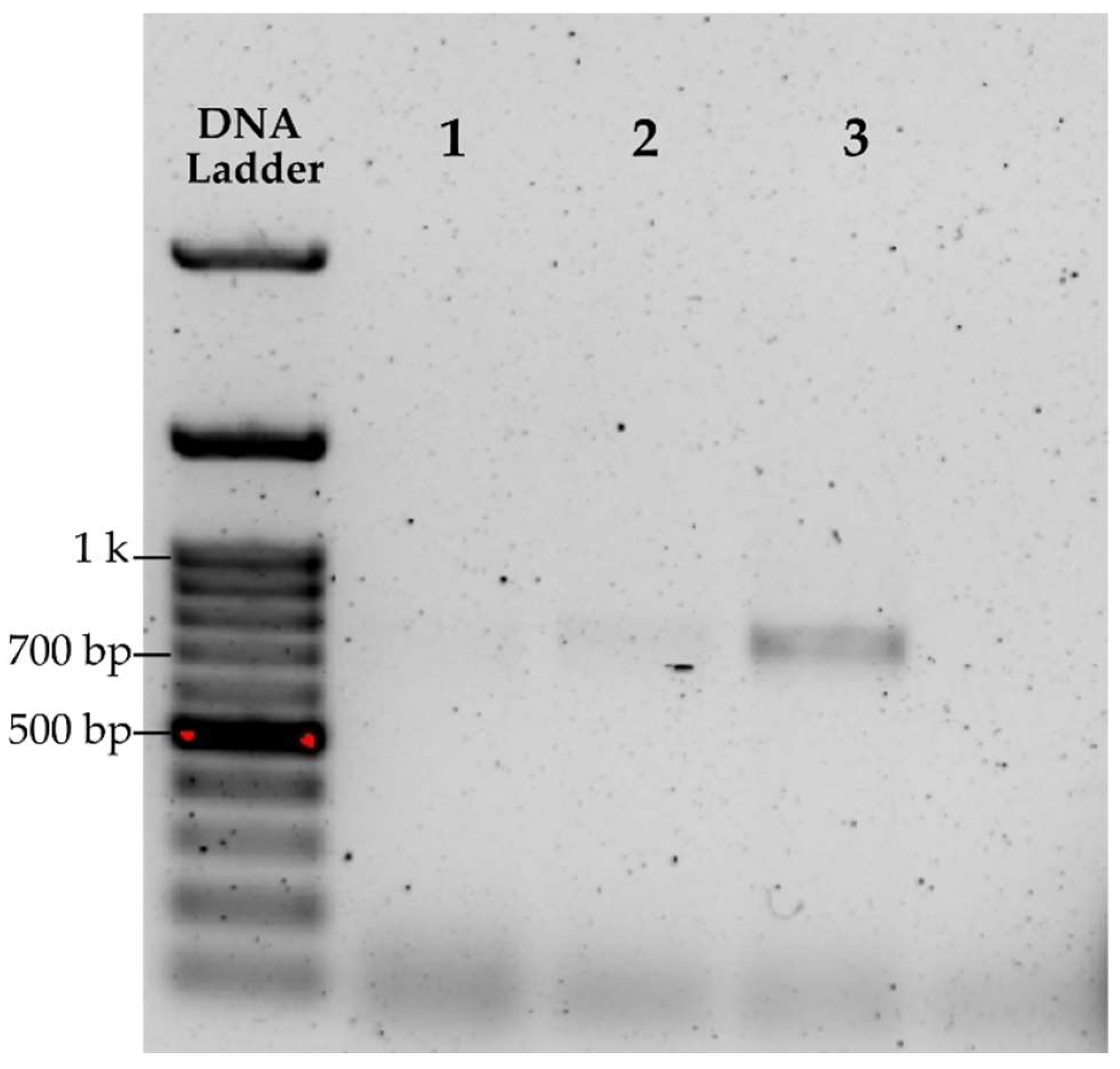
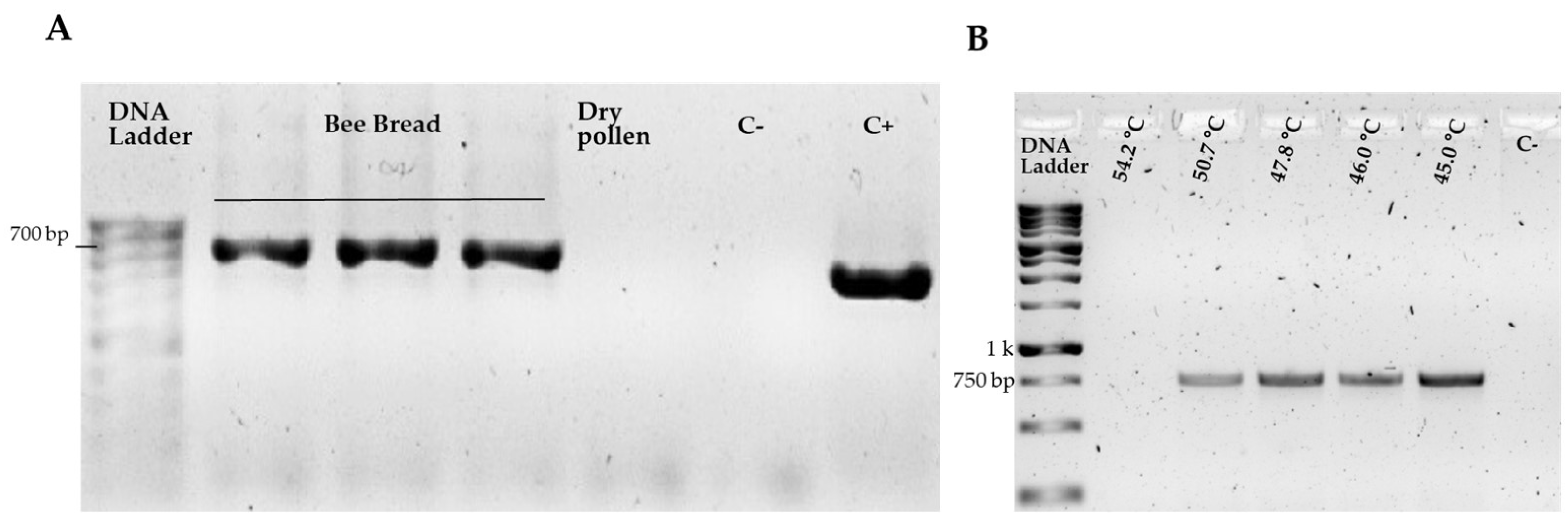
2.3. PCR Amplification
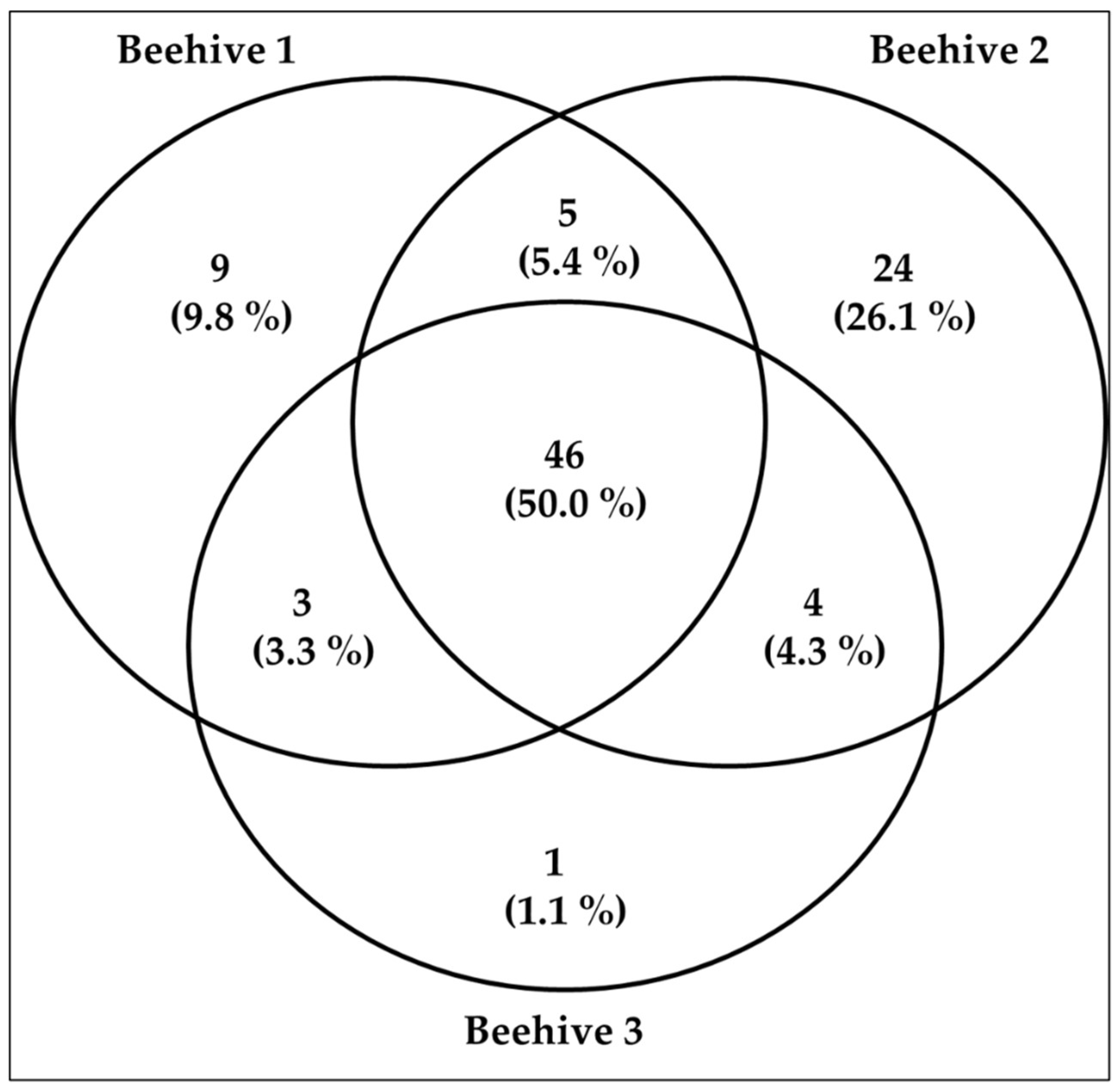
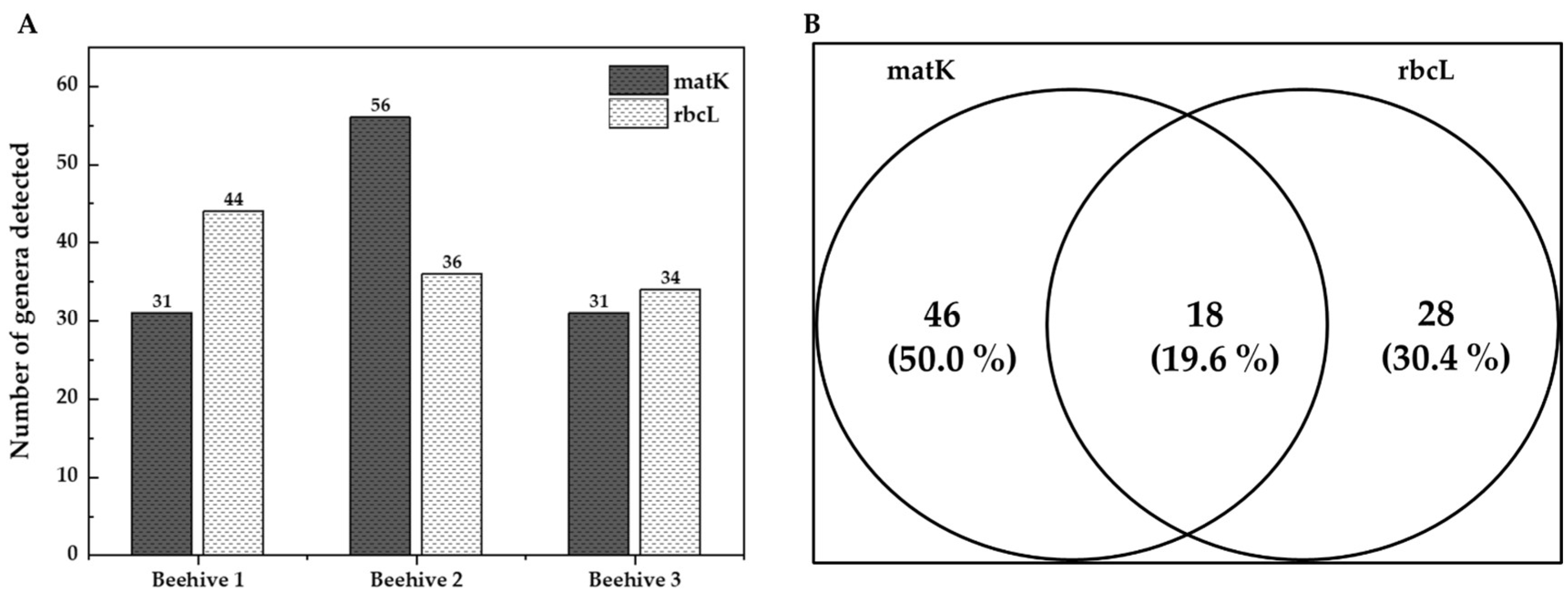
2.4. Molecular Identification of Bee Bread Samples
2.5. Pollen Micrographs
3. Discussion
4. Materials and Methods
4.1. Study Area
4.2. Pollen Collection
4.3. Evaluation of Pollen Grain Rupture Methods
4.4. DNA Extraction
4.5. PCR and Sequencing
4.6. Microscopic Analysis of Pollen
4.7. Data Analysis
5. Conclusions
Supplementary Materials
Author Contributions
Funding
Data Availability Statement
Acknowledgments
Conflicts of Interest
References
- Ollerton, J. Pollinator Diversity: Distribution, Ecological Function, and Conservation. Annu. Rev. Ecol. Evol. Syst. 2017, 48, 353–376. [Google Scholar] [CrossRef]
- Klein, A.-M.; Vaissière, B.E.; Cane, J.H.; Steffan-Dewenter, I.; Cunningham, S.A.; Kremen, C.; Tscharntke, T. Importance of Pollinators in Changing Landscapes for World Crops. Proc. R. Soc. B Biol. Sci. 2006, 274, 303–313. [Google Scholar] [CrossRef] [PubMed]
- Nath, R.; Singh, H.; Mukherjee, S. Insect Pollinators Decline: An Emerging Concern of Anthropocene Epoch. J. Apic. Res. 2023, 62, 23–38. [Google Scholar] [CrossRef]
- Keller, I.; Fluri, P.; Imdorf, A. Pollen Nutrition and Colony Development in Honey Bees: Part I. Bee World 2005, 86, 3–10. [Google Scholar] [CrossRef]
- Ellis, A.M.; Hayes, G.W., Jr. An Evaluation of Fresh versus Fermented Diets for Honey Bees (Apis mellifera). J. Apic. Res. 2009, 48, 215–216. [Google Scholar] [CrossRef]
- Ducker, S.C.; Knox, R.B. Pollen and Pollination: A Historical Review. Taxon 1985, 34, 401–419. [Google Scholar] [CrossRef]
- Topitzhofer, E.; Lucas, H.; Carlson, E.; Chakrabarti, P.; Sagili, R. Collection and Identification of Pollen from Honey Bee Colonies. J. Vis. Exp. 2021, 167, e62064. [Google Scholar] [CrossRef]
- Galimberti, A.; De Mattia, F.; Bruni, I.; Scaccabarozzi, D.; Sandionigi, A.; Barbuto, M.; Casiraghi, M.; Labra, M. A DNA Barcoding Approach to Characterize Pollen Collected by Honeybees. PLoS ONE 2014, 9, e109363. [Google Scholar] [CrossRef]
- Wilson, R.S.; Keller, A.; Shapcott, A.; Leonhardt, S.D.; Sickel, W.; Hardwick, J.L.; Heard, T.A.; Kaluza, B.F.; Wallace, H.M. Many Small Rather than Few Large Sources Identified in Long-Term Bee Pollen Diets in Agroecosystems. Agric. Ecosyst. Environ. 2021, 310, 107296. [Google Scholar] [CrossRef]
- Bell, K.L.; de Vere, N.; Keller, A.; Richardson, R.T.; Gous, A.; Burgess, K.S.; Brosi, B.J. Pollen DNA Barcoding: Current Applications and Future Prospects. Genome 2016, 59, 629–640. [Google Scholar] [CrossRef]
- Bell, K.L.; Turo, K.J.; Lowe, A.; Nota, K.; Keller, A.; Encinas-Viso, F.; Parducci, L.; Richardson, R.T.; Leggett, R.M.; Brosi, B.J.; et al. Plants, Pollinators and Their Interactions under Global Ecological Change: The Role of Pollen DNA Metabarcoding. Mol. Ecol. 2023, 32, 6345–6362. [Google Scholar] [CrossRef]
- Gostel, M.R.; Kress, W.J. The Expanding Role of DNA Barcodes: Indispensable Tools for Ecology, Evolution, and Conservation. Diversity 2022, 14, 213. [Google Scholar] [CrossRef]
- García, G.J.D.; Rivera, D.O. Composición florística del bosque el Agüil (Aguachica, Cesar) con anotaciones sobre su estructura. In Colombia Diversidad Biótica VIII: Media y Baja Montaña de la Serranía de Perijá; Rangel Ch., J.O., Ed.; Universidad Nacional de Colombia: Bogotá, Colombia, 2009; Volume 8, pp. 575–601. ISBN 978-958-719-214-8. [Google Scholar]
- Rangel-Ch., J.O.; Avella-Muñoz, A.; Garay-Pulido, H. Caracterización florística y estructural de los relictos boscosos del sur del departamento del Cesar. In Colombia Diversidad Biótica VIII: Media y Baja Montaña de la Serranía de Perijá; Rangel Ch., J.O., Ed.; Universidad Nacional de Colombia: Bogotá, Colombia, 2009; Volume 8, pp. 365–392. ISBN 978-958-719-214-8. [Google Scholar]
- Sucerquia, D.C.; Urrego, L.E.; Prado, M.A. The Utilization of Floral Resources from Mangroves of the Gulf of Urabá (Colombian Caribbean) by Introduced Honey Bees (Apis mellifera). J. Apic. Res. 2020, 59, 626–637. [Google Scholar] [CrossRef]
- Breadbear, N. Bees and Their Role in Forest Livelihoods: A Guide to the Services Provided by Bees and the Sustainable Harvesting, Processing and Marketing of Their Products; Food and Agriculture Organization of the United Nations: Rome, Italy, 2009; ISBN 978-92-5-106181-7. [Google Scholar]
- Hornick, T.; Richter, A.; Harpole, W.S.; Bastl, M.; Bohlmann, S.; Bonn, A.; Bumberger, J.; Dietrich, P.; Gemeinholzer, B.; Grote, R.; et al. An Integrative Environmental Pollen Diversity Assessment and Its Importance for the Sustainable Development Goals. Plants People Planet 2022, 4, 110–121. [Google Scholar] [CrossRef]
- Donkersley, P.; Rhodes, G.; Pickup, R.W.; Jones, K.C.; Wilson, K. Honeybee Nutrition Is Linked to Landscape Composition. Ecol. Evol. 2014, 4, 4195–4206. [Google Scholar] [CrossRef]
- Donkersley, P.; Rhodes, G.; Pickup, R.W.; Jones, K.C.; Power, E.F.; Wright, G.A.; Wilson, K. Nutritional Composition of Honey Bee Food Stores Vary with Floral Composition. Oecologia 2017, 185, 749–761. [Google Scholar] [CrossRef]
- Letsiou, S.; Madesis, P.; Vasdekis, E.; Montemurro, C.; Grigoriou, M.E.; Skavdis, G.; Moussis, V.; Koutelidakis, A.E.; Tzakos, A.G. DNA Barcoding as a Plant Identification Method. Appl. Sci. 2024, 14, 1415. [Google Scholar] [CrossRef]
- Simel, E.J.; Saidak, L.R.; Tuskan, G.A. Method of Extracting Genomic DNA from Non-Germinated Gymnosperm and Angiosperm Pollen. Biotechniques 1997, 22, 390–394. [Google Scholar] [CrossRef] [PubMed]
- Masoomi-Aladizgeh, F.; Jabbari, L.; Nekouei, R.K.; Aalami, A.; Atwell, B.J.; Haynes, P.A. A Universal Protocol for High-Quality DNA and RNA Isolation from Diverse Plant Species. PLoS ONE 2023, 18, e0295852. [Google Scholar] [CrossRef] [PubMed]
- Yu, J.; Xue, J.-H.; Zhou, S.-L. New Universal MatK Primers for DNA Barcoding Angiosperms. J. Syst. Evol. 2011, 49, 176–181. [Google Scholar] [CrossRef]
- Fazekas, A.J.; Burgess, K.S.; Kesanakurti, P.R.; Graham, S.W.; Newmaster, S.G.; Husband, B.C.; Percy, D.M.; Hajibabaei, M.; Barrett, S.C.H. Multiple Multilocus DNA Barcodes from the Plastid Genome Discriminate Plant Species Equally Well. PLoS ONE 2008, 3, e2802. [Google Scholar] [CrossRef] [PubMed]
- Group, C.P.W.; Hollingsworth, P.M.; Forrest, L.L.; Spouge, J.L.; Hajibabaei, M.; Ratnasingham, S.; van der Bank, M.; Chase, M.W.; Cowan, R.S.; Erickson, D.L.; et al. A DNA Barcode for Land Plants. Proc. Natl. Acad. Sci. USA 2009, 106, 12794–12797. [Google Scholar] [CrossRef]
- Dong, W.; Liu, J.; Yu, J.; Wang, L.; Zhou, S. Highly Variable Chloroplast Markers for Evaluating Plant Phylogeny at Low Taxonomic Levels and for DNA Barcoding. PLoS ONE 2012, 7, e35071. [Google Scholar] [CrossRef]
- Clegg, M.T. Chloroplast Gene Sequences and the Study of Plant Evolution. Proc. Natl. Acad. Sci. USA 1993, 90, 363–367. [Google Scholar] [CrossRef] [PubMed]
- Layek, U.; Manna, S.S.; Karmakar, P. Pollen Foraging Behaviour of Honey Bee (Apis mellifera L.) in Southern West Bengal, India. Palynology 2020, 44, 114–126. [Google Scholar] [CrossRef]
- Hernández-Hernández, T.; Brown, J.W.; Schlumpberger, B.O.; Eguiarte, L.E.; Magallón, S. Beyond Aridification: Multiple Explanations for the Elevated Diversification of Cacti in the New World Succulent Biome. New Phytol. 2014, 202, 1382–1397. [Google Scholar] [CrossRef]
- Patiny, S. Evolution of Plant-Pollinator Relationships; Cambridge University Press: Cambridge, UK, 2012; ISBN 978-0-521-19892-9. [Google Scholar]
- Tenorio-Escandón, P.; Ramírez-Hernández, A.; Flores, J.; Juan-Vicedo, J.; Martínez-Falcón, A.P. A Systematic Review on Opuntia (Cactaceae; Opuntioideae) Flower-Visiting Insects in the World with Emphasis on Mexico: Implications for Biodiversity Conservation. Plants 2022, 11, 131. [Google Scholar] [CrossRef]
- Kartzinel, T.R.; Hoff, H.K.; Divoll, T.J.; Littleford-Colquhoun, B.L.; Anderson, H.; Burak, M.K.; Kuzmina, M.L.; Musili, P.M.; Rogers, H.; Troncoso, A.J.; et al. Global Availability of Plant DNA Barcodes as Genomic Resources to Support Basic and Policy-Relevant Biodiversity Research. Mol. Ecol. 2025, 34, e17712. [Google Scholar] [CrossRef]
- Vellend, M.; Baeten, L.; Becker-Scarpitta, A.; Boucher-Lalonde, V.; McCune, J.L.; Messier, J.; Myers-Smith, I.H.; Sax, D.F. Plant Biodiversity Change Across Scales During the Anthropocene. Annu. Rev. Plant Biol. 2017, 68, 563–586. [Google Scholar] [CrossRef]
- Bruni, I.; Galimberti, A.; Caridi, L.; Scaccabarozzi, D.; De Mattia, F.; Casiraghi, M.; Labra, M. A DNA Barcoding Approach to Identify Plant Species in Multiflower Honey. Food Chem. 2015, 170, 308–315. [Google Scholar] [CrossRef]
- Lowe, A.; Jones, L.; Witter, L.; Creer, S.; de Vere, N. Using DNA Metabarcoding to Identify Floral Visitation by Pollinators. Diversity 2022, 14, 236. [Google Scholar] [CrossRef]
- Tiedge, T.M.; Rabasco, J.T.; Meiklejohn, K.A. DNA Metabarcoding Using Indexed Primers: Workflow to Characterize Bacteria, Fungi, Plants, and Arthropods from Environmental Samples. Diversity 2025, 17, 137. [Google Scholar] [CrossRef]
- Daugaliyeva, S.; Daugaliyeva, A.; Amirova, K.; Yelubayeva, A.; Toktarov, N.; Peletto, S. Identifying Honey Species Composition and Verifying Label Accuracy Using Melissopalynological Analysis and DNA Metabarcoding. Food Anal. Methods 2025, 18, 2634–2650. [Google Scholar] [CrossRef]
- Leones-Cerpa, J.L.; Cuenca Quicazán, M.; Restrepo, J.F.; Velandia, K.; Sánchez-Tuirán, E.; Ojeda, K.A. Perspectives in the Beekeeping Value Chain: Innovation and Development in the Northern Region of Colombia. Logist. Supply Chain. Sustain. Glob. Chall. 2024, 15, 58–70. [Google Scholar] [CrossRef]
- Corporación Autónoma Regional del Cesar (CORPOCESAR). Resolución No. 0659 05-12-2024 “Por Medio de La Cual Se Otorga a SOLENIUM S.A.S Con Identificación Tributaria No. 901097244 Para Realizar Aprovechamiento Forestal Único Del Proyecto-MINIGRANJA SOLAR LA PAZ VERSO Y LA PAZ PILÓN En El Predio Llamado ‘Villa Sonia’ Ubicado En Carretera Km 3+200 Vereda Los Robles En Jurisdicción Del Municipio de La Paz-Cesar”. Available online: https://www.corpocesar.gov.co/boletin-diciembre-2024.html (accessed on 11 May 2025).
- Holdridge, L.R. Life Zone Ecology; Tropical Science Center: San Jose, Costa Rica, 1967. [Google Scholar]
- Rangel Ch., J.O.; Carvajal-Cogollo, J.E. Clima de la Serranía del Perijá. In Colombia Diversidad Biótica VIII: Media y Baja Montaña de la Serranía de Perijá; Rangel Ch., J.O., Ed.; Universidad Nacional de Colombia: Bogotá, Colombia, 2009; Volume 8, pp. 3–49. ISBN 978-958-719-214-8. [Google Scholar]
- Delaplane, K.S.; Dag, A.; Danka, R.G.; Freitas, B.M.; Garibaldi, L.A.; Goodwin, R.M.; Hormaza, J.I. Standard Methods for Pollination Research with Apis mellifera. J. Apic. Res. 2013, 52, 1–28. [Google Scholar] [CrossRef]
- Castagna, A.; Benelli, G.; Conte, G.; Sgherri, C.; Signorini, F.; Nicolella, C.; Ranieri, A.; Canale, A. Drying Techniques and Storage: Do They Affect the Nutritional Value of Bee-Collected Pollen? Molecules 2020, 25, 4925. [Google Scholar] [CrossRef]
- Campos, M.G.R.; Stefan, B.; de Ligia Bicudo, A.-M.; Teresa, S.; Yanina, M.; Christian, F.; Ferreira, F. Pollen Composition and Standardisation of Analytical Methods. J. Apic. Res. 2008, 47, 154–161. [Google Scholar] [CrossRef]
- Bi, Y.-X.; Zielinska, S.; Ni, J.-B.; Li, X.-X.; Xue, X.-F.; Tian, W.-L.; Peng, W.-J.; Fang, X.-M. Effects of Hot-Air Drying Temperature on Drying Characteristics and Color Deterioration of Rape Bee Pollen. Food Chem. X 2022, 16, 100464. [Google Scholar] [CrossRef]
- Agencia UNAL. Trampa Caza-Polen, Con Patente Para Su Comercialización. Available online: https://agenciadenoticias.unal.edu.co/detalle/trampa-caza-polen-con-patente-para-su-comercializacion (accessed on 8 July 2025).
- Alcalá-Orozco, M.; LoboFarfan, I.; Tirado, D.F.; Mantilla Escalante, D.C. Enhancing the Nutritional and Bioactive Properties of Bee Pollen: A Comprehensive Review of Processing Techniques. Foods 2024, 13, 3437. [Google Scholar] [CrossRef]
- Swenson, S.J.; Gemeinholzer, B. Testing the Effect of Pollen Exine Rupture on Metabarcoding with Illumina Sequencing. PLoS ONE 2021, 16, e0245611. [Google Scholar] [CrossRef]
- Bentos, F.R.; Sosa, F.C. Aplicación del código de barras de ADN (DNA Barcoding) para la identificación de especies vegetales de interés industrial. Innotec 2020, 20, 117–138. [Google Scholar]
- Dong, W.; Cheng, T.; Li, C.; Xu, C.; Long, P.; Chen, C.; Zhou, S. Discriminating Plants Using the DNA Barcode RbcLb: An Appraisal Based on a Large Data Set. Mol. Ecol. Resour. 2014, 14, 336–343. [Google Scholar] [CrossRef] [PubMed]
- da Silva, C.I.; Radaeski, J.N.; Nicolosi Arena, M.V.; Bauermann, S.G. Atlas de Polen y Plantas Usadas Por Abejas, 1st ed.; Consultoria Inteligente em Serviços Ecossistêmicos: São Paulo, Brazil, 2020. [Google Scholar]
- García, Y.; Et, A. Flora palinológica de la vegetación acuática, de pantano y de la llanura aluvial de los humedales de los departamentos Córdoba y Cesar (Caribe Colombiano). Caldasia 2011, 33, 573–618. [Google Scholar]
- Montoya Pfeiffer, P.M.; León Bonilla, D.; Nates Parra, G. Catálogo de polen en mieles de Apis mellifera provenientes de zonas cafeteras en la Sierra Nevada de Santa Marta, Magdalena, Colombia. Rev. Acad. Colomb. Cienc. Exactas Fis. Nat. 2014, 38, 364. [Google Scholar] [CrossRef]
- El Ghouizi, A.; Bakour, M.; Laaroussi, H.; Ousaaid, D.; El Menyiy, N.; Hano, C.; Lyoussi, B. Bee Pollen as Functional Food: Insights into Its Composition and Therapeutic Properties. Antioxidants 2023, 12, 557. [Google Scholar] [CrossRef]

| Method | DNA (ng/μL) | A260/A280 | A260/A230 |
|---|---|---|---|
| Mortar | 1157 | 2.09 | 1.97 |
| Glass beads | 380 | 2.08 | 2.07 |
| Cordless Homogenizer | 1241 | 2.09 | 2.04 |
| Sample Origin | Samples Type | DNA (ng/μL) | A260/A280 | A260/A230 |
|---|---|---|---|---|
| Hive 1 | Bee bread | 1387 ± 341 | 2.14 ± 0.01 | 2.21 ± 0.05 |
| Hive 2 | Bee bread | 910 ± 148 | 2.12 ± 0.01 | 2.22 ± 0.03 |
| Hive 3 | Bee bread | 1142 ± 289 | 2.12 ± 0.01 | 2.15 ± 0.05 |
| Commercial pollen | Dry pollen | 327 ± 72 | 1.96 ± 0.01 | 1.89 ± 0.04 |
| Sample Origin | matK | rbcL | ||||
|---|---|---|---|---|---|---|
| Percent Sequence Identity (%) | E-Value | Total Score | Percent Sequence Identity (%) | E-Value | Total Score | |
| Hive 1 | 97.0 ± 1.1 | 0.0 ± 0.0 | 1235 ± 36 | 98.0 ± 0.9 | 0.0 ± 0.0 | 1437 ± 36 |
| Hive 2 | 89.0 ± 8.0 | 2.3 × 10−114 ± 2.0 × 10−114 | 826 ± 382 | 99.0 ± 0.6 | 0.0 ± 0.0 | 1489 ± 8 |
| Hive 3 | 97.0 ±0.5 | 0.0 ± 0.0 | 1208 ± 28 | 99.0 ± 0.1 | 0.0 ± 0.0 | 1480 ± 11 |
| Top Hit Genus | Percent Query Coverage (%) | Percent Sequence Identity (%) | Total Score | Assigned Accession Number |
|---|---|---|---|---|
| Leuenbergeria | 99 | 99 | 1373 | AY875242.1 |
| Rhodocactus | 99 | 99 | 1359 | AY875244.1 |
| Pereskia | 98 | 98 | 1313 | OR711232.1 |
Disclaimer/Publisher’s Note: The statements, opinions and data contained in all publications are solely those of the individual author(s) and contributor(s) and not of MDPI and/or the editor(s). MDPI and/or the editor(s) disclaim responsibility for any injury to people or property resulting from any ideas, methods, instructions or products referred to in the content. |
© 2025 by the authors. Licensee MDPI, Basel, Switzerland. This article is an open access article distributed under the terms and conditions of the Creative Commons Attribution (CC BY) license (https://creativecommons.org/licenses/by/4.0/).
Share and Cite
Lobo-Torres, M.; Mantilla-Escalante, D.C.; Anaya, B.J.; Tirado, D.F.; Arenas-Gómez, C.M. Uncovering the Floral Origins of Honey Bee Pollen in Colombian Tropical Dry Forest: A Low-Cost DNA Barcoding Approach Reveals Cactaceae Dominance. Plants 2025, 14, 3652. https://doi.org/10.3390/plants14233652
Lobo-Torres M, Mantilla-Escalante DC, Anaya BJ, Tirado DF, Arenas-Gómez CM. Uncovering the Floral Origins of Honey Bee Pollen in Colombian Tropical Dry Forest: A Low-Cost DNA Barcoding Approach Reveals Cactaceae Dominance. Plants. 2025; 14(23):3652. https://doi.org/10.3390/plants14233652
Chicago/Turabian StyleLobo-Torres, Maryuri, Diana C. Mantilla-Escalante, Brayan J. Anaya, Diego F. Tirado, and Claudia M. Arenas-Gómez. 2025. "Uncovering the Floral Origins of Honey Bee Pollen in Colombian Tropical Dry Forest: A Low-Cost DNA Barcoding Approach Reveals Cactaceae Dominance" Plants 14, no. 23: 3652. https://doi.org/10.3390/plants14233652
APA StyleLobo-Torres, M., Mantilla-Escalante, D. C., Anaya, B. J., Tirado, D. F., & Arenas-Gómez, C. M. (2025). Uncovering the Floral Origins of Honey Bee Pollen in Colombian Tropical Dry Forest: A Low-Cost DNA Barcoding Approach Reveals Cactaceae Dominance. Plants, 14(23), 3652. https://doi.org/10.3390/plants14233652

