
Article

A Preliminary Study on Mapping Methods of Geographical Features of Archaeological Remains and Ancient Human Behaviors in Prehistoric Settlement Landscape Reconstruction

1
School of Geography, Nanjing Normal University, Nanjing 210023, China
2
Institute of Environmental Archaeology, Nanjing Normal University, Nanjing 210023, China
3
School of Environment and Resource, Southwest University of Science and Technology, Mianyang 621010, China
4
School of Humanities and Social Sciences, University of Science and Technology of China, Hefei 230026, China
*
Author to whom correspondence should be addressed.
ISPRS Int. J. Geo-Inf. 2026, 15(5), 222; https://doi.org/10.3390/ijgi15050222
Submission received: 15 March 2026 / Revised: 5 May 2026 / Accepted: 18 May 2026 / Published: 21 May 2026

Abstract

The reconstruction of ancient geographical scenarios is significant for understanding environmental changes and civilizational evolution. However, human activities, as the main subjects in these scenes, cannot be directly reconstructed due to the lack of written records. Archaeological sites, formed through long-term human activities and natural processes, preserve material traces of ancient human behaviors within specific spatiotemporal contexts and provide critical evidence for inferring behaviors lacking written records. However, behavioral processes within site scenarios are difficult to observe and express directly. To address this challenge, we proposed a behavioral inference mapping method based on archaeological remains, integrating geography, archaeology, and behavioral science to support the inference and structured expression of ancient human behaviors. We first analyzed the relationships between behaviors and remain elements, and developed principles for inferring ancient human behaviors from remains. Secondly, combined with spatial analysis of geographic entities, we proposed multiscale geometric representations, methods for extracting and analyzing the geographical features of remains. We constructed a rule-driven mapping method of geographical features of archaeological remains and ancient human behaviors. Finally, the Taixi Site in Hebei Province and the Lingjiatan Site in Anhui Province were used as examples to verify the applicability and effectiveness of this method. This approach bridges remains and ancient human behaviors, demonstrates strong adaptability for behavioral-process inference, and provides new perspectives for settlement landscape reconstruction.

1. Introduction

Geographical scenario reconstruction helps us to understand the mechanisms of environmental change and civilizational evolution. For decades, studies on geographical scenario reconstruction have primarily focused on natural elements such as water, soil, atmosphere, biology, and landform. However, the reconstruction of human behaviors, which is the core component of these scenarios, is limited to the visual reproduction based on digital technologies, lacking support from authentic and reliable data and methodologies. Current studies predominantly emphasize the restoration of real-world scenarios while neglecting ancient geographic ones. As the main regions of ancient human activities, archaeological sites profoundly reflect human-environment interactions and serve as preferred regions for recreating the living conditions of ancient humans. Archaeological sites are the results of the combined effects of N processes (Natural Transforms) and C processes (Cultural Transforms) [1], representing the outcome shaped by the interplay of ancient human behaviors and natural forces. Therefore, the site scenarios are crucial components of the research on ancient geographical scenarios. The reconstruction of site scenarios, namely settlement landscape reconstruction, is the representation of historical contexts, encompassing both the natural environment of sites and ancient human behaviors. In terms of natural environment reconstruction, researchers usually obtain multi-source environmental proxy data such as paleostrata, sporopollen, diatoms, and foraminifera through field drilling, profile sampling, core analysis, archaeological excavation, and other methods. Combined with dating techniques, such as radiocarbon dating and optically stimulated luminescence dating (OSL), as well as 3D modeling methods, they reconstructed natural elements such as paleogeomorphology, paleoclimate, etc., thereby reconstructing the natural environment [2,3,4,5,6]. Unlike detectable and quantifiable natural elements, the behavioral processes of ancient humans, particularly prehistoric humans, cannot be directly reconstructed due to the lack of written records. However, behind these behaviors lie the selection, modification, and adaptation to the living environment of ancient humans, and the archaeological remains, such as features, artifacts and ecofacts, can indirectly reveal the outcomes and traces of these behaviors. Thus, archaeological remains provide crucial clues for inferring ancient human behaviors [7].
Field archaeology serves as the primary method for acquiring archaeological data. However, its limitations in excavation approaches, such as partial excavation and layered exposure, result in sparsity, fragmentation, and incompleteness of the data, making it difficult to fully reconstruct ancient human behaviors [8]. Archaeological remains reflect the behavioral capabilities and outcomes of ancient humans, while the processes of these behaviors require reasonable inference. Moreover, the inference of ancient human behaviors involves multiple spatiotemporal dimensions and behavioral characteristics. The multiscale and complex characteristics of these behaviors make it difficult to accurately reveal the underlying behavioral logic based solely on the spatial distribution or single-attribute information of the remains. Therefore, it is necessary to explore the human-environment interactions within multiscale, process-oriented spatial analytical frameworks [9,10]. To reconstruct the behavioral processes of ancient humans, it is indispensable to extract and analyze the geographical features of the remains, parse the relationship between ancient human behavioral elements and remain elements, and apply the principles for remain-behavior inference to establish the mapping relationship between the geographical features of the remains and ancient human behaviors. In doing so, it can enrich and supplement the content of human activities within ancient geographical scenarios. This constitutes the research motivation and objectives of this paper. The findings are expected to provide crucial methodological support for settlement landscape reconstruction, helping clarify the processes, evolutionary patterns, and intrinsic mechanisms of human-environment interactions.

2. Related Work

Human behavior refers to the dynamic responses of individuals or groups under specific material conditions, influenced by socio-cultural systems and personal values, or stimulated by internal and external environmental factors. The interdependence between human cultures and the natural environment dictates that we can truly understand ancient cultures and human behaviors only by studying archaeological remains [11].
On this basis, contemporary academic research on ancient human behaviors has formed a multi-dimensional development framework, mainly covering behavioral capacity, behavioral content, behavioral patterns, and behavioral modeling. Among them, geographic information system (GIS) technologies run through all research directions and have gradually become an important technical system supporting behavioral analysis and spatial deduction.
In terms of inferring behavioral capacity and behavioral content, many scholars have employed diverse archaeological remains, including bone tools, stone tools, and wooden implements, to infer ancient human capabilities in fishing, hunting, and tool-making [12,13,14]. By exploring the correlations between archaeological remains and the environment, researchers have further inferred the content of ancient human behaviors [15,16,17]. In this process, GIS has been used to quantify the correlations between the distribution of archaeological remains and environmental factors such as terrain, hydrology and vegetation, providing reliable quantitative evidence for inferring ancient human behavioral patterns [18,19]. In terms of behavioral patterns, a mature system of spatial analytical methods has been established in GIS-based archaeology. For instance, the least-cost path method is widely applied to reconstruct migration routes and resource acquisition corridors [20,21]. Kernel Density Estimation and spatial autocorrelation analysis are adopted to identify settlement distribution patterns and activity hotspots [22]. Viewshed analysis and three-dimensional visibility modeling are used to explore spatial perception and social interaction [23,24]. Spatial analysis of site distribution and its spatio-temporal evolution are used to explore the dynamic evolution of human–land relationships [25,26]. Furthermore, the integration of GIS and complex network analysis helps construct inter-site networks, revealing settlement system structures and ancient human interaction pathways [27]. Regarding behavioral modeling, GIS provides environmental and spatial constraints, forming the foundation for the quantitative simulation of ancient human behaviors. Davies et al. developed a GIS-ABM integrated framework based on archaeological data to simulate migration, resource utilization, and settlement behaviors of individuals in specific terrain [28]. Patrick employed an agent-based model to simulate resource adaptation behaviors of ancient humans under specific natural constraints [29]. Romanowska et al. further integrated three-dimensional terrain with behavioral rules, enhancing the authenticity of the simulation results [30]. Meanwhile, an increasing number of studies have attempted to quantitatively simulate human behavior using complex system models and machine learning methods. For example, the HybridHAR model enables multi-scale behavioral feature extraction [31]; agent-based models were applied to simulate the evolution of social complexity [32]; and the combination of GIS and machine learning was adopted to analyze the settlement location preferences of ancient humans [33,34,35].
Techniques including least-cost path analysis, kernel density estimation, site catchment analysis, viewshed modeling, intrasite spatial analysis, and agent-based modeling integrated with GIS have been applied to exactly the behavioral inference for many years. Despite certain achievements in theoretical systems and technical methods, numerous limitations remain: existing inferences targeting ancient, particularly prehistoric human behaviors remain limited to the judgment of behavioral capacity and the simulation of macro-scale behavioral paths, such as settlement migration and cultural transmission; while behavioral simulation is technically feasible, it has not yet been deeply integrated with archaeological knowledge systems, making it difficult to achieve dynamic and interpretable reconstruction and deduction in real-site contexts; the modeling of ancient human behaviors predominantly focuses on result-oriented feature recognition, and the static analysis of traditional GIS alone cannot depict the dynamic behavioral processes of ancient humans; specialized inferring methods for archaeological remains are still insufficient, and the mapping relationships between remains and human behaviors have not been effectively constructed, which restricts knowledge-driven logical inference, quantitative expression and intuitive visualization; most analytical frameworks depend on single dimensional features, failing to realize the systematic expression of multiple behavioral elements (such as time, subjects and means); the capacity of cross-scale fusion is inadequate, resulting in poor connection among micro individual activities, meso settlement structures and macro regional patterns. To address these shortcomings, it is imperative to integrate theories and methods from geography, archaeology, behavioral science, and GIS spatial analysis, systematically explore the mechanism of extracting behavioral clues from the geographical characteristics of archaeological remains, and construct a cross-spatiotemporal scale mapping method between geographical features of remains and ancient human behaviors.
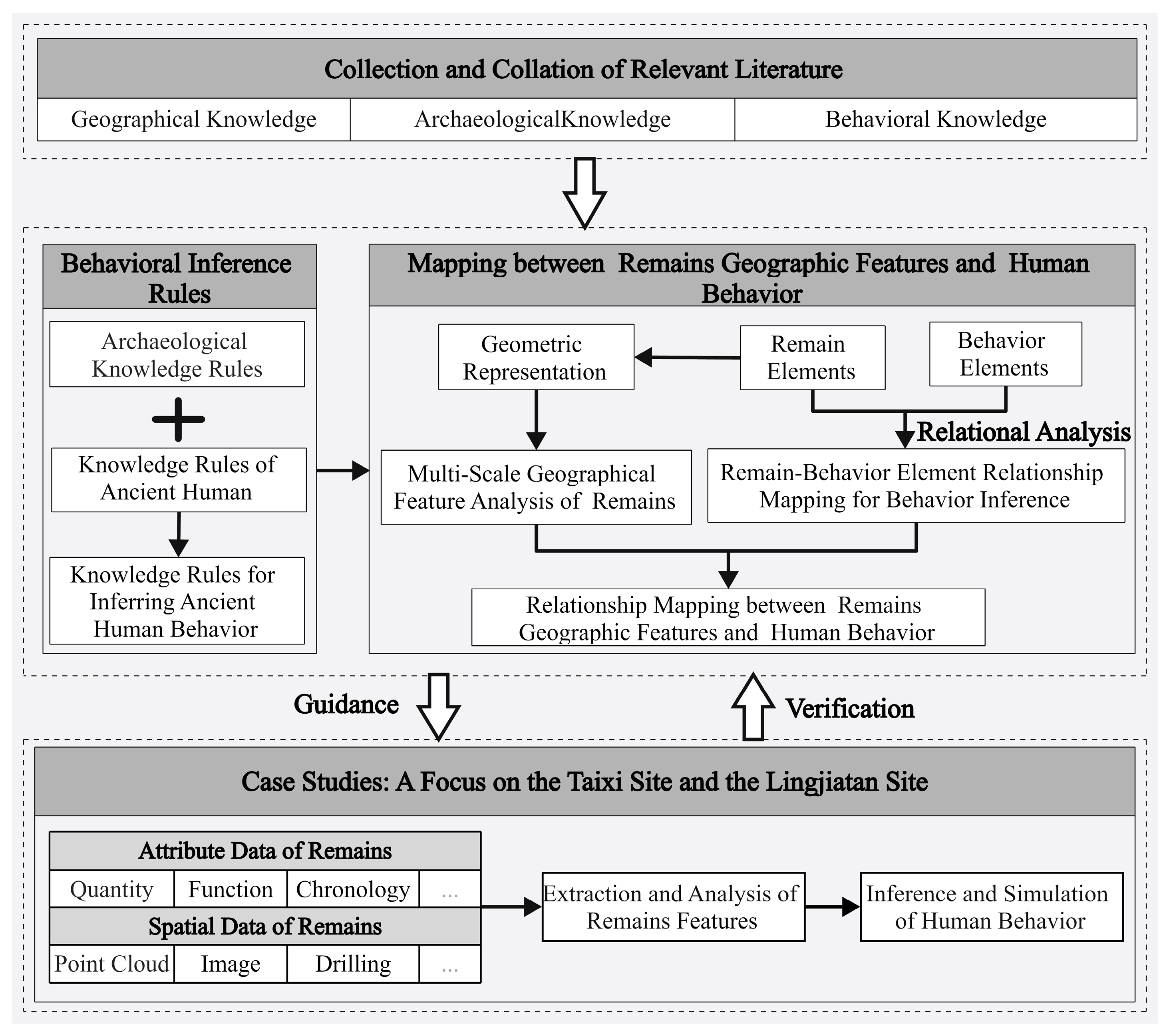
Therefore, proceeding from archaeological site data, taking the theories of geography, archaeology, and behavioral science as the foundation, and combining methods for extracting and analyzing the features of geographical entities, we aim to organize and analyze the concepts, classifications, and necessary expression content of remain elements and behavioral elements, establish a mapping relationship between the geographic features of remains and behaviors, and preliminarily infer ancient human behaviors by taking the Taixi Site in Hebei Province and the Lingjiatan Site in Anhui Province as examples. The research route is shown in Figure 1. This will help deepen the understanding of ancient human behavioral patterns and promote the integrated development of geographical, archaeological, and behavioral research. By establishing systematic methods for behavioral inference and dynamic modeling, it can support the reconstruction of ancient human behaviors within sites and expand new directions for digital archaeology and historical geography research.

3. Methodology

3.1. Analysis of the Relationship Between Ancient Human Behavioral Elements and Remain Elements

In a broad sense, the behavior of spatiotemporal objects refers to the ability of an entity to induce state changes in itself or other external objects. It also represents how entities manifest over time under internal laws and external disturbances, such as natural laws of the environment and stimuli from other spatiotemporal objects. Focusing on the spatiotemporal reconstruction of prehistoric human behaviors in archaeological sites, the prehistoric human behaviors inferred in this paper primarily refer to various production and daily life behaviors that emerged during the process of continuous selection, modification, and adaptation to their living environment. From the perspective of the generation mechanism, behavior is a response to processes that affect the organism itself (e.g., the construction of trenches driven by defence needs) and a control over processes that influence other spatiotemporal objects or the environment (e.g., farming, dwelling construction, etc.). It is characterized by multi-granularity, multi-type, multi-morphology, multidimensional correlation, multidimensional dynamics, and multi-capability autonomy. To comprehensively explore the content of ancient human behaviors, we proposed seven fundamental behavioral elements for describing and modeling them, based on works such as Behavioral Archaeology [1], Dictionary of Psychology [36], and Health Education [37]. These elements are subject, object, means, time, content, environment, and outcome.
In ancient times, particularly during the prehistoric era, when written records were scarce, archaeological remains served as the primary evidence for exploring ancient human behaviors. These remains, which include features, artifacts and ecofacts, are the core content of settlement landscapes and the main research subjects for archaeologists studying ancient lifestyles, social structures, and activity patterns. Features refer to immovable traces left by ancient humans through various activities, artifacts are portable human-made objects, and ecofacts are biological remains of cultural significance. Classified by their functions, these remains can be further subdivided as shown in Table 1.
With the proposal of the information geography theory for the ternary world of ‘physics-humanities-information’, the conceptual model of geographic scenarios with seven information elements and seven geographical description dimensions [38] provides multidimensional theoretical support and an information expression framework for the element description, analysis, and reconstruction of settlement landscapes. Specifically, the archaeological remains within the settlement landscape can be expressed and analyzed from diverse elements: time, spatial location/distribution, builders/users, remain ontology, and relevant behaviors.
To infer ancient human behaviors from archaeological remains, it is essential to first clarify the relationship between them at the conceptual level. This paper provides a preliminary analysis of the relationship between behavioral elements and remain elements (Table 2), laying the foundation for inferring the mapping relationship between behavior and remains at both the conceptual and logical levels.
In this study, behavioral time encompasses the chronological age, cultural period, and duration of ancient human behaviors. The behavioral object refers to the targets of these activities, which may include individuals, groups, or remains. The environment primarily denotes the locations of ancient human activities, encompassing the spatial distribution of features, stratigraphic layers, etc. The behavioral content provides a comprehensive classification of ancient human activities, such as production behaviors like farming, fishing, and hunting, as well as daily life behaviors, including sacrifice and dining.

3.2. Principles for Ancient Human Behaviors

We analyzed ancient human behaviors within their respective environmental systems. Based on works such as Ergonomics and The dynamics and statistical mechanics of human behaviors [39,40], combined with archaeological knowledge, the principles for ancient human behaviors are determined as shown in Table 3.
In Table 3, the passable width shall not be less than 375 mm based on the average shoulder width of existing adults [41]. Research indicates that the maximum passable slope for a normal human is 45° [42].
To resolve potential conflicts among the behavioral principles listed in Table 3, a hierarchical framework is proposed. First, the constraint layer (Behavioral occasion principle and Environmental passability principle) prioritizes determining whether a behavior can occur and whether a space is accessible. This layer aligns with the affordance theory in ecological psychology, which posits that behavior is fundamentally constrained by environmental conditions [43]. Second, under conditions of accessibility, the optimization layer focuses on path selection based on minimizing travel cost. This is consistent with the fundamental logic of human spatial behavior, where individuals minimize total work and balance immediate and future costs when solving problems [44]. Finally, the regulatory layer (including Path recognition habit, turning habits, and Conformity habit, etc.) operates when multiple feasible paths have similar costs. Its mechanism corresponds to the heuristic decision-making process in cognitive psychology [45]. Thus, the priorities of different principles reflect a progressive relationship of ‘accessibility constraint—cost optimization—behavioral preference regulation’, rather than a simple empirical ordering.

3.3. Principles for Ancient Human Behavior Inference

By integrating knowledge from geography, archaeology, and behavioral science, we established comprehensive principles for inferring ancient human behaviors, providing rule guidance for constructing a mapping relationship model between geographical features of remains and ancient human behaviors. The archaeological principles related to ancient human behaviors include: principles for judging the remain period and cultural type based on stratigraphy, typology, geochronology, and paleontological fossil chronology; principles for classifying remain type and function based on morphology, coexistence relationships, and geographical features of remains; and principle for judging identity hierarchy of ancient humans based on tomb hierarchy and housing hierarchy, etc. Behavioral principles for ancient humans primarily encompass the behavioral occasion principle, the shortest path principle, the environmental passability principle, the behavioral means selection principle, and the behavioral time-related principle, etc. As shown in Table 4.

3.4. Extraction and Analysis of Geographical Features of Archaeological Remains

In this study, the primary focus is placed on the representation and analysis of the geographical features of archaeological remains, including attribute characteristics such as temporal and functional properties, as well as spatial characteristics such as spatial morphology, spatial location, and spatial relationships, thereby providing a structured data basis for subsequent spatial analysis and behavioral inference. As movable material remains, artifacts and ecofacts provide information about human activities through their types, quantities, and spatial positions. As immovable remains, features represent the core of prehistoric human activities and serve as archaeological entities with three-dimensional information. From a functional-unit perspective, features usually go through three stages: construction, use, and abandonment [18]. Each stage corresponds to at least one accumulation behavior, forming a specific accumulation body, and the features of the accumulation body directly reflect the behavioral content of humans at that time. Therefore, it is necessary to systematically construct the mapping relationship between remains and human behaviors based on the extraction and analysis of the geographical features of remains.

3.4.1. Acquisition of Remain Data and Its Spatial Representation

Field archaeology serves as the primary method for acquiring archaeological remain data. Based on modern surveying and mapping technologies, as well as traditional archaeological methods, the spatial and attribute data of remains are collected at archaeological excavation sites, which serve as the data basis for inferring ancient human behaviors. To deduce human activities across multiple scales, from individual remains and single sites to site clusters, it is necessary to conduct fusion processing of multi-source remains data, as well as perform geometric representation and feature extraction of remains at different scales. This paper provides a preliminary classification, description, and analysis of research objects across different research units (Table 5).
As shown in Table 5, archaeological data primarily derive from imagery, including remote sensing imagery, unmanned aerial vehicle (UAV) imagery, close-range photographic imagery, and videos. Line drawings mainly refer to two-dimensional plane and section drawings, and topographic maps produced during field archaeology. 4D data denotes four types of digital terrain models: Digital Object Model (DOM), Digital Elevation Model (DEM), Digital Surface Model (DSM), and Digital Line Graph (DLG). Solid models are three-dimensional representations constructed based on the geometric features of research subjects and their data sources. The fusion and integration of these heterogeneous multi-source archaeological data [46] facilitate the subsequent extraction and analysis of the geographical features of remains, thereby enabling the establishment of mapping relationships with the behaviors of ancient humans.
In archaeological research, spatial feature analysis primarily focuses on features, while attribute feature analysis focuses more on artifacts and ecofacts. Based on the analysis of geographical scenarios and elements of archaeological sites, the spatial characteristics of features were analyzed from three scales. The micro-scale focuses on the spatial morphology of individual features, such as house foundations, ash pits, and burials. The meso-scale addresses spatial relationships among multiple features or feature assemblages, including burial clusters, cemeteries, and courtyard systems. The macro-scale extends the analysis to inter-site relationships, examining spatial organization and distribution patterns among site clusters at a regional scale. In the study of spatial features of geographic entities, research objects are typically abstracted into four categories for analysis: points, lines, areas, and volumes. Therefore, according to research needs, a preliminary geometric abstraction of features is conducted across these three scales, with results presented in Table 6.
Based on the geometric representations of features, we need to explore the spatial distribution (such as the location of the features in the site or between the sites), spatial relationship (such as the adjacency and subordination between different feature units or sites), spatial morphology (such as the geometric outline of the features) and other spatial features to deduce the behaviors and cultural connotation of ancient humans.

3.4.2. Multiscale Extraction and Analysis of Spatial Features of Features

Based on the geometric representation of features in Table 6 and research methods for spatial features of geographical entities, we systematically summarized the extraction and analysis methods for spatial features at the micro, meso, and macro scales, as shown in Table 7.

3.5. Construction of the Mapping Relationship Between Archaeological Remains and Behaviors

Based on the above analysis of the behavioral elements and the behavioral inference principles, the mapping relationship between the remains and the behaviors is analyzed as follows:
  • Using the relevant principles for chronological dating, the temporal features of artifacts and ecofacts can be determined. By correlating these features with the behavioral time among behavioral elements, the chronological age and cultural period when the behaviors occurred can be further inferred.
  • Using the principle for classifying the remain type and function, we can obtain the functional attribute of the artifacts produced by the ancient human behaviors. By correlating these features with the behavioral outcomes among behavioral elements, we can determine the corresponding behavioral means adopted by ancient humans based on different behavioral objects.
  • Applying the principles of tomb hierarchy and housing hierarchy to the houses inhabited by the ancestors and the cemeteries where they were buried after death within the site, we can determine the identity information of ancient humans. By correlating this information with the behavioral subjects among the behavioral elements, we can identify the accessible occasions and usable artifacts and tools corresponding to ancient humans with different ranks, under the provisions of the social hierarchy system.
  • By applying the functional classification principles derived from the style and structure of features and the functional attributes of unearthed artifacts, we can identify the type and function of features. This methodology enables us to reconstruct the content of ancient human activities within the site. Through analyzing the geographical spatial features of features and correlating them with behavioral elements such as behavioral environment, we can determine that ancient humans conducted activities in specific environments and locations and adapted their behaviors to the prevailing conditions.
In summary, there exists a discernible mapping relationship between archaeological remains and human behaviors. The attributes and spatial features embedded in these remains provide fundamental evidence for inferring ancient human behaviors. Combined with methods for extracting and analyzing the geographical features of remains, we refined remain elements into two dimensions: spatial features and attribute features. A mapping model linking geographical features of the remains to behavioral elements is constructed. Spatially, artifacts, ecofacts and features are abstracted into simple geometric objects, categorized into micro-scale (single remains), meso-scale (within-site), and macro-scale (inter-site) based on their geographical features, with corresponding spatial features described at each scale. Utilizing traditional archaeological typology and environmental archaeology methodologies, the study identifies typological, functional, and temporal attributes of remains. Finally, the remain elements and their corresponding geographical features are correlated with behavioral elements to support the inference of ancient human behaviors. Results are presented in Table 8.

4. Results

Based on the mapping relationship between geographical features of the remains and behavioral elements, we selected the Taixi site in Hebei Province and the Lingjiatan site in Anhui Province as experimental objects to verify the applicability and effectiveness of the mapping model proposed in this paper.

4.1. Inference of Ancient Human Behavior Based on the Distribution Characteristics of Features and Surface Morphology (Taixi Site)

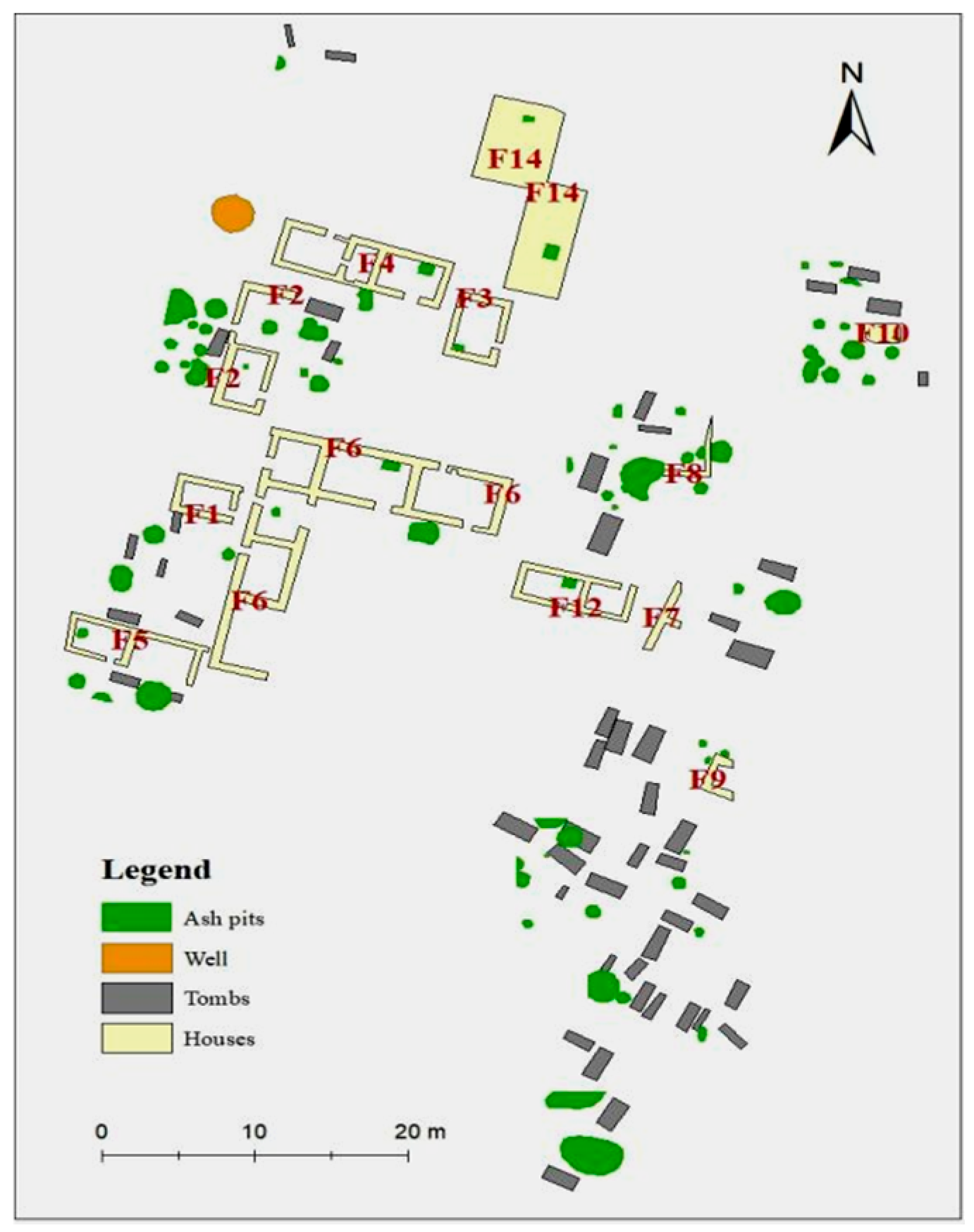
The Taixi Site is located to the northeast of Taixi Village in Gaocheng County, Hebei Province, lying between the four villages of Taixi, Zhuanghe, Gucheng, and Neizu. It is adjacent to the Shide Railway in the south and the Hutuo River in the north, covering a total area of 100,000 square meters. This site demonstrates prolonged cultural continuity, with evidence of human activity dating back to the Yangshao period through the Han Dynasty [48]. Systematic excavations initiated in 1973 revealed abundant residential remains in the late cultural layer, including 12 house foundations (F1–F10, F12, F14, each containing multiple household units), 87 ash pits, 1 well, and 55 tombs (Figure 2). These findings provide comprehensive data for quantitative analysis of ancient human behavior.
The analysis of ancient human activities at the Taixi site combines spatial feature examination with attribute analysis. Existing research indicates that Taixi was a clan-based village with interconnected households, likely consisting of patrilineal families or clans. The F14, designated as a communal dwelling, may have served purposes such as brewing and communal dining [49]. To further investigate household relationships, we recorded the spatial coordinates of all remains within the site using a local coordinate system, followed by K-means clustering analysis of house sites and adjacent ash pits (excluding F7, F9, and F12 on the western side due to incomplete excavation).
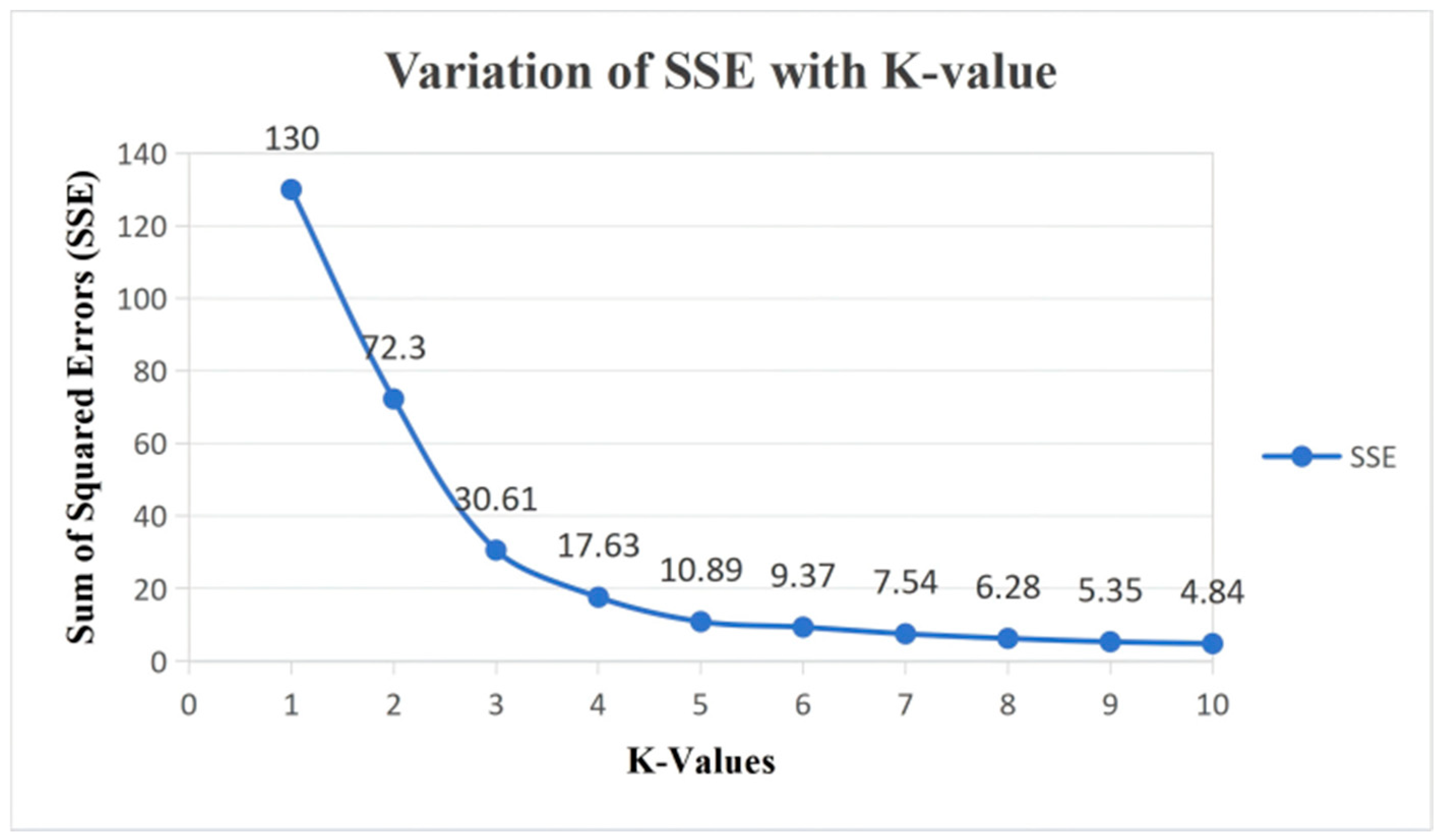
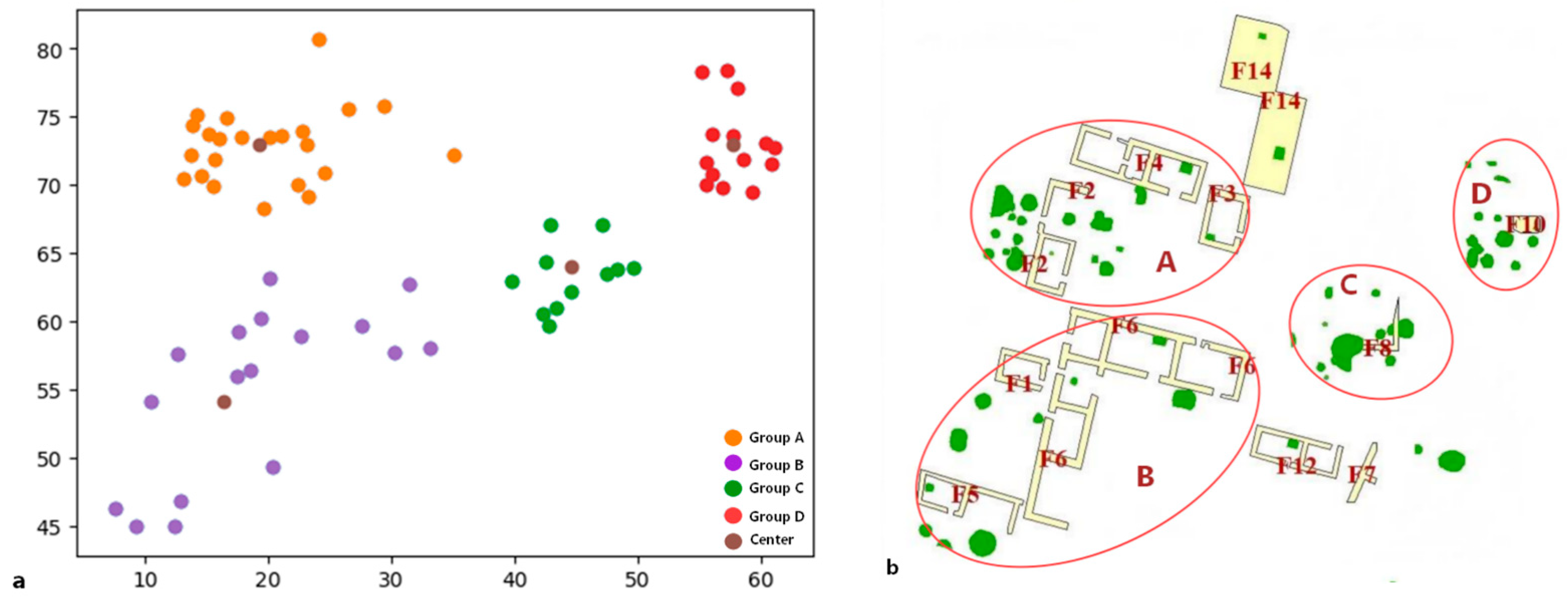
The elbow method was employed to determine the optimal number of clusters for K-means clustering [50]. The Sum of Squared Errors (SSE) was calculated for K values ranging from 1 to 10, as shown in Figure 3. The results indicate that the SSE decreases substantially when K increases from 1 to 3, suggesting that significant internal structural heterogeneity is progressively partitioned. At K = 4, a marked reduction in the rate of SSE decrease is observed, indicating the emergence of a clear elbow point. For K > 4, the decline in SSE becomes gradual and marginal, suggesting diminishing returns in clustering performance. According to the elbow criterion, K = 4 is identified as the optimal number of clusters. This parameter not only captures the major differentiation patterns within the multi-dimensional archaeological feature space, but also avoids over-clustering and the fragmentation of meaningful categories caused by excessively large K values. The results are presented in Figure 4.
The clustering analysis grouped the eight households into four families: Group A (houses F2, F3, F4) with 17 ash pits; Group B (houses F1, F5, F6) with 10 ash pits; Group C (house F8) with 12 ash pits; and Group D (house F10) with 14 ash pits. In terms of settlement hierarchy, Group B families are the largest, and their ash pits contain high-end pottery, suggesting the highest social status. House F14, designated as a communal dwelling, was excluded from the clustering analysis.
We simulated the travel aggregation behaviors of family members from Group B to F14. Based on Table 2, Table 3 and Table 8, behavioral analysis and rule selection were conducted, as detailed in Table 9.
After defining the behavioral content and constraints, we first utilized the stratigraphic profile from the Taixi Site excavation report to extract borehole data and generate ancient DEM data through interpolation. By integrating feature coordinates, we constructed the behavioral environment. In terms of behavioral visualization, this study employs the Unity 3D platform, a powerful real-time interactive 3D engine. It provides functionalities such as physics-based agent movement, dynamic navigation mesh generation over irregular terrain, collision detection, real-time animation of behavioral sequences, and first- and third-person interactive exploration of reconstructed site environments. These capabilities enable the simulation of continuous and dynamic processes, including human movement, migration, resource acquisition, and activity patterns. As a result, the approach facilitates the transformation from static spatial representations of archaeological remains to the dynamic visualization and reconstruction of behavioral processes.
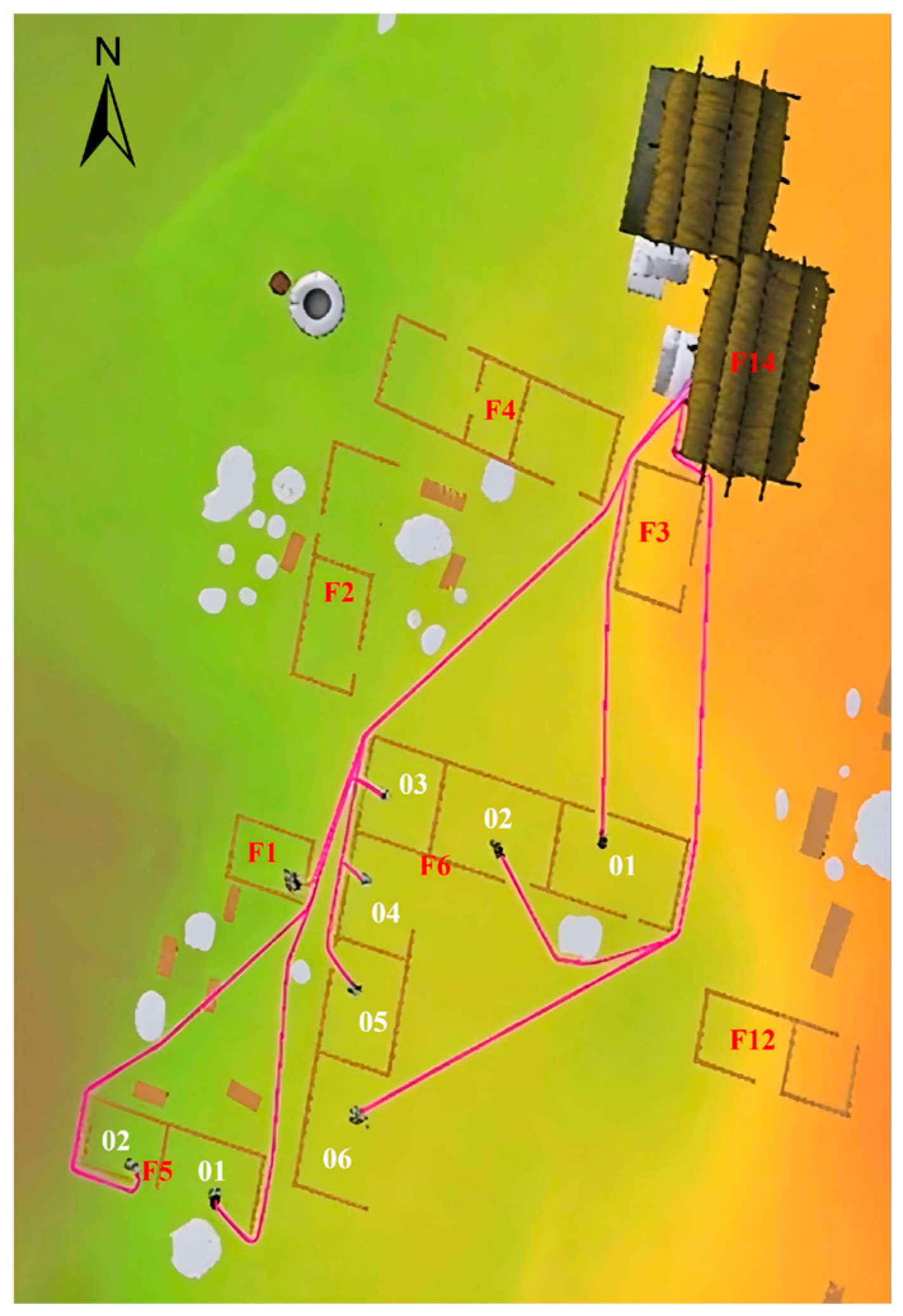
Specifically, the human model was imported into the Unity 3D platform, where C# scripts combined with Navigation components enabled dynamic simulation of travel behaviors (9 routes) for household members F1, F5 (members 01–02), and F6 (members 01–06) (Figure 5). Quantitative analysis of travel distance and time for each member in F1, F5, and F6 households (Table 10) revealed that the walking path from room F5-02 to F14 is the longest, measuring 49.36 m, while that from room F6-01 to F14 is the shortest, measuring 21.63 m.

4.2. Inference of Ancient Human Behavior Based on the Morphological Features of Feature Accumulation (Lingjiatan Site)

The Lingjiatan Site is located in Lingjiatan Village, Hanshan County, Anhui Province, China. Adjacent to the Yuxi River in the south and Mount Taihu in the north, it is a Neolithic central settlement site dating back approximately 6000 years, and also the largest and best-preserved super-large settlement of its time in the middle and lower reaches of the Yangtze River region. It serves as an important node for exploring the origin and formation of the diverse yet unified Chinese civilization. The site coordinates are 31°27′ N, 118°02′ E, with an area of nearly 1.6 million square meters [51].
During the archaeological excavation in 2015, a large amount of red burnt clay was discovered in a north–south oriented natural gully (coded G19, located in the raw soil layer). As the earliest building material in China, red burnt clay holds significant research value in the field of archaeology. It reflects the level of social productivity at that time and serves as an entry point for paleoenvironmental studies. To explore the archaeological value of red burnt clay in terms of spatial morphology, multi-period 3D laser point cloud data were collected from the three excavation pits (coded TW48S01~TW48S03), with 3D scanning performed both when the red burnt clay layer was fully exposed and after it was completely cleaned. The difference between the two datasets thus represents the red burnt clay layer. The data processing method for multi-temporal point clouds is detailed in the paper [52], which will not be reiterated here. As shown in Figure 6a–d), they respectively depict the excavation site of G19, the two phases of point cloud data of red burnt clay layer before (black point cloud) and after (yellow point cloud) cleaning, the extraction result of red burnt clay layer (brown part), and the constructed 3D model of red burnt clay layer.
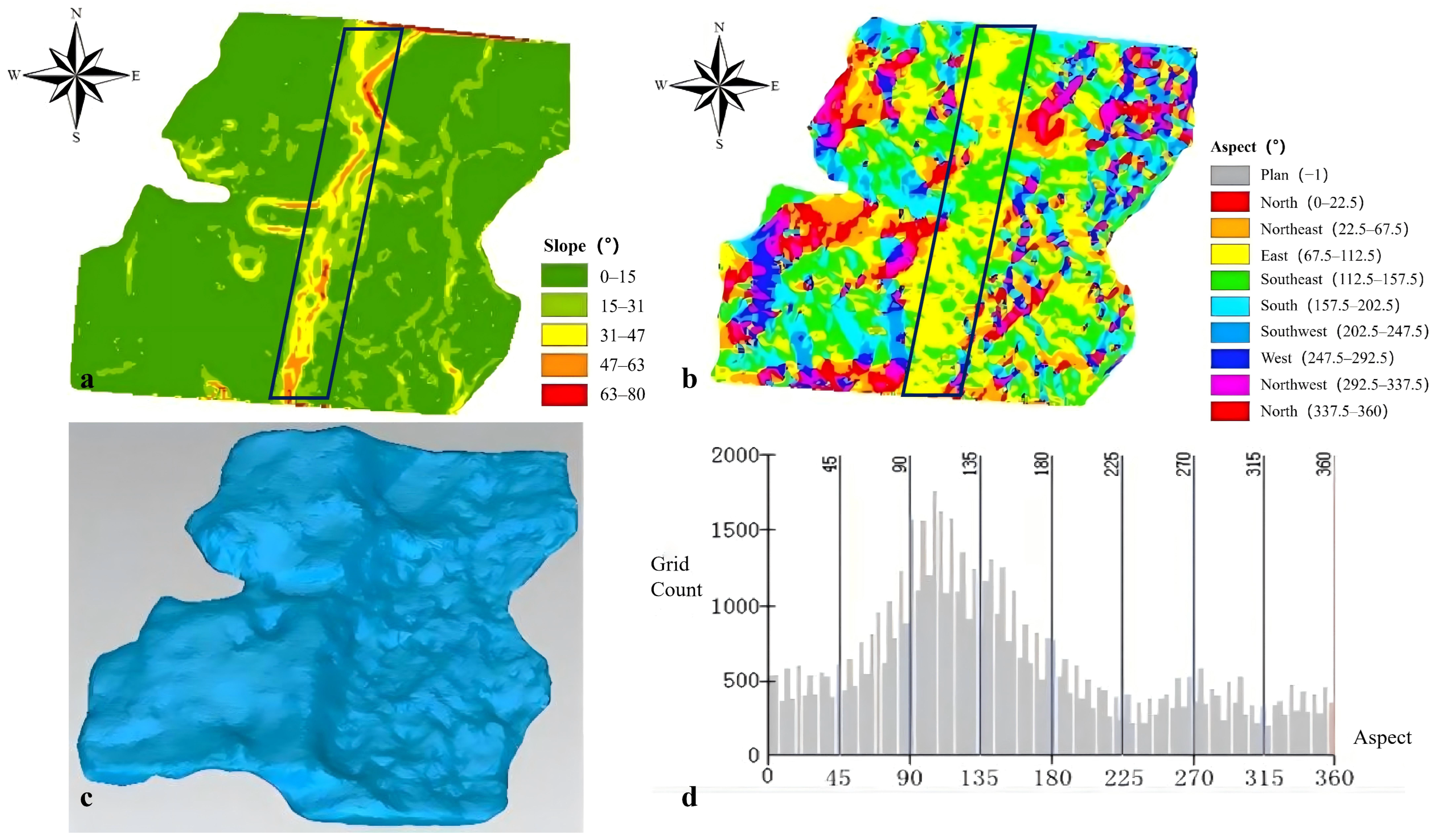
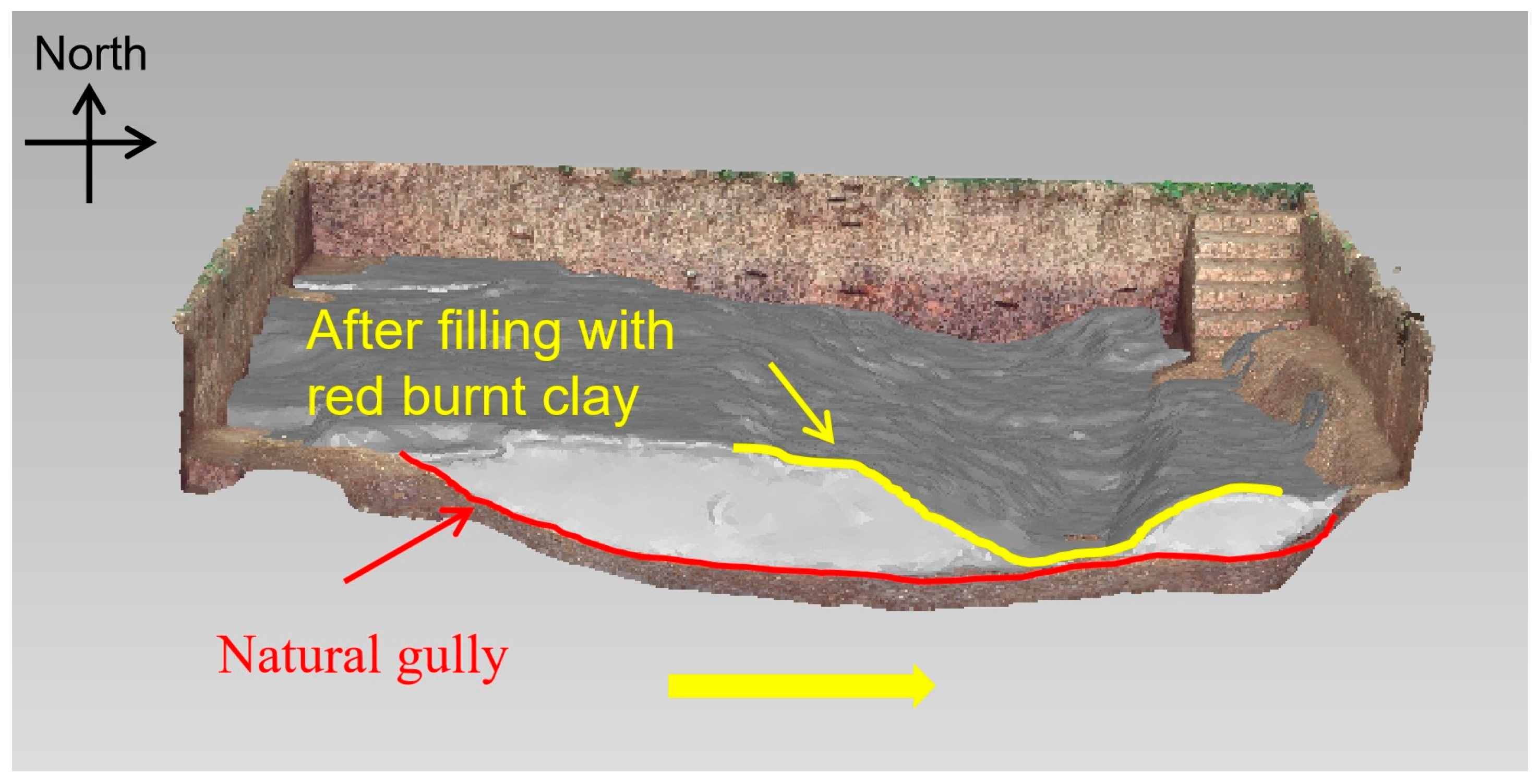
Topographic factor analysis was performed on Figure 6d. As shown in Figure 7, there is a north–south strip-shaped area with significant slope variations in the central part (black box) of the slope diagram of the red burnt clay layer (Figure 7a). The aspect diagram (Figure 7b) shows many yellow areas in the central part (black box), indicating a high concentration of areas with an eastern aspect. The slope distribution histogram (Figure 7d) further demonstrates that most values fall within the range of 90°and 135°, i.e., the east and southeast directions. Combined with the 3D model of red burnt clay (Figure 7c), the central area exhibits distinct east–west terraced undulations. In summary, these findings collectively suggest a clear west-to-east accumulation pattern in the red burnt clay layer, indicating that the Lingjiatan inhabitants likely deposited (or dumped) the red burnt clay from the western (left) side of the gully (Figure 8). Behavioral analysis and rule selection were conducted by cross-referencing Table 2, Table 3 and Table 8, as shown in Table 11.
Based on the analysis above, we can further deduce why the Lingjiatan ancestors chose the west side of the gully for waste disposal: (1) residential areas existed on the west side of the gully, prompting residents to discard garbage nearby; (2) the east side of the gully was obstructed by structures, highlands, or river basins, or was an inaccessible area to commoners. Of course, these inferences still require verification through local paleogeography, other archaeological data, and professional archaeological knowledge.

5. Discussion

In this paper, we integrated knowledge from archaeology, geography, and behavioral science to establish inference principles for ancient human behaviors, analyzed the relationships between behavioral elements and archaeological remain elements, clarified methods for extracting and analyzing relevant geographical features of remains, and constructed a mapping relationship between these features and behavioral elements. Finally, taking the Taixi Site in Hebei Province and the Lingjiatan Site in Anhui Province as examples, we derived and simulated ancient human aggregation behavior and feature accumulation behavior, respectively.
In terms of data foundation, traditional archaeological research predominantly relies on single-type data of remains (e.g., only artifact types, feature structures, etc.). The extracted spatial features are fragmented and incomplete (e.g., only labeling the scope of features without quantifying their spatial coordinates or their relationships with the environment), resulting in low data correlation. This study focuses on extracting geographical features of remains and deeply integrating them with their attribute features, to form multidimensional data support. This type of feature-based spatial extraction and integration is a key approach for linking spatial patterns to human activities in GIS-based behavioral studies [53].
In terms of methodology, compared with traditional GIS spatial analyses, which primarily focus on spatial distribution patterns or optimal path outputs, the proposed framework enables a structured representation and reconstruction of behavioral processes under rule-based constraints. By integrating knowledge from archaeology, geography, and behavioral science, it establishes a rule-constrained mechanism for behavioral inference, thereby reducing reliance on purely experience-based interpretations. Moreover, the framework overcomes the scale limitations of conventional archaeological studies by linking micro-scale remains, meso-scale sites, and macro-scale site clusters within a unified multi-scalar analytical structure, which is consistent with multiscale spatial analytical frameworks widely discussed in geographic information science [54,55]. It further incorporates the seven elements of behaviors (e.g., agents, time, activities, and means), and integrates multi-dimensional attributes of archaeological remains (including spatial and contextual information) with hierarchical decision rules and dynamic simulation mechanisms. This allows for the temporal evolution and systematic representation of behaviors, extending the analytical focus from static spatial outcomes to dynamic process reconstruction.
In the field of human behavioral inference, this study integrates knowledge from geography, archaeology and behavioral science. Through interdisciplinary collaboration, it establishes inference principles for the relationship between remains and ancient human behaviors by analyzing remain elements, behavioral elements, and geographical entity features. The research systematically summarizes methods for extracting and analyzing geographical features of remains, and develops a relationship mapping model between geographical features of remains and ancient human behavioral elements under the guidance of principles. This provides a quantitative, systematic, and logical methodological framework for the inference of ancient human behaviors. In addition, in this study, Unity 3D was introduced to support the dynamic simulation of ancient human behaviors by constructing a three-dimensional interactive environment, thereby extending conventional GIS-based approaches at the technical level. Traditional GIS-based archaeological spatial analyses largely rely on static raster data and cost-surface models, focusing on qualitative pattern description and quantitative spatial analysis, but they have limited capacity to capture the dynamic, stochastic, and complex nature of human behaviors. By contrast, Unity 3D operates on a reconstructed paleo-geographic Digital Elevation Model (DEM) and utilizes a NavMesh system to automatically define and represent traversable areas. Combined with a C# scripting environment, it provides a flexible framework for the explicit implementation of behavioral rules, such as variable movement speeds, obstacle avoidance, and real-time path adjustment. Within this environment, the paleo-geographic DEM functions as the basis for navigation, enabling a tight coupling between terrain characteristics and behavioral parameters. Through dynamic simulation in Unity 3D, key behavioral parameters defined in this study—including movement speed, turning behavior, and obstacle avoidance—can be represented at a level of detail that cannot be achieved by traditional static GIS-based path models. This allows for the reconstruction of behavioral processes rather than merely spatial outcomes, thereby improving the realism and reliability of behavioral inference.
In terms of applicability, this study addresses the limitations of traditional archaeological approaches, where site-specific experiential knowledge is often not transferable, by developing a methodological framework that can be applied across different sites. It is not only suitable for inferring ancient human behaviors at diverse types of sites (e.g., residential sites, production sites), meeting the needs for analyzing and interpreting the features of archaeological remains through the investigation of specific site, but also allows scenarios analysis at different scales, providing effective support for behavioral interpretation and a reusable framework for comparative studies of human behaviors across multiple sites.
This study also has certain limitations. The analytical framework proposed in this study is conceived as an integrative and extensible interdisciplinary system that combines geographical spatial analysis, archaeological interpretation of material remains, and rule-based modeling from behavioral science. It incorporates multiple dimensions of elements and multi-level constraint mechanisms, resulting in a relatively complex overall structure. Given the inherent complexity and diversity of prehistoric human spatial behavior, as well as the breadth and specialization of behavioral science theories, the behavioral inference rules developed in this study remain at a preliminary stage. They do not yet fully encompass all possible behavioral scenarios and activity types, and further refinement, expansion, and formalization are required to enhance the generality and applicability of the model. In terms of case validation, the two case studies presented in this paper focus on behavioral inference at the meso and micro scales. Due to limitations in the availability of archaeological data, the behavioral elements and inference constraints involved represent only a subset of the overall framework. In future work, with the advancement of archaeological excavations and the accumulation of more comprehensive datasets, additional constraints related to terrain, geomorphology, environmental conditions, and social factors can be incorporated. This will enable richer combinations of behavioral rules and a broader range of behavior types. Further applications across diverse case studies will also help refine the mapping structure of the model, enhance its explanatory power and adaptability in different scenarios, and ultimately provide stronger support for the modeling and digital reconstruction of ancient human behavior.

6. Conclusions

In this study, an archaeological data-based mapping method for geographical features of remains and ancient human behaviors has been proposed to address the need for settlement landscape reconstruction. By integrating geospatial analysis, archaeological interpretation, and behavioral science rules, this method establishes a systematic framework linking the remain elements with behavioral elements, enabling the inference and representation of behavioral processes from archaeological data. This provides a new technical pathway and methodological support for modeling ancient human behaviors.
Furthermore, taking the Lingjiatan and Taixi sites as case studies, we conducted preliminary behavioral inference and simulation at multiple spatial scales (i.e., micro- and meso-scales), demonstrating the applicability and operability of the proposed framework in multi-scale scenarios. The results indicate that the integration of multidimensional geographic feature extraction and rule-based behavioral modeling can effectively enhance the interpretive depth of archaeological data, extending research from traditional spatial pattern analysis to behavioral process reconstruction. In addition, the incorporation of three-dimensional visualization and dynamic simulation techniques enables the temporal representation and interactive analysis of ancient human behaviors, thereby improving the realism and interpretability of reconstructed historical geographic scenarios.
Overall, the proposed approach is exploratory yet meaningful for reconstructing prehistoric human behavioral processes and restoring ancient geographical and cultural environments, offering new perspectives for digital archaeology. With the continuous accumulation of archaeological data and advancements in modeling techniques, the proposed mapping model is expected to be applied to a wider range of site types and research contexts, and to play a greater role in data integration, visual representation, and interactive analysis, ultimately providing stronger support for studies of prehistoric human–environment relationships and digital archaeological scenario reconstruction.

Author Contributions

Lin Yang: Conceptualization, formal analysis, writing—original draft preparation, writing—review and editing, supervision, funding acquisition. Hui Li: Data curation, conceptualization, methodology, validation, formal analysis, resources, writing—review and editing, visualization. Peng Yu: Conceptualization, methodology, validation, formal analysis, resources, data curation, visualization. Weihong Wu: Data curation, conceptualization and supervision. All authors have read and agreed to the published version of the manuscript.

Funding

This research was funded by the National Natural Science Foundation of China (Grant No. 42571504) and Jiangsu Natural Science Foundation of China (Grant No. BK20231283).

Data Availability Statement

The data and codes that support the findings of this study are publicly available at https://github.com/lihui20010312/Mapping_methods.git (accessed on 14 March 2026).

Acknowledgments

Sincere thanks are given for the comments and contributions of the anonymous reviewers and members of the editorial team.

Conflicts of Interest

The authors declare no conflicts of interest.

References

  1. Schiffer, M.B. Behavioral Archaeology: Principles and Practice; Routledge: London, UK, 2016. [Google Scholar]
  2. Chávez-Lara, C.M.; Lozano-García, S.; Ortega-Guerrero, B.; Caballero-Miranda, M. Late Pleistocene and Holocene palaeoecological reconstruction of Lake Texcoco (Basin of Mexico) based on its ostracod record. J. Quat. Sci. 2022, 37, 1270–1279. [Google Scholar] [CrossRef]
  3. Meister, P.; Alexandre, A.; Bailey, H.; Barker, P.; Biskaborn, B.K.; Broadman, E.; Cartier, R.; Chapligin, B.; Couapel, M.; Dean, J.R.; et al. A global compilation of diatom silica oxygen isotope records from lake sediment. Clim. Past Discuss. 2014, 20, 363–392. [Google Scholar] [CrossRef]
  4. Shang, Z.W.; Li, J.F.; Wang, H.; Fang, J. Paleo-environment reconstruction of the oyster reefs around 4.2 ka BP in the North West Coast of Bohai Bay, China. Geol. China 2024, 51, 2042–2055. [Google Scholar]
  5. Li, A.; Zimmer-Dauphinee, J.R.; Kalyanam, R.; Lindsay, I.; VanValkenburgh, P.; Wernke, S.; Aliaga, D. Self-supervised large scale point cloud completion for archaeological site restoration. In Proceedings of the 2025 IEEE/CVF Conference on Computer Vision and Pattern Recognition (CVPR), Nashville, TN, USA, 10–17 June 2025. [Google Scholar]
  6. Zhu, Z.G.; Hou, J.K.; Zhu, G.Y.; Li, Q.; Li, M.Q. Application of U isotope fractionation effect in the analysis of paleo-ocean redox environments. Earth Sci. 2025, 50, 1250–1262. [Google Scholar]
  7. Chen, C. Doubt of the old, archaeology and historical reconstruction. J. Lit. Hist. Philos. 2006, 6. [Google Scholar] [CrossRef]
  8. Cortell-Nicolau, A.; Carrignon, S.; Rodíguez-Palomo, I.; Hromada, D.; Kahlenberg, R.; Mes, A.; Priss, D.; Yaworsky, P.; Zhang, X.; Brainerd, L.; et al. Assessing quantitative methods in archaeology via simulated datasets: The Archaeoriddle challenge. J. Archaeol. Sci. 2025, 177, 106179. [Google Scholar] [CrossRef]
  9. Miller, H.J.; Goodchild, M.F. Data-driven geography. GeoJournal 2015, 80, 449–461. [Google Scholar] [CrossRef]
  10. Yuan, M.; Hornsby, K. Understanding dynamics in geographic domains: Methods and challenges. Int. J. Geogr. Inf. Sci. 2020, 34, 1751–1772. [Google Scholar]
  11. Binford, L.R. Archaeology as anthropology. Am. Antiq. 1962, 28, 217–225. [Google Scholar] [CrossRef]
  12. Torre Sainz, I.; Doyon, L.; Benito-Calvo, A.; Mora, R.; Mwakyoma, I.; Njau, J.K.; Peters, R.F. Systematic bone tool production at 1.5 million years ago. Nature 2025, 640, 130–134. [Google Scholar] [CrossRef]
  13. Liu, J.H.; Ruan, Q.J.; Ge, J.Y.; Huang, Y.J.; Zhang, X.L.; Liu, J.; Li, S.F.; Shen, H.; Wang, Y.; Stidham, T.A.; et al. 300,000-year-old wooden tools from Gantangqing, southwest China. Science 2025, 389, 78–83. [Google Scholar] [CrossRef]
  14. Guagnin, M.; Perri, A.R.; Petraglia, M.D. Pre-Neolithic evidence for dog-assisted hunting strategies in Arabia. J. Anthropol. Archaeol. 2018, 49, 225–236. [Google Scholar] [CrossRef]
  15. Qu, Y. Understanding mammal resource choices and subsistence strategies during the Holocene Climate Optimum: Integration of evidence from palaeodistribution modelling, animal bones and archaeological remains in the farming–pastoral ecotone, northern China. J. Archaeol. Sci. 2024, 171, 106071. [Google Scholar] [CrossRef]
  16. Zhang, Y.; Xiao, Q.; Zhu, Y.; Wang, N.; Wu, M.; Li, Y.; Li, J.; Chen, D.; Huang, X.; Wang, S.; et al. Char and soot records of the Holocene fire history and its implications for climate–vegetation change and human activities within the Guanzhong Basin, southern Loess Plateau, China. Sci. Total Environ. 2024, 911, 168564. [Google Scholar] [CrossRef] [PubMed]
  17. Li, H.; Yi, X.; Lian, H.; Zhang, X.; Zheng, D.; Zhang, X.; Ren, L.; Yang, L.; Zhang, Z.; Song, R.; et al. Identification of rice paddy field morphology following the collapse of Neolithic culture in the Taihu Lake Plain, the Lower Yangtze River. J. Geogr. Sci. 2026, 36, 709–731. [Google Scholar] [CrossRef]
  18. Cui, J.X. Mapping landscape in Longshan period’s hierarchical society (3000–2000BCE) of North Loess Plateau: From archaeological predictive model to GIS spatial analysis. Herit. Sci. 2024, 12, 78. [Google Scholar] [CrossRef]
  19. Wang, C.Y.; Zhang, Z.; Li, Y.C. Distribution of settlement sites from Neolithic Age to Bronze Age and its relation to environmental changes in Eastern Hebei Province. Mt. Res. 2017, 35, 477–487. [Google Scholar]
  20. Frachetti, M.D.; Smith, C.E.; Traub, C.M.; Williams, T. Nomadic ecology shaped the highland geography of Asia’s Silk Roads. Nature 2017, 543, 193–198. [Google Scholar] [CrossRef]
  21. Yong, H.; Jia, X.; Li, S.; Yang, L.; Lee, H.F.; Tang, G. Reconstructing and tracing the evolution of the road networks in the Haidai region of China during the Bronze and Early Iron Ages. Herit. Sci. 2024, 12, 145. [Google Scholar] [CrossRef]
  22. Wright, D.K.; Kim, J.; Park, J.; Yang, J.; Kim, J. Spatial modeling of archaeological site locations based on summed probability distributions and hot-spot analyses: A case study from the Three Kingdoms Period, Korea. J. Archaeol. Sci. 2020, 113, 105036. [Google Scholar] [CrossRef]
  23. Eve, S.J.; Crema, E.R. A house with a view? Multi-model inference, visibility fields, and point process analysis of a Bronze Age settlement on Leskernick Hill (Cornwall, UK). J. Archaeol. Sci. 2014, 43, 267–277. [Google Scholar] [CrossRef]
  24. Paliou, E. Visual perception in past built environments: Theoretical and procedural issues in the archaeological application of three-dimensional visibility analysis. In Digital Geoarchaeology: New Techniques for Interdisciplinary Human-Environmental Research; Springer: Cham, Switzerland, 2017; pp. 65–80. [Google Scholar]
  25. Yu, J.; Yu, Y.; Wu, H.; Zhang, W.; Liu, H. Spatiotemporal changes in early human land use during the Holocene throughout the Yangtze River Basin, China. Holocene 2022, 32, 334–345. [Google Scholar] [CrossRef]
  26. Dong, G.; Lu, Y.; Zhang, S.; Huang, X.; Ma, M. Spatiotemporal variation in human settlements and their interaction with living environments in Neolithic and Bronze Age China. Prog. Phys. Geogr. 2022, 46, 949–967. [Google Scholar] [CrossRef]
  27. Yang, L.; Li, H.; Zhang, S.; Zhao, Y.; Sheng, Y. Cultural evolution of Neolithic archaeology in the Taihu Lake region of China based on complex network model. npj Herit. Sci. 2025, 13, 117. [Google Scholar] [CrossRef]
  28. Davies, B.; Romanowska, I.; Harris, K.; Crabtree, S.A. Combining geographic information systems and agent-based models in archaeology. Adv. Archaeol. Pract. 2019, 7, 185–193. [Google Scholar] [CrossRef]
  29. Patrick, S.M. Agent-based modelling for the cost-benefit analysis of adaptation strategies: A case study from Inuit Nunangat. J. Comput. Appl. Archaeol. 2024, 7, 283–300. [Google Scholar] [CrossRef]
  30. Huo, Y.; Wei, C.; Xu, Z.; Liu, Z.; Jin, M.; Zhang, Z. Integrating multi-scale convolution and attention mechanisms in HybridHAR for high-performance human activity recognition. Sci. Rep. 2026, 16, 10143. [Google Scholar] [CrossRef]
  31. Williams, A.J.; Mesoudi, A. A formal test using agent-based models of the circumscription theory for the evolution of social complexity. J. Archaeol. Sci. 2024, 172, 106090. [Google Scholar] [CrossRef]
  32. Romanowska, I.; Wren, C.D.; Crabtree, S.A. Agent-Based Modeling for Archaeology: Simulating the Complexity of Societies; SFI Press: Santa Fe, NM, USA, 2021. [Google Scholar]
  33. Orengo, H.A.; Garcia-Molsosa, A. A brave new world for archaeological survey: Automated machine learning-based potsherd detection using high-resolution drone imagery. J. Archaeol. Sci. 2019, 112, 105013. [Google Scholar] [CrossRef]
  34. Yaworsky, P.M.; Vernon, K.B.; Spangler, J.D.; Brewer, S.C.; Codding, B.F. Advancing predictive modeling in archaeology: An evaluation of regression and machine learning methods on the Grand Staircase–Escalante National Monument. PLoS ONE 2020, 15, e0239424. [Google Scholar] [CrossRef] [PubMed]
  35. Wang, Y.; Shi, X.; Oguchi, T. Archaeological predictive modeling using machine learning and statistical methods for Japan and China. ISPRS Int. J. Geo-Inf. 2023, 12, 238. [Google Scholar] [CrossRef]
  36. Lin, C.D.; Yang, Z.L.; Huang, X.T. (Eds.) Dictionary of Psychology; Shanghai Lexicographical Publishing House: Shanghai, China, 2003. [Google Scholar]
  37. Huang, J.H. (Ed.) Health Education, 3rd ed.; Fudan University Press: Shanghai, China, 2003. [Google Scholar]
  38. Lv, G.N.; Yuan, L.W.; Chen, M.; Zhang, X.; Zhou, L.; Yu, Z.; Luo, W.; Yue, S.; Wu, M. Reflections on the development of the geographic information discipline. Geo-Inf. Sci. 2024, 26, 767–778. [Google Scholar]
  39. Xing, B.; Zhang, S.N.; Wang, F. (Eds.) Ergonomics; China Ocean University Press: Qingdao, China, 2023. [Google Scholar]
  40. Wang, B.H.; Han, X.P. The dynamics and statistical mechanics of human behaviors. Physics 2010, 39, 28–37. [Google Scholar]
  41. GB/T 10000-2023; Human Dimensions of Chinese Adults. China Standards Press: Beijing, China, 2023.
  42. GB 50330-2013; Technical Code for Building Slope Engineering. China Standards Press: Beijing, China, 2013.
  43. Gibson, J.J. The Ecological Approach to Visual Perception; Houghton Mifflin: Boston, MA, USA, 1979. [Google Scholar]
  44. Zipf, G.K. Human Behavior and the Principle of Least Effort; Addison-Wesley: Cambridge, MA, USA, 1949. [Google Scholar]
  45. Kahneman, D. Thinking, Fast and Slow; Farrar, Straus and Giroux: New York, NY, USA, 2011. [Google Scholar]
  46. Shen, J.W. 3D-Scenario Reconstruction Method of Lingjiatan Site Based on Multi-Source Data Fusion. Master’s Thesis, Nanjing Normal University, Nanjing, China, 2019. [Google Scholar]
  47. Shen, J.W.; Yang, L.; Zheng, F.Z.; Wu, W.H. Reconstruction and application of paleo-stratigraphy of archaeological site based on multi-source data fusion. J. Nanjing Norm. Univ. Nat. Sci. 2020, 43, 49–55. [Google Scholar]
  48. Hebei Provincial Institute of Cultural Relics. The Taixi Shang Dynasty Site in Gaocheng; Cultural Relics Press: Beijing, China, 1985. [Google Scholar]
  49. Wang, Y. A Study on the Shang Dynasty Settlement and Societies of Taixi Site in Gaocheng. Master’s Thesis, Shandong University, Jinan, China, 2017. [Google Scholar]
  50. Yuan, C.; Yang, H. Research on K-value selection method of K-means clustering algorithm. J 2019, 2, 226–235. [Google Scholar] [CrossRef]
  51. Anhui Provincial Institute of Cultural Relics and Archaeology. Lingjiatan: Archaeological Excavation Reports of 1987 and 1998; Cultural Relics Press: Beijing, China, 2006. [Google Scholar]
  52. Yang, L.; Hu, Y.; Wu, W.H.; Sheng, Y.H.; Jia, X. Processing of multitemporal 3D point cloud data for reconstructing historical geographic scenarios. Sens. Mater. 2022, 34, 4551–4568. [Google Scholar]
  53. Miller, H.J. Necessary space–time conditions for human interaction. Int. J. Geogr. Inf. Sci. 2005, 19, 381–401. [Google Scholar]
  54. Couclelis, H. Rethinking time geography in the information age. Int. J. Geogr. Inf. Sci. 2009, 23, 1551–1575. [Google Scholar] [CrossRef]
  55. Goodchild, M.F. Scale in GIS: An overview. Geomorphology 2011, 130, 5–9. [Google Scholar] [CrossRef]
Figure 1. Research framework diagram.
Ijgi 15 00222 g001
Figure 2. Distribution of late cultural features at the Taixi site.
Ijgi 15 00222 g002
Figure 3. Variation in SSE with the K-values.
Ijgi 15 00222 g003
Figure 4. Clustering results of features. (a) Cluster results of features. (b) Plan view of cluster results.
Ijgi 15 00222 g004
Figure 5. Optimal route diagram for Group B members converging to F14 (red labels (e.g., F1) denote house structure IDs; white labels (e.g., 01) indicate individual members within each house; black dots within the house structures represent starting points.).
Ijgi 15 00222 g005
Figure 6. Process of extracting red burnt clay from multi-period point cloud data (Lingjiatan Site). (a) The excavation site of G19. (b) Point cloud data of two phases of red burnt clay. (c) Extraction process of the red burnt clay point cloud. (d) 3D model of red burnt clay.
Ijgi 15 00222 g006
Figure 7. Slope and aspect diagram of red burnt clay Layera. (a) Slope. (b) Aspect. (c) 3D model. (d) Aspect distribution histogram.
Ijgi 15 00222 g007
Figure 8. Behavioral inference based on the morphological features of red burnt clay accumulation.
Ijgi 15 00222 g008
Table 1. Types of remains.
TypesFunctionsExamples
FeaturesProduction and lifeAsh pits, house ruins, workshops, wells, palaces, etc.
DefenseTrenches, city walls, palisades, boundary ditches, etc.
Burial and sacrificeSacrificial area, altars, burial pits, etc.
ArtifactsProduction Tools for agriculture, handicrafts, fishing, etc.
LifeCooking utensils, tableware, decorations, etc.
Belief and customObjects used for divination, burial, sacrifice, etc.
EcofactsProductionCharcoal, etc.
LifeFaunal bones, carbonized seeds, phytoliths, etc.
Table 2. Analysis of behavioral elements and their relationship with remain elements.
Behavioral ElementsRemain ElementsDescription
TimeTime pointPhysical and chemical dating(chronological age)
Temporal processDuration of behavior
Time segmentCultural period and cultural context
SubjectIndividualsIndividuals associated with the remains (owners, builders, users, etc.)
GroupsGroups associated with the remains, or groups sharing the same identity attributes (clans, townships, etc.), or groups with unified division of labor (hunters, fishermen, etc.).
Object
(Target)
Individuals, groupsPeople involved in communication, collaboration, and confrontation related to the remains
Artifacts and ecofactsMaterial objects are directly affected by behaviors, such as plants used for construction, animal bones utilized for tool-making, sown plant seeds, etc.
FeaturesIndividual features, as well as functional zones, activity surfaces, and sites formed by the combination of features
Environment
(Location)
Spatial location, Spatial distributionLocation of human activities (features, stratigraphic layers)
ContentTheme behaviorBehaviors represented by the site, such as production (farming, fishing, hunting, etc.) and daily life (sacrifice, etc.).
MeansArtifactsBehavioral modes and tools: instruments and utensils required for the behavioral process
Outcome (Phenomenon)FeaturesIntrinsic attributes of features, such as workshops, dwellings, trenches, ash pits, tombs, etc.
ArtifactsUsed or processed artifacts, plants, animals, etc.
EcofactsAnimal bones discarded after consumption, etc.
Table 3. Principles for ancient human behaviors.
RulesDescriptionExplanations
Behavioral occasion principleThe situational context where human behavior occurs within specific time and space is shaped by factors such as social norms and goal demands.Different occasions directly constrain their behavioral logic and operation mode (stone tool manufacturing occasion, burial occasion, etc.)
Optimal path principleTo reduce energy consumption and improve behavioral efficiency, humans prioritize the path with the lowest passage cost.The simple path formed by the footprints is usually along the valley and the gentle terrain, avoiding the steep mountain.
Environmental passability principleThe selection of a passable way considering the average human body size and road conditionsPassable width (≥375 mm); the slope of passable terrain (≤45°); and the general passing speed (1.2 m/s).
Behavioral means selection principleThe selection of behavioral means that align with behavioral needs, social hierarchies, and current productivity levelsIn prehistoric times, walking was the main way of travel, and stone tools were the main tools of livelihood.
Behavioral time-related principleThe time point, temporal process, and time segments of behaviors possess different time scales.The dating technique determines the chronology of associated remains (chronological points); establishes the conventional time frame of ‘working at sunrise and resting at sunset’ (temporal processes); and defines cultural periods spanning hundreds to thousands of years based on archaeological typology, such as the Yangshao Culture (temporal segments).
Task queue theoryBased on behavioral logic, treat daily human activities as a series of tasks and prioritize them accordingly.Ancient people needed to make stone axes and other tools before going out to hunt.
Human walking habits① Shortcut-seeking habitTo reach a destination, people tend to choose the shortest path (e.g., the Euclidean distance).
② Path recognition habitPeople tend to take the paths they have traveled before and retrace their steps.
③ Left-turning habitThe center of gravity of the human body is biased to the left, and the body tends to lean slightly to the left when standing. During movement, individuals are prone to deviating to the left.
④ Edge-preference habitPeople in the peripheral areas of the interface are better protected and can observe the entire space than those in the central areas.
⑤ Conformity habitConformity is a psychological phenomenon commonly observed among certain individuals.
Table 4. Principles for remain-behavior inference.
PrinciplesBehavioral Inference Method
Principle for judging the remain period and cultural typeStratigraphyThe period of the production and life behavior of ancient humans corresponds to the period of the tools and the traces left by the behavioral process. This principle can be applied to determine the chronological age or cultural period of ancient human behaviors.
Typology
Geochronology
Paleontological fossil chronology
Principle for classifying the remain type and functionMorphologyThe types and functions of the remains reflect the specific content of ancient human production and living activities. For instance, stone tools and cooking utensils can be used to deduce the behavioral means adopted by ancient humans in production and daily life; the spatial characteristics of features (e.g., accumulation morphology and spatial distribution) reflect the behavioral processes at different scales.
Coexistence relation
Geographical features of remains
Principle for judging the identity hierarchy of ancient humansTomb hierarchyThe behavior of ancient humans was closely related to their social strata, such as divination and sacrifice, which often happened in the residences of the people with higher social status.
House hierarchy
Shortest path principleCombined with the analysis of the surface morphology of the ancient strata and the spatial distribution of the remains, the path analysis of the functional areas within the site or the migration path between the sites can be carried out.
Behavioral occasion principleThe determination of the behavioral occasion is used to retroactively infer and verify the relevant behavior of ancient people in the place, such as sacrifices performed in sacrificial areas.
Behavioral means selection principleSelect behavioral means based on behavioral needs, such as walking or using transportation tools for travel.
Environmental passability principleBased on the spatial distance between the remains within a site and the topography, combined with the shortest path principle, the passable routes of ancient humans can be inferred.
Behavioral time-related principleBased on common sense and the remain attribute, the period of the behavior is judged, and the start and end time and the duration of the ancient human travel are determined by the shortest path principle and the travel speed.
Table 5. Analysis of geographical scenario elements of archaeological sites.
Research UnitResearch ObjectDescription (Features)Data Format
RemainsIncluding movable artifacts and ecofacts, and immovable features
Ancient humansIdentity, characteristics, etc.3D points, solid models, etc.
Artifacts and ecofactsFunction, excavation site, affiliated features, entity attributes, etc.Images, 3D points, line drawings, solid models, text, etc.
FeaturesLocation, morphology, size, function, inclusions, etc.Images, 3D points, line drawings, solid models, text, etc.
SitesA place composed of a group of remains (with same attributes in kinship, geography, and function)
Remain combinationScale, morphology, orientation, chronological period, type, etc.Images, 3D points, line drawings, solid models, text, etc.
Site groupsAn area of ancient human activity composed of several sites
SitesCultural attributes, spatial distribution, scale, period, etc.4D data, text, etc.
Natural
environment
Natural geographical factors that are closely related to the site selection
TopographyGeological factors, orientation, spatiotemporal relationships with sites, etc.4D data, text, etc.
River Basins and Mountain RangesSpatiotemporal relationships with sites, etc.4D data, text, etc.
Table 6. Geometric representations of features at different scales.
Space ObjectPoint FeatureLinear FeatureAreal FeatureVolumetric Feature
Micro-scale
(within site)
features abstracted as pointsContour of featuresOpening planes of features3D solid models of features
Meso-scale (Within Site)features points in functional areas (sacrificial areas, burial areas, etc.)A combination of linear features in functional areasA combination of areal features in functional areasA combination of 3D solid models of features in functional areas
Macro-scale (between sites)set of regional site groups, set of feature groupsA combination of regional linear featuresA combination of regional areal features3D scenes and 3D solid models of regional features/sites
Table 7. Spatial feature extraction and analysis of remains at different scales.
ScaleGeometric RepresentationSpace FeatureFeature Extraction and Analysis
Micro-scalePointPlan coordinates, elevationThe spatial location and elevation data of the remains are obtained through GNSS and RTK measurements or spatial registration of existing archaeological data, which reflect the spatial locations of human behaviors.
LineLengthIt is derived from the vectorization of existing archaeological data or the spatial length measurement of data, such as point clouds and imagery, which reflects the morphology and size of the remains.
CurvatureAs mentioned above, curvature is also obtained via curvature measurement based on digitized archaeological data. It reflects the morphology of remains and can be used to infer the function and typology of features, thereby aiding in the inference of ancient human behaviors.
AreaArea, PerimeterSimilarly, based on digitized archaeological data, methods such as spatial measurement are employed to determine the area and perimeter. These measurements reflect the morphology and size of remains, providing data support for inferring ancient human population sizes, labor force levels, and other behavioral characteristics.
Slope, aspectThe slope and aspect of the features can be extracted through terrain factor analysis, which reflects the preferences of ancient human behaviors and provides data support for determining the direction of behavior and path selection.
VolumeVolumeThe volume of the features is calculated using spatial statistics; the earthwork of the features is obtained; and then the human resources, the scale of the ruins, and the level of labor force are deduced.
Meso-scalePointClustering characteristicsBased on the commonly used clustering method, such as the K-means clustering method, combined with clustering features and attribute features of remains, the multi-feature joint analysis can be carried out to deduce the categories and contents of ancient human behaviors in the sites.
LineDistance relationshipsCalculate the distance between different remains (cost distance, Euclidean distance, etc.), divide the functional areas within the site, and provide evidence for inferring the shortest travel path of ancient humans and the functional attributes of features.
AreaStratigraphic surface morphologyBy integrating archaeological drilling data, stratigraphic profiles, and modern DEM, we can employ interpolation and 3D modeling techniques to reconstruct paleostratigraphy [47]. The elevation, slope, and aspect across different periods are obtained within the site, and can be used to reconstruct ancient topography and support research on the interplay between human behaviors and paleoenvironments.
Point-line-areaTopological relationshipsThe topological relationships of remains reflect the spatial correlations among them; combining the spatial characteristics and attribute features of remains can determine the content of ancient human behaviors.
Orientation relationshipsMeasure the orientation of remains based on digitized archaeological data (e.g., PCA method), which can clarify the belief customs, defensive orientations, and architectural planning of ancient humans within the site.
Macro-scalePointQuantity distributionQuantity distribution reflects the degree of the distribution agglomeration of sites, and the number of sites reflects the process of cultural development in the region.
Elevation, slopeThe spatial coordinates of the sites in the study area are registered with DEM to obtain the topographic data of the area, which can be used to analyze the distribution characteristics of the sites and reflect the site selection behavior of ancient humans.
Distribution center of archaeological sitesExtracting the characteristics of distribution centers of site clusters (Tyson polygon method) enables the inference of the cultural structure and hierarchical relationships among sites in specific regions during the same period, providing support for deducing behaviors such as cultural exchanges and defensive protection between sites.
LineDistance relationshipsBy measuring the distances between archaeological sites based on their geometric centers, we can infer the clustering features of the site groups. The introduction of shortest path analysis enables us to infer the migration behaviors of ancient human settlements under topographical constraints, thereby supporting the understanding of settlement spatial organization and behavioral decision-making.
Point-line-areaOrientation relationshipsThe potential relationship between the sites can be analyzed by the distance and orientation relationship between the sites (standard deviation ellipse method).
Table 8. Mapping relationship of remain geographical features and behavioral elements.
Remain TypeDescriptionBehavioral Elements
DimensionTargetFeature
FeaturesSpaceSingle remain (Micro)PointSpace coordinates (x, y, z)Object/Environment
LineLength, curvatureObject/Outcome
AreaArea, perimeter, slope, aspect, etc.Object/Outcome
bodyVolume (Earthwork)Object/Outcome
Inter-remain (Meso)PointCluster centers, number of clusters, etc.Content/Outcome
LineDistance (shortest path)Mean
AreaStratum surface (slope, aspect, etc.).Environment
Point-line-areaOrientational/Topological relationshipContent/Outcome
Inter-site (Macro)PointSpatial distribution (distribution center, quantity, elevation, slope, aspect, etc.)Environment
LineSpatial distance between sites (migration path, least-cost path)Mean
AreaSettlement range (area, expansion trend)Environment
Point-line-areaOrientational/topological relationshipContent/Outcome
AttributeType and FunctionProduction and lifeWorkshops, farming areas, houses, etc.Content/Outcome
Defense City walls, moats, etc.
Burial, sacrificeSacrificial area, burial area, etc.
TimeChronological age and cultural period of featuresTime
Artifacts and ecofactsSpacePointLocation (x, y, z) and distribution of the artifacts and ecofactsObject
LineSpatial distance between similar and dissimilar artifacts and ecofacts
AreaDistribution and scope of artifacts and ecofacts
Point-line-areaOrientational relation, topological relation
AttributeType and functionProduction toolsAgricultural tools, fishing and hunting tools, handicraft tools, etc.Mean/Content/Outcome
Daily utensilsCooking utensils, tableware, decorations, etc.
Beliefs, customsFunerary objects, ritual implements, divination
TimeChronological age and cultural period of artifacts and ecofactsTime
Table 9. Analysis of aggregation behavior and selection of behavioral rules at Taixi Site.
Behavioral ElementCorresponding Remain ElementBehavioral Rules
TimeTime spent by each member during the tripA. Behavioral time-related principle (time points of behavioral occurrence)
B. Environmental passability principle (passable width ≥ 375 mm; slope of passable terrain ≤ 45°; speed = 1.2 m/s)
C. Behavioral occasion principle (gathering at F14 public housing)
D. Behavioral means selection principle (the ancient humans at Taixi Site traveled on foot)
E. Shortest path principle
F. Human walking habits (① shortcut-seeking habit, ③ left-turning habit)
SubjectFamily members of Group B
Object F14
EnvironmentPrivate residences F1, F5, F6, gathering places, and residential environments passed along the way
Content Aggregation at F14 from private residences
MeanWalking
Table 10. Distance and time statistics of Group B members converging to F14.
Route Number123456789
Start pointF6-01F6-02F6-03F6-04F6-05F6-06F5-01F5-02F1
End pointF14F14F14F14F14F14F14F14F14
Path distance (m)21.6334.0727.7129.8533.3640.9745.3249.3630.66
Walking time (s)18.0328.3923.0924.8827.8134.1537.7741.1325.55
Table 11. Analysis of accumulation behavior and selection of behavioral rules at Lingjiatan Site.
Behavioral ElementCorresponding Remain ElementBehavioral Rules
SubjectThe ancestors of LingjiatanA. Behavioral occasion principle (pouring red burnt clay into a natural gully)
B. Shortest path principle (preferentially dumping red burnt clay on the west side of the gully for proximity)
C. Human walking habits (① shortcut-seeking habit, ③ left-turning habit)
ObjectRed burnt clay
EnvironmentRaw soil layer of a natural gully
ContentAccumulation (or dumping) of red burnt clay on the west (left) side of the gully
Disclaimer/Publisher’s Note: The statements, opinions and data contained in all publications are solely those of the individual author(s) and contributor(s) and not of MDPI and/or the editor(s). MDPI and/or the editor(s) disclaim responsibility for any injury to people or property resulting from any ideas, methods, instructions or products referred to in the content.