1. Introduction
In nature, many organisms utilise compliant, soft body structures to navigate through cluttered, unpredictable environments efficiently. This observation has triggered a deliberate shift in robotics and in rehabilitation exoskeletons in particular, from predominantly rigid, mechanism-centric designs toward soft and hybrid embodiments that exploit material compliance and distributed deformation. Rigid exoskeletons, while precise and powerful, often suffer from joint misalignment, limited back drivability, bulky transmissions, and safety concerns during human–robot interaction. Soft technologies address these pain points by embedding “mechanical intelligence” (morphological computation) within the body itself: compliant skins [
1], indirect actuation such as with cable [
2,
3], continuum elements [
4], actively or passively adapt to users and environments, redistribute contact forces, and tolerate uncertainty without elaborate reflex loops [
5]. Delivering these benefits at scale requires active soft materials and, critically, muscle-like actuators capable of locomotion, large reversible shape change, and tunable stiffness. Compared with rigid systems, soft approaches promise (i) safer, more reliable human–environment interaction, (ii) adaptive behaviours that reduce explicit control complexity, and (iii) simpler, potentially more cost-effective components [
5]. At the same time, it must be stated upfront that controlling flexible or soft structures is more challenging than controlling rigid counterparts in general, owing to strong nonlinearities, distributed (infinite-dimensional) dynamics, viscoelastic hysteresis, and actuator/sensor latencies that complicate standard model-based control [
5].
The adoption of different types of actuators and actuation methods is already reshaping hand and upper-limb exoskeletons. Early glove-type devices demonstrated how soft pneumatic actuation can mobilise all digits while keeping the palm unobstructed; inflatable airbags served both as actuators and as intrinsic hyperextension stops, aligning assistance with physiological motion [
6]. Subsequent designs refined this idea via multi-chamber air structures that better direct extension forces along anatomical axes and reduce interphalangeal stress [
7]. In parallel, lightweight cable-driven architectures mounted on textile or flexible backbones improved portability and fit, using adjustable rings and routing to personalise assistance with minimal added mass [
8]. Compound drives that combine tendons with compliant elements (e.g., leaf springs) further simplify mechanics while supporting both flexion and extension with a single, compact transmission [
9]. For use beyond clinics, capstan-based, portable systems enable home training and even estimate interaction torques relevant to spasticity assessment without the need for expensive force sensors [
10]. Hybrid gloves that augment tendon transmissions with pneumatic power deliver therapeutic-level forces while maintaining comfort and compliance across hand sizes [
11]. Together, these developments illustrate the pathway from rigid, one-size-fits-all mechanisms to personalised soft and hybrid devices that prioritise comfort, natural kinematics, and user autonomy.
Progress on control is keeping pace with these advances in embodiment. Because soft robots exhibit high-dimensional, strongly nonlinear dynamics, direct physics-based model predictive control (MPC) can be computationally prohibitive. A promising remedy is to couple high-fidelity simulation with data-driven linearisation in an appropriate function space. In one representative framework [
12], the dynamics of a soft manipulator are simulated in PyElastica to generate input–output data; a lifted, approximately linear model is then identified using the Koopman operator, and the shape-regulation problem is recast as a convex optimisation that supports efficient MPC. The resulting surrogate runs over twelve times faster than the original physics model while maintaining effective shape manipulation performance. Such physics-informed, data-driven surrogates are especially attractive for soft exoskeletons, where personalised assistance, online adaptation, and safety constraints demand fast, predictive controllers.
Healthcare presents a compelling proving ground, where compliance and safety are paramount, and device affordability is a critical factor. Soft and hybrid robotic technologies now span rehabilitation and assistive devices, surgical systems, prosthetics/orthotics, diagnostic and therapeutic tools, and targeted drug delivery domains that benefit from intrinsic compliance, adaptable geometry, and gentle contact mechanics. For the wrist, a soft parallel mechanism actuated by six pneumatic artificial muscles and a central linear motor achieves the essential rehabilitation motions (flexion–extension, abduction–adduction, supination–pronation) within a compact and safe architecture [
13]. For personal care, a soft shower-arm manipulator tracks complex, asymmetric 3D paths under open-loop, task-space control, demonstrating the feasibility of compliant assistance in activities of daily living [
14]. In image-guided interventions, a soft parallel end-effector for ultrasound attains substantial longitudinal and transverse stiffness while preserving patient-safe compliance [
15]. Wearable elbow-rehabilitation devices based on inflatable wedge-cell modules generate controllable joint torques in lightweight, low-cost formats suited to routine therapy [
16]. Modular assistive concepts integrate flexible fluidic actuators with tensioning cables to realise reconfigurable shower arms tailored to user needs in demanding bathroom environments [
17]. Complementing these devices, a six-DOF (degree of freedom) ultrasound robot employing a passive, soft-robotics-inspired strategy behaves as a tunable nonlinear spring, enabling controlled, safe forces throughout its workspace [
18].
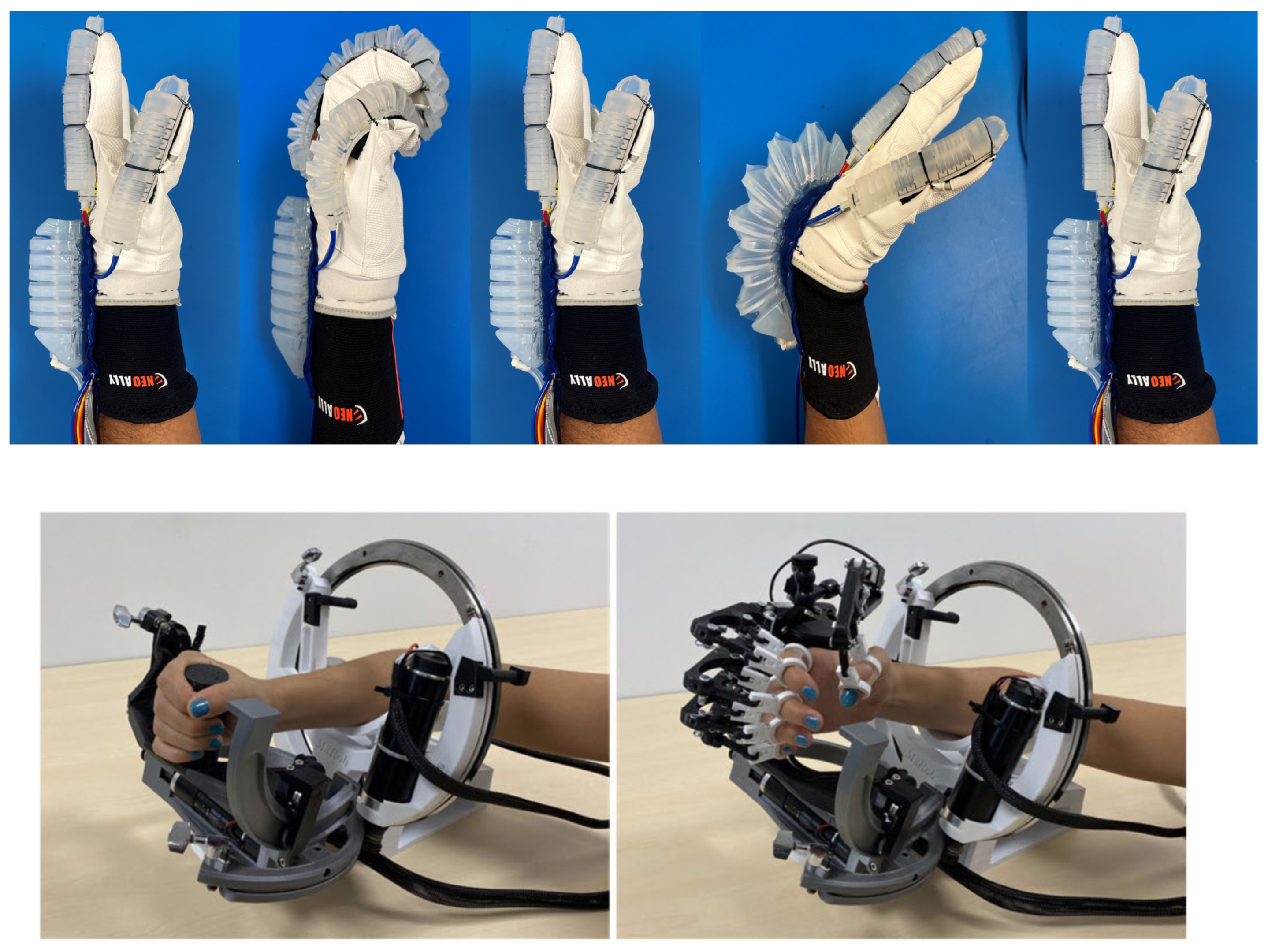
Since many daily tasks require coordinated wrist–hand motion, integrated platforms are gaining traction. Most activities of daily living (ADLs) require coordinated wrist positioning and finger manipulation, rather than isolated finger motion. Tasks such as grasping a cup, using cutlery, turning a key, opening a door handle, holding a phone, or manipulating clothing depend on the wrist placing the hand in an effective orientation while the fingers generate grasp, pinch, and release forces. Therefore, finger-only rehabilitation may improve local movement capacity but may not fully translate into functional independence if wrist stabilisation and wrist–hand coordination remain impaired. Integrated platforms can reduce donning time, simplify alignment, and encourage task-oriented rehabilitation, but often at the cost of increased bulk as shown in
Figure 1. Despite this importance, integrated wrist–hand designs remain underrepresented. The M3Rob platform combines a three-DOF wrist exoskeleton with a modular hand unit and multiple assistance modes, enabling task-based training within a single system [
19]. Likewise, a pneumatically actuated soft exoskeleton can assist wrist and hand simultaneously, offering full or partial support with PD control to track desired angles and velocities [
20].
Neuro-integrated rehabilitation further enhances outcomes by coupling physical assistance with neural engagement. A multisensory system that pairs a soft exoskeleton with virtual reality exercises and functional near-infrared spectroscopy (FNIRS) monitoring demonstrated improvements in grip strength and range of motion, along with measurable cortical activation, underscoring the synergy between motor practice and neuroplasticity [
21]. A complementary brain–computer interface (BCI) approach leverages electroencephalogram (EEG)-based motor imagery features with graph convolutional networks to achieve high motion-intention classification accuracy, enabling adaptive active–passive rehabilitation modes that respond to user intent [
22].
Finally, control trends are moving toward personalised, user-driven assistance. Electromyography (EMG)-controlled exoskeletons with series-elastic actuators provide compliant, safe force support that tolerates alignment errors and accommodates variable user effort [
23]. Variable-stiffness actuators enable therapists (or controllers) to tune joint rigidity in situ, facilitating nuanced posture shaping rather than only coarse grasp assistance [
24]. Magnetically controlled “smart” gloves provide instant, customisable resistance profiles suitable for both clinical and home training [
25]. Hybrid tendon-driven gloves augmented with pneumatic power achieve therapeutic force levels while preserving comfort and fit, bridging the gap between lab prototypes and everyday use [
11]. The field is converging on soft and hybrid exoskeletons that combine mechanically intelligent bodies with fast, tractable control often via physics-informed, data-driven surrogates to deliver safe, adaptive, and affordable rehabilitation.
2. Key Design Elements and Enabling Technologies for Soft Hand Exoskeleton
This section outlines the key design elements and the enabling technologies that support the development of soft exoskeletons.
2.1. Actuation Mechanisms for Soft Exoskeleton Robots in Rehabilitation
Fluid-powered actuation includes pneumatic fluid-powered actuation and hydraulic fluid-powered actuation. Fluid-powered actuation is one of the most widely used actuation mechanisms for developing assistive devices and soft exoskeleton rehabilitation robots, because of its high power density, dependability, and controllability. This actuation technology accounts for around 33% of the actuation mechanism for soft exoskeleton robots. Electrical motor actuation, chemical reactions, and soft active material-based actuation which includes dielectric elastomers, shape memory alloys (SMAs), magnetoactive elastomers, liquid crystalline elastomers, and piezoelectric materials, are among the soft actuators that are available for rehabilitation and assistance. Chemical reactions, liquid crystal elastomers, and magneto-active elastomers (MAEs) are relatively new research fields that collectively account for 11% of the field’s activity. These devices are primarily at the concept stage. Then, 23% of the work is based on SMA actuation technology, 10% on electric motors, 16% on dielectric elastomer actuators, and 7% on piezoelectric actuators [
26].
2.2. Sensing Technologies for Soft Exoskeleton Robots in Rehabilitation
Sensors are of great significance for operating the exoskeleton autonomously. Sensors enable the robot to detect information from its surroundings, including the user preference. Exoskeletons primarily use bending sensors such as flexion sensors, and also dynamic sensors, which comprise subclasses like force, torque, pressure, and inertial measurement unit (IMU) sensors. Other primary sensors are cameras or optical-based systems, encoders, electromyography (EMG), electroencephalogram (EEG) sensors, and potentiometer sensors. In [
27], a review on sensor technologies used in exoskeleton robots is detailed. Accordingly, lower-limb exoskeletons are the most common type of exoskeleton which uses nearly all sensor types. In total, 95% of lower-limb exoskeletons use IMUs, 82% use pressure sensors, and 82% use EEG sensors. Then, 67% of hand exoskeleton systems use bending sensors. Force and torque sensors make up a sizable portion of the sensors used in exoskeletons, with dynamic sensors accounting for 40%. Then, 14% of exoskeletons use encoders. EEG and cameras are utilised more frequently than bending sensors. Exoskeletons use a variety of other various sensor types, which account for 25%. Exoskeletons use a variety of specific sensors, including laser diode sensors, force myography (FMG), infrared, capacitive, and muscle circumference sensor (MCRS). A total of 23% of upper-limb exoskeletons use encoders and 20% of lower-limb exoskeletons use force sensors. Also, encoders and force sensors are used in 18% of hand exoskeleton devices [
27].
2.3. Materials and Structural Components for Soft Exoskeletons in Rehabilitation
In rehabilitation and assistive devices, researchers have created hand exoskeletons with rigid or flexible linkages and using hard or rigid materials. Exoskeletons can be either soft or rigid exoskeletons, depending on the material. To improve comfort, soft materials like fabric can be used in the wearable robot. 3D-printed exoskeletons are lightweight, easily customisable, and reasonably priced to manufacture. The most popular materials for hydraulic and pneumatic hand exoskeletons are silicone and fabric. The base material for exoskeleton gloves with motor-tendon actuators was silicone rubber and polymer. Nylon tendons have good strength, flexibility, and are less slippery in nature when connected to an object. One of the materials frequently utilised to create the casings of electronic devices of exoskeletons is polylactic acid (PLA) [
28].
2.4. Design Considerations and Criteria
Hand exoskeleton robots have emerged as critical tools for restoring hand function in individuals affected by stroke, spinal cord injury, arthritis, or age-related motor decline [
29,
30]. Designing such devices for rehabilitation requires balancing multiple criteria—control-theoretic performance metrics, adaptability, personalisation, configurability, and deployment—to ensure effective therapy outcomes. Recent advances in soft robotics further expand the design space, emphasising compliant, lightweight, and wearable systems that enhance user comfort and safety. This section consolidates conventional and emerging design criteria and how they apply across rehabilitation scenarios, incorporating insights from recent systematic reviews and emerging AI-driven innovations.
2.5. Control-Theoretic Performance Criteria
Fundamental to rehabilitation efficacy is the exoskeleton’s ability to replicate natural joint trajectories of the human hand. Mechanical alignment between the exoskeleton’s rotational axes and the user’s anatomical joints directly determines motion accuracy, torque transmission, and comfort [
29]. Errors in alignment introduce parasitic forces and motion constraints, potentially causing discomfort or unintended joint loading. Achieving sub-millimetre positional accuracy and minimal angular misalignment (<2° for finger joints) is a baseline engineering goal for contemporary prototypes [
27]. Precision manufacturing (via 3D printing or adjustable linkages) and calibration routines are therefore integral to the design process. At the low-level control layer, mechanical precision must be complemented by high-fidelity motion tracking. Typical control-theoretic performance metrics include the following:
Tracking Error (et): The deviation between commanded and actual joint trajectories. For therapeutic tasks involving fine finger motion, the root-mean-square tracking error should remain below 5–10% of the total range of motion. Settling Time (ts) and Rise Time: Short response times (<0.2 s for finger flexion) ensure responsiveness during assist-as-needed exercises. Steady-State Error: Ideally <1% for position control or <0.05 Nm for torque control to maintain stable grasping forces. Overshoot (Mp): Excessive overshoot increases risk of hyper-extension or pain; limiting Mp < 5% promotes smooth therapeutic motion. Bandwidth and Phase Margin: Sufficient (>3 Hz bandwidth; >45° phase margin) ensures stable closed-loop operation under variable limb impedance. These metrics quantify the accuracy and stability of exoskeleton actuation necessary to guarantee safety and repeatability during intensive rehabilitation sessions. For human–robot interaction, maintaining accurate impedance control is critical.
Impedance error,
, measures how faithfully the exoskeleton replicates the desired stiffness/damping behaviour. A low impedance error (<10%) signifies that the robot can render compliant or resistive behaviours as prescribed by therapy protocols. Transparency, defined as the ratio of user-generated motion energy transmitted through the device without interference, is another important measure for robot exoskeleton performance; high transparency (>0.8) indicates minimal mechanical or control resistance, yielding a more “natural” user feel [
27].
2.6. Adaptability
Hand exoskeletons should adapt to the needs of different users and therapy tasks. This includes physical adaptability—for example, incorporating compliant or soft robotic elements to accommodate natural hand movements—as well as adaptable control strategies. An effective device can adjust assistive force levels and range of motion in real time, providing more help when a user is weak and reducing assistance as the user regains strength. Integrating machine learning algorithms is a promising approach: by learning from a user’s motion data over repeated sessions, the exoskeleton can autonomously tune its behaviour to the individual’s movement patterns. Such adaptability ensures the robot remains neither underutilised nor overly restrictive, and can handle variations in patient performance (e.g., daily fluctuations in strength or the progression of recovery).
Additionally, adaptable interfaces (swappable control modes such as passive, assist-as-needed, or resistive exercise) allow the same device to be used across different therapy stages and tasks. Emerging AI-driven control systems (e.g., reinforcement learning-based controllers) are extending this adaptability by continuously optimising assistance in response to patient effort, task demands, or progression over time, beyond the static modes defined in traditional designs [
30]. Control-theoretically, adaptability is expressed through gain scheduling, adaptive control, and increasingly machine learning-based policies. The exoskeleton continuously updates its control parameters to minimise composite cost functions in terms of tracking error, force error and control input. AI models, like reinforcement learning or adaptive neural controllers, optimise this cost online by correlating performance with physiological feedback (e.g., electromyography or motion smoothness).
At the behavioural level, adaptability is evaluated through high-level indices such as the following: (1) Assist-as-Needed Index (AAN): Ratio of assistance torque to total movement torque, ideally converging toward zero as recovery improves. (2) Human-in-the-Loop Stability (HILS): Ensuring closed-loop system stability when the user contributes variable impedance; Lyapunov or passivity analysis provides quantitative stability margins. (3) User Intention Recognition Accuracy: Proportion of correctly inferred motion intents from biosignals (>90% target for practical systems). (4) Smoothness and Jerk Minimisation: Quantified via spectral arc length or jerk index, correlating with neuromotor recovery quality. For example, in post-stroke therapy, a reinforcement-learning controller may decrease assistive torque as the patient regains motor strength, thereby reducing the AAN index while maintaining low tracking error. This dynamic adaptation directly aligns device control with neuroplastic recovery principles [
31].
2.7. Personalisation and Human Factors
Rehabilitation outcomes improve when devices are personalised to each patient’s anatomy and preferences. Modern hand exoskeleton designs emphasise adjustability to accommodate varying hand sizes, finger lengths, and impairment levels. Techniques like 3D printing and modular design allow each exoskeleton to be custom-built or rapidly reconfigured for an individual, ensuring that joint alignment, range of motion, and grip configurations match the user’s needs. Personalisation also extends to comfort and ergonomics: a well-fitted, lightweight device with proper weight distribution and padding enables longer therapy sessions without pain or fatigue. Safety features (e.g., limits on force, emergency stop mechanisms) are tailored to the user’s condition to prevent injury. Moreover, a personalised user experience may include interfaces suited to the individual’s abilities—for instance, simple one-touch controls or even brain–computer interface control if the person cannot produce voluntary hand movements. Design for personalisation ensures the exoskeleton feels like a natural, comfortable extension of the user, which is crucial for engagement and adherence in rehabilitation.
Each patient’s impairment profile demands individualised kinematic and control parameters. Personalisation is achieved mechanically via adjustable link lengths or 3D-printed components and algorithmically through patient-specific control models or digital twin models that identify each user’s hand impedance and voluntary effort level [
27,
30]. Model-reference adaptive control can tune assistance gains to maintain target muscle activation levels measured by EMG. AI-driven user models can further predict fatigue, adapting session duration and control stiffness automatically. From a control perspective, comfort correlates with minimising interaction forces Fi and contact pressure variance at the human–device interface. Feedback loops that limit Fi < 5N on fingertips and maintain uniform pressure distribution (<10 kPa variance) are design goals for long-term wearability [
27]. Safety constraints are enforced through force-limiting controllers and redundant sensors to detect abnormal resistance or pain reflexes.
2.8. Configurability and Flexibility
Hand exoskeletons should offer configurable settings so that therapists or users can tailor the device to different exercises and goals. Research surveys highlight that effective systems provide a range of rehabilitation modes (passive mobilisation, active assistance, resistive training and bilateral mirroring) [
32], adjustable degrees of freedom, and tunable parameters to target specific movements. For example, a device might be reconfigured from full-hand grasp training to isolated finger exercises by locking certain joints or swapping attachments. Similarly, software control schemes can be switched between position control, force control, or impedance control depending on whether the goal is to improve range of motion, strength, or coordination. This configurability allows one exoskeleton to serve diverse therapy needs across patients and phases of recovery. It also facilitates research and personalisation, as the device can be quickly tuned or re-programmed to find optimal settings for each individual.
Control architectures often combine position, force, and impedance loops under hierarchical schemes. For instance, inner torque control ensures low-level stability (evaluated by settling time and bandwidth), while an outer adaptive impedance loop modulates interaction stiffness to simulate different exercise intensities. Quantitatively, mode-transition stability can be expressed by maintaining consistent phase margins (>40°) and bounded Lyapunov energy during mode switches. Advanced systems integrate task-space controllers driven by AI-based intention recognition networks, allowing smooth transitions between grip patterns (pinch, cylindrical, lateral grasp) depending on context. This hybrid configurability supports diverse clinical and daily-living exercises without manual re-programming. In the future, intelligent configuration systems might automatically suggest or load optimal settings for a given patient profile or task, further reducing the burden on clinicians to manually adjust device parameters.
2.9. Deployment and Usability
Translating hand exoskeletons from lab prototypes to widespread clinical or home use demands careful consideration of practical deployment factors. Usability is one of the most important keys to rehabilitation device design, meaning the system must be intuitive to operate, with minimal setup and a gentle learning curve. Many users of hand rehabilitation devices have limited dexterity or cognitive fatigue, so controls and feedback should be simple and clear (audible cues, simple visual interfaces, etc.). Portability and ease of donning are also vital. Devices that are heavy, bulky, or require extensive assistance to put on will likely be confined to specialist clinics. Recent reviews emphasise the importance of lightweight, compact and wireless designs to enable at-home rehabilitation and greater accessibility. For instance, soft wearable gloves with cable-driven actuation have been developed to allow patients to exercise at home with minimal supervision, greatly improving accessibility and cost-effectiveness of therapy. Reliability and maintenance are additional considerations: the exoskeleton should withstand daily use, have adequate battery life for a full session, and allow easy cleaning and upkeep, especially in home settings. Finally, affordability and integration into healthcare delivery models (including insurance coverage) are recognised factors in deployment. Designing with mass-producible components and open standards can lower costs and simplify repairs. Overall, focusing on user-centric design and real-world constraints ensures that hand exoskeletons can be feasibly deployed to those who need them most.
Real-world deployment requires the exoskeleton to maintain control and mechanical performance under variable environments. System reliability metrics include the following: (1) Mean time between failures (MTBF): >100 h for clinical prototypes. (2) Controller Robustness: Quantified by gain and phase margins, disturbance rejection (>20 dB attenuation at <2 Hz disturbances), and minimal drift in calibration (<1% over 8 h). (3) Energy Efficiency: Ratio of mechanical work output to electrical input, typically targeted >60% for portable systems. For home-based rehabilitation, lightweight soft-actuated gloves (<500 g) with portable battery packs are favoured [
29]. AI-assisted monitoring systems can evaluate high-level therapy metrics such as session compliance, task completion rate, and biomechanical improvement, feeding data back to clinicians for remote supervision.
2.10. Soft Exoskeleton Design Criteria and Considerations
Soft hand exoskeletons represent a paradigm shift from rigid, linkage-based architectures to flexible, fabric-integrated systems that emulate the biomechanics of the human hand [
4,
6]. In addition to the design considerations and criteria of hand exoskeleton robots for rehabilitation presented above, their design criteria emphasise compliance, wearability, lightweight actuation, and inherent safety, addressing many limitations of rigid designs. Soft exoskeletons employ elastomers, textiles, and fibre-reinforced composites to achieve large deformations with low mechanical impedance. Key considerations include the following:
Soft actuation relies on pneumatic artificial muscles (PAMs), tendon-driven cables, or shape memory alloys (SMAs).
PAMs generate high torque-to-weight ratios but require precise pressure control to avoid hysteresis.
Cable-driven systems provide compactness and high controllability, but friction and backlash must be compensated through adaptive feedforward control.
SMAs offer silent actuation but have slower response; hybrid systems combining SMAs for posture maintenance and motors for dynamic motion are under exploration [
31].
Control-theoretic metrics for soft actuation include pressure-tracking error (<5 kPa), response delay (<100 ms), and force linearity coefficient (>0.9). Soft exoskeletons use flexible sensors: strain gauges, optical fibres, liquid-metal circuits, or soft IMUs to capture deformation and contact forces. Sensor fusion algorithms compensate for drift and nonlinear hysteresis. Advanced model-free adaptive control and data-driven neural estimators map sensor signals to motion states, maintaining stable assistance even under material nonlinearity. Transparency and safety are inherently enhanced due to the compliant nature of soft actuators, but precise control demands closed-loop estimation of the human–robot interaction force field. Soft structures introduce dynamic uncertainty and nonlinearities that induce technical challenges in controlling them. Robust control strategies, such as sliding mode, adaptive impedance, and model-predictive control, ensure stability despite variable stiffness. Performance is evaluated using the following:
Force Tracking Error (≤0.1 ) for compliant grasping.
Settling Time (≤0.3 ) under pressure actuation.
Passivity Margin (≥20%) to ensure user safety under unpredictable hand motion. Integration with human-in-the-loop learning enables the controller to adapt to user biomechanics and therapeutic intent.
Soft exoskeletons distribute pressure over larger contact areas, reducing skin irritation. Breathable materials and fabric-based routing of cables improve thermal comfort. Lightweight (typically <300 g) construction facilitates prolonged daily wear, making them ideal for home-based tele-rehabilitation. Their silent and unobtrusive operation improves user acceptance among elderly or cognitively impaired individuals.
2.11. Scenario-Specific Design Considerations
Different rehabilitation use cases impose unique requirements on hand exoskeleton design:
Home-Based Rehabilitation for Older Adults: Devices intended for unsupervised use by seniors must prioritise simplicity, safety, and comfort. This means ergonomic gloves that can be donned and doffed independently, with automated guidance or error-detection (potentially via AI) to compensate for the lack of a full-time therapist. Lower assistive force and slower, smoother movements may be appropriate for arthritis or frailty to avoid discomfort. An example is a soft exoskeleton glove that patients can wear during daily activities or exercises at home, providing gentle assistance and remote monitoring, significantly increasing accessibility to therapy outside the clinic. Devices for age-related motor decline should prioritise low-force, high-compliance control. Transparency (>0.8) and low impedance (<0.1 Nm·s/rad) ensure comfort during unsupervised use. AI-based anomaly detection can halt operation if sensor drift or unintended force spikes are detected, providing autonomous safety. Energy-efficient actuators and adaptive low-power control extend battery life, improving deployability.
Clinical Therapy for Spinal Cord Injury (SCI): In a clinic setting for severe paralysis (e.g., tetraplegia), exoskeletons can be more complex and feature-rich, as trained clinicians are present to configure and supervise use. Accuracy and safety are paramount because the user may have no sensation or voluntary control. The device must precisely actuate the hand through functional movements without causing tissue strain. Adaptability is required to interface with alternative control signals; for instance, electromyography or brain–computer interfaces can be employed to infer the user’s intended movement. Robust support and possibly higher power actuation are needed to move stiff or spastic limbs common in chronic spinal injuries. In this scenario, the exoskeleton may also integrate with other rehabilitation technologies (e.g., virtual reality or functional electrical stimulation) in a comprehensive therapy regimen. The device must deliver high-torque assistance under therapist supervision for SCI patients with no voluntary control. Metrics such as stability margin and force bandwidth dominate: torque accuracy within ±0.05 Nm and zero-delay compliance feedback (<50 ms latency) prevent harmful overstretching. Hybrid EMG or EEG-driven controllers enhance engagement by using residual neural signals for intention detection. Rehabilitation metrics like movement repeatability (the coefficient of determination from a regression analysis R2 > 0.95 to compare different sets of measurements across sessions) gauge consistency of therapy outcomes.
Post-Stroke Rehabilitation: Stroke survivors often retain partial movement and benefit from assist-as-needed strategies. A hand exoskeleton for post-stroke therapy should be highly adaptive—capable of sensing the patient’s initiation of movement and providing proportional assistance to complete the motion. This requires finely tuned intent detection and adjustable assistance levels, allowing the patient to engage their remaining motor function to promote relearning. Feedback features (visual or haptic) can be included to encourage active participation and correct movement patterns. Because stroke patients may have muscle spasticity, the device’s control algorithm should detect and accommodate involuntary muscle activity (e.g., by pausing or adjusting force to avoid triggering spasms). Personalisation is key: the exoskeleton might, for example, allow therapists to programme specific grip exercises relevant to the patient’s daily life (such as pinch vs. power grasp), addressing individual functional goals. In particular, the goal is gradual reduction of assistance while maintaining motion quality for stroke survivors. Adaptive impedance controllers achieve this by minimising the cost function that depends on both tracking error and energy difference between human and robotic motion. Over successive sessions, decreasing the cost function and AAN index (<0.3) indicates motor recovery.
Arthritis and Chronic Motor Decline: Users with degenerative joint conditions or general age-related weakness need exoskeleton assistance that is gentle and supportive rather than intensive. Design criteria here focus on comfort, adjustability, and long-term wearability. The exoskeleton should impose minimal strain on painful joints—using soft, compliant actuation to support finger movement without forcing range beyond the user’s comfort. It may provide adaptive resistance or support to maintain joint mobility and muscle conditioning in a safe range. Control focuses on compliant position control with low stiffness (<1 Nm/rad) and smooth trajectory generation (jerk < 10 rad/s3). Configurability is useful to adjust the level of support as the condition fluctuates day to day. Furthermore, aesthetic and psychological factors play a role for this group: a sleeker, less “robotic” appearance and quiet operation can improve acceptance among older users. Deployment in community settings (e.g., use during daily tasks) would require the device to be unobtrusive and easily integrated into the person’s routine (lightweight, quick to slip on and off). Continuous monitoring of contact temperature and pressure prevents inflammation, extending daily usability.
3. Emerging Perspectives: Artificial Intelligence and Ethical Considerations
The integration of artificial intelligence (AI) in soft exoskeleton robots has been developing rapidly. A study by Castiblanco et al. [
34] proposed a robotic-assisted hand exoskeleton by integrating an Artificial Neural Network (ANN) to classify muscle effort using the EMG signals. The classified muscle effort levels are used to modulate the velocity of the exoskeleton during rehabilitation therapy using a fuzzy logic control system. The system excludes thumb motion due to the mechanical complexity and challenges in real-time EMG processing. Another study by Titkanlou et al. [
35] developed a brain–computer interface (BCI) for upper-limb rehabilitation using motor imagery (MI) electroencephalogram (EEG) signals. The system employs deep learning models such as convolutional neural network long short-term memory networks (CNN-LSTM), CNN Transformer and EEG-ITNet for classifying the hand movement intention from the EEG data. Although the CNN-LSTM model achieved the highest accuracy, its performance remained at 79.06% even with the use of data augmentation technique, indicating the limitation in generalisation. Further, this level of accuracy may be insufficient for clinical rehabilitation settings where precision and adaptability to individual users is critical.
Lee et al. [
36] developed a CNN-LSTM model for an intelligent upper-limb exoskeleton to predict human intention for strengthening augmentation, targeting shoulder and elbow flexion and extension. While the cloud-based deep learning model achieved an accuracy of 96.2%, the current implementation is trained on a small dataset. This underscores a limitation in its adaptability to a wider population and restricts its ability for personalisation. Zhong et al. [
37] have developed a plug-and-play subdomain adaptation method based on transfer learning through subdomain adaptation for hand gesture recognition for exoskeleton rehabilitation gloves. While the system performs well, it requires data from new subjects for adaptation, limiting its personalisation and generalisation. Obukhov et al. [
38] have presented a machine learning-based model for recognising and classifying upper-limb motor activity to control exoskeletons by integrating data from electromyography (EMG), inertial measurement units (IMUs), virtual reality (VR) trackers, and computer vision, achieving up to 99.2% classification accuracy. While the multisensory approach improves robustness and safety, the study highlights the need for model adaptation to individual users, as EMG signals vary significantly across individuals.
The integration of artificial intelligence into soft exoskeleton systems has shown promising progress, though several limitations persist. Personalisation and generalisation remain challenging due to the large amount of data required by the deep learning models. Data are acquired from specially devised experiments or synthesised using simulations. Construction of high-quality datasets for training models for rehabilitation is still a challenging task. On one hand, it is time-consuming and labour-intensive to acquire sufficient data from repetitive and mundane hand motions by human subjects in experiments. On the other hand, due to the lack of high-fidelity simulators or digital twin models, realistic data cannot be synthesised for machine learning model training. While these models perform well, the data-greedy nature of these models limits their application in real-time clinical settings and with new patients. This highlights the need for systems that can adapt to individual patients and operate reliably with minimal sensor input.
The growing integration of AI in soft exoskeletons has increased the need to consider the ethical and societal implications, especially in the transition process from prototype to clinical and industrial settings. Erden and Rainey [
39] stated that the active exoskeleton, which enhances and assists users’ strength and performance, raises ethical concerns related to autonomy, data privacy and equitable access. Privacy issues are another concern as these devices often collect sensitive health and well-being data while accessibility challenges may exacerbate existing inequalities. Adequate ethical reviews are necessary to ensure that research, development and deployment processes do not inadvertently harm people or reinforce social inequalities.
Building on this, Fosch-Villaronga et al. [
40] critically examine the ISO 13482:2014 [
41], which has been demonstrated to be a significant step in the regulation of wearable robots, emphasising the fact that it does not adequately address ethical and social aspects. The authors recommend adding the explicit ethical principle and user-centred design approach to foster responsible innovation and public confidence in exoskeleton technology. Additionally, they state that the standard may be strengthened by providing more specific explanations of the protected scope and clarifying the ways in which these exoskeletons interact with other regulatory frameworks, such as medical device regulations. These advancements will facilitate the safer, more equitable and more transparent use of exoskeletons in assistive and healthcare settings. A technoethical framework centred on the concept of body invasion was proposed by Massantini et al. [
42] to explain how users’ sense of embodiment, cognition and affectivity are influenced by occupational exoskeletons. They stated the importance of having new design solutions based on situated cognition and affectivity that can reshape the whole process of production, development, adoption, and marketing with fewer ethical challenges compared to the iterative design. The increasing integration of assistive exoskeletons into rehabilitation settings underscores the need to evaluate not only the functional and biomedical outcome but also the long-term effects of their use on the human body. All these studies demonstrate the importance of exoskeletons in assistive and occupational settings, while highlighting that the development and use of exoskeletons brings ethical concerns regarding autonomy, privacy, equitable access and broader societal impact.
Table 1 summarises the state-of-the-art review papers on soft exoskeletons, demonstrating review scope, application domain and the coverage of AI integration and ethical considerations.
It is evident from the literature that there is a consistent emphasis on the role of soft exoskeletons in rehabilitation. Many studies [
27,
29,
31,
32,
43,
44,
45] have highlighted the key aspects such as design mechanisms, digital fabrication techniques, actuation mechanisms and sensor integration. A few studies [
29,
32,
44] also identified the application of AI as an emerging trend for enabling real-time feedback and adaptive control. However, these studies have not thoroughly explored the integration of intelligent sensors for personalisation nor have addressed the ethical considerations related to the adoption of soft exoskeletons in clinical settings. Although the main focus of the study is the mechanical and design features of the soft hand exoskeleton, a wider view of the emerging trends, such as AI integration and ethical consideration, is acknowledged. Despite not explicitly being part of the search string, these emerging trends serve as a guide for rehabilitation technologies that are both technically effective and socially responsible. Building upon this foundation, the current study aims to systematically synthesise the current state of soft exoskeletons with an emphasis on significant design parameters such as mechanical transmission, actuator design, sensors, material, weight and cost and thereby providing a comprehensive overview for researchers and developers in the field.
In the paper, the following research questions are investigated by a systematic literature review:
- 1.
RQ1: What are the main design and technological characteristics of soft hand exoskeleton robots for rehabilitation, including mechanical architecture, actuation, sensing, materials, degrees of freedom, weight, and cost?
- 2.
RQ2: How do current soft hand exoskeleton systems address personalisation, adaptability, usability, and deployment across different rehabilitation users, clinical needs, and home-based contexts?
- 3.
RQ3: What are the key research gaps and future directions for developing intelligent, ethical, affordable, and clinically deployable soft hand exoskeleton robots?
4. Research Methodology
This study aims to apply a systematic literature review to understand the current soft exoskeleton trends, to explore the current research gap and to highlight the frontier of knowledge. The study follows the recommendation of preferred reporting items for systematic reviews and meta-analyses (PRISMA) proposed by Moher et al. [
46] for the literature search strategy, screening and selection of research papers, parameter extraction, quality assessment, data extraction into tabular format and reporting of results [
47].
4.1. Software Details
Data extraction, organisation, analysis, and visualisation were performed using Microsoft Excel 365 (Microsoft, Redmond, WA, USA). All figures included in this study were generated using the same software.
4.2. Search Strategy
To explore the current research direction of the soft exoskeleton, in this study, three databases were selected to ensure comprehensive coverage of relevant literature. Web of Science was included as it provides access to a vast repository of scientific content through multiple literature databases serving as a reliable and invaluable resource for identifying high-quality and impactful research [
48]. Scopus was chosen for its multi-disciplinary scope, offering comprehensive coverage of peer-reviewed literature across diverse field, thereby supporting a broad and balanced inclusion of relevant studies [
48]. PubMed was also included as it serves as a primary repository for biomedical research and is widely recognised as a comprehensive resource for accessing high-quality literature aimed at advancing health outcomes [
48]. Accordingly, in February 2025 this study employed all three databases to identify research papers published in English between 2003 and February 2025.
The search string used to identify the papers from each database is outlined below:
WoS: Refine results for (TS=(soft exoskeleton ) AND TS=(rehabilitation)) OR (TS=(soft exoskeleton ) AND TS=(stroke patients)) OR (TS=(soft exoskeleton robot)) and 2025 or 2024 or 2023 or 2022 or 2021 or 2020 or 2019 or 2018 or 2017 or 2016 or 2015 or 2014 or 2013 or 2011 or 2008 or 2007 or 2005 or 2004 or 2003 (Publication Years) and Proceeding Paper or Correction (Exclude-Document Types) and Book Chapters (Exclude-Document Types) and English (Languages)
Scopus: ( TITLE-ABS-KEY ( soft AND exoskeleton ) OR TITLE-ABS-KEY ( soft AND exoskeleton AND robot ) AND TITLE-ABS-KEY ( rehabilitation ) OR TITLE-ABS-KEY ( stroke AND patients )) AND ( EXCLUDE ( DOCTYPE , “cp” ) OR EXCLUDE ( DOCTYPE , “ch” ) OR EXCLUDE ( DOCTYPE , “cr” )) AND ( LIMIT-TO ( LANGUAGE , “English” )) 2003–2025
PubMed: (((soft exoskeleton[Title/Abstract]) OR (soft exoskeleton robot[Title/Abstract])) AND ((rehabilitation[Title/Abstract]) OR (stroke patients[Title/Abstract]))) Filters: Full text, English, from 2003–2025 Sort by: Journal The Boolean operators ‘AND’ and ‘OR’ were used to merge the keywords from the disciplines of soft exoskeleton robots. A total of 829 papers were found in the first search, and these were imported into Excel for additional screening.
4.3. Inclusion and Exclusion Criteria
In an SLR, the inclusion and exclusion criteria play a crucial role to establish the scope of the research and ensuring the accuracy and relevance of the selected studies. Hence, the inclusion and exclusion criteria presented in
Table 2 were applied to screen the 829 identified studies.
4.4. Quality Assessment and Data Extraction
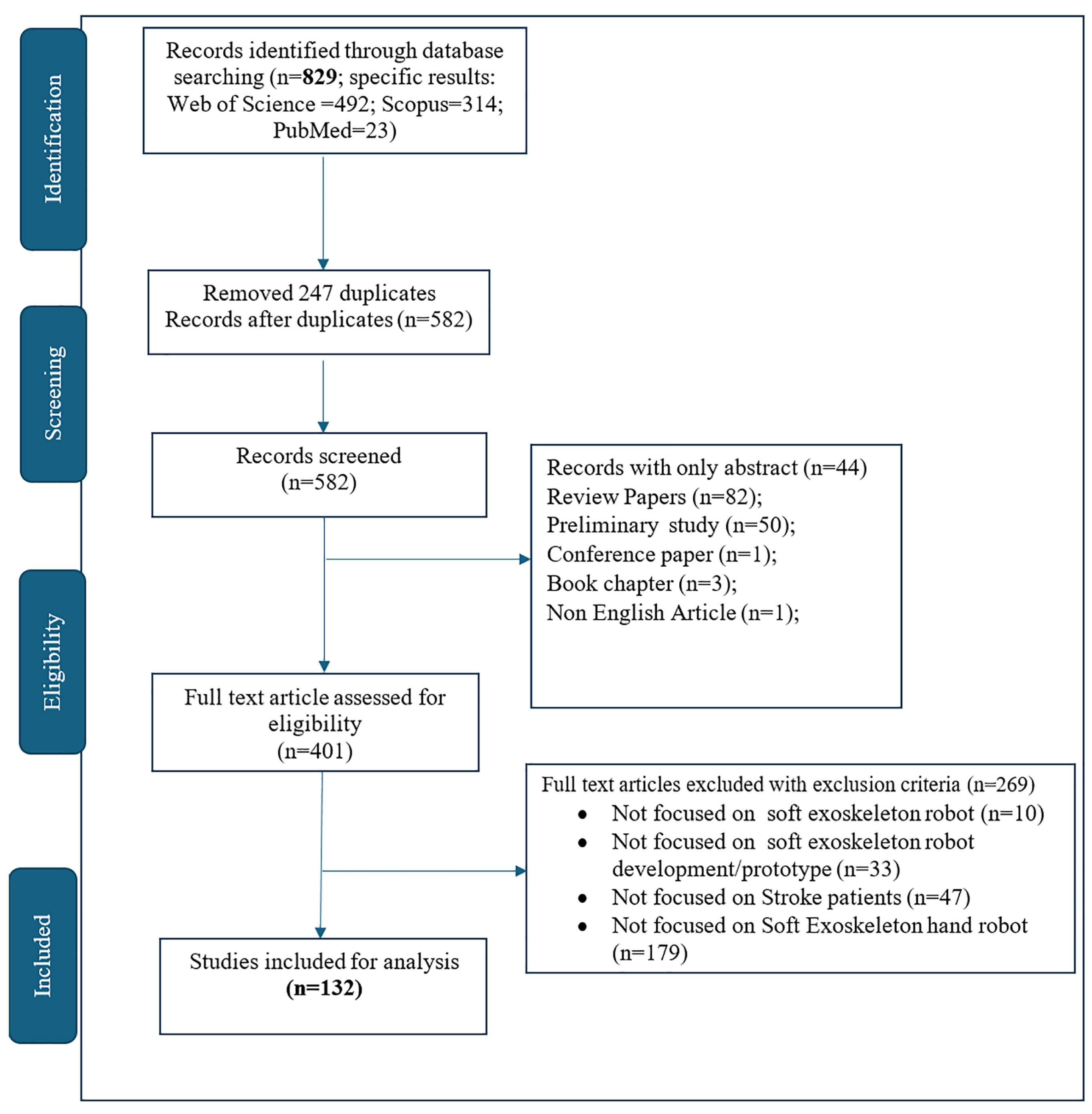
The authors of this study evaluated the merits and applicability of each study. The papers that satisfied the inclusion criteria were further analysed to extract the relevant information. Since multiple datasets were used for extraction, 247 duplicate studies were identified and removed. Following the elimination of review, survey, conference, retracted, non-English papers, 181 studies were removed. The remaining studies were assessed based on their title and abstract. For those papers where the abstract did not clearly indicate the application domain or the contribution, a full text review was conducted. Based on the abstract analysis, the pool of studies was further narrowed down to 401 studies. After carefully reviewing the full texts, 269 papers were excluded from the analysis. This resulted in a final selection of 132 papers that form the foundation for the SLR. These studies were synthesised thematically to identify trends, methods, and research gaps. A complete list of included studies is provided in the
Supplementary Materials for transparency and reproducibility. A PRISMA flowchart illustrating the selection and extraction process of relevant studies is presented in
Figure 2, see
Supplementary Materials for the PRISMA checklist. This work was not preregistered in the International Prospective Register of Systematic Reviews (PROSPERO) as it does not involve health-related outcomes. In addition, a formal review protocol was not prepared prior to the conduct of this study; instead, the review followed a predefined methodological framework for literature search, screening, and data extraction.
To provide a state-of-the-art and descriptive analysis of the primary studies, data extraction was carried out. The data extraction parameters listed in
Table 3 guided the extraction of qualitative and contextual information from each of the included studies.
The primary data consisted of a matrix with 13 fields and 132 rows, capturing detailed information on the application of soft exoskeleton in stroke patients. The extracted parameters were aligned with the three research questions. RQ1 was addressed through technical variables including mechanical transmission, actuation, mechanical placement, sensors, materials, DoF, wearable weight, and cost. RQ2 was addressed through variables and discussion themes related to AI application, sensing, personalisation, usability, portability, and deployment context. RQ3 was addressed by synthesising cross-cutting gaps in standardised reporting, wrist–hand integration, intelligent adaptation, affordability, clinical translation, and ethical considerations.
5. Results and Discussion
This section presents the results obtained from the analysis of the 132 studies included in the review.
5.1. Geographical Distribution and Temporal Evolution of Studies
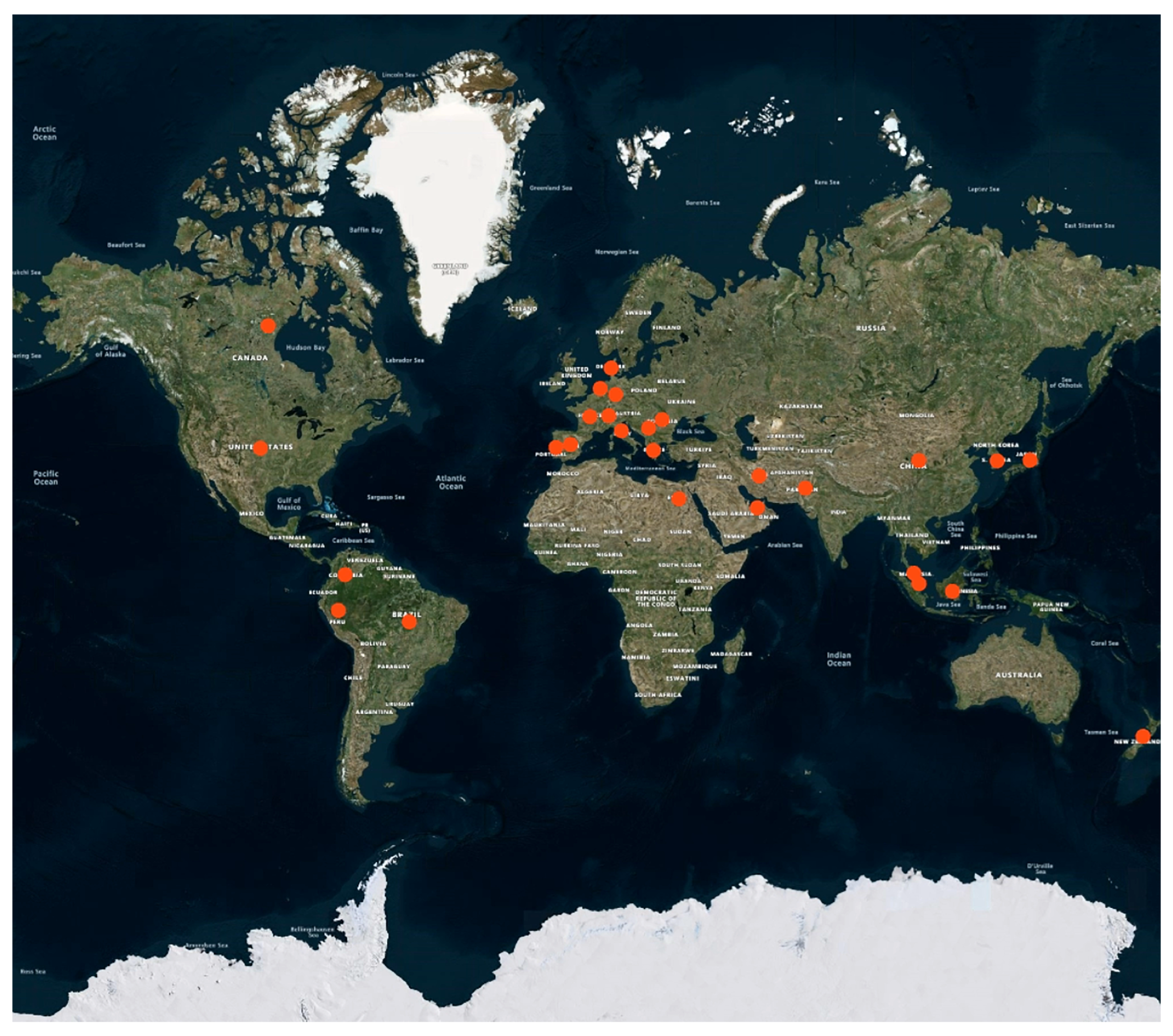
The geographical dispersion of the studies shows the widespread application of soft exoskeletons around the globe. It is clear from
Figure 3 that studies on soft exoskeletons are distributed across many regions. European countries make meaningful contributions; however, their representation in the reviewed dataset remains comparatively modest relative to Asia and North America. This discrepancy may be attributed to several interrelated factors. Despite the growing number of ageing populations in Europe who could benefit from rehabilitation and assistive technologies, European research frequently advances more cautiously due to strict ethical approval procedures, medical device regulation, and data-protection obligations (including GDPR). In contrast to regions where research programmes and regulatory procedures are more centralised and streamlined, these strict frameworks can hinder the pace of clinical validation and open-data sharing, despite being crucial for guaranteeing safety, privacy, and user well-being.
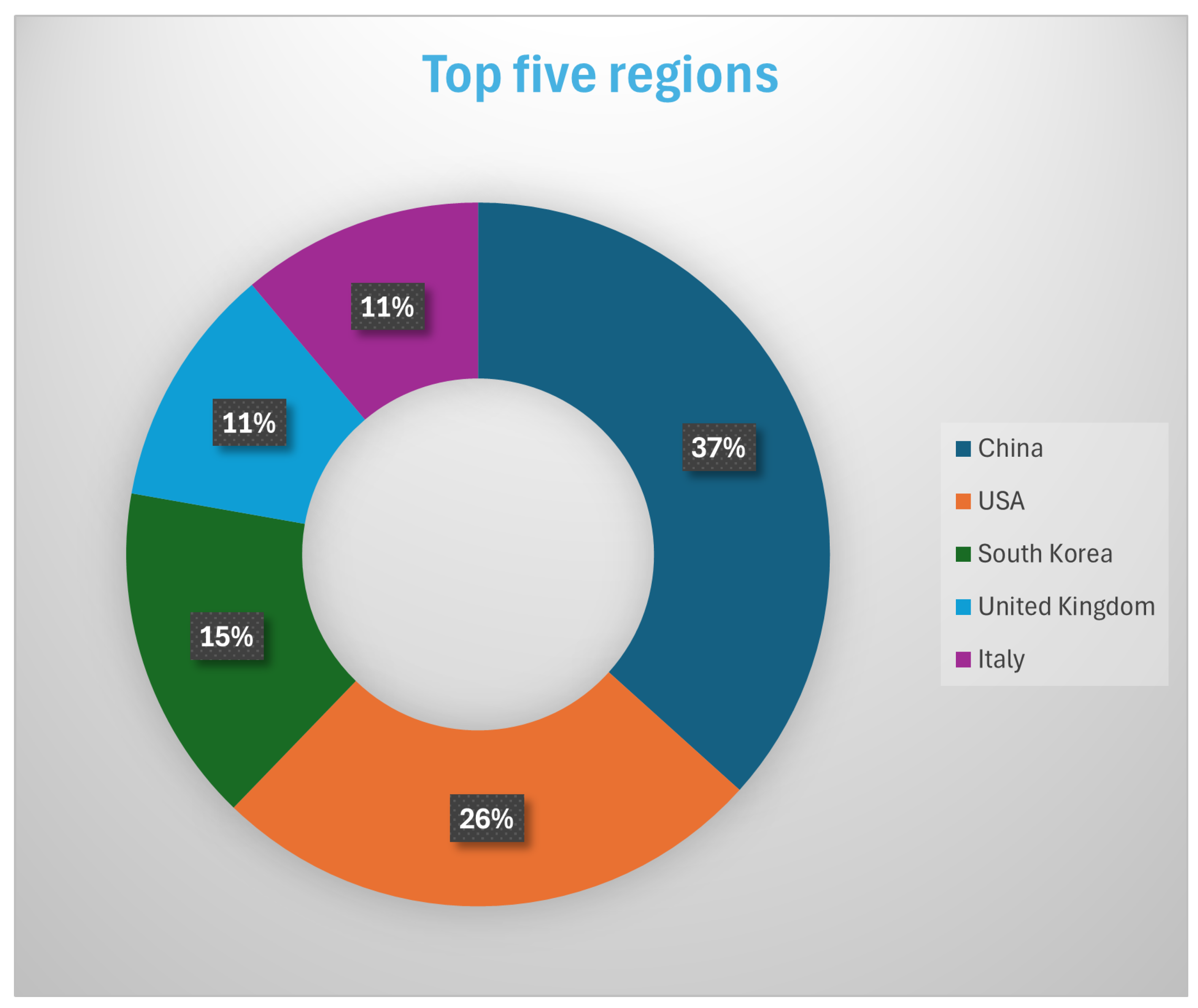
A further analysis of the data reveals that 37% of the included studies are mainly from China followed by the USA and South Korea (
Figure 4), highlighting significant contributions from Asia and North America.
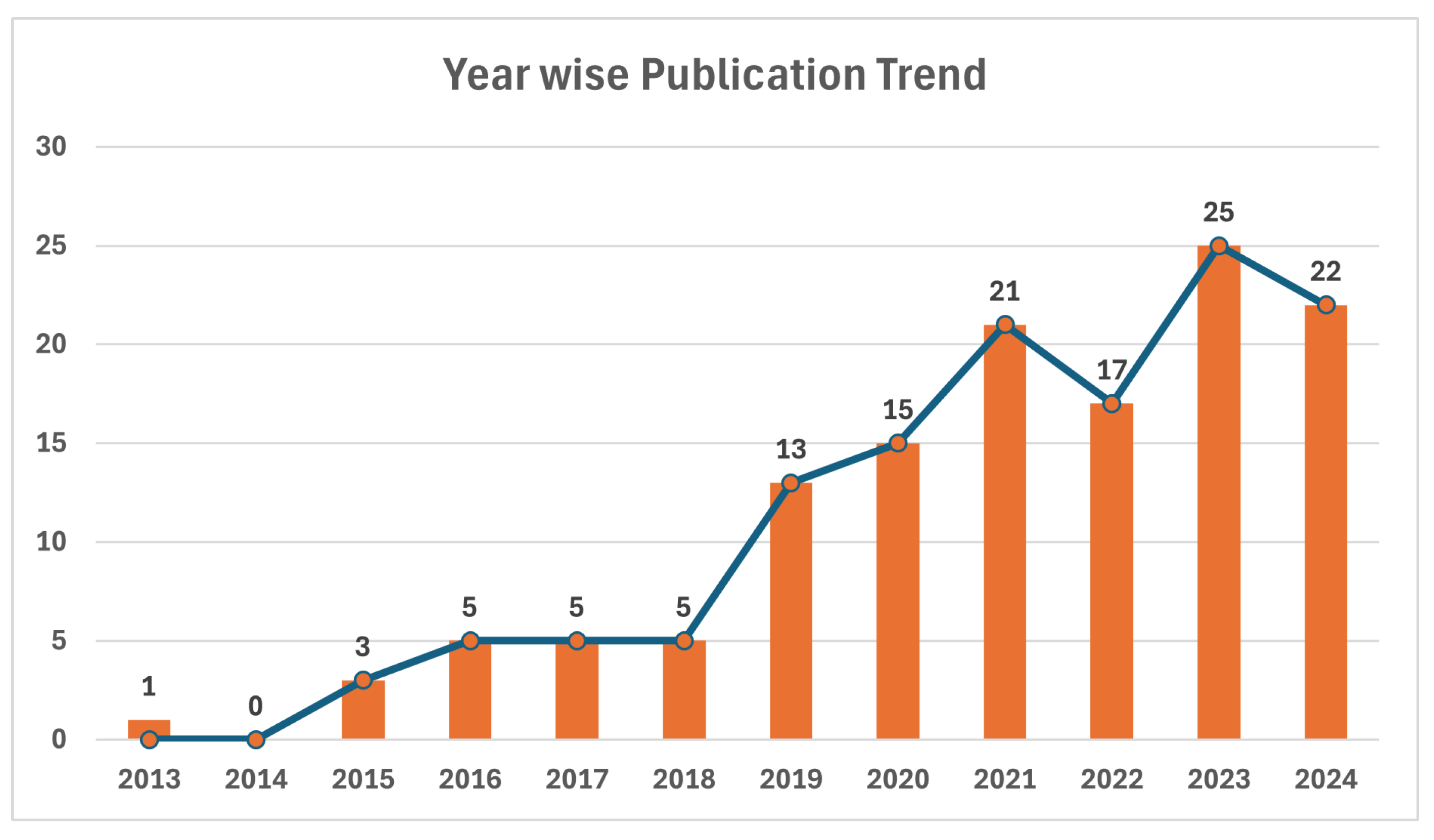
Figure 5 demonstrates the distribution of publications per year from the selected timeframe of 2003 to 2024. However, no relevant publications were identified prior to 2013 even though the study considered papers from 2003 onwards. It is evident that the number of studies was limited between 2013 and 2018.
A notable growth began in 2019 with 13 studies and the publication trend continued to rise steadily, peaking at 25 publications in 2023. Although there was a slight decline in 2024, the publication pattern demonstrates a sustained and expanding research interest in soft robotics. This spike coincides with the COVID-19 pandemic where patient isolation demands for technology-driven solutions, increasing the use of robotic equipment in healthcare and rehabilitation [
49,
50,
51]. The growth reflects both technological advances in soft robotics, AI, and advanced materials, and a global demographic shift towards an ageing population increasingly affected by stroke and motor impairments. Since then, healthcare systems and researchers worldwide have placed greater emphasis on automation, personalised care, and continuous rehabilitation beyond clinical settings, factors that have firmly positioned soft hand exoskeletons as an expanding research and application domain.
5.2. Actuation Mechanism
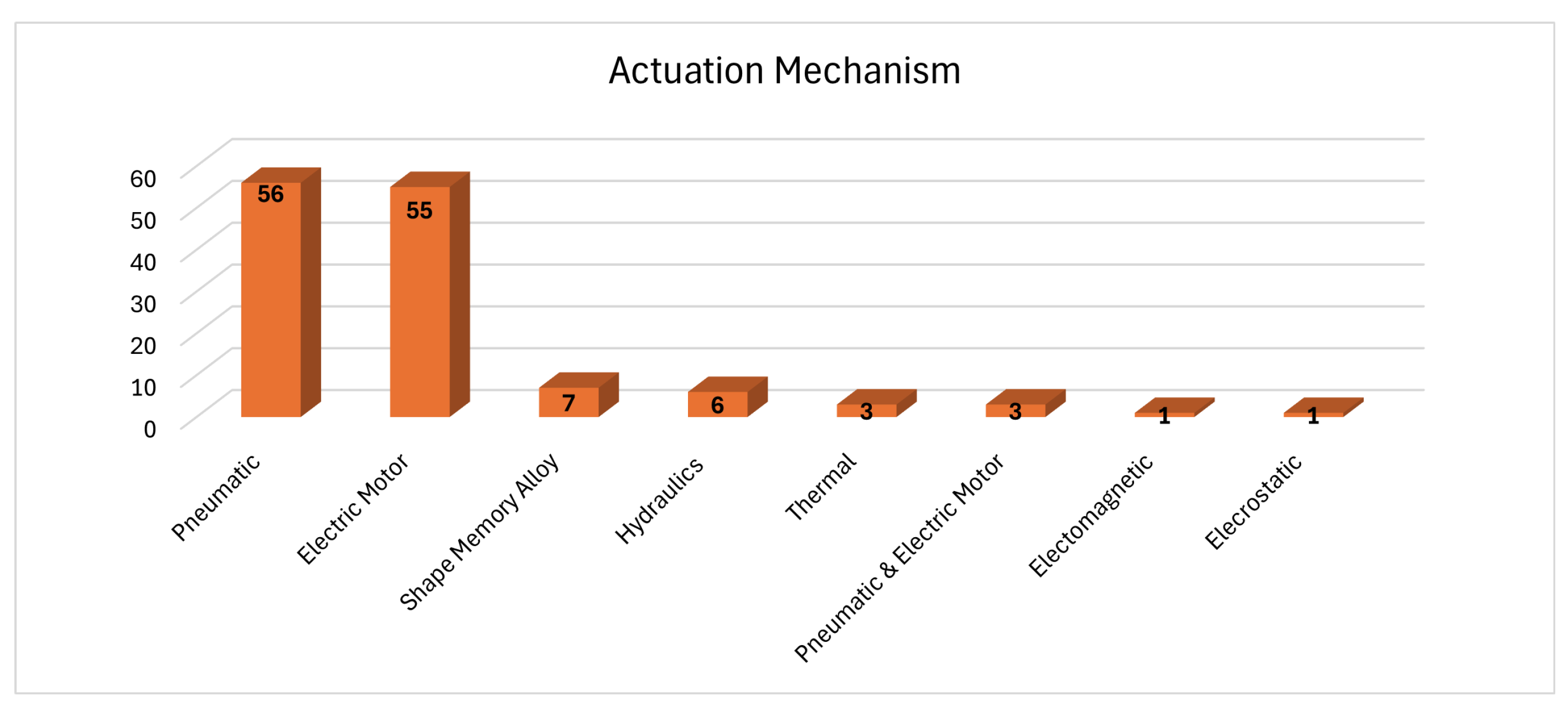
Selecting an appropriate actuation mechanism is a critical stage in the design and manufacturing of soft exoskeletons. The data of this study (
Figure 6) reveals that researchers have considered a variety of actuator types to meet different functional requirements. Among these, pneumatic and electric motor-based actuation mechanisms are widely adopted, representing the majority of studies in this area. Pneumatic actuators are well known for their compliance, light weight, flexibility and high power/weight and high power/ volume ratio [
20,
43,
44,
52]. These findings underscore the dominance of pneumatic actuators in soft robotics research and highlight their widespread adoption.
Similarly, the results of this study show that electric motors represent a promising choice of actuation mechanism due to their high actuation performance, fast response time and quiet operations [
53]. These characteristics, coupled with their high power-to-weight ratio make them a critical component in soft exoskeleton design. The findings further underscore the efficiency of the electric motor-based actuators and their wide acceptance in soft exoskeleton research.
It is evident from the findings that in addition to pneumatic and electric motor-based actuators, several other actuation mechanisms have also been explored, though their adoption remains limited. For instance, shape memory alloys (SMAs) have been adopted in seven studies but their slow response time, fatigue and heating requirements hinder their widespread use in soft exoskeletons [
54,
55]. Similarly, hydraulic actuators are known for their high stability and load-bearing capacity, but the factors such as the performance degradation due to leakage and high costs limit their widespread adoption in wearable contexts [
55].
For rehabilitation, pneumatic actuators are being preferred due to their inherent compliance and safety. However, reliance on an external fluid supply limits portability and everyday usability. For assistive applications, mostly cable-driven systems are being adopted due to their lightweight, portable design and ability to generate functional grasping forces. However, such a system requires complex cable routing and control strategies. Other actuators such as electric motor-driven devices are well suited for assistive applications, though such devices tend to be bulkier and more rigid. SMA actuators are being used in both applications due to their lightweight and compact design; however, they are limited due to their slower response time and force output constraints. Overall, the application of the device (either for assistance or rehabilitation) dominates the selection of the actuator: rehabilitation demands compliance and safety, while assistance requires portability and controllability.
5.3. Focused Body Parts in Soft Exoskeletons
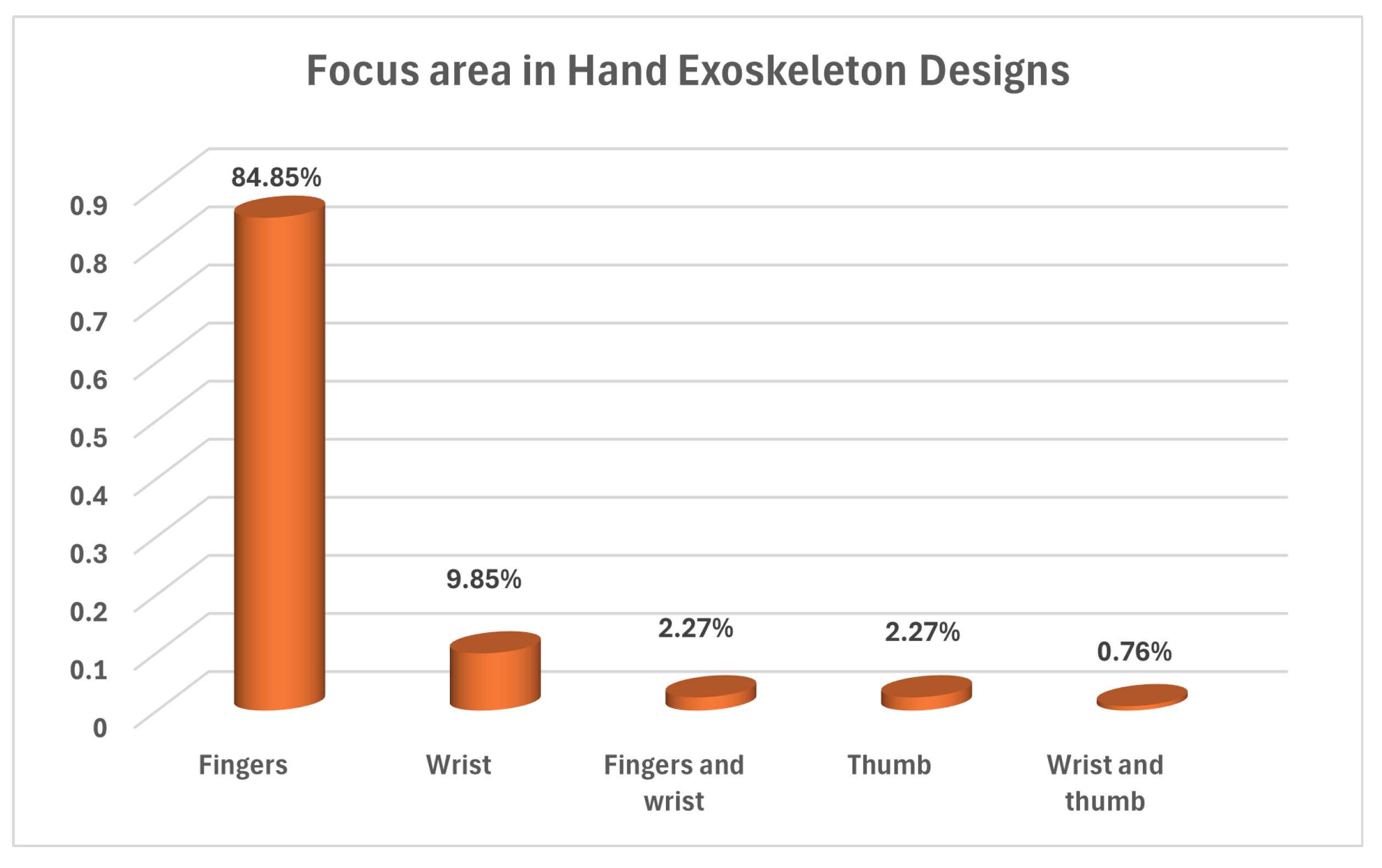
Figure 7 summarises the distribution of the target body parts in the reviewed studies. The analysis of the reviewed studies reveals the predominant focus on the fingers with 84.85% of studies targeting finger rehabilitation and assistance. Accordingly, pneumatic and electric motor-based actuators are most frequently used in the design due to their accurate, light weight and flexible motion needed for fine motor control in finger movements. Only about 9.8% of the reviewed studies focus on wrist exoskeletons because their complex movements and higher force requirements demand more sophisticated actuator design [
56].
Although exoskeletons that incorporate both the wrist and hand are highly important for rehabilitation, only a few studies have investigated assistive wearable devices for both fingers and the wrist. This observation is supported by the findings of the present study, as only 2.27% of the reviewed studies reported combined mechanisms for the wrist and fingers [
20]. The main mechanical barriers are biomechanical complexity, compact actuation, alignment, and wearability. Wrist–hand systems must support multiple coupled motions, including finger flexion–extension, grasp formation, wrist flexion–extension, radial–ulnar deviation, and sometimes forearm rotation. Adding the wrist increases the number of degrees of freedom, actuator routing complexity, torque requirements, and risk of anatomical misalignment. At the same time, the device must remain lightweight, comfortable, easy to don and doff, and safe for prolonged use. This creates a difficult trade-off between functionality, force output, compactness, compliance, and usability.
The main control barriers are coordination, nonlinearity, sensing, and safety. Unlike finger-only devices, wrist–hand exoskeletons require coordinated control of proximal wrist posture and distal finger motion. The controller must decide how much assistance to provide, when to stabilise the wrist, and how to adapt to user effort, fatigue, spasticity, or involuntary resistance. Soft structures further complicate control because they introduce nonlinear dynamics, hysteresis, viscoelastic behaviour, actuator delays, and sensor uncertainty. The review highlights that controlling soft structures is more challenging than rigid systems because of nonlinearities, distributed dynamics, hysteresis, and actuator/sensor latency. Therefore, future integrated devices will need robust sensor fusion, intention recognition, adaptive impedance control, and assist-as-needed strategies to support safe, functional, and personalised ADL-based rehabilitation.
5.4. Sensor Types
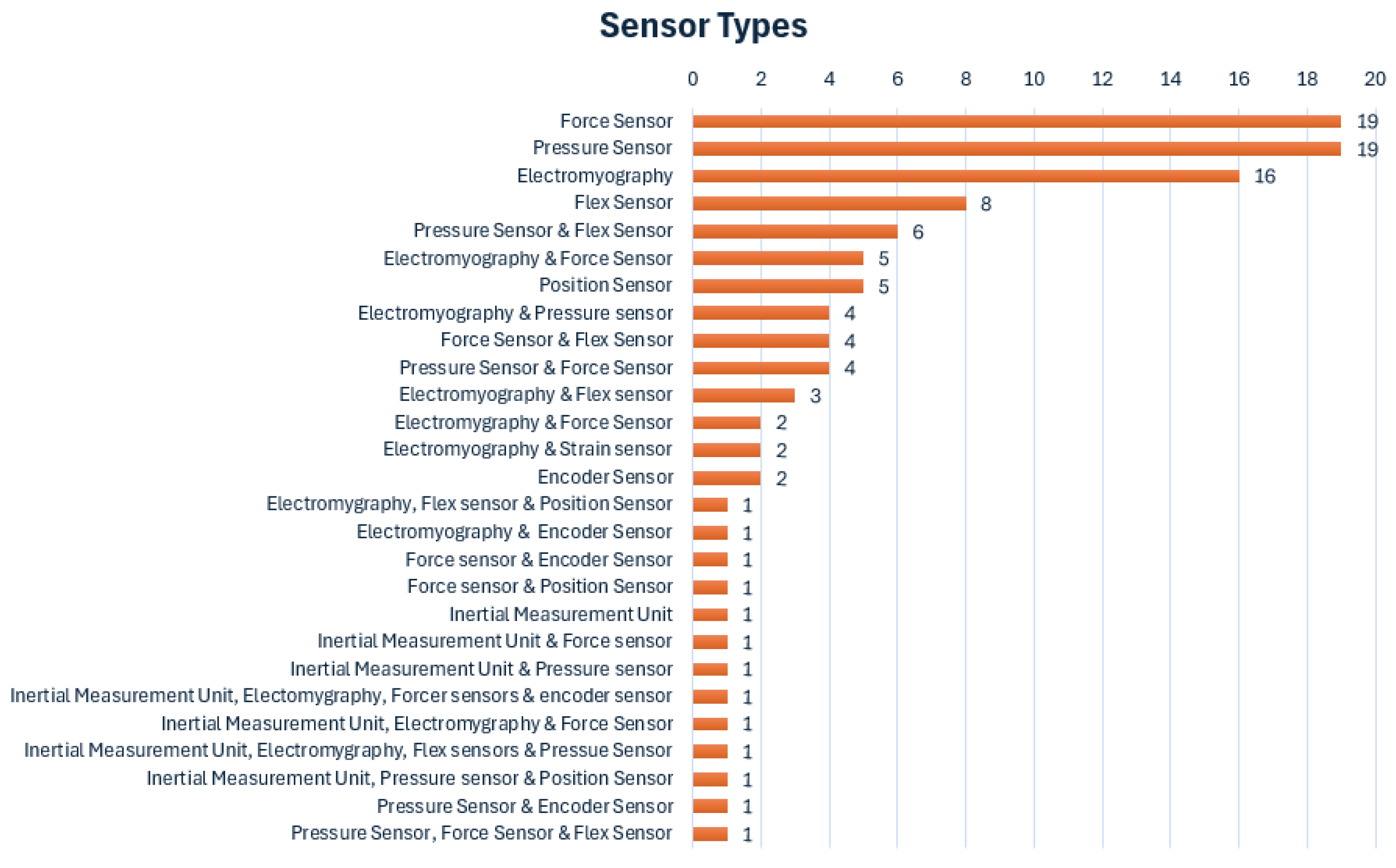
The results as illustrated in
Figure 8 indicate that many types of sensors were employed, including force, pressure, electromyography, flex, position, and encoder sensors. The findings of this study highlighted the popularity of the force sensor and pressure sensor, which emerged as the most commonly used sensing methods in soft exoskeleton systems, followed by electromyography. The wide acceptance of the force sensor, especially at joints and assessing the human exoskeleton interaction, has been reported in [
57]. Especially, the force/torque and pressure data act as feedback signals for the controller of hand exoskeleton robots for improving the accuracy, transparency and safety of the devices for safe and reliable human–robot contact and interaction. These sensors can distinguish the force applied to or generated by a device. By influencing whether an operation should proceed based on sensor readings, they enhance both device functionality and user safety. These features have contributed to their extensive application in soft exoskeletons and the findings of this study further support their significance.
Similarly pressure sensors are widely used in system with fluidic actuators such as pneumatic artificial muscles and other soft actuators [
27]. Pressure sensors are useful for responsive and adaptive control in soft exoskeletons because they indirectly reflect force and torque exchanges through fluidic pressure measurements. The widespread application of force and pressure sensors in soft exoskeletons, as confirmed by the findings of this study, underscores their importance in ensuring safe and effective human–robot interaction. The results also show the popularity of EMG sensors in soft exoskeletons. Tiboni et al. [
27] highlight that EMG sensors are significant in applications where the exoskeleton may react dynamically to the user’s effort and intentions. Their popularity stems from the potential to create a more natural and smooth human–machine interface, especially in rehabilitation and assistive technologies.
5.5. Degree of Freedom
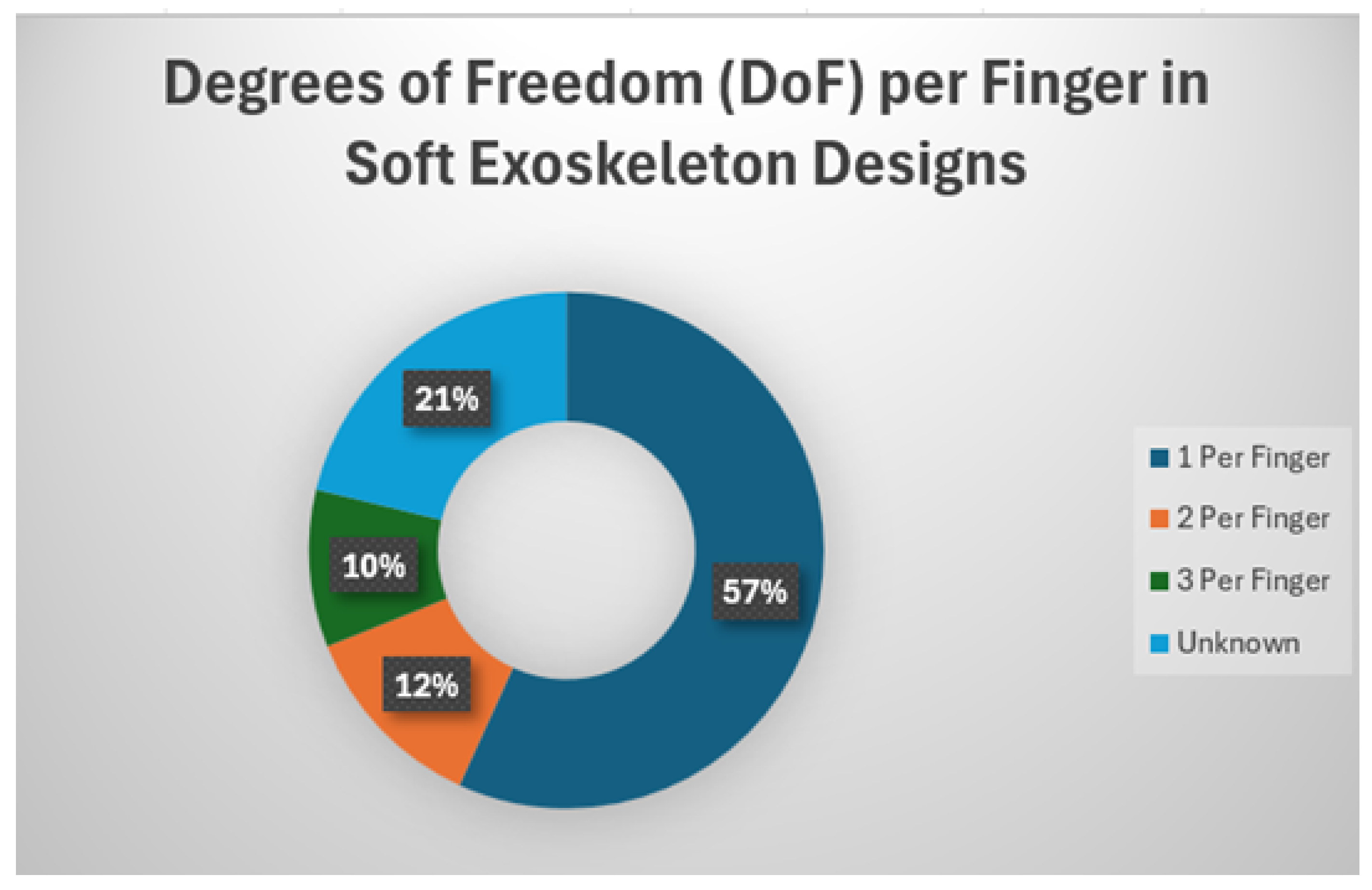
The analysis of this study (
Figure 9) emphasises that the most common configuration in soft exoskeleton is one degree of freedom as 57% of the studies are based on one DoF and followed by design with two DoFs. The number of degrees of freedom in soft exoskeleton is a crucial design choice as it directly influences the device mechanical complexity, control strategy and interface fidelity [
27]. The range and precision of movements are enhanced by increasing the DoFs, but it also introduces challenges in terms of weight, energy consumption, and control transparency.
Notably, 21% of the studies did not state the DoF configuration, which could be a reflection of a lack of standard reporting practices or the use of unconventional or hybrid designs. This study’s results underscore that simpler DoF configurations are favoured in many soft exoskeleton designs because of the reduced cost, ease of implementation and lower control complexity, especially in rehabilitation and assistive technology applications.
5.6. Material
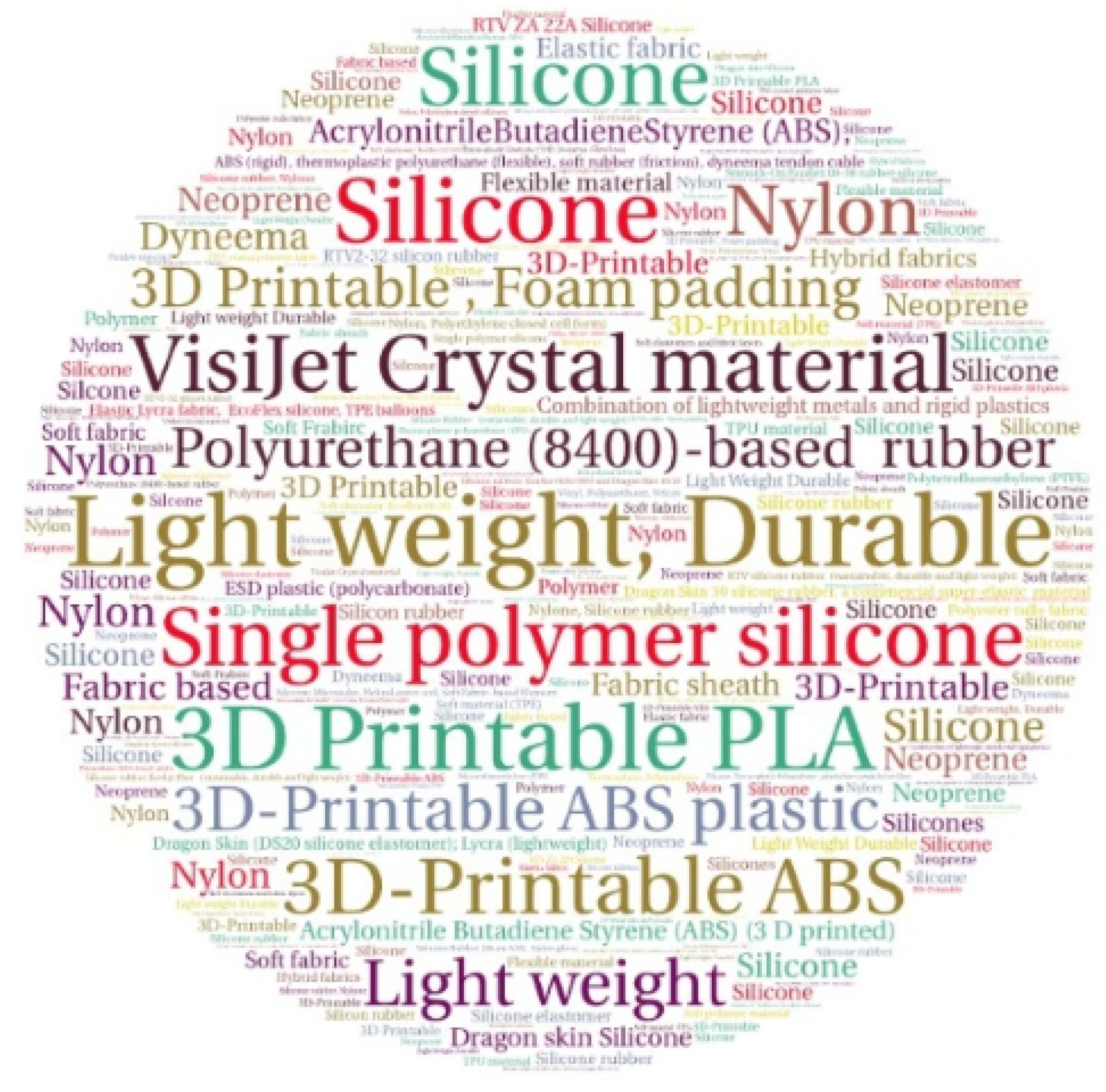
The word cloud presented in
Figure 10 highlights the key materials used in the reviewed studies. The prominent terms such as light weight, silicone and durable highlight the importance of selecting materials that enhance flexibility, comfort and usability in soft exoskeleton. This finding supports the significance of silicone-based soft wearable as they possess low shore hardness and exhibit higher strain response [
58].
The materials identified in
Figure 10 can be organised into several functional categories. First, soft elastomeric materials, including silicone, Dragon Skin silicone, polyurethane-based rubber, TPU, and other rubber-like polymers, dominate the material landscape because they provide compliance, flexibility, and safe contact with the human hand. These properties are essential for soft actuators and wearable rehabilitation gloves, where comfort and low mechanical impedance are critical. The prominence of silicone in the word cloud supports the importance of silicone-based soft wearables, particularly because of their low hardness and high strain response. Second, textile and wearable substrate materials, such as fabric, flexible fabric, neoprene, and nylon-based materials, contribute to the glove-like structure of soft exoskeletons. These materials improve wearability, ease of donning, breathability, and pressure distribution, making them suitable for prolonged rehabilitation use. Third, tendon and reinforcement materials, including nylon and Dyneema, are important for cable-driven mechanisms because they provide lightweight yet strong force transmission. Fourth, the word cloud highlights the growing use of 3D-printable and structural polymers, including PLA, ABS, VisiJet Crystal, and other printable polymers. These materials support rapid prototyping, low-cost manufacturing, anatomical customisation, and the production of lightweight support components. The appearance of ‘3D printable’ further supports the emergence of integrating 3D-printed soft actuators into soft wearables which offers high reliability and design flexibility [
55,
58]. Finally, functional and smart materials—notably liquid crystal materials—have also been identified as prominent in the reviewed studies [
55]. Terms such as light weight, durable and nylon underscore the importance of selecting materials that balance mechanical performance and user comfort. The findings of this study reinforce the importance of selecting the materials that are comfortable and flexible for soft wearable exoskeletons.
Overall, the material trends shown in
Figure 10 suggest that soft hand exoskeleton development is driven by a need to balance compliance, comfort, durability, lightweight construction, manufacturability, personalisation, and cost-effectiveness. This is consistent with the broader design principle that soft exoskeletons rely on elastomers, textiles, and fibre-reinforced composites to achieve large deformation with low mechanical impedance.
5.7. Wearable Weight
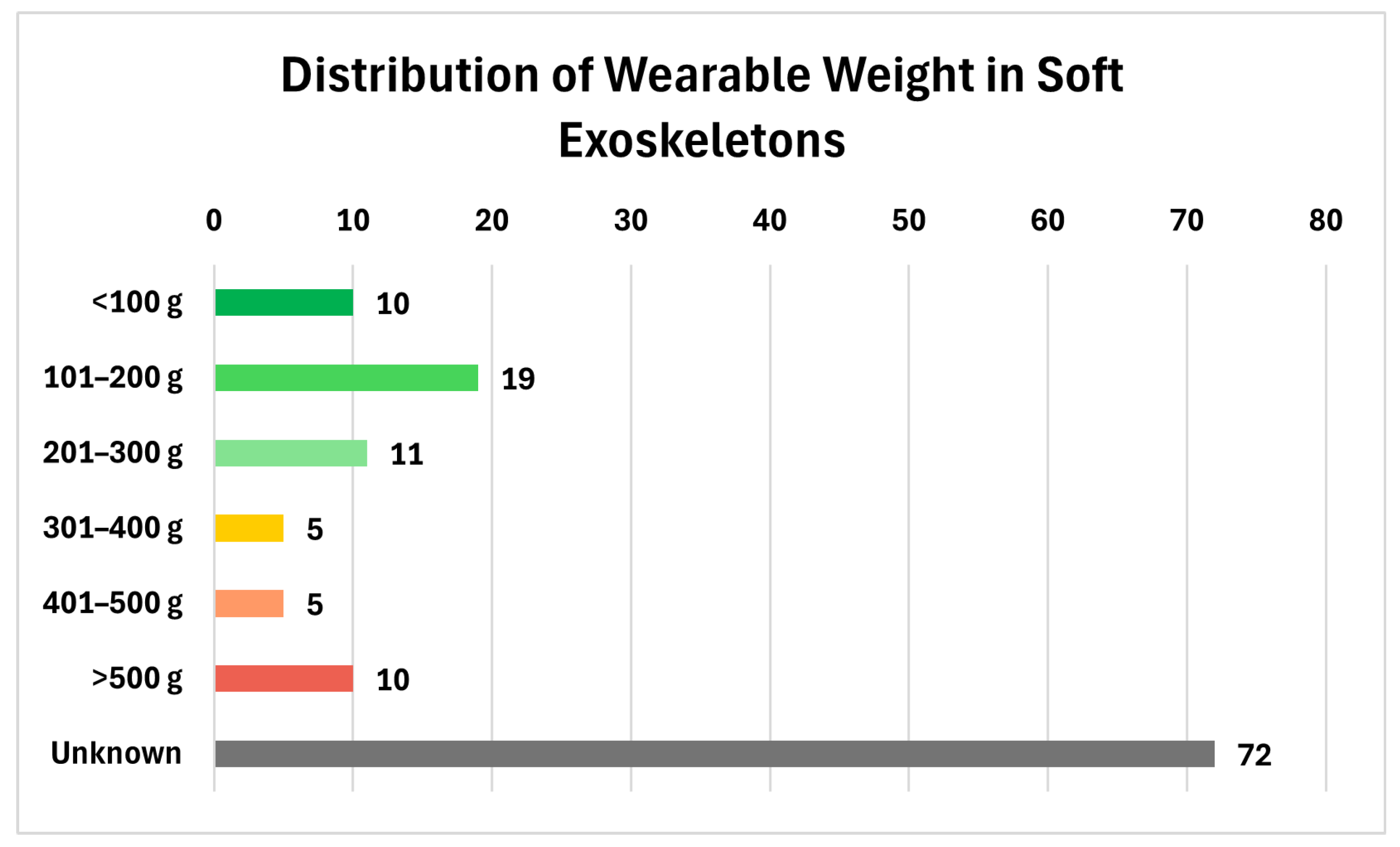
The weight range of 101–200 g is the most common among the studies that reported the weight followed by 201–300 g and less than 100 g (
Figure 11). These trends suggest a preference for lightweight designs. It also aligns with the design principles outlined by Xie et al. [
54], which highlighted the significance of the force-to-weight ratio and portability of the flexible exoskeleton. In addition to lowering the energy consumption of the users, lightweight devices can also be comfortable and easy to use, which is important for assistive and rehabilitation technology. The material analysis further supports this observation. The prominent terms such as silicone, and 3D printable materials contribute to the development of comfortable, flexible and lightweight components, enhancing both portability and design flexibility.
Compared with finger-only systems, wrist–hand exoskeletons require additional actuators, transmissions, structural supports, sensors, control electronics, and sometimes batteries or pneumatic supply components. These additions can quickly increase device bulk and mass, making the system harder to don and doff, less comfortable for prolonged use, and less suitable for home-based rehabilitation. This is particularly problematic for stroke survivors, older adults, and users with reduced strength, where excessive device weight may increase fatigue, alter natural movement patterns, or reduce therapy adherence. Heavy or bulky devices are more likely to remain confined to specialist clinics, while lightweight, compact, and wireless designs are important for home rehabilitation and accessibility.
In wrist–hand devices, weight distribution is as important as total weight. Mass placed near the fingers or distal hand increases perceived load, affects dexterity, and can interfere with grasping and object manipulation. Therefore, heavier components such as motors, valves, batteries, pumps, and controllers should ideally be relocated to the forearm, waist, or an external module, with only lightweight transmission elements routed to the hand. However, remote actuation introduces its own challenges, including cable friction, backlash, pressure delay, hysteresis, and reduced control bandwidth. This creates a core design trade-off: increasing functionality by adding wrist support improves ADL relevance, but it also increases mechanical complexity, size, weight, and control difficulty.
5.8. Cost
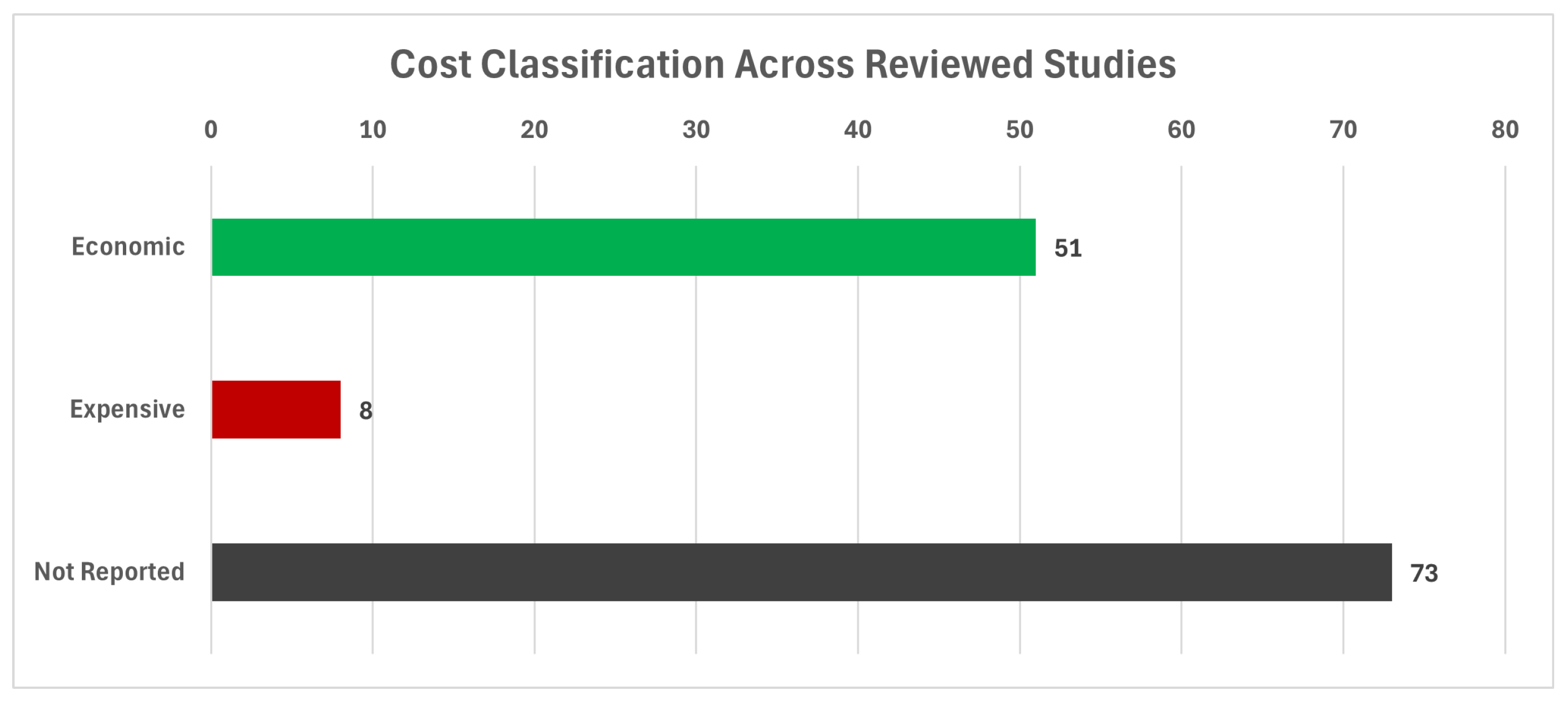
The findings of the cost-related data (
Figure 12) from the reviewed studies reveal a substantial gap in standardised economic reporting. This is consistent with the broader concern in this field where the benchmarking and cost reporting standards are still unexplored [
59]. Among the studies that reported the cost, 51 studies were classified as economically viable design which emphasise the affordability. This pattern is particularly significant in the context of rehabilitation and assistive technology where the cost-effectiveness is essential for broad adoption. Lower-cost exoskeleton technologies are required to guarantee greater inclusion and accessibility for users with disabilities [
60].
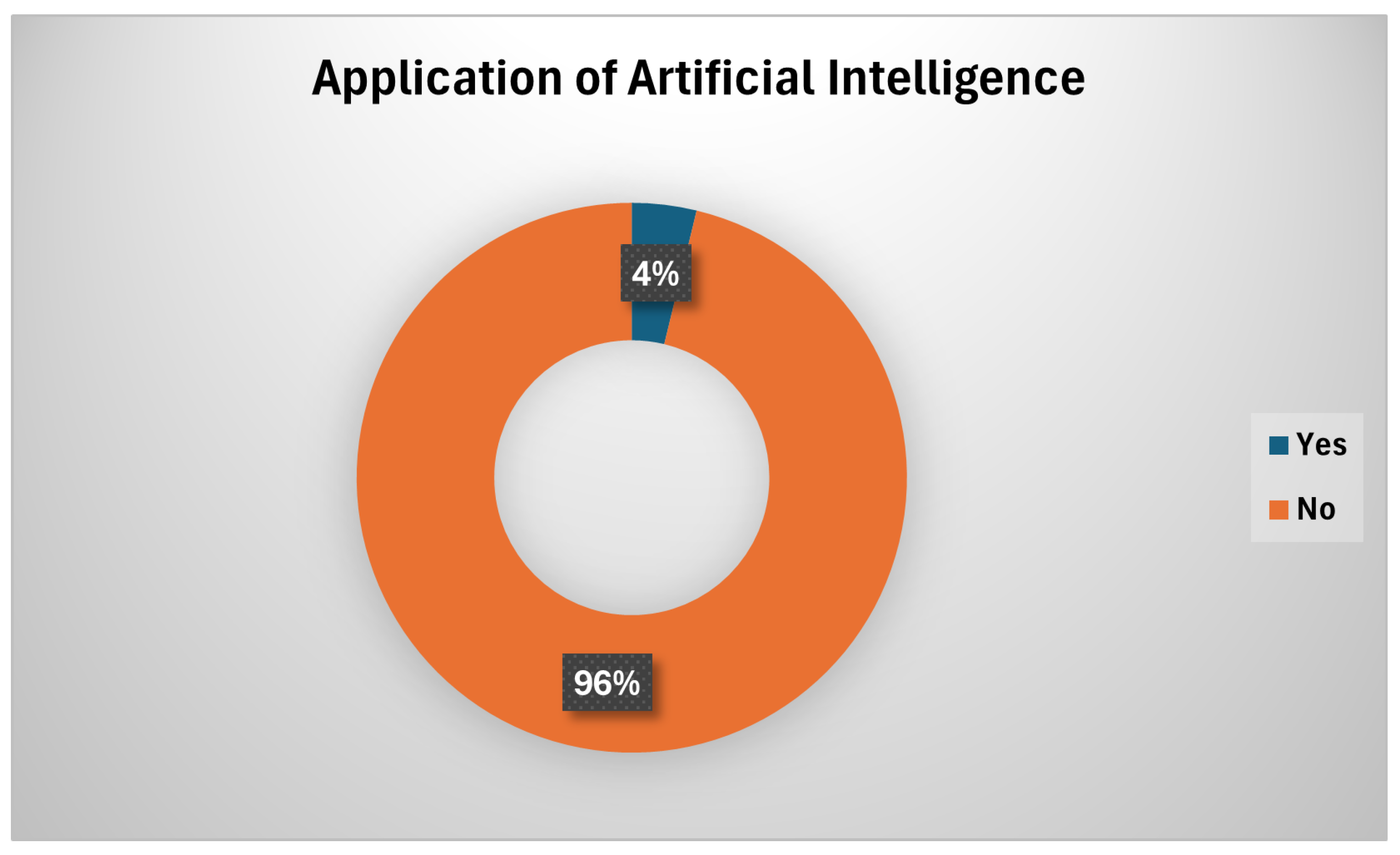
5.9. Application of Artificial Intelligence
As demonstrated in
Figure 13, out of the 132 studies, only five [
61,
62,
63,
64,
65] studies explicitly applied AI techniques, underscoring limited yet emerging scope of AI in soft exoskeleton development.
Most of the applications were focused on gesture recognition and classification, where algorithms such as K-Nearest Neighbour, Artificial Neural Network, Support Vector Machine and Random Forest were used. Recently, deep learning [
63] has been introduced to gesture recognition, showing a gradual shift towards the more sophisticated, AI-driven approaches. This is further supported by a recent LSTM-based adaptive monitoring model [
66] allowing real-time assessment and data-driven personalisation in lower-limb exoskeletons. Despite these contributions, the overall adoption of AI in soft exoskeletons remains limited, though researchers [
67,
68,
69] have reported the significance of incorporating AI for personalised exoskeleton devices. This underscores a significant gap in the application of AI that warrants further exploration. Recent studies further reinforce this direction, highlighting the emerging role of AI for adaptive control in personalised exoskeleton systems [
69].
5.10. Personalisation and Adaptability of Robotic Hand Exoskeletons for Rehabilitation
Personalisation and adaptability are essential features in hand exoskeletons, serving as primary determinants of therapeutic efficacy and safety across diverse users, medical conditions, and settings. This is supported by the following considerations:
- 1.
Hand Biomechanics varies widely: Human hands exhibit significant variability in size, joint alignment, stiffness, pain thresholds, spasticity, and residual motor control. Without geometric personalisation, such as alignment of joint axes, strap routing, and contact padding, devices may cause joint misalignment, resulting in parasitic torques, discomfort, and early discontinuation, particularly during extended use. Recent literature highlights the importance of human–robot motion compatibility and customisability, including adjustable link lengths, glove sizing, and three-dimensional printed shells, to ensure device kinematics adapt to the user [
29]. Personalisation also encompasses practical usability factors, such as ease of donning and doffing, weight distribution, and aesthetics, which influence adoption beyond laboratory settings [
29].
- 2.
Impairments evolve over time and control must adapt with them: Motor recovery following stroke, fatigue in spinal cord injury, and pain associated with arthritis can vary both daily and within individual sessions. Rigid assistance profiles may result in either insufficient or excessive support, leading to frustration or dependency, respectively. Adaptive strategies, such as assist-as-needed and human-in-the-loop control, dynamically adjust assistance torque, stiffness, and timing based on the user’s current capabilities, thereby enhancing engagement and efficiency. While these approaches are well established in lower-limb soft exoskeletons [
33], they are equally applicable to hand devices. Continuous monitoring of user state and intention through electromyography, kinematic, or force sensing, combined with iterative optimisation, improves functional outcomes and maintains safety. Reviews of upper-limb devices identify adaptive control and intention-aware assistance as critical areas for advancing from laboratory to real-world application [
45].
- 3.
Different exoskeleton types require distinct personalisation and adaptation strategies: On one hand, rigid hand exoskeletons deliver precise joint guidance and high torque, which is particularly beneficial for individuals with severe paresis. Geometric personalisation, including axis alignment and degree-of-freedom limits, mitigates the risk of harmful loading. Adaptive controllers, such as impedance or admittance control, adjust interaction forces in response to changes in spasticity or voluntary effort [
29]. On the other hand, soft gloves naturally conform to anatomical structures and distribute pressure, which enhances comfort and suitability for home use. However, these devices exhibit nonlinear and user-dependent transmission characteristics, such as fabric stretch and pressure–force hysteresis. Personalisation involves selecting appropriate materials and layouts, including textile and bladder geometry, optimising sensor placement for strain and pressure, and calibrating pressure and force maps for individual users. Adaptability necessitates the use of model-free or adaptive control strategies to address drift and hysteresis. Hybrid designs, which consist of soft gloves and rigid anchors with cable drives, balance comfort and precision of the devices. These designs benefit from mechanical personalisation, such as choosing specific anchor locations and routing Bowden cables, as well as friction and backlash compensation, that adapt to the unique paths of cables and glove deformation during use [
31].
- 4.
Successful clinical translation to domestic deployment of the device depends on three key factors: comfort, ease of use, and relevance to everyday life. Devices intended for pervasive healthcare must be comfortable, biocompatible, and easy to operate over long periods, to be used both in clinics and at home. Personalisation, like ensuring a good fit and easy mounting within two minutes, as well as adaptive features, such as self-adjusting assistance as the user improves, are vital for compliance and outcomes in activities of daily living. Surveys of soft hand designs highlight design needs like safety, effective force transmission, and a high power-to-weight ratio, all tailored to individuals to prevent joint overexertion or inadequate grip support [
31].
Through 3D printing, customised shells, integrated reinforcements, and sensors or actuators can be tailor-made or customised for each user, simplifying assembly while aligning movement mechanics with anatomical needs, thus enhancing comfort and force fidelity [
29]. With multimodal sensing, which includes EMG, IMU, and tension or pressure detection, and calibration tailored to the user, intention recognition becomes more accurate, even under conditions like sweat, fatigue, or electrode displacement. Surveys focused on the upper limbs emphasise such input requirements and advocate for reliable data processing in wearable technologies. Patient-in-the-loop optimisation modifies the timing and strength of assistance, minimising user effort without making them overly passive. Studies of soft exoskeletons in walking suggest that repetitive adjustments improve efficiency and user engagement [
33], which is also applicable to hand devices. Personalised safety features, such as force or range of motion limits, pressure dispersion targets, and specific safety measures for each device, protect users while supporting their recovery [
31]. In summary, each individual’s hand and recovery journey are unique, personalisation ensures devices fit well, interface properly, and include suitable sensor arrangements, while adaptability balances intended assistance as goals and impairments evolve. Whether using rigid, soft, or hybrid devices, the key lies in leveraging their personalisation features, which transform promising concepts into practical daily-use technologies, suitable both at home and in clinics.
5.11. Reflections to the Research Questions
Based on the above systematic literature review, the reflections to the research questions raised in the paper are as follows:
- 1.
RQ1: Design and technological characteristics
The review shows that soft hand exoskeletons are mainly designed to be compliant, lightweight, wearable, and safe for rehabilitation. Key design features include mechanical transmission, actuation, sensors, materials, degrees of freedom, weight, and cost. Most studies focus on finger rehabilitation, while wrist and integrated wrist–hand systems remain limited. Pneumatic and electric actuators are the dominant choices, supported by force, pressure, EMG, flex, position, and encoder sensors. Common materials include silicone, fabric, nylon, TPU, PLA, and ABS. However, inconsistent reporting of weight, cost, and configuration limits comparison.
- 2.
RQ2: Personalisation, adaptability, usability, and deployment
Personalisation and adaptability are increasingly recognised but remain unevenly implemented. Current systems use adjustable structures, glove sizing, modular components, 3D-printed parts, customised actuator placement, and user-specific calibration. Adaptability is supported by assist-as-needed control, intention recognition, impedance control, and sensor feedback. Usability depends strongly on comfort, donning/doffing, size, weight, and suitability for home rehabilitation. Integrated wrist–hand systems are important for activities of daily living, but their development is constrained by mechanical complexity, actuator routing, anatomical alignment, torque requirements, device bulk, and control difficulty.
- 3.
RQ3: Research gaps and future directions
Key gaps include limited standardised reporting of weight, cost, degrees of freedom, actuator configuration, and performance metrics. Integrated wrist–hand devices remain underdeveloped despite their relevance to functional rehabilitation and activities of daily living. AI is still insufficiently used for personalisation, adaptive control, fatigue prediction, digital twins, and therapy monitoring. Future research should prioritise lightweight, affordable, modular wrist–hand systems, clinically validated adaptive control, data-efficient and interpretable AI, and responsible deployment addressing privacy, autonomy, algorithmic transparency, equitable access, and regulatory requirements.
6. Conclusions
This systematic literature review examined 132 primary studies published between 2003 and February 2025, providing a thorough synthesis of advancements in soft hand exoskeleton robots with particular emphasis on design, actuation, sensing, materials, personalisation, and ethical considerations. However, the findings are subject to potential publication and database selection bias, along with the heterogeneity of the included studies. A salient finding pertains to the lack of transparency in reporting fundamental parameters such as cost and weight, which are critical factors that influence adaptability, comfort, and affordability. Further, the extant literature demonstrates a predominant focus on finger mechanisms, with considerably limited attention directed towards the integration of coordinated wrist–finger movement. Given that coordinated wrist and finger motion is essential for natural hand function, this disparity constitutes a substantial gap in the current body of knowledge that warrants systematic investigation in future research.
The use of AI for personalisation or ethical concerns of clinical adoption has received little attention, despite several studies acknowledging the growing significance of AI for real-time feedback. Ethical and regulatory concerns are becoming more significant as intelligent soft exoskeletons move from lab prototypes to clinical and practical applications. Algorithmic transparency, data privacy, user autonomy, and fair access are important issues. To enable responsible innovation and uphold public trust, these AI-based frameworks must be strengthened by integrating user-centred design concepts and clarifying regulatory overlaps.
Overall, research from 2003 to 2025 shows a distinct shift from rigid, mechanism-based exoskeletons to intelligent, soft, and compliant devices that can provide adaptive, user-centred rehabilitation. To build on this progress, future work should prioritise more transparent reporting on design parameters, development of more holistic hand--wrist mechanisms, and the creation of lightweight and low-cost systems that are accessible to a wider range of users. Although AI integration was not explicitly included within the scope of this review, future research should explore how AI can enhance personalisation, facilitate adaptive control, and motivate patients through engaging and supportive feedback. Incorporating such capabilities has the potential to increase the uptake of these emerging technologies, which combine mechanical intelligence with AI-enabled personalisation, offering safer, more comfortable, and more effective recovery pathways for individuals affected by stroke, spinal injury, or age-related decline. Realising their full potential will require close collaboration among engineers, clinicians, and ethicists, unified performance standards, transparent reporting, and robust clinical validation. Through such interdisciplinary efforts, the next generation of intelligent soft hand exoskeletons can move from experimental prototypes to accessible, high-impact systems that improve rehabilitation outcomes and enhance quality of life worldwide.