Urinary Metabolomics Predict Acute Kidney Injury in Very-Low-Birth-Weight Infants with Patent Ductus Arteriosus
 , , , , and
Abstract
1. Introduction
2. Materials and Methods
2.1. Study Design and Participants
2.2. Sample and Data Collection
2.3. 1H-NMR-Spectroscopy
2.4. Spectral Binning
2.5. Statistical Analysis
3. Results
3.1. Characteristics of Study Cohort
3.2. Traditional Parameters of Kidney Function and Injury
3.3. Urinary Metabolomics Analysis
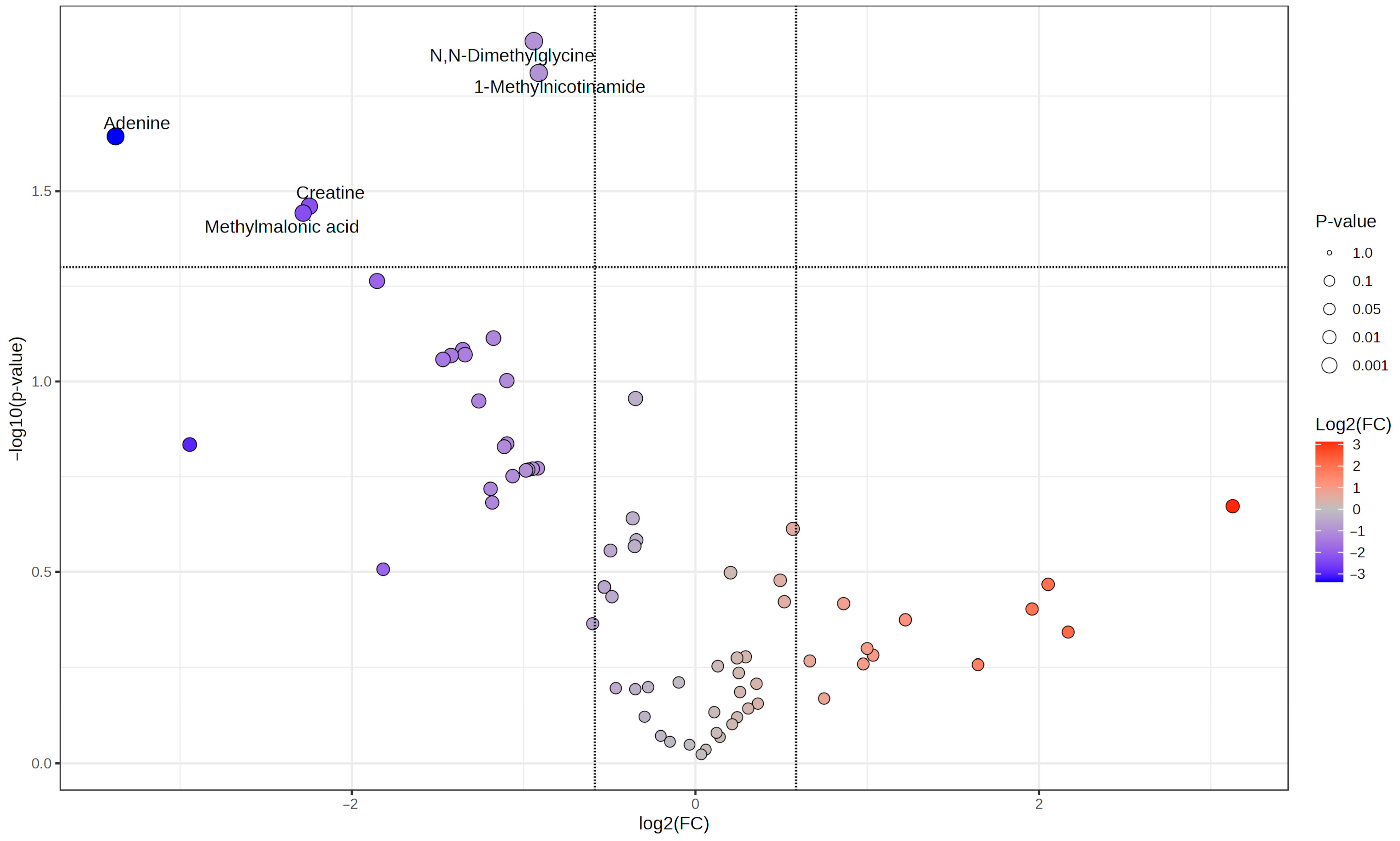
3.3.1. Fold-Change Analysis
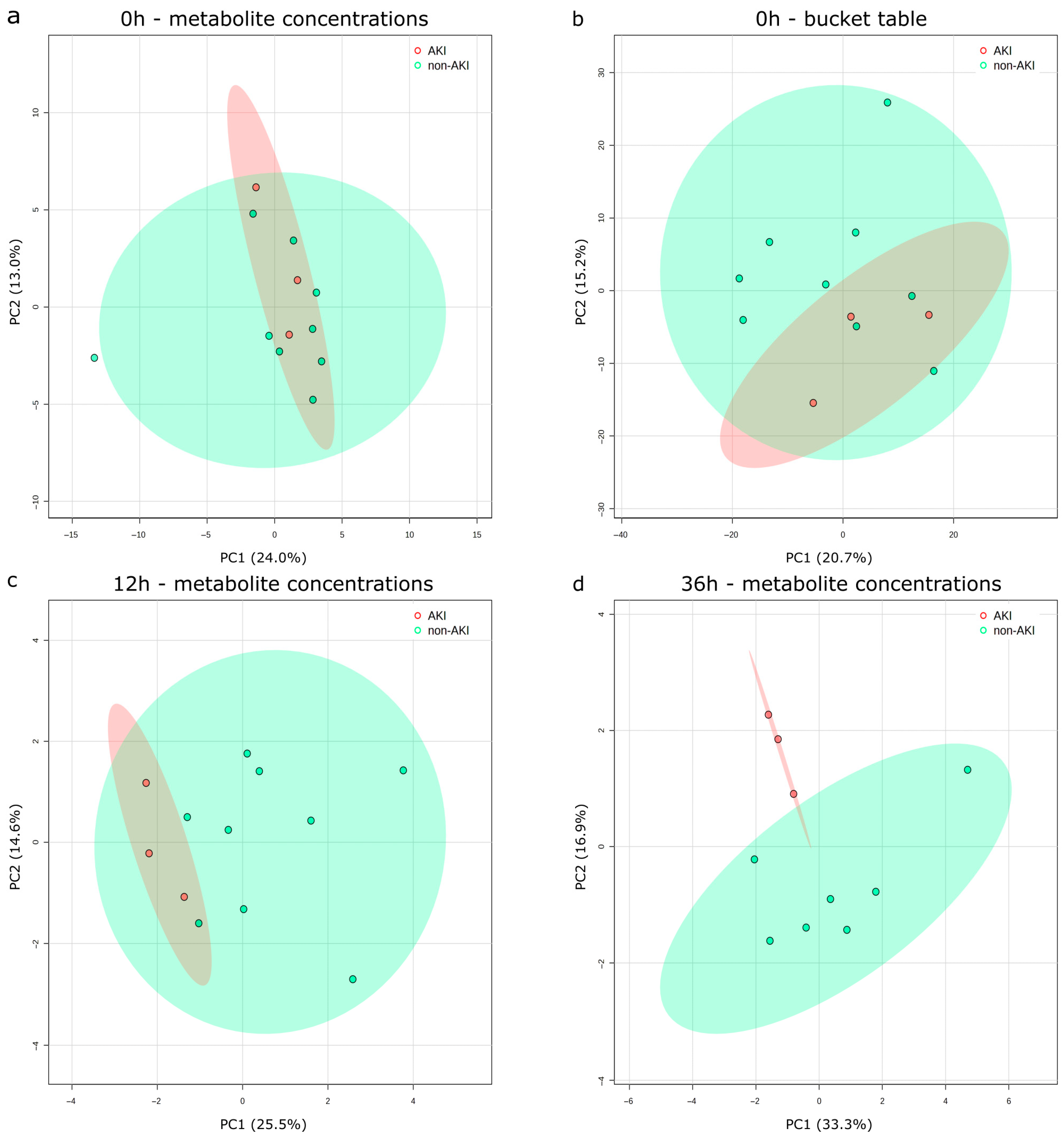
3.3.2. Pre-Treatment AKI Group Membership Does Not Explain Metabolomic Profile
3.3.3. Urinary Metabolomic Profiles Detect AKI Prior to Neonatal KDIGO-Based Criteria
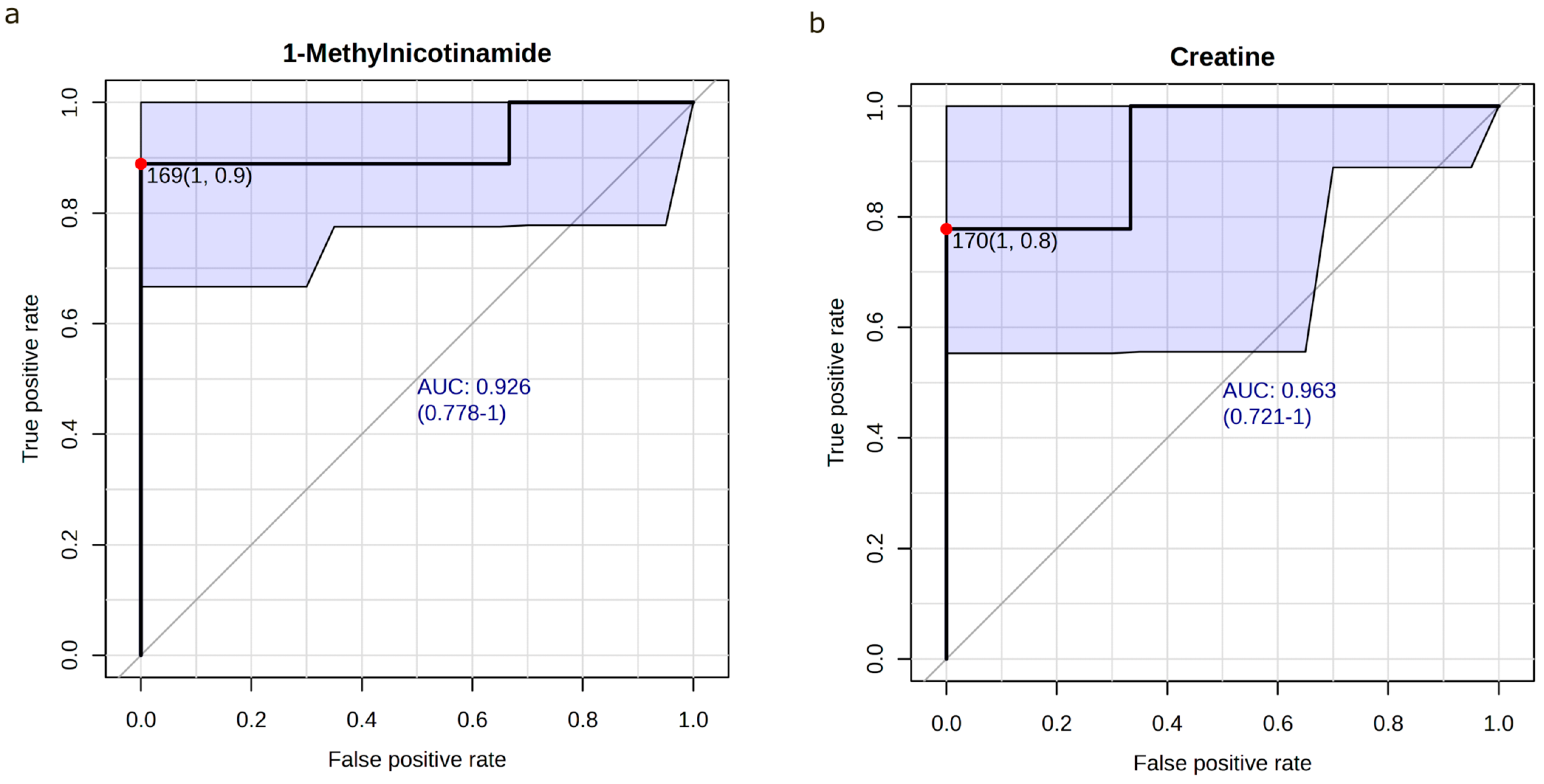
3.3.4. Prognostic Accuracy of 1-Methylnicotinamide/Creatinine and Creatine/Creatinine in Predicting AKI
3.3.5. Longitudinal Analysis of Urinary Creatine and 1-Methylnicotinamide
4. Discussion
5. Conclusions
Author Contributions
Funding
Institutional Review Board Statement
Informed Consent Statement
Data Availability Statement
Conflicts of Interest
Abbreviations
| AKI | Acute kidney injury |
| AUC | Area under the curve |
| BPD | Bronchopulmonary dysplasia |
| CKD | Chronic kidney disease |
| FC | Fold change |
| FDR | False detection rate |
| ICU | Intensive care unit |
| IMV | Invasive mechanical ventilation |
| KDIGO | Kidney Disease: Improving Global Outcomes |
| LC-MS | Liquid chromatography-mass spectrometry |
| NEC | Necrotizing enterocolitis |
| NMR | Nuclear magnetic resonance |
| NOESY | Nuclear overhauser effect spectroscopy |
| PC | Principal component |
| PCA | Principal component analysis |
| PDA | Persistent ductus arteriosus botalli |
| PERMANOVA | Permutational multivariate analysis of variance |
| ROC | Receiver operating characteristic |
| SCr | Serum creatinine |
| VLBW | Very low birthweight |
References
- Morgan, A.S.; Mendonca, M.; Thiele, N.; David, A.L. Management and outcomes of extreme preterm birth. BMJ 2022, 376, e055924. [Google Scholar] [CrossRef] [PubMed]
- Patel, R.M. Short- and Long-Term Outcomes for Extremely Preterm Infants. Am. J. Perinatol. 2016, 33, 318–328. [Google Scholar] [CrossRef]
- Schreiner, C.; Powell, T.L.; Palmer, C.; Jansson, T. Placental proteins with predicted roles in fetal development decrease in premature infants. Pediatr. Res. 2022, 92, 1316–1324. [Google Scholar] [CrossRef]
- Jetton, J.G.; Boohaker, L.J.; Sethi, S.K.; Wazir, S.; Rohatgi, S.; Soranno, D.E.; Chishti, A.S.; Woroniecki, R.; Mammen, C.; Swanson, J.R.; et al. Incidence and outcomes of neonatal acute kidney injury (AWAKEN): A multicentre, multinational, observational cohort study. Lancet Child Adolesc. Health 2017, 1, 184–194. [Google Scholar] [CrossRef]
- Charlton, J.R.; Boohaker, L.; Askenazi, D.; Brophy, P.D.; D’Angio, C.; Fuloria, M.; Gien, J.; Griffin, R.; Hingorani, S.; Ingraham, S.; et al. Incidence and Risk Factors of Early Onset Neonatal AKI. Clin. J. Am. Soc. Nephrol. 2019, 14, 184–195. [Google Scholar] [CrossRef]
- Harer, M.W.; Selewski, D.T.; Kashani, K.; Basu, R.K.; Gist, K.M.; Jetton, J.G.; Sutherland, S.M.; Zappitelli, M.; Goldstein, S.L.; Mottes, T.A.; et al. Improving the quality of neonatal acute kidney injury care: Neonatal-specific response to the 22nd Acute Disease Quality Initiative (ADQI) conference. J. Perinatol. 2021, 41, 185–195. [Google Scholar] [CrossRef]
- Mackenzie, H.S.; Brenner, B.M. Fewer nephrons at birth: A missing link in the etiology of essential hypertension? Am. J. Kidney Dis. 1995, 26, 91–98. [Google Scholar] [CrossRef]
- Rodriguez, M.M.; Gomez, A.H.; Abitbol, C.L.; Chandar, J.J.; Duara, S.; Zilleruelo, G.E. Histomorphometric analysis of postnatal glomerulogenesis in extremely preterm infants. Pediatr. Dev. Pathol. 2004, 7, 17–25. [Google Scholar] [CrossRef]
- Tain, Y.L.; Hsu, C.N. Preterm Birth and Kidney Health: From the Womb to the Rest of Life. Children 2024, 11, 1213. [Google Scholar] [CrossRef] [PubMed]
- Chaturvedi, S.; Ng, K.H.; Mammen, C. The path to chronic kidney disease following acute kidney injury: A neonatal perspective. Pediatr. Nephrol. 2017, 32, 227–241. [Google Scholar] [CrossRef] [PubMed]
- Barker, D.J. A new model for the origins of chronic disease. Med. Health Care Philos. 2001, 4, 31–35. [Google Scholar] [CrossRef]
- Barker, D.J.; Gluckman, P.D.; Godfrey, K.M.; Harding, J.E.; Owens, J.A.; Robinson, J.S. Fetal nutrition and cardiovascular disease in adult life. Lancet 1993, 341, 938–941. [Google Scholar] [CrossRef]
- The Low Birth Weight and Nephron Number Working Group. The Impact of Kidney Development on the Life Course: A Consensus Document for Action. Nephron 2017, 136, 3–49. [Google Scholar] [CrossRef]
- Hirano Arruda Moraes, L.; Jornada Krebs, V.L.; de Carvalho, W.B. Risk factors for acute kidney injury in very-low birth weight newborns: A systematic review with meta-analysis. Eur. J. Pediatr. 2024, 183, 3243–3251. [Google Scholar] [CrossRef] [PubMed]
- Dubin, R.F.; Rhee, E.P. Proteomics and Metabolomics in Kidney Disease, including Insights into Etiology, Treatment, and Prevention. Clin. J. Am. Soc. Nephrol. 2020, 15, 404–411. [Google Scholar] [CrossRef] [PubMed]
- Wishart, D.S.; Cheng, L.L.; Copie, V.; Edison, A.S.; Eghbalnia, H.R.; Hoch, J.C.; Gouveia, G.J.; Pathmasiri, W.; Powers, R.; Schock, T.B.; et al. NMR and Metabolomics-A Roadmap for the Future. Metabolites 2022, 12, 678. [Google Scholar] [CrossRef]
- Hocher, B.; Adamski, J. Metabolomics for clinical use and research in chronic kidney disease. Nat. Rev. Nephrol. 2017, 13, 269–284. [Google Scholar] [CrossRef]
- Martin-Lorenzo, M.; Gonzalez-Calero, L.; Ramos-Barron, A.; Sanchez-Nino, M.D.; Gomez-Alamillo, C.; Garcia-Segura, J.M.; Ortiz, A.; Arias, M.; Vivanco, F.; Alvarez-Llamas, G. Urine metabolomics insight into acute kidney injury point to oxidative stress disruptions in energy generation and H(2)S availability. J. Mol. Med. 2017, 95, 1399–1409. [Google Scholar] [CrossRef] [PubMed]
- Weiss, R.H.; Kim, K. Metabolomics in the study of kidney diseases. Nat. Rev. Nephrol. 2011, 8, 22–33. [Google Scholar] [CrossRef] [PubMed]
- Patschan, D.; Patschan, S.; Matyukhin, I.; Ritter, O.; Dammermann, W. Metabolomics in Acute Kidney Injury: The Clinical Perspective. J. Clin. Med. 2023, 12, 4083. [Google Scholar] [CrossRef] [PubMed]
- Piano, S.; Cardenas, A. Metabolomics to Predict Acute Kidney Injury in Cirrhosis. Hepatology 2021, 74, 2339–2341. [Google Scholar] [CrossRef]
- Muhle-Goll, C.; Eisenmann, P.; Luy, B.; Kolker, S.; Tonshoff, B.; Fichtner, A.; Westhoff, J.H. Urinary NMR Profiling in Pediatric Acute Kidney Injury-A Pilot Study. Int. J. Mol. Sci. 2020, 21, 1187. [Google Scholar] [CrossRef]
- Franiek, A.; Sharma, A.; Cockovski, V.; Wishart, D.S.; Zappitelli, M.; Blydt-Hansen, T.D. Urinary metabolomics to develop predictors for pediatric acute kidney injury. Pediatr. Nephrol. 2022, 37, 2079–2090. [Google Scholar] [CrossRef] [PubMed]
- Reiss, J.D.; Mataraso, S.J.; Holzapfel, L.F.; Maric, I.; Kasowski, M.M.; Martin, C.R.; Long, J.Z.; Stevenson, D.K.; Shaw, G.M.; Stanford Metabolic Health, C. Applications of Metabolomics and Lipidomics in the Neonatal Intensive Care Unit. Neoreviews 2025, 26, e100–e114. [Google Scholar] [CrossRef] [PubMed]
- Waldherr, S.; Fichtner, A.; Beedgen, B.; Bruckner, T.; Schaefer, F.; Tonshoff, B.; Poschl, J.; Westhoff, T.H.; Westhoff, J.H. Urinary acute kidney injury biomarkers in very low-birth-weight infants on indomethacin for patent ductus arteriosus. Pediatr. Res. 2019, 85, 678–686. [Google Scholar] [CrossRef] [PubMed]
- Selewski, D.T.; Charlton, J.R.; Jetton, J.G.; Guillet, R.; Mhanna, M.J.; Askenazi, D.J.; Kent, A.L. Neonatal Acute Kidney Injury. Pediatrics 2015, 136, e463–e473. [Google Scholar] [CrossRef]
- Pang, Z.; Lu, Y.; Zhou, G.; Hui, F.; Xu, L.; Viau, C.; Spigelman, A.F.; MacDonald, P.E.; Wishart, D.S.; Li, S.; et al. MetaboAnalyst 6.0: Towards a unified platform for metabolomics data processing, analysis and interpretation. Nucleic Acids Res. 2024, 52, W398–W406. [Google Scholar] [CrossRef] [PubMed]
- Rohart, F.; Gautier, B.; Singh, A.; Le Cao, K.A. mixOmics: An R package for ‘omics feature selection and multiple data integration. PLoS Comput. Biol. 2017, 13, e1005752. [Google Scholar] [CrossRef] [PubMed]
- Ruopp, M.D.; Perkins, N.J.; Whitcomb, B.W.; Schisterman, E.F. Youden Index and optimal cut-point estimated from observations affected by a lower limit of detection. Biom. J. 2008, 50, 419–430. [Google Scholar] [CrossRef]
- Atzori, L.; Antonucci, R.; Barberini, L.; Locci, E.; Marincola, F.C.; Scano, P.; Cortesi, P.; Agostiniani, R.; Defraia, R.; Weljie, A.; et al. 1H NMR-based metabolomic analysis of urine from preterm and term neonates. Front. Biosci. (Elite Ed.) 2011, 3, 1005–1012. [Google Scholar] [CrossRef] [PubMed]
- Martini, S.; Vitali, F.; Capelli, I.; Donadei, C.; Raschi, E.; Aiello, V.; Corvaglia, L.; De Ponti, F.; Poluzzi, E.; Galletti, S. Impact of nephrotoxic drugs on urinary biomarkers of renal function in very preterm infants. Pediatr. Res. 2022, 91, 1715–1722. [Google Scholar] [CrossRef]
- Trump, S.; Laudi, S.; Unruh, N.; Goelz, R.; Leibfritz, D. 1H-NMR metabolic profiling of human neonatal urine. Magn. Reson. Mater. Phys. Biol. Med. 2006, 19, 305–312. [Google Scholar] [CrossRef]
- Dessi, A.; Atzori, L.; Noto, A.; Visser, G.H.; Gazzolo, D.; Zanardo, V.; Barberini, L.; Puddu, M.; Ottonello, G.; Atzei, A.; et al. Metabolomics in newborns with intrauterine growth retardation (IUGR): Urine reveals markers of metabolic syndrome. J. Matern. Fetal Neonatal Med. 2011, 24, 35–39. [Google Scholar] [CrossRef]
- Georgakopoulou, I.; Chasapi, S.A.; Bariamis, S.E.; Varvarigou, A.; Spraul, M.; Spyroulias, G.A. Metabolic changes in early neonatal life: NMR analysis of the neonatal metabolic profile to monitor postnatal metabolic adaptations. Metabolomics 2020, 16, 58. [Google Scholar] [CrossRef] [PubMed]
- Lage, S.; Andrade, F.; Prieto, J.A.; Asla, I.; Rodriguez, A.; Ruiz, N.; Echeverria, J.; Luz Couce, M.; Sanjurjo, P.; Aldamiz-Echevarria, L. Arginine-guanidinoacetate-creatine pathway in preterm newborns: Creatine biosynthesis in newborns. J. Pediatr. Endocrinol. Metab. 2013, 26, 53–60. [Google Scholar] [CrossRef] [PubMed]
- Xie, N.; Zhang, L.; Gao, W.; Huang, C.; Huber, P.E.; Zhou, X.; Li, C.; Shen, G.; Zou, B. NAD(+) metabolism: Pathophysiologic mechanisms and therapeutic potential. Signal Transduct. Target. Ther. 2020, 5, 227. [Google Scholar] [CrossRef] [PubMed]
- Mori, V.; Amici, A.; Mazzola, F.; Di Stefano, M.; Conforti, L.; Magni, G.; Ruggieri, S.; Raffaelli, N.; Orsomando, G. Metabolic profiling of alternative NAD biosynthetic routes in mouse tissues. PLoS ONE 2014, 9, e113939. [Google Scholar] [CrossRef] [PubMed]
- Shi, H.; Enriquez, A.; Rapadas, M.; Martin, E.; Wang, R.; Moreau, J.; Lim, C.K.; Szot, J.O.; Ip, E.; Hughes, J.N.; et al. NAD Deficiency, Congenital Malformations, and Niacin Supplementation. N. Engl. J. Med. 2017, 377, 544–552. [Google Scholar] [CrossRef] [PubMed]
- Poyan Mehr, A.; Tran, M.T.; Ralto, K.M.; Leaf, D.E.; Washco, V.; Messmer, J.; Lerner, A.; Kher, A.; Kim, S.H.; Khoury, C.C.; et al. De novo NAD(+) biosynthetic impairment in acute kidney injury in humans. Nat. Med. 2018, 24, 1351–1359. [Google Scholar] [CrossRef]
- Morevati, M.; Fang, E.F.; Mace, M.L.; Kanbay, M.; Gravesen, E.; Nordholm, A.; Egstrand, S.; Hornum, M. Roles of NAD(+) in Acute and Chronic Kidney Diseases. Int. J. Mol. Sci. 2022, 24, 137. [Google Scholar] [CrossRef] [PubMed]
- Fontecha-Barriuso, M.; Lopez-Diaz, A.M.; Carriazo, S.; Ortiz, A.; Sanz, A.B. Nicotinamide and acute kidney injury. Clin. Kidney J. 2021, 14, 2453–2462. [Google Scholar] [CrossRef] [PubMed]
- Shim, C.K.; Sawada, Y.; Iga, T.; Hanano, M. Estimation of renal secretory function for organic cations by endogenous N1-methylnicotinamide in rats with experimental renal failure. J. Pharmacokinet. Biopharm. 1984, 12, 23–42. [Google Scholar] [CrossRef]
- Shim, C.K.; Sawada, Y.; Iga, T.; Hanano, M. Estimation of renal blood flow by use of endogenous N1-methylnicotinamide in rats. J. Pharmacobio-Dyn. 1985, 8, 20–24. [Google Scholar] [CrossRef] [PubMed]
- Kang, N.S.; Yoo, K.H.; Cheon, H.; Choi, B.M.; Hong, Y.S.; Lee, J.W.; Kim, S.K. Indomethacin treatment decreases renal blood flow velocity in human neonates. Biol. Neonate 1999, 76, 261–265. [Google Scholar] [CrossRef] [PubMed]



| Non-AKI Group | AKI Group | Significance | |
|---|---|---|---|
| Patient Demographics | |||
| n | 9 | 3 | - |
| Gestational age (weeks + days) | 26 + 6 (24 + 0–30 + 0) | 28 + 4 (27 + 6–29 + 5) | 0.37 |
| Birth weight (g) | 1100 (650–1480) | 1100 (750–1430) | 0.89 |
| Birth weight (SDS) | 0.39 (−0.59–0.80) | −0.23 (−1.33–0.34) | 0.15 |
| Male:Female | 7:2 | 3:0 | - |
| Umbilical cord arterial blood pH | 7.32 (7.10–7.43) | 7.25 (7.23–7.32) | 0.21 |
| APGAR 1 min | 0.57 | ||
| 3 | 2 (22.2%) | 0 (0%) | |
| 5 | 2 (22.2%) | 0 (0%) | |
| 6 | 1 (11.2%) | 0 (0%) | |
| 7 | 1 (11.1%) | 1 (33.3%) | |
| 8 | 3 (33.3%) | 2 (66.6%) | |
| APGAR 5 min | 0.51 | ||
| 5 | 2 (22.2%) | 0 (0%) | |
| 7 | 3 (33.3%) | 0 (0%) | |
| 8 | 1 (11.1%) | 1 (33.3%) | |
| 9 | 3 (33.3%) | 2 (66.6%) | |
| APGAR 10 min | 0.51 | ||
| 7 | 3 (33.3%) | 0 (0%) | |
| 8 | 2 (22.2%) | 1 (33.3%) | |
| 9 | 4 (44.4%) | 2 (66.6%) | |
| Minimum urine output 12 h before treatment [mL/kg/d] | 5.04 (1.86–8.33) | 4.16 (3.09–7.38) | >0.99 |
| Intraventricular hemorrhage (all 1st degree) | 1 (11.1%) | 1 (33.3%) | 0.46 |
| Respiratory distress syndrome | 8 (88.9%) | 2 (66.7%) | 0.58 |
| Presence of proven sepsis | 0/9 (0%) | 0/3 (0%) | - |
| Laboratory values | |||
| Serum creatinine [mg/dL] | 0.86 (0.53–1.36) | 0.66 (0.54–0.78) | 0.04 |
| Serum urea [mg/dL] | 66 (30–95) | 31 (19–44) | 0.02 |
| Serum cystatin C [mg/L] | 1.42 (0.61–2.62) | 1.31 (1.04–1.33) | 0.86 |
| Urinary creatinine [mg/dL] | 9.19 (4.17–30.83) | 10.35 (6.49–14.26) | 0.38 |
| Urinary protein/creatinine [g/mol] | 206.27 (83.79–635.57) | 156.28 (75.41–188.25) | 0.14 |
| Urinary beta-2-microglobulin/creatinine [g/g] | 9.77 (2.92–55.10) | 9.34 (5.07–14.28) | 0.38 |
| Medical intervention | |||
| Fluid supply on study enrollment (mL/kg per day) | 110 (65–150) | 110 (90–110) | 0.86 |
| Ampicillin treatment | 8 (88.9%) | 3 (100%) | >0.99 |
| Cefotaxime treatment | 3 (33.3%) | 0 (0%) | 0.49 |
| Cefuroxime treatment | 1 (11.1%) | 0 (0%) | >0.99 |
| Furosemide treatment | 1 (11.1%) | 0 (0%) | >0.99 |
| Gentamicin treatment | 7 (77.8%) | 3 (100%) | >0.99 |
| Hydrochlorthiazide treatment | 3 (33.3%) | 0 (0%) | 0.51 |
| Hydrocortisone treatment | 6 (66.7%) | 0 (0%) | 0.18 |
| Meropeneme treatment | 0 (0%) | 0 (0%) | - |
| Teicoplanin treatment | 2 (22.2%) | 0 (0%) | >0.99 |
| Umbilical artery catheter placement | 6 (66.7%) | 0 (0%) | 0.18 |
| Umbilical vein catheter placement | 6 (66.7%) | 0 (0%) | 0.18 |
| Invasive mechanical ventilation | 7 (77.8%) | 1 (33.3%) | 0.23 |
| Mean airway pressure [cmH2O] | 7.00 (6.00–8.20) | 7.10 (7.10–7.10) | 0.95 |
| Fraction of inspired oxygen (FiO2) | 0.25 (0.21–0.56) | 0.21 (0.21–0.21) | 0.31 |
| Non-invasive respiratory support (CPAP) | 2 (22.2%) | 1 (33.3%) | 0.78 |
| Positive end-expiratory pressure [cmH2O] | 4.85 (4.70–5.00) | 5.00 (5.00–5.00) | 0.67 |
| Fraction of inspired oxygen (FiO2) | 0.21 (0.21–0.21) | 0.21 (0.21–0.21) | - |
| Nutrition | |||
| Parenteral nutrition | 9 (100%) | 3 (100%) | - |
| Glucose [g/kg bodyweight/d] | 6.90 (5.70–8.90) | 8.40 (8.40–8.50) | 0.06 |
| Amino Acids [g/kg bodyweight/d] | 1.50 (1.00–2.50) | 2.00 (1.50–2.00) | 0.37 |
| Lipids [g/kg bodyweight/d] | 0 | 0 | - |
| Enteral nutrition | |||
| Maltodextrin (15% or 25%) | 3 (100%) | 9 (100%) | - |
| Prenatal factors | |||
| Amniotic infection | 1 (11.1%) | 0 (0%) | >0.99 |
| HELLP | 0 (0%) | 0 (0%) | - |
| In vitro fertilization | 1 (11.1%) | 0 (0%) | >0.99 |
| Intrauterine growth retardation | 0 (0%) | 1 (33.3%) | 0.25 |
| Maternal arterial hypertension | 0 (0%) | 0 (0%) | - |
| Maternal diabetes mellitus | 0 (0%) | 0 (0%) | - |
| Maternal use of nephrotoxic medication | 0 (0%) | 0 (0%) | - |
| Preeclampsia | 0 (0%) | 0 (0%) | - |
| Premature rupture of membranes | 2 (22.2%) | 0 (0%) | 0.47 |
| Twin | 5 (55.6%) | 1 (33.3%) | >0.99 |
| Non-AKI Group | AKI Group | Significance | |
|---|---|---|---|
| 1-Methylnicotinamide (mmol/mol crea) | |||
| 0 h | 218.18 | 123.08 | 0.04 |
| 12 h | 176.92 | 94.12 | 0.02 |
| 36 h | 144.44 | 82.35 | 0.07 |
| 84 h | 180.00 | 77.60 | 0.11 |
| 120 h | 177.78 | 80.42 | 0.33 |
| 14 d | 200.00 | 80.00 | 0.02 |
| 28 d | 200.00 | 81.81 | 0.02 |
| Creatine (mmol/mol crea) | |||
| 0 h | 350.00 | 69.23 | 0.04 |
| 12 h | 200.00 | 0.00 | 0.02 |
| 36 h | 225.00 | 0.00 | 0.02 |
| 84 h | 66.67 | 31.81 | 0.46 |
| 120 h | 66.67 | 43.75 | 1.00 |
| 14 d | 88.89 | 0.00 | 0.48 |
| 28 d | 58.33 | 0.00 | 0.63 |
Disclaimer/Publisher’s Note: The statements, opinions and data contained in all publications are solely those of the individual author(s) and contributor(s) and not of MDPI and/or the editor(s). MDPI and/or the editor(s) disclaim responsibility for any injury to people or property resulting from any ideas, methods, instructions or products referred to in the content. |
© 2026 by the authors. Licensee MDPI, Basel, Switzerland. This article is an open access article distributed under the terms and conditions of the Creative Commons Attribution (CC BY) license.
Share and Cite
Niesert, M.; Cannet, C.; Fichtner, A.; Hoffmann, G.F.; Okun, J.G.; Pituk, D.; Gille, C.; Pöschl, J.; Waldherr, S.; Ziegler, A.; et al. Urinary Metabolomics Predict Acute Kidney Injury in Very-Low-Birth-Weight Infants with Patent Ductus Arteriosus. Biomolecules 2026, 16, 391. https://doi.org/10.3390/biom16030391
Niesert M, Cannet C, Fichtner A, Hoffmann GF, Okun JG, Pituk D, Gille C, Pöschl J, Waldherr S, Ziegler A, et al. Urinary Metabolomics Predict Acute Kidney Injury in Very-Low-Birth-Weight Infants with Patent Ductus Arteriosus. Biomolecules. 2026; 16(3):391. https://doi.org/10.3390/biom16030391
Chicago/Turabian StyleNiesert, Moritz, Claire Cannet, Alexander Fichtner, Georg F. Hoffmann, Jürgen G. Okun, Dóra Pituk, Christian Gille, Johannes Pöschl, Sina Waldherr, Andreas Ziegler, and et al. 2026. "Urinary Metabolomics Predict Acute Kidney Injury in Very-Low-Birth-Weight Infants with Patent Ductus Arteriosus" Biomolecules 16, no. 3: 391. https://doi.org/10.3390/biom16030391
APA StyleNiesert, M., Cannet, C., Fichtner, A., Hoffmann, G. F., Okun, J. G., Pituk, D., Gille, C., Pöschl, J., Waldherr, S., Ziegler, A., & Westhoff, J. H. (2026). Urinary Metabolomics Predict Acute Kidney Injury in Very-Low-Birth-Weight Infants with Patent Ductus Arteriosus. Biomolecules, 16(3), 391. https://doi.org/10.3390/biom16030391