


Abstract
We give a review of the calculations of the masses of tetraquarks with two and four heavy quarks in the framework of the relativistic quark model based on the quasipotential approach and QCD. The diquark-antidiquark picture of heavy tetraquarks is used. The quasipotentials of the quark-quark and diquark-antidiquark interactions are constructed similarly to the previous consideration of mesons and baryons. Diquarks are considered in the colour triplet state. It is assumed that the diquark and antidiquark interact in the tetraquark as a whole and the internal structure of the diquarks is taken into account by the calculated form factor of the diquark-gluon interaction. All parameters of the model are kept fixed from our previous calculations of meson and baryon properties. A detailed comparison of the obtained predictions for heavy tetraquark masses with available experimental data is given. Many candidates for tetraquarks are found. It is argued that the structures in the di- mass spectrum observed recently by the LHCb collaboration can be interpreted as tetraquarks.
1. Introduction
The possibility of the existence of exotic multiquark hadrons, with the content of the valence quarks and antiquarks being different from a quark–antiquark pair for mesons, and three quarks for baryons, had been considered since the early days of the quark model. However, the absence of convincing experimental evidence for such multiquark state made investigation of marginal interest for several decades. The situation dramatically changed in the last two decades. This subject became a hot topic after the first explicit experimental evidence of the existence of hadrons, with compositions different from the usual for mesons and for baryons, became available (for recent reviews, see [1,2,3,4,5,6] and references therein). Candidates for both the exotic tetraquark and pentaquark states were found. However, in the literature there is no consensus about the composition of these states [1,2,3,4,5,6]. For example, significantly different interpretations for the candidates were proposed: molecules composed from two mesons loosely bound by the meson exchange, compact tetraquarks composed from a diquark and antidiquark bound by strong forces, hadroquarkonia composed of a heavy quarkonium embedded in a light meson, kinematic cusps, etc. The discrimination between different approaches is a very complicated experimental task.
The simplest multiquark system is a tetraquark, composed of two quarks and two antiquarks. Heavy tetraquarks are of particular interest, since the presence of a heavy quark increases the binding energy of the bound system and, as a result, the possibility that such tetraquarks will have masses below the thresholds for decays to mesons with open heavy flavour. In this case, the strong decays, which proceed through the quark and antiquark rearrangements, are kinematically forbidden, and the corresponding tetraquarks can decay only weakly or electromagnetically, and thus have a tiny decay width. If the predicted tetraquarks have masses slightly (a few MeV) above these thresholds, then they can be also observed as resonances. The excited tetraquark states could also be narrow, notwithstanding the large phase space, since their decays will be suppressed, either by the centrifugal barrier between quarks and antiquarks, by the nodes of the wave function of radially excited states, or both.
In Table 1, we collect experimental data on hidden-charm mesons with exotic properties [7,8,9,10,11]. We use the naming scheme, where X are neutral exotic charmonium-like states, observed in hadronic decays, Y are neutral exotic charmonium-like states with , observed in collisions, and Z are charged (isospin triplet ) charmonium-like states. The later ones are explicitly exotic, since they could not simply be states and, in order to have a nonzero charge, these states should at least contain additional light quark and antiquark. The experimentally determined quantum numbers , masses M, total decay widths , observation channels and the names of the experiments where they were first observed are given in Table 1 [9,10,11]. To determine the quantum numbers of X and Z states, a rather complicated angular analysis was necessary, while those of Y states, which coincided with the quantum numbers of the photon, are determined by the observation channel. Note that the , , , and states were observed as resonances in the mass spectrum, thus they should contain the strange quark and strange antiquark instead of the u and d quarks and antiquarks. Very recently, the BESIII Collaboration [8] reported the first candidate for the charged charmonium-like state with the open strangeness . It is important to point out that most of these exotic states have masses close to the thresholds of the open and/or hidden flavor meson production.
Table 1.
Experimental data on hidden-charm exotic mesons.
Many theoretical interpretations of these states were suggested in the literature (for recent reviews, see [1,2,3,4,5,6] and references therein). The main interpretations are as follows. The conventional states influenced by the open flavor thresholds. It is clear that such an interpretation is inapplicable, at least to the charged Z states. However, the admixture may be present in some of the neutral states. Thus, exotic interpretations were proposed. They include:
- Molecules, which are two heavy mesons (, loosely bound by meson exchanges [3];
- Tetraquarks, which are four-quark states, tightly bound by the color forces [12,13,14];
- Hybrids, which are -gluon states with excited gluonic degrees of freedom [15];
- Hadro-quarkonium, which are compact quarkonium states embedded in an excited light-quark matter [16];
- Kinematic or rescattering effects at corresponding thresholds [17];
- core plus molecular-like components [18].
In this review, we consider these exotic heavy mesons as heavy tetraquarks [12,13,14,19,20,21]. Our main assumption is as follows. Tetraquarks are composed from a diquark and antidiquark in color and three configurations, which are bound by color forces. This assaumption reduces the very complicated four-body relativistic calculation to a more simple two-step, two-body calculation. First, a diquark d (antidiquark ) is considered as a () bound state (as in baryons). Note that only the color triplet configuration contributes, since there is a repulsion between quarks in a color sextet. Second, a tetraquark is considered as the bound state where constituents are assumed to interact as a whole. This means that there are no separate interactions between quarks, composing a diquark, and antiquarks, composing an antidiquark [14]. The resulting tetraquark has a typical hadronic size. We consider diquarks in the ground state only, as in the case of heavy baryons [22]. All excitations are assumed to be in the -bound system. A rich spectroscopy is predicted, since both radial and orbital excitations can occur between diquarks. However, the number of predicted excited states is significantly lower than in a pure four-body picture of a tetraquark.
When one constructs a diquark, it is necessary to remember that it is a composite system. Thus, a diquark is not a point-like object. Indeed, its interaction with gluons is smeared by the form factor, which can be expressed through the overlap integral of diquark wave functions. Aldditionally, the Pauli principle should be taken into account. For the ground state diquarks, it leads to the following restrictions. The diquark, composed from quarks of different flavours, can have spins (scalar , axial vector diquarks, while the diquarks, composed from quarks of the same flavour, can have only (axial vector diquark). The scalar S diquark is more tightly bound and has a smaller mass because of the larger attraction due to the spin–spin interaction. It is often called a “good” diquark and the heavier axial vector A diquark is called a “bad” diquark.
It is important to emphasize that we treat both light and heavy quarks and diquarks fully relativistically, without application of the nonrelativistic () expansion.
In this review, we consider the following tetraquarks:
- Heavy tetraquarks with hidden charm and bottom [14,20,21].The neutral X should be split into two states ( and ) with few MeV. The model predicts the existence of their charged partners , and the existence of tetraquarks with open and hidden strangeness;
- Doubly heavy tetraquarks with open charm and bottom [19].These tetraquarks are explicitly exotic, with heavy flavor number equal to 2. Their observation would be a direct proof of the existence of multiquark states. The estimates of the production rates of such tetraquarks indicate that they could be produced and detected at present and future facilities. We considered the doubly heavy tetraquark ( and ) as the bound system of the heavy diquark () and light antidiquark ();
- Heavy tetraquarks with open charm and bottom [19].We considered heavy tetraquark () as the bound system of the heavy–light diquark () and heavy–light antidiquark ();
- tetraquarks composed from heavy () quarks only [23].The new structures in double- spectrum have been very recently observed by the LHCb Collaboration in proton–proton collisions [10]. On the other hand, the absence of narrow structures in the Y-pair production was reported by the LHCb [24] and CMS [25] Collaborations. We considered heavy tetraquark as the bound system of the doubly heavy diquark () and doubly heavy antidiquark ().
2. Relativistic Diquark–Antidiquark Model of Heavy Tetraquarks
For the calculation of the masses of tetraquarks, we use the relativistic quark model based on the quasipotential approach and the diquark–antidiquark picture of tetraquarks. First, we calculate the masses and wave functions () of the light and heavy diquarks as the bound quark–quark states. Second, the masses of the tetraquarks and their wave functions () are obtained for the bound diquark–antidiquark states. These wave functions are solutions of the Schrödinger-type quasipotential equations [14,19]
with the on-mass-shell relative momentum squared given by
and the relativistic reduced mass
The on-mass-shell energies , are defined as follows
The bound-state masses of a diquark or a tetraquark are , where are the masses of quarks ( and ) which form the diquark or of the diquark (d) and antidiquark (), which form the heavy tetraquark (T), while is their relative momentum.
The quasipotential operator in Equation (1) is constructed with the help of the off-mass-shell scattering amplitude, projected onto the positive-energy states. We consider diquarks in a tetraquark, as in a baryon, to be in the color triplet state, since in the color sextet there is a repulsion between two quarks. The quark–quark () interaction quasipotential is 1/2 of the quark–antiquark () interaction and is given by [22]
with
Here, is the gluon propagator in the Coulomb gauge, are the Dirac spinors and is the running QCD coupling constant with freezing
where the scale is chosen to be equal to , the background mass is GeV, and is the number of flavours [26]. The effective long-range vector vertex contains both the Dirac and Pauli terms [27]
where is the long-range anomalous chromomagnetic moment. In the nonrelativistic limit, the vector and scalar confining potentials in configuration space have the form
where is the mixing coefficient. Therefore, in the nonrelativistic limit, the quasipotential reduces to
reproducing the usual Cornel potential. Thus, our quasipotential can be viewed as its relativistic generalization. It contains both spin-independent and spin-dependent relativistic contributions.
Constructing the diquark–antidiquark () quasipotential, we use the same assumptions regarding the structure of the short- and long-range interactions. Taking into account the integer spin of a diquark in the color triplet state, the quasipotential is given by [14,19]
where is the wave function of the diquark,
Here the four-vector
is the polarization vector of the axial-vector diquark with momentum , , and is the polarization vector in the diquark rest frame. The effective long-range vector vertex of the diquark is given by
where . Here, the antisymmetric tensor is defined by
and the axial-vector diquark spin is given by ; is the total chromomagnetic moment of the axial-vector diquark. We choose to make the long-range chromomagnetic interaction of diquarks, which is proportional to , vanish in accordance with the flux-tube model. The vertex of the diquark-gluon interaction accounts for the internal structure of the diquark
where is the two-particle vertex function of the diquark-gluon interaction. It leads to emergence of the form factor smearing the one-gluon exchange potential. This form factor is expressed through the overlap integral of the diquark wave functions.
All parameters of the model were fixed previously [26,27,28] from the consideration of meson and baryon properties. They are as follows. The constituent heavy quark masses: GeV, GeV. The parameters of the quasipotential: GeV, GeV, MeV; the mixing coefficient of vector and scalar confining potentials ; the universal Pauli interaction constant . Note that the long-range chromomagnetic interaction of quarks, which is proportional to , vanishes for the chosen value of in accordance with the flux-tube model.
The resulting diquark–antidiquark quasipotential for the tetraquark states, where quark energies were replaced by the on-shell energies (4) to remove the non-locality, is given by [19]
Here
is the Coulomb-like one-gluon exchange potential, which takes into account the finite sizes of the diquark and antidiquark through corresponding form factors . are the diquark and antidiquark spins. The numerical analysis shows that this form factor can be approximated with high accuracy by the expression
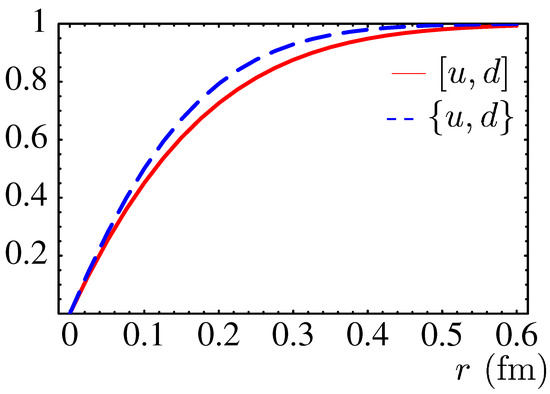
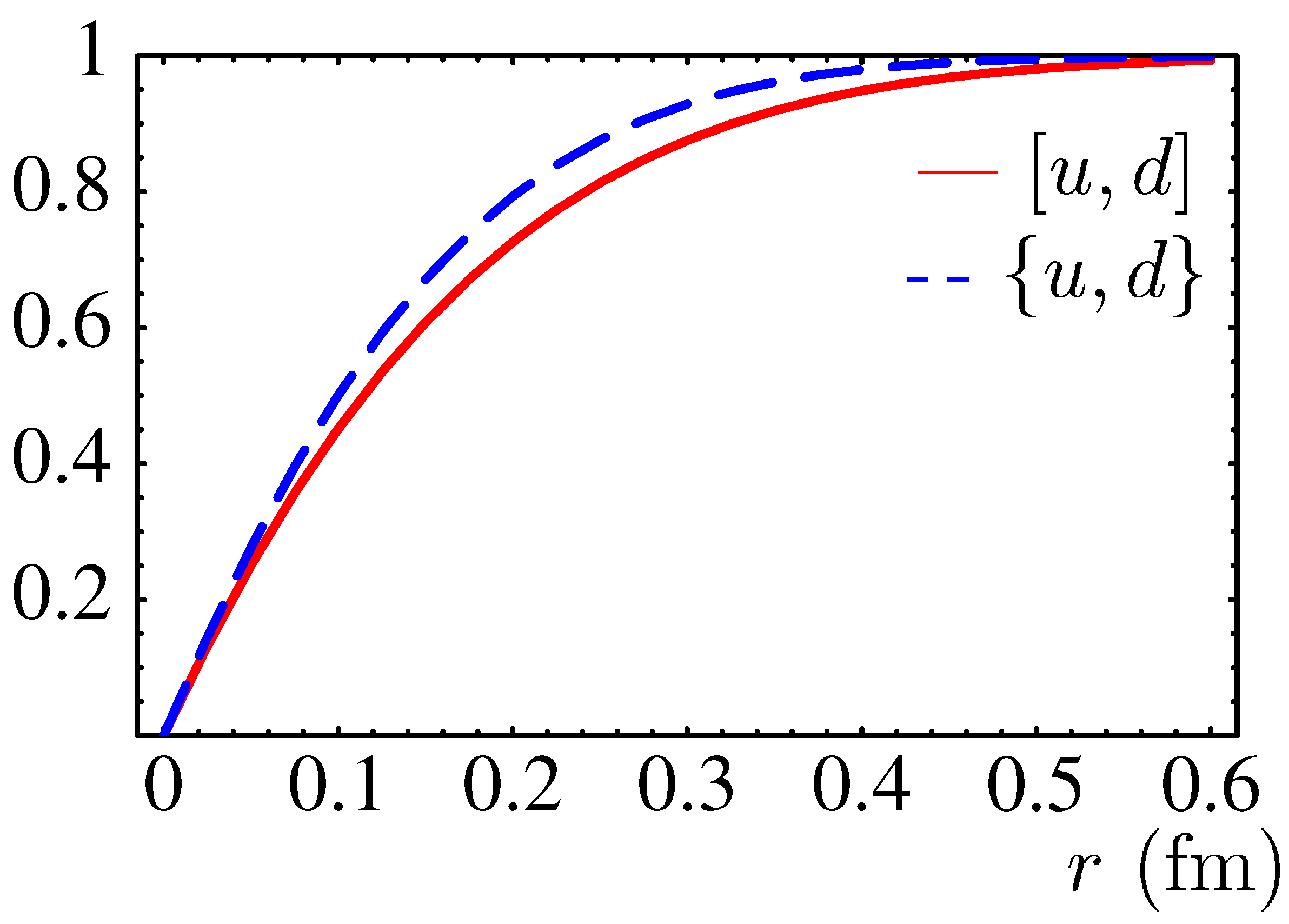
Such a form factor smears the one-gluon exchange potential and removes spurious singularities in the local relativistic quasipotential, thus allowing one to use it nonperturbatively to find the numerical solution to the quasipotential equation. The masses and parameters of light, heavy–light and doubly heavy diquarks are the same as in the heavy baryons [14,19,22,27] and are given in Table 2 and Table 3. As in the case of heavy baryons, we consider diquarks in the ground states only. In Figure 1 we plot, as an example, the form factors for the light scalar and axial vector diquarks. For other diquarks, the form factors have a similar form. As we see, the functions vanish in the limit and reach unity for large values of r. Such a behaviour can easily be understood intuitively. At large distances, a diquark can be approximated well by a point-like object, and its internal structure cannot be resolved. When the distance to the diquark decreases, the internal structure plays a more important role. As the distance approaches zero, the interaction weakens and turns to zero for , since this point coincides with the center of gravity of the two quarks forming the diquark. Thus, the function makes an important contribution to the short-range part of the interaction of the light and heavy diquark in the tetraquark, and can be neglected for the long-range (confining) interaction.
Table 2.
Masses M and form factor parameters of light and heavy–light diquarks. S and A denote scalar and axial vector diquarks, which are antisymmetric and symmetric in flavour, respectively.
Table 3.
Masses M and form factor parameters of doubly heavy diquarks. S and A denote scalar and axial-vector diquarks, antisymmetric and symmetric in flavour, respectively.
Figure 1.
The form factors for the scalar (solid line) and axial vector (dashed line) diquarks.
To calculate the masses of the ground state and excited tetarquarks, we substitute the diquark–antidiquark quasipotential (16) in the quasipotential Equation (1), and solve the resulting differential equation numerically in configuration space. It is important to emphasize that all relativistic contributions to the quasipotential are treated nonperturbatively. In the following sections, we present the results of such calculations for the tetraquarks containing two or four heavy quarks.
3. Heavy Tetraquarks with Hidden Charm and Bottom
First, we consider heavy tetraquarks with hidden charm and bottom ( or b, ). They can provide candidates for exotic charmonium-like (see Table 1) and bottomonium-like ( and ) states, observed experimentally.
In the diquark–antidiquark picture of heavy tetraquarks, both scalar S (antisymmetric in flavour ) and axial vector A (symmetric in flavour ) diquarks are considered. Therefore, we can obtain the following structure of the ground () states (C is defined only for ):
- Two states with :
- Three states with :
- One state with :
The orbitally excited () states are constructed analogously. As we find, a very rich spectrum of tetraquarks emerges. However, the number of states in the considered diquark–antidiquark picture is significantly lower than in the genuine four-quark approach.
The diquark–antidiquark model of heavy tetraquarks predicts the existence of the flavour nonet of states with hidden charm or beauty (): four tetraquarks [, ] with neither open nor hidden strangeness, which have electric charges 0 or and isospin 0 or 1; four tetraquarks ( and , ) with open strangeness (), which have electric charges 0 or and isospin ; one tetraquark with hidden strangeness and zero electric charge. Since we neglect the mass difference in u and d quarks and electromagnetic interactions in our model, the corresponding tetraquarks will be degenerate in mass. A more detailed analysis [13] predicts that the tetraquark mass differences can be of a few MeV so that the isospin invariance is broken for the mass eigenstates, and thus in their strong decays.
Masses of the ground, as well as orbitally and radially excited states of heavy tetraquarks were calculated in References [14,20,21] and we give them i Table 4 and Table 5. Note that most of the ground tetraquark states are predicted to lie either above or only slightly below corresponding open charm and bottom thresholds. For the excited states, we consider excitations only of the diquark–antidiquark system. A very rich spectrum of excited tetraquark states is obtained.
Table 4.
Masses of hidden charm diquark–antidiquark states (in MeV). S and A denote scalar and axial vector diquarks; is the total spin of the diquark and antidiquark. (C is defined only for ).
Table 5.
Masses of hidden-bottom tetraquark states (in MeV).
In Table 6, we compare the predicted masses of tetraquarks with hidden charm with available experimental data, listed in Table 1, and give possible tetraquark candidates. For the exotic charmonium-like states, we obtain the following results. The predicted mass of the ground state neutral charm tetraquark state coincides with the measured mass of . Then, the charged can be its partner state, composed from axial vector diquark (A) and axial vector antidiquark (), and , is its first radial excitation. Indeed, the predicted masses of these states are within experimental error bars. From its value of the mass, with unmeasured quantum numbers could be of the tetraquark. The charged , , , and have masses which are inconsistent with our results. They could be, e.g., the hadro-charmonium or molecular states. The charged can be the state of -wave tetraquark, composed from scalar (S) and axial vector (A) diquark–antidiquark combinations, while controversial , with the unmeasured parity and poorly determined mass, could be its or partner. The vector , and can be the -wave tetraquark states, composed from and diquarks, respectively, while corresponds to the -wave state of the tetraquark. We have no tetraquark candidate for the state.
Table 6.
Masses of hidden charm diquark–antidiquark states (in MeV) and possible experimental candidates.
Now, we discuss the exotic charmonium-like states observed in the mass spectrum. The axial vector can be the ground-state tetraquark with , composed form a scalar (S) and axial vector (A) diquark–antidiquark combinations, while the scalar and can correspond to the first radially excited tetraquarks, composed from the and , respectively. If , very recently observed by LHCb [11], is different from , it can be the excitation of the tetraquark with . We do not have the tetraquark candidate for the . The mass of the very recently observed [8] charged state with open strangeness coincides with our prediction for the state composed from scalar and axial vector diquarks . It is important to point out that most of the exotic charmonium-like states were discovered experimentally after our predictions.
In the exotic botomonium-like sector, we do not have tetraquark candidates for the charged and , which are probably molecular states. The ground states of the tetraquarks with a hidden bottom are predicted to have masses below the open bottom threshold, and thus they should be narrow states. In the last column of Table 6, the predictions for the masses of bottom counterparts to the hidden charm tetraquark candidates are given.
4. Doubly Heavy Tetraquarks with Open Charm and Bottom
The doubly heavy tetraquark ( and ) is considered as the bound system of the heavy diquark () and light antidiquark (). It is important to investigate the possible stability of the tetraquarks, since they are explicitly exotic states with a heavy flavour number equal to 2. Thus, their observation would be a direct proof of the existence of the multiquark states. Estimates of the production rates of such tetraquarks indicate that they could be produced and detected at present and future facilities.
We calculated the masses M of the ground states () of doubly heavy tetraquarks with open charm and/or bottom composed from the heavy diquark, containing two heavy quarks (, ), and the light antidiquark (, ) in Reference [19]. They are presented in Table 7. In this table, we give the values of the lowest thresholds T for decays into two corresponding heavy–light mesons () which were calculated using the measured masses of these mesons [9]. We also show values of the difference in the tetraquark and threshold masses . If this quantity is negative, then the tetraquark lies below the threshold of the decay into mesons with open flavour, and thus should be a narrow state which can be detected experimentally. The states with small positive values of could be also observed as resonances, since their decay rates will be suppressed by the phase space. All other states are expected to be very broad, and thus unobservable. We find that the only tetraquark which lies considerably below threshold is the state of . All other tetraquarks are predicted to lie either close to ( and states of , state of , state of , state of ) or significantly above the corresponding thresholds. Note that our predictions are in accordance with the recent lattice QCD calculations [29,30,31,32], which find that only doubly bottom tetraquarks have masses below the corresponding two-meson thresholds. This conclusion is also supported by the heavy quark symmetry [33] and quark model relations [34].
Table 7.
Masses M of heavy-diquark ()–light-antidiquark () states. T is the lowest threshold for decays into two heavy–light () mesons and . All values are given in MeV.
It is evident from the results presented in Table 7 that the heavy tetraquarks have an increasing chance of being below the open flavour threshold, and thus have a narrow width, with the increase in the ratio of the heavy diquark mass to the light antidiquark mass.
It is important to note that the comparison of the masses of doubly heavy tetraquarks given in Table 7, with our predictions for the masses of hidden charm and bottom tetraquarks in Table 4 and Table 5 [14,20,21] shows that the states are, in general, heavier than the corresponding ones. This result has the following explanation. Although the relation holds between diquark masses, the binding energy in the heavy–light diquark ()– heavy-light antidiquark ()-bound system is significantly larger than in the corresponding heavy diquark ()–light antidiquark () one. This fact is well known from the meson spectroscopy, where heavy quarkonia are more tightly bound than heavy–light mesons . For instance, we found that some of the tetraquarks lie below open charm thresholds, while all ground-state tetraquarks are found to be above such thresholds.
5. Heavy Tetraquarks with Open Charm and Bottom
The tetraquark is considered to be the bound state of the heavy–light diquark () and antidiquark (. In Table 8, the calculated masses M of the ground states of heavy tetraquarks with open charm and bottom, composed of a diquark and a antidiquark, are presented [19]. We also give the lowest thresholds T for decays into heavy–light mesons, as well as thresholds for decays into the and light () mesons and . For the non-strange tetraquarks, we give thresholds for decays of the states into and or . These states should be more stable than the ones, since their decays to and violate isospin. We find that only states of have negative values of , and thus they should be stable with respect to decays into heavy–light (B and D) mesons. The predicted masses of lowest states of and tetraquarks lie only slightly above the corresponding thresholds T. However, all tetraquarks were found to be significantly above the thresholds for decays into the and light () mesons. Nevertheless, the wave function of the spatially extended tetraquark would have little overlap with the wave function of the compact meson, thus substantially suppressing the decay rate in this channel. Therefore the above-mentioned tetraquark states, which are below the threshold, have good chances of being rather narrow and could be detected experimentally.
Table 8.
Masses M of diquark ()–antidiquark () states. T is the lowest threshold for decays into two heavy-light () mesons and ; is the threshold for decays into the and a light meson (), and . All values are given in MeV.
6. Tetraquarks
The exotic states consisting of heavy quarks ( and/or b) only are of special interest, since their nature can be determined more easily than in the case of exotic charmonium and bottomonium-like states. They should predominantly be compact tetraquarks. Indeed, a molecular configuration is unlikely. Only heavy mesons can be exchanged between constituents in such a molecule, and the arising Yukawa-type potential is not strong enough to provide binding. Soft gluons can be exchanged between two heavy quarkonia, leading to the so-called QCD van der Waals force. Such a force is known to be attractive, though whether it is strong enough to form a bound state remains unclear. The hadroquarkonium picture is not applicable. Thus, the diquark ()-antidiquark () configuration is preferable.
The calculated masses M of the ground states [23] of the neutral tetraquarks composed of the heavy diquark (, ), and heavy antidiquark () are given in Table 9 and Table 10. The masses of the charged heavy tetraquarks are presented in Table 11. In these tables, we give the values of the lowest thresholds T for decays into two corresponding heavy mesons (][] or [][), which were calculated using the measured masses of these mesons [9]. We also show values of the difference in the tetraquark and threshold masses, . If this quantity is negative, then the tetraquark lies below the threshold of the fall-apart decay into two mesons, and thus should be a narrow state. The states with small positive values of could be also observed as resonances, since their decay rates will be suppressed by the phase space. All other states are expected to be broad, and thus difficult to observe.
Table 9.
Masses M of the neutral heavy diquark ()–antidiquark () states. T is the threshold for the decays into two heavy-() mesons and . All values are given in MeV.
Table 10.
Masses M of the neutral heavy diquark ()-antidiquark () states. T is the threshold for the decays into two heavy-() mesons and . All values are given in MeV.
Table 11.
Masses M of the charged heavy diquark–antidiquark states. T is the threshold for the decays into two heavy () mesons and . All values are given in MeV.
From these tables, we can see that the predicted masses of almost all tetraquarks are significantly higher than the thresholds of the fall-apart decays to the lowest allowed two quarkonium states. All these states should be broad, since they can decay to corresponding quarkonium states through quark and antiquark rearrangements, and these decays are not suppressed either dynamically or kinematically. This conclusion is in accordance with the current experimental data. Indeed, the LHCb [24] and CMS [25] collaborations have not observed narrow beautiful tetraquarks in the -pair production. Note that the lattice nonrelativistic QCD [35] calculations did not find a signal for the tetraquarks below the lowest noninteracting two-bottomonium threshold. On the other hand, the broad structure near the di- mass threshold very recently observed by the LHCb [10] can correspond to the state of the tetraquark, with a predicted mass of 6367 MeV. The narrow structure, [10], could be the orbital or radial excitation of this tetraquark. Such excited states can be narrow, despite the large phase space, since it will be necessary to overcome the suppression in the fall-apart process, either due to the centrifugal barrier for the orbital excitations or due to the presence of the nodes in the wave function of the radially excited state. To test this possibility, we calculated masses of excited tetraquarks. Both radial and orbital excitations were only considered between the axial vector diquark and the axial vector antidiquark.
In Table 12, we give our predictions for the masses of the ground and excited states of tetraquarks [36]. The mass and width of the resonance in di- mass spectrum reported in Reference [10] are
where the difference is based on the treatment of nonresonant background (see Figure 3 in Reference [10]). The Model 1 assumes no interference with non-resonant, single-parton scattering (NRSPS), while the Model 2 assumes that the NRSPS continuum interferes with the broad structure close to the di- mass threshold. We find that this state can be described either as the first radial excitation () with and the predicted mass 6868 MeV, or as the second orbital excitations () with the mass 6899 MeV and/or with the mass 6915 MeV. In the invariant mass spectrum of weighted di- candidates [10] there is also a hint of another structure around 7.2 GeV. This can correspond to the second radial () excitation or/and with the predicted masses 7259 MeV and 7333 MeV, respectively.
Table 12.
Masses M of tetraquarks (in MeV); is the total spin of the diquark and antidiquark.
In Table 13, we compare our predictions for the masses of the ground states of tetraquarks with the results of previous calculations [35,37,38,39,40,41,42,43,44,45,46,47,48,49,50,51,52,53,54,55,56]. Our calculation shows that the account of the diquark structure (size) weakens the Coulomb-like, one-gluon exchange potential, thus increasing tetraquark masses and reducing spin–spin splittings. We can see from Table 13 that there are significant disagreements between different theoretical approaches. Indeed, References [35,39,40,41,42,45,47,50,52] predict heavy tetraquark masses below or slightly above the thresholds of the decays to two quarkonia and, thus, stable or significantly suppressed against fall-apart decays with a very narrow decay width. On the other hand, our model and other approaches predict such tetraquark masses significantly above these thresholds and, thus, they can be observed only as broad resonances.
Table 13.
Comparison of theoretical predictions for the masses of the ground states of the neutral tetraquarks (in MeV).
7. Conclusions
The calculation of masses of the tetraquarks with heavy quarks is reviewed. All considerations are performed in the framework of the relativistic quark model based on the quasipotential approach, QCD and the diquark–antidiquark picture. The dynamical approach is used, where both diquark and tetraquark masses and wave functions are obtained by the numerical solution of the quasipotential equation with the corresponding relativistic quasipotentials. The structure of the quark–quark and diquark–antidiquark interactions was fixed from the previous considerations of meson and baryon properties. Contrary to most of the considerations available in the literature, the diquark is not assumed to be a point-like object. Instead, its size is explicitly taken into account with the help of the diquark-gluon form factor, which is calculated as the overlap integral of the diquark wave functions. Such a form factor significantly weakens the short-range Coulomb-like part of the Cornell potential, thus increasing the masses of the tetraquarks and reducing spin splittings. This effect is especially pronounced for the tetraquarks, since they have a larger Coulomb contribution due to their smaller size. Note that the approaches with a point-like diquark substantially underestimate the mass of the doubly charmed baryon , while our model correctly predicted its mass [27] long before its experimental discovery. It is important to pint out that no free adjustable parameters are introduced. All values of the model parameters are kept fixed from the previous calculations of meson and baryon spectra and decays. This fact significantly improves the reliability of the predictions of our model.
A detailed comparison of our predictions with the current experimental data was performed. It was found that masses of , , , , , , , , , , , , , , are compatible with the masses of hidden-charm tetraquark states with corresponding quantum numbers. Note that most of these states were observed after our predictions. The ground states of tetraquarks with hidden bottom are predicted to have masses below the open bottom threshold, and thus should be narrow. We do not have tetraquark candidates for charged and , which are probably molecular states. Predictions for the masses of bottom counterparts to the charm tetraquark candidates are given. The experimental search for these states is an important test of the diquark–antidiquark picture of heavy tetraquarks.
In the explicitly exotic quark sector, the following results were obtained [19]. All the tetraquarks are predicted to be above the decay threshold into the open charm mesons. Only the state of is found to lie below the threshold. Some of the ground states of these tetraquarks are found to have masses just a few tens of MeV above the thresholds. Thus they, in principle, could be observed as resonances.
It was found that the predicted masses of all ground-state tetraquarks are above the thresholds for decays into two heavy () mesons. Therefore, they should rapidly fall apart into the two lowest allowed quarkonium states. Such decays proceed through quark rearrangements and are not suppressed dynamically or kinematically. These states should be broad, and are thus difficult to observe experimentally. The state with the predicted mass 6367 MeV can correspond to the broad structure recently observed by the LHCb Collaboration [10] in the mass spectrum of -pairs produced in proton–proton collisions. On the other hand, all ground-state tetraquarks have masses significantly (400–500 MeV) higher than corresponding thresholds, and thus should be very broad. This agrees with the absence of the narrow beautiful tetraquarks in the -pair production reported by the LHCb [24] and CMS [25] Collaborations.
The masses of excited tetraquarks were calculated. Lowest radial and orbital excitations between diquark and antidiquark were considered. It is concluded that the narrow structure, , observed very recently in the -pair invariant mass spectrum [10], could be either the first radial () excitation or the second orbital () excitation of the tetraquark, while the structure around 7.2 GeV could correspond to its second radial () excitation.
Note added: After the manuscript was submitted for publication, the LHCb Collaboration reported the observation of new resonances decaying to and [57]. The charged charmonium-like state with the open strangeness decaying to , with the mass MeV and spin-parity , was observed with large significance. Although its mass is consistent with the mass of the state previously observed by the BESIII experiment in the mass distribution [8], the decay width measured by the LHCb is about an order of magnitude broader than the width reported by the BESIII. Therefore, the LHCb concludes [57] that there is no evidence that the state is the same as the state. This conclusion is in accordance with our predictions [14,20]. Indeed, both states can be naturally interpreted in our model as the state composed from scalar and axial vector diquarks with the predicted mass 3982 MeV for the and as the state composed from axial vector diquark and antidiquark with the predicted mass 4004 MeV for the state (see Table 4). The new state decaying to final state with the measured mass [57] agrees with our prediction for the state, composed from scalar and axial vector diquarks, with the mass 4665 MeV. The new state [57] with the measured mass and quantum numbers or , where the first assignment is preferred at a level, could be interpreted in our model as the state , composed from scalar and axial vector diquarks, with the predicted mass 4514 MeV, or as the state, composed from axial vector diquark and antidiquark, with the predicted mass 4598 MeV. The broad state with the measured mass MeV with quantum numbers or (with a 2 difference in favor of the first hypothesis) [57] is consistent with our prediction for the state , composed from the scalar diquark and antidiquark, and the mass 4350 MeV.
Author Contributions
Investigation, R.N.F., V.O.G. and E.M.S., Writing—original draft, R.N.F., V.O.G. and E.M.S. All authors have read and agreed to the published version of the manuscript.
Funding
This research received no external funding.
Institutional Review Board Statement
Not applicable.
Informed Consent Statement
Not applicable.
Data Availability Statement
Not applicable.
Acknowledgments
The authors are grateful to D. Ebert for very fruitful and pleasant collaboration in developing the diquark-antidiquark model of tetraquarks. We express our gratitude to A. Berezhnoy and M. Wagner for valuable discussions. We thank the organizers of the XXXII International Workshop on High Energy Physics “Hot problems of Strong Interactions”, especially V. Petrov and R. Zhokhov, for the invitation to participate in such an interesting and productive meeting.
Conflicts of Interest
The authors declare no conflict of interest.
References
- Liu, Y.R.; Chen, H.X.; Chen, W.; Liu, X.; Zhu, S.L. Pentaquark and Tetraquark states. Prog. Part. Nucl. Phys. 2019, 107, 237–320. [Google Scholar] [CrossRef] [Scilit]
- Brambilla, N.; Eidelman, S.; Hanhart, C.; Nefediev, A.; Shen, C.P.; Thomas, C.E.; Vairo, A.; Yuan, C.Z. The XYZ states: Experimental and theoretical status and perspectives. Phys. Rept. 2020, 873, 1–154. [Google Scholar] [CrossRef] [Scilit]
- Guo, F.K.; Hanhart, C.; Meißner, U.-G.; Wang, Q.; Zhao, Q.; Zou, B.S. Hadronic molecules. Rev. Mod. Phys. 2018, 90, 015004. [Google Scholar] [CrossRef] [Scilit]
- Olsen, S.L.; Skwarnicki, T.; Zieminska, D. Nonstandard heavy mesons and baryons: Experimental evidence. Rev. Mod. Phys. 2018, 90, 015003. [Google Scholar] [CrossRef] [Scilit]
- Barabanov, M.Y.; Bedolla, M.A.; Brooks, W.K.; Cates, G.D.; Chen, C.; Chen, Y.; Cisbani, E.; Ding, M.; Eichmann, G.; Ent, R.; et al. Diquark Correlations Hadron Physics: Origin Impact Evidence. Prog. Part. Nucl. Phys. 2021, 116, 103835. [Google Scholar] [CrossRef] [Scilit]
- Lebed, R.F.; Mitchell, R.E.; Swanson, E.S. Heavy-Quark QCD Exotica. Prog. Part. Nucl. Phys. 2017, 93, 143–194. [Google Scholar] [CrossRef] [Scilit]
- Pakhlova, G. A Near-Threshold Enhanc. e+e−→ Cross Section Using Initial-State Radiation. Phys. Rev. Lett. 2008, 101, 172001. [Google Scholar] [CrossRef] [Scilit]
- Ablikim, M. Observation of a near-threshold structure in the K+ recoil-mass spectra in e+e−→K+( + ). arXiv 2011, arXiv:2011.07855. [Google Scholar]
- Particle Data Group; Zyla, P.A.; Barnett, R.M.; Beringer, J.; Dahl, O.; Dwyer, D.A.; Groom, D.E.; Lin, C.-J.; Lugovsky, K.S.; Pianori, E.; et al. Review of particle physics. Prog. Theor. Exp. Phys. 2020, 2020, 083C01. [Google Scholar] [CrossRef] [Scilit]
- Aaij, R.; Beteta, C.A.; Ackernley, T.; Adeva, B.; Adinolfi, M.; Afsharnia, H.; Aidala, C.A.; Aiola, S.; Ajaltouni, Z.; Akar, S.; et al. Observation of structure in the J/ψ -Pair Mass Spectrum. Sci. Bull. 2020, 65, 1983–1993. [Google Scholar] [CrossRef] [Scilit]
- Aaij, R.; Beteta, C.A.; Ackernley, T.; Adeva, B.; Adinolfi, M.; Afsharnia, H.; Aidala, C.A.; Aiola, S.; Ajaltouni, Z.; Akar, S.; et al. →J/ψπ+π−K+K− Decays. J. High Energy Phys. 2021, 2021, 024. [Google Scholar] [CrossRef] [Scilit]
- Iwasaki, Y. A Possible Model for New Resonances: Exotics and Hidden Charm. Prog. Theor. Phys. 1975, 54, 492–503. [Google Scholar] [CrossRef] [Scilit]
- Maiani, L.; Piccinini, F.; Polosa, A.D.; Riquer, V. Diquark-antidiquarks with hidden or open charm and the nature of X(3872). Phys. Rev. D 2005, 71, 014028. [Google Scholar] [CrossRef] [Scilit]
- Ebert, D.; Faustov, R.N.; Galkin, V.O. Masses of heavy tetraquarks in the relativistic quark model. Phys. Lett. B 2006, 634, 214–219. [Google Scholar] [CrossRef] [Scilit]
- Oncala, R.; Soto, J. Heavy Quarkonium Hybrids: Spectrum, Decay and Mixing. Phys. Rev. D 2017, 96, 014004. [Google Scholar] [CrossRef] [Scilit]
- Voloshin, M.B. Charmonium. Prog. Part. Nucl. Phys. 2008, 61, 455–511. [Google Scholar] [CrossRef] [Scilit]
- Rupp, G.; van Beveren, E. Heavy quarkonia: The beauty and the beasts. J. Phys. Conf. Ser. 2019, 1137, 012021. [Google Scholar] [CrossRef] [Scilit]
- Van Beveren, E.; Rupp, G. Modern meson spectroscopy: The fundamental role of unitarity. Prog. Part. Nucl. Phys. 2021, 117, 103845. [Google Scholar] [CrossRef] [Scilit]
- Ebert, D.; Faustov, R.N.; Galkin, V.O.; Lucha, W. Masses of tetraquarks with two heavy quarks in the relativistic quark model. Phys. Rev. D 2007, 76, 114015. [Google Scholar] [CrossRef] [Scilit]
- Ebert, D.; Faustov, R.N.; Galkin, V.O. Excited heavy tetraquarks with hidden charm. Eur. Phys. J. C 2008, 58, 399–405. [Google Scholar] [CrossRef] [Scilit]
- Ebert, D.; Faustov, R.N.; Galkin, V.O. Relativistic model of hidden bottom tetraquarks. Mod. Phys. Lett. A 2009, 24, 567–573. [Google Scholar] [CrossRef] [Scilit]
- Ebert, D.; Faustov, R.N.; Galkin, V.O. Spectroscopy and Regge trajectories of heavy baryons in the relativistic quark-diquark picture. Phys. Rev. D 2011, 84, 014025. [Google Scholar] [CrossRef] [Scilit]
- Faustov, R.N.; Galkin, V.O.; Savchenko, E.M. Masses of the tetraquarks in the relativistic diquark–antidiquark picture. Phys. Rev. D 2020, 102, 114030. [Google Scholar] [CrossRef] [Scilit]
- Aaij, R.; Beteta, C.A.; Ackernley, T.; Adeva, B.; Adinolfi, M.; Afsharnia, H.; Aidala, C.A.; Aiola, S.; Ajaltouni, Z.; Akar, S.; et al. Search Beautiful Tetraquarks Y(1S)μ+μ− Invariant-Mass Spectrum. J. High Energy Phys. 2018, 10, 086. [Google Scholar] [CrossRef] [Scilit]
- Sirunyan, A.M.; CMS Collaboration. Measurement of the Y(1S) Pair production section and search for resonances decaying to Y(1S)μ+μ− Proton-Proton Collisions TeV. Phys. Lett. B 2020, 808, 135578. [Google Scholar] [CrossRef] [Scilit]
- Ebert, D.; Faustov, R.N.; Galkin, V.O. Mass spectra and Regge trajectories of light mesons in the relativistic quark model. Phys. Rev. D 2009, 79, 114029. [Google Scholar] [CrossRef] [Scilit]
- Ebert, D.; Faustov, R.N.; Galkin, V.O.; Martynenko, A.P. Mass spectra of doubly heavy baryons in the relativistic quark model. Phys. Rev. D 2002, 66, 014008. [Google Scholar] [CrossRef] [Scilit]
- Ebert, D.; Faustov, R.N.; Galkin, V.O. Properties of heavy quarkonia and Bc mesons in the relativistic quark model. Phys. Rev. D 2003, 67, 014027. [Google Scholar] [CrossRef] [Scilit]
- Francis, A.; Hudspith, R.J.; Lewis, R.; Maltman, K. Lattice Prediction for Deeply Bound Doubly Heavy Tetraquarks. Phys. Rev. Lett. 2017, 118, 142001. [Google Scholar] [CrossRef] [Scilit]
- Junnarkar, P.; Mathur, N.; Padmanath, M. Study of doubly heavy tetraquarks in Lattice QCD. Phys. Rev. D 2019, 99, 034507. [Google Scholar] [CrossRef] [Scilit]
- Leskovec, L.; Meinel, S.; Pflaumer, M.; Wagner, M. Lattice QCD investigation of a doubly-bottom tetraquark with quantum numbers I(JP) = 0(1+). Phys. Rev. D 2019, 100, 014503. [Google Scholar] [CrossRef] [Scilit]
- Hudspith, R.J.; Colquhoun, B.; Francis, A.; Lewis, R.; Maltman, K. A lattice investigation of exotic tetraquark channels. Phys. Rev. D 2020, 102, 114506. [Google Scholar] [CrossRef] [Scilit]
- Eichten, E.J.; Quigg, C. Heavy-quark symmetry implies stable heavy tetraquark mesons QiQjkl. Phys. Rev. Lett. 2017, 119, 202002. [Google Scholar] [CrossRef] [Scilit]
- Karliner, M.; Rosner, J.L. Discovery of doubly-charmed Ξcc baryon implies a stable () tetraquark. Phys. Rev. Lett. 2017, 119, 202001. [Google Scholar] [CrossRef] [Scilit] [PubMed]
- Hughes, C.; Eichten, E.; Davies, C.T.H. Searching for beauty-fully bound tetraquarks using lattice nonrelativistic QCD. Phys. Rev. D 2018, 97, 054505. [Google Scholar] [CrossRef] [Scilit]
- Faustov, R.N.; Galkin, V.O.; Savchenko, E.M. Excited tetraquarks in the relativistic diquark–antidiquark picture. manusript in preparation, to be submitted for publication.
- Lloyd, R.J.; Vary, J.P. All-charm tetraquarks. Phys. Rev. D 2004, 70, 014009. [Google Scholar] [CrossRef] [Scilit]
- Barnea, N.; Vijande, J.; Valcarce, A. Four-quark spectroscopy within the hyperspherical formalism. Phys. Rev. D 2006, 73, 054004. [Google Scholar] [CrossRef] [Scilit]
- Berezhnoy, A.V.; Likhoded, A.K.; Luchinsky, A.V.; Novoselov, A.A. Production of J/ψ-meson pairs and 4c tetraquark at the LHC. Phys. Rev. D 2011, 84, 094023. [Google Scholar] [CrossRef] [Scilit]
- Heupel, W.; Eichmann, G.; Fischer, C.S. Tetraquark bound states in a Bethe-Salpeter approach. Phys. Lett. B 2012, 718, 545–549. [Google Scholar] [CrossRef] [Scilit]
- Berezhnoy, A.V.; Luchinsky, A.V.; Novoselov, A.A. Tetraquarks Composed of 4 Heavy Quarks. Phys. Rev. D 2012, 86, 034004. [Google Scholar] [CrossRef] [Scilit]
- Wang, Z.G. Analysis of the tetraquark states with QCD sum rules. Eur. Phys. J. C 2017, 77, 432. [Google Scholar] [CrossRef] [Scilit]
- Chen, W.; Chen, H.X.; Liu, X.; Steele, T.G.; Zhu, S.L. Hunting for exotic doubly hidden-charm/bottom tetraquark states. Phys. Lett. B 2017, 773, 247–251. [Google Scholar] [CrossRef] [Scilit]
- Anwar, M.N.; Ferretti, J.; Guo, F.K.; Santopinto, E.; Zou, B.S. Spectroscopy and decays of the fully-heavy tetraquarks. Eur. Phys. J. C 2018, 78, 647. [Google Scholar] [CrossRef] [Scilit]
- Esposito, A.; Polosa, A.D. A di-bottomonium at the LHC? Eur. Phys. J. C 2018, 78, 782. [Google Scholar] [CrossRef] [Scilit] [PubMed]
- Wu, J.; Liu, Y.R.; Chen, K.; Liu, X.; Zhu, S.L. Heavy-flavored tetraquark states with the configuration. Phys. Rev. D 2018, 97, 094015. [Google Scholar] [CrossRef] [Scilit]
- Debastiani, V.R.; Navarra, F.S. A non-relativistic model for the [cc][] tetraquark. Chin. Phys. C 2019, 43, 013105. [Google Scholar] [CrossRef] [Scilit]
- Wang, G.J.; Meng, L.; Zhu, S.L. Spectrum of the fully-heavy tetraquark state QQ′′. Phys. Rev. D 2019, 100, 096013. [Google Scholar] [CrossRef] [Scilit]
- Liu, M.S.; Lü, Q.F.; Zhong, X.H.; Zhao, Q. All-heavy tetraquarks. Phys. Rev. D 2019, 100, 016006. [Google Scholar] [CrossRef] [Scilit]
- Bai, Y.; Lu, S.; Osborne, J. Beauty-full tetraquarks. Phys. Lett. B 2019, 798, 134930. [Google Scholar] [CrossRef] [Scilit]
- Chen, X. Analysis of hidden-bottom states. Eur. Phys. J. A 2019, 55, 106. [Google Scholar] [CrossRef] [Scilit]
- Bedolla, M.A.; Ferretti, J.; Roberts, C.D.; Santopinto, E. Spectrum of fully-heavy tetraquarks from a diquark+antidiquark perspective. Eur. Phys. J. C 2020, 80, 1004. [Google Scholar] [CrossRef] [Scilit]
- Karliner, M.; Rosner, J.L. Interpretation of structure in the di-J/ψ spectrum. Phys. Rev. D 2020, 102, 114039. [Google Scholar] [CrossRef] [Scilit]
- Jin, X.; Xue, Y.; Huang, H.; Ping, J. Full-heavy tetraquarks in constituent quark models. Eur. Phys. J. C 2020, 80, 1083. [Google Scholar] [CrossRef] [Scilit]
- Lü, Q.F.; Chen, D.Y.; Dong, Y.B. Masses of fully heavy tetraquarks in an extended relativized quark model. Eur. Phys. J. C 2020, 80, 871. [Google Scholar] [CrossRef] [Scilit]
- Deng, C.; Chen, H.; Ping, J. Towards the understanding of fully-heavy tetraquark states from various models. Phys. Rev. D 2021, 103, 014001. [Google Scholar] [CrossRef] [Scilit]
- Aaij, R.; Beteta, C.A.; Ackernley, T.; Adeva, B.; Adinolfi, M.; Afsharnia, H.; Aidala, C.A.; Aiola, S.; Ajaltouni, Z.; Akar, S.; et al. Observation of new resonances decaying to J/ψK+ and J/ψϕ. arXiv 2021, arXiv:2103.01803. [Google Scholar]

Publisher’s Note: MDPI stays neutral with regard to jurisdictional claims in published maps and institutional affiliations. |
© 2021 by the authors. Licensee MDPI, Basel, Switzerland. This article is an open access article distributed under the terms and conditions of the Creative Commons Attribution (CC BY) license (https://creativecommons.org/licenses/by/4.0/).