1. Introduction
Understanding the spin degree of freedom of particles produced in relativistic heavy-ion collisions has become a central topic in recent years [
1,
2,
3,
4,
5,
6]. In non-central collisions, the large orbital angular momentum of the system can be partially transferred to the spins of produced particles through spin–orbit coupling, leading to finite spin polarization [
7,
8]. The connection between the system angular momentum and the global polarization of
hyperons was first proposed in theoretical studies and was later supported by experimental measurements from the STAR and ALICE collaborations [
9,
10,
11,
12]. The discovery of such polarization phenomena has opened new opportunities for probing the vortical structure, transport properties, and hadronization dynamics of the quark–gluon plasma (QGP) [
13,
14,
15,
16,
17,
18,
19].
Vector mesons, particularly the
and
, provide complementary sensitivity to the spin dynamics of the system. Their spin alignment is characterized by the spin-density-matrix element
, which represents the population probability of the spin substate with projection
along a chosen quantization axis. For an unpolarized ensemble,
is expected, whereas deviations from this value may indicate spin alignment generated during hadronization or modified by hadronic interactions [
7,
8]. Recent measurements by the STAR and ALICE collaborations have reported small but intriguing deviations of
from
for certain vector mesons, together with a pronounced collision-energy dependence [
10,
12]. These observations have stimulated growing theoretical and experimental interest in clarifying the underlying mechanisms responsible for such effects [
20].
Experimentally, the spin-alignment parameter
is extracted from the angular distribution of the decay daughters relative to the system angular momentum
in the rest frame of the vector meson. The polar-angle distribution can be expressed as
where
denotes the angle between
and the momentum of a daughter particle in the parent-meson rest frame. The vector
is perpendicular to the reaction plane, which is defined by the impact-parameter direction and the beam axis. In practice,
is obtained by fitting the measured
distribution with Equation (
1).
The spin alignment of spin-1 vector mesons, such as the
and
, provides an important probe of light- and strange-quark polarization. The
meson, predominantly produced at hadronization, receives minimal feed-down contributions compared with
and
hyperons. Furthermore, its relatively small hadronic interaction cross section reduces rescattering effects, making it sensitive to early partonic dynamics. In contrast, the
meson undergoes substantial hadronic rescattering due to its short lifetime and strong interaction cross section [
21,
22,
23]. Therefore, measurements of
spin alignment provide access not only to the initial spin alignment but also to the influence of hadronic evolution on the final-state observables [
24,
25,
26,
27].
The angular distribution in Equation (
1) assumes full phase space coverage and uniform detection efficiency. In realistic experimental conditions, however, detectors have finite pseudorapidity ranges, transverse-momentum thresholds, and species-dependent reconstruction efficiencies. Such limitations can modify the measured angular distribution even when the underlying decays are intrinsically isotropic. Although detailed efficiency and resolution corrections are typically applied in experimental analyses, the impact of kinematic acceptance boundaries themselves is less explicitly quantified. This issue is particularly relevant for
measurements, since its decay daughters, pions and kaons, often populate the low- to intermediate-
region close to typical detector thresholds. Variations in
and
selections may preferentially remove daughter particles from specific regions of
, thereby introducing subtle but non-negligible distortions to the reconstructed distribution. Given that experimentally observed deviations of
from
are typically at the percent level, even modest acceptance effects may become comparable in magnitude.
Motivated by these considerations, it is instructive to examine systematically how finite acceptance influences the extraction of
within a controlled framework [
28]. The purpose of such a study is not to reinterpret existing experimental measurements, but rather to clarify the interplay between kinematic coverage and the reconstruction of spin-alignment observables. A quantitative mapping of how acceptance constraints propagate into the reconstructed
can help support high-precision measurements and facilitate more direct comparisons between theoretical expectations and experimental data.
In this work, we employ a simplified toy-model approach to investigate how typical acceptance selections affect the reconstructed spin-alignment parameter . The model generates mesons with isotropic decays, ensuring that any deviation of the extracted from arises solely from acceptance effects. By applying various pseudorapidity and transverse-momentum cuts to the parent mesons and/or daughter particles, we quantify their impact on the reconstructed angular distributions. The resulting trends are compared qualitatively with behaviors reported by the STAR collaboration, highlighting kinematic regions where acceptance-related effects may become relevant. Overall, this study provides a complementary perspective on vector-meson spin alignment and may serve as a reference for future experimental analyses aimed at improving the accuracy and interpretability of measurements in relativistic heavy-ion collisions.
From an experimental perspective, the present study suggests that daughter-particle phase space coverage should be treated as a key ingredient in precision spin-alignment measurements. In particular, narrow pseudorapidity coverage and low- tracking requirements can induce sizable distortions in the reconstructed distribution even when the input decay is isotropic. Future measurements would therefore benefit from systematic checks of the extracted under variations in daughter-track and selections, matched-acceptance comparisons between model calculations and experimental data, and dedicated embedding or detector-response studies to separate acceptance-induced distortions from genuine spin-alignment signals.
2. Spin Density Matrix and the Observable
The spin configuration of a spin-1 vector meson is described by a
Hermitian spin density matrix
, where
denote the spin projections along the chosen quantization axis. The diagonal elements represent the population probabilities and satisfy the normalization condition
For the decay of a vector meson into two pseudoscalar particles, the angular distribution of the decay daughters in the meson rest frame can be expressed within the spin density matrix formalism as [
29]
where
are the Wigner rotation matrix elements for spin-1 vector mesons.
In experimental analyses, the azimuthal angle
is typically integrated over, which eliminates all off-diagonal terms. Using Equation (
2), the polar-angle distribution reduces to
which serves as the standard expression for extracting
. For an unpolarized ensemble,
, yielding an isotropic distribution, while deviations from
indicate spin alignment.
Within the spin-density matrix formalism, the parameter
represents the population probability of the spin substate with projection
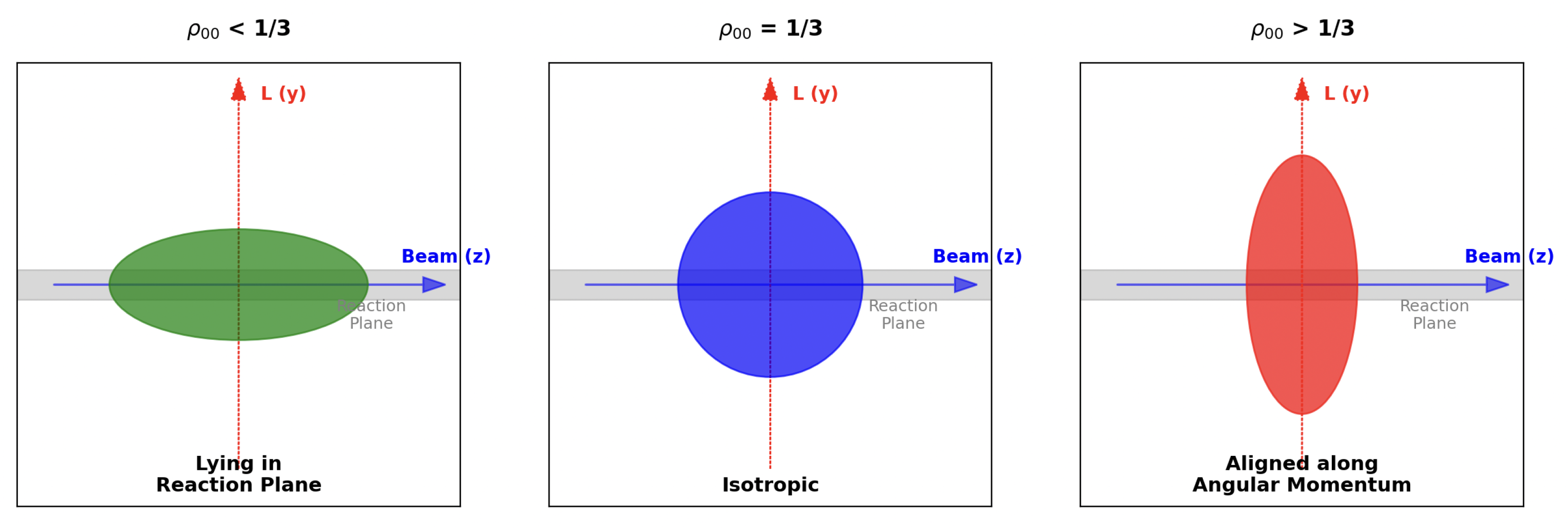
along the chosen quantization axis, and therefore characterizes the degree of spin alignment of the vector meson. As illustrated in
Figure 1, the value
corresponds to equal population of the three spin substates (
), indicating the absence of any preferred spin orientation. In this limit, the decay angular distribution becomes isotropic in the vector-meson rest frame, leading to a spherical topology in phase space. For
, the
spin substate is overpopulated, implying that the vector-meson spin exhibits a preferential alignment along the quantization axis. This results in a quadrupole anisotropy that enhances particle emission at large
. The corresponding phase space distribution assumes a prolate ellipsoidal shape, elongated along the quantization axis (beam direction). In contrast,
reflects an underpopulation of the
substate and a relative enhancement of the transverse (
) spin components. Consequently, the decay distribution develops a quadrupole distortion that suppresses emission along the quantization axis while enhancing it near
. This behavior is associated with an oblate phase space geometry, flattened along the beam direction.
3. The Simulation Method
In heavy-ion collision experiments, phase space coverage is inevitably constrained by the geometric and instrumental limitations of the detector. For instance, the STAR detector at RHIC has a typical charged-particle pseudorapidity acceptance of
with the newly installed iTPC, while reconstructed tracks are required to satisfy transverse momentum thresholds of
GeV/
c. Previous studies have shown that such limitations can influence the extraction of spin alignment observables [
28]. In particular, the measured
of
mesons was found to increase artificially as the
acceptance becomes narrower. This behavior arises because phase space boundaries constrain the accessible
regions in a nonuniform manner, thereby distorting the reconstructed angular distribution.
The decay kinematics of mesons differ from those of mesons. Whereas the decay is kinematically symmetric, the (and charge conjugates) decay is intrinsically asymmetric due to the unequal masses of the daughter particles. This asymmetry may further enhance the sensitivity of reconstructed distributions to acceptance selections. To systematically evaluate these effects and to quantify how finite pseudorapidity or transverse momentum cuts may bias extracted of , we perform a controlled simulation study based on both a multi-phase transport (AMPT) model and a simplified toy model approach.
The primary event generator used in this analysis is the string-melting version of the AMPT model [
30]. AMPT provides a realistic dynamical description of relativistic heavy-ion collisions and has been widely applied to these studies of collective flow, particle production, and hadronization at RHIC and LHC energies. The model consists of four main components: (1) fluctuating initial conditions provided by the HIJING model [
31], (2) an elastic parton cascade that governs partonic interactions [
32], (3) quark coalescence for hadronization, and (4) a hadronic rescattering phase simulated using a relativistic transport (ART) model [
33]. The string melting version converts initial strings into partons prior to transport evolution, allowing for a more complete modeling of the early partonic stage and subsequent hadronization dynamics.
To simulate the baseline kinematics of Au+Au collisions, minimum-bias events are generated using the string-melting version of the AMPT model. The impact parameter range is set to (0, 15.6) fm, corresponding to the experimental minimum-bias condition. A hadronic cascade time of 0.6 fm/c is used to suppress late-stage rescattering, so that the kinematic distributions mainly reflect their early production. In the present analysis, minimum-bias Au+Au events at GeV are generated with AMPT. From these events, approximately mesons are obtained and used to construct the parent-meson kinematic probability distributions in , , and for the toy model. The AMPT sample is used to provide realistic kinematic distributions in , , and , while the subsequent decay and acceptance study is performed in the dedicated toy-model framework.
In real experiments, the true reaction plane cannot be directly determined and is usually estimated by the event plane reconstructed from the azimuthal distribution of produced particles. In the present toy-model study, however, the reaction plane is fixed to the x-z plane, and the quantization axis, corresponding to the direction of the system angular momentum, is taken along the y axis. This choice is made only to define a fixed reference axis for a controlled study of acceptance effects. The detector effect considered here is not implemented through a full detector simulation, but through explicit kinematic selections on the generated parent mesons and/or their decay daughters. Therefore, the extracted in this work should be understood as the value reconstructed from the accepted daughter-particle distribution after the selected phase space cuts are applied.
We note that the present toy model does not include event-plane reconstruction, finite event-plane resolution, or track momentum resolution. These effects belong to a more complete detector-response treatment and are conceptually different from the phase space acceptance effect isolated here. Accordingly, the present toy model includes only statistical fit uncertainties associated with the reconstructed angular distributions. Event-plane resolution mainly smears the quantization axis used to define , while track momentum resolution smears the reconstructed daughter momentum and therefore the calculated . For the acceptance-driven effect studied in this work, the dominant distortion arises from whether daughter tracks are accepted or rejected by the imposed and boundaries.
Each
meson is decayed into a charged kaon and pion using standard two-body decay kinematics implemented in PYTHIA. In the subsequent toy-model calculation,
mesons are independently generated by sampling from the AMPT-derived parent-meson kinematic distributions and are then decayed once using the isotropic decay prescription. To generate the isotropic reference sample corresponding to
in full phase space, the daughter emission direction is sampled isotropically in the
rest frame with respect to the chosen quantization axis. Before any acceptance selection is applied, this procedure gives a flat
distribution, as expected for
. The daughter particles are then boosted to the laboratory frame, where the desired
and/or
selections are applied. For the accepted daughter pairs,
is reconstructed event by event in the
rest frame, and the resulting
distribution is fitted with Equation (
4) to extract the reconstructed
.
Owing to the large toy-model sample size, the statistical uncertainties of the extracted values are very small and are typically much smaller than the marker size in the figures. The quoted uncertainties are obtained from fits to the reconstructed distributions after the daughter-particle acceptance selections are applied. Typical statistical fit uncertainties are of the order of in the present toy-model calculation. In the following figures, statistical uncertainties are included where visible; when they are not visible, they are smaller than the plotted symbols. Therefore, the dominant effect discussed in this work is the systematic shift caused by the imposed acceptance selections, rather than a statistical fluctuation of the Monte Carlo sample.
4. Results and Discussion
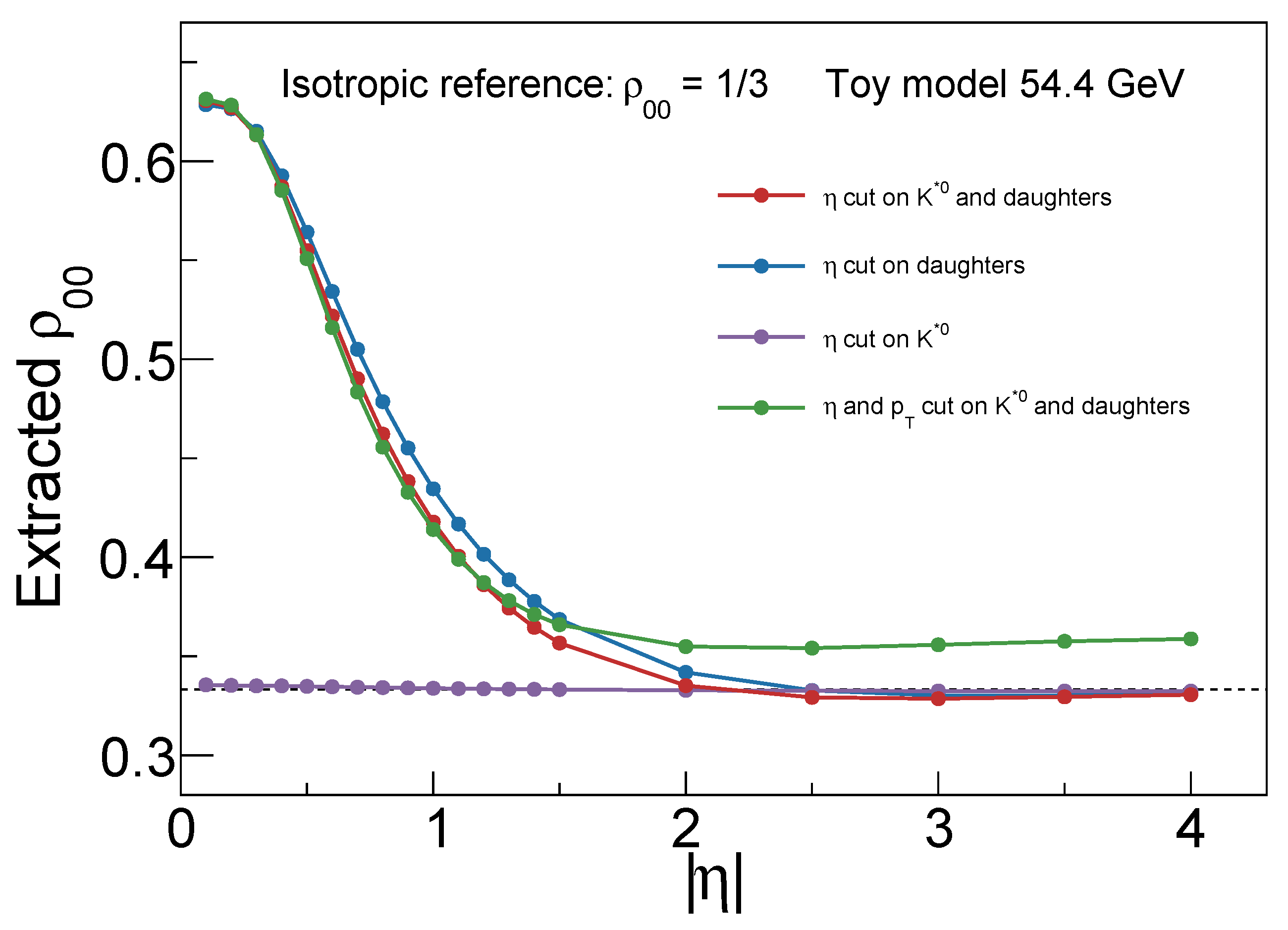
Figure 2 presents the extracted
of
mesons as a function of the upper limit of the pseudorapidity acceptance
in Au+Au collisions at
54.4 GeV, obtained from the toy model calculation. As discussed earlier, the toy model starts from an isotropic decay angular distribution, which corresponds to
in full phase space before any acceptance selection is applied. Four configurations are examined to quantify the impact of
selections on the reconstructed
: (1) applying
cuts simultaneously to the
mesons and their decay daughters; (2) applying
cuts to the decay daughters only; (3) applying
cuts to the parent
mesons only; and (4) applying
cuts to the parent and daughters together with an additional
GeV/
c threshold on the daughters, consistent with the STAR low
tracking requirement. These four cases correspond to the red, blue, purple, and green symbol and curves, respectively.
The results indicate that applying cuts solely on the parent mesons does not modify the extracted , which remains consistent with the isotropic reference value of across the full acceptance range. In contrast, imposing cuts on the decay daughters produces a substantial upward deviation from when the window is narrow (e.g., ). When an additional daughter track threshold is included, the extracted becomes slightly smaller than in the case with daughters cuts alone, however, it still exceeds even in the absence of any restriction, reflecting the intrinsic bias introduced by the low- removal. For all cases without cuts, the extracted gradually converges to the isotropic reference value of once the acceptance becomes sufficiently wide ().
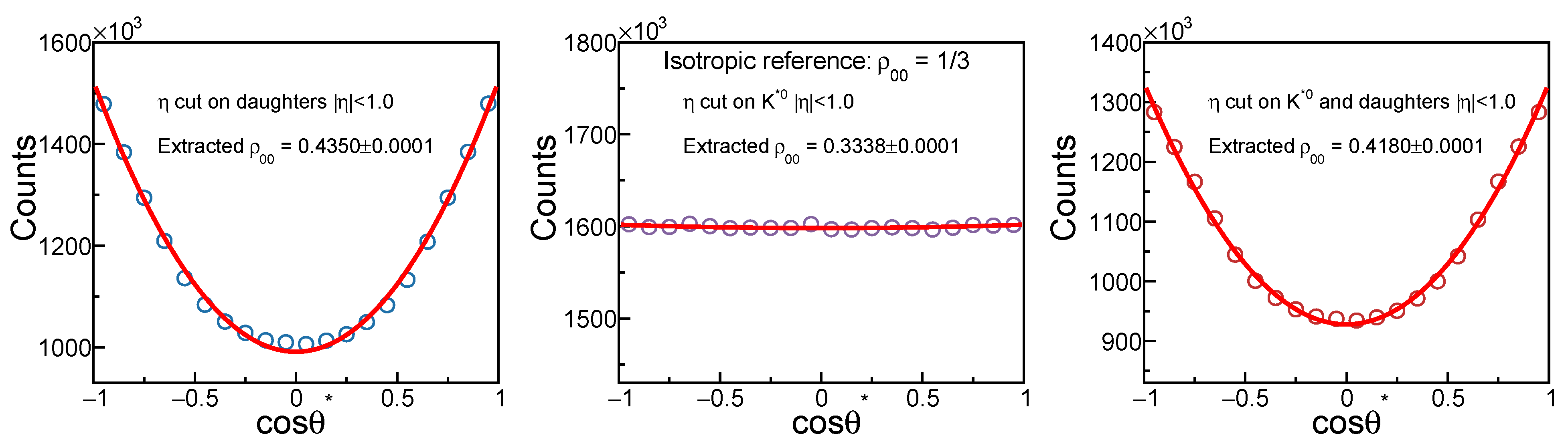
In order to illustrate how the pseudorapidity acceptance affects the reconstructed
,
Figure 3 shows the
distribution obtained under three conditions: (1) applying
to the decay daughters only, (2) applying the same
cut to the parent
mesons only, and (3) applying the cut simultaneously to both the parent and daughters. The open circles represent the yield in each
bin within the range [−1, 1], and the red curves denote fits using Equation (
4). When the
restriction is applied to the decay daughters (left and right panels), the measured distributions exhibit a characteristic parabolic shape with a minimum near
0. This behavior indicates that decays emitted preferentially transverse to the polarization axis are selectively removed by the finite
acceptance. Since
0 corresponds to configurations where the daughter momentum is perpendicular to the quantization axis, the suppression of these events distorts the angular distribution and artificially enhances the extracted
above the isotropic reference value of
. In contrast, as shown in the middle panel, imposing the same
constraint solely on the parent
mesons leaves the
distribution essentially flat, and the resulting
remains consistent with the isotropic reference value of
. These results demonstrate that acceptance-induced distortions originate primarily from kinematic selections applied to the decay daughters rather than the parent mesons. The narrower the daughter phase space window, the stronger the artificial depletion near
, leading to an apparent spin-alignment signal even when the underlying distribution is isotropic.
Quantitatively, the extracted values shown in
Figure 3 are
for the daughter cut only case,
for the parent cut only case, and
when the same
cut is applied to both the parent and daughter particles. These values demonstrate that the artificial enhancement of the reconstructed
is driven mainly by the daughter particle acceptance, while applying the
cut to the parent
meson alone leaves the reconstructed
consistent with the the isotropic reference case.
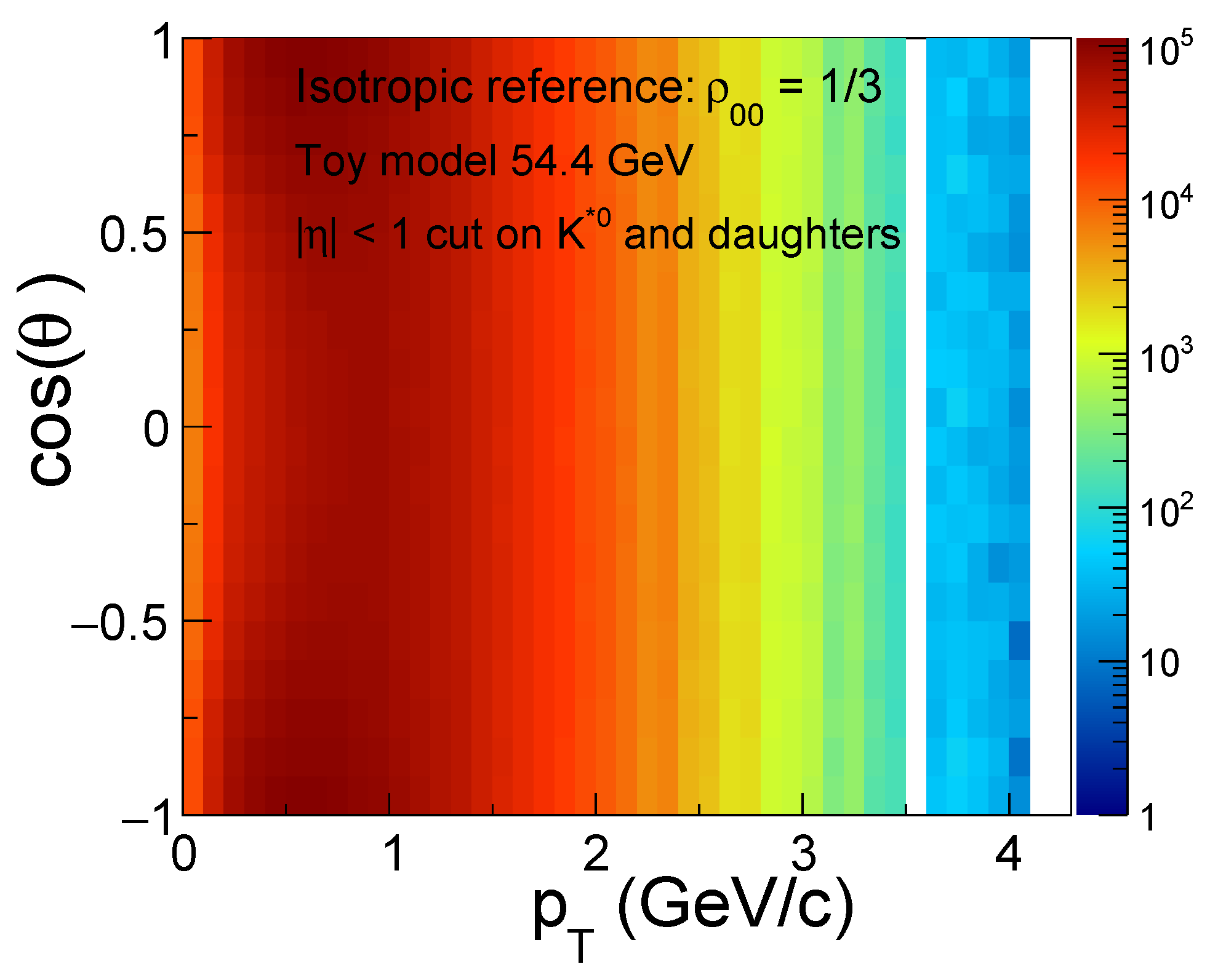
To further elucidate the impact of the
acceptance on the extracted
,
Figure 4 presents the two-dimensional distribution of
versus the parent-
transverse momentum,
, within a narrow pseudorapidity window
. In this figure, the same pseudorapidity selection is applied to both the parent
mesons and their decay daughters, while no daughter-track
cut is applied. The decay angle
is calculated from the daughter-particle momentum in the
rest frame, whereas the
axis denotes the transverse momentum of the parent
meson.
A clear suppression of yield is observed around , corresponding to daughter momenta oriented predominantly perpendicular to the quantization axis. This suppression is most pronounced for low- parent mesons. For parent mesons with small transverse momentum, the decay daughters can more easily acquire large longitudinal momentum components relative to their transverse momenta after being boosted to the laboratory frame. As a result, daughter particles associated with decay topologies around are more likely to fall outside the finite acceptance. Their selective removal depletes the yield near , changes the reconstructed angular distribution from a flat shape to a concave shape, and consequently leads to an extracted value larger than the isotropic expectation of .
Overall, this two-dimensional pattern provides direct evidence for the kinematic origin of the acceptance-induced bias. The finite window selectively suppresses daughter tracks from low- parent mesons for decay topologies in which the daughter momenta are oriented predominantly perpendicular to the quantization axis. In contrast, phase space selections applied solely to the parent mesons do not produce such distortions.
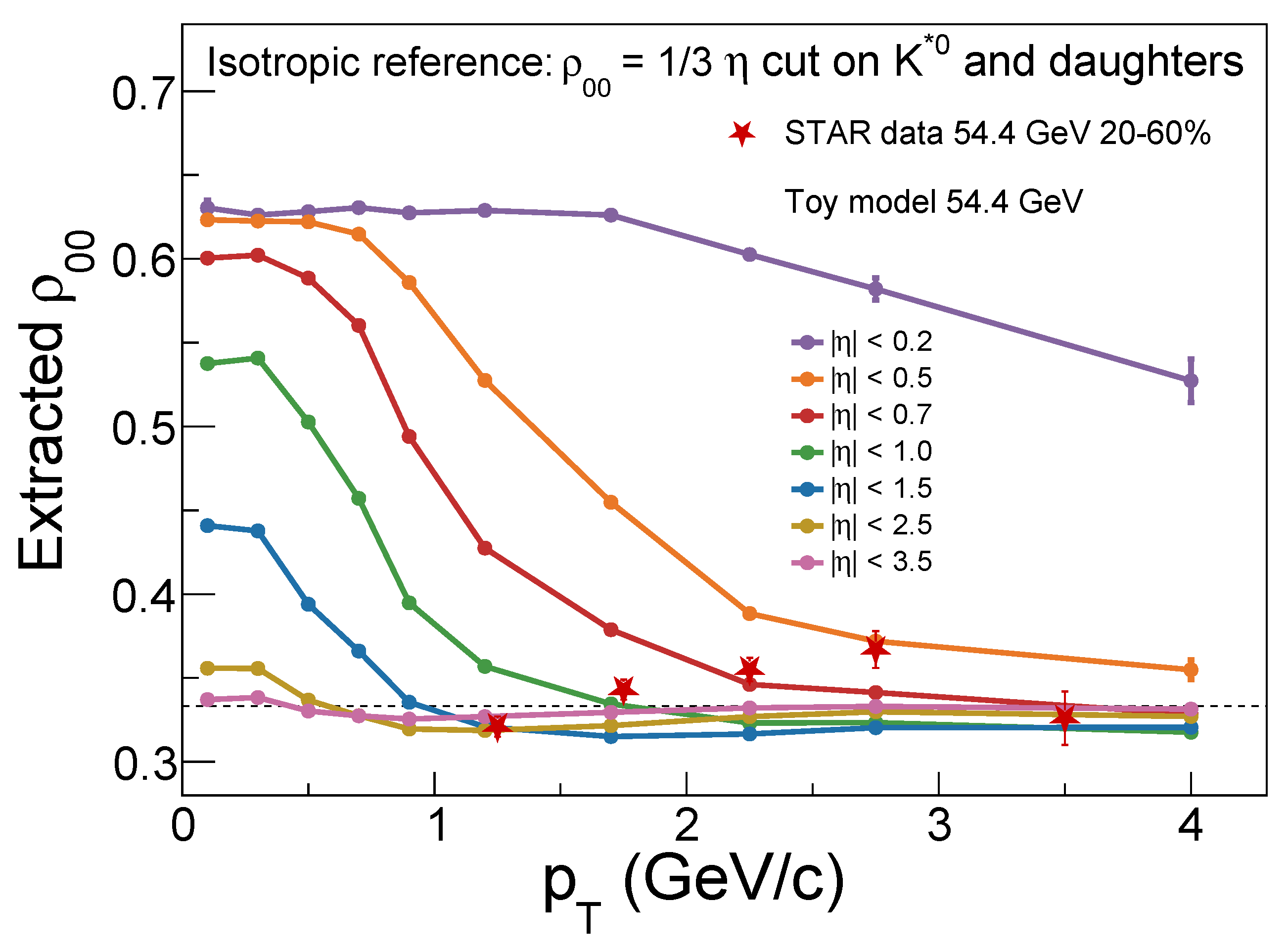
Figure 5 presents the dependence of the extracted
on the transverse momentum of the parent
mesons under different pseudorapidity acceptance applied to both the parent
mesons and their decay daughters. This is the same
definition used in the STAR measurements shown for comparison. In all toy model calculations, the decay angular distribution is isotropic in full phase space, corresponding to
, so that any deviation of the reconstructed
from
originates from the imposed kinematic acceptance selections.
The curves with different colors correspond to upper limits ranging from to . When the daughter acceptance is narrow (e.g., ), a pronounced enhancement of at low is observed. This behavior reflects the stronger sensitivity of daughter-track acceptance to decay topology for low- parent mesons. In this region, daughter particles associated with are more likely to fall outside the finite window, and their selective removal amplifies the apparent spin-alignment signal. As the acceptance widens, the reconstructed values gradually converge toward over the full range. For acceptance windows with upper limits larger than , the reconstructed approaches at sufficiently high , although the characteristic scale of this convergence depends on the width of the window.
Also shown in
Figure 5 are the STAR results at the same collision energy. The purpose of this comparison is not to reinterpret the experimental measurement, but to illustrate the possible magnitude of acceptance-induced distortions in the reconstructed
. We note that the
dependence observed in the STAR data is not fully reproduced by the present toy model. This is expected because the current calculation is constructed with an isotropic angular distribution corresponding to
and includes only finite kinematic acceptance effects. It does not include genuine spin-alignment dynamics, hadronization-stage spin–orbit correlations, hadronic rescattering or regeneration effects, event-plane resolution, detector-response effects, or details of background subtraction and signal extraction. Therefore, the increase in the measured
at intermediate
may originate from additional physics or experimental effects beyond the pure acceptance baseline isolated in this work. Overall,
Figure 5 highlights the important role of daughter-track phase space coverage in precision determinations of vector-meson spin alignment.
Although the present work focuses on mesons, the same acceptance mechanism can in principle affect other vector mesons reconstructed through two-body decays, such as mesons. The magnitude of the effect, however, is expected to depend on the decay kinematics, daughter-particle masses, lifetime, and the relevant reconstruction selections. For example, the decay is kinematically more symmetric than the decay, whereas the has unequal-mass daughters and is therefore more sensitive to asymmetric phase space rejection. Thus, the qualitative conclusion that daughter acceptance can distort the reconstructed is general, but the quantitative size of the bias should be evaluated separately for each vector-meson species and detector acceptance.
5. Summary
In summary, we have employed the AMPT model to obtain realistic kinematic distributions of mesons and, based on these inputs, constructed a dedicated toy model to investigate how phase space selections influence the extracted spin-alignment parameter . We find that finite pseudorapidity coverage, such as , can lead to reconstructed values above the isotropic expectation of , even when the input decay distribution is isotropic. This enhancement arises because, with the system angular momentum oriented in the transverse plane, limited daughter-particle acceptance preferentially rejects tracks associated with specific decay topologies, thereby distorting the reconstructed distribution and biasing the fitted toward larger values.
The reconstructed also exhibits acceptance-driven dependence, particularly in the low- region where daughter particles are more sensitive to the imposed boundaries. Qualitative comparisons between the toy-model calculations and STAR measurements are presented only as a reference and are not intended to reinterpret or revise the experimental results. Since the present toy model is constructed with an isotropic angular distribution corresponding to , any deviation in the reconstructed value originates from the imposed kinematic selections. The comparison therefore illustrates that acceptance effects can contribute to apparent deviations of from , although additional physics and detector-response effects may also be present in experimental measurements.
We emphasize that the present calculation is a controlled acceptance-level baseline study. It does not include a full detector response, finite event-plane resolution, track-momentum resolution, or background subtraction and signal-extraction effects. These effects should be incorporated in future detector-level or embedding studies to achieve a more quantitative comparison with experimental data. Nevertheless, the present work provides a transparent assessment of acceptance-induced biases in spin-alignment measurements and may serve as a useful baseline for future high-precision analyses of vector-meson spin alignment in relativistic heavy-ion collisions.