
Article

Linear Perturbations of an Exact Gravitational Wave in the Bianchi IV Universe

by
Konstantin Osetrin
1,2
1
Center for Theoretical Physics, Faculty of Physics and Mathematics, Tomsk State Pedagogical University, 634061 Tomsk, Russia
2
International Laboratory for Theoretical Cosmology, Tomsk State University of Control Systems and Radioelectronics, 634034 Tomsk, Russia
Universe 2026, 12(4), 110; https://doi.org/10.3390/universe12040110
Submission received: 10 February 2026 / Revised: 30 March 2026 / Accepted: 8 April 2026 / Published: 9 April 2026

Abstract

The proper-time method for constructing perturbative dynamical gravitational fields is presented. Using the proper-time method, a perturbative analytical model of gravitational waves against the backdrop of an exact wave solution of Einstein’s equations in a Bianchi IV universe is constructed. To construct the perturbative analytical wave model a privileged wave coordinate system and a synchronous time function associated with the proper time of an observer freely moving in a gravitational wave are used. Reduction of the field equations, taking into account compatibility conditions, reduces the mathematical model of gravitational waves to a system of coupled ordinary differential equations for functions of the wave variable. Analytical solutions for the components of the gravitational wave metric have been found. The stability of the resulting perturbative solutions for the continuum domain of parameters is proven. The linear stability of the exact solution for a gravitational wave in the anisotropic Bianchi IV universe for the continuum domain of parameters is demonstrated.

1. Introduction

The emergence of gravitational wave astronomy ten years ago in 2015 [1,2,3,4] opened up a new channel, beyond electromagnetic radiation, for obtaining information about the universe, astrophysical processes, and objects. Obtaining information about nature from this new, additional channel of information dramatically expanded the possibilities of observations and theoretical research in astronomy, astrophysics, and cosmology.
Current observational data from ground-based and satellite observatories and their interpretation have posed a number of complex questions for researchers in these fields: modeling the early stages of the universe’s dynamics; adequately describing the accelerated formation of galaxies, stars, and black holes; interpreting observational data of the cosmic microwave background (CMB), including its anisotropy [5]; investigating the stochastic gravitational wave background (GWB) of the universe [6,7]; and investigating the phenomena of ”dark energy” and ”dark matter”, among other topics. Research in these areas has reached the cutting edge of modern physical science. The role of gravitational waves in this research has greatly increased.
Gravitational waves in the early stages of the universe’s dynamics [8,9,10] could have played a significant role in the accelerated formation of inhomogeneities in the primordial plasma, dark matter, and matter and in the formation of galaxies, stars, and black holes. Gravitational waves could have had a significant impact on the formation of the cosmic microwave background [11] and its observed anisotropy. Detection of gravitational waves, theoretical interpretation of observational data from ground-based detectors, and observation of the stochastic gravitational wave background [12] by both direct and indirect methods using the Pulsar Timing Array [13,14,15] can provide information about many astrophysical processes. Projects for satellite gravitational wave detectors and the development of indirect methods for observing low-frequency gravitational waves are underway.
However, the theoretical basis for gravitational wave research is less well developed than that for electromagnetic radiation. The models and significance of gravitational waves in the early stages of the universe’s development are poorly understood. Methods for detecting low-frequency gravitational waves, which are important for studying the early stages of the universe and the dynamics of astrophysical processes, are in their infancy.
The complexity and nonlinearity of the field equations of gravity lead to difficulties in constructing both exact and perturbative solutions for complex gravitational wave models and in interpreting them. Nevertheless, a number of exact gravitational wave solutions have been constructed and studied [16,17], including in our papers [18,19,20,21]. Perturbative and numerical research methods continue to develop rapidly [22,23,24,25,26,27,28].
Detection of a gravitational wave and electromagnetic signal from the merger of two neutron stars in 2017 [2,3,4] showed with high accuracy that the speed of gravitational waves is equal to the speed of light, which has imposed restrictions on a number of theoretical models and methods used to describe gravitational waves. The use of coordinate systems with wave variables along which the spacetime interval vanishes to describe gravitational waves in theoretical models has thus received experimental confirmation.
Theoretical studies that simultaneously incorporate both electromagnetic and gravitational fields play a significant role [29,30,31,32,33,34] as the basis for mutually complementary and mutually controlling sources of information on astrophysical processes from different observation channels. Work on modified gravity theories, which claim to adequately describe both the early universe and the phenomena of ”dark energy” and ”dark matter”, is also of particular interest [35,36,37,38,39]. The selection of realistic theories can use gravitational wave models and observational data to evaluate them.
The discovery of anisotropy in the cosmic microwave background of the universe [5] has prompted a number of studies to interpret this fact [40,41,42]. A number of researchers have justifiably criticized the proposed kinematic interpretation of the observed anisotropy of the electromagnetic background [43,44]. Given the anisotropy of the observed microwave electromagnetic background, anisotropic spacetime models [45,46,47] in the early stages of the universe’s dynamics, including Bianchi universe models, are of interest, as are possible processes of their further isotropization, given the current state of the universe. Deviations of spacetime from isotropy can significantly influence current estimates of observational data and their interpretation [48]. Gravitational waves could also have a significant influence here.
Analytical models of gravitational waves in Bianchi universes are benchmarks, mathematical compasses, and data interpretation tools, used in theoretical physics, cosmology, and numerical calculations in gravity theory. One of the first analytical models of gravitational waves in the Bianchi VII universe (Lukash plane waves) was first considered in [49] and played an important role in subsequent research [50]. When we want not just to explore numerical simulations of phenomena, but to study the mechanisms of phenomena in the early stages of the universe’s evolution, we need analytical models. Given observational data on the anisotropy of the CMB and existing theoretical models, we must consider the possibility of anisotropy in the universe in its early stages. To interpret anisotropy phenomena, we must have analytical models of gravitational waves in Bianchi universes. Analytical models of gravitational waves can reveal new mechanisms: parametric resonance, amplitude enhancement, and directional dependence. Models of gravitational waves in Bianchi universes serve as a testing ground for quantum gravity and modified theories of gravity. For example, the anisotropy of Bianchi universes is a much more efficient particle generator than isotropic expansion within the Friedman–Robertson–Walker (FRW) cosmology. The particle production rate is proportional to the square of the anisotropy shear tensor, which in the early universe yields a huge energy output compared to the isotropic FRW case [51,52,53,54]. Quantum effects in an anisotropic background are orders of magnitude more powerful, since anisotropy breaks the conformal symmetry of the metric [55]. In an isotropic FRW universe, the metric is conformally flat. For massless fields, this means no particle production. Anisotropy breaks this symmetry. Gravitational waves in anisotropic universes can “convert” gravitational energy into particle production, unlike in the FRW model. The isotropization of Bianchi universes and the transition to the currently observed isotropic state of the universe are significant research topics. Thus, the concept of “mixing” has been proposed, where anisotropy behaves as a high-order chaotic gravitational wave [56,57]. The stochastic chaotic behavior of gravitational waves in the universe near the “beginning of time” has been discussed in famous works [58,59].
Perturbative secondary gravitational waves, as perturbations of strong gravitational waves in the early universe, can play a significant role in the accelerated formation of inhomogeneities in primordial plasma, dark matter, and matter, in the formation of the stochastic gravitational wave background of the universe, and in the isotropization processes of the universe during its dynamics.
This paper constructs one of the first analytical models of perturbative gravitational waves in the strong gravitational wave background of the Bianchi IV universe. The underlying strong gravitational wave background is an exact solution to Einstein’s vacuum equations.

2. The Proper-Time Method

When constructing both exact and perturbative models of dynamic gravitational fields (gravitational waves) against the backdrop of exact solutions of field gravitational equations, privileged wave coordinate systems with null variables, along which the spacetime interval vanishes, are often used. On the other hand, the dynamic nature of the gravitational field in the models under consideration implies the possibility of an explicit dependence of the metric on the time variable. Therefore, in our proposed method for constructing perturbative dynamic models, we assume that the functions of perturbative corrections to the base (background) metric depend on both the wave variable and time. As a function of time, we propose using the proper time of free particles on geodesics of the base (background) spacetime. Therefore, we call this method “the proper-time method”. In this paper, this approach is successfully tested using the example of an exact wave solution and a perturbative wave solution for a Bianchi IV universe.
The construction of the time function τ as a function of the variables of the used coordinate system can be based on the exact or perturbative solution of the geodesic Hamilton–Jacobi equation for the test particle action function in the background spacetime with metric g α β :
g α β τ x α τ x β = 1 .
Constructing the complete integral of the geodesic Hamilton–Jacobi Equation (1) allows us to find the time function on the geodesics of the base spacetime and makes it possible to transition (if necessary) to a synchronous reference frame (SRF) associated with a freely moving observer [60]. The observer’s proper time τ can be chosen as the uniform time of the new synchronous reference frame, and the spatial variables can be chosen such that the observer in the new SRF is at rest.
One of the known methods for constructing the complete integral of the geodesic Hamilton–Jacobi Equation (1) is the method of complete separation of variables in privileged coordinate systems, which has been developed for this equation by many authors, beginning with work by Paul Stäckel [61] and finally developed in the works of Vladimir Shapovalov [62,63,64].

3. Exact Model of Gravitational Waves in the Bianchi IV Universe

In a privileged wave coordinate system with a wave variable x 0 along which the spacetime interval vanishes, the wave metric for a Bianchi space of type IV can be written in the following form [45,65]:
d s 2 = 2 d x 0 d x 1 x 0 2 ω α γ β 2 [ α log 2 ( x 0 ) + 2 β log ( x 0 ) + γ d x 2 2 2 ( α log ( x 0 ) + β ) d x 2 d x 3 + α d x 3 2 ] ,
det g α β = x 0 4 ω α γ β 2 , 0 < x 0 , β 2 < α γ ,
where the constants α , β , γ , and ω are the parameters of the wave gravity model in a Bianchi space of type IV.
The spacetime admits a covariantly constant vector K α , i.e., it is plane-wave spacetime:
α K β = 0 K α = K 0 , 0 , 0 , 0 , K 0 = c o n s t
The homogeneity of this space is determined by the system of Killing vectors X ( 1 ) , X ( 2 ) , and X ( 3 ) , which in the wave coordinate system used can be chosen in the following form:
X ( 1 ) α = 0 , 0 , 1 , 0 , X ( 2 ) α = 0 , 0 , 0 , 1 , X ( 3 ) α = x 0 , x 1 , ω x 2 , ω x 3 x 2 .
The commutation relations for the Killing vectors have the following form, defining a Bianchi space of type IV:
X ( 1 ) , X ( 2 ) = 0 , X ( 1 ) , X ( 3 ) = ω X ( 1 ) X ( 2 ) , X ( 2 ) , X ( 3 ) = ω X ( 2 ) .
The wave spacetime under consideration has three independent non-zero components of the Riemann curvature tensor:
R 0202 = x 0 2 ω 2 4 β 2 α γ 2 [ α α 2 4 α γ ( ω 1 ) ω + 4 β 2 ( ω 1 ) ω log 2 ( x 0 ) 2 α 2 ( β 4 γ ω + 2 γ ) + 2 α β ( β ( 2 ω 1 ) 2 γ ( ω 1 ) ω ) + 4 β 3 ( ω 1 ) ω log ( x 0 ) 4 α β 2 + β ( γ 2 γ ω ) γ 2 ( ω 1 ) ω + 4 β 2 ( 2 β ω + β γ ( ω 1 ) ω ) + 3 α 2 γ ] , R 0302 = x 0 2 ω 2 4 β 2 α γ 2 [ α α 2 4 α γ ( ω 1 ) ω + 4 β 2 ( ω 1 ) ω log ( x 0 ) + α 2 ( β 4 γ ω + 2 γ ) + 2 α β ( β ( 2 ω 1 ) 2 γ ( ω 1 ) ω ) + 4 β 3 ( ω 1 ) ω ] , R 0303 = α α 2 4 α γ ( ω 1 ) ω + 4 β 2 ( ω 1 ) ω x 0 2 ω 2 4 β 2 α γ 2 .
Einstein’s vacuum equations for the metric (2) provide an additional condition relating the model parameters:
α 2 4 ω ( ω 1 ) ( β 2 + α γ ) = 0 .
The Weyl conformal curvature tensor for the model under consideration, given admissible parameter values, cannot vanish, and the model cannot degenerate into a conformally flat spacetime.
In the paper [65] for this exact wave model, solutions were found for the equations of motion of test particles and, thanks to this, a law of transformation from a privileged wave coordinate system to a synchronous reference system was found, where an observer freely moving in a gravitational wave is at rest and the time according to the clock of this observer is used as the unified time of the new synchronous reference system [60].

4. Linear Perturbations of an Exact Gravitational Wave

The background strong gravitational wave metric in a Bianchi IV universe, which is an exact solution to Einstein’s vacuum equations, can be represented in a privileged wave coordinate system as follows [65,66]:
d s 2 = 2 d x 0 d x 1 + x 0 2 ω 1 4 ω ( ω 1 ) μ + log ( x 0 ) 2 d x 2 2 + 2 x 0 2 ω μ + log ( x 0 ) d x 2 d x 3 x 0 2 ω d x 3 2 ,
0 < x 0 , 0 < ω < 1 .
where μ and ω are independent parameters of the background gravitational wave and x 0 is the wave variable along which the spacetime interval vanishes.
We will seek the perturbative (secondary) gravitational wave metric in a wave coordinate system with the wave variable x 0 , which determines the background field metric of the strong gravitational wave. The spacetime interval along the wave variable vanishes. In the wave coordinate system, we have g 00 = g 11 = 0 .
In accordance with the perturbative approach and using the proper-time method, we seek the perturbative gravitational wave metric in the form
g α β = g B α β + ϵ Ω α β x 0 , τ ,
where g B α β is the background field metric (8), ϵ is the dimensionless smallness parameter ( ϵ 1 ), τ is the synchronous time according to the clock of an observer freely moving against the background of the basic exact wave solution of the gravitational field equations.
The background exact gravitational wave model was constructed in [65]. The synchronous time function τ = τ ( x 0 , x 1 , x 2 , x 3 ) for the case under consideration can be represented in the used wave coordinate system in the following form:
τ 2 = ( 2 ω 1 ) x 2 2 x 0 2 ω 4 ω ( ω 1 ) [ 4 ( 1 2 ω ) 2 ( ω 1 ) ω log 2 ( x 0 ) 4 ( μ 1 ) 2 ω 1 + 8 ω 2 ω 2 3 ω + 1 ( μ ( 2 ω 1 ) + 1 ) log ( x 0 ) + 16 μ 2 ω 4 + 16 ( 1 2 μ ) μ ω 3 + 4 5 μ 2 6 μ + 1 ω 2 ] 2 ( 2 ω 1 ) 2 x 2 x 3 x 0 2 ω μ ( 2 ω 1 ) + 1 + ( 2 ω 1 ) log ( x 0 ) + ( 2 ω 1 ) 3 x 3 2 x 0 2 ω + 2 x 0 x 1 .
Linearization of Einstein’s vacuum equations for the metric (10) yields very cumbersome equations, which we will not write out. An example of the format of the resulting field equations can be found in Appendix B, where the initial form of the equation for the scalar curvature R = 0 is given. A study of the compatibility of these field equations with respect to the variables x 2 and x 3 , on which the synchronous time function τ depends, after rather cumbersome but obvious calculations, leads to the following structure of the dependence of the components of the perturbative (secondary) gravitational wave metric on the time τ and the wave variable x 0 :
Ω 00 = Ω 11 = 0 ,
Ω 01 = A 01 ( x 0 ) , Ω 02 = A 02 ( x 0 ) , Ω 03 = A 03 ( x 0 ) ,
Ω 12 = B 12 ( x 0 ) τ 2 + A 12 ( x 0 ) , Ω 13 = B 13 ( x 0 ) τ 2 + A 13 ( x 0 ) ,
Ω 22 = A 22 ( x 0 ) , Ω 23 = A 23 ( x 0 ) , Ω 33 = A 33 ( x 0 ) .
Here, the arbitrary functions of their arguments A α β ( x 0 ) and B α β ( x 0 ) arise as a result of integrating the compatibility conditions of the field equations over the variables x 2 , x 3 , and τ as “constants of integration”.
We have already partially fixed the coordinate freedom of the metric by choosing a wave coordinate system and assuming that the two correction functions Ω 00 = Ω 11 = 0 . Now, after refining the structure of the metric, we have the opportunity to additionally fix three more arbitrary correction functions in the metric using coordinate transformations (see Appendix A for details). Since Ω 01 is included in g 01 and depends only on x 0 , by transforming the wave variable x 0 , we can convert g 01 to unity and A 01 ( x 0 ) and Ω 01 to zero. The functions A 12 ( x 0 ) and A 13 ( x 0 ) are included in the correction functions Ω 12 and Ω 13 and in the components of the metric g 02 and g 03 only additively and therefore can be set equal to zero by coordinate transformations. Thus, the coordinate gauge freedom is maximally fixed.
The compatibility conditions for the linearized field equations contain an autonomous subsystem of two coupled first-order differential equations for the functions B 12 ( x 0 ) and B 13 ( x 0 ) , which can be reduced to the following form:
B 12 ( x 0 ) = 4 ω x 0 ( B 12 ( x 0 ) [ 4 ω 3 8 ω 2 + 6 ω 2 log ( x 0 ) + μ 4 ω 3 8 ω 2 + 6 ω 2 + ω ( 2 ω 3 ) ] + 2 B 13 ( x 0 ) 1 2 ω 3 + 4 ω 2 3 ω ) ,
B 13 ( x 0 ) = 1 x 0 ( 2 B 12 ( x 0 ) [ 8 μ 2 ω 4 + 2 6 μ 2 6 μ + 1 ω 2 + 4 μ 2 + 4 μ 2 ω + 8 ( 1 2 μ ) μ ω 3 + 4 ( ω 1 ) ω μ 4 ω 2 4 ω + 2 + 2 ω 1 log ( x 0 ) + 4 2 ω 3 4 ω 2 + 3 ω 1 ω log 2 ( x 0 ) + 1 ] 4 ω B 13 ( x 0 ) [ μ 4 ω 3 8 ω 2 + 6 ω 2 + 2 ω 2 + 4 ω 3 8 ω 2 + 6 ω 2 log ( x 0 ) 3 ω + 2 ] ) .
From here on, the superscript denotes the derivative with respect to the variable on which the function depends.
From the system of Equations (16) and (17), independent equations can be obtained by increasing the order of the equations. Thus, from Equation (16), we can express the function B 13 ( x 0 ) in terms of the function B 12 (and its derivative):
B 13 = 4 ω B 12 2 ( ω 1 ) 2 ω ( ω 1 ) + 1 μ + log ( x 0 ) + ω ( 2 ω 3 ) x 0 B 12 8 ω 2 ω 3 4 ω 2 + 3 ω 1 .
Then, from Equation (17) using relation (18), we obtain a second-order differential equation for the function B 12 ( x 0 ) :
B 12 = ( 8 ω + 1 ) x 0 B 12 + 8 ω 4 ω 3 8 ω 2 + 7 ω 1 B 12 x 0 2 .
The solution to Equation (19) is as follows ( β 2 > β 1 ):
B 12 = b 1 x 0 β 1 + b 2 x 0 β 2 .
As shown below, for the stability of the resulting perturbative solution, it will be necessary to set b 2 = 0 . Here b 1 and b 2 are constants of integration, and the parameters β 1 and β 2 are solutions of a quadratic equation of the following form:
β 2 + 8 ω β + 8 ω 4 ω 3 8 ω 2 + 7 ω 1 = 0 .
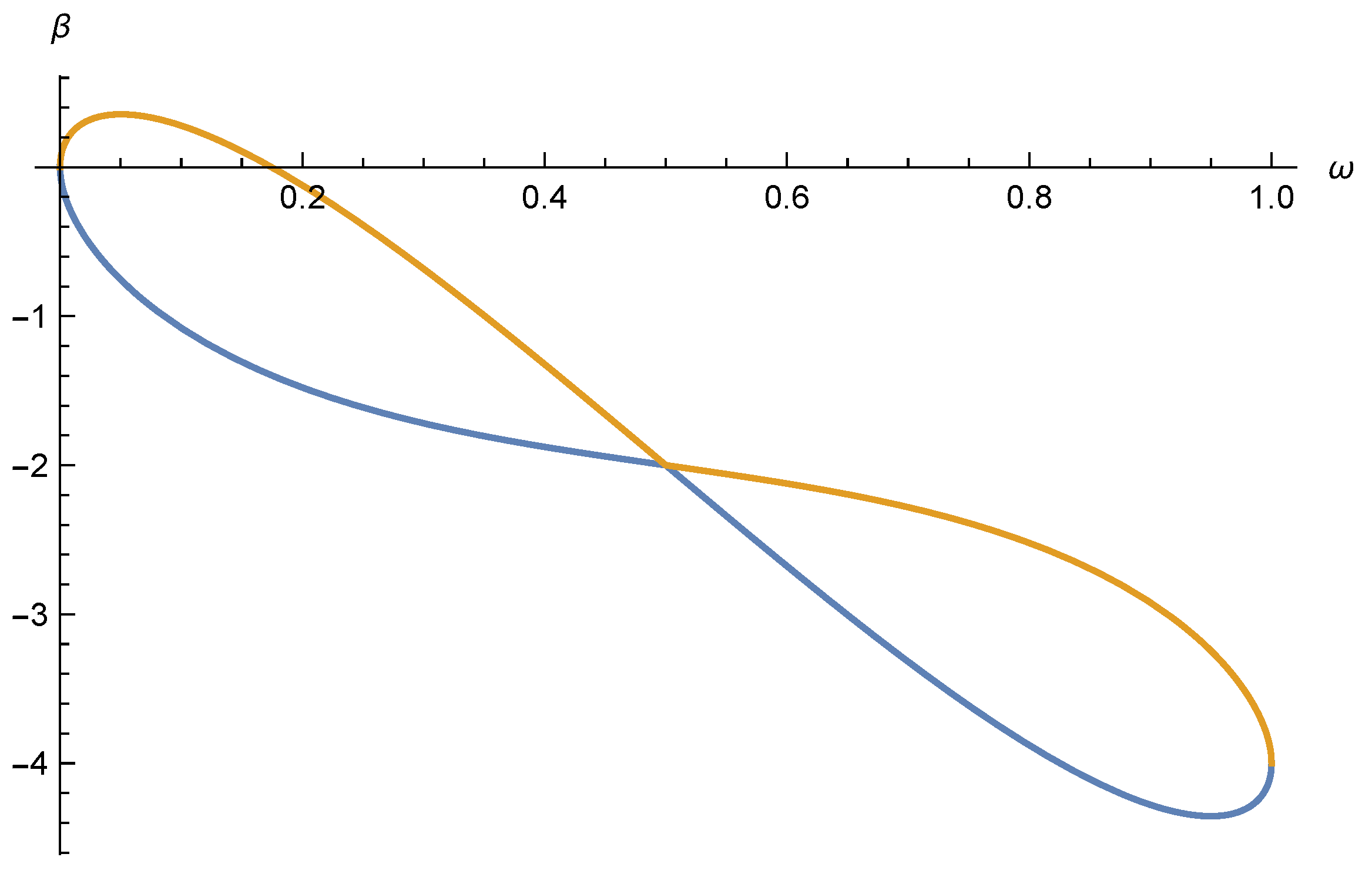
The parameters β 1 and β 2 are determined through the parameter ω of the gravitational wave:
β 1 = 4 ω + 2 ω ( 1 ω ) ( ω 1 / 2 ) 2 ,
β 2 = 4 ω 2 ω ( 1 ω ) ( ω 1 / 2 ) 2 .
The values of parameters β 1 and β 2 for all allowed values of the gravitational wave parameter ω are shown in Figure 1.
Using the solution for B 12 ( x 0 ) , we obtain the function B 13 ( x 0 ) from Equation (18):
B 13 ( x 0 ) = b 1 β 1 x 0 β 1 + b 2 β 2 x 0 β 2 8 ω ( 1 ω ) 2 ω 2 2 ω + 1 ω ( 3 2 ω ) μ + log ( x 0 ) B 12 ( x 0 ) .
As shown in paper [65], along geodesics the wave variable x 0 is proportional to the synchronous time τ . Then the correction functions Ω 12 = τ 2 B 12 and Ω 13 = τ 2 B 13 will be limited in time when β 1 < β 2 < 2 for the following region of parameter ω :
1 / 2 < ω < 1 .
Since in the admissible region of parameter ω we have the relation β 1 < β 2 < 2 , at large times τ we have the following behavior:
lim τ Ω 12 = lim τ τ 2 B 12 0 , lim τ Ω 13 = lim τ τ 2 B 13 0 .
From the compatibility conditions of the field equations, we additionally obtain a coupled system of two second-order differential equations. For the function A 02 ( x 0 ) we have
A 02 = 2 x 0 ( A 02 2 μ ω 2 2 μ ω 2 ω + 2 ω ω 1 log ( x 0 ) + 2 ω 1 ω A 03 + x 0 2 B 12 ( x 0 ) 2 x 0 B 12 ( 4 ω 2 ω 3 4 ω 2 + 3 ω 1 log ( x 0 ) + 8 μ ω 4 + ( 4 16 μ ) ω 3 + 6 ( 2 μ 1 ) ω 2 4 μ ω + ω 1 ) + 8 ω 2 ω 3 4 ω 2 + 3 ω 1 x 0 B 13 ) .
and for the function A 03 ( x 0 ) we have the following equation:
A 03 = 1 x 0 ( A 02 4 μ 2 ω ω 1 + 1 + 8 μ ω ω 1 log ( x 0 ) + 4 ω ω 1 log 2 ( x 0 ) + A 03 4 μ ω 4 μ ω 2 4 ω 2 log ( x 0 ) 4 ω + 4 ω log ( x 0 ) + 2 x 0 2 B 13 + 4 x 0 B 13 ( 4 ω 2 ω 3 4 ω 2 + 3 ω 1 log ( x 0 ) + 8 μ ω 4 + ( 4 16 μ ) ω 3 + 6 ( 2 μ 1 ) ω 2 + ( 3 4 μ ) ω + 1 ) 4 x 0 B 12 ( 4 ω 2 ω 3 4 ω 2 + 3 ω 1 log 2 ( x 0 ) + 4 ω ( ω 1 ) μ 4 ω 2 4 ω + 2 + 2 ω 1 log ( x 0 ) + 8 μ 2 ω 4 + 2 ω 2 6 μ 2 6 μ + 1 + ω 4 μ 2 + 4 μ 2 + 8 ω 3 μ ( 1 2 μ ) + 1 ) ) .
Expressing the derivative of A 03 from Equation (27), taking into account the form of the previously found derivatives for the functions B 12 and B 13 , we obtain
A 03 = x 0 A 02 + 4 ω A 02 ( 1 ω ) μ + log ( x 0 ) + 1 4 ω ( 1 ω ) + x 0 B 12 ( x 0 ) ω .
This equation determines the first derivative of function A 03 with respect to functions A 02 and B 12 , which are assumed to be given.
Substituting the derivative A 03 from Equation (29) into Equation (28) we obtain a third-order differential equation for determining the function A 02 ( x 0 ) :
A 02 = ( 8 ω + 1 ) A 02 ( x 0 ) x 0 16 ω 2 A 02 ( x 0 ) x 0 2 + 4 ( 1 ω ) B 12 ( x 0 ) x 0 ( 4 ω 4 ω 3 8 ω 2 + 7 ω 3 log ( x 0 ) + 16 μ ω 4 + ( 8 32 μ ) ω 3 + 4 ( 7 μ 3 ) ω 2 + ( 4 12 μ ) ω + 1 ) + 16 ω 4 ω 2 4 ω + 3 ( ω 1 ) 2 B 13 ( x 0 ) x 0 .
We obtain a third-order linear inhomogeneous differential equation with variable coefficients, where the inhomogeneous part is defined by functions B 12 and B 13 from Equations (20) and (24).
Integrating Equation (30) taking into account the explicit form of the previously found functions B 12 ( x 0 ) and B 13 ( x 0 ) , we obtain a solution in the following form:
A 02 ( x 0 ) = a 1 x 0 1 4 ω 1 4 ω 4 a 2 ω x 0 1 4 ω ( 1 4 ω ) 2 + 4 a 2 ω x 0 1 4 ω log ( x 0 ) 1 4 ω + a 3 2 b 1 ( ω 1 ) β 1 4 ω 2 4 ω + 3 + 8 ω 3 + 4 ω + 2 ( β 1 + 2 ) 2 ω 2 2 ω + 1 ( β 1 + 4 ω + 1 ) 2 x 0 β 1 + 2 2 b 2 ( ω 1 ) β 2 4 ω 2 4 ω + 3 + 8 ω 3 + 4 ω + 2 ( β 2 + 2 ) 2 ω 2 2 ω + 1 ( β 2 + 4 ω + 1 ) 2 x 0 β 2 + 2 ,
where a 1 , a 2 , and a 3 are new constants of integration. It is easy to see that for region 1 / 2 < ω < 1 ( β 1 < β 2 < 2 ), the function A 02 is a bounded function of time.
The solution for A 02 ( x 0 ) allows us to obtain the function A 03 ( x 0 ) from Equation (29):
A 03 ( x 0 ) = a 4 1 2 ( ω 1 ) ω [ 8 a 2 ω 2 x 0 1 4 ω ( 1 4 ω ) 2 + 8 a 2 ω 2 x 0 1 4 ω log ( x 0 ) 4 ω 1 + 2 ω x 0 1 4 ω ( 4 ω 1 ) 3 ( 4 a 2 ω ( 1 4 ω ) 2 ( ω 1 ) log 2 ( x 0 ) + ( 4 ω 1 ) a 1 4 ω 2 5 ω + 1 + 4 a 2 ω 4 μ ω 2 5 μ ω + μ 2 ω 1 log ( x 0 ) + a 1 ( 4 ω 1 ) 4 μ ω 2 5 μ ω + μ 3 ω + 4 a 2 ω 4 μ ω 2 5 μ ω + μ 2 ω 1 ) + 2 a 1 ω x 0 1 4 ω 4 ω 1 + 2 a 2 ω x 0 1 4 ω 1 4 ω + 2 b 1 ( ω 1 ) x 0 β 1 + 2 β 1 + 2 + 2 b 2 ( ω 1 ) x 0 β 2 + 2 β 2 + 2 + 4 b 1 ( ω 1 ) ω β 1 4 ω 2 4 ω + 3 + 8 ω 3 + 4 ω + 2 ( β 1 + 2 ) 2 2 ω 2 2 ω + 1 ( β 1 + 4 ω + 1 ) 2 × × β 1 ( μ ( ω 1 ) 1 ) + 2 μ ω 2 μ ω 1 + ( β 1 + 2 ) ( ω 1 ) log ( x 0 ) x 0 β 1 + 2 + 4 b 2 ( ω 1 ) ω β 2 4 ω 2 4 ω + 3 + 8 ω 3 + 4 ω + 2 ( β 2 + 2 ) 2 2 ω 2 2 ω + 1 ( β 2 + 4 ω + 1 ) 2 × × β 2 ( μ ( ω 1 ) 1 ) + 2 μ ω 2 μ ω 1 + ( β 2 + 2 ) ( ω 1 ) log ( x 0 ) x 0 β 2 + 2 b 1 ( β 1 + 1 ) ( ω 1 ) η 1 4 ω 2 4 ω + 3 + 8 ω 3 + 4 ω + 2 ( β 1 + 2 ) 2 ω 2 2 ω + 1 ( β 1 + 4 ω + 1 ) 2 x 0 β 1 + 2 b 2 ( β 2 + 1 ) ( ω 1 ) β 2 4 ω 2 4 ω + 3 + 8 ω 3 + 4 ω + 2 ( β 2 + 2 ) 2 ω 2 2 ω + 1 ( β 2 + 4 ω + 1 ) 2 x 0 β 2 + 2 ] .
It is easy to see that for the region of 1 / 2 < ω < 1 , where β 1 < β 2 < 2 , the function A 03 is also time-bounded.
From the system of field equations, only one equation remains, connecting the three remaining undefined functions A 22 ( x 0 ) , A 23 ( x 0 ) and A 33 ( x 0 ) :
x 0 2 ω + 2 A 22 ( 4 μ 2 ( 1 ω ) ω + 1 + 8 μ ( 1 ω ) ω log ( x 0 ) + 4 ( 1 ω ) ω log 2 ( x 0 ) ) + 6 ω x 0 2 ω + 1 A 22 ( μ 2 ( 1 ω ) ω + 4 μ ( 1 ω ) + 1 + 4 ( 1 ω ) ( 2 μ ω + 1 ) log ( x 0 ) + 4 ( 1 ω ) ω log 2 ( x 0 ) )
2 ω x 0 2 ω A 22 ( 4 μ 2 ω 2 ω 2 ω 1 + 4 μ 8 ω 2 9 ω + 1 + 2 ω 5
+ 4 ( ω 1 ) 4 μ ω 2 + 2 ( μ + 4 ) ω 1 log ( x 0 ) + 4 ω 2 ω 2 ω 1 log 2 ( x 0 ) )
+ 8 ( ω 1 ) ω x 0 2 ω + 2 A 23 μ + log ( x 0 )
+ 24 ( ω 1 ) ω x 0 2 ω + 1 A 23 2 μ ω + 1 + 2 ω log ( x 0 )
+ 8 ( ω 1 ) ω A 23 4 μ ω 2 + 2 ( μ + 4 ) ω 1 + 2 ( 2 ω + 1 ) ω log ( x 0 ) x 0 2 ω
+ 4 ( 1 ω ) ω x 0 2 ω + 2 A 33 + 24 ( 1 ω ) ω 2 x 0 2 ω + 1 A 33
8 ω 2 2 ω 2 ω 1 x 0 2 ω A 33 = 0 .
Thus, the solution for the gravitational wave metric contains two arbitrary functions from the three functions: A 22 ( x 0 ) , A 23 ( x 0 ) , and A 33 ( x 0 ) . Note that for any parameter ω , we have a trivial particular solution A 22 = A 23 = A 33 = 0 .
Let us give an example of a nonzero time-limited solution for Equation (33) of the following form:
A 22 = A 23 = 0 ,
A 33 ( x 0 ) = c 1 ( x 0 ) γ 1 + c 2 ( x 0 ) γ 2 , γ 1 , 2 = 1 2 1 6 ω ± 1 20 ω ( 1 ω ) ,
where c 1 and c 2 are integration constants. The solution (35) will be time-bounded for the following region of the parameter ω :
1 2 + 1 5 < ω < 1 , 1 2 + 1 5 0.94721 .
We have thus considered all linearized field equations for all functions included in the metric of the perturbative wave model based on the exact gravitational wave solution for a Bianchi type IV universe. We have shown that time-bounded solutions exist for all functions of the metric.
Let’s write out the final form of the components of the perturbative gravitational wave metric in a Bianchi type IV universe for the most general variant of the wave parameter values considered. In the linear approximation with respect to a small parameter ϵ , the covariant components of the full metric can be written using the notation of the background exact metric g α β ( 0 ) in the following form:
g 00 = 0 , g 01 = 1 , g 11 = 0 ,
g 02 = ϵ τ 2 B 12 g 22 ( 0 ) + B 13 g 23 ( 0 ) , g 03 = ϵ τ 2 B 12 g 23 ( 0 ) + B 13 g 33 ( 0 ) ,
g 12 = ϵ A 02 g 22 ( 0 ) + A 03 g 23 ( 0 ) , g 13 = ϵ A 02 g 23 ( 0 ) + A 03 g 33 ( 0 ) ,
g 22 = g 22 ( 0 ) ϵ g 22 ( 0 ) 2 A 23 g 23 ( 0 ) + A 22 g 22 ( 0 ) + A 33 g 23 ( 0 ) 2 ,
g 23 = g 23 ( 0 ) ϵ A 22 g 22 ( 0 ) g 23 ( 0 ) + A 23 g 22 ( 0 ) g 33 ( 0 ) + g 23 ( 0 ) 2 + A 33 g 23 ( 0 ) g 33 ( 0 ) ,
g 33 = g 33 ( 0 ) ϵ 2 A 23 g 23 ( 0 ) g 33 ( 0 ) + A 22 g 23 ( 0 ) 2 + A 33 g 33 ( 0 ) 2 ,
where g α β ( 0 ) are the covariant components of the metric (2) of the exact solution for the background gravitational wave in the anisotropic Bianchi IV universe.
Finally, in explicit form, in the linear approximation in the small parameter ϵ , the covariant components of the full gravitational wave metric in the anisotropic Bianchi IV universe take the following form:
g 00 = 0 , g 01 = 1 , g 11 = 0 ,
g 02 = ϵ τ 2 [ μ + log ( x 0 ) b 1 β 1 x 0 β 1 + 2 ω + b 2 β 2 x 0 β 2 + 2 ω 8 ω ( ω 1 ) 2 ω 2 2 ω + 1 + 4 μ ω 3 + ( 2 6 μ ) ω 2 2 ω + 1 + 2 ω 2 ( 2 ω 3 ) log ( x 0 ) 4 ω ( 1 ω ) 2 ω 2 2 ω + 1 × × b 1 x 0 β 1 + 2 ω + b 2 x 0 β 2 + 2 ω ] ,
g 03 = ϵ τ 2 [ ω ( 2 ω 3 ) b 1 x 0 β 1 + 2 ω + b 2 x 0 β 2 + 2 ω 4 ω 3 8 ω 2 + 6 ω 2 b 1 β 1 x 0 β 1 + 2 ω + b 2 β 2 x 0 β 2 + 2 ω 8 ω 2 ω 3 4 ω 2 + 3 ω 1 ] ,
g 12 = ϵ x 0 2 ω 4 ( ω 1 ) ω ( 1 4 μ 2 ( ω 1 ) ω 8 μ ( ω 1 ) ω log ( x 0 ) 4 ( ω 1 ) ω log 2 ( x 0 ) × × ( a 1 x 0 1 4 ω 1 4 ω 4 a 2 ω x 0 1 4 ω ( 1 4 ω ) 2 + 4 a 2 ω x 0 1 4 ω log ( x 0 ) 1 4 ω + a 3 2 b 1 ( ω 1 ) β 1 4 ω 2 4 ω + 3 + 8 ω 3 + 4 ω + 2 ( β 1 + 2 ) 2 ω 2 2 ω + 1 ( β 1 + 4 ω + 1 ) 2 x 0 β 1 + 2 2 b 2 ( ω 1 ) β 2 4 ω 2 4 ω + 3 + 8 ω 3 + 4 ω + 2 ( β 2 + 2 ) 2 ω 2 2 ω + 1 ( β 2 + 4 ω + 1 ) 2 x 0 β 2 + 2 ) + 4 ( ω 1 ) ω μ + log ( x 0 ) [ a 4 + x 0 2 ω ( 1 ω ) ( 2 a 1 ω x 0 4 ω 4 ω 1 + 8 a 2 ω 2 x 0 4 ω ( 1 4 ω ) 2 + 2 ω x 0 4 ω ( 4 ω 1 ) 3 ( a 1 ( 4 ω 1 ) 4 μ ω 2 5 μ ω + μ 3 ω + 4 a 2 ω 4 μ ω 2 5 μ ω + μ 2 ω 1 + ( 4 ω 1 ) a 1 4 ω 2 5 ω + 1 + 4 a 2 ω 4 μ ω 2 5 μ ω + μ 2 ω 1 log ( x 0 ) + 4 a 2 ( 1 4 ω ) 2 ( ω 1 ) ω log 2 ( x 0 ) ) + 8 a 2 ω 2 x 0 4 ω log ( x 0 ) 4 ω 1 + 2 a 2 ω x 0 4 ω 1 4 ω + 4 b 1 ( ω 1 ) ω β 1 4 ω 2 4 ω + 3 + 8 ω 3 + 4 ω + 2 ( β 1 + 2 ) 2 2 ω 2 2 ω + 1 ( β 1 + 4 ω + 1 ) 2 × × β 1 ( μ ( ω 1 ) 1 ) + 2 μ ω 2 μ ω 1 + ( β 1 + 2 ) ( ω 1 ) log ( x 0 ) x 0 β 1 + 1 + 4 b 2 ( ω 1 ) ω β 2 4 ω 2 4 ω + 3 + 8 ω 3 + 4 ω + 2 ( β 2 + 2 ) 2 2 ω 2 2 ω + 1 ( β 2 + 4 ω + 1 ) 2 × × β 2 ( μ ( ω 1 ) 1 ) + 2 μ ω 2 μ ω 1 + ( β 2 + 2 ) ( ω 1 ) log ( x 0 ) x 0 β 2 + 1 + 2 b 1 ( ω 1 ) x 0 β 1 + 1 β 1 + 2 + 2 b 2 ( ω 1 ) x 0 β 2 + 1 β 2 + 2 b 1 ( β 1 + 1 ) ( ω 1 ) β 1 4 ω 2 4 ω + 3 + 8 ω 3 + 4 ω + 2 ( β 1 + 2 ) 2 ω 2 2 ω + 1 ( β 1 + 4 ω + 1 ) 2 x 0 β 1 + 1 b 2 ( β 2 + 1 ) ( ω 1 ) β 2 4 ω 2 4 ω + 3 + 8 ω 3 + 4 ω + 2 ( β 2 + 2 ) 2 ω 2 2 ω + 1 ( β 2 + 4 ω + 1 ) 2 x 0 β 2 + 1 ) ] ) ,
g 13 = ϵ x 0 2 ω ( ( μ + log ( x 0 ) ) [ a 1 x 0 1 4 ω 1 4 ω 4 a 2 ω x 0 1 4 ω ( 1 4 ω ) 2 + 4 a 2 ω x 0 1 4 ω log ( x 0 ) 1 4 ω + a 3 2 b 1 ( ω 1 ) β 1 4 ω 2 4 ω + 3 + 8 ω 3 + 4 ω + 2 ( β 1 + 2 ) 2 ω 2 2 ω + 1 ( β 1 + 4 ω + 1 ) 2 x 0 β 1 + 2 2 b 2 ( ω 1 ) β 2 4 ω 2 4 ω + 3 + 8 ω 3 + 4 ω + 2 ( β 2 + 2 ) 2 ω 2 2 ω + 1 ( β 2 + 4 ω + 1 ) 2 x 0 β 2 + 2 ] x 0 2 ( ω 1 ) ω [ a 4 + 2 a 1 ω x 0 4 ω 4 ω 1 + 8 a 2 ω 2 x 0 4 ω ( 1 4 ω ) 2 + 8 a 2 ω 2 x 0 4 ω log ( x 0 ) 4 ω 1 + 2 a 2 ω x 0 4 ω 1 4 ω + 2 b 1 ( ω 1 ) x 0 β 1 + 1 β 1 + 2 + 2 b 2 ( ω 1 ) x 0 β 2 + 1 β 2 + 2 + 2 ω x 0 4 ω ( 4 ω 1 ) 3 ( a 1 ( 4 ω 1 ) 4 μ ω 2 5 μ ω + μ 3 ω + ( 4 ω 1 ) a 1 4 ω 2 5 ω + 1 + 4 a 2 ω 4 μ ω 2 5 μ ω + μ 2 ω 1 log ( x 0 ) + 4 a 2 ω 4 μ ω 2 5 μ ω + μ 2 ω 1 + 4 a 2 ( 1 4 ω ) 2 ( ω 1 ) ω log 2 ( x 0 ) ) + 4 b 1 ( ω 1 ) ω β 1 4 ω 2 4 ω + 3 + 8 ω 3 + 4 ω + 2 ( β 1 + 2 ) 2 2 ω 2 2 ω + 1 ( β 1 + 4 ω + 1 ) 2 × × β 1 ( μ ( ω 1 ) 1 ) + 2 μ ω 2 μ ω 1 + ( β 1 + 2 ) ( ω 1 ) log ( x 0 ) x 0 β 1 + 1 + 4 b 2 ( ω 1 ) ω β 2 4 ω 2 4 ω + 3 + 8 ω 3 + 4 ω + 2 ( β 2 + 2 ) 2 2 ω 2 2 ω + 1 ( β 2 + 4 ω + 1 ) 2 × × β 2 ( μ ( ω 1 ) 1 ) + 2 μ ω 2 μ ω 1 + ( β 2 + 2 ) ( ω 1 ) log ( x 0 ) x 0 β 2 + 1 b 1 ( β 1 + 1 ) ( ω 1 ) β 1 4 ω 2 4 ω + 3 + 8 ω 3 + 4 ω + 2 ( β 1 + 2 ) 2 ω 2 2 ω + 1 ( β 1 + 4 ω + 1 ) 2 x 0 β 1 + 1 b 2 ( β 2 + 1 ) ( ω 1 ) β 2 4 ω 2 4 ω + 3 + 8 ω 3 + 4 ω + 2 ( β 2 + 2 ) 2 ω 2 2 ω + 1 ( β 2 + 4 ω + 1 ) 2 x 0 β 2 + 1 ] ) ,
g 22 = ϵ x 0 4 ω 16 ( ω 1 ) 2 ω 2 ( 4 ω ( ω 1 ) A 33 1 4 μ 2 ( ω 1 ) ω 8 μ ( ω 1 ) ω log ( x 0 ) 4 ( ω 1 ) ω log 2 ( x 0 ) × × [ A 22 4 μ 2 ( ω 1 ) ω 1 + 8 μ ( ω 1 ) ω log ( x 0 ) + 4 ( ω 1 ) ω log 2 ( x 0 ) 4 ω ( ω 1 ) 2 A 23 μ + log ( x 0 ) A 33 ] ) + 1 4 μ 2 ω ( ω 1 ) 8 μ ω ( ω 1 ) log ( x 0 ) 4 ω ( ω 1 ) log 2 ( x 0 ) 4 ω ( ω 1 ) x 0 2 ω ,
g 23 = x 0 2 ω μ + log ( x 0 ) + + ϵ x 0 4 ω 4 ( ω 1 ) ω [ μ + log ( x 0 ) ( 4 μ 2 ω ( ω 1 ) 1 + 8 μ ω ( ω 1 ) log ( x 0 ) + 4 ω ( ω 1 ) log 2 ( x 0 ) ) A 22 + 4 ω ( ω 1 ) μ + log ( x 0 ) A 33 8 μ 2 ( ω 1 ) ω 1 + 16 μ ( ω 1 ) ω log ( x 0 ) + 8 ( ω 1 ) ω log 2 ( x 0 ) A 23 ] ,
g 33 = x 0 2 ω ϵ x 0 4 ω A 22 μ + log ( x 0 ) 2 2 A 23 μ + log ( x 0 ) + A 33 .
Here ω and μ are the parameters of the exact solution for the background strong gravitational wave, ϵ is the dimensionless smallness parameter ( ϵ 1 ), the parameters β 1 and β 2 are defined by the relations (22) and (23), and the parameters a 1 , a 2 , a 3 , a 4 , b 1 and b 2 are the constants of integration of the field equations and these constants are determined by the initial or boundary conditions. The synchronous time function τ is defined by the relation (11). The three functions of the wave variable A 22 ( x 0 ) , A 23 ( x 0 ) , and A 22 ( x 0 ) share a single Equation (33), which leaves two of these functions arbitrary in the resulting solution.
The determinant of the perturbative gravitational wave metric in first order in the smallness parameter ϵ takes the form
det g α β = x 0 4 ω 4 ω ( 1 ω ) + ϵ x 0 6 ω 16 ω 2 ( ω 1 ) 2 [ 4 ω ( 1 ω ) 2 A 23 μ + log ( x 0 ) A 33 + A 22 4 μ 2 ( ω 1 ) ω 1 + 8 μ ( ω 1 ) ω log ( x 0 ) + 4 ( ω 1 ) ω log 2 ( x 0 ) ] .
As we demonstrated earlier, studying the time-boundedness of corrections for the contravariant components of metric g α β yields a condition of the form 1 / 2 < ω < 1 . Due to the anisotropy of the model, the time behavior of the contravariant components of the gravitational wave metric differs from the behavior of its covariant components. For a contravariant components of metric g α β additional conditions arise for the time-boundedness of small corrections for components g 02 , g 03 , g 12 , and g 13 : β 1 + 2 + 2 ω < 0 if b 1 0 and β 2 + 2 + 2 ω < 0 if b 2 0 . Assuming that b 1 b 2 0 , the stability of the perturbative solution is achieved when ω 1 , which is on the boundary of the parameter domain. Thus, to ensure stability of the perturbative solution (taking into account β 2 > β 1 ), we must set the integration constant b 2 = 0 . Then the stability of the perturbative solution for g α β is achieved in the following parameter region:
ω m i n < ω < 1 ,
where from the condition β 1 + 2 + 2 ω < 0 we have
ω m i n = 1 6 2 + 32 + 3 114 3 2 2 / 3 1 / 2 32 + 3 114 3 0.72031 .
Correction functions A 22 ( x 0 ) , A 23 ( x 0 ) , and A 33 ( x 0 ) (two of which are arbitrary functions) for their bounded time behavior and constraints on the metric determinant should generally depend on x 0 as 1 / ( x 0 ) n , where n 6 ω .
Thus, there always exists a continuum set of parameters for the perturbative solution of the field equations for a secondary gravitational wave, for which the linear perturbations do not increase with time.
Checking the Weyl invariants for the resulting solution revealed that the perturbative solution belongs to Petrov class N, just like the background exact wave solution.
The solution obtained for the perturbative gravitational wave metric in the Bianchi IV universe allows for seven independent components of the Riemann curvature tensor, whereas the background exact gravitational wave had only three independent components of the curvature tensor.
Thus, perturbative secondary gravitational waves create an additional gravitational wave background that violates isotropy in exact strong gravitational wave models in Bianchi universes and can generate complex tidal accelerations. The effects under consideration provide an additional mechanism for the formation of local inhomogeneities in the early universe and a mechanism for local spatial isotropization.

5. Discussion

The paper derives one of the first linear perturbative analytical models of gravitational waves against the backdrop of an exact solution for a strong gravitational wave. The stability of the resulting perturbative solutions for the continuum domain of parameters is demonstrated, which also proves the linear stability of the basic exact solution for the gravitational wave in the Bianchi IV universe for the continuum domain of parameters. Developing such a model for the Bianchi IV universe allows us to further explore the role of perturbative gravitational waves in the early universe, including the influence of strong and perturbative gravitational waves on the accelerated formation of initial inhomogeneities in dark matter, primordial plasma, and matter. This opens up new possibilities for studying the influence of gravitational waves on the formation of the cosmic microwave background (CMB), taking into account its observed anisotropy, and on the formation of the stochastic gravitational wave background (SGB). This also allows us to estimate the influence of perturbative gravitational waves on the isotropization of the universe. The constructed analytical model of perturbative gravitational waves also enables the verification and debugging of numerical methods and computer programs for describing complex gravitational wave models and their influence on astrophysical processes.

6. Conclusions

The proper-time method for constructing perturbative dynamical gravitational fields is presented. An analytical perturbative model of gravitational waves based on the exact wave solution of Einstein’s equations for the Bianchi IV universe is constructed. A privileged wave coordinate system and a synchronous time function based on the clock of an observer freely moving (falling) in a background strong gravitational wave were used to construct the models. Compatibility conditions for the vacuum linearized Einstein equations for all admissible parametre values were obtained and resolved, and the field equations were reduced to systems of ordinary differential equations, whose solutions were found. The stability of the resulting perturbative solutions for the continuum domain of parameters was proven. This also explicitly demonstrates the linear stability of the basic exact solution for gravitational waves in the Bianchi IV universe under small perturbations for the continuum domain of parameters. The resulting gravitational wave models have seven independent components of the Riemann curvature tensor, compared to three components for the background exact gravitational wave.

Funding

This research received no external funding.

Data Availability Statement

The original contributions presented in this study are included in the article. Further inquiries can be directed to the corresponding author.

Conflicts of Interest

The author declares no conflicts of interest.

Appendix A. On Coordinate Transformations in the Wave Coordinate System

Let’s consider the metric tensor g ˜ α β in the wave coordinate system in the following form:
g ˜ α β = 0 1 ϵ Ω 02 ϵ Ω 03 1 0 ϵ Ω 12 ϵ Ω 13 ϵ Ω 02 ϵ Ω 12 A + ϵ Ω 22 B + ϵ Ω 23 ϵ Ω 03 ϵ Ω 13 B + ϵ Ω 23 C + ϵ Ω 33 ,
where ϵ is a dimensionless smallness parameter and the functions A, B, and C depend only on the vave variable x 0 . The correction functions Ω α β = Ω α β ( x 0 , τ ) depend on two variables x 0 and τ , where τ = τ ( x 0 , x 1 , x 2 , x 3 ) from (11):
τ ( x 0 , x 1 , x 2 , x 3 ) = 2 x 0 x 1 + a ( x 0 ) x 2 2 + 2 b ( x 0 ) x 2 x 3 + c ( x 0 ) x 3 2 .
Coordinate transformations that preserve the fixed choice of wave coordinate system ( Ω 00 = Ω 01 = Ω 11 = 0 ) have the following form (see [60]):
x 0 ϕ 0 ( x 0 ) , x 1 x 1 + ϕ 1 ( x 0 ) , x 2 x 2 + ϕ 2 ( x 0 ) , x 3 x 3 + ϕ 3 ( x 0 ) .
This coordinate transformations allow us to set the correction functions Ω 00 , Ω 01 , and Ω 11 to zero. The correction functions A 12 ( x 0 ) and A 13 ( x 0 ) are included in the metric components g 02 and g 03 only additively and can also be set to zero by admissible coordinate transformations. In fact, we have fixed five arbitrary correction functions in the metric using admissible coordinate transformations. Thus, the coordinate gauge freedom is maximally fixed.
As the textbook [60] rightly states, “The initial conditions for an arbitrary gravitational wave field must be specified by four arbitrary functions of the coordinates: due to the transverse nature of the waves, there are only two independent components of the metric that must be specified, and along with them, their first time derivatives must also be specified. The number 4 here refers to any free gravitational field”.
In our case, the two arbitrary functions of the solution of the field equations are two components of the three g ˜ 22 , g ˜ 23 , and g ˜ 33 , which are related to each other by one additional equation following from the field equations. Therefore, the resulting perturbative solution is complete (the arbitrariness in the gauge is sufficiently fixed) and this solution is a generalization of the ordinary weak gravitational wave model, but against a special wave background in the Bianchi IV universe.

Appendix B. Field Equation for the Scalar Curvature

For the gravitational wave metric in the notation (A1) and the proper time τ in the format (A2), a reduced field equation for the scalar curvature R = R ( 0 ) + ϵ R ( 1 ) = 0 in linear approximation R ( 1 ) = 0 is written:
0 = 2 x 2 3 B 2 A C 2 a a Ω , τ 02 τ Ω , τ τ 02 + b Ω , τ 03 τ Ω , τ τ 03
+ x 2 2 ( 2 x 3 B 2 A C 2 [ 2 a b Ω , τ 02 τ Ω , τ τ 02 + c a Ω , τ 03 τ Ω , τ τ 03
+ b a Ω , τ 02 τ Ω , τ τ 02 + 2 b Ω , τ 03 τ Ω , τ τ 03 ]
+ 2 B 2 A C [ Ω , τ 33 τ Ω , τ τ 33 A 2 2 B Ω , τ 23 τ Ω , τ τ 23 A + B 2 Ω , τ 22 τ Ω , τ τ 22 a 2
2 a b ( B 2 Ω , τ 23 τ Ω , τ τ 23 + A C Ω , τ 23 τ Ω , τ τ 23
+ B C τ Ω , τ τ 22 Ω , τ 22 + A τ Ω , τ τ 33 Ω , τ 33 )
+ x 0 a C Ω , τ 22 τ Ω , τ τ 22 2 B Ω , τ 23 τ Ω , τ τ 23 + A Ω , τ 33 τ Ω , τ τ 33
+ b 2 Ω , τ 33 τ Ω , τ τ 33 B 2 2 C Ω , τ 23 τ Ω , τ τ 23 B + C 2 Ω , τ 22 τ Ω , τ τ 22 ] )
+ x 2 ( 2 x 3 2 B 2 A C 2 [ a c Ω , τ 02 τ Ω , τ τ 02 + 2 c b Ω , τ 03 τ Ω , τ τ 03
+ b 2 b Ω , τ 02 τ Ω , τ τ 02 + c Ω , τ 03 τ Ω , τ τ 03 ]
+ 4 x 3 B 2 A C ( b 2 [ B 2 τ Ω , τ τ 23 Ω , τ 23 + B C Ω , τ 22 τ Ω , τ τ 22 + A Ω , τ 33 τ Ω , τ τ 33
+ A C τ Ω , τ τ 23 ( x 0 , τ ) Ω , τ 23 ] + b c [ Ω , τ 33 τ Ω , τ τ 33 B 2 2 B C Ω , τ 23 τ Ω , τ τ 23
+ C 2 Ω , τ 22 τ Ω , τ τ 22 ] + x 0 b C Ω , τ 22 τ Ω , τ τ 22 2 B Ω , τ 23 τ Ω , τ τ 23 + A Ω , τ 33 τ Ω , τ τ 33
+ a [ b Ω , τ 33 τ Ω , τ τ 33 A 2 2 B Ω , τ 23 τ Ω , τ τ 23 A + B 2 Ω , τ 22 τ Ω , τ τ 22
+ c ( τ Ω , τ τ 23 ( x 0 , τ ) Ω , τ 23 B 2 + A C τ Ω , τ τ 23 Ω , τ 23
+ B C Ω , τ 22 τ Ω , τ τ 22 + A Ω , τ 33 τ Ω , τ τ 33 ) ] )
2 B 2 A C [ C τ 2 2 a A Ω , τ 02 + b B Ω , τ 02 + A Ω , τ 03
B τ 2 a 3 B Ω , τ 02 + A Ω , τ 03 + b C Ω , τ 02 + 3 B Ω , τ 03
+ 2 B 2 ( a Ω , τ 02 τ 2 + b Ω , τ 03 τ 2 + a Ω , 0 τ 02 τ 2 + b Ω , 0 τ 03 τ 2
+ x 0 a Ω , τ τ 12 τ + x 0 b Ω , τ τ 13 τ x 0 a Ω , τ 12 x 0 b Ω , τ 13 )
+ A ( τ 2 a C Ω , τ 02 + a B Ω , τ 03 + 2 b C Ω , τ 03
2 C [ a Ω , τ 02 τ 2 + b Ω , τ 03 τ 2 + a Ω , 0 τ 02 τ 2 + b Ω , 0 τ 03 τ 2
+ x 0 a Ω , τ τ 12 τ + x 0 b Ω , τ τ 13 τ x 0 a Ω , τ 12 x 0 b Ω , τ 13 ] ) ] )
+ 2 c x 3 3 B 2 A C 2 b Ω , τ 02 τ Ω , τ τ 02 + c Ω , τ 03 τ Ω , τ τ 03
+ x 1 ( 4 x 2 B 2 A C 2 a Ω , τ 02 τ Ω , τ τ 02 + b Ω , τ 03 τ Ω , τ τ 03
+ 4 x 3 B 2 A C 2 b Ω , τ 02 τ Ω , τ τ 02 + c Ω , τ 03 τ Ω , τ τ 03
+ 4 x 0 B 2 A C C Ω , τ 22 τ Ω , τ τ 22 2 B Ω , τ 23 τ Ω , τ τ 23 + A Ω , τ 33 τ Ω , τ τ 33 )
+ 2 x 3 2 B 2 A C ( b 2 Ω , τ 33 τ Ω , τ τ 33 A 2 2 A B Ω , τ 23 τ Ω , τ τ 23 + B 2 Ω , τ 22 τ Ω , τ τ 22
2 b c Ω , τ 23 τ Ω , τ τ 23 B 2 + B C τ Ω , τ τ 22 Ω , τ 22 + A τ Ω , τ τ 33 Ω , τ 33 + A C Ω , τ 23 τ Ω , τ τ 23
+ x 0 c C Ω , τ 22 τ Ω , τ τ 22 2 B Ω , τ 23 τ Ω , τ τ 23 + A Ω , τ 33 τ Ω , τ τ 33
+ c 2 Ω , τ 33 τ Ω , τ τ 33 B 2 2 C Ω , τ 23 τ Ω , τ τ 23 B + C 2 Ω , τ 22 τ Ω , τ τ 22 ( x 0 , τ ) )
2 x 3 B 2 A C ( C τ 2 2 b A Ω , τ 02 + c B Ω , τ 02 + A Ω , τ 03
B τ 2 b 3 B Ω , τ 02 + A Ω , τ 03 + c C Ω , τ 02 + 3 B Ω , τ 03
+ 2 B 2 [ b Ω , τ 02 τ 2 + c Ω , τ 03 τ 2 + b Ω , 0 τ 02 τ 2 + c Ω , 0 τ 03 τ 2
+ x 0 b Ω , τ τ 12 τ + x 0 c Ω , τ τ 13 τ x 0 b Ω , τ 12 x 0 c Ω , τ 13 ]
+ A [ τ 2 b C Ω , τ 02 + b B Ω , τ 03 + 2 c C Ω , τ 03
2 C ( b Ω , τ 02 τ 2 + c Ω , τ 03 τ 2 + b Ω , 0 τ 02 τ 2 + c Ω , 0 τ 03 τ 2
+ x 0 b Ω , τ τ 12 τ + x 0 c Ω , τ τ 13 τ x 0 b Ω , τ 12 x 0 c Ω , τ 13 ) ] )
+ τ 2 ( B 4 4 b Ω , τ 23 2 c Ω , τ 33 + B 3 4 ( c C + 2 ) Ω , τ 23 4 b C Ω , τ 22 + A Ω , τ 33 + 8 x 0 Ω , 0 τ 23
B 2 C [ 2 c Ω , τ 22 C 2 + 5 x 0 C Ω , τ 22 + 14 x 0 B Ω , τ 23 + 4 A Ω , τ 33 + 5 x 0 A Ω , τ 33 + 4 x 0 A Ω , 0 τ 33
+ C 4 Ω , τ 22 2 c A Ω , τ 33 + 4 x 0 Ω , 0 τ 22 ]
+ 4 B [ b A C C Ω , τ 22 + A Ω , τ 33 c A C 2 Ω , τ 23 + 3 x 0 A C Ω , τ 23 + B Ω , τ 33
+ C 2 3 x 0 B Ω , τ 22 + 3 x 0 A Ω , τ 23 2 A Ω , τ 23 + x 0 Ω , 0 τ 23 ]
+ 2 c A C 3 Ω , τ 22 + 4 A C 2 Ω , τ 22 6 x 0 C 2 A Ω , τ 22
x 0 A C C Ω , τ 22 4 b A 2 C 2 Ω , τ 23 10 x 0 A C B Ω , τ 23 + 4 A 2 C Ω , τ 33
x 0 A C A Ω , τ 33 6 x 0 A 2 C Ω , τ 33 + 4 x 0 A C 2 Ω , 0 τ 22 + 4 x 0 A 2 C Ω , 0 τ 33
2 a B 2 A C A 2 Ω , τ 33 2 A B Ω , τ 23 + B 2 Ω , τ 22 ) ,
where the prime denotes the derivative with respect to x 0 for functions of one variable. Commas with subscripts in the functions Ω α β ( x 0 , τ ) denote partial derivatives with respect to the time variable τ or the wave variable x 0 .

Appendix C. Examples of Ricci Tensor Components

For the gravitational wave metric in the notation (A1) and for the proper time τ in the format (A2), the most compact components of the Ricci tensor in linear approximation R α β = R α β ( 0 ) + ϵ R α β ( 1 ) are presented:
R 11 ( 1 ) = x 0 2 B 2 A C τ 3 [ 2 x 2 a B 2 A C Ω , τ 02 τ Ω , τ τ 02
+ 2 b B 2 A C x 2 Ω , τ 03 + x 3 Ω , τ 02 τ x 3 Ω , τ τ 02 + x 2 Ω , τ τ 03
+ x 0 A Ω , τ 33 A τ Ω , τ τ 33 2 B Ω , τ 23 + 2 B τ Ω , τ τ 23 + C Ω , τ 22 C τ Ω , τ τ 22
+ 2 x 3 c B 2 A C Ω , τ 03 τ Ω , τ τ 03 ] ,
R 12 ( 1 ) = 1 4 B 2 A C τ 3 [ 2 C Ω , τ 12 x 0 2 + 2 B Ω , τ 13 x 0 2 + 2 C τ Ω , τ τ 12 x 0 2 2 B τ Ω , τ τ 13 x 0 2
+ 2 x 1 C Ω , τ 02 x 0 + x 2 2 C a Ω , τ 02 x 0 + 2 x 2 x 3 C b Ω , τ 02 x 0 + x 3 2 C c Ω , τ 02 x 0 2 x 1 B Ω , τ 03 x 0
x 2 2 B a Ω , τ 03 x 0 2 x 2 x 3 B b Ω , τ 03 x 0 x 3 2 B c Ω , τ 03 x 0 2 x 3 c C Ω , τ 23 x 0 + 2 x 3 c B Ω , τ 33 x 0
2 x 1 C τ Ω , τ τ 02 x 0 x 2 2 C τ a Ω , τ τ 02 x 0 2 x 2 x 3 C τ b Ω , τ τ 02 x 0 x 3 2 C τ c Ω , τ τ 02 x 0
+ 2 x 1 B τ Ω , τ τ 03 x 0 + x 2 2 B τ a Ω , τ τ 03 x 0 + 2 x 2 x 3 B τ b Ω , τ τ 03 x 0 + x 3 2 B τ c Ω , τ τ 03 x 0
+ 2 x 3 c C τ Ω , τ τ 23 x 0 2 x 3 c B τ Ω , τ τ 33 x 0 2 C τ 2 Ω , 0 τ 02 x 0 + 2 B τ 2 Ω , 0 τ 03 x 0 + 2 x 3 2 c 2 C 2 Ω , τ 02
2 c C 2 τ 2 Ω , τ 02 2 C τ 2 Ω , τ 02 + 2 B τ 2 Ω , τ 03 + 2 c B C τ 2 Ω , τ 03 2 x 3 2 c 2 B C Ω , τ 03 2 x 3 2 c 2 C 2 τ Ω , τ τ 02
+ 2 x 3 2 c 2 B C τ Ω , τ τ 03 + 2 x 2 2 a 2 B B Ω , τ 02 τ Ω , τ τ 02 + A τ Ω , τ τ 03 Ω , τ 03
2 x 3 2 c 2 C 2 τ Ω , τ τ 02 + 2 b 2 ( x 3 B + x 2 C ) ( x 2 C Ω , τ 02 τ Ω , τ τ 02 + x 3 A τ Ω , τ τ 03 Ω , τ 03
+ B x 3 Ω , τ 02 x 2 Ω , τ 03 + τ x 2 Ω , τ τ 03 x 3 Ω , τ τ 02 )
+ 2 a ( B 2 Ω , τ 02 τ 2 + A B Ω , τ 03 τ 2 + x 0 x 2 B Ω , τ τ 23 τ x 0 x 2 A Ω , τ τ 33 τ x 0 x 2 B Ω , τ 23 + x 0 x 2 A Ω , τ 33
+ x 2 x 3 c τ Ω , τ τ 03 Ω , τ 03 B 2 + 2 C Ω , τ 02 τ Ω , τ τ 02 B + A C τ Ω , τ τ 03 Ω , τ 03
+ x 2 b ( 2 x 3 Ω , τ 02 x 2 Ω , τ 03 + τ x 2 Ω , τ τ 03 2 x 3 Ω , τ τ 02 B 2
+ 2 x 2 C Ω , τ 02 τ Ω , τ τ 02 + x 3 A τ Ω , τ τ 03 Ω , τ 03 B + x 2 A C τ Ω , τ τ 03 Ω , τ 03 ) )
+ 2 b ( B 2 Ω , τ 03 τ 2 + A C Ω , τ 03 τ 2 + x 0 x 2 C Ω , τ τ 23 τ x 0 x 3 A Ω , τ τ 33 τ x 0 x 2 C Ω , τ 23 + x 0 x 3 A Ω , τ 33
+ x 3 c ( B 2 x 3 τ Ω , τ τ 03 x 3 Ω , τ 03 + 2 B C x 3 Ω , τ 02 x 2 Ω , τ 03 + τ x 2 Ω , τ τ 03 x 3 Ω , τ τ 02
+ C 2 x 2 C Ω , τ 02 τ Ω , τ τ 02 + x 3 A τ Ω , τ τ 03 Ω , τ 03 )
+ B x 0 x 3 Ω , τ 23 + x 2 Ω , τ 33 + τ x 3 Ω , τ τ 23 x 2 Ω , τ τ 33 2 C τ 2 Ω , τ 02 ) ] ,
R 13 ( 1 ) = 1 4 B 2 A C τ 3 [ 2 A Ω , τ 13 x 0 2 + 2 A τ Ω , τ τ 13 x 0 2 + 2 x 1 A Ω , τ 03 x 0 + x 2 2 A a Ω , τ 03 x 0
+ 2 x 2 x 3 A b Ω , τ 03 x 0 + x 3 2 A c Ω , τ 03 x 0 + 2 x 2 b C Ω , τ 22 x 0 + 2 x 3 c C Ω , τ 22 x 0 2 x 3 b A Ω , τ 23 x 0
2 x 1 A τ Ω , τ τ 03 x 0 x 2 2 A τ a Ω , τ τ 03 x 0 2 x 2 x 3 A τ b Ω , τ τ 03 x 0 x 3 2 A τ c Ω , τ τ 03 x 0
2 x 2 b C τ Ω , τ τ 22 x 0 2 x 3 c C τ Ω , τ τ 22 x 0 + 2 x 3 b A τ Ω , τ τ 23 x 0 2 A τ 2 Ω , 0 τ 03 x 0 + 2 b A C τ 2 Ω , τ 02
2 x 2 x 3 b 2 A C Ω , τ 02 2 x 3 2 b c A C Ω , τ 02 + 2 x 3 2 b 2 A 2 Ω , τ 03 2 A τ 2 Ω , τ 03 + 2 x 2 x 3 b 2 A C τ Ω , τ τ 02
+ 2 x 3 2 b c A C τ Ω , τ τ 02 2 x 3 2 b 2 A 2 τ Ω , τ τ 03 + 2 x 2 2 a 2 A 2 Ω , τ 03 τ Ω , τ τ 03
2 B 2 ( x 2 b 2 x 3 Ω , τ 02 x 2 Ω , τ 03 + τ x 2 Ω , τ τ 03 x 3 Ω , τ τ 02
+ b x 3 c x 3 Ω , τ 02 2 x 2 Ω , τ 03 + τ 2 x 2 Ω , τ τ 03 x 3 Ω , τ τ 02 τ 2 Ω , τ 02
+ x 2 a ( x 2 b + x 3 c ) Ω , τ 02 τ Ω , τ τ 02 + c c τ Ω , τ τ 03 Ω , τ 03 x 3 2 + τ 2 Ω , τ 03 )
2 a A ( A Ω , τ 03 τ 2 x 0 x 2 Ω , τ τ 23 τ + x 0 x 2 Ω , τ 23 + x 2 x 3 c C Ω , τ 02 τ Ω , τ τ 02
+ x 2 b x 2 C Ω , τ 02 τ Ω , τ τ 02 2 x 3 A Ω , τ 03 τ Ω , τ τ 03 )
+ B ( 2 Ω , τ 12 x 0 2 2 τ Ω , τ τ 12 x 0 2 + 2 x 3 b Ω , τ 22 x 0 2 x 2 b Ω , τ 23 x 0 2 x 3 c Ω , τ 23 x 0 + 2 x 1 τ Ω , τ τ 02 x 0
+ x 2 2 τ a Ω , τ τ 02 x 0 + 2 x 2 x 3 τ b Ω , τ τ 02 x 0 + x 3 2 τ c Ω , τ τ 02 x 0 2 x 3 b τ Ω , τ τ 22 x 0
+ 2 x 2 b τ Ω , τ τ 23 x 0 + 2 x 3 c τ Ω , τ τ 23 x 0 + 2 τ 2 Ω , 0 τ 02 x 0
Ω , τ 02 ( 2 a 2 A x 2 2 + 4 x 3 b c C x 2 + 2 x 0 x 3 b x 2 2 c C τ 2 2 τ 2 + 2 x 0 x 1 + 2 x 3 2 c 2 C
+ 2 b 2 C x 2 2 + x 3 2 A + 2 a A 2 x 2 x 3 b τ 2 + x 0 a x 2 2 + x 0 x 3 2 c )
4 b A τ 2 Ω , τ 03 + 4 x 2 x 3 b 2 A Ω , τ 03 + 4 x 3 2 b c A Ω , τ 03
+ 2 x 2 2 a 2 A τ Ω , τ τ 02 + 2 x 3 2 b 2 A τ Ω , τ τ 02 + 2 x 2 2 b 2 C τ Ω , τ τ 02 + 2 x 3 2 c 2 C τ Ω , τ τ 02
+ 4 x 2 x 3 b c C τ Ω , τ τ 02 4 x 2 x 3 b 2 A τ Ω , τ τ 03 4 x 3 2 b c A τ Ω , τ τ 03
+ 2 x 2 a ( 2 x 3 c A Ω , τ 03 τ Ω , τ τ 03 + 2 b A x 2 Ω , τ 03 + τ x 3 Ω , τ τ 02 x 2 Ω , τ τ 03
+ x 0 Ω , τ 22 τ Ω , τ τ 22 ) ) ] .
Here, the prime denotes the derivative with respect to x 0 for functions of one variable. Commas with subscripts in the functions Ω α β ( x 0 , τ ) denote partial derivatives with respect to the time variable τ or the wave variable x 0 .

References

  1. Abbott, B.P. et al. [LIGO Scientific Collaboration and Virgo Collaboration] Observation of Gravitational Waves from a Binary Black Hole Merger. Phys. Rev. Lett. 2016, 116, 061102. [Google Scholar] [CrossRef]
  2. Abbott, B.P. et al. [LIGO Scientific Collaboration and Virgo Collaboration] GW170817: Observation of Gravitational Waves from a Binary Neutron Star Inspiral. Phys. Rev. Lett. 2017, 119, 161101. [Google Scholar] [CrossRef] [PubMed]
  3. Abbott, B.P. et al. [LIGO Scientific Collaboration and Virgo Collaboration] Gravitational Waves and Gamma-Rays from a Binary Neutron Star Merger: GW170817 and GRB 170817A. Astrophys. J. Lett. 2017, 848, L13. [Google Scholar] [CrossRef]
  4. Abbott, B.P. et al. [LIGO Scientific Collaboration and Virgo Collaboration] Properties of the Binary Neutron Star Merger GW170817. Phys. Rev. X 2019, 9, 011001. [Google Scholar] [CrossRef]
  5. Bennett, C.; Larson, D.; Weiland, J.; Jarosik, N.; Hinshaw, G.; Odegard, N.; Smith, K.M.; Hill, R.S.; Gold, B.; Halpern, M.; et al. Nine-year Wilkinson Microwave Anisotropy Probe (WMAP) observations: Final maps and results. Astrophys. J. Suppl. Ser. 2013, 208, 20. [Google Scholar] [CrossRef]
  6. Ananda, K.N.; Clarkson, C.; Wands, D. Cosmological gravitational wave background from primordial density perturbations. Phys. Rev. D 2007, 75, 123518. [Google Scholar] [CrossRef]
  7. Caprini, C.; Figueroa, D.G. Cosmological backgrounds of gravitational waves. Class. Quantum Gravity 2018, 35, 163001. [Google Scholar] [CrossRef]
  8. Maggiore, M. Gravitational wave experiments and early universe cosmology. Phys. Rep. 2000, 331, 283–367. [Google Scholar] [CrossRef]
  9. Saito, R.; Yokoyama, J. Gravitational-wave background as a probe of the primordial black-hole abundance. Phys. Rev. Lett. 2009, 102, 161101. [Google Scholar] [CrossRef]
  10. Saito, R.; Yokoyama, J. Gravitational-Wave constraints on the abundance of primordial black holes. Prog. Theor. Phys. 2010, 123, 867–886. [Google Scholar] [CrossRef]
  11. Seljak, U.; Zaldarriaga, M. Signature of Gravity Waves in the Polarization of the Microwave Background. Phys. Rev. Lett. 1997, 78, 2054–2057. [Google Scholar] [CrossRef]
  12. van Remortel, N.; Janssens, K.; Turbang, K. Stochastic gravitational wave background: Methods and implications. Prog. Part. Nucl. Phys. 2023, 128, 104003. [Google Scholar] [CrossRef]
  13. Reardon, D.J.; Zic, A.; Shannon, R.M.; Hobbs, G.B.; Bailes, M.; Di Marco, V.; Kapur, A.; Rogers, A.F.; Thrane, E.; Askew, J.; et al. Search for an Isotropic Gravitational-wave Background with the Parkes Pulsar Timing Array. Astrophys. J. Lett. 2023, 951, L6. [Google Scholar] [CrossRef]
  14. Antoniadis, J. et al. [EPTA Collaboration and InPTA Collaboration] The second data release from the European Pulsar Timing Array—III. Search for gravitational wave signals. Astron. Astrophys. 2023, 678, A50. [Google Scholar] [CrossRef]
  15. Xu, H.; Chen, S.; Guo, Y.; Jiang, J.; Wang, B.; Xu, J.; Xue, Z.; Caballero, R.N.; Yuan, J.; Xu, Y.; et al. Searching for the Nano-Hertz Stochastic Gravitational Wave Background with the Chinese Pulsar Timing Array Data Release I. Res. Astron. Astrophys. 2023, 23, 075024. [Google Scholar] [CrossRef]
  16. Stephani, H.; Kramer, D.; MacCallum, M.; Hoenselaers, C.; Herlt, E. Exact Solutions of Einstein’s Field Equations, 2nd ed.; Cambridge Monographs on Mathematical Physics; Cambridge University Press: Cambridge, UK, 2003. [Google Scholar]
  17. Griffiths, J.B.; Podolský, J. Exact Space-Times in Einstein’s General Relativity; Cambridge Monographs on Mathematical Physics; Cambridge University Press: Cambridge, UK, 2009. [Google Scholar]
  18. Osetrin, K.; Osetrin, E.; Osetrina, E. Gravitational wave of the Bianchi VII universe: Particle trajectories, geodesic deviation and tidal accelerations. Eur. Phys. J. C 2022, 82, 894. [Google Scholar] [CrossRef]
  19. Osetrin, K.; Osetrin, E.; Osetrina, E. Deviation of Geodesics, Particle Trajectories and the Propagation of Radiation in Gravitational Waves in Shapovalov Type III Wave Spacetimes. Symmetry 2023, 15, 1455. [Google Scholar] [CrossRef]
  20. Osetrin, K.E.; Osetrin, E.K.; Osetrina, E.I. Deviation of geodesics and particle trajectories in a gravitational wave of the Bianchi type VI universe. J. Phys. A Math. Theor. 2023, 56, 325205. [Google Scholar] [CrossRef]
  21. Osetrin, K.E.; Epp, V.Y.; Chervon, S.V. Propagation of light and retarded time of radiation in a strong gravitational wave. Ann. Phys. 2024, 462, 169619. [Google Scholar] [CrossRef]
  22. Mukhanov, V.; Feldman, H.; Brandenberger, R. Theory of cosmological perturbations. Phys. Rep. 1992, 215, 203–333. [Google Scholar] [CrossRef]
  23. Ma, C.P.; Bertschinger, E. Cosmological perturbation theory in the synchronous and conformal Newtonian gauges. Astrophys. J. 1995, 455, 7–25. [Google Scholar] [CrossRef]
  24. Bishop, N.T.; Rezzolla, L. Extraction of gravitational waves in numerical relativity. Living Rev. Relativ. 2016, 19, 2. [Google Scholar] [CrossRef] [PubMed]
  25. Domènech, G. Scalar induced gravitational waves review. Universe 2021, 7, 398. [Google Scholar] [CrossRef]
  26. Blanchet, L. Post-Newtonian theory for gravitational waves. Living Rev. Relativ. 2024, 27, 4. [Google Scholar] [CrossRef]
  27. Zha, S.; Eggenberger Andersen, O.; O’Connor, E.P. Unveiling the nature of gravitational-wave emission in core-collapse supernovae with perturbative analysis. Phys. Rev. D 2024, 109, 083023. [Google Scholar] [CrossRef]
  28. Rink, K.; Bachhar, R.; Islam, T.; Rifat, N.E.M.; González-Quesada, K.; Field, S.E.; Khanna, G.; Hughes, S.A.; Varma, V. Gravitational wave surrogate model for spinning, intermediate mass ratio binaries based on perturbation theory and numerical relativity. Phys. Rev. D 2024, 110, 124069. [Google Scholar] [CrossRef]
  29. Bagrov, V.G.; Obukhov, V.V. Classes of Exact Solutions of the Einstein–Maxwell Equations. Ann. Der Phys. 1983, 495, 181–188. [Google Scholar] [CrossRef]
  30. Obukhov, V.V.; Chervon, S.V.; Kartashov, D.V. Solutions of Maxwell equations for admissible electromagnetic fields, in spaces with simply transitive four-parameter groups of motions. Int. J. Geom. Methods Mod. Phys. 2024, 21, 2450092. [Google Scholar] [CrossRef]
  31. Osetrin, E.; Osetrin, K. Pure radiation in space-time models that admit integration of the eikonal equation by the separation of variables method. J. Math. Phys. 2017, 58, 112504. [Google Scholar] [CrossRef]
  32. Obukhov, V.V. Classification of the non-null electrovacuum solution of Einstein–Maxwell equations with three-parameter abelian group of motions. Ann. Phys. 2024, 470, 169816. [Google Scholar] [CrossRef]
  33. Obukhov, V.V. Exact Solutions of Maxwell Vacuum Equations in Petrov Homogeneous Non-Null Spaces. Symmetry 2025, 17, 1574. [Google Scholar] [CrossRef]
  34. Osetrin, K.E.; Epp, V.Y.; Guselnikova, U.A. Gravitational wave and pure radiation in the Bianchi IV universe. Russ. Phys. J. 2025, 68, 526–531. [Google Scholar] [CrossRef]
  35. Nojiri, S.; Odintsov, S.D. Introduction to modified Gravity and gravitational alternative for dark energy. Int. J. Geom. Methods Mod. Phys. 2007, 4, 115–145. [Google Scholar] [CrossRef]
  36. Nojiri, S.; Odintsov, S.D. Unified cosmic history in modified gravity: From F(R) theory to Lorentz non-invariant models. Phys. Rep. 2011, 505, 59–144. [Google Scholar] [CrossRef]
  37. Capozziello, S.; De Laurentis, M. Extended Theories of Gravity. Phys. Rep. 2011, 509, 167–321. [Google Scholar] [CrossRef]
  38. Nojiri, S.; Odintsov, S.D.; Oikonomou, V.K. Modified gravity theories on a nutshell: Inflation, bounce and late-time evolution. Phys. Rep. 2017, 692, 1–104. [Google Scholar] [CrossRef]
  39. Osetrin, K.; Kirnos, I.; Osetrin, E.; Filippov, A. Wave-Like Exact Models with Symmetry of Spatial Homogeneity in the Quadratic Theory of Gravity with a Scalar Field. Symmetry 2021, 13, 1173. [Google Scholar] [CrossRef]
  40. Hansen, F.K.; Boero, E.F.; Luparello, H.E.; Garcia Lambas, D. A possible common explanation for several cosmic microwave background (CMB) anomalies: A strong impact of nearby galaxies on observed large-scale CMB fluctuations. Astron. Astrophys. 2023, 675, L7. [Google Scholar] [CrossRef]
  41. Cai, H.; Guan, Y.; Namikawa, T.; Kosowsky, A. Impact of anisotropic birefringence on measuring cosmic microwave background lensing. Phys. Rev. D 2023, 107, 043513. [Google Scholar] [CrossRef]
  42. Shi, R.; Marriage, T.A.; Appel, J.W.; Bennett, C.L.; Chuss, D.T.; Cleary, J.; Eimer, J.R.; Dahal, S.; Datta, R.; Espinoza, F.; et al. Testing Cosmic Microwave Background Anomalies in E-mode Polarization with Current and Future Data. Astrophys. J. 2023, 945, 79. [Google Scholar] [CrossRef]
  43. Siewert, T.M.; Schmidt-Rubart, M.; Schwarz, D.J. Cosmic radio dipole: Estimators and frequency dependence. Astron. Astrophys. 2021, 653, A9. [Google Scholar] [CrossRef]
  44. Mittal, V.; Oayda, O.T.; Lewis, G.F. The cosmic dipole in the Quaia sample of quasars: A Bayesian analysis. Mon. Not. R. Astron. Soc. 2023, 527, 8497–8510. [Google Scholar] [CrossRef]
  45. Osetrin, K.E.; Obukhov, V.V.; Filippov, A.E. Homogeneous spacetimes and separation of variables in the Hamilton–Jacobi equation. J. Phys. A Math. Gen. 2006, 39, 6641–6647. [Google Scholar] [CrossRef]
  46. Obukhov, V.V. Classification of Petrov Homogeneous Spaces. Symmetry 2024, 16, 1385. [Google Scholar] [CrossRef]
  47. Obukhov, V. Maxwell’s Equations in Homogeneous Spaces for Admissible Electromagnetic Fields. Universe 2022, 8, 245. [Google Scholar] [CrossRef]
  48. Ludwick, K.J.; Williams, P.L. Inferred Hubble parameter from gravitational waves in a perturbative Bianchi I background. Phys. Lett. B 2025, 868, 139717. [Google Scholar] [CrossRef]
  49. Lukash, V.N. Gravitational waves that conserve the homogeneity of space. Sov. Phys. JETP 1975, 40, 792–799. [Google Scholar]
  50. Elbistan, M.; Zhang, P.M.; Gibbons, G.W.; Horvathy, P.A. Lukash plane waves, revisited. JCAP 2021, 2021, 052. [Google Scholar] [CrossRef]
  51. Zel’Dovich, Y.B.; Starobinskiǐ, A.A. Particle Production and Vacuum Polarization in an Anisotropic Gravitational Field. Sov. J. Exp. Theor. Phys. 1972, 34, 1159. [Google Scholar]
  52. Zel’dovich, Y.B.; Starobinsky, A.A. Rate of particle production in gravitational fields. JETP Lett. 1977, 26, 252. [Google Scholar]
  53. Lukash, V.N.; Novikov, I.D.; Starobinsky, A.A.; Zeldovich, Y.B. Quantum Effects and Evolution of Cosmological Models. Nuovo Cim. B 1976, 35, 293–307. [Google Scholar] [CrossRef]
  54. Hu, B.L.; Parker, L. Anisotropy damping through quantum effects in the early universe. Phys. Rev. D 1978, 17, 933–945. [Google Scholar] [CrossRef]
  55. Grib, A.A.; Mamayev, S.G.; Mostepanenko, V.M. Vacuum Quantum Effects in Strong Fields; Friedmann Laboratory Publishing: St. Petersburg, Russia, 1994. [Google Scholar]
  56. Misner, C.W. Mixmaster universe. Phys. Rev. Lett. 1969, 22, 1071–1074. [Google Scholar] [CrossRef]
  57. Doroshkevich, A.G.; Lukash, V.N.; Novikov, I.D. The isotropization of homogeneous cosmological models. Sov. Phys. JETP 1973, 37, 739–746. [Google Scholar]
  58. Belinsky, V.A.; Khalatnikov, I.M.; Lifshitz, E.M. Oscillatory approach to a singular point in the relativistic cosmology. Adv. Phys. 1970, 19, 525–573. [Google Scholar] [CrossRef]
  59. Barrow, J.D. Chaotic behavior in general relativity. Phys. Rept. 1982, 85, 1–49. [Google Scholar] [CrossRef]
  60. Landau, L.D.; Lifshitz, E.M. The Classical Theory of Fields, 4th ed.; Course of Theoretical Physics Series; Butterworth-Heinemann: Oxford, UK, 1975; Volume 2, p. 402. [Google Scholar]
  61. Stäckel, P. Ueber die Integration der Hamilton’schen Differentialgleichung mittelst Separation der Variabeln. Math. Ann. 1897, 49, 145–147. [Google Scholar] [CrossRef]
  62. Shapovalov, V.N. Symmetry and separation of variables in Hamilton-Jacobi equation. I. Sov. Phys. J. 1978, 21, 1124–1129. [Google Scholar] [CrossRef]
  63. Shapovalov, V.N. Symmetry and separation of variables in Hamilton-Jacobi equation. II. Sov. Phys. J. 1978, 21, 1130–1132. [Google Scholar] [CrossRef]
  64. Shapovalov, V.N. The Stäckel spaces. Sib. Math. J. (Sov. J. Math.) 1979, 20, 790–800. [Google Scholar] [CrossRef]
  65. Osetrin, K.; Osetrin, E.; Osetrina, E. Geodesic deviation and tidal acceleration in the gravitational wave of the Bianchi type IV universe. Eur. Phys. J. Plus 2022, 137, 856. [Google Scholar] [CrossRef]
  66. Osetrin, K.E.; Epp, V.Y.; Filippov, A.E. Exact Model of Gravitational Waves and Pure Radiation. Symmetry 2024, 16, 1456. [Google Scholar] [CrossRef]
Figure 1. Parameters β 1 ( ω ) (dark blue line) and β 2 ( ω ) (light yellow line).
Universe 12 00110 g001
Disclaimer/Publisher’s Note: The statements, opinions and data contained in all publications are solely those of the individual author(s) and contributor(s) and not of MDPI and/or the editor(s). MDPI and/or the editor(s) disclaim responsibility for any injury to people or property resulting from any ideas, methods, instructions or products referred to in the content.