
Colorectal Cancer in the U.S., 1999–2021: Declining Rates, Rising Concerns, and Persistent Disparities

 , ,
, ,
Abstract
1. Introduction
2. Methods
2.1. Study Design
2.2. Data Abstraction
2.3. Statistical Analysis
2.4. Rationale for Selected Parameters and Stratifications
3. Results
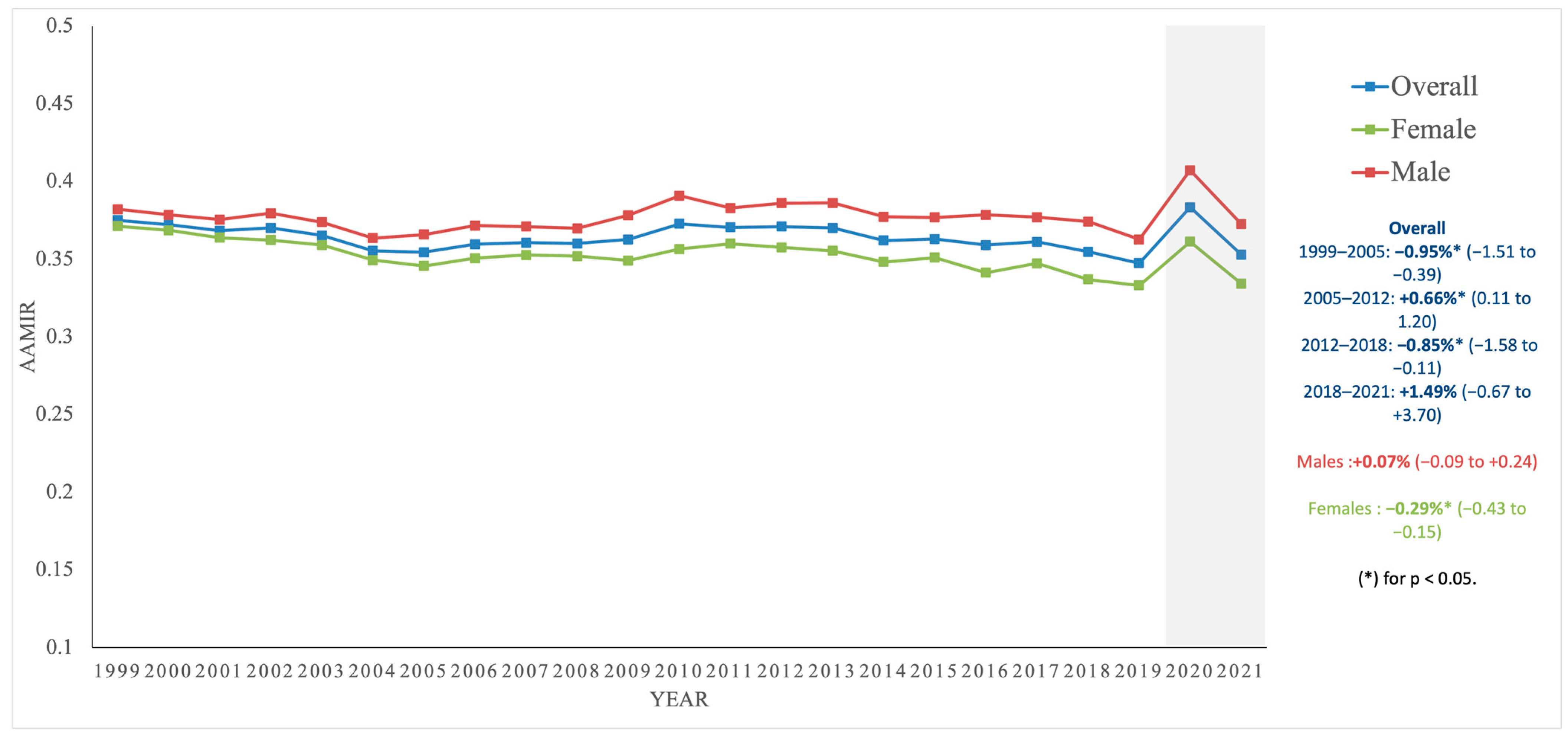
3.1. Gender-Specific Trends
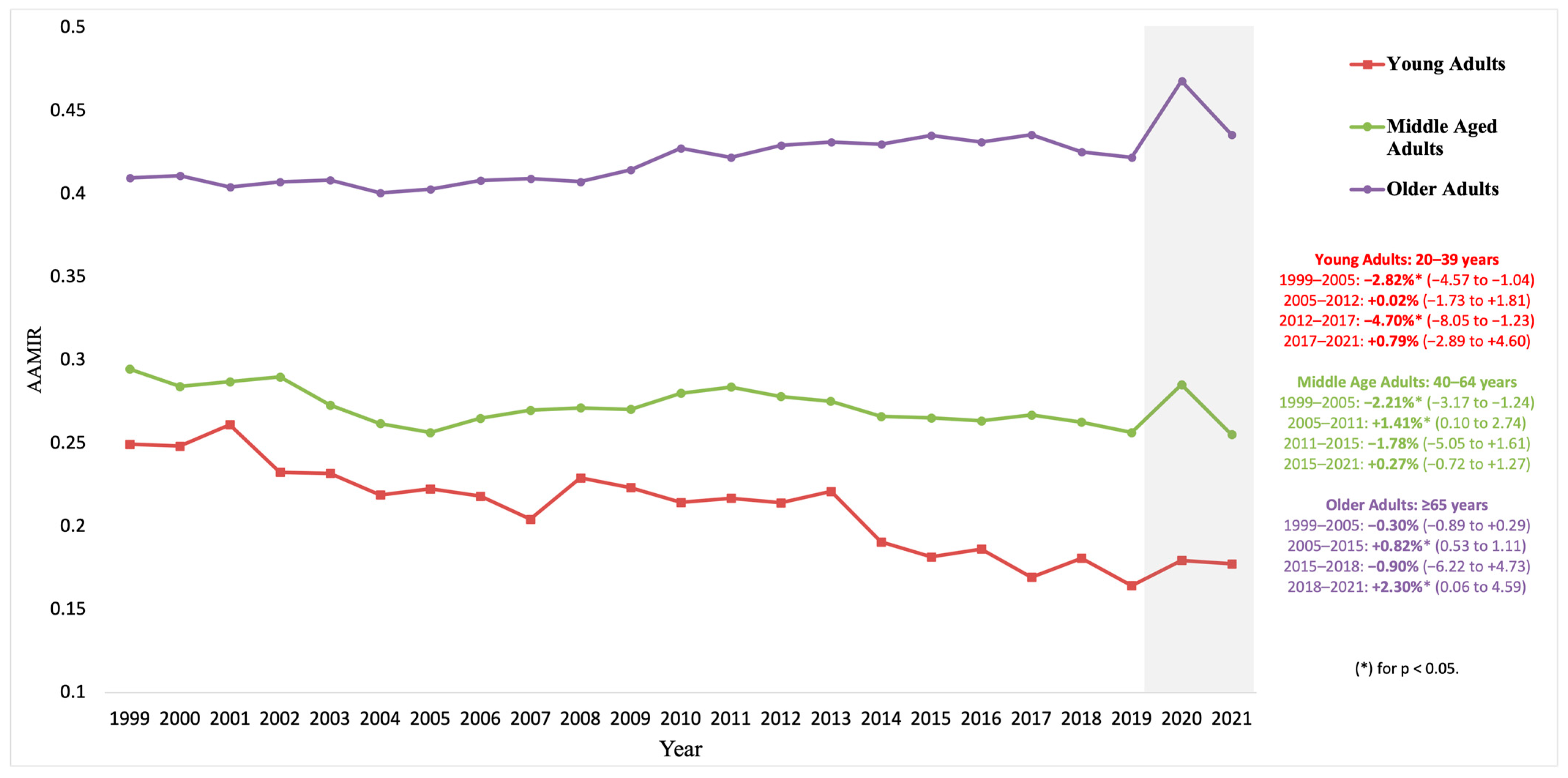
3.2. Age Group Trends
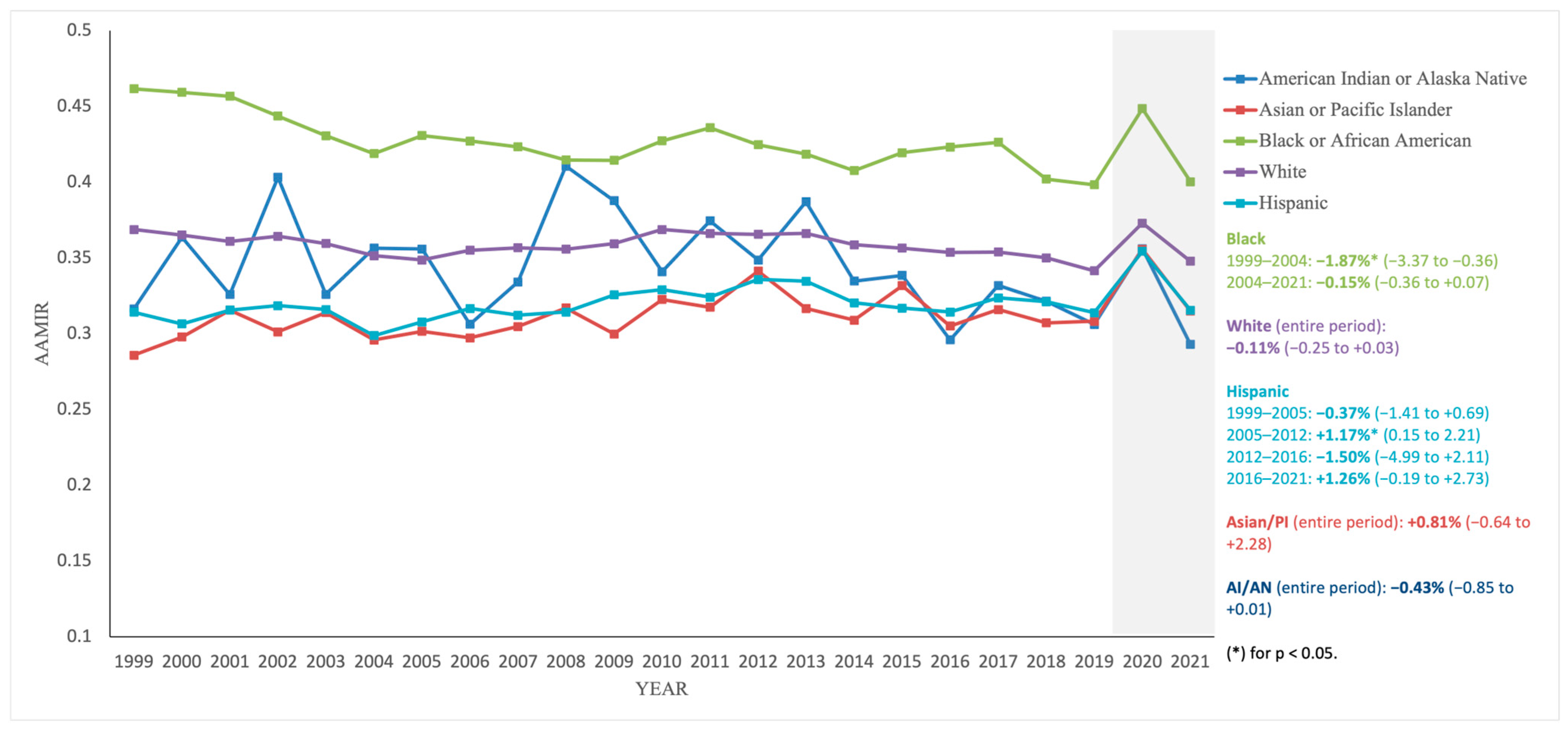
3.3. Racial and Ethnic Group Trends
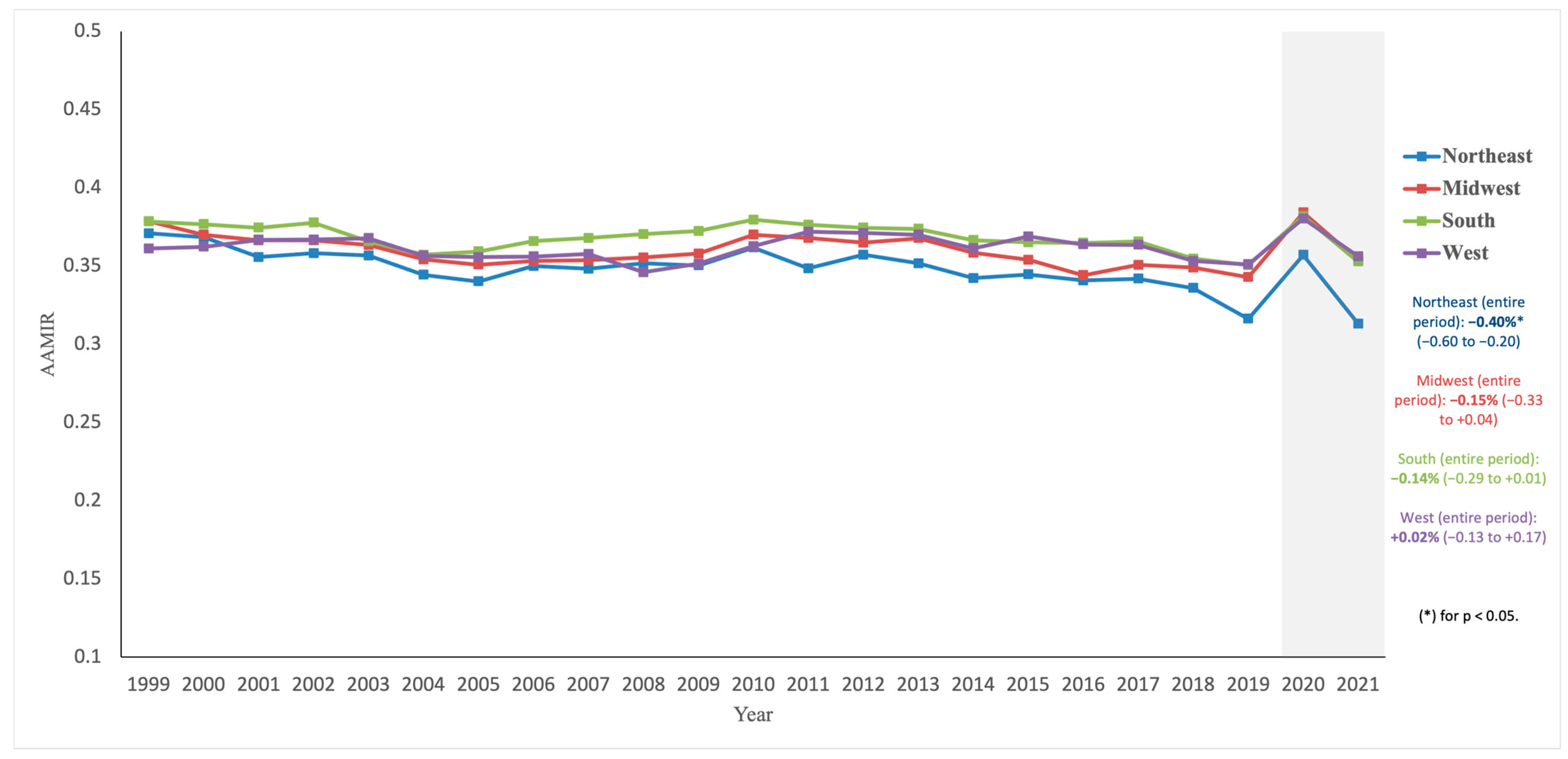
3.4. Regional Trends
3.5. State-Specific Trends
4. Discussion
Limitations
5. Conclusions
Supplementary Materials
Author Contributions
Funding
Institutional Review Board Statement
Informed Consent Statement
Data Availability Statement
Conflicts of Interest
References
- Siegel, R.L.; Miller, K.D.; Wagle, N.S.; Jemal, A. Colorectal cancer statistics, 2023. CA Cancer J. Clin. 2023, 73, 233–254. [Google Scholar] [CrossRef]
- American Cancer Society. Colorectal Cancer Facts & Figures 2023–2025; American Cancer Society: Atlanta, GA, USA, 2023; Available online: https://www.cancer.org/content/dam/cancer-org/research/cancer-facts-and-statistics/colorectal-cancer-facts-and-figures/colorectal-cancer-facts-and-figures-2023.pdf (accessed on 18 September 2025).
- Henley, S.J.; Anderson, R.N.; Thomas, C.C.; Massetti, G.M.; Peaker, B.; Richardson, L.C. Invasive cancer incidence and deaths in nonmetropolitan vs metropolitan US counties. MMWR Surveill. Summ. 2017, 66, 1–13. [Google Scholar] [CrossRef] [PubMed]
- Carethers, J.M. Racial and ethnic disparities in colorectal cancer incidence and mortality. Adv. Cancer Res. 2021, 151, 197–229. [Google Scholar] [CrossRef]
- Naishadham, D.; Lansdorp-Vogelaar, I.; Siegel, R.; Cokkinides, V.; Jemal, A. State disparities in colorectal cancer mortality patterns in the United States. Cancer Epidemiol. Biomark. Prev. 2011, 20, 1296–1302. [Google Scholar] [CrossRef]
- Appiah, J.K.; Asante, R.; Asiedu, E.K. Two decades of disparity: Racial and geographic trends in colorectal cancer mortality in the United States (2000–2020). Cureus 2025, 17, e84847. [Google Scholar] [CrossRef]
- Kusnik, A.; Renjithlal, S.L.M.; Chodos, A.; Shanmukhappa, S.C.; Eid, M.M.; Renjith, K.M.; Alweis, R. Trends in colorectal cancer mortality in the United States, 1999–2020. Gastroenterol. Res. 2023, 16, 217–225. [Google Scholar] [CrossRef] [PubMed] [PubMed Central]
- US Preventive Services Task Force; Davidson, K.W.; Barry, M.J.; Mangione, C.M.; Cabana, M.; Caughey, A.B.; Davis, E.M.; Donahue, K.E.; Doubeni, C.A.; Krist, A.H.; et al. Screening for colorectal cancer: Recommendation statement. JAMA 2021, 325, 1965–1977. [Google Scholar] [CrossRef] [PubMed]
- Akimoto, N.; Ugai, T.; Zhong, R.; Hamada, T.; Fujiyoshi, K.; Giannakis, M.; Wu, K.; Cao, Y.; Ng, K.; Ogino, S. Rising incidence of early-onset colorectal cancer—A call to action. Nat. Rev. Clin. Oncol. 2021, 18, 230–243. [Google Scholar] [CrossRef]
- André, T.; Shiu, K.-K.; Kim, T.W.; Jensen, B.V.; Jensen, L.H.; Punt, C.; Smith, D.; Garcia-Carbonero, R.; Benavides, M.; Gibbs, P.; et al. Pembrolizumab in MSI-H/dMMR metastatic colorectal cancer. N. Engl. J. Med. 2020, 383, 2207–2218. [Google Scholar] [CrossRef]
- Choi, E.; Lee, S.; Nhung, B.C.; Suh, M.; Park, B.; Jun, J.K. Cancer mortality-to-incidence ratio as an indicator of cancer management outcomes. Epidemiol. Health 2017, 39, e2017006. [Google Scholar] [CrossRef]
- Sunkara, V.; Hébert, J.R. The colorectal cancer mortality-to-incidence ratio as an indicator of global cancer screening and care. Cancer 2015, 121, 1563–1569. [Google Scholar] [CrossRef]
- Ellis, L.; Coleman, M.P.; Rachet, B. The mortality-to-incidence ratio is not a valid proxy for cancer survival. J. Glob. Oncol. 2019, 5, 1–9. [Google Scholar] [CrossRef]
- Centers for Disease Control and Prevention. United States Cancer Statistics (USCS) Database. Available online: https://wonder.cdc.gov (accessed on 16 September 2025).
- National Cancer Institute. Surveillance, Epidemiology, and End Results (SEER) Program. Site/Histology Recode. Available online: https://seer.cancer.gov/siterecode/ (accessed on 16 September 2025).
- World Health Organization. International Statistical Classification of Diseases and Related Health Problems, 10th Revision (ICD-10); World Health Organization: Geneva, Switzerland, 2016.
- von Elm, E.; Altman, D.G.; Egger, M.; Pocock, S.J.; Gøtzsche, P.C.; Vandenbroucke, J.P.; Initiative, F.T.S. The Strengthening the Reporting of Observational Studies in Epidemiology (STROBE) statement: Guidelines for reporting observational studies. PLoS Med. 2007, 4, e296. [Google Scholar] [CrossRef]
- U.S. Census Bureau. Geographic Terms and Concepts—Census Regions and Divisions of the United States. Available online: https://www.census.gov (accessed on 16 September 2025).
- Ingram, D.D.; Franco, S.J. 2013 NCHS Urban–Rural Classification Scheme for Counties; Vital Health Stat 2; National Center for Health Statistics: Hyattsville, MD, USA, 2014; pp. 1–73. [Google Scholar]
- Anderson, R.N.; Rosenberg, H.M. Age standardization of death rates: Implementation of the year 2000 standard. In National Vital Statistics Reports; National Center for Health Statistics: Hyattsville, MD, USA, 1998; Volume 47, pp. 1–20. [Google Scholar]
- National Cancer Institute. Joinpoint Regression Program; Version 4.9.0.0; Statistical Research and Applications Branch, National Cancer Institute: Bethesda, MD, USA, 2021. [Google Scholar]
- Fedewa, S.A.; Star, J.; Bandi, P.; Minihan, A.; Han, X.; Yabroff, K.R.; Jemal, A. Changes in Cancer Screening in the US During the COVID-19 Pandemic. JAMA Netw. Open 2022, 5, e2215490. [Google Scholar] [CrossRef]
- Sabatino, S.A.; Thompson, T.D.; White, M.C.; Villarroel, M.A.; Shapiro, J.A.; Croswell, J.M.; Richardson, L.C. Up-to-date breast, cervical, and colorectal cancer screening test use in the United States, 2021. Prev. Chronic Dis. 2023, 20, E94. [Google Scholar] [CrossRef]
- Afify, A.Y.; Ashry, M.H.; Hassan, H. Sex differences in survival outcomes of early-onset colorectal cancer. Sci. Rep. 2024, 14, 22041. [Google Scholar] [CrossRef] [PubMed]
- González-Flores, E.; Garcia-Carbonero, R.; Élez, E.; Redondo-Cerezo, E.; Safont, M.J.; Vera García, R. Gender and sex differences in colorectal cancer screening, diagnosis and treatment. Clin. Transl. Oncol. 2025, 27, 2825–2837. [Google Scholar] [CrossRef]
- Tsokkou, S.; Konstantinidis, I.; Papakonstantinou, M.; Chatzikomnitsa, P.; Liampou, E.; Toutziari, E.; Giakoustidis, D.; Bangeas, P.; Papadopoulos, V.; Giakoustidis, A. Sex differences in colorectal cancer: Epidemiology, risk factors, and clinical outcomes. J. Clin. Med. 2025, 14, 5539. [Google Scholar] [CrossRef]
- Wu, Z.; Huang, Y.; Zhang, R.; Zheng, C.; You, F.; Wang, M.; Xiao, C.; Li, X. Sex differences in colorectal cancer: With a focus on sex hormones and the gut microbiome. Cell Commun. Signal. 2024, 22, 167. [Google Scholar] [CrossRef] [PubMed]
- Kratzer, T.B.; Jemal, A.; Miller, K.D.; Nash, S.; Wiggins, C.; Redwood, D.; Smith, R.; Siegel, R.L. Cancer statistics for American Indian and Alaska Native individuals, 2022: Including increasing disparities in early onset colorectal cancer. CA Cancer J. Clin. 2023, 73, 120–146. [Google Scholar] [CrossRef] [PubMed]
- Centers for Disease Control and Prevention. Cancer and American Indian and Alaska Native People. Updated 7 May 2025. Available online: https://www.cdc.gov/cancer/health-equity/american-indian-alaska-native.html (accessed on 18 September 2025).
- Community Preventive Services Task Force. Patient Navigation Services to Increase Colorectal Cancer Screening. The Community Guide. Available online: https://www.thecommunityguide.org/findings/cancer-screening-patient-navigation-services-to-increase-colorectal-cancer-screening.html (accessed on 18 September 2025).
- Corley, D.A.; Jensen, C.D.; Quinn, V.P.; Doubeni, C.A.; Zauber, A.G.; Lee, J.K.; Schottinger, J.E.; Marks, A.R.; Zhao, W.K.; Ghai, N.R.; et al. Association between time to colonoscopy after a positive fecal test result and risk of colorectal cancer and cancer stage at diagnosis. JAMA 2017, 317, 1631–1641. [Google Scholar] [CrossRef] [PubMed]
- Murphy, C.C.; Sanoff, H.K.; Lund, J.L. Declines in colorectal cancer incidence and mortality rates slow among older adults. Clin. Gastroenterol. Hepatol. 2024, 22, 416–419.e5. [Google Scholar] [CrossRef] [PubMed]
- Mohile, S.G.; Dale, W.; Somerfield, M.R.; Schonberg, M.A.; Boyd, C.M.; Burhenn, P.S.; Canin, B.; Cohen, H.J.; Holmes, H.M.; Hopkins, J.O.; et al. Practical assessment and management of vulnerabilities in older patients receiving chemotherapy: ASCO guideline for geriatric oncology. J. Clin. Oncol. 2018, 36, 2326–2347. [Google Scholar] [CrossRef] [PubMed]
- Zauber, A.G. The impact of screening on colorectal cancer incidence and mortality. Gastroenterol. Hepatol. 2015, 11, 13–15. [Google Scholar] [PubMed Central]
- National Cancer Institute. Cancer Trends Progress Report: Colorectal Cancer Screening; Updated 2024–2025; NCI: Bethesda, MD, USA, 2025. Available online: https://progressreport.cancer.gov/detection/colorectal_cancer (accessed on 18 September 2025).
- Hoehn, R.S.; Rieser, C.J.; Phelos, H.; Sabik, L.M.; Nassour, I.; Paniccia, A.; Zureikat, A.H.; Tohme, S.T. Association Between Medicaid Expansion and Diagnosis and Management of Colon Cancer. J. Am. Coll Surg. 2021, 232, 146–156.e1. [Google Scholar] [CrossRef]
- Oklahoma State Department of Health; OU Health Stephenson Cancer Center. Colorectal Cancer in Oklahoma—Update 2025. Data Brief Series. 2025. Available online: https://www.ouhealth.com/documents/Colorectal-Cancer-in-Oklahoma-Data-Brief-Update-2025.pdf (accessed on 18 September 2025).
- Arizona Department of Health Services, Arizona Cancer Registry. Colorectal Cancer Infographic, 2018–2022; ADHS: Phoenix, AZ, USA, 2024. Available online: https://www.azdhs.gov/documents/preparedness/public-health-statistics/cancer-registry/adhs-acr-colorectal-cancer-infographic.pdf (accessed on 18 September 2025).
- Nebraska Department of Health and Human Services, Cancer Registry. Cancer Incidence and Mortality in Nebraska, 2019; NDHHS: Lincoln, NE, USA, 2023. Available online: https://dhhs.ne.gov/Cancer%20Registry%20Documents/Cancer%20Incidence%20and%20Mortality%20in%20Nebraska%20%202019.pdf (accessed on 18 September 2025).



| Subgroup | AAIR (1999) | AAIR (2021) | AAPC AAIR (95% CI) | AAMR (1999) | AAMR (2021) | AAPC AAMR (95% CI) | AAMIR (1999) | AAMIR (2021) | AAPC AAMIR (95% CI) |
|---|---|---|---|---|---|---|---|---|---|
| Overall | 78.24 | 50.79 | −2.20 (−2.52, −1.89) * | 29.34 | 17.92 | −2.33 (−2.46, −2.20) * | 0.375 | 0.353 | −0.08 (−0.47, 0.30) |
| Sex | |||||||||
| Male | 93.48 | 57.32 | −2.44 (−2.76, −2.13) * | 35.72 | 21.36 | −2.36 (−2.65, −2.08) * | 0.382 | 0.373 | 0.07 (−0.09, 0.24) |
| Female | 67.04 | 45.02 | −2.06 (−2.38, −1.74) * | 24.89 | 15.04 | −2.40 (−2.55, −2.26) * | 0.371 | 0.334 | −0.29 (−0.43, −0.15) * |
| Age Group | |||||||||
| 20–39 years | 3.68 | 6.45 | 2.42 (1.76, 3.08) * | 0.92 | 1.14 | 0.87 (0.63, 1.11) * | 0.249 | 0.177 | −1.71 (−2.85, −0.56) * |
| 40–65 years | 52.63 | 51.15 | −0.39 (−0.72, −0.05) * | 15.51 | 13.06 | −0.82 (−1.28, −0.36) * | 0.295 | 0.255 | −0.48 (−1.20, 0.25) |
| ≥65 years | 308.13 | 154.22 | −3.44 (−3.61, −3.27) * | 126.23 | 67.17 | −2.98 (−3.12, −2.85) * | 0.410 | 0.436 | 0.48 (−0.28, 1.24) |
| Race/Ethnicity | |||||||||
| Non-Hispanic White | 78.68 | 51.66 | −2.11 (−2.40, −1.82) * | 29.01 | 17.97 | −2.22 (−2.50, −1.93) * | 0.368 | 0.347 | −0.11% (−0.25 to +0.03) |
| Non-Hispanic Black | 87.53 | 57.88 | −2.05 (−2.50, −1.61) * | 40.4 | 23.16 | −2.67 (−2.77, −2.57) * | 0.462 | 0.400 | −0.54 (−0.90, −0.18) * |
| Hispanic | 64.54 | 47.47 | −1.73 (−1.96, −1.50) * | 20.28 | 14.97 | −1.51 (−1.62, −1.40) * | 0.314 | 0.315 | 0.28 (−0.48, 1.05) |
| Non-Hispanic Asian/Pacific Islander | 59.44 | 41.55 | −2.07 (−2.31, −1.82) * | 16.99 | 13.08 | −1.73 (−1.95, −1.50) * | 0.286 | 0.315 | 0.81 (−0.64, 2.28) |
| Non-Hispanic American Indian/Alaska Native | 67.54 | 62.11 | −0.27 (−0.58, 0.04) | 21.36 | 18.19 | −0.84 (−1.36, −0.32) * | 0.316 | 0.293 | −0.43 (−0.85, 0.01) |
| Region | |||||||||
| Northeast | 86.56 | 50.62 | −2.73 (−3.05, −2.42) * | 32.10 | 15.86 | −3.21 (−3.38, −3.04) * | 0.371 | 0.313 | −0.40 (−0.60, −0.20) * |
| Midwest | 82.21 | 53.34 | −2.16 (−2.52, −1.79) * | 31.12 | 18.86 | −2.36 (−2.51, −2.20) * | 0.379 | 0.354 | −0.15 (−0.33, 0.04) |
| South | 75.64 | 53.72 | −1.83 (−2.18, −1.48) * | 28.62 | 18.96 | −2.01 (−2.15, −1.87) * | 0.378 | 0.353 | −0.14 (−0.29, 0.01) |
| West | 70.67 | 47.63 | −2.00 (−2.31, −1.70) * | 25.52 | 16.96 | −2.01 (−2.19, −1.84) * | 0.361 | 0.356 | 0.02 (−0.13, 0.17) |
Disclaimer/Publisher’s Note: The statements, opinions and data contained in all publications are solely those of the individual author(s) and contributor(s) and not of MDPI and/or the editor(s). MDPI and/or the editor(s) disclaim responsibility for any injury to people or property resulting from any ideas, methods, instructions or products referred to in the content. |
© 2025 by the authors. Licensee MDPI, Basel, Switzerland. This article is an open access article distributed under the terms and conditions of the Creative Commons Attribution (CC BY) license (https://creativecommons.org/licenses/by/4.0/).
Share and Cite
Bin Abdul Ghaffar, Q.; Naqvi, S.M.M.; Shields, G.; Daglilar, E.; Chela, H. Colorectal Cancer in the U.S., 1999–2021: Declining Rates, Rising Concerns, and Persistent Disparities. Diseases 2025, 13, 392. https://doi.org/10.3390/diseases13120392
Bin Abdul Ghaffar Q, Naqvi SMM, Shields G, Daglilar E, Chela H. Colorectal Cancer in the U.S., 1999–2021: Declining Rates, Rising Concerns, and Persistent Disparities. Diseases. 2025; 13(12):392. https://doi.org/10.3390/diseases13120392
Chicago/Turabian StyleBin Abdul Ghaffar, Qais, Sayed Maisum Mehdi Naqvi, Garrett Shields, Ebubekir Daglilar, and Harleen Chela. 2025. "Colorectal Cancer in the U.S., 1999–2021: Declining Rates, Rising Concerns, and Persistent Disparities" Diseases 13, no. 12: 392. https://doi.org/10.3390/diseases13120392
APA StyleBin Abdul Ghaffar, Q., Naqvi, S. M. M., Shields, G., Daglilar, E., & Chela, H. (2025). Colorectal Cancer in the U.S., 1999–2021: Declining Rates, Rising Concerns, and Persistent Disparities. Diseases, 13(12), 392. https://doi.org/10.3390/diseases13120392