Article

A Fully Integrated Gate-Pole-Dominant Low-Dropout Regulator with Loop-Gain Booster for Maintaining High Power-Supply Rejection over a Wide Load Current Range


1
Department of Semiconductor Engineering, Kyung Hee University, Yongin 17104, Republic of Korea
2
Department of Computer Engineering, Kyung Hee University, Yongin 17104, Republic of Korea
3
Department of Electronic Engineering, Kyung Hee University, Yongin 17104, Republic of Korea
*
Author to whom correspondence should be addressed.
Electronics 2026, 15(9), 1825; https://doi.org/10.3390/electronics15091825
Submission received: 2 April 2026 / Revised: 13 April 2026 / Accepted: 21 April 2026 / Published: 24 April 2026

Abstract

This paper introduces a fully integrated gate-pole-dominant low-dropout regulator (LDO) that eliminates the need for external capacitors while sustaining high power-supply rejection (PSR) over a broad load current range. A loop-gain booster (LGB) is proposed to maintain the DC operating point of the error amplifier output at its optimal value, thereby preserving a high unity-gain frequency (UGF) even as the load current varies from zero to 200 mA. The parallel signal paths within the LGB inherently produce a left-half-plane (LHP) zero, which cancels one of the poles within the UGF of the feedback loop and guarantees robust stability under diverse operating conditions. Fabricated in a 40 nm CMOS technology, the prototype occupies only 0.008 mm2 with a 4 pF on-chip compensation capacitor. The proposed LDO achieves a PSR of −72 dB at 1 MHz and −40 dB at 10 MHz when IL = 200 mA and VDO = 0.1 V, and maintains a PSR better than −78 dB at 1 MHz and −42 dB at 10 MHz when IL = 1 mA and VDO = 0.1 V. The LGB-enhanced regulator achieves excellent load and line regulation figures of 29 μV/mA and 0.75 mV/V, while the LGB itself consumes merely 7 μA out of a total quiescent current of 108 μA.

1. Introduction

In modern system-on-chip (SoC) implementations, the increasing degree of functional integration means that noise-sensitive analog and radio-frequency (RF) circuits coexist on the same silicon substrate with aggressive digital circuitry. The spurious switching activity and supply fluctuation generated by the digital blocks can severely degrade the performance of adjacent analog circuits [1]. Under these circumstances, on-chip low-dropout regulators (LDOs) capable of providing high power-supply rejection (PSR) have become essential building blocks in modern power management architectures [2].
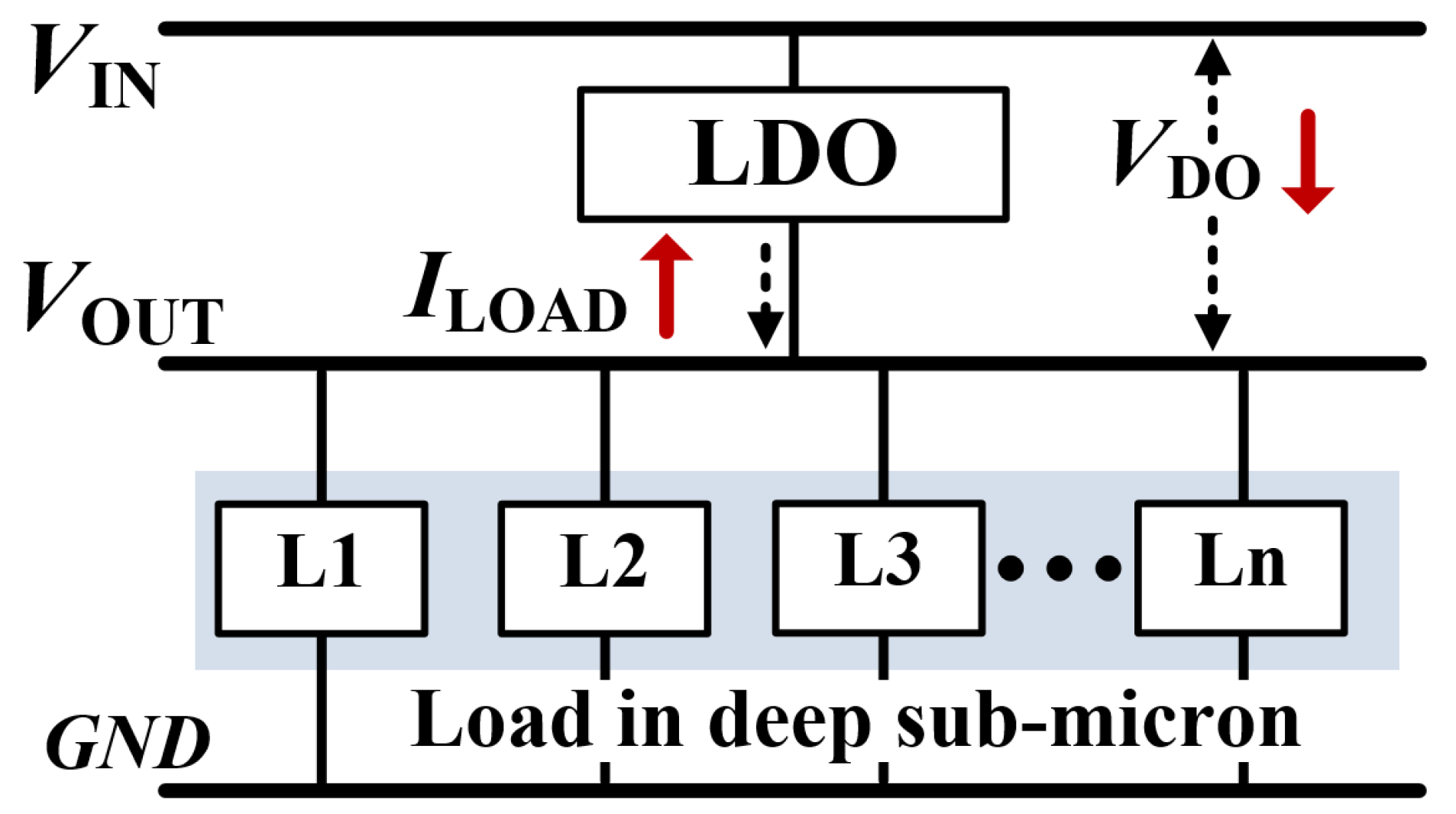
Figure 1 illustrates the typical operating environment of an LDO in deep sub-micron integrated circuits, where the regulator must supply a clean output voltage VOUT to multiple load blocks (i.e., L1, L2, …, Ln) under a shrinking dropout voltage VDO and increasing load current IL demands.
The demand for high-PSR LDOs has intensified as both the supply voltage headroom and the required IL range have expanded concurrently. A shrinking supply voltage translates into a diminished VDO, which places stringent constraints on the error amplifier’s output swing and gain. Meanwhile, applications such as wideband RF transceivers targeting 5G systems [3] require clean power delivery across bandwidths exceeding 100 MHz [3,4]. These dual requirements—low dropout and high PSR bandwidth—constitute one of the principal design tensions in contemporary LDO research.
From an architectural standpoint, LDO regulators are broadly divided into two families according to the location of their dominant loop pole [5]. In the first family, the dominant pole resides at the output node (i.e., ωD = ωOUT). While such output-pole-dominant LDOs naturally achieve high PSR at high frequencies—owing to the large output capacitor CL shunting supply ripples to ground beyond the unity-gain frequency (UGF)—they face a fundamental stability challenge. As the load current IL increases, the output pole moves toward the gate pole of the pass transistor, necessitating larger capacitors (often several microfarads) to preserve adequate phase margin [6,7,8,9]. The resulting dependence on bulky external capacitors conflicts with the ongoing drive toward full integration and reduced printed-circuit-board (PCB) footprints.
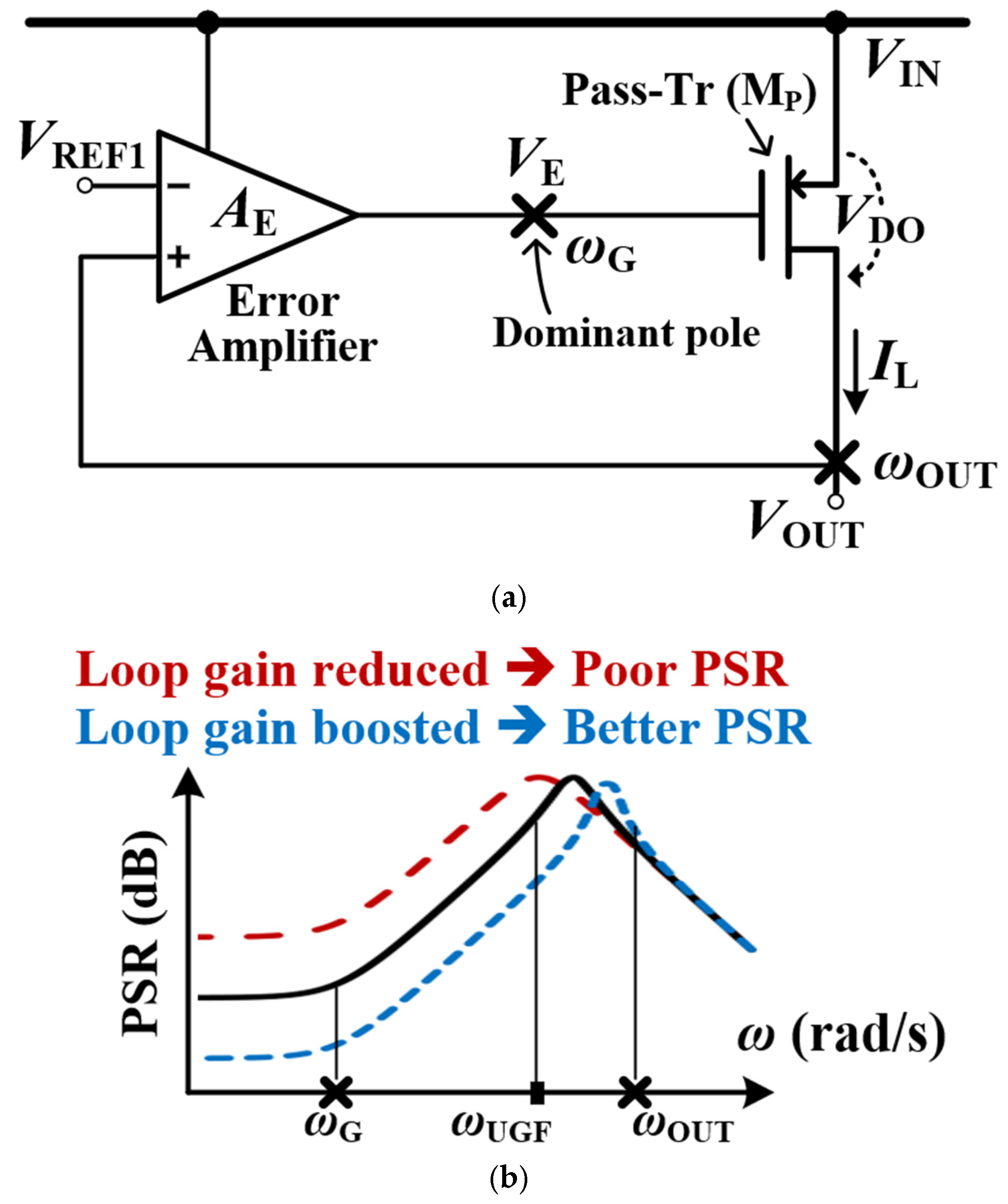
The second family positions the dominant pole at the gate node of the pass transistor MP (i.e., ωD = ωG) [10,11,12,13,14,15,16,17,18]. In these gate-pole-dominant architectures, increasing IL pushes ωOUT away from the dominant pole, thereby relaxing the capacitive loading requirement and enabling capacitor-less operation. Nevertheless, a well-known drawback emerges: a PSR hump near the UGF. At frequencies above ωG, the gate of MP is effectively shorted to ac ground; so the regulating loop loses its ability to suppress supply perturbations until CL takes over at higher frequencies [19]. The severity of this hump is directly linked to the UGF; a higher UGF pushes the hump to a higher frequency, improving broadband PSR.
Figure 2a depicts a conventional gate-pole-dominant LDO employing a simple error amplifier AE that directly drives the gate of MP, with the dominant pole located at the gate node VE. The feedback is taken from the output node VOUT. Figure 2b shows the corresponding PSR characteristics, where a notable PSR hump appears near the UGF (ωUGF). When the loop gain is reduced—for example, by a shift in the operating point of the error amplifier—the PSR hump worsens, whereas boosting the loop gain pushes the hump to higher frequencies and improves the overall PSR performance.
However, maintaining a high UGF across a wide IL range is challenging in practice. When IL changes across several decades, the overdrive voltage of MP varies substantially, which in turn forces the DC output level of the error amplifier VE to undergo a large variation. If VE deviates from the amplifier’s optimal output common-mode range (OCMR), the gain of the error amplifier AE degrades, the loop gain drops, and the UGF decreases—all of which translate into deteriorated PSR. This problem is exacerbated as VDO decreases, since the required swing in VE grows proportionally. Recently published high-PSR LDOs can be broadly grouped into three categories according to their PSR-enhancement strategies. The first category includes LDOs employing feed-forward ripple-cancelation or ripple-neutralization paths to suppress supply ripple over frequency [20,21]. The second category consists of gate-pole-dominant capacitor-less LDOs that utilize adaptive biasing or active frequency-compensation techniques to preserve loop bandwidth and stability [22,23]. A third category combines multiple loops or control domains in hybrid topologies to balance PSR, bandwidth, and transient behavior [24,25]. Nevertheless, these prior works still face trade-offs among high-frequency PSR, wide load-current range, low dropout, stability, and implementation overhead. These limitations directly motivate the proposed loop-gain booster (LGB) approach.
In this work, we present a fully integrated gate-pole-dominant LDO that achieves sustained high PSR over a wide IL range through a technique termed the loop-gain booster (LGB). Rather than adding intermediate gain stages or feed-forward cancelation paths, the LGB fixes VE at its optimal DC operating point via a secondary feedback mechanism. This stabilization preserves the maximum attainable AE—and hence the highest UGF—regardless of IL and VDO variations. Moreover, the auxiliary signal path of the LGB naturally produces an LHP zero that cancels a pole within the loop bandwidth, ensuring robust phase margin despite the multi-pole nature of the regulating loop. The remaining part of this paper is structured as follows. Section 2 examines the fundamental limitations of conventional gate-pole-dominant LDOs. Section 3 details the proposed LGB concept and overall architecture. Section 4 describes the transistor-level design of each building block. Section 5 presents the loop-gain analysis, stability assessment, and PSR characterization. Section 6 reports measurement results from the 40 nm CMOS prototype, and Section 7 concludes the paper.

2. Limitations of Conventional Gate-Pole-Dominant Architectures

To appreciate the contribution of the proposed technique, it is instructive to quantify the variation in VE as IL sweeps across its full range. In a gate-pole-dominant LDO where the error amplifier output drives MP either directly or through an intermediate stage characterized by an effective gain AI, the change ΔVE experienced when IL transitions from its minimum to maximum value can be expressed using the alpha-power-law MOSFET model [26] as:
V E 1 A I ( I L . M A X I L . M I N k p × 1 1 + λ V D O )    
where k p = 0.5 μ P C o x W L is a process transconductance parameter, μ P is a mobility of PMOS, C o x is a Capacitance of oxide, W and L are the width and length of MP, λ is a channel length modulation parameter, VDO is a drop-out voltage, I L is a load current, and AI represents the voltage gain of any intermediate stage preceding MP. According to (1), when AI is unity (i.e., no intermediate stage), ΔVE can amount to several hundred millivolts for a wide load current swing, readily exceeding the OCMR of the error amplifier.
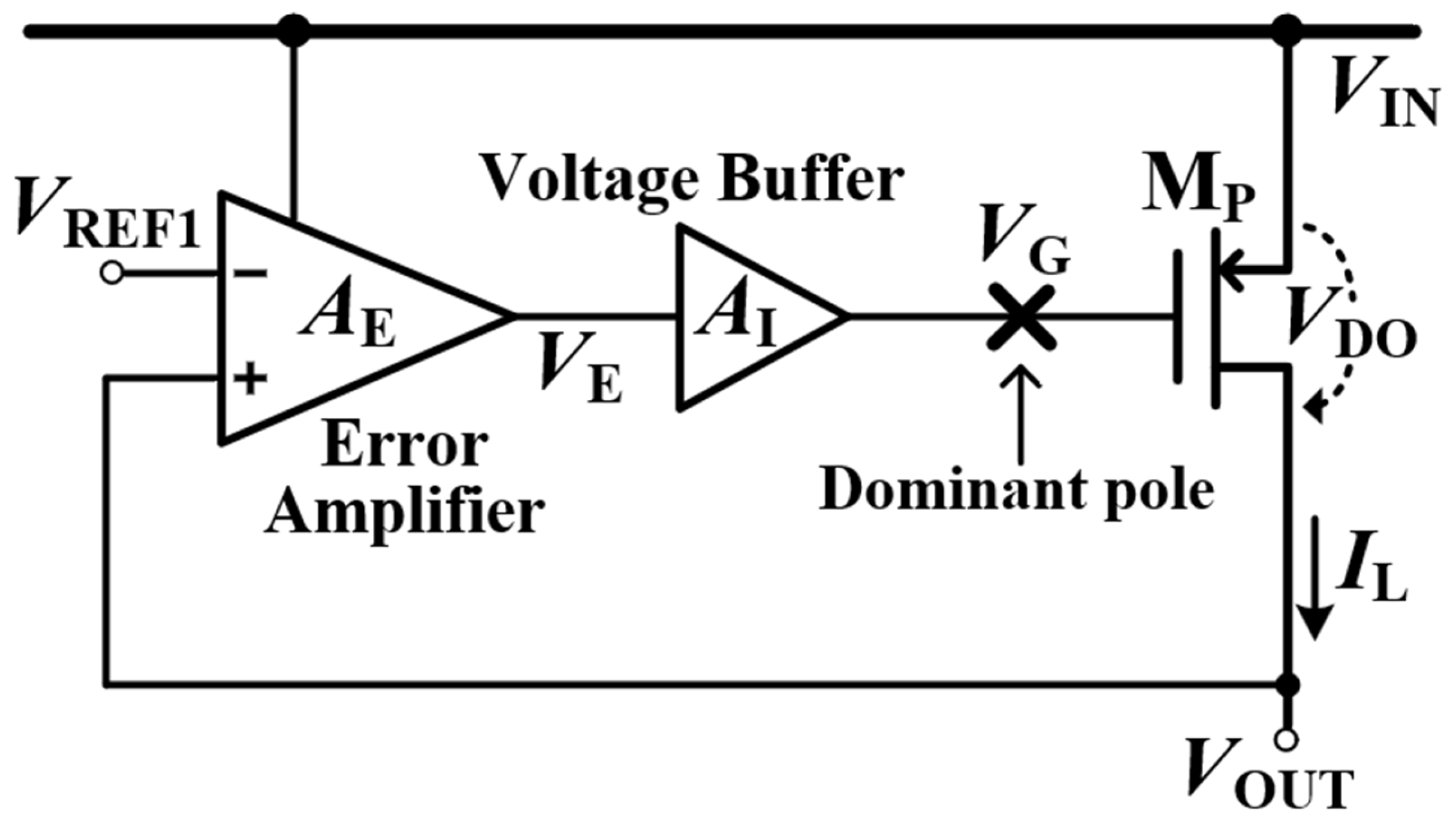
Figure 3 shows a conventional LDO architecture that cascades an intermediate voltage buffer stage with gain AI between the error amplifier output VE and the gate of MP. Prior solutions that employ high-gain intermediate stages [10,11] can raise AI and thereby reduce the voltage ΔVE as quantified in (1). However, achieving a high voltage gain in such a stage requires a correspondingly high output impedance, which, when loaded by the large parasitic capacitance of MP, pulls the gate pole ωG to a low frequency and limits the attainable UGF [12,13]. Multi-stage buffer topologies with low output impedance [14,15] offer another pathway but inevitably introduce multiple poles, creating stability concerns, especially under light-load conditions. It is worth noting that placing the dominant pole at VG, rather than at VOUT, is a deliberate architectural choice: it eliminates the need for a large off-chip output capacitor and ensures that the loop remains stable across the full load-current range, since the output pole moves to higher frequencies as IL increases. The dominant pole at VG effectively defines the loop bandwidth of the LDO, which in turn determines both the PSR performance within the regulation band and the speed of the load-transient response. Specifically, at frequencies below the dominant pole, the high loop gain suppresses supply ripples on VOUT, while the same bandwidth governs how quickly VOUT recovers to its nominal value after a load transient. However, this gate-pole-dominant topology inherently introduces the PSR hump described in Section 1, whose severity is directly tied to the UGF—and hence to how well VE is maintained at its optimal operating point. In essence, these conventional approaches face a three-way trade-off among loop gain, bandwidth, and stability. Raising the intermediate-stage gain improves ΔVE suppression at the cost of bandwidth; expanding the number of gain stages provides design flexibility but multiplies the poles that must be compensated. The LGB technique proposed in the following section resolves this trade-off by decoupling the DC operating point control of VE from the signal-path gain distribution.

3. Proposed LDO Architecture Employing the Loop-Gain Booster

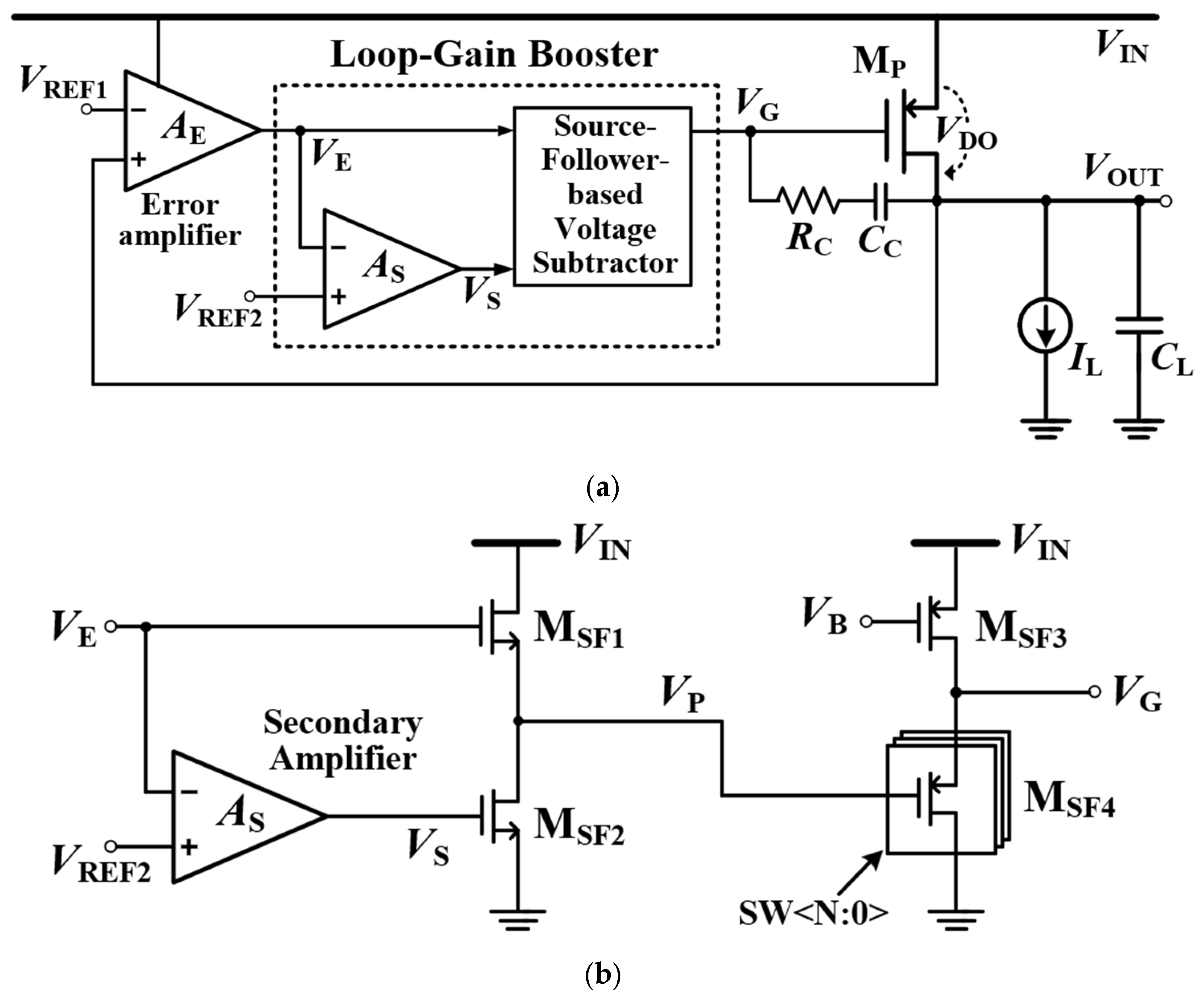
Figure 4a presents the top-level architecture of the proposed LDO, which comprises five principal blocks: the error amplifier, the loop-gain booster (LGB), MP (3 mm/40 nm thin-oxide), and a Miller compensation network (RC and CC). Because the dominant pole is located at the gate of MP rather than at the output, no external decoupling capacitor is needed. Figure 4b details the internal structure of the LGB, which consists of a secondary amplifier with gain AS whose inverting input is referenced to VREF2 and whose output drives a source-follower transistor MSF2, operating in parallel with a main-path source follower MSF1. A second buffer stage comprising MSF3 and MSF4 is inserted between VP and the gate of MP to eliminate the net DC level shift in the feedback path. Without this stage, the VGS offset of the source followers (i.e., MSF1) would cause VE to settle at an excessively high DC level. By passing the signal through a PMOS source follower (i.e., MSF4), which shifts the voltage down by one VGS, followed by an NMOS source follower (MSF4), which shifts it back up by one VGS, the two offsets cancel, and the DC relationship between VG and VE remains free of any accumulated level shift. Also, a digitally controllable switch array (SW<N:0>) is incorporated within this buffer stage to calibrate the DC operating point of VP. When IL changes or PVT variations become extreme, the number of active switches can be adjusted to compensate for the resulting shifts in VP. This prevents such perturbations from propagating back through the LGB and disturbing VE, thereby keeping VE stable across all operating conditions. It should be noted that, although CC is connected between the gate and drain of MP in a Miller configuration, its primary purpose in this design is not conventional pole-splitting. Without CC and the series resistor RC, the parasitic Cgd of the large pass transistor MP naturally produces a right-half-plane (RHP) zero that significantly degrades the phase margin. By inserting a small Miller capacitor CC (only 2 pF in this design) in series with RC between the gate and drain of MP, an LHP zero is generated that cancels the detrimental effect of the RHP zero and improves stability. The capacitance of CC was deliberately minimized to 2 pF to avoid any severe bandwidth reduction from the Miller effect at the dominant gate pole.

3.1. Operating Principle of the Loop-Gain Booster

The LGB is composed of two sub-blocks: a secondary amplifier with high DC gain AS and a voltage subtractor realized as two source followers. The key concept is the creation of an auxiliary signal path that operates in parallel with the main path from VE (the error amplifier output) to VP. In the main path, VE is level-shifted by a first source-follower transistor MSF1. In the auxiliary path, VE feeds the inverting input of the secondary amplifier (referenced to VREF2), whose output drives a second source-follower transistor MSF2. Because the secondary amplifier inverts the signal polarity, the two contributions arrive at VP with the same sign, ensuring constructive addition.
Since the DC gain AS of the secondary amplifier is large, the closed-loop action of the overall LDO forces VE to settle at VREF2. By choosing VREF2 to coincide with the voltage at which the error amplifier achieves its peak gain, the design locks VE at the optimal operating point, irrespective of load-current or dropout-voltage variations. Consequently, AE remains at its maximum value at all times, and the UGF of the loop is preserved.
It is worth noting that this operating principle of the LGB can be conceptually understood as the single-ended counterpart of a common-mode feedback (CMFB) loop. In a conventional differential amplifier, a CMFB loop is necessary because the high-impedance output node is not self-biased and would otherwise drift toward the supply rails; the CMFB loop anchors this node at its optimal DC operating point so that the differential gain is maximized. The error amplifier of an LDO suffers from a similar—but arguably more severe—DC drift problem at VE, where the bias point is pushed away from the optimum by load-current variations as well as PVT and dropout-voltage changes. However, a conventional CMFB cannot be directly applied here, because the error amplifier in an LDO is a single-ended structure rather than a differential one, and CMFB inherently relies on sensing the common mode of two complementary outputs. The proposed LGB resolves this incompatibility by acting as a single-ended CMFB equivalent: it continuously senses VE and, through the secondary feedback path described above, forces it back to VREF2 regardless of IL and VDO. Unlike a simple DC servo loop, which only corrects DC offset and is typically heavily low-pass filtered to avoid interfering with the main signal path, the LGB remains active over a wide frequency range, so that it not only stabilizes the DC operating point of VE but also actively boosts the small-signal loop gain at the frequencies where PSR matters most.

3.2. Transfer Function of the LGB

Superposing the gains of the main and auxiliary paths, the small-signal transfer function from VE to VP can be written as:
V P V E s A L G B 1 + s ω S A L G B 1 + s ω S    
where
A L G B = 1 + A S g m , S F 2 g m , S F 1    
and ωS is the pole frequency at the secondary amplifier output. This expression reveals that the two parallel paths inherently generate an LHP zero at a frequency A L G B times higher than ωS. This intrinsic zero plays a pivotal role in maintaining phase margin, as it can be positioned to cancel one of the poles falling within the UGF of the overall loop.
It should be emphasized that this LHP zero is not an incidental byproduct of the LGB but rather a deliberate design feature that distinguishes the proposed approach from prior gate-pole-dominant LDOs employing intermediate gain stages. In conventional approaches, inserting an additional gain stage in the feedback loop introduces an additional pole that severely degrades the phase margin, often requiring large compensation capacitors or complex pole-splitting techniques that ultimately limit the achievable bandwidth and PSR. In contrast, the parallel signal flow between the main path and the auxiliary path of the LGB intrinsically generates the LHP zero in (2), which is positioned to cancel the phase degradation caused by the additional pole introduced by the LGB itself. As a result, the proposed LGB attains the gain-boosting and DC-stabilization benefits of an auxiliary amplifier without paying the stability penalty that has historically limited intermediate-gain-stage approaches. This is the key reason the LGB can deliver high PSR over a wide load-current range without sacrificing loop stability.

3.3. Effective Intermediate-Stage Gain

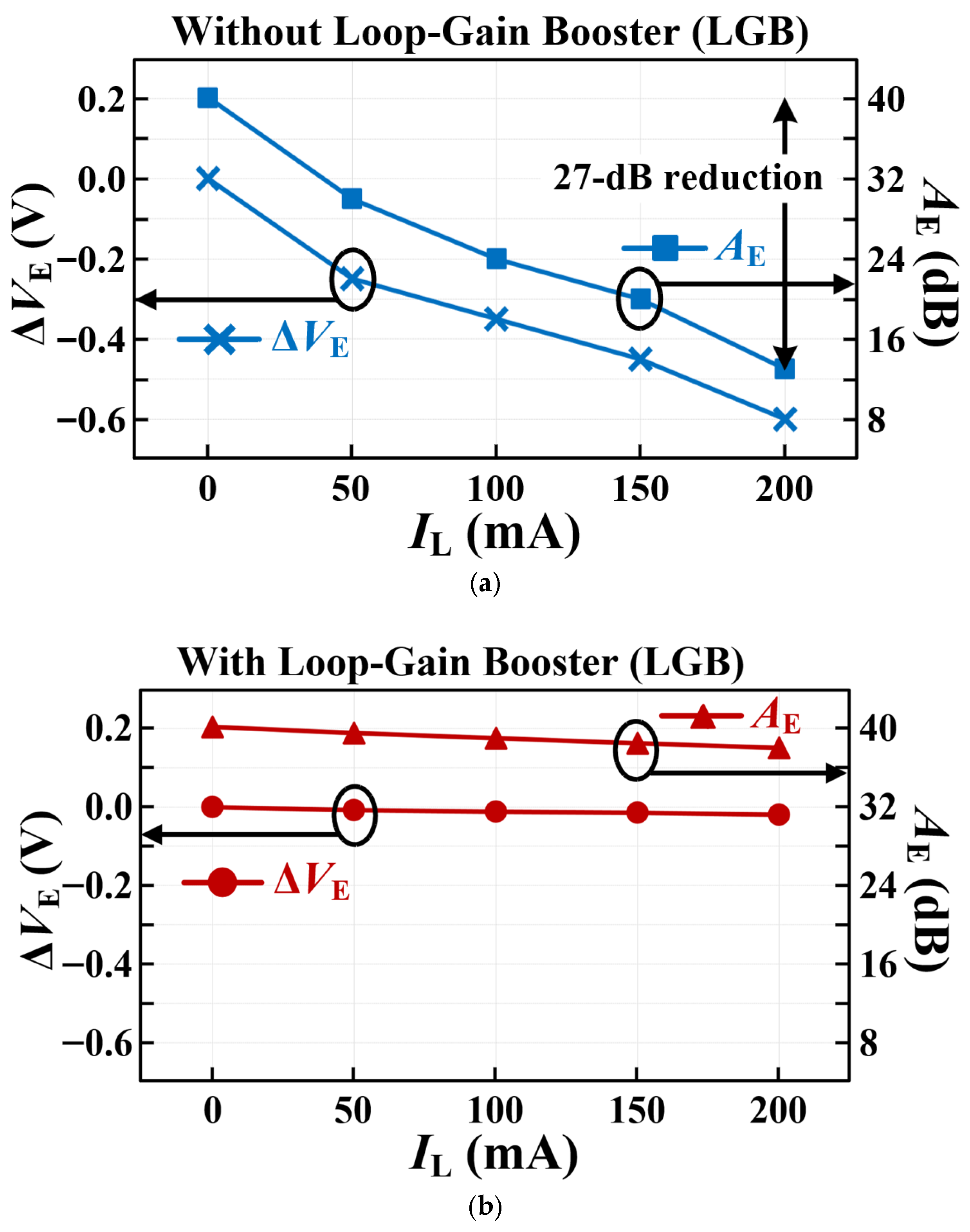
Figure 5 compares the behavior of ΔVE and the error amplifier gain AE as the load current IL varies from 0 to 200 mA, for two cases: (a) without the LGB, and (b) with the LGB. As shown in Figure 5a, in the absence of the LGB, VE undergoes a large excursion of approximately 0.6 V across the load range, causing AE to degrade by as much as 27 dB. In contrast, Figure 5b demonstrates that with the LGB enabled, VE remains nearly constant because the secondary feedback loop clamps it to VREF2. As a result, AE stays at its peak value of approximately 40 dB throughout the entire load range, confirming the effectiveness of the proposed technique.
As implied by (2), the effective gain from VE to VG (the gate of MP) is given by the product ALGB, which can be made large through the high gain of the secondary amplifier (approximately 26 dB in this design), ensuring that ΔVE is significantly attenuated.
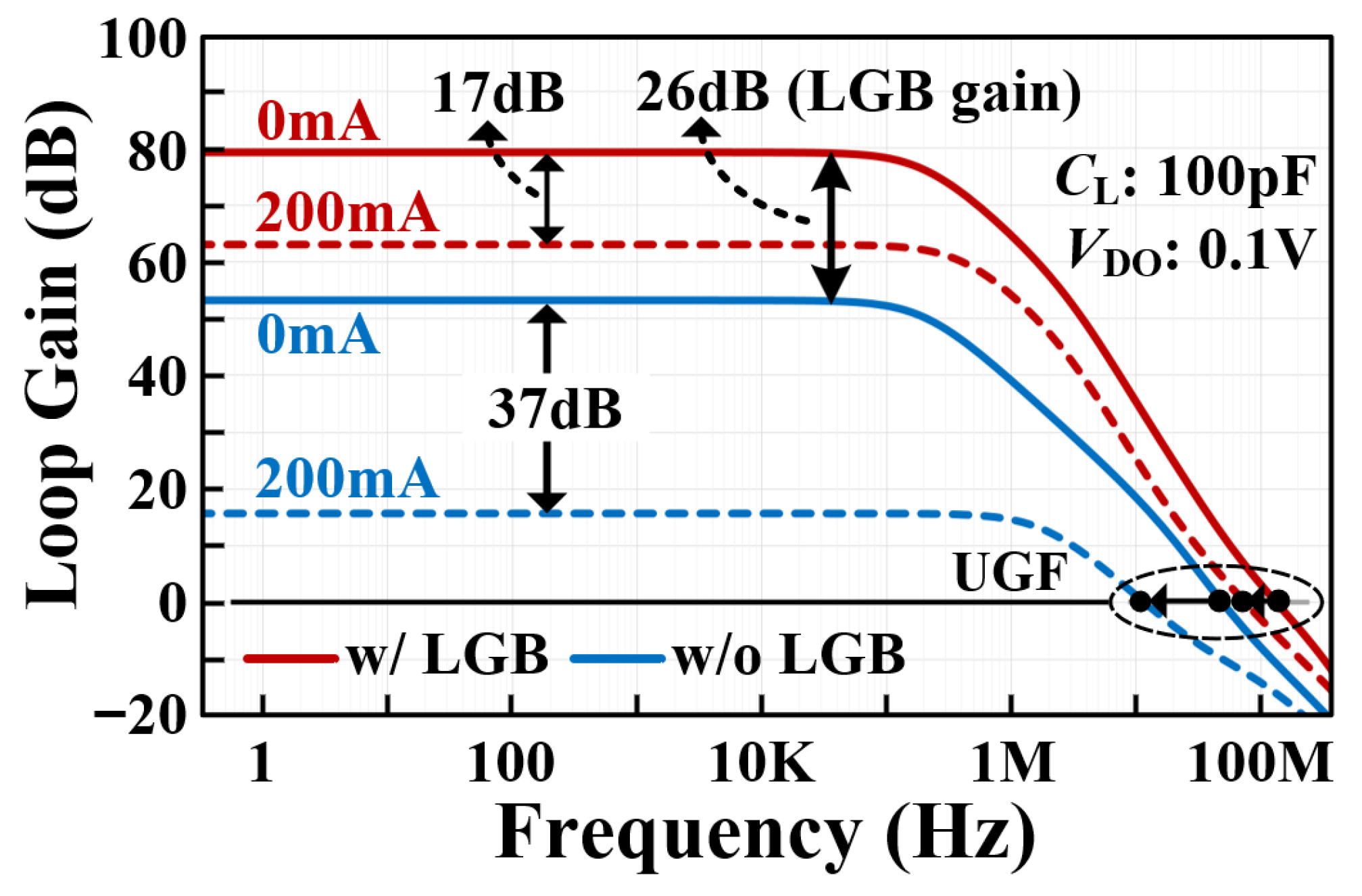
Figure 6 compares the open-loop gain of the proposed LDO with and without the LGB as a function of frequency, at two extreme load conditions (IL = 0 mA and 200 mA) with VDO = 0.1 V and CL = 100 pF. Without the LGB, the DC loop gain drops by 37 dB when IL increases from 0 to 200 mA. Also, it shows the degradation of UGF due to the increase in IL. In contrast, with the LGB enabled, the DC gain variation is reduced to only 17 dB. Also, the reduction of UGF is minimized compared than that of the LDO without the LGB. Furthermore, the LGB contributes an additional 26 dB of gain, and the UGF is maintained at a consistently high level across the entire load range.
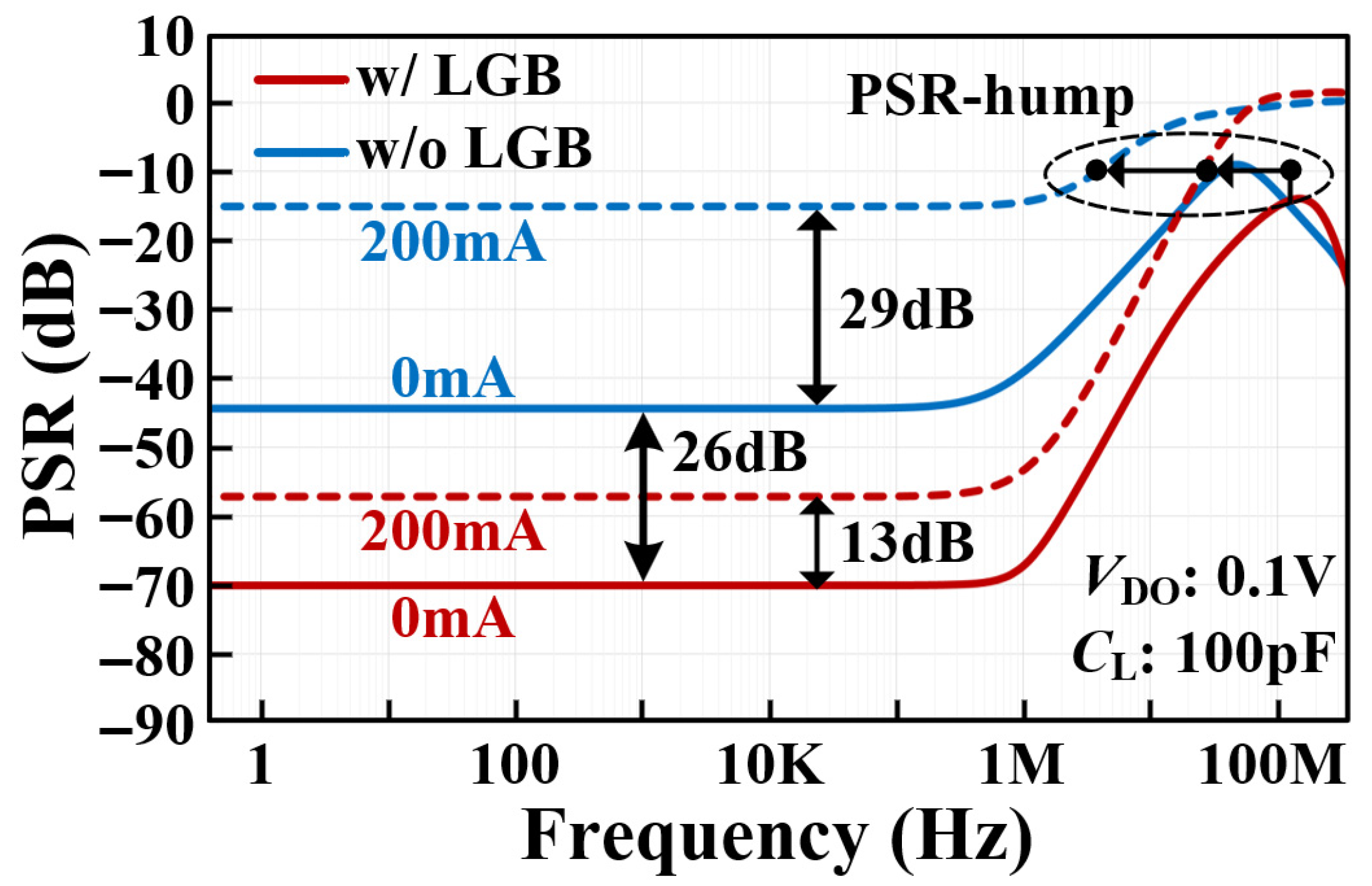
Figure 7 presents the simulated PSR comparison between the LDO with and without the LGB under the same operating conditions. Without the LGB, the PSR at the hump frequency degrades by up to 29 dB as IL increases from 0 to 200 mA, reflecting the collapse of the loop gain. With the LGB active, the LDO can achieve a 26 dB better PSR at 0 mA, compared with the LDO without the LGB. It can be observed that without LGB, the PSR-hump shifts to a lower frequency. Also, even when IL increases from 0 to 200 mA, the degradation of the PSR is dramatically reduced to 13 dB, confirming that maintaining a high UGF directly translates into improved broadband PSR performance.
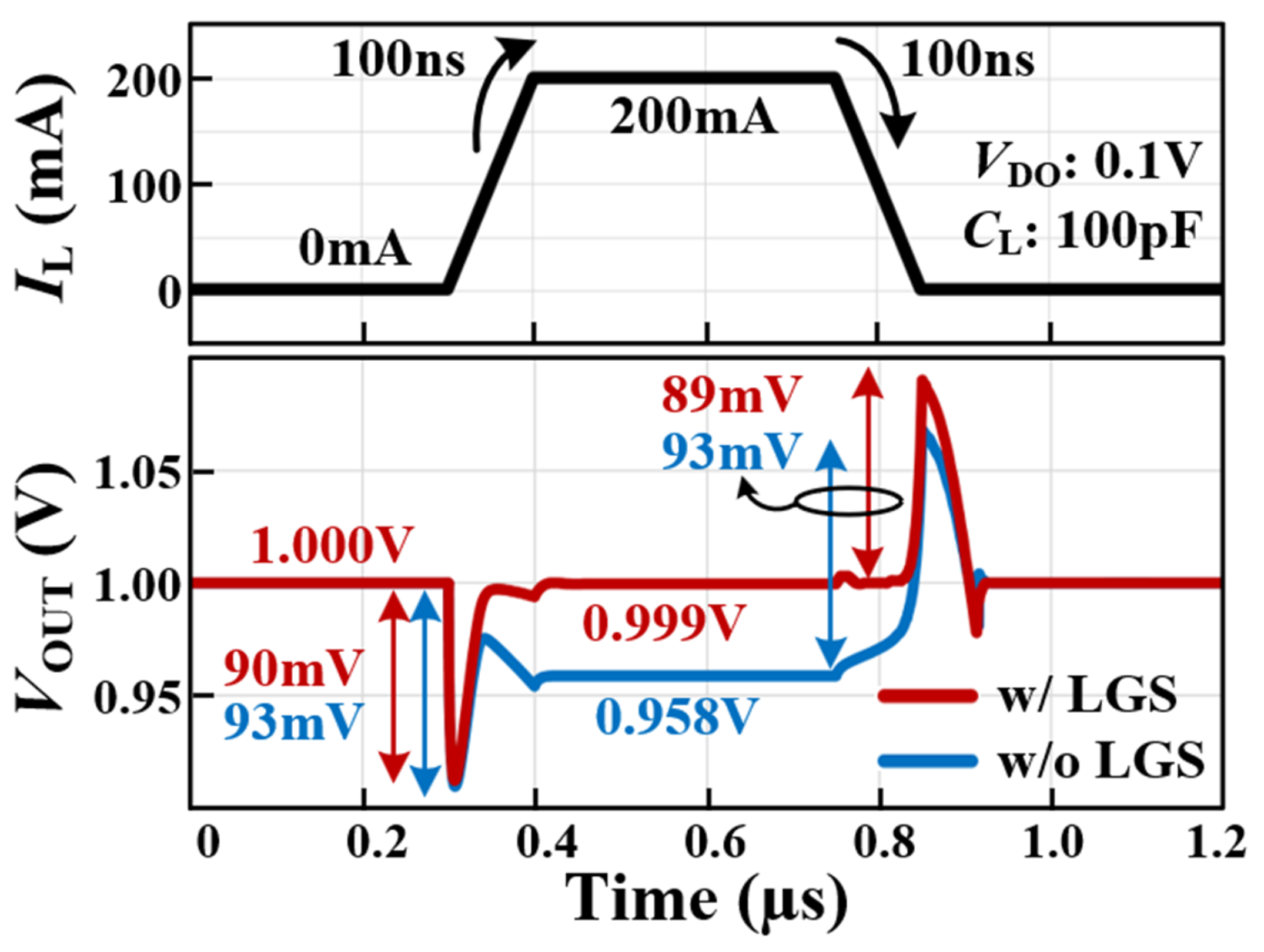
Figure 8 shows the simulated load-transient responses of the LDO with and without the LGB for a 0 to 200 mA current step (100 ns edge time) at VDO = 0.1 V and CL = 100 pF. With the LGB enabled, the steady-state output voltage is regulated at 0.999 V with undershoot and overshoot magnitudes of 90 mV and 89 mV, respectively. Without the LGB, the steady-state output shifts to 0.958 V—a 42 mV offset reflecting the degraded DC loop gain—while the transient excursions are comparable (93 mV undershoot and overshoot). The similar transient peak amplitudes indicate that the slew rate, limited by the stage driving MP, governs the dynamic behavior in both cases, whereas the improved DC accuracy with the LGB reflects its superior static regulation.
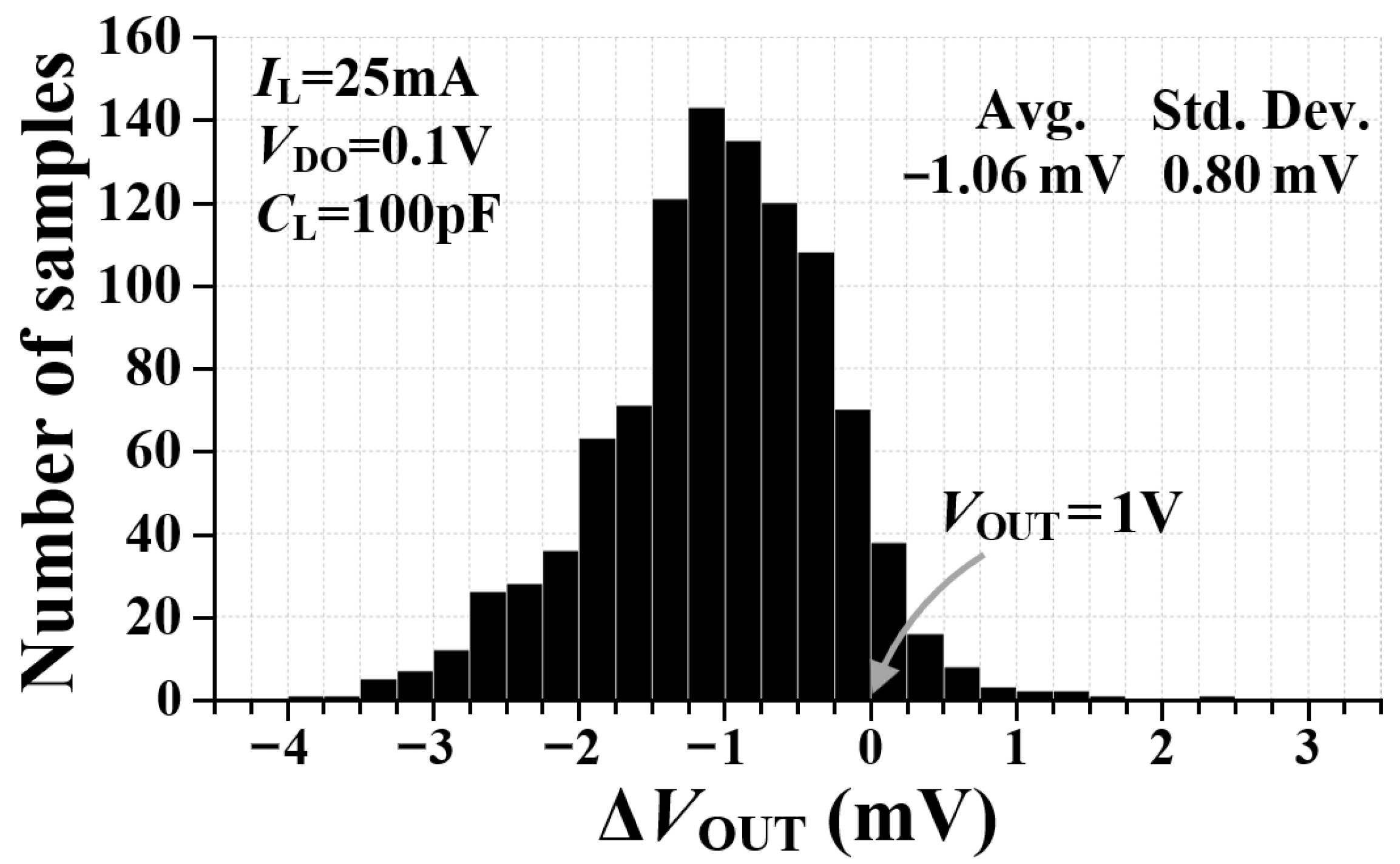
Figure 9 presents the results of a Monte Carlo simulation of the output voltage error ΔVOUT at IL = 25 mA, VDO = 0.1 V, and CL = 100 pF, with a target output voltage of VOUT = 1 V. The distribution yields an average offset of −1.06 mV and a standard deviation of 0.80 mV, indicating that the proposed LDO achieves acceptable output accuracy even in the presence of process and mismatch variations.

4. Transistor-Level Design of the Building Blocks

4.1. Error Amplifier

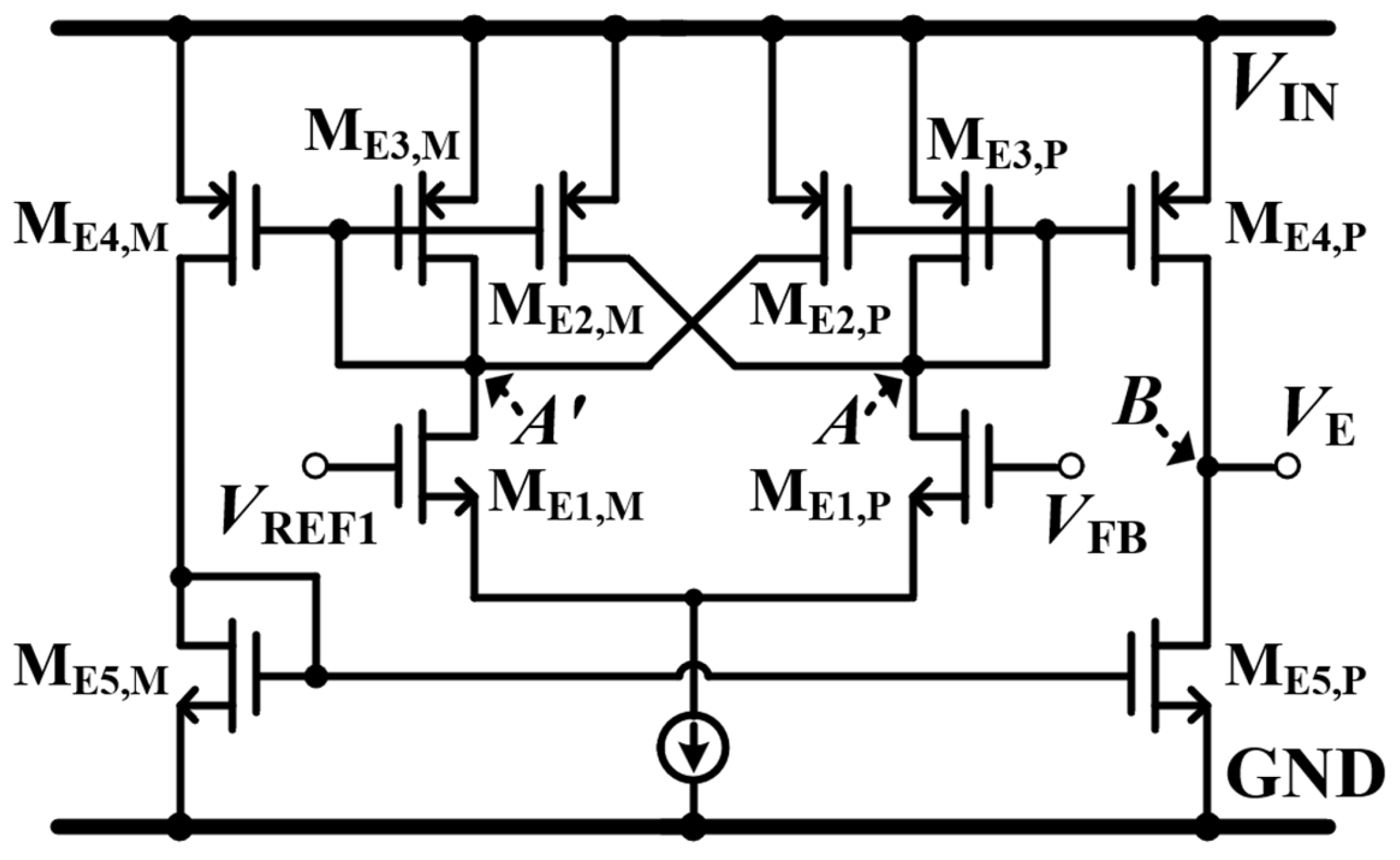
High inherent PSR of the error amplifier at low frequencies is a prerequisite for achieving excellent overall PSR. This design adopts a negative-gm operational amplifier topology [27], in which the negative impedance generated by cross-coupled transistors cancels the low impedance of diode-connected loads. This technique dramatically boosts the output impedance—and hence the voltage gain—of the first stage without requiring larger bias currents. The input pair employs NMOS devices, and an NMOS-type current mirror at the second stage ensures high supply rejection at low frequencies [28].
Figure 10 shows the transistor-level schematic of the error amplifier. The first stage consists of cross-coupled PMOS load pairs (ME3,M/ME3,P and ME4,M/ME4,P) with NMOS input transistors (ME2,M and ME2,P), creating high-impedance nodes A and A′ through negative-gm enhancement. The reference voltage VREF1 and the feedback voltage VFB are applied to the NMOS differential pair (ME1,M and ME1,P), and the second stage produces the output VE at node B. Tail current sources ME5,M and ME5,P set the bias condition.
Particular attention was paid to minimizing the parasitic capacitances at the internal high-impedance nodes (designated A and A′ in the schematic) by keeping the transistor dimensions compact. This strategy pushes the associated parasitic poles well beyond the UGF, preventing them from eroding the phase margin. The overall voltage gain of the error amplifier, evaluated at its output node B, exceeds 40 dB at low frequencies.

4.2. Secondary Amplifier

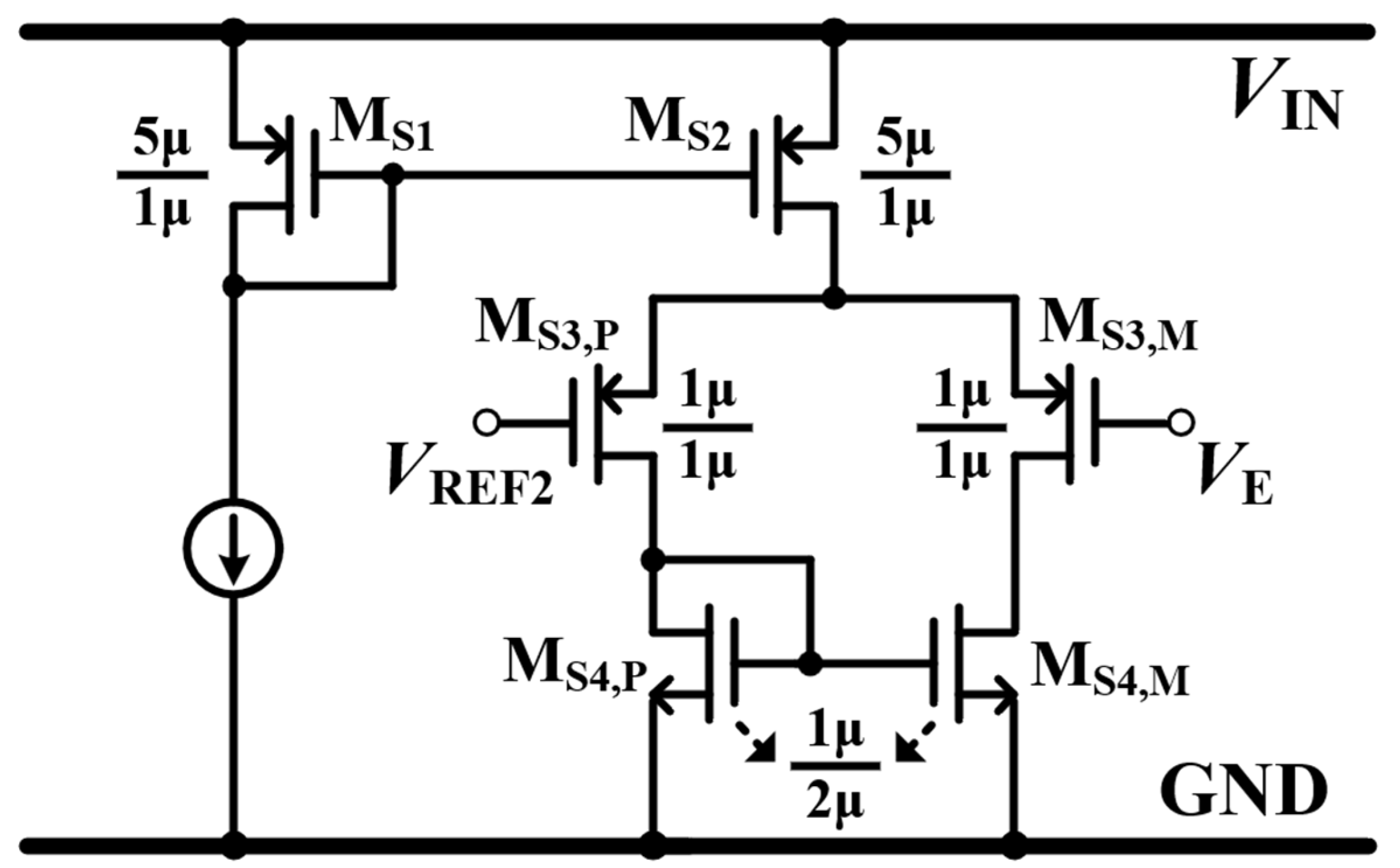
The secondary amplifier within the LGB is a conventional single-stage differential pair using PMOS input transistors, which inherently provides superior supply rejection at low frequencies compared with an NMOS input pair [28]. The secondary amplifier of the LGB employs a PMOS-input differential pair with a top PMOS bias current source. This topology provides inherently superior supply-noise rejection compared to NMOS-input configurations, because supply perturbations are tracked by both the source nodes of the input pair and the bias reference, resulting in first-order cancelation of supply-induced V G S modulation at the input stage [28]. This property is particularly important for the LGB, since any supply noise that leaks through the secondary amplifier would directly degrade the overall PSR improvement provided by the loop-gain boosting mechanism. Because its primary function is to establish a high DC gain for clamping VE rather than to extend signal bandwidth, the secondary amplifier operates with a modest current budget of only 2 μA and delivers approximately 26 dB of voltage gain. To further improve the common-mode rejection ratio (CMRR), the tail current source is implemented with a long channel length to increase its output resistance.
Figure 11 presents the transistor-level schematic of the secondary amplifier. The PMOS input pair (MS3,P and MS3,M), sized at 1 μ/1 μ, receives VREF2 and VE at its differential inputs. The input pair is sized sufficiently large to reduce random offset and threshold-voltage mismatch, thereby helping maintain CMRR robustness under PVT variations. The NMOS current-mirror load (MS4,P and MS4,M, sized at 1 μ/2 μ) provides the output at VS. In layout, the input differential pair and active load are arranged symmetrically using common-centroid and interdigitated configurations to minimize gradient-induced mismatch. The compact transistor dimensions keep the parasitic pole at the output node well above the frequencies of interest.

5. Theoretical Analysis of Loop Gain, Stability, and PSR

5.1. Loop-Gain Transfer Function

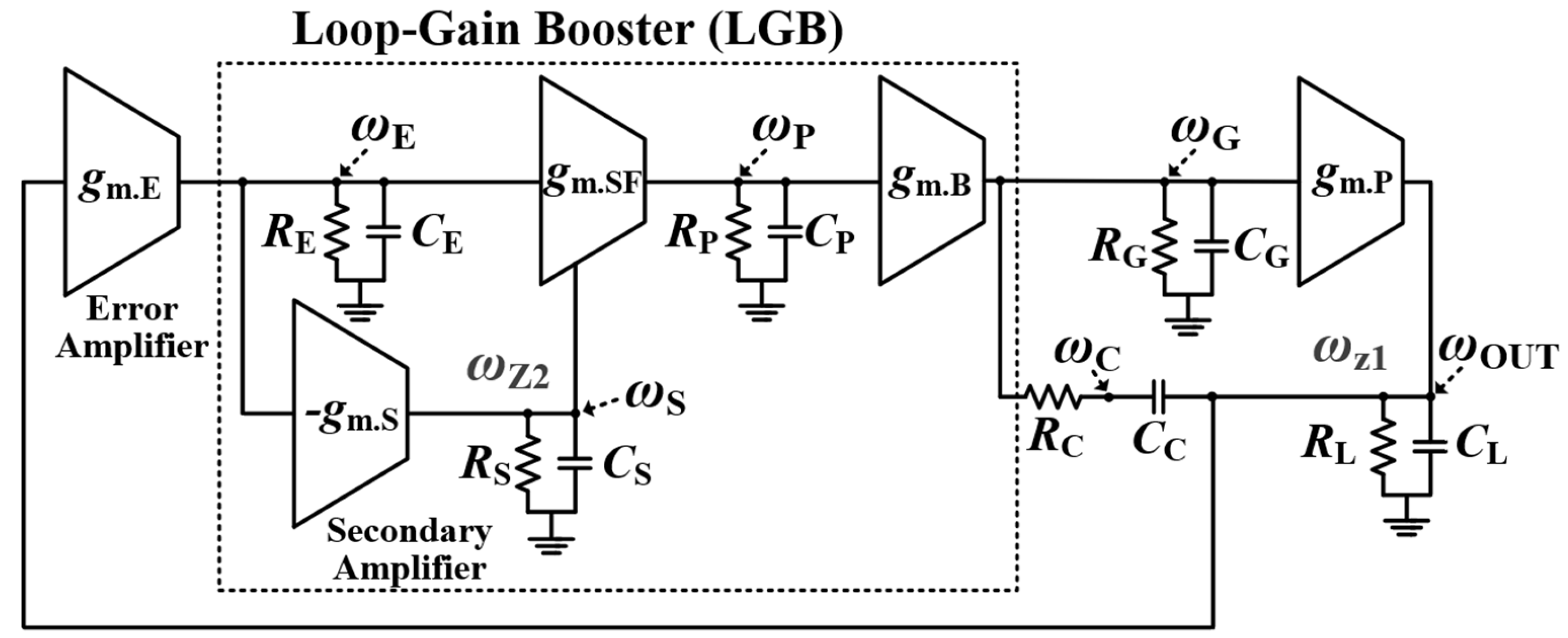
Figure 12 illustrates the complete small-signal equivalent model of the proposed LDO. The error amplifier is represented by its transconductance gm,E driving the output resistance RE in parallel with the parasitic capacitance CE. The LGB is modeled as two parallel paths: the main source-follower path with transconductance gm,SF feeding into RP and CP, and the secondary amplifier path with gain −gm,S driving RS and CS, where ωS marks the secondary amplifier’s pole, and ωZ2 denotes the LHP zero produced by the parallel-path structure. The low-gain buffer (gm,B) connects to the gate node of MP, modeled by RG and CG with the dominant pole ωG. The Miller compensation network (RC and CC) introduces the compensating zero ωZ1, and the output stage comprises the pass transistor transconductance gm,P driving the parallel combination of the load resistance RL and the load capacitor CL, establishing the output pole ωOUT.
The complete small-signal model of the proposed regulator includes multiple gain stages, each contributing poles and zeros. Within the UGF, three poles and two LHP zeros dominate the phase-margin budget. The first (dominant) pole ωG arises at the gate of MP, where the Miller-amplified compensation capacitor and the intrinsic gate capacitance create a large effective capacitance. The second pole ωS lies at the output of the secondary amplifier, and the third pole ωOUT is located at the LDO output. The first LHP zero ωZ1 is generated by the series RC–CC Miller network, while the second LHP zero ωZ2 originates from the parallel-path structure of the LGB, as derived in (2). The DC loop gain is given by:
A v , D C = g m , E R E 1 + g m , S R S g m , S F 2 g m , S F 1 g m , B R G g m , P R L r o , p

5.2. Phase Margin and Maximum Load Capacitance

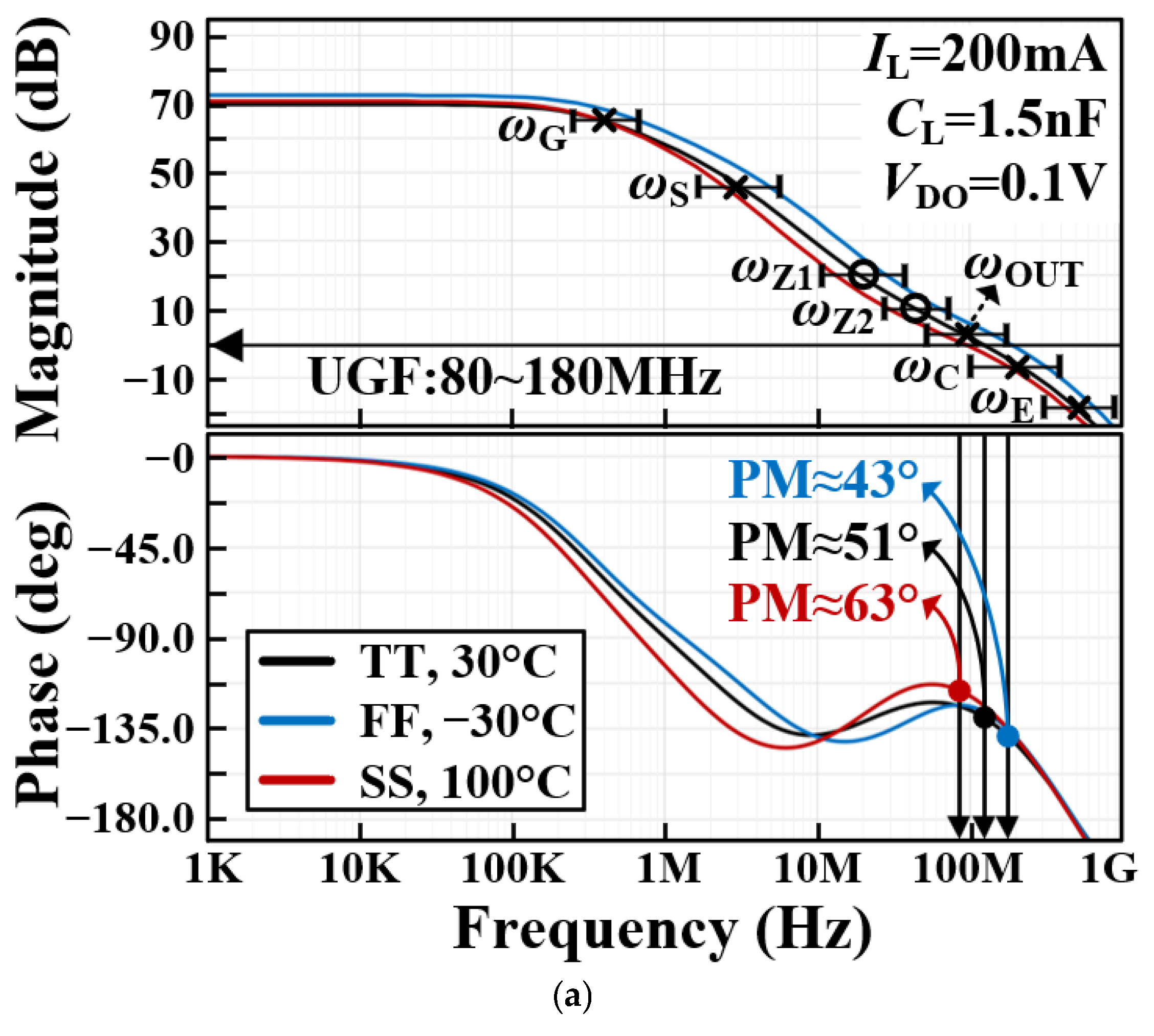
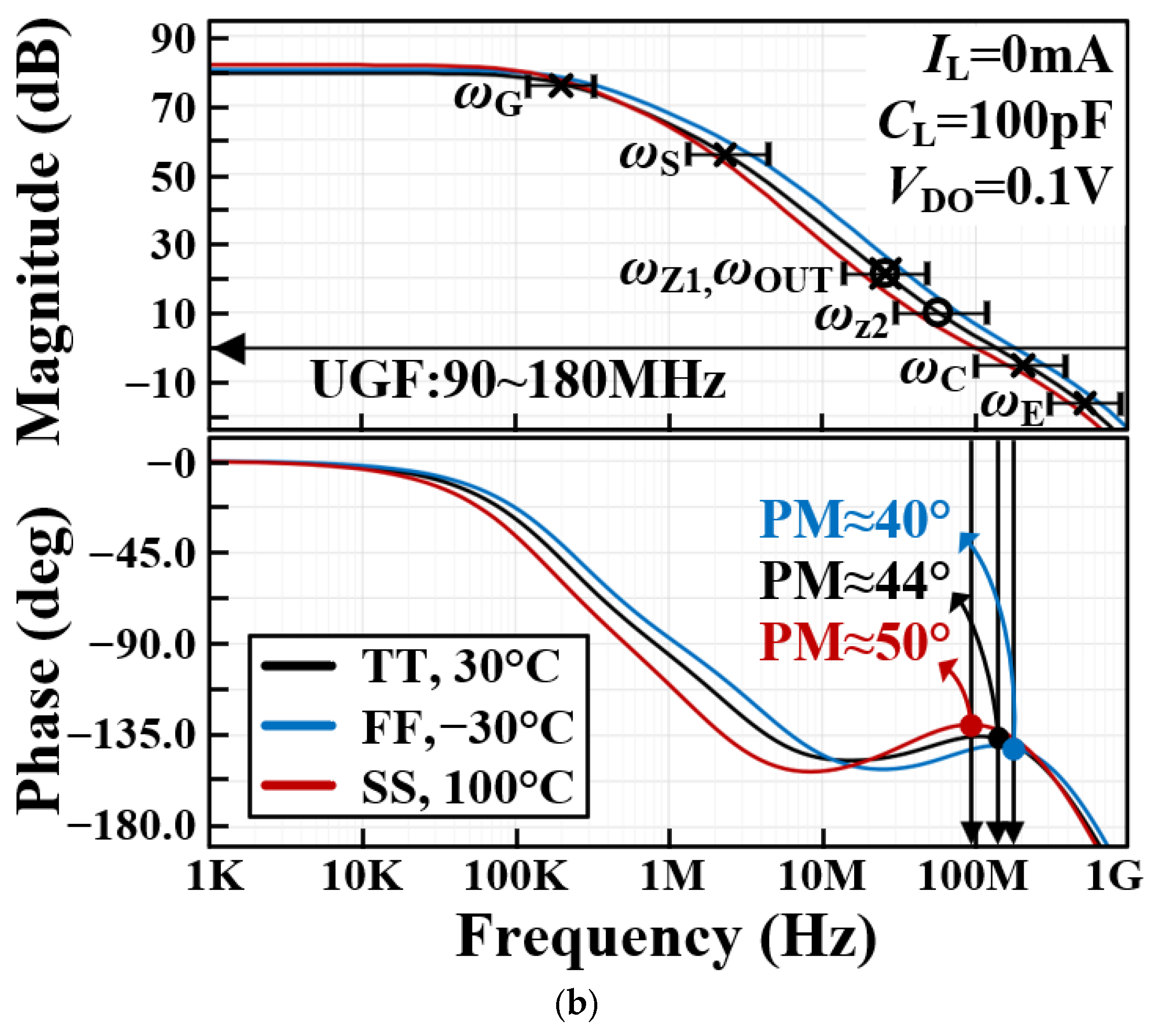
Figure 13a shows the Bode plots (magnitude and phase) of the proposed LDO obtained from post-layout simulations across three representative process–temperature corners: [TT, 30 °C], [FF, −30 °C], and [SS, 100 °C]. Figure 13a presents the results at IL = 200 mA and CL = 1.5 nF (it is not required CL, but just the maximum allowable CL at full load). The dominant gate pole ωG, the secondary amplifier pole ωS, and the output pole ωOUT are clearly visible in the magnitude response, along with the two LHP zeros (ωZ1 and ωZ2) that provide phase recovery before the crossover. The UGF ranges from 80 to 180 MHz, and the worst-case phase margin is approximately 43° at the [FF, −30 °C] corner, with 51° at [TT, 30 °C] and 63° at [SS, 100 °C]. Figure 13b shows the corresponding plots at IL = 0 mA and CL = 100 pF. The UGF in this case spans 90–180 MHz, with worst-case phase margins of approximately 40°, 44°, and 50° at the [FF, −30 °C], [TT, 30 °C], and [SS, 100 °C] corners, respectively.
Post-layout simulations were carried out across five process–temperature corners: [TT, 70 °C], [FF, −30 °C], [SS, 100 °C], [FF, 100 °C], and [SS, −30 °C]. For IL = 200 mA and CL = 1.5 nF (the maximum allowable load capacitance at full load), the worst-case phase margin was 43° at the [FF, −30 °C] corner.

5.3. PSR Analysis

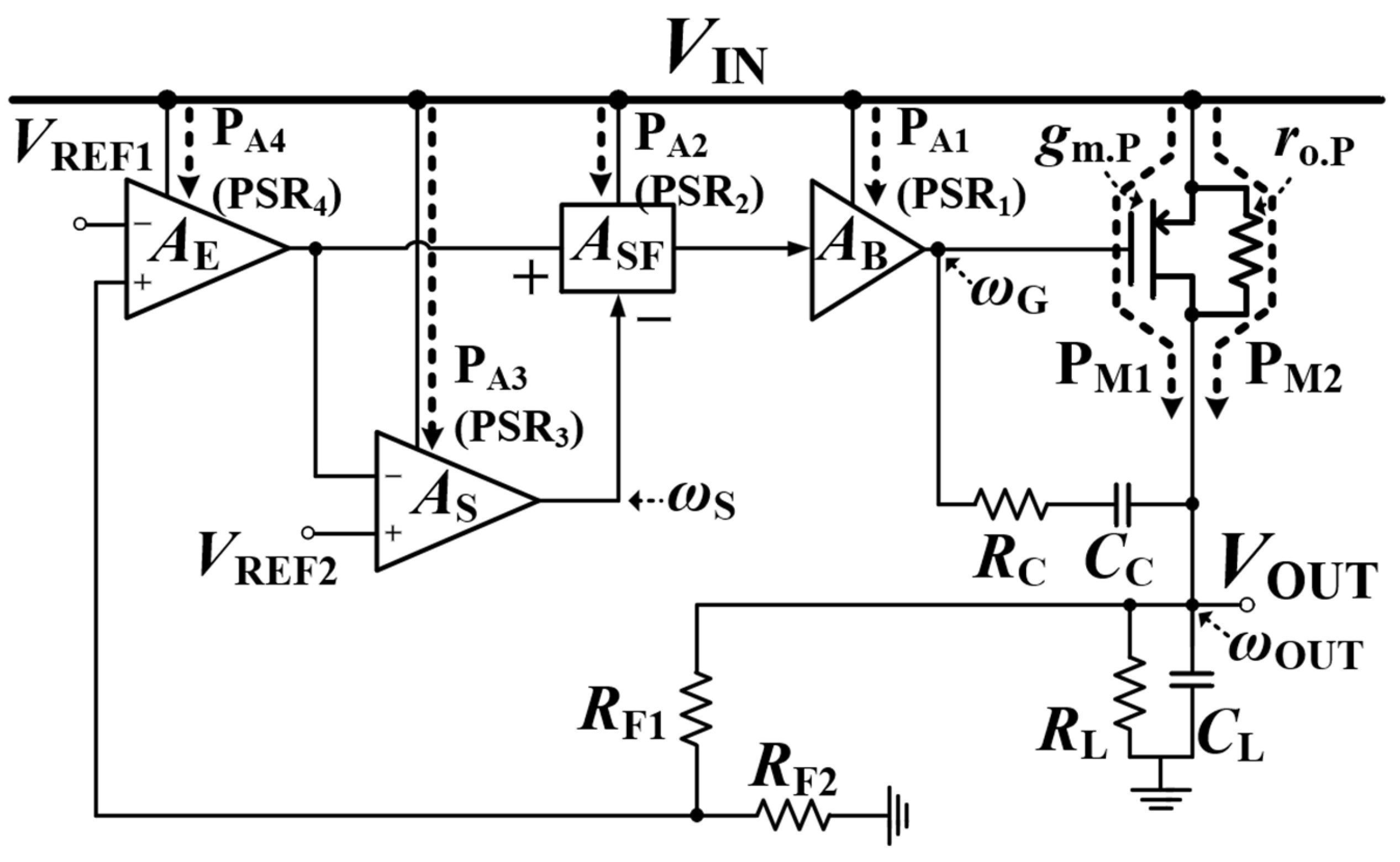
Figure 14 depicts the coupling paths through which supply noise VIN reaches the LDO output VOUT. Four principal paths are identified: PA1 (PSR1) propagates through the second source follower of the LGB; PA2 (PSR2) couples through the source-follower-based voltage subtractor ASF into the buffer; PA3 (PSR3) passes through the secondary amplifier AS; and PA4 (PSR4) enters via the error amplifier AE. The output node also receives direct supply coupling through the pass transistor’s drain–source path, modeled by PM1 and PM2.
Supply noise reaches the LDO output through several coupling mechanisms: the transconductance and drain–source conductance of MP, and parasitic supply-sensitivity paths in the error amplifier, the secondary amplifier, the voltage subtractor, and the second source follower of the LBG. A breakdown analysis at 1 kHz, 100 kHz, and 10 MHz reveals that the pass-transistor paths account for 88–98% of the total supply coupling, with the remaining contributions from the amplifier stages limited to less than 12%. The overall PSR within the UGF is well described by:
P S R L D O s K M 1 , M 2 + K A 1 + K A 2 , A 3 , A 4 1 + L G s 1 + s ω o u t
where KM1,M2 captures the pass-transistor coupling (6–14 dB), KA1 represents the buffer path contribution (suppressed to below −8 dB by the NMOS active load), and KA2,A3,A4 accounts for the remaining amplifier stages (collectively below −5 dB at low frequencies). The close agreement between the analytical model and full post-layout simulation validates the adequacy of this PSR decomposition.
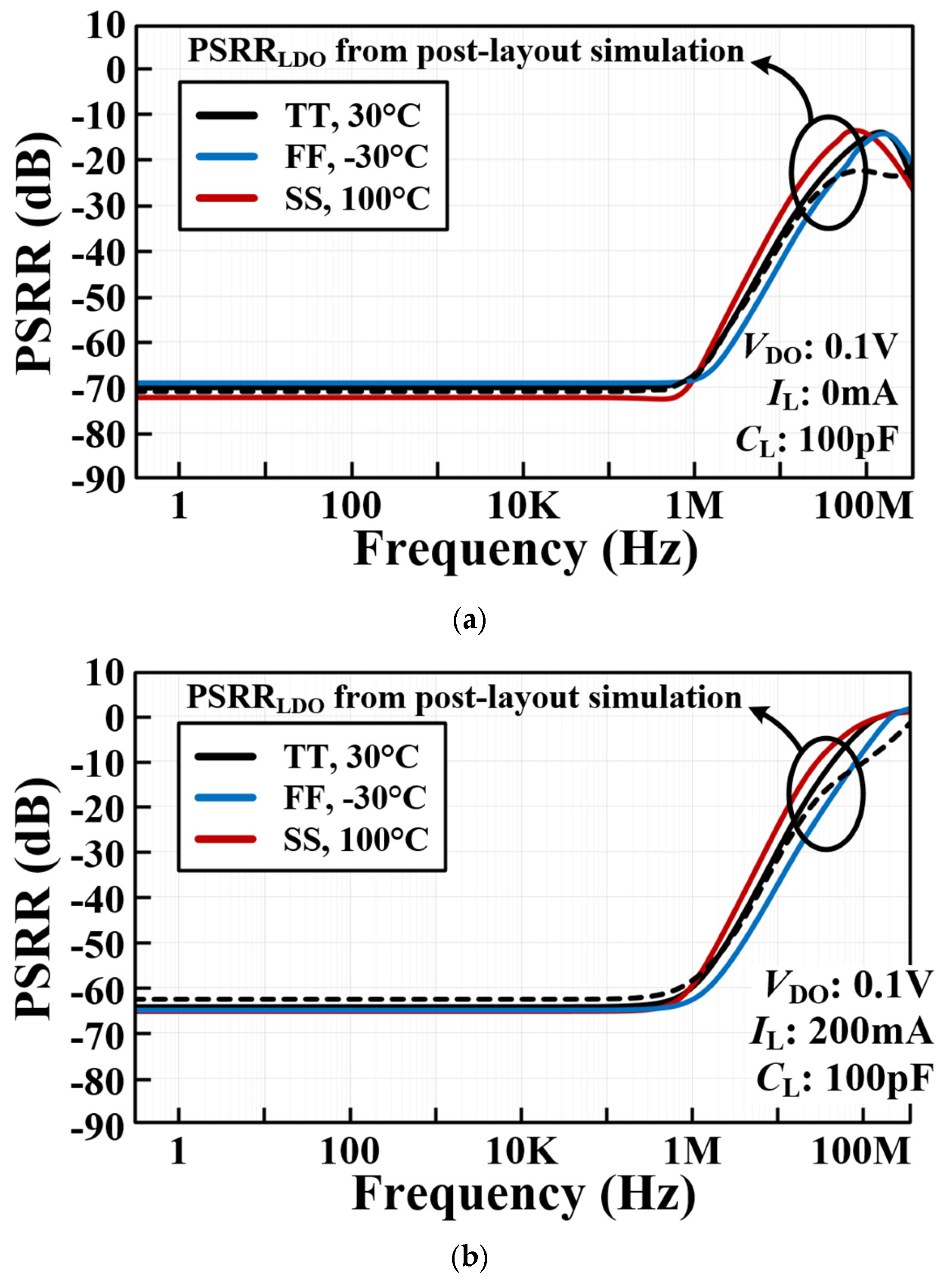
Figure 15 compares the overall PSR obtained from post-layout simulation (solid lines, at three process–temperature corners: [TT, 30 °C], [FF, −30 °C], and [SS, 100 °C]) with the analytical prediction from Equation (5) evaluated in MATLAB (ver.R2026A) (dashed line). Figure 15a shows the case with VDO = 0.1 V, IL = 0 mA, and CL = 100 pF, and Figure 15b shows the case with VDO = 0.1 V, IL = 200 mA, and CL = 100 pF. In both cases, the analytical model closely tracks the simulation across the entire frequency range, confirming the validity of the PSR decomposition presented above.

6. Experimental Results

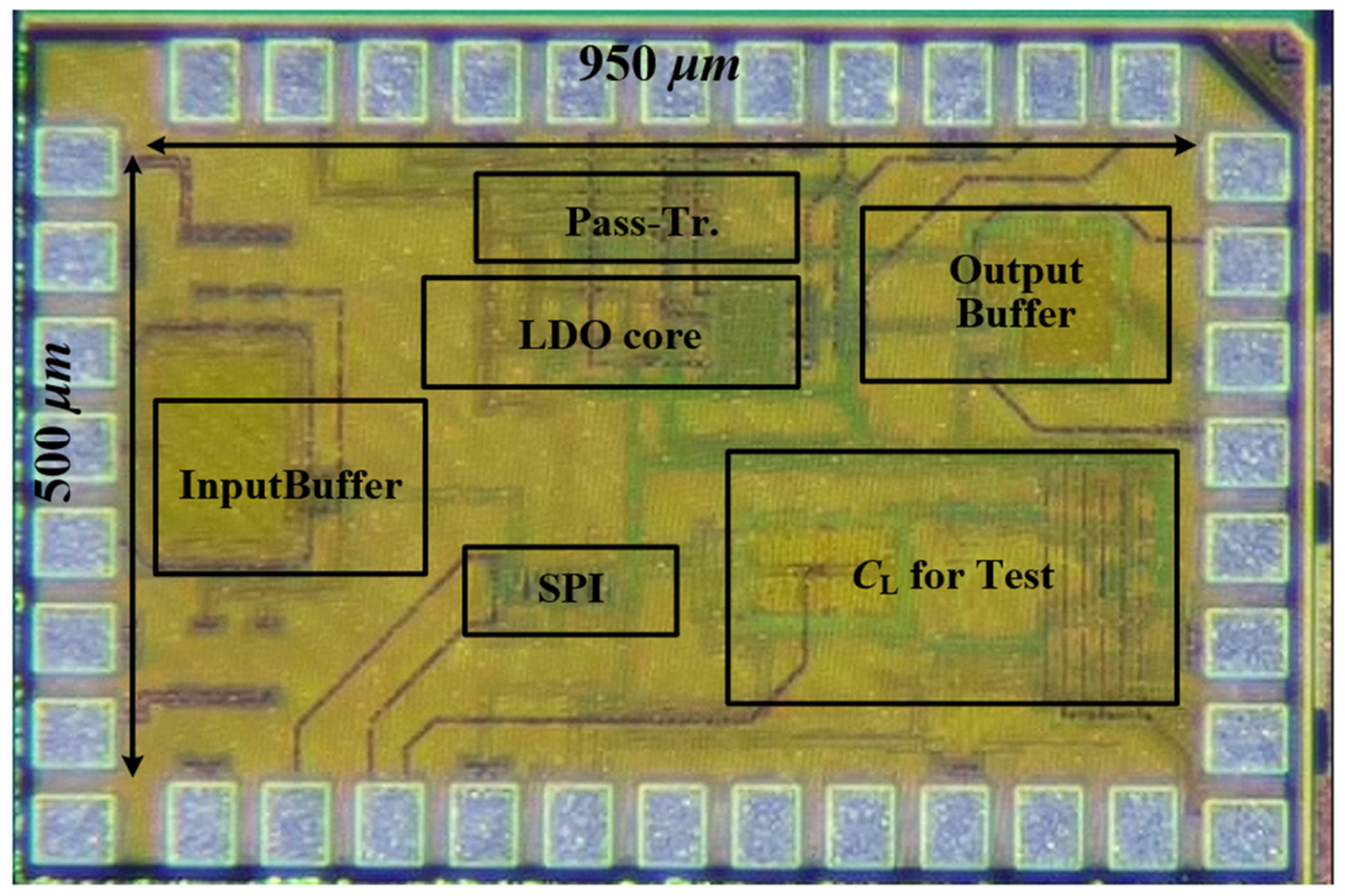
Figure 16 shows the die micrograph of the proposed LDO fabricated in a 40 nm CMOS process. The total chip area is 950 μm × 500 μm, and the layout identifies the major functional blocks: the pass transistor (Pass-Tr.), the LDO core containing the error amplifier and LGB, the output buffer, the input buffer, an SPI interface for digital control, and the on-chip load capacitor CL used for testing. The total active area, including the 4 pF on-chip compensation capacitor, measures 0.008 mm2, of which the LGB occupies a mere 240 μm2 (approximately 3% of the core area).
The input supply voltage is 1.1 V, and the output voltage is adjustable between 0.7 and 1.0 V, corresponding to dropout voltages in the range of 0.1–0.4 V. Both reference voltages, VREF1 and VREF2, were provided externally during testing.
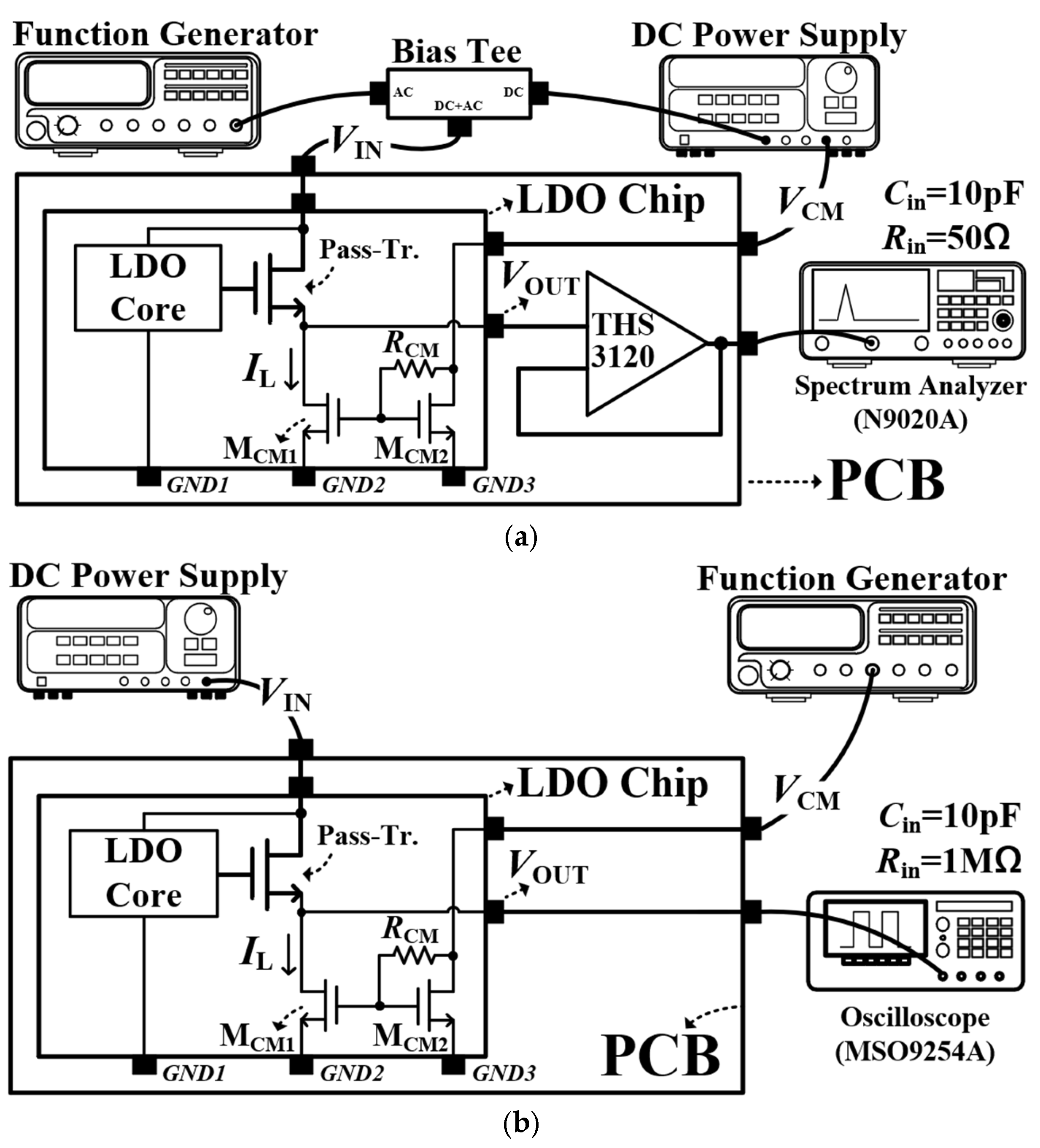
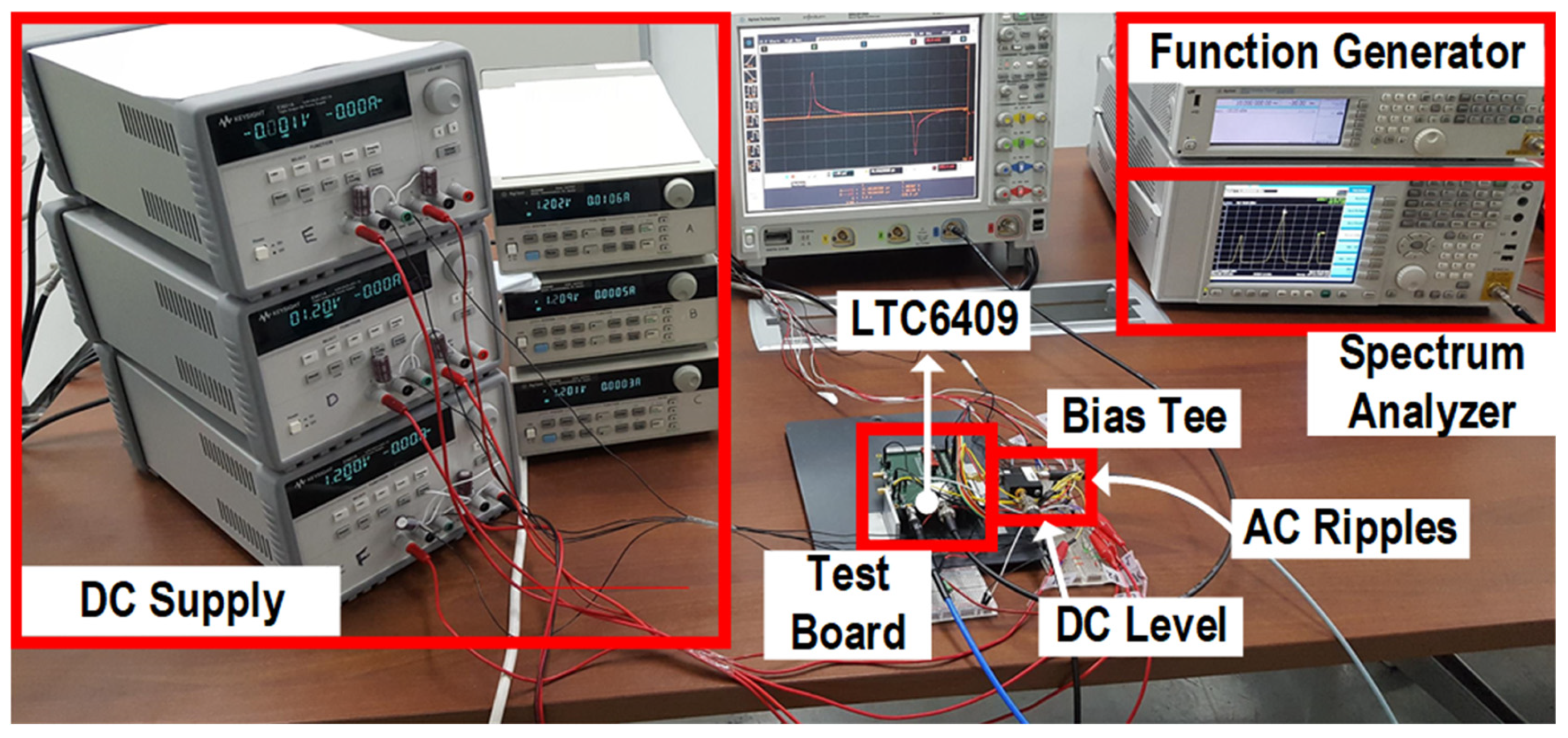
Figure 17 illustrates the measurement setups used to characterize the LDO. Figure 17a shows the PSR measurement configuration, in which a function generator provides an 80 mV peak-to-peak ac ripple that is combined with the DC supply through a bias tee to produce VIN. The output voltage VOUT is sensed through a common-mode measurement resistor RCM and buffered by a THS 3120 amplifier before being analyzed by a spectrum analyzer (Keysight Technologies, Santa Rosa, CA, USA; N9020A). The input capacitor Cin = 10 pF and termination resistor Rin = 50 Ω ensure proper impedance matching. Multiple ground domains (GND1, GND2, GND3) are carefully managed on the PCB to minimize ground-loop interference. Figure 17b depicts the load-transient measurement setup, where a function generator drives the load current through the common-mode node with Rin = 1 MΩ and Cin = 10 pF, and the output transient is captured by an oscilloscope (Tektronix, Beaverton, OR, USA; MSO9254A). Figure 18 shows our actual measurement setup.

6.1. Power-Supply Rejection

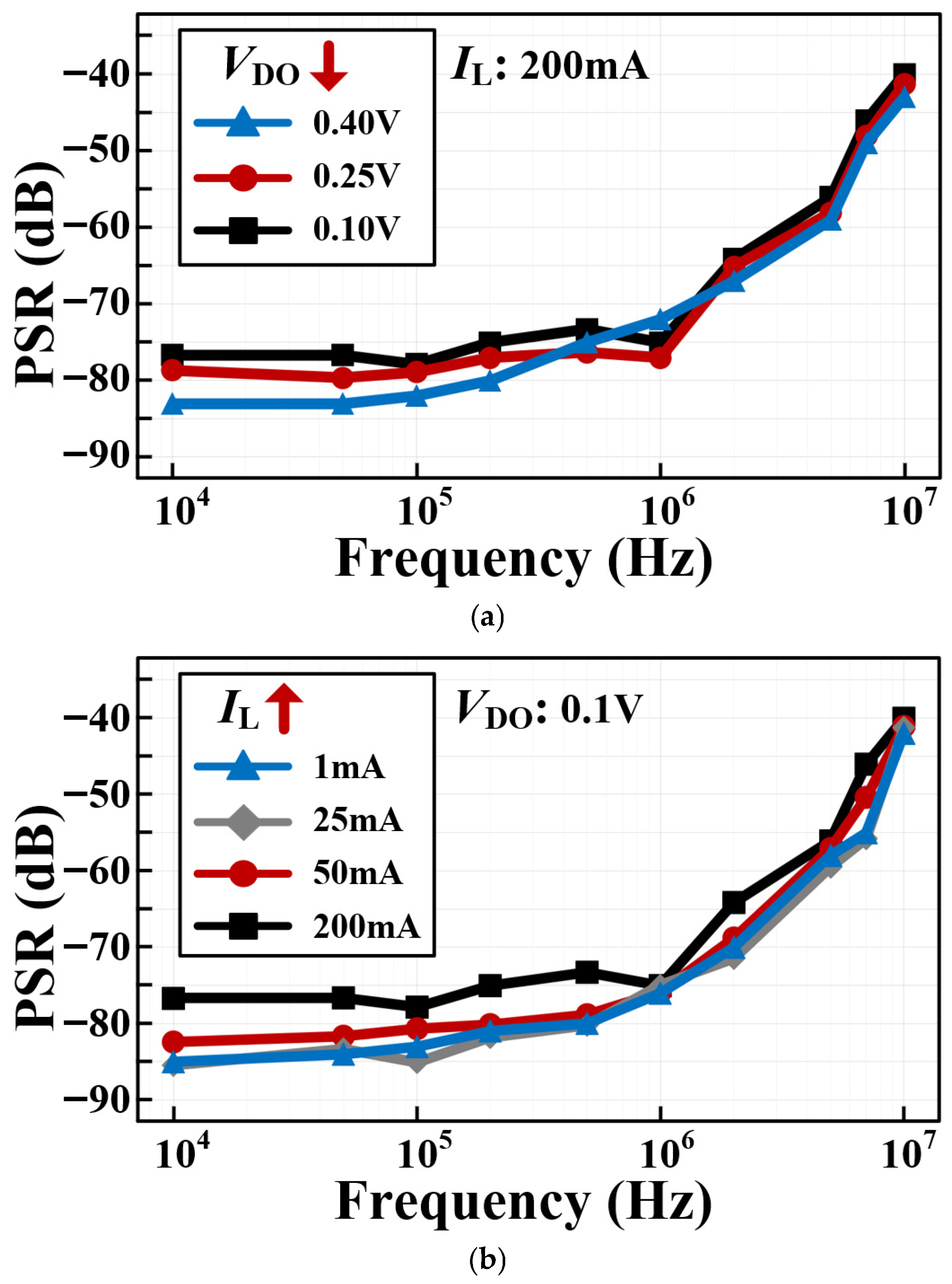
PSR measurements were conducted by superimposing an 80 mV peak-to-peak ac ripple onto VIN and sweeping the frequency from 10 kHz to 10 MHz. Figure 19a shows the measured PSR with the LGB enabled as VDO decreases from 0.4 to 0.1 V at a fixed IL of 200 mA. Even under the most stressed condition of VDO = 0.1 V, the LDO sustains PSR values better than −78, −72, and −40 dB at 100 kHz, 1 MHz, and 10 MHz, respectively—demonstrating the technique’s efficacy in preserving high rejection under low-headroom operation. Figure 19b presents the measured PSR as IL increases from 1 mA to 200 mA at VDO = 0.1 V. The PSR remains largely invariant with load current when the LGB is active, confirming the robustness of the proposed approach across the entire load range. Even at a light load current of 1 mA, the proposed LDO sustains PSR values better than −84 dB, −78 dB, and −42 dB at l00 kHz, 1 MHz, and 10 MHz, respectively. This demonstrates that the supply rejection performance of the proposed design is well maintained across the full range of load current conditions.

6.2. Transient Response

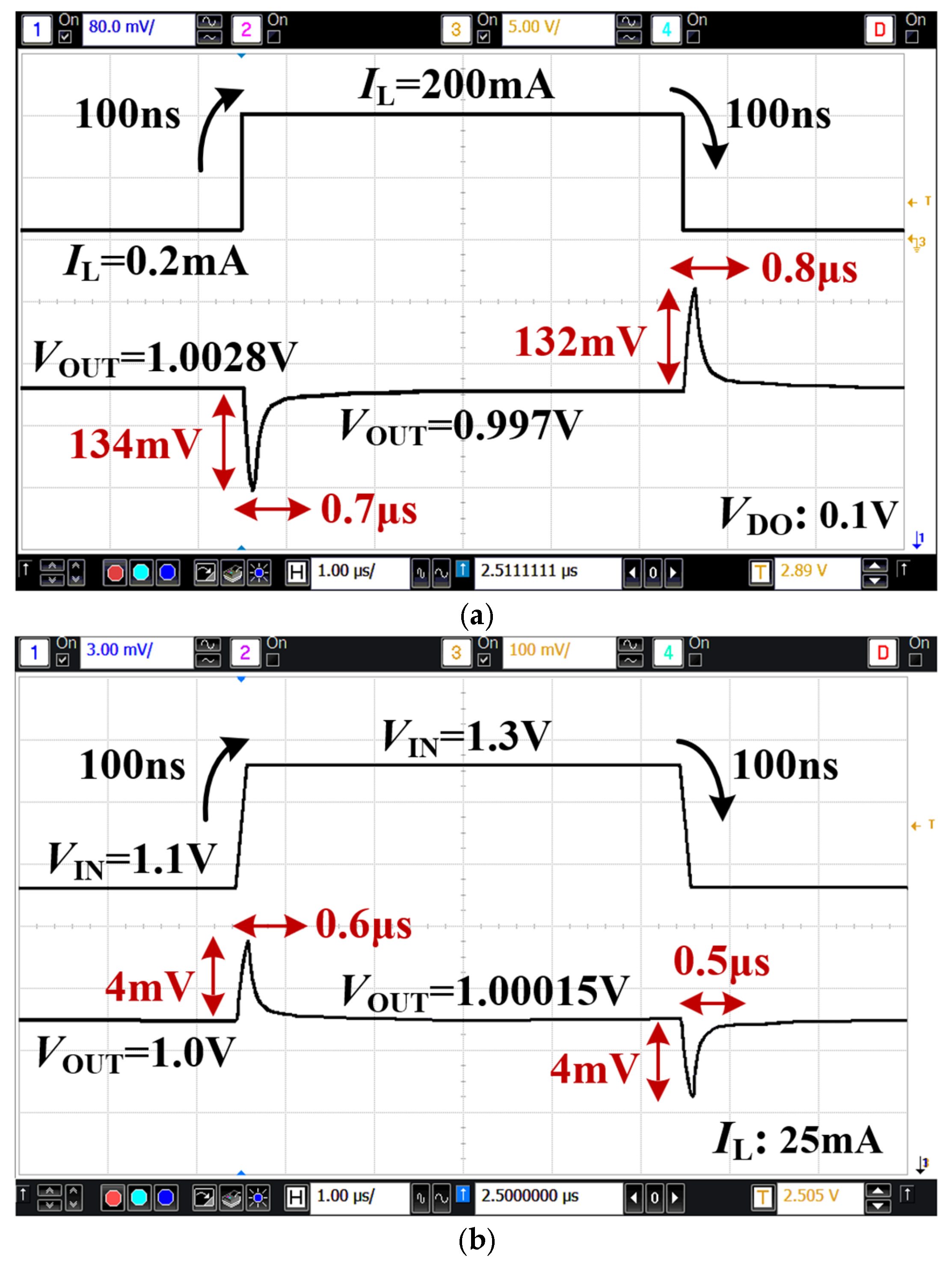
Figure 20a shows the measured load-transient response when IL steps between 0.2 and 200 mA with 100 ns edge time at VIN = 1.1 V, VOUT = 1.0 V (VDO = 0.1 V), and CL = 100 pF. The steady-state output voltage shifts from 1.0028 V at light load to 0.997 V at full load, yielding a load regulation of 19 μV/mA with the LGB enabled. The undershoot and overshoot magnitudes are 134 mV and 132 mV, respectively, with recovery times of 0.7 μs (undershoot) and 0.8 μs (overshoot). Figure 20b shows the measured line-transient response when VIN steps between 1.1 and 1.3 V at IL = 25 mA. The output voltage fluctuations are limited to 4 mV in both directions, with a settling time of approximately 0.6 μs for the rising edge and 0.5 μs for the falling edge, yielding a line regulation of 0.75 mV/V. These results confirm that the LGB successfully maintains a high loop gain under both load and supply perturbations.

6.3. Output Noise

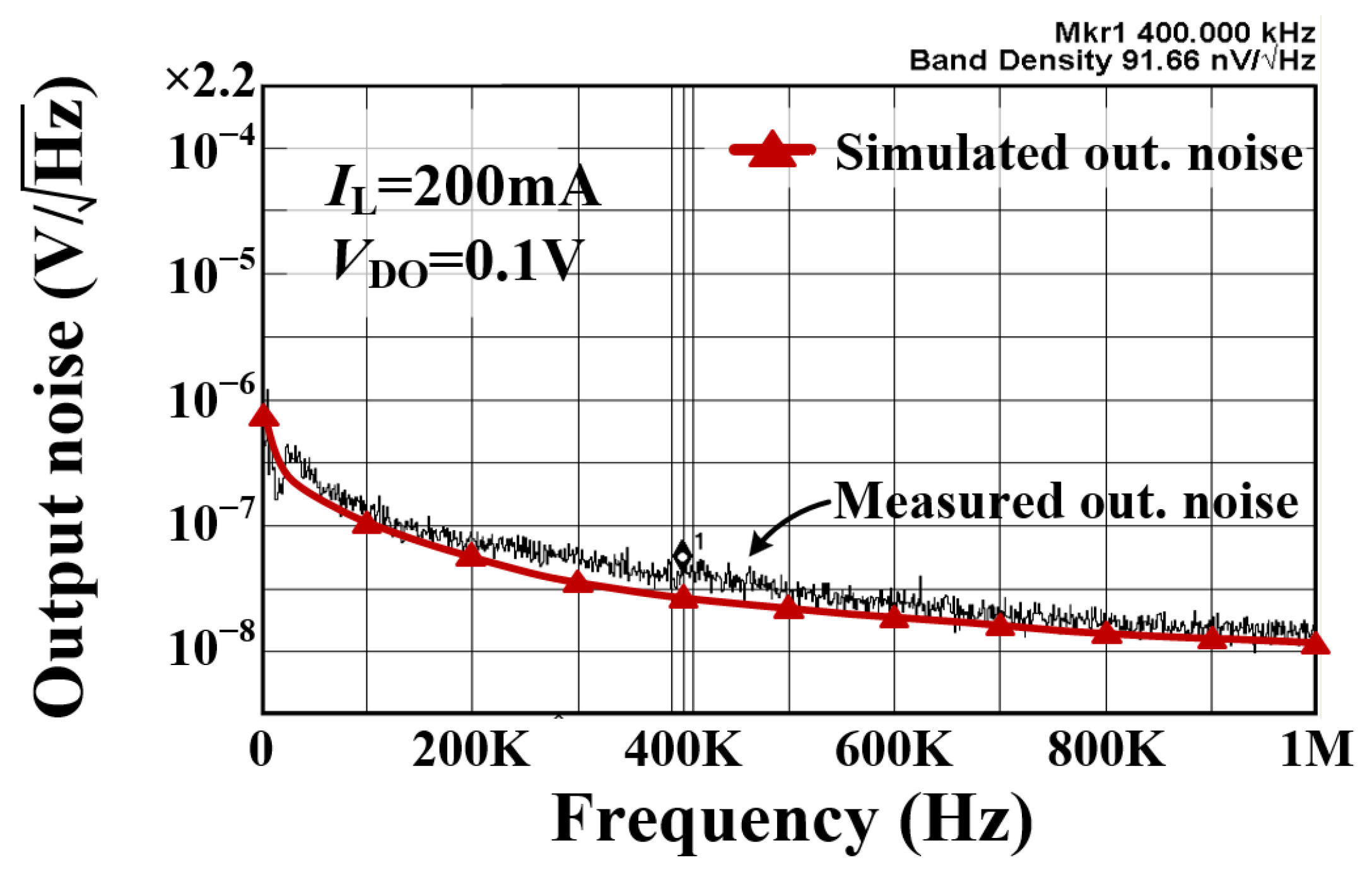
Figure 21 compares the measured and simulated output noise spectral density of the proposed LDO at IL = 200 mA and VDO = 0.1 V. The measurement was performed using a spectrum analyzer, and the results are plotted alongside the post-layout simulation predictions. The measured spot noise density at a 400 kHz offset is 88.58 n V / H z , showing reasonable agreement with the simulated values. The noise spectrum exhibits the expected 1/f characteristic at lower frequencies, transitioning to a flat thermal noise floor at higher offsets. Importantly, toggling the LGB has no appreciable effect on the noise floor, indicating that the dominant noise contributor is the error amplifier rather than the LGB circuitry.

6.4. Performance Summary and Comparison

Table 1 benchmarks the proposed LDO against recently reported state-of-the-art external-capacitor-less LDOs in terms of PSR, load capability, regulation performance, transient response, quiescent current, and silicon area. Among the compared designs, the proposed LDO exhibits the strongest PSR at all reported frequency points, achieving –78 dB at 100 kHz, –72 dB at 1 MHz, and –40 dB at 10 MHz. In addition, it supports the highest maximum load current of 200 mA while operating with the lowest dropout voltage of 0.1 V. Its UGF also extends up to 200 MHz, indicating a very wide loop bandwidth. In contrast, prior works generally either support lower maximum load currents or exhibit weaker PSR in the MHz range [29,30,31,32,33,34]. These results suggest that the proposed LGB-based architecture is highly effective in simultaneously achieving strong supply-noise suppression, wide loop bandwidth, and high load-driving capability.
From the implementation viewpoint, the proposed LDO also provides a competitive overall design point. Its line regulation is 0.75 mV/V, which is comparable to [29] and better than [30,31,33,34]. The active area is only 0.008 mm2, which is among the smallest in Table 1 and is smaller than those of [29,31,32]. In addition, as described in the circuit implementation, the LGB itself introduces only 7 μA of additional quiescent current and 240 μm2 of area overhead. On the other hand, the load regulation of 29 μV/mA is not the lowest among the compared works, indicating that the design emphasis is placed not on minimizing a single DC metric, but on achieving a balanced optimization across PSR, bandwidth, dropout, load capability, and area.
In terms of transient behavior, the proposed LDO achieves the smallest undershoot of 134 mV among the compared designs. Its F O M T R is 24.1 mV, which is significantly better than those of [29,32], although some prior works, such as [30,33,34], report smaller F O M T R values or shorter settling times. However, those designs generally show trade-offs in maximum load current, PSR, or both. The measured settling time of 0.8 μs is also faster than those of [31,32], while remaining competitive considering the 200 mA load-driving capability. Therefore, the key advantage of the proposed LDO is not merely the best result in a single metric, but the well-balanced combination of strong PSR from 100 kHz to 10 MHz, low-dropout operation, high maximum load current, compact area, and competitive transient performance without requiring an external capacitor.

7. Conclusions

This paper has presented a fully integrated gate-pole-dominant LDO regulator that leverages a loop-gain booster to maintain high PSR performance over a wide load current range without relying on external capacitors. By clamping the error amplifier’s output DC level at its gain-maximizing operating point, the LGB ensures that the UGF of the feedback loop remains high regardless of variations in the load current and dropout voltage. Implemented in a 40 nm CMOS process, the prototype achieves PSR values of −72 dB and −40 dB at 1 MHz and 10 MHz, respectively, under the most challenging conditions of 200 mA load current and 0.1 V dropout.
An intrinsic LHP zero generated by the dual-path topology of the LGB compensates for one of the in-band poles, ensuring robust stability with phase margins exceeding 40° across all corners. The technique incurs only 7 μA of additional quiescent current and 240 μm2 of extra silicon area—negligible overheads relative to the total LDO budget. These attributes, combined with excellent load regulation (29 μV/mA) and line regulation (0.75 mV/V), make the proposed LGB technique a compelling candidate for powering noise-sensitive analog and RF circuits in advanced SoC platforms.
While the current implementation targets a 40 nm node, the LGB concept is process-agnostic and can be applied to LDOs designed in longer-channel technologies with proportional benefits to the UGF. Future work may explore combining the LGB with adaptive supply-ripple cancelation techniques to push PSR performance beyond 1 GHz, which would be particularly valuable for next-generation wideband wireless transceivers.

Author Contributions

Conceptualization, D.W.K., S.H.L. and Y.L.; Methodology, D.W.K., C.Y., J.H.P. and Y.L.; Validation, D.W.K. and Y.L.; Formal analysis, Y.L.; Investigation, D.W.K. and Y.L.; Resources, Y.L.; Data curation, C.Y.; Writing—original draft, C.Y. and Y.L.; Writing—review & editing, C.Y. and Y.L.; Visualization, C.Y. and Y.L.; Supervision, Y.L.; Funding acquisition, Y.L. All authors have read and agreed to the published version of the manuscript.

Funding

This work was supported in part by the National Research and Development Program through the National Research Foundation (NRF) of Korea funded by the Ministry of Science and Information and Communications Technology (MSIT) under Grant RS-2025-02216971, in part by NRF grant funded by MSIT under Grant RS-2026-25489104, in part by Institute for Information & communications Technology Promotion(IITP) grant funded by MSIT and Korea Institute for Advancement of Technology (KIAT) grant funded by the Korea Government (MOTIE) (RS-2026-25534585, HRD Program for Industrial Innovation), in part by IITP grant funded by MSIT under Grant RS-2026-25523162, in part by the BK21 FOUR program through the National Research Foundation of Korea (NRF) under the Ministry of Education (Kyung Hee University, Global Advanced Semiconductor Innovation Education and Research Group).

Data Availability Statement

Data are contained within the article. Any supplementary data presented in this study are available on request from the corresponding author.

Conflicts of Interest

The authors declare no conflict of interest.

References

  1. Shi, C.; Walker, B.C.; Zeisel, E.; Hu, B.; McAllister, G.H. A highly integrated power management IC for advanced mobile applications. IEEE J. Solid-State Circuits 2007, 42, 1723–1731. [Google Scholar] [CrossRef]
  2. Rincon-Mora, G.A.; Allen, P.E. A low-voltage, low quiescent current, low drop-out regulator. IEEE J. Solid-State Circuits 1998, 33, 36–44. [Google Scholar] [CrossRef]
  3. Yoon, H.; Kim, J.; Park, S.; Lim, Y.; Lee, Y.; Bang, J.; Lim, K.; Choi, J. A -31 dBc integrated-phase-noise 29 GHz fractional-N frequency synthesizer supporting multiple frequency bands for backward-compatible 5G using a frequency doubler and injection-locked frequency multipliers. In Proceedings of the 2018 IEEE International Solid-State Circuits Conference (ISSCC), San Francisco, CA, USA, 11–15 February 2018; pp. 366–368. [Google Scholar] [CrossRef]
  4. Wu, R.; Minami, R.; Tsukui, Y.; Kawai, S.; Seo, Y.; Sato, S.; Kimura, K.; Kondo, S.; Ueno, T.; Fajri, N.; et al. 64-QAM 60-GHz CMOS transceivers for IEEE 802.11ad/ay. IEEE J. Solid-State Circuits 2017, 52, 2871–2891. [Google Scholar] [CrossRef]
  5. Arakali, A.; Gondi, S.; Hanumolu, P.K. Low-power supply-regulation techniques for ring oscillators in phase-locked loops using a split-tuned architecture. IEEE J. Solid-State Circuits 2009, 44, 2169–2181. [Google Scholar] [CrossRef]
  6. Al-Shyoukh, M.; Lee, H.; Perez, R. A transient-enhanced low-quiescent current low-dropout regulator with buffer impedance attenuation. IEEE J. Solid-State Circuits 2007, 42, 1732–1742. [Google Scholar] [CrossRef]
  7. Ho, M.; Leung, K.N.; Mak, K.-L. A low-power fast-transient 90-nm low-dropout regulator with multiple small-gain stages. IEEE J. Solid-State Circuits 2010, 45, 2466–2475. [Google Scholar] [CrossRef]
  8. Yuk, Y.-S.; Jung, S.; Kim, C.-W.; Gwon, H.-D.; Choi, S.; Cho, G.-H. PSR enhancement through super gain boosting and differential feed-forward noise cancellation in a 65-nm CMOS LDO regulator. IEEE Trans. Very Large Scale Integr. (VLSI) Syst. 2014, 22, 2181–2191. [Google Scholar] [CrossRef]
  9. Zarate-Roldan, J.; Wang, M.; Torres, J.; Sánchez-Sinencio, E. A capacitor-less LDO with high-frequency PSR suitable for a wide range of on-chip capacitive loads. IEEE Trans. Very Large Scale Integr. (VLSI) Syst. 2016, 24, 2970–2998. [Google Scholar] [CrossRef]
  10. Leung, K.N.; Mok, P.K.T. A capacitor-free CMOS low-dropout regulator with damping-factor-control frequency compensation. IEEE J. Solid-State Circuits 2003, 38, 1691–1702. [Google Scholar] [CrossRef]
  11. Lau, S.K.; Mok, P.K.T.; Leung, K.N. A low-dropout regulator for SoC with Q-reduction. IEEE J. Solid-State Circuits 2007, 42, 658–664. [Google Scholar] [CrossRef]
  12. Zhan, C.; Ki, W.-H. Output-capacitor-free adaptively biased low-dropout regulator for system-on-chips. IEEE Trans. Circuits Syst. I 2010, 57, 1017–1028. [Google Scholar] [CrossRef]
  13. Chong, S.S.; Chan, P.K. A 0.9-μA quiescent current output-capacitorless LDO regulator with adaptive power transistors in 65-nm CMOS. IEEE Trans. Circuits Syst. I 2013, 60, 1072–1081. [Google Scholar] [CrossRef]
  14. Tan, X.; Chong, S.S.; Chan, P.K.; Dasgupta, U. A LDO regulator with weighted current feedback technique for 0.47 nF–10 nF capacitive load. IEEE J. Solid-State Circuits 2014, 49, 2658–2672. [Google Scholar] [CrossRef]
  15. Hong, S.-W.; Cho, G.-H. High-gain wide-bandwidth capacitor-less low-dropout regulator (LDO) for mobile applications utilizing frequency response of multiple feedback loops. IEEE Trans. Circuits Syst. I 2016, 63, 46–57. [Google Scholar] [CrossRef]
  16. Park, C.-J.; Onabajo, M.; Silva-Martinez, J. External capacitor-less low drop-out regulator with 25 dB superior power supply rejection in the 0.4–4 MHz range. IEEE J. Solid-State Circuits 2014, 49, 486–501. [Google Scholar] [CrossRef]
  17. Lim, Y.; Lee, J.; Park, S.; Jo, Y.; Choi, J. An external capacitorless low-dropout regulator with high PSR at all frequencies from 10 kHz to 1 GHz using an adaptive supply-ripple cancellation technique. IEEE J. Solid-State Circuits 2018, 53, 2675–2685. [Google Scholar] [CrossRef]
  18. Milliken, R.J.; Silva-Martinez, J.; Sánchez-Sinencio, E. Full on-chip CMOS low-dropout voltage regulator. IEEE Trans. Circuits Syst. I 2007, 54, 1879–1890. [Google Scholar] [CrossRef]
  19. El-Nozahi, M.; Amer, A.; Torres, J.; Entesari, K.; Sánchez-Sinencio, E. High PSR low drop-out regulator with feed-forward ripple cancellation technique. IEEE J. Solid-State Circuits 2010, 45, 565–577. [Google Scholar] [CrossRef]
  20. Zhang, Y.; Cai, J.; Chen, J.; Jiang, L. A 0.91-μA-quiescent-current capacitor-less LDO with sub-threshold transient enhancement and bulk-driven feed-forward supply ripple cancellation. Microelectron. J. 2024, 151, 106311. [Google Scholar] [CrossRef]
  21. Tong, X.; Liu, Z.; Li, Y.; Xin, X. A high power supply rejection LDO with ripple neutralization technique for Sigma-Delta D/A converter. Microelectron. J. 2025, 162, 106746. [Google Scholar] [CrossRef]
  22. Jung, J.; Kwon, I. Output capacitor-less LDO regulator with dual-pass adaptive biasing and dynamic current generation for ultra-low-power IoT. Integration 2026, 106, 102589. [Google Scholar] [CrossRef]
  23. Cheng, T.; Wang, C.; Shi, Z. A capacitor-less FVF-LDO with dual-paths active frequency compensation and slew-rate enhancer circuit. Microelectron. J. 2026, 167, 106924. [Google Scholar] [CrossRef]
  24. Fang, H.; Jin, G.; Liu, W.; Wu, H.; Tang, H. A fast-transient dual loop LDO with high PSR. IEICE Electron. Express 2024, 21, 20240172. [Google Scholar] [CrossRef]
  25. Xie, J.; Chen, Q.; Li, J.; Luo, Z.; Zhang, J. A triple-loop hybrid-domain LDO with wide operating range and 47 ns recovery in 180 nm CMOS. AEU—Int. J. Electron. Commun. 2026, 204, 156141. [Google Scholar] [CrossRef]
  26. Sakurai, T.; Newton, A.R. Alpha-power law MOSFET model and its applications to CMOS inverter delay and other formulas. IEEE J. Solid-State Circuits 1990, 25, 584–594. [Google Scholar] [CrossRef]
  27. Roh, J.; Byun, S.-H.; Choi, Y.; Roh, H.; Kim, Y.-G.; Kwon, J.-K. A 0.9-V 60-μW 1-bit fourth-order delta-sigma modulator with 83-dB dynamic range. IEEE J. Solid-State Circuits 2008, 43, 361–370. [Google Scholar] [CrossRef]
  28. Gupta, V.; Rincon-Mora, G.A.; Raha, P. Analysis and design of monolithic, high PSR, linear regulators for SoC applications. In Proceedings of the IEEE International SOC Conference, Hilton Santa Clara, CA, USA, 12–15 September 2004; pp. 311–315. [Google Scholar] [CrossRef]
  29. Li, S.; Zhao, X.; Dong, L.; Yu, L.; Wang, Y. Design of a capacitor-less adaptively biased low dropout regulator using recycling folded cascode amplifier. AEU—Int. J. Electron. Commun. 2021, 135, 153745. [Google Scholar] [CrossRef]
  30. Jang, J.-H.; Gwon, H.-D.; Yoo, S.; Yang, J.-H.; Choi, B.-D. A 0.5–1-V time-voltage hybrid domain dual-loop analog LDO with wide-bandwidth high PSR in 28 nm. IEEE J. Solid-State Circuits 2025, 60, 272–285. [Google Scholar] [CrossRef]
  31. Li, Y.; Tang, S.; Zhao, X.; Liu, Y. Capacitor-less LDO with fast transient response implemented via bulk-driven technique. Electronics 2025, 14, 3617. [Google Scholar] [CrossRef]
  32. Limpisawas, T.; Wattanapanitch, W. A low-power wide-load-range output-capacitorless low-dropout voltage regulator with indirect-direct nested Miller compensation. IEEE Access 2022, 10, 67396–67412. [Google Scholar] [CrossRef]
  33. Kim, T.; Kim, B.; Roh, J. A 54-nA quiescent current capless LDO with -39-dB PSRR at 1 MHz using a load-tracking bandwidth extension technique. IEEE Trans. Circuits Syst. II Express Briefs 2024, 71, 1556–1560. [Google Scholar] [CrossRef]
  34. Bu, S.; Guo, J.; Leung, K.N. A 200-ps-response-time output-capacitorless low-dropout regulator with unity-gain bandwidth >100 MHz in 130-nm CMOS. IEEE Trans. Power Electron. 2018, 33, 3232–3246. [Google Scholar] [CrossRef]
  35. Lee, J.; Lee, Y.; Song, M.; Hwang, Y.; Park, J. A 500 mA output-capacitorless NMOS LDO with dynamic load range adaptation achieving fast settling time and enhanced PSR for chiplet power managements. IEEE Trans. Power Electron. 2025, 40, 14508–14523. [Google Scholar] [CrossRef]
Figure 1. Demands on the LDO in deep sub-micron ICs.
Electronics 15 01825 g001
Figure 2. Conventional LDOs: (a) utilizing a simple error amplifier; (b) their PSR characteristics.
Electronics 15 01825 g002
Figure 3. Conventional LDOs cascading an intermediate stage (or stages) with an error amplifier.
Electronics 15 01825 g003
Figure 4. Architectures: (a) proposed LDO using a loop-gain stabilizing technique; (b) loop-gain stabilizer.
Electronics 15 01825 g004
Figure 5. Comparisons of ΔVE and AE in an LDO (a) with and (b) without the LGB over load currents.
Electronics 15 01825 g005
Figure 6. Comparison of open-loop gains in an LDO with and without the LGB over load currents.
Electronics 15 01825 g006
Figure 7. Comparison of PSRs in an LDO with and without the LGB over load currents.
Electronics 15 01825 g007
Figure 8. Comparison of transient responses in an LDO with and without the LGB.
Electronics 15 01825 g008
Figure 9. Monte Carlo simulation of errors in VOUT, ΔVOUT.
Electronics 15 01825 g009
Figure 10. Schematic of the error amplifier.
Electronics 15 01825 g010
Figure 11. Schematic of the secondary amplifier.
Electronics 15 01825 g011
Figure 12. Small-signal equivalent model of the proposed LDO.
Electronics 15 01825 g012
Figure 13. Bode plots of the LDO from postlayout simulations at different corners: (a) IL was 200 mA and CL was 1.5 nF; (b) IL was 0, and CL was 100 pF.
Electronics 15 01825 g013aElectronics 15 01825 g013b
Figure 14. Coupling paths of supply noise to the load in the proposed LDO.
Electronics 15 01825 g014
Figure 15. PSRs from post-layout simulations when (a) the load current is 0 mA and (b) the load current is 200 mA.
Electronics 15 01825 g015
Figure 16. Micrograph of the proposed LDO.
Electronics 15 01825 g016
Figure 17. Measurement setups for (a) PSR, and (b) load-transient.
Electronics 15 01825 g017
Figure 18. Actual Measurement setup for PSR and load-transient.
Electronics 15 01825 g018
Figure 19. Measured PSRs (a) as the dropout voltage, VDO, decreased when a load current, IL was 200 mA, and (b) as IL increased when VDO was 0.1 V.
Electronics 15 01825 g019
Figure 20. (a) Measured load-transient responses when IL changed from 0.2 to 200 mA (VDO was 0.1 V), and (b) measured line-transient responses when VIN changed from 1.1 to 1.3 V (IL was 25 mA).
Electronics 15 01825 g020
Figure 21. Measurement and simulation results of the output noise of the proposed LDO.
Electronics 15 01825 g021
Table 1. Performance comparison with state-of-the-art external-capacitor-less LDOs.
This Work[29][30][31][32][33][34][35]
Year20262021202520252022202420182025
Process (nm)401802818018018013040
Dominant poleωGωGωGωGωGωGωGωG
TechniqueLGBAdaptive BiasingDual-LoopBulk-DrivenMulti-loopsLoad-TrackingMulti-miller pathDLRA
VIN (V)1.11.80.5–12.5–3.31.2–2.41.2–1.81–1.40.8–1.0
VDO (V)0.10.20.10.20.20.20.20.1
IL,MAX (mA)2001001201001001025500
IL,MIN (mA)0.20.10.10.110.10.125
CL (pF)100100201001000NA25165
UGF (MHz)80–2003.888.5–1504.45<138.5100.2–130.5NA
PSR (dB)100 kHz−78−29.4−66−10−32<−40NA<−40
1 MHz−72−22.5−44NA−12−39−57<−30
10 MHz−40NA−22NA−1−24.5−22<0
Cap. for compensation (pF)412NANANA0.40.115NA
Load reg. (μV/mA)290.483248.380.025NA173NA
Line reg. (mV/V)0.750.756.532.940.511.72.25NA
IQ (μA)10810–50.2526–22437140.054112300–350
Undershoot (mV)134174158NA25239028496
TTR (ns)/K *100/333500/166710/33NA1000/333315/500.3/110/
ΔIL for transient test(mA)199.899.999.999.9999.924.88300
FOMTR ** (mV)24.1145.89.7NA117.60.11.27NA
TSETTLE (μs)0.8NA0.0231.27.30.0175<0.190.052
Output   noise   ( nV / H z )276 @100kHzNANANANANANANA
Active area (mm2)0.0080.1040.00160.04170.1090.00740.0080.17
* K: TTR used in the measurement/the smallest TTR among the designs for comparison. ** FOMTR: K× Undershoot × IQ/IL,MAX [18].
Disclaimer/Publisher’s Note: The statements, opinions and data contained in all publications are solely those of the individual author(s) and contributor(s) and not of MDPI and/or the editor(s). MDPI and/or the editor(s) disclaim responsibility for any injury to people or property resulting from any ideas, methods, instructions or products referred to in the content.