


Abstract
Modern digital IC placement requires methods that balance placement quality, legality, and runtime as circuit sizes continue to grow. Learning-based generative placers provide a promising alternative to analytical and sequential approaches, but they remain computationally expensive because high-quality generation requires large number of steps. This paper presents CoDPlacer, a consistency-distilled framework for accelerating generative chip placement. The method distills a pretrained diffusion placer into a consistency model for faster macro- and cluster-level placement. Two full-chip placement flows are evaluated: macro placement followed by DREAMPlace standard-cell refinement (conventional method), and a hierarchical flow using standard-cell clustering, boundary-aware expansion, local DREAMPlace optimization, and final assembly. Experiments on 18 IBM benchmarks and five ISPD2005 circuits evaluate inference-step sensitivity, macro placement, and downstream detailed placement. The 128-step consistency model achieves 4.1×, 3.11×, and 7.82× generation speedups relative to the strongest evaluated baseline on clustered IBM, macro-only IBM, and macro-only ISPD2005 benchmarks, respectively, while maintaining competitive HPWL. In conventional full-chip placement, the consistency-distilled model achieves the lowest average HPWL among the evaluated baselines. These results show that consistency distillation provides an effective quality-runtime tradeoff and useful initialization for downstream analytical placement.
1. Introduction
Modern VLSI placement profoundly influences downstream routing, timing closure, and overall power–performance–area (PPA). Growing design scales, heterogeneous macros, tight physical/legalization constraints, and multi-physics objectives (e.g., thermal) make placement both computationally demanding and central to design quality. Research spans classical analytical solvers, GPU-accelerated implementations, routability-centric extensions, reinforcement learning (RL) and graph-based learning and, more recently, generative models. This section reviews representative works across these axes to motivate the methodology that follows.
Analytical and GPU-accelerated backbones. Classical analytical placers such as RePlAce and ePlace use electrostatics-based density modeling and nonlinear optimization to achieve high-quality placement [1,2]. DREAMPlace accelerated this paradigm using GPU-based deep-learning infrastructure while maintaining competitive solution quality [3]. Subsequent works further improved efficiency through dataflow-driven GPU optimization in DG-RePlAce [4], concurrent detailed placement in ABCDPlace [5], and operator fusion and optimized scheduling in XPlace [6]. More recent mixed-size placement methods also incorporate second-order information to improve optimization stability and the runtime–quality trade-off [7].
Routability and congestion awareness. Recent placement methods increasingly incorporate routability into optimization. DrP lace combines routability-aware objectives with legalization and detailed placement to improve post-route quality [8], while GOALPlace learns density targets from post-route feedback to reduce DRC and timing degradation [9]. Other approaches model pin-access constraints directly during placement using Boolean satisfiability to improve routability [10].
RL and sequential decision-making. RL- and CNN-based methods have shown strong performance across domains such as autonomous driving, control, action recognition, and object detection [11,12,13,14], motivating their use in chip placement and routing. Early approaches such as DeepPlace and DeepPR applied RL and learned representations to placement and routing [15], while subsequent studies examined the generalization and reproducibility of macro-placement RL [16,17]. Other works improved efficiency and stability through tree-search-guided RL and macro-regulation strategies [18,19], or combined RL with conventional placement and routing engines in AutoDMP and RoutePlacer [20,21]. More recent methods include visual RL in MaskPlace [22], transferable offline decision learning in ChiPFormer [23], and policy-gradient placement coupled with generative routing [24].
Graph-based learning and transferable guidance. GNNs have been successfully applied across domains including recommender systems and protein modeling [25,26], motivating their use in placement. PL-GNN and its affinity-aware extension use graph structure to guide cell clustering and placement, improving HPWL and other design metrics [27,28]. TransPlace targets cross-design generalization through transferable embeddings [29], while Graph-of-Circuits uses GNNs for physical-design exploration [30]. Other approaches incorporate PPA objectives into graph clustering [31] or use lightweight graph-signal processing, as in GiFt, to accelerate placement without heavy GNN training [32].
Generative and emerging paradigms. DREAM-GAN injects adversarial learning into DREAMPlace to generate density/placement patterns aligned with high-quality solutions [33]. More recently, ChipDiffusion formulated chip placement as a diffusion-based generative process, where a denoising network learns to generate placement solutions from noisy spatial representations while incorporating circuit connectivity and placement priors [34]. This formulation is attractive because it avoids purely sequential placement decisions and can generate placements for many objects jointly. However, although diffusion-based placement can offer runtime advantages over sequential learning-based approaches, its inference remains time-consuming and computationally expensive: high-quality sampling typically requires many reverse denoising steps, and the model used in this work follows a 1000-step denoising trajectory. Such latency is a major limitation for placement, where inference may need to be repeated across circuits, seeds, samples, legalization settings, and design-space exploration loops. Table 1 summarizes representative related works in placement research, including their main methodological categories, contributions, and evaluation benchmarks.
Table 1.
Summary of related works in placement research.
To address this bottleneck, recent consistency models introduce a faster generative paradigm in which a model learns to map noisy samples at different noise levels directly to a consistent clean solution [35]. In particular, consistency distillation transfers the behavior of a pretrained diffusion teacher into a student model that supports one-step or few-step generation, while retaining much of the teacher model’s learned distribution. Motivated by the importance of runtime in electronic design automation, this paper includes three main contributions. First, we introduce a consistency-distilled generative placement model that reduces the inference cost of placement while preserving competitive HPWL and legality. Second, we systematically evaluate the effect of consistency inference steps on placement quality and runtime across benchmarks. Third, we integrate the distilled model into both a conventional macro-placement flow and a hierarchical full-chip placement flow using standard-cell clustering, boundary-aware expansion, and DREAMPlace refinement. All codes and data preparation scripts are available at https://github.com/mohammad-AJP/CoDPlacer, accessed on 12 August 2026.
2. Materials and Methods
2.1. Data
This study adopts the data representation and benchmark-preparation pipeline introduced in ChipDiffusion [34]. Instead of training a diffusion model from scratch, we use the pretrained ChipDiffusion model as the teacher and apply consistency distillation using the same graph-based placement data employed in [34]. The training data are synthetically generated by sampling circuit size, object dimensions, aspect ratio, placement density, terminal configuration, and hierarchical connectivity to construct diverse legal placement instances. Each circuit is represented as a graph in which nodes correspond to placeable objects and edges represent circuit connectivity. Node features include physical object dimensions, while edge attributes encode pin-offset information. The placement target is the two-dimensional lower-left coordinate of each object.
During consistency distillation, noisy placement states are generated from the training placements at sampled diffusion timesteps. The frozen diffusion teacher performs a deterministic ODE transition between adjacent noise levels, and the student is optimized to produce consistent placement predictions across these states. Consequently, the distilled model can generate placements using one or a small number of inference steps rather than the long iterative denoising trajectory required by the original diffusion model. The objective is to determine whether this reduction in inference cost can be achieved while retaining useful placement quality.
For evaluation, we use public physical-design benchmarks from the IBM [36] and ISPD [37] suites. These benchmarks provide object dimensions, pin locations, fixed terminals, and net connectivity. To make large circuits compatible with the graph-based generative model, we follow a clustering procedure described in Section 2.2. Standard cells are grouped through hypergraph partitioning, whereas macros and fixed terminals remain individual nodes. The resulting reduced circuit graph therefore contains standard-cell clusters, macros, and ports or fixed terminals.
2.2. Standard-Cell Clustering
To reduce the size of the placement problem and enable hierarchical full-chip placement, we grouped the standard cells of each circuit using two different clustering models: KaHyPar (Karlsruhe Hypergraph Partitioning), a multilevel hypergraph partitioning framework that divides a hypergraph into balanced clusters while minimizing connectivity between the resulting partitions [38], and hMETIS, a multilevel hypergraph partitioning method developed for VLSI applications [39]. However, due to satisfactory results of hMetis and also to have a fair comparison, we decided to move forward with hMetis 1.5.3. The circuit netlist is modeled as a hypergraph, where standard cells correspond to vertices and nets correspond to hyperedges. hMETIS partitions this hypergraph into balanced groups while minimizing the number of cut hyperedges, which helps preserve local connectivity inside each cluster. To be able to compare results with [34], we used 512 standard-cell clusters for each IBM benchmark circuit. Macros are not absorbed into the clusters; they remain explicit placement objects so that the learned model can jointly place macros and coarse standard-cell regions.
After clustering, each cluster is represented as a movable object in the global placement problem. The consistency-distilled model predicts the locations of both macros and standard-cell clusters on the chip canvas. This evaluation setup separates two questions. First, the clustered IBM graphs evaluate the quality and speed of the learned consistency model at the coarse placement level. Second, expanded or refined placements can be used to evaluate whether the generated cluster-level solutions remain useful after reconstructing standard-cell-level layouts. This distinction is important because cluster-level HPWL measures the learned global placement quality, whereas full expanded placement quality reflects practical downstream usability.
2.3. Proposed Method
The proposed method applies consistency distillation to graph-based chip placement. Let a circuit be represented as a graph
where each node denotes a placeable object, such as a macro, a standard-cell cluster, or a terminal, and each edge represents circuit connectivity. The placement is represented by
where each row gives the normalized two-dimensional center coordinate of one object. Lower-left benchmark coordinates are converted to object centers during preprocessing and converted back during postprocessing. Normalized object sizes and center-relative pin offsets are provided as graph-conditioning attributes.
We used the model in [34] as a teacher and distill it into a consistency model. The goal is to teach a student model that maps a noisy placement directly to a clean placement estimate in one or a few inference steps. This is different from conventional iterative denoising, where many reverse steps are required.
2.3.1. Noising Process
Given a clean placement , a noisy placement at continuous time is constructed as
where the cosine schedule is used:
Large values of t correspond to highly noisy placements, while small values of t correspond to nearly clean placements.
2.3.2. Consistency Function
The student model learns a consistency function
which predicts the clean placement from any noisy point along the same denoising trajectory. To enforce the boundary condition
we use the following parameterization:
where is the graph neural network backbone. The scaling terms are defined as
and
In our implementation, . This parameterization gives and , so the model naturally satisfies the clean-placement boundary condition.
2.3.3. Consistency Distillation
During training, we sample adjacent timesteps and from a discretized schedule, where . First, a noisy placement is generated from the ground-truth placement . The frozen teacher model predicts the noise component:
where denotes the teacher model. A Denoising Diffusion Implicit Model (DDIM) style step is then used to estimate the corresponding lower-noise sample:
The student prediction at the higher-noise point is
and the target is produced by an exponential moving average (EMA) version of the student:
The consistency objective minimizes the coordinate-wise pseudo-Huber distance between the student prediction and the stop-gradient EMA target:
where is the set of movable objects, d indexes the horizontal and vertical placement coordinates, and is the pseudo-Huber constant. The EMA prediction is treated as a stop-gradient training target. Objects marked as fixed ports or terminals by the placement mask are excluded from the loss and retain their original positions. Applying the pseudo-Huber penalty independently to each coordinate reduces sensitivity to large prediction errors compared with a coordinate-wise mean-squared-error objective.
The exponential moving average (EMA) parameters are updated after each optimization step:
where is linearly increased during training from to .
2.3.4. Training Configuration
The consistency model uses the same graph neural network backbone as the teacher model, but only the student backbone is optimized. The teacher network is frozen throughout training. The student and EMA networks are initialized from the teacher backbone weights before distillation. We train the consistency model using Adam with learning rate , batch size 64, and 1,000,000 training steps. For consistency distillation, the number of training timestep pairs is fixed to .
2.3.5. Inference
At inference time, the model starts from Gaussian noise:
For one-step generation, the placement is obtained directly as
For multi-step generation, the model alternates between predicting a clean placement and re-noising it to the next timestep:
The final clean prediction is used as the generated placement. In this work, we evaluate various steps of consistency sampling. Fixed ports and terminals are preserved during sampling by applying the same placement mask used during training.
The main advantage of this formulation is that the number of neural network evaluations is reduced from 1000 iterative denoising steps to a small fixed number of consistency evaluations. This allows us to study the tradeoff between placement quality and inference cost while keeping the benchmark representation and teacher model fixed.
2.3.6. Detailed Placement Strategies
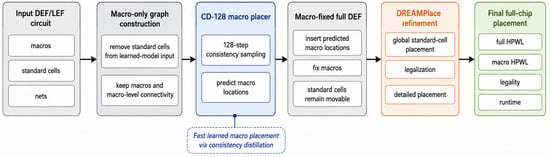
To evaluate the proposed consistency-distilled placement model beyond the macro-only setting, we consider two full-placement strategies. The first strategy follows the conventional evaluation protocol used in many macro-placement works. In this flow, the learned model is used only to generate macro locations. These macros are then inserted into the original full-chip file and fixed at the predicted locations, while all standard cells remain movable. A conventional analytical placer, DREAMPlace (https://github.com/limbo018/DREAMPlace accessed on 12 August 2026), is then used to place, legalize, and refine the standard cells around the fixed macros. This setting evaluates whether the learned macro placement provides a useful initialization for a standard downstream placement engine. The flow of this approach is shown in Figure 1.
Figure 1.
Architecture of the CD-128 + DREAMPlace full-placement flow. The consistency-distilled model is used to predict macro locations from a macro-only graph, after which the predicted macros are fixed in the original full-chip. DREAMPlace then performs global standard-cell placement, legalization, and detailed placement around the fixed learned macros which follows the common macro-placement evaluation flow.
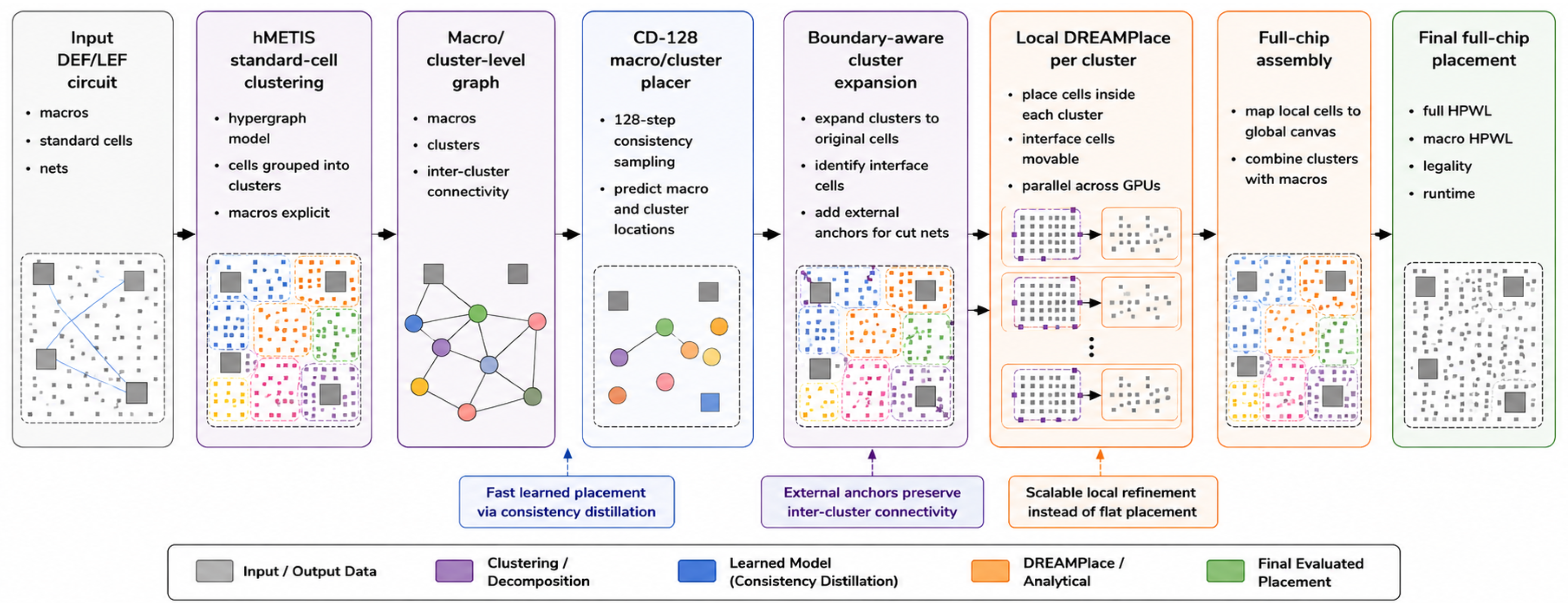
To extend the learned macro/cluster placement toward full-chip placement, we also use a hierarchical flow composed of three stages as depicted in Figure 2. First, the consistency-distilled model predicts the global locations of macros and clusters on the original chip canvas. Each cluster represents a group of standard cells and is treated as a soft placement object during this global stage. Second, each cluster is expanded into a local DREAMPlace problem containing the standard cells assigned to that cluster. DREAMPlace is then used to optimize the standard-cell locations inside each cluster independently. Third, the locally optimized cluster placements are mapped back to the original full-chip coordinate system using the predicted global cluster locations, and a final full-chip placement file is generated for legalization and evaluation.
Figure 2.
Architecture of the hierarchical CD-128 full-placement flow. Standard cells are first grouped into clusters (different cluster colors are used only to distinguish clusters and carry no quantitative meaning) using hMETIS, while macros remain explicit placement objects. The consistency-distilled model predicts global macro and cluster locations, after which each cluster is expanded into its original standard cells and optimized locally using DREAMPlace with boundary-aware interface-cell handling. The locally optimized clusters are then mapped back to the full-chip coordinate system and assembled into a complete placement for evaluation.
Figure 1 and Figure 2 represent two alternative full-placement flows that share the same proposed consistency-distilled global placement model. In Figure 1, CD-128 is used only for macro placement, followed by conventional DREAMPlace standard-cell placement, legalization, and detailed placement. In Figure 2, CD-128 jointly places macros and standard-cell clusters within a hierarchical flow, followed by boundary-aware cluster expansion and local DREAMPlace refinement. Thus, the main optimization introduced in this work is the learned global-placement stage, where the consistency distillation is used as placer, while the downstream DREAMPlace stages remain conventional.
2.4. Boundary-Aware Cluster Expansion
A key issue in such a hierarchical flow is that clusters are not electrically independent. Nets crossing cluster boundaries can be poorly represented if each cluster is optimized in isolation. To reduce this loss of global connectivity information, we use the boundary-aware cluster expansion. For every cut net leaving a cluster, a fixed external anchor is inserted into the local DREAMPlace instance to represent the estimated position of the external endpoint. Standard cells connected to such cut nets are marked as interface cells. These interface cells are not fixed; instead, they are initialized near the cluster boundary indicated by their external anchors and remain movable during local DREAMPlace optimization. This provides a soft boundary constraint: the local placer sees the direction of external connections while retaining enough freedom to optimize local wirelength and legality.
As circuits get bigger in size, the computational cost of their placement skyrockets. The main advantage of this hierarchy is scalability. Instead of solving the entire full-chip standard-cell placement problem in one flat optimization, the design is decomposed into many smaller cluster-local placement problems. These local problems can be solved independently and in parallel across multiple GPUs or CPU workers. As a result, the approach reduces the memory and compute burden of standard-cell refinement and creates a practical path for applying learned global placement models to larger circuits. At the same time, the final assembly and legalization stages preserve compatibility with conventional placement evaluation.
3. Results
This section reports the placement results on IBM and ISPD benchmark dataset. The evaluation includes the diffusion teacher and consistency-distilled models with different inference budgets. Lower HPWL values indicate better wirelength. Legality and macro legality are reported as normalized scores. Legality is measured as the ratio between the non-overlapping object area inside the chip boundary and the total object area. A score of indicates that all evaluated objects are within the placement region and have no overlaps, while lower values indicate overlap or boundary violations. Experiments were conducted on an Ubuntu 22.04.5 machine with an Intel Core i9 CPU, 128 GB of RAM and an NVIDIA GeForce RTX 2080 Ti GPU with 11 GB memory. All consistency distillation and model evaluation used a single GPU, with Python 3.10, PyTorch 2.2.1, CUDA 12.1, and PyTorch Geometric 2.4.0; downstream placement was performed using DREAMPlace.
3.1. Benchmark Statistics
Table 2 and Table 3 summarize the principal characteristics of the IBM and ISPD2005 benchmarks used in this study, including the numbers of objects, movable or standard cells, macros and fixed terminals, nets, and pins. Together, these benchmarks cover circuits ranging from relatively small designs to instances containing more than two million objects, enabling evaluation across different placement scales and connectivity complexities. We only used the first five circuits of ISPD2005 benchmark and reported the results on only these circuits.
Table 2.
Specifications of the IBM placement benchmarks used in this study.
Table 3.
Specifications of the ISPD2005 placement benchmark.
Each IBM circuit was partitioned into 512 standard-cell clusters, while macros and fixed terminals were retained as individual graph vertices. Consequently, the reduced graphs contain between 512 and 1298 vertices, substantially fewer than the original circuits containing up to 210,613 objects.
Table 4 compares the performance of the diffusion model and [34] with consistency-distilled samplers on clustered IBM dataset (each circuit is divided into macros + 512 standard cell clusters). The diffusion teacher obtains the average HPWL of 28.15 on all 18 circuits (HPWL ratio of 1.058 relative to the clustered reference placement derived from the original IBM coordinates.). However, this quality requires 170.42 s of total generation time. To have a fair comparison, the results are reported by averaging performance using five random seeds. The performance of long-step consistency sampler and their runtimes are relatively stable across all seeds.
Table 4.
Performance comparison on clustered IBM benchmarks between the diffusion model and consistency-distilled models. HPWL is reported in . Lower is better for HPWL, HPWL ratio, HPWL ratio std, and inference time; higher is better for legality and inference speedup.
The consistency-distilled model substantially reduces inference cost. The one-step model is a very fast configuration, with 27.80 s inference time and a 6.1× inference speedup, but this model achieves an average HPWL of 82.488 (HPWL ratio degrades to 2.975). This indicates that one-step sampling is too aggressive for high-quality placement in the current model and also reflects a limitation: a single evaluation must map an almost pure-noise placement directly to a globally connected and legal layout, whereas multistep sampling provides repeated lower-noise correction and guidance. Increasing the number of consistency steps sharply improves HPWL: by only changing steps to 2, the model reduces the HPWL to 38.315 (HPWL ratio to 1.429) which is a huge improvement. Longer samplers continue to close the quality gap. Setting the steps to 128 leads the model to have a competitive average HPWL of 28.973 (HPWL ratio of 1.0902) while requiring almost a quarter of diffusion model inference time plus maintaining high legality. The results show a clear quality-runtime trade-off: four to eight steps provide the strongest practical speed-quality compromise, whereas 64 to 128 steps are preferable when HPWL is prioritized. We used the consistency distillation with 128 steps (CD-128) as the main model in this work and reported the results for this model.
3.2. Inference-Step Ablation
Table 4 also isolates the effect of the number of consistency inference steps. The saturation behavior of the model by moving from 1 to 128 steps suggests that the consistency model rapidly approaches a useful placement estimate after only a few evaluations, while additional steps mainly refine wirelength.
The legality metrics remain stable after two steps. In particular, the four-step and eight-step models both exceed 0.999 or remain very close to it for cluster and macro legality. This is important because the observed runtime gains do not come from producing highly illegal placements. Instead, the main trade-off is between HPWL quality and inference budget. Per-circuit results for all 18 clustered IBM benchmarks are provided in Table A1.
Table 5 presents a matched-NFE comparison between the consistency-distilled model and the DDIM diffusion teacher, where both methods use the same number of sampling steps. Across most NFE settings, the CD model achieves lower HPWL than DDIM, with particularly large improvements at very low step counts, such as 1 and 2 steps. At 16 steps, the two methods obtain nearly identical HPWL, while CD again achieves lower HPWL at 64 and 128 steps. The model runtimes are comparable at each matched step count, whereas the total inference time of CD is generally lower than that of DDIM for all settings except the 1-step case. These results indicate that the advantage of consistency distillation is not solely due to using fewer sampling steps; even under matched computational budgets, CD generally preserves or improves placement quality while maintaining competitive inference cost.
Table 5.
Matched-step comparison between the consistency-distilled model and the DDIM diffusion teacher on clustered IBM benchmarks. HPWL is reported in , and runtime is reported in seconds. Model time measures sampling, while total inference time includes the remaining generation-pipeline overhead. Lower is better.
Moreover, based on the pure model sampling time in Table 5, CD-128 provides approximately a speedup over Diffusion-1000, demonstrating that consistency distillation substantially reduces the actual denoising/sampling cost. The smaller speedup observed in total inference time is primarily due to the fixed generation-pipeline overhead shared by both methods.
3.3. Macro-Only Placement Performance
Table 6 compares the macro placement performance with representative macro-placement baselines on the IBM benchmarks. Compared with the diffusion model, the distilled model reduces the average runtime from 1.37 min to 0.44 min, corresponding to approximately 3.1× speedup, while maintaining full macro legality. This acceleration comes with a small HPWL increase, from 2.61 to 2.79 in units of . The result highlights the central tradeoff of the proposed approach: consistency distillation substantially reduces inference cost, which is important for placement workflows requiring repeated sampling or design-space exploration, but the faster sampler does not fully preserve the macro-HPWL quality of the diffusion teacher.
Table 6.
Macro-level comparison with macro-placement baselines on IBM benchmarks. Macro HPWL values are reported in . Lower HPWL and runtime are better.
Table 7 compares the proposed 128-step consistency-distilled model with macro-placement baselines on ISPD2005 benchmark. To ensure a fair comparison, we report results only on the first five ISPD2005 circuits for which complete evaluations were successfully obtained. The consistency-distilled model achieves an average macro HPWL of 41.08, which is higher than ChipDiffusion but lower than MaskPlace and ChiPFormer. Its main advantage is runtime: the proposed model completes macro placement in 0.56 min, compared with 4.38 min for ChipDiffusion, 246 min for ChiPFormer, and 253 min for MaskPlace. This result shows the expected quality-runtime tradeoff of consistency distillation: the model sacrifices some HPWL quality relative to the full diffusion baseline but provides a substantially faster sampling process. Therefore, the ISPD2005 results support the central motivation of this work: using consistency distillation to make diffusion-based placement more practical when placement speed is a critical constraint.
Table 7.
Macro-level comparison with macro-placement baselines on ISPD2005 benchmarks. Macro HPWL values are reported in . Lower HPWL and runtime are better.
3.4. Detailed Placement
Table 8 evaluates whether macro placements generated by the various versions of diffusion model, the proposed 128-step consistency-distilled model, and MaskPlace are useful for a conventional full-placement flow. On average, consistency distillation with 128 steps (CD128) + DREAMPlace achieves the lowest final HPWL of , compared with for the diffusion model with 1000 denoising steps and for MaskPlace. To have a fair comparison, we also evaluated the stochastic and DDIM Diffusion model with 128 denoising steps, similar to 128 steps for consistency Distillted model. The stochastic Diffusion with 128 steps achieved an average HPWL of 28.80 over five seeds. DDIM diffusion model with 128 steps also achieved and average HPWL of 28.91. The results shows that by reducing denoising steps from 1000 to 128, the performance of the model degrades. However, CD with 128 steps shows much better performance than various diffusion models. Although CD128 has higher macro-only HPWL than the diffusion model, the full-placement result is not determined solely by macro-only HPWL. The downstream DREAMPlace stage optimizes the standard-cell placement over the complete netlist, and the CD128 macro configuration appears to provide a more favorable initialization for standard-cell spreading and legalization. We have also reported the performance of pure DREAMPlace on the IBM dataset, where it achieved an average HPWL of 27.18, which is better than the diffusion variants but slightly worse than CD-128. These results suggest that consistency distillation can provide a practical learned macro-initialization stage: it preserves enough placement structure for DREAMPlace to produce competitive final layouts, while avoiding the high sampling cost of diffusion-based macro generation.
Table 8.
Full detailed placement comparison between MaskPlace, diffusion-teacher, 128-step diffusion, diffusion with 128 DDIM steps and 128-step consistency-distilled macro placement followed by DREAMPlace for standard cell placement. HPWL is reported in . Lower is better.
Table 9 shows that the proposed CD-128 + DP flow achieves the lowest average detailed-placement HPWL across the evaluated ISPD2005 benchmarks (first five circuits), with an average of , compared with for Diffusion-1000 + DP and for Diffusion-128 + DP. This corresponds to an average HPWL reduction of approximately 8.8% and 8.6%, respectively. In particular, CD-128 achieves substantially lower HPWL on adaptec3 and adaptec4, while the diffusion-based variants perform better on some individual benchmarks such as adaptec1, adaptec2, and bigblue1. The results indicate that consistency distillation can preserve competitive placement quality while improving the average full detailed-placement HPWL over the evaluated ISPD2005 designs.
Table 9.
Full detailed placement comparison on the evaluated ISPD2005 benchmarks. Each method performs learned macro placement followed by DREAMPlace standard-cell placement. HPWL is reported in . Lower is better.
Table 10 compares the full-chip placement results of the hierarchical approach for diffusion model and CD-128 flows. On average, hierarchical diffusion obtains an HPWL of ), while hierarchical CD achieves ), corresponding to a modest increase of approximately . The hierarchical diffusion flow produces lower HPWL on 15 of the 18 benchmarks, whereas hierarchical CD-128 achieves better results on IBM14, IBM15, and IBM17. The relatively small average gap indicates that the distilled model preserves much of the global cluster and macro organization required by the subsequent boundary-aware expansion, cluster-local refinement, full-chip assembly, and legalization stages. The remaining difference suggests that hierarchical placement is sensitive to small variations in predicted cluster positions because inter-cluster connectivity is approximated during independent local optimization. Overall, these results demonstrate that consistency distillation can support a complete hierarchical placement pipeline while providing a favorable tradeoff between placement quality and generative inference cost.
Table 10.
Full detailed placement results of the hierarchical diffusion model and consistency-distilled-128 flows. HPWL is reported in . Lower is better.
The proposed hierarchical framework is not restricted to a specific global placement model. It can be integrated with other macro-placement methods by representing standard-cell groups as placeable clusters and converting the resulting reduced circuit into the input format required by the selected placer. The data-preparation scripts, format adapters, execution pipeline, and reproduction instructions are provided in the public GitHub repository accompanying this work.
3.5. Global-Routing Evaluation
To examine whether the placement-level HPWL improvements translate into downstream physical-design benefits, we performed global routing on the detailed placements of the IBM benchmarks using identical OpenROAD (https://openroad.org) settings. The global-routing results in Table 11 show that CD-128 + DP provides the most favorable overall downstream routing characteristics among the evaluated placement flows. In particular, CD-128 achieves the lowest routed wirelength of , compared with for Diffusion-1000 and for DDIM-128. It also produces the lowest routing usage which is the percentage of available routing resources consumed by routed nets (100.34%), via count (), and routing runtime (436.78 s), indicating that the placement-level HPWL improvements translate into shorter interconnects and more efficient routing. Although its normalized overflow (0.3134) is slightly higher than that of Diffusion-1000 (0.3069) and DDIM-128 (0.3103), the difference is small, suggesting that the reduction in wirelength and routing cost is achieved without a substantial degradation in congestion. Overall, these results indicate that the distilled CD-128 placements remain competitive in routability while providing better routed wirelength, fewer vias, and lower routing runtime than the diffusion-based alternatives.
Table 11.
Average global-routing comparison over the 18 IBM benchmarks using identical OpenROAD settings. Normalized overflow measures routing congestion. Routed wirelength is reported in m and vias in . Lower is better.
3.6. Qualitative Placement Comparison
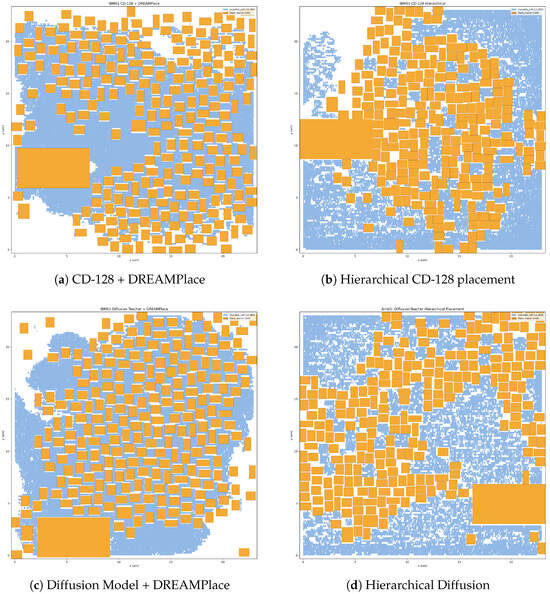
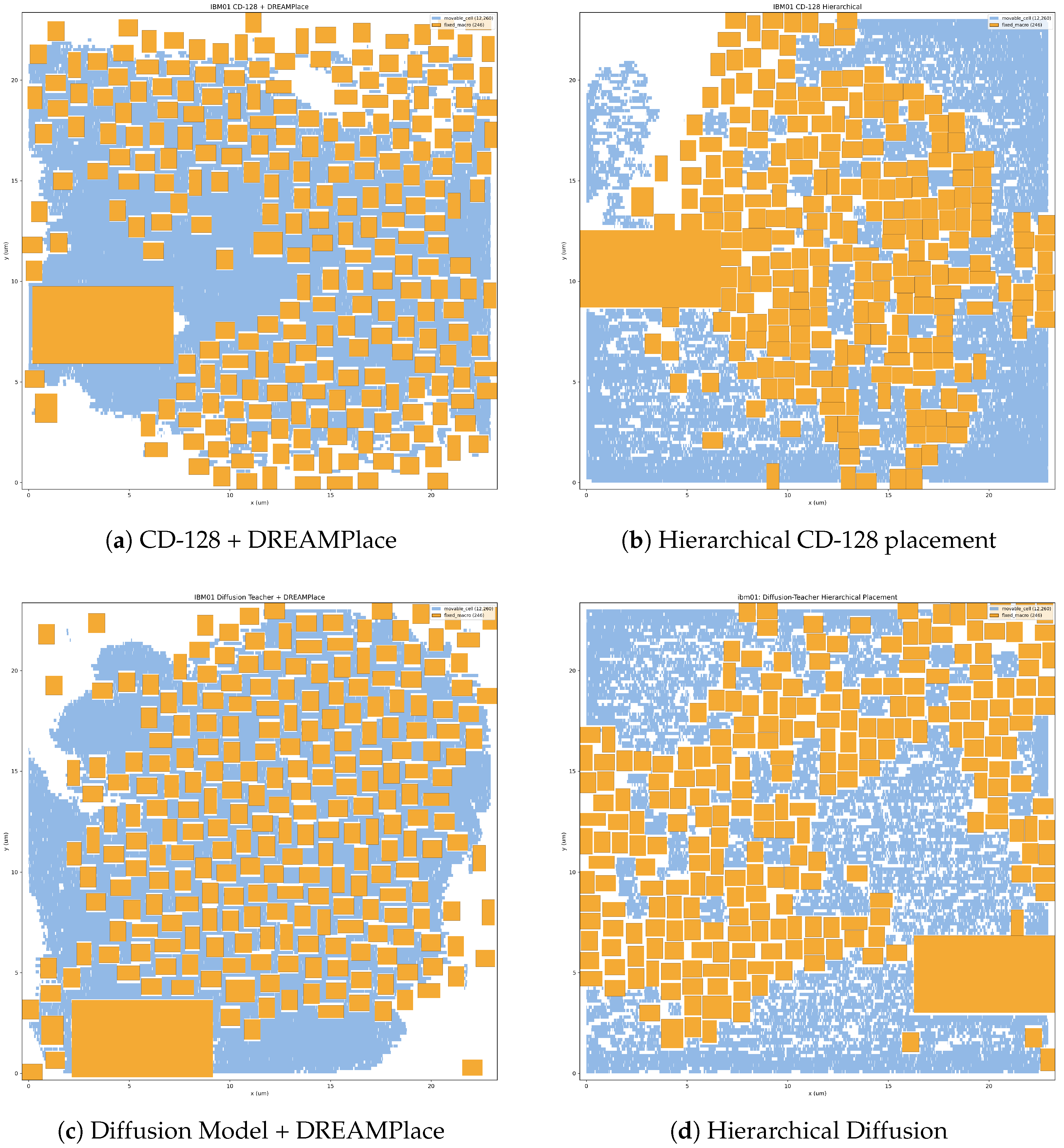
Figure 3 provides a qualitative comparison of the full-placement layouts generated by the learned placement flows on IBM01. The CD-128 and diffusion model flows use learned macro placement followed by DREAMPlace-based standard-cell refinement, while using them in a hierarchical manner predicts both macro and cluster locations before performing boundary-aware cluster expansion, cluster-local standard-cell optimization, and final full-chip assembly. Presenting both conventional and hierarchical variants illustrates how each generative model influences the spatial organization of macros and standard cells under the two full-placement strategies. These visualizations complement the quantitative HPWL and runtime results by showing how the evaluated flows distribute cells and fixed macros across the chip canvas.
Figure 3.
Full-circuit placement visualizations for IBM01 under four learned placement flows. (a) CD-128 generates the macro placement before DREAMPlace performs standard-cell placement. (b) Hierarchical CD-128 places macros and clusters globally, followed by cluster-local standard-cell optimization and full-chip assembly. (c) The diffusion model generates the macro placement before DREAMPlace performs standard-cell placement. (d) Hierarchical diffusion first places macros and clusters globally and then performs cluster expansion, local optimization, and final assembly.
4. Discussion
The results support the main hypothesis of this work: consistency distillation can substantially reduce the inference cost of diffusion-based chip placement while preserving useful placement structure. On the clustered IBM benchmark, the diffusion teacher remains the strongest quality reference among the learned models, but it requires a long iterative sampling process. The consistency-distilled models replace this expensive trajectory with a controllable number of consistency evaluations. In particular, the 128-step model reduces inference time from 170.42 s to 41.10 s while keeping the average HPWL close to the teacher. This confirms that consistency distillation is a practical acceleration mechanism rather than only a model-compression approach.
The inference-step ablation shows a clear quality-runtime tradeoff. One-step generation is extremely fast but too aggressive for high-quality placement. Moving from one to two steps recovers much of the lost HPWL quality, while four to eight steps provide a strong low-latency operating point with high legality and inference-level speedup. Longer samplers, especially 64 and 128 steps, are more appropriate when HPWL is prioritized. This gives the placement flow a useful inference knob: the same distilled model can be used for rapid design-space exploration or for higher-quality candidate generation.
The macro-only results further illustrate the expected behavior of consistency distillation. On IBM and ISPD2005, the CD-128 model is faster than the diffusion baseline but does not fully match its macro HPWL. This should be interpreted as an acceleration-quality tradeoff, not as an unconditional improvement over the teacher. Nevertheless, the detailed-placement results show that macro-only HPWL is not the only predictor of final full-chip quality. After DREAMPlace standard-cell refinement, CD-128 macro initialization achieves a lower average HPWL than the diffusion-teacher macro initialization.
The hierarchical flow demonstrates a second contribution: the learned placement can be extended from macro/cluster prediction to full-chip reconstruction. By combining hMETIS clustering, boundary-aware cluster expansion, cluster-local DREAMPlace optimization, and final assembly, the method produces complete full-chip placements from learned macro/cluster outputs. The hierarchical approach provides a scalable framework in which standard-cell refinement is decomposed into smaller cluster-level problems that can be processed in parallel.
Several limitations remain. First, the ISPD2005 macro-only result is computed on the subset of samples that completed successfully, so broader ISPD evaluation requires improved macro masking for very large circuits. Second, the hierarchical placement flow needs stronger global refinement after cluster assembly to have a better performance. In addition, the consistency model in this study was distilled for 1,000,000 training steps; longer distillation is likely to improve placement quality and further reduce the gap to the diffusion model. Future work should integrate routability-aware objectives, improve boundary modeling for inter-cluster nets, increase the distillation budget, and add a global post-assembly refinement stage.
5. Conclusions
This paper presented CoDPlacer, a consistency-distilled framework for accelerating digital IC placement. By distilling a pretrained Diffusion teacher into a consistency model, the proposed approach reduces the number of required sampling steps and provides a tunable tradeoff between placement quality and inference time. Experiments on clustered IBM benchmarks show that the 128-step consistency model approaches the teacher’s HPWL quality while providing substantial generation-level speedups. Macro-only experiments on IBM and ISPD2005 further show that the distilled model can reduce runtime compared with diffusion-based sampling, although some macro-HPWL degradation remains.
The paper also evaluated two full-placement strategies. In the conventional macro-placement flow, CD-128 macro locations are fixed and DREAMPlace performs full standard-cell placement, producing competitive detailed-placement results and improving over diffusion-teacher macro initialization on average. In the hierarchical flow, standard cells are grouped using hMETIS, globally placed as clusters with macros, expanded using boundary-aware constraints, optimized locally with DREAMPlace, and assembled into a full-chip placement which demonstrates a complete learned hierarchical placement pipeline.
Overall, the results indicate that consistency distillation is a promising direction for reducing the inference cost of generative chip placement and serves as a fast learned placement initialization strategy with controllable runtime-quality behavior.
Author Contributions
Conceptualization, M.A.S.; methodology, M.A.S.; software, M.A.S.; validation, M.A.S.; formal analysis, M.A.S.; investigation, M.A.S.; resources, J.S.Y.; data curation, M.A.S.; writing—original draft preparation, M.A.S.; writing—review and editing, M.A.S. and J.S.Y.; visualization, M.A.S.; supervision, J.S.Y.; project administration, J.S.Y.; funding acquisition, J.S.Y. and M.A.S. All authors have read and agreed to the published version of the manuscript.
Funding
This work is supported in part by Tokyo Electron America and Florida High Tech Corridor matching grants.
Data Availability Statement
The IBM [36] and ISPD [37] benchmark datasets analyzed in this study are publicly available. The source code, experiment configurations, data-preparation scripts, and evaluation procedures developed for this study are available at https://github.com/mohammad-AJP/CoDPlacer, accessed on 12 August 2026.
Conflicts of Interest
The authors declare no conflicts of interest.
Appendix A. Ablation Study
Per-Circuit HPWL Analysis
Table A1 reports the per-circuit HPWL. The one-step consistency model is consistently worse than the other settings, which agrees with the aggregate result in Table 4. From two steps onward, the model becomes competitive across all IBM circuits, and the longer 64-step and 128-step samplers usually provide the best consistency-model HPWL.
Table A1.
Per-circuit average HPWL for the clustered IBM comparison over 5 seeds. HPWL is reported in . Lower is better.
References
- Cheng, C.-K.; Kahng, A.B.; Kang, I.; Wang, L. RePlAce: Advancing Solution Quality and Routability Validation in Global Placement. IEEE Trans. Comput.-Aided Des. Integr. Circuits Syst. 2019, 38, 1717–1730. [Google Scholar] [CrossRef] [Scilit]
- Lu, J.; Chen, P.; Chang, C.-C.; Sha, L.; Huang, D.J.-H.; Teng, C.-C.; Cheng, C.-K. ePlace: Electrostatics-Based Placement Using Fast Fourier Transform and Nesterov’s Method. ACM Trans. Des. Autom. Electron. Syst. 2015, 20, 1–34. [Google Scholar]
- Lin, Y.; Dhar, S.; Li, W.; Ren, H.; Khailany, B.; Pan, D.Z. DREAMPlace: Deep Learning Toolkit-Enabled GPU Acceleration for Modern VLSI Placement. In Proceedings of the 56th Annual Design Automation Conference (DAC), Las Vegas, NV, USA, 2–6 June 2019; pp. 1–6. [Google Scholar] [CrossRef] [Scilit]
- Kahng, A.B.; Wang, Z. DG-RePlAce: A Dataflow-Driven GPU-Accelerated Analytical Global Placement Framework for Machine Learning Accelerators. IEEE Trans. Comput.-Aided Des. Integr. Circuits Syst. 2025, 44, 696–708. [Google Scholar] [CrossRef] [Scilit]
- Lin, Y.; Li, W.; Gu, J.; Ren, H.; Khailany, B.; Pan, D.Z. ABCDPlace: Accelerated Batch-Based Concurrent Detailed Placement on Multithreaded CPUs and GPUs. IEEE Trans. Comput.-Aided Des. Integr. Circuits Syst. 2020, 39, 5083–5096. [Google Scholar] [CrossRef] [Scilit]
- Liu, L.; Fu, B.; Lin, S.; Liu, J.; Young, E.F.Y.; Wong, M.D.F. Xplace: An Extremely Fast and Extensible Placement Framework. IEEE Trans. Comput.-Aided Des. Integr. Circuits Syst. 2024, 43, 1872–1885. [Google Scholar] [CrossRef] [Scilit]
- Chen, Y.; Wen, Z.; Liang, Y.; Lin, Y. Stronger Mixed-Size Placement Backbone Considering Second-Order Information. In Proceedings of the IEEE/ACM International Conference on Computer-Aided Design (ICCAD), San Francisco, CA, USA, 28 October–2 November 2023. [Google Scholar]
- Hao, R.; Cai, Y.; Zhou, Q.; Wang, R. DrPlace: A Deep Learning Based Routability-Driven VLSI Placement Algorithm. J. Comput.-Aided Des. Comput. Graph. 2021, 33, 624–631. [Google Scholar] [CrossRef] [Scilit]
- Agnesina, A.; Liang, R.; Pradipta, G.; Rajaram, A.; Ren, H. GOALPlace: Begin with the End in Mind. In Proceedings of the 2025 International Symposium on Physical Design (ISPD), Austin, TX, USA, 16–19 March 2025; pp. 2–10. [Google Scholar] [CrossRef] [Scilit]
- Duran, C.; Roa, E. Routing-Aware Standard Cell Placement Algorithm Applying Boolean Satisfiability. In Proceedings of the IEEE International Symposium on Circuits and Systems (ISCAS), Daegu, Republic of Korea, 22–28 May 2021. [Google Scholar]
- Li, G.; Yang, Y.; Li, S.; Qu, X.; Lyu, N.; Li, S.E. Decision Making of Autonomous Vehicles in Lane Change Scenarios: Deep Reinforcement Learning Approaches with Risk Awareness. Transp. Res. Part C Emerg. Technol. 2022, 134, 103452. [Google Scholar] [CrossRef] [Scilit]
- Mousavi, A.; Mousavi, R.; Mousavi, Y.; Fekih, A. Event-Triggered Reinforcement Learning-Based Fractional-Order Sliding Mode Control with Neural Approximation for Floating Offshore Wind Turbines. Energy 360 2026, 6, 100076. [Google Scholar] [CrossRef] [Scilit]
- Alijanpour, M.; Raie, A. Video Event Recognition Using Two-Stream Convolutional Neural Networks. In Proceedings of the 5th International Conference on Pattern Recognition and Image Analysis (IPRIA), Kashan, Iran, 28–29 April 2021; pp. 1–5. [Google Scholar] [CrossRef] [Scilit]
- Wu, Y.; Chen, Y.; Yuan, L.; Liu, Z.; Wang, L.; Li, H.; Fu, Y.R. Rethinking Classification and Localization for Object Detection. In Proceedings of the IEEE/CVF Conference on Computer Vision and Pattern Recognition (CVPR), Virtual, 13–19 June 2020. [Google Scholar]
- Cheng, R.; Yan, J. On Joint Learning for Solving Placement and Routing in Chip Design. In Proceedings of the Conference on Advances in Neural Information Processing Systems (NeurIPS), Virtual, 6–14 December 2021. [Google Scholar]
- Cheng, C.-K.; Kahng, A.B.; Kundu, S.; Wang, Y.; Wang, Z. Assessment of Reinforcement Learning for Macro Placement. In Proceedings of the International Symposium on Physical Design (ISPD), Virtual, 26–29 March 2023. [Google Scholar]
- Markov, I.L. Reevaluating Google’s Reinforcement Learning for IC Macro Placement. Commun. ACM 2024, 67, 60–71. [Google Scholar] [CrossRef] [Scilit]
- Geng, Z.; Wang, J.; Liu, Z.; Xu, S.; Tang, Z.; Yuan, M.; Hao, J.; Zhang, Y.; Wu, F. Reinforcement Learning within Tree Search for Fast Macro Placement. In Proceedings of the 41st International Conference on Machine Learning (ICML), Vienna, Austria, 21–27 July 2024. [Google Scholar]
- Xue, K.; Chen, R.-T.; Lin, X.; Shi, Y.; Kai, S.; Xu, S.; Qian, C. Reinforcement Learning Policy as Macro Regulator Rather than Macro Placer. In Proceedings of the 38th International Conference on Neural Information Processing Systems (NIPS ’24), Vancouver, BC, Canada, 10–15 December 2024; Volume 37, pp. 140565–140588. [Google Scholar] [CrossRef] [Scilit]
- Agnesina, A.; Rajvanshi, P.; Yang, T.; Pradipta, G.; Jiao, A.; Keller, B.; Khailany, B.; Ren, H. AutoDMP: Automated DREAMPlace-Based Macro Placement. In Proceedings of the 2023 International Symposium on Physical Design (ISPD), Virtual, 26–29 March 2023; pp. 149–157. [Google Scholar] [CrossRef] [Scilit]
- Hou, Y.; Ye, H.; Zhang, Y.; Xu, S.; Song, G. RoutePlacer: An End-to-End Routability-Aware Placer with Graph Neural Network. In Proceedings of the 30th ACM SIGKDD Conference on Knowledge Discovery and Data Mining (KDD), Barcelona, Spain, 25–29 August 2024; pp. 1085–1095. [Google Scholar] [CrossRef] [Scilit]
- Lai, Y.; Mu, Y.; Luo, P. MaskPlace: Fast Chip Placement via Reinforced Visual Representation Learning. In Proceedings of the Conference on Advances in Neural Information Processing Systems (NeurIPS), New Orleans, LA, USA, 28 November–9 December 2022. [Google Scholar]
- Lai, Y.; Liu, J.; Tang, Z.; Wang, B.; Hao, J.; Luo, P. ChiPFormer: Transferable Chip Placement via Offline Decision Transformer. In Proceedings of the 40th International Conference on Machine Learning (ICML), Honolulu, HI, USA, 23–29 July 2023. [Google Scholar]
- Cheng, R.; Lyu, X.; Li, Y.; Ye, J.; Hao, J.; Yan, J. The Policy-Gradient Placement and Generative Routing Neural Networks for Chip Design. In Proceedings of the Conference on Advances in Neural Information Processing Systems (NeurIPS), New Orleans, LA, USA, 28 November–9 December 2022. [Google Scholar]
- Ying, R.; He, R.; Chen, K.; Eksombatchai, P.; Hamilton, W.L.; Leskovec, J. Graph Convolutional Neural Networks for Web-Scale Recommender Systems. In Proceedings of the 24th ACM SIGKDD International Conference on Knowledge Discovery & Data Mining, London, UK, 19–23 August 2018. [Google Scholar]
- Mousa, R.; Sarabadani, A.; Taami, T.; Bengari, A.A.; Eslamifar, O.; Alijanpour Shalmani, M.; Karimi Shahmarvandi, E. A Comparative Survey on Large Language Models for Biological Data. Preprints 2025. [Google Scholar] [CrossRef] [Scilit]
- Lu, Y.-C.; Lim, S.K. VLSI Placement Optimization Using Graph Neural Networks. In Proceedings of the NeurIPS Workshop on Machine Learning for Systems, Virtual, 11 December 2020. [Google Scholar]
- Lu, Y.-C.; Pentapati, S.; Lim, S.K. The Law of Attraction: Affinity-Aware Placement Optimization Using Graph Neural Networks. In Proceedings of the International Symposium on Physical Design (ISPD), Virtual, 22–24 March 2021. [Google Scholar]
- Hou, Y.; Ye, H.; Yang, S.; Zhang, Y.; Xu, S.; Song, G. TransPlace: Transferable Circuit Global Placement via Graph Neural Network. In Proceedings of the 31st ACM SIGKDD Conference on Knowledge Discovery and Data Mining (KDD), Toronto, ON, Canada, 3–7 August 2025; pp. 484–495. [Google Scholar] [CrossRef] [Scilit]
- Shahane, A.; Manjiri, S.S.; Jain, A.; Kumar, S. Graph of Circuits with GNN for Exploring the Optimal Design Space. In Proceedings of the 37th International Conference on Neural Information Processing Systems (NIPS ’23), New Orleans, LA, USA, 10–16 December 2023; Volume 36, pp. 6014–6025. [Google Scholar] [CrossRef] [Scilit]
- Lu, Y.-C.; Yang, T.; Lim, S.K.; Ren, H. Placement Optimization via PPA-Directed Graph Clustering. In Proceedings of the ACM/IEEE Workshop on Machine Learning for CAD, Snowbird, Utah, USA, 12–13 September 2022. [Google Scholar]
- Liu, Y.; Zhou, H.; Wang, J.; Yang, F.; Zeng, X.; Shang, L. The Power of Graph Signal Processing for Chip Placement Acceleration. In Proceedings of the 43rd IEEE/ACM International Conference on Computer-Aided Design (ICCAD ’24), Newark, NJ, USA, 27–31 October 2024; Association for Computing Machinery: New York, NY, USA, 2025; pp. 1–8. [Google Scholar] [CrossRef] [Scilit]
- Lu, Y.-C.; Ren, H.; Hsiao, H.; Lim, S.K. DREAM-GAN: Advancing DREAMPlace towards Commercial-Quality Using Generative Adversarial Learning. In Proceedings of the International Symposium on Physical Design (ISPD), Virtual, 26–29 March 2023. [Google Scholar]
- Lee, V.; Nguyen, M.; Elzeiny, L.; Deng, C.; Abbeel, P.; Wawrzynek, J. Chip Placement with Diffusion Models. In Proceedings of the 42nd International Conference on Machine Learning (ICML), Vancouver, BC, Canada, 13–19 July 2025; Volume 267, pp. 33499–33514. [Google Scholar]
- Song, Y.; Dhariwal, P.; Chen, M.; Sutskever, I. Consistency Models. In Proceedings of the 40th International Conference on Machine Learning (ICML), Honolulu, HI, USA, 23–29 July 2023. [Google Scholar]
- Adya, S.N.; Chaturvedi, S.; Roy, J.A.; Papa, D.A.; Markov, I.L. Unification of Partitioning, Placement and Floorplanning. In Proceedings of the IEEE/ACM International Conference on Computer-Aided Design (ICCAD), San Jose, CA, USA, 7–11 November 2004; pp. 550–557. [Google Scholar]
- Nam, G.-J.; Alpert, C.J.; Villarrubia, P.; Winter, B.; Yildiz, M. The ISPD2005 Placement Contest and Benchmark Suite. In Proceedings of the International Symposium on Physical Design (ISPD), San Francisco, CA, USA, 3–6 April 2005; pp. 216–220. [Google Scholar] [CrossRef] [Scilit]
- Schlag, S.; Heuer, T.; Gottesbüren, L.; Akhremtsev, Y.; Schulz, C.; Sanders, P. High-Quality Hypergraph Partitioning. ACM J. Exp. Algorithmics 2023, 27, 1–39. [Google Scholar] [CrossRef] [Scilit]
- Karypis, G.; Aggarwal, R.; Kumar, V.; Shekhar, S. Multilevel Hypergraph Partitioning: Applications in VLSI Domain. IEEE Trans. Very Large Scale Integr. (Vlsi) Syst. 1999, 7, 69–79. [Google Scholar] [CrossRef] [Scilit]

Disclaimer/Publisher’s Note: The statements, opinions and data contained in all publications are solely those of the individual author(s) and contributor(s) and not of MDPI and/or the editor(s). MDPI and/or the editor(s) disclaim responsibility for any injury to people or property resulting from any ideas, methods, instructions or products referred to in the content. |
© 2026 by the authors. Licensee MDPI, Basel, Switzerland. This article is an open access article distributed under the terms and conditions of the Creative Commons Attribution (CC BY) license.