Article

A New Switching Configuration for a Bipolar Full-Bridge Boost Converter: Dynamic Analysis and Model Validation


by
Alfredo Roldán-Caballero
1,2,
Eduardo Hernández-Márquez
3,*,
José Rafael García-Sánchez
4,
Salvador Tavera-Mosqueda
5,
Víctor Hugo García-Rodríguez
6,
José Fermi Guerrero-Castellanos
2 and
Wuiyevaldo Fermín Guerrero-Sánchez
2
1
Unidad Profesional Interdisciplinaria de Ingeniería Campus Tlaxcala, Instituto Politécnico Nacional, Tlaxcala 90000, Mexico
2
Facultad de Ciencias de la Electrónica, Benemérita Universidad Autónoma de Puebla, Puebla 72570, Mexico
3
Departamento de Ingeniería Mecatrónica, Instituto Tecnológico Superior de Poza Rica, Tecnológico Nacional de México, Poza Rica 93230, Mexico
4
División de Ingeniería Mecatrónica, Tecnológico de Estudios Superiores de Huixquilucan, Tecnológico Nacional de México, Huixquilucan 52773, Mexico
5
Dirección de División de Ingeniería Mecatrónica, Universidad Politécnica del Valle de México, Tultitlán 54910, Mexico
6
Departamento de Ingeniería en Diseño, Universidad del Istmo, Santo Domingo Tehuantepec 70760, Mexico
*
Author to whom correspondence should be addressed.
Electronics 2026, 15(11), 2236; https://doi.org/10.3390/electronics15112236
Submission received: 22 April 2026 / Revised: 11 May 2026 / Accepted: 19 May 2026 / Published: 22 May 2026
(This article belongs to the Topic Power Electronics Converters, 2nd Edition)

Abstract

This paper proposes a new single-stage bipolar Boost DC/DC converter topology, hereafter referred to as the Full-bridge Boost converter. The proposed architecture enables the generation of a bipolar output voltage with a magnitude equal to or greater than the input voltage, reducing the passive component count. Specifically, a single inductor and a single capacitor are employed, in conjunction with a full-bridge structure and auxiliary switches, to achieve both voltage boosting and polarity inversion within a unified conversion stage. A comprehensive switching configuration is presented, and a mathematical model based on the system switching dynamics is derived. Furthermore, the steady-state behavior is analyzed, yielding an explicit expression for the voltage gain as a function of the control input. In addition, ripple analysis and continuous conduction mode (CCM) boundary conditions are derived to establish design constraints for the converter operation. The characteristic waveforms under both CCM and discontinuous conduction mode (DCM) operation are also analyzed. The validity of the proposed topology and its mathematical representation is verified through MATLAB/Simulink simulations. The detailed switching-level converter is implemented using the Simscape Electrical environment, and the numerical results of the averaged model are compared against the circuit-level simulation through waveform analysis and root mean square error (RMSE) indices to assess modeling accuracy. Finally, implementation feasibility considerations, including semiconductor stress, dead-time requirements, conduction and switching losses, and efficiency analysis, are discussed.

1. Introduction

The generation of electrical power from renewable energy sources (such as wind, solar, hydropower, geothermal energy, and biomass) has steadily increased, gradually replacing fossil fuel-based power generation [1]. However, the electrical energy produced by these sources is typically available at relatively low voltage levels. Consequently, voltage step-up stages are required either to enable long-distance power transmission with minimal energy losses or to directly supply specific applications. In this context, power electronic converters have gained increasing relevance due to their high efficiency in electrical energy conversion and their ease of integration into a wide variety of systems [2]. Among them, the DC/DC Boost converter, characterized by its ability to increase the output voltage relative to the input voltage, has been widely used in applications such as photovoltaic systems [3,4,5], wind energy conversion systems [6,7], electric vehicles [8,9], and other industrial sectors [10,11].
The conventional DC/DC Boost converter provides a unipolar output voltage with the same polarity as the input source. Although its voltage gain can theoretically be increased by adjusting the PWM duty cycle, the output polarity remains fixed. Nevertheless, many practical applications require the generation of bipolar voltage levels, where the output can assume both positive and negative values with respect to a common reference [12,13]. In traditional implementations, bipolar voltage generation is achieved by cascading a DC/DC Boost converter with a full-bridge inverter stage. While effective, this multi-stage approach increases component count, control complexity, and overall system size. To mitigate structural complexity, several Boost-derived topologies have been proposed to integrate voltage step-up and polarity inversion within a single stage.

1.1. State of the Art

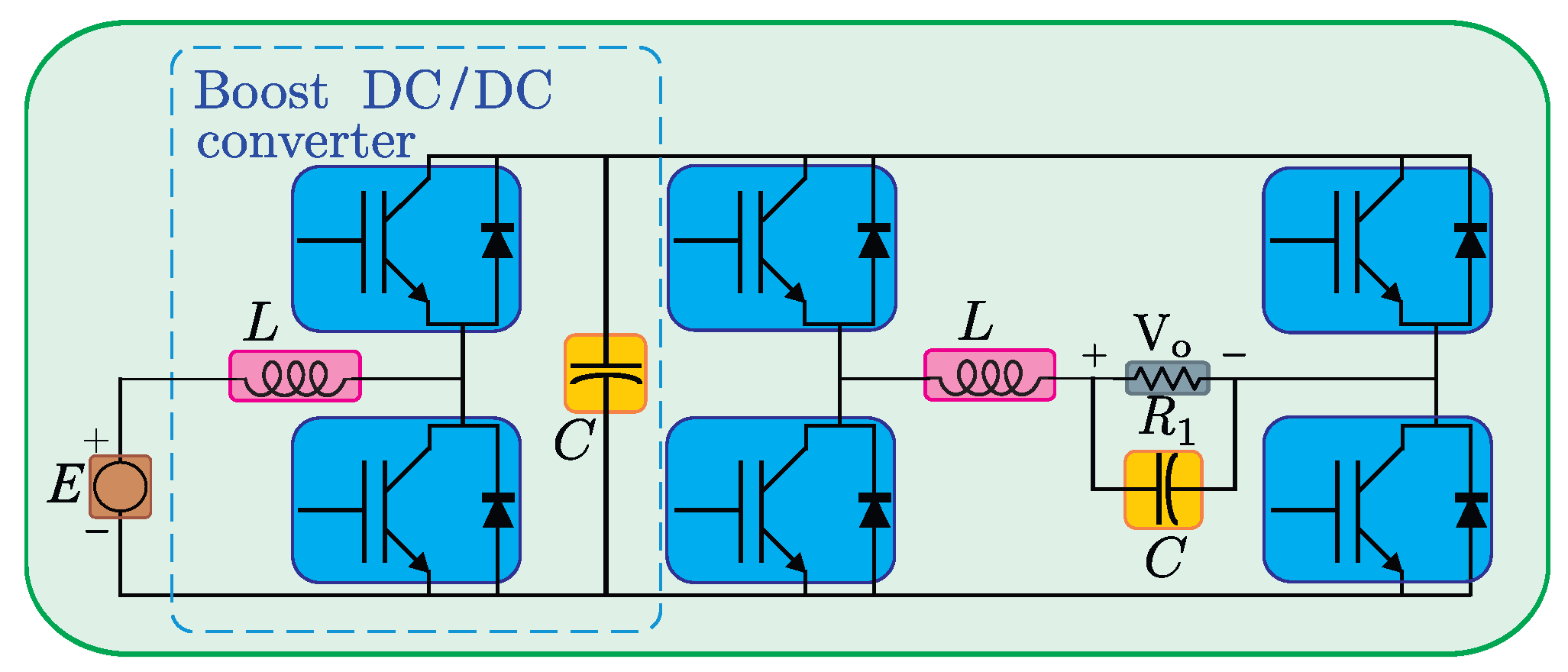
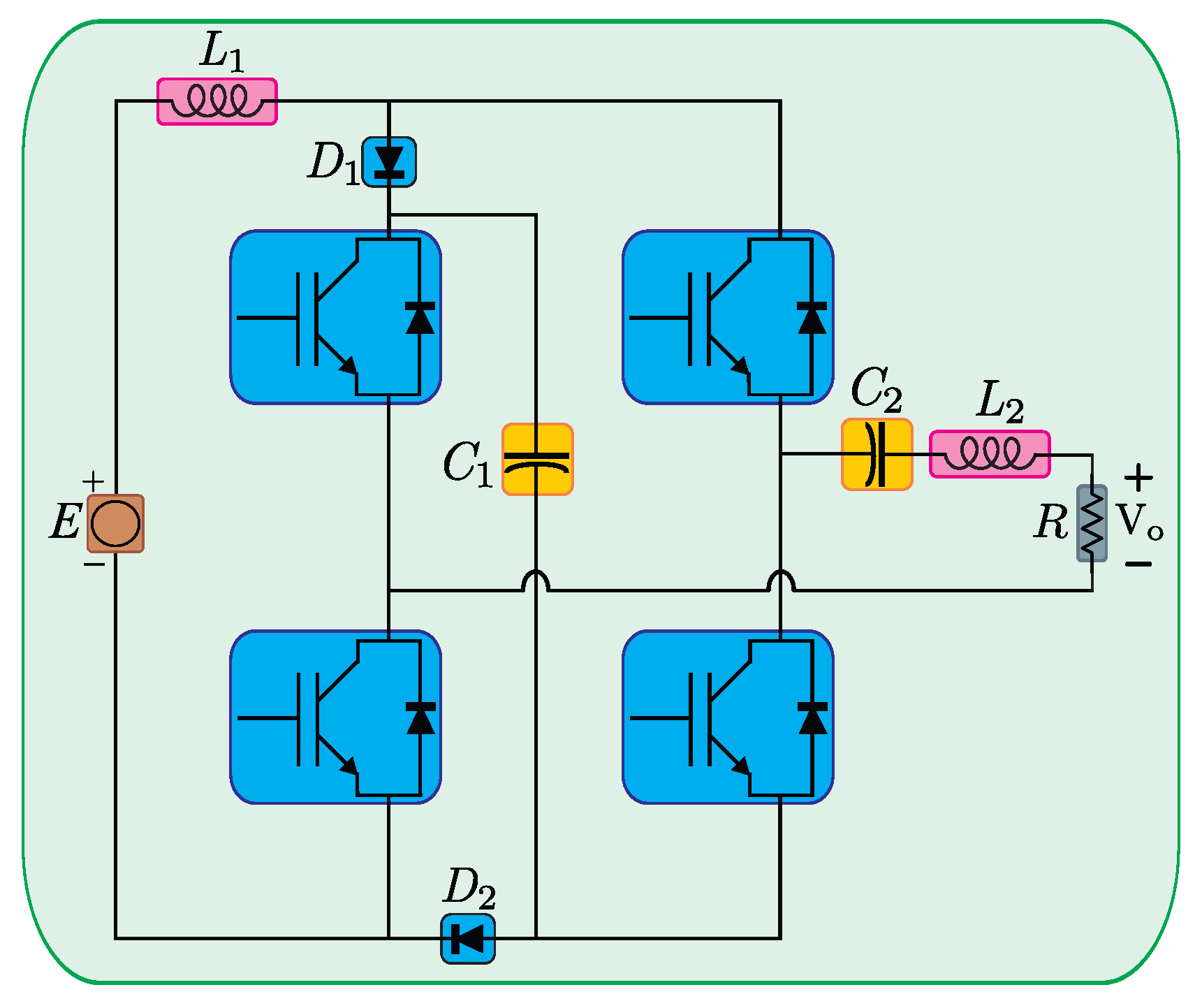
To address the need for bipolar voltage generation, numerous Boost-derived converter topologies have been reported. A straightforward approach to obtaining a bipolar output voltage consists of placing a Boost converter between the DC source and an inverter, as shown in Figure 1. However, depending on the power and voltage levels, this configuration may lead to increased volume, weight, and cost, as well as reduced overall efficiency [14]. Although such cascaded structures are typically employed for AC waveform generation, the objective of the present work is not the synthesis of sinusoidal signals but the realization of a single-stage DC/DC converter capable of generating controlled positive and negative voltage levels with step-up capability.
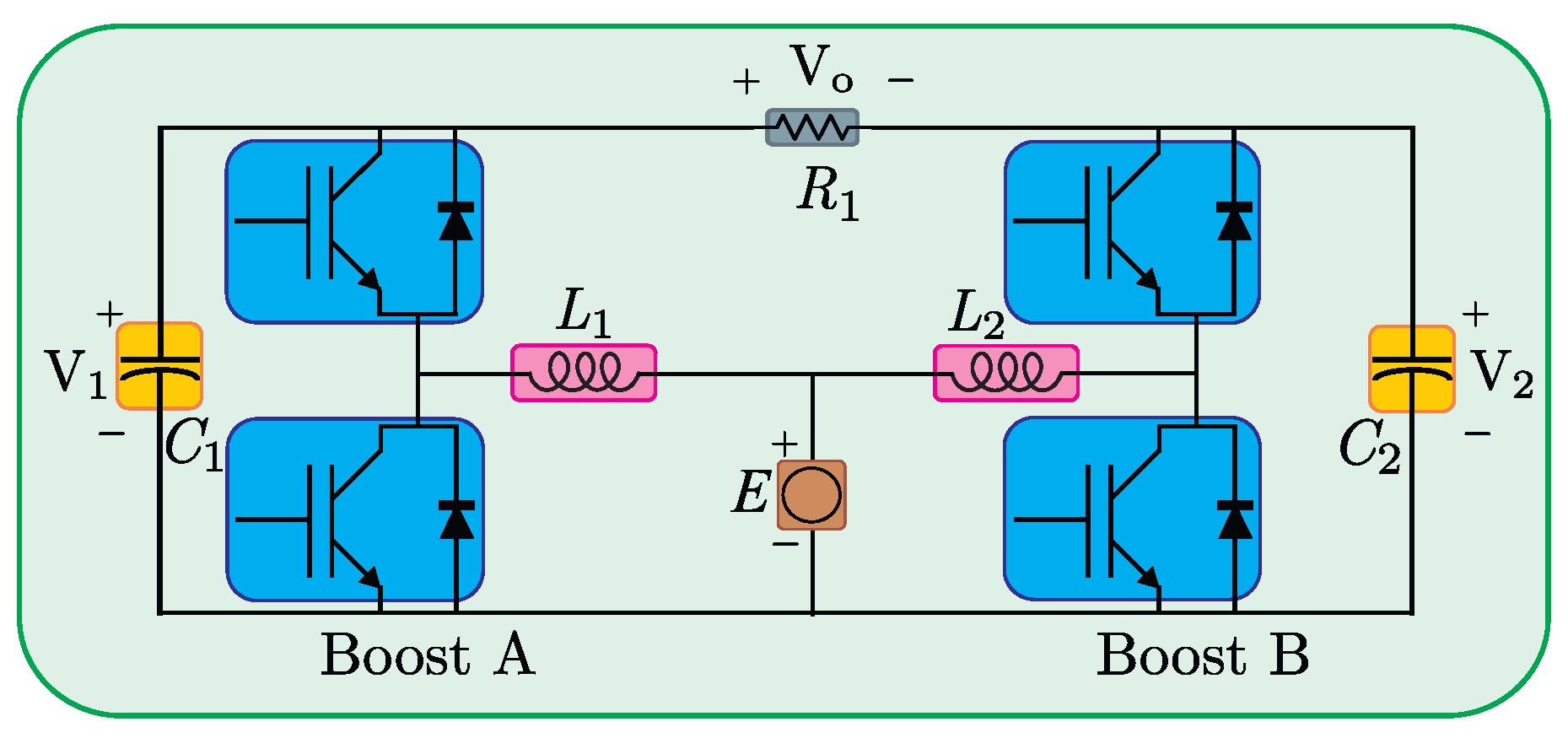
An improvement over the configuration shown in Figure 1 is presented in Figure 2. According to Cáceres and Barbi [14], two Boost converters are combined to generate a DC-biased sinusoidal output. The modulation signals of each converter are phase-shifted by 180 , with the load connected differentially between their outputs. Depending on the switching states of the transistors, a bipolar voltage is obtained across the load terminals. The averaged mathematical model describing the dynamics of this DC/AC Boost converter is nonlinear and of fourth order [14,15].
Arunkumar et al. [16] investigated the DC/AC Boost converter shown in Figure 2 by incorporating component nonlinearities into the mathematical model. By accounting for these nonlinear effects, the resulting model more accurately represents the dynamic behavior of the experimental prototype while preserving the fundamental characteristics of the conventional Boost converter.
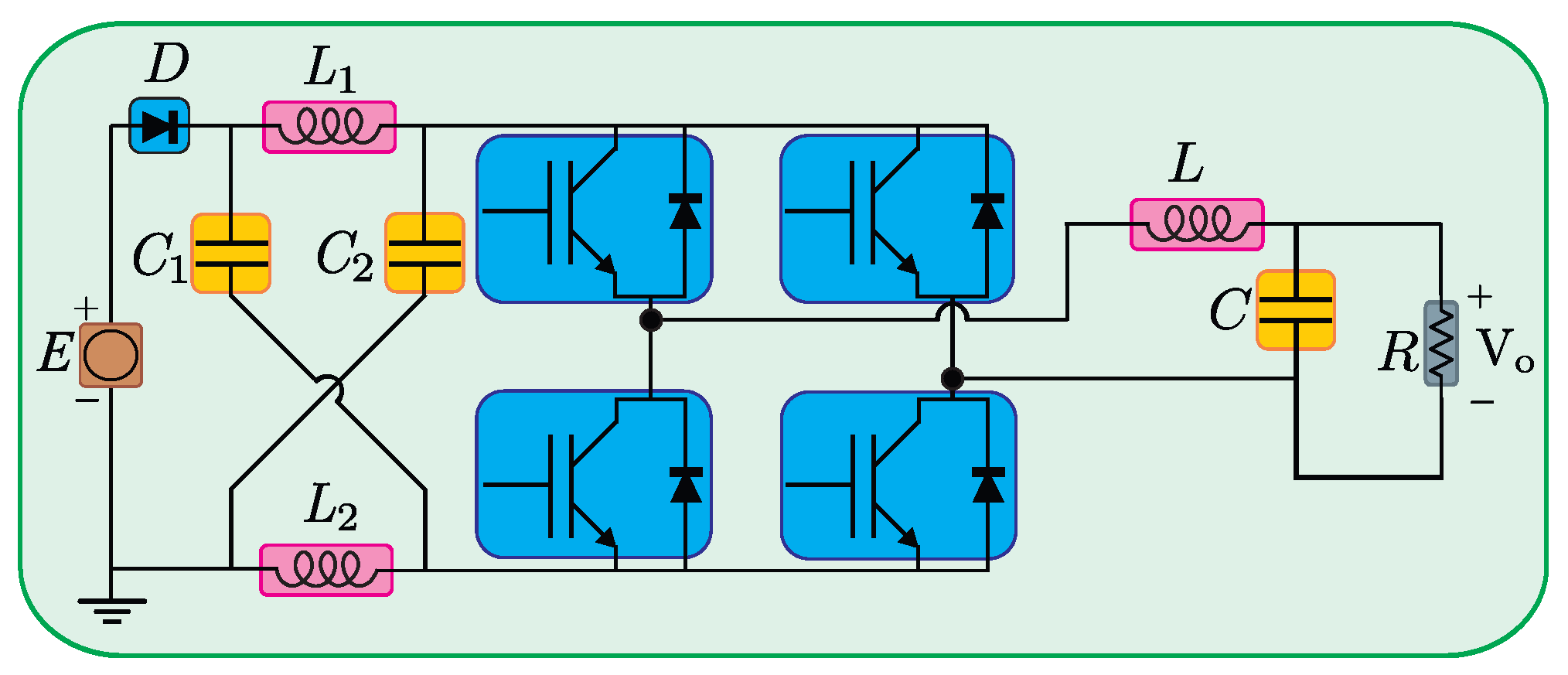
The Z-source inverter (ZSI), illustrated in Figure 3, was introduced in [17]. This topology employs an X-shaped L C impedance network between the inverter bridge and the power source, along with an L C low-pass filter at the output. Consequently, the load voltage can be bipolar with a magnitude either greater than or less than that of the source, depending on the switching states. Furthermore, the Z-source inverter can operate with both DC and AC inputs to generate either DC or AC outputs.
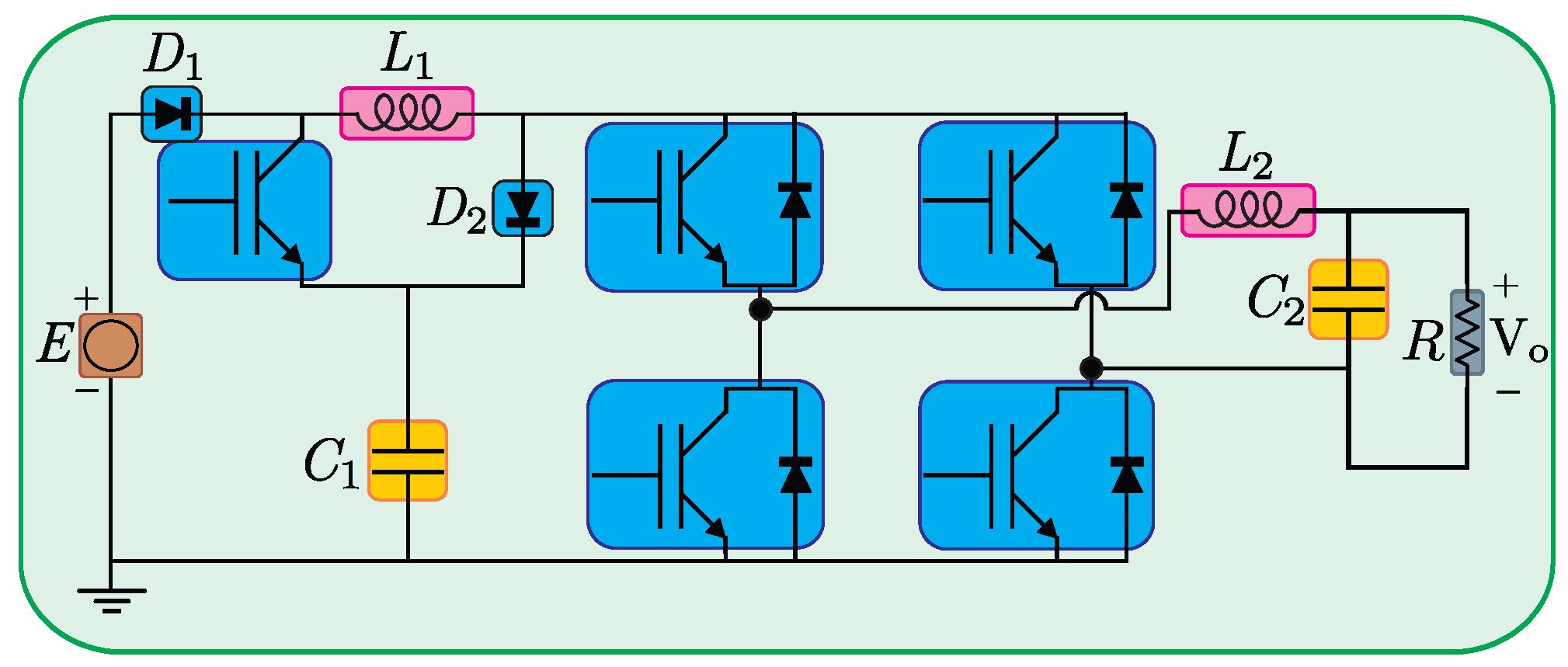
Ravindranath et al. [18] proposed a modification of the Z-source inverter, referred to as the switched Boost inverter (SBI), as shown in Figure 4. Compared with the ZSI in Figure 3, the switched Boost inverter incorporates additional active switches while reducing the count of passive components, specifically inductors and capacitors. This modification results in a notable reduction in system size, weight, and cost while preserving the operational advantages of the ZSI.
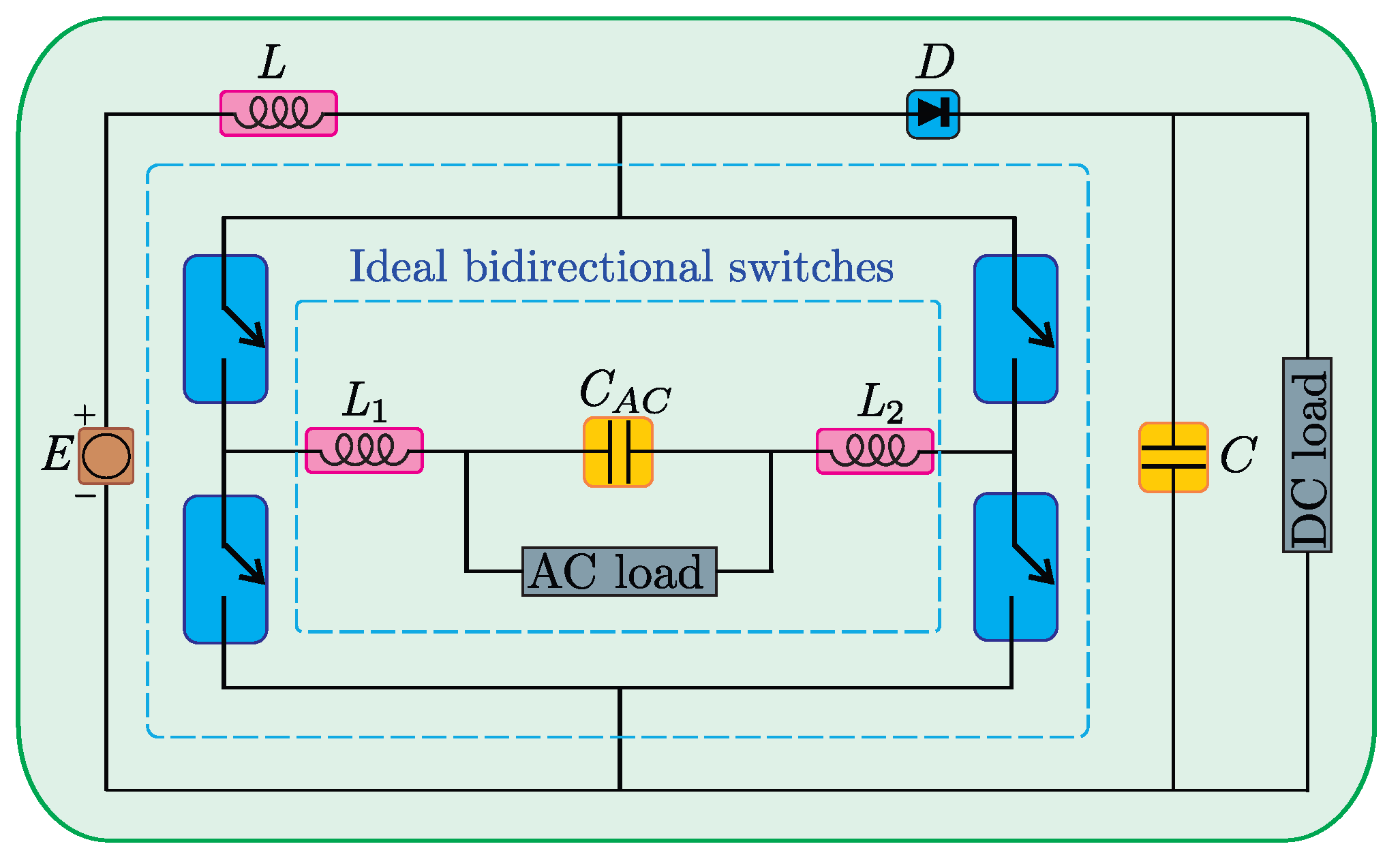
Ray et al. [19] proposed a Boost-derived hybrid converter, as depicted in Figure 5, obtained by replacing the transistor in a conventional DC/DC Boost converter with a network of ideal switches. This configuration enables the simultaneous generation of both AC and DC voltages. However, experimental results indicate that while the DC voltage is effectively boosted, the AC voltage does not experience amplification.
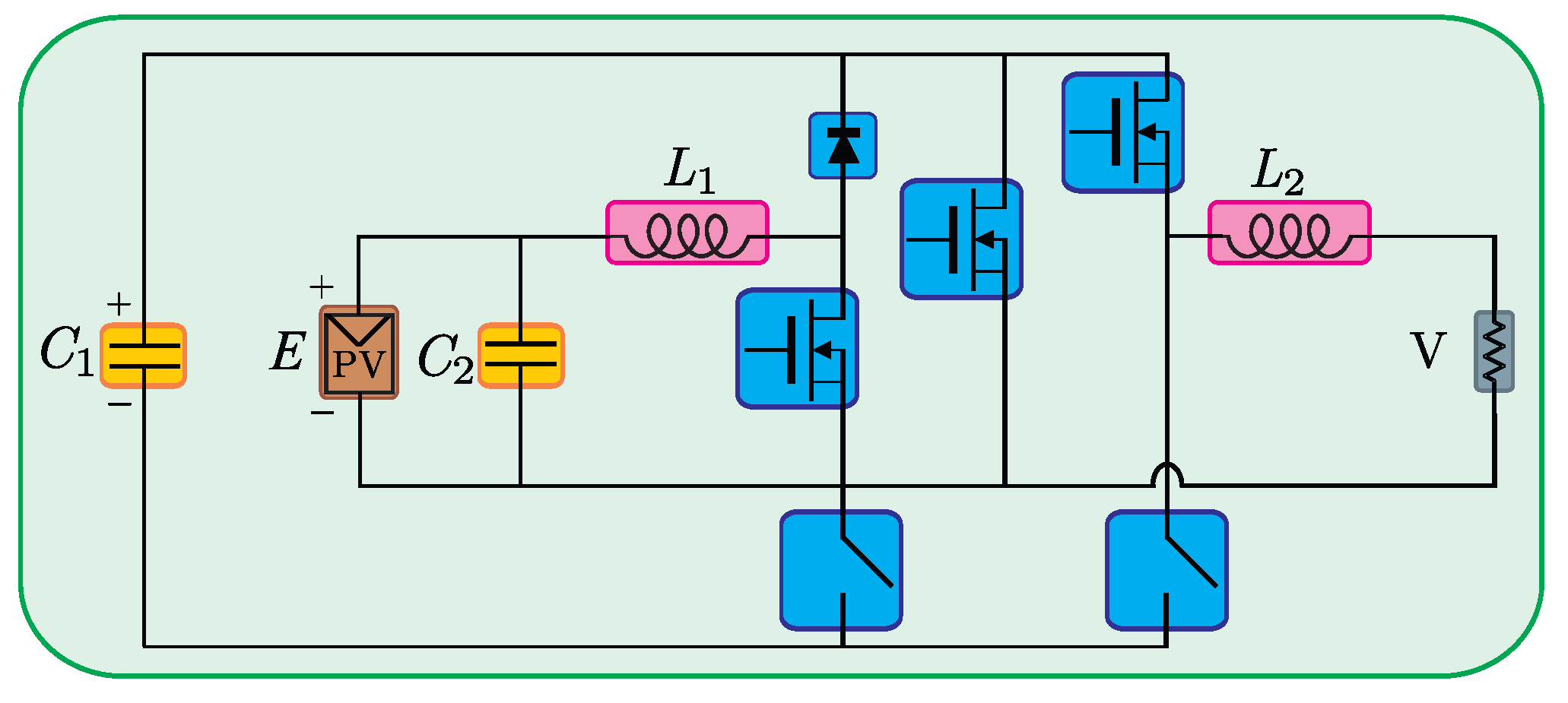
The topology shown in Figure 6 employs the same components as the switched Boost inverter depicted in Figure 4, with the key difference being that the DC source is connected in series with the inductor L 1 . Consequently, the quasi-switched Boost inverter (qSBI) proposed in [20] achieves continuous input current operation and an enhanced voltage gain.
Nguyen et al. [21] extended the switched Boost inverter by incorporating an additional inductor and three diodes, resulting in the topology known as the switched-inductor Boost inverter (SLBI), shown in Figure 7. This configuration exhibits a higher voltage gain compared to the conventional switched Boost inverter presented in Figure 4.
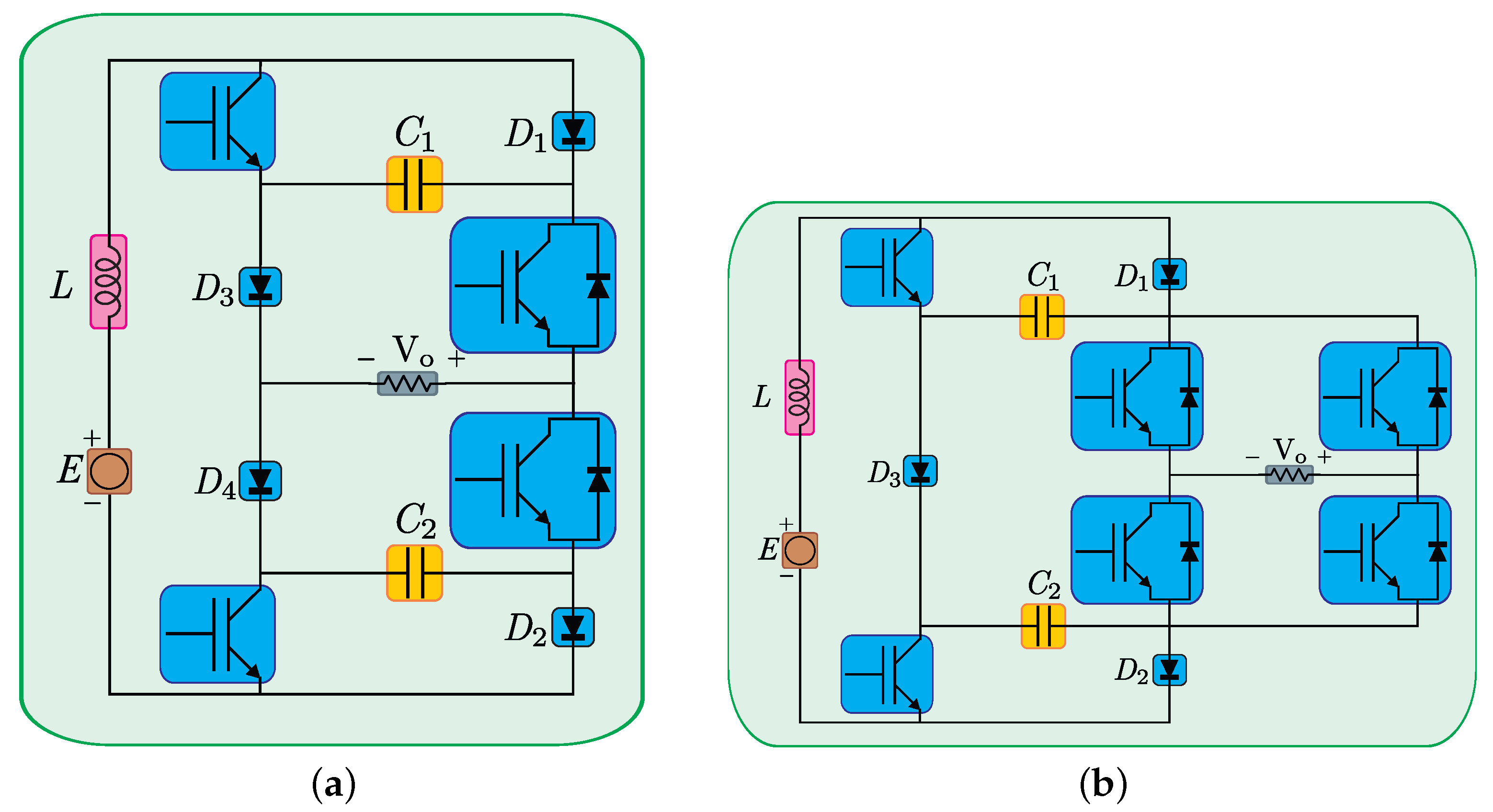
Half-bridge and full-bridge switched-Boost inverter topologies were proposed in [22], as shown in Figure 8. These converters provide high voltage gain, high efficiency, and a reduced passive component count compared to conventional Z-source inverters (Figure 3). Additionally, they offer continuous input current and the capability to generate a zero-voltage output level.
Nguyen and Tran [23] modified the quasi-switched Boost inverter shown in Figure 6 and proposed a four-switch switched-Boost inverter, illustrated in Figure 9. In this topology, the transistor located between the capacitor and the DC source is replaced by a half-bridge. Consequently, the active switch count is reduced compared to the quasi-switched Boost inverter, and a capacitor is employed to eliminate the DC offset at the output. The reported results demonstrate an increased voltage gain compared to other Boost-derived converters.
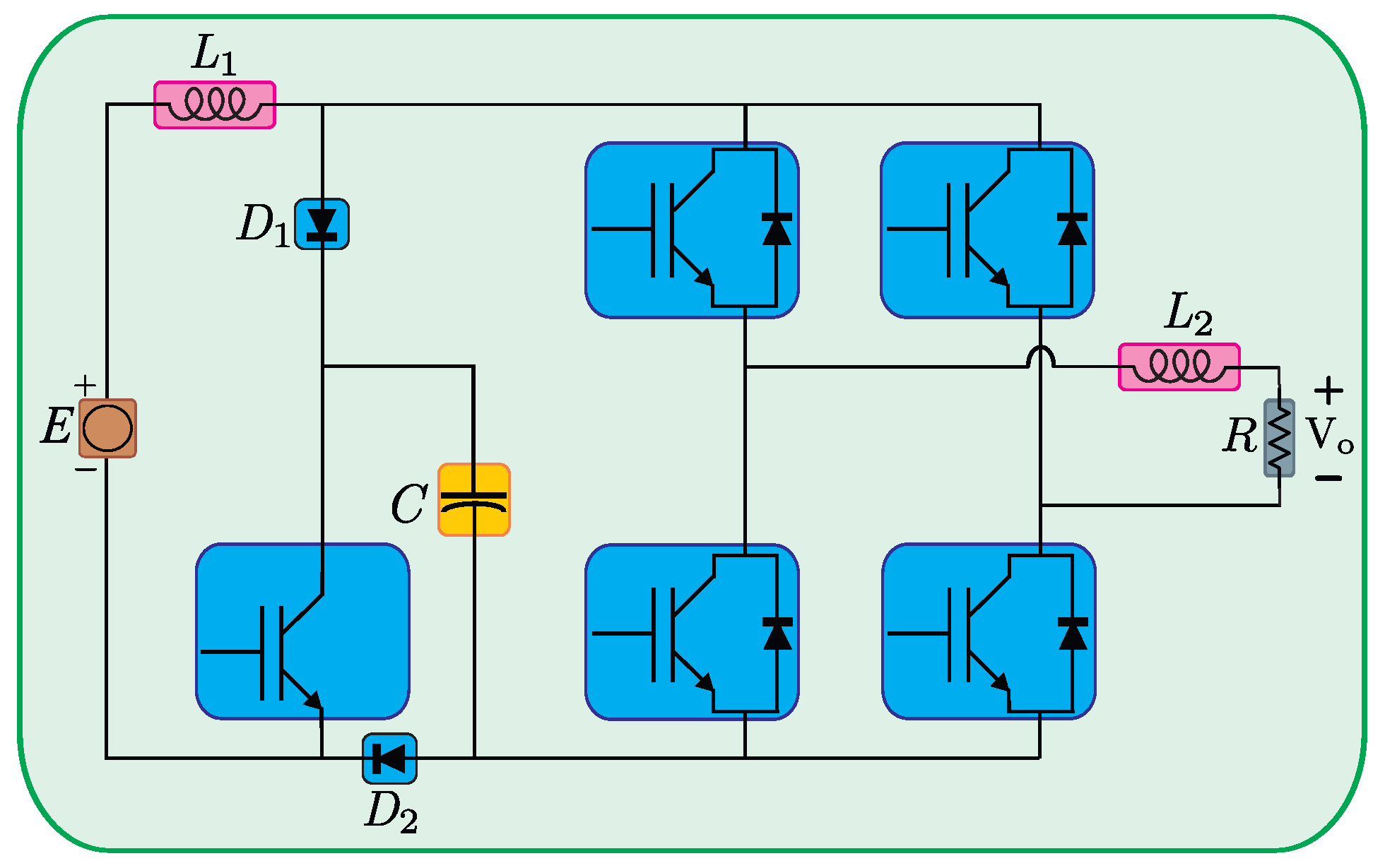
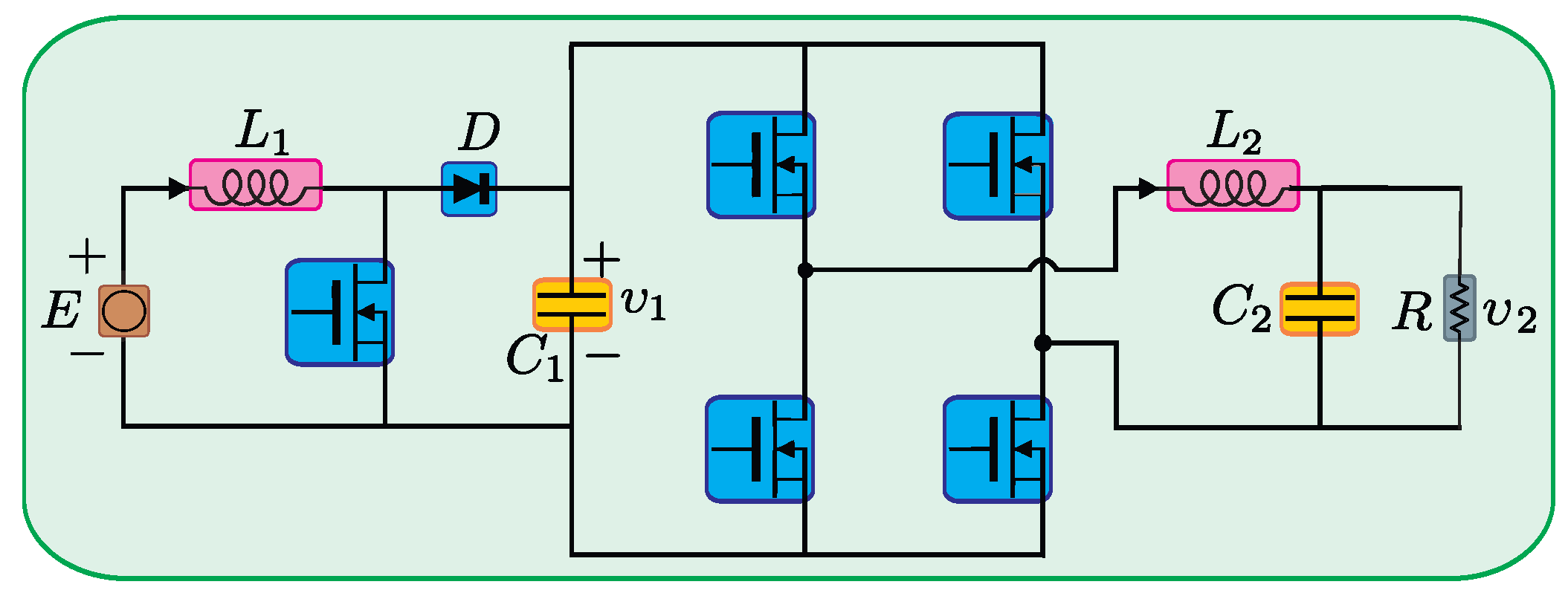
The converter proposed in [24], shown in Figure 10, is primarily composed of five switches, a diode, an input inductor, a capacitor, and an output filter. This non-isolated step-up DC–AC converter results from integrating a DC/DC Boost converter with a conventional full-bridge inverter. The reported results indicate a significant reduction in leakage current, thereby improving both reliability and conversion efficiency.
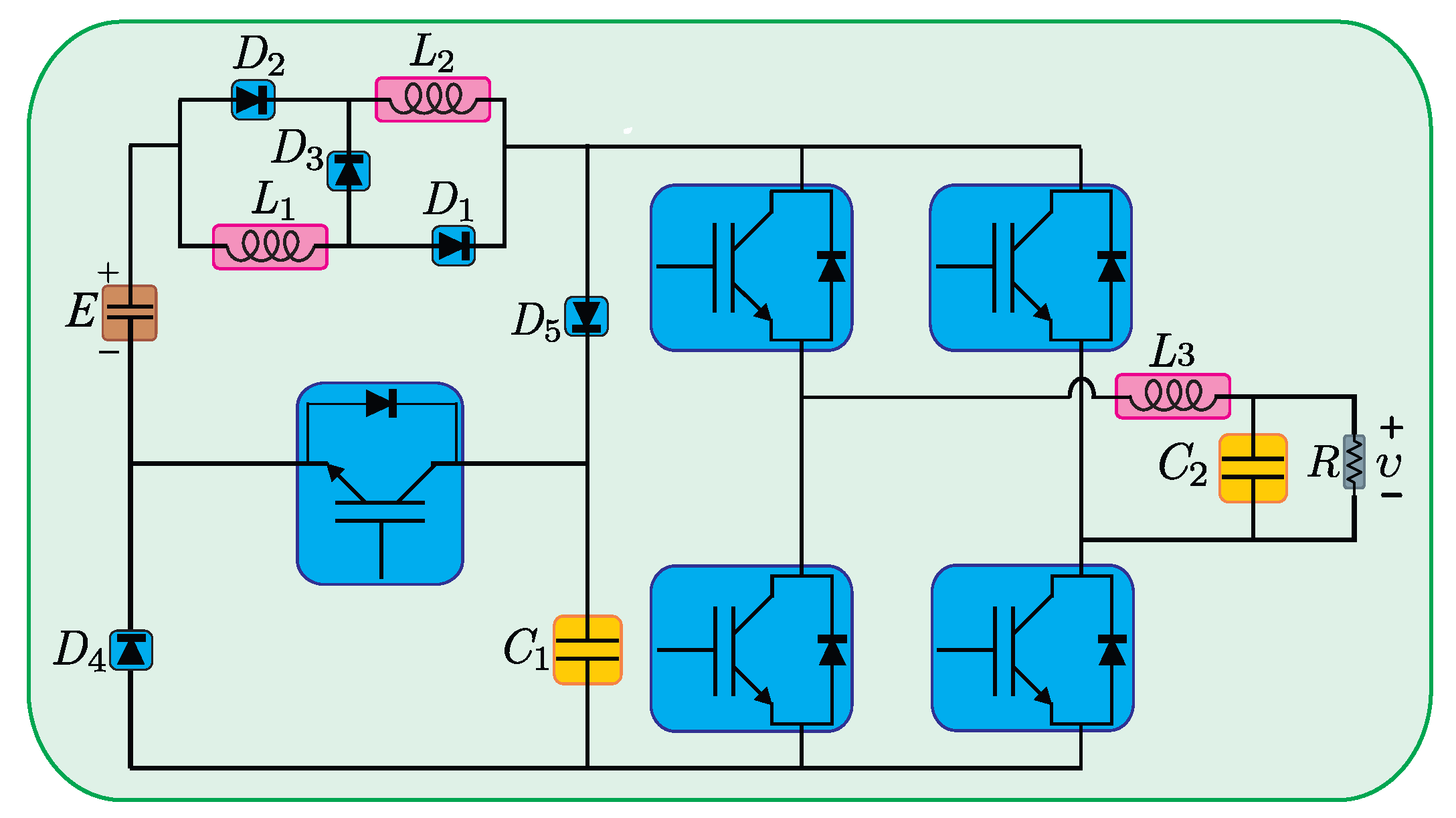
Recently, García-Rodríguez et al. [25] proposed a cascaded topology composed of a DC/DC Boost converter, a full-bridge inverter, and a DC/DC Buck converter, as shown in Figure 11. In this configuration, the Boost converter increases the input voltage, the full-bridge generates a bipolar output, and the Buck converter provides additional filtering and regulation through its L C stage.
The aforementioned topologies are reviewed not for their sinusoidal AC generation capability but because they belong to the class of Boost-derived converters that incorporate voltage step-up and polarity inversion. The state-of-the-art proposed converter shares this architectural principle.
From a topological and modulation perspective, recent single-stage bipolar step-up converters can be broadly classified into differential Boost–inverter converters [14,15,16], impedance-source inverters [17,20,21], hybrid Boost–inverter topologies [18,19,22,23,24], and cascaded Boost–inverter configurations [25]. In these topologies, bipolar voltage generation is commonly achieved through phase-shifted modulation, shoot-through states, switched-inductor boosting mechanisms, or full-bridge inversion stages. In contrast, the proposed converter employs a simplified switching configuration in which voltage boosting and polarity inversion are integrated within a unified DC/DC stage without requiring impedance-source networks or shoot-through operation. Owing to their capability for bipolar voltage generation and voltage boosting, converters of this class may also be relevant in emerging DC distribution and high-voltage DC applications. In this context, fault-tolerant and controllable DC conversion structures for HVDC systems have recently attracted considerable attention [26].
An alternative approach to voltage boosting consists of using multilevel Boost power converters, which generate multiple output voltage levels from several lower-voltage sources. This technique enables a significant reduction in harmonic content and improves system efficiency [27,28,29,30,31,32,33]. However, multilevel converters are not considered in this work. In addition to multilevel structures, isolated Boost-type DC/DC converters have been extensively investigated in the literature. These topologies typically employ high-frequency transformers to provide galvanic isolation and to extend the voltage conversion ratio through the turn ratio [34,35]. In such converters, the voltage boosting mechanism is inherently linked to magnetic energy transfer, the transformer turn ratio, and secondary-side rectification structures. The energy-processing principle is, therefore, magnetically coupled and structurally dependent on isolation stages. In contrast, non-isolated Boost converters achieve voltage step-up exclusively through duty-cycle modulation and direct inductor energy transfer without magnetic coupling. Consequently, the averaged dynamic models, gain-generation mechanisms, and switching-state structures of isolated and non-isolated converters belong to fundamentally different architectural families. For this reason, isolated Boost converters are outside the scope of this work.

1.2. Discussion and Contributions

In this paper, a novel bipolar Boost DC/DC topology is proposed. The proposed Full-bridge Boost converter consists of a DC source, a single inductor, a full-bridge stage, an additional pair of transistors, a capacitor, and a resistive load. Compared with the previously reported topologies shown in Figure 1, Figure 2, Figure 3, Figure 4, Figure 5, Figure 6, Figure 7, Figure 8, Figure 9, Figure 10 and Figure 11, the proposed converter employs a reduced number of passive components relative to those presented in [14,15,16,17,18,19,20,21,22,23,24,25]. Specifically, unlike the conventional Z-source inverter [17] or switched-Boost inverter [18] topologies, the proposed Full-bridge Boost converter does not rely on impedance-source networks, shoot-through states, switched-inductor cells, or capacitor-assisted boosting structures to achieve bipolar voltage generation. Instead, the proposed topology employs a full-bridge switching configuration together with a single inductor and a single capacitor to integrate voltage boosting and polarity inversion within a unified DC/DC stage. As a result, the proposed converter presents a structurally simpler alternative to existing switched-Boost and Z-source-derived converters. By appropriately controlling the switching states of the transistors, a bipolar output voltage is obtained at the full-bridge terminals while the input voltage is simultaneously stepped up. Simulation results are presented to validate the performance and feasibility of the proposed topology.
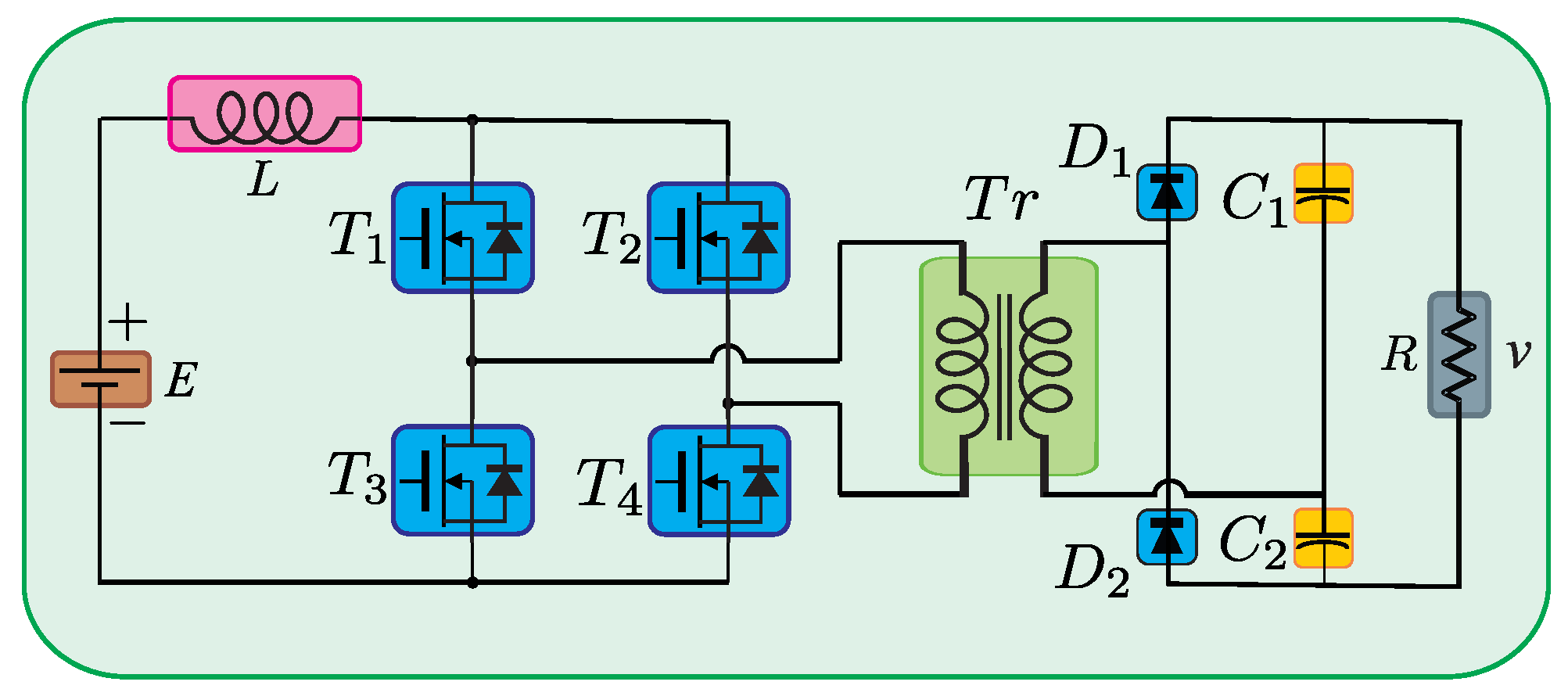
Although the proposed converter employs a full-bridge switching arrangement that may appear visually similar to the conventional current-fed full-bridge (CFFB) isolated Boost converter shown in Figure 12, both topologies belong to fundamentally different architectural classes.
In the conventional CFFB, the voltage-Boost mechanism is intrinsically dependent on the high-frequency transformer, the turn ratio n, the primary short-circuit interval, and the secondary rectifier stage. Its averaged model explicitly contains the transformer-dependent factor 1 / ( 2 n ) , and the static gain is given by [35],
G = 2 n 1 D c ,
which demonstrates that both the dynamic behavior and the voltage conversion ratio are structurally linked to magnetic coupling. Therefore, the transformer is not an auxiliary element but a fundamental component that defines the energy-processing mechanism of the converter.
In contrast, the proposed Full-bridge Boost converter belongs to the family of non-isolated voltage-fed topologies, where energy transfer occurs directly between the inductor and the load through controlled switching states, without transformer coupling, short-circuit intervals, or secondary rectification stages. As a result, the voltage-Boost mechanism is determined not by magnetic coupling or transformer turn ratio but by the switching configuration and the modulation strategy. This leads to a fundamentally different averaged dynamic structure and gain-generation principle, which are formally derived and analyzed in the following sections. The complete proposed circuit topology and switching configuration are formally introduced in Section 2.
Based on the comprehensive review of the state of the art and the technical gaps identified in existing bipolar power conversion solutions, the main contributions of this work are established as follows:
  • A new Full-bridge Boost converter topology is established that is capable of generating bipolar voltage using only six switches, one inductor, one capacitor, and a resistive load.
  • The formal mathematical representation is developed through the derivation of both switched and averaged models based on Kirchhoff’s theorems to provide a complete theoretical framework for dynamic analysis.
  • The operating regions are characterized by defining the boundary conditions for continuous and discontinuous conduction modes to establish deterministic design constraints.
  • The steady-state performance is evaluated through the analytical derivation of the current-voltage ripple expressions and the static voltage gain under a constant PWM duty cycle to establish the fundamental operating characteristics of the topology.
  • A high-fidelity validation framework is implemented in MATLAB R2023b/Simulink using Simscape Electrical and RMSE metrics to demonstrate the dynamic accuracy of the proposed model across the entire operational range.
  • The validation of the mathematical model is achieved through a comprehensive comparison between numerical results obtained from the averaged equations and high-fidelity circuit-level simulations to ensure the consistency of the proposed theory with physical behavior.
To further highlight the advantages of the proposed topology relative to existing Boost-derived converters that integrate voltage boosting and polarity inversion, Table 1 provides a comparative overview in terms of the number of active switches, passive components, efficiency, voltage stress, and control complexity. The values reported in Table 1 are qualitative or representative ranges extracted from the corresponding references and are intended to provide a comparative assessment of the structural and operational characteristics of the considered topologies. As can be observed, the proposed Full-bridge Boost converter achieves bipolar voltage boosting using a reduced number of passive components while preserving a single-stage conversion structure.
The remainder of this paper is organized as follows. Section 2 introduces the proposed Full-bridge Boost converter topology and describes its operating principles and switching configurations. Subsequently, the switching-based and averaged mathematical models of the converter are derived, and a steady-state analysis is carried out to determine the static voltage gain. Simulation results and model validation are presented in Section 4, where the averaged model is compared against circuit-level simulations implemented in MATLAB/Simulink. Finally, the main conclusions of the work are summarized in Section 5.

2. The New Full-Bridge Boost Converter System

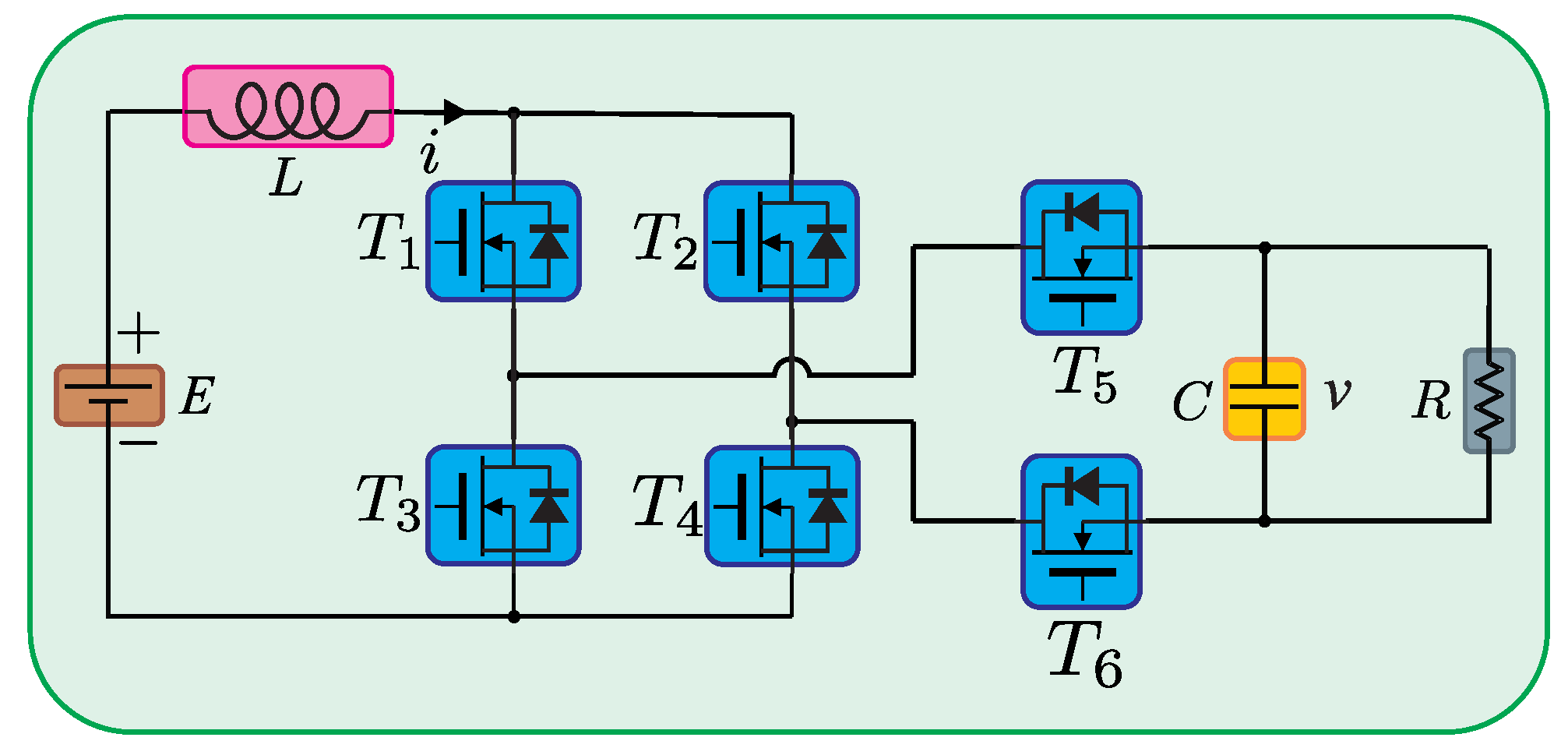
The proposed Full-bridge Boost converter is a novel DC/DC topology that enables bipolar boosting of the input voltage magnitude. The circuit diagram of the converter is shown in Figure 13. It comprises a DC supply voltage E, a single inductor L, an array of six power transistors ( T 1 to T 6 ), and an R C network consisting of a capacitor C and a load resistor R connected in parallel.
Through an appropriate switching sequence of transistors T 1 to T 6 , the proposed converter generates a bipolar output voltage v. As demonstrated in Section 2.1, the magnitude of this output can be controlled to be equal to or greater than that of the unipolar source E.

2.1. Switching Configuration

The operation of the proposed Full-bridge Boost converter system is divided into four distinct switching phases, as summarized in Table 2.
Transistors T 1 to T 4 constitute a full-bridge (H-bridge) stage responsible for controlling the polarity of the output voltage v. Transistors T 5 and T 6 , in coordination with the H-bridge, regulate the energy charging and discharging cycles of the converter.
Assuming ideal switching devices, the output voltage satisfies v > 0 during the positive charging and discharging phases. Conversely, during the negative charging and discharging phases, the output voltage satisfies v < 0 .
As detailed in Table 2, the practical implementation requires three independent PWM signals. The first PWM signal drives transistors T 1 and T 4 , the second drives T 2 and T 3 , and the third controls T 5 and T 6 . Considering the positive charging and discharging phases, transistors T 1 and T 4 remain continuously ON, while transistors T 2 and T 3 switch complementarily with respect to transistors T 5 and T 6 . Similarly, during the negative charging and discharging phases, transistors T 2 and T 3 remain continuously ON, whereas transistors T 1 and T 4 switch complementarily with respect to transistors T 5 and T 6 .
To characterize the switching dynamics of the proposed Full-bridge Boost converter, the equivalent circuit corresponding to each operating phase is analyzed in the following sections.

2.1.1. Positive Charging Phase

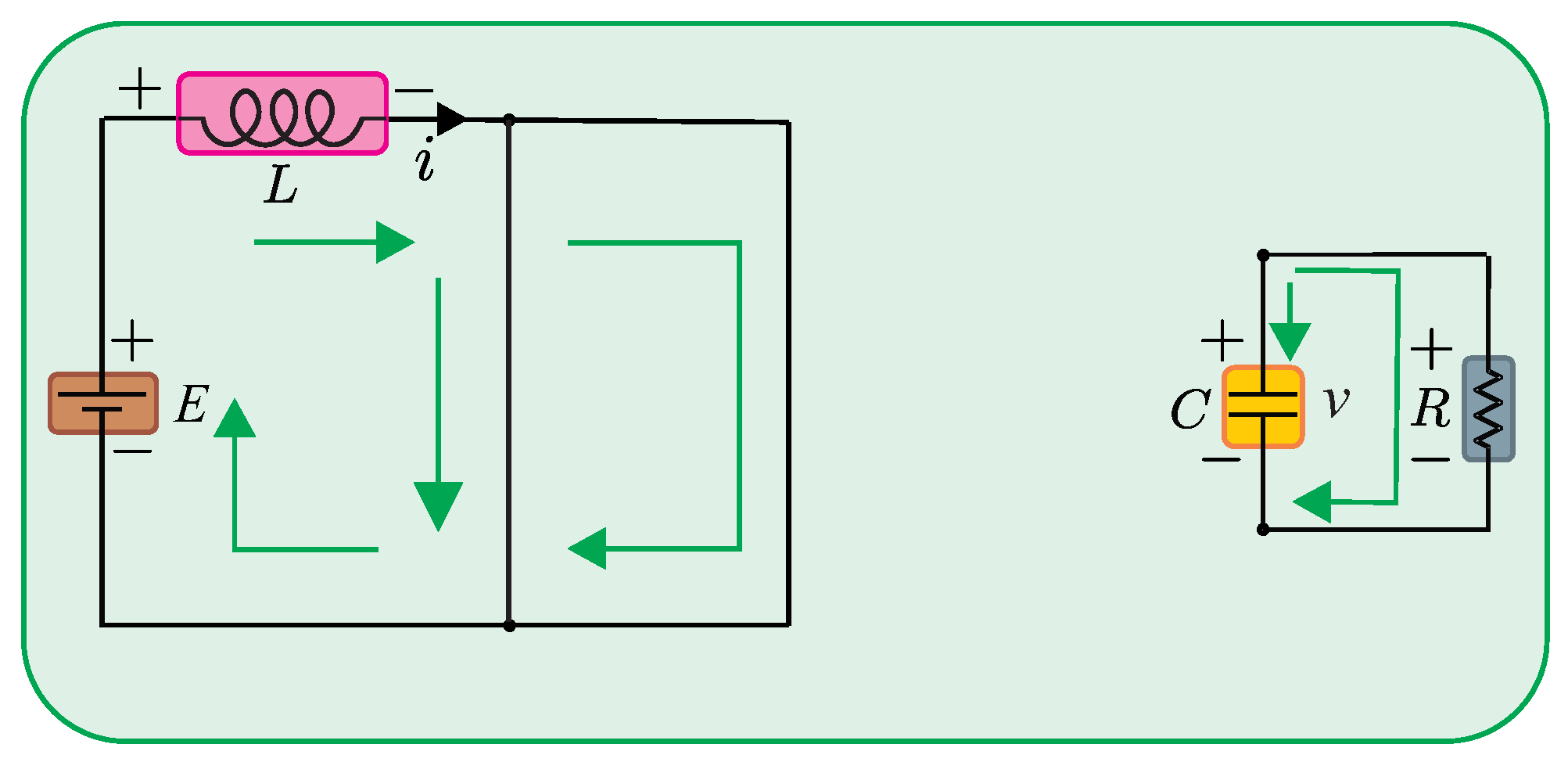
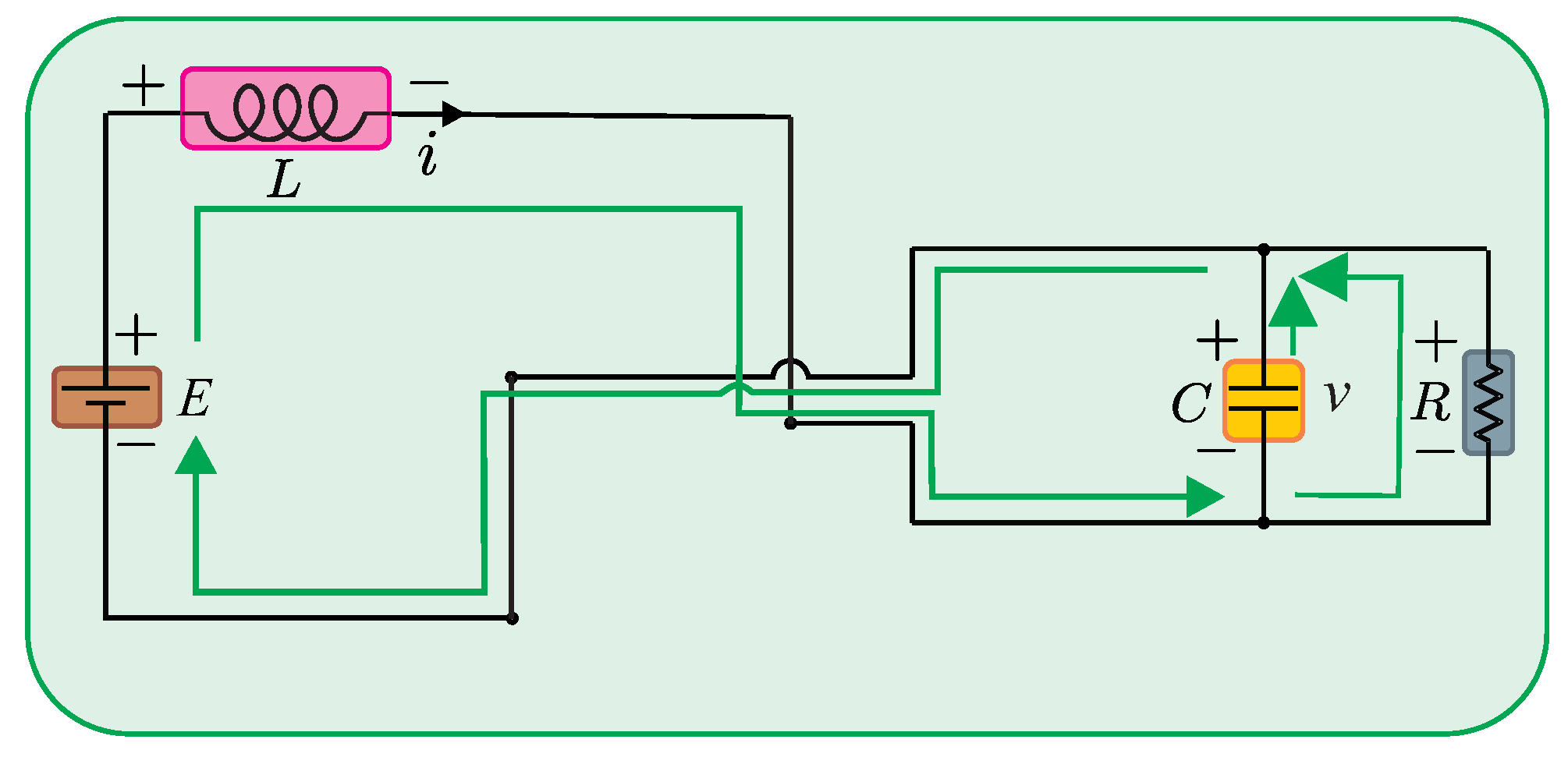
Based on the transistor switching states defined in Table 2, the equivalent circuit for the positive charging phase is illustrated in Figure 14.
Applying Kirchhoff’s theorems to the inductor L and capacitor C loops yields the following dynamic model:
L d i d t = E , C d v d t = v R .

2.1.2. Positive Discharging Phase

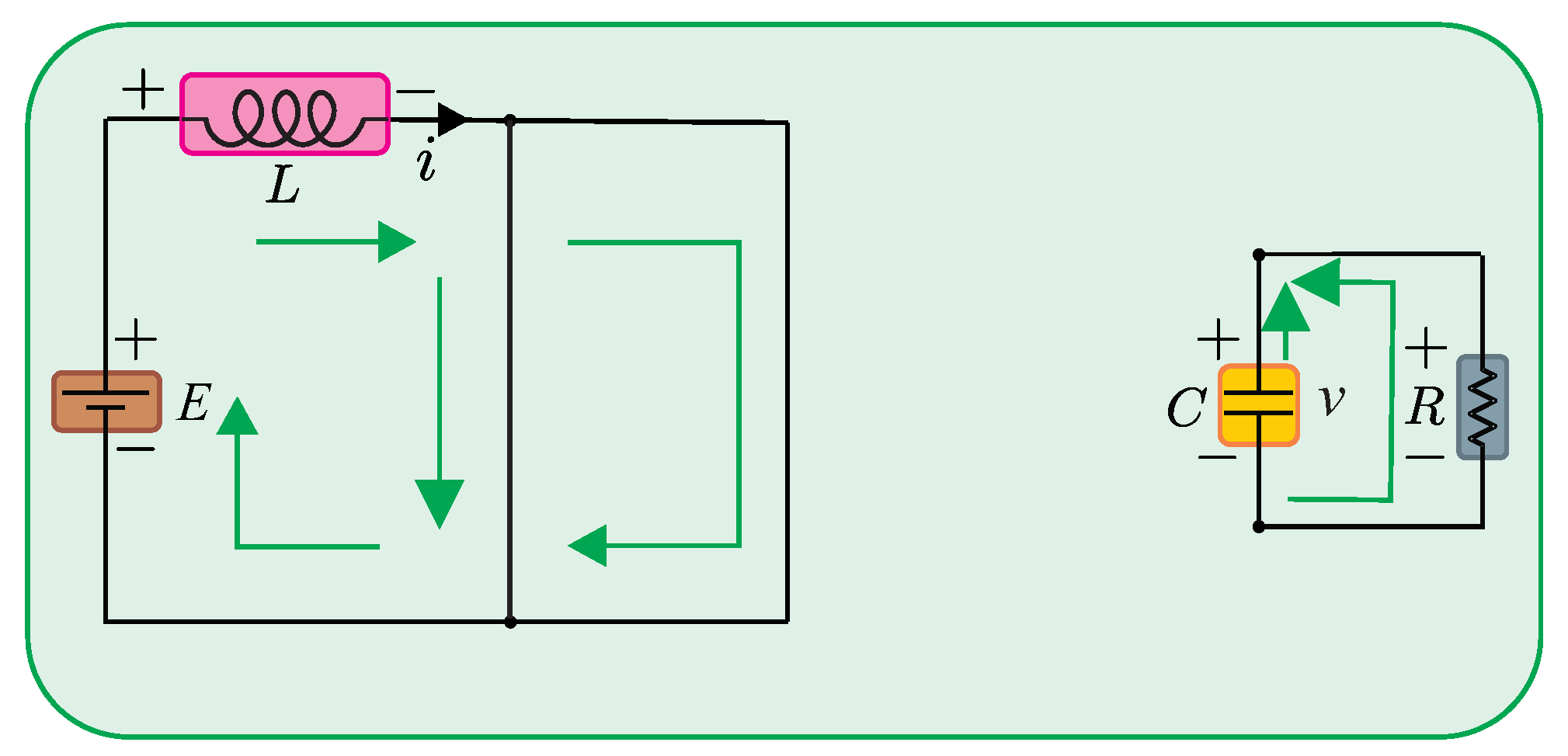
The equivalent circuit for the positive discharging phase is shown in Figure 15.
During this phase, the energy previously stored in the inductor L is transferred to the R C network. The corresponding dynamics is described by
L d i d t = E v , C d v d t = i v R .
It is worth noting that, during the positive discharging phase, the inductor current may reach zero if the Full-bridge Boost converter operates in discontinuous conduction mode (DCM). Under this condition, the inductor remains in a zero-current state, and the capacitor supplies the load according to
i = 0 , C d v d t = v R .
Therefore, the inductor current satisfies i 0 during the positive operating phases. In the remainder of this work, the proposed Full-bridge Boost converter is assumed to operate in continuous conduction mode (CCM) unless otherwise specified; that is, the inductor current does not reach zero within a switching period.

2.1.3. Negative Charging Phase

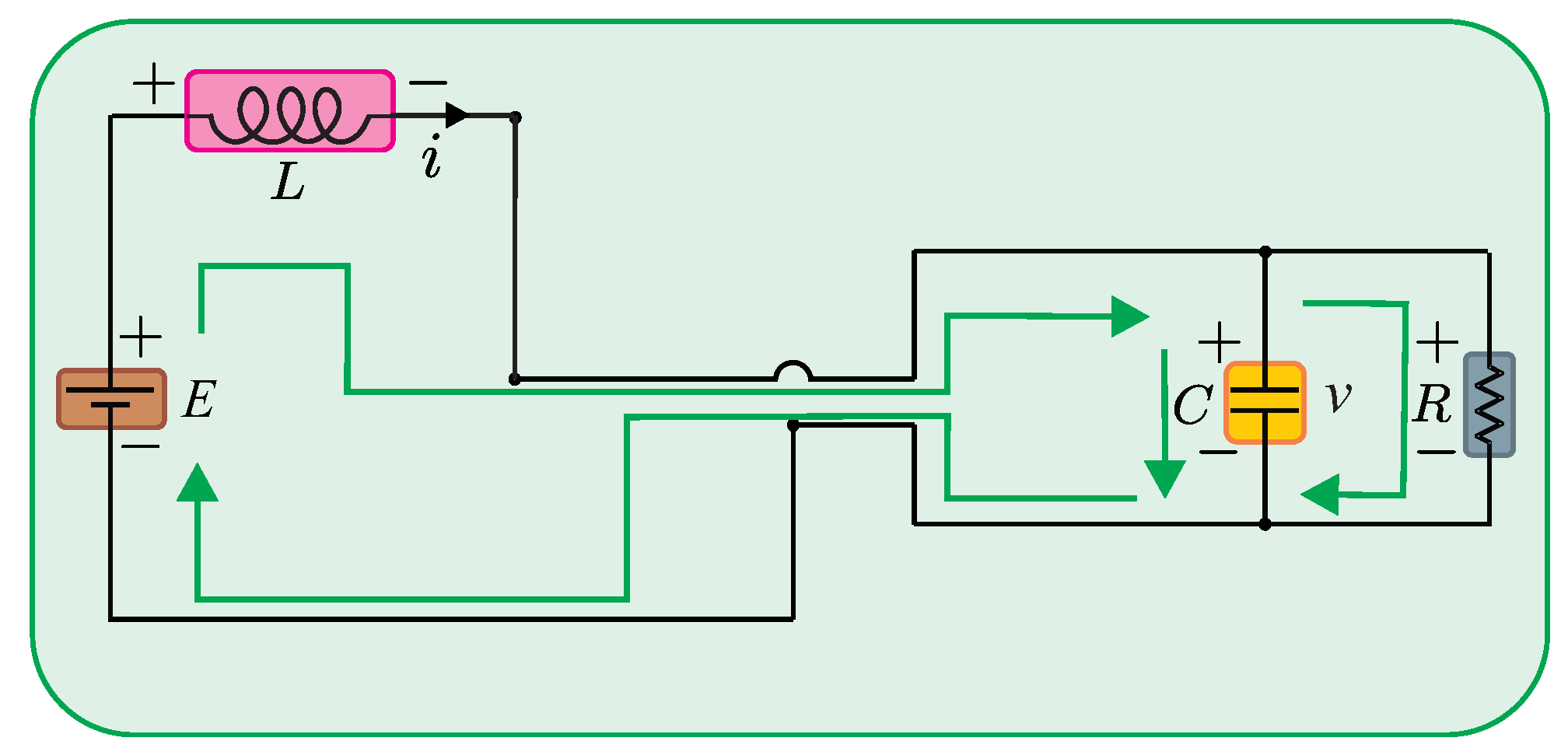
For the negative charging phase, where v < 0 is expected, the inductor stores energy as illustrated in Figure 16.
Since the positive and negative charging phases share the same switching configuration (see Table 2), the model for the negative charging phase is identical to that of the positive charging phase:
L d i d t = E , C d v d t = v R .

2.1.4. Negative Discharging Phase

In the negative discharging phase, the H-bridge reverses the polarity of the voltage applied to the R C network, as shown in Figure 17.
Applying Kirchhoff’s theorems yields
L d i d t = E + v , C d v d t = i v R .
Similar to the positive discharging phase, during the negative discharging phase the inductor current may also reach zero under discontinuous conduction mode (DCM) operation. In such a case, the converter enters a zero-current state described by
i = 0 , C d v d t = v R ,
thus ensuring that the inductor current satisfies i 0 during the negative operating phases.

2.2. Switching Model

The switching models given by (1)–(4) can be unified into a single switched representation by introducing the dimensionless discrete switching function u { 1 , 0 , 1 } , which represents the converter switching configuration:
L d i d t = E u v , C d v d t = u i v R .
Each operating phase is obtained by assigning to u the value specified in Table 3. Consequently, the unified switched model in (5) reproduces the individual operating modes described by (1)–(4). Moreover, the discrete switching function u determines the active switching state associated with the PWM implementation, as detailed in Section 4.1, and enables the derivation of the averaged model under CCM conditions.

2.3. Averaged Model

Following standard averaging techniques for CCM [36], the switched model (5) can be extended to an averaged representation by allowing the discrete switching function u to take values in the continuous interval [ 1 , 0 ) ( 0 , 1 ] . The dimensionless averaged input is denoted by u ¯ , while the averaged inductor current and capacitor voltage are denoted by i ¯ and v ¯ , respectively. The resulting averaged model is expressed as
L d ı ¯ d t = E u ¯ v ¯ , C d v ¯ d t = u ¯ ı ¯ v ¯ R .
The averaged model (6) serves as the basis for the steady-state analysis of the proposed “Full-bridge Boost converter system”, which is presented in the following section.

2.4. Steady-State Analysis of the Proposed Full-Bridge Boost Converter System

Under steady-state conditions, the time derivatives of the averaged state variables in (6) are set to zero, yielding the following algebraic relationships:
0 = E u ¯ s s v ¯ s s , 0 = u ¯ s s ı ¯ s s v ¯ s s R ,
where u ¯ s s , v ¯ s s , and ı ¯ s s denote the steady-state control input, output voltage, and inductor current, respectively. Solving (7) gives the steady-state current and voltage as functions of u ¯ s s :
ı ¯ s s = E u ¯ s s 2 R , v ¯ s s = E u ¯ s s .
From (8), the steady-state voltage gain of the Full-bridge Boost converter is obtained as
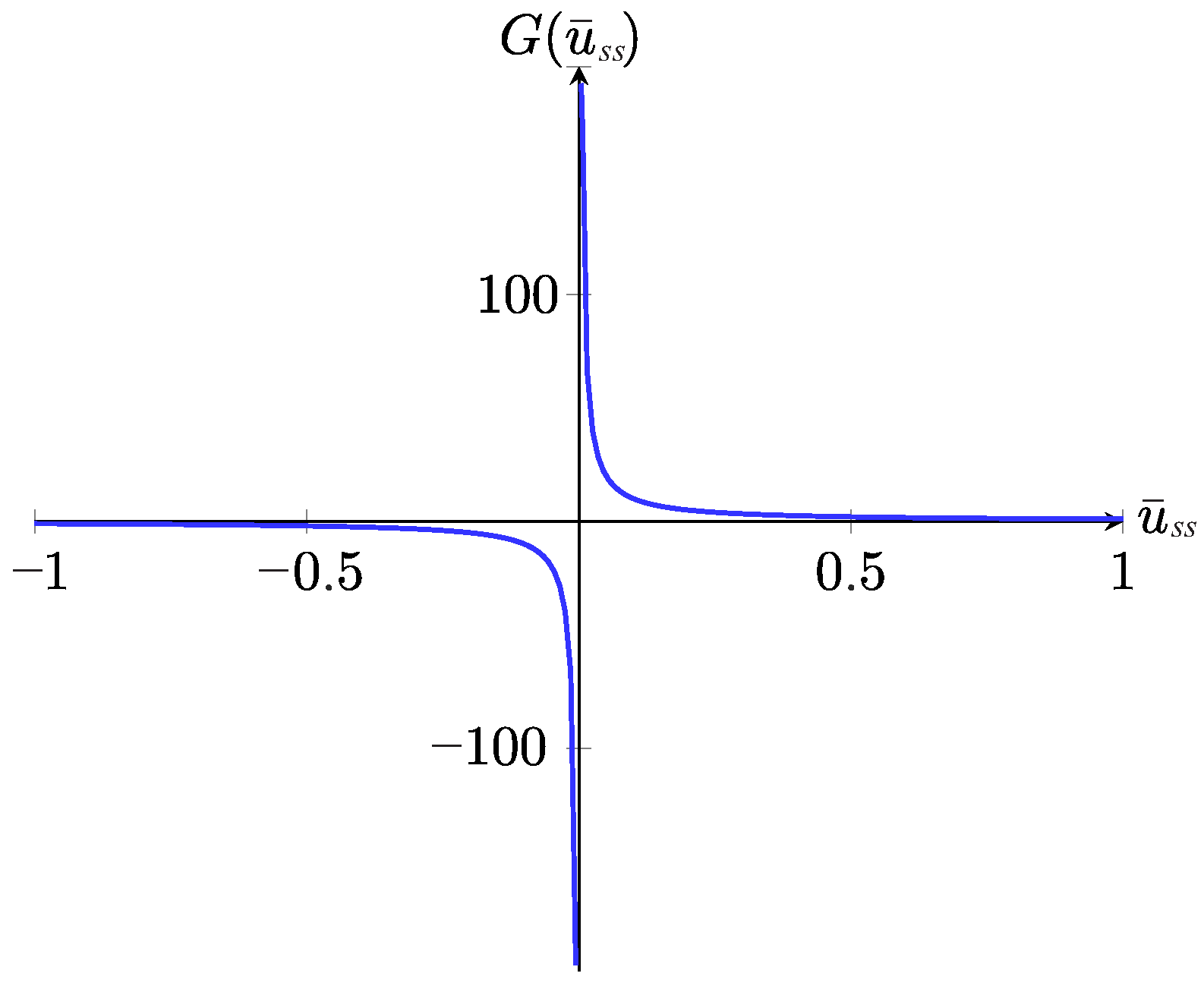
G ( u ¯ s s ) = v ¯ s s E = 1 u ¯ s s .
The gain G ( u ¯ s s ) for u ¯ s s [ 1 , 0 ) ( 0 , 1 ] is shown in Figure 18, where G ( 1 ) = 1 , G ( 1 ) = 1 , and lim u ¯ s s 0 ± G ( u ¯ s s ) = ± .

2.5. Ripple Analysis and Continuous Conduction Mode Boundary Conditions

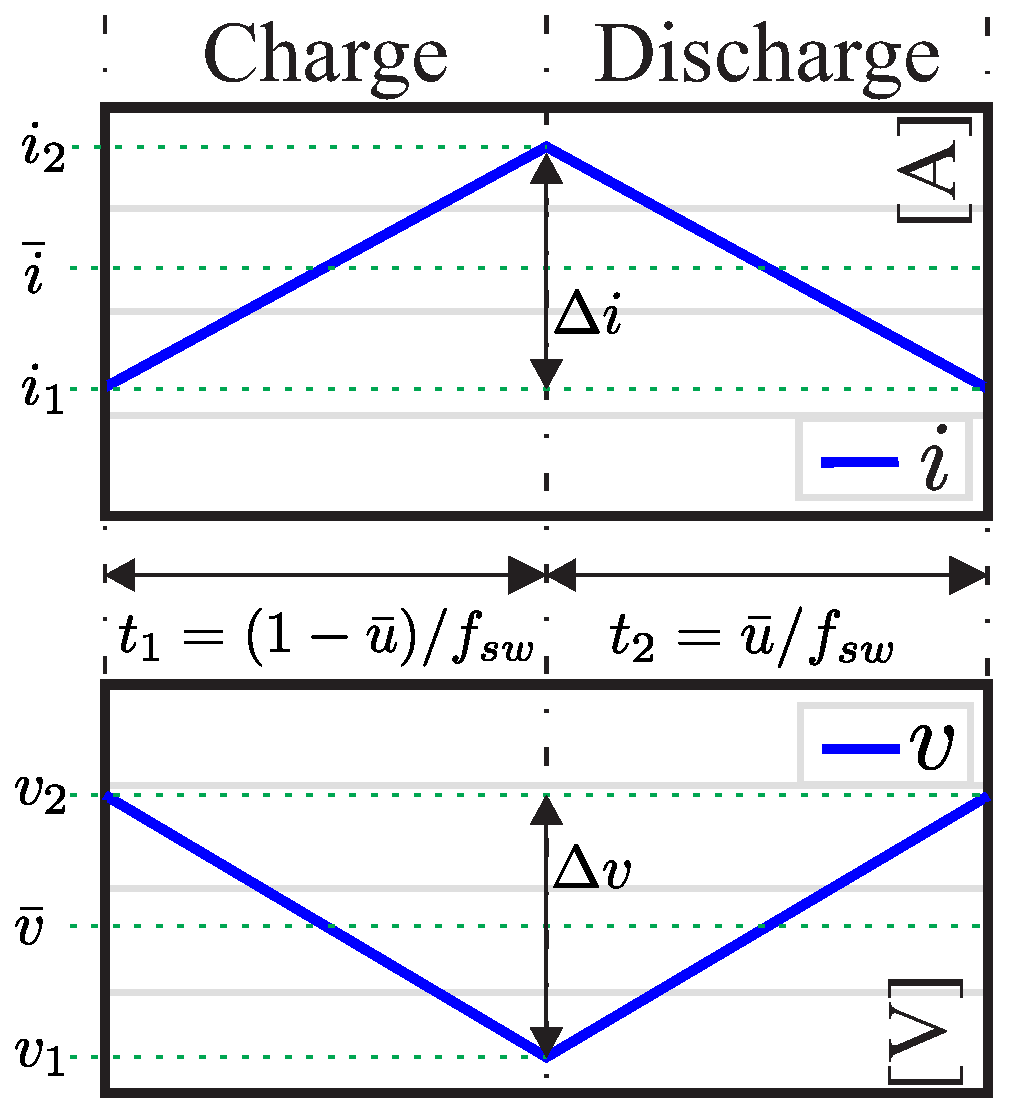
The inductor current and output voltage ripples, along with the continuous conduction mode (CCM) boundary condition, constitute fundamental design constraints for the proposed converter. These quantities are derived from the steady-state waveforms depicted in Figure 19, where i 1 and i 2 denote the minimum and maximum inductor currents, respectively, while v 1 and v 2 represent the minimum and maximum output voltages within a switching period. The corresponding average values of the inductor current and output voltage are denoted by i ¯ and v ¯ , respectively.
Assuming linear current and voltage variations within each switching subinterval, the positive charging phase dynamics given in (1) leads to:
L Δ i t 1 = E , C Δ v t 1 = v ¯ R ,
where Δ i = i 2 i 1 and Δ v = v 2 v 1 represent the peak-to-peak inductor current and output voltage ripples, respectively. Similarly, from the positive discharging phase in (2),
L Δ i t 2 = E v ¯ C Δ v t 2 = i ¯ v ¯ R .
Using the switching frequency definition f s w = 1 / ( t 1 + t 2 ) , the ripple magnitudes are obtained as
Δ i = E L ( 1 u ¯ ) f s w , Δ v = E R C 1 u ¯ f s w u ¯ .
Equation (12) explicitly reveals the inverse proportionality of the ripples to the switching frequency and passive components, and their nonlinear dependence on the duty cycle. The inductor current and output voltage ripples computed from the parameter values given in
E = 32   V , L = 4.97   mH , C = 114.7   μ F , R = 48   Ω ,
are Δ i = 71.54   mA and Δ v = 129.16   mV , respectively.
On the other hand, the critical inductance L c required to guarantee CCM operation can be derived from the boundary condition i 1 = 0 , as illustrated in Figure 19. Additionally, the minimum capacitance value C c can be obtained from the condition Δ v = 2 v ¯ in order to establish a capacitive design constraint. Under these conditions, a bound design approximation is obtained by imposing Δ i = 2 i ¯ and Δ v = 2 v ¯ . Substituting these relationships into (12) yields the following design criteria
2 ı ¯ = Δ i = E L c 1 u ¯ f s w , 2 v ¯ = Δ v = E R C c 1 u ¯ f s w u ¯ ,
therefore, by substituting the steady-state relationships from (8), the critical inductance and capacitance are determined as follows:
L c = R 2 u ¯ 1 u ¯ f s w , C c = 1 2 R 1 u ¯ f s w .
For the design parameters (13) R = 48   Ω , u ¯ = 0.5 , and f s w = 45 kHz, the critical values are calculated as L c = 133.33 μH and C c = 115.74   nF, respectively. Given that the selected components satisfy L = 4.97   mH L c and C = 114.7   μ F C c , the operation of the Full-bridge Boost converter is guaranteed to operate in CCM.

3. Design Considerations and Constraints

In addition to the switching and averaged models presented above, several aspects related to the implementation feasibility of the proposed Full-bridge Boost converter must be analyzed. These include the electrical stresses imposed on the semiconductor devices, dead-time requirements, conduction and switching losses, and the overall converter efficiency.

3.1. Semiconductor Stress

This analysis is essential for assessing the practical feasibility of the topology, facilitating the selection of power devices with appropriate voltage and current ratings.

3.1.1. Voltage Stress

Based on the switching configurations summarized in Table 2 and the equivalent circuits depicted in Figure 14, Figure 15, Figure 16 and Figure 17, it is evident that during their blocking intervals, the transistors are subjected to voltage stresses associated with the output voltage across the R C network. Therefore, the maximum blocking voltage across each transistor satisfies
| V T k max | = | v ¯ + 1 2 Δ v | E k = 1 , 2 , 3 , 4 , | v ¯ + 1 2 Δ v | k = 5 , 6 ,
where Δ v is the small output voltage ripple. Using the steady-state relation obtained in (8), the output voltage magnitude is
| v ¯ s s | = E u ¯ s s .
It follows that the voltage stress increases as | u ¯ s s | decreases. In particular,
lim u ¯ s s 0 | v ¯ s s | = .
which highlights the need to restrict the operating range of the modulation variable in practical implementations. In practice, this condition is limited by semiconductor ratings, parasitic effects, and non-ideal converter dynamics.

3.1.2. Current Stress

Transistors T 1 T 6 participate directly in the charging and discharging of the inductor. Consequently, their current stress is primarily determined by the inductor current. Assuming continuous conduction mode (CCM) operation, the maximum current can be approximated as
I T k max = ı ¯ + 1 2 Δ i ,   k = 1 , , 6 ,
where Δ i is the small inductor current ripple. Both the analysis of the output voltage and the inductor current ripples are detailed in Section 4. Considering (8), the steady-state inductor current is given by
ı ¯ s s = E u ¯ s s 2 R .
Therefore, the current stress of the transistors depends on the selected operating point through u ¯ s s and the load resistance R. Similarly to the voltage stress, the current stress increases as | u ¯ s s | decreases, and
lim u ¯ s s 0 ı ¯ s s = .
This behavior further supports the requirement to bound the modulation variable in order to avoid excessive semiconductor stress.

3.2. Dead-Time Requirement

Since the proposed topology incorporates complementary switching sequences, a dead-time interval must be introduced during switching transitions to prevent shoot-through conditions. As detailed in Table 2, the gating signals for T 1 and T 4 are complementary to those of T 5 and T 6 during the positive phases; conversely, the signals for T 2 and T 3 are complementary to T 5 and T 6 during the negative phases. The required dead-time duration depends on the turn-off delay and fall-time characteristics of the selected semiconductor technology. An insufficient dead time may induce shoot-through currents across the DC source, thereby increasing switching losses and potentially compromising device reliability.

3.3. Loss Analysis

To evaluate the practical feasibility of the proposed Full-bridge Boost converter, the primary non-idealities of both passive components and semiconductor devices are incorporated into the averaged model. Specifically, the equivalent series resistances (ESRs) of the inductor and capacitor, along with the conduction and switching losses of the transistors, are considered to provide a more accurate representation of the system dynamics and efficiency.

3.3.1. Conduction Losses

Under continuous conduction mode (CCM) and considering the triangular ripple approximation Δ i , the RMS current is given by
I R M S 2 = ı ¯   2 + Δ i 2 12 .
From the switching sequence summarized in Table 2, the RMS current through each transistor is
I T 1 , R M S 2 = I T 4 , R M S 2 = I R M S 2 , I T 2 , R M S 2 = I T 3 , R M S 2 = ( 1 u ¯ ) I R M S 2 , I T 5 , R M S 2 = I T 6 , R M S 2 = u ¯ I R M S 2 .
Due to the switching operation of the converter, the transistor onducts during different fractions of the switching period. Using the RMS current expressions obtained above, the conduction loss of each transistor can be approximated as
P σ , T k = I T k , R M S 2 R D S , k = 1 , 2 , 3 , 4 , 5 , 6 ,
where R D S is the drain–source on-resistance of the transistors. By considering the RMS current through each transistor (22), the total conduction loss of the semiconductor devices can be expressed as
P σ = k = 1 6 P σ , T k = 4 I R M S 2 R D S .
Using the steady-state conditions (8), the total conduction loss results in
P σ = 4 R D S E 2 u ¯ 4 R 2 + Δ i 2 12 .
The resistive losses of the inductor and capacitor are given by
P r L = E 2 u ¯ 4 R 2 + Δ i 2 12 r L ,
P r C = Δ i 2 12 r C ,
where r L and r C denote the equivalent series resistances of the inductor and capacitor, respectively.

3.3.2. Switching Losses

In addition to conduction losses, the switching transitions of the semiconductor devices produce additional power dissipation due to the overlap between the drain–source voltage and the drain current during turn-on and turn-off events. Assuming the commonly used linear approximation for the voltage and current transitions, the switching energy dissipated by each transistor during a commutation period can be approximated as
E s w , T k 1 2 v ¯ i ¯ ( t r + t f ) ,   k = 1 , 2 , 3 , 4 , 5 , 6 ,
where t r and t f denote the rise and fall times of the transistor, respectively. According to the switching sequence summarized in Table 2, four transistors commutate during each switching period of the Full-bridge Boost converter. Therefore, the total switching loss of the converter can be expressed as
P s w = 4 E s w f s w ,
where f s w denotes the switching frequency. Substituting the switching energy expression yields
P s w = 2 v ¯ i ¯ ( t r + t f ) f s w ,
This expression shows that the switching losses increase proportionally with the output voltage, the average inductor current, the switching frequency, and the intrinsic transition times of the semiconductor devices.

3.3.3. Total Losses and Efficiency

The total power dissipation in the converter is, therefore,
P t o t = P r L + P r C + P σ + P s w .
Finally, the efficiency of the converter can be estimated as
η = P o u t P o u t + P t o t .
The output power of the converter in steady state is
P o u t = v ¯ 2 R .
Using the steady-state relation (8), the efficiency equation leads to
η = E 2 u ¯ 2 R E 2 u ¯ 2 R + E 2 u ¯ 4 R + Δ i 2 12 r L + Δ i 2 12 r C + 4 R D S E 2 u ¯ 4 R 2 + Δ i 2 12 + 2 E 2 u ¯ 3 R ( t r + t f ) f s w .
This expression highlights the influence of the operating point u ¯ and the parasitic parameters on the overall efficiency of the Full-bridge Boost converter. In particular, high switching frequencies and small values of | u ¯ | increase semiconductor stresses and switching losses, which may reduce the achievable efficiency.
The presented analysis establishes the basis for a safe practical implementation of the proposed converter. Accordingly, Table 4 summarizes the principal electrical stresses, operating constraints, and implementation-related parameters in order to facilitate hardware implementation considerations.

4. Results

In this section, the signal analysis and validation of the averaged model of the proposed Full-bridge Boost converter system are presented. The validation is carried out by means of circuit-level simulations and numerical simulations of the switching and averaged models implemented in MATLAB/Simulink.
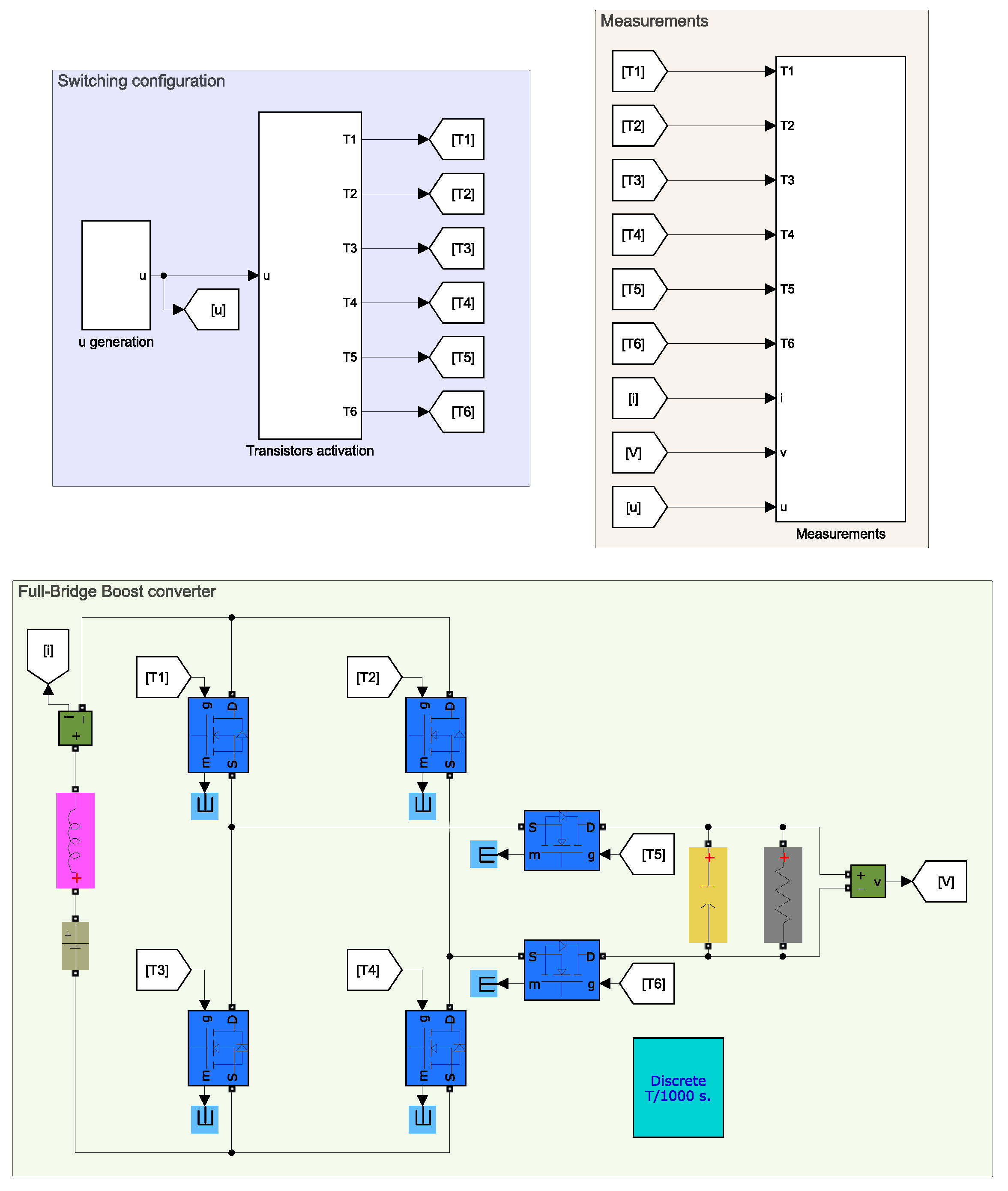
The MATLAB/Simulink block diagram used to obtain the circuit simulation results is shown in Figure 20. It consists of the following main blocks:
  • Switching configuration: In this block, the averaged control input u ¯ is defined, and the corresponding switching signals for transistors T 1 to T 6 are generated. The switching logic follows the configurations listed in Table 2. In addition, Table 3 is used to determine the discrete input u from the PWM signals, which are generated by the PWM Generator block of the Simscape Electrical toolbox with a switching frequency f s w = 45 kHz.
  • Measurements: This block acquires and displays the relevant signals from the Switching configuration and Full-bridge Boost converter subsystems.
  • Full-bridge Boost converter: In this block, the proposed Full-bridge Boost converter is implemented using the Simscape Toolbox. Discrete simulation is selected in the powergui settings with a sampling time of 22.2 ns.
The numerical simulation of the ideal averaged model is performed by implementing equations (6) in MATLAB/Simulink. Both the circuit-level simulation and the averaged model simulation employ the Euler numerical integration method with a fixed step size of 22.2 ns.

4.1. Waveforms and Switching Model Validation for the CCM Operation

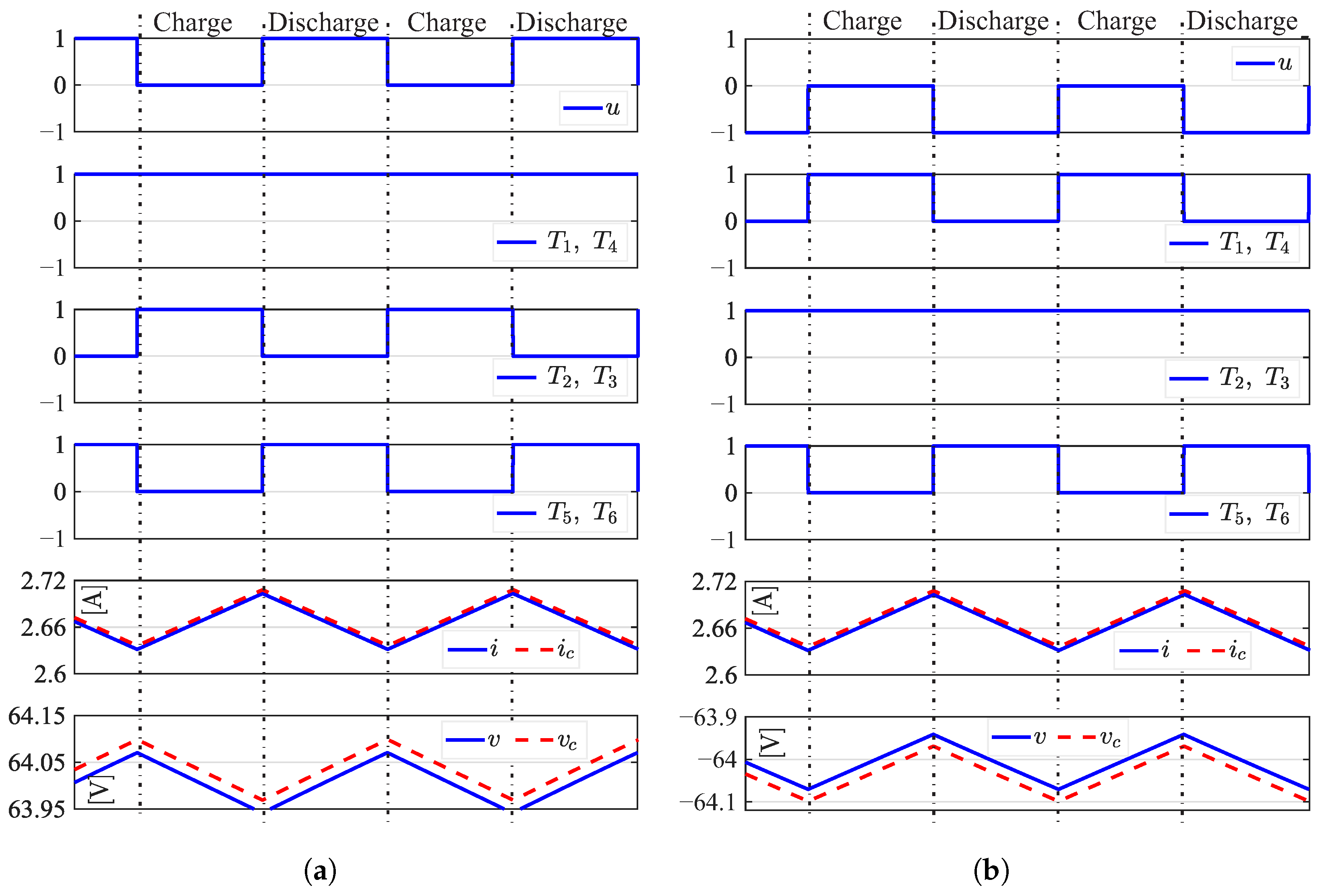
This subsection analyzes the typical voltage and current waveforms of the proposed Full-bridge Boost converter system. The converter is assumed to operate in continuous conduction mode (CCM) by selecting the parameter values given in (13), such that neither the inductor current nor the output voltage reaches zero.
Under CCM operation, two main waveform patterns arise for the output voltage v and the inductor current i, depending on the sign of the averaged input u ¯ . When u ¯ > 0 , the converter operates in the positive charging and positive discharging phases. In this case, transistors T 1 and T 4 remain continuously on, while transistors T 2 and T 3 switch with a duty cycle of 1 u ¯ . Simultaneously, transistors T 5 and T 6 switch with a duty cycle of u ¯ . Conversely, when u ¯ < 0 , the negative charging and negative discharging phases occur. In this operating mode, transistors T 2 and T 3 remain continuously on, transistors T 1 and T 4 switch with a duty cycle of 1 + u ¯ , and transistors T 5 and T 6 switch with a duty cycle of u ¯ .
The waveforms corresponding to the positive charging and discharging phases for u ¯ = 0.5 are shown in Figure 21a. Similarly, the waveforms for the negative charging and discharging phases with u ¯ = 0.5 are presented in Figure 21b.
The obtained waveforms confirm that for u ¯ > 0 , both the output voltage and the inductor current satisfy v > 0 and i > 0 , whereas for u ¯ < 0 , the output voltage becomes negative ( v < 0 ) while the inductor current remains positive. Moreover, Figure 21a,b show that the switching model (5) accurately reproduces the waveform behavior obtained from the circuit-level simulation.

4.2. Waveforms and Switching Model Validation for the DCM Operation

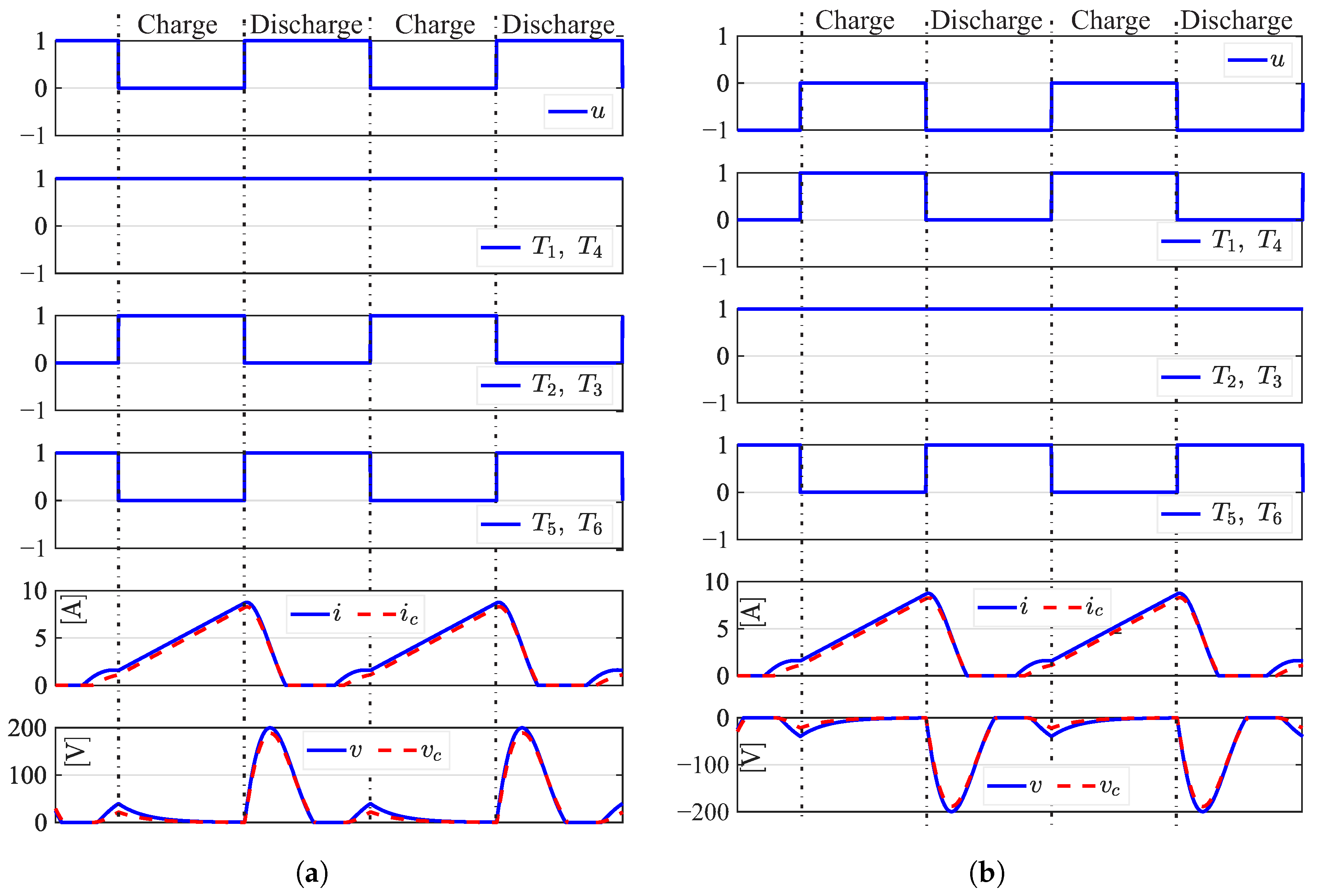
The discontinuous conduction mode (DCM) constitutes an important operating condition in power converters. Therefore, this subsection analyzes the characteristic waveforms of the proposed Full-bridge Boost converter under DCM operation. To induce DCM behavior, the design parameters are selected as
E = 32   V , L = 50   μ H , C = 50   nF , R = 48   Ω ,
where L < L c , as established in Section 2.5. Additionally, the reduced capacitance value increases the output voltage ripple. The behavior of the Full-bridge Boost converter under DCM operation for both positive and negative phases is illustrated in Figure 22.
As expected under DCM operation, the inductor current reaches zero during a portion of the switching period in both the positive and negative discharging phases. Moreover, the reduced capacitance produces a significant increase in the output voltage ripple. Furthermore, Figure 22 shows that the switching model (5) reproduces the principal waveform characteristics observed in the circuit-level simulation under DCM operation.

4.3. Averaged Model Validation

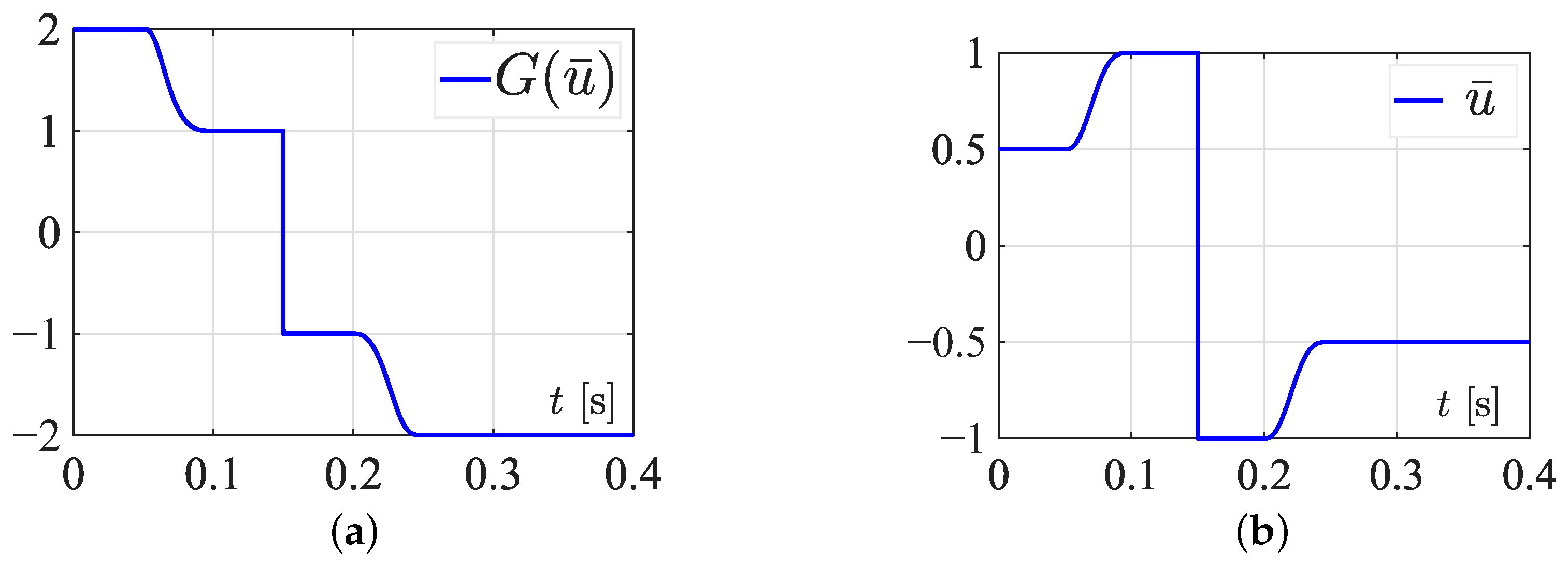
In this subsection, the dynamic behavior of the Full-bridge Boost converter obtained from circuit-level simulations is compared against the numerical solution of the averaged model (6). To achieve steady-state output voltages v = 2 E , v = E , v = E , and v = 2 E , a gain function G ( u ¯ ) ranging from 2 to 2 is implemented, as illustrated in Figure 23. This is presented alongside the corresponding waveform of the averaged input u ¯ to demonstrate the wide-range bipolar operation of the topology.
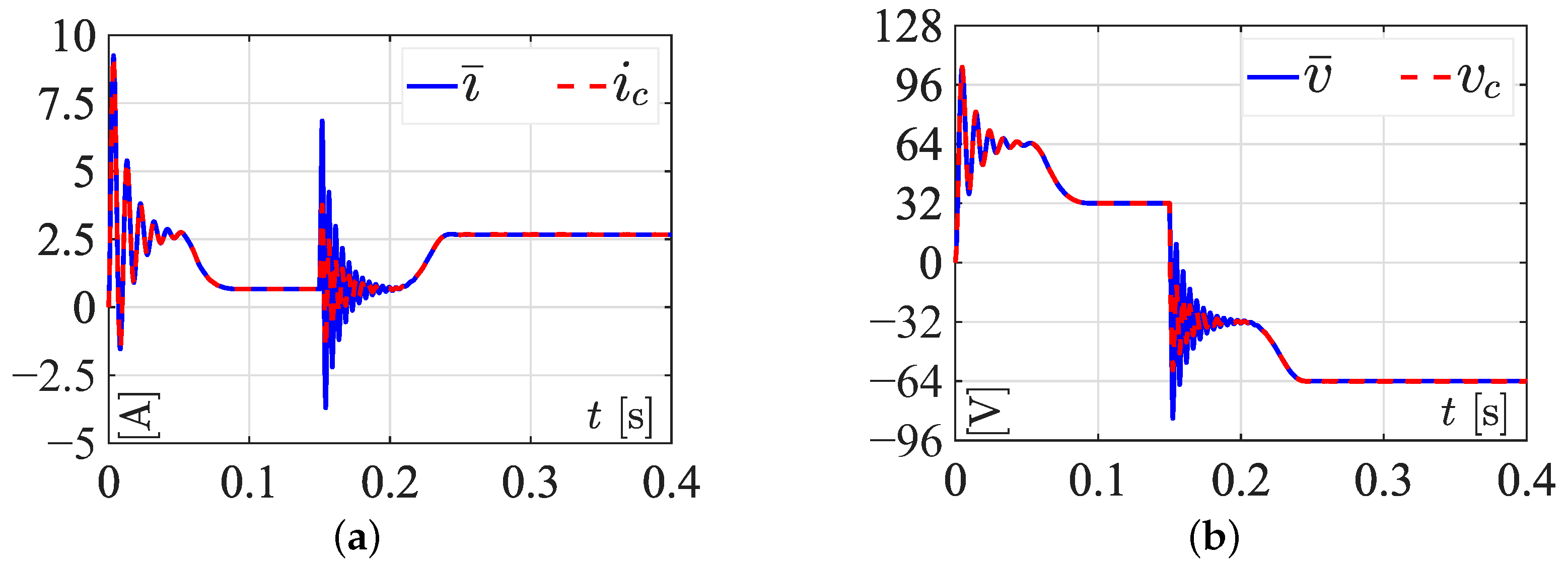
Figure 24 presents a comparative analysis between the averaged model (6) and the Full-bridge Boost converter implementation using circuit-level simulation. The numerical implementation was carried out using the parameter values defined in (13), for which the converter operates under CCM conditions. The results demonstrate that both the voltage and current trajectories of the averaged model closely track the responses of the switching circuit simulation. Therefore, the averaged model provides a high-fidelity representation of the system dynamics across the entire bipolar range, validating its use for subsequent control design.
An appropriate quantitative index to evaluate the agreement between the averaged model dynamics and the circuit-level simulation is the root mean square error (RMSE), defined as
R M S E i = 1 n k = 1 n i ¯ ( k ) i c ( k ) 2 , R M S E v = 1 n k = 1 n v ¯ ( k ) v c ( k ) 2 ,
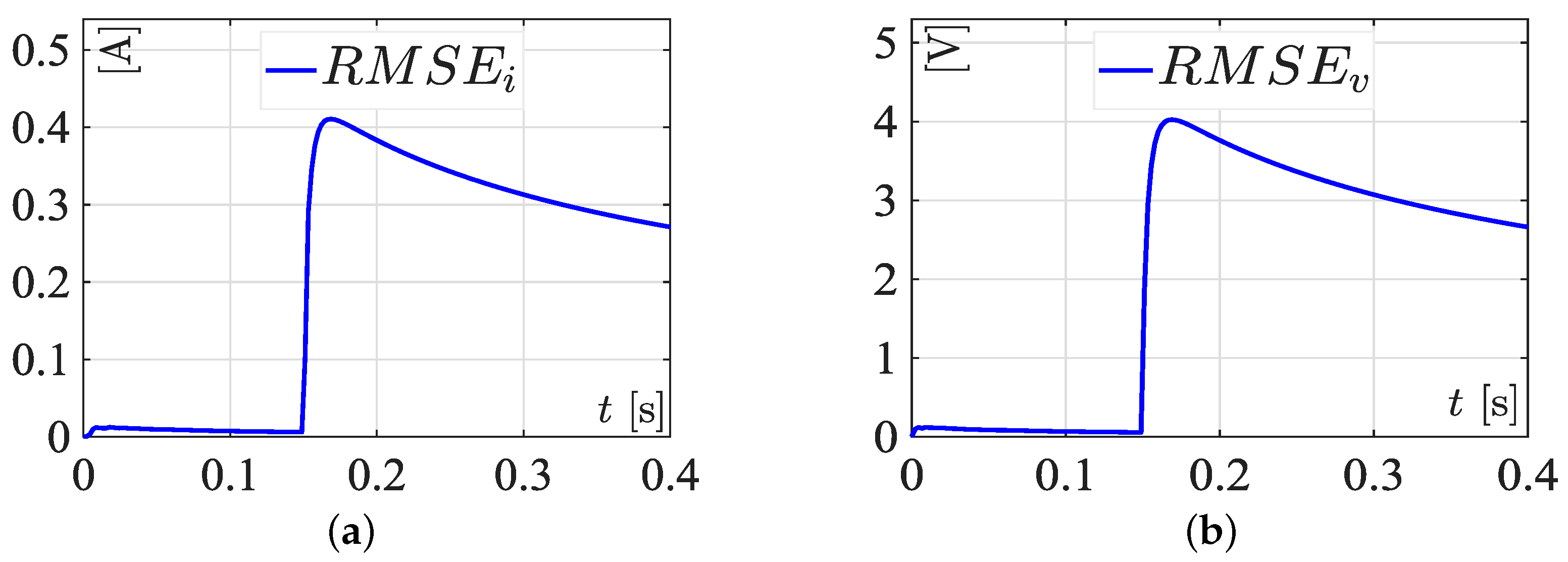
where n is the total number of data samples and k denotes the discrete-time index. The time evolution of R M S E i and R M S E v is shown in Figure 25.
The calculated RMSE values at the end of the simulation are R M S E i = 0.27   A and R M S E v = 2.66   V . These metrics indicate that the averaged model of the Full-bridge Boost converter captures the principal dynamic behavior observed in the circuit-level simulation. Notably, the RMSE values are more pronounced during transient intervals and decrease as the system approaches steady-state operation. This behavior is consistent with the fundamental assumptions of the averaging technique, since the high-frequency switching components are inherently filtered in the averaged representation.

5. Conclusions

The “Full-bridge Boost converter” presented in this work demonstrates a notable improvement in structural simplicity when compared with existing bipolar Boost-derived topologies, while retaining the capability to generate a boosted bipolar output voltage. The mathematical model derived for the proposed converter accurately describes its dynamic behavior, making it suitable for analysis as well as for the design of switching and control strategies. Furthermore, ripple analysis and continuous conduction mode (CCM) boundary conditions were derived to establish design constraints for the converter operation, and the characteristic waveforms under both CCM and discontinuous conduction mode (DCM) were analyzed.
Simulation results validate the proposed topology and confirm its ability to achieve bipolar voltage gain, together with the characteristic voltage and current waveforms expected in power electronic converters. Moreover, the averaged model provides a convenient framework for the systematic design of control strategies aimed at voltage regulation and trajectory tracking of the bipolar output. The comparison between the averaged model and the circuit-level simulation, supported through waveform analysis and RMSE indices, demonstrates that the averaged representation captures the principal dynamic behavior of the converter.
In addition, implementation feasibility considerations, including semiconductor stress, dead-time requirements, conduction and switching losses, and efficiency analysis, were discussed in order to provide a preliminary assessment of the practical operation of the proposed topology.
Overall, the proposed Full-bridge Boost converter constitutes a solid and flexible solution for applications requiring controlled positive and negative voltage generation, such as motor drives, robotics, and other power electronic systems.

Author Contributions

Conceptualization, A.R.-C., E.H.-M., and J.R.G.-S.; methodology, A.R.-C., E.H.-M., and S.T.-M.; validation, A.R.-C., E.H.-M., J.R.G.-S., and V.H.G.-R.; formal analysis, A.R.-C., E.H.-M., J.F.G.-C., and W.F.G.-S.; investigation, A.R.-C., E.H.-M., and S.T.-M.; resources, A.R.-C., E.H.-M., J.R.G.-S., S.T.-M., V.H.G.-R., J.F.G.-C., and W.F.G.-S.; data curation, V.H.G.-R.; writing—original draft preparation, A.R.-C., E.H.-M., and S.T.-M.; writing—review and editing, A.R.-C., E.H.-M., and J.R.G.-S.; visualization, V.H.G.-R., J.F.G.-C., and W.F.G.-S.; supervision, A.R.-C., E.H.-M., and J.R.G.-S.; project administration, A.R.-C., E.H.-M., J.R.G.-S., S.T.-M., V.H.G.-R., J.F.G.-C., and W.F.G.-S.; funding acquisition, A.R.-C., E.H.-M., J.R.G.-S., S.T.-M., V.H.G.-R., J.F.G.-C., and W.F.G.-S. All authors have read and agreed to the published version of the manuscript.

Funding

This research received no external funding.

Institutional Review Board Statement

Not applicable.

Informed Consent Statement

Not applicable.

Data Availability Statement

Data are contained within the article.

Acknowledgments

The Work of Alfredo Roldán-Caballero, Eduardo Hernández-Márquez, José Rafael García-Sánchez, Salvador Tavera-Mosqueda and Víctor Hugo García-Rodriguez was supported by SECIHTI-México.

Conflicts of Interest

The authors declare no conflicts of interest.

References

  1. Strielkowski, W.; Civín, L.; Tarkhanova, E.; Tvaronavičienė, M.; Petrenko, Y. Renewable energy in the sustainable development of electrical power sector: A review. Energies 2021, 14, 8240. [Google Scholar] [CrossRef]
  2. Hannan, M.A.; Al-Shetwi, A.Q.; Mollik, M.S.; Ker, P.J.; Mannan, M.; Mansor, M.; Al-Masri, H.M.K.; Mahlia, T.M.I. Wind energy conversions, controls, and applications: A review for sustainable technologies and directions. Sustainability 2023, 15, 3986. [Google Scholar] [CrossRef]
  3. Jain, S.; Agarwal, V. A single-stage grid connected inverter topology for solar PV systems with maximum power point tracking. IEEE Trans. Power Electron. 2007, 22, 1928–1940. [Google Scholar] [CrossRef]
  4. Abramovitz, A.; Zhao, B.; Smedley, K. High-gain single-stage boosting inverter for photovoltaic applications. IEEE Trans. Power Electron. 2016, 31, 3550–3558. [Google Scholar] [CrossRef]
  5. Mathew, D.; Naidu, R.C. A review on single-phase Boost inverter technology for low power grid integrated solar PV applications. Ain Shams Eng. J. 2024, 15, 102365. [Google Scholar] [CrossRef]
  6. Boudjemai, H.; Ardjoun, S.A.E.M.; Chafouk, H.; Denaï, M.; Alkuhayli, A.; Khaled, U.; Mahmoud, M.M. Experimental analysis of a new low power wind turbine emulator using a DC machine and advanced method for maximum wind power capture. IEEE Access 2023, 11, 92225–92241. [Google Scholar] [CrossRef]
  7. Mansouri, A.; Magri, A.E.; Lajouad, R.; Myasse, I.E.; Younes, E.K.; Giri, F. Wind energy based conversion topologies and maximum power point tracking: A comprehensive review and analysis. e-Prime 2023, 6, 100351. [Google Scholar] [CrossRef]
  8. Sayed, K.; Almutairi, A.; Albagami, N.; Alrumayh, O.; Abo-Khalil, A.G.; Saleeb, H. A review of DC-AC converters for electric vehicle applications. Energies 2022, 15, 1241. [Google Scholar] [CrossRef]
  9. Naresh, S.; Peddapati, S.; Alghaythi, M.L. A novel high quadratic gain Boost converter for fuel cell electric vehicle applications. IEEE J. Emerg. Sel. Top. Ind. Electron. 2023, 4, 637–647. [Google Scholar] [CrossRef]
  10. Jha, K.; Mishra, S.; Joshi, A. High-quality sine wave generation using a differential Boost inverter at higher operating frequency. IEEE Trans. Ind. Appl. 2015, 51, 373–384. [Google Scholar] [CrossRef]
  11. de Andrade, J.M.; Silva, G.V.; Coelho, R.F.; Lazzarin, T.B. The switched capacitor differential boost inverter applied to grid connection. Int. Trans. Electr. Energy Syst. 2021, 31, e12752. [Google Scholar] [CrossRef]
  12. Chen, J.; Wang, P. Impacts of bipolar impulse parameters on the PDIV of random-wound inverted-fed motor insulation. Energies 2025, 18, 2932. [Google Scholar] [CrossRef]
  13. Dharavath, A.A.; Dharavath, R.; Rao, D.V.S.K. Design and control of a dual active bridge converter for bipolar DC microgrid applications. In Proceedings of the International Conference on Power Electronics Converters for Transportation and Energy Applications, Jatni, India, 18–21 June 2025; pp. 1–6. [Google Scholar] [CrossRef]
  14. Cáceres, R.O.; Barbi, I. A Boost DC–AC converter: Analysis, design, and experimentation. IEEE Trans. Power Electron. 1999, 14, 134–141. [Google Scholar] [CrossRef]
  15. Sanchis, P.; Ursæa, A.; Gubía, E.; Marroyo, L. Boost DC–AC inverter: A new control strategy. IEEE Trans. Power Electron. 2005, 20, 343–353. [Google Scholar] [CrossRef]
  16. Arunkumar, G.; D, C.; Padmanaban, S.; Prusty, B.R.; Khan, B. Implementation of optimization-based PI controller tuning for non-ideal differential Boost inverter. IEEE Access 2021, 9, 58677–58688. [Google Scholar] [CrossRef]
  17. Peng, F.Z. Z-source inverter. IEEE Trans. Ind. Appl. 2003, 39, 504–510. [Google Scholar] [CrossRef]
  18. Ravindranath, A.; Mishra, S.K.; Joshi, A. Analysis and PWM control of switched Boost inverter. IEEE Trans. Ind. Electron. 2013, 60, 5593–5602. [Google Scholar] [CrossRef]
  19. Ray, O.; Mishra, S. Boost-derived hybrid converter with simultaneous DC and AC outputs. IEEE Trans. Ind. Appl. 2014, 50, 1082–1093. [Google Scholar] [CrossRef]
  20. Nguyen, M.-K.; Le, T.-V.; Park, S.; Lim, Y.-C. A class of quasi-switched Boost inverters. IEEE Trans. Ind. Electron. 2015, 62, 1526–1536. [Google Scholar] [CrossRef]
  21. Nguyen, M.-K.; Le, T.-V.; Park, S.J.; Lim, Y.-C.; Yoo, J.-Y. Class of high Boost inverters based on switched-inductor structure. IET Power Electron. 2015, 8, 750–759. [Google Scholar] [CrossRef]
  22. Shokati Asi, E.; Babaei, E.; Sabahi, M.; Babayi Nozadian, M.H.; Cecati, C. New half-bridge and full-bridge topologies for a switched-Boost inverter with continuous input current. IEEE Trans. Ind. Electron. 2018, 65, 3188–3197. [Google Scholar] [CrossRef]
  23. Nguyen, M.-K.; Tran, T.-T. A single-phase single-stage switched-Boost inverter with four switches. IEEE Trans. Power Electron. 2018, 33, 6769–6781. [Google Scholar] [CrossRef]
  24. Hu, X.; Zhang, Y.; Liu, X.; Yu, Z.; He, T.; Mao, L. A non-isolated step-up DC-AC converter with reduced leakage current for grid-connected photovoltaic systems. IEEE Access 2020, 8, 71907–71916. [Google Scholar] [CrossRef]
  25. García-Rodríguez, V.H.; Pérez-Cruz, J.H.; Ambrosio-Lázaro, R.C.; Tavera-Mosqueda, S. Analysis of DC/DC Boost converter–full-bridge Buck inverter system for AC generation. Energies 2023, 16, 2509. [Google Scholar] [CrossRef]
  26. Liu, K.; Li, B.; Jiang, Q.; Zhang, Y.; Liu, T. Fault ride-through strategy for hybrid cascaded HVDC systems based on controllable LCC. IEEE Trans. Circuits Syst. II Express Briefs 2026, 73, 88–92. [Google Scholar] [CrossRef]
  27. Barzegarkhoo, R.; Moradzadeh, M.; Zamiri, E.; Madadi Kojabadi, H.; Blaabjerg, F. A new Boost switched-capacitor multilevel converter with reduced circuit devices. IEEE Trans. Power Electron. 2018, 33, 6738–6754. [Google Scholar] [CrossRef]
  28. Lee, S.S.; Tan, A.S.T.; Ishak, D.; Mohd-Mokhtar, R. Single-phase simplified split-source inverter (S3I) for Boost DC-AC power conversion. IEEE Trans. Ind. Electron. 2019, 66, 7643–7652. [Google Scholar] [CrossRef]
  29. Lee, S.S.; Lee, K.-B. Dual-T-Type seven-level Boost active-neutral-point-clamped inverter. IEEE Trans. Power Electron. 2019, 34, 6031–6035. [Google Scholar] [CrossRef]
  30. Siddique, M.D.; Mekhilef, S.; Shah, N.M.; Sandeep, N.; Ali, J.S.M.; Iqbal, A.; Ahmed, M.; Ghoneim, S.; Al-Harthi, M.M.; Alamri, B.; et al. A single DC source nine-level switched-capacitor Boost inverter topology with reduced switch count. IEEE Access 2019, 8, 5840–5851. [Google Scholar] [CrossRef]
  31. Siddique, M.D.; Mekhilef, S.; Shah, N.M.; Ali, J.S.M.; Meraj, M.; Iqbal, A.; Al-Hitmi, M. A new single-phase single switched-capacitor based nine-level Boost inverter topology with reduced switch count and voltage stress. IEEE Access 2019, 7, 174178–174188. [Google Scholar] [CrossRef]
  32. Lee, S.S.; Yang, Y.; Siwakoti, Y. A novel single-stage five-level common-ground-Boost-type active neutral-point-clamped (5L-CGBT-ANPC) inverter. IEEE Trans. Power Electron. 2021, 36, 6192–6196. [Google Scholar] [CrossRef]
  33. Lee, S.S.; Lim, R.J.S.; Barzegarkhoo, R.; Lim, C.S.; Grigoletto, F.B.; Siwakoti, Y.P. A family of single-phase single-stage Boost inverters. IEEE Trans. Ind. Electron. 2023, 70, 7955–7964. [Google Scholar] [CrossRef]
  34. Li, W.; He, X. Review of nonisolated high-step-up DC/DC converters in photovoltaic grid-connected applications. IEEE Trans. Ind. Electron. 2011, 58, 1239–1250. [Google Scholar] [CrossRef]
  35. Nguyen, M.-K.; Duong, T.-D.; Lim, Y.-C.; Kim, Y.-J. Isolated Boost DC–DC converter with three switches. IEEE Trans. Power Electron. 2017, 32, 6257–6267. [Google Scholar] [CrossRef]
  36. Sira-Ramírez, H.; Silva-Ortigoza, R. Control Design Techniques in Power Electronics Devices; Springer: London, UK, 2006. [Google Scholar]
Figure 1. DC/DC Boost-inverter–Buck-converter.
Electronics 15 02236 g001
Figure 2. DC/AC Boost converter.
Electronics 15 02236 g002
Figure 3. Z-source inverter.
Electronics 15 02236 g003
Figure 4. Switched Boost inverter.
Electronics 15 02236 g004
Figure 5. Boost-derived hybrid converter.
Electronics 15 02236 g005
Figure 6. Quasi-switched Boost inverter.
Electronics 15 02236 g006
Figure 7. Switched-inductor Boost inverter.
Electronics 15 02236 g007
Figure 8. Half-bridge and full-bridge switched-Boost inverters: (a) half-bridge topology; (b) full-bridge topology.
Electronics 15 02236 g008
Figure 9. Switched-Boost inverter with four switches.
Electronics 15 02236 g009
Figure 10. Non-isolated step-up DC–AC converter.
Electronics 15 02236 g010
Figure 11. DC/DC Boost–full-bridge–Buck-inverter system.
Electronics 15 02236 g011
Figure 12. Conventional current-fed full-bridge isolated Boost converter.
Electronics 15 02236 g012
Figure 13. Full-bridge Boost converter system.
Electronics 15 02236 g013
Figure 14. Equivalent circuit of the Full-bridge Boost converter during the positive charging phase.
Electronics 15 02236 g014
Figure 15. Equivalent circuit of the Full-bridge Boost converter during the positive discharging phase.
Electronics 15 02236 g015
Figure 16. Equivalent circuit of the Full-bridge Boost converter during the negative charging phase.
Electronics 15 02236 g016
Figure 17. Equivalent circuit of the Full-bridge Boost converter during the negative discharging phase.
Electronics 15 02236 g017
Figure 18. Steady-state gain of the proposed Full-bridge Boost converter system.
Electronics 15 02236 g018
Figure 19. Steady-state waveforms for ripple and CCM boundary derivation.
Electronics 15 02236 g019
Figure 20. MATLAB/Simulink block diagram used for the circuit-level analysis of the Full-bridge Boost converter.
Electronics 15 02236 g020
Figure 21. Waveforms of the proposed Full-bridge Boost converter operating in CCM: (a) Positive phases for u ¯ = 0.5 ; (b) Negative phases for u ¯ = 0.5 . The variables i and v correspond to the switching model (5), whereas i c and v c denote the quantities obtained from the circuit-level simulation.
Electronics 15 02236 g021
Figure 22. Waveforms of the proposed Full-bridge Boost converter operating under DCM conditions: (a) Positive phases for u ¯ = 0.5 ; (b) Negative phases for u ¯ = 0.5 . The variables i and v correspond to the switching model (5), whereas i c and v c denote the quantities obtained from the circuit-level simulation.
Electronics 15 02236 g022
Figure 23. Gain and averaged input used for validation: (a) gain function G ( u ¯ ) ; (b) averaged input u ¯ applied to both the circuit simulation and the averaged model.
Electronics 15 02236 g023
Figure 24. Validation of the averaged model: (a) comparison of the inductor current between the averaged model and the switching circuit simulation; (b) comparison of the output voltage between the averaged model and the switching circuit simulation. The variables ı ¯ and v ¯ correspond to the averaged model (6), whereas i c and v c denote the quantities obtained from the circuit-level simulation.
Electronics 15 02236 g024
Figure 25. Root mean square errors (RMSE) for the results illustrated in Figure 24: (a) RMSE index for inductor current between the averaged model and the circuit simulation; (b) RMSE index for output voltage between the averaged model and the circuit simulation.
Electronics 15 02236 g025
Table 1. Comparison of efficiency, voltage stress, and control complexity with related topologies.
TopologyActive Passive Typical Voltage Control
Switches Components Efficiency Stress Complexity
DC/DC Boost–inverter–Buck converter [14]62L + 2C∼80%LowHigh
DC/AC Boost converter [14,15,16]42L + 2C∼75−85%ModerateHigh
Z-source inverter [17]43L + 3C∼90%LowMedium
Switched Boost inverter [18]52L + 2C∼90%HighMedium
Boost-derived hybrid converter [19]43L + 2C∼85%ModerateMedium
Quasi-switched Boost inverter [20]52L + 1C79–84%LowMedium
Switched-inductor Boost inverter [21]53L + 2C∼90%ModerateMedium
Half-bridge switched-Boost inverter [22]41L + 2C∼90–95%LowMedium
Full-bridge switched-Boost inverter [22]61L + 2C∼90–95%LowMedium
Switched-Boost inverter with four switches [23]42L + 2C∼90%ModerateMedium
Non-isolated step-up DC-AC converter [24]52L + 2C∼95%ModerateMedium
DC/DC Boost–Full-Bridge–Buck Inverter [25]52L + 2C∼85–90%LowHigh
Proposed Full-bridge Boost Converter61L + 1CExpected highHighMedium
Table 2. Switching configuration: transistor activation for the four operating phases of the proposed Full-bridge Boost converter system.
Positive ChargingPositive DischargingNegative ChargingNegative Discharging
T 1 ONONONOFF
T 2 ONOFFONON
T 3 ONOFFONON
T 4 ONONONOFF
T 5 OFFONOFFON
T 6 OFFONOFFON
Table 3. Values of the discrete switching function u for the four operating phases.
Positive ChargingPositive DischargingNegative ChargingNegative Discharging
u010 1
Table 4. Principal implementation and safe-operation considerations for the proposed Full-bridge Boost converter.
ParameterDescriptionImplementation Consideration
| V T k max | = | v ¯ + 1 2 Δ v | Maximum transistor voltage stressMust remain below the selected semiconductor blocking voltage rating
I T k max = ı ¯ + 1 2 Δ i Maximum transistor current stressMust remain below the selected semiconductor current rating
u ¯ Modulation operating rangeSmall values of | u ¯ | increase gain and semiconductor stress
f s w Switching frequencyHigh values increase switching losses and thermal stress
t d Dead-time intervalPrevents shoot-through during switching transitions
R D S On-state transistor resistanceDirectly affects conduction losses
t r , t f Rise and fall timesInfluence switching losses
r L Inductor ESRProduces additional conduction losses
r C Capacitor ESRIncreases voltage ripple and power dissipation
Δ i = E L ( 1 u ¯ ) f s w Inductor current rippleAffects RMS current and semiconductor stress
Δ v = E R C 1 u ¯ f s w u ¯ Output voltage rippleAffects voltage quality and capacitor stress
L c = R 2 u ¯ ( 1 u ¯ ) f s w Critical inductanceMinimum inductance value for guaranteed CCM operation
Disclaimer/Publisher’s Note: The statements, opinions and data contained in all publications are solely those of the individual author(s) and contributor(s) and not of MDPI and/or the editor(s). MDPI and/or the editor(s) disclaim responsibility for any injury to people or property resulting from any ideas, methods, instructions or products referred to in the content.