A Hierarchical Key Management Scheme for Efficient Outsourced Computation in Cloud Storage Services



Abstract
1. Introduction
- Access Control Lists (ACL): A file-centric approach where each data object maintains a record of users authorized for access [8].
- File Groups: A structure where a directory is created for a specific group of authorized users, and all files within that directory inherit the group’s access permissions.
- Storage Overhead for Data Owners: The data owner is required to maintain all keys within the hierarchical tree structure, leading to increased storage complexity.
- Scalability of Key Renewal Costs: The computational cost associated with processing renewed key messages is significant for both data owners and users. Since the scheme employs symmetric encryption, the frequency of decryption operations increases linearly with the depth and complexity of the key tree, further straining device resources.
- Data Confidentiality: To prevent unauthorized access or data leakage from malicious cloud service providers and external attackers, an efficient encryption and decryption mechanism is essential to ensure the integrity and privacy of data stored in the cloud.
- Access Control: The cloud infrastructure must rigorously validate all download requests to ensure that only users with verified access rights can retrieve specific data objects.
- Efficient Authorization and Revocation: The data owner must be able to manage user registration and revocation seamlessly. Notably, the revocation process should be executed without necessitating updates or affecting the access privileges of the remaining authorized users.
- Streamlined Key Management: Minimizing the administrative burden on the data owner is a primary objective. The data owner should be able to manage all files and authorized users with a minimal set of cryptographic keys. Furthermore, each authorized user should be able to access all permitted files using a single, unified secret key.
- Lightweight Computation: To accommodate the limited resources of mobile platforms, the scheme must minimize the computational overhead for both data owners and users during all system operations.
2. The Proposed Key Management Scheme
2.1. System Assumptions
- Semi-trusted (Honest-but-Curious) Cloud Infrastructure: The Cloud Storage Service (CSS) provider is modeled as a semi-trusted (honest-but-curious) entity. Specifically, the CSS is assumed to correctly execute protocol operations, maintain storage availability, and enforce access-control procedures, while potentially attempting to infer sensitive information from stored ciphertexts, re-key materials, and access patterns [13].The proposed scheme therefore protects data confidentiality against curious cloud providers and unauthorized users without assuming full trust in the CSS infrastructure.We additionally consider a limited collusion scenario between the CSS and revoked users. In this setting, revoked users may cooperate with the CSS to obtain historical ciphertexts, stored re-key messages, or access-control metadata. However, after revocation, the Data Owner regenerates updated hierarchical path keys and renewed file encryption keys while excluding the revoked users’ secret keys from the newly generated re-key messages. Consequently, the system must ensure that unauthorized entities, including the CSS provider itself, cannot access the plaintext of files stored in the cloud. The revoked users cannot derive updated file encryption keys for future ciphertext versions even if the CSS shares previously stored cryptographic materials.It should be noted that the proposed scheme primarily targets semi-trusted cloud environments rather than fully malicious cloud infrastructures. Therefore, the current framework does not attempt to defend against adversarial CSS behaviors such as arbitrary protocol deviation, forged re-key material injection, unauthorized ciphertext modification, or deliberate access-control bypass attacks.Defending against fully malicious cloud providers would require additional mechanisms such as verifiable auditing, trusted execution environments, blockchain-assisted verification, or formally verified access-control protocols, which are beyond the scope of the present lightweight key-management design.
- Service Availability and Connectivity: The CSS provider is required to maintain constant online availability. Conversely, data owners and authorized users are only expected to be online during active file operations or data retrieval [14].
- System Scalability and Efficiency: The proposed tree-based architecture achieves maximum efficiency in scenarios where a high volume of users shares access to a relatively smaller set of files [10]. Under these conditions, the benefits of minimized key storage and management overhead are most pronounced.
- Public Key Infrastructure (PKI): We assume the existence of a trusted Certificate Authority (CA) responsible for issuing and managing cryptographic key pairs. Each entity—including the data owner, CSS provider, and all users—possesses a valid public key pair, ensuring secure key distribution and identity verification across the system.
- Adversary Model and Threat Assumptions: The proposed scheme considers the following adversarial entities and attack scenarios:
- (a)
- Honest-but-Curious CSS: The Cloud Storage Service (CSS) correctly executes storage and transmission protocols but may attempt to infer sensitive information from stored ciphertexts, access right lists, or re-key messages. However, the CSS does not possess users’ private keys or secret keys.
- (b)
- External Eavesdropper: An external attacker may intercept communication messages transmitted over public channels. The attacker is assumed to have full access to transmitted ciphertexts but cannot break standard asymmetric or symmetric cryptographic primitives.
- (c)
- Malicious User: An unauthorized or malicious user may attempt to access files beyond their granted privileges by exploiting intercepted re-key messages or previously obtained credentials.
- (d)
- Revoked User: A revoked user may retain previously issued secret keys and historical re-key messages and attempt to derive updated file encryption keys after revocation.
- (e)
- Collusion Attack: We additionally consider limited collusion scenarios between a revoked user and the honest-but-curious CSS. The adversary may combine previously stored re-key materials and encrypted files to recover updated file keys. However, since updated re-key messages are generated using renewed path keys and exclude the revoked user’s secret key, the colluding parties cannot derive valid updated encryption keys.
- The proposed scheme assumes standard cryptographic hardness assumptions for hash functions, symmetric encryption, and public-key encryption mechanisms.
2.2. Cryptographic Primitives
2.3. Notation
2.4. The Proposed Scheme
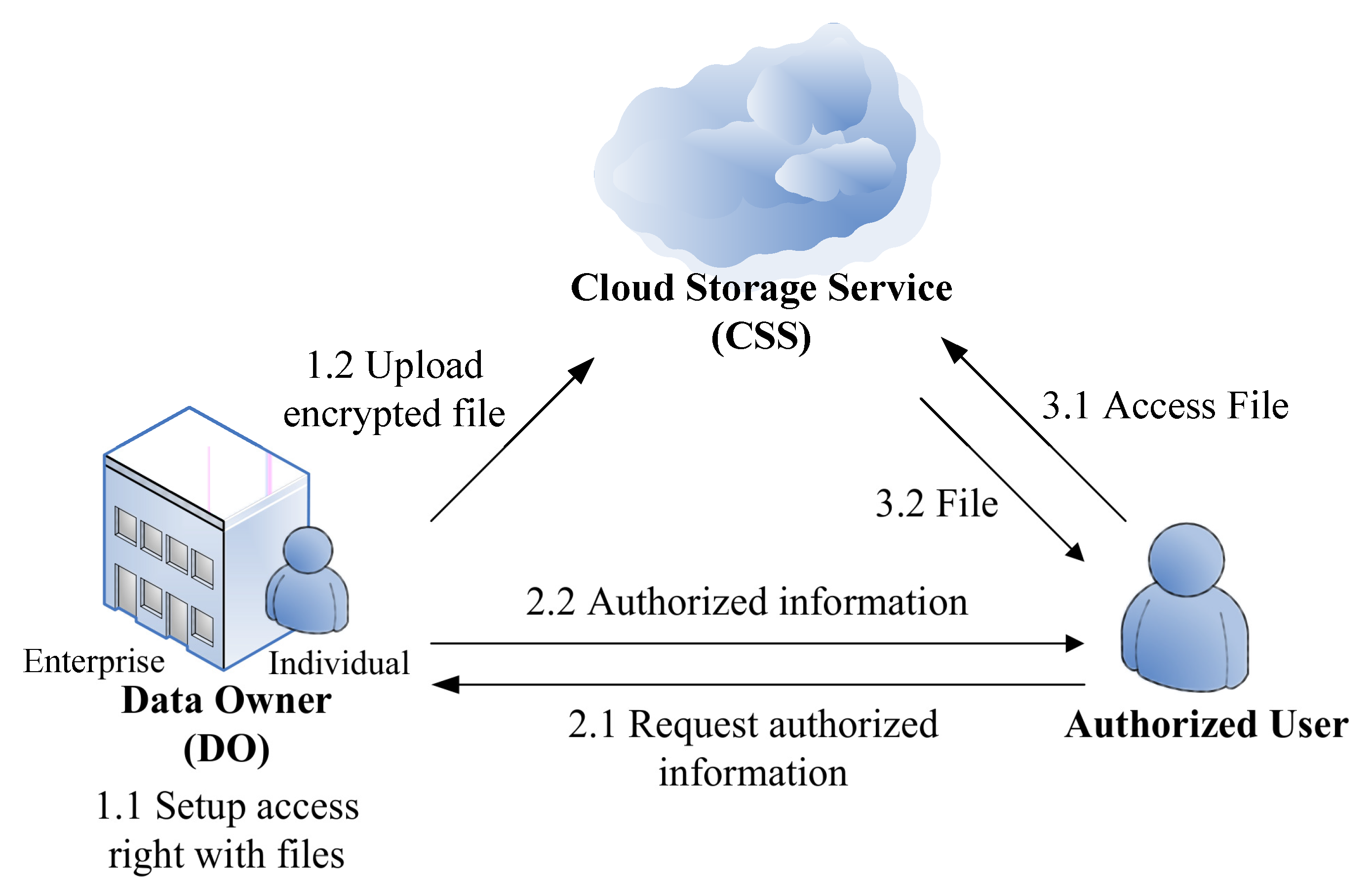
- Data Owner (DO): An entity, such as an enterprise or an individual, that maintains a large repository of data and seeks to share these resources with authorized parties.
- Cloud Storage Service (CSS): A provider that facilitates data persistence, provides fundamental access control mechanisms, and ensures the security of stored files.
- Authorized User: A participant who subscribes to or prepays for access to specific files owned by the DO and retrieves them through the CSS infrastructure.
2.4.1. Setup Phase
- 1.
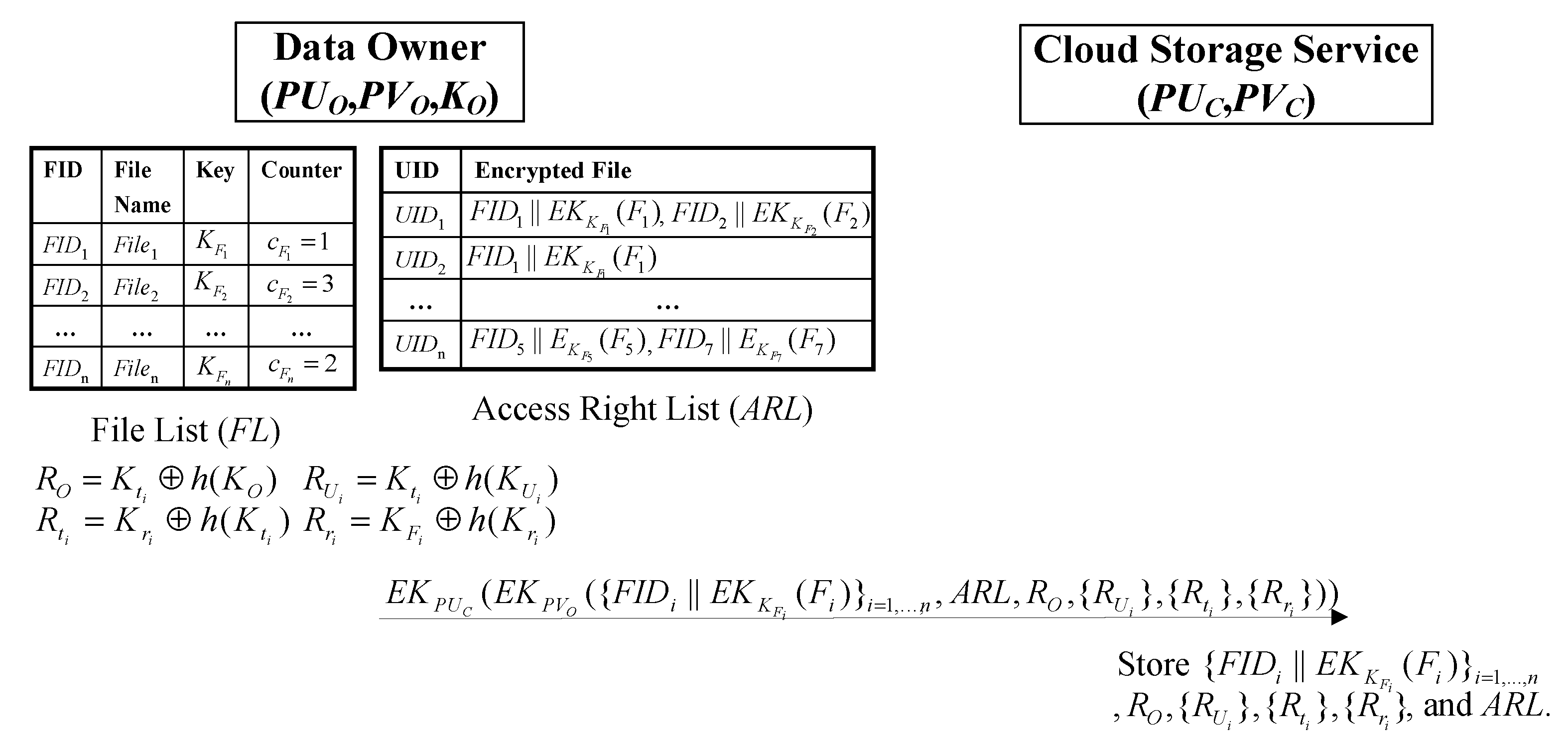
- Key Generation and Initialization: The DO compiles a file list () containing the file identifier (), file name, encryption key (), and a renewal counter () for each data object. The DO then defines a master secret key and assigns a unique secret key to each user U. Each file encryption key is derived using a one-way hash function: .
- 2.
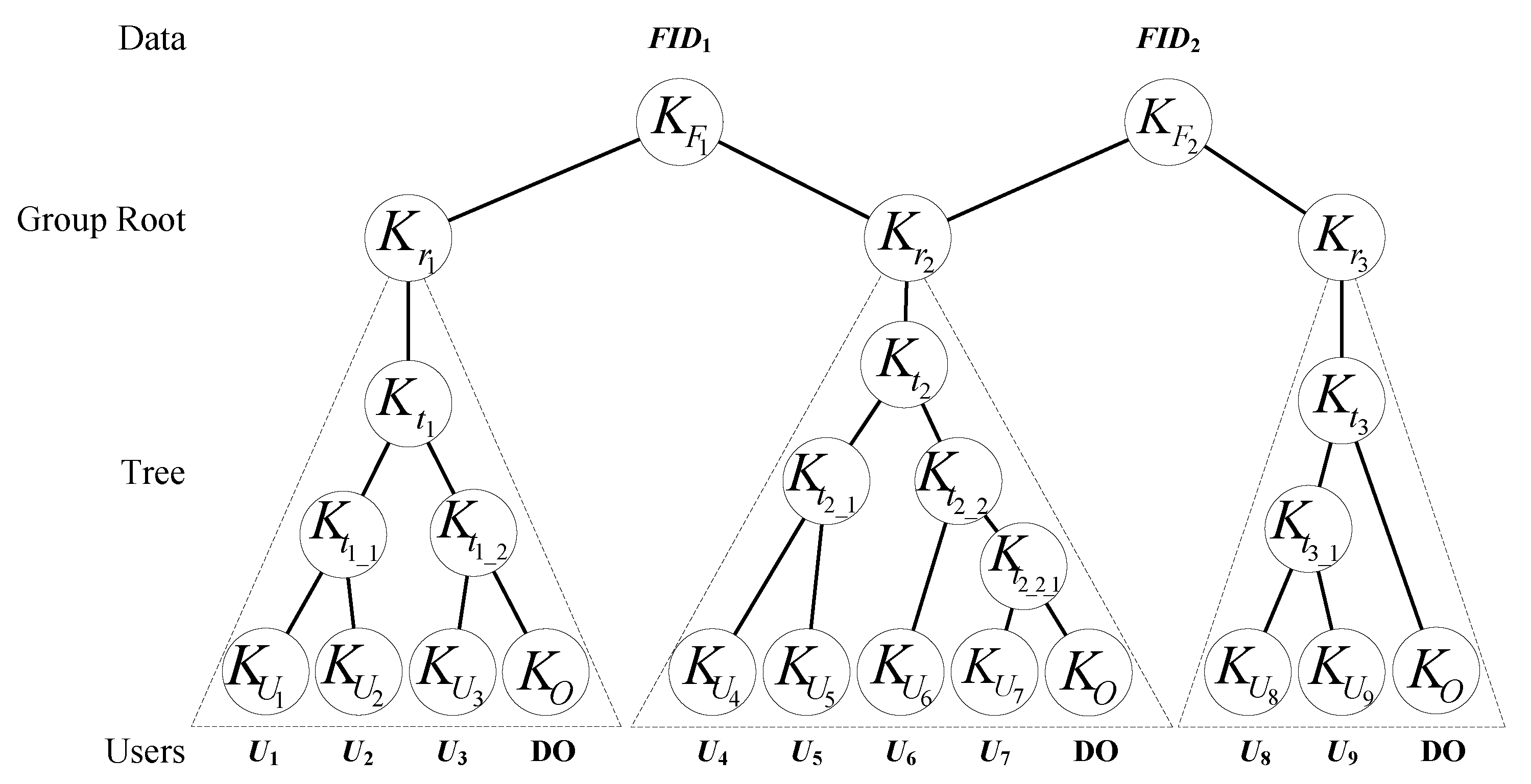
- Hierarchical Access Tree Construction: The DO organizes access privileges using a shared-key tree structure, as depicted in Figure 3. The DO embeds the master key into all trees, while individual user keys are integrated into specific trees based on their granted access rights. For instance, if user is authorized only for file , they are assigned to the first tree. Conversely, user , with access to both and , is placed in the second tree. Although users within the same tree share identical access levels, their unique secret keys facilitate targeted key updates, ensuring that re-keying operations do not disrupt the access of non-revoked users.
- 3.
- Re-key Message Generation: To enable key retrieval, the DO computes re-key messages using XOR operations and hash functions. Specifically, the DO generates and for the owner and user , respectively, allowing them to derive the internal tree key . Subsequently, and are generated, providing authorized entities with the means to progressively decrypt and obtain the final file encryption key .
- 4.
- Data Outsourcing: Finally, the DO constructs an Access Right List () that maps user identifiers () to their authorized encrypted files, denoted as . The DO then transmits the , the encrypted data objects, and the associated re-key messages to the CSS for storage.
2.4.2. Registration Phase
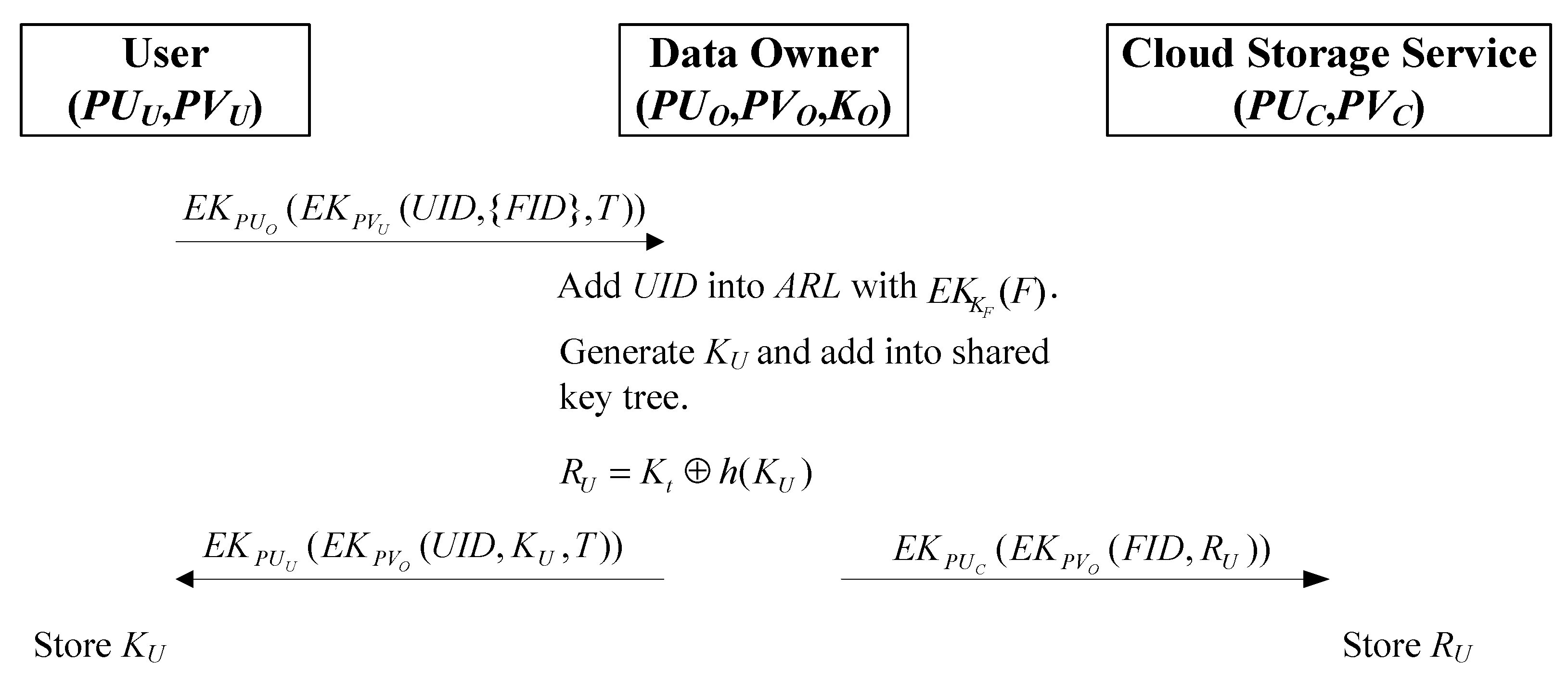
- Access Request and Verification: The user initiates the registration request by first generating a digital signature:where denotes a user identifier; denotes a set of requested file identifiers; T denotes a timestamp used to prevent replay attacks.The user then encrypts the request message together with the signature using the Data Owner’s public key:Upon receiving the request, the Data Owner decrypts the ciphertext using its private key and verifies the authenticity of the request using the user’s public key .After successful verification, the Data Owner generates a unique secret key for the user and computes the associated re-key message:The Data Owner subsequently distributes the authorization credentials securely to the user and the CSS provider.
- Credential Distribution: The DO securely distributes the credentials by transmitting to the user and to the CSS. This ensures that the user receives their private secret key while the CSS stores the re-key information necessary for file retrieval.
2.4.3. Download Phase
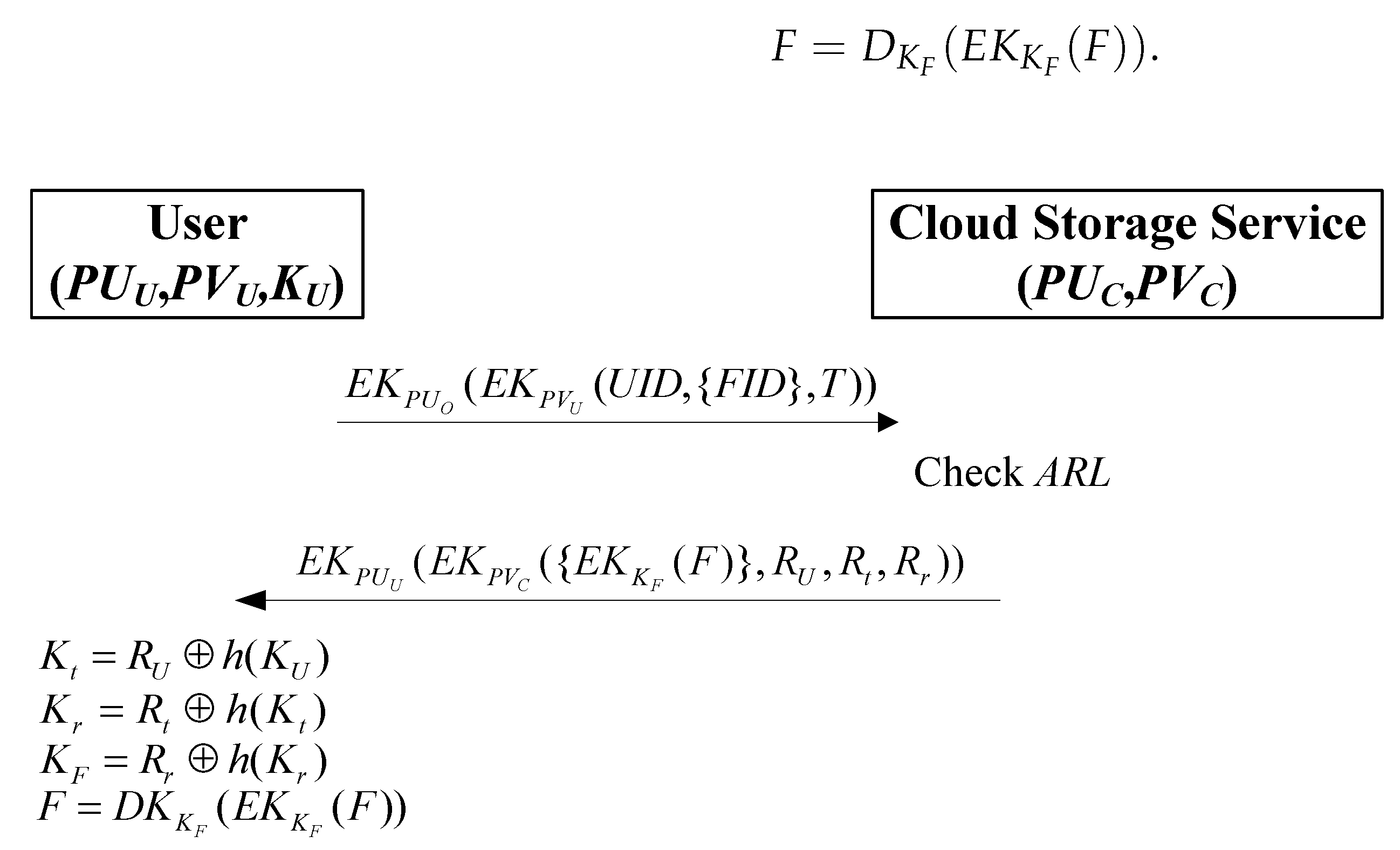
- File Request and Verification: When an authorized user requests a file from the CSS, the user first generates a signed request message:and transmits:Upon receiving the request, the CSS validates the user’s access privileges by consulting the Access Right List (). After verifying the user’s access privileges through the Access Right List (ARL), the CSS generates a digital signature:and transmits the following encrypted response to the user:The authorized user decrypts the message using the private key and verifies the signature using the CSS public key to ensure message authenticity and integrity. This response comprises the encrypted file alongside the corresponding re-key messages necessary for decryption.
- Key Recovery and Decryption: Upon receipt, the user decrypts the outer layers of the message to retrieve the encrypted file and re-key parameters. Using their unique secret key , the user derives the file encryption key through a sequential cryptographic unwrapping process:If the user possesses the correct authorization and secret key, the file encryption key is successfully recovered. Finally, the encrypted file is decrypted using:
2.4.4. Revocation and Re-Key Procedure
- The internal tree keys along the affected path: ,
- The corresponding root key of the affected file group: .
- The updated file encryption key for protected files: , where the file counter is incremented as: . Subsequently, the DO generates updated re-key messagesfor all non-revoked users within the affected group.
- Input: Revoked user , affected file group
- Step 1: Identify the hierarchical path from to the root node.
- Step 2: Regenerate all internal keys on the affected path:
- Step 3: Regenerate the corresponding root key:
- Step 4: Increment file counter:
- Step 5: Generate updated file encryption key:
- Step 6: Generate updated re-key messages for remaining users:
- Step 7: Upload updated ciphertexts and re-key materials to CSS.
- Output: Only non-revoked users can derive .
3. Discussion and Analysis
3.1. Security Analysis
- Data Confidentiality under Semi-trusted Cloud Assumptions. Under the defined adversary model, an external eavesdropper or an honest-but-curious CSS may intercept encrypted files, re-key messages, or communication traffic. However, all files are encrypted using symmetric encryption before being outsourced to the cloud. Moreover, the re-key messages are protected through one-way hash functions and XOR operations, ensuring that adversaries without the corresponding secret keys cannot derive valid file encryption keys.
- Even if the CSS stores all ciphertexts and access-related information, it cannot recover the plaintext because it does not possess the users’ private keys or secret keys required for the hierarchical key derivation process.
- Under the defined adversary model, the CSS may store all encrypted files, access-right mappings, and historical re-key materials. However, since the CSS does not possess the legitimate user secret keys required for hierarchical key derivation, it cannot independently recover valid file encryption keys.
- Moreover, after user revocation, newly generated re-key materials exclude revoked users from the updated hierarchical key path. Therefore, even if the CSS colludes with revoked users, future file encryption keys remain computationally infeasible to derive under the assumed cryptographic primitives.
- Recent studies have further highlighted that privacy leakage in distributed and intelligent computing systems may arise not only from direct ciphertext exposure but also from model updates, shared outputs, metadata analysis, and indirect inference attacks [15]. In particular, cloud-assisted artificial intelligence environments introduce additional risks related to information leakage during data sharing, access synchronization, and update propagation.
- The proposed scheme mitigates these risks by enforcing hierarchical access control, lightweight re-key isolation, and user-specific key derivation mechanisms. Even if encrypted files and historical re-key materials are exposed through cloud storage infrastructures, unauthorized entities remain unable to derive valid file encryption keys without possessing the corresponding secret credentials.
- Access Control. The CSS provider enforces access control by verifying the user’s identity against the Access Right List (ARL). Upon successful authorization, the CSS encapsulates the encrypted file and relevant re-key messages within a layer of asymmetric encryption using the recipient’s public key. Since decryption requires the corresponding private key, only the intended authorized user can access the contents. Consequently, unauthorized entities are strictly prohibited from obtaining both the encrypted data and the necessary re-key parameters.
- The proposed scheme prevents malicious or unauthorized users from accessing files beyond their granted privileges. Before delivering encrypted files, the CSS verifies the requester against the Access Right List (ARL). Furthermore, the encrypted file and corresponding re-key messages are additionally protected using the recipient’s public key.
- Therefore, even if an attacker intercepts the transmitted messages, successful decryption still requires possession of the legitimate private key and the corresponding secret key . Unauthorized users cannot derive the correct hierarchical keys needed to recover the file encryption key .
- Efficient Authorization and Revocation. The Data Owner (DO) facilitates fine-grained authorization by assigning a unique secret key to each user. By utilizing the re-key message , users can leverage their individual secret key to retrieve the file encryption key. In the event of user revocation, the DO simply updates the cryptographic path from the revoked user’s leaf node to the root, renewing and the associated re-key messages (). By excluding the revoked user’s secret key from the newly generated , revocation is achieved efficiently without necessitating updates for the remaining authorized users.
- The proposed scheme provides resistance against revoked-user attacks under the defined adversary model. When a user is revoked, the Data Owner updates the cryptographic path from the revoked leaf node to the root by renewing , , , and the associated re-key messages. Because the newly generated re-key message no longer includes the revoked user’s secret key, previously revoked users cannot derive updated file encryption keys even if they retain historical re-key messages or previously downloaded ciphertexts. In addition, non-revoked users remain unaffected during the revocation process, thereby significantly reducing the communication and computational overhead associated with re-key distribution.
- The proposed revocation mechanism provides forward secrecy for future file versions. After revocation, newly updated ciphertexts are protected using refreshed file encryption keys derived from updated counters and renewed hierarchical path keys. Consequently, revoked users cannot access subsequently updated files.
- However, if revoked users have previously downloaded ciphertexts encrypted under older file keys, those historical ciphertexts may remain accessible. Therefore, the proposed scheme focuses on efficient forward secrecy rather than retroactive backward secrecy for previously obtained data.
- Key Management. The proposed scheme utilizes a hierarchical shared-key tree structure [16] to enable dynamic file encryption key updates while maintaining system stability. By embedding the DO’s master key into each shared-key tree, the proposed scheme reduces the need for the Data Owner (DO) to explicitly store all internal tree keys and root keys within the hierarchy. Instead, the DO can dynamically derive the required cryptographic keys when necessary. Both the DO and authorized users are required to store only a single secret key. From this single key, the DO can derive all necessary file encryption keys and tree nodes, significantly streamlining key management.
- Resistance to Limited Collusion Attacks. We additionally consider a limited collusion scenario between an honest-but-curious CSS and revoked users. Although the CSS may store encrypted files and historical re-key messages, the colluding parties still cannot derive valid updated file encryption keys because the renewed re-key messages are generated using updated path keys that exclude the revoked user’s secret key.
- Consequently, access to future encrypted files remains protected even if previously exposed ciphertexts and outdated re-key materials are shared among colluding adversaries.
- It should be noted that the storage complexity discussed in this work distinguishes between cryptographic key storage and system metadata storage. Specifically:
- The File List (FL) stores file identifiers, counters, and associated metadata, resulting in a storage complexity proportional to the number of files: .
- The Access Right List (ARL) maintains user authorization relationships, whose storage complexity depends on the number of authorized users and access mappings: . or higher in practical deployments.
- The primary optimization achieved by the proposed scheme concerns hierarchical key material storage. Traditional hierarchical key management approaches often require explicit storage of internal tree keys and root keys for all groups. In contrast, the proposed scheme only requires the DO to maintain the master secret key: from which hierarchical keys can be dynamically derived.
- Lightweight Computation. To optimize performance for mobile environments, our scheme replaces the intensive symmetric encryption operations used in [10] with efficient XOR operations and one-way hash functions for re-key message generation. This substitution significantly reduces the computational overhead required for users to retrieve file encryption keys, fulfilling the requirement for a lightweight security protocol suitable for resource-constrained devices.
- Recent studies on predictive healthcare security frameworks have demonstrated that advanced encryption, decryption, and intelligent prediction mechanisms may introduce considerable computational overhead in resource-constrained environments [17]. For example, predictive protection frameworks utilizing BObMNN-based security analysis require repeated encryption/decryption operations and continuous model-processing procedures for healthcare data protection.
- Compared with such predictive security frameworks, the proposed scheme primarily relies on lightweight XOR operations and SHA-256 hash computations for hierarchical re-key generation and file-key derivation. Consequently, the computational burden imposed on mobile devices and lightweight cloud users is significantly reduced while still maintaining practical access-control and confidentiality protections.
3.2. Performance Evaluation
- Setup Phase: The DO performs n hash operations to generate file encryption keys, n symmetric encryptions for file protection, and hash and XOR operations to produce re-key messages (). Additionally, two asymmetric encryptions are applied to secure the and associated messages, while the CSS requires two asymmetric decryptions for data ingestion.
- Registration Phase: The user performs two asymmetric encryptions to secure the request (, , and T). The DO subsequently performs two asymmetric decryptions, followed by a hash and an XOR operation. To complete the process, the DO executes four asymmetric encryptions to distribute credentials, which the user and CSS then decrypt using two asymmetric decryptions each.
- Download Phase: The user initiates the request with two asymmetric encryptions. The CSS performs two asymmetric decryptions for verification, followed by two asymmetric encryptions to deliver the encrypted file and re-key messages. Finally, the user employs two asymmetric decryptions, three hash and XOR operations to derive the file encryption key, and one symmetric decryption to access the file content.
- Optimal Hierarchical Key Storage Efficiency: Unlike recent schemes such as Du et al. [18] and Tian [19], which require the Data Owner (DO) to maintain complex role-tag lists or attribute sets, our scheme significantly reduces storage overhead. By utilizing a hierarchical tree structure where only and are required, we achieve a constant or logarithmic storage complexity with respect to hierarchical cryptographic key materials ( or ), Metadata Storage (FL/ARL): and , eliminating the need for DOs to store large quantities of internal hierarchical or root keys. Therefore, the proposed scheme does not eliminate the inherent metadata storage requirements associated with maintaining file and authorization information. Instead, the optimization focuses on reducing the storage burden of hierarchical cryptographic key materials, particularly internal tree keys and root keys, which commonly dominate traditional hierarchical key management systems.
- High-Performance Computational Optimization: While the 2025 frameworks (Tian [19] and Zheng et al. [20]) rely on computationally intensive Bilinear Pairing () and Modular Exponentiation () operations, our scheme substitutes these with efficient Hash and XOR operations (). As Hash operations are approximately three orders of magnitude faster than Pairings, our scheme achieves nearly instantaneous processing times (<1 ms), whereas ABE-based counterparts often exceed 200 ms.
- Streamlined Key Management and Revocation: The proposed scheme offers a low-complexity revocation mechanism. Revocation only requires a targeted path update in the hierarchical tree, ensuring that non-revoked users remain unaffected. In contrast, Attribute-Based Encryption (ABAC/CP-ABE) schemes often suffer from high revocation costs due to the necessity of re-keying large sets of attributes across the entire system.
- Minimal Client-Side Burden: By enabling users to maintain only a single secret key (), our scheme avoids the “key explosion” problem seen in attribute-based or role-based schemes where key length scales linearly with attributes or roles. This lightweight footprint makes our approach the most viable solution for battery-sensitive mobile devices, edge-assisted IoT systems, and moderately resource-constrained environments.
- Computational Latency: The results indicate that the user-side computation cost of the proposed scheme remains under 1 ms, which is significantly lower than the ms required by the schemes of Du et al. [18], Tian [19], and Zheng [20]. This drastic reduction is achieved by substituting expensive Bilinear Pairing operations, prevalent in 2025 frameworks, with high-speed SHA-256 hashing and XOR logic. On ARM-based mobile processors, this transition not only saves hundreds of clock cycles but also prevents processor throttling and overheating during frequent access requests.
- Storage and Complexity Scaling: By integrating the Data Owner’s (DO) master key directly into the hierarchical tree structure, the proposed scheme successfully limits storage overhead to a constant or logarithmic scale ( or ). In contrast, the methods proposed by Du et al. [18] and Tian [19] face linear growth challenges due to data tags and attribute sets, respectively. Our approach demonstrates superior scalability as the volume of files and users increases within the cloud ecosystem.
- Mobile Suitability and Energy Efficiency: The energy consumption data reveals a direct correlation between cryptographic primitive selection and battery impact. The proposed scheme requires users to manage only a 256-bit single key, drastically reducing local memory footprints compared to the -bit attribute keys required by CP-ABE-based schemes. Furthermore, the revocation traffic is minimized to , ensuring that authority updates remain rapid and reliable even under low-bandwidth mobile network conditions.
3.3. Communication Overhead and Revocation Traffic
4. Conclusions
Author Contributions
Funding
Data Availability Statement
Conflicts of Interest
References
- Li, F. Collaborative Network Security Protection System Design in Cloud Computing Environment. Int. J. Netw. Secur. 2025, 27, 556–565. [Google Scholar]
- Tang, J.; Zhang, Q.; Zhang, S. Privacy-preserving Verifiable Encrypted Image Retrieval in Secure Cloud Computing. Int. J. Netw. Secur. 2026, 28, 54–67. [Google Scholar]
- Lee, S.-H.; Oh, S.-H.; Kim, J.-G. YOLOv5-Based Electric Scooter Crackdown Platform. Appl. Sci. 2025, 15, 3112. [Google Scholar] [CrossRef]
- Deng, Z.; Li, K.; Li, K.; Zhou, J. A multi-user searchable encryption scheme with keyword authorization in a cloud storage. Future Gener. Comput. Syst. 2017, 72, 208–218. [Google Scholar] [CrossRef]
- Qin, L.; Liu, S.; Liu, X.; Yu, J. An Attribute-based Encryption with Silent Revocation for Cloud Storage. Int. J. Netw. Secur. 2026, 28, 834–839. [Google Scholar]
- Yuan, Y.; Gu, Y.; Zhang, Z. Public Data Integrity Auditing Scheme Based on Fuzzy Identity for Cloud Storage System. Int. J. Netw. Secur. 2023, 25, 609–619. [Google Scholar]
- Ahuja, R.; Mohanty, S.K.; Sakurai, K. A scalable attribute-set-based access control with both sharing and full-fledged delegation of access privileges in cloud computing. Comput. Electr. Eng. 2017, 57, 241–256. [Google Scholar] [CrossRef]
- di Vimercati, S.D.C.; Foresti, S.; Jajodia, S.; Paraboschi, S.; Samarati, P. Over-encryption: Management of access control evolution on outsourced data. In Proceedings of the 33th VLDB International Conference, Vienna, Austria, 23–27 September 2007; pp. 123–134. [Google Scholar]
- Sun, W.; Lu, J.; Wang, M. Policy Extraction and Optimization with Top-down and Bottom-up Approaches for Attribute-based Access Control. Int. J. Netw. Secur. 2024, 26, 535–545. [Google Scholar]
- Sun, T.-H.; Hwang, M.-S. A hierarchical data access and key management in cloud computing. ICIC Express Lett. 2012, 6, 569–574. [Google Scholar]
- Li, S.; She, K.; Li, R. CP-ABE Scheme Supporting Direct Revocation and Outsourcing Decryption. Int. J. Netw. Secur. 2026, 28, 474–486. [Google Scholar]
- Hwang, M.-I.; Lee, C.-H.; Sun, T.-S.; Yang, C.-H. Cryptanalysis of A hierarchical Data Access and Key Management in Cloud Computing. In Proceedings of the 5th Annual International Conference on Information Technology and Applications (ITA 2018), Guilin, China, 19–21 October 2018. [Google Scholar]
- Wang, C.; Wang, Q.; Ren, K.; Cao, N.; Lou, W. Towards secure and dependable storage services in cloud computing. IEEE Trans. Serv. Comput. 2011, 22, 847–859. [Google Scholar] [CrossRef]
- Sanka, S.; Hota, C.; Rajarajan, M. Secure data access in cloud computing. In Proceedings of the 4th IMSAA International Conference, Bangalore, India, 15–17 December 2010; pp. 1–6. [Google Scholar]
- Tumma, C.; Azmeera, R.; Ayyamgari, S.; Thumma, B.Y.R. Data Security and Privacy Protection in Artificial Intelligence Models: Challenges and Defense Mechanisms. Int. J. Sci. Res. Eng. Manag. 2023, 7, 1–9. [Google Scholar] [CrossRef]
- Gu, Q.; Liu, P.; Lee, W.; Chu, C.-H. Ktr: An efficient key management scheme for secure data access control in wireless broadcast services. IEEE Trans. Dependable Secur. Comput. 2009, 6, 188–201. [Google Scholar] [CrossRef]
- Konda, B.; Yadulla, A.R.; Kasula, V.K.; Yenugula, M.; Ayyamgari, S. A Secure Predictive Framework for Preventing Health Care Data. Stat. Optim. Inf. Comput. 2025, 15, 571–585. [Google Scholar] [CrossRef]
- Du, R.; Wang, Z.; Wan, Y. A Multi-Level Role-Based Provable Data Possession Scheme for Medical Cloud Storage. Concurr. Comput. Pr. Expert 2025, 37, e70120. [Google Scholar] [CrossRef]
- Tian, J. Zero trust anonymous access algorithm for multi cloud storage system based on CP-ABE. Egypt. Inform. J. 2025, 30, 100681. [Google Scholar] [CrossRef]
- Zheng, K.; Zhou, J.; Zhou, D.; Xu, Z.; Liu, J.; Bai, C.; Li, L.; Wang, J.; Zhang, X. An Attribute-Revocable Hierarchical Access Control Scheme for Data Sharing in Cloud-Edge-End Environments. In Proceedings of the 2025 International Conference on Metaverse Computing, Networking and Applications (MetaCom), Seoul, Republic of Korea, 25–29 August 2025; pp. 143–148. [Google Scholar] [CrossRef]
- Chhatrapati, A.; Hohenberger, S.; Trombo, J.; Vusirikala, S. A Performance Evaluation of Pairing-Based Broadcast Encryption Systems. Cryptology ePrint Archive, Paper 2021/1526, 2021. Available online: https://eprint.iacr.org/2021/1526 (accessed on 14 May 2026).



| Notation | Significance |
|---|---|
| Public key of person X. | |
| Private key of person X. | |
| Data Owner’s secret key. | |
| User’s secret key. | |
| Access Right List of all authorized users. | |
| File list. | |
| User’s ID. | |
| n | The number of files the data owner has. |
| s | The number of authorized users. |
| k | The number of file groups. |
| m | The number of internal key of file group. |
| File ID, . | |
| The re-key counter of . | |
| File encryption key of file i, . | |
| Root key of the file group i, . | |
| Internal key of the file group i, . | |
| Asymmetric encryption function. | |
| Asymmetric decryption function. | |
| A one-way hash function. | |
| ⨁ | An exclusive or operator. |
| T | System time stamp. |
| Digital signature on message M using the private key of entity X. | |
| Signature verification using the public key of entity X. | |
| Public-key encryption using the public key of entity X. | |
| Public-key decryption using the private key of entity X. | |
| Digital signature value. |
| Our Scheme | Du et al. [18] | Tian [19] | Zheng et al. [20] | |
|---|---|---|---|---|
| Core | Hierarchical Tree | RBAC | Zero Trust | Cloud-Edge-End |
| Mechanism | + XOR/Hash | + PDP (Medical) | + CP-ABE | + ABAC |
| Storage Cost | ||||
| DO (Owner) | Roles, Policies, Tag List | |||
| User | (Single Key) | Role Keys | (Attribute-based) | + |
| CSS (Cloud) | Re-keys | |||
| Key Management | ||||
| Revocation Complexity | Low (Path update only) | High (Role reassignment) | High (Attribute re-keying) | Medium (Edge assisted) |
| Revoke Affected | None (Targeted) | Other users in same role | Users with same attributes | Users in specific end-nodes |
| Computing Cost | ||||
| DO (Owner) | ||||
| User | ||||
| CSS (Cloud) | ||||
| Main Advantage | Lightweight (No Pairing) | Data Integrity (PDP) | Anonymity & Zero Trust | Edge Computing Efficiency |
| Feature/Reference | Proposed Scheme | Du et al. [18] | Tian [19] | Zheng et al. [20] |
|---|---|---|---|---|
| Security | Hierarchical Tree | Multi-level Role (RBAC) | Zero Trust | Cloud-Edge-End |
| Architecture | + XOR/Hash | + PDP Proof | + CP-ABE | + ABAC |
| Core Operation Type | SHA-256 Hash / XOR | Bilinear Pairing + ECC | Pairing + MapToPoint | Pairing + Attribute Update |
| User Computation Cost | Typically ms | ms | ms (Scales with A) | ms (Edge-assisted) |
| DO Storage Cost | or | (Scales with data blocks) | (Scales with attributes) | (Scales with tree depth) |
| User Key Length | 256 bits (Single Key) | bits | bits (Linear with A) | bits (Scales with depth) |
| Revocation Traffic | XOR messages | re-assignment | attribute updates | edge synchronization |
| Energy Consumption | Negligible | Moderate (Frequent pairing) | High (Significant battery impact) | Moderate (Edge-offloaded) |
| Mobile Suitability | High (Resource-constrained) | Moderate (Medical terminals) | Low (Computation-intensive) | Moderate (Edge-dependent) |
Disclaimer/Publisher’s Note: The statements, opinions and data contained in all publications are solely those of the individual author(s) and contributor(s) and not of MDPI and/or the editor(s). MDPI and/or the editor(s) disclaim responsibility for any injury to people or property resulting from any ideas, methods, instructions or products referred to in the content. |
© 2026 by the authors. Licensee MDPI, Basel, Switzerland. This article is an open access article distributed under the terms and conditions of the Creative Commons Attribution (CC BY) license.
Share and Cite
Wu, N.-I.; Sun, T.-H.; Yang, C.-Y.; Hwang, M.-S. A Hierarchical Key Management Scheme for Efficient Outsourced Computation in Cloud Storage Services. Electronics 2026, 15, 2185. https://doi.org/10.3390/electronics15102185
Wu N-I, Sun T-H, Yang C-Y, Hwang M-S. A Hierarchical Key Management Scheme for Efficient Outsourced Computation in Cloud Storage Services. Electronics. 2026; 15(10):2185. https://doi.org/10.3390/electronics15102185
Chicago/Turabian StyleWu, Nan-I, Tsuei-Hung Sun, Cheng-Ying Yang, and Min-Shiang Hwang. 2026. "A Hierarchical Key Management Scheme for Efficient Outsourced Computation in Cloud Storage Services" Electronics 15, no. 10: 2185. https://doi.org/10.3390/electronics15102185
APA StyleWu, N.-I., Sun, T.-H., Yang, C.-Y., & Hwang, M.-S. (2026). A Hierarchical Key Management Scheme for Efficient Outsourced Computation in Cloud Storage Services. Electronics, 15(10), 2185. https://doi.org/10.3390/electronics15102185