2.1. Construction of a Double-Layer Equipment Transportation Network Model
This study adopts the assumption of an undirected and unweighted network due to the following characteristics of military equipment transportation processes. First, logistical reversibility: when forward transportation routes are disrupted, emergency equipment can be redirected backward along the original routes; therefore, directionality is not a primary concern in network robustness analysis. Second, homogeneity of transport capacity: military logistics channels are standardized, and each convoy unit operates under uniform load limits, thereby minimizing capacity heterogeneity. Third, classification constraints: for reasons of national security, detailed data on transport capacity and costs are classified. Accordingly, the networks constructed in this study are modeled as undirected and unweighted.
By using the network coupling theory, the double-layer equipment transportation network is defined as A triple . Among them, represents the LayerStorage–Supply Layer, and represents the Transportation Layer.
In the model, and respectively represent the node sets of each network layer, and represent the edge sets within the layer, and and represent the adjacency matrices within the layer. If nodes i and j have edges in that layer, then ; otherwise, it is 0.
The inter-layer relationship of the network is represented by the inter-layer coupling matrix , where the matrix element indicates that there is a material allocation or transportation connection between the storage and supply layer node and the transportation layer node , and vice versa is 0.
When building a two-layer equipment transportation network, the coupling relationship between layers is established based on the principle of “node sharing and material flow direction”, that is: if a certain node city has both a reserve warehouse and a transportation hub at the same time, or if this transportation node directly undertakes the transfer task of equipment and materials, it is regarded as the existence of a coupling relationship between layers [
19].
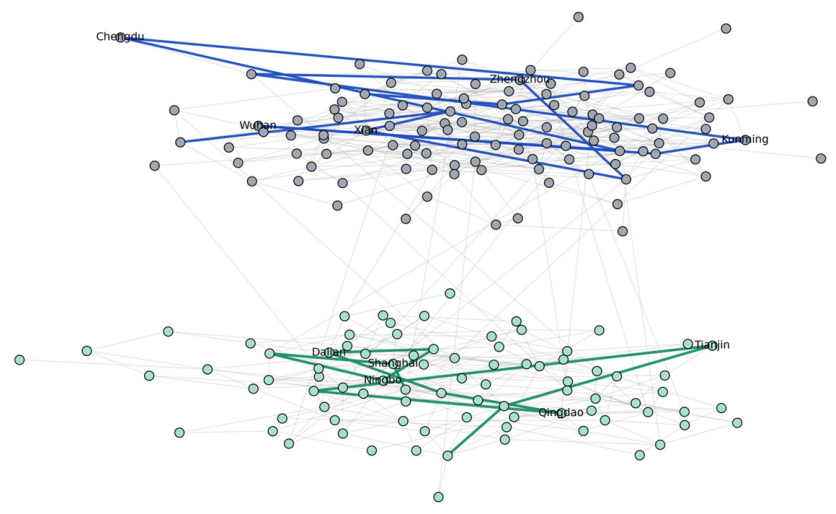
Therefore, the double-layer equipment transportation network can be abstracted as a coupled system between the storage and supply network and the transportation network, as shown in
Figure 1. The deep blue network layer represents the storage and supply network layer, which is mainly composed of the central warehouse, regional warehouses and forward warehouses. The light orange network layer represents the transportation network layer, which includes major transportation nodes such as railways, highways and air transport.
In recent years, modeling and analyzing the properties of multilayer networks has become a hot topic in complex network research. Some scholars utilize two-dimensional supra-adjacency matrices to flatten multilayer networks, enabling the unified representation of interactions across different layers.
This paper adopts this approach, utilizing a hyper-adjacency matrix as the mathematical model for a two-layer equipment transportation network. Since the research object is an undirected, unweighted multi-layer network, the hyper-adjacency matrix exhibits symmetry and can be expressed as:
Based on collected data from the equipment storage, supply, and transportation system, the storage and supply network layer comprises 86 storage nodes and 124 material flow paths; the transportation network layer includes 102 transportation nodes and 148 transportation routes. Among these, 12 nodes simultaneously perform both storage/supply and transportation functions, forming inter-layer coupled nodes. Statistically, the entire two-layer network comprises 176 independent nodes and 402 edges.
Using the Space-L method to number and abstract storage/supply nodes and transportation nodes, the established two-layer equipment transportation network model is shown in
Figure 1.
2.2. Data Abstraction and Reproducibility Protocol
The multilayer network designed for equipment support comprises two core functional layers. Their respective node definitions and aggregation logic are outlined as follows: Storage–Supply Layer: Nodes in this layer correspond to physical storage and supply facilities within the support system, including strategic depots, regional reserve centers, forward warehouses, and integrated support bases. Crucially, each node represents an aggregated business entity rather than a single geographical coordinate, providing an initial layer of protection for sensitive information.
Transportation Layer: This layer identifies key hubs in the material circulation process, such as railway freight stations, highway junctions, airports, and port logistics centers. Collectively, these nodes form the backbone transportation infrastructure facilitating the cross-regional flow of equipment and supplies.
(1) Aggregation Rules
To prevent the leakage of sensitive data through excessive granularity while simultaneously streamlining the network for efficient analysis, multiple facilities with similar roles and close proximity are merged into single nodes. This aggregation adheres to two rigorous criteria:
Functional Similarity: Facilities must perform identical or comparable roles within the supply chain to ensure functional consistency post-aggregation.
Spatial Proximity: Facilities are grouped only if they reside within the same administrative region or operational zone, thereby maintaining geographical coherence.
(2) Intra-layer Edge Construction Rules
To accurately reflect the inherent structural characteristics of the system, edges within each layer are defined by long-term, stable relationships rather than transient operational data. The specific rules are as follows:
Storage–Supply Layer: An undirected edge is established between two nodes if a stable, planned allocation relationship—such as routine supply, reserve transfer, or hierarchical distribution—exists between them. These edges characterize normalized material interactions.
Transportation Layer: Undirected edges connect nodes linked by primary transport corridors, such as railway lines, trunk highways, or fixed air routes. These edges prioritize the backbone structural connectivity of the infrastructure over real-time traffic intensity.
(3) Inter-layer Coupling Rules
Inter-layer coupling is grounded in the actual operational logic of the support system, deliberately eschewing abstract assumptions to ensure authenticity. An inter-layer edge connects a storage–supply node i and a transportation node j if at least one of the following conditions is met:
Co-located Dual-functionality: The storage facility and transport hub are situated in the same city or operational zone and jointly participate in material scheduling and flow.
Direct Transshipment Responsibility: The transportation node is tasked with the loading, unloading, or handling of materials for the corresponding storage node, signifying a direct operational link.
Functional Dependency: Core logistical phases, such as inbound and outbound movements for a storage node, rely on the transport hub as a primary gateway.
Coupling patterns extend beyond simple one-to-one mappings. A single storage–supply node may connect to multiple transportation nodes to reflect the diversity of shipping channels. Conversely, a transport hub can serve several storage nodes simultaneously, showcasing its radial service capacity.
(4) Data Anonymization and Reproducibility
To guarantee the reproducibility and verifiability of research results while strictly safeguarding sensitive data, we employ the following anonymization strategies and provide a standardized, reproducible dataset:
Anonymized Node Coding: All nodes are encoded with abstract identifiers—specifically, for storage nodes and for transportation nodes—to prevent identity disclosure.
Sensitive Information Removal: Geographic coordinates, specific facility names, and actual operational parameters are entirely purged from the dataset.
Topology Preservation: Only the topological relationships between nodes are retained, ensuring that subsequent network analysis remains viable.
For scenarios where data sharing is restricted, this paper describes a synthetic network generation procedure. The resulting synthetic networks faithfully preserve the key statistical properties of the original system, including degree distribution, node clustering coefficient, assortativity, and coupling ratio.
(5) Construction Workflow
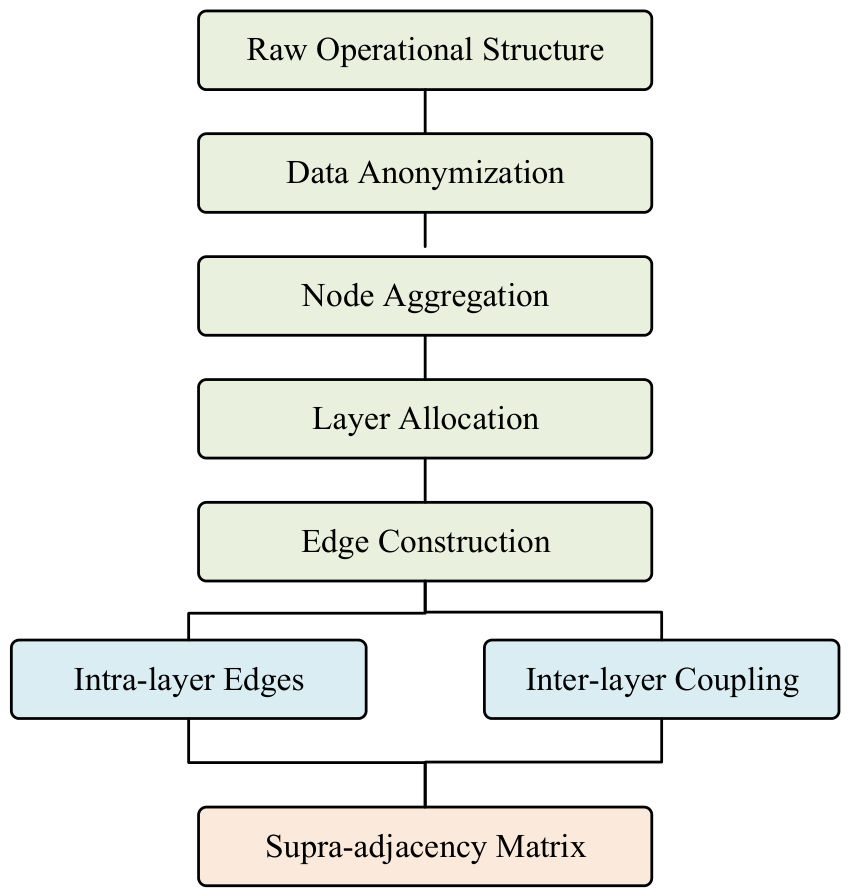
The comprehensive data processing and construction workflow for the equipment support multilayer network is illustrated in
Figure 2. It follows five core steps: Raw Operational Structure, Data Anonymization, Node Aggregation, Layer Allocation, Edge Construction (Intra- and Inter-layer), Final Supra-adjacency Matrix (
, see Equation (1)).
By employing standardized abstraction and anonymization, this scheme ensures model reproducibility without compromising sensitive operational details. Ultimately, it achieves an effective balance between the security imperatives of equipment support systems and the rigorous demands of scientific inquiry.
2.3. Network Topology Eigenvalue Analysis
2.3.1. Distributional Characterization of Structural Heterogeneity
To comprehensively characterize the structural heterogeneity of the multilayer equipment transportation network, this study extends the analysis beyond node degree and examines the distributional properties of three key metrics: node degree, betweenness centrality, and node load.
While degree distribution is commonly used to identify scale-free properties, it does not fully capture the functional role of nodes in flow redistribution and cascading failures. Therefore, betweenness centrality is introduced to reflect the control of shortest-path flows, and node load (including initial load and peak redistributed load during cascading processes) is analyzed to characterize dynamic stress concentration.
For each metric, we perform a systematic distributional comparison using three candidate models: power-law, log-normal, and exponential distributions. The fitting is conducted using maximum likelihood estimation (MLE), and the goodness-of-fit is evaluated using the Kolmogorov–Smirnov (KS) statistic. In addition, likelihood ratio tests and information criteria (AIC/BIC) are employed to compare competing models.
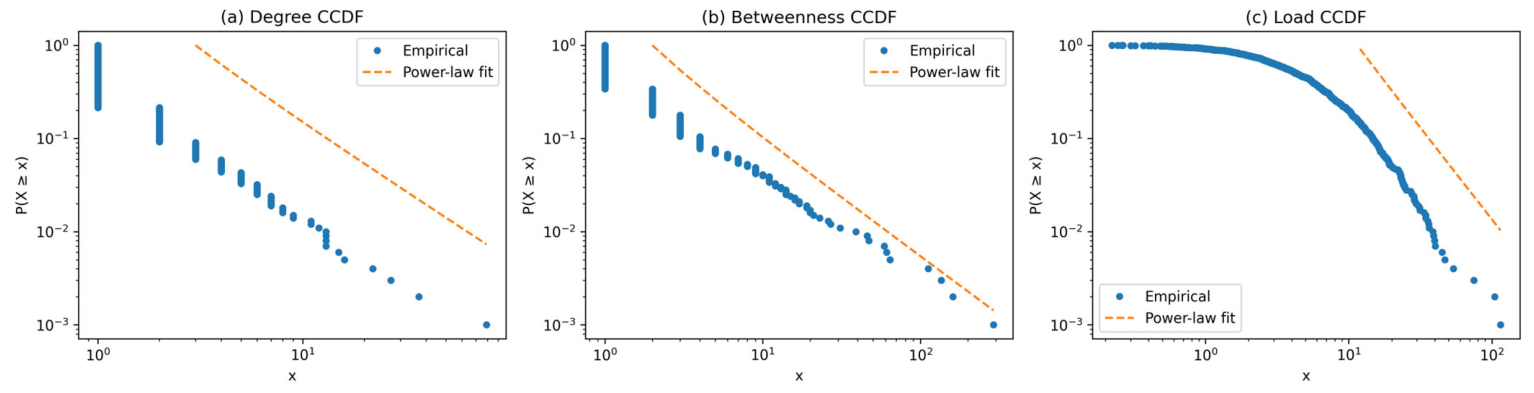
The complementary cumulative distribution functions (CCDFs) of the three metrics are shown in
Figure 3.
The results indicate that: The degree distribution follows a power-law behavior with exponent , consistent with typical scale-free network.; The betweenness centrality distribution exhibits a heavier tail, with exponent , indicating stronger concentration of flow control in a small number of nodes. The load distribution shows a mixed heavy-tail behavior, where the power-law model is competitive with the log-normal model, suggesting that dynamic load redistribution introduces additional variability beyond static topology.
Across all metrics, the power-law model is consistently favored over the exponential distribution based on KS statistics and likelihood ratio tests, confirming the presence of strong heterogeneity in both structural and functional dimensions.
These results demonstrate that the network exhibits not only topological scale-free network properties but also functional heavy-tailed behavior in flow and load dynamics, which is critical for understanding cascading failure propagation.
2.3.2. Node Clustering Coefficient
The node clustering coefficient
describes the degree of connection tightness between node neighbors [
20]. In a two-layer network, the aggregation coefficient of node
is defined as:
Here,
represents the actual number of edges that exist between the neighboring nodes of node
For cross-layer nodes, considering the joint adjacency relationship between the storage and supply layer and the transportation layer, the node clustering coefficient is expanded to:
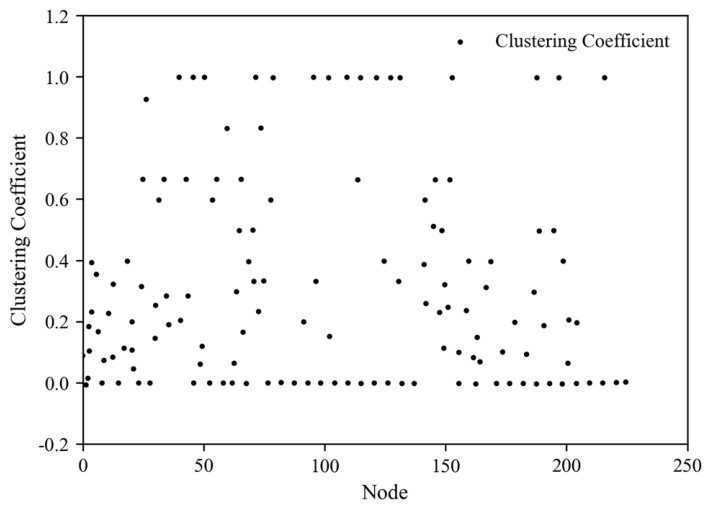
The calculation results are shown in
Figure 4. The node clustering coefficient of the multi-layer network is mainly distributed between 0.15 and 0.75, with an average value of 0.46, indicating that the network as a whole has a strong local agglomeration, that is, there are relatively dense local connections between the equipment storage and supply and transportation nodes. Some highly concentrated nodes correspond to the close supporting relationship between regional warehousing centers and military production bases, reflecting that the system has a high degree of redundancy and synergy within the local area.
2.3.3. Node PageRank Value
The PageRank algorithm is widely used for measuring the node-importance metric in single-layer networks. In a two-layer equipment transportation network, the PageRank value of a node is not only related to the quantity and quality of its neighbors, but also affected by the relative importance of the network layer [
21].
Let the adjacency matrices of the storage and supply layer and the transportation layer be
and
respectively, and the PageRank values of their nodes be
and
respectively. Then, the PageRank within the layer can be calculated by the classical algorithm:
Here, is the damping factor (taken as 0.85), and is the set of nodes pointing to node .
After considering the cross-layer influence, the comprehensive PageRank value of the node in the entire two-layer network can be expressed as:
Among them, and are the weight coefficients of the storage and supply layer and the transportation layer respectively, and is the inter-layer coupling adjustment parameter.
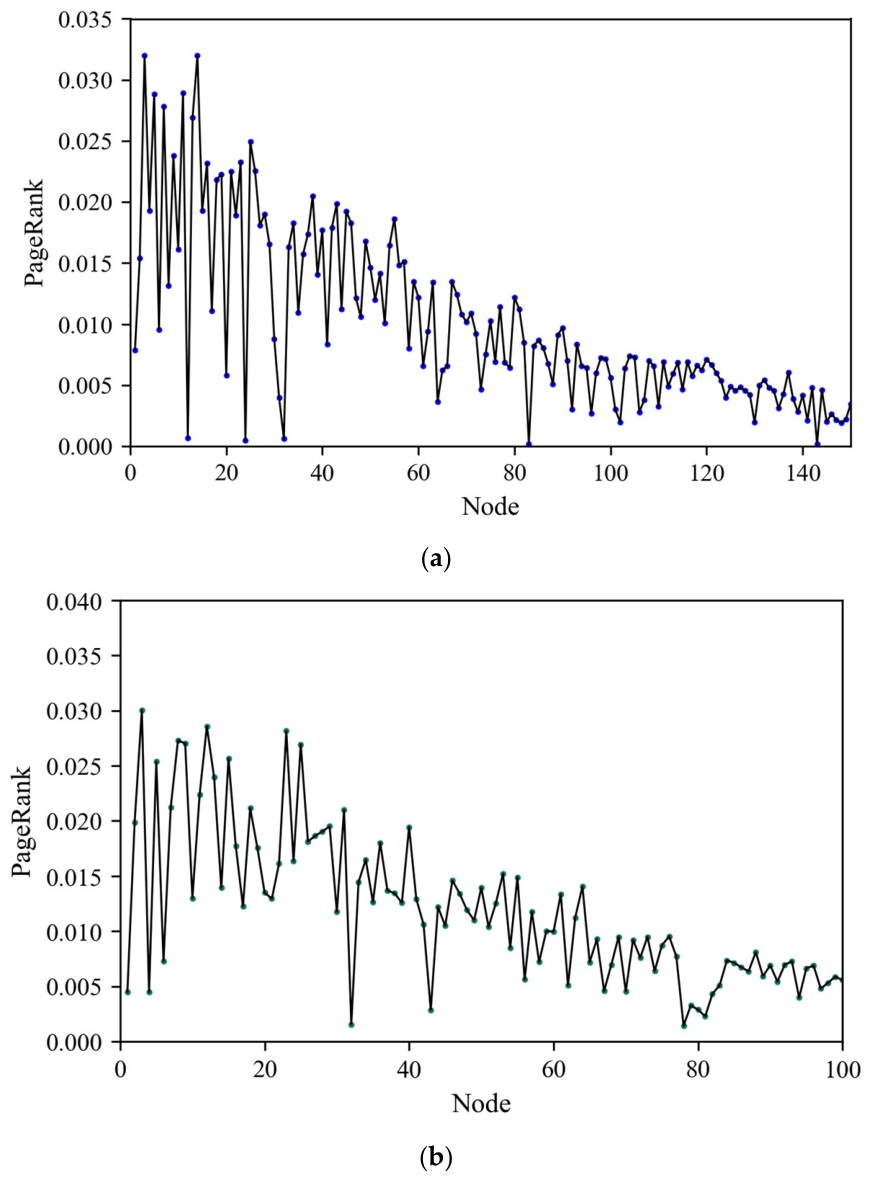
The calculation results are shown in
Figure 5. Among the top 10 nodes in terms of PR value, nodes such as the Central Strategic Reserve Repository, regional comprehensive support centers, and national-level railway freight hubs account for 70%, indicating that they play a crucial role in aggregating material and information flows in the network.
2.3.4. Network Layer Coupling Characteristics
To analyze the degree of association between the storage and supply layer and the transportation layer, Spearman’s correlation coefficient (Spearman’s
) is introduced, calculated as follows:
Here,
represents the rank difference in the core values of the same node in different layers of the network, and the value range of ρ is
. When
, the network shows assortative coupling; that is, high-connection nodes tend to connect to high-connection nodes. When
, the network shows a mismatch coupling [
21].
After calculation, the of the double-layer equipment transportation network is −0.117, indicating that there is a mild mismatch coupling feature between the storage and supply layer and the transportation layer; that is, the reserve nodes with high connectivity tend to be connected to the transportation nodes with smaller connectivity values through the transportation network. This mismatch feature reflects the supply mode of “central warehouse—distributed transportation hub” in the system, which is in line with the hierarchical and division of labor structure of the actual equipment storage and supply system.
2.4. Calculation Method for the Node-Importance Metric in Multi-Level Equipment Transportation Networks
Unlike single-layer transportation networks, in the calculation of node importance in multi-layer equipment transportation networks, not only the structural position and connection characteristics of nodes within each layer need to be considered, but also the relative importance and coupling influence between network layers should be comprehensively reflected. Therefore, this paper conducts research from two aspects: (1) Calculating the relative importance of each network layer to reflect the contribution of the storage and supply layer and the transportation layer to the overall network connectivity; (2) Calculate the intra-layer node-importance metric within each layer to reflect their core status in the local topological structure; Finally, the global node-importance metric is obtained through the fusion model.
2.4.1. Positioning Against Existing Multilayer Centrality Methods
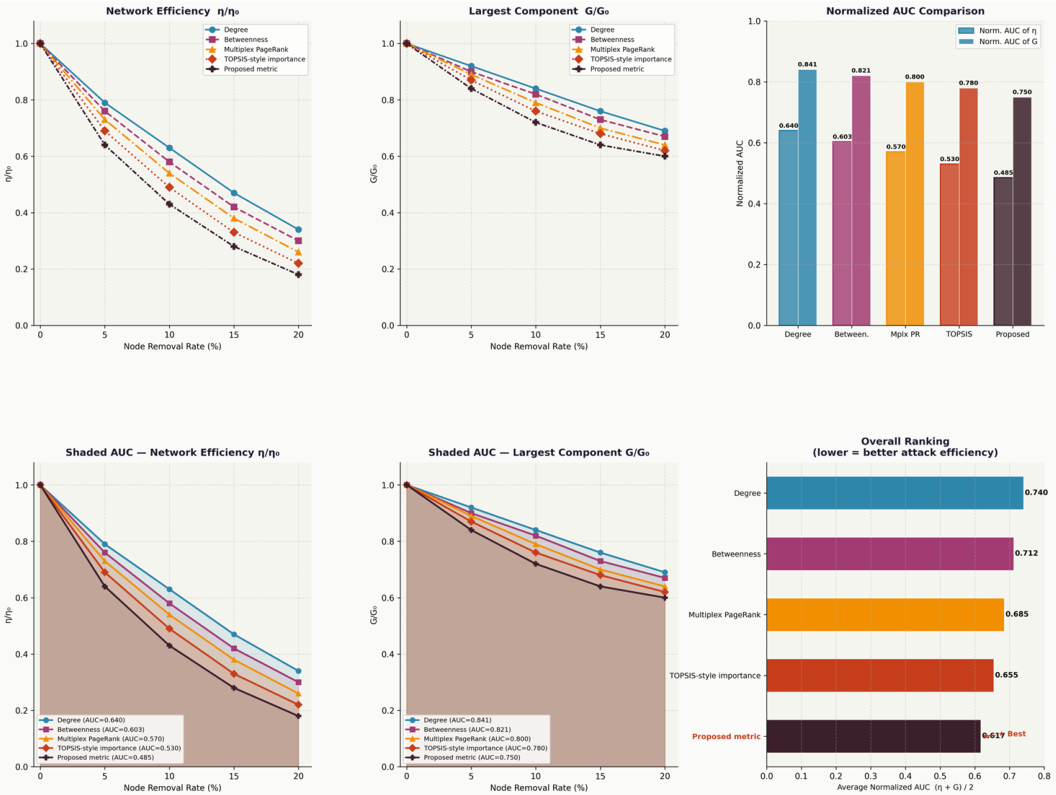
Before defining the proposed metric, we clarify its methodological position relative to representative node-ranking approaches used in complex and multilayer networks. In single-layer settings, degree and betweenness are widely adopted because they quantify local connectivity and shortest-path control, respectively. In multilayer settings, multiplex PageRank extends recursive prestige propagation across layers, while TOPSIS-style multilayer methods combine multiple indicators through weighted decision analysis. These methods are informative, but they are not equally suitable for the present problem.
The equipment support network studied in this paper exhibits three characteristics that motivate a different design. First, the storage–supply layer and the transportation layer are functionally asymmetric rather than interchangeable. Second, coupled nodes may simultaneously play storage, transfer, and cross-layer bridging roles, so their criticality cannot be adequately described by a purely intra-layer ranking. Third, the node-importance score is not used only for static ranking, but also serves as an explicit control variable in the subsequent cascading-failure load redistribution rule. Therefore, the proposed metric is designed as a cross-layer comparable importance score that jointly reflects layer-level structural contribution and intra-layer node influence.
For clarity,
Table 1 summarizes the differences between representative baseline methods and the proposed metric. The proposed approach should not be interpreted as uniformly superior in all multilayer networks. Its main advantage is expected in functionally asymmetric and strongly coupled systems where node importance must be directly linked to cascading-failure control. In contrast, for highly homogeneous or weakly coupled networks, simpler measures may provide comparable rankings at lower modeling cost.
2.4.2. Unified Definition and Calculation Steps
Based on the above positioning, the proposed metric is defined as a hierarchical fusion of layer-level structural importance and intra-layer node centrality. The calculation proceeds in three steps.
Step 1: Layer Weight Calculation.
We first quantify the relative structural contribution of each layer to the global connectivity of the coupled network. Let E denote the set of all intra-layer edges in the multilayer network, and let
and
denote the edge sets of the storage–supply layer and the transportation layer, respectively [
22]. The contribution of layer l is measured by the normalized sum of edge betweenness centrality over all edges belonging to that layer. Accordingly, the layer weight
is defined as
where
denotes the betweenness centrality of edge e in the global coupled topology. This definition ensures that a layer undertaking more shortest-path transmission tasks in the coupled network receives a larger structural weight.
Step 2: Intra-layer Node Centrality.
Within each layer, node-importance metric is measured using PageRank centrality, which captures the prestige of a node in terms of both the quantity and quality of its adjacent nodes. For a node i belonging to layer l, its intra-layer centrality is denoted by and is obtained from the standard PageRank iteration on the corresponding layer-specific adjacency matrix. This step reflects the local structural influence of the node within its own functional subnet.
Step 3: Global Importance Fusion.
The final global importance of node i in layer l is obtained by fusing the layer weight and the intra-layer node centrality. Specifically, the global importance score is defined as
For a coupled node that appears in both layers, its total importance is defined as the sum of its layer-specific contributions, i.e.,
Through this design, the proposed metric simultaneously captures three aspects: the relative structural role of each layer in the global network, the local influence of nodes within each layer, and the dual contribution of coupled nodes across layers. Therefore, the resulting score is cross-layer comparable and can be directly used as an input variable in the subsequent cascading-failure redistribution mechanism.
2.4.3. Sensitivity Analysis and Numerical Example
To illustrate how layer weights affect node ranking, we present a simplified numerical example involving three hypothetical nodes: Node A, a storage depot located only in the storage–supply layer; Node B, a transport hub located only in the transportation layer; and Node C, a coupled node that simultaneously appears in both layers. Their ranking outcomes under different layer-weight settings are shown in
Table 2.
The example shows that the ranking of single-layer nodes is sensitive to the relative structural importance of the layer in which they are located. When the storage–supply layer dominates the overall network, Node A receives the highest global importance. When the transportation layer becomes more dominant, Node B moves upward in the ranking. By contrast, the coupled node remains comparatively stable because its importance is jointly supported by both layers. This property reflects the intended behavior of the proposed metric: it preserves cross-layer comparability while recognizing the structural advantage of nodes that simultaneously contribute to multiple functional layers [
23].
To further illustrate the empirical meaning of the layer weights in the studied network, the calculated results show that the storage–supply layer has a larger normalized edge-betweenness contribution than the transportation layer. This indicates that, in the present equipment support network, the storage–supply layer plays a relatively more central structural role in maintaining global connectivity. Consequently, storage–supply hubs and cross-layer coupled nodes tend to rank prominently in the final importance list, which is consistent with the hierarchical characteristics of the actual equipment support system.