1. Introduction
In the era of smart cities and the Industrial Internet of Things (IIoT), enhancing the energy efficiency of intelligent transportation systems has become a central focus for both academia and the engineering sector. As critical cyber–physical infrastructure in modern metropolises, urban rail transit (URT) systems operate not only as the backbone of passenger transport but also as highly interconnected, data-rich nodes within the urban energy network. Statistically, traction energy consumption accounts for approximately 40–50% of the total energy footprint in subway systems [
1]. Consequently, leveraging these data-rich networks for physics-informed optimization is a crucial step toward realizing sustainable and intelligent urban mobility.
Regenerative braking energy (RBE) generated during train deceleration represents a crucial distributed energy resource [
2]. Although hardware-based solutions, such as installing wayside energy storage systems (WESSs), are somewhat effective, they frequently encounter challenges related to high capital investment and significant footprint requirements, particularly in space-constrained underground environments [
3]. In contrast, dynamically optimizing train operational scheduling to facilitate the direct energy transfer from braking trains to accelerating trains is widely regarded as a highly cost-effective, energy-efficient strategy. This approach eliminates the need for additional physical infrastructure, enhancing overall energy efficiency solely by leveraging the flexibility of operational dispatching [
4].
1.1. Background
Current research on the energy-efficient optimization of regenerative braking predominantly focuses on “time-domain” matching, with a primary emphasis on maximizing the temporal overlap between braking and accelerating trains. For instance, Deng et al. [
5] proposed a cooperative scheduling model utilizing a genetic algorithm to maximize overlap time, thereby synchronizing the acceleration and deceleration phases of consecutive trains. Wu et al. [
6] formulated a mixed-integer linear programming (MILP) problem to optimize the synchronization of train arrivals and departures within congested transit networks. Similarly, Jiao and Zhou [
7] developed a multi-objective optimization approach that aligns the braking phases of arriving trains with the accelerating phases of departing trains by dynamically adjusting dwell times. Zhang et al. [
8] focused on the integrated optimization of train trajectories and timetables, emphasizing the temporal synchronization of traction and braking efforts. Furthermore, Wang et al. [
9] introduced a robust mathematical model to accommodate uncertain train delays while still maximizing the intervals of regenerative energy overlap.
However, these “time-centric” approaches implicitly rely on a critical, idealized assumption: that energy can be transmitted losslessly as long as temporal alignment is achieved. This premise overlooks the spatial and physical realities of DC traction power supply systems, where energy must be transferred through a catenary network possessing inherent impedance that increases linearly with transmission distance. According to Joule’s law, long-distance transmission inevitably leads to significant line losses, and may even prevent the energy from reaching the load entirely due to severe voltage drops. Consequently, optimization strategies that strictly pursue temporal synchronization while neglecting spatial proximity frequently converge to “pseudo-optimal” solutions—where temporal matching is theoretically perfect, but a substantial portion of the regenerative braking energy dissipates as heat in the transmission lines rather than being effectively utilized by accelerating trains.
Furthermore, previous studies characterizing the instantaneous electrical relationships within a train fleet have relied heavily on “black-box” simulation models. Su et al. [
10] adopted a simulation-based cooperative scheduling method that treated the DC traction power supply system merely as a sequential simulation module, lacking a direct mathematical description of instantaneous power transfer, while Zhang et al. [
11] advanced the modeling of dynamic power flow in urban rail networks, their method still requires the iterative numerical resolution of complex power flow equations at every time step. Wu et al. [
12] and Wang et al. [
13] similarly employed simulation-driven optimization frameworks for energy storage sizing and train operation control, wherein objective functions were evaluated via time-consuming simulator feedback rather than derived from explicit analytical functions. Consequently, these studies failed to formulate instantaneous functional expressions for the power absorbed by accelerating trains, making it difficult to reveal the underlying physical mechanisms of energy interaction.
Concurrently, the existing energy objective functions lack differentiable mapping mechanisms, particularly concerning the relative spatial distances between trains. Ding et al. [
14] and Liao et al. [
15] utilized metaheuristic algorithms to solve timetabling problems precisely because their energy models could not provide gradient information regarding the decision variables. Miyatake and Ko [
16] employed a state-space search strategy based on dynamic programming for trajectory optimization; however, without the guidance of gradients, the computational burden becomes prohibitive in large-scale networks. More recently, Ying et al. [
17] and Šemrov et al. [
18] explored deep reinforcement learning methods, while these “model-free” agents are effective, they cannot establish an explicit and differentiable mathematical relationship between the energy-saving objectives and spatiotemporal states.
Finally, the current research rarely conducts targeted analyses based on the dynamic physical states of train motion. In their comprehensive review of energy-efficient train control, Scheepmaker et al. [
19] pointed out that most strategies optimize only single-train trajectories or static timetables, without explicitly analyzing dynamic interaction patterns (such as chasing or head-on encounters). Su et al. [
20] and Wang et al. [
21] focused on optimizing speed profiles and dwell times, yet they treated the varying distance between trains merely as a static constraint rather than a dynamic variable that influences the gradient direction. Although D’Ariano et al. [
22] and Corman et al. [
23] considered multi-train conflicts and collaborative control, they did not partition the optimization problem into distinct physical quadrants to analyze how relative motion states affect the sensitivity of energy absorption.
In summary, the existing literature exhibits a clear methodological bottleneck: the heavy reliance on purely “time-centric” synchronization, “black-box” simulation evaluations, gradient-free heuristic algorithms, and static spatial constraints prevents a rigorous mathematical understanding of multi-train energy interactions. There is a critical void in establishing an explicit, differentiable, and dynamically adaptive analytical framework. To bridge these interconnected gaps, this study introduces a paradigm shift from traditional heuristic dispatching to a physics-informed analytical gradient optimization.
1.2. Contributions
Addressing the complex spatiotemporal coupling issues induced by multi-train dynamic interactions within the traction power supply networks of urban rail transit, this paper constructs a spatiotemporal synergistic gradient optimization framework. By organically combining the laws of physical electricity with mathematical optimization, this study quantifies the attenuation of instantaneous power over spatial distance and achieves adaptive optimization under complex operational states. Importantly, this framework is designed with practical implications in mind, offering a scalable solution for real-world train scheduling. The main contributions of this research are summarized as follows:
- 1.
Creating an analytical model of electrical topology based on energy flow operator decoupling. Moving beyond pure time-matching approaches, this paper establishes an analytical representation of the instantaneous electrical interactions among a train fleet based on Kirchhoff’s laws. By decoupling energy flow operators, the current distribution ratio and line impedance loss are identified as key distance-dependent factors determining absorption efficiency. This approach physically quantifies the coupling between energy distribution and source-load relative distance, providing a practical and scalable theoretical foundation for spatiotemporal synergistic scheduling.
- 2.
Deriving a complete-process analytical gradient model based on spatiotemporal transformations. Targeting the dynamically cumulative nature of regenerative braking energy absorption, an optimization objective function centered on the integrated electrical energy is established. The precise analytical gradient of the objective function with respect to dwell time is derived using an innovative three-layer chain-rule architecture: “power-distance sensitivity,” “spatial directional factor,” and “kinematic perturbation.” This derivation effectively dismantles the mathematical barriers between physical impedance constraints and scheduling directives, successfully transforming the cooperative train scheduling issue from a qualitative adjustment into a rigorous quantitative optimization model.
- 3.
Designing a phase-plane-based adaptive gradient optimization strategy. To address the non-uniformity of the energy gradient field under varying train operational states, this paper maps the relative positions and traction speeds between interacting trains onto a four-quadrant phase plane. By uncovering the topological evolution of gradients within these quadrants, an adaptive gradient-solving strategy is designed to match the current motion state. This strategy effectively mitigates the oscillation issues common in conventional algorithms, ensuring algorithmic robustness and scalability. Consequently, it reliably guides the operational trajectories of the train fleet toward a low-impedance “optimal energy window” for practical energy recovery.
2. Energy Flow Matrix Modeling and Operator Decoupling for the Train Fleet
Based on Kirchhoff’s laws, this study constructs an analytical representation of the instantaneous electrical relationships within a train fleet. From this foundation, two critical parameters are derived: the “multi-train distribution factor” (which characterizes the proportional allocation when multiple accelerating trains jointly absorb energy) and the “line impedance loss factor” (which characterizes the transmission constraints imposed by catenary resistance consumption). This study mathematically proves that both of the aforementioned factors are directly dependent on the relative electrical distance between the braking train and the accelerating train(s). Consequently, the complex instantaneous electrical coupling problem is elegantly transformed into a distance optimization problem within geometric space.
2.1. Basic Element Modeling
The urban rail transit train operation system is a complex non-linear network. Given that the core objective of this study is to analytically resolve the energy interaction topology of the train fleet under macroscopic spatiotemporal conditions, factors such as line parasitic inductance and capacitance, as well as harmonic components within the system, are neglected. Consequently, a “quasi-steady-state DC approximation” (QSS) is adopted as the foundational model [
24].
The physical rationale for this approximation is rooted in the principle of time-scale decoupling and the fundamental nature of energy integration. In physical reality, the DC traction network possesses parasitic capacitance (C) and inductance (L). During a regenerative braking event, the substantial rate of change of current () combined with the high-frequency switching of insulated-gate bipolar transistor (IGBT) devices in the traction converters inevitably induces reverse overvoltages and local high-frequency resonances. However, it is critical to recognize that inductors and capacitors act strictly as energy storage elements rather than energy dissipation elements. Over a complete macroscopic braking cycle, which typically spans 20 to 35 s, the transient high-frequency energy absorbed and released by these parasitic components maintains a dynamic balance. Because the core objective function of this study evaluates the cumulative electrical energy via time integration (), the positive and negative power deviations induced by these high-frequency oscillations effectively cancel out over the macroscopic time horizon.
Consequently, the macroscopic energy distribution and net system transmission losses are overwhelmingly dictated by the Joule heating across the line resistance, which is strictly a function of the spatial distance between the braking and accelerating trains. Adopting the QSS assumption isolates the macroscopic spatiotemporal scheduling problem from the multi-time-scale stiffness that would arise from coupling microscopic electromagnetic differential equations, thereby ensuring the mathematical feasibility of the gradient derivation without compromising the physical integrity of the energy evaluation.
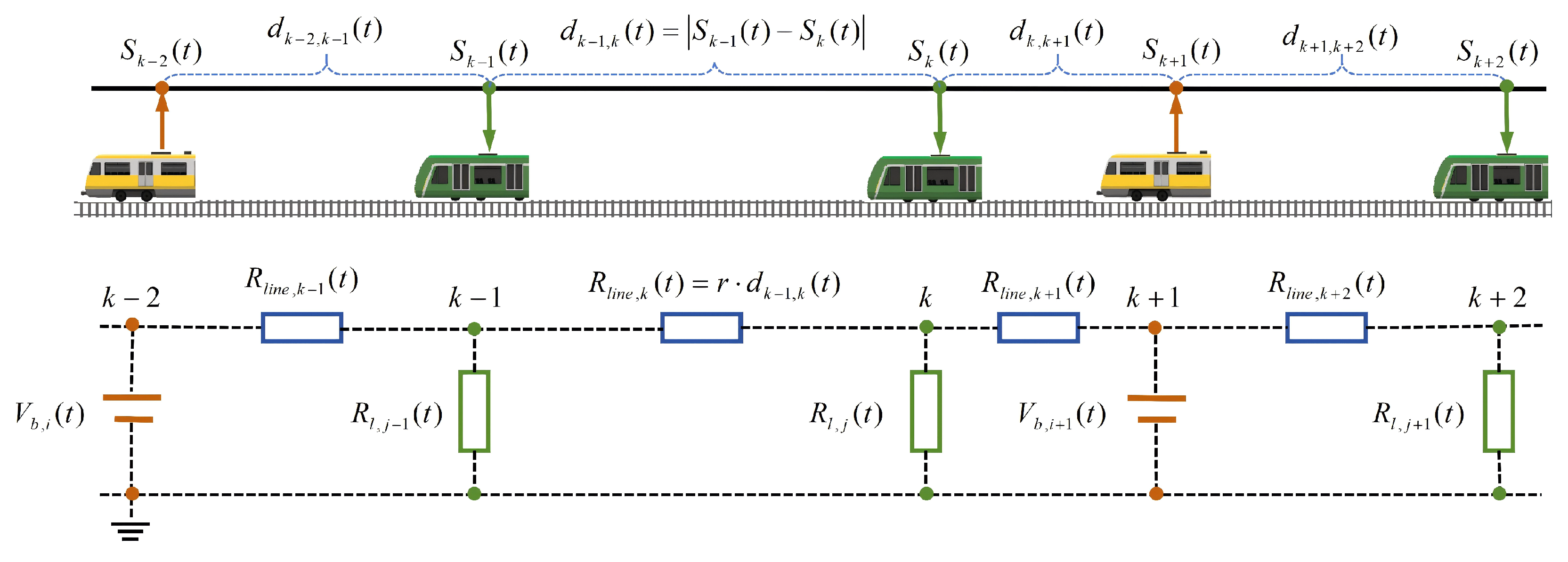
To address the time-varying topological characteristics of the subway traction power supply system, the physical circuit is discretized into a dynamic network comprising
N nodes. The node set encompasses all braking and accelerating (traction) trains. Based on the time-varying nature of the traction power supply system, the train operation network is first spatially discretized according to the operational states of the trains [
25]. The train position vector
is defined as shown in Equation (1) to characterize the dynamic distribution of nodes across the entire network, as illustrated in
Figure 1:
- 1.
Voltage source model of braking trains
During the regenerative braking process of subway trains, the motors operate in generator mode, converting the train’s kinetic energy into electrical energy that is fed back into the power grid. Given that the research object is a typical DC traction system, this model equivalents the braking train
i to an ideal DC voltage source
[
26]. The amplitude of
is physically constrained by the train’s deceleration, instantaneous payload, and inverter control strategy, manifesting as a time-varying function. Let
i denote any braking train, where
, and
B represents the set of braking trains.
- 2.
Load model of accelerating trains
Accelerating trains serve as the primary energy-absorbing units within the power grid. Let j denote any accelerating train, where , and M represents the set of accelerating trains. Analyzing its electrical characteristics, the power demand fluctuates with the running speed and acceleration . Therefore, it is equivalenced to a time-varying resistor .
- 3.
Catenary network model
To quantify the spatial attenuation effect of regenerative electrical energy during transmission, the catenary network is simplified as a one-dimensional uniform transmission conductor. The resistance per unit length of the catenary is defined as r (). For the positions of any two trains and , the electrical distance between them, , directly determines the transmission impedance .
2.2. Generalized Matrix Derivation for Multi-Source and Multi-Load Networks
To address the system-level synergistic optimization problem during the operation of the train fleet, a unified matrix solution framework is constructed to describe the dynamic transmission behavior of regenerative braking energy on the catenary network based on Kirchhoff’s laws [
27].
2.2.1. Single-Node Current Balance Equation
For any non-terminal node
k (
) in the network, applying Kirchhoff’s Current Law (KCL), the fundamental physical constraint of the system is described as “the net injected current at the node is zero.” Considering the connection relationship with adjacent nodes on the left and right [
28], the instantaneous difference equation for node
k is given by Equation (2):
The physical quantities in the equation are modeled as follows:
Traction load: If the node represents an accelerating train, it is equivalenced to a linear impedance based on Ohm’s law, with the outflow current being .
Braking feedback source: If the node represents a braking train, it is equivalenced to an ideal voltage source with node voltage . In the nodal equation, this is typically transformed into an equivalent current injection term.
2.2.2. Matrix Formulation of the Network-Wide State Equations
To solve for the network-wide states, the aforementioned local equations are generalized to the global network.
- 1.
Definition of state and source vectors
The network-wide node voltage vector
is defined as shown in Equation (3):
The current source vector
is defined: vector
Z represents the current source terms of the nodes. For a braking source node
i, its contribution to the nodal current is assigned to the term
, as shown in Equation (4):
where
corresponds to the equivalent current source intensity of the
k-th train at node
i (i.e., the previously mentioned
). For non-source nodes, this term is zero.
- 2.
Linear algebraic equations and matrix expansion
By combining the difference equations of all nodes, the current balance of the network nodes can be described by a system of linear equations, as shown in Equation (5):
where the system conductance matrix
is a sparse tridiagonal matrix. Integrating all nodes in the network, the specific expanded form of the matrix is given by Equation (6):
Main diagonal elements: Characterize the total self-admittance of node
k:
where
is the load conductance. If node
k corresponds to an accelerating train, then
.
Upper diagonal elements: Characterize the coupling strength with the right adjacent node
:
Lower diagonal elements: Characterize the coupling strength with the left adjacent node
:
2.3. Decoupling of Linear Impedance Losses in the Single-Source and Single-Load Transmission Mechanism
Although the generalized matrix equation establishes a numerical solution framework for the network-wide electrical states, it does not intuitively reflect the physical essence of energy interaction between nodes. To deeply investigate the transmission mechanism of regenerative braking energy and extract the key characteristic parameters determining energy efficiency, this section degenerates the complex network-wide matrix equations into the most fundamental binary physical unit—namely, the “single braking train–single accelerating train” model. The transmission efficiency factor, which characterizes the physical attributes of the line, is decoupled from the network constraints and abstracted into an explicit characteristic operator with respect to electrical distance. This establishes a clear, quantitative mapping relationship between the train’s operational position and energy loss.
2.3.1. Power Analytical Model from the Source-Side Perspective
The
N-node generalized network is simplified into a binary circuit [
29]. Let the braking train
i be an ideal voltage source. Located at position
, it is equivalenced to an ideal voltage source
with an output power of
. The accelerating train
j serves as the load. Located at position
, it is equivalenced to a time-varying resistor
. The line impedance is
.
To evaluate the effective utilization rate of regenerative braking energy, it is necessary to establish an analytical function for the load’s received power
with respect to the source-side states and spatial distance. Based on the law of conservation of energy, the load power equals the output power at the source side minus the transmission loss of the line, as shown in Equation (7):
Adopting the “quasi-steady-state DC approximation,” the circuit current is estimated using the source-side voltage as
. Substituting this into the loss term and extracting the common factor yields Equation (8):
2.3.2. Definition of the Linear Loss Operator
Defining the term within the square brackets of the above equation as the transmission efficiency operator
, it can be observed that the power received by the accelerating train is decoupled into the product of the braking train’s power and the transmission efficiency, as shown in Equation (9):
Mathematically and physically, exhibits monotonicity and linear differentiability. When the regenerative energy generated by braking train i is transmitted to train j, it is accompanied by voltage drops and thermal losses caused by the line resistance. Equation (9) indicates that is a monotonically decreasing linear function with respect to the electrical distance . This implies that, regardless of network competition, an increase in distance inevitably leads to a linear attenuation of energy utilization efficiency.
2.4. Current Allocation Mechanism in Single-Source and Multi-Load Scenarios and the Construction of the Energy Flow Allocation Operator
During subway operations, there are often situations within the same power supply section where multiple accelerating (traction) trains simultaneously utilize regenerative braking energy, causing the network to exhibit a “one-to-many” divergent topological characteristic. To quantify the energy relationships among multiple trains, this section decouples the power distribution factor from the generalized matrix equation based on the principle of parallel current division, abstracting it into a non-linear operator with respect to electrical distance [
30].
2.4.1. Single-Source Form of the State Equation
Based on the generalized discretized network, this scenario describes an operating condition where a single braking train (node
i) simultaneously supplies power to
n accelerating trains (load set
M) located at varying positions within the power supply arm. By sorting all trains according to their positional coordinates, the entire catenary is partitioned into several end-to-end “chain segments.” The system adheres to the tridiagonal matrix form of
, and the injection vector
J exhibits a single-source characteristic, as shown in Equation (10):
2.4.2. Current Distribution Model Based on Path Impedance
To reveal the energy distribution laws when multiple trains coexist, the aforementioned equivalent circuit is analyzed using the principle of parallel current division.
- 1.
Current distribution based on path impedance
The system is equivalenced to multiple time-varying loads
connected in parallel to the same voltage source via transmission lines of varying lengths. According to the parallel current division theorem, the current
obtained by the
j-th load depends on the total impedance of its entire branch, as expressed in Equation (11), and its power
is shown in Equation (12):
This mathematically describes that in the DC traction power supply network, trains closer to the braking source experience lower equivalent line impedance. Consequently, they hold an absolute advantage in physical competition and can acquire a larger power share.
- 2.
Definition of the power distribution factor
The power distribution operator
is defined to describe the complex electrical energy distribution relationships among multiple accelerating trains. This operator normalizes the “inverse distance term” of all effective loads, as presented in Equation (13):
Here, is a complex rational fractional function with respect to the distance vector. The denominator term incorporates the positional information of all accelerating trains. This implies that the energy acquired by train j depends not only on its own absolute position but also on the relative distribution of all other trains across the network.
2.5. Topological Structure of Multi-Source and Single-Load Scenarios
When multiple braking trains within a power supply section simultaneously supply power to a single accelerating train, the network exhibits a “many-to-one” convergent topology. In this scenario, the energy flow not only adheres to the principle of linear superposition but is also subjected to the non-linear constraints of physical voltage safety thresholds. This section aims to quantify this “supply–demand matching” relationship and decouple the saturation truncation operator from the generalized matrix equation, thereby clarifying the physical feasible region for gradient optimization.
2.5.1. Multi-Source Superposition Form of the State Equation
Under this scenario, the non-zero elements of the injection vector
in the generalized network-wide matrix equation correspond to all braking train nodes, as shown in Equation (14):
Under the linearized impedance assumption, the system satisfies the superposition theorem. The potential and received power of the load node are jointly determined by the excitations of all sources.
2.5.2. Potential Arrival Power and Linear Superposition
In the ideal linear region where overvoltage protection is not triggered, the aggregated power at the load port is the sum of the power from all braking sources after accounting for transmission losses. Based on the previously defined linear loss operator
, the potential arrival power
is defined as shown in Equation (15):
This equation quantifies the theoretical maximum energy that the physical network can “deliver” to the load terminal within the voltage limits. It indicates that the energy gain in a multi-source scenario is the linear accumulation of the transmission efficiencies of independent paths.
However, the accelerating train’s power acceptance capacity is not infinite; it is constrained by the grid’s safety voltage threshold . When multiple power sources simultaneously inject large currents into a single point, the load node voltage is significantly elevated. Once it exceeds , overvoltage protection mechanisms (such as rheostatic braking chopping) will forcibly intervene, causing the surplus energy to be dissipated.
3. Analytical Gradient Model of Energy Flow Based on Dynamic Spatiotemporal Trajectories
To address the complex non-linear optimization problem of cooperative utilization of regenerative braking energy among multiple trains in urban rail transit, this study constructs a system architecture designed to maximize network-wide energy efficiency by fine-tuning dwell times while strictly adhering to timetable constraints.
The preceding section established a generalized instantaneous power model to delineate the energy transmission mechanisms among trains at specific physical instants. However, timetable optimization is intrinsically a dynamic control process spanning the entire time domain. Its ultimate objective is to maximize the total electrical energy absorbed throughout the complete operational cycle. Because train positions continuously evolve over time, the circuit topology and energy flow relationships exhibit profound time-varying characteristics. Consequently, conventional numerical search methods struggle to capture the intricate coupling relationships among these variables. To accurately guide the optimization direction within a highly complex solution space, it is imperative to establish an explicit analytical dependency of the objective function (total energy) on the decision variables (dwell times).
3.1. Spatiotemporal Mapping Construction of the Instantaneous Power Model
The generalized instantaneous power model , which delineates the dynamics of energy transmission between trains, is capable of simulating network-wide energy flow within the time domain. However, from the perspective of trajectory optimization, conducting a sensitivity analysis directly based on the time variable t presents inherent limitations. This is because timetable adjustments (i.e., modifications to dwell times) are fundamentally translations of the trains’ spatiotemporal trajectories. Their direct physical consequence is the alteration of the relative electrical distance between the accelerating train and the braking train. Therefore, to construct a gradient-based optimization algorithm, it is imperative to map the time-varying power model into an explicit function of spatial variables and to conduct a decoupled analysis of the energy’s “allocation mechanism” and “transmission loss.”
3.1.1. Spatial Parameterization Reconstruction of the Model
The generalized instantaneous power model establishes that the effective power absorbed by the accelerating train
j from the braking train
i is jointly determined by the source-side power
, the power distribution factor
, and the transmission efficiency factor
, as shown in Equation (16):
Power distribution factor: By mapping the time-varying expression of the distribution factor
(derived from the principle of parallel circuit current division) into a spatial variable model, this factor characterizes the energy division within a multi-train competitive environment, as shown in Equation (17):
Transmission efficiency: By mapping the time-varying expression of the efficiency factor
(based on the linearized resistance loss assumption) into a spatial variable model, this factor describes the thermal loss attenuation during energy transmission, as shown in Equation (18):
3.1.2. Decoupling Analysis of Ideal Allocation and Non-Linear Loss
Through algebraic manipulation, the decoupled form of the loss is obtained, as presented in Equation (19):
Allocation power term: This term characterizes the theoretical energy share that train j can potentially acquire. Mathematically, this term adheres to the “inverse-square distance law.” It embodies the principle of proximity priority within DC traction power networks: as decreases, the numerical value of this term increases sharply. Conversely, the summation term in the denominator reflects the inter-train allocation dynamics—when other accelerating trains are present in close proximity, the denominator increases, causing the share of train j to be “diluted.” This component represents the upper-bound objective of the optimization; that is, the potential energy absorption that the algorithm seeks to maximize by adjusting positions.
Transmission loss term: This term quantifies the thermal losses induced by physical line resistance r and voltage limitations . After merging from both and , it mathematically reveals that as the spatial distance widens, the proportion of losses during transmission relatively ascends.
3.2. Parameterized Translational Mapping of Train Spatiotemporal Trajectories and Operational Boundary Construction
This section defines the spatiotemporal trajectory function of the trains, establishing a dynamic mapping mechanism between the decision variables (dwell times) and the system state variables (train positions and spacing). This constructs an optimization objective function centered on maximizing the network-wide utilization of regenerative braking energy [
31].
3.2.1. Translational Transformation of Decision Variables and Spatiotemporal Trajectories
Urban rail transit trains operate according to a predefined timetable; however, dwell times remain adjustable within the elastic range permitted by practical operational regulations. By introducing controlled time perturbations at stations, this study unlocks adjustment space for train operational states, establishing a dynamic optimization mechanism with dwell time as the decision variable.
Let the dwell time adjustment of accelerating train j at a specific station be defined as the decision variable, denoted as . Upon introducing , the train’s spatiotemporal trajectory will undergo a translation along the time axis. Suppose the absolute position of train j at time t under the original timetable is . According to kinematic principles, the actual position trajectory after applying the time adjustment can be expressed as .
3.2.2. Analytical Definition of Dynamic Electrical Distance and Physical Regularization
The dynamic electrical distance between the accelerating train j and the braking train i is no longer a static quantity, but rather a bivariate composite function of time t and the decision variable .
In physical subway operations, even when an up-track braking train and a down-track accelerating train are perfectly aligned at the same platform (), their effective electrical distance never reaches absolute zero. Regenerative current cannot transfer horizontally across the air gap between tracks; it must traverse a complete “U-shaped circuit” (pantograph → up-track feeder → substation DC busbar → down-track feeder → pantograph).
To rigorously reflect this incompressible minimum electrical circuit length and ensure the differentiability of the distance function, a spatial relaxation factor
(representing the intrinsic physical clearance) is introduced. The electrical distance is analytically formulated in Equation (20):
This regularization not only accurately maps the double-track parallel power supply topology but also guarantees that the denominator in the subsequent power flow equations never encounters an absolute mathematical zero.
3.2.3. Dynamic Dwell Time Domain and Operational Constraints
Although adjusting
can yield energy-saving benefits, train operations must strictly satisfy passenger flow demands and dispatching regulations [
32]. To standardize the values of the decision variables and ensure the rationality and stability of the optimization results, this study defines a dynamic dwell time domain
and introduces the following constraints:
- 1.
Linear update mechanism
Let the original scheduled dwell time of train
j be
; then, the newly adjusted dwell time
follows a linear superposition relationship, as shown in Equation (21):
- 2.
Adjustment amplitude and robust boundary constraints
To prevent abrupt changes in dwell times from disrupting passenger services, the adjusted dwell time must fall within a strict time window, as shown in Equation (22):
Crucially, in deterministic models, the minimum dwell time is often treated as a fixed constant. Based on the empirical operational parameters of Luoyang Metro Line 1, this baseline constant typically comprises the train’s mechanical characteristics (door command response, physical opening/closing execution, and traction startup delay) and a baseline passenger flow duration calibrated to the AW2 load standard (typical operational capacity).
However, in real-world scenarios, platform congestion is highly stochastic. Treating
as a perfectly controllable deterministic value risks generating an “optimized” timetable that is theoretically perfect but operationally fragile. Unpredictable delays in passenger boarding and alighting could easily trigger a cascading disruption of the synchronized energy-saving timetable. Therefore, to ensure operational resilience, the lower bound
in this study is redefined to explicitly incorporate a stochastic passenger flow parameter, as expressed in Equation (23):
Here, represents the deterministic operational time defined by the train’s hardware mechanisms; denotes the statistically required time for regular passenger boarding and alighting under the standard AW2 condition; and is a stochastic buffer parameter. The inclusion of is designed to absorb the variance caused by unexpected passenger dynamics, ensuring that the optimization algorithm secures a robust scheduling margin rather than a tight “pseudo-optimum.” Meanwhile, remains constrained by the maximum allowable tracking headway of the line.
- 3.
Electromagnetic Interference (EMI) constraints
To prevent EMI from disrupting signaling circuits during tight spatial synchronization, peak regenerative current must be bounded; while onboard LC filters handle high-frequency
transients, our scheduling model strictly constrains the absolute peak current, as expressed in Equation (24):
where
is the synchronized current,
is the nominal voltage, and
is the safety limit. If optimization exceeds this threshold, the active constraint redirects surplus power to onboard braking resistors, ensuring signaling safety is never compromised.
3.3. Formulation of the Integral Objective Model for Whole-Process Energy Absorption
This study adopts an event-driven trigger mechanism. By predicting imminent braking behaviors in real time, the system dynamically delineates the integration time horizon for optimization, centered on each identified regenerative energy release. Let be defined as an identified “braking event group,” which comprises a set of braking trains, denoted as , that are temporally adjacent, spatially close in electrical distance, and whose energy flows potentially intertwine.
For each triggered event group , its dynamic integration interval is defined as follows to ensure that the optimization algorithm can completely cover the entire cycle of regenerative braking energy absorption:
- 1.
Lower limit of integration :
Since the control variable in this study is the dwell time adjustment of accelerating trains (i.e., adjusting their future departure times), the system must intervene in calculations and issue commands before the actual occurrence of the braking energy. Therefore, the lower limit of integration is not merely the exact moment braking begins, but the predicted start time of the earliest braking event minus an optimization lead time, as expressed in Equation (25):
where
denotes the start time of the earliest braking behavior within the event group; and
represents the lead time set for adjusting the accelerating trains.
- 2.
Upper limit of integration :
The setting of the integration end time aims to completely capture the duration of energy release. Particularly when the overlapping braking of multiple trains occurs, the integration window must be automatically extended until the energy release of all trains within the event group completely finishes, as formulated in Equation (26):
where
denotes the termination time of the latest braking behavior within the event group.
The total absorbed energy of the entire network can be expressed as the integration over the time domain of the algebraic sum of power flows along all “source-load” transmission paths. The objective function
is defined as Equation (27):
where
is the dwell time adjustment vector for all trains in the network;
B is the set of braking trains; and
M is the set of accelerating trains.
The objective function for each optimization integrates over a complete energy process. This dynamic time-horizon strategy not only avoids invalid computations for intervals without energy flow, substantially improving computational efficiency, but more importantly, it logically resolves the difficulty of energy decoupling during multi-train overlapping conditions, thereby ensuring the completeness and accuracy of the network-wide energy calculation.
3.4. Construction of the Analytical Gradient Model for the Energy Objective Function
Applying the principles of the calculus of variations and the chain rule, this section performs layer-by-layer differentiation on the integral-type objective function to establish the analytical dependence of the objective function (total energy) on the decision variable (dwell time). By analyzing the mathematical relationships between energy and the relative motion trends of trains—including speed and spatial orientation—a quantitative analysis is conducted, establishing a sensitivity transmission model that links microscopic electrical parameters to macroscopic scheduling variables.
For any specific accelerating train
j, its corresponding gradient component
is given by Equation (28):
Observing the composite structure of the integrand
: the power
explicitly depends on the electrical distance
; the distance
depends on the train position
; and the position
is ultimately determined by the time adjustment
. Based on this, a three-layer chain rule architecture is constructed, as shown in Equation (29):
The partial derivatives of each layer are rigorously solved from the inside out.
Layer 3: Kinematic sensitivity
This layer quantifies the perturbation of the physical train position caused by the time adjustment. Defining the actual operational trajectory of train
j as
, where the time parameter is
. The partial derivative of the composite function
with respect to
is derived in Equation (30):
where
is the derivative of position with respect to running time, which corresponds to the train’s instantaneous velocity
, yielding Equation (31):
Layer 2: Spatial directional factor
This layer analytically resolves the impact of relative positional changes on the electrical distance scalar. Based on the regularized distance definition introduced in
Section 3.2.2,
, the partial derivative with respect to the variable
is shown in Equation (32):
This term acts as a smoothed spatial directional vector. Due to the presence of , it replaces the non-differentiable hard signum function with a continuous, strictly differentiable mapping. It approaches when the accelerating train is far ahead, when far behind, and smoothly transitions through 0 at the exact alignment point. This crucial mathematical property ensures that the gradient direction consistently points toward minimizing their spatial separation without causing numerical singularities.
Layer 1: Power-distance sensitivity
Applying the product rule of differentiation to the generalized power model yields Equation (33):
The two partial derivatives within the square brackets must be solved, respectively.
- (1)
Derivative of the allocation factor
Let
.
Simplifying this yields the analytical derivative of the allocation factor, as shown in Equation (34):
- (2)
Derivative of the efficiency factor
Substituting the efficiency model
, where the constant
. This is a linear function with respect to
; thus, its derivative is a constant, as shown in Equation (35):
Synthesizing Layer 1 by substituting Equations (34) and (35) back into the product rule formula and extracting the common factor, Equation (36) is obtained:
This term is consistently negative, mathematically proving that an increase in distance inevitably leads to a monotonic attenuation of effective power.
Substituting Equations (31), (32) and (36) back into the general chain rule formula. Note the cancellation of signs: the negative sign from Layer 1 (distance attenuation) multiplies with the negative sign from Layer 3 (reverse translation), resulting in a positive final gradient term, as shown in Equation (37):
Ultimately, for the objective function
E within the operational interval, its total gradient expression with respect to the dwell time adjustment
is given by Equation (38):
This analytical formulation constitutes the core iterative basis of the optimization algorithm in this study. It reveals that the optimal adjustment direction is dictated by the relative motion trend of the trains, while the adjustment magnitude is dynamically weighted by the current energy coupling intensity.
4. Adaptive Projected Gradient Optimization Algorithm Based on the Relative Motion Phase Plane
During the resolution of actual subway train operational scenarios, the gradient formula of the energy objective function exhibits significant non-linearity and spatial non-uniformity [
33]. To ensure the convergence and robustness of the algorithm, it is impermissible to conduct a blind search directly across the global domain. Instead, a relative motion phase plane is constructed to facilitate a partitioned analysis. Through this phase plane, the complex and non-uniform gradient field is systematically deconstructed into several distinct quadrants, each possessing homogeneous physical properties. By analytically resolving the topological structure of the gradient field within these varying quadrants, the inherent dynamical characteristics are revealed, thereby providing a rigorous theoretical foundation for the subsequent design of an adaptive step-size algorithm.
4.1. Numerical Characteristics of the Gradient Field and Dynamical Decoupling
As indicated by Equation (33), the gradient magnitude exhibits significant polarization characteristics under varying train operational states:
Gradient explosion in the near-field region (): When trains are in close-proximity scenarios, such as a rendezvous at the same station, the gradient magnitude surges dramatically. At this juncture, if the algorithm’s step size is not properly controlled, it is highly prone to severe numerical oscillations or even divergence.
Gradient vanishing in the far-field region (): When the distance between trains is substantial, the gradient magnitude rapidly decays to a negligible level. This makes it exceedingly difficult for the optimization algorithm to capture the descent direction within a flat search space, rendering it highly susceptible to convergence stagnation.
This “numerical stiffness” induced by the disparity in distance scales presents a dilemma for a single, fixed-step-size optimization strategy: a larger step size leads to an overshooting of near-field solutions, whereas a smaller step size results in inefficient far-field searching.
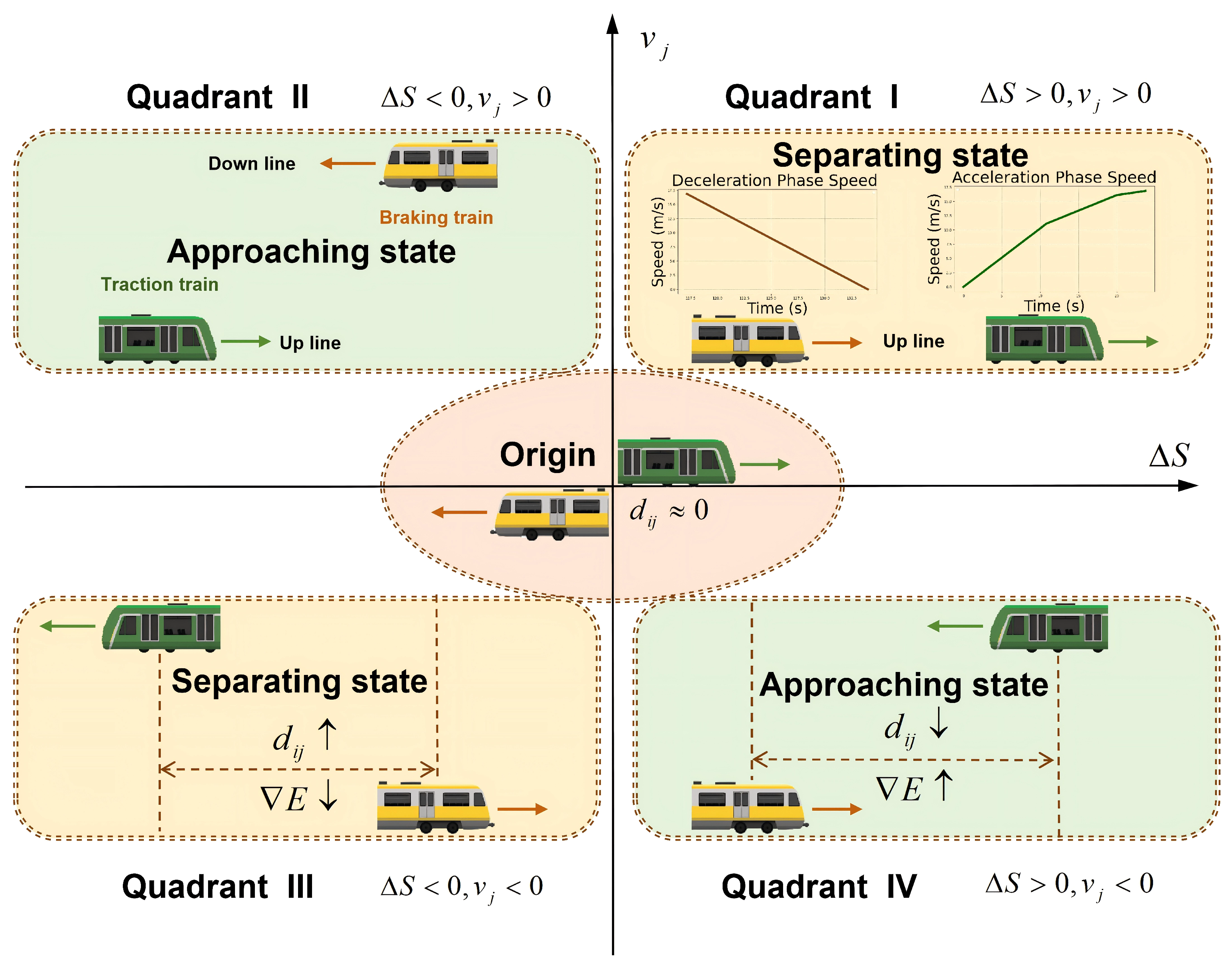
To resolve the aforementioned gradient evaluation issues, we introduce a two-dimensional phase plane , with the relative position as the horizontal axis and the accelerating train’s speed as the vertical axis.
The relative position is defined as shown in Equation (39):
Based on the sign combinations of
and
, and taking into account the potential operational states of the braking train
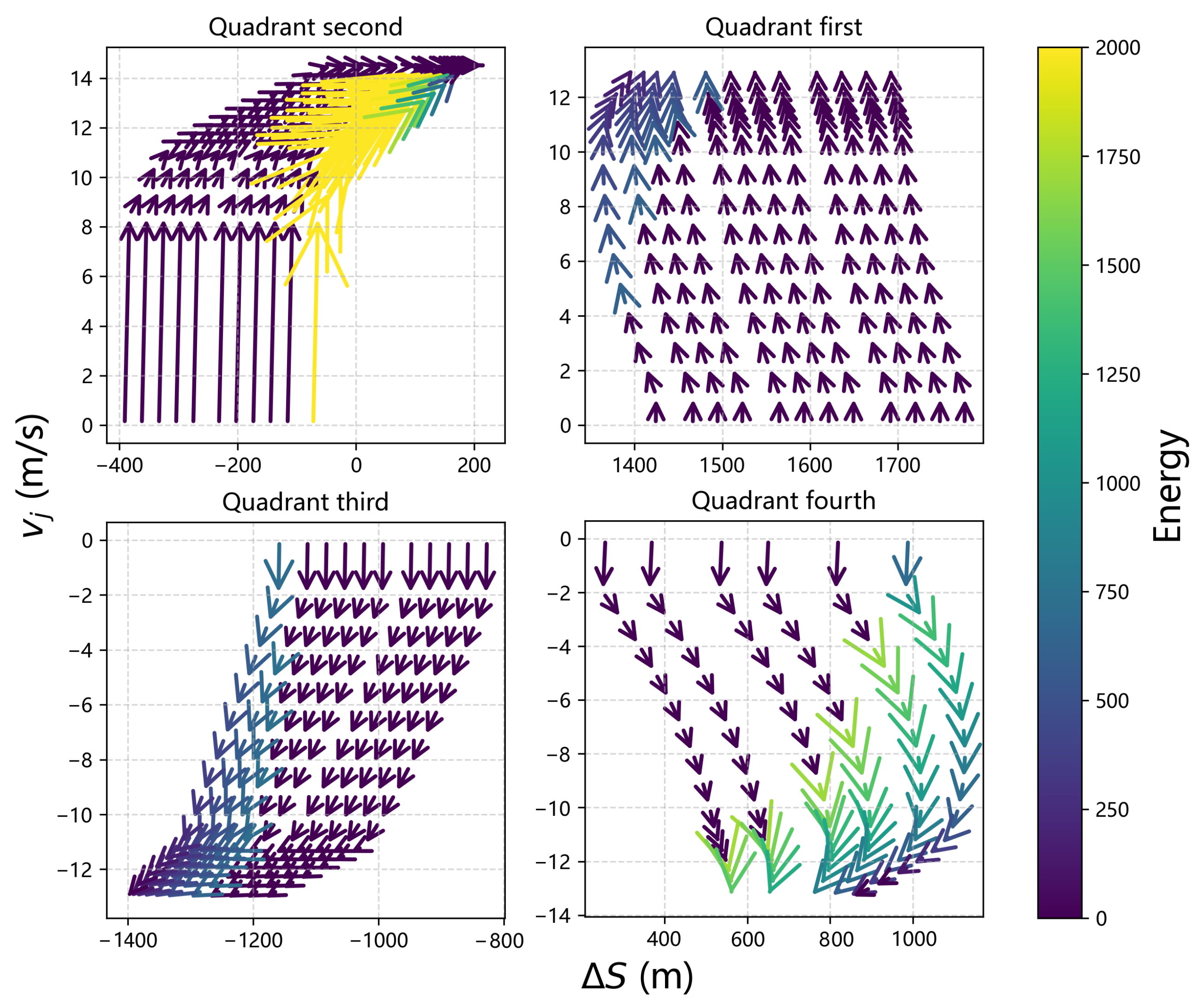
i, the state space is systematically partitioned into four mathematical quadrants, as illustrated in
Figure 2:
Quadrant I ():
This quadrant describes a physical state where the accelerating train j is located directly ahead of the braking train i in the positive direction and is accelerating forward with a positive velocity . If the braking and accelerating trains are traveling in the same direction, although it is nominally a “following” scenario, the dynamic trend shows the distance widening or maintaining a long headway because train j is accelerating while train i is decelerating to a stop. If the braking train is operating on the opposite track, the two trains are physically moving away from each other, causing the distance to increase sharply. In this quadrant, the gradient term is extremely small, marking a region of weak or even vanishing gradients.
Quadrant II ():
This quadrant describes a physical state where the accelerating train j is located in the negative direction (i.e., behind) the braking train i and is moving forward with a positive velocity . If the braking train is moving in the same direction (), the two trains are in a chasing state. Since the accelerating train is accelerating to catch up while the braking train is decelerating, the distance between them monotonically decreases. If the braking train is moving in the opposite direction (), the trains are approaching each other head-on; their relative velocities superimpose, and the distance shortens drastically. In this quadrant, the distance continuously decreases, and the gradient magnitude increases significantly, marking an effective region dominated by gradients.
Quadrant III ():
This quadrant describes a physical state where the accelerating train j is behind the braking train i but is moving backward with a negative velocity . If the braking train is moving forward (), the trains are traveling in opposite directions, and the distance widens. If the braking train is also moving backward (), both trains are moving in the negative direction. In this case, the accelerating train j is actually the “leading train” in the negative direction. Similarly, because the leading train j is accelerating away while the following train i is decelerating to a halt, the absolute distance still exhibits an increasing trend. Similar to Quadrant I, the distance continuously widens, marking a region of weak or vanishing gradients.
Quadrant IV ():
This quadrant describes a physical state where the accelerating train j is ahead of the braking train i and is moving backward with a negative velocity (e.g., an oncoming train on the opposite track). If the braking train is moving forward (), the trains are approaching head-on with a high relative velocity. If the braking train is also moving backward (), both trains are moving in the negative direction, making train j the “following train” in the negative direction. Because the accelerating train is chasing while the braking train is decelerating, the distance monotonically decreases. Similar to Quadrant II, the distance continuously decreases, marking an effective region dominated by gradients.
4.2. Differentiated Gradient Response Mechanism Based on the Phase Plane
- 1.
Approaching motion state
In Quadrants II and IV, the physical state corresponds to the two trains approaching each other. Different relative motion modes between the trains necessitate distinct optimization mechanisms.
- (1)
Head-on encounter mode
When the two trains travel in opposite directions (e.g., in Q2 or in Q4), the relative velocity is remarkably high. Although the spatial gradient term surges within a short period, the physical time window for the existence of this high gradient is extremely brief. Rather than relying on instantaneous values, the algorithm depends on the time-integral effect of the gradient here. By adaptively reducing the step size, it precisely captures this transient energy pulse.
- (2)
Same-direction chasing mode
When the two trains travel in the same direction (e.g., in Q2 or in Q4), the relative velocity is relatively small, and the electrical distance changes slowly. Although the gradient magnitude is not as drastic as in the head-on zone, its duration of effect is significantly prolonged. Mathematically, this integral effect of “moderate magnitude × long duration” creates a “long-tail effect” for energy transmission. This mode serves as the algorithm’s “dominant convergence region.” The stability of the gradient suppresses magnitude fluctuations, enabling the algorithm to employ larger step sizes for rapid searching in this region.
- 2.
Receding motion state
In Quadrants I and III, the physical state corresponds to the two trains accelerating apart. Regardless of the braking train’s travel direction, the accelerating train is moving away from the energy coverage zone utilizing its own acceleration. Over time, the distance increases monotonically. Since the gradient formula contains the term , as increases, the value of this term decays rapidly, potentially leading to a “gradient vanishing” phenomenon. This vanishing is not an algorithmic flaw, but rather a physical “validity screening.”
- 3.
Origin neighborhood state
In addition to the four motion quadrants discussed above, the origin neighborhood of the phase plane, , corresponds to a special state: up-and-down trains meeting at the same platform.
As , both the accelerating and braking trains are at the same platform, and . At this moment, if the accelerating train has just started (), focusing solely on the instantaneous gradient can easily lead to a misjudgment that the gradient is zero. Consequently, a position holding the maximum energy-saving potential might be erroneously classified as a convergence stagnation zone.
To overcome this misjudgment trap, the gradient optimization algorithm employed in this study relies not on single-point numerical values, but rather on a full-time-domain integration. Although at time , within a microscopic neighborhood where , any displacement of the train instantly couples the immense spatial potential energy with the non-zero velocity , yielding a massive gradient integral value. Once the algorithm crosses the origin, the adjacent gradient values exhibit a pronounced surge. The alternating sign of the gradient “locks” the accelerating train’s departure time to a specific phase of the braking train’s arrival, thereby physically achieving the globally optimal time synchronization for the cooperative operation of the accelerating and braking trains.
4.3. Construction of the Constrained Adaptive Gradient Model
Based on the analytical gradient formulas and the analysis of their spatiotemporal dynamical properties, this section constructs the numerical algorithm for the cooperative train energy-saving optimization problem. Given the “spatial non-uniformity” and “numerical stiffness” inherent in the gradient field, traditional fixed-step gradient methods struggle to strike a balance between convergence speed and stability. To this end, this study proposes an adaptive projected gradient ascent algorithm based on backtracking line search. This algorithm integrates an adaptive step-size regulation mechanism and a feasible-region projection operator, effectively overcoming the gradient singularities in same-station encounter zones while maximizing the network-wide energy efficiency under hard timetable constraints.
4.3.1. Mathematical Framework and Iterative Paradigm of the Optimization Problem
The energy-saving optimization of train timetables is fundamentally a constrained programming problem, which can be formulated as follows:
The constraints dictate that the dwell time adjustment for each train must fall within ; and the departure headway between the following train j and the preceding train must strictly exceed the minimum safety headway .
Here,
is the decision variable vector (encompassing the dwell times and departure times of all trains);
is the total regenerative braking energy to be maximized; and
represents the feasible region defined by operational safety constraints (such as section running times, minimum dwell times, and safe tracking headways). Given the availability of the analytical gradient for the objective function
, the first-order gradient ascent method is adopted as the core iterative paradigm, as shown in Equation (40):
where
denotes the solution vector at the k-th iteration;
represents the energy gradient direction (the direction of steepest ascent) calculated based on the analytical formulas;
is the learning rate (step size) at the k-th step;
is the projection operator that maps the unconstrained update back into the feasible region .
4.3.2. Adaptive Projected Gradient Algorithm Based on Backtracking Line Search
If is too large, it will trigger violent oscillations or even divergence near the singularities in the second and fourth quadrants (approaching zones). Conversely, if is too small, the convergence rate will be impractically slow, causing the algorithm to stagnate at local optima in the first and third quadrants (receding zones). The gradient field exhibits severe singularities (gradient explosion) near the origin of the phase plane and gradient vanishing in the far-field zones. A single, fixed step size is entirely incapable of adapting to these amplitude variations that span multiple orders of magnitude.
Consequently, this section introduces a backtracking line search strategy based on energy gain detection. Rather than relying on a predetermined fixed step size, this strategy dynamically identifies the optimal step size along the current gradient direction through a “trial–evaluate–backtrack” mechanism.
To guarantee the monotonic convergence of the algorithm, the selection of the step size
must ensure a tangible improvement in the objective function value. The energy gain criterion is defined in Equation (41):
The specific execution logic of this strategy is as follows:
- 1.
Initial large-step trial: At the beginning of each iteration, a relatively large step size is attempted first, aiming to achieve the maximum convergence speed in flat terrain (long-tail gradient zones).
- 2.
Energy evaluation: Based on the current trial step size, the trial solution is computed, and its corresponding energy is evaluated.
- 3.
Backtracking shrinkage: If the energy gain criterion is not satisfied, it indicates that the current step size is excessively large, causing the algorithm to overshoot the optimal solution or violate the feasible region constraints. The step size is then reduced exponentially.
- 4.
Iteration acceptance: Steps 2 and 3 are repeated until the gain condition is met. The successful is then adopted as the effective step size for the current iteration.
This mechanism elegantly resolves the issues highlighted in the phase dynamics analysis: in the same-direction chasing zones (where gradients are gentle), the initial large step size can often satisfy the detection criterion directly, enabling the algorithm to advance rapidly. Conversely, in the head-on encounter zones (where gradients are steep), a large step size will induce severe energy fluctuations or decreases. In response, the algorithm automatically triggers multiple backtracks, shrinking the step size to a microscopic value, thereby safely traversing the singularity without divergence.
Furthermore, the backtracking line search mechanism provides strong robustness against physical parameter drift, such as fluctuations in catenary resistance r due to electro-thermal heating. According to Equation (36), r strictly affects the scalar magnitude of the gradient intensity without altering its directional vector . Any resulting magnitude deviation is automatically absorbed by the dynamic step-size adjustment . This architectural advantage guarantees monotonic convergence under electro-thermal uncertainties, eliminating the need for real-time temperature sensing.
Regarding the termination of the iterative process, the convergence criterion is strictly aligned with the physical execution limits of the practical Operation Control Center (OCC). The algorithm dynamically terminates when the adaptive step size shrinks to a level where the resultant dwell time adjustment is smaller than the minimum operational time resolution of the signaling system (typically 1 s). From a theoretical standpoint, because the feasible region is strictly bounded by the hard timetable constraints, and the backtracking line search enforces a strictly monotonic increase in the energy objective function (as governed by Equation (39)), this projected gradient sequence is mathematically guaranteed to converge to at least a local stationary point. In practical dispatching, this effectively ensures that the train fleet stably settles into the low-impedance optimal energy synchronization window without encountering non-convergent oscillations.
It is imperative to note that while the global energy solution space for a high-density urban rail network exhibits highly complex, non-convex, and multimodal characteristics—making gradient-based algorithms theoretically susceptible to initial condition sensitivity and sub-optimal traps—this localized convergence is a deliberate engineering choice rather than a methodological limitation. In real-time URT scheduling, the initial solution vector () is not randomly generated; it is deterministically anchored to the official, safety-verified planned timetable. Furthermore, because the physically feasible solution space is severely restricted by rigid operational safety regulations, any attempt to employ gradient-escape mechanisms (such as multi-start or momentum strategies) to seek a theoretically higher global energy peak would inevitably require traversing infeasible regions, thereby violating strict signaling constraints. Thus, the proposed framework is purposefully constrained. By foregoing unbounded global exploration, the algorithm guarantees mathematically rigorous convergence toward the exact optimal peak strictly within the legally safe, bounded local subspace, which perfectly aligns with the safety-first imperative of practical metro dispatching.
4.4. Mathematical Proof of Convergence in the Origin Neighborhood
As highlighted in the phase plane analysis, the most severe numerical challenge arises in the origin neighborhood (). Standard gradient ascent algorithms are notoriously susceptible to violent oscillations or divergence when approaching such steep gradients. However, the proposed framework mathematically precludes this “overshooting” phenomenon through the synergistic effect of physical regularization and the backtracking line search mechanism.
Step 1: Gradient Boundedness via Spatial Regularization. From a pure mathematical perspective, a singularity implies as spatial distance approaches zero. However, as derived in Equation (20), the electrical distance is physically regularized by the inherent circuit clearance . Consequently, the absolute singularity is eliminated. The maximum spatial gradient intensity at the exact platform alignment point () is mathematically bounded by a finite constant, scaling proportionally to . This regularization ensures that the energy objective function remains locally Lipschitz continuous everywhere, including the origin neighborhood.
Step 2: Monotonic Convergence via the Backtracking Mechanism. Given that the gradient is bounded and Lipschitz continuous, the backtracking line search guarantees stable convergence without oscillation. Let the trial solution be . If a large initial step size causes the algorithm to step over the optimal synchronization phase (i.e., crossing the origin to the other side), the total regenerative energy will decrease.
At this juncture, the predetermined energy gain criterion (Equation (39)) detects the failure. The algorithm strictly rejects the oscillating step and triggers an exponential decay of the step size (, where ). This shrinkage iterates instantaneously until the step size is sufficiently small to land precisely on the energy peak. Therefore, governed by classical optimization theory, the adaptive step-size mechanism mathematically enforces strictly monotonic convergence, effectively damping out any cross-origin oscillations and securing the global optimum.
5. Case Study and Simulation Results
To validate the effectiveness of the proposed cooperative optimization method based on energy flow operator decoupling and phase plane dynamics, this section conducts numerical simulations within a typical urban rail transit simulation environment. Based on the generalized matrix model formulated in
Section 2, the simulation platform accurately models the traction power supply network as a time-varying resistance network with distributed parameters. The experimental parameters are reconstructed for simulation based on the actual operational data of Luoyang Subway Line 1 in China. The system integrates the network-level topological structure, the train-level kinematic model, and the traction-control-level electrical characteristics; detailed information can be referenced in our previously published research [
34]. Building upon this foundation, multiple sets of experiments, encompassing the verification of single-train dynamic characteristics and the analysis of multi-train cooperative energy flows, are designed. Furthermore, the optimized scheduling scheme is systematically compared and analyzed against the traditional fixed-timetable mode.
5.1. Analysis of the Spatiotemporal Propagation Mechanism of Regenerative Energy
The transmission of regenerative braking energy within the subway traction network is not merely a simple superposition of nodal powers; rather, it is a dynamic physical process highly dependent on the relative spatiotemporal positions of the trains. To reveal the essence of energy interaction during cooperative train operations, this section visually reconstructs the abstract energy flow field in three dimensions based on the previously formulated analytical instantaneous power model. To accurately reflect the energy interaction characteristics within an actual railway network, this study extracts and reconstructs three typical encounter scenarios with varying topological complexities from the real-world operational scenarios of Luoyang Subway Line 1 in China. By sequentially analyzing the scenarios of “single-source and single-load,” “single-source and multi-load,” and “multi-source and multi-load,” this section intuitively and quantitatively demonstrates the distance attenuation effect, the multi-load allocation mechanism, and the multi-source and multi-load cooperative absorption mechanism during energy transmission.
5.1.1. Analysis of Single-Source and Single-Load Absorption
The generalized instantaneous power model derived in this study indicates that energy utilization is not merely a function of time synchronization, but also critically depends on the distance between the braking train and the accelerating train. The propagation laws of regenerative braking energy within the DC traction network are characterized through experiments.
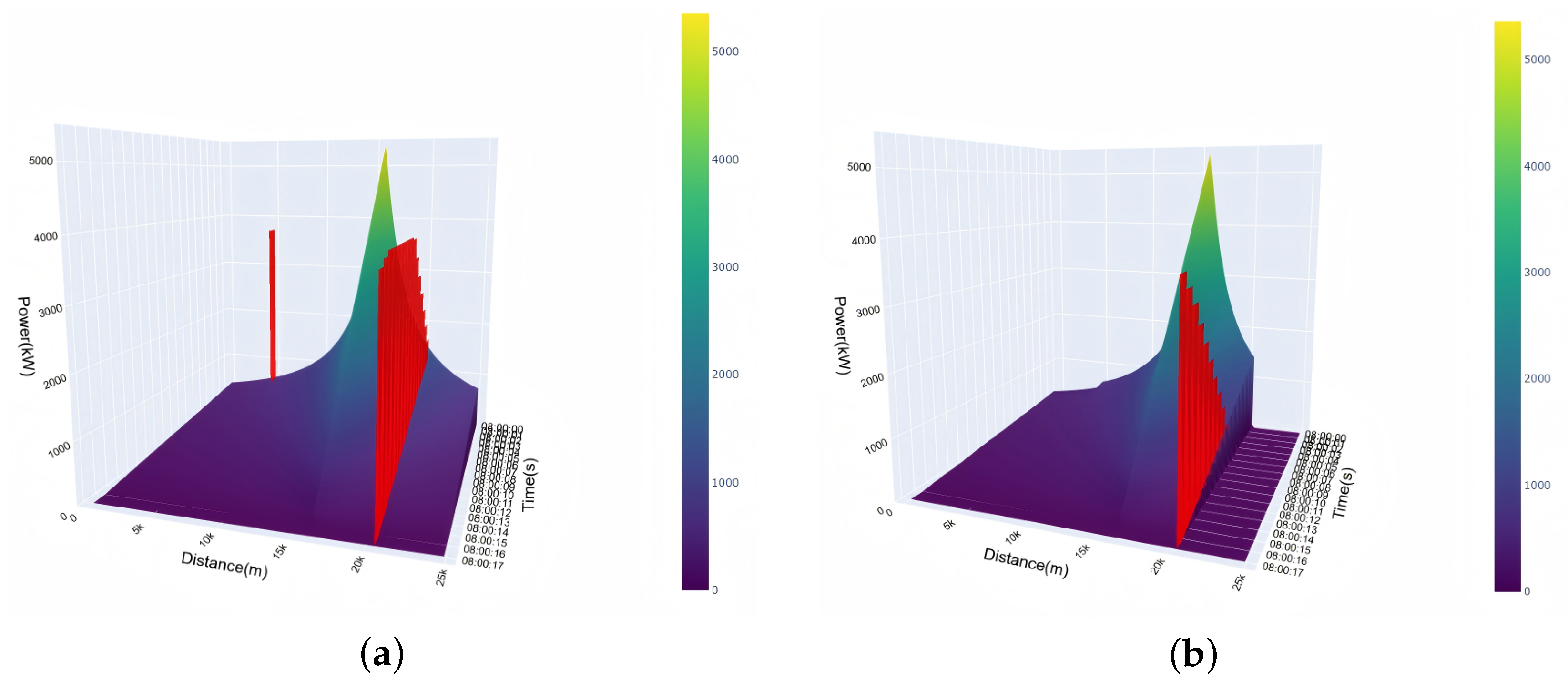
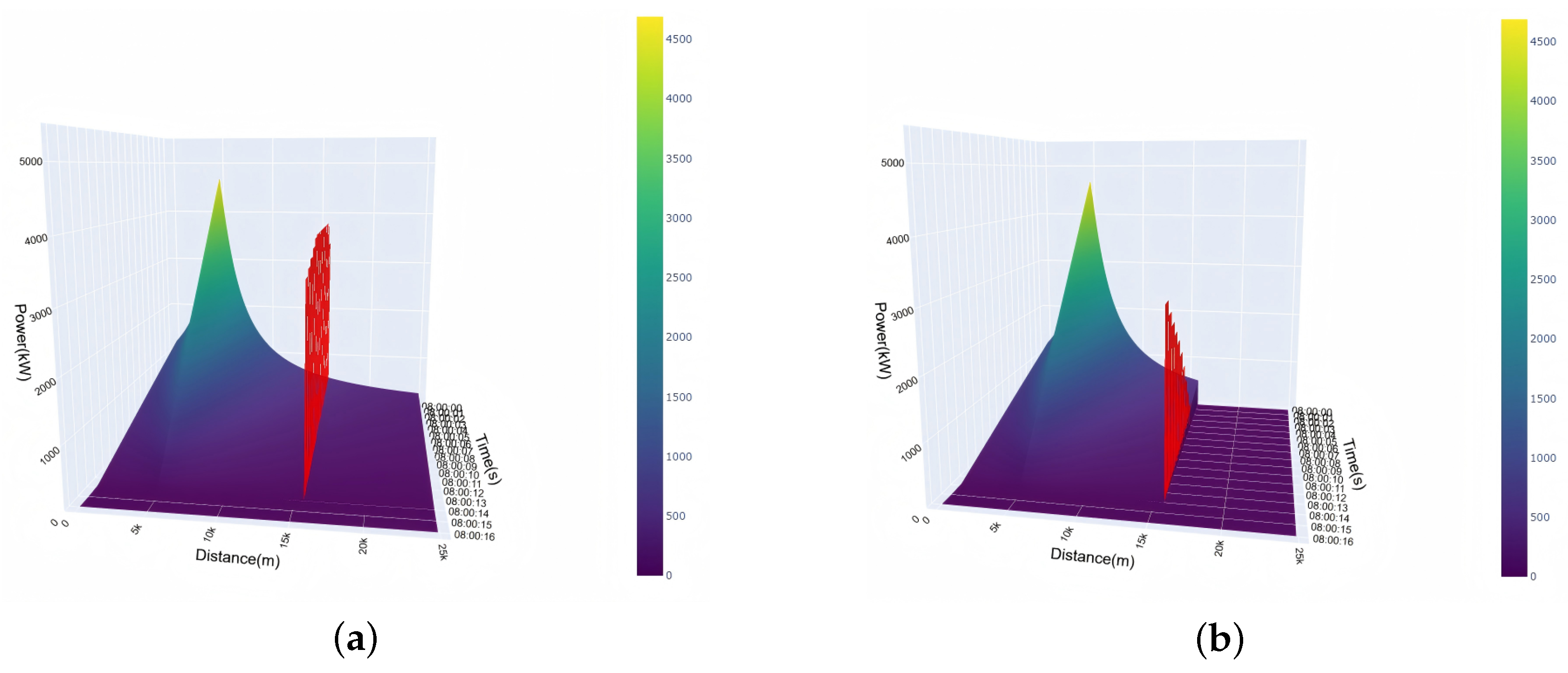
Figure 3 visualizes the three-dimensional spatiotemporal relationship between the regenerative energy potential field (source) and the traction power demand (load).
Green-yellow waveform: Represents the available regenerative braking electrical energy. The variation in the waveform exhibits a pronounced “distance attenuation effect,” with the yellow peak corresponding to the maximum regenerative braking energy achieved by the braking train at an absolute position of 4.7 km. The green tail represents the far-field region, where the electric potential attenuates away from the peak point due to consumption by the catenary resistance.
Red rectangular waveform: Represents the instantaneous power demand of the accelerating train.
Figure 3a illustrates the scenario prior to absorption, while
Figure 3b demonstrates the scenario after effective coupling, indicating that the regenerative energy is successfully absorbed.
5.1.2. Analysis of the Allocation Mechanism for Single-Source and Multi-Load Scenarios
A specific operational scenario comprising one braking train and two accelerating trains is selected as a case study.
Figure 4 illustrates the spatiotemporal energy distribution, wherein a single braking train (the source) releases energy while two distinct accelerating trains (the loads), located at different spatial positions along the line, simultaneously demand electrical energy.
The spatiotemporal energy distribution under the “one-source and two-load” scenario is presented in the figures.
Figure 4a depicts the scenario prior to absorption, whereas
Figure 4b displays the scenario following effective coupling. The figures illustrate one braking train (indicated by the yellow peak) and two accelerating trains (indicated by the red bars) distributed at varying distances. Load A (near) overlaps with the high-potential region and effectively absorbs the energy. Conversely, Load B (far) is situated in the low-potential tail region, resulting in lower absorbed energy due to distance attenuation. This phenomenon corroborates the “proximity-first” mechanism inherent in DC traction networks.
5.1.3. Analysis of the Cooperative Absorption Mechanism for Multi-Source and Multi-Load Scenarios
Actual high-density urban rail transit networks typically exhibit complex “multi-source and multi-load” topological characteristics.
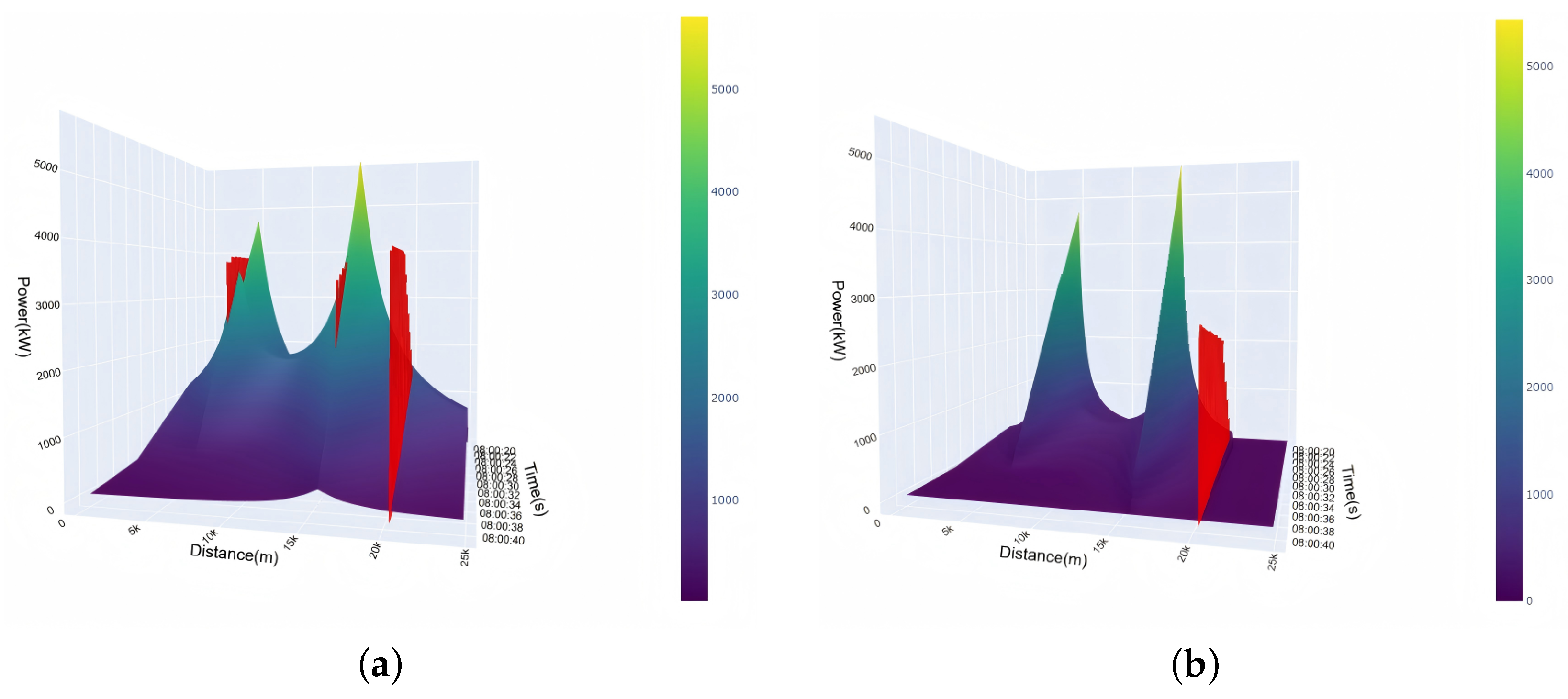
Figure 5 illustrates the complex spatiotemporal energy distribution where multiple braking trains (multiple peaks) and multiple accelerating trains (multiple red cross-sections) coexist.
Figure 5a presents the scenario prior to energy absorption. Multiple braking trains simultaneously release a substantial amount of electrical energy at disparate spatial locations, forming several high-potential energy zones. Concurrently, three accelerating trains are non-uniformly distributed within the vicinity of this region.
Figure 5b demonstrates the absorption scenario following effective physical coupling between the sources and loads. The three accelerating loads sufficiently absorb the regenerative energy from the multiple sources, resulting in a pronounced decrease in the original high-potential zones (the peaks). This physical phenomenon intuitively verifies that objective and highly efficient energy interaction and absorption can be achieved among the train fleet under complex multi-train overlapping conditions.
5.2. Numerical Verification of Gradient Field Dynamics on the Phase Plane
To validate the theoretical framework of dynamical decoupling proposed in
Section 4.1, this section conducts a numerical simulation of the energy gradient vector field on the two-dimensional relative motion phase plane. The simulated phase plane adopts the relative position
as the horizontal axis and the accelerating train velocity
as the vertical axis.
Figure 6 intuitively illustrates the evolutionary process of the gradient magnitude and direction under various physical interaction states. As illustrated by the gradient vector plots across the four quadrants, the numerical characteristics of the gradient field exhibit spatial polarization:
Gradient-dominated effective regions (approaching state): In Quadrant II () and Quadrant IV (), the physical state corresponds to the two trains approaching each other. As observed in the subplots, as the absolute relative distance decreases, the gradient magnitude (indicated by the color transition from dark purple to bright yellow) surges dramatically. The dense and highlighted directional vectors vividly demonstrate the phenomenon of “near-field gradient explosion”. Within these regions, the energy objective function exhibits extremely high sensitivity to timetable adjustments.
Gradient vanishing regions (separating state): Conversely, in Quadrant I () and Quadrant III (), the two trains are in a state of continuous separation. The corresponding subplots display a uniform dark purple hue, indicating that the gradient magnitude has decayed to a negligible level. This visually and conclusively confirms the “far-field gradient vanishing” effect, which is triggered by the rapid attenuation of the spatial distance term.
These experimental results intuitively reveal the inherent “numerical stiffness” within the global gradient field. This stark contrast in gradient magnitudes across different topological quadrants provides solid empirical evidence for the absolute necessity of adopting the partitioned adaptive step-size algorithm in this study.
5.3. Analysis of the Collaborative Optimization Effect on Regenerative Braking Energy Absorption
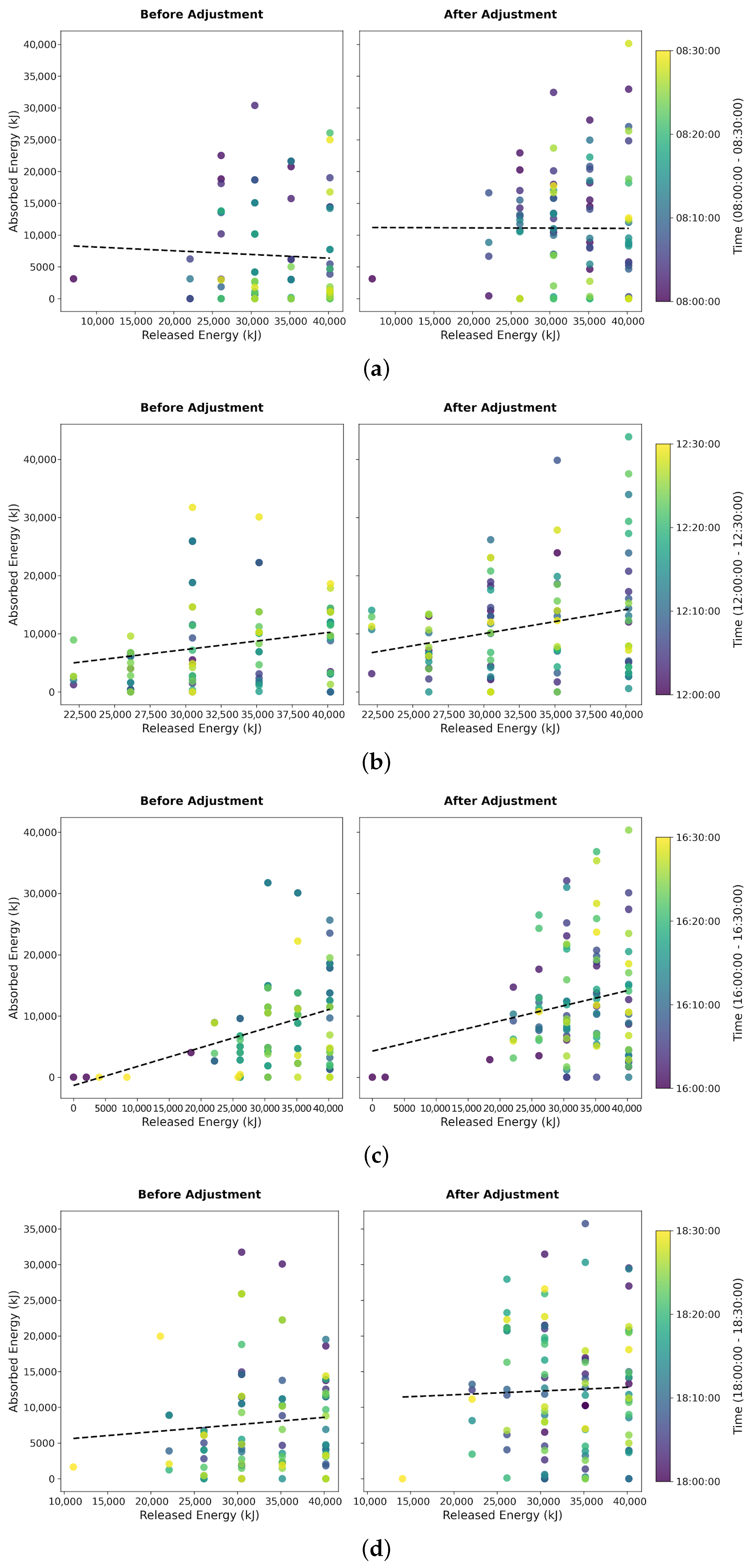
To verify the practical performance of the proposed collaborative optimization strategy under varying passenger flow demands, this section selects four typical operational periods (morning peak 08:00–08:30, off-peak 12:00–12:30, evening peak transition 16:00–16:30, and evening peak 18:00–18:30) for comparative experiments.
Figure 7 illustrates the scatter distribution and linear regression trends of the released energy versus the absorbed energy during train braking events within these four time windows, both before and after the timetable adjustment.
Observing the scatter distribution “Before Adjustment,” it is evident that across all four periods, the slopes of the regression fitting lines (indicated by the black dashed lines) are relatively flat, with a massive number of data points densely clustered near the horizontal axis (i.e., the absorbed energy is close to zero). This implies a low overall energy utilization rate of the system under the original fixed timetable. The fundamental cause of this phenomenon is that the original timetable fails to adequately consider the temporal overlap between trains. When a braking train releases energy, the lack of an accelerating train in close spatial proximity and precise temporal synchronization prevents the instantaneous braking power from being effectively absorbed. Consequently, a substantial amount of regenerative energy is dissipated by on-board resistors or wasted. Furthermore, the high degree of overlapping among the scatter points reflects the rigid characteristics of the original timetable under periodic scheduling.
In stark contrast, the “After Adjustment” graphs exhibit a remarkable optimization effect. By implementing the collaborative optimization strategy, the slopes of the regression lines in all four periods demonstrate substantial increases. The data points migrate significantly toward the positive direction of the vertical axis (the high-absorption region), and events exhibiting zero absorption are drastically reduced. This demonstrates that the optimization strategy effectively breaks the rigidity of the original timetable; by fine-tuning the train trajectories, it significantly enhances the spatiotemporal synchronization rate between the braking and accelerating trains. Based on the direct matching and temporal overlap of instantaneous power, the released regenerative braking energy can be efficiently and instantaneously absorbed by the power grid or adjacent trains.
In summary, whether during peak or off-peak periods, the proposed model effectively excavates the energy-saving potential during train operations, thereby significantly improving the comprehensive utilization rate of regenerative braking energy in the urban rail transit system.
6. Discussion
This section provides a comprehensive interpretation of the experimental findings, aiming to bridge the gap between numerical outcomes and the underlying physical engineering principles. The discussion is structured into two complementary dimensions. First, the intrinsic mechanism of the proposed spatiotemporal collaborative strategy is validated to elucidate how phase plane dynamics facilitate active energy synchronization under varying operational densities. Second, a transverse benchmarking analysis is performed against mainstream heuristic and data-driven algorithms to quantify the disruptive advantages of the spatial operator decoupling mechanism in ensuring engineering feasibility and mitigating hidden line thermal losses.
6.1. Effectiveness Evaluation and Mechanism Validation of the Collaborative Optimization Strategy
The aforementioned quantitative results reveal the limitations of traditional fixed timetables in terms of energy utilization, as well as the effectiveness of the collaborative optimization strategy proposed in this paper. As shown in
Table 1 and the scatter plots, the overall regenerative braking energy utilization rate of the system prior to optimization remained in a low range of 20.26% to 26.75%. This is primarily due to the inherent randomness of the traditional dispatching mode, where braking trains and accelerating trains frequently experience phase misalignment in the spatiotemporal domain.
Following the implementation of the collaborative optimization based on phase plane dynamics, the energy absorption indicators across all four typical periods have achieved noticeable improvements. Notably, during the morning and evening peak periods (08:00–08:30 and 18:00–18:30) with the highest dispatching densities, the overall utilization rates achieved growths of 13.12% and 13.83%, respectively. This enhancement directly corroborates the theoretical deductions presented previously: by fine-tuning train dwell times, driving the accelerating trains to actively “converge” toward the high-potential peaks generated by the braking trains on the phase plane can improve the time overlap of instantaneous power. Even during the off-peak period (12:00–12:30) with longer headway intervals, the utilization rate obtained an increase of nearly 9.37%, demonstrating the generalization capability and robustness of the algorithm under varying passenger flow demands.
Furthermore, the arithmetic mean utilization rates align consistently with the overall energy utilization rates across all periods after the adjustment. From a macroscopic statistical perspective, this further confirms that the system does not merely rely on a few accidental matches to inflate the overall data; rather, it achieves a stable and well-balanced spatiotemporal energy coupling at the global network level.
Regarding the results in
Table 1, it is worth noting the distinction in evaluation metrics between deterministic and stochastic methods, while statistical significance testing is essential for heuristic algorithms due to their inherent random variations, the proposed analytical gradient method operates deterministically. For a given operational time-slice with specific initial conditions, the gradient algorithm consistently converges to the identical optimized timetable. Consequently, multiple independent runs yield consistent outcomes without algorithmic variance. The reported energy improvements represent deterministic optimization results rather than statistical means, providing the predictable reliability necessary for real-time dispatching in Operation Control Centers.
6.2. Transverse Benchmarking and Physical Feasibility Assessment Against Mainstream Algorithms
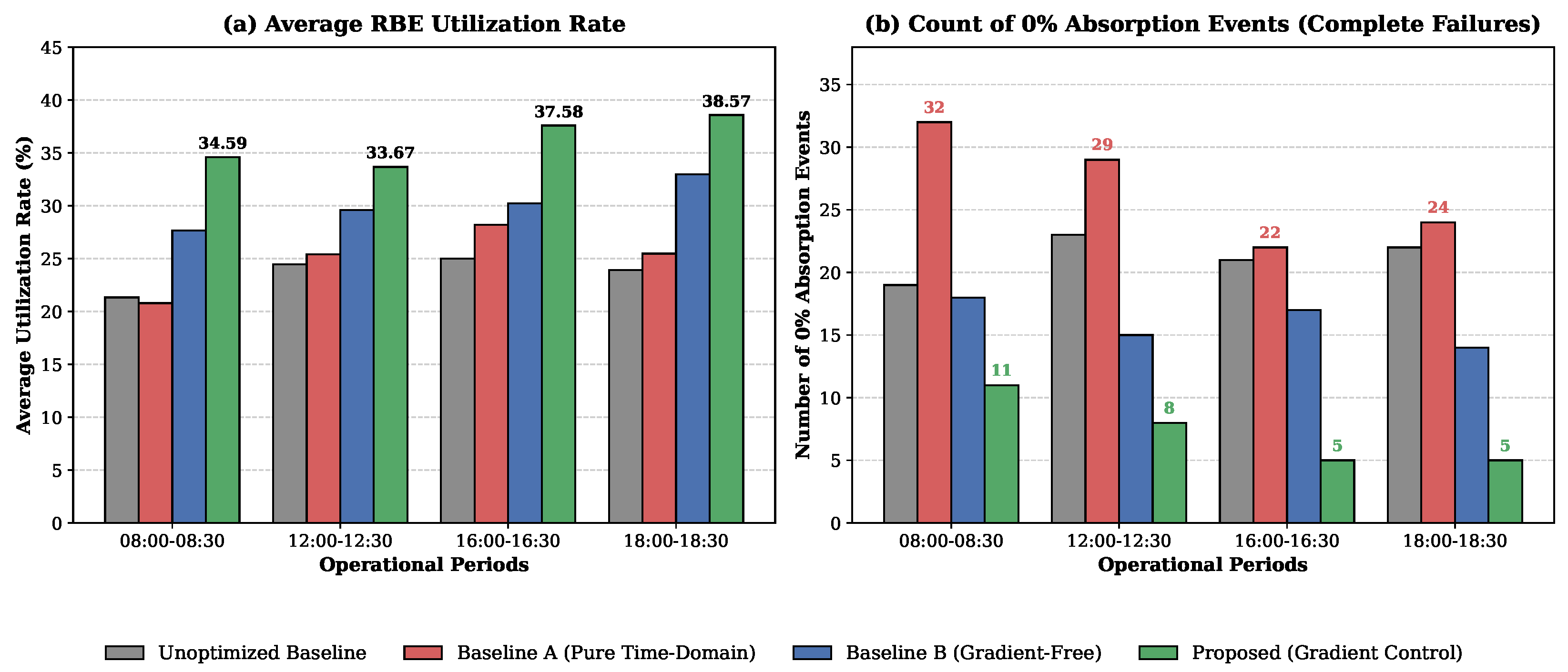
Beyond demonstrating stability against the unoptimized state, to profoundly prove the disruptive value of “decoupling spatial impedance” and provide transverse comparative aggressiveness, the proposed analytical gradient model is further evaluated against two mainstream scheduling baselines:
Baseline A (Pure Time-Domain Maximum Overlap Model): A heuristic model implemented using a Genetic Algorithm that optimizes solely to maximize the temporal overlap of braking and accelerating events, while deliberately ignoring spatial impedance and physical distance.
Baseline B (Gradient-Free Black-Box Intelligent Control): A model implemented using Deep Reinforcement Learning that adjusts dwell times through environment interaction but lacks explicit analytical gradients and spatial operators.
Proposed Model (Adaptive Projected Gradient): The spatiotemporal collaborative model explicitly decoupling spatial impedance.
To visually quantify these advantages,
Figure 8 illustrates the transverse benchmarking outcomes across four typical operational periods.
Figure 8a compares the actual average Regenerative Braking Energy (RBE) utilization rates, while
Figure 8b specifically counts the number of completely failed absorption events (where utilization equals 0%).
The transverse comparison in
Figure 8 explicitly reveals the fatal physical flaws of purely time-based algorithms. When evaluating Baseline A (Pure Time-Domain), the actual utilization rate barely improved (and even dropped to 20.78% in the morning peak). Shockingly, as vividly depicted by the red bars in
Figure 8b, the number of completely failed 0% absorption events spiked significantly across all periods (e.g., jumping from 19 to 32 in the morning peak). This phenomenon perfectly quantifies the vulnerability of time-domain models: by forcefully synchronizing trains across disparate ends of the metro line, the temporal overlap is mathematically perfect, but the electrical energy is forced to travel over distances significantly exceeding the effective transmission range. Consequently, the system suffers from massive, hidden line thermal losses (
), resulting in total energy dissipation before reaching the target train.
Furthermore, while Baseline B (Gradient-Free Intelligent Control) exhibits improvements over the unoptimized state, its black-box nature struggles to perfectly map the rigid physical constraints. Crucially, because the black-box optimization process lacks explicit supervision over hard engineering constraints, a portion of its outputs are subsequently rejected for exceeding operational boundaries, yielding sub-optimal utilization compared to exact analytical methods.
In stark contrast, the Proposed Model (depicted by the green bars) establishes absolute dominance. By explicitly decoupling spatial impedance, it identifies and penalizes physically invalid long-distance transfers. It actively pairs adjacent trains, drastically reducing the 0% failed events (dropping to merely 5 in the evening peaks) and maximizing the authentic, recoverable energy utilization (peaking at 38.57%). This visually and quantitatively confirms that avoiding massive hidden thermal losses is equally as critical as temporal synchronization, unequivocally proving the disruptive value of the proposed spatiotemporal framework.