Article

Performance Evaluation for Fiber Optic Gyroscopes Using Adaptive Belief Rule Base Under Imperfect Data

Missile Engineering Institute, PLA Rocket Force University of Engineering, Xi’an 710025, China
*
Author to whom correspondence should be addressed.
Electronics 2026, 15(10), 2160; https://doi.org/10.3390/electronics15102160
Submission received: 20 March 2026 / Revised: 29 April 2026 / Accepted: 13 May 2026 / Published: 18 May 2026
(This article belongs to the Section Systems & Control Engineering)

Abstract

Performance evaluation for fiber optic gyroscopes (FOG) has become an active research area in recent years. However, such evaluations are often challenged by imperfect data characterized by low quality and non-uniform distribution, which severely affects the accuracy of fiber optic gyroscope performance evaluations. To address this problem, an adaptive belief rule base (BRB) for data quality and distribution (ABRB-QD) method is proposed for modeling FOG performance evaluation under imperfect data. ABRB-QD effectively integrates data quality assessment and distribution adaptation into a unified belief rule structure. In this method, a data quality factor is introduced based on data stability to solve poor data quality issues. An adaptive membership function is established based on data distribution to transform input information, addressing non-uniform distribution problems in imperfect data. Furthermore, a parameter optimization model is developed to enhance the evaluation accuracy of ABRB-QD. Finally, to illustrate the effectiveness of the developed method, a case study of FOG performance evaluation is conducted.

1. Introduction

With the rapid development of science, technology, and engineering fields, the performance evaluation of the fiber optic gyroscope (FOG) has become a crucial aspect of the defense and industrial sectors [1,2,3]. As the core sensing unit of inertial navigation systems, FOG provides attitude references through angular velocity measurements and is extensively used in aerospace, marine navigation, and other engineering applications. The performance of FOG can decline due to aging components and external environmental interference. It is crucial to address this degradation promptly to prevent economic losses and, more importantly, safety hazards [4,5,6]. Additionally, due to the high costs associated with FOG, replacement often surpasses maintenance expenses when failures occur. Therefore, assessing FOG performance is of great importance for enhancing instrument reliability and ensuring the accuracy of engineering decisions.
In the context of engineering practice, sensor-monitored data inevitably incorporates imperfect data, which manifests two distinct features. On one hand, low data quality arises from sensor failures and environmental disturbances. On the other hand, diversity in distribution characteristics emerges due to varied monitoring data types in engineering applications, where imperfect data exhibit considerable complexity as they are more susceptible to external interference. Current traditional evaluation methods that rely on ideal data are not capable of accurately reflecting the true performance of FOG [7]. Imperfect data lead to the misrepresentation of FOG performance in evaluation models, resulting in the production of unreliable results. Consequently, accounting for the effects of imperfect data is of critical importance in engineering practice [8].
In recent years, as the industry has continued to shift toward digital development, many intelligent and efficient performance evaluation methods have emerged. Analyzing the current literature shows that the main performance evaluation approaches fall into three key categories: mechanism-based, knowledge-based, and data-driven methods. The mechanism-based method is highly dependent on the internal working mechanism of the instrumentation and requires an explicit physical or mathematical model to describe the relationship between inputs and outputs. For example, Yuan et al. [9] combined event tree analysis, computational fluid dynamics simulation, and evacuation modeling to assess the risk of toxic gas leakage in a chemical plant. Li et al. [10] proposed an implicit Kalman filtering method to predict the remaining service life of a system and evaluate its health status. The knowledge-based method utilizes the valuable experience accumulated over time by experts in the field of navigation instruments to assess FOG performance. For example, Jo et al. [11] developed a probabilistic safety evaluation method for personnel reliability analysis by incorporating operator action time. Rahim et al. [12] developed a deep learning-based engine health monitoring system using a hybrid CNN-BiGRU model, which analyzes sensor data for accurate fault detection. The data-driven method does not require prior knowledge of the FOG’s working mechanisms; instead, performance evaluation is performed by analyzing large amounts of observational data, leading to its widespread use in assessments. Che et al. [13] developed a predictive health assessment framework for lithium-ion batteries using probabilistic degradation prediction and accelerating aging detection.
As navigation instruments become increasingly complex and their working principles harder to understand, mechanism-based methods are rarely used; due to the accumulated knowledge and experience of domain experts, the knowledge-based method is a convenient and useful evaluation approach, but the results are influenced by subjective judgment from experts. Recently, data-driven methods have gained popularity in performance evaluation. However, most data-driven models have a “black-box” nature, which reduces interpretability in the evaluation process. Additionally, this approach depends on high-quality data and struggles with evaluating navigation instruments when the data is imperfect. On one hand, as the reliability of navigation instruments improves, high-value data becomes scarcer. On the other hand, the accuracy of data-driven evaluation models is affected by the presence of imperfect data.
In summary, existing methods are unable to address the issue of insufficient evaluation accuracy when the data is mostly imperfect. Therefore, a new evaluation framework based on a belief rule base (BRB) is proposed. BRB was introduced by Yang et al. in 2006 [14]. As a modeling approach using “if-then” belief rules, BRB incorporates the concept of belief degrees during inference, representing all possible results in the form of belief distributions. This structure provides BRB with dual advantages: it combines qualitative knowledge with quantitative data and allows for the incorporation of expert knowledge and domain expertise through its rule-based format, ensuring model interpretability [15]. As a knowledge–data-hybrid-driven model, BRB has demonstrated effectiveness in performance evaluation applications [16,17,18,19]. For example, Li et al. [20] proposed a dynamic performance evaluation method for high-value complex systems based on BRB. Cheng et al. [21] developed a multidiscounted BRB model for health status assessment in large complex electromechanical systems.
Currently, BRB-based research for imperfect data has mainly focused on low-quality data and non-uniformly distributed data. For low-quality data, Lian et al. [22] used interval conversion to describe sensor interference, which improved the accuracy and robustness of BRB, but the reliability difference among evaluation attributes was not directly quantified. Feng et al. [23] introduced SNR as a quality factor to reduce the influence of noisy data, but this description is closely related to signal–noise characteristics and is not always applicable to different types of monitoring attributes. For non-uniformly distributed data, traditional BRB models usually rely on Yang’s rule-based utility conversion, which is more suitable for uniformly distributed data. To improve the information transformation process, Liu et al. [24] and Lian et al. [25] introduced Gaussian and idempotent membership functions into BRB, respectively. Han et al. [26] proposed BRB-RAMF by considering random variables of adaptive membership functions, in which the adaptive coefficient is treated as a random variable to improve the flexibility of membership function adjustment. These studies have enhanced BRB modeling under imperfect data from different perspectives. However, quality-oriented methods mainly describe the reliability of input data, while membership function-oriented methods mainly improve the matching between numerical inputs and referential values. The influence of attribute reliability on rule activation and the influence of data distribution on information transformation are still not sufficiently considered in a unified reasoning process.
This limitation is particularly important in FOG performance evaluation. On the one hand, low-quality measurements caused by environmental interference may reduce the reliability of evaluation attributes and distort the inferred performance state. On the other hand, the numerical values of monitoring attributes are often non-uniformly distributed, typically showing local density and overall sparsity within adjacent reference intervals. Under such conditions, conventional membership functions may produce inaccurate information transformation because they cannot adequately reflect the actual distribution pattern of the data. For example, when most samples cluster near one reference value while only a few are distributed near the other, the same numerical distance does not necessarily imply the same membership degree. Moreover, even if the distribution of input data is considered, attributes with poor stability may still participate in rule activation in the same way as reliable attributes. Therefore, a BRB-based performance evaluation model is needed in which data quality affects rule activation and data distribution affects the transformation from numerical inputs to belief degrees.
To address the above issues, a new adaptive BRB model for data quality and distribution (ABRB-QD) is proposed for FOG performance evaluation under imperfect data. In this model, the stability of monitoring data is used to calculate the quality factor of each evaluation attribute, and this factor is introduced into rule activation to reduce the influence of low-quality inputs. Meanwhile, the distribution characteristics of monitoring data are used to construct an adaptive membership function, so that non-uniformly distributed data can be transformed into belief degrees more reasonably. In this way, ABRB-QD retains the interpretability of BRB while further considering both attribute reliability and distribution-adaptive information transformation in the reasoning process.
The main work and contributions are as follows:
(1)
An ABRB-QD framework is proposed for FOG performance evaluation under imperfect data. The framework considers both attribute reliability and data distribution in the BRB reasoning process.
(2)
A stability-based data quality calculation method is proposed to quantify the reliability of evaluation attributes. The obtained quality factor is introduced into rule activation to reduce the influence of low-quality monitoring data.
(3)
An adaptive membership function is developed according to the distribution characteristics of monitoring data, improving the transformation of non-uniformly distributed inputs into belief degrees.
The main structure of this paper is as follows. Section 2 presents the basic definition, problem formulation, and performance evaluation model. Section 3 describes the model construction, inference process, and optimization of model parameters for ABRB-QD. Finally, Section 4 validates the proposed method using a performance evaluation case of a FOG. Section 5 concludes the paper.

2. Preliminary and Problem Formulation

In this section, some basic definitions, problem formulation, and the ABRB-QD-based performance evaluation model are briefly introduced to facilitate understanding of the proposed method. Section 2.1 provides basic definitions, while Section 2.2 defines the evaluation problem. Section 2.3 then introduces the ABRB-QD-based performance evaluation model.

2.1. Basic Definitions

Amid increasing demands for PHM of complex electromechanical equipment in critical industrial sectors, the performance evaluation of FOG has become an essential component of operation and maintenance. In this paper, a performance evaluation framework under imperfect data is constructed. The model accurately quantifies performance state evolution trends and extracts latent information from data with diverse distribution patterns, thereby enabling precise transformation of input information and improving evaluation accuracy. Some definitions of the proposed methodology are given below to facilitate comprehension.
Definition 1 (Imperfect data).
Imperfect data refers to operational datasets collected throughout the equipment life cycle, exhibiting two deficiencies: non-uniform distribution compromising information transformation efficacy and low data quality impairing evaluation accuracy. These characteristics render traditional evaluation methods inapplicable.
Definition 2 (Data quality).
Data quality refers to the reliability and consistency of the collected data in reflecting the actual state of FOG during the process of FOG performance evaluation. Its core is reflected in data stability. Data stability characterizes the degree of fluctuation and repeatability of the data over multiple measurements. The higher the stability, the more concentrated the data distribution around the true value and the smaller the random error. The lower the stability, the more discrete the data distribution and the more significant the random noise interference on the evaluation results. In this paper, data quality is indirectly quantified through stability. Low-quality data, characterized by insufficient stability, reduces the reliability of model inputs and consequently degrades evaluation accuracy.
It should be noted that poor data quality manifests in various ways, including missing data, outliers, and data instability. This paper focuses specifically on the issue of reduced data stability caused by environmental interference.
Definition 3 (Non-uniform distribution).
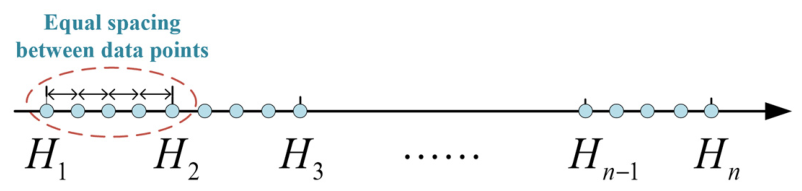
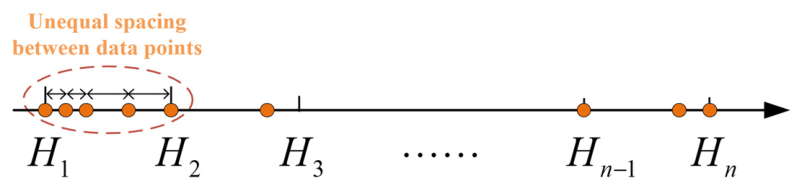
Non-uniformity of data refers to a non-uniform distribution of numerical values rather than a distribution over time, i.e., monitoring data of a certain system attribute throughout the entire life cycle. Regardless of the temporal order of the measurements, the magnitude of all the data values exhibits a non-uniform distribution along the number axis.
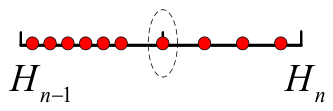
Figure 1 and Figure 2 represent uniform and non-uniform distributions, respectively, where H n is the reference value of the n th performance evaluation metric.

2.2. Problem Formulation

The issues addressed in the performance evaluation of FOG under imperfect data can be summarized into two aspects:
Problem 1: How to establish a performance evaluation model using imperfect data and expert knowledge. Monitoring data is influenced by acquisition conditions and environmental interference, resulting in characteristics such as low quality and non-uniform distribution. While expert knowledge can provide prior information, subjective knowledge can lead to biases in the initial estimation of model parameters. To combine qualitative knowledge with “imperfect data” to construct a performance evaluation model, the following mapping relationship can be established:
F = Ω { x i , E K , Q i } , i = 1 , 2 , , M
where F is the performance evaluation model. Ω ( · ) is the corresponding nonlinear mapping function of the performance evaluation model. x i = [ x 1   , x 2 , , x M ] denotes the monitoring data of M performance indicator parameters. E K is expert knowledge, and Q i is the quality factor of the i th system attributes, reflecting the influence of imperfect data in the model construction.
Problem 2: This comprises how to consider the impact of imperfect data on the performance evaluation inference process. In practical industrial scenarios, complex operating conditions result in a non-uniform distribution of monitoring data, characterized by local density and overall sparsity. Traditional evaluation models struggle to capture the true distribution of data, leading to deviations in feature matching and affecting the credibility of evaluation results. The reasoning process for performance evaluation is as follows:
y ^ = F ( S ( x 1   , x 2 , , x M )   )
where y ^ is the performance evaluation result. F ( · ) is the performance evaluation model proposed in Problem 1. S ( · ) is an information processing method that takes into account the effect of imperfect data.

2.3. ABRB-QD-Based Performance Evaluation Model

ABRB-QD incorporates the data quality factor into the traditional BRB and employs a new membership function that flexibly varies considering data distribution. In ABRB-QD, the k th rule can be expressed as follows:
R k ( t ) :   IF   x 1   i s   H 1 k x 2   i s   H 2 k x M   i s   H M k ,                           THEN   y i s   D 1 , β 1 , k , , D N , β N , k , ( n = 1 N β n , k 1 ) , with   a   rule   weight   θ k ,   attribute   weight   δ 1 , , δ M   and   data   quality   factor   Q 1 , , Q M
where x 1 , x 2 , x M is the monitoring data of M system attributes. The weights of these system attributes are δ 1 , δ M ; H i k i = 1 , 2 , , M is the referential value of attributes, which is used to integrate multi-source information into a unified framework. The performance status of FOG is { D 1 , D 2 , , D N } , and its corresponding output belief degree vector is [ β 1 , k , β 2 , k β N , k ] θ k ( k = 1 , 2 , , L ) represents the rule weights of the k th rule. “ ” represents the logical “AND” relationship; Q i i = 1 , 2 , , M is the data quality factor. In this paper, the primary consideration is the stability of the data.

3. Procedure of ABRB-QD-Based Performance Evaluation

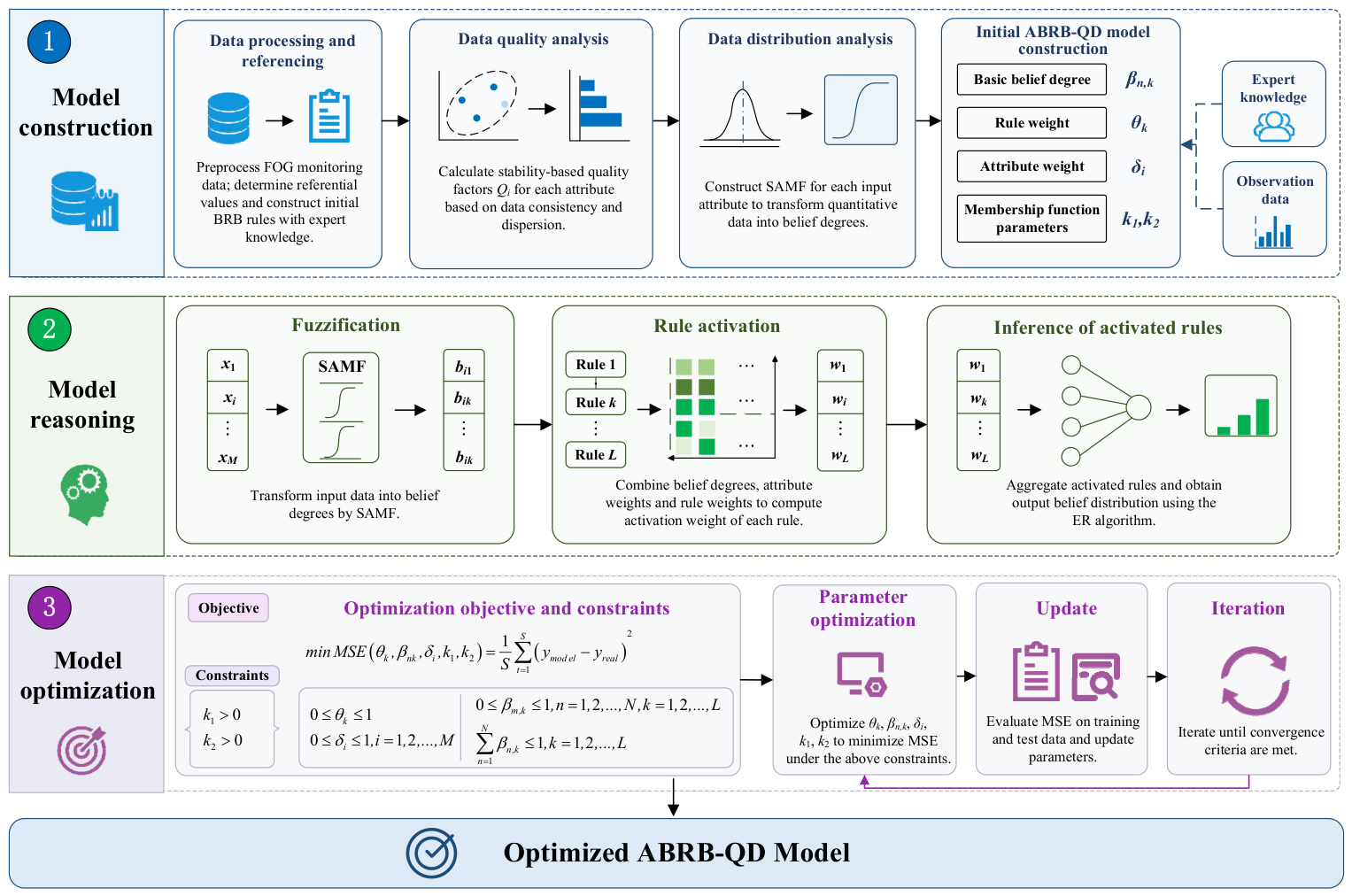
In this section, the procedure of the ABRB-QD-based performance evaluation model is introduced. Section 3.1 describes the data quality factor. Section 3.2 presents the reasoning process with imperfect data and an adaptive membership function. Section 3.3 explains parameter optimization of the model. For clarity, the overall workflow of the proposed ABRB-QD method is illustrated in Figure 3.

3.1. Calculation of Data Quality Factor

Based on the testing conditions, the data is divided into two types: short-term test data and long-term test data.
(1)
Short-term test data refers to data measured under the condition of high adjacent test frequencies and minimal changes in FOG performance status within the total test time, reflecting short-term variations in FOG performance.
(2)
Long-term test data refers to data where the FOG testing duration is sufficiently long, and the interval between two consecutive tests is large, enabling the full reflection of the long-term trend of FOG performance changes.
Due to changes in FOG performance, long-term test data exhibits a clear trend compared to short-term test data. Therefore, X i is introduced to distinguish long-term test data from short-term test data when calculating Q i .
X i = x i                                                 if   S h o r t t e r m   t e s t   d a t a x i x ^ i                                 if   L o n g t e r m   t e s t   d a t a
where x i is the test data for system attributes; x ^ i is the long-term trend curve data obtained through least squares fitting. The data quality factors are as follows:
Q i = 1 1 σ 1 S 1 i = 1 s ( X i X ¯ ) 2
where X ¯ is the mean of X i , S denotes the number of data points, and σ is the half-range of test data, with a value of σ = ( m a x ( X 1 , X 2 , , X c ) m i n ( X 1 , X 2 , , X c ) ) / 2 . The effect of this normalization setting is further examined in the case study.
The design of the data quality factor Q i is inspired by the signal-to-noise ratio (SNR) in engineering and the coefficient of variation (CV) in statistics, with the aim of constructing a dimensionless metric to quantify data stability. Here, the mean value X ¯ is used to characterize the central level of the data, while σ represents the fluctuation amplitude. In this study, σ is defined as the half-range of the data to provide a simple normalization factor for the spread of each attribute and to make the resulting quality factor comparable across different metrics Therefore, a higher Q i indicates smaller relative fluctuations in the data and thus higher stability.

3.2. Reasoning Processes for Performance Evaluation Considering Imperfect Data

3.2.1. Limitations of the Traditional Triangular Membership Function

In BRB, the traditional input transformation method employs the “rule-utility” approach to fuzzify the input information and convert it into a distribution. The membership degree α i j can be calculated using a triangular membership function:
α i j = H i ( k + 1 ) x i H i ( k + 1 ) H i k j = k if H i k x i ( t ) H i ( k + 1 ) x i H i k H i ( k + 1 ) H i k j = k + 1 0 j = 1 , 2 , L , j k , k + 1
where H i k and H i ( k + 1 ) are the values corresponding to the reference levels of the i th system attribute in the k th and k + 1 th rules, respectively. Equation (6) indicates that the triangular membership function assumes a linear relationship between the input data and the degree of matching. This relationship is based on the assumption of uniform data distribution. However, data often exhibits a non-uniform distribution, which leads to a degradation in the effectiveness of the triangular membership function transformation.
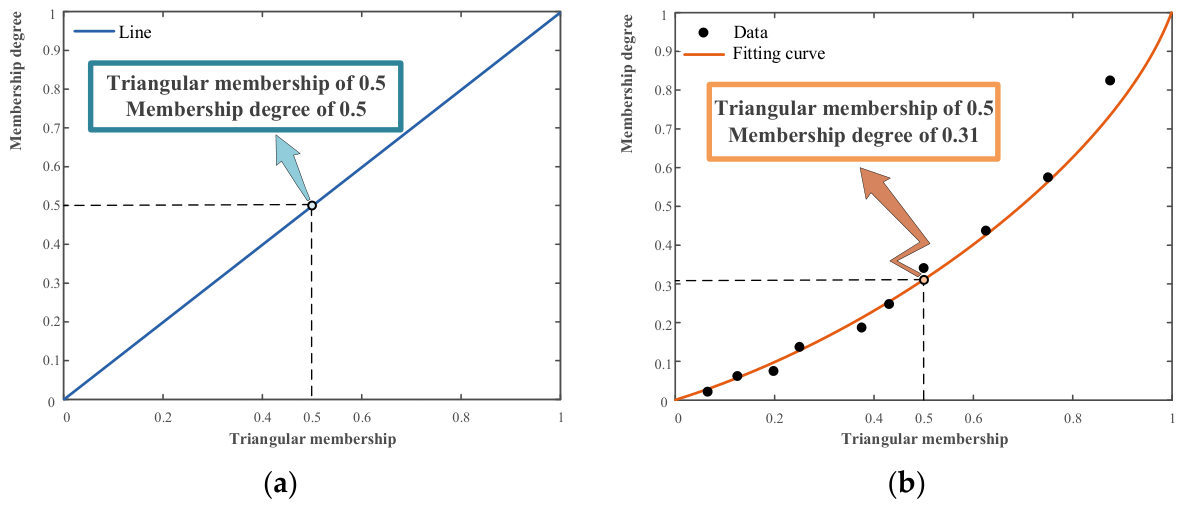
When the data distribution is as shown in Figure 4, the data near H n 1 is abundant and dense, while the data near H n is scarce and sparse. In this case, the point within the dashed circle is closer to H n , and the membership degree of this point with respect to H n 1 and H n is no longer 0.5. Figure 5a shows the membership degree of this point by using a triangular membership function.

3.2.2. Definition and Characteristics of SAMF

Figure 5b shows the triangular membership–membership degree relationship curve obtained by the method proposed in the paper. The novel membership function suggests a nonlinear relationship between triangular membership and membership degree. In this paper, a State-Following Adaptive Membership Function (SAMF) is proposed. SAMF dynamically adjusts membership functions based on imperfect data characteristics, enhancing applicability in scenarios with poor data quality and non-uniform distributions, as detailed below:
α i j = ( x H n 1 ) k 1 ( x H n 1 ) k 1 + H n x k 2 j = k if H i k x i H i ( k + 1 ) 1 ( x H n 1 ) k 1 ( x H n 1 ) k 1 + H n x k 2 j = k + 1 0 j = 1 , 2 , L , j k , k + 1
where k 1 and k 2 denote the convexity coefficients for the initial and terminal segments of SAMF, respectively. To demonstrate that SAMF meets the selection criteria for the membership function while analyzing the specific effects of k 1 and k 2 on this function, mathematical analysis of SAMF relative to H n at input x ( H n 1 , H n ) proceeds as follows:
f ( x ) = ( x H n 1 ) k 1 ( x H n 1 ) k 1 + H n x k 2
The first derivative of f ( x ) is as follows:
f ( x ) = ( H n x ) k 2 1 ( x H n 1 ) k 1 1 [ k 1 ( H n x ) + k 2 ( x H n 1 ) ] [ ( x H n 1 ) k 1 + ( H n x ) k 2 ] 2
From Equation (9), for x ( H n 1 , H n ) , the denominator is always positive. Meanwhile, ( H n x ) k 2 1 and ( x H n 1 ) k 1 1 are positive on this interval. In addition, the term k 1 ( H n x ) + k 2 ( x H n 1 ) is nonnegative under the conditions k 1 > 0 and k 2 > 0 . Therefore, f ( x ) 0 holds on the interval, implying that f ( x ) is monotonically increasing and satisfies a basic requirement of a membership function. The effect of k 1 and k 2 on f ( x ) is shown in Table 1.
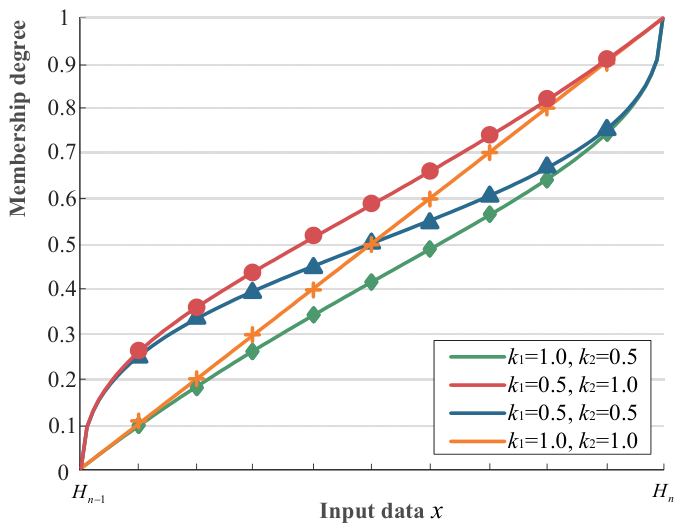
As k 1 and k 2 change, SAMF can adapt to different data distribution scenarios and dynamically adjust to system changes. As shown in Figure 6, the SAMF’s concavity varies significantly when taken at different values.
It is worth mentioning that when k 1 = k 2 = 1 , SAMF will degenerate to a triangular membership function; when k 1 × k 2 = 1 , SAMF is exponential to the input and the function will degenerate to an idempotent membership function.
In addition to the triangular membership function, commonly used membership functions in fuzzy systems include the Gaussian and idempotent membership functions. Their models are as follows:
f ( x ) = 1 exp 1 2 x c σ   2
f ( x ) = H n x H n H n 1   s
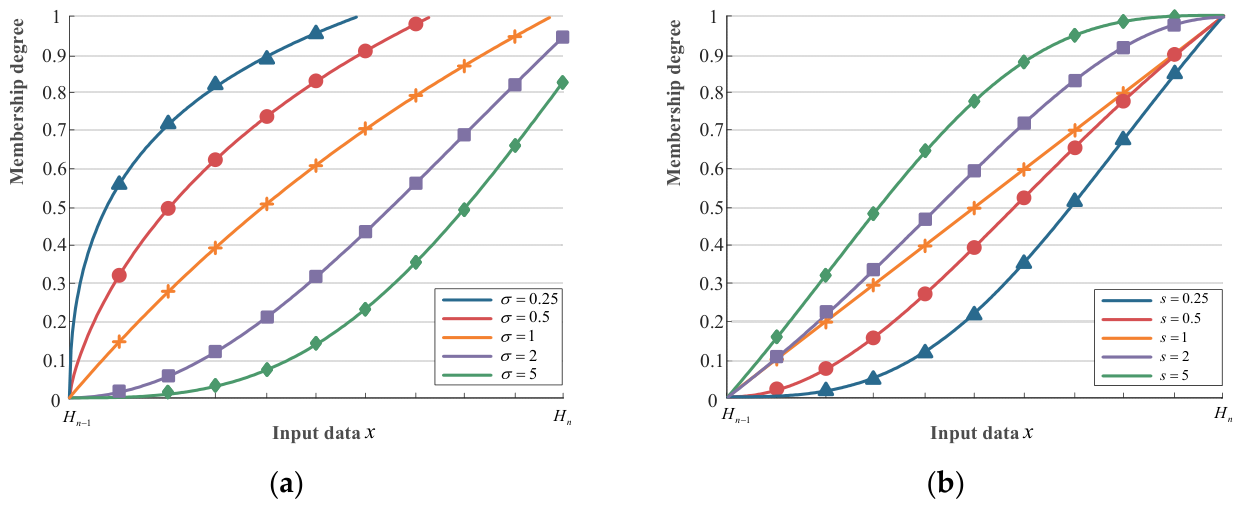
The Gaussian membership function dynamically adapts to the fuzzification requirements of different data distributions by adjusting the mean value c and standard deviation σ . However, it performs poorly in transforming uniformly distributed data, and when the value of σ increases, the conversion effect may be counterintuitive. The idempotent membership function can alter the convexity and concavity of the function by changing its parameter. Still, its second derivative remains either consistently positive or consistently negative, meaning there are no inflection points within the same curve interval. Figure 7 illustrates the membership degree of x relative to H n in the aforementioned membership function. The SAMF has high flexibility and effectively addresses the issues above.
After determining the membership function model and combining the FOG test data, calculate the initial values of k 1 and k 2 , with the specific steps as follows:
Step 1: Data Preprocessing. Screen valid monitoring data throughout the entire life cycle of the FOG. During the screening process, prioritize selecting data with identical data acquisition conditions.
Step 2: Creating a Scatter Plot. After aggregating attribute data and sorting it by numerical value, groups are redefined such that each interval between adjacent reference values constitutes a distinct group. The data points are assigned numbers in order based on their numerical values. Finally, a scatter plot is generated with the group number on the x-axis and numerical value on the y-axis.
Step 3: Curve Fitting. Map the scatter plot’s x-axis to reference values and fit the scatter plot with the SAMF to obtain the initial values of k 1 and k 2 .
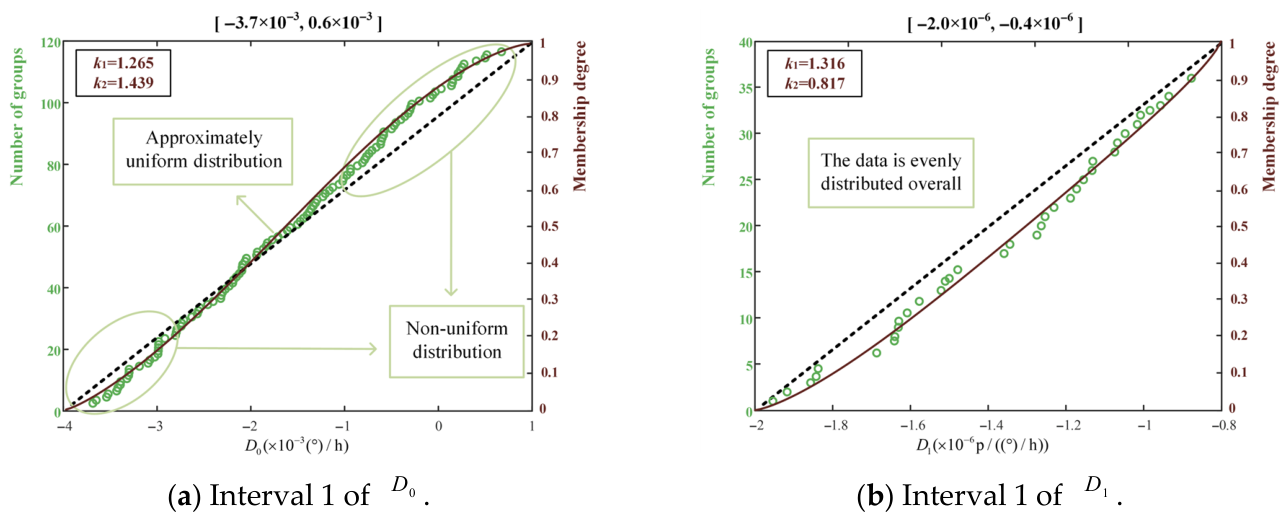
For the mapping process in Step 3, an example is provided for illustration. After Steps 1 and 2 are processed, a certain attribute yields the data (0, 0.1, 0.23, 0.3, 0.34, 0.49, 0.6, 0.7, 0.8, 0.91, 1), with corresponding number (0, 1, 2, 3, 4, 5, 6, 7, 8, 9, 10). The reference levels and reference values are (Good, Moderate, Poor) = (0, 0.5, 1). Consequently, the data is divided into two intervals: (0, 0.5) and (0.5, 1). Taking the interval (0, 0.5) as an example, there are six data points, numbered from 0 to 5. When plotting the scatter plot, map the x-axis (group number) to the interval from 0 to 0.5, and the y-axis remains numerical.

3.2.3. ABRB-QD Evaluation Process

The evaluation process of ABRB-QD can be summarized in two steps, namely rule activation and rule inference, with the specific steps as follows:
Step 1: Rule activation. By using SAMF, the membership degree of input information relative to evaluation attributes can be obtained. To obtain the total membership degree of all attributes in the k th rule, Equation (12) can be utilized. Additionally, by introducing a data quality factor, the model can be expressed as follows:
α k = j = 1 M α i k ( Q i · δ ¯ i ) δ ¯ i = δ i max i = 1 , , M { δ i } , 0 δ ¯ i 1
where δ ¯ i represents the relative weight of the attribute. Here, Q i modulates the effective attribute weight in the exponent. Since Q i ranges from 0 to 1, a lower data quality factor reduces the exponent associated with the corresponding attribute. For α i k ( 0 , 1 ) , this makes α i k ( Q i · δ ¯ i ) move closer to 1, thereby weakening the discriminative influence of unreliable attributes on the overall matching degree. In this way, low-quality attributes have less impact on rule activation.
In ABRB-QD, different monitoring information has varying impacts on each rule. This variation is reflected through the activation weights of the rules. The activation weight expression is as follows:
w k = θ k α k l = 1 L θ l α l , k = 1 , , L
where θ k represents the weight of the k th rule, reflecting its relative importance compared to other rules.
Step 2: Rule inference. When a rule is activated, the resulting feature vector is used to represent the outcome based on that rule. Subsequently, the confidence vectors generated by all rules can be fused using the Evidential Reasoning (ER) algorithm. Finally, a comprehensive evaluation vector is obtained. The mathematical expression of the ER analysis algorithm is as follows:
β ^ n = μ [ k = 1 L ( w k β n , k + 1 w k j = 1 N β j , k ) k = 1 L ( 1 w k j = 1 N β j , k ) ] 1 μ [ k = 1 L ( 1 w k ) ] μ = [ n = 1 N k = 1 L ( w k β n , k + 1 w k j = 1 N β j , k ) ( N 1 ) k = 1 L ( 1 w k j = 1 N β j , k ) ] 1
where β ^ n represents the belief vector output by the model, and μ represents intermediate process parameters. The final evaluation result is presented in the form of a specific score. By solving the output expected utility, the performance state can ultimately be quantified as follows:
y ^ = n = 1 N u ( D n ) β ^ n
where u ( D n ) represents the utility of the n th output, i.e., the performance evaluation score of FOG.

3.3. ABRB-QD Parameter Optimization Process

Since ABRB-QD has parameters provided by experts, such as attribute weights δ i , rule weights θ k , and belief degree β n , k , which are subjective, and considering that each data collection environment has differences, leading to errors in SAMF parameters, it is necessary to optimize the model parameters. Combining the physical meaning of the parameters, the optimization model is as follows:
min M S E ( θ k , β n , k , δ i , k 1 , k 2 ) = 1 S t = 1 S ( y m o d e l y r e a l ) 2 s . t . k 1 > 0 k 2 > 0 0 θ k 1 0 δ i 1 , i = 1 , 2 , , M 0 β n , k 1 , n = 1 , 2 , , N , k = 1 , 2 , , L n = 1 N β n , k 1 , k = 1 , 2 , , L
where y m o d e l and y r e a l represent the model output and actual output, respectively. θ k , β n , k , δ i , k 1 , k 2 are the model parameters to be optimized. For reproducibility, the main procedure of ABRB-QD is summarized in Algorithm 1.
Algorithm 1. ABRB-QD
Input: Monitoring data X, expert knowledge EK, referential values H , real perfomance states Y
Output: Optimized θ k , β n , k , δ i , k 1 and k 2
1:Construct the initial ABRB-QD model by EK and H
2:Calculate Q i by Equation (5)
3:Construct SAMF by Equations (7)–(9)
4:Initialize θ k , β n , k , δ i , k 1 and k 2
5:for s = 1 to S do
6:      Calculate belief degrees b i , k of x s by SAMF
7:      Calculate the matching degree α k and activation weight w k
8:      Perform ER-based inference
9:      Calculate y ^ s
10:end for
11:Optimize θ k , β n , k , δ i , k 1 and k 2 by minimizing the MSE in Equation (16)
12:Return the optimized ABRB-QD model
It should be noted that SAMF provides flexible shape control through two parameters, but its expressive capacity is limited to relatively smooth distribution patterns. Therefore, it is most effective when the underlying data distribution exhibits structured variations, such as skewness or density differences within intervals. In cases where the distribution becomes highly complex, the representation ability of a two-parameter function may be constrained.

4. Case Study

In this section, a case study on the performance evaluation of FOG is conducted to validate the practical value of the proposed method. Section 4.1 introduces the brief background of fiber optic gyroscope performance evaluation. Section 4.2 calculates the quality factor and membership functions using the proposed method in this paper. In Section 4.3, a performance evaluation model based on ABRB-QD is established and optimized. In Section 4.4, comparative studies are performed. Section 4.5 analyzes and discusses the results.

4.1. Background Description

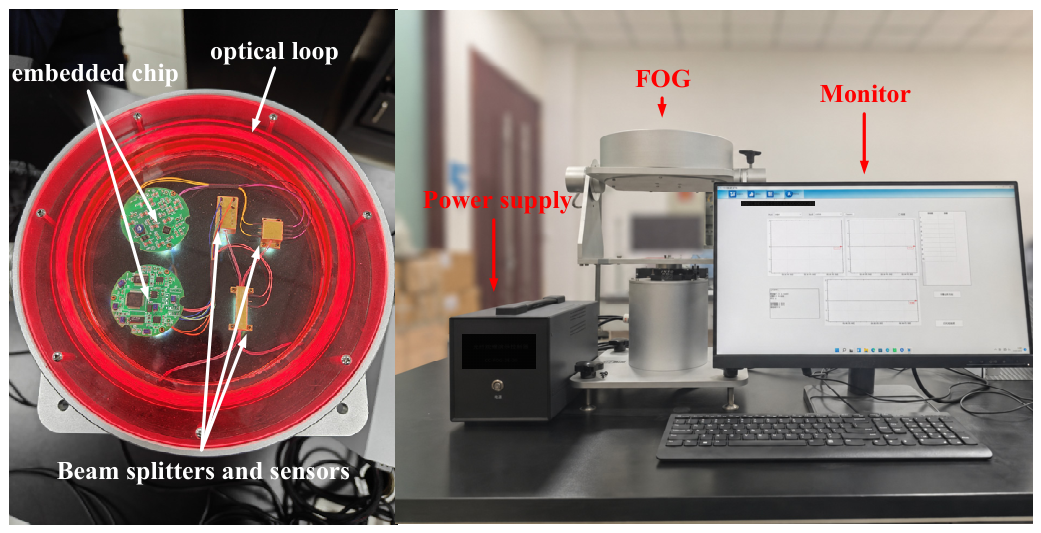
In the experimental setup, the FOG was horizontally mounted on an isolated foundation to sense the vertical component of the Earth’s rotation rate. The test site was located at a latitude of 34°15′ N. During data acquisition, the gravity acceleration at the test site was 9.7967 m/s2, and the interval between two consecutive tests was 6 h. The corresponding FOG and its test equipment are shown in Figure 8.
To determine the evaluation attributes of FOG, this paper introduces frequency difference analysis. The model of FOG’s input angular velocity ω and output frequency difference Δ v is as follows:
Δ v = D 1 ω + D 0
where Δ v denotes the output frequency difference in the FOG, ω represents the input angular velocity, D 1 is the scaling factor, also known as the first-order drift coefficient, and D 0 denotes the zeroth-order drift coefficient. The scaling factor D 1 is related to the structural parameters of the FOG and can be expressed as D 1 = 4 A / L λ , where A represents the area enclosed by the FOG ring resonator loop, L denotes the loop perimeter, and λ is the laser wavelength. As shown in Equation (17), the output frequency difference Δ v is determined by the input angular velocity ω , the scaling factor D 1 , and the zeroth-order drift coefficient D 0 . Therefore, by measuring multiple sets of ω and Δ v , the values of D 0 and D 1 can be obtained. The specific formula is as follows:
Δ v 1 = D 1 ω 1 + D 0 Δ ν 2 = D 1 ω 2 + D 0
The values of D 0 and D 1 are
D 1 = Δ v 1 Δ v 2 ω 1 ω 2 D 0 = ω 1 Δ v 2 ω 2 Δ v 1 ω 1 ω 2
Since D 0 and D 1 are derived from the raw measurements Δ v 1 , Δ v 2 , ω 1 and ω 2 , their measurement uncertainties should be considered. Let g = ω 1 ω 2 . Based on Equation (19), the first-order uncertainty propagation of D 1 can be expressed as
u 2 ( D 1 ) = u 2 ( Δ ν 1 ) + u 2 ( Δ ν 2 ) g 2 + D 1 2 u 2 ( ω 1 ) + u 2 ( ω 2 ) g 2
Similarly, the uncertainty propagation of D 0 can be approximated as
u 2 ( D 0 ) = ω 2 2 u 2 ( Δ ν 1 ) + ω 1 2 u 2 ( Δ ν 2 ) g 2 + D 1 2 ω 2 2 u 2 ( ω 1 ) + ω 1 2 u 2 ( ω 2 ) g 2
The above equations show that the propagated uncertainties of D 0 and D 1 are related to the denominator ω 1 ω 2 . When the two operating angular velocities are too close, the uncertainty may be amplified, leading to an ill-conditioned derivation. In this study, the two angular velocity operating points were selected with sufficient separation, and the angular velocity difference was much larger than the angular velocity control uncertainty. Therefore, the calculation of D 0 and D 1 is assumed to be well-posed under the present experimental conditions.
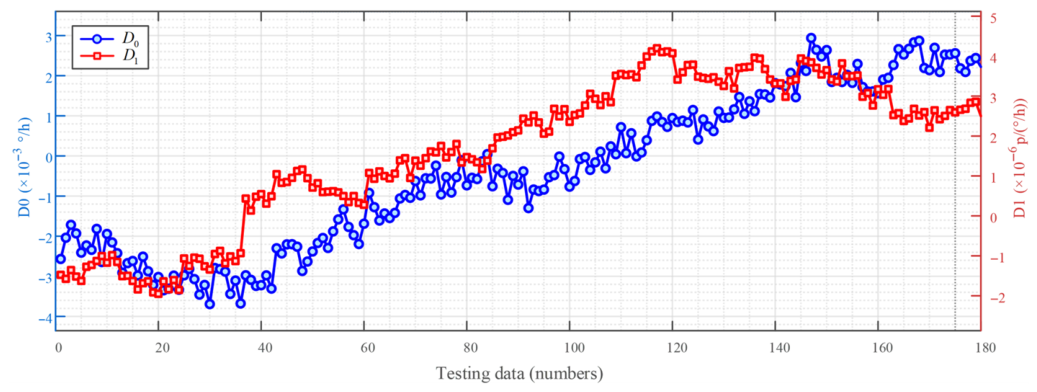
From the above frequency difference analysis, it can be seen that the navigation accuracy of FOG is mainly affected by D 0 and D 1 . Therefore, D 0 and D 1 are selected as the evaluation attributes in this study. This selection has clear physical significance and reflects the dominant performance variation of the considered FOG under the current conditions. The gravity acceleration at the test site is 9.7967, with a sampling interval of 6 h. The experiment obtained 180 test datasets for D 0 and D 1 through sensors, as shown in Figure 9.
A key advantage of ABRB-QD is its flexibility in attribute selection. While these two attributes are used here, other relevant indicators can also be included depending on the application scenario and available engineering knowledge.

4.2. Calculation of Data Quality Factors and Initial Membership Functions

Based on FOG’s test results, D 0 and D 1 represent long-term test data. According to the steps in Section 3.1, the data quality factors D 0 and D 1 for the two evaluation attributes Q 1 and Q 2 are obtained as follows:
Q 1 = 0.8973 Q 2 = 0.9407
To partition the SAMF intervals, first provide the reference values and reference levels of FOG’s evaluation attributes. Based on expert experience, D 0 and D 1 are categorized into four reference levels: High (H), Sub-high (SH), Medium (M), and Low (L), as illustrated in Table 2.
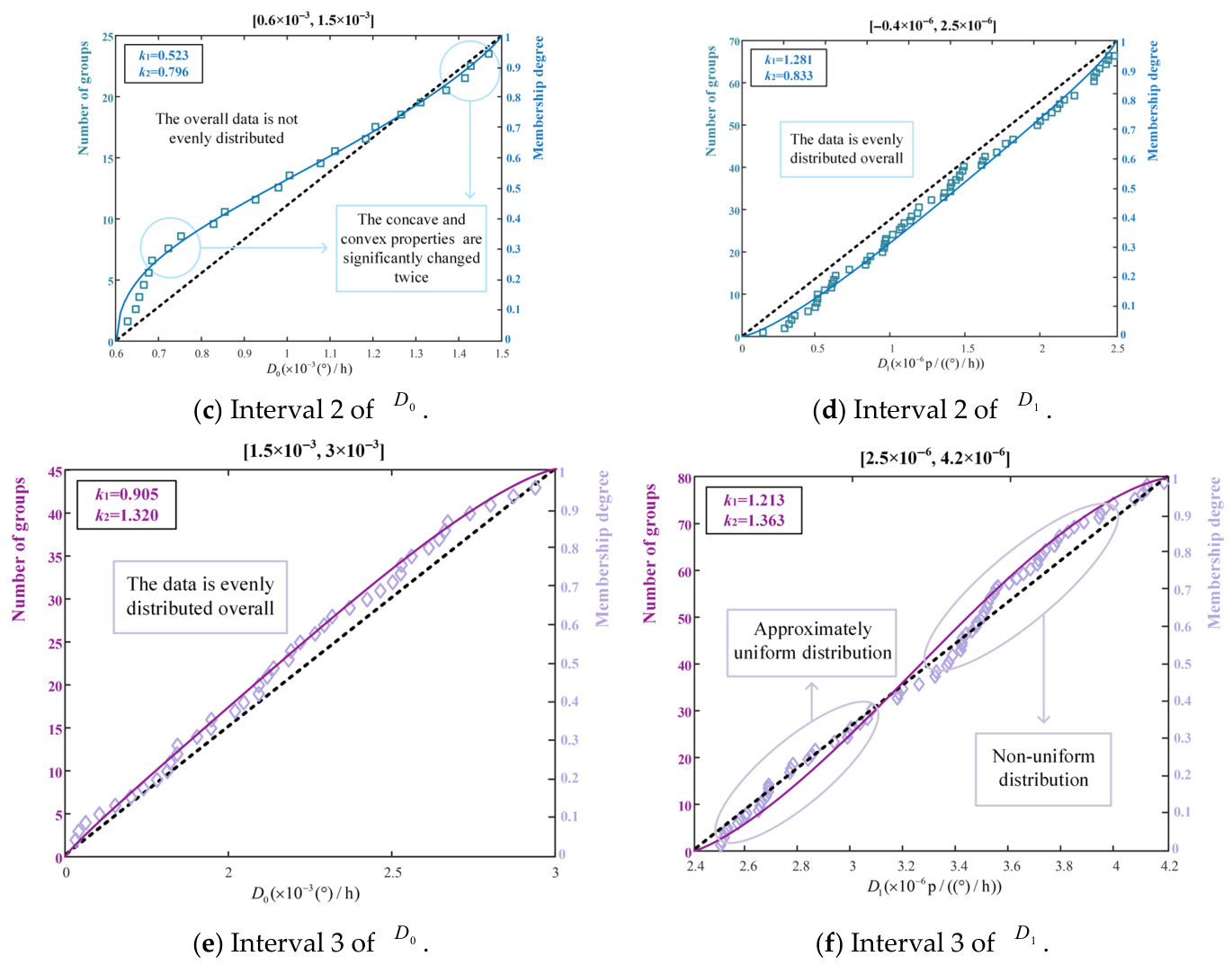
Based on the SAMF computation process in Section 3.2 and FOG test data, Figure 10 shows the data distribution and initial membership functions of D 0 and D 1 .

4.3. Construction and Optimization of the ABRB-QD-Based Performance Evaluation Model

In this experiment, the FOG was used to measure the vertical component of the Earth’s rotation rate. Since the vertical component of the Earth’s rotation rate at a fixed test site is theoretically constant, the difference between the FOG measurement and the theoretical Earth-rate component can be regarded as the measurement error of the gyroscope. Therefore, the measurement accuracy of the FOG is used as the basis for assigning its performance state.
According to the distribution of the Earth-rate measurement errors, four reference performance levels are defined: I (Excellent), II (Good), III (Moderate), and IV (Poor). A smaller measurement error indicates better FOG performance. In this study, the measurement error of 2.2 × 10⁻⁵ °/s is taken as the reference value of Level I, while the measurement error of 10.1 × 10⁻⁵ °/s is taken as the reference value of Level IV. The reference values of Levels II and III are obtained by equal-interval partitioning between these two boundary values. For model inference, the four performance levels are further mapped to normalized referential values of 1, 0.67, 0.33, and 0, respectively, as shown in Table 3.
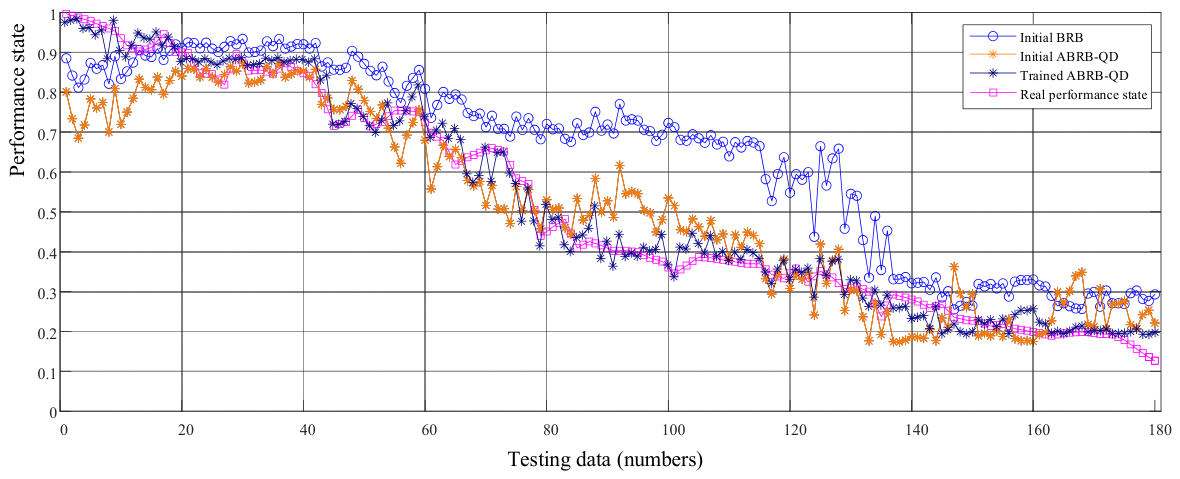
Since the measurement error of each sample varies continuously during the experiment, the real performance state used in Figure 11 and in the MSE calculation is represented as a continuous normalized score. Specifically, the real performance state of each sample is obtained by linear interpolation between the two nearest reference measurement errors and their corresponding normalized referential values. If the measurement error is smaller than 2.2 × 10⁻⁵ °/s, the real performance state is set to 1; if it is larger than 10.1 × 10⁻⁵ °/s, the real performance state is set to 0. In this way, the ground-truth performance state used for MSE calculation is consistent with the continuous expected utility output of the BRB model.
Based on the above referential values, the initial rule weights are set to 1, and the initial BRB is established according to expert knowledge, resulting in 16 initial rules. The initial ABRB-QD settings are illustrated in Table 4.
Since the initial ABRB-QD model fails to achieve the desired evaluation accuracy, the optimization model in Equation (16) is trained using the P-CMAES algorithm. Here, P-CMAES is adopted as an optimization tool for parameter training of the proposed ABRB-QD model, as commonly used in BRB-related studies [17,20,26]. The number of iterations for P-CMAES was set to 500, with 90 random sets of test data selected as the training set and the remaining 90 sets used as the test set. The real performance state used in Figure 11 and in the MSE calculation is obtained by applying the above piecewise linear mapping to the Earth-rate measurement error calculated from the FOG measurement and the theoretical Earth-rate component.
As shown in Table 5, some rules with uniform initial belief degrees are adjusted after optimization. For example, rules 4 and 13 correspond to cases where D 0 and D 1 indicate different performance tendencies. Such cases are relatively rare in the available samples and are also difficult for experts to assess with high confidence; therefore, uniform belief degrees are adopted in the initial rule base to represent this uncertainty. After optimization, the corresponding belief degrees are further calibrated according to the available data and the evaluation accuracy objective. For the FOG considered in this study, when either D 0 or D 1 becomes relatively large, the evaluation result tends to assign more belief to worse performance levels, which is consistent with the physical understanding that larger error-related coefficients generally indicate poorer gyroscope performance.
As shown in Figure 11, the evaluation performance of the ABRB-QD model improved significantly after training. Figure 11 presents a representative experimental run to illustrate the performance state evaluation results before and after model training. In this representative run, compared with the initial ABRB-QD model, the optimized ABRB-QD model reduces the MSE from 3.28 × 10⁻² to 7.11 × 10⁻⁴, corresponding to a 97.8% reduction in the evaluation error. The evaluation results of the optimized model are therefore closer to the real performance state.
To further examine the sensitivity of the normalization parameter σ in Equation (5), an additional comparative experiment was conducted in the case study. Specifically, the original half-range-based definition of σ was replaced by two commonly used scale measures, namely the standard deviation and the interquartile range (IQR), while the remaining model settings were kept unchanged. For each normalization choice, the ABRB-QD parameters were re-optimized under the same training and testing protocol. The obtained AMSE values are 7.11 × 10⁻⁴, 7.83 × 10⁻⁴, and 8.49 × 10⁻⁴ for the half-range, standard deviation, and IQR definitions, respectively. The results indicate that the evaluation accuracy changes only slightly under different normalization choices. Therefore, the proposed ABRB-QD method is relatively robust to the definition of σ , and the half-range-based normalization is retained in this study.

4.4. Comparative Study

To further evaluate the effectiveness of ABRB-QD, comparative experiments are conducted from two perspectives: different BRB evaluation models and data-driven models. The evaluation metrics include the average MSE (AMSE) and the standard deviation (STD) of twenty repeated experiments. AMSE is used to describe the average prediction error, while STD is used to measure the dispersion of the results across repeated runs. Therefore, these two metrics provide statistically descriptive information on both the accuracy and stability of the compared models.
a.
Different BRB evaluation models
(1)
The BRB model with a triangular membership function, called BRB-t. The input information transformation function is shown in Equation (6).
(2)
The BRB model with a Gaussian membership function, called BRB-g. The input information transformation function is shown in Equation (10).
(3)
The BRB model with an idempotent membership function, called BRB-n. The input information transformation function is shown in Equation (11), and the values of s in the experiment are shown in Table 6 and Table 7.
(4)
The BRB model with adaptive maximum likelihood ratio considering random variables is called BRB-RAMF. The membership function of BRB-RAMF resembles SAMF, differing in that SAMF determines parameters based on data distribution, while BRB-RAMF employs the maximum likelihood ratio for parameter determination.
The above five BRB models were optimized using the same P-CMAES algorithm under a unified optimization setting and then compared with the proposed ABRB-QD. In this way, the optimization procedure was kept consistent across the BRB-type models. The statistical evaluation results of the five BRB models over twenty repeated experiments are presented in Table 8, where AMSE and STD are used to compare the average evaluation accuracy and stability, respectively.
b.
Different data-driven models.
Machine learning methods have been widely applied in performance evaluation. This paper conducts a comparative study on K-Nearest Neighbor (KNN), Backpropagation Neural Network (BPNN), Random Forest (RF), and Naive Bayes (NB) models. The evaluation results are shown in Table 9.
(1)
KNN is a machine learning algorithm that does not require training [27], which finds the k-nearest samples by calculating distances and makes decisions based on the majority class of the samples.
(2)
BPNN is a neural network that adjusts weights through error backpropagation [28], where data is transmitted forward from the input layer to the output layer, and connection weights are adjusted in the reverse direction based on the output error.
(3)
RF is an ensemble learning algorithm [29], comprising multiple decision trees that collectively vote to determine evaluation results.
(4)
NB is a probabilistic classification model based on Bayes’ theorem [30]. It directly calculates the prior and conditional probabilities from the training set and infers the posterior probabilities. The evaluation result for NB can be obtained using Equation (15).
The data-driven baseline models were evaluated under the same training and test setting. Specifically, for KNN, the hyperparameters n_neighbors, weights, and metric were searched in [3, 5, 7, 9], {uniform, distance}, and {euclidean, manhattan}, respectively. For BPNN, the hidden-layer structure was selected from [(64,), (128,), (128, 64)], the activation function was chosen from {relu, tanh}, the initial learning rate was searched in [0.001, 0.01], and the batch size was searched in [32, 64, 128]. For RF, the hyperparameters n_estimators, max_depth, min_samples_split, and min_samples_leaf were searched in [100, 200, 300], [None, 5, 10, 15], [2, 5, 10], and [1, 2, 5], respectively. For NB, the hyperparameter var_smoothing was searched in [10−9, 10−8, 10−7]. All hyperparameter tuning was carried out on the training set using GridSearchCV with five-fold cross-validation.

4.5. Result Analysis and Discussion

In this section, the advantages of the ABRB-QD are analyzed and discussed in conjunction with the results of comparative experiments.
(1)
Comparison with different BRB evaluation models.
After considering data quality and SAMF, the evaluation accuracy of BRB has improved. This result is well explained, as the triangular membership function of BRB-t cannot reflect the non-uniform distribution of imperfect data and exhibits poor conversion effectiveness. Meanwhile, BRB-g and BRB-n, which show slightly improved data conversion performance, are prone to causing input data fuzzification errors under poor data quality conditions. Therefore, the ABRB-QD model significantly improves evaluation performance under imperfect data. As shown in Table 8, compared to trained BRB-t, BRB-g, BRB-n, and BRB-RAMF models, the evaluation accuracy improved by 43.6%, 26.3%, 34.3%, and 19.4%, respectively, while evaluation stability increased by 51.5%, 44.2%, 41.0%, and 26.6%. The evaluation performance of ABRB-QD is significantly improved compared to other BRB models.
It is worth noting that, compared with other membership functions, the SAMF can adapt to a broader range of data distributions, especially in cases where data anomalies are more pronounced. This is attributed to its capability to fit data distributions, thereby determining model adjustment parameters to achieve more precise fuzzy processing of quantitative data.
(2)
Comparison with different data-driven models.
The limited number of high-value samples in FOG exposes the limitations of data-driven models. Since the training set may not fully represent the overall mapping relationship, data-driven models are generally prone to overfitting. Among these, RF demonstrates advantages through dual randomness in feature and sample selection, thereby improving model performance. As shown in Table 9, compared with post-training KNN, NB, BPNN, and RF models, ABRB-QD achieves evaluation accuracy improvements of 32.5%, 48.1%, 38.7%, and 27.9%, respectively, along with stability enhancements of 33.4%, 42.9%, 38.6%, and 26.1%. These results indicate that ABRB-QD achieves lower average prediction error and better stability than the compared data-driven models under the revised evaluation protocol.
These results demonstrate the advantage of expert knowledge in small-sample modeling, where experts provide an interpretable initial model based on domain knowledge and experience, and the evaluation accuracy is further improved by combining this prior knowledge with the available small-sample data. The computational cost of ABRB-QD mainly depends on the size of the rule base and the number of optimization iterations. In the current experiments, the approximate training time is about 7–20 s, depending on initialization and optimization. As the number of attributes or referential levels increases, the number of rules grows accordingly, which may make inference and training more time-consuming in higher-dimensional cases. Under these experimental conditions, the results primarily demonstrate the effectiveness of ABRB-QD with the two selected evaluation attributes. Future work will further explore additional FOG samples and evaluation attributes to assess the method’s applicability in more complex scenarios.

5. Conclusions

In this paper, a novel BRB-based method is proposed for the performance evaluation of FOG operating under imperfect data conditions. This approach effectively mitigates the impact of low-quality data on evaluation results while capturing the actual distribution characteristics of the data, offering a potentially useful solution for the considered FOG performance evaluation problem.
The main contributions of this paper can be summarized as follows: First, to address the issue of poor data quality, the calculation method of the data quality factor based on data stability is proposed, where quality factors are integrated into the model to reflect the reliability of evaluation attributes. Second, to resolve uneven data distribution, the SAMF is designed for fuzzy processing of quantitative data. To demonstrate the effectiveness of the ABRB-QD model, a FOG performance case study is conducted. The model achieves a minimum MSE of 7.11 × 10⁻⁴, demonstrating not only superior accuracy but also enhanced practical utility compared to conventional methods. Third, a parameter optimization model is developed to improve the evaluation accuracy of ABRB-QD.
It is worth noting that SAMF has limited capability in representing more complex data distributions. Therefore, using fewer membership function model parameters to reflect complex distribution situations with imperfect data and improve the model’s generalization ability remains an important challenge. In addition, as the number of attributes and referential levels increases, the growth of the rule base may limit the computational scalability of the proposed method. Under the current experimental conditions, the results primarily demonstrate the effectiveness of ABRB-QD in the present two-attribute FOG performance evaluation case, and further validation with additional FOG samples and evaluation attributes will be considered in future work. Future work will also focus on improving the expressive ability of the membership function, enhancing computational scalability, analyzing uncertainty propagation more rigorously, and validating the proposed method on more FOG systems.


Author Contributions

Conceptualization, F.Z. and Z.F.; methodology, Z.L. and C.H.; validation, C.L. and J.M. All authors have read and agreed to the published version of the manuscript.

Funding

This research was funded by National Natural Science Foundation of China grant number 62573349 and 62203461.

Institutional Review Board Statement

Not applicable.

Data Availability Statement

The data presented in this study are available on request from the corresponding author.

Conflicts of Interest

The authors declare no conflicts of interest.

References

  1. Wang, P.F.; Gao, Y.B.; Wu, M.H.; Zhang, F.; Li, G.; Qin, C. A Denoising Method for Fiber Optic Gyroscope Based on Variational Mode Decomposition and Beetle Swarm Antenna Search Algorithm. Entropy 2020, 22, 765. [Google Scholar] [CrossRef]
  2. Chen, J.B.; Wang, J.N.; Chang, S.; Li, P.; Lin, G.; Tong, S.; Li, Z.; Luo, Y. Design and performance evaluation of a mobile CO2 detector based on mid-infrared IBBCEAS. Measurement 2025, 247, 116839. [Google Scholar] [CrossRef]
  3. Fei, Z.Y.; Jiang, X.W.; Zhao, Q.J.; Cui, Z.; Yang, Y. Stealth performance evaluation of helicopter against airborne early warning radar considering trimming control. Chin. J. Aeronaut. 2023, 36, 204–220. [Google Scholar] [CrossRef]
  4. Awasthi, A.; Chung, J.D.; Cho, H.; Jeon, Y. Facile numerical approximations to evaluate the performance of an ice-on-coil-type latent thermal energy storage tank with top-inlet-bottom-outlet configuration. Alex. Eng. J. 2023, 69, 445–456. [Google Scholar]
  5. Dong, Z.J.; Wang, T.X.; Ma, X.Y.; Cao, C.; Sun, J. Structural performance evaluation of airport asphalt pavement based on field data measurement and finite element simulation. Measurement 2023, 210, 112553. [Google Scholar] [CrossRef]
  6. Jiang, W.; Xu, Y.; Chen, Z.; Zhang, N.; Xue, X.; Zhou, J. Measurement of health evolution tendency for aircraft engine using a data-driven method based on multi-scale series reconstruction and adaptive hybrid model. Measurement 2022, 199, 111502. [Google Scholar]
  7. Yang, J.B. Rule and utility based evidential reasoning approach for multiattribute decision analysis under uncertainties. Eur. J. Oper. Res. 2001, 131, 31–61. [Google Scholar] [CrossRef]
  8. Li, D.; Dong, J.; Zhang, C.; Peng, K. A two-stage feature-extraction-based fault detection method for industrial processes with imperfect data. IEEE Trans. Instrum. Meas. 2025, 74, 3506311. [Google Scholar] [CrossRef]
  9. Yuan, S.; Cai, J.; Reniers, G.; Yang, M.; Chen, C.; Wu, J. Safety barrier performance assessment by integrating computational fluid dynamics and evacuation modeling for toxic gas leakage scenarios. Reliab. Eng. Syst. Saf. 2022, 226, 108719. [Google Scholar] [CrossRef]
  10. Li, G.F.; Wei, J.F.; He, J.L.; Yang, H.; Meng, F. Implicit Kalman filtering method for remaining useful life prediction of rolling bearing with adaptive detection of degradation stage transition point. Reliab. Eng. Syst. Saf. 2023, 235, 109269. [Google Scholar] [CrossRef]
  11. Jo, W.; Lee, S.J. Human reliability evaluation method covering operator action timing for dynamic probabilistic safety assessment. Reliab. Eng. Syst. Saf. 2024, 241, 109686. [Google Scholar] [CrossRef]
  12. Rahim, M.A.; Rahman, M.M.; Islam, M.S.; Muzahid, A.J.M.; Rahman, M.A.; Ramasamy, D. Deep learning-based vehicular engine health monitoring system utilising a hybrid convolutional neural network/bidirectional gated recurrent unit. Expert Syst. Appl. 2024, 257, 125080. [Google Scholar] [CrossRef]
  13. Che, Y.; Zheng, Y.S.; Forest, F.E.; Sui, X.; Hu, X.; Teodorescu, R. Predictive health assessment for lithium-ion batteries with probabilistic degradation prediction and accelerating aging detection. Reliab. Eng. Syst. Saf. 2024, 241, 109603. [Google Scholar] [CrossRef]
  14. Yang, J.B.; Liu, J.; Wang, J.; Sii, H.-S.; Wang, H.-W. Belief rule-base inference methodology using the evidential reasoning approach—RIMER. IEEE Trans. Syst. Man Cybern.—Part A Syst. Hum. 2006, 36, 266–285. [Google Scholar] [CrossRef]
  15. Cao, Y.; Zhou, Z.J.; Hu, C.H.; He, W.; Tang, S. On the interpretability of belief rule-based expert systems. IEEE Trans. Fuzzy Syst. 2020, 29, 3489–3503. [Google Scholar] [CrossRef]
  16. Huang, H.; Feng, S.; Li, J.; Guan, T.; Zhu, H. Adaptive Belief Rule Base Modeling of Complex Industrial Systems Based on Sigmoid Functions. Entropy 2025, 27, 1157. [Google Scholar] [CrossRef] [PubMed]
  17. Feng, Z.C.; Zhou, Z.J.; Hu, C.H.; Ban, X.; Hu, G. A safety assessment model based on belief rule base with new optimization method. Reliab. Eng. Syst. Saf. 2020, 203, 107055. [Google Scholar] [CrossRef]
  18. Cao, Y.D.; Jia, M.P.; Ding, P.; Zhao, X.; Ding, Y. Incremental learning for remaining useful life prediction via temporal cascade broad learning system with newly acquired data. IEEE Trans. Ind. Inform. 2022, 19, 6234–6245. [Google Scholar]
  19. Xie, W.; Liu, Y.; Wang, X.; Wang, J. The pipeline leak detection algorithm based on D-S evidence theory and signal fusion mechanism. Alex. Eng. J. 2023, 85, 218–235. [Google Scholar] [CrossRef]
  20. Li, C.; Feng, Z.; Zhou, Z.; Gao, Y. Dynamic performance evaluation of high-valued complex systems based on belief rule base. IEEE Trans. Instrum. Meas. 2025, 74, 3528811. [Google Scholar] [CrossRef]
  21. Cheng, C.; Wang, J.; Chen, H.; Zhou, Z.; Teng, W.; Zhang, B. Health status assessment for LCESs based on multidiscounted belief rule base. IEEE Trans. Instrum. Meas. 2021, 70, 3514213. [Google Scholar] [CrossRef]
  22. Lian, Z.; Zhou, Z.; Hu, C.; Ming, Z.; Wang, J.; Zhao, Y. A belief rule-based performance evaluation model for complex systems considering sensors disturbance. IEEE Trans. Reliab. 2024, 73, 1245–1257. [Google Scholar] [CrossRef]
  23. Feng, Z.; Yang, R.; Zhou, Z.; Hu, C. Trustworthy fault diagnosis method based on belief rule base with multisource uncertain information for vehicle. IEEE Trans. Ind. Electron. 2024, 71, 7947–7956. [Google Scholar] [CrossRef]
  24. Liu, J.; Yang, J.B.; Ruan, D.; Martinez, L.; Wang, J. Self-tuning of fuzzy belief rule bases for engineering system safety analysis. Ann. Oper. Res. 2008, 163, 143–168. [Google Scholar] [CrossRef]
  25. Lian, Z.; Zhou, Z.; Zhang, X.; Feng, Z.; Han, X.; Hu, C. Fault Diagnosis for Complex Equipment Based on Belief Rule Base with Adaptive Nonlinear Membership Function. Entropy 2023, 25, 442. [Google Scholar] [CrossRef] [PubMed]
  26. Han, P.; Huang, Z.; Li, W.; He, W.; Cao, Y. A belief rule base considering random variables of adaptive membership functions. IEEE Trans. Instrum. Meas. 2025, 74, 3512914. [Google Scholar] [CrossRef]
  27. He, Q.P.; Wang, J. Fault detection using the k-nearest neighbor rule for semiconductor manufacturing processes. IEEE Trans. Semicond. Manuf. 2007, 20, 345–354. [Google Scholar] [CrossRef]
  28. Qin, J.; Du, S.G.; Ye, J.; Yong, R. SVNN-ANFIS approach for stability evaluation of open-pit mine slopes. Expert Syst. Appl. 2022, 198, 116816. [Google Scholar] [CrossRef]
  29. Ramya, V.; Ganapathy, K. Evaluation of vehicle quality performance using random forest in comparison with KNN to measure the accuracy, recall, and precision. In Proceedings of the 2022 3rd International Conference on Intelligent Engineering and Management, London, UK, 27–29 April 2022; IEEE: New York, NY, USA, 2022; pp. 550–555. [Google Scholar]
  30. Jasy, M.D.H.; Al Hasan, S.; Sagor, M.I.K.; Noman, A.; Ji, J.M. A performance evaluation of sentiment classification applying SVM, KNN, and Naive Bayes. In Proceedings of the 2021 International Conference on Computing, Networking, Telecommunications & Engineering Sciences Applications, Tirana, Albania, 9–10 December 2021; IEEE: New York, NY, USA, 2021; pp. 56–60. [Google Scholar]
Figure 1. Uniformly distributed data.
Electronics 15 02160 g001
Figure 2. Non-uniformly distributed data.
Electronics 15 02160 g002
Figure 3. The whole process of the proposed ABRB-QD.
Electronics 15 02160 g003
Figure 4. Example of non-uniform distribution within an interval.
Electronics 15 02160 g004
Figure 5. Comparison of the triangular membership–membership degree relationships. (a) Triangle membership–membership degree curve in traditional BRB. (b) Triangle membership–membership degree curve in ABRB-QD.
Electronics 15 02160 g005
Figure 6. Membership degree of H n 1 using the SAMF.
Electronics 15 02160 g006
Figure 7. Properties of common membership functions. (a) Membership degree of H n 1 , using the Gaussian membership function. (b) Membership degree of H n 1 , using the idempotent membership function.
Electronics 15 02160 g007
Figure 8. FOG and its test equipment.
Electronics 15 02160 g008
Figure 9. Test data of the FOG.
Electronics 15 02160 g009
Figure 10. Data distribution and initial membership function.
Electronics 15 02160 g010aElectronics 15 02160 g010b
Figure 11. Performance state evaluation results of the ABRB-QD model before and after training.
Electronics 15 02160 g011
Table 1. Function characteristics under different values of k 1 and k 2 .
The   Value   Ranges   of   k 1 and   k 2 Function Concavity and Convexity
k 1 < 1 The initial segment is a convex function.
k 1 = 1 The initial segment is a linear function.
k 1 > 1 The initial segment is a concave function.
k 2 < 1 The terminal segment is a concave function.
k 2 = 1 The terminal segment is a linear function.
k 2 > 1 The terminal segment is a convex function.
Table 2. Referential values of two attributes.
LMSHH
D 0 ( × 10 3 ( ° ) / h ) −3.70.61.53.0
D 1 ( × 10 6 p / ( ( ° ) / h ) ) −2−0.42.54.2
Table 3. Referential values for performance state.
Performance StateIVIIIIII
Earth-rate measurement error (×10−5 °/s)10.17.54.82.2
Referential value00.330.671
Table 4. The rules of initial ABRB-QD.
No. θ l D 0 D 1 Consequent {IV, III, II, I}No. θ l D 0 D 1 Consequent {IV, III, II, I}
11 L L {0 0 0 1}91 S H L {0 0.2 0.2 0.6}
21 L M {0 0 0.2 0.8}101 S H M {0.2 0.6 0.2 0}
31 L S H {0 0.2 0.2 0.6}111 S H S H {0.1 0.8 0.1 0}
41 L H {0.25 0.25 0.25 0.25}121 S H H {0.6 0.4 0 0}
51 M L {0 0 0.4 0.6}131 H L {0.25 0.25 0.25 0.25}
61 M M {0 0.2 0.6 0.2}141 H M {0.3 0.6 0.1 0}
71 M S H {0.1 0.4 0.4 0.1}151 H S H {0.7 0.3 0 0}
81 M H {0.2 0.6 0.2 0}161 H H {1 0 0 0}
Table 5. The rules of optimized ABRB-QD.
No. θ l D 0 D 1 Consequent {IV, III, II, I}No. θ l D 0 D 1 Consequent {IV, III, II, I}
10.67 L L {0.33 0.17 0.03 0.47}90.43 S H L {0.56 0.13 0.13 0.18}
20.82 L M {0.11 0 0 0.89}100.88 S H M {0.62 0.05 0.20 0.13}
30.91 L S H {0.31 0.36 0.14 0.19}110.67 S H S H {0.60 0.19 0.17 0.04}
40.55 L H {0.63 0.12 0.23 0.02}120.39 S H H {0.23 0.25 0.48 0.04}
50.73 M L {0.41 0.10 0.25 0.24}130.96 H L {0.41 0.03 0.37 0.19}
60.19 M M {0.22 0.49 0.29 0}140.41 H M {0.76 0.04 0.01 0.19}
70.61 M S H {0.26 0.04 0.53 0.17}150.97 H S H {0.31 0.41 0.27 0.01}
80.78 M H {0.47 0.17 0.24 0.12}160.29 H H {0.33 0.28 0.24 0.15}
Table 6. The value of D 0 in the BRB-n.
(−3.7 × 10⁻³, 0.6 × 10⁻³)(0.6 × 10⁻³, 1.5 × 10⁻³)(1.5 × 10⁻³, 3 × 10⁻³)
s 0.90.70.8
Table 7. The value of D 1 in the BRB-n.
(−2 × 10⁻⁶, −0.4 × 10⁻⁶)(−0.4 × 10⁻⁶, 2.5 × 10⁻⁶)(2.5 × 10⁻⁶, 4.2 × 10⁻⁶)
s 0.81.21.3
Table 8. Evaluation results of different BRBs.
BRB-tBRB-gBRB-nBRB-RAMFABRB-QD
AMSE (×10−4)12.69.6410.828.827.11
STD (×10−1)7.536.546.194.973.65
Table 9. Evaluation results of different machine-learning-based models.
KNNNBBPNNRFABRB-QD
AMSE (×10−4)10.5413.6811.599.867.11
STD (×10−1)5.486.395.944.943.65
Disclaimer/Publisher’s Note: The statements, opinions and data contained in all publications are solely those of the individual author(s) and contributor(s) and not of MDPI and/or the editor(s). MDPI and/or the editor(s) disclaim responsibility for any injury to people or property resulting from any ideas, methods, instructions or products referred to in the content.