1. Introduction
Oscillators are nonlinear electronic systems producing a periodic output signal with a certain frequency and amplitude. Moreover, the electrical parameters of the output signal are determined by the structure of the circuit and the operating point of the active element (BJTs or MOSFETs). Depending on the passive components forming the frequency-selective network, oscillators are typically classified as LC or RC types [
1,
2]. RC oscillators are typically used to obtain oscillations in the frequency range from 0.1 Hz to 10
5 Hz. For LC oscillators, the operating frequency typically spans from above 10
5 Hz to 10
9 Hz [
3]. This study focuses on LC oscillators that produce harmonic oscillations from above 10
5 to 10
7 Hz.
LC sinusoidal oscillators are widely used in modern RF electronic systems. They are important electronic modules in radio transmitters as carrier oscillators, in radio receivers and television receivers as local oscillators, and in most electronic measurement instruments. They are also employed in medical electronics and various industrial applications, such as surface hardening of steel, metal melting, and wood drying. At lower frequencies, relaxation-type circuits [
4], including “Joule thief” variants [
5], have been developed on the basis of Meißner oscillators and are used in micropower AC–DC converters [
6,
7,
8,
9] for energy-harvesting applications. The Colpitts oscillator is one of the most widely used types of LC oscillators, and it is also extensively studied in scientific research [
10,
11,
12,
13,
14,
15,
16,
17,
18,
19,
20,
21,
22]. In the present study, the focus will be on this particular circuit topology, although the solutions discussed are applicable to other types of LC oscillators as well.
Depending on the practical application of each oscillator, its most important electrical parameters are determined, which form the technical requirements for its design. Although numerous publications address LC oscillator design, there is no consistent systematization of the procedures for choosing a suitable circuit configuration and determining the component values. Several works [
10,
12,
13,
14,
15] provide design guidelines, but they typically cover only specific circuit topologies or focus on particular transistor models.
The passive components used in the resonant circuits of LC oscillators typically exhibit large tolerances in their parameters. Consequently, the oscillation frequency is subject to significant variation. These tolerances influence not only the resonant frequency but also key network parameters such as the voltage transfer ratio (attenuation), input impedance at resonance, and load-coupling factor (in the case of partial load coupling). Such parameters strongly affect the oscillator’s output amplitude. In LC oscillators, the output amplitude is primarily determined by the characteristics of the amplifier stage.
Recent research on Colpitts and LC oscillators increasingly emphasizes implementations in RF CMOS and GaN technologies, driven by demands for high integration, low power consumption, and operation at microwave and millimeter-wave frequencies. While these technologies dominate modern integrated RF systems, the associated design complexity often obscures the fundamental amplitude control mechanisms and limits experimental accessibility.
In this work, a bipolar transistor implementation is deliberately adopted to focus on the underlying design methodology rather than technology-specific optimization. The proposed nonlinear steady-state analysis, statistical robustness assessment, and transconductance-based amplitude stabilization are formulated at an architectural level and are therefore applicable beyond the specific device technology employed in the experimental validation.
An important initial consideration is whether the oscillator will be used in single-unit devices or in mass-produced products. In the first case, the circuit may include adjustable elements, e.g., trimmer potentiometers, trimmer/variable capacitors, trimmer/variable inductive elements. In mass production, adjustable components are undesirable because they require individual calibration and significantly increase manufacturing costs.
Even if adjustment elements are used, they are typically adjusted only once or at long intervals. Such adjustments, however, cannot compensate for parameters that vary during operation—for example, supply voltage, temperature, humidity or irreversible element aging.
Typically, LC oscillator design methodologies begin with the selection of a transistor and design of a selected circuit for the amplifier stage, e.g., [
10,
23,
24]. This article adopts a different approach. The first step is to design the LC tank and determine the tolerance limits of the parameters of the LC tank through Monte Carlo simulation analysis. The amplifier stage is then selected based on the considerations outlined above regarding the adjustment of the circuit.
It is generally preferable to avoid the need for circuit adjustment. This article presents the possibility of adding a block for amplitude stabilization of the oscillator’s output signal. Stabilization is achieved by automatically adjusting the transistor transconductance in the amplifier stage. As a result, the output amplitude becomes largely independent of LC tank parameter variations.
The use of automatic amplitude stabilization, as well as the use of statistical simulation analyses in the design process, provides several significant advantages:
The overall design process becomes significantly simpler;
The risk of redesigning after pilot production is minimized;
Component tolerances in the amplifier stage have negligible impact on circuit operation.
These advantages yield clear economic benefits. The design time of the product is significantly reduced, as well as the costs associated with its development. In most cases, the final price will be lower, since there is no need to use tight-tolerance components for some blocks of the circuit (in this case, such a block is the amplifier stage). This also enables predictable design and implementation schedules while minimizing risk. Such predictability is crucial when the device is developed within strictly planned and pre-funded project frameworks. A typical example is scientific projects funded by national and international sources. Procurement and manufacturing activities are often scheduled entirely in advance. These activities often require extended lead times due to regulatory constraints associated with public procurement. Adjustments related to the delivery of components or service requests during the implementation phase are highly undesirable and, in some cases, even impossible. Such actions may ultimately result in the unsuccessful completion of the planned project activities [
25,
26].
To demonstrate the proposed methodology, the paper presents the complete design of an LC oscillator, supported by statistical simulation analysis and experimental validation.
2. Block Diagram and Basic Circuit Configuration of LC Oscillator—Theoretical Analysis
2.1. Basic Block Diagram of LC Oscillator—Conditions for Self-Oscillation
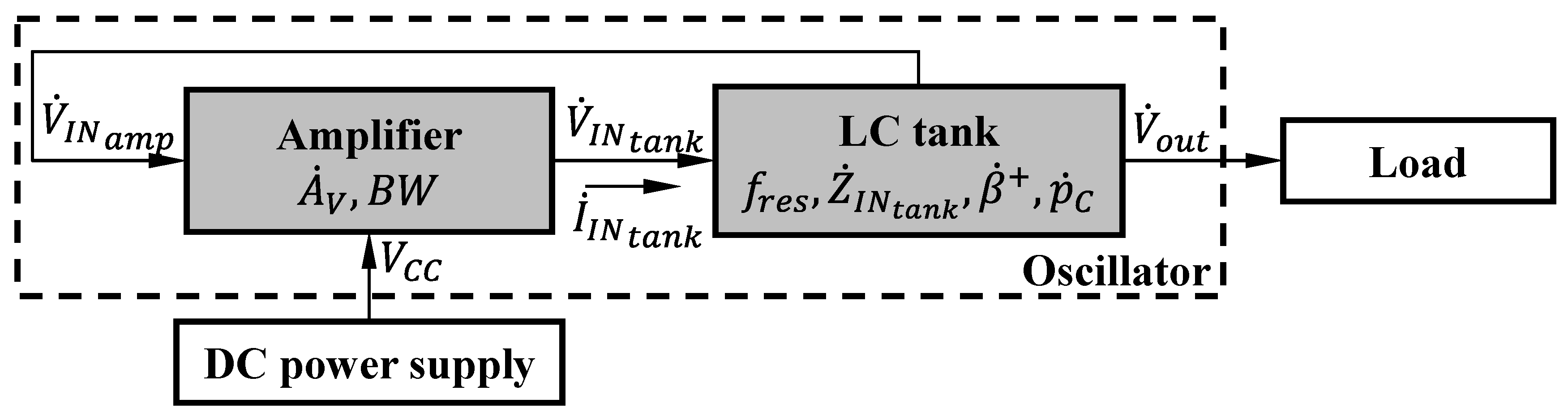
Each oscillator circuit consists of an amplifier stage and a frequency-selective circuit. In LC oscillators, an LC tank is used as a frequency-selective circuit.
Figure 1 presents a basic block diagram of LC oscillator.
The main parameters of the LC tank are as follows:
Resonant frequency: , where and are the equivalent inductance and capacitance of the LC tank;
Voltage transfer ratio at resonant frequency: , where is the amplifier input voltage (output voltage of LC tank) and is the input voltage of the LC tank (output voltage of amplifier);
Coupling coefficient of the external oscillator load to the resonant circuit at : , where is the oscillator output signal;
Input resistance at resonant frequency: , where is the LC tank input current (output current for amplifier);
Phase shift between the input and output signal of the LC tank at resonant frequency: typically, .
The main parameters of the amplifier are as follows:
Voltage gain (amplification) at resonant frequency: ;
Bandwidth: , where and are the high and low corner frequencies of the amplifier;
Phase shift between the input and output signal of the amplifier at resonant frequency: typically, .
When the oscillator is at steady state (output signal amplitude is constant), the output signal is
. It follows that
. Typically, the oscillator can be at steady state when working at resonant frequency. Therefore, the following is valid:
This is the so-called Barkhausen oscillation criterion [
2]. Only when this equation is satisfied does the oscillator output signal have a constant amplitude. If
, the amplitude continuously decreases and the oscillator stops oscillating. If
, the amplitude increases and the amplifier tends to work in nonlinear regions of its transfer characteristics. As a result, the output signal is highly distorted, exhibiting an almost trapezoidal shape and, in some cases, becoming nearly rectangular.
To ensure that the oscillator output signal remains sinusoidal (with minimal distortion) and keeps a constant amplitude, the amplifier gain must depend on the output amplitude. If the amplitude begins to decrease, the gain should increase; conversely, if the amplitude rises, the gain must decrease. When a single-transistor stage is used as the amplifier, the nonlinearity of its transfer characteristic can provide a weak amplitude stabilization. Better results can be achieved by adding a dedicated circuit that controls the amplifier gain as a function of the output signal amplitude.
Most often, common emitter/source single-transistor stages are used as amplifiers. The use of op-amps is limited in LC oscillators, due to the requirement for a wide bandwidth. Amplifiers with bipolar transistors are preferred over field-effect transistor amplifiers due to the higher transconductance of bipolar transistors and, consequently, their higher gain. This allows the usage of an LC tank with a lower voltage transfer ratio .
Depending on the value of , to achieve the desired amplitude of the output signal, the transistor can operate in class A or class C. At class A, the output signal amplitude is more stable, but the energy efficiency is impaired. In class C, the energy efficiency is high, but the speed of the amplifier stage deteriorates due to repeated switching of the transistor on and off. The latter can lead to instability of the output signal amplitude.
2.2. Basic Circuit of LC Oscillator
The main circuit configurations used to implement an LC tank in sinusoidal oscillators are the Meißner, Hartley, Colpitts, and Clapp topologies.
The Meißner and Hartley oscillators rely on inductive feedback and are more sensitive to variations in inductance and mutual coupling. The Clapp oscillator, a refinement of the Colpitts design with an additional series capacitor, offers even higher stability but at the cost of increased component count and more complex design procedure. The Colpitts oscillator, which uses a capacitive feedback divider, provides improved frequency stability and better repeatability due to the lower tolerances and temperature coefficients of capacitors compared to inductors.
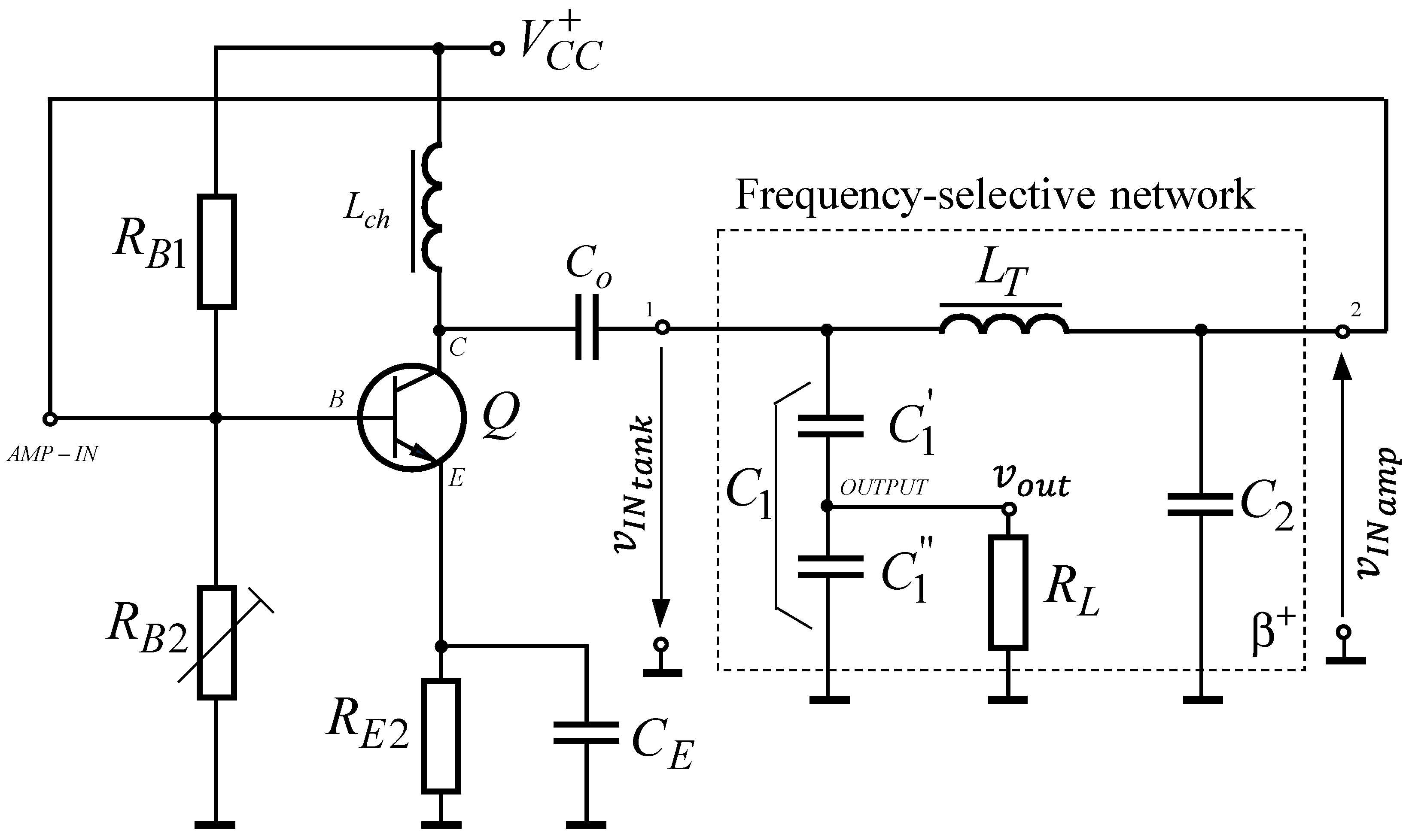
Figure 2 shows a circuit of a Colpitts oscillator with a common emitter BJT amplifier.
A simplified analysis of the circuit will be presented in order to derive expressions for circuit design.
2.2.1. Basic Analysis of the LC Tank
The resonant frequency of the LC tank can be obtained by the following expression:
The voltage transfer ratio (attenuation) at resonant frequency of the LC tank can be obtained by using Ohm’s law. By replacing it with the expression for the resonant frequency (2), the approximate expression is obtained
The coupling coefficient of the load to the resonant circuit at
is
The input resistance of the LC tank at resonant frequency can be obtained also using Ohm’s law and the consequent substitution of frequency with Equation (2):
where
is the Q factor of
.
When the specific capacitor values have not yet been selected, an approximate expression derived from the previous equation can be used. This approximation is obtained through exponential function fitting and multiple optimization steps. The resulting equation is
It is important to note that the resulting equation is only suitable for an initial approximate calculation of the . The average error at 0.3–0.5 and at is below 25%, but when , it can reach up to about 50%. This error is quite acceptable, given the high production tolerances of the parameters of the LC tank elements. For example, at , the production tolerance is typically ±30%.
For known capacitor values, it is desirable to use Equation (5) or simulation analysis results.
2.2.2. Basic Analysis of the Amplifier Stage
The main requirement for the amplifier stage is to fulfill the Barkhausen criterion (1) in the steady-state conditions. The amplifier-stage gain depends on the transistor transconductance
and the equivalent load impedance of the amplifier stage
:
The equivalent load resistance of the amplifier stage depends mainly on the input resistance of the LC tank circuit
, from the output resistance of the transistor
and from the impedance
of the inductor
:
The transconductance of the transistor
depends mainly on the DC operating point of the transistor (mainly from the emitter current of the transistor
) and can be found approximately from the following expression:
where
(
,
, and
is the device temperature in Kelvins).
The emitter current of the transistor can be controlled through the three resistors in the circuit:
From the Barkhausen criterion, it follows that the gain of the amplifier stage must be adjusted to exactly compensate the losses in the resonant circuit. According to Equation (9), the gain is controlled by the DC value of the emitter current. The input current of the resonant circuit—and therefore the emitter current—is inherently non-sinusoidal. The relationship between the amplitude of the emitter current and its DC component is nonlinear and depends on the transistor’s operating class.
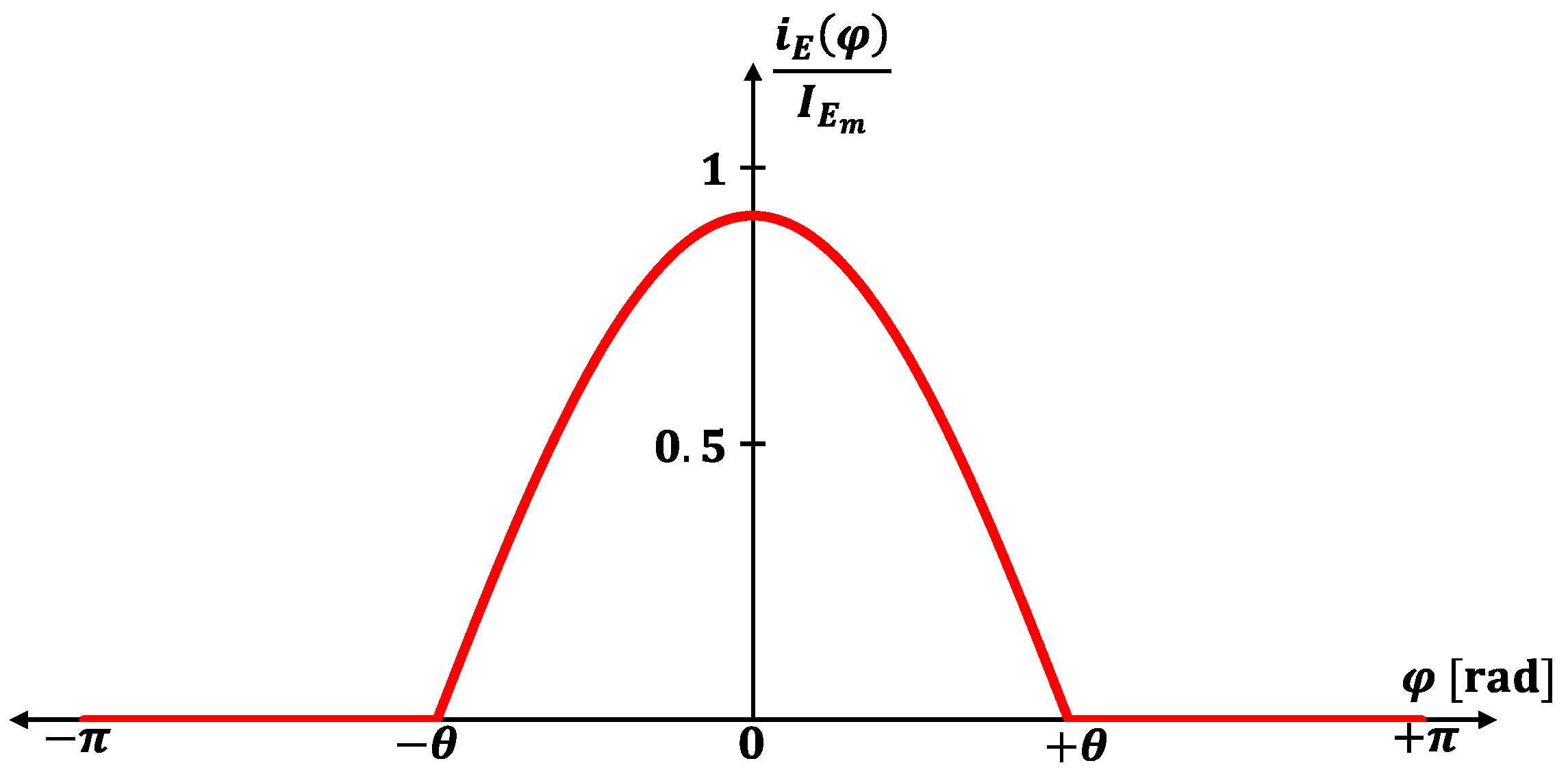
When the amplifier stage operates in class C, the emitter current—and consequently the collector current—exhibits a waveform similar to that of a sharp cosine pulse.
Figure 3 presents a graph of a cosine pulse with normalized amplitude
for phase range
. The parameter
is the amplitude value of the pulse. The pulse has non-zero values only in the phase range
. Outside of this range, the pulse wave has zero value. The angle
is called the cut-off angle or condition angle. The graph in
Figure 3 shows, as an example, the pulse at condition angle
85°.
The sharp cosine wave pulse is described by the following expression:
In the theory of LC generators based on bipolar transistors operating in class C, the following two parameters are commonly used:
where
is the DC offset value of the pulse, and
is the amplitude of the pulse’s fundamental (first) harmonic component.
The DC offset value of the pulse can be obtained by averaging the pulse values for one period of the pulse (
):
The amplitude of the fundamental (first) harmonic component
of the pulse can be obtained by using Fourier transform:
The expressions for
and
are obtained in their final form as follows:
The resulting equations are transcendental. Consequently, it is not possible to directly obtain an analytical expression for the angle . However, for given values of or , the angle can be readily determined by solving the equations numerically.
The value of the condition angle is most often chosen in the range from 60° to 180°. At a larger angle , the level of the higher harmonics of the emitter current is lower and a more stable frequency can be achieved. In cases where a large ratio has to be achieved, there are larger variations in the supply voltage, and when operation is planned in a larger temperature range, a smaller value for the angle is chosen. In this way, a larger “margin of self-oscillation” can be provided. A smaller angle is chosen for power oscillators with high energy efficiency.
Using the parameter
, the Barkhausen loop gain equation is defined as follows [
26]:
2.3. Oscillator Frequency Stability
The basic electrical parameters of oscillators determine the accuracy of operation of the designed measuring instruments and electro-medical devices, the stability of the frequency of oscillations in industrial generators, RF electronic systems, etc. Therefore, the main requirement for them is that the amplitude at a given load and their frequency be stable. However, during the operation of the oscillators, the frequency, and in some cases the amplitude, changes. The cause of the change in the frequency of oscillations is various destabilizing factors, such as ambient temperature, environmental pollution, atmospheric pressure, humidity, occurrence of mechanical vibrations, change in supply voltage, changes in load, etc. As a result of the complex influence of various factors, a short-term or temporary change in frequency occurs, while small changes in amplitude will not lead to significant changes in the accuracy of electronic devices in which oscillators are used. This section presents theoretical analyses and results that can be used as a basis for formulating recommendations for the design process, so that for a selected circuit configuration and selected components, the value of the relative frequency instability specified in the technical requirements is ensured.
It is noted that nonlinear LC oscillators, including Colpitts topologies, may exhibit complex dynamic behavior under inappropriate biasing or excessive loop gain conditions. The analytical formulation adopted in this work is intentionally restricted to the normal steady-state oscillatory regime, characterized by a single-frequency periodic solution and a well-defined conduction angle. Non-oscillatory and chaotic modes are excluded by design through appropriate loop gain margins, bias conditions, and AGC action, and are therefore outside the scope of the present model.
2.3.1. Frequency Stability Assessment
To assess the change in the oscillation frequency
, a coefficient of relative frequency instability is introduced:
where
is the difference between the measured frequency
and the frequency
, for which the electronic circuit is designed.
Considering the combined influence of the destabilizing factors, which are of a probabilistic nature, the total value of the coefficient of frequency instability of the oscillations was found [
5]
where
is the coefficient of frequency instability
from individual destabilizing factor
.
2.3.2. Frequency Stability Factor of Colpitts Oscillator
The destabilizing factors influence the oscillation frequency by altering the phase shift
of the feedback loop. Such a phase change arises from variations in circuit components due to, for example, temperature fluctuations, supply voltage variations, load parameter changes, or parasitic electrostatic and electromagnetic fields. In fact, the oscillation frequency
is solely determined by the phase response
of the feedback loop; oscillations in the closed loop occur for a frequency
at which the phase is equal to zero (or equivalently, 2π (or 360°)). If the phase function is “very steep” in the vicinity of the frequency of oscillation, the
will be a large value, and the resulting frequency change
will be of a relatively small value [
2]:
where
is the coefficient of the frequency stability factor (or slope of the phase function) of the oscillator.
For sinusoidal oscillators, the value of the frequency stability factor
is determined basically by the electrical parameters of the resonant circuit. To obtain the value of the
, we analyzed the resonant circuit diagram in the Colpitts oscillator. For this purpose, the resonant circuit was analyzed separately from the oscillator diagram, with the element
determining the equivalent resonant resistance, in which the input and output impedance of the transistor were included. By applying the nodal voltage method to the resonant circuit, the following expression for the transfer function is obtained:
Substituting
into the transfer function yields
For the phase function of the resonant circuit, we obtained
For frequencies close to the resonant frequency, i.e., at
, the so-called absolute detuning
is small, or
. Then, for the imaginary part of
, the following transformation can be performed:
where
or
where
.
Then, the frequency stability factor is found
3. Design Procedure of Colpitts Oscillator with Bipolar Transistor
In this section, a simplified design procedure for the basic LC oscillator circuit is presented, enabling designers to obtain a functional version of the circuit. The proposed procedure combines manual calculations with computer-aided simulations. In the analytical equations used during the design process, the phase delay of the transistor transconductance is neglected, and this parameter is treated as a real quantity. Consequently, the selection of active and passive components remains approximate. For many transistor models, exact parameter values are not provided in datasheets, and the designers have only static characteristics, often statistically averaged and potentially differing significantly from those of the particular device used to implement the oscillator. Therefore, during simulation and subsequent fine-tuning, the initially estimated parameters are refined further. The design process concludes with the fabrication of a prototype and experimental testing on a dedicated printed circuit board.
The description of the proposed design method aims to generalize several formulas applicable to different circuit configurations.
The main technical requirements on the basis of which oscillators are designed are: oscillation frequency (same as resonant frequency of the LC tank ), maximum value of the frequency instability , output voltage at a given external load resistance (or output power ), and temperature range in which they must operate. For greater clarity, the description of the design procedure is accompanied by a specific numerical example for the design of a Colpitts oscillator with the following parameters: (1) oscillation frequency 1.1 MHz ± 10%; (2) output voltage 2 V ± 0.2 V ( 4 V ± 0.4 V—peak-to-peak value of output voltage) on external load with a resistance of 500 Ω ± 10% and (3) the circuit is supplied by a stabilized power supply with voltage 9 V ± 1%, working in (4) ambient temperature range from −20 °C up to +50 °C. With respect to long-term stability, the requirements are as follows: (5) the amplitude variation must remain below over a five-year operating period, and (6) the number of failed devices over the same five-year period must be fewer than one per 1000 units.
The steps in the proposed methodology follow the sequence outlined below. Firstly, the LC tank is designed using a simplified procedure, and statistical analysis is performed to determine the variation limits of its key parameters, and , under the influence of multiple error sources. Based on these results, the amplifier stage is designed and evaluated through statistical simulations. Finally, optimization tasks are carried out.
3.1. Selection of the LC Tank Elements
The value for the inductance of inductor can be recommended according to the oscillation frequency range: (1) 100 μH for 100 kHz 1 MHz; (2) 10–100 μH for 1 MHz 10 MHz; (3) 10 μH for 10 MHz.
The values of the passive components in the serial–parallel equivalent circuit ( is the series resistance, is the parasitic capacitance, and is the value of inductance) are determined empirically or based on the datasheet. Moreover, for the selected inductor, the quality factor is determined based on the datasheet of the manufacturer.
For example, the NLCV32T-470K-EF choke from TDK Corporation (Tokyo, Japan) [
27] can be selected. Using the data provided in its datasheet, the following parameter values are obtained:
Based on the equation for the oscillation frequency, it is calculated as follows:
The coupling coefficient
is selected based on the power supply voltage and the amplitude of the output signal. The maximum peak-to-peak value of the transistor collector voltage (same as voltage on the inductor
) and at the load is
If it is assumed for emitter DC voltage
1.5 V and for transistor saturation voltage
0.3 V, the maximum collector voltage at which there is no saturation of the transistor is
For the coupling
coefficient is obtained
In this case, it can be selected .
The input impedance at
can be calculated approximately using Equation (6):
The parameter is primarily determined by the expected gain of the amplifier stage. At lower values of , a higher amplifier gain is necessary, and the transistor must operate at a larger conduction angle to achieve the desired output amplitude. Conversely, at higher values of , the required gain decreases and the amplifier can operate at a smaller angle . However, when becomes too small, the amplitude stability deteriorates to unacceptable levels. To enable the proper selection of , an approximate analysis of the expected amplifier gain will be carried out.
The following expression is obtained for the amplifier-stage gain:
where
is the transistor Early voltage, and
is the inductance of the radio frequency choke (RFC) in the collector circuit of the transistor. For discrete bipolar transistors, the Early voltage
is in the range of 10 V to 100 V [
28]. For the designed circuit, an intermediate value equal to 50 V was chosen. The RFC provides a high impedance at
but a low DC resistance and can be found according to the following condition:
. In the specific case, this condition is satisfied for inductance values above 1 mH. However, at values above 1 mH, the self-resonant frequency of the RFC approaches the oscillator operating frequency, which is unacceptable. Therefore, a value of 1 mH has been selected.
Table 1 presents the gain of the amplifier stage calculated by Equation (32) for several values of the emitter current
.
In this situation, the coefficient can be selected within the limits 0.002–0.02. Based on computer simulations performed on experimental electronic circuits, at values of the coefficient less than 0.005, the condition angle acquires values greater than 180°. As a result, the transistor enters the class A amplification mode, in which the energy efficiency decreases. The larger value of the is associated with a smaller level of the higher harmonics of the collector current. When approaching the upper limit (), the condition angle has smaller values, which provides a large margin of self-oscillation, but with a higher level of higher harmonics. As a result, even self-modulation on the output signal waveform can occur. For the designed oscillator, an approximately intermediate value equal to 0.01 was chosen.
The capacitor values of the LC tank are calculated as follows [
11]:
When selecting typical values of the capacitor parameters, a catalog from Samsung Electro-mechanics company (Suwon, Republic of Korea) was used [
29]. For capacitors
and
, ceramic capacitors with C0G-type ceramic with tolerance ±5% are selected. For capacitor
, a ceramic capacitor with X7R-type ceramic was chosen with a capacitance tolerance of ±5% and tolerance due to the influence of temperature of ±15% (both tolerances have an integral effect and the total tolerance is ±20%).
With the selected capacitor values, the new values for the LC tank parameters will be
3.2. Statistical Analysis of the LC Tank
Once the LC resonant circuit has been initially sized, the next step is to investigate the influence of various error sources on its parameters. In this case, the primary source of error arises from the parameter tolerances of the circuit components.
In the open-source software product QUCS-S (version 25.2.0) [
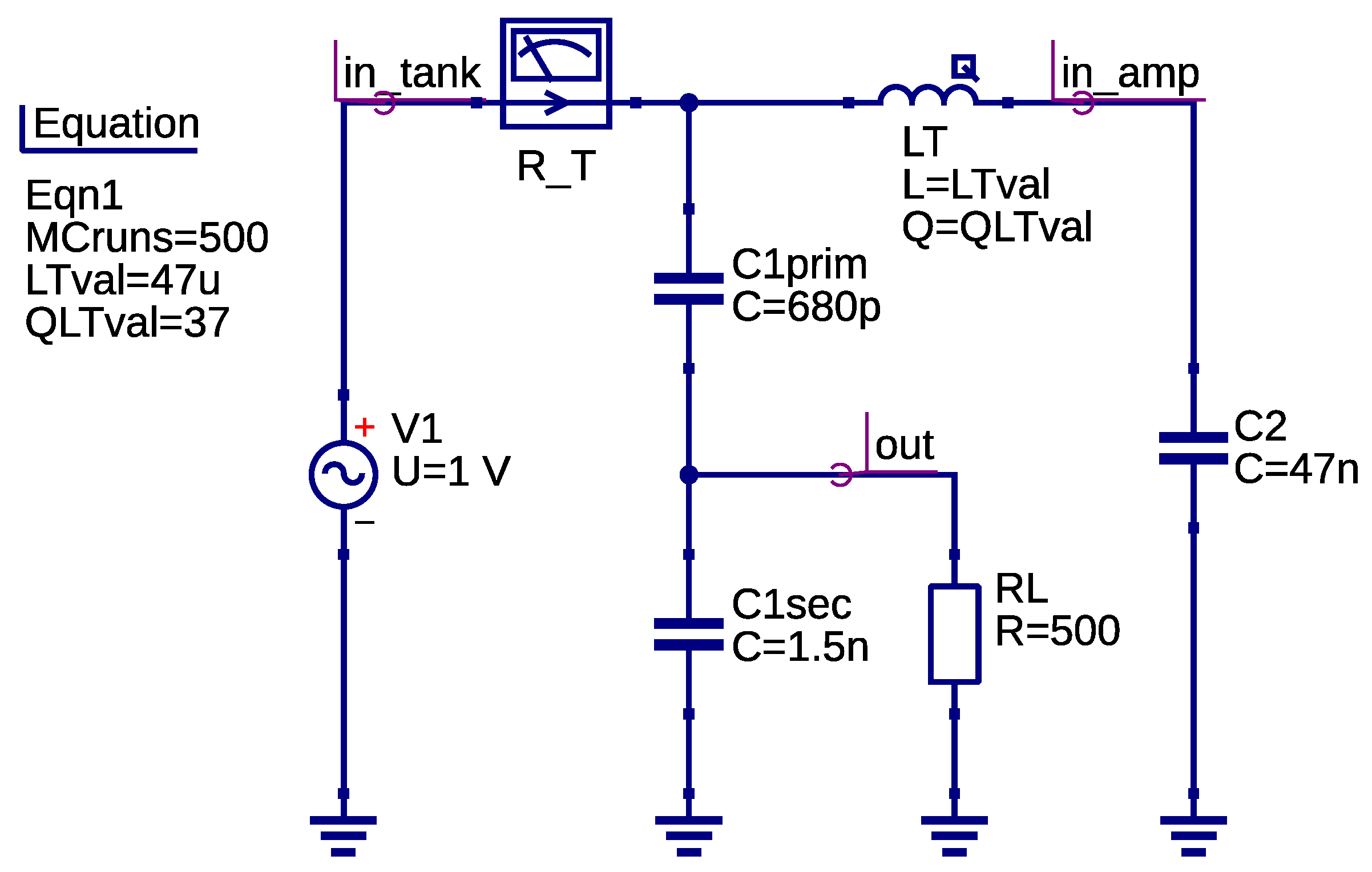
30], a SPICE model of the LC tank circuit has been developed.
Figure 4 shows the developed simulation model of the LC tank in the QUCS-S. In the “Equation” block, values have been entered for some of the parameters.
The statistical simulation analysis of the circuit is performed using the Monte Carlo analysis type. Since Monte Carlo simulation is not yet implemented as a standard feature in QUCS-S, it is necessary to create a SPICE script to control the simulation process. More detailed information on the implementation of this type of simulation in QUCS-S is given in [
31]. The complete SPICE simulation script is provided in the
Supplementary Materials (File S1).
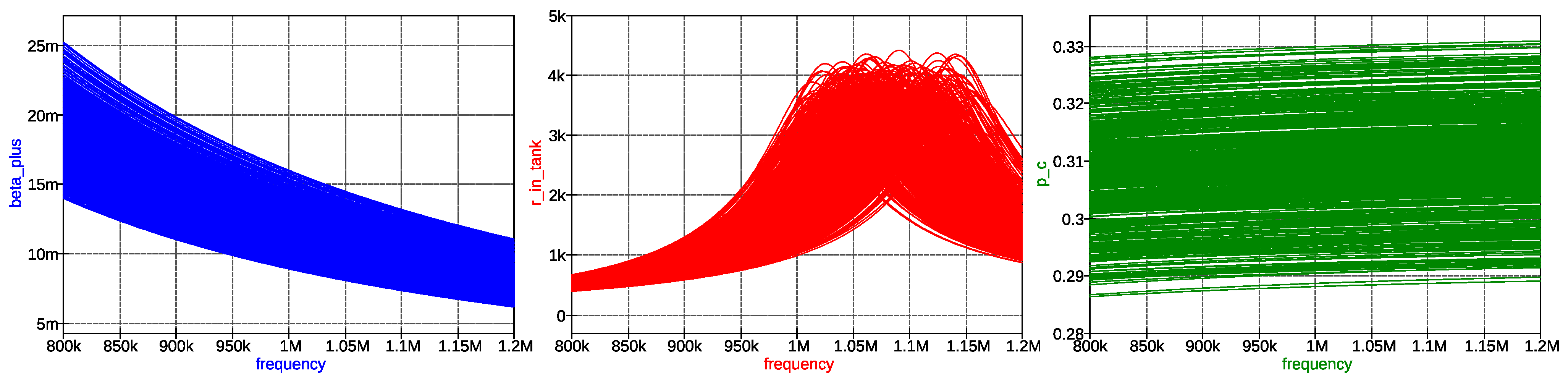
The main simulation analysis is an AC sweep over the frequency range from 900 kHz to 1200 kHz. This analysis is repeated multiple times for different combinations of component parameter values (500 iterations in this case). A graphical representation of the results in the QUCS-S environment is shown in
Figure 5.
From the graphs, it can be seen that the parameters of the LC tank circuit can be within wide limits due to the component tolerances. From these results, the values for
and
are obtained. The resonant frequency is determined by the maximum value of the input resistance of the circuit. When a signal with a frequency equal to the resonant frequency is applied to the input of such a type of LC tank, its input resistance has a maximum value. Post-processing of the simulation data is performed, and the results are summarized in
Table 2.
The results show that the requirement for the output frequency ( 1.1 MHz ± 10%) is satisfied with the selected LC tank components. The frequency of the output signal practically depends only on the LC tank parameters. Therefore, the results of this analysis are sufficient to confirm the fulfilment of the criteria set with regard to the frequency of oscillations.
3.3. Selection of the Amplifier-Stage Elements
The selected transistor must be able to operate at the oscillator frequency. However, it is more stable if the transistor’s transition frequency is significantly higher than the oscillator frequency . The selected transistor should have relatively good linearity at a small signal and therefore have low distortion and low noise. For example, a low-power bipolar NPN transistor type BC847C as an active element was selected. Some of the more important parameters are: 45 V, 100 mA, and 280 mW; the transition frequency at 10 mA is with a typical value of 100 MHz and at 200 μA, the noise figure is below 10 dB. The current gain is 420–800.
The first step in determining the transistor’s DC operating point is the selection of the emitter current. The emitter current value determines both the gain and the conduction angle of the amplifier stage. Based on the results presented in
Table 3, it follows that the gain required to satisfy the Barkhausen criterion lies within the following range:
It follows that when the circuit is used in this form, individual adjustment of the emitter current will be required. The emitter current setting also determines the amplitude of the output signal. Using the approximate expression (32) for the amplification stage, the emitter current is obtained as follows:
In this circuit, the emitter current—and consequently the collector current—is controlled by the resistor .
Previously, the voltage at the transistor’s emitter was chosen to be
A potentiometer must be selected for the emitter resistor that satisfies the following condition:
A multi-turn trimmer potentiometer with a standard value of 5 kΩ is selected.
The resistors forming the base voltage divider shall be sized as follows:
The following resistor values are selected: 6.8 kΩ and 22 kΩ.
The RFC
provides a high impedance at
but a low DC resistance. Previously, a value of 1 mH was selected. The selected choke model is TDK NLFV32T-102K-EF from TDK Corporation (Tokyo, Japan) [
32]. According to the manufacturer’s data given, the Q-factor is approximately 50 at the oscillator operating frequency.
3.4. Statistical Analysis of the Whole Circuit
The purpose of this simulation analysis is to determine whether the circuit meets the specified requirements after adjusting the amplitude of the output signal by setting the transistor’s emitter current. In this case, the influence of component manufacturing tolerances is not simulated, since these variations are compensated through individual adjustment of the circuit. The analysis examines the effects of temperature and supply voltage fluctuations.
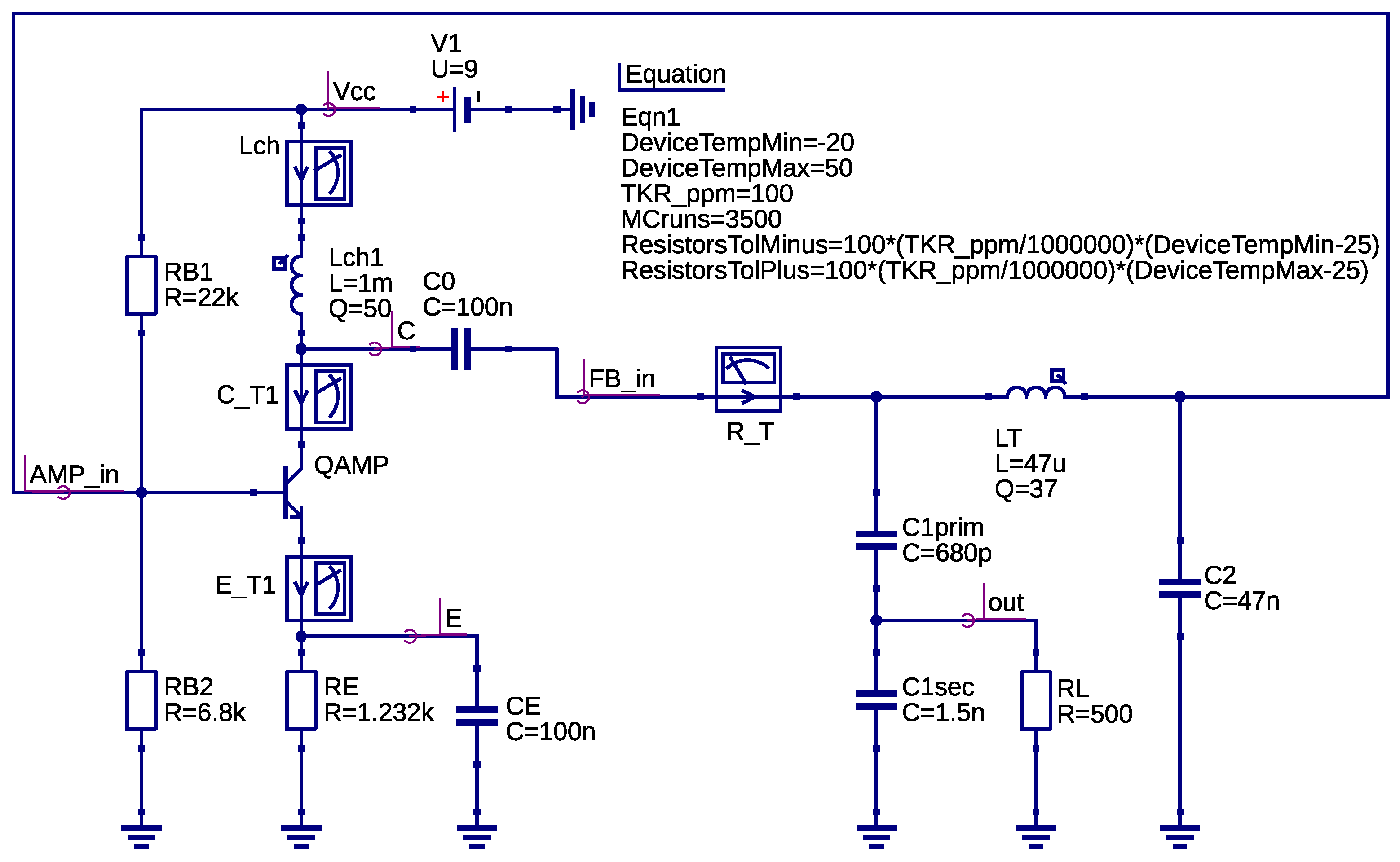
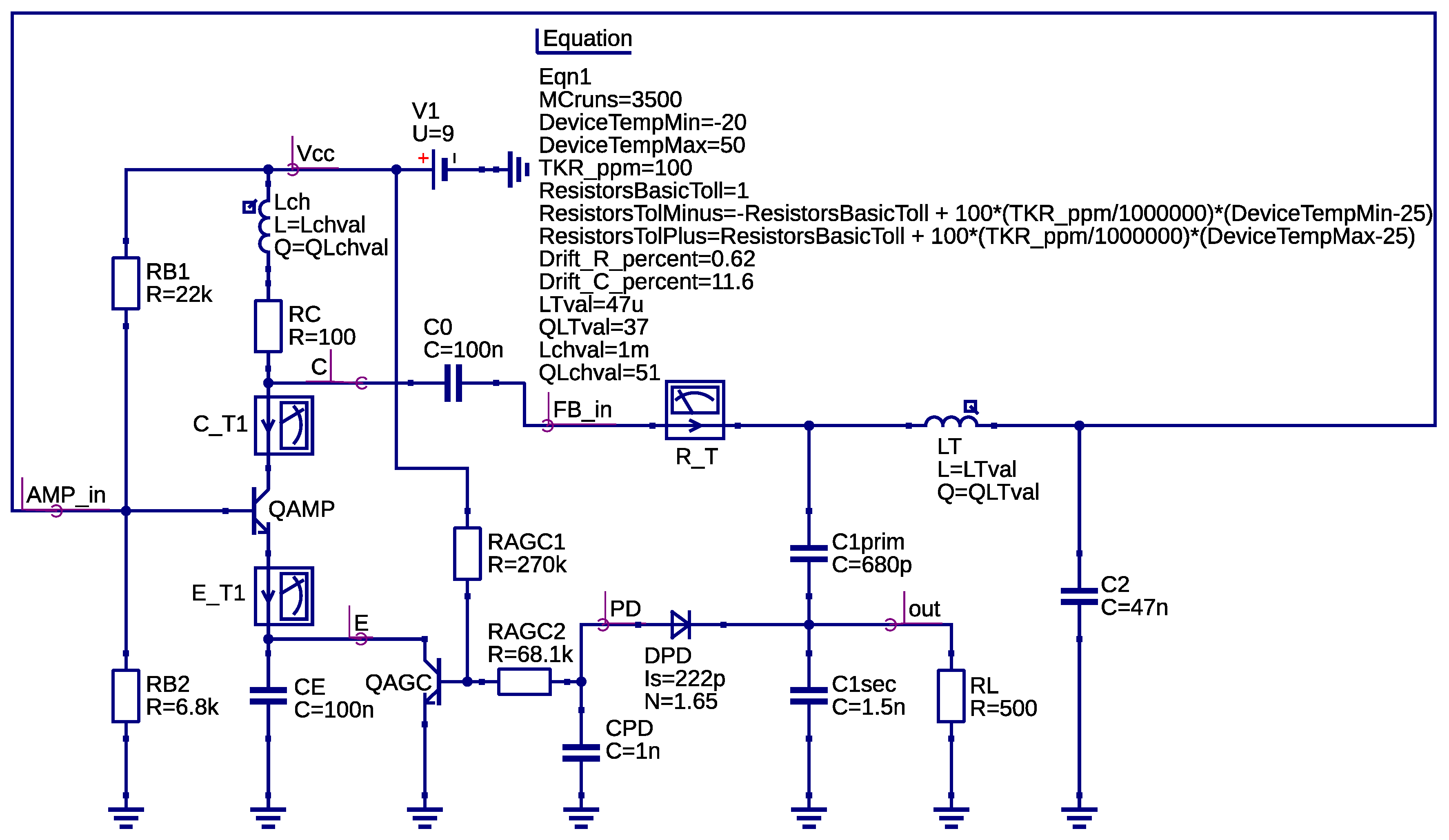
Figure 6 shows the developed simulation model in the QUCS-S environment.
The individual fine-tuning is simulated by adjusting the resistor , so that the peak-to-peak value of the output signal is 4 V.
The statistical simulation analysis of the circuit is performed using “Monte Carlo” simulation analysis type. The complete SPICE simulation script is provided in the
Supplementary Materials (File S2).
In this case, the following is studied: (1) the influence of temperature on the values of resistors and transistor parameters; (2) the influence of the supply voltage and (3) the influence of the load. The effect of temperature on the resistors, transistor and capacitors is studied. In the case of the other elements, the influence of temperature is ignored because it is insignificant.
Much of the post-processing of results is done through QUCS-S. Unlike the LC circle study, transient analysis is used here. Due to problems encountered in obtaining simulation results related to the features of the QUCS-S and NGSPICE environment, a different approach was used to record the results—through the echo function instead of write.
The results from simulation data post-processing are presented in
Table 3.
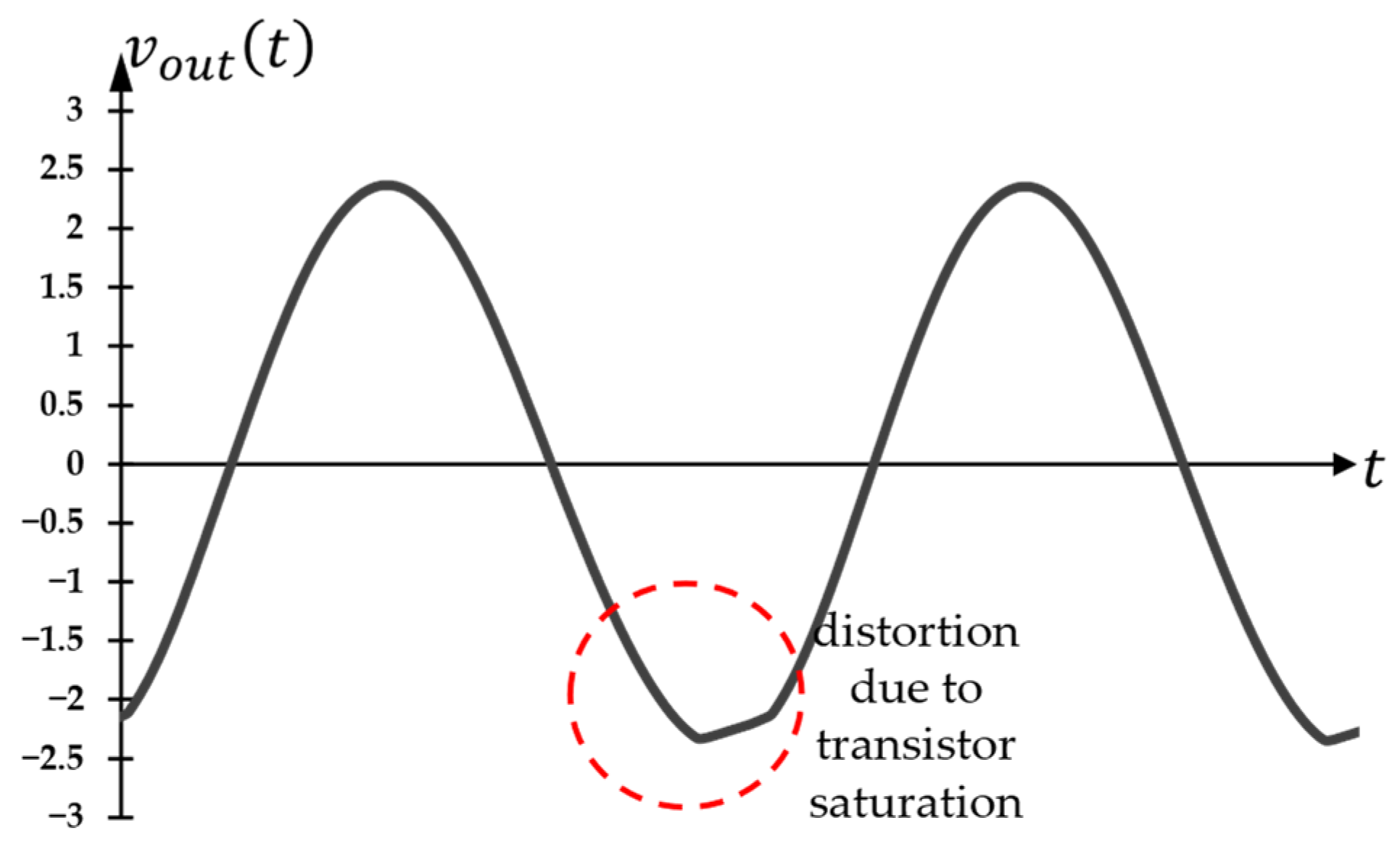
A serious issue is that, over a wide temperature range, the output signal becomes distorted. According to Equation (29), at
, the amplifier-stage transistor enters saturation mode, resulting in severe distortion of the output signal.
Figure 7 shows the time diagram of the output signal when transistor saturation is present. The total harmonic distortion (THD) in this case is 3.18% (calculated by Fourier-type simulation in QUCS-S). From the results obtained, it is evident that the requirement for the amplitude of the output signal (
4 V ± 0.4 V) is not met in this circuit configuration. In this case, the peak-to-peak value of the output voltage varies in a range from 2.83 V up to 4.71 V only due to the influence of temperature, supply voltage and load variations.
4. Amplitude Stabilization of the Colpitts Oscillator
From the previous analysis, it follows that in order to meet the specified technical requirements, the basic Colpitts oscillator circuit must be modified in the direction of stabilizing the amplitude of the output signal. For the sake of universality, an additional amplitude stabilization block will be developed, which will also be applicable to other circuit solutions.
4.1. Theoretical Analysis of the LC Oscillator When Adding an Amplitude Stabilization Block
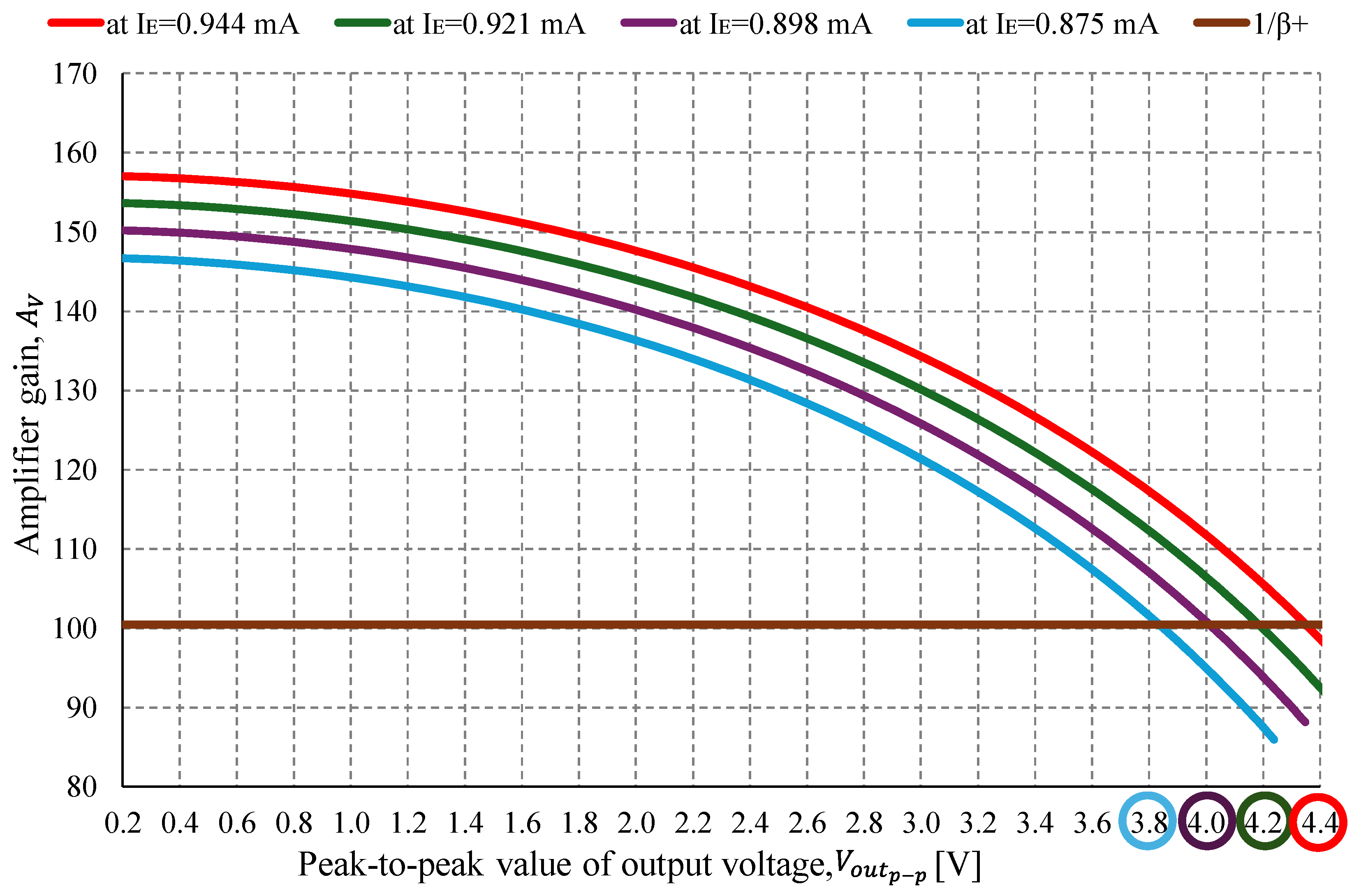
From the theoretical analyses presented earlier, it is evident that the amplitude of the output signal is determined by the gain of the amplifier stage. However, an additional relationship must also be considered: the gain of the stage decreases as the output signal amplitude increases. To illustrate this dependency,
Figure 8 shows the relationship between the gain of the amplifier stage described in
Section 3 and the amplitude of the output signal.
The relationship between the gain and amplitude is represented for four close values of the emitter current. The Barkhausen criterion is satisfied only at the intersection of the – curve and the curve, where the output amplitude reaches a stable value. It is evident that the output amplitude can be controlled by adjusting the transistor emitter current.
The task of the amplitude stabilization block is to continuously regulate the emitter current of the transistor (and, consequently, the gain of the amplifier stage) so that the output signal amplitude is automatically maintained at the desired level.
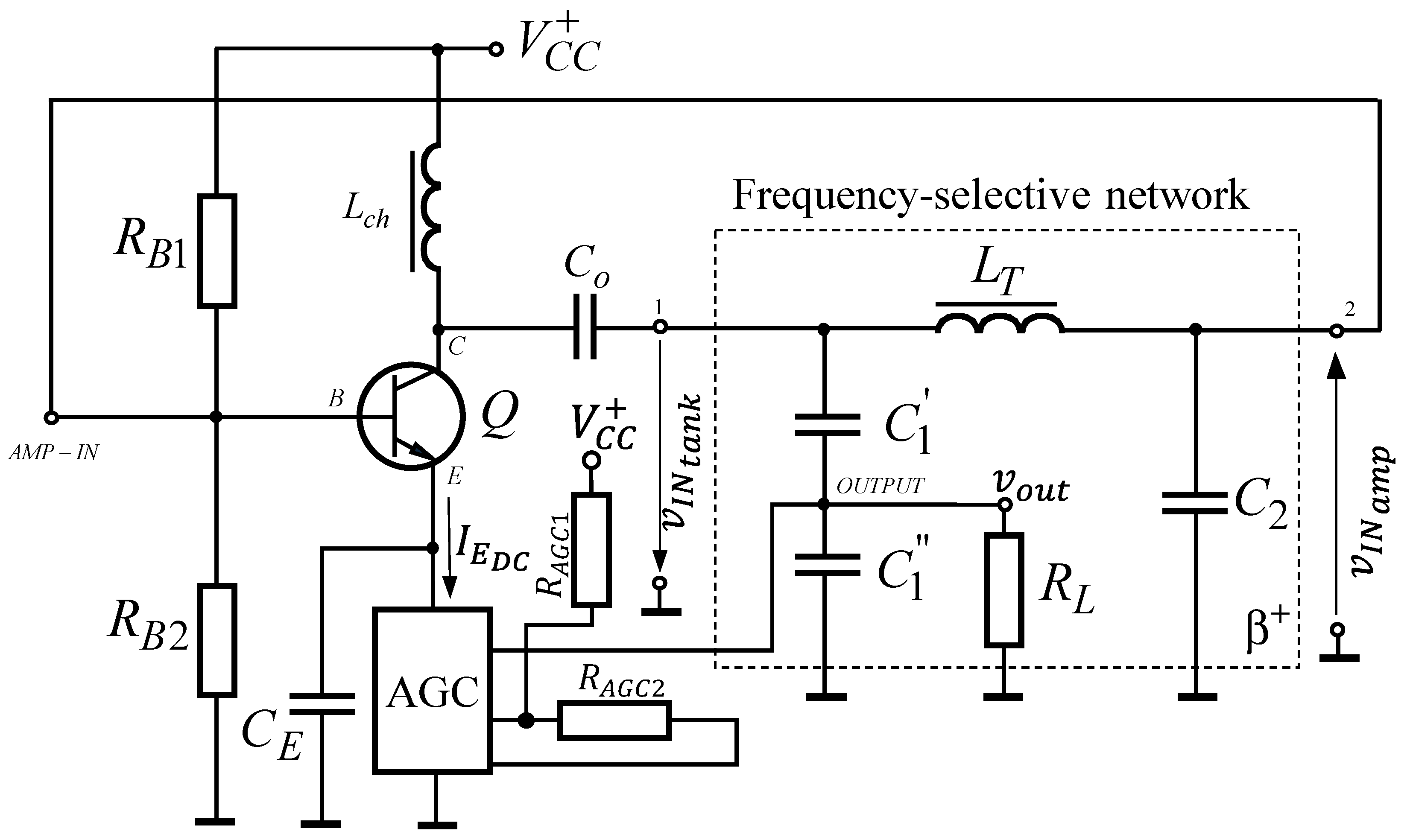
Figure 9 shows the circuit with an added automatic gain control (AGC) block for amplitude stabilization. The output amplitude can be adjusted by changing the ratio between resistors
and
.
The oscillator output signal is applied to the input of the AGC block. The emitter circuit of the amplifier stage is connected to the output of the AGC block.
At steady state condition of the circuit, the following condition is satisfied:
where
is the output voltage amplitude and
is the coefficient of the AGC block.
Ideally, the AGC should maintain a constant output signal amplitude regardless of variations in the LC tank parameters, the transistor parameters, the base offset voltage, and the load, within certain limits. The AGC block introduces a global negative feedback loop into the circuit.
Phase noise is a critical performance metric for LC oscillators and is known to be influenced by both the resonator quality factor and active device noise. Amplitude control mechanisms may additionally affect phase noise if they introduce rapid gain modulation or strong waveform distortion. In the proposed design, the AGC operates in a slow, quasi-static regime and directly regulates the transistor transconductance rather than employing hard limiting or fast envelope control.
As a result, the AGC primarily affects the long-term amplitude stability and has limited impact on short-term phase fluctuations governed by the resonant tank and active device noise. While the proposed approach is not optimized for minimum phase noise, it is expected to exhibit phase noise behavior comparable to that of a classical Colpitts oscillator operating at similar bias conditions. A detailed phase noise optimization and measurement are outside the scope of the present work and may be addressed in future studies.
4.2. Development of AGC Block
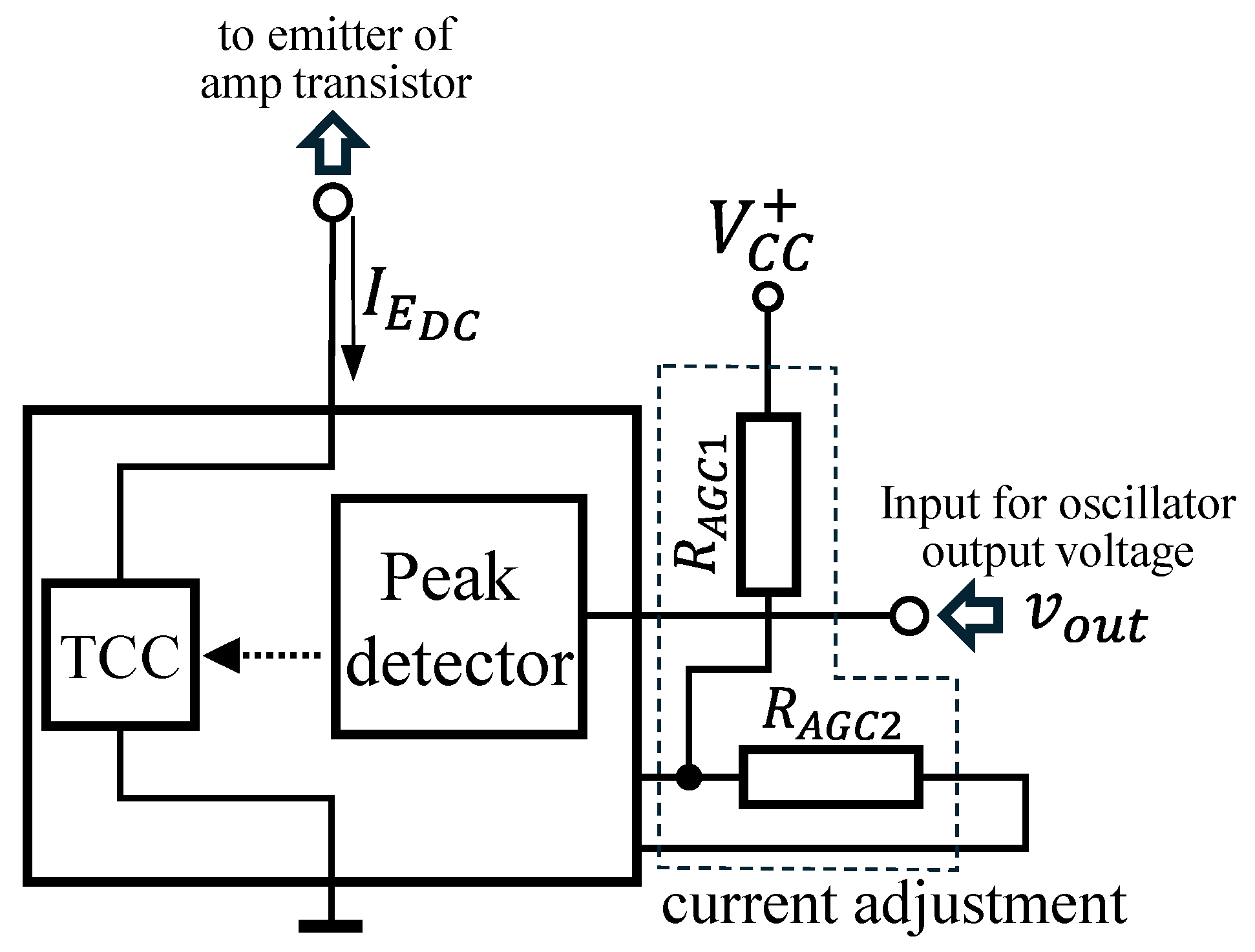
In general, AGC circuits consist of a current control element (e.g., transistor) and a peak detector.
Figure 10 shows the block diagram of the AGC block.
The AGC block includes the following modules:
Transistor current control (TCC) module—it controls the DC emitter current of the amplifier transistor;
Peak detector—it measures the amplitude value of the oscillator output voltage and controls the output current of the TCC module.
For the implementation of the TCC module, either a bipolar or a field-effect transistor can be used, as well as a more complex circuit incorporating several transistors. When a field-effect transistor is used, the relationship between the constant output current (the drain current
) and the control voltage
(at saturation region) is given by the following expression:
where
is the transistor transconductance parameter,
is the gate threshold voltage of the transistor and
is the drain current at
0 V.
The parameters of discrete field-effect transistors exhibit substantial manufacturing variation. For example, in the case of the BS170 transistor, the gate threshold voltage
can be between 0.8 V and 3 V [
33]. Discrete JFETs show similar wide tolerances. For example, for transistor BF245, the gate off voltage
spans −0.5 V to −8 V. For MMBFJ201—between −0.3 V and −1.5 V. A field-effect transistor routinely shows threshold voltage variations of a factor of two to three within a single device family.
As can be seen from Equation (41), the value of the drain current is directly dependent on the threshold voltage. It follows from this that the use of field-effect transistors in the implementation of the TCC block is impractical without introducing local negative feedback loops and adding an additional amplifier stage in the peak detector block.
In a bipolar transistor, the relationship between the emitter current
and the base emitter voltage
is approximately described by the Ebers–Moll equation:
where
is the saturation current of the transistor and
is the emission coefficient of the transistor.
For discrete BJTs, the base emitter voltage is in the range of approximately 0.6–0.9 V—for example, 0.65–0.85 V for the 2N3904 and 0.58–0.72 V for the BC547 at milliampere-level currents [
34], and is much tighter than the several-volt device-to-device spread typical of MOSFET threshold voltages.
Based on this, it is chosen to use a bipolar transistor in the implementation of the TCC module.
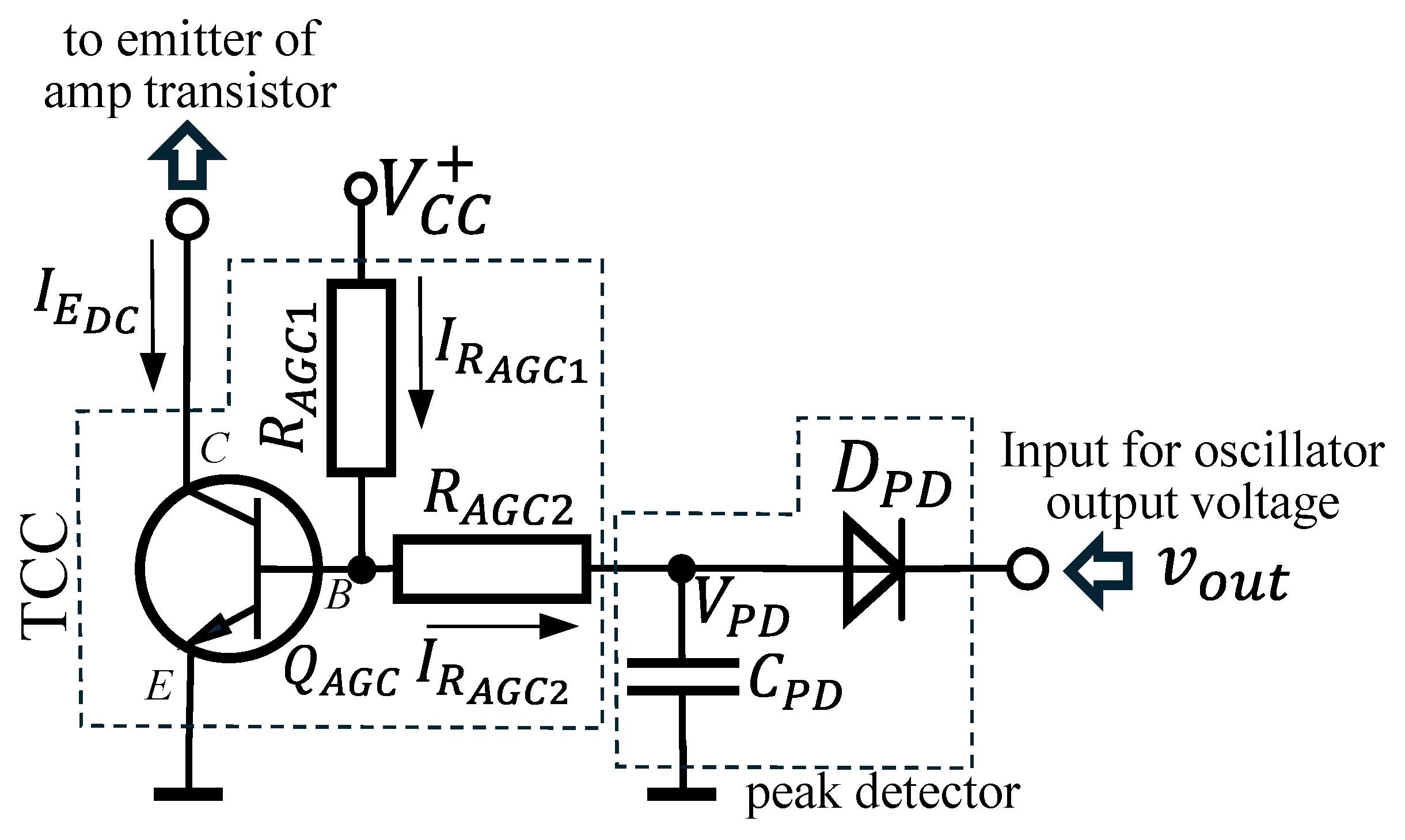
The circuit diagram of the developed AGC block is presented in
Figure 11.
The working principle is the following. When the circuit reaches steady-state operation, the voltage at the output of the peak detector is approximately:
The peak detector output voltage is negative in respect to ground. For the base emitter voltage of transistor , a value of 0.6 V can be used.
The base current
of the transistor
can be calculated by the following expression:
The collector current
of the transistor
is approximately equal to the collector current
of the amplifier-stage transistor
. This leads to the following expression:
Assuming that
0.6 V, the amplitude of the output signal is obtained as follows:
From the obtained expression, it is evident that the amplitude of the output signal depends primarily on the resistors and .
The stabilization of the output signal amplitude is achieved as follows. When the amplitude of the oscillator’s output signal increases, the voltage also increases (with negative polarity with respect to ground). This leads to an increase in the current , and consequently the base current of transistor decreases. As a result, the emitter current of the amplifier-stage transistor is reduced, which decreases the gain of the amplifier stage. The reduced gain lowers the output signal amplitude, thereby restoring it to the desired level and achieving amplitude stabilization.
Similarly, if the amplitude of the oscillator’s output signal decreases, the current
decreases as well, which increases the emitter current of the amplifier-stage transistor
and thus increases the gain of the amplifier stage. This compensates for the reduction in amplitude. If the output signal amplitude is close to 0 V (for example, immediately after the power supply is switched on), the voltage
+0.6 V, the current
0, and the collector current of the amplifier-stage transistor reach their maximum value:
While LC oscillators are commonly employed over a very wide frequency range, extending into the gigahertz region in integrated implementations, the proposed design methodology is not inherently limited to a specific frequency band. In this work, experimental validation is deliberately performed at lower frequencies, where parasitic effects of PCB interconnects are negligible and do not obscure the underlying amplitude control mechanisms. Extension of the methodology to higher frequencies would require technology-specific layout considerations and is outside the scope of the present experimental study.
4.3. Design of the AGC Block
The design of the AGC block will be presented for the specific example. The range in which the emitter current is expected to lie for the given LC tank parameters is
860 μA–1380 μA. Based on simulation optimization analyses, it was found that in this particular case, it is desirable the max emitter current of amplifier transistor
be about 10 times larger than
. At higher values of
, an unacceptable DC offset begins to appear at the oscillator’s output. The value of
is obtained by solving Equation (46) for this resistor:
A value of 270 kΩ was selected for .
The necessary value of resistor
is derived analogously:
A value of 68.1 kΩ was selected for .
5. Tolerance and Reliability Simulation Analysis of Colpitts Oscillator with AGC Block
5.1. Simulation Model Development
The purpose of the tolerance and reliability simulation analysis is to determine whether the circuit meets the specified requirements without the need for readjustment. The influence of component parameter tolerances, temperature, supply voltage variations, and load changes is examined. Two types of analyses are performed. The first is a tolerance analysis, which determines whether the circuit satisfies the specified requirements immediately after production. The second type is a reliability-oriented tolerance analysis, which evaluates the probability that the circuit will continue to meet the requirements after a defined period of operation.
5.2. Results from Tolerance Simulation Analysis
The data from the tolerance simulation data are processed and the results are presented in
Table 4.
From the results obtained, it is clear that the requirement for the amplitude of the output signal (
4 V ± 0.4 V) is successfully achieved in this circuit configuration without the need for additional adjustment. The range of the output voltage is within the range from 3.64 V up to 4.20 V. An absolute deviation is
.
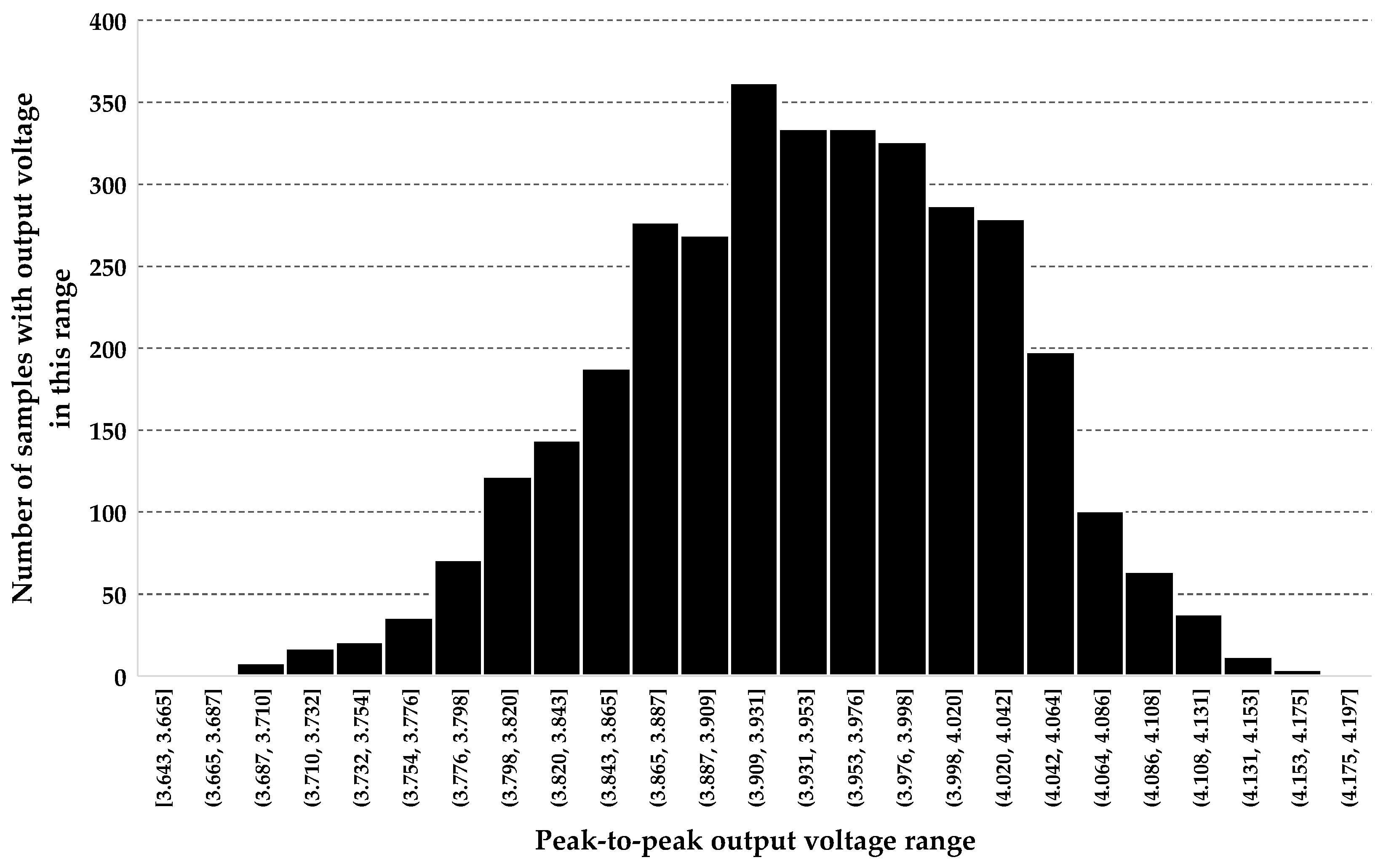
Figure 13 presents a histogram showing the distribution of the obtained values for the output voltage in sub-intervals. In total, 25 sub-intervals have been selected.
The histogram is shown solely to visualize clustering and spread under worst-case uniform sampling, not to infer a probability density function. In Monte Carlo analysis, a uniform distribution is chosen for all variations in values within tolerance limits, since the ultimate goal is to obtain the furthest possible values from the target value, regardless of the probability of these worst-case scenarios occurring; that is, the analysis performed resembles a corner analysis. A true corner analysis is not possible to perform in this case due to the significant number of variable parameters—26 parameters. The statistical analysis confirms that the oscillator’s output voltage remains tightly clustered around its nominal value despite the intentionally broad uniform distributions applied to all component tolerances, temperature, supply variations, transistor parameters and load. Even under these deliberately harsh conditions, the resulting spread of the peak-to-peak output voltage is narrow, with a mean of 3.944 V and a standard deviation of 0.0838 V. These results demonstrate that, even under uniform worst-case tolerance modeling, the circuit exhibits excellent manufacturing robustness and strong amplitude stability.
Monte Carlo analysis provides a model-based and assumption-dependent estimate of robustness and rare-event behavior, and therefore cannot fully substitute long-term field reliability data. The obtained results are intended as conservative bounds under explicitly modeled variations and aging mechanisms.
5.3. Results from Reliability Simulation Statistical Analysis
The simulation reliability study is performed again using the same script (
File S3). A tolerance due to a long-term change has been added to the tolerances of the elements’ parameters. For each Monte Carlo iteration, the amplitude before aging (the data used in
Section 5.2) is first calculated, and then the amplitude for the aging effect for the specific Monte Carlo iteration is calculated.
Long-term reliability and aging effects are addressed through statistical modeling rather than direct experimental observation. Experimental measurements are performed on a limited number of physical prototypes to validate correct functional operation and amplitude stabilization under varying conditions. Estimation of rare-event failure probabilities, such as the reported upper bound of one failure per 1000 units, is therefore based on Monte Carlo simulation and confidence-bound analysis, which reflects the expected population-level behavior rather than the outcome of large-scale experimental testing.
For the resistors used, the change in resistance can be described by the following expression [
35]:
where
is the operating time for which the calculation is performed;
is the duration of the reliability test (taken from the component’s documentation);
is the irreversible drift obtained after the reliability test (taken from the component’s documentation);
is a parameter indicating that, for the same elapsed time, the irreversible drift doubles for each specified change in the resistive-layer temperature (for thin-film resistors, it is typically 30 K);
is the resistive-layer temperature used in the calculation; and
is the resistive-layer temperature at which the reliability test was conducted.
When calculating the drift, the power dissipated by the resistors can be ignored, since in all cases it is negligible (in all cases, it is below 2 mW). The drift for 5 years for the selected type of resistors will be
In the case of capacitors, only the drift of the capacitors with X7R-type ceramics is included in the calculation. In those with C0G ceramics, the long-term drift is negligible. X7R capacitors exhibit logarithmic aging of approximately
2.5% per decade-hour after the last temperature reset above the Curie temperature, as documented in [
36,
37,
38]. Using the standard vendor aging convention for Class-II MLCCs (log-time decay,
k% per decade-hour), the capacitance after
t hours may be written as
, where
is the capacitance at the referee time (≈1 h after last heat) [
36,
37,
38].
Over a period of 5 years, the relative change in capacitance is the following:
For resistors, the drift is positive, and for capacitors—negative.
It should be emphasized that Equations (51) and (52) quantify the long-term drift of individual passive components under worst-case assumptions. The resulting variation in the oscillator output amplitude is substantially lower, since the AGC loop dynamically compensates these parameter drifts. Therefore, the subsequent values reported represent the closed-loop system response rather than the raw component aging effects.
A total of 3497 paired Monte Carlo simulations (new vs. five-year aged) were analyzed after removing three runs that exhibited simulation artifacts in the emitter current amplitude.
For each Monte Carlo iteration, the relative drift resulting from component aging was calculated based on the output signal value at the time of production,
, and its value after an operating period
, using the following expression:
A unit is classified as a failure if either:
(exceeds drift limit), or
lies outside the limits of .
Across all 3497 MC samples, the following key statistics were obtained:
Minimum peak value of output voltage after 5 years: 3.677 V;
Maximum peak value of output voltage after 5 years: 4.251 V;
Minimum drift for 5 years: 0.19%;
Maximum drift for 5 years: 1.542%;
Mean drift for 5 years: 0.463%;
Standard deviation: 0.138%;
95th percentile of drift: 0.719%;
99th percentile of drift: 0.835%;
Clopper–Pearson 95% one-sided upper bound: 0.0856% (i.e., <0.856 defect samples per 1000 samples).
Basic statistical parameters (mean, standard deviation, empirical percentiles) were computed using standard sample-based definitions [
39,
40]. The reliability bound was obtained from the one-sided 95% Clopper–Pearson upper confidence limit for a binomial proportion [
41], consistent with the NIST guidance [
42]. The last is calculated using the inverse cumulative distribution function of the Beta distribution
as follows:
where
is the confidence complement (
0.05 at confidence level 95%),
is the number of defect samples and
is the number of samples.
The 99th percentile of the absolute five-year amplitude drift is , i.e., of devices remain below 1% drift—comfortably inside the <2% stability specification. In the same runs, no aged sample fell outside the limits (4 V ± 0.4 V), so the combined failure criterion (drift ≥ 2% or out of limits”) produced 0/3497 failures. Using the one-sided 95% Clopper–Pearson bound, the failure probability is 0.0856%, i.e., less than one failure per 1000 devices at 95% confidence, thereby meeting the reliability requirement with a comfortable margin.
6. Simulation and Experimental Study of AGC Block Operation
The results presented in
Section 5 showed that the circuit of a Colpitts generator with AGC showed a high insensitivity of the amplitude of the output signal from changes in the parameters of the LC circuit and the amplifier, and this was done without any individual adjustment of the circuit. In this section, the influence of the parameters of the LC circuit, the load and the amplifier stage on the output amplitude will be investigated when applying the methodology for sizing the circuit with AGC discussed in
Section 4. The results of a simulation and experimental study will be presented through a specially developed prototype.
6.1. Developed Experimental Prototype of Colpitts Oscillator with AGC Block
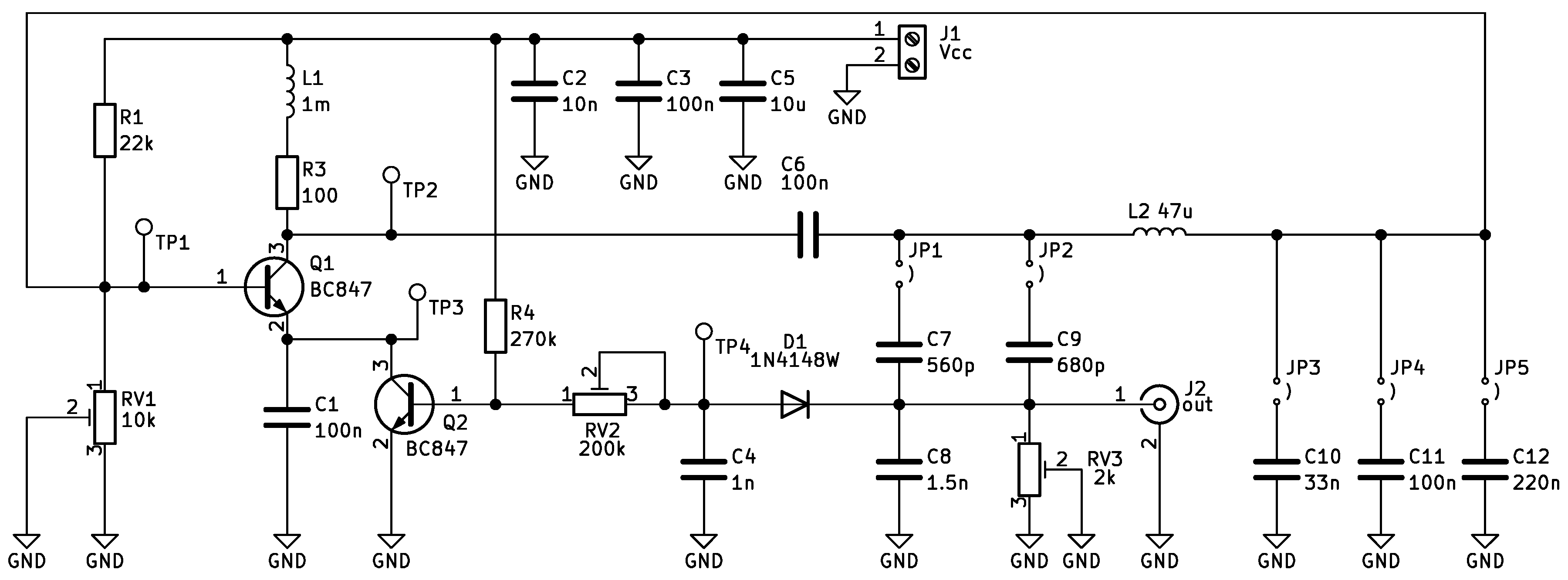
An experimental prototype of a Colpitts oscillator with AGC was developed, implemented according to the circuit shown in
Figure 9. It is possible to change the main parameters of the LC tank, the load and the amplifier stage within a wide range. The circuit diagram of the developed prototype is presented in
Figure 14.
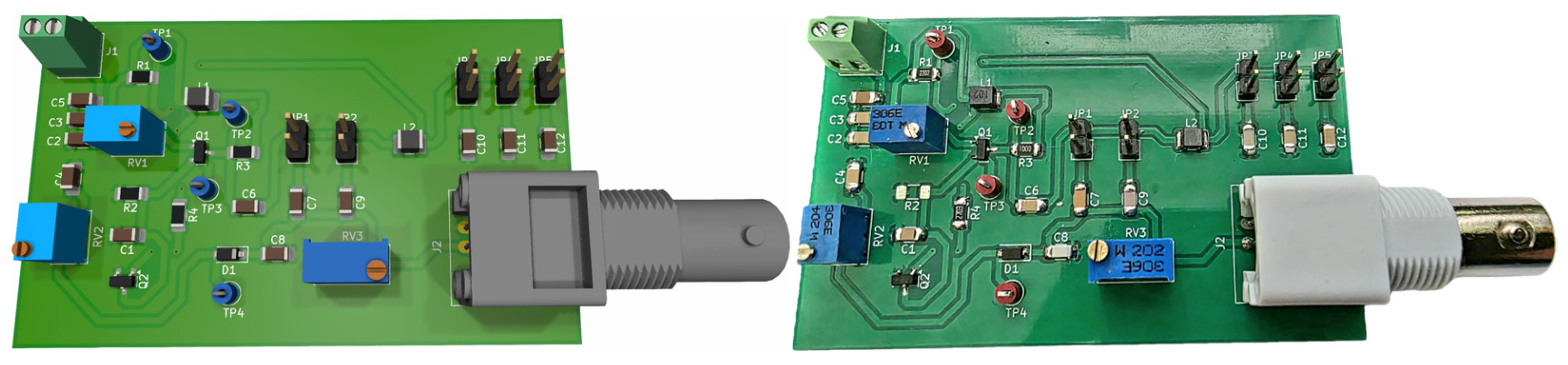
Figure 15 shows a 3D model (in KiCAD environment) and a photograph of the developed printed circuit board.
Table 5 shows the limits within which the values of the LC tank and amplifier parameters can be varied. For the parameters, the values of which can be changed in steps, all possible values are given.
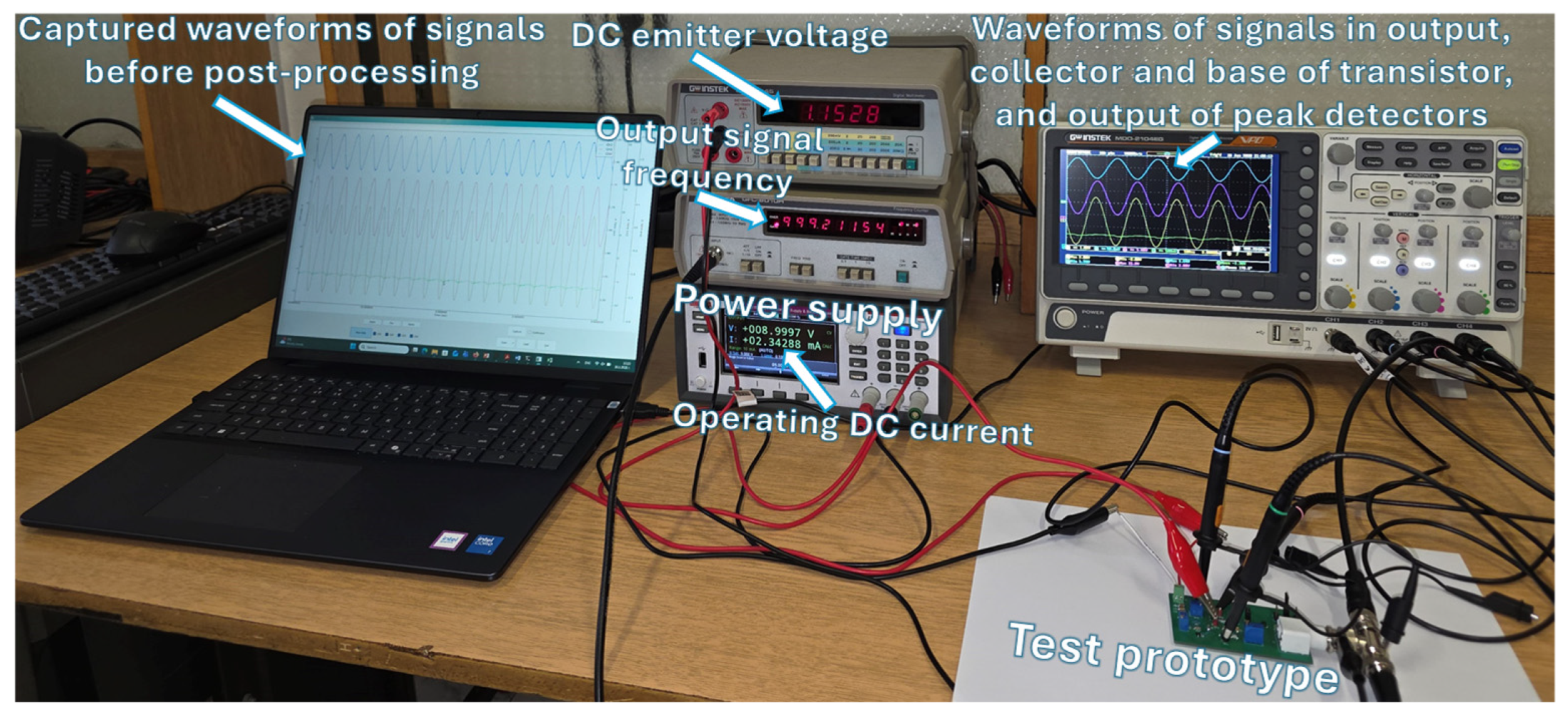
The physical measurements were carried out through the experimental setup shown in
Figure 16.
The experimental setup includes the following measurement setup:
Digital storage oscilloscope GW Instek MDO-2104EG—used for waveform capturing of signal on PCB test points;
Benchtop multimeter GW Instek GDM-8145—used for measurement of DC operating point of the circuit (in
Figure 16 is shown DC emitter voltage);
Benchtop frequency meter GW Instek GFC-8010H—used for precise measurement of operating frequency of the oscillator;
Benchtop precise DC power supply KEITHLEY 2281S-20-6—used for power supply of the circuit and for DC operating current monitoring;
Laptop PC—used for control of the measurement process and data acquisition from, the oscilloscope.
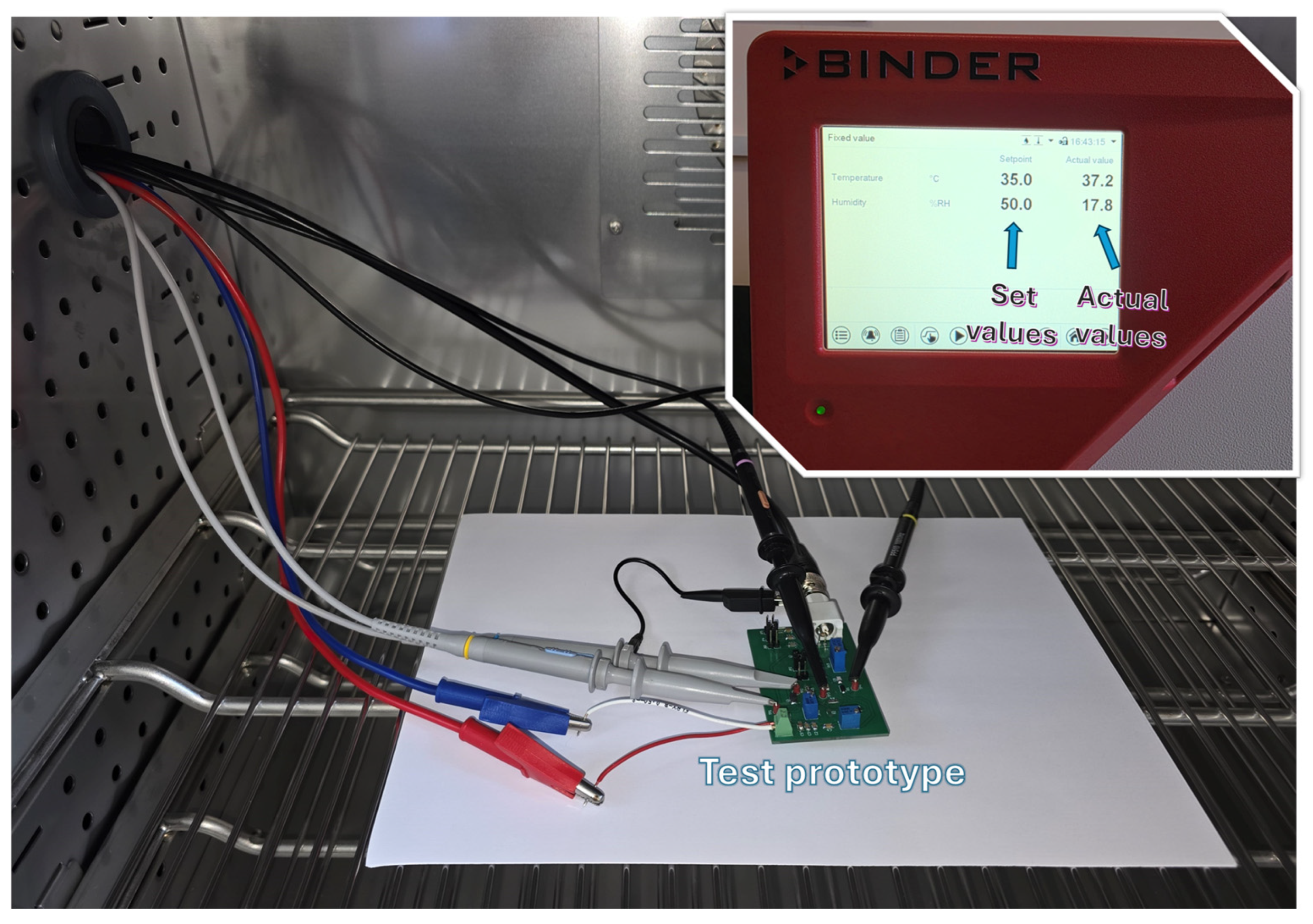
The physical study of the impact of ambient temperature on the oscillator parameters was carried out using a Binder KBF PRO 130 climate chamber (Binder GmbH, Tuttlingen, Germany).
Figure 17 shows a view of the investigated sample placed inside the chamber. The inset image presents the control panel of the chamber.
6.2. Results from Simulation and Experimental Study of LC Tank Parameters’ Influence on Output Signal Amplitude Setting
The analysis is carried out for a target output signal amplitude
1.8 V (
3.6 V). The evaluation is performed for different values of the LC tank parameters. According to the data presented in
Table 4, this amplitude can be achieved for all three values of the coupling coefficient
. The load resistance is chosen to be
500 Ω, and the emitter voltage of the amplifier transistor is set to
1.5 V.
For each combination of LC tank parameter values, the value of
is calculated using Equation (49). To perform this calculation, the required emitter current of the amplifier transistor must be determined. This current is approximated using Equation (32) as follows:
The results are presented in
Table 6.
The presented results show that the AGC block sizing methodology described in
Section 4 is largely independent from the LC tank parameters. The maximum absolute error in the results obtained from the physical experiment is 0.22 V, corresponding to a relative error of 6.1%. The maximum absolute error in the results obtained from the simulation is 0.2 V, corresponding to a relative error of 5.6%. The results obtained from the experimental prototype further confirm the correctness of the simulation model and the validity of the results produced by it.
6.3. Results from Simulation and Experimental Study on Output Signal Amplitude Dependence on DC Operating Point of the Amplifier Transistor
The analysis was carried out for a target output signal amplitude
1.8 V (
3.6 V). The external load resistance was chosen as
500 Ω. The circuit configuration with jumpers JP2 and JP4 enabled was selected. The value of resistor
is 68.1 kΩ. The emitter voltage of the amplifier transistor
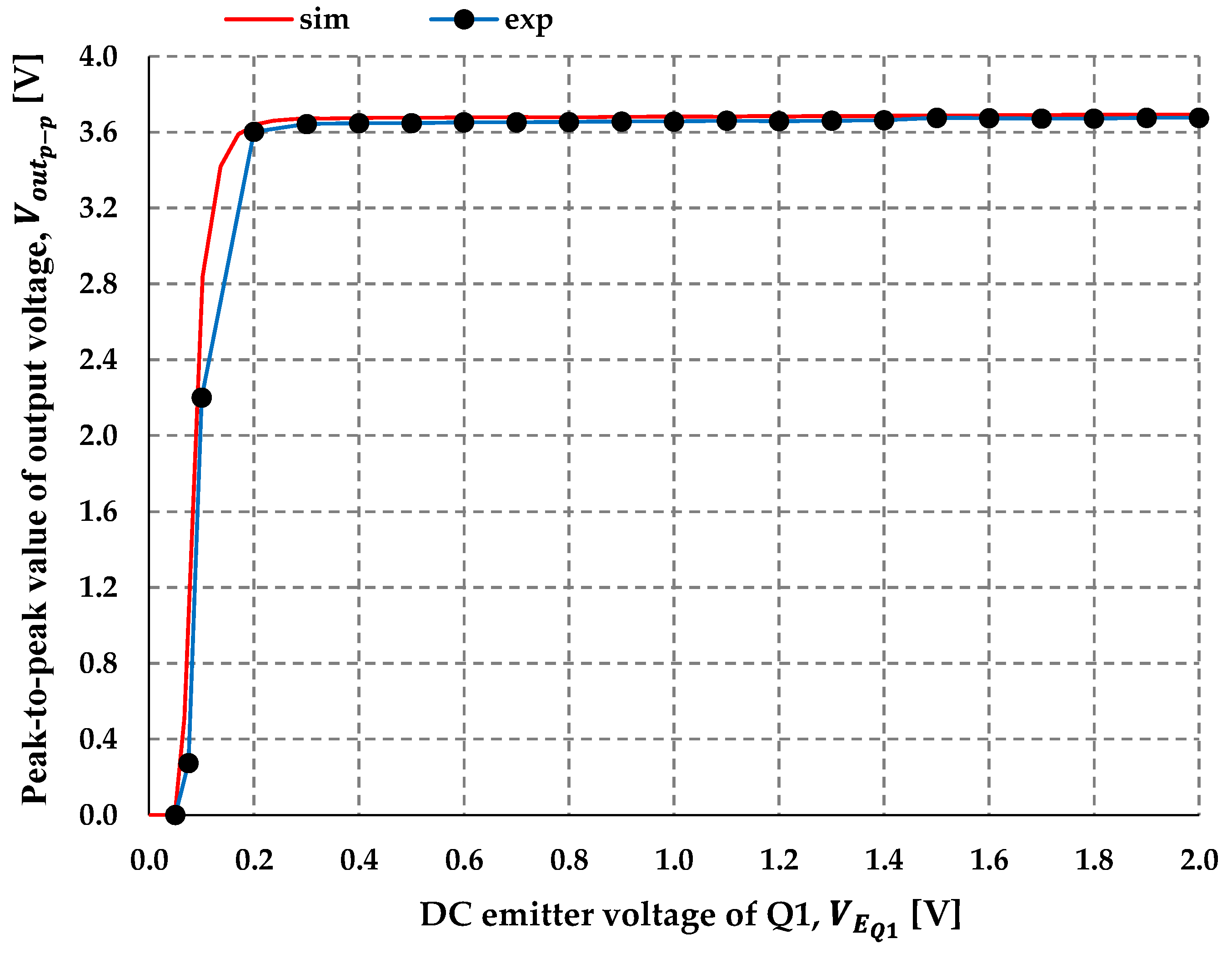
varies in the range from 0.05 V up to 2 V. The results of the simulation and the experimental investigation are presented graphically in
Figure 18. In the plot showing the experimental results, the measurement points are explicitly marked.
Simulation and experimental results confirm that for emitter voltage values above 0.4 V, the DC operating point of the amplifier stage has practically no influence on the amplitude of the oscillator’s output signal. This makes it possible to select a lower emitter voltage value, which extends the possible collector–emitter voltage swing without increasing the supply voltage. For example, with this circuit configuration, when 2 V, the maximum collector–emitter voltage is 14.4 V, according to Equation (29). Under these conditions, the maximum output signal swing is . If the emitter voltage is reduced to 0.5 V, the maximum collector–emitter voltage becomes 16.4 V, and the maximum output signal swing increases to . This is a 14% increase in the maximum output signal swing without changing any other oscillator parameters. This is possible because, in the AGC-controlled circuit, there is no need to stabilize the DC emitter current of the amplifier transistor through local feedback in the amplifier stage. The emitter current is regulated automatically by the AGC block.
6.4. Results from Simulation and Experimental Study on Output Signal Amplitude Dependence on External Load
The analysis was carried out for a target output signal amplitude
1.8 V (
3.6 V). The circuit configuration with jumpers JP2 and JP4 enabled was selected. The value of resistor
is 68.1 kΩ. The emitter voltage of the amplifier transistor was set to
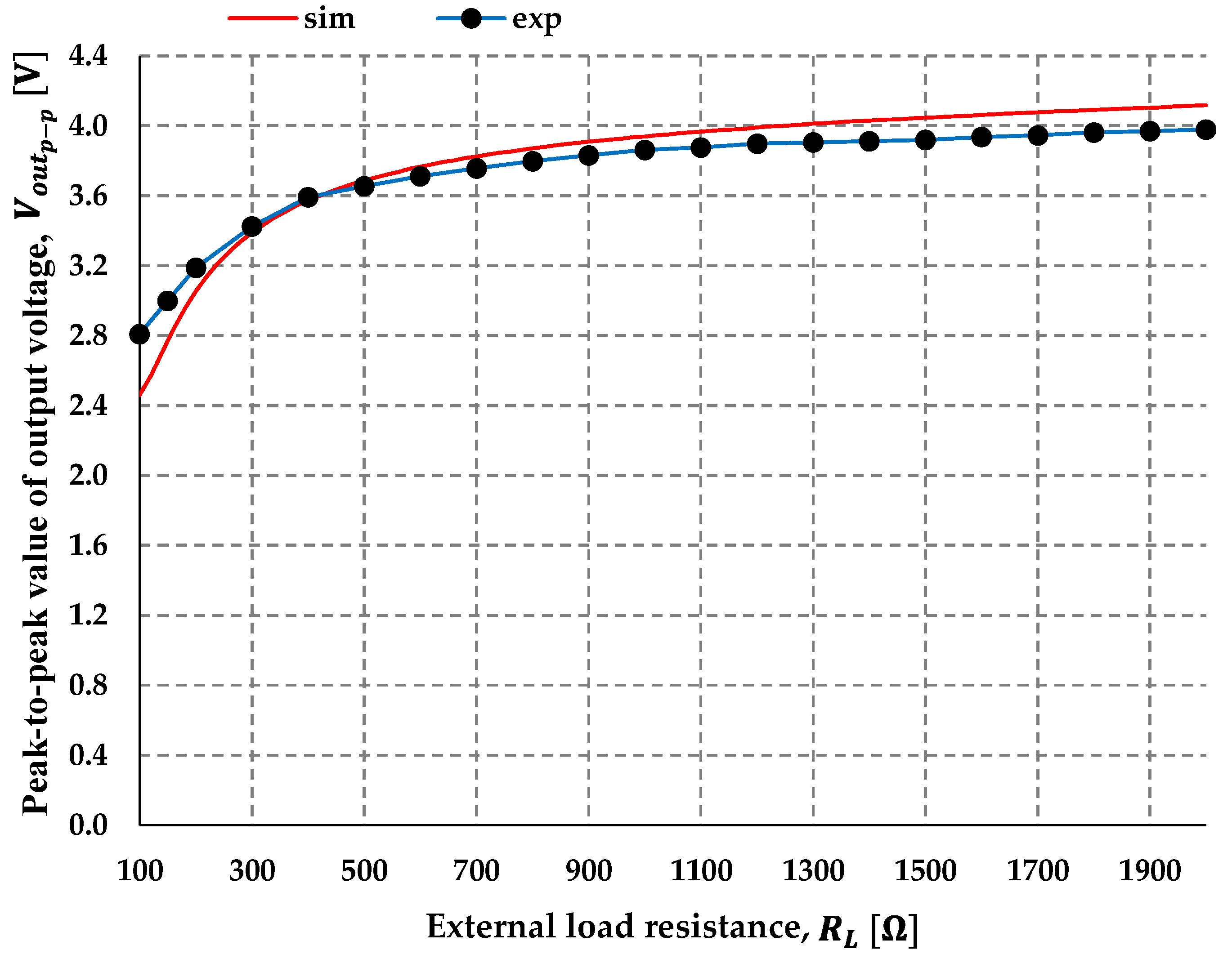
1.5 V. The external load resistance varies in the range from 100 Ω up to 2000 Ω (for load resistances below 100 Ω, waveform distortion appears at the oscillator output). The results from both the simulation and the experimental investigation are presented graphically in
Figure 19. In the plot showing the experimental results, the measurement points are explicitly marked.
The presented results show that the external load resistance has a certain influence on the amplitude of the output signal, particularly when the load resistance is below 1000 Ω. As the load resistance decreases, the input resistance of the LC tank at resonance decreases significantly, and consequently the load seen by the amplifier becomes smaller. This requires a higher emitter current of the amplifier transistor in order to maintain the amplifier-stage gain. As a result, the base current of the transistor in the AGC block increases. According to Equation (46), this leads to a reduction in the output signal amplitude. Therefore, to restore the desired amplitude, it becomes necessary to adjust the value of . On the other hand, if the variations in the externally connected load resistance remain within narrow limits (e.g., ±10%), the change in output signal amplitude is negligible. Typically, variations in the resistance of an externally connected load to an LC oscillator fall within narrow limits. If the variations are larger, the inclusion of a buffer stage between the oscillator output and the external load is typically required.
6.5. Results from Simulation and Experimental Study on Adjustment of Output Signal Amplitude
The circuit configuration with jumpers JP2 and JP4 connected was selected for this study. The value of resistor
is 68.1 kΩ. The emitter voltage of the amplifier transistor was set to
1.5 V. The external load resistance was chosen to be
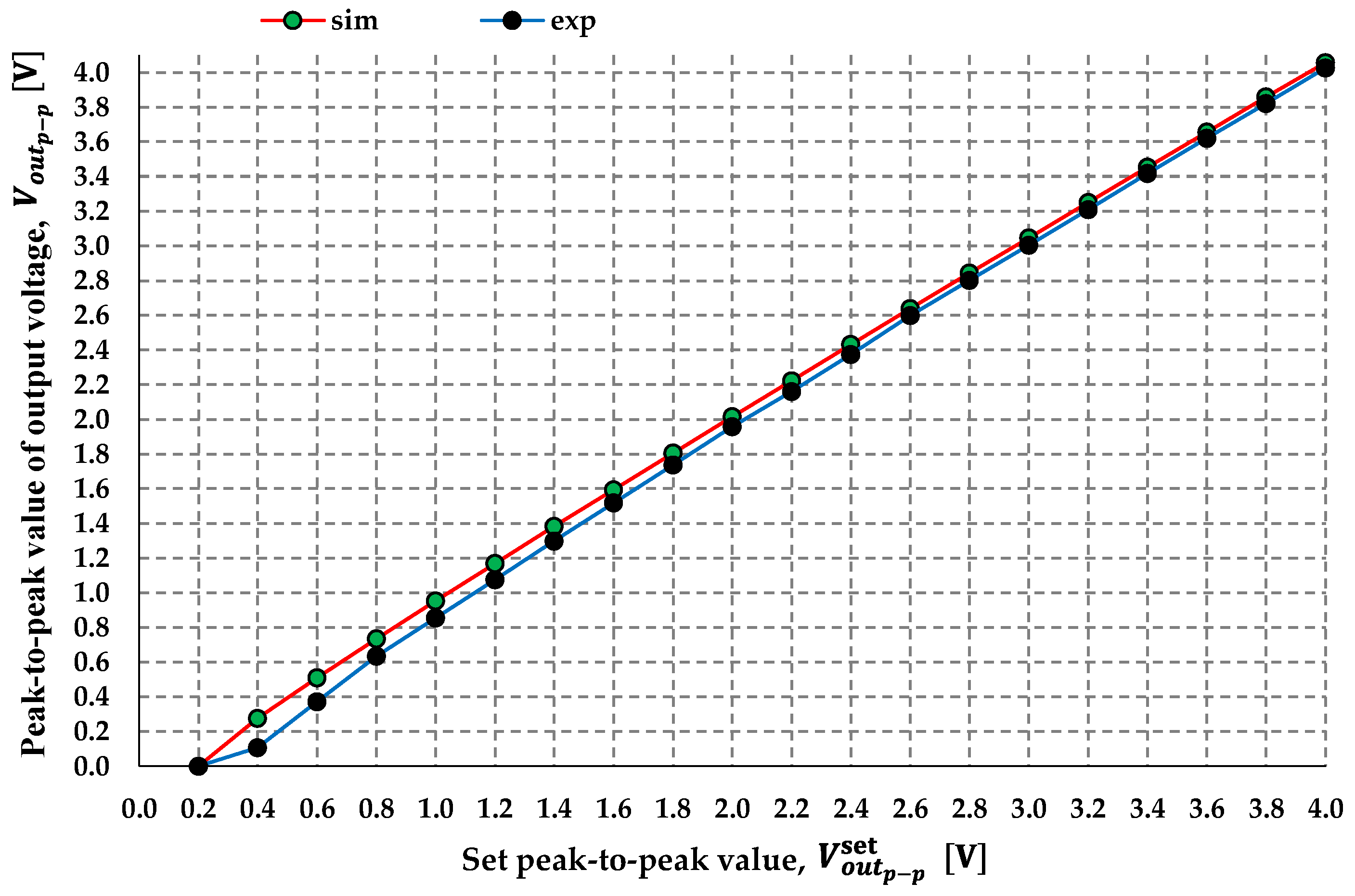
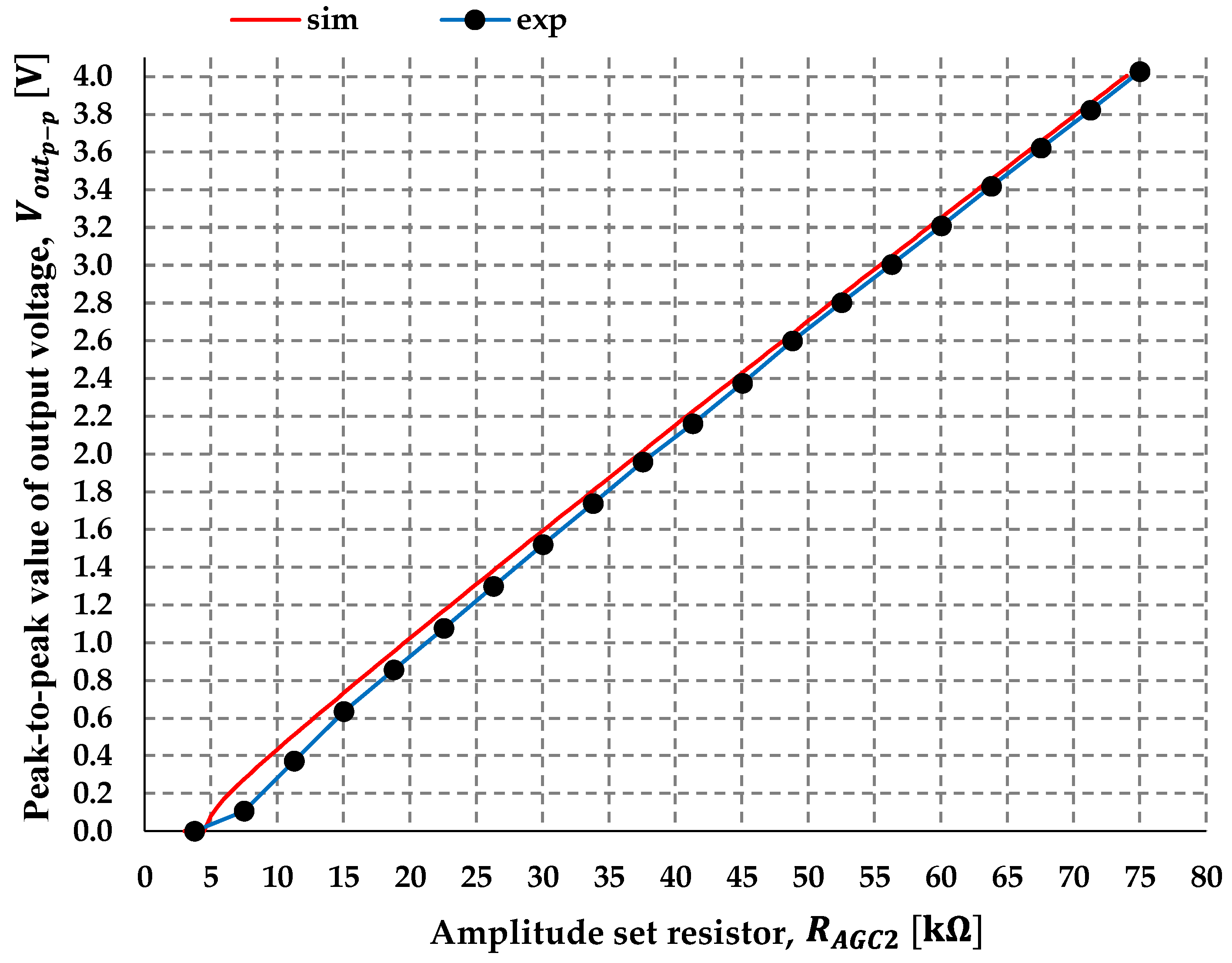
500 Ω. The circuit was simulated and physically investigated for values of the desired peak-to-peak value of output signal in the range from 0.2 V to 4 V, with a step of 0.2 V. For each peak-to-peak value, the corresponding value of the resistor
was calculated and adjusted using the trimmer potentiometer RV2.
Figure 20 shows the actual peak-to-peak value of the output signal versus the desired value.
Figure 21 shows the relationship between the peak-to-peak output signal amplitude and the resistance of resistor
(RV2 on the experimental prototype circuit).
The presented results show that setting the output signal amplitude using Equation (49) for , the error is below 0.1 V. For smaller amplitudes, the error increases to approximately 0.2 V. If the oscillator is required to operate at values , it is advisable to use an attenuator after the oscillator and maintain its operating amplitude at .
6.6. Results from Experimental Study on Output Signal Amplitude Dependence on Ambient Temperature
The analysis was carried out for a target output signal amplitude 1.8 V ( 3.6 V). The circuit configuration with jumpers JP2 and JP4 enabled was selected. The value of resistor is 68.1 kΩ. The emitter voltage of the amplifier transistor was set to 1.5 V at 25 °C. The external load resistance was chosen to be 500 Ω. The ambient temperature varies from −20 °C up to 50 °C with step 5 °C. For temperature values above 10 °C, the humidity is maintained at 50%. Below 10 °C, the climate camera used has no possibility for humidity adjustment.
Only the experimental results are presented in this study, since the temperature dependence of the employed X7R capacitors cannot be accurately described by a deterministic capacitance–temperature model. The X7R specification defines only the bounded capacitance variation over temperature, while the actual dependence strongly depends on the manufacturing technology, DC bias conditions, and material composition. Consequently, circuit-level simulations cannot reliably reproduce the measured temperature behavior, whereas experimental investigation provides a physically representative assessment of the oscillator performance under realistic operating conditions.
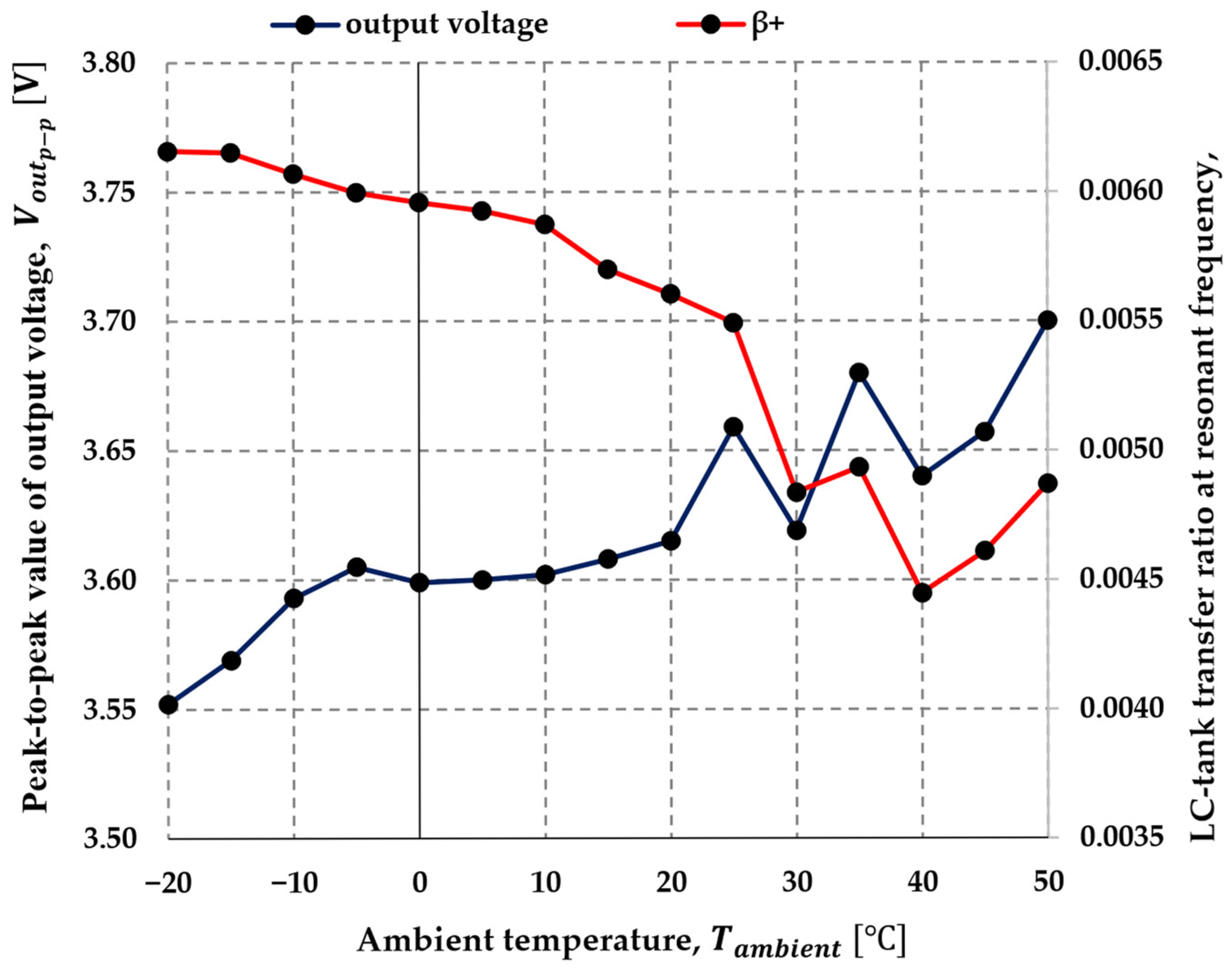
Figure 22 shows the dependence of the peak-to-peak value of the output signal and LC tank transfer ratio
from ambient temperature
.
The results obtained clearly show that the output signal amplitude varies within a narrow range. In the present case, the variation is approximately ±0.1 V over the entire temperature range, which corresponds to about ±3%. At the same time, the transfer ratio of the LC tank exhibits a significantly wider variation, on the order of 40% (varies from 0.0044 up to 0.0062 over the entire temperature range). As expected, the amplitude stabilization loop adjusts the amplifier gain to compensate for these changes, thereby maintaining the output amplitude within tight limits. The amplifier gain varies in the range from approximately 162 to 216. The non-uniform shape of the resulting curves is also expected and can be attributed to the complex and nonlinear temperature dependence of the X7R capacitors.
7. Conclusions
This study introduced an enhanced Colpitts oscillator topology supported by a systematic design methodology that combines analytical modeling, nonlinear steady-state analysis, and extensive statistical simulations. The investigation of the classical oscillator confirmed that—even after manual adjustment—the output amplitude may vary by up to ±30% under realistic parameter deviations.
To address this limitation, an automatic gain control (AGC) block was developed, enabling dynamic transconductance adjustment and eliminating the need for trimming. Monte Carlo simulations incorporating component tolerances, temperature variations, supply voltage changes, load variations, and long-term aging effects demonstrated that the AGC-based design maintains amplitude stability within ±10% in the worst case immediately after production and below 1% drift over five years. A reliability-oriented statistical analysis yielded a worst-case failure probability bound below 0.1%, meeting stringent long-term stability requirements.
A dedicated prototype further validated the approach, demonstrating predictable amplitude behavior across wide variations in LC tank parameters, amplifier biasing, and external loading. The proposed methodology simplifies the oscillator design process, increases robustness, and enables mass production-ready implementations using only standard tolerance components.
Future work may extend the method to higher-frequency Colpitts and Clapp oscillators, MOS-based implementations, and integrated circuit realizations where process variation effects are more pronounced.