FADES: Adaptive Drift Estimation via Conformal Signals for Streaming Intrusion Detection


Abstract
1. Introduction
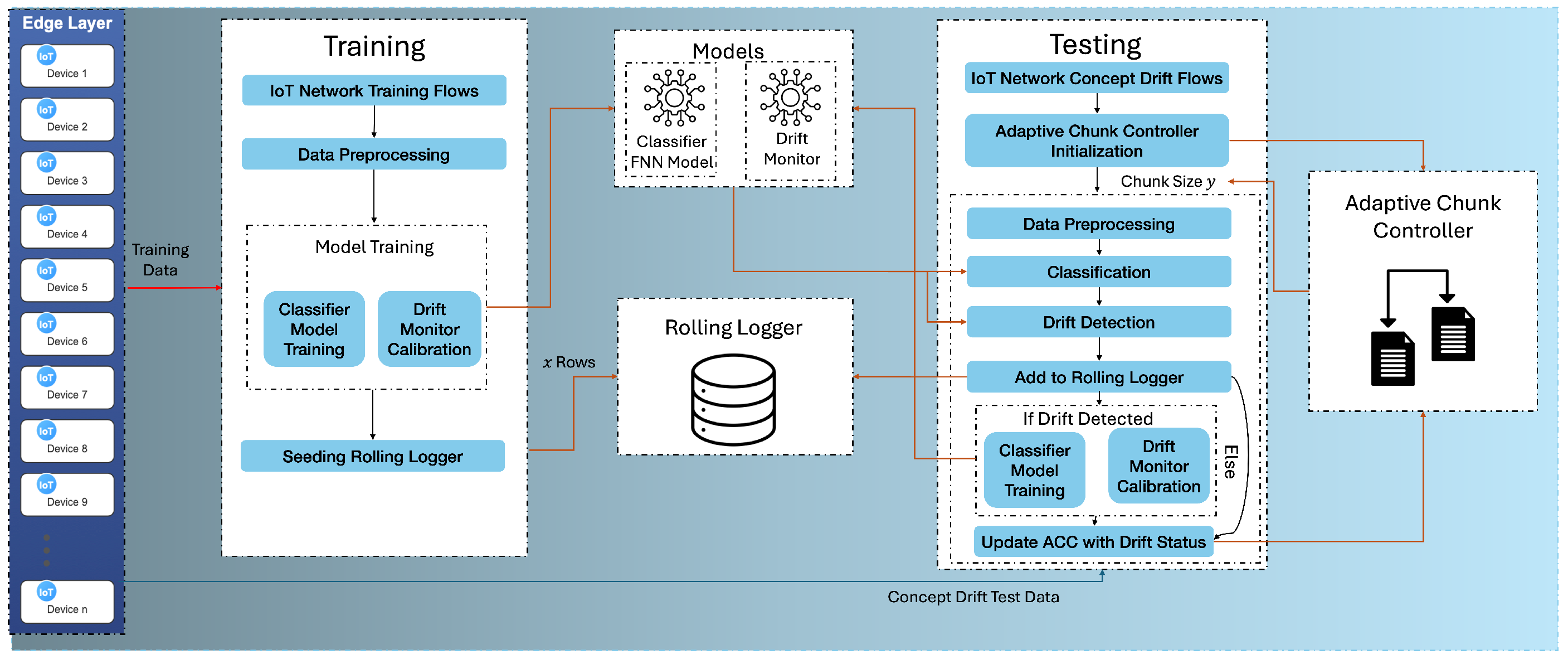
- We present FADES, a modular framework that generalizes drift detection in streaming IoT intrusion detection by unifying conformal evaluation and representation-space methods within a single pipeline.
- We integrate CADE into the streaming pipeline, enabling controlled comparison between prediction-space and representation-space drift detection approaches under identical conditions.
- We conduct a large-scale empirical evaluation consisting of 375 simulations across multiple seeds, runs, and dataset transfer settings, providing variance-aware performance analysis.
- We demonstrate that conformal-evaluation-based drift detection achieves comparable performance to more complex methods while maintaining significantly lower runtime overhead.
Research Questions
2. Related Work
2.1. Conformal Evaluation and Drift Detection
2.2. Model Retraining and Adaptation Under Concept Drift
2.3. Adaptability in Streaming IDS
2.4. Models for Nonconformity Measures
3. Materials and Methods
3.1. IoT Traffic Capture, Labeling, and Flow Preprocessing
3.2. Benchmark Datasets and Collection Provenance
3.2.1. CSE-CIC-IDS2018 (CICIDS2018)
3.2.2. UNSW-NB15
3.2.3. Flow-Export Harmonization for Transfer
3.2.4. Comparison with the DFAIR IoT Dataset
3.3. Baseline Classifier and CE Model Design
3.4. Why Conformal Evaluation for Drift Detection
- It does not require ground-truth labels at test time, allowing drift to be signaled before delayed labels are available.
- It supports per-class calibration through class-conditional score thresholds, improving sensitivity to distributional changes that affect different traffic classes differently.
- It is classifier agnostic because it relies on model outputs rather than internal architecture details.
3.5. Baseline Conformal Evaluators in FADES
- ICE: a single-model inductive evaluator using a held-out calibration split.
- CCE: a cross-conformal evaluator that aggregates nonconformity information across multiple folds.
- Approx-TCE: an approximate transductive evaluator that reduces the cost of full transductive conformal evaluation.
- Approx-CCE: our proposed lightweight approximation of CCE.
3.6. Approx-CCE
| Algorithm 1: Approx-CCE: Calibration [14] |
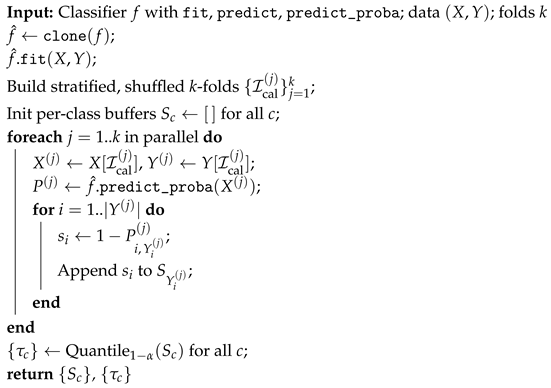 |
| Algorithm 2: Approx-CCE Test-Time Prediction [14] |
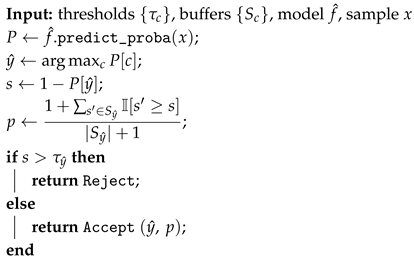 |
3.7. Streaming Simulation with Rolling Calibration Buffer
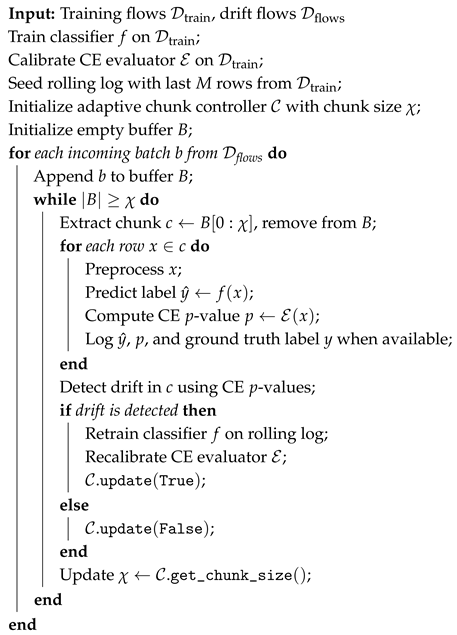
| Algorithm 3: Streaming Simulation with CE Drift Detection |
 |
3.8. Drift Detection Criterion
3.9. Framework Design Justification
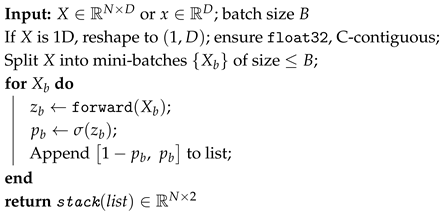
| Algorithm 4: MLP predict_proba [14] |
 |
3.10. Adaptive Chunking Controller
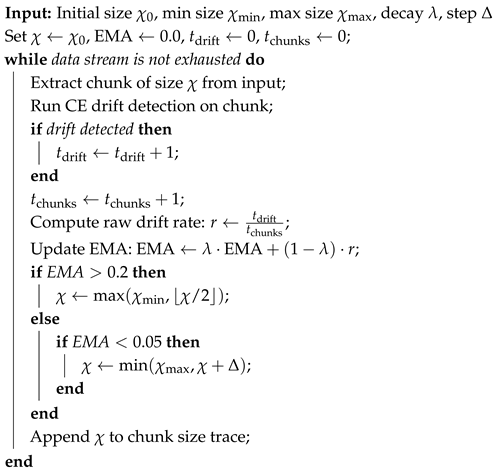
| Algorithm 5: Adaptive Chunk Size Controller [14] |
 |
3.11. Experimental Protocol and Transfer Settings
3.11.1. Dataset Characteristics and Transfer Behavior
3.11.2. Experimental Hardware and Runtime Environment
3.12. Journal-Extension Additions
3.12.1. Multi-Run, Multi-Seed Analysis
3.12.2. CADE Integration and Runtime Comparison
3.13. Statistical Analysis
4. Results
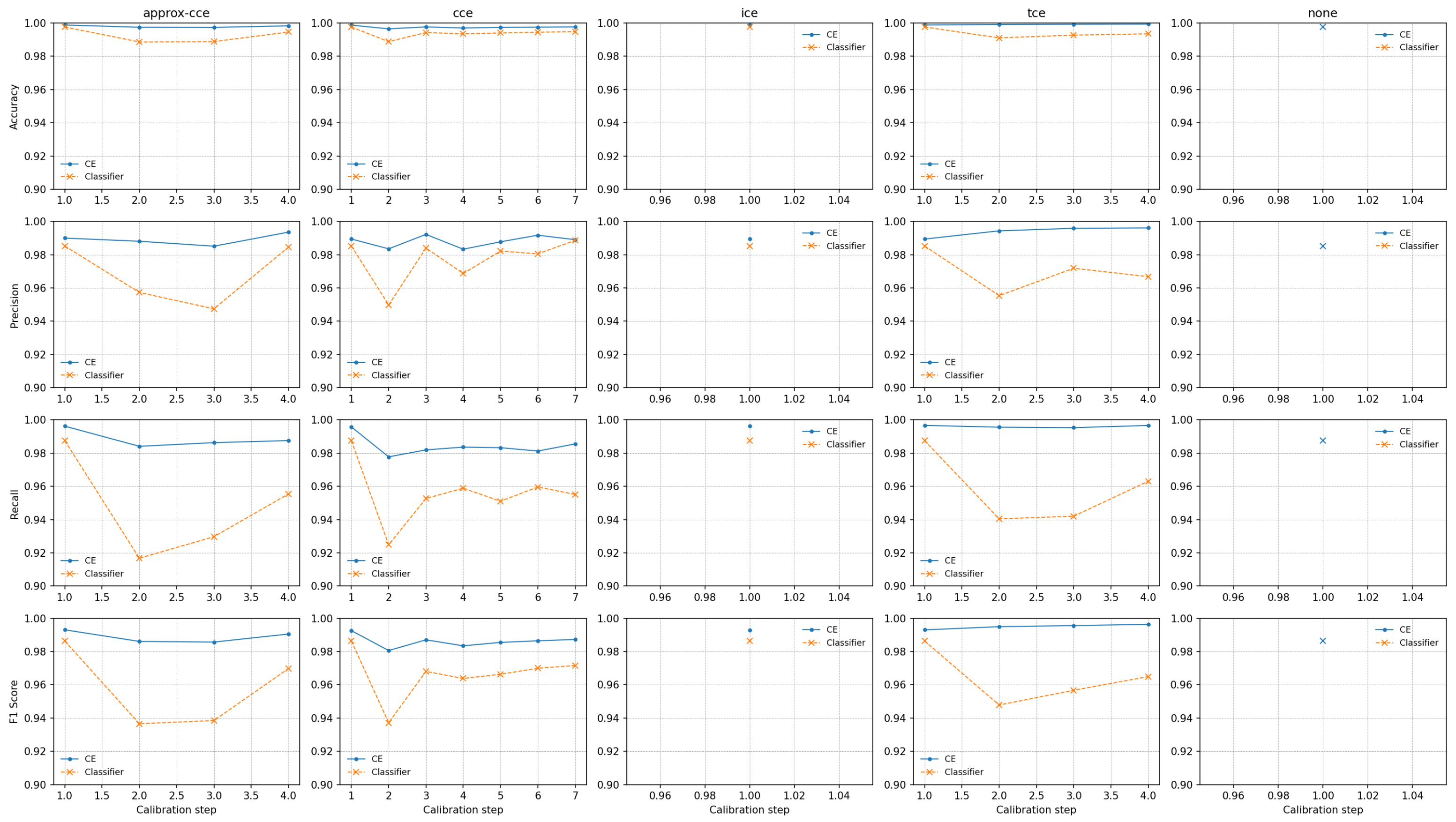
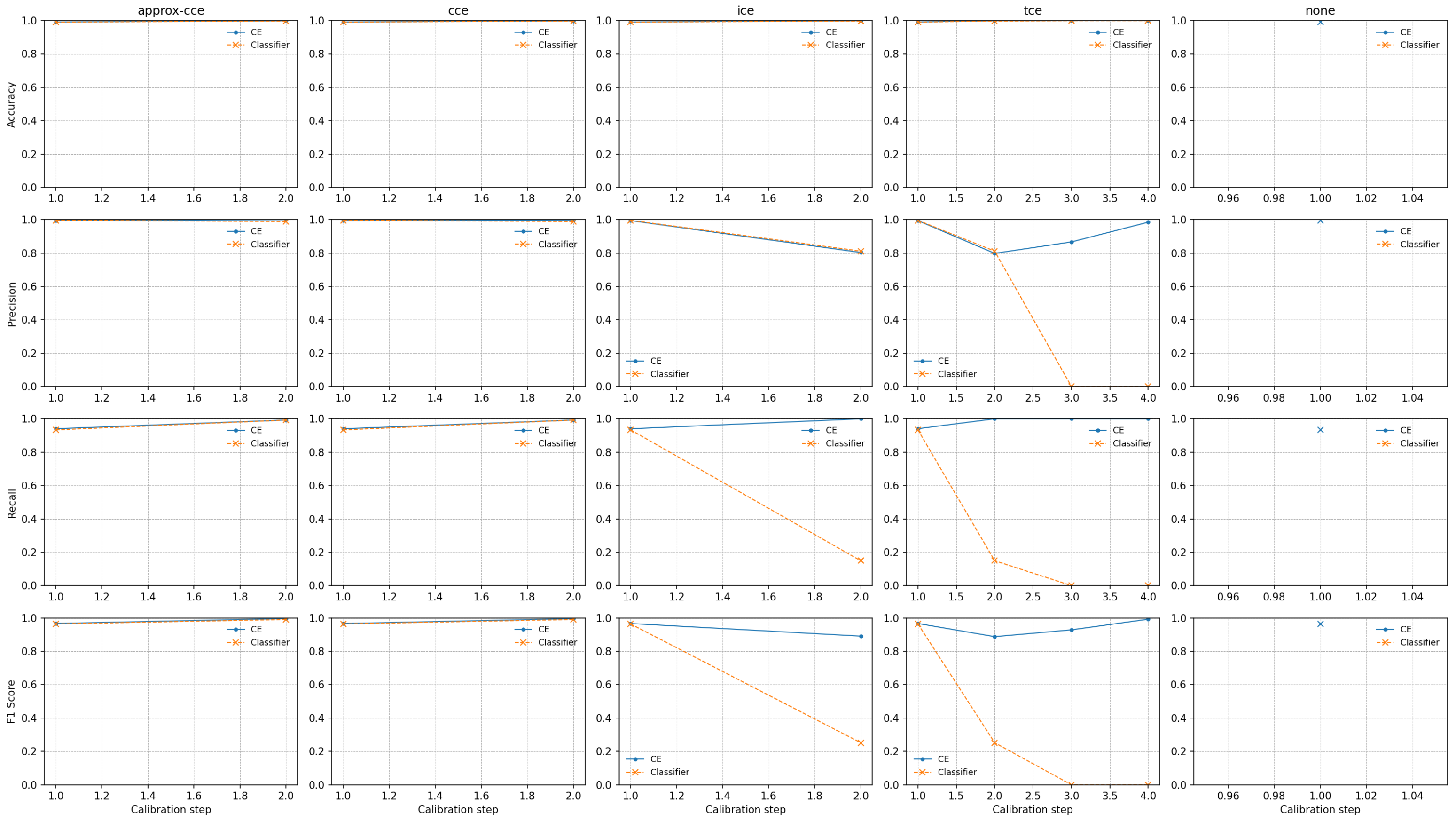
4.1. RQ1: Performance vs. Computational Overhead
4.2. RQ2: CE vs. CADE Runtime Feasibility
- CE-triggered retraining, where drift is signaled via conformal p-value deviations.
- CADE-triggered retraining, where drift is signaled via representation-space distance from the learned manifold.
4.2.1. Runtime Feasibility
4.2.2. Operational Implications
4.3. Attack Presence and Retraining Trigger Analysis
4.4. RQ3: Stability Across Seeds and Transfer Settings
4.5. RQ4: Unified Framework Comparison
5. Discussion
5.1. Novelty Relative to Transcend and Prior Work
5.2. Model Architecture Clarification
5.3. Evaluation Design and Drift Scenarios
5.4. Operational Implications
5.5. Limitations and Future Work
6. Conclusions
Author Contributions
Funding
Data Availability Statement
Acknowledgments
Conflicts of Interest
References
- Gama, J.; Žliobaitė, I.; Bifet, A.; Pechenizkiy, M.; Bouchachia, A. A survey on concept drift adaptation. ACM Comput. Surv. (CSUR) 2014, 46, 1–37. [Google Scholar] [CrossRef]
- Vovk, V.; Gammerman, A.; Shafer, G. Algorithmic Learning in a Random World; Springer: Boston, MA, USA, 2005; Volume 29. [Google Scholar]
- Shafer, G.; Vovk, V. A tutorial on conformal prediction. J. Mach. Learn. Res. 2008, 9, 371–421. [Google Scholar]
- Angelopoulos, A.N.; Bates, S. Conformal prediction: A gentle introduction. Found. Trends Mach. Learn. 2023, 16, 494–591. [Google Scholar] [CrossRef]
- Jordaney, R.; Sharad, K.; Dash, S.K.; Wang, Z.; Papini, D.; Nouretdinov, I.; Cavallaro, L. Transcend: Detecting concept drift in malware classification models. In Proceedings of the 26th USENIX Security Symposium (USENIX Security 17), Vancouver, BC, Canada, 16–18 August 2017; pp. 625–642. [Google Scholar]
- Barbero, F.; Pendlebury, F.; Pierazzi, F.; Cavallaro, L. Transcending transcend: Revisiting malware classification in the presence of concept drift. In Proceedings of the 2022 IEEE Symposium on Security and Privacy (SP); IEEE: Piscataway, NJ, USA, 2022; pp. 805–823. [Google Scholar]
- Yang, L.; Guo, W.; Hao, Q.; Ciptadi, A.; Ahmadzadeh, A.; Xing, X.; Wang, G. CADE: Detecting and explaining concept drift samples for security applications. In Proceedings of the 30th USENIX Security Symposium (USENIX Security 21), Online, 11–13 August 2021; pp. 2327–2344. [Google Scholar]
- Alam, M.T.; Piplai, A.; Rastogi, N. ADAPT: A Pseudo-labeling Approach to Combat Concept Drift in Malware Detection. arXiv 2025, arXiv:2507.08597. [Google Scholar] [CrossRef]
- Ying, J.; Zhu, T.; Zheng, A.; Chen, T.; Lv, M.; Chen, Y. METANOIA: A Lifelong Intrusion Detection and Investigation System for Mitigating Concept Drift. arXiv 2024, arXiv:2501.00438. [Google Scholar]
- Le, D.C.; Zincir-Heywood, N. Anomaly detection for insider threats using unsupervised ensembles. IEEE Trans. Netw. Serv. Manag. 2021, 18, 1152–1164. [Google Scholar] [CrossRef]
- Gupta, R.; Liu, S.; Zhang, R.; Hu, X.; Kommaraju, P.; Wang, X.; Benkraouda, H.; Feamster, N.; Nahrstedt, K. Generative active adaptation for drifting and imbalanced network intrusion detection. arXiv 2025, arXiv:2503.03022. [Google Scholar] [CrossRef]
- Baldini, G.; Amerini, I. Online Distributed Denial of Service (DDoS) intrusion detection based on adaptive sliding window and morphological fractal dimension. Comput. Netw. 2022, 210, 108923. [Google Scholar] [CrossRef]
- Baena-Garcıa, M.; del Campo-Ávila, J.; Fidalgo, R.; Bifet, A.; Gavalda, R.; Morales-Bueno, R. Early drift detection method. In Proceedings of the Fourth International Workshop on Knowledge Discovery from Data Streams, Philadelphia, PA, USA, 20 August 2006; Volume 6, pp. 77–86. [Google Scholar]
- Barrett, S.; Li, L.; Dorai, G.; Rajaganapathy, S. FIRCE: A Framework for Intrusion Response and Conformal Evaluation. arXiv 2026, arXiv:2605.01962. [Google Scholar] [CrossRef]
- Soltani, M.; Khajavi, K.; Jafari Siavoshani, M.; Jahangir, A.H. A multi-agent adaptive deep learning framework for online intrusion detection. Cybersecurity 2024, 7, 9. [Google Scholar] [CrossRef]
- Yang, S.; Zheng, X.; Li, J.; Xu, J.; Zhang, X.; Ngai, E.C. Self-Supervised Adaptation Method to Concept Drift for Network Intrusion Detection. IEEE Trans. Dependable Secur. Comput. 2025, 22, 7632–7646. [Google Scholar] [CrossRef]
- Xu, R.; Cheng, Y.; Liu, Z.; Xie, Y.; Yang, Y. Improved Long Short-Term Memory based anomaly detection with concept drift adaptive method for supporting IoT services. Future Gener. Comput. Syst. 2020, 112, 228–242. [Google Scholar] [CrossRef]
- Bifet, A.; Gavalda, R. Learning from time-changing data with adaptive windowing. In Proceedings of the 2007 SIAM International Conference on Data Mining; SIAM: Philadelphia, PA, USA, 2007; pp. 443–448. [Google Scholar]
- Spinosa, E.J.; de Carvalho, A.P.d.L.F.; Gama, J. Novelty detection with application to data streams. Intell. Data Anal. 2009, 13, 405–422. [Google Scholar] [CrossRef]
- Gardner, E.S., Jr. Exponential smoothing: The state of the art. J. Forecast. 1985, 4, 1–28. [Google Scholar] [CrossRef]
- Hyndman, R.J.; Athanasopoulos, G. Forecasting: Principles and Practice; OTexts: Melbourne, Australia, 2018. [Google Scholar]
- Brown, R.G. Smoothing, Forecasting and Prediction of Discrete Time Series; Courier Corporation: North Chelmsford, MA, USA, 2004. [Google Scholar]
- Holt, C.C. Forecasting seasonals and trends by exponentially weighted moving averages. Int. J. Forecast. 2004, 20, 5–10. [Google Scholar] [CrossRef]
- Boswell, B.; Barrett, S.; Rajaganapathy, S.; Dorai, G. FLARE: Feature-based Lightweight Aggregation for Robust Evaluation of IoT Intrusion Detection. arXiv 2025, arXiv:2504.15375. [Google Scholar]
- Boswell, B.; Dorai, G.; Barrett, S.; Rajaganapathy, S.; Li, L. FIRE: Fog-Based Intrusion Detection Framework for Real-Time Security in IoT Environments. In Proceedings of the Future Technologies Conference; Springer: Cham, Switzerland, 2025; pp. 209–226. [Google Scholar]
- Kato, Y.; Tax, D.M.; Loog, M. A review of nonconformity measures for conformal prediction in regression. Conform. Probabilistic Predict. Appl. 2023, 204, 369–383. [Google Scholar]
- Linusson, H.; Johansson, U.; Boström, H.; Löfström, T. Efficiency comparison of unstable transductive and inductive conformal classifiers. In Proceedings of the IFIP International Conference on Artificial Intelligence Applications and Innovations; Springer: Berlin/Heidelberg, Germany, 2014; pp. 261–270. [Google Scholar]
- Messoudi, S.; Rousseau, S.; Destercke, S. Deep conformal prediction for robust models. In Proceedings of the International Conference on Information Processing and Management of Uncertainty in Knowledge-Based Systems; Springer: Cham, Switzerland, 2020; pp. 528–540. [Google Scholar]
- Johansson, U.; Boström, H.; Löfström, T.; Linusson, H. Regression conformal prediction with random forests. Mach. Learn. 2014, 97, 155–176. [Google Scholar] [CrossRef]
- Hočevar, T.; Zupan, B.; Stålring, J. Conformal Prediction with Orange. J. Stat. Softw. 2021, 98, 1–22. [Google Scholar] [CrossRef]
- Gorishniy, Y.; Rubachev, I.; Khrulkov, V.; Babenko, A. Revisiting deep learning models for tabular data. Adv. Neural Inf. Process. Syst. 2021, 34, 18932–18943. [Google Scholar]
- Shwartz-Ziv, R.; Armon, A. Tabular data: Deep learning is not all you need. Inf. Fusion 2022, 81, 84–90. [Google Scholar] [CrossRef]
- Gorishniy, Y.; Kotelnikov, A.; Babenko, A. Tabm: Advancing tabular deep learning with parameter-efficient ensembling. arXiv 2024, arXiv:2410.24210. [Google Scholar]
- Guo, C.; Pleiss, G.; Sun, Y.; Weinberger, K.Q. On calibration of modern neural networks. In Proceedings of the International Conference on Machine Learning; PMLR: London, UK, 2017; pp. 1321–1330. [Google Scholar]
- Barrett, S.; Boswell, B.; Dorai, G. Exploring the vulnerabilities of IoT devices: A comprehensive analysis of mirai and bashlite attack vectors. In Proceedings of the 2023 10th International Conference on Internet of Things: Systems, Management and Security (IOTSMS); IEEE: Piscataway, NJ, USA, 2023; pp. 125–132. [Google Scholar]
- Boswell, B.; Barrett, S.; Dorai, G. Unraveling iot traffic patterns: Leveraging principal component analysis for network anomaly detection and optimization. In Proceedings of the 2024 12th International Symposium on Digital Forensics and Security (ISDFS); IEEE: Piscataway, NJ, USA, 2024; pp. 1–6. [Google Scholar]
- Barrett, S. CAPEX-Capture-for-Evaluation: IoT Attack and Baseline Data Capture Scripts. 2024. Available online: https://github.com/DFAIR-LAB-Augusta/CAPEX-Capture-for-Evaluation (accessed on 30 June 2025).
- Leevy, J.L.; Khoshgoftaar, T.M. A survey and analysis of intrusion detection models based on cse-cic-ids2018 big data. J. Big Data 2020, 7, 104. [Google Scholar] [CrossRef]
- Sharafaldin, I.; Lashkari, A.H.; Ghorbani, A.A. Toward generating a new intrusion detection dataset and intrusion traffic characterization. ICISSp 2018, 1, 108–116. [Google Scholar]
- Moustafa, N.; Slay, J. UNSW-NB15: A comprehensive data set for network intrusion detection systems (UNSW-NB15 network data set). In Proceedings of the 2015 Military Communications and Information Systems Conference (MilCIS), Canberra, ACT, Australia, 10–12 November 2015; pp. 1–6. [Google Scholar] [CrossRef]
- GitHub—Ahlashkari/CICFlowMeter: CICFlowmeter-V4.0 (Formerly Known as ISCXFlowMeter) is an Ethernet Traffic Bi-Flow Generator and Analyzer for Anomaly Detection That Has Been Used in Many Cybersecurity Datsets such as Android Adware-General Malware Dataset (CICAAGM2017), IPS/IDS dataset (CICIDS2017), Android Malware Dataset (CICAndMal2017) and Distributed Denial of Service (CICDDoS2019). Available online: https://github.com/ahlashkari/CICFlowMeter (accessed on 9 April 2026).
- GitHub—Hieulw/Cicflowmeter: CICFlowmeter Written in Python for Easy to Try Out. Available online: https://github.com/hieulw/cicflowmeter (accessed on 9 April 2026).
- Breiman, L. Random forests. Mach. Learn. 2001, 45, 5–32. [Google Scholar] [CrossRef]
- Chen, T.; Guestrin, C. Xgboost: A scalable tree boosting system. In Proceedings of the 22nd ACM Sigkdd International Conference on Knowledge Discovery and Data Mining; Association for Computing Machinery: New York, NY, USA, 2016; pp. 785–794. [Google Scholar]
- Cortes, C.; Vapnik, V. Support-vector networks. Mach. Learn. 1995, 20, 273–297. [Google Scholar] [CrossRef]
- Hendrycks, D. Gaussian Error Linear Units (Gelus). arXiv 2016, arXiv:1606.08415. [Google Scholar]
- Ba, J.L.; Kiros, J.R.; Hinton, G.E. Layer normalization. arXiv 2016, arXiv:1607.06450. [Google Scholar] [CrossRef]
- Srivastava, N.; Hinton, G.; Krizhevsky, A.; Sutskever, I.; Salakhutdinov, R. Dropout: A simple way to prevent neural networks from overfitting. J. Mach. Learn. Res. 2014, 15, 1929–1958. [Google Scholar]
- Kingma, D.P. Adam: A method for stochastic optimization. arXiv 2014, arXiv:1412.6980. [Google Scholar]
- Canadian Institute for Cybersecurity. IDS 2018|Datasets|Research|Canadian Institute for Cybersecurity|UNB. Available online: https://www.unb.ca/cic/datasets/ids-2018.html (accessed on 9 November 2025).
- Amazon Web Services. A Realistic Cyber Defense Dataset (CSE-CIC-IDS2018)—Registry of Open Data on AWS. Available online: https://registry.opendata.aws/cse-cic-ids2018/ (accessed on 9 November 2025).
- UNSW Canberra Cyber. The UNSW-NB15 Dataset|UNSW Research. Available online: https://research.unsw.edu.au/projects/unsw-nb15-dataset (accessed on 9 November 2025).
- Canadian Institute for Cybersecurity. Applications|Research|Canadian Institute for Cybersecurity|UNB. Available online: https://www.unb.ca/cic/research/applications.html (accessed on 9 November 2025).
- Songma, S.; Sathuphan, T.; Pamutha, T. Optimizing intrusion detection systems in three phases on the CSE-CIC-IDS-2018 dataset. Computers 2023, 12, 245. [Google Scholar]
- Yoo, A.B.; Jette, M.A.; Grondona, M. Slurm: Simple linux utility for resource management. In Proceedings of the Workshop on Job Scheduling Strategies for Parallel Processing; Springer: Berlin/Heidelberg, Germany, 2003; pp. 44–60. [Google Scholar]
- Nelson, A.; Rekhi, S.; Souppaya, M.; Scarfone, K. Incident Response Recommendations and Considerations for Cybersecurity Risk Management: A CSF 2.0 Community Profile; NIST Special Publication NIST SP 800-61r3; National Institute of Standards and Technology: Gaithersburg, MD, USA, 2025. [CrossRef]
- Verizon. 2025 Data Breach Investigations Report; Technical Report; Verizon: Basking Ridge, NJ, USA, 2025. [Google Scholar]
- Barrett, S. XSecIoT—FIRCE Backup Branch. 2025. Available online: https://github.com/DFAIR-LAB-Augusta/XSecIoT/tree/FIRCE_bkp (accessed on 30 June 2025).
- Limin Yang, S.B. GitHub—DFAIR-LAB-Augusta/CADE_FIRCE: Code from the USENIX Security 2021 Paper—CADE: Detecting and Explaining Concept Drift Samples for Security Applications; Updates to Work with FIRCE. Available online: https://github.com/DFAIR-LAB-Augusta/CADE_FIRCE (accessed on 9 April 2026).



| Paper | Context | Drift Detection Method | Adaptation Trigger | Retraining Strategy | Notable Features/ Contributions |
|---|---|---|---|---|---|
| Jordaney et al. [5] (Transcend) | Malware Detection | Nonconformity score drop-off | Manual threshold | None (reject-only) | Introduces transductive conformal prediction for drift rejection |
| Barbero et al. [6] (Transcending Transcend) | Malware Classification | Approximate p-value tracking | Statistical p-value thresholds | Retrains with buffered calibration | Improves Transcend efficiency; adds ICE and CCE variants |
| Alam et al. [8] (ADAPT) | Malware Classification | Pseudo-label confidence filters | Low confidence + drift signal | Online retraining from pseudo-labeled cache | Confidence-aware retraining without labels |
| Soltani et al. [15] | Sequential Flow-Based IDS | Continual retraining using small packet windows | Stream update cycle | Lightweight federated deep model retrained on new flows | Demonstrates 95%+ detection rate and fast adaptation to new patterns |
| Gupta et al. [11] | IDS (CIC-IDS) | Density-aware active sampling | Generative + active retraining on selected samples | Combines augmentation with label-efficient active learning | F1-score improvement from 0.60 to 0.86 in experiments |
| Ying et al. [9] (METANOIA) | Unsupervised IDS (PIDS) | Streaming anomaly detection | Incremental anomaly model updates over time windows | Minimizes false positives via rehearsal nodes | Continuous adaptation with reduced false positives |
| Yang et al. [16] (ReCDA) | IDS under concept drift | None (self-supervised alignment) | New unlabeled window | Self-supervised rep. update + weakly supervised classifier tuning | Label-efficient; plug-and-play rep. module; results on UNSW-NB15, CICIDS-2017, Kyoto-2006+ |
| Xu et al. [17] (I-LSTM + CDA) | IoT anomaly detection | None (time-weighted sampling) | Time-window update | Periodic LSTM retrain on CDA-balanced samples | Time-aware LSTM + smooth activation; smart-home results |
| Yang et al. [7] (CADE) | Security concept drift detection | Contrastive autoencoder in representation space | Drifting-sample discovery | Representation-space adaptation and explanation | Explains drifting samples but is runtime-heavy in our setting |
| FADES | IoT Intrusion Detection | Conformal Evaluation (Approx-CCE) | p-value drift trigger | Rolling log retrain + CE recalibration | Real-time CE with ACC |
| Model | I1 Prob.-Based NCM | I2 Post Hoc Calib. | I3 Fast (Re)Train | I4 Stable NCM (After Calib.) | I5 Good for Tabular Flows | I6 Temp. Scaling Suffices |
|---|---|---|---|---|---|---|
| Linear/Kernel SVM | ✓ (via Platt/iso) | ✓ | (linear:) ✓ (kernel:) × | ✓ (margins) | ✓ | × (needs or iso) |
| Logistic Regression | ✓ | ✓ | ✓ | ✓ | ✓ | × |
| Random Forest | ✓ (vote probs) | ✓ | ✓ | ✓ | ✓ | × |
| Gradient Boosting/XGBoost | ✓ (softprob) | ✓ | ✓ | ✓ | ✓ | × |
| k-NN | ✓ (freq.) | (mixed) | × (scale) | (data dependent) | (depends) | × |
| Naive Bayes | ✓ | (mixed) | ✓ | (data dependent) | ✓ | × |
| MLP | ✓ | ✓ (temp. scaling) | ✓ (compact) | ✓ (with reg.) | ✓ | ✓ |
| Device | Interaction Method |
|---|---|
| Amazon Echo Dot (5th Gen) | App & Voice |
| Google Home Cam | App |
| Google Nest Mini | App & Voice |
| Kasa Smart Plug | App & On-Device Control |
| LongPlus Baby Monitor | App |
| NiteBird Smart Bulb | App |
| OKP K2 Vacuum | App |
| Philips Hue Hub | App |
| Ring Video Doorbell | App & On-Device Control |
| Roborock K2 Vacuum | App & On-Device Control |
| Dataset | Environment | Devices/Hosts | Users | Capture Method | Flow Exporter | Attack Types |
|---|---|---|---|---|---|---|
| DFAIR | IoT testbed | 10 IoT devices | 1 user | tcpdump PCAP | CICFlowMeter | Floods |
| DFAIR Drift | IoT testbed | 10 IoT devices | 1 user | tcpdump PCAP | CICFlowMeter | Floods + HULK |
| CICIDS2018 | Enterprise emulation | ∼450 hosts | Multiple | PCAP logs | CICFlowMeter-V3 | Scenario attacks |
| UNSW-NB15 | Cyber-range | Synthetic hosts | Automated | PCAP capture | Argus/Bro | 9 attack classes |
| Method | Calibration | Test (per Sample) |
|---|---|---|
| TCE | ||
| Approx-TCE | ||
| ICE | ||
| CCE | ||
| Approx-CCE |
| Configuration | DFAIR Dims. | UNSW Dims. | Margin | MAD Thresh. | Min. Ratio | Min. Count | Epochs |
|---|---|---|---|---|---|---|---|
| Original CADE | 10.0 | 3.5 | 0.05 | 1 | 250 | ||
| Reduced-Epoch CADE | 10.0 | 3.5 | 0.05 | 1 | 50 | ||
| Lightened CADE | 5.0 | 4.0 | 0.10 | 3 | 10 |
| Dataset | CE Type | CE Acc. | Prec. | Rec. | F1 | Runtime (s) | #Calibs |
|---|---|---|---|---|---|---|---|
| DFAIR | ICE | 1.0000 | 0.9999 | 0.9999 | 0.9999 | 626.6639 | No Retrain |
| → | Approx-TCE | 1.0000 | 1.0000 | 1.0000 | 1.0000 | 768.7549 | 4 |
| DFAIR | CCE | 1.0000 | 0.9998 | 0.9999 | 0.9998 | 785.3604 | 2 |
| Drift | Approx-CC | 1.0000 | 0.9998 | 0.9999 | 0.99987 | 676.2752 | 2 |
| CICIDS2018 | ICE | 0.9953 | 0.8990 | 0.9701 | 0.9288 | 5628.1554 | 2 |
| → | Approx-TCE | 0.9976 | 0.9111 | 0.9852 | 0.9439 | 6637.4307 | 4 |
| DFAIR | CCE | 0.9950 | 0.9962 | 0.9667 | 0.9811 | 16584.1373 | 2 |
| Drift | Approx-CCE | 0.9952 | 0.9973 | 0.9667 | 0.9816 | 6020.9825 | 2 |
| UNSW-NB15 | ICE | 0.9988 | 0.9897 | 0.9962 | 0.9929 | 600.9195 | No Retrain |
| → | Approx-TCE | 0.9991 | 0.9939 | 0.9961 | 0.9950 | 720.1210 | 4 |
| DFAIR | CCE | 0.9975 | 0.9881 | 0.9842 | 0.9861 | 1792.7051 | 7 |
| Drift | Approx-CCE | 0.9980 | 0.9892 | 0.9885 | 0.9889 | 717.1803 | 4 |
| Dataset | Chunk Size | Num Calibs | CE Accuracy | CE Precision | CE Recall | CE F1 Score | Runtime (s) |
|---|---|---|---|---|---|---|---|
| DFAIR Drift | 100 | 11 | 1.0000 | 0.9999 | 1.0000 | 1.0000 | 598.0396 |
| 75 | 15 | 1.0000 | 0.9999 | 1.0000 | 1.0000 | 764.7714 | |
| 50 | 18 | 1.0000 | 0.9999 | 1.0000 | 1.0000 | 761.2931 | |
| 25 | 18 | 1.0000 | 0.9999 | 1.0000 | 1.0000 | 772.4752 | |
| 15 | 17 | 0.9954 | 0.9970 | 0.9658 | 0.9789 | 877.6462 | |
| 10 | 54 | 1.0000 | 1.0000 | 1.0000 | 1.0000 | 2247.3858 | |
| 5 | 22 | 1.0000 | 0.9999 | 1.0000 | 0.9999 | 978.3778 | |
| 1 | 39 | 1.0000 | 0.9999 | 1.0000 | 0.9999 | 1870.6970 | |
| Adaptive | 2 | 1.0000 | 0.9998 | 0.9999 | 0.9998 | 676.2752 | |
| CICIDS2018 → DFAIR Drift | 100 | 4 | 0.9973 | 0.9478 | 0.9833 | 0.9637 | 6328.3502 |
| 75 | 2 | 0.9957 | 0.9969 | 0.9701 | 0.9831 | 7856.0773 | |
| 50 | 4 | 0.9973 | 0.9624 | 0.9814 | 0.9703 | 6214.5404 | |
| 25 | 3 | 0.9963 | 0.9978 | 0.9750 | 0.9862 | 6481.8293 | |
| 15 | 3 | 0.9964 | 0.9980 | 0.9750 | 0.9863 | 6289.8090 | |
| 10 | 3 | 0.9968 | 0.9462 | 0.9779 | 0.9596 | 6016.8208 | |
| 5 | 2 | 0.9952 | 0.9970 | 0.9668 | 0.9815 | 6113.9819 | |
| 1 | 2 | 0.9952 | 0.9972 | 0.9668 | 0.9816 | 6426.8002 | |
| Adaptive | 2 | 0.9952 | 0.9973 | 0.9667 | 0.9816 | 6020.9825 | |
| UNSW-NB15 → DFAIR Drift | 100 | 5 | 0.9978 | 0.9891 | 0.9866 | 0.9878 | 732.5098 |
| 75 | 26 | 0.9977 | 0.9888 | 0.9855 | 0.9871 | 1227.4375 | |
| 50 | 2 | 0.9982 | 0.9881 | 0.9915 | 0.9898 | 627.9414 | |
| 25 | 90 | 0.9975 | 0.9878 | 0.9841 | 0.9859 | 2721.6069 | |
| 15 | 90 | 0.9976 | 0.9891 | 0.9838 | 0.9864 | 2879.1444 | |
| 10 | 102 | 0.9977 | 0.9896 | 0.9844 | 0.9870 | 3213.1473 | |
| 5 | 180 | 0.9976 | 0.9888 | 0.9839 | 0.9863 | 5257.7047 | |
| 1 | 1296 | 0.9976 | 0.9885 | 0.9840 | 0.9862 | 38,461.2289 | |
| Adaptive | 4 | 0.9980 | 0.9892 | 0.9885 | 0.9889 | 717.1803 |
| Method | Configuration | Runtime | Completed | Retrains |
|---|---|---|---|---|
| CADE | Original, 250 epochs | >7 days | No | – |
| CADE | Reduced-epoch, 50 epochs | >7 days | No | 175 |
| CADE | Lightened, 10 epochs | >7 days | No | 1016 |
| Approx-CCE | Prediction-space CE | 785.36 s | Yes | 2 |
| Group | Risk Diff. | Odds Ratio | Fisher p | ||
|---|---|---|---|---|---|
| Overall | 0.0159 | 0.0230 | −0.0071 | 0.6866 | <0.001 |
| CIC_UNSW | 0.0046 | 0.0128 | −0.0082 | 0.3548 | <0.001 |
| DFAIR | 0.0122 | 0.0125 | −0.0003 | 0.9695 | 0.832 |
| NB15 | 0.0312 | 0.0433 | −0.0121 | 0.7108 | <0.001 |
| Approx-CCE | 0.0103 | 0.0116 | −0.0013 | 0.8827 | 0.485 |
| Approx-TCE | 0.0075 | 0.0156 | −0.0082 | 0.4740 | <0.001 |
| CCE | 0.0385 | 0.0441 | −0.0056 | 0.8663 | 0.113 |
| ICE | 0.0080 | 0.0198 | −0.0117 | 0.4024 | <0.001 |
| Dataset | Acc. () | Prec. | Rec. | F1 | Runtime (s) | #Retrains |
|---|---|---|---|---|---|---|
| DFAIR → DFAIR Drift | 0.9930 ± 0.0010 | 0.9653 ± 0.0054 | 0.9997 ± 0.0002 | 0.9819 ± 0.0028 | 238.0271 ± 16.8674 | 1.40 ± 0.82 |
| UNSW-NB15 → DFAIR Drift | 0.9921 ± 0.0018 | 0.9700 ± 0.0108 | 0.9465 ± 0.0259 | 0.9579 ± 0.0187 | 499.9271 ± 19.2662 | 3.40 ± 1.04 |
| CICIDS2018 → DFAIR Drift | 0.9936 ± 0.0005 | 0.7950 ± 0.2469 | 0.7621 ± 0.2508 | 0.7780 ± 0.2489 | 5069.8297 ± 140.1692 | 1.00 ± 0.00 |
Disclaimer/Publisher’s Note: The statements, opinions and data contained in all publications are solely those of the individual author(s) and contributor(s) and not of MDPI and/or the editor(s). MDPI and/or the editor(s) disclaim responsibility for any injury to people or property resulting from any ideas, methods, instructions or products referred to in the content. |
© 2026 by the authors. Licensee MDPI, Basel, Switzerland. This article is an open access article distributed under the terms and conditions of the Creative Commons Attribution (CC BY) license.
Share and Cite
Barrett, S.; Dorai, G.; Li, L.; Rajaganapathy, S. FADES: Adaptive Drift Estimation via Conformal Signals for Streaming Intrusion Detection. Electronics 2026, 15, 2114. https://doi.org/10.3390/electronics15102114
Barrett S, Dorai G, Li L, Rajaganapathy S. FADES: Adaptive Drift Estimation via Conformal Signals for Streaming Intrusion Detection. Electronics. 2026; 15(10):2114. https://doi.org/10.3390/electronics15102114
Chicago/Turabian StyleBarrett, Seth, Gokila Dorai, Lin Li, and Swarnamugi Rajaganapathy. 2026. "FADES: Adaptive Drift Estimation via Conformal Signals for Streaming Intrusion Detection" Electronics 15, no. 10: 2114. https://doi.org/10.3390/electronics15102114
APA StyleBarrett, S., Dorai, G., Li, L., & Rajaganapathy, S. (2026). FADES: Adaptive Drift Estimation via Conformal Signals for Streaming Intrusion Detection. Electronics, 15(10), 2114. https://doi.org/10.3390/electronics15102114