Article

Parameter Estimation of the Distributed Drive Mining Dump Truck Based on SH-AUKF

1
Basic Education School, Beijing Information Technology College, Beijing 100070, China
2
College of Engineering, South China Agricultural University, Guangzhou 510640, China
3
Guangdong Laboratory for Lingnan Modern Agriculture, Guangzhou 510640, China
*
Author to whom correspondence should be addressed.
Electronics 2026, 15(10), 2113; https://doi.org/10.3390/electronics15102113
Submission received: 1 April 2026 / Revised: 9 May 2026 / Accepted: 12 May 2026 / Published: 14 May 2026
(This article belongs to the Special Issue Recent Progress in Hybrid Electric Vehicles (HEVs))

Abstract

This paper proposes an enhanced adaptive unscented Kalman filter (SH-AUKF) method based on the Sage–Husa algorithm to address the issue of insufficient estimation accuracy for state parameters and road adhesion coefficients in distributed drive mining dump trucks under complex mining conditions. By integrating a seven-degree-of-freedom vehicle dynamics model with the Dugoff tire model, a collaborative observer is constructed for estimating state parameters and the four-wheel road adhesion coefficient. Through joint simulation verification using Trucksim–Matlab 2025b, it was demonstrated that under sinusoidal steering, step steering, and varying road adhesion coefficients (0.3~0.7), the root mean square error (RMSE) of longitudinal vehicle speed, slip angle, and yaw rate estimation using SH-AUKF was significantly reduced compared to the traditional UKF. Additionally, the estimation error of the four-wheel road adhesion coefficient was decreased by 8~26%. This has significant application value for improving the automation level of mining transportation.

1. Introduction

With the ongoing advancement of intelligent and unmanned transformations in mines, distributed drive mining dump trucks, as the core equipment for material transportation, play a critical role in ensuring transportation efficiency and operational safety [1]. However, the complex working conditions in mines, including steep slopes, sharp turns, unstructured road surfaces, and dynamically varying adhesion conditions, result in abrupt changes in vehicle state parameters (e.g., slip angle, yaw rate) and time-varying road adhesion coefficients. Consequently, vehicle motion control methods encounter challenges such as reduced control accuracy and inadequate robustness. Accurate estimation of vehicle state parameters and road adhesion coefficients serves as the foundation for achieving high-precision and stable control, and its study holds significant engineering value [2].
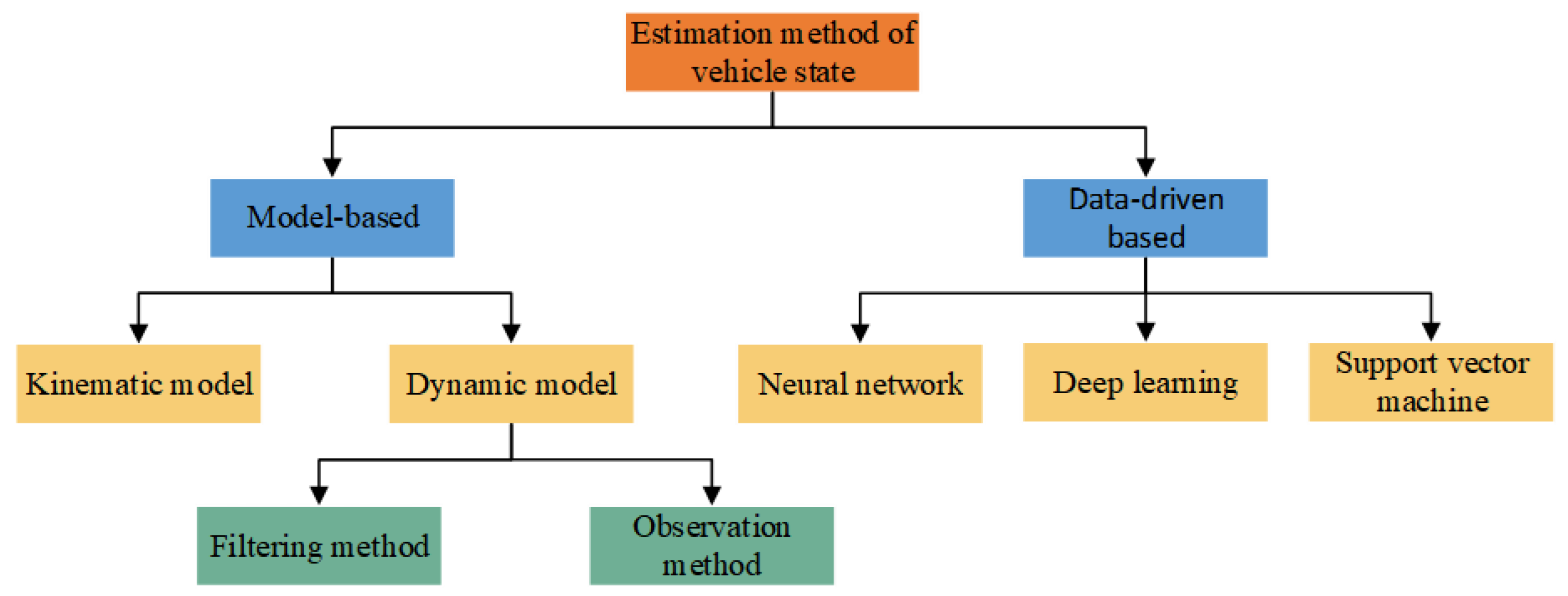
Accurately obtaining vehicle status parameters is critical for control systems, including motion control and active safety control, in mining dump trucks. Current vehicle state estimation methods can primarily be categorized into two types, model-based and data-driven approaches [3,4], as illustrated in Figure 1.
Kalyanasundaram et al. [5] proposed an uncertainty-aware hybrid learning architecture that integrates machine learning models with vehicle motion models to directly estimate the centroid roll angle. Xia et al. [6] achieved dynamic identification of the lateral deviation angle of the vehicle’s center of mass by establishing vehicle kinematic equations and fusing multi-source data from inertial measurement units (IMUs) and satellite navigation systems. Compared to vehicle kinematic models, vehicle state parameter estimation based on dynamic models achieves high-precision estimation of key state parameters by analyzing the relationship between vehicle forces and motion while comprehensively considering dynamic factors such as tire forces, mass distribution, and suspension characteristics. Singh et al. [7] proposed a novel framework for estimating the vehicle sideslip angle, combining an adaptive tire model with a model-based observer. This adaptive tire model can effectively address the dynamic changes in tire operating conditions. Luo et al. [8] employed a layered estimation method, using a sliding mode observer in the upper layer to estimate the lateral and longitudinal forces of the vehicle, providing accurate and stable inputs for the lower layer. However, the performance of the sliding mode observer is sensitive to the selection of sliding mode parameters [9]. Compared to the aforementioned estimation methods, Kalman filtering algorithms and their improved variants are more widely applied for state parameter estimation. Sun et al. [10] utilized the Extended Kalman Filter (EKF) algorithm for real-time observation of the vehicle’s center of mass lateral deviation angle, establishing a centroid lateral angle state observer with an adaptive truncation program by combining EKF with the least squares method. Compared to EKF, UKF employs UT transformation to simulate state distribution through a series of Sigma points, avoiding the need for complex Jacobian matrix calculations. Lei et al. [11] proposed a dynamic state estimation architecture for distributed electric drive articulated vehicles based on forgetting factor unscented Kalman filter and singular value decomposition (SVD-UKF), verifying its effectiveness. Data-driven vehicle state parameter estimation does not rely on traditional physical models. Gonzalez et al. [12] proposed a deep learning-based approach to estimate the center of mass roll angle and body roll angle. Adbillah et al. [13] used artificial neural networks to estimate difficult-to-measure state variables in vehicle models, demonstrating the effectiveness and superiority of this method.
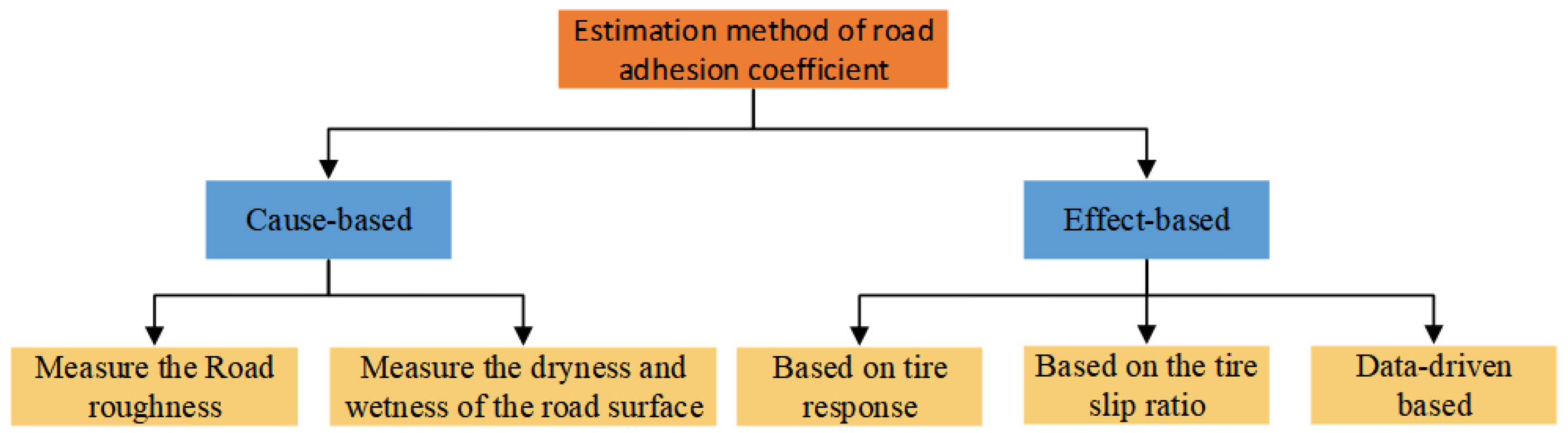
The road adhesion coefficient is one of the key parameters of the vehicle control system, and the control system can select the optimal control strategy based on the size of the road adhesion coefficient. At present, the estimation methods for road adhesion coefficient mainly include two categories [14,15,16], cause-based and effect-based, as shown in Figure 2.
The cause-based estimation method directly calculates the adhesion coefficient by measuring or inverting the physical properties of the tire-road contact interface. Li et al. [17] estimated the road adhesion coefficient based on the reflection intensity characteristics of LiDAR point clouds. Liang et al. utilized 3D laser technology to detect continuous point cloud data of asphalt pavement and reconstruct the 3D terrain of pavement texture, thereby enhancing the efficiency and accuracy of texture feature description and adhesion performance evaluation. The effect-based estimation method indirectly infers the adhesion coefficient by observing the vehicle’s dynamic response (e.g., slip ratio, yaw rate, etc.). Leng et al. [18] designed a strategy that integrates a dynamic estimator and a visual estimator based on support vector machines for road surface classification, improving the convergence speed of road estimation algorithms. Wang et al. developed an electric vehicle road adhesion coefficient estimation algorithm based on slip rate perception constraints and strong tracking unscented Kalman filter (UKF). Peng et al. [19] have demonstrated that V2X-enabled platoon cooperative control exhibits high sensitivity to vehicle states and road adhesion conditions. Consequently, accurate estimation of vehicle states and adhesion coefficients not only serves as the foundation for achieving high-precision control of individual vehicles but also constitutes a prerequisite for supporting safety-critical applications such as V2X-enabled platoon cooperative control—these cooperative strategies are highly dependent on the precise perception of the dynamic limits of both the ego vehicle and surrounding vehicles.
The existing vehicle state estimation methods are primarily designed for traditional centralized drive vehicles and face challenges in directly adapting to distributed drive architectures. Model-based observers depend on an accurate tire–motor coupling model, but the increased complexity of distributed drive multi-wheel independent control complicates model construction. Although data-driven methods can avoid modeling errors, they require reconstructing input features to accommodate four-wheel drive characteristics, and the scarcity of mining scene data limits their generalization ability. Regarding noise processing, the multiple noise sources in distributed drives, such as motor torque fluctuations and wheel speed sensor noise, exhibit significant time-varying characteristics. The assumption of a fixed noise covariance matrix in traditional unscented Kalman filters (UKF) leads to a sharp decline in estimation accuracy during sudden turns or abrupt changes in adhesion. Additionally, the independent estimation of the four-wheel adhesion coefficient must address the coupling relationship between the slip rate and side slip angle of each wheel, and existing estimation methods struggle to meet the refined control requirements of distributed driving.
In response to the aforementioned challenges, this article focuses on distributed drive mining dump trucks as the research subject and proposes an adaptive unscented Kalman filter (SH-AUKF) method based on the Sage–Husa algorithm to achieve high-precision and robust estimation of vehicle state parameters and road adhesion coefficients. It should be noted that this study primarily focuses on the algorithmic design and high-fidelity simulation verification. Therefore, the validation of the proposed method is currently constrained to a software-in-the-loop simulation environment. While this provides a solid theoretical foundation, it is acknowledged that there exists a gap between the simulation model and the physical reality of mining operations, which necessitates further experimental validation in future work.

2. Dynamic Modeling of Distributed Drive Mining Dump Trucks

2.1. Vehicle Dynamics Model

Distributed drive mining dump trucks impose specific requirements on dynamic modeling due to their unique power architecture and dynamic characteristics under complex working conditions. The dynamic model serves as a critical foundation for studying vehicle parameter estimation, requiring a balance between model accuracy and computational efficiency. The seven-degree-of-freedom model can more comprehensively represent the longitudinal, lateral, and yaw motions of vehicles, fully describe their dynamic behavior on unstructured road surfaces, and achieve more precise estimation of relevant parameters. This is especially significant for estimating vehicle parameters under complex operating conditions.
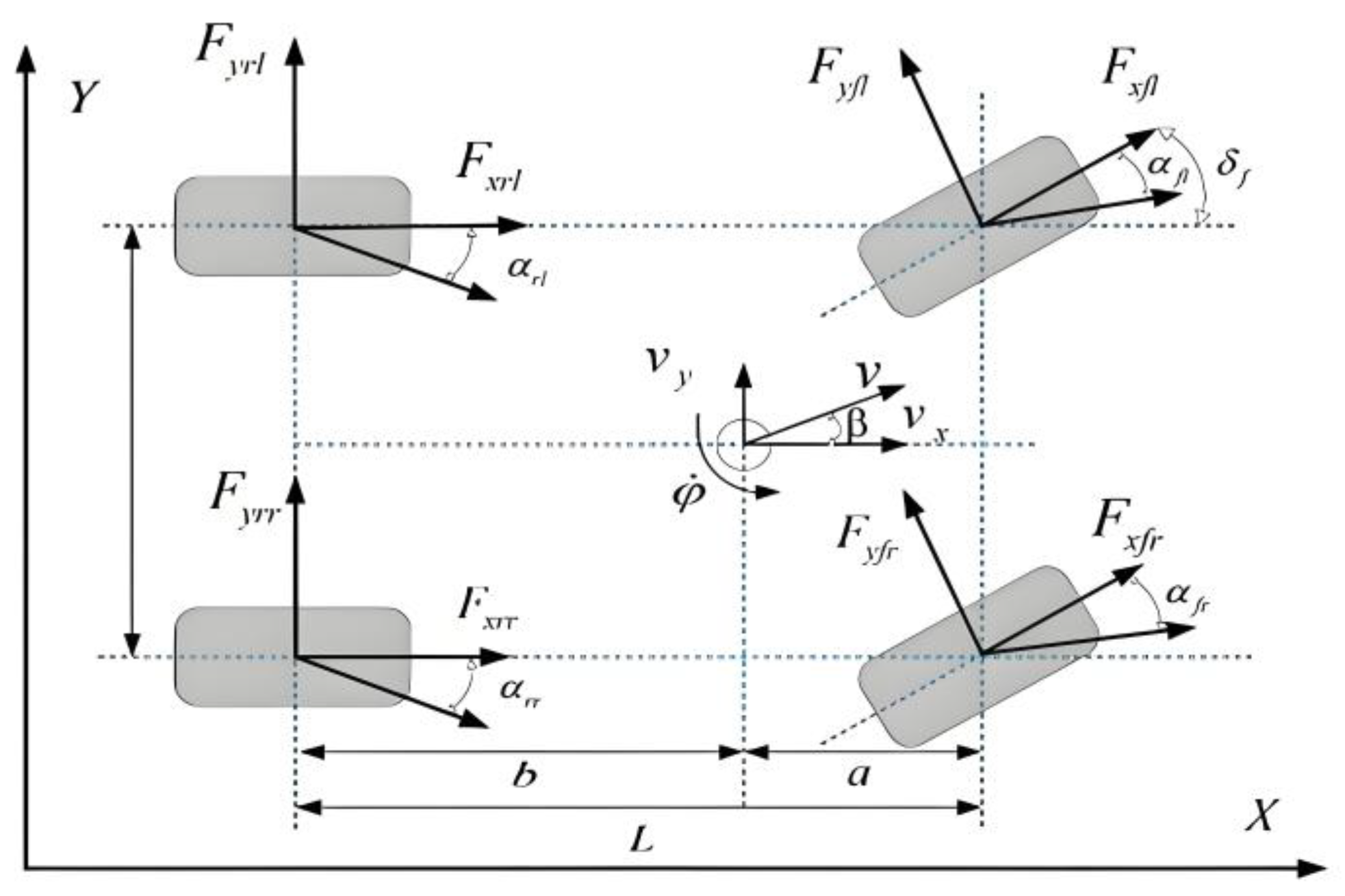
The seven-degree-of-freedom vehicle dynamics model is presented in Figure 3, and the vehicle dynamics motion equation is expressed as follows:
m ( v ˙ x v y φ ˙ ) = ( F x f l + F x f r ) cos δ f ( F y f l + F y f r ) sin δ f + F x r l + F x r r m ( v ˙ y v x φ ˙ ) = ( F x f l + F x f r ) sin δ f ( F y f l + F y f r ) cos δ f + F y r l + F y r r I z φ ¨ = a [ ( F x f l + F x f r ) sin δ f + ( F y f l + F y f r ) cos δ f ] b ( F y r l + F y r r ) + 0.5 c ( F y f l F y f r ) sin δ f + 0.5 c ( F x f r F x f l ) + 0.5 c ( F x r r F x r l ) I w ω ˙ i j = T i j R F x i j
which, m represents the mass, φ represents the lateral angular velocity, F x i j represents the longitudinal force of the tire, F y i j represents the lateral force of the tire, v x represents longitudinal velocity, v y represents lateral velocity, I z represents the yaw inertia of the vehicle about the Z-axis, a and b represent the distances from the center of mass to the front and rear axles, c represents the wheelbase, δ f represents front wheel steering angle of the vehicle, I w represents rotational inertia of the wheels, T i j represents driving torque on the four wheel hub motors, R represents wheel radius, and ω i j represents the wheel speed.
During vehicle motion, the coupling effect of lateral and longitudinal accelerations causes the vertical load on the tires to redistribute. Consequently, in the vehicle dynamics model, the impact of load transfer must be taken into account, and the vertical dynamic load equation for the tires can be expressed as:
F z f l = m g b 2 L m a x h 2 L m a y b h L c + m a x a y h 2 g L c F z f r = m g b 2 L m a x h 2 L + m a y b h L c m a x a y h 2 g L c F z r l = m g a 2 L m a x h 2 L m a y a h L c + m a x a y h 2 g L c F z r r = m g a 2 L m a x h 2 L + m a y a h L c m a x a y h 2 g L c
which, h represents the height of the center of mass, L represents the wheelbase, a x represents the longitudinal acceleration, and a y represents the lateral acceleration.
In vehicle steering dynamics, the tire slip angle α i j serves as the core input parameter, and its magnitude directly influences the tire lateral force. The tire slip angle is derived from parameters such as the yaw rate, front wheel angle, and longitudinal and lateral vehicle speeds. The calculation equation is expressed as follows:
α f l = δ f arctan ( v y + a φ ˙ v x 0.5 c φ ˙ ) α f r = δ f arctan ( v y + a φ ˙ v x + 0.5 c φ ˙ ) α r l = arctan ( v y + b φ ˙ v x 0.5 c φ ˙ ) α r r = arctan ( v y + b φ ˙ v x + 0.5 c φ ˙ )
The calculation equation for the tire slip ratio of a vehicle under acceleration or braking conditions is expressed as follows:
s i j = R ω i j v x R ω i j ,   i f   R ω i j v x v x R ω i j R ω i j ,   i f   R ω i j v x

2.2. Tire Model

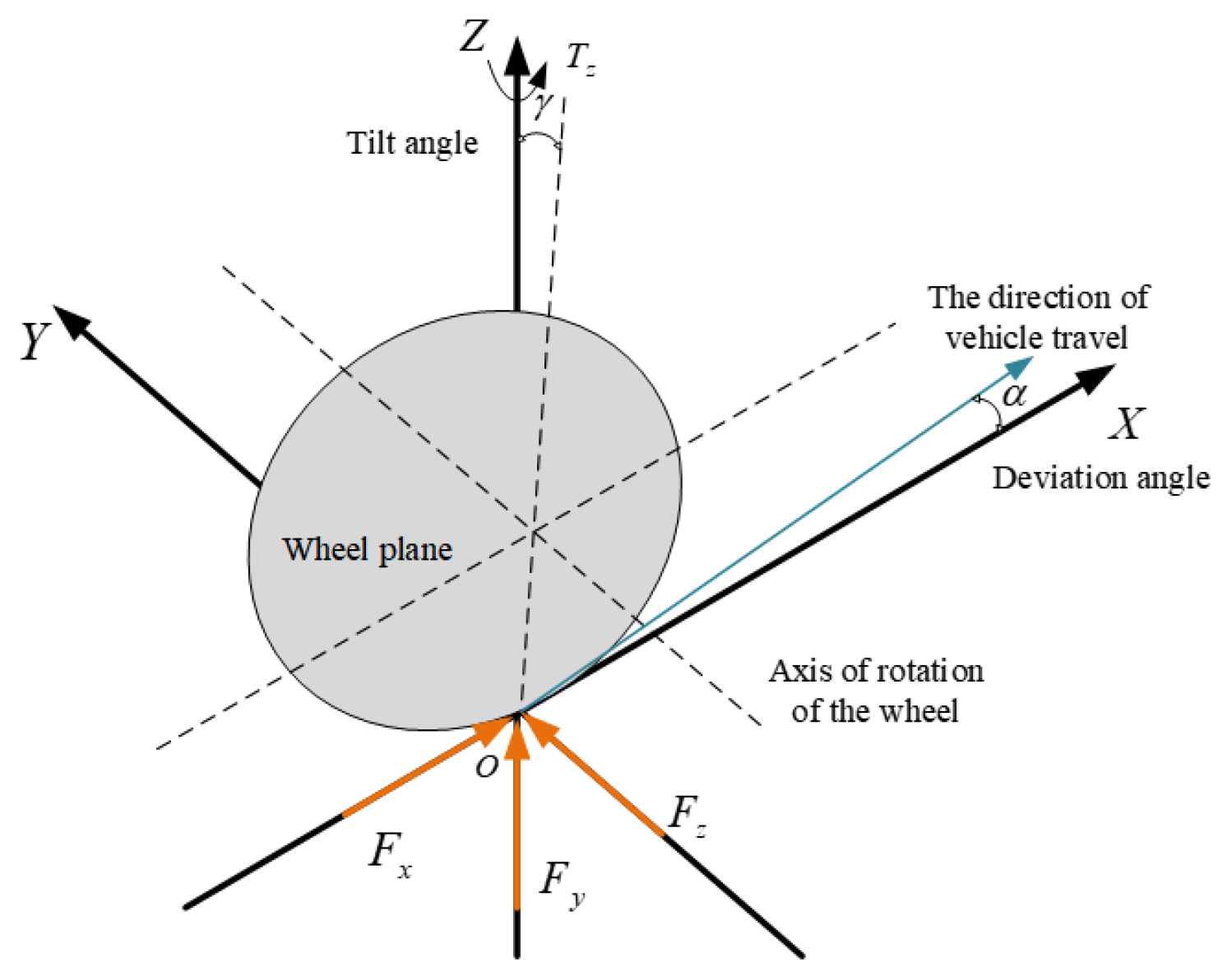
As the only component in contact with the road surface, the mechanical properties of tires are closely related to the vehicle’s motion in all directions. The estimation of vehicle state parameters and road adhesion coefficients depends on information regarding tire forces. Due to its small number of parameters, low computational complexity, excellent separation of road adhesion coefficients, and good compatibility with the algorithm, which can satisfy the real-time and adaptability requirements of the algorithm, this paper selects the Dugoff semi-empirical tire model for construction, as illustrated in Figure 4.
Expression of tire longitudinal force:
F x i j = μ i j F x i j 0 = μ i j F z i j C y i j s i j 1 s i j f ( L )
Expression of tire lateral force:
F y i j = μ i j F y i j 0 = μ i j F z i j C y i j tan α i j 1 s i j f ( L ) f ( L ) =     1     , L 1 L ( 2 L ) , L < 1 L = ( 1 s i j ) ( 1 ε v x C x i j 2 s i j 2 + C y i j 2 tan 2   α i j ) 2 C x i j 2 s i j 2 + C y i j 2 tan 2   α i j
which, i = f , r represents the front and rear wheels; j = l , r represent the left and right wheels; C x i j , C y i j represents the longitudinal stiffness and lateral stiffness of the tire; μ i j indicates the road adhesion coefficient of each wheel; ε represents the speed influencing factor; F z i j indicates the vertical load of the tire; F x i j 0 , F y i j 0 represent the normalization processing of the tire stress; L describes the characteristic parameters of tire slip.

2.3. Validation of the Dynamic Model

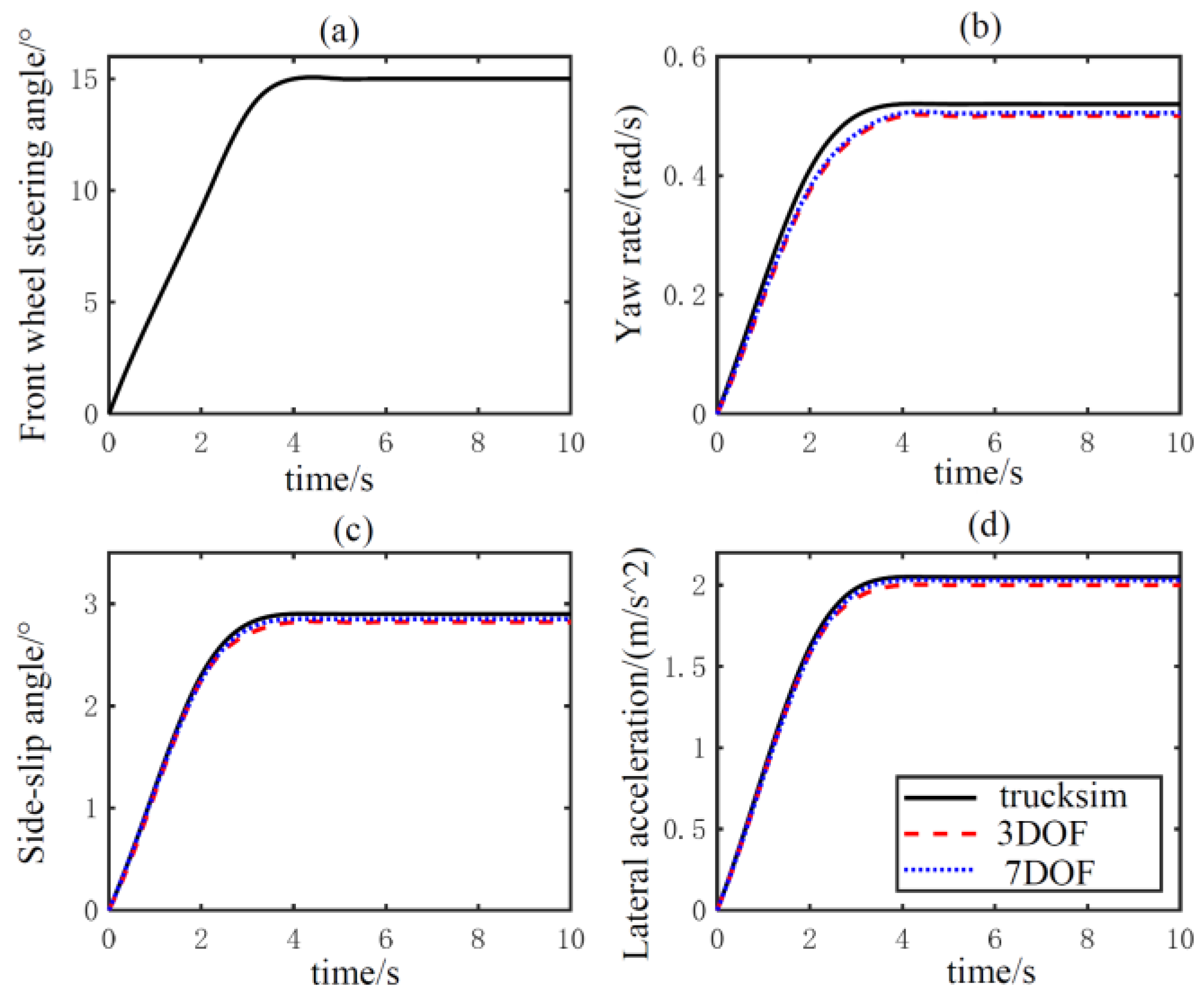
To verify the validity of the vehicle dynamic model mentioned above, this section uses the Trucksim and Matlab/Simulink co-simulation platform. The model in Trucksim is taken as the reference, and the vehicle model parameters in Trucksim are modified according to the data in Table 1. The seven-degree-of-freedom and three-degree-of-freedom dynamic models of the vehicle are validated. The vehicle verification condition is a circular trajectory with a radius of 30 m, the road adhesion coefficient is set to 0.7, and the vehicle speed is set to 20 km/h. The model validation results are shown in Figure 5. It can be seen that the parameter response of the dynamic model established in this chapter is basically consistent with that of the model in Trucksim, which proves that the proposed distributed drive mining dump truck dynamic model is reasonable and effective.

3. Estimation of Vehicle State Parameters and Road Surface Adhesion Coefficient

3.1. Unscented Kalman Filter Algorithm Based on Sage–Husa Algorithm

In this section, an adaptive noise estimation module based on the Sage–Husa algorithm is added to the traditional UKF. At each time step, not only state prediction and update are performed, but also the estimated values of and are updated according to the statistical characteristics of the current residual sequence (the difference between observation and prediction), thereby dynamically adjusting the parameters of the filter. The adaptive mechanism for real-time adjustment of the process noise covariance matrix and measurement noise covariance matrix in the UKF makes it more suitable for time-varying systems. The steps are as follows:
The calculation of the system process noise mean is as follows:
q ( k ) = ( 1 d k ) q ( k 1 ) + d ( k ) x ^ ( k | k 1 ) i = 0 2 n W i m x i ( k | k 1 )
The calculation of the system process noise covariance matrix is as follows:
Q ( k ) = ( 1 d k ) Q ( k 1 ) + d k { K ( k ) e ( k 1 ) e T ( k 1 ) K T ( k + 1 ) + P ( k | k 1 ) i = 0 2 n W i p [ χ i ( k / k 1 ) x ^ ( k / k 1 ) ] [ χ i ( k / k 1 ) x ^ ( k / k 1 ) ] T }
The mean value of the system observation noise is calculated as follows:
r ( k ) = ( 1 d k ) r ( k 1 ) + d k z ^ ( k | k 1 ) i = 0 2 n W i m z i ( k | k 1 )
The calculation of the system measurement noise covariance matrix is as follows:
R ( k ) = ( 1 d k ) R ( k ) + d k { e ( k ) e T ( k ) i 2 n W i p [ z i ( k / k 1 ) z ^ ( k / k 1 ) ] [ z i ( k / k 1 ) z ^ ( k / k 1 ) ] T }
In the formula, d k is the update rate, which represents the estimated speed of noise update, d k = ( 1 b ) / ( 1 b k + 1 ) where b is the forgetting factor, and its value range is generally from 0.95 to 0.99.

3.2. Estimation of Vehicle State Parameters Based on SH-AUKF

In the dynamic control and safe driving of distributed drive mining dump trucks, the accurate estimation of vehicle state parameters (longitudinal speed, slip angle, yaw rate) is of crucial importance. This article proposes a vehicle state parameter estimation observer based on the Sage–Husa adaptive unscented Kalman filter (AUKF).
The state space equation is formulated using a seven-degree-of-freedom vehicle dynamics model, as expressed below:
v ˙ x = v y φ ˙ + a x v ˙ y = v x φ ˙ + a y I z φ ¨ = a [ ( F x f l + F x f r ) sin δ f + ( F y f l + F y f r ) cos δ f ] b ( F y r l + F y r r ) + 0.5 c ( F y f l F y f r ) sin δ f + 0.5 c ( F x f r F x f l ) + 0.5 c ( F x r r F x r l ) ω i j = T i j F x i j R I ω
The estimation of vehicle state parameters is based on a nonlinear observation equation, which is composed of the following dynamic relationships and expressed as follows:
a x = 1 m ( ( F x f l + F x f r ) cos δ f + F x r l + F x r r ( F y f l + F y f r ) sin δ f ) a y = 1 m ( ( F x f l + F x f r ) sin δ f + F y r l + F y r r ( F y f l + F y f r ) cos δ f )
The longitudinal and lateral forces acting on the wheels in the aforementioned dynamic equations can be derived from the Dugoff tire model equations. Meanwhile, information such as vehicle lateral and longitudinal acceleration, wheel speed, torque, etc., can be readily obtained from basic measurement sensors.
In summary, the state variables in the SH-AUKF state parameter estimation algorithm are as follows:
x = x 1   x 2   x 3 T = v x   v y   φ ˙ T
The measured variables are:
y = y 1   y 2   y 3 T = a x   a y   φ ˙ T
The system input is:
u = u 1   u 2   u 3   u 4   u 5   u 6   u 7   u 8   u 9 T     = δ f   F x f l   F x f r   F x r l   F x r r   F y f l   F y f r   F y r l   F y r r T
The nonlinear state space equation representation of the final SH-AUKF vehicle state parameter estimation observer is expressed as follows:
x ˙ 1 = x 2 x 3 + u 2 cos u 1 + u 3 cos u 1 + u 4 + u 5 ( u 6 + u 7 ) sin u 1 m x ˙ 2 = u 2 sin u 1 + u 3 sin u 1 + u 8 + u 9 ( u 6 + u 7 ) cos u 1 m x ˙ 3 = 1 I z u 2 ( a sin u 1 0.5 c cos u 1 ) + u 3 ( a sin u 1 + 0.5 c sin u 1 ) 0.5 c ( u 5 u 4 ) + ( u 6 + u 7 ) a cos u 1 ( u 8 + u 9 ) a
The expression for the measurement equation is:
y 1 = u 2 cos u 1 + u 3 cos u 1 + u 4 + u 5 ( u 6 + u 7 ) sin u 1 m y 2 = u 2 sin u 1 + u 3 sin u 1 + u 8 + u 9 ( u 6 + u 7 ) cos u 1 m y 3 = x 3

3.3. Estimation of Road Adhesion Coefficient Based on SH-AUKF

In vehicle engineering, the adhesion coefficient is a critical parameter for evaluating the driving stability and dynamic characteristics of vehicles under extreme operating conditions. It directly influences the acceleration, braking, and steering performance of the vehicle. However, mining dump trucks operate on unstructured road surfaces in mining areas, where road adhesion conditions vary significantly (e.g., gravel, mud, or mixed ice and snow roads). If the road adhesion coefficient cannot be sensed in real-time, it may lead to misjudgment of the tire force boundary by the trajectory tracking controller, resulting in issues such as driving wheel slip and lateral instability. In engineering practice, measuring the road adhesion coefficient using sensors faces the following challenges: complex installation requiring vehicle structural modifications; high procurement and maintenance costs; and adverse working conditions that can easily cause measurement failures. Therefore, accurate, real-time, and reliable estimation of the road adhesion coefficient has become a fundamental aspect of trajectory tracking control and optimization for distributed drive mining dump trucks. Its necessity also stems from the strong coupling effect of tire–road contact forces on the vehicle’s motion state under complex working conditions. The paper proposes a road adhesion coefficient observer based on the SH-AUKF algorithm, enabling real-time identification of road conditions.
The observer estimates the road adhesion coefficient of the four wheels based on a seven-degree-of-freedom vehicle dynamics model, and its dynamic equation can be expressed in the following form:
a x = μ f l ( F x f l 0 F y f l 0 δ f ) + μ f r ( F x f l 0 F y f l 0 δ f ) + μ r l F x r l 0 + μ r r F x r r 0 m a y = μ f l ( F x f l 0 F y f l 0 ) + μ f r ( F x f r 0 F y f r 0 ) + μ r l F y r l 0 + μ r r F y r r 0 m φ ¨ = 1 I z a ( F x f l 0 δ f + F y f l 0 ) + c 2 ( F x f r 0 F y f r 0 δ ) μ f l + a ( F x f r 0 δ f + F y f r 0 ) c 2 ( F x f r 0 F y f r 0 δ ) μ f r b F y r l 0 c 2 F x r l 0 μ r l b F y r r 0 + c 2 F x r r 0 μ r r
which, μ f l , μ f r , μ r l , μ r r are the adhesion coefficients of the four wheels.
The state variable of the system is x = μ f l , μ f r , μ r l , μ r r T , the output quantity is y = a x , a y , φ ¨ T , and the control variable is u = δ f . The measurement data obtainable from vehicle sensors includes longitudinal and lateral acceleration. Meanwhile, the precise estimate of the yaw rate is differentiated to obtain the rate of change of the yaw rate.
Under the assumption that the road adhesion coefficient changes slowly, the state equation of the discrete system can be expressed as follows:
x k + 1 = f ( x k , u k , W k ) = x k + W k
where W k is the system process noise.
The system’s discrete measurement equation can be expressed as:
y k = a x , k a y , k r ˙ k + V k = F x f l 0 F y f l 0 δ f m   F x f r 0 F y f r 0 δ f m   F x r l 0 m   F x r r 0 m F x f l 0 δ f + F y f l 0 m   F x f r 0 δ f F y f l 0 m   F y r l 0 m   F y r r 0 m H 1 H 2 H 3   H 4 μ f l , k μ f r , k μ r l , k μ r r , k + V k H 1 = 1 I z ( a ( F x f l 0 δ f + F y f l 0 ) + c 2 ( F x f l 0 F y f l 0 δ f ) ) , H 2 = 1 I z ( a ( F x f r 0 δ f + F y f r 0 ) c 2 ( F x f r 0 F y f r 0 δ f ) ) H 3 = 1 I z ( b F y r l 0 c 2 F x r l 0 ) , H 4 = 1 I z ( b F y r r 0 + c 2 F x r r 0 )
where V k is the observation noise.

4. Simulation Verification

4.1. Simulation Verification and Analysis of State Parameter Estimation

To verify the accuracy and reliability of the vehicle state parameter estimation algorithm, this section conducted validation tests on the Trucksim Matlab/Simulink platform under sine angle input and step angle input conditions. To highlight the advantages of the SH-AUKF algorithm proposed in this article, it was compared with the traditional UKF algorithm. Meanwhile, to evaluate the estimation accuracy of the state observer, a multidimensional error index was employed to quantify the estimation performance. Peak Absolute Error (PAE), Mean Absolute Error (MAE), and Root Mean Square Error (RMSE) were used as the accuracy evaluation indicators for the estimation results. The specific expressions for these three metrics are as follows:
P A E = max | x e x r | M A E = k = 1 n | x e x r | / n R M S E = k = 1 n ( x e x r ) 2 / n

4.1.1. Sinusoidal Steering Wheel Angle Condition

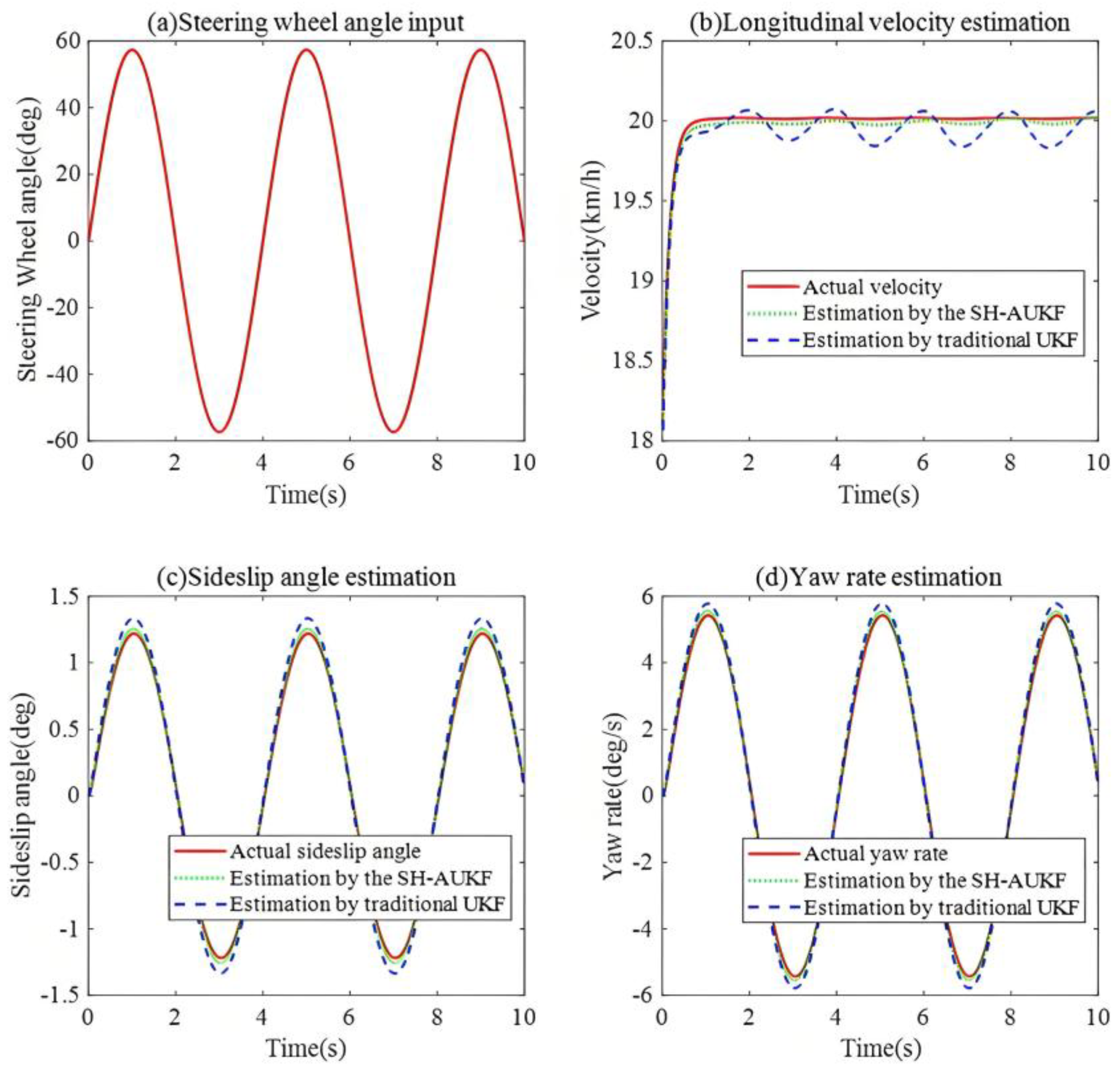
Set the initial speed to 18 km/h, accelerate uniformly to 20 km/h, and then drive the mining dump truck at a constant speed. The road adhesion coefficient is set to 0.7, and the simulation time is set to 10 s. The experimental results are compared with the longitudinal vehicle speed, slip angle, and yaw rate estimated by the traditional UKF state observer under the same operating conditions, using the actual vehicle state parameters output by TruckSim as a reference. To verify the estimation accuracy and real-time performance of the AUKF state parameter observer based on the Sage–Husa algorithm, the experimental results are presented in Figure 6.
From the overall simulation results, it can be observed that under the sine angle input condition, the AUKF state parameter observer based on the Sage–Husa algorithm proposed in this section demonstrates excellent parameter estimation performance. Compared with the traditional UKF state observer, this study introduces an adaptive noise covariance matrix adjustment mechanism to achieve more accurate estimation of key vehicle parameters. When the steering wheel direction changes, both state parameter observers exhibit relatively large fluctuations in estimating the vehicle’s state parameters; however, the AUKF state observer based on the Sage–Husa algorithm shows smaller fluctuations in the estimated values, as well as superior stability and robustness.
To provide a more intuitive and accurate description of the effectiveness of the state parameter observer designed in this study, the following analysis focuses on the estimation errors of vehicle state parameters: The Peak Absolute Error (PAE) for longitudinal vehicle speed estimation is 0.1063 km/h, Mean Squared Error (MSE) is 0.0015 km/h, and Root Mean Squared Error (RMSE) is 0.0383 km/h. For estimating the lateral deviation angle of the centroid, the PAE, MSE, and RMSE are 0.0496, 0.0012, and 0.0344, respectively. For lateral angular velocity estimation, the PAE is 0.2282, MSE is 0.0221, and RMSE is 0.1488. Compared with the traditional UKF state observer, the SH-AUKF state parameter observer reduces the PAE of longitudinal vehicle speed, slip angle, and yaw rate estimation by 20.37%, 65.29%, and 40.74%, respectively, demonstrating a significant improvement in the algorithm’s anti-interference capability under extreme working conditions. Additionally, the MSE decreases by 81.70%, 89.65%, and 70.01%, respectively, reflecting the optimization of steady-state tracking accuracy. Finally, the RMSE decreases by 57.73%, 68.03%, and 45.19%, effectively suppressing error propagation. Overall, the vehicle state parameter observer proposed in this study achieves higher estimation accuracy, stronger robustness, and stability, meeting the requirements of the algorithm.

4.1.2. Step Steering Wheel Angle Condition

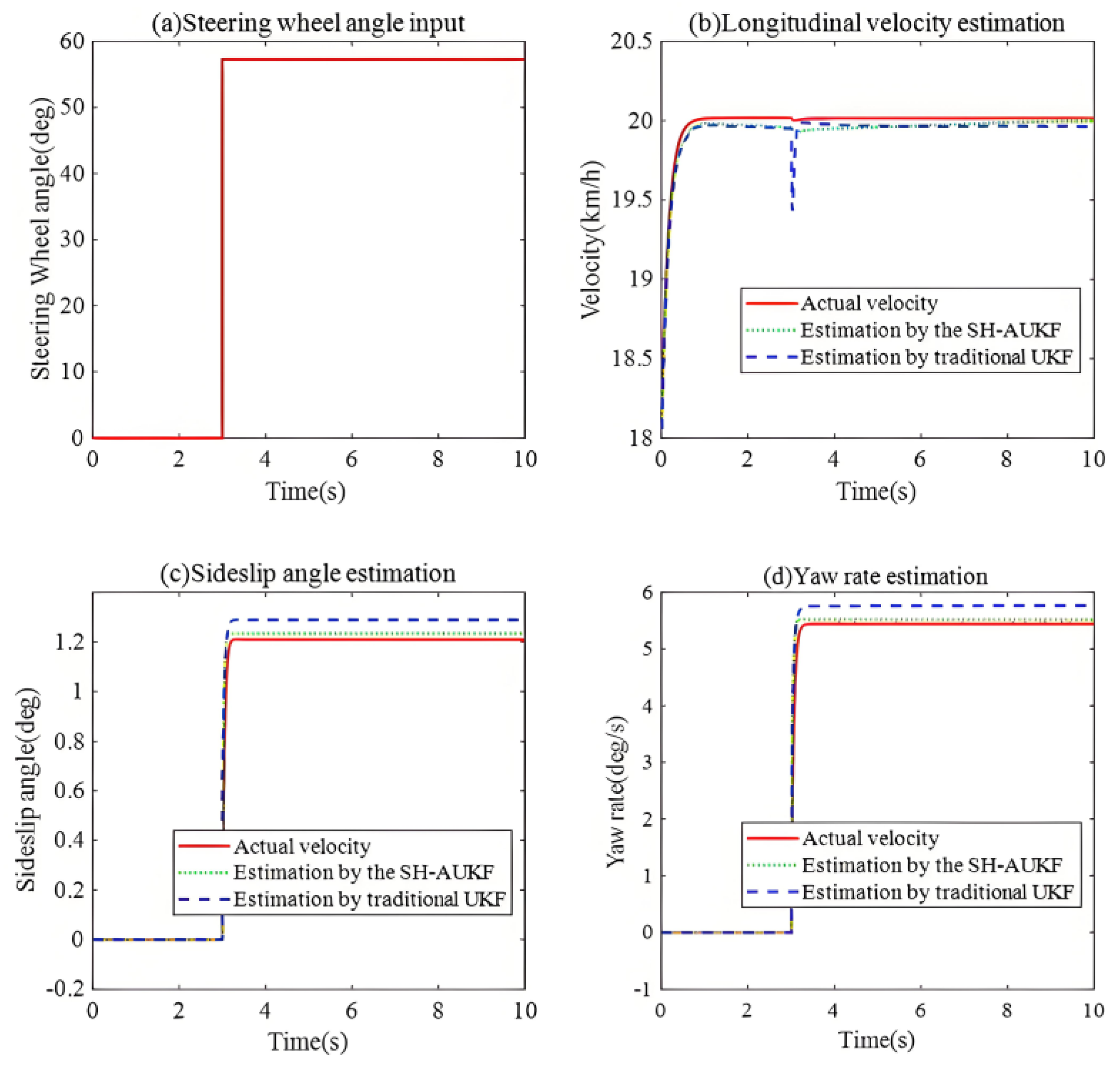
Except for the steering wheel angle input, all other settings remain the same as in the previous operating conditions. The simulation test results are presented in Figure 7. From the simulation results, it can be observed that under the step steering wheel angle input condition, the AUKF state observer based on the Sage–Husa algorithm proposed in this section continues to demonstrate excellent performance. Compared with the traditional UKF state observer, it achieves more accurate estimation of the longitudinal vehicle speed, slip angle, and yaw rate while exhibiting superior robustness and adaptability.
The AUKF state observer based on the Sage–Husa algorithm demonstrates outstanding parameter estimation performance under step steering conditions. Error data analysis reveals that the Peak Absolute Error (PAE), Mean Squared Error (MSE), and Root Mean Squared Error (RMSE) for longitudinal vehicle speed estimation are 0.0973, 0.0015, and 0.0386, respectively; the PAE, MSE, and RMSE for estimating the lateral deviation angle of the centroid are 0.3510, 0.0014, and 0.0374, respectively; and the PAE, MSE, and RMSE for lateral angular velocity estimation are 1.5739, 0.0224, and 0.1496, respectively. Compared with the traditional UKF state observer, the SH-AUKF state parameter observer reduces the PAE of longitudinal vehicle speed, slip angle, and yaw rate estimation by 82.67%, 44.63%, and 9.77%, respectively; the MSE decreases by 54.55%, 77.42%, and 57.41%, respectively; and the RMSE decreases by 32.28%, 53.37%, and 34.76%, respectively. The vehicle state parameter observer proposed in this study achieves high estimation accuracy, strong adaptability, and robustness, meeting the algorithm requirements and satisfying the control needs of mining dump trucks on unstructured road surfaces.

4.2. Simulation Verification and Analysis of Road Adhesion Coefficient Estimation

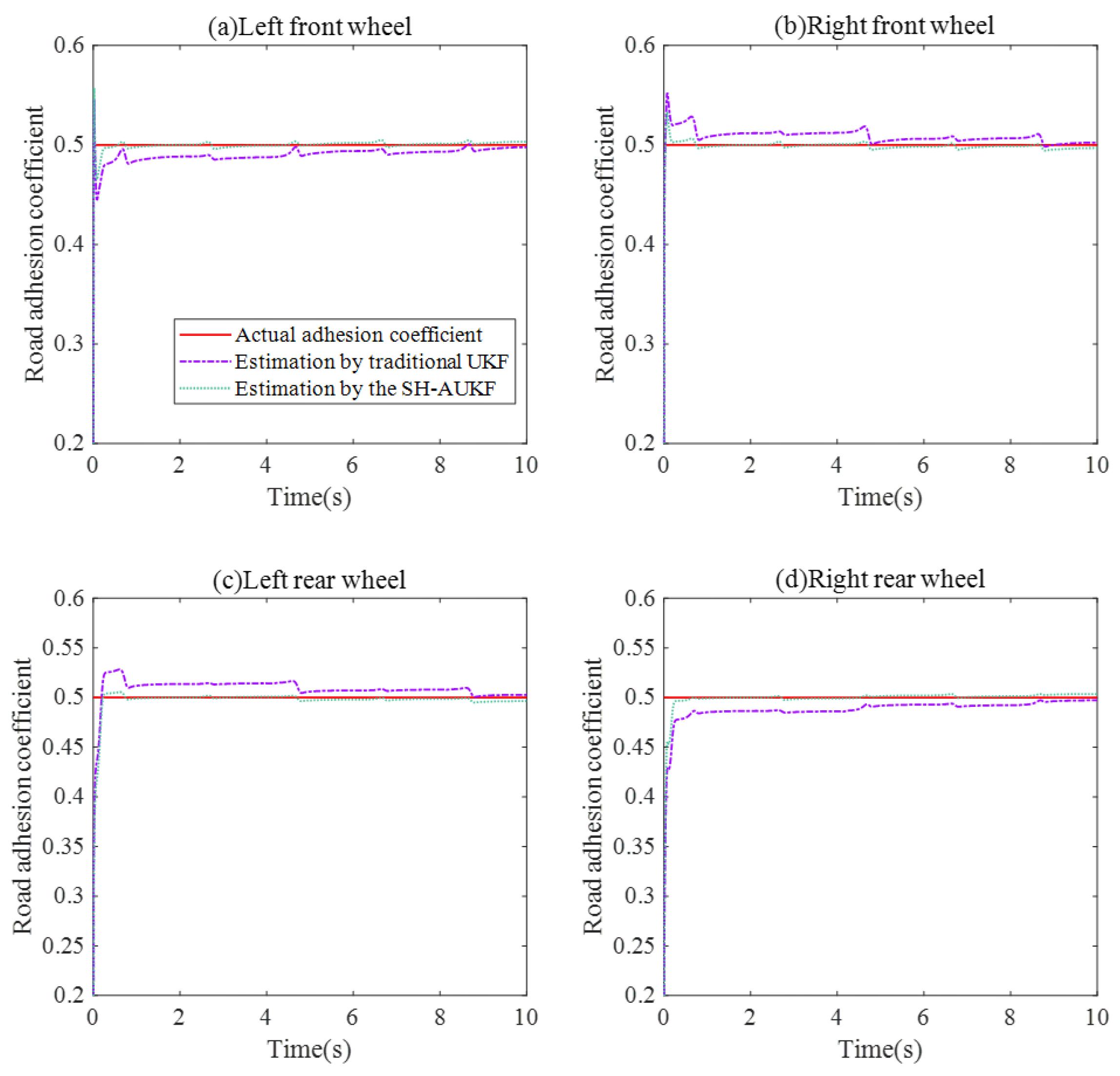
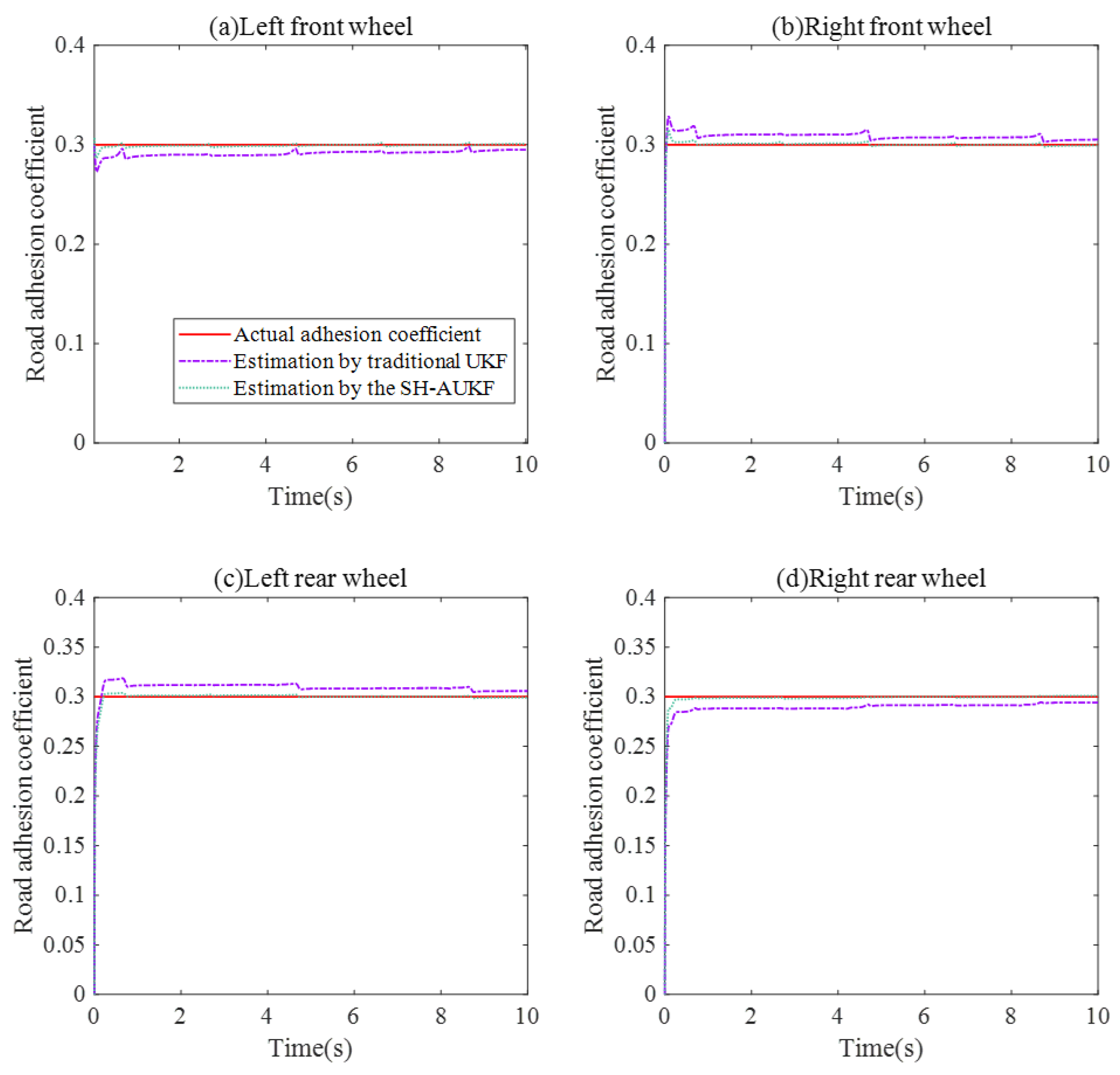
To verify the accuracy and reliability of the road adhesion coefficient estimation algorithm proposed in this section, validation was conducted using the Matlab/Simulink TruckSim software platform (v. 2025b). To highlight the advantages of the SH-AUKF algorithm proposed in this study, it was compared with the traditional UKF algorithm. The verification process employed the same steering wheel angle input as in the previous section, with a constant speed set at 20 km/h. The estimation performance was simulated and verified under three different road adhesion coefficients (0.7, 0.5, and 0.3), which correspond to three mining road conditions: gravel road, dry soil road, and waterlogged road, respectively. The simulation results are as follows.

4.2.1. Simulation Verification of Gravel Pavement (Pavement Adhesion Coefficient 0.7)

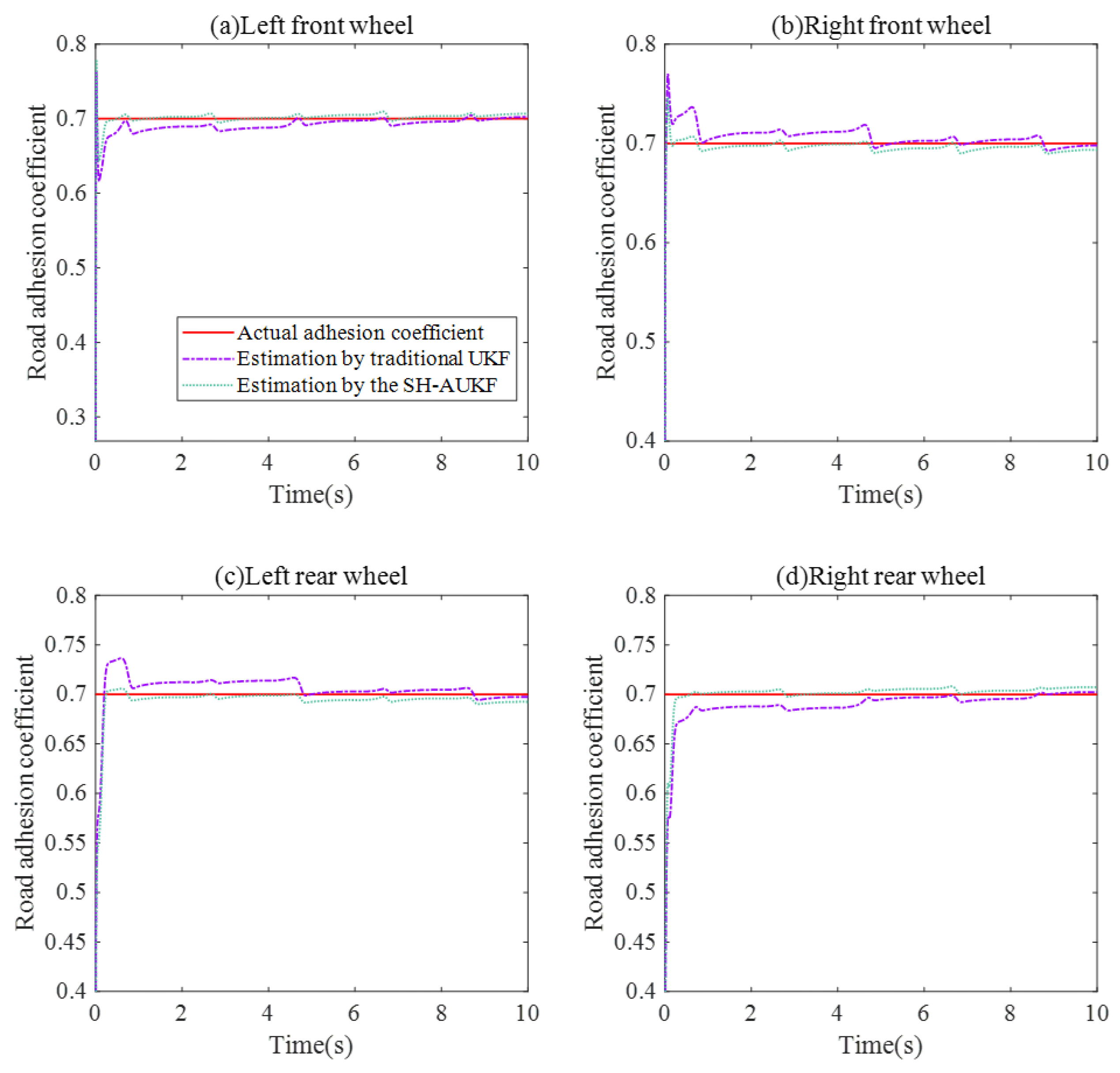
As shown in Figure 8, under gravel road conditions (with a nominal road adhesion coefficient of 0.7), the Sage–Husa-optimized adaptive unscented Kalman filter (AUKF) observer for road adhesion coefficients demonstrates superior estimation performance across all four wheels, achieving a marked improvement in both accuracy and convergence consistency.
Following initialization of the simulation experiment, the Sage–Husa-optimized adaptive unscented Kalman filter (SH-AUKF) observer for tire–road adhesion coefficients converged rapidly to the nominal value of μ = 0.7. In contrast, the conventional UKF observer exhibited slower convergence and pronounced overshoot—particularly evident in the estimates for the right front wheel (Figure 8b) and left rear wheel (Figure 8c). During steering maneuvers—i.e., when the mining dump truck undergoes directional changes—both observers experienced transient estimation fluctuations. However, the SH-AUKF observer yielded significantly reduced amplitude and shorter settling time, demonstrating superior robustness to dynamic lateral load transfer and enhanced estimation stability under transient vehicle dynamics.

4.2.2. Simulation Verification of Dry Soil Pavement (Pavement Adhesion Coefficient 0.5)

As illustrated in Figure 9, under dry soil road conditions (nominal adhesion coefficient μ = 0.5), the Sage–Husa-optimized adaptive unscented Kalman filter (AUKF) observer for tire–road adhesion coefficients maintains superior estimation performance across all four wheels, exhibiting both enhanced accuracy and improved robustness to modeling uncertainties. Compared with the traditional UKF, the SH-AUKF can converge more rapidly to the actual value of 0.5 when estimating the road adhesion coefficient and exhibits greater stability. Even when the steering wheel changes direction, it maintains a smaller fluctuation range.

4.2.3. Simulation Verification of Waterlogged Road Surface (Road Adhesion Coefficient 0.3)

It can be seen from the simulation results in Figure 10 that on a waterlogged road surface (with a road adhesion coefficient of 0.3), the AUKF road adhesion coefficient observer based on Sage–Husa optimization continues to exhibit superior estimation performance, higher estimation accuracy, better robustness, and stability for all four wheels.
To analyze the estimation effect of the road adhesion coefficient more intuitively, the following analysis focuses on the estimation error of the road adhesion coefficient. Due to the convergence of the road adhesion coefficient starting from 0 after the simulation begins, the initial error is relatively large, making the maximum error less informative. In this section, only the root mean square error (RMSE) is selected as the analysis index. From the error data, it can be observed that the observer achieves higher estimation accuracy for the front wheels. This is because the front wheels, which serve as steering angles, experience significant coupling changes in lateral and longitudinal forces, providing richer dynamic data. These data changes facilitate the separation of the longitudinal and lateral components of the road adhesion coefficient, thereby improving estimation accuracy. When the road adhesion coefficient is 0.3, 0.5, and 0.7, the AUKF road adhesion coefficient observer based on Sage–Husa demonstrates better performance, with average RMSE values of 0.0106, 0.0182, and 0.0257 for all four wheels, respectively. Compared with traditional UKF observers, the average RMSE decreases by 26.02%, 14.39%, and 8.02% under these three operating conditions, respectively.

5. Conclusions

The paper focuses on the accuracy and robustness of key state parameter and road adhesion coefficient estimation for distributed drive mining dump trucks. Firstly, the characteristics and advantages of KF, EKF, and UKF algorithms are compared. Subsequently, the UKF algorithm is selected, and an adaptive unscented Kalman filter algorithm (SH-AUKF) based on Sage–Husa optimization is proposed. By incorporating the Sage–Husa algorithm, dynamic estimation of the covariance matrix between process noise and observation noise is achieved, effectively addressing the issue of reduced estimation accuracy in traditional UKF under time-varying noise environments. An adaptive parameter estimation observer that integrates vehicle dynamics performance and tire mechanical characteristics is established, and a multi-parameter estimation system including longitudinal velocity, slip angle, yaw rate, and road adhesion coefficient is constructed.
A joint simulation platform is built, and different operating conditions are selected for simulation verification. The results demonstrate that the vehicle state parameter and road adhesion coefficient estimation algorithm based on SH-AUKF proposed in this paper exhibits superior accuracy, robustness, and adaptability compared to traditional UKF observers. Under sinusoidal operating conditions, the RMSE of longitudinal vehicle speed, slip angle, and yaw rate decreases by 57.73%, 68.03%, and 45.19%, respectively. Under step conditions, the RMSE decreases by 32.28%, 53.37%, and 34.76%, respectively. When the road adhesion coefficient is 0.3, 0.5, and 0.7, the average RMSE of the four wheels decreases by 26.02%, 14.39%, and 8.02%, respectively. This study provides theoretical support for high-precision control of unmanned mining vehicles and holds significant engineering application value.
While the simulation results demonstrate the theoretical effectiveness of the SH-AUKF algorithm, future research will focus on bridging the gap between simulation and reality. The immediate next step involves deploying the algorithm onto a Hardware-in-the-Loop (HIL) test bench to evaluate its performance under realistic sensor noise, signal delays, and actuator non-idealities. Subsequently, we plan to conduct real-vehicle experiments on an actual distributed drive mining dump truck. These field tests will be conducted under authentic mining-site disturbances, including varying payloads, rough terrain shocks, and complex road adhesion conditions, to comprehensively assess the algorithm’s robustness and applicability in real-world engineering scenarios.


Author Contributions

Conceptualization, K.S. and B.X.; methodology, K.S. and B.X.; software, K.S.; validation, K.S. and B.X.; formal analysis, K.S. and L.S.; investigation, K.S. and L.S.; resources, B.X.; data curation, K.S. and B.X.; writing—original draft preparation, K.S.; writing—review and editing, L.S. and B.X.; visualization, K.S.; supervision, L.S. and B.X.; project administration, L.S. and B.X.; funding acquisition, L.S. and B.X. All authors have read and agreed to the published version of the manuscript.

Funding

This research was funded by the National Natural Science Foundation of China under Grants 52302515; the Guangdong Basic and Applied Basic Research Foundation under Grants 2024A1515010135 and 2026A1515011453.

Data Availability Statement

The original contributions presented in the study are included in the article; further inquiries can be directed to the corresponding author.

Conflicts of Interest

The authors declare no conflicts of interest.

References

  1. Tang, Q.; Hu, M.; Bian, Y.; Wang, Y.; Lei, Z.; Peng, X.; Li, K. Optimal energy efficiency control framework for distributed drive mining truck power system with hybrid energy storage: A vehicle-cloud integration approach. Appl. Energy 2024, 374, 123989. [Google Scholar] [CrossRef]
  2. Gao, L.; Wu, Q.; He, Y.; Wu, K.; Shao, P. Robust estimation of sideslip angle for heavy-duty vehicles under payload conditions using a series-connected structure estimator. IEEE Trans. Intell. Veh. 2024, 10, 2915–2931. [Google Scholar] [CrossRef]
  3. Ding, X.; Wang, Z.; Zhang, L. Event-triggered vehicle sideslip angle estimation based on low-cost sensors. IEEE Trans. Ind. Inform. 2021, 18, 4466–4476. [Google Scholar] [CrossRef]
  4. Jin, X.; Yin, G.; Chen, N. Advanced estimation techniques for vehicle system dynamic state: A survey. Sensors 2019, 19, 4289. [Google Scholar] [CrossRef] [PubMed]
  5. Kalyanasundaram, A.; Sekaran, K.C.; Stauber, P.; Lange, M.; Utschick, W.; Botsch, M. Uncertainty-Aware Hybrid Machine Learning in Virtual Sensors for Vehicle Sideslip Angle Estimation. arXiv 2025, arXiv:2504.06105. [Google Scholar] [CrossRef]
  6. Xia, X.; Xiong, L.; Lu, Y.; Gao, L.; Yu, Z. Vehicle sideslip angle estimation by fusing inertial measurement unit and global navigation satellite system with heading alignment. Mech. Syst. Signal Process. 2021, 150, 107290. [Google Scholar] [CrossRef]
  7. Liang, H.; Pagano, R.G.; Oddone, S.; Cong, L.; De Blasiis, M.R. Analysis of Road Surface Texture for Asphalt Pavement Adhesion Assessment Using 3D Laser Technology. Remote Sens. 2024, 16, 1943. [Google Scholar] [CrossRef]
  8. Luo, J.; Guan, J.; Zhou, X.; Zhu, P. A strategy for vehicle air resistance and rolling resistance calculation based on the hierarchical estimation method. Int. J. Veh. Syst. Model. Test. 2024, 18, 152–174. [Google Scholar] [CrossRef]
  9. Ben Moussa, H.; Bakhti, M. Nonlinear tyre model-based sliding mode observer for vehicle state estimation. Int. J. Dyn. Control 2024, 12, 2944–2957. [Google Scholar] [CrossRef]
  10. Sun, W.; Wang, Z.; Wang, J.; Wang, X.; Liu, L. Research on a real-time estimation method of vehicle sideslip angle based on EKF. Sensors 2022, 22, 3386. [Google Scholar] [CrossRef] [PubMed]
  11. Lei, T.; Hou, M.; Li, L.; Cao, H. A State Estimation of Dynamic Parameters of Electric Drive Articulated Vehicles Based on the Forgetting Factor of Unscented Kalman Filter with Singular Value Decomposition. Actuators 2025, 14, 31. [Google Scholar] [CrossRef]
  12. González, L.P.; Sánchez, S.S.; Garcia-Guzman, J.; Boada, M.J.L.; Boada, B.L. Simultaneous estimation of vehicle roll and sideslip angles through a deep learning approach. Sensors 2020, 20, 3679. [Google Scholar] [CrossRef] [PubMed]
  13. Abdillah, M.; Mellouli, E.M. A new adaptive second-order non-singular terminal sliding mode lateral control combined with neural networks for autonomous vehicle. Int. J. Veh. Perform. 2024, 10, 50–72. [Google Scholar] [CrossRef]
  14. Wu, Y.; Li, G.; Fan, D. Joint estimation of driving state and road adhesion coefficient for distributed drive electric vehicle. IEEE Access 2021, 9, 75460–75469. [Google Scholar] [CrossRef]
  15. Qi, G.; Fan, X.; Li, H. A comparative study of the unscented Kalman filter and particle filter estimation methods for the measurement of the road adhesion coefficient. Mech. Sci. 2022, 13, 735–749. [Google Scholar] [CrossRef]
  16. Wang, Y.; Chang, Z.; Cai, Y.; Shang, Y.; Gao, F.; Huang, J. Road Adhesion Coefficient Estimation Based on Adaptive Unscented Kalman Filter. Eng. Lett. 2024, 32, 1921–1929. [Google Scholar]
  17. Li, B.; Wenjuan, E.; Feng, T.; Ding, Y.; Li, Y.; Wang, X.; Jiang, X.; Shen, C. Road adhesion coefficient estimation based on LiDAR reflectance intensity. IEEE Sens. J. 2024, 24, 29135–29148. [Google Scholar] [CrossRef]
  18. Leng, B.; Jin, D.; Xiong, L.; Yang, X.; Yu, Z. Estimation of tire-road peak adhesion coefficient for intelligent electric vehicles based on camera and tire dynamics information fusion. Mech. Syst. Signal Process. 2021, 150, 107275. [Google Scholar] [CrossRef]
  19. Peng, J.; Shangguan, W.; Chai, L.; Chen, J.; Peng, C.; Cai, B. V2X-Enabled Platoon Control for Aperiodic Congestion Mitigation via Moving Bottlenecks in Mixed Traffic Environments. IEEE Trans. Veh. Technol. 2025, 1–13. Available online: https://ieeexplore.ieee.org/document/11318970 (accessed on 10 May 2026). [CrossRef]
Figure 1. Summary of vehicle state parameter estimation methods.
Electronics 15 02113 g001
Figure 2. Summary of estimation methods for road surface adhesion coefficient.
Electronics 15 02113 g002
Figure 3. Seven-degree-of-freedom dynamic model.
Electronics 15 02113 g003
Figure 4. Dugoff tire model.
Electronics 15 02113 g004
Figure 5. Validation of dynamic models, (a) Front wheel steering angle; (b) Yaw rate; (c) Side-slip angle; (d) Lateral acceleration.
Electronics 15 02113 g005
Figure 6. Comparison of sinusoidal operating condition estimation.
Electronics 15 02113 g006
Figure 7. Comparison of step condition estimation.
Electronics 15 02113 g007
Figure 8. Comparison of estimated adhesion coefficient of gravel pavement.
Electronics 15 02113 g008
Figure 9. Comparison of estimated adhesion coefficient of dry soil pavement.
Electronics 15 02113 g009
Figure 10. Comparison of estimated adhesion coefficients for waterlogged road surfaces.
Electronics 15 02113 g010
Table 1. Main parameters of mining dump trucks.
ParameterValueUnite
Full load mass120t
curb weight40t
Tire model30.00 R51-
Turning radius12.2m
Wheelbase6000mm
Distance between center of mass and front axle3000mm
Distance between the center of mass and the rear axle3000mm
Maximum speed60km/h
Disclaimer/Publisher’s Note: The statements, opinions and data contained in all publications are solely those of the individual author(s) and contributor(s) and not of MDPI and/or the editor(s). MDPI and/or the editor(s) disclaim responsibility for any injury to people or property resulting from any ideas, methods, instructions or products referred to in the content.