Article

Instrumentation Techniques for Nuclear Pulse Shaping and Calibration in Geiger–Müller-Based Gamma Detectors

1
Facultad de Ciencias de la Ingeniería e Industrias, Universidad UTE, Quito 170129, Ecuador
2
Ministerio de Ambiente y Energía, Quito 170705, Ecuador
3
Oncology Department, Hospital de Especialidades Portoviejo, Manabi 130105, Ecuador
4
Departamento de Automatización y Control Industrial, Escuela Politécnica Nacional, Quito 170702, Ecuador
*
Author to whom correspondence should be addressed.
Electronics 2026, 15(10), 2093; https://doi.org/10.3390/electronics15102093
Submission received: 21 April 2026 / Revised: 7 May 2026 / Accepted: 12 May 2026 / Published: 14 May 2026
(This article belongs to the Section Circuit and Signal Processing)

Abstract

This work presents the design and validation of a low-cost electronic architecture for nuclear pulse conditioning and radiation exposure measurement using a Geiger–Müller tube. The main contribution is a structured three-stage conditioning system capable of transforming high-voltage analog nuclear pulses into standardized TTL-compatible digital signals for real-time acquisition and pulse counting. The proposed architecture integrates a regulated 500 V high-voltage supply, voltage coupling and limitation, CMOS-based inversion, and monostable pulse shaping using a 555 timer to generate stable 5 V output pulses with approximately 1600 μs duration. Experimental evaluation included oscilloscope-based pulse characterization, plateau-region verification, and calibration tests performed with a certified gamma radiation source under controlled laboratory conditions. The measured exposure response followed the expected inverse-distance radiation behavior, with relative deviations within ± 13 % compared with certified reference values. The results demonstrate the feasibility of implementing reliable radiation instrumentation using commercially available electronic components, providing an accessible solution for environmental, laboratory, and educational monitoring applications.

1. Introduction

The objective of this research is to develop and experimentally validate a reliable and low-cost electronic architecture for the detection, conditioning, and digital acquisition of nuclear pulses generated by a Geiger–Müller (GM) tube. Radiation monitoring remains essential in environmental surveillance, industrial safety, laboratory instrumentation, medical protection, and nuclear security applications, particularly in scenarios where continuous monitoring and accessible instrumentation are required. Although modern radiation detection technologies have evolved significantly, Geiger–Müller-based systems continue to be widely adopted due to their simplicity, robustness, low power consumption, and reduced implementation cost, as highlighted by Aspetti et al. [1]. Their compatibility with embedded electronics and digital acquisition systems also makes them attractive for compact and distributed monitoring platforms. Nevertheless, the implementation of reliable low-cost radiation instrumentation still presents important challenges associated with high-voltage stability, pulse integrity, signal conditioning, and measurement repeatability.
Recent investigations have proposed several approaches to improve radiation detection systems through embedded processing, wireless communication, and advanced signal acquisition techniques. Commercial ASIC-based pulse processing architectures have demonstrated improved pulse discrimination and real-time conditioning performance [2], while microcontroller-based monitoring platforms have emphasized portability, affordability, and remote acquisition capabilities [3,4]. These developments confirm the growing interest in low-cost and digitally integrated radiation monitoring technologies. However, many existing implementations prioritize communication and connectivity functionalities without providing a detailed analysis of nuclear pulse conditioning, high-voltage operating stability, pulse standardization, or experimental calibration procedures. As a result, there remains a need for instrumentation-oriented studies focused specifically on the electronic transformation of Geiger–Müller analog pulses into stable digital signals while maintaining acceptable measurement consistency and exposure estimation capability.
This work represents a continuation and experimental extension of the preliminary system introduced in Pavón et al. (2024) [5]. While the previous study presented the general architecture of a low-cost radiation monitoring platform, the present research focuses specifically on the electronic instrumentation aspects associated with nuclear pulse acquisition and conditioning. The proposed contribution includes the design and experimental validation of the high-voltage generation stage, the implementation of a structured three-stage pulse conditioning architecture composed of coupling, inversion, and monostable pulse-shaping stages, and the calibration of the detector response using a certified gamma radiation source under controlled laboratory conditions. In addition, the study incorporates oscilloscope-based pulse analysis, statistical evaluation through repeated measurements, and experimental exposure–response characterization based on inverse-distance radiation behavior.
The first hypothesis addressed in this research states that a low-cost electronic conditioning architecture based on commercially available components can reliably transform high-voltage analog nuclear pulses into stable TTL-compatible digital signals suitable for real-time pulse counting and digital acquisition systems. The second hypothesis proposes that the resulting detector response can achieve acceptable repeatability and exposure estimation consistency for environmental radiation monitoring applications when experimentally calibrated under controlled laboratory conditions.
The experimental results presented in this work demonstrate that the proposed electronic architecture successfully standardizes Geiger–Müller nuclear pulses while maintaining stable pulse amplitude, controlled pulse duration, and repeatable digital acquisition behavior. Furthermore, the calibration analysis confirms that the detector response follows the expected inverse-distance radiation trend with acceptable relative deviations for low-cost environmental monitoring instrumentation. Consequently, this work contributes a validated and reproducible framework for low-cost nuclear pulse conditioning and radiation exposure estimation, providing an accessible instrumentation alternative for educational, laboratory, and environmental monitoring applications.
The structure of this paper is designed to clearly present the development and validation of the radiation detection system. Section 2 details the methodology, including the conditioning architecture and electronic design. Section 3 presents the analysis of experimental results, from pulse waveform validation to calibration tests. Finally, Section 4 offers the conclusions drawn from the system’s performance and calibration outcomes.

2. State of the Art

Table 1 summarizes the core methodologies proposed across the reviewed literature, all of which aim to detect nuclear pulses generated by ionizing radiation. Each paper listed introduces a different approach, ranging from analog signal conditioning to fully digital processing systems. Despite differences in sensor types and processing techniques, a common thread is the emphasis on accurate pulse capture and standardization for reliable measurement. This highlights a shared objective across the field: to ensure pulse integrity while optimizing detection accuracy and cost. These studies collectively support the relevance of developing robust electronics for radiation monitoring.
Several researchers have contributed to advancing radiation monitoring systems through diverse technological strategies. Recent studies have also explored energy optimization strategies for unmanned aerial vehicles, including energy harvesting and lightweight autonomous platforms, to extend mission duration and operational range in UAV-based environmental monitoring applications [8]. Ahmad et al. [9] emphasized the integration of IoT and UAVs to enhance the mobility and data accessibility in radiation monitoring. Hernández-Gutiérrez et al. [10] proposed a cloud-connected system for nuclear material detection using MQTT and a multisensor approach. Tiyapun et al. [11] focused on developing a cost-effective Geiger-based system using LabVIEW, showcasing strong correlation between counts and dosage.
Radiation detection research has progressively evolved from foundational studies on detector physics and calibration toward integrated, intelligent, and mobile monitoring systems. Early contributions addressed the intrinsic behavior of Geiger–Müller (GM) detectors, particularly deadtime, pile-up, and counting losses. Usman and Patil [12] provided a systematic review of deadtime models and compensation techniques, clarifying the limitations of paralyzable and non-paralyzable assumptions under practical operating conditions. Complementarily, Vidhya et al. [13] examined calibration procedures and efficiency estimation using standardized radioactive sources, reinforcing the importance of detector health verification. Reddy et al. [14] extended this perspective by implementing online electronic diagnostics and wireless testing for area gamma radiation monitors, reducing human exposure and enabling in situ verification. These works establish the metrological and operational basis required for reliable radiation measurement systems.
Subsequent investigations focused on improving detector response and understanding gas-based chamber behavior under varying radiation environments. Habrman [15] demonstrated that directional lead sheathing enhances gamma response through controlled interaction geometry, while Pejović [16] analyzed the influence of low dose-rate gamma radiation on breakdown voltage and time delay in GM chambers, contributing to the understanding of gas discharge dynamics. Morishita et al. [17] evaluated ultra-thin plastic scintillators for alpha and beta contamination under high-background conditions, expanding detection capability beyond conventional GM limitations. Together, these studies refine detector design at the physical and material levels, improving sensitivity, selectivity, and stability.
Parallel to hardware advancements, signal processing and system intelligence have become central research directions. Ai et al. [18] introduced neural network-based timing extraction and analyzed performance limits through multivariate Cramér–Rao bounds, demonstrating the potential of data-driven feature extraction in radiation detection. At the system level, Vispute [19] proposed a microcontroller-based portable GM detector emphasizing affordability and ease of deployment, while Utomo et al. [20] integrated data storage capabilities for X-ray leakage monitoring. Zaky et al. [21] compared GM detectors with thermoluminescent dosimeters for occupational dose assessment, highlighting practical trade-offs between real-time monitoring and cumulative dose evaluation. These contributions show the transition from standalone detectors toward embedded, digitally integrated platforms capable of continuous monitoring and data analysis.
The integration of radiation sensors with mobile and unmanned platforms represents a consolidated research line aimed at environmental surveillance and emergency response. Cerba et al. [22] developed a modular unmanned radiation-monitoring system deployable in high-risk scenarios, while Borbinha et al. [23] evaluated airborne monitoring strategies combining GM and CZT sensors for NORM site assessment. Albarodi et al. [24] designed a compact radiation monitor for space rockets, demonstrating robustness under dynamic conditions. Folifack Signing et al. [25] implemented a low-cost UAV-based real-time monitoring system, validating field performance over extended campaigns. Marques et al. [26] synthesized advances in mobile gamma and neutron detection systems, outlining technological trends including UAV deployment, sensor miniaturization, and networked architectures. Collectively, these studies define the current state of the art as a convergence of detector physics, embedded electronics, advanced signal processing, and autonomous monitoring platforms, oriented toward scalable, real-time radiation surveillance across environmental, industrial, and aerospace contexts.

3. Methodology

3.1. Overview of Detection and Conditioning Architecture

This work represents a continuation and experimental extension of the radiation detection system previously presented in Pavón et al. [5], where the general low-cost architecture for gamma radiation monitoring was introduced. While the previous study focused primarily on the complete detector integration and environmental monitoring capabilities, the present research concentrates specifically on the electronic instrumentation aspects associated with nuclear pulse conditioning, signal standardization, and experimental calibration. The objective of this stage is to improve the reliability, repeatability, and digital compatibility of the pulses generated by the Geiger–Müller (GM) tube through a structured electronic conditioning architecture.
The gamma radiation detection process begins with the Geiger–Müller tube, which converts ionizing radiation events into high-voltage analog pulses with variable amplitude and duration. Since these raw pulses are not directly compatible with digital acquisition systems, a dedicated three-stage conditioning architecture was developed to transform the detector output into stable TTL-compatible signals suitable for pulse counting and real-time monitoring applications. The proposed conditioning structure consists of coupling, inversion, and pulse-shaping stages designed to improve signal integrity and ensure stable digital acquisition.
The coupling stage limits the amplitude of the incoming nuclear pulse using a resistor and Zener diode configuration, protecting downstream electronics from high-voltage transients generated by the GM tube. The conditioned signal is subsequently inverted using a CMOS logic stage to satisfy the triggering requirements of the monostable multivibrator. Finally, the pulse-shaping stage implemented with a 555 timer generates a standardized digital pulse with controlled amplitude and duration, enabling reliable counting by microcontrollers, SCADA systems, and other digital acquisition platforms. The selected pulse duration also improves noise immunity and reduces susceptibility to false triggering during signal acquisition.
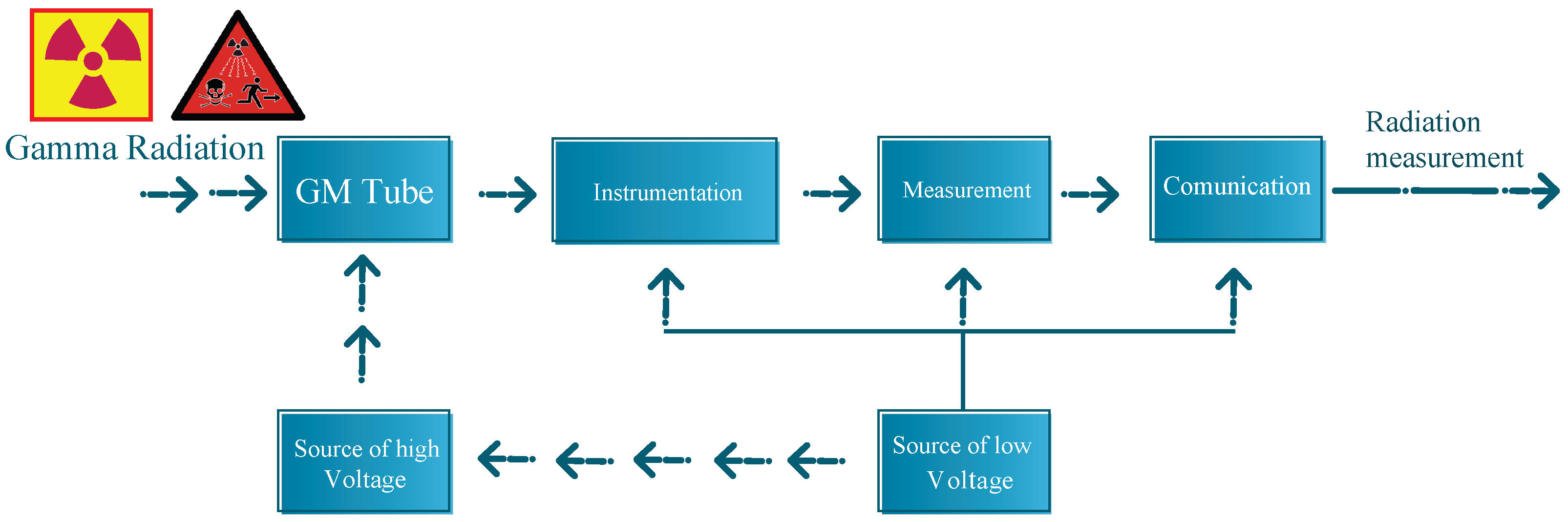
As shown in Figure 1, the complete architecture integrates both the high-voltage generation stage required for GM tube operation and the low-voltage electronic conditioning circuits used for signal processing and communication. The design prioritizes simplicity, stability, and low-cost implementation while maintaining acceptable pulse conditioning performance for environmental radiation monitoring applications. This approach allows the transformation of unstable analog nuclear events into repeatable digital signals appropriate for continuous monitoring and exposure estimation systems.

3.2. Geiger–Müller Tube Selection and Configuration

The LND712 Geiger–Müller tube, manufacturer LND INC, New York, USA was selected as the radiation sensing element due to its proven reliability, commercial availability, stable response characteristics, and suitability for low-cost environmental radiation monitoring applications. This tube is capable of detecting alpha, beta, and gamma radiation while maintaining low background count rates and acceptable sensitivity for real-time exposure estimation. The detector operates within a nominal voltage range between 450 and 650 VDC, with an experimentally selected operating point near 500 VDC corresponding to the stable region of the Geiger plateau. At this operating condition, the tube generates high-voltage analog nuclear pulses with amplitudes ranging approximately from 20 to 40 V and pulse durations close to 1600 μs prior to electronic conditioning.
The selection of the LND712 tube directly determined the design criteria of the complete electronic architecture proposed in this work. Both the high-voltage generation stage and the pulse conditioning circuitry were specifically dimensioned and optimized according to the electrical characteristics of this detector, including its operating voltage, pulse amplitude, discharge behavior, and response stability. Consequently, the resistor values, voltage regulation stages, coupling configuration, inverter logic levels, and monostable timing parameters were all designed to ensure proper operation with the LND712 tube. For this reason, the proposed electronic configuration was not intended to operate universally with arbitrary GM tubes without corresponding redesign and recalibration of the conditioning and high-voltage stages.
Table 2 summarizes the principal electrical and operational characteristics of the selected Geiger–Müller tube. These parameters were used as reference values during the design of the high-voltage source, signal attenuation stages, and pulse-shaping circuitry to preserve pulse integrity while ensuring compatibility with digital acquisition systems.
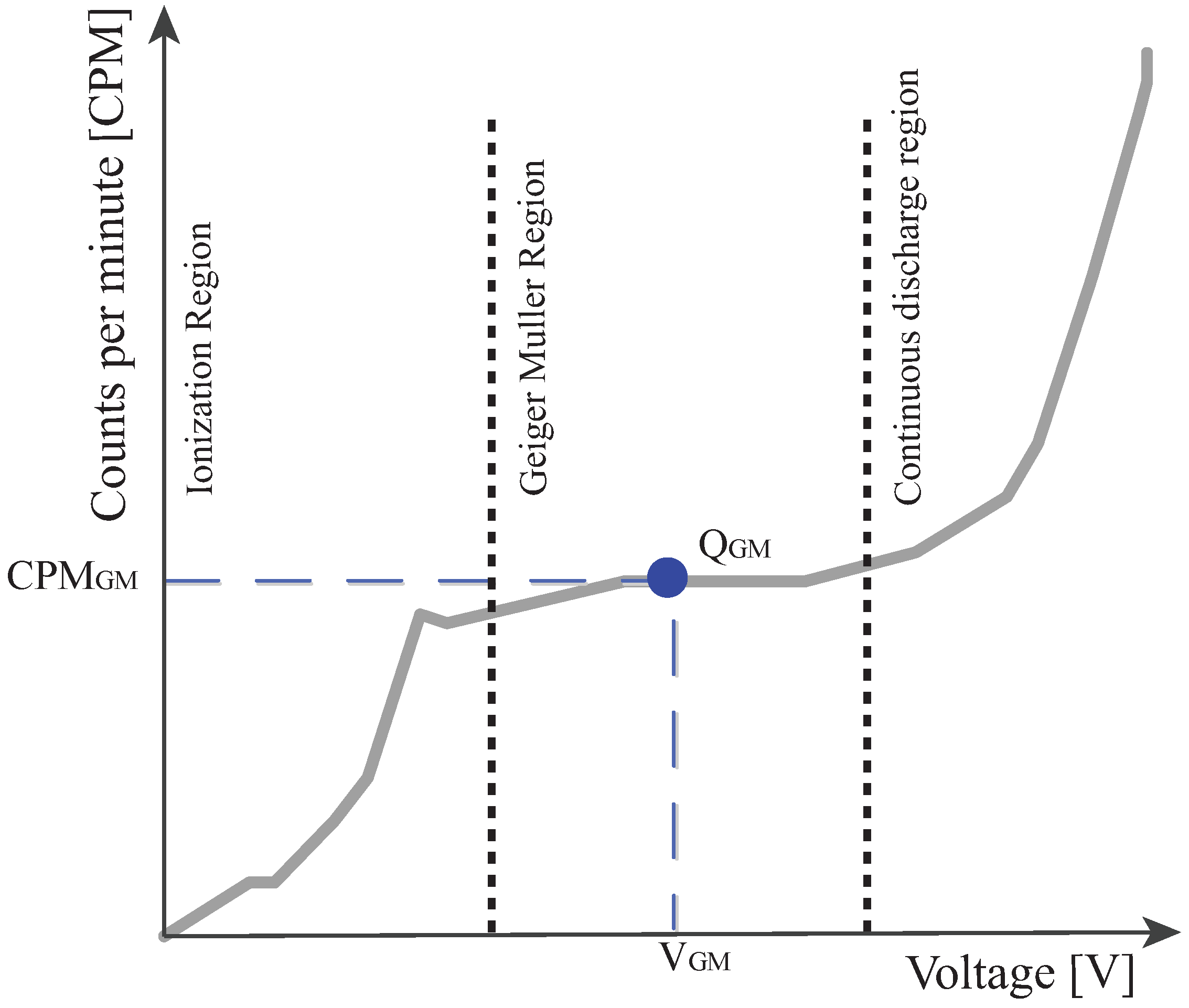
Figure 2 presents the characteristic voltage-count response behavior of a Geiger–Müller detector. The curve identifies the principal operational regions, including ionization, proportional response, Geiger plateau, and continuous discharge. The Geiger plateau corresponds to the region where the count rate becomes relatively independent of the applied voltage, allowing stable pulse generation for each detected radiation event. Operating the detector within this region is essential to minimize sensitivity to high-voltage fluctuations and ensure stable radiation measurements.
The quality and stability of the plateau region are commonly evaluated through the plateau slope metric, expressed as the percentage variation in count rate per 100 V increase in operating voltage in Equation (1), where C 1 and C 2 represent the measured count rates at operating voltages V 1 and V 2 , respectively. The resulting value is expressed in %/100 V and provides an indication of detector stability within the Geiger plateau region. Lower slope values correspond to more stable detector operation and reduced sensitivity to high-voltage variations.
S = C 2 C 1 C 1 ( V 2 V 1 ) × 100 × 100
The plateau analysis also confirms that small variations in the high-voltage supply produce limited changes in the measured count rate when the detector operates within the plateau region. This behavior improves the robustness of the proposed radiation monitoring system and supports the use of the selected operating voltage for long-term environmental monitoring applications.

3.3. Nuclear Pulse Conditioning Circuit Design

The nuclear pulse conditioning circuit constitutes the principal electronic contribution of this work and was specifically developed to transform the raw analog output generated by the LND712 Geiger–Müller tube into standardized TTL-compatible digital signals suitable for pulse counting and real-time acquisition systems. Since the GM tube produces high-voltage pulses with variable amplitude and nonuniform temporal characteristics, direct interfacing with microcontrollers or digital electronics is not possible without a dedicated conditioning stage. Consequently, a multistage electronic architecture was designed to ensure signal protection, logic compatibility, pulse standardization, and stable digital acquisition.
The conditioning process consists of three sequential stages: coupling and voltage limitation, logic inversion, and monostable pulse shaping. The design criteria of these stages were established according to the electrical characteristics of the LND712 tube, including its pulse amplitude, pulse duration, discharge behavior, and operating voltage. The primary objective of the conditioning architecture is to preserve the occurrence of each nuclear event while generating digitally stable output pulses with controlled amplitude and duration.
Table 3 summarizes the principal electrical characteristics of the raw nuclear pulse generated by the Geiger–Müller tube and the corresponding conditioned TTL pulse produced after signal processing. The original analog pulse exhibits amplitudes between approximately 20 and 40 V with durations close to 500 μs. Due to the use of a 500:1 high-voltage oscilloscope probe during experimental measurements, the observed oscilloscope voltage corresponds to a scaled representation of the actual detector pulse. After conditioning, the resulting output pulse presents a stable amplitude of approximately 5 V and a fixed duration near 1600 μs, ensuring compatibility with digital counting systems.
As shown in Figure 3, the conditioning architecture begins with the coupling stage, where the incoming nuclear pulse is attenuated and voltage-limited using a resistor and Zener diode network. This stage protects the subsequent digital electronics from high-voltage transients generated by the Geiger–Müller tube. The conditioned signal is then processed through a CMOS inverter stage to adapt the signal polarity and satisfy the triggering requirements of the monostable multivibrator. Finally, the pulse-shaping stage implemented with a 555 timer generates a standardized TTL-compatible pulse with approximately 5 V amplitude and a fixed duration close to 1600 μs. The pulse duration was intentionally selected to improve noise immunity, reduce false triggering, and ensure stable pulse acquisition in digital systems.
Figure 4 illustrates the modular organization of the nuclear pulse conditioning system, emphasizing the functional separation between voltage limitation, logic inversion, and pulse standardization stages. This modular structure facilitates signal analysis, debugging, and experimental validation while also allowing adaptation of individual stages according to detector characteristics and acquisition requirements.
The output pulse generated by the 555 timer operating in monostable mode is controlled by the resistor–capacitor timing network composed of the timing resistor R and capacitor C. This configuration determines the duration during which the output pulse remains active after each nuclear event detected by the Geiger–Müller tube. In the proposed conditioning circuit, the component values were experimentally selected to obtain a standardized output pulse close to 1600 μs, improving pulse stability, noise immunity, and synchronization with digital counting systems. The pulse duration produced by the monostable stage is determined according to the timing relation expressed in Equation (2), where T represents the pulse duration, R is the timing resistor, and C corresponds to the timing capacitor [6].
T = 1.1 R C
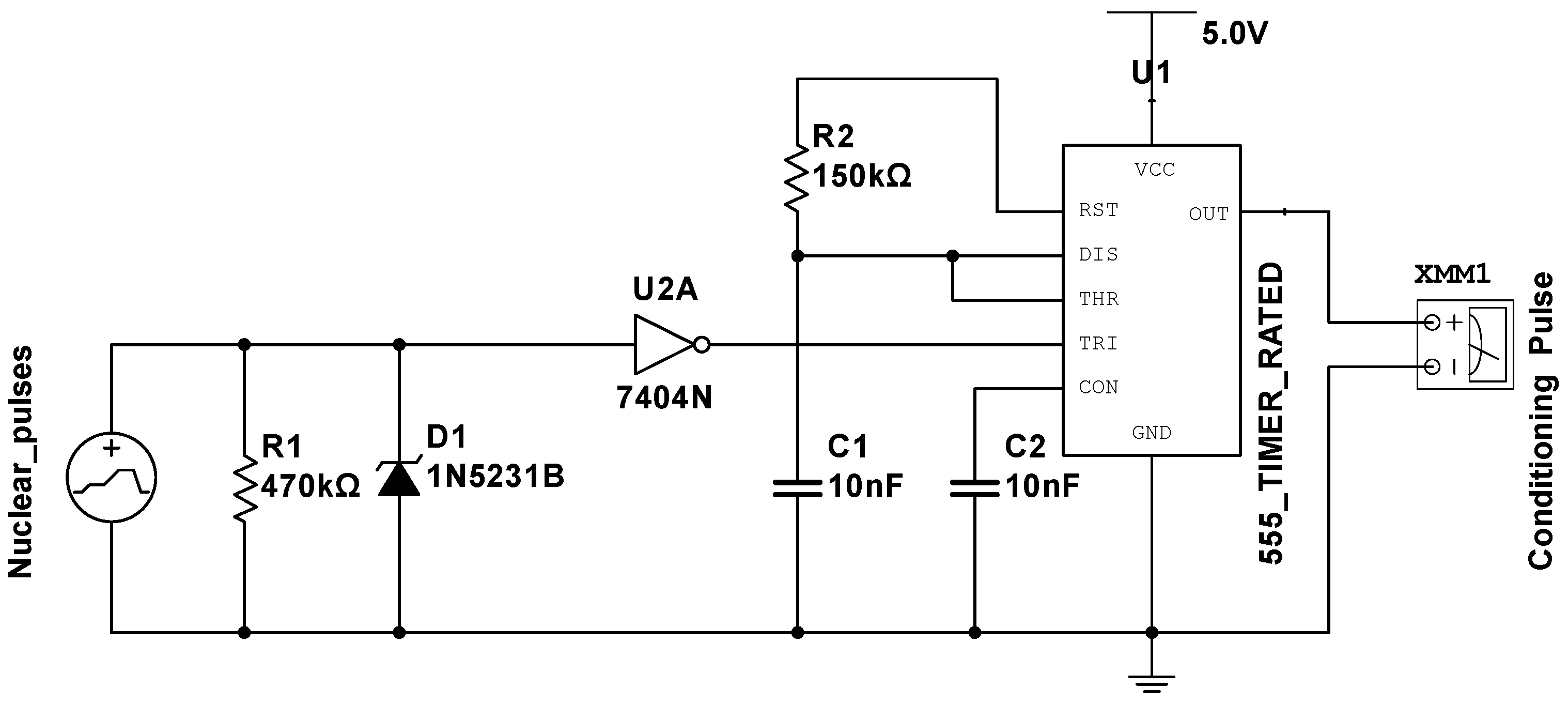
Figure 5 presents the complete electronic implementation of the proposed nuclear pulse conditioning circuit developed for the LND712 Geiger–Müller tube. The schematic integrates the three functional stages previously described: voltage coupling and limitation, logic inversion, and monostable pulse shaping. The input nuclear pulse generated by the detector is first applied to the protection stage composed of resistor R 1 and Zener diode D 1 , which attenuate and clamp the high-voltage transient pulse in order to protect the digital electronics from overvoltage conditions. The conditioned signal is then processed by the CMOS inverter (7404 N), manufacturer STMicroelectronics, Geneva, Switzerland, which performs polarity inversion and generates the appropriate logic transition required to trigger the monostable stage. Finally, the 555 timer configured in monostable mode produces a standardized TTL-compatible pulse suitable for digital counting and real-time acquisition systems.
The component values used in the conditioning architecture were selected according to the electrical characteristics of the LND712 detector and experimentally adjusted to ensure stable pulse transformation. The resistor–capacitor timing network formed by R 2 and C 1 determines the output pulse duration generated by the monostable stage. The resulting output pulse exhibits an amplitude close to 5 V and a duration near 1600 μs, improving signal standardization, reducing susceptibility to false triggering, and ensuring compatibility with microcontroller- and SCADA-based acquisition platforms. The use of the CMOS inverter also improves edge definition and pulse synchronization prior to monostable triggering.
The pulse duration generated by the 555 timer is governed by the monostable timing relation referenced in Equations (3)–(5). Using the experimentally selected timing components R 2 = 150 k Ω and C 1 = 10 nF , the theoretical pulse duration can be estimated as follows:
T = 1.1 R C
T = 1.1 ( 150 × 10 3 ) ( 10 × 10 9 )
T 1.65 × 10 3 s 1650 μ s
The calculated pulse duration is consistent with the experimentally measured output pulse observed during oscilloscope validation. Since the monostable stage maintains the conditioned output active during the interval defined by Equation (3), the circuit introduces an effective dead time approximately equal to the standardized pulse duration. Consequently, pulses arriving within this interval may not be independently registered, limiting the maximum counting capability of the system under high-radiation-flux conditions. Nevertheless, the selected timing configuration provides an adequate compromise between noise immunity, pulse stability, and counting performance for environmental radiation monitoring applications.
The conditioning process follows a sequential algorithm designed to convert raw nuclear pulses into standardized digital events suitable for counting and acquisition. As summarized in Algorithm 1, the analog pulse generated by the Geiger–Müller tube is first subjected to voltage limitation, followed by polarity inversion and monostable pulse shaping. The resulting output is a stable TTL-compatible pulse appropriate for digital monitoring systems.
Algorithm 1 Nuclear Pulse Detection and Conditioning
  1:
Input: Analog pulse from Geiger–Müller tube
  2:
Output: TTL pulse (5 V, ∼1600 μs)
  3:
Apply voltage limitation and coupling
  4:
Invert signal polarity using CMOS inverter
  5:
Trigger monostable multivibrator
  6:
Generate standardized TTL-compatible pulse
  7:
Transfer conditioned pulse to counting system

3.4. Experimental Validation and Calibration Procedure

The experimental validation of the proposed radiation detection system was divided into two complementary stages designed to evaluate both the electronic pulse conditioning performance and the quantitative exposure–response behavior of the detector. The first experiment focused on verifying the correct operation of the nuclear pulse conditioning architecture through oscilloscope-based signal analysis, while the second experiment concentrated on the calibration and statistical characterization of the detector response under controlled laboratory radiation exposure conditions.
The first experimental stage evaluated the transformation of the raw analog nuclear pulse generated by the Geiger–Müller tube into a standardized TTL-compatible digital signal suitable for pulse counting applications. The detector was exposed to a known gamma radiation source in order to generate representative nuclear events while oscilloscope measurements were performed at different points of the conditioning chain. The analysis included verification of voltage limitation, logic inversion, pulse synchronization, pulse width stabilization, and digital signal compatibility. The relationship between the input nuclear pulse and the conditioned output signal will be experimentally analyzed through the oscilloscope traces.
The conditioning analysis considered the temporal and amplitude characteristics of both the raw detector pulse and the conditioned output pulse. The detector pulse generated by the Geiger–Müller tube exhibits a transient analog behavior with variable amplitude and exponential discharge characteristics. The output pulse generated by the monostable stage was experimentally verified according to the timing relation defined in Equation (3), ensuring stable pulse duration and digital compatibility during acquisition. The practical counting capability of the system is also constrained by the pulse duration, establishing an approximate maximum count frequency according to Equation (6), where f max represents the approximate maximum pulse counting frequency and T corresponds to the standardized monostable pulse duration. This relationship establishes the practical dead-time limitation of the conditioning architecture for high-radiation-flux conditions.
f max 1 T
The second experimental stage consisted of the calibration and statistical characterization of the detector response using a certified gamma radiation source under controlled laboratory conditions. Multiple repeated measurements were performed at different source-detector distances corresponding to approximately 25%, 50%, and 75% of the operational scale of the instrument. The objective of this procedure was to evaluate detector repeatability, exposure estimation capability, and consistency of the pulse-counting system. The resulting experimental measurements were compared against the expected radiation propagation behavior according to the inverse-square law expressed in Equation (7), where I represents the measured exposure intensity and r corresponds to the distance between the detector and the radiation source. This relationship describes the theoretical decrease in exposure intensity as the detector is positioned farther from the source.
I 1 r 2
The calibration results will be analyzed using repeated statistical measurements rather than isolated acquisitions in order to improve the representativeness of the detector characterization. The complete experimental validation procedure adopted in this work is summarized in Algorithm 2. The methodology integrates electronic pulse verification and radiation exposure calibration in order to evaluate both the instrumentation performance and the quantitative response behavior of the proposed radiation detection system.
Algorithm 2 Experimental Validation and Calibration Procedure
  1:
Configure the Geiger–Müller detector and high-voltage supply
  2:
Expose the detector to a controlled gamma radiation source
  3:
Acquire oscilloscope measurements at different conditioning stages
  4:
Verify pulse attenuation, inversion, and pulse shaping behavior
  5:
Measure conditioned TTL pulse amplitude and duration
  6:
Position the detector at predefined calibration distances
  7:
Acquire repeated exposure measurements for each operating condition
  8:
Compute average exposure values and statistical dispersion
  9:
Compare experimental measurements with inverse-square response behavior
10:
Analyze detector repeatability and exposure estimation capability
Special safety precautions were adopted during the experimental implementation and calibration procedures due to the presence of high-voltage circuitry and ionizing radiation sources. The high-voltage stage was electrically insulated and operated under controlled laboratory conditions to minimize accidental contact and discharge risks. Additionally, the calibration experiments using the gamma radiation source were conducted following the safety protocols established by the certified calibration laboratory, including controlled exposure conditions, restricted handling procedures, and supervised operation by authorized personnel.

4. Analysis and Discussion

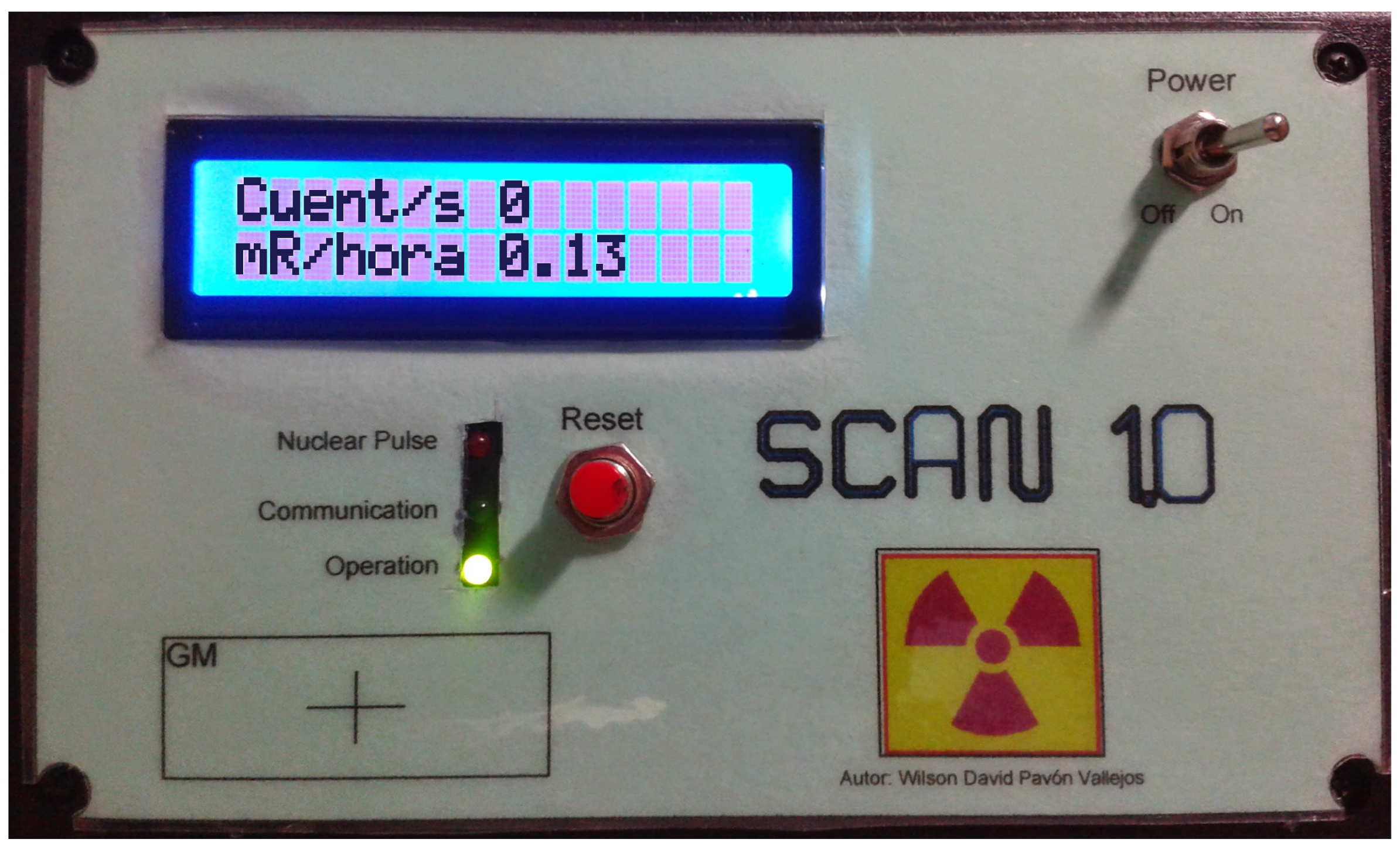
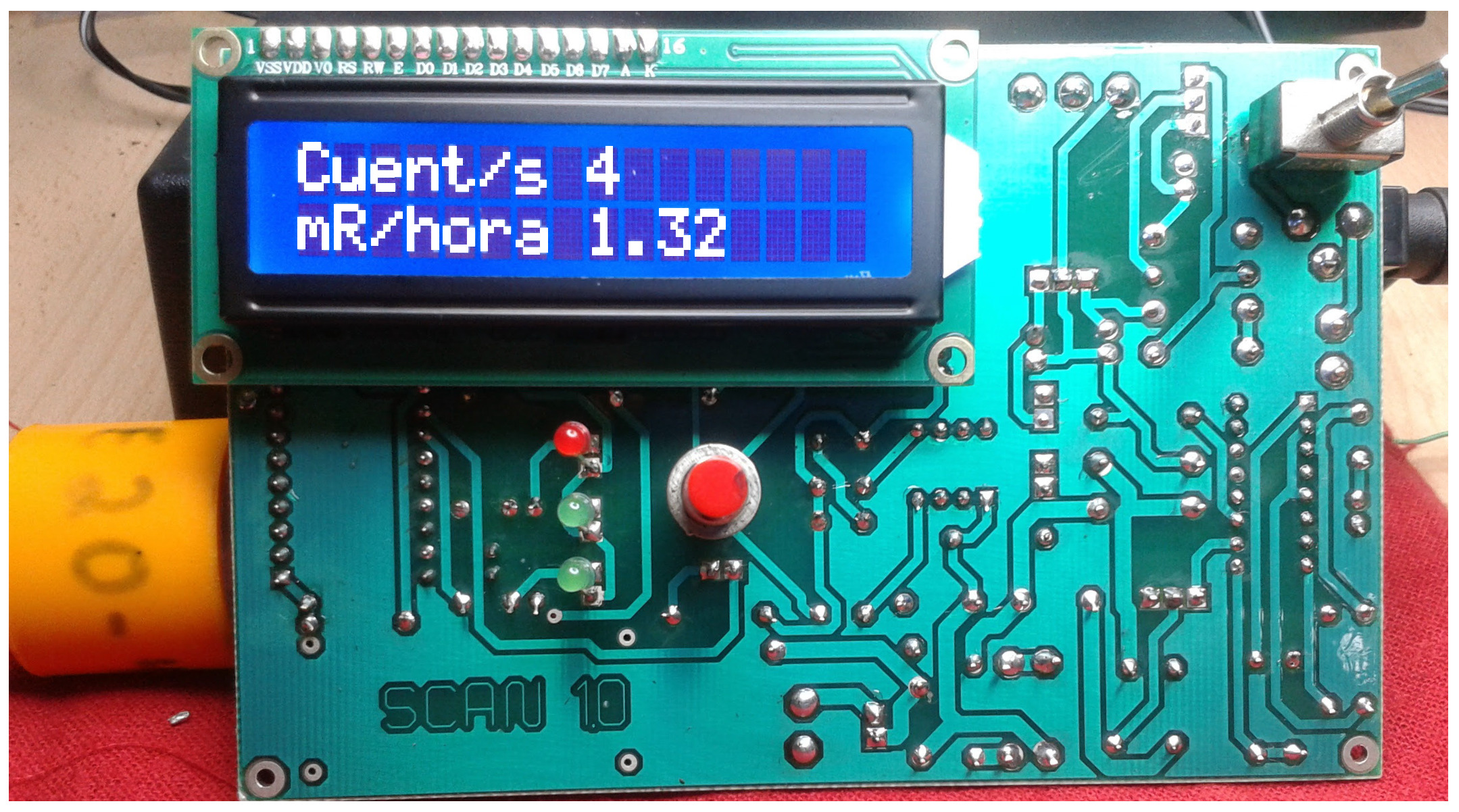
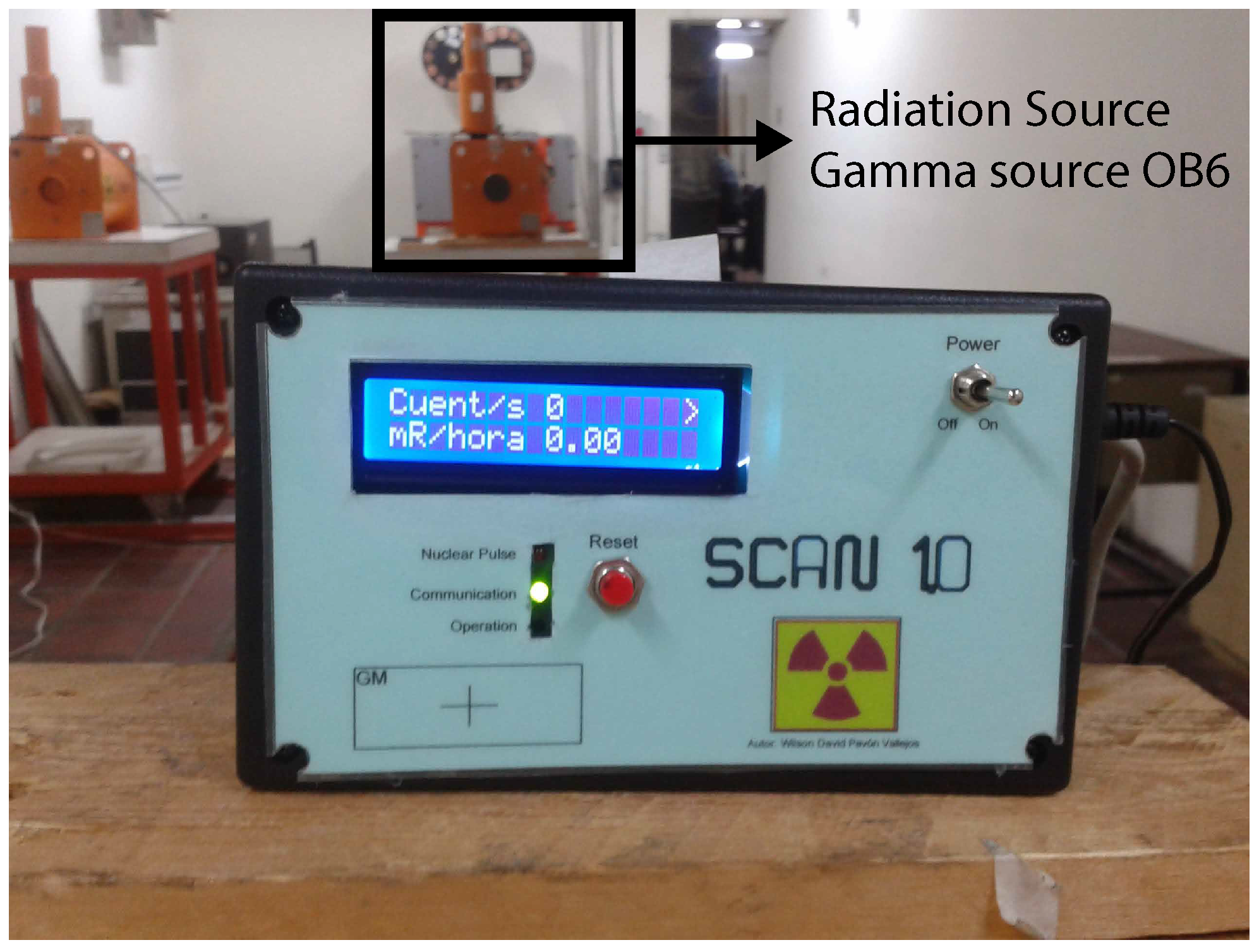
The prototype of the radiation detection system was designed, implemented, assembled, and experimentally validated by the authors as an extension of the work previously presented in Pavón et al. (2024) [5]. The developed system integrates the Geiger–Müller tube, high-voltage supply, nuclear pulse conditioning circuit, and data acquisition interface within a compact electronic structure specifically built for this research. Figure 6 shows the final assembled prototype constructed by the authors and used during the laboratory and field validation tests.

4.1. Detector Response Behavior Within the Geiger Plateau Region

To evaluate the effectiveness of the proposed nuclear pulse conditioning architecture, a first experimental procedure was carried out using a known gamma radiation reference source positioned near the detector. The objective of this experiment was not to perform a metrological calibration, but rather to validate the correct operation of the Geiger–Müller tube, verify the stability of the pulse conditioning stages, and experimentally obtain the detector response behavior within the Geiger plateau region. Since this stage focused on functional validation and pulse analysis, environmental compensation variables such as temperature and humidity were not incorporated into the procedure. The experiment allowed verification of stable pulse generation, proper high-voltage operation, and repeatable count acquisition under controlled exposure conditions.
Figure 7 and Figure 8 present the experimental setup used during the first validation stage. The detector was exposed to the gamma radiation reference source at controlled distances in order to analyze the detector response and evaluate the pulse counting stability. This setup was also used to experimentally determine the Geiger plateau behavior and verify the effectiveness of the nuclear pulse conditioning process.
To experimentally verify the effectiveness of the proposed nuclear pulse conditioning architecture, oscilloscope measurements were performed at different stages of the signal path. The objective of these measurements was to validate the correct transformation of the high-voltage analog pulses generated by the Geiger–Müller tube into stable TTL-compatible digital signals suitable for pulse counting and real-time acquisition systems. The measurements also allowed verification of signal polarity inversion, pulse standardization, and voltage adaptation throughout the conditioning process.
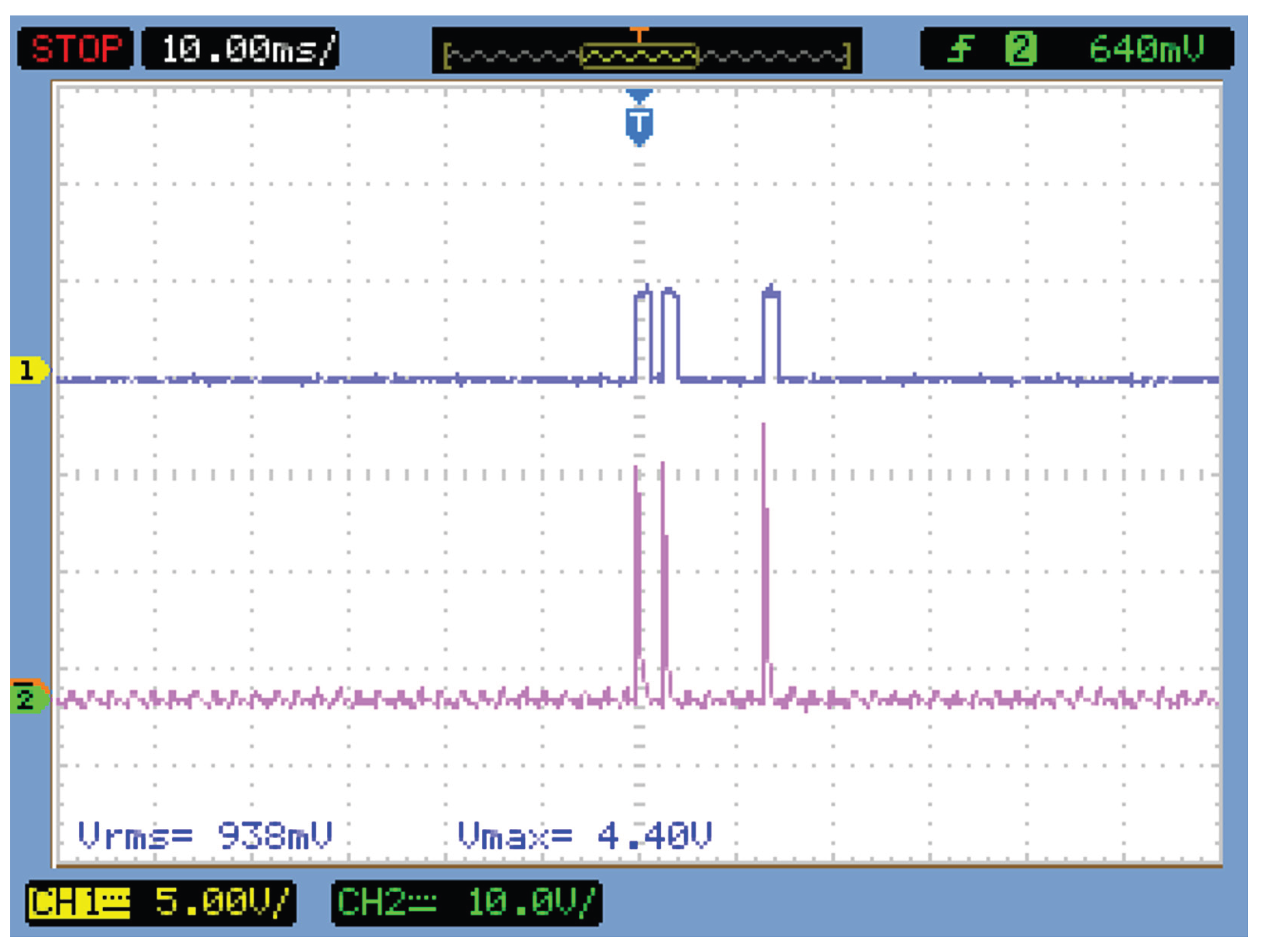
Figure 9 presents the complete pulse conditioning response. The lower trace corresponds to the original nuclear pulse obtained directly from the Geiger–Müller tube, exhibiting narrow high-voltage analog pulses with variable amplitude. The upper trace shows the final conditioned output generated by the monostable stage, producing standardized TTL pulses with approximately 5 V amplitude and controlled pulse width. The results confirm the successful conversion of unstable analog nuclear events into uniform digital pulses suitable for reliable counting by microcontrollers and SCADA-based acquisition systems.
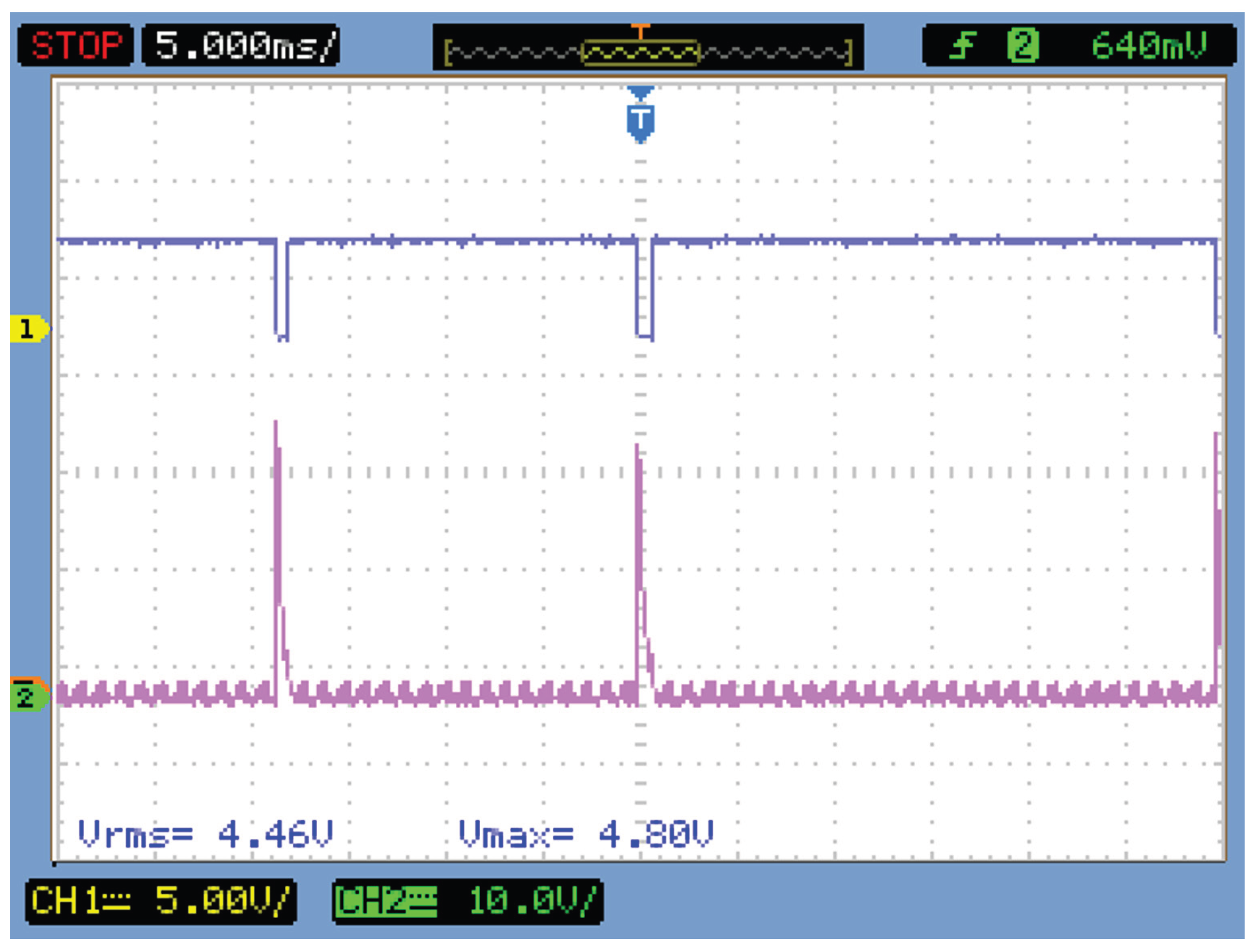
Figure 10 illustrates the intermediate inversion stage of the conditioning circuit. The lower trace corresponds to the original nuclear pulse, while the upper trace shows the output of the CMOS inverter stage. The observed polarity inversion confirms the correct operation of the logic adaptation stage prior to pulse shaping. This inversion process is necessary to properly trigger the monostable multivibrator and ensure consistent pulse generation in the final output stage.
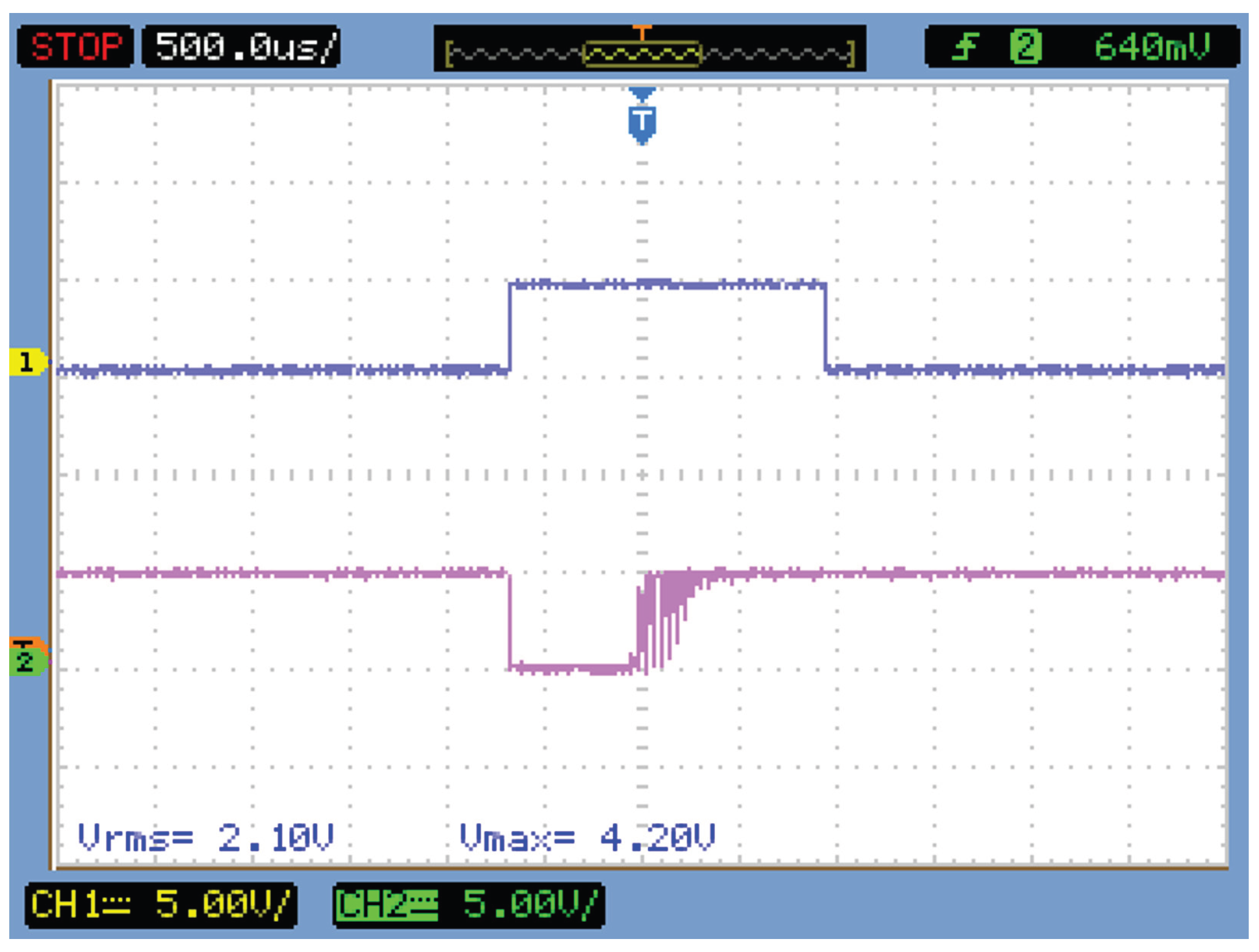
Figure 11 presents the relationship between the inverter stage and the final monostable output. The lower trace corresponds to the output of the CMOS inverter stage, while the upper trace shows the TTL-compatible pulse generated after pulse shaping. The temporal alignment between both signals confirms the correct triggering sequence of the monostable multivibrator and demonstrates that the inverter stage provides an adequate logic transition for stable pulse generation. This synchronization is essential to ensure reliable pulse counting and avoid false triggering in the digital acquisition stage.
Figure 12 shows the transition between the conditioned inverted nuclear pulse and the final TTL output signal. The lower trace corresponds to the inverted nuclear pulse prior to pulse shaping, while the upper trace shows the standardized TTL pulse produced by the 555 timer stage. The figure demonstrates the successful transformation of narrow and variable analog nuclear events into digitally stable pulses with controlled amplitude and duration. This behavior confirms the effectiveness of the proposed conditioning architecture for converting Geiger–Müller analog pulses into signals compatible with microcontrollers and SCADA-based monitoring systems.
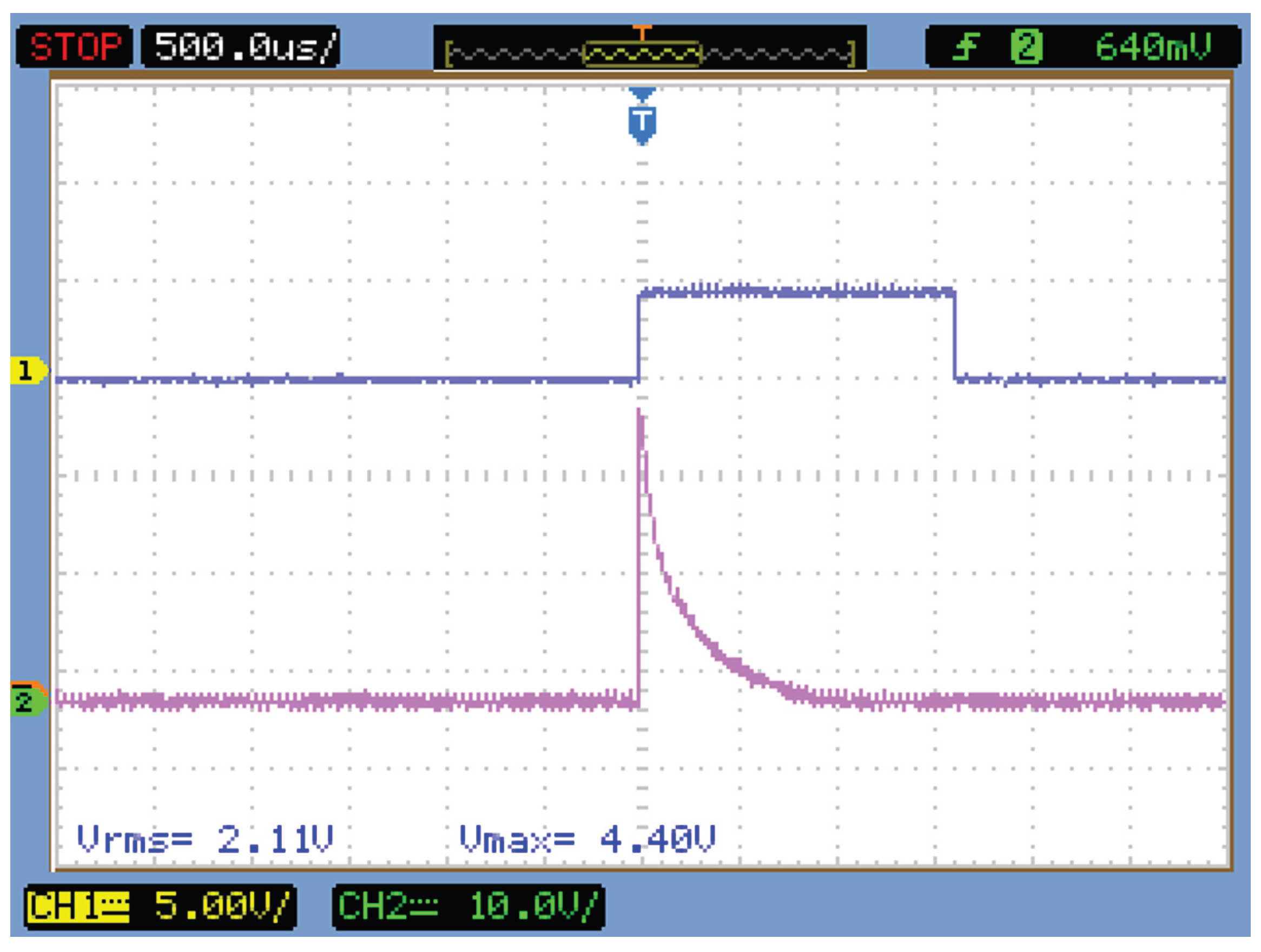
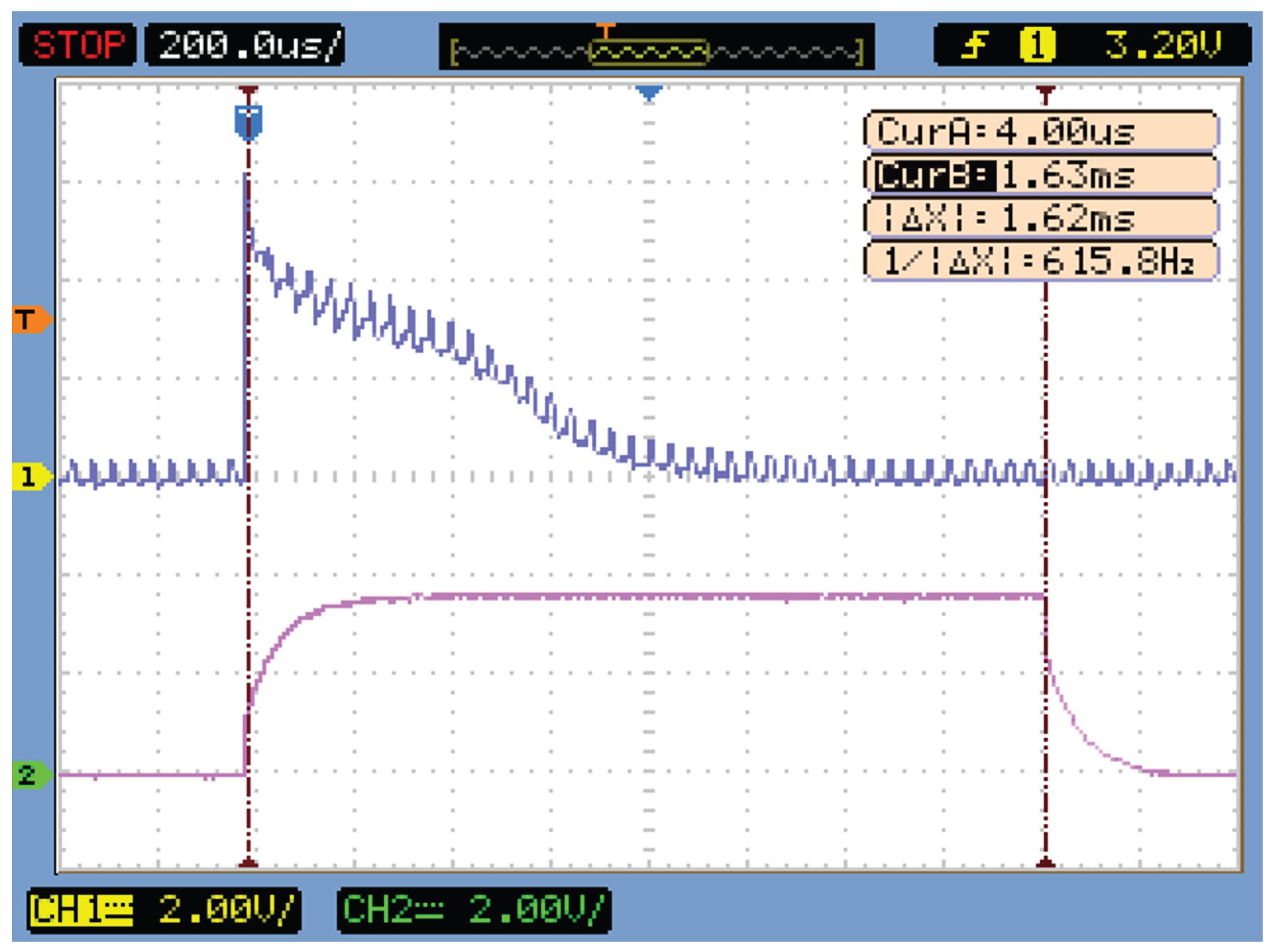
Finally, Figure 13 presents detailed oscilloscope measurements of the conditioned pulse, including amplitude and pulse-width markers. The results confirm a stable TTL output amplitude close to 5 V and an experimentally measured pulse duration near 1600 μs, consistent with the theoretical timing behavior of the monostable multivibrator implemented using the 555 timer. The measured pulse width validates the selected resistor–capacitor configuration used in the pulse shaping stage and confirms the repeatability and stability of the conditioning process. The standardized pulse duration also establishes the practical counting limit of the system, since excessively high radiation flux may lead to pulse overlap and dead-time effects. Nevertheless, for environmental radiation monitoring applications with moderate count rates, the obtained pulse characteristics ensure stable and reliable operation.
The measured pulse width validates the selected resistor–capacitor configuration used in the monostable stage and confirms the repeatability of the pulse shaping process. The standardized pulse duration also establishes the practical counting limit of the system, since excessively high radiation flux may lead to pulse overlap and dead-time effects. Nevertheless, for environmental radiation monitoring applications with moderate count rates, the obtained pulse characteristics ensure stable and reliable operation.
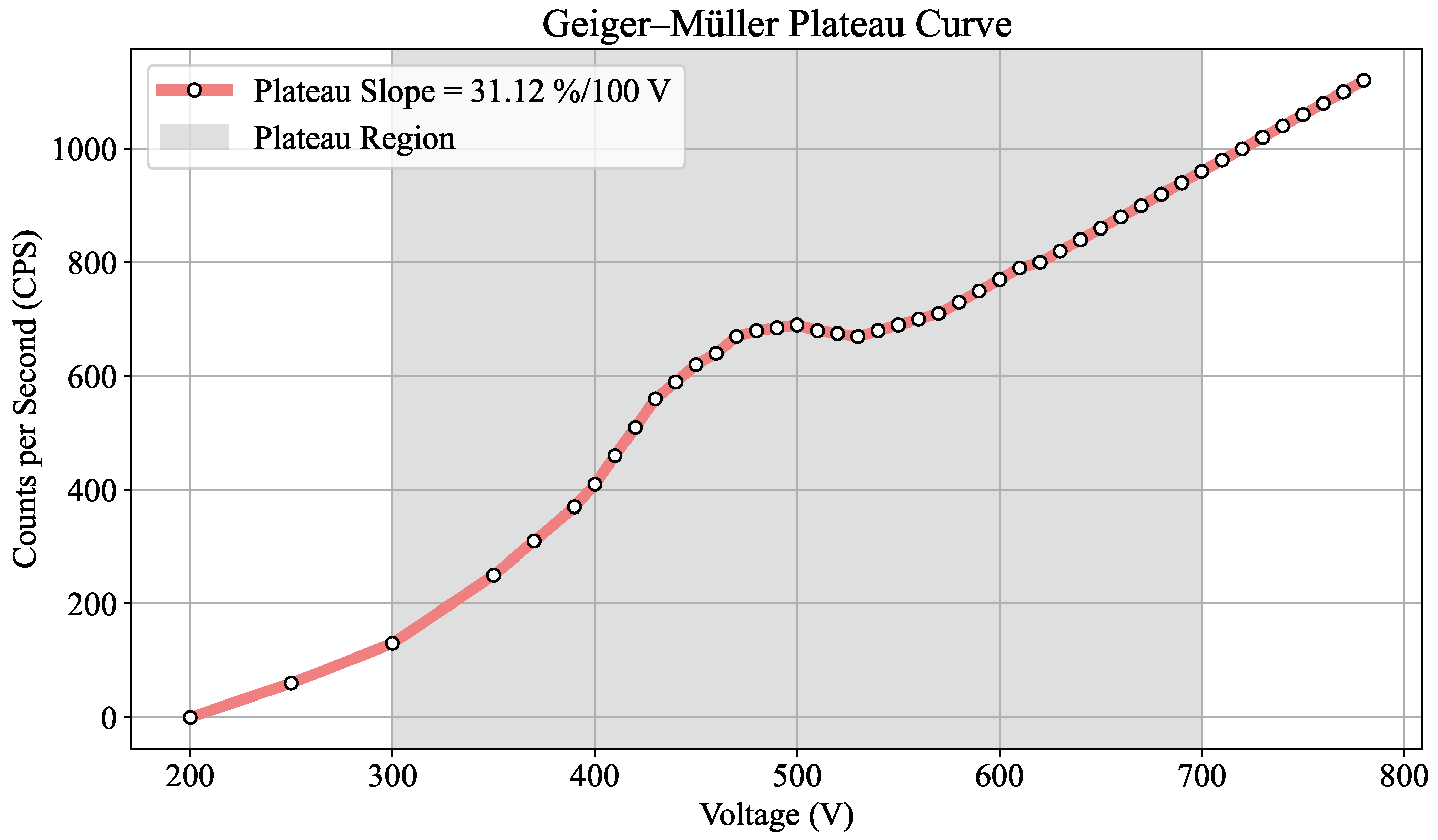
To assess the operational stability of the Geiger–Müller tube, a real plateau curve was experimentally obtained, as shown in Figure 14. The curve clearly identifies the ionization region, the Geiger–Müller region, and the onset of continuous discharge. Within the plateau region, the count rate remains relatively stable despite increases in the applied voltage, validating the optimal operating range of the detector. This behavior is essential to ensure that the pulse amplitude and count rate are largely independent of the initial ionization process, thereby enabling consistent and reliable radiation measurements.
The plateau slope was evaluated using the standard Geiger–Müller characterization metric expressed in percentage variation per 100 V, according to Equation (8), where C 1 and C 2 correspond to the count rates measured at voltages V 1 and V 2 , respectively, and C avg represents the average count rate within the selected plateau interval. Based on the experimental measurements, the obtained plateau slope was 31.12%/100 V. Although the count rate exhibits a progressive increase with voltage, the detector maintained stable pulse generation within the evaluated operating range, confirming the functionality of the proposed conditioning and high-voltage stages.
S = C 2 C 1 C avg 100 V 2 V 1 × 100

4.2. Experimental Calibration and Exposure Response Validation

To evaluate the measurement accuracy, repeatability, and exposure–response behavior of the proposed radiation detection system, a controlled calibration procedure was conducted in 2014 at the Secondary Standards Laboratory of the Ecuadorian nuclear regulatory authority. The experiment was carried out using a certified gamma radiation reference source under controlled laboratory conditions, allowing validation of the detector response in the operational range between 0 and 10 mR/h. Unlike the previous functional validation experiment, this procedure was specifically designed to assess the quantitative response of the system and compare the measured exposure values against certified reference levels.
The calibration process consisted of positioning the detector at different distances from the gamma radiation source while maintaining a fixed attenuation configuration. For each operating point, multiple repeated measurements were acquired in order to evaluate the repeatability and stability of the pulse counting system. The detector response was then compared with the certified reference exposure values provided by the calibration laboratory. Environmental conditions including temperature, pressure, and relative humidity were also documented during the calibration procedure to ensure traceability of the measurements.
Table 4 summarizes the principal equipment, reference instruments, and source characteristics employed during the calibration procedure.
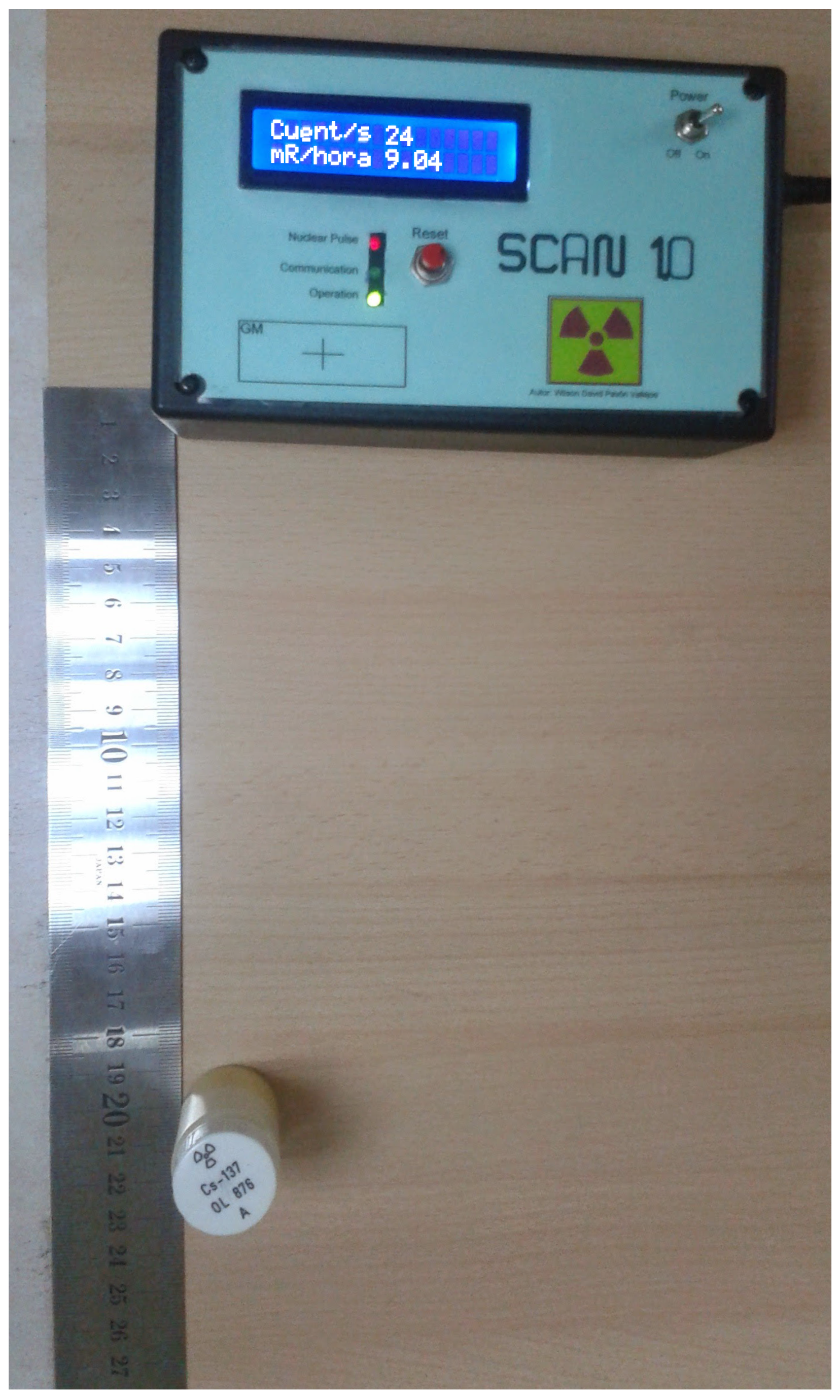
Figure 15 presents the experimental calibration setup used during the laboratory validation tests. The developed prototype was positioned at controlled distances from the certified gamma radiation source in order to obtain exposure measurements under traceable reference conditions. This setup allowed verification of the detector response stability, pulse counting consistency, and exposure estimation capability across different radiation levels.
To improve the statistical consistency and reliability of the calibration analysis, multiple repeated measurements were performed at each exposure level instead of relying on single acquisitions. The calibration procedure evaluated three reference exposure regions corresponding approximately to 25%, 50%, and 75% of the operational scale of the detector. For each operating condition, nine independent measurements were acquired, allowing estimation of the average detector response, analysis of measurement repeatability, and evaluation of statistical dispersion. This approach provides a more representative characterization of the detector behavior and directly addresses the variability associated with pulse-counting systems operating under ionizing radiation exposure.
Table 5 summarizes the repeated measurements obtained during the calibration procedure. The experimental results show relatively low dispersion between repeated acquisitions, particularly at lower exposure levels, indicating stable pulse conditioning and repeatable digital pulse acquisition. Small variations between measurements are mainly attributed to counting statistics inherent to Geiger–Müller detection, minor positioning differences during the experimental setup, and electronic noise associated with the conditioning stages.
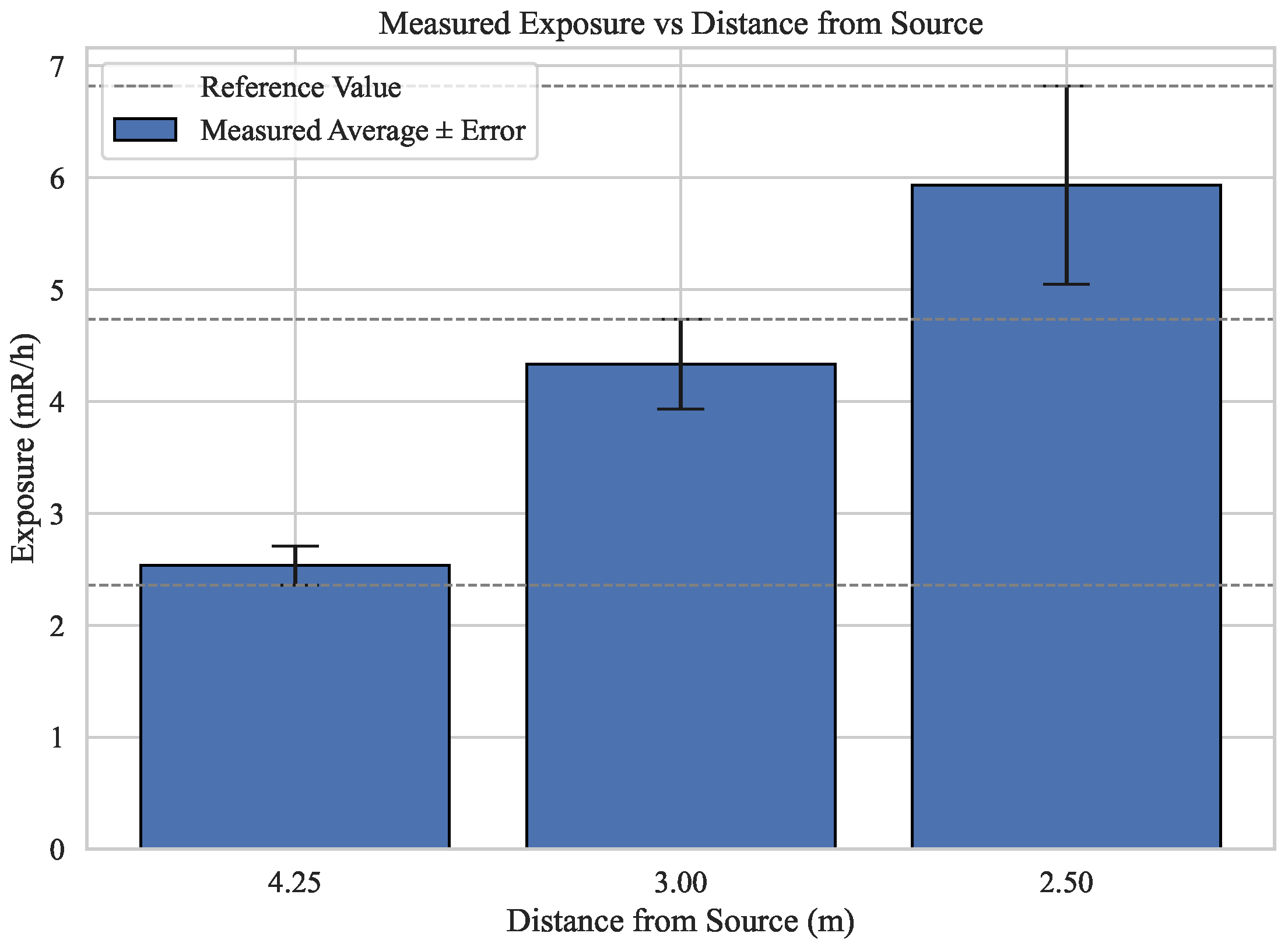
The statistical analysis of the calibration results is summarized in Table 6, where the measured average exposure values are compared against the certified reference exposure levels corresponding to 25%, 50%, and 75% of the radiation source intensity. The obtained results reveal relatively small absolute deviations between measured and reference values, with relative errors ranging from approximately 7.3% to −13%. These deviations are considered acceptable for field-grade environmental radiation monitoring systems and are consistent with the practical limitations of Geiger–Müller-based detectors, including counting statistics, detector sensitivity variations, electronic conditioning tolerances, and geometric alignment uncertainties during calibration.
The results also demonstrate that the proposed conditioning architecture and pulse counting system maintain stable operation across different exposure levels while preserving repeatability in the acquired measurements. Although no complete uncertainty propagation model was implemented, the repeated experimental acquisitions provide a representative estimation of the variability associated with the detector response under controlled laboratory conditions.
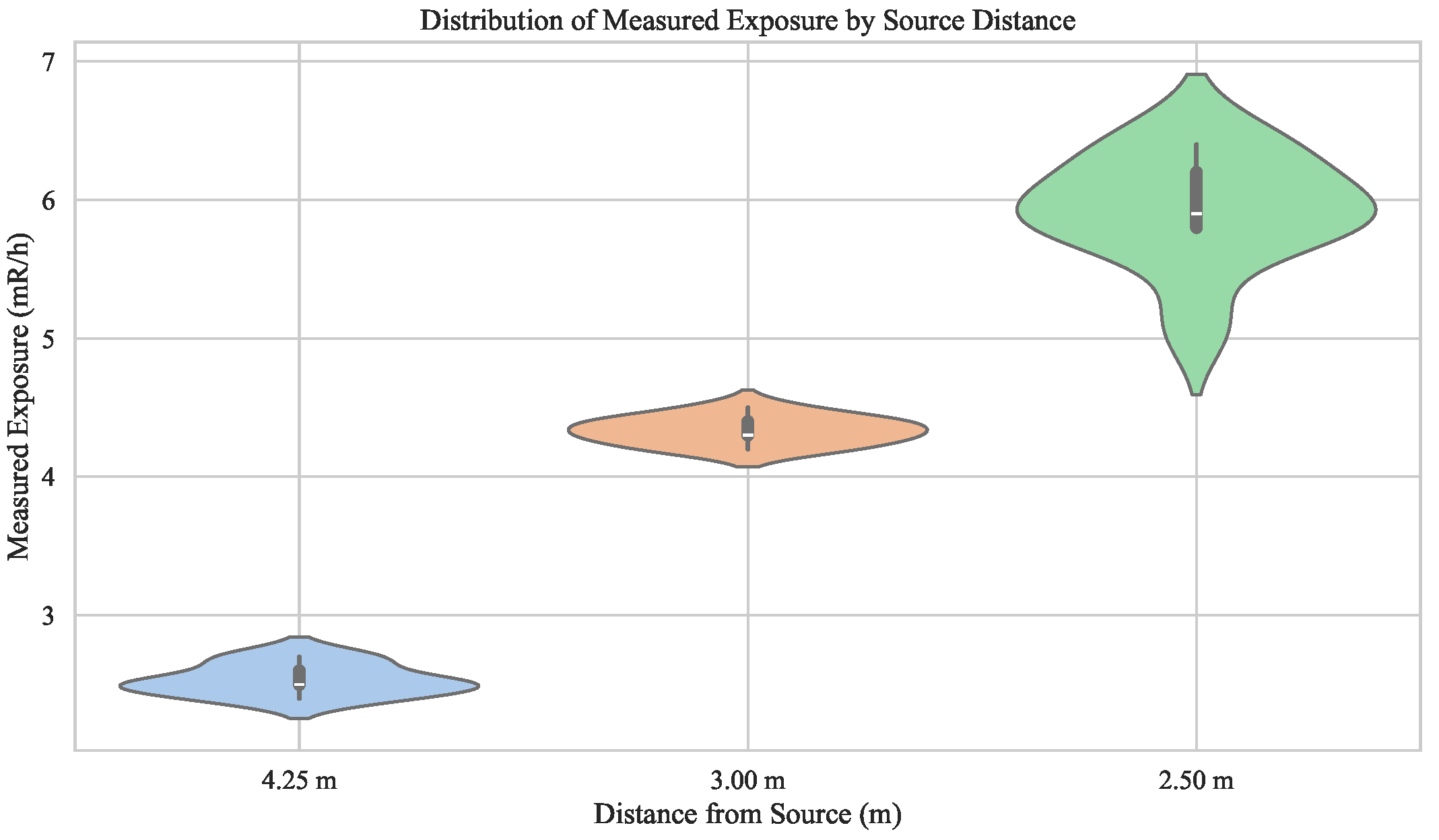
To further analyze the consistency and statistical distribution of the experimental measurements, Figure 16 presents a violin plot of the exposure values obtained at different operating conditions. The distribution shape and spread provide a graphical representation of the variability associated with repeated pulse-counting measurements. The relatively narrow distributions observed at lower exposure levels indicate low measurement dispersion and stable detector behavior, while slightly wider distributions at higher exposure levels reflect the increased variability commonly associated with Geiger–Müller counting statistics and experimental positioning tolerances. Overall, the results confirm the repeatability and robustness of the proposed radiation detection system for environmental monitoring applications.
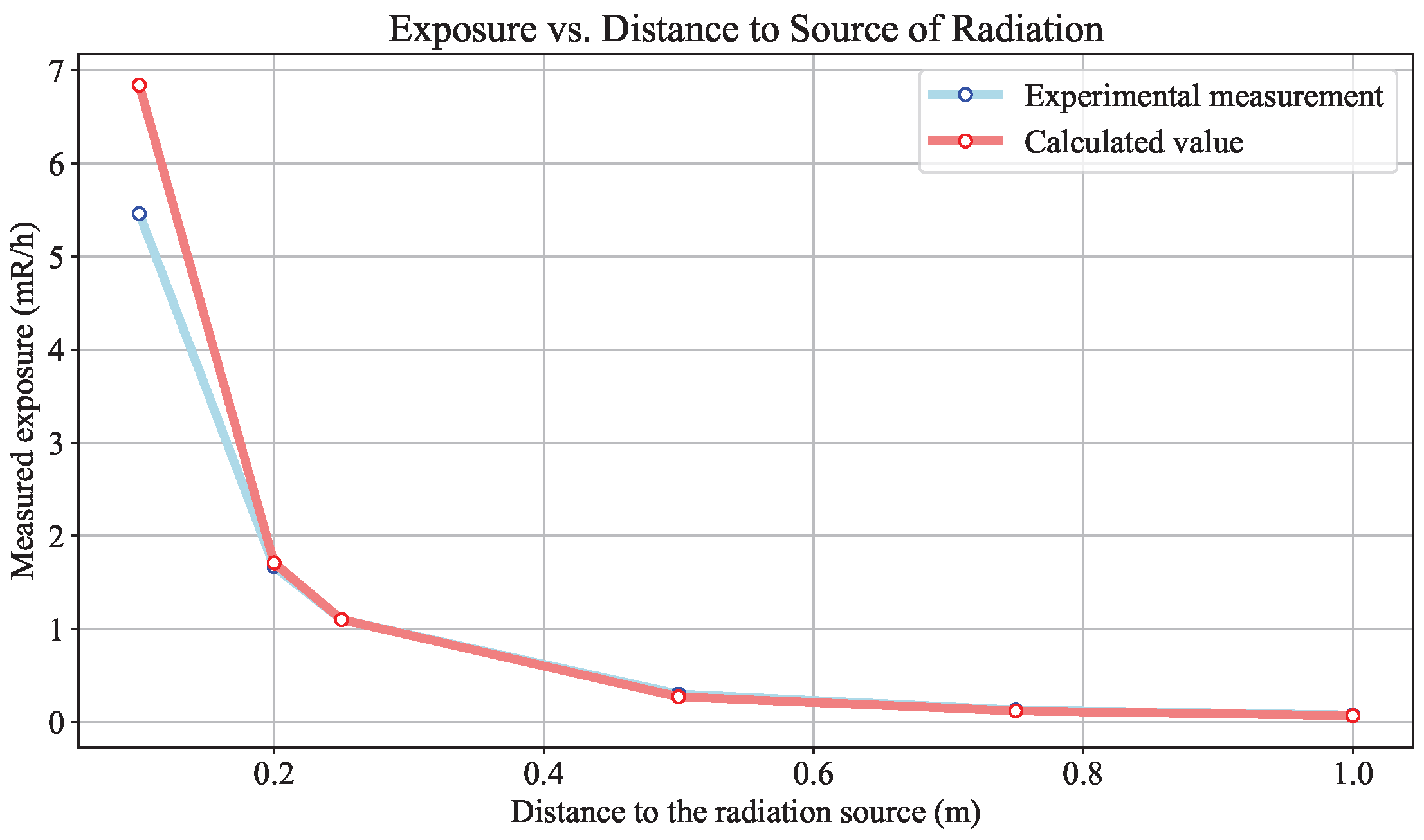
The exposure–distance behavior obtained during calibration is summarized in Figure 17. The figure compares the experimentally measured exposure values against the theoretical response expected from the inverse-square radiation propagation model. As expected, the measured exposure decreases as the detector is positioned farther from the source. Although small deviations are observed between experimental and theoretical values, the measured response follows the expected inverse trend with acceptable agreement throughout the evaluated operating range. These deviations are associated with practical measurement uncertainties including counting statistics, detector sensitivity variations, geometric alignment, and electronic conditioning tolerances.
A complementary representation of the calibration results is shown in Figure 18, where the average measured exposure values are presented together with their corresponding experimental variability. The relatively small dispersion observed in the repeated measurements confirms the repeatability and stability of the proposed pulse conditioning architecture and pulse counting algorithm. These results demonstrate that the system is capable of producing consistent exposure measurements under controlled radiation conditions while maintaining stable signal standardization and digital pulse acquisition.
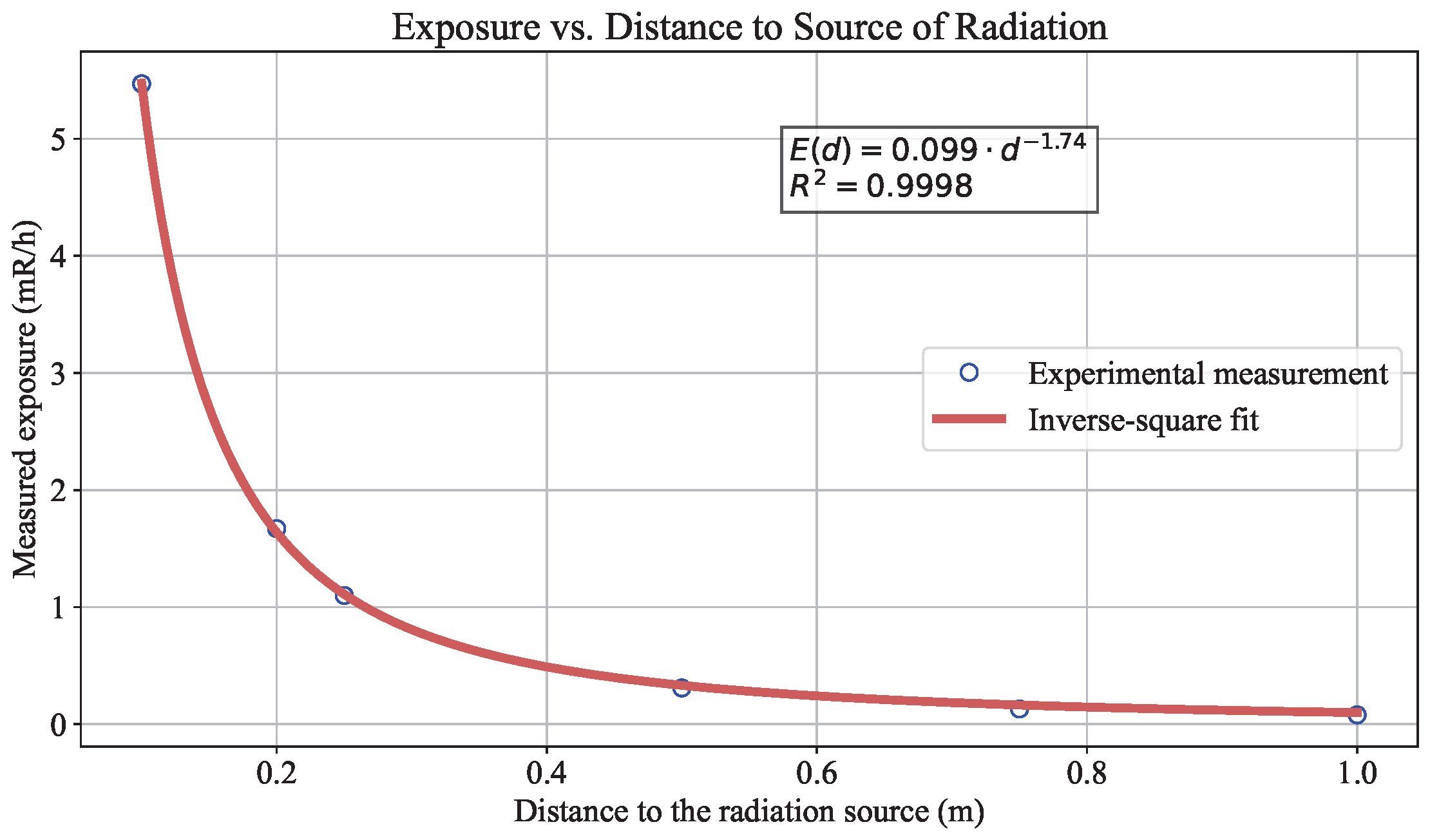
Finally, Figure 19 presents the experimental validation of the detector response as a function of the distance to the radioactive source. In contrast to a linear approximation, the measured exposure follows the expected physical behavior of ionizing radiation propagation, which is governed by an inverse power-law relationship. The experimental data were therefore fitted using the model expressed in Equation (9), where E ( d ) represents the measured exposure at distance d, while a and b are experimentally determined fitting parameters. The resulting fit yielded the relationship E ( d ) = 0.099 d 1.74 with a coefficient of determination of R 2 = 0.9998 , demonstrating excellent agreement between the experimental measurements and the theoretical attenuation trend. The obtained exponent value close to the ideal inverse-square behavior confirms the consistency of the radiation measurements and validates the detector response over the evaluated operating range. Minor deviations from the theoretical exponent of b = 2 can be attributed to environmental scattering effects, detector geometry, source positioning uncertainties, and practical limitations associated with low-cost Geiger–Müller instrumentation. These results confirm that the proposed system accurately reproduces the expected decrease in radiation exposure with increasing distance, supporting its applicability for environmental radiation monitoring and field measurements.
E ( d ) = a d b
Although the proposed system was intentionally designed as a low-cost and electronically simple radiation monitoring solution, several engineering trade-offs were consciously accepted during development. The architecture prioritizes accessibility, ease of implementation, low power consumption, and stable pulse acquisition over high-precision spectrometric performance typically associated with more complex radiation instrumentation. Consequently, the system provides reliable pulse counting and exposure estimation capabilities for environmental monitoring applications, while accepting moderate measurement deviations associated with Geiger–Müller counting statistics, simplified conditioning electronics, and practical calibration limitations. In addition, the use of a Geiger–Müller tube inherently limits the possibility of energy discrimination, since the detector generates pulses with nearly uniform amplitude independent of the incident radiation energy. Therefore, the proposed architecture is primarily intended for radiation presence detection and exposure monitoring rather than spectroscopic analysis. Nevertheless, the modular structure of the conditioning and acquisition stages facilitates future integration with embedded processing and communication platforms. The standardized TTL-compatible output generated by the conditioning circuit enables straightforward incorporation into microcontroller-, IoT-, and SCADA-based distributed monitoring systems for real-time environmental sensing applications. Future developments may incorporate digital filtering, adaptive dead-time correction, statistical compensation algorithms, and wireless communication interfaces through dedicated microcontroller integration, potentially improving measurement stability, scalability, and real-time processing capabilities under more demanding operating conditions.


5. Conclusions and Future Work

The proposed nuclear pulse conditioning architecture successfully transformed high-voltage analog pulses generated by the Geiger–Müller tube into standardized TTL-compatible digital signals suitable for pulse counting and real-time acquisition systems. The modular structure composed of coupling, inversion, and monostable pulse-shaping stages demonstrated stable operation during experimental validation tests, enabling reliable signal adaptation between the radiation detector and digital processing platforms. Oscilloscope measurements confirmed the correct operation of each conditioning stage, including voltage adaptation, polarity inversion, pulse synchronization, and standardized pulse generation with an experimentally verified duration close to 1600 μs.
The experimental results demonstrated that the proposed conditioning circuit provides stable and repeatable pulse standardization under different radiation exposure conditions. The monostable pulse shaping stage implemented using a 555 timer generated consistent TTL output pulses with approximately 5 V amplitude, improving signal integrity and reducing susceptibility to noise and false triggering. Although the selected pulse duration introduces practical dead-time limitations at very high count rates, the obtained performance is appropriate for environmental radiation monitoring applications characterized by moderate exposure levels and continuous long-term acquisition requirements.
The calibration procedure performed under controlled laboratory conditions in 2014 confirmed the functional accuracy and repeatability of the developed radiation detection system. Unlike single-point validation approaches, the calibration analysis incorporated multiple repeated measurements at different exposure levels corresponding to 25%, 50%, and 75% of the detector operational range. The experimental exposure measurements followed the expected inverse-distance radiation behavior with acceptable agreement relative to certified reference values. Statistical analysis showed relative deviations ranging from approximately 7.3% to −13%, values considered acceptable for low-cost field-grade environmental radiation monitoring systems based on Geiger–Müller technology.
The obtained results validate the feasibility of implementing a low-cost radiation detection and pulse conditioning system using commercially available electronic components while maintaining acceptable measurement stability and exposure estimation capability. The proposed architecture offers a practical alternative for educational, environmental, and industrial monitoring applications requiring reliable radiation pulse acquisition and digital integration. Future work should incorporate extended uncertainty propagation analysis, background radiation compensation, environmental sensitivity evaluation, and high-count-rate characterization in order to further improve the metrological robustness and scalability of the system.
The obtained results validate the feasibility of implementing a low-cost radiation detection and pulse conditioning system using commercially available electronic components while maintaining acceptable measurement stability and exposure estimation capability. The proposed architecture offers a practical alternative for educational, environmental, industrial, and emergency radiation monitoring applications requiring reliable pulse acquisition and digital integration in resource-constrained environments. Future work will focus on improving the metrological robustness, scalability, and operational autonomy of the system through extended uncertainty propagation analysis, background radiation compensation, environmental sensitivity characterization, and high-count-rate evaluation. Additional developments will include the incorporation of regulated high-voltage feedback and protection mechanisms, microcontroller-based digital filtering and statistical correction algorithms, wireless and IoT communication interfaces, and intelligent data-driven calibration techniques. The modular structure of the proposed architecture also enables future integration into distributed sensing networks and UAV-based radiation mapping platforms for remote environmental monitoring and rapid-response scenarios.
Future work will focus on improving the metrological robustness, scalability, and operational versatility of the proposed radiation monitoring architecture. Although the current design prioritizes low-cost implementation, simplicity, and stable pulse acquisition, future developments may incorporate advanced high-voltage regulation and feedback mechanisms to improve long-term stability under variable operating conditions. Additional research will also explore the integration of embedded microcontrollers, digital filtering algorithms, statistical compensation techniques, and data-driven calibration approaches to reduce measurement uncertainty and improve exposure estimation accuracy. Furthermore, the modular TTL-compatible architecture facilitates future incorporation into wireless IoT platforms and UAV-based environmental radiation mapping systems, enabling distributed monitoring applications in emergency response scenarios and resource-limited regions where accessible radiation instrumentation is required.

Author Contributions

Conceptualization, methodology, software, resources, validation, formal analysis, W.P.; investigation, writing–original draft preparation, D.G., J.B.-P., and E.P.; writing–review and editing, supervision. W.C. All authors have read and agreed to the published version of the manuscript.

Funding

The Universidad UTE has provided financial support for the article processing charges (APC) under funding number 4000, and fosters an encouraging environment for academic research and innovation.

Data Availability Statement

Data are contained within the article.

Acknowledgments

This paper presents results from a research project conducted at Universidad UTE. All figures and images in this article have been designed and verified to be accessible for readers with color vision deficiencies. Thanks to Emilia Cabezas, a student at the Universidad UTE, who helped us improve the design of Figure 1, Figure 3 and Figure 4.

Conflicts of Interest

The authors declare no conflicts of interest.

References

  1. Aspetti, P.C.; Martellucci, L.; Quaranta, R.; Manenti, G.; Malizia, A. Design for Enhanced Gamma Radiation Detection Prototype: A Comprehensive Approach. Eur. Phys. J. Plus 2025, 140, 273. [Google Scholar] [CrossRef]
  2. Leland, J.; Fang, M.; Pani, S.; Venturini, Y.; Locatelli, M.; Di Fulvio, A. Enabling Pulse Shape Discrimination with Commercial ASICs. Nucl. Instrum. Methods Phys. Res. A 2024, 1064, 169438. [Google Scholar] [CrossRef]
  3. Mbarndouka Taamté, J.; Saïdou; Bodo, B.; Kountchou Noubé, M.; Folifack Signing, V.R.; Yakum-Ntaw Younui, S.; Hamadou Yerima, A.; Iamsumang, C.; Massey, C. Low-Cost Wireless Smart Device Design for Radiation Protection and Nuclear Security. J. Instrum. 2021, 16, T06011. [Google Scholar] [CrossRef]
  4. Nicolae, M.S.; Nicolae, I.D.; Presura Nicolae, R.C.; Nicolae, P.M. Remote Monitoring of Environment Radiation with Arduino Wemos and Geiger Counter Sensors. In Proceedings of the 2023 Power Quality and Electromagnetic Compatibility at Low-Frequency (PQEMC-LF 2023), Craiova, Romania, 28–30 June 2023; pp. 77–80. [Google Scholar] [CrossRef]
  5. Pavon, W.; Bastidas-Pazmiño, J.; Orozco, L.; Yao, W.-S. Cost-Effective Gamma Radiation Detection System for Environmental Monitoring. In Proceedings of the 2024 IEEE Eighth Ecuador Technical Chapters Meeting (ETCM), Cuenca, Ecuador, 15–18 October 2024. [Google Scholar] [CrossRef]
  6. Almutairi, B.; Alam, S.; Goodwin, C.S.; Usman, S.; Akyurek, T. Simultaneous Experimental Evaluation of Pulse Shape and Deadtime Phenomenon of GM Detector. Sci. Rep. 2021, 11, 3320. [Google Scholar] [CrossRef]
  7. Almutairi, B.; Akyurek, T.; Usman, S. Voltage Dependent Pulse Shape Analysis of Geiger–Müller Counter. Nucl. Eng. Technol. 2019, 51, 1081–1090. [Google Scholar] [CrossRef]
  8. Citroni, R.; Di Paolo, F.; Livreri, P. A Novel Energy Harvester for Powering Small UAVs: Performance Analysis, Model Validation and Flight Results. Sensors 2019, 19, 1771. [Google Scholar] [CrossRef]
  9. Ahmad, M.I.; Mohd, M.H.; Nordin, R.; Mohamed, F.; Abu-Samah, A.; Abdullah, N.F. Ionizing Radiation Monitoring Technology at the Verge of Internet of Things. Sensors 2021, 21, 7629. [Google Scholar] [CrossRef]
  10. Hernández-Gutiérrez, C.A.; Delgado-del-Carpio, M.; Zebadúa-Chavarría, L.A.; Hernández-de-León, H.R.; Escobar-Gómez, E.N.; Quevedo-López, M. IoT-Enabled System for Detection, Monitoring, and Tracking of Nuclear Materials. Electronics 2023, 12, 3042. [Google Scholar] [CrossRef]
  11. Tiyapun, K.; Seemapapon, S.; Hemla, P.; Wetchagarun, S.; Punnachaiya, S.; Keawmorakot, U. Radiation Measurement with Data Acquisition Using LabVIEW. Curr. Appl. Sci. Technol. 2023, 23, 1–7. [Google Scholar] [CrossRef]
  12. Usman, S.; Patil, A. Radiation Detector Deadtime and Pile Up: A Review of the Status of Science. Nucl. Eng. Technol. 2018, 50, 1006–1016. [Google Scholar] [CrossRef]
  13. Vidhya, S.; Prabhat, K.; Suresh, S. Calibration and Estimation of Efficiency of Geiger Muller Counter Using a Standard Radioactive Source. Int. J. Phys. Sci. 2017, 12, 8–12. [Google Scholar] [CrossRef]
  14. Reddy, P.S.; Kumar, R.A.R.; Mathews, M.G.; Amarendra, G. Online Fault Diagnostics and Testing of Area Gamma Radiation Monitor Using Wireless Network. Nucl. Instrum. Methods Phys. Res. Sect. A 2017, 859, 23–30. [Google Scholar] [CrossRef]
  15. Habrman, P. Directional Geiger–Müller Detector with Improved Response to Gamma Radiation. J. Instrum. 2019, 14, P09018. [Google Scholar] [CrossRef]
  16. Pejović, M.M. Influence of Low Dose Rate Gamma Radiation on Breakdown Voltage and Electrical Breakdown Time Delay of Working Gas Geiger–Muller Chamber. Vacuum 2022, 201, 111116. [Google Scholar] [CrossRef]
  17. Morishita, Y.; Hoshi, K.; Torii, T. Evaluation of an Ultra-Thin Plastic Scintillator to Detect Alpha and Beta Particle Contamination. Nucl. Instrum. Methods Phys. Res. Sect. A 2020, 966, 163795. [Google Scholar] [CrossRef]
  18. Ai, P.; Deng, Z.; Wang, Y.; Li, L. Neural Network-Featured Timing Systems for Radiation Detectors: Performance Evaluation Based on Bound Analysis. J. Instrum. 2021, 16, P09019. [Google Scholar] [CrossRef]
  19. Vispute, P. A Technical Report on Radiation Detector. Int. J. Res. Appl. Sci. Eng. Technol. 2019, 7, 315–320. [Google Scholar] [CrossRef]
  20. Utomo, B.; Indrato, T.; Ariswati, H.G.; Mudjiono, U.; Ardiansyah, B.; Hossain, A.K.M.B.; Wongpituk, K. Analysis of Tube Leakage of X-Ray Radiation Using Geiger Muller Sensor Equipped with Data Storage. Indones. J. Electron. Electromed. Eng. Med. Inform. 2022, 4, 78–84. [Google Scholar] [CrossRef]
  21. Zaky, M.M.; Elhefnawy, A.H.; Shabib, M.; Mongy, T. Evaluation of the Effectiveness of Radiation Detection Systems in Measurement of Equivalent Dose Rate for Nuclear Reactor Workers. Radiat. Phys. Chem. 2023, 212, 111153. [Google Scholar] [CrossRef]
  22. Cerba, S.; Luley, J.; Vrban, B.; Osusky, F.; Necas, V. Unmanned Radiation-Monitoring System. IEEE Trans. Nucl. Sci. 2020, 67, 636–643. [Google Scholar] [CrossRef]
  23. Borbinha, J.; Romanets, Y.; Teles, P.; Corisco, J.; Vaz, P.; Carvalho, D.; Brouwer, Y.; Luís, R.; Pinto, L.; Vale, A.; et al. Performance Analysis of Geiger–Müller and Cadmium Zinc Telluride Sensors Envisaging Airborne Radiological Monitoring in NORM Sites. Sensors 2020, 20, 1538. [Google Scholar] [CrossRef] [PubMed]
  24. Albarodi, A.; Demirköz, M.B.; Kiliç, U.; Can, A.B.; Boztemur, D.O.; Karadöller, E.; Çalikan, A.U.; Kabuli, G.; Tavaciolu, L.B. Design and Characterization of a Compact Radiation Monitor for Space Rockets. RAD Conf. Proc. 2021, 5, 125–131. [Google Scholar] [CrossRef]
  25. Folifack Signing, V.R.; Mbarndouka Taamté, J.; Kountchou Noube, M.; Omgba Abanda, Z.S.; Yerima Abba, H.; Saïdou. Real-Time Environmental Radiation Monitoring Based on Locally Developed Low-Cost Device and Unmanned Aerial Vehicle. J. Instrum. 2023, 18, P05031. [Google Scholar] [CrossRef]
  26. Marques, L.; Vale, A.; Vaz, P. State-of-the-Art Mobile Radiation Detection Systems for Different Scenarios. Sensors 2021, 21, 1051. [Google Scholar] [CrossRef] [PubMed]
Figure 1. General architecture of the proposed radiation detection system. The process begins with gamma radiation detection through the Geiger–Müller tube, followed by high-voltage generation, nuclear pulse conditioning, pulse standardization, and integration with digital acquisition and communication interfaces.
Electronics 15 02093 g001
Figure 2. Typical voltage-count response curve of a Geiger–Müller tube showing the ionization region, Geiger plateau, and continuous discharge region. The selected operating point near 500 V corresponds to the stable plateau region used for reliable radiation pulse acquisition.
Electronics 15 02093 g002
Figure 3. Block diagram of the proposed nuclear pulse conditioning architecture showing the coupling, inversion, and pulse-shaping stages used to transform the raw Geiger–Müller analog pulse into a standardized TTL-compatible digital signal.
Electronics 15 02093 g003
Figure 4. Internal structure of the nuclear pulse conditioning system showing the coupling, CMOS inversion, and monostable pulse-shaping stages.
Electronics 15 02093 g004
Figure 5. Complete electronic schematic of the proposed nuclear pulse conditioning circuit showing the voltage protection stage ( R 1 and D 1 ), CMOS inverter stage (7404 N), and monostable pulse-shaping stage based on the 555 timer. The circuit transforms the raw high-voltage Geiger–Müller pulse into a standardized TTL-compatible digital output pulse.
Electronics 15 02093 g005
Figure 6. Radiation detection system prototype developed for environmental monitoring [5].
Electronics 15 02093 g006
Figure 7. Experimental setup used for the functional validation of the radiation detection system. The detector was exposed to a known gamma radiation reference source.
Electronics 15 02093 g007
Figure 8. Experimental setup for detector calibration with a known radiation source.
Electronics 15 02093 g008
Figure 9. Experimental oscilloscope measurement of the complete pulse conditioning process. Bottom trace: raw analog nuclear pulse generated by the Geiger–Müller tube. Top trace: standardized TTL-compatible pulse obtained after the pulse shaping stage, showing stable amplitude and controlled pulse width suitable for digital counting applications.
Electronics 15 02093 g009
Figure 10. Oscilloscope measurement of the inversion stage in the nuclear pulse conditioning circuit. Bottom trace: original nuclear pulse from the Geiger–Müller tube. Top trace: inverted pulse generated by the CMOS inverter stage prior to monostable pulse shaping.
Electronics 15 02093 g010
Figure 11. Oscilloscope measurement showing synchronization between the inverter stage and the final pulse shaping stage. Bottom trace: CMOS inverter output. Top trace: standardized TTL-compatible pulse generated by the monostable multivibrator.
Electronics 15 02093 g011
Figure 12. Experimental verification of the pulse shaping process. Bottom trace: inverted nuclear pulse before monostable conditioning. Top trace: final TTL-compatible output pulse with standardized amplitude and pulse width.
Electronics 15 02093 g012
Figure 13. Detailed oscilloscope measurement of the conditioned pulse including timing and amplitude markers. The measurements confirm a TTL-compatible output amplitude of approximately 5 V and a pulse duration close to 1600 μs, validating the monostable pulse shaping configuration.
Electronics 15 02093 g013
Figure 14. Experimentally measured Geiger–Müller plateau curve showing the characteristic operating regions and the evaluated plateau interval used for slope calculation.
Electronics 15 02093 g014
Figure 15. Experimental setup used during the 2014 calibration procedure. The developed radiation detector prototype was evaluated using a certified gamma radiation reference source under controlled laboratory conditions.
Electronics 15 02093 g015
Figure 16. Violin plot showing the statistical distribution of repeated exposure measurements obtained during calibration at different exposure levels.
Electronics 15 02093 g016
Figure 17. Comparison between experimentally measured exposure values and the theoretical inverse-square response as a function of distance from the gamma radiation source.
Electronics 15 02093 g017
Figure 18. Average measured exposure values obtained during calibration together with the experimental variability associated with repeated measurements at different distances from the radiation source.
Electronics 15 02093 g018
Figure 19. Experimental exposure as a function of distance to the radioactive source together with the inverse power-law fitting model.
Electronics 15 02093 g019
Table 1. Summary of Papers Proposing Radiation Detection Methods.
CitationPaper ObjectiveDetection Method
[1]Develop compact, low-cost radiation detectorTime-to-first count technique with ionization tube
[2]Enable PSD using commercial ASIC hardwareDual-path shaping in Citiroc1A signal chain
[3]Design affordable device for live radiation trackingSignal conditioning and wireless data via XBee
[4]Build IoT platform for ambient radiation alertsRemote sensing via Wemos board and ThingSpeak
[6]Investigate pulse shape diversity for PSD potentialOscilloscope-based waveform inspection and classification
[7]Examine voltage influence on detector responsePulse morphology analysis under varied bias settings
Table 2. Specifications of the LND712 Geiger–Müller Tube.
ParameterValue
Radiation TypeAlpha, Beta, Gamma
Sensitivity (Cs-137)16 cps/mR/h
Operating Voltage450–650 VDC
Pulse Duration∼1600 μs
Output Amplitude20–40 V
Background CountMax. 10 cpm
Table 3. Electrical characteristics of the input nuclear pulse and conditioned TTL output pulse.
ParameterRaw Nuclear PulseConditioned TTL Pulse
Signal TypeAnalog high-voltage pulseDigital TTL pulse
Amplitude20–40 V5 V
Measured VoltageScaled using 50:1 probeDirect measurement
Pulse Duration∼500 μs∼1600 μs
PolarityNegative transient pulsePositive pulse
Output CompatibilityNot TTL compatibleTTL compatible
ApplicationGM tube outputDigital pulse counting
Table 4. Equipment and reference instruments used during the 2014 calibration procedure.
ParameterDescription
Calibration Year2014
Calibration LaboratorySecondary Standards Laboratory (Ecuador)
Radiation SourceGamma source OB6
Detector TypeGeiger–Müller detector
Calibration Range0–10 mR/h
Temperature22 °C
Relative Humidity58%
Pressure712 mbar
ElectrometerFarmer 2570/1B
Ionization ChamberNE-2570C
MultimeterFluke-189
Fixed Attenuation40 mm
Table 5. Repeated exposure measurements obtained during the calibration procedure for different reference exposure levels.
Trial25% Scale50% Scale75% Scale
Distance (m)Exposure (mR/h)Distance (m)Exposure (mR/h)Distance (m)Exposure (mR/h)
14.252.703.004.202.505.90
22.402.504.304.205.705.80
32.502.504.404.305.905.80
42.402.404.404.205.805.90
52.502.504.604.405.805.80
62.602.504.504.206.005.80
72.502.404.604.405.706.40
82.402.404.704.305.606.30
92.402.604.604.305.505.10
Average2.503704.392595.81852
Table 6. Error analysis between measured and reference exposure levels.
Reference LevelReference Value (mR/h)Measured Average (mR/h)Absolute Error (mR/h)Relative Error (%)
25%2.36002.53330.17337.3446
50%4.73604.3333−0.4027−8.5023
75%6.82005.9333−0.8867−13.0010
Disclaimer/Publisher’s Note: The statements, opinions and data contained in all publications are solely those of the individual author(s) and contributor(s) and not of MDPI and/or the editor(s). MDPI and/or the editor(s) disclaim responsibility for any injury to people or property resulting from any ideas, methods, instructions or products referred to in the content.