Joint Optimization for Uplink/Downlink Intelligent Decoupled Access in Heterogeneous C-V2X Communications

 ,
,
Abstract
1. Introduction
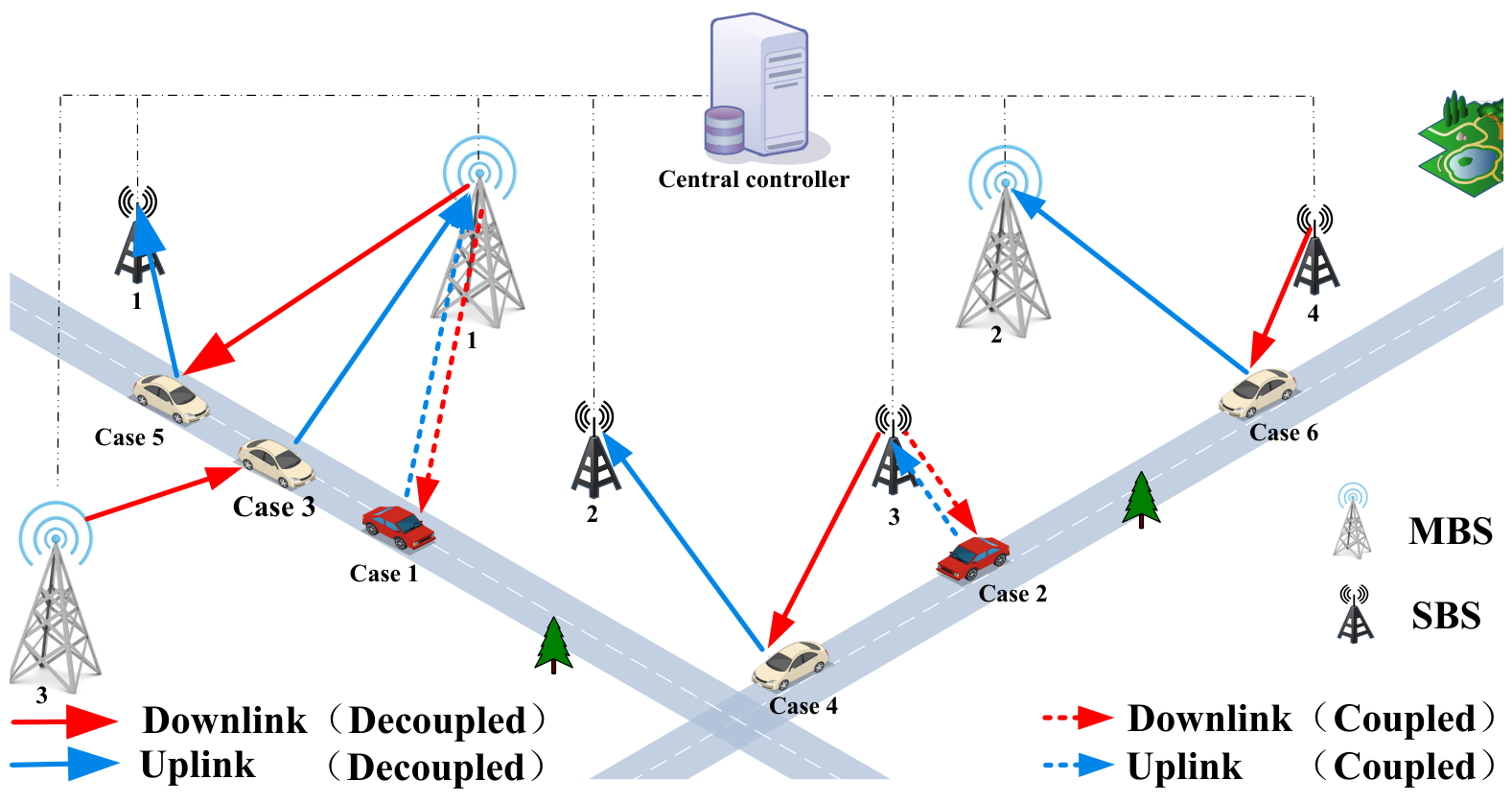
- We present a novel UL/DL intelligent decoupled access framework for C-V2X in the 5G/B5G era. This framework provides a foundation for potential performance improvement of UL/DL intelligent decoupled access in C-V2X. The framework uniquely supports dynamic switching between decoupled and coupled access modes, enabling vehicles to adaptively select the optimal access strategy based on their location and network conditions.
- We aim to maximize system throughput by jointly optimizing the association matrices, transmission power, and radio spectrum allocation between vehicles and BSs for UL and DL. Thus, we formulate the maximum throughput of all vehicles as a mixed-integer nonlinear programming problem (MINLP), which is non-convex and difficult to solve. By introducing auxiliary variables, we transform the MINLP into a standard convex optimization problem. This joint formulation captures the inherent coupling between user association, power control, and bandwidth allocation across both UL and DL.
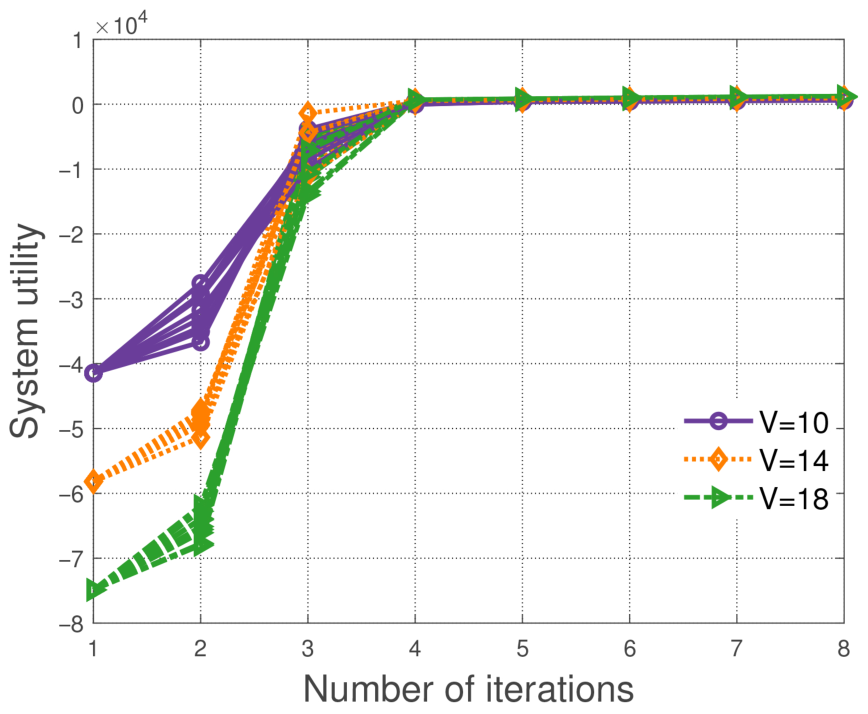
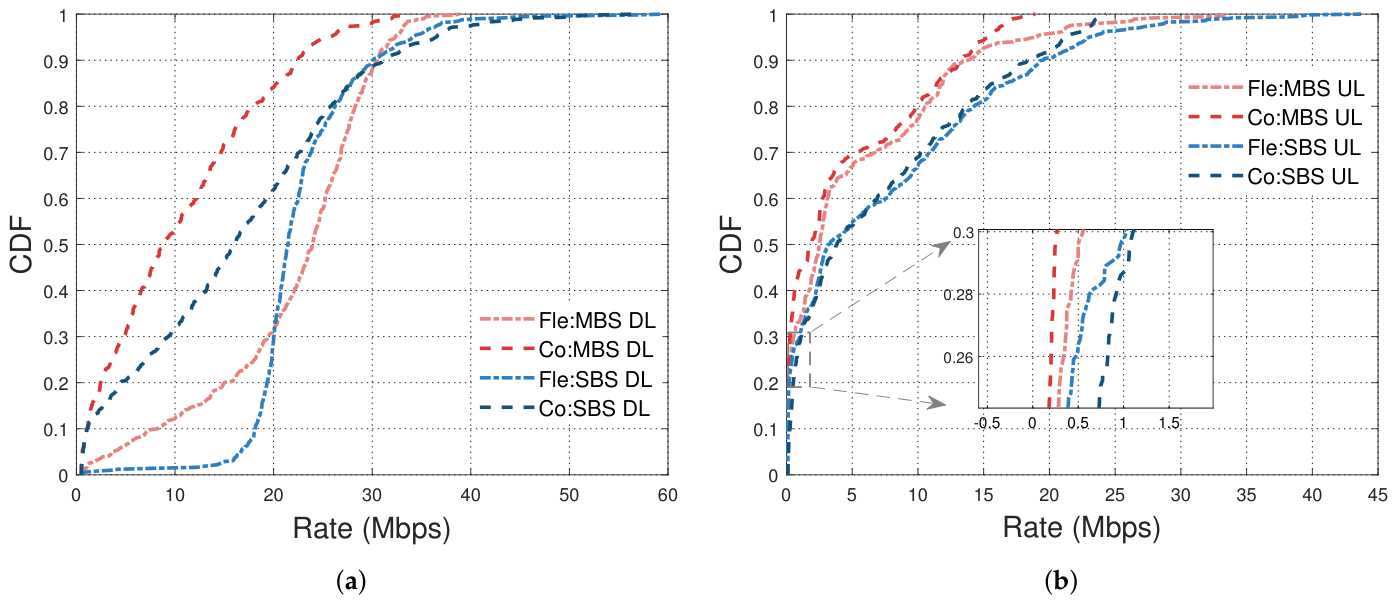
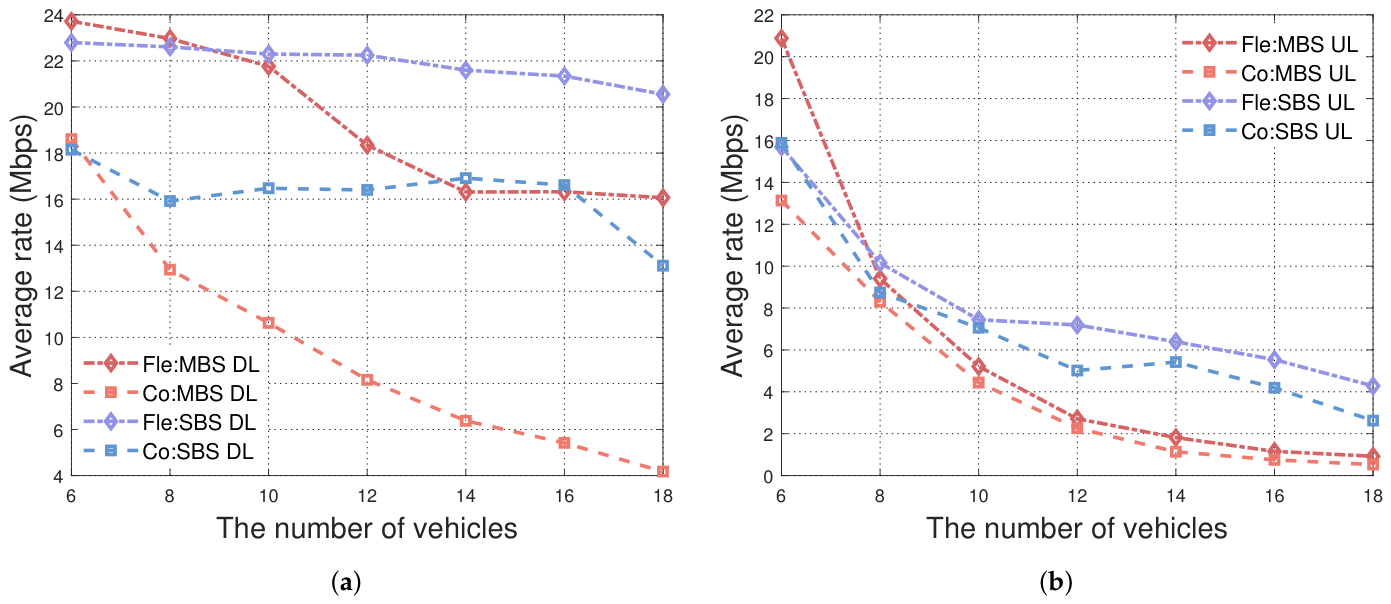
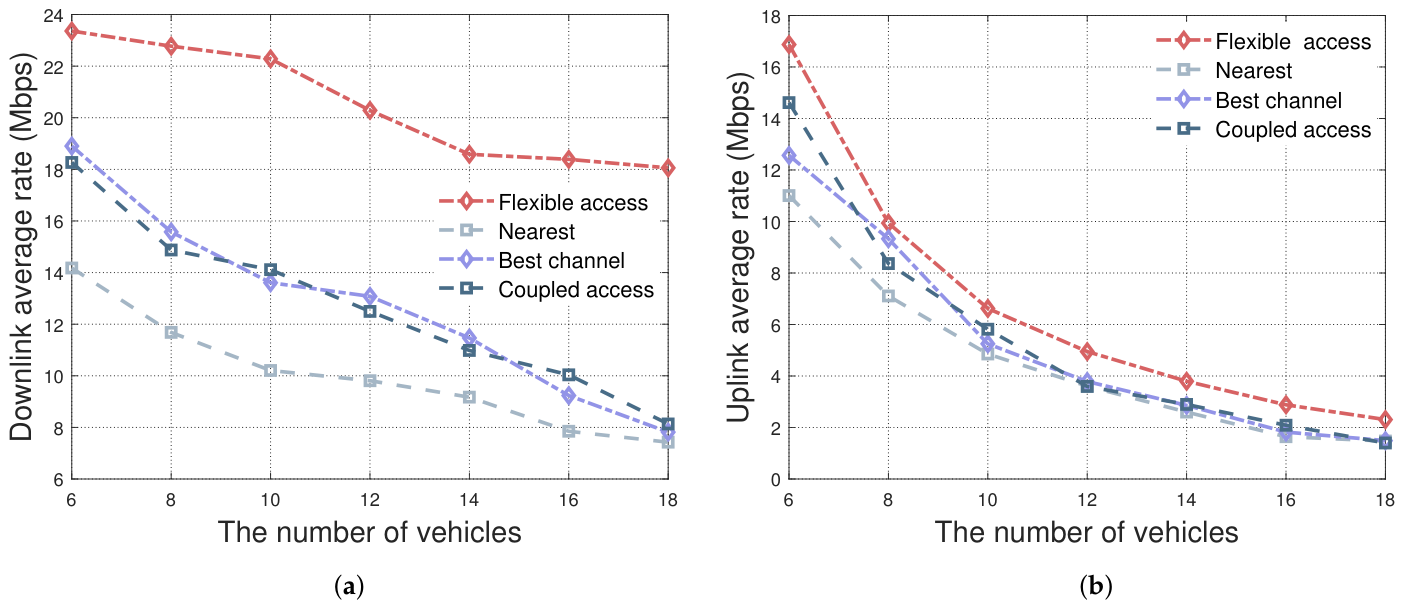
- We propose an efficient iterative algorithm for a sub-optimal solution by employing successive convex optimization techniques. Extensive simulations are conducted to demonstrate the effectiveness of the successive convex approximation (SCA) iterative algorithm. Simulation results demonstrate that the proposed framework achieves substantial throughput gains in both UL and DL compared with coupled access and distance-based association benchmarks.
2. Related Work
3. System Model and Problem Formulation
3.1. UL/DL Intelligent Decoupled Access
- Coupled Case 1:
- Coupled Case 2: SBS j
- Decoupled Case 3: MBS i, MBS j, ()
- Decoupled Case 4: SBS i, MBS j
- Decoupled Case 5: MBS i, SBS j
- Decoupled Case 6: SBS i, SBS j, (),
3.2. Channel Propagation and Interference Models
3.3. Data Transmission Rate
3.4. Problem Formulation
4. DL Joint Optimization
4.1. Association Variable and Objective Function Optimization for DL
4.2. Radio Resource Allocation for DL
5. UL Joint Optimization
5.1. Association Variable and Objective Function Optimization for UL
5.2. Wireless Resource Allocation Optimization for UL
6. Coupled Access Optimization
| Algorithm 1: SCA for maximizing system throughput |
 |
7. Optimization Algorithm for Maximizing System Throughput
| Algorithm 2: Access Mode Classification for Intelligent Decoupled Access |
 |
8. Simulation Results
9. Conclusions
Author Contributions
Funding
Data Availability Statement
Acknowledgments
Conflicts of Interest
Abbreviations
| UL/DL | Uplink/Downlink |
| SBS | Small Base Stations |
| MBS | Macro Base Stations |
| C-V2X | Cellular Vehicle-to-Everything |
| 5G | Fifth-generation Mobile Communications |
| B5G | Beyond 5G |
| ITS | Intelligent Transportation Systems |
| SINR | Signal-to-Noise-and-Interference-Ratio |
| UMa | Urban Macro |
| CVX | Convex Optimization |
| CDF | Cumulative Distribution Function |
References
- Jiao, L.; Yu, K.; Chen, J.; Liu, T.; Zhou, H.; Cai, L. Performance Analysis of Uplink/Downlink Decoupled Access in Cellular-V2X Networks. IEEE Trans. Mob. Comput. 2023, 23, 5616–5630. [Google Scholar] [CrossRef]
- Xu, Y.; Zhou, H.; Ma, T.; Zhao, J.; Qian, B.; Shen, X. Leveraging multiagent learning for automated vehicles scheduling at nonsignalized intersections. IEEE Internet Things J. 2021, 8, 11427–11439. [Google Scholar] [CrossRef]
- Ojaghi, B.; Adelantado, F.; Verikoukis, C. Enhancing V2X QoS: A Dual Approach of Packet Duplication and Dynamic RAN Slicing in B5G. IEEE Trans. Intell. Transp. Syst. 2024, 25, 7848–7860. [Google Scholar] [CrossRef]
- Sabeeh, S.; Wesołowski, K.; Sroka, P. C-V2X centralized resource allocation with spectrum re-partitioning in highway scenario. Electronics 2022, 11, 279. [Google Scholar] [CrossRef]
- Husain, S.; Kunz, A.; Prasad, A.; Pateromichelakis, E.; Samdanis, K.; Song, J. The road to 5G V2X: Ultra-high reliable communications. In Proceedings of the 2018 IEEE Conference on Standards for Communications and Networking (CSCN); IEEE: Piscataway, NJ, USA, 2018; pp. 1–6. [Google Scholar]
- Yin, X.; Liu, J.; Cheng, X.; Xiong, X. A C-V2X Compatible Massive Data Download Scheme Based on Heterogeneous Vehicular Network. IEEE Trans. Consum. Electron. 2023, 69, 962–973. [Google Scholar] [CrossRef]
- Jiao, L.; Zhao, J.; Xu, Y.; Zhang, T.; Zhou, H.; Zhao, D. Performance Analysis for Downlink Transmission in Multi-Connectivity Cellular V2X Networks. IEEE Internet Things J. 2023, 11, 11812–11824. [Google Scholar] [CrossRef]
- Siddiqui, M.U.A.; Qamar, F.; Ahmed, F.; Nguyen, Q.N.; Hassan, R. Interference management in 5G and beyond network: Requirements, challenges and future directions. IEEE Access 2021, 9, 68932–68965. [Google Scholar] [CrossRef]
- Zhang, Y.; Zheng, F.; Luo, J. HetNets under Decoupled Uplink and Downlink Access with UE Random Discontinuous Transmission: Local Delay and Energy Efficiency. China Commun. 2024, 21, 205–216. [Google Scholar] [CrossRef]
- Xu, Y.; Liu, Z.; Qian, B.; Du, H.; Chen, J.; Kang, J.; Zhou, H.; Niyato, D. Fully-Decoupled RAN for Feedback-Free Multi-Base Station Transmission in MIMO-OFDM System. IEEE J. Sel. Areas Commun. 2025, 43, 780–794. [Google Scholar] [CrossRef]
- Shang, J.; Shang, J.; Yao, Z.; Yu, S.; Xu, J. Research and Design on Antenna Performance of Intelligent Connected Vehicles. Mod. Radar 2025. [Google Scholar] [CrossRef]
- Sial, N.; Ahmed, J. A novel and realistic hybrid downlink-uplink coupled/decoupled access scheme for 5G HetNets. Turk. J. Electr. Eng. Comput. Sci. 2017, 25, 4457–4473. [Google Scholar] [CrossRef]
- Xu, Y.; Qian, B.; Yu, K.; Ma, T.; Zhao, L.; Zhou, H. Federated Learning Over Fully-Decoupled RAN Architecture for Two-Tier Computing Acceleration. IEEE J. Sel. Areas Commun. 2023, 41, 789–801. [Google Scholar] [CrossRef]
- Yu, K.; Zhou, H.; Xu, Y.; Liu, Z.; Du, H.; Shen, X. Large Sequence Model for MIMO Equalization in Fully Decoupled Radio Access Network. IEEE Open J. Commun. Soc. 2025, 6, 4491–4504. [Google Scholar] [CrossRef]
- Sekander, S.; Tabassum, H.; Hossain, E. Decoupled uplink-downlink user association in multi-tier full-duplex cellular networks: A two-sided matching game. IEEE Trans. Mob. Comput. 2016, 16, 2778–2791. [Google Scholar] [CrossRef]
- Yu, K.; Yu, Q.; Tang, Z.; Zhao, J.; Qian, B.; Xu, Y.; Zhou, H.; Shen, X. Fully-Decoupled Radio Access Networks: A Flexible Downlink Multi-Connectivity and Dynamic Resource Cooperation Framework. IEEE Trans. Wirel. Commun. 2023, 22, 4202–4214. [Google Scholar] [CrossRef]
- Meneguette, R.I.; Bittencourt, L.F.; Madeira, E.R. User-centric mobility management architecture for vehicular networks. In Mobile Networks and Management, Proceedings of the 4th International Conference, MONAMI 2012, Hamburg, Germany, 24–26 September 2012; Revised Selected Papers 4; Springer: Berlin/Heidelberg, Germany, 2013; pp. 42–56. [Google Scholar]
- Jiao, L.; Yu, K.; Xu, Y.; Zhang, T.; Zhou, H.; Shen, X. Spectral Efficiency Analysis of Uplink-Downlink Decoupled Access in C-V2X Networks. In Proceedings of the GLOBECOM 2022—2022 IEEE Global Communications Conference; IEEE: Piscataway, NJ, USA, 2022; pp. 2062–2067. [Google Scholar]
- Yu, K.; Zhou, H.; Tang, Z.; Shen, X.; Hou, F. Deep reinforcement learning-based RAN slicing for UL/DL decoupled cellular V2X. IEEE Trans. Wirel. Commun. 2021, 21, 3523–3535. [Google Scholar] [CrossRef]
- Liu, T.; Zhou, H.; Li, J.; Shu, F.; Han, Z. Uplink and downlink decoupled 5G/B5G vehicular networks: A federated learning assisted client selection method. IEEE Trans. Veh. Technol. 2022, 72, 2280–2292. [Google Scholar] [CrossRef]
- Yu, K.; Zhou, H.; Qian, B.; Tang, Z.; Shen, X. A reinforcement learning aided decoupled RAN slicing framework for cellular V2X. In Proceedings of the GLOBECOM 2020—2020 IEEE Global Communications Conference; IEEE: Piscataway, NJ, USA, 2020; pp. 1–6. [Google Scholar]
- Jiang, L.; Sha, X.; Wu, X.; Zhang, N. A novel resource allocation algorithm based on downlink and uplink decouple access scheme in heterogeneous networks. China Commun. 2016, 13, 22–31. [Google Scholar] [CrossRef]
- Liu, X.; Liu, H.; Zheng, K.; Liu, J.; Taleb, T.; Shiratori, N. AoI-minimal clustering, transmission and trajectory co-design for UAV-assisted WPCNs. IEEE Trans. Veh. Technol. 2024, 74, 1035–1051. [Google Scholar] [CrossRef]
- Shi, Y.; Alsusa, E.; Baidas, M.W. On the application of uplink/downlink decoupled access in heterogeneous mobile edge computing. Comput. Netw. 2023, 223, 109593. [Google Scholar] [CrossRef]
- Peng, J.; Shangguan, W.; Chai, L.; Chen, J.; Peng, C.; Cai, B. V2X Enabled Platoon Control for Aperiodic Congestion Mitigation via Moving Bottlenecks in Mixed Traffic Environments. IEEE Trans. Veh. Technol. 2025. [Google Scholar] [CrossRef]
- Boccardi, F.; Andrews, J.; Elshaer, H.; Dohler, M.; Parkvall, S.; Popovski, P.; Singh, S. Why to decouple the uplink and downlink in cellular networks and how to do it. IEEE Commun. Mag. 2016, 54, 110–117. [Google Scholar] [CrossRef]
- Chetlur, V.V.; Dhillon, H.S. Coverage and rate analysis of downlink cellular vehicle-to-everything (C-V2X) communication. IEEE Trans. Wirel. Commun. 2019, 19, 1738–1753. [Google Scholar] [CrossRef]
- Andrews, J.G.; Baccelli, F.; Ganti, R.K. A tractable approach to coverage and rate in cellular networks. IEEE Trans. Commun. 2011, 59, 3122–3134. [Google Scholar] [CrossRef]
- ETSI. Study on Channel Model for Frequencies from 0.5 to 100 GHz; Technical Report 3GPP TR 38.901; ETSI: Valbonne, France, 2022. [Google Scholar]
- Singh, A.; Marzetta, T.L. Shannon theory for wireless communication in a resonant chamber. IEEE J. Sel. Areas Commun. 2024, 42, 1494–1503. [Google Scholar] [CrossRef]
- Zhan, C.; Zeng, Y.; Zhang, R. Energy-efficient data collection in UAV enabled wireless sensor network. IEEE Wirel. Commun. Lett. 2017, 7, 328–331. [Google Scholar] [CrossRef]
- Geng, S.; Wei, Z.; Zhao, J.; Shen, F.; Joung, J.; Sun, S. Joint Deployment and Resource Allocation for Service Provision in Multi-UAV-Assisted Wireless Networks. IEEE Internet Things J. 2024, 11, 37269–37286. [Google Scholar] [CrossRef]
- André, R.; Luciani, X.; Moreau, E. Joint eigenvalue decomposition algorithms based on first-order Taylor expansion. IEEE Trans. Signal Process. 2020, 68, 1716–1727. [Google Scholar] [CrossRef]
- Boyd, S.P.; Vandenberghe, L. Convex Optimization; Cambridge University Press: Cambridge, UK, 2004. [Google Scholar]
- Von Hohenbalken, B. A finite algorithm to maximize certain pseudoconcave functions on polytopes. Math. Program. 1975, 9, 189–206. [Google Scholar] [CrossRef]
- An, L.T.H.; Tao, P.D. The DC (difference of convex functions) programming and DCA revisited with DC models of real world nonconvex optimization problems. Ann. Oper. Res. 2005, 133, 23–46. [Google Scholar] [CrossRef]



| Channel Parameters | Value |
|---|---|
| MBS transmit power (dBm) | 46 |
| SBS transmit power (dBm) | 30 |
| Vehicle transmit power (dBm) | 29 |
| Mean of shadowing gain for LOS, NLOS (dB) | |
| STD of shadowing gain for LOS, NLOS (dB) | |
| Mean of Rayleigh fading (dBi) | 1 |
| The antenna heights of MBS, SBS, vehicle (m) | 25, 10, 1.8 |
| The DL communication frequency (GHz) | 5 |
| The UL communication frequency (GHz) | 5.9 |
| Simulation Parameters | Value |
| The minimum DL rate (Mbps) | 0.5 |
| The minimum UL rate (Mbps) | 0.1 |
| The length of road (m) | 1200 |
| The total bandwidth of MBS, SBS (MHz) | 15, 6 |
| The total bandwidth of MBS, SBS (MHz) | 15, 6 |
| The maximum bandwidth of MBS, SBS (MHz) | 3, 3 |
| The maximum bandwidth of MBS, SBS (MHz) | 3, 3 |
| The maximum for MBS/SBS in DL | 5, 2 |
| The maximum for MBS/SBS in UL | 5, 2 |
| The proportion of vehicles in LOS | 80% |
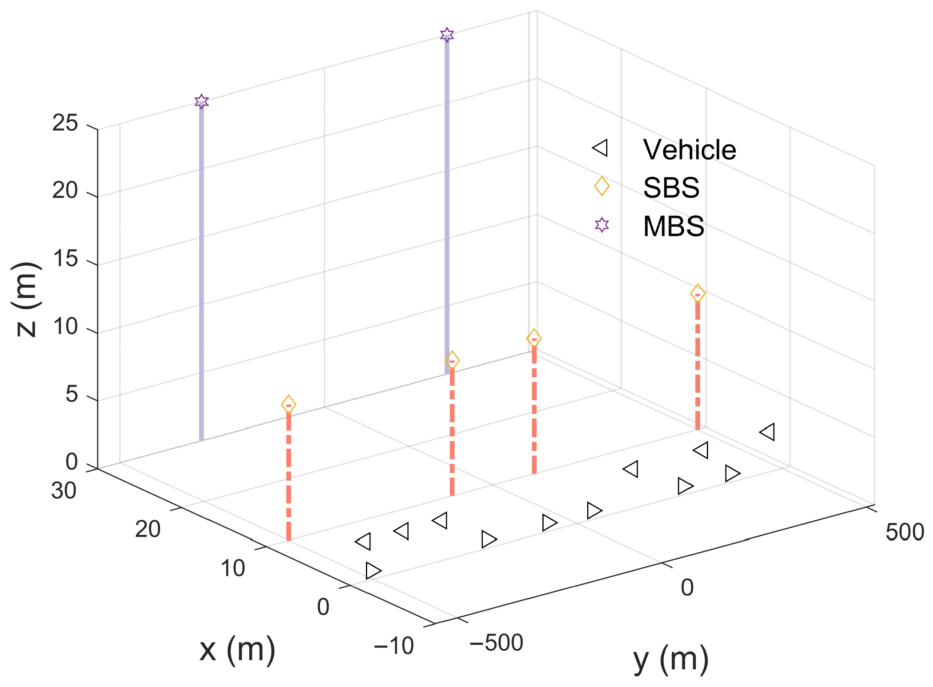
| The number V of vehicles | 6∼18 |
| The number M of MBS | 2 |
| The number S of SBS | 4 |
Disclaimer/Publisher’s Note: The statements, opinions and data contained in all publications are solely those of the individual author(s) and contributor(s) and not of MDPI and/or the editor(s). MDPI and/or the editor(s) disclaim responsibility for any injury to people or property resulting from any ideas, methods, instructions or products referred to in the content. |
© 2026 by the authors. Licensee MDPI, Basel, Switzerland. This article is an open access article distributed under the terms and conditions of the Creative Commons Attribution (CC BY) license.
Share and Cite
Jiao, L.; Li, P.; Yang, Y.; Xia, L.; Cheng, Q.; Liu, A.; Yang, J.; Xu, X. Joint Optimization for Uplink/Downlink Intelligent Decoupled Access in Heterogeneous C-V2X Communications. Electronics 2026, 15, 2046. https://doi.org/10.3390/electronics15102046
Jiao L, Li P, Yang Y, Xia L, Cheng Q, Liu A, Yang J, Xu X. Joint Optimization for Uplink/Downlink Intelligent Decoupled Access in Heterogeneous C-V2X Communications. Electronics. 2026; 15(10):2046. https://doi.org/10.3390/electronics15102046
Chicago/Turabian StyleJiao, Luofang, Pin Li, Yuhao Yang, Linghao Xia, Qiang Cheng, Ang Liu, Jingbei Yang, and Xianzhe Xu. 2026. "Joint Optimization for Uplink/Downlink Intelligent Decoupled Access in Heterogeneous C-V2X Communications" Electronics 15, no. 10: 2046. https://doi.org/10.3390/electronics15102046
APA StyleJiao, L., Li, P., Yang, Y., Xia, L., Cheng, Q., Liu, A., Yang, J., & Xu, X. (2026). Joint Optimization for Uplink/Downlink Intelligent Decoupled Access in Heterogeneous C-V2X Communications. Electronics, 15(10), 2046. https://doi.org/10.3390/electronics15102046