1. Introduction
Lithium-ion batteries are widely used in electric vehicles (EVs), energy storage systems (ESSs), and portable electronics because of their high energy density and long cycle life. As their application range expands, battery management systems (BMSs) have become essential for accurately monitoring and controlling battery states [
1,
2,
3,
4,
5,
6]. A BMS periodically measures key variables such as voltage, current, and temperature and uses them to provide protection and operational control, thereby ensuring system safety and reliability [
7,
8,
9]. Among BMS functions, state of charge (SOC) estimation is particularly important because it directly determines awareness of remaining energy, available energy prediction, power limitation, and protection thresholds. When SOC estimation errors accumulate, uncertainty in available energy prediction increases and protection control can become overly conservative, degrading both system efficiency and user experience [
4,
5,
10,
11]. In practice, EV and small scale ESS BMSs are commonly implemented on low power microcontrollers or SoC platforms, where information from multiple cells must be processed periodically under limited computational and memory resources. Accordingly, SOC estimation is an industrially important function, and embedded implementations must balance estimation performance against resource and power budgets [
12,
13,
14].
A wide range of SOC estimation methods has been studied, including coulomb counting, observers and filters based on models, voltage-based estimation, and data-driven approaches. Each method offers different tradeoffs in terms of implementation simplicity, estimation performance, and dependence on models or data, and embedded BMS applications must consider computational and memory costs in addition to accuracy [
12,
13]. Recent studies have also reported strong performance using deep learning-based SOC estimation methods, including deep learning frameworks and Transformer–LSTM structures [
15,
16]. In addition, graph-based transfer learning and domain adaptation methods have achieved excellent results in intelligent fault diagnosis under domain shifts, as demonstrated by recent studies on knowledge correlation graph-guided multi-source interaction and spatial-channel collaborative multi-scale graph interaction [
17,
18]. These studies reflect the recent progress of data-driven methods that learn transferable representations from complex operating data. Electrochemical impedance spectroscopy (EIS)-based estimation has also been investigated for battery SOC estimation [
19,
20].
However, such methods may require additional training data, feature extraction, graph or domain adaptation processing, or dedicated excitation and measurement procedures. Their deployment in embedded BMS platforms therefore requires careful consideration of computational cost, memory usage, and implementation complexity. From a hardware design perspective, implementations should explicitly address not only resource usage but also bounded worst case latency and robust termination behavior. Many existing studies on FPGA implementation focus primarily on demonstrating functional feasibility or system level validation, and lightweight hardware for SOC estimation that simultaneously considers real-time operating constraints and implementation complexity remains needed.
This paper presents a lightweight hardware approach to SOC estimation for the development of a gauge IP in embedded BMS applications. The proposed method models the reference OCV–SOC curve of a lithium-ion battery with a piecewise polynomial that has two regions and estimates OCV from the measured terminal voltage together with ESR correction, after which SOC is updated iteratively. The estimator is implemented as a standalone gauge IP driven by finite state machines (FSMs), allowing us to address both hardware feasibility under constrained resources and robust real-time operation. The design is validated on a real-time FPGA battery measurement testbed, where SOC estimation accuracy and resource usage are evaluated. An MPW implementation is also presented to demonstrate ASIC feasibility.
The main contributions of this work are as follows:
We propose an SOC estimation structure that combines a two-region piecewise OCV–SOC polynomial with an ESR lookup table (LUT). This structure reduces the memory demand of dense LUT-based mapping and provides a compact arithmetic structure suitable for fixed-point hardware implementation.
We present a standalone gauge IP based on FSM control, a 1-LSB termination rule, a guard based on , and an operator-reuse datapath. The proposed IP performs iterative SOC estimation using shared arithmetic resources while limiting excessive iteration and limit cycle behavior.
Real-time validation on an FPGA battery measurement testbed demonstrates an overall NMAE of approximately 1.6% over charge and discharge data, with resource usage of 504 LUTs and 580 FFs, and a TSMC 28 nm ASIC implementation further confirms hardware feasibility.
The remainder of this paper is organized as follows.
Section 2 reviews related studies.
Section 3 describes the proposed estimation method based on the OCV–SOC relationship.
Section 4 presents the hardware design and implementation of the gauge IP.
Section 5 reports the experimental results, including FPGA real-time validation and MPW results.
Section 6 discusses the significance and limitations of the work and outlines future directions, and
Section 7 concludes the paper.
2. Related Work
2.1. SOC Estimation Methods
Because SOC is a state variable that cannot be measured directly, indirect estimation based on available sensor signals is commonly employed, and a variety of estimation techniques have been investigated [
10]. Coulomb counting, which integrates battery current over time, is simple to implement and computationally inexpensive; however, sensor offset, gain error, and sampling error can accumulate over time and gradually increase the long-term SOC estimation error [
21,
22]. To mitigate this limitation, observer and filter approaches built on equivalent circuit models (ECMs) have been widely studied. Among them, the extended Kalman filter (EKF) is frequently used to improve estimation performance by incorporating the dynamic behavior of voltage and current [
22,
23,
24,
25]. Nevertheless, such methods typically require repeated state and parameter updates, linearization, and matrix operations, which increase computational cost and often require parameter identification and calibration procedures [
12]. Data-driven and learning-based methods have also reported strong performance under diverse conditions, but their model size, inference cost, data dependence, and verification burden require additional consideration before deployment in embedded BMS platforms.
In voltage-based approaches, the relationship between open circuit voltage and SOC serves as a key source of information for SOC estimation, and the OCV–SOC curve is usually approximated and stored as either a polynomial or a lookup table (LUT) [
26,
27]. OCV–SOC models are attractive because of their relatively simple structure and good reproducibility, but the required storage and computational cost depend strongly on the fitting strategy and storage format [
21]. Their applicability also depends on how variations in the OCV–SOC characteristic under different operating conditions are handled, making model selection important for practical BMS design. Methods based on the OCV–SOC relationship have been used alone or combined with coulomb counting and filters based on models in hybrid forms, and when iterative update structures are employed, termination design for real-time operation becomes an important part of the estimator [
28,
29,
30,
31,
32,
33].
2.2. Hardware Implementations for SOC Estimation
The practical implementation of SOC estimation algorithms depends strongly on the target platform. Embedded BMSs are commonly built on low power MCUs or SoCs, where battery information such as voltage and current is sampled and processed periodically under limited computational capability, memory capacity, and power budgets. Consequently, algorithmic complexity and memory demand are major constraints that determine whether a method can be deployed in embedded environments. FPGA implementations, by contrast, can exploit parallelism and deterministic execution and have therefore been used to realize filter-based estimators such as EKF, as well as voltage-based estimators in hardware [
34,
35,
36,
37]. However, many existing hardware studies emphasize proof of concept implementation or system-level validation rather than jointly designing and quantifying resource efficiency and termination behavior for lightweight hardware. Reports that extend beyond FPGA verification to chip fabrication and measurement are also still limited. Against this background, hardware for embedded BMS applications should not only simplify the SOC estimation model but also clarify how the selected model is translated into a resource-efficient implementation. In OCV–SOC-based estimation, dense LUT-based mapping can increase memory demand, whereas piecewise approximation can still require non-negligible arithmetic resources depending on the implementation. Therefore, a lightweight gauge architecture should jointly consider model storage, arithmetic structure, termination behavior, and latency bounds under real-time operating constraints.
3. OCV–SOC-Based Estimation Method
3.1. Overview of the Proposed Method
The goal of this study is real-time SOC estimation for lithium-ion batteries in embedded BMS environments. To this end, we propose a lightweight SOC estimation algorithm and a hardware structure suitable for implementation. The algorithm is based on the OCV–SOC characteristic of a lithium-ion battery, but to reduce dependence on large LUTs and higher order models, the OCV–SOC curve is partitioned into two voltage regions and each region is approximated by a quadratic polynomial. Measured terminal voltage
V and current
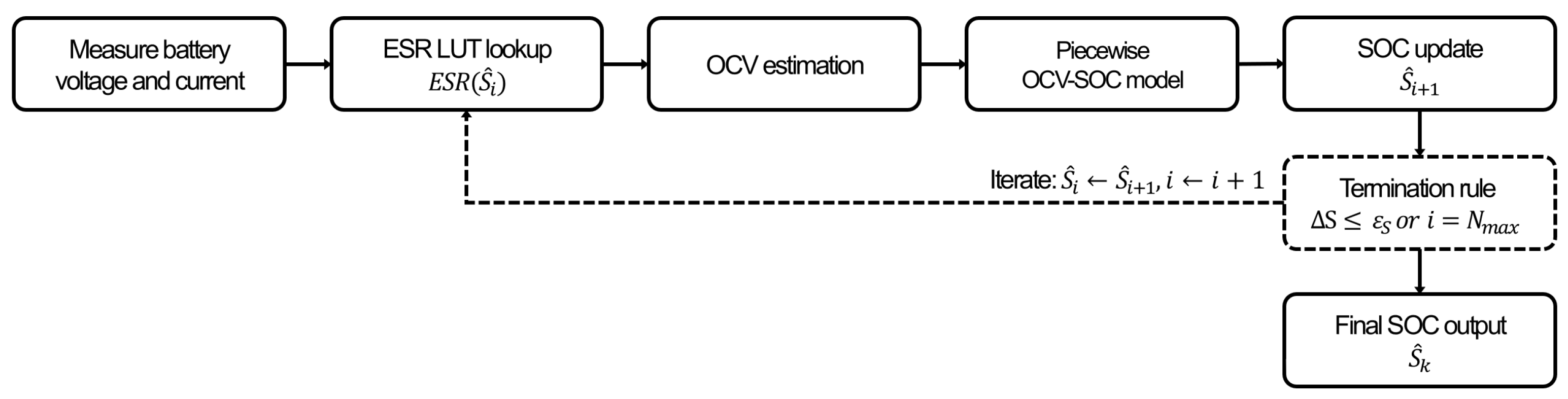
I are used as inputs. During the iterative update, the ESR corresponding to the current SOC estimate is obtained from an LUT, an OCV input is constructed, and SOC is then updated. The overall computation follows an iterative update structure: OCV is updated from the current SOC estimate, the resulting OCV is applied to the piecewise polynomial model, and the next SOC estimate is computed. For real-time operation, termination is guaranteed by a 1-LSB convergence criterion together with a maximum iteration limit. The main symbols and parameters used in this paper are summarized in
Table 1. SOC is denoted by
S, and the estimate at iteration
i is written as
.
Figure 1 summarizes the overall processing pipeline of the proposed method. At each sampling instant, the terminal voltage
and current
are acquired. The ESR associated with the current SOC estimate
is then read from the LUT, and this value is used together with the measured voltage and current to construct the OCV input to the model. The resulting OCV estimate is applied to the piecewise quadratic OCV–SOC model to compute the updated SOC estimate
. This sequence is repeated iteratively until the termination rule described in
Section 3.3 is satisfied, after which the final SOC is reported as
.
3.2. Piecewise OCV–SOC Modeling
This section describes how the OCV–SOC relationship, which forms the core of the proposed method, is modeled in a form suitable for hardware implementation. The OCV–SOC curve of a lithium-ion battery is nonlinear, and its voltage slope varies with SOC. As a result, approximating the entire range with a single low-order polynomial can increase fitting error in certain regions, whereas increasing the polynomial order raises implementation complexity. To reduce dependence on large LUTs or higher order polynomial models, we partition the OCV–SOC curve into two voltage regions and approximate each region with a quadratic polynomial, thereby obtaining a lightweight model that computes SOC from OCV. SOC is normalized to the range 0–1 to match the fixed-point representation and scaling used in hardware. In
Figure 1, this model corresponds to the
Piecewise OCV–
SOC model block and provides the updated SOC value for a given OCV during each iteration.
3.2.1. Reference OCV–SOC Characterization
The OCV–SOC reference data were derived from a characterized single lithium-ion cell dataset and used as the basis for both the piecewise polynomial model and the ESR LUT design. The reference SOC used for error evaluation was obtained by OCV–SOC mapping from the same dataset. The battery model stores Voc and ESR over SOC states and provides 101 SOC points with 1 mV Voc resolution and 1 mΩ ESR resolution. The uncertainty of the reference dataset is affected by both the battery-model resolution and the voltage/current measurement accuracy used during dataset generation. The reference OCV–SOC curve exhibits a steep slope change in the low SOC region and becomes gradually flatter as SOC increases. Because of this region’s specific nonlinearity, applying a single low order approximation across the entire range can increase fitting error in the low voltage region.
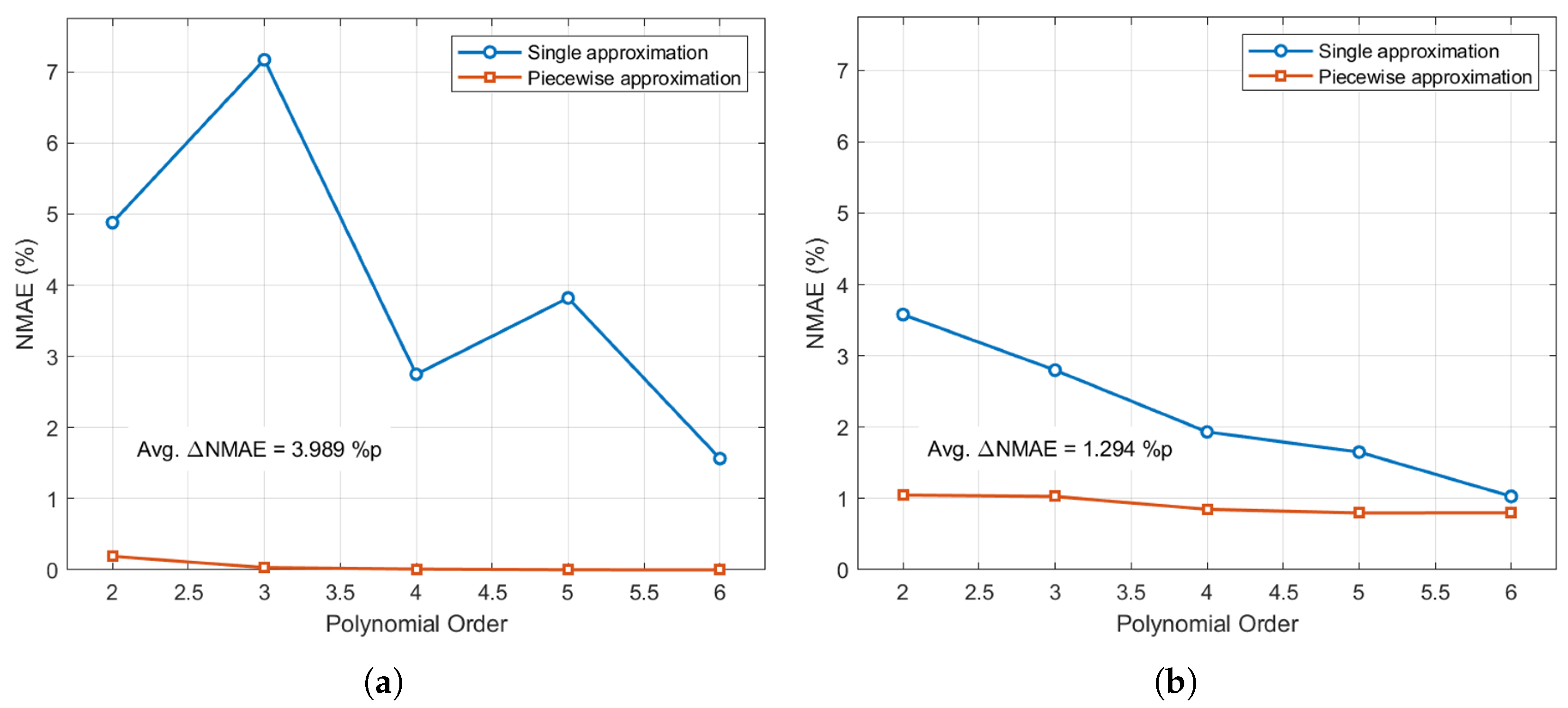
Figure 2a and b compare the approximation error of the single full-range approximation and the two-region piecewise approximation in the low voltage and high voltage regions, respectively. In this comparison, the NMAE values are normalized by the full SOC range so that both approximation structures can be interpreted on a common basis. As shown in
Figure 2, the two-region piecewise approximation follows the region’s specific nonlinearity more effectively than the single approximation, particularly in the low-voltage region. Therefore, this study adopts a two-region approximation to reduce region-specific fitting error while keeping model complexity low.
3.2.2. Two-Region Piecewise Polynomial Approximation
The polynomial order and partition boundary of the two-region model were determined through offline analysis using the reference OCV–SOC data. Given the nonlinearity discussed in
Section 3.2.1, the polynomial order was selected by considering both local approximation capability and implementation complexity. A quadratic polynomial is the polynomial of the lowest order that can explicitly represent local curvature within each region, whereas models of higher order require additional coefficients and arithmetic operations. Therefore, the quadratic form was considered a suitable model of minimum order for the proposed piecewise approximation intended for hardware implementation.
Candidate models of low polynomial order in the two-region structure were then compared in terms of approximation accuracy.
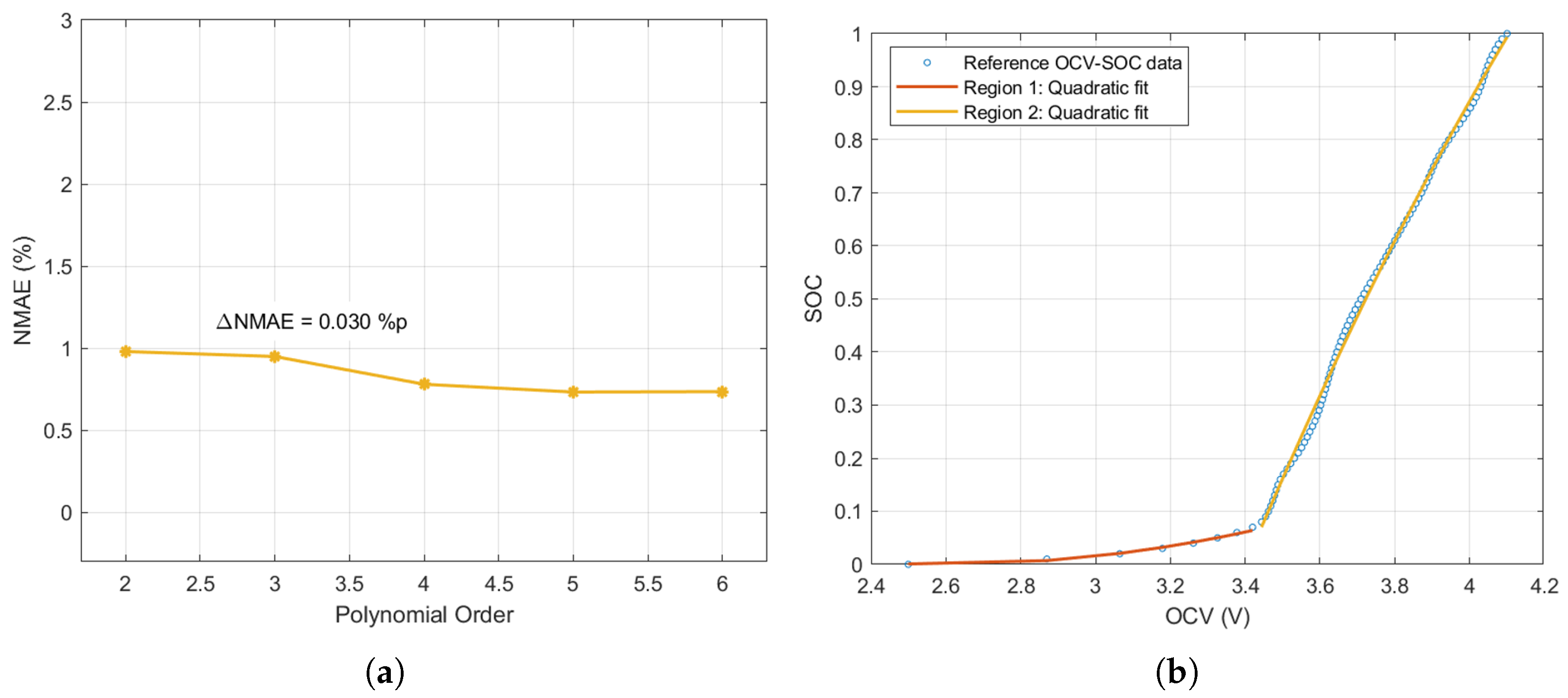
Figure 3a shows the overall NMAE as a function of polynomial order in the two-region structure. Although the overall error decreases as the polynomial order increases, the additional reduction becomes limited once the dominant local curvature is represented by the quadratic term. This result supports the adoption of the two-region quadratic model as a practical trade-off between approximation capability and implementation complexity.
Figure 3b compares the reference OCV–SOC data with the selected two-region quadratic approximation. The partition boundary was chosen by comparing the approximation accuracy of each region for the selected model structure, and the final model was configured so that region selection can be performed using only a single comparison with the OCV threshold voltage
. In each region, the SOC output for OCV input
x is approximated by a quadratic polynomial, and the SOC update at iteration
i is defined as follows:
Here,
denotes the region selected by the OCV threshold
, with
for
and
for
. The coefficients
,
, and
for each region are listed in
Table 2.
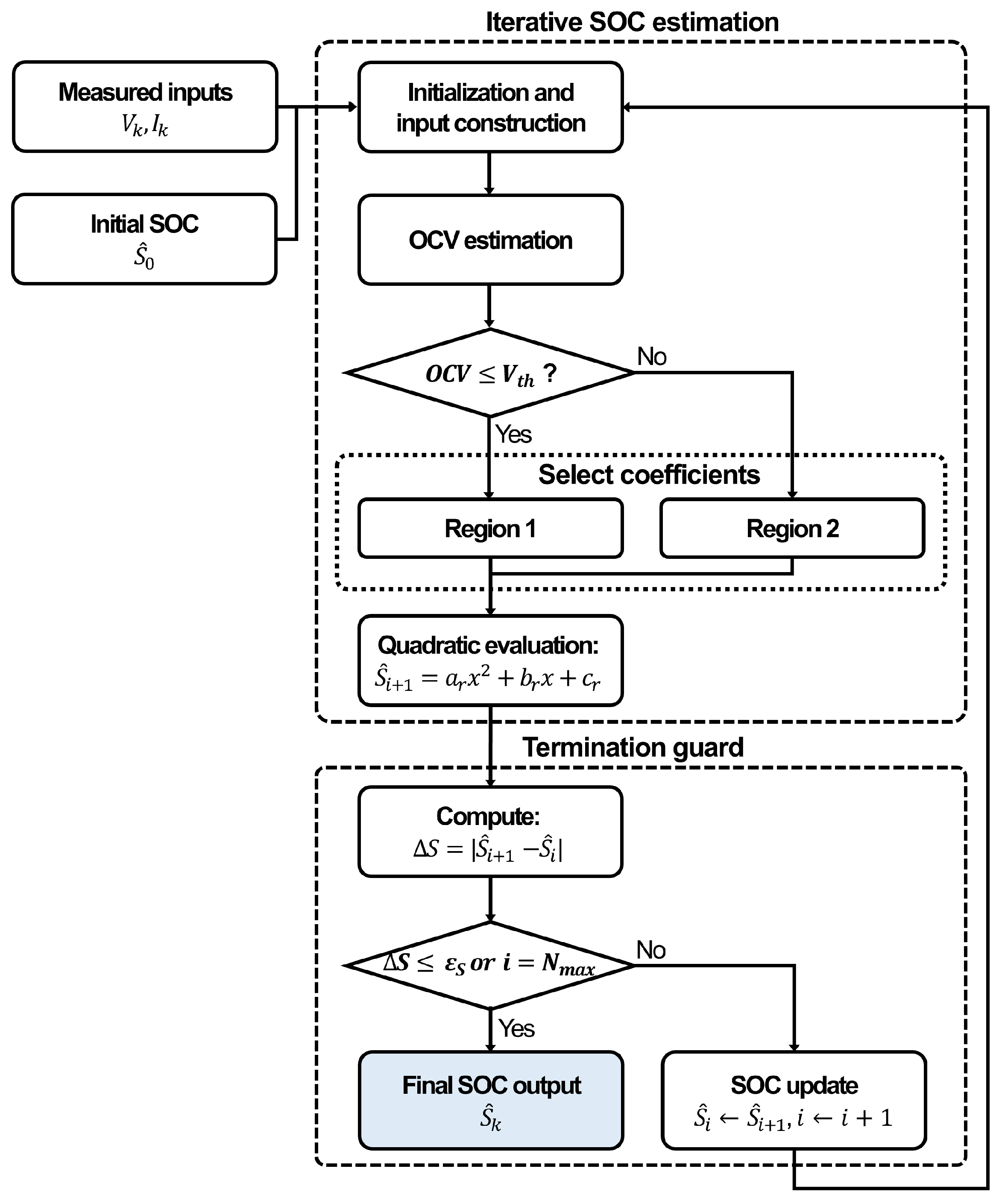
Both regions share the same arithmetic structure, while the coefficients are selected according to the active region. This two-region quadratic approximation is well suited to fixed-point iterative updating because it uses only a small number of coefficients and a simple arithmetic structure, reducing both storage cost and computational complexity compared with mapping based on a large LUT. Applying the same polynomial order in both regions also provides a uniform implementation flow, so model switching requires only coefficient selection after region comparison. The iterative SOC estimation flow based on the above piecewise quadratic OCV–SOC model is summarized in
Figure 4.
3.3. The 1-LSB-Based Termination Rule for Predictable Runtime Behavior
This section presents a 1-LSB termination rule together with a guard based on the maximum number of iterations so that the fixed-point iterative SOC update shows predictable runtime behavior in real-time hardware. At sample
k, the proposed method updates SOC iteratively, and the estimate at iteration
i is denoted by
. Following the processing flow in
Section 3.1, each iteration constructs the required input from the current estimate and computes the next SOC value.
In fixed-point implementations, even after the iterative update enters the vicinity of convergence, scaling and quantization errors can prevent the estimate from settling exactly at a single fixed point. Instead, the estimate may fluctuate slightly between adjacent representable values. In such cases, the actual variation is very small, but an overly strict termination condition can cause unnecessary additional iterations even after sufficient convergence has been reached. Therefore, this work determines termination based on the difference between two successive estimates. The tolerance is set to 1 LSB, which corresponds to the minimum distinguishable change in the fixed-point SOC representation. This 1-LSB criterion reduces unnecessary iteration and enables stable final SOC decisions even when the estimate jitters within approximately because of input noise or quantization error.
However, the 1-LSB criterion alone does not completely prevent prolonged termination in regions where the estimate alternates between neighboring quantization levels. In that case, the updated magnitude can remain near the threshold for repeated iterations. To bound the iteration count, we therefore introduce a maximum number of iterations,
. This guard provides predictable worst case execution time in real-time hardware, and the final output
is taken as the last updated value at the termination point. The resulting definition and termination rule are summarized in Algorithm 1.
| Algorithm 1 Termination rule for iterative SOC update |
Require: Measured inputs at sample k (), initial estimate , tolerance , maximum
iterations
Ensure: Final SOC
1: Initialize
2: while do
3: Construct required inputs based on
4:
5:
6: if then
7: break
8: end if
9:
10:
11: end while
12: |
4. Hardware Design and Implementation
This section describes the hardware structure used to implement the iterative update method based on the OCV–SOC relationship that was presented in
Section 3 as a standalone gauge IP that does not rely on a microprocessor. In this paper, the gauge IP denotes a hardware block that can perform SOC estimation independently, and its main computational engine is referred to as the Gauge Core. The proposed implementation adopts fixed-point arithmetic and a minimal LUT structure to accommodate limited computational and memory resources. To ensure predictable runtime in real-time operation, it employs a termination guard that combines a 1-LSB termination rule with a limit on the maximum number of iterations. The gauge IP was described in synthesizable RTL and validated on an FPGA hardware platform. ASIC feasibility is further demonstrated in
Section 5 through MPW results.
4.1. System Hardware Design
This subsection summarizes the system-level hardware organization and data flow used to apply the gauge IP to real-time SOC estimation. The proposed system separates measurement and estimation functions and repeats the same measurement, estimation and output pipeline at every sampling period. Sensing of battery terminal voltage and current and initial data acquisition are handled by an external measurement AFE board. At each sampling instant, the gauge IP receives the measured data, starts computation, calculates SOC through the Gauge Core, and provides the result to an external observation path. Accordingly, the system interface is minimized to the reception of measured data and the observation of the resulting SOC, whereas the estimation and termination logic reside entirely inside the gauge IP.
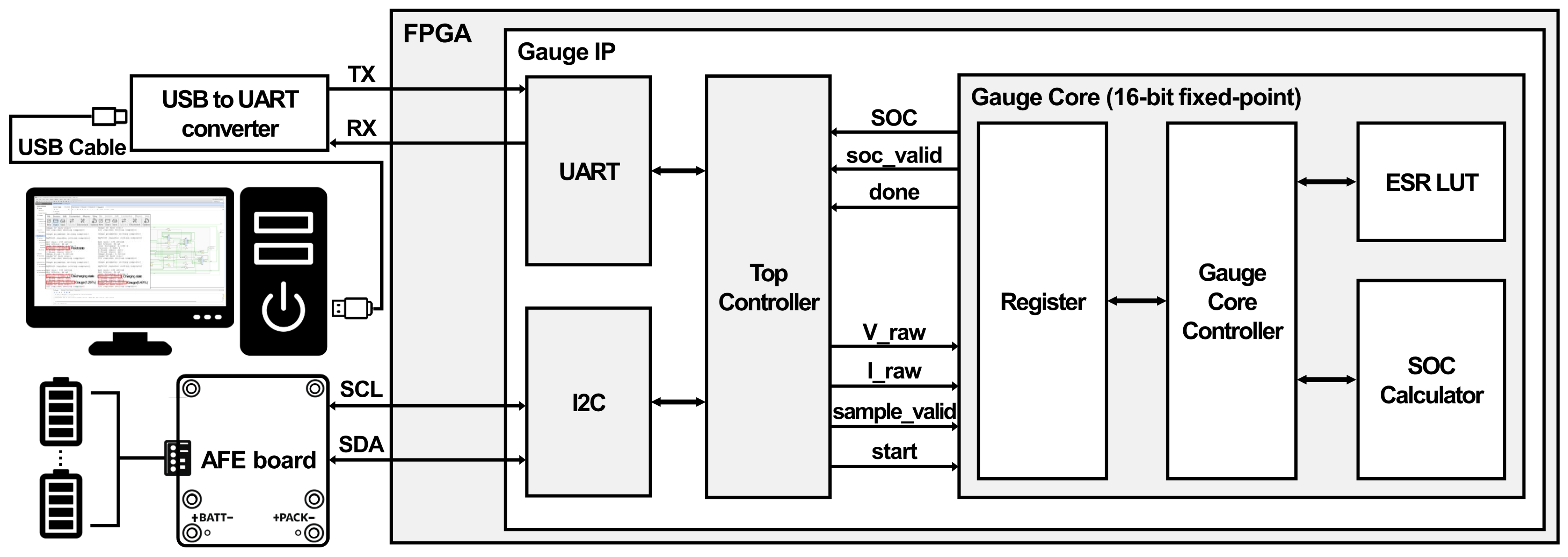
At the system level, the hardware structure and data flow are as follows. As shown in
Figure 5, the gauge IP consists of four main modules: (i) an I2C module, (ii) a Top Controller, (iii) the Gauge Core, and (iv) a UART module. The I2C module acts as a bidirectional serial interface that receives raw voltage and current data for each sample from the external AFE board. The Top Controller is an FSM that drives the system sequentially, initiating input acquisition and estimation at each sampling instant and generating control signals for the modules in the required order. The Gauge Core stores the received measurement data in an input buffer, applies fixed-point scaling to convert them into the internal numeric format, computes OCV, selects the active region, evaluates the polynomial, and updates SOC iteratively. Iteration termination is decided by the termination guard inside the Gauge Core, which implements the 1-LSB rule, and the finalized SOC is sent to a PC through the UART module for performance evaluation and validation.
Therefore, in the proposed system, both SOC estimation and termination are executed inside the Gauge Core without processor intervention, while the external components support operation verification by supplying measurement data and observing results.
4.2. Gauge Core Design
The Gauge Core is the computational block that receives the terminal voltage and current acquired at sampling instant k and determines the final SOC through iterative updating based on the OCV–SOC relationship. The Gauge Core constructs the OCV input using the ESR value associated with the current SOC estimate, updates SOC by applying the OCV to the piecewise polynomial model, and determines when to terminate iteration through the termination guard. In summary, the structure repeatedly computes the next SOC value from the current estimate and then updates the stored estimate.
4.2.1. Fixed-Point Representation
To perform real-time SOC estimation under tight hardware resource constraints, the Gauge Core processes all internal computations using fixed-point arithmetic. The raw voltage and current values received from the external AFE board are buffered and then converted, through scaling, into the internal numeric format used for computation. This scaling stage aligns the units and ranges of the raw measurements with the internal arithmetic range, secures the numerical resolution needed for polynomial evaluation and iterative updating, and also acts as preprocessing that suppresses overflow and excessive bit width growth during arithmetic operations.
A single fixed-point format is used throughout the internal calculations of the Gauge Core. As illustrated in
Figure 6, all internal operations use a 16-bit signed fixed-point format, and the same format is applied to OCV calculation, region selection, polynomial evaluation, iterative updating, and termination checking. The incoming voltage and current values are also converted into this format during scaling. This use of a single format reduces implementation complexity by preserving format consistency across the full computation path while still providing sufficient resolution.
The fixed-point format was selected by considering both the range and resolution of key variables, including input voltage and current, the estimated OCV, SOC state values, polynomial coefficients, and intermediate accumulation terms. In particular, the minimum SOC resolution is defined as 1 LSB, and the internal format was chosen so that SOC variables can represent this resolution without loss. The format consistency also helps prevent accumulation error from unduly affecting the convergence decision during iterative updates.
4.2.2. Gauge Core Architecture
The Gauge Core receives voltage and current samples from the AFE, performs SOC estimation based on iterative updating, and outputs the final SOC and a valid completion signal for each sample.
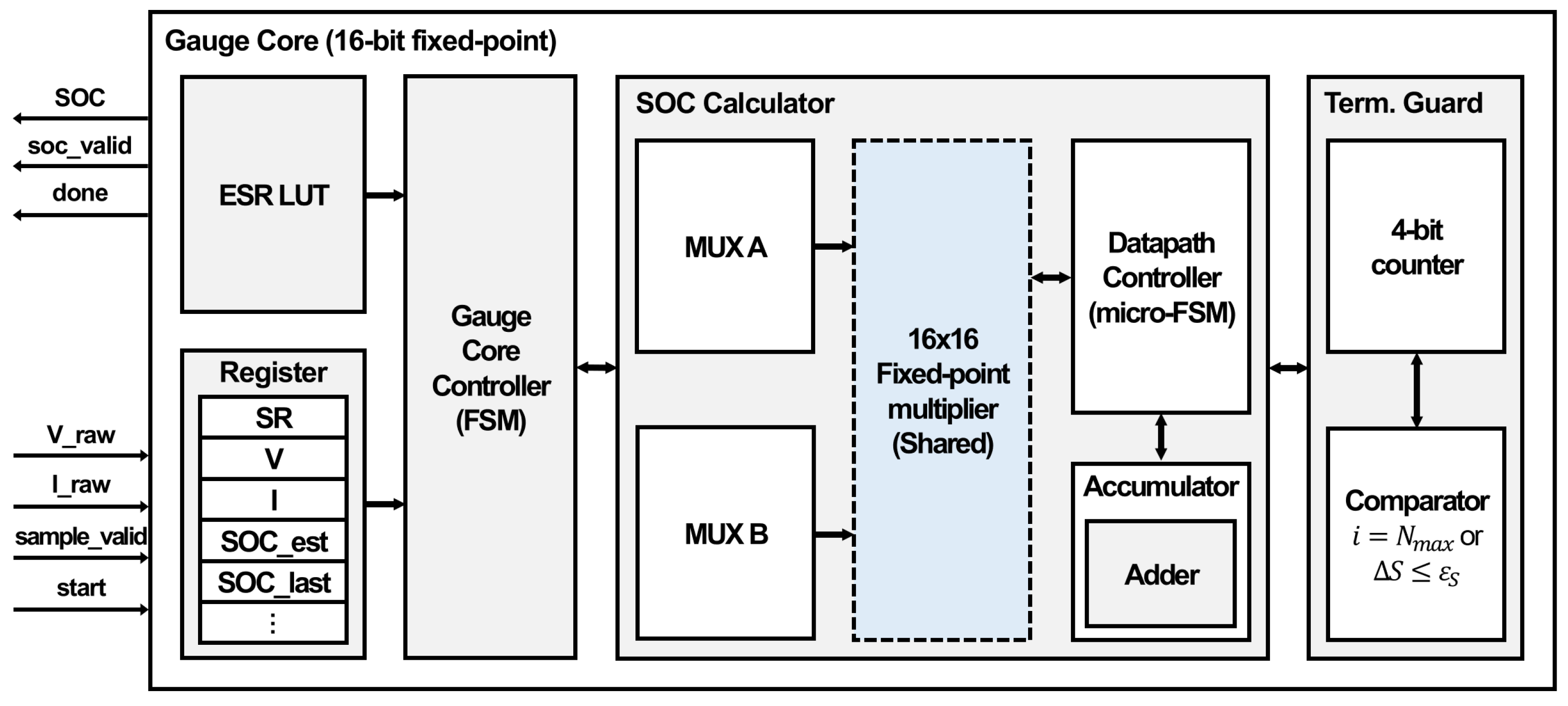
Figure 7 shows the internal organization used to support this functionality. The architecture consists of an input and state register block, an ESR lookup block, an SOC Calculator that performs the iterative computation, a Gauge Core Controller that manages the computation sequence, and a Termination Guard that decides when the iteration should stop.
Once a valid sample is received, the input and state register block maintains the voltage, current, and SOC estimate for the current iteration. The ESR LUT returns the ESR corresponding to the current SOC estimate and passes it to the SOC Calculator. By storing ESR values and polynomial coefficients instead of the full OCV–SOC relation in a dense table, the proposed structure reduces memory demand.
The Gauge Core Controller manages the full processing order as an FSM, including the start of computation for each sample, the progress of iterative updates, termination checking, and final output generation. The control flow initiates iterative computation after input reception and sequentially activates the SOC Calculator and Termination Guard at each iteration step. As a result, all blocks operate under controller supervision in the order required to process one sample from input reception to the final SOC output.
The SOC Calculator computes the next SOC value from the input sample and the current SOC estimate. It scales the input voltage and current, constructs the OCV input using the ESR value and then selects the active polynomial region to evaluate the corresponding quadratic model. These operations are scheduled over multiple clock cycles using a shared 16 × 16 fixed-point multiplier, thereby reducing arithmetic resource usage without allocating separate multipliers to each step.
The Termination Guard evaluates the difference between the newly computed SOC and the previous estimate at each iteration and determines whether to stop based on the rule defined in
Section 3. When the termination condition is met, the controller ends the iterative computation for that sample and outputs the final SOC. Otherwise, the updated estimate becomes the state for the next iteration. Through this structure, the Gauge Core performs the full iterative data flow—ESR lookup, OCV construction, piecewise polynomial evaluation, termination checking, and result output—consistently within the hardware.
4.2.3. Operator-Reuse Datapath
This subsection describes the operator-reuse datapath adopted by the Gauge Core to perform SOC estimation based on iterative updating within limited hardware resources. The focus is on reducing arithmetic cost by sharing a single multiplier across the input scaling stage, OCV construction, and piecewise quadratic evaluation instead of distributing the required multiplications across multiple parallel multipliers.
The SOC Calculator uses a sequential add–shift multiplier for 16 × 16 fixed-point multiplication. Fixed-point multiplication is implemented by first performing integer multiplication and then aligning the scale through a shift according to the predefined number of fractional bits, followed by normalization to the required bit width. Signed operation is handled using two’s complement representation. Because battery measurements arrive sample by sample, the overall timing budget is sufficiently relaxed that a sequential multiplier can complete the required computations within one sampling period. Thus, the proposed structure trades some arithmetic latency for lower hardware usage by avoiding duplicated multipliers.
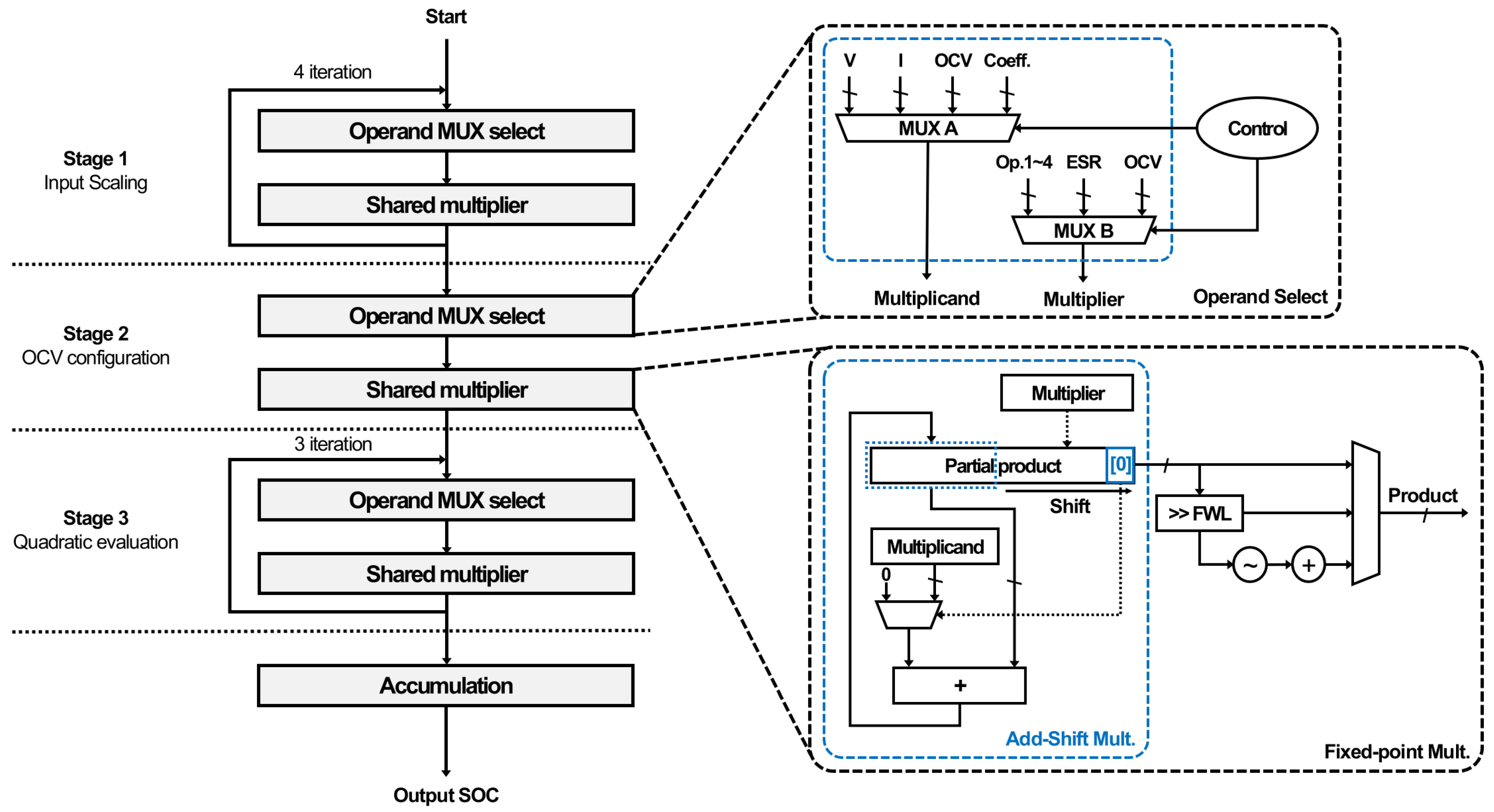
The 16 × 16 fixed-point multiplier is shared across the datapath. As shown in
Figure 8, the same multiplier is reused over time for input scaling, ESR-based OCV construction, and piecewise quadratic evaluation, allowing the computation to be carried out without additional multipliers. During this process, multiplier inputs are selected step by step through
MUXA and
MUXB, and the products are combined sequentially through the accumulation path to form intermediate terms and the final updated value. The progression of the arithmetic stages and operand selection is handled by a local FSM inside the SOC Calculator, coordinated with the top-level Gauge Core Controller so that iterative updating for each sample proceeds in a consistent order.
This operator-reuse datapath maintains the arithmetic precision and processing flow required for iterative updating while reducing redundant use of area intensive operators such as multipliers, making it advantageous for lightweight hardware implementation.
5. Experimental Results
This section presents experimental results that verify the real-time viability of the proposed gauge IP from a hardware perspective. Operation on a real-time FPGA battery measurement testbed is demonstrated, and the collected logs are used to evaluate SOC estimation accuracy quantitatively. In addition, synthesis and implementation reports are used to summarize hardware resource usage and timing, and ASIC layout and measurement results obtained through MPW fabrication are presented to support ASIC feasibility. Overall, this section shows that a lightweight gauge architecture based on FSM control can operate in real time without processor control, as evaluated from the viewpoints of estimation accuracy, implementation cost, and operating characteristics.
5.1. Experimental Setup
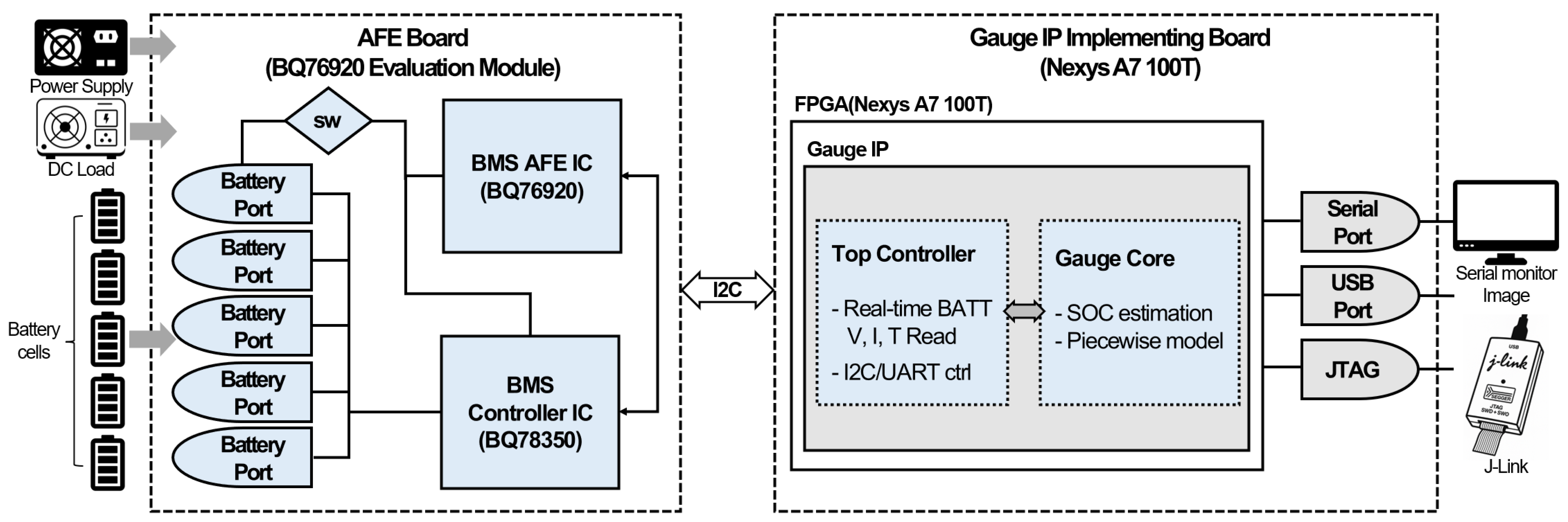
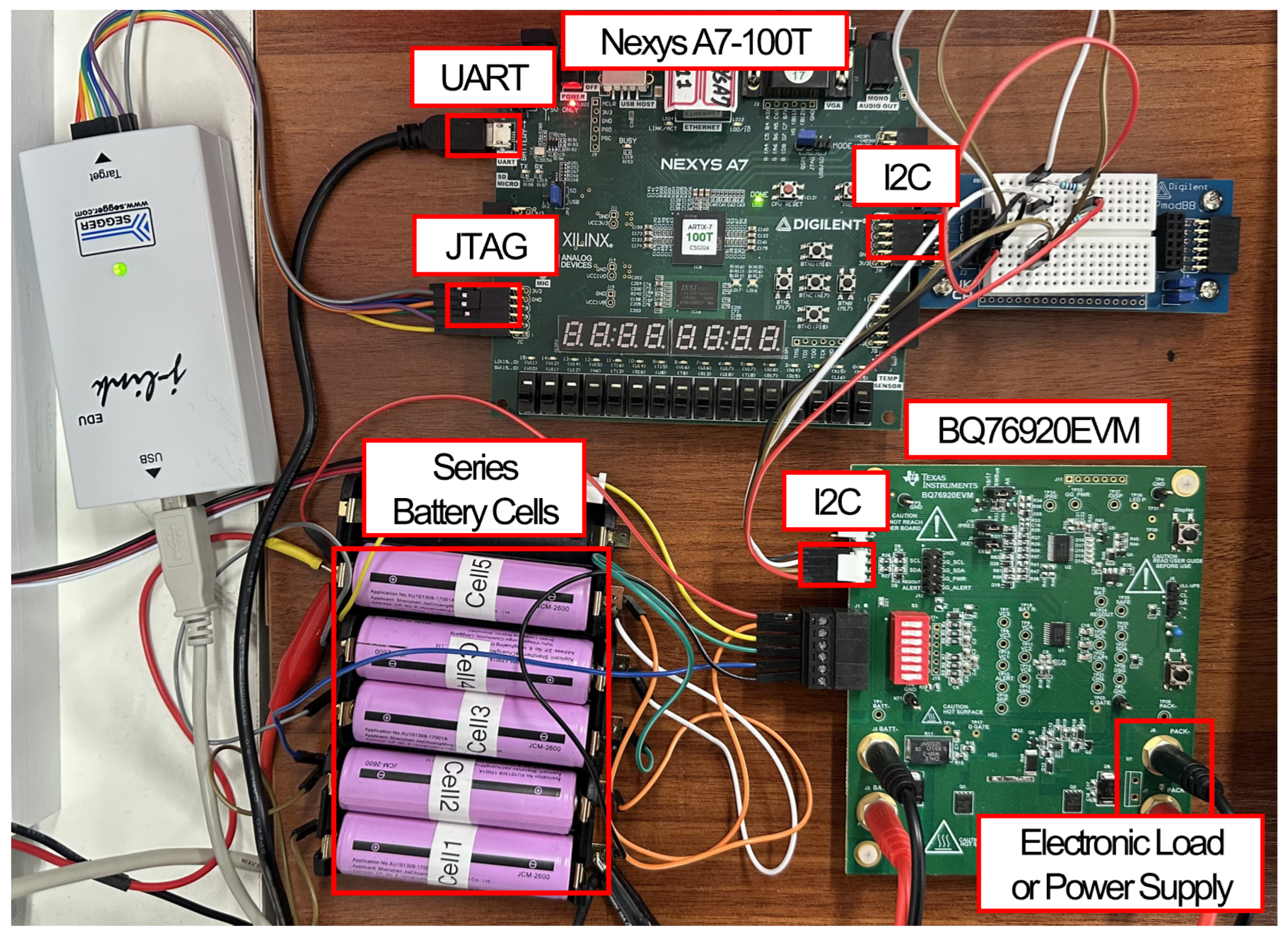
To verify the real-time operation of the gauge IP, an integrated testbed consisting of a 5S lithium-ion battery pack, an AFE board, an FPGA board, and a host PC was constructed.
Figure 9 shows the overall testbed organization and interface connections, while
Figure 10 presents the implemented validation setup. Battery terminal voltage and current were measured by an external analog front end (AFE) board and transmitted to the FPGA through an I2C interface. The gauge IP implemented on the FPGA then performed SOC estimation using the received measurements and output the result through an external observation path. All computations required for SOC estimation, including the termination decision of the iterative update, were executed in hardware logic, while the external components supported validation through data delivery and result logging. The experiments were conducted on a 5S series pack built from commercial lithium-ion cells, and the specifications of the 3.7 V cells used are summarized in
Table 3. Charge and discharge current profiles were applied, and terminal voltage and current measurements together with SOC estimation results were collected.
The FPGA target platform was a Digilent Nexys A7-100T board based on a Xilinx Artix-7 XC7A100T FPGA device (Xilinx Inc., San Jose, CA, USA). The RTL was written in Verilog HDL (IEEE Std 1364-2005) and synthesized using Xilinx Vivado Design Suite 2024.1 (Xilinx Inc., San Jose, CA, USA), and the generated bitstream was programmed onto the FPGA via a USB-JTAG interface. During real-time measurement, SOC estimation results generated by the gauge IP operating at a 50 MHz system clock were transmitted to the host PC through the board’s USB-UART interface and stored for accuracy evaluation.
To inspect the internal timing and control flow, a debugging environment based on the Vivado Integrated Logic Analyzer (ILA) was configured. ILA probes were connected to major input and output signals of the gauge IP, as well as the I2C and UART signals required for operation monitoring. This setup was used to verify that measurement reception, estimation, and result transmission proceeded as intended and to inspect communication waveforms and the timing of the control signals.
5.2. Accuracy Evaluation
This subsection quantitatively evaluates the SOC estimation accuracy of the proposed gauge IP. The evaluation was based on voltage and current logs collected during charge and discharge conditions on the real-time testbed described in
Section 5.1, together with the SOC output logs from the gauge IP. Accuracy metrics were computed by aligning the gauge IP SOC output and the reference SOC at each sample index. The purpose of this subsection is to present the estimation performance of the lightweight hardware implementation using quantitative metrics under real-time operating conditions.
The adopted accuracy metrics are mean absolute error (MAE), normalized MAE (NMAE), and root mean square error (RMSE). MAE represents the average absolute error between the estimated SOC and the reference SOC over all samples. NMAE normalizes MAE by the SOC range so that results can be compared across conditions. RMSE is more sensitive to larger errors and is therefore reported as a complementary measure of error dispersion. In this paper, SOC is represented as a normalized quantity, and the same unit and range are used consistently in metric calculation. Letting
N denote the total number of samples, the error between the reference SOC
and the gauge IP output
is defined as follows:
Here, N is the total number of samples and is the normalized SOC range. In this study, SOC was normalized to the range 0–1, so was used for NMAE calculation.
The reference SOC in the experiments was generated offline from the measured voltage and current logs using the same reference OCV–SOC mapping data employed to construct the piecewise model and the ESR LUT. The gauge IP output and were then aligned using the sample index, and the error metrics were calculated.
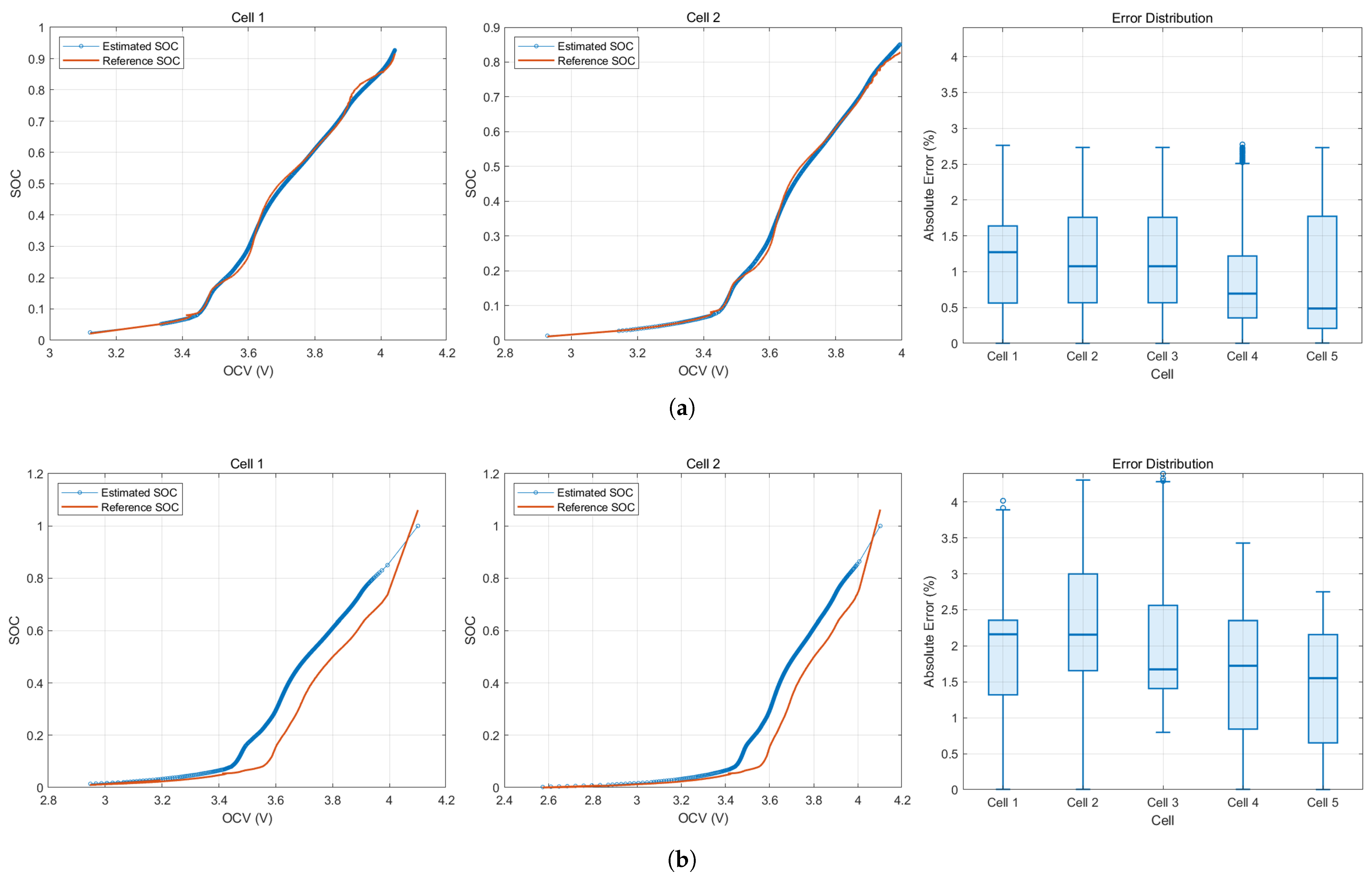
Accuracy evaluation was performed for both charge and discharge tests. The charge test followed a CC/CV condition, whereas the discharge test used a CC condition, optionally including rest intervals. For each test, the collected voltage and current samples and the gauge IP SOC output were compared using the same indexing basis to calculate the error metrics. The results are presented through representative SOC trajectories and error distributions, together with summary metrics.
Figure 11 presents representative SOC trajectories for the charge and discharge tests together with box plots of the sample-wise absolute error distributions across Cells 1–5.
Table 4 summarizes the achieved accuracy, and
Table 5 compares the overall sample error of this work with representative MCU and FPGA implementations reported in the literature. The 1.6% value reported in
Table 5 is the overall NMAE computed over all charge and discharge samples.
5.3. Hardware Implementation Results
This subsection summarizes the FPGA resource usage and timing characteristics of the proposed gauge IP and then presents the MPW ASIC results. FPGA resource utilization was obtained from the Vivado implementation report. The resulting usage was 504 LUTs (0.79%) and 580 FFs (0.46%). In addition, no BRAM or DSP blocks were used, confirming that the proposed structure is a lightweight logic implementation that does not rely on dedicated memory or DSP resources. Resource efficiency was compared against FPGA implementations that explicitly reported absolute resource counts, and the comparison is summarized in
Table 6.
To examine the convergence behavior of the termination rule, the number of iterations required until termination was recorded for each sample. As summarized in
Table 7, most samples terminated before reaching the maximum iteration guard. This result indicates that the 1-LSB criterion served as the main termination condition in normal operation, while the
guard bounded rare prolonged iterations.
In terms of timing, the internal SOC computation latency of the proposed gauge IP was measured as 186 cycles at a 50 MHz system clock, corresponding to approximately 3.72 μs. This is about 0.0015% of the 250 ms sampling period used in the real-time testbed, indicating that SOC computation for each sample comfortably completes before the next update instant. Therefore, even though the proposed structure relies on sequential computation with a shared multiplier, it satisfies the timing budget required for real-time SOC updating for each sample.
The ASIC implementation results of the proposed gauge IP are summarized in
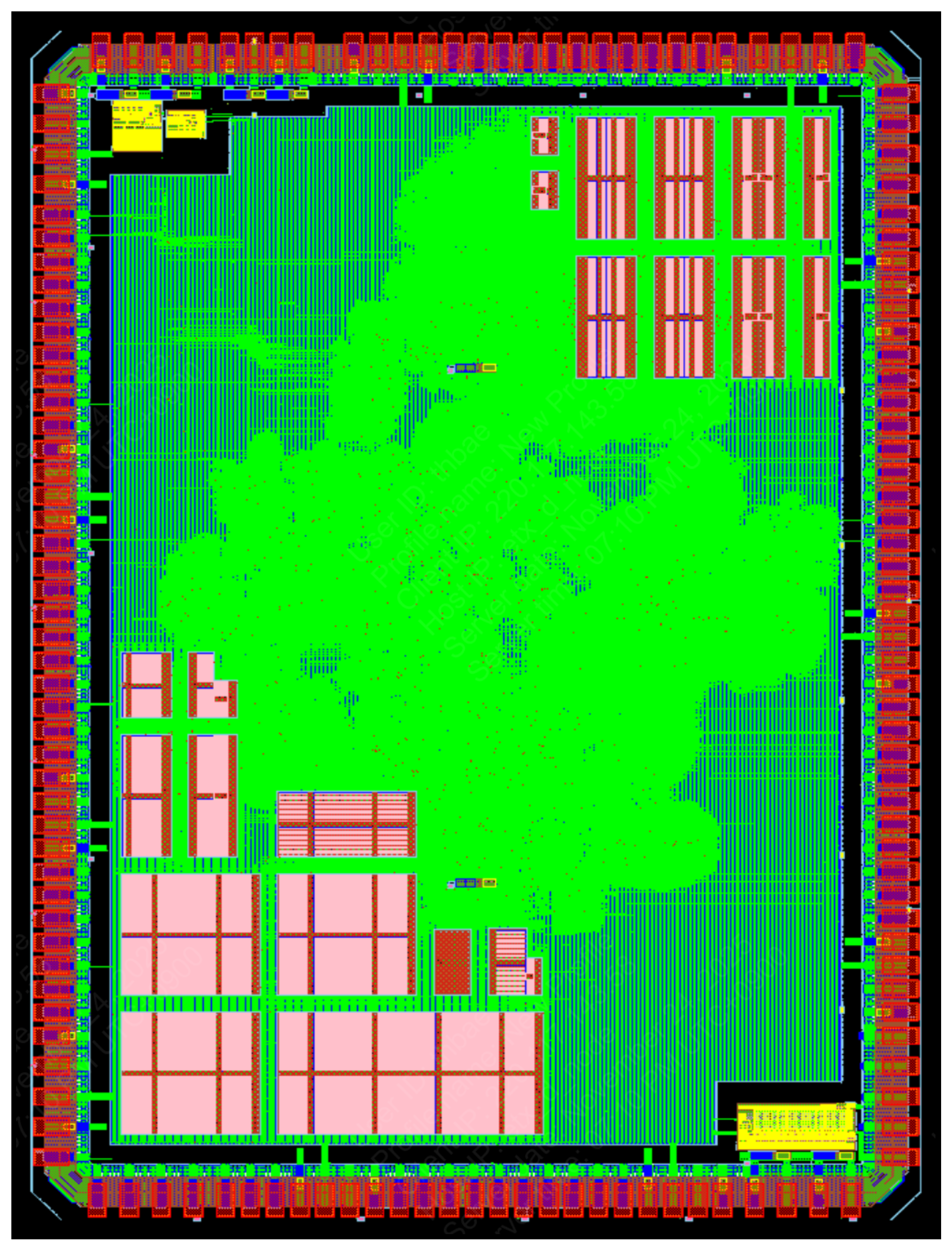
Table 8. The IP was integrated as one block in a shared MPW chip fabricated in a TSMC 28 nm CMOS process, and the die size of the shared chip is 2.2 mm × 3.3 mm. The proposed gauge IP was configured to operate with a divided 50 MHz clock, and its gate count was estimated as 12,026 gates.
Figure 12 shows the physical layout of the chip containing the proposed gauge IP. This layout result indicates that the proposed SOC estimation logic based on FSM control is sufficiently lightweight to be integrated as a digital block in an MPW chip.
6. Discussion
The significance of this work lies in implementing an iterative estimation flow based on the OCV–SOC relationship as a standalone gauge IP based on FSM control and translating it into a lightweight hardware architecture suitable for actual implementation. The proposed structure combines a polynomial OCV–SOC model, an ESR LUT, fixed-point arithmetic, and an operator-reuse datapath, and it performs both estimation and termination checking entirely in hardware. By combining a 1-LSB termination rule with a guard based on the maximum number of iterations, the design achieves predictable runtime behavior for iterative estimation in real-time operation. From this perspective, the proposed gauge IP can be interpreted as a lightweight hardware architecture for SOC estimation in resource constrained environments.
The FPGA and ASIC implementation results support the validity of this design direction. The proposed gauge IP achieved an overall error of about 1.6% on the charge and discharge datasets collected from the real-time testbed while using only 504 LUTs and 580 FFs. In addition, the internal SOC computation latency was approximately 3.72 μs at 50 MHz, which is well within the 250 ms sampling period used in the real-time testbed. Furthermore, the design was integrated as a block in an MPW chip fabricated in a TSMC 28 nm CMOS process, demonstrating that the proposed architecture can be realized as a lightweight gauge IP suitable for integration at chip level.
This work prioritizes lightweight hardware implementation, and thus factors, such as temperature variation, long term aging, hysteresis, and cell-to-cell mismatch, in environments with multiple cells are not explicitly incorporated in the current structure. These factors can change the OCV–SOC and ESR characteristics of the cell and may therefore require additional compensation or calibration mechanisms. Accordingly, the proposed design should be understood not as a complete battery state estimator that covers all possible operating conditions, but rather as a baseline architecture focused on hardware implementation. Future work can broaden the applicability of the design through temperature dependent OCV–SOC and ESR modeling, aging aware coefficient calibration, multichannel extension based on time sharing, and integration with higher level control structures for multiple cells. Further validation under more diverse load profiles and long-term operating conditions could also evolve the proposed gauge IP into a lightweight estimation core for BMS SoCs or ASICs.
7. Conclusions
This paper proposed an iterative SOC estimation method based on the OCV–SOC relationship and a corresponding standalone gauge IP based on FSM control for lightweight hardware implementation in embedded BMS environments. The method models the reference OCV–SOC curve with a two-region quadratic polynomial, corrects OCV using an ESR LUT, and updates SOC iteratively using 16-bit fixed-point arithmetic and an operator-reuse datapath. In addition, the design incorporates an FSM control structure without a microprocessor together with a termination guard, so that the compact OCV–SOC model, fixed-point datapath, and operator-reuse structure can support real-time operation under constrained hardware resources.
Real-time validation on an FPGA testbed showed that the proposed gauge IP achieved an overall NMAE of 1.6% and was implemented on an Artix-7 XC7A100T using only 504 LUTs and 580 FFs. The design was also integrated as a block in an MPW chip fabricated in a TSMC 28 nm CMOS process, yielding a physical layout corresponding to 12,026 gates. These results demonstrate that the proposed architecture is a lightweight hardware solution capable of real-time SOC estimation in resource constrained environments.
Author Contributions
Conceptualization, methodology, software, formal analysis, data curation, writing—original draft preparation, and visualization, G.J.; validation, investigation and resources, G.J. and S.K.; writing—review and editing, supervision and funding acquisition, S.L. All authors have read and agreed to the published version of the manuscript.
Funding
This work was supported by the Research and Development Program through the Korea Evaluation Institute of Industrial Technology (KEIT), funded by the Ministry of Trade, Industry and Energy (MOTIE) (RS-2023-00232192, RS-2024-00403397, RS-2024-00433615, RS-2022-00155731, and RS-2024-00403483).
Institutional Review Board Statement
Not applicable.
Data Availability Statement
The data supporting the findings of this study are available from the corresponding author upon reasonable request.
Acknowledgments
The CAD tools used in this work, including Xilinx Vivado Design Suite 2024.1, Synopsys VCS S-2021.09, Synopsys Verdi S-2021.09, Synopsys SpyGlass Q-2020.03-SP2-3, and Synopsys Design Compiler S-2021.06-SP5, were supported by the IC Design Education Center (IDEC).
Conflicts of Interest
The authors declare no conflicts of interest.
Abbreviations
The following abbreviations are used in this manuscript:
| BMS | Battery Management System |
| SOC | State of Charge |
| OCV | Open Circuit Voltage |
| ESR | Equivalent Series Resistance |
| FSM | Finite State Machine |
| FPGA | Field Programmable Gate Array |
| ASIC | Application Specific Integrated Circuit |
| MPW | Multi-Project Wafer |
References
- Lelie, M.; Braun, T.; Knips, M.; Nordmann, H.; Ringbeck, F.; Zappen, H.; Sauer, D.U. Battery Management System Hardware Concepts: An Overview. Appl. Sci. 2018, 8, 534. [Google Scholar] [CrossRef]
- Thangavel, S.; Mohanraj, D.; Girijaprasanna, T.; Raju, S.; Dhanamjayulu, C.; Muyeen, S.M. A Comprehensive Review on Electric Vehicle: Battery Management System, Charging Station, Traction Motors. IEEE Access 2023, 11, 20994–21019. [Google Scholar] [CrossRef]
- Stan, A.-I.; Swierczynski, M.J.; Stroe, D.-I.; Teodorescu, R.; Andreasen, S.J. Lithium ion battery chemistries from renewable energy storage to automotive and back-up power applications—An overview. In Proceedings of the 2014 International Conference on Optimization of Electrical and Electronic Equipment (OPTIM), Bran, Romania, 22–24 May 2014; pp. 713–720. [Google Scholar]
- Lu, L.; Han, X.; Li, J.; Hua, J.; Ouyang, M. A review on the key issues for lithium-ion battery management in electric vehicles. J. Power Sources 2013, 226, 272–288. [Google Scholar] [CrossRef]
- Demirci, O.; Taskin, S.; Schaltz, E.; Acar Demirci, B. Review of battery state estimation methods for electric vehicles—Part I: SOC estimation. J. Energy Storage 2024, 87, 111435. [Google Scholar] [CrossRef]
- Zheng, M.; Qi, B.; Wu, H. A li-ion battery management system based on CAN-bus for electric vehicle. In Proceedings of the 2008 3rd IEEE Conference on Industrial Electronics and Applications (ICIEA 2008), Singapore, 3–5 June 2008; pp. 1180–1184. [Google Scholar]
- Gabbar, H.A.; Othman, A.M.; Abdussami, M.R. Review of battery management systems (BMS) development and industrial standards. Technologies 2021, 9, 28. [Google Scholar] [CrossRef]
- Marcos, D.; Garmendia, M.; Crego, J.; Cortajarena, J.A. Functional safety BMS design methodology for automotive lithium-based batteries. Energies 2021, 14, 6942. [Google Scholar] [CrossRef]
- Panwar, N.G.; Singh, S.; Garg, A.; Gupta, A.K.; Gao, L. Recent advancements in battery management system for Li-ion batteries of electric vehicles: Future role of digital twin, cyber-physical systems, battery swapping technology, and nondestructive testing. Energy Technol. 2021, 9, 2000984. [Google Scholar] [CrossRef]
- Meng, J.; Ricco, M.; Luo, G.; Swierczynski, M.J.; Stroe, D.-I.; Stroe, A.-I.; Teodorescu, R. An overview and comparison of online implementable SOC estimation methods for lithium-ion battery. IEEE Trans. Ind. Appl. 2018, 54, 1583–1591. [Google Scholar] [CrossRef]
- Adaikkappan, M.; Sathiyamoorthy, N. Modeling, state of charge estimation, and charging of lithium-ion battery in electric vehicle: A review. Int. J. Energy Res. 2022, 46, 2141–2165. [Google Scholar] [CrossRef]
- Jemmali, S.; Manaï, B.; Hamouda, M. Pure hardware design and implementation on FPGA of an EKF based accelerated SoC estimator for a lithium-ion battery in electric vehicles. IET Power Electron. 2022, 15, 1004–1015. [Google Scholar] [CrossRef]
- Weng, C.; Sun, J.; Peng, H. A unified open-circuit-voltage model of lithium-ion batteries for state of charge estimation and state-of-health monitoring. J. Power Sources 2014, 258, 228–237. [Google Scholar] [CrossRef]
- He, Z.; Yang, Z.; Cui, X.; Li, Q.B.E. A method of state-of-charge estimation for EV power lithium-ion battery using a novel adaptive extended Kalman filter. IEEE Trans. Veh. Technol. 2020, 69, 14618–14630. [Google Scholar] [CrossRef]
- Tian, J.; Chen, C.; Shen, W.; Sun, F.; Xiong, R. Deep Learning Framework for Lithium-Ion Battery State of Charge Estimation: Recent Advances and Future Perspectives. Energy Storage Mater. 2023, 61, 102883. [Google Scholar] [CrossRef]
- Bao, G.; Liu, X.; Zou, B.; Yang, K.; Zhao, J.; Zhang, L.; Chen, M.; Qiao, Y.; Wang, W.; Tan, R.; et al. Collaborative Framework of Transformer and LSTM for Enhanced State-of-Charge Estimation in Lithium-Ion Batteries. Energy 2025, 322, 135548. [Google Scholar] [CrossRef]
- Wu, Z.; Jiang, H.; Wang, X.; Zhu, H. Knowledge correlation graph-guided multi-source interaction domain adaptation network for rotating machinery fault diagnosis. ISA Trans. 2023, 142, 663–682. [Google Scholar] [CrossRef] [PubMed]
- Wang, X.; Jiang, H.; Dong, Y.; Mu, M. Spatial-channel collaborative multi-scale graph interaction deep transfer learning for unsupervised rotating machinery fault diagnosis. Eng. Appl. Artif. Intell. 2026, 176, 114691. [Google Scholar] [CrossRef]
- Gao, Y.; Onori, S. Advancing LiFePO4 Battery SOC Estimation: Electrochemical Impedance Spectroscopy with Short-Period Sine-Wave Pulses. Green Energy Intell. Transp. 2026, 5, 100386. [Google Scholar] [CrossRef]
- Sun, B.; Pang, J.; Zhu, L.; Zhao, X.; Zhang, W.; Ma, S.; Liu, X. A Novel State of Charge Estimation Method Based on Electrochemical Impedance Spectroscopy for Solid-State Batteries of Next-Generation Space Power Sources under Different States of Health. Space Sci. Technol. 2025, 5, 0198. [Google Scholar] [CrossRef]
- Barsukov, Y.; Qian, J. Battery Power Management for Portable Devices; Artech House: Norwood, MA, USA, 2013. [Google Scholar]
- Baccouche, I.; Mlayah, A.; Jemmali, S.; Manai, B.; Ben Amara, N.E. Implementation of a Coulomb counting algorithm for SOC estimation of Li-Ion battery for multimedia applications. In Proceedings of the 2015 IEEE 12th International Multi-Conference on Systems, Signals & Devices (SSD15), Mahdia, Tunisia, 16–19 March 2015; pp. 1–6. [Google Scholar]
- Baccouche, I.; Jemmali, S.; Manai, B.; Chaibi, R.; Ben Amara, N.E. Hardware implementation of an algorithm based on kalman filter for monitoring low capacity Li-ion batteries. In Proceedings of the 2016 7th International Renewable Energy Congress (IREC), Hammamet, Tunisia, 22–24 March 2016; pp. 1–6. [Google Scholar]
- Kim, M.-J.; Chae, S.-H.; Moon, Y.-K. Adaptive Battery State of Charge Estimation Method for Electric Vehicle Battery Management System. In Proceedings of the 2020 International SoC Design Conference (ISOCC), Yeosu, Republic of Korea, 21–24 October 2020; pp. 288–289. [Google Scholar]
- Kim, M.; So, J. VLSI design and FPGA implementation of state of charge and state-of-health estimation for electric vehicle battery management systems. J. Energy Storage 2023, 73, 108876. [Google Scholar] [CrossRef]
- Elmahdi, F.; Ismail, L.; Masaif, N. Fitting the OCV-SOC relationship of a battery lithium-ion using genetic algorithm method. E3S Web Conf. 2021, 234, 00097. [Google Scholar] [CrossRef]
- Bañuelos-Saucedo, M.A. Li-ion Battery Two-region Polynomial Piecewise State of charge Model for a Portable Datalogger Applied to Technosol Studies. In Proceedings of the 2020 International Conference on Mechatronics, Electronics and Automotive Engineering (ICMEAE), Cuernavaca, Mexico, 16–21 November 2020; pp. 192–195. [Google Scholar]
- Baccouche, I.; Manai, B.; Ben Amara, N.E. SoC estimation of LFP Battery Based on EKF Observer and a Full Polynomial Parameters-Model. In Proceedings of the 2020 IEEE 91st Vehicular Technology Conference (VTC2020-Spring), Virtual Event, 25–28 May 2020; pp. 1–5. [Google Scholar]
- Baccouche, I.; Jemmali, S.; Manai, B.; Omar, N.; Ben Amara, N.E. Improved OCV Model of a Li-Ion NMC Battery for Online SOC Estimation Using the Extended Kalman Filter. Energies 2017, 10, 764. [Google Scholar] [CrossRef]
- Baccouche, I.; Jemmali, S.; Mlayah, A.; Manai, B.; Ben Amara, N.E. Implementation of an Improved Coulomb-Counting Algorithm Based on a Piecewise SOC-OCV Relationship for SOC Estimation of Li-Ion Battery. Int. J. Renew. Energy Res. 2018, 8, 178–187. [Google Scholar]
- Lazreg, M.B.; Baccouche, I.; Jemmali, S.; Manai, B.; Hamouda, M. SoC Estimation of Li-Ion Battery Pack for Light Electric Vehicles using Enhanced Coulomb Counting Algorithm. In Proceedings of the 2019 10th International Renewable Energy Congress (IREC), Sousse, Tunisia, 26–28 March 2019; pp. 1–6. [Google Scholar]
- Das, S.; Samanta, S.; Gupta, S. FPGA based Improved State of Charge Estimation using Modified Coulomb Counting method for Lithium-Ion Battery. In Proceedings of the 2024 IEEE International Conference on Power Electronics, Drives and Energy Systems (PEDES 2024), Mangalore, India, 18–21 December 2024; pp. 1–6. [Google Scholar]
- Baronti, F.; Roncella, R.; Saletti, R.; Zamboni, W. FPGA implementation of the mix algorithm for state of charge estimation of Lithium-ion batteries. In Proceedings of the IECON 2014—40th Annual Conference of the IEEE Industrial Electronics Society, Dallas, TX, USA, 29 October–1 November 2014; pp. 5641–5646. [Google Scholar]
- Ma, Y.; Duan, P.; He, P.; Zhang, F.; Chen, H. FPGA implementation of extended Kalman filter for SOC estimation of lithium-ion battery in electric vehicle. Asian J. Control 2019, 21, 2126–2136. [Google Scholar] [CrossRef]
- Benkara, K.E.K.; Alchami, A.; Eddine, A.N.; Bakaraki, G.; Forgez, C. Field programmable gate arrays implementation of a Kalman filter based state of charge observer of a lithium ion battery pack. J. Energy Storage 2023, 70, 107860. [Google Scholar] [CrossRef]
- Nishanth, G.; Krishnan, M.M.; Parandhaman, B.; Harinarayanan, J. Hardware implementation of EKF based SOC estimate for lithium-ion batteries in electric vehicle applications. Sci. Rep. 2025, 15, 15551. [Google Scholar] [CrossRef]
- Yun, S.; Jeon, J.; Lee, E.; Jeong, T.; Kim, S. FPGA Implementation of Battery State of Charge Estimation Using Extended Kalman Filter and Dynamic Sampling. World Electr. Veh. J. 2025, 16, 587. [Google Scholar] [CrossRef]
- Samsung SDI Co., Ltd. Specification of Product for Lithium-Ion Rechargeable Cell, Model ICR18650-26F; Product Specification; Samsung SDI Co., Ltd.: Yongin-si, Republic of Korea, 2009. [Google Scholar]
Figure 1.
Overall processing flow of the proposed SOC estimation method. Solid and dashed arrows denote data flow and the iterative SOC update path, respectively. Boxes represent processing steps.
Figure 1.
Overall processing flow of the proposed SOC estimation method. Solid and dashed arrows denote data flow and the iterative SOC update path, respectively. Boxes represent processing steps.
Figure 2.
Approximation error for the single full-range approximation and the two-region piecewise approximation: (a) low voltage region and (b) high voltage region.
Figure 2.
Approximation error for the single full-range approximation and the two-region piecewise approximation: (a) low voltage region and (b) high voltage region.
Figure 3.
Approximation error and selected two-region quadratic approximation: (a) overall NMAE versus polynomial order and (b) reference OCV–SOC curve with the selected approximation.
Figure 3.
Approximation error and selected two-region quadratic approximation: (a) overall NMAE versus polynomial order and (b) reference OCV–SOC curve with the selected approximation.
Figure 4.
Iterative SOC estimation flow using the proposed piecewise quadratic model.
Figure 4.
Iterative SOC estimation flow using the proposed piecewise quadratic model.
Figure 5.
System block diagram of the proposed gauge IP for SOC estimation. Solid arrows indicate data and control signal flow between modules.
Figure 5.
System block diagram of the proposed gauge IP for SOC estimation. Solid arrows indicate data and control signal flow between modules.
Figure 6.
Internal 16-bit signed fixed-point format used in the Gauge Core.
Figure 6.
Internal 16-bit signed fixed-point format used in the Gauge Core.
Figure 7.
Internal architecture of the proposed Gauge Core for iterative SOC estimation.
Figure 7.
Internal architecture of the proposed Gauge Core for iterative SOC estimation.
Figure 8.
Stage based operator-reuse datapath of the SOC Calculator.
Figure 8.
Stage based operator-reuse datapath of the SOC Calculator.
Figure 9.
Experimental testbed and interface connections for real-time validation.
Figure 9.
Experimental testbed and interface connections for real-time validation.
Figure 10.
Implemented real-time validation setup.
Figure 10.
Implemented real-time validation setup.
Figure 11.
SOC estimation results for representative cells and absolute error distributions under (a) charge and (b) discharge conditions.
Figure 11.
SOC estimation results for representative cells and absolute error distributions under (a) charge and (b) discharge conditions.
Figure 12.
Physical layout of the chip containing the proposed gauge IP.
Figure 12.
Physical layout of the chip containing the proposed gauge IP.
Table 1.
Key symbols and parameters used in this work.
Table 1.
Key symbols and parameters used in this work.
| Symbol | Definition | Value |
|---|
| k | Sampling index | – |
| i | Iteration index within a sample | |
| Measured terminal voltage and current at sample k | – |
| Estimated OCV at iteration i | – |
| Estimated SOC at iteration i | – |
| Updated SOC at iteration | – |
| Final SOC at sample k | – |
| Maximum number of iterations | 10 |
Table 2.
Two-region quadratic OCV–SOC coefficients.
Table 2.
Two-region quadratic OCV–SOC coefficients.
| Range | | | |
|---|
| | | |
| | | |
Table 3.
Specifications of Samsung ICR18650-26F [
38].
Table 3.
Specifications of Samsung ICR18650-26F [
38].
| Parameter | Value | Unit |
|---|
| Cell format | 18,650 | – |
| Nominal capacity | 2600 | mAh |
| Nominal voltage | 3.7 | V |
| Charge voltage | 4.2 | V |
| Max. charge current | 2600 | mA |
| Max. discharge current | 5200 | mA |
| Discharge cutoff voltage | 2.75 | V |
Table 4.
Error metrics of the proposed gauge IP under charge and discharge tests.
Table 4.
Error metrics of the proposed gauge IP under charge and discharge tests.
| Condition | MAE | NMAE (%) | RMSE |
|---|
| Charge | 0.0105 | 1.05 | 0.0127 |
| Discharge | 0.0241 | 2.41 | 0.0269 |
Table 5.
Accuracy comparison with representative hardware implementations.
Table 5.
Accuracy comparison with representative hardware implementations.
| Reference | Algorithm | Hardware Platform | Error (%) |
|---|
| Baccouche et al. [30] | Piecewise OCV–SOC + CC | MCU (PIC18F) | 2 |
| Nishanth et al. [36] | EKF | MCU (STM32F446RE) | 4.2 |
| Jemmali et al. [12] | EKF | ZC702 FPGA (XC7Z020) | 0.84 |
| Benkara et al. [35] | EKF | Spartan-6 FPGA (XC6SLX150) | 5 |
| Kim et al. [24] | EKF + FIR | Zynq-7020 FPGA (XC7Z020) | 2 |
| Proposed
| Piecewise OCV–SOC + iterative update | Nexys A7-100T FPGA (XC7A100T) | 1.6 |
Table 6.
FPGA resource utilization comparison with representative hardware implementations.
Table 6.
FPGA resource utilization comparison with representative hardware implementations.
| Reference | Jemmali et al. [12] | Benkara et al. [35] | Kim et al. [24] | Proposed |
|---|
| FPGA | ZC702
(XC7Z020) | Spartan-6
(XC6SLX150) | Zynq-7020
(XC7Z020) | Nexys A7-100T(XC7A100T) |
| Logic Utilization | Used | Util. | Used | Util. | Used | Util. | Used | Util. |
| LUT | 12,192 | 22% | 11,442 | 12% | 1666 | 0.55% | 504 | 0.79% |
| FF | 5520 | 5% | 15,395 | 8% | 1140 | 0.19% | 580 | 0.46% |
| BRAM | 33 | 11% | – | – | 4 | 0.39% | 0 | 0% |
| DSP | 220 | 100% | 94 | 52% | 10 | 0.36% | 0 | 0% |
Table 7.
Iteration count results under charge and discharge conditions.
Table 7.
Iteration count results under charge and discharge conditions.
| Condition | Average | Maximum | Reached (%) |
|---|
| Charge | 2.32 | 10 | 0.11 |
| Discharge | 2.43 | 10 | 0.35 |
Table 8.
ASIC implementation results of the proposed gauge IP.
Table 8.
ASIC implementation results of the proposed gauge IP.
| Metric | Proposed Gauge IP |
|---|
| Process technology | TSMC 28 nm CMOS |
| Die size of shared chip | 2.2 mm × 3.3 mm |
| Chip target frequency | 200 MHz |
| Operating frequency | 50 MHz |
| Gate count | 12,026 gates |
| Disclaimer/Publisher’s Note: The statements, opinions and data contained in all publications are solely those of the individual author(s) and contributor(s) and not of MDPI and/or the editor(s). MDPI and/or the editor(s) disclaim responsibility for any injury to people or property resulting from any ideas, methods, instructions or products referred to in the content. |