Toward Sustainable Interconnected Metrological Networks: Synchronized Multi-Resource Coordination

Abstract
1. Introduction
- 1.
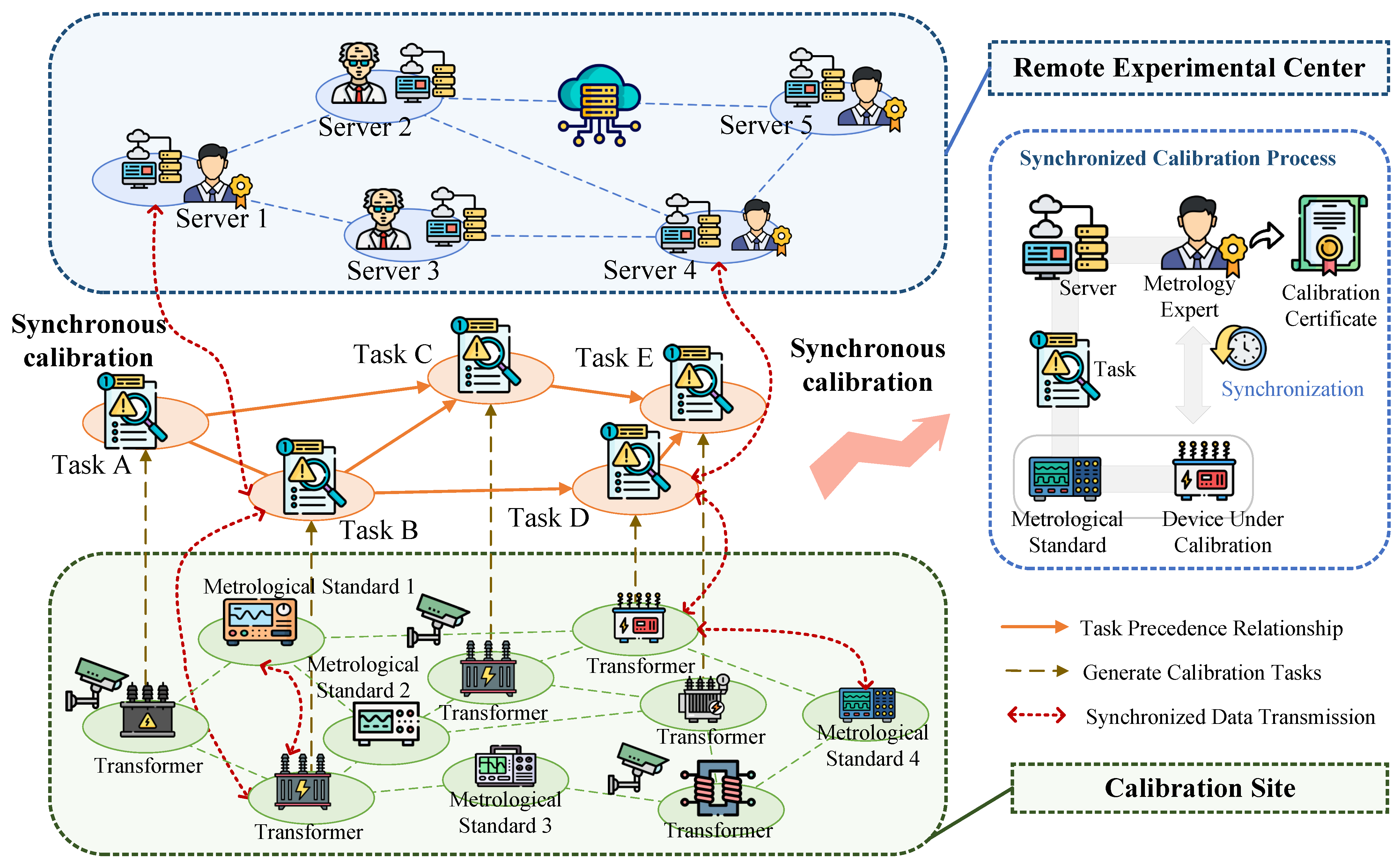
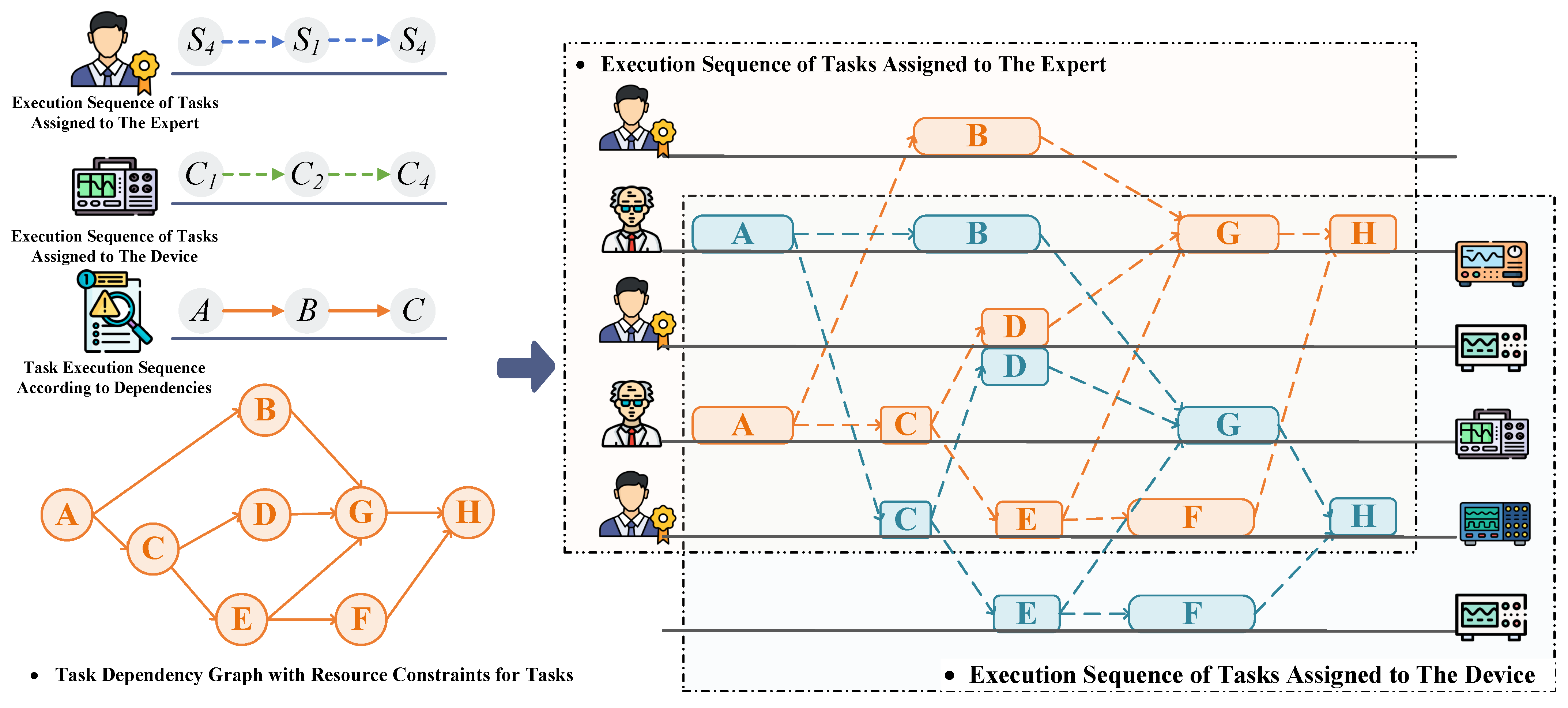
- We propose a heterogeneous task mapping and time synchronization model for remote calibration that captures resource and temporal dependencies on both the client and server sides. This dependency-aware synchronization and scheduling problem is formulated as a multi-objective constrained optimization problem.
- 2.
- We present a two-stage heuristic algorithm, named Critical-Path-based Priority Scheduling (CP-PS), that employs critical-path analysis and hierarchical scheduling to efficiently coordinate heterogeneous tasks in distributed, multi-monitoring-point client–server architectures.
- 3.
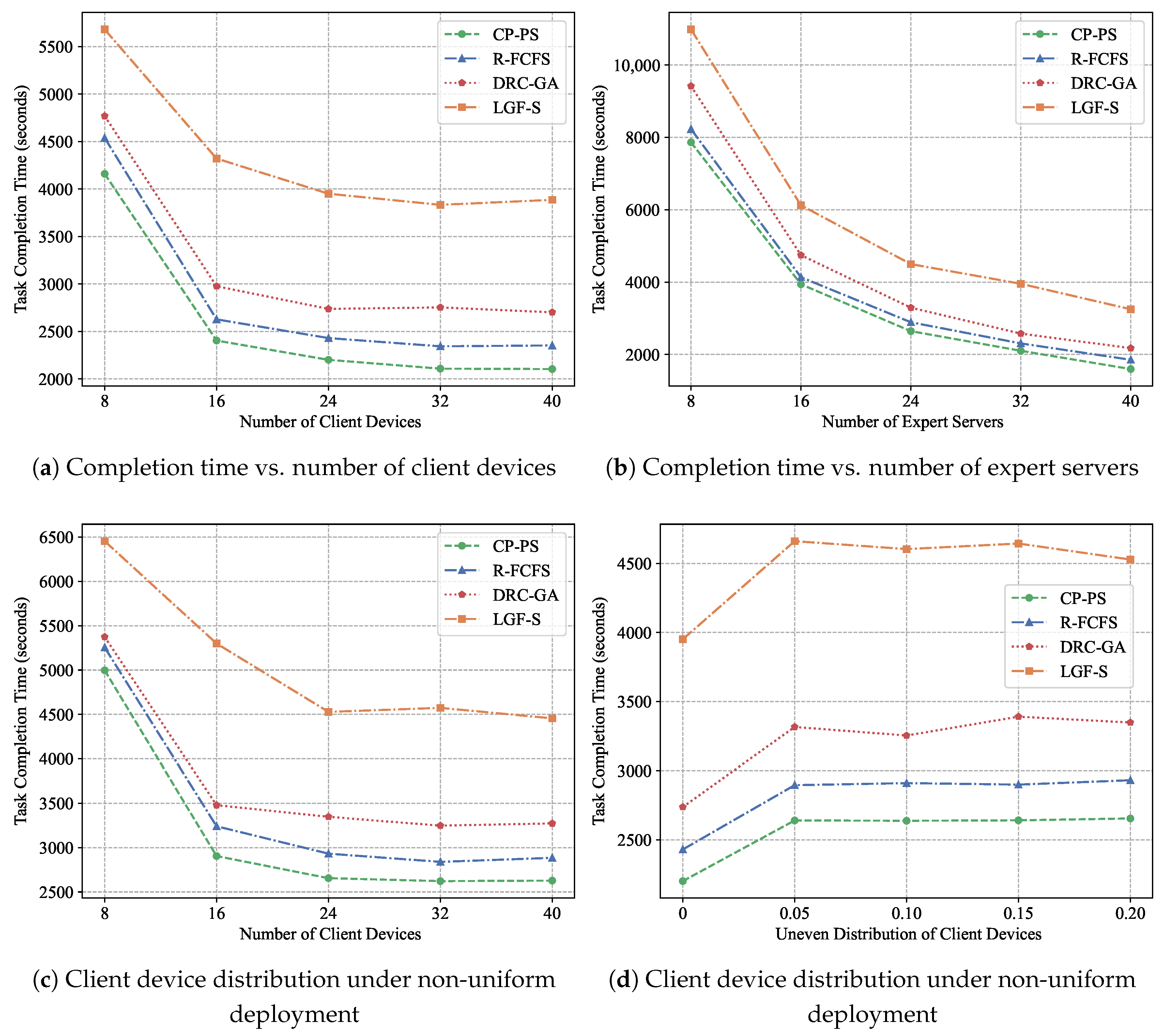
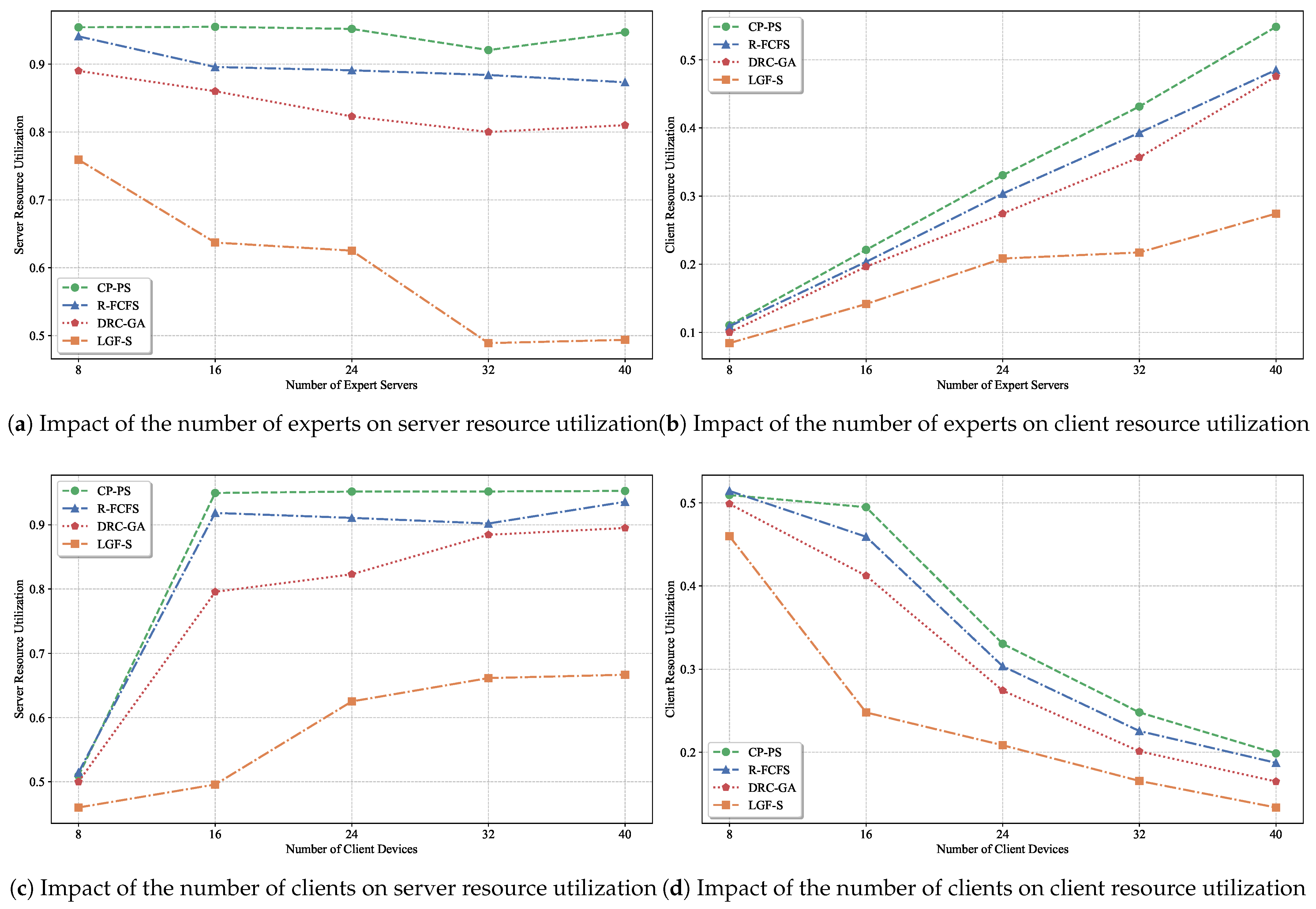
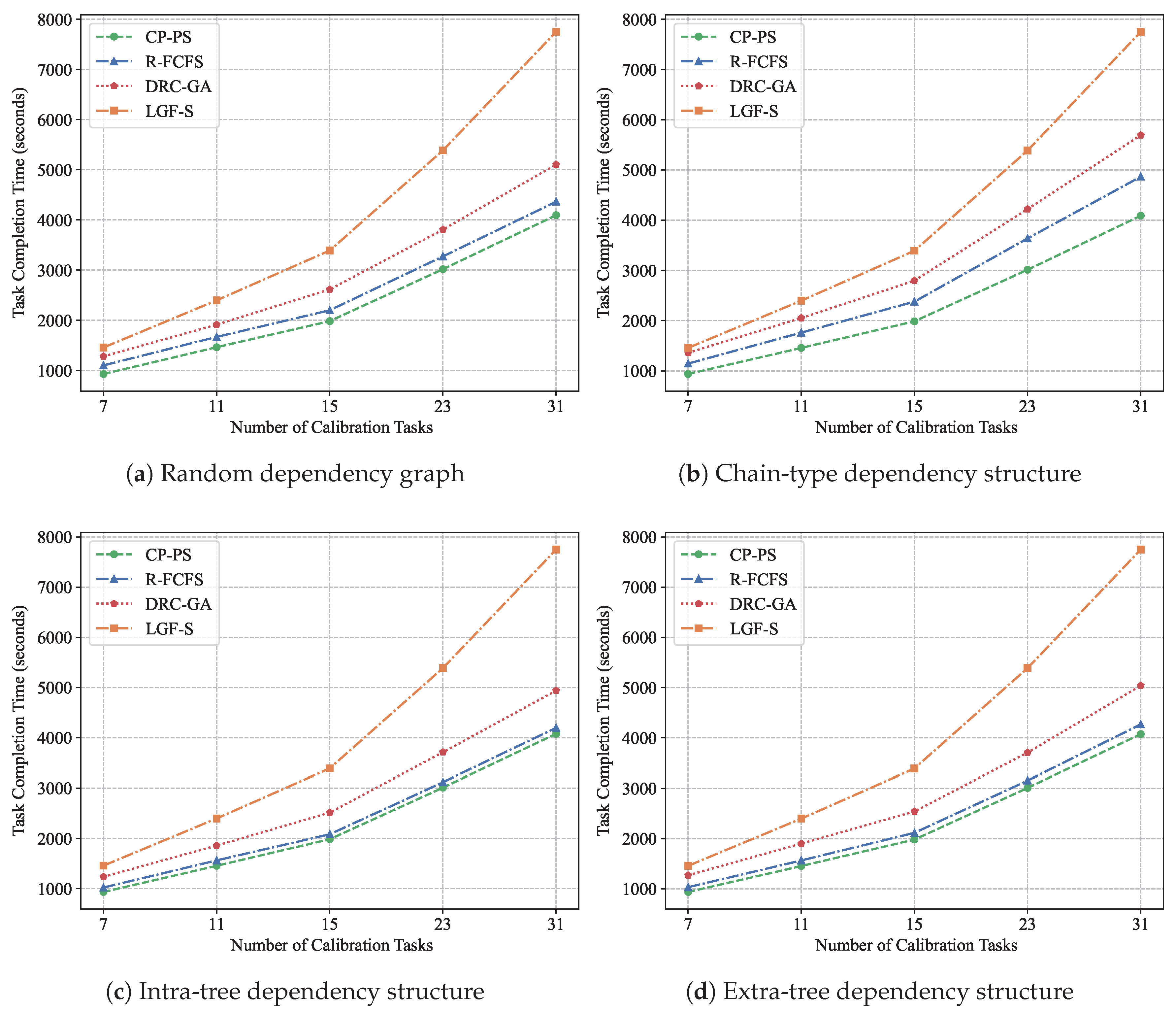
- Finally, extensive simulations across diverse workloads and system scales demonstrate that the proposed method consistently outperforms mainstream baselines, achieving significant and stable performance gains in terms of throughput and latency reduction.
2. Related Work
2.1. Remote Calibration
2.2. Job Scheduling
3. Problem Formulation
- Network and Clock Assumptions: In the remote calibration system under study, the duration of a single calibration task typically ranges from 5 to 30 min. In contrast, the network delays experienced during actual system operation are generally on the order of seconds or milliseconds. Since the timescale of the calibration process is significantly larger than the communication delays (by more than two orders of magnitude), we assume that network delays and clock synchronization errors are negligible in our modeling and analysis, ensuring the focus remains on the core issues of the calibration process itself.
- Communication Reliability Assumption: We assume that the communication between metrology agents and devices in the system is highly reliable and deterministic. This assumption is grounded in the actual system design, which employs a dual-camera collaboration mechanism—one camera identifies and uploads meter data, while the other captures and transmits a real-time video stream. Furthermore, the system integrates various devices, including environmental sensors, which collectively participate in data acquisition and uploading. Through this multi-device collaboration and redundant design, the system effectively controls communication errors in practice, justifying our treatment of the communication environment as reliable and deterministic.
- Task Arrival and Queuing Assumption: Our model is based on the operational practices of China’s national metrology system. Within this framework, calibration tasks are typically assigned in advance by higher-level authorities, which results in a known arrival pattern of calibration requests prior to system operation, rather than a stochastic, dynamic process. Given this context, the queuing model adopted in this work primarily captures the waiting times caused by the occupancy of standard instruments or the unavailability of expert resources. Thus, the core assumption is that task queuing is based on a pre-determined schedule.
3.1. System Model
3.2. Device Correspondence Model
3.3. Temporal Synchronization Model
4. Algorithm
| Algorithm 1 CP-PS |
|
| Algorithm 2 Longest Path Calculation |
|
5. Performance Evaluation
5.1. Experimental Setup
- 1.
- R-FCFS serves as a naive baseline, which assigns tasks randomly to available resources. It embodies minimal optimization logic, providing a benchmark to quantify the performance gains of more sophisticated methods.
- 2.
- DRC-GA represents a metaheuristic approach, providing a contrast between global search capabilities and problem-specific heuristics. It adapts standard genetic operators (crossover and mutation) to the dual-resource constrained environment. Through iterative evolution, it searches for a near-optimal schedule that satisfies task dependencies and resource constraints.
- 3.
- LGF-S implements a greedy heuristic that schedules tasks into the largest available idle blocks across client and server resources, aiming to minimize fragmentation. As a locally optimizing heuristic, it is well-suited for real-time scheduling and provides a contrast to global search methods like DRC-GA.
5.2. Scalability Evaluation
5.3. Utilization Evaluation
5.4. Performance Under Resource Heterogeneity
5.5. Calibration Task Characteristics and Workload Impact
6. Conclusions
Author Contributions
Funding
Data Availability Statement
Conflicts of Interest
References
- Nakutis, Ž.; Saunoris, M.; Ramanauskas, R.; Daunoras, V. A Method for Remote Wattmeter Calibration. In Proceedings of the 2017 IEEE International Instrumentation and Measurement Technology Conference (I2MTC), Turin, Italy, 22–25 May 2017; pp. 1–5. [Google Scholar] [CrossRef]
- Yuan, Q.; Li, R.; Zhou, B.; Lu, J.; Hu, M.; Lai, P.; Zhao, Y.; Zhang, X. Collaborative Truck-UAV Delivery Routing Optimization under Dynamic Weather Conditions and Customer Demands. IEEE Trans. Consum. Electron. 2025, in press. [Google Scholar] [CrossRef]
- Liu, W.; Cao, B.; Lu, T.; Cai, C.; Hu, M.; Peng, K.; Xiong, Z. Lightweight Hybrid Device Identification for IoT Applications. IEEE Internet Things J. 2025, 12, 23747–23762. [Google Scholar] [CrossRef]
- Liao, T.; Wei, L.; Hu, X.; Hu, J.; Hu, M.; Peng, K.; Cai, C.; Xiong, Z. Blockchain-Enhanced UAV Networks: Optimizing Data Storage for Real-Time Efficiency. IEEE Internet Things J. 2025, 12, 39910–39924. [Google Scholar] [CrossRef]
- Afrin, S.; Rafa, S.J.; Kabir, M.; Farah, T.; Alam, M.S.B.; Lameesa, A.; Ahmed, S.F.; Gandomi, A.H. Industrial Internet of Things: Implementations, challenges, and potential solutions across various industries. Comput. Ind. 2025, 170, 104317. [Google Scholar] [CrossRef]
- Dritsas, E.; Trigka, M. Big data and Internet of Things applications in smart cities: Recent advances, challenges, and critical issues. Internet Things 2025, 34, 101770. [Google Scholar] [CrossRef]
- Siam, S.I.; Ahn, H.; Liu, L.; Alam, S.; Shen, H.; Cao, Z.; Shroff, N.; Krishnamachari, B.; Srivastava, M.; Zhang, M. Artificial Intelligence of Things: A Survey. ACM Trans. Sen. Netw. 2025, 21, 1–75. [Google Scholar] [CrossRef]
- Taymanov, R.; Sapozhnikova, K. Metrological self-check and evolution of metrology. Measurement 2010, 43, 869–877. [Google Scholar] [CrossRef]
- Oldham, N.; Parker, M. Internet-based test service for multifunction calibrators. In Proceedings of the IMTC/99—16th IEEE Instrumentation and Measurement Technology Conference (Cat. No.99CH36309), Venice, Italy, 24–26 May 1999; Volume 3, pp. 1485–1487. [Google Scholar] [CrossRef]
- Dudley, R.; Ridler, N. Internet calibration direct to national measurement standards for automatic network analysers. In Proceedings of the IMTC 2001—18th IEEE Instrumentation and Measurement Technology Conference, Rediscovering Measurement in the Age of Informatics (Cat. No.01CH 37188), Budapest, Hungary, 21–23 May 2001; Volume 1, pp. 255–258. [Google Scholar] [CrossRef]
- Raouf, M.H.A.; Ali, R.S.M.; Gadelrab, M.S. Construction and remote calibration of an automated resistance measuring system. MAPAN 2011, 26, 125–131. [Google Scholar] [CrossRef]
- Wang, H.; Miao, Q.; Yang, R.; Zhang, P.; Shi, Z.; Ning, Y.; Yu, Q.; Zeng, B.; Tian, J.; Zhang, Q. Research Progress on Remote Calibration Technologies. J. Comput. Appl. 2024, 44, 323–327. [Google Scholar]
- Wang, Q.; Li, H.; Wang, H.; Zhang, J.; Fu, J. A Remote Calibration Device Using Edge Intelligence. Sensors 2022, 22, 322. [Google Scholar] [CrossRef]
- Wang, Q.; Zhang, J.; Lei, M.; Li, H.; Peng, K.; Hu, M. Toward Wide Area Remote Sensor Calibrations: Applications and Approaches. IEEE Sens. J. 2024, 24, 8991–9001. [Google Scholar] [CrossRef]
- Zha, Z.; Ge, H.; Zou, C.; Long, F.; He, X.; Wu, G.; Dong, C.; Deng, T.; Xu, J. Synchronous Remote Calibration for Electricity Meters: Application and Optimization. Appl. Sci. 2025, 15, 1259. [Google Scholar] [CrossRef]
- Dong, Y.; Cao, B.; Wang, Z.; Hu, M.; Cai, C.; Zheng, T.; Peng, K. A Joint Game-Theoretic Approach for Multicast Routing and Load Balancing in LEO Satellite Networks. IEEE Trans. Netw. Serv. Manag. 2025, in press. [Google Scholar] [CrossRef]
- Weng, Y.; Zheng, T.; Chen, Z.; Hu, M.; Luo, J. Rising from Pieces: Effective Inference at the Edge via Robust Split ML. IEEE Trans. Mob. Comput. 2025, in press. [Google Scholar] [CrossRef]
- Wang, L.; Liu, X.; Ding, H.; Hu, Y.; Peng, K.; Hu, M. Energy-Delay-Aware Joint Microservice Deployment and Request Routing With DVFS in Edge: A Reinforcement Learning Approach. IEEE Trans. Comput. 2025, 74, 1589–1604. [Google Scholar] [CrossRef]
- Peng, K.; Hu, Y.; Ding, H.; Chen, H.; Wang, L.; Cai, C.; Hu, M. Large-Scale Service Mesh Orchestration With Probabilistic Routing in Cloud Data Centers. IEEE Trans. Serv. Comput. 2025, 18, 868–882. [Google Scholar] [CrossRef]
- Li, Z.; Sang, H.; Pan, Q.; Gao, K.; Han, Y.; Li, J. Dynamic AGV Scheduling Model With Special Cases in Matrix Production Workshop. IEEE Trans. Ind. Inform. 2023, 19, 7762–7770. [Google Scholar] [CrossRef]
- Chen, L.; Zhu, J.; Deng, Y.; Li, Z.; Chen, J.; Jiang, X.; Yin, S.; Wei, S.; Liu, L. An Elastic Task Scheduling Scheme on Coarse-Grained Reconfigurable Architectures. IEEE Trans. Parallel Distrib. Syst. 2021, 32, 3066–3080. [Google Scholar] [CrossRef]
- Xu, L.; Xu, Q.; Chen, C.; Zhang, Y.; Wang, S.; Guan, X. Efficient Task-Network Scheduling With Task Conflict Metric in Time-Sensitive Networking. IEEE Trans. Ind. Inform. 2024, 20, 1528–1538. [Google Scholar] [CrossRef]
- Wang, D.; Hu, P.; Du, J.; Zhou, P.; Deng, T.; Hu, M. Routing and Scheduling for Hybrid Truck-Drone Collaborative Parcel Delivery With Independent and Truck-Carried Drones. IEEE Internet Things J. 2019, 6, 10483–10495. [Google Scholar] [CrossRef]
- Hu, M.; Liu, W.; Peng, K.; Ma, X.; Cheng, W.; Liu, J.; Li, B. Joint Routing and Scheduling for Vehicle-Assisted Multidrone Surveillance. IEEE Internet Things J. 2019, 6, 1781–1790. [Google Scholar] [CrossRef]
- Li, H.; Zhang, H.; Zhang, B.; Chen, Z.; Yang, M.; Zhang, Y. A Method Suitable for Vicarious Calibration of a UAV Hyperspectral Remote Sensor. IEEE J. Sel. Top. Appl. Earth Obs. Remote Sens. 2015, 8, 3209–3223. [Google Scholar] [CrossRef]
- Ershov, I.A.; Stukach, O.V. Internet of Measurement development based on NI PXI Remote Calibration. In Proceedings of the 2019 Dynamics of Systems, Mechanisms and Machines (Dynamics), Omsk, Russia, 5–7 November 2019; pp. 1–5. [Google Scholar] [CrossRef]
- Fang, L.; Duan, S.; Li, Y.; Ma, X.; Lan, K. A New Model for Remote Calibration of Voltage Source Based on GPS Common-View Method. IEEE Trans. Instrum. Meas. 2023, 72, 5501309. [Google Scholar] [CrossRef]
- Zhou, F.; Cheng, Y.; Wu, F.; Xiao, J.; Hu, J. Research on the online remote calibration technology of the digital meter. In Proceedings of the 2014 IEEE Workshop on Advanced Research and Technology in Industry Applications (WARTIA), Ottawa, ON, Canada, 29–30 September 2014; pp. 1237–1239. [Google Scholar] [CrossRef]
- Quan, W.; Bing, L.; Zijuan, G.; Gaoning, N.; Wenxuan, W.; Qingjin, R.; Jian, C.; Tao, S. Architecture and Simulation of Remote Calibration System for Electric Power Testing Device Based on “Internet+”. In Proceedings of the 2019 IEEE 2nd International Conference on Automation, Electronics and Electrical Engineering (AUTEEE), Shenyang, China, 22–24 November 2019; pp. 300–304. [Google Scholar] [CrossRef]
- Zhihua, Z.; Huanning, W.; Hengyu, T.; Yan, H.; Xugang, G.; Yuan, L. Research on Remote Calibration System for Energy Meters. In Proceedings of the 2024 11th International Conference on Power and Energy Systems Engineering (CPESE), Nara City, Japan, 6–8 September 2024; pp. 309–313. [Google Scholar] [CrossRef]
- Yang, T.; Yu, J.; Pen, H.; Zhou, F.; Gao, B.; Lu, H. Remote Metrological Verification Method for Electric Vehicle Off-Board Chargers Based on the SIS Infectious Disease Model in a Vehicle-Pile Interaction Network. IEEE Trans. Instrum. Meas. 2025, 74, 1500711. [Google Scholar] [CrossRef]
- Vito, S.D.; Elia, G.D.; Ferlito, S.; Esposito, E.; Piantadosi, G.; Francia, G.D. Remote Calibration strategies for Low Cost Air Quality Multisensors: A performance comparison. In Proceedings of the 2024 IEEE International Symposium on Olfaction and Electronic Nose (ISOEN), Grapevine, TX, USA, 12–15 May 2024; pp. 1–4. [Google Scholar] [CrossRef]
- Fang, L.; Li, Y.; Duan, S.; Lan, K. Remote value transmission and traceability technology of measuring instruments based on wireless communication. Rev. Sci. Instruments 2023, 94, 021501. [Google Scholar] [CrossRef] [PubMed]
- Peng, K.; Wen, H.; Guo, Z.; Ge, H.; Cai, C.; Zhou, B.; Hu, M. Energy-Efficient Joint Deployment and Routing for Delay-Sensitive Microservices in Edge Computing. IEEE Trans. Sustain. Comput. 2025, in press. [Google Scholar] [CrossRef]
- Hu, Y.; Liao, X.; Hu, J.; Wen, H.; Xu, H.; Peng, K.; Hu, M. Energy-Efficient Microservice Orchestration for Latency-Sensitive Applications in Edge Computing: A Reinforcement Learning Approach. IEEE Internet Things J. 2025, in press. [Google Scholar] [CrossRef]
- Peng, K.; Liao, T.; Ren, M.; Hu, Y.; Wu, L.; Hu, M.; Jiang, H. Symmetric Orchestration Under Service Mesh Paradigm: Empowering Massive Online Applications in Edge Clouds. IEEE Trans. Mob. Comput. 2025, in press. [Google Scholar] [CrossRef]
- Wang, L.; Wen, Z.; Ge, H.; Hu, M.; Xu, J.; Peng, K.; Cai, C.; Xiong, Z. Energy–Latency-Aware Microservice Orchestration in Edge Computing via Node Ranking Matrix and Proportional Routing. IEEE Internet Things J. 2025, 12, 51597–51610. [Google Scholar] [CrossRef]
- Hu, M.; Luo, J.; Wang, Y.; Veeravalli, B. Adaptive Scheduling of Task Graphs with Dynamic Resilience. IEEE Trans. Comput. 2017, 66, 17–23. [Google Scholar] [CrossRef]
- Hu, M.; Luo, J.; Wang, Y.; Lukasiewycz, M.; Zeng, Z. Holistic Scheduling of Real-Time Applications in Time-Triggered In-Vehicle Networks. IEEE Trans. Ind. Inform. 2014, 10, 1817–1828. [Google Scholar] [CrossRef]
- Li, K. Scheduling Precedence Constrained Tasks for Mobile Applications in Fog Computing. IEEE Trans. Serv. Comput. 2023, 16, 2153–2164. [Google Scholar] [CrossRef]



| Symbol | Description |
|---|---|
| Set of task nodes: | |
| Dependency edge set: | |
| Set of inspection points: | |
| Set of all metrological standard devices | |
| Set of all metrology experts | |
| Set of all calibration task types | |
| Metrological standard device i at inspection point | |
| Metrology expert r supervising tasks | |
| Multi-type DAG representing the task scheduling problem | |
| Task type of task , e.g., | |
| Set of task types that device can handle | |
| Set of task types that expert can handle | |
| Compatibility: 1 if device can process , else 0 | |
| Assignment: 1 if task is assigned to device , else 0 | |
| Expert capability: 1 if expert can handle , else 0 | |
| Assignment: 1 if task is supervised by expert , else 0 | |
| Precedence: 1 if is a predecessor of , else 0 | |
| Start time of device executing task | |
| End time of device executing task | |
| Start time of expert supervising task | |
| End time of expert supervising task | |
| Processing time of task (typically 5–30 min) | |
| Makespan: maximum completion time across all tasks |
| Category | Parameter | Default Value |
|---|---|---|
| Experts | 24 | |
| Resource Configuration | Client Sites | 3 |
| Devices | 24 | |
| Task Types | 10 | |
| Task Configuration | Tasks per Workflow | 20 |
| Samples per Job | 20 | |
| Capability Limits | Max Types per Expert | 6 |
| Max Types per Device | 3 |
Disclaimer/Publisher’s Note: The statements, opinions and data contained in all publications are solely those of the individual author(s) and contributor(s) and not of MDPI and/or the editor(s). MDPI and/or the editor(s) disclaim responsibility for any injury to people or property resulting from any ideas, methods, instructions or products referred to in the content. |
© 2025 by the authors. Licensee MDPI, Basel, Switzerland. This article is an open access article distributed under the terms and conditions of the Creative Commons Attribution (CC BY) license (https://creativecommons.org/licenses/by/4.0/).
Share and Cite
Wang, Q.; Han, X.; Yin, X.; Chen, G.; Yin, W.; Chen, X.; Zhang, J.; Chen, Z. Toward Sustainable Interconnected Metrological Networks: Synchronized Multi-Resource Coordination. Electronics 2025, 14, 4796. https://doi.org/10.3390/electronics14244796
Wang Q, Han X, Yin X, Chen G, Yin W, Chen X, Zhang J, Chen Z. Toward Sustainable Interconnected Metrological Networks: Synchronized Multi-Resource Coordination. Electronics. 2025; 14(24):4796. https://doi.org/10.3390/electronics14244796
Chicago/Turabian StyleWang, Quan, Xia Han, Xiaodong Yin, Gang Chen, Wenqing Yin, Xiwen Chen, Jun Zhang, and Zhuo Chen. 2025. "Toward Sustainable Interconnected Metrological Networks: Synchronized Multi-Resource Coordination" Electronics 14, no. 24: 4796. https://doi.org/10.3390/electronics14244796
APA StyleWang, Q., Han, X., Yin, X., Chen, G., Yin, W., Chen, X., Zhang, J., & Chen, Z. (2025). Toward Sustainable Interconnected Metrological Networks: Synchronized Multi-Resource Coordination. Electronics, 14(24), 4796. https://doi.org/10.3390/electronics14244796