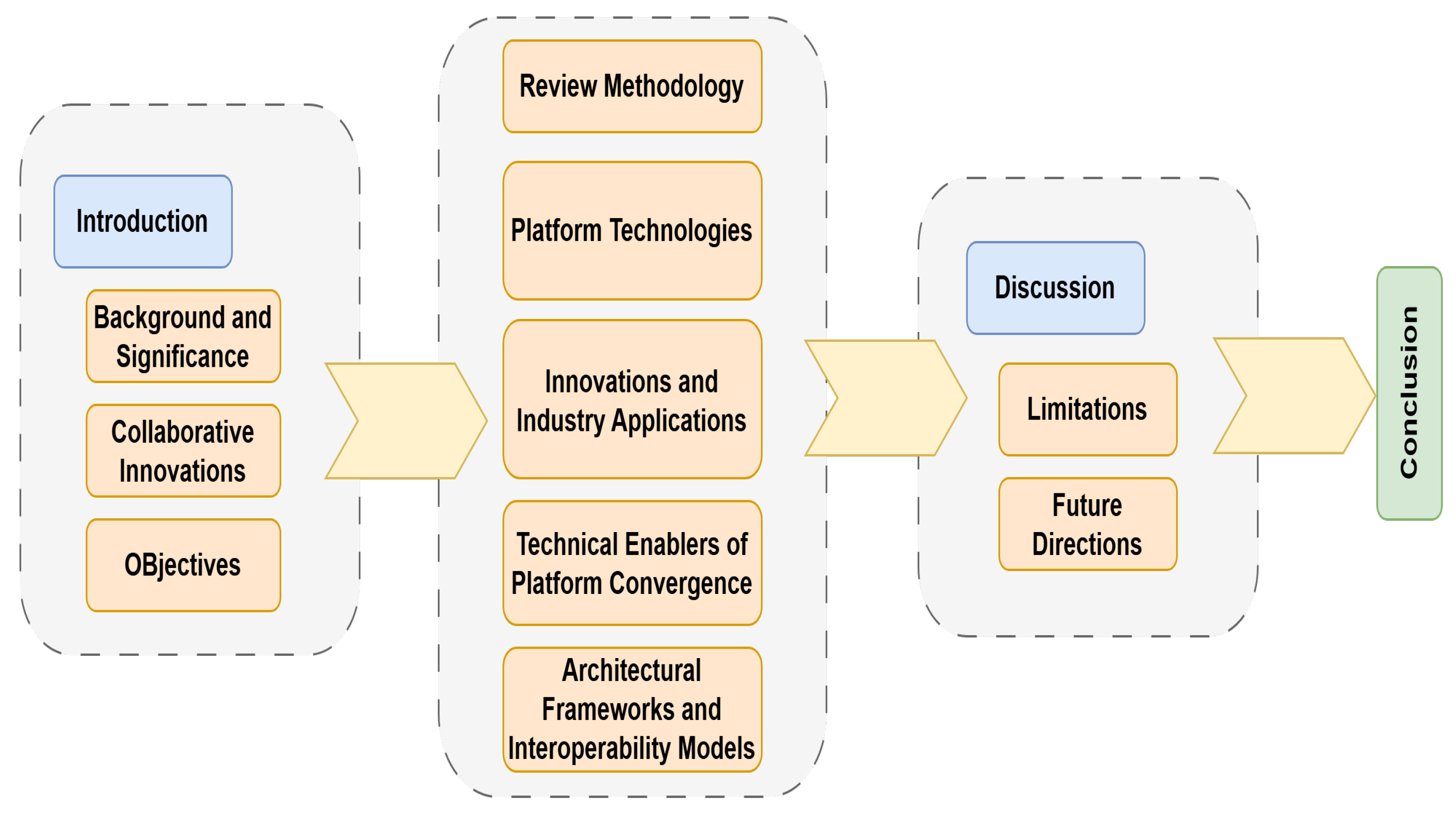

Towards a Unified Digital Ecosystem: The Role of Platform Technology Convergence




Abstract
1. Introduction
1.1. Background and Significance
1.2. Key Drivers of Collaborative Innovation
1.3. Objectives of the Review
- A timeline of platform convergence illustrating the evolution and integration of core technologies.
- A standards and frameworks map supporting cross-sector interoperability.
- A governance lens addressing trust, privacy, and regulatory compliance across domains.
- A research agenda highlighting emerging directions for AI, blockchain, and edge–cloud orchestration.
- A synthesis of technical enablers, sector-specific applications, and emerging trends guiding future innovation.
2. Review Methodology
2.1. Literature Search Strategy
2.2. Inclusion and Exclusion Criteria
- Discusses technologies, architectures, or frameworks contributing to platform convergence;
- Presents models or mechanisms for interoperability, integration, and cross-domain interaction;
- Explores systemic properties, emergent behaviors, or synergistic effects of convergent technologies;
- Reports cross-domain use cases, conceptual frameworks, or insights informing future research directions.
- Focused solely on isolated, domain-specific technologies without cross-platform relevance;
- Addressed only hardware-level implementation details without systemic implications;
- Presented new experimental datasets, empirical measurements, or prototype evaluations;
- Were systematic reviews, meta-analyses, or scoping reviews lacking conceptual synthesis.
2.3. Synthesis Approach
- Technological enablers and systemic interactions within platform convergence;
- Architectural and interoperability frameworks supporting cross-domain integration;
- Mechanisms of technological synergy, including functional complementarity, data interlocking, and process embedding;
- Use case insights demonstrating emergent properties and practical impacts across industries;
- Challenges, systemic gaps, and future research opportunities.
2.4. Rationale for a Narrative Review
3. Fundamental Concepts of Platform Technologies
3.1. Artificial Intelligence
3.2. Internet of Things
3.3. Blockchain Technology
3.4. Cloud and Edge Computing
3.5. 5G and Next-Generation Connectivity
3.6. Interoperability and Cross-Platform Integration
3.7. Cross-Industry Insights and Systemic Implications
- Healthcare: Real-time patient monitoring requires ultra-low latency, strict privacy compliance, and adaptive AI-driven analytics. These demands encourage edge–cloud coordination, federated learning, and blockchain-based auditability to maintain trust and data integrity.
- Manufacturing: IoT-enabled smart factories depend on high-throughput, deterministic communication and predictive maintenance across heterogeneous machinery. AI-optimized scheduling, digital twins, and closed-loop control systems enable rapid reconfiguration and reduced downtime.
- Finance: Convergence centers on data security, transaction immutability, explainable AI-driven risk analysis, and compliance automation. Blockchain and AI complement one another by enhancing fraud detection, auditability, and cross-institutional trust.
4. Collaborative Innovations and Industry Applications
4.1. Healthcare
4.2. Finance
4.3. Manufacturing
4.4. Smart Cities

| Short Title | Aim of Paper | Research Findings | Conclusion |
|---|---|---|---|
| AI-driven IoT anomaly detection [16] | Survey methods for detecting anomalies in IoT streams using AI | Compared ML and DL models; deep models show higher detection rates but need more data | Deep learning improves detection but requires edge/cloud orchestration and labeled data. |
| Federated-learning for cross-device privacy [17] | Explore federated learning for privacy-preserving model training across devices | Demonstrates reduced data sharing; performance close to centralized training with careful aggregation | Federated learning is promising for private collaboration but needs robust aggregation and communication strategies. |
| Blockchain-enabled supply chain traceability [18] | Assess blockchain for tamper-proof supply-chain records | Shows improved traceability and auditability; latency and scalability issues noted | Blockchain enhances trust but requires integration with IoT and scalable consensus mechanisms. |
| Edge-AI for real-time control [19] | Evaluate edge deployment of AI for low-latency control tasks | Edge inference reduces latency and bandwidth usage; model compression critical | Edge-AI enables real-time control when combined with model optimization and orchestration. |
| 5G network slicing for industrial IoT [20] | Investigate network slicing to satisfy diverse QoS in IIoT | Slicing supports heterogeneous QoS; orchestration complexity is nontrivial | Network slicing enables tailored services but requires automated orchestration and standardization. |
| Digital-twin for predictive maintenance [21] | Review digital twin approaches for equipment health monitoring | Digital twins improve prediction and simulation fidelity with sensor fusion | Digital twins provide effective predictive maintenance when paired with real-time data and model calibration. |
| Decentralized identity for device authentication [22] | Propose decentralized identity schemes for IoT devices | Decentralized identity improves authentication resilience; key management remains a challenge | Decentralized identity increases trust but needs scalable key and credential management. |
| Cross-platform data interoperability frameworks [23] | Survey frameworks for semantic interoperability between platforms | Ontology-based and middleware solutions improve semantic alignment; heterogeneity remains | Interoperability frameworks mitigate data mismatch but require community standards. |
| Federated analytics for healthcare data [24] | Evaluate federated analytics for multi-site health research | Enables collaborative analytics without sharing raw data; heterogeneity affects model performance | Federated analytics supports privacy-preserving research with careful normalization. |
| Privacy-preserving ML with differential privacy [25] | Examine DP methods in collaborative ML pipelines | DP mitigates leakage but reduces model utility depending on epsilon | Differential privacy is effective but requires balancing privacy budget and performance. |
| AI-augmented blockchain smart contracts [26] | Explore integrating AI with smart contracts for adaptive workflows | AI can inform smart contract triggers; trust and verification are issues | AI-smart-contract integration can enable adaptive automation but needs verifiable AI outputs. |
| Energy-efficient edge orchestration [27] | Investigate strategies to reduce energy in edge-cloud systems | Task placement and lightweight models significantly reduce energy footprint | Energy-aware orchestration is essential for sustainable converged platforms. |
| Adaptive QoS for multi-access networks [28] | Study adaptive QoS algorithms across 5G/Wi-Fi coexistence | Dynamic QoS allocation improves user experience under variable loads | Cross-access QoS adaptation enhances service continuity in heterogeneous networks. |
| Interoperable middleware for smart cities [29] | Review middleware enabling cross-domain city services | Middleware eases integration of sensors and services; governance gaps persist | Middleware supports cross-domain applications but requires governance and data policies. |
| Secure OTA updates for distributed devices [30] | Propose secure over-the-air update mechanisms for fleets | Signed updates and rollback mechanisms reduce compromise risk; supply-chain threats remain | Secure OTA is necessary for large deployments but must secure the update pipeline end-to-end. |
| Multi-agent coordination in autonomous systems [31] | Survey coordination protocols for multi-agent autonomy | Decentralized protocols scale better; communication constraints limit performance | Decentralized coordination is viable with robust local policies and intermittent comms. |
| Knowledge graphs for cross-domain integration [32] | Assess knowledge graphs to link heterogeneous datasets | Knowledge graphs improve semantic linking and querying; maintenance is intensive | Knowledge graphs facilitate interoperability but require curation and schema alignment. |
| Hybrid cloud-edge architectures for latency-critical apps [33] | Evaluate hybrid architectures for delay-sensitive services | Hybrid setups balance training vs. inference load; orchestration complexity noted | Hybrid cloud-edge is effective for latency-critical tasks with flexible orchestration. |
| Trust management in decentralized IoT networks [34] | Analyze trust frameworks for device collaboration | Reputation and blockchain-based trust improve decision-making; Sybil attacks remain a concern | Trust frameworks help but need Sybil-resistant identity and lightweight metrics. |
| AI-assisted resource allocation in 5G [35] | Study AI methods to optimize 5G resource scheduling | Reinforcement learning improves allocation under dynamics; training cost is high | AI-driven schedulers can outperform heuristics if training and generalization are addressed. |
| Data governance models for platform ecosystems [36] | Survey governance strategies for multi-stakeholder data sharing | Role-based and policy-driven models enable control; enforcement remains hard | Strong governance combines technical controls with legal and organizational policies. |
| Robust sensor fusion for autonomous mobility [37] | Review sensor fusion techniques for reliable perception | Multi-sensor fusion increases robustness under occlusion/noise | Sensor fusion is critical for autonomy but requires synchronization and calibration. |
| Explainable AI in collaborative platforms [38] | Explore XAI techniques for multi-stakeholder systems | Post-hoc and inherently interpretable models help trust; tradeoffs with accuracy exist | XAI increases transparency but must be tailored to stakeholder needs and regulatory contexts. |
| Scalable consensus for IoT-blockchain systems [39] | Investigate lightweight consensus mechanisms for constrained devices | Lightweight consensus reduces resource cost but may weaken security guarantees | Scalable consensus designs are needed for practical blockchain+IoT deployments. |
| Cross-domain transfer learning for heterogeneous data [40] | Evaluate transfer learning across different domains and sensors | Transfer improves performance with limited labels but risk of negative transfer | Cross-domain transfer is beneficial when domain shifts are carefully managed. |
| Federated optimization under non-iid data [41] | Study optimization methods for federated settings with heterogeneous data | Personalized models and adaptive aggregation mitigate non-iid effects | Federated optimization must address heterogeneity via personalization and robust aggregation. |
| Resilience engineering for converged cyber-physical systems [42] | Review resilience strategies against faults and attacks | Redundancy and adaptive reconfiguration improve resilience; cost is a factor | Resilience requires design-time and run-time mechanisms across layers. |
| Semantic interoperability for healthcare platforms [43] | Assess semantic standards for health-data exchange | Standard vocabularies (e.g., FHIR) aid interoperability; legacy systems impede adoption | Semantic standards speed integration but require adoption incentives and tooling. |
| Privacy-aware edge analytics architectures [44] | Propose architectures that protect privacy in edge analytics | Local aggregation and encryption reduce exposure; utility depends on design | Privacy-aware edge designs are feasible with hybrid cryptographic and ML techniques. |
| Quantum-resistant cryptography for platform security [45] | Explore post-quantum cryptography for future-proof platforms | PQC algorithms offer resistance but carry performance/size overheads | Early migration planning for PQC is advisable while balancing performance impact. |
| Multi-modal sensing for smart environments [46] | Survey multi-modal sensing fusion for context-aware services | Combining modalities improves accuracy and context recognition | Multi-modal sensing enables richer services but raises synchronization and privacy concerns. |
| Quantum Computing Platforms Integration [47] | To explore the role of quantum platforms in converging data processing frameworks. | Demonstrated how quantum acceleration enhances cross-platform computational efficiency. | Future convergence will rely on hybrid quantum-classical architectures. |
| Secure Blockchain Interoperability Framework [48] | To develop a framework ensuring trust and transparency in interoperable systems. | Showed that blockchain can ensure verifiable cross-platform data exchange. | Emphasized combining blockchain with AI to enhance platform trust. |
| Cloud-Edge Synergy in Smart Manufacturing [49] | To investigate how edge computing complements cloud services in Industry 4.0. | Found improved latency, energy efficiency, and scalability in hybrid deployments. | Advocated adaptive cloud-edge orchestration for industrial convergence. |
| 6G Converged Communication Architecture [50] | To conceptualize a unified 6G architecture integrating IoT, AI, and edge networks. | Proposed architecture enabling seamless data flow across digital ecosystems. | Highlighted AI-driven orchestration as key for 6G platform convergence. |
| Interoperable Healthcare IoT Systems [51] | To analyze interoperability challenges in multi-platform healthcare IoT. | Identified semantic and protocol-level incompatibilities between devices. | Suggested standardized APIs and middleware for healthcare data convergence. |
4.5. Autonomous Systems
4.6. Cross-Industry Comparison
4.6.1. Privacy and Data Governance
4.6.2. Real-Time Performance and Latency
4.6.3. Trust Mechanisms and Risk Profiles
4.6.4. System Coupling and Interoperability
4.6.5. Design Implications
5. Technical Enablers of Platform Convergence
6. Architectural Frameworks and Interoperability Models
7. Emerging Trends, Research Gaps, Future Directions, and Conclusions
7.1. Technological Collaboration Mechanisms
7.2. Identified Research Gaps
7.3. Future Research Directions
- Developing unified reference architectures, standardized ontologies, and interoperability protocols for seamless cross-platform integration.
- Embedding emerging technologies such as quantum computing, digital twins, and extended reality within secure, resource-aware platform frameworks.
- Advancing privacy-preserving AI, decentralized trust mechanisms, and adaptive edge–cloud orchestration for resilience and transparency.
- Strengthening governance and regulatory frameworks to ensure accountable, equitable, and responsible system behavior.
- Establishing interdisciplinary collaboration models bridging industry, academia, and government to accelerate adoption and societal impact.
7.4. Conclusions
Author Contributions
Funding
Data Availability Statement
Conflicts of Interest
Abbreviations
| AI | Artificial Intelligence |
| APIs | Application Programming Interfaces |
| AR | Augmented Reality |
| CPS | Cyber-Physical System |
| DeFi | Decentralized Finance |
| DP | Differential Privacy |
| IIoT | Industrial Internet of Things |
| LiDAR | Light Detection and Ranging |
| ML | Machine Learning |
| MR | Mixed Reality |
| OTA | Over-The-Air |
| PQC | Post-Quantum Cryptography |
| QoS | Quality of Service |
| SDK | Software Development Kit |
| V2X | Vehicle-to-Everything |
| VR | Virtual Reality |
| XR | Extended Reality |
References
- Haque, E.U.; Abbasi, W.; Almogren, A.; Choi, J.; Altameem, A.; Rehman, A.U.; Hamam, H. Performance enhancement in blockchain based IoT data sharing using lightweight consensus algorithm. Sci. Rep. 2024, 14, 26561. [Google Scholar] [CrossRef]
- Saeed, S.; Jhanjhi, N.Z.; Khan, M.A.; Yadav, D.K. Digital transformation and cybersecurity challenges. Front. Comput. Sci. 2025, 7, 1–4. [Google Scholar] [CrossRef]
- Majeed, A.; Hwang, S.O. A Data-Centric AI Paradigm for Socio-Industrial and Global Challenges. Electronics 2024, 13, 2156. [Google Scholar] [CrossRef]
- Majeed, A.; Hwang, S.O. Towards unlocking the hidden potentials of the data-centric AI paradigm in the modern era. Appl. Syst. Innov. 2024, 7, 54. [Google Scholar] [CrossRef]
- Imtiaz, H.H.; Khan, W.U.; Bashir, A.K.; Obayya, M.; Negm, N.; Yahya, A.E.; Dutta, A.K. Digital Twin Enabled 6G MEC Networks: Computational Energy Efficiency for Consumer IIoT in Industry 5.0. IEEE Trans. Consum. Electron. 2025, 71, 7874–7881. [Google Scholar] [CrossRef]
- Kim, D.; Woo, H.; Lee, Y. Addressing bias and fairness using fair federated learning: A synthetic review. Electronics 2024, 13, 4664. [Google Scholar] [CrossRef]
- Majeed, A.; Patni, S.; Hwang, S.O. A Comprehensive Analysis of Privacy-Preserving Solutions Developed for IoT-Based Systems and Applications. Electronics 2025, 14, 2106. [Google Scholar] [CrossRef]
- Park, S.; Bae, S.; Lee, J.; Sung, Y. Real-Time Dynamic Pricing for Edge Computing Services: A Market Perspective. IEEE Access 2024, 12, 134754–134769. [Google Scholar] [CrossRef]
- Lee, J.; Solat, F.; Kim, T.Y.; Poor, H.V. Federated learning-empowered mobile network management for 5G and beyond networks: From access to core. IEEE Commun. Surv. Tutor. 2024, 26, 2176–2212. [Google Scholar] [CrossRef]
- Rehman, Z.; Tariq, N.; Moqurrab, S.A.; Yoo, J.; Srivastava, G. Machine learning and internet of things applications in enterprise architectures: Solutions, challenges, and open issues. Expert Syst. 2024, 41, e13467. [Google Scholar] [CrossRef]
- Mehmood, F.; Mumtaz, N.; Mehmood, A. Next-Generation Tools for Patient Care and Rehabilitation: A Review of Modern Innovations. Actuators 2025, 14, 133. [Google Scholar] [CrossRef]
- Mehmood, F.; Mehmood, A.; Whangbo, T.K. Alzheimer’s Disease Detection in Various Brain Anatomies Based on Optimized Vision Transformer. Mathematics 2025, 13, 1927. [Google Scholar] [CrossRef]
- Mehmood, F.; Mehmood, A. Recent Advancements in Millimeter-Wave Antennas and Arrays: From Compact Wearable Designs to Beam-Steering Technologies. Electronics 2025, 14, 2705. [Google Scholar] [CrossRef]
- Khan, F. Emerging trends and challenges of IoT in smart healthcare systems, smart cities and education. Sensors 2024, 24, 5735. [Google Scholar] [CrossRef]
- Mehmood, F.; Rehman, S.U.; Choi, A. Vision-AQ: Explainable Multi-Modal Deep Learning for Air Pollution Classification in Smart Cities. Mathematics 2025, 13, 3017. [Google Scholar] [CrossRef]
- Nwachukwu, C.; Durodola-Tunde, K.; Akwiwu-Uzoma, C. AI-driven anomaly detection in cloud computing environments. Int. J. Sci. Res. Arch. 2024, 13, 692–710. [Google Scholar] [CrossRef]
- Du, W.; Li, M.; Wu, L.; Han, Y.; Zhou, T.; Yang, X. A efficient and robust privacy-preserving framework for cross-device federated learning. Complex Intell. Syst. 2023, 9, 4923–4937. [Google Scholar] [CrossRef]
- Ahmed, W.A.; MacCarthy, B.L. Blockchain-enabled supply chain traceability—How wide? How deep? Int. J. Prod. Econ. 2023, 263, 108963. [Google Scholar] [CrossRef]
- Chinta, S. Edge AI for real-time decision making in IoT networks. Int. J. Innov. Res. Comput. Commun. Eng. 2024, 12, 11293–11309. [Google Scholar] [CrossRef]
- Wijethilaka, S.; Liyanage, M. Survey on network slicing for Internet of Things realization in 5G networks. IEEE Commun. Surv. Tutor. 2021, 23, 957–994. [Google Scholar] [CrossRef]
- Zhong, D.; Xia, Z.; Zhu, Y.; Duan, J. Overview of predictive maintenance based on digital twin technology. Heliyon 2023, 9, e14534. [Google Scholar] [CrossRef]
- Dib, O.; Rababah, B. Decentralized identity systems: Architecture, challenges, solutions and future directions. Ann. Emerg. Technol. Comput. (AETiC) 2020, 4, 19–40. [Google Scholar] [CrossRef]
- Chaturvedi, K.; Kolbe, T.H. Towards establishing cross-platform interoperability for sensors in smart cities. Sensors 2019, 19, 562. [Google Scholar] [CrossRef]
- Abbas, S.R.; Abbas, Z.; Zahir, A.; Lee, S.W. Federated learning in smart healthcare: A comprehensive review on privacy, security, and predictive analytics with IoT integration. Healthcare 2024, 12, 2587. [Google Scholar] [CrossRef] [PubMed]
- Blanco-Justicia, A.; Sánchez, D.; Domingo-Ferrer, J.; Muralidhar, K. A critical review on the use (and misuse) of differential privacy in machine learning. ACM Comput. Surv. 2022, 55, 1–16. [Google Scholar] [CrossRef]
- Liu, L.; Han, M. EcoIntegrity: AI-Augmented Blockchain Framework for Carbon Footprint Tracking and Incentives in IoT. In Proceedings of the International Conference on Smart Grid Inspired Future Technologies, Santa Clara, CA, USA, 23–24 March 2024; Springer: Cham, Switzerland, 2024; pp. 159–181. [Google Scholar]
- Shalavi, N.; Perin, G.; Zanella, A.; Rossi, M. Energy efficient deployment and orchestration of computing resources at the network edge: A survey on algorithms, trends and open challenges. arXiv 2022, arXiv:2209.14141. [Google Scholar] [CrossRef]
- Yu, O.T. End-to-end adaptive QoS provisioning over GPRS wireless mobile network. Mob. Netw. Appl. 2003, 8, 255–267. [Google Scholar] [CrossRef]
- Goumopoulos, C. Smart city middleware: A survey and a conceptual framework. IEEE Access 2024, 12, 4015–4047. [Google Scholar] [CrossRef]
- Kovacevic, A.; Gligoric, N. Enhancing security of automotive ota firmware updates via decentralized identifiers and distributed ledger technology. Electronics 2024, 13, 4640. [Google Scholar] [CrossRef]
- Ota, J. Multi-agent robot systems as distributed autonomous systems. Adv. Eng. Inform. 2006, 20, 59–70. [Google Scholar] [CrossRef]
- Teclaw, W.; O’Donnel, J.; Kukkonen, V.; Pauwels, P.; Labonnote, N.; Hjelseth, E. Federating cross-domain BIM-based knowledge graph. Adv. Eng. Inform. 2024, 62, 102770. [Google Scholar] [CrossRef]
- Irshad, A. Latency Optimization in Edge vs. Cloud Computing: A Comparative Study for Real-Time Applications. Int. J. Bus. Comput. Sci. 2024, 1, 24–30. [Google Scholar]
- Putra, G.D.; Dedeoglu, V.; Kanhere, S.S.; Jurdak, R. Trust management in decentralized iot access control system. In Proceedings of the 2020 IEEE International Conference on Blockchain and Cryptocurrency (ICBC), Toronto, ON, Canada, 2–6 May 2020; pp. 1–9. [Google Scholar]
- Abdellatif, A.A.; Abo-Eleneen, A.; Mohamed, A.; Erbad, A.; Navkar, N.V.; Guizani, M. Intelligent-slicing: An AI-assisted network slicing framework for 5G-and-beyond networks. IEEE Trans. Netw. Serv. Manag. 2023, 20, 1024–1039. [Google Scholar] [CrossRef]
- Lee, S.U.; Zhu, L.; Jeffery, R. Data governance for platform ecosystems: Critical factors and the state of practice. arXiv 2017, arXiv:1705.03509. [Google Scholar] [CrossRef]
- Alatise, M.B.; Hancke, G.P. A review on challenges of autonomous mobile robot and sensor fusion methods. IEEE Access 2020, 8, 39830–39846. [Google Scholar] [CrossRef]
- Arnold, O.; Golchert, S.; Rennert, M.; Jantke, K.P. Interactive collaborative learning with explainable artificial intelligence. In Proceedings of the International Conference on Interactive Collaborative Learning, Vienna, Austria, 27–30 September 2022; Springer: Berlin/Heidelberg, Germany, 2022; pp. 13–24. [Google Scholar]
- Haque, E.U.; Shah, A.; Iqbal, J.; Ullah, S.S.; Alroobaea, R.; Hussain, S. A scalable blockchain based framework for efficient IoT data management using lightweight consensus. Sci. Rep. 2024, 14, 7841. [Google Scholar]
- Zhang, C.; Wang, G.; Wang, S.; Zhan, D.; Yin, M. Cross-domain network attack detection enabled by heterogeneous transfer learning. Comput. Netw. 2023, 227, 109692. [Google Scholar] [CrossRef]
- Lu, Z.; Pan, H.; Dai, Y.; Si, X.; Zhang, Y. Federated learning with non-iid data: A survey. IEEE Internet Things J. 2024, 11, 19188–19209. [Google Scholar] [CrossRef]
- Clark, A.; Zonouz, S. Cyber-physical resilience: Definition and assessment metric. IEEE Trans. Smart Grid 2017, 10, 1671–1684. [Google Scholar] [CrossRef]
- De Mello, B.H.; Rigo, S.J.; Da Costa, C.A.; da Rosa Righi, R.; Donida, B.; Bez, M.R.; Schunke, L.C. Semantic interoperability in health records standards: A systematic literature review. Health Technol. 2022, 12, 255–272. [Google Scholar] [CrossRef] [PubMed]
- Jin, H.; Zhang, P.; Dong, H.; Zhu, Y.; Bouguettaya, A. Privacy-aware forecasting of quality of service in mobile edge computing. IEEE Trans. Serv. Comput. 2021, 16, 478–492. [Google Scholar] [CrossRef]
- Wu, F.; Zhou, B.; Song, J.; Xie, L. Quantum-resistant blockchain and performance analysis. J. Supercomput. 2025, 81, 498. [Google Scholar] [CrossRef]
- Akhtar, E.D.S.; Khan, I.; Jumani, A.; Talpur, M.R.H.; Iqbal, A.; Rafique, A.A. Advancing Multi-Modal Machine Learning in Smart Environments: Integrating Visual, Auditory, and Sensorial Data for Context-Aware Human–AI Interaction. Annu. Methodol. Arch. Res. Rev. 2025, 3, 26–47. [Google Scholar] [CrossRef]
- Rallis, K.; Liliopoulos, I.; Varsamis, G.D.; Tsipas, E.; Karafyllidis, I.G.; Sirakoulis, G.C.; Dimitrakis, P. Interfacing Quantum Computing Systems with High-Performance Computing Systems: An Overview. arXiv 2025, arXiv:2509.06205. [Google Scholar] [CrossRef]
- Alshudukhi, K.S.; Khemakhem, M.A.; Eassa, F.E.; Jambi, K.M. An interoperable blockchain security frameworks based on microservices and smart contract in IoT environment. Electronics 2023, 12, 776. [Google Scholar] [CrossRef]
- Guo, L.; He, Y.; Wan, C.; Li, Y.; Luo, L. From cloud manufacturing to cloud–edge collaborative manufacturing. Robot.-Comput.-Integr. Manuf. 2024, 90, 102790. [Google Scholar] [CrossRef]
- Li, H.; Zhang, W.; Xu, Y.; He, D.; Li, H. Broadcasting and 6G converged network architecture. IEEE Trans. Broadcast. 2024, 70, 971–979. [Google Scholar] [CrossRef]
- Mavrogiorgou, A.; Kiourtis, A.; Perakis, K.; Pitsios, S.; Kyriazis, D. IoT in healthcare: Achieving interoperability of high-quality data acquired by IoT medical devices. Sensors 2019, 19, 1978. [Google Scholar] [CrossRef] [PubMed]
- Mehmood, A.; Muhammad, A.; Mehmood, F.; Song, W.C. Enhancing vehicle location prediction accuracy with road-aware rectification for multi-access edge computing applications. Mathematics 2024, 12, 3980. [Google Scholar] [CrossRef]
- Arif, M.; Kim, W.; Mehmood, A. Performance of UAV-assisted C-V2X communications with 3D antenna beam-width fluctuations. Comput. Commun. 2025, 242, 108267. [Google Scholar] [CrossRef]
- Ullah, I.; Arishi, A.; Singh, S.K.; Alharbi, F.; Ibrahim, A.H.; Islam, M.; Daradkeh, Y.I.; Choi, C. Autonomous network management for 6G communication: A comprehensive survey. Digit. Commun. Netw. 2025; in press. [Google Scholar] [CrossRef]
- Anwar, M.S.; Alhalabi, W.; Choi, A.; Ullah, I.; Alhudali, A. Internet of metaverse things (IoMT): Applications, technology challenges and security consideration. In Future Communication Systems Using Artificial Intelligence, Internet of Things and Data Science; CRC Press: Boca Raton, FL, USA, 2024; pp. 133–158. [Google Scholar]
- Jeong, J.; Lee, J. A Federated Reinforcement Learning Framework via a Committee Mechanism for Resource Management in 5G Networks. Sensors 2024, 24, 7031. [Google Scholar] [CrossRef] [PubMed]

| Technical Enablers | Description/Role | Key Advantages | Challenges/Considerations |
|---|---|---|---|
| AI and Machine Learning Integration | Enables predictive analytics, adaptive decision-making, autonomous operations, and automation across converged platforms. | Improved intelligence, anomaly detection, optimized workflows, enhanced personalization. | Data quality and labeling, interpretability, model bias, computational cost, integration with legacy systems. |
| IoT and Edge–Cloud Synergy | Provides real-time sensing, communication, and distributed processing across devices, edge nodes, and cloud infrastructure. | Low-latency responses, distributed analytics, scalable monitoring, energy efficiency. | Heterogeneous device integration, network congestion, latency management, security and privacy challenges. |
| Blockchain and Distributed Ledger Technologies | Ensures trust, transparency, and secure data sharing across decentralized platforms. | Decentralized trust, tamper-proof transactions, smart contracts, auditability. | Scalability, latency, energy consumption, interoperability, key and identity management. |
| 5G/6G Communication Infrastructure | Supports high-throughput, low-latency, massive device connectivity, and network slicing for converged platforms. | Ultra-reliable connectivity, low-latency applications, enhanced QoS, support for autonomous systems. | Deployment cost, interoperability, standardization gaps, spectrum allocation, infrastructure complexity. |
| Cybersecurity and Trust Management Frameworks | Protects systems against attacks and ensures secure, reliable interactions across nodes and platforms. | Data integrity, user privacy, resilience to threats, continuous monitoring. | Dynamic threat landscape, system complexity, policy enforcement, compliance with regulations. |
| Middleware and API Standardization | Provides integration layers, standardized communication protocols, and modular interfaces for seamless platform interoperability. | Interoperability, modularity, flexible integration, faster deployment. | Lack of universal standards, maintenance overhead, versioning conflicts, vendor lock-in. |
| Digital Twin and Simulation Platforms | Enable virtual replicas of physical systems to optimize operations and predict failures. | Predictive maintenance, enhanced decision-making, scenario analysis. | Data fidelity, model accuracy, computational requirements, synchronization with real systems. |
| Extended Reality (AR/VR/MR) Interfaces | Provides immersive visualization and interaction across converged platforms. | Training, simulation, human-in-the-loop decision-making, intuitive monitoring. | High computational cost, content creation complexity, latency issues, device heterogeneity. |
| Frameworks | Description/Role | Key Advantages | Challenges/Considerations |
|---|---|---|---|
| Reference Architectures | Provide standardized blueprints for integrating multiple converging platforms across domains. | Consistency, repeatability, faster deployment, easier collaboration across stakeholders. | Domain-specific adaptation, evolving standards, balancing flexibility with rigidity. |
| Data Interchange Standards and Semantic Ontologies | Enable uniform data representation and semantic understanding across heterogeneous systems. | Interoperability, enhanced analytics, reduced miscommunication, reusable data models. | Maintenance of ontologies, alignment across platforms, handling semantic conflicts. |
| Cross-Platform Integration Layers (APIs, SDKs, Middleware) | Serve as interface layers for seamless communication between diverse platforms and modules. | Modularity, flexibility, rapid integration, reduced development complexity. | Versioning conflicts, dependency management, security vulnerabilities, documentation overhead. |
| Microservices and Containerized Architectures | Decompose platform functionalities into modular services for flexibility and scalability. | Scalability, independent deployment, easier updates, resource efficiency. | Orchestration complexity, network overhead, monitoring and debugging challenges. |
| Event-Driven and Message-Oriented Middleware | Provides asynchronous communication and event propagation across platform modules. | Loose coupling, responsiveness, scalable workflows, real-time event handling. | Message loss, ordering issues, monitoring, and debugging complexity. |
| Case Studies: End-to-End Convergent Ecosystems | Showcase practical implementations across multiple domains, highlighting success and limitations. | Demonstrates real-world feasibility, lessons learned, validation of design choices. | Generalization to other domains, resource constraints, cost and complexity of deployment. |
| Hybrid Cloud–Edge Architectures | Combine cloud computing with edge nodes to balance performance, cost, and latency. | Optimized computation, low-latency response, enhanced reliability, adaptive resource allocation. | Complexity of orchestration, security across heterogeneous nodes, network management. |
| Trend | Description/Role | Potential Impact | Research Opportunities/Challenges |
|---|---|---|---|
| Quantum Computing | Quantum acceleration for complex computational tasks. | High-performance analytics, large-scale optimization. | Hybrid quantum–classical models, co-design, fault tolerance. |
| Digital Twins and Extended Reality | Virtual replicas and immersive interfaces. | Enhanced monitoring, simulation, predictive maintenance. | Data fidelity, synchronization, scalability, model standards. |
| Sustainable and Green Computing | Energy-efficient architectures for distributed platforms. | Reduced environmental impact, higher efficiency. | Renewable-powered systems, carbon-aware orchestration. |
| Ethics, Governance, and Regulation | Frameworks for transparency and accountability. | Trustworthy intelligent systems and wider societal acceptance. | Global standards, ethical AI deployment, real-time compliance. |
| Interdisciplinary Collaboration | Multi-stakeholder coordination across domains. | Accelerated innovation, unified standards, harmonized deployment. | Shared data platforms, governance models, interoperability protocols. |
Disclaimer/Publisher’s Note: The statements, opinions and data contained in all publications are solely those of the individual author(s) and contributor(s) and not of MDPI and/or the editor(s). MDPI and/or the editor(s) disclaim responsibility for any injury to people or property resulting from any ideas, methods, instructions or products referred to in the content. |
© 2025 by the authors. Licensee MDPI, Basel, Switzerland. This article is an open access article distributed under the terms and conditions of the Creative Commons Attribution (CC BY) license (https://creativecommons.org/licenses/by/4.0/).
Share and Cite
Mehmood, A.; Arif, M.; Mehmood, F. Towards a Unified Digital Ecosystem: The Role of Platform Technology Convergence. Electronics 2025, 14, 4787. https://doi.org/10.3390/electronics14244787
Mehmood A, Arif M, Mehmood F. Towards a Unified Digital Ecosystem: The Role of Platform Technology Convergence. Electronics. 2025; 14(24):4787. https://doi.org/10.3390/electronics14244787
Chicago/Turabian StyleMehmood, Asif, Mohammad Arif, and Faisal Mehmood. 2025. "Towards a Unified Digital Ecosystem: The Role of Platform Technology Convergence" Electronics 14, no. 24: 4787. https://doi.org/10.3390/electronics14244787
APA StyleMehmood, A., Arif, M., & Mehmood, F. (2025). Towards a Unified Digital Ecosystem: The Role of Platform Technology Convergence. Electronics, 14(24), 4787. https://doi.org/10.3390/electronics14244787