1. Introduction
Recent geopolitical escalation in early 2026 involving tensions between the United States, Israel, and Iran has renewed global concerns over the stability of energy supply routes in the Middle East, particularly the Strait of Hormuz, one of the most critical maritime chokepoints for global oil transportation [
1]. Heightened military activity and threats to tanker shipping in this region have intensified uncertainty in global energy markets, raising fears of supply disruptions and price volatility that may propagate across interconnected commodity sectors. Conflicts in the Middle East have historically generated significant reactions in energy markets, as geopolitical shocks and military strikes can rapidly influence investor expectations and energy price dynamics. Empirical evidence shows that air and drone strikes in regional conflicts can significantly increase volatility in global energy markets and energy-related assets, highlighting the sensitivity of commodity systems to geopolitical tensions [
2].
Such geopolitical tensions underscore the growing interconnectedness among energy, food, and metal markets, which has intensified in recent years, driven not only by market fundamentals but also by increasingly frequent geopolitical disruptions. This interdependence becomes particularly evident during systemic crises such as the COVID-19 pandemic, when information flows and contagion risks rapidly propagate across commodity sectors [
3]. More recently, geopolitical conflicts including the Russia–Ukraine war and escalating tensions in the Middle East have disrupted key commodity supply chains. Agricultural production in conflict zones has declined, while energy and mining infrastructures face operational interruptions and transport constraints. Events such as the Black Sea grain corridor blockade, sanctions on Russian oil, and potential disruptions to the Strait of Hormuz illustrate how regional conflicts can generate cascading shortages and price volatility across global energy, food, and metal markets [
4].
Beyond armed conflicts, global commodity markets are also shaped by trade policy shocks and economic sanctions. Geopolitical tensions and trade policy shifts have further intensified disruptions in global commodity markets. Trade wars, economic sanctions, and protectionist measures can significantly alter global supply chains by restricting market access, increasing production costs, and distorting commodity price signals. Such policy-driven shocks often trigger retaliatory measures and trade realignments, amplifying uncertainty in international markets. These dynamics not only reshape global trade patterns but also reinforce the interconnectedness among energy, food, and metal markets through indirect transmission channels in production networks and international supply chains [
5].
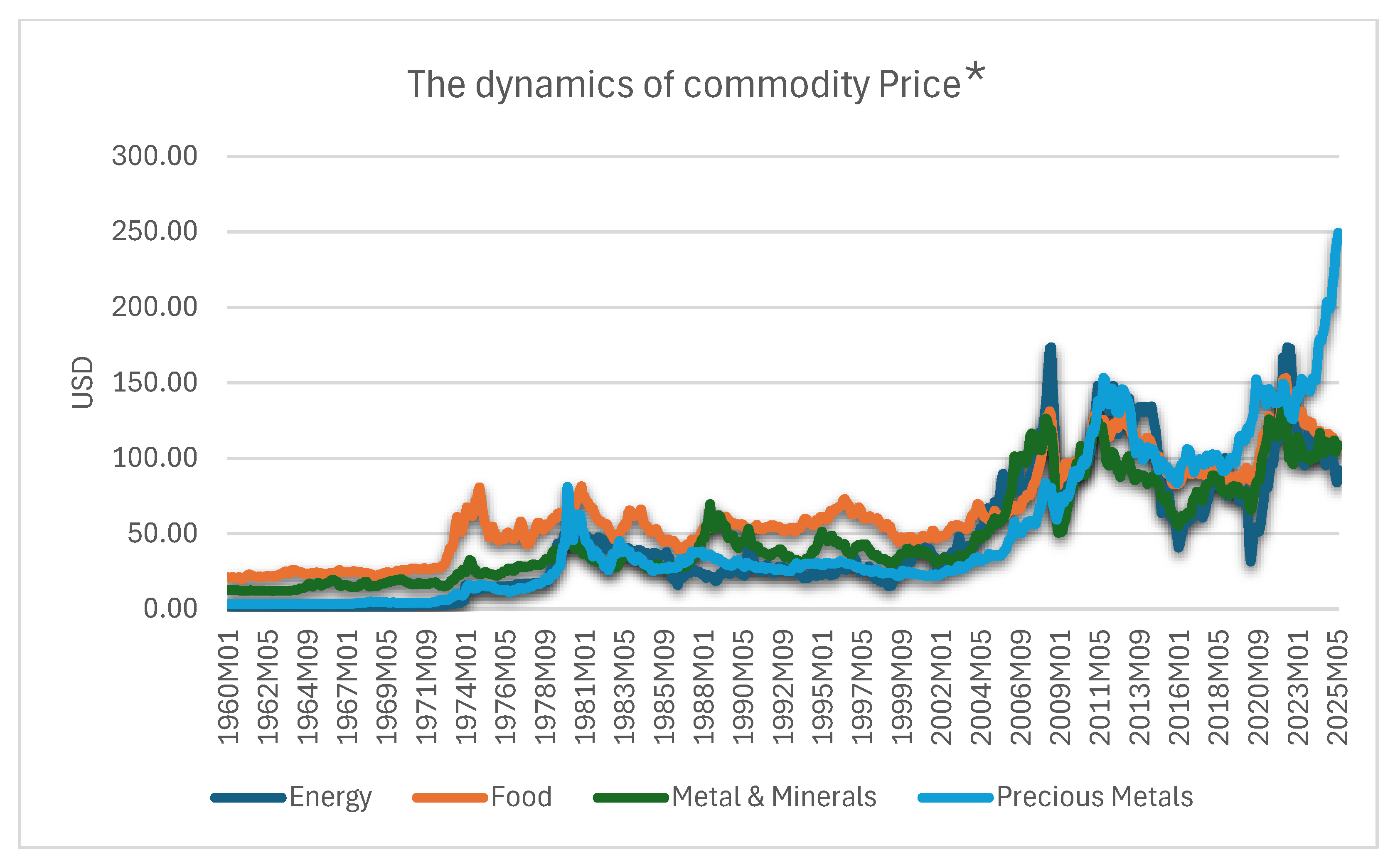
The long-term evolution of global commodity prices further illustrates the increasing interdependence among energy, food, and metal markets. As shown in
Figure 1, the price indices of these commodities have exhibited several synchronized fluctuations since the 1960s, particularly during major global economic and geopolitical disturbances. Notable surges occurred during the oil crises of the 1970s, the commodity supercycle preceding the 2008 financial crisis, and the recent volatility following the COVID-19 pandemic and the Russia–Ukraine conflict, which significantly increased systemic risk in global commodity markets. Recent studies also highlight the growing connectedness between geopolitical risk and commodity markets, particularly in periods of heightened geopolitical tensions [
6,
7]. Energy prices display the most pronounced volatility and frequently precede movements in food and metal prices, reflecting the central role of energy as a key production input across commodity sectors. Empirical evidence further indicates asymmetric linkages between energy and agricultural markets, where fluctuations in oil and gas prices can propagate to grains and other soft commodities through production and transportation costs. In addition, supply chain pressures associated with geopolitical shocks have been shown to transmit volatility between traditional energy and metal markets, reinforcing cross-commodity spillovers within global resource systems [
8,
9]. These dynamics are consistent with broader evidence showing that major global events and crises can significantly amplify market volatility and reshape the behavior of interconnected financial and commodity systems [
10].
Within the energy–metal nexus, geopolitical tensions and protectionist measures including sanctions and tariffs on strategic minerals have disrupted supply chains and increased global trade costs [
12,
13]. These developments have intensified competition for rare earth elements and critical metals required for green energy technologies, fostering resource nationalism and reshaping international resource governance [
14]. Such disruptions highlight the growing interdependence between energy and metal markets, where shocks in energy systems can influence the demand, production costs, and price dynamics of industrial metals within global commodity networks [
15].
Despite the expanding literature on geopolitical risk and commodity market volatility, most existing studies focus on bilateral relationships or sector-specific spillovers without examining how geopolitical shocks operate within an integrated energy–food–metal framework. While prior research documents volatility amplification during geopolitical crises, limited attention has been given to understanding how such shocks influence the structural hierarchy, asymmetric transmission patterns, and sectoral segmentation within commodity market networks. In particular, recent geopolitical tensions highlight the vulnerability of strategic resource systems, yet empirical evidence capturing how these shocks propagate across interconnected but partially segmented commodity markets using high-frequency data remains insufficient.
Furthermore, although geopolitical risk is widely recognized as a driver of volatility spillovers, less is known about the direction, magnitude, and persistence of these transmissions and how key commodities assume differentiated roles as dominant transmitters, passive absorbers, or insulated nodes within the system. Addressing these gaps is essential for understanding whether geopolitical disturbances fundamentally restructure commodity interlinkages or instead reinforce pre-existing asymmetries and sectoral boundaries in global resource markets. More importantly, limited attention has been given to whether traditionally recognised safe-haven assets such as gold act as systemic propagators or passive receivers of shocks within an integrated commodity network under geopolitical stress.
In addition to these gaps, the role of gold within interconnected commodity systems remains theoretically ambiguous. While a substantial body of literature identifies gold as a safe-haven asset during periods of financial and geopolitical stress, recent evidence suggests that this role is inherently time-varying and regime-dependent. In particular, ref. [
16] demonstrates that gold’s hedging effectiveness strengthens markedly during extreme geopolitical shocks such as the Russia–Ukraine conflict. However, this strand of literature primarily evaluates gold within financial asset pricing frameworks, leaving limited understanding of how gold behaves within an integrated cross-commodity transmission system. This raises an important question as to whether gold functions as a systemic transmitter of shocks or rather as a passive absorber of uncertainty within interconnected energy, food, and metal markets. This finding should not be interpreted as contradicting gold’s safe-haven role, but rather as indicating that its function is context-dependent and operates primarily as a passive absorber within commodity networks.
In order to address these gaps, this study seeks to answer the following research questions:
How does geopolitical risk influence the interconnectedness among energy, food, and metal markets within an integrated framework?
How do geopolitical shocks propagate in terms of direction, magnitude, and persistence across these commodity groups?
How do strategic commodities assume differentiated roles as transmitters, receivers, or passive absorbers of shocks within the commodity market network?
In light of these dynamics, the present study is designed to achieve several inter-related objectives. First, it aims to empirically quantify the impact of geopolitical risk on the degree, direction, and temporal persistence of interlinkages among energy, food, and metal markets within an integrated framework. Second, it seeks to examine how geopolitical risk influences the structure and intensity of cross-sectoral shock transmission, particularly during periods of heightened global uncertainty. Third, it investigates the differentiated roles of key commodities such as crude oil, copper, and wheat as dominant transmitters, transmission bridges, or receivers within the commodity market network, including the role of gold as a potential passive absorber under geopolitical stress.
To accomplish these objectives, the study utilizes daily time-series data covering benchmark commodity prices across energy, food, and metal categories. The Caldara and Iacoviello Geopolitical Risk Index is incorporated to quantitatively capture fluctuations in geopolitical tensions. The empirical strategy integrates multiple complementary econometric techniques.
Correlation analysis is employed to examine the direction and strength of contemporaneous relationships. Granger causality testing is conducted to identify predictive directional linkages, while cointegration analysis is applied to assess the presence of long-run equilibrium relationships among the variables. A Vector Error Correction Model framework is implemented to estimate impulse response functions and forecast error variance decompositions, allowing for the evaluation of dynamic shock transmission, magnitude of spillovers, and the persistence of geopolitical disturbances across commodity markets. To enhance the robustness of the findings, the analysis is further complemented by a connectedness framework, allowing the assessment of whether transmission roles remain structurally stable across different geopolitical regimes.
The significance of this research lies in its contribution to a deeper understanding of how geopolitical shocks and uncertainty influence the interconnectedness and transmission dynamics of global commodity markets. By integrating high-frequency market data with geopolitical risk metrics, the study provides nuanced insights into directional spillovers, systemic asymmetries, sectoral segmentation, and adaptive market responses. These findings offer valuable implications for policy design, supply chain resilience, and investment risk management, while also advancing the academic discourse on cross-commodity transmission mechanisms within an integrated energy–food–metal framework in an increasingly volatile global environment. In particular, this study contributes by distinguishing between commodities that actively propagate shocks and those that primarily absorb them, thereby providing a more nuanced interpretation of the role of strategic assets such as gold within a multi-commodity system.
The remainder of the paper proceeds as follows:
Section 2 reviews the relevant literature,
Section 3 describes the data and methodology,
Section 4 presents the results,
Section 5 discusses the findings, and
Section 6 concludes.
3. Data and Methodology
3.1. Data Description
This study utilizes high-frequency daily time series data (five days per week) spanning from 1 January 2022 to 15 July 2025, encompassing benchmark futures prices for energy (WTI crude oil, natural gas), food (wheat, corn), and metals (copper, aluminium, gold). The geopolitical dimension is proxied by the Caldara and Iacoviello Geopolitical Risk Index (GPRD). Data are obtained from the World Bank Commodity Markets database and Investing.com.
The selected sample period is deliberately chosen to encompass a series of major geopolitical shocks that have had profound implications for global commodity markets. These include the Russia–Ukraine war, which began in February 2022 and severely disrupted energy and grain exports from the Black Sea region; the U.S.–China trade tensions initiated under the Trump administration’s tariff policies in 2018, whose lingering effects continued to influence global trade flows and input costs; the escalation of the Israel–Palestine conflict in October 2023, which heightened geopolitical instability in the Middle East; and the outbreak of the Israel–Iran conflict in April 2024, which posed direct threats to critical energy shipping routes such as the Strait of Hormuz. Collectively, these geopolitical events, both directly and indirectly, have altered the behaviour of energy, food, and metal commodity prices through supply chain disruptions, increased transportation and production costs, shifts in trade policies, and heightened market uncertainty, as elaborated in the preceding literature review.
The selection of variables is based on their global benchmark status and sectoral representativeness. WTI crude oil and natural gas represent key energy commodities with dominant roles in global production and transportation costs. Wheat and corn are selected as major staple food commodities that are highly sensitive to energy inputs and global trade disruptions. Copper and aluminium serve as core industrial metals reflecting manufacturing and infrastructure activity, while gold represents a strategic asset with recognised safe-haven properties. The Geopolitical Risk Index (GPRD) is included as a validated proxy for geopolitical uncertainty, widely used in empirical studies examining its impact on financial and commodity markets.
All series are expressed in real terms by adjusting for inflation, transformed into natural logarithms to stabilize variance, and seasonally adjusted (see
Table 1). Stationarity properties of the data are verified using Augmented Dickey–Fuller (ADF). The commodities selected represent three strategic sectors: energy (WTI, Gas), food (Rice, Wheat, Corn), and metals (Copper, Aluminium, Gold). The Geopolitical Risk Index (GPRD) by Caldara and Iacoviello (2022) is included as a key exogenous driver [
48].
To provide an initial overview of data characteristics, descriptive statistics were calculated for all variables. These include mean, standard deviation, skewness, kurtosis, and the Jarque–Bera test for normality.
Table 2 presents the descriptive statistics for the nine variables under study: eight key commodities namely crude oil (WTI), natural gas (Gas), rice, wheat, corn, copper, aluminium, and gold along with the Global Geopolitical Risk Index (GPRD). The dataset spans from January 2022 to July 2025, covering 911 daily observations per series.
From the perspective of central tendency, Aluminium, Gold, and Wheat record the highest average price levels, at 2499.80 USD, 2156.49 USD, and 689.90 USD respectively. In contrast, Gas (3.93 USD), Copper (4.11 USD), and Rice (16.17 USD) demonstrate the lowest mean prices. GPRD, while not a commodity price per se, represents an aggregate index of global geopolitical tension, with a mean value of 150.50.
In terms of volatility, as measured by standard deviation, Gold, Aluminium, and Wheat are the most volatile assets, with respective standard deviations of 425.11, 305.68, and 166.97. Conversely, Copper (0.41), Gas (1.95), and Rice (1.54) exhibit the greatest price stability, rendering them relatively conservative from a portfolio risk management perspective. GPRD also displays high volatility (60.22), underscoring the dynamic and uncertain geopolitical environment prevailing throughout the study period.
Distributional diagnostics confirm substantial deviations from normality across all series. Most commodities exhibit positive skewness, suggesting distributions skewed toward extreme upward price shocks. Rice is the only exception, with a marginally negative skew. Excess kurtosis is particularly notable for GPRD (10.76), Aluminium (5.75), Wheat (4.53), and WTI (4.22), reflecting the presence of fat tails and frequent outliers.
The empirical patterns highlight several important implications. First, energy and industrial metal commodities (e.g., WTI and Aluminium) tend to be more sensitive to macro-shocks and global uncertainty, implying their potential role as systemic risk transmitters. Second, the geopolitical risk index (GPRD) displays not only high variance but also extreme event clustering, reaffirming its utility as an exogenous trigger variable in volatility modeling. Third, the asymmetric volatility across commodities necessitates a modeling framework capable of capturing both contemporaneous spillovers and dynamic feedback mechanisms.
In summary, commodities such as Gold, Aluminium, and Wheat emerge as volatility-prone and highly reactive to exogenous shocks, whereas Copper, Gas, and Rice exhibit more stable behavior, making them suitable for conservative risk strategies. GPRD, with its pronounced non-linearity and external origin, is poised to play a critical role in driving commodity co-movements during periods of geopolitical escalation.
3.2. Justification of Methodological Approach
This study employs a time series econometric framework to analyse the dynamic interactions between geopolitical risk and the prices of eight major global commodities: WTI crude oil, natural gas, rice, wheat, corn, copper, aluminium, and gold. The main objective is to identify the causal relationships, long-run equilibria, and shock transmission mechanisms among these markets under conditions of geopolitical uncertainty.
The methodology integrates three key tools: Correlation analysis, Granger causality tests, and the Vector Error Correction Model (VECM), including Impulse Response Functions (IRF), and Forecast Error Variance Decomposition (FEVD). This multi-tiered econometric approach is widely employed in multivariate time series analysis and yields complementary insights into contemporaneous co-movement, causal directionality, long-run equilibrium dynamics, and the network-level structure of shock transmission:
Correlation Analysis. Initial insights are derived via Pearson correlation coefficients to explore the magnitude and direction of contemporaneous co-movements among the commodities and the geopolitical index.
Granger Causality Testing. Bivariate Granger causality tests are employed to investigate lead–lag relationships and information flows across markets. The optimal lag length is determined via Akaike (AIC), Schwarz (SC), and Hannan–Quinn (HQ) information criteria.
To examine whether changes in one variable (e.g., GPR) Granger-cause changes in another variable (e.g., a specific commodity price), a pair of regressions is estimated in the following general form:
where:
= commodity price or index (e.g., Aluminium, WTI, Gold, etc.).
= another variable tested as the potential cause (e.g., GPR or another commodity).
= the number of lags used in the model.
= error terms (white noise).
Hypothesis testing:
: for all → does not Granger-cause .
: At least one → Granger-causes .
- 3.
Cointegration and VECM Estimation. To examine the long-run equilibrium relationships among variables, this study applies the Johansen cointegration test as developed by [
49,
50]. This method is suitable for a multivariate system where all variables are integrated of the same order (I(1)) but may have stationary linear combinations.
The cointegration test is conducted by estimating a Vector Autoregressive (VAR) model of order
p:
where:
is a vector of non-stationary endogenous variables. In this study, includes Aluminium (MAL3), WTI Crude Oil, Natural Gas, Rough Rice, US Wheat, US Corn, Copper, Gold, and the Geopolitical Risk Index (GPR).
(where i = 1, 2, …, p) is a coefficient matrix that measures how the lagged values of all endogenous variables in the system affect the current values of those variables. Matrix size: , where k is the number of endogenous variables in
is a vector of deterministic variables (e.g., constant, trend, dummy variables).
is a vector of white-noise error terms.
If the Johansen test confirms cointegration among the variables, the VAR model can be re-parameterized into a Vector Error Correction Model (VECM) form:
where
represents the short-run dynamics of the variables.
The matrix contains information about the long-run relationships between the variables. If the rank of is , there are cointegrating vectors.
The matrices capture the short-run adjustments toward the long-run equilibrium.
Beyond its standard applicability to cointegrated systems, the VECM framework is particularly appropriate in this study for three reasons. First, commodity prices are structurally interconnected through common production inputs, where energy costs are embedded in both food and metal production, implying economically meaningful long-run equilibrium relationships. Second, the identified cointegrating relationships among key variables (WTI, wheat, copper, aluminium, and GPRD) allow for the modelling of equilibrium adjustments following geopolitical shocks, making mean-reversion a testable economic feature. Third, the VECM framework ensures that dynamic responses are estimated within an equilibrium-consistent system, allowing the resulting analysis to reflect structural relationships rather than temporary deviations.
Impulse response functions (IRFs) are employed to evaluate the magnitude, direction, and persistence of shocks following geopolitical disturbances. This approach directly addresses Research Question 2 by tracing how shocks originating from geopolitical risk and energy markets propagate across commodity sectors over time. To ensure robustness against variable ordering, generalized impulse response functions (GIRFs) following Pesaran are applied.
Forecast error variance decomposition (FEVD) is used to quantify the relative contribution of each variable to the overall variance of the system. This enables the identification of commodities that act as dominant transmitters or receivers of shocks, thereby addressing Research Question 3 and providing a variance-based perspective on cross-commodity spillover dynamics.
This methodological sequence is theoretically grounded in the literature on inter-market spillovers and macro-financial linkages and is particularly well-suited to high-frequency (daily) data, where fully structural modelling may be constrained by complexity and overparameterisation [
51,
52]. It is particularly well-suited to high-frequency (daily) data, where fully structural modelling may be constrained by complexity and overparameterisation.
- 4.
Diebold–Yilmaz Connectedness and Event-Window Robustness Checks. To assess the robustness of the VECM-based findings and to evaluate the time-varying nature of cross-commodity connectedness across distinct geopolitical regimes, this study additionally employs the Diebold–Yilmaz (DY) spillover connectedness framework [
53]. The DY approach decomposes the forecast error variance of each variable across all others via a generalised variance decomposition, yielding a total connectedness index as well as directional and net spillover measures for each market. This allows for a clear identification of net transmitters and net receivers within the system. The analysis is conducted over three structurally distinct event windows that reflect major geopolitical escalation episodes: Period 1 (1 January 2022–6 October 2023), covering the post-Russia–Ukraine invasion phase and its cascading effects on energy and grain markets; Period 2 (7 October 2023–12 April 2024), corresponding to the Hamas–Israel conflict escalation and concurrent Houthi disruptions to Red Sea maritime trade; and Period 3 (13 April 2024–15 July 2025), initiated by the direct Iran–Israel military exchange, which introduced qualitatively new safe-haven and energy supply risk dynamics. These sub-period analyses serve as event-window robustness checks that test whether the directional transmission roles identified in the full-sample VECM remain structurally stable or shift meaningfully across geopolitical regimes.
Rather than applying formal endogenous break tests, this study adopts an a priori event-window approach grounded in well-documented geopolitical episodes. This design is consistent with the event-study methodology widely employed in commodity market literature [
6,
7], and the stability of transmission classifications across all three windows provides practical evidence that full-period VECM results are not distorted by structural instability.
4. Results
4.1. Correlation Analysis
Table 3 presents the Pearson correlation matrix. GPRD exhibits statistically significant positive correlations with WTI crude oil (r = 0.222,
p < 0.01), natural gas (r = 0.133,
p < 0.01), wheat (r = 0.213,
p < 0.01), corn (r = 0.095,
p < 0.01), copper (r = 0.208,
p < 0.01), and aluminium (r = 0.403,
p < 0.01). The correlations of GPRD with rice (r = −0.034,
p = 0.299) and gold (r = 0.054,
p = 0.101) are statistically insignificant, suggesting these commodities are relatively insulated from geopolitical risk fluctuations. The strongest GPRD–commodity association is with aluminium (r = 0.403), plausibly reflecting aluminium’s energy-intensive production and its reliance on geopolitically exposed supply chains in Russia and the Middle East.
Among commodity pairs, the strongest correlations are observed between wheat and corn (r = 0.894, p < 0.01), reflecting shared demand drivers and substitution effects in global grain markets, and between copper and aluminium (r = 0.685, p < 0.01), consistent with their shared exposure to industrial demand cycles. WTI exhibits strong positive correlations with wheat (r = 0.757, p < 0.01) and corn (r = 0.616, p < 0.01), supporting the cost-push hypothesis that rising energy prices propagate to agricultural commodity prices through production and transportation cost channels. Notably, gold exhibits significant negative correlations with most energy and food commodities—WTI (r = −0.610, p < 0.01), wheat (r = −0.653, p < 0.01)—consistent with its counter-cyclical safe-haven character.
4.2. Granger Causality Analysis
Table 4 reports the bivariate Granger causality results. GPRD Granger-causes statistically significant changes in WTI (F = 2.508,
p = 0.082), wheat (F = 3.959,
p = 0.019), copper (F = 2.667,
p = 0.069), and aluminium (F = 9.343,
p < 0.001), confirming its role as a primary exogenous shock transmitter across multiple commodity markets. No significant causal relationship is detected from GPRD to gas, rice, or corn, indicating that these commodities are relatively insulated from direct geopolitical signalling.
The GPRD → WTI causal linkage is economically expected: geopolitical events—particularly military conflicts involving major oil-producing nations and threats to critical transit chokepoints such as the Strait of Hormuz—directly affect supply expectations and transportation routes for crude oil, generating immediate futures market price responses. The GPRD → Copper linkage reflects copper’s strategic role as both an industrial input and a defence-critical commodity. Geopolitical tensions frequently target copper-producing regions and disrupt trade in refined copper and copper ore, creating supply uncertainty that propagates into price dynamics; copper’s centrality in defence and green technology supply chains further amplifies its sensitivity to trade restrictions and sanctions.
Among the commodity pairs, WTI Granger-causes wheat (F = 7.318, p < 0.001), aluminium (F = 2.597, p = 0.075), and gold (F = 4.292, p = 0.014), confirming energy’s central role as a production-cost transmitter. The WTI → Aluminium causality is explained by the energy intensity of aluminium smelting: energy costs account for approximately 30–40% of total aluminium production costs, meaning that WTI price movements translate directly into production economics, particularly when energy markets are tight. The WTI → Wheat link operates primarily through transportation and nitrogen-based fertiliser costs, which are produced from natural gas—a commodity closely correlated with oil prices. Rising WTI prices therefore impose upstream cost pressures on wheat producers, transmitted over a one-to-two lag period consistent with fertiliser procurement and application cycles.
WTI is itself Granger-caused by wheat (F = 2.894, p = 0.055) and aluminium (F = 2.397, p = 0.091), confirming its dual role as both a transmitter and a receiver of shocks within the network. Aluminium also Granger-causes gas (F = 5.896, p = 0.002) and copper (F = 4.087, p = 0.017), reflecting its integrative position in the commodity network. Gold, consistent with its passive absorber characterisation, significantly affects only WTI (F = 3.942, p = 0.019) and wheat (F = 3.850, p = 0.021) in the causal framework, indicating limited outward systemic influence. Gas, rice, and corn exhibit comparatively weak or non-significant causal linkages with other commodities, suggesting their predominantly passive role as shock recipients in this network.
4.3. Cointegration and VECM Results
Stationarity tests using the Augmented Dickey–Fuller (ADF) and Phillips–Perron (PP) methods confirm that all nine series are non-stationary at levels but stationary in first differences, satisfying the requirement for cointegration analysis. Optimal lag selection via AIC, SC, and HQ information criteria indicates a two-lag structure. The Johansen cointegration test identifies at least two cointegrating vectors at the 5% significance level, confirming stable long-run equilibrium relationships among the key variables—particularly WTI, wheat, copper, aluminium, and GPRD—and validating the VECM specification.
4.3.1. Impulse Response Functions
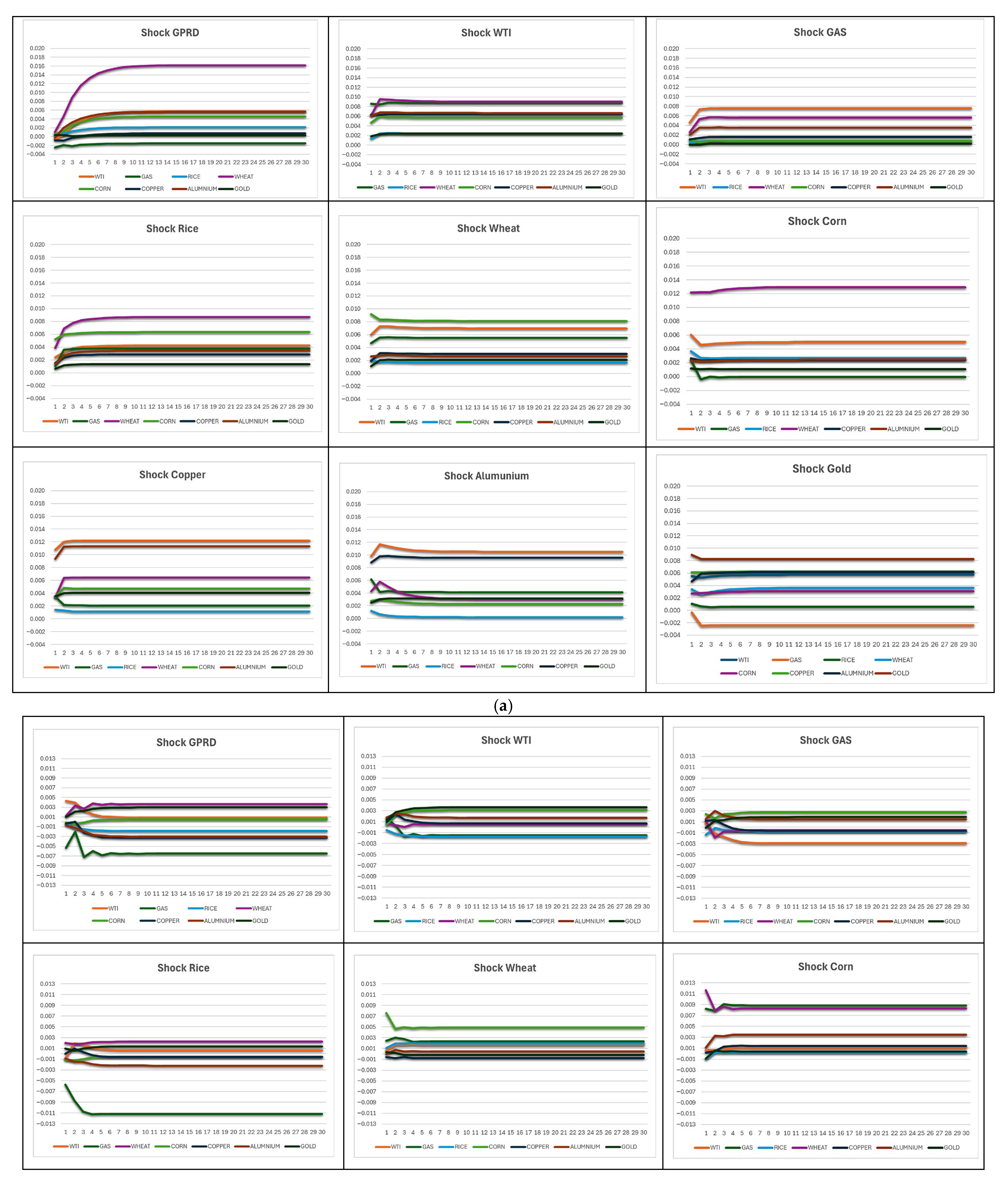
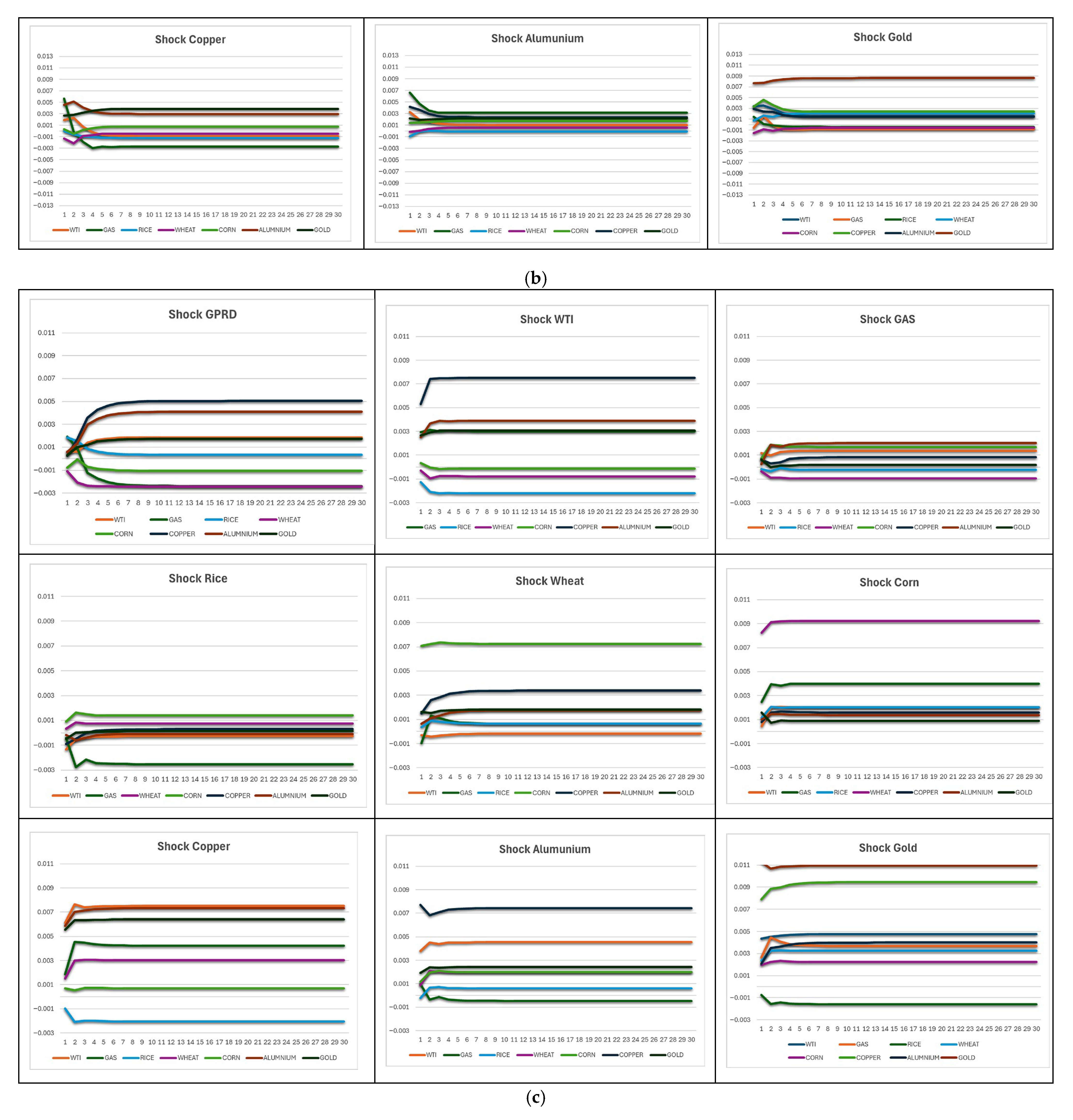
Figure 2 presents the impulse response functions (IRFs) across three distinct sub-periods—Period 1 (1 January 2022–6 October 2023), Period 2 (7 October 2023–12 April 2024), and Period 3 (13 April 2024–30 June 2025)—designed to capture structural shifts associated with major geopolitical escalations, including the aftermath of the Russia–Ukraine conflict, the onset of the Israel–Hamas war, and the subsequent Iran–Israel escalation. Panels (a)–(c) report the dynamic responses of selected commodity prices to identified shocks within each regime, allowing for a comparative assessment of temporal heterogeneity in shock transmission and adjustment dynamics. By segmenting the sample in accordance with these exogenous geopolitical breaks, the IRFs provide a structured basis for evaluating how the magnitude, persistence, and propagation of shocks evolve across regimes, without imposing homogeneity over the full sample period.
Table 5 synthesises the regime-dependent nature of impulse response dynamics by highlighting how both the magnitude and transmission channels of shocks evolve across geopolitical contexts. In Period 1, responses are strongest and most persistent, reflecting a dominant supply-disruption mechanism in which shocks—particularly from geopolitical risk and energy markets—propagate broadly across commodities. This phase exhibits the widest cross-sectoral transmission, with energy acting as a central conduit linking food and industrial metals. The intensity and duration of responses underscore a system driven by structural shortages and cost-push pressures, where interdependencies are amplified and adjustment paths are relatively slow.
In contrast, Period 2 is characterised by a compression in both magnitude and persistence of responses, alongside a shift toward financial and trade-route-related transmission channels. Shock effects become more selective and short-lived, indicating reduced systemic propagation compared to Period 1. Notably, this regime marks the emergence of gold as an active safe-haven responder, while traditional energy–food linkages weaken. The transmission structure narrows, suggesting that uncertainty operates more through market expectations and logistical disruptions rather than direct production shocks.
Period 3 reveals a further transformation in which shock intensity becomes more targeted yet strategically integrated, particularly between energy and financial markets. Responses associated with geopolitical risk and oil become faster and more pronounced, while safe-haven dynamics reach their strongest expression, with gold exhibiting the most persistent reactions across all periods. At the same time, certain relationships—such as the industrial metal cluster—remain structurally stable, whereas others, including the energy–food linkage, show clear attenuation. Overall, the table demonstrates that both the strength and direction of impulse responses are inherently regime-contingent, governed by the underlying nature of geopolitical shocks.
4.3.2. Forecast Error Variance Decomposition
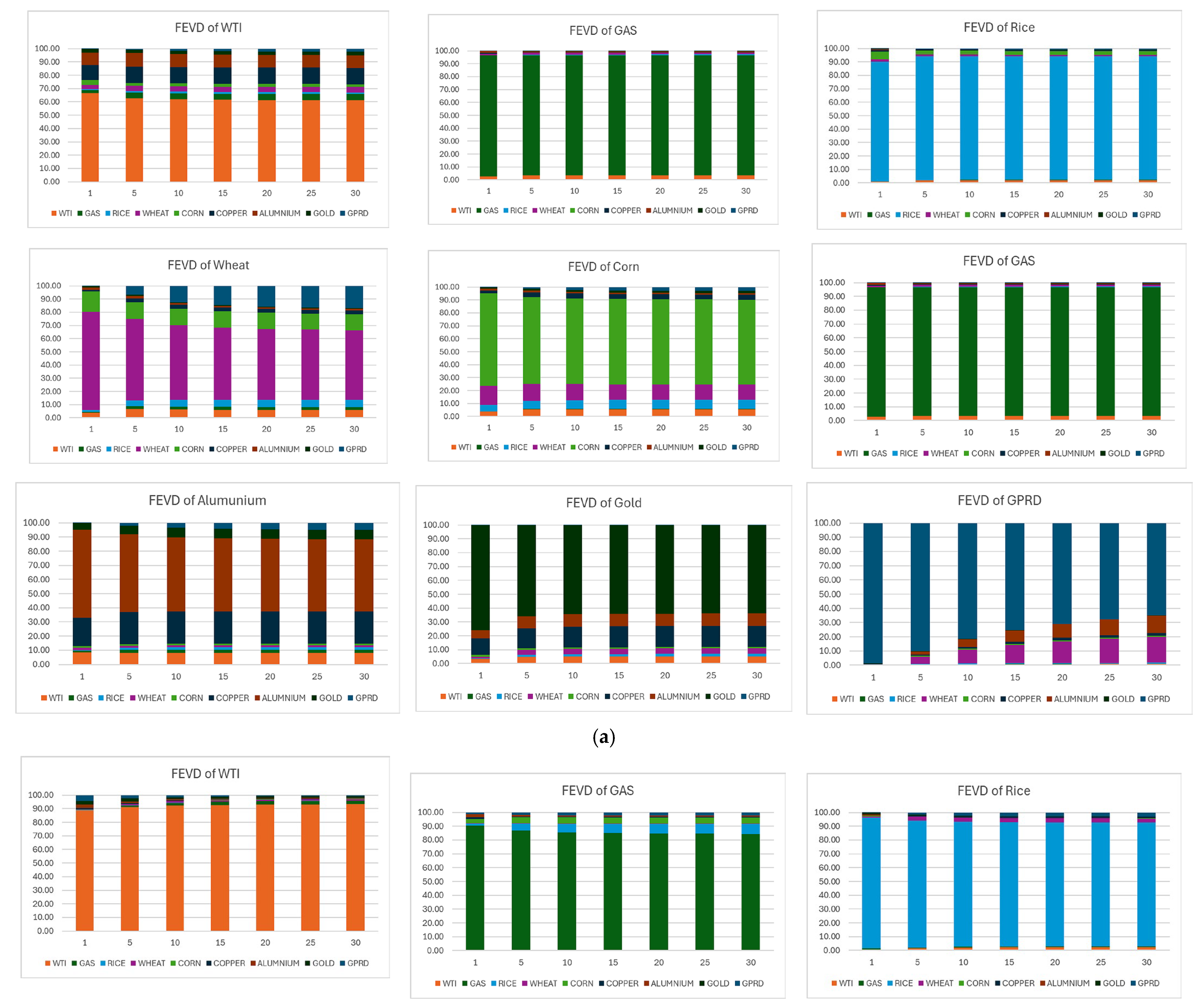
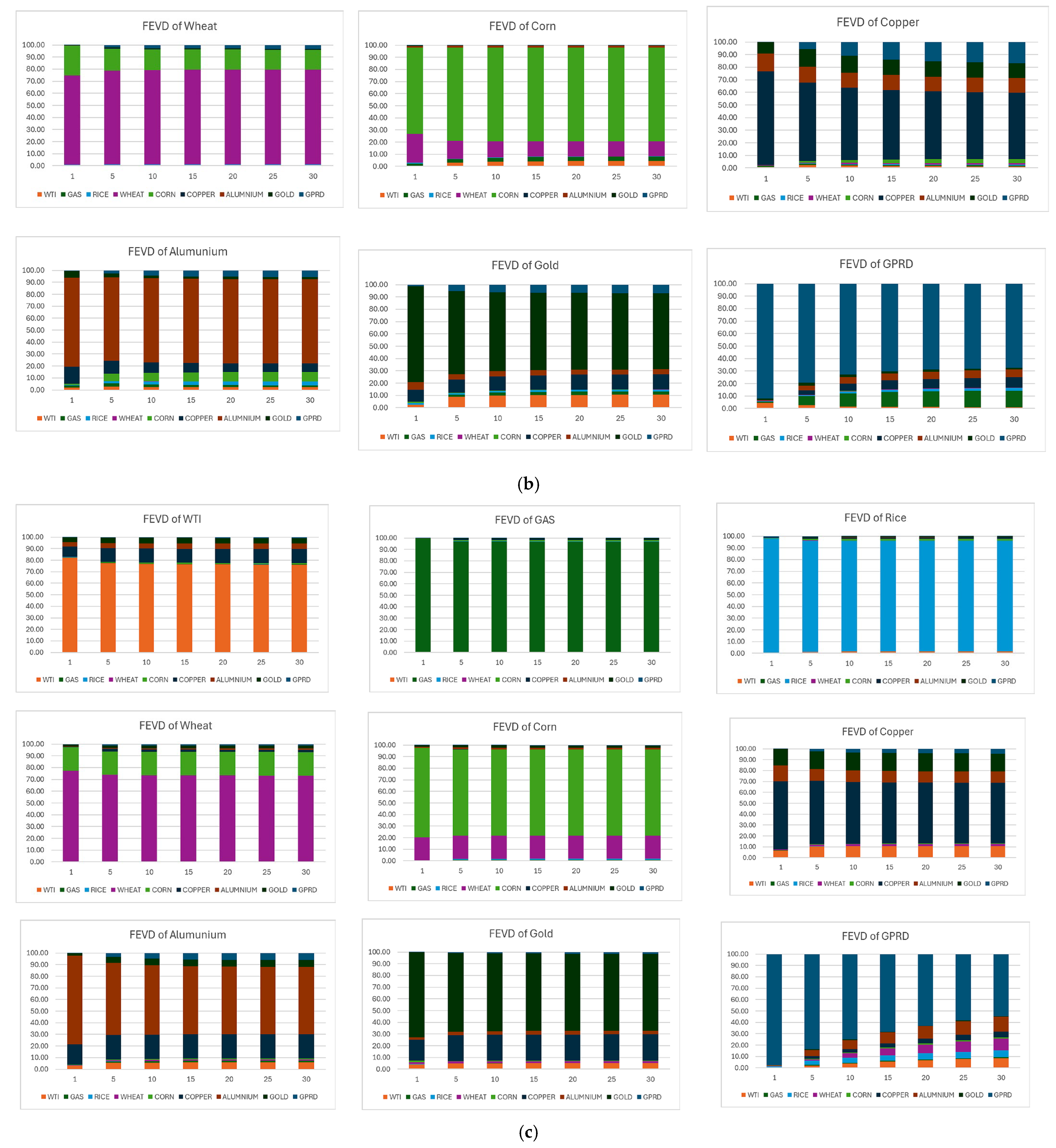
Figure 3 presents the forecast error variance decomposition (FEVD) results across three sub-periods—Period 1 (1 January 2022–6 October 2023), Period 2 (7 October 2023–12 April 2024), and Period 3 (13 April 2024–30 June 2025)—to evaluate how the relative contribution of shocks to commodity price variability evolves under distinct geopolitical regimes. Panels (a)–(c) decompose the proportion of forecast error variance attributable to own shocks, cross-commodity spillovers, and geopolitical risk, thereby complementing the dynamic insights obtained from the impulse response analysis. By structuring the FEVD across these event-driven windows—associated with the Russia–Ukraine conflict, Israel–Hamas war, and Iran–Israel escalation—the analysis provides a comparative framework for assessing how variance attribution, shock dominance, and cross-market dependence shift over time, without imposing parameter stability across the full sample.
Table 6 consolidates the FEVD evidence by demonstrating that the sources of commodity price variability are strongly regime-dependent, with both the magnitude and composition of variance contributions shifting across geopolitical contexts. In Period 1, variance is predominantly shaped by supply-disruption channels, where energy and food markets exhibit the highest sensitivity to external shocks, particularly from geopolitical risk and oil. This phase reflects the broadest cross-sectoral variance transmission, with the energy–food linkage playing a central role, while most commodities—especially gold—remain largely driven by their own innovations.
In Period 2, the variance structure becomes more compressed and rebalanced, indicating a transition toward financial uncertainty and trade-route risk channels. The contribution of geopolitical risk to variance becomes more visible in selected markets, most notably through the increasing role of gold as a safe-haven absorber of external shocks. At the same time, traditional transmission pathways—such as the energy–food linkage—lose explanatory power, and cross-market variance contributions become more selective rather than system-wide.
By Period 3, the FEVD results reveal a more integrated yet asymmetric variance structure, where geopolitical risk and energy shocks jointly influence both commodity and financial dimensions of the system. The contribution of external shocks to gold reaches its highest level, confirming its strengthened safe-haven function, while energy-related variance becomes more tightly linked to geopolitical developments. In contrast, the food sector shows diminished exposure to external drivers, signalling a structural decoupling from earlier crisis dynamics. Meanwhile, the persistence of strong bilateral variance sharing within industrial metals highlights the existence of stable intra-sectoral linkages, even as broader cross-commodity relationships remain contingent on the prevailing geopolitical regime.
4.4. Robustness Check: Diebold–Yilmaz Connectedness Across Geopolitical Event Windows
To assess the structural stability of the transmission roles identified in the VECM framework and to evaluate the time-varying nature of cross-commodity connectedness across distinct geopolitical regimes, the Diebold–Yilmaz (DY) spillover connectedness framework [
53] is applied across three structurally distinct event windows: Period 1 (1 January 2022–6 October 2023), corresponding to the post-Russia–Ukraine invasion phase and its cascading effects on energy and grain markets; Period 2 (7 October 2023–12 April 2024), covering the Hamas–Israel conflict escalation and concurrent Houthi disruptions to Red Sea maritime trade; and Period 3 (13 April 2024–15 July 2025), initiated by the direct Iran–Israel military exchange.
The estimated Total Connectedness Index (TCI) for the full sample stands at 21.5%, indicating a moderately interconnected system in which idiosyncratic shocks remain the dominant driver of individual commodity variance, but cross-market transmission is nonetheless economically meaningful.
Table 7 presents the full pairwise spillover connectedness matrix, and
Table 8 summarises the net spillover classification for each variable.
The net spillover hierarchy reveals a structured and highly asymmetric transmission architecture. Aluminium (+16.0%) and copper (+7.6%) emerge as the dominant net transmitters of shocks within the system, followed by GPRD (+3.9%) and rice (+1.3%). In contrast, WTI (−11.0%), wheat (−11.1%), gold (−3.5%), corn (−1.7%), and gas (−1.5%) are classified as net receivers. Strong intra-sectoral spillovers are observed within industrial metals (copper-to-aluminium: 21.1%; aluminium-to-copper: 18.8%) and within agricultural commodities (wheat-to-corn: 17.7%; corn-to-wheat: 13.0%). Cross-sectoral transmission is more limited, with energy shocks primarily affecting metals rather than directly influencing food markets.
To provide further granularity on bilateral transmission channels,
Table 9 presents the full pairwise spillover matrix averaged across the rolling Diebold–Yilmaz estimation windows. Unlike the static full-sample matrix in
Table 9, the time-averaged values reflect the central tendency of bilateral spillovers across varying market conditions throughout the study period, offering a more robust characterisation of persistent bilateral linkages. Each cell reports the average percentage of forecast error variance in the row variable (FROM) attributable to shocks originating from the column variable (TO), while diagonal entries represent own-variance contributions.
The time-averaged bilateral matrix corroborates and extends the static connectedness results. The strongest bilateral linkages are concentrated within sectors: copper-to-aluminium (23.847%) and aluminium-to-copper (16.948%) constitute the most persistent pair in the entire matrix, while wheat-to-corn (17.641%) and corn-to-wheat (12.537%) represent the tightest within-food relationship. Across sectoral boundaries, WTI-to-copper (8.814%) and WTI-to-aluminium (6.213%) confirm the energy cost-push channel as the primary cross-sector transmission mechanism. Notably, gold exhibits comparatively weak bilateral outward spillovers across all pairs, with its largest transmission directed toward copper (12.654%) rather than food or energy commodities, consistent with its characterisation as a net receiver rather than a systemic propagator.
Critically, gold is identified as a net receiver with a net spillover of −3.5% (contribution to others: 17.8%; contribution from others: 21.3%), indicating that it absorbs more variance from external shocks than it propagates to other markets. This result directly corroborates the VECM-based IRF and FEVD evidence, reinforcing the characterisation of gold as a passive shock absorber and recipient of macroeconomic uncertainty rather than a systemic volatility propagator within this energy–food–metal framework. These classifications are stable across all three geopolitical event windows, confirming that the directional transmission roles are not crisis-specific artefacts but structurally persistent features of this commodity network.
6. Conclusions
This study addresses a key gap in the commodity market literature by developing an integrated, high-frequency framework to analyse how geopolitical risk shapes interlinkages across energy, food, and metal markets. Specifically, it aims to (i) quantify the impact of geopolitical risk on the direction, magnitude, and persistence of cross-commodity transmission, (ii) identify how shocks propagate across sectors, and (iii) characterise the roles of commodities as transmitters, receivers, or insulated nodes. To achieve these objectives, the study employs daily data from January 2022 to July 2025, generalised impulse response functions (IRF), forecast error variance decomposition (FEVD), and Diebold–Yilmaz connectedness analysis across multiple geopolitical regimes.
The results consistently demonstrate that geopolitical risk (GPRD) functions as a robust systemic driver of commodity price dynamics, significantly influencing WTI, wheat, copper, and aluminium. The analysis reveals a clear structural hierarchy: WTI operates as a central transmission hub through cost-push and signalling channels, while industrial metals emerge as dominant net transmitters within the network. In contrast, agricultural commodities remain relatively segmented, and gold consistently acts as a net receiver, reflecting its conditional safe-haven role as a passive absorber rather than a propagator of cross-market volatility. These findings are operationalised into two decision-support frameworks: a Commodity Stress Indicator (CSI) that links geopolitical risk thresholds to policy responses, and a transmitter–receiver portfolio allocation rule that supports adaptive investment strategies under shifting geopolitical regimes.
From a policy perspective, the results provide actionable guidance for real-time monitoring and intervention in commodity markets under geopolitical stress. However, several limitations should be acknowledged. The VECM framework assumes linear adjustment and may not fully capture nonlinear or regime-switching dynamics during extreme events; this study does not apply formal endogenous structural break tests (e.g., Zivot–Andrews or Bai–Perron)—while the event-window DY approach addresses regime stability empirically, future research should formally validate break dates using endogenous detection methods; the GPRD is an aggregate proxy that does not distinguish between types of geopolitical shocks; the analysis relies on futures data, which may diverge from spot market conditions; and the VECM does not explicitly control for macroeconomic variables such as exchange rates, inflation, and interest rates; endogenous macro interactions remain a direction for future research. Future research should extend this framework by incorporating nonlinear and time-varying models, endogenising macroeconomic interactions, expanding the commodity set to include transition-related resources, and validating the proposed CSI and portfolio frameworks using real-time or higher-frequency data.