1. Introduction
The rapid digitalization of economic and social life has significantly reshaped patterns of criminality, leading to a pronounced increase in cybercrime worldwide. Computer fraud, including phishing, identity theft, and online financial scams, has become especially widespread and damaging [
1,
2,
3]. The proliferation of digital infrastructure in banking, commerce, and daily interactions has exponentially expanded criminal opportunities while simultaneously increasing the risk exposure of individuals, businesses, and public institutions [
4,
5]. While the precise scale of cyber-enabled fraud is difficult to measure due to underreporting, available data suggests a persistent mismatch between victimization experiences and official crime statistics. Reporting gaps are driven by factors such as lack of awareness, perceived futility of reporting, or reputational concerns among institutions [
2,
6]. Consequently, public data may reflect only a partial view of this rapidly evolving phenomenon. Several initiatives have been developed at the European level to strengthen resilience against cyber-enabled crime. Directive 2013/40/EU [
7] on attacks against information systems, transposed into Spanish law by Organic Law 1/2015, reinforced the criminalization of digital fraud and related offenses (BOE, 2015) [
8]. Europol’s Internet Organized Crime Threat Assessment (IOCTA) [
9] reports have further highlighted computer fraud as one of the fastest-growing cybercrime phenomena, with significant social and economic implications across Member States [
10]. Many studies have focused on specific modalities, such as investment scams or romance fraud, while neglecting a comprehensive structural perspective that integrates regional and demographic variables [
5,
11,
12,
13]. Beyond aggregating individual offenses, computer fraud should be understood as an emergent outcome of a socio-technical system. This system integrates digital connectivity, online financial services, internet use intensity, economic inequalities, criminal opportunities, reporting practices, and institutional capacity for response. From this perspective, regional differences are not merely variations in recorded incidence but expressions of distinct territorial system configurations that condition exposure, detection, and vulnerability. From a theoretical perspective, this approach aligns with Routine Activity Theory, which emphasizes exposure and opportunity structures, and with the Technology Acceptance Model (TAM), which explains how the expansion of digital environments increases both adoption and vulnerability. Together, these frameworks support the interpretation of computer fraud as an emergent outcome of interactions between users, technologies, and institutional contexts. Within this framework, the system comprises three components (digital, socioeconomic, and territorial) that interact to shape exposure to online environments and the incidence of computer fraud. Accordingly, higher levels of digital integration and economic activity are expected to increase fraud exposure, while territorial differences modulate these patterns through institutional and reporting factors. However, there is still a lack of studies that examine computer fraud as a multiscale systemic phenomenon and analyze how interdependent digital, socioeconomic, and territorial components generate differentiated patterns of vulnerability across regions. To design effective, evidence-based prevention strategies, it is therefore essential to understand how these interconnected factors shape the spatial and temporal dynamics of computer fraud. Vulnerability to computer fraud arises from the interaction between digital infrastructures, socioeconomic conditions, and territorial contexts. Greater digital connectivity increases exposure to online fraud, while economic development expands participation in digital financial systems. Territorial differences in institutional capacity and technological adoption further shape the regional distribution of fraud. Thus, vulnerability patterns reflect interconnected components of the system rather than isolated factors. Existing research on computer fraud can be broadly grouped into three strands: studies focusing on specific fraud modalities, analyses of individual risk factors, and research examining the role of digitalization and socioeconomic development. However, these approaches often remain fragmented and rarely integrate structural, territorial, and temporal dimensions. Despite extensive research on cyber fraud, most studies focus on specific modalities or isolated risk factors, often neglecting the interaction between digital, socioeconomic, and territorial dimensions. Few adopt an integrated approach combining temporal, regional, and structural analyses.
This study addresses this gap by adopting a socio-technical systems perspective that integrates temporal dynamics, regional disparities, and structural determinants within a unified analytical framework. Unlike previous studies that focus on isolated factors or specific fraud types, this approach provides a multiscalar analysis of computer fraud in Spain, including trends, regional clustering, structural associations, and medium-term projections to 2035. Spain represents a relevant case for analyzing computer fraud due to its rapid digitalization, pronounced regional heterogeneity, and decentralized structure, which enable the study of differentiated vulnerability patterns within a common national context. The availability of consistent long-term data further supports the analysis of temporal and regional dynamics. Guided by this framework, the study tests the following hypotheses. Higher levels of digital integration are expected to increase the incidence of fraud due to greater exposure to online environments. Socioeconomic development is also expected to be positively associated with fraud rates, reflecting greater participation in digital economic activity. In addition, territorial differences are expected to produce heterogeneous patterns of fraud, shaped by variations in institutional capacity and reporting practices. Finally, computer fraud is expected to show sustained temporal growth over the study period.
This study approaches computer fraud as a socio-technical and territorial system. Accordingly, the aim was to examine the temporal evolution and regional disparities of different subtypes of computer fraud in Spain from 2011 to 2022, analyze their sociodemographic and structural determinants, identify clustered territorial trajectories across autonomous communities, and provide medium-term projections to 2035 to inform evidence-based public policy and strategic economic planning in the field of digital security. From a systems perspective, computer fraud can be understood as an emergent phenomenon arising from the interactions among multiple interconnected components rather than from isolated causal factors. This view is consistent with systems and complexity approaches, which emphasize interdependencies, non-linear dynamics, and the role of structural configurations in shaping outcomes. Compared to traditional criminological models focused on individual risk factors, the socio-technical framework adopted here highlights how digital infrastructures, user behavior, and institutional contexts interact to generate differentiated patterns of vulnerability and growth.
This study is organized as follows.
Section 2 describes the data sources and methods,
Section 3 presents the results, and
Section 4 discusses the findings from a socio-technical systems perspective. Finally,
Section 5 summarizes the main conclusions and implications.
3. Results
3.1. Cybercrime Patterns in Spain (2011–2022)
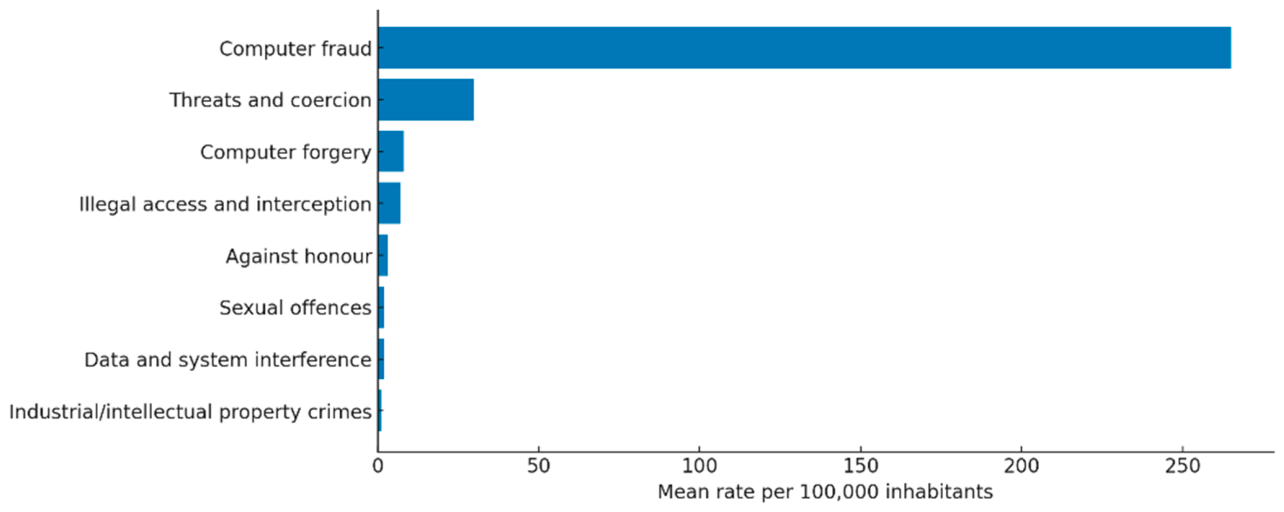
As shown in
Figure 1, the mean annual rate per 100,000 inhabitants of the main types of cybercrime recorded in Spain between 2011 and 2022. The data show that computer fraud was the most frequent cyber offense, with a mean rate of 269.4 cases, clearly surpassing all other categories. The second most reported category was threats and coercion, with a mean of 25.7 cases, followed by computer forgery (9.4) and illegal access and interception, which registered a mean of 6.9 cases per 100,000 inhabitants during the same period. Other categories reported lower mean rates: offenses against persons (3.6), sexual offenses committed through digital means (2.8), and data and system interference (2.3). The lowest rate was observed in industrial and intellectual property offenses, with a mean of 0.3 cases per 100,000 inhabitants.
3.2. Trends in Computer Fraud in Spain (2011–2022)
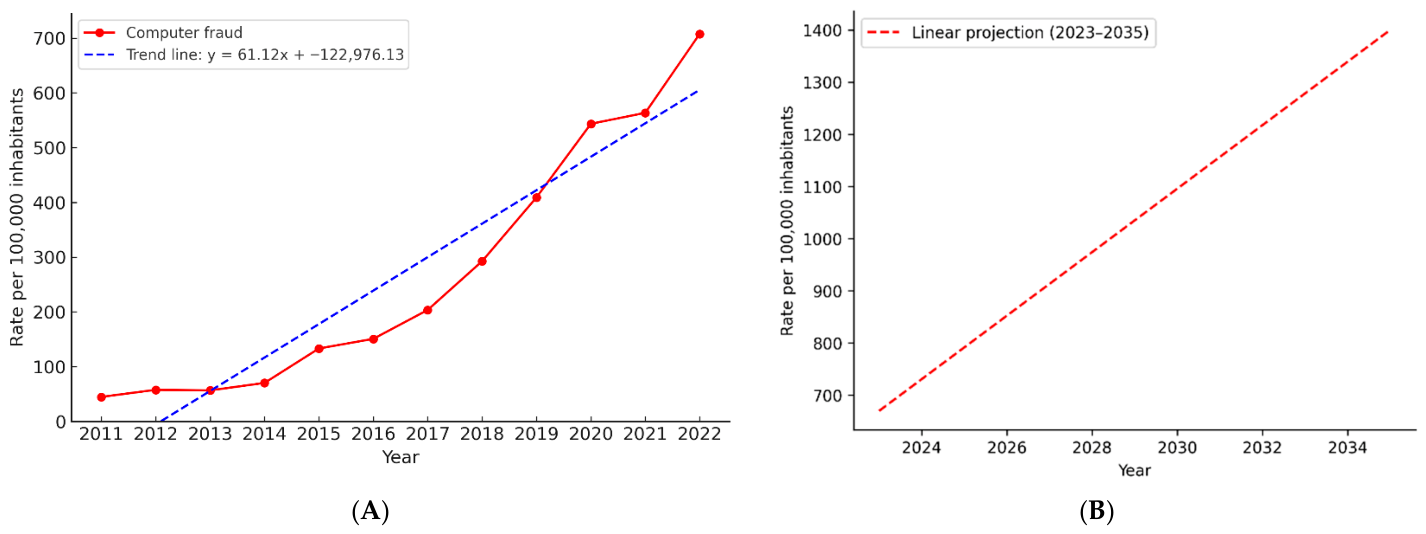
The analysis of the annual evolution of cyber fraud in Spain between 2011 and 2022 showed a very marked and sustained increase (
Figure 2A). The rate rose from 44.7 cases per 100,000 inhabitants in 2011 to 133.1 in 2015, then to 292.5 in 2018. The growth intensified in recent years, reaching 409.1 in 2019, 543.5 in 2020, and 707.7 in 2022, representing an increase of over 1.480% over the period analyzed. The regression line (y = 61.12x − 122,976.13) confirmed a steep upward trend, with a mean annual increase of approximately 61 cases per 100,000 inhabitants. As shown in
Figure 2B, computer fraud in Spain increased from 44.7 to 707.7 cases per 100,000 inhabitants between 2011 and 2022. The rate is projected to reach about 820 in 2025, 1100 in 2030, and nearly 1440 in 2035.
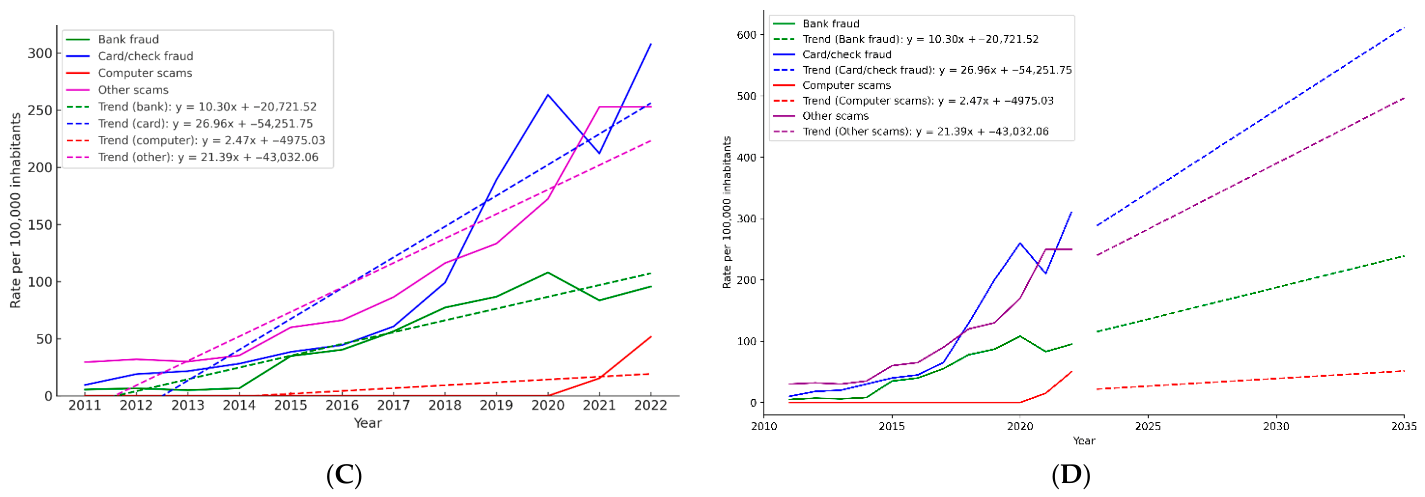
The differentiated trajectories of these fraud subtypes reflect the internal evolution of the broader fraud system, with distinct forms of digital and financial exposure contributing unevenly to overall growth. As shown in
Figure 2C, different types of computer fraud in Spain increased steadily between 2011 and 2022, with distinct growth patterns. Card fraud showed the largest rise, increasing from 9.5 to 307.5 cases per 100,000 inhabitants, with a sharp acceleration after 2016 (44.4) and rapid growth through 2018 (99.1), 2019 (189.1), and 2020 (263.3), peaking in 2022. Bank fraud also increased substantially, from 5.6 in 2011 to a peak of 107.9 in 2020 and remained elevated at 95.6 in 2022 despite a slight decline after 2020. Computer scams emerged more recently, first recorded at 15.3 in 2021 and rising to 51.7 in 2022, indicating a rapid recent expansion. These differentiated trends suggest that fraud subtypes are driven by distinct dynamics, reflecting heterogeneous forms of digital and financial exposure within the broader system. Finally, in
Figure 2D, it is observed how all types of cyber fraud in Spain increased between 2011 and 2022 and are projected to continue growing until 2035. Card fraud increased the most, rising from 9.5 to 307.5 cases per 100,000 inhabitants, with a projection exceeding 600 in 2035. Additionally, banking fraud increased from 5.6 in 2011 to 95.6 in 2022 and is expected to reach approximately 240 by 2035. Cyber scams, recorded for the first time in 2021 at 15.3 cases and rising to 51.7 in 2022, also show an upward trend, though at a lower growth rate. The remaining frauds analyzed also showed a sustained increase and could reach 500 by 2035.
3.3. Regional Variation and Temporal Trends in Computer Fraud
The analysis of computer fraud rates across Spain’s autonomous communities between 2011 and 2022 showed a widespread, statistically significant increase in all regions (
Table 1). The annual slopes were significant in all cases (
p < 0.05), confirming an upward trend during the study period.
The steepest increases were observed in the Basque Country, Catalonia, and Madrid, with annual slopes of 85.6, 75.9, and 73.3 cases per 100,000 inhabitants, respectively. Other regions, including the Balearic Islands, Castile and León, Asturias, Galicia, La Rioja, Navarre, Cantabria, and Aragon, also showed marked increases, whereas Castilla-La Mancha, the Canary Islands, Murcia, Andalusia, the Valencian Community, Extremadura, Ceuta, and Melilla presented moderate but still statistically significant growth. Overall, the regional trajectories indicate a generalized increase in computer fraud, but at different rates across territories.
The linear regression model (Rate per Year × Region) confirmed significant differences between autonomous communities (p < 0.00000001), a strong temporal effect (p < 2.88 × 10−79), and a significant year × region interaction (p = 0.0015), indicating that, although the increase was widespread, the rate of growth of cyber fraud varied significantly between autonomous communities.
3.4. Mean Computer Fraud Rates by Region (2011–2022)
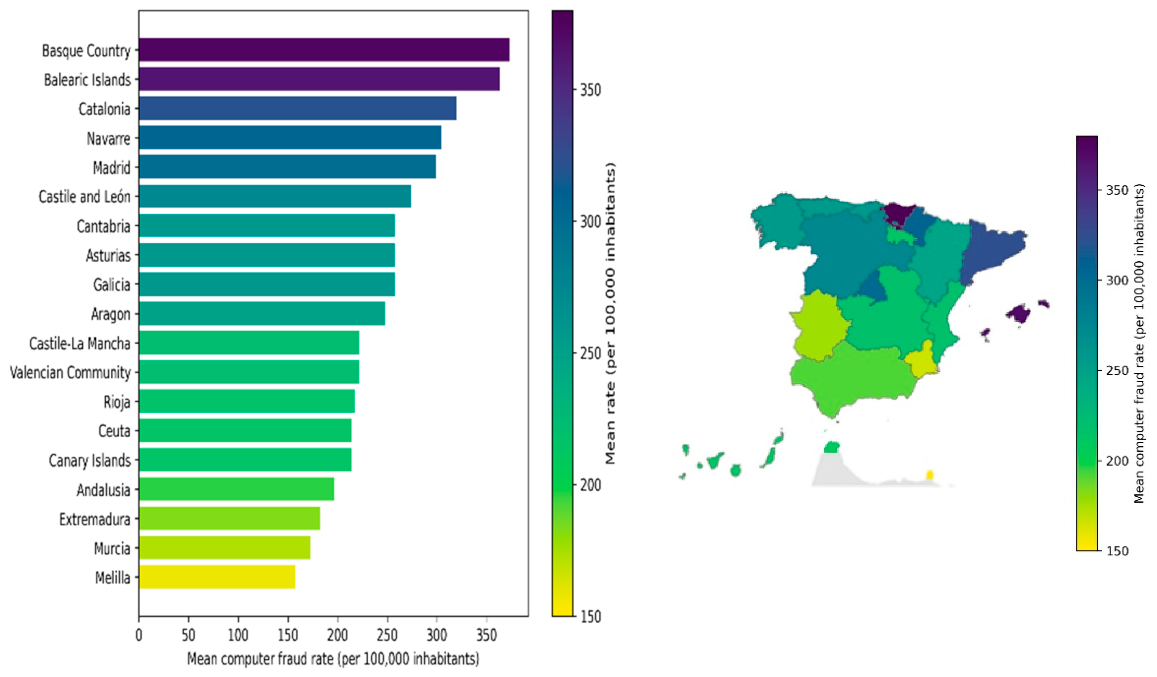
The analysis of mean computer fraud rates in Spanish autonomous communities from 2011 to 2022 revealed substantial regional disparities (
Figure 3). As illustrated in
Figure 3 and
Figure 4, this spatial distribution reveals a clear concentration of higher rates in economically developed and highly digitalized regions. These territorial differences indicate that computer fraud does not expand uniformly across Spain, but reflects variations in digital integration, economic activity, and institutional capacity across regions. The Basque Country recorded the highest mean rate, with 373.0 cases per 100,000 inhabitants, closely followed by the Balearic Islands at 363.3 and Catalonia at 320.1. These three regions constituted the first group in terms of prevalence, standing notably above the national means. In the second, Navarre (304.6), Madrid (298.8), and Castile and León (273.6) also showed elevated mean rates, suggesting persistently high levels of computer fraud throughout the study period. Cantabria, Asturias, and Galicia presented nearly identical means, around 258 cases per 100,000 inhabitants. A mid-range group included Aragon (248.0), Castile-La Mancha (222.2), the Valencian Community (222.1), along with La Rioja (217.2), Ceuta (214.2), and the Canary Islands (214.01). These regions exhibited moderate mean rates, indicating the presence of computer fraud, though on a less pronounced scale than in the territories mentioned above. At the lower end of the distribution, Andalusia (196.4), Extremadura (182.8), and Murcia (172.8) registered relatively modest mean rates. The lowest mean was recorded in Melilla, with 157.7 cases per 100,000 inhabitants, making it the region least exposed to computer fraud during the study period.
3.5. Regional Distribution of Fraud Types in Spain
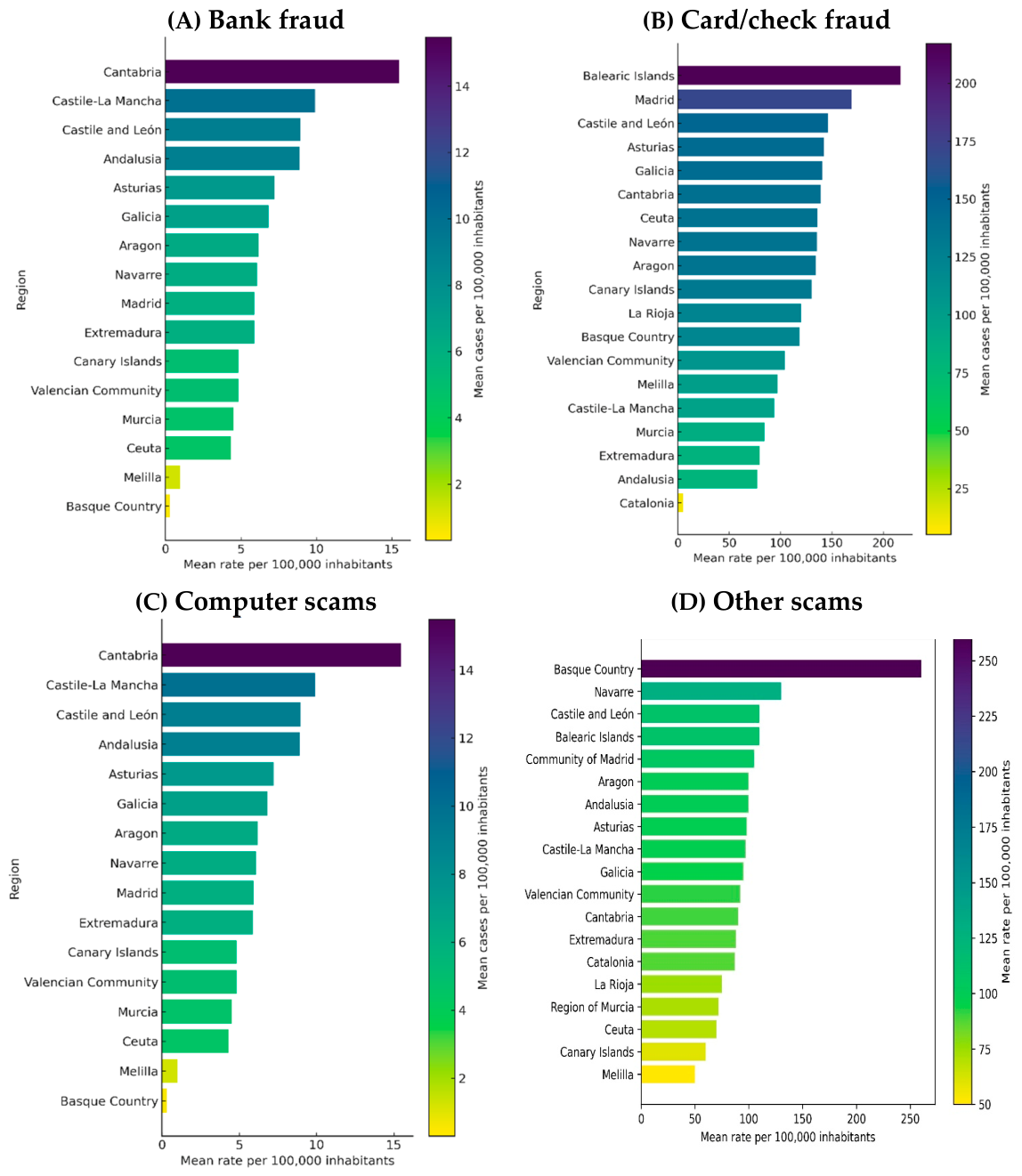
The analysis of regional fraud rates in Spain reveals distinct geographical patterns across the four main types, measured per 100,000 inhabitants, from 2011 to 2022 (
Figure 4). The annual mean rate of bank fraud per 100,000 inhabitants in Spain between 2011 and 2022 varied notably across regions (
Figure 4A). Catalonia recorded the highest mean rate, with 227.42 cases, well above the rest. This figure may be upwardly biased due to differences in the classification of offenses included in this subtype across autonomous communities. The Balearic Islands followed with a mean rate of 37.90 cases, while Navarre (32.40), Castilla-La Mancha (21.79), the Valencian Community (21.07), Madrid (20.88), and the Canary Islands (19.37) also registered relatively high mean rates. In
Figure 4B, which shows fraud involving credit/debit cards and traveler’s checks, the Balearic Islands ranked first (217.1). Madrid (168.8) also recorded high levels. At the lower end, Extremadura (79.6), Andalusia (77.4), and Catalonia (5.1) were below the national mean. The Catalonia figure may be downwardly biased due to differences in the classification of offenses included in this subtype compared with other autonomous communities.
Figure 4C shows computer fraud. Cantabria ranked first (15.5), followed by Castile-La Mancha (9.9) and Castile and León (9.0). The lowest rates were found in Catalonia and the Basque Country, below 1.
Lastly,
Figure 4D highlights other types of fraud, showing a markedly different profile: the Basque Country reports an exceptionally high mean rate (253.3), more than twice that of the next highest region, Navarre (130.7). Castilla y León, the Balearic Islands, and Madrid follow with values just above 100, while Melilla (50.7), the Canary Islands (59.8), and Ceuta (70.0) remain at the lower end of the scale.
3.6. Regional System Profiles and Clustering of Fraud Rates
Five clusters of Spanish regions were identified using K-means clustering of mean fraud rates per 100,000 inhabitants from 2011 to 2022, revealing distinct regional system profiles of fraud exposure. The composition of the clusters was summarized in
Table 2, which lists all regions and their corresponding mean rates. These clusters can be interpreted as recurrent territorial configurations of the fraud system, reflecting different levels of structural exposure and digital vulnerability. Cluster 0 comprises Extremadura, the Region of Murcia, and Melilla, with the lowest national means (171.1). Cluster 1 includes Castile-La Mancha, the Valencian Community, La Rioja, Ceuta, the Canary Islands, and Andalusia, with a mean rate of 214.4. Cluster 2 brings together Castile and León, Cantabria, Asturias, Galicia, and Aragon, with a mean value of 259.1. Cluster 3 consists of Catalonia, Navarre, and the Community of Madrid, which recorded higher levels (mean: 307.8). Finally, Cluster 4, with the highest means (368.2), groups the Basque Country and the Balearic Islands. The groups were renumbered from 0 to 4 in ascending order according to their mean fraud rates. The values reported represent the mean number of computer fraud cases per 100,000 inhabitants between 2011 and 2022.
3.7. Cluster Analysis of Regional Fraud Rates
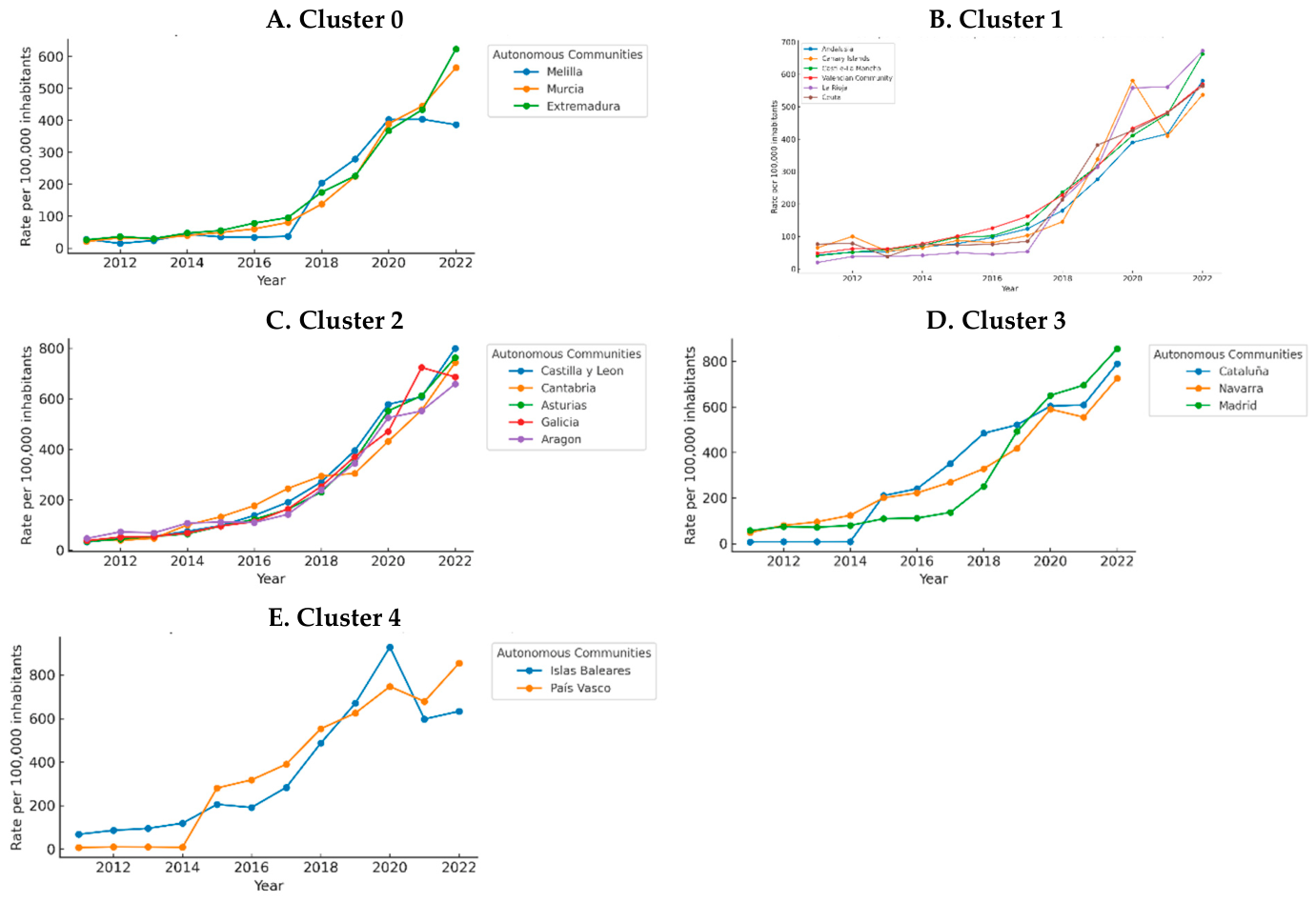
Figure 5 displays the temporal trends of the five clusters, ordered from the lowest to the highest mean rate, to provide a clearer picture of the dynamics within each group. It also highlights the grouping of regions into distinct clusters, reflecting different temporal trajectories and levels of fraud exposure across the national system. Cluster 0 (
Figure 5A) consists of Melilla, the Region of Murcia, and Extremadura. These regions recorded the lowest national means, ranging from 157.6 in Melilla to 182.8 in Extremadura. All three showed moderate growth until 2017, followed by a sharper increase that continued through the end of the period. In 2022, their rates ranged between 386 and 624 incidents per 100,000 inhabitants. Cluster 1 (
Figure 5B) brings together Andalusia, the Canary Islands, Ceuta, La Rioja, the Valencian Community, and Castile-La Mancha. Their mean values ranged from 196.4 (Andalusia) to 222.2 (Castile-La Mancha). Starting at around 20–75 incidents in 2011, all regions experienced sharp increases after 2017, ending in 2022 at 537–673. Castile-La Mancha and La Rioja showed the highest rates at the end of the series. Cluster 2 (
Figure 5C) includes Aragon, Galicia, Asturias, Cantabria, Castile, and León. The mean values of this group ranged from 248.0 in Aragon to 273.6 in Castile and León. Initial rates in 2011 ranged from 33 to 47, and by 2022, they had increased substantially, reaching between 658 and over 799. Cantabria and Galicia were among the regions with the steepest increases in recent years. Cluster 3 (
Figure 5D) comprises the Community of Madrid, Navarre, and Catalonia. These three regions showed higher mean levels: Catalonia at 320.1, Navarre at 304.6, and Madrid at 298.8. Their trajectories revealed steady growth throughout the period, culminating in 2022 with high values of 725.2 in Navarre, 790.6 in Catalonia, and 856.2 in Madrid. Finally, Cluster 4 (
Figure 5E) includes the Balearic Islands and the Basque Country, which consistently displayed the highest national means. The Basque Country recorded the highest means (373.0), followed by the Balearic Islands (363.3). Their trajectories were marked by strong growth between 2015 and 2020, with the Balearic Islands peaking at more than 925 incidents per 100,000 inhabitants before slightly declining, while the Basque Country remained above 850 in the last year.
3.8. System-Level Determinants of Computer Fraud (2022)
Table 3 shows statistically significant system-level associations between various sociodemographic, educational, economic, and technological variables and the rates of computer fraud recorded in Spain in 2022. These associations help characterize the structural configuration of the socio-technical environment in which fraud risk emerges across regions. A significant correlation was found between educational level and the prevalence of other scams in 2022. Specifically, higher education showed a positive correlation with this type of fraud (r = 0.581,
p = 0.014), while both intermediate education (r = −0.597,
p = 0.011) and the first stage of secondary education (r = −0.607,
p = 0.010) were negatively associated. The observed variation in the relationship between education and fraud can be interpreted in terms of differential exposure and participation in digital environments. Higher educational attainment is often associated with greater use of online financial services, digital platforms, and complex economic transactions, which may increase exposure to fraud opportunities. In contrast, individuals with intermediate levels of education may have lower engagement with such systems, thereby reducing their exposure. These patterns suggest that education does not act as a simple protective factor, but rather interacts with digital behavior and economic activity, shaping distinct vulnerability profiles within the broader socio-technical system. No other significant correlations were observed between the remaining educational categories and the different types of fraud, including bank fraud, card/check fraud, and computer scams (
p > 0.05). On the other hand, a significant correlation was found between income level and the incidence of other scams. Specifically, high income was strongly positively correlated with this type of fraud (r = 0.691,
p = 0.001). No other statistically significant associations were observed between income categories and the remaining types of fraud (bank fraud, card/check fraud, and computer scams), although lower-middle income showed a marginally non-significant negative correlation with other scams (r = −0.465,
p = 0.052). Taken together, these findings suggest that fraud incidence is shaped not by isolated variables, but by the interaction of multiple structural components of the regional socio-technical system. A significant correlation was observed between frequent Internet usage and certain types of fraud. Specifically, multiple daily uses of the Internet showed a positive correlation with bank fraud (r = 0.281,
p = 0.039), a negative correlation with card/check fraud (r = −0.353,
p = 0.009), and a negative correlation with computer scams (r = −0.318,
p = 0.019). No other significant correlations were found between Internet usage rates and other types of fraud (
p > 0.05). Finally, strong correlations were found between digital household equipment and computer-related fraud. Broadband access showed the highest correlation with bank fraud (r = 0.968,
p = 0.000) and other scams (r = 0.925,
p = 0.000), closely followed by general Internet access and mobile connectivity. In contrast, landline access was negatively associated with all fraud types, most notably with other scams (r = −0.953,
p = 0.000) and card/check fraud (r = −0.913,
p = 0.000). While positively associated, computer ownership showed a weaker correlation with computer scams (r = 0.552,
p = 0.098), which did not reach statistical significance. High digital connectivity, combined with greater economic activity and regional exposure to online transactions, appears to amplify vulnerability patterns across territories.
3.9. Sex and Age Differences in Computer Fraud Rates
Comparative analysis of fraud victimization rates by sex, age group, and fraud type in Spain between 2011 and 2022 reveals consistent patterns across all demographic segments. However, no statistically significant differences by sex were found (
Table 4). Focusing on the most common type, card and check fraud, among those under 18, both sexes showed very low mean rates (0.69 for men versus 0.75 for women; t = −0.003,
p = 0.998). This trend of low victimization extended to all types of fraud in this age group, and none of the comparisons yielded significant differences.
In contrast, mean rates were high across most adult age groups. Among individuals aged 18 to 25, the mean rate for men was 109.19 cases per 100,000 population, compared to 126.70 for women (t = −0.334, p = 0.742). In the 26–40 age group, the mean rate for men was 129.91 and for women 141.93 (t = −0.227, p = 0.823), while in the 41–50 age group, men had a mean rate of 125.95 and women 130.84 (t = −0.094, p = 0.926). These differences were minimal and not statistically significant. Similarly, in the 51- to 65-year-old group, men recorded 112.13 and women 94.75 (t = 0.388, p = 0.702), again with no significant differences. Finally, for those aged 65 and over, the mean rate of card and check fraud was clearly higher among men (58.98) than among women (29.04), but the difference was also not significant (t = 1.280, p = 0.218).
Similar patterns were observed for all other types of fraud (bank, computer, and other). None of the sex-based comparisons showed statistically significant differences across all combinations of fraud type and age group examined (all p-values > 0.05).
3.10. Projected Trends in Computer Fraud Rates by Sex and Age (2011–2035)
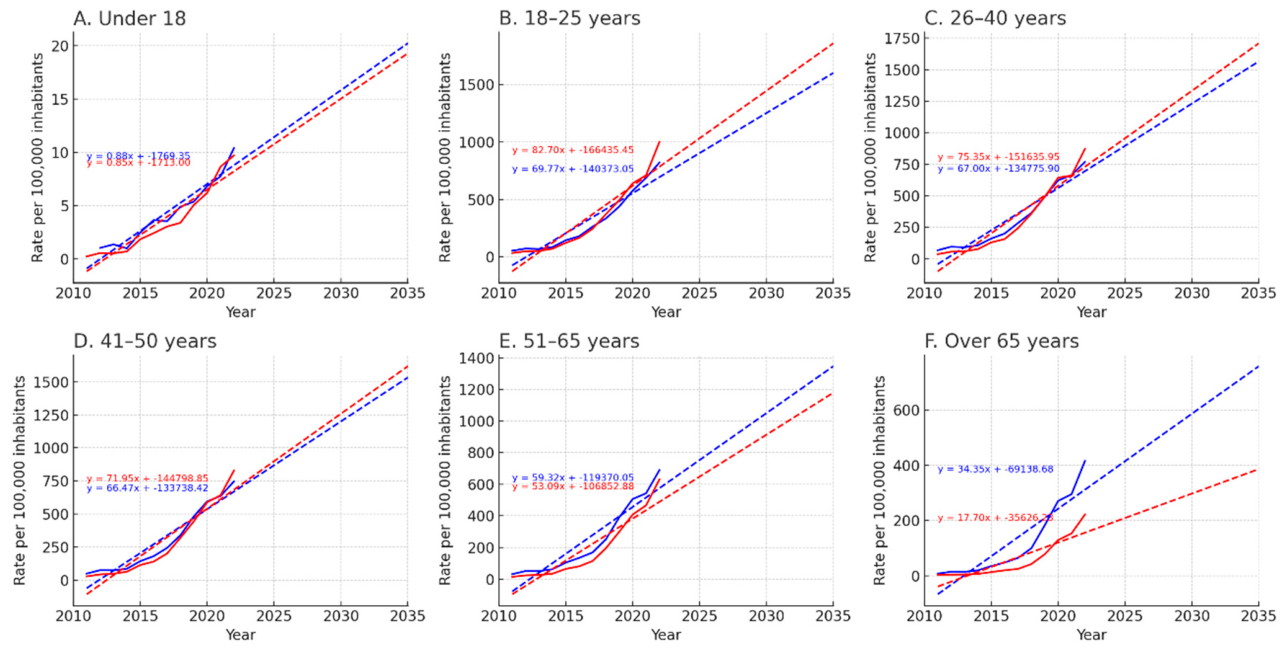
The temporal patterns of computer fraud in Spain reveal marked differences by age and sex over 2011–2022, with linear projections extending to 2035 (
Figure 6).
In
Figure 6A, which shows individuals under 18, both sexes show a moderate increase, but the trend is notably steeper among females (y = 2.55x − 5076.91) than among males (y = 0.95x − 1895.09). Although absolute rates remain relatively low in this age group, the sharp rise among girls suggests an especially pronounced relative increase. The gap between sexes widens significantly in the 18–25 age group (
Figure 6B). Women exhibit much higher fraud rates, with a slope of 0.18 (y = 0.18x − 362.64) versus just 0.05 among men (y = 0.05x − 108.29), indicating a rapid acceleration in fraud victimization among young adult females. This trend is even more evident in
Figure 6C, representing the 26–40 group, where female rates follow an upward trajectory (y = 0.25x − 507.69). In contrast, male rates remain flat (y = 0.00x + 0.00), suggesting a potential plateau in this male subgroup. The same dynamic persists in
Figure 6D (41–50 years), where women continue to lead the increase in fraud rates, with a slope of 0.22 (y = 0.22x − 435.16) versus 0.05 for men (y = 0.05x − 108.29), suggesting a potential increase in female victimization in future projections. However, observed differences between sexes remain statistically non-significant. In
Figure 6E (51–65 years), men show no growth (y = 0.00x + 0.00), while women display a significantly steeper projection (y = 0.33x − 652.75), consolidating a gap that is not only statistically relevant but also socially significant, given the implications in terms of digital vulnerability. Finally,
Figure 6F (over 65 years) shows slower increase rates for both sexes. However, women again surpass men in slope (y = 0.15x − 290.11 vs. y = 0.08x − 162.44).
4. Discussion
This study examined the temporal evolution, regional disparities, and structural determinants of computer fraud in Spain, as well as its projected trends through 2035. Taken together, the findings indicate that computer fraud operates as a socio-technical and territorial system in which digital infrastructures, economic activity, user behavior, and institutional conditions interact to shape uneven patterns of exposure and growth. In this context, fraud cannot be explained by single-factor effects, but rather by the interaction between digital, socioeconomic, and territorial dimensions. Regions with higher connectivity and economic development are not only more digitally integrated but also more exposed to complex financial ecosystems, increasing opportunities for fraud. At the same time, territorial differences in reporting capacity and institutional response further modulate observed incidence rates, resulting in heterogeneous vulnerability patterns across regions. This integrative approach represents a key contribution of the present study, as it moves beyond single-factor explanations and provides a system-level understanding of computer fraud that simultaneously incorporates temporal, territorial, and structural dimensions. Accordingly, the following discussion interprets these empirical patterns and explains the underlying mechanisms within a socio-technical systems framework.
These findings reinforce the interpretation of computer fraud as an emergent property of a socio-technical system, in which digital expansion does not simply increase the number of online users but also reshapes the structure of exposure, opportunity, and vulnerability. Connectivity, income, technological access, and territorial conditions should therefore not be interpreted as isolated predictors, but as interacting components that generate cumulative risk environments. From this perspective, higher fraud rates in more developed and digitalized regions do not contradict socioeconomic progress; rather, they reflect the greater intensity of digitally mediated financial and social interactions in these territories.
Our results show that computer fraud has sustained and accelerated growth across all autonomous communities. This sustained increase may be explained by the rapid expansion of digital infrastructures and online financial services, which increases both exposure to fraud opportunities and the scale at which such offenses can be executed. Our data also reveal firm regional heterogeneity: the highest rates were concentrated in regions with higher income levels and digital penetration (Basque Country, Balearic Islands, Catalonia), while less developed regions displayed lower figures. Madrid experienced accelerated growth from 2017 to 2022, suggesting that regional rankings may shift in the future. Rather than representing isolated local anomalies, these regional disparities can be interpreted as differences in the configuration of socio-technical systems, in which connectivity, digital financial activity, economic resources, institutional capacity, and reporting practices interact to shape distinct levels of fraud exposure.
This interpretation also helps explain why territorial disparities persist despite a common national legal framework. Regional differences may reflect not only variation in fraud exposure, but also differences in reporting practices, institutional capacity, digital banking penetration, and public awareness of cybercrime. Thus, the observed regional patterns should be understood as the result of both actual victimization dynamics and the capacity of each territorial system to detect, classify, and report computer fraud.
This pattern suggests that technological development increases opportunities for victimization rather than ensuring greater security [
15,
23]. Other studies confirm these observations, showing that the rapid expansion of digital adoption and online financial services has created new opportunities for fraudulent activity and significantly increased consumer exposure to cybercrime [
21,
24]. McKinsey & Company (2022) [
25] highlights that fraud has escalated as digital adoption has accelerated, enabling new and more sophisticated schemes, while Kubilay et al. (2023) [
26] emphasize that the spread of digital financial services has raised serious consumer protection concerns, particularly fraud and scams. Recent reports at the European level also stress that fraud has become the most frequently reported crime type, driven mainly by the proliferation of online platforms and services [
27].
From a sociodemographic perspective, our findings show that young adults (18–25 years) were the most affected group, followed by middle-aged adults, while those over 65 years, although initially less exposed, recorded a sustained increase over the last decade. These results confirm the progressive reduction in the so-called “age protection gap” in Spain, a phenomenon documented in other contexts as well [
11,
28]. Our study also found no statistically significant differences between men and women, suggesting a balanced pattern of victimization by sex. However, other authors have noted that specific subtypes of fraud, such as romance fraud, disproportionately affect women [
12,
29], introducing relevant qualitative nuances. From a structural standpoint, our correlational analyses indicated that fraud risk is associated with broadband access, intensive internet use, and mobile device availability. These findings suggest that digital connectivity acts as a structural driver of fraud exposure, as increased access to online environments expands both legitimate and illicit interactions within the digital economy. Rather than acting independently, these factors appear to form part of an interconnected socio-technical environment in which greater digital integration may expand opportunities for fraud. Conversely, more traditional technologies, such as landline telephony, were associated with a lower incidence, suggesting a different exposure profile [
25]. We also found a positive correlation with educational attainment and income levels, indicating that fraud is not limited to conventionally vulnerable groups but may be facilitated by higher levels of participation in digitally mediated economic activity. This relationship can be interpreted in terms of differential exposure to digital environments. Higher educational attainment may be associated with greater use of online financial services, digital platforms, and complex economic transactions, thereby increasing exposure to fraud opportunities. In contrast, intermediate educational levels may reflect lower engagement with these systems. Thus, education should not be interpreted as a simple protective factor, but as a variable that interacts with digital behavior and economic activity to shape vulnerability profiles. These findings should be interpreted as correlational patterns rather than causal relationships, reflecting structural associations within the socio-technical system. Thus, education should not be interpreted as a simple protective factor, but as a variable that interacts with digital behavior and economic activity to shape vulnerability profiles. These findings should be interpreted as correlational patterns rather than causal relationships, reflecting structural associations within the socio-technical system.
These results are consistent with the warnings of international bodies, which stress the need to consider demographic and structural factors when designing vulnerability profiles [
26]. Finally, our results confirm that fraud incidence will continue to rise if no specific measures are implemented, as indicated by the linear projections through 2035. This projected growth suggests that, in the absence of structural interventions, the underlying drivers of the system, digital expansion, financial integration, and uneven territorial vulnerability, may continue to amplify fraud dynamics over time.
These conclusions place the Spanish experience within the broader European context, where digital fraud is the most frequently reported crime type [
30]. A study further highlights that the phenomenon is accompanied by a prominent “dark figure,” as a significant proportion of incidents go unreported, limiting the ability of official statistics to capture its true magnitude [
31]. Our study provides empirical evidence specific to Spain, identifying territorial inequalities and sociodemographic and structural profiles of victimization. These findings reinforce the notion that computer fraud is a complex, structural, and expanding phenomenon, whose prevention requires tailored policies by region, age, and level of digitalization [
29,
32]. From a systems perspective, this implies the need for adaptive, multi-level governance strategies to strengthen system resilience, reduce structural exposure, and improve coordination among technological, legal, financial, and educational responses. In practical terms, prevention strategies should be adapted to different regional profiles. Highly digitalized regions with high fraud incidence may require advanced monitoring systems, stronger cooperation between financial institutions and law enforcement agencies, and rapid-response mechanisms for emerging fraud modalities. In contrast, regions with lower digital development may benefit more from preventive interventions focused on digital literacy, safe online financial behavior, and early user protection. Intermediate regions may require hybrid strategies combining technological surveillance with educational and awareness-based measures.
Nevertheless, several limitations should be noted. First, our data are derived from official police records, which are subject to underreporting and may underestimate the true magnitude of computer fraud due to the well-known dark figure of crime, as many incidents remain unreported or undetected. In addition, future research may benefit from triangulating official police data with alternative sources, such as victimization surveys, financial sector reports, or cybersecurity datasets, to improve the accuracy and completeness of fraud estimates. Second, differences in the timing and completeness of police reporting systems between regions may introduce comparative biases. Catalonia and the Basque Country incorporated their records into the national system later, which may have affected the series’ temporal comparability. This delayed inclusion may introduce measurement bias and artificially inflate recorded fraud rates, affecting temporal comparability and potentially overstating growth trends in certain regions. In addition, projections to 2035 are based on the continuation of current trends and do not account for potential policies, technological, or behavioral changes, which introduce uncertainty and may affect the accuracy of future estimates.
Finally, the associations identified with socioeconomic and technological factors are correlational and do not imply causality. In addition, the present study does not explicitly model feedback mechanisms, non-linear dynamics, or causal interdependencies among variables. Future research should address these limitations by applying advanced analytical approaches, such as multivariate regression models, longitudinal designs, and dynamic or network-based methods, to better capture causal relationships and system interactions. Additionally, K-means clustering may be sensitive to initial conditions and does not capture temporal dynamics, which may affect the stability and interpretation of the identified regional groupings. Therefore, these results should be considered exploratory, and future research should incorporate alternative clustering methods and stability analyses to validate these patterns. Furthermore, the use of bivariate correlations without control variables may introduce bias due to unobserved confounding factors, and therefore, the observed associations should be interpreted as exploratory rather than causal.